US3283224A - Mold capping semiconductor device - Google Patents
Mold capping semiconductor deviceDownload PDFInfo
- Publication number
- US3283224A US3283224AUS480577AUS48057765AUS3283224AUS 3283224 AUS3283224 AUS 3283224AUS 480577 AUS480577 AUS 480577AUS 48057765 AUS48057765 AUS 48057765AUS 3283224 AUS3283224 AUS 3283224A
- Authority
- US
- United States
- Prior art keywords
- electrical contact
- header member
- semiconductor
- lead
- ribbon
- Prior art date
- Legal status (The legal status is an assumption and is not a legal conclusion. Google has not performed a legal analysis and makes no representation as to the accuracy of the status listed.)
- Expired - Lifetime
Links
Images
Classifications
- H—ELECTRICITY
- H01—ELECTRIC ELEMENTS
- H01L—SEMICONDUCTOR DEVICES NOT COVERED BY CLASS H10
- H01L23/00—Details of semiconductor or other solid state devices
- H01L23/28—Encapsulations, e.g. encapsulating layers, coatings, e.g. for protection
- H01L23/31—Encapsulations, e.g. encapsulating layers, coatings, e.g. for protection characterised by the arrangement or shape
- H01L23/3107—Encapsulations, e.g. encapsulating layers, coatings, e.g. for protection characterised by the arrangement or shape the device being completely enclosed
- H01L23/3135—Double encapsulation or coating and encapsulation
- H—ELECTRICITY
- H01—ELECTRIC ELEMENTS
- H01L—SEMICONDUCTOR DEVICES NOT COVERED BY CLASS H10
- H01L23/00—Details of semiconductor or other solid state devices
- H01L23/28—Encapsulations, e.g. encapsulating layers, coatings, e.g. for protection
- H01L23/31—Encapsulations, e.g. encapsulating layers, coatings, e.g. for protection characterised by the arrangement or shape
- H01L23/3107—Encapsulations, e.g. encapsulating layers, coatings, e.g. for protection characterised by the arrangement or shape the device being completely enclosed
- H01L23/3121—Encapsulations, e.g. encapsulating layers, coatings, e.g. for protection characterised by the arrangement or shape the device being completely enclosed a substrate forming part of the encapsulation
- H—ELECTRICITY
- H01—ELECTRIC ELEMENTS
- H01L—SEMICONDUCTOR DEVICES NOT COVERED BY CLASS H10
- H01L23/00—Details of semiconductor or other solid state devices
- H01L23/48—Arrangements for conducting electric current to or from the solid state body in operation, e.g. leads, terminal arrangements ; Selection of materials therefor
- H01L23/488—Arrangements for conducting electric current to or from the solid state body in operation, e.g. leads, terminal arrangements ; Selection of materials therefor consisting of soldered or bonded constructions
- H01L23/498—Leads, i.e. metallisations or lead-frames on insulating substrates, e.g. chip carriers
- H01L23/49811—Additional leads joined to the metallisation on the insulating substrate, e.g. pins, bumps, wires, flat leads
- H—ELECTRICITY
- H01—ELECTRIC ELEMENTS
- H01L—SEMICONDUCTOR DEVICES NOT COVERED BY CLASS H10
- H01L2924/00—Indexing scheme for arrangements or methods for connecting or disconnecting semiconductor or solid-state bodies as covered by H01L24/00
- H01L2924/0001—Technical content checked by a classifier
- H01L2924/0002—Not covered by any one of groups H01L24/00, H01L24/00 and H01L2224/00
- H—ELECTRICITY
- H01—ELECTRIC ELEMENTS
- H01L—SEMICONDUCTOR DEVICES NOT COVERED BY CLASS H10
- H01L2924/00—Indexing scheme for arrangements or methods for connecting or disconnecting semiconductor or solid-state bodies as covered by H01L24/00
- H01L2924/10—Details of semiconductor or other solid state devices to be connected
- H01L2924/11—Device type
- H01L2924/12—Passive devices, e.g. 2 terminal devices
- H01L2924/1204—Optical Diode
- H01L2924/12044—OLED
Definitions
- Semiconductor junction devicesare very sensitive to overloading or excessive junction temperature, for which reason it has become known to mount the devices upon a stud or base of heat conductive material which either acts as a heat sink or as a means of mounting the device to a heat sink.
- the present inventionis directed toward structural improvements in this type of semiconductor device.
- a header member of electrical insulating materialhas spaced-apart electrical contact regions on its upper surface, the semiconductor crystal being mounted with a region of one conductivity type in ohmic connection with one of the electrical contact regions and being provided with a lead wire or lead wires ohmically connecting its region of opposite conductivity type or regions of opposite and similar conductivity types with other electric- ⁇ ally isolated contact region or regions.
- a separate electroconductive leadis connected to each of the electrical contact regions such that one end of the ribbon lead projects beyond the lheader member.
- a solid plastic capis molded over the upper portion of the header member to embed the electrical contact regions, the semiconductor body and lead wires, and the secured ends of the ribbon leads, whereby only the projecting ends of the ribbon leads and the lower portion of the header member are exposed.
- the plastic encapsulating capis conveniently formed by transfer moldings.
- the surfaces to be encapsulatedcan conveniently be covered with a buffer coating prior to molding to absorb thermal and mechanical stresses during the molding process and to equalize molding pressure so that critical or physically weak structural components are not strained.
- the completed deviceis solid and void-free, thereby eliminating the possibility of migration of loose particles within the device, increasing radiation resistance by eliminating the usual pocket of ionizable gas, and solidly embedding the semiconductor crystal and delicate internal leads.
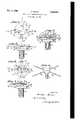
- FIGURE lis a plan view of a semiconductor mounting structure
- FIGURE 2is an elevation view of the structure shown in FIGURE 1;
- FIGURE 3is a plan view of the mounting structure of FIGURE l with a semiconductor crystal mounted thereon;
- FIGURE 4is an elevation view of the structure shown in FIGURE 3 after the addition of a buffer coating over the uppermost portion of the structure;
- FIGURE 5is an elevational view, partly in section, of the completed semiconductor device.
- FIGURE 6is a perspective view of the completed semiconductor device.
- the present invention mounting structureincludes a disc 10 of ⁇ heat conductive, electrical insulating material, preferably beryllia or other suitable ceramic.
- the disc 10defines an upper surface 11 and a lower surface 12, a thin layer of metal 13 being established on the lower surface 12 by chemi-plating or other suitable metalizing technique.
- the upper surface 11is also metalized in a predetermined pattern to thereby define a die mounting pad 15 and spaced apart electrical contacts 16, 17 and 18.
- a heat sink stud 20is brazed to the metalized lower surface of the disc 10, the stud 20 being preferably copper or a low thermal resistance alloy.
- the stud 20may be of a heat conductive, electrical insulating material, and can be formed integral with the disc 10 (the metal layer 13 then being unnecessary).
- a series of four electroconductive ribbon leads 21-24are secured in low resistance ohmic contact t-o the various metalized regions on the upper surface 11 of the disc 10, such as by brazing, for example.
- any number of leadsmay be used depending on the nature of the device (e.g., typically two for a diode).
- the discmay be directly affixed to a heat conductive surface.
- the ribbon leadsare attached at one of their ends and oriented so that they project radially beyondv the disc 10, the ribbon lead 21 being bonded to the die mounting pad 15, the ribbon lead 22 being bonded to the electrical contact 16, the ribbon lead 23 bonded to the electrical contact 17, and the ribbon lead 24 bonded to the electrical contact 18.
- the mounting structureis ready to receive the semiconductor crystal which forms the heart of the PN junction device.
- FIGURE 3 of the drawingshows the structure of FIG- URES l and 2 to which is mounted a semiconductor crystal wafer, generally indicated by the reference numeral 25.
- the crystal wafer 25comprises a disc shaped wafer or die of N-type silicon into the upper surfaces of which are diffuse-d atoms of P-type and subsequently N-type Iactive impurities in such configuration so as to form a so-called planar NPN transistor structure.
- the general configuration of such planar structures and suitable fabrication techniques to form themare well known in the art and will not be discussed in detail, beyond stating that the lower surface yof the wafer defines an N-type collector region while N-type emitter and P-type base regions are defined in its upper surface.
- the lower surface of the semiconductor crystal Wafer 25is bonded in low resistance ohmie contact to the larger central portion of the die mounting pad 15, thereby establishing the ribbon lead 21 as the collector terminal of the transistor.
- Contact leads 26 and 28 of fine wireare ohmically bonded to the N-type emitter region on the upper surface of the crystal and to the ribbon leads 22 and 24 respectively, thereby establishing the ribbon leads 22 and 24 as the transistor dual emitter leads.
- the ribbon lead 23is established as the transistor base terminal by bonding a Whisker lead 27 to the ribbon lead 23 and to the P-type base region defined on the upper surface of the crystal wafer.
- the desired ohmic contactcan be achieved by thermo-compression bonding the whisker leads 26-28 to the semiconductor crystal wafer 25 and welding them to the ribbon leads.
- the sub-assembly Iat this stage of fabricationwill then appear as shown in FIGURE 3.
- the sub-assemblyis buffer coated by for-ming a soft elastic coating 30 of silicone resin, or other suitable polymer, over the semiconductor wafer, the Whisker leads, the electrical contact regions and die mounting pad, and exposed upper surface portions of the ldisc 10.
- This coatingcan be conveniently applied with a small brush.
- the buffer coating 30Upon application of the buffer coating 30, the subassembly will appear as shown in FIGURE 4.
- the purpose of the buffer coatingis to provide a soft land elastic medium surrounding the semiconductor crystal and the fine Wire internal lead connections so that subsequently applied molding pressure, lor any thermal strain that would be developed in the solid molded package, will be absorbed by the elastic material so that strain will not be applied or transferred directly to critical and physically weak structural components.
- the buffer coated sub-assemblyis then loaded into a mold and ya plastic eap (silicone molding compound) 35 is transfer molded over the upper portion of the disc '10, contiguous with the coating 30 to thereby effectively embed the electrical contact regions and die mounting pad, the semiconductor wafer and Whisker leads, and the secured ends of the ribbon leads.
- ya plastic eapsilicone molding compound
- the finished packageis solid and void-free, thereby eliminating the possibility of migration of loose particles in the area of the semiconductor wafer that could cause short circuits.
- the embedding of the Whisker leads forming the internal connections of the devicegreatly increases the resistance of the device to shock and vibration.
- the presence of the buffer coatingabsorbs the thermal shock, thereby contributing to a more rugged device.
- Power transistors constructed in accordance with the present invention technique for operation at 150 megacycles with a power rating of watts under pulse conditionshave exhibited the following characteristics:
- Thermal resistance8/75 C./W.
- Collector to base voltage70 v. D. ⁇ C.
- Collector to emitter voltage(16:50 ma.) 40 v. D.C.
- a semiconductor devicecomprising:
- header member of electrical insulating heat conductive materialhaving a uniplanar upper surface and a lower surface, the lower surface of said header member defining a broad area contact for the conduction of heat from said header body to a heat sink;
- a semiconductor devicecomprising:
- header member of electrical insulating heat conductive materialhaving a uniplanar upper surface and a lower surface, the lower surface -of said header member defining a broad area contact for the conduction of heat from said header body to a heat sink;
- a body of semiconductor material containing at least one PN junctionsaid body of semiconductor material being mounted with a region of one conductivity type in ohmic connection with said first electrical contact region and being provided with a lead wire ohmically connecting a region of opposite conductivity type with said second electrical contact region;
Landscapes
- Engineering & Computer Science (AREA)
- Microelectronics & Electronic Packaging (AREA)
- Physics & Mathematics (AREA)
- Condensed Matter Physics & Semiconductors (AREA)
- General Physics & Mathematics (AREA)
- Computer Hardware Design (AREA)
- Power Engineering (AREA)
- Structures Or Materials For Encapsulating Or Coating Semiconductor Devices Or Solid State Devices (AREA)
- Cooling Or The Like Of Semiconductors Or Solid State Devices (AREA)
Description
Nov. l, 1966 G. ERKAN MOLD CAPPING SEMICONDUCTOR DEVICE Filed Aug. 18, 1965 lre 5.
United States Patent 3,283,224 MLD CAPPHNG SEMICONDUCTOR DEVICE Gunduz Erkan, Torrance, Calif., assignor to TRW Semiconductors, inc., Lawndale, Calif., a corporation of California Filed Aug. 18, 1965, Ser. No. 480,577 2 Claims. (Cl. 317-234) This invention relates to semiconductor devices and more particularly to a semiconductor encapsulation technique using a molded cap.
Semiconductor junction devices are very sensitive to overloading or excessive junction temperature, for which reason it has become known to mount the devices upon a stud or base of heat conductive material which either acts as a heat sink or as a means of mounting the device to a heat sink. The present invention is directed toward structural improvements in this type of semiconductor device.
In accordance with the present invention technique a header member of electrical insulating material has spaced-apart electrical contact regions on its upper surface, the semiconductor crystal being mounted with a region of one conductivity type in ohmic connection with one of the electrical contact regions and being provided with a lead wire or lead wires ohmically connecting its region of opposite conductivity type or regions of opposite and similar conductivity types with other electric- `ally isolated contact region or regions. A separate electroconductive lead is connected to each of the electrical contact regions such that one end of the ribbon lead projects beyond the lheader member. A solid plastic cap is molded over the upper portion of the header member to embed the electrical contact regions, the semiconductor body and lead wires, and the secured ends of the ribbon leads, whereby only the projecting ends of the ribbon leads and the lower portion of the header member are exposed. The plastic encapsulating cap is conveniently formed by transfer moldings. The surfaces to be encapsulated can conveniently be covered with a buffer coating prior to molding to absorb thermal and mechanical stresses during the molding process and to equalize molding pressure so that critical or physically weak structural components are not strained. Thus, the completed device is solid and void-free, thereby eliminating the possibility of migration of loose particles within the device, increasing radiation resistance by eliminating the usual pocket of ionizable gas, and solidly embedding the semiconductor crystal and delicate internal leads.
Accordingly, it is an object of the present invention to provide an improved semiconductor device.
It is also an object of the present invention to provide an improved semiconductor device of the type utilizing a heat conductive header.
It is another object of the present invention to provide an improved semiconductor packaging technique.
It is still another object of the present invention to provide an improved semiconductor fabrication technique utilizing a mold capping method.
It is `a still further object of the present invention to provide a mounting header for a semiconductor device intended for use at very high frequencies and at high power levels.
It is also an object of the present invention to provide a semiconductor' device encapsulated with a molded plastic cap, :and wherein only a minor part of the total heat dissipation of the device occurs through electrical ribbon leads protruding through the encapsulation.
The novel features which are believed to be characteristic of the invention, both `as to its organization and method of operation, together with further objects and 3,283,224- Patented Nov. 1, 1966 advantages thereof will be better understood from the following description considered in connection with the accompanying drawing in which a presently preferred embodiment of the invention is illustrated by way of example. It is to be expressly understood, however, that the drawing is for the purpose of illustration and description only, and is not intended as a definition of the limits of the invention.
In the drawing:
FIGURE l is a plan view of a semiconductor mounting structure;
FIGURE 2 is an elevation view of the structure shown in FIGURE 1;
FIGURE 3 is a plan view of the mounting structure of FIGURE l with a semiconductor crystal mounted thereon;
FIGURE 4 is an elevation view of the structure shown in FIGURE 3 after the addition of a buffer coating over the uppermost portion of the structure;
FIGURE 5 is an elevational view, partly in section, of the completed semiconductor device; and
FIGURE 6 is a perspective view of the completed semiconductor device.
Referring to the drawings, `and in particular to FIG- URES l and 2, the present invention mounting structure includes adisc 10 of `heat conductive, electrical insulating material, preferably beryllia or other suitable ceramic. Thedisc 10 defines anupper surface 11 and a lower surface 12, a thin layer ofmetal 13 being established on the lower surface 12 by chemi-plating or other suitable metalizing technique. Theupper surface 11 is also metalized in a predetermined pattern to thereby define adie mounting pad 15 and spaced apartelectrical contacts
Aheat sink stud 20 is brazed to the metalized lower surface of thedisc 10, thestud 20 being preferably copper or a low thermal resistance alloy. Alternatively, thestud 20 may be of a heat conductive, electrical insulating material, and can be formed integral with the disc 10 (themetal layer 13 then being unnecessary). A series of four electroconductive ribbon leads 21-24 are secured in low resistance ohmic contact t-o the various metalized regions on theupper surface 11 of thedisc 10, such as by brazing, for example. Of course any number of leads may be used depending on the nature of the device (e.g., typically two for a diode). Further, alternatively it will be understood that the disc may be directly affixed to a heat conductive surface. As can best be seen in FIGURE 1 the ribbon leads are attached at one of their ends and oriented so that they project radially beyondv thedisc 10, theribbon lead 21 being bonded to thedie mounting pad 15, theribbon lead 22 being bonded to theelectrical contact 16, theribbon lead 23 bonded to theelectrical contact 17, and theribbon lead 24 bonded to theelectrical contact 18. At this stage of fabrication the mounting structure is ready to receive the semiconductor crystal which forms the heart of the PN junction device.
FIGURE 3 of the drawing shows the structure of FIG- URES l and 2 to which is mounted a semiconductor crystal wafer, generally indicated by the reference numeral 25. In the illustrated embodiment the crystal wafer 25 comprises a disc shaped wafer or die of N-type silicon into the upper surfaces of which are diffuse-d atoms of P-type and subsequently N-type Iactive impurities in such configuration so as to form a so-called planar NPN transistor structure. The general configuration of such planar structures and suitable fabrication techniques to form them .are well known in the art and will not be discussed in detail, beyond stating that the lower surface yof the wafer defines an N-type collector region while N-type emitter and P-type base regions are defined in its upper surface. The lower surface of the semiconductor crystal Wafer 25 is bonded in low resistance ohmie contact to the larger central portion of thedie mounting pad 15, thereby establishing theribbon lead 21 as the collector terminal of the transistor. Contact leads 26 and 28 of fine wire are ohmically bonded to the N-type emitter region on the upper surface of the crystal and to the ribbon leads 22 and 24 respectively, thereby establishing the ribbon leads 22 and 24 as the transistor dual emitter leads. Theribbon lead 23 is established as the transistor base terminal by bonding aWhisker lead 27 to theribbon lead 23 and to the P-type base region defined on the upper surface of the crystal wafer. The desired ohmic contact can be achieved by thermo-compression bonding the whisker leads 26-28 to the semiconductor crystal wafer 25 and welding them to the ribbon leads. The sub-assembly Iat this stage of fabrication will then appear as shown in FIGURE 3.
Next, the sub-assembly is buffer coated by for-ming a softelastic coating 30 of silicone resin, or other suitable polymer, over the semiconductor wafer, the Whisker leads, the electrical contact regions and die mounting pad, and exposed upper surface portions of theldisc 10. This coating can be conveniently applied with a small brush. Upon application of thebuffer coating 30, the subassembly will appear as shown in FIGURE 4. The purpose of the buffer coating is to provide a soft land elastic medium surrounding the semiconductor crystal and the fine Wire internal lead connections so that subsequently applied molding pressure, lor any thermal strain that would be developed in the solid molded package, will be absorbed by the elastic material so that strain will not be applied or transferred directly to critical and physically weak structural components.
The buffer coated sub-assembly is then loaded into a mold and ya plastic eap (silicone molding compound) 35 is transfer molded over the upper portion of the disc '10, contiguous with thecoating 30 to thereby effectively embed the electrical contact regions and die mounting pad, the semiconductor wafer and Whisker leads, and the secured ends of the ribbon leads. Thus, only the free ends of the ribbon leads protrude from the molded cap, While thestud 20 is exposed beneath the plastic cap, as shown in FIGURES 5 and 6 of the drawing.
The finished package is solid and void-free, thereby eliminating the possibility of migration of loose particles in the area of the semiconductor wafer that could cause short circuits. The embedding of the Whisker leads forming the internal connections of the device greatly increases the resistance of the device to shock and vibration. The presence of the buffer coating absorbs the thermal shock, thereby contributing to a more rugged device.
Power transistors constructed in accordance with the present invention technique for operation at 150 megacycles with a power rating of watts under pulse conditions, have exhibited the following characteristics:
Maximum ratings Storage temperature 65 C. to 200 C. Operating junction temp. 65 C. to 200 C. Lead temperature (1/16 from cap for l0 sec.) 230 C, Total dissipation at leap temperawatts.
Thermal resistance (junction to cap) 8/75 C./W. Collector to base voltage 70 v. D.\C. Collector to emitter voltage (RB=10Q) 70 v. D.C. Collector to emitter voltage (16:50 ma.) 40 v. D.C.
d Emitter to base voltage 4.0 v. D.C. D.C. collector current, continuous 1.2 a. D.C. D C. base current, continuous 0.5 a. D.C.
Although the invention has been described with a certain degree of particularity, it is understood that the present disclosure has been made only by way of example and that numerous changes in the details of construction, the selection of materials, and the combination and arrangement of parts may be resorted to without departing from the spirit and the scope of the invention as hereinafter claimed, for example, devices with one or more PN junctions may be housed in the present invention semiconductor package.
What is claimed is:
ll. A semiconductor device comprising:
(a) a header member of electrical insulating heat conductive material having a uniplanar upper surface and a lower surface, the lower surface of said header member defining a broad area contact for the conduction of heat from said header body to a heat sink;
(b) a thin layer of electroconductive material established on spaced apart portions of the uniplanar upper surface of said header member to define first and second electrical contact regions;
(c) a body of semiconductor material containing at least one PN junction, said body of semiconductor material being mounted with a portion thereof in ohmic connection with said first electrical contact region and being provided with a lead wire ohmically connecting another portion thereof with said second electrical contact region;
(d) a first electroconductive lead having one of its ends secured in ohmic contact with said first electrical contact region and having its other end projecting beyond said header member;
(e) a second electroconductive ribbon lead having one of its ends secured in ohmic contact with said second electrical contact region and having its other end projecting beyond said header member;
(f) a buffer coating of elastic material disposed over said semiconductor material and surrounding the free portion of said lead wire; and
(g) a solid plastic cap molded over the upper portion of said header member to cover said buffer coating, said electrical contact regions, said semiconductor body and lead wire and the secured ends of said first and second ribbon leads to thereby expose only the free ends of said ribbon leads and the lowermost portion -of said header member including said lower surface.
2. A semiconductor device comprising:
(a) a header member of electrical insulating heat conductive material having a uniplanar upper surface and a lower surface, the lower surface -of said header member defining a broad area contact for the conduction of heat from said header body to a heat sink;
(b) a thin layer of electroconductive material established on spaced apart portions of the uniplanar upper surface of said header member to define first and second electrical contact regions;
(c) a body of semiconductor material containing at least one PN junction, said body of semiconductor material being mounted with a region of one conductivity type in ohmic connection with said first electrical contact region and being provided with a lead wire ohmically connecting a region of opposite conductivity type with said second electrical contact region;
(d) a first electroconductive lead having one of its ends secured in ohmie contact with said first electrical contact region and having its other end projecting beyond said header member;
(e) a second electroconductive ribbon lead having one of its ends secured in ohmic c-ontact with said second electrical contact region and having its other end projecting beyond said header member;
(f) a buffer coating of elastic material disposed over said semiconductor material and surrounding the free portion of said lead wire; and
(g) a solid plastic cap molded over the upper portion of said header member to cover said buffer coating, said electrical contact regions, said semiconductor body and lead Wire, and the secured ends of said irst and second ribbon leads to thereby expose only the free ends of said ribbon leads and the lowermost portion of said header member including said lower surface.
References Cited by the Examiner UNITED STATES PATENTS JOHN W. HUCKERT, Primary Examiner.
M. EDLOW, Assistant Examiner.
Claims (1)
1. A SEMICONDUCTOR DEVICE COMPRISING: (A) A HEADER MEMBER OF ELECTRICAL INSULATING HEAT CONDUCTIVE MATERIAL HAVING A UNIPLANAR UPPER SURFACE AND A LOWER SURFACE, THE LOWER SURFACE OF SAID HEADER MEMBER DEFINING A BROAD AREA CONTACT FOR THE CONDUCTION OF HEAT FROM SAID HEADER BODY TO A HEAT SINK; (B) A THIN LAYER OF ELECTROCONDUCTIVE MATERIAL ESTABLISHED ON SPACED APART PORTIONS OF THE UNIPLANAR UPPER SURFACE OF SAID HEADER MEMBER TO DEFINE FIRST AND SECOND ELECTRICAL CONTACT REGIONS; (C) A BODY OF SEMICONDUCTOR MATERIAL CONTAINING AT LEAST ONE PN JUNCTION, SAID BODY OF SEMICONDUCTOR MATERIAL BEING MOUNTED WITH A PORTION THEREOF IN OHMIC CONNECTION WITH SAID FIRST ELECTRICAL CONTACT REGION AND BEING PROVIDED WITH A LEAD WIRE OHMICALLY CONNECTING ANOTHER PORTION THEREOF WITH SAID SECOND ELECTRICAL CONTACT REGION; (D) A FIRST ELECTROCONDUCTIVE LEAD HAVING ONE OF ITS ENDS SECURED IN OHMIC CONTACT WITH SAID FIRST ELECTRICAL CONTACT REGION AND HAVING ITS OTHER END PROJECTING BEYOND SAID HEADER MEMBER; (E) A SECOND ELECTROCONDUCTIVE RIBBON LEAD HAVING ONE OF ITS ENDS SECURED IN OHMIC CONTACT WITH SAID SECOND ELECTRICAL CONTACT REGION AND HAVING ITS OTHER END PROJECTING BEYOND SAID HEADER MEMBER; (F) A BUFFER COATING OF ELASTIC MATERIAL DISPOSED OVER SAID SEMICONDUCTOR MATERIAL AND SURROUNDING THE FREE PORTION OF SAID LEAD WIRE; AND (G) A SOLID PLASTIC CAP MOLDED OVER THE UPPER PORTION OF SAID HEADER MEMBER TO COVER SAID BUFFER COATING, SAID ELECTRICAL CONTACT REGIONS, SAID SEMICONDUCTOR BODY AND LEAD WIRE AND THE SECURED ENDS OF SAID FIRST AND SECOND RIBBON LEADS TO THEREBY EXPOSE ONLY THE FREE ENDS OF SAID RIBBON LEADS AND THE LOWERMOST PORTION OF SAID HEADER MEMBER INCLUDING SAID LOWER SURFACE.
Priority Applications (4)
| Application Number | Priority Date | Filing Date | Title |
|---|---|---|---|
| US480577AUS3283224A (en) | 1965-08-18 | 1965-08-18 | Mold capping semiconductor device |
| GB11327/66AGB1135607A (en) | 1965-08-18 | 1966-03-15 | Mold capping semiconductor device |
| FR57250AFR1475436A (en) | 1965-08-18 | 1966-04-12 | Semiconductor device |
| DE19661564839DE1564839A1 (en) | 1965-08-18 | 1966-05-05 | Semiconductor device |
Applications Claiming Priority (1)
| Application Number | Priority Date | Filing Date | Title |
|---|---|---|---|
| US480577AUS3283224A (en) | 1965-08-18 | 1965-08-18 | Mold capping semiconductor device |
Publications (1)
| Publication Number | Publication Date |
|---|---|
| US3283224Atrue US3283224A (en) | 1966-11-01 |
Family
ID=23908500
Family Applications (1)
| Application Number | Title | Priority Date | Filing Date |
|---|---|---|---|
| US480577AExpired - LifetimeUS3283224A (en) | 1965-08-18 | 1965-08-18 | Mold capping semiconductor device |
Country Status (4)
| Country | Link |
|---|---|
| US (1) | US3283224A (en) |
| DE (1) | DE1564839A1 (en) |
| FR (1) | FR1475436A (en) |
| GB (1) | GB1135607A (en) |
Cited By (25)
| Publication number | Priority date | Publication date | Assignee | Title |
|---|---|---|---|---|
| US3386015A (en)* | 1965-10-21 | 1968-05-28 | Texas Instruments Inc | Semiconductor element having an organic silicone base cement |
| US3471752A (en)* | 1965-02-16 | 1969-10-07 | Int Standard Electric Corp | Semiconductor device with an insulating body interposed between a semiconductor element and a part of a casing |
| US3479570A (en)* | 1966-06-14 | 1969-11-18 | Rca Corp | Encapsulation and connection structure for high power and high frequency semiconductor devices |
| US3492157A (en)* | 1966-06-20 | 1970-01-27 | Tokyo Shibaura Electric Co | Resin-sealed semiconductor device and manufacturing method for the same |
| US3539875A (en)* | 1968-09-25 | 1970-11-10 | Philips Corp | Hardware envelope with semiconductor mounting arrangements |
| US3546543A (en)* | 1968-08-30 | 1970-12-08 | Nat Beryllia Corp | Hermetically sealed electronic package for semiconductor devices with high current carrying conductors |
| US3560808A (en)* | 1968-04-18 | 1971-02-02 | Motorola Inc | Plastic encapsulated semiconductor assemblies |
| US3590341A (en)* | 1968-08-19 | 1971-06-29 | Kmc Semiconductor Corp | Microwave transistor package |
| US3594619A (en)* | 1967-09-30 | 1971-07-20 | Nippon Electric Co | Face-bonded semiconductor device having improved heat dissipation |
| US3597658A (en)* | 1969-11-26 | 1971-08-03 | Rca Corp | High current semiconductor device employing a zinc-coated aluminum substrate |
| US3601667A (en)* | 1968-12-09 | 1971-08-24 | Gen Electric | A semiconductor device with a heat sink having a foot portion |
| US3628106A (en)* | 1969-05-05 | 1971-12-14 | Gen Electric | Passivated semiconductor device with protective peripheral junction portion |
| US3628107A (en)* | 1969-05-05 | 1971-12-14 | Gen Electric | Passivated semiconductor device with peripheral protective junction |
| US3718969A (en)* | 1970-09-21 | 1973-03-06 | Motorola Inc | Plastic encapsulated semiconductor assemblies |
| US3719969A (en)* | 1971-04-21 | 1973-03-13 | Goodrich Co B F | Plastic encapsulated semiconductor assemblies |
| US3742599A (en)* | 1970-12-14 | 1973-07-03 | Gen Electric | Processes for the fabrication of protected semiconductor devices |
| US3753634A (en)* | 1970-10-09 | 1973-08-21 | T Bliven | Molding means for strip frame semiconductive device |
| US3786375A (en)* | 1970-04-27 | 1974-01-15 | Hitachi Ltd | Package for mounting semiconductor device in microstrip line |
| US3792406A (en)* | 1971-11-26 | 1974-02-12 | Dale Electronics | Fuse resistor and the method for making same |
| US3814994A (en)* | 1973-03-07 | 1974-06-04 | Gen Motors Corp | Four terminal power transistor |
| US3828425A (en)* | 1970-10-16 | 1974-08-13 | Texas Instruments Inc | Method for making semiconductor packaged devices and assemblies |
| US3839660A (en)* | 1973-02-05 | 1974-10-01 | Gen Motors Corp | Power semiconductor device package |
| US3864727A (en)* | 1969-03-21 | 1975-02-04 | Licentia Gmbh | Semiconductor device |
| US4438372A (en) | 1979-10-16 | 1984-03-20 | Patent-Treuhand Gesellschaft Fur Elektrische Gluhlampen Mbh | Multiple low-pressure discharge lamp operating circuit |
| USRE33175E (en)* | 1974-06-12 | 1990-03-06 | The D. L. Auld Company | Method for making decorative emblems |
Citations (8)
| Publication number | Priority date | Publication date | Assignee | Title |
|---|---|---|---|---|
| US2750654A (en)* | 1950-10-03 | 1956-06-19 | Harry L Owens | Miniature rectifier |
| US2888736A (en)* | 1955-03-31 | 1959-06-02 | Raytheon Mfg Co | Transistor packages |
| US2937960A (en)* | 1952-12-31 | 1960-05-24 | Rca Corp | Method of producing rectifying junctions of predetermined shape |
| US2948835A (en)* | 1958-10-21 | 1960-08-09 | Texas Instruments Inc | Transistor structure |
| US2985806A (en)* | 1958-12-24 | 1961-05-23 | Philco Corp | Semiconductor fabrication |
| US3195026A (en)* | 1962-09-21 | 1965-07-13 | Westinghouse Electric Corp | Hermetically enclosed semiconductor device |
| US3199001A (en)* | 1960-12-08 | 1965-08-03 | Microtronics Inc | Temperature stable transistor device |
| US3231797A (en)* | 1963-09-20 | 1966-01-25 | Nat Semiconductor Corp | Semiconductor device |
- 1965
- 1965-08-18USUS480577Apatent/US3283224A/ennot_activeExpired - Lifetime
- 1966
- 1966-03-15GBGB11327/66Apatent/GB1135607A/ennot_activeExpired
- 1966-04-12FRFR57250Apatent/FR1475436A/ennot_activeExpired
- 1966-05-05DEDE19661564839patent/DE1564839A1/enactivePending
Patent Citations (8)
| Publication number | Priority date | Publication date | Assignee | Title |
|---|---|---|---|---|
| US2750654A (en)* | 1950-10-03 | 1956-06-19 | Harry L Owens | Miniature rectifier |
| US2937960A (en)* | 1952-12-31 | 1960-05-24 | Rca Corp | Method of producing rectifying junctions of predetermined shape |
| US2888736A (en)* | 1955-03-31 | 1959-06-02 | Raytheon Mfg Co | Transistor packages |
| US2948835A (en)* | 1958-10-21 | 1960-08-09 | Texas Instruments Inc | Transistor structure |
| US2985806A (en)* | 1958-12-24 | 1961-05-23 | Philco Corp | Semiconductor fabrication |
| US3199001A (en)* | 1960-12-08 | 1965-08-03 | Microtronics Inc | Temperature stable transistor device |
| US3195026A (en)* | 1962-09-21 | 1965-07-13 | Westinghouse Electric Corp | Hermetically enclosed semiconductor device |
| US3231797A (en)* | 1963-09-20 | 1966-01-25 | Nat Semiconductor Corp | Semiconductor device |
Cited By (25)
| Publication number | Priority date | Publication date | Assignee | Title |
|---|---|---|---|---|
| US3471752A (en)* | 1965-02-16 | 1969-10-07 | Int Standard Electric Corp | Semiconductor device with an insulating body interposed between a semiconductor element and a part of a casing |
| US3386015A (en)* | 1965-10-21 | 1968-05-28 | Texas Instruments Inc | Semiconductor element having an organic silicone base cement |
| US3479570A (en)* | 1966-06-14 | 1969-11-18 | Rca Corp | Encapsulation and connection structure for high power and high frequency semiconductor devices |
| US3492157A (en)* | 1966-06-20 | 1970-01-27 | Tokyo Shibaura Electric Co | Resin-sealed semiconductor device and manufacturing method for the same |
| US3594619A (en)* | 1967-09-30 | 1971-07-20 | Nippon Electric Co | Face-bonded semiconductor device having improved heat dissipation |
| US3560808A (en)* | 1968-04-18 | 1971-02-02 | Motorola Inc | Plastic encapsulated semiconductor assemblies |
| US3590341A (en)* | 1968-08-19 | 1971-06-29 | Kmc Semiconductor Corp | Microwave transistor package |
| US3546543A (en)* | 1968-08-30 | 1970-12-08 | Nat Beryllia Corp | Hermetically sealed electronic package for semiconductor devices with high current carrying conductors |
| US3539875A (en)* | 1968-09-25 | 1970-11-10 | Philips Corp | Hardware envelope with semiconductor mounting arrangements |
| US3601667A (en)* | 1968-12-09 | 1971-08-24 | Gen Electric | A semiconductor device with a heat sink having a foot portion |
| US3864727A (en)* | 1969-03-21 | 1975-02-04 | Licentia Gmbh | Semiconductor device |
| US3628107A (en)* | 1969-05-05 | 1971-12-14 | Gen Electric | Passivated semiconductor device with peripheral protective junction |
| US3628106A (en)* | 1969-05-05 | 1971-12-14 | Gen Electric | Passivated semiconductor device with protective peripheral junction portion |
| US3597658A (en)* | 1969-11-26 | 1971-08-03 | Rca Corp | High current semiconductor device employing a zinc-coated aluminum substrate |
| US3786375A (en)* | 1970-04-27 | 1974-01-15 | Hitachi Ltd | Package for mounting semiconductor device in microstrip line |
| US3718969A (en)* | 1970-09-21 | 1973-03-06 | Motorola Inc | Plastic encapsulated semiconductor assemblies |
| US3753634A (en)* | 1970-10-09 | 1973-08-21 | T Bliven | Molding means for strip frame semiconductive device |
| US3828425A (en)* | 1970-10-16 | 1974-08-13 | Texas Instruments Inc | Method for making semiconductor packaged devices and assemblies |
| US3742599A (en)* | 1970-12-14 | 1973-07-03 | Gen Electric | Processes for the fabrication of protected semiconductor devices |
| US3719969A (en)* | 1971-04-21 | 1973-03-13 | Goodrich Co B F | Plastic encapsulated semiconductor assemblies |
| US3792406A (en)* | 1971-11-26 | 1974-02-12 | Dale Electronics | Fuse resistor and the method for making same |
| US3839660A (en)* | 1973-02-05 | 1974-10-01 | Gen Motors Corp | Power semiconductor device package |
| US3814994A (en)* | 1973-03-07 | 1974-06-04 | Gen Motors Corp | Four terminal power transistor |
| USRE33175E (en)* | 1974-06-12 | 1990-03-06 | The D. L. Auld Company | Method for making decorative emblems |
| US4438372A (en) | 1979-10-16 | 1984-03-20 | Patent-Treuhand Gesellschaft Fur Elektrische Gluhlampen Mbh | Multiple low-pressure discharge lamp operating circuit |
Also Published As
| Publication number | Publication date |
|---|---|
| FR1475436A (en) | 1967-03-31 |
| GB1135607A (en) | 1968-12-04 |
| DE1564839A1 (en) | 1969-10-23 |
Similar Documents
| Publication | Publication Date | Title |
|---|---|---|
| US3283224A (en) | Mold capping semiconductor device | |
| US3290564A (en) | Semiconductor device | |
| US4827376A (en) | Heat dissipating interconnect tape for use in tape automated bonding | |
| JP4594237B2 (en) | Semiconductor device | |
| CN101263596A (en) | Reversible multi-footprint package and method of manufacture | |
| US3381080A (en) | Hermetically sealed semiconductor device | |
| JP2982126B2 (en) | Semiconductor device and manufacturing method thereof | |
| US3617819A (en) | A semiconductor device having a connecting pad of low resistivity semiconductor material interconnecting gold electrodes and aluminum contacts of an enclosure | |
| US3469017A (en) | Encapsulated semiconductor device having internal shielding | |
| US4012768A (en) | Semiconductor package | |
| KR20230130720A (en) | Packaged electronic devices having substrates with thermally conductive adhesive layers | |
| JP7145190B2 (en) | Chip packaging structure and manufacturing method thereof | |
| JPH0777258B2 (en) | Semiconductor device | |
| CN105280564B (en) | Carrier, semiconductor module and preparation method thereof | |
| US3457471A (en) | Semiconductor diodes of the junction type having a heat sink at the surface nearer to the junction | |
| CN119895563A (en) | Flip chip and pre-molded clip power module | |
| CN110970372B (en) | Semiconductor device assembly including a spacer having an embedded semiconductor die | |
| US3581166A (en) | Gold-aluminum leadout structure of a semiconductor device | |
| JP3500015B2 (en) | Semiconductor device and manufacturing method thereof | |
| CN114975335B (en) | Semiconductor Package | |
| CN120530492A (en) | Thermally enhanced power semiconductor package | |
| US3032695A (en) | Alloyed junction semiconductive device | |
| JPH07176664A (en) | Semiconductor device and manufacturing method thereof | |
| US3408732A (en) | Method of forming a semiconductor device | |
| JPS639664B2 (en) |