US3262452A - Goniometer apparatus for brain surgery - Google Patents
Goniometer apparatus for brain surgeryDownload PDFInfo
- Publication number
- US3262452A US3262452AUS273611AUS27361163AUS3262452AUS 3262452 AUS3262452 AUS 3262452AUS 273611 AUS273611 AUS 273611AUS 27361163 AUS27361163 AUS 27361163AUS 3262452 AUS3262452 AUS 3262452A
- Authority
- US
- United States
- Prior art keywords
- base
- cannula guide
- joined
- quadrant
- indexing head
- Prior art date
- Legal status (The legal status is an assumption and is not a legal conclusion. Google has not performed a legal analysis and makes no representation as to the accuracy of the status listed.)
- Expired - Lifetime
Links
- 210000004556brainAnatomy0.000titleclaimsdescription23
- 238000001356surgical procedureMethods0.000titledescription9
- 210000001124body fluidAnatomy0.000claimsdescription10
- 239000010839body fluidSubstances0.000claimsdescription10
- 210000003625skullAnatomy0.000description25
- 230000003902lesionEffects0.000description7
- 238000000034methodMethods0.000description7
- 238000006073displacement reactionMethods0.000description6
- 238000004164analytical calibrationMethods0.000description4
- 150000001875compoundsChemical class0.000description3
- 241000669003Aspidiotus destructorSpecies0.000description2
- 230000006835compressionEffects0.000description2
- 238000007906compressionMethods0.000description2
- FYYHWMGAXLPEAU-UHFFFAOYSA-NMagnesiumChemical compound[Mg]FYYHWMGAXLPEAU-UHFFFAOYSA-N0.000description1
- 208000012902Nervous system diseaseDiseases0.000description1
- 208000025966Neurological diseaseDiseases0.000description1
- 206010044565TremorDiseases0.000description1
- XAGFODPZIPBFFR-UHFFFAOYSA-NaluminiumChemical compound[Al]XAGFODPZIPBFFR-UHFFFAOYSA-N0.000description1
- 229910052782aluminiumInorganic materials0.000description1
- 238000006243chemical reactionMethods0.000description1
- 238000010276constructionMethods0.000description1
- 230000006378damageEffects0.000description1
- 239000012530fluidSubstances0.000description1
- 230000008014freezingEffects0.000description1
- 238000007710freezingMethods0.000description1
- 208000015181infectious diseaseDiseases0.000description1
- 229910052749magnesiumInorganic materials0.000description1
- 239000011777magnesiumSubstances0.000description1
- 239000000463materialSubstances0.000description1
- 238000005259measurementMethods0.000description1
- 230000003340mental effectEffects0.000description1
- 238000012986modificationMethods0.000description1
- 230000004048modificationEffects0.000description1
- 230000035515penetrationEffects0.000description1
- 230000000750progressive effectEffects0.000description1
- 239000000126substanceSubstances0.000description1
- 210000001519tissueAnatomy0.000description1
- 238000002604ultrasonographyMethods0.000description1
Images

Classifications
- A—HUMAN NECESSITIES
- A61—MEDICAL OR VETERINARY SCIENCE; HYGIENE
- A61B—DIAGNOSIS; SURGERY; IDENTIFICATION
- A61B90/00—Instruments, implements or accessories specially adapted for surgery or diagnosis and not covered by any of the groups A61B1/00 - A61B50/00, e.g. for luxation treatment or for protecting wound edges
- A61B90/10—Instruments, implements or accessories specially adapted for surgery or diagnosis and not covered by any of the groups A61B1/00 - A61B50/00, e.g. for luxation treatment or for protecting wound edges for stereotaxic surgery, e.g. frame-based stereotaxis
- A61B90/11—Instruments, implements or accessories specially adapted for surgery or diagnosis and not covered by any of the groups A61B1/00 - A61B50/00, e.g. for luxation treatment or for protecting wound edges for stereotaxic surgery, e.g. frame-based stereotaxis with guides for needles or instruments, e.g. arcuate slides or ball joints
- A—HUMAN NECESSITIES
- A61—MEDICAL OR VETERINARY SCIENCE; HYGIENE
- A61B—DIAGNOSIS; SURGERY; IDENTIFICATION
- A61B90/00—Instruments, implements or accessories specially adapted for surgery or diagnosis and not covered by any of the groups A61B1/00 - A61B50/00, e.g. for luxation treatment or for protecting wound edges
- A61B90/06—Measuring instruments not otherwise provided for
- A61B2090/067—Measuring instruments not otherwise provided for for measuring angles
Definitions
- This inventionrelates to surgical apparatu and, more specifically, to goniometric apparatus used in connection with brain surgery.
- Various neurological diseases characterized by tremors and rigidityare markedly improved when a small area of the brain is treated.
- This treatmentconsists of limited destruction by mean of cutting or lesioning, electrocautery, ultrasound, freezing, or by introduction of chemicals. to such use, for the sake of simplicity and the simplification of terminology, the apparatus of this invention will be described in connection with lesioning. This lesioning process is accomplished by passage of a cannula to the specific area of the brain.
- the lesioning process itselfis relatively simple and well understood. Likewise, the actuallesioning itself requires very little time. The time consuming and, therefore, relatively expensive portion of the procedure has always been to locate the precise area on any given patient to be lesioned. Thi has been necessitated by the fact that the precise area within the brain cavity varies from patient to patient, and by the pronounced differences in the configuration of human skulls.
- the surgeryis performed through a small trephine or hole in the cranium; and the exact area to be lesioned is a definite area within the brain.
- the lesion area of the brainmay be located by X-ray; however, since the brain is not a plane surface, the area must be located in both the anterio-posterior and the medio-lateral directions. It is obviou that, in order to insert a cannula through the trephine in the cranium and precisely reach the target area, the cannula must be precisely guided in both anterio-posterior and medio-later-al directions.
- One object of the present inventionis to provide an apparatus for precisely guiding the axis of a cannula to coincide with the axis through a trephine in the cranium and a precise area of the brain, in both anterioposterior and mediadateral directions from two X-ray films taken before surgery, one of which was taken in the anterio-posterior and the other in the medio-lateral position; the apparatus being set from the X-ray films.
- Another object of the present inventionis to reduce the number and the frequency of the X-ray requirements in the course of the surgery.
- Still another object of the present inventionis to provide an apparatus which, when removably joined to the patients cranium, may be set precisely to the determinations made on the X-ray films.
- a still further object of the present inventionis to provide a goniometer having the highest degree of accuracy, and which is nearly fool-proof in its use.
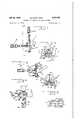
- FIG. 1is a plan view, in reduced scale, of the goniometer.
- FIG. 2is a reduced scale side elevation, partially in section, taken along line 2-2 of FIG. 1 and rotated 90 to the left.
- FIG. 3is a plan section on line 33 of FIG. 2 showing an azimuth scale.
- FIG. 4is a plan section on line 4-4 of FIG. 2 with the upper swivel plate omitted and showing the method of link-ing the cannula guide to the adjusting micrometers.
- FIG. 5is a vertical section on line 5'5 of FIG. 3.
- FIG. 6is a front elevation of the base.
- FIG. 7is a rear elevation of the base showing a drainage passage.
- FIG. 8is an exploded perspective of a portion of the cannula guide and the elements linking it to the adjusting micrometers.
- FIG. 9is a perspective of the goniometer
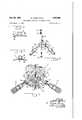
- FIG. 10illustrates the method for determining the correct setting of the goniometer from an X-ray negative by using a transparent overlay,scale.
- the goniometer 11has a base 12 which in use is joined to the patients cranium in a manner to be hereinafter described.
- the balance of the goniometer, referred to as indexing head 15,is removably and rotatably mounted on base 12.
- the terms removable and removably mounted or joinedare to be differentiated from disassembable, in that there is a distinct function to be performed by the base when the indexing head is removed from the base; namely, to prevent body fluids flowing from the trephine in the patients skull and through the base from entering and encrusting on the indexing head, which if they did, would hinder the operation of the apparatus and would also form a site for infection.
- the indexing head 15has for its more essential elements, a base collar or ring 14, a first quadrant means 18, a second quadrant means 16 at right angle to the first quadrant means, a cannula guide 20, a first threaded adjusting means or micrometer 24 and a second threaded adjusting means or micrometer 22.
- FIG. 10represents an X-ray negative of the patient on which a transparent scale 26 (shown fragmentarily) has been positioned for a purpose to be hereinafter described.
- the goniometer(except cannula guide 20 which is shown in section) has most of its elements shown in phantom lines to indicate that the major portions are made of aluminum, magnesium or other materials which do not completely shield the penetration of X-rays.
- the base 12is attached to the patients skull, and the indexing head 15 is properly positioned and oriented on the base before the X-ray is taken.
- the goniometerhas an azimuth scale, to be described hereinafter, to assure that the indexing head may be repeatedly oriented to the same position on the base.
- the base 12has a flange 28, the lower face of which is contoured to the general shape of the human skull in the general area shown.
- the baseis positioned to locate its vertical axis over the center of the trephine 30, which had been previously formed, where it is held in position by pin 32 and screw 34 which engage the skull.
- the base 12in addition to flange 28, has a circular boss 36 having a passage axially passing through the boss and flange and having a spherical seat 38 at the free end of the boss.
- One element of the azimuth scale previously mentionedis scribed on the upper part of the boss.
- the scribed element of the azimuth scaleis best shown on FIG. 3 as scribed index line 40.
- the basealso contains a passage 41 for the natural drainage of fluids from the tissues within the patients skull through trephine 30.
- the second element of the azimuth scaleis shown on base ring 14 as scribed index 42, which is graduated through the full 360 of the circle.
- the azimuth scaleprovides a convenient means for repeatedly orienting the indexing head 15 to any position on the patients skull, where it is releasably held in place by lock screw 43. It is obvious that the azimuth scale may be reversed with the scribed index line 40 on the base ring 14 and the index 42 on the base 12.
- Each of quadrant means 16 and 18has an arcuate crown containing an elongated linear slot 16a and 18a as best shown on FIG. 9.
- the slotsare of such width as to provide a free fit for retaining and guiding the upper end of the canriula guide 20 as shown.
- the lower open yoke end of each quadrant meansis pivotally joined to base ring 14 by means of screws 44 as best shown on FIG. and FIG. 9.
- Other pivoting meansmay be used; the important consideration being to provide a quadrant structure consisting of two means pivotally mounted at substantially 90 to each other and having superimposed crowns each arcuately movable in relation to the other.
- the pivot axis of the first and second quadrant meansshould substantially be on a plane normal to the longitudinal passage through the cannula guide and passing through the geometrical center of the spherical seat 38 in base 12 when the indexing head is joined to the base.
- the cannula guideis an elongated hollow tube having a ball end 46 at the lower end, and having a similar ball 48 at the mid section.
- the ball end 46 and ball 48may be directly formed as shown; or, if desired, they may be made of ball elements and brazed in place.
- Ball end 46is pivotally seated in seat 38 of base 12 as'best shown on FIG. 5.
- joined to cannula guide 20is a washer 50 providing a spring saddle for compression spring 52 which is disposed between washer 50 and quadrant means 18 to bias the cannula guide toward the base 12.
- spindle 22a on micrometer 22 and spindle 24a on micrometer 24each have a ball end 54 joined to the free end thereof by means of pin 56.
- Two triangular-shaped swivel plates 58having holes in each corner area, are so placed on cannula guide 20 that one swivel plate is on each side of ball 48 on the cannula guide while the holes 60 in the other corner areas of the swivel plates engage the balls 54 on ball ends 54. All holes in the swivel plates may be straight holes; or, they may be contoured to the form of the respective balls.
- the upper and lower swivel plates 58are resiliently held together to engage ball ends 54 by means of screw 62, compression spring 63 and nut 64.
- Each micrometermay be axially adjusted on its re spective quadrant means during instrument calibration by means of adjusting nuts 66 shown on FIG. 9.
- the calibration scale shown on each micrometermay be graduated to show the angular displacement of the cannula guide from its vertical zero position.
- each micrometeris axially adjusted to read 0 on the calibration scale when the cannula guide is in its true vertical zero position.
- the particular scale usedis a function of the distance between ball end 46 and ball 48 on the cannula guide, and the pitch of the micrometer thread.
- Micrometers calibrated to read linear measurementsmay be used, but such use requires a mental conversion of linear readings to angular equivalents on the cannula guide.
- the arrangement of elementsis such that the axis through the cannula guide may be set to any simple or compound angle from the vertical zero position.
- the indexing headis joined to the base and oriented in azimuth to place the axes of the micrometers into the anterio-posterior and medic-lateral planes on which the X- rays are to be taken; where it is held in place by lock screw 43.
- the azimuth readingis made of record in order that the indexing head may subsequently be returned to the initial position.
- the goniometeris set to have the axis of the cannula guide on the vertical zero axis 68 shown on FIG. 10.
- the patient, with goniometer attached,is then X-rayed; taking at least one picture in both the anterio-uosterior and medic-lateral positions.
- the indexing headis then removed, leaving the base on the patients skull.
- FIG. 10which represents an X-ray film in the anterio-posterior position shows the hypothetical lesion area 70 in that one plane of the film.
- the transparent scale 26is superimposed over the film with the center of the scale over the ball end of the cannula guide as shown and the 0 line coinciding with the vertical zero axis 68 passing through the cannula guide when the X-ray was taken.
- the lesion area 70is shown to be on the 5 line etched on the scale and indicates the correct required angular displacement of the cannula guide from its vertical Zero position in the anterio-posterior plane in order to make the axis pass through the lesion area 70.
- the axis through the cannula guidewill coincide with the 5 position on the scale and will be in proper alignment in the anterio-posterior plane.
- the procedureis repeated on the film taken in the medic-lateral direction; that adjustment being made with micrometer 24. It is obvious that the compound angle of the cannula guide is now properly positioned to place the axis through lesion area 70 in the patients brain.
- the scale 26is graduated in degrees on both sides of the 0 line as shown. For clarity, only each fifth degree line is shown full length on the drawing. Also on the scale, as shown, are a series of arcuate lines radiating from the scale center. These arcs may he graduated in inches as shown, or in the metric system. The arcuate lines are useful in estimating the distance of the lesion area 70 from such reference surface as the upper end of the cannula guide. It is obvious that the scale 26 may be superimposed on the film with the 0 line passing through area 70; in which case the necessary angular adjustment would be read on axis 68.
- a goniometerhaving an angularly adjustable cannula guide and being adapted for attaching over a trephine in a patients skull, thus permitting a surgeon to reach a predetermined area of the patients brain with a cannula or other instrument guided by the cannula guide and comprising: a base having an upper and a lower end with an axial bore extending through said ends, the lower end being contoured and adapted for externally joining in a fixed non-rotating manner to a convex surface and the upper end having a seat coaxial with said bore, and an indexing head removably joined to said base for leaving said base in fixed position on the patient when said indexing head is removed and thus preventing body fluids flowing from the trephine in patients skull and through said base from entering and encrusting on said indexing head; said indexing head comprising a base collar removably joined to said base, a cannula guide the lower end of which engages with the seat in said base when said indexing head is joined to said base
- first adjusting meansjoined to said first quadrant means and pivotally moving said cannula guide on said base and pivoting said second quadrant means on said base collar
- second adjusting meansjoined to said second quadrant means and pivotally moving said cannula guide on said base and pivoting said first quadrant means on said base collar
- a goniometerhaving an angularly adjustable cannula guide and being adapted for attaching over a trephine in a patients skull, thus permitting a surgeon to reach a predetermined area of the patients brain with a cannula or other instrument guided by the cannula guide and comprising: a base and ,an indexing head removably joined to said base; said base comprising a flange contoured and adapted for externally attaching in a fixed non-rotating manner to a convex surface, a boss extending upward from said flange, and a bore coaxially passing through said boss and said flange and forming a seat at the free end of said boss; said indexing head comprising a base collar removably joined to said base for leaving said base in fixed position on the patient when said indexing head is removed and thus preventing :body fluids flowing from the trephine in patients skull and through said base from entering and encrusting on said indexing head, a cannula guide the lower end
- a goniometerhaving an angularly adjustable cannula guide and being adapted for attaching over a trephine in a patients skull, thus permitting a surgeon to reach a predetermined area of the patientsbrain with a cannula or other instrument guided by the cannula guide and comprising: a base and an indexing head removably and rotatably joined to said base; said base comprising a flange contoured and adapted for externally attaching in a fixed non-rotating manner to a convex surface, a circular boss extending upward from said flange, and a bore coaxially passing through said boss and said flange and forming a seat at the free end of said boss; said indexing head comprising a base ring removably and rotatably joined to the circular boss on said base for leaving said base in fixed position on the patient when said indexing head is removed and thus preventing body fluids flowing from the trephine in patients skull and through said base from entering and encrusting on said index
- a goniometerhaving an angularly adjustable cannula guide and being adapted for attaching over a trephine in a patients skull, thus permitting a surgeon to reach a predetermined area of the patients brain with a cannula or other instrument guided by the cannula guide and comprising: a base and an indexing head removably and rotatably joined to said base; said base comprising a flange contoured and adapted for externally attaching in a fixed non-rotating manner to a convex surface, a circular boss extending upward from said flange, and a bore coaxially passing through said boss and said flange and forming a seat at the free end of said circular boss; said indexing head comprising a base ring removably and rotatably joined to the circular boss on said base for leaving said base in fixed position on the patient when said indexing head is removed and thus preventing body fluids flowing from the trephine in patients skull and through said base from entering and encrusting on said index
- a goniometerhaving an angularly adjustable cannula guide and being adapted for attaching over a trephine in a patients skull, thus permitting a surgeon to reach a predetermined area of the patients brain with a cannula or other instrument guided by the cannula guide and comprising: a base and an indexing head removably and rotatably joined to said base; said base comprising a flange contoured and adapted for externally attaching in a fixed non-rotating manner to a convex surface, a circular boss extending upward from said flange, and a bore coaxially passing through said boss and said flange and forming a seat at the free end of said circular boss; said indexing head comprising a base ring removably and rotatably joinedto the circular boss on said base for leaving said base in fixed position on the patient when said indexing head is removed and thus preventing body fluids flowing from the trephine in patients skull and through said base from entering and encrusting on said index
- a goniometerhaving an angularly adjustable cannula guide and being adapted for attaching over a trephine in a patients skull, thus permitting a surgeon to reach a predetermined area of the patients brain with a cannula or other instrument guided by the cannula guide and comprising: a base and an indexing head removably and rotatably joined to said base; said base comprising a flange contoured and adapted for externally attaching in a fixed non-rotating manner to a convex surface, a circular boss extending upward from said flange, and a bore coaxially passing through said boss and said flange and forming a seat at the free end of said circular boss; said indexing head comprising a base ring removably and rotatably joined to the circular boss on said base for leaving said base in fixed position on the patient when said indexing head is removed and thus preventing body fluids flowing from the trephine in patients skull and through said base from entering and encrusting on said index
- a goniometerhaving an angularly adjust-able cannula guide and being adapted for attaching over a trephine in a patients skull, thus permitting a surgeon to reach a predetermined area of the patients brain with a cannula or other instrument guided by the cannula guide and comprising: a base and an indexing head removably and rotatably joined to said base; said base comprising a flange contoured and adapted for externally attaching in a fixed non-rotating manner to, a convex surface, a circular boss extending upward from said flange, and a bore coaxially passing through said boss and said flange and terminating in a spherical seat at the free end of said circular boss; said indexing head comprising a base ring removably and rotatably joined to the circular boss on said base for leaving said base in fixed position on the patient when said indexing head is removed and thus preventing body fluids flowing from the trephine in patients skull and through said base from
- a goniometerhaving an angular adjustable cannula guide and being adapted for attaching over a trephine in a patients skull, thus permitting a surgeon to reach a predetermined area of the patients brain with a cannula or other instrument guided by the cannula guide and comprising: a base and an indexing head removably and rotatably joined to said base, said base and said indexing head having a first and a second azimuth scale element indicating the azimuth of said indexing head on said base; said base comprising a flange contoured and adapted for externally attaching in a fixed non-rotating manner to a convex surface, a circular boss extending upward from said flange, a bore coaxially passing through said boss and said flange and terminating in a spherical seat at the free end of said circular boss, and the first of said azimuth scale elements scribed on said circular boss; said indexing head comprising a base ring removably and rotatably
Landscapes
- Health & Medical Sciences (AREA)
- Surgery (AREA)
- Life Sciences & Earth Sciences (AREA)
- Heart & Thoracic Surgery (AREA)
- Pathology (AREA)
- Oral & Maxillofacial Surgery (AREA)
- Engineering & Computer Science (AREA)
- Biomedical Technology (AREA)
- Nuclear Medicine, Radiotherapy & Molecular Imaging (AREA)
- Medical Informatics (AREA)
- Molecular Biology (AREA)
- Animal Behavior & Ethology (AREA)
- General Health & Medical Sciences (AREA)
- Public Health (AREA)
- Veterinary Medicine (AREA)
- Surgical Instruments (AREA)
Description
July 26, 1966 w. HARDY ETAL 3,262,452
GONIOMETER APPARATUS FOR BRAIN SURGERY Filed April 1.7, 1963 5 Sheets-Sheet 1 I N V EN TORS W6 Y! #620 Y wan/7M A guy uvmv Y July 26, 1966 w. HARDY ETAL GONIOMETER APPARATUS FOR BRAIN SURGERY Filed April 1.7, 1963 5 Sheets-Sheet 2 July 26, 1966 w. HARDY ETAL GONIOMETER APPARATUS FOR BRAIN SURGERY Filed April 17, 1963 5 Sheets-Sheet 5 R mm miw WW2 MM W M United States Patent GUNIOMETER APPARATUS FOR BRAIN SURGERY This invention relates to surgical apparatu and, more specifically, to goniometric apparatus used in connection with brain surgery. Various neurological diseases characterized by tremors and rigidity are markedly improved when a small area of the brain is treated. This treatment consists of limited destruction by mean of cutting or lesioning, electrocautery, ultrasound, freezing, or by introduction of chemicals. to such use, for the sake of simplicity and the simplification of terminology, the apparatus of this invention will be described in connection with lesioning. This lesioning process is accomplished by passage of a cannula to the specific area of the brain.
The lesioning process itself is relatively simple and well understood. Likewise, the actuallesioning itself requires very little time. The time consuming and, therefore, relatively expensive portion of the procedure has always been to locate the precise area on any given patient to be lesioned. Thi has been necessitated by the fact that the precise area within the brain cavity varies from patient to patient, and by the pronounced differences in the configuration of human skulls.
The surgery is performed through a small trephine or hole in the cranium; and the exact area to be lesioned is a definite area within the brain. The lesion area of the brain may be located by X-ray; however, since the brain is not a plane surface, the area must be located in both the anterio-posterior and the medio-lateral directions. It is obviou that, in order to insert a cannula through the trephine in the cranium and precisely reach the target area, the cannula must be precisely guided in both anterio-posterior and medio-later-al directions. This has been done in the past by various apparatus; all of which required a progressive series of check X- rays because the devices were not accurate enough to be precisely adjusted from the initial X-rays. The old procedure Was time consuming to the surgeon as well as causing unnecessary discomfort to the patient.
One object of the present invention is to provide an apparatus for precisely guiding the axis of a cannula to coincide with the axis through a trephine in the cranium and a precise area of the brain, in both anterioposterior and mediadateral directions from two X-ray films taken before surgery, one of which was taken in the anterio-posterior and the other in the medio-lateral position; the apparatus being set from the X-ray films.
Another object of the present invention is to reduce the number and the frequency of the X-ray requirements in the course of the surgery.
Still another object of the present invention is to provide an apparatus which, when removably joined to the patients cranium, may be set precisely to the determinations made on the X-ray films.
A still further object of the present invention is to provide a goniometer having the highest degree of accuracy, and which is nearly fool-proof in its use.
Additional objects, advantages and features of the invention reside in the construction, arrangement and combination of parts involved in the embodiment of the invention as will appear from the following description and accompanying drawings wherein:
FIG. 1 is a plan view, in reduced scale, of the goniometer.
FIG. 2 is a reduced scale side elevation, partially in section, taken along line 2-2 of FIG. 1 and rotated 90 to the left.
Although not limited FIG. 3 is a plan section on line 33 of FIG. 2 showing an azimuth scale.
FIG. 4 is a plan section on line 4-4 of FIG. 2 with the upper swivel plate omitted and showing the method of link-ing the cannula guide to the adjusting micrometers.
FIG. 5 is a vertical section on line 5'5 of FIG. 3.
FIG. 6 is a front elevation of the base.
FIG. 7 is a rear elevation of the base showing a drainage passage.
FIG. 8 is an exploded perspective of a portion of the cannula guide and the elements linking it to the adjusting micrometers.
FIG. 9 is a perspective of the goniometer, and
FIG. 10 illustrates the method for determining the correct setting of the goniometer from an X-ray negative by using a transparent overlay,scale.
Referring to the drawings and, in particular, to FIG. 1, FIG. 2 and FIG. 9, the goniometer 11 has abase 12 which in use is joined to the patients cranium in a manner to be hereinafter described. The balance of the goniometer, referred to as indexinghead 15, is removably and rotatably mounted onbase 12. As will be better understood from a further reading of the specification, the terms removable and removably mounted or joined are to be differentiated from disassembable, in that there is a distinct function to be performed by the base when the indexing head is removed from the base; namely, to prevent body fluids flowing from the trephine in the patients skull and through the base from entering and encrusting on the indexing head, which if they did, would hinder the operation of the apparatus and would also form a site for infection. The indexinghead 15 has for its more essential elements, a base collar orring 14, a first quadrant means 18, a second quadrant means 16 at right angle to the first quadrant means, acannula guide 20, a first threaded adjusting means ormicrometer 24 and a second threaded adjusting means ormicrometer 22.
FIG. 10 represents an X-ray negative of the patient on which a transparent scale 26 (shown fragmentarily) has been positioned for a purpose to be hereinafter described. The goniometer (exceptcannula guide 20 which is shown in section) has most of its elements shown in phantom lines to indicate that the major portions are made of aluminum, magnesium or other materials which do not completely shield the penetration of X-rays. Thebase 12 is attached to the patients skull, and the indexinghead 15 is properly positioned and oriented on the base before the X-ray is taken. The goniometer has an azimuth scale, to be described hereinafter, to assure that the indexing head may be repeatedly oriented to the same position on the base. Thebase 12 has aflange 28, the lower face of which is contoured to the general shape of the human skull in the general area shown. The base is positioned to locate its vertical axis over the center of thetrephine 30, which had been previously formed, where it is held in position bypin 32 andscrew 34 which engage the skull.
Referring to FIG. 5, FIG. 6 and FIG. 7, thebase 12, in addition toflange 28, has acircular boss 36 having a passage axially passing through the boss and flange and having aspherical seat 38 at the free end of the boss. One element of the azimuth scale previously mentioned is scribed on the upper part of the boss. The scribed element of the azimuth scale is best shown on FIG. 3 as scribedindex line 40. As best shown on FIG. 5 and FIG. 7, the base also contains apassage 41 for the natural drainage of fluids from the tissues within the patients skull throughtrephine 30. As best shown on FIG. 3, the second element of the azimuth scale is shown onbase ring 14 as scribedindex 42, which is graduated through the full 360 of the circle. The azimuth scale provides a convenient means for repeatedly orienting the indexinghead 15 to any position on the patients skull, where it is releasably held in place bylock screw 43. It is obvious that the azimuth scale may be reversed with the scribedindex line 40 on thebase ring 14 and theindex 42 on thebase 12.
Each of quadrant means 16 and 18 has an arcuate crown containing an elongatedlinear slot 16a and 18a as best shown on FIG. 9. The slots are of such width as to provide a free fit for retaining and guiding the upper end of thecanriula guide 20 as shown. The lower open yoke end of each quadrant means is pivotally joined tobase ring 14 by means ofscrews 44 as best shown on FIG. and FIG. 9. Other pivoting means may be used; the important consideration being to provide a quadrant structure consisting of two means pivotally mounted at substantially 90 to each other and having superimposed crowns each arcuately movable in relation to the other. In order to provide ideal movement of components, the pivot axis of the first and second quadrant means should substantially be on a plane normal to the longitudinal passage through the cannula guide and passing through the geometrical center of thespherical seat 38 inbase 12 when the indexing head is joined to the base.
As best shown on FIG. 10, the cannula guide is an elongated hollow tube having aball end 46 at the lower end, and having asimilar ball 48 at the mid section. Theball end 46 andball 48 may be directly formed as shown; or, if desired, they may be made of ball elements and brazed in place.Ball end 46 is pivotally seated inseat 38 ofbase 12 as'best shown on FIG. 5. As best shown on FIG. 2, joined tocannula guide 20 is awasher 50 providing a spring saddle forcompression spring 52 which is disposed betweenwasher 50 and quadrant means 18 to bias the cannula guide toward thebase 12.
Referring in particular to FIG. 8 and FIG. 9,spindle 22a onmicrometer 22 andspindle 24a onmicrometer 24 each have aball end 54 joined to the free end thereof by means ofpin 56. Two triangular-shapedswivel plates 58, having holes in each corner area, are so placed oncannula guide 20 that one swivel plate is on each side ofball 48 on the cannula guide while the holes 60 in the other corner areas of the swivel plates engage theballs 54 onball ends 54. All holes in the swivel plates may be straight holes; or, they may be contoured to the form of the respective balls. As best shown on FIG. 2 and FIG. 8, the upper and lowerswivel plates 58 are resiliently held together to engageball ends 54 by means ofscrew 62,compression spring 63 andnut 64.
Each micrometer may be axially adjusted on its re spective quadrant means during instrument calibration by means of adjustingnuts 66 shown on FIG. 9. The calibration scale shown on each micrometer may be graduated to show the angular displacement of the cannula guide from its vertical zero position. During instrument calibration each micrometer is axially adjusted to read 0 on the calibration scale when the cannula guide is in its true vertical zero position. The particular scale used is a function of the distance between ball end 46 andball 48 on the cannula guide, and the pitch of the micrometer thread. Micrometers calibrated to read linear measurements may be used, but such use requires a mental conversion of linear readings to angular equivalents on the cannula guide. The arrangement of elements is such that the axis through the cannula guide may be set to any simple or compound angle from the vertical zero position.
After the patient has been prepared andbase 12 attached to the patients skull as indicated on FIG. 10, the indexing head is joined to the base and oriented in azimuth to place the axes of the micrometers into the anterio-posterior and medic-lateral planes on which the X- rays are to be taken; where it is held in place bylock screw 43. The azimuth reading is made of record in order that the indexing head may subsequently be returned to the initial position. The goniometer is set to have the axis of the cannula guide on the vertical zeroaxis 68 shown on FIG. 10. The patient, with goniometer attached, is then X-rayed; taking at least one picture in both the anterio-uosterior and medic-lateral positions. The indexing head is then removed, leaving the base on the patients skull.
After the X-ray films have been developed, the films are used to determine the correct compound angle of the cannula guide in order for the cannula to reach thelesion area 70 within the patients brain. FIG. 10 which represents an X-ray film in the anterio-posterior position shows thehypothetical lesion area 70 in that one plane of the film. The transparent scale 26 is superimposed over the film with the center of the scale over the ball end of the cannula guide as shown and the 0 line coinciding with the vertical zeroaxis 68 passing through the cannula guide when the X-ray was taken. Thelesion area 70 is shown to be on the 5 line etched on the scale and indicates the correct required angular displacement of the cannula guide from its vertical Zero position in the anterio-posterior plane in order to make the axis pass through thelesion area 70. When the cannula guide is displaced the required 5 by adjustingmicrometer 22, the axis through the cannula guide will coincide with the 5 position on the scale and will be in proper alignment in the anterio-posterior plane. The procedure is repeated on the film taken in the medic-lateral direction; that adjustment being made withmicrometer 24. It is obvious that the compound angle of the cannula guide is now properly positioned to place the axis throughlesion area 70 in the patients brain.
The scale 26 is graduated in degrees on both sides of the 0 line as shown. For clarity, only each fifth degree line is shown full length on the drawing. Also on the scale, as shown, are a series of arcuate lines radiating from the scale center. These arcs may he graduated in inches as shown, or in the metric system. The arcuate lines are useful in estimating the distance of thelesion area 70 from such reference surface as the upper end of the cannula guide. It is obvious that the scale 26 may be superimposed on the film with the 0 line passing througharea 70; in which case the necessary angular adjustment would be read onaxis 68.
It is to be understood that the embodiment of the present invention as shown and described is to be regarded as illustrative only, and that the invention is susceptible to variations, modifications and changes within the scope of the appended claims.
We claim:
1. A goniometer having an angularly adjustable cannula guide and being adapted for attaching over a trephine in a patients skull, thus permitting a surgeon to reach a predetermined area of the patients brain with a cannula or other instrument guided by the cannula guide and comprising: a base having an upper and a lower end with an axial bore extending through said ends, the lower end being contoured and adapted for externally joining in a fixed non-rotating manner to a convex surface and the upper end having a seat coaxial with said bore, and an indexing head removably joined to said base for leaving said base in fixed position on the patient when said indexing head is removed and thus preventing body fluids flowing from the trephine in patients skull and through said base from entering and encrusting on said indexing head; said indexing head comprising a base collar removably joined to said base, a cannula guide the lower end of which engages with the seat in said base when said indexing head is joined to said base, a first quadrant means pivotally joined at the lower end to said base collar and slidably engaging the upper portion of said cannula guide, a second quadrant means pivotally joined at the lower end to said base collar to be superimposed at substantially to said first quadrant means and slidably engaging the upper portion of said cannula guide,
a first adjusting means joined to said first quadrant means and pivotally moving said cannula guide on said base and pivoting said second quadrant means on said base collar, and a second adjusting means joined to said second quadrant means and pivotally moving said cannula guide on said base and pivoting said first quadrant means on said base collar.
2. A goniometer having an angularly adjustable cannula guide and being adapted for attaching over a trephine in a patients skull, thus permitting a surgeon to reach a predetermined area of the patients brain with a cannula or other instrument guided by the cannula guide and comprising: a base and ,an indexing head removably joined to said base; said base comprising a flange contoured and adapted for externally attaching in a fixed non-rotating manner to a convex surface, a boss extending upward from said flange, and a bore coaxially passing through said boss and said flange and forming a seat at the free end of said boss; said indexing head comprising a base collar removably joined to said base for leaving said base in fixed position on the patient when said indexing head is removed and thus preventing :body fluids flowing from the trephine in patients skull and through said base from entering and encrusting on said indexing head, a cannula guide the lower end of which engages with the seat at the free end of the boss on said base when said indexing head is joined to said base, a first quadrant means pivotally joined at the lower end to said base collar and slidably engaging the upper portion of said cannula guide, a second quadrant means pivotally joined at the lower end to said base collar to be superimposed at substantially 90 to said first quadrant means and slidably engaging the upper portion of said cannula guide, a first adjusting means joined to said first quadrant means and engaging said cannula guide for pivotally moving said cannula guide on said base and pivoting said second quadrant means on said base collar, and a second adjusting means joined to said second quadrant means and engaging said cannula guide for pivotally moving said cannula guide on said base and pivoting said first quadrant means on said base collar.
3. A goniometer having an angularly adjustable cannula guide and being adapted for attaching over a trephine in a patients skull, thus permitting a surgeon to reach a predetermined area of the patientsbrain with a cannula or other instrument guided by the cannula guide and comprising: a base and an indexing head removably and rotatably joined to said base; said base comprising a flange contoured and adapted for externally attaching in a fixed non-rotating manner to a convex surface, a circular boss extending upward from said flange, and a bore coaxially passing through said boss and said flange and forming a seat at the free end of said boss; said indexing head comprising a base ring removably and rotatably joined to the circular boss on said base for leaving said base in fixed position on the patient when said indexing head is removed and thus preventing body fluids flowing from the trephine in patients skull and through said base from entering and encrusting on said indexing head, a hollow cannula guide the lower end of which engages with the seat at the free end of the circular boss on said base when said indexing head is joined to said base, a first quadrant means pivotally joined at the lower end to said base ring and slidably engaging the upper portion of said hollow cannula guide, a second quadrant means pivotally joined at the lower end to said base ring to be superimposed at substantially 90 to said first quadrant means and slidably engaging the upper portion of said hollow cannula guide, a first adjusting means joined to said first quadrant means and engaging said hollow cannula guide for pivotally moving said hollow cannula guide on said base and pivoting said second quadrant means on said base ring, and a second adjusting means joined to said second quadrant means 6 and engaging said hollow cannula guide for pivotally moving said hollow cannula guide on said base and pivoting said first quadrant means on said b-asetring.
4. A goniometer having an angularly adjustable cannula guide and being adapted for attaching over a trephine in a patients skull, thus permitting a surgeon to reach a predetermined area of the patients brain with a cannula or other instrument guided by the cannula guide and comprising: a base and an indexing head removably and rotatably joined to said base; said base comprising a flange contoured and adapted for externally attaching in a fixed non-rotating manner to a convex surface, a circular boss extending upward from said flange, and a bore coaxially passing through said boss and said flange and forming a seat at the free end of said circular boss; said indexing head comprising a base ring removably and rotatably joined to the circular boss on said base for leaving said base in fixed position on the patient when said indexing head is removed and thus preventing body fluids flowing from the trephine in patients skull and through said base from entering and encrusting on said indexing head, a hollow cannula guide the lower end of which engages with the seat at the free end of the circular boss on said base when said indexing head is joined to said base, a first forked quadrant means straddling and pivotally joined at the lower open end to said base ring and slidably engaging the upper portion of said hollow cannula guide, a second forked quadrant means straddling and pivotally joined at the lower open end to said base ring to be superimposed at substantially to said first quadrant means and slidably engaging the upper portion of said hollow cannula guide, a first adjusting means joined to said first quadrant means and engaging said hollow cannula guide for pivotally moving said hollow cannula guide on said base and pivoting said second quadrant means on said base ring, a second adjusting means joined to said second quadrant means and engaging said hollow cannula guide for pivotally moving said hollow cannula guide on said base and pivoting said first quadrant means on said base ring, and a biasing means disposed between said hollow cannula guide and said first quadrant means for biasing said hollow cannula guide against the seat in said base. I
5. A goniometer having an angularly adjustable cannula guide and being adapted for attaching over a trephine in a patients skull, thus permitting a surgeon to reach a predetermined area of the patients brain with a cannula or other instrument guided by the cannula guide and comprising: a base and an indexing head removably and rotatably joined to said base; said base comprising a flange contoured and adapted for externally attaching in a fixed non-rotating manner to a convex surface, a circular boss extending upward from said flange, and a bore coaxially passing through said boss and said flange and forming a seat at the free end of said circular boss; said indexing head comprising a base ring removably and rotatably joinedto the circular boss on said base for leaving said base in fixed position on the patient when said indexing head is removed and thus preventing body fluids flowing from the trephine in patients skull and through said base from entering and encrusting on said indexing head, a hollow cannula guide the lower end of which engages with the seat at the free end of the circular boss on said base when said indexing head is joined to said base, a first forked quadrant means having an arcuate crown' with an elongated longitudinal slot slidably engaging the upper upper portion of said hollow cannula guide and having the lower open end straddling and pivotally joined to said base ring, a second forked quadrant means having an arcuate crown with an elongated longitudinal slot slidably engaging the upper portion of said hollow cannula guide and having the lower open end straddling and pivotally joined to said base ring to be superimposed at substantially 90 to said first quadrant means, a first adjusting means joined to said first quadrant means and engaging said hollow cannula guide for pivotally moving said hollow cannula guide on said base and pivoting said second quadrant means on said base ring, and a second adjusting means joined to said second quadrant means and engaging said hollow cannula guide for pivotally moving said hollow cannula guide on said base and pivoting said first quadrant means on said base ring.
6. A goniometer having an angularly adjustable cannula guide and being adapted for attaching over a trephine in a patients skull, thus permitting a surgeon to reach a predetermined area of the patients brain with a cannula or other instrument guided by the cannula guide and comprising: a base and an indexing head removably and rotatably joined to said base; said base comprising a flange contoured and adapted for externally attaching in a fixed non-rotating manner to a convex surface, a circular boss extending upward from said flange, and a bore coaxially passing through said boss and said flange and forming a seat at the free end of said circular boss; said indexing head comprising a base ring removably and rotatably joined to the circular boss on said base for leaving said base in fixed position on the patient when said indexing head is removed and thus preventing body fluids flowing from the trephine in patients skull and through said base from entering and encrusting on said indexing head, a hollow cannula guide the lower end of which engages with the seat at the free end of the circular boss on said base when said indexing head is joined to said base, a first forked quadrant means having an arcuate crown with an elongated longitudinal slot slidably engaging the upper portion of said hollow cannula guide and having the lower open end straddling and pivotally joined to said base ring, a second forked quadrant means having an arcuate crown with an elongated longitudinal slot slidably engaging the upper portion of said hollow cannula guide and having the lower open end straddling and pivotally joined to said base ring to be superimposed at substantially 90 to said first quadrant means, a first adjusting means joined to said first quadrant means and engaging said hollow cannula guide for pivotally moving said hollow cannula guide on said base and pivoting said second quadrant means on said base ring, a second adjusting means joined to said second quadrant means and engaging said hollow cannula guide for pivotally moving said hollow cannula guide on said base and pivoting said first quadrant means on said base ring, and a biasing means disposed between said hollow cannular guide and said first quadrant means for biasing said hollow cannula guide against the seat in said a base.
7. A goniometer having an angularly adjust-able cannula guide and being adapted for attaching over a trephine in a patients skull, thus permitting a surgeon to reach a predetermined area of the patients brain with a cannula or other instrument guided by the cannula guide and comprising: a base and an indexing head removably and rotatably joined to said base; said base comprising a flange contoured and adapted for externally attaching in a fixed non-rotating manner to, a convex surface, a circular boss extending upward from said flange, and a bore coaxially passing through said boss and said flange and terminating in a spherical seat at the free end of said circular boss; said indexing head comprising a base ring removably and rotatably joined to the circular boss on said base for leaving said base in fixed position on the patient when said indexing head is removed and thus preventing body fluids flowing from the trephine in patients skull and through said base from entering and encrusting on said indexing head, an elongated cannula guide terminating at the lower end in a ball engaging the spherical seat in said base when saidindexing head is joined to said base and having a longitudinal passage therethrough, a first forked quadrant means having an arcuate WQWQ ith an elongated longitudinal slot slidably engaging the upper portion of said cannula guide and having the lower open end straddling and pivotally joined to said base ring, a second forked quadrant means having an arcuate crown with an elongated longitudinal slot slidably engaging the upper portion of said cannula guide and having the lower open end straddling and pivotally joined to said base ring to be superimposed at substantially to said first quadrant means, the pivot axis of said first and said second quadrant means being substantially on a plane normal to the longitudinal passage through said cannula guide when coaxial with the bore in said base to be in the vertical zero position and passing through the geometrical center of the spherical seat in said base when said indexing head is joined to said base; a first adjusting means joined to said first quadrant means and engaging said cannula guide for pivotally moving said cannula guide on said base and pivoting said second quadrant means on the second quadrant pivot axis, and a second adjusting means joined to said second quadrant means and engaging said cannula guide for pivotally moving said cannula guide on said base and pivoting said first quadrant means on the first quadrant pivot axis.
8. A goniometer as set forth inclaim 7 wherein said first and said second adjusting means are threaded adjusting means having a calibration scale to indicate the angular displacement of said cannula guide from the vertical zero position.
9. A goniometer as set forth inclaim 7 wherein said first and said second adjusting means are threaded adjusting means having a calibration scale to indicate the angular displacement of the cannula guide from the vertical zero position and each having adjusting means for lineally adjusting their joined position in said first and said second quadrant means, thus providing a means for setting the zero on the calibration scale to the vertical zero position of said cannula guide during instrument calibration.
10. A goniometer having an angular adjustable cannula guide and being adapted for attaching over a trephine in a patients skull, thus permitting a surgeon to reach a predetermined area of the patients brain with a cannula or other instrument guided by the cannula guide and comprising: a base and an indexing head removably and rotatably joined to said base, said base and said indexing head having a first and a second azimuth scale element indicating the azimuth of said indexing head on said base; said base comprising a flange contoured and adapted for externally attaching in a fixed non-rotating manner to a convex surface, a circular boss extending upward from said flange, a bore coaxially passing through said boss and said flange and terminating in a spherical seat at the free end of said circular boss, and the first of said azimuth scale elements scribed on said circular boss; said indexing head comprising a base ring removably and rotatably joined to the circular boss on said base for leaving said base in fixed position on the patient when said indexing head is removed and thus preventing body fluids flowing from the trephine in patients skull and through said base from entering and encnisting on said indexing head and having the second of said azimuth scale elements scribed thereon, an elongated cannula guide terminating at the lower end in a ball engaging the spherical seat in said base when said indexing head is joined to said base and having a longitudinal passage therethrough, a first forked quadrant means having an arcuate crown with an elongated longitudinal slot slidably engaging the upper portion of said cannula guide and having the lower open end straddling and pivotally joined to said base ring, a second forked quadrant means having an arcuate crown with an elongated longitudinal slot slidably engaging the upper portion of said cannula guide and having the lower open end straddling and pivotally joined to said base ring to be superimposed at substantially 90 to said first quadrant means, the pivot axis of said first and said second quadrant means being substantially on a plane normal to the longitudinal passage through said cannula guide when coaxial with the bore in said base to be in the vertical Zero position and passing through the geometrical center of the spherical seat in said base when said indexing head is joined to said base; a first threaded adjusting means joined to said first quadrant means and engaging said oannula guide for pivotally moving said cannula guide on said base and pivoting said sec-0nd quadrant means on the said second quadrant pivot axis, said first threaded adjusting means having a calibration scale to indicate the angular displacement of the cannula guide from the vertical zero position, and a second threaded adjusting means joined to said second quadrant means and engaging said cannula guide for pivotally moving said cannula guide on said base and pivoting said first quadrant means on the said first quadrant pivot axis, said second threaded adjusting means having a calibration scale to indicate the angular displacement of the cannula guide from the vertical zero position, said first and said second threaded adjusting means having adjusting means for setting the zero on the calibration scale to the vertical zero position of said cannula guide during instrument calibration.
11. A goniometer as set forth inclaim 10 and having References Cited by the Examiner UNITED STATES PATENTS 2,697,433 12/ 1954 Zehnder l28-83 3,115,140 12/1963 Volkman 128-410 FOREIGN PATENTS 182,815 8/1955 Austria. 240,542 4/ 1946 Switzerland.
RICHARD A. GAUDET, Primary Examiner.
G. MCNEILL, Assistant Examiner.
Claims (1)
1. A GONIOMETER HAVING AN ANGUALRLY ADJUSTABLE CANNULA GUIDE AND BEING ADAPTED FOR ATTACHING OVER A TREPHINE IN A PATIENT''S SKULL, THUS PERMITTING A SURGEON TO REACH A PREDETERMINED AREA OF THE PATIENT''S BRAIN WITH A CANNULA OR OTHER INSTRUMENT GUIDED BY THE CANNULA GUIDE AND COMPRISING: A BASE HAVING AN UPPER AND A LOWER END WITH AN AXIAL BORE EXTENDING THROUGH SAID ENDS, THE LOWER END BEING CONTOURED AND ADAPTED FOR EXTERNALLY JOINING IN A FIXED NON-ROTATING MANNER TO A CONVEX SURFACE AND THE UPPER END HAVING A SEAT COAXIAL WITH SAID BORE, AND AN INDEXING HEAD REMOVABLY JOINED TO SAID BASE FOR LEAVING SAID BASE IN FIXED POSITION ON THE PATIENT WHEN SAID INDEXING HEAD IS REMOVED AND THUS PREVENTING BODY FLUIDS FLOWING FROM THE TREPHINE IN PATIENT''S SKULL AND THROUGH SAID BASE FROM ENTERING AND ENCRUSTING ON SAID INDEXING HEAD; SAID INDEXING HEAD COMPRISING A BASE COLLAR REMOVABLY JOINED TO SAID BASE, A CANNULA GUIDE THE LOWER END OF WHICH ENGAGES WITH THE SEAT IN SAID BASE WHEN SAID INDEXING HEAD IS JOINED TO SAID BASE, A FIRST QUADRANT MEANS PIVOTALLY JOINED AT THE LOWER END TO SAID BASE COLLAR AND SLIDABLY ENGAGING THE UPPER PORTION OF SAID CANNULA GUIDE, A SECOND QUADRANT MEANS PIVOTALLY JOINED AT THE LOWER END OF SAID BASE COLAR TO BE SUPERIMPOSED AT SUBSTANTIALLY 90* TO SAID FIRST QUADRANT MEANS AND SLIDABLY ENGAGING THE UPPER PORTION OF SAID CANNULA GUIDE A FIRST ADJUSTING MEANS JOINED TO SAID FIRST QUANDRANT MEANS AND PIVOTALLY MOVING SAID CANNULA GUIDE ON SAID BASE AND PIVOTING SAID SECOND QUADRANT MEANS ON SAID BASE COLLAR, AND A SECOND ADJUSTING MEANS JOINED TO SAID SECOND QUADRANT MEANS AND PIVOTALLY MOVING SAID CANNULA GUIDE ON SAID BASE AND PIVOTING SAID FIRST QUADRANT MEANS ON SAID BASE COLLAR.
Priority Applications (1)
| Application Number | Priority Date | Filing Date | Title |
|---|---|---|---|
| US273611AUS3262452A (en) | 1963-04-17 | 1963-04-17 | Goniometer apparatus for brain surgery |
Applications Claiming Priority (1)
| Application Number | Priority Date | Filing Date | Title |
|---|---|---|---|
| US273611AUS3262452A (en) | 1963-04-17 | 1963-04-17 | Goniometer apparatus for brain surgery |
Publications (1)
| Publication Number | Publication Date |
|---|---|
| US3262452Atrue US3262452A (en) | 1966-07-26 |
Family
ID=23044688
Family Applications (1)
| Application Number | Title | Priority Date | Filing Date |
|---|---|---|---|
| US273611AExpired - LifetimeUS3262452A (en) | 1963-04-17 | 1963-04-17 | Goniometer apparatus for brain surgery |
Country Status (1)
| Country | Link |
|---|---|
| US (1) | US3262452A (en) |
Cited By (27)
| Publication number | Priority date | Publication date | Assignee | Title |
|---|---|---|---|---|
| US3460537A (en)* | 1966-09-26 | 1969-08-12 | Donald C Zeis | Stereotactic guide for use in the creation of destructive brain lesions |
| US4534050A (en)* | 1982-12-09 | 1985-08-06 | The United States Of America As Represented By The Secretary Of The Air Force | X-ray goniometer |
| US4579009A (en)* | 1984-12-21 | 1986-04-01 | Maplehurst Ova Transplants, Inc. | Coupling for use with micromanipulator |
| WO1994020035A1 (en)* | 1993-03-12 | 1994-09-15 | Kernforschungszentrum Karlsruhe Gmbh | Mechanical control system for endoscopic surgery |
| US5402801A (en)* | 1991-06-13 | 1995-04-04 | International Business Machines Corporation | System and method for augmentation of surgery |
| US5649936A (en)* | 1995-09-19 | 1997-07-22 | Real; Douglas D. | Stereotactic guide apparatus for use with neurosurgical headframe |
| US6050954A (en)* | 1998-08-21 | 2000-04-18 | Manan Medical Products, Inc. | Biopsy needle orientation fixture |
| US20030208187A1 (en)* | 2002-05-02 | 2003-11-06 | Gmp Surgical Solutions, Inc. | Apparatus for positioning a medical instrument |
| US20050182420A1 (en)* | 2004-02-13 | 2005-08-18 | Schulte Gregory T. | Low profile apparatus for securing a therapy delivery device within a burr hole |
| US20060195119A1 (en)* | 2003-02-20 | 2006-08-31 | Image-Guided Neurologics, Inc. | Trajectory guide with angled or patterned guide lumens or height adjustment |
| US20070096863A1 (en)* | 2005-10-31 | 2007-05-03 | Benito Valencia Avila | System for protecting circuitry in high-temperature environments |
| US7497863B2 (en) | 2004-12-04 | 2009-03-03 | Medtronic, Inc. | Instrument guiding stage apparatus and method for using same |
| US7559935B2 (en) | 2003-02-20 | 2009-07-14 | Medtronic, Inc. | Target depth locators for trajectory guide for introducing an instrument |
| US7636596B2 (en) | 2002-12-20 | 2009-12-22 | Medtronic, Inc. | Organ access device and method |
| US7637915B2 (en) | 2000-08-17 | 2009-12-29 | Medtronic, Inc. | Trajectory guide with instrument immobilizer |
| US7660621B2 (en) | 2000-04-07 | 2010-02-09 | Medtronic, Inc. | Medical device introducer |
| US7704260B2 (en) | 2002-09-17 | 2010-04-27 | Medtronic, Inc. | Low profile instrument immobilizer |
| US7744606B2 (en)* | 2004-12-04 | 2010-06-29 | Medtronic, Inc. | Multi-lumen instrument guide |
| US20110028791A1 (en)* | 2009-07-28 | 2011-02-03 | Marino James F | Arcuate surgical guidance system and methods |
| US20110060339A1 (en)* | 2009-09-09 | 2011-03-10 | De Wekker Erwin | Hip surgery assembly |
| US8568419B2 (en) | 2010-03-25 | 2013-10-29 | Hipsecure B.V. | Navigation system for orthopaedic surgery |
| US9232977B1 (en)* | 2009-03-27 | 2016-01-12 | Tausif-Ur Rehman | Instrument guiding device |
| US9302043B2 (en) | 2013-03-12 | 2016-04-05 | Medtronic, Inc. | Socketed portal anchors and methods of using same |
| US9352125B2 (en) | 2013-03-12 | 2016-05-31 | Medtronic, Inc. | Portal anchors incorporating strain relief cup and systems using same |
| US10076387B2 (en) | 2015-06-18 | 2018-09-18 | Medtronic, Inc. | Medical device implantation and positioning system |
| US10252032B2 (en) | 2013-03-12 | 2019-04-09 | Medtronic, Inc. | Socketed portal anchors and methods of using same |
| US10850554B2 (en) | 2018-12-10 | 2020-12-01 | Martha Christine Heppard | Artist perspective tool |
Citations (4)
| Publication number | Priority date | Publication date | Assignee | Title |
|---|---|---|---|---|
| CH240542A (en)* | 1944-01-25 | 1945-12-31 | Max Dr Med Zehnder | Straightener for femoral neck nailing. |
| US2697433A (en)* | 1951-12-04 | 1954-12-21 | Max A Zehnder | Device for accurately positioning and guiding guide wires used in the nailing of thefemoral neck |
| AT182815B (en)* | 1946-07-25 | 1955-08-10 | Ludwig Dr Med Preissl | Guide device for nailing femoral neck fractures |
| US3115140A (en)* | 1960-08-18 | 1963-12-24 | Baltimore Instr Company | Apparatus for stereotaxic brain operations |
- 1963
- 1963-04-17USUS273611Apatent/US3262452A/ennot_activeExpired - Lifetime
Patent Citations (4)
| Publication number | Priority date | Publication date | Assignee | Title |
|---|---|---|---|---|
| CH240542A (en)* | 1944-01-25 | 1945-12-31 | Max Dr Med Zehnder | Straightener for femoral neck nailing. |
| AT182815B (en)* | 1946-07-25 | 1955-08-10 | Ludwig Dr Med Preissl | Guide device for nailing femoral neck fractures |
| US2697433A (en)* | 1951-12-04 | 1954-12-21 | Max A Zehnder | Device for accurately positioning and guiding guide wires used in the nailing of thefemoral neck |
| US3115140A (en)* | 1960-08-18 | 1963-12-24 | Baltimore Instr Company | Apparatus for stereotaxic brain operations |
Cited By (70)
| Publication number | Priority date | Publication date | Assignee | Title |
|---|---|---|---|---|
| US3460537A (en)* | 1966-09-26 | 1969-08-12 | Donald C Zeis | Stereotactic guide for use in the creation of destructive brain lesions |
| US4534050A (en)* | 1982-12-09 | 1985-08-06 | The United States Of America As Represented By The Secretary Of The Air Force | X-ray goniometer |
| US4579009A (en)* | 1984-12-21 | 1986-04-01 | Maplehurst Ova Transplants, Inc. | Coupling for use with micromanipulator |
| US5950629A (en)* | 1991-06-13 | 1999-09-14 | International Business Machines Corporation | System for assisting a surgeon during surgery |
| US5402801A (en)* | 1991-06-13 | 1995-04-04 | International Business Machines Corporation | System and method for augmentation of surgery |
| US5445166A (en)* | 1991-06-13 | 1995-08-29 | International Business Machines Corporation | System for advising a surgeon |
| US5630431A (en)* | 1991-06-13 | 1997-05-20 | International Business Machines Corporation | System and method for augmentation of surgery |
| US5695500A (en)* | 1991-06-13 | 1997-12-09 | International Business Machines Corporation | System for manipulating movement of a surgical instrument with computer controlled brake |
| US5976156A (en)* | 1991-06-13 | 1999-11-02 | International Business Machines Corporation | Stereotaxic apparatus and method for moving an end effector |
| US6231526B1 (en) | 1991-06-13 | 2001-05-15 | International Business Machines Corporation | System and method for augmentation of surgery |
| US6547782B1 (en) | 1991-06-13 | 2003-04-15 | International Business Machines, Corp. | System and method for augmentation of surgery |
| WO1994020035A1 (en)* | 1993-03-12 | 1994-09-15 | Kernforschungszentrum Karlsruhe Gmbh | Mechanical control system for endoscopic surgery |
| US5649936A (en)* | 1995-09-19 | 1997-07-22 | Real; Douglas D. | Stereotactic guide apparatus for use with neurosurgical headframe |
| US6050954A (en)* | 1998-08-21 | 2000-04-18 | Manan Medical Products, Inc. | Biopsy needle orientation fixture |
| US10300268B2 (en) | 2000-04-07 | 2019-05-28 | Medtronic, Inc. | Device for immobilizing a primary instrument and method therefor |
| US7857820B2 (en) | 2000-04-07 | 2010-12-28 | Medtronic, Inc. | Sheath assembly for an access device and method therefor |
| US7815651B2 (en) | 2000-04-07 | 2010-10-19 | Medtronic, Inc. | Device for immobilizing a primary instrument and method therefor |
| US7833231B2 (en) | 2000-04-07 | 2010-11-16 | Medtronic, Inc. | Device for immobilizing a primary instrument and method therefor |
| US7660621B2 (en) | 2000-04-07 | 2010-02-09 | Medtronic, Inc. | Medical device introducer |
| US8911452B2 (en) | 2000-04-07 | 2014-12-16 | Medtronic, Inc. | Device for immobilizing a primary instrument and method therefor |
| US8845656B2 (en) | 2000-04-07 | 2014-09-30 | Medtronic, Inc. | Device for immobilizing a primary instrument and method therefor |
| US7828809B2 (en) | 2000-04-07 | 2010-11-09 | Medtronic, Inc. | Device for immobilizing a primary instrument and method therefor |
| US8192445B2 (en) | 2000-08-17 | 2012-06-05 | Medtronic, Inc. | Trajectory guide with instrument immobilizer |
| US7637915B2 (en) | 2000-08-17 | 2009-12-29 | Medtronic, Inc. | Trajectory guide with instrument immobilizer |
| US20030208207A1 (en)* | 2002-05-02 | 2003-11-06 | Gmp Surgical Solutions, Inc. | Apparatus for positioning a medical instrument relative to a patient |
| US7347862B2 (en) | 2002-05-02 | 2008-03-25 | Layer James H | Apparatus for positioning a medical instrument relative to a patient |
| US20030208187A1 (en)* | 2002-05-02 | 2003-11-06 | Gmp Surgical Solutions, Inc. | Apparatus for positioning a medical instrument |
| US9901713B2 (en) | 2002-09-17 | 2018-02-27 | Medtronic, Inc. | Low profile instrument immobilizer |
| US10058681B2 (en) | 2002-09-17 | 2018-08-28 | Medtronic, Inc. | Low profile instrument immobilizer |
| US7704260B2 (en) | 2002-09-17 | 2010-04-27 | Medtronic, Inc. | Low profile instrument immobilizer |
| US10974029B2 (en) | 2002-09-17 | 2021-04-13 | Medtronic, Inc. | Low profile instrument immobilizer |
| US8116850B2 (en) | 2002-12-20 | 2012-02-14 | Medtronic, Inc. | Organ access device and method |
| US7636596B2 (en) | 2002-12-20 | 2009-12-22 | Medtronic, Inc. | Organ access device and method |
| US7981120B2 (en) | 2003-02-20 | 2011-07-19 | University Of South Florida | Trajectory guide with angled or patterned guide lumens or height adjustment |
| US7658879B2 (en) | 2003-02-20 | 2010-02-09 | Medtronic, Inc. | Trajectory guide with angled or patterned guide lumens or height adjustment |
| US7699854B2 (en) | 2003-02-20 | 2010-04-20 | Medtronic, Inc. | Trajectory guide with angled or patterned guide lumens or height adjustment |
| US7896889B2 (en) | 2003-02-20 | 2011-03-01 | Medtronic, Inc. | Trajectory guide with angled or patterned lumens or height adjustment |
| US7559935B2 (en) | 2003-02-20 | 2009-07-14 | Medtronic, Inc. | Target depth locators for trajectory guide for introducing an instrument |
| US20060195119A1 (en)* | 2003-02-20 | 2006-08-31 | Image-Guided Neurologics, Inc. | Trajectory guide with angled or patterned guide lumens or height adjustment |
| US20050182423A1 (en)* | 2004-02-13 | 2005-08-18 | Schulte Gregory T. | Methods and apparatus for securing a therapy delivery device within a burr hole |
| US10086193B2 (en) | 2004-02-13 | 2018-10-02 | Medtronic, Inc. | Apparatus for securing a therapy delivery device within a burr hole and method for making same |
| US11938312B2 (en) | 2004-02-13 | 2024-03-26 | Medtronic, Inc. | Apparatus for securing a therapy delivery device within a burr hole and method for making same |
| US7604644B2 (en) | 2004-02-13 | 2009-10-20 | Medtronic, Inc. | Apparatus for securing a therapy delivery device within a burr hole |
| US20050182420A1 (en)* | 2004-02-13 | 2005-08-18 | Schulte Gregory T. | Low profile apparatus for securing a therapy delivery device within a burr hole |
| US20050182424A1 (en)* | 2004-02-13 | 2005-08-18 | Schulte Gregory T. | Methods and apparatus for securing a therapy delivery device within a burr hole |
| US7580756B2 (en) | 2004-02-13 | 2009-08-25 | Medtronic, Inc. | Methods and apparatus for securing a therapy delivery device within a burr hole |
| US20050182421A1 (en)* | 2004-02-13 | 2005-08-18 | Schulte Gregory T. | Methods and apparatus for securing a therapy delivery device within a burr hole |
| US20050182422A1 (en)* | 2004-02-13 | 2005-08-18 | Schulte Gregory T. | Apparatus for securing a therapy delivery device within a burr hole and method for making same |
| US20050182464A1 (en)* | 2004-02-13 | 2005-08-18 | Schulte Gregory T. | Methods and apparatus for securing a therapy delivery device within a burr hole |
| WO2005079903A3 (en)* | 2004-02-13 | 2006-03-16 | Medtronic Inc | Methods and apparatus for securing a therapy delivery device within a burr hole |
| US7803163B2 (en) | 2004-12-04 | 2010-09-28 | Medtronic, Inc. | Multiple instrument retaining assembly and methods therefor |
| US7744606B2 (en)* | 2004-12-04 | 2010-06-29 | Medtronic, Inc. | Multi-lumen instrument guide |
| US7867242B2 (en) | 2004-12-04 | 2011-01-11 | Medtronic, Inc. | Instrument for guiding stage apparatus and method for using same |
| US7497863B2 (en) | 2004-12-04 | 2009-03-03 | Medtronic, Inc. | Instrument guiding stage apparatus and method for using same |
| US20090118743A1 (en)* | 2004-12-04 | 2009-05-07 | Medtronic, Inc. | Instrument For Guiding Stage Apparatus And Method For Using Same |
| US20070096863A1 (en)* | 2005-10-31 | 2007-05-03 | Benito Valencia Avila | System for protecting circuitry in high-temperature environments |
| US9232977B1 (en)* | 2009-03-27 | 2016-01-12 | Tausif-Ur Rehman | Instrument guiding device |
| US20110028791A1 (en)* | 2009-07-28 | 2011-02-03 | Marino James F | Arcuate surgical guidance system and methods |
| US8721536B2 (en)* | 2009-07-28 | 2014-05-13 | Trinity Orthopedics, Llc | Arcuate surgical guidance system and methods |
| EP2294980A1 (en)* | 2009-09-09 | 2011-03-16 | In Novation B.V. | Hip surgery assembly |
| US20110060339A1 (en)* | 2009-09-09 | 2011-03-10 | De Wekker Erwin | Hip surgery assembly |
| US8568419B2 (en) | 2010-03-25 | 2013-10-29 | Hipsecure B.V. | Navigation system for orthopaedic surgery |
| US11013893B2 (en) | 2013-03-12 | 2021-05-25 | Medtronic, Inc. | Socketed portal anchors and methods of using same |
| US10252032B2 (en) | 2013-03-12 | 2019-04-09 | Medtronic, Inc. | Socketed portal anchors and methods of using same |
| US9302043B2 (en) | 2013-03-12 | 2016-04-05 | Medtronic, Inc. | Socketed portal anchors and methods of using same |
| US9352125B2 (en) | 2013-03-12 | 2016-05-31 | Medtronic, Inc. | Portal anchors incorporating strain relief cup and systems using same |
| US12121678B2 (en) | 2013-03-12 | 2024-10-22 | Medtronic, Inc. | Socketed portal anchors and methods of using same |
| US10076387B2 (en) | 2015-06-18 | 2018-09-18 | Medtronic, Inc. | Medical device implantation and positioning system |
| US10850554B2 (en) | 2018-12-10 | 2020-12-01 | Martha Christine Heppard | Artist perspective tool |
| US11440338B2 (en) | 2018-12-10 | 2022-09-13 | Martha Christine Heppard | Artist perspective tool |
Similar Documents
| Publication | Publication Date | Title |
|---|---|---|
| US3262452A (en) | Goniometer apparatus for brain surgery | |
| US4722336A (en) | Placement guide | |
| US6132437A (en) | Method and stereotactic apparatus for locating intracranial targets guiding surgical instruments | |
| US5855582A (en) | Noninvasive stereotactic apparatus and method for relating data between medical devices | |
| US5281232A (en) | Reference frame for stereotactic radiosurgery using skeletal fixation | |
| JP2693195B2 (en) | A device that indicates the surgical location | |
| US5618288A (en) | Stereotactic system for surgical procedures | |
| US6041249A (en) | Device for making a guide path for an instrument on a patient | |
| US5143076A (en) | Three-dimensional beam localization microscope apparatus for stereotactic diagnoses or surgery | |
| US5330485A (en) | Cerebral instrument guide frame and procedures utilizing it | |
| EP3072472B1 (en) | Stereotactic whole-body guide system for precisely positioning surgical instruments inside the body | |
| Willner et al. | CT simulation in stereotactic brain radiotherapy—analysis of isocenter reproducibility with mask fixation | |
| CN106937877B (en) | A method of using a puncture guide device | |
| US20160296293A1 (en) | Apparatus for robotic surgery | |
| US3357431A (en) | Neurosurgical apparatus | |
| CN110368100B (en) | Brain stereotactic instrument | |
| CN109106454A (en) | RC encephalic minimally-invasive treatment positioning device | |
| Howard et al. | A noninvasive, reattachable skull fiducial marker system | |
| WO2007044469A2 (en) | A method and apparatus to direct radiation treatment to a specific region of the brain | |
| JPH0450010B2 (en) | ||
| US3957035A (en) | Ophthalmological device useful for eye surgery | |
| KR100647491B1 (en) | Animal laboratory stereotactic instruments that can be used for gamma knife radiosurgery | |
| SU955916A1 (en) | Stereotaxic apparatus | |
| CN216603026U (en) | Auxiliary scale for cerebral hemorrhage puncture treatment | |
| US4603427A (en) | Collimator in a panoramic dental X-ray apparatus |