US3202990A - Intermediate frequency side-lobe canceller - Google Patents
Intermediate frequency side-lobe cancellerDownload PDFInfo
- Publication number
- US3202990A US3202990AUS810961AUS81096159AUS3202990AUS 3202990 AUS3202990 AUS 3202990AUS 810961 AUS810961 AUS 810961AUS 81096159 AUS81096159 AUS 81096159AUS 3202990 AUS3202990 AUS 3202990A
- Authority
- US
- United States
- Prior art keywords
- signal
- phase
- jammer
- output
- intermediate frequency
- Prior art date
- Legal status (The legal status is an assumption and is not a legal conclusion. Google has not performed a legal analysis and makes no representation as to the accuracy of the status listed.)
- Expired - Lifetime
Links
- 230000008054signal transmissionEffects0.000claimsdescription21
- 238000006880cross-coupling reactionMethods0.000claimsdescription9
- 230000008878couplingEffects0.000description8
- 238000010168coupling processMethods0.000description8
- 238000005859coupling reactionMethods0.000description8
- 230000004044responseEffects0.000description7
- 238000012545processingMethods0.000description5
- 238000010586diagramMethods0.000description4
- 230000014509gene expressionEffects0.000description4
- 230000010363phase shiftEffects0.000description4
- 238000013459approachMethods0.000description3
- 230000010354integrationEffects0.000description3
- 230000008901benefitEffects0.000description2
- 230000005540biological transmissionEffects0.000description2
- 230000000694effectsEffects0.000description2
- 230000008030eliminationEffects0.000description2
- 238000003379elimination reactionMethods0.000description2
- 238000000034methodMethods0.000description2
- 238000012986modificationMethods0.000description2
- 230000004048modificationEffects0.000description2
- 230000000750progressive effectEffects0.000description2
- 230000008859changeEffects0.000description1
- 238000012937correctionMethods0.000description1
- 230000003111delayed effectEffects0.000description1
- 230000001419dependent effectEffects0.000description1
- 238000013461designMethods0.000description1
- 238000001914filtrationMethods0.000description1
- 230000003252repetitive effectEffects0.000description1
- 238000000926separation methodMethods0.000description1
Images

Classifications
- G—PHYSICS
- G01—MEASURING; TESTING
- G01S—RADIO DIRECTION-FINDING; RADIO NAVIGATION; DETERMINING DISTANCE OR VELOCITY BY USE OF RADIO WAVES; LOCATING OR PRESENCE-DETECTING BY USE OF THE REFLECTION OR RERADIATION OF RADIO WAVES; ANALOGOUS ARRANGEMENTS USING OTHER WAVES
- G01S7/00—Details of systems according to groups G01S13/00, G01S15/00, G01S17/00
- G01S7/02—Details of systems according to groups G01S13/00, G01S15/00, G01S17/00 of systems according to group G01S13/00
- G01S7/28—Details of pulse systems
- G01S7/2813—Means providing a modification of the radiation pattern for cancelling noise, clutter or interfering signals, e.g. side lobe suppression, side lobe blanking, null-steering arrays
- H—ELECTRICITY
- H01—ELECTRIC ELEMENTS
- H01Q—ANTENNAS, i.e. RADIO AERIALS
- H01Q3/00—Arrangements for changing or varying the orientation or the shape of the directional pattern of the waves radiated from an antenna or antenna system
- H01Q3/26—Arrangements for changing or varying the orientation or the shape of the directional pattern of the waves radiated from an antenna or antenna system varying the relative phase or relative amplitude of energisation between two or more active radiating elements; varying the distribution of energy across a radiating aperture
- H01Q3/2605—Array of radiating elements provided with a feedback control over the element weights, e.g. adaptive arrays
- H01Q3/2611—Means for null steering; Adaptive interference nulling
- H01Q3/2629—Combination of a main antenna unit with an auxiliary antenna unit
- H—ELECTRICITY
- H04—ELECTRIC COMMUNICATION TECHNIQUE
- H04B—TRANSMISSION
- H04B1/00—Details of transmission systems, not covered by a single one of groups H04B3/00 - H04B13/00; Details of transmission systems not characterised by the medium used for transmission
- H04B1/06—Receivers
- H04B1/10—Means associated with receiver for limiting or suppressing noise or interference
- H04B1/12—Neutralising, balancing, or compensation arrangements
Definitions
- Antenna side-lobesmake it possible for a single jammer to be effective against a radar from any angle of azimuth.
- the jammer power density at the radar antennais inversely proportional to the square of the distance between the jammer and the radar.
- Radar signal power densityis inversely proportional to the fourth power of the distance between the target and the radar.
- the jammerthus has a power advantage that overcomes the radar antennas reduced gain as its side-lobes scan past the jammer.
- a sidelobe cancelleruses jammer location to eliminate jamming signals and in effect maintains a null in the radar antenna receiver pattern in the direction of the jammer. To accomplish this effect the side-lobe canceller uses an omni-directional antenna adjacent to the radar antenna.
- Prior art side-lobe cancelling systemshave used two separate receivers, one for each antenna, adjusting one in amplitude so their outputs may be subtracted to eliminate the jammer at the video level.
- This approachhas disadvantages since it involves the complex problem of matching two complete receivers almost perfectly in band pass, time delay and amplitude response.
- Video sidelobe cancellationalso requires complete duplication of all intermediate frequency signal processing equipment being used with the radar. Accordingly it is an object of this invention to provide side'lobe cancellation without requiring matching of complete receivers.
- Another object of this inventionis to provide an improved jammer cancelling signal processing circuit.
- Still another object of this inventionis to permit intermediate frequency signal processing equipment to be used after side-lobe cancellation has taken place.
- Still another object of the inventionis to provide flexibility in a side-lobe canceller which can be expanded to cancel multiple jammers.
- a further object of this inventionis to employ phase information for jammer cancellation as well as the amplitude information normally used in video cancellers.
- a main signal transmission channelhaving a directional antenna adapted to receive desired signals.
- This channelis coupled through a conventional first detector to produce an intermediate frequency signal and through a signal combining circuit and a first filter network to an output terminal.
- An auxiliary signal transmission channelis provided having an omni-directional antenna adapted primarily to receive undesired signals.
- the omni-antennais coupled through a conventional first detector to produce an intermediate frequency signal offset from the intermediate frequency signal in the main assasss Patented Aug. 24, 1965 transmission channel by a fixed amount at least equal to the signal bandwidtl. It is then coupled through a filter network having the same time delay as the filter network in the main channel.
- the output of the main channel and the filter network in the auxiliary channelare coupled to a band pass cross correlator which has an output signal representing the amplitude and phase difference of the components of the undesired signal in each of the two channels.
- the cross correlator outputis then heterodyned with the offset intermediate frequency signal of the auxiliary channel in order to produce an auxiliary channel output at the same frequency as the intermediate frequency in the main channel and with any phase difference removed.
- This signalis then coupled to the signal combining circuit in the main channel which subtracts it from the signal in the main channel, closing the loop and providing continuous cancellation of the jamming signal in the output of the main channel.
- the inventionmay employ a number of omni-directional antennas in order to provide for cancellation from several jamming sources.
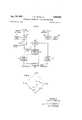
- FIG. 1(a)is a block diagram illustrating one embodiment of the invention employing a single omni-antenna
- FIG. 1(b)is vector diagram showing certain voltage relationship useful to explain the operation of the circuit of FIG. 1(a),
- FIG. 2illustrates in block diagram form another embodiment of the invention extended to be effective against multiple jammers
- FIG. 3represents waveforms useful to explain the operation of the circuit of FIG. 2.
- FIG. 1there is illustrated an embodiment of the invention employing a directional radar antenna 10, and a single omni-directional radar antenna 12.
- the directional antennareceives a desired signal in its main lobe. Jamming is sometimes in troduced by means of a high power source of jamming signals located a distance from the target in order to swamp out target information. This jamming may be picked up by a side-lobe of the radar antenna. In order to properly detect a target it is necessary to eliminate that portion of the signal received by the radar antenna which is attributable to jamming.
- the output of directional antenna llilis mixed in a mixer d with the output of a local oscillator 16.
- Mixer 14can be any conventional first detector.
- the output of (mini-directional antenna i2is mixed in another conventional first detector 18 with the output of a second local oscillator 20, down to an intermediate frequency which is offset in frequency from the intermediate frequency of the radar jamming signal. It is obvious that other techniques of obtaining the desired intermediate frequency may be employed such as the use of a single local oscillator for both channels and then offsetting the frequency of the two channels.
- the output of mixer lidis connected through a subtraction. circuit 22. and through a band pass filter 23 to one input of a band pass cross correlator comprising a mixer r 24 and a narrow band filter 26.
- the output of mixer 18is connected through band pass filter ...7 to a second input of the mixer 24.
- the output of narrow band filter Z6is connected to one input of a mixer 28 which has the output of mixer 18 connected to another of its inputs.
- the output of mixer 23is connected in turn to a second input of subtraction circuit 22.
- Directional antenna 16, local oscillator 16, mixer 14, subtraction circuit 22, and band pass filter 23comprise a main channel having an output terminal 3'9 located on the connection between band pass filter 23 and mixer 24.
- Omni-antenna 1'12, mixer if, local oscillator 29 and filter 27comprise an auxiliary channel.
- the waveform in the main channelmay be expressed as a signal carrier having a specified amplitude and phase, modulated by the signal waveform, plus a jammer carrier having the same frequency but some different amplitude and phase, modulated by the jammer waveform.
- the expression of the jamming signal received at the omni-directional antenna 12is the same as the expression for the radar antenna jamming signal except for a gain term and a phase shift introduced by the different in path length from the jammer to the omni-directional antenna and from the jammer to the radar.
- the magnitude of the phase shiftdepends upon the position of the jammer and the distance between the omni-directional antenna 12 and the radar antenna 10. If the waveform in the auxiliary channel is properly corrected in amplitude the phase, then it may be combined with the main channel waveform in such a manner that the jamming waveforms cancel, while signal in general does not.
- the amplitude and phase of the two jamming signalsmust be equalized.
- the omnidirectional antenna jamming signalis mixed down to an intermediate frequency in mixer 13 which is offset in frequency from the intermediate frequency of the radar jamming signal present at the output of mixer 14.
- These signalsare then mixed in mixer 24 and narrow band filtered in filter 26 to produce a signal at a frequency equal to the difference between the two intermediate frequencies.
- the amplitude of this signalis proportional to the average power of the jammer and the phase equals the phase of the jamming signal received at omni-directional antenna 12.
- the phase differenceis cancelled by mixing this signal with the jamming signal in mixer 28.
- the result of thisis a signal at the radar intermediate frequency that is phase equalized and that has an amplitude proportional to the average power of the jammer.
- This signalis introduced to the radar LP. channel through substraction circuit 22 forming a nonlinear closed loop providing automatic gain adjustment so that the residual jamming signal approaches zero in the radar intermediate frequency channel.
- the speed of response of the systemis dependent upon the loop gain, and the bandwith of the narrow band filter 26. Since loop gain is proportional to average power, the loop cancels jamming signals which have high average power, while it is relatively insensitive to target returns which have low average power and is thus able to discriminate between the two.
- the noiseis filtered to the signal bandwith using identical band pass filters, such as filters 23 and 27 in both channels, probably at LP.
- the narrow band noise in either channelmay be regarded as a carrier (W located at the center frequency of the band pass filter, and modulated both in amplitude and phase by the complex noise waveform j(t). Under the assumption of small relative time delay between channels, this waveform will be common to both channels.
- the relative amplitude and carrier phases of the two channelswill depend on the system geometry and jammer location.
- a frequency difference, wis introduced upon mixing the input signals with the output (W -l-W) signal of local oscillator 16 and the output of signal (W -i-W-l-w) of local oscillator 20.
- This frequency differenceshould comfortably exceed the signal bandwidth, but it may be small compared to the LP.
- this residueis multiplied by e and the product smoothed by the narrow band integrating filter 26, which is located to select the difference frequency w.
- the bandwidth of filter 26may be controlled to determine the integration time of the cross correlator. Assuming a cross correlator gain of 2G and an arbitrary circuit phase of a, the integrated product at the output of filter 26 is where j (t) represents average jammer power, P and the expressions representing the sum of frequencies resulting from heterodyning the two waveforms together are dropped. The sum of frequencies being dropped in order to conform to the realities of the circuit, since the filter 26 is designed to pass only the difference frequencies and not the sum frequencies.
- This smoothed carrier frequencyis then used to control the amplitude and phase of :2 which is provided through the cancellation path to cancel the jammer in the main channel.
- the phase of erepresents the phase difference and the amplitude is proportional to the required amount of amplitude correction.
- Equationindicates that whatever the loop phase, a, the magnitude of (qfi-cz) is small if the loop gain, a Gl is large.
- Equation 14may be approximated by In particular, if the loop phase on is adjusted to Zero, and from Equation 15; 5:0.
- Equation 17showing the degree of jammer cancellation obtained, is reminiscent of the conventional feedback equation except that the loop gain is a function of the jammer power P
- the performance of the loopincluding stability criteria affecting the design of the integrating filter 26 should be identical to a conventional loop.
- Variations of jammer w average power atan intermediate ratemight cause trouble by modulating loop gain. Very slow or very fast rates will not cause trouble. The slow rate is DC. while the fast rate, if it exceeds the bandwidth of the integrating fitter 2d, merely becomes part of the jammer waveform K
- the dependence of cancellation on jammer poweris very useful, in that high average power jamming is well cancelled, while low average power signals (in the ab sence of jamming) are not.
- the integration timeis N pulse lengths, the cancellation ratios for jamming should exceed that for signal of the same peak power by something like N, as can be seen by referring to Equation 17 with the assumption that the jammer amplitude is near that of the signal.
- FIG. 2again illustrates a main channel employing a radar antenna 14 coupled through a mixer 14, having a local oscillator 16 as its other input, and through a subtraction circuit 22 to an output terminal 30.
- FIG. 2employs three omni-directional antennas 32, 34 and 36 equally spaced d meters apart in a linear array.
- the equivalent width of the arrayis illustrated as D which extends d/2 on either side of the end elements and is equal to the number of elements times the element spacing.
- These antennasare coupled respectively through mixers 38, 49 and 42 to one input of the mixer 24.
- the other inputs of mixers 38, 40 and 42are coupled respectively to local oscillators 44, 46 and 48.
- the output of mixer 24is coupled to the input of mixer 28 through three narrow band filters 50, 52 and 54 which are connected in parallel.
- the second input of mixer 28is connected to the combined outputs of the three mixers 38, 4t ⁇ and 42.
- the output of mixer 23is then coupled to a second input of subtraction circuit 22.
- the antenna pattern of such an array as illustrated in FIG. 2comprises a number of echelon lobes inversely proportional in width to the total length of the array with spacing between the adjacent lobes inversely proportional to the distance between adjacent antennas, as illustrated in FIG. 3a.
- Phasing the output of the omni-directional antennas 32, 34 and 36, which causes the pattern to scan in azimuth,is accomplished by mixing the outputs of successive ones of the antennas with local oscillator frequencies from local oscillators 44, 46 and 48 that have frequency differences that are integral multiples of the frequency offset of local oscillator 44 from local oscillator 46.
- the phase of the signal received at the first omni-directional antenna 32is shifted by 211- radians in a period corresponding to one cycle of the local oscillator frequency offset.
- the signal phase of the second omni-directional antenna 34is shifted by 41r radians in the same period of time, and so on, causing the pattern of the linear ray to scan one echelon lobe spacing in a time corresponding to one cycle of the offset frequency of the first local oscillator 44.
- the local oscillator frequencyis chosen high enough so that no jamming waveform information is lost.
- the narrow band filter 26 of the single jammer configuration of FIG. 1(a)is replaced by a comb filter, or band of narrow band filters, 56, 52 and 54, tuned to the different frequencies of the omni-antenna intermediate frequency channels and the radar intermediate frequency. As long as not more than one jammer appears at a time in the echelon lobes its signals are cancelled in the radar intermediate frequency channel.
- the band pass filters 23 and 27 of FIG. 1may also be inserted in the same channels of FIG. 2 as in FIG. 1 but are not illustrated in the drawing of FIG. 2.
- the peak response of the pattern P(0)is (N-
- 1), and occurs when the phasors are colinear, or when G'IiZKn', K20, 1, 2, 3 25 From Equation (24) this requires that sin eai21er (26)
- the array patternmay thus have a number of main, or echelon, lobe responses, as illustrated in FIG. 3b, at the valves of 6' defined by Equation (26).
- Equation (26)also indicates how the array pattern may be steered by varying the steering phase 0:.
- An array with N-l-l elementsshould then be able to resolve N +1 different signals which are separated in angle by Aw.
- Equation 23The exact form of the array pattern P(0) may be determined from Equation 23 through the use of trigonometric identities. It can be shown that the phase of P(0) is N1( 21d sin 0) This defines a repetitive sin x type of pattern having x all the properties just described. For N odd, a slightly different expression is obtained but the basic properties are the same.
- This patternfor a seven element array (N:6), is shown in FIG. 3(c). As with any antenna, the pattern may be modified to suppress side lobes by modifying the amplitudes of the various element signals before summing.
- this patternmaybe steered to any angular position by changing the steering phase a.
- the steering phase atshould be replaced by a time varying scanning phase shift. This is done in the circuit illustrated in FIG. 2 by providing the local oscillator frequencies described previously whose frequency offsets amount to phase differences which are scanned in time.
- the array pattern of FIG. 30then will move uniformly with time, scanning the distance between echelon lobes (Md) in one cycle of the offset or scanning frequency. This scanning frequency is the frequency difference of the local oscillators 44 and 46.
- the signalis properly sampled, that is the samples contain complete information on the signal waveform.
- signals which can be resolved in angle by the array patternwill be seen at separate times at the array output so that the time multiplexed form of the sidelobe cancelling loop can independently cancel them.
- a noise cancellera main signal transmission channel having an output terminal, an auxiliary signal transmission channel having an output terminal, said channels having cross coupling therebetween, means for detecting the relative amplitude and phase of each of the cross coupled signals, a compensating cross feed network capable of adjustment for minimizing cross coupling at at least one output terminal, means responsive tosaid relative amplitude and phase for automatically adjusting said cross feed network in order to minimize cross coupling.
- a main signal transmission channelhaving a directional antenna adapted to receive desired signals, an auxiliary signal transmission channel having an omni-directional antenna adapted to receive primarily undesired signals, means coupling said directional antenna thru a conventional first detector to produce an intermediate frequency signal and thru a signal combining circuit and a first filter network to an output terminal, means coupling said omni-directional antenna thru a conventional second detector to produce an intermediate frequency signal oifset from said first intermediate frequency signal a fixed amount at least equal to the signal bandwidth and thru a filter network having the same time delay as said first filter network to one input of a band pass cross correlator, means coupling said output terminal to another input of said cross correlator, said cross correlator having an output signal representative of the amplitude and phase difference of the components of said undesired signal in each of said channels, means for automatically eterodyning said cross correlator output signal with said offset intermediate frequency signal of said auxiliary channel to produce an auxiliary channel output at the same
- a main signal transmission channelhaving an output terminal and adapted to receive a desired and an undesired signal, a second transmission channel adapted primarily to receive undesired signals, means for combining a first portion of the second channel undesired signal with said first channel signals to provide a first signal, means for mixing a second portion of the undesired second channel signal with said first signal to provide a second signal, means for substantially modifying the undesired signal available at said output terminal comprising means responsive to the amplitude and phase of said second signal for controlling the ampli tude and phase of said first portion of the second channel undesired signal.
- a main signal transmission channelcapable of receiving a desired and an undesired signal and having an output terminal
- an auxiliary signal transmission channeladapted primarily to receive said undesired signal
- correlating meansfor comparing the portion of said undesired signal present in said main and auxiliary channels to determine their phase and amplitude relationship
- a main signal transmission channelhaving an output terminal, an auxiliary signal transmission channel, said channels having cross coupling therebetween, means for detecting the relative amplitude and phase of each of the cross coupled signals, a compensating cross feed network capable of adjustment for minimizing cross coupling at said output terminal, means responsive to said relative amplitude and phase for adjusting said cross feed network in order to minimize cross coupling.
- a main signal transmission channelhaving a directional antenna adapted to receive desired signals, an auxiliary signal transmission channel having a plurality of omnidirectional antennas arranged in a linear array and adapted to receive undesired signals, means coupling said directional antenna in series thru a first detector to produce a first intermediate frequency signal and thru a signal combining circuit to an output terminal, means coupling each of said omni-directional antennas thru a separate second detector to produce an intermediate frequency signal, the intermediate frequency signal of the omni directional antenna adjacent said directional antenna being offset from said first intermediate frequency a fixed amount at least equal to the desired signal bandwidth and each succeeding omni-directional antenna in said linear array being offset an integral multiple of an additional amount which also exceeds the desired signal bandwidth, a cross correlator having a comb of band pass filters each designed to pass one of the intermediate frequencies of a separate one of the first detectors associated with each of said omni-antennas, means connecting the combined outputs of said first detectors associated with said omni-antennas, means connecting
- a main signal transmission channelhaving a directional antenna capable of receiving desired and undesired signals and having an output terminal
- an auxiliary signal transmission channelhaving a plurality of omni-directional antennas adapted primarily to receive said undesired signals
- correlating meansfor comparing the portions of each of said undesired signals present in said main channel and the corresponding undesired signals in said auxiliary channel to determine their phase and amplitude relationship
- a main signal transmission channelhaving an output terminal and an input terminal coupled to receive a signal distorted by noise
- an auxiliary signal transmission channelhaving an output terminal and an input terminal coupled to receive essentially noise
- cross correlation meanscoupled to each of said output terminals for detecting the relative amplitude and phase of said signal and said noise and providing a control signal accordingly
- a compensating cross feed networkcoupled to the output terminal of said auxiliary channel to receive said noise signal and to said cross correlation means to receive said control signal
- said cross feed networkincluding means automatically responsive to said control signal to adjust the amplitude and phase of said noise to provide a correcting signal equal in amplitude and phase to the noise appearing at the output terminal of said main channel, and means for subtracting said correcting signal from said signal distorted by noise to generate a pure signal.
- a main signal transmission channelhaving an output terminal and an input terminal coupled to receive a desired signal from a station and undesired noise from a jamming source
- an auxiliary signal transmission channelhaving an output terminal and an input terminal coupled to receive essentially noise from said jamming source
- cross correlation meanscoupled to each of said output terminals for detecting the relative amplitude and phase of said signal and said noise and providing a control signal
- a compensating cross feed networkcoupled to the output terminal of said auxiliary channel to receive said noise signal and to said cross correlation means to receive said control signal, said cross feed network automatically responsive to said control signal to adjust the amplitude and phase of said noise to provide a correcting signal equal in amplitude and phase signal.
Landscapes
- Engineering & Computer Science (AREA)
- Computer Networks & Wireless Communication (AREA)
- Radar, Positioning & Navigation (AREA)
- Remote Sensing (AREA)
- Signal Processing (AREA)
- Physics & Mathematics (AREA)
- General Physics & Mathematics (AREA)
- Variable-Direction Aerials And Aerial Arrays (AREA)
Description
Aug. 24, 1965 P. W. HOWELLS INTERMEDIATE FREQUENCY SIDE-LOBE CANCELLER Filed May 4. 1959 2 Sheets-Sheet 1 FIGIo.
RADAR OMNI ANTENNA ANTENNA |8 ,20 LOCAL LOCAL osc MIxER MIXER 05C.
22... MIXER suBTRAcTINeJ CIRCUIT I l cLosEo 1 I LOOP I NARROW I I II BAND I I: FILTER I I BAND l IBAND 23 PASS I PASS 27 F|LTER FILTER I I MIXER I L CROSS 3Q-O-QUTPUT fl CORRELATOR 9 /F\m er c INVENTORI PAUL W. HOWELLS BY ff.
H IS ATTORNEY.
1965 P. w. HQWELLS 3,202,990
INTERMEDIATE FREQUENCY SIDE-LOBE' CANCELLER 2 Sheets-Sheet 2 H62. d D d IRADAR b 32 2 34 k5 If!- ANTENNA l6 4 4 ;f Y
Filed May 4, 1959 NN a N ssa I I l ,flsuarRAcTlNe CIRCUIT3s 46 40L 48 42 MIXER 5 0 5 2 15 4 NBF NBF NBF MIXER -w -20: w-Nw 3O OUTPUT ANGLE (INSING) T INVENTORI PAUL.W.HOWELLS,
HIS ATTORNEY.
United States Patent 0 3,202,990 INTERMEDIATE FREQUENCY SIDE-LUBE CANCELLER Paul W. Howells, Morrisviile, N.Y., assig'nor to General Electric (Iompany, a corporation of New York Filed May 4, 1959, Ser. No. Sitlfidl 9 Claims. (Cl. 343-100) This invention relates to the elimination of jamming in a signal processing system and more particularly to the provision in a signal reception system of a side-lobe canceller employing a minimal amount of duplication of signal processing equipment.
Antenna side-lobes make it possible for a single jammer to be effective against a radar from any angle of azimuth. The jammer power density at the radar antenna is inversely proportional to the square of the distance between the jammer and the radar. Radar signal power density is inversely proportional to the fourth power of the distance between the target and the radar. The jammer thus has a power advantage that overcomes the radar antennas reduced gain as its side-lobes scan past the jammer.
Side-lobe cancellation is a fundamental approach to elimination of jamming from received signals. A sidelobe canceller uses jammer location to eliminate jamming signals and in effect maintains a null in the radar antenna receiver pattern in the direction of the jammer. To accomplish this effect the side-lobe canceller uses an omni-directional antenna adjacent to the radar antenna.
Prior art side-lobe cancelling systems have used two separate receivers, one for each antenna, adjusting one in amplitude so their outputs may be subtracted to eliminate the jammer at the video level. This approach has disadvantages since it involves the complex problem of matching two complete receivers almost perfectly in band pass, time delay and amplitude response. Video sidelobe cancellation also requires complete duplication of all intermediate frequency signal processing equipment being used with the radar. Accordingly it is an object of this invention to provide side'lobe cancellation without requiring matching of complete receivers.
Another object of this invention is to provide an improved jammer cancelling signal processing circuit.
Still another object of this invention is to permit intermediate frequency signal processing equipment to be used after side-lobe cancellation has taken place.
Still another object of the invention is to provide flexibility in a side-lobe canceller which can be expanded to cancel multiple jammers.
A further object of this invention is to employ phase information for jammer cancellation as well as the amplitude information normally used in video cancellers.
In carrying out the invention in one form thereof a main signal transmission channel is provided having a directional antenna adapted to receive desired signals. This channel is coupled through a conventional first detector to produce an intermediate frequency signal and through a signal combining circuit and a first filter network to an output terminal. An auxiliary signal transmission channel is provided having an omni-directional antenna adapted primarily to receive undesired signals. The omni-antenna is coupled through a conventional first detector to produce an intermediate frequency signal offset from the intermediate frequency signal in the main assasss Patented Aug. 24, 1965 transmission channel by a fixed amount at least equal to the signal bandwidtl. It is then coupled through a filter network having the same time delay as the filter network in the main channel. The output of the main channel and the filter network in the auxiliary channel are coupled to a band pass cross correlator which has an output signal representing the amplitude and phase difference of the components of the undesired signal in each of the two channels. The cross correlator output is then heterodyned with the offset intermediate frequency signal of the auxiliary channel in order to produce an auxiliary channel output at the same frequency as the intermediate frequency in the main channel and with any phase difference removed. This signal is then coupled to the signal combining circuit in the main channel which subtracts it from the signal in the main channel, closing the loop and providing continuous cancellation of the jamming signal in the output of the main channel.
in another form the invention may employ a number of omni-directional antennas in order to provide for cancellation from several jamming sources.
The novel features which are believed to be characteristic of the invention are set forth with particularity in the appended claims. The invention itself however, to-
' gether with further objects and advantages thereof can best be understood by reference to the following description taken in connection with the accompanying drawings, in which FIG. 1(a) is a block diagram illustrating one embodiment of the invention employing a single omni-antenna,
FIG. 1(b) is vector diagram showing certain voltage relationship useful to explain the operation of the circuit of FIG. 1(a),
FIG. 2 illustrates in block diagram form another embodiment of the invention extended to be effective against multiple jammers,
FIG. 3 represents waveforms useful to explain the operation of the circuit of FIG. 2.
Referring now to the drawings, in FIG. 1 there is illustrated an embodiment of the invention employing adirectional radar antenna 10, and a single omni-directional radar antenna 12. The directional antenna receives a desired signal in its main lobe. Jamming is sometimes in troduced by means of a high power source of jamming signals located a distance from the target in order to swamp out target information. This jamming may be picked up by a side-lobe of the radar antenna. In order to properly detect a target it is necessary to eliminate that portion of the signal received by the radar antenna which is attributable to jamming. The output of directional antenna llil is mixed in a mixer d with the output of alocal oscillator 16.Mixer 14 can be any conventional first detector. The output of (mini-directional antenna i2 is mixed in another conventionalfirst detector 18 with the output of a secondlocal oscillator 20, down to an intermediate frequency which is offset in frequency from the intermediate frequency of the radar jamming signal. It is obvious that other techniques of obtaining the desired intermediate frequency may be employed such as the use of a single local oscillator for both channels and then offsetting the frequency of the two channels. The output of mixer lid is connected through a subtraction.circuit 22. and through aband pass filter 23 to one input of a band pass cross correlator comprising amixer r 24 and anarrow band filter 26. The output ofmixer 18 is connected through band pass filter ...7 to a second input of themixer 24. The output of narrow band filter Z6 is connected to one input of amixer 28 which has the output ofmixer 18 connected to another of its inputs. The output ofmixer 23 is connected in turn to a second input ofsubtraction circuit 22.Directional antenna 16,local oscillator 16,mixer 14,subtraction circuit 22, andband pass filter 23 comprise a main channel having an output terminal 3'9 located on the connection betweenband pass filter 23 andmixer 24. Omni-antenna 1'12, mixer if, local oscillator 29 andfilter 27 comprise an auxiliary channel. The operation of the circuit of FIG. 1 is as follows:
When a jammer is present, the waveform in the main channel may be expressed as a signal carrier having a specified amplitude and phase, modulated by the signal waveform, plus a jammer carrier having the same frequency but some different amplitude and phase, modulated by the jammer waveform. The expression of the jamming signal received at the omni-directional antenna 12 is the same as the expression for the radar antenna jamming signal except for a gain term and a phase shift introduced by the different in path length from the jammer to the omni-directional antenna and from the jammer to the radar. The magnitude of the phase shift depends upon the position of the jammer and the distance between the omni-directional antenna 12 and theradar antenna 10. If the waveform in the auxiliary channel is properly corrected in amplitude the phase, then it may be combined with the main channel waveform in such a manner that the jamming waveforms cancel, while signal in general does not.
Before the jamming can be cancelled by subtraction insubtraction circuit 22 the amplitude and phase of the two jamming signals must be equalized. To do this the omnidirectional antenna jamming signal is mixed down to an intermediate frequency in mixer 13 which is offset in frequency from the intermediate frequency of the radar jamming signal present at the output ofmixer 14. These signals are then mixed inmixer 24 and narrow band filtered infilter 26 to produce a signal at a frequency equal to the difference between the two intermediate frequencies. The amplitude of this signal is proportional to the average power of the jammer and the phase equals the phase of the jamming signal received at omni-directional antenna 12. The phase difference is cancelled by mixing this signal with the jamming signal inmixer 28. The result of this is a signal at the radar intermediate frequency that is phase equalized and that has an amplitude proportional to the average power of the jammer.
This signal is introduced to the radar LP. channel throughsubstraction circuit 22 forming a nonlinear closed loop providing automatic gain adjustment so that the residual jamming signal approaches zero in the radar intermediate frequency channel. The speed of response of the system is dependent upon the loop gain, and the bandwith of thenarrow band filter 26. Since loop gain is proportional to average power, the loop cancels jamming signals which have high average power, while it is relatively insensitive to target returns which have low average power and is thus able to discriminate between the two.
Analyzing the operation of the circuit of FIG. 1 it will be assumed that the average power of the jammer is constant over an integration time comparable to one range sweep, the average jammer power is much greater than the average signal power and the relative time delay between channels is small compared to inverse signal bandwidth. These are all the necessary assumptions but for further convenience it will be assumed that the jammer wave form is wideband noise.
The noise is filtered to the signal bandwith using identical band pass filters, such asfilters
The relative amplitude and carrier phases of the two channels will depend on the system geometry and jammer location. Let the main channel jammer waveform at RJF. at the output ofradar antenna 10 be where m is amplitude and t is time, and the auxiliary channel waveform at the output of omni-antenna 12 be where a is amplitude and 0 the phase angle.
In converting these signals to the canceller LP. at the outputs ofmixers local oscillator 16 and the output of signal (W -i-W-l-w) oflocal oscillator 20. This frequency difference should comfortably exceed the signal bandwidth, but it may be small compared to the LP.
At the canceller I.F., then, we have:
e zm j(t) cos Wt and a= i( cos )t+ where r is the amplitude and 7) the phase angle.
In the IF. cross correlator this residue is multiplied by e and the product smoothed by the narrowband integrating filter 26, which is located to select the difference frequency w. The bandwidth offilter 26 may be controlled to determine the integration time of the cross correlator. Assuming a cross correlator gain of 2G and an arbitrary circuit phase of a, the integrated product at the output offilter 26 is where j (t) represents average jammer power, P and the expressions representing the sum of frequencies resulting from heterodyning the two waveforms together are dropped. The sum of frequencies being dropped in order to conform to the realities of the circuit, since thefilter 26 is designed to pass only the difference frequencies and not the sum frequencies.
This smoothed carrier frequency is then used to control the amplitude and phase of :2 which is provided through the cancellation path to cancel the jammer in the main channel. The phase of e represents the phase difference and the amplitude is proportional to the required amount of amplitude correction. When 6 is multiplied by e inmixer 28 the cancellation voltage obtained at the output ofmixer 28 at the difference frequency becomes which due to filtering infilter 23 to remove the sum frequencies, becomes e =ra GP (t) cos (Wt+a) (11) Note that 9, the original phase difference between the channels, has been removed. When the loop is closed the cancelled jammer residue is e =e e Equating real and imaginary parts of these voltages as written in Eqs 3, 5 and 11 yields the relations:
These equations define the relations between e e and c which are indicated in FIG. l(b). Equation indicates that whatever the loop phase, a, the magnitude of (qfi-cz) is small if the loop gain, a Gl is large.
The loop attempts to adjust the residue phase 4) to cancel the loop phase on. ThenEquation 14 may be approximated by In particular, if the loop phase on is adjusted to Zero, and from Equation 15; 5:0.
Equation 17, showing the degree of jammer cancellation obtained, is reminiscent of the conventional feedback equation except that the loop gain is a function of the jammer power P For constant jammer power, the performance of the loop, including stability criteria affecting the design of the integratingfilter 26 should be identical to a conventional loop. Variations of jammer w average power atan intermediate rate might cause trouble by modulating loop gain. Very slow or very fast rates will not cause trouble. The slow rate is DC. while the fast rate, if it exceeds the bandwidth of the integrating fitter 2d, merely becomes part of the jammer waveform K The dependence of cancellation on jammer power is very useful, in that high average power jamming is well cancelled, while low average power signals (in the ab sence of jamming) are not. If the integration time is N pulse lengths, the cancellation ratios for jamming should exceed that for signal of the same peak power by something like N, as can be seen by referring to Equation 17 with the assumption that the jammer amplitude is near that of the signal.
The side-lobe cancelling technique employing the invention can be extended to be effective against multiple jammers by utilizing additional omni-antennas equally spaced in a linear array as illustrated in the block diagram of FIG. 2. FIG. 2 again illustrates a main channel employing aradar antenna 14 coupled through amixer 14, having alocal oscillator 16 as its other input, and through asubtraction circuit 22 to an output terminal 30. Whereever possible identical numerals are used to designate components similar to those of FIG. 1. Instead of a single omni-directional antenna FIG. 2 employs three omni-directional antennas mixers mixer 24. The other inputs ofmixers local oscillators mixer 24 is coupled to the input ofmixer 28 through three narrow band filters 50, 52 and 54 which are connected in parallel. The second input ofmixer 28 is connected to the combined outputs of the threemixers 38, 4t} and 42. The output ofmixer 23 is then coupled to a second input ofsubtraction circuit 22.
The antenna pattern of such an array as illustrated in FIG. 2 comprises a number of echelon lobes inversely proportional in width to the total length of the array with spacing between the adjacent lobes inversely proportional to the distance between adjacent antennas, as illustrated in FIG. 3a. Phasing the output of the omni-directional antennas local oscillators local oscillator 44 fromlocal oscillator 46. In this manner the phase of the signal received at the first omni-directional antenna 32 is shifted by 211- radians in a period corresponding to one cycle of the local oscillator frequency offset. The signal phase of the second omni-directional antenna 34 is shifted by 41r radians in the same period of time, and so on, causing the pattern of the linear ray to scan one echelon lobe spacing in a time corresponding to one cycle of the offset frequency of the firstlocal oscillator 44. Each time an echelon lobe of the array scans past a jammer the jamming waveform is sampled. The local oscillator frequency is chosen high enough so that no jamming waveform information is lost.
In the multiple jammer canceller of FIG. 2 thenarrow band filter 26 of the single jammer configuration of FIG. 1(a) is replaced by a comb filter, or band of narrow band filters, 56, 52 and 54, tuned to the different frequencies of the omni-antenna intermediate frequency channels and the radar intermediate frequency. As long as not more than one jammer appears at a time in the echelon lobes its signals are cancelled in the radar intermediate frequency channel. The band pass filters 23 and 27 of FIG. 1 may also be inserted in the same channels of FIG. 2 as in FIG. 1 but are not illustrated in the drawing of FIG. 2.
Consider a wavefront approaching the array ofomniantennaes 33, 34, 36 at angle 0, which has just reached the zero element (antenna 32), and appears at this element as EDIE cos Wt where E is the amplitude and W the frequency of the wavefront. Because of the angle of arrival, 0, and the element spacing, d, this phase front still has d sin 0 distance to go before reaching the second antenna 34. Since one wavelength, r, represents 21r radians of phase delay, the first element signal at antenna 34 will be delayed in phase by radians orits signal will be E =E cos (Wti In general then the Kth element signal is E =E cos (Wt-w) I? This demonstrates the progressive delay of the element signals in phase along the array. Before the element signals are added, a fixed phase shift (Km) which varies linearly along the array would, upon addition, result in the summed signals having the form The array response would then be the sum of these divided by the received signal voltage E, or
This may be regarded as the sume of (N +1) unit phasors having a constant progressive phase difference =asin (24) Several characteristics of the array pattern P(0) may be deduced from an examination of Equation (23). The peak response of the pattern P(0) is (N-|1), and occurs when the phasors are colinear, or when G'IiZKn', K20, 1, 2, 3 25 From Equation (24) this requires that sin e= ai21er (26) The array pattern may thus have a number of main, or echelon, lobe responses, as illustrated in FIG. 3b, at the valves of 6' defined by Equation (26). The separation between these echelon lobe responses in terms of sin 0 is This leads to the usual requirement for a half-Wavelength spacing between elements. When A :2 the pattern, which can exist only in the range l2sin 051, is restricted to just one main lobe, which is usually desired. In some applications a number of such echelon lobes are permissible, so large element spacings may be used.
Equation (26) also indicates how the array pattern may be steered by varying the steering phase 0:. A change in or shifts the location of all main lobe response uniformly in sin 0, by the amount FromEquation 24 the width of the main lobe is then seen to be A (sin 6) (30) as compared to the spacing between echelon lobes ofEquation 27. An array with N-l-l elements should then be able to resolve N +1 different signals which are separated in angle by Aw.
The exact form of the array pattern P(0) may be determined fromEquation 23 through the use of trigonometric identities. It can be shown that the phase of P(0) is N1( 21d sin 0) This defines a repetitive sin x type of pattern having x all the properties just described. For N odd, a slightly different expression is obtained but the basic properties are the same.
This pattern, for a seven element array (N:6), is shown in FIG. 3(c). As with any antenna, the pattern may be modified to suppress side lobes by modifying the amplitudes of the various element signals before summing.
With the array configuration thus far described, this pattern maybe steered to any angular position by changing the steering phase a. To make a pattern which scans as rapidly as desired the steering phase at should be replaced by a time varying scanning phase shift. This is done in the circuit illustrated in FIG. 2 by providing the local oscillator frequencies described previously whose frequency offsets amount to phase differences which are scanned in time. The array pattern of FIG. 30 then will move uniformly with time, scanning the distance between echelon lobes (Md) in one cycle of the offset or scanning frequency. This scanning frequency is the frequency difference of thelocal oscillators
Assuming that f is at least equal to the signal bandwidth, the signal is properly sampled, that is the samples contain complete information on the signal waveform. In this manner signals which can be resolved in angle by the array pattern will be seen at separate times at the array output so that the time multiplexed form of the sidelobe cancelling loop can independently cancel them.
Once the signals are combined as described above, the circuit of FIG. 2 operates analogously to that of FIG. 1(a).
While particular embodiments of the invention have been illustrated and discussed it will be understood that it is not intended to limit the scope of the invention thereto since many modifications may be made and it is therefore contemplated by the appended claims to cover any such modifications as fall in the true spirit and scope of the invention.
What is claimed as new and desired to be secured by Letters Patent of the United States is:
1. In a noise canceller, a main signal transmission channel having an output terminal, an auxiliary signal transmission channel having an output terminal, said channels having cross coupling therebetween, means for detecting the relative amplitude and phase of each of the cross coupled signals, a compensating cross feed network capable of adjustment for minimizing cross coupling at at least one output terminal, means responsive tosaid relative amplitude and phase for automatically adjusting said cross feed network in order to minimize cross coupling.
2. In an intermediate frequency sidelobe canceller, a main signal transmission channel having a directional antenna adapted to receive desired signals, an auxiliary signal transmission channel having an omni-directional antenna adapted to receive primarily undesired signals, means coupling said directional antenna thru a conventional first detector to produce an intermediate frequency signal and thru a signal combining circuit and a first filter network to an output terminal, means coupling said omni-directional antenna thru a conventional second detector to produce an intermediate frequency signal oifset from said first intermediate frequency signal a fixed amount at least equal to the signal bandwidth and thru a filter network having the same time delay as said first filter network to one input of a band pass cross correlator, means coupling said output terminal to another input of said cross correlator, said cross correlator having an output signal representative of the amplitude and phase difference of the components of said undesired signal in each of said channels, means for automatically eterodyning said cross correlator output signal with said offset intermediate frequency signal of said auxiliary channel to produce an auxiliary channel output at the same frequency as the intermediate frequency in said main channel and with any phase difference removed, and means coupling said auxiliary channel output to said combining circuit in order to subtract it from the signal in said main channel.
3. In combination, a main signal transmission channel having an output terminal and adapted to receive a desired and an undesired signal, a second transmission channel adapted primarily to receive undesired signals, means for combining a first portion of the second channel undesired signal with said first channel signals to provide a first signal, means for mixing a second portion of the undesired second channel signal with said first signal to provide a second signal, means for substantially modifying the undesired signal available at said output terminal comprising means responsive to the amplitude and phase of said second signal for controlling the ampli tude and phase of said first portion of the second channel undesired signal.
4. In combination, a main signal transmission channel capable of receiving a desired and an undesired signal and having an output terminal, an auxiliary signal transmission channel adapted primarily to receive said undesired signal, correlating means for comparing the portion of said undesired signal present in said main and auxiliary channels to determine their phase and amplitude relationship, means for mixing the output of said correlating means with said undesired signal in said auxiliary channel to provide a compensating signal, means for subtracting said compensating signal from the signals present in said main channel for minimizing the amount of said undesired signal at said output terminal.
5. In an intermediate frequency sidelobe canceller, a main signal transmission channel having an output terminal, an auxiliary signal transmission channel, said channels having cross coupling therebetween, means for detecting the relative amplitude and phase of each of the cross coupled signals, a compensating cross feed network capable of adjustment for minimizing cross coupling at said output terminal, means responsive to said relative amplitude and phase for adjusting said cross feed network in order to minimize cross coupling.
6. In an intermediate frequency slidelobe canceller, a main signal transmission channel having a directional antenna adapted to receive desired signals, an auxiliary signal transmission channel having a plurality of omnidirectional antennas arranged in a linear array and adapted to receive undesired signals, means coupling said directional antenna in series thru a first detector to produce a first intermediate frequency signal and thru a signal combining circuit to an output terminal, means coupling each of said omni-directional antennas thru a separate second detector to produce an intermediate frequency signal, the intermediate frequency signal of the omni directional antenna adjacent said directional antenna being offset from said first intermediate frequency a fixed amount at least equal to the desired signal bandwidth and each succeeding omni-directional antenna in said linear array being offset an integral multiple of an additional amount which also exceeds the desired signal bandwidth, a cross correlator having a comb of band pass filters each designed to pass one of the intermediate frequencies of a separate one of the first detectors associated with each of said omni-antennas, means connecting the combined outputs of said first detectors associated with said omnidirectional antennas to one input of said cross correlator, means coupling said output terminal to another input of said cross correlator, said cross correlator having an output signal representative of the amplitude and phase difference of the components of said undesired signals present at the outputs of each of said detectors, means for heterodyning said cross correlator output signal with the combined ofiset intermediate frequency signals of said auxiliary channel to produce an auxiliary channel output having components at the same frequencies as the intermediate frequencies of the signal components in the main channel and with any phase differences removed, and means coupling said auxiliary channel output to said combining circuit in order to subtract the signal components having intermediate frequencies the same as that present in the main channel from the signals in said main channel.
7. In combination, a main signal transmission channel having a directional antenna capable of receiving desired and undesired signals and having an output terminal, an auxiliary signal transmission channel having a plurality of omni-directional antennas adapted primarily to receive said undesired signals, correlating means for comparing the portions of each of said undesired signals present in said main channel and the corresponding undesired signals in said auxiliary channel to determine their phase and amplitude relationship, means for deterodyning the output of said correlating means with the combined undesired signals in said auxiliary channel to provide a compensating signal, means for subtracting the frequency components of said compensating signal having frequency counterparts in said main channel from the signals present in said main channel for minimizing the amount of said undesired signals at said output terminal.
8. In a noise canceller, a main signal transmission channel having an output terminal and an input terminal coupled to receive a signal distorted by noise, an auxiliary signal transmission channel having an output terminal and an input terminal coupled to receive essentially noise, cross correlation means coupled to each of said output terminals for detecting the relative amplitude and phase of said signal and said noise and providing a control signal accordingly, a compensating cross feed network coupled to the output terminal of said auxiliary channel to receive said noise signal and to said cross correlation means to receive said control signal, said cross feed network including means automatically responsive to said control signal to adjust the amplitude and phase of said noise to provide a correcting signal equal in amplitude and phase to the noise appearing at the output terminal of said main channel, and means for subtracting said correcting signal from said signal distorted by noise to generate a pure signal.
9. In a noise canceller, a main signal transmission channel having an output terminal and an input terminal coupled to receive a desired signal from a station and undesired noise from a jamming source, an auxiliary signal transmission channel having an output terminal and an input terminal coupled to receive essentially noise from said jamming source, cross correlation means coupled to each of said output terminals for detecting the relative amplitude and phase of said signal and said noise and providing a control signal, a compensating cross feed network coupled to the output terminal of said auxiliary channel to receive said noise signal and to said cross correlation means to receive said control signal, said cross feed network automatically responsive to said control signal to adjust the amplitude and phase of said noise to provide a correcting signal equal in amplitude and phase signal.
References Cited by the Examiner UNITED STATES PATENTS 6/ 36 Macalpine 330-84 Breedlove 250-2054 Bay 250-2054 McMillan 330-84 Collbohm 343-100 Great Britain.
CHESTER L. JUSTUS, Primary Examiner.
Claims (1)
1. IN A NOISE CANCELLER, A MAIN SIGNAL TRANSMISSION CHANNEL HAVING AN OUTPUT TERMINAL, AN AUXILIARY SIGNAL TRANSMISSION CHANNEL HAVING AN OUTPUT TERMINAL, SAID CHANNELS HAVING CROSS COUPLING THEREBETWEEN, MEANS FOR DETECTING THE RELATIVE AMPLITUDE AND PHASE OF EACH OF THE CROSS COUPLED SIGNALS, A COMPENSATING CROSS FEED NETWORK CAPABLE OF ADJUSTMENT FOR MINIMIZING CROSS COUPLING AT AT LEAST ONE OUTPUT TERMINAL, MEANS RESPONSIVE TO SAID RELATIVE AMPLITUDE AND PHASE FOR AUTOMATICALLY ADJUSTING SAID CROSS FEED NETWORK IN ORDER TO MINIMIZE CROSS COUPLING.
Priority Applications (1)
| Application Number | Priority Date | Filing Date | Title |
|---|---|---|---|
| US810961AUS3202990A (en) | 1959-05-04 | 1959-05-04 | Intermediate frequency side-lobe canceller |
Applications Claiming Priority (2)
| Application Number | Priority Date | Filing Date | Title |
|---|---|---|---|
| US810961AUS3202990A (en) | 1959-05-04 | 1959-05-04 | Intermediate frequency side-lobe canceller |
| GB2008461AGB990680A (en) | 1961-06-02 | 1961-06-02 | Improvements in noise cancellers for signal processing systems |
Publications (1)
| Publication Number | Publication Date |
|---|---|
| US3202990Atrue US3202990A (en) | 1965-08-24 |
Family
ID=26254429
Family Applications (1)
| Application Number | Title | Priority Date | Filing Date |
|---|---|---|---|
| US810961AExpired - LifetimeUS3202990A (en) | 1959-05-04 | 1959-05-04 | Intermediate frequency side-lobe canceller |
Country Status (1)
| Country | Link |
|---|---|
| US (1) | US3202990A (en) |
Cited By (53)
| Publication number | Priority date | Publication date | Assignee | Title |
|---|---|---|---|---|
| US3435453A (en)* | 1967-11-06 | 1969-03-25 | Us Navy | Sidelobe cancelling system for array type target detectors |
| US3495249A (en)* | 1968-11-12 | 1970-02-10 | Us Air Force | Radar height readout system |
| US3761923A (en)* | 1972-09-01 | 1973-09-25 | Us Army | Radar side lobe canceller input equalizer |
| US3778602A (en)* | 1970-10-30 | 1973-12-11 | King Radio Corp | Area navigation computer and solid state filter |
| US3881177A (en)* | 1974-03-12 | 1975-04-29 | Us Army | Frequency agile-baseband sidelobe canceller |
| US3882498A (en)* | 1973-02-22 | 1975-05-06 | Gen Electric | Adaptive array processor providing improved mainlobe maintenance |
| US3916408A (en)* | 1974-01-18 | 1975-10-28 | Hughes Aircraft Co | Radar receiver having clutter and large signal reduction |
| USB488395I5 (en)* | 1974-07-15 | 1976-01-27 | ||
| US3938153A (en)* | 1974-08-16 | 1976-02-10 | The United States Of America As Represented By The Secretary Of The Navy | Sidelobe canceller system |
| US3938154A (en)* | 1974-08-16 | 1976-02-10 | The United States Of America As Represented By The Secretary Of The Navy | Modified sidelobe canceller system |
| US3978483A (en)* | 1974-12-26 | 1976-08-31 | The United States Of America As Represented By The Secretary Of The Navy | Stable base band adaptive loop |
| DE2635755A1 (en)* | 1975-09-11 | 1977-04-07 | Sanders Associates Inc | DEVICE FOR REMOVING SIDE SIDES |
| DE2714908A1 (en)* | 1976-04-06 | 1977-10-20 | Hollandse Signaalapparaten Bv | COAERENT SIDE CLUB SUPPRESSION UNIT IN A PULSE RADAR |
| US4070675A (en)* | 1976-10-21 | 1978-01-24 | Motorola Inc. | Power rejection apparatus using a null-constrained subarray for MTI radar applications |
| US4075633A (en)* | 1974-10-25 | 1978-02-21 | The United States Of America As Represented By The Secretary Of The Navy | Space adaptive coherent sidelobe canceller |
| US4085368A (en)* | 1976-08-30 | 1978-04-18 | Bell Telephone Laboratories, Incorporated | Interference canceling method and apparatus |
| US4086592A (en)* | 1977-07-22 | 1978-04-25 | The United States Of America As Represented By The Secretary Of The Navy | Digital sidelobe canceller |
| US4107678A (en)* | 1976-09-28 | 1978-08-15 | Westinghouse Electric Corp. | Polarization correlation target seeker |
| US4115865A (en)* | 1976-04-09 | 1978-09-19 | Thomson-Csf | High-speed correlating device |
| JPS5442995A (en)* | 1977-09-10 | 1979-04-05 | Toshiba Corp | Monopulse receiving device |
| US4177464A (en)* | 1978-11-13 | 1979-12-04 | The United States Of America As Represented By The Secretary Of The Air Force | Multiplexing of multiple loop sidelobe cancellers |
| US4186349A (en)* | 1977-12-27 | 1980-01-29 | E-Systems, Inc. | Adaptive narrow band noise estimator/suppressor radio receiver |
| US4204211A (en)* | 1974-06-24 | 1980-05-20 | General Electric Company | Controllable saturation sidelobe canceller |
| US4275397A (en)* | 1979-08-06 | 1981-06-23 | The United Statesof America as represented by the Secretary of the Army | Interference canceling random access discrete address multiple access system |
| US4285048A (en)* | 1979-06-27 | 1981-08-18 | The United States Of America As Represented By The Secretary Of The Army | Space variant signal processor |
| EP0050384A1 (en)* | 1980-10-17 | 1982-04-28 | Hollandse Signaalapparaten B.V. | Elimination in a pulse radar receiver of interference signals stemming from N distinct sources |
| US4359738A (en)* | 1974-11-25 | 1982-11-16 | The United States Of America As Represented By The Secretary Of The Navy | Clutter and multipath suppressing sidelobe canceller antenna system |
| US4364052A (en)* | 1980-10-29 | 1982-12-14 | Bell Telephone Laboratories, Incorporated | Antenna arrangements for suppressing selected sidelobes |
| US4376940A (en)* | 1980-10-29 | 1983-03-15 | Bell Telephone Laboratories, Incorporated | Antenna arrangements for suppressing selected sidelobes |
| US4439770A (en)* | 1976-06-23 | 1984-03-27 | The United States Of America As Represented By The Secretary Of The Navy | Cascaded adaptive loops |
| US4516130A (en)* | 1982-03-09 | 1985-05-07 | At&T Bell Laboratories | Antenna arrangements using focal plane filtering for reducing sidelobes |
| US4525716A (en)* | 1984-09-10 | 1985-06-25 | At&T Bell Laboratories | Technique for cancelling antenna sidelobes |
| US4586048A (en)* | 1971-03-04 | 1986-04-29 | The United States Of America As Represented By The Secretary Of The Air Force | Sidelobe canceller |
| US4628320A (en)* | 1964-04-29 | 1986-12-09 | General Electric Company | Cancellation of scatter jamming |
| US4644359A (en)* | 1982-12-02 | 1987-02-17 | Mitsubishi Denki Kabushiki Kaisha | Antenna system |
| US4652881A (en)* | 1984-01-10 | 1987-03-24 | Lewis Bernard L | Efficient adaptive filter bank |
| US4673943A (en)* | 1984-09-25 | 1987-06-16 | The United States Of America As Represented By The Secretary Of The Air Force | Integrated defense communications system antijamming antenna system |
| US4689628A (en)* | 1974-08-16 | 1987-08-25 | The United States Of America As Represented By The Secretary Of The Navy | Adapive sidelobe canceller system |
| US4731587A (en)* | 1985-12-10 | 1988-03-15 | Hughes Aircraft Company | Enhanced quadrature notch filter |
| US4893128A (en)* | 1979-11-29 | 1990-01-09 | The United States Of America As Represented By The Secretary Of The Air Force | Troposcatter diversity sidelobe jamming suppressor |
| US5049890A (en)* | 1974-09-23 | 1991-09-17 | The United States Of America As Represented By The Secretary Of The Navy | Sampled data processing |
| US5162805A (en)* | 1975-02-19 | 1992-11-10 | The United States Of America As Represented By The Secretary Of The Navy | Frequency diversity sidelobe canceller |
| US5291209A (en)* | 1973-11-02 | 1994-03-01 | Hughes Aircraft Company | Coherent side lobe canceler |
| US5296865A (en)* | 1974-08-23 | 1994-03-22 | The United States Of America As Represented By The Secretary Of The Navy | MTI compatible coherent sidelobe canceller |
| US5351057A (en)* | 1974-11-25 | 1994-09-27 | The United States Of America As Represented By The Secretary Of The Navy | Directive optimization of coherent sidelobe canceller systems |
| US5365234A (en)* | 1977-03-23 | 1994-11-15 | United States Of America As Represented By The Secretary Of The Navy | High-resolution sidelobe-canceller auxiliary antennas |
| US5909191A (en)* | 1991-06-12 | 1999-06-01 | Space Systems/Loral, Inc. | Multiple beam antenna and beamforming network |
| US6018317A (en)* | 1995-06-02 | 2000-01-25 | Trw Inc. | Cochannel signal processing system |
| US6268821B1 (en)* | 1977-10-21 | 2001-07-31 | Raytheon Company | Multiple band sidelobe canceller |
| US20090140922A1 (en)* | 2005-07-08 | 2009-06-04 | Thales | Bistatic radiofrequency device for producing an intrusion detecting barrier |
| US8614644B2 (en) | 2010-04-22 | 2013-12-24 | The Aerospace Corporation | Systems and methods for protecting a receiving antenna from interference by a transmitting antenna |
| US9786986B2 (en) | 2014-04-07 | 2017-10-10 | Kymeta Coproration | Beam shaping for reconfigurable holographic antennas |
| US10422855B2 (en)* | 2013-04-03 | 2019-09-24 | Leonard Mw Ltd | Radar systems and methods |
Citations (6)
| Publication number | Priority date | Publication date | Assignee | Title |
|---|---|---|---|---|
| US2043587A (en)* | 1932-01-02 | 1936-06-09 | Communications Patents Inc | Distortionless transmission system |
| US2104635A (en)* | 1936-01-16 | 1938-01-04 | Harry B Breedlove | Means and method for suppressing interference in radio reception |
| US2268998A (en)* | 1938-10-18 | 1942-01-06 | Magyar Wolframlampa Gyar Kreme | Reducing disturbances in radio reception |
| GB720345A (en)* | 1952-09-05 | 1954-12-15 | Derek Alfred Levell | Improvements in or relating to radar arrangements |
| US2748201A (en)* | 1951-09-21 | 1956-05-29 | Bell Telephone Labor Inc | Multiple-feedback systems |
| US2825900A (en)* | 1950-02-17 | 1958-03-04 | Rand Corp | Directional receiver |
- 1959
- 1959-05-04USUS810961Apatent/US3202990A/ennot_activeExpired - Lifetime
Patent Citations (6)
| Publication number | Priority date | Publication date | Assignee | Title |
|---|---|---|---|---|
| US2043587A (en)* | 1932-01-02 | 1936-06-09 | Communications Patents Inc | Distortionless transmission system |
| US2104635A (en)* | 1936-01-16 | 1938-01-04 | Harry B Breedlove | Means and method for suppressing interference in radio reception |
| US2268998A (en)* | 1938-10-18 | 1942-01-06 | Magyar Wolframlampa Gyar Kreme | Reducing disturbances in radio reception |
| US2825900A (en)* | 1950-02-17 | 1958-03-04 | Rand Corp | Directional receiver |
| US2748201A (en)* | 1951-09-21 | 1956-05-29 | Bell Telephone Labor Inc | Multiple-feedback systems |
| GB720345A (en)* | 1952-09-05 | 1954-12-15 | Derek Alfred Levell | Improvements in or relating to radar arrangements |
Cited By (56)
| Publication number | Priority date | Publication date | Assignee | Title |
|---|---|---|---|---|
| US4628320A (en)* | 1964-04-29 | 1986-12-09 | General Electric Company | Cancellation of scatter jamming |
| US3435453A (en)* | 1967-11-06 | 1969-03-25 | Us Navy | Sidelobe cancelling system for array type target detectors |
| US3495249A (en)* | 1968-11-12 | 1970-02-10 | Us Air Force | Radar height readout system |
| US3778602A (en)* | 1970-10-30 | 1973-12-11 | King Radio Corp | Area navigation computer and solid state filter |
| US4586048A (en)* | 1971-03-04 | 1986-04-29 | The United States Of America As Represented By The Secretary Of The Air Force | Sidelobe canceller |
| US3761923A (en)* | 1972-09-01 | 1973-09-25 | Us Army | Radar side lobe canceller input equalizer |
| US3882498A (en)* | 1973-02-22 | 1975-05-06 | Gen Electric | Adaptive array processor providing improved mainlobe maintenance |
| US5291209A (en)* | 1973-11-02 | 1994-03-01 | Hughes Aircraft Company | Coherent side lobe canceler |
| US3916408A (en)* | 1974-01-18 | 1975-10-28 | Hughes Aircraft Co | Radar receiver having clutter and large signal reduction |
| US3881177A (en)* | 1974-03-12 | 1975-04-29 | Us Army | Frequency agile-baseband sidelobe canceller |
| US4204211A (en)* | 1974-06-24 | 1980-05-20 | General Electric Company | Controllable saturation sidelobe canceller |
| USB488395I5 (en)* | 1974-07-15 | 1976-01-27 | ||
| US3982245A (en)* | 1974-07-15 | 1976-09-21 | General Electric Company | Sidelobe canceller with programmable correlation signal weighting |
| US3938154A (en)* | 1974-08-16 | 1976-02-10 | The United States Of America As Represented By The Secretary Of The Navy | Modified sidelobe canceller system |
| US3938153A (en)* | 1974-08-16 | 1976-02-10 | The United States Of America As Represented By The Secretary Of The Navy | Sidelobe canceller system |
| US4689628A (en)* | 1974-08-16 | 1987-08-25 | The United States Of America As Represented By The Secretary Of The Navy | Adapive sidelobe canceller system |
| US5296865A (en)* | 1974-08-23 | 1994-03-22 | The United States Of America As Represented By The Secretary Of The Navy | MTI compatible coherent sidelobe canceller |
| US5049890A (en)* | 1974-09-23 | 1991-09-17 | The United States Of America As Represented By The Secretary Of The Navy | Sampled data processing |
| US4075633A (en)* | 1974-10-25 | 1978-02-21 | The United States Of America As Represented By The Secretary Of The Navy | Space adaptive coherent sidelobe canceller |
| US4359738A (en)* | 1974-11-25 | 1982-11-16 | The United States Of America As Represented By The Secretary Of The Navy | Clutter and multipath suppressing sidelobe canceller antenna system |
| US5351057A (en)* | 1974-11-25 | 1994-09-27 | The United States Of America As Represented By The Secretary Of The Navy | Directive optimization of coherent sidelobe canceller systems |
| US3978483A (en)* | 1974-12-26 | 1976-08-31 | The United States Of America As Represented By The Secretary Of The Navy | Stable base band adaptive loop |
| US5162805A (en)* | 1975-02-19 | 1992-11-10 | The United States Of America As Represented By The Secretary Of The Navy | Frequency diversity sidelobe canceller |
| DE2635755A1 (en)* | 1975-09-11 | 1977-04-07 | Sanders Associates Inc | DEVICE FOR REMOVING SIDE SIDES |
| DE2714908A1 (en)* | 1976-04-06 | 1977-10-20 | Hollandse Signaalapparaten Bv | COAERENT SIDE CLUB SUPPRESSION UNIT IN A PULSE RADAR |
| US4119963A (en)* | 1976-04-06 | 1978-10-10 | Hollandse Signaalapparaten B.V. | Coherent side-lobe suppressing unit for a pulse radar apparatus |
| US4115865A (en)* | 1976-04-09 | 1978-09-19 | Thomson-Csf | High-speed correlating device |
| US4439770A (en)* | 1976-06-23 | 1984-03-27 | The United States Of America As Represented By The Secretary Of The Navy | Cascaded adaptive loops |
| US4085368A (en)* | 1976-08-30 | 1978-04-18 | Bell Telephone Laboratories, Incorporated | Interference canceling method and apparatus |
| US4107678A (en)* | 1976-09-28 | 1978-08-15 | Westinghouse Electric Corp. | Polarization correlation target seeker |
| US4070675A (en)* | 1976-10-21 | 1978-01-24 | Motorola Inc. | Power rejection apparatus using a null-constrained subarray for MTI radar applications |
| US5365234A (en)* | 1977-03-23 | 1994-11-15 | United States Of America As Represented By The Secretary Of The Navy | High-resolution sidelobe-canceller auxiliary antennas |
| US4086592A (en)* | 1977-07-22 | 1978-04-25 | The United States Of America As Represented By The Secretary Of The Navy | Digital sidelobe canceller |
| JPS5442995A (en)* | 1977-09-10 | 1979-04-05 | Toshiba Corp | Monopulse receiving device |
| US6268821B1 (en)* | 1977-10-21 | 2001-07-31 | Raytheon Company | Multiple band sidelobe canceller |
| US4186349A (en)* | 1977-12-27 | 1980-01-29 | E-Systems, Inc. | Adaptive narrow band noise estimator/suppressor radio receiver |
| US4177464A (en)* | 1978-11-13 | 1979-12-04 | The United States Of America As Represented By The Secretary Of The Air Force | Multiplexing of multiple loop sidelobe cancellers |
| US4285048A (en)* | 1979-06-27 | 1981-08-18 | The United States Of America As Represented By The Secretary Of The Army | Space variant signal processor |
| US4275397A (en)* | 1979-08-06 | 1981-06-23 | The United Statesof America as represented by the Secretary of the Army | Interference canceling random access discrete address multiple access system |
| US4893128A (en)* | 1979-11-29 | 1990-01-09 | The United States Of America As Represented By The Secretary Of The Air Force | Troposcatter diversity sidelobe jamming suppressor |
| EP0050384A1 (en)* | 1980-10-17 | 1982-04-28 | Hollandse Signaalapparaten B.V. | Elimination in a pulse radar receiver of interference signals stemming from N distinct sources |
| US4364052A (en)* | 1980-10-29 | 1982-12-14 | Bell Telephone Laboratories, Incorporated | Antenna arrangements for suppressing selected sidelobes |
| US4376940A (en)* | 1980-10-29 | 1983-03-15 | Bell Telephone Laboratories, Incorporated | Antenna arrangements for suppressing selected sidelobes |
| US4516130A (en)* | 1982-03-09 | 1985-05-07 | At&T Bell Laboratories | Antenna arrangements using focal plane filtering for reducing sidelobes |
| US4644359A (en)* | 1982-12-02 | 1987-02-17 | Mitsubishi Denki Kabushiki Kaisha | Antenna system |
| US4652881A (en)* | 1984-01-10 | 1987-03-24 | Lewis Bernard L | Efficient adaptive filter bank |
| US4525716A (en)* | 1984-09-10 | 1985-06-25 | At&T Bell Laboratories | Technique for cancelling antenna sidelobes |
| US4673943A (en)* | 1984-09-25 | 1987-06-16 | The United States Of America As Represented By The Secretary Of The Air Force | Integrated defense communications system antijamming antenna system |
| US4731587A (en)* | 1985-12-10 | 1988-03-15 | Hughes Aircraft Company | Enhanced quadrature notch filter |
| US5909191A (en)* | 1991-06-12 | 1999-06-01 | Space Systems/Loral, Inc. | Multiple beam antenna and beamforming network |
| US6018317A (en)* | 1995-06-02 | 2000-01-25 | Trw Inc. | Cochannel signal processing system |
| US20090140922A1 (en)* | 2005-07-08 | 2009-06-04 | Thales | Bistatic radiofrequency device for producing an intrusion detecting barrier |
| US8614644B2 (en) | 2010-04-22 | 2013-12-24 | The Aerospace Corporation | Systems and methods for protecting a receiving antenna from interference by a transmitting antenna |
| US10422855B2 (en)* | 2013-04-03 | 2019-09-24 | Leonard Mw Ltd | Radar systems and methods |
| US9786986B2 (en) | 2014-04-07 | 2017-10-10 | Kymeta Coproration | Beam shaping for reconfigurable holographic antennas |
| US10566697B2 (en)* | 2014-04-07 | 2020-02-18 | Kymeta Corporation | Beam shaping for reconfigurable holographic antennas |
Similar Documents
| Publication | Publication Date | Title |
|---|---|---|
| US3202990A (en) | Intermediate frequency side-lobe canceller | |
| US4268829A (en) | Steerable null antenna processor with gain control | |
| US3961172A (en) | Real-time cross-correlation signal processor | |
| US4771289A (en) | Beamforming/null-steering adaptive array | |
| US4475243A (en) | Isolation method and apparatus for a same frequency repeater | |
| US4280128A (en) | Adaptive steerable null antenna processor | |
| US4628320A (en) | Cancellation of scatter jamming | |
| US3177489A (en) | Interference suppression systems | |
| EP1225455B1 (en) | Radar apparatus with RFI suppression | |
| US4086592A (en) | Digital sidelobe canceller | |
| US3995271A (en) | Adaptive clutter cancellation and interference rejection system for AMTI radar | |
| EP0065499B1 (en) | Adaptive polarization for the cancellation of intentional interference in a radar system | |
| US5179386A (en) | Cylindrical phased array antenna system to produce wide open coverage of a wide angular sector with high directive gain and strong capability to resolve multiple signals | |
| US3938154A (en) | Modified sidelobe canceller system | |
| US3938153A (en) | Sidelobe canceller system | |
| US4146889A (en) | Method and apparatus for sidelobe reduction in radar | |
| US5361074A (en) | Mainlobe canceller system | |
| EP0098339A1 (en) | An adaptive system for the attenuation of an intentional disturbance applied to a phased array type radar with mechanical scanning | |
| US4549183A (en) | Interference suppressor for an electronically or mechanically scanning monopulse radar generating sum and difference signals from received microwave energy | |
| US4439769A (en) | Combined adaptive sidelobe canceller and frequency filter system | |
| US3141164A (en) | Radar receiver utilizing narrow band filtering and multiplexing | |
| US4586045A (en) | Wide band multiple side-lobe canceller | |
| US4689628A (en) | Adapive sidelobe canceller system | |
| US5351058A (en) | General purpose sidelobe canceller system | |
| US3471788A (en) | Predetection signal processing system |