US3147457A - Temperature probe - Google Patents
Temperature probeDownload PDFInfo
- Publication number
- US3147457A US3147457AUS128896AUS12889661AUS3147457AUS 3147457 AUS3147457 AUS 3147457AUS 128896 AUS128896 AUS 128896AUS 12889661 AUS12889661 AUS 12889661AUS 3147457 AUS3147457 AUS 3147457A
- Authority
- US
- United States
- Prior art keywords
- tube
- thermistor
- probe
- temperature
- leads
- Prior art date
- Legal status (The legal status is an assumption and is not a legal conclusion. Google has not performed a legal analysis and makes no representation as to the accuracy of the status listed.)
- Expired - Lifetime
Links
- 239000000523sampleSubstances0.000titleclaimsdescription30
- 239000004020conductorSubstances0.000claimsdescription9
- 239000012777electrically insulating materialSubstances0.000claimsdescription6
- 239000000463materialSubstances0.000claimsdescription4
- 239000011521glassSubstances0.000description9
- 229910052751metalInorganic materials0.000description8
- 239000002184metalSubstances0.000description8
- 239000004519greaseSubstances0.000description5
- XAGFODPZIPBFFR-UHFFFAOYSA-NaluminiumChemical compound[Al]XAGFODPZIPBFFR-UHFFFAOYSA-N0.000description4
- 229920001296polysiloxanePolymers0.000description4
- 239000011324beadSubstances0.000description3
- 239000000203mixtureSubstances0.000description2
- 239000004809TeflonSubstances0.000description1
- 229920006362Teflon®Polymers0.000description1
- 239000004568cementSubstances0.000description1
- 230000007547defectEffects0.000description1
- 239000011810insulating materialSubstances0.000description1
- 238000012856packingMethods0.000description1
Images
Classifications
- G—PHYSICS
- G01—MEASURING; TESTING
- G01K—MEASURING TEMPERATURE; MEASURING QUANTITY OF HEAT; THERMALLY-SENSITIVE ELEMENTS NOT OTHERWISE PROVIDED FOR
- G01K1/00—Details of thermometers not specially adapted for particular types of thermometer
- G01K1/16—Special arrangements for conducting heat from the object to the sensitive element
Definitions
- a temperature probeembodying a temperature-sensitive thermistor encased within a metal tube which is placed against or within the body, the temperature of which is to be determined.
- the electrical resistance of a thermistorvaries with temperature and, when the thermistor is connected into a suitable electrical circuit which will measure Variations in its resistance, the temperature of the body against which or in which the probe is placed can be determined by suitably calibrated instruments connected into the circuit.
- Temperature probes of the type just generally describedare conventional. However, such prior probes have had the defect that, in order to obtain from the probe fast responses to changes in temperature, the metal tube forming part of the probe has been joined to the thermistor and, therefore, the tube is electrically connected to one thermistor lead. In such an arrangement the probe can pick up ambient signals which destroy the accuracy of the probe and this limits the possible uses of the probe. The associated circuitry is also limited in this case because one side of the thermistor must usually be grounded.
- a temperature probeincluding a thermistor which is sensitive to changes in temperature and which is encased in a metal tube which is electrically insulated from the thermistor and which, therefore, is not connected electrically into the circuit into which the thermistor is connected.
- a probe made in accordance with our inventionwill give rapid responses to temperature changes.
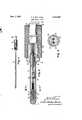
- FIGURE 1is a side View partially in section of our thermistor probe
- FIGURE 2is a Vertical, longitudinal section of our probe on a scale larger than that used in FIGURE l;
- FIGURE 3is a section along the lines III-III in FIGURE 2.
- our temperature probecomprises a hollow, elongated metal tube 4 having at one end a handle 5 of electrical insulating material which is mounted on the tube by a bushing 6. As is shown in FIGURE 2, the end of the tube 4 away from the handle 5 is closed and a thermistor 7 is positioned within the tube against this closed end. Electrical leads 8 and 9 are connected to the thermistor and extend through the tube and out the open end of the tube Where they are connected to a coaxial cable 10 which leads to a circuit (not shown) which measures variations in the resistance of the thermistor 7 in accordance with the temperature to which it is subjected.
- the end of the tube 4 in which the thermistor 7 is locatedis closed by a plug 11 which is press-fitted into the tube, following which the tube and the plug are ground so that the end of the tube and the plug are rounded and smooth, as shown in FIGURE 2.
- a heatconducting and electrically-insulating material 12comprlsmg equal portions by volume of a silicone grease, such as that known as Dow Corning No. 3, and aluminum powder is inserted into the tube in suliicient amount to surround the thermistor 7 and portions of the leads 8 and 9l adjacent the bead.
- a column of grease Within the tube approximately loA6 long and lilling the interior of the tube back of the plug 11 for %6gives good results.
- the thermistor 7 and portions of the leads 8 and y9 adjacent the beadare enclosed in a glass envelope 13.
- the length of the leads 8 and 9 outside of the glass envelope 13is enclosed within No. 28 gauge, thin-wall Teflon, spaghetti electricallyinsulating tubing 8 and 9. This tubing is pressed tightly against the end of the glass envelope 13 and the leads 8 and 9 are twisted three times, as shown in FIGURE 2, to hold the ends of the spaghetti against the glass envelope 13.
- the glass envelope 13 containing the thermistor 7 and the leads 8 and 9is pressed firmly through the heat-conducting and electrically-insulating material 12 so that the end of the envelope engages the inner surface of the plug 11.
- the heat-conducting material 12surrounds the glass envelope 13 and contacts the inner walls of the tube 4 so that. heat is transmitted very rapidly from the exterior surface of the plug 11 and the end of the tube 4 to the thermistor 7.
- the end of the metal tube 4 opposite to the end in which the thermistor 7 is locatedfits into a metal bushing 6 which has an externally threaded cylindrical portion 15.
- the tube 4is soldered to the bushing 6 at 16 and a hollow cylindrical handle 5 has at one end interior threads which are threaded over the cylindrical portion 15 of the Ibushing 6.
- the coaxial cable 10extends into the handle 5 from the end opposite to the end into which the tube 4 extends and is secured in the handle by cement 17.
- the leads 8 and 9extend through the bushing 6 and are connected to the coaxial cable in a conventional manner.
- the heat-conducting and electrically-insulating materialcan also be used to improve the performance of probes having nonmetallic outer tubes by packing the material around the thermistors and against the ends and adjacent inner walls of the outer tubes.
- a temperature probewhich may be easily assembled and which has two important features.
- the exterior metal tube of the probeis not electrically connected to the thermistor and, therefore, is not connected into the circuit for measuring the resistance of the thermistor.
- the probehas very rapid response to changes in temperature.
- the thermistor leadsare electrically insulated from the outer tube, as is also the handle; and, therefore, the probe can be used to measure the temperature of metal conductors which are not at ground potential. Conversely, it can be used to measure the temperature of conductors which are grounded.
- a temperature probecomprising a hollow tube closed at one end, a thermistor within the tube and positioned adjacent the closed end, leads connected to the thermistor and extending through the tube and out the open end of the tube, a glass envelope enclosing the thermistor and portions of the leads adjacent the thermistor, and a heat-conducting and electrically-insulating'material surrounding said envelope, said material also contacting the closed end and interior side walls of said tube adjacent the thermistor.
- thermoelectric materialis a mixture of silicone grease and aluminum powder.
Landscapes
- Physics & Mathematics (AREA)
- General Physics & Mathematics (AREA)
- Thermistors And Varistors (AREA)
Description
Sept l, 1964 H. A. G1LL. ETAL TEMPERATURE PROBE m A, @fr
INVENTORS. Harry A. 6/`// BY Warren Gil/Ingham -M mdvfw@ lllllllll l sa THE/R A r TOR/v5 Ys United States Patent O 3,147,457 TEMPERATURE PROBE Harry A. Gill, Ridgefield, Conn., and Warren Gillingham, Pittsburgh, Pa., assignors to Fisher Scentiic Company, Pittsburgh, Pa., a corporation of Pennsylvania Filed Aug. 2, 1961, Ser. No. 128,896 3 Claims. (Cl. 338-28) This application relates to a temperature probe. More particularly, it relates to a temperature probe embodying a temperature-sensitive thermistor encased within a metal tube which is placed against or within the body, the temperature of which is to be determined. As is well known, the electrical resistance of a thermistor varies with temperature and, when the thermistor is connected into a suitable electrical circuit which will measure Variations in its resistance, the temperature of the body against which or in which the probe is placed can be determined by suitably calibrated instruments connected into the circuit.
Temperature probes of the type just generally described are conventional. However, such prior probes have had the defect that, in order to obtain from the probe fast responses to changes in temperature, the metal tube forming part of the probe has been joined to the thermistor and, therefore, the tube is electrically connected to one thermistor lead. In such an arrangement the probe can pick up ambient signals which destroy the accuracy of the probe and this limits the possible uses of the probe. The associated circuitry is also limited in this case because one side of the thermistor must usually be grounded.
The problems created by the necessity for electrically insulating the thermistor from its surroundings have been solved by making the tube of glass, but the glass tube must be thin in order to transmit heat quickly and, therefore, is very fragile.
We have invented a temperature probe including a thermistor which is sensitive to changes in temperature and which is encased in a metal tube which is electrically insulated from the thermistor and which, therefore, is not connected electrically into the circuit into which the thermistor is connected. At the same time, a probe made in accordance with our invention will give rapid responses to temperature changes.
In the accompanying drawings, we have illustrated a presently preferred embodiment of our invention, in which:
FIGURE 1 is a side View partially in section of our thermistor probe;
FIGURE 2 is a Vertical, longitudinal section of our probe on a scale larger than that used in FIGURE l; and
FIGURE 3 is a section along the lines III-III in FIGURE 2.
Referring to FIGURE 1 of the drawings, our temperature probe comprises a hollow, elongated metal tube 4 having at one end ahandle 5 of electrical insulating material which is mounted on the tube by a bushing 6. As is shown in FIGURE 2, the end of the tube 4 away from thehandle 5 is closed and a thermistor 7 is positioned within the tube against this closed end. Electrical leads 8 and 9 are connected to the thermistor and extend through the tube and out the open end of the tube Where they are connected to acoaxial cable 10 which leads to a circuit (not shown) which measures variations in the resistance of the thermistor 7 in accordance with the temperature to which it is subjected.
Referring more particularly to FIGURE 2, the end of the tube 4 in which the thermistor 7 is located is closed by a plug 11 which is press-fitted into the tube, following which the tube and the plug are ground so that the end of the tube and the plug are rounded and smooth, as shown in FIGURE 2.
Before the plug 11 is pressed into the tube, a heatconducting and electrically-insulatingmaterial 12 comprlsmg equal portions by volume of a silicone grease, such as that known as Dow Corning No. 3, and aluminum powder is inserted into the tube in suliicient amount to surround the thermistor 7 and portions of theleads 8 and 9l adjacent the bead. In practice, we have found that a column of grease Within the tube approximately loA6 long and lilling the interior of the tube back of the plug 11 for %6 gives good results.
As is also shown in FIGURE 2, the thermistor 7 and portions of theleads 8 and y9 adjacent the bead are enclosed in aglass envelope 13. The length of theleads glass envelope 13 is enclosed within No. 28 gauge, thin-wall Teflon, spaghetti electricallyinsulatingtubing glass envelope 13 and theleads glass envelope 13.
During assembly of the probe, theglass envelope 13 containing the thermistor 7 and theleads material 12 so that the end of the envelope engages the inner surface of the plug 11. As shown in FIGURE 2, the heat-conductingmaterial 12 surrounds theglass envelope 13 and contacts the inner walls of the tube 4 so that. heat is transmitted very rapidly from the exterior surface of the plug 11 and the end of the tube 4 to the thermistor 7.
The end of the metal tube 4 opposite to the end in which the thermistor 7 is located fits into ametal bushing 6 which has an externally threadedcylindrical portion 15. The tube 4 is soldered to the bushing 6 at 16 and a hollowcylindrical handle 5 has at one end interior threads which are threaded over thecylindrical portion 15 of the Ibushing 6. Thecoaxial cable 10 extends into thehandle 5 from the end opposite to the end into which the tube 4 extends and is secured in the handle by cement 17. Theleads bushing 6 and are connected to the coaxial cable in a conventional manner.
The heat-conducting and electrically-insulating material (silicone grease and aluminum powder) can also be used to improve the performance of probes having nonmetallic outer tubes by packing the material around the thermistors and against the ends and adjacent inner walls of the outer tubes.
From the foregoing, it is apparent that we have invented a temperature probe which may be easily assembled and which has two important features. First, the exterior metal tube of the probe is not electrically connected to the thermistor and, therefore, is not connected into the circuit for measuring the resistance of the thermistor. Second, because a heat-conducting material surrounds the bead and is in contact with the end of the probe and with the interior walls of the tube adjacent the ends of the probe, the probe has very rapid response to changes in temperature. The thermistor leads are electrically insulated from the outer tube, as is also the handle; and, therefore, the probe can be used to measure the temperature of metal conductors which are not at ground potential. Conversely, it can be used to measure the temperature of conductors which are grounded.
While We have described a presently preferred embodiment of our invention, it is to be understood that it may be otherwise variously embodied Within the scope of the appended claims.
We claim:
1. A temperature probe comprising a hollow tube closed at one end, a thermistor within the tube and positioned adjacent the closed end, leads connected to the thermistor and extending through the tube and out the open end of the tube, a glass envelope enclosing the thermistor and portions of the leads adjacent the thermistor, and a heat-conducting and electrically-insulating'material surrounding said envelope, said material also contacting the closed end and interior side walls of said tube adjacent the thermistor.
2. A temperature probe as described in claim 1 in which the heat-conducting and electrically insulating material is a mixture of silicone grease and aluminum powder.
3. A temperature probe as described in claim 1 in which the heat-conducting and electrically insulating material is a mixture of equal proportions of silicone grease and aluminum powder.
References Cited in the le of this patent UNITED STATES PATENTS 2,528,243 Quinn Oct. 31, 1950 2,559,077 Johnson et al July 3, 1951 2,588,014 Knudsen Mar. 4, 1952 2,590,041 Roost Mar. 18, 1952
Claims (1)
1. A TEMPERATURE PROBE, COMPRISING A HOLLOW TUBE CLOSED AT ONE END, A THERMISTOR WITHIN THE TUBE AND POSITIONED ADJACENT THE CLOSED END, LEADS CONNECTED TO THE THERMISTOR AND EXTENDING THROUGH THE TUBE AND OUT THE OPEN END OF THE TUBE, A GLASS ENVELOPE ENCLOSING THE THERMISTOR AND PORTIONS OF THE LEADS ADJACENT THE THERMISTOR, AND A HEAT-CONDUCTING AND ELECTRICALLY-INSULATING MATERIAL SURROUNDING SAID ENVELOPE, SAID MATERIAL ALSO CONTACTING THE CLOSED END AND INTERIOR SIDE WALLS OF SAID TUBE ADJACENT THE THERMISTOR.
Priority Applications (1)
| Application Number | Priority Date | Filing Date | Title |
|---|---|---|---|
| US128896AUS3147457A (en) | 1961-08-02 | 1961-08-02 | Temperature probe |
Applications Claiming Priority (1)
| Application Number | Priority Date | Filing Date | Title |
|---|---|---|---|
| US128896AUS3147457A (en) | 1961-08-02 | 1961-08-02 | Temperature probe |
Publications (1)
| Publication Number | Publication Date |
|---|---|
| US3147457Atrue US3147457A (en) | 1964-09-01 |
Family
ID=22437519
Family Applications (1)
| Application Number | Title | Priority Date | Filing Date |
|---|---|---|---|
| US128896AExpired - LifetimeUS3147457A (en) | 1961-08-02 | 1961-08-02 | Temperature probe |
Country Status (1)
| Country | Link |
|---|---|
| US (1) | US3147457A (en) |
Cited By (31)
| Publication number | Priority date | Publication date | Assignee | Title |
|---|---|---|---|---|
| US3281518A (en)* | 1963-11-26 | 1966-10-25 | Leeds & Northrup Co | Thermocouple assembly |
| US3367186A (en)* | 1965-08-27 | 1968-02-06 | Measurement Science Corp | Resistance thermometer |
| US3508186A (en)* | 1968-04-16 | 1970-04-21 | Schwarza Chemiefaser | Resistance thermometer |
| US3592059A (en)* | 1969-06-27 | 1971-07-13 | Computer Diode Corp | Temperature measuring apparatus |
| US3735322A (en)* | 1970-07-13 | 1973-05-22 | Vapor Corp | Temperature sensor |
| US4166451A (en)* | 1977-08-26 | 1979-09-04 | Salera Edmond A | Heat sensing instrument probe |
| US4186368A (en)* | 1978-05-30 | 1980-01-29 | Tektronix, Inc. | Wide range, quick response temperature probe sensor |
| US4246786A (en)* | 1979-06-13 | 1981-01-27 | Texas Instruments Incorporated | Fast response temperature sensor and method of making |
| US4246787A (en)* | 1979-06-13 | 1981-01-27 | Texas Instruments Incorporated | Fast response temperature sensor and method of making |
| US4531844A (en)* | 1981-10-14 | 1985-07-30 | Societe Bourguignonne De Mercanique | Thermal probe and apparatus incorporating the same |
| US4538927A (en)* | 1983-01-12 | 1985-09-03 | Robert Bosch Gmbh | Electrical temperature sensor, particularly for fever thermometer use |
| EP0447882A1 (en)* | 1990-03-19 | 1991-09-25 | Eaton Corporation | Sensing refrigerant temperature in a thermostatic expansion valve |
| US5372427A (en)* | 1991-12-19 | 1994-12-13 | Texas Instruments Incorporated | Temperature sensor |
| US5720556A (en)* | 1995-02-02 | 1998-02-24 | Keystone Thermometrics Corporation | Temperature sensor probe |
| US5999081A (en)* | 1996-11-29 | 1999-12-07 | Marchi Associates, Inc. | Shielding unique for filtering RFI and EFI interference signals from the measuring elements |
| US6093883A (en)* | 1997-07-15 | 2000-07-25 | Focus Surgery, Inc. | Ultrasound intensity determining method and apparatus |
| US6130598A (en)* | 1996-01-08 | 2000-10-10 | Matsushita Electric Industrial Co., Ltd. | Temperature detecting apparatus |
| US6286995B1 (en)* | 1998-09-22 | 2001-09-11 | Denso Corporation | Temperature sensor |
| US6437679B1 (en)* | 1999-04-30 | 2002-08-20 | Siemens Aktiengesellschaft | Device for temperature determination and process for manufacturing such a device |
| US6462640B2 (en)* | 2000-03-29 | 2002-10-08 | Heraeus Electro-Nite International N.V. | Sensor with a temperature-dependent measuring element |
| US20030111257A1 (en)* | 2001-11-05 | 2003-06-19 | Jeol Ltd. | Wire member and method of fabricating same |
| US20040066836A1 (en)* | 2002-10-07 | 2004-04-08 | Ming-Yun Chen | Rapid respond electronic clinical thermometer |
| US20040213323A1 (en)* | 2003-04-25 | 2004-10-28 | Universal Leaf Tobacco Company, Inc. | Packed product temperature measuring device |
| US7075407B1 (en)* | 1999-04-09 | 2006-07-11 | Murata Manufacturing Co., Ltd. | Temperature sensor |
| US7080941B1 (en)* | 2001-11-13 | 2006-07-25 | Lam Research Corporation | Temperature sensing system for temperature measurement in a high radio frequency environment |
| US20120266451A1 (en)* | 2008-03-20 | 2012-10-25 | Endress + Hauser Flowtec Ag | Temperature sensor and method for its manufacture |
| US20180158581A1 (en)* | 2015-09-25 | 2018-06-07 | Murata Manufacturing Co., Ltd. | Electronic component module with leads and method for manufacturing the same |
| US10488062B2 (en) | 2016-07-22 | 2019-11-26 | Ademco Inc. | Geofence plus schedule for a building controller |
| US10534331B2 (en) | 2013-12-11 | 2020-01-14 | Ademco Inc. | Building automation system with geo-fencing |
| US10895883B2 (en) | 2016-08-26 | 2021-01-19 | Ademco Inc. | HVAC controller with a temperature sensor mounted on a flex circuit |
| US12264973B1 (en)* | 2023-12-19 | 2025-04-01 | Shenzhen Kuki Electronic Co., Ltd. | Temperature probe |
Citations (4)
| Publication number | Priority date | Publication date | Assignee | Title |
|---|---|---|---|---|
| US2528243A (en)* | 1949-10-12 | 1950-10-31 | Gen Electric | Electric control element |
| US2559077A (en)* | 1946-07-01 | 1951-07-03 | Carl G Westerberg | Resistance element and method of preparing same |
| US2588014A (en)* | 1949-04-27 | 1952-03-04 | Lewis Eng Co | Resistance thermometer bulb |
| US2590041A (en)* | 1949-09-09 | 1952-03-18 | Foxboro Co | Resistance thermometer |
- 1961
- 1961-08-02USUS128896Apatent/US3147457A/ennot_activeExpired - Lifetime
Patent Citations (4)
| Publication number | Priority date | Publication date | Assignee | Title |
|---|---|---|---|---|
| US2559077A (en)* | 1946-07-01 | 1951-07-03 | Carl G Westerberg | Resistance element and method of preparing same |
| US2588014A (en)* | 1949-04-27 | 1952-03-04 | Lewis Eng Co | Resistance thermometer bulb |
| US2590041A (en)* | 1949-09-09 | 1952-03-18 | Foxboro Co | Resistance thermometer |
| US2528243A (en)* | 1949-10-12 | 1950-10-31 | Gen Electric | Electric control element |
Cited By (44)
| Publication number | Priority date | Publication date | Assignee | Title |
|---|---|---|---|---|
| US3281518A (en)* | 1963-11-26 | 1966-10-25 | Leeds & Northrup Co | Thermocouple assembly |
| US3367186A (en)* | 1965-08-27 | 1968-02-06 | Measurement Science Corp | Resistance thermometer |
| US3508186A (en)* | 1968-04-16 | 1970-04-21 | Schwarza Chemiefaser | Resistance thermometer |
| US3592059A (en)* | 1969-06-27 | 1971-07-13 | Computer Diode Corp | Temperature measuring apparatus |
| US3735322A (en)* | 1970-07-13 | 1973-05-22 | Vapor Corp | Temperature sensor |
| US4166451A (en)* | 1977-08-26 | 1979-09-04 | Salera Edmond A | Heat sensing instrument probe |
| US4186368A (en)* | 1978-05-30 | 1980-01-29 | Tektronix, Inc. | Wide range, quick response temperature probe sensor |
| US4246786A (en)* | 1979-06-13 | 1981-01-27 | Texas Instruments Incorporated | Fast response temperature sensor and method of making |
| US4246787A (en)* | 1979-06-13 | 1981-01-27 | Texas Instruments Incorporated | Fast response temperature sensor and method of making |
| US4531844A (en)* | 1981-10-14 | 1985-07-30 | Societe Bourguignonne De Mercanique | Thermal probe and apparatus incorporating the same |
| US4538927A (en)* | 1983-01-12 | 1985-09-03 | Robert Bosch Gmbh | Electrical temperature sensor, particularly for fever thermometer use |
| EP0447882A1 (en)* | 1990-03-19 | 1991-09-25 | Eaton Corporation | Sensing refrigerant temperature in a thermostatic expansion valve |
| US5372427A (en)* | 1991-12-19 | 1994-12-13 | Texas Instruments Incorporated | Temperature sensor |
| US5720556A (en)* | 1995-02-02 | 1998-02-24 | Keystone Thermometrics Corporation | Temperature sensor probe |
| US6130598A (en)* | 1996-01-08 | 2000-10-10 | Matsushita Electric Industrial Co., Ltd. | Temperature detecting apparatus |
| US5999081A (en)* | 1996-11-29 | 1999-12-07 | Marchi Associates, Inc. | Shielding unique for filtering RFI and EFI interference signals from the measuring elements |
| US6093883A (en)* | 1997-07-15 | 2000-07-25 | Focus Surgery, Inc. | Ultrasound intensity determining method and apparatus |
| US6286995B1 (en)* | 1998-09-22 | 2001-09-11 | Denso Corporation | Temperature sensor |
| US7193498B2 (en) | 1999-04-09 | 2007-03-20 | Murata Manufacturing Co., Ltd. | Method of producing temperature sensor and mounting same to a circuit board |
| US20060208848A1 (en)* | 1999-04-09 | 2006-09-21 | Murata Manufacturing Co., Ltd. | Method of producing temperature sensor and mounting same to a circuit board |
| US7075407B1 (en)* | 1999-04-09 | 2006-07-11 | Murata Manufacturing Co., Ltd. | Temperature sensor |
| US6437679B1 (en)* | 1999-04-30 | 2002-08-20 | Siemens Aktiengesellschaft | Device for temperature determination and process for manufacturing such a device |
| US6462640B2 (en)* | 2000-03-29 | 2002-10-08 | Heraeus Electro-Nite International N.V. | Sensor with a temperature-dependent measuring element |
| US7426779B2 (en) | 2001-11-05 | 2008-09-23 | Jeol Ltd. | Method of fabricating wire member |
| US7049505B2 (en)* | 2001-11-05 | 2006-05-23 | Jeol Ltd. | Wire member and method of fabricating same |
| US20060200986A1 (en)* | 2001-11-05 | 2006-09-14 | Jeol Ltd. | Method of fabricating wire member |
| US20030111257A1 (en)* | 2001-11-05 | 2003-06-19 | Jeol Ltd. | Wire member and method of fabricating same |
| US7080941B1 (en)* | 2001-11-13 | 2006-07-25 | Lam Research Corporation | Temperature sensing system for temperature measurement in a high radio frequency environment |
| US6854882B2 (en)* | 2002-10-07 | 2005-02-15 | Actherm Inc. | Rapid response electronic clinical thermometer |
| US20040066836A1 (en)* | 2002-10-07 | 2004-04-08 | Ming-Yun Chen | Rapid respond electronic clinical thermometer |
| US20040213323A1 (en)* | 2003-04-25 | 2004-10-28 | Universal Leaf Tobacco Company, Inc. | Packed product temperature measuring device |
| US7018096B2 (en)* | 2003-04-25 | 2006-03-28 | Universal Leaf Tobacco Company, Inc. | Packed product temperature measuring device |
| US20120266451A1 (en)* | 2008-03-20 | 2012-10-25 | Endress + Hauser Flowtec Ag | Temperature sensor and method for its manufacture |
| US8935843B2 (en)* | 2008-03-20 | 2015-01-20 | Endress + Hauser Flowtec Ag | Temperature sensor and method for its manufacture |
| US10712718B2 (en) | 2013-12-11 | 2020-07-14 | Ademco Inc. | Building automation remote control device with in-application messaging |
| US10534331B2 (en) | 2013-12-11 | 2020-01-14 | Ademco Inc. | Building automation system with geo-fencing |
| US10591877B2 (en) | 2013-12-11 | 2020-03-17 | Ademco Inc. | Building automation remote control device with an in-application tour |
| US10649418B2 (en) | 2013-12-11 | 2020-05-12 | Ademco Inc. | Building automation controller with configurable audio/visual cues |
| US10768589B2 (en) | 2013-12-11 | 2020-09-08 | Ademco Inc. | Building automation system with geo-fencing |
| US10176909B2 (en)* | 2015-09-25 | 2019-01-08 | Murata Manufacturing Co., Ltd. | Electronic component module with leads and method for manufacturing the same |
| US20180158581A1 (en)* | 2015-09-25 | 2018-06-07 | Murata Manufacturing Co., Ltd. | Electronic component module with leads and method for manufacturing the same |
| US10488062B2 (en) | 2016-07-22 | 2019-11-26 | Ademco Inc. | Geofence plus schedule for a building controller |
| US10895883B2 (en) | 2016-08-26 | 2021-01-19 | Ademco Inc. | HVAC controller with a temperature sensor mounted on a flex circuit |
| US12264973B1 (en)* | 2023-12-19 | 2025-04-01 | Shenzhen Kuki Electronic Co., Ltd. | Temperature probe |
Similar Documents
| Publication | Publication Date | Title |
|---|---|---|
| US3147457A (en) | Temperature probe | |
| US3614387A (en) | Electrical heater with an internal thermocouple | |
| US6676290B1 (en) | Electronic clinical thermometer | |
| US2566369A (en) | Pressure gauge | |
| US3499310A (en) | Self-calibrating temperature sensing probe and probe - indicator combination | |
| US4538927A (en) | Electrical temperature sensor, particularly for fever thermometer use | |
| US3324722A (en) | Continuous fluid level measuring apparatus | |
| US3024295A (en) | Immersion pyrometer with non-directional contact structure | |
| US2307626A (en) | Resistance thermometer | |
| US2849518A (en) | Temperature indicator | |
| US2025534A (en) | Electromotive thermometry | |
| US4654623A (en) | Thermometer probe for measuring the temperature in low-convection media | |
| US2131065A (en) | Resistance thermometer | |
| US3360990A (en) | Thermoelectric liquid level indicating system | |
| US2728833A (en) | Resistance thermometer | |
| US4492948A (en) | Fast response surface contact temperature sensor | |
| US2679642A (en) | Liquid level indicator | |
| US4995731A (en) | Method for measuring heat transfer coefficient and sensor including heat transfer element and thermal insulation element | |
| US2826625A (en) | Thermo-couple | |
| US2337202A (en) | Resistor | |
| Starr | The pressure coefficient of thermal conductivity of metals | |
| US2466211A (en) | High-voltage resistor | |
| US2367211A (en) | Pressure gauge | |
| US1917129A (en) | Temperature indicator | |
| US2375892A (en) | Thermometer |