US2987292A - Mechanically operated collapsible valve - Google Patents
Mechanically operated collapsible valveDownload PDFInfo
- Publication number
- US2987292A US2987292AUS826781AUS82678159AUS2987292AUS 2987292 AUS2987292 AUS 2987292AUS 826781 AUS826781 AUS 826781AUS 82678159 AUS82678159 AUS 82678159AUS 2987292 AUS2987292 AUS 2987292A
- Authority
- US
- United States
- Prior art keywords
- liner
- valve
- sleeve
- bore
- balls
- Prior art date
- Legal status (The legal status is an assumption and is not a legal conclusion. Google has not performed a legal analysis and makes no representation as to the accuracy of the status listed.)
- Expired - Lifetime
Links
- 239000012530fluidSubstances0.000description5
- 238000006073displacement reactionMethods0.000description3
- 230000000717retained effectEffects0.000description3
- 230000005540biological transmissionEffects0.000description2
- 230000000694effectsEffects0.000description2
- 230000000750progressive effectEffects0.000description2
- 238000007789sealingMethods0.000description2
- 230000007797corrosionEffects0.000description1
- 238000005260corrosionMethods0.000description1
- 230000008878couplingEffects0.000description1
- 238000010168coupling processMethods0.000description1
- 238000005859coupling reactionMethods0.000description1
- 230000007257malfunctionEffects0.000description1
- 238000012856packingMethods0.000description1
- 239000000126substanceSubstances0.000description1
Images
Classifications
- F—MECHANICAL ENGINEERING; LIGHTING; HEATING; WEAPONS; BLASTING
- F16—ENGINEERING ELEMENTS AND UNITS; GENERAL MEASURES FOR PRODUCING AND MAINTAINING EFFECTIVE FUNCTIONING OF MACHINES OR INSTALLATIONS; THERMAL INSULATION IN GENERAL
- F16K—VALVES; TAPS; COCKS; ACTUATING-FLOATS; DEVICES FOR VENTING OR AERATING
- F16K7/00—Diaphragm valves or cut-off apparatus, e.g. with a member deformed, but not moved bodily, to close the passage ; Pinch valves
- F16K7/02—Diaphragm valves or cut-off apparatus, e.g. with a member deformed, but not moved bodily, to close the passage ; Pinch valves with tubular diaphragm
- F16K7/04—Diaphragm valves or cut-off apparatus, e.g. with a member deformed, but not moved bodily, to close the passage ; Pinch valves with tubular diaphragm constrictable by external radial force
- F16K7/06—Diaphragm valves or cut-off apparatus, e.g. with a member deformed, but not moved bodily, to close the passage ; Pinch valves with tubular diaphragm constrictable by external radial force by means of a screw-spindle, cam, or other mechanical means
Definitions
- the present inventionhas for its major object the solution of the above mentioned diii'iculties through the provision of a 'valve in which a tlexible bore liner is located within a iluid iiow bore of a valve body, the liner being subject to complete and positive closure.
- the flexible bore liner'extends across a side opening in the valve body to seal Y.
- insert meansis provided at lthe outside of the opening, the insert means being movas for example in rotation to positively cam the insert means inwardly and thereby effect positive displacement of the liner to reduce the iiuid flowv bore area, there being no possibility of lmalfunction in closure of the valve.
- insertsare provided at the outside of multiple side openings in a tubular body spaced about the body axis.
- These insertspreferably comprise balls sized for simultaneous movement through the openings in response to displacement of an actuator sleeve relative to the tubular body and at the exterior thereof.
- the sleeveis rotatable about the tubular body axis to cam the balls inwardly from within interior recesses in the sleeve, whereas in another form of the invention the sleeve is advanced axially along the tubular body to cam the balls inwardly from within an annular recess in the sleeve.
- An important feature of the inventionresides in the fact that the ilexible liner is substantially fully supported at all times by the convex ball surfaces so as to prevent pressure blowout of the liner through the side openings Patented June 6,
- the lineris bulged so as to completely lill the uid liow bore area when the balls have entered the bore to the maximum extent.
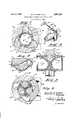
- FIG. lis a cross section through the valve in condition
- FIG. 2is a view similar to FIG. l but showing the valve in closed condition;
- FIG. 3is a view taken on line 3-3 of FIG. 2;
- FIG. 4is a perspective View of the valve exterior showing the use of a worm gear mechanism for opening and Aopen fbe provided.
- the side openingsare approximately ci'r cular and are sized to pass circular cross section inserts shown in their preferred form as balls 15 located at the outsides of the openings as seen in FIG. l, wherein' the valve is open.
- the ballsare retained in the valve open condition within recesses 16 formed within a sleeve 17 which is mounted for rotation about the tubular' body 11. As seen in FIG.
- the sleeve 17is axially retained between a pair of collars 18 and 19, the iirst typically being fixed on the tubular body 11, and theV second collar'bein'g mounted on threads 20, It ywill be understood that the sleeve 17 may be locked in rotary position by tightening the collar '18 against the sleeve so as to frictionally engage the sleeve against collarsY 1S and 19.
- Other locking devicesare of course usable as and for the purpose of locating the sleeve 17 in a rotary position Vwith respect to the tubular body 11.
- the sleeve 17is adapted to be rotated in the direction of the arrow 22 for the purpose of closing the valve; and in this connection the recesses have cam shoulders 23 a't their rearward sides with respect to the direction of 4 ro'- tation. These cam shoulders are angled to engage and urge the balls 15 inwardly through the side openings'V 13 for causing the balls to enter the bore 12, theballs'in their innermost positionsl being shown in FIG.'2. 'As therein illustrated, the lballs are retained in their'inn'er'- most positions by engagement with the bore segments 221 of the sleeve intermediate the recesses 16.
- a exible bore linertypically cylindrical, is shown generally at 25 in all views, the liner typically comprising rubber, and being peripherally sealed as by bonding to the bore 12 of the body 11 at the locations 26 and 27 spaced at axially opposite sides of the side openings 1'3.
- the linermay be held in place by. a flanged coupling, as between pipe and valve body flanges.
- the liner 25is shown circumferentially supported by the bore 12 of the tubular body 11 and by the smoothly convex surfaces of the balls 15, there being only small gaps within the side openings 13 across which the liner is unsupported during valve open condition.
- the interior edges 28 of the openings 13are rounded or smooth so as to prevent gouging or cutting of the rubber liner 25 when the latter is pressed thereagainst by uid pressure.
- the balls 15displace the liner inwardly at symmetrical locations, causing increasing en- 3 gagement of the convex surfaces of the balls with the 4exterior surface of the liner.
- the liner cross sectiongenerally appears Y-shaped as viewed in FIG. 2, the balls transmitting pressure to the liner to close it across interfaces 30 also extending in Y-shaped configuration. This pressure transmission is positive and mechanical, there being no chance for the balls to move outwardly to result in opening of the valve in the absence of further rotation or counter-rotation of the sleeve 17.
- a liner bulge 31in the form of a projection tapering inwardly toward the axis 14 and opposite one of the balls 15.
- the bulge 31keys or matches the gap remaining at the axis 14 when the balls and liner are displaced inwardly to extent.
- Additional inward bulges 32 located in the plane of the bulge 31 normal to the axis 14are provided at locations intermediate the balls 15 so as to cause the -formation of enlarged liner lobes 33 during inward displacement of the balls.
- the ylobesin turn effect a more extensive engagement of the liner exterior surface with the balls 15 to insure maximum pressure transmission and sealing closure at the interfaces 30.
- FIGS. 1 and 2a handle extension 34 of the sleeve is shown projecting outwardly away from the sleeve. It will be understood that the handle 34 may be grasped manually or may be otherwise actuated to rotate Vthe sleeve 17, giving increased mechanical advantage forclosing the valve. It will be further understood that complete closure of the valve ⁇ shown in these views is etected by turning of the sleeve 17 through only 1A of a turn, approximately.
- the sleeve 17has gear teeth 35 formed thereon for engagement with a worm 36 formed on a shaft 37.
- the latteris adapted to be supported by lugs 38 and to extend through openings 39 therein, the lugs being carried by the tube 11.
- rotation of the hand wheel 40 on the shaft 3-7causes turning of the sleeve 17 for closing the valve with much increased mechanical advantage, depending of course upon the mechanical advantage derived from the worm gear arrangement. This makes possible line control of the valve.
- the sleeve 17is in threaded engagement with the tube 11 at 41, so that as the sleeve is turned it advances axially relative to the tubing 11.
- the balls 1Sare received in an annular recess 42 in the sleeve 17 when the valve is in open condition.
- an annular cam surface 43engages the balls and displaces ,them inwardly through the side openings 13 for closing the liner 25 as previously described.
- a valvecomprising a tubular body having an Vaxially extending fluid ow bore and three side openings equally Y spaced about said bore, a flexible bore liner extending Vacross said openings sealing oil ⁇ access of uid in the bore to said openings, three inserts at the outside of said openings sized to enter said bore through said openings, said inserts having equal circular cross sections in planes normal to the bore axis and rotary actuator means including cam means rotatable in one direction about said tubular body in camming engagement with said inserts to cause said inserts to enter said bore simultaneously and to equal progressive extent and to displace said liner at three symmetrical locations therein for reducing the uid ow bore area, said rotaryvactuator means being operable when rotation thereof is stoppedgto hold lthe inserts at any one of an infinite number of selected positions of equal progressive entrance into ⁇ said bore, the curved surfaces of the inserts in the valve closed position positively holding Vsaid bore liner in Y-shaped cross sectional coniigur'ation van
- said actuator cam meanscomprises a sleeve having three like recesses receiving said balls at the outside of said side opening, the recesses having walls which gradually diverge outwardly Afrom the tubular body in the direction of forward rotation of said sleeve and then Vabruptly taper back toward the tubular body.
- said rotary actuator meanscomprises a rotatablyr mounted member having gear teeth, and a worm in threaded engagement with said teeth, said worm being mounted on said tubular body.
Landscapes
- Engineering & Computer Science (AREA)
- General Engineering & Computer Science (AREA)
- Mechanical Engineering (AREA)
- Multiple-Way Valves (AREA)
Description
Unitsd Se@ Patent 2,987,292 MECHANICALLY OPERATED COLLAPSIBLE VALVE William R. Teson, 11341 Via Wanda, No. 64, Long Beach, Calif., and Howard W. Barkell, 1807 Luray St., Long Beach 7, Calif. Y
Filed July 13, '1959, Ser. No. 826,781 9 Claims. (Cl. 251-6) This invention relates generally to uid ow valves, and more particularly concernsV a novel valveV characterized as being packingless, in that there are no clearances between relatively movable parts to which uid has access during opening and closing of the valve, which clearances are ordinarily required to be sealed by appropriate packing.
In the handling of corrosive uids such as in reneries and in the chemical industry it is sometimes desirable to keep the iuid out of contact with movable valve parts subject to corrosion. This is extremely ydifiicult to accomplish where, during opening and closing of the valve, the liuid has access to the valve parts through small clearances which are formed even between mechanically pressure sealed components. Accordingly, etorts have been made in the past to construct valves in which such clearances are eliminated, by utilizing Va Iiiexible section of tubing which may be closed oi or pinched off from the exterior as by the application of iluid pressure to the tubing outer surface. However, such packingless valves Ahave been subject to diiiiculties brought about at least in part by the lack of positive mechanical closure of the exible tubing eiected in'such a way as to insure, without chance of malfunction, the complete closure of the valve.
Accordingly, the present invention has for its major object the solution of the above mentioned diii'iculties through the provision of a 'valve in which a tlexible bore liner is located within a iluid iiow bore of a valve body, the liner being subject to complete and positive closure. As will be described in detail, the flexible bore liner 'extends across a side opening in the valve body to seal Y.
off access of fluid in the bore to the 'side opening. For
effecting closure of the liner, insert means is provided at lthe outside of the opening, the insert means being movas for example in rotation to positively cam the insert means inwardly and thereby effect positive displacement of the liner to reduce the iiuid flowv bore area, there being no possibility of lmalfunction in closure of the valve. Y
More specically, multiple inserts are provided at the outside of multiple side openings in a tubular body spaced about the body axis. These inserts preferably comprise balls sized for simultaneous movement through the openings in response to displacement of an actuator sleeve relative to the tubular body and at the exterior thereof. In one form of the invention, the sleeve is rotatable about the tubular body axis to cam the balls inwardly from within interior recesses in the sleeve, whereas in another form of the invention the sleeve is advanced axially along the tubular body to cam the balls inwardly from within an annular recess in the sleeve. An important feature of the invention resides in the fact that the ilexible liner is substantially fully supported at all times by the convex ball surfaces so as to prevent pressure blowout of the liner through the side openings Patented June 6,
in the tubular body. Also, the liner is bulged so as to completely lill the uid liow bore area when the balls have entered the bore to the maximum extent.
These and other objects and advantages of the present invention, as well as the details of an illustrative embodiment, will be more fully understood from the following detailed description of the drawings in which:
FIG. l is a cross section through the valve in condition;
FIG. 2 is a view similar to FIG. l but showing the valve in closed condition; FIG. 3 is a view taken on line 3-3 of FIG. 2; FIG. 4 is a perspective View of the valve exterior showing the use of a worm gear mechanism for opening and Aopen fbe provided. The side openings are approximately ci'r cular and are sized to pass circular cross section inserts shown in their preferred form asballs 15 located at the outsides of the openings as seen in FIG. l, wherein' the valve is open. The balls are retained in the valve open condition withinrecesses 16 formed within a sleeve 17 which is mounted for rotation about the tubular'body 11. As seen in FIG. 3 the sleeve is axially retained between a pair ofcollars 18 and 19, the iirst typically being fixed on thetubular body 11, and theV second collar'bein'g mounted on threads 20, It ywill be understood that the sleeve 17 may be locked in rotary position by tightening the collar '18 against the sleeve so as to frictionally engage the sleeve against collarsY 1S and 19. Other locking devices are of course usable as and for the purpose of locating the sleeve 17 in a rotary position Vwith respect to thetubular body 11. K
The sleeve 17 is adapted to be rotated in the direction of thearrow 22 for the purpose of closing the valve; and in this connection the recesses have cam shoulders 23 a't their rearward sides with respect to the direction of 4 ro'- tation. These cam shoulders are angled to engage and urge theballs 15 inwardly through theside openings'V 13 for causing the balls to enter thebore 12, theballs'in their innermost positionsl being shown in FIG.'2. 'As therein illustrated, the lballs are retained in their'inn'er'- most positions by engagement with the bore segments 221 of the sleeve intermediate therecesses 16. l A exible bore liner, typically cylindrical, is shown generally at 25 in all views, the liner typically comprising rubber, and being peripherally sealed as by bonding to thebore 12 of thebody 11 at thelocations balls 15, and the liner extends across the openings to seal oi access of corrosive fluid thereto. In FIG. l, theliner 25 is shown circumferentially supported by thebore 12 of thetubular body 11 and by the smoothly convex surfaces of theballs 15, there being only small gaps within theside openings 13 across which the liner is unsupported during valve open condition. Prefably, theinterior edges 28 of theopenings 13 are rounded or smooth so as to prevent gouging or cutting of therubber liner 25 when the latter is pressed thereagainst by uid pressure.
As the valve is closed theballs 15 displace the liner inwardly at symmetrical locations, causing increasing en- 3 gagement of the convex surfaces of the balls with the 4exterior surface of the liner. When the valve is finally closed the liner cross section generally appears Y-shaped as viewed in FIG. 2, the balls transmitting pressure to the liner to close it acrossinterfaces 30 also extending in Y-shaped configuration. This pressure transmission is positive and mechanical, there being no chance for the balls to move outwardly to result in opening of the valve in the absence of further rotation or counter-rotation of the sleeve 17.
Complete closure of the liner at the axis V14 is made possible by the provision of aliner bulge 31 in the form of a projection tapering inwardly toward the axis 14 and opposite one of theballs 15. As viewed in FIG. 2, thebulge 31 keys or matches the gap remaining at the axis 14 when the balls and liner are displaced inwardly to extent. Additionalinward bulges 32 located in the plane of thebulge 31 normal to the axis 14 are provided at locations intermediate theballs 15 so as to cause the -formation of enlargedliner lobes 33 during inward displacement of the balls. The ylobes in turn effect a more extensive engagement of the liner exterior surface with theballs 15 to insure maximum pressure transmission and sealing closure at theinterfaces 30.
In FIGS. 1 and 2 ahandle extension 34 of the sleeve is shown projecting outwardly away from the sleeve. It will be understood that thehandle 34 may be grasped manually or may be otherwise actuated to rotate Vthe sleeve 17, giving increased mechanical advantage forclosing the valve. It will be further understood that complete closure of the valve `shown in these views is etected by turning of the sleeve 17 through only 1A of a turn, approximately.
In FIG. 4 the sleeve 17 hasgear teeth 35 formed thereon for engagement with aworm 36 formed on ashaft 37. The latter is adapted to be supported bylugs 38 and to extend throughopenings 39 therein, the lugs being carried by thetube 11. Thus, rotation of the hand wheel 40 on the shaft 3-7 causes turning of the sleeve 17 for closing the valve with much increased mechanical advantage, depending of course upon the mechanical advantage derived from the worm gear arrangement. This makes possible line control of the valve.
In FIG. the sleeve 17 is in threaded engagement with thetube 11 at 41, so that as the sleeve is turned it advances axially relative to thetubing 11. The balls 1S are received in anannular recess 42 in the sleeve 17 when the valve is in open condition. As the sleeve 17 is rotated and thereby axially advanced, anannular cam surface 43 engages the balls and displaces ,them inwardly through theside openings 13 for closing theliner 25 as previously described. Y Y
We claim: Y Y
1. A valve, comprising a tubular body having an Vaxially extending fluid ow bore and three side openings equally Y spaced about said bore, a flexible bore liner extending Vacross said openings sealing oil` access of uid in the bore to said openings, three inserts at the outside of said openings sized to enter said bore through said openings, said inserts having equal circular cross sections in planes normal to the bore axis and rotary actuator means including cam means rotatable in one direction about said tubular body in camming engagement with said inserts to cause said inserts to enter said bore simultaneously and to equal progressive extent and to displace said liner at three symmetrical locations therein for reducing the uid ow bore area, said rotaryvactuator means being operable when rotation thereof is stoppedgto hold lthe inserts at any one of an infinite number of selected positions of equal progressive entrance into` said bore, the curved surfaces of the inserts in the valve closed position positively holding Vsaid bore liner in Y-shaped cross sectional coniigur'ation vand exerting compressive `loading against lopposite sides of the Y-arms of the bore liner when the inserts are fully entered into said body.
2. The invention as dened in claim l in which said inserts comprise balls.
3. 'Ihe invention as defined inclaim 2 in which said actuator cam means comprises a sleeve having three like recesses receiving said balls at the outside of said side opening, the recesses having walls which gradually diverge outwardly Afrom the tubular body in the direction of forward rotation of said sleeve and then Vabruptly taper back toward the tubular body.
4. The invention as defined .inv claim 2 in which the diameter of each ball plus the thickness of said liner and less the through dimension of each opening is substan tially equal to the bore radius.
5. The invention as dened inclaim 2 in which said liner is circumferentially bonded to said tube bore at locations at axially opposite sides of said openings.
6. 'Ihe invention as dened inclaim 2 in which said liner is radially inwardly budged for cooperation with at least one ball to completely close the fluid ow bore area when said balls have entered said bore to maximum extent.
7. The invention as defined inclaim 2 in which said rotary actuator means comprises a rotatablyr mounted member having gear teeth, and a worm in threaded engagement with said teeth, said worm being mounted on said tubular body. v
8. TheY invention as defined in claim 2in which said rotary actuator means comprises a sleeve rfreely rotatable about said tubular body. Y
9. The invention as dened inclaim 2 including threads supporting said sleeve for axial advancement along and rotation about said tubular body.
References Cited in the le of this patent UNITED STATES PATENTS 492,580 Hadley a Feb. 28, 1893 2,641,282 Hazlett a Mar. 16, 1949 FOREIGN PATENTS 179,527 Switzerland of 1935 59,025 Norway of 1938 745,844 Great Britain a of 1956
Priority Applications (1)
| Application Number | Priority Date | Filing Date | Title |
|---|---|---|---|
| US826781AUS2987292A (en) | 1959-07-13 | 1959-07-13 | Mechanically operated collapsible valve |
Applications Claiming Priority (1)
| Application Number | Priority Date | Filing Date | Title |
|---|---|---|---|
| US826781AUS2987292A (en) | 1959-07-13 | 1959-07-13 | Mechanically operated collapsible valve |
Publications (1)
| Publication Number | Publication Date |
|---|---|
| US2987292Atrue US2987292A (en) | 1961-06-06 |
Family
ID=25247521
Family Applications (1)
| Application Number | Title | Priority Date | Filing Date |
|---|---|---|---|
| US826781AExpired - LifetimeUS2987292A (en) | 1959-07-13 | 1959-07-13 | Mechanically operated collapsible valve |
Country Status (1)
| Country | Link |
|---|---|
| US (1) | US2987292A (en) |
Cited By (20)
| Publication number | Priority date | Publication date | Assignee | Title |
|---|---|---|---|---|
| US3830462A (en)* | 1972-08-23 | 1974-08-20 | Spiran Sarco Ltd | Valves |
| US3965925A (en)* | 1974-03-18 | 1976-06-29 | J. H. Gooch & Company Limited | Pinch valve |
| US4148143A (en)* | 1976-04-26 | 1979-04-10 | Siemens Aktiengesellschaft | Dental turbine handpiece |
| US4690162A (en)* | 1985-09-30 | 1987-09-01 | Lyddy James E | Method and apparatus for regulating fluid flow |
| WO1993006877A1 (en)* | 1991-10-11 | 1993-04-15 | Boston Scientific Corporation | Rotatable medical valve closure |
| WO1993006878A1 (en)* | 1991-10-11 | 1993-04-15 | Boston Scientific Corporation | Catheter introducer sheath assembly |
| US5489274A (en)* | 1992-10-09 | 1996-02-06 | Boston Scientific Corporation | Rotatable medical valve closure |
| US20020183787A1 (en)* | 2001-06-01 | 2002-12-05 | Velocimed, L.L.C. | Closure devices, related delivery methods and tools, and related methods of use |
| US20040049231A1 (en)* | 2000-03-13 | 2004-03-11 | Fred Hafer | Instrument and method for delivery of anaesthetic drugs |
| US20060217655A1 (en)* | 2000-03-13 | 2006-09-28 | Vitullo Jeffrey M | Pre-loaded lockable stimulating catheter for delivery of anaesthetic drugs |
| US20070125801A1 (en)* | 2003-10-02 | 2007-06-07 | Richard Spray | Pinch Faucet |
| US20110315794A1 (en)* | 2010-06-23 | 2011-12-29 | Kevin Franklin Albrecht | Hose Nozzle |
| WO2012130435A1 (en) | 2011-03-29 | 2012-10-04 | Festo Ag & Co. Kg | Pinch valve |
| US8567751B2 (en)* | 2010-08-06 | 2013-10-29 | Asepco | Inline aseptic valve |
| US20140039398A1 (en)* | 2011-04-11 | 2014-02-06 | Dan Rottenberg | Needle and guidewire holder |
| US20140100552A1 (en)* | 2012-10-02 | 2014-04-10 | The Queen's Medical Center | Vascular access systems having a guidewire anti-migration feature |
| US20140117261A1 (en)* | 2012-10-31 | 2014-05-01 | Ohki-Industry Co., Ltd. | Pinch valve device |
| US9855100B2 (en) | 2008-04-02 | 2018-01-02 | The Spectranetics Corporation | Liquid light-guide catheter with optically diverging tip |
| US10092357B2 (en) | 2008-07-21 | 2018-10-09 | The Spectranetics Corporation | Tapered liquid light guide |
| US10907739B2 (en) | 2016-03-03 | 2021-02-02 | Christine L. Jeep Trustee of the Louis & Patricia Mueller Family Trust, Dated April 2nd, 2020 | Pinch valve |
Citations (4)
| Publication number | Priority date | Publication date | Assignee | Title |
|---|---|---|---|---|
| US492580A (en)* | 1893-02-28 | Pneumatic tire | ||
| CH179527A (en)* | 1934-12-24 | 1935-09-15 | Kugler Fils Aine S A J | Device controlling the passage of a fluid. |
| US2641282A (en)* | 1949-03-16 | 1953-06-09 | William A Hazlett | Pressure operated collapsible valve |
| GB745844A (en)* | 1953-07-08 | 1956-03-07 | Ernest Cohen | A new or improved valve |
- 1959
- 1959-07-13USUS826781Apatent/US2987292A/ennot_activeExpired - Lifetime
Patent Citations (4)
| Publication number | Priority date | Publication date | Assignee | Title |
|---|---|---|---|---|
| US492580A (en)* | 1893-02-28 | Pneumatic tire | ||
| CH179527A (en)* | 1934-12-24 | 1935-09-15 | Kugler Fils Aine S A J | Device controlling the passage of a fluid. |
| US2641282A (en)* | 1949-03-16 | 1953-06-09 | William A Hazlett | Pressure operated collapsible valve |
| GB745844A (en)* | 1953-07-08 | 1956-03-07 | Ernest Cohen | A new or improved valve |
Cited By (34)
| Publication number | Priority date | Publication date | Assignee | Title |
|---|---|---|---|---|
| US3830462A (en)* | 1972-08-23 | 1974-08-20 | Spiran Sarco Ltd | Valves |
| US3965925A (en)* | 1974-03-18 | 1976-06-29 | J. H. Gooch & Company Limited | Pinch valve |
| US4148143A (en)* | 1976-04-26 | 1979-04-10 | Siemens Aktiengesellschaft | Dental turbine handpiece |
| US4690162A (en)* | 1985-09-30 | 1987-09-01 | Lyddy James E | Method and apparatus for regulating fluid flow |
| US5397310A (en)* | 1991-10-11 | 1995-03-14 | Boston Scientific Corporation | Catheter introducer sheath assembly |
| WO1993006878A1 (en)* | 1991-10-11 | 1993-04-15 | Boston Scientific Corporation | Catheter introducer sheath assembly |
| US5989223A (en)* | 1991-10-11 | 1999-11-23 | Boston Scientific Corporation | Rotatable medical valve closure |
| EP1148281A1 (en)* | 1991-10-11 | 2001-10-24 | Boston Scientific Corporation | Rotatable medical valve closure |
| WO1993006877A1 (en)* | 1991-10-11 | 1993-04-15 | Boston Scientific Corporation | Rotatable medical valve closure |
| US5489274A (en)* | 1992-10-09 | 1996-02-06 | Boston Scientific Corporation | Rotatable medical valve closure |
| US7386341B2 (en) | 2000-03-13 | 2008-06-10 | Arrow International, Inc. | Instrument and method for delivery of anaesthetic drugs |
| US8611993B2 (en) | 2000-03-13 | 2013-12-17 | Arrow International, Inc. | Pre-loaded lockable stimulating catheter for delivery of anaesthetic drugs |
| US20040049231A1 (en)* | 2000-03-13 | 2004-03-11 | Fred Hafer | Instrument and method for delivery of anaesthetic drugs |
| US20060217655A1 (en)* | 2000-03-13 | 2006-09-28 | Vitullo Jeffrey M | Pre-loaded lockable stimulating catheter for delivery of anaesthetic drugs |
| US20020183787A1 (en)* | 2001-06-01 | 2002-12-05 | Velocimed, L.L.C. | Closure devices, related delivery methods and tools, and related methods of use |
| US7472882B2 (en)* | 2003-10-02 | 2009-01-06 | Anheuser-Busch, Inc. | Pinch faucet |
| US20070125801A1 (en)* | 2003-10-02 | 2007-06-07 | Richard Spray | Pinch Faucet |
| US10716625B2 (en) | 2008-04-02 | 2020-07-21 | The Spectranetics Corporation | Liquid light-guide catheter with optically diverging tip |
| US9855100B2 (en) | 2008-04-02 | 2018-01-02 | The Spectranetics Corporation | Liquid light-guide catheter with optically diverging tip |
| US10092357B2 (en) | 2008-07-21 | 2018-10-09 | The Spectranetics Corporation | Tapered liquid light guide |
| US20110315794A1 (en)* | 2010-06-23 | 2011-12-29 | Kevin Franklin Albrecht | Hose Nozzle |
| US8567751B2 (en)* | 2010-08-06 | 2013-10-29 | Asepco | Inline aseptic valve |
| WO2012130435A1 (en) | 2011-03-29 | 2012-10-04 | Festo Ag & Co. Kg | Pinch valve |
| US9334969B2 (en) | 2011-03-29 | 2016-05-10 | Festo Ag & Co. Kg | Pinch valve |
| DE102011015385A1 (en)* | 2011-03-29 | 2012-10-04 | Festo Ag & Co. Kg | pinch |
| US10292727B2 (en) | 2011-04-11 | 2019-05-21 | The Spectranetics Corporation | Needle and guidewire holder |
| US20140039398A1 (en)* | 2011-04-11 | 2014-02-06 | Dan Rottenberg | Needle and guidewire holder |
| US9162038B2 (en)* | 2011-04-11 | 2015-10-20 | The Spectranetics Corporation | Needle and guidewire holder |
| US9668766B2 (en) | 2011-04-11 | 2017-06-06 | The Spectranetics Corporation | Needle and guidewire holder |
| US8992480B2 (en)* | 2012-10-02 | 2015-03-31 | The Queen's Medical Center | Vascular access systems having a guidewire anti-migration feature |
| US9504806B2 (en) | 2012-10-02 | 2016-11-29 | The Queen's Medical Center | Vascular access systems having a guidewire anti-migration feature |
| US20140100552A1 (en)* | 2012-10-02 | 2014-04-10 | The Queen's Medical Center | Vascular access systems having a guidewire anti-migration feature |
| US20140117261A1 (en)* | 2012-10-31 | 2014-05-01 | Ohki-Industry Co., Ltd. | Pinch valve device |
| US10907739B2 (en) | 2016-03-03 | 2021-02-02 | Christine L. Jeep Trustee of the Louis & Patricia Mueller Family Trust, Dated April 2nd, 2020 | Pinch valve |
Similar Documents
| Publication | Publication Date | Title |
|---|---|---|
| US2987292A (en) | Mechanically operated collapsible valve | |
| US3768774A (en) | Gate valve with pressure actuated plug seat | |
| US5193573A (en) | Ball valve having replaceable seals under full service pressure | |
| US4479513A (en) | High pressure ball valve | |
| US4572239A (en) | High pressure ball valve | |
| US3129920A (en) | Conduit connection and valve | |
| US5819791A (en) | Check valve including means to permit selective back flow | |
| US3376015A (en) | High pressure disc valve | |
| US2842382A (en) | Valved connector | |
| US3033226A (en) | Valve | |
| US4605199A (en) | Ball valve provided with a lock ring | |
| US8496228B2 (en) | Planetary gear ball valve | |
| EP0156574B1 (en) | A rotary valve operating mechanism | |
| US3285563A (en) | Screw actuated pinch valve | |
| US3378026A (en) | Lubricated valve with means to relieve excessive sealant pressure | |
| US20160186887A1 (en) | Valve operator assembly with inverted roller screw | |
| US4483512A (en) | Slow opening valve | |
| US3315697A (en) | Lubricated valve with means to relieve sealant pressure | |
| CN112393044B (en) | A quick connector for fluid loading and unloading | |
| US3165122A (en) | Plug valve | |
| US3388715A (en) | Lubricated valve with spring means for relieving excessive sealant pressure | |
| US3283354A (en) | Plug valve for flow lines | |
| EP0488966A1 (en) | Stopper device for gas tubes | |
| US2489441A (en) | Swivel connection | |
| US2850297A (en) | Quick detachable coupler |