US2737954A - Surgical stitching instrument with rotatable needle support - Google Patents
Surgical stitching instrument with rotatable needle supportDownload PDFInfo
- Publication number
- US2737954A US2737954AUS409801AUS40980154AUS2737954AUS 2737954 AUS2737954 AUS 2737954AUS 409801 AUS409801 AUS 409801AUS 40980154 AUS40980154 AUS 40980154AUS 2737954 AUS2737954 AUS 2737954A
- Authority
- US
- United States
- Prior art keywords
- needle
- tubular
- shaft
- head
- support member
- Prior art date
- Legal status (The legal status is an assumption and is not a legal conclusion. Google has not performed a legal analysis and makes no representation as to the accuracy of the status listed.)
- Expired - Lifetime
Links
- 238000010276constructionMethods0.000description13
- 230000006835compressionEffects0.000description10
- 238000007906compressionMethods0.000description10
- 238000000034methodMethods0.000description9
- 230000007246mechanismEffects0.000description7
- 230000013011matingEffects0.000description6
- 230000004048modificationEffects0.000description6
- 238000012986modificationMethods0.000description6
- 125000006850spacer groupChemical group0.000description4
- 230000006872improvementEffects0.000description2
- 239000000463materialSubstances0.000description2
- 101100504379Mus musculus Gfral geneProteins0.000description1
- 239000008280bloodSubstances0.000description1
- 210000004369bloodAnatomy0.000description1
- 230000001276controlling effectEffects0.000description1
- 230000004886head movementEffects0.000description1
- 230000008569processEffects0.000description1
- 230000001105regulatory effectEffects0.000description1
Images

Classifications
- A—HUMAN NECESSITIES
- A61—MEDICAL OR VETERINARY SCIENCE; HYGIENE
- A61B—DIAGNOSIS; SURGERY; IDENTIFICATION
- A61B17/00—Surgical instruments, devices or methods
- A61B17/04—Surgical instruments, devices or methods for suturing wounds; Holders or packages for needles or suture materials
- A61B17/0469—Suturing instruments for use in minimally invasive surgery, e.g. endoscopic surgery
Definitions
- This inventionrelates to surgical stitching instruments and is particularly directed to surgical stitching instruments in which a suturing needle having an arcuate head and point is mounted at the outer end of a support member.
- the stitchingmay be done simply with this instrument. After the needle head has partially passed through the tissues to be sutured, as is customarily done with this type of instrument, the loop of thread on the pointed end of the needle head is brought from the deep area to the surface by means of a very narrow, long blunt hook or other instrument, after which the needle is removed as usual and the stitch cut to the desired length. Then the stitch is tied.
- the primary object of my inventionis to provide'a surgical stitching instrument, which is so constructed that the needle may be rotated through an angle, the point passing through an arc of a circle, while the instrument handle is held stationary, to enable the head portion of the needle, behind the point thereof, to remain in and follow accurately the opening through the tissue formed by the point of the needle, thereby permitting the operator to stitch deep tissues within a small area, at the same time reducing to a minimum the size ofthe incision through the tissue.
- a further object of the inventionis to enable a surgeon to maintain a rm and accurate grip on the instrument and to manoeuvre the needle through an opening in the tissue, without the necessity of having the body of the instrument follow the contour of the needle.
- the needle properis frequently obscured by blood and adjacent tissues, which obscure the head of the needle and render it extremely ditiicult for a surgeon to observe the position and contour of the head of the needle, in order to move the instrument through the required arcuate path.
- a primary feature of applicants improved constructionis that it enables a surgeon to accurately and txedly support the handle of the instrument after the initial incision through the tissue is formed by the point of the needle, the path of the arcuate portion of the head of the needle being accurately co-ordinated with the position of the point thereof by the angular movement of the needle support member.
- the threadis generally grasped by the fingers after the needle head passes through the tissues to be sewn.
- the loop of threadis pulled away from the needle by a long thin blunt hook, or other suitable instrument, following which the needle is withdrawn from the tissues.
- a further objectis to provide an instrument in which the head of the needle will accurately follow the point thereof regardless of the size of the needle, or the immediate visibility of the head thereof during the suturing operation.
- Another objectis to provide an instrument in which the path in the form of a circular sector, through which the head of the needle passes, is accurately controlled and denitely limited as to range of angular movement, thus reducing the opening through the tissue to a minimum and minimizing the tendency toward tearing of the tissue.
- Another feature of the inventionis that it reduces sharply the breakage of needles, as contrasted with the conventional type of surgical needle, or stitching instrument.
- the conventional type of surgical stitching instrumentthe delicate path necessarily followed by the head of the needle tends to cause frequent needle breakage unless the contour of the needle head is accurately followed by the operator.
- This inventionfurther provides a light weight, accurate suturing instrument, which sharply reduces the skill and experience with a particular instrument required on the part of a surgeon, or other operator of the instrument.
- a further objectis to provide an accurate, readily controlled needle clamping mechanism, which Will retain and support the needle in its required position While the needle support member is rotated through an angle during the suturing operation.
- Another featureresides in the simple and readily operated control mechanism provided for facilitating the angular movement of the head of the needle.
- Another feature of the inventionis the positive means provided for accurately limiting the angular movement of thehead of the needle to prevent excessive angular movement thereof beyond the limitations required by a particular needle construction.
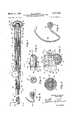
- Fig. lrepresents a vertical section through one embodiment of the surgical stitching needle, in which the needle holder shaft is rotatably supported in the handle by a plurality of needle bearings.
- Fig. 2is a cross-section through the handle, the needle holder shaft and the needle roller bearings, taken at 2 2, Fig. 1.
- Fig. 3is a cross-section through the needle holder shaft and the tubular shaft support member, and a side elevation of the thread spool housing and the thread tension adjusting mechanism, taken at 3 3, Fig. l.
- Fig. 4is a plan View of the outer end of the needle holder shaft and the tubular shaft support member, shown in Fig. 1.
- Fig. Sis a cross-section through the outer end of the needle holder shaft, shown in Fig. 1, and a plan view of one size and type of surgical stitching needle, taken at 5 5, Fig. l, showing the needle rotated through its operating angular range in dot-dash lines.
- Fig. 6is a side elevation of the head and the point of the needle shown in Fig. 5, showing the thread slots through the pointed end of the needle head, taken at 6 6, Fig. 5.
- Fig. 7is a cross-section, similar to Fig. 5, through the outer end of the needle support shaft, and a front elevation of a larger size of surgical stitching needle.
- Fig. 8is a cross-section, similar to Fig. 5, through the outer end of the needle support shaft, and a front elevation of a smaller size of needle, supported by the needle holder shaft.
- Fig. 9is a cross-section through the needle holder shaft, the tubular shaft support member, and the needle holder shaft locating key, shown in Figs. 1 and 4, taken at 9 9, Fig. 4.
- Fig. 10is a cross-section through the handle, the tubular handle extension, and the tubular shaft support member, shown in Fig. l, showing the pin, which limits the angular movement of the needle holder shaft and the circular segmental slot through the handle extension, which limits the angular movement of the pin, taken at 10 10, Fig. l.
- Fig. 11is a vertical section, similar to Fig. l, through a modification of the surgical stitching needle mechanism, shown in Fig. l, with the needle holder shaft and the tubular shaft support member supported in the handle extension by a plurality of plain bearings.
- Fig. l2is a section through the outer end of the needle holder shaft and the tubular shaft support member, taken at 12 12, Fig. 1l.
- Fig. 13is a cross-section, similar to Fig. 2, through the handle and the needle holder shaft, shown in Fig. ll, showing the plain bearings supporting the tubular shaft support member, taken at 13 13, Fig. ll.
- Fig. 14is a cross-section through the handle, the needle holder shaft and the tubular shaft support member, shown in Fig. ll, showing a torsion spring which restores the needle holder shaft to its initial position after it is rotated through its angular range, taken at 14 14, Fig. 1l.
- Fig. 15is a cross-section through the shank of the needle, shown in Fig. 12, showing one half of the shank cross-section in the form of a semi-regular Octagon, the octagonal portion fitting into a slot of a mating contour formed in the end of the tubular shaft support member.
- One embodiment of the surgical stitching instrument constructionshown in Figs. 1, 2 and 3, comprises a substantially cylindrical needle holder shaft 10, which is slidably mounted within a long tubular shaft support member 11, the tubular shaft support member being rotatably fitted to and supported by a tubular handle 12,
- the handle 12which is made of a plastic, or similar material, is of frusto-conical tubular section, the outer circumference of the handle being of regular polygonal contour, or having long flutes or other convolutions formed thereon to facilitate gripping the handle.
- a tubular handle extension 14is pressed into or otherwise fitted to the interior of the handle 12, as indicated in Fig. l, the forward portion of the tubular extension projecting beyond the forward end of the handle, a circular shoulder 15 integral with the tubular extension engaging the forward end of the handle in order to align the tubular extension with the handle. As indicated in Figs.
- two rows of needle bearings 16 and 17are fitted to the interior of the tubular handle extension 14, within the handle, the needle bearings rotatably supporting the tubular shaft support member 11, which is mounted within the handle.
- the needle bearings 16 and 17fit into a reduced diameter area of the tubular shaft support member, a pair of shoulders 20 and 20a integral with the tubular shaft support member, adjacent the ends of the needle rollers 16 and 17, retaining the needle rollers in the position shown in Fig. 1.
- the forward end of the tubular handle extension 14, projecting beyond the handle,has a plain tubular bushing, or bearing 22, fitted thereto, the tubular bushing rotatably supporting the forward portion of the tubular shaft support member 11 projecting Ibeyond the needle bearing 16.
- a ange 24 integral with the tubular bushing 22, Fig. 1engages the forward edge 0f the tubular handle extension, thereby aligning the bushing with the tubular handle extension.
- the bushing 22may be split along its longitudinal center line, thus enabling the bushing to be fitted to the tubular shaft support member before it is inserted in the tubular handle extension 14.
- the needle holder shaft 10has a substantially cylindrical head 25 integral with the extreme front end thereof, the head having a blind cavity 26 therein to receive and support the shank 27 of a surgical needle, such as those shown in Figs. 5 and 6, which is fitted thereto.
- the head 25 of the needle holder shafthas a substantially rectangular key 23 integral therewith, the key 28 fitting into a mating slot 29 cut into the forward end of the tubular shaft support member to align the shaft with the tubular shaft support member.
- the tubular shaft support memberhas a semi-octagonal or other form of slot 30 conforming to the contour of the needle shank 27, through the front end thereof, the surfaces of the slot 30 engaging the shank 27 of the needle to clamp the needle shank against the head 25 of the shaft, when the shaft is tightened within the handle, in a manner hereinafter described in greater detail.
- the tubular shaft support mem ber 11has a collar 32 integral with the rear end thereof, a cylindrical, or other form of pin 33 being pressed into or otherwise attached to the tubular shaft support member collar 32.
- the pin 33tits into a circular segmental slot 34 cut into the inner end of the tubular handle eX- tension 14 within the handle 12, the extreme radial edges of the circular segmental slot 34 engaging the pin 33, thereby positively limiting the angular movement of the needle holder shaft and the needle fitted thereto in both directions, for the reasons hereinafter described in greater detail.
- the extreme rear end of the needle holder shaft, within the handle 12,is threads 35, the threads fitting into mating internal threads formed in a tubular controlv sleeve 36, mounted in the rear portion of the handle 12, as indicated in Fig. l.
- a control knob 37 integral with the control sleeve,is utilized to rotate the needle holder shaft and the tubular shaft support member fitted thereto through an angle to manipulate the surgical needle, such as those shownin Figs. 5 and 6, in a manner hereinafter described in greater detail.
- a lock nutis provided at the rear end of the control sleeve knob 37.
- the lock nutcomprises an internally threaded shank 40, which fits into a counterbored seat formed in the control knob 37, and a cylindrical, regular polygonal, or other form of head 41 integral with the shank.
- the shank 40 and a portion of the head of the lock nutare internally threaded to receive the threads 35 at the rear end of the needle holder shaft 10.
- the head 41 of the lock nutmay be uted, knurled or otherwise roughened to facilitate gripping the lock nut head in order to tighten the lock nut on the threaded end of the needle holder shaft 10.
- the lock nutis tightened by means of the head 41 thereof, until the forward edge of the shank 4th of the locknut seats in the bottom of the countersunk seat in the control knob, thereby locking the threads on the shaft, and enabling the needle holder shaft to be rotated by means of the control knob.
- the control knob 37has a pair of diametrically opposite openings or cavities 42 therethrough, a manipulating ring 43, comprising an arcuate head and a pair of legs tted to the control knob openings 42 being provided to manipulate the control knob.
- the inner diameter of the rear end of the head 41 of the lock nutis counterbored 44 to clear the threads of the needle holder shaft 10, as indicated in Fig. 1.
- a spool housing 45within which a suture thread spool 46, on which the suture thread 47 is wound is rotatably mounted, is fitted to the outer circumference of the tubular handle extension 14, a tubular bracket 48 integral with or attached to the spool housing 45, being pressed on or otherwise attached to the handle extension, a screw, or pin fitted through the bracket wall aligning the bracket 48 with the tubular handle extension.
- a spool support shaft 49is mounted in the spool housing 45, as indicated in Fig. 3, the spool support shaft rotatably supporting the suture thread spool 46.
- the spool support shaft 49is keyed or otherwise iitted to the central wall of the spool housing 45 to prevent rotation of the shaft, while permitting it to slide within the spool housing 45.
- the spool 46has a central hub integral therewith, the central hub having an opening therethrough, which rotatably ts the spool support shaft 49.
- a cap nut Si) having a central hub 51 integral therewith,is provided at the left-hand side of the spool support shaft 49, a threaded opening in the center of the hub 51 being threadably fitted to the external threads 52 formed at the left-hand end of the spool support shaft 49, Fig. 3.
- the inner edge of the cap nut hub 51engages the adjacent surface of the spool. 46, thereby retaining the spool in the position shown in Fig. 3.v
- an auxiliary spool tensioning nut 56is fitted to the right-hand end of the spool support shaft 49, Fig. 3, the interior of the auxiliary spool tensioning nut 56 being threadably fitted to threads formed v at the right-hand end of the spool support shaft 49.
- An auxiliary coiled compression spring 57is mounted between the right-hand face of the central wall 55 of the spool housing 45 and the inner face of the auxiliary tensioning nut 56, the spring 57 sliding the spool support shaft with the spool 46 rotatably mounted thereon, relative to the housing 45, thereby regulating the pressure against the thread spool 46, and adjusting the tension on the suture thread 47 Wrapped around the spool 46.
- the adjustable pressure on the two coiled compression springs 54 and 57, mounted on opposite sides of the central wall 55 of the spool housing 45regulates the pressure against the thread spool 46, under control of the cap nut Si) and the auxiliary tensioning nut 56, when the nuts 50 and 56, respectively, are tightened or loosened on the spool support shaft 49, thereby accurately controlling the tension on the suture thread 47, which is fed to the slots in the surgical stitching needle, such as that Vshown in Figs. l and 5.
- One embodiment of the surgical stitching needleshown in Fig. 5, comprises a shank 27, of circular or regular polygonal cross-section, and a head 58, in the form of a circular sector, the head being connected to the outer end of the shank by an angular connecting section interposed between the head and the shank.
- the outer tip of the head of the needlehas a tapered point 58a formed thereon, the point puncturing the tissue when the needle is used for suturing.
- the head 58 of the needleis in the form of a circular sector, the radius of the circle being substantially equal to the distance between the needle head 58 and the center of the needle holder shaft in the mounted position, shown in Fig.
- the head of the needle adjacent the point thereofhas a pair of narrow rectangular or oval slots 59 and 59a cut therethrough, the slots receiving the free end of the suturing thread 47, which is fed from the thread spool 46.
- the head 25 of the needle holder shaft 10has a blind cavity 26 formed therein, the cross-section of the cavity being substantially the same as that of the shank 27 of the needle, to receive and support the shank of the needle, the opposite side of which abuts the slots 30 in the tubular shaft support member 11.
- the angular movement of the needle holder shaft 10 and the needle fitted theretois limited by the circular segmental slot 34 cut through the wall of the tubular handle extension, the radial ends of the slot 34 engaging a pin 33 attached to the tubular shaft support member, as indicated in Fig. l0, to limit the angular movement of the head' of' the needle to the maximum range, shown in Fig. 5,I the angular movement of' the needle head being limited by the position of the arcuate junction section 61', between the head ofthe needle and the angular connecting section thereof, thereby preventing the arcuate junction section 61 of the needle from entering the perforation through the tissue, formed by the point of the needle and tearing the tissue during the suturing operation.
- a wire loop 52is fitted to the tubular shaft support member, adjacent the front end thereof, the ends of the wire loop being soldered, brazed or otherwise attached to the tubular shaft support member.
- the wire loop 62serves as a guide to direct the suturing thread from the spool 46 to the slots through the head of the needle.
- the shank 63is substantially the same as that shown in Fig. 5, and is supported in the head of the needle holder shaft in. substantially the same manner.
- the head 64 of the needleis in the form of a circular sector, the radius of the ⁇ head being substantially equal to the distance between the centerline of the needle holder shaft and the head of the needle. ln the construction, shown in Fig. 7, the radius ofthe head of the needle is larger than that shown in' Fig.' 5.
- the point 64a ofthe needleis tapered in substantially the same manner as that shown in Fig. 5, a pair of thread' slots, similar to those shown in Fig. 6, being cut through the head of the needle in substantially the same manner.
- the path of the. head of the needleis substantially the same as that shown by dot-dash lines, Fig. 5, the angular path of the head of the needle being the same as that shown in Fig. 5, the circular segmental slot 3'4 in the tubular handle extension 14 limiting the angular movement of the needle to the same extent as that shown in Figs'. 5 and 10 and hereinbefore described, so that the needles can be used interchangeably with the same surgical stitching instrument.
- the shank 66is substantially the same as those shown in Figs. 5' and' 7, the shank being supported in the head of the needle holder shaft in the same manner.
- the head 67 of the needleis' similar to' those shown in Figs. 5 and 7, the radius of the head being considerably smaller than that of the needle head shown in Fig. 5.
- the angular path of the point of the needle during the suturing operationis substantially thel same as that shown by dotdash lines', Fig. 5, the angular movement being limited byv the circular segmental slot 34' through the tubular handle extension 14, shown in Fig. l0, in the same manner.
- the lock nut shown in Fig. 1may be either removed or left loose on the threaded end of the needle holder shaft 10.
- the needle shank'may be. loosened by rotating the control knob 31' in a leftward direction, where right-hand threads are used, after the needle head is moved through the angular. path, shown by dot-dash lines, Fig. 5, in order to insert the head of the needle in the body tissue.
- a needle holder shaft 70is slidably mounted within a long tubular shaft support member 71, the tubular shaft support member being rotatably tted to and supported by a tubular handle 72, similar to that shown in Fig. 1, and hereinbefore described.
- a tubular handle extension 73is pressed intoy or otherwise attached to the interior of the handle 72, the forward portion of the tubular handle extension projecting beyond the forward end of the handle 72, a circular shoulder integral with the tubular handle extension engaging the forward end of. the handle to locate the tubular handle extensiom relative to the handle, in the same manner as that shown in Fig. l.
- two plain tubular bearings, or bushings 74 and 74apressed into or otherwise attached' to the interior of the tubular handle extension 73, rotatably support the. tubular shaft support member 71.
- a collar 75 integral with the rear end of the tubular shaft support memberengages the rear end of the rear tubular bushing 74a, to longitudinally locate the rear bushing within the tubular handle extension 73.
- the bushings 74 and 74amay be split along their longitudinal center line to facilitate assembly with the tubularshaft' support member 71, before they are inserted in the handle extension 73.
- a tubular spacer 76'tted to the interior of the handle extension 73is located between the tubular bushings 74 and 74a, the spacer longitudinally locating the central bushing 74, relative to the rear bushing 74a.
- a similar auxiliary' tubular bushing 77is pressed into or otherwise fitted to the tubular handle extension 73, adjacent the forward end thereof.
- a ange integral with the forward end of the auxiliary tubular bushing 77engages the forward edge of the tubular handle extension 73, thereby aligning the auxiliary bushing with the tubular handle extension.
- the three tubular bushings 74, 74a, and 77rotatably support' the tubular shaft support member 71, in the manner shown in Fig. 11.
- the needle holder shaft 70has a substantially cylindrical head 79 integral with the extreme forward end thereof, the head having a blind cavity 8l) formed' therein to receive and support thc shank' 27 of a surgical needle, such as that shown in Fig. 5.
- the cavity 80is' of circular, octagonal, or other regular polygonal cross-section', conforming to the cross-section of the shank of the needle, in order to accurately align the needle with the needle holder shaft and prevent twisting of the needle whilev the needle shank is clamped between the head of the needle holder shaft and the end of the tubulark shafti support member, when the needle holder shaft is clamped to the handle in a manner similar to that shown in Fig.
- a circular shoulder 81 integral with the tubular shaft support member 71engages the forward edge of. the flange of the auxiliary bushing 77, thereby aligning, the tubular shaft support member 71 with the handle exten sion 73, in substantially the same manner as that shown in Fig. l and hereinbefore described.
- the auxiliary tubular bushing 77may be split along its longitudinal axis to facilitate assembly with the tubular shaft support member 71, before it is inserted in the tubular handle extension 73.
- the collar 75integralwith the rear end of the tubular handle'extension, has a projecting cylindricall pin pressed into'or otherwise attached thereto, in the same manner as 9 that shown in Figs. 1 and 10.
- the pin 33ts into a circular segmental slot cut through the rear end of the tubular handle extension in the same manner as that shown in Fig. 10 and hereinbefore described, the radial edges of the circular segmental slot engaging the pin 33 in the two angular limiting positions thereof, thereby positively limiting the angular movement of the needle fitted thereto in both angular positions ofthe pin 33, the angular needle movement being equal to, or slightly less than the angular needle movement shown in Fig. 5, and hereinbefore described in detail.
- the extreme rear portion of the needle holder shaft 76, located within the handle,is threaded, the threads fitting into internal threads formed in a tubular control sleeve 82, mounted within the rear portion of the handle 72, as indicated in Fig. 11.
- a knob 83 integral with the control sleeve 82,is employed to manipulate the needle holder shaft, in the same manner as that shown in Fig. 1, and hereinbefore described.
- a pair of arcuate wings 84 and 84ais fitted to slots in the control sleeve knob, the wings being welded, brazed, or otherwise attached to the control sleeve knob to facilitate manoeuvering the control knob by means of the fingers of the operator.
- a shoulder integral with the forward face of the control knob 83engages one face of a tubular flat washer 39, in the same manner as that shown in Fig. 1 and hereinbefore described, thereby enabling the control knob 83 to rotate the needle holder shaft 70, when the head 79 of the needle holder shaft 70 is clamped against the forward end of the tubular shaft support member 71, by means of the threads at the rear end of the needle holder shaft, which t into the threads in the interior of the control sleeve.
- a lock nutsimilar to that shown in Fig. l and hereinbefore described, is provided at the rear end of the control sleeve knob.
- the lock nutcomprises an internally threaded shank 85, which fits into a counter-bored seat, formed in the control knob 83, and a cylindrical knurled, regular polygonal, or other form of head 86, integral with the shank.
- a shoulder formed at the junction between the lock nut shank 85 and the head thereofclears the flat face of the control knob, thus enabling the end of the lock nut shank 85 to seat in the bottom of the counterbore, and in that manner tightly gripping the threads at the end of the needle holder shaft, and preventing relative angular movement between the needle holder shaft and the tubular shaft support member 71, while the lock nut is in place.
- the spool housing 45, the thread supply spool 46 fitted to the tubular handle extension, and the adjusting and tensioning nuts 50 and 53, respectively, utilized in con junction with the spool housing 45, and the spool support shaft fitted therto,are substantially the same as those shown in Figs. l and 3 and hereinbefore described, the method of mounting and adjustment of the thread spool 46 being substantially the same as that shown in Fig. 3 and hereinbefore described.
- An opening 87is cut through the outer walls of the tubular shaft support member 71, a mating opening being cut through the needle holder shaft 70 to guide the suturing thread 47 from the spool 46 to the thread slots 59 and 59a in the head 58 of the needle, the operation of the needle being substantially the same as those shown in Figs. 5, 6 and 7, and hereinbefore described.
- a coiled torsion spring 88is mounted within the inner diameter of the handle 72, around the rear end of the tubular shaft support member 71.
- the rear end of the torsion spring 88has an outwardly extending projection 89 integral therewith, as indicated" in Fig. 14, the projection, which is substantially perpendicular to the torsion spring longitudinal axis, fitting into an opening in the handle 72.
- the forward end of the torsion spring 88has an in wardly extending projection 90 integral therewith, the projection 90 fitting into an opening in the rear end of the tubular shaft support member 71, in the manner shown in Fig. 14.
- the inwardly extending projection 90 of the torsion spring 88is moved through an angle corresponding to the angular movement of the needle head 58, relative to the ⁇ outwardly extending projection 89 of the torsion spring, which is held stationary within the handle 72.
- the angular movement of the inwardly extending projection of the torsion springWinds up the coils of the torsion spring 88, the tension in the spring coils restoring the spring projections 89 and 90 and the needle holder shaft to the position, shown in Fig. 14, after the control knob 83 is released, thereby restoring the head of the needle from the position shown by dotdash lines, Fig. 5, to the normal position shown in Fig. 5.
- Atorsion spring 88shown in Figs. ll and 14 may be eliminated, the angular movement of the needle holder shaft 70 being controlled by the control sleeve knob 83 in substantially the same manner as that shown in Figs. l and l0 and hereinbefore described.
- the surgical stitching needles utilized with the needle holder shaft, shown in Fig. 1l,are substantially the same as those shown in Figs. 5, 6 and 7, and hereinbefore described.
- the shank 27 of the needlewhich is of regular polygonal, or other suitable cross-section, tits into a blind cavity 80 of a mating contour, formed in the head 79 of the needle holder shaft, the bottom of the cavity 80 serving as a stop for the needle shank, which retains the head of the needle in the required position, shown in Fig. 5, the distance between the center line of the shaft and the center of the arcuate head of the needle being equal to the radius of the head and the tapered point of the needle, as indicated in Fig. 5.
- the angular operational range of the needle holder shaft and the needle fitted theretois substantially the same as that shown in Figs. l and 5, the head of the needle being moved through the angular range represented by the needle head position, shown in Fig. 5, and the position at the opposite end of the stroke, shown by dot-dash lines, Fig. 5.
- the angular movement of the needle holder shaft 70is e limited by the pin 33 attached to the tubular shaft support member and the circular segmental slot cut through the tubular handle extension 73, in the manner shown in Fig. 10 and hereinbefore described in detail.
- the lock nutmay be eliminated entirely, or left loosely on the threaded end of the needle holder shaft, thus enabling the control sleeve 82 to release the needle from the needle holder shaft head, when the control sleeve is rotated in a direction opposite the direction of the threads on the needle holder shaft, in the same manner as the construction shown in Fig. 1 and hereinbefore described.
- the spool housing 45, the thread support spool 46 venous and the spool thread tensioning mechanism shownv in Figs. l, 3 and 11,may be eliminated entirely in operations in which only one or two individual stitches are to be made, particularly where the stitches are made in close quarters, as in the nose of the human body.
- the needlesare individually threaded, a separate needle being attached to the head of the needle holder shaft for each stitch.
- the operation of the surgical stitching instrumentis substantially the same as that shown in Figs. l and 2 and hereinbefore described, except that the torsion spring 83, shown in Figs. l1 and 14, restores the needle head to its original position, shown in Fig. 5, after the needle holder shaft and the needle tted thereto are vrotated into the dot-dash position, shown in Fig. 5.
- the construction of the needlemay be altered from those shown in Figs. 5, 7 and 8, the size and cross-sectional contour of the shank being varied to suit the requirements of a particular needle holder.
- the position of the angularly located connecting seetion, between the shank and the head of the needlemay be varied to suit the needle shank construction and the construction and relative location of the head of the needle.
- the primary requirement of the needle constructionis that the mean radius of the head and point of the needle must be equal to the distance from the center of the needle head to the center of rotation of the needle holder shaft about which the needle is rotated.
- the method of supporting the needle in the needle holder shaft and the head thereofmay also be varied to suit the requirements of a particular needle construction, the fundamental requirement remaining that the, distance from the center of rotation off the needle holder shaft to the center of the needle head must be substantially equal to the mean radius of ther head of the needle, which is in the form of a circular sector.
- the method of locating the shank of the needle, relative to the center of rotation of the needle holder shaftmay also be varied, provided the relation between the head of the needle and the center of the shaft is maintained as hereinbefore described.
- the needle shankmay be gripped by the needle holder shaft and the tubular shaft support member, or by another type of needle holder member, atV points other than. those indicated in Figs. 5, 7 and 8, provided the distance from the center of the shaft to the centerline of the needle head is maintained.
- shank of the needlemay be varied from those shown inv Figs.. l and l1 and hereinbefore described, to suit they requirements of a particular application or suturing operation.
- radius of the head of the needlemay be varied to suit particular applications, provided the general con.- tour ofv the head of the needle is maintained as hereinbefore described.
- the torsion spring mechanismshown in Figs. l1 and 14, may be incorporated into the surgical stitch-ing inw strument. shown in Figs. l and 2, thev operationv of the. torsion mechanism remaining substantially thev same as that shown in Figs. 1l. and 14, and hereinbefore described.
- a surgical4 stitching instrumentcomprising ai needle having a shank with a head and an eye-point in the form of a circular sector integral with the shank, a substantially cylindrical element operative to retain the needle shank, the center of the needle head circular sector coinciding substantially with the longitudinal cylindrical member axis,- a tubular support member fitted around said cylindrical element, to rotatably support the cylindrical element, means formed in said cylindrical element and the tubular support member operative to grip the needle shank therebetween, means rotatably supporting the tubular supporty member, and means threadably attached to the cylindrical element operative to retain the cylindrical element inthe needle shank clamping position relative to the tubular support member, the rotation of the cylindrical element being operative to rotate the needle head during the stitching operation thereof to draw a thread through the tissue to be stitched.
- a surgical stitching instrumentcomprising a needle having a shank and a head in the form of a circular sector integral with the shank, a substantially cylindrical element operative to retain the needle shank, a tubular support member tted around the cylindrical needle shank retainer cylindrical element, the center of the needle head circular sector radius being in substantial registryA with the cylindrical element rotational axis, said tubular member rotatably supporting the cylindrical element, means formed in the cylindrical element and the tubular support member operative to clamp the needle shanktherebetween, a handle element rotatably supporting the tubular support member, means longitudinally aligning.
- the tubular support memberwith the handle element, means threadably attached to the cylindrical element operative to retain the cylindrical element in the needle clamping position relative to the tubular support member, and gripping means attached to the cylindrical element operative to angularly rotate the cylindrical element and the tubular support member, the-rotation of the cylindrical element being operative to rotate the needle head during the stitching operation thereof, to draw a thread through the tissue stitched.
- A. surgical stitching instrumentcomprising a needle having a shank and a head in the form of a circular sector integral with the shank, a substantially cylindrical shaft having a needle holder elementr integral therewith, said needle holder element and cylindrical shaft having a cavity therein to receive the needlev shank, the center' of the needle head circular sector coinciding substantially with the cylindrical shaft longitudinal axis, a tubular shaft support member telescopically fitted to the cylindrical shaft, the tubular shaft support member having a slot thereinto fit the needle shank, a handle element surrounding the tubular shaft support member, means tted to saidl handle element rotatably supporting the tubular shaft support member, meansi longitudinally aligning the tubular shaft support.
- tubular means threadably attached to the cylindrical shaftoperative to clamp the tubular shaft.
- a surgical stitching instrumentcomprising a needle having a shank anda head' in the form of a circular sector integral' with the shank, a substantially cylindrical shaft having a needley holder element integral therewith, said needle4 holder element' and cylindrical shaft having a cavity therein tol receivef the needle shank, the center' of the needle head circular sector coinciding" substantially with thecylindrical shaft longitudinal axis,v atubular shaft support member telescopically fitted'l to th'e' cylindrical shaft, the tubular' shaft support member having a ⁇ - slot therein to tit the needle shank, a handle element surrounding the tubular shaft support member, a plurality.
- a surgical stitching instrumentcomprising a needle having a shank and a head in the form of a circular sector integral with the shank and spaced therefrom, a substantially cylindrical shaft having a head integral with one end thereof, a tubular support member telescopically tted to the cylindrical shaft, said head and cylindrical shaft having a cavity therein to receive the needle shank, the tubular shaft support member having a slot therein to fit the needle shank, the center of the needle head circular sector coinciding substantially with the cylindrical shaft longitudinal axis, a tubular handle member sur.
- tubular shaft support memberrounding the tubular shaft support member, a plurality of bearings fitted to the handle member rotatably supporting the tubular shaft support member, means integral with the tubular shaft support member longitudinally locating the tubular shaft support member relative to the handle member, a tubular sleeve threadably attached to the cylindrical shaft, said tubular sleeve being operative to clamp the tubular shaft support member against the cylindrical shaft to grip the needle shank therebetween, a knob integral with the tubular sleeve rotatably engaging one end of the handle member, locking means threadably attached to the cylindrical shaft fitted to the tubular sleeve knob to lock the tubular sleeve against the cylindrical shaft, said knob being operative to rotate the cylindrical shaft, and means operative to limit the angular movement of the cylindrical shaft and the tubular shaft support member relative to the handle member, the rotation of the cylindrical shaft being operative to rotate the needle head through the stitching movement thereof.
- a surgical stitching instrumentcomprising a needle having a shank and a head in the form of a circular sector integral with the shank, a substantially cylindrical shaft having a head integral with one end thereof, a tubular shaft support member telescopically itted to the cylindrical shaft, said cylindrical shaft headvand the shaft having a cavity therein to receive the needle shank, the tubular shaft support member having a slot therein to receive the needle shank, the center of the needle head circular sector radius being in substantial registry with the cylindrical shaft rotational axis, a tubular handle member surrounding the tubular shaft support member, a plurality of needle bearings tted to the handle member rotatably supporting the tubular shaft support member, means integral with the tubular shaft support member longitudinally locating the tubular shaft support member relative to the handle member, a tubular sleeve threadably attached to the end of the cylindrical shaft opposite the head thereof, said tubular sleeve being operative to clamp the tubular shaft support member against the cylindrical shaft head to grip the needle shank therebetween,
- a surgical stitching instrumentcomprising a needle l having a shank and a head in the form ofa circular sector integral with the shank, a substantially cylindrical shaft having a needle holder element integral with one end thereof, said needle holder element and the cylindrical shaft having a cavity therein to receive the needle shank, a tubular shaft support member telescopically fitted to the cylindrical shaft engaging the needle holder element, the tubular shaft support member having a slot therein to receive the needle shank, the center of the needle head sector radius being substantially coincidental with the cylindrical shaft rotational center, a tubular handle mem ber surrounding the tubular shaft support member, a plurality of tubular bushings inserted in the handle member rotatably supporting the tubular shaft support member, means'integral with the tubular shaft support member engaging one of said bushings to longitudinally locate the tubular shaft support member relative to the handle member, a tubular sleeve threadably attached to the cylindrical shaft opposite the needle holder element, said tubular sleeve being operative to clamp the
- a surgical stitching instrumentcomprising a needle having a shank and a head in the form of a circular sector integral with the shank, a substantially cylindrical shaft having a needle holder element integral with one end thereof, said needle holder element and the cylindrical shaft having a cavity therein to receive the needle shank, a.
- tubular shaft support membertelescopically fitted to the cylindrical shaft engaging the 4needle holder element, the tubular shaft support member having a slot therein to receive the needle shank, the center of the needle head sector radius being in substantial registry with the cylindrical shaft rotational axis, a tubular handle member surrounding the tubular shaft support member, a plurality of bearings fitted to the handle member rotatably supporting the tubular shaft support member, means integral with the tubular shaft support member engaging one of said bearing to longitudinally locate the tubular shaft support member relative to the handle member, a tubular sleeve threadably attached to the end of the cylindrical shaft opposite the needle holder element, said tubular sleeve being operative to clamp the tubular shaft support member against the cylindrical shaft needle holder element to grip the needle shank therebetween, a knob integral with the tubular sleeve rotatably engaging the adjacent end of the handle member, said knob being operative to rotate the cylindrical shaft within the handle member, means attached to the cylindrical shaft support member operative to limit the angular movement
- a surgical stitching instrumentcomprising a needle having a shankand a head in the form of a circular sector integral with the shank, a substantially cylindrical shaft having a head integral with one end thereof, a tubulal shaft support member telescopically fitted to the cylindri' cal shaft, said head and cylindrical shaft having a cavity therein to receive and locate the needle shank, the tubular shaft support member having a ⁇ slot therein to receive the needle shank,- the center of the needle head sector radius being in substantial registryl'with the cylindrical shaft rotational axis, a tubular handle member surrounding the tubular shaft support member, a tubular handle extension lixedly attached to the handle member, a plurality of tubular bushings fitted ,to the handle member rotatably supporting the tubular shaft support member,
- one of said bushingshaving aV flange integral with one the tub'ular shaft support member against the cylindrical shaft head to grip the needle shank therebetween, a knob integral with the tubular' control sleeve rotatably engaging'v one end of the handle member, a fiat tubular washer located between the knob and the handle member, locking means threadably attached to the cylindrical Shaft fitted to the control sleeve knob to loc'k the' control sleeve against the cylindrical shaft, said knob being operative to rotate the cylindrical shaft, a pin attached to the tubular shaft support member projecting radially therefrom, the tubular handle member having a circular segmental slot therein in substantial alignment with the' pin, said pin fitting through the handle member slot, the' rotation of the cylindrical shaft in one direction being operative to move the needle head throughthe stitching movement thereofto draw a thread through the tissue to be stitched, said handle member slot being' operative' to limit the angular range of said pin to' regulate the angular movement of the cylindrical shaft, coordinated with the
- a surgical stitching instrumentcomprising a needle having a shank and a head th'e'form of a circular sector integral with the shank, a substantially cylindrical shaft having a head integral with onere'nd thereof, a tubular shaft support member telescopic'ally fitted to the' cylindrical shaft, said head and cylindrical shaft having a cavity' therein to receive and radially' locate the needle shank, said tubular shaft support member having' a slot therein to tit the needle shank, the center of the needle head sector radius being in substantiall lregistry with the cylindrical shaft rotational axis', a tubular handle member surrounding the tubular shaft support member, a plurality of bearings tted to thel tubular handle member rotatably supporting the tubular shaft support member', means integral with the tubular shaft support member engaging one of said bearings to longitudinally locate the' tubular shaft support member relative to the handle member, a control sleeve threadablyfittedtotheend of the cylindrical shaft opposite the head thereof, a knob integral
- said control sleeve knobbeing operative t'o rotate the cylindrical shaft
- a pin attached to the tubular shaft support member projecting radially therefromthe tubular handle member having a circular segmental slot therein in substantial alignment with the pin, said pin fitting through the handle slot, said circular segmental handle slot being operative to limit the angular movement of said pin
- a torsion springinterposed between the' handle member and the tubular shaft support member, one end of said torsion spring being attached to the handle member with the opposite end thereof attached to the tubular shaft support member, the rotation ofthe cylindrical shaft in one direction being operative to move the needle head through the stitching path thereof, said torsion spring being operative to restore the cylindric'al shaft and the circular sector needle head to their initial position after the shaft is angularly displaced, and a needle' head stitch completed.
- a surgical stitching instrumentcomprising a needle having a shank with a head and an eye-point in the form of a circular sector integral with the shank, a substantially cylindrical shaft having a head integral with one end thereof, a tubular shaft support member telescopically fitted to the cylindrical shaft, said cylindrical shaft head and the shaft having a cavity therein to receive the needle shank, the tubular shaft support member having a slot therein to receive' the needle shank, the center of the needle head circular sector radius being in substantial alignment with the cylindrical shaft rotational axis, a tubular handlev member surrounding the tubular shaft support member, a plurality' of needle bearings fitted to the handle member rotatably supporting the tubular shaft support member, means in'te'gral with the tubular shaft support member longitudinally locating thc tubular shaft support member relative to the handle member, a spool support housing attached to the handle member, a spool of suturing thread rotatably mounted Within said housing, the free end of said thread being fed through the eye of
- knobbeing operative to rotate the cylindrical shaft and thefcircular sector needle head within the handle member, the rotation of the cylindrical shaft in one direc' tion being operative to move the needle head through its stitching path, and means attached to the tubular shaft support member, operative to limit the angular movement of the cylindrical shaft, co-ordinated with the' angle subtended by the needle head circular sector during' a' single stitch thereof.
- a surgical stitching instrumentcomprising a needle having a shank with a head and an eye-point in the form of a circular s'ector integral with the shank, a substantially cylindrical element operative to receive and support the needle' shank,- a tubular support member fitted around the cylindrical element, said tubular support member sustaining said cylindrical element, the center of the needle head circular sector radius being in substantial registry with the' cylindrical element rotational axis, a handle element rotatably supporting the tubular support member, means longitudinally aligning the tubular support member with the' handle element, a spool support housing attached to said handle member, a spool of suturing thread rotatably mounted within said spool support housing, the free end of said tl'ire'adv being fed through the eye of said needle, and means adjusting the pressure against said thread spool to regulate the Vrate' at which the thread is fed therefrom, means threadably attached to the cylindrical element ope'rat'i'vel toY retain the cylindrical element in the needle clamping
- a surgical stitching instrumentcomprising a needle having a shank with a head and an eye-point in the form of a circular sector integral with the shank, a substantially cylindrical shaft having a needle holder element integral therewith, said needle holder element and the cylindrical shaft having a cavity therein to receive the needle shank, the center of the needle head circular sector radius coinciding substantially with the cylindrical shaft rotational axis, a tubular shaft support member telescopically fitted to the cylindrical shaft, the tubular shaft support member having a slot therein to tit the needle shank, a handle member surrounding the tubular shaft support member, means litted to said handle member rotatably supporting the tubular shaft support member, means longitudinally aligning the tubular shaft support member with the handle member, a spool housing attached to said handle member, a spool support shaft fitted to said spool housing, a spool of suturing thread rotatably mounted on said shaft, the free end of said suturing thread being fed through the eye of saidneedle, flexible means
- a surgical stitching instrumentcomprising a needle having a shank with a head and an eye-point in the form of a circular sector integral with the shank, a substantially cylindrical shaft having a needle holder element integral therewith, said needle holder element and cylindrical shaft having a cavity therein to receive the needle shank, the center of the needle head circular sector radius coinciding substantially With the cylindrical shaft rotational axis, a tubular shaft support member telescopically tted to the cylindrical shaft, the tubular shaft support member having a slot therein to fit the needle shank, a handle element surrounding the tubular shaft support member, a plurality of bearings fitted to the handle element rotatably supporting the tubular shaft support member, means longitudinally aligning the tubular shaft support member with the handle element, a spool housing attached to said handle member, the spool housing having an intermediate wall therein substantially perpendicular to the longitudinal housing axis, a spool support shaft slidably fitted to said spool housing, a spool of suturing thread
- a surgical stitching instrumentcomprising a needle having a shank, with a head and an eye-point in the form of a circular sector integral with the shank, a substantially cylindrical element operative to receive and support the needle shank, a tubular support member fitted around the cylindrical element, said tubular support member sustaining said cylindrical element, the center of the needle head circular sector radius being in substantial alignment with the cylindrical element rotational axis, a handle element rotatably supporting the tubular support member, means longitudinally aligning the tubu lar support member with the handle element, a spool housing attached to said handle member, the spool housing having an intermediate wall therein substantially perpendicular to the longitudinal spool housing axis, a spool support shaft slidably fitted to said spool housing, a spool of suturing thread rotatably mounted on the spool support shaft, the free end of the suturing thread being fed through the eye of the needle, a compression spring litted to the spool support shaft between the spool and one side of
Landscapes
- Health & Medical Sciences (AREA)
- Life Sciences & Earth Sciences (AREA)
- Surgery (AREA)
- Heart & Thoracic Surgery (AREA)
- Engineering & Computer Science (AREA)
- Biomedical Technology (AREA)
- Nuclear Medicine, Radiotherapy & Molecular Imaging (AREA)
- Medical Informatics (AREA)
- Molecular Biology (AREA)
- Animal Behavior & Ethology (AREA)
- General Health & Medical Sciences (AREA)
- Public Health (AREA)
- Veterinary Medicine (AREA)
- Surgical Instruments (AREA)
Description
G. H. KNAPP SURGICAL STITCHING INSTRUMENT WITH March 13, 1956 ROTATABLE NEEDLE SUPPORT 2 Sheets-Sheet l Filed Feb. l2, 1954 March 13, 1956 G. H. KNAPP SURGICAL sTITcHING INSTRUMENT wITR ROTATABLE NEEDLE SUPPORT 2 Sheets-Sheet 2 Filed Feb. l2, 1954 WEEE@EEE x mm, Nm..
www
NN .SN
\N QM,
NN .SN
GLo/P/A /zAA/APP JNVENTOR.
Arran/5y United States Patentl O SURGICAL STITCHING INSTRUMENT WITH ROTATABLE NEEDLE SUPPRT Gloria H. Knapp, New York, N. Y.
Application February 12, 1954, Serial No. 409,801
Claims. (Cl. 12S-340) This invention relates to surgical stitching instruments and is particularly directed to surgical stitching instruments in which a suturing needle having an arcuate head and point is mounted at the outer end of a support member.
It is primarily directed to an improvement in surgical stitching instruments,` which will facilitate the stitching in close areas, which are relatively inaccessible, and which will enable the portion of the head of the needle behind the point thereof to follow accurately the incision formed by the point of the needle at the start of each suturing stitch.
In stitching a deep area in a restricted space, the stitching may be done simply with this instrument. After the needle head has partially passed through the tissues to be sutured, as is customarily done with this type of instrument, the loop of thread on the pointed end of the needle head is brought from the deep area to the surface by means of a very narrow, long blunt hook or other instrument, after which the needle is removed as usual and the stitch cut to the desired length. Then the stitch is tied. If this special type of needle holder instrument is not used, and a different type of needle holder utilized, then, using the same major improvement of the surgical stitching instrument on the prior art, that of rotating the needle holder to' stitch, the head of the needle with the attached thread may be carried completely through the tissues and cut, and the stitch tied as is usually done now.
The primary object of my invention is to provide'a surgical stitching instrument, which is so constructed that the needle may be rotated through an angle, the point passing through an arc of a circle, while the instrument handle is held stationary, to enable the head portion of the needle, behind the point thereof, to remain in and follow accurately the opening through the tissue formed by the point of the needle, thereby permitting the operator to stitch deep tissues within a small area, at the same time reducing to a minimum the size ofthe incision through the tissue.
A further object of the invention is to enable a surgeon to maintain a rm and accurate grip on the instrument and to manoeuvre the needle through an opening in the tissue, without the necessity of having the body of the instrument follow the contour of the needle.
With the conventional type of surgical stitching instrument it is necessary for a surgeon to accurately manoeuvre het instrument in such a manner as to follow the contour of the needle in order to accurately form each suture without excessively tearing the tissues.
As the sizes and arcuate contours of the needles employed with this general type of instrument vary considerably, it is necessary for the surgeon to alter the path of the entire instrument in coordination with each size and contour of needle employed.
Unless the path of the needle head contour is accurately followed at each suturing stroke, there is a tendency to excessively enlarge the opening through the tissue and tear the tissue during the process of suturing.
ice
As the suturing is of necessity frequently performed in locations which are relatively inaccessible, the needle proper is frequently obscured by blood and adjacent tissues, which obscure the head of the needle and render it extremely ditiicult for a surgeon to observe the position and contour of the head of the needle, in order to move the instrument through the required arcuate path.
As the angular position of the handle of the instrument relative to the tissue is of necessity frequently altered, the path of the required movement of the instrument is even further complicated.
A primary feature of applicants improved construction is that it enables a surgeon to accurately and txedly support the handle of the instrument after the initial incision through the tissue is formed by the point of the needle, the path of the arcuate portion of the head of the needle being accurately co-ordinated with the position of the point thereof by the angular movement of the needle support member.
In operating a surgical stitching instrument of this type, the thread is generally grasped by the fingers after the needle head passes through the tissues to be sewn.
In the deep areas where stitching is necessary, after the needle head with the attached thread has passed through the tissues to be sewn, the loop of thread is pulled away from the needle by a long thin blunt hook, or other suitable instrument, following which the needle is withdrawn from the tissues.
A further object is to provide an instrument in which the head of the needle will accurately follow the point thereof regardless of the size of the needle, or the immediate visibility of the head thereof during the suturing operation.
Another object is to provide an instrument in which the path in the form of a circular sector, through which the head of the needle passes, is accurately controlled and denitely limited as to range of angular movement, thus reducing the opening through the tissue to a minimum and minimizing the tendency toward tearing of the tissue.
Another feature of the invention is that it reduces sharply the breakage of needles, as contrasted with the conventional type of surgical needle, or stitching instrument. With the conventional type of surgical stitching instrument, the delicate path necessarily followed by the head of the needle tends to cause frequent needle breakage unless the contour of the needle head is accurately followed by the operator.
This invention further provides a light weight, accurate suturing instrument, which sharply reduces the skill and experience with a particular instrument required on the part of a surgeon, or other operator of the instrument.
A further object is to provide an accurate, readily controlled needle clamping mechanism, which Will retain and support the needle in its required position While the needle support member is rotated through an angle during the suturing operation.
Another feature resides in the simple and readily operated control mechanism provided for facilitating the angular movement of the head of the needle.
Another feature of the invention is the positive means provided for accurately limiting the angular movement of thehead of the needle to prevent excessive angular movement thereof beyond the limitations required by a particular needle construction.
The accompanying drawings, illustrative of one embodiment of my invention and several modifications thereof, together with the description of their construction and the method of operation, utilization and the method of manipulation thereof, will serve to clarify further objects and advantages of my invention.
In the drawings:
Fig. l represents a vertical section through one embodiment of the surgical stitching needle, in which the needle holder shaft is rotatably supported in the handle by a plurality of needle bearings.
Fig. 2 is a cross-section through the handle, the needle holder shaft and the needle roller bearings, taken at 2 2, Fig. 1.
Fig. 3 is a cross-section through the needle holder shaft and the tubular shaft support member, and a side elevation of the thread spool housing and the thread tension adjusting mechanism, taken at 3 3, Fig. l.
Fig. 4 is a plan View of the outer end of the needle holder shaft and the tubular shaft support member, shown in Fig. 1.
Fig. S is a cross-section through the outer end of the needle holder shaft, shown in Fig. 1, and a plan view of one size and type of surgical stitching needle, taken at 5 5, Fig. l, showing the needle rotated through its operating angular range in dot-dash lines.
Fig. 6 is a side elevation of the head and the point of the needle shown in Fig. 5, showing the thread slots through the pointed end of the needle head, taken at 6 6, Fig. 5.
Fig. 7 is a cross-section, similar to Fig. 5, through the outer end of the needle support shaft, and a front elevation of a larger size of surgical stitching needle.
Fig. 8 is a cross-section, similar to Fig. 5, through the outer end of the needle support shaft, and a front elevation of a smaller size of needle, supported by the needle holder shaft.
Fig. 9 is a cross-section through the needle holder shaft, the tubular shaft support member, and the needle holder shaft locating key, shown in Figs. 1 and 4, taken at 9 9, Fig. 4.
Fig. 10 is a cross-section through the handle, the tubular handle extension, and the tubular shaft support member, shown in Fig. l, showing the pin, which limits the angular movement of the needle holder shaft and the circular segmental slot through the handle extension, which limits the angular movement of the pin, taken at 10 10, Fig. l.
Fig. 11 is a vertical section, similar to Fig. l, through a modification of the surgical stitching needle mechanism, shown in Fig. l, with the needle holder shaft and the tubular shaft support member supported in the handle extension by a plurality of plain bearings.
Fig. l2 is a section through the outer end of the needle holder shaft and the tubular shaft support member, taken at 12 12, Fig. 1l.
Fig. 13 is a cross-section, similar to Fig. 2, through the handle and the needle holder shaft, shown in Fig. ll, showing the plain bearings supporting the tubular shaft support member, taken at 13 13, Fig. ll.
Fig. 14 is a cross-section through the handle, the needle holder shaft and the tubular shaft support member, shown in Fig. ll, showing a torsion spring which restores the needle holder shaft to its initial position after it is rotated through its angular range, taken at 14 14, Fig. 1l.
Fig. 15 is a cross-section through the shank of the needle, shown in Fig. 12, showing one half of the shank cross-section in the form of a semi-regular Octagon, the octagonal portion fitting into a slot of a mating contour formed in the end of the tubular shaft support member.
It will be understood that the following description of the construction and the method ofoperation and manipulation of the surgical stitching instrument with rotatable needle holder, is intended as explanatory of the invention and not restrictive thereof.
One embodiment of the surgical stitching instrument construction, shown in Figs. 1, 2 and 3, comprises a substantially cylindricalneedle holder shaft 10, which is slidably mounted within a long tubular shaft support member 11, the tubular shaft support member being rotatably fitted to and supported by atubular handle 12,
by means of which the instrument may be held by the operator. Thehandle 12, which is made of a plastic, or similar material, is of frusto-conical tubular section, the outer circumference of the handle being of regular polygonal contour, or having long flutes or other convolutions formed thereon to facilitate gripping the handle. Atubular handle extension 14 is pressed into or otherwise fitted to the interior of thehandle 12, as indicated in Fig. l, the forward portion of the tubular extension projecting beyond the forward end of the handle, acircular shoulder 15 integral with the tubular extension engaging the forward end of the handle in order to align the tubular extension with the handle. As indicated in Figs. 1 and 2, two rows ofneedle bearings tubular handle extension 14, within the handle, the needle bearings rotatably supporting the tubular shaft support member 11, which is mounted within the handle. Theneedle bearings shoulders 20 and 20a integral with the tubular shaft support member, adjacent the ends of theneedle rollers
The forward end of thetubular handle extension 14, projecting beyond the handle, has a plain tubular bushing, or bearing 22, fitted thereto, the tubular bushing rotatably supporting the forward portion of the tubular shaft support member 11 projecting Ibeyond theneedle bearing 16. Aange 24 integral with thetubular bushing 22, Fig. 1, engages the forward edge 0f the tubular handle extension, thereby aligning the bushing with the tubular handle extension. A circular shoulder 2.3 integral with the tubular shaft support member 11, engages the forward edge of thebushing flange 24, thereby aligning the tubular shaft support member with thehandle extension 14 and preventing rearward movement of the shaft support member relative to the handle extension. To facilitate assembly in thetubular handle extension 14, thebushing 22 may be split along its longitudinal center line, thus enabling the bushing to be fitted to the tubular shaft support member before it is inserted in thetubular handle extension 14. As indicated in Figs. 1 and 9, theneedle holder shaft 10 has a substantiallycylindrical head 25 integral with the extreme front end thereof, the head having ablind cavity 26 therein to receive and support theshank 27 of a surgical needle, such as those shown in Figs. 5 and 6, which is fitted thereto.
Thehead 25 of the needle holder shaft has a substantially rectangular key 23 integral therewith, the key 28 fitting into amating slot 29 cut into the forward end of the tubular shaft support member to align the shaft with the tubular shaft support member.
As indicated in Figs. 4 and 15, the tubular shaft support member has a semi-octagonal or other form ofslot 30 conforming to the contour of theneedle shank 27, through the front end thereof, the surfaces of theslot 30 engaging theshank 27 of the needle to clamp the needle shank against thehead 25 of the shaft, when the shaft is tightened within the handle, in a manner hereinafter described in greater detail.
As indicated in Fig. l, the tubular shaft support mem ber 11 has acollar 32 integral with the rear end thereof, a cylindrical, or other form ofpin 33 being pressed into or otherwise attached to the tubular shaftsupport member collar 32. `Thepin 33 tits into a circularsegmental slot 34 cut into the inner end of the tubular handle eX-tension 14 within thehandle 12, the extreme radial edges of the circularsegmental slot 34 engaging thepin 33, thereby positively limiting the angular movement of the needle holder shaft and the needle fitted thereto in both directions, for the reasons hereinafter described in greater detail.
The extreme rear end of the needle holder shaft, within thehandle 12, isthreads 35, the threads fitting into mating internal threads formed in atubular controlv sleeve 36, mounted in the rear portion of thehandle 12, as indicated in Fig. l. Acontrol knob 37 integral with the control sleeve, is utilized to rotate the needle holder shaft and the tubular shaft support member fitted thereto through an angle to manipulate the surgical needle, such as those shownin Figs. 5 and 6, in a manner hereinafter described in greater detail.Ashoulder 38 integral with the forward end of thecontrol knob 37 of the control sleeve engages one face of a tubular atwasher 39, the opposite face of which engages the rear end of thehandle 12, thereby enabling thecontrol sleeve knob 37 to rotate the needle holder shaft, when thehead 25 of the needle holder shaft is clamped against the forward end of the tubular shaft support member by means of thethreads 35 at the rear end of the shaft, which t into mating internal threads in the control'sleeve. In order to prevent accidental loosening of the needleholder shaft threads 35 within thetubular control sleeve 36, a lock nut is provided at the rear end of thecontrol sleeve knob 37. The lock nut comprises an internally threadedshank 40, which fits into a counterbored seat formed in thecontrol knob 37, and a cylindrical, regular polygonal, or other form of head 41 integral with the shank. Theshank 40 and a portion of the head of the lock nut are internally threaded to receive thethreads 35 at the rear end of theneedle holder shaft 10. Where a cylindrical lock nut head 41 is used, the head 41 of the lock nut may be uted, knurled or otherwise roughened to facilitate gripping the lock nut head in order to tighten the lock nut on the threaded end of theneedle holder shaft 10. After thetubular control sleeve 36 is tightened on the threads at the end of theneedle holder shaft 10, by
means of thecontrol knob 37, the lock nut is tightened by means of the head 41 thereof, until the forward edge of the shank 4th of the locknut seats in the bottom of the countersunk seat in the control knob, thereby locking the threads on the shaft, and enabling the needle holder shaft to be rotated by means of the control knob.
Thecontrol knob 37 has a pair of diametrically opposite openings orcavities 42 therethrough, a manipulating ring 43, comprising an arcuate head and a pair of legs tted to thecontrol knob openings 42 being provided to manipulate the control knob.
The inner diameter of the rear end of the head 41 of the lock nut is counterbored 44 to clear the threads of theneedle holder shaft 10, as indicated in Fig. 1.
As indicated in Figs. l and 3, aspool housing 45, within which asuture thread spool 46, on which thesuture thread 47 is wound is rotatably mounted, is fitted to the outer circumference of thetubular handle extension 14, atubular bracket 48 integral with or attached to thespool housing 45, being pressed on or otherwise attached to the handle extension, a screw, or pin fitted through the bracket wall aligning thebracket 48 with the tubular handle extension. Aspool support shaft 49 is mounted in thespool housing 45, as indicated in Fig. 3, the spool support shaft rotatably supporting thesuture thread spool 46. Thespool support shaft 49 is keyed or otherwise iitted to the central wall of thespool housing 45 to prevent rotation of the shaft, while permitting it to slide within thespool housing 45. Thespool 46 has a central hub integral therewith, the central hub having an opening therethrough, which rotatably ts thespool support shaft 49.
A cap nut Si) having acentral hub 51 integral therewith, is provided at the left-hand side of thespool support shaft 49, a threaded opening in the center of thehub 51 being threadably fitted to theexternal threads 52 formed at the left-hand end of thespool support shaft 49, Fig. 3. The inner edge of thecap nut hub 51 engages the adjacent surface of the spool. 46, thereby retaining the spool in the position shown in Fig. 3.v A tubular section integral with the outer circumference of thecap nut 50 its over the open outer wall of thespool housing 45, thereby closing the opening in the left-hand side of the spool housing. v
A atwasher 53 slidably mounted on thespool support shaft 49 engages the inner face of thethread spool 46, the opposite face of thewasher 53 pressing against a coiledcompression spring 54 fitted around the spool support shaft, between thewasher 53 and the central wall S5 of thespool housing 45.
As indicated in Fig. 3, an auxiliaryspool tensioning nut 56 is fitted to the right-hand end of thespool support shaft 49, Fig. 3, the interior of the auxiliaryspool tensioning nut 56 being threadably fitted to threads formed v at the right-hand end of thespool support shaft 49. An auxiliarycoiled compression spring 57 is mounted between the right-hand face of the central wall 55 of thespool housing 45 and the inner face of theauxiliary tensioning nut 56, thespring 57 sliding the spool support shaft with thespool 46 rotatably mounted thereon, relative to thehousing 45, thereby regulating the pressure against thethread spool 46, and adjusting the tension on thesuture thread 47 Wrapped around thespool 46.
The adjustable pressure on the two coiled compression springs 54 and 57, mounted on opposite sides of the central wall 55 of thespool housing 45 regulates the pressure against thethread spool 46, under control of the cap nut Si) and theauxiliary tensioning nut 56, when the nuts 50 and 56, respectively, are tightened or loosened on thespool support shaft 49, thereby accurately controlling the tension on thesuture thread 47, which is fed to the slots in the surgical stitching needle, such as that Vshown in Figs. l and 5.
One embodiment of the surgical stitching needle, shown in Fig. 5, comprises ashank 27, of circular or regular polygonal cross-section, and ahead 58, in the form of a circular sector, the head being connected to the outer end of the shank by an angular connecting section interposed between the head and the shank. The outer tip of the head of the needle has a tapered point 58a formed thereon, the point puncturing the tissue when the needle is used for suturing. Thehead 58 of the needle is in the form of a circular sector, the radius of the circle being substantially equal to the distance between theneedle head 58 and the center of the needle holder shaft in the mounted position, shown in Fig. 5, to enable the point and the head of the needle to follow a circular path in passing through the tissue during the suturing operation. The head of the needle adjacent the point thereof has a pair of narrow rectangular oroval slots suturing thread 47, which is fed from thethread spool 46.
Thehead 25 of theneedle holder shaft 10 has ablind cavity 26 formed therein, the cross-section of the cavity being substantially the same as that of theshank 27 of the needle, to receive and support the shank of the needle, the opposite side of which abuts theslots 30 in the tubular shaft support member 11.
The bottom of thecavity 26 in thehead 25 of the needle holder shaft, engages the end of theshank 27 of the needle, thereby' positively locating the needle shank in the position shown in Fig. 5, thehead 58 of the needle forming an arc of a circle, as hereinbefore described.
When theneedle holder shaft 10 and the tubular shaft support member 11 are rotated by means of theknob 37 integral with thecontrol sleeve 36, thehead 58 of the needle passes through a circular segmental path, as shown by dot-dash lines, Fig. 5, the point 58a of the needle moving from the position shown by solid lines, Fig. 5, to the position shown by dot-dash lines, Fig. 5.
The angular movement of theneedle holder shaft 10 and the needle fitted thereto is limited by the circularsegmental slot 34 cut through the wall of the tubular handle extension, the radial ends of theslot 34 engaging apin 33 attached to the tubular shaft support member, as indicated in Fig. l0, to limit the angular movement of the head' of' the needle to the maximum range, shown in Fig. 5,I the angular movement of' the needle head being limited by the position of the arcuate junction section 61', between the head ofthe needle and the angular connecting section thereof, thereby preventing the arcuate junction section 61 of the needle from entering the perforation through the tissue, formed by the point of the needle and tearing the tissue during the suturing operation.
As indicated in Figs. 1 and' 4', awire loop 52 is fitted to the tubular shaft support member, adjacent the front end thereof, the ends of the wire loop being soldered, brazed or otherwise attached to the tubular shaft support member. Thewire loop 62 serves as a guide to direct the suturing thread from thespool 46 to the slots through the head of the needle.
In a modification of the needle, shown in Fig. 7, theshank 63 is substantially the same as that shown in Fig. 5, and is supported in the head of the needle holder shaft in. substantially the same manner. Thehead 64 of the needle is in the form of a circular sector, the radius of the` head being substantially equal to the distance between the centerline of the needle holder shaft and the head of the needle. ln the construction, shown in Fig. 7, the radius ofthe head of the needle is larger than that shown in' Fig.' 5.
The point 64a ofthe needle is tapered in substantially the same manner as that shown in Fig. 5, a pair of thread' slots, similar to those shown in Fig. 6, being cut through the head of the needle in substantially the same manner. The path of the. head of the needle is substantially the same as that shown by dot-dash lines, Fig. 5, the angular path of the head of the needle being the same as that shown in Fig. 5, the circular segmental slot 3'4 in thetubular handle extension 14 limiting the angular movement of the needle to the same extent as that shown in Figs'. 5 and 10 and hereinbefore described, so that the needles can be used interchangeably with the same surgical stitching instrument.
In another modification of the needle, shown in Fig. 8,
theshank 66 is substantially the same as those shown in Figs. 5' and' 7, the shank being supported in the head of the needle holder shaft in the same manner. Thehead 67 of the needle is' similar to' those shown in Figs. 5 and 7, the radius of the head being considerably smaller than that of the needle head shown in Fig. 5. The angular path of the point of the needle during the suturing operation is substantially thel same as that shown by dotdash lines', Fig. 5, the angular movement being limited byv the circular segmental slot 34' through thetubular handle extension 14, shown in Fig. l0, in the same manner.
vThe spool support housing 4S and thespool 46, shown in Figs; l and 3 may be eliminated, thesuturing thread 47 being fed directly to theslots
head of the needle in individual sections, where only oney or two stitches are to be formed by the instrument in one operation.
In close quarters, where it is necessary to remove the needle from the needle holder shaft, after an individual stitch is completed, the lock nut shown in Fig. 1 may be either removed or left loose on the threaded end of theneedle holder shaft 10. In this manner, the needle shank' may be. loosened by rotating the control knob 31' in a leftward direction, where right-hand threads are used, after the needle head is moved through the angular. path, shown by dot-dash lines, Fig. 5, in order to insert the head of the needle in the body tissue.
By rotating thecontrol knob 37 and thecontrol sleeve 36 integral therewith in a leftward direction, the grip on the shank of the needle, between the head of the needle holder shaft and the groove in the end of the tubular shaft support member isY released, theA instrument being readily` detached from the shank' of thev needle, the head" of which is left inJ the tissue. After they instrument is removed, the needle-may' be removed from the tissueI by a pair of surgical pliers or other suitable means, the
ends ofjthe suturing thread being tied together and knotted'y in the conventional manner.
In a modification of the construction,y shownl in Figs. l1 and l2, aneedle holder shaft 70, similar to that shown in Fig. 1, is slidably mounted within a long tubularshaft support member 71, the tubular shaft support member being rotatably tted to and supported by atubular handle 72, similar to that shown in Fig. 1, and hereinbefore described. Atubular handle extension 73 is pressed intoy or otherwise attached to the interior of thehandle 72, the forward portion of the tubular handle extension projecting beyond the forward end of thehandle 72, a circular shoulder integral with the tubular handle extension engaging the forward end of. the handle to locate the tubular handle extensiom relative to the handle, in the same manner as that shown in Fig. l.
As indicated in Figs. 1l and 13, two plain tubular bearings, orbushings 74 and 74a, pressed into or otherwise attached' to the interior of thetubular handle extension 73, rotatably support the. tubularshaft support member 71. Acollar 75 integral with the rear end of the tubular shaft support member engages the rear end of the rear tubular bushing 74a, to longitudinally locate the rear bushing within thetubular handle extension 73. Thebushings 74 and 74a may be split along their longitudinal center line to facilitate assembly with the tubularshaft'support member 71, before they are inserted in thehandle extension 73.
A tubular spacer 76'tted to the interior of thehandle extension 73, is located between thetubular bushings 74 and 74a, the spacer longitudinally locating thecentral bushing 74, relative to the rear bushing 74a.
A similar auxiliary'tubular bushing 77 is pressed into or otherwise fitted to thetubular handle extension 73, adjacent the forward end thereof. A ange integral with the forward end of the auxiliarytubular bushing 77 engages the forward edge of thetubular handle extension 73, thereby aligning the auxiliary bushing with the tubular handle extension. An auxiliarytubular spacer 78 fittedr to the interior of. thetubular handle extension 73, between theauxiliary bushing 77 and the central support bushing, locates thecentral support bushing 74 relative to theauxiliary bushing 77, and the tubular handle extension, which longitudinally positions the auxiliary tubular bushing. The threetubular bushings shaft support member 71, in the manner shown in Fig. 11.
As indicated in Figs. ll. and 12, theneedle holder shaft 70 has a substantiallycylindrical head 79 integral with the extreme forward end thereof, the head having a blind cavity 8l) formed' therein to receive and support thc shank' 27 of a surgical needle, such as that shown in Fig. 5. Thecavity 80 is' of circular, octagonal, or other regular polygonal cross-section', conforming to the cross-section of the shank of the needle, in order to accurately align the needle with the needle holder shaft and prevent twisting of the needle whilev the needle shank is clamped between the head of the needle holder shaft and the end of the tubulark shafti support member, when the needle holder shaft is clamped to the handle in a manner similar to that shown in Fig. l, and hereinafter described in greater detail. Acircular shoulder 81 integral with the tubularshaft support member 71 engages the forward edge of. the flange of theauxiliary bushing 77, thereby aligning, the tubularshaft support member 71 with thehandle exten sion 73, in substantially the same manner as that shown in Fig. l and hereinbefore described.
The auxiliarytubular bushing 77, may be split along its longitudinal axis to facilitate assembly with the tubularshaft support member 71, before it is inserted in thetubular handle extension 73.
Thecollar 75, integralwith the rear end of the tubular handle'extension, has a projecting cylindricall pin pressed into'or otherwise attached thereto, in the same manner as 9 that shown in Figs. 1 and 10. Thepin 33 ts into a circular segmental slot cut through the rear end of the tubular handle extension in the same manner as that shown in Fig. 10 and hereinbefore described, the radial edges of the circular segmental slot engaging thepin 33 in the two angular limiting positions thereof, thereby positively limiting the angular movement of the needle fitted thereto in both angular positions ofthepin 33, the angular needle movement being equal to, or slightly less than the angular needle movement shown in Fig. 5, and hereinbefore described in detail.
The extreme rear portion of theneedle holder shaft 76, located within the handle, is threaded, the threads fitting into internal threads formed in atubular control sleeve 82, mounted within the rear portion of thehandle 72, as indicated in Fig. 11. Aknob 83 integral with thecontrol sleeve 82, is employed to manipulate the needle holder shaft, in the same manner as that shown in Fig. 1, and hereinbefore described.
A pair ofarcuate wings 84 and 84a is fitted to slots in the control sleeve knob, the wings being welded, brazed, or otherwise attached to the control sleeve knob to facilitate manoeuvering the control knob by means of the fingers of the operator.
A shoulder integral with the forward face of thecontrol knob 83 engages one face of a tubularflat washer 39, in the same manner as that shown in Fig. 1 and hereinbefore described, thereby enabling thecontrol knob 83 to rotate theneedle holder shaft 70, when thehead 79 of theneedle holder shaft 70 is clamped against the forward end of the tubularshaft support member 71, by means of the threads at the rear end of the needle holder shaft, which t into the threads in the interior of the control sleeve.
In order to prevent accidental loosening of the needle holder shaft threads, within thecontrol sleeve 82, a lock nut, similar to that shown in Fig. l and hereinbefore described, is provided at the rear end of the control sleeve knob. The lock nut comprises an internally threadedshank 85, which fits into a counter-bored seat, formed in thecontrol knob 83, and a cylindrical knurled, regular polygonal, or other form ofhead 86, integral with the shank. A shoulder formed at the junction between thelock nut shank 85 and the head thereof clears the flat face of the control knob, thus enabling the end of thelock nut shank 85 to seat in the bottom of the counterbore, and in that manner tightly gripping the threads at the end of the needle holder shaft, and preventing relative angular movement between the needle holder shaft and the tubularshaft support member 71, while the lock nut is in place.
Thespool housing 45, thethread supply spool 46 fitted to the tubular handle extension, and the adjusting andtensioning nuts spool housing 45, and the spool support shaft fitted therto, are substantially the same as those shown in Figs. l and 3 and hereinbefore described, the method of mounting and adjustment of thethread spool 46 being substantially the same as that shown in Fig. 3 and hereinbefore described.
Anopening 87 is cut through the outer walls of the tubularshaft support member 71, a mating opening being cut through theneedle holder shaft 70 to guide thesuturing thread 47 from thespool 46 to thethread slots head 58 of the needle, the operation of the needle being substantially the same as those shown in Figs. 5, 6 and 7, and hereinbefore described.
In order to simplify the manipulation of theneedle holder shaft 70, and the needle supported thereby, acoiled torsion spring 88 is mounted within the inner diameter of thehandle 72, around the rear end of the tubularshaft support member 71.
The rear end of thetorsion spring 88 has an outwardly extendingprojection 89 integral therewith, as indicated" in Fig. 14, the projection, which is substantially perpendicular to the torsion spring longitudinal axis, fitting into an opening in thehandle 72.
The forward end of thetorsion spring 88 has an in wardly extending projection 90 integral therewith, the projection 90 fitting into an opening in the rear end of the tubularshaft support member 71, in the manner shown in Fig. 14.
When theneedle holder shaft 70 is rotated from the needle head position, shown in Fig. 5, to the needle head position, shown by dot-dash lines, Fig. 5, by means of thecontrol knob 83, the inwardly extending projection 90 of thetorsion spring 88 is moved through an angle corresponding to the angular movement of theneedle head 58, relative to the `outwardly extendingprojection 89 of the torsion spring, which is held stationary within thehandle 72. The angular movement of the inwardly extending projection of the torsion spring Winds up the coils of thetorsion spring 88, the tension in the spring coils restoring thespring projections 89 and 90 and the needle holder shaft to the position, shown in Fig. 14, after thecontrol knob 83 is released, thereby restoring the head of the needle from the position shown by dotdash lines, Fig. 5, to the normal position shown in Fig. 5.
This enables the operator to release thecontrol knob 83 after the needle has been moved to the dot-dash position, shown in Fig. 5, thetorsion spring 88 restoring the needle to its initial position, shown in Fig. 5.
The maximum angular movement of the projecting ends 89 and 90 of thetorsion spring 88, relative to one another, is limited by the angular movement of thepin 33, which is fitted to a circular segmental .slot in thetubular handle extension 73, in the manner shown in Fig. l0 and hereinbefore described.
TheAtorsion spring 88, shown in Figs. ll and 14 may be eliminated, the angular movement of theneedle holder shaft 70 being controlled by thecontrol sleeve knob 83 in substantially the same manner as that shown in Figs. l and l0 and hereinbefore described.
The surgical stitching needles utilized with the needle holder shaft, shown in Fig. 1l, are substantially the same as those shown in Figs. 5, 6 and 7, and hereinbefore described.
Theshank 27 of the needle, which is of regular polygonal, or other suitable cross-section, tits into ablind cavity 80 of a mating contour, formed in thehead 79 of the needle holder shaft, the bottom of thecavity 80 serving as a stop for the needle shank, which retains the head of the needle in the required position, shown in Fig. 5, the distance between the center line of the shaft and the center of the arcuate head of the needle being equal to the radius of the head and the tapered point of the needle, as indicated in Fig. 5.
The angular operational range of the needle holder shaft and the needle fitted thereto is substantially the same as that shown in Figs. l and 5, the head of the needle being moved through the angular range represented by the needle head position, shown in Fig. 5, and the position at the opposite end of the stroke, shown by dot-dash lines, Fig. 5.
, The angular movement of theneedle holder shaft 70 is e limited by thepin 33 attached to the tubular shaft support member and the circular segmental slot cut through thetubular handle extension 73, in the manner shown in Fig. 10 and hereinbefore described in detail.
In order to permit ready removal of theneedle shank 27 from theneedle holder shaft 70, the lock nut may be eliminated entirely, or left loosely on the threaded end of the needle holder shaft, thus enabling thecontrol sleeve 82 to release the needle from the needle holder shaft head, when the control sleeve is rotated in a direction opposite the direction of the threads on the needle holder shaft, in the same manner as the construction shown in Fig. 1 and hereinbefore described.
Thespool housing 45, thethread support spool 46 venous and the spool thread tensioning mechanism shownv in Figs. l, 3 and 11, may be eliminated entirely in operations in which only one or two individual stitches are to be made, particularly where the stitches are made in close quarters, as in the nose of the human body.
In such instances, the needles are individually threaded, a separate needle being attached to the head of the needle holder shaft for each stitch.
The operation of the surgical stitching instrument, shown in Figs. l1 and l2, is substantially the same as that shown in Figs. l and 2 and hereinbefore described, except that thetorsion spring 83, shown in Figs. l1 and 14, restores the needle head to its original position, shown in Fig. 5, after the needle holder shaft and the needle tted thereto are vrotated into the dot-dash position, shown in Fig. 5.
The construction of the needle may be altered from those shown in Figs. 5, 7 and 8, the size and cross-sectional contour of the shank being varied to suit the requirements of a particular needle holder.
The position of the angularly located connecting seetion, between the shank and the head of the needle, may be varied to suit the needle shank construction and the construction and relative location of the head of the needle.
The primary requirement of the needle construction is that the mean radius of the head and point of the needle must be equal to the distance from the center of the needle head to the center of rotation of the needle holder shaft about which the needle is rotated.
The method of supporting the needle in the needle holder shaft and the head thereof may also be varied to suit the requirements of a particular needle construction, the fundamental requirement remaining that the, distance from the center of rotation off the needle holder shaft to the center of the needle head must be substantially equal to the mean radius of ther head of the needle, which is in the form of a circular sector.
-The method of locating the shank of the needle, relative to the center of rotation of the needle holder shaft, may also be varied, provided the relation between the head of the needle and the center of the shaft is maintained as hereinbefore described.
The needle shank may be gripped by the needle holder shaft and the tubular shaft support member, or by another type of needle holder member, atV points other than. those indicated in Figs. 5, 7 and 8, provided the distance from the center of the shaft to the centerline of the needle head is maintained.
The method. of gripping and clamping, the: shank of the needle may be varied from those shown inv Figs.. l and l1 and hereinbefore described, to suit they requirements of a particular application or suturing operation.
They radius of the head of the needle, the overall contour of. the needle,- and. the diameter of the material of which. the head of the needle is made, may be varied to suit particular applications, provided the general con.- tour ofv the head of the needle is maintained as hereinbefore described.
The torsion spring mechanism, shown in Figs. l1 and 14, may be incorporated into the surgical stitch-ing inw strument. shown in Figs. l and 2, thev operationv of the. torsion mechanism remaining substantially thev same as that shown in Figs. 1l. and 14, and hereinbefore described.
it will be apparent to those skilled in. thel arti that. my present invention is not limited to the specific details described above and shown. in the drawings, and that varions modifications arey possible in carrying out the features of the invention and the operation, manipulation and theA method. of utilization. thereof, without departingfromtheY spirit and. scope of the appended. claims-1 What I claim is:
l. A surgical4 stitching instrument comprising ai needle having a shank with a head and an eye-point in the form of a circular sector integral with the shank, a substantially cylindrical element operative to retain the needle shank, the center of the needle head circular sector coinciding substantially with the longitudinal cylindrical member axis,- a tubular support member fitted around said cylindrical element, to rotatably support the cylindrical element, means formed in said cylindrical element and the tubular support member operative to grip the needle shank therebetween, means rotatably supporting the tubular supporty member, and means threadably attached to the cylindrical element operative to retain the cylindrical element inthe needle shank clamping position relative to the tubular support member, the rotation of the cylindrical element being operative to rotate the needle head during the stitching operation thereof to draw a thread through the tissue to be stitched.
2. A surgical stitching instrument comprising a needle having a shank and a head in the form of a circular sector integral with the shank, a substantially cylindrical element operative to retain the needle shank, a tubular support member tted around the cylindrical needle shank retainer cylindrical element, the center of the needle head circular sector radius being in substantial registryA with the cylindrical element rotational axis, said tubular member rotatably supporting the cylindrical element, means formed in the cylindrical element and the tubular support member operative to clamp the needle shanktherebetween, a handle element rotatably supporting the tubular support member, means longitudinally aligning. the tubular support member with the handle element, means threadably attached to the cylindrical element operative to retain the cylindrical element in the needle clamping position relative to the tubular support member, and gripping means attached to the cylindrical element operative to angularly rotate the cylindrical element and the tubular support member, the-rotation of the cylindrical element being operative to rotate the needle head during the stitching operation thereof, to draw a thread through the tissue stitched.
3f. A. surgical stitching instrumentcomprising a needle having a shank and a head in the form of a circular sector integral with the shank, a substantially cylindrical shaft having a needle holder elementr integral therewith, said needle holder element and cylindrical shaft having a cavity therein to receive the needlev shank, the center' of the needle head circular sector coinciding substantially with the cylindrical shaft longitudinal axis, a tubular shaft support member telescopically fitted to the cylindrical shaft, the tubular shaft support member having a slot thereinto fit the needle shank, a handle element surrounding the tubular shaft support member, means tted to saidl handle element rotatably supporting the tubular shaft support member, meansi longitudinally aligning the tubular shaft support. member with the handle element, tubular means threadably attached to the cylindrical shaft operative to clamp the tubular shaft. supportA member against the cylindrical shaft needle holder element to grip the needle shank therebetween, gripping means attached to the tubular threaded means operative to rotate the tubular' shaft support member, andrneans limiting the angular'v movement` of the needle holder element and the cylindricaly shaft, the rotationI of the cylindrical shaft' being operaJ tivel t'o' rotate the needle head through the stitching' movement thereof'.
4. A surgical stitching instrument comprising a needle having a shank anda head' in the form of a circular sector integral' with the shank, a substantially cylindrical shaft having a needley holder element integral therewith, said needle4 holder element' and cylindrical shaft having a cavity therein tol receivef the needle shank, the center' of the needle head circular sector coinciding" substantially with thecylindrical shaft longitudinal axis,v atubular shaft support member telescopically fitted'l to th'e' cylindrical shaft, the tubular' shaft support member having a`- slot therein to tit the needle shank, a handle element surrounding the tubular shaft support member, a plurality. of bearings fitted to the handle element rotatably supporting the tubular shaft support member, means longitudinally aligning the tubular shaft support member with the handle element, a tubular sleeve element threadably fitted to the cylindrical shaft operative to clamp the tubular support member against the needle holder shaft to grip the needle shank therebetween, a gripping element integral with the tubular sleeve operative to rotate the needle holder element and the cylindrical shaft, means attached to the tubular shaft support member operative to engage the handle element to limit the angular movement of the cylindrical shaft co-ordinated with the angle subtended by the needle head circular sector, the rotation of the cylindrical shaft being operative to rotate the needle headv through the stitching movement thereof to draw a thread through the tissue to be stitched.
5. A surgical stitching instrument comprising a needle having a shank and a head in the form of a circular sector integral with the shank and spaced therefrom, a substantially cylindrical shaft having a head integral with one end thereof, a tubular support member telescopically tted to the cylindrical shaft, said head and cylindrical shaft having a cavity therein to receive the needle shank, the tubular shaft support member having a slot therein to fit the needle shank, the center of the needle head circular sector coinciding substantially with the cylindrical shaft longitudinal axis, a tubular handle member sur.
rounding the tubular shaft support member, a plurality of bearings fitted to the handle member rotatably supporting the tubular shaft support member, means integral with the tubular shaft support member longitudinally locating the tubular shaft support member relative to the handle member, a tubular sleeve threadably attached to the cylindrical shaft, said tubular sleeve being operative to clamp the tubular shaft support member against the cylindrical shaft to grip the needle shank therebetween, a knob integral with the tubular sleeve rotatably engaging one end of the handle member, locking means threadably attached to the cylindrical shaft fitted to the tubular sleeve knob to lock the tubular sleeve against the cylindrical shaft, said knob being operative to rotate the cylindrical shaft, and means operative to limit the angular movement of the cylindrical shaft and the tubular shaft support member relative to the handle member, the rotation of the cylindrical shaft being operative to rotate the needle head through the stitching movement thereof.
6. A surgical stitching instrument comprising a needle having a shank and a head in the form of a circular sector integral with the shank, a substantially cylindrical shaft having a head integral with one end thereof, a tubular shaft support member telescopically itted to the cylindrical shaft, said cylindrical shaft headvand the shaft having a cavity therein to receive the needle shank, the tubular shaft support member having a slot therein to receive the needle shank, the center of the needle head circular sector radius being in substantial registry with the cylindrical shaft rotational axis, a tubular handle member surrounding the tubular shaft support member, a plurality of needle bearings tted to the handle member rotatably supporting the tubular shaft support member, means integral with the tubular shaft support member longitudinally locating the tubular shaft support member relative to the handle member, a tubular sleeve threadably attached to the end of the cylindrical shaft opposite the head thereof, said tubular sleeve being operative to clamp the tubular shaft support member against the cylindrical shaft head to grip the needle shank therebetween, a knob integral with the tubular sleeve engaging the end of the handle member opposite the cylindrical shaft head, said` knob being operative to rotate the cylindrical shaft within the handle member, and means attached to the tubular shaft support member operative to limit the angular movement of the cylindrical shaft and the tubular shaft support member, co-ordinated with the angle subtended by lil the needle head circular sector, the rotation of the cylindrical shaft being operative to rotate the needle head through the stitching movement thereof to draw a thread through the tissue to be stitched.
7. A surgical stitching instrument comprising a needle l having a shank and a head in the form ofa circular sector integral with the shank, a substantially cylindrical shaft having a needle holder element integral with one end thereof, said needle holder element and the cylindrical shaft having a cavity therein to receive the needle shank, a tubular shaft support member telescopically fitted to the cylindrical shaft engaging the needle holder element, the tubular shaft support member having a slot therein to receive the needle shank, the center of the needle head sector radius being substantially coincidental with the cylindrical shaft rotational center, a tubular handle mem ber surrounding the tubular shaft support member, a plurality of tubular bushings inserted in the handle member rotatably supporting the tubular shaft support member, means'integral with the tubular shaft support member engaging one of said bushings to longitudinally locate the tubular shaft support member relative to the handle member, a tubular sleeve threadably attached to the cylindrical shaft opposite the needle holder element, said tubular sleeve being operative to clamp the tubular shaft support member against the cylindrical shaft needle holder element to grip the needle shank therebetween, a knob integral with the tubular sleeve adjacent one end of the handle member, spacer means interposed between the knob and the handle member, said knob being operative to rotate the cylindrical shaft relative to the handle member, and means attached to the tubular shaft support member operative to limit the angular movement of the cylindrical shaft and the tubular shaft support member coordinated with the angle subtend by the needle head circular sector, the rotation of the cylindrical shaft being operative to rotate the needle head through the stitching movement thereof.
8. A surgical stitching instrument comprising a needle having a shank and a head in the form of a circular sector integral with the shank, a substantially cylindrical shaft having a needle holder element integral with one end thereof, said needle holder element and the cylindrical shaft having a cavity therein to receive the needle shank, a. tubular shaft support member telescopically fitted to the cylindrical shaft engaging the 4needle holder element, the tubular shaft support member having a slot therein to receive the needle shank, the center of the needle head sector radius being in substantial registry with the cylindrical shaft rotational axis, a tubular handle member surrounding the tubular shaft support member, a plurality of bearings fitted to the handle member rotatably supporting the tubular shaft support member, means integral with the tubular shaft support member engaging one of said bearing to longitudinally locate the tubular shaft support member relative to the handle member, a tubular sleeve threadably attached to the end of the cylindrical shaft opposite the needle holder element, said tubular sleeve being operative to clamp the tubular shaft support member against the cylindrical shaft needle holder element to grip the needle shank therebetween, a knob integral with the tubular sleeve rotatably engaging the adjacent end of the handle member, said knob being operative to rotate the cylindrical shaft within the handle member, means attached to the cylindrical shaft support member operative to limit the angular movement of the cylindrical shaft relative to the handle member, a flexible torsion member interposed between the tubular shaft support member and the handle member, the opposite ends of said flexible torsion member being attached to the tubular shaft support member and thev handle member respectively, -the rotation of the cylindrical shaftirr one direction being operative to move the needle head through the stitching path thereof, said torsion member being opera- 15 tive t'o restore the cylindrical shaft and the circular sector needle head lto their initial position after the cylindrical shaft is angularly displaced by means of the tubular sleeve knob.
9. A surgical stitching instrument comprising a needle having a shankand a head in the form of a circular sector integral with the shank, a substantially cylindrical shaft having a head integral with one end thereof, a tubulal shaft support member telescopically fitted to the cylindri' cal shaft, said head and cylindrical shaft having a cavity therein to receive and locate the needle shank, the tubular shaft support member having a `slot therein to receive the needle shank,- the center of the needle head sector radius being in substantial registryl'with the cylindrical shaft rotational axis, a tubular handle member surrounding the tubular shaft support member, a tubular handle extension lixedly attached to the handle member, a plurality of tubular bushings fitted ,to the handle member rotatably supporting the tubular shaft support member,
one of said bushings having aV flange integral with one the tub'ular shaft support member against the cylindrical shaft head to grip the needle shank therebetween, a knob integral with the tubular' control sleeve rotatably engaging'v one end of the handle member, a fiat tubular washer located between the knob and the handle member, locking means threadably attached to the cylindrical Shaft fitted to the control sleeve knob to loc'k the' control sleeve against the cylindrical shaft, said knob being operative to rotate the cylindrical shaft, a pin attached to the tubular shaft support member projecting radially therefrom, the tubular handle member having a circular segmental slot therein in substantial alignment with the' pin, said pin fitting through the handle member slot, the' rotation of the cylindrical shaft in one direction being operative to move the needle head throughthe stitching movement thereofto draw a thread through the tissue to be stitched, said handle member slot being' operative' to limit the angular range of said pin to' regulate the angular movement of the cylindrical shaft, coordinated with the angular movement of the needle head' circular sector.
l0. A surgical stitching instrument comprising a needle having a shank and a head th'e'form of a circular sector integral with the shank, a substantially cylindrical shaft having a head integral with onere'nd thereof, a tubular shaft support member telescopic'ally fitted to the' cylindrical shaft, said head and cylindrical shaft having a cavity' therein to receive and radially' locate the needle shank, said tubular shaft support member having' a slot therein to tit the needle shank, the center of the needle head sector radius being in substantiall lregistry with the cylindrical shaft rotational axis', a tubular handle member surrounding the tubular shaft support member, a plurality of bearings tted to thel tubular handle member rotatably supporting the tubular shaft support member', means integral with the tubular shaft support member engaging one of said bearings to longitudinally locate the' tubular shaft support member relative to the handle member, a control sleeve threadablyfittedtotheend of the cylindrical shaft opposite the head thereof, a knob integral with the control slccve rotatably engaging the adjacent end of the handle member, said control sleeve and' knob being operative to'iclamp the' tubular shaft support member' against the cylindrical Shaft headto grip `the needles'hank'therebetween, locking meansthreadably attached tothe cylim drical shaft' fitted to the control sleeve knob, said locking' means being operative tdloek the' control sleeve against airs-7,954
the cylindrical shaft, said control sleeve knob being operative t'o rotate the cylindrical shaft, a pin attached to the tubular shaft support member projecting radially therefrom, the tubular handle member having a circular segmental slot therein in substantial alignment with the pin, said pin fitting through the handle slot, said circular segmental handle slot being operative to limit the angular movement of said pin, a torsion spring interposed between the' handle member and the tubular shaft support member, one end of said torsion spring being attached to the handle member with the opposite end thereof attached to the tubular shaft support member, the rotation ofthe cylindrical shaft in one direction being operative to move the needle head through the stitching path thereof, said torsion spring being operative to restore the cylindric'al shaft and the circular sector needle head to their initial position after the shaft is angularly displaced, and a needle' head stitch completed.
ll. A surgical stitching instrument comprising a needle having a shank with a head and an eye-point in the form of a circular sector integral with the shank, a substantially cylindrical shaft having a head integral with one end thereof, a tubular shaft support member telescopically fitted to the cylindrical shaft, said cylindrical shaft head and the shaft having a cavity therein to receive the needle shank, the tubular shaft support member having a slot therein to receive' the needle shank, the center of the needle head circular sector radius being in substantial alignment with the cylindrical shaft rotational axis, a tubular handlev member surrounding the tubular shaft support member, a plurality' of needle bearings fitted to the handle member rotatably supporting the tubular shaft support member, means in'te'gral with the tubular shaft support member longitudinally locating thc tubular shaft support member relative to the handle member, a spool support housing attached to the handle member, a spool of suturing thread rotatably mounted Within said housing, the free end of said thread being fed through the eye of said needle, a tubular sleeve threadably attached to the end of the cylindrical shaft opposite the head thereof, said tubular sleeve being operative to clamp the tubular shaft support member against the cylindrical shaft head to grip the needle shank therebetween, a knob integral with the tubular sleeve engaging the adjacent end of the handle member,
- said knob being operative to rotate the cylindrical shaft and thefcircular sector needle head within the handle member, the rotation of the cylindrical shaft in one direc' tion being operative to move the needle head through its stitching path, and means attached to the tubular shaft support member, operative to limit the angular movement of the cylindrical shaft, co-ordinated with the' angle subtended by the needle head circular sector during' a' single stitch thereof.
l2. A surgical stitching instrument comprising a needle having a shank with a head and an eye-point in the form of a circular s'ector integral with the shank, a substantially cylindrical element operative to receive and support the needle' shank,- a tubular support member fitted around the cylindrical element, said tubular support member sustaining said cylindrical element, the center of the needle head circular sector radius being in substantial registry with the' cylindrical element rotational axis, a handle element rotatably supporting the tubular support member, means longitudinally aligning the tubular support member with the' handle element, a spool support housing attached to said handle member, a spool of suturing thread rotatably mounted within said spool support housing, the free end of said tl'ire'adv being fed through the eye of said needle, and means adjusting the pressure against said thread spool to regulate the Vrate' at which the thread is fed therefrom, means threadably attached to the cylindrical element ope'rat'i'vel toY retain the cylindrical element in the needle clamping position relative to the tubular shaft support member, the rotation of the cylindrical shaft in one di'` re'cti'oir beig" operative to move the needle head through 17 its stitching path, and gripping means attached to the cylindrical element Operative to angularly rotate the cylindrical element, the tubular support member and the circular sector needle head through the needle head stitching path. t
13. A surgical stitching instrument comprising a needle having a shank with a head and an eye-point in the form of a circular sector integral with the shank, a substantially cylindrical shaft having a needle holder element integral therewith, said needle holder element and the cylindrical shaft having a cavity therein to receive the needle shank, the center of the needle head circular sector radius coinciding substantially with the cylindrical shaft rotational axis, a tubular shaft support member telescopically fitted to the cylindrical shaft, the tubular shaft support member having a slot therein to tit the needle shank, a handle member surrounding the tubular shaft support member, means litted to said handle member rotatably supporting the tubular shaft support member, means longitudinally aligning the tubular shaft support member with the handle member, a spool housing attached to said handle member, a spool support shaft fitted to said spool housing, a spool of suturing thread rotatably mounted on said shaft, the free end of said suturing thread being fed through the eye of saidneedle, flexible means operative to supply pressure against said thread spool, and means for adjusting the tension in said iiexible means to vary the pressure against the thread spool and regulate the rate of feeding of the suturing thread therefrom, tubular means threadably attached to the cylindrical shaft operative to clamp the tubular shaft support member against the cyilndrical shaft needle holder element to grip the needle shank therebetween, gripping means attached to the tubular threaded means operative to rotate the tubular shaft support member, and the circular sector needle head, the rotation of the cylindrical shaft being operative to move the needle head through the stitching path thereof, and means operative to limit the angular movement of the needle holder element and the cylindrical shaft co-ordinated with the angular movement of the needle head through a single stitch.
14. A surgical stitching instrument comprising a needle having a shank with a head and an eye-point in the form of a circular sector integral with the shank, a substantially cylindrical shaft having a needle holder element integral therewith, said needle holder element and cylindrical shaft having a cavity therein to receive the needle shank, the center of the needle head circular sector radius coinciding substantially With the cylindrical shaft rotational axis, a tubular shaft support member telescopically tted to the cylindrical shaft, the tubular shaft support member having a slot therein to fit the needle shank, a handle element surrounding the tubular shaft support member, a plurality of bearings fitted to the handle element rotatably supporting the tubular shaft support member, means longitudinally aligning the tubular shaft support member with the handle element, a spool housing attached to said handle member, the spool housing having an intermediate wall therein substantially perpendicular to the longitudinal housing axis, a spool support shaft slidably fitted to said spool housing, a spool of suturing thread rotatably mounted on said spool support shaft, the free end of the suturing thread being fed through the eye of the needle, a compression spring tted to said spool support shaft, between the spool and the intermediate housing wall, adjusting means threadably fitted to one end of said spool support shaft adjacent the spool, said adjusting means being operative to engage the thread spool to regulate the pressure of the compression spring against the threadl spool, a tubular sleeve threadably tted to the cylindrical shaft operative to clamp the tubular support member against the needle holder element of the cylindrical shaft to grip the needle shank therebetween, a gripping element integral with the tubular sleeve operative to rotate the needle holder element, the cylindrical shaft, and the circular sector needle head, the rotation of the cylindrical shaft being operative to move the needle head through the stitching path thereof, and means attached to the tubular shaft support member operative to engage the handle element to limit the angular movement of the cylindrical shaft co-ordinated with the angle subtended by the needle head circular sector during the needle head movement represented by a single stitch.
15. A surgical stitching instrument comprising a needle having a shank, with a head and an eye-point in the form of a circular sector integral with the shank, a substantially cylindrical element operative to receive and support the needle shank, a tubular support member fitted around the cylindrical element, said tubular support member sustaining said cylindrical element, the center of the needle head circular sector radius being in substantial alignment with the cylindrical element rotational axis, a handle element rotatably supporting the tubular support member, means longitudinally aligning the tubu lar support member with the handle element, a spool housing attached to said handle member, the spool housing having an intermediate wall therein substantially perpendicular to the longitudinal spool housing axis, a spool support shaft slidably fitted to said spool housing, a spool of suturing thread rotatably mounted on the spool support shaft, the free end of the suturing thread being fed through the eye of the needle, a compression spring litted to the spool support shaft between the spool and one side of the intermediate housing wall, an adjusting nut threadably iitted to one end of the spool support shaft adjacent the thread spool, said adjusting nut being operative to engage the thread spool to regulate the pressure of the compression spring against the thread spool, an auxiliary compression spring fitted to said spool support shaft, adjacent the side of the intermediate housing wall opposite the thread spool, an auxiliary adjusting nut threadably fitted to the spool support shaft adjacent the auxiliary compression spring, said auxiliary adjusting nut being operative to engage the auxiliary compression spring to slide the spool support shaft with the spool mounted thereon to regulate the pressure against said thread spool, means threadably attached to the cylindrical element operative to retain the cylindrical element in the needle clamping position, the rotation of the cylindrical element being operative to rotate the needle head through the stitching movement thereof, and gripping means attached to the cylindrical element operative to angularly rotate the cylindrical element and the circular sector needle head through the stitching movement of the needle head.
References Cited in the iile of this patent UNITED STATES PATENTS 2,348,218 Karle Mayl 9, 1944
Priority Applications (1)
| Application Number | Priority Date | Filing Date | Title |
|---|---|---|---|
| US409801AUS2737954A (en) | 1954-02-12 | 1954-02-12 | Surgical stitching instrument with rotatable needle support |
Applications Claiming Priority (1)
| Application Number | Priority Date | Filing Date | Title |
|---|---|---|---|
| US409801AUS2737954A (en) | 1954-02-12 | 1954-02-12 | Surgical stitching instrument with rotatable needle support |
Publications (1)
| Publication Number | Publication Date |
|---|---|
| US2737954Atrue US2737954A (en) | 1956-03-13 |
Family
ID=23622018
Family Applications (1)
| Application Number | Title | Priority Date | Filing Date |
|---|---|---|---|
| US409801AExpired - LifetimeUS2737954A (en) | 1954-02-12 | 1954-02-12 | Surgical stitching instrument with rotatable needle support |
Country Status (1)
| Country | Link |
|---|---|
| US (1) | US2737954A (en) |
Cited By (53)
| Publication number | Priority date | Publication date | Assignee | Title |
|---|---|---|---|---|
| US3139089A (en)* | 1961-11-16 | 1964-06-30 | George S Schwerin | Needle manipulating device |
| US3168097A (en)* | 1960-08-02 | 1965-02-02 | Porges | Needle holder having a rotating clamp for surgical sutures |
| US3638654A (en)* | 1969-07-11 | 1972-02-01 | Uche Akuba | Suturing instrument |
| WO1984001707A1 (en)* | 1982-11-03 | 1984-05-10 | Harvey A Klein | Surgical needle holder |
| US4621640A (en)* | 1984-01-09 | 1986-11-11 | Mulhollan James S | Mechanical needle carrier and method for its use |
| EP0437063A3 (en)* | 1990-01-12 | 1991-08-21 | Vance Products Incorporated D/B/A Cook Urological Incorporated And Cook Ob/Gyn | Instrument for securing a suture needle |
| EP0552430A1 (en)* | 1992-01-20 | 1993-07-28 | Storz, Karl, Dr.med. h.c. | Instrument with a forceps-like needle holder |
| US5368601A (en)* | 1992-04-30 | 1994-11-29 | Lasersurge, Inc. | Trocar wound closure device |
| US5403329A (en)* | 1992-09-23 | 1995-04-04 | United States Surgical Corporation | Instrument for closing trocar puncture wounds |
| US5403328A (en)* | 1992-04-22 | 1995-04-04 | United States Surgical Corporation | Surgical apparatus and method for suturing body tissue |
| US5470338A (en)* | 1993-10-08 | 1995-11-28 | United States Surgical Corporation | Instrument for closing trocar puncture wounds |
| US5474543A (en)* | 1993-05-17 | 1995-12-12 | Mckay; Hunter A. | Single needle apparatus and method for performing retropublic urethropexy |
| US5474568A (en)* | 1993-10-08 | 1995-12-12 | United States Surgical Corporation | Instrument for closing trocar puncture wounds |
| US5501690A (en)* | 1994-09-02 | 1996-03-26 | Ethicon Endo-Surgery | Suturing device |
| US5527321A (en)* | 1993-07-14 | 1996-06-18 | United States Surgical Corporation | Instrument for closing trocar puncture wounds |
| US6221085B1 (en)* | 1999-01-18 | 2001-04-24 | Zarija Djurovic | Djurovic suturing device |
| US6315784B1 (en)* | 1999-02-03 | 2001-11-13 | Zarija Djurovic | Surgical suturing unit |
| WO2001078609A3 (en)* | 2000-04-18 | 2002-05-16 | Orthopaedic Biosystems Ltd Inc | Method and apparatus for suturing |
| US6723107B1 (en) | 1999-04-19 | 2004-04-20 | Orthopaedic Biosystems Ltd. | Method and apparatus for suturing |
| US20040254537A1 (en)* | 2003-06-16 | 2004-12-16 | Conlon Sean P. | Subcutaneous self attaching injection port with integral moveable retention members |
| US20050283119A1 (en)* | 2003-06-16 | 2005-12-22 | Joshua Uth | Implantable medical device with reversible attachment mechanism and method |
| US20060058808A1 (en)* | 2004-09-08 | 2006-03-16 | Susanne Schneid | Surgical instrument |
| US20060190039A1 (en)* | 2003-09-15 | 2006-08-24 | Janel Birk | Implantable device fastening system and methods of use |
| US20070010790A1 (en)* | 2005-06-24 | 2007-01-11 | Byrum Randal T | Injection port |
| US20070149947A1 (en)* | 2003-12-19 | 2007-06-28 | Byrum Randal T | Audible and tactile feedback |
| US20080097482A1 (en)* | 2006-10-24 | 2008-04-24 | Gregory Bain | Suture device having selective needle actuation and related method |
| US20090093768A1 (en)* | 2004-06-01 | 2009-04-09 | Conlon Sean P | Method of implanting a fluid injection port |
| US7561916B2 (en) | 2005-06-24 | 2009-07-14 | Ethicon Endo-Surgery, Inc. | Implantable medical device with indicator |
| US20090259191A1 (en)* | 2003-09-15 | 2009-10-15 | Allergan, Inc. | Implantable injection port |
| US20090264901A1 (en)* | 2008-04-17 | 2009-10-22 | Ethan Franklin | Implantable access port device and attachment system |
| US20100217198A1 (en)* | 2008-04-17 | 2010-08-26 | Allergan, Inc. | Implantable access port device having a safety cap |
| US20100234808A1 (en)* | 2003-06-16 | 2010-09-16 | Uth Joshua R | Injection Port Applier with Downward Force Actuation |
| US20100241144A1 (en)* | 2009-03-23 | 2010-09-23 | George Delli-Santi | Surgical instrument for manipulating surgical suture and methods of use |
| US20100241141A1 (en)* | 2007-05-08 | 2010-09-23 | Lee Heeyoung | Tools for fiber reinforced anti-compressive adherent suture method |
| US20100296887A1 (en)* | 2009-05-20 | 2010-11-25 | Hilti Aktiengesellschaft | Drill |
| US20110028995A1 (en)* | 2009-07-28 | 2011-02-03 | Edwards Lifesciences Corporation | Surgical Puncture Cinch and Closure System |
| US20110054407A1 (en)* | 2009-08-26 | 2011-03-03 | Allergan, Inc. | System including access port and applicator tool |
| US7918844B2 (en) | 2005-06-24 | 2011-04-05 | Ethicon Endo-Surgery, Inc. | Applier for implantable medical device |
| US20110118760A1 (en)* | 2009-11-16 | 2011-05-19 | David Gregoire | Suture passer |
| US20110196195A1 (en)* | 2010-02-05 | 2011-08-11 | Allergan, Inc. | Implantable subcutaneous access port |
| US20110196394A1 (en)* | 2010-02-10 | 2011-08-11 | Allergan, Inc. | Implantable injection port |
| US20110218392A1 (en)* | 2009-08-26 | 2011-09-08 | Allergan, Inc. | Implantable bottom exit port |
| US8708979B2 (en) | 2009-08-26 | 2014-04-29 | Apollo Endosurgery, Inc. | Implantable coupling device |
| US8801597B2 (en) | 2011-08-25 | 2014-08-12 | Apollo Endosurgery, Inc. | Implantable access port with mesh attachment rivets |
| US8821373B2 (en) | 2011-05-10 | 2014-09-02 | Apollo Endosurgery, Inc. | Directionless (orientation independent) needle injection port |
| US8858421B2 (en) | 2011-11-15 | 2014-10-14 | Apollo Endosurgery, Inc. | Interior needle stick guard stems for tubes |
| US8882655B2 (en) | 2010-09-14 | 2014-11-11 | Apollo Endosurgery, Inc. | Implantable access port system |
| US8905916B2 (en) | 2010-08-16 | 2014-12-09 | Apollo Endosurgery, Inc. | Implantable access port system |
| US8992415B2 (en) | 2010-04-30 | 2015-03-31 | Apollo Endosurgery, Inc. | Implantable device to protect tubing from puncture |
| US9089395B2 (en) | 2011-11-16 | 2015-07-28 | Appolo Endosurgery, Inc. | Pre-loaded septum for use with an access port |
| US9125718B2 (en) | 2010-04-30 | 2015-09-08 | Apollo Endosurgery, Inc. | Electronically enhanced access port for a fluid filled implant |
| US9199069B2 (en) | 2011-10-20 | 2015-12-01 | Apollo Endosurgery, Inc. | Implantable injection port |
| US10265062B2 (en) | 2012-02-07 | 2019-04-23 | Arthrocare Corporation | Surgical instrument for manipulating and passing suture |
Citations (1)
| Publication number | Priority date | Publication date | Assignee | Title |
|---|---|---|---|---|
| US2348218A (en)* | 1942-04-09 | 1944-05-09 | Singer Mfg Co | Surgical stitching instrument |
- 1954
- 1954-02-12USUS409801Apatent/US2737954A/ennot_activeExpired - Lifetime
Patent Citations (1)
| Publication number | Priority date | Publication date | Assignee | Title |
|---|---|---|---|---|
| US2348218A (en)* | 1942-04-09 | 1944-05-09 | Singer Mfg Co | Surgical stitching instrument |
Cited By (101)
| Publication number | Priority date | Publication date | Assignee | Title |
|---|---|---|---|---|
| US3168097A (en)* | 1960-08-02 | 1965-02-02 | Porges | Needle holder having a rotating clamp for surgical sutures |
| US3139089A (en)* | 1961-11-16 | 1964-06-30 | George S Schwerin | Needle manipulating device |
| US3638654A (en)* | 1969-07-11 | 1972-02-01 | Uche Akuba | Suturing instrument |
| WO1984001707A1 (en)* | 1982-11-03 | 1984-05-10 | Harvey A Klein | Surgical needle holder |
| US4491135A (en)* | 1982-11-03 | 1985-01-01 | Klein Harvey A | Surgical needle holder |
| US4621640A (en)* | 1984-01-09 | 1986-11-11 | Mulhollan James S | Mechanical needle carrier and method for its use |
| EP0437063A3 (en)* | 1990-01-12 | 1991-08-21 | Vance Products Incorporated D/B/A Cook Urological Incorporated And Cook Ob/Gyn | Instrument for securing a suture needle |
| JP3131233B2 (en) | 1990-01-12 | 2001-01-31 | バンス プロダクツ インコーポレイティド | Suture needle holding device and suture needle driving device |
| EP0552430A1 (en)* | 1992-01-20 | 1993-07-28 | Storz, Karl, Dr.med. h.c. | Instrument with a forceps-like needle holder |
| US5403328A (en)* | 1992-04-22 | 1995-04-04 | United States Surgical Corporation | Surgical apparatus and method for suturing body tissue |
| US5662663A (en)* | 1992-04-22 | 1997-09-02 | United States Surgical Corporation | Surgical suture instrument |
| US5368601A (en)* | 1992-04-30 | 1994-11-29 | Lasersurge, Inc. | Trocar wound closure device |
| US5507757A (en)* | 1992-04-30 | 1996-04-16 | Lasersurge, Inc. | Method of closing puncture wounds |
| US5626588A (en)* | 1992-04-30 | 1997-05-06 | Lasersurge, Inc. | Trocar wound closure device |
| US5403329A (en)* | 1992-09-23 | 1995-04-04 | United States Surgical Corporation | Instrument for closing trocar puncture wounds |
| US5474543A (en)* | 1993-05-17 | 1995-12-12 | Mckay; Hunter A. | Single needle apparatus and method for performing retropublic urethropexy |
| US5527321A (en)* | 1993-07-14 | 1996-06-18 | United States Surgical Corporation | Instrument for closing trocar puncture wounds |
| US5586986A (en)* | 1993-07-14 | 1996-12-24 | United States Surgical Corporation | Instrument for closing trocar puncture wounds |
| US5474568A (en)* | 1993-10-08 | 1995-12-12 | United States Surgical Corporation | Instrument for closing trocar puncture wounds |
| US5470338A (en)* | 1993-10-08 | 1995-11-28 | United States Surgical Corporation | Instrument for closing trocar puncture wounds |
| US5501690A (en)* | 1994-09-02 | 1996-03-26 | Ethicon Endo-Surgery | Suturing device |
| US6221085B1 (en)* | 1999-01-18 | 2001-04-24 | Zarija Djurovic | Djurovic suturing device |
| US6315784B1 (en)* | 1999-02-03 | 2001-11-13 | Zarija Djurovic | Surgical suturing unit |
| US6723107B1 (en) | 1999-04-19 | 2004-04-20 | Orthopaedic Biosystems Ltd. | Method and apparatus for suturing |
| WO2001078609A3 (en)* | 2000-04-18 | 2002-05-16 | Orthopaedic Biosystems Ltd Inc | Method and apparatus for suturing |
| US8864717B2 (en) | 2003-06-16 | 2014-10-21 | Ethicon Endo-Surgery, Inc. | Subcutaneous self attaching injection port with integral moveable retention members |
| US8007474B2 (en)* | 2003-06-16 | 2011-08-30 | Ethicon Endo-Surgery, Inc. | Implantable medical device with reversible attachment mechanism and method |
| US20040254537A1 (en)* | 2003-06-16 | 2004-12-16 | Conlon Sean P. | Subcutaneous self attaching injection port with integral moveable retention members |
| US8764713B2 (en) | 2003-06-16 | 2014-07-01 | Ethicon Endo-Surgery, Inc. | Method of repositioning an injection port |
| US8758303B2 (en) | 2003-06-16 | 2014-06-24 | Ethicon Endo-Surgery, Inc. | Injection port with applier |
| US8715243B2 (en) | 2003-06-16 | 2014-05-06 | Ethicon Endo-Surgery, Inc. | Injection port applier with downward force actuation |
| US8211127B2 (en) | 2003-06-16 | 2012-07-03 | Ethicon Endo-Surgery, Inc. | Injection port with extendable and retractable fasteners |
| US20050283119A1 (en)* | 2003-06-16 | 2005-12-22 | Joshua Uth | Implantable medical device with reversible attachment mechanism and method |
| US20110082426A1 (en)* | 2003-06-16 | 2011-04-07 | Ethicon Endo-Surgery, Inc. | Subcutaneous self attaching injection port with integral moveable retention members |
| US7862546B2 (en) | 2003-06-16 | 2011-01-04 | Ethicon Endo-Surgery, Inc. | Subcutaneous self attaching injection port with integral moveable retention members |
| US20100130941A1 (en)* | 2003-06-16 | 2010-05-27 | Conlon Sean P | Audible And Tactile Feedback |
| US20100234808A1 (en)* | 2003-06-16 | 2010-09-16 | Uth Joshua R | Injection Port Applier with Downward Force Actuation |
| US20100217199A1 (en)* | 2003-06-16 | 2010-08-26 | Ethicon Endo-Surgery, Inc. | Method of Repositioning an Injection Port |
| US20100211085A1 (en)* | 2003-06-16 | 2010-08-19 | Ethicon Endo-Surgery, Inc. | Injection Port with Extendable and Retractable Fasteners |
| US20100286649A1 (en)* | 2003-09-15 | 2010-11-11 | Allergan, Inc. | Implantable device fastening system |
| US8317761B2 (en) | 2003-09-15 | 2012-11-27 | Allergan, Inc. | Methods of deploying an implantable injection port |
| US20100049214A1 (en)* | 2003-09-15 | 2010-02-25 | Allergan, Inc. | Implantable medical implants having fasteners and methods of fastening |
| US20090264827A1 (en)* | 2003-09-15 | 2009-10-22 | Allergan, Inc. | Methods of implanting an injection port |
| US7762998B2 (en)* | 2003-09-15 | 2010-07-27 | Allergan, Inc. | Implantable device fastening system and methods of use |
| US8007479B2 (en)* | 2003-09-15 | 2011-08-30 | Allergan, Inc. | Implantable injection port |
| US20060190039A1 (en)* | 2003-09-15 | 2006-08-24 | Janel Birk | Implantable device fastening system and methods of use |
| US20090259191A1 (en)* | 2003-09-15 | 2009-10-15 | Allergan, Inc. | Implantable injection port |
| US7811275B2 (en)* | 2003-09-15 | 2010-10-12 | Allergan, Inc. | Methods of implanting an injection port |
| US8496614B2 (en) | 2003-09-15 | 2013-07-30 | Allergan, Inc. | Implantable device fastening system |
| US8409203B2 (en) | 2003-09-15 | 2013-04-02 | Allergan, Inc. | Implantable medical implants having fasteners |
| US8162897B2 (en) | 2003-12-19 | 2012-04-24 | Ethicon Endo-Surgery, Inc. | Audible and tactile feedback |
| US7553298B2 (en) | 2003-12-19 | 2009-06-30 | Ethicon Endo-Surgery, Inc. | Implantable medical device with cover and method |
| US20070149947A1 (en)* | 2003-12-19 | 2007-06-28 | Byrum Randal T | Audible and tactile feedback |
| US7850660B2 (en) | 2003-12-19 | 2010-12-14 | Ethicon Endo-Surgery, Inc. | Implantable medical device with simultaneous attachment mechanism and method |
| US20060293625A1 (en)* | 2003-12-19 | 2006-12-28 | Hunt John V | Implantable medical device with cover and method |
| US20050283118A1 (en)* | 2003-12-19 | 2005-12-22 | Joshua Uth | Implantable medical device with simulataneous attachment mechanism and method |
| US20110144424A1 (en)* | 2004-06-01 | 2011-06-16 | Ethicon Endo-Surgery, Inc. | Method of implanting a fluid injection port |
| US8585662B2 (en) | 2004-06-01 | 2013-11-19 | Ethicon Endo-Surgery, Inc. | Method of implanting a fluid injection port |
| US20090093768A1 (en)* | 2004-06-01 | 2009-04-09 | Conlon Sean P | Method of implanting a fluid injection port |
| US8048084B2 (en) | 2004-09-08 | 2011-11-01 | Aesculap Ag | Surgical instrument |
| US20060058808A1 (en)* | 2004-09-08 | 2006-03-16 | Susanne Schneid | Surgical instrument |
| US20070010790A1 (en)* | 2005-06-24 | 2007-01-11 | Byrum Randal T | Injection port |
| US7561916B2 (en) | 2005-06-24 | 2009-07-14 | Ethicon Endo-Surgery, Inc. | Implantable medical device with indicator |
| US7918844B2 (en) | 2005-06-24 | 2011-04-05 | Ethicon Endo-Surgery, Inc. | Applier for implantable medical device |
| US7651483B2 (en) | 2005-06-24 | 2010-01-26 | Ethicon Endo-Surgery, Inc. | Injection port |
| US20080097482A1 (en)* | 2006-10-24 | 2008-04-24 | Gregory Bain | Suture device having selective needle actuation and related method |
| US8562629B2 (en) | 2006-10-24 | 2013-10-22 | Arthrocare Corporation | Suture device having selective needle actuation and related method |
| US9393013B2 (en)* | 2007-05-08 | 2016-07-19 | Heeyoung Lee Lee | Tools for fiber reinforced anti-compressive adherent suture method |
| US20100241141A1 (en)* | 2007-05-08 | 2010-09-23 | Lee Heeyoung | Tools for fiber reinforced anti-compressive adherent suture method |
| US20110213199A1 (en)* | 2008-04-17 | 2011-09-01 | Allergan, Inc. | Implantable access port device and attachment system |
| US9023063B2 (en) | 2008-04-17 | 2015-05-05 | Apollo Endosurgery, Inc. | Implantable access port device having a safety cap |
| US9023062B2 (en) | 2008-04-17 | 2015-05-05 | Apollo Endosurgery, Inc. | Implantable access port device and attachment system |
| US8398654B2 (en) | 2008-04-17 | 2013-03-19 | Allergan, Inc. | Implantable access port device and attachment system |
| US20100217198A1 (en)* | 2008-04-17 | 2010-08-26 | Allergan, Inc. | Implantable access port device having a safety cap |
| US20090264901A1 (en)* | 2008-04-17 | 2009-10-22 | Ethan Franklin | Implantable access port device and attachment system |
| US8147505B2 (en)* | 2009-03-23 | 2012-04-03 | Arthrocare Corporation | Surgical instrument for manipulating surgical suture and methods of use |
| US20100241144A1 (en)* | 2009-03-23 | 2010-09-23 | George Delli-Santi | Surgical instrument for manipulating surgical suture and methods of use |
| US20100296887A1 (en)* | 2009-05-20 | 2010-11-25 | Hilti Aktiengesellschaft | Drill |
| US20110028995A1 (en)* | 2009-07-28 | 2011-02-03 | Edwards Lifesciences Corporation | Surgical Puncture Cinch and Closure System |
| US8500757B2 (en) | 2009-07-28 | 2013-08-06 | Edwards Lifesciences Corporation | Surgical puncture cinch and closure system |
| US8715158B2 (en) | 2009-08-26 | 2014-05-06 | Apollo Endosurgery, Inc. | Implantable bottom exit port |
| US8506532B2 (en)* | 2009-08-26 | 2013-08-13 | Allergan, Inc. | System including access port and applicator tool |
| US20110218392A1 (en)* | 2009-08-26 | 2011-09-08 | Allergan, Inc. | Implantable bottom exit port |
| US8708979B2 (en) | 2009-08-26 | 2014-04-29 | Apollo Endosurgery, Inc. | Implantable coupling device |
| US20110054407A1 (en)* | 2009-08-26 | 2011-03-03 | Allergan, Inc. | System including access port and applicator tool |
| US20110118760A1 (en)* | 2009-11-16 | 2011-05-19 | David Gregoire | Suture passer |
| US9211118B2 (en) | 2009-11-16 | 2015-12-15 | Arthrocare Corporation | Suture passer |
| US20110196195A1 (en)* | 2010-02-05 | 2011-08-11 | Allergan, Inc. | Implantable subcutaneous access port |
| US20110196394A1 (en)* | 2010-02-10 | 2011-08-11 | Allergan, Inc. | Implantable injection port |
| US8882728B2 (en) | 2010-02-10 | 2014-11-11 | Apollo Endosurgery, Inc. | Implantable injection port |
| US8992415B2 (en) | 2010-04-30 | 2015-03-31 | Apollo Endosurgery, Inc. | Implantable device to protect tubing from puncture |
| US9241819B2 (en) | 2010-04-30 | 2016-01-26 | Apollo Endosurgery, Inc. | Implantable device to protect tubing from puncture |
| US9125718B2 (en) | 2010-04-30 | 2015-09-08 | Apollo Endosurgery, Inc. | Electronically enhanced access port for a fluid filled implant |
| US8905916B2 (en) | 2010-08-16 | 2014-12-09 | Apollo Endosurgery, Inc. | Implantable access port system |
| US8882655B2 (en) | 2010-09-14 | 2014-11-11 | Apollo Endosurgery, Inc. | Implantable access port system |
| US8821373B2 (en) | 2011-05-10 | 2014-09-02 | Apollo Endosurgery, Inc. | Directionless (orientation independent) needle injection port |
| US8801597B2 (en) | 2011-08-25 | 2014-08-12 | Apollo Endosurgery, Inc. | Implantable access port with mesh attachment rivets |
| US9199069B2 (en) | 2011-10-20 | 2015-12-01 | Apollo Endosurgery, Inc. | Implantable injection port |
| US8858421B2 (en) | 2011-11-15 | 2014-10-14 | Apollo Endosurgery, Inc. | Interior needle stick guard stems for tubes |
| US9089395B2 (en) | 2011-11-16 | 2015-07-28 | Appolo Endosurgery, Inc. | Pre-loaded septum for use with an access port |
| US10265062B2 (en) | 2012-02-07 | 2019-04-23 | Arthrocare Corporation | Surgical instrument for manipulating and passing suture |
Similar Documents
| Publication | Publication Date | Title |
|---|---|---|
| US2737954A (en) | Surgical stitching instrument with rotatable needle support | |
| US4491135A (en) | Surgical needle holder | |
| US3638654A (en) | Suturing instrument | |
| US2579192A (en) | Suturing instrument | |
| US3168097A (en) | Needle holder having a rotating clamp for surgical sutures | |
| US5397325A (en) | Laparoscopic suturing device | |
| US3638653A (en) | Suturing device | |
| US11020106B2 (en) | Suturing device provided with reciprocally movable needle and circularly movable shuttle | |
| US9579098B2 (en) | Bendable suture needle with free varying angle and holder therefor | |
| US9743922B2 (en) | Wire knot delivery device | |
| US9352130B2 (en) | Torque device for a guidewire | |
| KR102461834B1 (en) | Medical tool for thread insertion | |
| CN105769271A (en) | Deep soft tissue incision anastomat | |
| US11180881B2 (en) | Suturing device provided with casing and depression formed in the same for receiving suturing target | |
| HK1222306A1 (en) | Surgical needle having a detachable tip body and a thread running inside | |
| CN108567525A (en) | Tweezers for eye surgery | |
| CN112971883A (en) | Large wound blood vessel suturing device | |
| US20050192597A1 (en) | Wound closure device | |
| CN102512217B (en) | Controllable self-bending sewing needle | |
| CN215778324U (en) | A deep tissue suture device | |
| CN102512216A (en) | Controllable self-bending suture needle | |
| US2370545A (en) | Surgical stitching instrument for eye and plastic surgery | |
| KR101857507B1 (en) | Suture Needle Apparatus | |
| JPH0654855A (en) | Needle holder for operation under endoscope, cartridge for ligature and suturing and ligating device for operation under endoscope consisting of combination thereof | |
| CN111493953B (en) | Tissue stitching instrument |