US2714672A - Accelerometer - Google Patents
AccelerometerDownload PDFInfo
- Publication number
- US2714672A US2714672AUS307314AUS30731452AUS2714672AUS 2714672 AUS2714672 AUS 2714672AUS 307314 AUS307314 AUS 307314AUS 30731452 AUS30731452 AUS 30731452AUS 2714672 AUS2714672 AUS 2714672A
- Authority
- US
- United States
- Prior art keywords
- wafers
- inertial
- base
- accelerometer
- cylindrical
- Prior art date
- Legal status (The legal status is an assumption and is not a legal conclusion. Google has not performed a legal analysis and makes no representation as to the accuracy of the status listed.)
- Expired - Lifetime
Links
- 235000012431wafersNutrition0.000description40
- 239000000463materialSubstances0.000description19
- 230000006835compressionEffects0.000description15
- 238000007906compressionMethods0.000description15
- 239000004020conductorSubstances0.000description14
- 230000035945sensitivityEffects0.000description8
- 230000001133accelerationEffects0.000description7
- 239000002655kraft paperSubstances0.000description5
- 238000010276constructionMethods0.000description4
- JRPBQTZRNDNNOP-UHFFFAOYSA-Nbarium titanateChemical compound[Ba+2].[Ba+2].[O-][Ti]([O-])([O-])[O-]JRPBQTZRNDNNOP-UHFFFAOYSA-N0.000description3
- 229910002113barium titanateInorganic materials0.000description3
- 239000013078crystalSubstances0.000description3
- 230000000694effectsEffects0.000description3
- 229910000792MonelInorganic materials0.000description2
- 239000011810insulating materialSubstances0.000description2
- 229910001220stainless steelInorganic materials0.000description2
- 239000010935stainless steelSubstances0.000description2
- 101100353161Drosophila melanogaster prel geneProteins0.000description1
- BQCADISMDOOEFD-UHFFFAOYSA-NSilverChemical compound[Ag]BQCADISMDOOEFD-UHFFFAOYSA-N0.000description1
- 238000005162X-ray Laue diffractionMethods0.000description1
- 240000008042Zea maysSpecies0.000description1
- 235000005824Zea mays ssp. parviglumisNutrition0.000description1
- 235000002017Zea mays subsp maysNutrition0.000description1
- 239000011248coating agentSubstances0.000description1
- 238000000576coating methodMethods0.000description1
- 235000005822cornNutrition0.000description1
- 238000005553drillingMethods0.000description1
- 239000012530fluidSubstances0.000description1
- 238000004519manufacturing processMethods0.000description1
- 238000005259measurementMethods0.000description1
- 229910052751metalInorganic materials0.000description1
- 239000002184metalSubstances0.000description1
- 238000009877renderingMethods0.000description1
- 230000000284resting effectEffects0.000description1
- 229910052709silverInorganic materials0.000description1
- 239000004332silverSubstances0.000description1
- 239000007787solidSubstances0.000description1
- 230000003068static effectEffects0.000description1
Images
Classifications
- G—PHYSICS
- G01—MEASURING; TESTING
- G01P—MEASURING LINEAR OR ANGULAR SPEED, ACCELERATION, DECELERATION, OR SHOCK; INDICATING PRESENCE, ABSENCE, OR DIRECTION, OF MOVEMENT
- G01P15/00—Measuring acceleration; Measuring deceleration; Measuring shock, i.e. sudden change of acceleration
- G01P15/02—Measuring acceleration; Measuring deceleration; Measuring shock, i.e. sudden change of acceleration by making use of inertia forces using solid seismic masses
- G01P15/08—Measuring acceleration; Measuring deceleration; Measuring shock, i.e. sudden change of acceleration by making use of inertia forces using solid seismic masses with conversion into electric or magnetic values
- G01P15/09—Measuring acceleration; Measuring deceleration; Measuring shock, i.e. sudden change of acceleration by making use of inertia forces using solid seismic masses with conversion into electric or magnetic values by piezoelectric pick-up
- G01P15/0907—Measuring acceleration; Measuring deceleration; Measuring shock, i.e. sudden change of acceleration by making use of inertia forces using solid seismic masses with conversion into electric or magnetic values by piezoelectric pick-up of the compression mode type
- B—PERFORMING OPERATIONS; TRANSPORTING
- B06—GENERATING OR TRANSMITTING MECHANICAL VIBRATIONS IN GENERAL
- B06B—METHODS OR APPARATUS FOR GENERATING OR TRANSMITTING MECHANICAL VIBRATIONS OF INFRASONIC, SONIC, OR ULTRASONIC FREQUENCY, e.g. FOR PERFORMING MECHANICAL WORK IN GENERAL
- B06B1/00—Methods or apparatus for generating mechanical vibrations of infrasonic, sonic, or ultrasonic frequency
- B06B1/02—Methods or apparatus for generating mechanical vibrations of infrasonic, sonic, or ultrasonic frequency making use of electrical energy
- B06B1/06—Methods or apparatus for generating mechanical vibrations of infrasonic, sonic, or ultrasonic frequency making use of electrical energy operating with piezoelectric effect or with electrostriction
- B06B1/0607—Methods or apparatus for generating mechanical vibrations of infrasonic, sonic, or ultrasonic frequency making use of electrical energy operating with piezoelectric effect or with electrostriction using multiple elements
- B06B1/0611—Methods or apparatus for generating mechanical vibrations of infrasonic, sonic, or ultrasonic frequency making use of electrical energy operating with piezoelectric effect or with electrostriction using multiple elements in a pile
- B06B1/0618—Methods or apparatus for generating mechanical vibrations of infrasonic, sonic, or ultrasonic frequency making use of electrical energy operating with piezoelectric effect or with electrostriction using multiple elements in a pile of piezo- and non-piezoelectric elements, e.g. 'Tonpilz'
Definitions
- This inventionrelates to improvements in accelerometers and particularly to accelerometers employing as an acceleration responsive element a body of material such as a piezoelectric crystal which possesses an electrical characteristic or condition which varies with the compression thereof.
- Accelerometersare employed in the testing and design of aircraft and other machines by mounting the accelerometers securely to the machines in question and then vibrating the machines. It is highly desirable to employ for this purpose an accelerometer which is of light weight and small size. It is also desirable that the accelerometer have a uniform sensitivity over a wide range of frequencies and over a wide temperature range.
- Accelerometershave been made from discs of polarized lead-stabilized barium titanate (BaTiOs). Such material is very suitable because the temperature coefficient of its piezoelectric constant is relatively low and its curie point is relatively high.
- BaTiOspolarized lead-stabilized barium titanate
- discs of that typehave been drilled with holes through the centers thereof and the apertured discs have been stacked about a post having stops at opposite ends of the stack and one of the stops has been threadably arranged upon the post in order to adjust the static compression of the discs
- This arrangementsuffers from the disadvantages that the discs are hard and brittle, thus rendering the manufacture of such accelerometers expensive.
- Other characteristics desired in an accelerometerare pointed out hereafter.
- One of the objects of this inventionis to provide an improved accelerometer of low mass, small volume and a minimum number of components.
- Another object of this inventionis to provide an accelerometer of high resonant frequency and of high uniform sensitivity over a wide frequency range.
- Another object of this inventionis to provide an accelerometer having a sensitivity and a resonant frequency which are relatively constant over a large temperature range.
- Another object of this inventionis to provide an accelerometer employing a plurality of discs of electrosensitive material without the necessity of drilling holes through that material.
- Another object of this inventionis to provide a case that provides the force for compressing the electrosensitive material and for electrostatically shielding the working part of the accelerometer.
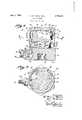
- Figure lis a longitudinal sectional view of the accelerometer.
- Fig. 2is a sectional view taken on the plane 22 of Fig. 1.
- an accelerometer 10embodying various features of the present invention.
- the accelerometercomprises a case and a body of electrosensitive material mounted therein.
- the eiectrosensitive memberis compressed between the end walls of the case, thus causing the cylindrical side Wall thereof to be elongated under stress.
- One end of the caseserves as a base and an inertial mass associated with the other end thereof is resiliently supported by the electrosensitive member thereby forming a resonant acceleratiomresponsive system.
- the compression of the electrosensitive member and the tension of the tubular memberestablishes the force constant of the system, thereby establishing both the resonant frequency and the sensitivity.
- the case itconsists of a body member 12 and cap member 4%, the two members being hermetically sealed. Since the case is composed of metal, it serves as an electrostatic shield.
- the body member 12is of unitary construction comprising a base portion or member 20 and a tubular sidewall portion or member 22.
- the body member 12also comprises an inwardly extending threaded lip or flange 24 forming a mouth or opening 26 at the opposite end from the base portion 20.
- the base portionis formed with an external flat face 28 with a central threaded bore 30.
- This arrangementfacilitates securing the accelerometer firmly to the flat face of a machine to be tested, thus forming, in effect, a rigid part thereof without substantially modifying the resonant characteristics of the accelerating or vibrating object and without substantially affecting the acceleration or vibration thereof.
- the base member 20 and the cylindrical member 22are of circular cross-sectional configuration, being coaxial.
- the cylindrical member 22is thin-walled, the thickness thereof being about one or two percent of the diameter of the tubular member and very small compared to the length of the wall lying between the base portion and the threaded flange 24.
- a circular recess 32 having a diameter less than that of the opening 26is formed in the base 20 at the lower end of the case 10.
- the cap memberis cup-shaped, being formed with a circular recess 42 on the interior thereof directly opposite the recess 32 in the base member 20.
- the two recesses 42 and 32are of substantially the same diameter and are coaxial with the periphery of the cap member 4%.
- the cap memberis formed with two diametrically opposite recesses 44 on the outer side thereof to facilitate rotating with a suitable tool.
- the electrosensitive body or member illustrated herecomprises a pair of piezo-electric wafers 46 and 48.
- Material that has been found to be particularly suitable in this inventioncomprises polarized lead-stabilized barium titanate crystals which are compressed into small flat Wafers coated with very thin silver layers 46a, 46b and 48a, 48b at the flat ends thereof. Though one such wafer could be employed in this invention, it is better to employ two, since this minimizes torsional strain in the electrosensitive body by virtue of the fact that the contiguous surfaces of the two Wafers are relatively movable while the accelerometer is being assembled.
- An inertial member 50is arranged between the cap member 40 and the pair of wafers 46 and 48.
- the inertial member 56is of cylindrical configuration.
- the upper end of the inertial massis provided with a circular boss 52 that is of smaller diameter than the recess 42 in the cap member 40.
- the lower end of the inertial memberis provided with a circular recess 54 formed by an axial flange or ring 56.
- a conductor 60 having an insulating coating 62lies in a longitudinal slot 64 formed in the side of the inertial mass 50 and is soldered thereto at one end thereof and is held in place by means of stakes 66.
- This conductorleads through an inclined opening 68 formed in the base into a radial bore formed in the side of the base where it is fastened to a central conductor 72 of a coaxial connector 74.
- a retaining pin 80pressed into registered radial holes 82 and 84 in the case 10 and the cap prevent the cap from rotating in the case.
- a disc 36 of Kraft paper or other insulating materialis cupped in the recess 42 between the cap member 40 and the boss 52.
- the conductor 69is drawn through the hole 68 and the connector 74 is screwed into the bore 70.
- the conductor 60is then drawn through the opening 26 and is laid in the slot 64 formed in the side of the inertial member 50.
- the bare end of the conductoris then soldered to the inertial mass at the root of the slot 64.
- the wafers 46 and 48are then stacked and placed in the recess 32 in the base member 20. Then with the lower wafer 46 in the recess 32 the inertial mass is in serted in the opening 26 and placed upon the upper wafer 48.
- the disc of kraft paper or other insulating materialis placed centrally upon the boss 52.
- the cap memberis then screwed into the threaded flange 24 squeezing and cupping the disc of kraft paper and compressing the electrosensitive discs 46 and 48 between the faces of the opposing recesses 32 and 54 in the base member 20 and the inertial member 50.
- the inertial memberis located on the wafers with the slot 64 in a counter-clockwise position relative to the hole 68. This permits the inertial member 50 to turn slightly without applying tension to the conductor as the cap member 40 is rotated in a countercrosswise direction.
- the cylindrical member 22As the cap member rotates the cylindrical member 22 is stretched or elongated, producing a longitudinal or axially extending tension therein. This tension, the cap member 40 compresses the discs 46 and 48.
- the compliance of the cylindrical member 22is very large compared to the compliance of the two wafers 46 and 48.
- the force constant of the cylindrical member 22is very small compared with the force constant of the two wafers 46 and 48. For this reason, as the cap member 40 is rotated, the cylindrical member 22 is elongated a great deal more than the discs 46 and 48 are shortened.
- the inertial member 50 and the two wafers 46 and 4.8form a resonant mechanical system.
- the wafers 46 and 48serve as a resilient member interconnecting the inertial member 50 and the base 2%.
- that force constantis primarily responsible for resisting the movement of the inertial member 59 when the accelerometer as a whole is subjected to accelerating forces applied to the base member 20.
- the spacing between the inertial member 50 and the base memberchanges, changing the degree of compression of the wafers 46 and 48.
- Such a change in compressioncauses a corresponding change in the electrical condition of the crystals of the wafers generating an electromotive force between the base member 20 and the inertial member 50.
- This forceis detected by means of conventional equipment including a cable connected to the connector 74.
- the electromotive force acting through generated by the wafers 46 and 48does not bear a constant relationship with the accelerational force applied to the base member but varies with frequency. However, it is substantially proportional to acceleration at any one frequency.
- certain resonant frequenciesappear in the response characteristic, and over a wide range below the lowest resonant frequency the respouse is substantially uniform.
- the lowest resonant frequency that appearsdepends upon the length of the cylindrical member
- the length of the cylindrical 22is made short and the wafers 46 and 48 are compressed to such an extent that the resonant frequency of the mechanical system formed by the wafers and the inertial member is very high.
- this resonant frequencyis much higher than the longitudinal resonant frequency of the cylinder.
- the cap member 40is rotated an amount to cause this mechanical system to have such a high resonant frequency and the amount of compression of the wafers 45 and 48 is chosen to produce a prel'. determined high sensitivity at low frequencies.
- holes 32 and 84are drilled and the retaining pin 30 is pressed into them.
- the wafersare composed of barium titanate.
- the inertial memberis made of Monel metal; the case, including both the body thereof and the cap member, is composed of stainless steel. These materials have characteristics indicated in the following table:
- the density of the inertial member and the caseare both higher than that of the wafers, thus aiding in creating large inertial forces to compress the wafers.
- These large inertial forcesare also produced in part by employing an inertial member that is much thicker than the wafers.
- the value of Youngs modulus for the inertial memberis much higher than that for the wafers. Accordingly, since forces are applied by the case over equal areas of the inertial member and the wafers, a large portion of the compressive force supplied by the case is accommodated by compression of the wafers.
- the wafershave a diameter less than 0.375 inch and a thickness of about 0.06 inch.
- the kraft discis about 0.003 inch thick. It is partly because of its very low thickness that the kraft disc does not appreciably effect the force constant.
- the length of the inertial massis less than 0.25 inch and its diameter is less than 0.5 inch. It is thus seen that the accelerometer so produced is compact and of light weight.
- a measuring instrumentcomprising: a case having a compliant cylindrical sidewall and having a stiff base member and a stiff cap member at opposite ends thereof, said base member having a recess in the inner wall thereof; a body of electrosensitive material compressed between said base member and said cap member by tension of said cylindrical member, said body of material having an electrical characteristic which varies in accordance with the compression thereof; an inertial member coupled to said cap member for varying the compression of said body in response to acceleration of said base member; and means including a pair of conductors connected to mutually spaced points of said body of material for detecting changes in such electrical characteristic.
- a measuring instrumentcomprising: a case having a compliant cylindrical sidewall and having a stiff base member and a stiff cap member at opposite ends thereof, said base member having a recess in the inner Wall thereof; an inertial member secured to said cap member, said inertial member having a recess opposite the recess in said base member; two cylindrical wafers stacked between the faces of the recesses of said inertial member and said base member and compressed therebetween by tension of said cylindrical member, said wafers being composed of material having an electrical characteristic that varies in accordance with the compression thereof; and means including a pair of mutually insulated conductors electrically connected to the remote faces of said wafers for detecting changes in such electrical characteristic.
- a measuring instrumentcomprising: a case having a compliant cylindrical sidewall and having a stiff electrically conductive base member and a stifi cap member at opposite ends thereof, said base member having a recess in the inner wall thereof; an electrically conductive inertial member secured to but insulated from said cap member, said member having a recess opposite the recess in said base member; two cylindrical wafers stacked between the faces of the recesses of said inertial member and said base member and compressed therebetween by tension of said cylindrical member, said wafers being composed of material having an electrical characteristic that varies in accordance with the compression thereof; and means including a pair of conductors connected respectively to the base and to the inertial member for detecting changes in such electrical characteristic.
- a measuring instrumentcomprising: a case composed of electrically conductive material having a corn pliant cylindrical sidewall and having a stifi base member and a stiff cap member at opposite ends thereof, said base and cap members having recesses in the inner wall thereof; an electrically conductive inertial member having a boss fitted into the recess in said cap member, said inertial member having a recess opposite the recess in said base member; an insulating sheet cupped between said inertial member and said cap member; two cylindrical wafers stacked between the faces of the recesses of said inertial member and said base member and compressed therebetween by tension of said cylindrical member, said disks being composed of material having an electrical characteristic that varies in accordance with the compression thereof, and means including a pair of conductors connected electrically to the remote faces of said wafers for detecting changes in such electrical characteristic.
- a measuring instrumentcomprising: a case having a compliant cylindrical sidewall portion and having a stiff base at one end thereof, said sidewall member having a threaded inwardly extending flange at the opposite end thereof; a stiff cap member threadably engaging said flange and rotatable relative thereto, said base and cap members having opposing recesses in the inner walls thereof said recesses being coaxial with the periphery of said cap member; an inertial member having a boss fitted into the recess in said cap member, said massive body having a recess opposite the recess in said base member; a cylindrical body resting between the faces of the recesses of said massive body and said base and compressed therebetween by tension of said cylindrical portion, the tension being adjustable by rotation of said cap member, said cylindrical body being composed of material having an electrical characteristic that varies in accordance with the.
- a measuring instrumentcomprising: a case having a compliant cylindrical sidewall portion and having a stiff base at one end thereof, said sidewall portion having a threaded inwardly extending flange at the opposite end thereof; a stiff cap member threadably engaging said flange and rotatable relative thereto, said base and cap members having opposing recesses in the inner walls thereof, said recesses being coaxial with the periphery of said cap member; an inertial member having a boss fitted into the recess in said cap member, said massive body having a recess opposite the recess in said base member; two cylindrical wafers stacked between the faces of the recesses of said massive body and said base and compressed therebetween by tension of said cylindrical portion, the tension being adjustable by rotation of said cap member, said disks being composed of material having an electrical characteristic that varies in accordance with the compression thereof; and means including a pair of mutually insulated conductors connected electrically to the remote faces of such wafers for detecting changes in such electrical characteristic.
Landscapes
- Physics & Mathematics (AREA)
- General Physics & Mathematics (AREA)
- Engineering & Computer Science (AREA)
- Mechanical Engineering (AREA)
- Force Measurement Appropriate To Specific Purposes (AREA)
Description
Aug. 2, 1955 H. D. WRIGHT ET AL 2,714,672
ACCELEROMETER Filed Aug. 50, 195
sag
X/VENTOQS- E DUDL MIGHT,
rroQ/vEY- 2,714,572 Patented Aug. 2, 1955 ice ACELEROMETER Harry Dudley Wright, Altadena, and Eric G. Laue, San Gabriei, Calif; said Laue assignor to said Wright Application August 30, 1952, Serial No. 307,314
6 Claims. (Ci. fill-8.4)
This invention relates to improvements in accelerometers and particularly to accelerometers employing as an acceleration responsive element a body of material such as a piezoelectric crystal which possesses an electrical characteristic or condition which varies with the compression thereof.
Accelerometers are employed in the testing and design of aircraft and other machines by mounting the accelerometers securely to the machines in question and then vibrating the machines. It is highly desirable to employ for this purpose an accelerometer which is of light weight and small size. It is also desirable that the accelerometer have a uniform sensitivity over a wide range of frequencies and over a wide temperature range.
Accelerometers have been made from discs of polarized lead-stabilized barium titanate (BaTiOs). Such material is very suitable because the temperature coefficient of its piezoelectric constant is relatively low and its curie point is relatively high. Heretofore, in the construction of accelerometers, discs of that type have been drilled with holes through the centers thereof and the apertured discs have been stacked about a post having stops at opposite ends of the stack and one of the stops has been threadably arranged upon the post in order to adjust the static compression of the discs This arrangement suffers from the disadvantages that the discs are hard and brittle, thus rendering the manufacture of such accelerometers expensive. Other characteristics desired in an accelerometer are pointed out hereafter.
One of the objects of this invention is to provide an improved accelerometer of low mass, small volume and a minimum number of components.
Another object of this invention is to provide an accelerometer of high resonant frequency and of high uniform sensitivity over a wide frequency range.
Another object of this invention is to provide an accelerometer having a sensitivity and a resonant frequency which are relatively constant over a large temperature range.
Another object of this invention is to provide an accelerometer employing a plurality of discs of electrosensitive material without the necessity of drilling holes through that material.
Another object of this invention is to provide a case that provides the force for compressing the electrosensitive material and for electrostatically shielding the working part of the accelerometer.
The foregoing and other objects of this invention together with various advantages thereof will become ap parent from the specification taken in connection with the accompanying drawings. Though this invention is described herein with particular reference to accelerometers, it will be understood that it may also be applied to the measurement of various forces whether they be forces applied between solid objects or pressures produced by fluids, or the like. In this connection it is to be mentioned that acceleration is merely one dynamic manifestation of forces and that, in effect, an accelerometer is Cir a force-measuring instrument, even though it be directly calibrated in acceleration.
In the drawings:
Figure l is a longitudinal sectional view of the accelerometer; and
Fig. 2 is a sectional view taken on theplane 22 of Fig. 1.
In the drawings, there is illustrated anaccelerometer 10 embodying various features of the present invention. The accelerometer comprises a case and a body of electrosensitive material mounted therein. According to the present invention the eiectrosensitive member is compressed between the end walls of the case, thus causing the cylindrical side Wall thereof to be elongated under stress. One end of the case serves as a base and an inertial mass associated with the other end thereof is resiliently supported by the electrosensitive member thereby forming a resonant acceleratiomresponsive system. The compression of the electrosensitive member and the tension of the tubular member establishes the force constant of the system, thereby establishing both the resonant frequency and the sensitivity.
The case it) consists of abody member 12 and cap member 4%, the two members being hermetically sealed. Since the case is composed of metal, it serves as an electrostatic shield. Thebody member 12 is of unitary construction comprising a base portion ormember 20 and a tubular sidewall portion ormember 22. Thebody member 12 also comprises an inwardly extending threaded lip orflange 24 forming a mouth or opening 26 at the opposite end from thebase portion 20. The base portion is formed with an externalflat face 28 with a central threadedbore 30. This arrangement facilitates securing the accelerometer firmly to the flat face of a machine to be tested, thus forming, in effect, a rigid part thereof without substantially modifying the resonant characteristics of the accelerating or vibrating object and without substantially affecting the acceleration or vibration thereof.
Thebase member 20 and thecylindrical member 22 are of circular cross-sectional configuration, being coaxial. Thecylindrical member 22 is thin-walled, the thickness thereof being about one or two percent of the diameter of the tubular member and very small compared to the length of the wall lying between the base portion and the threadedflange 24. Acircular recess 32 having a diameter less than that of theopening 26 is formed in thebase 20 at the lower end of thecase 10.
The cap member is cup-shaped, being formed with acircular recess 42 on the interior thereof directly opposite therecess 32 in thebase member 20. The tworecesses opposite recesses 44 on the outer side thereof to facilitate rotating with a suitable tool.
The electrosensitive body or member illustrated here comprises a pair of piezo-electric wafers thin silver layers 46a, 46b and 48a, 48b at the flat ends thereof. Though one such wafer could be employed in this invention, it is better to employ two, since this minimizes torsional strain in the electrosensitive body by virtue of the fact that the contiguous surfaces of the two Wafers are relatively movable while the accelerometer is being assembled.
Aninertial member 50 is arranged between thecap member 40 and the pair ofwafers inertial member 56 is of cylindrical configuration. The upper end of the inertial mass is provided With acircular boss 52 that is of smaller diameter than therecess 42 in thecap member 40. The lower end of the inertial member is provided with acircular recess 54 formed by an axial flange orring 56.
Aconductor 60 having aninsulating coating 62 lies in alongitudinal slot 64 formed in the side of theinertial mass 50 and is soldered thereto at one end thereof and is held in place by means of stakes 66. This conductor leads through aninclined opening 68 formed in the base into a radial bore formed in the side of the base where it is fastened to acentral conductor 72 of acoaxial connector 74. A retainingpin 80 pressed into registeredradial holes case 10 and the cap prevent the cap from rotating in the case.
A disc 36 of Kraft paper or other insulating material is cupped in therecess 42 between thecap member 40 and theboss 52.
In order to assemble the accelerometer, the conductor 69 is drawn through thehole 68 and theconnector 74 is screwed into thebore 70. Theconductor 60 is then drawn through the opening 26 and is laid in theslot 64 formed in the side of theinertial member 50. The bare end of the conductor is then soldered to the inertial mass at the root of theslot 64.
Thewafers recess 32 in thebase member 20. Then with thelower wafer 46 in therecess 32 the inertial mass is in serted in the opening 26 and placed upon theupper wafer 48.
The disc of kraft paper or other insulating material is placed centrally upon theboss 52. The cap member is then screwed into the threadedflange 24 squeezing and cupping the disc of kraft paper and compressing theelectrosensitive discs opposing recesses base member 20 and theinertial member 50.
Initially the inertial member is located on the wafers with theslot 64 in a counter-clockwise position relative to thehole 68. This permits theinertial member 50 to turn slightly without applying tension to the conductor as thecap member 40 is rotated in a countercrosswise direction.
As the cap member rotates thecylindrical member 22 is stretched or elongated, producing a longitudinal or axially extending tension therein. This tension, thecap member 40 compresses thediscs cylindrical member 22 is very large compared to the compliance of the twowafers cylindrical member 22 is very small compared with the force constant of the twowafers cap member 40 is rotated, thecylindrical member 22 is elongated a great deal more than thediscs
As mentioned above, theinertial member 50 and the twowafers 46 and 4.8 form a resonant mechanical system. In this system thewafers inertial member 50 and the base 2%. Inasmuch as the force constant of thewafers cylindrical member 22, that force constant is primarily responsible for resisting the movement of the inertial member 59 when the accelerometer as a whole is subjected to accelerating forces applied to thebase member 20.
When an acceleration force is applied to thebase member 20, the spacing between theinertial member 50 and the base member changes, changing the degree of compression of thewafers base member 20 and theinertial member 50. This force is detected by means of conventional equipment including a cable connected to theconnector 74. In practice, the electromotive force acting through generated by thewafers
in practice it has been found that the sensitivity of the accelerometer increases with the tension in thecylindrical member 22. It has also been found that the resonant frequency of the mechanical system formed by the wafers and the inertial member increases with such tension.
In this accelerometer the lowest resonant frequency that appears depends upon the length of the cylindrical member Thus, in order to achieve uniform response over a wide frequency range, the length of the cylindrical 22 is made short and thewafers
During assembly thecap member 40 is rotated an amount to cause this mechanical system to have such a high resonant frequency and the amount of compression of thewafers 45 and 48 is chosen to produce a prel'. determined high sensitivity at low frequencies. When the desired resonant frequency and sensitivity have been achieved, holes 32 and 84 are drilled and the retainingpin 30 is pressed into them.
As mentioned hereinabove, the wafers are composed of barium titanate. The inertial member is made of Monel metal; the case, including both the body thereof and the cap member, is composed of stainless steel. These materials have characteristics indicated in the following table:
Material Y, dynes/crn.
BaTiOs Monel metal Stainless Steel Approximately.
where It will be noted that the temperature coefiicient of expansion of the wafers, the inertial member and the case are very nearly equal. Consequently, as the temperature changes, the degree of compression of thewafers
It will also be noted that the density of the inertial member and the case are both higher than that of the wafers, thus aiding in creating large inertial forces to compress the wafers. These large inertial forces are also produced in part by employing an inertial member that is much thicker than the wafers.
It will also be noted that the value of Youngs modulus for the inertial member is much higher than that for the wafers. Accordingly, since forces are applied by the case over equal areas of the inertial member and the wafers, a large portion of the compressive force supplied by the case is accommodated by compression of the wafers.
In practice, the wafers have a diameter less than 0.375 inch and a thickness of about 0.06 inch. The kraft disc is about 0.003 inch thick. It is partly because of its very low thickness that the kraft disc does not appreciably effect the force constant. Also in practice, the length of the inertial mass is less than 0.25 inch and its diameter is less than 0.5 inch. It is thus seen that the accelerometer so produced is compact and of light weight.
From the foregoing description it is apparent that an accelerometer has been provided which achieves the objects of this invention. Although only one particular form of the invention has been specifically disclosed, it will be obvious that the invention is not limited thereto but is capable of a variety of mechanical embodiments. Various changes which will now suggest themselves to those skilled in the art may be made in the material, form, details of construction and arrangement of the elements without departing from the spirit of the invention. Reference is therefore to be had to the appended claims to ascertain the scope of the invention.
The invention claimed is:
1. A measuring instrument comprising: a case having a compliant cylindrical sidewall and having a stiff base member and a stiff cap member at opposite ends thereof, said base member having a recess in the inner wall thereof; a body of electrosensitive material compressed between said base member and said cap member by tension of said cylindrical member, said body of material having an electrical characteristic which varies in accordance with the compression thereof; an inertial member coupled to said cap member for varying the compression of said body in response to acceleration of said base member; and means including a pair of conductors connected to mutually spaced points of said body of material for detecting changes in such electrical characteristic.
2. A measuring instrument comprising: a case having a compliant cylindrical sidewall and having a stiff base member and a stiff cap member at opposite ends thereof, said base member having a recess in the inner Wall thereof; an inertial member secured to said cap member, said inertial member having a recess opposite the recess in said base member; two cylindrical wafers stacked between the faces of the recesses of said inertial member and said base member and compressed therebetween by tension of said cylindrical member, said wafers being composed of material having an electrical characteristic that varies in accordance with the compression thereof; and means including a pair of mutually insulated conductors electrically connected to the remote faces of said wafers for detecting changes in such electrical characteristic.
3. A measuring instrument comprising: a case having a compliant cylindrical sidewall and having a stiff electrically conductive base member and a stifi cap member at opposite ends thereof, said base member having a recess in the inner wall thereof; an electrically conductive inertial member secured to but insulated from said cap member, said member having a recess opposite the recess in said base member; two cylindrical wafers stacked between the faces of the recesses of said inertial member and said base member and compressed therebetween by tension of said cylindrical member, said wafers being composed of material having an electrical characteristic that varies in accordance with the compression thereof; and means including a pair of conductors connected respectively to the base and to the inertial member for detecting changes in such electrical characteristic.
4. A measuring instrument comprising: a case composed of electrically conductive material having a corn pliant cylindrical sidewall and having a stifi base member and a stiff cap member at opposite ends thereof, said base and cap members having recesses in the inner wall thereof; an electrically conductive inertial member having a boss fitted into the recess in said cap member, said inertial member having a recess opposite the recess in said base member; an insulating sheet cupped between said inertial member and said cap member; two cylindrical wafers stacked between the faces of the recesses of said inertial member and said base member and compressed therebetween by tension of said cylindrical member, said disks being composed of material having an electrical characteristic that varies in accordance with the compression thereof, and means including a pair of conductors connected electrically to the remote faces of said wafers for detecting changes in such electrical characteristic.
5. A measuring instrument comprising: a case having a compliant cylindrical sidewall portion and having a stiff base at one end thereof, said sidewall member having a threaded inwardly extending flange at the opposite end thereof; a stiff cap member threadably engaging said flange and rotatable relative thereto, said base and cap members having opposing recesses in the inner walls thereof said recesses being coaxial with the periphery of said cap member; an inertial member having a boss fitted into the recess in said cap member, said massive body having a recess opposite the recess in said base member; a cylindrical body resting between the faces of the recesses of said massive body and said base and compressed therebetween by tension of said cylindrical portion, the tension being adjustable by rotation of said cap member, said cylindrical body being composed of material having an electrical characteristic that varies in accordance with the.
compression thereof; and means including a pair of conductors connected to mutually spaced points of said body of material for detecting changes in such electrical characteristic.
6. A measuring instrument comprising: a case having a compliant cylindrical sidewall portion and having a stiff base at one end thereof, said sidewall portion having a threaded inwardly extending flange at the opposite end thereof; a stiff cap member threadably engaging said flange and rotatable relative thereto, said base and cap members having opposing recesses in the inner walls thereof, said recesses being coaxial with the periphery of said cap member; an inertial member having a boss fitted into the recess in said cap member, said massive body having a recess opposite the recess in said base member; two cylindrical wafers stacked between the faces of the recesses of said massive body and said base and compressed therebetween by tension of said cylindrical portion, the tension being adjustable by rotation of said cap member, said disks being composed of material having an electrical characteristic that varies in accordance with the compression thereof; and means including a pair of mutually insulated conductors connected electrically to the remote faces of such wafers for detecting changes in such electrical characteristic.
References Cited in the file of this patent UNITED STATES PATENTS
Priority Applications (1)
| Application Number | Priority Date | Filing Date | Title |
|---|---|---|---|
| US307314AUS2714672A (en) | 1952-08-30 | 1952-08-30 | Accelerometer |
Applications Claiming Priority (1)
| Application Number | Priority Date | Filing Date | Title |
|---|---|---|---|
| US307314AUS2714672A (en) | 1952-08-30 | 1952-08-30 | Accelerometer |
Publications (1)
| Publication Number | Publication Date |
|---|---|
| US2714672Atrue US2714672A (en) | 1955-08-02 |
Family
ID=23189179
Family Applications (1)
| Application Number | Title | Priority Date | Filing Date |
|---|---|---|---|
| US307314AExpired - LifetimeUS2714672A (en) | 1952-08-30 | 1952-08-30 | Accelerometer |
Country Status (1)
| Country | Link |
|---|---|
| US (1) | US2714672A (en) |
Cited By (27)
| Publication number | Priority date | Publication date | Assignee | Title |
|---|---|---|---|---|
| US2824243A (en)* | 1956-06-01 | 1958-02-18 | Hughes Aircraft Co | Compression type accelerometer |
| US2849629A (en)* | 1955-08-16 | 1958-08-26 | Charles W Kissinger | Chatter accelerometer |
| US2860265A (en)* | 1954-06-21 | 1958-11-11 | Bell Telephone Labor Inc | Ferroelectric device |
| US2875352A (en)* | 1953-03-04 | 1959-02-24 | Gulton Ind Inc | Blast gauge |
| US2917642A (en)* | 1955-02-21 | 1959-12-15 | Wright | Pressure-responsive transducer |
| US2947889A (en)* | 1956-08-27 | 1960-08-02 | Gen Ultrasonics Company | Electromechanical transducer system |
| US3060333A (en)* | 1959-03-23 | 1962-10-23 | Endevco Corp | High capacity accelerometer |
| US3066232A (en)* | 1959-06-12 | 1962-11-27 | Branson Instr | Ultrasonic transducer |
| US3075099A (en)* | 1959-06-03 | 1963-01-22 | Endevco Corp | Accelerometer |
| US3093759A (en)* | 1958-10-22 | 1963-06-11 | Gulton Ind Inc | Accelerometer |
| US3094314A (en)* | 1960-08-02 | 1963-06-18 | Detrex Chem Ind | Sandwich type transducer and coupling |
| US3115616A (en)* | 1958-03-31 | 1963-12-24 | Robert L Parris | Mechanical vibration pick-up for use in high noise fields |
| US3120622A (en)* | 1960-03-29 | 1964-02-04 | Gulton Ind Inc | Self-calibrating accelerometer |
| US3158831A (en)* | 1961-05-31 | 1964-11-24 | George L Boyer | Underwater acoustic intensity meter |
| US3240073A (en)* | 1962-03-01 | 1966-03-15 | Edcliff Instr Inc | Linear accelerometer |
| US3337758A (en)* | 1964-12-22 | 1967-08-22 | Brothers Jack | Piezo-electric energy source for space vehicles |
| US3374663A (en)* | 1965-04-16 | 1968-03-26 | Electronic Systems Inc | Vibration detector |
| US3536939A (en)* | 1967-08-02 | 1970-10-27 | List Hans | Piezoelectric accelerometer with cooling through the baseplate |
| US3673443A (en)* | 1970-12-31 | 1972-06-27 | Sundstrand Data Control | Pressure transducer with reduced temperature sensitivity |
| US3673442A (en)* | 1964-02-19 | 1972-06-27 | Hans Conrad Sonderegger | Temperature compensated piezoelectric accelerometer |
| US3677184A (en)* | 1955-08-16 | 1972-07-18 | Us Army | Proximity fuzes |
| US4967114A (en)* | 1988-04-13 | 1990-10-30 | Mitsubishi Denki Kabushiki Kaisha | Acceleration detector |
| US5128581A (en)* | 1989-05-02 | 1992-07-07 | Fujikura Ltd. | Piezoelectric acceleration sensor and piezoelectric acceleration sensor device |
| US5512794A (en)* | 1991-12-05 | 1996-04-30 | Kistler Instrumente Ag | Shear accelerometer |
| US5661361A (en)* | 1995-08-29 | 1997-08-26 | Pruftechnik Dieter Busch Ag | Balanced compression accelerometer |
| US20110046521A1 (en)* | 2009-08-20 | 2011-02-24 | Krypton Systems LLC | Ultra-Sonic and Vibratory Treatment Devices and Methods |
| US9360495B1 (en) | 2013-03-14 | 2016-06-07 | Lockheed Martin Corporation | Low density underwater accelerometer |
Citations (2)
| Publication number | Priority date | Publication date | Assignee | Title |
|---|---|---|---|---|
| US2411401A (en)* | 1942-07-28 | 1946-11-19 | Westinghouse Electric Corp | Accelerometer |
| US2514297A (en)* | 1943-03-03 | 1950-07-04 | Us Navy | Apparatus for observing the conduct of a projectile in a gun |
- 1952
- 1952-08-30USUS307314Apatent/US2714672A/ennot_activeExpired - Lifetime
Patent Citations (2)
| Publication number | Priority date | Publication date | Assignee | Title |
|---|---|---|---|---|
| US2411401A (en)* | 1942-07-28 | 1946-11-19 | Westinghouse Electric Corp | Accelerometer |
| US2514297A (en)* | 1943-03-03 | 1950-07-04 | Us Navy | Apparatus for observing the conduct of a projectile in a gun |
Cited By (29)
| Publication number | Priority date | Publication date | Assignee | Title |
|---|---|---|---|---|
| US2875352A (en)* | 1953-03-04 | 1959-02-24 | Gulton Ind Inc | Blast gauge |
| US2860265A (en)* | 1954-06-21 | 1958-11-11 | Bell Telephone Labor Inc | Ferroelectric device |
| US2917642A (en)* | 1955-02-21 | 1959-12-15 | Wright | Pressure-responsive transducer |
| US3677184A (en)* | 1955-08-16 | 1972-07-18 | Us Army | Proximity fuzes |
| US2849629A (en)* | 1955-08-16 | 1958-08-26 | Charles W Kissinger | Chatter accelerometer |
| US2824243A (en)* | 1956-06-01 | 1958-02-18 | Hughes Aircraft Co | Compression type accelerometer |
| US2947889A (en)* | 1956-08-27 | 1960-08-02 | Gen Ultrasonics Company | Electromechanical transducer system |
| US3115616A (en)* | 1958-03-31 | 1963-12-24 | Robert L Parris | Mechanical vibration pick-up for use in high noise fields |
| US3093759A (en)* | 1958-10-22 | 1963-06-11 | Gulton Ind Inc | Accelerometer |
| US3060333A (en)* | 1959-03-23 | 1962-10-23 | Endevco Corp | High capacity accelerometer |
| US3075099A (en)* | 1959-06-03 | 1963-01-22 | Endevco Corp | Accelerometer |
| US3066232A (en)* | 1959-06-12 | 1962-11-27 | Branson Instr | Ultrasonic transducer |
| US3120622A (en)* | 1960-03-29 | 1964-02-04 | Gulton Ind Inc | Self-calibrating accelerometer |
| US3094314A (en)* | 1960-08-02 | 1963-06-18 | Detrex Chem Ind | Sandwich type transducer and coupling |
| US3158831A (en)* | 1961-05-31 | 1964-11-24 | George L Boyer | Underwater acoustic intensity meter |
| US3240073A (en)* | 1962-03-01 | 1966-03-15 | Edcliff Instr Inc | Linear accelerometer |
| US3673442A (en)* | 1964-02-19 | 1972-06-27 | Hans Conrad Sonderegger | Temperature compensated piezoelectric accelerometer |
| US3337758A (en)* | 1964-12-22 | 1967-08-22 | Brothers Jack | Piezo-electric energy source for space vehicles |
| US3374663A (en)* | 1965-04-16 | 1968-03-26 | Electronic Systems Inc | Vibration detector |
| US3536939A (en)* | 1967-08-02 | 1970-10-27 | List Hans | Piezoelectric accelerometer with cooling through the baseplate |
| US3673443A (en)* | 1970-12-31 | 1972-06-27 | Sundstrand Data Control | Pressure transducer with reduced temperature sensitivity |
| US4967114A (en)* | 1988-04-13 | 1990-10-30 | Mitsubishi Denki Kabushiki Kaisha | Acceleration detector |
| US5128581A (en)* | 1989-05-02 | 1992-07-07 | Fujikura Ltd. | Piezoelectric acceleration sensor and piezoelectric acceleration sensor device |
| US5512794A (en)* | 1991-12-05 | 1996-04-30 | Kistler Instrumente Ag | Shear accelerometer |
| US5661361A (en)* | 1995-08-29 | 1997-08-26 | Pruftechnik Dieter Busch Ag | Balanced compression accelerometer |
| US20110046521A1 (en)* | 2009-08-20 | 2011-02-24 | Krypton Systems LLC | Ultra-Sonic and Vibratory Treatment Devices and Methods |
| US8460221B2 (en) | 2009-08-20 | 2013-06-11 | Krypton Systems LLC | Ultra-sonic and vibratory treatment devices and methods |
| US9360495B1 (en) | 2013-03-14 | 2016-06-07 | Lockheed Martin Corporation | Low density underwater accelerometer |
| US10448181B2 (en) | 2013-03-14 | 2019-10-15 | Lockheed Martin Corporation | Method of manufacturing a low density underwater accelerometer |
Similar Documents
| Publication | Publication Date | Title |
|---|---|---|
| US2714672A (en) | Accelerometer | |
| US3120622A (en) | Self-calibrating accelerometer | |
| US3185869A (en) | Transducer | |
| US3104334A (en) | Annular accelerometer | |
| US2164638A (en) | Electrical pressure detector | |
| US2767973A (en) | Accelerometers | |
| US2808522A (en) | Accelerometer | |
| US2722614A (en) | Vibration and shock-responsive device | |
| US3307054A (en) | Accelerometer | |
| US3075098A (en) | Accelerometer | |
| US3858065A (en) | Annular 3m class piezoelectric crystal transducer | |
| US3025359A (en) | Vibration-compensated pressure sensitive microphone | |
| US2800796A (en) | Pressure measuring device | |
| US3988620A (en) | Transducer having enhanced acceleration cancellation characteristics | |
| US4190782A (en) | Piezoelectric ceramic resonant transducer with stable frequency | |
| US4395908A (en) | Means for adjusting the sensitivity of a crystal detector | |
| US3060333A (en) | High capacity accelerometer | |
| US3002179A (en) | Low frequency hydrophone | |
| US2808524A (en) | Inertia responsive electro-mechanical transducer | |
| US3104336A (en) | Hollow conical electromechanical transducer for use in air | |
| US7525238B2 (en) | Ground insulated piezoelectric sensor for the measurement of acceleration or pressure | |
| US3252016A (en) | Electro-mechanical transducer | |
| DK169653B1 (en) | Shear type piezoelectric accelerometer | |
| US3586889A (en) | Means for resiliently mounting transducer elements between a housing and an inertial mass | |
| US3233465A (en) | Accelerometer |