US2705006A - Device for preventing habitual breathing through the mouth - Google Patents
Device for preventing habitual breathing through the mouthDownload PDFInfo
- Publication number
- US2705006A US2705006AUS396098AUS39609853AUS2705006AUS 2705006 AUS2705006 AUS 2705006AUS 396098 AUS396098 AUS 396098AUS 39609853 AUS39609853 AUS 39609853AUS 2705006 AUS2705006 AUS 2705006A
- Authority
- US
- United States
- Prior art keywords
- mouthpiece
- mouth
- teeth
- breathing
- jaw
- Prior art date
- Legal status (The legal status is an assumption and is not a legal conclusion. Google has not performed a legal analysis and makes no representation as to the accuracy of the status listed.)
- Expired - Lifetime
Links
Images

Classifications
- A—HUMAN NECESSITIES
- A61—MEDICAL OR VETERINARY SCIENCE; HYGIENE
- A61F—FILTERS IMPLANTABLE INTO BLOOD VESSELS; PROSTHESES; DEVICES PROVIDING PATENCY TO, OR PREVENTING COLLAPSING OF, TUBULAR STRUCTURES OF THE BODY, e.g. STENTS; ORTHOPAEDIC, NURSING OR CONTRACEPTIVE DEVICES; FOMENTATION; TREATMENT OR PROTECTION OF EYES OR EARS; BANDAGES, DRESSINGS OR ABSORBENT PADS; FIRST-AID KITS
- A61F5/00—Orthopaedic methods or devices for non-surgical treatment of bones or joints; Nursing devices ; Anti-rape devices
- A61F5/56—Devices for preventing snoring
- A61F5/566—Intra-oral devices
Definitions
- the present inventionrelates to a mouthpiece specifically constructed for the prevention of habitual breathing through the mouth.
- the device of the present inventionis constructed to assure correct breathing habits either asleep or awake and is to be utilized in such manner that the victim of breathing habits through the mouth will, after using the device, unconsciously practice good breathing habits.
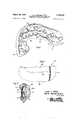
- Figure lis a rear view of the mouthpiece of the present invention.
- Figure 2is a front view of the mouthpiece of the present invention.
- Figure 3is a cross sectional view of the mouthpiece of the present invention as applied to an individual;
- Figure 4is a view of the attachment of the mouthpiece to the teeth of the upper jaw.
- Figure 5is a view of the mouthpiece as attached to the teeth of the lower jaw.
- the mouth pieceis illustrated in its entirety by the numeral and is constructed primarily of a piece of moldable plastic
- the mouthpiece 10is shaped to conform to the curvature of the jaw of the individual for whom the mouthpiece is constructed.
- the mouthpiece 10is substantially T-shaped in cross section with the head 12 of the T closing the mouth opening and having portions thereof seating between the upper and lower lips 16 and 18, respectively, and the gums of the upper and lower jaws to retain the mouthpiece in position in the mouth and prevent the passage of air thereinto.
- This head or front 12 of the mouthpieceis formed with central depressions 20 and 22 at the upper and lower edges thereof centrally of its ends so that no uncomfortable pressure will be exerted on the phrenum joining the lips to the ums.
- the stem 14 of the mouthpiece 10serves as a separator or spacer between the teeth of the upper and lower jaws 24 and 26 of the wearer.
- depressions or impressionsconforming to the shape of the teeth of the upper jaw 24 of the wearer, these depressions being designated generally by the numeral 28 and terminating against the upper surface of the stem or separator 14 of the mouthpiece.
- the depressions for the upper molarsare designated by a separate numeral 30 as will be noted most particularly in Figures 1 and 4 for a purpose that will become immediately apparent.
- a holder 32Adjacent the depressions 30 the upper jaw portion of the mouthpiece 10 on each side of the jaw is provided a holder 32 in the form of a wire having its ends embedded in the stem 14 and its intermediate portion being shaped to conform to the side wall shape of the two molars 30a on each side of the upper jaw.
- depressions 28 and 30are formed in the back surface of the front wall of the mouthpiece. These depressions are designated by the numerals 34 for the front incisors and 36 for the other front lower teeth.
- the front lower incisors 34a and the other lower front teeth 36a of the lower jaw 26are seated in the corresponding depressions 34 and 36 formed in the lower jaw portion of the mouthpiece 10.
- a wire holder having its ends embedded within the plastic shell forming the mouthpiecehas its intermediate portion disposed behind the depressions 34 and shaped to the curvature of the front lower incisors 34 to frictionally clamp these teeth to the lower jaw portion of the mouthpiece 10.
- the shape of the mouthpieceis such that it is extremely comfortable to use and will cause no distress to the wearer.
- a mouthpiece for preventing breathing through the mouthcomprising a member shaped to the curvature of the jaw and adapted to fit within the mouth of a wearer, said member including a portion formed to lie between the teeth and the lips, means on said member for seating the teeth of the upper and lower jaw therein, and means for releasably retaining the teeth of the jaws in said member, said member being molded to fit the jaw, said seating means including depressions formed in the rear wall of the member to fit the teeth, said retaining means including a holder for clampingly embracing some of the teeth of the jaw.
- a mouthpiece for preventing breathing through the mouthcomprising a member shaped to the curvature of the jaw and adapted to fit within the mouth of a wearer, said member including a portion formed to lie between the teeth and the lips, means on said member for seating the teeth of the upper and lower jaw therein, and means for releasably retaining the teeth of the jaws in said member, said member being molded to fit the jaw, said seating means including depressions formed in the member to fit the teeth, said retaining means ineluding a holder embracing the front, lower incisors, and elements embracing the molars of the upper jaw.
- a mouthpiece for preventing breathing through the mouthcomprising a member shaped to the curvature of the jaw and adapted to fit within the mouth of a wearer, said member including a portion formed to lie between the teeth and the lips, means on said member 5 for seating the teeth of the upper and lower jaw therein, and means for releasably clamping the teeth of the upper and lower jaws to the member, said seating means including depressions formed in said member to fit the teeth, said clamping means including holders for embracing some of the teeth of the upper and lower jaws.
Landscapes
- Health & Medical Sciences (AREA)
- Otolaryngology (AREA)
- Pulmonology (AREA)
- Nursing (AREA)
- Orthopedic Medicine & Surgery (AREA)
- Engineering & Computer Science (AREA)
- Biomedical Technology (AREA)
- Heart & Thoracic Surgery (AREA)
- Vascular Medicine (AREA)
- Life Sciences & Earth Sciences (AREA)
- Animal Behavior & Ethology (AREA)
- General Health & Medical Sciences (AREA)
- Public Health (AREA)
- Veterinary Medicine (AREA)
- Orthopedics, Nursing, And Contraception (AREA)
- Respiratory Apparatuses And Protective Means (AREA)
Description
March 29, 1955 CETTEL ETAL 2,705,006
DEVICE FOR PREVENTING HABITUAL BREATHING THROUGH THE MOUTH Filed Dec. 4, 1953 2 Sheets-Sheet l Lou/s L. Carrel Mar/e Pauline Girard 11v VEN TORS March 29, 1955 CETTEL ET AL 2,705,006
. DEVICE FOR PREVENTING HABITUAL BREATHING THROUGH THE MOUTH Filed Dec. 4, 1955 2 Sheets-Sheet 2 Louis L. Cartel Marie Paul/he Gfi'ard INVENTORS Mm BY ym 3M3:
United States Patent 'Oflice 2,705,006 Patented Mar. 29, 1955 DEVICE FOR PREVENTING HABITUAL BREATHING THROUGH THE MOUTH Louis L. Cettel and Marie Pauline Girard, Los Angeles, Calif.
Application December 4, 1953, Serial No. 396,098
3 Claims. (Cl. 128136) The present invention relates to a mouthpiece specifically constructed for the prevention of habitual breathing through the mouth.
Quite frequently people become victims of improper breathing habits, such as breathing through the mouth. The habit is detrimental both to the one who is the victim of the habit and to those around him. Constant breathing through the mouth often results in bad eating habits and seemingly poor table manners as well as leading to snoring at night or at other times when asleep. However, habitual breathing through the mouth may also affect the teeth adversely, making some crooked and quite often causing pain to the teeth in extremely cold weather.
Accordingly, the device of the present invention is constructed to assure correct breathing habits either asleep or awake and is to be utilized in such manner that the victim of breathing habits through the mouth will, after using the device, unconsciously practice good breathing habits.
These together with other objects and advantages which will become subsequently apparent reside in the details of construction and operation as more fully hereinafter described and claimed, reference being had to the accompanying drawings forming a part hereof, wherein like numerals refer to like parts throughout, and in which:
Figure l is a rear view of the mouthpiece of the present invention;
Figure 2 is a front view of the mouthpiece of the present invention;
Figure 3 is a cross sectional view of the mouthpiece of the present invention as applied to an individual;
Figure 4 is a view of the attachment of the mouthpiece to the teeth of the upper jaw; and
Figure 5 is a view of the mouthpiece as attached to the teeth of the lower jaw.
Referring now to the drawings in detail, the mouth piece is illustrated in its entirety by the numeral and is constructed primarily of a piece of moldable plastic,
the particular plastic constituting no part of the present invention.
Themouthpiece 10 is shaped to conform to the curvature of the jaw of the individual for whom the mouthpiece is constructed.
Themouthpiece 10, noting Figure 3, is substantially T-shaped in cross section with thehead 12 of the T closing the mouth opening and having portions thereof seating between the upper andlower lips front 12 of the mouthpiece is formed withcentral depressions stem 14 of themouthpiece 10 serves as a separator or spacer between the teeth of the upper andlower jaws
On the back surface of the front orhead 12 of themouthpiece 10 above the stem orspacer 14 are a plurality of depressions or impressions conforming to the shape of the teeth of theupper jaw 24 of the wearer, these depressions being designated generally by thenumeral 28 and terminating against the upper surface of the stem orseparator 14 of the mouthpiece. The depressions for the upper molars are designated by a separate numeral 30 as will be noted most particularly in Figures 1 and 4 for a purpose that will become immediately apparent.
Adjacent the depressions 30 the upper jaw portion of themouthpiece 10 on each side of the jaw is provided aholder 32 in the form of a wire having its ends embedded in thestem 14 and its intermediate portion being shaped to conform to the side wall shape of the twomolars 30a on each side of the upper jaw.
As will be particularly noted in Figure 4, when the teeth 28a of the upper jaw are seated in thedepressions 28 of the upper jaw portion of the mouthpiece, themolars 30a seat in the depressions 30 and are more or less frictionally clamped to the mouthpiece by means of thewire holders 32.
In the lower jaw portion of the device, that portion beneath the stem orseparator 14 of the mouthpiece, similar depressions to thedepressions 28 and 30 are formed in the back surface of the front wall of the mouthpiece. These depressions are designated by thenumerals 34 for the front incisors and 36 for the other front lower teeth.
Noting particularly Figure 5, the front lower incisors 34a and the other lower front teeth 36a of thelower jaw 26 are seated in thecorresponding depressions mouthpiece 10. A wire holder having its ends embedded within the plastic shell forming the mouthpiece has its intermediate portion disposed behind thedepressions 34 and shaped to the curvature of the frontlower incisors 34 to frictionally clamp these teeth to the lower jaw portion of themouthpiece 10.
Thus, when themouthpiece 10 is inserted correctly in the mouth of a wearer as shown in Figure 3, the teeth of the upper andlower jaws
The shape of the mouthpiece is such that it is extremely comfortable to use and will cause no distress to the wearer.
It has been found advisable to embed reinforcingwire 38 within thefront 12 of themouthpiece 10 to afford additional rigidity to the same.
From the foregoing, the construction and operation of the device will be readily understood and further explanation is believed to be unnecessary. However, since numerous modifications and changes will readily occur to those skilled in the art, it is not desired to limit the invention to the exact construction shown and described, and accordingly, all suitable modifications and equivalents may be resorted to, falling within the scope of the appended claims.
What is claimed as new is as follows:
1. A mouthpiece for preventing breathing through the mouth comprising a member shaped to the curvature of the jaw and adapted to fit within the mouth of a wearer, said member including a portion formed to lie between the teeth and the lips, means on said member for seating the teeth of the upper and lower jaw therein, and means for releasably retaining the teeth of the jaws in said member, said member being molded to fit the jaw, said seating means including depressions formed in the rear wall of the member to fit the teeth, said retaining means including a holder for clampingly embracing some of the teeth of the jaw.
2. A mouthpiece for preventing breathing through the mouth comprising a member shaped to the curvature of the jaw and adapted to fit within the mouth of a wearer, said member including a portion formed to lie between the teeth and the lips, means on said member for seating the teeth of the upper and lower jaw therein, and means for releasably retaining the teeth of the jaws in said member, said member being molded to fit the jaw, said seating means including depressions formed in the member to fit the teeth, said retaining means ineluding a holder embracing the front, lower incisors, and elements embracing the molars of the upper jaw.
3. A mouthpiece for preventing breathing through the mouth comprising a member shaped to the curvature of the jaw and adapted to fit within the mouth of a wearer, said member including a portion formed to lie between the teeth and the lips, means on said member 5 for seating the teeth of the upper and lower jaw therein, and means for releasably clamping the teeth of the upper and lower jaws to the member, said seating means including depressions formed in said member to fit the teeth, said clamping means including holders for embracing some of the teeth of the upper and lower jaws.
References Cited the file of this patent UNITED STATES PATENTS
Priority Applications (1)
| Application Number | Priority Date | Filing Date | Title |
|---|---|---|---|
| US396098AUS2705006A (en) | 1953-12-04 | 1953-12-04 | Device for preventing habitual breathing through the mouth |
Applications Claiming Priority (1)
| Application Number | Priority Date | Filing Date | Title |
|---|---|---|---|
| US396098AUS2705006A (en) | 1953-12-04 | 1953-12-04 | Device for preventing habitual breathing through the mouth |
Publications (1)
| Publication Number | Publication Date |
|---|---|
| US2705006Atrue US2705006A (en) | 1955-03-29 |
Family
ID=23565835
Family Applications (1)
| Application Number | Title | Priority Date | Filing Date |
|---|---|---|---|
| US396098AExpired - LifetimeUS2705006A (en) | 1953-12-04 | 1953-12-04 | Device for preventing habitual breathing through the mouth |
Country Status (1)
| Country | Link |
|---|---|
| US (1) | US2705006A (en) |
Cited By (21)
| Publication number | Priority date | Publication date | Assignee | Title |
|---|---|---|---|---|
| US3178820A (en)* | 1962-02-19 | 1965-04-20 | Harold D Kesling | Intra-oral tooth positioner |
| US3407500A (en)* | 1966-05-06 | 1968-10-29 | Peter C. Kesling | Tooth positioner |
| US3584620A (en)* | 1969-06-19 | 1971-06-15 | Edith A Hale | Cosmetic device |
| US4951655A (en)* | 1989-03-27 | 1990-08-28 | University Of Florida | Maxillary fixed cervical spine orthosis |
| US5003994A (en)* | 1989-10-10 | 1991-04-02 | Cook George W | Oral appliance for improving breathing and methods of using and making same |
| US5056534A (en)* | 1987-07-08 | 1991-10-15 | Wright David W R | Snore inhibiting device |
| US5267862A (en)* | 1993-01-08 | 1993-12-07 | Parker Jonathan A | Intraoral appliance |
| US5316020A (en)* | 1990-10-03 | 1994-05-31 | Ernest Truffer | Snoring prevention device |
| US5467783A (en)* | 1992-11-16 | 1995-11-21 | Meade; Thomas E. | Apparatus and method for the reduction of snoring |
| DE29602745U1 (en)* | 1996-02-16 | 1996-07-11 | Stockhausen, Rolf, Dr., 40210 Düsseldorf | Anti-snoring device |
| US6604528B1 (en)* | 2002-04-22 | 2003-08-12 | Lloyd P. Duncan | Acid reflux and snoring device |
| US6766802B1 (en) | 2003-06-05 | 2004-07-27 | Bryan Keropian | Sleep appliance |
| US6877513B2 (en) | 2000-01-21 | 2005-04-12 | Respironics, Inc. | Intraoral apparatus for enhancing airway patency |
| US20060289013A1 (en)* | 2005-06-23 | 2006-12-28 | Bryan Keropian | Sleep appliance |
| US20070006884A1 (en)* | 2003-03-10 | 2007-01-11 | Mark Abramson | Method for treating sleep apnea |
| US20090032030A1 (en)* | 2007-07-30 | 2009-02-05 | Callender R Sam | Apparatus for treatment of sleep apnea |
| WO2010068493A1 (en) | 2008-11-25 | 2010-06-17 | Lumen Devices Llc | Devices, systems and methods for the treatment of sleep apnea |
| WO2010087824A1 (en)* | 2009-01-29 | 2010-08-05 | Callender R Sam | Method and apparatus for treatment of sleep apnea |
| US8757164B2 (en) | 2009-08-12 | 2014-06-24 | Mark E. Abramson | Dental appliance with adjustable tongue repositioner |
| US20210330488A1 (en)* | 2020-04-28 | 2021-10-28 | Rick T. Waterman | Oral appliance apparatus and method of operation thereof |
| US20240207558A1 (en)* | 2020-03-06 | 2024-06-27 | R.I.P., Llc | Oral appliance for use with cpap headgear |
Citations (2)
| Publication number | Priority date | Publication date | Assignee | Title |
|---|---|---|---|---|
| US2643652A (en)* | 1951-04-09 | 1953-06-30 | Fred P Moffett | Mouth protector |
| US2678043A (en)* | 1951-12-18 | 1954-05-11 | Stark Emanuel | Mouth appliance |
- 1953
- 1953-12-04USUS396098Apatent/US2705006A/ennot_activeExpired - Lifetime
Patent Citations (2)
| Publication number | Priority date | Publication date | Assignee | Title |
|---|---|---|---|---|
| US2643652A (en)* | 1951-04-09 | 1953-06-30 | Fred P Moffett | Mouth protector |
| US2678043A (en)* | 1951-12-18 | 1954-05-11 | Stark Emanuel | Mouth appliance |
Cited By (31)
| Publication number | Priority date | Publication date | Assignee | Title |
|---|---|---|---|---|
| US3178820A (en)* | 1962-02-19 | 1965-04-20 | Harold D Kesling | Intra-oral tooth positioner |
| US3407500A (en)* | 1966-05-06 | 1968-10-29 | Peter C. Kesling | Tooth positioner |
| US3584620A (en)* | 1969-06-19 | 1971-06-15 | Edith A Hale | Cosmetic device |
| US5056534A (en)* | 1987-07-08 | 1991-10-15 | Wright David W R | Snore inhibiting device |
| US4951655A (en)* | 1989-03-27 | 1990-08-28 | University Of Florida | Maxillary fixed cervical spine orthosis |
| US5003994A (en)* | 1989-10-10 | 1991-04-02 | Cook George W | Oral appliance for improving breathing and methods of using and making same |
| US5316020A (en)* | 1990-10-03 | 1994-05-31 | Ernest Truffer | Snoring prevention device |
| US5467783A (en)* | 1992-11-16 | 1995-11-21 | Meade; Thomas E. | Apparatus and method for the reduction of snoring |
| US5682903A (en)* | 1992-11-16 | 1997-11-04 | Meade; Thomas E. | Apparatus and method for the reduction of snoring |
| US5267862A (en)* | 1993-01-08 | 1993-12-07 | Parker Jonathan A | Intraoral appliance |
| DE29602745U1 (en)* | 1996-02-16 | 1996-07-11 | Stockhausen, Rolf, Dr., 40210 Düsseldorf | Anti-snoring device |
| US20050081859A1 (en)* | 2000-01-21 | 2005-04-21 | Respironics, Inc. | Intraoral apparatus for enhancing airway patency |
| US6877513B2 (en) | 2000-01-21 | 2005-04-12 | Respironics, Inc. | Intraoral apparatus for enhancing airway patency |
| US7328698B2 (en) | 2000-01-21 | 2008-02-12 | Ric Investments, Llc | Intraoral apparatus for enhancing airway patency |
| US6604528B1 (en)* | 2002-04-22 | 2003-08-12 | Lloyd P. Duncan | Acid reflux and snoring device |
| US7819122B2 (en) | 2003-03-10 | 2010-10-26 | Abramson Mark E | Mouth guard including nasal dilator for improved breathing |
| US20070006884A1 (en)* | 2003-03-10 | 2007-01-11 | Mark Abramson | Method for treating sleep apnea |
| US7328705B2 (en) | 2003-03-10 | 2008-02-12 | Mark Abramson | Dental appliance for improving airflow through nasal-pharyngeal airway |
| US7581542B2 (en) | 2003-03-10 | 2009-09-01 | Abramson Mark E | Method for treating sleep apnea |
| US20090301500A1 (en)* | 2003-03-10 | 2009-12-10 | Mark Abramson | Mouth guard including nasal dilator for improved breathing |
| US6766802B1 (en) | 2003-06-05 | 2004-07-27 | Bryan Keropian | Sleep appliance |
| US20060289013A1 (en)* | 2005-06-23 | 2006-12-28 | Bryan Keropian | Sleep appliance |
| US7451767B2 (en) | 2005-06-23 | 2008-11-18 | Bryan Keropian | Sleep appliance |
| US20090032030A1 (en)* | 2007-07-30 | 2009-02-05 | Callender R Sam | Apparatus for treatment of sleep apnea |
| WO2010068493A1 (en) | 2008-11-25 | 2010-06-17 | Lumen Devices Llc | Devices, systems and methods for the treatment of sleep apnea |
| EP3045154A1 (en) | 2008-11-25 | 2016-07-20 | Lumen Devices LLC | Devices, systems and methods for the treatment of sleep apnea |
| WO2010087824A1 (en)* | 2009-01-29 | 2010-08-05 | Callender R Sam | Method and apparatus for treatment of sleep apnea |
| US8757164B2 (en) | 2009-08-12 | 2014-06-24 | Mark E. Abramson | Dental appliance with adjustable tongue repositioner |
| US20240207558A1 (en)* | 2020-03-06 | 2024-06-27 | R.I.P., Llc | Oral appliance for use with cpap headgear |
| US20210330488A1 (en)* | 2020-04-28 | 2021-10-28 | Rick T. Waterman | Oral appliance apparatus and method of operation thereof |
| US11458036B2 (en)* | 2020-04-28 | 2022-10-04 | Rick T. Waterman | Oral appliance apparatus and method of operation thereof |
Similar Documents
| Publication | Publication Date | Title |
|---|---|---|
| US2705006A (en) | Device for preventing habitual breathing through the mouth | |
| US2627268A (en) | Antisnoring device | |
| US3924638A (en) | Tension reliever | |
| US2178128A (en) | Antisnoring device | |
| US1483694A (en) | Breathing corrector | |
| US3126002A (en) | Or mouth protector | |
| US3943924A (en) | Mouthpiece | |
| US4169473A (en) | Anti-snoring and anti-bruxism device | |
| US2678043A (en) | Mouth appliance | |
| US3211143A (en) | Mouth protector | |
| US1924315A (en) | Sleep eye shade | |
| US5642737A (en) | Device for alleviating snoring | |
| US5117816A (en) | Anti-snore device | |
| US3411501A (en) | Thermoplastic mouthpiece and method of making same | |
| US5056534A (en) | Snore inhibiting device | |
| US2590118A (en) | Mouthpiece | |
| US3224441A (en) | Method of forming a teeth protector | |
| US3308816A (en) | Quick donning frame for respirator masks and the like | |
| US6619290B1 (en) | Mouthpiece for reducing snoring | |
| US3103217A (en) | Mouthpiece | |
| US3259129A (en) | Apparatus for correcting tongue thrust problems | |
| US7143767B2 (en) | Mouthpiece for reducing snoring | |
| US2284058A (en) | Headrest | |
| US1990411A (en) | Device to prevent mouth breathing and snoring | |
| US8186356B2 (en) | Mouth guard |