US2505308A - Ampoule for hypodermic syringes - Google Patents
Ampoule for hypodermic syringesDownload PDFInfo
- Publication number
- US2505308A US2505308AUS754939AUS75493947AUS2505308AUS 2505308 AUS2505308 AUS 2505308AUS 754939 AUS754939 AUS 754939AUS 75493947 AUS75493947 AUS 75493947AUS 2505308 AUS2505308 AUS 2505308A
- Authority
- US
- United States
- Prior art keywords
- ampule
- sleeve
- barrel
- front member
- syringe
- Prior art date
- Legal status (The legal status is an assumption and is not a legal conclusion. Google has not performed a legal analysis and makes no representation as to the accuracy of the status listed.)
- Expired - Lifetime
Links
Images
Classifications
- A—HUMAN NECESSITIES
- A61—MEDICAL OR VETERINARY SCIENCE; HYGIENE
- A61M—DEVICES FOR INTRODUCING MEDIA INTO, OR ONTO, THE BODY; DEVICES FOR TRANSDUCING BODY MEDIA OR FOR TAKING MEDIA FROM THE BODY; DEVICES FOR PRODUCING OR ENDING SLEEP OR STUPOR
- A61M5/00—Devices for bringing media into the body in a subcutaneous, intra-vascular or intramuscular way; Accessories therefor, e.g. filling or cleaning devices, arm-rests
- A61M5/178—Syringes
- A61M5/24—Ampoule syringes, i.e. syringes with needle for use in combination with replaceable ampoules or carpules, e.g. automatic
- A—HUMAN NECESSITIES
- A61—MEDICAL OR VETERINARY SCIENCE; HYGIENE
- A61M—DEVICES FOR INTRODUCING MEDIA INTO, OR ONTO, THE BODY; DEVICES FOR TRANSDUCING BODY MEDIA OR FOR TAKING MEDIA FROM THE BODY; DEVICES FOR PRODUCING OR ENDING SLEEP OR STUPOR
- A61M5/00—Devices for bringing media into the body in a subcutaneous, intra-vascular or intramuscular way; Accessories therefor, e.g. filling or cleaning devices, arm-rests
- A61M5/178—Syringes
- A61M5/24—Ampoule syringes, i.e. syringes with needle for use in combination with replaceable ampoules or carpules, e.g. automatic
- A61M5/2448—Ampoule syringes, i.e. syringes with needle for use in combination with replaceable ampoules or carpules, e.g. automatic comprising means for injection of two or more media, e.g. by mixing
- A—HUMAN NECESSITIES
- A61—MEDICAL OR VETERINARY SCIENCE; HYGIENE
- A61M—DEVICES FOR INTRODUCING MEDIA INTO, OR ONTO, THE BODY; DEVICES FOR TRANSDUCING BODY MEDIA OR FOR TAKING MEDIA FROM THE BODY; DEVICES FOR PRODUCING OR ENDING SLEEP OR STUPOR
- A61M5/00—Devices for bringing media into the body in a subcutaneous, intra-vascular or intramuscular way; Accessories therefor, e.g. filling or cleaning devices, arm-rests
- A61M5/178—Syringes
- A61M5/24—Ampoule syringes, i.e. syringes with needle for use in combination with replaceable ampoules or carpules, e.g. automatic
- A61M2005/2403—Ampoule inserted into the ampoule holder
- A61M2005/2411—Ampoule inserted into the ampoule holder from the front
- A—HUMAN NECESSITIES
- A61—MEDICAL OR VETERINARY SCIENCE; HYGIENE
- A61M—DEVICES FOR INTRODUCING MEDIA INTO, OR ONTO, THE BODY; DEVICES FOR TRANSDUCING BODY MEDIA OR FOR TAKING MEDIA FROM THE BODY; DEVICES FOR PRODUCING OR ENDING SLEEP OR STUPOR
- A61M5/00—Devices for bringing media into the body in a subcutaneous, intra-vascular or intramuscular way; Accessories therefor, e.g. filling or cleaning devices, arm-rests
- A61M5/178—Syringes
- A61M5/24—Ampoule syringes, i.e. syringes with needle for use in combination with replaceable ampoules or carpules, e.g. automatic
- A61M2005/2477—Ampoule syringes, i.e. syringes with needle for use in combination with replaceable ampoules or carpules, e.g. automatic comprising means to reduce play of ampoule within ampoule holder, e.g. springs
Definitions
- This inventionrelates to a hypodermic syringe.
- the general object of the inventionis to provide an improved hypodermic syringe by means of which a fresh solution may be quickly prepared.
- a more specific object of the inventionis to provide an improved ampule for use in a hypordermic syringe.
- Another object of the inventionis to lprovide an improved hypodermic syringe barrel for use with disposable ampules.
- Another object of the inventionis to provide a novel front member for use with a hypodermic syringe.
- a further object of the inventionis -to provide an improved barrel for a hypodermic syringe.
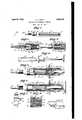
- FIG. 1is an extended view showing my improved syringe front member and an ampule used therewith;
- Fig. 2-is an enlarged fragmentary central sectional view showing the front member with the ampule partly inserted therein;
- Fig. 3is a view similar to Fig. 2 vwith the ampule fully seated in the front member;
- Fig. 4is a side elevation showing the ampule barrel
- Fig. 5is an enlarged, fragmentary, sectional view showing the barrel secured to the front member
- Fig. 6is a view similar to Fig. 5, showing the plunger threaded to the piston cork and in partly advanced position;
- Fig. 7is an enlarged, fragmentary, sectional view showing the inner end of the tube.
- Fig. 8is an enlarged sectional view showing the front end of the ampule.
- the syringeincludes a front member Il, a barrel I2 and an ampule I3.
- the front memberincludes a body I4, preferably made of metal, which has a bore I5 and a threaded rear end I6.
- the forward part of the front memberincludes a. tapering tip I1 at the inner end of which I arrange a threaded portion I 8.
- the front memberincludes a reduced bore I9 in which a tube 20 is secured as by brazng.
- the tube 20is pointed at the inner end as at 2l and includes a plurality of holes 22 which afford communication between the interior and exterior of the tube.
- the hub 23 of a hypodermic needle 24which has a sharpened front end 25.
- the hub 23includes a tapering portion 26 which corresponds to the tapering tip Il and an internally threaded portion 2, the threads of which engage the threads I8 on the front member to produce a fluid-tight joint between the front member and the hub 23.
- the inner end of the needle 24is disposed in a recess 2l in the hub which communicates with the tube I9.
- the ampule I3 in its rear endincludes a piston cork 30 which may be' made of rubber and has a threaded recess 3I adapted to receive a plunger, to be later described.
- a stopperwhich consists of a rubber sleeve 3
- a container memberArranged within the sleeve 3
- a peripheral outwardly directed flange 36arranged upon the end of the body 33 engages the outer end of the sleeve 3
- a rubber tubular closure 40is disposed within the tube 33 and has a peripheral flange 4I which engages the flange 36 on the holder. The flange 36 seats in a recess 42 on the iiange 32 and the flange 4I extends out to cover the flange 36 on the member 33.
- the closure 4I]has a recess 43 which is closed by a diaphragm 44 and there is a space between the diaphragm and the disc 34 and in this space I arrange a medicinal pellet or tablet 45 which when discharged into the vehicle, such as distilled water, in the body of the ampule, makes a fresh solution for injection purposes.
- the barrelconsists of a tubular body 50, having viewing apertures 5I and having threads 52 at the forwardV end which' engage the threads I6 to hold the barrel on the front member.
- the barrelincludes a finger gripping member 53 and the rear portion of the barrel includes a closure 54 which has an end portion 55 with a hole 56 therein, through which a plunger 5l reciprocates.
- the plunger 51is arranged within a stepped sliding sleeve 58 which is urged forwardly by a spring 59 and which in its extreme forward position engages a shoulder 60 within the barrel.
- the sleeve 58has a bevelled front end 6I which is adapted to engage and center an ampule in the barrel.
- the rear end of the plungerincludes a finger engaging portion 62 and at the forward end the plunger includes a shoulder 63 which is adapted to abut against the piston cork.
- the plungerIn advance of the shoulder the plunger includes a threaded portion 64 which is adapted to engage the threads 3l in the piston cork 30.
- the web 35has been fractured and the disc;.,34fdisp1acedso ,that the tablet 45 is discharged into the vehicle within the ampule.
- the holes 22now affordcomgnuni-i,Y
- An 4a-mpule for use in a syringe, said ampule ,comprising .agylinder having a rubber sleeve thereinat one end, said sleeve having a angeengaging.
Landscapes
- Health & Medical Sciences (AREA)
- Vascular Medicine (AREA)
- Engineering & Computer Science (AREA)
- Anesthesiology (AREA)
- Biomedical Technology (AREA)
- Heart & Thoracic Surgery (AREA)
- Hematology (AREA)
- Life Sciences & Earth Sciences (AREA)
- Animal Behavior & Ethology (AREA)
- General Health & Medical Sciences (AREA)
- Public Health (AREA)
- Veterinary Medicine (AREA)
- Infusion, Injection, And Reservoir Apparatuses (AREA)
Description
April 25 1950 vA. E. SMITH 2,505,308
AMPOULE FOR HYPODERMIC SYRINGES Filed June 16, 1947 4, 4 3v INVENTOR.
sa 5,3 Aer/MKZ SM/rf/ Patented Apr. 25, 1950 Bosses UNITED sTATEs PATENT oFElcE Arthur E. Smith, Los Angeles, Calif.
Application VJ une 16, 1947, Serial No. 754,939
2 Claims.
This invention relates to a hypodermic syringe.
The general object of the invention is to provide an improved hypodermic syringe by means of which a fresh solution may be quickly prepared.
A more specific object of the invention is to provide an improved ampule for use in a hypordermic syringe.
Another object of the invention is to lprovide an improved hypodermic syringe barrel for use with disposable ampules.
Another object of the invention is to provide a novel front member for use with a hypodermic syringe.
A further object of the invention is -to provide an improved barrel for a hypodermic syringe.
Other objects and advantages of my .invention will be apparent from the following description taken in connection with the accompanying drawings, wherein Fig. 1 is an extended view showing my improved syringe front member and an ampule used therewith;
Fig. 2- is an enlarged fragmentary central sectional view showing the front member with the ampule partly inserted therein;
Fig. 3 is a view similar to Fig. 2 vwith the ampule fully seated in the front member;
Fig. 4 is a side elevation showing the ampule barrel;
Fig. 5 is an enlarged, fragmentary, sectional view showing the barrel secured to the front member;
Fig. 6 is a view similar to Fig. 5, showing the plunger threaded to the piston cork and in partly advanced position;
Fig. 7 is an enlarged, fragmentary, sectional view showing the inner end of the tube, and
Fig. 8 is an enlarged sectional view showing the front end of the ampule.
Referring to the drawing by reference characters, I have shown my invention as embodied in a syringe, indicated generally at I0. As shown, the syringe includes a front member Il, a barrel I2 and an ampule I3.
As shown, the front member includes a body I4, preferably made of metal, which has a bore I5 and a threaded rear end I6. The forward part of the front member includes a. tapering tip I1 at the inner end of which I arrange a threaded portion I 8. The front member includes a reduced bore I9 in which atube 20 is secured as by brazng. Thetube 20 is pointed at the inner end as at 2l and includes a plurality ofholes 22 which afford communication between the interior and exterior of the tube.
Upon the tip I 1, I arrange thehub 23 of ahypodermic needle 24 which has a sharpened front end 25. Thehub 23 includes a taperingportion 26 which corresponds to the tapering tip Il and an internally threaded portion 2, the threads of which engage the threads I8 on the front member to produce a fluid-tight joint between the front member and thehub 23. The inner end of theneedle 24 is disposed in a recess 2l in the hub which communicates with the tube I9.
The ampule I3 in its rear end includes a piston cork 30 which may be' made of rubber and has a threaded recess 3I adapted to receive a plunger, to be later described. At its forward end the ampule I3 has a stopper which consists of a rubber sleeve 3| which has a peripheral outwardly directedflange 32 thereon which engages the end of a cylindrical member forming a circular wall of the ampule. Arranged within the sleeve 3| is a container member, preferably made of frangible plastic, and consisting of a,tubular body 33, having anintegral end disc 34, which is shown as plano-convex, with the convex portion disposed inwardly and with anarrow web 35 connecting the disc to thetubular body 33. A peripheral outwardly directedflange 36 arranged upon the end of thebody 33 engages the outer end of the sleeve 3|. A rubbertubular closure 40 is disposed within thetube 33 and has a peripheral flange 4I which engages theflange 36 on the holder. Theflange 36 seats in arecess 42 on theiiange 32 and the flange 4I extends out to cover theflange 36 on themember 33.
The closure 4I] has arecess 43 which is closed by a diaphragm 44 and there is a space between the diaphragm and thedisc 34 and in this space I arrange a medicinal pellet ortablet 45 which when discharged into the vehicle, such as distilled water, in the body of the ampule, makes a fresh solution for injection purposes.
The barrel consists of atubular body 50, having viewing apertures 5I and havingthreads 52 at the forwardV end which' engage the threads I6 to hold the barrel on the front member. The barrel includes afinger gripping member 53 and the rear portion of the barrel includes aclosure 54 which has an end portion 55 with ahole 56 therein, through which a plunger 5l reciprocates.
Theplunger 51 is arranged within a stepped slidingsleeve 58 which is urged forwardly by a spring 59 and which in its extreme forward position engages ashoulder 60 within the barrel. Thesleeve 58 has a bevelled front end 6I which is adapted to engage and center an ampule in the barrel. The rear end of the plunger includes afinger engaging portion 62 and at the forward end the plunger includes ashoulder 63 which is adapted to abut against the piston cork. In advance of the shoulder the plunger includes a threadedportion 64 which is adapted to engage the threads 3l in the piston cork 30.
In use the operator takes the parts shown in Fig. l, e. the front member andthe ampule, and moves the ampule rst to the position shown in Fig. 2 andthengtojthe@position shown in Fig.=3, in whichrlatter positionrthe pointedftip 2 Lon thetube 20 has pierced the diaphragm 44 and has advanced through thetablet 45. Theweb 35 has been fractured and the disc;.,34fdisp1acedso ,that thetablet 45 is discharged into the vehicle within the ampule. Theholes 22 now affordcomgnuni-i,Y
pensates .for yaiiations Z'infdamet'erolnthel cylinf e 1,11 illlgerily ,syringe the ,operator is. assured of having a freshssolutionfoff,thegproper character- .ties-,and `is'assured that,,theesehitene,and .the
A ile- The u seof the plunger-threaded tothe Stopfjner .allows the stopper to;.beipulledr-Slshtlyrear- -Jwardly'l after' the vpre1,irnii'iary,,irlijection .is made so ,that the ,operatorpgiriayatestpto Idetermine gwhether the needle is .,in albloodl vessel, newhich 4 ber sleeve therein, said sleeve having a flange engaging the end of the cylinder, a container member within said sleeve, said container member having a frangible disc at one end thereof and 5 having a peripheral flange at the other end thereof, said peripheral ange engaging said rubber sleeve, a rubber closure within said container member and having a diaphragm spaced siren .saidi f-ranaible dise-said closure :having a lo k,peripheralfrange at thel-outer endf-thereof and engaging the ange on said container member, ldlca tablet between said diaphragm and said disc, andapistoneork in said ampule remote from said sleeve. i5 k212.; An 4a-mpule for use in a syringe, said ampule ,comprising .agylinder having a rubber sleeve thereinat one end, said sleeve having a ange =engaging. the end of the cylinder, a tubular container member within'said sleeve, said container en gmeniber havinga ,-frangiblediscl atgoneendthere- V,effambhaving erlpheral flangeat-,the other :freed-thereof Said:peripheralfflangefengagingthe .,outerrend iofgsaid rubber .-fsleeve, vag-,hollowg vclosure within said container member, said hollowclosure gs-havingyanintegral; diaphragm; said hollow z clo- .l-sui'e, having .a peripheral ,Rangeat the gouter-,end thereof, said hollow closure peripheralflangeenteasing-the iflaneeeonesadfeontainerfmemberiand the fiangeeonsad sleeve, therezbeinelaspaeelbe- 3o tween said diaphragm and saidldisxc, ,ragtabletin -,:.saidf s pace,1;.andiarnieton-eork inaeald anipme. remoteirom saidsleeye Y ARTHUR E.
freegames ei-TED UNITED srAJrEsePAfi-ENTS
Priority Applications (1)
| Application Number | Priority Date | Filing Date | Title |
|---|---|---|---|
| US754939AUS2505308A (en) | 1947-06-16 | 1947-06-16 | Ampoule for hypodermic syringes |
Applications Claiming Priority (1)
| Application Number | Priority Date | Filing Date | Title |
|---|---|---|---|
| US754939AUS2505308A (en) | 1947-06-16 | 1947-06-16 | Ampoule for hypodermic syringes |
Publications (1)
| Publication Number | Publication Date |
|---|---|
| US2505308Atrue US2505308A (en) | 1950-04-25 |
Family
ID=25037031
Family Applications (1)
| Application Number | Title | Priority Date | Filing Date |
|---|---|---|---|
| US754939AExpired - LifetimeUS2505308A (en) | 1947-06-16 | 1947-06-16 | Ampoule for hypodermic syringes |
Country Status (1)
| Country | Link |
|---|---|
| US (1) | US2505308A (en) |
Cited By (7)
| Publication number | Priority date | Publication date | Assignee | Title |
|---|---|---|---|---|
| US2702547A (en)* | 1950-02-27 | 1955-02-22 | Antonina S Glass | Motor-driven medical injection apparatus and cartridges therefor |
| US2939459A (en)* | 1957-01-11 | 1960-06-07 | Jorge A Lazarte | Tandem syringe |
| US3108592A (en)* | 1958-10-17 | 1963-10-29 | Novo Terapeutisk Labor As | Injection ampoule |
| US5451214A (en)* | 1993-03-22 | 1995-09-19 | Hajishoreh; Kaveh-Karimi | Syringe apparatus |
| JP2003199827A (en)* | 2001-12-28 | 2003-07-15 | Terumo Corp | Syringe |
| WO2006105006A3 (en)* | 2005-03-31 | 2009-06-04 | Milestone Scientific Inc | Safety syringe |
| US20110092917A1 (en)* | 2008-05-05 | 2011-04-21 | Becton, Dickinson And Company | Drug delivery device having cartridge with enlarged distal end |
Citations (3)
| Publication number | Priority date | Publication date | Assignee | Title |
|---|---|---|---|---|
| US1770634A (en)* | 1928-09-26 | 1930-07-15 | Arthur E Smith | Syringe |
| US2268994A (en)* | 1941-01-04 | 1942-01-06 | Arthur E Smith | Syringe ampoule |
| US2377274A (en)* | 1943-02-20 | 1945-05-29 | Arthur E Smith | Ampule |
- 1947
- 1947-06-16USUS754939Apatent/US2505308A/ennot_activeExpired - Lifetime
Patent Citations (3)
| Publication number | Priority date | Publication date | Assignee | Title |
|---|---|---|---|---|
| US1770634A (en)* | 1928-09-26 | 1930-07-15 | Arthur E Smith | Syringe |
| US2268994A (en)* | 1941-01-04 | 1942-01-06 | Arthur E Smith | Syringe ampoule |
| US2377274A (en)* | 1943-02-20 | 1945-05-29 | Arthur E Smith | Ampule |
Cited By (10)
| Publication number | Priority date | Publication date | Assignee | Title |
|---|---|---|---|---|
| US2702547A (en)* | 1950-02-27 | 1955-02-22 | Antonina S Glass | Motor-driven medical injection apparatus and cartridges therefor |
| US2939459A (en)* | 1957-01-11 | 1960-06-07 | Jorge A Lazarte | Tandem syringe |
| US3108592A (en)* | 1958-10-17 | 1963-10-29 | Novo Terapeutisk Labor As | Injection ampoule |
| US5451214A (en)* | 1993-03-22 | 1995-09-19 | Hajishoreh; Kaveh-Karimi | Syringe apparatus |
| US5458580A (en)* | 1993-03-22 | 1995-10-17 | Hajishoreh; Kaveh-Karimi | Syringe apparatus |
| US5480390A (en)* | 1993-03-22 | 1996-01-02 | Hajishoreh; Kaveh-Karimi | Syringe apparatus |
| JP2003199827A (en)* | 2001-12-28 | 2003-07-15 | Terumo Corp | Syringe |
| WO2006105006A3 (en)* | 2005-03-31 | 2009-06-04 | Milestone Scientific Inc | Safety syringe |
| US20110092917A1 (en)* | 2008-05-05 | 2011-04-21 | Becton, Dickinson And Company | Drug delivery device having cartridge with enlarged distal end |
| US10124117B2 (en)* | 2008-05-05 | 2018-11-13 | Becton, Dickinson And Company | Drug delivery device having cartridge with enlarged distal end |
Similar Documents
| Publication | Publication Date | Title |
|---|---|---|
| US4333458A (en) | Self-aspirating syringe with positively engaged locking collet | |
| US2701566A (en) | Injection apparatus | |
| US2832339A (en) | Hypodermic injector | |
| US4333456A (en) | Self-aspirating hypodermic syringe and self-aspirating assembly therefor | |
| US2722215A (en) | Spring-actuated medical syringe | |
| GB1437595A (en) | Large capacity syringe | |
| US2688967A (en) | Metal aspirating syringe | |
| GB789029A (en) | Improvements in hypodermic syringes | |
| GB1263355A (en) | Hypodermic injection device | |
| GB1243574A (en) | Inoculator instrument | |
| US2505308A (en) | Ampoule for hypodermic syringes | |
| US2377274A (en) | Ampule | |
| US2345302A (en) | Anesthetizing syringe | |
| US2966910A (en) | Locking devices | |
| US2524367A (en) | Hypodermic ampoule syringe | |
| US2538391A (en) | Syringe | |
| US2540461A (en) | Combination ampoule syringe | |
| US2268994A (en) | Syringe ampoule | |
| US2524362A (en) | Disposable ampoule syringe | |
| US1770634A (en) | Syringe | |
| US2789559A (en) | Syringe with aspiration device for cylindrical ampoules | |
| US2305278A (en) | Syringe construction | |
| US2478845A (en) | Disposable ampoule syringe | |
| US2362165A (en) | Hypodermic syringe | |
| US2478844A (en) | Disposable syringe |