US2293455A - Device for applying solder - Google Patents
Device for applying solderDownload PDFInfo
- Publication number
- US2293455A US2293455AUS411180AUS41118041AUS2293455AUS 2293455 AUS2293455 AUS 2293455AUS 411180 AUS411180 AUS 411180AUS 41118041 AUS41118041 AUS 41118041AUS 2293455 AUS2293455 AUS 2293455A
- Authority
- US
- United States
- Prior art keywords
- pot
- solder
- terminals
- soldering
- reservoir
- Prior art date
- Legal status (The legal status is an assumption and is not a legal conclusion. Google has not performed a legal analysis and makes no representation as to the accuracy of the status listed.)
- Expired - Lifetime
Links
- 229910000679solderInorganic materials0.000titledescription34
- 238000005476solderingMethods0.000description23
- 238000010438heat treatmentMethods0.000description10
- 238000010276constructionMethods0.000description6
- 230000004907fluxEffects0.000description6
- 238000002844meltingMethods0.000description6
- 230000008018meltingEffects0.000description6
- XEEYBQQBJWHFJM-UHFFFAOYSA-NIronChemical compound[Fe]XEEYBQQBJWHFJM-UHFFFAOYSA-N0.000description5
- 239000002184metalSubstances0.000description5
- 229910052751metalInorganic materials0.000description5
- 150000001875compoundsChemical class0.000description3
- 238000007654immersionMethods0.000description3
- 229910052742ironInorganic materials0.000description3
- 239000007788liquidSubstances0.000description3
- 230000004048modificationEffects0.000description3
- 238000012986modificationMethods0.000description3
- 239000011248coating agentSubstances0.000description2
- 238000000576coating methodMethods0.000description2
- 238000002485combustion reactionMethods0.000description2
- 238000007598dipping methodMethods0.000description2
- 239000000446fuelSubstances0.000description2
- 239000000295fuel oilSubstances0.000description2
- 239000000463materialSubstances0.000description2
- 239000007787solidSubstances0.000description2
- RYGMFSIKBFXOCR-UHFFFAOYSA-NCopperChemical compound[Cu]RYGMFSIKBFXOCR-UHFFFAOYSA-N0.000description1
- LFQSCWFLJHTTHZ-UHFFFAOYSA-NEthanolChemical compoundCCOLFQSCWFLJHTTHZ-UHFFFAOYSA-N0.000description1
- ATJFFYVFTNAWJD-UHFFFAOYSA-NTinChemical compound[Sn]ATJFFYVFTNAWJD-UHFFFAOYSA-N0.000description1
- 230000003750conditioning effectEffects0.000description1
- 239000004020conductorSubstances0.000description1
- 229910052802copperInorganic materials0.000description1
- 239000010949copperSubstances0.000description1
- 238000005485electric heatingMethods0.000description1
- 230000005611electricityEffects0.000description1
- 239000007789gasSubstances0.000description1
- 239000011810insulating materialSubstances0.000description1
- 238000004519manufacturing processMethods0.000description1
- 150000002739metalsChemical class0.000description1
- 238000000034methodMethods0.000description1
- 239000003921oilSubstances0.000description1
- 230000002093peripheral effectEffects0.000description1
- 230000000717retained effectEffects0.000description1
- 229910052724xenonInorganic materials0.000description1
- FHNFHKCVQCLJFQ-UHFFFAOYSA-Nxenon atomChemical compound[Xe]FHNFHKCVQCLJFQ-UHFFFAOYSA-N0.000description1
Images

Classifications
- B—PERFORMING OPERATIONS; TRANSPORTING
- B23—MACHINE TOOLS; METAL-WORKING NOT OTHERWISE PROVIDED FOR
- B23K—SOLDERING OR UNSOLDERING; WELDING; CLADDING OR PLATING BY SOLDERING OR WELDING; CUTTING BY APPLYING HEAT LOCALLY, e.g. FLAME CUTTING; WORKING BY LASER BEAM
- B23K3/00—Tools, devices, or special appurtenances for soldering, e.g. brazing, or unsoldering, not specially adapted for particular methods
- B23K3/06—Solder feeding devices; Solder melting pans
- B23K3/0646—Solder baths
Definitions
- the inventionrelates to flux-coating, tinning or soldering'devices of the type in which a reser-,
- voiris employed for holding a quantity of liquid flux, or melted tin, or melted solder, and in which the objects to be flux-coated, tinned or soldered are dipped.
- the inventionfurther relates to an improved tool for heat conditioning and applying molten solder for bonding or soldering electrical connections to terminals of plugs and sockets commonly used in electrical work.
- the principal object of the inventionis to provide a molten solder reservoir adapted for the soldering of wires or, electrical connections to terminals of polarized and non-polarized type plugs and sockets commonly used in radio work and cable work, these plugs all being provided with terminals and one or more positioning prongs of any type and of any desired configuration.
- Another object of the inventionis to provide a heated reservoir and more particularly to an improved construction oi body adapted to be used as an attachment for a universal type soldering iron which can be heated in any desired manner for melting solder and/or other metals.
- Another object of the inventionis to provide a reservoir of improved construction adapted to be used as a tool and to be constructed in such a manner as to be eflective in quickly melting solder or other metal placed therein, when placed upon, or secured to, any heating unit especially those deriving their energy from electricity, gas, oil, chemical compounds or any othersuitable means.
- Another object of the inventionis to provide a molten solder reservoir in the soldering tip of an electric soldering-iron, adapted for the soldering of wires to terminals of polarized and nonpolarized type plugs and sockets and the like, by immersion in the reservoir containing the solder at proper service temperature; said iron being provided with a housing for an electrical heating element and other necessary electrical circuit conductors so it may be used in places otherwise quite inaccessible.
- Another object of the inventionis to provide coating to electrical connections by immersion of said connections ,prior to soldering the electrical connections also by immersion of said connections in a novel reservoir containing molten solder, and it has special reference to novel heating devices associated therewith.
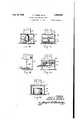
- Figure 1is a side view of a radio tube, and a soldering pot of our invention illustrating the position of the same before they are applied to each other for the soldering of the terminal
- Figure 2is a view similar to Figure 1 showing the pot in section for clearness with soldering flux in the reservoir and the radio tube terminals immersed therein;
- Figure 3is a view similar to Figure 2 with the pot shown in section, the reservoir containing molten solder and the radio tube terminals immersed therein;
- FIG 4is an enlarged fragmentary sectional view of a soldering pot of our invention with the terminal pinsof an amphenol plug immersed in molten solder retained in the reservoir of said D
- Figure 5'is a fragmentary sectional view of a soldering pot of our invention showing a modified form. of handle shank having a bore in axial alignment with the base of said pot and containing a heating element therein;
- FIG. 6is an elevation of an electrically I heated tool embodying our invention.
- novel material reservoir part of the improved Figure 7is an enlarged fragmentary plan view of the pot or tip end of the tool shown in Figure 6; v
- Figure 8is a side view shown in section of the pot or tip end of the tool shown in Figure 6;
- Figure 9is a view similar to Figure 8 with a modified form of pot
- Figure 10is a bottom view of a radio tube
- Figure 11is a bottom view of an Amphenol p us
- Figure 12is a plan view similar to Figure 7 soldering pot; Y
- Figure 13is a fragmentary vertical section thru a terminal pin of a radio tube, as shown in Figure 1, prior to soldering;
- Figure 14is a view similar to Figure 13, showing a terminal tip after it has been immersed in solder;
- Figure 15is an elevational pjew of an insulating washer suitably shaped to form a supporting means
- Figure 16is a side view of our novel soldering pot placed upon a support, said support shown in section and supporting an electrical heating element positioned below said pot;
- Figure 17is a view similar to Figure 15 showing a fuel oil container with a wick positioned below the pot;
- Figure 18is a side view of our invention secured to an angle bracket support and having a Bunsen type gas burner positioned therebelow;
- Figure 19is a side View of our invention positioned upon an electric stove
- Figure 20is a view similar to Figure 18 showing the heat being supplied by canned heat.
- heating element l2said bar being assembled in a suitable handle it, with a'washer It of heat insulating material whichis clamped between the end of the grip section of the handle and the metal bar i I when the parts are first assembled, said washer shielding the hand from the heat of the pot or tip end and so shaped to form a support for said device, said pot it! in bar it being heated by electric current passing through the cable It to the heating element i2, positioned in said bar.
- the pot inis formed as a hollow extension or from a metal block with.
- the base of the pot I 0 and the triangular shaped washer Ieach have a fiat surface thereon for maintainingthe reservoir in a proper upright position when either one or the entire device is placed upon a flat surface; said washer ll being so designed as to keep the not I elevated and in The modification shown in Figure 5 illustrates 70 'therpot l0 assembled with a horizontal bar ll,
- FIG. 1is shown a radio tube at with base 3! and hollow terminals 32. Electrical connections or wires 33 are shown extending outwardly therefrom, this feature being more clearly shown in Figure 13.
- Said tube 30is shown having a hollow positioning prong 3 5 centrally positioned wtih respect to the outer periphery of. its base as is clearly shown in Figure 10, said prong 35 being provided with a laterally-proiecting rib 35 disposed on one side thereof.
- a radiotube 30isshown with its I 7 wires and terminals immersed in molten solder H, the solder bonding said wires 33 and terminals 32 together as is clearly shown in Figure 14'.
- FIG. 12illustrates a pot i0 assembled with bar H; said pot being formed from a cubical shaped bar of metal pro for the for dipping the terminals of plugs, sockets, or
- said potin molten solder contained in'the reser? voir of said stationary pot, said pot may be heated by various methods, as for example, those;
- FIG 20our novel pot I is shown supported upon a stand 10, provided with legs H and base I2, suitably arranged to support a can of commercial compound, 13, such as Canned Heat" or the like, in the base thereof, said compound when ignited will heat said pot III to melt solder contained therein.
- a can of commercial compound, 13, such as Canned Heat" or the likein the base thereof, said compound when ignited will heat said pot III to melt solder contained therein.
- a pot constructed as described aboveis filled with liquid flux and said terminals of said tubes are dipped into the flux either by lowering the tube and terminals or raising the pot into contact therewlthras desired.
- the terminalsare then removed and dipped into .another pot.
- pot l0 containing molten solder llsaid pot receiving heat from any desired source and in any desired manner; the molten solder adhering to the wires and terminals and after removal of the terminals from the solder in the reservoir oi the pot, the solder remaining on said terminals will harden and form a perfect bond.
- a hand tool of the kind describedcomprising a cylindrical metallic body portion capable of receiving heat, the bottom of said body being formed to rest or be secured upon a supporting surface, the top of said body provided with a circular, channel shaped, groove providing a reservoir for soldering material, and said body also provided with a central hollow shaft open at its top: whereby a plurality of electrical connections may be soldered at the same time to a plurality of terminals of an electrical plug having a positioning prong by immersing said connections and terminals in the solder and placing the prong inside the hollow shaft.
- a soldering devicecomprising an open hollow melting chamber of integrally formed bounding walls and provided with a hollowshaft-like member protruding from one of its inside surfaces, said shaft-like member providing a dry well to receive a positioning prong of a plug which is not to receive solder.
- said shaft-like membersurrounded by a channel shaped reser- .voir. arranged to receive the terminals of a plug to which the solder is to be applied. and heating means arranged therewith to apply heat to said reservoir to melt solder inserted therein.
- a soldering device for soldering a plurality of terminals on a .plug and the likecomprising.
- a positioning prong of a plug which is not to receive soldersaid shaft-like member surrounded by a channel shaped reservoir arranged to receive a plurality of terminals of a plug to which the solder is to be applied, and heating means arranged therewith to apply heat to said reservoir to melt solder inserted therein.
Landscapes
- Engineering & Computer Science (AREA)
- Mechanical Engineering (AREA)
- Electric Connection Of Electric Components To Printed Circuits (AREA)
Description
Aug. 1942- J. F. blscH EI'AL 2,293,455
DEVICE FOR APP-LYING SOLDER Filed Sept. 17, '1941 2 Sheeig-She'et 1 Aug. 18, 1942.
J. F. DISCH ETAL DEVICE FORAPPLYING SOLDER 2 Sheets-Sheet 2 Filed Sept. 17, 1941 x n E:
INVENTO JOHN F 0/3535. RUDOL PH KOSA CH.
Patented Aug. 18, 1942 nnvron ron APPLYING sonmm John Francis Disch and Rudolph Kosack, Chicago, 111.
Application September 17, 1941, Serial No. 411,180
The invention relates to flux-coating, tinning or soldering'devices of the type in which a reser-,
voir is employed for holding a quantity of liquid flux, or melted tin, or melted solder, and in which the objects to be flux-coated, tinned or soldered are dipped.
The invention further relates to an improved tool for heat conditioning and applying molten solder for bonding or soldering electrical connections to terminals of plugs and sockets commonly used in electrical work.
The principal object of the invention is to provide a molten solder reservoir adapted for the soldering of wires or, electrical connections to terminals of polarized and non-polarized type plugs and sockets commonly used in radio work and cable work, these plugs all being provided with terminals and one or more positioning prongs of any type and of any desired configuration.
Another object of the invention is to provide a heated reservoir and more particularly to an improved construction oi body adapted to be used as an attachment for a universal type soldering iron which can be heated in any desired manner for melting solder and/or other metals.
Another object of the invention is to provide a reservoir of improved construction adapted to be used as a tool and to be constructed in such a manner as to be eflective in quickly melting solder or other metal placed therein, when placed upon, or secured to, any heating unit especially those deriving their energy from electricity, gas, oil, chemical compounds or any othersuitable means. in
Another object of the invention is to provide a molten solder reservoir in the soldering tip of an electric soldering-iron, adapted for the soldering of wires to terminals of polarized and nonpolarized type plugs and sockets and the like, by immersion in the reservoir containing the solder at proper service temperature; said iron being provided with a housing for an electrical heating element and other necessary electrical circuit conductors so it may be used in places otherwise quite inaccessible.
Another object of the invention is to provide coating to electrical connections by immersion of said connections ,prior to soldering the electrical connections also by immersion of said connections in a novel reservoir containing molten solder, and it has special reference to novel heating devices associated therewith.
Further objects and advantages are within the scope of this invention such as relate to the arrangement, operation and function of the related elements of the structure, to various details of construction and to combination of parts, elements per se, and to economies of manufacture and numerous other features as will be apparent from a consideration of the specification and the accompanying drawings of preferred embodiments of the invention. in which, however, modifications may be made without departing from the scope of the appended claims.
Figure 1 is a side view of a radio tube, and a soldering pot of our invention illustrating the position of the same before they are applied to each other for the soldering of the terminal A Figure 2 is a view similar to Figure 1 showing the pot in section for clearness with soldering flux in the reservoir and the radio tube terminals immersed therein;
Figure 3 is a view similar to Figure 2 with the pot shown in section, the reservoir containing molten solder and the radio tube terminals immersed therein;
Figure 4 is an enlarged fragmentary sectional view of a soldering pot of our invention with the terminal pinsof an amphenol plug immersed in molten solder retained in the reservoir of said D Figure 5'is a fragmentary sectional view of a soldering pot of our invention showing a modified form. of handle shank having a bore in axial alignment with the base of said pot and containing a heating element therein;
Figure 6 is an elevation of an electrically I heated tool embodying our invention;
novel material reservoir part of the improved Figure 7 is an enlarged fragmentary plan view of the pot or tip end of the tool shown in Figure 6; v
Figure 8 is a side view shown in section of the pot or tip end of the tool shown in Figure 6;
Figure 9 is a view similar to Figure 8 with a modified form of pot;
Figure 10 is a bottom view of a radio tube;
Figure 11 is a bottom view of an Amphenol p us; 7
Figure 12 is a plan view similar to Figure 7 soldering pot; Y
Figure 13 is a fragmentary vertical section thru a terminal pin of a radio tube, as shown in Figure 1, prior to soldering;
Figure 14 is a view similar to Figure 13, showing a terminal tip after it has been immersed in solder;
Figure 15 is an elevational pjew of an insulating washer suitably shaped to form a supporting means;
Figure 16 is a side view of our novel soldering pot placed upon a support, said support shown in section and supporting an electrical heating element positioned below said pot;
Figure 17 is a view similar to Figure 15 showing a fuel oil container with a wick positioned below the pot;
Figure 18 is a side view of our invention secured to an angle bracket support and having a Bunsen type gas burner positioned therebelow; I
Figure 19 is a side View of our invention positioned upon an electric stove;
Figure 20 is a view similar to Figure 18 showing the heat being supplied by canned heat.
Referring now to the drawings, the construetion illustrated in the drawings includes, and
referring specifically to Figures 6 and 7, we have themetallic soldering pot 19, preferably of'copper, having'secured thereto the metallic bar H,- said bar having assembled therein an electrical with a modified type or modified shape of ofbore 20 open at the top and at the bottom in said pot it, saidend 22 thereby closing the bore 26 at the base thereof and forming a shaft open only at the top. The upper surface of said pot It being provided with a groove it formingthe channel shaped reservoir and forming in conjunction with thebore 20 and the inner wall 24% a tubular stem l8. This type construction eliminates the necessity of an integral ly formed hollow threaded lug orbar extension 25 as shown in the figures described above.
heating element l2,said bar being assembled in a suitable handle it, with a'washer It of heat insulating material whichis clamped between the end of the grip section of the handle and the metal bar i I when the parts are first assembled, said washer shielding the hand from the heat of the pot or tip end and so shaped to form a support for said device, said pot it! in bar it being heated by electric current passing through the cable It to the heating element i2, positioned in said bar. The pot in is formed as a hollow extension or from a metal block with. an open channel shaped groove, or melting reservoir i6 therein, said reservoir adaptedjo containthe flux or molten solder 81, said solder being heated by convection through the bar it and base of pot l0, said pot l0 having a central bore therein forming with the inner peripheral wall of saidreservoir 2. central tubular shaft having a stem l8, said shaft being open at the top and closed atthe bottom. The open bore of said stem providing a dry chamber IQ for preventing molten solder coming into contact with positioning prongs on radio tubes and the like when the terminal ends of said tubes are immersed in the molten solder II as featured by our novel soldering device. The base of the pot I 0 and the triangular shaped washer I each have a fiat surface thereon for maintainingthe reservoir in a proper upright position when either one or the entire device is placed upon a flat surface; said washer ll being so designed as to keep the not I elevated and in The modification shown in Figure 5 illustrates 70 'therpot l0 assembled with a horizontal bar ll,
said bar bent at an angle upwardly, forming a vertical supportingmeans 2|, the solidupper end 22 being secured withinthe lower portion 75 I Figufe ,19 u navel-pot, 3' is 1m sup on the side of the melding pot it and positioned a short distance above the bottom of the same In Figure 1 isshown a radio tube at withbase 3! andhollow terminals 32. Electrical connections orwires 33 are shown extending outwardly therefrom, this feature being more clearly shown in Figure 13. Saidtube 30 is shown having a hollow positioning prong 3 5 centrally positioned wtih respect to the outer periphery of. its base as is clearly shown in Figure 10, said prong 35 being provided with a laterally-proiecting rib 35 disposed on one side thereof.
In Figures 4 and 11 is shown an Amphenol plug 35 withnumerous terminal pins, a'positioning prong, and parts similar to the terminals on i said radio plugs 39, so like numerals have been designated thereto for simplicity.-
In Figure 3 aradiotube 30 isshown with itsI 7 wires and terminals immersed in molten solder H, the solder bonding saidwires 33 andterminals 32 together as is clearly shown in Figure 14'.
In Figures 1 2,. 3 and 4, a solid externally screwrthreaded lug $0, is shown integrally formed for the attachment of any type handle.
The modification shown in Figure 12 illustrates a pot i0 assembled with bar H; said pot being formed from a cubical shaped bar of metal pro for the for dipping the terminals of plugs, sockets, or
the like, in molten solder contained in'the reser? voir of said stationary pot, said pot may be heated by various methods, as for example, those;
shown in Figures 16, 17, 18, 19 and 20.
' In Figure 16 our pot I0 is shown supported?" upon a table 40 provided withlegs 4| and a hub, 42, in which an electric heating coil type unit? 43 is mounted, being provided withbinding screws 44 to receive thesupply wires 45. p In Figure 17 our novel pot I 0 is-shown sup ported upon afuel container 50, provided with side walls 5|, and acentral hub 52, thru which a wick is extended. The top surface of said coni tainer has an opening 53 therein and in con-' junction with the upper section ofsaid'container 50, forms acombustion chamber 54 for suitable liquid fuel 56, as for example, fuel oil, alcohol or the'like, to heat said pot.
InFigure .18 our novel pot I0 is shown supported by anangle bracket 51 and-positioned to receive heat from the combustion of gas by the 3 use of a Bunsen type'gas burner it, being supplied with gas thru tube 59.
our novel soldering I ported by anelectric stove 60 provided with legs 61 andheating units 62 and 83, said units being provided with supply wires 64, 65, 86, 81 contained in cable 68.
In Figure 20 our novel pot I is shown supported upon astand 10, provided with legs H and base I2, suitably arranged to support a can of commercial compound, 13, such as Canned Heat" or the like, in the base thereof, said compound when ignited will heat said pot III to melt solder contained therein.
In operation, when electrical connections and terminals of radio tubes, sockets, or the like are to be soldered together, a pot constructed as described above is filled with liquid flux and said terminals of said tubes are dipped into the flux either by lowering the tube and terminals or raising the pot into contact therewlthras desired. The terminals are then removed and dipped into .another pot. such as pot l0 containing molten solder ll, said pot receiving heat from any desired source and in any desired manner; the molten solder adhering to the wires and terminals and after removal of the terminals from the solder in the reservoir oi the pot, the solder remaining on said terminals will harden and form a perfect bond.
From the foregoing description of the iew'speciiic forms of the present invention, it becomes evident that it may find many uses, particularly in the electric wiring business; that its construction eliminates all danger of fire hazards; and that a good many variations may be provided in order to enhance the quality of, and to adapt the device for various specific purposes and uses; and it is thought that a clear understanding of the construction, utility and advantages of our invention will be had without a more detailed de-' ing a one piece metallic body portion and handle extension, said body capable of receiving heat having a central bore providing a hollow shaft, the top surface of said body provided with a channel shaped groove surrounding said shaft to form a solder melting pot where a plurality oi! terminals of a single electrical plug may be dipped for soldering at one dipping while the positioning prong of said plug is positioned within the hollow shaft.
2. A hand tool of the kind described, comprising a cylindrical metallic body portion capable of receiving heat, the bottom of said body being formed to rest or be secured upon a supporting surface, the top of said body provided with a circular, channel shaped, groove providing a reservoir for soldering material, and said body also provided with a central hollow shaft open at its top: whereby a plurality of electrical connections may be soldered at the same time to a plurality of terminals of an electrical plug having a positioning prong by immersing said connections and terminals in the solder and placing the prong inside the hollow shaft.
3. A soldering device comprising an open hollow melting chamber of integrally formed bounding walls and provided with a hollowshaft-like member protruding from one of its inside surfaces, said shaft-like member providing a dry well to receive a positioning prong of a plug which is not to receive solder. said shaft-like member surrounded by a channel shaped reser- .voir. arranged to receive the terminals of a plug to which the solder is to be applied. and heating means arranged therewith to apply heat to said reservoir to melt solder inserted therein.
4. A soldering device for soldering a plurality of terminals on a .plug and the like comprising.
an open hollow melting chamber of integrally formed bounding walls andprovided with a vertical hollow shaft-like member protruding upwardly from its inside-bottom surface, said shattlike member providing a dry well to receive. a positioning prong of a plug which is not to receive solder, said shaft-like member surrounded by a channel shaped reservoir arranged to receive a plurality of terminals of a plug to which the solder is to be applied, and heating means arranged therewith to apply heat to said reservoir to melt solder inserted therein.
JOHN FRANCIS DISCH.
RUDOLPH KOSACK.
. e CERTIFICATE or conaxcnou. Patent No. 2,295,155." August 18, 19!;2.
Joan mncxs mscn, ET AL.
It is hereby certified thet error eppeere in thevebove numberedpetent requiring correction as follows; In the grant, lines '1 and 15, and. in the heading end eignatu're to the printed epeciricction, name of eecondinventor, for Rudolph Koeeck" rend -Rudo1ph Kouach"; and that the euid Lettere Patent should berecd with this correction therein that theeeme me y conform to the record of the. one in the Patent Office.
Signed and eeeled thie 20th day of 0ctober, A. n. 19!;2.
Henry van Alldllfi, (Seal) Acting commissioner or Pctente.
CERTIFICATE OF CORRECTION.
Patent no. 2,295,155. August 18, 19!;2.
JOHN FRANCIS DISCH, ET AL.
It is hereby certified thet error appears in the-above numberedpetent requiring correction as follows: In the grant, lines '1 and 13, and in the heading end eigaature to the printed ,epeciticetion, me of aecondinventor, for "Rudolph Koeeck" read. -Rudolph xenon"; um am; the said Let tera Patent ehould bereed. with this correction therein that theeeme me'y conform to the record. or the. one in the Patent Office.
Signed and lad um 20th day of 0cto'ber, A. n. 19h2.
, I Henry Von Area-1e, (Seal) Acting Commissioner or Potent-e.
Priority Applications (1)
| Application Number | Priority Date | Filing Date | Title |
|---|---|---|---|
| US411180AUS2293455A (en) | 1941-09-17 | 1941-09-17 | Device for applying solder |
Applications Claiming Priority (1)
| Application Number | Priority Date | Filing Date | Title |
|---|---|---|---|
| US411180AUS2293455A (en) | 1941-09-17 | 1941-09-17 | Device for applying solder |
Publications (1)
| Publication Number | Publication Date |
|---|---|
| US2293455Atrue US2293455A (en) | 1942-08-18 |
Family
ID=23627901
Family Applications (1)
| Application Number | Title | Priority Date | Filing Date |
|---|---|---|---|
| US411180AExpired - LifetimeUS2293455A (en) | 1941-09-17 | 1941-09-17 | Device for applying solder |
Country Status (1)
| Country | Link |
|---|---|
| US (1) | US2293455A (en) |
Cited By (16)
| Publication number | Priority date | Publication date | Assignee | Title |
|---|---|---|---|---|
| US2429836A (en)* | 1944-04-25 | 1947-10-28 | Jr James Albert Mcfarlane | Die employed in reclaiming plastic bases of radio tubes |
| US2429888A (en)* | 1944-02-14 | 1947-10-28 | Garrett Corp | Method of replacing tubes in heat exchangers |
| US2457599A (en)* | 1944-10-27 | 1948-12-28 | Rca Corp | Method of closing tube ends by dipping in molten solder |
| US2493434A (en)* | 1946-03-21 | 1950-01-03 | Joslyn Mfg And Supply Company | Method of manufacturing fuse links |
| US2506047A (en)* | 1946-12-31 | 1950-05-02 | Sylvania Electric Prod | Protective device for use in soldering operations |
| US2612128A (en)* | 1951-02-23 | 1952-09-30 | Warsaw George Bernard | Soldering tool for tube sockets and terminal strips |
| US2737570A (en)* | 1952-08-27 | 1956-03-06 | Aita Paolo | Electric soldering iron |
| US2770875A (en)* | 1952-06-09 | 1956-11-20 | Motorola Inc | Soldering machine |
| US2841690A (en)* | 1954-12-28 | 1958-07-01 | Gen Electric | Contact pin and method for fluorescent lamps |
| US2856674A (en)* | 1952-07-26 | 1958-10-21 | Gen Motors Corp | Method of connecting an insulated conductor to a connector terminal element |
| US3050612A (en)* | 1960-10-26 | 1962-08-21 | Ralph M Eversole | Desoldering tip |
| US3099081A (en)* | 1960-11-21 | 1963-07-30 | Rca Corp | Brazing jig |
| US3126854A (en)* | 1964-03-31 | Soldering machine | ||
| US3130286A (en)* | 1961-04-11 | 1964-04-21 | James J Lenzi | Electric soldering gun tip |
| US4014343A (en)* | 1975-04-25 | 1977-03-29 | Neomed Incorporated | Detachable chuck for electro-surgical instrument |
| US4518110A (en)* | 1982-09-22 | 1985-05-21 | Control Data Corporation | Device for soldering/desoldering apertured lendless packages |
- 1941
- 1941-09-17USUS411180Apatent/US2293455A/ennot_activeExpired - Lifetime
Cited By (16)
| Publication number | Priority date | Publication date | Assignee | Title |
|---|---|---|---|---|
| US3126854A (en)* | 1964-03-31 | Soldering machine | ||
| US2429888A (en)* | 1944-02-14 | 1947-10-28 | Garrett Corp | Method of replacing tubes in heat exchangers |
| US2429836A (en)* | 1944-04-25 | 1947-10-28 | Jr James Albert Mcfarlane | Die employed in reclaiming plastic bases of radio tubes |
| US2457599A (en)* | 1944-10-27 | 1948-12-28 | Rca Corp | Method of closing tube ends by dipping in molten solder |
| US2493434A (en)* | 1946-03-21 | 1950-01-03 | Joslyn Mfg And Supply Company | Method of manufacturing fuse links |
| US2506047A (en)* | 1946-12-31 | 1950-05-02 | Sylvania Electric Prod | Protective device for use in soldering operations |
| US2612128A (en)* | 1951-02-23 | 1952-09-30 | Warsaw George Bernard | Soldering tool for tube sockets and terminal strips |
| US2770875A (en)* | 1952-06-09 | 1956-11-20 | Motorola Inc | Soldering machine |
| US2856674A (en)* | 1952-07-26 | 1958-10-21 | Gen Motors Corp | Method of connecting an insulated conductor to a connector terminal element |
| US2737570A (en)* | 1952-08-27 | 1956-03-06 | Aita Paolo | Electric soldering iron |
| US2841690A (en)* | 1954-12-28 | 1958-07-01 | Gen Electric | Contact pin and method for fluorescent lamps |
| US3050612A (en)* | 1960-10-26 | 1962-08-21 | Ralph M Eversole | Desoldering tip |
| US3099081A (en)* | 1960-11-21 | 1963-07-30 | Rca Corp | Brazing jig |
| US3130286A (en)* | 1961-04-11 | 1964-04-21 | James J Lenzi | Electric soldering gun tip |
| US4014343A (en)* | 1975-04-25 | 1977-03-29 | Neomed Incorporated | Detachable chuck for electro-surgical instrument |
| US4518110A (en)* | 1982-09-22 | 1985-05-21 | Control Data Corporation | Device for soldering/desoldering apertured lendless packages |
Similar Documents
| Publication | Publication Date | Title |
|---|---|---|
| US2293455A (en) | Device for applying solder | |
| US2902629A (en) | Printed circuit connection and method of making same | |
| US2236837A (en) | Glue pot | |
| US2611068A (en) | Pivotally mounted plug and vaporizer | |
| US1988827A (en) | Electrically heated tool | |
| US3215815A (en) | Soldering iron holder having molten solder reservoir | |
| US1789475A (en) | Soldering iron holder | |
| US3651306A (en) | Electric soldering gun and tip therefor | |
| US2540095A (en) | Vapor dispenser | |
| US3065524A (en) | Method of interconnecting electrical apparatus | |
| US2259545A (en) | Portable degreasing apparatus | |
| US3267409A (en) | Terminal for electronic component | |
| US1961496A (en) | Electrical heating device | |
| US2908796A (en) | Electrical solder pot | |
| US2112068A (en) | Soldering iron | |
| US3519799A (en) | Hermetically sealed electrical plug-in terminal with mating electrical socket | |
| US3725134A (en) | Expendable immersion thermocouple unit | |
| US2336904A (en) | Electrically heated soldering apparatus | |
| US908712A (en) | Electrical heating apparatus. | |
| US2931881A (en) | Soldering device | |
| US2212795A (en) | Electric joint solderer | |
| US1425633A (en) | Soldering pot and soldering iron | |
| US1847951A (en) | Heating device | |
| US3161811A (en) | Semiconductor device mount | |
| KR200153246Y1 (en) | Tip replacement iron |