US2175726A - Catheter for bronchospirometry - Google Patents
Catheter for bronchospirometryDownload PDFInfo
- Publication number
- US2175726A US2175726AUS242490AUS24249038AUS2175726AUS 2175726 AUS2175726 AUS 2175726AUS 242490 AUS242490 AUS 242490AUS 24249038 AUS24249038 AUS 24249038AUS 2175726 AUS2175726 AUS 2175726A
- Authority
- US
- United States
- Prior art keywords
- catheter
- tubular structure
- collars
- bronchus
- inflatable
- Prior art date
- Legal status (The legal status is an assumption and is not a legal conclusion. Google has not performed a legal analysis and makes no representation as to the accuracy of the status listed.)
- Expired - Lifetime
Links
- 210000004072lungAnatomy0.000description27
- 210000000621bronchiAnatomy0.000description20
- 239000012530fluidSubstances0.000description15
- 210000003437tracheaAnatomy0.000description11
- 230000000241respiratory effectEffects0.000description10
- 239000000463materialSubstances0.000description9
- 239000004020conductorSubstances0.000description7
- 238000007789sealingMethods0.000description7
- 238000013125spirometryMethods0.000description7
- 239000000470constituentSubstances0.000description3
- 239000007789gasSubstances0.000description3
- 235000017276SalviaNutrition0.000description1
- 241001072909SalviaSpecies0.000description1
- 238000010276constructionMethods0.000description1
- 238000007599dischargingMethods0.000description1
- 230000000694effectsEffects0.000description1
- 239000004744fabricSubstances0.000description1
- 239000004615ingredientSubstances0.000description1
- 238000004519manufacturing processMethods0.000description1
- 239000002184metalSubstances0.000description1
- 238000000034methodMethods0.000description1
- 238000012986modificationMethods0.000description1
- 230000004048modificationEffects0.000description1
- 210000000214mouthAnatomy0.000description1
- 208000008128pulmonary tuberculosisDiseases0.000description1
- 230000029058respiratory gaseous exchangeEffects0.000description1
Images
Classifications
- A—HUMAN NECESSITIES
- A61—MEDICAL OR VETERINARY SCIENCE; HYGIENE
- A61M—DEVICES FOR INTRODUCING MEDIA INTO, OR ONTO, THE BODY; DEVICES FOR TRANSDUCING BODY MEDIA OR FOR TAKING MEDIA FROM THE BODY; DEVICES FOR PRODUCING OR ENDING SLEEP OR STUPOR
- A61M25/00—Catheters; Hollow probes
- A61M25/10—Balloon catheters
- A61M25/1011—Multiple balloon catheters
- A—HUMAN NECESSITIES
- A61—MEDICAL OR VETERINARY SCIENCE; HYGIENE
- A61B—DIAGNOSIS; SURGERY; IDENTIFICATION
- A61B5/00—Measuring for diagnostic purposes; Identification of persons
- A61B5/08—Measuring devices for evaluating the respiratory organs
- A61B5/097—Devices for facilitating collection of breath or for directing breath into or through measuring devices
Definitions
- This inventionrelates to surgical accessories vided in the wall of the tubular structure III at and particularly to a special catheter for use in a point adjacent the distal end which will be broncho-spirometry and for other purposes. positioned within the bronchus of one lung, as by The invention aims to provide a compact leaving the entire end of the catheter open as multi-tubed structure adapted to be readily inillustrated.
- a second opening i2is provided in 5 serted in the respiratory passages of a patient, the wall of the tubular structure III at a point with minimum difliculty and discomfort, for conproximal to the first opening and in a position ducting gaseous materials between each of the adapted to communicate with the other lung.
- the lumen of the tubular portion Inis divided spirometers, and further aims to provide simple into two separate fluid conduits l3 and H by but assuredly effective means for occluding the means of a septum l5 extending from the proxrespiratory passages at appropriate points for imal end of the tubular portion ID to a point l6 sealing the lungs from each other and from the between the two openings H and 12 at which outside atmosphere, whereby the functional capoint the septum l5 curves toward and is at- 15 pacity of each lung may be determined sepatached to the wall 01' the tube to form a closed 15 rately and simultaneously. end for one of the conduits IS.
- the two fluid The inventionmay be readily understood by conduits l3 and I4 diverge at the proximal and referring to the accompanying drawing, of of the tubular portion and terminate in separate which-- tubular extensions I1 and 18, respectively,
- Fig. 1is an elevation showing a catheter emadapted to be connected to any appropriate fluid 2o bodying the principles of the present inventions conductors such as conductors leading to sepain a preferred form; rate spirometers.
- Fig. 2is a vertical section taken on line 2-2
- two inflatablecollars I9 and Fig. 3is a vertical section taken on line 3-3 20, are provided encircling the tubular structure 5 of Fig. 1;
- FIG. 8is a diagrammatic view illustrating the longitudinally through the walls of the tubular manner in which the prwent catheter is emstructure Hi from a point adjacent the proximal ployed in carrying out diflerential bronchoend to both inflatable collars Iland 20, comspirometry upon a patien municating openings 22, 23 being provided 40
- the inventioncontemplates a catheter adapted through the walls of the tubular structure Ill 40 to be inserted in the respiratory passages of a underneath the inflatable collars i9, 2!], respecpatient and having two longitudinal passagetively, for conducting inflating fluid thereto.
- diverges from the tubular structure and and also includes two separate sealing means so terminates in a tubular extension 24 adapted to 45 positioned on the catheter as to seal the lungs be connected to any suitable apparatus for infrom each other and from the outside atmosjecting fluid under pressure. phere and force breathing through the respec- For facilitating entrance of the catheter into tive conduits of the catheter.
- the tubular structure l0desirably is preformed 59 comprises a relat'vely long tubular structure 10 with a permanently-set arcuate configuration as adapted to extend from a point outside the indicated at 25 in the modified form of the mouth of a patient, through the mouth and catheter illustrated in Fig. '7, the catheter being trachea, to a point at least within the main otherwise similar in construction to the catheter bronchus Of one lung- One Opening H is proillustrated in Figs. 1-6.
- the entire catheterpreferably is made essentially of a flexible soft rubber or analogous composition, although it is to be understood that other materials, such as conventional fabric, metal or wire reenforcemerits, may be associated with the essentially rubber structure so long as the essential flexibility of the rubber is not destroyed.
- the catheterdesirably has a one-piece, unitary structure to avoid all possibility of parts becoming disconnected or separated while in use, although satisfactory catheters obviously may be fabricated by assembling separate pre-i'ormed parts of rubber or other flexible material and cementing or otherwise mounting the parts in proper relation. Procedures for manufacturing such structures are well known in the rubber industry and form no part of the present invention.
- the catheteris passed through the respiratory passages of a patient, as indicated in Fig. 8, until the distal end of the catheter including the inflatable collar I9 is positioned with the main bronchus 3! of one lung, usually the left lung.
- the second inflatable collar 20will then be positioned within the trachea 32.
- air or other inflating fluidis injected through the tube 24 and duct 2
- the patientWhen the collars have been inflated, the patient, of course, breathes through the catheter, the left lung receiving and discharging gases through the opening II and the communicating tubes l4 and I8, while the ri ht lung receives and discharges gases through the opening i2 and the communicating tubes I3 and IT.
- the tubular extensions I '1 and iiiare connected to separate spirometers which measure characteristic factors concerning the intake and discharge gases and afford a basis for calculating the functional capacity or eiflciency of each lung separately and simultaneously.
- the spirometeritself of course is a known apparatus.
- the present inventionis especially useful in examinations conducted as a preliminary to treating a patient suffering from pulmonary tuberculosis when it is vitally important to know accurately the relative functional efficiencies of the two lungs in order that the character and extent of treatment which may safely be undertaken on either lung can be reliably judged.
- the catheterobviously is capable of other uses however.
- a surgical accessorycomprising a tubular structure of elongated configuration having at least three longitudinal conduits each separate from the others, a plurality of inflatable collars encircling the tubular structure at longitudinally spaced-apart positions, each of said inflatable collars communicating with at least one of said conduits for receiving inflating fluid therefrom, the walls of said tubular structure having a plurality of openings therein at positions removed from the positions of the inflatable collars, each of said openings communicating with one of said conduits and at least two of said conduits communicating with different openings, the proximal ends of said conduits being adapted to be connected with appropriate fluid conductors, said surgical accessory being flexible and comprising a rubbery composition as its principal constituent.
- a surgical accessorycomprising a tubular structure adapted to be inserted in a body passage, an inflatable collar encircling the tubular structure at a position adjacent the distal end thereof, a second inflatable collar encircling the tubular structure at a position proximal to the first collar, means for inflating the collars including an inflating duct extending longitudinally through the said structure and communicating with at least one of the inflatable collars for conproximal end of the tubular structure and terminating in separate tubular extensions adapted to be connected to appropriate fluid conduits, said accessory having an essentially unitary structure embodying rubber as the principal ingredient and being flexible throughout.
- a catheter for differential broncho-spirometryadapted to be inserted in the respiratory passages of a patient for conducting gaseous materials to and from the lungs separately and simultaneously, said catheter comprising a tubular structure adapted to extend through the trachea to a point within the bronchus of a lung, means for sealing the said bronchus about the tubular structure, separate means for sealing the trachea about the tubular structure, the walls of said tubular structure having one opening distal to both sealing means and a second opening between the two sealing means, said tubular structure having two separate longitudinal conduits communicating respectively with the aforesaid two openings, said catheter having a unitary structure and being flexible throughout.
- a catheter for differential broncho-spirometryadapted to be inserted in the respiratory passages of a patient for conducting gaseous materials to and from the lungs separately and simultaneously, said catheter comprising a tubular structure adapted to extend through the trachea to a point within the bronchus of one lung, an inflatable portion adapted to seal the said bronchus, a second inflatable portion adapted to seal the trachea, means for inflating the two inflatable portions, the walls of said tubular structure having one opening distal to both inflatable portions and a second opening between the two inflatable portions, said tubular structure having ing respectively the proximal ends of said conduits and of said the distal end tioned within the said bronchus, a second inflatposition proximal to will be positioned within the trachea when the two separate longitudinal conduits communicating respectively withthe aforesaid two openings, the proximal ends of said conduits being adapted to be connected with appropriate fluid conductors, said catheter being flexible throughout.
- a catheter for differential broncho-spiromev tryadapted to be inserted in the respiratory passages of a patient for conducting gaseous materials to and from the lungs separately and simultaneously, said catheter comprising a tubular structure adapted to extend at least from the mouth of a patient to a point within the main bronchus of one lung, cling the tubular structure at a position adjacent the distal end thereof and adapted to be positioned within the said bronchus, a second inflatable collar encircling the tubular structure at a position proximal to the first collar and which will be positioned within the trachea when the first collar is positioned within the bronchus of one lung, said collars being adapted to seal the respective respiratory passages when inflated, inflating duct means for conducting inflating fluid to said collars, the walls of said tubular structure having one opening distal to both collars and a second opening between the two collars, a septum dividing the lumen of said tubular structure into two separate longitudinal conduits communicatwith the a
- inflating duct meansbeing adapted to be connected to appropriate fluid conductors, said catheter embodying rubber as the principal constituentand being flexible throughout.
- a catheter for differential broncho-spirometryadapted to be inserted in the respir D sages of a patient for conducting gaseous materials to and from the lungs separately and simultaneously, said catheter comprising a tubular structure adapted to extend at least from'the mouth of a patient to a point within the main bronchus of one lung, an cling the tubular structure at a position adjacent thereof and adapted to be posiable-collar encircling the tubular structure at a the first collar and which first collar is positioned within the bronchus of one lung, said collars being adapted when in flated to seal the respestive respiratory passages, a single ,inflating duct extending longitudinally through a wall of said structure and communicatan'inflatable collar encirinflatable collar encirflexible throughout.
- the walls of said tubular structurehaving one opening distal to both collars and a second opening between the two coling with both lars, a septum dividing the lumen of said tubular structure into two separate longitudinal conduits communicating respectively with the aforesaid openings, said conduits and said inflating duct diverging at the proximal end of the catheter and terminating in three separate tubular extensions adapted to be connected with appropriate fluid conductors, said catheter having an essentially integral unitary structure embodying rubher as the principal constituent and being flexible throughout.
- a catheter for differential broncho-spirometryadapted to be inserted in the respiraitory passages of a patient for conducting gaseous materials to and from the lungs separately and simultaneously, said catheter comprising a tubular structure adapted to extend at least from the mouth of a patient to a point within the main bronchus of one lung, the distal end of said structure having a pre-formed and permanently-set arcuate configuration for facilitating entrance into the said bronchus, an inflatable collar encircling the tubular structure at a position adjacent the distal end thereof and adapted to be positioned within the said bronchus, a second inflatable collar encircling the tubular structure at a position proximal to the first collar and which will be positioned within the trachea when the first collar is positioned within the bronchus of one lung, said collars being adapted when inflated to seal the respective respiratory passages, a single inflating duct extending longitudinally through a wall of said structure and communicat collars, a septum
Landscapes
- Health & Medical Sciences (AREA)
- Life Sciences & Earth Sciences (AREA)
- Heart & Thoracic Surgery (AREA)
- Animal Behavior & Ethology (AREA)
- Public Health (AREA)
- Pulmonology (AREA)
- Engineering & Computer Science (AREA)
- Veterinary Medicine (AREA)
- Biomedical Technology (AREA)
- Biophysics (AREA)
- General Health & Medical Sciences (AREA)
- Child & Adolescent Psychology (AREA)
- Hematology (AREA)
- Anesthesiology (AREA)
- Physiology (AREA)
- Physics & Mathematics (AREA)
- Pathology (AREA)
- Medical Informatics (AREA)
- Molecular Biology (AREA)
- Surgery (AREA)
- Media Introduction/Drainage Providing Device (AREA)
Description
Oct. 10, 1939. P. w. GEBAUER 2,175,726
CATHETER FOR BRONCHOSPIROMETRY Filed Nov. 26, 1938 IIIIIIl/IIIIIIIIIIIII) e 10, m9 I 2,175,726
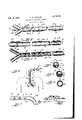
UNITED STATES PATENT orrlcs CATHETER FOR BRONCHOSPIROMZETRY Paul W. Gebaucr, Cleveland, Ohio, assignor to American Anode Inc., Akron, Ohio, a corporation of Delaware 7 Application November 26, 19:8, Serial No. 242,490 '1 Claims. (01. 128-349) This invention relates to surgical accessories vided in the wall of the tubular structure III at and particularly to a special catheter for use in a point adjacent the distal end which will be broncho-spirometry and for other purposes. positioned within the bronchus of one lung, as by The invention aims to provide a compact leaving the entire end of the catheter open as multi-tubed structure adapted to be readily inillustrated. A second opening i2 is provided in 5 serted in the respiratory passages of a patient, the wall of the tubular structure III at a point with minimum difliculty and discomfort, for conproximal to the first opening and in a position ducting gaseous materials between each of the adapted to communicate with the other lung. lungs, individually, and respective, separate The lumen of the tubular portion In is divided spirometers, and further aims to provide simple into two separate fluid conduits l3 and H by but assuredly effective means for occluding the means of a septum l5 extending from the proxrespiratory passages at appropriate points for imal end of the tubular portion ID to a point l6 sealing the lungs from each other and from the between the two openings H and 12 at which outside atmosphere, whereby the functional capoint the septum l5 curves toward and is at- 15 pacity of each lung may be determined sepatached to the wall 01' the tube to form a closed 15 rately and simultaneously. end for one of the conduits IS. The two fluid The invention may be readily understood by conduits l3 and I4 diverge at the proximal and referring to the accompanying drawing, of of the tubular portion and terminate in separate which-- tubular extensions I1 and 18, respectively,
Fig. 1 is an elevation showing a catheter emadapted to be connected to any appropriate fluid 2o bodying the principles of the present inventions conductors such as conductors leading to sepain a preferred form; rate spirometers.
Fig. 2 is a vertical section taken on line 2-2 For sealing the respiratory passages about the of Fig. 1; inserted catheter, two inflatablecollars I9 and Fig. 3 is a vertical section taken on line 3-3 20, are provided encircling thetubular structure 5 of Fig. 1; In at longitudinally spaced-apart positions, one Fig. 4 is a vertical section taken on line 4-4 collar l9 being located adjacent the distal end of Fig. 1; of the catheter between the two openings H and Fig. 5 is a vertical section taken on line 5-5 12, and the secondinflatable collar 20 bein of Fig, 1; cated proximal to the opening I2 so that the 30 Fig. 6 is a horizontal section-taken on line 6-6 opening I2 is located between the two inflatable of Fig. 5; collars while the opening I! is distal to both Fig. '7 is a fragmentary elevation of a catheter collars.
generally similar to the catheter of Figs. 1-6, For inflating the collars I! and 20, a relatively but embody a curved distal end; and smallinflating duct 2| is provided extending 5 Fig. 8 is a diagrammatic view illustrating the longitudinally through the walls of the tubular manner in which the prwent catheter is emstructure Hi from a point adjacent the proximal ployed in carrying out diflerential bronchoend to both inflatable collars Iland 20, comspirometry upon a patien municatingopenings duct 2| diverges from the tubular structure and and also includes two separate sealing means so terminates in atubular extension 24 adapted to 45 positioned on the catheter as to seal the lungs be connected to any suitable apparatus for infrom each other and from the outside atmosjecting fluid under pressure. phere and force breathing through the respec- For facilitating entrance of the catheter into tive conduits of the catheter. the main bronchus of alung, the distal end of Such a catheter as illustrated in the drawing the tubular structure l0 desirably is preformed 59 comprises a relat'vely longtubular structure 10 with a permanently-set arcuate configuration as adapted to extend from a point outside the indicated at 25 in the modified form of the mouth of a patient, through the mouth and catheter illustrated in Fig. '7, the catheter being trachea, to a point at least within the main otherwise similar in construction to the catheter bronchus Of one lung- One Opening H is proillustrated in Figs. 1-6. The most satisfactory 55 arcuate conflguration appears to be obtained by gently curving the distal end of the catheter from a point distal to the opening H so that the distal tip of the catheter is directed at an angle of approximately 60 to the axis of the rest 01' the tubular portion I0, although no particular curvature is essential.
In order to facilitate ready passage of the catheter through the tortuous channels of the mouth, trachea and bronchus with minimum diiflculty and discomfort, the entire catheter preferably is made essentially of a flexible soft rubber or analogous composition, although it is to be understood that other materials, such as conventional fabric, metal or wire reenforcemerits, may be associated with the essentially rubber structure so long as the essential flexibility of the rubber is not destroyed. The catheter desirably has a one-piece, unitary structure to avoid all possibility of parts becoming disconnected or separated while in use, although satisfactory catheters obviously may be fabricated by assembling separate pre-i'ormed parts of rubber or other flexible material and cementing or otherwise mounting the parts in proper relation. Procedures for manufacturing such structures are well known in the rubber industry and form no part of the present invention.
To use the present catheter for carrying out differential broncho-spirometry, the catheter is passed through the respiratory passages of a patient, as indicated in Fig. 8, until the distal end of the catheter including the inflatable collar I9 is positioned with themain bronchus 3! of one lung, usually the left lung. The secondinflatable collar 20 will then be positioned within thetrachea 32. Using any suitable device, air or other inflating fluid is injected through thetube 24 andduct 2| until the collars l9 and 20 have been inflated sufliciently to seal the bronchus and trachea, respectively, about the catheter, the inflated collars conforming readily to irregularities in the passageway walls to effect an assuredly effective seal which is maintained as by clamping thetube 21. When the collars have been inflated, the patient, of course, breathes through the catheter, the left lung receiving and discharging gases through the opening II and the communicating tubes l4 and I8, while the ri ht lung receives and discharges gases through the opening i2 and the communicating tubes I3 and IT. The tubular extensions I '1 and iii are connected to separate spirometers which measure characteristic factors concerning the intake and discharge gases and afford a basis for calculating the functional capacity or eiflciency of each lung separately and simultaneously. The spirometer itself of course is a known apparatus.
The present invention is especially useful in examinations conducted as a preliminary to treating a patient suffering from pulmonary tuberculosis when it is vitally important to know accurately the relative functional efficiencies of the two lungs in order that the character and extent of treatment which may safely be undertaken on either lung can be reliably judged. The catheter obviously is capable of other uses however.
Numerous modifications and variations in details of structure and materials embodied in the catheter for broncho spirometry as hereinabove described may be made without departing from the spirit and scope of the invention as defined by the appended claims.
I claim:
1. A surgical accessory comprising a tubular structure of elongated configuration having at least three longitudinal conduits each separate from the others, a plurality of inflatable collars encircling the tubular structure at longitudinally spaced-apart positions, each of said inflatable collars communicating with at least one of said conduits for receiving inflating fluid therefrom, the walls of said tubular structure having a plurality of openings therein at positions removed from the positions of the inflatable collars, each of said openings communicating with one of said conduits and at least two of said conduits communicating with different openings, the proximal ends of said conduits being adapted to be connected with appropriate fluid conductors, said surgical accessory being flexible and comprising a rubbery composition as its principal constituent.
2. A surgical accessory comprising a tubular structure adapted to be inserted in a body passage, an inflatable collar encircling the tubular structure at a position adjacent the distal end thereof, a second inflatable collar encircling the tubular structure at a position proximal to the first collar, means for inflating the collars including an inflating duct extending longitudinally through the said structure and communicating with at least one of the inflatable collars for conproximal end of the tubular structure and terminating in separate tubular extensions adapted to be connected to appropriate fluid conduits, said accessory having an essentially unitary structure embodying rubber as the principal ingredient and being flexible throughout.
3. A catheter for differential broncho-spirometry adapted to be inserted in the respiratory passages of a patient for conducting gaseous materials to and from the lungs separately and simultaneously, said catheter comprising a tubular structure adapted to extend through the trachea to a point within the bronchus of a lung, means for sealing the said bronchus about the tubular structure, separate means for sealing the trachea about the tubular structure, the walls of said tubular structure having one opening distal to both sealing means and a second opening between the two sealing means, said tubular structure having two separate longitudinal conduits communicating respectively with the aforesaid two openings, said catheter having a unitary structure and being flexible throughout.
4. A catheter for differential broncho-spirometry adapted to be inserted in the respiratory passages of a patient for conducting gaseous materials to and from the lungs separately and simultaneously, said catheter comprising a tubular structure adapted to extend through the trachea to a point within the bronchus of one lung, an inflatable portion adapted to seal the said bronchus, a second inflatable portion adapted to seal the trachea, means for inflating the two inflatable portions, the walls of said tubular structure having one opening distal to both inflatable portions and a second opening between the two inflatable portions, said tubular structure having ing respectively the proximal ends of said conduits and of said the distal end tioned within the said bronchus, a second inflatposition proximal to will be positioned within the trachea when the two separate longitudinal conduits communicating respectively withthe aforesaid two openings, the proximal ends of said conduits being adapted to be connected with appropriate fluid conductors, said catheter being flexible throughout.
5. A catheter for differential broncho-spiromev try adapted to be inserted in the respiratory passages of a patient for conducting gaseous materials to and from the lungs separately and simultaneously, said catheter comprising a tubular structure adapted to extend at least from the mouth of a patient to a point within the main bronchus of one lung, cling the tubular structure at a position adjacent the distal end thereof and adapted to be positioned within the said bronchus, a second inflatable collar encircling the tubular structure at a position proximal to the first collar and which will be positioned within the trachea when the first collar is positioned within the bronchus of one lung, said collars being adapted to seal the respective respiratory passages when inflated, inflating duct means for conducting inflating fluid to said collars, the walls of said tubular structure having one opening distal to both collars and a second opening between the two collars, a septum dividing the lumen of said tubular structure into two separate longitudinal conduits communicatwith the aforesaid two openings,
inflating duct means being adapted to be connected to appropriate fluid conductors, said catheter embodying rubber as the principal constituentand being flexible throughout. 6. A catheter for differential broncho-spirometry adapted to be inserted in the respir D sages of a patient for conducting gaseous materials to and from the lungs separately and simultaneously, said catheter comprising a tubular structure adapted to extend at least from'the mouth of a patient to a point within the main bronchus of one lung, an cling the tubular structure at a position adjacent thereof and adapted to be posiable-collar encircling the tubular structure at a the first collar and which first collar is positioned within the bronchus of one lung, said collars being adapted when in flated to seal the respestive respiratory passages, a single ,inflating duct extending longitudinally through a wall of said structure and communicatan'inflatable collar encirinflatable collar encirflexible throughout.
of said collars for conducting in-v flating fluid to the collars, the walls of said tubular structure having one opening distal to both collars and a second opening between the two coling with both lars, a septum dividing the lumen of said tubular structure into two separate longitudinal conduits communicating respectively with the aforesaid openings, said conduits and said inflating duct diverging at the proximal end of the catheter and terminating in three separate tubular extensions adapted to be connected with appropriate fluid conductors, said catheter having an essentially integral unitary structure embodying rubher as the principal constituent and being flexible throughout.
7. A catheter for differential broncho-spirometry adapted to be inserted in the respiraitory passages of a patient for conducting gaseous materials to and from the lungs separately and simultaneously, said catheter comprising a tubular structure adapted to extend at least from the mouth of a patient to a point within the main bronchus of one lung, the distal end of said structure having a pre-formed and permanently-set arcuate configuration for facilitating entrance into the said bronchus, an inflatable collar encircling the tubular structure at a position adjacent the distal end thereof and adapted to be positioned within the said bronchus, a second inflatable collar encircling the tubular structure at a position proximal to the first collar and which will be positioned within the trachea when the first collar is positioned within the bronchus of one lung, said collars being adapted when inflated to seal the respective respiratory passages, a single inflating duct extending longitudinally through a wall of said structure and communicat collars, a septum dividing the lumen of said tubular structure into two separate longitudinal con- ,duits communicating respectively with the aforesaid two openings, said conduits and said inflating duct diverging at the proximal end of the catheter and terminating in three separate tubular extensions adapted to be connected with appropriate fluid conductors, said catheter having an es-- sentially integral unitary structure embodying rubber as the principal constituent and being Pm. w. among;-
Priority Applications (1)
| Application Number | Priority Date | Filing Date | Title |
|---|---|---|---|
| US242490AUS2175726A (en) | 1938-11-26 | 1938-11-26 | Catheter for bronchospirometry |
Applications Claiming Priority (1)
| Application Number | Priority Date | Filing Date | Title |
|---|---|---|---|
| US242490AUS2175726A (en) | 1938-11-26 | 1938-11-26 | Catheter for bronchospirometry |
Publications (1)
| Publication Number | Publication Date |
|---|---|
| US2175726Atrue US2175726A (en) | 1939-10-10 |
Family
ID=22914971
Family Applications (1)
| Application Number | Title | Priority Date | Filing Date |
|---|---|---|---|
| US242490AExpired - LifetimeUS2175726A (en) | 1938-11-26 | 1938-11-26 | Catheter for bronchospirometry |
Country Status (1)
| Country | Link |
|---|---|
| US (1) | US2175726A (en) |
Cited By (54)
| Publication number | Priority date | Publication date | Assignee | Title |
|---|---|---|---|---|
| US2460473A (en)* | 1945-12-17 | 1949-02-01 | Smith Minton Larkin | Catheter |
| US2642874A (en)* | 1951-06-04 | 1953-06-23 | Wilmer B Keeling | Instrument for treating prostate glands |
| US2693191A (en)* | 1951-07-16 | 1954-11-02 | Davol Rubber Co | Incontinence urinal balloon plug |
| US2883986A (en)* | 1957-09-24 | 1959-04-28 | Davol Rubber Co | Endotracheal cuff |
| US3123067A (en)* | 1964-03-03 | Process and apparatus for determining the presence | ||
| DE1166977B (en)* | 1959-11-07 | 1964-04-02 | Auergesellschaft Gmbh | Device for connecting ventilation, anesthesia and similar devices to the patient's airways |
| US3417744A (en)* | 1966-03-15 | 1968-12-24 | Mishkin Sidney | Catheter for selective bronchography |
| US3915173A (en)* | 1974-07-08 | 1975-10-28 | Ansur Inc | Intubation device for the inhalation of gasses |
| US4230108A (en)* | 1979-03-13 | 1980-10-28 | Young Sharon L | Apparatus and method for sealing esophageal entrance to trachea above and below |
| US4233984A (en)* | 1978-06-30 | 1980-11-18 | Walling Peter T | Respiratory ventilating device |
| US4248221A (en)* | 1977-08-26 | 1981-02-03 | Latex Products (Proprietary) Limited | Endobronchial tubes |
| US4300550A (en)* | 1978-04-26 | 1981-11-17 | Becton, Dickinson And Company | Suction and oxygenation catheter |
| US4451252A (en)* | 1981-07-24 | 1984-05-29 | Vas-Cath Of Canada Limited | Cannula |
| WO1984004043A1 (en)* | 1983-04-15 | 1984-10-25 | Baxter Travenol Lab | A double lumen cannula and its method of manufacture |
| US4509514A (en)* | 1981-12-16 | 1985-04-09 | Brain Archibald Ian Jeremy | Artificial airway device |
| US4568329A (en)* | 1982-03-08 | 1986-02-04 | Mahurkar Sakharam D | Double lumen catheter |
| US4583968A (en)* | 1983-10-03 | 1986-04-22 | Mahurkar Sakharam D | Smooth bore double lumen catheter |
| US4623327A (en)* | 1985-02-12 | 1986-11-18 | Mahurkar Sakharam D | Method and apparatus for using dual-lumen catheters for extracorporeal treatment |
| USD287882S (en) | 1983-04-15 | 1987-01-20 | Baxter Travenol Laboratories, Inc. | Needle hub |
| USD288005S (en) | 1983-04-15 | 1987-01-27 | Baxter Travenol Laboratories, Inc. | Needle hub |
| US4675004A (en)* | 1985-04-16 | 1987-06-23 | Quinton Instrument Company | Dual-lumen fistula needle |
| US4692141A (en)* | 1982-03-08 | 1987-09-08 | Mahurkar Sakharam D | Double lumen catheter |
| US4693704A (en)* | 1982-10-12 | 1987-09-15 | Sumitomo Bakelite Company Limited | Cervical canal catheter |
| US4770652A (en)* | 1985-02-12 | 1988-09-13 | Mahurkar Sakharam D | Method and apparatus for using dual-lumen catheters for extracorporeal treatment |
| WO1988006045A3 (en)* | 1987-02-21 | 1988-11-17 | Bissendorf Peptide Gmbh | Device for the removal of active substances locally applied against solid tumors |
| US4808155A (en)* | 1986-02-27 | 1989-02-28 | Mahurkar Sakharam D | Simple double lumen catheter |
| US4976261A (en)* | 1989-04-03 | 1990-12-11 | Advanced Pulmonary Technologies, Inc. | Endotracheal tube with inflatable cuffs |
| US5040531A (en)* | 1987-02-02 | 1991-08-20 | Mallinckrodt Medical, Inc. | Laser resistant ventilating device |
| US5065757A (en)* | 1987-09-28 | 1991-11-19 | Dragisic Branislav M | Shielding to protect material from laser light |
| US5197951A (en)* | 1983-12-14 | 1993-03-30 | Mahurkar Sakharam D | Simple double lumen catheter |
| US5221255A (en)* | 1990-01-10 | 1993-06-22 | Mahurkar Sakharam D | Reinforced multiple lumen catheter |
| US5348536A (en)* | 1993-08-02 | 1994-09-20 | Quinton Instrument Company | Coextruded catheter and method of forming |
| US5374245A (en)* | 1990-01-10 | 1994-12-20 | Mahurkar; Sakharam D. | Reinforced multiple-lumen catheter and apparatus and method for making the same |
| US5397307A (en)* | 1993-12-07 | 1995-03-14 | Schneider (Usa) Inc. | Drug delivery PTCA catheter and method for drug delivery |
| US5403291A (en)* | 1993-08-02 | 1995-04-04 | Quinton Instrument Company | Catheter with elongated side holes |
| US5554119A (en)* | 1991-08-02 | 1996-09-10 | Scimed | Drug delivery catheter with manifold |
| US5556390A (en)* | 1995-03-07 | 1996-09-17 | Quinton Instrument Company | Catheter with oval or elliptical lumens |
| US5690642A (en)* | 1996-01-18 | 1997-11-25 | Cook Incorporated | Rapid exchange stent delivery balloon catheter |
| US5797869A (en)* | 1987-12-22 | 1998-08-25 | Vas-Cath Incorporated | Multiple lumen catheter |
| US6550475B1 (en)* | 1998-03-11 | 2003-04-22 | Oldfield Family Holdings Pty. Limited | Endotracheal tube for selective bronchial occlusion |
| US20050228339A1 (en)* | 2004-04-12 | 2005-10-13 | The Trustees Of The University Of Pennsylvania | Multi-lumen catheter |
| US20080135052A1 (en)* | 2005-06-10 | 2008-06-12 | Bussieres Jean | Right double lumen endobronchial tube |
| US8157919B2 (en) | 2009-02-06 | 2012-04-17 | Endoclear, Llc | Methods for removing debris from medical tubes |
| US8381345B2 (en) | 2009-02-06 | 2013-02-26 | Endoclear, Llc | Devices for cleaning endotracheal tubes |
| US9333321B2 (en) | 2004-04-12 | 2016-05-10 | Aegis Medical Technologies, Llc | Multi-lumen catheter |
| US9445714B2 (en) | 2010-03-29 | 2016-09-20 | Endoclear Llc | Endotracheal tube coupling adapters |
| US9492634B2 (en) | 2006-03-31 | 2016-11-15 | C. R. Bard, Inc. | Catheter including arcuate transition region |
| US9687621B2 (en) | 2012-07-06 | 2017-06-27 | The Regents Of The University Of California | Dual lumen endobronchial tube device |
| US10004863B2 (en) | 2012-12-04 | 2018-06-26 | Endoclear Llc | Closed suction cleaning devices, systems and methods |
| US10016575B2 (en) | 2014-06-03 | 2018-07-10 | Endoclear Llc | Cleaning devices, systems and methods |
| RU2682418C1 (en)* | 2017-12-13 | 2019-03-19 | Акционерное общество "Научно-производственное объединение "СПЛАВ" | Missile with air-jet engine |
| US10252023B2 (en) | 2013-01-11 | 2019-04-09 | C. R. Bard, Inc. | Curved catheter and methods for making same |
| EP3626301A1 (en) | 2012-04-23 | 2020-03-25 | Aegis Medical Technologies, Inc | Multi-lumen catheter |
| US10722322B2 (en) | 2010-03-29 | 2020-07-28 | Endoclear Llc | Distal airway cleaning devices |
- 1938
- 1938-11-26USUS242490Apatent/US2175726A/ennot_activeExpired - Lifetime
Cited By (83)
| Publication number | Priority date | Publication date | Assignee | Title |
|---|---|---|---|---|
| US3123067A (en)* | 1964-03-03 | Process and apparatus for determining the presence | ||
| US2460473A (en)* | 1945-12-17 | 1949-02-01 | Smith Minton Larkin | Catheter |
| US2642874A (en)* | 1951-06-04 | 1953-06-23 | Wilmer B Keeling | Instrument for treating prostate glands |
| US2693191A (en)* | 1951-07-16 | 1954-11-02 | Davol Rubber Co | Incontinence urinal balloon plug |
| US2883986A (en)* | 1957-09-24 | 1959-04-28 | Davol Rubber Co | Endotracheal cuff |
| DE1166977B (en)* | 1959-11-07 | 1964-04-02 | Auergesellschaft Gmbh | Device for connecting ventilation, anesthesia and similar devices to the patient's airways |
| US3417744A (en)* | 1966-03-15 | 1968-12-24 | Mishkin Sidney | Catheter for selective bronchography |
| US3915173A (en)* | 1974-07-08 | 1975-10-28 | Ansur Inc | Intubation device for the inhalation of gasses |
| US4248221A (en)* | 1977-08-26 | 1981-02-03 | Latex Products (Proprietary) Limited | Endobronchial tubes |
| US4300550A (en)* | 1978-04-26 | 1981-11-17 | Becton, Dickinson And Company | Suction and oxygenation catheter |
| US4233984A (en)* | 1978-06-30 | 1980-11-18 | Walling Peter T | Respiratory ventilating device |
| US4230108A (en)* | 1979-03-13 | 1980-10-28 | Young Sharon L | Apparatus and method for sealing esophageal entrance to trachea above and below |
| US4451252A (en)* | 1981-07-24 | 1984-05-29 | Vas-Cath Of Canada Limited | Cannula |
| US4509514A (en)* | 1981-12-16 | 1985-04-09 | Brain Archibald Ian Jeremy | Artificial airway device |
| US4568329A (en)* | 1982-03-08 | 1986-02-04 | Mahurkar Sakharam D | Double lumen catheter |
| US4692141A (en)* | 1982-03-08 | 1987-09-08 | Mahurkar Sakharam D | Double lumen catheter |
| US4693704A (en)* | 1982-10-12 | 1987-09-15 | Sumitomo Bakelite Company Limited | Cervical canal catheter |
| USD287882S (en) | 1983-04-15 | 1987-01-20 | Baxter Travenol Laboratories, Inc. | Needle hub |
| USD288005S (en) | 1983-04-15 | 1987-01-27 | Baxter Travenol Laboratories, Inc. | Needle hub |
| WO1984004043A1 (en)* | 1983-04-15 | 1984-10-25 | Baxter Travenol Lab | A double lumen cannula and its method of manufacture |
| US4583968A (en)* | 1983-10-03 | 1986-04-22 | Mahurkar Sakharam D | Smooth bore double lumen catheter |
| US5197951A (en)* | 1983-12-14 | 1993-03-30 | Mahurkar Sakharam D | Simple double lumen catheter |
| US4623327A (en)* | 1985-02-12 | 1986-11-18 | Mahurkar Sakharam D | Method and apparatus for using dual-lumen catheters for extracorporeal treatment |
| US4770652A (en)* | 1985-02-12 | 1988-09-13 | Mahurkar Sakharam D | Method and apparatus for using dual-lumen catheters for extracorporeal treatment |
| US4675004A (en)* | 1985-04-16 | 1987-06-23 | Quinton Instrument Company | Dual-lumen fistula needle |
| US4808155A (en)* | 1986-02-27 | 1989-02-28 | Mahurkar Sakharam D | Simple double lumen catheter |
| US5040531A (en)* | 1987-02-02 | 1991-08-20 | Mallinckrodt Medical, Inc. | Laser resistant ventilating device |
| WO1988006045A3 (en)* | 1987-02-21 | 1988-11-17 | Bissendorf Peptide Gmbh | Device for the removal of active substances locally applied against solid tumors |
| US5065757A (en)* | 1987-09-28 | 1991-11-19 | Dragisic Branislav M | Shielding to protect material from laser light |
| US20010044594A1 (en)* | 1987-12-22 | 2001-11-22 | Vas-Cath Incorporated | Multiple lumen catheter |
| US5797869A (en)* | 1987-12-22 | 1998-08-25 | Vas-Cath Incorporated | Multiple lumen catheter |
| US7229429B2 (en) | 1987-12-22 | 2007-06-12 | Vas-Cath Inc. | Multiple lumen catheter |
| US6206849B1 (en) | 1987-12-22 | 2001-03-27 | Vas-Cath Incorporated | Multiple lumen catheter |
| US4976261A (en)* | 1989-04-03 | 1990-12-11 | Advanced Pulmonary Technologies, Inc. | Endotracheal tube with inflatable cuffs |
| US5374245A (en)* | 1990-01-10 | 1994-12-20 | Mahurkar; Sakharam D. | Reinforced multiple-lumen catheter and apparatus and method for making the same |
| US5221255A (en)* | 1990-01-10 | 1993-06-22 | Mahurkar Sakharam D | Reinforced multiple lumen catheter |
| US5716340A (en)* | 1991-08-02 | 1998-02-10 | Scimed Life Systems, Inc. | Blood perfusion catheter |
| US5558642A (en)* | 1991-08-02 | 1996-09-24 | Scimed Life Systems, Inc. | Drug delivery catheter |
| US5554119A (en)* | 1991-08-02 | 1996-09-10 | Scimed | Drug delivery catheter with manifold |
| US5348536A (en)* | 1993-08-02 | 1994-09-20 | Quinton Instrument Company | Coextruded catheter and method of forming |
| US5489278A (en)* | 1993-08-02 | 1996-02-06 | Quinton Instrument Company | Catheter with elongated side openings |
| US5403291A (en)* | 1993-08-02 | 1995-04-04 | Quinton Instrument Company | Catheter with elongated side holes |
| US5397307A (en)* | 1993-12-07 | 1995-03-14 | Schneider (Usa) Inc. | Drug delivery PTCA catheter and method for drug delivery |
| US5556390A (en)* | 1995-03-07 | 1996-09-17 | Quinton Instrument Company | Catheter with oval or elliptical lumens |
| US5690642A (en)* | 1996-01-18 | 1997-11-25 | Cook Incorporated | Rapid exchange stent delivery balloon catheter |
| US6550475B1 (en)* | 1998-03-11 | 2003-04-22 | Oldfield Family Holdings Pty. Limited | Endotracheal tube for selective bronchial occlusion |
| US20050228339A1 (en)* | 2004-04-12 | 2005-10-13 | The Trustees Of The University Of Pennsylvania | Multi-lumen catheter |
| US7569029B2 (en) | 2004-04-12 | 2009-08-04 | Clark Timothy W I | Multi-lumen catheter |
| US20090247927A1 (en)* | 2004-04-12 | 2009-10-01 | Clark Timothy W I | Multi-lumen catheter |
| US10220184B2 (en) | 2004-04-12 | 2019-03-05 | Aegis Medical Technologies, Llc | Multi-lumen catheter |
| US9333321B2 (en) | 2004-04-12 | 2016-05-10 | Aegis Medical Technologies, Llc | Multi-lumen catheter |
| US8517978B2 (en) | 2004-04-12 | 2013-08-27 | Aegis Medical Technologies, Llc | Multi-lumen catheter |
| US20080135052A1 (en)* | 2005-06-10 | 2008-06-12 | Bussieres Jean | Right double lumen endobronchial tube |
| US9492634B2 (en) | 2006-03-31 | 2016-11-15 | C. R. Bard, Inc. | Catheter including arcuate transition region |
| US9332891B2 (en) | 2009-02-06 | 2016-05-10 | Endoclear Llc | Tracheostomy visualization |
| US9962233B2 (en) | 2009-02-06 | 2018-05-08 | Endoclear Llc | Body-inserted tube cleaning |
| US8534287B2 (en) | 2009-02-06 | 2013-09-17 | Endoclear, Llc | Methods for tracheostomy visualization |
| US8601633B2 (en) | 2009-02-06 | 2013-12-10 | Endoclear Llc | Cleaning of body-inserted medical tubes |
| US9095286B2 (en) | 2009-02-06 | 2015-08-04 | Endoclear Llc | Body-inserted tube cleaning |
| US8458844B2 (en) | 2009-02-06 | 2013-06-11 | Endoclear, Llc | Medical tube cleaning apparatus |
| US8382908B2 (en) | 2009-02-06 | 2013-02-26 | Endoclear, Llc | Methods for cleaning endotracheal tubes |
| US9386907B2 (en) | 2009-02-06 | 2016-07-12 | Endoclear Llc | Visualization systems and methods |
| US9398837B2 (en) | 2009-02-06 | 2016-07-26 | Endoclear Llc | Methods for confirming placement of endotracheal tubes |
| US10682203B2 (en) | 2009-02-06 | 2020-06-16 | Endoclear Llc | Methods of cleaning endotracheal tubes including light treatment |
| US8381345B2 (en) | 2009-02-06 | 2013-02-26 | Endoclear, Llc | Devices for cleaning endotracheal tubes |
| US9579012B2 (en) | 2009-02-06 | 2017-02-28 | Endoclear Llc | Visualized endotracheal tube placement systems |
| US10441380B2 (en) | 2009-02-06 | 2019-10-15 | Endoclear Llc | Body-inserted tube cleaning |
| US9855111B2 (en) | 2009-02-06 | 2018-01-02 | Endoclear Llc | Methods of removing biofilm from endotracheal tubes |
| US9907624B2 (en) | 2009-02-06 | 2018-03-06 | Endoclear Llc | Body-inserted tube cleaning with suction |
| US8468637B2 (en) | 2009-02-06 | 2013-06-25 | Endoclear Llc | Mechanically-actuated endotracheal tube cleaning device |
| US8157919B2 (en) | 2009-02-06 | 2012-04-17 | Endoclear, Llc | Methods for removing debris from medical tubes |
| US9445714B2 (en) | 2010-03-29 | 2016-09-20 | Endoclear Llc | Endotracheal tube coupling adapters |
| US10722322B2 (en) | 2010-03-29 | 2020-07-28 | Endoclear Llc | Distal airway cleaning devices |
| EP3626301A1 (en) | 2012-04-23 | 2020-03-25 | Aegis Medical Technologies, Inc | Multi-lumen catheter |
| US9687621B2 (en) | 2012-07-06 | 2017-06-27 | The Regents Of The University Of California | Dual lumen endobronchial tube device |
| US10004863B2 (en) | 2012-12-04 | 2018-06-26 | Endoclear Llc | Closed suction cleaning devices, systems and methods |
| US10821249B2 (en) | 2012-12-04 | 2020-11-03 | Endoclear Llc | Closed suction cleaning devices, systems and methods |
| US11173266B2 (en) | 2012-12-04 | 2021-11-16 | Endoclear Llc | Closed suction cleaning devices, systems and methods |
| US10252023B2 (en) | 2013-01-11 | 2019-04-09 | C. R. Bard, Inc. | Curved catheter and methods for making same |
| US11633566B2 (en) | 2013-01-11 | 2023-04-25 | C. R. Bard, Inc. | Curved catheter and methods for making same |
| US10016575B2 (en) | 2014-06-03 | 2018-07-10 | Endoclear Llc | Cleaning devices, systems and methods |
| US10850062B2 (en) | 2014-06-03 | 2020-12-01 | Endoclear Llc | Cleaning devices, systems and methods |
| RU2682418C1 (en)* | 2017-12-13 | 2019-03-19 | Акционерное общество "Научно-производственное объединение "СПЛАВ" | Missile with air-jet engine |
Similar Documents
| Publication | Publication Date | Title |
|---|---|---|
| US2175726A (en) | Catheter for bronchospirometry | |
| US2210744A (en) | Catheter | |
| US3707151A (en) | Self-inflating endotracheal tube | |
| US4976261A (en) | Endotracheal tube with inflatable cuffs | |
| US5697365A (en) | Endotracheal tube construction and method for intubating a patient | |
| US3460541A (en) | Endotracheal intubation tubes | |
| US3565079A (en) | Self-inflating endotracheal tube | |
| US3734100A (en) | Catheter tubes | |
| US2127215A (en) | Expansible respiratory airway | |
| US4488548A (en) | Endotracheal tube assembly | |
| US4341210A (en) | Cuffed endotracheal tube and method | |
| US4233984A (en) | Respiratory ventilating device | |
| US5188592A (en) | Dynamic pressurized catheter with simultaneous oxygen delivery and suction | |
| US4090518A (en) | Esophago-pharyngeal airway | |
| US4235239A (en) | Cuffed endotrachael tube and method | |
| US5291882A (en) | Multi-lumen ITPV endotracheal tube | |
| JPH0352300B2 (en) | ||
| US20160345905A1 (en) | Endobronchial tube apparatus | |
| WO2000062849A1 (en) | Tracheal tube with bulged cuff | |
| GB1173784A (en) | Improvements in or relating to Catheters | |
| CN110339461A (en) | Endoscopic Guided Wire-Guided Balloon Catheters | |
| JPH10179745A (en) | Intra-esophagus airway for emergency resuscitation | |
| CN100502970C (en) | A double balloon tracheal tube | |
| CN211245043U (en) | A tracheal tube suitable for single and double lung ventilation | |
| CN219700741U (en) | Tracheal cannula |