US2002548A - Support for heddle bars - Google Patents
Support for heddle barsDownload PDFInfo
- Publication number
- US2002548A US2002548AUS645905AUS64590532AUS2002548AUS 2002548 AUS2002548 AUS 2002548AUS 645905 AUS645905 AUS 645905AUS 64590532 AUS64590532 AUS 64590532AUS 2002548 AUS2002548 AUS 2002548A
- Authority
- US
- United States
- Prior art keywords
- heddle
- pin
- support
- spring
- bar
- Prior art date
- Legal status (The legal status is an assumption and is not a legal conclusion. Google has not performed a legal analysis and makes no representation as to the accuracy of the status listed.)
- Expired - Lifetime
Links
- 239000002023woodSubstances0.000description5
- 238000004519manufacturing processMethods0.000description2
- 238000010276constructionMethods0.000description1
- 230000037431insertionEffects0.000description1
- 238000003780insertionMethods0.000description1
- 230000003014reinforcing effectEffects0.000description1
Images
Classifications
- D—TEXTILES; PAPER
- D03—WEAVING
- D03C—SHEDDING MECHANISMS; PATTERN CARDS OR CHAINS; PUNCHING OF CARDS; DESIGNING PATTERNS
- D03C9/00—Healds; Heald frames
- D03C9/06—Heald frames
- D03C9/0608—Construction of frame parts
- D03C9/0616—Horizontal upper or lower rods
- D03C9/0633—Heald bars or their connection to other frame parts
- D—TEXTILES; PAPER
- D03—WEAVING
- D03C—SHEDDING MECHANISMS; PATTERN CARDS OR CHAINS; PUNCHING OF CARDS; DESIGNING PATTERNS
- D03C9/00—Healds; Heald frames
- D03C9/06—Heald frames
- D03C9/0608—Construction of frame parts
- D03C9/0658—Intermediate supports or their connection to other frame parts
Definitions
- One of the principal objects of my present inventionis to providea heddle bar supporting and ⁇ Y 5 locking Adevice which is characterized by simplicity, economy of manufacture and efiiciency in operation when in use.
- Another object of my inventionis to provide a heddle bar supporting and locking means in which a leaf spring is utilized to bear directly upon the heddle bar and lock it in position in the support, and to also lock a center brace in position, supplementary means in the form of a lock nut also being provided to positively hold the spring in binding position against the heddle bar.
- Another object of the vinventionis to provide a construction in which the support may be screwed into a wooden heddle framerail by means of the usual wood threads, and a locking nut may be mounted on the support on machine screw threads superimposed on the wood threads.
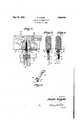
- Fig. 1represents a fragmentary elevational view of a portion of a heddle frame showing the invention applied thereto, the rend portions of several heddles being illustrated in position.
- Fig. 2represents a sectional view on line 2--2 of Fig. 1 looking in the direction indicated by the arrows.
- Fig. 3represents a similar view on the line 3-3 of Fig. 1.
- Fig. 4represents a view in perspective of the spring.
- the same supporting. and locking meansmay be used in conjunction with the upper and lower rails of a heddle frame, and I therefore have illustrated the invention only in connection with the upper rail.
- the railis indicated at 5
- the heddle baris indicated at 6, and the upper endsof several heddles are indicated at 'I.
- the supportmay be in the form of a pin 8 suitably secured to the rail 5.
- Imay provide the upper end of the pin, the lower end of which is flattened as at 9, with wood screw threads IB so that the pin may be screwed intothe rail.
- a reinforcing plate I Imay be fastened to the under face of the rail, and through al1 openingin this plate the pin projects.
- the flattened portion of the pinis provided with a recess for receiving a heddle bar 6, ⁇ and this recess at its lower end has a shoulder I which-may be beveled upwardly and outwardly as indicated so as to tend to cam or wedge the (Cl. 139-92) l p heddle bar 6 against the support'wherr the bar is in lockedV position.
- The' locking means for the barmay bein the form of a leaf spring I2,"'anchored.at one end to thezplate III by one of lthe screws I3 which'sev 5 ⁇ cure said plate in position, at its other end being forked as at I4 and provided with a downwardly projecting prong or tongue I5.
- the forked end of the springstraddles the pin 8, and the spring is thus prevented from turning sidewise, while free to flex up and down, therefore fouling with an adjacent frame is prevented.
- the prong l5extends downwardly in sufliciently spaced relation to the flattened portion 9 of the pin to allow for the insertion of the end of a center brace I6 between the flattened portion of the pin and the prong.
- the bracemay have its upper end hookshaped, so that it may be snapped into position on the heddle bar between the support and the prong.
- the end of the prongis recessed at Il 20 so as to engage the upper edge of the heddle bar I5v and force the latter downwardly against the inclined shoulder I1.
- the springmay itself be sufficiently strong to lock the heddle bar in position on the support.25 and to maintain the center brace in position, but in order to provide a more positive locking means I may utilize a locking nut I8 which is turned onto the pin 8 on machine threads I9 which are superimposed on the wood threads.
- the ma- 30 chine threads'Vmay extend the full length of the I pin except for the flattened portion of the latter, While the Wood threads need only extend a suincient distance to allow the pin to be screwed to the desired extent into the rail and to allow for any adjustments of the pin that may be desired.
- the locking nutis positioned above the free end of the spring and may be turned down into the position indicated at Figs.
- a heddlebar supportincluding a pin having a shoulder adapted to receive a heddle bar, a spring adapted to engage the heddle bai ⁇ directly for locking it in position on the support, and means movable along said pin for holding the spring and bar in positive locked position.
- a heddle bar supportincluding a pin having a shoulder adapted to receive a heddle bar, a springl adapted to engage the heddle bar' directly for locking it in' position on the support, and a nut threaded on said pin for holdingthe spring and-- bar in positive ⁇ locked position.
Landscapes
- Engineering & Computer Science (AREA)
- Textile Engineering (AREA)
- Emergency Lowering Means (AREA)
Description
May 28,-1935. n R. RAGAN SUPPORT FORSHEDDLE BARS Filed D ec. 6, 1932 Patented I May 17.8, 1935 `Heddle` Manufacturing Company, Philadelphia,
Pa., a corporation of Pennsylvania Application December 6, 1932, Serial No. 645,905
` l 4 `6 Claims. `This invention relates to means for supporting and locking theheddle bars of a heddle frame. I
Y One of the principal objects of my present invention is to providea heddle bar supporting and` Y 5 locking Adevice which is characterized by simplicity, economy of manufacture and efiiciency in operation when in use.
Another object of my invention is to provide a heddle bar supporting and locking means in which a leaf spring is utilized to bear directly upon the heddle bar and lock it in position in the support, and to also lock a center brace in position, supplementary means in the form of a lock nut also being provided to positively hold the spring in binding position against the heddle bar.
Another object of the vinvention is to provide a construction in which the support may be screwed into a wooden heddle framerail by means of the usual wood threads, and a locking nut may be mounted on the support on machine screw threads superimposed on the wood threads.
These and other objects will-more particularly appear as the description proceeds.
In the drawing in which I have illustrated one of the embodiments thatthe invention may take;
Fig. 1 represents a fragmentary elevational view of a portion of a heddle frame showing the invention applied thereto, the rend portions of several heddles being illustrated in position.
Fig. 2 represents a sectional view on line 2--2 of Fig. 1 looking in the direction indicated by the arrows.
Fig. 3 represents a similar view on the line 3-3 of Fig. 1.
Fig. 4 represents a view in perspective of the spring.
The same supporting. and locking means may be used in conjunction with the upper and lower rails of a heddle frame, and I therefore have illustrated the invention only in connection with the upper rail. The rail is indicated at 5, the heddle bar is indicated at 6, and the upper endsof several heddles are indicated at 'I. The support may be in the form of apin 8 suitably secured to the rail 5. To this end I may provide the upper end of the pin, the lower end of which is flattened as at 9, with wood screw threads IB so that the pin may be screwed intothe rail. A reinforcing plate I I may be fastened to the under face of the rail, and through al1 openingin this plate the pin projects. The flattened portion of the pin is provided with a recess for receiving aheddle bar 6, `and this recess at its lower end has a shoulder I which-may be beveled upwardly and outwardly as indicated so as to tend to cam or wedge the (Cl. 139-92)l p heddle bar 6 against the support'wherr the bar is in lockedV position. I I
The' locking means for the bar may bein the form of a leaf spring I2,"'anchored.at one end to thezplate III by one of lthe screws I3 which'sev 5` cure said plate in position, at its other end being forked as at I4 and provided with a downwardly projecting prong or tongue I5. The forked end of the spring straddles thepin 8, and the spring is thus prevented from turning sidewise, while free to flex up and down, therefore fouling with an adjacent frame is prevented. The prong l5 extends downwardly in sufliciently spaced relation to theflattened portion 9 of the pin to allow for the insertion of the end of a center brace I6 between the flattened portion of the pin and the prong. The brace may have its upper end hookshaped, so that it may be snapped into position on the heddle bar between the support and the prong. The end of the prong is recessed at Il 20 so as to engage the upper edge of the heddle bar I5v and force the latter downwardly against the inclined shoulder I1.
The spring may itself be sufficiently strong to lock the heddle bar in position on the support.25 and to maintain the center brace in position, but in order to provide a more positive locking means I may utilize a locking nut I8 which is turned onto thepin 8 on machine threads I9 which are superimposed on the wood threads. The ma- 30 chine threads'V may extend the full length of the I pin except for the flattened portion of the latter, While the Wood threads need only extend a suincient distance to allow the pin to be screwed to the desired extent into the rail and to allow for any adjustments of the pin that may be desired. The locking nut is positioned above the free end of the spring and may be turned down into the position indicated at Figs. 2 and 3 so as to force the spring into binding engagement with the heddle bar and thus hold the latter rigidly in position in the support; This movement of the locking nut will likewise bring the nut into binding engagement with the spring so that the latter acts as a means to prevent accidental unscrewing of the nut. I
When it is desired to remove theheddle bar from its support the nut is unscrewed and the end of the spring lifted to clear the bar whereupon the latter may be moved outwardly from the recess.
The foregoing detailed description has been given for purposes of clearness of understanding of the invention, and of the particular form thereof chosen for illustrative purposes, but no undue 55 limitations should be deduced therefrom, as the appended claims should be construed as broadly as permissible in view of the prior art.
I claim:
l. The combination with a heddle frame, of a pin mounted on a rail thereof and having a shoulder adapted to receive a heddle bar, a spring mounted on said rail and having its free end forked and straddl'ilng the pi'n and provided with a prong adapted to engage the heddle' b'ar, and a locking nut mounted on the pin and adapted to be turned into binding engagement with the spring. v A
2. The combination with a heddle frame, of a pin mounted on a rail thereof and having means for receiving a heddle bar, and a2 spring'liaiving a portion atlone end adapted to bear against the heddle bar and also having? a portion str'addling the pin.
3. The combination with a heddle frame, of a pin-mounted ori-a rail thereof and provided with a shoulder adapted to receive a heddle'bar, a spring mounted Von the rail and having its free end providedv with a= prong adapted toengagel the heddle bar, said prong: beingl arranged i'n suciently spaced relation to the pin to allow of the reception of a center brace between the spring and pin, and a locking nut mounted on the pin and adapted to be brought into binding engagement with the spring.
4. The combination with a heddle bar support having means for receiving a heddle bar, of a spring having a portion adapted to bear against the' heddle bar', said portion extending in spaced relationship with respect to the support to permit the reception of a center brace between the spring and support.
5.- A heddlebar support including a pin having a shoulder adapted to receive a heddle bar, a spring adapted to engage the heddle bai` directly for locking it in position on the support, and means movable along said pin for holding the spring and bar in positive locked position.
6. A heddle bar support including a pin having a shoulder adapted to receive a heddle bar, a springl adapted to engage the heddle bar' directly for locking it in' position on the support, and a nut threaded on said pin for holdingthe spring and-- bar in positive` locked position.
RALPH HAGAN.
Priority Applications (1)
| Application Number | Priority Date | Filing Date | Title |
|---|---|---|---|
| US645905AUS2002548A (en) | 1932-12-06 | 1932-12-06 | Support for heddle bars |
Applications Claiming Priority (1)
| Application Number | Priority Date | Filing Date | Title |
|---|---|---|---|
| US645905AUS2002548A (en) | 1932-12-06 | 1932-12-06 | Support for heddle bars |
Publications (1)
| Publication Number | Publication Date |
|---|---|
| US2002548Atrue US2002548A (en) | 1935-05-28 |
Family
ID=24590938
Family Applications (1)
| Application Number | Title | Priority Date | Filing Date |
|---|---|---|---|
| US645905AExpired - LifetimeUS2002548A (en) | 1932-12-06 | 1932-12-06 | Support for heddle bars |
Country Status (1)
| Country | Link |
|---|---|
| US (1) | US2002548A (en) |
Cited By (4)
| Publication number | Priority date | Publication date | Assignee | Title |
|---|---|---|---|---|
| US2676619A (en)* | 1952-01-11 | 1954-04-27 | Draper Corp | Harness frame connector |
| US2707496A (en)* | 1953-12-11 | 1955-05-03 | Draper Corp | Harness frame for looms |
| US2773516A (en)* | 1951-11-01 | 1956-12-11 | Steel Heddle Mfg Co | Loom harness |
| US3154108A (en)* | 1962-03-13 | 1964-10-27 | Steel Heddle Mfg Co | Loom harness |
- 1932
- 1932-12-06USUS645905Apatent/US2002548A/ennot_activeExpired - Lifetime
Cited By (4)
| Publication number | Priority date | Publication date | Assignee | Title |
|---|---|---|---|---|
| US2773516A (en)* | 1951-11-01 | 1956-12-11 | Steel Heddle Mfg Co | Loom harness |
| US2676619A (en)* | 1952-01-11 | 1954-04-27 | Draper Corp | Harness frame connector |
| US2707496A (en)* | 1953-12-11 | 1955-05-03 | Draper Corp | Harness frame for looms |
| US3154108A (en)* | 1962-03-13 | 1964-10-27 | Steel Heddle Mfg Co | Loom harness |
Similar Documents
| Publication | Publication Date | Title |
|---|---|---|
| US2345419A (en) | Floor clip | |
| US2002548A (en) | Support for heddle bars | |
| US2160174A (en) | Bedstead coupling connection | |
| DE275349C (en) | ||
| US2305063A (en) | Bed rail latch | |
| US2707495A (en) | Heddle bar support | |
| US1994286A (en) | Heddle bar supporting means | |
| US2154655A (en) | Eccentric connection for loom swords | |
| US1465015A (en) | Nut lock | |
| US2211271A (en) | Heddle frame | |
| US2445070A (en) | Loom harness | |
| US2034871A (en) | Heddle frame | |
| DE660185C (en) | Rail fastening secured against unauthorized loosening on wooden or iron sleepers | |
| US2078897A (en) | Heddle frame | |
| DE613265C (en) | Rail fastening on rib shims | |
| US1607136A (en) | Rail joint | |
| US1904581A (en) | Printer's quoin | |
| US2175519A (en) | Support for heddle bars | |
| US1687096A (en) | Heddle frame | |
| US1821647A (en) | Heddle frame | |
| US1693236A (en) | Heddle frame | |
| US1728758A (en) | Nut lock | |
| US1784269A (en) | Lock washer | |
| US1901451A (en) | Gauge | |
| US2030713A (en) | Shuttle pin lock |