US1993580A - Electric terminal connection and method of making the same - Google Patents
Electric terminal connection and method of making the sameDownload PDFInfo
- Publication number
- US1993580A US1993580AUS594276AUS59427632AUS1993580AUS 1993580 AUS1993580 AUS 1993580AUS 594276 AUS594276 AUS 594276AUS 59427632 AUS59427632 AUS 59427632AUS 1993580 AUS1993580 AUS 1993580A
- Authority
- US
- United States
- Prior art keywords
- terminal
- sheath
- heating element
- twisted
- conductors
- Prior art date
- Legal status (The legal status is an assumption and is not a legal conclusion. Google has not performed a legal analysis and makes no representation as to the accuracy of the status listed.)
- Expired - Lifetime
Links
- 238000004519manufacturing processMethods0.000titledescription3
- 238000010438heat treatmentMethods0.000description43
- 239000004020conductorSubstances0.000description22
- 239000011810insulating materialSubstances0.000description11
- 238000005485electric heatingMethods0.000description4
- 238000000034methodMethods0.000description4
- 239000007787solidSubstances0.000description4
- 230000000694effectsEffects0.000description2
- CPLXHLVBOLITMK-UHFFFAOYSA-Nmagnesium oxideInorganic materials[Mg]=OCPLXHLVBOLITMK-UHFFFAOYSA-N0.000description2
- 239000000395magnesium oxideSubstances0.000description2
- AXZKOIWUVFPNLO-UHFFFAOYSA-Nmagnesium;oxygen(2-)Chemical compound[O-2].[Mg+2]AXZKOIWUVFPNLO-UHFFFAOYSA-N0.000description2
- 239000000463materialSubstances0.000description2
- 229910052751metalInorganic materials0.000description2
- 239000002184metalSubstances0.000description2
- 238000012986modificationMethods0.000description2
- 230000004048modificationEffects0.000description2
- 229920000136polysorbatePolymers0.000description2
- 229910018487Ni—CrInorganic materials0.000description1
- 108010013381PorinsProteins0.000description1
- 230000015572biosynthetic processEffects0.000description1
- 238000007664blowingMethods0.000description1
- VNNRSPGTAMTISX-UHFFFAOYSA-Nchromium nickelChemical compound[Cr].[Ni]VNNRSPGTAMTISX-UHFFFAOYSA-N0.000description1
- 238000004140cleaningMethods0.000description1
- 238000010276constructionMethods0.000description1
- 238000005520cutting processMethods0.000description1
- 230000003116impacting effectEffects0.000description1
- 102000007739porin activity proteinsHuman genes0.000description1
- 238000005096rolling processMethods0.000description1
Images
Classifications
- H—ELECTRICITY
- H05—ELECTRIC TECHNIQUES NOT OTHERWISE PROVIDED FOR
- H05B—ELECTRIC HEATING; ELECTRIC LIGHT SOURCES NOT OTHERWISE PROVIDED FOR; CIRCUIT ARRANGEMENTS FOR ELECTRIC LIGHT SOURCES, IN GENERAL
- H05B3/00—Ohmic-resistance heating
- H05B3/02—Details
- H05B3/06—Heater elements structurally combined with coupling elements or holders
- H—ELECTRICITY
- H05—ELECTRIC TECHNIQUES NOT OTHERWISE PROVIDED FOR
- H05B—ELECTRIC HEATING; ELECTRIC LIGHT SOURCES NOT OTHERWISE PROVIDED FOR; CIRCUIT ARRANGEMENTS FOR ELECTRIC LIGHT SOURCES, IN GENERAL
- H05B3/00—Ohmic-resistance heating
- H05B3/40—Heating elements having the shape of rods or tubes
- H05B3/42—Heating elements having the shape of rods or tubes non-flexible
- H05B3/48—Heating elements having the shape of rods or tubes non-flexible heating conductor embedded in insulating material
- Y—GENERAL TAGGING OF NEW TECHNOLOGICAL DEVELOPMENTS; GENERAL TAGGING OF CROSS-SECTIONAL TECHNOLOGIES SPANNING OVER SEVERAL SECTIONS OF THE IPC; TECHNICAL SUBJECTS COVERED BY FORMER USPC CROSS-REFERENCE ART COLLECTIONS [XRACs] AND DIGESTS
- Y10—TECHNICAL SUBJECTS COVERED BY FORMER USPC
- Y10T—TECHNICAL SUBJECTS COVERED BY FORMER US CLASSIFICATION
- Y10T29/00—Metal working
- Y10T29/49—Method of mechanical manufacture
- Y10T29/49002—Electrical device making
- Y10T29/49082—Resistor making
- Y10T29/49087—Resistor making with envelope or housing
- Y10T29/49098—Applying terminal
Definitions
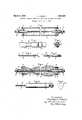
- This heating unit 10comprises a straight 5 connection between the resistance conductor of core wire resistance heating element 11 formed 5 the heating unit and a terminal member, and from a pair of twisted resistanceconductors 110, method for efiecting the connection. 11b, extending centrally of a metallic sheath 12.
- the resistance elementis made from a suitable particular application to electric heating units high resistance material having considerable 1 having a resistance heating element formed by TeSi1ien 3y,'SuCh as nickel-Chromium y-
- the twisting a plurality of resistance conductors toheating element 11is embedded in a compacted gether as described and claimed in my copendmass of powdered heat refractory insulating maing application, Serial No. 111,372, filed Decemterial 13 such as ma e u xideher 3, 1929, issued as Patent No. 1,959,776 on May Metallic terminals 14 and 15 are p vid d for 22, 1934 of which this application is a division.
- each terminal i D 15In carrying my invention into effect in one. vided with a stepped longitudinal recess 16 for form thereof, I provide the twisted resistance receiving a correspondingly stepped portion 17 of conductor with a stepped terminal portion and he twisted heating ele The pp provide in the terminal a stepped bore to receive minal D tiOn 0f e heating element is formed 20 this terminalportion.
- the terminalwill be reduced to the terminal portion 1'7 is inserted in the stepped 25 such an extent that the material of the terminal bore of the terminal, the reduced twisted Portion will be forced into the grooves between the 17a will be received in the larger terminal recess twisted resistance conductors. portion 16a and the projecting portion 17b will For a more complete understanding of my inbe received in the smaller recess portion 16b.
- Fig. 1is a sectional ment terminal portion so that the metal of the view illustrating the electric heating unit of my n l s forced i the spaces or grooves above-mentioned copending application provided tween the turns of the twisted core heating elewith an electric terminal connection arranged in ment.
- Fig. 2is a fragmentary view illustrating a porserved that before a terminal could be removed tion of the heating element of Fig.
- Fig. 3is a sectional view taken through formed in the terminal recesses when the ter- 40 the line 3-3 of Fig. 2;
- Fig. 4is an elevation of minal is compressed on the unit.
- Fig. 5is an elevation of the terwith a relatively short pitch to form the'resist- 5 minal partly in section illustrating the terminal ance heating element 11. While I have shown prepared for connection with the heating elebut two resistance strands wound about each ment; Fig. 6 is a sectional view illustrating the other to form the twisted heating element, it is heating unit in a more advanced stage of its conto be understood that several, as for instance struction; Fig. 7 is an elevation of a member used three or four, may be used if desired.
- Fig. 8is a Electric connections are then established be- 50 partial elevation of the finished electric heating tween the terminals 14 and 15 and their respecunit provided with a terminal connection artiveend portions of the heating element 11. ranged in accordance with my invention.
- the heating element 11is prepared for connec- Referring to the drawing, 1 have shown my tion with the terminals 14 and 15 by providing 1 invention in one form in connection with a the Stepped end terminal portions 1'7.
- the projecting portion 17bmay be formed by cutting off or otherwise detaching a portion of one of the conductors (11a, 11b) so as to leave the single strand. After this, the twisted end portion 170.
- the heating elementis swaged or otherwise reduced to approximately the diameter of the larger terminal recess portion 16a.
- the projecting portion 17bwill be bent or twisted so as to lie in the axis of the heating element and further that the portion 16b of the terminal recess will have a diameter approximately equal to that of the projecting strand 17b so that it will just receive this portion.
- the terminal portion 17is then inserted in the recess 16 of the terminal, after which the terminal is swaged or otherwise compressed, preferably to a square cross-section, so that its metal is forced into the grooves or spaces between the twisted conductors of the terminal portions 17a of the heating element.
- This terminal arrangementis a very important feature of my invention. It will be understood that if the twisted core wire heating element were left full size to the end rather than having the stepped formation as shown, and the terminal were provided with a straight bore to receive it, the terminal would be so weak at the end of the core wire that it would practically draw in two at this point during the subsequent swaging of the assembled heating unit.
- Iprovide 'the metallic sheath 12 with plurality of flattened portions 12a positioned so as to. maintain the heating element central during the insulating material loading operation and during the initial swaging operations.
- the sheath at these flattened portionswill be sufliciently wide to receive the heating element but ordinarily will not be large enough for the terminals to pass through. Consequently it is generally necessary to assemble the heating element with the sheath before the indenting operation.
- the metallic sheath 12is prepared for the assembly of the heating element 11, first by providing its ends with count'erbores 20 (Fig. 1) and then by thoroughly cleaning the interior of the sheath.
- the resistance element 11 with its terminals attachedis then inserted lengthwise within the sheath as shown in Fig. 1 and preferably is placed under a slight tension to hold it straight within the sheath.
- the heating elementwill have a length suflicient to permit the terminals to project from the ends of the sheath.
- The. heating elementmay be supported and tensioned in the sheath'by placing washers 21 in the counterbores 20 and which fit on the terminal members so as to hold them centrally of the sheath.
- Suitable sleeves or col lars 22are then provided on the terminal members and are secured by means of nuts 23 which are turned on the threaded projecting end portions of the terminals. It will be understood that by turning the nuts 23 inwardly on the terminal portions, the heating element will be placed under a tension suificient to hold it central within the tube and to prevent its kinking during the indenting operation.
- the sheathis ready for the indenting operation.
- the indentsare placed in the metallic sheath so as to provide the flattened portions 12a in pairs with the axes of the adjacent portions positioned substantially at right angles to each other. It will be observed that by reason of this arrangement, the reduced portions of each pair taken together form a square-shaped retaining section around the resistance element, (Fig. 3). It will be understood that a number of these pairs will be spaced at intervals along the length of the sheath.
- one pair of indentswill be formed with their axes substantially at 90 to each other. Then the sheath will be rotated about its longitudinal axis through 45 and another set of indents will be formed with their axes substantially at 90 to each other. In effect, therefore, the four indents of adjacent pairs taken together will form an octagonal shaped retaining section. This arrangement precludes any possibility of the element moving from its central position beyond the limits defined by the clearance between the resistance element and the side portions of the two square retaining sections formed by the adjacent pairs.
- the flattened portionswill be spaced so that the heating element will be properly centered within the sheath but will not be positioned so close to each other that the passageway through the sheath will be restricted.
- the indentswill be placed in the sheath not only to maintain the heatingelement 11 central but also to maintain the terminal members 14 and 15 centrally of the sheath (Fig. 6).
- the nuts 23, the sleeves 22 and the washers 21are removed and the interior of the sheath is thoroughly cleaned so that any scale which might have become loosened by the indenting process is removed.
- the interiormay thus be cleaned by blowing dry air through the sheath.
- the sheathis now ready for the loading operation.
- the sheathis closed at one end, for example at the left hand end, as viewed in Fig. 6, by a pair of solid washers 21 which flt on the terminal 14 so as to hold the terminal centrally of 'the tube. These washers, as shown, are received in the left hand counterbore 20.
- the sleeve 22is then positioned on the projecting end portion of the terminal 14 and is secured by means of the nut 23.
- the terminal 15is secured in a similar manner centrally of the sheath by means of a triangular shaped washer 26 which is positioned in the counterbore 20 at the right hand end of the sheath.
- the resistance conductor 11is. placed under a slight tension by turning the nuts 23 inwardly onlthe terminals.
- the sheathis now filled through the openings provided by the triangular washer 26 with the heat refractory powdered insulating material 13.
- the sheathis held in an upright position in a special vibrating machine (not shown) with the end provided with the triangular washer uppermost.
- a special vibrating machinenot shown
- the sheathis filled with the insulating material through the openings provided by the triangular washer, it is vibrated to shake the insulating material together and distribute it uniformly around the terminals and the resistance element. Itwill be understood that the powdered insulating material will readily pass through the flattened portions 12a to the lower portions of the upright sheath.
- a solid washer 27which is similar to the washers 21 is inserted ,in place around the terminal 15 to close the sheath.
- the sleeve 22 and the nut 23are then replaced and-the core wire resistance element 11 is placed under a slight strain by turning the nut 23 inwardly on the terminal 15/
- the ends of the sheathare .then turned over so as to aecure the washers in the ends of the sheath.
- This compacting of the insulating materialmay be accomplished by striking the metallic sheath between each pair of flattened portions with a rather heavy impacting blow, as by hitting the sheath with a short split die in a press. It has been found that this operation so compacts the magnesium oxide around the core wire that it .will be held perfectly central within the sheath during the-swaging operations. After the insulating material has thus been compacted, the nuts 23 and the sleeves 22 are again removed.
- the entire unitis now passed through a swaging or rolling machine for the purpose of compacting the insulating material within the sheath to a hard dense mass, the swaging operation reducing the diameter and increasing the length of the unit.
- a swaging or rolling machinegenerally will remove the fiattened portions of the sheath bulging the flattened sides outward somewhat, and it has been found that the sheath will assume a complete cylindrical shape throughoutits length. The sheath will lengthen somewhat faster than the core wire during the first two or three passes through the machine. minals will be drawn within the sheath for a short distance.
- the insulating materialwill generally be sufilciently compacted by the first several passes to secure the terminals against further inward movement.
- the pitch which was approximately before swagingwas increased by the swaging operation to approximately H".
- the'terminals 14 and 15In other words, the projecting ter- The twisted are gradually reduced in diameter by the swagins. the recessed ends contracting around the resistance element.
- the heating unitmay be annealed between successive swaging operations in order to prevent the resistance element and sheath from becoming hard and brittle.
- the washers at each endare out oi! or otherwise removed and the ends of the unit are squared oil (Fig. 8). It will be understood that the terminals 14 and 15 will be held firmly in place by the compacted insulating material in which they are embedded.
- the method of securing a terminal to an elongated electrical conductor formed of separate elongated conductors twisted together throughout their lengthswhich comprises forming a stepped terminal portion on said conductors by projecting one end portion of one of said conductors axially beyond the twisted end portion of said conductors, providing in a solid metallic terminal member .a stepped bore corresponding to the stepped terminal portion on said conductors, fitting said terminal portion of said conductors -into said stepped bore in said terminal member and then'swaging said terminal member onto said terminal portion so that said terminal member tightly grips said terminal portion with good electrical and mechanical engagement, the projecting portion of said stepped terminal portion gripped by the corresponding part of said terminal member relieving the strain in the walls of said terminal member at the bottom of the larger part of said stepped bore set up when a force is applied to said conductors tending to remove them from said terminal member, thereby preventing rupture of said terminal member at the bottom of said larger bore portion.
- a stepped terminal portion on said conductorsdefined by one of said conductors extending axially from the twisted portion of said conductors, and a solid metallic terminal member provided with 'a stepped bore corresponding to the stepped terminal portion on said conductors fitted onto said terminal portion and compressed thereon in good electrical and mechanical relation with it, the reduced part of said terminal portion gripped by the corresponding part of said terminal member relieving the strain in the walls of said terminal member at the bottom of the larger part of said bore set up when a force is applied to said conductors tending to remove them from said terminal member, thereby preventing rupture of said terminal member at the bottom of said larger bore portion.
Landscapes
- Resistance Heating (AREA)
Description
March 5,1935. c. c. ABBOTT 1,993,580
ELECTRIC TERMINAL CONNECTION AND METHOD OF MAKING THE SAME Original Filed Dec. 3, 1929 iiii l. MA
InQencor: Charles C'Abbobb, b MW M His Attor'heg.
UNITED STATES PATENT OFFICE ELECTRIC TERMINAL CONNECTION AND METHOD OF MAKING THE SAME Charles 0. Abbott, Pittslield, Mass, assignor to General Electric Company, a corporation of New York Original application December 3, 1929, Serial No. 411,372, now Patent No. 1,959,776, dated May 22, 1934. Divided and this application February 20, 1932, Serial No. 594,276
2 Claims. (01. 29-4555) My invention relates to electric terminal consheathed wire heating unit of the type described nections, more particularly to terminal connecand claimed in my above-mentioned copending 1 tions for electric heating units and the like, and application, Serial No. 411,372, filed December 3, has for its object the provision of an improved 1929. Thisheating unit 10 comprises a straight 5 connection between the resistance conductor of core wire resistance heating element 11 formed 5 the heating unit and a terminal member, and from a pair of twisted resistanceconductors 110, method for efiecting the connection. 11b, extending centrally of ametallic sheath 12.
Although not limited thereto, my invention has The resistance element is made from a suitable particular application to electric heating units high resistance material having considerable 1 having a resistance heating element formed by TeSi1ien 3y,'SuCh as nickel-Chromium y- The twisting a plurality of resistance conductors toheating element 11 is embedded in a compacted gether as described and claimed in my copendmass of powdered heat refractory insulating maing application, Serial No. 111,372, filedDecemterial 13 such as ma e uxideher 3, 1929, issued as Patent No. 1,959,776 on MayMetallic terminals D 15 In carrying my invention into effect in one. vided with a steppedlongitudinal recess 16 for form thereof, I provide the twisted resistance receiving a correspondingly stepped portion 17 of conductor with a stepped terminal portion and he twisted heating ele The pp provide in the terminal a stepped bore to receive minal D tiOn 0f e heating element is formed 20 this terminalportion. I then insert the stepped by a reduced twisted portion 17a of the end por- 20 terminal portion within the bore provided for it tion of the heating element and by the end porin the terminal and reduce the diameter of the tion 1717 of one of the conductors which projects terminal so as to iorce it into good electrical and beyond the twisted portion, preferably in the axis mechanical contact with the resistance conducf the element. It will be observed that when tors. Preferably the terminal will be reduced to the terminal portion 1'7 is inserted in the stepped 25 such an extent that the material of the terminal bore of the terminal, the reduced twisted Portion will be forced into the grooves between the 17a will be received in the larger terminal recess twisted resistance conductors. portion 16a and the projecting portion 17b will For a more complete understanding of my inbe received in the smaller recess portion 16b.
vention reference should be had to the accom- Each terminal is compressed on its heating ele- 30 panying drawing in which Fig. 1 is a sectional ment terminal portion so that the metal of the view illustrating the electric heating unit of my n l s forced i the spaces or grooves above-mentioned copending application provided tween the turns of the twisted core heating elewith an electric terminal connection arranged in ment. A very good electrical and mechanical accordance with my invention and showing the connection is thus provided between the terunit in a preliminary stage of its construction; minals and the heating element. It will be ob- Fig. 2 is a fragmentary view illustrating a porserved that before a terminal could be removed tion of the heating element of Fig. 1 in an ador pulled from the heating element, it would be vanced stage of the process of making the heatnecessary to strip the inner threads which are mg unit; Fig. 3 is a sectional view taken through formed in the terminal recesses when the ter- 40 the line 3-3 of Fig. 2; Fig. 4 is an elevation of minal is compressed on the unit.
a portion of the twisted heating element illusv In forming the heating unit, the electrical retrating the element prepared for connection with sistance elements 11a and 11b are twisted together its terminals; Fig. 5 is an elevation of the terwith a relatively short pitch to form the'resist- 5 minal partly in section illustrating the terminal ance heating element 11. While I have shown prepared for connection with the heating elebut two resistance strands wound about each ment; Fig. 6 is a sectional view illustrating the other to form the twisted heating element, it is heating unit in a more advanced stage of its conto be understood that several, as for instance struction; Fig. 7 is an elevation of a member used three or four, may be used if desired.
in making the heating element; and Fig. 8 is a Electric connections are then established be- 50 partial elevation of the finished electric heating tween theterminals terminals
of the heating element is swaged or otherwise reduced to approximately the diameter of the larger terminal recess portion 16a. It will be understood that the projecting portion 17b will be bent or twisted so as to lie in the axis of the heating element and further that the portion 16b of the terminal recess will have a diameter approximately equal to that of the projecting strand 17b so that it will just receive this portion. The terminal portion 17 is then inserted in therecess 16 of the terminal, after which the terminal is swaged or otherwise compressed, preferably to a square cross-section, so that its metal is forced into the grooves or spaces between the twisted conductors of the terminal portions 17a of the heating element.
This terminal arrangement is a very important feature of my invention. It will be understood that if the twisted core wire heating element were left full size to the end rather than having the stepped formation as shown, and the terminal were provided with a straight bore to receive it, the terminal would be so weak at the end of the core wire that it would practically draw in two at this point during the subsequent swaging of the assembled heating unit.
I provide 'themetallic sheath 12 with plurality of flattened portions 12a positioned so as to. maintain the heating element central during the insulating material loading operation and during the initial swaging operations. The sheath at these flattened portions will be sufliciently wide to receive the heating element but ordinarily will not be large enough for the terminals to pass through. Consequently it is generally necessary to assemble the heating element with the sheath before the indenting operation.
Themetallic sheath 12 is prepared for the assembly of the heating element 11, first by providing its ends with count'erbores 20 (Fig. 1) and then by thoroughly cleaning the interior of the sheath. The resistance element 11 with its terminals attached is then inserted lengthwise within the sheath as shown in Fig. 1 and preferably is placed under a slight tension to hold it straight within the sheath. It will be understood that the heating element will have a length suflicient to permit the terminals to project from the ends of the sheath. The. heating element may be supported and tensioned in thesheath'by placing washers 21 in thecounterbores 20 and which fit on the terminal members so as to hold them centrally of the sheath. Suitable sleeves orcol lars 22 are then provided on the terminal members and are secured by means ofnuts 23 which are turned on the threaded projecting end portions of the terminals. It will be understood that by turning thenuts 23 inwardly on the terminal portions, the heating element will be placed under a tension suificient to hold it central within the tube and to prevent its kinking during the indenting operation.
After the heating element has been assembled with the sheath as shown in Fig. 1, the sheath is ready for the indenting operation. As shown (Figs. 2 and 3), the indents are placed in the metallic sheath so as to provide the flattened portions 12a in pairs with the axes of the adjacent portions positioned substantially at right angles to each other. It will be observed that by reason of this arrangement, the reduced portions of each pair taken together form a square-shaped retaining section around the resistance element, (Fig. 3). It will be understood that a number of these pairs will be spaced at intervals along the length of the sheath.
It will be observed by reference to Fig. 3 that the passageway through the sheath at these flattened portions is sufliciently large to receive the heating element 11 and by reason of the fact that the adjacent flattened portions are arranged substantially at right angles to each other, the heating element will be secured centrally of the sheath at a plurality of points spaced at intervals throughout its length. However, it is very important that the reduced sections of the sheath be sufiiciently large to prevent gripping of the resistance element at any point. Thus, generally there will be some clearance between the walls of the sheath and the element. It is preferable, therefore, to form each pair of flattened portions in the sheath at substantially'45" to the adjacent pairs. In other words one pair of indents will be formed with their axes substantially at 90 to each other. Then the sheath will be rotated about its longitudinal axis through 45 and another set of indents will be formed with their axes substantially at 90 to each other. In effect, therefore, the four indents of adjacent pairs taken together will form an octagonal shaped retaining section. This arrangement precludes any possibility of the element moving from its central position beyond the limits defined by the clearance between the resistance element and the side portions of the two square retaining sections formed by the adjacent pairs. It will be understood, of course, that ifthe axes of the flattened portions of each pair were not thus rotated relatively to the axes of the corresponding flattened portions of the adjacent pairs, the limits of the clearance would be defined by the distance between the surface of the resistance element and the corner portions of the square retaining sections.
It will be understood that the flattened portions will be spaced so that the heating element will be properly centered within the sheath but will not be positioned so close to each other that the passageway through the sheath will be restricted. Moreover, it will be understood that the indents will be placed in the sheath not only to maintain the heatingelement 11 central but also to maintain theterminal members
After the sheath has thus been indented, thenuts 23, thesleeves 22 and thewashers 21 are removed and the interior of the sheath is thoroughly cleaned so that any scale which might have become loosened by the indenting process is removed. The interior may thus be cleaned by blowing dry air through the sheath.
The sheath is now ready for the loading operation. The sheath is closed at one end, for example at the left hand end, as viewed in Fig. 6, by a pair ofsolid washers 21 which flt on the terminal 14 so as to hold the terminal centrally of 'the tube. These washers, as shown, are received in theleft hand counterbore 20. Thesleeve 22 is then positioned on the projecting end portion of the terminal 14 and is secured by means of thenut 23. The terminal 15 is secured in a similar manner centrally of the sheath by means of a triangular shapedwasher 26 which is positioned in thecounterbore 20 at the right hand end of the sheath. The resistance conductor 11 is. placed under a slight tension by turning the nuts 23 inwardly onlthe terminals.
The sheath is now filled through the openings provided by thetriangular washer 26 with the heat refractory powdered insulatingmaterial 13. To accomplish this, the sheath is held in an upright position in a special vibrating machine (not shown) with the end provided with the triangular washer uppermost. As the sheath is filled with the insulating material through the openings provided by the triangular washer, it is vibrated to shake the insulating material together and distribute it uniformly around the terminals and the resistance element. Itwill be understood that the powdered insulating material will readily pass through the flattened portions 12a to the lower portions of the upright sheath. When the sheath has been filled, asolid washer 27 which is similar to thewashers 21 is inserted ,in place around the terminal 15 to close the sheath. Thesleeve 22 and thenut 23 are then replaced and-the core wire resistance element 11 is placed under a slight strain by turning thenut 23 inwardly on the terminal 15/ The ends of the sheath are .then turned over so as to aecure the washers in the ends of the sheath.
After the sheath has thus been loaded with the powdered insulating material, I compact the magnesium oxide in these portions of the sheath between the flattened portions 12a. aroundthe core wire heating element. This further insures the central location of the heating element.
This compacting of the insulating material may be accomplished by striking the metallic sheath between each pair of flattened portions with a rather heavy impacting blow, as by hitting the sheath with a short split die in a press. It has been found that this operation so compacts the magnesium oxide around the core wire that it .will be held perfectly central within the sheath during the-swaging operations. After the insulating material has thus been compacted, the nuts 23 and thesleeves 22 are again removed.
The entire unit is now passed through a swaging or rolling machine for the purpose of compacting the insulating material within the sheath to a hard dense mass, the swaging operation reducing the diameter and increasing the length of the unit. Several through the swaging machine generally will remove the fiattened portions of the sheath bulging the flattened sides outward somewhat, and it has been found that the sheath will assume a complete cylindrical shape throughoutits length. The sheath will lengthen somewhat faster than the core wire during the first two or three passes through the machine. minals will be drawn within the sheath for a short distance. However, the insulating material will generally be sufilciently compacted by the first several passes to secure the terminals against further inward movement. core wire resistance during the swaging operation will be lengthened so that the original relatively short pitch of the wire will be greatly increased. Thus in one specific heating unit, the pitch which was approximately before swaging was increased by the swaging operation to approximately H". Moreover the'terminals 14 and 15 In other words, the projecting ter- The twisted are gradually reduced in diameter by the swagins. the recessed ends contracting around the resistance element.
It will be understood that if desired the heating unit may be annealed between successive swaging operations in order to prevent the resistance element and sheath from becoming hard and brittle.
After the unit has been swaged to the desired extent, the washers at each end are out oi! or otherwise removed and the ends of the unit are squared oil (Fig. 8). It will be understood that theterminals
While I have shown a particular embodiment of my invention, it will be understood, of course, that I do not wish to be limited thereto since many modifications may be made, and I, therefore, contemplate by the appended claims to cover any such modifications as fall within the true spirit and scope of my invention.
What I claim as new and desire to secure by Letters Patent of the United States, is:
1. The method of securing a terminal to an elongated electrical conductor formed of separate elongated conductors twisted together throughout their lengths, which comprises forming a stepped terminal portion on said conductors by projecting one end portion of one of said conductors axially beyond the twisted end portion of said conductors, providing in a solid metallic terminal member .a stepped bore corresponding to the stepped terminal portion on said conductors, fitting said terminal portion of said conductors -into said stepped bore in said terminal member and then'swaging said terminal member onto said terminal portion so that said terminal member tightly grips said terminal portion with good electrical and mechanical engagement, the projecting portion of said stepped terminal portion gripped by the corresponding part of said terminal member relieving the strain in the walls of said terminal member at the bottom of the larger part of said stepped bore set up when a force is applied to said conductors tending to remove them from said terminal member, thereby preventing rupture of said terminal member at the bottom of said larger bore portion.
2. In a terminal, a plurality of electrical conductors twisted together throughout their,
lengths. a stepped terminal portion on said conductors defined by one of said conductors extending axially from the twisted portion of said conductors, and a solid metallic terminal member provided with 'a stepped bore corresponding to the stepped terminal portion on said conductors fitted onto said terminal portion and compressed thereon in good electrical and mechanical relation with it, the reduced part of said terminal portion gripped by the corresponding part of said terminal member relieving the strain in the walls of said terminal member at the bottom of the larger part of said bore set up when a force is applied to said conductors tending to remove them from said terminal member, thereby preventing rupture of said terminal member at the bottom of said larger bore portion.
. CHARLES C. ABBO'I'I.
Priority Applications (1)
| Application Number | Priority Date | Filing Date | Title |
|---|---|---|---|
| US594276AUS1993580A (en) | 1929-12-03 | 1932-02-20 | Electric terminal connection and method of making the same |
Applications Claiming Priority (2)
| Application Number | Priority Date | Filing Date | Title |
|---|---|---|---|
| US411372AUS1959776A (en) | 1929-11-30 | 1929-12-03 | Electric heating unit |
| US594276AUS1993580A (en) | 1929-12-03 | 1932-02-20 | Electric terminal connection and method of making the same |
Publications (1)
| Publication Number | Publication Date |
|---|---|
| US1993580Atrue US1993580A (en) | 1935-03-05 |
Family
ID=27021375
Family Applications (1)
| Application Number | Title | Priority Date | Filing Date |
|---|---|---|---|
| US594276AExpired - LifetimeUS1993580A (en) | 1929-12-03 | 1932-02-20 | Electric terminal connection and method of making the same |
Country Status (1)
| Country | Link |
|---|---|
| US (1) | US1993580A (en) |
Cited By (6)
| Publication number | Priority date | Publication date | Assignee | Title |
|---|---|---|---|---|
| US2580244A (en)* | 1946-10-24 | 1951-12-25 | Roberts Edwin Gilber Llewellyn | Mineral insulated conductor workpiece |
| US3036368A (en)* | 1959-07-28 | 1962-05-29 | Gen Electric | End terminal for sheathed tubular heater and method of manufacture |
| US3067397A (en)* | 1959-07-28 | 1962-12-04 | Gen Electric | End terminal for sheathed tubular heater |
| US3340718A (en)* | 1965-03-04 | 1967-09-12 | Raymond A Heisler | One-piece electrode |
| USD562187S1 (en) | 2006-02-16 | 2008-02-19 | International Engineering And Manufacturing, Inc. | Pentagonal backer plate |
| US11692689B2 (en) | 2016-02-26 | 2023-07-04 | Magic Leap, Inc. | Light output system with reflector and lens for highly spatially uniform light output |
- 1932
- 1932-02-20USUS594276Apatent/US1993580A/ennot_activeExpired - Lifetime
Cited By (7)
| Publication number | Priority date | Publication date | Assignee | Title |
|---|---|---|---|---|
| US2580244A (en)* | 1946-10-24 | 1951-12-25 | Roberts Edwin Gilber Llewellyn | Mineral insulated conductor workpiece |
| US3036368A (en)* | 1959-07-28 | 1962-05-29 | Gen Electric | End terminal for sheathed tubular heater and method of manufacture |
| US3067397A (en)* | 1959-07-28 | 1962-12-04 | Gen Electric | End terminal for sheathed tubular heater |
| US3340718A (en)* | 1965-03-04 | 1967-09-12 | Raymond A Heisler | One-piece electrode |
| USD562187S1 (en) | 2006-02-16 | 2008-02-19 | International Engineering And Manufacturing, Inc. | Pentagonal backer plate |
| US11692689B2 (en) | 2016-02-26 | 2023-07-04 | Magic Leap, Inc. | Light output system with reflector and lens for highly spatially uniform light output |
| US12264803B2 (en) | 2016-02-26 | 2025-04-01 | Magic Leap, Inc. | Light output system with reflector and lens for highly spatially uniform light output |
Similar Documents
| Publication | Publication Date | Title |
|---|---|---|
| US587764A (en) | Wire for armature-windings | |
| US2761273A (en) | Dead end for cables | |
| US2622314A (en) | Method of forming spliced sector cables | |
| US2933805A (en) | Electric heaters | |
| US2920351A (en) | Method of making spring cords | |
| US1886086A (en) | Connecter for cables | |
| US1993580A (en) | Electric terminal connection and method of making the same | |
| US1959776A (en) | Electric heating unit | |
| US2053933A (en) | Electric heater | |
| US1951654A (en) | Method of making a cable connecter | |
| US1718676A (en) | Electric heating unit | |
| US1911063A (en) | Electrical heating unit | |
| US2772323A (en) | Wire connector | |
| US1680347A (en) | Socket for wire cables or strands | |
| US1960221A (en) | Electric heating unit | |
| US3234633A (en) | Method of making a sheathed electric heating unit | |
| US3134843A (en) | Joints for electric cables having anti-torsional armour | |
| US1751416A (en) | Electric heating unit | |
| US1652835A (en) | Method of making insulator pins | |
| US1736379A (en) | Wire connecter | |
| US2217276A (en) | Electric conductor | |
| US2112729A (en) | Electric heater | |
| US3525208A (en) | Appliance for linear body | |
| US1494940A (en) | Electric heating unit | |
| US2446490A (en) | Method of producing connector bars |