US1600722A - Mounting for diamonds and the like - Google Patents
Mounting for diamonds and the likeDownload PDFInfo
- Publication number
- US1600722A US1600722AUS649826AUS64982623AUS1600722AUS 1600722 AUS1600722 AUS 1600722AUS 649826 AUS649826 AUS 649826AUS 64982623 AUS64982623 AUS 64982623AUS 1600722 AUS1600722 AUS 1600722A
- Authority
- US
- United States
- Prior art keywords
- holder
- diamond
- electro
- diamonds
- metal
- Prior art date
- Legal status (The legal status is an assumption and is not a legal conclusion. Google has not performed a legal analysis and makes no representation as to the accuracy of the status listed.)
- Expired - Lifetime
Links
- 239000010432diamondSubstances0.000titledescription54
- PXHVJJICTQNCMI-UHFFFAOYSA-NNickelChemical compound[Ni]PXHVJJICTQNCMI-UHFFFAOYSA-N0.000description38
- 229910003460diamondInorganic materials0.000description32
- 239000002184metalSubstances0.000description27
- 229910052751metalInorganic materials0.000description27
- 229910052759nickelInorganic materials0.000description19
- 238000000576coating methodMethods0.000description16
- 239000011248coating agentSubstances0.000description14
- 239000004020conductorSubstances0.000description14
- 229910052709silverInorganic materials0.000description13
- 239000004332silverSubstances0.000description13
- BQCADISMDOOEFD-UHFFFAOYSA-NSilverChemical compound[Ag]BQCADISMDOOEFD-UHFFFAOYSA-N0.000description10
- 238000000151depositionMethods0.000description10
- 238000000034methodMethods0.000description10
- 241001422033ThestylusSpecies0.000description9
- 238000009713electroplatingMethods0.000description8
- 238000007747platingMethods0.000description8
- 239000010410layerSubstances0.000description6
- 239000000463materialSubstances0.000description5
- XLYOFNOQVPJJNP-UHFFFAOYSA-NwaterChemical compoundOXLYOFNOQVPJJNP-UHFFFAOYSA-N0.000description5
- 239000012153distilled waterSubstances0.000description4
- SQGYOTSLMSWVJD-UHFFFAOYSA-Nsilver(1+) nitrateChemical compound[Ag+].[O-]N(=O)=OSQGYOTSLMSWVJD-UHFFFAOYSA-N0.000description4
- HAAYBYDROVFKPU-UHFFFAOYSA-Nsilver;azane;nitrateChemical compoundN.N.[Ag+].[O-][N+]([O-])=OHAAYBYDROVFKPU-UHFFFAOYSA-N0.000description4
- TXUICONDJPYNPY-UHFFFAOYSA-N(1,10,13-trimethyl-3-oxo-4,5,6,7,8,9,11,12,14,15,16,17-dodecahydrocyclopenta[a]phenanthren-17-yl) heptanoateChemical compoundC1CC2CC(=O)C=C(C)C2(C)C2C1C1CCC(OC(=O)CCCCCC)C1(C)CC2TXUICONDJPYNPY-UHFFFAOYSA-N0.000description3
- WSFSSNUMVMOOMR-UHFFFAOYSA-NFormaldehydeChemical compoundO=CWSFSSNUMVMOOMR-UHFFFAOYSA-N0.000description3
- 229910021626Tin(II) chlorideInorganic materials0.000description3
- 238000004140cleaningMethods0.000description3
- 238000010276constructionMethods0.000description3
- 150000003378silverChemical class0.000description3
- 239000001119stannous chlorideSubstances0.000description3
- 235000011150stannous chlorideNutrition0.000description3
- QGZKDVFQNNGYKY-UHFFFAOYSA-NAmmoniaChemical compoundNQGZKDVFQNNGYKY-UHFFFAOYSA-N0.000description2
- GRYLNZFGIOXLOG-UHFFFAOYSA-NNitric acidChemical compoundO[N+]([O-])=OGRYLNZFGIOXLOG-UHFFFAOYSA-N0.000description2
- PMZURENOXWZQFD-UHFFFAOYSA-LSodium SulfateChemical compound[Na+].[Na+].[O-]S([O-])(=O)=OPMZURENOXWZQFD-UHFFFAOYSA-L0.000description2
- 239000003795chemical substances by applicationSubstances0.000description2
- 230000007423decreaseEffects0.000description2
- 239000003792electrolyteSubstances0.000description2
- 239000010408filmSubstances0.000description2
- 239000011810insulating materialSubstances0.000description2
- 229910017604nitric acidInorganic materials0.000description2
- 229910052594sapphireInorganic materials0.000description2
- 239000010980sapphireSubstances0.000description2
- 229910001961silver nitrateInorganic materials0.000description2
- 238000005406washingMethods0.000description2
- 241001527902AratusSpecies0.000description1
- JCYZMTMYPZHVBF-UHFFFAOYSA-NMelarsoprolChemical compoundNC1=NC(N)=NC(NC=2C=CC(=CC=2)[As]2SC(CO)CS2)=N1JCYZMTMYPZHVBF-UHFFFAOYSA-N0.000description1
- 229910000831SteelInorganic materials0.000description1
- 229930006000SucroseNatural products0.000description1
- CZMRCDWAGMRECN-UGDNZRGBSA-NSucroseChemical compoundO[C@H]1[C@H](O)[C@@H](CO)O[C@@]1(CO)O[C@@H]1[C@H](O)[C@@H](O)[C@H](O)[C@@H](CO)O1CZMRCDWAGMRECN-UGDNZRGBSA-N0.000description1
- 239000002253acidSubstances0.000description1
- 229910021529ammoniaInorganic materials0.000description1
- 238000013459approachMethods0.000description1
- 208000018747cerebellar ataxia with neuropathy and bilateral vestibular areflexia syndromeDiseases0.000description1
- 239000003638chemical reducing agentSubstances0.000description1
- 229910017052cobaltInorganic materials0.000description1
- 239000010941cobaltSubstances0.000description1
- GUTLYIVDDKVIGB-UHFFFAOYSA-Ncobalt atomChemical compound[Co]GUTLYIVDDKVIGB-UHFFFAOYSA-N0.000description1
- 238000004070electrodepositionMethods0.000description1
- 239000004519greaseSubstances0.000description1
- VKYKSIONXSXAKP-UHFFFAOYSA-NhexamethylenetetramineChemical compoundC1N(C2)CN3CN1CN2C3VKYKSIONXSXAKP-UHFFFAOYSA-N0.000description1
- 229960004903invert sugarDrugs0.000description1
- 230000001788irregularEffects0.000description1
- WSFSSNUMVMOOMR-NJFSPNSNSA-NmethanoneChemical compoundO=[14CH2]WSFSSNUMVMOOMR-NJFSPNSNSA-N0.000description1
- 238000012986modificationMethods0.000description1
- 230000004048modificationEffects0.000description1
- 239000012811non-conductive materialSubstances0.000description1
- BASFCYQUMIYNBI-UHFFFAOYSA-NplatinumChemical compound[Pt]BASFCYQUMIYNBI-UHFFFAOYSA-N0.000description1
- 239000011148porous materialSubstances0.000description1
- 108010085990projectinProteins0.000description1
- 239000011241protective layerSubstances0.000description1
- 230000000630rising effectEffects0.000description1
- 229910052938sodium sulfateInorganic materials0.000description1
- 235000011152sodium sulphateNutrition0.000description1
- 239000010959steelSubstances0.000description1
- 229960004793sucroseDrugs0.000description1
- 239000010409thin filmSubstances0.000description1
Images
Classifications
- C—CHEMISTRY; METALLURGY
- C25—ELECTROLYTIC OR ELECTROPHORETIC PROCESSES; APPARATUS THEREFOR
- C25D—PROCESSES FOR THE ELECTROLYTIC OR ELECTROPHORETIC PRODUCTION OF COATINGS; ELECTROFORMING; APPARATUS THEREFOR
- C25D17/00—Constructional parts, or assemblies thereof, of cells for electrolytic coating
- C25D17/06—Suspending or supporting devices for articles to be coated
- Y—GENERAL TAGGING OF NEW TECHNOLOGICAL DEVELOPMENTS; GENERAL TAGGING OF CROSS-SECTIONAL TECHNOLOGIES SPANNING OVER SEVERAL SECTIONS OF THE IPC; TECHNICAL SUBJECTS COVERED BY FORMER USPC CROSS-REFERENCE ART COLLECTIONS [XRACs] AND DIGESTS
- Y10—TECHNICAL SUBJECTS COVERED BY FORMER USPC
- Y10S—TECHNICAL SUBJECTS COVERED BY FORMER USPC CROSS-REFERENCE ART COLLECTIONS [XRACs] AND DIGESTS
- Y10S428/00—Stock material or miscellaneous articles
- Y10S428/922—Static electricity metal bleed-off metallic stock
- Y10S428/9335—Product by special process
- Y10S428/934—Electrical process
- Y10S428/935—Electroplating
- Y—GENERAL TAGGING OF NEW TECHNOLOGICAL DEVELOPMENTS; GENERAL TAGGING OF CROSS-SECTIONAL TECHNOLOGIES SPANNING OVER SEVERAL SECTIONS OF THE IPC; TECHNICAL SUBJECTS COVERED BY FORMER USPC CROSS-REFERENCE ART COLLECTIONS [XRACs] AND DIGESTS
- Y10—TECHNICAL SUBJECTS COVERED BY FORMER USPC
- Y10S—TECHNICAL SUBJECTS COVERED BY FORMER USPC CROSS-REFERENCE ART COLLECTIONS [XRACs] AND DIGESTS
- Y10S76/00—Metal tools and implements, making
- Y10S76/12—Diamond tools
- Y—GENERAL TAGGING OF NEW TECHNOLOGICAL DEVELOPMENTS; GENERAL TAGGING OF CROSS-SECTIONAL TECHNOLOGIES SPANNING OVER SEVERAL SECTIONS OF THE IPC; TECHNICAL SUBJECTS COVERED BY FORMER USPC CROSS-REFERENCE ART COLLECTIONS [XRACs] AND DIGESTS
- Y10—TECHNICAL SUBJECTS COVERED BY FORMER USPC
- Y10T—TECHNICAL SUBJECTS COVERED BY FORMER US CLASSIFICATION
- Y10T428/00—Stock material or miscellaneous articles
- Y10T428/12—All metal or with adjacent metals
- Y10T428/12229—Intermediate article [e.g., blank, etc.]
- Y10T428/12271—Intermediate article [e.g., blank, etc.] having discrete fastener, marginal fastening, taper, or end structure
- Y—GENERAL TAGGING OF NEW TECHNOLOGICAL DEVELOPMENTS; GENERAL TAGGING OF CROSS-SECTIONAL TECHNOLOGIES SPANNING OVER SEVERAL SECTIONS OF THE IPC; TECHNICAL SUBJECTS COVERED BY FORMER USPC CROSS-REFERENCE ART COLLECTIONS [XRACs] AND DIGESTS
- Y10—TECHNICAL SUBJECTS COVERED BY FORMER USPC
- Y10T—TECHNICAL SUBJECTS COVERED BY FORMER US CLASSIFICATION
- Y10T428/00—Stock material or miscellaneous articles
- Y10T428/12—All metal or with adjacent metals
- Y10T428/12458—All metal or with adjacent metals having composition, density, or hardness gradient
- Y—GENERAL TAGGING OF NEW TECHNOLOGICAL DEVELOPMENTS; GENERAL TAGGING OF CROSS-SECTIONAL TECHNOLOGIES SPANNING OVER SEVERAL SECTIONS OF THE IPC; TECHNICAL SUBJECTS COVERED BY FORMER USPC CROSS-REFERENCE ART COLLECTIONS [XRACs] AND DIGESTS
- Y10—TECHNICAL SUBJECTS COVERED BY FORMER USPC
- Y10T—TECHNICAL SUBJECTS COVERED BY FORMER US CLASSIFICATION
- Y10T428/00—Stock material or miscellaneous articles
- Y10T428/12—All metal or with adjacent metals
- Y10T428/12493—Composite; i.e., plural, adjacent, spatially distinct metal components [e.g., layers, joint, etc.]
- Y10T428/12771—Transition metal-base component
- Y10T428/12861—Group VIII or IB metal-base component
- Y10T428/12896—Ag-base component
- Y—GENERAL TAGGING OF NEW TECHNOLOGICAL DEVELOPMENTS; GENERAL TAGGING OF CROSS-SECTIONAL TECHNOLOGIES SPANNING OVER SEVERAL SECTIONS OF THE IPC; TECHNICAL SUBJECTS COVERED BY FORMER USPC CROSS-REFERENCE ART COLLECTIONS [XRACs] AND DIGESTS
- Y10—TECHNICAL SUBJECTS COVERED BY FORMER USPC
- Y10T—TECHNICAL SUBJECTS COVERED BY FORMER US CLASSIFICATION
- Y10T428/00—Stock material or miscellaneous articles
- Y10T428/12—All metal or with adjacent metals
- Y10T428/12493—Composite; i.e., plural, adjacent, spatially distinct metal components [e.g., layers, joint, etc.]
- Y10T428/12771—Transition metal-base component
- Y10T428/12861—Group VIII or IB metal-base component
- Y10T428/12944—Ni-base component
- Y—GENERAL TAGGING OF NEW TECHNOLOGICAL DEVELOPMENTS; GENERAL TAGGING OF CROSS-SECTIONAL TECHNOLOGIES SPANNING OVER SEVERAL SECTIONS OF THE IPC; TECHNICAL SUBJECTS COVERED BY FORMER USPC CROSS-REFERENCE ART COLLECTIONS [XRACs] AND DIGESTS
- Y10—TECHNICAL SUBJECTS COVERED BY FORMER USPC
- Y10T—TECHNICAL SUBJECTS COVERED BY FORMER US CLASSIFICATION
- Y10T428/00—Stock material or miscellaneous articles
- Y10T428/12—All metal or with adjacent metals
- Y10T428/12993—Surface feature [e.g., rough, mirror]
Definitions
- the principal object of my inventionis to provide an improved mounting of this character whereby the stylus or point, formed of ,diamond, sapphire or the like, Will be very firmly and rigidly secured in its holder so as to effectually prevent the same from being loosened in use.
- My inventionalso resides in an improved method and in improved apparatus for producing mountings of the character described, such improved apparatus constituting the subject matter of my application Serial No. 129,110, entitled Electro-platingv apparatus and filed on August 14th, 1926,'as a division of the present application.
- a mountingfor example, a mounting for a phonograph stylus formed of diamond, in accordance with my invention, I preferably proceed as follows:
- small piece of diamond of the pro ersize and shape for use as a phonograpis first thoroughly cleaned preferably by immersing the same in hot, dilute nitric acid and then washing the same with distilled water until it is free of nitric acid and absopreferablycovered with a. thin film of stannous chloride as by immersing the same in a solution of the latter. When the diamond has been in this solution for about five minutes, it is removed and washed with distilled water.
- a thin preliminary coating of conductive materialpreferably in the form of a silver mirror, is then applied to the diamond, which is preferably done by immersing the latter in a solution of ammoniacal' silver nitrate having definite molecular proportions of ammonia and silver nitrate, and then adding to the solution a suitable reducstylus ing agent until the entire surface of the dia- 1923.
- mondis properly flashed with a coatin of pure metallic silver just sufiicient in thickness to provide a good conductor.
- Various agentsmay be employed such, for
- as cane sugar convertedas for example, by treatment with a suitable acid, into an invert sugar, or dilute formaldehyde, the latter being preferable.
- the silver coatmondin various ways 0t er than that just described, and may also be applied, by elec trically depositing the While it is not absolutely necessary, where the metallic silver is deposited on the diasame in a vacuum.'
- ingmay be chemically de osited on the diamond from a solution of ammoniacal silver nitrate as described, to apply a coating of stannous chloride ,to the forming the silver mirror thereon, I find that such'silver'mirror is more easily and effectively produced and that the character of the same is improved when this coating is present.
- the coating of pure metallic silverthat is, after it is covered with a diamond before 1 silver mirror of suiiicient thickness, the same is removed from the solution of ammoniacal silver nitrate and washed clean with dis tilled water, I preferably simultaneously treat alarge number of points or splints of diamond or the like to the steps above described.
- Mountings for the silver coated diamondsare now preferably produced in' situ b electro-depositing metal thereon to a su ficient thickness and then turning down and finishing the holders diamond points embedded therein to the desired 'form.
- the diamondsare preferably electro-plated first with very thin, protective layers of metal, preferably thus obtained and the nickel, as by placing the same in a nickel' gauze basket constituting the cathode of a e 05, and to form the thin nickel plating cell.
- the cathode of whiccomprises a rotary member provided with a plurality of supports or holders of specia construction in which the diamonds are mounted, the arrangement being such that in each rotation of the cathode each of the supports and the diamond carried thereby are immersed in the plating bath during a part of such rotation and are out of the plating bath during the remainder of such rotation.
- the samePrior to mount-- ing the diamonds and the respective supports therefor in the electro-plating cell, the same are cleaned the same as catho es in an electro-cleaning cell the bath of which may consist of a solution of sodium sulphate, so as to remove therefrom all grease and oxids which may be present.
- the sameare preferably washed with distilled: water.
- the nickel or other metalis preferably deposited on the diamonds in the electro-plating apparatus referred to, in such a manner that it will be less dense than the thin layer of nickel or other metal first deposited thereon.-.
- IIn forming mountings for the diamond styli of Edison phonographs, I preferably plate the diamonds with nickel in this electroplating apparatus for a period of approximately 72 hours, impressing on such appas ratus or cell at the start a current of about .05 of an ampere and then increasing such current at intervals up to'about .5 or .6 of
- the holder produced by electro-deposited on each diamondwill consist of layers of nickel which decrease in density from the innermost layer outwardly.
- An important feature of my inventionresides in the employment of ametal which when ele-tro-deposited will be in a state of tension such that the holders or mountings produced as described will grip the styli or tool members-embedded therein under pressure.
- nickelas this metal is electro-de osited in such a high state of tension,that olders or mountings formed thereof will grip or hold the styli or tool members therein under enormous pressure, frequently a pressure of thousands of pounds per square inch.
- Cobaltmay also be used, but the electro-deposition thereof is more difficult to control than is the case with nickel, the same frequently being deposited in such a highstate of ten-' sion that it cracks or bursts. I find that (preferably by immersingstyli and tool members are held better and more firmly when mounted as just described than in any other way.
- each of the holders so producedis turned down to size and, one end thereof and the adjacent end of the diamond embedded therein are preferably cut and ground to a tapered portion formed partly on the holder and partly on the diamond and the surface of which has a continuous taper.
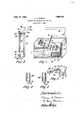
- Figure 1is a partly'dia'grammatic view in perspective, partly in section, of a preferred form of an electroplating apparatus or cell cathode of the electro-plating apparatus shown in Fig. 1;
- FIGs. 4 and 5are enlarged, fragmental views in elevation, of my improved mounting showing the same in different stagesof' completion.
- the electro-plating apparatus 'or' cell shown'in Fig. 1 in whic the diamonds are provided with the final thick deposits of electro-plated metal after the thin coatings of conductive material andelectro-plated metal have been applied theretocomprises a container 1, an anode 2 disposed in the electrolyte or plating bath 3, and a cathode 4 of special construction.
- the cathode 4prefer- I ably consists of arotatable member in the form of a disc 5 secured to a shaft 6 which is disposed just above the plating bath 3 for rotation about a fixed axis inclined somewhat from the vertical.
- a plurality of sup- .ports or holders A for the diamonds 10 to be platedare removably mounted on the disc 5 at the peripheralportion thereof and depend from said disc so that in each rotation of the'latter each of the diamonds and its holder will be immersed in and moved through the plating bath in a path which closely approaches the anode 2 and will then be removed from the bath.
- the plating on the diamondis freed from air ubbles and accordingly such plating is revented from becoming porous.
- the ano e2is preferably disposed in the platin bath 3 adajacent one end of the-tank 1 andpreferably comprises a mass of nickel shot 11 held in a suitable container 12 of heavy canvass or other porous material.
- Reference character 13represents a conductor, preferably of nickel, which extends downwardly in the tank 1 and through and into the container 12 so as to establish contact with the nickel shot 11, this conductor preferably being removed as far as possible from the path of the holders A to thereby prevent the same from being quickly consumed'in the operation of the low the to siderable 'istance above the electrolyte 3, is
- suitable meansat a very slow rate, preferably aboutonce every minute.
- Each of the holders A'consists of a supporting member '18 formed of conducting material, a rod 19 secured to said member at one end and depending therefrom, said rod having alower end portion 20 extending latera y and then upwardly and being provided at its end with a recess or seat 21, and a small. rod or wire 21' mounted on the member 18 for movement towards and from the recess 21.
- the rod 19is preferably formed of non-conductive material such as lass, while the small 'rod or wire 21 is ormed of conductive material, preferably I steel.
- Rod 21'is adjustably mounted for reciprocatory or sliding movement in a vertical V-shaped groove 22 formed on the front end or face of the member 18 and is yieldingl held in adjusted position as by means 0 a spring 23 secured to one end of the member 18 and taking over said rod,
- each of the supports 18is provided with a rearward extension; 26 cut away on its under side to form a shoulder 27, while the rotatable'member or disc 5'is provided on its upper side with a plurality of radially disposed recesses 28 respectively receivin the rtions 26 of the The mwar movement of'the sup Its 18.
- each of the holders Amay be quickly applied tothe disc 5 by engaging the portion 26 thereof in one of the recesses 28 and then ushing the holder inwardly until the shou der 27 abuts the edge of the disc. In so applying the holder t bevelled face 29 en ages beneath the, free end of spring 32 and presses the latter upwardly as the holder is moved inwardly, and
- the spring32then coacts with the shoulas hereinbefore described, are mounted in the supports or holders A as shown.
- the holders and the diamonds thereinare then cleaned to remove all dirt and oxids therefrom by immersing the same for a short.
- each holder Awith the exception of the reduced lower end portion 25 thereof, is then coated with parafin or other suitable insulating material, after which the holders are mounted on the rotatable disc 5 as shown; Thedisc' 5 is then rotated and current is impressed on the electro-plating cell as above described until each of the diamonds is plated with a mass of nickel or other metal of sufficient thickness to provide a holder therefor.
- .Tl'llS holder of electro-deposited nickel or other metalrepresented by reference character 40 (Fig.
- the holders 40are then eac turned down to proper size as indicated at 40' in .Fig. 4, and material is removed or cut away from one end ortion thereof so as to provide the same with a tapered portion 41 from which a portion of the diamond 10 projects.
- the end portion 41 of each holder and the projecting portion of the stylus 10are then ground down to form a conical end portion having a continuous tapered surface 42 formed partly on the holder and partly on the stylus, after which the end of the stylus is rounded as indicated at 10' so as properly to fit the record grooves with which the stylus is designed to be used.
- a mounting for a diamond stylus or the like, roduced as above described,comprises a hol er for the stylus which gri s the same very firmly, bein substantial y. entirely formed of electroeposited nickel or other metal.
- theportion 25 of rod 21' embedded in the holder for the diamondis so' small that as a ractical matter it is negligible.
- a device of the character describedcom rising a stylus or tool member and a ho] or within which the said stylus or tool member issecured, said holder consisting of electro-deposited metal in a state of tenslon, substantially as describedw 2.
- a device of the class describedcomprising a member, and a holder for said member in which thelatter is embedded,
- said holderbeing formed comprising a member, and a holder fo said member in which the latter is embedded, said holder comprising portions formed of electro-deposited metal of different densities, substantially as described.
- a device of the character describedcomprising a member and a holder for said member in which the latter is embedded, said holder being formed of electro-deposited-metal the density of which gradually decreases from the inner portion of the holder outwardly, substantially as described.
- a device of the character describedcomprising a member, and a holder for said member in which the latter is embedded, substantially all of said holder being formed of electro-deposited metal and the portion thereof adjacent said member being of greater density than the outer portion thereof, substantially as described.
- a stylus mountingcomprising a. holder and a stylus partially embedded in saidholder and extending therefrom, substantially all of said holder being formed of electro-deposited metal in a state of tension, substantially as described.
- a stylus mountincomprising a holder, and a'st lus partia ly embedded in the holder and projectin from one end thereof, the. projecting end 0% jacent portion of the holder being formed into a tapered portion having a continuous taper formed partly on the holder and partly on the stylus, substantially all of said holder being formed of electro-deposited metal, substantially as described.
- the method' of producing a mounting for a member formed of diamond or the the stylus and the ad likewhich consists in chemically deposit-v ing a coating in the form of a silver mirror on said member by immersing the same in a solution of ,ammoniacal silver nitrate and then adding formaldehyde to said solution, and then formin a holder for said memher by electroepositing metal thereon, substantially as described.
- a mounting for a member formed of diamond or the likewhich consists in applying a thin coating of conductive material to said member, then .electro-depositing metal on said mem-- her so as to produce a holder in which the member is embedded with one end thereof into aportion having a continuous June 1923. adjacent one end of the holder, and then removing material from the adjacent end 0 portions of the holder and the member so as to produce a surface formed partly on the holder and partly on the member and having a continuous taper, substantially as described.
Landscapes
- Chemical & Material Sciences (AREA)
- Engineering & Computer Science (AREA)
- Chemical Kinetics & Catalysis (AREA)
- Electrochemistry (AREA)
- Materials Engineering (AREA)
- Metallurgy (AREA)
- Organic Chemistry (AREA)
- Polishing Bodies And Polishing Tools (AREA)
- Electroplating Methods And Accessories (AREA)
Description
Sept. 21 ,1926. 1,600,722
T. A. EDISON MOUNTING FOR nnmoxws AND THE LIKE 7 Filed July 6, 1923 UNITED STA-TE THOMAS A. EDISON, OF LLEWELLYN' I E ARK,
FATE
N'r IVQFFHICE."
wnsr ORANGE, NEW JERSEY, n'ss'leNon r THOMAS A. EDISON; INCORPORATED, or was! ORANGE, NEW JERSEY, A Gourm- TION OF NEW JER SEY.
MOUNTING FOR QIAMONDQ THE LIKE.
Application filed July 6,
. directed to mountings for 'phonographic lutely clean. The diamond is then styli formed of diamond or sapphire and in which the stylus is partially enclosed in a metal holder and projects from an end portion thereof, it is to be distinctly understood that my invention, as to many of its features, is also applicable to mountings for diamonds or the like used for other purposes such, for example, as for various types of cutting, grinding and truing tools.
The principal object of my invention is to provide an improved mounting of this character whereby the stylus or point, formed of ,diamond, sapphire or the like, Will be very firmly and rigidly secured in its holder so as to effectually prevent the same from being loosened in use.
My invention also resides in an improved method and in improved apparatus for producing mountings of the character described, such improved apparatus constituting the subject matter of my application Serial No. 129,110, entitled Electro-platingv apparatus and filed on August 14th, 1926,'as a division of the present application.
In producing a mounting, for example, a mounting for a phonograph stylus formed of diamond, in accordance with my invention, I preferably proceed as follows: A
small piece of diamond of the pro ersize and shape for use as a phonograp is first thoroughly cleaned preferably by immersing the same in hot, dilute nitric acid and then washing the same with distilled water until it is free of nitric acid and absopreferablycovered with a. thin film of stannous chloride as by immersing the same in a solution of the latter. When the diamond has been in this solution for about five minutes, it is removed and washed with distilled water. A thin preliminary coating of conductive material, preferably in the form of a silver mirror, is then applied to the diamond, which is preferably done by immersing the latter in a solution of ammoniacal' silver nitrate having definite molecular proportions of ammonia and silver nitrate, and then adding to the solution a suitable reducstylus ing agent until the entire surface of the dia- 1923. Serial No. 849,826.
mond is properly flashed with a coatin of pure metallic silver just sufiicient in thickness to provide a good conductor. Various agents may be employed such, for
reducing example,as cane sugar converted, as for example, by treatment with a suitable acid, into an invert sugar, or dilute formaldehyde, the latter being preferable. The silver coatmond in various ways 0t er than that just described, and may also be applied, by elec trically depositing the While it is not absolutely necessary, where the metallic silver is deposited on the diasame in a vacuum.'
ing may be chemically de osited on the diamond from a solution of ammoniacal silver nitrate as described, to apply a coating of stannous chloride ,to the forming the silver mirror thereon, I find that such'silver'mirror is more easily and effectively produced and that the character of the same is improved when this coating is present. After the diamond has been properly flashedwith the coating of pure metallic silver, that is, after it is covered with a diamond before 1 silver mirror of suiiicient thickness, the same is removed from the solution of ammoniacal silver nitrate and washed clean with dis tilled water, I preferably simultaneously treat alarge number of points or splints of diamond or the like to the steps above described. V
Mountings for the silver coated diamonds are now preferably produced in' situ b electro-depositing metal thereon to a su ficient thickness and then turning down and finishing the holders diamond points embedded therein to the desired 'form. To this end the diamonds are preferably electro-plated first with very thin, protective layers of metal, preferably thus obtained and the nickel, as by placing the same in a nickel' gauze basket constituting the cathode of a e 05, and to form the thin nickel plating cell.
with a nickel anode, la ers of nickel on the diamonds, a current of very low density, preferably 'about' .05 of an ampere is impressed on the cell for a period of about five hours. The thin layers of nickelthus roduced are very hard, tou h, and dense an are very firmly bonded to t e ThlS cell is provided diamonds respectively. As it is unnecessary loo to handle the-diamonds in providing the same with these thin layers or coatings of nickel, the danger of removal of portions of the thin conductive film or mirror of metallic silver from any of the diamonds is minimized. The diamonds are then electro-plated with metal, preferably nickel, to a suf-,
ficient thickness to form holders of the desired size in an electrolating apparatus or cell the cathode of whic comprises a rotary member provided with a plurality of supports or holders of specia construction in which the diamonds are mounted, the arrangement being such that in each rotation of the cathode each of the supports and the diamond carried thereby are immersed in the plating bath during a part of such rotation and are out of the plating bath during the remainder of such rotation. Prior to mount-- ing the diamonds and the respective supports therefor in the electro-plating cell, the same are cleaned the same as catho es in an electro-cleaning cell the bath of which may consist of a solution of sodium sulphate, so as to remove therefrom all grease and oxids which may be present. Upon removing the supports and the diamonds mounted therein from the electro-cleaning cell, the same are preferably washed with distilled: water. The nickel or other metal is preferably deposited on the diamonds in the electro-plating apparatus referred to, in such a manner that it will be less dense than the thin layer of nickel or other metal first deposited thereon.-.
In forming mountings for the diamond styli of Edison phonographs, I preferably plate the diamonds with nickel in this electroplating apparatus for a period of approximately 72 hours, impressing on such appas ratus or cell at the start a current of about .05 of an ampere and then increasing such current at intervals up to'about .5 or .6 of
an ampere. Accordingly, the holder produced by electro-deposited on each diamond will consist of layers of nickel which decrease in density from the innermost layer outwardly.
An important feature of my invention resides in the employment of ametal which when ele-tro-deposited will be in a state of tension such that the holders or mountings produced as described will grip the styli or tool members-embedded therein under pressure. For this reason I prefer to employ nickel, as this metal is electro-de osited in such a high state of tension,that olders or mountings formed thereof will grip or hold the styli or tool members therein under enormous pressure, frequently a pressure of thousands of pounds per square inch. Cobalt may also be used, but the electro-deposition thereof is more difficult to control than is the case with nickel, the same frequently being deposited in such a highstate of ten-' sion that it cracks or bursts. I find that (preferably by immersingstyli and tool members are held better and more firmly when mounted as just described than in any other way.
After the diamonds have been plated with metal to the desired thickness, each of the holders so produced is turned down to size and, one end thereof and the adjacent end of the diamond embedded therein are preferably cut and ground to a tapered portion formed partly on the holder and partly on the diamond and the surface of which has a continuous taper.
In order that my invention may be more clearly understood, attention is directed to the drawing accompanying and forming a part of this specification, and in which,-
Figure 1 is a partly'dia'grammatic view in perspective, partly in section, of a preferred form of an electroplating apparatus or cell cathode of the electro-plating apparatus shown in Fig. 1; and
Figs. 4 and 5 are enlarged, fragmental views in elevation, of my improved mounting showing the same in different stagesof' completion.
The electro-plating apparatus 'or' cell shown'in Fig. 1 in whic the diamonds are provided with the final thick deposits of electro-plated metal after the thin coatings of conductive material andelectro-plated metal have been applied thereto, comprises a container 1, ananode 2 disposed in the electrolyte or platingbath 3, and a cathode 4 of special construction. The cathode 4 prefer- I ably consists of arotatable member in the form of adisc 5 secured to a shaft 6 which is disposed just above theplating bath 3 for rotation about a fixed axis inclined somewhat from the vertical. A plurality of sup- .ports or holders A for thediamonds 10 to be plated are removably mounted on thedisc 5 at the peripheralportion thereof and depend from said disc so that in each rotation of the'latter each of the diamonds and its holder will be immersed in and moved through the plating bath in a path which closely approaches theanode 2 and will then be removed from the bath. During that'portion of each rotation ofdisc 5 in which each diamond being plated is out of the bath, the plating on the diamond is freed from air ubbles and accordingly such plating is revented from becoming porous. The ano e2 is preferably disposed in theplatin bath 3 adajacent one end of the-tank 1 andpreferably comprises a mass ofnickel shot 11 held in asuitable container 12 of heavy canvass or other porous material.Reference character 13 represents a conductor, preferably of nickel, which extends downwardly in the tank 1 and through and into thecontainer 12 so as to establish contact with thenickel shot 11, this conductor preferably being removed as far as possible from the path of the holders A to thereby prevent the same from being quickly consumed'in the operation of the low the to siderable 'istance above theelectrolyte 3, is
cell. In order further to protect theconductor 13 against electrolytic action, that portion thereof extendin from a point justbeof conta1ner 12 and for a conencased in asheath 14 of rubber or other suitable non-insulating material. Current is supplied to the electro-plating ap aratus or cell by means ofconductors 15 an 16 extending from a suitable source (not shown),
and respectively connected to thecontact member 13 and the shaft 6 supportin the rotatable cathode. In the. operation 0 the cell, shaft 6 and cathode 4 are rotated .by
suitable means (not shown) at a very slow rate, preferably aboutonce every minute.
Each of the holders A'consists of a supporting member '18 formed of conducting material, arod 19 secured to said member at one end and depending therefrom, said rod havingalower end portion 20 extending latera y and then upwardly and being provided at its end with a recess orseat 21, and a small. rod or wire 21' mounted on themember 18 for movement towards and from therecess 21. Therod 19 is preferably formed of non-conductive material such as lass, while the small 'rod orwire 21 is ormed of conductive material, preferably I steel. Rod 21' is adjustably mounted for reciprocatory or sliding movement in a vertical V-shapedgroove 22 formed on the front end or face of themember 18 and is yieldingl held in adjusted position as by means 0 aspring 23 secured to one end of themember 18 and taking over said rod,
the spring. being shaped adjacent its free end to conform to therod 21 as indicated at 24. The lower end portion of the rod 21' is reduced as indicated at 25, and is adapted to be engaged with a.diamond 10 when the latter'is seated in therecess 21 at the end ofrod 19, to thereby secure the diamond in the holder. Each of thesupports 18 is provided with a rearward extension; 26 cut away on its under side to form ashoulder 27, while the rotatable'member or disc 5'is provided on its upper side with a plurality of radially disposedrecesses 28 respectively receivin thertions 26 of the The mwar movement of'the sup Its 18. ho dtrs A with respect to thedisc 5 is limited by the engagement of theshoulders 27 onthemembers 18 with the edge of the disc. The upper face of theportion 26 of eachmember 1-8 is bevelled as indicated at 29, ashoulder 30 being formed between the latter and the upper face of the support. Disposed in each of therecesses 28 and secured at one end to thedisc 5 as by means of a screw 31, is aleaf spring 32 provided adjacent its free end with an abrupt downwardly deflected portion 33. With the construction described, each of the holders A may be quickly applied tothedisc 5 by engaging theportion 26 thereof in one of therecesses 28 and then ushing the holder inwardly until the shou der 27 abuts the edge of the disc. In so applying the holder t bevelledface 29 en ages beneath the, free end ofspring 32 and presses the latter upwardly as the holder is moved inwardly, and
upon the holder reaching the limit of its inward movement, the deflected portion 33 ofspring 32 snaps over theshoulder 30 of the holder, as .Wlll be apparent from Fig.
'3. The spring32 then coacts with the shoulas hereinbefore described, are mounted in the supports or holders A as shown. The holders and the diamonds therein are then cleaned to remove all dirt and oxids therefrom by immersing the same for a short.
time as cathodes in an electrolytic cleaning cell, removing them from the cell and then washing the same with distilled water. The conductive rod or wire 21' of each holder A, with the exception of the reducedlower end portion 25 thereof, is then coated with parafin or other suitable insulating material, after which the holders are mounted on therotatable disc 5 as shown; Thedisc' 5 is then rotated and current is impressed on the electro-plating cell as above described until each of the diamonds is plated with a mass of nickel or other metal of sufficient thickness to provide a holder therefor. .Tl'llS holder of electro-deposited nickel or other metal represented by reference character 40 (Fig. 2) is somewhat irregular in shape and because of the coating ofparafiin on rod 21' extends up on the latter only to the top of its-reduced end portion 25.; Boththe re-' duced end portions'25 of rods 21' and the points or splints 10 of diamond or the like will be embedded in theholders 40. 0b viously one end of each of the diamonds will be closely adjacent-one end of the holder in which it is embedded. The rods 21' together with the holders 40'and the diamonds embedded therein are now removed from holder A, each holder then being separated from the correspondingrod 21 by severingvthe latter closely ad acent the to of the holder. Theholders 40 are then eac turned down to proper size as indicated at 40' in .Fig. 4, and material is removed or cut away from one end ortion thereof so as to provide the same with a taperedportion 41 from which a portion of thediamond 10 projects.- Where the mountings to be produced are for phonograph styli, theend portion 41 of each holder and the projecting portion of thestylus 10 are then ground down to form a conical end portion having a continuous taperedsurface 42 formed partly on the holder and partly on the stylus, after which the end of the stylus is rounded as indicated at 10' so as properly to fit the record grooves with which the stylus is designed to be used.
A mounting for a diamond stylus or the like, roduced as above described, comprises a hol er for the stylus which gri s the same very firmly, bein substantial y. entirely formed of electroeposited nickel or other metal. In this connection, it may be noted thattheportion 25 of rod 21' embedded in the holder for the diamond is so' small that as a ractical matter it is negligible.
ile I have described the preferred form of mounting in accordance with my invention, and the preferred method and apparatus for producing the same, it is to be understood that the same are subject to many changes and modifications without departure from the spirit of the invention and the scope of the appended claims.
Having now described my invention, what I claim as new and desire to protect by Letters Patent, is as follows 1. A device of the character described com rising a stylus or tool member and a ho] or within which the said stylus or tool member issecured, said holder consisting of electro-deposited metal in a state of tenslon, substantially asdescribedw 2. A device of the class described comprising a member, and a holder for said member in which thelatter is embedded,
substantially all of said holder being formed comprising a member, and a holder fo said member in which the latter is embedded, said holder comprising portions formed of electro-deposited metal of different densities, substantially as described.
5. A device of the character described, comprising a member and a holder for said member in which the latter is embedded, said holder being formed of electro-deposited-metal the density of which gradually decreases from the inner portion of the holder outwardly, substantially as described.
6. A device of the character described comprising a member, and a holder for said member in which the latter is embedded, substantially all of said holder being formed of electro-deposited metal and the portion thereof adjacent said member being of greater density than the outer portion thereof, substantially as described.
a 7. A stylus mounting comprising a. holder and a stylus partially embedded in saidholder and extending therefrom, substantially all of said holder being formed of electro-deposited metal in a state of tension, substantially as described.
8. A stylus mountin comprising a holder, and a'st lus partia ly embedded in the holder and projectin from one end thereof, the. projecting end 0% jacent portion of the holder being formed into a tapered portion having a continuous taper formed partly on the holder and partly on the stylus, substantially all of said holder being formed of electro-deposited metal, substantially as described.
9. The' method of mounting a stylus or tool member which consists in applying thereto a coating of conductive material and then electro-depositing thereon metal having the property of being. placed in a state of'tension when electro-deposited whereby such metalwill grip said stylus or member under ressure, substantially as described.
10. he method of producing a mounting for a member such as a diamond stylus or the like, which consists in providing said member with a coating in the form of a film of stannous chloride, then chemically depositing a silver mirror on said mem-' her, and then forming a holder for such member by electro-depositing metal thereon, substantially as described.
11. The method of producing a mounting 'for a member formed of diamond or the like, which consists in chemically depositing a coating in the form of a silver mirror on said member by immersing the same in a solution of ammoniacal silver nitrate and then adding a reducing agent to said solution, and then forming a holder for said member by electro-de ositing metal thereon, substantially as ascribed.
12. The method' of producing a mounting for a member formed of diamond or the the stylus and the ad like, which consists in chemically deposit-v ing a coating in the form of a silver mirror on said member by immersing the same in a solution of ,ammoniacal silver nitrate and then adding formaldehyde to said solution, and then formin a holder for said memher by electroepositing metal thereon, substantially as described.
13. The method of producing a mounting for a member formed of diamond or the like, which consists in applying a thin coating of conductive material to said member, and then forming a holder for said member by 'electro-depositing thereon like, which consists in applying a thin coating ofconductive material to said member and then successively electro-de ositing on said member layers of metal of density, substantially as described.
. 16.- The method of producing a mounting for a member formed of diamond or the like, which consists in applying a thin coating of conductive material to said member, then .electro-depositing metal on said mem-- her so as to produce a holder in which the member is embedded with one end thereof into aportion having a continuous June 1923. adjacent one end of the holder, and then removing material from the adjacent end 0 portions of the holder and the member so as to produce a surface formed partly on the holder and partly on the member and having a continuous taper, substantially as described. a
17.. The steps in the method of producing a mounting or a member formed of diamond'or the like, which consists in applying a thin coating of conductive material to said member, then electro-depositing metal on said member so as to produce a holder in which the member isembedded with one end thereof adjacent one end of the holder, and then removing material from an end portion of said holder so as to leave one end portion of said member projecting from the holder, substantially as described.
18. The method of producing a mounting for a member formed of diamond or the like, which consists in applying a thin coating of conductive material to said member,
then electro-depositing metal on said member so as to produce a holder in which the "member is embedded with one end of the holder,
one end adjacent then removin material from the end of said holder ad acent said end of said member so as to leave said decreaslng member projecting a from the holder, and then forming the projecting end of said member and the ad acent end of the holder tapered surface formed partly on the holder and partly on the member, substantially as descnbed. 1 I p This specification signed this 28th day of THOS. A. EDISON.
Priority Applications (2)
| Application Number | Priority Date | Filing Date | Title |
|---|---|---|---|
| US649826AUS1600722A (en) | 1923-07-06 | 1923-07-06 | Mounting for diamonds and the like |
| US129110AUS1836066A (en) | 1923-07-06 | 1926-08-14 | Electroplating apparatus |
Applications Claiming Priority (1)
| Application Number | Priority Date | Filing Date | Title |
|---|---|---|---|
| US649826AUS1600722A (en) | 1923-07-06 | 1923-07-06 | Mounting for diamonds and the like |
Publications (1)
| Publication Number | Publication Date |
|---|---|
| US1600722Atrue US1600722A (en) | 1926-09-21 |
Family
ID=24606371
Family Applications (2)
| Application Number | Title | Priority Date | Filing Date |
|---|---|---|---|
| US649826AExpired - LifetimeUS1600722A (en) | 1923-07-06 | 1923-07-06 | Mounting for diamonds and the like |
| US129110AExpired - LifetimeUS1836066A (en) | 1923-07-06 | 1926-08-14 | Electroplating apparatus |
Family Applications After (1)
| Application Number | Title | Priority Date | Filing Date |
|---|---|---|---|
| US129110AExpired - LifetimeUS1836066A (en) | 1923-07-06 | 1926-08-14 | Electroplating apparatus |
Country Status (1)
| Country | Link |
|---|---|
| US (2) | US1600722A (en) |
Cited By (3)
| Publication number | Priority date | Publication date | Assignee | Title |
|---|---|---|---|---|
| JPS4884744A (en)* | 1972-02-17 | 1973-11-10 | ||
| JPS5028380B1 (en)* | 1969-06-10 | 1975-09-13 | ||
| US4543803A (en)* | 1983-11-30 | 1985-10-01 | Mark Keyasko | Lightweight, rigid, metal product and process for producing same |
Families Citing this family (8)
| Publication number | Priority date | Publication date | Assignee | Title |
|---|---|---|---|---|
| US2654707A (en)* | 1950-08-23 | 1953-10-06 | Reynolds Metals Co | Anodizing rack |
| US2749300A (en)* | 1952-04-15 | 1956-06-05 | Gen Electric | Apparatus for electrolytically cleaning lamp stem lead wires |
| US2749669A (en)* | 1953-03-12 | 1956-06-12 | Mecha Finish Corp | Finishing device |
| US2793994A (en)* | 1953-04-29 | 1957-05-28 | Novitsky Joseph | Plating rack with removable tips |
| US3238115A (en)* | 1965-02-15 | 1966-03-01 | Beckman Instruments Inc | Semiautomatic programmed apparatus |
| US5234562A (en)* | 1988-11-07 | 1993-08-10 | Matsushita Electric Industrial Co., Ltd. | Electroplating apparatus for coating a dielectric resonator |
| US7850830B2 (en)* | 2007-05-11 | 2010-12-14 | Lacks Enterprises, Inc. | Method and apparatus for racking articles for surface treatment |
| EP2189554A1 (en)* | 2008-11-25 | 2010-05-26 | MG Oberflächensysteme GmbH & Co | Carrying device and method of galvanising one or more workpieces |
- 1923
- 1923-07-06USUS649826Apatent/US1600722A/ennot_activeExpired - Lifetime
- 1926
- 1926-08-14USUS129110Apatent/US1836066A/ennot_activeExpired - Lifetime
Cited By (3)
| Publication number | Priority date | Publication date | Assignee | Title |
|---|---|---|---|---|
| JPS5028380B1 (en)* | 1969-06-10 | 1975-09-13 | ||
| JPS4884744A (en)* | 1972-02-17 | 1973-11-10 | ||
| US4543803A (en)* | 1983-11-30 | 1985-10-01 | Mark Keyasko | Lightweight, rigid, metal product and process for producing same |
Also Published As
| Publication number | Publication date |
|---|---|
| US1836066A (en) | 1931-12-15 |
Similar Documents
| Publication | Publication Date | Title |
|---|---|---|
| US2020117A (en) | Cutting, grinding, and burnishing tool and the production thereof | |
| US1600722A (en) | Mounting for diamonds and the like | |
| US2429222A (en) | Method of making contact wires | |
| US2451341A (en) | Electroplating | |
| US3957593A (en) | Method of forming an abrasive tool | |
| US3556957A (en) | Metal treatment | |
| US2390282A (en) | Electrolytic barrel pickling and polishing | |
| US3211634A (en) | Method of producing abrasive surface layers | |
| JP2000087282A (en) | Electroplated blade manufacturing apparatus and manufacturing method | |
| US2135873A (en) | Process of making metal reflectors | |
| US3939046A (en) | Method of electroforming on a metal substrate | |
| US1918627A (en) | Apparatus for producing printing forms | |
| US2575712A (en) | Electroplating | |
| US2155392A (en) | Method of forming printing cylinders | |
| US2766195A (en) | Plated aluminum bearings | |
| GB2320724A (en) | Method for producing metal foil by electroforming | |
| US2457060A (en) | Method for bonding a nickel electrodeposit to a nickel surface | |
| JPH0665779A (en) | Method for electrodepositing metal | |
| Beckmann et al. | RHEED investigations of copper deposition on gold in the underpotential region | |
| US1733608A (en) | Phonograph needle | |
| US2969295A (en) | Chemical gold plating | |
| JPS5811518B2 (en) | Metal-diamond composite plating method | |
| EP0004449B1 (en) | Bonding process for grinding tools | |
| US3284324A (en) | Substrate preparation method | |
| US1978791A (en) | Chromium plating of type |