US12164027B1 - Multi-pathway distance measurements for optical sensors - Google Patents
Multi-pathway distance measurements for optical sensorsDownload PDFInfo
- Publication number
- US12164027B1 US12164027B1US17/020,659US202017020659AUS12164027B1US 12164027 B1US12164027 B1US 12164027B1US 202017020659 AUS202017020659 AUS 202017020659AUS 12164027 B1US12164027 B1US 12164027B1
- Authority
- US
- United States
- Prior art keywords
- light
- electronic device
- distance
- signal strength
- emitter
- Prior art date
- Legal status (The legal status is an assumption and is not a legal conclusion. Google has not performed a legal analysis and makes no representation as to the accuracy of the status listed.)
- Active, expires
Links
- 230000003287optical effectEffects0.000titledescription12
- 238000005259measurementMethods0.000titledescription11
- 238000000034methodMethods0.000claimsabstractdescription37
- 238000000926separation methodMethods0.000claimsdescription80
- 230000006870functionEffects0.000description13
- 230000008859changeEffects0.000description12
- 230000036541healthEffects0.000description11
- 238000004891communicationMethods0.000description10
- 230000000875corresponding effectEffects0.000description10
- 230000007423decreaseEffects0.000description9
- 238000013459approachMethods0.000description8
- 238000001514detection methodMethods0.000description8
- 230000004888barrier functionEffects0.000description7
- 230000007246mechanismEffects0.000description7
- 230000004044responseEffects0.000description6
- 210000000707wristAnatomy0.000description6
- 238000000576coating methodMethods0.000description5
- 238000012790confirmationMethods0.000description5
- 238000012806monitoring deviceMethods0.000description5
- 210000003491skinAnatomy0.000description5
- 239000011248coating agentSubstances0.000description4
- 230000002596correlated effectEffects0.000description4
- 239000013078crystalSubstances0.000description4
- 238000010586diagramMethods0.000description4
- 238000012545processingMethods0.000description4
- 238000010521absorption reactionMethods0.000description3
- 238000005516engineering processMethods0.000description3
- 238000012544monitoring processMethods0.000description3
- 230000000007visual effectEffects0.000description3
- 238000004458analytical methodMethods0.000description2
- 230000008901benefitEffects0.000description2
- 230000001419dependent effectEffects0.000description2
- 230000005670electromagnetic radiationEffects0.000description2
- 239000011521glassSubstances0.000description2
- 239000000463materialSubstances0.000description2
- 238000007620mathematical functionMethods0.000description2
- 238000012986modificationMethods0.000description2
- 230000004048modificationEffects0.000description2
- 229910052594sapphireInorganic materials0.000description2
- 239000010980sapphireSubstances0.000description2
- 208000012641Pigmentation diseaseDiseases0.000description1
- 210000003423ankleAnatomy0.000description1
- 230000005540biological transmissionEffects0.000description1
- 230000001413cellular effectEffects0.000description1
- 239000003086colorantSubstances0.000description1
- 230000023077detection of light stimulusEffects0.000description1
- 238000009792diffusion processMethods0.000description1
- 230000000694effectsEffects0.000description1
- 230000007717exclusionEffects0.000description1
- 210000001061foreheadAnatomy0.000description1
- 230000008571general functionEffects0.000description1
- 210000004209hairAnatomy0.000description1
- 210000003780hair follicleAnatomy0.000description1
- 230000000977initiatory effectEffects0.000description1
- 238000004519manufacturing processMethods0.000description1
- 239000004033plasticSubstances0.000description1
- 239000007787solidSubstances0.000description1
- 230000003595spectral effectEffects0.000description1
- 238000001228spectrumMethods0.000description1
- 239000000126substanceSubstances0.000description1
- 230000007704transitionEffects0.000description1
- 230000001960triggered effectEffects0.000description1
- 238000001429visible spectrumMethods0.000description1
- 230000002618waking effectEffects0.000description1
Images


Classifications
- G—PHYSICS
- G01—MEASURING; TESTING
- G01S—RADIO DIRECTION-FINDING; RADIO NAVIGATION; DETERMINING DISTANCE OR VELOCITY BY USE OF RADIO WAVES; LOCATING OR PRESENCE-DETECTING BY USE OF THE REFLECTION OR RERADIATION OF RADIO WAVES; ANALOGOUS ARRANGEMENTS USING OTHER WAVES
- G01S17/00—Systems using the reflection or reradiation of electromagnetic waves other than radio waves, e.g. lidar systems
- G01S17/02—Systems using the reflection of electromagnetic waves other than radio waves
- G01S17/06—Systems determining position data of a target
- G01S17/08—Systems determining position data of a target for measuring distance only
- G—PHYSICS
- G01—MEASURING; TESTING
- G01S—RADIO DIRECTION-FINDING; RADIO NAVIGATION; DETERMINING DISTANCE OR VELOCITY BY USE OF RADIO WAVES; LOCATING OR PRESENCE-DETECTING BY USE OF THE REFLECTION OR RERADIATION OF RADIO WAVES; ANALOGOUS ARRANGEMENTS USING OTHER WAVES
- G01S7/00—Details of systems according to groups G01S13/00, G01S15/00, G01S17/00
- G01S7/48—Details of systems according to groups G01S13/00, G01S15/00, G01S17/00 of systems according to group G01S17/00
- G01S7/4808—Evaluating distance, position or velocity data
- G—PHYSICS
- G01—MEASURING; TESTING
- G01S—RADIO DIRECTION-FINDING; RADIO NAVIGATION; DETERMINING DISTANCE OR VELOCITY BY USE OF RADIO WAVES; LOCATING OR PRESENCE-DETECTING BY USE OF THE REFLECTION OR RERADIATION OF RADIO WAVES; ANALOGOUS ARRANGEMENTS USING OTHER WAVES
- G01S7/00—Details of systems according to groups G01S13/00, G01S15/00, G01S17/00
- G01S7/48—Details of systems according to groups G01S13/00, G01S15/00, G01S17/00 of systems according to group G01S17/00
- G01S7/483—Details of pulse systems
- G01S7/486—Receivers
- G01S7/4861—Circuits for detection, sampling, integration or read-out
- G01S7/4863—Detector arrays, e.g. charge-transfer gates
Definitions
- the present disclosuregenerally relates to optical distance measuring devices, electronic devices that include such optical distance measuring devices, and methods of their operation.
- Example electronic devicesinclude smart watches, wearable health sensing devices, cell phones, tablet computers, personal digital assistants, and the like. More particularly, wearable devices include electronic devices such as electronic watches, smart watches, smart phones, health monitoring devices, fitness monitoring devices, audio playback devices, and so on.
- Such devicesmay have one or more sensors or sensor systems that detect when an object exterior to the electronic device is within a certain distance.
- a smart phonemay have detectors that can aid in determining that the smart phone is horizontally placed on or near a flat surface, such as a charging mat.
- Other examplesinclude smart watches or wearable health monitors that have sensors to detect that they are positioned on or near a user's body.
- Such devicesmay use detection of proximity of an exterior object to enable or disable one or more functions.
- a smart watch or a wearable health monitormay use proximity detection as part of a determination that it is on a user's body, and then enable or start monitoring, authentication, or sensing operations.
- Such electronic devicesmay include optical or light-based components for estimating distance to, or detecting proximity to, an exterior object.
- an electronic devicecomprising: a housing; a light emitter operable to emit light outward from or through the housing; a first light detector positioned within the housing at a first separation distance from the light emitter; a second light detector positioned within the housing at a second separation distance from the light emitter, the second separation distance different from the first separation distance; and a processor configured to estimate an object distance by: determining a first signal strength of the first light detector; determining a second signal strength of the second light detector; and using the first signal strength and the second signal strength to estimate the object distance; wherein: the object distance is a distance from the electronic device to an object.
- an electronic devicecomprising: a housing; a light emitter operable to emit light outward from or through the housing; a first pair of light detectors positioned on a first side of an axis on which the light emitter lies; a second pair of light detectors positioned on a second side of the axis; and a processor operably connected to the light emitter and the first and second pairs of light detectors; wherein: the processor estimates a first object distance from the electronic device to an object exterior to the electronic device at least partially by determining a ratio of signal strengths of the first pair of light detectors; and the processor estimates a second object distance from the electronic device to the object exterior to the electronic device at least partially by determining a ratio of signal strengths of the second pair of light detectors.
- the present disclosurealso describes a method of operating an electronic device, comprising: estimating that an object exterior to the electronic device is within a critical distance of the electronic device by: emitting, from a light emitter, an emitted light outward from or through a housing of the electronic device; determining a first signal strength produced by a first light detector that varies with a portion of the emitted light reflected from the object and received by the first light detector; determining a second signal strength that varies with another portion of the emitted light reflected from the object and received by the second light detector; determining a ratio of the first signal strength and the second signal strength; determining that the object is within the critical distance when the ratio is less than a critical distance value; and enabling an operation of the electronic device when the object is within the critical distance.
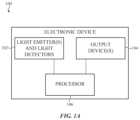
- FIG. 1 Ais a functional block diagram of certain components of a device or system, according to an embodiment.
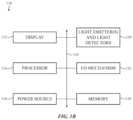
- FIG. 1 Bis an electrical connection block diagram of certain components of an electronic device or system, according to an embodiment.
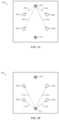
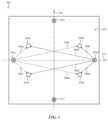
- FIG. 2 Aillustrates a plan view of a housing of an electronic device with light transmitters and light detectors, according to an embodiment.
- FIG. 2 Billustrates a plan view of a housing of an electronic device with light transmitters and light detectors, according to an embodiment.
- FIG. 3illustrates a plan view of a housing of an electronic device with light transmitters and light detectors, according to an embodiment.
- FIG. 4illustrates a perspective view of a housing of an electronic device with light transmitters and light detectors, according to an embodiment.
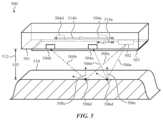
- FIG. 5illustrates a side view of an electronic device in proximity to an exterior object, according to an embodiment.
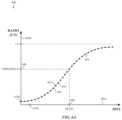
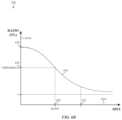
- FIGS. 6 A-Billustrate proximity curves, according to an embodiment.
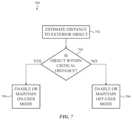
- FIG. 7is a flow chart of a method of operating an electronic device, according to an embodiment.
- FIG. 8is a flow chart of a method of operating an electronic device, according to an embodiment.
- cross-hatching or shading in the accompanying figuresis generally provided to clarify the boundaries between adjacent elements and also to facilitate legibility of the figures. Accordingly, neither the presence nor the absence of cross-hatching or shading conveys or indicates any preference or requirement for particular materials, material properties, element proportions, element dimensions, commonalities of similarly illustrated elements, or any other characteristic, attribute, or property for any element illustrated in the accompanying figures.
- the embodiments described hereinare directed to electronic devices, light or optical distance estimating or measuring components or systems for electronic devices, and methods of operation of such electronic devices or components or systems.
- the electronic devicesare configured to be worn on, or in proximity to, a user.
- wearable electronic devicesinclude a smart watch, a smart phone, a health monitoring device, or another wearable device.
- Such wearable electronic devicesmay benefit from detecting whether they are being worn by a user. Such a detection may be based on an estimated proximity of the electronic device to an exterior object, such as a user's wrist, arm, leg, or other position.
- Even electronic devices not primarily designed to be wornmay benefit from detection of a proximity to an exterior object. Accordingly, embodiments described herein may detect or estimate a distance between an electronic device and an object external to the electronic device.
- distance estimationsare performed by emitting light from an emitter of an electronic device toward an object being sensed, receiving emitted light that has been reflected from the object at a first and a second light detector, and using the signal strength of the light received at the first detector and the signal strength of the light received at the second detector to calculate a ratio of signal strengths. This ratio may then be correlated to a distance between the electronic device and the object.
- the emitteremits light of a certain wavelength and the light detectors detect light of that wavelength.
- Some embodimentsmay employ or incorporate light detectors that are sensitive substantially only to the wavelength(s) emitted by the light emitter(s), while other may incorporate or employ light detectors that sense a wider range of wavelengths.
- the first light detectoris positioned a first separation distance from the emitter and the second light detector is positioned a second separation distance from the emitter.
- the first separation distancemay be shorter than the second separation distance, such that light travels further from the emitter, to the object, and to the second light detector than light traveling from the emitter, to the object, and to the first light detector.
- the first light detectormay be referred to herein as a “short length” light detector while the second light detector is referred to as a “long length” light detector.
- the routing of the light from the emitter to a light detectormay be referred to as a “light path.”
- a light detectorthere are two separate distances that affect an amount of light from an emitter that is received by a light detector.
- Firstis the separation distance between the emitter and the detector, as discussed above. The further the detector is physically located from the emitter, the less light the detector receives from the emitter. Given a fixed distance between an electronic device and an object being sensed, a short length light detector will almost always receive more light from an emitter than will a long length light detector. Thus, presuming the electronic device is not tilted or offset from the object being sensed, a signal strength at the short length light detector will almost always exceed a signal strength at the long length light detector at any given moment.
- More emitted lightis typically received at the short length light detector than at the long length light detector, insofar as less light is lost to scattering, diffusion, absorption, and the like. It may be appreciated that a signal strength of the light received at the short length detector is greater than a signal strength of light received at the long length detector as a result. Likewise, the signal strength of a signal generated by the short length detector is correspondingly greater than the signal strength of a signal generated by the long length detector.
- the second distance that affects the amount of light from an emitter that is received by a light detectoris the distance between the electronic device and the object reflecting light from the emitter (e.g., the object being sensed). This may be referred to as the “object distance.” As the object distance increases, less light is received by a light detector since the light path increases. That is, light emitted by the emitter travels further to impinge on the object, as well as further to return to the detector. Longer light paths mean more light is scattered away from the detector. Thus, as the object distance increases, the signal strength for a detector usually decreases.
- the electronic devicemay generate a ratio of the long length detector's signal strength to the short length detector's signal strength. As the object distance increases, this ratio approaches one. Likewise, as the object distance decreases, this ratio approaches zero. Put another way, the further the emitter/electronic device is from the object, the closer the signal strength of both light detectors becomes as the light paths to each detector near the same value. Likewise, as the emitter (and thus the electronic device) approaches the object, the object distance decreases and relative differences in the short and long light paths become greater.
- the electronic devicemay use the ratio of signal strengths to estimate distance. Further, a ratio of the two signal strengths is used because the ratio is dimensionless and so is not dependent on any particular quality of the object reflecting light. Thus, embodiments described herein may accurately measure or estimate a distance to two objects that have different light absorptive, diffusive, and/or scattering properties with the same degree of accuracy.
- Certain embodiments described hereinmay use multiple pairs of light detectors to determine an object distance.
- a light emitterpositioned in or on a housing, including on a surface of the electronic device's housing, emits light outward from the electronic device. If the exterior object is near or proximate to the electronic device, such as within a certain range of object distances, the emitted light may reflect from the object both to a first pair of light detectors and to a second pair of light detectors.
- the first and second pairs of light detectorsare positioned at different separation distances from the emitter, and thus have different light paths.
- the electronic devicemay measure signal strengths of the light received at each of the pairs of detectors and generate a ratio of the signal strength of the first pair of light detectors to the signal strength of the second pair of detectors.
- This ratio of signal strengthsmay be correlated with a distance of the exterior object from the electronic device, for example by relating the ratio to a proximity curve that correlates the ratio to a distance, or may otherwise be correlated to a distance.
- the signal strengths at or generated by each detector in the pair(s) of detectorsis used to estimate distance to an object, the estimated object distance does not change as the reflective, absorptive, or scattering properties of the object change.
- Additional and/or alternative embodimentsmay use more than two light detectors, more than two pairs of light detectors, and/or more than one light emitter.
- an electronic device using such object distance detection or measuring embodimentsmay alter an operational state based on the detections or measurements.
- a tilt, skew, offset, or other alignment of an electronic devicemay be determined by comparing signal strength ratios of multiple sets of light detectors, such as multiple pairs of light detectors. Since the detectors are generally coplanar and closer light detectors have higher signal strengths (as they receive more light reflected from an object), the relative signal strengths of the pairs of light detectors indicate the orientation of the electronic device's housing relative to the object.
- inventionsdiscuss the use of signal strength ratios, it should be appreciated that other constructs may be employed in lieu of a ratio or signal strength. Certain embodiments may employ any suitable value, measurement, or characteristic of a signal (including frequency, wavelength, phase, and so on) in a distance estimation. Likewise, any suitable construct may be derived from such signal characteristics and used to estimate distance.
- a “construct”is a value derived by applying a mathematical function to one or more signal characteristics of one or more signals. Thus, a signal strength (e.g., amplitude) is a signal characteristic, while a ratio of signal strengths is a construct.
- constructsmay include derivatives, integrals, rates, proportions, summations, squares, roots, or powers of other constructs, “constructs of constructs” (e.g., a derivative of a ratio) and so on.
- a “signal strength ratio,” as used herein,may refer to a ratio of signal strengths that are measured or calculated at a single point in time, measured or calculated from an averaged or weighted set of signal strengths measured across a time period, or some particular measurement of signal strength (such as maximum signal strength, minimum signal strength, average signal strength, highest confidence signal strength, and so on).
- FIGS. 1 A- 8These and other embodiments are discussed below with reference to FIGS. 1 A- 8 .
- those skilled in the artwill readily appreciate that the detailed description given herein with respect to these Figures is for explanatory purposes only and should not be construed as limiting.
- Other examples and implementationsare within the scope and spirit of the disclosure and appended claims.
- features implementing functionsmay also be physically located at various positions, including being distributed such that portions of functions are implemented at different physical locations.
- FIG. 1 Ashows a functional block diagram of an electronic device (or device) 100 .
- the device 100may be a wearable device, such as an electronic watch, smart watch, smart phone, health monitoring device, fitness monitoring device, or audio playback device that is wearable on a wrist of a user.
- the device 100may also or alternatively be wearable on an ankle, arm, forehead, waist, or other body part, or may be positionable or attachable to another device (e.g., a seat cushion or bed).
- the device 100may include one or more input devices 102 , one or more output devices 104 , and a processor 106 .
- a “processor,” such as the processor 106may refer to any of a singular processor, a set of multiple processors, a microprocessor or microcontroller, a field programmable gate array, and/or another type of processor in combination with supporting circuitry.
- the input device(s) 102may detect various types of user input or sense various types of parameters, and the output device(s) 106 may provide various types of outputs.
- user input and/or parameters that are sensed by the input device(s) 102may be used to control one or more settings, functions, or other aspects of the device 100 , or may be provided to a remote device.
- Particular examples of input devices 102include light emitters and light detectors as discussed in the embodiments described below.
- one or more of the output devices 104may be configured to provide output that is dependent on, or manipulated in response to, the user input and/or parameters sensed by one or more of the input devices 102 .
- the outputs provided by one or more of the output devices 104may also be responsive to, or initiated by, a program or application that is executed by the processor 106 and/or an associated companion device.
- the output devices 104may include any suitable components for generating or communicating outputs. Examples of output devices 104 include audio output devices (e.g., speakers), visual output devices (e.g., lights, displays, or other electromagnetic radiation emitters), tactile output devices (e.g., haptic output devices), communication devices (e.g., wired or wireless communication devices), and so on, or some combination thereof. Each output device 104 may be configured to receive signals, data, or instructions from the processor 106 and/or one or more of the input devices 102 , and to provide one or more outputs dictated by the signals, data, or instructions.
- audio output devicese.g., speakers
- visual output devicese.g., lights, displays, or other electromagnetic radiation emitters
- tactile output devicese.g., haptic output devices
- communication devicese.g., wired or wireless communication devices
- the processor 106may be operably coupled to the input devices 102 and the output devices 104 .
- the processor 106may receive inputs (e.g., signals, statuses, and/or measurements) directly or indirectly from the input device(s) 102 , in response to user input and/or parameters sensed by the input device(s) 102 .
- the processor 106may interpret the inputs.
- the processor 106may maintain or alter one or more settings, functions, or aspects of the device 100 and, in some cases, the processor 106 may provide signals, data, or instructions to one or more of the output devices 104 .
- the processor 106may provide signals, data, or instructions to one or more of the output devices 104 independently of any input received from an input device 102 .
- a signal, data, or instruction provided to an output device 104may cause the output device 104 to generate one or more outputs (e.g., an audio output, a visual output, a tactile output, one or more signals or instructions, and so on). Examples of suitable processors are discussed in more detail below with reference to FIG. 1 B .
- FIG. 1 Bshows an example electrical block diagram of an electronic device 110 , such as electrical device 100 and the electronic devices described in the embodiments below.
- the electronic device 110may include an electronic display 112 (e.g., a light-emitting display), a processor 114 , a power source 116 , a memory 118 or storage device, a subsystem 120 of light emitters and light detectors, or an input/output (I/O) mechanism 122 (e.g., an input/output device, input/output port, or haptic input/output interface).
- the processor 114may control some or all of the operations of the electronic device 110 .
- the processor 114may communicate, either directly or indirectly, with some or all of the other components of the electronic device 110 .
- a system bus or other communication mechanism 124can provide communication between the electronic display 112 , the processor 114 , the power source 116 , the memory 118 , the subsystem 120 of light emitters and light detectors, and the I/O mechanism 122 .
- the processor 114may be implemented as any electronic device capable of processing, receiving, or transmitting data or instructions, whether such data or instructions are in the form of software or firmware or otherwise encoded.
- the processor 114may include a microprocessor, a central processing unit (CPU), an application-specific integrated circuit (ASIC), a digital signal processor (DSP), a controller, or a combination of such devices.
- the term “processor”is meant to encompass a single processor or processing unit, multiple processors, multiple processing units, or other suitably configured computing element or elements. It should be noted that the components of the electronic device 110 can be controlled by multiple processors.
- select components of the electronic device 110may be controlled by a first processor and other components of the electronic device 110 (e.g., the electronic display 112 ) may be controlled by a second processor, where the first and second processors may or may not be in communication with each other.
- the power source 116can be implemented with any device capable of providing energy to the electronic device 110 .
- the power source 116may include one or more batteries or rechargeable batteries.
- the power source 116may include a power connector or power cord that connects the electronic device 110 to another power source, such as a wall outlet.
- the memory 118may store electronic data that can be used by the electronic device 110 .
- the memory 118may store electrical data or content such as, for example, audio and video files, documents and applications, device settings and user preferences, timing signals, control signals, and data structures or databases.
- the memory 118may include any type of memory.
- the memory 118may include random access memory, read-only memory, flash memory, removable memory, other types of storage elements, or combinations of such memory types.
- the electronic device 110may also include a subsystem 120 of light emitters and light detectors, potentially positioned almost anywhere on the electronic device 110 .
- the subsystem 120may include one or more electromagnetic radiation emitters and detectors, positioned and/or configured as described with reference to any of FIGS. 2 A- 8 .
- the I/O mechanism 122may transmit or receive data from a user or another electronic device.
- the I/O mechanism 122may include the electronic display 112 , a touch sensing input mechanism (such as a touch-sensitive display, button, or portion of a housing), a crown, one or more buttons (e.g., a graphical user interface “home” button), one or more cameras (including an under-display camera), one or more microphones or speakers, one or more ports, such as a microphone port, and/or a keyboard, all of which are optional. Additionally or alternatively, the I/O mechanism 122 may transmit electronic signals via a communications interface, such as a wireless, wired, and/or optical communications interface. Examples of wireless and wired communications interfaces include, but are not limited to, cellular and Wi-Fi communications interfaces.
- FIG. 2 Ashows a plan view of a housing 201 of an electronic device 200 .
- the housing 201may be define an exterior (including a back side) of a smart watch, a wearable health monitor that attaches to a user, a smart phone, or another electronic device.
- the back side of the electronic device 200is shown in the plan view as a rectangle, but other shapes are possible.
- the electronic device 200includes various optical and other components that it may use to determine proximity of an exterior object or estimate the object distance.
- the electronic device 200includes a first light emitter 202 .
- the light emitter 202may be a light emitting diode, a laser diode, or another component able to emit light.
- the light emitter 202may be an infrared laser diode, though this is not required in the embodiments.
- the wavelength or spectral range of the light emitted by the first light emitter 202may be fixed or variable, such as depending on a received input or control signal.
- the light emitter 202may be able to emit light, which may be triggered by received input or control signals, such as from the processor 106 , and may be emitted sequentially, and may have a variable duration and duty cycle.
- the light emittermay be positioned at, in, or proximate to the housing 201 so as to emit light in a certain direction outward from the electronic device 200 .
- the light emitter 202may be a laser emitter, and may be mounted in a movable fixture, such as a piezoelectric or piezo-resistive fixture, that allows the emitted laser light to be steered.
- the light emittersmay be positioned within the housing 201 or beneath a cover attached to, or forming part of, the housing.
- This covermay be formed from glass, sapphire, plastic, crystal, or the like.
- Either or both of the housing or such an elementmay be optically transparent in a visible spectrum, or may be partly transparent at infrared, ultraviolet, and/or other wavelengths while being visibly opaque.
- the housing or cover(or other suitable element) may be optically and/or infrared transparent but covered with an optical and/or infrared barrier, such as a coating or ink. This barrier may define one or more windows through which light may enter or exit the housing 201 or cover.
- the barriermay define a window over one or more emitters as discussed herein, thus permitting light to exit the emitter and the device 400 .
- the windowmay be fully defined by the barrier or may be defined by cooperation between the barrier and the housing of cover on which the barrier is deposited (e.g., the housing or cover may be thinned, raised, stepped, or otherwise configured to facilitate light transmission therethrough or provide a demarcation for the barrier), although this is not necessary.
- FIG. 2 Ait should be appreciated that it is equally applicable to all embodiments discussed herein, specifically including those of FIGS. 2 B- 5 .
- the electronic device 200also includes two pairs of light detectors: the first pair 204 a and 204 b , and the second pair 208 a and 208 b .
- Each of the four light detectors 204 a , 204 b , 208 a , and 208 bmay be implemented using known photon or light detection technologies, such as CMOS photodetectors, photodiodes, or another technology.
- the four light detectors 204 a , 204 b , 208 a , and 208 bmay be implemented with different technologies.
- the four light detectors 204 a , 204 b , 208 a , and 208 bmay be positioned proximate to the housing 201 , such as by being coplanar with the housing 201 of the electronic device 200 , or may be positioned within the housing 201 .
- a glass, sapphire, or crystal cover or elementmay define a portion of, or may be affixed to or over, the housing 201 .
- the four light detectors 204 a , 204 b , 208 a , and 208 bmay detect light having a specific wavelength or within a specific wavelength range, and may generate a signal having a signal strength that varies with an amount of light that is emitted by the emitter and detected or received by the light detector. Put another way, the signal strength may increase as more emitted light is received by a light detector 204 a , 204 b , 208 a , 208 b and decrease as less emitted light is received by a light detector.
- One or more of the four light detectors 204 a , 204 b , 208 a , and 208 bmay be positioned so as to preferentially detect light entering from within a limited solid angle, such as light entering from the direction of the light emitter 202 .
- the light detectorsreceive light through the housing 201 , a back cover, or the like. Further, although the light detectors are visible in FIGS. 2 A- 2 B , they may be hidden from view not only by the housing or cover, but also by an ink or coating that is visually opaque but passes light in the wavelengths emitted by the light emitters 202 .
- Signals(such as voltage or current signals) produced by any of the four light detectors 204 a , 204 b , 208 a , and 208 b in response to detection of light, and their relative signal strengths, may be received and processed by control electronics within the electronic device 200 , such as the processor 106 .
- the signal strengths used to determine a ratio, and thus a distance to an objectmay be either a signal strength of light received by a light detector or a signal strength of a signal generated by a light detector in response to receiving light.
- constructs other than ratiosmay be used.
- One or more of the four light detectors 204 a , 204 b , 208 a , and 208 bmay have filters at, or in the housing 201 to remove or reduce impinging light outside the wavelength range of light emitted by the light emitter 202 .
- filtersmay be in addition to the coating described above, or the coating may function as such a filter.
- the first pair of light detectors 204 a and 204 bare positioned in or on the housing 201 at different respective separation distances 206 a and 206 b from the light emitter 202 .
- the separation distance 206 ais less than the separation distance 206 b (e.g., the separation distance 206 is a short length and the separation distance 206 b is a long length).
- the first pair of light detectors 204 a and 204 bneed not be collinear with the light emitter 202 , though they may be.
- the second pair of light detectors 208 a and 208 bare positioned in or on the housing 201 at different respective separation distances 210 a and 210 b from the light emitter 202 .
- the separation distance 210 ais a short length while the separation distance 210 b is a long length.
- the second pair of light detectors 208 a and 208 bneed not be collinear with the light emitter 202 , though they may be.
- the separation distance 206 ais equal (or nearly equal) to the separation distance 210 a
- the separation distance 206 bis equal (or nearly equal) to the separation distance 210 b , but this is not required.
- a detector or emitteris described as “in or on the housing,” it should be appreciated this encompasses such detectors or emitters being in or on an element attached to the housing, such as a cover or crystal, as well.
- the electronic device 200may include a second light emitter 212 positioned on or proximate to the housing 201 .
- the second light emitter 212may emit light having the same, a similar, or a different wavelength or wavelength spectrum than that of the light emitted by the first light emitter 202 .
- the first and second light emittersmay emit light at different times, such that the light detectors 204 a , 204 b , 208 a , 208 b receive light from only one emitter at any given time; in embodiments where the first and second light emitters emit light having the same wavelength(s), such time multiplexing may be employed to ensure that light detectors receive light from only one emitter at any given instant (although this is not necessary).
- the first and second emittersmay emit light having different wavelengths simultaneously, and the light detectors may be configured to detect both wavelengths separately (or some detectors may detect light from the first emitter and some may detect light from the second emitter).
- the light emitter 202 and light emitter 212lie on an axis (vertical in the orientation shown in FIG. 2 A ).
- the first pair of light detectors 204 a , 204 bare on a first side (left) of the axis, with the second pair of light detectors 208 a , 208 b on the opposite side (right) of the axis.
- the embodimentmay compare signal strength ratios (or other constructs) between pairs of detectors. That is, the signal strength ratio of each signal generated by a first pair of light detectors 204 a , 204 b may be compared against the signal strength ratio of each signal generated by a second pair of light detectors 208 a , 208 b.
- separation distances 206 a , 206 b , 210 a , 210 bincrease, the corresponding path length increases, light impinging on a light detector 204 a , 204 b , 208 a , 208 b decreases and so the signal strength of a light detector will decrease.
- the detectorreceives more of the emitted light and so signal strength increases. Accordingly, short separation distances (and short path lengths) yield higher signal strength from a light detector while long separation distances (and long path lengths) yield lower signal strength from the light detector.
- the signal strength ratio of one of the pairs of detectorswill be less than the signal strength ratio of the other of the pair of detectors.
- the pair of detectors nearest an objectwill have the highest signal strength ratio, as the light travels a short distance both from the emitter to the object and when reflected from the object to the light detectors closest to the object.
- the electronic devicemay determine which pair of light detectors 204 a , 204 b , or 208 a , 208 b is closest to the object.
- each pair of detectorsis defined by its location on one side or another of an axis passing through the emitter (e.g., on which the emitter lies).
- the signal strength rationeed not be a ratio of signal strengths measured at an instantaneous point in time. Rather, the ratio may be derived from signal strengths that are measured or calculated at a single point in time, measured or calculated from an averaged or weighted set of signal strengths measured across a period, or some particular measurement of signal strength (such as maximum signal strength, minimum signal strength, average signal strength, highest confidence signal strength, and so on).
- FIG. 2 Bshows a plan view similar to that of FIG. 2 A for the electronic device 200 .
- the two respective separation distances 214 a and 214 bfrom a second light emitter 212 to the first pair of light detectors 204 a and 204 b .
- the separation distance 214 ais greater than the distance 214 b .
- FIG. 2 Bshows the two respective separation distances 216 a and 216 b from the light emitter 212 to the second pair of light detectors 208 a and 208 b .
- the separation distance 216 ais greater than the separation distance 216 b.
- the separation distance 214 amay be equal to the separation distance 206 b (e.g., both are short lengths), the separation distance 214 b may equal the separation distance 206 a (e.g., both are long lengths), the separation distance 216 a may equal the separation distance 210 b (again, both are long lengths), and the separation distance 216 b may equal the separation distance 210 a (again, both are short lengths).
- “equal”will mean equal to within a numerical tolerance appropriate for the scale of the embodiment. However, these equalities are not required: they may not be implemented in other embodiments.
- Signal strength ratiosmay be calculated for each of the light detector pairs 204 a , 204 b and 208 a , 208 b with respect to light emitted by the second light emitter 212 .
- the electronic device 200may determine which light emitter 202 , 212 is closer to an object reflecting light. Accordingly, an embodiment may determine tilt of the electronic device, with respect to the object, about two axes.
- FIGS. 2 A-Bhave two light emitters 202 and 212
- other embodimentsmay use a single light emitter on the housing 201 of the electronic device 200 .
- Such single light emitter embodimentsmay use a single pair of light detectors, or two or more pairs of light detectors.
- the methods of operation of such alternative embodimentsare related to the methods of operation discussed below, and will be apparent to one skilled in the art.
- FIG. 3shows a plan view of a surface of housing 301 of an electronic device 300 .
- the surfacemay be a backside of a smart watch, a wearable health monitor that attaches to a user, a smart phone, or another electronic device.
- the backside of the electronic device 300is shown in the plan view as a rectangle, but other shapes are possible.
- the electronic device 300includes various optical and other components that it may use to determine proximity of an exterior object or estimate an object distance separating the exterior object from the electronic device.
- the electronic device 300may be the same as, or a variation of, the electronic device 200 described in relation to FIGS. 2 A-B
- the electronic device 300includes a first pair of light emitters 202 , 212 such as described in relation to FIGS. 2 A-B . As shown, the first pair of light emitters 202 , 212 are positioned oppositely along an axis 302 .
- the electronic device 300also includes a first pair of light detectors 204 a , 204 b such as described in relation to FIGS. 2 A-B , and a second pair of light detectors 208 a , 208 b , such as described in relation to FIGS. 2 A-B .
- the first pair of light detectors 204 a , 204 bis positioned on a first side of the axis 302
- the second pair of light detectors 208 a , 208 bis positioned on a second side of the axis 302
- other embodimentsmay use other configurations.
- the first pair of light detectors 204 a , 204 bis positioned along a line segment approximately parallel to the axis 302
- the second pair of light detectors 208 a , 208 bis positioned along another line segment approximately parallel to the axis 302 .
- thisis not required, and other embodiments may use different positioning configurations for the first and second pairs of light detectors.
- the electronic device 300also includes a third light emitter 304 a and a fourth light emitter 304 b positioned oppositely along a second axis 310 .
- the second axis 310is horizontal and intersects the first, vertical axis 302 approximately perpendicularly. However, in other configurations the second axis 310 may intersect the first axis 302 at an angle different from a right angle.
- the second axis 310approximately bisects each of the first and second light emitter pairs, so that the light detectors 204 a and 208 a are on a first (top) side of the axis 310 , and the light detectors 204 b and 208 b are on the opposite side of the second axis 310 .
- this configurationis not required.
- the light emitter 304 ahas separation distance 306 a to the light detector 204 a , and separation distance 306 b to the light detector 208 a , which is greater than the separation distance 306 a .
- the light emitter 304 aalso has separation distance 306 c to the light detector 204 b , and separation distance 306 d to the light detector 208 b , which is greater than the separation distance 306 c .
- the separation distances between emitters and detectorsare shown rather than the corresponding light paths. Light paths between emitters and detectors will in actuality be angled paths that reflect off an object to be sensed by the device 300 . This is shown, for example, in FIG. 5 .
- the light emitter 304 bhas separation distance 308 a to the light detector 208 a , and separation distance 308 b to the light detector 204 a , which is greater than the separation distance 308 a .
- the light emitter 304 balso has separation distance 308 c to the light detector 208 b , and separation distance 308 d to the light detector 204 b , which is greater than the separation distance 308 a.
- the operation of the emitters 304 a , 304 b and light detectors 204 a , 204 b , 208 a , 208 bis generally the same as described above with respect to FIGS. 2 A- 2 B , and signal strength ratios for pairs of light emitters may be calculated in a similar fashion.
- light detectors 204 a , 208 amay form a first pair while light detectors 204 b , 208 b form a second pair. This may permit the electronic device to determine and object distance, as well as tilt with respect to an object and about a second axis 310 .
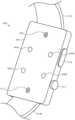
- FIG. 4shows a perspective view of an exemplary electronic device 400 that incorporates the object distance measuring components described above (e.g., emitters and light detectors).
- the electronic device 400is a smart watch, with the object distance measuring components emitting and receiving light through a backside of a housing 401 .
- the backside of the housing 401may be defined by a cover that is attached to, and cooperates with, a shell or other element forming a portion of the backside and/or the sidewalls and/or at least a portion of a front of the housing.
- the smart watch 400may be worn by a user, such as on a wrist, by using a watch band, whose ends 414 a , 414 b are shown attached to opposite edges of the smart watch 400 .
- the smart watch 400may include one or more input or selection devices, such as a crown 411 or a button 410 .
- the backside surface 401When worn, the backside surface 401 may be positioned next to, and oriented toward, a user's wrist or arm.
- the object distance measuring components and their methods of operationmay allow the smart watch 400 to change operational states or modes depending on a determined or estimated proximity of the smart watch 400 to the user's wrist or arm.
- An “operational state,” as used herein,may be an on-user mode, off-user mode, a power-on mode, a power-off mode, a mode in which full functionality of the electronic device is accessible, a mode in which limited or no functionality of the device is accessible, and so on. Certain example operational states are discussed more herein.
- the electronic device 400includes the configuration of components described in relation to FIGS. 2 A-B . More specifically, the electronic device 400 includes a first light emitter 402 and a second light emitter 412 defining an axis across the backside of the housing 401 . A first pair of light detectors 404 a , 404 b is positioned on a first side of the axis, and a second pair of light detectors 408 a , 408 b is positioned on an opposite side of the axis.
- the electronic device 400may alternatively include the configuration of components described in relation to FIG. 3 , or may include a single light emitter and a single pair (or more) of light detectors.
- two light emittersare positioned as in FIG. 2 A .
- a single pair of light detectorsis positioned between the two light emitters along an axis on which the two light emitters lie.
- two light emittersare positioned adjacent to each other at one end of the electronic device.
- light emittersmay be positioned at one end of the back side surface of the housing, such that each is on an opposite side of a central axis (similar to an axis intersecting emitters 402 , 412 of FIG. 4 ).
- a single pair of light detectorsmay be positioned on the central axis.
- Each light emittermay emit its respective light at a non-right angle with respect to the central axis.
- any of the various configurations of light emitters and light detectors discussed abovemay be operated by the respective electronic device to determine if an exterior object is near or proximate to the electronic device, and/or to determine or estimate an object distance between the electronic device and the object.
- the determinations or estimations of object distancesare made by emitting light from at least one light emitter, and receiving respective reflections from the object at one (or more) pairs of light detectors.
- an object distancemay be estimated.
- the path lengths traveled by light from the emitter to a respective light detectorwill be different and different amounts of light will be received by each of the light detectors, and different signal strengths will result.
- one of the light detectorswill be a “short length” light detector as light travels a relatively short distance from the emitter, to the object, and back to this light detectors.
- a second light detectorwill be a “long length” detector as light travels a relatively long distance from the light emitter, to the object, and back to this second light detector.
- a ratio of signal strengthsmay then be related to a proximity curve.
- a proximity curveprovides a relation from a value of the ratio to a value of an object distance, e.g., a distance between the electronic device and the exterior object. Such a proximity curve may be obtained either experimentally, or by geometric considerations. Further, a proximity curve may be implemented as a list of respective values of ratios and object distances, which may be implemented in the electronic device as a look-up table, with interpolation used for ratio values not in a list or table. In some embodiments, the proximity curve may include a critical distance value, which equates to a critical distance. The critical distance is the distance at which an electronic object may alter operations, states, functionality, power modes, or the like, as described herein.
- the electronic devicewhen the electronic device is closer to the object than a critical distance, the electronic device may be in an “on-user” mode while the electronic device assumes an “off-user” mode when the distance between it and the object meets or exceeds the critical distance.
- On-user and off-user modesare described in more detail herein; generally (although not necessarily), full functionality of an electronic device is accessible to a user when the device is in the on-user state while limited or no functionality is accessible to the user when the device is in an off-user state.
- the proximity curvemay be implemented as a function or algorithm, such as may be executed by a processor. Such a function may be obtained by a fit to a finite number of experimentally determined data points, or by geometric considerations.
- An operational state of the electronic devicemay then be adjusted depending on whether the exterior object is within the critical distance. For example, if the electronic device is operating under the assumption that it is away from or not on a user (e.g., not detecting heart beats, or locked from receiving user entries), and the object distance is then determined to be within the critical distance, the electronic device may initiate on-user operations (e.g., monitoring heart beasts, or initiating a logon operation).
- the electronic devicemay maintain off-user status and respective operations. Analogous “maintain or change” operational decisions may occur if the electronic device is under the assumption that it is on a user or near the object.
- the electronic devicemay perform a confirmation operation. For example, an initial determination made that the object is within the critical distance may be based on a ratio obtained from a first pair of light detectors. To verify this determination, the electronic device may use a ratio obtained from a second pair of light detectors, which may receive light from a second light emitter different from the light emitter used in the initial determination. The electronic device may enable (e.g., turn on) the second light emitter as part of the confirmation operation. Such a confirmation operation may be used in cases when the initial determination would cause the electronic device to alter its operational state.
- the electronic devicemay confirm that initial distance determination using a second ratio based on the signal strengths of a second pair of light detectors, which also may be based on light from a second light emitter.
- the electronic devicemay form a second ratio using the initially used pair of light detectors but based on second signal strengths obtained from another light emitter, either from the initially used light emitter or from a second light emitter.
- the electronic devicemay perform initial operations, such as calibration, with the light emitter(s) and light detectors.
- One calibration operationmay use a measured scale factor for each optical path; e.g., at manufacture or periodically by a user, a calibration operation detects light from a standard reflective surface, and adjusts one or more scale factors for the signal strengths from the light detectors.
- one or more signal strengthsmay be too low or too high to be considered reliable.
- little emitted light from one or more light emittersmay not be received at the respective light detectors, such as due to complete absorption or surface irregularities of the exterior object, producing a too-low signal strength.
- ambient light or another source of lightmay make one or more signal strengths noisy or close to or within a noise level.
- a localized highly reflective area on the exterior objectmay cause the signal strength of the farther light to exceed that of the nearer light detector.
- the electronic devicemay determine that a ratio would not be reliable. The electronic device may then discard the ratio from use in determining whether the exterior object is within a critical distance. The electronic device may instead use a ratio of signal strengths from another pair of light detectors induced by light from another light emitter. Alternately, the electronic device may cause further emissions of light until a valid ratio is found.
- Some embodimentsmay use more than one light emitter.
- two light emittersmay be positioned on or in the housing, as described above, and along an axis, with two pairs of light detectors configured as shown in FIG. 2 A .
- the two light emittersmay alternate to emit respective light.
- the respective light emittermay make its own determination or estimation of the object distance based on one or more signal strengths or ratios of signal strengths, as described herein.
- the two object distance estimatesmay be averaged, such as to reduce noise effects, or one may be discarded as an unreliable value (outside of an expected range).
- a single detectormay receive light from each of the emitters at separate times; insofar as the signals received by the single light detector will vary, these signals may be used to determine a ratio and then estimate a distance to an object in a manner similar to that described herein with respect to embodiments having one emitter and multiple detectors.
- multiple light emittersmay emit an alternating sequence of light (or may receive another triggering pattern for emissions from a processor), and for each light form a sequence of respective estimates of the object distance.
- This sequence of respective estimates of the object distancemay be time-averaged (possibly with weights) to reduce the chance of spurious state changes.
- the light emitter(s)may emit a sequence of light pulses, with corresponding duty cycles.
- the light detectorsmay be enabled for reception only during each pulse emission period, or section thereof, to detect the pulse's reflections.
- the strengths of the light detectors' corresponding signalsmay be time-averaged to reduce false state change operations.
- a first light emittermay emit light directed to a first pair of light detectors whose two light detectors are at two different separation distances from that first light emitter (e.g., in FIG. 2 A light emitter 202 is used with just light detectors 208 a and 208 b ). A ratio of the signal strengths from just that pair of light detectors is used to obtain a first estimate of the object distance. Then, a second light emitter may emit another light directed to a second pair of light detectors whose two light detectors are also at two different separation distances from that second light emitter (e.g., in FIG.
- light emitter 212is used with just light detectors 204 a and 204 b ).
- a ratio of the signal strengths from just that second pair of light detectorsis used to obtain a second estimate of the object distance.
- a difference in the estimatesmay be used to estimate a tilt, offset, or skew of the exterior object.
- Still other embodimentsmay have a configuration that uses four light emitters, such as arranged in the “crossed-axis” configuration shown in FIG. 3 .
- Each light emittermay emit, sequentially, a respective light.
- Respective estimates of an object distancemay be made, such as by, for each light, using average signal strengths from multiple pairs of light detectors. The four estimates may be averaged (possibly with weights, such as based on signal strength), with possibly any outlier values discarded. Or, for each light, signal strengths from just as single pair of light detectors may be used to obtain separate estimates of object distances that may indicate tilt or orientation of the object.
- FIG. 5shows a cross-sectional view of an electronic device 500 and an exterior object 510 that is at an object distance OD 512 from the electronic device 500 .
- the electronic device 500has a housing 501 , and may have an optional cover (such as a crystal or cover on a smart watch) 503 .
- the electronic device 500includes a light emitter 502 positioned on the housing 501 , or proximate to the housing 501 , and able to emit light toward the object 510 .
- the electronic device 500also includes a first pair of light detectors: the first light detector 504 a positioned on or proximate to the exterior of the housing 501 at a separation distance d 1 514 a from the light emitter 502 and a second light detector 504 b positioned on or proximate to the housing 501 at a separation distance d 2 514 b from the light emitter 502 .
- the electronic device 500includes a second pair of light detectors: the light detectors 504 c and 504 d , respectively at separation distances d 1 514 a and d 2 514 b .
- the pairs of light detectorsare shown along parallel lines but this need not be the case.
- Light emitted from the light emitter 502may follow two light paths to be detected at the light detectors 504 a , 504 b , and/or may also follow two analogous light paths to be detected at the light detectors 504 c , 504 d . These light paths are generalized examples of how light may reach the emitters rather than specific, necessary paths.
- the first light pathconsists of the outward path section 506 a and the reflected path section 506 b , extending from the point of reflection 506 d to the light detector 504 a .
- lightmay be reflected or refracted in multiple directions such that some light is not received at (or does not impinge on) the light detector 504 a , as indicated by the reflections 506 c .
- the second light pathconsists of the outward path section 508 a and the reflected path section 508 b , extending from the second point 508 d to the light detector 504 b .
- some lightmay be reflected or refracted in multiple directions such that this light is not received at (or does not impinge on) the light detector 504 b , as indicated the reflection 508 c.
- the two light pathswill have different total travel distances (or “path lengths”). Given a stationary object, path lengths increase as separation distance increases. As the path lengths increase, more light is scattered from the object 510 and so is not received by the light detector. Accordingly, the signal strength of light at light detector 504 b is less than that measured at light detector 504 a . Similarly, if the electronic device 500 is tilted as shown in FIG. 5 , light detector 504 c is further away from object 510 than is light detector 504 a and light detector 504 d is further away from object 510 than is detector 504 c .
- the first light detector pairreceives signals having higher strengths than does the second light detector pair (e.g., light detectors 504 c and 504 d ).
- each of the light detectors in the first light detector pairreceive more light as compared to their counterparts in the second light detector pair.
- the signal strength ratio of the first light detector pairis greater than the signal strength ratio of the second light detector pair. This is true whether the signal strength is that of the light received by a light detector or the signal generated by a given light detector in response to receiving light, insofar as the signal strength of a generated signal is proportional to the amount of light received.
- the electronic device 500may determine that it is tilted or offset in such a fashion that the light detectors 504 a , 504 b are closer to the object 510 than are the light detectors 504 c , 504 d.
- FIG. 6 Ashows a first graph 600 of a proximity curve 604 in which the horizontal axis 602 a represents the object distance Dist (which is OD of FIG. 5 ), and the vertical axis 602 b represents the ratio value of the signal strength of the detector that is nearest the emitter (e.g., the short length detector) divided by a signal strength of the detectors that is furthest from the emitter (e.g., the long length detector).
- the proximity curve 604may be obtained from a geometric analysis or from interpolation from experimentally measured values, as indicated by the discrete points 605 .
- the ratio valueis less than or equal to the critical distance value 608 , it may be determined that the object distance is less than or equal to a critical distance D crit 606 at which the electronic device may determine that the object is sufficiently close (for example, that a smart watch is being worn, or health monitor is attached to patient) for the electronic device to enter a corresponding operational state or mode.
- the “critical distance value”is a value of the ratio that corresponds to a critical distance. Accordingly and as used herein, the critical distance value is dimensionless (as is the ratio) and is not, itself, a measurement of distance but instead correlates to a critical distance.
- the critical distanceis a distance typically reached only when an electronic device has been removed from a wearer, and/or a distance at which certain functions of the electronic device do not operate, cease to become reliable, or otherwise are altered.
- the critical distancethus may be a distance that, when exceeded, causes the electronic device to change certain operations, functionalities, states, or the like. In certain embodiments, the critical distance may be approximately 10 centimeters, although this may vary between embodiments.
- the electronic devicemay use two critical distances: a near critical distance and a far critical distance.
- the electronic devicemay have three distinct operational states based on the two critical distance values.
- a determined object distanceis less than the near critical distance, and so the electronic device may determine that is sufficiently close to the object to enable a first operational state (for example, a fully operational state).
- the determined object distanceis greater than the far critical distance and so the electronic device may determine that it should enable a second operational state (for example, a powered-off state, a locked state, or the like).
- the determined object distanceis greater than the near critical distance but less far the longer critical distance.
- the electronic devicemay be in a zone of uncertainty, where it may not be close enough to the object to enable the first operational state and not far enough from the object to enable the second operational state.
- the electronic devicemay enable a third operational state when the determined object distance is greater than the near critical distance but less than the far critical distance.
- the third operational statemay provide limited functionality, may provide full functionality for a limited time, or may provide no functionality for a limited time.
- the electronic devicemay maintain its operational state for a limited time while it is in the zone of uncertainty rather than changing operational states.
- the ratio value calculated by dividing the long length detector's signal strength by the short length detector's signal strengthis always less than one, and the ratio (and thus proximity curve 604 ) approaches one as the value of Dist increases.
- the ratiowould, from geometric considerations, approach the limit ratio value 610 b equal to d 1 /d 2 for d 1 514 a and d 2 514 b as shown in FIG. 5 .
- the electronic device's measurements or determinations of the signal strengthsmay approach a constant, or may become indeterminate or invalid, insofar as the variation in signal strengths becomes extremely large.
- a tilt, skew, offset, or other alignment of an electronic devicemay be determined by comparing the relative signal strength ratios of different pairs of detectors and/or detectors within a pair. Since the detectors are generally coplanar and light detectors that are closer to an object have higher signal strengths (as they receive more light reflected from the object), the relative signal strengths of the light detectors indicate the orientation of the electronic device's housing relative to the object.
- “Tilt”generally refers to a condition where a surface of the electronic device through which light is emitted (an “emission surface”) extends at an angle from a surface of an object, or from a plane generally containing a surface of the object (an “object plane”).
- “Offset”refers to a condition where the emission surface of the electronic device is generally parallel to the object plane, but the emission surface is laterally offset from the object.
- Skwrefers to a condition where the emission surface is both tilted and offset.
- FIG. 6 Bshows a second graph 620 of an alternate proximity curve 624 in which the horizontal axis 622 a represents the object distance Dist (which is OD of FIG. 5 ), and the vertical axis 622 b represents the ratio value of the signal strength of the shorter length detector to the signal strength of the longer length detector.
- the proximity curve 624may be obtained from a geometric analysis or from interpolation from experimentally measured values. The ratio value of the long path length to the short path length is always greater than 1, and the ratio (and thus proximity curve 624 ) approaches 1 as the value of Dist decreases toward 1.
- the ratio valuewill increase to a limit value 630 equal to d 2 /d 1 , for d 1 514 a and d 2 514 b as shown in FIG. 5 .
- the electronic device's measurements or determinations of the path lengths of the light's light pathsmay not be valid.
- the ratio value of the long path length to the short path lengthis greater than or equal to the critical distance value 628 , it may be determined that the object distance is less than or equal to a critical distance D crit 626 at which the electronic device may determine that the object is sufficiently close for the electronic device to enter a corresponding operational state or mode.
- the optical-based object distance determination methods described abovemay be used by wearable electronic devices in conjunction with other sensors for detecting proximity of a human user.
- Certain other types of proximity sensorsmay use or be based on detecting skin tones or colors, or amounts of light reflected from a person's skin, or the like.
- such other sensorsmay not adequately handle cases where a user has hirsute or tattooed arms, or prosthetic devices. Because they employ a dimensionless signal strength ratio-based distance determination, the embodiments described above can overcome such limitations.
- Further embodimentsmay use multiple pairs of light emitters in conjunction with multiple pairs of light detectors, such as the embodiment of FIG. 3 , to improve the accuracy of the object distance determinations, as well as potentially determining a tilt of the exterior object.
- multiple light detectorsare used and corresponding multiple estimates of the object distance based on relative signal strength ratios are then obtained, the multiple estimates may be averaged to improve accuracy.
- obtaining multiple preliminary estimates of the object distance using multiple lights from multiple sensorscan allow for indeterminate estimates to be disregarded. Hair, tattoos, and prosthetics may react differently than skin, for example, in an embodiment that estimates object distances based on absolute reflectance or values of light.
- a hair follicle, or a dark tattoomay block reflections along one of the two light paths described in relation to FIG. 5 , so that one of the light detectors does not receive a reflection of the light (e.g., the light detector does not create a high enough output signal within an enabled detection period).
- a light detectormay create a positive reception signal due to ambient light reception or due to noise. A distance determination based on such an erroneous signal may be too different from the remaining distance determinations produced using other light from other light emitters and received at other light detectors.
- embodiments described hereinrely on relative signal strengths of light detectors.
- the relative signal strengthse.g., the ratio of signal strengths
- FIG. 7is a flow chart of a method 700 of operating an electronic device to detect proximity of an exterior object, and/or estimate whether the exterior object is within a critical distance.
- the method 700may be used with the electronic devices as described above, or by other electronic devices.
- the methodmay be initiated by the electronic device on a fixed schedule or time intervals, by a user input, or by a signal from a sensor of the electronic device.
- an electronic deviceestimates a distance to an exterior object (e.g., an object distance). This may be by the optical components and procedures discussed previously, or by other methods.
- the estimate of the object distanceis compared to a critical distance.
- the critical distancemay be a fixed value stored by the electronic device, or may be an adaptively set value.
- the electronic devicemay enable or maintain an off-user mode.
- the devicemay change its operation.
- the devicemay lock, power down, sleep, disable certain functionality or the like, and may require a security check be passed before unlocking, waking, or restoring functionality.
- a security checkmay be entry of a valid passcode, receipt of a valid biometric identifier, or the like.
- certain featurese.g., one or more health monitoring functions, communication functions, display functions, and so on may be disabled while the device is in an off-user mode.
- user alertsmay take a different form, may be enhanced, or may be disabled when the device is in an off-user mode and as compared to those user alerts when the device is in an on-user mode.
- a user alertmay be a haptic alert when the device is in an on-user mode while the user alert may be a visual or audible alert when the device is in an off-user mode.
- the electronic devicemay enter an operational state that assumes the electronic device is on or near enough to the user.
- various sensorse.g., pulse, temperature, etc.
- a smart watchmay enter a powered up state under the assumption that the exterior object is a user's wrist and that the smart watch is being worn by the user.
- a smart phonemay determine that object is a table and so reduce power to an on-board camera pointed toward the table.
- the operational statemay enable or maintain an on-user mode, where functionality and operation of the electronic device assumes, is based on, or otherwise functions as if the device is worn or held by a user.
- FIG. 8is a flow chart of a method 800 of operating an electronic device having a light emitter and at least one pair of light detectors to detect proximity of an exterior object, and/or estimate whether the exterior object is within a critical distance.
- the method 800may be used with the electronic devices as described above, or by other electronic devices.
- the methodmay be initiated by the electronic device on a fixed schedule or time intervals, by a user input, or by a signal from a sensor of the electronic device.
- a light emittermay be selected or enabled.
- a selectionmay be based on a change of state (e.g., a position change detected by an accelerometer, or a change in ambient light) of the electronic device, or on another basis, such as a rotation schedule between multiple light emitters.
- the selected light emitteremits a light.
- the emitted lightmay be from a fixed direction outward from the electronic device, or variably directed outward in an expected direction of the exterior object.
- a first estimateis made to obtain a first estimated object distance based on light emitted by the first emitter and the resulting ratio of signal strengths from a corresponding pair of light detectors.
- a second estimatemay be made of a second estimated object distance based on light emitted by a second emitter and a resulting ratio of signal strengths form a corresponding pair of light detectors. The general functions and methodology to make such estimates are discussed elsewhere herein.
- a determination that such further estimates are to be mademay occur when at least one of the first or second estimates at block 806 could not be determined.
- one of the light detectorsmay not have received any reflected light.
- the methodmay use multiple light detector pairs for improved accuracy.
- further estimates of object distancesmay occur when a first estimate of an object distance is indeterminate.
- the method 800returns to block 802 to select either another light emitter or use the current light emitter to repeat the operations of blocks 804 and 806 .
- a distance estimateis formed of a distance from the electronic device to an exterior object (or, more specifically, an exterior surface of an object).
- the object distance estimatemay be a selection (for example, based on signal strengths) of a single object distance estimate of many, or as a weighted average of multiple object distance estimates.
- the estimated distance from the electronic device to the objectis compared to a critical value, and determined to be either greater than or equal to the critical value or less than the critical value.
- the critical valuemay be fixed or may be adaptively and/or dynamically adjusted.
- a determinationmay be made whether to confirm that estimated distance is greater or less than the critical distance. For example, if such an initial estimate is based on a single distance determination, or from multiple but conflicting determinations that the distance is less than the critical distance, the electronic device may return to block 802 . In the method 800 , the electronic device may return to block 802 and repeat the emission(s) of light and measurements of ratios of signal strengths, with possibly alternate light emitters and light detectors. Such a confirmation operation may be used if the initial estimated distance would cause a change of operational state of the electronic device.
- the electronic devicemay enable or maintain an off-user mode.
- Such modesmay be as described above for block 706 of method 700 .
- the electronic deviceenables an on-user operation mode.
- the electronic devicemay either transition to such a mode if not presently in it, or may remain in that mode if currently in that on-user mode.
- the on-user modemay refer to any of the operational modes or procedures discussed above for the various examples and embodiments.
Landscapes
- Engineering & Computer Science (AREA)
- Physics & Mathematics (AREA)
- Computer Networks & Wireless Communication (AREA)
- General Physics & Mathematics (AREA)
- Radar, Positioning & Navigation (AREA)
- Remote Sensing (AREA)
- Electromagnetism (AREA)
- Length Measuring Devices By Optical Means (AREA)
Abstract
Description
The present disclosure generally relates to optical distance measuring devices, electronic devices that include such optical distance measuring devices, and methods of their operation.
Electronic devices are commonplace in today's society. Example electronic devices include smart watches, wearable health sensing devices, cell phones, tablet computers, personal digital assistants, and the like. More particularly, wearable devices include electronic devices such as electronic watches, smart watches, smart phones, health monitoring devices, fitness monitoring devices, audio playback devices, and so on.
Such devices may have one or more sensors or sensor systems that detect when an object exterior to the electronic device is within a certain distance. For example, a smart phone may have detectors that can aid in determining that the smart phone is horizontally placed on or near a flat surface, such as a charging mat. Other examples include smart watches or wearable health monitors that have sensors to detect that they are positioned on or near a user's body.
Such devices may use detection of proximity of an exterior object to enable or disable one or more functions. For example, a smart watch or a wearable health monitor may use proximity detection as part of a determination that it is on a user's body, and then enable or start monitoring, authentication, or sensing operations.
This summary is provided to introduce a selection of concepts in a simplified form that are further described below in the Detailed Description section. This summary is not intended to identify key features or essential features of the claimed subject matter, nor is it intended to be used as an aid in determining the scope of the claimed subject matter.
Disclosed herein are electronic devices, systems, and methods of their operation. Such electronic devices may include optical or light-based components for estimating distance to, or detecting proximity to, an exterior object.
More specifically, described herein is an electronic device, comprising: a housing; a light emitter operable to emit light outward from or through the housing; a first light detector positioned within the housing at a first separation distance from the light emitter; a second light detector positioned within the housing at a second separation distance from the light emitter, the second separation distance different from the first separation distance; and a processor configured to estimate an object distance by: determining a first signal strength of the first light detector; determining a second signal strength of the second light detector; and using the first signal strength and the second signal strength to estimate the object distance; wherein: the object distance is a distance from the electronic device to an object.
Also described herein is an electronic device, comprising: a housing; a light emitter operable to emit light outward from or through the housing; a first pair of light detectors positioned on a first side of an axis on which the light emitter lies; a second pair of light detectors positioned on a second side of the axis; and a processor operably connected to the light emitter and the first and second pairs of light detectors; wherein: the processor estimates a first object distance from the electronic device to an object exterior to the electronic device at least partially by determining a ratio of signal strengths of the first pair of light detectors; and the processor estimates a second object distance from the electronic device to the object exterior to the electronic device at least partially by determining a ratio of signal strengths of the second pair of light detectors.
The present disclosure also describes a method of operating an electronic device, comprising: estimating that an object exterior to the electronic device is within a critical distance of the electronic device by: emitting, from a light emitter, an emitted light outward from or through a housing of the electronic device; determining a first signal strength produced by a first light detector that varies with a portion of the emitted light reflected from the object and received by the first light detector; determining a second signal strength that varies with another portion of the emitted light reflected from the object and received by the second light detector; determining a ratio of the first signal strength and the second signal strength; determining that the object is within the critical distance when the ratio is less than a critical distance value; and enabling an operation of the electronic device when the object is within the critical distance.
These and other embodiments are more fully described in the detailed description that follows.
The disclosure will be readily understood by the following detailed description in conjunction with the accompanying drawings, wherein like reference numerals designate like structural elements.
The use of cross-hatching or shading in the accompanying figures is generally provided to clarify the boundaries between adjacent elements and also to facilitate legibility of the figures. Accordingly, neither the presence nor the absence of cross-hatching or shading conveys or indicates any preference or requirement for particular materials, material properties, element proportions, element dimensions, commonalities of similarly illustrated elements, or any other characteristic, attribute, or property for any element illustrated in the accompanying figures.
Additionally, it should be understood that the proportions and dimensions (either relative or absolute) of the various features and elements (and collections and groupings thereof) and the boundaries, separations, and positional relationships presented therebetween, are provided in the accompanying figures merely to facilitate an understanding of the various embodiments described herein and, accordingly, may not necessarily be presented or illustrated to scale, and are not intended to indicate any preference or requirement for an illustrated embodiment to the exclusion of embodiments described with reference thereto.
Reference will now be made in detail to representative embodiments illustrated in the accompanying drawings. It should be understood that the following descriptions are not intended to limit the embodiments to one preferred embodiment. To the contrary, it is intended to cover alternatives, modifications, and equivalents as can be included within the spirit and scope of the described embodiments as defined by the appended claims.
The embodiments described herein are directed to electronic devices, light or optical distance estimating or measuring components or systems for electronic devices, and methods of operation of such electronic devices or components or systems. In some embodiments, the electronic devices are configured to be worn on, or in proximity to, a user. Examples of such wearable electronic devices include a smart watch, a smart phone, a health monitoring device, or another wearable device. Such wearable electronic devices may benefit from detecting whether they are being worn by a user. Such a detection may be based on an estimated proximity of the electronic device to an exterior object, such as a user's wrist, arm, leg, or other position. Even electronic devices not primarily designed to be worn may benefit from detection of a proximity to an exterior object. Accordingly, embodiments described herein may detect or estimate a distance between an electronic device and an object external to the electronic device.
Typically, distance estimations are performed by emitting light from an emitter of an electronic device toward an object being sensed, receiving emitted light that has been reflected from the object at a first and a second light detector, and using the signal strength of the light received at the first detector and the signal strength of the light received at the second detector to calculate a ratio of signal strengths. This ratio may then be correlated to a distance between the electronic device and the object. It should be appreciated that the emitter emits light of a certain wavelength and the light detectors detect light of that wavelength. Some embodiments may employ or incorporate light detectors that are sensitive substantially only to the wavelength(s) emitted by the light emitter(s), while other may incorporate or employ light detectors that sense a wider range of wavelengths. In embodiments with light detects that sense wider range of wavelengths than are outputted by the light emitter, techniques (such as dark channel subtraction, modulation/demodulation, and the like) or filters (including coatings) may be used to separate emitted light from ambient light. This ensures the light detectors receive and are sensitive to a signal (e.g., light) from the emitter rather than ambient light.
Expanding on this example, the first light detector is positioned a first separation distance from the emitter and the second light detector is positioned a second separation distance from the emitter. The first separation distance may be shorter than the second separation distance, such that light travels further from the emitter, to the object, and to the second light detector than light traveling from the emitter, to the object, and to the first light detector. Accordingly, the first light detector may be referred to herein as a “short length” light detector while the second light detector is referred to as a “long length” light detector. Similarly, the routing of the light from the emitter to a light detector may be referred to as a “light path.”
Generally, there are two separate distances that affect an amount of light from an emitter that is received by a light detector. First is the separation distance between the emitter and the detector, as discussed above. The further the detector is physically located from the emitter, the less light the detector receives from the emitter. Given a fixed distance between an electronic device and an object being sensed, a short length light detector will almost always receive more light from an emitter than will a long length light detector. Thus, presuming the electronic device is not tilted or offset from the object being sensed, a signal strength at the short length light detector will almost always exceed a signal strength at the long length light detector at any given moment.
More emitted light is typically received at the short length light detector than at the long length light detector, insofar as less light is lost to scattering, diffusion, absorption, and the like. It may be appreciated that a signal strength of the light received at the short length detector is greater than a signal strength of light received at the long length detector as a result. Likewise, the signal strength of a signal generated by the short length detector is correspondingly greater than the signal strength of a signal generated by the long length detector.
The second distance that affects the amount of light from an emitter that is received by a light detector is the distance between the electronic device and the object reflecting light from the emitter (e.g., the object being sensed). This may be referred to as the “object distance.” As the object distance increases, less light is received by a light detector since the light path increases. That is, light emitted by the emitter travels further to impinge on the object, as well as further to return to the detector. Longer light paths mean more light is scattered away from the detector. Thus, as the object distance increases, the signal strength for a detector usually decreases.
The electronic device may generate a ratio of the long length detector's signal strength to the short length detector's signal strength. As the object distance increases, this ratio approaches one. Likewise, as the object distance decreases, this ratio approaches zero. Put another way, the further the emitter/electronic device is from the object, the closer the signal strength of both light detectors becomes as the light paths to each detector near the same value. Likewise, as the emitter (and thus the electronic device) approaches the object, the object distance decreases and relative differences in the short and long light paths become greater.
Given this relationship between signal strengths and both the separation distance and object distance, the electronic device may use the ratio of signal strengths to estimate distance. Further, a ratio of the two signal strengths is used because the ratio is dimensionless and so is not dependent on any particular quality of the object reflecting light. Thus, embodiments described herein may accurately measure or estimate a distance to two objects that have different light absorptive, diffusive, and/or scattering properties with the same degree of accuracy.
Certain embodiments described herein may use multiple pairs of light detectors to determine an object distance. In various embodiments, a light emitter positioned in or on a housing, including on a surface of the electronic device's housing, emits light outward from the electronic device. If the exterior object is near or proximate to the electronic device, such as within a certain range of object distances, the emitted light may reflect from the object both to a first pair of light detectors and to a second pair of light detectors. The first and second pairs of light detectors are positioned at different separation distances from the emitter, and thus have different light paths. The electronic device may measure signal strengths of the light received at each of the pairs of detectors and generate a ratio of the signal strength of the first pair of light detectors to the signal strength of the second pair of detectors. This ratio of signal strengths may be correlated with a distance of the exterior object from the electronic device, for example by relating the ratio to a proximity curve that correlates the ratio to a distance, or may otherwise be correlated to a distance. Further, because the signal strengths at or generated by each detector in the pair(s) of detectors is used to estimate distance to an object, the estimated object distance does not change as the reflective, absorptive, or scattering properties of the object change.
Additional and/or alternative embodiments may use more than two light detectors, more than two pairs of light detectors, and/or more than one light emitter. In the methods described, an electronic device using such object distance detection or measuring embodiments may alter an operational state based on the detections or measurements.
Further, a tilt, skew, offset, or other alignment of an electronic device may be determined by comparing signal strength ratios of multiple sets of light detectors, such as multiple pairs of light detectors. Since the detectors are generally coplanar and closer light detectors have higher signal strengths (as they receive more light reflected from an object), the relative signal strengths of the pairs of light detectors indicate the orientation of the electronic device's housing relative to the object.
Although embodiments discuss the use of signal strength ratios, it should be appreciated that other constructs may be employed in lieu of a ratio or signal strength. Certain embodiments may employ any suitable value, measurement, or characteristic of a signal (including frequency, wavelength, phase, and so on) in a distance estimation. Likewise, any suitable construct may be derived from such signal characteristics and used to estimate distance. A “construct” is a value derived by applying a mathematical function to one or more signal characteristics of one or more signals. Thus, a signal strength (e.g., amplitude) is a signal characteristic, while a ratio of signal strengths is a construct. Other constructs may include derivatives, integrals, rates, proportions, summations, squares, roots, or powers of other constructs, “constructs of constructs” (e.g., a derivative of a ratio) and so on. Additionally, a “signal strength ratio,” as used herein, may refer to a ratio of signal strengths that are measured or calculated at a single point in time, measured or calculated from an averaged or weighted set of signal strengths measured across a time period, or some particular measurement of signal strength (such as maximum signal strength, minimum signal strength, average signal strength, highest confidence signal strength, and so on).
These and other embodiments are discussed below with reference toFIGS.1A-8 . However, those skilled in the art will readily appreciate that the detailed description given herein with respect to these Figures is for explanatory purposes only and should not be construed as limiting. Other examples and implementations are within the scope and spirit of the disclosure and appended claims. For example, features implementing functions may also be physically located at various positions, including being distributed such that portions of functions are implemented at different physical locations. Also, as used herein, including in the claims, “or” as used in a list of items prefaced by “at least one of” indicates a disjunctive list such that, for example, a list of “at least one of A, B, or C” means A or B or C or AB or AC or BC or ABC (i.e., A and B and C). Further, the term “exemplary” does not mean that the described example is preferred or better than other examples.
In the following Figures, like reference numerals are used to designate similar or related components or features. However, it is not implied that such components or features are necessarily identical. Variations of those components or features, as would be known to one skilled in the art, are within the scope of the disclosure for the components or features having like reference numerals.
In some cases, user input and/or parameters that are sensed by the input device(s)102 may be used to control one or more settings, functions, or other aspects of thedevice 100, or may be provided to a remote device. Particular examples ofinput devices 102 include light emitters and light detectors as discussed in the embodiments described below. In some cases, one or more of theoutput devices 104 may be configured to provide output that is dependent on, or manipulated in response to, the user input and/or parameters sensed by one or more of theinput devices 102. The outputs provided by one or more of theoutput devices 104 may also be responsive to, or initiated by, a program or application that is executed by theprocessor 106 and/or an associated companion device. Theoutput devices 104 may include any suitable components for generating or communicating outputs. Examples ofoutput devices 104 include audio output devices (e.g., speakers), visual output devices (e.g., lights, displays, or other electromagnetic radiation emitters), tactile output devices (e.g., haptic output devices), communication devices (e.g., wired or wireless communication devices), and so on, or some combination thereof. Eachoutput device 104 may be configured to receive signals, data, or instructions from theprocessor 106 and/or one or more of theinput devices 102, and to provide one or more outputs dictated by the signals, data, or instructions.
Theprocessor 106 may be operably coupled to theinput devices 102 and theoutput devices 104. Theprocessor 106 may receive inputs (e.g., signals, statuses, and/or measurements) directly or indirectly from the input device(s)102, in response to user input and/or parameters sensed by the input device(s)102. In some cases, theprocessor 106 may interpret the inputs. In response to the inputs, or interpreted inputs, theprocessor 106 may maintain or alter one or more settings, functions, or aspects of thedevice 100 and, in some cases, theprocessor 106 may provide signals, data, or instructions to one or more of theoutput devices 104. In some cases, theprocessor 106 may provide signals, data, or instructions to one or more of theoutput devices 104 independently of any input received from aninput device 102. A signal, data, or instruction provided to anoutput device 104 may cause theoutput device 104 to generate one or more outputs (e.g., an audio output, a visual output, a tactile output, one or more signals or instructions, and so on). Examples of suitable processors are discussed in more detail below with reference toFIG.1B .
The processor114 may be implemented as any electronic device capable of processing, receiving, or transmitting data or instructions, whether such data or instructions are in the form of software or firmware or otherwise encoded. For example, the processor114 may include a microprocessor, a central processing unit (CPU), an application-specific integrated circuit (ASIC), a digital signal processor (DSP), a controller, or a combination of such devices. As described herein, the term “processor” is meant to encompass a single processor or processing unit, multiple processors, multiple processing units, or other suitably configured computing element or elements. It should be noted that the components of theelectronic device 110 can be controlled by multiple processors. For example, select components of the electronic device110 (e.g.,subsystem 120 of light emitters and light detectors) may be controlled by a first processor and other components of the electronic device110 (e.g., the electronic display112) may be controlled by a second processor, where the first and second processors may or may not be in communication with each other.
Thepower source 116 can be implemented with any device capable of providing energy to theelectronic device 110. For example, thepower source 116 may include one or more batteries or rechargeable batteries. Additionally or alternatively, thepower source 116 may include a power connector or power cord that connects theelectronic device 110 to another power source, such as a wall outlet.
Thememory 118 may store electronic data that can be used by theelectronic device 110. For example, thememory 118 may store electrical data or content such as, for example, audio and video files, documents and applications, device settings and user preferences, timing signals, control signals, and data structures or databases. Thememory 118 may include any type of memory. By way of example only, thememory 118 may include random access memory, read-only memory, flash memory, removable memory, other types of storage elements, or combinations of such memory types.
Theelectronic device 110 may also include asubsystem 120 of light emitters and light detectors, potentially positioned almost anywhere on theelectronic device 110. In some cases, thesubsystem 120 may include one or more electromagnetic radiation emitters and detectors, positioned and/or configured as described with reference to any ofFIGS.2A-8 .
The I/O mechanism 122 may transmit or receive data from a user or another electronic device. The I/O mechanism 122 may include theelectronic display 112, a touch sensing input mechanism (such as a touch-sensitive display, button, or portion of a housing), a crown, one or more buttons (e.g., a graphical user interface “home” button), one or more cameras (including an under-display camera), one or more microphones or speakers, one or more ports, such as a microphone port, and/or a keyboard, all of which are optional. Additionally or alternatively, the I/O mechanism 122 may transmit electronic signals via a communications interface, such as a wireless, wired, and/or optical communications interface. Examples of wireless and wired communications interfaces include, but are not limited to, cellular and Wi-Fi communications interfaces.
Theelectronic device 200, as shown, includes afirst light emitter 202. Thelight emitter 202 may be a light emitting diode, a laser diode, or another component able to emit light. Thelight emitter 202 may be an infrared laser diode, though this is not required in the embodiments. The wavelength or spectral range of the light emitted by thefirst light emitter 202 may be fixed or variable, such as depending on a received input or control signal. Thelight emitter 202 may be able to emit light, which may be triggered by received input or control signals, such as from theprocessor 106, and may be emitted sequentially, and may have a variable duration and duty cycle. The light emitter may be positioned at, in, or proximate to the housing201 so as to emit light in a certain direction outward from theelectronic device 200. In some embodiments, thelight emitter 202 may be a laser emitter, and may be mounted in a movable fixture, such as a piezoelectric or piezo-resistive fixture, that allows the emitted laser light to be steered.
In some embodiments, the light emitters (and/or the detectors discussed below) may be positioned within the housing201 or beneath a cover attached to, or forming part of, the housing. This cover may be formed from glass, sapphire, plastic, crystal, or the like. Either or both of the housing or such an element may be optically transparent in a visible spectrum, or may be partly transparent at infrared, ultraviolet, and/or other wavelengths while being visibly opaque. In some examples, the housing or cover (or other suitable element) may be optically and/or infrared transparent but covered with an optical and/or infrared barrier, such as a coating or ink. This barrier may define one or more windows through which light may enter or exit the housing201 or cover. As one non-limiting example, the barrier may define a window over one or more emitters as discussed herein, thus permitting light to exit the emitter and thedevice 400. It should be appreciated that the window may be fully defined by the barrier or may be defined by cooperation between the barrier and the housing of cover on which the barrier is deposited (e.g., the housing or cover may be thinned, raised, stepped, or otherwise configured to facilitate light transmission therethrough or provide a demarcation for the barrier), although this is not necessary. Although this description is given with respect toFIG.2A , it should be appreciated that it is equally applicable to all embodiments discussed herein, specifically including those ofFIGS.2B-5 .
Theelectronic device 200 also includes two pairs of light detectors: thefirst pair second pair light detectors light detectors light detectors electronic device 200, or may be positioned within the housing201. In some cases, a glass, sapphire, or crystal cover or element may define a portion of, or may be affixed to or over, the housing201. The fourlight detectors light detector light detectors light emitter 202. In some embodiments, the light detectors receive light through the housing201, a back cover, or the like. Further, although the light detectors are visible inFIGS.2A-2B , they may be hidden from view not only by the housing or cover, but also by an ink or coating that is visually opaque but passes light in the wavelengths emitted by thelight emitters 202.
Signals (such as voltage or current signals) produced by any of the fourlight detectors electronic device 200, such as theprocessor 106. It should be appreciated that the signal strengths used to determine a ratio, and thus a distance to an object (e.g., an object distance), may be either a signal strength of light received by a light detector or a signal strength of a signal generated by a light detector in response to receiving light. In some embodiments, constructs other than ratios may be used.
One or more of the fourlight detectors light emitter 202. These filters may be in addition to the coating described above, or the coating may function as such a filter.
The first pair oflight detectors respective separation distances light emitter 202. In the embodiment shown, theseparation distance 206ais less than theseparation distance 206b(e.g., the separation distance206 is a short length and theseparation distance 206bis a long length). The first pair oflight detectors light emitter 202, though they may be. Similarly, the second pair oflight detectors respective separation distances light emitter 202. In the embodiment shown, theseparation distance 210ais a short length while theseparation distance 210bis a long length. Again, the second pair oflight detectors light emitter 202, though they may be. In the embodiment shown, theseparation distance 206ais equal (or nearly equal) to theseparation distance 210a, and theseparation distance 206bis equal (or nearly equal) to theseparation distance 210b, but this is not required. When a detector or emitter is described as “in or on the housing,” it should be appreciated this encompasses such detectors or emitters being in or on an element attached to the housing, such as a cover or crystal, as well.
Theelectronic device 200 may include asecond light emitter 212 positioned on or proximate to the housing201. Thesecond light emitter 212 may emit light having the same, a similar, or a different wavelength or wavelength spectrum than that of the light emitted by thefirst light emitter 202. The first and second light emitters may emit light at different times, such that thelight detectors
In the embodiment shown inFIGS.2A-B , thelight emitter 202 andlight emitter 212 lie on an axis (vertical in the orientation shown inFIG.2A ). In the embodiment shown, the first pair oflight detectors light detectors light detectors light detectors
Generally, as separation distances206a,206b,210a,210bincrease, the corresponding path length increases, light impinging on alight detector
Further, in any given orientation, the signal strength ratio of one of the pairs of detectors will be less than the signal strength ratio of the other of the pair of detectors. Generally, the pair of detectors nearest an object will have the highest signal strength ratio, as the light travels a short distance both from the emitter to the object and when reflected from the object to the light detectors closest to the object. By comparing the signal strength ratios of the two pairs of detectors to one another, the electronic device may determine which pair oflight detectors
It should be appreciated that the signal strength ratio need not be a ratio of signal strengths measured at an instantaneous point in time. Rather, the ratio may be derived from signal strengths that are measured or calculated at a single point in time, measured or calculated from an averaged or weighted set of signal strengths measured across a period, or some particular measurement of signal strength (such as maximum signal strength, minimum signal strength, average signal strength, highest confidence signal strength, and so on).
In some embodiments, theseparation distance 214amay be equal to theseparation distance 206b(e.g., both are short lengths), theseparation distance 214bmay equal theseparation distance 206a(e.g., both are long lengths), theseparation distance 216amay equal theseparation distance 210b(again, both are long lengths), and theseparation distance 216bmay equal theseparation distance 210a(again, both are short lengths). Herein, “equal” will mean equal to within a numerical tolerance appropriate for the scale of the embodiment. However, these equalities are not required: they may not be implemented in other embodiments. Signal strength ratios (or other constructs) may be calculated for each of the light detector pairs204a,204band208a,208bwith respect to light emitted by thesecond light emitter 212. By comparing the signal strength ratio of a given pair of light detectors for light emitted by afirst emitter 202 to that generated by light emitted by asecond light emitter 212, theelectronic device 200 may determine whichlight emitter
While the embodiments described in relation toFIGS.2A-B have twolight emitters electronic device 200. Such single light emitter embodiments may use a single pair of light detectors, or two or more pairs of light detectors. The methods of operation of such alternative embodiments are related to the methods of operation discussed below, and will be apparent to one skilled in the art.
Theelectronic device 300 includes a first pair oflight emitters FIGS.2A-B . As shown, the first pair oflight emitters axis 302. Theelectronic device 300 also includes a first pair oflight detectors FIGS.2A-B , and a second pair oflight detectors FIGS.2A-B . In the configuration of the embodiment shown, the first pair oflight detectors axis 302, and the second pair oflight detectors axis 302. However, other embodiments may use other configurations. In the configuration shown, the first pair oflight detectors axis 302, and similarly the second pair oflight detectors axis 302. However, this is not required, and other embodiments may use different positioning configurations for the first and second pairs of light detectors.
Theelectronic device 300 also includes a thirdlight emitter 304aand a fourth light emitter304bpositioned oppositely along asecond axis 310. In the configuration shown, thesecond axis 310 is horizontal and intersects the first,vertical axis 302 approximately perpendicularly. However, in other configurations thesecond axis 310 may intersect thefirst axis 302 at an angle different from a right angle. In the configuration shown, thesecond axis 310 approximately bisects each of the first and second light emitter pairs, so that thelight detectors axis 310, and thelight detectors second axis 310. However, this configuration is not required.
In the configuration shown, thelight emitter 304ahasseparation distance 306ato thelight detector 204a, andseparation distance 306bto thelight detector 208a, which is greater than theseparation distance 306a. Thelight emitter 304aalso hasseparation distance 306cto thelight detector 204b, andseparation distance 306dto thelight detector 208b, which is greater than theseparation distance 306c. For the sake of simplicity, the separation distances between emitters and detectors are shown rather than the corresponding light paths. Light paths between emitters and detectors will in actuality be angled paths that reflect off an object to be sensed by thedevice 300. This is shown, for example, inFIG.5 .
In the configuration shown, the light emitter304bhasseparation distance 308ato thelight detector 208a, andseparation distance 308bto thelight detector 204a, which is greater than theseparation distance 308a. The light emitter304balso hasseparation distance 308cto thelight detector 208b, andseparation distance 308dto thelight detector 204b, which is greater than theseparation distance 308a.
The operation of theemitters 304a,304bandlight detectors FIGS.2A-2B , and signal strength ratios for pairs of light emitters may be calculated in a similar fashion. Here, however,light detectors light detectors second axis 310.
When worn, thebackside surface 401 may be positioned next to, and oriented toward, a user's wrist or arm. The object distance measuring components and their methods of operation may allow thesmart watch 400 to change operational states or modes depending on a determined or estimated proximity of thesmart watch 400 to the user's wrist or arm. An “operational state,” as used herein, may be an on-user mode, off-user mode, a power-on mode, a power-off mode, a mode in which full functionality of the electronic device is accessible, a mode in which limited or no functionality of the device is accessible, and so on. Certain example operational states are discussed more herein.
In the embodiment shown, theelectronic device 400 includes the configuration of components described in relation toFIGS.2A-B . More specifically, theelectronic device 400 includes afirst light emitter 402 and asecond light emitter 412 defining an axis across the backside of thehousing 401. A first pair oflight detectors light detectors
One skilled in the art may recognize that theelectronic device 400 may alternatively include the configuration of components described in relation toFIG.3 , or may include a single light emitter and a single pair (or more) of light detectors. In another embodiment, two light emitters are positioned as inFIG.2A . A single pair of light detectors is positioned between the two light emitters along an axis on which the two light emitters lie. By positioning the light detectors and light emitters in a straight line, the impact of ambient light on operation of the system may be reduced as compared to other embodiments.
In yet another embodiment, two light emitters are positioned adjacent to each other at one end of the electronic device. For example, light emitters may be positioned at one end of the back side surface of the housing, such that each is on an opposite side of a central axis (similar to anaxis intersecting emitters FIG.4 ). In such an embodiment, a single pair of light detectors may be positioned on the central axis. Each light emitter may emit its respective light at a non-right angle with respect to the central axis.
Any of the various configurations of light emitters and light detectors discussed above may be operated by the respective electronic device to determine if an exterior object is near or proximate to the electronic device, and/or to determine or estimate an object distance between the electronic device and the object.
As an overview, the determinations or estimations of object distances (and/or of tilts of an object with respect to the plane defined by the housing) are made by emitting light from at least one light emitter, and receiving respective reflections from the object at one (or more) pairs of light detectors. By using signal strengths corresponding to the amount of emitted light received at the light detectors, an object distance may be estimated. When the two light detectors are at different separation distances from the emitter, the path lengths traveled by light from the emitter to a respective light detector will be different and different amounts of light will be received by each of the light detectors, and different signal strengths will result. Thus, one of the light detectors will be a “short length” light detector as light travels a relatively short distance from the emitter, to the object, and back to this light detectors. A second light detector will be a “long length” detector as light travels a relatively long distance from the light emitter, to the object, and back to this second light detector. A ratio of signal strengths (either the “short length” light detector's signal strength divided by the “long length” light detector's signal strengths, or vice versa) may then be related to a proximity curve.
A proximity curve provides a relation from a value of the ratio to a value of an object distance, e.g., a distance between the electronic device and the exterior object. Such a proximity curve may be obtained either experimentally, or by geometric considerations. Further, a proximity curve may be implemented as a list of respective values of ratios and object distances, which may be implemented in the electronic device as a look-up table, with interpolation used for ratio values not in a list or table. In some embodiments, the proximity curve may include a critical distance value, which equates to a critical distance. The critical distance is the distance at which an electronic object may alter operations, states, functionality, power modes, or the like, as described herein. For example, when the electronic device is closer to the object than a critical distance, the electronic device may be in an “on-user” mode while the electronic device assumes an “off-user” mode when the distance between it and the object meets or exceeds the critical distance. On-user and off-user modes are described in more detail herein; generally (although not necessarily), full functionality of an electronic device is accessible to a user when the device is in the on-user state while limited or no functionality is accessible to the user when the device is in an off-user state. Alternatively, the proximity curve may be implemented as a function or algorithm, such as may be executed by a processor. Such a function may be obtained by a fit to a finite number of experimentally determined data points, or by geometric considerations.
When the ratio is compared to the proximity curve to obtain an object distance value, a determination may be made therefrom whether the object is within a critical distance of the electronic device. An operational state of the electronic device may then be adjusted depending on whether the exterior object is within the critical distance. For example, if the electronic device is operating under the assumption that it is away from or not on a user (e.g., not detecting heart beats, or locked from receiving user entries), and the object distance is then determined to be within the critical distance, the electronic device may initiate on-user operations (e.g., monitoring heart beasts, or initiating a logon operation). Alternatively, if the electronic device is operating under the assumption it is away from, or not positioned on, a user because the object distance is determined to be greater than the critical distance, the electronic device may maintain off-user status and respective operations. Analogous “maintain or change” operational decisions may occur if the electronic device is under the assumption that it is on a user or near the object.
As an additional operation, if a determination is made that the object is within the critical distance, the electronic device may perform a confirmation operation. For example, an initial determination made that the object is within the critical distance may be based on a ratio obtained from a first pair of light detectors. To verify this determination, the electronic device may use a ratio obtained from a second pair of light detectors, which may receive light from a second light emitter different from the light emitter used in the initial determination. The electronic device may enable (e.g., turn on) the second light emitter as part of the confirmation operation. Such a confirmation operation may be used in cases when the initial determination would cause the electronic device to alter its operational state. Similarly, if an initial determination is made that the object has moved (or is now) beyond the critical distance, the electronic device may confirm that initial distance determination using a second ratio based on the signal strengths of a second pair of light detectors, which also may be based on light from a second light emitter. As yet another example of a confirmation operation, the electronic device may form a second ratio using the initially used pair of light detectors but based on second signal strengths obtained from another light emitter, either from the initially used light emitter or from a second light emitter.
The electronic device may perform initial operations, such as calibration, with the light emitter(s) and light detectors. One calibration operation may use a measured scale factor for each optical path; e.g., at manufacture or periodically by a user, a calibration operation detects light from a standard reflective surface, and adjusts one or more scale factors for the signal strengths from the light detectors.
In operation, it may be that one or more signal strengths may be too low or too high to be considered reliable. In a first example, when the exterior object is in contact with the electronic device, little emitted light from one or more light emitters may not be received at the respective light detectors, such as due to complete absorption or surface irregularities of the exterior object, producing a too-low signal strength. In a second example, ambient light or another source of light may make one or more signal strengths noisy or close to or within a noise level. In a third example, a localized highly reflective area on the exterior object may cause the signal strength of the farther light to exceed that of the nearer light detector.
In these or other examples, the electronic device may determine that a ratio would not be reliable. The electronic device may then discard the ratio from use in determining whether the exterior object is within a critical distance. The electronic device may instead use a ratio of signal strengths from another pair of light detectors induced by light from another light emitter. Alternately, the electronic device may cause further emissions of light until a valid ratio is found.
Although embodiments are described herein as using a proximity curve to relate the signal strength ratio to the object distance, it should be understood that this is one sample way in which the signal strength ratio (or other construct) may be related or correlated to the object distance. Look-up tables or mathematical functions may be used in other embodiments and so the use of a proximity curve should be understood to be an example rather than a limitation.
Some embodiments may use more than one light emitter. For example, two light emitters may be positioned on or in the housing, as described above, and along an axis, with two pairs of light detectors configured as shown inFIG.2A . The two light emitters may alternate to emit respective light. As each light is emitted, the respective light emitter may make its own determination or estimation of the object distance based on one or more signal strengths or ratios of signal strengths, as described herein. The two object distance estimates may be averaged, such as to reduce noise effects, or one may be discarded as an unreliable value (outside of an expected range). Further, it should be appreciated that, in embodiments employing two emitters, a single detector may receive light from each of the emitters at separate times; insofar as the signals received by the single light detector will vary, these signals may be used to determine a ratio and then estimate a distance to an object in a manner similar to that described herein with respect to embodiments having one emitter and multiple detectors.
In further methods, multiple light emitters may emit an alternating sequence of light (or may receive another triggering pattern for emissions from a processor), and for each light form a sequence of respective estimates of the object distance. This sequence of respective estimates of the object distance may be time-averaged (possibly with weights) to reduce the chance of spurious state changes.
In further methods, for embodiments with either a single light emitter or multiple light emitters, the light emitter(s) may emit a sequence of light pulses, with corresponding duty cycles. The light detectors may be enabled for reception only during each pulse emission period, or section thereof, to detect the pulse's reflections. The strengths of the light detectors' corresponding signals may be time-averaged to reduce false state change operations.
As another option for an embodiment having multiple light emitters, such as for the configuration shown inFIGS.2A-B , a first light emitter may emit light directed to a first pair of light detectors whose two light detectors are at two different separation distances from that first light emitter (e.g., inFIG.2A light emitter 202 is used with justlight detectors FIG.2A ,light emitter 212 is used with justlight detectors
Still other embodiments may have a configuration that uses four light emitters, such as arranged in the “crossed-axis” configuration shown inFIG.3 . Each light emitter may emit, sequentially, a respective light. Respective estimates of an object distance may be made, such as by, for each light, using average signal strengths from multiple pairs of light detectors. The four estimates may be averaged (possibly with weights, such as based on signal strength), with possibly any outlier values discarded. Or, for each light, signal strengths from just as single pair of light detectors may be used to obtain separate estimates of object distances that may indicate tilt or orientation of the object.
Theelectronic device 500 also includes a first pair of light detectors: thefirst light detector 504apositioned on or proximate to the exterior of thehousing 501 at aseparation distance d 1514afrom thelight emitter 502 and a secondlight detector 504bpositioned on or proximate to thehousing 501 at aseparation distance d 2514bfrom thelight emitter 502. Also, theelectronic device 500 includes a second pair of light detectors: thelight detectors separation distances d 1514aandd 2514b. For simplicity, the pairs of light detectors are shown along parallel lines but this need not be the case.
Light emitted from thelight emitter 502 may follow two light paths to be detected at thelight detectors light detectors outward path section 506aand the reflectedpath section 506b, extending from the point ofreflection 506dto thelight detector 504a. At the point ofreflection 506d, light may be reflected or refracted in multiple directions such that some light is not received at (or does not impinge on) thelight detector 504a, as indicated by thereflections 506c. The second light path consists of theoutward path section 508aand the reflectedpath section 508b, extending from thesecond point 508dto thelight detector 504b. At the point ofreflection 508d, some light may be reflected or refracted in multiple directions such that this light is not received at (or does not impinge on) thelight detector 504b, as indicated the reflection508c.
The two light paths will have different total travel distances (or “path lengths”). Given a stationary object, path lengths increase as separation distance increases. As the path lengths increase, more light is scattered from theobject 510 and so is not received by the light detector. Accordingly, the signal strength of light atlight detector 504bis less than that measured atlight detector 504a. Similarly, if theelectronic device 500 is tilted as shown inFIG.5 ,light detector 504cis further away fromobject 510 than islight detector 504aandlight detector 504dis further away fromobject 510 than isdetector 504c. Thus, the first light detector pair (e.g.,light detectors light detectors electronic device 500 may determine that it is tilted or offset in such a fashion that thelight detectors object 510 than are thelight detectors
In the case that the ratio value is less than or equal to thecritical distance value 608, it may be determined that the object distance is less than or equal to acritical distance D crit606 at which the electronic device may determine that the object is sufficiently close (for example, that a smart watch is being worn, or health monitor is attached to patient) for the electronic device to enter a corresponding operational state or mode. The “critical distance value” is a value of the ratio that corresponds to a critical distance. Accordingly and as used herein, the critical distance value is dimensionless (as is the ratio) and is not, itself, a measurement of distance but instead correlates to a critical distance. In some embodiments, the critical distance is a distance typically reached only when an electronic device has been removed from a wearer, and/or a distance at which certain functions of the electronic device do not operate, cease to become reliable, or otherwise are altered. The critical distance thus may be a distance that, when exceeded, causes the electronic device to change certain operations, functionalities, states, or the like. In certain embodiments, the critical distance may be approximately 10 centimeters, although this may vary between embodiments.
In some embodiments, the electronic device may use two critical distances: a near critical distance and a far critical distance. The electronic device may have three distinct operational states based on the two critical distance values. In a first situation, a determined object distance is less than the near critical distance, and so the electronic device may determine that is sufficiently close to the object to enable a first operational state (for example, a fully operational state). In a second situation, the determined object distance is greater than the far critical distance and so the electronic device may determine that it should enable a second operational state (for example, a powered-off state, a locked state, or the like). In a third situation, the determined object distance is greater than the near critical distance but less far the longer critical distance. In this this situation, the electronic device may be in a zone of uncertainty, where it may not be close enough to the object to enable the first operational state and not far enough from the object to enable the second operational state. In some embodiments, the electronic device may enable a third operational state when the determined object distance is greater than the near critical distance but less than the far critical distance. For example, the third operational state may provide limited functionality, may provide full functionality for a limited time, or may provide no functionality for a limited time. As another option, the electronic device may maintain its operational state for a limited time while it is in the zone of uncertainty rather than changing operational states.
The ratio value calculated by dividing the long length detector's signal strength by the short length detector's signal strength is always less than one, and the ratio (and thus proximity curve604) approaches one as the value of Dist increases. As the value of Dist approaches 0, the ratio would, from geometric considerations, approach thelimit ratio value 610bequal to d1/d2ford 1514aandd 2514bas shown inFIG.5 . However, for such small values of Dist, such as below alimit value 610a, the electronic device's measurements or determinations of the signal strengths may approach a constant, or may become indeterminate or invalid, insofar as the variation in signal strengths becomes extremely large.
Further, a tilt, skew, offset, or other alignment of an electronic device may be determined by comparing the relative signal strength ratios of different pairs of detectors and/or detectors within a pair. Since the detectors are generally coplanar and light detectors that are closer to an object have higher signal strengths (as they receive more light reflected from the object), the relative signal strengths of the light detectors indicate the orientation of the electronic device's housing relative to the object. “Tilt” generally refers to a condition where a surface of the electronic device through which light is emitted (an “emission surface”) extends at an angle from a surface of an object, or from a plane generally containing a surface of the object (an “object plane”). “Offset” refers to a condition where the emission surface of the electronic device is generally parallel to the object plane, but the emission surface is laterally offset from the object. “Skew” refers to a condition where the emission surface is both tilted and offset.
In the case that the ratio value of the long path length to the short path length is greater than or equal to thecritical distance value 628, it may be determined that the object distance is less than or equal to acritical distance D crit626 at which the electronic device may determine that the object is sufficiently close for the electronic device to enter a corresponding operational state or mode.
The optical-based object distance determination methods described above (using at least one light emitter in conjunction with at least one pair of light detectors at different separation distances, or two pairs of light detectors that are grouped by their position relative to an axis passing through the emitter) may be used by wearable electronic devices in conjunction with other sensors for detecting proximity of a human user. Certain other types of proximity sensors, for example, may use or be based on detecting skin tones or colors, or amounts of light reflected from a person's skin, or the like. However, such other sensors may not adequately handle cases where a user has hirsute or tattooed arms, or prosthetic devices. Because they employ a dimensionless signal strength ratio-based distance determination, the embodiments described above can overcome such limitations.
Further embodiments may use multiple pairs of light emitters in conjunction with multiple pairs of light detectors, such as the embodiment ofFIG.3 , to improve the accuracy of the object distance determinations, as well as potentially determining a tilt of the exterior object. When multiple light detectors are used and corresponding multiple estimates of the object distance based on relative signal strength ratios are then obtained, the multiple estimates may be averaged to improve accuracy. Also, obtaining multiple preliminary estimates of the object distance using multiple lights from multiple sensors can allow for indeterminate estimates to be disregarded. Hair, tattoos, and prosthetics may react differently than skin, for example, in an embodiment that estimates object distances based on absolute reflectance or values of light. Further, different skin pigmentations may alter absorption, reflection, and/or scattering and so may cause different readings even though the skin is at the same distance. For example, a hair follicle, or a dark tattoo, may block reflections along one of the two light paths described in relation toFIG.5 , so that one of the light detectors does not receive a reflection of the light (e.g., the light detector does not create a high enough output signal within an enabled detection period). In another example, a light detector may create a positive reception signal due to ambient light reception or due to noise. A distance determination based on such an erroneous signal may be too different from the remaining distance determinations produced using other light from other light emitters and received at other light detectors. By contrast, embodiments described herein rely on relative signal strengths of light detectors. Insofar as any variance or change in an object's surface will affect the signal at all detectors, the relative signal strengths (e.g., the ratio of signal strengths) remains unchanged. This is true whether the object reflecting light from an emitter to the detectors is skin or another substance.
Atblock 702, an electronic device estimates a distance to an exterior object (e.g., an object distance). This may be by the optical components and procedures discussed previously, or by other methods.
Atblock 704, the estimate of the object distance is compared to a critical distance. The critical distance may be a fixed value stored by the electronic device, or may be an adaptively set value.
Atblock 706, in the case that the estimated object distance is found to be more than the critical distance, the electronic device may enable or maintain an off-user mode. As an example, when the device enters an off-user mode, it may change its operation. Continuing this example, the device may lock, power down, sleep, disable certain functionality or the like, and may require a security check be passed before unlocking, waking, or restoring functionality. Such a security check may be entry of a valid passcode, receipt of a valid biometric identifier, or the like. Additionally or alternatively, certain features (e.g., one or more health monitoring functions, communication functions, display functions, and so on) may be disabled while the device is in an off-user mode. Similarly, user alerts may take a different form, may be enhanced, or may be disabled when the device is in an off-user mode and as compared to those user alerts when the device is in an on-user mode. As one example, a user alert may be a haptic alert when the device is in an on-user mode while the user alert may be a visual or audible alert when the device is in an off-user mode.
Atblock 708, in the case that the estimated object distance is found to be less than the critical distance, the electronic device may enter an operational state that assumes the electronic device is on or near enough to the user. As an example, for a health monitor, in the on-user mode of operation various sensors (e.g., pulse, temperature, etc.) may be started and their respective measurements recorded and transmitted. As another example, a smart watch may enter a powered up state under the assumption that the exterior object is a user's wrist and that the smart watch is being worn by the user. As another example, a smart phone may determine that object is a table and so reduce power to an on-board camera pointed toward the table. In certain embodiments, the operational state may enable or maintain an on-user mode, where functionality and operation of the electronic device assumes, is based on, or otherwise functions as if the device is worn or held by a user.
Atblock 802, a light emitter may be selected or enabled. A selection may be based on a change of state (e.g., a position change detected by an accelerometer, or a change in ambient light) of the electronic device, or on another basis, such as a rotation schedule between multiple light emitters.
Atblock 804, the selected light emitter emits a light. The emitted light may be from a fixed direction outward from the electronic device, or variably directed outward in an expected direction of the exterior object.
Atblock 806, a first estimate is made to obtain a first estimated object distance based on light emitted by the first emitter and the resulting ratio of signal strengths from a corresponding pair of light detectors. Also, a second estimate may be made of a second estimated object distance based on light emitted by a second emitter and a resulting ratio of signal strengths form a corresponding pair of light detectors. The general functions and methodology to make such estimates are discussed elsewhere herein.
Atblock 808, a decision is made whether to make further estimates of object distances. A determination that such further estimates are to be made may occur when at least one of the first or second estimates atblock 806 could not be determined. For example, one of the light detectors may not have received any reflected light. In another example, the method may use multiple light detector pairs for improved accuracy. As yet another option, further estimates of object distances may occur when a first estimate of an object distance is indeterminate. When it is determined that such further estimates are to be made, themethod 800 returns to block802 to select either another light emitter or use the current light emitter to repeat the operations ofblocks
Atblock 810, based on the various pairs of long and short lengths of light between the selected light emitter(s) and pairs of light detectors, a distance estimate is formed of a distance from the electronic device to an exterior object (or, more specifically, an exterior surface of an object). The object distance estimate may be a selection (for example, based on signal strengths) of a single object distance estimate of many, or as a weighted average of multiple object distance estimates.
Atblock 812, the estimated distance from the electronic device to the object is compared to a critical value, and determined to be either greater than or equal to the critical value or less than the critical value. The critical value may be fixed or may be adaptively and/or dynamically adjusted. Also atblock 812, a determination may be made whether to confirm that estimated distance is greater or less than the critical distance. For example, if such an initial estimate is based on a single distance determination, or from multiple but conflicting determinations that the distance is less than the critical distance, the electronic device may return to block802. In themethod 800, the electronic device may return to block802 and repeat the emission(s) of light and measurements of ratios of signal strengths, with possibly alternate light emitters and light detectors. Such a confirmation operation may be used if the initial estimated distance would cause a change of operational state of the electronic device.
Atblock 814, in the case that the estimated object distance is greater than or equal to the critical value, the electronic device may enable or maintain an off-user mode. Such modes may be as described above forblock 706 ofmethod 700.
Atblock 816, in the case that the estimated object distance is less than the critical value, the electronic device enables an on-user operation mode. The electronic device may either transition to such a mode if not presently in it, or may remain in that mode if currently in that on-user mode. The on-user mode may refer to any of the operational modes or procedures discussed above for the various examples and embodiments.
The foregoing description, for purposes of explanation, used specific nomenclature to provide a thorough understanding of the described embodiments. However, it will be apparent to one skilled in the art that the specific details are not required in order to practice the described embodiments. Thus, the foregoing descriptions of the specific embodiments described herein are presented for purposes of illustration and description. They are not targeted to be exhaustive or to limit the embodiments to the precise forms disclosed. It will be apparent to one of ordinary skill in the art that many modifications and variations are possible in view of the above teachings.
Claims (20)
1. An electronic device, comprising:
a housing;
a first light emitter operable to emit light outward from or through the housing;
a second light emitter operable to emit light outward from or through the housing, wherein the first light emitter and the second light emitter are positioned to lie on an axis across a backside of the housing;
a first light detector positioned within the housing at a first separation distance from the first light emitter and configured to receive light emitted by at least one of the first light emitter or the second light emitter;
a second light detector positioned within the housing at a second separation distance from the first light emitter and configured to receive light emitted by at least one of the first light emitter or the second light emitter, wherein the second separation distance is different from the first separation distance; and
a processor configured to estimate an object distance by:
determining a first signal strength of the first light detector;
determining a second signal strength of the second light detector; and
using a ratio of the first signal strength and the second signal strength to estimate the object distance; wherein:
the object distance is a distance from the electronic device to an object; and
the first light detector and the second light detector are positioned on a first side of the axis.
2. The electronic device ofclaim 1 , wherein:
the second separation distance is less than the first separation distance.
3. The electronic device ofclaim 1 , wherein the first separation distance is less than the second separation distance.
4. The electronic device ofclaim 1 , wherein, in the event that the processor estimates that the object distance is less than a critical distance, selecting a corresponding operational state of the electronic device.
5. The electronic device ofclaim 1 , wherein:
the electronic device is an electronic watch; and
the object is a limb of a person wearing the electronic watch.
6. The electronic device ofclaim 1 , wherein:
the electronic device further comprises:
a third light detector positioned within the housing at the first separation distance from the second light emitter; and
a fourth light detector positioned within the housing at the second separation distance from the second light emitter.
7. The electronic device ofclaim 6 , wherein the first light emitter and the second light emitter emit light at different times.
8. The electronic device ofclaim 6 , wherein:
the third light detector and the fourth light detector are positioned on a second side of the axis.
9. The electronic device ofclaim 6 , wherein:
the object distance is a first object distance; and
the processor is further configured to:
determine a third signal strength of the third light detector;
determine a fourth signal strength of the fourth light detector; and
use the third signal strength and the fourth signal strength to estimate a second object distance.
10. The electronic device ofclaim 9 , wherein the processor determines a tilt of the object relative to the electronic device based on:
the ratio of the first signal strength to the second signal strength; and
a ratio of the third signal strength to the fourth signal strength.
11. An electronic device, comprising:
a housing;
a first light emitter operable to emit light outward from or through the housing;
a second light emitter operable to emit light outward from or through the housing, wherein the first light emitter and the second light emitter are positioned to lie on an axis across a backside of the housing;
a first pair of light detectors positioned on a first side of the axis and configured to receive light emitted by at least one of the first light emitter or the second light emitter;
a second pair of light detectors positioned on a second side of the axis and configured to receive light emitted by at least one of the first light emitter or the second light emitter; and
a processor operably connected to the first and second light emitters and the first and second pairs of light detectors; wherein:
the processor estimates a first object distance from the electronic device to an object exterior to the electronic device at least partially by determining a ratio of signal strengths of the first pair of light detectors; and
the processor estimates a second object distance from the electronic device to the object exterior to the electronic device at least partially by determining a ratio of signal strengths of the second pair of light detectors.
12. The electronic device ofclaim 11 , wherein:
the first pair of light detectors comprises:
a first light detector separated from the first light emitter by a first separation distance; and
a second light detector separated from the first light emitter by a second separation distance; wherein:
the ratio of signal strengths of the first pair of light detectors varies with:
the first separation distance;
the second separation distance; and
the first object distance.
13. The electronic device ofclaim 11 , wherein:
the light from the first light emitter and the light from the second light emitter have the same wavelength.
14. The electronic device ofclaim 13 , wherein:
the signal strengths of the first pair of light detectors are based on an amount of light emitted by the first light emitter and received by the first pair of light detectors; and
the signal strengths of the second pair of light detectors are based on an amount of light emitted by the second light emitter and received by the second pair of light detectors.
15. The electronic device ofclaim 11 , wherein the processor uses the first object distance and the second object distance to determine a tilt of the housing with respect to the object.
16. A method of operating an electronic device comprising a first light emitter and a second light emitter positioned on an axis across a backside of a housing, the method comprising:
estimating that an object exterior to the electronic device is within a critical distance of the electronic device by:
emitting, from at least one of the first light emitter or the second light emitter, an emitted light outward from or through the housing of the electronic device;
determining a first signal strength produced by a first light detector that varies with a portion of the emitted light reflected from the object and received by the first light detector, wherein the first light detector is positioned on a first side of the axis;
determining a second signal strength produced by a second light detector that varies with another portion of the emitted light reflected from the object and received by the second light detector, wherein the second light detector is positioned on the first side of the axis;
determining a ratio of the first signal strength and the second signal strength;
determining that the object is within the critical distance when the ratio is less than a critical distance value; and
enabling an operation of the electronic device when the object is within the critical distance.
17. The method ofclaim 16 , further comprising disabling the operation of the electronic device when the processor determines that the object is not within the critical distance.
18. The method ofclaim 16 , wherein:
the ratio is a first ratio;
the first light detector is positioned a first separation distance from the first light emitter;
the second light detector is positioned a second separation distance from the first light emitter;
the second separation distance is greater than the first separation distance; and
the method further comprises
determining a strength of a third signal of a third light detector that is positioned on a second side of the axis;
determining a strength of a fourth signal of a fourth light detector that is positioned on the second side of the axis;
determining a second ratio of the strength of the third signal and the strength of the fourth signal; and
determining that the object is within the critical distance when the second ratio is less than the critical distance value.
19. The method ofclaim 18 , further comprising estimating a tilt or offset of the electronic device relative to the object based on the first and second ratios.
20. The method ofclaim 16 , wherein:
the first signal strength is one of a maximum signal strength, a minimum signal strength, an average signal strength, or a highest confidence signal strength of the light received by the first light detector; and
the second signal strength is one of a maximum signal strength, a minimum signal strength, an average signal strength, or a highest confidence signal strength of the light received by the second light detector.
Priority Applications (2)
| Application Number | Priority Date | Filing Date | Title |
|---|---|---|---|
| US17/020,659US12164027B1 (en) | 2020-09-14 | 2020-09-14 | Multi-pathway distance measurements for optical sensors |
| US18/949,593US20250076502A1 (en) | 2020-09-14 | 2024-11-15 | Multi-pathway distance measurements for optical sensors |
Applications Claiming Priority (1)
| Application Number | Priority Date | Filing Date | Title |
|---|---|---|---|
| US17/020,659US12164027B1 (en) | 2020-09-14 | 2020-09-14 | Multi-pathway distance measurements for optical sensors |
Related Child Applications (1)
| Application Number | Title | Priority Date | Filing Date |
|---|---|---|---|
| US18/949,593ContinuationUS20250076502A1 (en) | 2020-09-14 | 2024-11-15 | Multi-pathway distance measurements for optical sensors |
Publications (1)
| Publication Number | Publication Date |
|---|---|
| US12164027B1true US12164027B1 (en) | 2024-12-10 |
Family
ID=93796350
Family Applications (2)
| Application Number | Title | Priority Date | Filing Date |
|---|---|---|---|
| US17/020,659Active2043-03-18US12164027B1 (en) | 2020-09-14 | 2020-09-14 | Multi-pathway distance measurements for optical sensors |
| US18/949,593PendingUS20250076502A1 (en) | 2020-09-14 | 2024-11-15 | Multi-pathway distance measurements for optical sensors |
Family Applications After (1)
| Application Number | Title | Priority Date | Filing Date |
|---|---|---|---|
| US18/949,593PendingUS20250076502A1 (en) | 2020-09-14 | 2024-11-15 | Multi-pathway distance measurements for optical sensors |
Country Status (1)
| Country | Link |
|---|---|
| US (2) | US12164027B1 (en) |
Cited By (1)
| Publication number | Priority date | Publication date | Assignee | Title |
|---|---|---|---|---|
| US20250060780A1 (en)* | 2023-08-15 | 2025-02-20 | Oura Health Oy | Techniques for detecting orientation of a wearable device |
Citations (280)
| Publication number | Priority date | Publication date | Assignee | Title |
|---|---|---|---|---|
| JPS60127776A (en) | 1983-12-15 | 1985-07-08 | Fujitsu Ltd | semiconductor light emitting device |
| JPS63177495A (en) | 1987-01-16 | 1988-07-21 | Sharp Corp | semiconductor laser device |
| US4913150A (en) | 1986-08-18 | 1990-04-03 | Physio-Control Corporation | Method and apparatus for the automatic calibration of signals employed in oximetry |
| US4931767A (en)* | 1987-10-17 | 1990-06-05 | Daimler-Benz Ag | Device for visibility measurement for a motor vehicle |
| US5287376A (en) | 1992-12-14 | 1994-02-15 | Xerox Corporation | Independently addressable semiconductor diode lasers with integral lowloss passive waveguides |
| US5483261A (en) | 1992-02-14 | 1996-01-09 | Itu Research, Inc. | Graphical input controller and method with rear screen image detection |
| US5488678A (en) | 1993-08-03 | 1996-01-30 | Sharp Kabushiki Kaisha | Assembly structure for an optical integrated circuit device |
| US5488204A (en) | 1992-06-08 | 1996-01-30 | Synaptics, Incorporated | Paintbrush stylus for capacitive touch sensor pad |
| US5617439A (en) | 1994-06-10 | 1997-04-01 | Mitsubishi Denki Kabushiki Kaisha | Semiconductor laser device and semiconductor laser array device |
| US5644667A (en) | 1993-03-24 | 1997-07-01 | Fujitsu Limited | Integrated semiconductor optical devices and method of manufacture employing substrate having alignment groove |
| US5742631A (en) | 1996-07-26 | 1998-04-21 | Xerox Corporation | Independently-addressable monolithic laser arrays |
| US5825352A (en) | 1996-01-04 | 1998-10-20 | Logitech, Inc. | Multiple fingers contact sensing method for emulating mouse buttons and mouse operations on a touch sensor pad |
| US5835079A (en) | 1996-06-13 | 1998-11-10 | International Business Machines Corporation | Virtual pointing device for touchscreens |
| US5848088A (en) | 1995-07-11 | 1998-12-08 | Seiko Epson Corporation | Surface emission type semiconductor for laser with optical detector, method of manufacturing thereof, and sensor using the same |
| US5880411A (en) | 1992-06-08 | 1999-03-09 | Synaptics, Incorporated | Object position detector with edge motion feature and gesture recognition |
| US5940556A (en) | 1997-03-07 | 1999-08-17 | Ifos | Fiber-optic mode-routed add-drop filter |
| JP2000163031A (en) | 1998-11-25 | 2000-06-16 | Seiko Epson Corp | Portable information devices and information storage media |
| US6083172A (en) | 1995-08-07 | 2000-07-04 | Nellcor Puritan Bennett Incorporated | Method and apparatus for estimating physiological parameters using model-based adaptive filtering |
| US6094270A (en)* | 1996-08-07 | 2000-07-25 | Matsushita Electric Industrial Co., Ltd. | Range finder |
| US6122042A (en) | 1997-02-07 | 2000-09-19 | Wunderman; Irwin | Devices and methods for optically identifying characteristics of material objects |
| US6188391B1 (en) | 1998-07-09 | 2001-02-13 | Synaptics, Inc. | Two-layer capacitive touchpad and method of making same |
| WO2001014929A1 (en) | 1999-08-23 | 2001-03-01 | The Arizona Board Of Regents Acting On Behalf Of The University Of Arizona | Integrated hybrid optoelectronic devices |
| US6310610B1 (en) | 1997-12-04 | 2001-10-30 | Nortel Networks Limited | Intelligent touch display |
| US6313612B1 (en) | 1999-03-18 | 2001-11-06 | Seiko Epson Corporation | Electronic device, electronic device to be charged and method of controlling electronic devices |
| US6330378B1 (en) | 2000-05-12 | 2001-12-11 | The Trustees Of Princeton University | Photonic integrated detector having a plurality of asymmetric waveguides |
| US6345133B1 (en) | 1999-12-23 | 2002-02-05 | Jds Uniphase Corporation | Functional device based on focusing-concave gratings for multi-wavelength channel manipulation |
| WO2002011339A2 (en) | 2000-07-26 | 2002-02-07 | Apa Optics, Inc. | Multiplexer, demultiplexer and add/drop multiplexer for single mode optical fiber communication links |
| US20020029128A1 (en) | 2000-09-04 | 2002-03-07 | Jones Barbara Lynn | Method and apparatus for three-dimensional coordinate determination |
| US6393185B1 (en) | 1999-11-03 | 2002-05-21 | Sparkolor Corporation | Differential waveguide pair |
| JP2002342033A (en) | 2001-05-21 | 2002-11-29 | Sony Corp | Non-contact type user input device |
| US6526300B1 (en) | 1999-06-18 | 2003-02-25 | Masimo Corporation | Pulse oximeter probe-off detection system |
| US6533729B1 (en) | 2000-05-10 | 2003-03-18 | Motorola Inc. | Optical noninvasive blood pressure sensor and method |
| US6584136B2 (en) | 2000-12-30 | 2003-06-24 | Electronics And Telecommunications Research Institute | Folded cavity laser |
| US6594409B2 (en) | 2001-04-18 | 2003-07-15 | Apic Corporation | WDM transmitter or receiver including an array waveguide grating and active optical elements |
| US6615065B1 (en) | 1998-10-13 | 2003-09-02 | Somanetics Corporation | Multi-channel non-invasive tissue oximeter |
| US6628686B1 (en) | 2001-11-16 | 2003-09-30 | Fox-Tek, Inc | Integrated multi-wavelength and wideband lasers |
| US6657723B2 (en) | 2000-12-13 | 2003-12-02 | International Business Machines Corporation | Multimode planar spectrographs for wavelength demultiplexing and methods of fabrication |
| US6662033B2 (en) | 1994-04-01 | 2003-12-09 | Nellcor Incorporated | Pulse oximeter and sensor optimized for low saturation |
| US6690387B2 (en) | 2001-12-28 | 2004-02-10 | Koninklijke Philips Electronics N.V. | Touch-screen image scrolling system and method |
| EP1403985A1 (en) | 2002-09-25 | 2004-03-31 | Agilent Technologies, Inc. - a Delaware corporation - | An optoelectronic assembly |
| WO2004031824A1 (en) | 2002-09-30 | 2004-04-15 | Intel Corporation | System and method for packaging a monitor photodiode with a laser in an optical subassembly |
| EP1432045A2 (en) | 2002-12-18 | 2004-06-23 | TDK Corporation | Optocoupler and its manufacturing method |
| US6795622B2 (en) | 1998-06-24 | 2004-09-21 | The Trustess Of Princeton University | Photonic integrated circuits |
| US20050053112A1 (en) | 2001-11-16 | 2005-03-10 | Shams-Zadeh-Amiri Ali M | Surface emitting dfb laser structures for broadband communication systems and array of same |
| US20050063431A1 (en) | 2003-09-19 | 2005-03-24 | Gallup Kendra J. | Integrated optics and electronics |
| US20050078134A1 (en)* | 2002-03-14 | 2005-04-14 | Seiko Epson Corporation | Printing apparatus, printing method, storage medium, and computer system |
| US6882874B2 (en) | 2002-02-15 | 2005-04-19 | Datex-Ohmeda, Inc. | Compensation of human variability in pulse oximetry |
| US6892449B1 (en) | 2002-10-09 | 2005-05-17 | Cypress Semiconductor Corp. | Method of manufacturing electro-optical devices |
| US6940182B2 (en) | 2001-12-11 | 2005-09-06 | Celerity Research Pte. Ltd. | Flip-chip package with underfill dam for stress control |
| US6947639B2 (en) | 2002-11-18 | 2005-09-20 | Optevia Corporation | Integrated polarization coupler |
| WO2005091036A1 (en) | 2004-03-19 | 2005-09-29 | Nec Corporation | Optical module and method for manufacturing the same |
| US6952504B2 (en) | 2001-12-21 | 2005-10-04 | Neophotonics Corporation | Three dimensional engineering of planar optical structures |
| US20060002443A1 (en) | 2004-06-30 | 2006-01-05 | Gennady Farber | Multimode external cavity semiconductor lasers |
| US6987906B2 (en) | 2002-08-27 | 2006-01-17 | Nippon Sheet Glass Co., Ltd. | Optical connection device |
| US7015894B2 (en) | 2001-09-28 | 2006-03-21 | Ricoh Company, Ltd. | Information input and output system, method, storage medium, and carrier wave |
| US7054517B2 (en) | 2000-03-16 | 2006-05-30 | Lightsmyth Technologies Inc | Multiple-wavelength optical source |
| US7058245B2 (en) | 2000-04-04 | 2006-06-06 | Waveguide Solutions, Inc. | Integrated optical circuits |
| US7079715B2 (en) | 2001-10-09 | 2006-07-18 | Infinera Corporation | Transmitter photonic integrated circuit (TxPIC) chip architectures and drive systems and wavelength stabilization for TxPICs |
| US20060253010A1 (en) | 2004-09-28 | 2006-11-09 | Donald Brady | Monitoring device, method and system |
| US20070047157A1 (en)* | 2005-08-31 | 2007-03-01 | Canon Kabushiki Kaisha | Recording apparatus and control method |
| US7203426B2 (en) | 2005-06-04 | 2007-04-10 | National Taiwan University | Optical subassembly of optical transceiver |
| US7206621B2 (en) | 2003-08-27 | 2007-04-17 | Nihon Kohden Corporation | Pulse oximeter |
| US7209611B2 (en) | 2002-10-08 | 2007-04-24 | Infinera Corporation | Transmitter photonic integrated circuit (TxPIC) chips utilizing compact wavelength selective combiners/decombiners |
| US7245379B2 (en) | 2001-12-12 | 2007-07-17 | Proimmune Limited | Device and method for investigating analytes in liquid suspension or solution |
| US7269356B2 (en) | 2003-07-09 | 2007-09-11 | Lucent Technologies Inc. | Optical device with tunable coherent receiver |
| US7283694B2 (en) | 2001-10-09 | 2007-10-16 | Infinera Corporation | Transmitter photonic integrated circuits (TxPIC) and optical transport networks employing TxPICs |
| US7314451B2 (en) | 2005-04-25 | 2008-01-01 | Earlysense Ltd. | Techniques for prediction and monitoring of clinical episodes |
| US7324195B2 (en) | 2004-01-08 | 2008-01-29 | Valorbec Societe Em Commandite | Planar waveguide based grating device and spectrometer for species-specific wavelength detection |
| US20080044128A1 (en) | 2001-10-09 | 2008-02-21 | Infinera Corporation | TRANSMITTER PHOTONIC INTEGRATED CIRCUITS (TxPICs) AND OPTICAL TRANSPORT NETWORK SYSTEM EMPLOYING TxPICs |
| US20080049980A1 (en) | 2006-08-28 | 2008-02-28 | Motorola, Inc. | Button with integrated biometric sensor |
| US7366364B2 (en) | 2002-11-18 | 2008-04-29 | Jds Uniphase Corporation | Optical multiplexer |
| US7444048B2 (en) | 2001-10-09 | 2008-10-28 | Infinera Corporation | Tilted combiners/decombiners and photonic integrated circuit (PIC) employing the same |
| JP2008262118A (en) | 2007-04-13 | 2008-10-30 | Daiichikosho Co Ltd | Karaoke song selection device displaying song selection history |
| US7447393B2 (en) | 2004-01-16 | 2008-11-04 | Neophotonics Corporation | Thermal control of optical components |
| US20080310470A1 (en) | 2007-06-18 | 2008-12-18 | Lehigh University | Broadband semiconductor laser |
| US7526007B2 (en) | 2005-12-15 | 2009-04-28 | Palo Alto Research Center Incorporated | Buried lateral index guided lasers and lasers with lateral current blocking layers |
| US7558301B2 (en) | 2006-12-20 | 2009-07-07 | Industrial Technology Research Institute | Multiwavelength semiconductor laser array and method of fabricating the same |
| US7616110B2 (en) | 2005-03-11 | 2009-11-10 | Aframe Digital, Inc. | Mobile wireless customizable health and condition monitor |
| US7643860B2 (en) | 2003-05-21 | 2010-01-05 | Asulab S.A. | Portable instrument for measuring a physiological quantity, including a device for illuminating the surface of an organic tissue |
| US7663607B2 (en) | 2004-05-06 | 2010-02-16 | Apple Inc. | Multipoint touchscreen |
| US7680364B2 (en) | 2001-10-09 | 2010-03-16 | Infinera Corporation | Wavelength locking and power control systems for multi-channel photonic integrated circuits (PICS) |
| US7689075B2 (en) | 2003-03-22 | 2010-03-30 | Qinetiq Limited | Optical wavelength division multiplexer/demultiplexer device |
| US20100158067A1 (en) | 2008-12-22 | 2010-06-24 | Hitachi, Ltd. | Optical module |
| US7885302B2 (en) | 2007-02-28 | 2011-02-08 | Osram Opto Semiconductors Gmbh | Integrated tapered diode laser arrangement and method for producing it |
| FR2949024A1 (en) | 2009-08-04 | 2011-02-11 | Thales Sa | Laser beam transmitting device e.g. quantum cascade laser, for multisource emitter, has optical cavity comprising adaptation zone that presents width at its junction with main cavity, and another width at its junction with extraction zone |
| US7974504B2 (en) | 2008-03-28 | 2011-07-05 | Infinera Corporation | Reflection suppression in a photonic integrated circuit |
| WO2011090274A2 (en) | 2010-01-19 | 2011-07-28 | 주식회사 제이유에이치 | Pulse-measuring apparatus wearable on the wrist, and method for controlling same |
| US8019400B2 (en) | 1994-10-07 | 2011-09-13 | Masimo Corporation | Signal processing apparatus |
| US8175670B2 (en) | 2004-03-09 | 2012-05-08 | Nellcor Puritan Bennett Llc | Pulse oximetry signal correction using near infrared absorption by water |
| US20120119920A1 (en) | 2010-11-12 | 2012-05-17 | Extra Sensory Technology, L.C. | Portable sensory devices |
| US20120310062A1 (en) | 2011-05-31 | 2012-12-06 | Nellcor Puritan Bennett Llc | Photon density wave based determination of physiological blood parameters |
| US20130030267A1 (en) | 2011-07-29 | 2013-01-31 | Nellcor Puritan Bennett Llc | Multi-purpose sensor system |
| US8378811B2 (en) | 2005-03-11 | 2013-02-19 | Aframe Digital, Inc. | Mobile wireless customizable health and condition monitor |
| US8463345B2 (en) | 2009-06-10 | 2013-06-11 | Medtronic, Inc. | Device and method for monitoring of absolute oxygen saturation and total hemoglobin concentration |
| US8515217B2 (en) | 2009-09-02 | 2013-08-20 | Alcatel Lucent | Vertical optically emitting photonic devices with electronic steering capability |
| US8559775B2 (en) | 2010-07-22 | 2013-10-15 | Dubravko Ivan Babic | Colorless optical network architecture and network components |
| US8564784B2 (en) | 2010-08-06 | 2013-10-22 | Crystalvue Medical Corporation | Large area optical diagnosis apparatus and operating method thereof |
| WO2013173838A2 (en) | 2012-05-18 | 2013-11-21 | Apple Inc. | Device, method, and graphical user interface for manipulating user interfaces based on fingerprint sensor inputs |
| US8618930B2 (en) | 2005-03-11 | 2013-12-31 | Aframe Digital, Inc. | Mobile wireless customizable health and condition monitor |
| US20140029943A1 (en) | 2012-07-30 | 2014-01-30 | Sagi Varghese Mathai | Coplanar routing for optical transmission |
| US20140073968A1 (en) | 2012-09-11 | 2014-03-13 | Nellcor Puritan Bennett Llc | Methods and systems for qualifying physiological values based on two segments |
| US20140069951A1 (en) | 2011-05-12 | 2014-03-13 | Enocean Gmbh | Electric apparatus with sensor detection system |
| US8700111B2 (en) | 2009-02-25 | 2014-04-15 | Valencell, Inc. | Light-guiding devices and monitoring devices incorporating same |
| US8724100B1 (en) | 2012-10-22 | 2014-05-13 | Kotura, Inc. | Wafer level testing of optical devices |
| CN103876726A (en) | 2013-11-15 | 2014-06-25 | 江苏达科信息科技有限公司 | Intelligent electrocardiograph monitoring device based on potential and photoelectric detection method |
| US8792869B2 (en) | 2011-05-18 | 2014-07-29 | Qualcomm Incorporated | Method and apparatus for using proximity sensing for augmented reality gaming |
| US8873026B2 (en) | 2011-08-05 | 2014-10-28 | Qualcomm Incorporated | Proximity sensor distance detection ambiguity removal |
| CN203943664U (en) | 2013-08-14 | 2014-11-19 | 深圳市西微数字技术有限公司 | Wearable detection heart rate device |
| US8920332B2 (en) | 2012-06-22 | 2014-12-30 | Fitbit, Inc. | Wearable heart rate monitor |
| US20150054348A1 (en) | 2011-02-19 | 2015-02-26 | Lequio Power Technology Corp. | Power supply device, power reception device, and power supply/reception device |
| US8983250B2 (en) | 2013-03-14 | 2015-03-17 | Intelligent Fiber Optic Systems, Inc. | AWG filter for wavelength interrogator |
| US20150099943A1 (en) | 2013-10-04 | 2015-04-09 | Covidien Lp | Wearable physiological sensing device with optical pathways |
| WO2015051253A2 (en) | 2013-10-04 | 2015-04-09 | Salutron, Inc. | Persistent authentication using sensors of a user-wearable device |
| US9020004B2 (en) | 2011-08-10 | 2015-04-28 | Fujitsu Limited | External resonator-type semiconductor laser element and optical element |
| US9028123B2 (en) | 2010-04-16 | 2015-05-12 | Flex Lighting Ii, Llc | Display illumination device with a film-based lightguide having stacked incident surfaces |
| US9031412B2 (en) | 2004-04-15 | 2015-05-12 | Infinera Corporation | Coolerless photonic integrated circuits (PICs) for WDM transmission networks and PICs operable with a floating signal channel grid changing with temperature but with fixed channel spacing in the floating grid |
| US9039614B2 (en) | 2013-01-15 | 2015-05-26 | Fitbit, Inc. | Methods, systems and devices for measuring fingertip heart rate |
| US9049998B2 (en) | 2012-06-22 | 2015-06-09 | Fitbit, Inc. | Biometric monitoring device with heart rate measurement activated by a single user-gesture |
| US20150160622A1 (en)* | 2013-12-06 | 2015-06-11 | Lg Electronics Inc. | Smart watch and control method thereof |
| US20150164352A1 (en) | 2013-12-18 | 2015-06-18 | Lg Electronics Inc. | Apparatus for measuring bio-information and a method for error compensation thereof |
| WO2015094378A1 (en) | 2013-12-20 | 2015-06-25 | Apple Inc. | Skin proximity and tilt effect sensor |
| US9066691B2 (en) | 2008-07-15 | 2015-06-30 | Nellcor Puritan Bennett Ireland | Using a continuous wavelet transform to generate a reference signal |
| WO2015105881A1 (en) | 2014-01-08 | 2015-07-16 | Elenza, Inc. | Electro-optical monofocal intraocular lens |
| US9091715B2 (en) | 2013-02-25 | 2015-07-28 | Google Technology Holdings LLC | Wearable device with capacitive sensor and method of operation therefor |
| US9110259B1 (en) | 2013-03-14 | 2015-08-18 | Intelligent Fiber Optic Systems, Inc. | Interleaved aliased AWG filter for continuous wideband wavelength discrimination |
| US9135397B2 (en) | 2008-07-18 | 2015-09-15 | Koninklijke Philips N.V. | System and method for enabling therapeutic delivery of aerosolized medicament to a plurality of subjects to be monitored |
| US20150293228A1 (en)* | 2014-04-11 | 2015-10-15 | Facet Technology Corp. | Methods and apparatus for object detection and identification in a multiple detector lidar array |
| US9176282B2 (en) | 2011-10-06 | 2015-11-03 | Valorbec S.E.C. | High efficiency mono-order concave diffraction grating |
| US9217669B2 (en) | 2013-05-10 | 2015-12-22 | Zhejiang University | One-dimensional global rainbow measurement device and measurement method |
| US9226663B2 (en) | 2014-04-07 | 2016-01-05 | Physical Enterprises, Inc. | Systems and methods for optical isolation in measuring physiological parameters |
| US9241635B2 (en) | 2010-09-30 | 2016-01-26 | Fitbit, Inc. | Portable monitoring devices for processing applications and processing analysis of physiological conditions of a user associated with the portable monitoring device |
| US9314197B2 (en) | 2011-08-30 | 2016-04-19 | Oxitone Medical Ltd. | Wearable pulse oximetry device |
| US20160129279A1 (en) | 2014-07-09 | 2016-05-12 | Akari Systems, Inc. | Wearable therapeutic light source |
| US9348154B2 (en) | 2013-11-08 | 2016-05-24 | Fujitsu Limited | Optical resonator apparatus, optical transmitter and controlling method for optical resonator |
| US9370689B2 (en) | 2008-01-07 | 2016-06-21 | The Quantum Group, Inc. | System and methods for providing dynamic integrated wellness assessment |
| US9392946B1 (en) | 2015-05-28 | 2016-07-19 | Fitbit, Inc. | Heart rate sensor with high-aspect-ratio photodetector element |
| US9405066B2 (en) | 2014-11-11 | 2016-08-02 | Finisar Corporation | Two-stage adiabatically coupled photonic systems |
| US20160224750A1 (en) | 2015-01-31 | 2016-08-04 | The Board Of Trustees Of The Leland Stanford Junior University | Monitoring system for assessing control of a disease state |
| US9423418B2 (en) | 2013-02-25 | 2016-08-23 | Google Technology Holdings LLC | Capacitive sensor |
| US9442525B2 (en) | 2014-02-21 | 2016-09-13 | Samsung Electronics Co., Ltd. | Wearable devices |
| US20160278712A1 (en) | 2015-03-26 | 2016-09-29 | Rohm Co., Ltd. | Living Body Information Sensor |
| US20160296174A1 (en) | 2013-12-05 | 2016-10-13 | Apple Inc. | Method of reducing motion artifacts on wearable optical sensor devices |
| US9510790B2 (en) | 2015-02-27 | 2016-12-06 | Samsung Electronics Co., Ltd. | Method for measuring biological signal and wearable electronic device for the same |
| US9515378B2 (en) | 2010-11-16 | 2016-12-06 | Muthukumar Prasad | Environment property based antenna radiation pattern optimizing system |
| US9513321B2 (en) | 2010-12-29 | 2016-12-06 | Robert Bosch Gmbh | Sensor system for monitoring surroundings on a mechanical component, and method for actuating and evaluating the sensor system |
| US9526433B2 (en) | 2014-09-12 | 2016-12-27 | Verily Life Sciences Llc | Wrist-mounted electrocardiography device |
| US9526421B2 (en) | 2005-03-11 | 2016-12-27 | Nrv-Wellness, Llc | Mobile wireless customizable health and condition monitor |
| US9543736B1 (en) | 2015-11-20 | 2017-01-10 | International Business Machines Corporation | Optimized solder pads for solder induced alignment of opto-electronic chips |
| WO2017040431A1 (en) | 2015-09-01 | 2017-03-09 | Bribbla Dynamics Llc | Reference switch architectures for noncontact sensing of substances |
| US9597014B2 (en) | 2012-06-22 | 2017-03-21 | Fitbit, Inc. | GPS accuracy refinement using external sensors |
| US9603569B2 (en) | 2014-07-11 | 2017-03-28 | Verily Life Sciences Llc | Positioning a wearable device for data collection |
| US20170095216A1 (en) | 2015-10-02 | 2017-04-06 | Mark Laty | Biowatch |
| US9620931B2 (en) | 2012-03-30 | 2017-04-11 | Fujitsu Limited | Optical device, optical transmission device, optical reception device, hybrid laser and optical transmission apparatus |
| US20170115825A1 (en)* | 2012-10-14 | 2017-04-27 | Neonode Inc. | Removable protective cover with embedded proximity sensors |
| US20170119262A1 (en) | 2015-10-28 | 2017-05-04 | Lg Electronics Inc. | Mobile terminal |
| US9643181B1 (en) | 2016-02-08 | 2017-05-09 | International Business Machines Corporation | Integrated microfluidics system |
| US20170135633A1 (en) | 2013-05-23 | 2017-05-18 | Medibotics Llc | Integrated System for Managing Cardiac Rhythm Including Wearable and Implanted Devices |
| US20170164878A1 (en) | 2012-06-14 | 2017-06-15 | Medibotics Llc | Wearable Technology for Non-Invasive Glucose Monitoring |
| US20170172476A1 (en) | 2014-06-30 | 2017-06-22 | Scint B.V. | Body worn measurement device |
| US9743838B2 (en) | 2015-10-02 | 2017-08-29 | Fitbit, Inc. | Circuits and methods for photoplethysmographic sensors |
| US20170251963A1 (en) | 2016-03-04 | 2017-09-07 | Seiko Epson Corporation | Measurement apparatus and detection device |
| US9766370B2 (en) | 2015-05-18 | 2017-09-19 | Apple Inc. | Wrist-detection algorithm |
| US9763607B1 (en) | 2014-09-11 | 2017-09-19 | Verily Life Sciences Llc | Optimized biophotonic sensors |
| US9782128B2 (en) | 2015-01-09 | 2017-10-10 | Samsung Electronics Co., Ltd. | Wearable device and method for controlling the same |
| US9784829B2 (en) | 2015-04-06 | 2017-10-10 | GM Global Technology Operations LLC | Wheel detection and its application in object tracking and sensor registration |
| WO2017184423A1 (en) | 2016-04-21 | 2017-10-26 | Bribbla Dynamics Llc | Multiplexing and encoding for reference switching |
| WO2017184420A1 (en) | 2016-04-21 | 2017-10-26 | Bribbla Dynamics Llc | Optical system for reference switching |
| US9804027B2 (en) | 2014-09-29 | 2017-10-31 | Aurrion, Inc. | Heterogeneous spectroscopic transceiving photonic integrated circuit sensor |
| US9829631B2 (en) | 2015-04-20 | 2017-11-28 | Skorpios Technologies, Inc. | Vertical output couplers for photonic devices |
| US9833179B2 (en) | 2013-12-27 | 2017-12-05 | Seiko Epson Corporation | Blood component analyzing method and blood component analyzing apparatus |
| US20170347902A1 (en) | 2014-12-16 | 2017-12-07 | Koninklijke Philips N.V. | Optical vital signs sensor |
| US9861286B1 (en) | 2012-12-31 | 2018-01-09 | Omni Medsci, Inc. | Short-wave infrared super-continuum lasers for early detection of dental caries |
| US20180014785A1 (en) | 2015-01-05 | 2018-01-18 | Huawei Technologies Co., Ltd. | Detection method for wearable device and wearable device |
| US9875560B2 (en) | 2013-11-15 | 2018-01-23 | Shenzhen Mindray Bio-Medical Electronics Co., Ltd. | Graphical display of physiological parameters on patient monitors |
| US9880352B2 (en) | 2015-07-22 | 2018-01-30 | BB Photonics Inc. | Compound semiconductor photonic integrated circuit with dielectric waveguide |
| US20180073924A1 (en)* | 2015-03-19 | 2018-03-15 | Heptagon Micro Optics Pte. Ltd. | Optoelectronic module for spectral and proximity data acquisition |
| US9943237B2 (en) | 2013-12-04 | 2018-04-17 | Welch Allyn, Inc. | Analysis of direct and indirect heartbeat data variations |
| US9948063B2 (en) | 2012-03-19 | 2018-04-17 | Thorlabs Quantum Electronics, Inc. | Waveguide structure for mid-IR multiwavelength concatenated distributed-feedback laser with an active core made of cascaded stages |
| US9946020B1 (en) | 2017-02-03 | 2018-04-17 | Elenion Technologies, Llc | Mode matched Y-junction |
| US9952433B2 (en) | 2013-09-02 | 2018-04-24 | Lg Electronics Inc. | Wearable device and method of outputting content thereof |
| KR20180042472A (en) | 2016-09-08 | 2018-04-26 | (주)파트론 | Electronic device |
| US9974466B2 (en) | 2011-10-17 | 2018-05-22 | Atlas5D, Inc. | Method and apparatus for detecting change in health status |
| US10009668B2 (en) | 2014-12-01 | 2018-06-26 | The Royal Institution For The Advancement Of Learning / Mcgill University | Methods and systems for board level photonic bridges |
| US10016613B2 (en) | 2013-04-02 | 2018-07-10 | West Affum Holdings Corp. | Wearable cardiac defibrillator system long-term monitoring alternating patient parameters other than ECG |
| US10032557B1 (en) | 2014-05-29 | 2018-07-24 | Apple Inc. | Tuning of primary and secondary resonant frequency for improved efficiency of inductive power transfer |
| US20180227754A1 (en) | 2015-12-10 | 2018-08-09 | Yuri Luis Dario Paez Velazquez | Wearable data device with deactivation security feature |
| US20180235483A1 (en) | 2017-02-17 | 2018-08-23 | Sensogram Technologies, Inc. | Integrated biosensor |
| US10092197B2 (en) | 2014-08-27 | 2018-10-09 | Apple Inc. | Reflective surfaces for PPG signal detection |
| US10117587B2 (en) | 2015-04-27 | 2018-11-06 | Apple Inc. | Dynamically reconfigurable apertures for optimization of PPG signal and ambient light mitigation |
| US10136859B2 (en) | 2014-12-23 | 2018-11-27 | Michael Cutaia | System and method for outpatient management of chronic disease |
| US20180344175A1 (en) | 2011-06-13 | 2018-12-06 | Health Watch, Llc | Monitoring device with a pedometer |
| US10165954B2 (en) | 2014-07-31 | 2019-01-01 | Salutron Inc. | Integrated sensor modules |
| US10178959B1 (en) | 2014-07-10 | 2019-01-15 | Verily Life Sciences Llc | Non-invasive flow monitoring |
| US10181021B2 (en) | 2016-02-01 | 2019-01-15 | Fitbit, Inc. | Method and apparatus for off-body detection for wearable device |
| US20190018136A1 (en)* | 2016-01-12 | 2019-01-17 | Ams Ag | Optical sensor arrangement |
| US20190015045A1 (en) | 2016-02-04 | 2019-01-17 | Goertek Inc. | Method and apparatus for detecting wearing state of a wearable device |
| US10188330B1 (en) | 2014-02-05 | 2019-01-29 | Covidien Lp | Methods and systems for determining a light drive parameter limit in a physiological monitor |
| US10203454B2 (en) | 2016-05-31 | 2019-02-12 | Futurewei Technologies, Inc. | Dense wavelength-division multiplexing (DWDM) network and method |
| EP3451117A1 (en) | 2017-09-05 | 2019-03-06 | Apple Inc. | Wearable electronic device with electrodes for sensing biological parameters |
| US20190069781A1 (en) | 2017-09-06 | 2019-03-07 | Samsung Electronics Co., Ltd. | Method of obtaining biometric information based on wearing state and electronic device thereof |
| US20190083034A1 (en) | 2016-04-28 | 2019-03-21 | Lg Electronics Inc. | Watch-type terminal and method for controlling same |
| US10243684B2 (en) | 2017-05-23 | 2019-03-26 | Futurewei Technologies, Inc. | Wavelength-division multiplexed polarization-insensitive transmissive modulator |
| US10241476B1 (en) | 2017-10-04 | 2019-03-26 | Joshua Moten | Wristwatch configured to provide wireless charging |
| US10238351B2 (en) | 2008-05-12 | 2019-03-26 | Earlysense Ltd. | Monitoring, predicting and treating clinical episodes |
| US20190090806A1 (en) | 2017-09-26 | 2019-03-28 | Apple Inc. | Optical Sensor Subsystem Adjacent a Cover of an Electronic Device Housing |
| US20190090766A1 (en) | 2017-09-26 | 2019-03-28 | Apple Inc. | Concentric architecture for optical sensing |
| CN109589095A (en) | 2019-01-31 | 2019-04-09 | 深圳市爱都科技有限公司 | A kind of wearable device |
| CN109645972A (en) | 2019-01-08 | 2019-04-19 | 研和智能科技(杭州)有限公司 | An array arrangement circuit for measuring heart rate and blood oxygen |
| US10271745B2 (en) | 2016-06-17 | 2019-04-30 | Qualcomm Incorporated | Monolithic integrated emitter-detector array in a flexible substrate for biometric sensing |
| US10278592B2 (en) | 2013-12-09 | 2019-05-07 | Samsung Electronics Co., Ltd. | Modular sensor platform |
| US10278591B2 (en) | 2014-04-29 | 2019-05-07 | Huinno Co., Ltd. | Blood glucose measurement method and apparatus using multiple body signals |
| US10285898B2 (en) | 2014-12-10 | 2019-05-14 | Nextern Inc. | Responsive whole patient care compression therapy and treatment system |
| US20190154439A1 (en)* | 2016-03-04 | 2019-05-23 | May Patents Ltd. | A Method and Apparatus for Cooperative Usage of Multiple Distance Meters |
| US10310196B2 (en) | 2013-12-03 | 2019-06-04 | Intel Corporation | Monolithic physically displaceable optical waveguides |
| US20190167124A1 (en) | 2016-08-09 | 2019-06-06 | Koninklijke Philips N.V. | Device for use in blood oxygen saturation measurement |
| US10317200B1 (en) | 2015-09-30 | 2019-06-11 | Apple Inc. | Multi-mode sensor for surface orientation |
| US10372160B2 (en) | 2014-11-10 | 2019-08-06 | Lg Electronics Inc. | Ring shaped wearable device having projector |
| WO2019152990A1 (en) | 2018-02-05 | 2019-08-08 | Samtec Inc. | Optical interposer |
| US10376164B2 (en) | 2015-09-28 | 2019-08-13 | Koninklijke Philips N.V. | Vital signs sensor and method of measuring vital signs of a user |
| US10417513B2 (en) | 2016-02-26 | 2019-09-17 | Samsung Display Co., Ltd. | Photosensitive thin film device and biometric information sensing apparatus including the photosensitive thin film device |
| US10429597B2 (en) | 2016-03-02 | 2019-10-01 | Corning Optical Communications LLC | Interposer assemblies and arrangements for coupling at least one optical fiber to at least one optoelectronic device |
| WO2019185903A1 (en) | 2018-03-29 | 2019-10-03 | Flore, Ingo | Measurement system for spectroscopic examinations of living tissue |
| US10433739B2 (en) | 2016-04-29 | 2019-10-08 | Fitbit, Inc. | Multi-channel photoplethysmography sensor |
| US10444067B2 (en) | 2014-10-31 | 2019-10-15 | Industrial Technology Research Institute | Optical sensing apparatus and measuring method thereof |
| EP3561561A1 (en) | 2018-04-26 | 2019-10-30 | Huawei Technologies Co., Ltd. | Optical splitter including a trident structure |
| US20190339468A1 (en) | 2018-05-07 | 2019-11-07 | Infinera Corporation | Spare channels on photonic integrated circuits and in photonic integrated circuit modules and systems |
| US20190342009A1 (en) | 2018-05-07 | 2019-11-07 | Infinera Corporation | Spare channels on photonic integrated circuits and in photonic integrated circuit modules and systems |
| US10485478B1 (en) | 2014-06-13 | 2019-11-26 | Verily Life Sciences Llc | Wireless charging of a wrist-mounted sensor platform |
| US10485437B2 (en) | 2015-03-30 | 2019-11-26 | Bose Corporation | Light guide system for physiological sensor |
| US10529003B2 (en) | 2008-04-07 | 2020-01-07 | Mohammad A. Mazed | Optical biomodule for detection of diseases at an early onset |
| US10537270B2 (en) | 2016-07-25 | 2020-01-21 | Biobeat Technologies Ltd | Method and device for optical measurement of biological properties |
| US10559708B2 (en) | 2018-05-07 | 2020-02-11 | Lite-On Singapore Pte. Ltd. | Proximity sensing module with dual transmitters |
| US10586525B1 (en) | 2019-06-18 | 2020-03-10 | RPG Acoustical Systems, LLC | Array of acoustical returner devices to reflect sound back in the incident direction |
| US20200085374A1 (en) | 2016-08-26 | 2020-03-19 | Boe Technology Group Co., Ltd. | Heart rate measurement method and device, and wearable apparatus |
| US10599192B2 (en) | 2017-09-11 | 2020-03-24 | Apple Inc. | Internal architecture of a portable electronic device having ports that are offset from electronic modules |
| US10627783B2 (en) | 2014-09-02 | 2020-04-21 | Apple Inc. | Wearable electronic device |
| US10645470B2 (en) | 2016-05-09 | 2020-05-05 | Intel Corporation | Wearable apparatus for measurements of a user's physiological context |
| US10646145B2 (en) | 2018-02-09 | 2020-05-12 | General Electric Company | Reflective SpO2 measurement system and method |
| US20200163616A1 (en) | 2018-11-28 | 2020-05-28 | Jacqueline Mbwille Sakaya | Devices, systems, and methods to monitor subject compliance with a pharmaceutical treatment regimen |
| WO2020106974A1 (en) | 2018-11-21 | 2020-05-28 | Skorpios Technologies, Inc. | Etched facet in a multi quantum well structure |
| US10687718B2 (en) | 2016-05-10 | 2020-06-23 | Apple Inc. | Systems and methods for non-pulsatile blood volume measurements |
| US10702211B2 (en) | 2016-07-15 | 2020-07-07 | Apple Inc. | Sensor window with integrated isolation feature |
| US10732574B2 (en) | 2016-04-28 | 2020-08-04 | Lg Electronics Inc. | Watch type terminal and method for controlling the same |
| US10736552B2 (en) | 2016-09-27 | 2020-08-11 | Spry Health, Inc. | Systems and methods for biological metrics measurement |
| US10741064B2 (en) | 2011-07-25 | 2020-08-11 | Ips Group Inc. | Low-power vehicle detection |
| US20200253547A1 (en) | 2017-10-31 | 2020-08-13 | Apple Inc. | Monitoring System for Assessing Control of a Disease State |
| US10760955B2 (en) | 2015-02-13 | 2020-09-01 | Taiwan Biophotonic Corporation | Optical sensor |
| US20200297955A1 (en) | 2015-08-26 | 2020-09-24 | Resmed Sensor Technologies Limited | Systems and methods for monitoring and management of chronic disease |
| US10795508B2 (en) | 2018-11-20 | 2020-10-06 | Lg Electronics Inc. | Mobile terminal and method for controlling the same |
| US10799133B2 (en) | 2014-08-07 | 2020-10-13 | Y-Brain Inc. | Wearable device and control method therefor |
| US10806386B2 (en) | 2014-09-29 | 2020-10-20 | Nonin Medical, Inc. | Tissue site detection |
| US10843066B2 (en) | 2018-06-27 | 2020-11-24 | Facebook Technologies, Llc | Capacitive sensing assembly for detecting proximity of user to a controller device |
| US10852492B1 (en) | 2014-10-29 | 2020-12-01 | Acacia Communications, Inc. | Techniques to combine two integrated photonic substrates |
| US10874348B1 (en) | 2015-09-30 | 2020-12-29 | Apple Inc. | Force sensing for PPG heart-rate performance enhancement and contact detection |
| US10918322B2 (en) | 2017-02-13 | 2021-02-16 | Apple Inc. | Light restriction designs in optical sensing applications having shared windows |
| US20210093237A1 (en) | 2019-09-27 | 2021-04-01 | Apple Inc. | Physiological Monitoring System for Measuring Oxygen Saturation |
| US10966643B1 (en) | 2019-06-12 | 2021-04-06 | Fitbit, Inc. | Wearable non-invasive carbon monoxide inhalation tracking |
| US10996399B2 (en) | 2016-12-06 | 2021-05-04 | Roadmap Systems Ltd | Space-division multiplexed reconfigurable, wavelength selective switch |
| US11018524B2 (en) | 2018-03-04 | 2021-05-25 | David Simpson | Induction driven lighting |
| US11035318B2 (en) | 2018-12-25 | 2021-06-15 | Mazda Motor Corporation | Control device for compression ignition engine |
| US20210194481A1 (en) | 2018-09-07 | 2021-06-24 | Azoteq (Pty) Ltd | Dynamic capacitive sensing |
| US11076769B2 (en) | 2015-04-14 | 2021-08-03 | Lg Innotek Co., Ltd. | Human body wearable device and operation method thereof |
| US20210278561A1 (en) | 2020-03-06 | 2021-09-09 | Apple Inc. | Optical Sensor Having a Magnetic Optical Barrier |
| US11145310B2 (en) | 2018-03-28 | 2021-10-12 | Casio Computer Co., Ltd. | Electronic device, voice input sensitivity control method, and storage medium storing voice input sensitivity control program |
| US11156497B2 (en) | 2017-09-29 | 2021-10-26 | Apple Inc. | Connected epitaxial optical sensing systems comprising a second epitaxial chip with a second light source and a second detector to detect light of a first light source |
| US11158996B2 (en) | 2017-09-28 | 2021-10-26 | Apple Inc. | Laser architectures using quantum well intermixing techniques |
| US11190556B2 (en) | 2019-05-24 | 2021-11-30 | Bose Corporation | Systems and methods for data management |
| US11226459B2 (en) | 2018-02-13 | 2022-01-18 | Apple Inc. | Integrated photonics device having integrated edge outcouplers |
| US11224381B2 (en) | 2006-10-12 | 2022-01-18 | Masimo Corporation | Oximeter probe off indicator defining probe off space |
| US20220059992A1 (en) | 2020-08-20 | 2022-02-24 | Apple Inc. | Integrated Edge-Generated Vertical Emission Laser |
| US20220075036A1 (en)* | 2020-09-08 | 2022-03-10 | Beijing Voyager Technology Co., Ltd. | Range estimation for lidar systems using a detector array |
| US20220085231A1 (en) | 2020-09-14 | 2022-03-17 | Apple Inc. | Optical Sensor Package with Magnetic Component for Device Attachment |
| US20220091333A1 (en) | 2020-09-23 | 2022-03-24 | Apple Inc. | Light Splitting Device |
| US20220099896A1 (en) | 2020-09-25 | 2022-03-31 | Apple, Inc. | Wavelength Agile Multiplexing |
| US11309929B2 (en) | 2018-06-22 | 2022-04-19 | Hewlett-Packard Development Company, L.P. | Output power adjustments based on sensors |
| US11482513B2 (en) | 2009-10-13 | 2022-10-25 | Skorpios Technologies, Inc. | Heterogeneous substrate bonding for photonic integration |
| US11511440B2 (en) | 2018-11-16 | 2022-11-29 | Hewlett-Packard Development Company, L.P. | Object detection to activiate pressure sensors |
| US11561515B2 (en) | 2018-08-02 | 2023-01-24 | Apple Inc. | Crown for an electronic watch |
| US20230190167A1 (en) | 2020-08-20 | 2023-06-22 | Samsung Electronics Co., Ltd. | Method for acquiring biometric information and electronic device therefor |
| US20230404419A1 (en) | 2019-09-06 | 2023-12-21 | Apple Inc. | Devices Having Matter Differentiation Detectors |
- 2020
- 2020-09-14USUS17/020,659patent/US12164027B1/enactiveActive
- 2024
- 2024-11-15USUS18/949,593patent/US20250076502A1/enactivePending
Patent Citations (297)
| Publication number | Priority date | Publication date | Assignee | Title |
|---|---|---|---|---|
| JPS60127776A (en) | 1983-12-15 | 1985-07-08 | Fujitsu Ltd | semiconductor light emitting device |
| US4913150A (en) | 1986-08-18 | 1990-04-03 | Physio-Control Corporation | Method and apparatus for the automatic calibration of signals employed in oximetry |
| JPS63177495A (en) | 1987-01-16 | 1988-07-21 | Sharp Corp | semiconductor laser device |
| US4931767A (en)* | 1987-10-17 | 1990-06-05 | Daimler-Benz Ag | Device for visibility measurement for a motor vehicle |
| US5483261A (en) | 1992-02-14 | 1996-01-09 | Itu Research, Inc. | Graphical input controller and method with rear screen image detection |
| US5880411A (en) | 1992-06-08 | 1999-03-09 | Synaptics, Incorporated | Object position detector with edge motion feature and gesture recognition |
| US5488204A (en) | 1992-06-08 | 1996-01-30 | Synaptics, Incorporated | Paintbrush stylus for capacitive touch sensor pad |
| US5287376A (en) | 1992-12-14 | 1994-02-15 | Xerox Corporation | Independently addressable semiconductor diode lasers with integral lowloss passive waveguides |
| US5644667A (en) | 1993-03-24 | 1997-07-01 | Fujitsu Limited | Integrated semiconductor optical devices and method of manufacture employing substrate having alignment groove |
| US5488678A (en) | 1993-08-03 | 1996-01-30 | Sharp Kabushiki Kaisha | Assembly structure for an optical integrated circuit device |
| US6662033B2 (en) | 1994-04-01 | 2003-12-09 | Nellcor Incorporated | Pulse oximeter and sensor optimized for low saturation |
| US5617439A (en) | 1994-06-10 | 1997-04-01 | Mitsubishi Denki Kabushiki Kaisha | Semiconductor laser device and semiconductor laser array device |
| US8019400B2 (en) | 1994-10-07 | 2011-09-13 | Masimo Corporation | Signal processing apparatus |
| US5848088A (en) | 1995-07-11 | 1998-12-08 | Seiko Epson Corporation | Surface emission type semiconductor for laser with optical detector, method of manufacturing thereof, and sensor using the same |
| US6083172A (en) | 1995-08-07 | 2000-07-04 | Nellcor Puritan Bennett Incorporated | Method and apparatus for estimating physiological parameters using model-based adaptive filtering |
| US5825352A (en) | 1996-01-04 | 1998-10-20 | Logitech, Inc. | Multiple fingers contact sensing method for emulating mouse buttons and mouse operations on a touch sensor pad |
| US5835079A (en) | 1996-06-13 | 1998-11-10 | International Business Machines Corporation | Virtual pointing device for touchscreens |
| US5742631A (en) | 1996-07-26 | 1998-04-21 | Xerox Corporation | Independently-addressable monolithic laser arrays |
| US6094270A (en)* | 1996-08-07 | 2000-07-25 | Matsushita Electric Industrial Co., Ltd. | Range finder |
| US6122042A (en) | 1997-02-07 | 2000-09-19 | Wunderman; Irwin | Devices and methods for optically identifying characteristics of material objects |
| US5940556A (en) | 1997-03-07 | 1999-08-17 | Ifos | Fiber-optic mode-routed add-drop filter |
| US6310610B1 (en) | 1997-12-04 | 2001-10-30 | Nortel Networks Limited | Intelligent touch display |
| US6795622B2 (en) | 1998-06-24 | 2004-09-21 | The Trustess Of Princeton University | Photonic integrated circuits |
| US6188391B1 (en) | 1998-07-09 | 2001-02-13 | Synaptics, Inc. | Two-layer capacitive touchpad and method of making same |
| US6615065B1 (en) | 1998-10-13 | 2003-09-02 | Somanetics Corporation | Multi-channel non-invasive tissue oximeter |
| JP2000163031A (en) | 1998-11-25 | 2000-06-16 | Seiko Epson Corp | Portable information devices and information storage media |
| US6313612B1 (en) | 1999-03-18 | 2001-11-06 | Seiko Epson Corporation | Electronic device, electronic device to be charged and method of controlling electronic devices |
| US6526300B1 (en) | 1999-06-18 | 2003-02-25 | Masimo Corporation | Pulse oximeter probe-off detection system |
| WO2001014929A1 (en) | 1999-08-23 | 2001-03-01 | The Arizona Board Of Regents Acting On Behalf Of The University Of Arizona | Integrated hybrid optoelectronic devices |
| US6393185B1 (en) | 1999-11-03 | 2002-05-21 | Sparkolor Corporation | Differential waveguide pair |
| US6345133B1 (en) | 1999-12-23 | 2002-02-05 | Jds Uniphase Corporation | Functional device based on focusing-concave gratings for multi-wavelength channel manipulation |
| US7054517B2 (en) | 2000-03-16 | 2006-05-30 | Lightsmyth Technologies Inc | Multiple-wavelength optical source |
| US7203401B2 (en) | 2000-03-16 | 2007-04-10 | Lightsmyth Technologies Inc | Multiple wavelength optical source |
| US7058245B2 (en) | 2000-04-04 | 2006-06-06 | Waveguide Solutions, Inc. | Integrated optical circuits |
| US6533729B1 (en) | 2000-05-10 | 2003-03-18 | Motorola Inc. | Optical noninvasive blood pressure sensor and method |
| US6330378B1 (en) | 2000-05-12 | 2001-12-11 | The Trustees Of Princeton University | Photonic integrated detector having a plurality of asymmetric waveguides |
| WO2002011339A2 (en) | 2000-07-26 | 2002-02-07 | Apa Optics, Inc. | Multiplexer, demultiplexer and add/drop multiplexer for single mode optical fiber communication links |
| US20020029128A1 (en) | 2000-09-04 | 2002-03-07 | Jones Barbara Lynn | Method and apparatus for three-dimensional coordinate determination |
| US6657723B2 (en) | 2000-12-13 | 2003-12-02 | International Business Machines Corporation | Multimode planar spectrographs for wavelength demultiplexing and methods of fabrication |
| US6584136B2 (en) | 2000-12-30 | 2003-06-24 | Electronics And Telecommunications Research Institute | Folded cavity laser |
| US6594409B2 (en) | 2001-04-18 | 2003-07-15 | Apic Corporation | WDM transmitter or receiver including an array waveguide grating and active optical elements |
| JP2002342033A (en) | 2001-05-21 | 2002-11-29 | Sony Corp | Non-contact type user input device |
| US7015894B2 (en) | 2001-09-28 | 2006-03-21 | Ricoh Company, Ltd. | Information input and output system, method, storage medium, and carrier wave |
| US20080044128A1 (en) | 2001-10-09 | 2008-02-21 | Infinera Corporation | TRANSMITTER PHOTONIC INTEGRATED CIRCUITS (TxPICs) AND OPTICAL TRANSPORT NETWORK SYSTEM EMPLOYING TxPICs |
| US7444048B2 (en) | 2001-10-09 | 2008-10-28 | Infinera Corporation | Tilted combiners/decombiners and photonic integrated circuit (PIC) employing the same |
| US7460742B2 (en) | 2001-10-09 | 2008-12-02 | Infinera Corporation | Method and apparatus for providing an antireflection coating on the output facet of a photonic integrated circuit (PIC) chip |
| US7283694B2 (en) | 2001-10-09 | 2007-10-16 | Infinera Corporation | Transmitter photonic integrated circuits (TxPIC) and optical transport networks employing TxPICs |
| US7483599B2 (en) | 2001-10-09 | 2009-01-27 | Infinera Corporation | Method of calibrating a monolithic transmitter photonic integrated circuit (TXPIC) chip |
| US7680364B2 (en) | 2001-10-09 | 2010-03-16 | Infinera Corporation | Wavelength locking and power control systems for multi-channel photonic integrated circuits (PICS) |
| US7885492B2 (en) | 2001-10-09 | 2011-02-08 | Infinera Corporation | Transmitter photonic integrated circuit (TxPIC) chips |
| US8300994B2 (en) | 2001-10-09 | 2012-10-30 | Infinera Corporation | Transmitter photonic integrated circuit (TxPIC) chip |
| US7079715B2 (en) | 2001-10-09 | 2006-07-18 | Infinera Corporation | Transmitter photonic integrated circuit (TxPIC) chip architectures and drive systems and wavelength stabilization for TxPICs |
| US6628686B1 (en) | 2001-11-16 | 2003-09-30 | Fox-Tek, Inc | Integrated multi-wavelength and wideband lasers |
| US20050053112A1 (en) | 2001-11-16 | 2005-03-10 | Shams-Zadeh-Amiri Ali M | Surface emitting dfb laser structures for broadband communication systems and array of same |
| US6940182B2 (en) | 2001-12-11 | 2005-09-06 | Celerity Research Pte. Ltd. | Flip-chip package with underfill dam for stress control |
| US7245379B2 (en) | 2001-12-12 | 2007-07-17 | Proimmune Limited | Device and method for investigating analytes in liquid suspension or solution |
| US7477384B2 (en) | 2001-12-12 | 2009-01-13 | Proimmune Limited | Device and method for investigating analytes in liquid suspension or solution |
| US6952504B2 (en) | 2001-12-21 | 2005-10-04 | Neophotonics Corporation | Three dimensional engineering of planar optical structures |
| US6690387B2 (en) | 2001-12-28 | 2004-02-10 | Koninklijke Philips Electronics N.V. | Touch-screen image scrolling system and method |
| US7184064B2 (en) | 2001-12-28 | 2007-02-27 | Koninklijke Philips Electronics N.V. | Touch-screen image scrolling system and method |
| US6882874B2 (en) | 2002-02-15 | 2005-04-19 | Datex-Ohmeda, Inc. | Compensation of human variability in pulse oximetry |
| US20050078134A1 (en)* | 2002-03-14 | 2005-04-14 | Seiko Epson Corporation | Printing apparatus, printing method, storage medium, and computer system |
| US6987906B2 (en) | 2002-08-27 | 2006-01-17 | Nippon Sheet Glass Co., Ltd. | Optical connection device |
| EP1403985A1 (en) | 2002-09-25 | 2004-03-31 | Agilent Technologies, Inc. - a Delaware corporation - | An optoelectronic assembly |
| WO2004031824A1 (en) | 2002-09-30 | 2004-04-15 | Intel Corporation | System and method for packaging a monitor photodiode with a laser in an optical subassembly |
| US7209611B2 (en) | 2002-10-08 | 2007-04-24 | Infinera Corporation | Transmitter photonic integrated circuit (TxPIC) chips utilizing compact wavelength selective combiners/decombiners |
| US6892449B1 (en) | 2002-10-09 | 2005-05-17 | Cypress Semiconductor Corp. | Method of manufacturing electro-optical devices |
| US7366364B2 (en) | 2002-11-18 | 2008-04-29 | Jds Uniphase Corporation | Optical multiplexer |
| US6947639B2 (en) | 2002-11-18 | 2005-09-20 | Optevia Corporation | Integrated polarization coupler |
| EP1432045A2 (en) | 2002-12-18 | 2004-06-23 | TDK Corporation | Optocoupler and its manufacturing method |
| US7689075B2 (en) | 2003-03-22 | 2010-03-30 | Qinetiq Limited | Optical wavelength division multiplexer/demultiplexer device |
| US7643860B2 (en) | 2003-05-21 | 2010-01-05 | Asulab S.A. | Portable instrument for measuring a physiological quantity, including a device for illuminating the surface of an organic tissue |
| US7269356B2 (en) | 2003-07-09 | 2007-09-11 | Lucent Technologies Inc. | Optical device with tunable coherent receiver |
| US7206621B2 (en) | 2003-08-27 | 2007-04-17 | Nihon Kohden Corporation | Pulse oximeter |
| US20050063431A1 (en) | 2003-09-19 | 2005-03-24 | Gallup Kendra J. | Integrated optics and electronics |
| US7324195B2 (en) | 2004-01-08 | 2008-01-29 | Valorbec Societe Em Commandite | Planar waveguide based grating device and spectrometer for species-specific wavelength detection |
| US7447393B2 (en) | 2004-01-16 | 2008-11-04 | Neophotonics Corporation | Thermal control of optical components |
| US7720328B2 (en) | 2004-01-16 | 2010-05-18 | Neophotonics Corporation | Thermal control of optical components |
| US8175670B2 (en) | 2004-03-09 | 2012-05-08 | Nellcor Puritan Bennett Llc | Pulse oximetry signal correction using near infrared absorption by water |
| WO2005091036A1 (en) | 2004-03-19 | 2005-09-29 | Nec Corporation | Optical module and method for manufacturing the same |
| US9031412B2 (en) | 2004-04-15 | 2015-05-12 | Infinera Corporation | Coolerless photonic integrated circuits (PICs) for WDM transmission networks and PICs operable with a floating signal channel grid changing with temperature but with fixed channel spacing in the floating grid |
| US7663607B2 (en) | 2004-05-06 | 2010-02-16 | Apple Inc. | Multipoint touchscreen |
| US20060002443A1 (en) | 2004-06-30 | 2006-01-05 | Gennady Farber | Multimode external cavity semiconductor lasers |
| US20060253010A1 (en) | 2004-09-28 | 2006-11-09 | Donald Brady | Monitoring device, method and system |
| US7616110B2 (en) | 2005-03-11 | 2009-11-10 | Aframe Digital, Inc. | Mobile wireless customizable health and condition monitor |
| US9526421B2 (en) | 2005-03-11 | 2016-12-27 | Nrv-Wellness, Llc | Mobile wireless customizable health and condition monitor |
| US8378811B2 (en) | 2005-03-11 | 2013-02-19 | Aframe Digital, Inc. | Mobile wireless customizable health and condition monitor |
| US8618930B2 (en) | 2005-03-11 | 2013-12-31 | Aframe Digital, Inc. | Mobile wireless customizable health and condition monitor |
| US7314451B2 (en) | 2005-04-25 | 2008-01-01 | Earlysense Ltd. | Techniques for prediction and monitoring of clinical episodes |
| US7203426B2 (en) | 2005-06-04 | 2007-04-10 | National Taiwan University | Optical subassembly of optical transceiver |
| US20070047157A1 (en)* | 2005-08-31 | 2007-03-01 | Canon Kabushiki Kaisha | Recording apparatus and control method |
| US7526007B2 (en) | 2005-12-15 | 2009-04-28 | Palo Alto Research Center Incorporated | Buried lateral index guided lasers and lasers with lateral current blocking layers |
| US20080049980A1 (en) | 2006-08-28 | 2008-02-28 | Motorola, Inc. | Button with integrated biometric sensor |
| US11224381B2 (en) | 2006-10-12 | 2022-01-18 | Masimo Corporation | Oximeter probe off indicator defining probe off space |
| US7558301B2 (en) | 2006-12-20 | 2009-07-07 | Industrial Technology Research Institute | Multiwavelength semiconductor laser array and method of fabricating the same |
| US7885302B2 (en) | 2007-02-28 | 2011-02-08 | Osram Opto Semiconductors Gmbh | Integrated tapered diode laser arrangement and method for producing it |
| JP2008262118A (en) | 2007-04-13 | 2008-10-30 | Daiichikosho Co Ltd | Karaoke song selection device displaying song selection history |
| US20080310470A1 (en) | 2007-06-18 | 2008-12-18 | Lehigh University | Broadband semiconductor laser |
| US9370689B2 (en) | 2008-01-07 | 2016-06-21 | The Quantum Group, Inc. | System and methods for providing dynamic integrated wellness assessment |
| US7974504B2 (en) | 2008-03-28 | 2011-07-05 | Infinera Corporation | Reflection suppression in a photonic integrated circuit |
| US10529003B2 (en) | 2008-04-07 | 2020-01-07 | Mohammad A. Mazed | Optical biomodule for detection of diseases at an early onset |
| US10238351B2 (en) | 2008-05-12 | 2019-03-26 | Earlysense Ltd. | Monitoring, predicting and treating clinical episodes |
| US9066691B2 (en) | 2008-07-15 | 2015-06-30 | Nellcor Puritan Bennett Ireland | Using a continuous wavelet transform to generate a reference signal |
| US9135397B2 (en) | 2008-07-18 | 2015-09-15 | Koninklijke Philips N.V. | System and method for enabling therapeutic delivery of aerosolized medicament to a plurality of subjects to be monitored |
| US20100158067A1 (en) | 2008-12-22 | 2010-06-24 | Hitachi, Ltd. | Optical module |
| US8700111B2 (en) | 2009-02-25 | 2014-04-15 | Valencell, Inc. | Light-guiding devices and monitoring devices incorporating same |
| US8463345B2 (en) | 2009-06-10 | 2013-06-11 | Medtronic, Inc. | Device and method for monitoring of absolute oxygen saturation and total hemoglobin concentration |
| FR2949024A1 (en) | 2009-08-04 | 2011-02-11 | Thales Sa | Laser beam transmitting device e.g. quantum cascade laser, for multisource emitter, has optical cavity comprising adaptation zone that presents width at its junction with main cavity, and another width at its junction with extraction zone |
| US8515217B2 (en) | 2009-09-02 | 2013-08-20 | Alcatel Lucent | Vertical optically emitting photonic devices with electronic steering capability |
| US11482513B2 (en) | 2009-10-13 | 2022-10-25 | Skorpios Technologies, Inc. | Heterogeneous substrate bonding for photonic integration |
| WO2011090274A2 (en) | 2010-01-19 | 2011-07-28 | 주식회사 제이유에이치 | Pulse-measuring apparatus wearable on the wrist, and method for controlling same |
| US9028123B2 (en) | 2010-04-16 | 2015-05-12 | Flex Lighting Ii, Llc | Display illumination device with a film-based lightguide having stacked incident surfaces |
| US8559775B2 (en) | 2010-07-22 | 2013-10-15 | Dubravko Ivan Babic | Colorless optical network architecture and network components |
| US8564784B2 (en) | 2010-08-06 | 2013-10-22 | Crystalvue Medical Corporation | Large area optical diagnosis apparatus and operating method thereof |
| US9241635B2 (en) | 2010-09-30 | 2016-01-26 | Fitbit, Inc. | Portable monitoring devices for processing applications and processing analysis of physiological conditions of a user associated with the portable monitoring device |
| US20120119920A1 (en) | 2010-11-12 | 2012-05-17 | Extra Sensory Technology, L.C. | Portable sensory devices |
| US9515378B2 (en) | 2010-11-16 | 2016-12-06 | Muthukumar Prasad | Environment property based antenna radiation pattern optimizing system |
| US9513321B2 (en) | 2010-12-29 | 2016-12-06 | Robert Bosch Gmbh | Sensor system for monitoring surroundings on a mechanical component, and method for actuating and evaluating the sensor system |
| US20150054348A1 (en) | 2011-02-19 | 2015-02-26 | Lequio Power Technology Corp. | Power supply device, power reception device, and power supply/reception device |
| US20140069951A1 (en) | 2011-05-12 | 2014-03-13 | Enocean Gmbh | Electric apparatus with sensor detection system |
| US8792869B2 (en) | 2011-05-18 | 2014-07-29 | Qualcomm Incorporated | Method and apparatus for using proximity sensing for augmented reality gaming |
| US20120310062A1 (en) | 2011-05-31 | 2012-12-06 | Nellcor Puritan Bennett Llc | Photon density wave based determination of physiological blood parameters |
| US20180344175A1 (en) | 2011-06-13 | 2018-12-06 | Health Watch, Llc | Monitoring device with a pedometer |
| US10741064B2 (en) | 2011-07-25 | 2020-08-11 | Ips Group Inc. | Low-power vehicle detection |
| US20130030267A1 (en) | 2011-07-29 | 2013-01-31 | Nellcor Puritan Bennett Llc | Multi-purpose sensor system |
| US8873026B2 (en) | 2011-08-05 | 2014-10-28 | Qualcomm Incorporated | Proximity sensor distance detection ambiguity removal |
| US9020004B2 (en) | 2011-08-10 | 2015-04-28 | Fujitsu Limited | External resonator-type semiconductor laser element and optical element |
| US9314197B2 (en) | 2011-08-30 | 2016-04-19 | Oxitone Medical Ltd. | Wearable pulse oximetry device |
| US9176282B2 (en) | 2011-10-06 | 2015-11-03 | Valorbec S.E.C. | High efficiency mono-order concave diffraction grating |
| US9974466B2 (en) | 2011-10-17 | 2018-05-22 | Atlas5D, Inc. | Method and apparatus for detecting change in health status |
| US9948063B2 (en) | 2012-03-19 | 2018-04-17 | Thorlabs Quantum Electronics, Inc. | Waveguide structure for mid-IR multiwavelength concatenated distributed-feedback laser with an active core made of cascaded stages |
| US9620931B2 (en) | 2012-03-30 | 2017-04-11 | Fujitsu Limited | Optical device, optical transmission device, optical reception device, hybrid laser and optical transmission apparatus |
| WO2013173838A2 (en) | 2012-05-18 | 2013-11-21 | Apple Inc. | Device, method, and graphical user interface for manipulating user interfaces based on fingerprint sensor inputs |
| US20170164878A1 (en) | 2012-06-14 | 2017-06-15 | Medibotics Llc | Wearable Technology for Non-Invasive Glucose Monitoring |
| US8948832B2 (en) | 2012-06-22 | 2015-02-03 | Fitbit, Inc. | Wearable heart rate monitor |
| US9049998B2 (en) | 2012-06-22 | 2015-06-09 | Fitbit, Inc. | Biometric monitoring device with heart rate measurement activated by a single user-gesture |
| US8920332B2 (en) | 2012-06-22 | 2014-12-30 | Fitbit, Inc. | Wearable heart rate monitor |
| US9597014B2 (en) | 2012-06-22 | 2017-03-21 | Fitbit, Inc. | GPS accuracy refinement using external sensors |
| US9237855B2 (en) | 2012-06-22 | 2016-01-19 | Fitbit, Inc. | Wearable heart rate monitor |
| US20140029943A1 (en) | 2012-07-30 | 2014-01-30 | Sagi Varghese Mathai | Coplanar routing for optical transmission |
| US20140073968A1 (en) | 2012-09-11 | 2014-03-13 | Nellcor Puritan Bennett Llc | Methods and systems for qualifying physiological values based on two segments |
| US20170115825A1 (en)* | 2012-10-14 | 2017-04-27 | Neonode Inc. | Removable protective cover with embedded proximity sensors |
| US8724100B1 (en) | 2012-10-22 | 2014-05-13 | Kotura, Inc. | Wafer level testing of optical devices |
| US9861286B1 (en) | 2012-12-31 | 2018-01-09 | Omni Medsci, Inc. | Short-wave infrared super-continuum lasers for early detection of dental caries |
| US9039614B2 (en) | 2013-01-15 | 2015-05-26 | Fitbit, Inc. | Methods, systems and devices for measuring fingertip heart rate |
| US9091715B2 (en) | 2013-02-25 | 2015-07-28 | Google Technology Holdings LLC | Wearable device with capacitive sensor and method of operation therefor |
| US9423418B2 (en) | 2013-02-25 | 2016-08-23 | Google Technology Holdings LLC | Capacitive sensor |
| US8983250B2 (en) | 2013-03-14 | 2015-03-17 | Intelligent Fiber Optic Systems, Inc. | AWG filter for wavelength interrogator |
| US9110259B1 (en) | 2013-03-14 | 2015-08-18 | Intelligent Fiber Optic Systems, Inc. | Interleaved aliased AWG filter for continuous wideband wavelength discrimination |
| US10016613B2 (en) | 2013-04-02 | 2018-07-10 | West Affum Holdings Corp. | Wearable cardiac defibrillator system long-term monitoring alternating patient parameters other than ECG |
| US9217669B2 (en) | 2013-05-10 | 2015-12-22 | Zhejiang University | One-dimensional global rainbow measurement device and measurement method |
| US20170135633A1 (en) | 2013-05-23 | 2017-05-18 | Medibotics Llc | Integrated System for Managing Cardiac Rhythm Including Wearable and Implanted Devices |
| CN203943664U (en) | 2013-08-14 | 2014-11-19 | 深圳市西微数字技术有限公司 | Wearable detection heart rate device |
| US9952433B2 (en) | 2013-09-02 | 2018-04-24 | Lg Electronics Inc. | Wearable device and method of outputting content thereof |
| WO2015051253A2 (en) | 2013-10-04 | 2015-04-09 | Salutron, Inc. | Persistent authentication using sensors of a user-wearable device |
| US20150099943A1 (en) | 2013-10-04 | 2015-04-09 | Covidien Lp | Wearable physiological sensing device with optical pathways |
| US9558336B2 (en) | 2013-10-04 | 2017-01-31 | Salutron Inc. | Persistent authentication using sensors of a user-wearable device |
| US9348154B2 (en) | 2013-11-08 | 2016-05-24 | Fujitsu Limited | Optical resonator apparatus, optical transmitter and controlling method for optical resonator |
| CN103876726A (en) | 2013-11-15 | 2014-06-25 | 江苏达科信息科技有限公司 | Intelligent electrocardiograph monitoring device based on potential and photoelectric detection method |
| US9875560B2 (en) | 2013-11-15 | 2018-01-23 | Shenzhen Mindray Bio-Medical Electronics Co., Ltd. | Graphical display of physiological parameters on patient monitors |
| US10310196B2 (en) | 2013-12-03 | 2019-06-04 | Intel Corporation | Monolithic physically displaceable optical waveguides |
| US9943237B2 (en) | 2013-12-04 | 2018-04-17 | Welch Allyn, Inc. | Analysis of direct and indirect heartbeat data variations |
| US20160296174A1 (en) | 2013-12-05 | 2016-10-13 | Apple Inc. | Method of reducing motion artifacts on wearable optical sensor devices |
| US20150160622A1 (en)* | 2013-12-06 | 2015-06-11 | Lg Electronics Inc. | Smart watch and control method thereof |
| US10278592B2 (en) | 2013-12-09 | 2019-05-07 | Samsung Electronics Co., Ltd. | Modular sensor platform |
| US20150164352A1 (en) | 2013-12-18 | 2015-06-18 | Lg Electronics Inc. | Apparatus for measuring bio-information and a method for error compensation thereof |
| WO2015094378A1 (en) | 2013-12-20 | 2015-06-25 | Apple Inc. | Skin proximity and tilt effect sensor |
| US9833179B2 (en) | 2013-12-27 | 2017-12-05 | Seiko Epson Corporation | Blood component analyzing method and blood component analyzing apparatus |
| WO2015105881A1 (en) | 2014-01-08 | 2015-07-16 | Elenza, Inc. | Electro-optical monofocal intraocular lens |
| US10188330B1 (en) | 2014-02-05 | 2019-01-29 | Covidien Lp | Methods and systems for determining a light drive parameter limit in a physiological monitor |
| US9442525B2 (en) | 2014-02-21 | 2016-09-13 | Samsung Electronics Co., Ltd. | Wearable devices |
| US9226663B2 (en) | 2014-04-07 | 2016-01-05 | Physical Enterprises, Inc. | Systems and methods for optical isolation in measuring physiological parameters |
| US20150293228A1 (en)* | 2014-04-11 | 2015-10-15 | Facet Technology Corp. | Methods and apparatus for object detection and identification in a multiple detector lidar array |
| US10278591B2 (en) | 2014-04-29 | 2019-05-07 | Huinno Co., Ltd. | Blood glucose measurement method and apparatus using multiple body signals |
| US10032557B1 (en) | 2014-05-29 | 2018-07-24 | Apple Inc. | Tuning of primary and secondary resonant frequency for improved efficiency of inductive power transfer |
| US10485478B1 (en) | 2014-06-13 | 2019-11-26 | Verily Life Sciences Llc | Wireless charging of a wrist-mounted sensor platform |
| US20170172476A1 (en) | 2014-06-30 | 2017-06-22 | Scint B.V. | Body worn measurement device |
| US20160129279A1 (en) | 2014-07-09 | 2016-05-12 | Akari Systems, Inc. | Wearable therapeutic light source |
| US10178959B1 (en) | 2014-07-10 | 2019-01-15 | Verily Life Sciences Llc | Non-invasive flow monitoring |
| US9603569B2 (en) | 2014-07-11 | 2017-03-28 | Verily Life Sciences Llc | Positioning a wearable device for data collection |
| US10165954B2 (en) | 2014-07-31 | 2019-01-01 | Salutron Inc. | Integrated sensor modules |
| US10799133B2 (en) | 2014-08-07 | 2020-10-13 | Y-Brain Inc. | Wearable device and control method therefor |
| US10092197B2 (en) | 2014-08-27 | 2018-10-09 | Apple Inc. | Reflective surfaces for PPG signal detection |
| US10627783B2 (en) | 2014-09-02 | 2020-04-21 | Apple Inc. | Wearable electronic device |
| US9763607B1 (en) | 2014-09-11 | 2017-09-19 | Verily Life Sciences Llc | Optimized biophotonic sensors |
| US9526433B2 (en) | 2014-09-12 | 2016-12-27 | Verily Life Sciences Llc | Wrist-mounted electrocardiography device |
| US10806386B2 (en) | 2014-09-29 | 2020-10-20 | Nonin Medical, Inc. | Tissue site detection |
| US9804027B2 (en) | 2014-09-29 | 2017-10-31 | Aurrion, Inc. | Heterogeneous spectroscopic transceiving photonic integrated circuit sensor |
| US10852492B1 (en) | 2014-10-29 | 2020-12-01 | Acacia Communications, Inc. | Techniques to combine two integrated photonic substrates |
| US10444067B2 (en) | 2014-10-31 | 2019-10-15 | Industrial Technology Research Institute | Optical sensing apparatus and measuring method thereof |
| US10372160B2 (en) | 2014-11-10 | 2019-08-06 | Lg Electronics Inc. | Ring shaped wearable device having projector |
| US9405066B2 (en) | 2014-11-11 | 2016-08-02 | Finisar Corporation | Two-stage adiabatically coupled photonic systems |
| US10009668B2 (en) | 2014-12-01 | 2018-06-26 | The Royal Institution For The Advancement Of Learning / Mcgill University | Methods and systems for board level photonic bridges |
| US10285898B2 (en) | 2014-12-10 | 2019-05-14 | Nextern Inc. | Responsive whole patient care compression therapy and treatment system |
| US20170347902A1 (en) | 2014-12-16 | 2017-12-07 | Koninklijke Philips N.V. | Optical vital signs sensor |
| US10136859B2 (en) | 2014-12-23 | 2018-11-27 | Michael Cutaia | System and method for outpatient management of chronic disease |
| US20180014785A1 (en) | 2015-01-05 | 2018-01-18 | Huawei Technologies Co., Ltd. | Detection method for wearable device and wearable device |
| US9782128B2 (en) | 2015-01-09 | 2017-10-10 | Samsung Electronics Co., Ltd. | Wearable device and method for controlling the same |
| US20160224750A1 (en) | 2015-01-31 | 2016-08-04 | The Board Of Trustees Of The Leland Stanford Junior University | Monitoring system for assessing control of a disease state |
| US10760955B2 (en) | 2015-02-13 | 2020-09-01 | Taiwan Biophotonic Corporation | Optical sensor |
| US9510790B2 (en) | 2015-02-27 | 2016-12-06 | Samsung Electronics Co., Ltd. | Method for measuring biological signal and wearable electronic device for the same |
| US20180073924A1 (en)* | 2015-03-19 | 2018-03-15 | Heptagon Micro Optics Pte. Ltd. | Optoelectronic module for spectral and proximity data acquisition |
| US20160278712A1 (en) | 2015-03-26 | 2016-09-29 | Rohm Co., Ltd. | Living Body Information Sensor |
| US10485437B2 (en) | 2015-03-30 | 2019-11-26 | Bose Corporation | Light guide system for physiological sensor |
| US9784829B2 (en) | 2015-04-06 | 2017-10-10 | GM Global Technology Operations LLC | Wheel detection and its application in object tracking and sensor registration |
| US11076769B2 (en) | 2015-04-14 | 2021-08-03 | Lg Innotek Co., Ltd. | Human body wearable device and operation method thereof |
| US10132996B2 (en) | 2015-04-20 | 2018-11-20 | Skorpios Technologies, Inc. | Back side via vertical output couplers |
| US9829631B2 (en) | 2015-04-20 | 2017-11-28 | Skorpios Technologies, Inc. | Vertical output couplers for photonic devices |
| US10117587B2 (en) | 2015-04-27 | 2018-11-06 | Apple Inc. | Dynamically reconfigurable apertures for optimization of PPG signal and ambient light mitigation |
| US9766370B2 (en) | 2015-05-18 | 2017-09-19 | Apple Inc. | Wrist-detection algorithm |
| US9392946B1 (en) | 2015-05-28 | 2016-07-19 | Fitbit, Inc. | Heart rate sensor with high-aspect-ratio photodetector element |
| US9880352B2 (en) | 2015-07-22 | 2018-01-30 | BB Photonics Inc. | Compound semiconductor photonic integrated circuit with dielectric waveguide |
| US20200297955A1 (en) | 2015-08-26 | 2020-09-24 | Resmed Sensor Technologies Limited | Systems and methods for monitoring and management of chronic disease |
| WO2017040431A1 (en) | 2015-09-01 | 2017-03-09 | Bribbla Dynamics Llc | Reference switch architectures for noncontact sensing of substances |
| US10376164B2 (en) | 2015-09-28 | 2019-08-13 | Koninklijke Philips N.V. | Vital signs sensor and method of measuring vital signs of a user |
| US10874348B1 (en) | 2015-09-30 | 2020-12-29 | Apple Inc. | Force sensing for PPG heart-rate performance enhancement and contact detection |
| US10317200B1 (en) | 2015-09-30 | 2019-06-11 | Apple Inc. | Multi-mode sensor for surface orientation |
| US9743838B2 (en) | 2015-10-02 | 2017-08-29 | Fitbit, Inc. | Circuits and methods for photoplethysmographic sensors |
| US20170095216A1 (en) | 2015-10-02 | 2017-04-06 | Mark Laty | Biowatch |
| US20170119262A1 (en) | 2015-10-28 | 2017-05-04 | Lg Electronics Inc. | Mobile terminal |
| US9543736B1 (en) | 2015-11-20 | 2017-01-10 | International Business Machines Corporation | Optimized solder pads for solder induced alignment of opto-electronic chips |
| US20180227754A1 (en) | 2015-12-10 | 2018-08-09 | Yuri Luis Dario Paez Velazquez | Wearable data device with deactivation security feature |
| US20190018136A1 (en)* | 2016-01-12 | 2019-01-17 | Ams Ag | Optical sensor arrangement |
| US10181021B2 (en) | 2016-02-01 | 2019-01-15 | Fitbit, Inc. | Method and apparatus for off-body detection for wearable device |
| US20190015045A1 (en) | 2016-02-04 | 2019-01-17 | Goertek Inc. | Method and apparatus for detecting wearing state of a wearable device |
| US9643181B1 (en) | 2016-02-08 | 2017-05-09 | International Business Machines Corporation | Integrated microfluidics system |
| US10417513B2 (en) | 2016-02-26 | 2019-09-17 | Samsung Display Co., Ltd. | Photosensitive thin film device and biometric information sensing apparatus including the photosensitive thin film device |
| US10429597B2 (en) | 2016-03-02 | 2019-10-01 | Corning Optical Communications LLC | Interposer assemblies and arrangements for coupling at least one optical fiber to at least one optoelectronic device |
| US20190154439A1 (en)* | 2016-03-04 | 2019-05-23 | May Patents Ltd. | A Method and Apparatus for Cooperative Usage of Multiple Distance Meters |
| US20170251963A1 (en) | 2016-03-04 | 2017-09-07 | Seiko Epson Corporation | Measurement apparatus and detection device |
| WO2017184423A1 (en) | 2016-04-21 | 2017-10-26 | Bribbla Dynamics Llc | Multiplexing and encoding for reference switching |
| WO2017184420A1 (en) | 2016-04-21 | 2017-10-26 | Bribbla Dynamics Llc | Optical system for reference switching |
| US10732574B2 (en) | 2016-04-28 | 2020-08-04 | Lg Electronics Inc. | Watch type terminal and method for controlling the same |
| US20190083034A1 (en) | 2016-04-28 | 2019-03-21 | Lg Electronics Inc. | Watch-type terminal and method for controlling same |
| US10433739B2 (en) | 2016-04-29 | 2019-10-08 | Fitbit, Inc. | Multi-channel photoplethysmography sensor |
| US10645470B2 (en) | 2016-05-09 | 2020-05-05 | Intel Corporation | Wearable apparatus for measurements of a user's physiological context |
| US10687718B2 (en) | 2016-05-10 | 2020-06-23 | Apple Inc. | Systems and methods for non-pulsatile blood volume measurements |
| US10203454B2 (en) | 2016-05-31 | 2019-02-12 | Futurewei Technologies, Inc. | Dense wavelength-division multiplexing (DWDM) network and method |
| US10271745B2 (en) | 2016-06-17 | 2019-04-30 | Qualcomm Incorporated | Monolithic integrated emitter-detector array in a flexible substrate for biometric sensing |
| US10702211B2 (en) | 2016-07-15 | 2020-07-07 | Apple Inc. | Sensor window with integrated isolation feature |
| US10537270B2 (en) | 2016-07-25 | 2020-01-21 | Biobeat Technologies Ltd | Method and device for optical measurement of biological properties |
| US20190167124A1 (en) | 2016-08-09 | 2019-06-06 | Koninklijke Philips N.V. | Device for use in blood oxygen saturation measurement |
| US20200085374A1 (en) | 2016-08-26 | 2020-03-19 | Boe Technology Group Co., Ltd. | Heart rate measurement method and device, and wearable apparatus |
| KR20180042472A (en) | 2016-09-08 | 2018-04-26 | (주)파트론 | Electronic device |
| US10736552B2 (en) | 2016-09-27 | 2020-08-11 | Spry Health, Inc. | Systems and methods for biological metrics measurement |
| US10996399B2 (en) | 2016-12-06 | 2021-05-04 | Roadmap Systems Ltd | Space-division multiplexed reconfigurable, wavelength selective switch |
| US9946020B1 (en) | 2017-02-03 | 2018-04-17 | Elenion Technologies, Llc | Mode matched Y-junction |
| US10918322B2 (en) | 2017-02-13 | 2021-02-16 | Apple Inc. | Light restriction designs in optical sensing applications having shared windows |
| US20180235483A1 (en) | 2017-02-17 | 2018-08-23 | Sensogram Technologies, Inc. | Integrated biosensor |
| US10243684B2 (en) | 2017-05-23 | 2019-03-26 | Futurewei Technologies, Inc. | Wavelength-division multiplexed polarization-insensitive transmissive modulator |
| US20190072912A1 (en) | 2017-09-05 | 2019-03-07 | Apple Inc. | Wearable Electronic Device with Electrodes for Sensing Biological Parameters |
| US11432766B2 (en) | 2017-09-05 | 2022-09-06 | Apple Inc. | Wearable electronic device with electrodes for sensing biological parameters |
| EP3451117A1 (en) | 2017-09-05 | 2019-03-06 | Apple Inc. | Wearable electronic device with electrodes for sensing biological parameters |
| US10610157B2 (en) | 2017-09-05 | 2020-04-07 | Apple Inc. | Wearable electronic device with electrodes for sensing biological parameters |
| US20190069781A1 (en) | 2017-09-06 | 2019-03-07 | Samsung Electronics Co., Ltd. | Method of obtaining biometric information based on wearing state and electronic device thereof |
| US10599192B2 (en) | 2017-09-11 | 2020-03-24 | Apple Inc. | Internal architecture of a portable electronic device having ports that are offset from electronic modules |
| US20190090766A1 (en) | 2017-09-26 | 2019-03-28 | Apple Inc. | Concentric architecture for optical sensing |
| US20190090806A1 (en) | 2017-09-26 | 2019-03-28 | Apple Inc. | Optical Sensor Subsystem Adjacent a Cover of an Electronic Device Housing |
| US11158996B2 (en) | 2017-09-28 | 2021-10-26 | Apple Inc. | Laser architectures using quantum well intermixing techniques |
| US11156497B2 (en) | 2017-09-29 | 2021-10-26 | Apple Inc. | Connected epitaxial optical sensing systems comprising a second epitaxial chip with a second light source and a second detector to detect light of a first light source |
| US20220011157A1 (en) | 2017-09-29 | 2022-01-13 | Apple Inc. | Connected Epitaxial Optical Sensing Systems |
| US10241476B1 (en) | 2017-10-04 | 2019-03-26 | Joshua Moten | Wristwatch configured to provide wireless charging |
| US20200253547A1 (en) | 2017-10-31 | 2020-08-13 | Apple Inc. | Monitoring System for Assessing Control of a Disease State |
| WO2019152990A1 (en) | 2018-02-05 | 2019-08-08 | Samtec Inc. | Optical interposer |
| US10646145B2 (en) | 2018-02-09 | 2020-05-12 | General Electric Company | Reflective SpO2 measurement system and method |
| US11226459B2 (en) | 2018-02-13 | 2022-01-18 | Apple Inc. | Integrated photonics device having integrated edge outcouplers |
| US11018524B2 (en) | 2018-03-04 | 2021-05-25 | David Simpson | Induction driven lighting |
| US11145310B2 (en) | 2018-03-28 | 2021-10-12 | Casio Computer Co., Ltd. | Electronic device, voice input sensitivity control method, and storage medium storing voice input sensitivity control program |
| WO2019185903A1 (en) | 2018-03-29 | 2019-10-03 | Flore, Ingo | Measurement system for spectroscopic examinations of living tissue |
| EP3561561A1 (en) | 2018-04-26 | 2019-10-30 | Huawei Technologies Co., Ltd. | Optical splitter including a trident structure |
| US10559708B2 (en) | 2018-05-07 | 2020-02-11 | Lite-On Singapore Pte. Ltd. | Proximity sensing module with dual transmitters |
| US20190342009A1 (en) | 2018-05-07 | 2019-11-07 | Infinera Corporation | Spare channels on photonic integrated circuits and in photonic integrated circuit modules and systems |
| US20190339468A1 (en) | 2018-05-07 | 2019-11-07 | Infinera Corporation | Spare channels on photonic integrated circuits and in photonic integrated circuit modules and systems |
| US11309929B2 (en) | 2018-06-22 | 2022-04-19 | Hewlett-Packard Development Company, L.P. | Output power adjustments based on sensors |
| US10843066B2 (en) | 2018-06-27 | 2020-11-24 | Facebook Technologies, Llc | Capacitive sensing assembly for detecting proximity of user to a controller device |
| US11561515B2 (en) | 2018-08-02 | 2023-01-24 | Apple Inc. | Crown for an electronic watch |
| US20210194481A1 (en) | 2018-09-07 | 2021-06-24 | Azoteq (Pty) Ltd | Dynamic capacitive sensing |
| US11511440B2 (en) | 2018-11-16 | 2022-11-29 | Hewlett-Packard Development Company, L.P. | Object detection to activiate pressure sensors |
| US10795508B2 (en) | 2018-11-20 | 2020-10-06 | Lg Electronics Inc. | Mobile terminal and method for controlling the same |
| WO2020106974A1 (en) | 2018-11-21 | 2020-05-28 | Skorpios Technologies, Inc. | Etched facet in a multi quantum well structure |
| US20200163616A1 (en) | 2018-11-28 | 2020-05-28 | Jacqueline Mbwille Sakaya | Devices, systems, and methods to monitor subject compliance with a pharmaceutical treatment regimen |
| US11035318B2 (en) | 2018-12-25 | 2021-06-15 | Mazda Motor Corporation | Control device for compression ignition engine |
| CN109645972A (en) | 2019-01-08 | 2019-04-19 | 研和智能科技(杭州)有限公司 | An array arrangement circuit for measuring heart rate and blood oxygen |
| CN109589095A (en) | 2019-01-31 | 2019-04-09 | 深圳市爱都科技有限公司 | A kind of wearable device |
| US11190556B2 (en) | 2019-05-24 | 2021-11-30 | Bose Corporation | Systems and methods for data management |
| US10966643B1 (en) | 2019-06-12 | 2021-04-06 | Fitbit, Inc. | Wearable non-invasive carbon monoxide inhalation tracking |
| US10586525B1 (en) | 2019-06-18 | 2020-03-10 | RPG Acoustical Systems, LLC | Array of acoustical returner devices to reflect sound back in the incident direction |
| US20230404419A1 (en) | 2019-09-06 | 2023-12-21 | Apple Inc. | Devices Having Matter Differentiation Detectors |
| US11857298B1 (en) | 2019-09-06 | 2024-01-02 | Apple Inc. | Devices having matter differentiation detectors |
| US20210093237A1 (en) | 2019-09-27 | 2021-04-01 | Apple Inc. | Physiological Monitoring System for Measuring Oxygen Saturation |
| US20210278561A1 (en) | 2020-03-06 | 2021-09-09 | Apple Inc. | Optical Sensor Having a Magnetic Optical Barrier |
| US20220059992A1 (en) | 2020-08-20 | 2022-02-24 | Apple Inc. | Integrated Edge-Generated Vertical Emission Laser |
| US20230190167A1 (en) | 2020-08-20 | 2023-06-22 | Samsung Electronics Co., Ltd. | Method for acquiring biometric information and electronic device therefor |
| US20220075036A1 (en)* | 2020-09-08 | 2022-03-10 | Beijing Voyager Technology Co., Ltd. | Range estimation for lidar systems using a detector array |
| US20220085231A1 (en) | 2020-09-14 | 2022-03-17 | Apple Inc. | Optical Sensor Package with Magnetic Component for Device Attachment |
| US20220091333A1 (en) | 2020-09-23 | 2022-03-24 | Apple Inc. | Light Splitting Device |
| US20220099896A1 (en) | 2020-09-25 | 2022-03-31 | Apple, Inc. | Wavelength Agile Multiplexing |
Non-Patent Citations (8)
| Title |
|---|
| Gonzalez-Sanchez et al., "Capacitive Sensing for Non-Invasive Breathing and Heart Monitoring in Non-Restrained, Non-Sedated Laboratory Mice," Sensors 2016, vol. 16, No. 1052, pp. 1-16. |
| He et al., "Integrated Polarization Compensator for WDM Waveguide Demultiplexers," IEEE Photonics Technology Letters vol. 11, No. 2, Feb. 1999, pp. 224-226. |
| Kybartas et al., "Capacitive Sensor for Respiratory Monitoring," Conference "Biomedical Engineering," Nov. 2015, 6 pages. |
| Lapedus, "Electroplating IC Packages—Tooling challenges increase as advanced packaging ramps up," Semiconductor Engineering, https://semiengineering.com/electroplating-ic-packages, Apr. 10, 2017, 22 pages. |
| Materials and Processes for Electronic Applications, Series Editor: James J. Licari, AvanTeco, Whittier, California, Elsevier Inc., 2009, 20 pages. |
| U.S. Appl. No. 17/473,745, filed Sep. 13, 2021, Liu et al. |
| US 11,819,316 B1, 11/2023, Allec et al. (withdrawn) |
| Worhoff et al., "Flip-chip assembly for photonic circuits," MESA+ Research Institute, University of Twente, Integrated Optical MicroSystems Group, The Netherlands, 2004, 12 pages. |
Cited By (2)
| Publication number | Priority date | Publication date | Assignee | Title |
|---|---|---|---|---|
| US20250060780A1 (en)* | 2023-08-15 | 2025-02-20 | Oura Health Oy | Techniques for detecting orientation of a wearable device |
| US12436563B2 (en)* | 2023-08-15 | 2025-10-07 | Oura Health Oy | Detecting an orientation of a wearable device using different wavelengths of transmitted light |
Also Published As
| Publication number | Publication date |
|---|---|
| US20250076502A1 (en) | 2025-03-06 |
Similar Documents
| Publication | Publication Date | Title |
|---|---|---|
| US20250076502A1 (en) | Multi-pathway distance measurements for optical sensors | |
| US10324032B2 (en) | Light-based shielding detection | |
| JP6438891B2 (en) | Apparatus, system, and method for heartbeat signal detection and processing | |
| US11627887B2 (en) | PPG sensor having light arrival angle control at detector | |
| US20210137397A1 (en) | In-canal heart rate monitoring apparatus | |
| US8971978B2 (en) | Contact lens with integrated pulse oximeter | |
| US12042255B2 (en) | Devices having matter differentiation detectors | |
| JP5707208B2 (en) | Infrared thermometer | |
| CN206491806U (en) | Continuous blood oxygen saturation rhythm of the heart ring with alarm | |
| US20230284980A1 (en) | Detecting position of a wearable monitor | |
| US12204289B1 (en) | Device removal indication using different object proximity thresholds | |
| KR20250048342A (en) | System and method for determining the wearing status of a wearable computing device | |
| US20250110048A1 (en) | Optical Sensor Device for Hydration Measurement | |
| KR20180086940A (en) | Method for controlling electronic apparatus | |
| US20240099598A1 (en) | Wearable electronic device, determination standard setting method and storage medium | |
| KR20230060430A (en) | Wearable electronic device and operating method of wearable electronic device | |
| CN118011516A (en) | Method for optical sensor measurement control |
Legal Events
| Date | Code | Title | Description |
|---|---|---|---|
| FEPP | Fee payment procedure | Free format text:ENTITY STATUS SET TO UNDISCOUNTED (ORIGINAL EVENT CODE: BIG.); ENTITY STATUS OF PATENT OWNER: LARGE ENTITY | |
| STCF | Information on status: patent grant | Free format text:PATENTED CASE |