US12144743B2 - Intervertebral implant - Google Patents
Intervertebral implantDownload PDFInfo
- Publication number
- US12144743B2 US12144743B2US17/492,996US202117492996AUS12144743B2US 12144743 B2US12144743 B2US 12144743B2US 202117492996 AUS202117492996 AUS 202117492996AUS 12144743 B2US12144743 B2US 12144743B2
- Authority
- US
- United States
- Prior art keywords
- screw
- intervertebral implant
- cage
- intervertebral
- guide
- Prior art date
- Legal status (The legal status is an assumption and is not a legal conclusion. Google has not performed a legal analysis and makes no representation as to the accuracy of the status listed.)
- Active, expires
Links
- 239000007943implantSubstances0.000titleclaimsdescription36
- 230000007246mechanismEffects0.000claimsabstractdescription40
- 230000004927fusionEffects0.000claimsdescription47
- 238000007373indentationMethods0.000claimsdescription33
- 210000000988bone and boneAnatomy0.000claimsdescription32
- 239000000463materialSubstances0.000claimsdescription11
- 230000010354integrationEffects0.000claimsdescription5
- 210000000115thoracic cavityAnatomy0.000abstractdescription15
- 238000003780insertionMethods0.000abstractdescription10
- 230000037431insertionEffects0.000abstractdescription10
- 230000000149penetrating effectEffects0.000abstractdescription4
- 230000003993interactionEffects0.000abstractdescription2
- 238000000034methodMethods0.000description22
- 238000007747platingMethods0.000description13
- 239000000047productSubstances0.000description10
- 230000000284resting effectEffects0.000description8
- 230000008901benefitEffects0.000description7
- 210000004705lumbosacral regionAnatomy0.000description7
- 230000006378damageEffects0.000description6
- 238000005553drillingMethods0.000description6
- 238000005516engineering processMethods0.000description6
- 208000024248Vascular System injuryDiseases0.000description5
- 208000012339Vascular injuryDiseases0.000description5
- 208000027418Wounds and injuryDiseases0.000description5
- 238000002513implantationMethods0.000description5
- 208000014674injuryDiseases0.000description5
- 230000002093peripheral effectEffects0.000description5
- 230000000153supplemental effectEffects0.000description5
- RTAQQCXQSZGOHL-UHFFFAOYSA-NTitaniumChemical compound[Ti]RTAQQCXQSZGOHL-UHFFFAOYSA-N0.000description4
- 239000008280bloodSubstances0.000description4
- 210000004369bloodAnatomy0.000description4
- 230000009977dual effectEffects0.000description4
- 230000006872improvementEffects0.000description4
- 230000035515penetrationEffects0.000description4
- 125000006850spacer groupChemical group0.000description4
- 238000001356surgical procedureMethods0.000description4
- 229910052719titaniumInorganic materials0.000description4
- 239000010936titaniumSubstances0.000description4
- 206010002091AnaesthesiaDiseases0.000description3
- 230000037005anaesthesiaEffects0.000description3
- 230000003247decreasing effectEffects0.000description3
- 230000006698inductionEffects0.000description3
- 230000001737promoting effectEffects0.000description3
- 238000010079rubber tappingMethods0.000description3
- 208000032765Device extrusionDiseases0.000description2
- 206010061310Nerve root injuryDiseases0.000description2
- 238000013459approachMethods0.000description2
- 238000011882arthroplastyMethods0.000description2
- 230000002146bilateral effectEffects0.000description2
- 230000003412degenerative effectEffects0.000description2
- 238000013461designMethods0.000description2
- 238000002224dissectionMethods0.000description2
- 238000001125extrusionMethods0.000description2
- 238000012986modificationMethods0.000description2
- 230000004048modificationEffects0.000description2
- 210000003205muscleAnatomy0.000description2
- 230000002035prolonged effectEffects0.000description2
- 238000011084recoveryMethods0.000description2
- 239000007787solidSubstances0.000description2
- 239000013589supplementSubstances0.000description2
- 208000028389Nerve injuryDiseases0.000description1
- 206010074074Oesophageal compressionDiseases0.000description1
- 208000020307Spinal diseaseDiseases0.000description1
- 230000001154acute effectEffects0.000description1
- 230000001684chronic effectEffects0.000description1
- 238000011161developmentMethods0.000description1
- 230000003467diminishing effectEffects0.000description1
- 201000010099diseaseDiseases0.000description1
- 208000037265diseases, disorders, signs and symptomsDiseases0.000description1
- 238000011846endoscopic investigationMethods0.000description1
- 230000003628erosive effectEffects0.000description1
- 210000005036nerveAnatomy0.000description1
- 230000001537neural effectEffects0.000description1
- 230000002265preventionEffects0.000description1
- 230000009467reductionEffects0.000description1
- 210000000278spinal cordAnatomy0.000description1
- 210000001519tissueAnatomy0.000description1
- 230000002792vascularEffects0.000description1
- 210000002517zygapophyseal jointAnatomy0.000description1
Images








Classifications
- A—HUMAN NECESSITIES
- A61—MEDICAL OR VETERINARY SCIENCE; HYGIENE
- A61F—FILTERS IMPLANTABLE INTO BLOOD VESSELS; PROSTHESES; DEVICES PROVIDING PATENCY TO, OR PREVENTING COLLAPSING OF, TUBULAR STRUCTURES OF THE BODY, e.g. STENTS; ORTHOPAEDIC, NURSING OR CONTRACEPTIVE DEVICES; FOMENTATION; TREATMENT OR PROTECTION OF EYES OR EARS; BANDAGES, DRESSINGS OR ABSORBENT PADS; FIRST-AID KITS
- A61F2/00—Filters implantable into blood vessels; Prostheses, i.e. artificial substitutes or replacements for parts of the body; Appliances for connecting them with the body; Devices providing patency to, or preventing collapsing of, tubular structures of the body, e.g. stents
- A61F2/02—Prostheses implantable into the body
- A61F2/30—Joints
- A61F2/44—Joints for the spine, e.g. vertebrae, spinal discs
- A61F2/4455—Joints for the spine, e.g. vertebrae, spinal discs for the fusion of spinal bodies, e.g. intervertebral fusion of adjacent spinal bodies, e.g. fusion cages
- A61F2/447—Joints for the spine, e.g. vertebrae, spinal discs for the fusion of spinal bodies, e.g. intervertebral fusion of adjacent spinal bodies, e.g. fusion cages substantially parallelepipedal, e.g. having a rectangular or trapezoidal cross-section
- A—HUMAN NECESSITIES
- A61—MEDICAL OR VETERINARY SCIENCE; HYGIENE
- A61B—DIAGNOSIS; SURGERY; IDENTIFICATION
- A61B17/00—Surgical instruments, devices or methods
- A61B17/56—Surgical instruments or methods for treatment of bones or joints; Devices specially adapted therefor
- A61B17/58—Surgical instruments or methods for treatment of bones or joints; Devices specially adapted therefor for osteosynthesis, e.g. bone plates, screws or setting implements
- A61B17/68—Internal fixation devices, including fasteners and spinal fixators, even if a part thereof projects from the skin
- A61B17/70—Spinal positioners or stabilisers, e.g. stabilisers comprising fluid filler in an implant
- A61B17/7062—Devices acting on, attached to, or simulating the effect of, vertebral processes, vertebral facets or ribs ; Tools for such devices
- A61B17/7064—Devices acting on, attached to, or simulating the effect of, vertebral facets; Tools therefor
- A—HUMAN NECESSITIES
- A61—MEDICAL OR VETERINARY SCIENCE; HYGIENE
- A61B—DIAGNOSIS; SURGERY; IDENTIFICATION
- A61B17/00—Surgical instruments, devices or methods
- A61B17/56—Surgical instruments or methods for treatment of bones or joints; Devices specially adapted therefor
- A61B17/58—Surgical instruments or methods for treatment of bones or joints; Devices specially adapted therefor for osteosynthesis, e.g. bone plates, screws or setting implements
- A61B17/68—Internal fixation devices, including fasteners and spinal fixators, even if a part thereof projects from the skin
- A61B17/80—Cortical plates, i.e. bone plates; Instruments for holding or positioning cortical plates, or for compressing bones attached to cortical plates
- A61B17/8033—Cortical plates, i.e. bone plates; Instruments for holding or positioning cortical plates, or for compressing bones attached to cortical plates having indirect contact with screw heads, or having contact with screw heads maintained with the aid of additional components, e.g. nuts, wedges or head covers
- A61B17/8047—Cortical plates, i.e. bone plates; Instruments for holding or positioning cortical plates, or for compressing bones attached to cortical plates having indirect contact with screw heads, or having contact with screw heads maintained with the aid of additional components, e.g. nuts, wedges or head covers wherein the additional element surrounds the screw head in the plate hole
- A—HUMAN NECESSITIES
- A61—MEDICAL OR VETERINARY SCIENCE; HYGIENE
- A61B—DIAGNOSIS; SURGERY; IDENTIFICATION
- A61B17/00—Surgical instruments, devices or methods
- A61B17/56—Surgical instruments or methods for treatment of bones or joints; Devices specially adapted therefor
- A61B17/58—Surgical instruments or methods for treatment of bones or joints; Devices specially adapted therefor for osteosynthesis, e.g. bone plates, screws or setting implements
- A61B17/68—Internal fixation devices, including fasteners and spinal fixators, even if a part thereof projects from the skin
- A61B17/84—Fasteners therefor or fasteners being internal fixation devices
- A61B17/86—Pins or screws or threaded wires; nuts therefor
- A61B17/8605—Heads, i.e. proximal ends projecting from bone
- A—HUMAN NECESSITIES
- A61—MEDICAL OR VETERINARY SCIENCE; HYGIENE
- A61B—DIAGNOSIS; SURGERY; IDENTIFICATION
- A61B17/00—Surgical instruments, devices or methods
- A61B17/56—Surgical instruments or methods for treatment of bones or joints; Devices specially adapted therefor
- A61B17/58—Surgical instruments or methods for treatment of bones or joints; Devices specially adapted therefor for osteosynthesis, e.g. bone plates, screws or setting implements
- A61B17/68—Internal fixation devices, including fasteners and spinal fixators, even if a part thereof projects from the skin
- A61B17/80—Cortical plates, i.e. bone plates; Instruments for holding or positioning cortical plates, or for compressing bones attached to cortical plates
- A61B17/8033—Cortical plates, i.e. bone plates; Instruments for holding or positioning cortical plates, or for compressing bones attached to cortical plates having indirect contact with screw heads, or having contact with screw heads maintained with the aid of additional components, e.g. nuts, wedges or head covers
- A61B17/8042—Cortical plates, i.e. bone plates; Instruments for holding or positioning cortical plates, or for compressing bones attached to cortical plates having indirect contact with screw heads, or having contact with screw heads maintained with the aid of additional components, e.g. nuts, wedges or head covers the additional component being a cover over the screw head
- A—HUMAN NECESSITIES
- A61—MEDICAL OR VETERINARY SCIENCE; HYGIENE
- A61B—DIAGNOSIS; SURGERY; IDENTIFICATION
- A61B17/00—Surgical instruments, devices or methods
- A61B17/56—Surgical instruments or methods for treatment of bones or joints; Devices specially adapted therefor
- A61B17/58—Surgical instruments or methods for treatment of bones or joints; Devices specially adapted therefor for osteosynthesis, e.g. bone plates, screws or setting implements
- A61B17/68—Internal fixation devices, including fasteners and spinal fixators, even if a part thereof projects from the skin
- A61B17/84—Fasteners therefor or fasteners being internal fixation devices
- A61B17/86—Pins or screws or threaded wires; nuts therefor
- A—HUMAN NECESSITIES
- A61—MEDICAL OR VETERINARY SCIENCE; HYGIENE
- A61B—DIAGNOSIS; SURGERY; IDENTIFICATION
- A61B17/00—Surgical instruments, devices or methods
- A61B17/56—Surgical instruments or methods for treatment of bones or joints; Devices specially adapted therefor
- A61B17/58—Surgical instruments or methods for treatment of bones or joints; Devices specially adapted therefor for osteosynthesis, e.g. bone plates, screws or setting implements
- A61B17/88—Osteosynthesis instruments; Methods or means for implanting or extracting internal or external fixation devices
- A61B17/92—Impactors or extractors, e.g. for removing intramedullary devices
- A61B2017/922—Devices for impaction, impact element
- A—HUMAN NECESSITIES
- A61—MEDICAL OR VETERINARY SCIENCE; HYGIENE
- A61F—FILTERS IMPLANTABLE INTO BLOOD VESSELS; PROSTHESES; DEVICES PROVIDING PATENCY TO, OR PREVENTING COLLAPSING OF, TUBULAR STRUCTURES OF THE BODY, e.g. STENTS; ORTHOPAEDIC, NURSING OR CONTRACEPTIVE DEVICES; FOMENTATION; TREATMENT OR PROTECTION OF EYES OR EARS; BANDAGES, DRESSINGS OR ABSORBENT PADS; FIRST-AID KITS
- A61F2/00—Filters implantable into blood vessels; Prostheses, i.e. artificial substitutes or replacements for parts of the body; Appliances for connecting them with the body; Devices providing patency to, or preventing collapsing of, tubular structures of the body, e.g. stents
- A61F2/02—Prostheses implantable into the body
- A61F2/28—Bones
- A61F2002/2835—Bone graft implants for filling a bony defect or an endoprosthesis cavity, e.g. by synthetic material or biological material
- A—HUMAN NECESSITIES
- A61—MEDICAL OR VETERINARY SCIENCE; HYGIENE
- A61F—FILTERS IMPLANTABLE INTO BLOOD VESSELS; PROSTHESES; DEVICES PROVIDING PATENCY TO, OR PREVENTING COLLAPSING OF, TUBULAR STRUCTURES OF THE BODY, e.g. STENTS; ORTHOPAEDIC, NURSING OR CONTRACEPTIVE DEVICES; FOMENTATION; TREATMENT OR PROTECTION OF EYES OR EARS; BANDAGES, DRESSINGS OR ABSORBENT PADS; FIRST-AID KITS
- A61F2/00—Filters implantable into blood vessels; Prostheses, i.e. artificial substitutes or replacements for parts of the body; Appliances for connecting them with the body; Devices providing patency to, or preventing collapsing of, tubular structures of the body, e.g. stents
- A61F2/02—Prostheses implantable into the body
- A61F2/30—Joints
- A61F2002/30001—Additional features of subject-matter classified in A61F2/28, A61F2/30 and subgroups thereof
- A61F2002/30316—The prosthesis having different structural features at different locations within the same prosthesis; Connections between prosthetic parts; Special structural features of bone or joint prostheses not otherwise provided for
- A61F2002/30329—Connections or couplings between prosthetic parts, e.g. between modular parts; Connecting elements
- A61F2002/30476—Connections or couplings between prosthetic parts, e.g. between modular parts; Connecting elements locked by an additional locking mechanism
- A—HUMAN NECESSITIES
- A61—MEDICAL OR VETERINARY SCIENCE; HYGIENE
- A61F—FILTERS IMPLANTABLE INTO BLOOD VESSELS; PROSTHESES; DEVICES PROVIDING PATENCY TO, OR PREVENTING COLLAPSING OF, TUBULAR STRUCTURES OF THE BODY, e.g. STENTS; ORTHOPAEDIC, NURSING OR CONTRACEPTIVE DEVICES; FOMENTATION; TREATMENT OR PROTECTION OF EYES OR EARS; BANDAGES, DRESSINGS OR ABSORBENT PADS; FIRST-AID KITS
- A61F2/00—Filters implantable into blood vessels; Prostheses, i.e. artificial substitutes or replacements for parts of the body; Appliances for connecting them with the body; Devices providing patency to, or preventing collapsing of, tubular structures of the body, e.g. stents
- A61F2/02—Prostheses implantable into the body
- A61F2/30—Joints
- A61F2002/30001—Additional features of subject-matter classified in A61F2/28, A61F2/30 and subgroups thereof
- A61F2002/30316—The prosthesis having different structural features at different locations within the same prosthesis; Connections between prosthetic parts; Special structural features of bone or joint prostheses not otherwise provided for
- A61F2002/30535—Special structural features of bone or joint prostheses not otherwise provided for
- A61F2002/30593—Special structural features of bone or joint prostheses not otherwise provided for hollow
- A—HUMAN NECESSITIES
- A61—MEDICAL OR VETERINARY SCIENCE; HYGIENE
- A61F—FILTERS IMPLANTABLE INTO BLOOD VESSELS; PROSTHESES; DEVICES PROVIDING PATENCY TO, OR PREVENTING COLLAPSING OF, TUBULAR STRUCTURES OF THE BODY, e.g. STENTS; ORTHOPAEDIC, NURSING OR CONTRACEPTIVE DEVICES; FOMENTATION; TREATMENT OR PROTECTION OF EYES OR EARS; BANDAGES, DRESSINGS OR ABSORBENT PADS; FIRST-AID KITS
- A61F2/00—Filters implantable into blood vessels; Prostheses, i.e. artificial substitutes or replacements for parts of the body; Appliances for connecting them with the body; Devices providing patency to, or preventing collapsing of, tubular structures of the body, e.g. stents
- A61F2/02—Prostheses implantable into the body
- A61F2/30—Joints
- A61F2/30767—Special external or bone-contacting surface, e.g. coating for improving bone ingrowth
- A61F2/30771—Special external or bone-contacting surface, e.g. coating for improving bone ingrowth applied in original prostheses, e.g. holes or grooves
- A61F2002/30772—Apertures or holes, e.g. of circular cross section
- A—HUMAN NECESSITIES
- A61—MEDICAL OR VETERINARY SCIENCE; HYGIENE
- A61F—FILTERS IMPLANTABLE INTO BLOOD VESSELS; PROSTHESES; DEVICES PROVIDING PATENCY TO, OR PREVENTING COLLAPSING OF, TUBULAR STRUCTURES OF THE BODY, e.g. STENTS; ORTHOPAEDIC, NURSING OR CONTRACEPTIVE DEVICES; FOMENTATION; TREATMENT OR PROTECTION OF EYES OR EARS; BANDAGES, DRESSINGS OR ABSORBENT PADS; FIRST-AID KITS
- A61F2/00—Filters implantable into blood vessels; Prostheses, i.e. artificial substitutes or replacements for parts of the body; Appliances for connecting them with the body; Devices providing patency to, or preventing collapsing of, tubular structures of the body, e.g. stents
- A61F2/02—Prostheses implantable into the body
- A61F2/30—Joints
- A61F2/30767—Special external or bone-contacting surface, e.g. coating for improving bone ingrowth
- A61F2/30771—Special external or bone-contacting surface, e.g. coating for improving bone ingrowth applied in original prostheses, e.g. holes or grooves
- A61F2002/30772—Apertures or holes, e.g. of circular cross section
- A61F2002/30784—Plurality of holes
- A61F2002/30787—Plurality of holes inclined obliquely with respect to each other
- A—HUMAN NECESSITIES
- A61—MEDICAL OR VETERINARY SCIENCE; HYGIENE
- A61F—FILTERS IMPLANTABLE INTO BLOOD VESSELS; PROSTHESES; DEVICES PROVIDING PATENCY TO, OR PREVENTING COLLAPSING OF, TUBULAR STRUCTURES OF THE BODY, e.g. STENTS; ORTHOPAEDIC, NURSING OR CONTRACEPTIVE DEVICES; FOMENTATION; TREATMENT OR PROTECTION OF EYES OR EARS; BANDAGES, DRESSINGS OR ABSORBENT PADS; FIRST-AID KITS
- A61F2/00—Filters implantable into blood vessels; Prostheses, i.e. artificial substitutes or replacements for parts of the body; Appliances for connecting them with the body; Devices providing patency to, or preventing collapsing of, tubular structures of the body, e.g. stents
- A61F2/02—Prostheses implantable into the body
- A61F2/30—Joints
- A61F2/44—Joints for the spine, e.g. vertebrae, spinal discs
- A61F2002/448—Joints for the spine, e.g. vertebrae, spinal discs comprising multiple adjacent spinal implants within the same intervertebral space or within the same vertebra, e.g. comprising two adjacent spinal implants
- A—HUMAN NECESSITIES
- A61—MEDICAL OR VETERINARY SCIENCE; HYGIENE
- A61F—FILTERS IMPLANTABLE INTO BLOOD VESSELS; PROSTHESES; DEVICES PROVIDING PATENCY TO, OR PREVENTING COLLAPSING OF, TUBULAR STRUCTURES OF THE BODY, e.g. STENTS; ORTHOPAEDIC, NURSING OR CONTRACEPTIVE DEVICES; FOMENTATION; TREATMENT OR PROTECTION OF EYES OR EARS; BANDAGES, DRESSINGS OR ABSORBENT PADS; FIRST-AID KITS
- A61F2220/00—Fixations or connections for prostheses classified in groups A61F2/00 - A61F2/26 or A61F2/82 or A61F9/00 or A61F11/00 or subgroups thereof
- A61F2220/0025—Connections or couplings between prosthetic parts, e.g. between modular parts; Connecting elements
Definitions
- the present inventionrelates to a unique universal bi-directional screw (BDS) system, and in particular its application to the spine, also referred to as bi-directional fixating transvertebral (BDFT) screw/cage constructs which can be used as stand-alone intervertebral devices which combine the dual functions of an intervertebral spacer that can be filled with bone fusion material(s), as well as a bi-directional transvertebral bone fixating/fusion screw apparatus.
- BDSbi-directional bi-directional screw
- BDFTbi-directional fixating transvertebral
- intervertebral cage/BDFT screw constructscan be used as stand-alone devices obviating the need for pedicle screw fixation in many but not all cases.
- intervertebral cage/BDFT screw constructscan be used as stand-alone devices obviating the need for anterior or lateral (thoracic and lumbosacral) spinal plating, and/or supplemental posterior pedicle screw fixation.
- anterior cervical spinal fusionsand many anterio-lateral thoracic, and anterior or anterio-lateral lumbosacral fusions are supplemented with anterior or anterior-lateral spinal plating, and very often, in particular in the thoracic and lumbosacral spine, are supplemented with posterior pedicle screw instrumentation.
- Complications of pedicle screw placement in cervical, thoracic and lumbosacral spineinclude duration of procedure, significant tissue dissection and muscle retraction, misplaced screws with neural and/or vascular injury, excessive blood loss, need for transfusions, prolonged recovery, incomplete return to work, and excessive rigidity leading to adjacent segmental disease requiring further fusions and re-operations.
- Complications of anterior plating in the cervical spineinclude potential plate, and/or screw esophageal compression, and misplaced screws leading to neurovascular injury.
- Complications of anterior or anterior-lateral plating in the anterior lumbar spineinclude potential devastating injury to the major vessels due to chronic vascular erosion of the major vessels, or acute vascular injuries due to partial or complete plate and/or screw back out.
- plate removalcan be arduous, with potential complications of prolonged esophageal retraction, vascular injury and screw breakage.
- Recent advances including diminishing the plate width and/or profile, and absorbable platesimperfectly address some but not all of these issues.
- Complications of all conventional spinal anterior intervertebral device constructsare their potential for extrusion in the absence of plating. Hence, they are supplemented with anterior plating to prevent extrusion.
- Complications of posterior lumbosacral intervertebral device construct in the presence or absence of supplemental pedicle screw fixationis device extrusion, and potential nerve root and/or vascular injuries.
- a devicewhich combines in a single stand-alone construct the dual functions of: a) an intervertebral cage spacer which can be filled with bone fusion material maintaining disc height, and, b) a bi-directional fixating/fusion transvertebral body screw apparatus.
- These embodimentsare described for posterior and anterior lumbar (and anterio-lateral thoracic) intervertebral placement, and anterior cervical intervertebral placement.
- the present inventionrecognizes the aforementioned problems with prior art apparatus and solves these problems by, among other things, improving upon the designs illustrated in the aforementioned related applications.
- the present applicationprovides an advanced and novel bi-directional fixating transvertebral (BDFT) screw/cage apparatus with a modified novel cage which has indentations on the upper aspect of the screw box adjacent to the internalized angled screw guides. These indentations have leaf springs which are press fit into these indentations.
- the leaf springsfunction as screw locking mechanisms in conjunction with specialized BDFT screws that are designed with ratcheted screw heads.
- the small leaf springs which are perpendicularly aligned with the screw head ratchet spiked teeth and troughsallow the ratchet teeth of the screw heads to rotate only in the penetrating direction.
- a bi-directional fixating transvertebral (BDFT) screw/cage apparatusprovide as strong or stronger segmental fusion as pedicle screws without the complications arising from pedicle screw placement, which include misplacement with potential nerve and/or vascular injury, violation of healthy facets, possible pedicle destruction, blood loss, and overly rigid fusions.
- BDFTbi-directional fixating transvertebral
- the present inventionrecognizes that the very advantage of transpedicular screws which facilitate a strong solid fusion by rigidly engaging all three spinal columns is the same mechanical mechanism whereby complete inflexibility of all columns is incurred thereby leading to increasing rostral and caudal segmental stress which leads to an increased rate of re-operation.
- Transvertebral fusionalso leads to far less muscle retraction, blood loss and significant reduction in operating room (O.R.) time.
- O.R.operating room
- the lumbosacral intervertebral cage/BDFT screw constructscan be introduced via posterior, lateral, transforaminal or anterior interbody fusion approaches/surgical techniques. Although one can opt to supplement these constructs with transpedicular screws there would be no absolute need for supplemental pedicle screw fixation with these operative techniques.
- BDFTbi-directional fixating transvertebral
- BDFTbi-directional fixating transvertebral
- Intervertebral cage/BDFT screw constructsmay be utilized as a one-step salvage mechanism for failed/extruded anteriorly placed lumbar artificial discs obviating the need for supplemental posterior pedicle screws and/or anterior lumbar plating thereby significantly reducing and/or eliminating co-morbidities associated with these other salvage procedures.
- anterior cervical intervertebral cage/BDFT screw construct placementcan be used to salvage failed anterior cervical arthroplasties, and re-do fusions without having to supplement with cervical anterior plates, thereby reducing the morbidity of this procedure.
- the present inventionreduces or eliminates the need to remove the prior plate in order to place a new superior plate, because the function of the plate is replaced by the dual functioning intervertebral cervical construct, thereby reducing the operating room time and surgical morbidity of this procedure.
- an exemplary embodimentis directed to an intervertebral cage spacer and bi-directional fixating/fusion transvertebral body screw/cage apparatus.
- the apparatusincludes an intervertebral cage for maintaining disc height.
- the intervertebral cageincludes a first internal screw guide and a second internal screw guide adjacent to novel cage indentations which contains a press-fit leaf spring.
- the apparatusfurther includes a first screw member having a screw head with ratchet teeth, a tapered end and a threaded body disposed within the intervertebral cage, a second screw member having a screw head with ratchet teeth, a tapered end and a threaded body disposed within the intervertebral cage, and a first screw locking mechanism that prevents the first screw member and the second screw from pulling-out of the first internal screw guide and the second internal screw guide.
- Another exemplary embodimentis directed to an integral intervertebral cage spacer and bi-directional fixating/fusion transvertebral body screw apparatus, including an intervertebral cage having a plurality of internal angled screw guides.
- the apparatusfurther includes a plurality of screw members having a screw head with ratchet teeth and troughs, a tapered end and a threaded body disposed within the plurality of internal angled screw guides of the intervertebral cage, which are adjacent to novel cage indentations which contain press fit leaf springs. Due to the geometric orientation of the ratchet teeth on the screw head, the adjacent leaf springs allow the screws to rotate only in the penetrating direction.
- Screw rotation in the opposite, back out, directionis prevented because the leaf spring engages the space in between the ratchet teeth (troughs) preventing this opposite rotation and hence locking it preventing the plurality of screw members from pulling out of the plurality of internal angled screw guides.
- Another exemplary embodimentis directed to a method of inserting a bi-directional fixating transvertebral (BDFT) screw/cage apparatus between a first vertebral body and a second vertebral body.
- the methodincludes measuring a dimension of a disc space between the first vertebral body and the second vertebral body, determining that the disc space is a posterior or lateral lumbar disc space, an anterior lumbar disc space, or an anterior cervical disc space, selecting an intervertebral cage based on the measured dimension of the disc space and based on the determination of the disc space being the posterior lumbar disc space, the lateral lumbar disc space, the anterior lumbar disc space, or the anterior cervical disc space, inserting the selected intervertebral cage into a midline of the disc space until the selected intervertebral cage is flush or countersunk relative to the first vertebral body and the second vertebral body, inserting a first screw member into a first internal screw guide of the selected intervertebral cage, inserting a second
- the posterior lumbar BDFT cage screw apparatusis uniquely designed in order to get into the posterior space and obtain proper screw angulations.
- Two exemplary embodimentsare described; one that is rectangular and one that is elliptical and concave mimicking the posterior intervertebral disc space.
- the axes of the internal screw guidesare not horizontally aligned as they are in the cervical embodiment. Their axes must be oblique one to the other, and the screw guides must be very close to one another, in order for the screws to achieve proper vertebral body penetration in such a restricted posterior lumbar inter space.
- the lateral two screwspenetrate the inferior vertebral body, and the middle two screws project to the superior vertebral body.
- the screw angle guideshave an approximate twenty five degree angle.
- the anglescan be variable or divergent.
- the screw drill guidenarrows such that the screw head is countersunk into the cage and thus it can be locked even in the absence of an additional screw locking mechanism.
- the screw locking mechanism described hereinis yet an additional mechanism preventing screw back out.
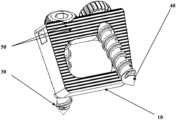
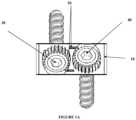
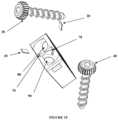
- FIG. 1 Aillustrates a top view of an anterior cervical intervertebral cage/BDFT screw construct according to an embodiment of the invention.
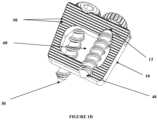
- FIG. 1 Billustrates a bottom perspective (isometric) view of an anterior cervical intervertebral cage/BDFT screw construct according to an embodiment of the invention.
- FIG. 1 Cillustrates a side view of an anterior cervical intervertebral cage/BDFT screw construct according to an embodiment of the invention.
- FIG. 1 Dillustrates a bottom, perspective view of an anterior cervical intervertebral cage/BDFT screw construct according to an embodiment of the invention.
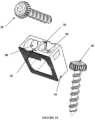
- FIG. 1 Eillustrates a front, perspective, exploded view of an anterior cervical intervertebral cage/BDFT screw construct according to an embodiment of the invention.
- FIG. 1 Fillustrates a top, perspective exploded view of an anterior cervical intervertebral cage/BDFT screw construct according to an embodiment of the invention.
- FIG. 1 Gillustrates a top, perspective exploded view of an anterior cervical intervertebral cage/BDFT screw construct with visualized internalized angled screw guides according to an embodiment of the invention.
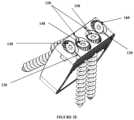
- FIG. 2 Aillustrates a top view of an anterior lumbar intervertebral cage/BDFT screw construct according to an embodiment of the invention.
- FIG. 2 Billustrates a bottom view of an anterior lumbar intervertebral cage/BDFT screw construct according to an embodiment of the invention.
- FIG. 2 Cillustrates a top, perspective view of an anterior lumbar intervertebral cage/BDFT screw construct according to an embodiment of the invention.
- FIG. 2 Dillustrates a side, perspective view of an anterior lumbar intervertebral cage/BDFT screw construct according to an embodiment of the invention.
- FIG. 2 Eillustrates a top, perspective view of an anterior lumbar intervertebral cage/BDFT screw construct according to an embodiment of the invention.
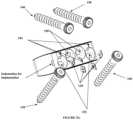
- FIG. 2 Fillustrates a top exploded view of an anterior lumbar intervertebral cage/BDFT screw construct according to an embodiment of the invention.
- FIG. 2 Gillustrates a top, perspective exploded view of an anterior lumbar intervertebral cage/BDFT screw construct according to an embodiment of the invention.
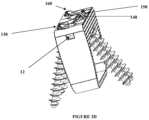
- FIG. 3 Aillustrates a top view of a posterior lumbar rectangularly designed intervertebral cage/BDFT construct according to an embodiment of the invention.
- FIG. 3 Billustrates a front, perspective view of a posterior lumbar rectangularly designed intervertebral cage/BDFT construct according to an embodiment of the invention.
- FIG. 3 Cillustrates a side, perspective view of a posterior lumbar rectangularly designed intervertebral cage/BDFT construct according to an embodiment of the invention.
- FIG. 3 Dillustrates a front, perspective view of a posterior lumbar rectangularly designed intervertebral cage/BDFT construct according to an embodiment of the invention.
- FIG. 3 Eillustrates a top, perspective exploded view of a posterior lumbar rectangularly designed intervertebral cage/BDFT construct according to an embodiment of the invention.
- FIG. 3 Fillustrates a top, perspective exploded view of a posterior lumbar rectangularly designed intervertebral cage/BDFT construct according to an embodiment of the invention.
- FIG. 4 Aillustrates a top view of a posterior lumbar elliptically designed intervertebral cage/BDFT construct according to an embodiment of the invention.
- FIG. 4 Billustrates a front, perspective view of a posterior lumbar elliptically designed intervertebral cage/BDFT construct according to an embodiment of the invention.
- FIG. 4 Cillustrates a side view of a posterior lumbar elliptically designed intervertebral cage/BDFT construct according to an embodiment of the invention.
- FIG. 4 Dillustrates a front, perspective view of a posterior lumbar elliptically designed intervertebral cage/BDFT construct according to an embodiment of the invention.
- FIG. 4 Eillustrates a top, perspective exploded view of a posterior lumbar elliptically designed intervertebral cage/BDFT construct according to an embodiment of the invention.
- FIG. 4 Fillustrates a top, perspective exploded view of a posterior lumbar elliptically designed intervertebral cage/BDFT construct according to an embodiment of the invention.
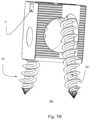
- FIG. 5 Aillustrates a perspective view of an intervertebral cage construct according to an embodiment of the invention.
- FIG. 5 Billustrates another perspective view of an intervertebral cage construct according to an embodiment of the invention.
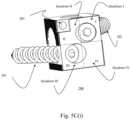
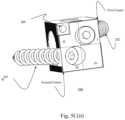
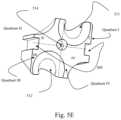
- FIGS. 5 C (i) and 5 C(ii)illustrate top, perspective view of an intervertebral cage construct according to an embodiment of the invention.
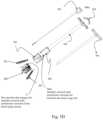
- FIG. 5 Dillustrates a top, perspective, exploded view of a positioning tool/screw guide/box expander.
- FIG. 5 Eillustrates a superior oblique perspective view of the positioning tool/drill guide/box expander component.
- FIGS. 1 A- 5 Eexemplary embodiments of the invention will now be described.
- FIGS. 1 A- 5 Ethe above described problems of the conventional art can be solved in the cervical, thoracic and lumbosacral spines by insertion into the denuded intervertebral disc space multiple embodiments of a bi-directional fixating transvertebral (BDFT) screw/cage apparatus.
- BDFTbi-directional fixating transvertebral
- FIGS. 1 A- 1 Gillustrate three-dimensional views of an exemplary embodiment of an anterior cervical intervertebral cage/BDFT construct 10 .
- the top portion of the cage 10has indentations 70 that are adjacent to the internalized screw guides 80 , 90 ( FIG. 1 F ) which contain press-fit leaf spring screw locking mechanisms 20 .
- the cage 10also includes additional indentations 12 on the side surfaces of the cage 10 for insertion of the prongs of an insertion device.
- a side surface of the cage 10can elliptically contoured when viewed from the side ( FIG. 1 C ) to fit into the bi-concave cervical disc space.
- the embodimentincludes two screws 30 , 40 .
- the screws 30 , 40include screw heads with ratchet teeth. The teeth have troughs in between.
- a first screw 30is oriented rostrally (superiorly) and a second screw 40 is oriented caudally (inferiorly).
- the cage 10can include a cavity 60 for bone product placement.
- the cage 10includes two built in internalized screw/drill guides 80 , 90 (e.g., approximately having a 25 degree angulation), one for each screw 30 , 40 , which orient the screws 30 , 40 bi-directionally in opposite directions.
- the cage 10can include a screw guide tunnel exit 13 adjacent to the bone cavity 60 ( FIG. 1 ).
- the internalized screw/drill guides 80 , 90can have different degrees of angulation and/or different positions within the cage 10 .
- the cageincludes at least one screw guide 80 or 82 having a predetermined trajectory (e.g., preferably having a 25 degree angulation) that may make placement of all screws equally facile, more amenable to multi-level placement, and may diminish the need for external drill guides.
- the cageincludes at least two screw guides 80 , 82 having a predetermined trajectory (e.g., preferably having a 25 degree angulation) that may make placement of all screws equally facile, more amenable to multi-level placement, and may diminish the need for external drill guides.
- the cagecan include a screw guide 80 , 82 having another predetermined trajectory, such as an angulation of substantially 25 degrees (e.g., an angulation ranging from 20 degrees to 30 degrees).
- the cagecan include a screw guide 80 , 82 having another predetermined trajectory, such as an angulation ranging from 20 degrees to 25 degrees, an angulation ranging from 25 degrees to 30 degrees, an angulation ranging from 25 degrees to 35 degrees, an angulation ranging from 25 degrees to 35 degrees, an angulation ranging from 20 degrees to 40 degrees, an angulation ranging from 25 degrees to 40 degrees, etc.
- the embodiments of the cagecan include one or more screw/drill guides 80 , 82 having different angles and/or different positions within the cage.
- the built in tunnels of the screw guides 80 , 90provide an important advantage of ensuring that only one prescribed angled trajectory is possible for transvertebral screw placement.
- the built in tunnelsnarrow going downward. This facilitates the locking of the screw head to the top of the cage 10 even in the absence of the locking mechanism described herein.
- Embodiments of the intervertebral cages 10can be designed with internalized screw/drill guides 80 , 90 with different angles and/or different positions within the cage 10 .
- the angle and size of the screws 30 , 40make them amenable to single or multi-level placement.
- the superior and inferior surfaces or edges of the lumbar cage 10can include ridges 50 or the like to facilitate integration and fusion with superior and inferior vertebral bodies.
- the embodimentcan include a leaf spring 20 which can be, for example, press-fit into the indentation 70 adjacent to the self-drilling internal screw guides, 80 , 90 on top of the cage 10 .
- the leaf spring 20can be manufactured from a variety of materials, such as titanium.
- the exemplary embodiments of the locking mechanismare an evolutionary advance and improvement compared to the apparatus illustrated in the aforementioned related applications.
- the novel embodimentsare quite unique and different from all other conventional screw locking mechanisms.
- FIGS. 2 A- 2 Gillustrate three-dimensional views of an exemplary embodiment of an anterior lumbar intervertebral cage/BDFT construct.
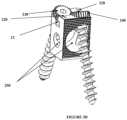
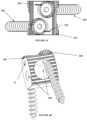
- the cage 110includes indentations 194 on top of the cage 10 laterally adjacent to all four internalized screw guides 190 , 192 ( FIG. 2 G ), which contain press-fit leaf springs 120 .
- the cage 110also can include indentations 12 on both side surfaces for insertion of prongs of an implantation tool.
- This cage 110can be larger than the cervical cage 10 and also can include elliptically contoured sidewalls when view from the side to fit into the bi-concave lumbar disc space ( FIG. 2 D ).
- the cage 110includes four (4) horizontally aligned internalized screw guides 190 , 192 for four (4) screws 130 , 140 , 150 , 160 .
- the two lateral (left and right) screws 130 , 160are oriented inferiorly, and the two middle screws 140 , 150 are oriented superiorly.
- the axes of these guides 190 , 192 and screws 130 , 140 , 150 , 160are not perfectly horizontal with respect to each other.
- Each lateral screw guide/screwis obliquely oriented with respect to its adjacent medial screw guide/screw. This is necessary to achieve the proper trajectory for bone penetration along with the precise angle of the screw guides.
- the screw guide tunnel exits 13are illustrated in FIG. 2 C and are in continuity (connected) with the enlarged bone cavity 180 .
- the orientations of the four screw guides 190 , 192 (and screws; 130 , 140 , 150 , 160 )are selected because of their symmetry and inherent stability.
- the cage 110can include a large cavity 180 for bone product placement.
- the cage 110includes four built-in internalized screw/drill guides 190 , 192 (e.g., having an approximate 25 degree angulation), one for each screw 130 , 140 , 150 , 160 .
- Other embodiments of the intervertebral cage 110can be designed with internalized screw/drill guides 190 , 192 with different angles and/or different positions within the cage 110 .
- the angle and size of the screws 130 , 140 , 150 , 160make them amenable to single or multi-level placement.
- the superior and inferior surfaces or edges of the cage 110can include ridges 170 or the like to facilitate integration and fusion with superior and inferior vertebral bodies. In an embodiment, there are no compartmental divisions in the cavity 180 for bone product placement to maximize the quantity of bone for fusion.
- the cage 110includes four leaf springs 120 that can be, for example, press-fit to the indentations 194 adjacent to the internalized screw guides 190 , 192 on top of the cage 110 ( FIG. 2 ).
- the cage 110includes one leaf spring locking mechanism 120 per screw 130 , 140 , 150 , 160 .
- one locking mechanism 120can be provided for each screw 130 , 140 , 150 , 160 , or one locking mechanism 120 can be provided for two or more screws 130 , 140 , 150 , 160 .
- the top of the cage 110includes an indentation 194 for each leaf spring locking mechanism 120 .
- Each leaf spring locking mechanism 120also can be designed to rest and be press-fit into the indentations 194 , which are adjacent to the in-built self drilling screw guides 190 , 192 .
- the leaf spring locking mechanism 120can be manufactured from a variety of materials, such as titanium.
- the exemplary embodimentsare an evolutionary advance and improvement compared to the apparatus illustrated in the aforementioned related applications, and are quite unique and different from all other conventional locking mechanisms used for other types of anterior lumbar cages.
- a possible conventional devicemay include anterior placed lumbar implants with perforating screws.
- the conventional devicemay include a horseshoe implant having a plurality of cylindrical holes with smooth inner surfaces and comprise only one stop for the heads of the bone screws to be inserted into them. The placement of five cylindrical holes is oriented within the cage in a non-symmetric manner.
- the exemplary embodimentsdiffer in many substantial ways from the conventional devices.
- the exemplary embodimentsprovide a symmetric orientation of the screw holes, as well as a screw locking mechanism.
- the exemplary embodimentsalso provide an angulation/trajectory (e.g., an approximate twenty five degree angulation/trajectory) for preventing pull-out or back-out of the screws that would make placement of all screws in a manner which would lead to maximum stability of the construct within the vertebral space, and obviate the need for external drill guides, and surgeon trajectory angulation guess work.
- multiple embodiments of lumbar intervertebral implantsmay be presented which include one with internally threaded bore holes, another embodiment with a front plate mounted at the front surface of the implant, and another embodiment with the front place displaceably configured to move vertically relative to the implant.
- the disclosed preferred borehole axesmay be 35-55 degrees.
- These conventional devicesmay have four screw perforations that are not aligned four in a row. Two of the screw holes may be laterally placed on the left, one on top of each other, the top one with a superior trajectory, and the bottom with an inferior trajectory. Likewise, two perforations may be placed on the right, one on top of each other, the top one with a superior trajectory and the bottom one with an inferior trajectory.
- the disclosed screw locking mechanismmay be a screw with an external thread matching the internal borehole thread, or spiral springs.
- the anterior lumbar construct of the exemplary embodimentsdiffers in many substantial ways from these conventional devices.
- the exemplary embodimentsinclude a single cage construct with four (4) internalized drill guides arranged horizontally in a row.
- the lateral screw guides/screwsare obliquely oriented with the respect to their adjacent medial screw guides/screws.
- the middle two screwsare oriented superiorly, and the lateral left and right screws are oriented inferiorly.
- This symmetric alignment of screws and orientations within the superior and inferior vertebral bodiese.g., two middle superiorly projecting screws, and two laterally projecting inferior screws) make the fixation to the superior and inferior vertebral bodies much more symmetric and thus more stable preventing subsidence.
- the cageincludes a screw guide having a predetermined trajectory (e.g., an approximate trajectory of 25 degrees or another angulation) that makes placement of all screws equally facile, more amenable to multi-level placement, and diminishes the need for external drill guides.
- a screw guidehaving a predetermined trajectory (e.g., an approximate trajectory of 25 degrees or another angulation) that makes placement of all screws equally facile, more amenable to multi-level placement, and diminishes the need for external drill guides.
- the exemplary screw locking mechanismwhich is press-fit to the cage, is unique and differs substantially from the conventional approach of matching screw/cage threads or spiral springs.
- FIGS. 3 A- 3 Fillustrate three-dimensional views of an exemplary embodiment of a posterior lumbar rectangular intervertebral cage/BDFT construct.
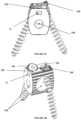
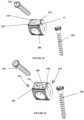
- the cage 210includes indentations 290 on top of the cage 290 that are adjacent to the internal screw guides 270 , 280 ( FIG. 3 F ).
- the indentations 290contain press-fit leaf springs 220 .
- the cage 210also includes indentations 12 on both side surfaces of the construct for the prong placement of an implantation tool.
- the screws 230 , 240perforate and orient in opposing superior and inferior directions.
- the cage 210can include a cavity 250 for bone product placement.
- the top and bottom portions of the rectangular cage 210are elliptically contoured to naturally fit into the bi-concave intervertebral disc space ( FIG. 3 C ; side view).
- the top of cage 210is a square with equal width and length.
- the cage 210includes built-in internalized screw/drill guides 270 , 280 having a predetermined angled trajectory (e.g., having an approximate 25 degree angulation), and their axes are not horizontal, but oblique one to the other and very close to each other.
- Each screw guide/screw 270 , 280occupies one corner of a square, obliquely oriented one to the other ( FIG. 3 A ).
- One of the guidesis angled rostrally (superiorly) (e.g., guide 270 ) and the other caudally (inferiorly) (e.g., guide 280 ).
- the intervertebral cages 210can be designed with internalized screw/drill guides 270 , 280 with different angles and/or different positions within the cage 210 . Because the tunnel of the screw guide 270 , 280 narrows, when the screw 230 , 240 is countersunk on top of the cage 210 , the screw 230 , 240 is preliminarily locked, even in the absence of this locking mechanism.
- the angle and size of the screws 230 , 240make them amenable to single or multi-level placement.
- the screw guide exit tunnel 13 adjacent to the bone cavity 250is illustrated in FIG. 3 D .
- the superior and inferior surfaces or edgescan include ridges or the like to facilitate integration and fusion with superior and inferior vertebral bodies.
- One of these constructsis placed posteriorly into the intervertebral space on the left side, and the other on the right side.
- the cage 210includes a leaf spring screw locking mechanism 220 that can be, for example, press-fit into the indentation 290 adjacent to the internalized screw guides 270 , 280 on top of the cage 210 .
- the top of the cage 210can have an indentation 290 to engage the spring leaf locking mechanism 220 .
- the spring leaf locking mechanism 220can be manufactured from a variety of materials, such as titanium.
- the adjacent leaf spring 20prevents screw back out or pull out by engaging and locking the space between the ratchet teeth (trough) of the screw head when the screws 230 , 240 are in their final resting positions. This engagement prevents any rotation of the screw 230 , 240 in the opposite direction.
- the exemplary embodiment of this novel intervertebral cage 210is an evolutionary advance and improvement compared to the apparatus illustrated in the aforementioned related applications.
- the novel cage 210also is quite unique and different from other conventional locking mechanisms used for other known cervical and lumbar anterior or posterior plate screws. No other conventional posterior lumbar intervertebral cage BDFT/screw constructs are known.
- FIGS. 4 A- 4 Fillustrate three-dimensional views of an exemplary embodiment of a posterior lumbar elliptical intervertebral cage/BDFT construct.
- indentations 290 on top of the cage 210are adjacent to the internal screw guides 270 , 280 ( FIG. 4 F ).
- the indentations 290can contain press-fit leaf springs, 220 .
- the cage 210also can include indentations or slots 12 on both side surfaces of the cage 210 for insertion of a prong of an implantation tool (see example cage and tool in FIG. 5 D ; the cage 210 can engage the tool in a similar manner), and more particularly, that engage the distal medial oriented male protuberance of a lateral griper prong of an implantation tool.
- the screws 230 , 240perforate and orient in opposing superior and inferior directions.
- the cage 210can include a cavity 250 for bone product placement.
- the entire body of this cage 210can be elliptical as opposed to the top and bottom portions of the rectangular cage of the previous embodiment 210 , and can be contoured when viewed from the side to naturally fit into the bi-concave intervertebral disc space ( FIG. 4 C ).
- the cage 210includes built-in internalized screw/drill guides 270 , 280 having a predetermined angled trajectory (e.g., having an approximate 25 degree angulation), and their axes are not horizontal, but oblique one to the other and very close to each other.
- Each screw guide/screwoccupies one corner of a square, obliquely oriented one to the other ( FIG. 4 A ). This necessary to achieve proper screw penetration in so narrow a posterior lumbar interspace.
- One of the guidesis angled rostrally (superiorly) (e.g., guide 270 ) and the other caudally (inferiorly) (e.g., guide 280 ).
- the intervertebral cages 210can be designed with internalized screw/drill guides 270 , 280 with different angles and/or different positions within the cage 210 . Because the tunnel of the screw guide 270 , 280 narrows, when the screw 230 , 240 is countersunk on top of the cage 210 , the screw 230 , 240 is preliminarily locked, even in the absence of this locking mechanism. The angle and size of the screws 230 , 240 make them amenable to single or multi-level placement.
- the screw guide exit tunnel 13 adjacent to the bone cavity 250is illustrated in FIG. 4 D .
- the superior and inferior surfaces or edgescan include ridges or the like to facilitate integration and fusion with superior and inferior vertebral bodies. One of these constructs is placed posteriorly into the intervertebral space on the left side, and the other on the right side.
- the cage 210includes a leaf spring screw locking mechanism 220 that can be, for example, press-fit into the indentation 290 adjacent to the internalized screw guides 270 , 280 on top of the cage 210 .
- the top of the cage 210can have an indentation 290 to engage the spring leaf locking mechanism 220 .
- the spring leaf locking mechanism 220can be manufactured from a variety of materials, such as titanium.
- the adjacent leaf spring 220prevents screw back out or pull out by engaging and locking the space between the ratchet teeth (trough) of the screw head when the screws 230 , 240 are in their final resting positions. This engagement prevents any rotation of the screw in the opposite direction.
- the exemplary embodiment of this novel intervertebral cage 210is an evolutionary advance and improvement compared to the apparatus illustrated in the aforementioned related applications.
- the novel cage 210also is quite unique and different from other conventional locking mechanisms used for other known cervical and lumbar anterior or posterior plate screws. No other conventional posterior lumbar intervertebral cage BDFT/screw constructs are known.
- Anterior cervical spine placement of the intervertebral cage/BDFT screw construct 10( FIG. 1 ) can be implanted via previously described techniques for anterior cervical discectomy and fusion. Some but not all of these techniques include, open, microscopic, closed endoscopic or tubular. Fluoroscopic or any other form of visualized guidance can be used for this procedure.
- the patientis placed in a supine position.
- An incisionis made overlying the intended disc space or spaces, and the anterior spine is exposed.
- a discectomyis performed and the endplates exposed.
- the disc heightis measured and an anterior cervical intervertebral cage of the appropriate disc height, width and depth is selected.
- the central cavityis packed with bone fusion material, autologous bone graft, allograft, alone or in combination with any commercially available bone fusion promoting product.
- the cage 10is then inserted into the midline of the anterior disc space routinely until it is flush or countersunk relative to the vertebral body above and below.
- the BDFT screws 30 , 40are then inserted into the internalized rostrally (superiorly) and caudally (inferiorly) angled screw guides 80 , 90 .
- a drill with or without a drill guidecan be used to prepare for screw placement. This is not absolutely necessary.
- self-drilling/self-tapping screws 30 , 40 of the appropriately selected lengthscan be directly screwed into the vertebral bodies once placed into the internalized drill-guided angled tunnels.
- the cage's screw guides 80 , 90which have internalized tunnels, direct the screws 30 , 40 into the superior and inferior vertebral bodies in the predetermined angle of the internalized tunnels. There is no other angled trajectory other than that which is built into the internalized screw guide/tunnel of the cage 10 that the screw 30 , 40 can be oriented in. Hence, there is no absolute need for fluoroscopic guidance.
- the BDFT screws 30 , 40can then be locked into their final positions.
- each of the BDFT screws 30 , 40 with ratcheted screw headsare turned, they penetrate and engage the bone until they are locked in a final position by its final turn when the screw head is flush with the surface of the cage 10 .
- the adjacent leaf spring 20prevents screw back out or pull out by engaging and locking the space between the ratchet teeth of the screw head (trough) when the screws 30 , 40 are in their final resting positions. This engagement because of the geometric arrangement of the ratchet teeth and troughs prevents any rotation of the screw 30 , 40 in the opposite direction.
- the screw 30 , 40Once the screw 30 , 40 is in this position it can no longer be backed out without destroying the leaf spring mechanism 20 .
- the surgeonhas the option to verify the trajectory fluoroscopically by applying preliminary non-ratcheted BDFT screws 30 , 40 which lack ratchet teeth on their screw heads. Once the surgeon is confident of the screw trajectory verified by x-ray, the BDFT screws 30 , 40 with screw head ratchet teeth can be inserted and locked in their final position. Because of the presence of internalized screw-guides 80 , 90 within the cage 10 , this step is not absolutely necessary, but is an option available for the surgeon as a double-check measure.
- Anterior or anteriolateral placement of thoracic or lumbar spine intervertebral cage/BDFT screw constructs 110can be implanted via previously described surgical techniques for anterior lumbar discectomy, and transthoracic, anterior-lateral thoracic discectomy. Some but not all of these techniques include, open, microscopic, closed endoscopic or tubular. Fluoroscopic or any other form of visualized guidance can be used for this procedure.
- a discectomyis performed and the endplates exposed.
- the disc heightis measured and an anterior lumbar (or thoracic) intervertebral cage of the appropriate disc height, width and depth is selected.
- the central cavity 180is packed with bone fusion material, autologous bone graft, allograft, alone or in combination with any commercially available bone fusion promoting product.
- the cage 110is then inserted into the midline of the anterior disc space routinely until it is flush or countersunk relative to the vertebral body above and below.
- the four BDFT screws 130 , 140 , 150 , 160 with screw heads with ratchet teethare then inserted into the two middle internalized rostrally (superiorly) and two lateral, caudally (inferiorly) angled screw guides 190 , 192 .
- a drill with or without a drill guidecan be used to prepare for screw placement. This is not absolutely necessary. Because the cage 110 has internalized screw guides 190 , 192 , self-drilling/self-tapping screws 130 , 140 , 150 , 160 of the appropriately selected lengths can be directly screwed into the vertebral bodies once placed into the internalized drill-guided angled tunnels.
- the cage's internalized guides 190 , 192which have internalized tunnels, direct the screws 130 , 140 , 150 , 160 into the superior and inferior vertebral bodies in the predetermined angle of the internalized tunnels. There is no other angled trajectory other than that which is built into the internalized screw guide/tunnel of the cage 110 that the screw 130 , 140 , 150 , 160 can be oriented in. Hence there is no absolute need for fluoroscopic guidance.
- the BDFT screws 130 , 140 , 150 , 160can then be locked into their final positions.
- the screws 130 , 140 , 150 , 160 with ratcheted screw headsare turned, the screws 130 , 140 , 150 , 160 penetrate and engage the bone until they are locked in a final position by its final turn when the screw head is flush with the surface of the cage 110 .
- the adjacent leaf spring 120prevents screw back out or pull out by engaging and locking the space between the ratchet teeth of the screw head (trough) when the screws 130 , 140 , 150 , 160 are in their final resting positions. This engagement prevents any rotation of the screw 130 , 140 , 150 , 160 in the opposite direction.
- the screw 130 , 140 , 150 , 160can no longer be backed out without destroying the leaf spring mechanism 20 .
- the surgeonhas the option to verify the trajectory fluoroscopically by applying preliminary non-ratcheted BDFT screws 130 , 140 , 150 , 160 which lack ratchet teeth on their screw heads. Once the surgeon is confident of the screw trajectory verified by x-ray, the BDFT screws 130 , 140 , 150 , 160 with screw head ratchet teeth can be inserted and locked in their final position. Because of the presence of internalized screw-guides 180 , 190 within the cage 110 , this step is not absolutely necessary, but is an option available for the surgeon as a double-check measure.
- Implantation of the posterior lumbar intervertebral cage/BDFT screw constructs 110can be performed via previously described posterior lumbar interbody fusion (PLIF) or posterior transforaminal lumbar interbody fusion (TLIF) procedures.
- the procedurescan be performed open, microscopic, closed tubular or endoscopic techniques. Fluoroscopic guidance can be used with any of these procedures.
- the patientis placed in the prone position.
- a midline incisionis made for a PLIF procedure, and one or two parallel paramedian incisions or a midline incision is made for the TLIF procedure.
- a unilateral or bilateral facet sparing hemi-laminotomyis created to introduce the posterior lumbar construct into the disc space after a discectomy is performed and the space adequately prepared.
- the far lateral disc spaceis entered and a circumferential discectomy is performed.
- the disc spaceis prepared and the endplates exposed.
- the disc heightis measured and a posterior lumbar intervertebral cage/BDFT screw construct ( FIGS. 3 and 4 ) of the appropriate disc height, width and depth is selected.
- the central cavity 250is packed with bone fusion material, autologous bone graft, allograft, alone or in combination with any commercially available bone fusion promoting product.
- one construct 210is placed on either right or left sides, or one construct each is placed into left and right sides. The constructs are inserted such they are flush or countersunk relative to the superior and inferior vertebral bodies.
- the intervertebral space in between the constructscan also be packed with bone product for fusion.
- the BDFT screws 230 , 240are then inserted into internalized rostrally (superiorly) and caudally (inferiorly) angled screw guides 270 , 280 .
- a drill with or without a drill guidecan be used to prepare for screw placement. This is not absolutely necessary. Because the cage 210 has internalized screw guides 270 , 280 , self-drilling/self-tapping screws 230 , 240 of the appropriately selected lengths can be directly screwed into the vertebral bodies once placed into the internalized drill-guided angled tunnels.
- the cage's internalized guides 270 , 280which have internalized tunnels, direct the screws 230 , 240 into the superior and inferior vertebral bodies in the predetermined angle of the internalized tunnels. There is no other angled trajectory other than that which is built into the internalized screw guide/tunnel 270 , 280 of the cage 210 that the screw 230 , 240 can be oriented in. Hence, unlike posterior placement of pedicle screws 230 , 240 there is no absolute need for fluoroscopic or expensive and cumbersome, frameless stereotactic CT guidance.
- the BDFT screws 230 , 240can then be locked into their final positions.
- each of the BDFT screws 230 , 240 with ratcheted screw headsare turned, they penetrate and engage the bone until they are locked in a final position by its final turn when the screw head is flush with the surface of the cage 210 .
- the adjacent leaf spring 220prevents screw back out or pull out by engaging and locking the space between the ratchet teeth of the screw head (trough) when the screws 230 , 240 are in their final resting positions. This engagement prevents any rotation of the screw 230 , 240 in the opposite direction.
- the screw 230 , 240Once the screw 230 , 240 is in this position it can no longer be backed out without destroying/disrupting the leaf spring mechanism 220 .
- the surgeonhas the option to verify the trajectory fluoroscopically by applying preliminary non-ratcheted BDFT screws 230 , 240 which lack ratchet teeth on their screw heads. Once the surgeon is confident of the screw trajectory verified by x-ray, the BDFT screws 230 , 240 with screw head ratchet teeth can be inserted and locked in their final position. Because of the presence of internalized screw-guides 270 , 280 within the cage 210 , this step is not absolutely necessary, but is an option available for the surgeon as a double-check measure.
- the present inventionsmay provide effective and safe techniques that overcome the problems associated with current transpedicular based cervical, thoracic and lumbar fusion technology, as well as anterior cervical, thoracic and lumbar plating technology, and for many degenerative stable and unstable spinal diseases. These inventions could replace much pedicle screw, and anterior plating based instrumentation in many but not all degenerative spine conditions.
- anterior and posterior lumbar intervertebral cage/BDFT screw constructsand placement of anterior cervical cage/BDFT screw constructs far exceeds that of current pedicle screw and anterior spinal plating technology.
- these deviceshave markedly significantly decreased risk of misguided screw placement and hence decreased risk of neurovascular injury, and blood loss.
- the lumbar and cervical intervertebral cage/BDFT screw constructsall would have decreased recovery time, and more rapid return to work time compared to pedicle screw, and plating technology.
- FIGS. 5 A, 5 B, 5 C (i), and 5 C(ii)illustrate an exemplary embodiment of exemplary cage 200 . These features are shown for example purposes, are not limited to the cage 200 , and can be incorporated into any cage according to any of the embodiments described herein. As shown in FIGS. 5 C (i) and 5 C(ii), the screw guides can be positioned within four (4) quadrants I, II, III, IV.
- the intervertebral cagecan include a wall having an entry opening of the first integral screw guide and an entry opening of the second integral screw guide, wherein the wall of the cage can include four quadrants delineated by a first axis and a second axis each lying in a plane of the wall, and the first axis is at a right angle with respect to the second axis, wherein the four quadrants include a first quadrant, a second quadrant, a third quadrant, and a fourth quadrant, wherein the first quadrant and the fourth quadrant are opposed to the second quadrant and the third quadrant with respect to the first axis, and the first quadrant and the second quadrant are opposed to the third quadrant and the fourth quadrant with respect to the second axis, wherein the first quadrant is diagonally opposed to the third quadrant, and the second quadrant is diagonally opposed to the fourth quadrant, and wherein one of a majority of an area of the entry opening of the first integral screw guide is in the first quadrant and a majority
- the intervertebral cagecan include a wall having an entry opening of the first integral screw guide and an entry opening of the second integral screw guide, wherein the wall has four quadrants delineated by a first axis and a second axis each lying in a plane of the wall, and the first axis is at a right angle with respect to the second axis, wherein the four quadrants include a first quadrant, a second quadrant, a third quadrant, and a fourth quadrant, wherein the first quadrant and the fourth quadrant are opposed to the second quadrant and the third quadrant with respect to the first axis, and the first quadrant and the second quadrant are opposed to the third quadrant and the fourth quadrant with respect to the second axis, wherein the first quadrant is diagonally opposed to the third quadrant, and the second quadrant is diagonally opposed to the fourth quadrant, and wherein one of a center of the entry opening of the first integral screw guide is in the first quadrant and a center of the entry opening of the second integral screw
- FIG. 5 Dillustrates an embodiment of an external drill/screw guide-box expander which assists in screw trajectory of the exemplary cage 200 .
- the cage 200can be a cage according to any of the embodiments described herein, or an expanding cage, in which case an expanding Allen key component can be used.
- the devicecan include, for example, an Allen key 501 (e.g., for an expandable cage), a spring 502 , a handle 503 , a gripper 504 having a gripper prong 506 , which alternatively may include a male protuberance (e.g., a medially oriented mal protuberant extension for insertion into the lateral cage slot 12 ), and a screw guide 505 .
- an Allen key 501e.g., for an expandable cage
- a spring 502e.g., for an expandable cage
- a handle 503e.g., a handle 503
- a gripper 504 having a gripper prong 506which alternatively may
- FIG. 5 Eillustrates a superior oblique view of the screw guide demonstrating insertions or grooves 509 for gripper prong 506 of the gripper 504 in FIG. 5 D , built-in trajectory guides 511 , 512 for insertions of screws, and an opening 514 for an Allen key, in instances in which an expandable cage is being used.
- the Allen keymay not be present when a non-adjustable cage is being used.
- the Allen keymay be present even when an adjustable cage is being used, such that the tool is universal to various types of cages.
- the gripper 504can include gripper prongs (e.g., medially oriented male protuberant extensions) 506 which insert into grooves 509 of the screw guide 505 and lateral slots (e.g., 12 ) of a cage, thereby perfectly aligning them.
- gripper prongse.g., medially oriented male protuberant extensions
- lateral slotse.g., 12
- a cagecan be provided that has internal screw guides which have no gaps, and furthermore an insertion tool can be provided that has an external screw guide that further precisely guides the screws through the external tool screw guide, then into the internal implant screw guide guaranteeing the precise predetermined angulation of the screws.
- the combination the internal and external screw guidescan create a long tunnel for a screw to enable a predetermined trajectory.
- an embodiment of the indentations or recesses for the screw holes in any of the exemplary cagescan be configured such that the screw heads will rest entirely within a peripheral side of a surface of the top portion of the cage (i.e., top surface).
- the direction of the screw tunnelis from an anterior surface to a posterior of the top surface of the cage (i.e., the non-adjacent side).
- the indentations or recesses for the screw holescan be configured such that the screw heads will rest entirely within the peripheral side of the top surface of the cage.
- the screw hole guidepasses through the anterior-posterior axis of the top surface.
- the guides core circumference for the screw threadis surrounded by the lateral wall masses, and surrounded by mass from the front and rear surfaces (i.e., walls) of the cage.
- the indentations or recesses for the screw holescan be configured such that a recess for the screw holes are entirely within the peripheral side of the top surface of the box.
- there is a through-hole for a screwwhich is counter-bored to keep the screw head within an outer surface boundary of the cage and in a direction to prevent the screw from avoiding the front or rear surfaces of the cage.
- the indentations or recesses for the screw holescan be configured such that a recess for the screw holes is entirely within the peripheral side of the front wall of the cage
- the tunnel for the screwsis such that when the screw first enters, the screw will be surrounded by mass from the lateral sides and mass from the upper and lower sides of the wall. The screw will exit at the posterior end of the peripheral wall.
- an embodiment of the indentations or recesses for the screw holescan be configured such that a position of the screws is suitable for posterior lumbar screw holes.
- the screw holescan be diagonal to each other along a transversal line.
- the transversal linecan be defined as the line that would diagonally intersect and bypass the space between the recess for the screw holes.
- the screw holescan be diagonally opposed and lie on a congruent angle to each other from the intersecting transversal line.
- the recess for the screw holescan be diagonal and perpendicular to each other within the outer plane.
- the recess for the screw holescan be diagonal and symmetrically constrained within the outer wall of the cage.
Landscapes
- Health & Medical Sciences (AREA)
- Orthopedic Medicine & Surgery (AREA)
- Engineering & Computer Science (AREA)
- Biomedical Technology (AREA)
- Life Sciences & Earth Sciences (AREA)
- Neurology (AREA)
- Surgery (AREA)
- General Health & Medical Sciences (AREA)
- Veterinary Medicine (AREA)
- Heart & Thoracic Surgery (AREA)
- Public Health (AREA)
- Animal Behavior & Ethology (AREA)
- Molecular Biology (AREA)
- Medical Informatics (AREA)
- Nuclear Medicine, Radiotherapy & Molecular Imaging (AREA)
- Cardiology (AREA)
- Oral & Maxillofacial Surgery (AREA)
- Transplantation (AREA)
- Vascular Medicine (AREA)
- Prostheses (AREA)
Abstract
Description
Claims (23)
Priority Applications (1)
| Application Number | Priority Date | Filing Date | Title |
|---|---|---|---|
| US17/492,996US12144743B2 (en) | 2005-04-12 | 2021-10-04 | Intervertebral implant |
Applications Claiming Priority (15)
| Application Number | Priority Date | Filing Date | Title |
|---|---|---|---|
| US67023105P | 2005-04-12 | 2005-04-12 | |
| US11/208,644US7704279B2 (en) | 2005-04-12 | 2005-08-23 | Bi-directional fixating transvertebral body screws, zero-profile horizontal intervertebral miniplates, expansile intervertebral body fusion devices, and posterior motion-calibrating interarticulating joint stapling device for spinal fusion |
| US11/536,815US7846188B2 (en) | 2005-04-12 | 2006-09-29 | Bi-directional fixating transvertebral body screws, zero-profile horizontal intervertebral miniplates, total intervertebral body fusion devices, and posterior motion-calibrating interarticulating joint stapling device for spinal fusion |
| US11/842,855US7942903B2 (en) | 2005-04-12 | 2007-08-21 | Bi-directional fixating transvertebral body screws and posterior cervical and lumbar interarticulating joint calibrated stapling devices for spinal fusion |
| US12/054,335US7972363B2 (en) | 2005-04-12 | 2008-03-24 | Bi-directional fixating/locking transvertebral body screw/intervertebral cage stand-alone constructs and posterior cervical and lumbar interarticulating joint stapling guns and devices for spinal fusion |
| US201161445034P | 2011-02-21 | 2011-02-21 | |
| US201161451579P | 2011-03-10 | 2011-03-10 | |
| US201161451582P | 2011-03-10 | 2011-03-10 | |
| US13/084,543US8353913B2 (en) | 2005-04-12 | 2011-04-11 | Bi-directional fixating transvertebral body screws and posterior cervical and lumbar interarticulating joint calibrated stapling devices for spinal fusion |
| US13/103,994US9603713B2 (en) | 2005-04-12 | 2011-05-09 | Bi-directional fixating/locking transvertebral body screw/intervertebral cage stand-alone constructs and posterior cervical and lumbar interarticulating joint stapling guns and devices for spinal fusion |
| US13/401,829US9744052B2 (en) | 2005-04-12 | 2012-02-21 | Bi-directional fixating/locking transvertebral body screw/intervertebral cage stand-alone constructs |
| US13/418,323US9814601B2 (en) | 2005-04-12 | 2012-03-12 | Bi-directional fixating/locking transvertebral body screw/intervertebral cage stand-alone constructs |
| US15/791,484US10376383B2 (en) | 2005-04-12 | 2017-10-24 | Bi-directional fixating/locking transvertebral body screw/intervertebral cage stand-alone constructs |
| US16/532,033US11141288B2 (en) | 2005-04-12 | 2019-08-05 | Bi-directional fixating/locking transvertebral body screw/intervertebral cage stand-alone constructs |
| US17/492,996US12144743B2 (en) | 2005-04-12 | 2021-10-04 | Intervertebral implant |
Related Parent Applications (1)
| Application Number | Title | Priority Date | Filing Date |
|---|---|---|---|
| US16/532,033ContinuationUS11141288B2 (en) | 2005-04-12 | 2019-08-05 | Bi-directional fixating/locking transvertebral body screw/intervertebral cage stand-alone constructs |
Publications (2)
| Publication Number | Publication Date |
|---|---|
| US20220023060A1 US20220023060A1 (en) | 2022-01-27 |
| US12144743B2true US12144743B2 (en) | 2024-11-19 |
Family
ID=47362577
Family Applications (5)
| Application Number | Title | Priority Date | Filing Date |
|---|---|---|---|
| US13/401,829Expired - LifetimeUS9744052B2 (en) | 2005-04-12 | 2012-02-21 | Bi-directional fixating/locking transvertebral body screw/intervertebral cage stand-alone constructs |
| US15/678,401Expired - LifetimeUS10238505B2 (en) | 2005-04-12 | 2017-08-16 | Bi-directional fixating/locking transvertebral body screw/intervertebral cage stand-alone constructs |
| US16/362,294Expired - LifetimeUS10925753B2 (en) | 2005-04-12 | 2019-03-22 | Bi-directional fixating/locking transvertebral body screw/intervertebral cage stand-alone constructs |
| US17/181,706AbandonedUS20210307925A1 (en) | 2005-04-12 | 2021-02-22 | Bi-directional fixating/locking transvertebral body screw/intervertebral cage stand-alone constructs |
| US17/492,996Active2027-01-24US12144743B2 (en) | 2005-04-12 | 2021-10-04 | Intervertebral implant |
Family Applications Before (4)
| Application Number | Title | Priority Date | Filing Date |
|---|---|---|---|
| US13/401,829Expired - LifetimeUS9744052B2 (en) | 2005-04-12 | 2012-02-21 | Bi-directional fixating/locking transvertebral body screw/intervertebral cage stand-alone constructs |
| US15/678,401Expired - LifetimeUS10238505B2 (en) | 2005-04-12 | 2017-08-16 | Bi-directional fixating/locking transvertebral body screw/intervertebral cage stand-alone constructs |
| US16/362,294Expired - LifetimeUS10925753B2 (en) | 2005-04-12 | 2019-03-22 | Bi-directional fixating/locking transvertebral body screw/intervertebral cage stand-alone constructs |
| US17/181,706AbandonedUS20210307925A1 (en) | 2005-04-12 | 2021-02-22 | Bi-directional fixating/locking transvertebral body screw/intervertebral cage stand-alone constructs |
Country Status (1)
| Country | Link |
|---|---|
| US (5) | US9744052B2 (en) |
Families Citing this family (43)
| Publication number | Priority date | Publication date | Assignee | Title |
|---|---|---|---|---|
| US7704279B2 (en) | 2005-04-12 | 2010-04-27 | Moskowitz Mosheh T | Bi-directional fixating transvertebral body screws, zero-profile horizontal intervertebral miniplates, expansile intervertebral body fusion devices, and posterior motion-calibrating interarticulating joint stapling device for spinal fusion |
| US9532821B2 (en) | 2005-04-12 | 2017-01-03 | Nathan C. Moskowitz | Bi-directional fixating/locking transvertebral body screw/intervertebral cage stand-alone constructs with vertical hemi-bracket screw locking mechanism |
| US7846188B2 (en) | 2005-04-12 | 2010-12-07 | Moskowitz Nathan C | Bi-directional fixating transvertebral body screws, zero-profile horizontal intervertebral miniplates, total intervertebral body fusion devices, and posterior motion-calibrating interarticulating joint stapling device for spinal fusion |
| US9744052B2 (en)* | 2005-04-12 | 2017-08-29 | Nathan C. Moskowitz | Bi-directional fixating/locking transvertebral body screw/intervertebral cage stand-alone constructs |
| US9848993B2 (en) | 2005-04-12 | 2017-12-26 | Nathan C. Moskowitz | Zero-profile expandable intervertebral spacer devices for distraction and spinal fusion and a universal tool for their placement and expansion |
| US11903849B2 (en) | 2005-04-12 | 2024-02-20 | Moskowitz Family Llc | Intervertebral implant and tool assembly |
| US7942903B2 (en) | 2005-04-12 | 2011-05-17 | Moskowitz Ahmnon D | Bi-directional fixating transvertebral body screws and posterior cervical and lumbar interarticulating joint calibrated stapling devices for spinal fusion |
| US7972363B2 (en) | 2005-04-12 | 2011-07-05 | Moskowitz Ahmnon D | Bi-directional fixating/locking transvertebral body screw/intervertebral cage stand-alone constructs and posterior cervical and lumbar interarticulating joint stapling guns and devices for spinal fusion |
| US7854765B2 (en) | 2006-04-20 | 2010-12-21 | Moskowitz Mosheh T | Electronically controlled artificial intervertebral disc with motor assisted actuation systems |
| US8906028B2 (en) | 2009-09-18 | 2014-12-09 | Spinal Surgical Strategies, Llc | Bone graft delivery device and method of using the same |
| US10973656B2 (en) | 2009-09-18 | 2021-04-13 | Spinal Surgical Strategies, Inc. | Bone graft delivery system and method for using same |
| US10245159B1 (en) | 2009-09-18 | 2019-04-02 | Spinal Surgical Strategies, Llc | Bone graft delivery system and method for using same |
| EP2547292B1 (en) | 2010-03-16 | 2019-04-24 | Pinnacle Spine Group, LLC | Ntervertebral implants and graft delivery systems |
| US8940030B1 (en) | 2011-01-28 | 2015-01-27 | Nuvasive, Inc. | Spinal fixation system and related methods |
| US9380932B1 (en) | 2011-11-02 | 2016-07-05 | Pinnacle Spine Group, Llc | Retractor devices for minimally invasive access to the spine |
| US9693876B1 (en)* | 2012-03-30 | 2017-07-04 | Ali H. MESIWALA | Spinal fusion implant and related methods |
| WO2014159739A1 (en) | 2013-03-14 | 2014-10-02 | Pinnacle Spine Group, Llc | Interbody implants and graft delivery systems |
| US9788971B1 (en) | 2013-05-22 | 2017-10-17 | Nuvasive, Inc. | Expandable fusion implant and related methods |
| US9801734B1 (en) | 2013-08-09 | 2017-10-31 | Nuvasive, Inc. | Lordotic expandable interbody implant |
| US10863976B2 (en)* | 2013-10-07 | 2020-12-15 | Warsaw Orthopedic, Inc. | Spinal implant system and method for lumbar and lumbosacral fusion |
| US9918848B2 (en)* | 2013-10-07 | 2018-03-20 | Warsaw Orthopedic, Inc. | Spinal implant system and method |
| US8776456B1 (en)* | 2013-10-21 | 2014-07-15 | Sunmodo Corporation | Solar panel tile roof mounting device |
| US9364341B2 (en)* | 2014-01-09 | 2016-06-14 | Warsaw Orthopedic, Inc. | Spinal implant system and method |
| US20160151166A1 (en)* | 2014-07-01 | 2016-06-02 | Alliance Partners, Llc | Low profile standalone cervical interbody with screw locking clips and method of using same |
| US10194964B2 (en)* | 2014-11-14 | 2019-02-05 | Warsaw Orthopedic, Inc. | Shaped bone graft materials and methods of use |
| US10039648B2 (en) | 2015-05-06 | 2018-08-07 | Choice Spine, Lp | Intervertebral implant device |
| US9820867B2 (en)* | 2015-05-13 | 2017-11-21 | Gil Tepper | Three column spinal fixation implants and associated surgical methods |
| JP6643364B2 (en) | 2015-06-25 | 2020-02-12 | インスティテュート フォー マスキュロスケレタル サイエンス アンド エジュケイション,リミテッド | Interbody fusion device and system for implantation |
| US9895235B2 (en)* | 2015-12-18 | 2018-02-20 | Warsaw Orthopedic, Inc. | Spinal implant system and method |
| CN106344219A (en)* | 2016-08-25 | 2017-01-25 | 江苏奥康尼医疗科技发展有限公司 | Anterior cervical fusion device |
| US10307265B2 (en) | 2016-10-18 | 2019-06-04 | Institute for Musculoskeletal Science and Education, Ltd. | Implant with deployable blades |
| US10405992B2 (en) | 2016-10-25 | 2019-09-10 | Institute for Musculoskeletal Science and Education, Ltd. | Spinal fusion implant |
| US10675157B2 (en)* | 2017-04-05 | 2020-06-09 | Life Spine, Inc. | Lumbar stand-alone spine implant |
| US11766339B1 (en) | 2017-10-24 | 2023-09-26 | Omnia Medical, LLC | Multi-material multi-component spinal implant |
| CN109646153A (en)* | 2019-02-28 | 2019-04-19 | 赵刘军 | Novel interbody cage systems based on lower cervical anterior pedicle of vertebral arch basal part screw |
| CN110538014B (en)* | 2019-10-08 | 2024-05-14 | 宋兴华 | Fusion device and fusion device assembly for minimally invasive surgery |
| USD925740S1 (en) | 2019-11-26 | 2021-07-20 | GetSet Surgical SA | Spinal fusion cage |
| US11273057B2 (en) | 2019-11-26 | 2022-03-15 | GetSet Surgical SA | Spinal surgery instruments, systems, and methods |
| US11173042B2 (en) | 2019-11-26 | 2021-11-16 | GetSet Surgical SA | Spinal surgery devices, systems, and methods |
| US11278426B2 (en) | 2019-11-26 | 2022-03-22 | GetSet Surgical SA | Spinal surgery assemblies, systems, and methods |
| CN111067672A (en)* | 2019-12-31 | 2020-04-28 | 江苏澳格姆生物科技有限公司 | Degradable cervical vertebra fusion cage and implantation method thereof |
| CN111358600A (en)* | 2020-03-20 | 2020-07-03 | 青岛大学附属医院 | Self-locking intervertebral fusion device system under spinal endoscope |
| EP4216876A2 (en) | 2020-09-24 | 2023-08-02 | Alphatec Spine, Inc. | Composite porous interbodies and methods of manufacture |
Citations (130)
| Publication number | Priority date | Publication date | Assignee | Title |
|---|---|---|---|---|
| US2360942A (en) | 1943-01-23 | 1944-10-24 | Jack I Ellerstein | Drill guide |
| US4064881A (en) | 1975-06-06 | 1977-12-27 | Rocket Of London Limited | Surgical clip applicator |
| US4554914A (en) | 1983-10-04 | 1985-11-26 | Kapp John P | Prosthetic vertebral body |
| US4599086A (en) | 1985-06-07 | 1986-07-08 | Doty James R | Spine stabilization device and method |
| US4636217A (en) | 1985-04-23 | 1987-01-13 | Regents Of The University Of Minnesota | Anterior spinal implant |
| US4904261A (en) | 1987-08-06 | 1990-02-27 | A. W. Showell (Surgicraft) Limited | Spinal implants |
| US4960420A (en) | 1988-08-23 | 1990-10-02 | Marlowe Goble E | Channel ligament clamp and system |
| US4997432A (en) | 1988-03-23 | 1991-03-05 | Waldemar Link Gmbh & Co. | Surgical instrument set |
| US5005749A (en) | 1988-07-01 | 1991-04-09 | United States Surgical Corp. | Anastomosis surgical stapling instrument |
| US5062850A (en) | 1990-01-16 | 1991-11-05 | University Of Florida | Axially-fixed vertebral body prosthesis and method of fixation |
| US5123926A (en) | 1991-02-22 | 1992-06-23 | Madhavan Pisharodi | Artificial spinal prosthesis |
| US5290312A (en) | 1991-09-03 | 1994-03-01 | Alphatec | Artificial vertebral body |
| US5405391A (en) | 1993-02-16 | 1995-04-11 | Hednerson; Fraser C. | Fusion stabilization chamber |
| US5413583A (en) | 1992-05-21 | 1995-05-09 | Ethicon, Inc. | Force limiting arrangement for needle holder for endoscopic surgery |
| US5454819A (en) | 1994-03-17 | 1995-10-03 | Nusurg Medical, Inc. | Spring biased laparoscopic surgical needle holder |
| US5514180A (en) | 1994-01-14 | 1996-05-07 | Heggeness; Michael H. | Prosthetic intervertebral devices |
| FR2727003A1 (en) | 1994-11-18 | 1996-05-24 | Euros Sa | Lumbar-sacral vertebrae anterior stabiliser |
| US5660188A (en) | 1991-05-09 | 1997-08-26 | Groiso; Jorge A. | Procedure for applying an elastic clip |
| US5667472A (en) | 1994-03-18 | 1997-09-16 | Clarus Medical Systems, Inc. | Surgical instrument and method for use with a viewing system |
| US5713912A (en) | 1995-08-30 | 1998-02-03 | Stress Management, Inc. | Ligating clip having ramp-shaped vessel clamping members and tool for applying same |
| US5782832A (en) | 1996-10-01 | 1998-07-21 | Surgical Dynamics, Inc. | Spinal fusion implant and method of insertion thereof |
| US5865848A (en) | 1997-09-12 | 1999-02-02 | Artifex, Ltd. | Dynamic intervertebral spacer and method of use |
| US5888223A (en) | 1995-12-08 | 1999-03-30 | Bray, Jr.; Robert S. | Anterior stabilization device |
| US5916224A (en) | 1997-07-09 | 1999-06-29 | The United States Of America As Represented By The Secretary Of The Army | Tendon repair clip implant |
| US5951574A (en) | 1998-10-23 | 1999-09-14 | Ethicon Endo-Surgery, Inc. | Multiple clip applier having a split feeding mechanism |
| US5960522A (en) | 1997-05-21 | 1999-10-05 | Micron Electronics, Inc. | Ribbon cable alligator clamp |
| US5968054A (en) | 1998-02-11 | 1999-10-19 | Yeatts, Ii; Stanley D. | Compressible structure clamping and cutting |
| US5976136A (en) | 1998-05-11 | 1999-11-02 | Electro Biology, Inc. | Method and apparatus for external bone fixator |
| US6126689A (en) | 1998-06-15 | 2000-10-03 | Expanding Concepts, L.L.C. | Collapsible and expandable interbody fusion device |
| US6224602B1 (en) | 1999-10-11 | 2001-05-01 | Interpore Cross International | Bone stabilization plate with a secured-locking mechanism for cervical fixation |
| US6235034B1 (en) | 1997-10-24 | 2001-05-22 | Robert S. Bray | Bone plate and bone screw guide mechanism |
| US6322562B1 (en) | 1998-12-19 | 2001-11-27 | Dietmar Wolter | Fixation system for bones |
| US20010053914A1 (en)* | 2000-01-06 | 2001-12-20 | Landry Michael E. | Instrument and method for implanting an interbody fusion device |
| US6342074B1 (en) | 1999-04-30 | 2002-01-29 | Nathan S. Simpson | Anterior lumbar interbody fusion implant and method for fusing adjacent vertebrae |
| US6361537B1 (en)* | 2001-05-18 | 2002-03-26 | Cinci M. Anderson | Surgical plate with pawl and process for repair of a broken bone |
| US6368350B1 (en) | 1999-03-11 | 2002-04-09 | Sulzer Spine-Tech Inc. | Intervertebral disc prosthesis and method |
| US6375682B1 (en) | 2001-08-06 | 2002-04-23 | Lewis W. Fleischmann | Collapsible, rotatable and expandable spinal hydraulic prosthetic device |
| US20020068977A1 (en) | 2000-12-05 | 2002-06-06 | Jackson Roger P. | Anterior variable expandable fusion cage |
| US6419704B1 (en) | 1999-10-08 | 2002-07-16 | Bret Ferree | Artificial intervertebral disc replacement methods and apparatus |
| US6432106B1 (en) | 1999-11-24 | 2002-08-13 | Depuy Acromed, Inc. | Anterior lumbar interbody fusion cage with locking plate |
| US6458159B1 (en) | 2000-08-15 | 2002-10-01 | John S. Thalgott | Disc prosthesis |
| US20020143338A1 (en) | 2000-02-01 | 2002-10-03 | Hand Innovations, Inc. | Fixation system with multidirectional stabilization pegs |
| US6527804B1 (en) | 1998-12-11 | 2003-03-04 | Dimso (Distribution Medicale Du Sud-Quest) | Intervertebral disk prosthesis |
| US6533818B1 (en) | 2000-04-26 | 2003-03-18 | Pearl Technology Holdings, Llc | Artificial spinal disc |
| US6558423B1 (en) | 1999-05-05 | 2003-05-06 | Gary K. Michelson | Interbody spinal fusion implants with multi-lock for locking opposed screws |
| US6572653B1 (en) | 2001-12-07 | 2003-06-03 | Rush E. Simonson | Vertebral implant adapted for posterior insertion |
| US6579318B2 (en) | 2000-06-12 | 2003-06-17 | Ortho Development Corporation | Intervertebral spacer |
| US6582468B1 (en) | 1998-12-11 | 2003-06-24 | Spryker Spine | Intervertebral disc prosthesis with compressible body |
| US20030130737A1 (en) | 2000-02-22 | 2003-07-10 | Mcgahan Thomas V. | Anterior impacted bone graft and driver instruments |
| US6613055B2 (en) | 2001-09-21 | 2003-09-02 | Piergiacomi Sud - S.R.L. | Instrument for the implant of a surgical plate for osteosynthesis |
| US6629998B1 (en) | 2000-08-23 | 2003-10-07 | Chih-I Lin | Intervertebral retrieval device |
| US6641614B1 (en) | 1997-05-01 | 2003-11-04 | Spinal Concepts, Inc. | Multi-variable-height fusion device |
| US6655243B2 (en) | 1996-07-31 | 2003-12-02 | Wayne Anderson | Multiple-in-1 precision hand tool |
| US6719794B2 (en) | 2001-05-03 | 2004-04-13 | Synthes (U.S.A.) | Intervertebral implant for transforaminal posterior lumbar interbody fusion procedure |
| US6723126B1 (en) | 2002-11-01 | 2004-04-20 | Sdgi Holdings, Inc. | Laterally expandable cage |
| US6733532B1 (en) | 1998-12-11 | 2004-05-11 | Stryker Spine | Intervertebral disc prosthesis with improved mechanical behavior |
| US6764491B2 (en) | 1999-10-21 | 2004-07-20 | Sdgi Holdings, Inc. | Devices and techniques for a posterior lateral disc space approach |
| US6770094B2 (en) | 2001-07-05 | 2004-08-03 | Gerald Fehling | Intervertebral disc prosthesis |
| US20040177531A1 (en) | 2003-03-10 | 2004-09-16 | Adidas International Marketing B.V. | Intelligent footwear systems |
| US20040193272A1 (en) | 2003-03-06 | 2004-09-30 | Rafail Zubok | Instrumentation and methods for use in implanting a cervical disc replacement device |
| WO2004093749A1 (en) | 2003-04-23 | 2004-11-04 | Sepitec Foundation | Spondylodesis device |
| US20040220571A1 (en) | 1998-04-30 | 2004-11-04 | Richard Assaker | Bone plate assembly |
| US6824564B2 (en) | 1997-04-25 | 2004-11-30 | Stryker France, Sas | Two-part intersomatic implant |
| US20040254644A1 (en) | 2002-10-21 | 2004-12-16 | Taylor Brett Allison | Intervertebral disk prosthesis |
| US20050027362A1 (en) | 1999-02-26 | 2005-02-03 | Williams Lytton A. | Method and apparatus for intervertebral implant anchorage |
| US6852117B2 (en) | 2000-07-12 | 2005-02-08 | Medical Device Group, Inc. | Medical knife assembly and method of using same |
| US20050049590A1 (en) | 2003-03-07 | 2005-03-03 | Neville Alleyne | Spinal implant with securement spikes |
| US6890355B2 (en) | 2001-04-02 | 2005-05-10 | Gary K. Michelson | Artificial contoured spinal fusion implants made of a material other than bone |
| US6904308B2 (en) | 2001-05-20 | 2005-06-07 | Given Imaging Ltd. | Array system and method for locating an in vivo signal source |
| US20050177235A1 (en) | 2004-02-10 | 2005-08-11 | Baynham Bret O. | Spinal fusion device |
| US20050216084A1 (en) | 2003-04-22 | 2005-09-29 | Fleischmann Lewis W | Collapsible, rotatable, and tiltable hydraulic spinal disc prosthesis system with selectable modular components |
| US6955671B2 (en) | 1999-02-18 | 2005-10-18 | Olympus Corporation | Remote surgery support system |
| US6972019B2 (en) | 2001-01-23 | 2005-12-06 | Michelson Gary K | Interbody spinal implant with trailing end adapted to receive bone screws |
| US20050273170A1 (en) | 2004-06-08 | 2005-12-08 | Navarro Richard R | Prosthetic intervertebral spinal disc with integral microprocessor |
| US6974480B2 (en) | 2001-05-03 | 2005-12-13 | Synthes (Usa) | Intervertebral implant for transforaminal posterior lumbar interbody fusion procedure |
| US20050278026A1 (en) | 2003-08-05 | 2005-12-15 | Gordon Charles R | Expandable intervertebral implant with wedged expansion member |
| US7030904B2 (en) | 1997-10-06 | 2006-04-18 | Micro-Medical Devices, Inc. | Reduced area imaging device incorporated within wireless endoscopic devices |
| US7037258B2 (en) | 1999-09-24 | 2006-05-02 | Karl Storz Imaging, Inc. | Image orientation for endoscopic video displays |
| US20060155285A1 (en) | 2005-01-12 | 2006-07-13 | Kent Anderson | Anchor retaining mechanisms for bone plates |
| US7077864B2 (en) | 2002-02-12 | 2006-07-18 | Cross Medical Products, Inc. | Vertebral interbody cage with translatable locking screw |
| US7097615B2 (en) | 2001-10-05 | 2006-08-29 | Boston Scientific Scimed, Inc. | Robotic endoscope with wireless interface |
| US20060195100A1 (en)* | 2003-09-30 | 2006-08-31 | X-Spine Systems, Inc. | Spinal fusion system utilizing an implant plate having at least one integral lock |
| WO2006091503A1 (en) | 2005-02-22 | 2006-08-31 | Timken Us Corporation | Thrust bearing assembly |
| US7135043B2 (en) | 2002-08-20 | 2006-11-14 | Showa Ika Kohgyo Co., Ltd. | Intervertebral cage |
| US7232464B2 (en) | 2002-02-19 | 2007-06-19 | Synthes (Usa) | Intervertebral implant |
| US7238203B2 (en) | 2001-12-12 | 2007-07-03 | Vita Special Purpose Corporation | Bioactive spinal implants and method of manufacture thereof |
| US20070250167A1 (en) | 2003-04-21 | 2007-10-25 | Rsb Spine Llc | Spine implants |
| US20070276498A1 (en) | 2002-12-17 | 2007-11-29 | Mayhys Medizinaltechnik Ag | Interbertebral Implant with Tiltable Joint Parts |
| US7326248B2 (en) | 2001-03-09 | 2008-02-05 | Warsaw Orthopedic, Inc. | Expandable interbody spinal fusion implant with expansion constraining member and method for use thereof |
| US20080183293A1 (en) | 2007-11-12 | 2008-07-31 | John Parry | Orthopaedic Implants and Protheses |
| US20080249575A1 (en)* | 2007-04-03 | 2008-10-09 | Warsaw Orthopedic, Inc. | Anchor Member Locking Features |
| US20080249569A1 (en) | 2007-04-03 | 2008-10-09 | Warsaw Orthopedic, Inc. | Implant Face Plates |
| US20080249625A1 (en) | 2007-04-03 | 2008-10-09 | Warsaw Orthopedic, Inc. | Composite Interbody Spacer |
| US7442299B2 (en) | 1998-06-12 | 2008-10-28 | Waters Investments Limited | Ion exchange porous resins for solid phase extraction and chromatography |
| US20080281425A1 (en) | 2007-02-21 | 2008-11-13 | John Thalgott | Orthopaedic Implants and Prostheses |
| US20080281424A1 (en) | 2006-11-29 | 2008-11-13 | John Parry | Orthopaedic Implants and Prostheses |
| US20090030520A1 (en) | 2007-07-26 | 2009-01-29 | Lutz Biedermann | Fixation device for bones |
| US20090080997A1 (en)* | 2007-09-24 | 2009-03-26 | Jeffrey Johnson | Retaining Device and Apparatus |
| US20090105830A1 (en) | 2007-06-06 | 2009-04-23 | Jones Robert J | Interbody fusion device, integral retention device, and associated methods |
| US20090105831A1 (en) | 2007-10-19 | 2009-04-23 | Jones Robert J | Locking mechanisms and associated methods |
| US20090182430A1 (en) | 2008-01-16 | 2009-07-16 | Aesculap Implant Systems, Inc. | Dynamic interbody |
| US20090187218A1 (en) | 2008-01-17 | 2009-07-23 | Amedica Corporation | Bone fixation plate with wire members for resisting back out of bone anchors |
| US20090210062A1 (en)* | 2008-02-20 | 2009-08-20 | John Thalgott | Orthopaedic Implants and Prostheses |
| US7615059B2 (en) | 2001-05-30 | 2009-11-10 | Ams Research Corporation | Surgical suture passers and methods |
| US7704279B2 (en) | 2005-04-12 | 2010-04-27 | Moskowitz Mosheh T | Bi-directional fixating transvertebral body screws, zero-profile horizontal intervertebral miniplates, expansile intervertebral body fusion devices, and posterior motion-calibrating interarticulating joint stapling device for spinal fusion |
| US7727246B2 (en) | 2000-12-06 | 2010-06-01 | Ethicon Endo-Surgery, Inc. | Methods for endoluminal treatment |
| US20100145460A1 (en) | 2008-11-07 | 2010-06-10 | Mcdonough William P | Zero-profile interbody spacer and coupled plate assembly |
| US7776093B2 (en) | 2003-10-20 | 2010-08-17 | Blackstone Medical, Inc. | Vertebral body replacement apparatus and method |
| US7803162B2 (en) | 2003-07-21 | 2010-09-28 | Spine Solutions, Inc. | Instruments and method for inserting an intervertebral implant |
| US20100305704A1 (en) | 2006-02-27 | 2010-12-02 | Synthes Gmbh | Intervertebral implant with fixation geometry |
| US7846207B2 (en) | 2003-02-06 | 2010-12-07 | Synthes Usa, Llc | Intervertebral implant |
| US7887591B2 (en) | 2002-12-17 | 2011-02-15 | Synthes Usa, Llc | Intervertebral implant comprising joint parts that are mounted to form a universal joint |
| US7942903B2 (en) | 2005-04-12 | 2011-05-17 | Moskowitz Ahmnon D | Bi-directional fixating transvertebral body screws and posterior cervical and lumbar interarticulating joint calibrated stapling devices for spinal fusion |
| US7959675B2 (en) | 2005-04-08 | 2011-06-14 | G&L Consulting, Llc | Spine implant insertion device and method |
| US7972363B2 (en) | 2005-04-12 | 2011-07-05 | Moskowitz Ahmnon D | Bi-directional fixating/locking transvertebral body screw/intervertebral cage stand-alone constructs and posterior cervical and lumbar interarticulating joint stapling guns and devices for spinal fusion |
| US8029512B2 (en) | 2004-10-26 | 2011-10-04 | Pioneer Surgical Technology | Spinal stabilization device and methods |
| US8034060B2 (en) | 2004-05-21 | 2011-10-11 | Neatstitch Ltd. | Suture device with first and second needle giudes attached to a shaft and respectively holding first and second needles |
| US8105367B2 (en) | 2003-09-29 | 2012-01-31 | Smith & Nephew, Inc. | Bone plate and bone plate assemblies including polyaxial fasteners |
| US8114162B1 (en) | 2006-08-09 | 2012-02-14 | Nuvasive, Inc. | Spinal fusion implant and related methods |
| US8137405B2 (en) | 2008-10-08 | 2012-03-20 | K2M, Inc. | Spinal interbody spacer |
| US8167949B2 (en) | 2008-01-25 | 2012-05-01 | Aesculap Implant Systems, Llc | Hydrostatic interbody |
| US20120145460A1 (en) | 2008-10-17 | 2012-06-14 | Salzer Iii John A | Vertical drilling system for controlling deviation |
| US20120271423A1 (en) | 2011-04-22 | 2012-10-25 | K2M, Inc. | Spinal interbody spacer with semi-constrained screws |
| US20120277870A1 (en) | 2011-04-29 | 2012-11-01 | Wolters Madeline C | Spinal Interbody Implant With Bone Screw Retention |
| US8328872B2 (en) | 2008-09-02 | 2012-12-11 | Globus Medical, Inc. | Intervertebral fusion implant |
| US20120323330A1 (en) | 2007-11-16 | 2012-12-20 | Synthes Usa, Llc | Low profile intervertebral implant |
| US20130073044A1 (en) | 2011-09-16 | 2013-03-21 | Thomas Gamache | Removable, bone-securing cover plate for intervertebral fusion cage |
| US8419797B2 (en) | 2010-02-26 | 2013-04-16 | Biedermann Technologies Gmbh & Co. Kg | Implant for stabilizing bones or vertebrae |
| US8613761B2 (en) | 2007-09-28 | 2013-12-24 | Warsaw Orthopedic, Inc. | Surgical implant with an anti-backout feature |
| US9814601B2 (en) | 2005-04-12 | 2017-11-14 | Nathan C. Moskowitz | Bi-directional fixating/locking transvertebral body screw/intervertebral cage stand-alone constructs |
Family Cites Families (20)
| Publication number | Priority date | Publication date | Assignee | Title |
|---|---|---|---|---|
| EP1645248B8 (en) | 2000-02-04 | 2010-06-16 | Warsaw Orthopedic, Inc. | Expandable interbody spinal fusion implant having pivotally attached blocker |
| US6716247B2 (en) | 2000-02-04 | 2004-04-06 | Gary K. Michelson | Expandable push-in interbody spinal fusion implant |
| US6454807B1 (en) | 2000-11-30 | 2002-09-24 | Roger P. Jackson | Articulated expandable spinal fusion cage system |
| US20040186569A1 (en) | 2003-03-20 | 2004-09-23 | Berry Bret M. | Height adjustable vertebral body and disc space replacement devices |
| US7776047B2 (en)* | 2003-04-09 | 2010-08-17 | Depuy Spine, Inc. | Guide for spinal tools, implants, and devices |
| US7985255B2 (en) | 2003-04-21 | 2011-07-26 | Rsb Spine Llc | Implant subsidence control |
| US20050256576A1 (en) | 2004-05-13 | 2005-11-17 | Moskowitz Nathan C | Artificial expansile total lumbar and thoracic discs for posterior placement without supplemental instrumentation and its adaptation for anterior placement of artificial cervical, thoracic and lumbar discs |
| US7854766B2 (en) | 2004-05-13 | 2010-12-21 | Moskowitz Nathan C | Artificial total lumbar disc for unilateral safe and simple posterior placement in the lumbar spine, and removable bifunctional screw which drives vertical sliding expansile plate expansion, and interplate widening, and angled traction spikes |
| US8251891B2 (en) | 2004-05-14 | 2012-08-28 | Nathan Moskowitz | Totally wireless electronically embedded action-ended endoscope utilizing differential directional illumination with digitally controlled mirrors and/or prisms |
| US7322984B2 (en)* | 2005-01-06 | 2008-01-29 | Spinal, Llc | Spinal plate with internal screw locks |
| US9744052B2 (en) | 2005-04-12 | 2017-08-29 | Nathan C. Moskowitz | Bi-directional fixating/locking transvertebral body screw/intervertebral cage stand-alone constructs |
| US7846188B2 (en) | 2005-04-12 | 2010-12-07 | Moskowitz Nathan C | Bi-directional fixating transvertebral body screws, zero-profile horizontal intervertebral miniplates, total intervertebral body fusion devices, and posterior motion-calibrating interarticulating joint stapling device for spinal fusion |
| US8257370B2 (en) | 2005-04-12 | 2012-09-04 | Moskowitz Ahmnon D | Posterior cervical and lumbar interarticulating joint staples, stapling guns, and devices for spinal fusion |
| US9532821B2 (en) | 2005-04-12 | 2017-01-03 | Nathan C. Moskowitz | Bi-directional fixating/locking transvertebral body screw/intervertebral cage stand-alone constructs with vertical hemi-bracket screw locking mechanism |
| US8784450B2 (en) | 2005-04-12 | 2014-07-22 | Mosheh T. MOSKOWITZ | Interarticulating spinous and transverse process staples for spinal fusion |
| US9888918B2 (en) | 2005-04-12 | 2018-02-13 | Nathan C. Moskowitz | Horizontal-transvertebral curvilinear nail-screws with inter-locking rigid or jointed flexible rods for spinal fusion |
| US9848993B2 (en) | 2005-04-12 | 2017-12-26 | Nathan C. Moskowitz | Zero-profile expandable intervertebral spacer devices for distraction and spinal fusion and a universal tool for their placement and expansion |
| US9675385B2 (en) | 2005-04-12 | 2017-06-13 | Nathan C. Moskowitz | Spinous process staple with interdigitating-interlocking hemi-spacers for adjacent spinous process separation and distraction |
| US7854765B2 (en) | 2006-04-20 | 2010-12-21 | Moskowitz Mosheh T | Electronically controlled artificial intervertebral disc with motor assisted actuation systems |
| US9901455B2 (en) | 2009-11-25 | 2018-02-27 | Nathan C. Moskowitz | Total artificial spino-laminar prosthetic replacement |
- 2012
- 2012-02-21USUS13/401,829patent/US9744052B2/ennot_activeExpired - Lifetime
- 2017
- 2017-08-16USUS15/678,401patent/US10238505B2/ennot_activeExpired - Lifetime
- 2019
- 2019-03-22USUS16/362,294patent/US10925753B2/ennot_activeExpired - Lifetime
- 2021
- 2021-02-22USUS17/181,706patent/US20210307925A1/ennot_activeAbandoned
- 2021-10-04USUS17/492,996patent/US12144743B2/enactiveActive
Patent Citations (151)
| Publication number | Priority date | Publication date | Assignee | Title |
|---|---|---|---|---|
| US2360942A (en) | 1943-01-23 | 1944-10-24 | Jack I Ellerstein | Drill guide |
| US4064881A (en) | 1975-06-06 | 1977-12-27 | Rocket Of London Limited | Surgical clip applicator |
| US4554914A (en) | 1983-10-04 | 1985-11-26 | Kapp John P | Prosthetic vertebral body |
| US4636217A (en) | 1985-04-23 | 1987-01-13 | Regents Of The University Of Minnesota | Anterior spinal implant |
| US4599086A (en) | 1985-06-07 | 1986-07-08 | Doty James R | Spine stabilization device and method |
| US4904261A (en) | 1987-08-06 | 1990-02-27 | A. W. Showell (Surgicraft) Limited | Spinal implants |
| US4997432A (en) | 1988-03-23 | 1991-03-05 | Waldemar Link Gmbh & Co. | Surgical instrument set |
| US5005749A (en) | 1988-07-01 | 1991-04-09 | United States Surgical Corp. | Anastomosis surgical stapling instrument |
| US4960420A (en) | 1988-08-23 | 1990-10-02 | Marlowe Goble E | Channel ligament clamp and system |
| US5062850A (en) | 1990-01-16 | 1991-11-05 | University Of Florida | Axially-fixed vertebral body prosthesis and method of fixation |
| US5123926A (en) | 1991-02-22 | 1992-06-23 | Madhavan Pisharodi | Artificial spinal prosthesis |
| US5660188A (en) | 1991-05-09 | 1997-08-26 | Groiso; Jorge A. | Procedure for applying an elastic clip |
| US5290312A (en) | 1991-09-03 | 1994-03-01 | Alphatec | Artificial vertebral body |
| US5413583A (en) | 1992-05-21 | 1995-05-09 | Ethicon, Inc. | Force limiting arrangement for needle holder for endoscopic surgery |
| US5405391A (en) | 1993-02-16 | 1995-04-11 | Hednerson; Fraser C. | Fusion stabilization chamber |
| US5514180A (en) | 1994-01-14 | 1996-05-07 | Heggeness; Michael H. | Prosthetic intervertebral devices |
| US5454819A (en) | 1994-03-17 | 1995-10-03 | Nusurg Medical, Inc. | Spring biased laparoscopic surgical needle holder |
| US5667472A (en) | 1994-03-18 | 1997-09-16 | Clarus Medical Systems, Inc. | Surgical instrument and method for use with a viewing system |
| FR2727003A1 (en) | 1994-11-18 | 1996-05-24 | Euros Sa | Lumbar-sacral vertebrae anterior stabiliser |
| US5713912A (en) | 1995-08-30 | 1998-02-03 | Stress Management, Inc. | Ligating clip having ramp-shaped vessel clamping members and tool for applying same |
| US5888223A (en) | 1995-12-08 | 1999-03-30 | Bray, Jr.; Robert S. | Anterior stabilization device |
| US6655243B2 (en) | 1996-07-31 | 2003-12-02 | Wayne Anderson | Multiple-in-1 precision hand tool |
| US5782832A (en) | 1996-10-01 | 1998-07-21 | Surgical Dynamics, Inc. | Spinal fusion implant and method of insertion thereof |
| US6824564B2 (en) | 1997-04-25 | 2004-11-30 | Stryker France, Sas | Two-part intersomatic implant |
| US6641614B1 (en) | 1997-05-01 | 2003-11-04 | Spinal Concepts, Inc. | Multi-variable-height fusion device |
| US5960522A (en) | 1997-05-21 | 1999-10-05 | Micron Electronics, Inc. | Ribbon cable alligator clamp |
| US5916224A (en) | 1997-07-09 | 1999-06-29 | The United States Of America As Represented By The Secretary Of The Army | Tendon repair clip implant |
| US5865848A (en) | 1997-09-12 | 1999-02-02 | Artifex, Ltd. | Dynamic intervertebral spacer and method of use |
| US7030904B2 (en) | 1997-10-06 | 2006-04-18 | Micro-Medical Devices, Inc. | Reduced area imaging device incorporated within wireless endoscopic devices |
| US6235034B1 (en) | 1997-10-24 | 2001-05-22 | Robert S. Bray | Bone plate and bone screw guide mechanism |
| US5968054A (en) | 1998-02-11 | 1999-10-19 | Yeatts, Ii; Stanley D. | Compressible structure clamping and cutting |
| US20040220571A1 (en) | 1998-04-30 | 2004-11-04 | Richard Assaker | Bone plate assembly |
| US5976136A (en) | 1998-05-11 | 1999-11-02 | Electro Biology, Inc. | Method and apparatus for external bone fixator |
| US7442299B2 (en) | 1998-06-12 | 2008-10-28 | Waters Investments Limited | Ion exchange porous resins for solid phase extraction and chromatography |
| US6126689A (en) | 1998-06-15 | 2000-10-03 | Expanding Concepts, L.L.C. | Collapsible and expandable interbody fusion device |
| US5951574A (en) | 1998-10-23 | 1999-09-14 | Ethicon Endo-Surgery, Inc. | Multiple clip applier having a split feeding mechanism |
| US6733532B1 (en) | 1998-12-11 | 2004-05-11 | Stryker Spine | Intervertebral disc prosthesis with improved mechanical behavior |
| US6527804B1 (en) | 1998-12-11 | 2003-03-04 | Dimso (Distribution Medicale Du Sud-Quest) | Intervertebral disk prosthesis |
| US6582468B1 (en) | 1998-12-11 | 2003-06-24 | Spryker Spine | Intervertebral disc prosthesis with compressible body |
| US6322562B1 (en) | 1998-12-19 | 2001-11-27 | Dietmar Wolter | Fixation system for bones |
| US6955671B2 (en) | 1999-02-18 | 2005-10-18 | Olympus Corporation | Remote surgery support system |
| US20050027362A1 (en) | 1999-02-26 | 2005-02-03 | Williams Lytton A. | Method and apparatus for intervertebral implant anchorage |
| US6368350B1 (en) | 1999-03-11 | 2002-04-09 | Sulzer Spine-Tech Inc. | Intervertebral disc prosthesis and method |
| US6342074B1 (en) | 1999-04-30 | 2002-01-29 | Nathan S. Simpson | Anterior lumbar interbody fusion implant and method for fusing adjacent vertebrae |
| US6558423B1 (en) | 1999-05-05 | 2003-05-06 | Gary K. Michelson | Interbody spinal fusion implants with multi-lock for locking opposed screws |
| US8403986B2 (en) | 1999-05-05 | 2013-03-26 | Warsaw Orthopedic, Inc. | Push-in interbody spinal fusion implant with multi-lock for locking opposed screws and method for use thereof |
| US7033394B2 (en) | 1999-05-05 | 2006-04-25 | Sdgi Holdings, Inc. | Interbody spinal fusion implants with end cap for locking vertebral body penetrating members |
| US7037258B2 (en) | 1999-09-24 | 2006-05-02 | Karl Storz Imaging, Inc. | Image orientation for endoscopic video displays |
| US6419704B1 (en) | 1999-10-08 | 2002-07-16 | Bret Ferree | Artificial intervertebral disc replacement methods and apparatus |
| US6224602B1 (en) | 1999-10-11 | 2001-05-01 | Interpore Cross International | Bone stabilization plate with a secured-locking mechanism for cervical fixation |
| US6764491B2 (en) | 1999-10-21 | 2004-07-20 | Sdgi Holdings, Inc. | Devices and techniques for a posterior lateral disc space approach |
| US6432106B1 (en) | 1999-11-24 | 2002-08-13 | Depuy Acromed, Inc. | Anterior lumbar interbody fusion cage with locking plate |
| US20010053914A1 (en)* | 2000-01-06 | 2001-12-20 | Landry Michael E. | Instrument and method for implanting an interbody fusion device |
| US20020143338A1 (en) | 2000-02-01 | 2002-10-03 | Hand Innovations, Inc. | Fixation system with multidirectional stabilization pegs |
| US20030130737A1 (en) | 2000-02-22 | 2003-07-10 | Mcgahan Thomas V. | Anterior impacted bone graft and driver instruments |
| US6533818B1 (en) | 2000-04-26 | 2003-03-18 | Pearl Technology Holdings, Llc | Artificial spinal disc |
| US6579318B2 (en) | 2000-06-12 | 2003-06-17 | Ortho Development Corporation | Intervertebral spacer |
| US6852117B2 (en) | 2000-07-12 | 2005-02-08 | Medical Device Group, Inc. | Medical knife assembly and method of using same |
| US6458159B1 (en) | 2000-08-15 | 2002-10-01 | John S. Thalgott | Disc prosthesis |
| US6629998B1 (en) | 2000-08-23 | 2003-10-07 | Chih-I Lin | Intervertebral retrieval device |
| US20020068977A1 (en) | 2000-12-05 | 2002-06-06 | Jackson Roger P. | Anterior variable expandable fusion cage |
| US7727246B2 (en) | 2000-12-06 | 2010-06-01 | Ethicon Endo-Surgery, Inc. | Methods for endoluminal treatment |
| US6972019B2 (en) | 2001-01-23 | 2005-12-06 | Michelson Gary K | Interbody spinal implant with trailing end adapted to receive bone screws |
| US7442209B2 (en) | 2001-01-23 | 2008-10-28 | Warsaw Orthopedic, Inc. | Implant with trailing end adapted to receive bone screws |
| US7326248B2 (en) | 2001-03-09 | 2008-02-05 | Warsaw Orthopedic, Inc. | Expandable interbody spinal fusion implant with expansion constraining member and method for use thereof |
| US6890355B2 (en) | 2001-04-02 | 2005-05-10 | Gary K. Michelson | Artificial contoured spinal fusion implants made of a material other than bone |
| US6719794B2 (en) | 2001-05-03 | 2004-04-13 | Synthes (U.S.A.) | Intervertebral implant for transforaminal posterior lumbar interbody fusion procedure |
| US6974480B2 (en) | 2001-05-03 | 2005-12-13 | Synthes (Usa) | Intervertebral implant for transforaminal posterior lumbar interbody fusion procedure |
| US6361537B1 (en)* | 2001-05-18 | 2002-03-26 | Cinci M. Anderson | Surgical plate with pawl and process for repair of a broken bone |
| US6904308B2 (en) | 2001-05-20 | 2005-06-07 | Given Imaging Ltd. | Array system and method for locating an in vivo signal source |
| US7615059B2 (en) | 2001-05-30 | 2009-11-10 | Ams Research Corporation | Surgical suture passers and methods |
| US6770094B2 (en) | 2001-07-05 | 2004-08-03 | Gerald Fehling | Intervertebral disc prosthesis |
| US6375682B1 (en) | 2001-08-06 | 2002-04-23 | Lewis W. Fleischmann | Collapsible, rotatable and expandable spinal hydraulic prosthetic device |
| US6613055B2 (en) | 2001-09-21 | 2003-09-02 | Piergiacomi Sud - S.R.L. | Instrument for the implant of a surgical plate for osteosynthesis |
| US7097615B2 (en) | 2001-10-05 | 2006-08-29 | Boston Scientific Scimed, Inc. | Robotic endoscope with wireless interface |
| US6572653B1 (en) | 2001-12-07 | 2003-06-03 | Rush E. Simonson | Vertebral implant adapted for posterior insertion |
| US7238203B2 (en) | 2001-12-12 | 2007-07-03 | Vita Special Purpose Corporation | Bioactive spinal implants and method of manufacture thereof |
| US7077864B2 (en) | 2002-02-12 | 2006-07-18 | Cross Medical Products, Inc. | Vertebral interbody cage with translatable locking screw |
| US7232464B2 (en) | 2002-02-19 | 2007-06-19 | Synthes (Usa) | Intervertebral implant |
| US7618456B2 (en) | 2002-02-19 | 2009-11-17 | Synthes Usa, Llc | Intervertebral implant |
| US7875076B2 (en) | 2002-02-19 | 2011-01-25 | Synthes Usa, Llc | Intervertebral implant |
| US7135043B2 (en) | 2002-08-20 | 2006-11-14 | Showa Ika Kohgyo Co., Ltd. | Intervertebral cage |
| US20040254644A1 (en) | 2002-10-21 | 2004-12-16 | Taylor Brett Allison | Intervertebral disk prosthesis |
| US6953477B2 (en) | 2002-11-01 | 2005-10-11 | Sdgi Holdings, Inc. | Laterally expandable cage |
| US6723126B1 (en) | 2002-11-01 | 2004-04-20 | Sdgi Holdings, Inc. | Laterally expandable cage |
| US20040088054A1 (en) | 2002-11-01 | 2004-05-06 | Bret Berry | Laterally expandable cage |
| US7887591B2 (en) | 2002-12-17 | 2011-02-15 | Synthes Usa, Llc | Intervertebral implant comprising joint parts that are mounted to form a universal joint |
| US20070276498A1 (en) | 2002-12-17 | 2007-11-29 | Mayhys Medizinaltechnik Ag | Interbertebral Implant with Tiltable Joint Parts |
| US7846207B2 (en) | 2003-02-06 | 2010-12-07 | Synthes Usa, Llc | Intervertebral implant |
| US7862616B2 (en) | 2003-02-06 | 2011-01-04 | Synthes Usa, Llc | Intervertebral implant |
| US20040193272A1 (en) | 2003-03-06 | 2004-09-30 | Rafail Zubok | Instrumentation and methods for use in implanting a cervical disc replacement device |
| US20050049590A1 (en) | 2003-03-07 | 2005-03-03 | Neville Alleyne | Spinal implant with securement spikes |
| US20040177531A1 (en) | 2003-03-10 | 2004-09-16 | Adidas International Marketing B.V. | Intelligent footwear systems |
| US20070250167A1 (en) | 2003-04-21 | 2007-10-25 | Rsb Spine Llc | Spine implants |
| US20050216084A1 (en) | 2003-04-22 | 2005-09-29 | Fleischmann Lewis W | Collapsible, rotatable, and tiltable hydraulic spinal disc prosthesis system with selectable modular components |
| US7628816B2 (en) | 2003-04-23 | 2009-12-08 | Friedrich Magerl | Spondylodesis device |
| WO2004093749A1 (en) | 2003-04-23 | 2004-11-04 | Sepitec Foundation | Spondylodesis device |
| US20070213820A1 (en) | 2003-04-23 | 2007-09-13 | Sepitec Foundation | Spondylodesis Device |
| US7803162B2 (en) | 2003-07-21 | 2010-09-28 | Spine Solutions, Inc. | Instruments and method for inserting an intervertebral implant |
| US20050278026A1 (en) | 2003-08-05 | 2005-12-15 | Gordon Charles R | Expandable intervertebral implant with wedged expansion member |
| US8105367B2 (en) | 2003-09-29 | 2012-01-31 | Smith & Nephew, Inc. | Bone plate and bone plate assemblies including polyaxial fasteners |
| US20060195100A1 (en)* | 2003-09-30 | 2006-08-31 | X-Spine Systems, Inc. | Spinal fusion system utilizing an implant plate having at least one integral lock |
| US7776093B2 (en) | 2003-10-20 | 2010-08-17 | Blackstone Medical, Inc. | Vertebral body replacement apparatus and method |
| US7211112B2 (en) | 2004-02-10 | 2007-05-01 | Atlas Spine | Spinal fusion device |
| US20050177235A1 (en) | 2004-02-10 | 2005-08-11 | Baynham Bret O. | Spinal fusion device |
| US8034060B2 (en) | 2004-05-21 | 2011-10-11 | Neatstitch Ltd. | Suture device with first and second needle giudes attached to a shaft and respectively holding first and second needles |
| US20050273170A1 (en) | 2004-06-08 | 2005-12-08 | Navarro Richard R | Prosthetic intervertebral spinal disc with integral microprocessor |
| US8029512B2 (en) | 2004-10-26 | 2011-10-04 | Pioneer Surgical Technology | Spinal stabilization device and methods |
| US20060155285A1 (en) | 2005-01-12 | 2006-07-13 | Kent Anderson | Anchor retaining mechanisms for bone plates |
| WO2006091503A1 (en) | 2005-02-22 | 2006-08-31 | Timken Us Corporation | Thrust bearing assembly |
| US7959675B2 (en) | 2005-04-08 | 2011-06-14 | G&L Consulting, Llc | Spine implant insertion device and method |
| US7704279B2 (en) | 2005-04-12 | 2010-04-27 | Moskowitz Mosheh T | Bi-directional fixating transvertebral body screws, zero-profile horizontal intervertebral miniplates, expansile intervertebral body fusion devices, and posterior motion-calibrating interarticulating joint stapling device for spinal fusion |
| US7942903B2 (en) | 2005-04-12 | 2011-05-17 | Moskowitz Ahmnon D | Bi-directional fixating transvertebral body screws and posterior cervical and lumbar interarticulating joint calibrated stapling devices for spinal fusion |
| US8353913B2 (en) | 2005-04-12 | 2013-01-15 | Moskowitz Ahmnon D | Bi-directional fixating transvertebral body screws and posterior cervical and lumbar interarticulating joint calibrated stapling devices for spinal fusion |
| US9814601B2 (en) | 2005-04-12 | 2017-11-14 | Nathan C. Moskowitz | Bi-directional fixating/locking transvertebral body screw/intervertebral cage stand-alone constructs |
| US7972363B2 (en) | 2005-04-12 | 2011-07-05 | Moskowitz Ahmnon D | Bi-directional fixating/locking transvertebral body screw/intervertebral cage stand-alone constructs and posterior cervical and lumbar interarticulating joint stapling guns and devices for spinal fusion |
| US10376383B2 (en) | 2005-04-12 | 2019-08-13 | Moskowitz Family Llc | Bi-directional fixating/locking transvertebral body screw/intervertebral cage stand-alone constructs |
| US20100305704A1 (en) | 2006-02-27 | 2010-12-02 | Synthes Gmbh | Intervertebral implant with fixation geometry |
| US8114162B1 (en) | 2006-08-09 | 2012-02-14 | Nuvasive, Inc. | Spinal fusion implant and related methods |
| US20080281424A1 (en) | 2006-11-29 | 2008-11-13 | John Parry | Orthopaedic Implants and Prostheses |
| US20080281425A1 (en) | 2007-02-21 | 2008-11-13 | John Thalgott | Orthopaedic Implants and Prostheses |
| US8268000B2 (en) | 2007-04-03 | 2012-09-18 | Warsaw Orthopedic, Inc. | Composite interbody spacer |
| US20080249625A1 (en) | 2007-04-03 | 2008-10-09 | Warsaw Orthopedic, Inc. | Composite Interbody Spacer |
| US20080249569A1 (en) | 2007-04-03 | 2008-10-09 | Warsaw Orthopedic, Inc. | Implant Face Plates |
| US20080249575A1 (en)* | 2007-04-03 | 2008-10-09 | Warsaw Orthopedic, Inc. | Anchor Member Locking Features |
| US8425607B2 (en) | 2007-04-03 | 2013-04-23 | Warsaw Orthopedic, Inc. | Anchor member locking features |
| US20090105830A1 (en) | 2007-06-06 | 2009-04-23 | Jones Robert J | Interbody fusion device, integral retention device, and associated methods |
| US8273127B2 (en) | 2007-06-06 | 2012-09-25 | Spinesmith Partners, L.P. | Interbody fusion device and associated methods |
| US20090030520A1 (en) | 2007-07-26 | 2009-01-29 | Lutz Biedermann | Fixation device for bones |
| US20090080997A1 (en)* | 2007-09-24 | 2009-03-26 | Jeffrey Johnson | Retaining Device and Apparatus |
| US8613761B2 (en) | 2007-09-28 | 2013-12-24 | Warsaw Orthopedic, Inc. | Surgical implant with an anti-backout feature |
| US8882813B2 (en) | 2007-10-19 | 2014-11-11 | Spinesmith Partners, L.P. | Locking mechanisms and associated methods |
| US20090105831A1 (en) | 2007-10-19 | 2009-04-23 | Jones Robert J | Locking mechanisms and associated methods |
| US8728165B2 (en) | 2007-11-12 | 2014-05-20 | Centinel Spine, Inc. | Orthopaedic implants and protheses |
| US20080183293A1 (en) | 2007-11-12 | 2008-07-31 | John Parry | Orthopaedic Implants and Protheses |
| US8540774B2 (en) | 2007-11-16 | 2013-09-24 | DePuy Synthes Products, LLC | Low profile intervertebral implant |
| US20120323330A1 (en) | 2007-11-16 | 2012-12-20 | Synthes Usa, Llc | Low profile intervertebral implant |
| US8414651B2 (en) | 2008-01-16 | 2013-04-09 | Aesculap Implant Systems, Llc | Dynamic interbody |
| US20090182430A1 (en) | 2008-01-16 | 2009-07-16 | Aesculap Implant Systems, Inc. | Dynamic interbody |
| US20090187218A1 (en) | 2008-01-17 | 2009-07-23 | Amedica Corporation | Bone fixation plate with wire members for resisting back out of bone anchors |
| US8167949B2 (en) | 2008-01-25 | 2012-05-01 | Aesculap Implant Systems, Llc | Hydrostatic interbody |
| US20090210062A1 (en)* | 2008-02-20 | 2009-08-20 | John Thalgott | Orthopaedic Implants and Prostheses |
| US20130060339A1 (en) | 2008-09-02 | 2013-03-07 | Globus Medical, Inc | Intervertebral Fusion Implant |
| US8328872B2 (en) | 2008-09-02 | 2012-12-11 | Globus Medical, Inc. | Intervertebral fusion implant |
| US8137405B2 (en) | 2008-10-08 | 2012-03-20 | K2M, Inc. | Spinal interbody spacer |
| US20120145460A1 (en) | 2008-10-17 | 2012-06-14 | Salzer Iii John A | Vertical drilling system for controlling deviation |
| US20100145460A1 (en) | 2008-11-07 | 2010-06-10 | Mcdonough William P | Zero-profile interbody spacer and coupled plate assembly |
| US8419797B2 (en) | 2010-02-26 | 2013-04-16 | Biedermann Technologies Gmbh & Co. Kg | Implant for stabilizing bones or vertebrae |
| US20120271423A1 (en) | 2011-04-22 | 2012-10-25 | K2M, Inc. | Spinal interbody spacer with semi-constrained screws |
| US20120277870A1 (en) | 2011-04-29 | 2012-11-01 | Wolters Madeline C | Spinal Interbody Implant With Bone Screw Retention |
| US20130073044A1 (en) | 2011-09-16 | 2013-03-21 | Thomas Gamache | Removable, bone-securing cover plate for intervertebral fusion cage |
Non-Patent Citations (7)
| Title |
|---|
| Dieter Grob et al., "Clinical Experience With the Dynesys Semirigid Fixation System for the Lumbar Spine," Spine, vol. 30, No. 3, 2005, pp. 324-331. |
| E.K. Wai et al., "Disk Replacement Arthroplasties: Can The Success of Hip and Knee Replacements be Repeated in the Spine?," Seminars in Spine Surgery, vol. 15, No. 4 Dec. 2003, pp. 473-482. |
| International Search Report (ISR) and Written Opinion of the International Searching Authority, Dec. 3, 2007, International Application No. PCT/US 07/05005. |
| International Search Report (ISR) and Written Opinion of the International Searching Authority, Jul. 9, 2008, International Application No. PCT/US2007/021013. |
| International Search Report (ISR) and Written Opinion of the International Searching Authority, May 21, 2008, International Application No. PCT/US2007/021015. |
| Richard D. Guyer et al., "lntervertebral Disc Prostheses," Spine Journal, vol. 28, No. 15S, Supp. To Aug. 1, 2003, pp. S15-S23. |
| Vincent C. Traynelis. "Prosthetics and Biologics: The Wave of the Future," Clinical Neurosurgery, vol. 50, Proceedings of the Congress of Neurological Surgeons, Philadelphia, PA 2002, Chapter 9, pp. 207-219. |
Also Published As
| Publication number | Publication date |
|---|---|
| US20190282371A1 (en) | 2019-09-19 |
| US20220023060A1 (en) | 2022-01-27 |
| US10238505B2 (en) | 2019-03-26 |
| US10925753B2 (en) | 2021-02-23 |
| US20210307925A1 (en) | 2021-10-07 |
| US20180014945A1 (en) | 2018-01-18 |
| US9744052B2 (en) | 2017-08-29 |
| US20120330419A1 (en) | 2012-12-27 |
Similar Documents
| Publication | Publication Date | Title |
|---|---|---|
| US12144743B2 (en) | Intervertebral implant | |
| US11141288B2 (en) | Bi-directional fixating/locking transvertebral body screw/intervertebral cage stand-alone constructs | |
| US11759243B2 (en) | Spinal bone fusion system | |
| US12232973B2 (en) | Intervertebral internal screw guide and fixation apparatus including screw lock | |
| US8257370B2 (en) | Posterior cervical and lumbar interarticulating joint staples, stapling guns, and devices for spinal fusion | |
| US9848998B2 (en) | Bi-directional fixating transvertebral body screws and posterior cervical and lumbar interarticulating joint calibrated stapling devices for spinal fusion |
Legal Events
| Date | Code | Title | Description |
|---|---|---|---|
| FEPP | Fee payment procedure | Free format text:ENTITY STATUS SET TO UNDISCOUNTED (ORIGINAL EVENT CODE: BIG.); ENTITY STATUS OF PATENT OWNER: SMALL ENTITY | |
| FEPP | Fee payment procedure | Free format text:ENTITY STATUS SET TO SMALL (ORIGINAL EVENT CODE: SMAL); ENTITY STATUS OF PATENT OWNER: SMALL ENTITY | |
| AS | Assignment | Owner name:MOSKOWITZ FAMILY LLC, MARYLAND Free format text:ASSIGNMENT OF ASSIGNORS INTEREST;ASSIGNOR:MOSKOWITZ, NATHAN C.;REEL/FRAME:057952/0760 Effective date:20180313 Owner name:NATHAN C. MOSKOWITZ, MARYLAND Free format text:ASSIGNMENT OF ASSIGNORS INTEREST;ASSIGNOR:MOSKOWITZ, AHMNON D.;REEL/FRAME:057968/0967 Effective date:20160803 Owner name:NATHAN C. MOSKOWITZ, MARYLAND Free format text:ASSIGNMENT OF ASSIGNORS INTEREST;ASSIGNOR:VALDIVIA Y. ALVARADO, PABLO A.;REEL/FRAME:057952/0127 Effective date:20150429 Owner name:NATHAN C. MOSKOWITZ, MARYLAND Free format text:ASSIGNMENT OF ASSIGNORS INTEREST;ASSIGNOR:MOSKOWITZ, MOSHEH T.;REEL/FRAME:057969/0126 Effective date:20160831 | |
| STPP | Information on status: patent application and granting procedure in general | Free format text:NON FINAL ACTION MAILED | |
| STPP | Information on status: patent application and granting procedure in general | Free format text:RESPONSE TO NON-FINAL OFFICE ACTION ENTERED AND FORWARDED TO EXAMINER | |
| STPP | Information on status: patent application and granting procedure in general | Free format text:FINAL REJECTION MAILED | |
| STPP | Information on status: patent application and granting procedure in general | Free format text:NOTICE OF ALLOWANCE MAILED -- APPLICATION RECEIVED IN OFFICE OF PUBLICATIONS | |
| ZAAB | Notice of allowance mailed | Free format text:ORIGINAL CODE: MN/=. | |
| STPP | Information on status: patent application and granting procedure in general | Free format text:PUBLICATIONS -- ISSUE FEE PAYMENT RECEIVED | |
| STPP | Information on status: patent application and granting procedure in general | Free format text:PUBLICATIONS -- ISSUE FEE PAYMENT VERIFIED | |
| STCF | Information on status: patent grant | Free format text:PATENTED CASE |