US11890042B2 - Active compression apparatus, methods of assembly and methods of use - Google Patents
Active compression apparatus, methods of assembly and methods of useDownload PDFInfo
- Publication number
- US11890042B2 US11890042B2US17/644,027US202117644027AUS11890042B2US 11890042 B2US11890042 B2US 11890042B2US 202117644027 AUS202117644027 AUS 202117644027AUS 11890042 B2US11890042 B2US 11890042B2
- Authority
- US
- United States
- Prior art keywords
- bone
- present
- screw
- length
- threaded
- Prior art date
- Legal status (The legal status is an assumption and is not a legal conclusion. Google has not performed a legal analysis and makes no representation as to the accuracy of the status listed.)
- Active
Links
Images




















Classifications
- A—HUMAN NECESSITIES
- A61—MEDICAL OR VETERINARY SCIENCE; HYGIENE
- A61B—DIAGNOSIS; SURGERY; IDENTIFICATION
- A61B17/00—Surgical instruments, devices or methods
- A61B17/56—Surgical instruments or methods for treatment of bones or joints; Devices specially adapted therefor
- A61B17/58—Surgical instruments or methods for treatment of bones or joints; Devices specially adapted therefor for osteosynthesis, e.g. bone plates, screws or setting implements
- A61B17/68—Internal fixation devices, including fasteners and spinal fixators, even if a part thereof projects from the skin
- A61B17/84—Fasteners therefor or fasteners being internal fixation devices
- A61B17/86—Pins or screws or threaded wires; nuts therefor
- A61B17/8625—Shanks, i.e. parts contacting bone tissue
- A61B17/863—Shanks, i.e. parts contacting bone tissue with thread interrupted or changing its form along shank, other than constant taper
- A—HUMAN NECESSITIES
- A61—MEDICAL OR VETERINARY SCIENCE; HYGIENE
- A61B—DIAGNOSIS; SURGERY; IDENTIFICATION
- A61B17/00—Surgical instruments, devices or methods
- A61B17/56—Surgical instruments or methods for treatment of bones or joints; Devices specially adapted therefor
- A61B17/58—Surgical instruments or methods for treatment of bones or joints; Devices specially adapted therefor for osteosynthesis, e.g. bone plates, screws or setting implements
- A61B17/68—Internal fixation devices, including fasteners and spinal fixators, even if a part thereof projects from the skin
- A61B17/686—Plugs, i.e. elements forming interface between bone hole and implant or fastener, e.g. screw
- A—HUMAN NECESSITIES
- A61—MEDICAL OR VETERINARY SCIENCE; HYGIENE
- A61B—DIAGNOSIS; SURGERY; IDENTIFICATION
- A61B17/00—Surgical instruments, devices or methods
- A61B17/56—Surgical instruments or methods for treatment of bones or joints; Devices specially adapted therefor
- A61B17/58—Surgical instruments or methods for treatment of bones or joints; Devices specially adapted therefor for osteosynthesis, e.g. bone plates, screws or setting implements
- A61B17/68—Internal fixation devices, including fasteners and spinal fixators, even if a part thereof projects from the skin
- A61B17/72—Intramedullary devices, e.g. pins or nails
- A61B17/7216—Intramedullary devices, e.g. pins or nails for bone lengthening or compression
- A61B17/7225—Intramedullary devices, e.g. pins or nails for bone lengthening or compression for bone compression
- A—HUMAN NECESSITIES
- A61—MEDICAL OR VETERINARY SCIENCE; HYGIENE
- A61B—DIAGNOSIS; SURGERY; IDENTIFICATION
- A61B17/00—Surgical instruments, devices or methods
- A61B17/56—Surgical instruments or methods for treatment of bones or joints; Devices specially adapted therefor
- A61B17/58—Surgical instruments or methods for treatment of bones or joints; Devices specially adapted therefor for osteosynthesis, e.g. bone plates, screws or setting implements
- A61B17/68—Internal fixation devices, including fasteners and spinal fixators, even if a part thereof projects from the skin
- A61B17/84—Fasteners therefor or fasteners being internal fixation devices
- A61B17/844—Fasteners therefor or fasteners being internal fixation devices with expandable anchors or anchors having movable parts
- A—HUMAN NECESSITIES
- A61—MEDICAL OR VETERINARY SCIENCE; HYGIENE
- A61B—DIAGNOSIS; SURGERY; IDENTIFICATION
- A61B17/00—Surgical instruments, devices or methods
- A61B17/56—Surgical instruments or methods for treatment of bones or joints; Devices specially adapted therefor
- A61B17/58—Surgical instruments or methods for treatment of bones or joints; Devices specially adapted therefor for osteosynthesis, e.g. bone plates, screws or setting implements
- A61B17/68—Internal fixation devices, including fasteners and spinal fixators, even if a part thereof projects from the skin
- A61B17/84—Fasteners therefor or fasteners being internal fixation devices
- A61B17/86—Pins or screws or threaded wires; nuts therefor
- A—HUMAN NECESSITIES
- A61—MEDICAL OR VETERINARY SCIENCE; HYGIENE
- A61B—DIAGNOSIS; SURGERY; IDENTIFICATION
- A61B17/00—Surgical instruments, devices or methods
- A61B17/56—Surgical instruments or methods for treatment of bones or joints; Devices specially adapted therefor
- A61B17/58—Surgical instruments or methods for treatment of bones or joints; Devices specially adapted therefor for osteosynthesis, e.g. bone plates, screws or setting implements
- A61B17/68—Internal fixation devices, including fasteners and spinal fixators, even if a part thereof projects from the skin
- A61B17/84—Fasteners therefor or fasteners being internal fixation devices
- A61B17/86—Pins or screws or threaded wires; nuts therefor
- A61B17/8605—Heads, i.e. proximal ends projecting from bone
- A—HUMAN NECESSITIES
- A61—MEDICAL OR VETERINARY SCIENCE; HYGIENE
- A61B—DIAGNOSIS; SURGERY; IDENTIFICATION
- A61B17/00—Surgical instruments, devices or methods
- A61B17/56—Surgical instruments or methods for treatment of bones or joints; Devices specially adapted therefor
- A61B17/58—Surgical instruments or methods for treatment of bones or joints; Devices specially adapted therefor for osteosynthesis, e.g. bone plates, screws or setting implements
- A61B17/68—Internal fixation devices, including fasteners and spinal fixators, even if a part thereof projects from the skin
- A61B17/84—Fasteners therefor or fasteners being internal fixation devices
- A61B17/86—Pins or screws or threaded wires; nuts therefor
- A61B17/8605—Heads, i.e. proximal ends projecting from bone
- A61B17/861—Heads, i.e. proximal ends projecting from bone specially shaped for gripping driver
- A61B17/8615—Heads, i.e. proximal ends projecting from bone specially shaped for gripping driver at the central region of the screw head
- A—HUMAN NECESSITIES
- A61—MEDICAL OR VETERINARY SCIENCE; HYGIENE
- A61B—DIAGNOSIS; SURGERY; IDENTIFICATION
- A61B17/00—Surgical instruments, devices or methods
- A61B17/56—Surgical instruments or methods for treatment of bones or joints; Devices specially adapted therefor
- A61B17/58—Surgical instruments or methods for treatment of bones or joints; Devices specially adapted therefor for osteosynthesis, e.g. bone plates, screws or setting implements
- A61B17/68—Internal fixation devices, including fasteners and spinal fixators, even if a part thereof projects from the skin
- A61B17/84—Fasteners therefor or fasteners being internal fixation devices
- A61B17/86—Pins or screws or threaded wires; nuts therefor
- A61B17/8625—Shanks, i.e. parts contacting bone tissue
- A—HUMAN NECESSITIES
- A61—MEDICAL OR VETERINARY SCIENCE; HYGIENE
- A61B—DIAGNOSIS; SURGERY; IDENTIFICATION
- A61B17/00—Surgical instruments, devices or methods
- A61B17/56—Surgical instruments or methods for treatment of bones or joints; Devices specially adapted therefor
- A61B17/58—Surgical instruments or methods for treatment of bones or joints; Devices specially adapted therefor for osteosynthesis, e.g. bone plates, screws or setting implements
- A61B17/68—Internal fixation devices, including fasteners and spinal fixators, even if a part thereof projects from the skin
- A61B17/84—Fasteners therefor or fasteners being internal fixation devices
- A61B17/86—Pins or screws or threaded wires; nuts therefor
- A61B17/864—Pins or screws or threaded wires; nuts therefor hollow, e.g. with socket or cannulated
- A—HUMAN NECESSITIES
- A61—MEDICAL OR VETERINARY SCIENCE; HYGIENE
- A61B—DIAGNOSIS; SURGERY; IDENTIFICATION
- A61B17/00—Surgical instruments, devices or methods
- A61B17/56—Surgical instruments or methods for treatment of bones or joints; Devices specially adapted therefor
- A61B17/58—Surgical instruments or methods for treatment of bones or joints; Devices specially adapted therefor for osteosynthesis, e.g. bone plates, screws or setting implements
- A61B17/68—Internal fixation devices, including fasteners and spinal fixators, even if a part thereof projects from the skin
- A61B17/84—Fasteners therefor or fasteners being internal fixation devices
- A61B17/86—Pins or screws or threaded wires; nuts therefor
- A61B17/866—Material or manufacture
- A—HUMAN NECESSITIES
- A61—MEDICAL OR VETERINARY SCIENCE; HYGIENE
- A61B—DIAGNOSIS; SURGERY; IDENTIFICATION
- A61B17/00—Surgical instruments, devices or methods
- A61B17/56—Surgical instruments or methods for treatment of bones or joints; Devices specially adapted therefor
- A61B17/58—Surgical instruments or methods for treatment of bones or joints; Devices specially adapted therefor for osteosynthesis, e.g. bone plates, screws or setting implements
- A61B17/68—Internal fixation devices, including fasteners and spinal fixators, even if a part thereof projects from the skin
- A61B17/84—Fasteners therefor or fasteners being internal fixation devices
- A61B17/86—Pins or screws or threaded wires; nuts therefor
- A61B17/869—Pins or screws or threaded wires; nuts therefor characterised by an open form, e.g. wire helix
- A—HUMAN NECESSITIES
- A61—MEDICAL OR VETERINARY SCIENCE; HYGIENE
- A61B—DIAGNOSIS; SURGERY; IDENTIFICATION
- A61B17/00—Surgical instruments, devices or methods
- A61B17/56—Surgical instruments or methods for treatment of bones or joints; Devices specially adapted therefor
- A61B17/58—Surgical instruments or methods for treatment of bones or joints; Devices specially adapted therefor for osteosynthesis, e.g. bone plates, screws or setting implements
- A61B17/68—Internal fixation devices, including fasteners and spinal fixators, even if a part thereof projects from the skin
- A61B17/84—Fasteners therefor or fasteners being internal fixation devices
- A61B17/86—Pins or screws or threaded wires; nuts therefor
- A61B17/8695—Washers
- A—HUMAN NECESSITIES
- A61—MEDICAL OR VETERINARY SCIENCE; HYGIENE
- A61B—DIAGNOSIS; SURGERY; IDENTIFICATION
- A61B17/00—Surgical instruments, devices or methods
- A61B17/56—Surgical instruments or methods for treatment of bones or joints; Devices specially adapted therefor
- A61B17/58—Surgical instruments or methods for treatment of bones or joints; Devices specially adapted therefor for osteosynthesis, e.g. bone plates, screws or setting implements
- A61B17/88—Osteosynthesis instruments; Methods or means for implanting or extracting internal or external fixation devices
- A61B17/8875—Screwdrivers, spanners or wrenches
- A61B17/8877—Screwdrivers, spanners or wrenches characterised by the cross-section of the driver bit
- A61B17/888—Screwdrivers, spanners or wrenches characterised by the cross-section of the driver bit the driver bit acting on the central region of the screw head
- A—HUMAN NECESSITIES
- A61—MEDICAL OR VETERINARY SCIENCE; HYGIENE
- A61B—DIAGNOSIS; SURGERY; IDENTIFICATION
- A61B17/00—Surgical instruments, devices or methods
- A61B17/56—Surgical instruments or methods for treatment of bones or joints; Devices specially adapted therefor
- A61B17/58—Surgical instruments or methods for treatment of bones or joints; Devices specially adapted therefor for osteosynthesis, e.g. bone plates, screws or setting implements
- A61B17/88—Osteosynthesis instruments; Methods or means for implanting or extracting internal or external fixation devices
- A61B17/8875—Screwdrivers, spanners or wrenches
- A61B17/8886—Screwdrivers, spanners or wrenches holding the screw head
- A61B17/8888—Screwdrivers, spanners or wrenches holding the screw head at its central region
- A—HUMAN NECESSITIES
- A61—MEDICAL OR VETERINARY SCIENCE; HYGIENE
- A61B—DIAGNOSIS; SURGERY; IDENTIFICATION
- A61B17/00—Surgical instruments, devices or methods
- A61B17/56—Surgical instruments or methods for treatment of bones or joints; Devices specially adapted therefor
- A61B17/58—Surgical instruments or methods for treatment of bones or joints; Devices specially adapted therefor for osteosynthesis, e.g. bone plates, screws or setting implements
- A61B17/68—Internal fixation devices, including fasteners and spinal fixators, even if a part thereof projects from the skin
- A61B17/84—Fasteners therefor or fasteners being internal fixation devices
- A61B17/86—Pins or screws or threaded wires; nuts therefor
- A61B17/8685—Pins or screws or threaded wires; nuts therefor comprising multiple separate parts
- A—HUMAN NECESSITIES
- A61—MEDICAL OR VETERINARY SCIENCE; HYGIENE
- A61B—DIAGNOSIS; SURGERY; IDENTIFICATION
- A61B17/00—Surgical instruments, devices or methods
- A61B17/56—Surgical instruments or methods for treatment of bones or joints; Devices specially adapted therefor
- A61B17/58—Surgical instruments or methods for treatment of bones or joints; Devices specially adapted therefor for osteosynthesis, e.g. bone plates, screws or setting implements
- A61B17/88—Osteosynthesis instruments; Methods or means for implanting or extracting internal or external fixation devices
- A61B17/8875—Screwdrivers, spanners or wrenches
- A61B17/8894—Screwdrivers, spanners or wrenches holding the implant into or through which the screw is to be inserted
- A—HUMAN NECESSITIES
- A61—MEDICAL OR VETERINARY SCIENCE; HYGIENE
- A61B—DIAGNOSIS; SURGERY; IDENTIFICATION
- A61B17/00—Surgical instruments, devices or methods
- A61B17/56—Surgical instruments or methods for treatment of bones or joints; Devices specially adapted therefor
- A61B17/58—Surgical instruments or methods for treatment of bones or joints; Devices specially adapted therefor for osteosynthesis, e.g. bone plates, screws or setting implements
- A61B17/68—Internal fixation devices, including fasteners and spinal fixators, even if a part thereof projects from the skin
- A61B2017/681—Alignment, compression, or distraction mechanisms
Definitions
- the present inventionrelates generally to general surgery and orthopedic implants, and more specifically, but not exclusively, relates to devices implanted to aide bone fusion and repair.
- the inventionrelates to compression devices for joining two bone fragments, and associated devices for implanting such devices, to methods for compressing and/or fixing bone fragments for extended periods of time, and to the manufacturing of such devices.
- Bone fractures and other bone disordersare regularly treated by fusion. Bones are currently fused with the assistance of implants, such as, pins, rods, plates and screws which are designed to hold the bones or bone fragments in place while healing occurs and the bones or bone pieces are fused together. Compression can be used to join or stabilize two bone fragments and assists in the healing of the bone fragments. Examples of compression bone screws are known in the art, each having varying degrees of efficacy.
- the goal of joint arthrodesisis to create a stable union between the intended fusion surfaces.
- a compressive force from a standard screw placementis dynamic during its application, once the screw is tightened down, it functions as a static device unable to maintain the compressive load as the bone remodels.
- a compressive load maintained across the fusion surface and a decrease in the stress shieldingcould aide healing.
- the stability from screw compressionmay also be affected by several factors such as bone density, bone resorption, and fixation orientation. It may be desirable to have a device that delivers an active or dynamic compression across the desired fusion site for an extended period of time to promote healing. Details of such benefits are further described by Bottlang, Michael PhD; Tsai, Stanley M S; Bliven, Emily K.
- active compression screw conceptsThere exist active compression screw concepts.
- activebeing defined as having some axial tension capability over a change in length of the member.
- these conceptshave complicated surgical procedures.
- the current active compression screw conceptsare limited in their ability to change length per the ratio of screw length, and they are limited in the amount of axial force per the ratio of screw length.
- the current active compression screw conceptsdo not have the ability to adjust compression or have adjustable compression over time.
- the current active compression screws conceptsdo not have simple construction, making manufacturing complicated and expensive, and finally the current platforms cannot scale down to a therapeutic diameter for small bones. Therefore, improved devices and methods for fusing bones together are needed.
- the present inventionis directed to methods and apparatus for matter herein surrounding novel compression apparatuses, systems and methods for compressing suitable materials.
- the present inventionis directed to apparatuses and methods that provide active compression to bone segments constructed with a unitary contiguous structure.
- unitary contiguous structurebeing defined as a structure formed from one piece of material and only material was removed to create the final construct, no joining of independent components or elements is needed to create the final construct.
- active compressionbeing defined as a continuous axial tension over a given length change of a member, such as an axial spring. This ability to change in length can be in a range of 1%-20% of the length of the member. In contrast a standard screw cannot provide axial tension or compression when the change in length exceeds the elastic limit of the construct which is typically a small deformation of 1%, herein defined as “passive compression”.
- a device that provides active compression to bone segmentsconstructed from two or more members.
- these deviceshave screw like features.
- a method of deployment or the surgical procedure for inserting the inventive deviceis similar to that of driving a screw like body into bone segments, similar to that of a common, non-active compression screw. Because the entire inventive device could potentially change in length, the effective therapeutic range or distance that the device could potentially provide an active compressive force is, in certain embodiments, over 6 mm so as to account for different levels of bone absorption. The amount of force needed to facilitate a union will differ depending on the anatomic features being fused.
- the inventive method and apparatuscan be scaled to accommodate a range of compressive axial force of 0-200N and potentially larger, depending on a diameter of the apparatus.
- an apparatus and methodare provided in which the apparatus provides active compression to bone segments for a time exceeding current compression screws and up to the time for the bones to heal or fuse.
- the amount of force needed to facilitate bone healing over timemay change.
- the present inventionallows for structural variables to be adjusted such that the inventive apparatus delivers a compressive axial force in different amounts over time and stretched lengths. Additionally, such structural variables can be adjusted to deliver a consistent amount of force over a given distance or time.
- the devices of the present inventionhave the ability to be scaled down to an effective diameter for use in the small bones of the hand and feet having diameters potentially less than 2 mm.
- an activation of an axial tension force according to the present inventioncan be before, during, or after deployment of the device into the desired anatomy, thus allowing for different surgical procedures to be developed and optimized for clinical benefit.
- the apparatuses of the present inventioncan be cannulated.
- the apparatuses of the present inventioncan be non-cannulated or solid.
- the current inventioncan incorporate all other known existing features that facilitate tissue interaction and compression generation.
- the axial tension force of the current inventionis generated in several manners.
- One manner that can be employedis through utilizing perforations or cut features in and along the body of the device. These features can be varied to provide the optimal criteria of axial tension force, torsional rigidity, and bending stiffness for a given application.
- a delivery mechanismcan be employed to load the axial force into the device.
- the forcecould also be preloaded with a retention mechanism, either external or internal or throughout the device, for example a resorbable material could be used.
- a retention mechanismeither external or internal or throughout the device, for example a resorbable material could be used.
- apparatuses and methodsare provided in which a device constructed with a Shape Memory Alloy, SMA, such as Nitinol provides tailored active axial, torsion, bending, radial, shear, and/or compression forces to bone segments.
- SMAShape Memory Alloy
- the present inventionis directed to apparatuses, systems and methods for compressing and/or tensioning suitable materials, particularly for bone fragments, initially at time of implant and over a time period beyond implantation.
- the present inventionis further directed to joining members, such as active bone screws and methods of use thereof for securing portions of tissue and/or bones while providing a specific amount of desired flexion or elasticity that promotes stronger healing of a fracture or fusion, e.g. resulting in increased torsional strength of a healed fracture or fusion.
- the present inventionis further directed to joining members, such as active rods and/or plates and methods of use thereof for securing portions of tissue and/or bones while providing a specific amount of desired flexion or elasticity that promotes stronger healing of a fracture or fusion, e.g. resulting in increased torsional strength of a healed fracture or fusion.
- the described inventioncan be used with or without orthopedic trauma plates, and/or, intramedullary nails, and/or pins, rods, and/or external fixation devices.
- the described inventioncan be utilized with solid screws, cannulated screws, headed screws, and/or headless screws, rods, nails, plates, staples, suture anchors, and soft tissue anchors. Threads are typically depicted in this disclosure as the tissue anchoring mechanism.
- the present inventionis further directed to joining members, such as bone screws and methods of use thereof for use in securing bone rods and/or plates to portions of tissue and/or bones while providing a specific amount of desired flexion or elasticity that promotes stronger healing of a fracture or fusion, e.g. resulting in increased torsional strength of a healed fracture or fusion.
- such rods and/or platesare non-active rods and/or plates and the active joining members of the present invention provide an active force or flexion to the system.
- such rods and/or platesare active rods and/or plates and both the active rods and/or plates and the active joining members of the present invention both provide an active force or flexion to the system.
- Certain embodiments of the present inventionprovide an apparatus for generating active compression comprising: a distal bone engagement portion; a proximal bone engagement portion having an external diameter greater than an external diameter of the distal bone engagement portion; and a central portion interposed between the proximal bone engagement portion and the distal bone engagement portion having a perforation formed there through that facilitates a change in a dimension of the apparatus.
- the apparatushas a unitary contiguous structure.
- the apparatusis cannulated.
- the proximal bone engagement portioncomprises threads having a pitch that is distinct from a pitch of threads of the distal bone engagement portion.
- the distal bone engagement portioncomprises threads.
- the perforationcomprises a non-uniform shape.
- the perforationcomprises a helical form.
- the change in the dimension of the apparatuscomprises a change in length.
- the change in the dimension of the apparatuscomprises a shortening of a length of the apparatus.
- the change in the dimension of the apparatuscomprises a change in dimension of the apparatus over a period of greater than 12 hours.
- Certain embodiments of the present inventionprovide an apparatus for generating active compression comprising: a cannulated body having a compression preload feature; a plurality of perforations formed through a sidewall of the cannulated body; and a dimension that changes upon deformation of the plurality of perforations through an activation of the compression preload feature.
- an exterior of the sidewall of the cannulated bodycomprises threads.
- the dimensioncomprises a length of the apparatus.
- the compression preload featurecomprises a plurality of threads having different pitches formed on an exterior of the sidewall of the cannulated body.
- the activationcomprises a rotation of the apparatus.
- Certain embodiments of the present inventionprovide a method of actively compressing bone segments comprising: applying a longitudinal tensile stress to a cannulated body through deformation of perforations formed through a sidewall of the cannulated body; inserting the cannulated body into a first bone segment and a second bone segment; and releasing the tensile stress over a period of time; and compressing the first bone segment and the second bone segment through release of the tensile stress.
- applying a longitudinal tensile stress to a cannulated body through deformation of perforations formed through a sidewall of the cannulated body and inserting the cannulated body into a first bone segment and a second bone segmentare simultaneous.
- applying a longitudinal tensile stress to a cannulated body through deformation of perforations formed through a sidewall of the cannulated bodycomprised rotating a plurality of threads having different pitches formed on an exterior of the sidewall of the cannulated body.
- applying a longitudinal tensile stress to a cannulated body through deformation of perforations formed through a sidewall of the cannulated bodycomprises lengthening the cannulated body.
- Certain embodiments of the present inventionprovide an apparatus for generating active compression comprising: a proximal anchor portion; a distal anchor portion; a plurality of struts formed of a superelastic material interposed between the proximal anchor portion and the distal anchor portion; a first state having an axial elastic potential energy generated through deformation of at least one strut of the plurality of struts; and a second state wherein the axial elastic potential energy releases nonlinearly relative to a displacement of the proximal anchor portion relative to the distal anchor portion.
- the axial elastic potential energycomprises an axial tensile elastic potential energy.
- the axial elastic potential energycomprises an axial compressive elastic potential energy.
- a transition from the first state to the second statecomprises a transition of the at least one strut of the plurality of struts from a high energy state to a low energy state.
- a transition from the first state to the second statecomprises a transition of the at least one strut of the plurality of struts from a deformed state to an un-deformed state.
- Certain embodiments of the present inventionprovide an apparatus for generating active compression of bone segments comprising: a distal bone engagement portion; a proximal bone engagement portion; a central portion that facilitates a change in a dimension of the apparatus interposed between the proximal bone engagement portion and the distal bone engagement portion having a perforation formed through a side wall of the central portion; and a limiting feature formed by opposing sides of the perforation that limits the change in the dimension of the apparatus facilitated by the perforation.
- the apparatushas a unitary contiguous structure; the apparatus is cannulated; the proximal bone engagement portion comprises threads having a pitch that are distinct from a pitch of threads of the distal bone engagement portion; the distal bone engagement portion comprises threads; the limiting feature limits a change in a length of the apparatus; the limiting feature limits a change in a circumference of the apparatus; the perforation comprises a helical form that defines a continuous helical strut; the limiting feature has a stepped shape; the perforation is form through the sidewall perpendicular to a longitudinal central axis of the apparatus and parallel to a radius of the longitudinal central axis; and/or the change in the dimension of the apparatus comprises a change in dimension of the apparatus over a period of greater than 12 hours.
- Certain embodiments of the present inventionprovide an apparatus for generating active compression of bone segments comprising: a cannulated body having a compression preload feature; a perforation formed through a sidewall of the cannulated body; and a dimension that changes upon deformation of the perforation through an activation of the compression preload feature, the dimension that changes limited by corresponding change limiting features formed in opposing sides of the perforation.
- an exterior of the sidewall of the cannulated bodycomprises threads; the dimension that changes upon deformation of the perforation comprises a length of the apparatus; the compression preload feature comprises a plurality of threads having different pitches formed on an exterior of the sidewall of the cannulated body; and/or the activation of the compression preload feature comprises a rotation of the apparatus.
- Certain embodiments of the present inventionprovide a method of actively compressing bone segments comprising: inserting a cannulated screw into a first bone segment and a second bone segment; applying a longitudinal tensile stress to a cannulated body through deformation of a perforation formed through a sidewall of the cannulated body; limiting the deformation of the perforation by engaging corresponding deformation limiting features formed in opposing sidewalls of the perforation; releasing the tensile stress over a period of time; and compressing the first bone segment and the second bone segment through said releasing the tensile stress.
- Certain embodiments of the present inventionprovide an apparatus for generating active compression between bone segments comprising: a proximal anchor portion; a distal anchor portion; a spring formed of a superelastic material interposed between the proximal anchor portion and the distal anchor portion; a first state having an axial elastic potential energy generated through a deformation of the spring; and a second state wherein the axial elastic potential energy releases nonlinearly relative to a displacement of the proximal anchor portion relative to the distal anchor portion.
- the springcomprises corresponding deformation limiting features formed on opposing sides of the spring;
- the axial elastic potential energycomprises an axial compressive elastic potential energy;
- a transition from the first state to the second statecomprises a transition of the spring from a high energy state to a low energy state;
- a transition from the first state to the second statecomprises a transition of the spring from a deformed state to a nondeformed state;
- the springis positioned over a longitudinal shaft of the apparatus adjacent the proximal anchor portion;
- the springis helical; and/or the spring is a beveled washer.
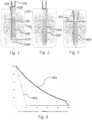
- FIG. 1is a side view of a bone fixation device being inserted into two non-reduced bone segments in a non-expanded state, in accordance with an aspect of the present invention
- FIG. 2is a side view of a bone fixation device being inserted into two reduced bone segments in an expanded, tensioned state, in accordance with an aspect of the present invention
- FIG. 3is a side view of a bone fixation device inserted into two reduced bone segments in a non-expanded state, in accordance with an aspect of the present invention
- FIG. 4is a graph depicting the compressive force applied over time by a device according to the present invention relative to a standard screw;
- FIG. 5is a side view of a bone fixation device inserted into two non-reduced bone segments in an expanded state, in accordance with an aspect of the present invention
- FIG. 6is a side view of a bone fixation device inserted into two reduced bone segments in a non-expanded state, in accordance with an aspect of the present invention
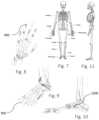
- FIG. 7is an illustration of exemplary bones in the human anatomy in which the disclosed invention could be utilized, in accordance with an aspect of the present invention.
- FIG. 8is an illustration of exemplary bones in the human hand anatomy in which the disclosed invention could be utilized, in accordance with an aspect of the present invention
- FIG. 9is an illustration of exemplary bones in the human foot anatomy in which the disclosed invention could be utilized, in accordance with an aspect of the present invention.
- FIG. 10is an illustration of exemplary bones in the human foot anatomy in which the disclosed invention could be utilized, in accordance with an aspect of the present invention
- FIG. 11is an illustration of exemplary bones in the human anatomy in which the disclosed invention could be utilized, in accordance with an aspect of the present invention
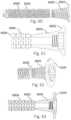
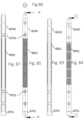
- FIG. 12is a side view of a bone fixation device in an expanded state, in accordance with an aspect of the present invention.
- FIG. 13is a side view of a bone fixation device in a non-expanded state, in accordance with an aspect of the present invention.
- FIG. 14is an enlarged side view of a portion of a deformable or expandable segment of a bone fixation device in an expanded state, in accordance with an aspect of the present invention.
- FIG. 15is an enlarged side view of a portion of a deformable or expandable segment of a bone fixation device in an unexpanded state, in accordance with an aspect of the present invention.
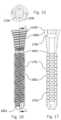
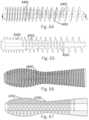
- FIG. 16is a plan view of a bone fixation device, in accordance with an aspect of the present invention.
- FIG. 17is a side cross section view of a bone fixation device in a non-expanded state, in accordance with an aspect of the present invention.
- FIG. 18is a side view of a bone fixation device in a non-expanded state, in accordance with an aspect of the present invention.
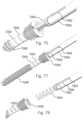
- FIG. 19is a perspective view of a bone fixation device in a non-expanded state, in accordance with an aspect of the present invention.
- FIG. 20is a perspective view of a bone fixation device in an expanded state, in accordance with an aspect of the present invention.
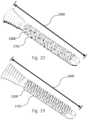
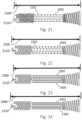
- FIG. 21is a side view of a bone fixation device with a non-threaded expandable segment in a non-expanded state, in accordance with an aspect of the present invention.
- FIG. 22is a side view of a bone fixation device with a non-threaded expandable segment in an expanded state, in accordance with an aspect of the present invention.
- FIG. 23is a side view of a bone fixation device with a non-threaded expandable segment in a non-expanded state, in accordance with an aspect of the present invention.
- FIG. 24is a side view of a bone fixation device with a non-threaded expandable segment in an expanded state, in accordance with an aspect of the present invention.
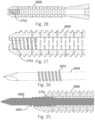
- FIG. 25is a side cross section view of a bone fixation assembly with a threaded expandable segment in a non-expanded state and a distal inner thread with a threaded central member, in accordance with an aspect of the present invention
- FIG. 26is a side view of a threaded central member, in accordance with an aspect of the present invention.
- FIG. 27is an enlarged side cross section view of a bone fixation device with a threaded distal segment in a non-expanded state, in accordance with an aspect of the present invention
- FIG. 28is a side cross section view of a bone fixation device with a threaded distal segment in a non-expanded state, in accordance with an aspect of the present invention.
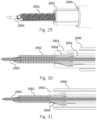
- FIG. 29is a perspective view of a bone fixation assembly with a threaded expandable segment in a non-expanded state and a distal inner thread with a threaded central member and a proximal head retention collet mechanism, in accordance with an aspect of the present invention
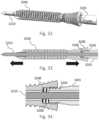
- FIG. 30is a side cross section view of a bone fixation assembly with a threaded expandable segment in a non-expanded state and a distal inner thread with a threaded central member and a proximal head retention collet mechanism, in accordance with an aspect of the present invention
- FIG. 31is a side cross section view of a bone fixation assembly with a threaded expandable segment in a non-expanded state and a distal inner thread with a threaded central member and a proximal head retention collet mechanism, in accordance with an aspect of the present invention
- FIG. 32is a perspective view of a bone fixation assembly with a threaded expandable segment in a non-expanded state and a distal inner thread with a threaded central member and a proximal head retention driver mechanism, in accordance with an aspect of the present invention
- FIG. 33is a side cross section view of a bone fixation assembly with a threaded expandable segment in a non-expanded state and a distal inner thread with a threaded central member and a proximal head retention driver mechanism, in accordance with an aspect of the present invention
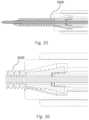
- FIG. 34is a side cross section, enlarged view of a portion of a bone fixation assembly with a threaded expandable segment in a non-expanded state and a distal inner thread with a threaded central member and a proximal head retention driver mechanism, in accordance with an aspect of the present invention
- FIG. 35is a side cross section view of a bone fixation assembly with a threaded expandable segment in a non-expanded state and a distal inner thread with a threaded central member and a proximal head retention driver mechanism and a proximal head retention collet mechanism, in accordance with an aspect of the present invention
- FIG. 36is a side cross section close up view of a bone fixation assembly with a threaded expandable segment in a non-expanded state and a distal inner thread with a threaded central member and a proximal head retention driver mechanism and a proximal head retention collet mechanism, in accordance with an aspect of the present invention
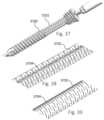
- FIG. 37is a perspective view of a bone fixation device with a non-threaded expandable segment in a non-expanded state, in accordance with an aspect of the present invention.
- FIG. 38is a perspective view of a portion of a bone fixation device with a non-threaded expandable segment in an expanded state, in accordance with an aspect of the present invention.
- FIG. 39is a perspective view of a portion of a bone fixation device with a non-threaded expandable segment in a non-expanded state, in accordance with an aspect of the present invention.
- FIG. 40is a perspective view of a bone fixation assembly with a non-threaded expandable segment in a non-expanded state with a central member with distal and proximal retention features, in accordance with an aspect of the present invention
- FIG. 41is a perspective view of a central member with distal and proximal retention features, in accordance with an aspect of the present invention.
- FIG. 42is a side view of a bone fixation device with a non-threaded expandable segment in a non-expanded state with distal and proximal retention features, in accordance with an aspect of the present invention
- FIG. 43is a side view of a bone fixation device with a non-threaded expandable segment in a non-expanded state with a central exterior stiffening member, in accordance with an aspect of the present invention
- FIG. 44is a side cross section view of a bone fixation device with a non-threaded expandable segment in a non-expanded state with a central exterior stiffening member, in accordance with an aspect of the present invention
- FIG. 45is a side view of a bone fixation device with a non-threaded expandable segment in an expanded state with a central dissolvable member, in accordance with an aspect of the present invention.
- FIG. 46is a side cross section view of a bone fixation device with a non-threaded expandable segment in an expanded state with a central dissolvable member, in accordance with an aspect of the present invention
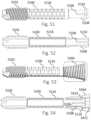
- FIG. 47is a side view of a threaded central member with a proximal head retention mechanism, in accordance with an aspect of the present invention.
- FIG. 48is a side cross section view of a bone fixation assembly with a non-threaded expandable segment in a non-expanded state and a proximal inner thread with a threaded central member with a proximal head retention mechanism, in accordance with an aspect of the present invention
- FIG. 49is a side cross section close up view of a bone fixation assembly with a non-threaded expandable segment in an expanded state and a proximal inner thread with a threaded central cannulated member with a proximal head retention mechanism, in accordance with an aspect of the present invention
- FIG. 50is a side cross section view of a bone fixation device with a non-threaded expandable segment in a non-expanded state with a central interior stiffening member, in accordance with an aspect of the present invention
- FIG. 51is a side view of a bone fixation multi component device with a non-threaded expandable segment in a non-expanded state with a central interior stiffening member without a captured but potentially freely rotating proximal head member, in accordance with an aspect of the present invention
- FIG. 52is a side cross section view of a bone fixation multi component device with a non-threaded expandable segment in a non-expanded state with a central interior stiffening member without a captured but potentially freely rotating proximal head member, in accordance with an aspect of the present invention
- FIG. 53is a side view of a bone fixation multi component device with a non-threaded expandable segment in a non-expanded state with a central interior stiffening member and a captured but potentially freely rotating proximal head member, in accordance with an aspect of the present invention
- FIG. 54is a side cross section view of a bone fixation multi component device with a non-threaded expandable segment in a non-expanded state with a central interior stiffening member and a captured but potentially freely rotating proximal head member, in accordance with an aspect of the present invention
- FIG. 55is a perspective view of a central interior stiffening member with threaded distal engagement features and a proximal head member, in accordance with an aspect of the present invention.
- FIG. 56is a side view of a bone fixation multi component device with a non-threaded expandable segment in an expanded state with threaded distal engagement features, in accordance with an aspect of the present invention
- FIG. 57is a side cross section view of a bone fixation multi component device with a non-threaded expandable segment in an expanded state with a central interior stiffening member with threaded distal engagement features and a proximal head member, in accordance with an aspect of the present invention
- FIG. 58is a side cross section view of a bone fixation multi component device with a non-threaded expandable segment in a non-expanded state with a central interior stiffening member with threaded distal engagement features and a proximal head member, in accordance with an aspect of the present invention
- FIG. 59is a side view of a bone fixation multi component device with a non-threaded expandable segment in a non-expanded state with a central interior stiffening member with threaded distal engagement features and a proximal head member, in accordance with an aspect of the present invention
- FIG. 60is a side view of a bone fixation device in a non-expanded state with a proximal head engagement feature, in accordance with an aspect of the present invention.
- FIG. 61is a side cross section close up view of a bone fixation device in a non-expanded state with a proximal head engagement feature, in accordance with an aspect of the present invention
- FIG. 62is a perspective view of a bone fixation device in a non-expanded state with a freely rotating proximal head engagement feature, in accordance with an aspect of the present invention
- FIG. 63is a side cross section close up view of a bone fixation device in a non-expanded state with a freely rotating proximal head engagement feature, in accordance with an aspect of the present invention.
- FIG. 64is a side view of a bone fixation device in a non-expanded state with a tapered minor diameter and variable pitch thread features, in accordance with an aspect of the present invention.
- FIG. 65is a side cross section view of a bone fixation device in a non-expanded state with a tapered minor diameter and variable pitch thread features, in accordance with an aspect of the present invention.
- FIG. 66is a side view of a bone fixation device in a non-expanded state with variable minor and major diameters and triple lead pitch thread features, in accordance with an aspect of the present invention
- FIG. 67is a side cross section view of a bone fixation device in a non-expanded state with variable minor and major diameters and triple lead pitch thread features, in accordance with an aspect of the present invention.
- FIG. 68is a perspective view of a bone fixation device in a non-expanded state with variable minor and major diameters and triple lead pitch thread features, in accordance with an aspect of the present invention.
- FIG. 69is a perspective view of a bone fixation device in a non-threaded, non-expanded state with variable minor and major diameters and distal triple lead pitch thread and variable proximal thread features, in accordance with an aspect of the present invention
- FIG. 70is a side cross section view of a bone fixation device in a non-expanded state with variable minor and major diameters and triple lead pitch thread features, in accordance with an aspect of the present invention.
- FIG. 71is a side cross section view of a bone fixation device in a non-threaded non-expanded state with variable minor and major diameters and distal triple lead pitch thread and variable proximal thread features, in accordance with an aspect of the present invention
- FIG. 72is a perspective view of a bone fixation device with a non-threaded helical expandable segment in a non-expanded state, in accordance with an aspect of the present invention.
- FIG. 73is a perspective view of a bone fixation assembly with a non-threaded helical expandable segment in a non-expanded state with a helical expansion member and driver, in accordance with an aspect of the present invention
- FIG. 74is a perspective view of a bone fixation assembly with a non-threaded helical expandable segment in a non-expanded state with a helical expansion member and driver and central member, in accordance with an aspect of the present invention
- FIG. 75is a perspective view of a bone fixation assembly with a non-threaded helical expandable segment in an expanded state with a helical expansion member and driver and central member, in accordance with an aspect of the present invention
- FIG. 76is a perspective view of a bone fixation assembly with a non-threaded helical expandable segment in an expanded state with a helical expansion member and driver and central member, in accordance with an aspect of the present invention
- FIG. 77is a perspective view of a bone fixation assembly with a non-threaded helical expandable segment in an expanded state with a helical expansion member and driver, in accordance with an aspect of the present invention
- FIG. 78is a perspective view of a bone fixation assembly with a non-threaded helical expandable segment in a non-expanded state with a helical expansion member and driver, in accordance with an aspect of the present invention
- FIG. 79is a side cross section view of a bone fixation assembly with a non-threaded helical expandable segment in an expanded state with a helical expansion member and driver and central member, in accordance with an aspect of the present invention
- FIG. 80is a perspective view of a bone fixation assembly with a non-threaded expandable segment in a non-expanded state with trans axial engagement members in a bone, in accordance with an aspect of the present invention
- FIG. 81is a perspective view of a bone fixation assembly with a non-threaded expandable segment in a non-expanded state, in accordance with an aspect of the present invention.
- FIG. 82is a perspective view of a bone fixation assembly with a non-threaded expandable segment in an expanded state, in accordance with an aspect of the present invention.
- FIG. 83is a side cross section view of a bone fixation assembly with a non-threaded expandable segment in a non-expanded state with a central member, in accordance with an aspect of the present invention
- FIG. 84is a side view of a bone fixation assembly with a non-threaded expandable segment in a non-expanded state with a central member, in accordance with an aspect of the present invention
- FIG. 85is a side cross section view of a bone fixation assembly with a non-threaded expandable segment in an expanded state with a central member and retention features, in accordance with an aspect of the present invention.
- FIG. 86is an end view of a bone fixation assembly with a non-threaded expandable segment in an expanded state with a central member and retention features, in accordance with an aspect of the present invention.
- FIG. 87is a side cross section view of a bone fixation assembly with a non-threaded expandable segment in an expanded state with a central member and retention features, in accordance with an aspect of the present invention
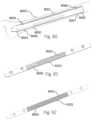
- FIG. 88is a side view of a portion of a bone fixation device with a non-threaded expandable segment in a non-expanded state, in accordance with an aspect of the present invention.
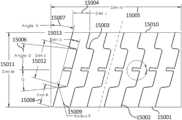
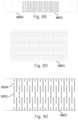
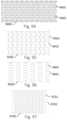
- FIG. 89is a partial side view of a portion of a cut slot pattern of a bone fixation device with a non-threaded expandable segment in a non-expanded state, in accordance with an aspect of the present invention.
- FIG. 90is a partial side view of a portion of a cut slot pattern of a bone fixation device with a non-threaded expandable segment in a non-expanded state, in accordance with an aspect of the present invention.
- FIG. 91is a side view of a portion of a bone fixation device with a non-threaded expandable segment in an expanded state, in accordance with an aspect of the present invention.
- FIG. 92is a partial side view of a portion of a cut slot pattern of a bone fixation device with a non-threaded expandable segment in an expanded state, in accordance with an aspect of the present invention
- FIG. 93is a partial side view of a portion of a cut slot pattern of a bone fixation device with a non-threaded expandable segment in an expanded state, in accordance with an aspect of the present invention.
- FIG. 94is a partial side view of a portion of a cut slot pattern of a bone fixation device with a non-threaded expandable segment in an expanded state, in accordance with an aspect of the present invention.
- FIG. 95is a partial side view of a portion of a cut slot pattern of a bone fixation device with a non-threaded expandable segment in a non-expanded state, in accordance with an aspect of the present invention.
- FIG. 96is a partial side view of a portion of a cut slot pattern of a bone fixation device with a non-threaded expandable segment in a non-expanded state, in accordance with an aspect of the present invention
- FIG. 97is a partial side view of a portion of a cut slot pattern of a bone fixation device with a non-threaded expandable segment in a non-expanded state, in accordance with an aspect of the present invention.
- FIG. 98is a partial side view of a portion of a cut slot pattern of a bone fixation device with a non-threaded expandable segment in a non-expanded state, in accordance with an aspect of the present invention.
- FIG. 99is a partial side view of a portion of a cut slot pattern of a bone fixation device with a non-threaded expandable segment in a non-expanded state, in accordance with an aspect of the present invention.
- FIG. 100is a side view of a bone fixation device with a non-threaded helical expandable segment in a non-expanded state, in accordance with an aspect of the present invention
- FIG. 101is a side cross section view of a bone fixation device with a non-threaded helical expandable segment in a non-expanded state, in accordance with an aspect of the present invention
- FIG. 102is a side view of a bone fixation device with a non-threaded segment, in accordance with an aspect of the present invention.
- FIG. 103is a graph showing material strain curves, in accordance with an aspect of the present invention.
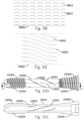
- FIG. 104is a perspective enlarged view of a bone fixation device with a triple lead threaded expandable segment in a non-expanded state, in accordance with an aspect of the present invention.
- FIG. 105is a side and an enlarged end view of a bone fixation device with a single lead threaded segment, in accordance with an aspect of the present invention.
- FIG. 106is a side and an enlarged end view of a bone fixation device with a double lead threaded segment, in accordance with an aspect of the present invention.
- FIG. 107is a side and an enlarged end view of a bone fixation device with a triple lead threaded segment, in accordance with an aspect of the present invention.
- FIG. 108is a plan enlarged view of a portion of a cut slot pattern of a bone fixation device with a non-threaded expandable segment in a non-expanded state, the segment would yield two different patterns as wrapped about the circumference of the body, in accordance with an aspect of the present invention
- FIG. 109is an enlarged elevation view of a joining feature of a bone fixation device with a non-threaded expandable segment and a threaded segment in joined state, in accordance with an aspect of the present invention.
- FIG. 110is a side view of a bone fixation device with a non-threaded expandable segment in a non-expanded state the segment being of larger diameter than the minor diameter of the threaded section, in accordance with an aspect of the present invention
- FIG. 111is a side cross section view of a bone fixation device with a non-threaded expandable segment in a non-expanded state the segment being of larger diameter than the minor diameter of the threaded section, in accordance with an aspect of the present invention
- FIG. 112is a side view of a bone fixation device with a non-threaded expandable segment in a non-expanded state the segment being bent off axis from that of the threaded section, in accordance with an aspect of the present invention
- FIG. 113is a flow chart showing one embodiment of a method of clinical application of a bone fixation device according to the present invention.
- FIG. 114is a flow chart showing one embodiment of a method of clinical application of a bone fixation device according to the present invention.
- FIG. 115is a flow chart showing one embodiment of a method of clinical application of a bone fixation device according to the present invention.
- FIG. 116is a flow chart showing one embodiment of a method of clinical application of a bone fixation device according to the present invention.
- FIG. 117is a flow chart showing one embodiment of a method of clinical application of a bone fixation device according to the present invention.
- FIG. 118is a flow chart showing one embodiment of a method of clinical application of a bone fixation device according to the present invention.
- FIG. 119is a flow chart showing one embodiment of a method of manufacturing a bone fixation device according to the present invention.
- FIG. 120is a flow chart showing one embodiment of a method of manufacturing a bone fixation device according to the present invention.
- FIG. 121is a flow chart showing one embodiment of a method of manufacturing a bone fixation device according to the present invention.
- FIG. 122is a flow chart showing one embodiment of a method of manufacturing a bone fixation device according to the present invention.
- FIG. 123is a partial side view of a bone fixation device with a non-threaded expandable segment with multiple expansion properties in a non-expanded state, in accordance with an aspect of the present invention
- FIG. 124is a partial side view of a bone fixation device with a non-threaded expandable segment with multiple expansion properties in a non-expanded state with deformation control features, in accordance with an aspect of the present invention
- FIG. 125is a side view of a bone fixation device with a non-threaded expandable segment with multiple expansion properties in a non-expanded state, in accordance with an aspect of the present invention
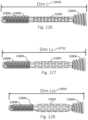
- FIG. 126is a side view of a bone fixation device with a non-threaded expandable segment with radial expansion properties in a non-expanded state, in accordance with an aspect of the present invention
- FIG. 127is a side view of a bone fixation device with a non-threaded expandable segment with radial expansion properties in a partially-expanded state, in accordance with an aspect of the present invention
- FIG. 128is a side view of a bone fixation device with a non-threaded expandable segment with radial expansion properties in a fully-expanded state, in accordance with an aspect of the present invention
- FIG. 129is a side cross section view of a bone fixation device with a threaded distal segment and a non-threaded expandable segment in a non-expanded state, the expandable segment being of larger diameter than the minor diameter of the threaded section, the distal segment having a feature on an inner diameter that can engage and transfer a torque and axial load, in accordance with an aspect of the present invention
- FIG. 130is a side cross section view of a bone fixation device assembly with a threaded distal segment and a non-threaded expandable segment in a non-expanded state, the expandable segment being of larger diameter than the minor diameter of the threaded distal segment, the distal segment having a feature on an inner diameter that can engage and transfer a torque and axial load, and a driving mechanism that can engage the distal feature and a proximal end of the device, in accordance with an aspect of the present invention;
- FIG. 131is a perspective view of a device assembly with a driving mechanism that engages a distal feature and a proximal end of a device, in accordance with an aspect of the present invention.
- FIG. 132is a perspective cross section view of a bone fixation device assembly with a threaded distal segment and a non-threaded expandable segment in a non-expanded state, the expandable segment being of larger diameter than the minor diameter of the threaded distal segment, the distal segment having a feature on an inner diameter that can engage and transfer a torque and axial load, and a driving mechanism that can engage the distal feature and a proximal end of the device, in accordance with an aspect of the present invention;
- FIG. 133is a side view of a bone fixation device being inserted into two non-reduced bone segments, in accordance with an aspect of the present invention.
- FIG. 134is a side view of a bone fixation device being inserted into two non-reduced bone segments in accordance with an aspect of the present invention
- FIG. 135is a side view of a bone fixation device inserted into two reduced bone segments in a flexed state, in accordance with an aspect of the present invention
- FIG. 136is a graph depicting the compressive force loaded over distance by a device according to the present invention relative to a standard screw.
- FIG. 137is a partial side view of a portion of a cut slot pattern of a bone fixation device with a non-threaded helical expandable segment in a non-expanded state, in accordance with an aspect of the present invention.
- FIG. 138is a partial side view of a bone fixation device with a non-threaded helical expandable segment in a non-expanded state, in accordance with an aspect of the present invention.
- FIG. 139is a partial side view of a bone fixation device with a non-threaded helical expandable segment with torsional engagement features in a non-expanded state, in accordance with an aspect of the present invention.
- FIG. 140is a side view of a bone fixation device with a non-threaded helical expandable segment with torsional engagement features in a non-expanded state, in accordance with an aspect of the present invention.
- FIG. 141is a side view of a bone fixation device with a non-threaded helical expandable segment with torsional engagement features in a non-expanded state, in accordance with an aspect of the present invention.
- FIG. 142is a side view of a bone fixation device with a non-threaded helical expandable segment with torsional engagement features in a non-expanded state, in accordance with an aspect of the present invention.
- FIG. 143is a partial side view of a portion of a cut slot pattern of a bone fixation device with a non-threaded helical expandable segment with torsional engagement features in a non-expanded state, in accordance with an aspect of the present invention.
- FIG. 144is a partial side view scaled detail of a portion of a cut slot pattern of a bone fixation device with a non-threaded helical expandable segment with torsional engagement features in a non-expanded state, in accordance with an aspect of the present invention.
- FIG. 145is a partial side view of a bone fixation device with a non-threaded helical expandable segment with torsional engagement features in an expanded state, in accordance with an aspect of the present invention.
- FIG. 146is a side view of a bone fixation device with a non-threaded helical expandable segment with torsional engagement features in a non-expanded state, in accordance with an aspect of the present invention.
- FIG. 147is a side view of a bone fixation device with a non-threaded helical expandable segment with torsional engagement features in an expanded state, in accordance with an aspect of the present invention.
- FIG. 148is a side view of a bone fixation device with a non-threaded helical expandable segment with torsional engagement features in a non-expanded state, in accordance with an aspect of the present invention.
- FIG. 149is a side view of a bone fixation device with a non-threaded helical expandable segment with torsional engagement features in an expanded state, in accordance with an aspect of the present invention.
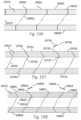
- FIG. 150is a partial side view of a portion of a cut slot pattern of a bone fixation device with a non-threaded helical expandable segment with torsional engagement features and axial length engagement features in a non-expanded state, in accordance with an aspect of the present invention.
- FIG. 151is a partial side view scaled detail of a portion of a cut slot pattern of a bone fixation device with a non-threaded helical expandable segment with torsional engagement features and axial length engagement features in a non-expanded state, in accordance with an aspect of the present invention.
- FIG. 152is a partial side view of a portion of a cut slot pattern of a bone fixation device with a non-threaded helical expandable segment with torsional engagement features and axial length engagement features in a non-expanded state, in accordance with an aspect of the present invention.
- FIG. 153is a partial side view scaled detail of a portion of a cut slot pattern of a bone fixation device with a non-threaded helical expandable segment with torsional engagement features and axial length engagement features in a non-expanded state, in accordance with an aspect of the present invention.
- FIG. 154is a partial side view of a portion of a cut slot pattern of a bone fixation device with a non-threaded helical expandable segment with torsional engagement features and axial length engagement features in a non-expanded state, in accordance with an aspect of the present invention.
- FIG. 155is a partial side view scaled detail of a portion of a cut slot pattern of a bone fixation device with a non-threaded helical expandable segment with torsional engagement features and axial length engagement features in an expanded state, in accordance with an aspect of the present invention.
- FIG. 156is a partial side view scaled detail of a portion of a cut slot pattern of a bone fixation device with a non-threaded helical expandable segment with torsional engagement features and axial length engagement features in an expanded state, in accordance with an aspect of the present invention.
- FIG. 157is a partial side view of a portion of a cut slot pattern of a bone fixation device with a non-threaded helical expandable segment with torsional engagement features and axial length engagement features in a non-expanded state, in accordance with an aspect of the present invention.
- FIG. 158is a partial side view of a portion of a cut slot pattern of a bone fixation device with a non-threaded helical expandable segment with torsional engagement features and axial length engagement features in a non-expanded state, in accordance with an aspect of the present invention.
- FIG. 159is a partial side view scaled detail of a portion of a cut slot pattern of a bone fixation device with a non-threaded helical expandable segment with torsional engagement features and axial length engagement features in an expanded state, in accordance with an aspect of the present invention.
- FIG. 160is a partial side view of a portion of a cut slot pattern of a bone fixation device with a non-threaded helical expandable segment with torsional engagement features and axial length engagement features in a non-expanded state, in accordance with an aspect of the present invention.
- FIG. 161is a partial side view of a portion of a cut slot pattern of a bone fixation device with a non-threaded helical expandable segment with torsional engagement features and axial length engagement features in a non-expanded state, in accordance with an aspect of the present invention.
- FIG. 162is a partial side view scaled detail of a portion of a cut slot pattern of a bone fixation device with a non-threaded helical expandable segment with torsional engagement features and axial length engagement features in an expanded state, in accordance with an aspect of the present invention.
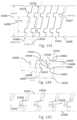
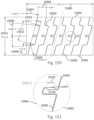
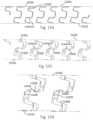
- FIG. 163is a partial side view of a portion of a cut slot pattern of a bone fixation device with a non-threaded sinusoidal expandable segment with torsional engagement features and axial length engagement features in a non-expanded state, in accordance with an aspect of the present invention.
- FIG. 164is a partial detailed side view of a portion of a cut slot pattern of a bone fixation device with a non-threaded sinusoidal expandable segment with torsional engagement features and axial length engagement features in a non-expanded state, in accordance with an aspect of the present invention.
- FIG. 165is a partial side view of a portion of a cut slot pattern of a bone fixation device with a non-threaded expandable segment with trapezoidal torsional engagement features and axial length engagement features in a non-expanded state, in accordance with an aspect of the present invention.
- FIG. 166is a partial detailed side view of a portion of a cut slot pattern of a bone fixation device with a non-threaded expandable segment with trapezoidal torsional engagement features and axial length engagement features in a non-expanded state, in accordance with an aspect of the present invention.
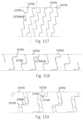
- FIG. 167is a partial side view of a portion of a cut slot pattern of a bone fixation device with a non-threaded helical expandable segment with torsional engagement features and axial length limiting features in a non-expanded state, in accordance with an aspect of the present invention.
- FIG. 167 Ais a partial side view scaled detail of a portion of a cut slot pattern of a bone fixation device with a non-threaded helical expandable segment with torsional engagement features and axial length limiting features in a non-expanded state, in accordance with an aspect of the present invention.
- FIG. 167 Bis a partial side view scaled detail of a portion of a cut slot pattern of a bone fixation device with a non-threaded helical expandable segment with torsional engagement features and axial length limiting features in an expanded state, in accordance with an aspect of the present invention.
- FIG. 168is a partial side view of a portion of a cut slot pattern of a bone fixation device with a non-threaded helical expandable segment with torsional engagement features and axial length engagement features in a non-expanded state, in accordance with an aspect of the present invention.
- FIG. 168 Ais a partial side view scaled detail of a portion of a cut slot pattern of a bone fixation device with a non-threaded helical expandable segment with torsional engagement features and axial length engagement features in a deformed, expanded state, in accordance with an aspect of the present invention.
- FIG. 169is a partial side view scaled detail of a portion of a cut slot pattern of a bone fixation device with a non-threaded helical expandable segment with torsional engagement features and axial length engagement features in an expanded state, in accordance with an aspect of the present invention.
- FIG. 169 Ais a partial side view scaled detail of a portion of a cut slot pattern of a bone fixation device with a non-threaded helical expandable segment with torsional engagement features and axial length engagement features in a deformed, expanded state, in accordance with an aspect of the present invention.
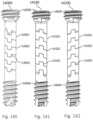
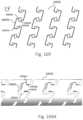
- FIG. 170is a partial side view of a bone fixation device with a non-threaded expandable segment in a non-expanded state, in accordance with an aspect of the present invention.
- FIG. 171is a partial side view of a portion of a cut slot pattern of a bone fixation device with a non-threaded expandable segment in a non-expanded state, in accordance with an aspect of the present invention.
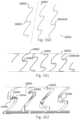
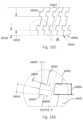
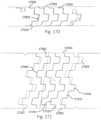
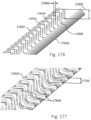
- FIG. 172is a partial side view of a bone fixation device with a non-threaded axial sinusoidal expandable segment in a non-expanded state, in accordance with an aspect of the present invention.
- FIG. 173is a partial side view of a bone fixation device with a non-threaded axial sinusoidal expandable segment in an expanded state, in accordance with an aspect of the present invention.
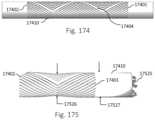
- FIG. 174is a partial side view of a bone fixation device with a non-threaded axial angled expandable segment in a non-expanded state, in accordance with an aspect of the present invention.
- FIG. 175is a partial side view of a bone fixation device with a non-threaded axial angled expandable segment in an expanded state, in accordance with an aspect of the present invention.
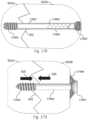
- FIG. 176is a partial side view of a bone fixation device with a non-threaded expandable segment in a non-expanded state, in accordance with an aspect of the present invention.
- FIG. 177is a partial enlarged detail side view of a bone fixation device with a non-threaded expandable segment in an expanded state, in accordance with an aspect of the present invention.
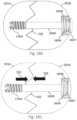
- FIG. 178is a side view of a bone fixation device inserted into two reduced bone segments in a non-expanded state, in accordance with an aspect of the present invention.
- FIG. 179is a side view of a bone fixation device inserted into two reduced bone segments, in accordance with an aspect of the present invention.
- FIG. 180is a side view of a bone fixation device inserted into two reduced bone segments in an expanded state, in accordance with an aspect of the present invention.
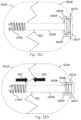
- FIG. 181is a side view of a bone fixation device inserted into two reduced bone segments in a non-expanded state, in accordance with an aspect of the present invention.
- FIG. 182is a side view of a bone fixation device inserted into two reduced bone segments in a non-expanded state, in accordance with an aspect of the present invention.
- FIG. 183is a side view of a bone fixation device inserted into two reduced bone segments in a non-expanded state, in accordance with an aspect of the present invention.
- FIG. 184is a side view of a bone fixation device in an expanded state, in accordance with an aspect of the present invention.
- FIG. 185is a partial cross section side view of a bone fixation device in an expanded state, in accordance with an aspect of the present invention.
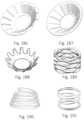
- FIG. 186is an isometric view of a bone fixation spring element device, in accordance with an aspect of the present invention.
- FIG. 187is an isometric view of a bone fixation spring element device, in accordance with an aspect of the present invention.
- FIG. 188is an isometric view of a bone fixation spring element device, in accordance with an aspect of the present invention.
- FIG. 189is an isometric view of a bone fixation spring element device, in accordance with an aspect of the present invention.
- FIG. 190is an isometric view of a bone fixation spring element device, in accordance with an aspect of the present invention.
- FIG. 191is an isometric view of a bone fixation spring element device, in accordance with an aspect of the present invention.
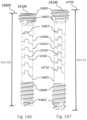
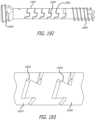
- FIG. 192is a side view of a bone fixation device reduced to practice with a non-threaded helical expandable segment with torsional engagement features in a non-expanded state, in accordance with an aspect of the present invention.
- FIG. 193is a partial side view of a bone fixation device reduced to practice with a non-threaded helical expandable segment with torsional engagement features in a non-expanded state, in accordance with an aspect of the present invention.
- FIG. 194is a graph with data from a device of the present invention that was reduced to practice of the compressive force unloaded over distance relative to a standard screw.
- FIG. 195is a partial perspective cross section view of a bone fixation device assembly with a threaded distal segment and a non-threaded expandable segment in a non-expanded state, in accordance with an aspect of the present invention.
- FIG. 196is a partial side cross section view of a bone fixation device with a non-threaded helical expandable segment in a non-expanded state, in accordance with an aspect of the present invention.
- FIG. 197is a partial side cross section view of a bone fixation device with a non-threaded helical expandable segment in a non-expanded state, in accordance with an aspect of the present invention.
- FIG. 198is a partial side cross section view of a bone fixation device with a non-threaded helical expandable segment in a non-expanded state, in accordance with an aspect of the present invention.
- FIG. 199is a partial cross section view of a bone fixation device with a non-threaded expandable segment in a non-expanded state, in accordance with an aspect of the present invention.
- FIG. 200is a partial cross section view of a bone fixation device with a non-threaded expandable segment in a non-expanded state, in accordance with an aspect of the present invention.
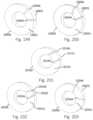
- FIG. 201is a partial cross section view of a bone fixation device with a non-threaded expandable segment in a non-expanded state, in accordance with an aspect of the present invention.
- FIG. 202is a partial cross section view of a bone fixation device with a non-threaded expandable segment in a non-expanded state, in accordance with an aspect of the present invention.
- FIG. 203is a partial cross section view of a bone fixation device with a non-threaded expandable segment in a non-expanded state, in accordance with an aspect of the present invention.
- FIG. 204is a cross section view of a bone fixation device with a non-threaded expandable segment in a non-expanded state, in accordance with an aspect of the present invention.
- FIG. 205is a cross section view of a bone fixation device with a non-threaded expandable segment in a non-expanded state, in accordance with an aspect of the present invention.
- FIG. 206is a cross section view of a bone fixation device with a non-threaded expandable segment in a non-expanded state, in accordance with an aspect of the present invention.
- FIG. 207is a cross section view of a bone fixation device with a non-threaded expandable segment in a non-expanded state, in accordance with an aspect of the present invention.
- FIG. 208is a cross section view of a bone fixation device with a non-threaded expandable segment in a non-expanded state, in accordance with an aspect of the present invention.
- FIG. 209is a flow chart showing one embodiment of a method of clinical application of a bone fixation device according to the present invention.
- FIG. 210is a flow chart showing one embodiment of a method of clinical application of a bone fixation device according to the present invention.
- FIG. 211is a flow chart showing one embodiment of a method of clinical application of a bone fixation device according to the present invention.
- the present specificationdescribes embodiments of apparatus and methods providing an actively compressing system that compress and secures bone segments.
- a structure of an orthopedic bone systemis pre-loaded prior to insertion or effectively loaded during insertion into a desired orthopedic site to post-operatively provide active compression across a facture, or is post operatively loaded, after the device has been implanted.
- the actively compressing systemincludes an elastic, expandable portion. Further, a distal portion and a proximal portion are coupled to one another by the elastic, expandable segment that is configured to be tensioned and provide active compression between the distal and proximal portions.
- a surgical procedureemploys potentially fewer steps than current active compression screws, with a possible length change of at least 0-6 millimeters (mm) and an ability to provide 0-200 newton (N) of axial force, such axial force may, or may not, be adjustable compression over time.
- embodiment herein describedprovide a unitary body construction as well as other embodiments, potentially manufactured from common manufacturing techniques, possibly resulting in a lower cost of goods than current active compression platforms, and the potential ability to scale the design down to at least a 2.0 mm screw.
- Pitchis distance from one point on a screw thread to a corresponding point on the next thread, measured parallel to a longitudinal axis of the screw.
- Pitch diameteron a straight screw thread, a diameter of an imaginary cylinder the surface of which passes through the thread at such a point as to make a width of the thread and a width of the space between threads equal.
- Pitch diameteron a tapered screw thread, a diameter, at a given distance from a reference plane perpendicular to an axis of an imaginary cone, the surface of which would pass through the threads at such point as to make equal the width of the threads and the width of the spaces cut by the surface of the cone.
- “Lead”is a distance a screw thread advances on one rotational turn, measured parallel to the axis. On a single-thread screw the lead and the pitch are identical; on a double-thread screw the lead is twice the pitch; on a triple-thread screw the lead is three times the pitch. “Major diameter” is a largest diameter of an external or internal thread. “Minor diameter” is a smallest diameter of a thread. “Root” is a surface of the thread corresponding to the minor diameter of an external thread and the major diameter of an internal thread. Also defined as the bottom surface joining the flanks of two adjacent threads.
- the ends of the inventive joining features or screwscan have any such features to help facilitate clinical therapy such as self-cutting, self-tapping threads, anti-rotation and/or anti back-out features, reverse cutting threads, profiles or features that aide in the locking of member into a plate, rod, nail, or other screw.
- bone fixation or joining devicesmay include a first portion, a second portion, and at least one axial tension portion or feature.
- the terms “bone fixation device,” “bone fusion device,” “medical device,” “device,” “joining member”, and “implant”may be used interchangeable as they essentially describe the same device.
- the terms “expanded,” “loaded,” “stressed,” “stretched,” and “lengthen”may be used interchangeable as they essentially describe the same feature or state.
- the terms “relaxed,” “unloaded,” “reduced,” “collapsed,” and “shortened”may be used interchangeable as they essentially describe the same feature or state.
- the terms “active”, “actively”, “dynamic”, “dynamically”, and “non-passive”can all be used interchangeably and are intended to have the same meaning of applying continuous force when loaded, and these terms may be used interchangeably.
- proximal, distal, anterior, posterior, medial, lateral, superior and inferiorare defined by their standard usage for indicating a particular part of a bone or implant according to the relative disposition of the natural bone or directional terms of reference.
- proximalmeans the portion of an implant farthest from the insertion end
- distalindicates the portion of the implant nearest the insertion end.
- anterioris a direction towards the front side of the body
- posteriormeans a direction towards the back side of the body
- medialmeans towards the midline of the body
- lateralis a direction towards the sides or away from the midline of the body
- superiormeans a direction above and “inferior” means a direction below another object or structure.
- central memberdeformable member, and expandable member shall be interpreted to include any number of members having a square, round, or oblong shaped cross-section, configured to store energy.
- the term “slideably coupled”shall be interpreted broadly as including any coupling configuration that allows for relative translation between two members, wherein the translation may be linear, non-linear, or rotational.
- a method or device that “comprises,” “has,” “includes,” or “contains” one or more steps or elementspossesses those one or more steps or elements, but is not limited to possessing only those one or more steps or elements.
- a step of a method or an element of a device that “comprises,” “has,” “includes,” or “contains” one or more featurespossesses those one or more features, but is not limited to possessing only those one or more features.
- a device or structure that is configured in a certain wayis configured in at least that way, but may also be configured in ways that are not listed.
- the present active compression orthopedic joining member or screw systemwill be described herein, for ease of explanation only, in the context of a bone screw assembly configured to stabilize bones.
- the methods and structures disclosed hereinare intended for application in any of a wide variety of bones and fractures and fusions, as will be apparent to those of skill in the art in view of the disclosure herein.
- the bone fixation device of the present system and methodis applicable in a wide variety of fractures and osteotomies in the hand, such as interphalangeal and metacarpophalangeal arthrodesis, transverse phalangeal and metacarpal fracture fixation, spiral phalangeal and metacarpal fracture fixation, oblique phalangeal and metacarpal fracture fixation, intercondylar phalangeal and metacarpal fracture fixation, phalangeal and metacarpal osteotomy fixation as well as others known in the art.
- fractures and osteotomiessuch as interphalangeal and metacarpophalangeal arthrodesis, transverse phalangeal and metacarpal fracture fixation, spiral phalangeal and metacarpal fracture fixation, oblique phalangeal and metacarpal fracture fixation, intercondylar phalangeal and metacarpal fracture fixation, phalangeal and metacarpal osteotomy fixation as well as others known in the art.
- a wide variety of phalangeal and metatarsal osteotomies and fractures and fusions of the footmay also be stabilized using the bone fixation device of the present system and method.
- Theseinclude, among others, distal metaphyseal osteotomies such as those described by Austin and Reverdin-Laird, base wedge osteotomies, oblique diaphyseal, digital arthrodesis as well as a wide variety of others that will be known to those of skill in the art.
- Fractures of the fibular and tibial malleoli, pilon fractures and other fractures of the bones of the legmay also be fixated and stabilized with the present exemplary system and method.
- Each of the foregoingmay be treated in accordance with the present system and method, by advancing one of the active compression screw systems disclosed herein through a first bone component, across the fracture, and into the second bone component to fix the fracture.
- an orthopedic bone fixation device for actively compressing a plurality of bone segmentsincludes a first segment or portion positioned at a distal end of the device, a second segment or portion positioned at a proximal end of the device, and an elastic segment or portion having a first and a second end.
- the first end of the elastic segmentis coupled to the first segment and said second end of the elastic segment is coupled to the second member, the elastic member or portion, in an expanded state, configured to exert a force drawing the first and second members or portions together.
- the elastic member and distal and proximal segments or portionsbeing constructed as one unitary contiguous member or structure.
- the implantfor insertion in and stabilization of a bone material having a first and a second region.
- the implantcomprises a shaft including a longitudinal axis, a proximal portion, an expandable center section or portion and a distal portion.
- the proximal and distal portionsmay have proximal and distal threads formed thereon respectively.
- the proximal and distal threadseach have minor and major diameters.
- the minor diameter of the proximal threadmay or may not be substantially equal to the major diameter of the distal thread.
- the shaft of the implantmay have an unthreaded expandable medial portion disposed between the proximal and distal portions that separates the proximal and distal portions and is changeable in length.
- a bone fixation deviceincluding a member and at least one axially and/or radially deformable feature or segment positioned between the distal end and the proximal end.
- the implant of the present inventionis a compression implant and is a bone screw.
- a distal threaded portion and a proximal threaded portionindividually threadably engage each of the two regions of the bone and stabilize the bone and potentially provide axial force to elongate the center section.
- the bone screw apparatusis cannulated throughout its length to allow utilization with a suitable guide wire and cannulated tools for drilling and driving.
- a suitable guide wire and cannulated tools for drilling and drivingin order to compress two spaced-apart materials such as bone fragments, holes can be pre-drilled for both the primary screw and the secondary screw, and a driver can be used to screw into place the screw across the fracture line, with or without the center section elongated. Once the screw segment is in place, a separate driver can be used to turn or rotate the distal screw member further into place and to cause compression of the bone fragments and lengthen the central expandable segment.
- the present inventive system and methodprovides an orthopedic screw system configured to provide a post-operative “active” compressive force on the joined bone segments for fusion.
- activeshall be interpreted as referring to a system configured to provide an active compressive force; rather than a “passive” fastener which would allow a compressive force but not itself provide a dynamic compressive force.
- the elongation of the inventive apparatusprovides a continuous axial compression force onto the bone segments it is engaged into until such time that the elongation is reduced to its resting or non-expanded state. The bone tissue and apparatus will remain in a dynamic interaction of force applied by the apparatus until such time the bone yields or remodels to a zero or reduced stress relationship between the tissue and the apparatus.
- the device of the present inventionunder sufficient axial load, the device of the present invention stretches or is expandable in length. Therefore, the device can maintain an amount of compressive force at the fusion surface, even with subsidence or collapse of bone at the fusion surface over time. Dynamization or axial compression of transverse osteotomies has been shown to increase both the torsional stability and maximal torque of the fracture site when compared to locked rigid control.
- the dynamic nature of the active compression design of the present inventionallows for controlled axial compression at the fusion surface which potentially results in a decrease in stress shielding.
- the solid and the threaded screw and nail designs of know devices, by comparison,are statically locked and thus result in a greater degree of stress shielding. This decrease in stress shielding of the present invention is advantageous for improved bone healing and fusion.
- the elongated compression segment embodiment of the present inventionrepresents a fixation device that can provide active compression over a period of time to a fixation construct.
- the forces applied to the bonemay have the ability to adapt to changes that may occur with bone gapping, movement, and/or, resorption.
- the elongated compression segment of the device of the present inventioncreates a dynamic or residual compressive force across the fusion interface. This dynamic force can adjust over time to accommodate for any potential gapping as a result of the surface vagaries, osteopenic bone, surgeon application, premature weight bearing or the presence of bone grafting material.
- an active compression screw systemmay also be used to attach tissue or structure to the bone, such as in ligament reattachment and other soft tissue attachment procedures.
- the fixation devicemay also be used to attach sutures to the bone, such as in any of a variety of tissue suspension procedures.
- soft tissuesuch as capsule, tendon, or ligament may be affixed to bone by employing the inventive device.
- the inventive device and methodscan also be used to attach a synthetic material such as mesh, to bone or allograft material, such as tensor fascia lata, to bone.
- retention of the material to bonemay be accomplished with an enlarged head portion of the active compression orthopedic screw system shown in the figures to accept a suture or other material for facilitation of this attachment.
- the ability of the present active compression orthopedic screwmay prevent loosening of the screw, thereby reducing the likelihood that the attached tissue or structure will be prematurely released from the bone.
- the ability of the screw to change in lengthmay further shield the bone from the stress of the tension applied and therefore stress shield the attachment mechanism to the bone in this example the threads, yielding a better of stronger or more consistent, long term retention of the bone thread interface.
- screw implant of the inventionmay result in improved compression performance in that the screw will generate bone or tissue compression more efficiently.
- screw implantcan be used in several types of surgical procedures, such as, osteotomies where two separated pieces of the same bone are involved, arthrodesis connecting two or more bones together, and graft fixation where bone and other materials are anchored in place by the screws
- the length of the expandable or deformable memberis increased by an axial force.
- the axial forceresults in the deflection of struts formed in the expandable or deformable member or portion to obtain an increased separation distance between the struts which then yields an overall increase in member length from the original, non-expanded or non-stretched state.
- the distance or amount of axial translationcan vary from small displacements to large displacements, depending on multiple variables and desired performance characteristics.
- performance characteristic variablesinclude, but are not limited to, expandable or deformable member or portion strut width, strut length, radius of end cut slots, width of cut slots, outer diameter of expandable or deformable member, inner diameter of expandable or deformable member, number of slots along the radius of the expandable or deformable member, shape of cut slots, angle of cut slots, number of slots along the axial length of the expandable or deformable member, number of expandable or deformable members, layers of expandable or deformable members, configuration of multiple members, the pattern of slots along the length of the expandable or deformable member or portion, the location of the beginning and ending slots along the length, overall length of the expandable or deformable member, the material, the surface treatment of the material forming the expandable or deformable portion or member, the surface finish, the machined profile of the expandable or deformable member, and the ratio and or relationship of these variables relative to each other.
- the terms perforation and cut slot and the plural forms thereof,are herein used interchangeably.
- the desired characteristics to control within the inventive embodimentmay include but are not limited to, amount of axial force applied to recover or achieve the length, the amount of axial force applied to increase the axial length or stretch or load the member, the amount of length change variable along the axial position of the member, the amount of force change as a ratio to change in length, the radial bending stiffness of the entire member along the axis, the torsional stiffness, the separation of individual strut members, the elastic limit of the material, the engagement in bone tissue, the insertion force of the member into bone, the removability of the member, the migration of the member in/through bone tissue, the resistance to migration of the member in bone tissue, the biocompatibility of the member, the procedural ease of use of the member, the ease of manufacturing of the member, the cost of the member, the number of elements employed to construct the member, and the manufacturing processes employed to construct the member.
- the perforations or cut features of the expandable or deformable portion of the device of the present inventioncan take on an infinite number of permutations of cell designs such as those already described and those including, but are not limited to; diamond shapes, wave forms, non-uniform shapes, sinusoidal shapes, slots, ovals, or round circles. Illustrative examples of some of these possible embodiments can be seen at least in FIGS. 88 - 112 .
- These perforations or cut slot patternscan be repeating along the length or vary along the length, multiple shapes and sizes could be combined in the same construct, either along the length or around the circumference.
- the strutsmay vary in dimension along a length.
- the cross-section of the memberscan also take on an infinite number of permutations of cell designs such as those already demonstrated by prior art and known to those familiar to the art, these include but are not limited to; round, square, oval, etc., the features and dimensions can vary in wall thickness and cross-section along a length of the inventive device.
- increasing the strut lengthincreases the amount of deformation for a given loading condition. This is advantageous in that the increased change in length accommodate a larger change in bone tissue over time.
- the amount of force that is then exerted as compressioncould be reduced which may be a desired trait depending on the desired loading profile.
- the radius of end cut slotscan affect the strain of the struts and increase or decrease the amount of recoverable deformation.
- the width of perforations or cut slotsmay facilitate more or less flexibility of the construct. The manufacturing process can also be affected by this width making different process possible with wider slots such as machine milling, or laser cutting with narrow slots.
- the outer diameter of the expandable or deformable portion or membermay affect the overall stiffness of the construct and axial tension force by increasing or decreasing the amount of structural material involved and changing the bending moment.
- the inner diameter of the expandable or deformable portion or membermay affect the overall stiffness of the construct and axial tension force by increasing or decreasing the amount of structural material involved, it may also affect the manufacturing process used to create the construct.
- the inner diametermay also affect the assembly members or other features used to facilitate the method of application of the inventive embodiments.
- the number of slots along the radius of the memberalso affect the axial tension force generated by the members, and/or the flexural stiffness of the construct. Employing more slots of shorter length or less slots of longer length or slots not evenly distributed about the radius may all facilitate the desired behavior of the construct.
- the shape of perforations or cut slotscan affect the axial tension force, bending stiffness, and the torsional rigidity, of the construct by impacting the local deformation of the construct under load.
- the angle of cut slots relative to the axis of the member and also relative to the radius of the constructcan facilitate different bending behaviors.
- the number of slots along the axial length of the member, the density of the slots, the pattern of slots, the location of the slots along the length, and the overall length of area covered by the slotscan also impact the desired behavior of the inventive embodiments.
- the higher number of slots along the lengththe greater change in length for a given design.
- the more slots around the circumferencethe less length change for a given design and length.
- the number of slots formed around the circumferencedefines the number of spring elements in parallel of the construct. The greater the number or cells around the circumference the higher the spring constant for each spring due to the short strut length available, assuming a constant strut width. The more cells along the length effectively reduce the spring constant allowing the structure increased stretched length.
- a flexible and a non-flexible layermay be employed concentrically together to yield an axial flexible and bending rigid configuration, or vis versa.
- the inventive embodimentsemploy of a unitary member or could be constructed from several different members and joined together in rigid form or in a manner that would leave degrees of freedom between the multiple bodies. The length of these individual members can impact the performance by either increasing or decreasing the desired behavior.
- the location of the member being axial, layered externally or layered internallycan also be used to control the behavior of the inventive embodiments.
- Materialcan also be used as a variable; elastic, stiff, absorbable, biocompatible, and any other material known to those in the art can be used individually or in combination with others to yield a desired feature set.
- the surface treatment of the materialcan also have an impact on the behavior of the structures.
- the ratio and or relationship of these variables relative to each othercan be varied in spirit of the inventive disclosure by those familiar with the art and all combinations are considered herein encompassed in this disclosure.
- Another embodimentis the ability for these axial tension members to increase and or decrease in radial diameter from the center axis. This feature could also yield additional clinical benefits by increasing tissue interface or procedural ease. The ability to adjust all of these variables to yield a desired axial or longitudinal tension over a given length that does not exceed the resistive force of the end retention features in the tissue for an extended period of time should help facilitate healing.
- the present inventionincludes embodiments of apparatus and methods providing an actively compressing system that compresses and secures bone segments; with a unitary contiguous structure; by driving a screw like body into bone segments; that can deliver compressive force over 0.5 mm and in certain embodiments, more than 6 mm of bone absorption; that can deliver compressive axial force of 0-200N; that can deliver compressive axial force for more than 1 hours and potentially up to 48 hours or more after delivery into the bone; that can deliver a compressive axial force in different amounts over time; that can deliver a selected compressive axial force; that can deliver a compressive axial force in different amounts over time; and that can have a diameter of 2-20 mm.
- the present inventionincludes embodiments of apparatuses and methods providing an actively compressing system that compresses and secures bone segments; with a unitary contiguous structure; by driving a screw like body into bone segments; that can deliver compressive force.
- of the inventive methodincludes driving a screw like body into bone segments and then activating a compressive axial force.
- of the inventive methodincludes driving a screw like body into bone segments and delivering a body into bone segments that has axial force generating members substantially the entire length of the body.
- the inventive methodincludes driving a screw like body into bone segments and delivering a body into bone segments that has axial force generating members in a defined region of the length of the body; with a unitary contiguous structure, delivered over a K-wire; or with a unitary contiguous structure that is solid; or with a structure that is cannulated; or by delivering a body into bone segments that has axial force generating members that utilizes perforations or cut features to achieve the axial tension force.
- the apparatuses and methods of the present inventionprovide an actively compressing system that compresses and secures bone segments; with a unitary contiguous structure; by driving a screw-like body into bone segments.
- the screw-like bodyhas axial force generating members that utilizes perforations or cut features to achieve the axial tension force and utilizes threaded regions of the body and the threaded regions' engagement with bone to preload the axial tension.
- the screw-like bodyhas axial force generating members that utilizes perforations or cut features to achieve the axial tension force and utilizes a delivery mechanism to generate the axial preload.
- the screw-like bodyhas axial force generating members that utilize perforations or cut features to achieve the axial tension force and uses an internal member to generate the axial preload.
- the apparatuses and methods of the present inventionprovide an actively compressing system that compresses and secures bone segments with a unitary contiguous structure that has axial force generating members that utilizes perforations or cut features to achieve the axial tension force and uses resorbable material.
- axial force generating membersutilize a structure that is made from shape memory alloy SMA or other material commonly used in the manufacture of implanted devices.
- the apparatuses and methods of the present inventionprovide an actively compressing system that compresses and secures bone segments that has the ability to deform elastically along the central axis beyond that which a solid screw of any material could possibly elastically deform. This ability to deform allows for clinical applications that exceed current available options or solutions and for clinical application that could benefit from tissue fastening devices that provide axial mobile configurations.
- the apparatuses and methods of the present inventionprovide screws designed to bend or transmit torque around a corner.
- the apparatuses and methods of the present inventionprovide screws formed in a bent or curved or helical shape, and installed or delivered in a straight shape.
- the apparatuses and methods of the present inventionprovide screws made out of PEEK or other materials.
- the apparatuses and methods of the present inventionprovide screws processed in the elongated state, then formed back to the shortened state.
- the apparatuses and methods of the present inventionprovide locking features on a screw head to work in conjunction with a plate, rod and/or staples.
- the apparatuses and methods of the present inventionprovide screw design features, used with or without plates, rods and/or staples.
- the apparatuses and methods of the present inventionprovide screws used in spine applications.
- the apparatuses and methods of the present inventionprovide screws formed with an expanded center section, larger than distal and proximal threads.
- the apparatuses and methods of the present inventionprovide solid screws, cannulated screws, headed screws.
- the apparatuses and methods of the present inventionprovide passive thread features to prevent backing out, reverse cutting threads.
- the apparatuses and methods of the present inventionprovide screws with a center portion larger than distal end, able to apply torque at the distal end; a driver inserted all the way past the proximal threads and center section into a socket at the distal end aiding in torsional rotation of the apparatus.
- the apparatuses and methods of the present inventionprovide external or internal spring elements to increase and/or store and/or maintain a tensile force that, in turn, generates or provides a compressive force between two or more tissue segments.
- the apparatuses and methods of the present inventionprovide hybrid screws; constructed of multiple materials such as but not limited to polymer plus metal, different alloys combined into the construction of the embodiments.
- the apparatuses and methods of the present inventionprovide a fastener having no distinct enlarged proximal head and/or having a continuous thread diameter throughout the length of the screw in which the proximal and distal threads can be the same diameter.
- the present inventionprovides methods of assembling the bone fixation device.
- the present inventionprovides methods of using the bone fixation device to compress segments of bone.
- the apparatuses and methods of the present inventionprovide the ability to continuously apply a compressive force to bone segments over a distance or length in which the embodiment was initially stretched or lengthened.
- the mechanism providing this expansion and contraction or change in lengthcomprises a continuous wrap member spanning the length of the expandable section.
- This wrap membercomprises a single wrap encompassing the entire circumference.
- This wrap membercomprises multiple wrap members spanning the length of the expandable section.
- the wrap memberbeing similar in shape and function to a rectangular cross-section helical coil spring. The pitch of this wrap cut pattern having a direct relationship on the spring constant of the expanding section.
- the apparatuses and methods of the present inventionprovide the ability to continuously apply a compressive force to bone segments over a distance or length in which the embodiment was initially stretched or lengthened.
- the mechanism providing this expansion and contraction or change in lengthcomprises of a continuous wrap member or strut spanning the length of the expandable section. This wrap being integrated into any orthopedic screw design.
- These screwshaving standard heads, threaded heads, self-tapping and cutting thread profiles, cannulated screws, screws of any diameter, screws of any length, e.g. 2 mm diameter screws, 12 mm diameter screws, 20 mm length screws, 300 mm length screws.
- the apparatuses and methods of the present inventionprovide the ability to continuously apply a compressive force to bone segments over a distance or length in which the embodiment was initially stretched or lengthened.
- the mechanism providing this expansion and contraction or change in lengthcomprises of a continuous wrap member spanning the length of the expandable section.
- the wrap sectionbeing one continuous body with the distal threaded section and the proximal head of the body.
- the apparatuses and methods of the present inventionprovide the ability to continuously apply a compressive force to bone segments over a distance or length in which the embodiment was initially stretched or lengthened.
- the mechanism providing this expansion and contraction or change in lengthcomprises of a continuous wrap member spanning the length of the expandable section.
- the wrap sectionbeing one continuous body with the distal threaded section and the proximal head of the body.
- the wrap directionbeing in the same direction as the threads on the distal end.
- the wrap directionbeing in the opposite direction as the threads on the distal end.
- the apparatuses and methods of the present inventionprovide the ability to continuously apply a compressive force to bone segments over a distance or length in which the embodiment was initially stretched or lengthened.
- This rotation of the bodybeing limited by a limiting engagement feature.
- This rotation limiting featureexisting on the wrap or strut member.
- This rotation limiting featureexisting on the leading edge of the wrap member.
- This rotation limiting featureexisting on the trailing edge of the wrap member.
- the embodiment having 1 to 100 rotation limiting features along the circumference of the bodyThe embodiment having rotation limiting features along the circumference of the body spaced in a uniform pattern.
- the apparatuses and methods of the present inventionprovide the ability to continuously apply a compressive force to bone segments over a distance or length in which the embodiment was initially stretched or lengthened. This distance being limited by a limiting feature.
- This length limiting featureexisting on the wrap or strut member.
- This length limiting featureexisting on the rotational engagement member.
- This length limiting featureexisting on the leading edge of the wrap member.
- This length limiting featureexisting on the trailing edge of the wrap member.
- the length limiting featureintegrated into the rotational engagement feature.
- the length limiting memberhaving a mechanical engagement.
- the length limiting featurehaving a sliding engagement.
- the length limiting featurehaving a wedging engagement.
- the length limiting featurehaving a catching engagement.
- the inventionhaving 1 to 100 length limiting features along the expanding section.
- the inventionhaving 1 to 100 length limiting features along the circumference of the body.
- the inventionhaving length limiting features along the circumference of the body spaced in a uniform pattern.
- the inventionhaving length limiting features along the circumference of the body spaced in a varied pattern.
- the apparatuses and methods of the present inventionprovide the ability to continuously apply a compressive force to bone segments over a distance or length in which the embodiment was initially stretched or lengthened. This change in length can be more than 20 percent of the entire constructs length.
- the distance in which the applied force can be appliedcan range from 0-20 percent of the bodies overall length, and can be set by the design.
- the apparatuses and methods of the present inventionprovide the ability to continuously apply a compressive force to bone segments over a distance or length in which the embodiment was initially stretched or lengthened. This distance being limited by the design. This limiting feature allowing for application of a higher compressive force being applied to the bone segments than the spring force of the expanded mechanism. This is commonly called a preload.
- a preloadAn example of this would be the spring mechanism can apply a constant or variable 50N of compression to the bone segments over a distance of 3 mm. Once the screw has stretched 3 mm, further engagement of the threads and bone tissue could yield a 200N compression between the bone segments.
- the 200N forcewill resolve with in less than 1 mm of bone absorption, then the spring force of the expandable mechanism will load the bone at 50N until the 3 mm of stretch is reduced to 0 mm, which may or may not happen.
- the apparatuses and methods of the present inventionprovide the ability to continuously apply a compressive force to bone segments over a distance or length in which the embodiment was initially stretched or lengthened having a stretch length that is limited by an interference mechanism.
- the apparatuses and methods of the present inventionprovide the ability to continuously apply a compressive force to bone segments over a distance or length in which the embodiment was initially stretched or lengthened having a rotational engagement feature that limits the amount of rotation along the length of the expanding section.
- These rotational engagement featurescan enable the length change of the expanding mechanism.
- These rotational engagement featurescan resist the length change of the expanding mechanism.
- These rotational engagement featurescan limit the rotational positional change of the expanding mechanism during loading.
- the apparatuses and methods of the present inventionprovide the ability to continuously apply a compressive force to bone segments over a distance or length in which the embodiment was initially stretched or lengthened having stress relieving cut patterns to allow for large deformations.
- the apparatuses and methods of the present inventionprovide the ability to continuously apply a compressive force to bone segments over a distance or length in which the embodiment was initially compressed or shortened. This distance being limited by the design. This limiting feature allowing for application of a higher compressive force being applied to the bone segments than the spring force of the expanded mechanism. This is commonly called a preload.
- the apparatuses and methods of the present inventionprovide the ability to continuously apply a compressive force to bone segments over a distance or length in which the embodiment was initially compressed or shortened. This distance being limited by the design.
- the force generating memberbeing a compression spring.
- the force generating memberbeing a compression washer.
- the force generating memberbeing a compression wave spring.
- the spring mechanismresiding on the exterior of the screw member or bone engagement member.
- the spring mechanismbeing on the surface of the bone.
- the apparatuses and methods of the present inventionprovide the ability to continuously apply a compressive force to bone segments over a distance or length in which the embodiment was initially compressed or shortened. This distance being limited by the design.
- the force generating memberbeing a compression spring.
- the force generating memberbeing a compression washer.
- the force generating memberbeing a compression wave spring.
- the apparatuses and methods of the present inventionprovide the ability to continuously apply a compressive force to bone segments over a distance or length in which the embodiment was initially compressed or shortened. This distance being limited by the design.
- the force generating memberbeing a compression spring.
- the spring mechanismresiding beneath the surface of the bone.
- the apparatuses and methods of the present inventionprovide the ability to continuously apply a compressive force to bone segments over a distance or length in which the embodiment was initially compressed or shortened. This distance being limited by the design.
- the force generating memberbeing a compression spring.
- the spring mechanismresiding beneath the surface of the bone.
- the spring mechanismresiding inside of a retaining member.
- the retaining memberengaging the bone and spring.
- the spring forcebeing transmitted through the head of a screw to the distal bone segment.
- the apparatuses and methods of the present inventionprovide the ability to continuously apply a compressive force to bone segments over a distance or length in which the embodiment was initially compressed or shortened.
- the spring forcebeing transmitted through the head of a screw to the distal bone segment.
- the apparatuses and methods of the present inventionprovide the ability to continuously apply a compressive force to bone segments over a distance or length in which the embodiment was initially stretched or lengthened. This distance being limited by the design.
- the spring forcebeing transmitted through the head of a screw to the proximal bone segment.
- the spring forcebeing transmitted through the distal threads of a screw to the distal bone segment.
- the apparatuses and methods of the present inventionprovide the ability to continuously apply a compressive force to bone segments over a distance or length in which the embodiment was initially stretched or lengthened. This distance being limited by the design.
- the spring forcebeing transmitted through the head of a screw to the proximal bone segment.
- the spring forcebeing transmitted through the distal threads of a screw to the distal bone segment.
- the section of the joining apparatusbeing resistant to bending across the region of the bone segment interface.
- the section of the screw that extends across the fractured boneends in a nonexpanding section.
- the apparatuses and methods of the present inventionprovide the ability to continuously apply a compressive force to bone segments over a distance or length in which the embodiment was initially stretched or lengthened.
- the expanding sectionhaving a cut pattern.
- the cut patternhaving beam members in angles relative to the axis.
- the cut patternbeams being shorter than the circumference of the body.
- the continuous body of the cut patternshaving beams in bending and nodes of connection.
- the cut pattern of beamsalternating angles about the circumference of the body.
- the relative beam angles diverging from each other as the bodyis lengthened.
- the nodes at the ends of the beamsincreasing in axial separation distance relative to each other during axial tensile loading.
- the beam members acting as springsin series as a mechanism.
- the apparatuses and methods of the present inventionprovide the ability to continuously apply a compressive force to bone segments over a distance or length in which the embodiment was initially stretched or lengthened.
- the expanding sectionhaving a cut slot pattern.
- the cut patternhaving beam members in angles relative to the axis resembling a sinusoidal pattern.
- the beam membersdeflect to a lesser angle or deform to a straight configuration upon axial tensile loading.
- the beam members connected on each end to the bodyfeatures that engage bone tissue.
- the beam membershaving circumferential support members at the apexes of a sinusoidal pattern.
- the beam membersdecreasing in diameter from their relative starting diameter.
- the beam membersincreasing in diameter from their relative starting diameter.
- the methods and apparatus of the of present inventionwith features formed of cut paths that do not intersect with the central axis of the body.
- the methods and apparatus of the present inventionwhich has a variable cut angle or plane throughout the cut path, relative to lines or planes orthogonal to the central axis.
- Certain embodiments of the present inventionprovide apparatuses, such as bone fixation devices, having a strut or spring wrap member having features that substantially limit a rotation of the strut or spring wrap member about a longitudinal central axis of the device resulting from a torsional force input to the device along the longitudinal central axis of the device, thereby, resulting in longitudinal ends of the device rotating through or into patient tissue, e.g. bone matter, at substantially a same rate and frequency.
- Certain embodiments of the present inventionprovide apparatuses, such as bone fixation devices, having a strut or spring wrap member having features that limit a torsional and/or rotational displacement or deformation of the strut or spring wrap member about a longitudinal central axis of the device when the feature is placed under rotational loading and/or axial loading.
- Certain embodiments of the present inventionprovide apparatuses, such as bone fixation devices, having a strut or spring wrap member having features that limit the displacement of the device when an axial deformation is imparted onto the device.
- Certain embodiments of the present inventionprovide apparatuses, such as bone fixation devices, having a strut or spring wrap member having axle length limiting features that have a two distinct loading curves that vary in slope.
- Certain embodiments of the present inventionprovide apparatuses, such as bone fixation devices, having a strut or spring wrap member having axle length limiting features that can be designed to limit the amount of deformation under a given load.
- Certain embodiments of the present inventionprovide apparatuses, such as bone fixation devices, having a strut or spring wrap member having axial length limiting features that also limit torsional displacement of an adjacent strut or spring wrap member.
- Certain embodiments of the present inventionprovide apparatuses, such as bone fixation devices, having a strut or spring wrap member having features that enable axial translation or deformation up until a predetermined dimension of the device, e.g. an axial length or a circumference, at which time the features abruptly resist such deformation.
- Certain embodiments of the present inventionprovide apparatuses, such as bone fixation devices, having a strut or spring wrap member having features that limit deformation or deflection of the strut or spring wrap member regardless of a direction of a rotational input applied to the device, i.e. having features that allow alternate axial displacement of the device within patient tissue without obstruction or binding of the device.
- Certain embodiments of the present inventionprovide apparatuses, such as bone fixation devices, having a strut or spring wrap member having features that limit torsional rotation without imparting axial load or resistance in both axial directions of the device.
- Certain embodiments of the present inventionprovide apparatuses, such as bone fixation devices, having a strut or spring wrap member having features that limit torsional deflection or deformation and that increase the overall torsional strength of the device.
- Certain embodiments of the present inventionprovide apparatuses, such as bone fixation devices, having a strut or spring wrap member having features that limit axial deflection or deformation and increase the overall axial strength of the device.
- Certain embodiments of the present inventionprovide apparatuses, such as bone fixation devices, having a strut or spring wrap member having features that limit torsional and axial deformation of the device and that increase the overall torsional and axial strength of the device.
- FIGS. 1 - 3depicts a representation of one embodiment of the present invention in which a member 100 , shown in a contracted or shortened state, is inserted in to bone members 101 and 102 and then brings or draws bone members 101 and 102 towards one another, providing a compressive axial tension or force.
- the bone members 101 and 102may represent one bone broken in two pieces or two bones that are to be fused together.
- the bonemay, for example be a cortical or cancellous bone or both.
- the joining member 100is driven into the bone members 101 and 102 with a mechanical instrument, mechanism, or tool 103 that provides the forces needed to accomplish this action.
- This forcecould be that of rotating the member 100 and applying an axial force to facilitate a screwing of the member 100 into the bone members 101 and 102 .
- the bone membersmay or may not be placed in close proximity to each other prior to insertion or placement of member 100 .
- Bone members 101 and 102may or may not have been pre-drilled with a pilot hole to facilitate placement of bone member 101 and 102 .
- Bone members 101 and 102may, but need not necessarily, have member 104 , depicted here as an axial member such as a K-wire, inserted prior to placement of member 100 .
- the K-wire 104may be placed to help facilitate the securing of bone members 101 and 102 relative to each other.
- the K-wire or member 104may act as an axial alignment guide for a cannulated member 100 .
- the member 104may or may not be over drilled with a cannulated drill as a pre-drill step to a diameter that facilitates placement of member 100 .
- the member 100changes in axial length, as indicated by a member 200 , shown in FIG. 2 .
- the change in lengthoccurs over all or a portion of a deformable or expandable portion 202 of member 200 .
- This change in lengthmay be imparted onto the contracted or shortened member 100 prior to insertion into bone members 101 and 102 .
- this change in lengthmay be imparted onto the contracted or shortened member 100 during the insertion into bone members 101 and 102 .
- this change in lengthmay be imparted onto the contracted or shortened member 100 by the act or through the forces imparted onto the contracted or shortened member 100 by the delivery mechanism 103 .
- this change in lengthmay be imparted onto the contracted or shortened member 100 by the act or through the forces imparted onto the contracted or shortened member 100 by the delivery mechanism 103 in combination with a resistance to insertion imparted by the bone members 101 and 102 .
- the lengthened or axially elongated member 200asserts a compressive force onto the bone members 101 and 102 that draws bone members 101 and 102 towards one another.
- the elongated member 200 shown in FIG. 2applies force onto the bone members 101 and 102 through a mechanism, for example, in which threads 106 formed on an exterior of member 100 , 200 engage the bone members 101 and 102 and a head 108 of the member 100 , 200 and the pitch of the threads 106 function in combination to generate a compressive load or force across the two bone members 101 and 103 to help facilitate bone healing or fusion.
- the elongated member 200 shown in FIG. 2applies force onto the bone members 101 and 102 in such a way as to apply an active or continuous force over an extended period of time, for example over a period of time from 1 to 72 hours.
- the period of timecan be that of the length of time for the force of the elongated member 200 to retract from extended state indicated as member 200 to retracted state indicated as member 100 .
- This time to retractwill be controlled, in part, by the reactive forces bone members 101 and 102 impart onto the engaging members or threads 106 of member 100 , 200 .
- This time to retract and related forceswill be furthered controlled, in part, by the nature of the bone material that is engaged by the member 100 , 200 by the thread 106 and, in part, by the features that enable the adjustable length of member 100 , 200 .
- the mechanisms of control of the compressive force generated and related contraction periodmay, for example, include but are not limited to the amount of force imparted onto bone members 101 and 102 ; the amount of bone material engaged by the engagement features of the implant member 100 , 200 , e.g. by threads 106 ; and the surface area of the interface between the bone members 101 and 102 and the implant member 100 , 200 .
- the extend and adjustable period of time over which the continuous compressive force is applied to bone members 101 and 102facilitates bone members 101 and 102 healing together and/or forming a fusing or union 301 .
- the stored energy or force of member 200that can exhibit a continuous load over time and/or absorption of bone material.
- the stored compressive energy or preloadprovides a compressive force cross the bone elements to aide in the healing or fusion process.
- the preloadcan be imparted into the joining member 100 , 200 in several manners. The preload could have been imparted to the member 100 , 200 before it is inserted into the bone members 101 and 102 . The preload could be imparted by the act of inserting the member 100 , 200 into the bone member 101 and 102 . Engagement features, e.g.
- threads 106 , on the member 100 , 200can work in such a fashion that the tip or distal end 110 of the member 100 , 200 is advanced at a rate that exceeds the advancement of the proximal end or head 103 of the member 100 , thus resulting in an axial force and resulting lengthening of the member 100 indicated by member 200 , details of which will be further described herein.
- FIG. 3shows a member 300 which represents a relaxed, contracted, state of member 200 in which the preload has dissipated over time to help facilitate the union or healing between bone members 102 and 101 .
- This unloadingcan happen over an extended and adjustable period of time.
- This unloading and contractioncan occur over or through several millimeters of bone absorption.
- the fusion 301 between bone members 101 and 102shown in FIG. 3 , is greatly aided by the compression force that remains and persists during the period of healing.
- FIG. 4is a graphical representation of certain differences between one embodiment of the inventive joining member and a standard screw.
- the vertical axisrepresents compressive force applied onto the bone segments as a percentage.
- the horizontal axisrepresents either time or amount of bone resorption or change in distance of the bone segments.
- the inventive apparatusescan demonstrate a compressive force over a greater change in length than either a standard screw or a currently available compression screw. This ability correlates directly to delivering a compressive force to bones over a longer period of time in a live tissue environment. As tissue remodels or resorbs to achieve a zero-stress state, the ever-changing length allows the pressure to be applied over a longer period of time.
- the graphdepicts the difference between a standard screw 401 and an active compression screw 402 .
- This compressive loadalthough being good for healing also yields an effect known as Wolff's law which holds that bone responds to load by increasing in density to account for the loading. If the load exceeds that of physiological norms and at acute points or focalized stress points the bone will remodel in a way to reduce that stress point to that of the surrounding bone. This happens with a standard screw rapidly.
- the load applied to bone through use of a standard compressive screwwill resolve in a brief or acute period of compression because the length of the screw does not change and therefore the amount of remodeling needed to resolve that focal stress is minor and/or limited.
- the present inventionis contrary to this effect in that the joining member of the present invention will continue to change in length as the bone remodels resulting in a compressive force that will continue over a longer period of time and or a greater distance of remodeling of bone tissue.
- a springwhen a spring is stretched from its resting position, it exerts an opposing force approximately proportional to its change in length.
- the rate or spring constant of a springis approximately the change in the force it exerts, divided by the change in deflection of the spring. That is, it is the gradient or slope of a force versus deflection curve.
- An extension spring's rateis expressed in units of force divided by distance, for example pound per inch, lb./in, or Newton per meter, N/m.
- a linear springis one with a linear relationship between force and displacement, meaning that the force and the displacement are directly proportional to each other.
- a graph showing force vs. displacement for a linear springwill always be a straight line having a constant slope.
- Typical compression screwsyield this behavior.
- a typical compression screwdoes not change in length or only changes very little in length.
- the spring characteristics of typical compression screws and helical spring mechanismsare primarily dependent on the shear modulus of the material from which the typical compression screw or heli
- a nonlinear springhas a nonlinear relationship between force and displacement.
- a graph showing force vs. displacement for a nonlinear springwill be more complicated and have a changing slope.
- the properties of the springs or deformable portions of the inventive devices disclosed herein, that are based on strut or beam bending and on material properties of superelastic materials,produce forces that vary nonlinearly relative to their displacement.
- the apparatuses and methods of the present inventionprovide members that impart a compressive force on at least two tissue members through axial tensile elastic potential energy released through a mechanism that uses beam bending and material properties of superelastic materials to produce forces that vary nonlinearly with displacement.
- FIGS. 5 and 6depict another representation of an embodiment of the present invention in which a bone element 501 with a compression zone 502 is brought together and compressed, both acutely and over time, with screw member 500 .
- the screw member 500is shown with a deformable portion 602 in an expanded/stretched/loaded/state 604 .
- FIG. 6shows the deformable portion 602 of the member 500 in a compressed/unexpanded/unloaded state 606 in which a compressive force is applied in the directions indicated by arrows 505 to the compression zone 502 of bone 501 as the deformable portion 602 of the screw member 500 transitions from the expanded state 604 to the final, compressed state 606 .
- FIGS. 7 - 10show the anatomy in which certain embodiments of the present invention can be utilized.
- the methods and structures disclosed hereinare intended for application in any of a wide variety of bones and fractures.
- the bone fixation device of the present exemplary system and methodis applicable in a wide variety of fractures and osteotomies in the hand, such as interphalangeal and metacarpophalangeal arthrodesis, transverse phalangeal and metacarpal fracture fixation, spiral phalangeal and metacarpal fracture fixation, oblique phalangeal and metacarpal fracture fixation, intercondylar phalangeal and metacarpal fracture fixation, phalangeal and metacarpal osteotomy fixation as well as others known in the art.
- a wide variety of phalangeal and metatarsal osteotomies and fractures of the footmay also be stabilized using the bone fixation device of the present exemplary system and method.
- Theseinclude, among others, distal metaphyseal osteotomies such as those described by Austin and Reverdin-Laird, base wedge osteotomies, oblique diaphyseal, digital arthrodesis as well as a wide variety of others that will be known to those of skill in the art.
- Fractures of the fibular and tibial malleoli, pilon fractures and other fractures of the bones of the legmay also be fixated and stabilized with the present exemplary system and method.
- Each of the foregoingmay be treated in accordance with the present system and method, by advancing one of the active compression screw systems disclosed herein through a first bone component, across the fracture, and into the second bone component to fix the fracture.
- FIGS. 12 - 15show certain embodiments of the present invention. More particularly, FIGS. 12 and 14 depict an embodiment of a member 1200 having a deformable portion 1202 in a stretched, expanded, loaded, stressed, state 1204 in which a length 1201 of the member 1200 is increased by an axial force. In contrast, FIGS. 13 and 15 depict the member 1200 having a deformable portion 1202 in a contracted, unexpanded, unloaded, unstressed, state 1206 in which a length 1205 of the member 1200 is decreased relative to length 1201 .
- the axial force resulting in the deflection of the struts 1400shown in FIG.
- the distance or amount of axial translationcan vary from small displacements to large displacements, depending on multiple variables and desired performance characteristics.
- performance characteristic variablesinclude but are not limited to the strut width, the strut length, a radius of end cut slots forming the struts, width of cut slots, outer diameter of member, inner diameter of member, number of slots along the radius of the member, shape of cut slots, angle of cut slots, number of slots along the axial length of the member, number of members, layers of members, configuration of multiple members, the pattern of slots along the length, the location of the beginning and ending slots along the length, overall length of the member, the material, the surface treatment of the material, the machined profile member, the ratio and or relationship of these variables relative to each other.
- the desired characteristics to control within the inventive embodimentmay include but are not limited to, amount of axial force applied to recover the length, amount of axial force to increase the axial length or stretch or load the member, amount of length change variable along the axial position of the member the amount of force change as a ratio to change in length, the bending stiffness of the entire member along the axis, the separation of individual strut members, the elastic limit of the material, the engagement in bone tissue, the insertion force of the member into bone, the removability of the member, the migration of the member in/through bone tissue, the resistance to migration of the member in bone tissue, the biocompatibility of the member, the procedural ease of use of the member, the ease of manufacturing of the member, the cost of the member, the number of elements that construct the member, manufacturing processes to construct embodiment.
- a diameter of the inventive joining member 1200can be from 1 mm-20 mm, the length of the member 1200 can range, for example, from 4 mm to over 400 mm.
- a difference in the distance 1201 of the stretched configuration 1204 and the distance 1206 of the upstretched member 1200is in the range of 0.2%-20% or more of the overall length of the member 1200 .
- a change or difference in the lengths 1401 and 1402 between the struts 1400shown in FIGS. 14 and 15 , facilitates, in part, the difference in the distance 1201 of the stretched configuration 1204 and the distance 1206 of the upstretched member 1200 .
- change or difference in the lengths 1401 and 1402 between the struts 1400can be from 0.1% to over 200% of the relaxed length 1401 .
- the dimensionsare also applicable to the other embodiments of the inventive joining member disclosed herein.
- FIGS. 16 - 18depict another embodiment of the present invention.
- FIG. 17is a cross sectional view of a cannulated member 1500 along lines A-A shown in FIG. 18 .
- Line A-Amay also indicate a longitudinal axis through member 1500 .
- the member 1500is a threaded screw with slots 1702 machined along a length of a deformable portion 1701 .
- a distal tip of the screw 1500has cutting features 1803 , triple lead threads 1802 , transition zone 1801 , single lead tapered head section 1800 , driver engagement feature 1700 .
- the drive engagement feature 1700may employ any common fastener interface, for example, flathead, Philips, hex head, star head, hexalobe, or other.
- a difference in the thread pitches of the single lead tapered head section 1800 and the triple lead threads 1802can, in certain embodiments, provide the axial force required to stretch the members 1500 while driving the member 1500 into the bone.
- the cross-section view of FIG. 17further illustrates that the entire device is one unitary member. This unitary member can be made on one manufacturing machine greatly reducing the cost of goods of this embodiment compared to other active compression screws.
- FIGS. 19 and 20show another representation of the member 1500 shown in FIGS. 16 - 18 .
- FIG. 20depicts a stretched configuration 2000 wherein the amount of change in length is variable along a length of the deformable portion 1701 of the member 1500 .
- FIG. 19depicts a contracted configuration 1900 of the deformable portion 1701 of the member 1500 .
- the deformable portion of the inventive memberis deformed in a uniform amount along the length of the deformable portion.
- the deformationis variable along the length of the member.
- the amount or degree of change in length from state 1900 to state 2000can be influenced by the variables previously described herein.
- the expanded state 2000can also facilitate the integration of the surrounding bone tissue into the device which may be desirable to help stabilize the bone fusion.
- the expanded state 2000can also facilitate the deployment of a material from the inner diameter into the surrounding bone tissue.
- Biologics, antibiotics, bone graft, BMP, bone cement, pharmaceuticals, and any other material used to help facilitate bone healingcould be deployed through the expansion features of the member 1500 or through the expansion features of any of the embodiments herein disclosed.
- FIGS. 21 , 22 , 23 , and 24show additional embodiments of the present invention in which a member employs, for example, a distal threaded portion with a triple lead thread pitch and a proximal head portion with a tapering single point thread.
- a memberemploys, for example, a distal threaded portion with a triple lead thread pitch and a proximal head portion with a tapering single point thread.
- the difference in thread pitch of the distal threaded portion and the headyields a force along the axis that could stretch the middle section shown here without threads and with cut features that allow for a change in length of the screw body under an axial force.
- FIGS. 21 and 22show the same device 2110 in a stretched and relaxed state.
- FIGS. 23 and 24show the same device 2120 in a stretched and relaxed state.
- the device 2110employs struts having a width 2101 that are thicker than the struts of device 2120 having a width 2300 . This difference can yield a different deformation of deformable section 2002 for a given force.
- the device 2110 shown in FIG. 21may lengthen a distance of 2200 relative to length 2100 , but for the same load the device 2120 , shown in FIG. 23 , may lengthen a distance of 2400 relative to length 2300 .
- the change in length from length 2300 to 2400being greater than the change in length from length 2100 to 2200 .
- the cut featurescan take on that of an infinite number of permutations of cell designs such as diamond shapes, wave forms, non-uniform, sinusoidal, slots, ovals, or round circles. Illustrative examples of some of these embodiments can be seen in FIGS. 83 , 84 , 87 , 88 , 90 , 91 , and 92 and other figures as well.
- the strutsmay vary in dimension along a length of the particular strut and a length of the respective deformable portion.
- the cross-section of the memberscan also take on an infinite number of permutations of cell designs such as those already demonstrated, including but not limited to round, square, oval, symmetrical and asymmetrical.
- the features and dimensionscan vary in wall or material thickness and in cross-section.
- Increasing the strut lengthcan increase the amount of deformation for a given loading condition. This could be advantageous in that the overall change in the entire structure could be increased and therefore the change in length could accommodate a larger change in bone tissue over time. The amount of force that is then exerted as compression could be reduced which could be a desired trait, depending on the desired loading profile.
- the radius of end cut slotscan affect the strain of the struts and increase or decrease the amount of recoverable deformation.
- the width of cut slotsmay facilitate more or less flexibility of the construct.
- the manufacturing processcan also be affected by this width making different processes possible with wider slots such as machine milling, or laser cutting with narrow slots.
- the outer diameter of membermay affect the overall stiffness of the construct and axial tension force by increasing or decreasing the amount of structural material involved and changing the bending moment.
- the inner diameter of the membermay affect the overall stiffness of the construct and axial tension force by increasing or decreasing the amount of structural material involved, it may also affect the manufacturing process used to create the construct.
- the inner diametermay also affect the assembly members or other features used to facilitate the method of application of the embodiment.
- the number of slots along the radius of the membercould affect the axial tension force generated by the members, and/or the flexural stiffness of the construct. More slots of shorter length or less slots of longer length or slots not evenly distributed about the radius may all facilitate the desired behavior of the construct.
- the shape of cut slotscan affect the axial tension force, bending stiffness, the torsional rigidity, of the construct by impacting the local deformation of the construct under load.
- the angle of cut slots relative to the axis of the member and also relative to the radius of the constructcan facilitate different bending behaviors.
- the number of slots along the axial length of the member, the density of the slots, the pattern of slots, the location of the slots along the length, and the overall length of the area covered by the slotscan also impact the desired behavior of the embodiments.
- Multiple memberscould be used to facilitate the desired design intent by having nested or layered members in which a flexible and a non-flexible layer together to yield an axial flexible and bending rigid configuration.
- the embodimentcan be formed of a unitary member or can be constructed from several different members and joined together in rigid form or in a manner that would leave degrees of freedom between the multiple bodies.
- the length of these individual memberscan impact the performance of the member by either increasing or decreasing the desired behavior.
- the location of the member being axial, layered externally or layered internallycan also be used to control the behavior of the embodiments.
- Materialcan also be used as a variable; elastic, stiff, absorbable, biocompatible, and any other material can be used individually or in combination with others to yield a desired feature set.
- the surface treatment of the materialcan also have an impact on the behavior of the structures.
- the ratio and or relationship of these variables relative to each othercan be varied in spirit of the inventive disclosure by those familiar with the art and all combinations are considered herein encompassed in this disclosure in the spirit of brevity.
- the illustrative examples further detailed hereinare that brief illustrative examples, and the variables in any one figure could be used with all the other examples either illustrated, captured in the text or known to those in the art.
- FIGS. 25 - 28show another embodiment of the present invention in which a distal portion and a proximal portion of a device 2800 employs features that facilitate the application of a longitudinal force or tensile stress to the device 2800 .
- FIG. 26depicts a central axial member 2600 with an engagement feature depicted as threads 2601 .
- the threads 2601engage with complementary features, for example, threads 2701 formed within an interior of the device 2800 , as shown in FIGS. 25 , 27 , and 28 .
- axial forcecan be applied to the member 2800 .
- This mechanismallows for application of an axial force in either compression or tension and this may be done after the screw is inserted into the bone, or after just the distal tip is inserted, or before the screw is inserted. It may be desired to preload a compression or tension stress to the screw implant before insertion into the bone tissue. This preload stretch will then need to be maintained throughout the implantation procedure. There are many ways to obtain and maintain the loaded or stretched condition this being but one possible embodiment.
- FIGS. 29 , 30 , and 31show another embodiment of the present invention in which a distal, internal portion of the member 2902 is threaded such as that described above with regard to the embodiment shown in FIGS. 25 - 28 .
- a head 3004 of the screw member 2902is captured or retained in order to apply an axial force.
- This illustrative method of retaining the head 3004 of the screw 2902is but one possible solution.
- a collet 2901fits over the head 3004 , an internal surface of fingers of the collet 2901 being formed so as to fit the exterior contour of the head 3004 .
- a compression sleeve 2900advances axially over the collet 2901 in order to capture the head 3004 within the fingers of collet 2901 , as shown in FIG. 30 .
- the screw 2902is rotated about the axis by a driving mechanism 3002 that passes through the collet 2901 and engages an engagement portion of the head 3004 , such as the drive engagement feature 1700 described with respect to embodiments shown in FIG. 16 .
- An axial forceis applied to the screw member 2902 by applying opposing forces onto the threaded central member 2903 against the collet member 3001 and/or the driving member 3002 .
- these three memberscan act in concert to apply either a tensile elongating force or compressive shortening force along the length of the screw 2902 .
- the collet 2901 and/or driving mechanism 3002may control the rotation of the screw head about the axis.
- the threaded central member 2903may also be able to control the rotation of the screw 2903 about the axis of the screw 2902 .
- the collet 2901alternatively may allow rotation of the screw within the collet 2901 while applying an axial force.
- the driving member 3002is an optional member shown here as illustrative.
- the threaded central member 2903can be introduced into the screw before, during, or after the screw 2902 is inserted into the bone.
- the length of the respective compression sleeve 2900 , threaded central member 2903 , collet 2901 , and driving mechanism 3002are such that control of the members 2902 is as desired for the given procedure potentially coupled with a mechanism that allowed for and facilitated the application of the desired force in the proper sequence.
- Member 2902is similar to that of those shown earlier, however any of the given embodiments or combinations of disclosed herein could be used with this mechanism to achieve the desired outcome.
- FIGS. 32 , 33 , and 34show another embodiment of the present invention in which a distal, internal portion of a joining member 3200 is threaded such as that described above with regard to the embodiment shown in FIGS. 25 - 28 .
- This embodimentis illustrative of yet another manner in which axial and rotational load is applied to the joining member or screw body along and about its axis.
- a driver member 3201employs threads 3204 in addition to or in place of any other engagement features.
- the threads 3204engage threads 3206 on a head 3208 of the screw 3200 .
- the driver member 3201 and a central threaded member 3210can then apply an axial force along the length of the member 3200 in compression or tension.
- an internal surface of the distal end of the member 3200may be stepped down or reduced in diameter and an external surface of the central threaded member 3210 may have a corresponding step up or increased diameter.
- This combinationwould allow for an axial tensile force to be applied along the length of the screw between the driver and tip of the screw through the central member. The same effect could be accomplished by not engaging the threads rotationally on the screw and central member, thus allowing for one-way axial loading to be applied.
- FIGS. 35 and 36show another embodiment of the present invention in which a distal, internal portion of a joining member 3500 is threaded such as that described above with regard to the embodiment shown in FIGS. 25 - 28 and a collet mechanism as described with respect to the embodiment shown in FIGS. 29 - 31 , further coupled with the threaded driver features described with respect to the embodiment shown in FIGS. 32 - 34 ; as an illustrative example of combining any and all of the features disclosed herein.
- FIGS. 37 - 39show another embodiment of the present invention in which device 3700 employs a deformable section similar to the deformable section 2002 without threads as described with respect to the embodiments shown in FIGS. 21 - 24 .
- a deformable portion 3702employs cut slot features 3704 .
- FIG. 38shows such cut slot features 3704 of the deformable portion 3702 of device 3700 in a stretched or strained state
- FIG. 39shows such cut slot features 3704 of the deformable portion 3702 of device 3700 in a FIG. 38 and relaxed of unstrained state.
- the strained and relaxed states of the member 3700can be opposite if the initial state of the member 3700 was that of an expanded condition and the closed, reduced state required an axial force to obtain the compressed state shown in FIG. 39 .
- the above-described, alternative configurationcan and does apply to all the embodiments disclosed herein.
- the amount of length change of the member 3700is a result or function of a change in a dimension, for example a width, of cut slot features 3704 . It is also a function of the number of cut slot features 3704 employed along the length or longitudinal axis of the member 3700 .
- a small change in individual slot gap widthcould be obtained by many materials common to the construction of orthopedic bone screws including but not limited to, titanium's, stainless steels, cobalt chromes, SMA's (shape memory alloys), nitinol, magnesium's, plastics, PEEK, PLLA, PLGA, PGA and other alloys.
- the amount of change desiredcould range from 0 mm to over 10 mm depending on the application of mechanism and procedural application.
- FIGS. 40 , 41 , and 42show another embodiment of the present invention in which a device 4000 employs a deformable section similar to the deformable section 2002 described with respect to the embodiments shown in FIGS. 21 - 24 .
- the present embodimentis but one example of a mechanism that would facilitate such an application.
- the member or screw body 4000employs receiving features 4002 trans-axially positioned in a distal portion and a proximal portion of member 4000 , depicted in FIGS. 40 and 42 as holes or apertures.
- the receiving features 4002are designed to receive complementary features or pins 4106 positioned through holes 4104 of a central member 4100 .
- the features 4106are inserted into the holes 4104 of the central member 4100 and receiving features 4002 of the screw 4000 during manufacturing while the screw is in a loaded or stretched state.
- the features 4106are made of a material that is biocompatible but having the material properties required to retain the loaded or strained condition of the screw. Materials include but are not limited to all the materials the screw and central member can be constructed from, and, in certain embodiments, are formed of any of the bioabsorbable materials or any of the other material concepts listed herein.
- a driver 4008applies an axial rotation force to deploy the screw 4000 into the bone with the central member 4100 assembled within the screw 4000 .
- the central membercan then be removed from the screw 4000 through application of additional force, either axial or rotational. The force will shear off the members 4106 in the receiving features 4002 of the screw member 4000 .
- the central memberthen can be removed if desired.
- the screw member 4000can be implanted in a stretched state and, over a prescribed amount of time after implantation, the pins are absorbed by the body and the axial compression force is exerted between bones or bone fragments to facilitate healing and/or fusion.
- FIGS. 43 and 44show another embodiment of the present invention in which a screw member 4300 employs a member 4302 to provide resistance to radial flexion or bending of the screw member 4300 relative to axis A-A.
- the member 4302can, for example, be a sleeve or tube that is applied over an outside diameter of a deformable portion 4304 employing cut slots 4308 .
- the sleeve 4302can be free floating or attached to the screw 4300 so as to allow the screw member to still change in length relative to the sleeve member 4300 .
- the sleeve 4302can be attached a one point or at one end to the screw 4300 .
- the sleeve member 4302can be applied and then welded or joined to itself so as to form a continuous circumferential member around a portion of screw member 4300 .
- the sleeve member 4302can, alternatively, be threaded onto the screw and then reside in the area with no threads.
- the sleeve member 4302could be made from the same material as the screw or any of the other materials described herein.
- the sleeve member 4302may further employ features to help maintain a preload of the screw member 4300 .
- FIGS. 45 , and 46show another embodiment of the present invention in which a screw member 4500 which employs filler member 4502 that functions, in part, to occupy the space or voids 4510 formed by cut slots 4508 , thereby limiting the ability of the screw member 4500 to change or decrease in length.
- the member 4502may cover an outer surface 4504 of the screw member 4500 and/or fill all or a portion of an interior 4606 of the screw member 4500 , in addition to occupying the space or voids formed by the cut slots 4508 .
- the filler member 4502is formed of a material that changes in physical and/or chemical properties upon insertion into and exposure to bodily tissue.
- the filler member 4502is formed of a material that is dissolvable, bioabsorbable, resorbable, amorphic, degradable, soluble, flexible, meltable and/or disintegrable.
- the filler member 4502is formed of a material that changes in properties such that it becomes or transforms to a state that is not strong enough to resist a compressive force imparted on opposing struts defining the spaces or voids 4510 formed by cut slots 4508 .
- the filler member 4502is formed of a material that change in material properties such that it is no longer present in the spaces or voids 4510 formed by cut slots 4508 .
- the rate at which the material from which the filler member 4502 is formed allows the struts to move and apply compressive forcecan be controlled by material selection and or adjusting material formulation. Depending upon the application, it may be desired to apply the compressive force immediately after implantation or soon thereafter. Materials that may facilitate this could be similar to sugars, salts, or other biocompatible soluble materials. The desired rate of force application may be over several weeks or months, in which absorbable materials could facilitate this behavior, such as poly(lactic-co-glycolic acid) (PLGA); poly(glycolic acid) (PGA); polylactic acid (PLA); polycaprolactone (PCL) and the various copolymers that can be made by combining the same.
- PLGApoly(lactic-co-glycolic acid)
- PGApoly(glycolic acid)
- PCLpolycaprolactone
- the materialssuch as collagen, hydroxyapatite, calcium phosphates, polyvinyl chlorides, polyamides, silicones, polyurethanes, and hydrogels could be used as they can also be formulated to change in material properties over time.
- materials absorption and disintegrationknown to those familiar with the art and are herein incorporated in concept.
- the material from which the filler member 4502 is formedis a flexible material that can only be compressed to a known dimension, but that can stretch or elongate. This embodiment could be used to aide in imparting a radial bending stiffness but not limit the extension properties of the expandable member.
- the present embodimentemploys a material, in addition to the material or materials from which the joining member or screw is formed, that in one state is rigid enough to maintain the struts of cut slots of the deformable portion of the device in one position during insertion into tissue, then after that insertion the additional material has a second state in which the material changes properties such that the struts or slots have the force to overcome that of the additional material, and the rate at which this can be adjusted ranges from times of less than one minute to several months.
- FIGS. 47 - 49show additional embodiments of the present invention in which a joining member or screw 4800 employs an inner member 4802 insertable within a lumen 4806 of screw 4800 for the purpose of adding radial stiffness to the member or screw 4800 .
- the inner member 4802may reside within an entire length of the implant member 4800 or a portion less than the entire length of the member 4800 .
- the inner member 4802is added or inserted into the screw member 4800 pre-implantation, during, or post implantation into the body.
- the inner member 4802can be solid or cannulated.
- FIG. 47depicts a solid member 4802 with a threaded head 4804 having a tool engagement feature 4814 . As shown in FIG.
- member 4802during assembly, member 4802 is inserted into lumen 4806 of member 4800 and extends a length exceeding that of a deformable portion 4808 of screw 4800 .
- the threaded head 4804 of inner member 4802is rotated to engage a receiving feature 4810 formed within head 4812 of screw 4800 in order to join together or couple the inner member 4802 and the screw 4800 with a mechanical interlock feature shown by way of example only as threads.
- FIG. 49is similar to the embodiments described above and shown in FIGS. 47 and 48 , and further employs an interference feature 4902 within a lumen 4806 that interferes or resists the inner member 4802 upon insertion and engagement of the threaded head 4804 of the inner member 4802 with the receiving feature 4810 formed within head 4812 of screw 4800 such that the deformable portion 4808 is stretched or preloaded.
- the interference feature 4902can take the form of a reduced or stepped diameter that resists further insertion of the inner member 4802 absent expansion of the deformable portion 4808 of screw 4800 .
- the screw 4800can then be deployed into bone with the inner member 4802 pre-inserted and therefore the screw 4800 pre-loaded.
- inner member 4802can be removed which will release the preload and allow the expandable portion 4808 to apply active compression load to the tissue through the distal and proximal exterior threaded members.
- the inner member 4802does not have to be removed completely to accomplish this activation.
- the inner member 4802 length and head thread 4804 depthcan be designed such that the inner member 4802 can be unscrewed the distance of the desired shortening of the expandable section without being removed from the head of the screw 4800 . This scenario allows for the inner member 4802 to be retained in order to provide, for example, radial stiffness.
- the inner member 4802can be cannulated or solid to better facilitate procedural implantation over a wire.
- the assemblycan be delivered over a K-wire with a one-piece cannulated driver or a nested two-piece cannulated driver, as described above
- the inner member 4802can be made of a material that is dissolvable over time as previously described.
- the interference feature 4902can also be shaped as to engage a driver feature to help facilitate delivery by helping distribute or carry torque load to the distal end of the screw and/or axial load or stretching of the screw.
- the cross section of the driver featurecan be any that helps facilitate the load transfer such as but not limited to; hex, star, Philips, slotted, or other.
- the embodiment of the joining member or screw 5000 shown in FIG. 50employs a cannulated member 5002 positioned within a lumen 5004 of member 5000 .
- the cannulated member 5002extends a length distally exceeding that of the deformable portion 5006 .
- the cannulated member 5002resides in a surface recess or mating feature 5008 having a diameter greater than a diameter of the lumen 5004 of the screw 5000 .
- the difference in diametersmay be equal to substantially equal to a thickness of a side wall of the cannulated member 5002 such that the presence of the cannulated member 5002 does not effectively reduce the diameter of the lumen 5004 .
- the mating feature 5008is machined in the lumen 5004 .
- the cannulated member 5002is slightly shorter in length than the mating feature 5008 to allow for axial length change in the screw body.
- the mating feature 5008can be inserted in many different ways into the lumen 5004 , including, but not limited to: employing a cut tube configuration that collapses and then expands within the lumen 5004 ; employing a threaded tube configuration that is passed into a thread the mating feature 5008 ; employing a multi-part screw 5000 that is joined around the member; and all other methods of construction described herein.
- FIGS. 51 - 54show additional embodiments of the present invention in which a member 5100 employs a feature set that allows a distal threaded portion 5102 to rotate separate or independent from a rotation of a proximal head portion 5304 .
- the screw member 5100employs a tool engagement feature 5106 for insertion of the distal threaded portion 5102 into bone, one of more deflecting members 5108 , and a head retention feature 5110 .
- the proximal head portion 5304employs a tool engagement feature 5412 and a receiving feature 5414 .
- the receiving feature 5414 of the proximal head portion 5304is configured to accept the head retention feature 5110 of the screw member 5100 so as to longitudinally and radially couple the distal threaded portion 5102 to the proximal head portion 5304 while allowing rotational freedom between the distal threaded portion 5102 and the proximal head portion 5304 , e.g. through a lip and groove configuration.
- Loading of the device 5100may be achieved by rotating the distal threaded portion 5102 and the proximal head portion 5304 sequentially at a different or a same rate; rotating both the distal threaded portion 5102 and the proximal head portion 5304 simultaneously at a different or a same rate; after implantation, by further rotating the distal threaded portion 5102 or the proximal head portion 5304 while the other portion is maintained stationary; or by rotating the distal threaded portion 5102 and the proximal head portion 5304 in opposite directions.
- a nested driver set or independent driverscan be used to independently engage the tool engagement feature 5106 of the screw member 5100 and the tool engagement feature 5412 of the proximal head portion 5304 .
- the proximal head portion 5304is shown in FIGS. 53 and 54 with threads but need not include such. Assembly or attachment of the distal threaded portion 5102 to the proximal head portion 5304 may be facilitated through radial, inward deflection of the one or more deflecting members 5108 so as to allow for engagement of the receiving feature 5414 of the proximal head portion 5304 and the head retention feature 5110 of the distal threaded portion 5102 .
- the screw 5100 shown in FIGS. 51 - 54is shown as employing a cannulated member such as that described with respect to the cannulated member 5002 shown in FIG. 50 .
- the screw 5100may, but need not, employ such a cannulated member and is shown as employing such merely as an example of the various combinations of inventive features contemplated.
- An example of procedural implementationDrive distal end 5102 which may elongate center section 5100 , bodies rotates relative to proximal end 5304 but is connected.
- a first driverengages distal member 5100 potentially using feature 5106 and elongates center as distal threads 5102 engage bone while proximal end 5300 swivels and remains stationary.
- a second driverthat may be cannulated engages the proximal end 5304 and the first driver, effectively driving both distal and proximal ends the same distance into the bone, while maintaining pre-load and active compression.
- the entire screw bodycould be driven into the bone at one time and then the distal end 5102 could be further driven independently effectively lengthening the expandable section and creating the axial load.
- FIGS. 55 - 59show an additional embodiment of the present invention in which an axial force of joining member 5600 may originate from or be assisted by employing a central member 5502 .
- the central member 5502has a distal engagement feature 5504 , such as threads, and a proximal head 5506 .
- the joining member or screw 5600has a distal portion 5608 , a proximal head portion 5610 , a deformable portion 5612 interposed there between, and a lumen 5722 . While the proximal head portion 5610 of the screw 5600 is shown as being threaded, the proximal head portion 5610 need not be threaded.
- the distal portion 5608has an inner engagement feature 5714 that is complementary to the distal engagement feature 5504 of the central member 5502
- the proximal head portion 5610has an inner engagement feature 5716 that is complementary to an exterior of the proximal head 5506 of the central member 5502 .
- the joining member or screw 5600has a first state with a length 5618 , shown in FIGS. 56 and 57 in which the deformable portion 5612 is in a lengthened or expanded state.
- the joining member or screw 5600has a second state with a length 5920 , shown in FIGS. 58 and 59 in which the deformable portion 5612 is in a shortened or compressed state.
- the central member 5502is inserted into the lumen 5722 and (1) the distal engagement feature 5504 of the central member 5502 is engaged with the inner engagement feature 5714 of the distal portion 5608 of the screw 5600 , for example by rotation, and (2) the proximal head 5506 of the central member 5502 is engaged with the inner engagement feature 5716 of the proximal head portion 5610 of the screw 5600 .
- These engagementsmay occur prior to or after implantation of the screw 5600 into bone matter. These engagements limit the distal advancement of the central member 5502 through lumen 5722 of screw 5600 .
- the act of engagementwill result in a shortening or compression of the screw 5600 from the lengthened state 5618 to the shortened state 5920 , shown in FIGS. 56 and 59 , respectively. If the central member 5502 is more elastic than the screw 5600 , the act of engagement will result in a lengthening or stretching of stretched central member 5502 and, hence, applying an axial compressive force to the screw 5600 .
- the force exerted onto the components by the stretched central member 5502this could then result in a compressive force applied to the bone transmitted through the distal portion 5608 and the proximal head portion 5610 of the screw 5600 .
- the rate of this change in length of the screw 5600will be dependent on the amount of force the central member exhibits onto the assembly.
- the central membercan, for example, be constructed from a material with high elastic modulus such as nitinol, and the screw member can, for example, be made of any suitable material for orthopedic implants.
- the proximal head 5506 of the central member 5502has threads that are complementary to threads of the inner engagement feature 5716 of the proximal head portion 5610 of the screw 5600 , similar to the embodiment described above and shown in FIGS. 47 - 49 .
- a difference of the thread pitch of the threaded distal engagement feature 5504 and threaded proximal head 5506 of the central member 5502could be such that the proximal head 5506 advances faster than the threaded distal engagement feature 5504 through the lumen 5722 of the screw 5600 . Thereby, resulting in an axial tension stress along the screw member 5600 .
- the loaded condition of the screw 5600would have a length similar to or greater than length 5618 shown in FIG. 56 .
- screw member 5600would function like the other embodiments described herein with an elastically expandable portion 5612 .
- Application of the central member 5502 into this described constructwould elongate the deformable portion 5612 .
- the constructcould be inserted into the bone and then the central member 5502 could be removed releasing the axial compression of the expandable section.
- FIGS. 60 - 63show additional embodiments of the present invention in which a joining member 6000 is similar to other embodiments presented herein and further employs additional feature 6002 and/or 6204 that function to increase the amount of force required to penetrate or set a head portion 6003 of the screw member 6000 into the desired tissue or bone by increasing an effective diameter of a head 6003 of the member 6000 .
- These embodimentsenable a greater axial force to be applied to the screw member 6000 , thereby more easily loading the deformable portion 6004 of the screw member 6000 .
- Member 6002can be a non-unitary or unitary enlarged lip, edge, or flange associated with the head portion 6003 of screw 6000 .
- Feature 6204is an independent component that is non-unitary with the screw 6000 having a form such as a spring washer that adds to the compressive force upon the system by applying additional axial tension. Feature 6204 allows for independent rotation of the screw member 6000 relative to the feature 6204 .
- the features 6002 and 6204may be employed independent of one another or in combination with one another on any of the joining members herein disclosed.
- FIGS. 64 - 71show additional embodiments of the present invention. These features are depicted as representational and can be employed or otherwise combined with any of the embodiments herein disclosed.
- the variables of thread pitch and minor and major diametercan all be adjusted to maximize the compression force the screw can create. This in combination with an expandable length and active axial tension force feature could yield an improved clinical efficacy for bone fusion.
- FIG. 64shows a side view of a bone fixation device 6400 having an expandable or deformable section in a non-expanded state, a tapered minor diameter 6402 , and a variable pitch thread 6401 .
- FIG. 65shows a side cross section view of a bone fixation device 6500 having an expandable section 6502 in a non-expanded state, a tapered minor diameter 6501 , a variable pitch thread, and a cannulation.
- FIG. 66is a side view of a bone fixation device 6600 with an expandable section in a non-expanded state, variable minor and major diameters, and a triple lead pitch thread.
- FIG. 67shows a side cross section view of a bone fixation device 6700 having an expandable section 6702 in a non-expanded state with variable minor and major diameters and triple lead pitch thread features.
- FIG. 68shows a perspective view of a bone fixation device 6800 having an expandable section 6802 in a non-expanded state, variable minor and major diameters 6801 , and a triple lead pitch thread.
- FIG. 67shows a side cross section view of a bone fixation device 6700 having an expandable section 6702 in a non-expanded state with variable minor and major diameters and triple lead pitch thread features.
- FIG. 68shows a perspective view of a bone fixation device 6800 having an expandable section 6802 in a non-expanded state,
- 69is a perspective view of a bone fixation device having a non-threaded expandable section 6901 in a non-expanded state, variable minor and major diameters, a distal triple lead pitch thread 6900 , and a variable proximal thread features 6902 .
- FIG. 70shows a side cross section view of a bone fixation device having an expandable section 7001 in a non-expanded state, a variable minor and major diameter 7002 , and a triple lead pitch thread 7000 .
- FIG. 71shows a side cross section view of a bone fixation device with a non-threaded, expandable section 7101 in non-expanded state, variable minor and major diameters, a distal triple lead pitch thread 7100 , and variable proximal threads 7102 .
- FIGS. 72 - 79show yet another embodiment of the present invention in which a joining member or screw 7200 employs a helical deformable portion or section 7202 , a preload member 7301 , and a delivery and activation mechanism.
- FIG. 72depicts the screw 7200 employing the expandable section 7202 , a distal portion 7201 , and a threaded head 7203 .
- Implementation of the screw 7200is achieved through employment of the three primary components depicted in FIG. 73 : the screw 7200 , the helical preload member 7301 having an engagement stem 7302 , and a driver 7304 having a receptive feature 7303 .
- FIG. 79shows the components in an assembled state in cross-section.
- FIG. 74depicts the driver 7304 engaged with the helical preload member 7301 over a central wire member 7401 .
- the preload member 7301has a strut width that is wider than the helical gap width of helical deformable portion 7202 .
- the preload member 7301is then rotated into the screw 7200 and a proximal portion is seated within the head 7203 of the screw 7200 .
- the driver 7304 and the central wire member 7401can then be removed from the assembly as shown in FIG. 75 .
- the screwcan then be inserted into the bone tissue preloaded.
- the central member and drivercould be attached to the screw and driven into the bone tissue.
- the helical membercould be rotated in the opposite direction and removed, allowing the helical section to compressively load the bone tissue.
- external threads of the screw thread 7200 and the helical expansion member 7202could be threaded in opposite directions such that when the distal portion 7201 of the screw is inserted into the bone tissue the helical loading member would be expanded to create a loading condition as the head of the screw is inserted into the tissue.
- FIGS. 80 - 87show yet additional embodiments of the present invention.
- the active compression concept and the related manners of implementationcan also be applied to other constructs other than screws.
- rodsare commonly used in orthopedics to repair broken bones and fuse joints.
- the present embodimentsillustrate rods with receiving features that engage trans-axial screws or pins.
- one or both end of this configurationcould be threaded to engage bone tissue or any of the previously described embodiments can be made to receive trans-axial members.
- jigsare used to facilitate the procedure of implanting these rod members into tissue.
- FIG. 80depicts a device 8000 implanted in a bone 8005 .
- Device 8000employs an expandable section 8001 , distal engaging members 8004 and 8006 , a distal portion 8003 , a proximal portion 8002 , and proximal engaging members 8007 and 8008 .
- FIGS. 80 , 81 , 83 , and 84show the device 8000 a contracted state 8101
- FIGS. 82 , 85 , and 87show the device 8000 in an expanded state 8201 .
- the distal engaging members 8004 and 8006 and the proximal engaging members 8008 and 8007can be employed in any combination such as 3 and 4 or 6 and 8 and can be positioned in multiple planes or uniplanar. They could be threaded or unthreaded and, they can employ features that allowed for micro-motion. They can be slots or have a mesh-like structure. They can be anything know to those familiar to the art.
- FIGS. 81 and 82can be independent embodiments with different activation mechanisms, as previously described herein.
- FIGS. 85 - 87show the expanded and contracted states of the device 8000 and one possible method for transforming the device 8000 from the contracted state to the expanded state through employing member 8701 and stops 8703 and 8702 .
- stop 8703is inserted into member 8200 and then member 8701 is inserted into a lumen of device 8200 .
- the stop 8703restricts the axial forward advancement of member 8701 and, with additional axial force of advancement the center expanding member 8701 , deformable portion 8001 becomes stressed or longitudinally expanded.
- Stop 8702is then inserted to lock member 8701 within the device 8200 and, at least temporarily fix the device 8200 in that expanded state 8201 .
- the device 8200can then be used to treat a broken bone or fusion.
- the stops 8703 and/or 8702are either removed, dissolved, weakened, sheared, or some other suitable action that will allow member 8701 to transverse axially toward the distal end such that the deformable portion 8001 is allowed to retract or collapse and the device 8200 reduces in length, either immediately or over a prescribed time period.
- FIGS. 88 - 93show embodiments and configurations of a cut slot patterns employed in the expandable or deformable portions or sections of any embodiments of the present invention herein disclosed.
- This patterncan be employed to cut a tube of material to manufacture all or a portion of a member 8800 .
- FIG. 88depicts a flat or unidimensional representation of the member 8800 having the cut slot pattern 8801 .
- FIGS. 89 and 90are progressive enlargements of a portion of the cut slot pattern 8801 shown in FIG. 88 .
- Spaces or voids 9002 between struts 9004are areas where material is not present. It will be understood that FIGS. 88 - 90 may similarly show the pattern 8801 wrapped around a tubular member.
- FIG. 91depicts a flat or unidimensional representation of a member 9100 having a cut slot patter 9101 .
- FIGS. 92 and 93are progressive enlargements of a portion of the cut slot patter 9101 shown in FIG. 91 .
- Spaces or voids 9302 between struts 9304are areas where material is not present. It will be understood that FIGS. 91 - 93 may similarly show the pattern 8801 wrapped around a tubular member.
- the member 8800 shown in FIGS. 88 - 90 and the member 9100 shown in FIGS. 91 - 93are the same member employing the same cut pattern in an unexpanded state, FIGS. 88 - 90 , and an expanded state, FIGS. 91 - 93 .
- expansion or lengthening of the cut pattern 8801can result in the cut pattern 9101 having spaces or voids 9302 that define a greater internal void area than the spaces or voids 9302 of the cut pattern 8801 shown in FIGS. 88 - 90 .
- FIGS. 94 - 101show additional embodiments and configurations of cut slot patterns employed in the expandable or deformable portions or sections of any embodiments of the present invention herein disclosed. It will be understood that the cut slot patterns shown in FIGS. 94 - 101 can represent a flat or unidimensional representation of a cut pattern employed to form a tubular structure or member or, alternatively, may represent the pattern already formed as a tubular structure or member.
- FIG. 94shows a cut slot pattern 9400 having oval cut slots 9402 .
- the oval cut slots 9402can yield higher strut 9401 strain relief during deformation, as well as, facilitate the integration of material or tissue ingrowth between the slots.
- the cut slot 95shows a cut slot pattern 9500 employing greater than and less than symbols or side-ways chevron shaped cut slots 9502 .
- the cut slots 9502can yield alternate strut 9501 strain profiles during deformation and can facilitate different axial and torsional stiffness profiles.
- FIG. 96shows a cut slot pattern 9600 employing alternating curved cut slots 9602 .
- the curved cut slots 9601yield alternate strut 9602 strain profiles during deformation and facilitate the different axial and torsional stiffness profiles.
- FIG. 97shows a cut slot pattern 9700 employing overlapping alternating curved cut slots 9702 .
- the overlapping alternating curved cut slots 9702yield alternate strut 9701 strain profiles during deformation and facilitate different axial and torsional stiffness profiles.
- FIG. 98shows a cut slot pattern 9800 employing repeating interrupted curved cut slots 9802 .
- the repeating interrupted curved cut slots 9802yield alternate strut 9801 strain profiles during deformation and facilitate different axial and torsional stiffness profiles.
- FIG. 99shows a cut slot pattern 9900 employing longitudinal “S” or curved cut slots 9902 .
- the longitudinal curved cut slots 9902yield alternate strut 9901 strain profiles during deformation and facilitate different axial and
- FIGS. 100 and 101show a cut slot pattern 10000 employing lengthwise or longitudinal “S” or curved symmetric repeating cut slots 10002 .
- the cut slots 10002yield alternate strut 10001 strain profiles during deformation and facilitate different axial and torsional stiffness profiles.
- the cut slot pattern 10000can, for example, be employed to form a helical expansion or deformable portion 10003 of a screw member 10006 .
- the cut slots 10002 of the cut slot pattern 10000 of the deformable portion 10003can be oriented in an opposite direction than threads 10004 of the member 10006 .
- the helical deformable portion 10003creates a loading condition upon or prior to insertion of a head portion 10008 of screw 10006 into the tissue.
- FIGS. 99 , 100 and 101can also be configured such that the diameter of the expandable 10003 section can either increase or decrease upon loading and unloading of the member. This might be advantageous to either increase bone tissue interface as the diameter expands or to help facilitate mechanical interlock upon a delivery mechanism as the diameter decreased.
- FIG. 103is a depiction of various stress strain curves of various materials potentially relevant to the embodiments of the present invention.
- Superelastic nitinolexhibits a constant stress feature, the loading and unloading curve is substantially flat over large strains.
- the superelastic nitinol modulusis much more similar to that of bone than other common materials used to make screws like titanium alloys or stainless-steel alloys. Constructing the embodiments of the present invention yields an implant that would potentially not stress shield the bone. This allows the design of devices that apply a constant stress over a wide range of shapes.
- a super-elastic material used to form the embodimentsmay be a shape memory alloy (SMA), super-elasticity is a unique property of SMA.
- SMAshape memory alloy
- super-elastic materials used to form the embodimentsinclude, but are in no way limited to, a shape memory alloy of nickel and titanium commonly referred to as nitinol.
- the embodimentsmay be formed of nitinol, according to one exemplary embodiment, because nitinol can provide a low constant force at human body temperature.
- the Nitinolcould be optimized to be in the super elastic Austenite phase at human body temperature. This is accomplished by heat setting the austenite finish temp Af below 98.6 degrees Fahrenheit. This would ideally be done after the machining of the screw so as to also anneal any residual strain.
- nitinolexhibits a reduction in elongation at a rate of approximately 10%, which is approximately equal to the subsidence rate of an orthopedic body.
- many materialscan be used for the construction of the embodiments herein disclosed.
- FIGS. 102 and 104 - 107show screw or joining member features that are commonly varied to maximize the effectiveness of the fastener with various applications including but not limited to; thread pitch, thread angle, tip design, cutting features, self-tapping, self-drilling, minor diameter, major diameter, rake angle, run out, shank length, head size, head angle, cannulation, tapered threads, single point, multiple point starts, triple threads, variable pitch, variable taper, variable minor and major diameters. In certain embodiments of the present invention any and/or all of these variables are employed to maximize the performance of the fastener.
- features of screws previously in existencecan be utilized in combination with the inventive embodiments disclosed herein to achieve the active compression feature.
- FIG. 104depicts a screw with a triple start thread design. This means that there are three independent “ridges” 10402 , 10403 , and 10404 wrapped around the cylinder of the screw's body. Each time that the screw's body rotates one turn of 360 degrees, it will advance a distance axially equal to the total width of all three ridges 10402 , 10403 , and 10404 .
- FIG. 105depicts a single start thread design
- FIG. 106shows a double start thread design
- FIG. 107shows a triple start thread design.
- the advantage of using multiple startsis that the amount of travel can be increased for a given rotational motion, this coupled with having different starts, and/or pitches on longitudinally opposite ends or portions of the same screw can create an axial force along the length of the screw between the different threaded sections.
- FIG. 108shows a cut slot pattern 10800 employing repeating interrupted cut slots 10801 .
- the cut slots 10801 , 10803 and, hence, struts 10802are nonparallel to and are non-orthogonal to a longitudinal axis of the joining member or screw in which the cut slot pattern 10800 is employed.
- the cut slots 10801 , 10803 and, hence, struts 10802 of the cut slot pattern 10800are oblique to the longitudinal axis of the joining member or screw in which the cut slot pattern 10800 is employed. Through the oblique orientation, the cut slot pattern 10800 yields alternate strut 10802 strain profiles during deformation and facilitates different axial and torsional stiffness profiles.
- the cut slots 10803are oriented differently within the cut slot pattern 10800 than the cut slots 10801 .
- This non-uniform pattern around the circumference of the deformable portionyields non-uniform behavior or stress and strain profiles of the deformable portion about an axis in which the cut slot pattern is employed.
- This non-uniform behaviorhas clinical benefits by allowing more deformation in one plane or direction relative to another plane or direction. Any combination of patterns could be combined to achieve the desired behavior. Varying the cut slot pattern, cut slot density, cut slot length, cut slot shape, and the other variables described herein can be combined throughout the length and around the circumference of the deformable portion to yield the desired mechanical behavior.
- FIG. 109shows an embodiment of a joining member according to the present invention formed of a non-unitary construction.
- the various independent components that may be employed to forma joining membermay include, but are not limited to, a distal threaded portion, a central deformable portion, a proximal head portion, and an internal or external radially stiffening member.
- the advantages of a non-unitary constructinclude, but are not limited to, ease of manufacturing, cost of fabrication, material property optimization, and customization.
- the materials that may be employed for formation of the any of the independent componentsinclude, but are not limited to, titanium alloys, stainless steels, cobalt chromes, polymers like PEEK, biodegradable materials like magnesium, PLLA, PLG, and others.
- the embodiments included hereincould be all constructed from multiple segments and then joined together in manufacturing or in the clinical setting.
- the method of joining, coupling, or forming a union of the independent componentsincludes, for example, snap fit, welding, bonding, sintering, or other methods know in the art.
- the independent componentscan be made from different types of materials or from the same type of material.
- the multiple segments designcan facilitate manufacturing processes that are simpler and/or more cost effective.
- FIG. 109shows one example of a union or coupling 10901 of a distal threaded portion 10900 and a deformable or expandable portion 10902 .
- FIGS. 110 and 111show a cut slot pattern 11001 employing radially repeating cut slots 11002 .
- the radially repeating cut slots 11002yield alternate strut 11001 strain profiles during deformation and facilitate different axial and torsional stiffness profiles.
- the cut slot pattern 11001can be employed in a joining member or screw 11000 having distal threaded portion 11004 and a deformable portion 11006 .
- the deformable portion 11006has an exterior diameter 11008 that is greater than a minor diameter 110010 of the distal threaded portion 11004 .
- This larger diameter of the deformable portion 11006can allow employing a thicker cross-sectional wall, the thickness of which can be manipulated in order to adjust an axial tension or an axial and/or a torsional stiffness of the screw 11000 .
- the screw 11000may be implanted by preparing a tissue cavity formed with a stepped diameter drill so as to facilitate an interference between the tissue and the screw that is optimized. This embodiment demonstrates a feature that could be utilized on any of the embodiments disclosed herein.
- An anti-rotation or anti back-up feature 11011may further be employed so as to promote the securing of the screw into the tissue.
- the feature 11011is shown here as a cut into the threads which creates an edge that the tissue engages upon rotation in the direction that would loosen or remove the screw.
- the feature 11011can take many forms that include but are not limited to expanding tangs, cut patterns, assembled members, or other. This anti-rotation or anti back-up feature can also be employed on any embodiment herein disclosed.
- FIG. 112shows a cut slot pattern 11201 employing radially repeating cut slots 11202 .
- the radially repeating cut slots 11201allow for a deformable portion 11206 of a joining member or screw 11200 to radially bend or deform relative to a longitudinal axis 11204 .
- the property radially bending or deformingmay be imparted in any of the embodiments herein disclosed. This radial deformation may or may not be fully elastic in nature, i.e. a joining member employing this property of radial deformation may or may not return to its original shape symmetry about axis 11204 .
- the propertyallows the joining member or screw 11200 to screw or join tissue along a nonlinear path.
- This featuremay be useful in an environment where there is a desire to bend in a repetitive nature, because the strain levels could be designed to have a long fatigue life compared to that of a solid screw undergoing the same amount of deformation.
- the bending force of the membercan be designed by varying all the previously described features to obtain a desirable clinical therapy.
- the joining member or screwis inserted in a straight or axial fashion and the resting state of the screw could be off axis or bent.
- the bending force of the screwcan then be used as a desired therapy to move the bone fragments once implanted.
- Screws or joining memberscan be formed in a bent or curved or helical shape, and installed or delivered in a straight shape to obtain a desired clinical therapy.
- FIG. 113is a flow chart depicting one possible method and procedural progression for insertion of a joining member of the present invention into bone tissue to facilitate a desired therapy.
- the progressionstarts with the inserting of a K-wire or guide pin into the desired location of placement, for example, transecting a fracture plane of the bone.
- a measurement of the desired joining member lengthcan be made utilizing the relative length of the wire and surface of the bone.
- the inventive joining membercan then be inserted, for example by rotation, into the bone over the K-wire.
- the end of the joining membercan have self-cutting and self-tapping features that allow it to displace the bone tissue as it advances forward through the bone.
- the additional friction due to the increased size of the head, and a differential pitch and/or starts of the head relative to the distal portion of the joining memberwill apply a compressive force to the bone segments across the fracture plane.
- This forcewill also apply an axial tension feature of the joining member effectively elongating it and storing potential energy into the axial tension.
- the stored axial tension energywill continue to apply force onto the bone across the fracture plane yielding a desired therapeutic beneficial pressure to aide healing.
- FIG. 114is a flow chart depicting one possible method and procedural progression for insertion of a joining member of the present invention into bone tissue to facilitate a desired therapy.
- the progressionstarts with the inserting of a K-wire or guide pin into the desired location of placement, for example, transecting a fracture plane of the bone.
- a measurement of the desired joining member lengthcan be made utilizing the relative length of the wire and surface of the bone.
- a cannulated drillis inserted over the K-wire to increase the diameter of the hole and potentially facilitate a better mechanical fit between the bone and the joining member.
- the joining membercan then be rotated into the bone over the K-wire.
- the end of the joining membercan have self-cutting and self-tapping features that allow it to displace the bone tissue as it advances forward through the bone.
- an additional friction due to the increased size of the head and a differential pitch and/or starts of the head relative to a distal portion of the joining memberwill apply a compressive force to the bone segments across the fracture plane.
- This forcewill also be applied to an axial tension feature of the screw effectively elongating the joining member and storing potential energy into the axial tension.
- the stored axial tension energywill continue to apply force onto the bone across the fracture plane yielding a desired therapeutic beneficial pressure to aide healing.
- FIG. 115is a flow chart depicting one possible method and procedural progression for insertion of a joining member of the present invention into bone tissue to facilitate a desired therapy.
- the progressionstarts with the inserting of a drill into the desired location of placement, for example transecting a fracture plane of the bone. Once drilled, a measurement of the desired joining member length is made utilizing a measurement depth gauge and surface of the bone. A joining member can then be rotated into the bone. The end of the joining member can have self-cutting and self-tapping features that allow it to displace the bone tissue as it advances forward through the bone.
- the additional friction due to an increased size of the head and a differential pitch and/or starts of the head relative to a distal threaded portion of the joining memberwill apply a compressive force to the bone segments across the fracture plane.
- This forcewill also be applied to an axial tension feature of the joining member effectively elongating it and storing potential energy into the axial tension.
- the stored axial tension energywill continue to apply force onto the bone across the fracture plane yielding a desired therapeutic beneficial pressure to aide healing.
- FIG. 116is a flow chart depicting one possible method and procedural progression for insertion of a joining member of the present invention into bone tissue to facilitate a desired therapy.
- the progressionstarts with the pre-loading of a joining member onto a delivery mechanism.
- This preloadis an axially stretching an axial tension feature of the inventive joining member and holds the pre-load during the insertion of the joining member into bone.
- This preloadcould be done in the manufacturing factory or in the clinical setting by the end user.
- the next stepis insertion of a drill into the desired location of placement, for example transecting a fracture plane of the bone. Once drilled, a measurement of the desired joining member length can be made utilizing a measurement depth gauge and surface of the bone. The joining member can then be rotated into the bone.
- the end of the joining membercan have self-cutting and self-tapping features that allow it to displace the bone tissue as it advances forward through the bone.
- FIG. 117is a flow chart depicting one possible method and procedural progression for insertion of a joining member of the present invention into bone tissue to facilitate a desired therapy.
- the progressionstarts with the inserting of a K-wire or guide pin into the desired location of placement, for example transecting a fracture plane of the bone.
- a measurement of the desired joining member lengthcan be made utilizing the relative length of the wire and surface of the bone.
- the joining membercan then be inserted, for example by rotation, into the bone over the K-wire.
- the end of the joining membercan have self-cutting and self-tapping features that allow it to displace the bone tissue as it advances forward through the bone.
- the additional friction due to the increased size of the head and a differential pitch and/or starts of the head relative to a distal portion of the joining memberwill apply a compressive force to the bone segments across the fracture plane.
- the distal portion of the joining membercan be further driven forward while the proximal head remains stationary which would create further force across the fracture plane.
- This forcewill also be applied to the axial tension feature of the joining member effectively elongating it and storing potential energy into the axial tension. After insertion is complete, the stored axial tension energy will continue to apply force onto the bone across the fracture plane yielding a desired therapeutic beneficial pressure to aide healing.
- FIG. 118is a flow chart depicting one possible method and procedural progression for insertion of a joining member of the present invention into bone tissue to facilitate a desired therapy.
- the progressionstarts with the inserting of a drill into the desired location of placement, for example transecting a fracture plane of the bone.
- a measurement of a desired joining member lengthis made utilizing a depth measurement instrument and surface of the bone.
- the joining membercan then be inserted into the bone, for example, by rotation.
- the end of the joining membercan have self-cutting and self-tapping features that allow it to displace the bone tissue as it advances forward through the bone.
- an additional friction due to the increased size of the head and a differential pitch and/or starts of the head relative to a distal portion of the joining memberwill apply a compressive force to the bone segments across the fracture plane.
- a tensioning membercan be applied to the joining member which would create further force across the fracture plane.
- the tensioning membermay be separate member that is assembled into the joining member to provide additional axial tension to the assembly. This force will also be applied to the axial tension feature of the joining member effectively elongating it and storing potential energy into the axial tension. After insertion is complete, the stored axial tension energy will continue to apply force onto the bone across the fracture plane yielding a desired therapeutic beneficial pressure to aide healing.
- This additional axial tension membercould also provide an additional resistance to bending to the assembly.
- FIG. 119is a flow chart depicting one possible method and procedural progression for insertion of a joining member of the present invention into bone tissue to facilitate a desired therapy.
- the progressionstarts with the pre-loading of a joining member.
- This preloadis an axially stretching of the axial tension feature of the inventive joining member and holds the pre-load during the insertion of the joining member into bone.
- This preloadcould be achieved in the manufacturing factory or in the clinical setting by the end user.
- the progressioncontinues with the inserting of a drill into the desired location of placement, for example transecting a fracture plane of the bone.
- a measurement of the desired joining member lengthcan be made utilizing a depth measurement instrument and surface of the bone.
- the joining membercan then be, for example, rotated into the bone.
- the end of the joining membercan have self-cutting and self-tapping features that allow it to displace the bone tissue as it advances forward through the bone.
- an additional friction due to the increased size of the head and a differential pitch and/or starts of the head relative to a distal portion of the joining memberwill apply a compressive force to the bone segments across the fracture plane.
- the preload membercould be removed from the joining member which would create further force across the fracture plane.
- the pre-loading membermay be a separate member that is assembled into the joining member. After insertion is complete, the stored axial tension energy will continue to apply force onto the bone across the fracture plane yielding a desired therapeutic beneficial pressure to aide healing.
- FIG. 120is a flow chart depicting one possible method and manufacturing progression for the construction of a joining member according to the present invention.
- metalsuch as Nitinol with an appropriate chemical structure of, for example, nickel 55.8%, titanium 44.185%, oxygen 0.01%, and carbon 0.005%, and ingot transition temperature of less than 5 degrees Celsius
- tubingis drawn to an appropriate inner and outer diameter, wall thickness, and desired physical properties such as a tensile strength around 145,000 PSI, and percent elongation of over 10 percent.
- the next stepis to machine the desired outer profile of threads and features into the tubing material. This machining can be standard machining techniques, cryogenic machining, EDM (electrical discharge machining), grinding, or other techniques know to those in the art.
- the axial tension featuresare added to the construct. These features are obtained by removing the desired material by using methods understood by those in the industry such as laser cutting, EDM, chemically etched, and water jet machined. Once all the features are formed in the construct, the piece can then undergo a thermal heat setting or annealing.
- the purpose of the heat setcould be to relieve any residual stresses in the part from any of the previous machining steps. Additional physical or dimensional changes could be imparted onto the structure through the heat treatment steps.
- the heat setcould be a dial-in or adjustment of the austenite transition temperature.
- a final stepis the finishing of the surface finish of the part. This could be done through a series of either chemically etching or mechanically etching of the heavy oxide surface from the part. Once the surface is relatively uniform, an electro-polishing process to both smooth the surface and establish roughly a 200 angstrom layer of titanium oxide is employed. These two process steps also serve to further remove any heat affected areas on the parts resulting from any of the machining or cutting processes. These steps also improve the biocompatibility, the corrosion resistance, and fatigue life of the construct. The parts at this point could enter a final cleaning process and then packaging. Sterilization of the screws could be done by the manufacturer or at the clinical site.
- FIG. 121is a flow chart depicting one possible method and manufacturing progression for the construction of a joining member according to the present invention.
- the present methodis similar to the process described with respect to FIG. 120 , with the exception that the early step of drawing into a tube would be replaced with drawing into a solid rod. Starting with a solid rod will then require that the construct is cannulated. Such cannulation being created through machining, gun drilling, EDM, or other method know to those in the art.
- FIG. 122is a flow chart depicting one possible method and manufacturing progression for the construction of a joining member according to the present invention.
- the present methodis similar to the process described with respect to FIG. 120 , with the exception that the creation of the cut slots ultimately forming the deformable portion of the member for creation of an axial tension feature is formed before the machining of the exterior or screw features, such as the distal and proximal threads.
- Joining members and/or screws according to the present inventioncan also be processed in an elongated state and then formed back to a shortened state during the heat setting step. This technique facilitates easier manufacturing of the cut slot features and electro-polishing steps.
- multipart constructscould have all these included variations and more.
- the methods described in FIGS. 120 - 122are centered around Nitinol material. However, the methods for other materials such as other titanium alloys and/or stainless-steel alloys would be similar.
- the final steps when using other materialsmay include that of adding a surface coating like anodizing or plating and or passivation. Additionally, alternative manufacturing methods also include deposition, molding, casting, sintering, and others know to those in the art are included herein as potential manufacturing techniques of the disclosed invention.
- FIGS. 113 - 122are described as being performed in a progression or sequence of distinct steps only for the sake of clarity. It is understood and within the scope of the present invention that such steps be performed in alternate progressions or sequences and embodiments may omit steps shown and/or described in connection with the illustrative methods. Embodiments may include steps that are neither shown nor described in connection with the illustrative methods. Illustrative method steps may be combined. For example, one illustrative method may include steps shown in connection with another illustrative method.
- FIGS. 123 - 125depict additional embodiments of a joining member that can be employed in conjunction with those embodiments and joining members previously disclosed.
- FIG. 125illustrates a deformable or expandable portion 12300 of a joining member 12500 that employs a plurality of different sections 12501 , 12502 , and 12503 .
- the sections 12501 , 12502 , and 12503have different axial and bending spring properties due to the differences in geometry of the cut slot features along the longitudinal axis of the deformable portion 12300 .
- the ability to have one, two, three, or more different sections yielding different behaviorfacilitates clinical advantages to the deformable portion 12300 , such as evenly or unevenly distributing a radial bending or flexion load over a given length, facilitating radial bending around a defined length of the member, and facilitating a resistance to a torsional load upon insertion.
- the cut slot patterncan be asymmetric around a circumference of the central deformable section.
- the cut slot patterncan employ different dimensions around a circumference of the central deformable section in order to create asymmetric mechanical properties.
- the sections 12501 , 12502 , and 12503may employ different axial stiffness while maintaining the same radial bending stiffness, allow preferential bending in one or more defined planes, allow a same radial bending stiffness and different axial stiffness, or allow any and all the design parameters disclosed herein to be adjusted in order to yield the desired results. As shown in FIG.
- the parameters that can be variedinclude, but are not limited to, a Dim A apex or node dimension or width 12301 ; a Dim B strut width 12302 ; a Dim C window or cut width 12303 , an end of the cut slot width by the apex or node radius 12310 ; a Dim D length of the strut 12304 , and a thickness of the strut or wall thickness of the material of the member. These variables work in concert together to yield the desired characteristics which can be varied depending on the clinical indication.
- One embodimentmay employ the following exemplary algorithm of ratios and relationships; a Dim A 12301 of no less than 1.5 times a Dim B 12302 ; a Dim B 12302 of within 50% of the strut width; a radius 12310 of sufficient size to stay under 15% strain during deformation which then dictates a value of the Dim C 12303 ; a number of struts circumferentially around the longitudinal axis and overall diameter of the member will dictate a Dim D length of strut 12304 which will have a profound impact on the amount of deflection of the embodiment.
- the dimensionscould be in the ranges of wall thickness WT of 1 mm; 3 struts circumferentially; Dim B 12302 0.75 (WT); Dim A 12301 1.125 mm; Dim D 12302 2.5 mm; Dim C 12303 0.006-0.020 in.
- WTwall thickness
- Dim B 12302 0.75 (WT)Dim A 12301 1.125 mm
- Dim C 12303 0.006-0.020in.
- these numberscould be adjusted to dial in the spring effect desired.
- FIG. 124illustrates another embodiment slot cut pattern 12400 employing a cut slot 12402 having opposing features 12401 .
- the opposing features 12401facilitate limiting the motion or deformation, both axially and torsionally, of the cut slot pattern 12400 by interrupting such displacement. If the struts attached to the opposing features 12401 are displaced toward one another, the opposing members 12401 come in contact, or interfere, with one another, thereby limiting the deformation of the cut slot 12402 . It will be understood that the opposing features 12401 can be of any shape that would fit into the limited space available and not otherwise obstruct the functionality of the strut members.
- FIGS. 126 - 128show yet another embodiment of the present invention in which a joining member 12600 employs a deformable portion 12602 that deforms or expands in a radial and a longitudinal direction.
- the deformable portion 12602has an initial, relaxed state having an external diameter that is larger than an external diameter of a distal portion and/or a proximal portion, such as that shown in FIG. 127 or FIG. 128 .
- Such an expansionmay facilitate the ability to apply torque at the distal portion of a joining member 12600 .
- a drivercould be inserted through a lumen of the joining member 12600 all the way past a proximal head portion 12604 and a deformable portion 12602 and into a socket or receiving feature of a distal portion 12608 .
- the distal portion 12608could then be driven further into the tissue thereby transforming the joining member 12600 from a length Dim Ls 12712 ( FIG. 127 ) or Dim Lss 12814 ( FIG. 128 ) to a length Dim L 12610 ( FIG. 126 ) while reducing the diameter of the deformable portion 12602 and creating the axial tension force within member 12600 .
- This expanded diameter deformable portioncan also improve its retention of the joining member within the bone tissue thereby increasing the joining member's effectiveness.
- the deformable portion 12602can be formed to have an initial, reduced diameter providing the desired retention force. These expanded or decreased diameters can be facilitated by a geometry of the cut slots of the deformable portion 12602 , as well as, by the heat setting of the member 12600 .
- member 12600can have the length Dim L 12610 which is the maximum length of the member 12600 when the proximal head portion 12604 and the distal portion 12608 are at the farthest distance from each other.
- the struts of the deformable portion 12602are primarily parallel with a longitudinal axis of the member 12600 .
- the cut slots of the deformable portion 12602change in shape and the struts are no longer parallel with the longitudinal axis of the member 12600 and the overall diameter of the deformable portion 12602 increases.
- the amount of this diameter increasewill depend on the amount of displacement of angle of the struts 12703 and the length of the struts of the deformable portion 12602 .
- the cut slots of the deformable portion 12602further change in shape and the struts are even less parallel with the longitudinal axis of the member 12600 and the overall diameter of the deformable portion 12602 further increases.
- the member 12600can be manufactured to initially assume any of the states shown in FIGS. 126 - 128 through specified heat treatment.
- the initial or resting configurationcan be set as to yield a specific amount of force applied over length change.
- the member 126can be held in a delivery system in a strained state until such time a shortening of the device was desired. Any of the aforementioned mechanism or additional members could accomplish said therapy.
- FIGS. 129 - 132show yet another embodiment of the present invention in which a joining member employs a deformable portion 12900 that deforms or expands in a longitudinal direction.
- the apparatuses and methods of the present inventionprovide screws with a center deformable portion having an outer diameter that is larger than a diameter of a distal portion and that is able to apply torque at the distal portion; a driver inserted through and way past a proximal portion and a center deformable portion and into a socket formed in an interior of a distal portion aiding in torsional rotation of the apparatus.
- the deformable portion 12900has an initial, relaxed state having an external diameter that is larger than a minor diameter of the distal threaded portion.
- the bodyalso having a feature on the distal portion inner diameter that can engage and transfer a torque and axial load.
- An interference or engagement feature 12901 that is shaped to engage a driver featurecan also be employed in order to help facilitate delivery by helping distribute or carry torque load to the distal portion of the screw and/or axial load or stretching of the screw.
- the cross section of the driver featurecan be any that facilitates the load transfer such as but not limited to; hex, star, Philips, slotted, or others.
- Certain embodimentscan also employ a proximal engagement feature 12905 shown here as a hexalobe, and an inner lumen 12902 that is stepped or that changes in diameter along the length of the axis one or more times.
- An increased proximal inner diameter of lumen 12902can facilitate a larger diameter engagement driver 13001 allowing for a larger torque application.
- the expandable or deformable portion 12900is depicted here with an outer diameter that is the same as the major diameter of the distal threads 12904 .
- the distal lumen portion 12903is depicted here having a diameter that is smaller than a diameter of the proximal lumen portion 12907 .
- This configurationis illustrative and the proximal and distal lumen portions can have the same diameter, also the outer diameter of the expandable or deformable portion 12900 can be larger or smaller than that of the maximum diameter of the distal threads 12904 .
- a drive member 13001has a distal drive member 13002 with an engagement feature illustrated here as a hex driver.
- the distal driver member 13002can be articulated axially and rotationally either in concert with or independent of a proximal drive mechanism 13000 and an engagement feature 13003 .
- the mechanismis capable of delivering an axial load and a torsional load at both the distal and proximal ends of the screw embodiment.
- the distal drive member 13001can also be cannulated to allow for passage over a Kwire.
- FIGS. 133 , 134 and 135depict a representation of one embodiment of the present invention in which a K-wire member 13304 is inserted into bone members 13301 and 13302 along an axis 13303 .
- the bone members 13301 and 13302are not completely reduced and a gap 13306 remains on a portion of the surfaces of the bone segments 13301 and 13302 .
- a known or standard screw member 13400can be employed to brings or draw bone members 13301 and 13302 towards one another, providing a compressive axial tension or force.
- the bone members 13301 and 13302may represent one bone broken in two pieces or two bones that are to be fused together.
- the bonemay, for example be a cortical or cancellous bone or both.
- the standard screw 13400draws the segments together but, disadvantageously, the axial path 13303 is maintained relative to the bone segments and the gap 13401 may not be fully reduced.
- a joining member 13500is operable to change in axial length and an axial alignment.
- the change in dimensionoccurs over all or a portion of a deformable or expandable portion 13504 of member 13500 .
- the lengthened or axially displaced member 13500shown in FIG. 135 , asserts a compressive force onto the bone members 13301 and 13302 that draws the bone members 13301 and 13302 towards one another.
- This compressive forcein combination with the axial flexibility of the inventive device allows the gap 13306 to be more completely reduced to a reduced state 13501 .
- This ability to deviate from an original axis of entry 13303 , 13503 and the axial and the radial flexibility of the member 13500promotes more complete bone segment apposition and therefore facilitates bone members 13301 and 13302 healing together and/or forming a fusing or union 13501 .
- a stored energy or force of deformable portion 13504that can exhibit a continuous load over time and/or absorption of bone material.
- the stored compressive energy or preloadadvantageously provides a compressive force across the bone elements to aide in the healing or fusion process.
- FIG. 136is a graphical representation of certain differences between one embodiment of the inventive joining member and a standard screw in a loading profile.
- the vertical axisrepresents compressive force applied onto the bone segments as a percentage.
- the horizontal axisrepresents a change in distance of the bone segments or penetration of the screw member into the bone tissue.
- the inventive apparatusescan demonstrate a compressive force to bone segments or tensile force on the apparatus over a greater change in length than either a standard screw or a currently available compression screw.
- the graphdepicts the difference between a standard screw, such as that shown in FIG. 102 , and an active compression screw such as any embodiment disclosed herein.
- FIGS. 137 and 138depict another embodiment of the invention.
- FIGS. 137 and 138show a partial side view of a portion of a cut slot pattern of a bone fixation device with a non-threaded helical deformable segment in a non-expanded state, in accordance with an aspect of the present invention.
- FIGS. 137 and 138show a cut slot pattern 13700 employing a longitudinal helix that wraps around a central longitudinal axis to form a portion of a body of the bone fixation device.
- a cut slot 13702yields alternate strut 13701 dimensions and strain profiles during deformation and facilitates different axial and torsional stiffness profiles.
- the cut slot pattern 13700can, for example, be employed to form the deformable portion 10003 of a screw member 10006 ( FIGS. 100 and 101 ).
- the cut slots 13702 of the deformable portioncan be oriented in the same or an opposite direction than threads 10004 and 10008 of the member 10006 .
- the helical deformable portion 10003 employing cut slot pattern 13700creates a loading condition upon or prior to insertion of a head portion 10008 of screw 10006 into the tissue.
- the helical cut slot pattern 13700acts as a spring member to provide an elastic deflection that can store energy to be imparted to the screw engagement features of distal threads and proximal head features.
- the cut slots 13702 of the cut slot pattern 13700can have a constant pitch as depicted in FIGS. 137 and 138 or can have a variable pitch.
- This embodimentacts as an extension spring in tension.
- the strut 13701 of the cut slot pattern 13700have a leading edge 13704 which corresponds to the distal direction 13706 and a trailing edge 13705 which corresponds to a proximal direction 13707 .
- the figurescan also be interpreted in opposite direction.
- the cut slot pattern 13700 shown in FIGS. 137 and 138can also be configured such that a diameter of the deformable portion formed by the cut slot pattern 13700 can either increase or decrease upon loading and unloading of the member. This can be advantageous to increase bone tissue interface as the diameter expands and to facilitate mechanical interlock upon a delivery mechanism as the diameter decreases.
- the loading of the center sectioncan either increase or decrease the distance between the struts 13701 .
- Spring behavioris well known and all the variables that effect spring force can be used here to achieve a desired clinical outcome.
- a pitch 13703can be altered to match a desired spring force and bending stiffness, the width of the struts 13701 corresponding to the pitch 13703 .
- FIG. 137is a partial view of a flat representation of a pattern that is machined onto a tube or curved surface. This flat pattern could be used to program a laser cutter that is programmed in two-dimensional machine code.
- FIGS. 137 , 143 , 150 , 152 , 157 , 160 , 163 , 165 , 167 , 171 , and 173can each represent such partial flat pattern views.
- FIGS. 138 , 139 , 154 , 158 , 161 , 168 , 170 , 172 , 174 , and 176illustrate partial views of a tube and/or deformable portion which the corresponding flat pattern is wrapped onto. These partial views can illustrate a machined tube with the corresponding flat pattern.
- FIG. 138is a partial side view of a bone fixation device with a non-threaded helical expandable segment in a non-expanded state, in accordance with an aspect of the present invention.
- the ends not shown herecan, for example, employ a distal screw tip and a proximal screw head.
- FIGS. 139 - 149depict another embodiment of the disclosed invention, in which a deformable portion is loaded in multiple directions.
- the deformable portionis subjected to a torsional load from the act of driving the screw into tissue or removing from the tissue.
- the loadis transmitted from the proximal head of the screw member to the distal threads of the screw member through or across the deformable portion.
- This loadingcan either have the effect of lengthening or shortening the deformable portion depending on the direction of the cuts of the cut pattern and the direction of the torsion applied.
- the length of a wound spring form or shape loaded in the direction of the windinggrows during its loading.
- the diameteralso changes during the loading.
- the deformable portionis loaded in either compression or tension by the forces imparted by the distal and proximal ends of the screw and their interactions with the tissue during the action of inserting and or removing from tissue.
- This axial loadingcan impart a torsional loading aspect to the distal end relative to the proximal end. In certain applications, it may be desirable to minimize the amount of angular deflection from the proximal end to the distal end of the screw.
- FIGS. 139 - 149illustrate torsional engagement features along an entirety or through portions of the length of the deformable portion.
- the torsional engagement featuresserve several functions. As the struts of the deformable portion wind or unwind, the engagement features of one strut engage the corresponding engagement features of a next or adjacent strut, thereby limiting the displacement of the individual struts in a torsional aspect.
- the torsional loadcan be transferred throughout the entire length of the construct limiting overall rotational displacement relative to each end.
- the torsional engagement featurescan aide in the lengthening of the deformable portion, or can inhibit such lengthening.
- the torsional engagement featurescan aid in the shortening of the deformable portion during unwinding if desired.
- the torsional engagement featurescan be designed to be neutral to the force vector to yield no advantage for either lengthening or shortening.
- the angle of the edges of the torsional engagement features relative to the vector or direction of the applied forcecan be manipulated to yield many different desired behaviors in the deformable portion of the fixation member.
- the shapecould be such that it encourages the lengthening initially and then resists it after a specific length has been obtained.
- the position and shape of the engagement featurescan be such that an axial bending load is imparted on the structure to yield a shape change that might be an asset to therapy.
- FIG. 139is a partial side view of a deformable portion of a bone fixation device employing torsional engagement features, in a non-expanded state, in accordance with an aspect of the present invention.
- the torsional engagement feature 13903is a feature that extends into or interlocks or interdigitates with an adjacent receiving engagement feature 13903 .
- the shape, size, number, location of the cut slots 13902 that form the engagement feature 13903can vary extensively.
- the cut pattern 13900takes a path to yield torsional engagement features 13903 which attached or are incorporated into or are part of the struts 13901 . In the example shown in FIG.
- each turnmust absorb about one sixth of the total stretch or compression. If such deformation is, for example, approximately 3 mm, each torsional engagement feature should move or displace, for example, about 0.5 mm or 0.020 inches. As the number of turns increases the individual travel is reduced and vice versa.
- the deformable sectioncould be made to deform at a constant rate or amount along the length.
- the deformable sectioncould be made to deform at a variable rate or amount along the length having one section deform more than another.
- FIGS. 140 - 142illustrate some of the variables of the torsional engagement features of the present invention.
- the helical wrapped strut 13901 of members 14000 and struts 14101 of member 14100 , shown in FIGS. 140 and 141 , respectively,are oriented in an opposite direction relative to the strut 14201 of a member 14200 , shown in FIG. 142 .
- Helical wrapped struts 13901 and 14101are oriented in an opposite direction relative to distal threads 14004 and proximal threads 14004 .
- helical wrap struts 14201are in a same direction relative to the distal threads 14004 and proximal threads 14005 .
- the engagement features 13903 employed in the member 14000are oriented in a distal direction on struts 13901 and, in members 14100 and 14200 , the engagement feature 14103 and 14203 are oriented in a proximal direction on the struts 14101 and 14201 , respectively.
- FIG. 192is a picture of a side view of the bone fixation device or member 14000 reduced to practice.
- the directions of the wrap of struts 13901 and 14101 relative to 14201may be in the same direction as or opposite to the distal threads 14004 and or proximal threads 14005 and serve to vary the application of these features to yield different desired spring, lengthening, compressive and/or tensile reaction.
- the corresponding engagement featuresare positioned on opposing or adjacent distal or proximal sides of adjacent strut or struts of member. To achieve a desired expansion, tensile force, rotational stability, diameter expansion or contraction, these features and their dimension, shapes, location, and frequency are constructed in various combinations to yield a desired mechanistic behavior.
- Embodiments of members 14000 , 14100 , and 14200are depicted as side views of cannulated headless screws for bone fixation with a non-threaded helical deformable center segment with torsional engagement features, in a non-expanded state.
- These screws or membershave proximal threads 14005 that allow for threading into the tissue at the site of therapy.
- the distal threads 14004can have the same, less, or more pitch than the proximal threads to yield an axial load of tension, neutral or compression.
- FIG. 143is a partial side view of a portion of a cut slot pattern 14300 of a bone fixation device, for example device 14100 shown in FIG. 141 , with a non-threaded helical deformable portion with torsional engagement features, in a non-expanded state.
- the embodiment shown in FIG. 143shows additional variables of the torsional engagement features.
- the number of engagement features 14103 employed around a circumference shown here as two and number of struts 14101 shown here as five for a total of twelve engagement features 14103can be varied to achieve a desired mechanical behavior.
- the number of engagement features per helical wrap of the strutcan vary from one to 100, or more, depending on the diameter of the screw or tube member and the size of the engagement feature. Different numbers of features can yield different torsional responses, elongation properties, stress and strain profiles, and bending stiffness.
- FIG. 144is a scaled partial side view detail of a portion of a cut slot pattern 14300 of a bone fixation device with a non-threaded helical expandable segment with torsional engagement features, in a non-expanded state, near the beginning or end of the cut pattern.
- a radius 14308 (Radius AA) and a dimension 14407 , FIG. 144illustrate features that serves several functions.
- the machined gap or dimension 14407is minimized throughout most of a cut pattern.
- the ends of the cut patterncan benefit from an increase in the radius 14308 (Radius AA) and the dimension 14407 becoming larger, or with more distance between the helical members.
- the end of this cut slotcould also benefit from having a geometry that will have a lower strain when the member is loaded, such as radius 14308 .
- the size of a gap or dimension 14307can vary from the lowest machining width possible, e.g. around 0.0005 inches, depending on the material wall thickness, to as great as the pitch dimension 14310 (Dim J).
- An increased dimension 14407can also facilitate processing steps such as electropolishing, chemical etching and/or grit blasting.
- the radius 14308facilitates a clearance area to allow desired media to gain access to the side walls of the strut.
- the rest of the deformable portioncan be deformed or stretched during processing to obtain a desired gap distance or strut separation such as that shown in FIG. 145 as gap 14502 .
- a dimension 14305represents a circumferential dimension of the embodiment in this flat pattern illustration.
- a dimension 14306(Dim BB) is a measurement of the distance between engagement features 14103 .
- the dimension 14306can be equal to a width dimension 14405 (Dim S), described below, or as high as the circumference dimension 14305 (Dim M) multiplied by the number of helical wrapped struts 14101 .
- An angle 14406is a measurement of the angle of the engagement feature axially orientated edges relative to a longitudinal central axis of the screw member.
- the angle 14406can vary from zero degrees, which would be parallel to an axis 14412 of the member, to parallel with a pitch angle 15007 (Angle K), FIG. 150 .
- the shape and angles of sides 14402 and 14403 of the engagement feature 14103can be symmetric or can have different shapes and/or angles.
- a leading edge 14409 of the engagement feature 14103having the width or dimension 14405 (Dim S), can be parallel to the pitch angle 15007 , as shown in FIG. 150 , or can be at a non-zero degree angle relative to the pitch angle 15007 , depending on the desired functionality.
- Width 14405 (Dim S)can be in a range from a few thousandths to the value of the circumference dimension 14305 (Dim M) multiplied by the number of struts 14101 .
- a height 14408 (Dim O) of the engagement feature 14103can vary up to a practical maximum of the pitch 14310 (Dim J).
- Receiving edges 14401 and 14404 and complementary edges 14402 and 14403 of engagement feature 14103have different contact and relative interaction characteristics depending on the loading of the entire construct.
- the complementary edge 14403is the effective engagement edge in this design as shown by an interface 14504 , FIG. 145 .
- the complementary edge 14403slides relative to and potential against or in contact with the receiving edge 14404 , while a gap or space 14505 remains between the receiving edge 14401 and the complementary edge 14402 .
- the angle 14406can impact the interactional behavior of the two edges sliding against each other by impacting the two forces on them, kinetic and static friction.
- the angles 14406 A and 14406 B of the two opposing complementary edges 14402 and 14403 relative to the longitudinal central axiscan be the same or different. Similar to an incline plane, the narrower the angle 14406 A, the lower the force required to initiate and maintain sliding motion. The surface finish and material type of the edge features also impacts this relationship by effecting the frictional coefficient.
- the angle 14406 Acan result in a higher force needed to slide the engagement feature relative to the strut with angular values that are parallel to or less than the axis angle. Conversely it may act as a ramp to facilitate the sliding of the two edges relative to each other as depicted in FIG. 144 with an angle greater than the axis of, for example, approximately six degrees.
- the complementary edge 14402is not in contact with the receiving edge 14401 depending on the loading and angle of the edge shown here as approximately five degrees. However, if the angle is decreased, as shown in FIG. 169 , engagement with or locking of the respective receiving edges and complementary edges is achieved, thereby effectively limiting the expansion of the deformable portion.
- FIG. 145is a partial side view of a bone fixation device, e.g. device 14100 shown in FIG. 141 , with a non-threaded helical deformable segment having a cut pattern 14300 with torsional engagement features, in an expanded or loaded state.
- the elongated state of cut pattern 14300demonstrates a potential behavior of the engagement feature 14103 having edges coming in contact at interface 14504 and a clearance or gap 14505 between the opposite engagement feature edges. This behavior is the result of loading in a torsional aspect and or a stretching/tension loading aspect or both combined.
- the amount of overall twist about the axis of the tube along the length of the memberis limited by the engagement features 14103 .
- FIG. 146is a side view of the bone fixation device 14100 with a non-threaded helical deformable portion with torsional engagement features, in a non-expanded state.
- FIG. 147is a side view of the bone fixation device 14100 with a non-threaded helical expandable segment with torsional engagement features, in an expanded state.
- a length 14609 (Dim DD)is less than a length 14709 (Dim EE).
- a loading of the member 14100 with an external tensile and/or torsional forceyields an increase in length of the construct depicted in the comparison of the member 14100 shown in FIG. 146 and FIG. 147 .
- Self-cutting thread featuressuch as 14601 and 14607 can be used on the screw. Segments 14602 that do not have cut slots, i.e. that are not within the cut pattern 14300 having cut slots 14102 and struts 14101 , may or may not be present and may have lengths spanning a majority of the length of the member 14100 .
- the gaps 14407can be constructed such that they are equivalent to the expanded gap 14710 for a given loading condition.
- the members illustrated in FIGS. 146 and 147are merely illustrative of the concept of the herein disclosed invention.
- the expandable, torque transferring, length limiting features described herecan be implemented on any screw, rod, or other implement to fixate bone tissue, such as the embodiments depicted in FIGS. 148 and 149 .
- FIGS. 148 and 149show a similar embodiment of the present invention as shown in FIGS. 147 and 148 , with the exception that the embodiment shown in FIGS. 148 and 149 show the above described features and deformable portion on a headed screw or member 14800 employing non-threaded head 14806 .
- This embodimentcan provide a simpler insertion technique, by allowing the delivery rotations to number as many as the clinician determines is appropriate. The more turns yielding a longer screw construct, as the distal threaded end would continue to drive into the tissue.
- FIG. 148is a side view of a bone fixation device or member 14800 with a non-threaded helical expandable segment with torsional engagement features, in a non-expanded state.
- FIG. 149is a side view of a bone fixation device or member 14800 with a non-threaded helical expandable segment with torsional engagement features, in an expanded state.
- FIGS. 150 - 169show examples of yet another embodiment of the present invention. These examples cover features that share the ability to limit the extension or stretch of a portion or an entirety of a construct, joining member, or deformable portion.
- the ability to control the lengthening of the overall memberhas several benefits. One such benefit is to allow for a maximum length to be obtained and then an additional application of axial load to be applied to the bone segments. This additional load could be applied through further rotations of the screw which would engage the tissue distally and add a compression force that was above the force required to stretch the screw to the designed amount. Clinically this is called preload.
- the loadwould first be absorbed by the tissue up to the point the elongation mechanism was activated and then the load would be imparted by the elongation mechanism until the distance was completely relaxed, this distance could be several millimeters.
- the ability to control the expanded statecould also prohibit the over expansion of the elongation section which may be desirable to minimize the yielding of the construct.
- FIG. 150is a side view of a portion of a cut slot pattern of a bone fixation device with a non-threaded helical expandable segment with torsional engagement features and axial length engagement features, in a non-expanded state.
- This embodimenthas only one engagement feature 15003 per helical wrap of strut 15001 .
- tension forceis applied to the screw member, it may be desirable to limit the overall expansion or deformation of a deformable portion 15010 .
- length limiting featuresshown in FIG. 151 , can be made through various physical features formed in cut slot 15002 of engagement feature 15003 .
- the concept of having a member that both expands in length but that is also limited in such expansionillustrated in FIGS. 150 thru 169 , allows application of a greater tensile force absent a resulting change in length or diameter beyond a predetermined or designed value.
- a dimension 15008(Dim R) is shown here to be the same on each of the struts 15001 , however a dimension 15008 , a dimension 15012 (Dim S), and a dimension 15103 (Dim O) can vary on each of struts 15001 which would change the cross section of the helical wrap member 15010 and the forces the engagement features 15003 exert during torsional loading of the member.
- a radius 15009(Radius P) can also be varied along with an angle 15006 (Angle Q) to maximize the width of the helical member and or facilitate different frictional characteristics.
- An overall length 15005 (Dim N) of the deformable portion 15010is limited by the length of screw, the threaded portions, and the head.
- An angle 15007 (Angle K)is the pitch of the struts 15001 and is related on a dimension 15004 (Dim J).
- a dimension 15011 (Dim M)represents the circumferential dimension of the construct. Alternatively, the dimension 15004 can be variable through the deformable portion 15010 .
- FIG. 151is a partial side view scaled detail of a portion B, shown in FIG. 150 , of a cut slot pattern 15010 of a bone fixation device with a non-threaded helical expandable segment having torsional engagement features 15003 and integrated corresponding axial length engagement features 15104 A and 15104 B in a non-expanded state.
- a dimension 15105(DIM T) is a dimension between the elongation limiting engagement feature 15104 A and 15104 B on torsional engagement feature 15003 .
- the dimension 15105corresponds to the length the adjacent struts 15001 will move apart from each other before the elongation limiting engagement features 15104 A and 15104 B engage fully or contact one another and prevent further elongation. This dimension 15105 can be altered to adjust the overall deformation or elongation of the entire structure.
- FIGS. 152 - 156illustrate another embodiment of the invention employing a semi-symmetric geometry and a slot cut pattern 15210 having locking features or length engagement features on the engagement side or leading edge of the torsional engagement features.
- the limiting features 15304 A and 15304 Bcome into contact at point 15505 and limit the rotation and length changes of the construct.
- FIG. 152is a partial side view of a portion of a cut slot pattern 15210 having cut slots 15202 of a bone fixation device with a non-threaded helical expandable segment or deformable portion with torsional engagement features 15203 on both the leading and trailing edge of the helical struts 15201 and axial length engagement features 15304 A and 15304 B on the engagement or sliding edge, in a non-expanded state.
- FIG. 153is a partial side view scaled detail of a portion D shown in FIG. 152 of a cut slot pattern 15210 of a bone fixation device with a non-threaded helical expandable segment with torsional engagement features 15203 and axial length engagement features 15304 A and 15304 B in a non-expanded state.
- a dimension 15309 (Dim T)can be altered to affect the overall lengthen limiting feature of the construct, which is limited by a dimension 15306 (Dim O) a length of the engagement feature.
- Dimension 15312 (Dim Z)is a dimension of the interference feature or offset of axial length engagement features 15304 A and 153046 .
- a dimension 15312can be set to give a robust engagement or shallow to give a weak or less engaging mechanism depending on the desired effect.
- An effective range of dimension 15312(Dim Z) is a couple of thousandths of an inch to the value of a dimension 15305 (Dim S) the engagement feature width.
- a dimension 15306is half of Dim O 14408 the height of the engagement feature.
- a relationship of an angle 15310 (Angle Q, the angle of a side of the engagement features 15203 relative to a longitudinal central axis of construct) and the relative orientation of the axial length engagement features 15304 A and 15304 Bwill yield different engagement.
- the length limiting featureis shown only on one side of the torsional engagement feature but could be placed on the other edge also or instead of.
- the angle of approach, height and length of the engagement featurescan be altered as to optimize the desired engagement.
- the depth 15312 (Dim Z)can be steep to give a robust engagement or shallow to give a weak or less engaging mechanism, depending on the desired effect.
- the relationship of the angle 15310 (Angle Q) and the relative orientation of the axial length limiting features 15304 A and 15304 Bwill yield different engagement.
- FIGS. 154 - 156illustrate the cut pattern 15210 shown in FIG. 152 formed onto a tube and machined into a construct.
- the cut pattern 15210has length limiting features 15304 A and 153046 .
- FIG. 154is a partial side view of a portion of the cut slot pattern 15210 of a bone fixation device with a non-threaded helical expandable or deformable segment with torsional engagement features 15203 and axial length engagement features 15304 A and 153046 in a non-expanded state into a tube.
- FIGS. 155 and 156are partial side view scaled details of a portion of a cut slot pattern 15210 of a bone fixation device with a non-threaded helical expandable or deformable segment with torsional engagement features 15203 and axial length engagement features 15304 A and 153046 , in an expanded state under a tensile load with the length engagement features engaged at points 15505 .
- FIGS. 155 and 156show the cut pattern 15210 in a stretched configuration with the length limiting features 15304 A and 15304 B engaged at points 15505 such that length limiting features 15304 A and 15304 B transmit force from one to the other.
- the engagement features 15203have a leading-edge side 15605 and a trailing edge side 15606 .
- the definitions of the leading and trailing edge sidesare generally dependent on the specific cut pattern direction and the loading of force application onto the construct.
- FIGS. 157 - 159illustrate another embodiment of the invention having a cut pattern with cut slots having a different geometry or shape of torsional engagement features and length engagement features.
- the geometryis similar to that of a triangle.
- the shape of the of torsional engagement features and length engagement features of the previous embodimentshave been similar to trapezoids, rectangles, parallelograms, rhombus, or the like.
- the differences in feature geometry of the cut pattern 15710 formed by cut slots 15702may yield less or more material in the cross-sectional area of helical struts 15701 and effect the spring force of the construct.
- the geometric shapemay also yield a torsional engagement feature 15703 that demonstrate a higher yielding point and thus are able to withstand higher loading conditions.
- the amount of engagement or length of the length engagement features 15704 A and 15704 Bwill also have an impact on the amount of load or force the cut pattern 15710 can withstand before yielding.
- the number of torsional engagement features 15703 along the length of the strut 15701will also impact the load distribution along the strut 15701 .
- the number of torsional engagement features 15703is not symmetric per wrap member. The number and/or position is offset so as to maximize the cross-sectional areas at any one point along the helical strut 15701 , this gives a stepped appearance to the cut pattern.
- FIG. 157is a partial side view of a portion of the cut slot pattern 15710 of a bone fixation device with a non-threaded helical expandable segment with torsional engagement features 15703 and axial length engagement features 15704 A/B, in a non-expanded state.
- FIG. 158is a partial side view of a portion of a cut slot pattern 15710 of a bone fixation device with a non-threaded helical expandable segment with torsional engagement features 15703 and axial length engagement features 15704 A/B, in a non-expanded state.
- FIG. 158is a partial side view of a portion of a cut slot pattern 15710 of a bone fixation device with a non-threaded helical expandable segment with torsional engagement features 15703 and axial length engagement features 15704 A/B, in a non-expanded state.
- 159is a partial side view scaled detail of a portion of a cut slot pattern 15703 of a bone fixation device with a non-threaded helical expandable segment with torsional engagement features 15703 and axial length engagement features 15704 A and 15704 B in contact or engaged at point 15905 , in an expanded state.
- the facesmove apart from one another upon clockwise rotation minimizing friction until the engagement features 16004 A and 16004 B catch or interfere at some point along the deformation then they transfer the loading. During counterclockwise rotation they would engage with less loading.
- FIGS. 160 - 162illustrate another embodiment of the invention having a cut pattern with cut slots having a different geometry or shape of torsional engagement features and length engagement features.
- the geometryis similar to that of a triangle.
- the number of engagement featuresis not symmetric per wrap member and is offset such as to maximize the cross-sectional areas at any one point along the helical strut, this gives a stepped appearance to the pattern.
- a cut pattern 16010 having struts 16001 formed of cut slots 16002employs length engagement features 16004 A/B on a trailing edge of a torsional engagement feature 16003 .
- the leading edge of the torsional engagement feature 16003is minimized so there is little to no contact until the length limiting features 16004 A/B come into contact at point 16005 .
- This set of featuresyields a different rotational lengthening behavior than the other designs.
- This embodimenthas little frictional resistance to lengthening until the length limiting features 16004 A and 16604 B engage at point 16205 .
- FIG. 160is a partial side view of a portion of a cut slot pattern 16010 of a bone fixation device with a non-threaded helical expandable segment with torsional engagement features 16003 and axial length engagement features 16004 A/B, in a non-expanded state.
- FIG. 161is a partial side view of a portion of a cut slot pattern 16010 of a bone fixation device with a non-threaded helical expandable segment with torsional engagement features 16003 and axial length engagement features 16004 A/B, in a non-expanded state.
- FIG. 160is a partial side view of a portion of a cut slot pattern 16010 of a bone fixation device with a non-threaded helical expandable segment with torsional engagement features 16003 and axial length engagement features 16004 A/B, in a non-expanded state.
- 162is a partial side view scaled detail of a portion of a cut slot pattern 16010 of a bone fixation device with a non-threaded helical expandable segment with torsional engagement features 16003 and axial length engagement features 16004 A/B, in an expanded state.
- a gap 16205indicates an expansion of the cut pattern 16010 at cut slots 16002 .
- FIGS. 163 and 164depict another embodiment of the invention employing two length limiting features.
- a cut pattern 16310 formed with cut slots 16302employs torsional engagement features 16303 having length limiting dimensions or dimensional features and independent length limiting features 16404 A/B, similar to those previously described.
- the torsional engagement features 16303have length limiting dimensions or dimensional features in the form of a first width or dimension 16406 that is larger than a second width or dimension 16407 .
- the orientation of this dimension difference of the torsional engagement features 16303defines an interference of adjacent sides of the torsional engagement features 16303 upon lengthening or expansion of cut pattern 16310 and expansion of a distance 16311 (Dim N).
- the differences in the dimensions 16406 and 16407limit the amount of axial travel and force engagement of the edges of the receiving and protruding portions of the torsional engagement features 16303 .
- a dimension 16313 (Dim W), a dimension 16315 (Dim V), and a radius 16308 (Dim U)define the size and frequency of the torsional engagement features 16303 employing axial length limiting dimensions.
- the length limiting features 16404 A/Bemploy a dimension 16412 (Dim Z) and a dimension 16414 (Dim T) that is similar to the other embodiments described herein. It will be understood that the length limiting features 16404 A/B are redundant with the axial length limiting dimensions of the torsional engagement features 16303 and that both the length limiting features 16404 A/B axial length limiting dimensions of the torsional engagement features 16303 independently are sufficient to limit the axial lengthening of the cut patters 16310 .
- both the length limiting features 16404 A/B and the axial length limiting dimensions of the torsional engagement features 16303do not need to be present to create interference of the side edges of torsional engagement features 16303 and thereby limit the axial lengthening of the cut patterns 16310 .
- the interference fit between the side edgescan be sufficient to limit the travel or lengthening of the cut pattern 16310 .
- FIG. 163is a partial side view of a portion of a cut slot pattern 16310 with an overall length 16311 (Dim N) and a pitch 16318 (Dim J) with a resulting pitch angle 16317 (Angle K) of a bone fixation device having a circumference 16315 (Dim M) with a non-threaded sinusoidal expandable segment with torsional engagement features 16303 having axial length limiting dimensions and axial length engagement features 116404 A/B, in a non-expanded state.
- FIG. 164is a partial detailed side view of a portion C shown in FIG.
- a radius 16308can be 0.025 inches which corresponds to a dimension 16406 .
- Dimension 16407could have a value of 0.020 which would result in an interference fit on each of the engagement features.
- FIGS. 165 and 166show embodiments of the present invention similar to the embodiments shown in FIGS. 163 and 164 in that the torsional engagement features employ length limiting dimensions or dimensional features through a differential sizing or width of different portions of the torsional engagement features in order to create an interference fit or lengthening stop upon axial expansion, e.g. the differential widths of the torsional engagement feature prevents the protruding and receiving portions of the torsional engagement features from fully separating from one another.
- independent length limiting featuressuch as those previously described, are not employed within the cut slots of the cut pattern.
- a cut pattern 16510has struts 16501 employing torsional engagement features 16503 having length limiting dimensions or dimensional features formed of cut slot 16502 .
- An angle 16616 and the length of the engagement feature 16503help define the angle of force and the surface area upon which such force is applied when such length limiting dimensions of the torsional engagement features 16503 are engaged. These dimensions can either increase or decrease the amount of resistance generated during axial lengthening of the cut slot pattern 16510 .
- Dimension 16515 and 16518define, in part, the frequency and size of the engagement features.
- FIG. 165is a partial side view of a portion of a cut slot pattern 16510 of a bone fixation device with a non-threaded expandable segment with trapezoidal torsional shaped engagement features 16503 having length limiting dimensions or dimensional features, in a non-expanded state.
- FIG. 166is a partial detailed side view of a portion A shown in FIG. 165 of a cut slot pattern 16510 of a bone fixation device with a non-threaded expandable segment with trapezoidal shaped torsional engagement features 16503 having length limiting dimensions or dimensional features, in a non-expanded state.
- FIG. 166depicts dimension 16605 and 16607 which define an increased gap area in the cut pattern.
- FIG. 193is a picture of a side view of a portion of a bone fixation device 19300 employing the cut slot pattern 16510 shown in FIG. 165 with a non-threaded expandable segment with trapezoidal torsional shaped engagement features 16503 having length limiting dimensions or dimensional features, in a non-expanded state, reduced to practice.
- FIGS. 167 , 167 A, and 167 Bdepict another embodiment of the invention that incorporates features described previously herein.
- the shape of the torsional engagement features having length limiting dimensions or dimensional featuresis asymmetric.
- the engagement feature 16703 leading edge side 16714is angled to slidably engage with a slight ramp in the angle promoting length change, and an edge 16715 which is angled sharply against the axis of deformation provides a positive stop.
- the angle of edge 16715also acts as a ramp to apply force to the surfaces together once they come into contact. This asymmetry provides further means for controlling the torsional force required for axial lengthening of the cut slot pattern and the robustness of the axial length limiting characteristics of the cut slot pattern.
- FIGS. 167 and 167 Aare partial side views of portions of a cut slot pattern 16710 of a bone fixation device with a non-threaded helical expandable segment with torsional engagement features having axial length limiting dimensions or dimensional features, in a non-expanded state.
- FIG. 167 Bis a partial side view of a portion of the cut slot pattern 16710 of a bone fixation device with a non-threaded helical expandable segment with torsional engagement features having axial length limiting dimensions or dimensional features, in an expanded state.
- FIGS. 167 , 167 A, and 167 Bshow the cut pattern 16710 having struts 16701 employing torsional engagement features 16703 having length limiting dimensions or dimensional features formed of cut slots 16702 .
- the torsional engagement features 16703employ length limiting dimensions or dimensional features that generate an interference engagement between the sides or edges of receiving torsional engagement features 16703 A and the sides or edges of protruding torsional engagement features 16703 B resulting in contact points 16705 A and 16705 B.
- the length limiting dimensions or dimensional features of torsional engagement features 16703are defined, in part, by a dimension 16712 being greater that a dimension 16713 .
- leading and trailing sides or edges of the rotational engagement features 16703employ angles that facilitate the axial lengthening of the cut pattern 16710 by having a sliding contact engagement.
- the entire or portions of the cut slot 16702can be machined at a larger width and/or with a potential overall shorter path thus simplifying manufacturing and shortening manufacturing time.
- the angle of the torsional engagement features 16703can also facilitate the removal of the screw body by adding additional contact pressure along the features.
- FIGS. 168 and 168 Aare partial side views of a portion of another embodiment of the present invention employing a cut slot pattern 16810 of a bone fixation device with a non-threaded helical expandable segment with torsional engagement features 16803 employing length limiting dimensions or dimensional features and independent length limiting features 16804 A and 16804 B.
- FIG. 168shows the cut slot pattern 16810 in a non-expanded state
- FIG. 168 Ashows the cut slot pattern 16810 in an expanded state.
- This embodimentis similar to that shown in FIG. 167 but the cut slot pattern 16810 further employs length deformation limiting features on the leading edge or face, similar to FIG. 152 .
- the faces of the length limiting features 16804 A and 16804 Bare angled to promote a sliding contact until the feature edges engage during length deformation.
- An opposite side or face of the torsional engagement features 16803have a wedged shape or being sloped such that, upon axial deformation of the cut slot pattern 16810 , the faces apply force for the engagement of the length limiting features 16804 A and 16804 B.
- FIG. 168 Adepicts the construct in a tabular form deformed in a stretched or expanded state.
- the length limiting features 16804 A and 16804 Bare shown in an engaged position.
- Corresponding opposing faces 16805 A and 16805 B of torsional engagement features 16803engage or interact to generate a force vector that increases the force on the engagement of the length limiting features 16804 A and 16804 B.
- the interaction of faces 16805 A and 16805 B of torsional engagement features 16803serve, in part, to increase not only the surface area of the interference but also define the geometry so that the axial and torsional forces generated are translated into forces that engage the entire cut slot pattern 16810 .
- FIGS. 169 and 169 Aare partial side views scaled details of a portion of a cut slot pattern 16910 of a bone fixation device with a non-threaded helical expandable segment with torsional engagement features 16903 employing length limiting dimensions or dimensional features and independent length limiting features 16904 A/ 16904 B and 16905 A/ 16905 B on opposite sides or edges of the torsional engagement features 16903 .
- FIG. 169shows the cut slot pattern 16910 in a non-expanded state
- FIG. 169 Ashows the cut slot pattern 16910 in an expanded state.
- This embodimentis similar to that shown in FIG. 168 but further employs length deformation limiting features on the trailing edge or face similar to FIG. 160 .
- the faces or surfaces of the torsional engagement features 16903 forming length limiting features 16904 A and 16904 Bare angled to promote a sliding contact until the length limiting features 16904 A and 16904 B engage during length deformation.
- the faces or surfaces of the torsional engagement features 16903are angled so as to provide slidable engagement until the relatively perpendicular to a longitudinal central axis edges of the length limiting features 16904 A/ 16904 B and 16905 A/ 16905 B come into contact and effectively stop axial deformation.
- FIG. 169 Adepicts the construct in tubular form deformed in the stretched or expanded state.
- the length limiting features 16804 A/ 16804 B and 16905 A/ 16905 Bare shown in the engaged state.
- the feature faceshave both slanted or angle surfaces to facilitate deformation and also have substantially perpendicular engagement surfaces to limit the length deformation. Both these features are on both leading and trailing sides of the torsional engagement features 16903 .
- These deformation limiting featuresboth enable the deformation in length and torsional directions, as well as limit the total deformation in both axial and rotational motion.
- FIGS. 170 and 171depict another embodiment of the invention in which the wrapped strut 17001 employs stepped or repeated step shaped torsional engagement features 17003 formed of a cut slot 17002 .
- cut slot pattern 17010employs torsional engagement features 17003 having a form or shape of a torsional engagement feature on a torsional engagement feature.
- the patternemploys both torsional engagement feature 17103 A extending from trailing edge 17122 of the struts 17001 and torsional engagement feature 17103 B extending from a leading edge 17121 of the struts 17001 .
- a gap 17107represents the cut slot pattern increasing in width near the ends of the pattern. This allows for strain relief of the construct as it transitions from a cut slot pattern into a solid, non-cut section or portion. This feature also allows for easier post processing such as electropolish, etching, and grit blasting.
- FIG. 170is a partial side view of a bone fixation device with a non-threaded expandable segment, in a non-expanded state.
- FIG. 171is a partial side view of a portion of a cut slot pattern of a bone fixation device with a non-threaded expandable segment, in a non-expanded state.
- FIGS. 172 - 175illustrate other embodiments of the present invention.
- the deformable portions of the membersare configured to not yield a rotation force.
- cut pattern 17210employs wrap members 17201 having a sinusoidal like path along a longitudinal axis of the pattern 17210 formed by cut slots 17202 .
- the deflection of members 17201work in concert to yield no net rotational moment.
- Optional perpendicular spline members 17223 placed at the apex of the peaks and valleys of the members 17201act to limit the radial deforming forces imparted on members 17201 .
- Each section 17224 of wrap members 17201 between the spline members 17223act like a beam in bending and thus a spring, lengthening as it is deformed into a straight or axial configuration.
- the number of wrap members 17201can vary from 1 to 100 but is dependent on a width 17307 of the member 17201 , a width of the cut slot 17202 , an amplitude 17308 of deflection of wrap members 17201 , and a diameter of a tubular form of the cut pattern 17210 .
- the wrap members 17201 about the circumference of the tubular form of the constructact as springs in parallel, changing the spring constant accordingly.
- the springsare set parallel to each other and the resulting spring constant is higher than if a single strut or spring having the width 17307 is employed throughout the length of the deformable portion.
- the bending pattern or profile of wrap members 17201can vary to distribute the bending strain along the longitudinal axis in a desired manner.
- the width 17307 and length of sections 17224 of the wrap members 17201can be the same or can vary about the circumference of the tubular form of the construct.
- FIG. 172shows two spring mechanisms or sections 17224 in series, the number of these spring mechanisms is dependent on the overall length of the cut pattern 17210 but could vary from 1 to 100, changing the spring constant accordingly.
- FIG. 173shows four spring mechanisms or sections 17224 in series, each section 17224 having a different deformation than that shown in FIG. 172 .
- FIG. 172is a partial side view of a tubular form of a cut pattern 17210 of a bone fixation device with a non-threaded sinusoidal expandable segment, in a non-expanded state.
- FIG. 173is a partial side view of a bone fixation device with a non-threaded sinusoidal expandable segment in an expanded state.
- FIGS. 174 and 175show an alternative embodiment of the inventive concept described with regard to FIGS. 172 and 173 .
- cut pattern 17410employs wrap members 17401 having an angled path along a longitudinal axis of the pattern 17410 formed by cut slots 17402 .
- the deflection of members 17401work in concert to yield no net rotational moment.
- a longitudinal axis force indicated by arrows 17525 applied to the cut pattern 17410yields reduction in a diameter 17526 relative to a diameter 17527 of a portion of the construct not employing cut pattern 17410 , as depicted in FIG. 175 .
- the strut members 17401can be uniform or have different widths 17404 .
- FIG. 174is a partial side view of a cut pattern 17410 of a bone fixation device with a non-threaded angled expandable segment, in a non-expanded state.
- FIG. 175is a partial side view of a cut pattern 17410 of a bone fixation device with a non-threaded angled expandable segment, in an expanded state.
- FIGS. 176 and 177depict yet another embodiment of the present invention in which a cut pattern 17610 employs cut slots 17602 having a wave-like or chevron shape and struts 17601 A and 17601 B and joining portion 17604 .
- a dimension 17703 between the similarly oriented cut slots 17602increases as an axial load is applied to the cut pattern 17610 .
- This deflectionis controlled by several variables including the wall thickness of the tube; a width 17606 of the struts 17601 A, 17601 B; a length 17605 of the struts 17601 A, 17601 B; an angle of the struts 17601 A, 17601 B relative to a longitudinal central axis; an angle of the struts 17601 A, 17601 B relative to the adjacent struts 17601 A, 17601 B; the number of the struts 17601 A, 17601 B about the circumference; the number of the strut 17601 A, 17601 B along the axis of the construct; and the diameter of the tubular form of the cut pattern 17610 .
- the expanding sectionhas the cut pattern 17610 .
- the cut pattern 17610having struts 17601 A and 17601 B in angles relative to the axis.
- the cut pattern 17610 struts 17601 A and 17601 Bbeing shorter than the circumference of the body.
- the continuous body of the cut pattern 17610having the angled struts 17601 A and 17601 B terminating at joining portion 17604 .
- the angled struts 17601 A and 17601 Bcreate the spring force for therapeutic effect.
- the angled struts 17601 A and 17601 Bhaving alternating angles about the circumference of the body.
- the struts 17601 A and 17601 Bare relatively parallel to each other axially, before axial load is applied.
- the relative angles of the struts 17601 A and 17601 B diverging from each other as the body or cut pattern 17610is lengthened.
- the joining portions 17604 at the ends of the struts 17601 A and 17601 Bincrease in axial separation distance relative to each other during axial loading.
- the overall properties of bending, rotational, and axial stiffnessmay be different from the other embodiments disclosed herein. Variations on the cut pattern 17610 are considered included in this disclosure.
- FIG. 176is a partial side view of the cut pattern 17610 of a bone fixation device with a non-threaded expandable or deformable segment, in a non-expanded state.
- FIG. 177is a partial enlarged detail side view of the cut pattern 17610 of a bone fixation device with a non-threaded expandable segment, in an expanded state.
- FIG. 178is a side view of a bone fixation device 17800 , in a non-expanded state, inserted into two reduced bone segments 501 A and 501 B.
- This illustrationis similar to that of FIG. 5 and the screw or joining member is similar to embodiment shown in FIGS. 139 and 140 .
- a shaft of the member 17800has a deformable portion 17606 off set to one end of the screw such that there remains a portion 17807 that is uncut and less flexible.
- the less flexible portion 17807serves to interface with the bone segments 501 A, 501 B at the compression region 502 .
- the less flexible portion 17807can be threaded or unthreaded.
- the screwcould employ any distal thread 17804 configuration appropriate for the type of tissue it is engaging with, such as cancellous or cortical thread types.
- the proximal head 17805can also take on any feature set to optimize the clinical application such as headed, headless, threaded, self-tapping threaded, etc.
- FIGS. 179 - 191depict additional embodiments of the disclosed invention in which the therapeutic mechanism of action employs multiple components to obtain a drawbar spring assembly with the spring in compression instead of tension.
- Various compression spring designscan be used with these embodiments such as those depicted in FIGS. 186 - 191 including but not limited to compression springs, lock washers, spring washers, wave springs, Belleville annular rings of hollow truncated cone, springs of conical shape made of helically coiled wires, and others.
- the spring wire employed in certain of these embodimentscould have any cross section; e.g. round, flat, rectangular, oval, square, etc.
- the end configurationscan be plain, ground, varied pitch, wrapped, squared, or any other suitable configuration.
- the spring configurationcan utilize any known configuration including but not limited to; constant pitch, conical, barrel, hourglass, or variable pitch.
- the springscan be made from wire wrapped and treated to maintain their profile.
- the springscan be cut or machined from rod stock or tubing.
- the outside diameter, inside diameter, mean diameter, wire diameter, free length, solid length, deflection, pitch, material, and material processing,are all variables that can be used to control the spring rate and stress concentrations in the design to achieve the desired force profile and geometric configuration.
- Belleville annular rings of hollow truncated conemay be advantageous in certain applications as they are able to absorb external axial forces counter-acting against each other.
- the spring member cross sectionis usually rectangular. Belleville springs are designed for higher loads with low deformations. They are used individually or in sets. When using springs in a set it is necessary to take account of friction effects.
- the springscould be configured into a serial arrangement, i.e. arranged against each other, the resulting spring constant of the set being lower than that of a single spring.
- Springs of conical shape made of helically coiled wires, with constant clearance between the active coilsmay be advantageous in certain applications as they are able to absorb external counter-acting forces applied against each other along their axis.
- FIGS. 179 - 183depict embodiments of the present invention in which bone segments 501 A and 501 B, with a compression zone 502 , are brought together and compressed, both acutely and over time, with the inventive screw members.
- FIG. 179shows a spring or deformable portion 17906 of the member 17900 in a compressed/unexpanded/loaded state in which a compressive force is applied in directions indicated by arrows 505 to a compression zone 502 of bone segments 501 A and 501 B.
- a head of the screw 17907transmits a compression force generated by the spring 17906 to the bone segments 501 A and 501 B in directions indicated by arrows 505 to the compression zone 502 through the engagement of a distal threaded section 17904 of the screw body 17900 .
- the compression spring 17906 shown hereis a beveled washer type spring, acting on the surface of the bone.
- the head 17907 of the screw 17900 and spring 17906can remain on the surface of the bone segment 501 B.
- the screws in FIGS. 179 - 185could be cannulated or solid screws, and the screws could employ any distal thread 17904 configuration appropriate for the type of tissue it is engaging with, such as cancellous or cortical self-tapping thread types.
- FIG. 180is a side view of a bone fixation device 18000 inserted into two reduced bone segments 501 A and 501 B, in an expanded state.
- a helical conical spring 18006interfaces with the head 18007 of the screw 18000 and a counter drilled feature 18008 in the bone 501 B. This configuration allows the screw head 18007 and spring 18006 to reside tangent to and/or under the surface of the bone 501 B within counter drilled features 18008 .
- the use of a conical springcan minimize the height of the spring 18006 needed to yield the given force needed.
- FIG. 181is a side view of a bone fixation device 18000 inserted into two reduced bone segments 501 A and 501 Bb, in a non-expanded state.
- FIG. 182is a side view of a bone fixation device 18200 inserted into two reduced bone segments 501 A and 501 B, in a compressed state.
- a spring element 18206is positioned within a pocket washer 18209 sunken within a counter drilled bone feature 18208 .
- a lip 18210 of the washer 18209resides on a surface of the bone 501 B.
- a head 18207 of the screw 18200can be designed to reside inside of or tangent to a surface of the lip 18210 of the pocket washer 18209 .
- the head 18207 of the screw 18200can be flush with the lip 18210 of the washer 18209 ( FIG. 182 ), on top of the lip 18210 of the washer 18209 ( FIG. 183 ), or recessed within the pocket washer 18209 .
- the spring 18206 and pocket washer 18209can vary in diameter to accommodate a minimal or smaller diameter drill hole such as shown in FIG. 185 .
- the amount of spring force neededcan be met by varying the standard spring parameters, the length of compression, pitch, diameter, cross-section, material, shape and other parameters.
- FIG. 183is a side view of a bone fixation device 18300 inserted into two reduced bone segments 501 A and 510 B, in a compressed state.
- a spring element 18306is positioned within a pocket washer 18309 sunken within a counter drill feature 18308 .
- a lip 18310 of the washer 18309resides on a surface of the bone 501 B.
- a head 18307 of the screw 18300can be designed to reside on a surface of the lip 18310 of the pocket washer 18209 .
- the spring 18306 and pocket washer 18309can vary in diameter to accommodate a minimal or smaller diameter drill hole such as shown in FIG. 185 .
- FIG. 184is a side view of a bone fixation device 18400 , in an expanded state
- FIG. 185is a partial cross section, side view of the bone fixation device 18400 , in an expanded state, in accordance with an aspect of the present invention.
- a spring element 18406is positioned within a pocket washer 18409 having a lip 18410 .
- a head 18407 of the screw 18400can be designed to reside within a recess 18409 A of the pocket washer 18409 .
- the head 18407employs a tool interface 18503 for rotation of a member shaft 18501 having a lumen 18505 .
- the spring 18406 and pocket washer 18409can vary in diameter to accommodate a minimal or smaller diameter bone drill hole for the washer 18409 employing a stepped diameter as shown in FIG. 185 .
- the head 18407may protrude above or from the lip 18410 of the washer 18409 by a length 18502 .
- the head 18407In a compressed or non-expanded state, the head 18407 is positioned within or substantially within the recess 18409 A of washer 18409 .
- FIGS. 186 - 191represent some of the types of spring mechanisms that can be used with the embodiments described herein.
- FIG. 186is an isometric view of a bone fixation bevel washer with separated contact members on the outer diameter of the spring element.
- FIG. 187is an isometric view of a bone fixation bevel washer with separate contact members on the inner diameter spring element device.
- FIG. 188is an isometric view of a bone fixation bevel washer with separated contact members on the outer diameter with twisted orientation to aide rotational control and spin of the spring element device.
- FIG. 189is an isometric view of a bone fixation wave spring element device.
- FIG. 190is an isometric view of a bone fixation tapered helical wound flat element spring element device.
- FIG. 191is an isometric view of a bone fixation helical wound round or oval wire element spring device.
- FIGS. 192 and 193depict embodiments of the present invention reduced to practice.
- FIG. 192being similar to FIG. 140 and FIG. 193 similar to FIG. 165 .
- FIG. 194is a graph comparing the loading and unloading force profile relative to distance displaced (not linear) of a device of the present invention relative to a standard bone screw.
- Line 19400is the loading of the inventive screw during the deformable section deformation
- line 19401is the loading after the engagement features have limited the deformation and loading is continued.
- Line 19402is the initial unloading of a deformable screw according to the present invention.
- Line 19403is the unloading of a deformable screw during the recovery of the deformation of the deformable section.
- Dotted line 19404is the loading and dotted line 19405 is the unloading of a standard non-expandable screw.
- a standard screwloses compressive force in less than 1 millimeter of reduction of distance of substrates being compressed.
- the inventive deformable screwcan maintain compressive loading of over 4 millimeters of distance or positional relaxation.
- FIGS. 195 - 208illustrate another aspect of certain embodiments of the present invention.
- FIGS. 195 - 208show certain of the angles at which the cut slots forming above described features can be formed within a member. These cut slot angles can yield different behaviors in deformable portions employing otherwise similar cut patterns by changing the cross-sectional shape and area of the features. Different cut slot angles can also affect the embodiments by changing the interference, the surfaces that contact and the direction of load being applied to the surfaces. The following description will capture some of the features that different possible cut slot angle cutting enables.
- FIG. 195shows a cannulated screw or joining member 19500 that is similar to the embodiments shown in FIGS. 140 - 142 .
- the memberis shown with a partial axial cross section along surface 19531 and a partial transverse cross section along surface 19532 relative to a longitudinal central axis 19533 .
- the surface 19531transects a cut slot 19502 forming struts 19501 .
- the surface 19532transects the cut slot 19502 forming torsional engagement member 19503 .
- FIG. 196shows a cross section view of a portion of a member 19600 employing a cannulated central helical expandable section 19610 , similar to that shown in FIG. 138 .
- the surface 19531 formed by axial cross sectionis the orientation of the image, i.e. is oriented perpendicular to the view.
- Struts 19601are formed by a cut slot 19602 made through a side wall 19605 of the member 19600 at an angle that is approximately perpendicular to the longitudinal central axis 19533 , i.e. 90 degrees or directly orthogonal to the central axis 19533 .
- FIG. 197shows a cross section view of a portion of a member 19700 employing a cannulated central helical expandable section 19710 .
- the surface 19531 formed by axial cross sectionis the orientation of the image, i.e. is oriented perpendicular to the viewer.
- Struts 19701are formed by a cut slot 19702 made through a side wall 19705 of member 19700 at an angle 19734 relative to an orthogonal axis 19736 .
- the angle 19734can be approximately plus or minus 80 degrees.
- a line or plane between an exterior edge 19735 of the cut slot 19702 and an interior edge 19737 of the cut slot 19702is not parallel to the orthogonal axis 19736 .
- the angle 19734is shown as being consistent or uniform throughout expandable section 19710 .
- FIG. 198shows a cross section view of a portion of a member 19800 employing a cannulated central helical expandable section 19810 .
- the surface 19531 formed by axial cross sectionis the orientation of the image, i.e. is oriented perpendicular to the viewer.
- Struts 19801are formed by a cut slot 19802 made through a side wall 19805 of member 19800 at an angle 19834 relative to an orthogonal axis 19836 .
- the angle 19834can be approximately plus or minus 80 degrees.
- a line or plane between an exterior edge 19835 of the cut slot 19802 and an interior edge 19837 of the cut slot 19802is not parallel to the orthogonal axis 19836 .
- the angle 19834is shown as varying along the axis 19533 .
- the cut slot 19802can transition to a different angle 19834 yielding a cut slot 19802 in a different plane along the axis 19533 .
- This angle changeyields a different or variable cut slot pattern on the exterior and/or interior surface of the member 19800 .
- the bending stiffness, rotational response, the diameter change, in response to torsional, axial, and bending loadsis altered with these non-orthogonal cut angles.
- FIGS. 199 - 203are partial perspective views of deformable portions of bone fixation devices having a non-threaded deformable or expandable segment, in a non-expanded state, that depict cut angle variation shown on a cross-sectional plane 19502 which is approximately at an angle of a cut slot forming a strut of the deformable portion.
- FIGS. 204 - 208are partial perspective views of deformable portions of bone fixation devices having a non-threaded deformable or expandable segment, in a non-expanded state, that depict cut angle variation shown on a cross-sectional plane that is orthogonal to a longitudinal central axis of the fixation device. Shown in FIGS. 199 - 208 are the cut angles of the cut slots forming the torsional engagement features of the devices.
- FIGS. 199 and 204show cross-sectional views through a torsional engagement feature 19903 of a deformable portion of a cannulated bone fixation member 19900 .
- Sides of the torsional engagement feature 19903are formed of a cut path 19944 and a cut path 19946 through a side wall 19931 of the member 19900 .
- the cut paths 19944 and 19946are shown with lines or planes interposed therethrough and projecting therefrom.
- the cut paths 19944 and 19946are formed orthogonal to a tangent of a circumference of the member 19900 .
- lines or planes 20448 interposed through the cut paths 19944 and 19946intersect at a longitudinal central axis 20433 of the member 19900 .
- FIGS. 200 and 205show cross-sectional views through a torsional engagement feature 20003 of a deformable portion of a cannulated bone fixation member 20000 .
- Sides of the torsional engagement feature 20003are formed of a cut path 20044 and a cut path 20046 through a side wall 20031 of the member 20000 .
- the cut paths 20044 and 20046are shown with lines or planes interposed therethrough and projecting therefrom.
- the cut paths 20044 and 20046are formed asymmetrically and are formed non-orthogonal to a tangent of a circumference of the member 20000 .
- the asymmetric cut paths 20044 and 20046are each formed at different negative angles relative to a reference line or plane 20548 projecting or emanating radially from a longitudinal central axis 20533 of the member 20000 .
- FIGS. 201 and 206show cross-sectional views through a torsional engagement feature 20103 of a deformable portion of a cannulated bone fixation member 20100 .
- Sides of the torsional engagement feature 20103are formed of a cut path 20144 and a cut path 20146 through a side wall 20131 of the member 20100 .
- the cut paths 20144 and 20146are shown with lines or planes interposed therethrough and projecting therefrom.
- the cut paths 20144 and 20146are formed symmetrically and are formed non-orthogonal to a tangent of a circumference of the member 20100 .
- the cut path 20144is formed at a negative angle relative to a reference line or plane 20648 projecting or emanating radially from a longitudinal central axis 20633 of the member 20100 .
- the cut path 20146is formed at a positive angle relative to the reference line or plane 20648 projecting or emanating radially from the longitudinal central axis 20633 of the member 20100 . As shown in FIGS. 201 and 206 , cut paths 20144 and 20146 are parallel to one another.
- FIGS. 202 and 207show cross-sectional views through a torsional engagement feature 20203 of a deformable portion of a cannulated bone fixation member 20200 .
- Sides of the torsional engagement feature 20203are formed of a cut path 20244 and a cut path 20246 through a side wall 20231 of the member 20200 .
- the cut paths 20244 and 20246are shown with lines or planes interposed therethrough and projecting therefrom.
- the cut paths 20244 and 20246are formed asymmetrically or symmetrically and are formed non-orthogonal to a tangent of a circumference of the member 20200 .
- the cut path 20244is formed at a negative angle relative to a reference line or plane 20748 projecting or emanating radially from a longitudinal central axis 20733 of the member 20200 .
- the cut path 20246is formed at a positive angle relative to the reference line or plane 20648 projecting or emanating radially from the longitudinal central axis 20633 of the member 20100 .
- cut paths 20244 and 20246are non-parallel to one another. Due to the orientations of the cut paths 20244 and 20246 , the torsional engagement feature 20203 is limited in its ability to move in a radial direction away from the central axis 20733 .
- FIGS. 203 and 208show cross-sectional views through a torsional engagement feature 20303 of a deformable portion of a cannulated bone fixation member 20300 .
- Sides of the torsional engagement feature 20303are formed of a cut path 20344 and a cut path 20346 through a side wall 20331 of the member 20300 .
- the cut paths 20344 and 20346are shown with lines or planes interposed therethrough and projecting therefrom.
- the cut paths 20344 and 20346are formed asymmetrically or symmetrically and are formed non-orthogonal to a tangent of a circumference of the member 20300 .
- the cut path 20344is formed at a positive angle relative to a reference line or plane 20848 projecting or emanating radially from a longitudinal central axis 20833 of the member 20300 .
- the cut path 20346is formed at a negative angle relative to the reference line or plane 20748 projecting or emanating radially from the longitudinal central axis 20833 of the member 20300 . As shown in FIGS. 203 and 208 , cut paths 20344 and 20346 are non-parallel to one another.
- FIGS. 209 - 211are described as being performed in a progression or sequence of distinct steps only for the sake of clarity. It is understood and within the scope of the present invention that such steps be performed in alternate progressions or sequences and embodiments may omit steps shown and/or described in connection with the illustrative methods. Embodiments may include steps that are neither shown nor described in connection with the illustrative methods. Illustrative method steps may be combined. For example, one illustrative method may include steps shown in connection with another illustrative method.
- FIGS. 209 and 210are flow charts depicting methods and procedural progressions for insertion of a joining member of the present invention into bone tissue to facilitate a desired therapy.
- the progressionstarts with the inserting of a K-wire or guide pin into the desired location of placement, for example, transecting a fracture plane of the bone.
- a measurement of the desired joining member lengthcan be made utilizing the relative length of the wire and surface of the bone.
- a cannulated drillis inserted over the K-wire to increase the diameter of the hole and potentially facilitate a better mechanical fit between the bone and the joining member.
- the joining membercan then be rotated into the bone over the K-wire.
- the end of the joining membercan have self-cutting and self-tapping features that allow it to displace the bone tissue as it advances forward through the bone.
- an additional friction due to the increased size of the head and/or a differential pitch and/or starts of the head relative to a distal portion of the joining memberwill apply a compressive force to the bone segments across the fracture plane.
- This forcewill also be applied to an axial tension feature of the screw effectively elongating the joining member and storing potential energy into the axial tension.
- the memberwill stretch to a predetermined or designed length. After that length is obtained the continued rotation of the screw member will increase the loading or axial tension the member applies to the tissue.
- the bonewill begin to remodel during the process of healing and depending on the stress state of any individual bone cell the bone growth process will either absorb or create more bone cells at that location. This process will continue until the bone has reached an acceptable stress level for the bone cells. This process can be aided by the stored axial tension energy continuing to apply force onto the bone across the fracture plane yielding a desired therapeutic beneficial pressure to aide healing.
- FIG. 211is a flow chart depicting a method and manufacturing progression for the construction of a joining member according to the present invention.
- rod stockis drawn and cold worked to an appropriate diameter, and desired physical properties.
- the next stepis to drill the central lumen and machine the desired outer profile of threads and features into the tubing material.
- This machiningcan be standard machining techniques, cryogenic machining, EDM (electrical discharge machining), grinding, or other techniques know to those in the art.
- the axial tension featuresare added to the construct. These features are obtained by removing the desired material by using methods understood by those in the industry such as laser cutting, EDM, chemically etching, and water jet machining. Great care being taken during all previous steps to assure minimal heating of the part, maintaining the transition temperature and mechanical properties of the material.
- a final stepis the finishing of the surface finish of the part. This could be done through a series of either chemically etching or mechanically etching of the heavy oxide surface from the part. Once the surface is relatively uniform, an electro-polishing process to both smooth the surface and establish roughly a 200-angstrom layer of titanium oxide is employed. These two process steps also serve to further remove any heat affected areas on the parts resulting from any of the machining or cutting processes. These steps also improve the biocompatibility, the corrosion resistance, and fatigue life of the construct. The parts at this point could enter a final cleaning process and then packaging. Sterilization of the screws could be done by the manufacturer or at the clinical site.
- the load applied to bone through use of a standard compressive screwwill increase rapidly after the bone segments come into contact with each other and the proximal engagement feature applies load to the bone segment.
- the loadcan easily exceed that of the holding force of the distal and proximal tissue engagement features.
- the amount of remodeling needed to resolve that focal stressis minor and/or limited.
- the present inventionis contrary to this effect in that the joining member of the present invention will continue to change in dimension as the bone remodels, thereby resulting in a compressive force that will continue over a longer period of time and or a greater distance of remodeling of bone tissue.
- the loading profile of embodiment of the devices disclosed hereinexhibit nonlinear behavior.
- a nonlinear springhas a nonlinear relationship between force and displacement.
- a graph showing force vs. displacement for a nonlinear springwill have a changing slope.
- the deformable elastic center section of the joining members of the present inventioncan be stretched while loading and follow a nonlinear profile similar to that of line 13602 .
- the screwcould then exhibit a profile similar to that of line 13603 .
- the designcould be such that the spring always stays in the nonlinear behavior.
- the apparatuses and methods of the present inventionprovide joining members that impart a compressive force on at least two tissue members through applying a stored axial tensile elastic potential energy that is released through a mechanism that uses beam bending and material properties of superelastic materials to produce forces that vary nonlinearly with displacement.
- any of the joining members herein disclosedare employed to secure or otherwise fix a rod and/or plate to tissue and/or bone.
- the joining memberemploys a locking feature that corresponds to a feature on the rod and/or plate so as to lock or fix a portion of the joining member, e.g. a proximal head of the joining member, to the rod and/or plate, e.g. within an orifice or aperture of the rod and/or plate.
- a position of a joining memberis non-fixed or mobile within the rod and/or plate, e.g. within an orifice or aperture of the rod and/or plate.
- the joining member and the rod and/or plateare cold welded to one another.
- the joining memberis employed to secure or otherwise fix a compressive rod and/or plate to tissue and/or bone.
- the joining memberis employed to secure or otherwise fix an active rod and/or plate to tissue and/or bone.
- the joining memberis employed to secure or otherwise fix a non-active rod and/or plate to tissue and/or bone.
- any of the joining members herein disclosedare provided with, treated with, or coated with a substance such as biologics, antibiotics, bone graft, BMP, bone cement, pharmaceuticals, or any other material used to help facilitate bone and/or tissue and combinations thereof.
- a coating of such substanceis applied to all surfaces of the inventive device.
- a coating of such substanceis applied to only an interior surface or only an exterior surface of the inventive device.
- a surface of the inventive deviceis provided with a surface texture and/or wells formed therein in which such substance or substances are deposited or coated.
- the coatingis a time-release substance.
- embodiments of the present inventionprovide systems and methods for an active orthopedic screw system.
- embodiments of the present inventionare configured to provide tailored active axial, torsion, bending, radial, shear, and/or compression forces to a plurality of bone segments, thereby promoting bone growth. Consequently, the active orthopedic screw system of the present invention increases osteogenic stimulation as well as segment stabilization.
Landscapes
- Health & Medical Sciences (AREA)
- Orthopedic Medicine & Surgery (AREA)
- Life Sciences & Earth Sciences (AREA)
- Surgery (AREA)
- Medical Informatics (AREA)
- Engineering & Computer Science (AREA)
- Biomedical Technology (AREA)
- Heart & Thoracic Surgery (AREA)
- Nuclear Medicine, Radiotherapy & Molecular Imaging (AREA)
- Molecular Biology (AREA)
- Animal Behavior & Ethology (AREA)
- General Health & Medical Sciences (AREA)
- Public Health (AREA)
- Veterinary Medicine (AREA)
- Neurology (AREA)
- Surgical Instruments (AREA)
- Steroid Compounds (AREA)
Abstract
Description
Claims (4)
Priority Applications (2)
| Application Number | Priority Date | Filing Date | Title |
|---|---|---|---|
| US17/644,027US11890042B2 (en) | 2016-02-26 | 2021-12-13 | Active compression apparatus, methods of assembly and methods of use |
| US18/390,755US12426931B2 (en) | 2016-02-26 | 2023-12-20 | Active compression apparatus, methods of assembly and methods of use |
Applications Claiming Priority (4)
| Application Number | Priority Date | Filing Date | Title |
|---|---|---|---|
| US201662300336P | 2016-02-26 | 2016-02-26 | |
| PCT/US2017/019530WO2017147537A1 (en) | 2016-02-26 | 2017-02-24 | Active compression apparatus, methods of assembly and methods of use |
| US15/831,212US11234746B2 (en) | 2016-02-26 | 2017-12-04 | Active compression apparatus, methods of assembly and methods of use |
| US17/644,027US11890042B2 (en) | 2016-02-26 | 2021-12-13 | Active compression apparatus, methods of assembly and methods of use |
Related Parent Applications (1)
| Application Number | Title | Priority Date | Filing Date |
|---|---|---|---|
| US15/831,212DivisionUS11234746B2 (en) | 2016-02-26 | 2017-12-04 | Active compression apparatus, methods of assembly and methods of use |
Related Child Applications (1)
| Application Number | Title | Priority Date | Filing Date |
|---|---|---|---|
| US18/390,755ContinuationUS12426931B2 (en) | 2016-02-26 | 2023-12-20 | Active compression apparatus, methods of assembly and methods of use |
Publications (2)
| Publication Number | Publication Date |
|---|---|
| US20220096137A1 US20220096137A1 (en) | 2022-03-31 |
| US11890042B2true US11890042B2 (en) | 2024-02-06 |
Family
ID=59685704
Family Applications (3)
| Application Number | Title | Priority Date | Filing Date |
|---|---|---|---|
| US15/831,212Active2038-07-28US11234746B2 (en) | 2016-02-26 | 2017-12-04 | Active compression apparatus, methods of assembly and methods of use |
| US17/644,027ActiveUS11890042B2 (en) | 2016-02-26 | 2021-12-13 | Active compression apparatus, methods of assembly and methods of use |
| US18/390,755ActiveUS12426931B2 (en) | 2016-02-26 | 2023-12-20 | Active compression apparatus, methods of assembly and methods of use |
Family Applications Before (1)
| Application Number | Title | Priority Date | Filing Date |
|---|---|---|---|
| US15/831,212Active2038-07-28US11234746B2 (en) | 2016-02-26 | 2017-12-04 | Active compression apparatus, methods of assembly and methods of use |
Family Applications After (1)
| Application Number | Title | Priority Date | Filing Date |
|---|---|---|---|
| US18/390,755ActiveUS12426931B2 (en) | 2016-02-26 | 2023-12-20 | Active compression apparatus, methods of assembly and methods of use |
Country Status (8)
| Country | Link |
|---|---|
| US (3) | US11234746B2 (en) |
| EP (1) | EP3419535A4 (en) |
| JP (2) | JP7084879B2 (en) |
| CN (2) | CN109069191B (en) |
| AU (3) | AU2017224110B2 (en) |
| CA (1) | CA3015902A1 (en) |
| IL (1) | IL261289B2 (en) |
| WO (1) | WO2017147537A1 (en) |
Families Citing this family (75)
| Publication number | Priority date | Publication date | Assignee | Title |
|---|---|---|---|---|
| US20180228621A1 (en) | 2004-08-09 | 2018-08-16 | Mark A. Reiley | Apparatus, systems, and methods for the fixation or fusion of bone |
| JP5631597B2 (en) | 2007-03-12 | 2014-11-26 | スタウト メディカル グループ,エル.ピー. | Expandable mounting device and method |
| WO2013052807A2 (en) | 2011-10-05 | 2013-04-11 | H. Lee Moffitt Cancer Center And Research Institute, Inc. | Bone fusion system |
| US10799367B2 (en) | 2011-10-05 | 2020-10-13 | H. Lee Moffitt Cancer Center And Research Institute, Inc. | Bone fusion system |
| US10363140B2 (en) | 2012-03-09 | 2019-07-30 | Si-Bone Inc. | Systems, device, and methods for joint fusion |
| US11147688B2 (en) | 2013-10-15 | 2021-10-19 | Si-Bone Inc. | Implant placement |
| WO2015095353A1 (en)* | 2013-12-17 | 2015-06-25 | H. Lee Moffit Cancer Center And Research Institute, Inc. | Transdiscal screw |
| US10322009B2 (en) | 2014-08-01 | 2019-06-18 | H. Lee Moffitt Cancer Center And Research Institute, Inc. | Expandable intervertebral cage |
| US10478238B2 (en) | 2014-12-02 | 2019-11-19 | Activortho, Inc. | Active compression devices, methods of assembly and methods of use |
| US11666447B1 (en) | 2015-03-05 | 2023-06-06 | Taq Ortho, LLC | Bone implant augment and offset device |
| US11678917B1 (en) | 2015-03-05 | 2023-06-20 | Taq Ortho, LLC | Bone insert augment and offset method |
| CA3015902A1 (en) | 2016-02-26 | 2017-08-31 | Activortho, Inc. | Active compression apparatus, methods of assembly and methods of use |
| US11224467B2 (en) | 2016-02-26 | 2022-01-18 | Activortho, Inc. | Active compression apparatus, methods of assembly and methods of use |
| WO2017181174A1 (en)* | 2016-04-15 | 2017-10-19 | Arthrex, Inc. | Arthrodesis devices for generating and applying compression within joints |
| US11950817B2 (en)* | 2016-12-29 | 2024-04-09 | Sinnov, Llc | Two-part screw systems and methods for implanting same |
| US11331131B2 (en)* | 2017-03-30 | 2022-05-17 | K2M, Inc. | Fixation device and method of using the same |
| AU2018265427B2 (en)* | 2017-05-12 | 2024-02-29 | Cutting Edge Spine Llc | Implants for tissue fixation and fusion |
| US11191645B2 (en) | 2017-09-05 | 2021-12-07 | ExsoMed Corporation | Small bone tapered compression screw |
| US11147681B2 (en) | 2017-09-05 | 2021-10-19 | ExsoMed Corporation | Small bone angled compression screw |
| US11116519B2 (en) | 2017-09-26 | 2021-09-14 | Si-Bone Inc. | Systems and methods for decorticating the sacroiliac joint |
| WO2019074696A1 (en)* | 2017-10-09 | 2019-04-18 | Conmed Corporation | Easy start cannulated bone screw |
| CN107784172B (en)* | 2017-10-26 | 2021-04-06 | 南京工程学院 | Method for manufacturing corrugated heat exchange tube |
| WO2019113115A1 (en)* | 2017-12-04 | 2019-06-13 | Activortho, Inc. | Active compression apparatus, methods of assembly and methods of use |
| US10888363B2 (en) | 2017-12-06 | 2021-01-12 | Stout Medical Group, L.P. | Attachment device and method for use |
| EP3501457A1 (en)* | 2017-12-20 | 2019-06-26 | Materialise N.V. | Flexible porous implant fixation system |
| US11253304B2 (en)* | 2018-01-03 | 2022-02-22 | Glw, Inc. | Hybrid cannulated orthopedic screws |
| EP3524181B1 (en)* | 2018-02-09 | 2021-11-10 | Biedermann Technologies GmbH & Co. KG | System of a bone anchor and an elongate instrument |
| WO2019168817A1 (en)* | 2018-02-27 | 2019-09-06 | The University Of Toledo | Syndesmosis fixation and reconstruction system and method of using the same |
| US11246712B2 (en) | 2018-03-01 | 2022-02-15 | Paragon 28, Inc. | Implants, systems, and methods of use and assembly |
| WO2019169319A1 (en)* | 2018-03-01 | 2019-09-06 | Paragon 28, Inc. | Implants and methods of use and assembly |
| ES3011907T3 (en) | 2018-03-28 | 2025-04-08 | Si Bone Inc | Threaded implants for use across bone segments |
| EP3781057A1 (en) | 2018-04-18 | 2021-02-24 | GLW, Inc. | Removable orthopedic screws |
| CN108553155A (en)* | 2018-05-15 | 2018-09-21 | 河北医科大学第三医院 | A kind of flexible intramedullary nail |
| US10912652B2 (en) | 2018-07-09 | 2021-02-09 | Arthrex, Inc. | Arthroplasty implant systems for generating and applying dynamic compression |
| US11266453B2 (en)* | 2018-09-21 | 2022-03-08 | DePuy Synthes Products, Inc. | Bone compression screws and related systems and methods |
| US10743926B2 (en) | 2018-12-20 | 2020-08-18 | Industrial Technology Research Institute | Osteo-implant |
| US11369419B2 (en) | 2019-02-14 | 2022-06-28 | Si-Bone Inc. | Implants for spinal fixation and or fusion |
| EP4613244A2 (en) | 2019-02-14 | 2025-09-10 | SI-Bone Inc. | Implants for spinal fixation and or fusion |
| US11439445B2 (en)* | 2019-03-19 | 2022-09-13 | Dynorif, Llc | Methods of bone reduction and fixation |
| US11510713B2 (en) | 2019-09-11 | 2022-11-29 | Medline Industries, Lp | Compression device, kit, and method |
| USD1033644S1 (en) | 2019-09-11 | 2024-07-02 | Medline Industries, Lp | Deformable medical compression device |
| JP7646654B2 (en) | 2019-11-21 | 2025-03-17 | エスアイ-ボーン・インコーポレイテッド | Rod coupling assembly for bone stabilization construct - Patent application |
| US10952780B1 (en) | 2019-11-22 | 2021-03-23 | Retrofix Screws, Llc | Method of reducing a fracture of the lateral malleolus |
| US10729478B1 (en)* | 2019-11-22 | 2020-08-04 | Retrofix Screws, Llc | Cannulated orthopedic screw and method of reducing a fracture of the lateral malleolus |
| AU2020392121B2 (en) | 2019-11-27 | 2025-05-22 | Si-Bone, Inc. | Bone stabilizing implants and methods of placement across SI joints |
| EP4072452A4 (en) | 2019-12-09 | 2023-12-20 | SI-Bone, Inc. | Sacro-iliac joint stabilizing implants and methods of implantation |
| US11918257B2 (en) | 2020-03-04 | 2024-03-05 | Orthofix Us Llc | Implant system and method for joint fusion |
| FR3109075B1 (en)* | 2020-04-09 | 2023-06-30 | Lock In Sa | Cortical Stabilization Bone Anchor Implant |
| EP3932369B1 (en)* | 2020-06-03 | 2025-06-04 | Howmedica Osteonics Corp. | Intercalary endoprosthesis |
| FR3111790B1 (en)* | 2020-06-29 | 2022-11-04 | Univ Bordeaux | ELASTICLY DEFORMABLE FIXING DEVICE |
| IT202000020551A1 (en)* | 2020-08-27 | 2022-02-27 | Rinaldo Giancola | DEVICE FOR THE SELECTIVE BIOLOGICAL SYNTHESIS OF A BONE TISSUE |
| JP2023541866A (en)* | 2020-09-16 | 2023-10-04 | アキュームド・エルエルシー | Headless compression screw with attachment mechanism |
| JP2023554581A (en)* | 2020-11-11 | 2023-12-28 | アキュームド・エルエルシー | Tapered compression screw with non-constant pitch for dynamic compression |
| EP4259015A4 (en) | 2020-12-09 | 2024-09-11 | SI-Bone, Inc. | SACROILIAC JOINT STABILIZATION IMPLANTS AND METHODS OF IMPLANTATION |
| USD1019954S1 (en) | 2021-02-24 | 2024-03-26 | Medshape, Inc. | Dynamic compression device |
| US11291488B1 (en)* | 2021-02-24 | 2022-04-05 | Medshape, Inc. | Dynamic compression devices and processes for making and using same |
| US12023068B2 (en) | 2021-03-02 | 2024-07-02 | Medshape, Inc. | Resorption-controlled compression devices and processes for making and using the same |
| CN112842503B (en)* | 2021-03-05 | 2025-01-17 | 山东航维骨科医疗器械股份有限公司 | Sliding pressurizing locking bone screw |
| US12349951B2 (en) | 2021-03-11 | 2025-07-08 | Bfm Holdings, Llc | Double helix bone screw |
| US11974789B2 (en) | 2021-06-21 | 2024-05-07 | Medline Industries, Lp | Compression device, bone plate, bone plate assembly, kit, and method |
| US20220401138A1 (en)* | 2021-06-22 | 2022-12-22 | Nextremity Solutions, Inc. | Expandable bone fixation screw with removable core pin |
| EP4312838A1 (en)* | 2021-06-22 | 2024-02-07 | Smith & Nephew, Inc. | Self-countersinking bone fastener and method for countersinking a bone fastener used in connection with an orthopedic implant |
| US20230015097A1 (en)* | 2021-07-15 | 2023-01-19 | Blue Sky Technologies, LLC | Anchor |
| US11317956B1 (en)* | 2021-08-26 | 2022-05-03 | University Of Utah Research Foundation | Active compression bone screw |
| WO2023034019A1 (en)* | 2021-09-01 | 2023-03-09 | Trauner Kenneth B | Bone insert augment and offset device |
| WO2023052844A2 (en)* | 2021-09-28 | 2023-04-06 | Biomimetic Innovations Limited | Devices, systems, and methods for bone repair or implant fixation |
| US12064156B2 (en) | 2023-01-09 | 2024-08-20 | John F. Krumme | Dynamic compression fixation devices |
| WO2023178321A2 (en)* | 2022-03-18 | 2023-09-21 | Krumme John F | Dynamic compression fixation devices |
| US20240122679A1 (en)* | 2022-10-18 | 2024-04-18 | Jagjot RANDHAWA | Mechanical dental bonding scrubbing apparatus |
| US20240148515A1 (en)* | 2022-11-04 | 2024-05-09 | Bfm Holdings, Llc | Interspinous process fixation device |
| WO2024191984A1 (en)* | 2023-03-13 | 2024-09-19 | Edwards Lifesciences Corporation | Helical nosecone |
| USD1083099S1 (en) | 2023-03-28 | 2025-07-08 | Biomimetic Innovations Limited | Device for bone repair or implant fixation |
| US11857236B1 (en) | 2023-06-05 | 2024-01-02 | Retrofix Screws, Llc | Orthopedic screw |
| WO2025038769A1 (en) | 2023-08-15 | 2025-02-20 | Si-Bone Inc. | Pelvic stabilization implants, methods of use and manufacture |
| US11998255B1 (en) | 2023-08-26 | 2024-06-04 | University Of Utah Research Foundation | Cannulated continuous compression screw |
Citations (178)
| Publication number | Priority date | Publication date | Assignee | Title |
|---|---|---|---|---|
| US972787A (en) | 1907-06-07 | 1910-10-11 | Francis P Huyck | Adjustable shaft-engaging means. |
| US2382019A (en) | 1944-05-02 | 1945-08-14 | Miller Edwin August | Compound screw |
| US2397545A (en) | 1945-02-13 | 1946-04-02 | Mervyn G Hardinge | Self-adjusting fracture reducing device |
| US2414882A (en) | 1943-09-24 | 1947-01-28 | Herschel Leiter H | Fracture reduction apparatus |
| US2526959A (en) | 1947-07-01 | 1950-10-24 | Frank A Lorenzo | Fracture reduction apparatus |
| US2563976A (en) | 1947-11-20 | 1951-08-14 | J W Speaker Corp | Blind attachment device |
| US2612159A (en) | 1949-03-01 | 1952-09-30 | Marie B Collison | Trochanteric plate for bone surgery |
| US2621653A (en) | 1949-04-29 | 1952-12-16 | Briggs Henry | Fracture reducing device |
| US2699774A (en) | 1952-05-12 | 1955-01-18 | Livingston Herman Harrison | Bone pin locking device |
| US2801631A (en) | 1954-08-18 | 1957-08-06 | Charnley John | Fracture screw adjusting means |
| US2952254A (en) | 1958-11-06 | 1960-09-13 | George J Keating | Fastener |
| US2985168A (en) | 1959-03-19 | 1961-05-23 | Jonas Salo | Bone-aligning instrument |
| US3051169A (en) | 1957-12-07 | 1962-08-28 | Stille Werner Ab | Surgical screw connector |
| US3076453A (en) | 1961-01-16 | 1963-02-05 | Raymond G Tronzo | Hip nail |
| US3435526A (en) | 1967-02-13 | 1969-04-01 | Heli Coil Corp | Device for securing an artificial tooth to the bone structure of a human jaw |
| US3441017A (en) | 1965-03-24 | 1969-04-29 | Hans Jurgen Kaessmann | Apparatus for the treatment of fractures of tubular bones |
| US3678925A (en) | 1969-10-03 | 1972-07-25 | Artur Fischer | Connector for fractured bones |
| US3716051A (en) | 1970-09-10 | 1973-02-13 | Fischer Artur | Expandible connector for fractured bones |
| US3760802A (en) | 1971-02-26 | 1973-09-25 | Fischer Artur | Supporting device for fractured tubular bones |
| US3915162A (en) | 1974-02-13 | 1975-10-28 | Peter S Miller | Orthopedic pin identification means |
| US3990438A (en) | 1975-04-21 | 1976-11-09 | Pritchard Rowland W | Bone fracture fixation and compression apparatus |
| US4095591A (en) | 1977-01-27 | 1978-06-20 | Richards Manufacturing Co., Inc. | Compression screw system |
| US4175555A (en) | 1977-02-24 | 1979-11-27 | Interfix Limited | Bone screw |
| DE2906068A1 (en) | 1978-12-19 | 1980-06-26 | Synthes Ag | DEVICE FOR FASTENING BONE PIECES |
| SU923533A1 (en) | 1980-07-18 | 1982-04-30 | Тернопольский медицинский институт | Device for treating fractures of bone |
| SU1061807A1 (en) | 1982-02-18 | 1983-12-23 | Edinak Aleksej N | Apparatus for perosseous osteosynthesis |
| US4463753A (en) | 1980-01-04 | 1984-08-07 | Gustilo Ramon B | Compression bone screw |
| US4621629A (en) | 1985-08-12 | 1986-11-11 | Harrington Arthritis Research Center | Compression hip screw |
| US4653486A (en) | 1984-04-12 | 1987-03-31 | Coker Tom P | Fastener, particularly suited for orthopedic use |
| US4711232A (en) | 1985-07-12 | 1987-12-08 | Artur Fischer | Bone fastener and method of installing same |
| US4799841A (en) | 1986-02-11 | 1989-01-24 | System 3R International Ab | Dowel-like apparatus for locating a component on a reference part |
| US4858601A (en) | 1988-05-27 | 1989-08-22 | Glisson Richard R | Adjustable compression bone screw |
| US4940467A (en) | 1988-02-03 | 1990-07-10 | Tronzo Raymond G | Variable length fixation device |
| USRE33348E (en) | 1985-11-07 | 1990-09-25 | Zimmer, Inc. | Bone screw |
| US4959064A (en) | 1988-10-07 | 1990-09-25 | Boehringer Mannheim Corporation | Dynamic tension bone screw |
| DE3936703A1 (en) | 1989-11-03 | 1991-05-08 | Lutz Biedermann | BONE SCREW |
| US5019079A (en) | 1989-11-20 | 1991-05-28 | Zimmer, Inc. | Bone screw |
| WO1991009572A1 (en) | 1989-12-21 | 1991-07-11 | Bakinsky Nauchno-Issledovatelsky Institut Travmatologii I Ortopedii | Compressing screw for osteosynthesis |
| US5041116A (en) | 1990-05-21 | 1991-08-20 | Wilson James T | Compression hip screw system |
| US5098434A (en) | 1990-11-28 | 1992-03-24 | Boehringer Mannheim Corporation | Porous coated bone screw |
| US5100405A (en) | 1990-09-07 | 1992-03-31 | Mclaren Alexander C | Locking cap for medical implants |
| AU648723B2 (en) | 1991-03-05 | 1994-04-28 | Howmedica Osteonics Corp. | Screw and driver |
| US5334204A (en) | 1992-08-03 | 1994-08-02 | Ace Medical Company | Fixation screw |
| JPH0749082A (en) | 1993-04-13 | 1995-02-21 | Hughes Aircraft Co | Linear compressor including reciprocating piston and machined double spiral piston spring |
| US5397328A (en) | 1991-12-07 | 1995-03-14 | Howmedica Gmbh | Bone nail for spoke bone fractures |
| US5593410A (en) | 1989-10-26 | 1997-01-14 | Vrespa; Giuseppe | Screw device for fixing prostheses to bones |
| WO1997003611A1 (en) | 1995-07-18 | 1997-02-06 | Edwards, Garland, U. | Flexible shaft |
| US5919193A (en) | 1996-03-14 | 1999-07-06 | Slavitt; Jerome A. | Method and kit for surgically correcting malformations in digits of a finger or toe |
| US6001101A (en) | 1994-07-05 | 1999-12-14 | Depuy France | Screw device with threaded head for permitting the coaptation of two bone fragments |
| US6048344A (en) | 1996-01-18 | 2000-04-11 | Synthes (U.S.A.) | Threaded washer and bone screw apparatus |
| US6258093B1 (en) | 1999-02-01 | 2001-07-10 | Garland U. Edwards | Surgical reamer cutter |
| WO2001054598A1 (en) | 1998-03-06 | 2001-08-02 | Disc-O-Tech Medical Technologies, Ltd. | Expanding bone implants |
| US6319254B1 (en) | 1999-04-22 | 2001-11-20 | Newdeal | Compression osteosynthesis screw, and an ancillaty device for use therewith |
| US20020055740A1 (en) | 2000-11-08 | 2002-05-09 | The Cleveland Clinic Foundation | Method and apparatus for correcting spinal deformity |
| US20020095154A1 (en) | 2000-04-04 | 2002-07-18 | Atkinson Robert E. | Devices and methods for the treatment of spinal disorders |
| US6447518B1 (en) | 1995-07-18 | 2002-09-10 | William R. Krause | Flexible shaft components |
| US6458134B1 (en) | 1999-08-17 | 2002-10-01 | Pioneer Laboratories, Inc. | Bone connector system with anti-rotational feature |
| WO2003047442A1 (en) | 2001-12-07 | 2003-06-12 | Mathys Medizinaltechnik Ag | Damping element and device for stabilisation of adjacent vertebral bodies |
| US6656184B1 (en) | 2002-01-09 | 2003-12-02 | Biomet, Inc. | Bone screw with helical spring |
| US6743233B1 (en) | 2000-08-02 | 2004-06-01 | Orthopaedic Biosystems, Ltd., Inc. | Medical screw and method of installation |
| US20050152770A1 (en) | 2002-02-26 | 2005-07-14 | Degima Medizinprodukte Gmbh | Threaded device with improved resistance against torsion-caused breakage |
| US20050165402A1 (en) | 2002-02-15 | 2005-07-28 | Taras John S. | Cannulated distraction pin for fracture fixation |
| US20050177167A1 (en) | 2001-06-21 | 2005-08-11 | Karl-Heinz Hildinger & Helmut Muckter | Implantable screw for stabilization of a joint or a bone fracture |
| US20050197660A1 (en) | 2004-03-08 | 2005-09-08 | Haid Regis W.Jr. | Occipital and cervical stabilization systems and methods |
| US6949101B2 (en) | 2002-03-29 | 2005-09-27 | Depuy Orthopaedics, Inc. | Medical instrument for milling a curved path in bone and procedure |
| US6955513B2 (en) | 2002-03-21 | 2005-10-18 | California Polytechnic State University Foundation | Flexible fastener |
| US20050277940A1 (en) | 2004-06-15 | 2005-12-15 | Neff James R | Dynamic compression device and driving tool |
| US7122037B2 (en) | 2001-05-17 | 2006-10-17 | Inion Ltd. | Bone fracture fastener and material for production thereof |
| US7135023B2 (en) | 2003-07-07 | 2006-11-14 | Watkins William T | Compression bone screw device |
| US20060264954A1 (en) | 2005-04-07 | 2006-11-23 | Sweeney Thomas M Ii | Active compression screw system and method for using the same |
| US20070016204A1 (en) | 2005-07-14 | 2007-01-18 | Medical Device Concepts Llc. | Spinal buttress device and method |
| NL1030218C2 (en) | 2005-10-18 | 2007-04-19 | Gert Dr Ir Nijenbanning | Medical device for treating fractured bones or attaching stabilizing elements to bone parts. |
| US20070270855A1 (en)* | 2006-04-06 | 2007-11-22 | Lotus Medical, Llc | Active compression to facilitate healing of bones |
| US20070282342A1 (en) | 2004-03-26 | 2007-12-06 | Alfred Niederberger | Articulated Bone Screw |
| US20080177333A1 (en) | 2006-10-24 | 2008-07-24 | Warsaw Orthopedic, Inc. | Adjustable jacking implant |
| US20080188854A1 (en) | 2007-01-05 | 2008-08-07 | University Of Florida Research Foundation, Inc. | Surgical Anchor Delivery System |
| EP1967151A1 (en) | 2007-03-06 | 2008-09-10 | Zimmer Technology, Inc. | Self tapping screw with resorbable tip |
| US20080236601A1 (en) | 2007-03-28 | 2008-10-02 | Medshape Solutions, Inc. | Manufacturing shape memory polymers based on deformability peak of polymer network |
| US20090062868A1 (en) | 2005-04-04 | 2009-03-05 | Zimmer Gmbh | Pedicle screw |
| EP1430845B1 (en) | 2002-12-19 | 2009-07-08 | Stryker Trauma GmbH | Means for osteosynthesis comprising medullary nail, screw and spring sleeve |
| US7578836B2 (en) | 2000-04-04 | 2009-08-25 | Depuy Mitek | Orthopedic screw and method |
| US7582107B2 (en) | 2003-02-03 | 2009-09-01 | Integra Lifesciences Corporation | Compression screw apparatuses, systems and methods |
| US20090264937A1 (en) | 2008-04-21 | 2009-10-22 | Zimmer, Inc. | Bone screw for providing dynamic tension |
| US7608097B2 (en) | 2003-04-29 | 2009-10-27 | Millennium Medical Technologies | Bone screw with fluid delivery structure |
| US7611521B2 (en) | 1996-09-13 | 2009-11-03 | Tendon Technology, Ltd. | Apparatus and methods for tendon or ligament repair |
| US20090275966A1 (en) | 2008-05-05 | 2009-11-05 | Miroslav Mitusina | Flexible inner members having flexible regions comprising a plurality of intertwined helical cuts |
| WO2009152270A1 (en) | 2008-06-10 | 2009-12-17 | Sonoma Orthopedic Products, Inc. | Fracture fixation device, tools and methods |
| WO2010017631A1 (en) | 2008-08-15 | 2010-02-18 | Kinetic Spine Technologies Inc. | Dynamic pedicle screw |
| US7686807B2 (en) | 2001-03-22 | 2010-03-30 | Interventional Spine, Inc. | Tool for bone fixation device |
| US20100139182A1 (en) | 2007-03-21 | 2010-06-10 | Wernersson Lars Haakan | resilient fixing arrangement |
| US20100152786A1 (en) | 2006-09-28 | 2010-06-17 | Ogen Innovative Medical Devices Ltd. | Orthopedic bone fixation |
| WO2010099239A2 (en) | 2009-02-24 | 2010-09-02 | Flex Technology, Inc. | Flexible screw |
| US20100256690A1 (en) | 2009-04-02 | 2010-10-07 | Andreas Appenzeller | Locking Spiral Anchoring System |
| US7833256B2 (en) | 2004-04-16 | 2010-11-16 | Biedermann Motech Gmbh | Elastic element for the use in a stabilization device for bones and vertebrae and method for the manufacture of such elastic element |
| US20100318130A1 (en) | 2007-12-15 | 2010-12-16 | Parlato Brian D | Flexible rod assembly for spinal fixation |
| US20110092992A1 (en) | 2006-04-21 | 2011-04-21 | Darois Roger E | Method and apparatus for surgical fastening |
| US7951198B2 (en) | 2005-05-10 | 2011-05-31 | Acumed Llc | Bone connector with pivotable joint |
| US8029524B1 (en) | 2007-11-15 | 2011-10-04 | B&M Precision, Inc. | Angled rotary tissue cutting instruments and inner members therefor having flexible couplings |
| US8043333B2 (en) | 2007-06-08 | 2011-10-25 | Synthes Usa, Llc | Dynamic stabilization system |
| US8052706B2 (en) | 2008-07-10 | 2011-11-08 | B&M Precision, Inc. | Flexible inner member having a flexible region comprising a labyrinthine cut |
| US8057500B2 (en) | 2008-08-01 | 2011-11-15 | B&M Precision, Inc. | Flexible inner member having a flexible region comprising a cut with convoluted path areas |
| JP2012504027A (en) | 2008-09-26 | 2012-02-16 | ソノマ・オーソペディック・プロダクツ・インコーポレーテッド | Bone fixation device, tool and method |
| US8118952B2 (en) | 2004-04-21 | 2012-02-21 | Medshape Solutions, Inc. | Osteosynthetic implants and methods of use and manufacture |
| US20120053639A1 (en) | 2010-08-27 | 2012-03-01 | Grant William P | Foot beam insert |
| US8142464B2 (en) | 2009-07-21 | 2012-03-27 | Miroslav Mitusina | Flexible inner member having a flexible region composed of longitudinally and rotationally offset partial circumferential cuts |
| US8298273B2 (en) | 2000-08-22 | 2012-10-30 | Pathak Kartikeya P | Renew compression screw |
| US8308783B2 (en) | 2008-08-11 | 2012-11-13 | Arch Day Design, Llc | Collapsible bone screw apparatus |
| WO2012154119A1 (en) | 2011-05-09 | 2012-11-15 | Akoustos Ab | Attachment arrangement |
| US8323272B2 (en) | 2010-02-17 | 2012-12-04 | Medshape Solutions, Inc. | Apparatus and methods for programming a shape-memory medical device implant |
| US8343197B2 (en) | 2007-04-11 | 2013-01-01 | Toby Orthopaedics, Inc. | Curved assembly for reattachment of fragmented bone segments |
| US20130012942A1 (en) | 2005-05-18 | 2013-01-10 | Sonoma Orthopedic Products, Inc. | Segmented intramedullary fracture fixation devices and methods |
| US8366559B2 (en) | 2010-06-23 | 2013-02-05 | Lenkbar, Llc | Cannulated flexible drive shaft |
| WO2013018062A1 (en) | 2011-08-02 | 2013-02-07 | Nlt Spine Ltd. | Bone screw with deflectable portion |
| US20130041469A1 (en) | 2011-08-11 | 2013-02-14 | Jeff Phelps | Interbody axis cage |
| US8394127B2 (en) | 2009-12-02 | 2013-03-12 | Spartek Medical, Inc. | Low profile spinal prosthesis incorporating a bone anchor having a deflectable post and a compound spinal rod |
| US8398690B2 (en) | 2007-02-07 | 2013-03-19 | Apex Biomedical Company, Llc | Rotationally asymmetric bone screw |
| US20130079879A1 (en) | 2011-09-26 | 2013-03-28 | Sean Suh | Flexible Anchoring and Fusion Devices and Methods of Using the Same |
| US8414585B2 (en) | 2007-02-13 | 2013-04-09 | Arthroplasty Innovations, Llc | Flexible trephine and method of removing a bowed implant from a bone |
| CN103099667A (en) | 2013-02-22 | 2013-05-15 | 常州市斯博特医疗器械有限公司 | Implantable bone type ground anchor |
| US8518044B2 (en) | 2007-02-09 | 2013-08-27 | Christopher G. Sidebotham | Disposable flexible reamer shaft for medical applications |
| US8529611B2 (en) | 2010-03-16 | 2013-09-10 | Competitive Global Medical, Llc | Distal interphalangeal fusion method and device |
| US8591579B2 (en) | 2005-05-27 | 2013-11-26 | DePuy Synthes Products, LLC | Intervertebral ligament having a helical bone fastener |
| US20140005669A1 (en) | 2012-06-29 | 2014-01-02 | The Cleveland Clinic Foundation | Intramedullary bone stent |
| US20140050550A1 (en) | 2011-03-08 | 2014-02-20 | Karlsruher Institut für Technologie | Anchor Fastening Element |
| US20140081338A1 (en) | 2000-11-10 | 2014-03-20 | Biedermann Technologies Gmbh & Co. Kg | Bone screw |
| US8685067B2 (en) | 2010-12-21 | 2014-04-01 | Competitive Global Medical, Llc | Compression plate apparatus |
| US20140094860A1 (en) | 2012-10-02 | 2014-04-03 | Alphatec Spine, Inc. | Expandable screw and methods of use |
| US8715326B2 (en) | 2009-08-28 | 2014-05-06 | Competitive Global Medical, Llc | Distal interphalangeal fusion device and method of use |
| US8845649B2 (en) | 2004-09-24 | 2014-09-30 | Roger P. Jackson | Spinal fixation tool set and method for rod reduction and fastener insertion |
| US8852239B2 (en) | 2013-02-15 | 2014-10-07 | Roger P Jackson | Sagittal angle screw with integral shank and receiver |
| US20150012048A1 (en) | 2013-07-03 | 2015-01-08 | Acumed Llc | Steerable fastener for bone |
| US8956356B2 (en) | 2011-05-17 | 2015-02-17 | DePuy Synthes Products, LLC | Telescoping screw for femoral neck fractures |
| US8961516B2 (en) | 2005-05-18 | 2015-02-24 | Sonoma Orthopedic Products, Inc. | Straight intramedullary fracture fixation devices and methods |
| US8968415B2 (en) | 2012-02-07 | 2015-03-03 | Biomet Manufacturing, Llc | Implant fixation device |
| US8998925B2 (en) | 2011-06-20 | 2015-04-07 | Rdc Holdings, Llc | Fixation system for orthopedic devices |
| WO2015095353A1 (en) | 2013-12-17 | 2015-06-25 | H. Lee Moffit Cancer Center And Research Institute, Inc. | Transdiscal screw |
| US9078716B2 (en) | 2012-10-11 | 2015-07-14 | Zimmer Gmbh | Surgical mid-foot compression pin |
| US20150223843A1 (en) | 2001-10-18 | 2015-08-13 | Orthoip, Llc | Bone screw system and method |
| US20150230843A1 (en) | 2011-09-22 | 2015-08-20 | Mx Orthopedics, Corp. | Controlling the unloading stress of nitinol devices and/or other shape memory material devices |
| US20150250604A1 (en) | 2011-06-30 | 2015-09-10 | Mx Orthopedics, Corp. | Wave Spring for a Spinal Implant |
| US9161793B2 (en) | 1993-01-21 | 2015-10-20 | Acumed Llc | Axial tension screw |
| US9168076B2 (en) | 2011-01-25 | 2015-10-27 | Bridging Medical, Llc | Bone compression screw |
| US20150305819A1 (en) | 2014-03-11 | 2015-10-29 | William R Krause | Cannulated Instrument Flushing and Cleaning Instrument |
| US9173693B2 (en) | 2012-09-19 | 2015-11-03 | The Curators Of The University Of Missouri | Apparatus and method for sternal closure |
| US20150313720A1 (en) | 2014-05-01 | 2015-11-05 | Morgan Packard Lorio | Sacroiliac joint fastener, systems, and methods of using the same |
| US9204910B2 (en) | 2010-03-10 | 2015-12-08 | Advanced Orthopaedic Solutions, Inc. | Telescoping bone screw |
| US9204886B2 (en) | 2009-05-15 | 2015-12-08 | Zimmer, Inc. | Threaded, flexible implant and method for threading a curved hole |
| US20150374387A1 (en) | 2014-06-30 | 2015-12-31 | Tornier, Inc. | Device for maintaining alignment of a cannulated shaft over a guide pin |
| US9283006B2 (en) | 2011-09-22 | 2016-03-15 | Mx Orthopedics, Corp. | Osteosynthetic shape memory material intramedullary bone stent and method for treating a bone fracture using the same |
| US9314286B2 (en) | 2005-02-15 | 2016-04-19 | Zimmer, Inc. | Bone screw with multiple thread profiles for far cortical locking and flexible engagement to a bone |
| US9345520B2 (en) | 2003-11-07 | 2016-05-24 | Biedermann Technologies Gmbh & Co. Kg | Stabilization device for bones comprising a spring element and manufacturing method for said spring element |
| WO2016081528A1 (en) | 2014-11-17 | 2016-05-26 | Bridging Medical, Llc | Bone compression systems |
| US9381052B2 (en) | 2012-11-12 | 2016-07-05 | Navid Ziran | Dynamic axial nail for intramedullary treatment of long bone fractures |
| US20160213368A1 (en) | 2015-01-26 | 2016-07-28 | Panthera Medtech | Active tension bone and joint stabilization devices |
| US9408648B2 (en) | 2001-03-30 | 2016-08-09 | Interventional Spine, Inc. | Method and apparatus for bone fixation with secondary compression |
| US9421051B2 (en) | 2013-09-06 | 2016-08-23 | Biomet Manufacturing, Llc | Implant fixation assembly |
| US9445850B2 (en) | 2010-11-24 | 2016-09-20 | Afcn, Llc | Intramedullary nail, system, and method with dynamic compression |
| US9456857B2 (en) | 2008-04-07 | 2016-10-04 | H&R Special Springs L.P. | Apparatus for stabilizing long bone fractures |
| US9482260B1 (en) | 2009-02-24 | 2016-11-01 | William R Krause | Flexible fastening device for industrial use |
| US9492202B2 (en) | 2005-08-24 | 2016-11-15 | Biedermann Technologies Gmbh & Co. Kg | Rod-shaped implant element for the application in spine surgery or trauma surgery and stabilization device with such a rod-shaped implant element |
| US9526542B2 (en) | 2014-05-07 | 2016-12-27 | Acumed Llc | Hip fixation with load-controlled dynamization |
| US20170020585A1 (en) | 2014-03-06 | 2017-01-26 | University Of British Columbia | Shape adaptable intramedullary fixation device |
| US20170056979A1 (en) | 2015-08-31 | 2017-03-02 | William R. Krause | Flexible shaft for holding a tool of rotary driven motion |
| US20170100171A1 (en) | 2015-10-07 | 2017-04-13 | Mx Orthopedics, Corp. | Devices for generating and applying compression within a body |
| EP2858585B1 (en) | 2012-06-11 | 2017-05-24 | Aristotech Industries GmbH | Bone screw arrangement with variable length |
| WO2017117092A1 (en) | 2016-01-01 | 2017-07-06 | Tractus Vascular, Llc | Flexible catheter |
| US20170189085A1 (en) | 2013-03-14 | 2017-07-06 | William R. Krause | Flexible intramedullary nail |
| US9700361B2 (en) | 2012-02-03 | 2017-07-11 | Zimmer, Inc. | Bone plate for elastic osteosynthesis |
| US20170202563A1 (en) | 2016-01-18 | 2017-07-20 | Clariance | Flexible and fluted cutting device |
| WO2017147537A1 (en) | 2016-02-26 | 2017-08-31 | Activortho, Inc. | Active compression apparatus, methods of assembly and methods of use |
| US9763712B2 (en) | 2007-12-17 | 2017-09-19 | DePuy Synthes Products, Inc. | Dynamic bone fixation element and method of using the same |
| US9788868B2 (en) | 2004-02-27 | 2017-10-17 | Roger P Jackson | Dynamic spinal stabilization assemblies, tool set and method |
| US9801663B2 (en) | 2007-02-14 | 2017-10-31 | Flex Technology, Inc. | Flexible spine components |
| US9820788B2 (en) | 2011-10-05 | 2017-11-21 | H. Lee Moffitt Cancer Center And Research Institute, Inc. | Bone fusion system |
| US9827029B2 (en) | 2012-03-13 | 2017-11-28 | DePuy Synthes Products, Inc. | Dynamic bone fixation element |
| US20170360489A1 (en)* | 2014-12-02 | 2017-12-21 | Activortho, Inc. | Active Compression Devices, Methods Of Assembly And Methods Of Use |
| US9861413B2 (en) | 2013-11-11 | 2018-01-09 | Arthrex, Inc. | Screws for generating and applying compression within a body |
| US20180263669A1 (en) | 2016-02-26 | 2018-09-20 | Activortho, Inc. | Active Compression Apparatus, Methods Of Assembly And Methods Of Use |
Family Cites Families (4)
| Publication number | Priority date | Publication date | Assignee | Title |
|---|---|---|---|---|
| GB0220138D0 (en) | 2002-08-30 | 2002-10-09 | Kaydara Inc | Matte extraction using fragment processors |
| CN2631436Y (en)* | 2003-07-17 | 2004-08-11 | 连远步 | Axially pressed bone fracture plate with shape memory function |
| CN1907238B (en)* | 2005-08-04 | 2012-02-22 | J·A·格鲁瓦索 | Integrated bone clamp and surgical system comprising same |
| FR3001122B1 (en)* | 2013-01-23 | 2015-02-27 | Euros Sa | AUTOMATIC ELONGATION IMPLANT |
- 2017
- 2017-02-24CACA3015902Apatent/CA3015902A1/enactivePending
- 2017-02-24CNCN201780024562.1Apatent/CN109069191B/ennot_activeExpired - Fee Related
- 2017-02-24CNCN202210686291.9Apatent/CN115054358A/enactivePending
- 2017-02-24JPJP2018563764Apatent/JP7084879B2/enactiveActive
- 2017-02-24WOPCT/US2017/019530patent/WO2017147537A1/ennot_activeCeased
- 2017-02-24AUAU2017224110Apatent/AU2017224110B2/enactiveActive
- 2017-02-24EPEP17757388.8Apatent/EP3419535A4/ennot_activeWithdrawn
- 2017-02-24ILIL261289Apatent/IL261289B2/enunknown
- 2017-12-04USUS15/831,212patent/US11234746B2/enactiveActive
- 2021
- 2021-11-04AUAU2021261926Apatent/AU2021261926A1/ennot_activeAbandoned
- 2021-12-13USUS17/644,027patent/US11890042B2/enactiveActive
- 2022
- 2022-04-05JPJP2022062864Apatent/JP2022082676A/enactivePending
- 2023
- 2023-12-20USUS18/390,755patent/US12426931B2/enactiveActive
- 2024
- 2024-07-04AUAU2024204656Apatent/AU2024204656A1/enactivePending
Patent Citations (199)
| Publication number | Priority date | Publication date | Assignee | Title |
|---|---|---|---|---|
| US972787A (en) | 1907-06-07 | 1910-10-11 | Francis P Huyck | Adjustable shaft-engaging means. |
| US2414882A (en) | 1943-09-24 | 1947-01-28 | Herschel Leiter H | Fracture reduction apparatus |
| US2382019A (en) | 1944-05-02 | 1945-08-14 | Miller Edwin August | Compound screw |
| US2397545A (en) | 1945-02-13 | 1946-04-02 | Mervyn G Hardinge | Self-adjusting fracture reducing device |
| US2526959A (en) | 1947-07-01 | 1950-10-24 | Frank A Lorenzo | Fracture reduction apparatus |
| US2563976A (en) | 1947-11-20 | 1951-08-14 | J W Speaker Corp | Blind attachment device |
| US2612159A (en) | 1949-03-01 | 1952-09-30 | Marie B Collison | Trochanteric plate for bone surgery |
| US2621653A (en) | 1949-04-29 | 1952-12-16 | Briggs Henry | Fracture reducing device |
| US2699774A (en) | 1952-05-12 | 1955-01-18 | Livingston Herman Harrison | Bone pin locking device |
| US2801631A (en) | 1954-08-18 | 1957-08-06 | Charnley John | Fracture screw adjusting means |
| US3051169A (en) | 1957-12-07 | 1962-08-28 | Stille Werner Ab | Surgical screw connector |
| US2952254A (en) | 1958-11-06 | 1960-09-13 | George J Keating | Fastener |
| US2985168A (en) | 1959-03-19 | 1961-05-23 | Jonas Salo | Bone-aligning instrument |
| US3076453A (en) | 1961-01-16 | 1963-02-05 | Raymond G Tronzo | Hip nail |
| US3441017A (en) | 1965-03-24 | 1969-04-29 | Hans Jurgen Kaessmann | Apparatus for the treatment of fractures of tubular bones |
| US3435526A (en) | 1967-02-13 | 1969-04-01 | Heli Coil Corp | Device for securing an artificial tooth to the bone structure of a human jaw |
| US3678925A (en) | 1969-10-03 | 1972-07-25 | Artur Fischer | Connector for fractured bones |
| US3716051A (en) | 1970-09-10 | 1973-02-13 | Fischer Artur | Expandible connector for fractured bones |
| US3760802A (en) | 1971-02-26 | 1973-09-25 | Fischer Artur | Supporting device for fractured tubular bones |
| US3915162A (en) | 1974-02-13 | 1975-10-28 | Peter S Miller | Orthopedic pin identification means |
| US3990438A (en) | 1975-04-21 | 1976-11-09 | Pritchard Rowland W | Bone fracture fixation and compression apparatus |
| US4095591A (en) | 1977-01-27 | 1978-06-20 | Richards Manufacturing Co., Inc. | Compression screw system |
| US4175555A (en) | 1977-02-24 | 1979-11-27 | Interfix Limited | Bone screw |
| DE2906068A1 (en) | 1978-12-19 | 1980-06-26 | Synthes Ag | DEVICE FOR FASTENING BONE PIECES |
| US4463753A (en) | 1980-01-04 | 1984-08-07 | Gustilo Ramon B | Compression bone screw |
| SU923533A1 (en) | 1980-07-18 | 1982-04-30 | Тернопольский медицинский институт | Device for treating fractures of bone |
| SU1061807A1 (en) | 1982-02-18 | 1983-12-23 | Edinak Aleksej N | Apparatus for perosseous osteosynthesis |
| US4653486A (en) | 1984-04-12 | 1987-03-31 | Coker Tom P | Fastener, particularly suited for orthopedic use |
| US4711232A (en) | 1985-07-12 | 1987-12-08 | Artur Fischer | Bone fastener and method of installing same |
| US4621629A (en) | 1985-08-12 | 1986-11-11 | Harrington Arthritis Research Center | Compression hip screw |
| USRE33348E (en) | 1985-11-07 | 1990-09-25 | Zimmer, Inc. | Bone screw |
| US4799841A (en) | 1986-02-11 | 1989-01-24 | System 3R International Ab | Dowel-like apparatus for locating a component on a reference part |
| US4940467A (en) | 1988-02-03 | 1990-07-10 | Tronzo Raymond G | Variable length fixation device |
| US4858601A (en) | 1988-05-27 | 1989-08-22 | Glisson Richard R | Adjustable compression bone screw |
| US4959064A (en) | 1988-10-07 | 1990-09-25 | Boehringer Mannheim Corporation | Dynamic tension bone screw |
| US5593410A (en) | 1989-10-26 | 1997-01-14 | Vrespa; Giuseppe | Screw device for fixing prostheses to bones |
| DE3936703A1 (en) | 1989-11-03 | 1991-05-08 | Lutz Biedermann | BONE SCREW |
| US5209753A (en) | 1989-11-03 | 1993-05-11 | Lutz Biedermann | Bone screw |
| US5019079A (en) | 1989-11-20 | 1991-05-28 | Zimmer, Inc. | Bone screw |
| WO1991009572A1 (en) | 1989-12-21 | 1991-07-11 | Bakinsky Nauchno-Issledovatelsky Institut Travmatologii I Ortopedii | Compressing screw for osteosynthesis |
| US5041116A (en) | 1990-05-21 | 1991-08-20 | Wilson James T | Compression hip screw system |
| US5100405A (en) | 1990-09-07 | 1992-03-31 | Mclaren Alexander C | Locking cap for medical implants |
| US5098434A (en) | 1990-11-28 | 1992-03-24 | Boehringer Mannheim Corporation | Porous coated bone screw |
| AU648723B2 (en) | 1991-03-05 | 1994-04-28 | Howmedica Osteonics Corp. | Screw and driver |
| US5397328A (en) | 1991-12-07 | 1995-03-14 | Howmedica Gmbh | Bone nail for spoke bone fractures |
| US5334204A (en) | 1992-08-03 | 1994-08-02 | Ace Medical Company | Fixation screw |
| US9161793B2 (en) | 1993-01-21 | 2015-10-20 | Acumed Llc | Axial tension screw |
| US5944302A (en) | 1993-04-13 | 1999-08-31 | Raytheon Company | Linear compressor including reciprocating piston and machined double-helix piston spring |
| JPH0749082A (en) | 1993-04-13 | 1995-02-21 | Hughes Aircraft Co | Linear compressor including reciprocating piston and machined double spiral piston spring |
| US6001101A (en) | 1994-07-05 | 1999-12-14 | Depuy France | Screw device with threaded head for permitting the coaptation of two bone fragments |
| WO1997003611A1 (en) | 1995-07-18 | 1997-02-06 | Edwards, Garland, U. | Flexible shaft |
| US6053922A (en) | 1995-07-18 | 2000-04-25 | Krause; William R. | Flexible shaft |
| US6447518B1 (en) | 1995-07-18 | 2002-09-10 | William R. Krause | Flexible shaft components |
| US6048344A (en) | 1996-01-18 | 2000-04-11 | Synthes (U.S.A.) | Threaded washer and bone screw apparatus |
| US5919193A (en) | 1996-03-14 | 1999-07-06 | Slavitt; Jerome A. | Method and kit for surgically correcting malformations in digits of a finger or toe |
| US7611521B2 (en) | 1996-09-13 | 2009-11-03 | Tendon Technology, Ltd. | Apparatus and methods for tendon or ligament repair |
| WO2001054598A1 (en) | 1998-03-06 | 2001-08-02 | Disc-O-Tech Medical Technologies, Ltd. | Expanding bone implants |
| US6258093B1 (en) | 1999-02-01 | 2001-07-10 | Garland U. Edwards | Surgical reamer cutter |
| US6319254B1 (en) | 1999-04-22 | 2001-11-20 | Newdeal | Compression osteosynthesis screw, and an ancillaty device for use therewith |
| US6458134B1 (en) | 1999-08-17 | 2002-10-01 | Pioneer Laboratories, Inc. | Bone connector system with anti-rotational feature |
| US20020095154A1 (en) | 2000-04-04 | 2002-07-18 | Atkinson Robert E. | Devices and methods for the treatment of spinal disorders |
| US7578836B2 (en) | 2000-04-04 | 2009-08-25 | Depuy Mitek | Orthopedic screw and method |
| US6743233B1 (en) | 2000-08-02 | 2004-06-01 | Orthopaedic Biosystems, Ltd., Inc. | Medical screw and method of installation |
| US8298273B2 (en) | 2000-08-22 | 2012-10-30 | Pathak Kartikeya P | Renew compression screw |
| US20020055740A1 (en) | 2000-11-08 | 2002-05-09 | The Cleveland Clinic Foundation | Method and apparatus for correcting spinal deformity |
| US20140081338A1 (en) | 2000-11-10 | 2014-03-20 | Biedermann Technologies Gmbh & Co. Kg | Bone screw |
| US7686807B2 (en) | 2001-03-22 | 2010-03-30 | Interventional Spine, Inc. | Tool for bone fixation device |
| US9408648B2 (en) | 2001-03-30 | 2016-08-09 | Interventional Spine, Inc. | Method and apparatus for bone fixation with secondary compression |
| US7122037B2 (en) | 2001-05-17 | 2006-10-17 | Inion Ltd. | Bone fracture fastener and material for production thereof |
| US20050177167A1 (en) | 2001-06-21 | 2005-08-11 | Karl-Heinz Hildinger & Helmut Muckter | Implantable screw for stabilization of a joint or a bone fracture |
| US20150223843A1 (en) | 2001-10-18 | 2015-08-13 | Orthoip, Llc | Bone screw system and method |
| WO2003047442A1 (en) | 2001-12-07 | 2003-06-12 | Mathys Medizinaltechnik Ag | Damping element and device for stabilisation of adjacent vertebral bodies |
| US7329258B2 (en) | 2001-12-07 | 2008-02-12 | Synthes (U.S.A.) | Damping element |
| US6656184B1 (en) | 2002-01-09 | 2003-12-02 | Biomet, Inc. | Bone screw with helical spring |
| US20050165402A1 (en) | 2002-02-15 | 2005-07-28 | Taras John S. | Cannulated distraction pin for fracture fixation |
| US20050152770A1 (en) | 2002-02-26 | 2005-07-14 | Degima Medizinprodukte Gmbh | Threaded device with improved resistance against torsion-caused breakage |
| US6955513B2 (en) | 2002-03-21 | 2005-10-18 | California Polytechnic State University Foundation | Flexible fastener |
| US6949101B2 (en) | 2002-03-29 | 2005-09-27 | Depuy Orthopaedics, Inc. | Medical instrument for milling a curved path in bone and procedure |
| EP1430845B1 (en) | 2002-12-19 | 2009-07-08 | Stryker Trauma GmbH | Means for osteosynthesis comprising medullary nail, screw and spring sleeve |
| US7569055B2 (en) | 2002-12-19 | 2009-08-04 | Stryker Trauma Gmbh | Osteosynthetic aid |
| US7582107B2 (en) | 2003-02-03 | 2009-09-01 | Integra Lifesciences Corporation | Compression screw apparatuses, systems and methods |
| US7608097B2 (en) | 2003-04-29 | 2009-10-27 | Millennium Medical Technologies | Bone screw with fluid delivery structure |
| US7135023B2 (en) | 2003-07-07 | 2006-11-14 | Watkins William T | Compression bone screw device |
| US9345520B2 (en) | 2003-11-07 | 2016-05-24 | Biedermann Technologies Gmbh & Co. Kg | Stabilization device for bones comprising a spring element and manufacturing method for said spring element |
| US9788868B2 (en) | 2004-02-27 | 2017-10-17 | Roger P Jackson | Dynamic spinal stabilization assemblies, tool set and method |
| US20050197660A1 (en) | 2004-03-08 | 2005-09-08 | Haid Regis W.Jr. | Occipital and cervical stabilization systems and methods |
| US20070282342A1 (en) | 2004-03-26 | 2007-12-06 | Alfred Niederberger | Articulated Bone Screw |
| EP1753355B1 (en) | 2004-03-26 | 2011-11-09 | Synthes GmbH | Articulated bone screw |
| US7833256B2 (en) | 2004-04-16 | 2010-11-16 | Biedermann Motech Gmbh | Elastic element for the use in a stabilization device for bones and vertebrae and method for the manufacture of such elastic element |
| US20150238232A1 (en) | 2004-04-16 | 2015-08-27 | Biedermann Technologies Gmbh & Co. Kg | Elastic element for the use in a stabilization device for bones and vertebrae and method for the manufacture of such elastic element |
| US8118952B2 (en) | 2004-04-21 | 2012-02-21 | Medshape Solutions, Inc. | Osteosynthetic implants and methods of use and manufacture |
| US20050277940A1 (en) | 2004-06-15 | 2005-12-15 | Neff James R | Dynamic compression device and driving tool |
| US7175626B2 (en) | 2004-06-15 | 2007-02-13 | Board Of Regents Of The University Of Nebraska | Dynamic compression device and driving tool |
| US8845649B2 (en) | 2004-09-24 | 2014-09-30 | Roger P. Jackson | Spinal fixation tool set and method for rod reduction and fastener insertion |
| US9314286B2 (en) | 2005-02-15 | 2016-04-19 | Zimmer, Inc. | Bone screw with multiple thread profiles for far cortical locking and flexible engagement to a bone |
| US20090062868A1 (en) | 2005-04-04 | 2009-03-05 | Zimmer Gmbh | Pedicle screw |
| US20060264954A1 (en) | 2005-04-07 | 2006-11-23 | Sweeney Thomas M Ii | Active compression screw system and method for using the same |
| US7951198B2 (en) | 2005-05-10 | 2011-05-31 | Acumed Llc | Bone connector with pivotable joint |
| US8961516B2 (en) | 2005-05-18 | 2015-02-24 | Sonoma Orthopedic Products, Inc. | Straight intramedullary fracture fixation devices and methods |
| US20130012942A1 (en) | 2005-05-18 | 2013-01-10 | Sonoma Orthopedic Products, Inc. | Segmented intramedullary fracture fixation devices and methods |
| US8591579B2 (en) | 2005-05-27 | 2013-11-26 | DePuy Synthes Products, LLC | Intervertebral ligament having a helical bone fastener |
| US20070016204A1 (en) | 2005-07-14 | 2007-01-18 | Medical Device Concepts Llc. | Spinal buttress device and method |
| US9492202B2 (en) | 2005-08-24 | 2016-11-15 | Biedermann Technologies Gmbh & Co. Kg | Rod-shaped implant element for the application in spine surgery or trauma surgery and stabilization device with such a rod-shaped implant element |
| US20080262497A1 (en) | 2005-10-18 | 2008-10-23 | Baat Holding B.V. | Medical Device for Treating Broken Bones or Fixing Stabilising Elements to Bone Parts |
| EP1937172B1 (en) | 2005-10-18 | 2014-03-05 | Gannet B.V. | Medical device for treating broken bones or fixing stabilising elements to bone parts |
| NL1030218C2 (en) | 2005-10-18 | 2007-04-19 | Gert Dr Ir Nijenbanning | Medical device for treating fractured bones or attaching stabilizing elements to bone parts. |
| US8048134B2 (en) | 2006-04-06 | 2011-11-01 | Andrew K. Palmer | Active compression to facilitate healing of bones |
| US20070270855A1 (en)* | 2006-04-06 | 2007-11-22 | Lotus Medical, Llc | Active compression to facilitate healing of bones |
| US20110092992A1 (en) | 2006-04-21 | 2011-04-21 | Darois Roger E | Method and apparatus for surgical fastening |
| US20120239038A1 (en) | 2006-05-17 | 2012-09-20 | Sonoma Orthopedic Products, Inc | Bone fixation device, tools and methods |
| US20100152786A1 (en) | 2006-09-28 | 2010-06-17 | Ogen Innovative Medical Devices Ltd. | Orthopedic bone fixation |
| US20080177333A1 (en) | 2006-10-24 | 2008-07-24 | Warsaw Orthopedic, Inc. | Adjustable jacking implant |
| US20080188854A1 (en) | 2007-01-05 | 2008-08-07 | University Of Florida Research Foundation, Inc. | Surgical Anchor Delivery System |
| US8398690B2 (en) | 2007-02-07 | 2013-03-19 | Apex Biomedical Company, Llc | Rotationally asymmetric bone screw |
| US8518044B2 (en) | 2007-02-09 | 2013-08-27 | Christopher G. Sidebotham | Disposable flexible reamer shaft for medical applications |
| US8414585B2 (en) | 2007-02-13 | 2013-04-09 | Arthroplasty Innovations, Llc | Flexible trephine and method of removing a bowed implant from a bone |
| US9801663B2 (en) | 2007-02-14 | 2017-10-31 | Flex Technology, Inc. | Flexible spine components |
| EP1967151A1 (en) | 2007-03-06 | 2008-09-10 | Zimmer Technology, Inc. | Self tapping screw with resorbable tip |
| US20100139182A1 (en) | 2007-03-21 | 2010-06-10 | Wernersson Lars Haakan | resilient fixing arrangement |
| US20080236601A1 (en) | 2007-03-28 | 2008-10-02 | Medshape Solutions, Inc. | Manufacturing shape memory polymers based on deformability peak of polymer network |
| US8343197B2 (en) | 2007-04-11 | 2013-01-01 | Toby Orthopaedics, Inc. | Curved assembly for reattachment of fragmented bone segments |
| US8043333B2 (en) | 2007-06-08 | 2011-10-25 | Synthes Usa, Llc | Dynamic stabilization system |
| US8029524B1 (en) | 2007-11-15 | 2011-10-04 | B&M Precision, Inc. | Angled rotary tissue cutting instruments and inner members therefor having flexible couplings |
| US20100318130A1 (en) | 2007-12-15 | 2010-12-16 | Parlato Brian D | Flexible rod assembly for spinal fixation |
| US9763712B2 (en) | 2007-12-17 | 2017-09-19 | DePuy Synthes Products, Inc. | Dynamic bone fixation element and method of using the same |
| US9456857B2 (en) | 2008-04-07 | 2016-10-04 | H&R Special Springs L.P. | Apparatus for stabilizing long bone fractures |
| US20090264937A1 (en) | 2008-04-21 | 2009-10-22 | Zimmer, Inc. | Bone screw for providing dynamic tension |
| US20090275966A1 (en) | 2008-05-05 | 2009-11-05 | Miroslav Mitusina | Flexible inner members having flexible regions comprising a plurality of intertwined helical cuts |
| WO2009152270A1 (en) | 2008-06-10 | 2009-12-17 | Sonoma Orthopedic Products, Inc. | Fracture fixation device, tools and methods |
| US8052706B2 (en) | 2008-07-10 | 2011-11-08 | B&M Precision, Inc. | Flexible inner member having a flexible region comprising a labyrinthine cut |
| US8057500B2 (en) | 2008-08-01 | 2011-11-15 | B&M Precision, Inc. | Flexible inner member having a flexible region comprising a cut with convoluted path areas |
| US8308783B2 (en) | 2008-08-11 | 2012-11-13 | Arch Day Design, Llc | Collapsible bone screw apparatus |
| WO2010017631A1 (en) | 2008-08-15 | 2010-02-18 | Kinetic Spine Technologies Inc. | Dynamic pedicle screw |
| JP2012504027A (en) | 2008-09-26 | 2012-02-16 | ソノマ・オーソペディック・プロダクツ・インコーポレーテッド | Bone fixation device, tool and method |
| WO2010099239A2 (en) | 2009-02-24 | 2010-09-02 | Flex Technology, Inc. | Flexible screw |
| US20110144703A1 (en) | 2009-02-24 | 2011-06-16 | Krause William R | Flexible Screw |
| US9482260B1 (en) | 2009-02-24 | 2016-11-01 | William R Krause | Flexible fastening device for industrial use |
| US20100256690A1 (en) | 2009-04-02 | 2010-10-07 | Andreas Appenzeller | Locking Spiral Anchoring System |
| US9204886B2 (en) | 2009-05-15 | 2015-12-08 | Zimmer, Inc. | Threaded, flexible implant and method for threading a curved hole |
| US8142464B2 (en) | 2009-07-21 | 2012-03-27 | Miroslav Mitusina | Flexible inner member having a flexible region composed of longitudinally and rotationally offset partial circumferential cuts |
| US8715326B2 (en) | 2009-08-28 | 2014-05-06 | Competitive Global Medical, Llc | Distal interphalangeal fusion device and method of use |
| US8394127B2 (en) | 2009-12-02 | 2013-03-12 | Spartek Medical, Inc. | Low profile spinal prosthesis incorporating a bone anchor having a deflectable post and a compound spinal rod |
| US8323272B2 (en) | 2010-02-17 | 2012-12-04 | Medshape Solutions, Inc. | Apparatus and methods for programming a shape-memory medical device implant |
| US9204910B2 (en) | 2010-03-10 | 2015-12-08 | Advanced Orthopaedic Solutions, Inc. | Telescoping bone screw |
| US8529611B2 (en) | 2010-03-16 | 2013-09-10 | Competitive Global Medical, Llc | Distal interphalangeal fusion method and device |
| US8366559B2 (en) | 2010-06-23 | 2013-02-05 | Lenkbar, Llc | Cannulated flexible drive shaft |
| US20120053639A1 (en) | 2010-08-27 | 2012-03-01 | Grant William P | Foot beam insert |
| US9445850B2 (en) | 2010-11-24 | 2016-09-20 | Afcn, Llc | Intramedullary nail, system, and method with dynamic compression |
| US8685067B2 (en) | 2010-12-21 | 2014-04-01 | Competitive Global Medical, Llc | Compression plate apparatus |
| US9168076B2 (en) | 2011-01-25 | 2015-10-27 | Bridging Medical, Llc | Bone compression screw |
| US20140050550A1 (en) | 2011-03-08 | 2014-02-20 | Karlsruher Institut für Technologie | Anchor Fastening Element |
| WO2012154119A1 (en) | 2011-05-09 | 2012-11-15 | Akoustos Ab | Attachment arrangement |
| US8956356B2 (en) | 2011-05-17 | 2015-02-17 | DePuy Synthes Products, LLC | Telescoping screw for femoral neck fractures |
| US8998925B2 (en) | 2011-06-20 | 2015-04-07 | Rdc Holdings, Llc | Fixation system for orthopedic devices |
| US20150250604A1 (en) | 2011-06-30 | 2015-09-10 | Mx Orthopedics, Corp. | Wave Spring for a Spinal Implant |
| WO2013018062A1 (en) | 2011-08-02 | 2013-02-07 | Nlt Spine Ltd. | Bone screw with deflectable portion |
| US20130041469A1 (en) | 2011-08-11 | 2013-02-14 | Jeff Phelps | Interbody axis cage |
| US20150230843A1 (en) | 2011-09-22 | 2015-08-20 | Mx Orthopedics, Corp. | Controlling the unloading stress of nitinol devices and/or other shape memory material devices |
| US9283006B2 (en) | 2011-09-22 | 2016-03-15 | Mx Orthopedics, Corp. | Osteosynthetic shape memory material intramedullary bone stent and method for treating a bone fracture using the same |
| US20130079879A1 (en) | 2011-09-26 | 2013-03-28 | Sean Suh | Flexible Anchoring and Fusion Devices and Methods of Using the Same |
| US9820788B2 (en) | 2011-10-05 | 2017-11-21 | H. Lee Moffitt Cancer Center And Research Institute, Inc. | Bone fusion system |
| US9700361B2 (en) | 2012-02-03 | 2017-07-11 | Zimmer, Inc. | Bone plate for elastic osteosynthesis |
| US8968415B2 (en) | 2012-02-07 | 2015-03-03 | Biomet Manufacturing, Llc | Implant fixation device |
| US9827029B2 (en) | 2012-03-13 | 2017-11-28 | DePuy Synthes Products, Inc. | Dynamic bone fixation element |
| US9980762B2 (en) | 2012-06-11 | 2018-05-29 | Aristotech Industries Gmbh | Bone screw arrangement with variable length |
| EP2858585B1 (en) | 2012-06-11 | 2017-05-24 | Aristotech Industries GmbH | Bone screw arrangement with variable length |
| US20140005669A1 (en) | 2012-06-29 | 2014-01-02 | The Cleveland Clinic Foundation | Intramedullary bone stent |
| US9173693B2 (en) | 2012-09-19 | 2015-11-03 | The Curators Of The University Of Missouri | Apparatus and method for sternal closure |
| US20170245905A1 (en) | 2012-10-02 | 2017-08-31 | Alphatec Spine, Inc. | Expandable screw and methods of use |
| US20140094860A1 (en) | 2012-10-02 | 2014-04-03 | Alphatec Spine, Inc. | Expandable screw and methods of use |
| US9078716B2 (en) | 2012-10-11 | 2015-07-14 | Zimmer Gmbh | Surgical mid-foot compression pin |
| US9381052B2 (en) | 2012-11-12 | 2016-07-05 | Navid Ziran | Dynamic axial nail for intramedullary treatment of long bone fractures |
| US8852239B2 (en) | 2013-02-15 | 2014-10-07 | Roger P Jackson | Sagittal angle screw with integral shank and receiver |
| CN103099667A (en) | 2013-02-22 | 2013-05-15 | 常州市斯博特医疗器械有限公司 | Implantable bone type ground anchor |
| US20170189085A1 (en) | 2013-03-14 | 2017-07-06 | William R. Krause | Flexible intramedullary nail |
| US9848930B2 (en) | 2013-07-03 | 2017-12-26 | Acumed Llc | Steerable fastener for bone |
| US20150012048A1 (en) | 2013-07-03 | 2015-01-08 | Acumed Llc | Steerable fastener for bone |
| US9421051B2 (en) | 2013-09-06 | 2016-08-23 | Biomet Manufacturing, Llc | Implant fixation assembly |
| US9861413B2 (en) | 2013-11-11 | 2018-01-09 | Arthrex, Inc. | Screws for generating and applying compression within a body |
| WO2015095353A1 (en) | 2013-12-17 | 2015-06-25 | H. Lee Moffit Cancer Center And Research Institute, Inc. | Transdiscal screw |
| US20160310190A1 (en) | 2013-12-17 | 2016-10-27 | H. Lee Moffit Cancer Center And Research Institute, Inc. | Transdiscal screw |
| US20170020585A1 (en) | 2014-03-06 | 2017-01-26 | University Of British Columbia | Shape adaptable intramedullary fixation device |
| US20150305819A1 (en) | 2014-03-11 | 2015-10-29 | William R Krause | Cannulated Instrument Flushing and Cleaning Instrument |
| US20150313720A1 (en) | 2014-05-01 | 2015-11-05 | Morgan Packard Lorio | Sacroiliac joint fastener, systems, and methods of using the same |
| US9526542B2 (en) | 2014-05-07 | 2016-12-27 | Acumed Llc | Hip fixation with load-controlled dynamization |
| US20150374387A1 (en) | 2014-06-30 | 2015-12-31 | Tornier, Inc. | Device for maintaining alignment of a cannulated shaft over a guide pin |
| WO2016081528A1 (en) | 2014-11-17 | 2016-05-26 | Bridging Medical, Llc | Bone compression systems |
| US20170360489A1 (en)* | 2014-12-02 | 2017-12-21 | Activortho, Inc. | Active Compression Devices, Methods Of Assembly And Methods Of Use |
| US20170311984A1 (en) | 2015-01-26 | 2017-11-02 | Panther Orthopedics, Inc. | Active tension bone and joint stabilization devices |
| US20160213368A1 (en) | 2015-01-26 | 2016-07-28 | Panthera Medtech | Active tension bone and joint stabilization devices |
| JP2018502694A (en) | 2015-01-26 | 2018-02-01 | パンサー オーソピディックス, インコーポレイテッド | Effective tension bone and joint stabilization device |
| US9808867B2 (en) | 2015-08-31 | 2017-11-07 | Flex Technology, Inc. | Flexible shaft for holding a tool of rotary driven motion |
| US20170056979A1 (en) | 2015-08-31 | 2017-03-02 | William R. Krause | Flexible shaft for holding a tool of rotary driven motion |
| US20170100171A1 (en) | 2015-10-07 | 2017-04-13 | Mx Orthopedics, Corp. | Devices for generating and applying compression within a body |
| WO2017117092A1 (en) | 2016-01-01 | 2017-07-06 | Tractus Vascular, Llc | Flexible catheter |
| US20170202563A1 (en) | 2016-01-18 | 2017-07-20 | Clariance | Flexible and fluted cutting device |
| WO2017147537A1 (en) | 2016-02-26 | 2017-08-31 | Activortho, Inc. | Active compression apparatus, methods of assembly and methods of use |
| US20180092677A1 (en) | 2016-02-26 | 2018-04-05 | Activortho, Inc. | Active Compression Apparatus, Methods Of Assembly And Methods Of Use |
| US20180263669A1 (en) | 2016-02-26 | 2018-09-20 | Activortho, Inc. | Active Compression Apparatus, Methods Of Assembly And Methods Of Use |
Non-Patent Citations (6)
| Title |
|---|
| European Patent Office, Examination Report dated Sep. 9, 2019 in European Patent Application No. 17757388.8, 7 pages. |
| European Patent Office, Extended European Search Report dated Jul. 6, 2021 in European Patent Application No. 18886087.1, 9 pages. |
| Japanese Patent Office, Office Action dated Mar. 11, 2021 with English translation in Japanese Patent Application No. 2018-563764, 7 pages. |
| United States Patent and Trademark Office, Final Office Action dated Feb. 23, 2021 in U.S. Appl. No. 15/945,683, 21 pages. |
| WIPO, U.S. International Search Authority, International Search Report and Written Opinion dated Feb. 14, 2019 in International Patent Application No. PCT/US2018/063915, 9 pages. |
| WIPO, U.S. International Search Authority, International Search Report and Written Opinion dated Jun. 9, 2017 in International Patent Application No. PCT/US2017/019530, 13 pages. |
Also Published As
| Publication number | Publication date |
|---|---|
| IL261289B2 (en) | 2023-04-01 |
| CA3015902A1 (en) | 2017-08-31 |
| AU2024204656A1 (en) | 2024-07-25 |
| US12426931B2 (en) | 2025-09-30 |
| AU2017224110B2 (en) | 2021-08-12 |
| US20180092677A1 (en) | 2018-04-05 |
| AU2021261926A1 (en) | 2021-12-02 |
| JP2022082676A (en) | 2022-06-02 |
| CN109069191A (en) | 2018-12-21 |
| WO2017147537A1 (en) | 2017-08-31 |
| IL261289B (en) | 2022-12-01 |
| US20240115302A1 (en) | 2024-04-11 |
| AU2017224110A1 (en) | 2018-09-06 |
| EP3419535A1 (en) | 2019-01-02 |
| JP2019508202A (en) | 2019-03-28 |
| CN109069191B (en) | 2022-07-12 |
| US11234746B2 (en) | 2022-02-01 |
| US20220096137A1 (en) | 2022-03-31 |
| IL261289A (en) | 2018-10-31 |
| CN115054358A (en) | 2022-09-16 |
| JP7084879B2 (en) | 2022-06-15 |
| EP3419535A4 (en) | 2019-10-09 |
Similar Documents
| Publication | Publication Date | Title |
|---|---|---|
| US12426931B2 (en) | Active compression apparatus, methods of assembly and methods of use | |
| US20220096132A1 (en) | Active Compression Apparatus, Methods Of Assembly And Methods Of Use | |
| US11617606B2 (en) | Proximal humeral stabilization system | |
| AU2024227197A1 (en) | Active compression apparatus, methods of assembly and methods of use | |
| US12059160B2 (en) | Proximal humeral stabilization system | |
| EP3381383B1 (en) | Proximal humeral stabilization system | |
| US9351778B2 (en) | Porous expansion bolt | |
| EP2819597B1 (en) | Expandable fastener | |
| US20150057663A1 (en) | Intramedullary Nail, System, and Method With Dynamic Compression |
Legal Events
| Date | Code | Title | Description |
|---|---|---|---|
| FEPP | Fee payment procedure | Free format text:ENTITY STATUS SET TO UNDISCOUNTED (ORIGINAL EVENT CODE: BIG.); ENTITY STATUS OF PATENT OWNER: SMALL ENTITY | |
| FEPP | Fee payment procedure | Free format text:ENTITY STATUS SET TO SMALL (ORIGINAL EVENT CODE: SMAL); ENTITY STATUS OF PATENT OWNER: SMALL ENTITY | |
| STPP | Information on status: patent application and granting procedure in general | Free format text:DOCKETED NEW CASE - READY FOR EXAMINATION | |
| STPP | Information on status: patent application and granting procedure in general | Free format text:NON FINAL ACTION MAILED | |
| STPP | Information on status: patent application and granting procedure in general | Free format text:RESPONSE TO NON-FINAL OFFICE ACTION ENTERED AND FORWARDED TO EXAMINER | |
| STPP | Information on status: patent application and granting procedure in general | Free format text:NOTICE OF ALLOWANCE MAILED -- APPLICATION RECEIVED IN OFFICE OF PUBLICATIONS | |
| STPP | Information on status: patent application and granting procedure in general | Free format text:PUBLICATIONS -- ISSUE FEE PAYMENT RECEIVED | |
| STPP | Information on status: patent application and granting procedure in general | Free format text:PUBLICATIONS -- ISSUE FEE PAYMENT VERIFIED | |
| STCF | Information on status: patent grant | Free format text:PATENTED CASE | |
| AS | Assignment | Owner name:CONVENTUS ORTHOPAEDICS, INC., PENNSYLVANIA Free format text:ASSIGNMENT OF ASSIGNORS INTEREST;ASSIGNOR:ACTIVORTHO, INC.;REEL/FRAME:067326/0933 Effective date:20240417 | |
| AS | Assignment | Owner name:ACTIVORTHO, INC., MINNESOTA Free format text:ASSIGNMENT OF ASSIGNORS INTEREST;ASSIGNOR:OGILVIE, WILLIAM F.;REEL/FRAME:067495/0427 Effective date:20180916 Owner name:ACTIVORTHO, INC., MINNESOTA Free format text:ASSIGNMENT OF ASSIGNORS INTEREST;ASSIGNORS:PETERSON, ALEX;SAVAGE, DANIEL S.;SIGNING DATES FROM 20171204 TO 20181205;REEL/FRAME:067495/0422 Owner name:ACTIVORTHO, INC., MINNESOTA Free format text:TECHNOLOGY TRANSFER AGREEMENT;ASSIGNORS:HINDRICHS, PAUL;BRENZEL, MICHAEL;PALMER, ANDREW, M.D.;REEL/FRAME:067499/0280 Effective date:20170208 |