US11759940B2 - Battery compartment for power tools - Google Patents
Battery compartment for power toolsDownload PDFInfo
- Publication number
- US11759940B2 US11759940B2US17/741,778US202217741778AUS11759940B2US 11759940 B2US11759940 B2US 11759940B2US 202217741778 AUS202217741778 AUS 202217741778AUS 11759940 B2US11759940 B2US 11759940B2
- Authority
- US
- United States
- Prior art keywords
- housing
- battery
- battery compartment
- top side
- rear end
- Prior art date
- Legal status (The legal status is an assumption and is not a legal conclusion. Google has not performed a legal analysis and makes no representation as to the accuracy of the status listed.)
- Active
Links
Images
Classifications
- B—PERFORMING OPERATIONS; TRANSPORTING
- B25—HAND TOOLS; PORTABLE POWER-DRIVEN TOOLS; MANIPULATORS
- B25F—COMBINATION OR MULTI-PURPOSE TOOLS NOT OTHERWISE PROVIDED FOR; DETAILS OR COMPONENTS OF PORTABLE POWER-DRIVEN TOOLS NOT PARTICULARLY RELATED TO THE OPERATIONS PERFORMED AND NOT OTHERWISE PROVIDED FOR
- B25F5/00—Details or components of portable power-driven tools not particularly related to the operations performed and not otherwise provided for
- B25F5/02—Construction of casings, bodies or handles
- H—ELECTRICITY
- H01—ELECTRIC ELEMENTS
- H01M—PROCESSES OR MEANS, e.g. BATTERIES, FOR THE DIRECT CONVERSION OF CHEMICAL ENERGY INTO ELECTRICAL ENERGY
- H01M50/00—Constructional details or processes of manufacture of the non-active parts of electrochemical cells other than fuel cells, e.g. hybrid cells
- H01M50/20—Mountings; Secondary casings or frames; Racks, modules or packs; Suspension devices; Shock absorbers; Transport or carrying devices; Holders
- H01M50/202—Casings or frames around the primary casing of a single cell or a single battery
- H—ELECTRICITY
- H01—ELECTRIC ELEMENTS
- H01M—PROCESSES OR MEANS, e.g. BATTERIES, FOR THE DIRECT CONVERSION OF CHEMICAL ENERGY INTO ELECTRICAL ENERGY
- H01M2220/00—Batteries for particular applications
- H01M2220/30—Batteries in portable systems, e.g. mobile phone, laptop
Definitions
- the present inventionrelates generally to housings that are used for power tools, such as chainsaws, trimmers, hedge trimmers and the like. Especially, the present invention relates to a battery compartment provided in the housing for power tools.
- the bulkiness of the batterymay lead to a bulkiness of the housing, which in turn may lead to power tools that are more difficult to maneuver. Maneuverability in turn is a safety aspect, since many power tools may cause severe injuries if handled in a wrong way.
- U.S. Pat. No. 8,286,359discloses a battery-operated chainsaw, wherein the battery is located at one side of a frame of the chainsaw.
- the purpose of the placement of the batteryis to provide a center of gravity for the chainsaw that is located at least partially beneath or in front of a front handle.
- the front handleis formed by the frame that also forms a rear handle.
- the chainsawis of the type where the battery is attached direct towards a frame and not into a battery compartment. Such battery compartments in prior art may be placed at different positions of the housing.
- An object of the present inventionis to accomplish a housing for power tools with a battery compartment that does not contribute to the bulkiness of the housing and that makes the power tool easier to maneuver.
- a further object with the present inventionis to provide a battery compartment into which it is easy to insert and release a battery.
- a housing for a power toolhaving a front end, at which front end a tool of the power tool is attached, a rear end and a top side.
- a battery compartmentis provided at the top side of the housing, the battery compartment extending inside the housing and having a shape adapted to receive a battery.
- the shapeis essentially cuboidal and has a rectangular cross section when looking at the top side of the housing and the short sides of the rectangular cross section are substantially parallel with the rear end and the front end of the housing.
- the battery compartmentis skewed backwards towards the rear end with an angle of between 5 to 30 degrees in relation to an axis that is perpendicular to the top side of the housing, preferably the angle is between 7 and 15 degrees.
- the housingfurther comprises a release button arranged to eject the battery from the battery compartment during removal of the battery.
- a gasketmay be provided between the battery compartment and the battery, such that the battery compartment is sealed.
- Providing the battery compartment such that the short sides of the rectangular cross section of the battery compartment are substantially parallel with the rear end and the front end of the housingmakes it possible to reduce the width of the housing and thereby design a slimmer power tool.
- the advantage with a slimmer power toolis that it is possible to have the power tool closer to the body during operation thereof. This makes the power tool easier to manoeuvre and thus increases the safety of the power tool.
- Another advantage according to embodiments of the present inventionis that the battery compartment is skewed backwards towards the rear end with an angle in relation to an axis that is perpendicular to the top side of the housing. This makes it easy for an operator of the power tool to insert and release the battery from the battery compartment.
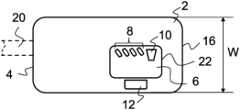
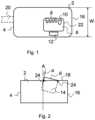
- FIG. 1is a schematic view from above of a housing for power tools.
- FIG. 2is a schematic side view of the housing for power tools.
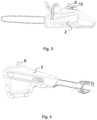
- FIG. 3is a perspective view of a chainsaw having a housing according to one embodiment of the present invention.
- FIG. 4is a perspective view of a trimmer having a housing according to one embodiment of the present invention.
- FIG. 1shows the housing 2 from a view above and FIG. 2 shows the housing 2 in a side view.
- the housing 2comprises a front end 4 , at which a tool 20 of the power tool is attached.
- the tool 20is schematically indicated with dotted lines and will be very different depending on the type of power tool that is used.
- a power toolis a tool that is used primarily in the garden or sometimes also in the forest and is driven or powered by a battery. Examples of such power tools may be, chainsaws, blowers, trimmers, hedge trimmers etc.
- the housing 2further comprises a rear end 16 and a top side 18 .
- a battery compartment 14is provided at the top side 18 of the housing 2 and extends inside the housing. The extension of the battery compartment 14 is indicated by dotted lines in FIG. 2 .
- the shape of the battery compartment 14is adapted to receive a battery 6 .
- the shape of the battery compartment 14is essentially cuboidal with an essentially rectangular cross section looking at the top side 18 of the housing 2 .
- One very important feature of the present inventionis that the short sides 22 of the rectangular cross section are substantially parallel with the rear end 16 and the front end 4 of the housing 2 . This makes it possible to design a slimmer housing 2 , i.e. a housing 2 having a small width W. Having a housing with a small width W is advantageous sines it allows the power tool to come closer to the body of a user during operation of the power tool. This makes the power tool easier to manoeuvre and thus safer.
- the battery 6is provided with power indicator lamps 8 that indicate the remaining power in the battery 6 , when a power check button 10 is pushed.
- the housingmay also be provided with a release button 12 , which when pushed ejects the battery 6 out of the battery compartment 14 , such that a user may extract the battery 6 from the battery compartment 14 and replace the battery 6 .
- the battery compartment 14is skewed backwards towards the rear end 16 with an angle ⁇ of between 5 to 30 degrees in relation to an axis A that is perpendicular to the top side 18 of the housing 2 .
- the skewingis advantageous since the angle makes it easier for an operator to insert and extract the battery 6 from the battery compartment 14 .
- the skewing angle ⁇may be in the range of 7 and 15 degrees.
- the housing 2may also be provided with a gasket 24 that is provided between the battery compartment 14 and the battery 6 when the battery 6 is inserted in the battery compartment 14 , such that the battery compartment 14 is sealed.
- FIG. 3 and FIG. 4show two implementations of the present invention, wherein the housing 2 is used for two different power tools, i.e. a chainsaw in FIG. 3 and trimmer in FIG. 4 .
- the battery 6is skewed making it easy for a user to access and exchange the battery 6 .
Landscapes
- Engineering & Computer Science (AREA)
- Mechanical Engineering (AREA)
- Chemical & Material Sciences (AREA)
- Chemical Kinetics & Catalysis (AREA)
- Electrochemistry (AREA)
- General Chemical & Material Sciences (AREA)
- Battery Mounting, Suspending (AREA)
Abstract
Description
This application is a continuation of U.S. application Ser. No. 16/651,247, filed Mar. 26, 2020, which claims priority to PCT Application No. PCT/CN2017/103737, filed on Sep. 27, 2017, the disclosures of which are hereby incorporated by reference in their entirety.
The present invention relates generally to housings that are used for power tools, such as chainsaws, trimmers, hedge trimmers and the like. Especially, the present invention relates to a battery compartment provided in the housing for power tools.
During the last decades, battery-driven power tools such as chainsaws, trimmers, hedge trimmers, etc. have become more and more popular due to the development of more efficient batteries. However, the more powerful batteries are bulkier, which may cause problems when designing the housing of the power tools, and especially the battery compartment provided in the housing.
The bulkiness of the battery may lead to a bulkiness of the housing, which in turn may lead to power tools that are more difficult to maneuver. Maneuverability in turn is a safety aspect, since many power tools may cause severe injuries if handled in a wrong way.
U.S. Pat. No. 8,286,359 discloses a battery-operated chainsaw, wherein the battery is located at one side of a frame of the chainsaw. The purpose of the placement of the battery is to provide a center of gravity for the chainsaw that is located at least partially beneath or in front of a front handle. The front handle is formed by the frame that also forms a rear handle. In U.S. Pat. No. 8,286,359, the chainsaw is of the type where the battery is attached direct towards a frame and not into a battery compartment. Such battery compartments in prior art may be placed at different positions of the housing.
Thus, there is a need for a battery compartment that does not build bulkiness to the housing of power tools in order to increase the maneuverability and thereby the safety of the power tool.
An object of the present invention is to accomplish a housing for power tools with a battery compartment that does not contribute to the bulkiness of the housing and that makes the power tool easier to maneuver. A further object with the present invention is to provide a battery compartment into which it is easy to insert and release a battery.
According to one aspect of the present invention this is accomplished by a housing for a power tool, having a front end, at which front end a tool of the power tool is attached, a rear end and a top side. A battery compartment is provided at the top side of the housing, the battery compartment extending inside the housing and having a shape adapted to receive a battery. The shape is essentially cuboidal and has a rectangular cross section when looking at the top side of the housing and the short sides of the rectangular cross section are substantially parallel with the rear end and the front end of the housing.
In one embodiment, the battery compartment is skewed backwards towards the rear end with an angle of between 5 to 30 degrees in relation to an axis that is perpendicular to the top side of the housing, preferably the angle is between 7 and 15 degrees.
In another embodiment, the housing further comprises a release button arranged to eject the battery from the battery compartment during removal of the battery.
Furthermore, a gasket may be provided between the battery compartment and the battery, such that the battery compartment is sealed.
Providing the battery compartment such that the short sides of the rectangular cross section of the battery compartment are substantially parallel with the rear end and the front end of the housing makes it possible to reduce the width of the housing and thereby design a slimmer power tool. The advantage with a slimmer power tool is that it is possible to have the power tool closer to the body during operation thereof. This makes the power tool easier to manoeuvre and thus increases the safety of the power tool.
Another advantage according to embodiments of the present invention is that the battery compartment is skewed backwards towards the rear end with an angle in relation to an axis that is perpendicular to the top side of the housing. This makes it easy for an operator of the power tool to insert and release the battery from the battery compartment.
The invention will now be described, by way of example, with reference to the accompanying drawings, in which:
In the following, a detailed description of a housing for power tools according to embodiments of the present invention will be presented.
With reference toFIG.1 andFIG.2 ahousing 2 for power tools is shown.FIG.1 shows thehousing 2 from a view above andFIG.2 shows thehousing 2 in a side view. Thehousing 2 comprises afront end 4, at which atool 20 of the power tool is attached. Thetool 20 is schematically indicated with dotted lines and will be very different depending on the type of power tool that is used. In context of this application a power tool is a tool that is used primarily in the garden or sometimes also in the forest and is driven or powered by a battery. Examples of such power tools may be, chainsaws, blowers, trimmers, hedge trimmers etc.
Now returning toFIG.1 andFIG.2 where thehousing 2 further comprises arear end 16 and atop side 18. Abattery compartment 14 is provided at thetop side 18 of thehousing 2 and extends inside the housing. The extension of thebattery compartment 14 is indicated by dotted lines inFIG.2 . The shape of thebattery compartment 14 is adapted to receive abattery 6. In general, the shape of thebattery compartment 14 is essentially cuboidal with an essentially rectangular cross section looking at thetop side 18 of thehousing 2. One very important feature of the present invention is that theshort sides 22 of the rectangular cross section are substantially parallel with therear end 16 and thefront end 4 of thehousing 2. This makes it possible to design aslimmer housing 2, i.e. ahousing 2 having a small width W. Having a housing with a small width W is advantageous sines it allows the power tool to come closer to the body of a user during operation of the power tool. This makes the power tool easier to manoeuvre and thus safer.
InFIG.1 thebattery 6 is provided withpower indicator lamps 8 that indicate the remaining power in thebattery 6, when apower check button 10 is pushed. Furthermore, the housing may also be provided with arelease button 12, which when pushed ejects thebattery 6 out of thebattery compartment 14, such that a user may extract thebattery 6 from thebattery compartment 14 and replace thebattery 6.
As is evident fromFIG.2 , thebattery compartment 14 is skewed backwards towards therear end 16 with an angle α of between 5 to 30 degrees in relation to an axis A that is perpendicular to thetop side 18 of thehousing 2. The skewing is advantageous since the angle makes it easier for an operator to insert and extract thebattery 6 from thebattery compartment 14. In a preferred embodiment, the skewing angle α may be in the range of 7 and 15 degrees.
In another embodiment, thehousing 2 may also be provided with agasket 24 that is provided between thebattery compartment 14 and thebattery 6 when thebattery 6 is inserted in thebattery compartment 14, such that thebattery compartment 14 is sealed.
Although, the present invention has been described above with reference to specific embodiments, it is not intended to be limited to the specific form set forth herein. Rather, the invention is limited only by the accompanying claims.
In the claims, the term “comprises/comprising” does not exclude the presence of other elements or steps. Furthermore, although individually listed, a plurality of means or elements may be implemented by e.g. a single unit or processor. Additionally, although individual features may be included in different claims, these may possibly advantageously be combined, and the inclusion in different claims does not imply that a combination of features is not feasible and/or advantageous. In addition, singular references do not exclude a plurality. The terms “a”, “an”, “first”, “second” etc do not preclude a plurality. Reference signs in the claims are provided merely as a clarifying example and shall not be construed as limiting the scope of the claims in any way.
Claims (8)
1. A housing for a power tool, the housing comprising:
a front end configured to be connected to a tool of the power tool;
a rear end;
a top side;
a battery compartment provided on the top side for receiving a battery, the battery compartment extending inside the housing; and
a release button disposed on the housing for releasing the battery;
wherein the battery compartment is skewed backwards towards the rear end with an angle (α) of between 5 to 30 degrees in relation to an axis (A) that is perpendicular to the top side.
2. The housing according toclaim 1 , wherein the angle (α) is between 7 and 15 degrees.
3. The housing according toclaim 1 , wherein a gasket is provided for placement between the battery compartment and the battery, such that the battery compartment is sealed.
4. The housing according toclaim 1 , wherein the housing is adapted to be part of a chainsaw, a blower, a trimmer or a hedge trimmer.
5. The housing according toclaim 1 , wherein the battery compartment is essentially cuboidal with an essentially rectangular cross section as viewed from the top side.
6. The housing according toclaim 5 , wherein respective short sides of the essentially rectangular cross section are substantially parallel with the rear end and the front end of the housing.
7. A housing for a power tool, the housing comprising:
a front handle and a rear handle;
a front end configured to be connected to a tool of the power tool;
a rear end;
a top side;
a battery compartment provided on the top side for receiving a battery, the battery compartment extending inside the housing; and
a release button disposed on the housing for releasing the battery;
wherein the battery compartment is located between the front handle and the rear handle.
8. A power tool, comprising:
a housing including:
a front end having a tool;
a handle;
a rear end;
a top side;
and a battery compartment provided on the top side for receiving a battery, the battery compartment extending inside the housing;
wherein the battery compartment is skewed backwards towards the rear end with an angle (α) of between 5 to 30 degrees in relation to an axis (A) that is perpendicular to the top side.
Priority Applications (1)
| Application Number | Priority Date | Filing Date | Title |
|---|---|---|---|
| US17/741,778US11759940B2 (en) | 2017-09-27 | 2022-05-11 | Battery compartment for power tools |
Applications Claiming Priority (3)
| Application Number | Priority Date | Filing Date | Title |
|---|---|---|---|
| PCT/CN2017/103737WO2019061090A1 (en) | 2017-09-27 | 2017-09-27 | Battery compartment for power tools |
| US202016651247A | 2020-03-26 | 2020-03-26 | |
| US17/741,778US11759940B2 (en) | 2017-09-27 | 2022-05-11 | Battery compartment for power tools |
Related Parent Applications (2)
| Application Number | Title | Priority Date | Filing Date |
|---|---|---|---|
| US16/651,247ContinuationUS11358268B2 (en) | 2017-09-27 | 2017-09-27 | Battery compartment for power tools |
| PCT/CN2017/103737ContinuationWO2019061090A1 (en) | 2017-09-27 | 2017-09-27 | Battery compartment for power tools |
Publications (2)
| Publication Number | Publication Date |
|---|---|
| US20220266440A1 US20220266440A1 (en) | 2022-08-25 |
| US11759940B2true US11759940B2 (en) | 2023-09-19 |
Family
ID=61044746
Family Applications (2)
| Application Number | Title | Priority Date | Filing Date |
|---|---|---|---|
| US16/651,247Active2037-10-10US11358268B2 (en) | 2017-09-27 | 2017-09-27 | Battery compartment for power tools |
| US17/741,778ActiveUS11759940B2 (en) | 2017-09-27 | 2022-05-11 | Battery compartment for power tools |
Family Applications Before (1)
| Application Number | Title | Priority Date | Filing Date |
|---|---|---|---|
| US16/651,247Active2037-10-10US11358268B2 (en) | 2017-09-27 | 2017-09-27 | Battery compartment for power tools |
Country Status (4)
| Country | Link |
|---|---|
| US (2) | US11358268B2 (en) |
| EP (1) | EP3673532B1 (en) |
| CN (2) | CN107584458A (en) |
| WO (1) | WO2019061090A1 (en) |
Families Citing this family (8)
| Publication number | Priority date | Publication date | Assignee | Title |
|---|---|---|---|---|
| US11806858B2 (en)* | 2017-09-27 | 2023-11-07 | Globe (jiangsu) Co., Ltd. | Impact protecting member for a cutting tool |
| EP3673532B1 (en)* | 2017-09-27 | 2025-05-14 | Globe (Jiangsu) Co., Ltd. | Battery compartment for power tools |
| EP4008491A1 (en)* | 2020-12-04 | 2022-06-08 | Hilti Aktiengesellschaft | Machine tool with a first handle, a second handle and a main body |
| USD1002306S1 (en)* | 2021-04-23 | 2023-10-24 | Zhejiang Safun Industrial Co., Ltd. | Chain saw |
| CN119318055A (en)* | 2022-03-17 | 2025-01-14 | 苏州宝时得电动工具有限公司 | Battery packs, battery pack systems and power tools |
| USD1074342S1 (en)* | 2022-09-30 | 2025-05-13 | Greenworks (Jiangsu) Co., Ltd | Hedge trimmer |
| CN118216327A (en)* | 2022-12-21 | 2024-06-21 | 南京泉峰科技有限公司 | Chainsaw |
| USD1078426S1 (en)* | 2023-09-01 | 2025-06-10 | Husqvarna Ab | Chainsaw |
Citations (13)
| Publication number | Priority date | Publication date | Assignee | Title |
|---|---|---|---|---|
| US20080184568A1 (en)* | 2007-02-06 | 2008-08-07 | Desa Ip, Llc | Split Power Tool |
| US20110308831A1 (en)* | 2010-03-06 | 2011-12-22 | Husqvarna, AB | Battery powered tool and battery pack for a battery powered tool |
| US20120073847A1 (en)* | 2010-09-28 | 2012-03-29 | Makita Corporation | Rechargeable electric tool |
| US20140116737A1 (en)* | 2012-10-31 | 2014-05-01 | Hitachi Koki Co., Ltd. | Portable tool |
| US20150263592A1 (en)* | 2014-03-17 | 2015-09-17 | Makita Corporation | Power tool |
| US20150280532A1 (en)* | 2014-04-01 | 2015-10-01 | Makita Corporation | Electric tool |
| US20150375315A1 (en)* | 2013-02-01 | 2015-12-31 | Makita Corporation | Cutting tool |
| US20150375416A1 (en)* | 2013-02-01 | 2015-12-31 | Makita Corporation | Chainsaw |
| US20170106521A1 (en)* | 2015-10-14 | 2017-04-20 | Black & Decker Inc. | Power tool |
| US20170259452A1 (en)* | 2016-03-10 | 2017-09-14 | Makita Corporation | Chainsaw |
| US20170297216A1 (en)* | 2014-10-08 | 2017-10-19 | Makita Corporation | Electric chainsaw |
| US20170373614A1 (en)* | 2016-06-24 | 2017-12-28 | Black & Decker Inc. | Control scheme for power tool having a brushless motor |
| US20180332766A1 (en)* | 2017-05-19 | 2018-11-22 | The Toro Company | Lawn and garden tool with boom having adjustable length and detachable boom sections |
Family Cites Families (21)
| Publication number | Priority date | Publication date | Assignee | Title |
|---|---|---|---|---|
| US5300372A (en) | 1992-10-26 | 1994-04-05 | Motorola, Inc. | Rechargeable cell or cell pack contact configuration |
| US8286359B2 (en) | 2002-11-19 | 2012-10-16 | Techtronic Outdoor Products Technology Limited | Battery operated chain saw |
| KR100497252B1 (en) | 2003-09-09 | 2005-06-23 | 삼성에스디아이 주식회사 | Battery pack |
| US20060199072A1 (en)* | 2005-03-03 | 2006-09-07 | Perpetual Green Ltd. | Battery operation device with battery pack release mechanism |
| KR100876265B1 (en) | 2007-08-30 | 2008-12-26 | 삼성에스디아이 주식회사 | Battery case and battery pack using same |
| CN101504973B (en)* | 2008-02-05 | 2014-04-23 | 珠海市嘉德电能科技有限公司 | Lithium ionic cell module and cell set |
| DE102009012175A1 (en)* | 2009-02-27 | 2010-09-02 | Andreas Stihl Ag & Co. Kg | Electrical appliance with a battery pack |
| DE102009012178B4 (en)* | 2009-02-27 | 2019-07-04 | Andreas Stihl Ag & Co. Kg | Battery operated, handheld implement |
| DE102009012181A1 (en) | 2009-02-27 | 2010-09-02 | Andreas Stihl Ag & Co. Kg | Battery-powered, hand-held implement with a throttle |
| DE102009012184A1 (en)* | 2009-02-27 | 2010-09-02 | Andreas Stihl Ag & Co. Kg | Portable, hand-held electrical appliance with a battery pack |
| CN201758599U (en)* | 2010-04-29 | 2011-03-16 | 常州格力博工具有限公司 | Electric tool |
| DE102010047761A1 (en)* | 2010-10-08 | 2012-04-12 | Andreas Stihl Ag & Co. Kg | Implement with an electric drive motor |
| DE102011080309A1 (en)* | 2011-08-03 | 2013-02-07 | Robert Bosch Gmbh | Power supply device |
| US10213936B2 (en) | 2011-08-26 | 2019-02-26 | Husqvarna Ab | Battery powered rear handle chain saw |
| CN202292694U (en)* | 2011-10-18 | 2012-07-04 | 常州格力博工具有限公司 | Electric tool |
| CN102398079A (en)* | 2011-11-18 | 2012-04-04 | 浙江亚特电器有限公司 | Chain saw driven by storage battery |
| EP2908984B1 (en) | 2012-10-19 | 2018-01-24 | Husqvarna AB | Outdoor power device internal cooling system |
| WO2015061370A1 (en)* | 2013-10-21 | 2015-04-30 | Milwaukee Electric Tool Corporation | Adapter for power tool devices |
| JP6300271B2 (en) | 2014-07-22 | 2018-03-28 | 株式会社マキタ | Chainsaw |
| US10478950B2 (en)* | 2015-11-26 | 2019-11-19 | Makita Corporation | Power tool |
| EP3673532B1 (en)* | 2017-09-27 | 2025-05-14 | Globe (Jiangsu) Co., Ltd. | Battery compartment for power tools |
- 2017
- 2017-09-27EPEP17926424.7Apatent/EP3673532B1/enactiveActive
- 2017-09-27USUS16/651,247patent/US11358268B2/enactiveActive
- 2017-09-27WOPCT/CN2017/103737patent/WO2019061090A1/ennot_activeCeased
- 2017-10-31CNCN201711050968.5Apatent/CN107584458A/enactivePending
- 2017-10-31CNCN201721435052.7Upatent/CN207534756U/enactiveActive
- 2022
- 2022-05-11USUS17/741,778patent/US11759940B2/enactiveActive
Patent Citations (13)
| Publication number | Priority date | Publication date | Assignee | Title |
|---|---|---|---|---|
| US20080184568A1 (en)* | 2007-02-06 | 2008-08-07 | Desa Ip, Llc | Split Power Tool |
| US20110308831A1 (en)* | 2010-03-06 | 2011-12-22 | Husqvarna, AB | Battery powered tool and battery pack for a battery powered tool |
| US20120073847A1 (en)* | 2010-09-28 | 2012-03-29 | Makita Corporation | Rechargeable electric tool |
| US20140116737A1 (en)* | 2012-10-31 | 2014-05-01 | Hitachi Koki Co., Ltd. | Portable tool |
| US20150375315A1 (en)* | 2013-02-01 | 2015-12-31 | Makita Corporation | Cutting tool |
| US20150375416A1 (en)* | 2013-02-01 | 2015-12-31 | Makita Corporation | Chainsaw |
| US20150263592A1 (en)* | 2014-03-17 | 2015-09-17 | Makita Corporation | Power tool |
| US20150280532A1 (en)* | 2014-04-01 | 2015-10-01 | Makita Corporation | Electric tool |
| US20170297216A1 (en)* | 2014-10-08 | 2017-10-19 | Makita Corporation | Electric chainsaw |
| US20170106521A1 (en)* | 2015-10-14 | 2017-04-20 | Black & Decker Inc. | Power tool |
| US20170259452A1 (en)* | 2016-03-10 | 2017-09-14 | Makita Corporation | Chainsaw |
| US20170373614A1 (en)* | 2016-06-24 | 2017-12-28 | Black & Decker Inc. | Control scheme for power tool having a brushless motor |
| US20180332766A1 (en)* | 2017-05-19 | 2018-11-22 | The Toro Company | Lawn and garden tool with boom having adjustable length and detachable boom sections |
Also Published As
| Publication number | Publication date |
|---|---|
| EP3673532A1 (en) | 2020-07-01 |
| EP3673532B1 (en) | 2025-05-14 |
| US20200254601A1 (en) | 2020-08-13 |
| US11358268B2 (en) | 2022-06-14 |
| CN207534756U (en) | 2018-06-26 |
| US20220266440A1 (en) | 2022-08-25 |
| CN107584458A (en) | 2018-01-16 |
| WO2019061090A1 (en) | 2019-04-04 |
| EP3673532A4 (en) | 2020-10-21 |
| EP3673532C0 (en) | 2025-05-14 |
Similar Documents
| Publication | Publication Date | Title |
|---|---|---|
| US11759940B2 (en) | Battery compartment for power tools | |
| US9943039B2 (en) | Outdoor power tool | |
| USD1002529S1 (en) | Portable power charger | |
| US10981291B2 (en) | Electric chainsaw | |
| USD863918S1 (en) | Portable electric circular saw | |
| US8286359B2 (en) | Battery operated chain saw | |
| USD927416S1 (en) | Power tool battery pack | |
| US9591809B2 (en) | Split power tool | |
| CN103781604B (en) | Battery powered rear handle chain saw | |
| US9224995B2 (en) | Battery powered tool and battery pack for a battery powered tool | |
| USD920231S1 (en) | Battery pack for a camera | |
| USD919562S1 (en) | Battery pack for a camera | |
| USD805869S1 (en) | Chainsaw | |
| JP7202899B2 (en) | electric work machine | |
| USD941650S1 (en) | Lithium-ion battery hammer drill | |
| US20210078203A1 (en) | Power cutter | |
| USD1000244S1 (en) | Portable electric chainsaw body | |
| USD998560S1 (en) | Battery housing | |
| USD899881S1 (en) | Portable electric chainsaw | |
| USD906968S1 (en) | Motor for electric power unit | |
| US10391667B2 (en) | Portable power tool | |
| WO2014119116A1 (en) | Electric brush cutter | |
| USD966064S1 (en) | Felling wedge | |
| USD1012648S1 (en) | Portable band saw body | |
| USD1036372S1 (en) | Portable case for battery charger or power adaptor |
Legal Events
| Date | Code | Title | Description |
|---|---|---|---|
| FEPP | Fee payment procedure | Free format text:ENTITY STATUS SET TO UNDISCOUNTED (ORIGINAL EVENT CODE: BIG.); ENTITY STATUS OF PATENT OWNER: LARGE ENTITY | |
| STPP | Information on status: patent application and granting procedure in general | Free format text:DOCKETED NEW CASE - READY FOR EXAMINATION | |
| STPP | Information on status: patent application and granting procedure in general | Free format text:NOTICE OF ALLOWANCE MAILED -- APPLICATION RECEIVED IN OFFICE OF PUBLICATIONS | |
| STPP | Information on status: patent application and granting procedure in general | Free format text:PUBLICATIONS -- ISSUE FEE PAYMENT VERIFIED | |
| STCF | Information on status: patent grant | Free format text:PATENTED CASE |