US11616727B2 - Data pipeline configuration using network sensors - Google Patents
Data pipeline configuration using network sensorsDownload PDFInfo
- Publication number
- US11616727B2 US11616727B2US17/223,396US202117223396AUS11616727B2US 11616727 B2US11616727 B2US 11616727B2US 202117223396 AUS202117223396 AUS 202117223396AUS 11616727 B2US11616727 B2US 11616727B2
- Authority
- US
- United States
- Prior art keywords
- data
- node
- network
- edge device
- descriptive tags
- Prior art date
- Legal status (The legal status is an assumption and is not a legal conclusion. Google has not performed a legal analysis and makes no representation as to the accuracy of the status listed.)
- Active, expires
Links
- 238000007689inspectionMethods0.000claimsabstractdescription11
- 238000000605extractionMethods0.000claimsabstractdescription8
- 238000000034methodMethods0.000claimsdescription71
- 230000008569processEffects0.000claimsdescription37
- 230000009466transformationEffects0.000claimsdescription4
- 238000013523data managementMethods0.000description17
- 238000004891communicationMethods0.000description12
- 238000013499data modelMethods0.000description9
- 238000013501data transformationMethods0.000description8
- 230000006855networkingEffects0.000description8
- 238000012545processingMethods0.000description8
- 230000006870functionEffects0.000description7
- 238000005259measurementMethods0.000description7
- 230000006399behaviorEffects0.000description6
- 230000000694effectsEffects0.000description6
- 238000010801machine learningMethods0.000description6
- 238000013506data mappingMethods0.000description5
- 238000012544monitoring processMethods0.000description5
- 238000013459approachMethods0.000description4
- 238000012549trainingMethods0.000description4
- 238000013528artificial neural networkMethods0.000description3
- 230000008901benefitEffects0.000description3
- 230000037406food intakeEffects0.000description3
- 230000007246mechanismEffects0.000description3
- 238000012986modificationMethods0.000description3
- 230000004048modificationEffects0.000description3
- 238000013515scriptMethods0.000description3
- 238000004088simulationMethods0.000description3
- 238000003860storageMethods0.000description3
- 238000004378air conditioningMethods0.000description2
- 238000004458analytical methodMethods0.000description2
- 238000010586diagramMethods0.000description2
- 238000010438heat treatmentMethods0.000description2
- 238000012423maintenanceMethods0.000description2
- 230000003287optical effectEffects0.000description2
- 238000005457optimizationMethods0.000description2
- 238000000513principal component analysisMethods0.000description2
- 238000001228spectrumMethods0.000description2
- 238000012706support-vector machineMethods0.000description2
- 230000001360synchronised effectEffects0.000description2
- 230000009471actionEffects0.000description1
- 230000006978adaptationEffects0.000description1
- 230000003044adaptive effectEffects0.000description1
- 230000002547anomalous effectEffects0.000description1
- 238000009529body temperature measurementMethods0.000description1
- 238000004422calculation algorithmMethods0.000description1
- QVFWZNCVPCJQOP-UHFFFAOYSA-NchloralodolChemical compoundCC(O)(C)CC(C)OC(O)C(Cl)(Cl)ClQVFWZNCVPCJQOP-UHFFFAOYSA-N0.000description1
- 230000000295complement effectEffects0.000description1
- 238000007906compressionMethods0.000description1
- 230000006835compressionEffects0.000description1
- 230000001010compromised effectEffects0.000description1
- 238000013144data compressionMethods0.000description1
- 238000000354decomposition reactionMethods0.000description1
- 238000013136deep learning modelMethods0.000description1
- 238000013461designMethods0.000description1
- 238000011161developmentMethods0.000description1
- 238000009826distributionMethods0.000description1
- 230000003203everyday effectEffects0.000description1
- 238000009499grossingMethods0.000description1
- 238000004519manufacturing processMethods0.000description1
- 239000002184metalSubstances0.000description1
- 230000035755proliferationEffects0.000description1
- 238000007637random forest analysisMethods0.000description1
- 230000009467reductionEffects0.000description1
- 230000003362replicative effectEffects0.000description1
- 230000004044responseEffects0.000description1
- 238000012552reviewMethods0.000description1
- 238000005070samplingMethods0.000description1
- 230000011664signalingEffects0.000description1
- 238000013179statistical modelMethods0.000description1
- 238000000844transformationMethods0.000description1
- 238000013519translationMethods0.000description1
- 238000012384transportation and deliveryMethods0.000description1
Images


Classifications
- H—ELECTRICITY
- H04—ELECTRIC COMMUNICATION TECHNIQUE
- H04L—TRANSMISSION OF DIGITAL INFORMATION, e.g. TELEGRAPHIC COMMUNICATION
- H04L47/00—Traffic control in data switching networks
- H04L47/10—Flow control; Congestion control
- H04L47/24—Traffic characterised by specific attributes, e.g. priority or QoS
- H04L47/2416—Real-time traffic
- H—ELECTRICITY
- H04—ELECTRIC COMMUNICATION TECHNIQUE
- H04L—TRANSMISSION OF DIGITAL INFORMATION, e.g. TELEGRAPHIC COMMUNICATION
- H04L41/00—Arrangements for maintenance, administration or management of data switching networks, e.g. of packet switching networks
- H04L41/08—Configuration management of networks or network elements
- H04L41/0803—Configuration setting
- H04L41/0813—Configuration setting characterised by the conditions triggering a change of settings
- H04L41/0816—Configuration setting characterised by the conditions triggering a change of settings the condition being an adaptation, e.g. in response to network events
- H—ELECTRICITY
- H04—ELECTRIC COMMUNICATION TECHNIQUE
- H04L—TRANSMISSION OF DIGITAL INFORMATION, e.g. TELEGRAPHIC COMMUNICATION
- H04L41/00—Arrangements for maintenance, administration or management of data switching networks, e.g. of packet switching networks
- H04L41/08—Configuration management of networks or network elements
- H04L41/0876—Aspects of the degree of configuration automation
- H04L41/0886—Fully automatic configuration
- H—ELECTRICITY
- H04—ELECTRIC COMMUNICATION TECHNIQUE
- H04L—TRANSMISSION OF DIGITAL INFORMATION, e.g. TELEGRAPHIC COMMUNICATION
- H04L47/00—Traffic control in data switching networks
- H04L47/10—Flow control; Congestion control
- H04L47/19—Flow control; Congestion control at layers above the network layer
- H04L47/193—Flow control; Congestion control at layers above the network layer at the transport layer, e.g. TCP related
- H—ELECTRICITY
- H04—ELECTRIC COMMUNICATION TECHNIQUE
- H04L—TRANSMISSION OF DIGITAL INFORMATION, e.g. TELEGRAPHIC COMMUNICATION
- H04L41/00—Arrangements for maintenance, administration or management of data switching networks, e.g. of packet switching networks
- H04L41/08—Configuration management of networks or network elements
- H04L41/0893—Assignment of logical groups to network elements
- H—ELECTRICITY
- H04—ELECTRIC COMMUNICATION TECHNIQUE
- H04L—TRANSMISSION OF DIGITAL INFORMATION, e.g. TELEGRAPHIC COMMUNICATION
- H04L41/00—Arrangements for maintenance, administration or management of data switching networks, e.g. of packet switching networks
- H04L41/16—Arrangements for maintenance, administration or management of data switching networks, e.g. of packet switching networks using machine learning or artificial intelligence
- H—ELECTRICITY
- H04—ELECTRIC COMMUNICATION TECHNIQUE
- H04L—TRANSMISSION OF DIGITAL INFORMATION, e.g. TELEGRAPHIC COMMUNICATION
- H04L41/00—Arrangements for maintenance, administration or management of data switching networks, e.g. of packet switching networks
- H04L41/40—Arrangements for maintenance, administration or management of data switching networks, e.g. of packet switching networks using virtualisation of network functions or resources, e.g. SDN or NFV entities
- H—ELECTRICITY
- H04—ELECTRIC COMMUNICATION TECHNIQUE
- H04L—TRANSMISSION OF DIGITAL INFORMATION, e.g. TELEGRAPHIC COMMUNICATION
- H04L43/00—Arrangements for monitoring or testing data switching networks
- H04L43/06—Generation of reports
- H04L43/065—Generation of reports related to network devices
Definitions
- the present disclosurerelates generally to computer networks, and, more particularly, to data pipeline configuration using network sensors.
- the Internet of Thingsrepresents an evolution of computer networks that seeks to connect many everyday objects to the Internet.
- IoTInternet of Things
- smart devicesthat are Internet-capable such as thermostats, lighting, televisions, cameras, and the like.
- these devicesmay also communicate with one another.
- an IoT motion sensormay communicate with one or more smart lightbulbs, to actuate the lighting in a room when a person enters the room.
- Vehiclesare another class of ‘things’ that are being connected via the IoT for purposes of sharing sensor data, implementing self-driving capabilities, monitoring, and the like.
- IoTAs the IoT evolves, the variety of IoT devices will continue to grow, as well as the number of applications associated with the IoT devices. For instance, multiple cloud-based, business intelligence (BI) applications may take as input measurements captured by a particular IoT sensor. To this end, data pipelines are often constructed from the edge device(s) of the IoT network to the destination cloud provider.
- BIbusiness intelligence
- FIG. 1illustrate an example network
- FIG. 2illustrates an example network device/node
- FIG. 3illustrates an example network architecture for edge to multi-cloud processing and governance
- FIGS. 4 A- 4 Billustrate examples of data processing by an edge device in a network
- FIGS. 5 A- 5 Eillustrates an example of the configuration of a data pipeline at an edge of a network
- FIGS. 6 A- 6 Billustrate examples of descriptive tags for network nodes
- FIG. 7illustrates an example simplified procedure for the configuration of a data pipeline for an edge device.
- a serviceassociates a plurality of descriptive tags with a node in a network, based on an inspection of packets sent by the node that is performed by one or more sensors deployed to the network.
- the serviceidentifies, based on the plurality of descriptive tags, data to be extracted from traffic of the node by an edge device located at an edge of the network.
- the servicedetermines, based on the plurality of descriptive tags, an external destination to which the data should be sent by the edge device after extraction.
- the servicesends a data pipeline configuration to the edge device, wherein the data pipeline configuration causes the edge device to extract the data from the traffic sent by the node and to send the data to the external destination.
- a computer networkis a geographically distributed collection of nodes interconnected by communication links and segments for transporting data between end nodes, such as personal computers and workstations, or other devices, such as sensors, etc.
- end nodessuch as personal computers and workstations, or other devices, such as sensors, etc.
- LANslocal area networks
- WANswide area networks
- LANstypically connect the nodes over dedicated private communications links located in the same general physical location, such as a building or campus.
- WANstypically connect geographically dispersed nodes over long-distance communications links, such as common carrier telephone lines, optical lightpaths, synchronous optical networks (SONET), synchronous digital hierarchy (SDH) links, or Powerline Communications (PLC), and others.
- Other types of networkssuch as field area networks (FANs), neighborhood area networks (NANs), personal area networks (PANs), etc. may also make up the components of any given computer network.
- FANsfield area networks
- NANsneighborhood area networks
- PANspersonal area networks
- computer networksmay include an Internet of Things network.
- IoTInternet of Things
- IoEInternet of Everything
- objectsobjects
- the IoTinvolves the ability to connect more than just computers and communications devices, but rather the ability to connect “objects” in general, such as lights, appliances, vehicles, heating, ventilating, and air-conditioning (HVAC), windows and window shades and blinds, doors, locks, etc.
- HVACheating, ventilating, and air-conditioning
- the “Internet of Things”thus generally refers to the interconnection of objects (e.g., smart objects), such as sensors and actuators, over a computer network (e.g., via IP), which may be the public Internet or a private network.
- IoT networksoperate within a shared-media mesh networks, such as wireless or PLC networks, etc., and are often on what is referred to as Low-Power and Lossy Networks (LLNs), which are a class of network in which both the routers and their interconnect are constrained. That is, LLN devices/routers typically operate with constraints, e.g., processing power, memory, and/or energy (battery), and their interconnects are characterized by, illustratively, high loss rates, low data rates, and/or instability.
- constraintse.g., processing power, memory, and/or energy (battery)
- IoT networksare comprised of anything from a few dozen to thousands or even millions of devices, and support point-to-point traffic (between devices inside the network), point-to-multipoint traffic (from a central control point such as a root node to a subset of devices inside the network), and multipoint-to-point traffic (from devices inside the network towards a central control point).
- Edge computingalso sometimes referred to as “fog” computing, is a distributed approach of cloud implementation that acts as an intermediate layer from local networks (e.g., IoT networks) to the cloud (e.g., centralized and/or shared resources, as will be understood by those skilled in the art). That is, generally, edge computing entails using devices at the network edge to provide application services, including computation, networking, and storage, to the local nodes in the network, in contrast to cloud-based approaches that rely on remote data centers/cloud environments for the services. To this end, an edge node is a functional node that is deployed close to IoT endpoints to provide computing, storage, and networking resources and services. Multiple edge nodes organized or configured together form an edge compute system, to implement a particular solution.
- local networkse.g., IoT networks
- the cloude.g., centralized and/or shared resources, as will be understood by those skilled in the art. That is, generally, edge computing entails using devices at the network edge to provide application services,
- Edge nodes and edge systemscan have the same or complementary capabilities, in various implementations. That is, each individual edge node does not have to implement the entire spectrum of capabilities. Instead, the edge capabilities may be distributed across multiple edge nodes and systems, which may collaborate to help each other to provide the desired services.
- an edge systemcan include any number of virtualized services and/or data stores that are spread across the distributed edge nodes. This may include a master-slave configuration, publish-subscribe configuration, or peer-to-peer configuration.
- LLCsLow power and Lossy Networks
- Smart Gride.g., certain sensor networks
- Smart Citiese.g., Smart Cities
- Linksare generally lossy, such that a Packet Delivery Rate/Ratio (PDR) can dramatically vary due to various sources of interferences, e.g., considerably affecting the bit error rate (BER);
- PDRPacket Delivery Rate/Ratio
- Linksare generally low bandwidth, such that control plane traffic must generally be bounded and negligible compared to the low rate data traffic;
- Constraint-routingmay be required by some applications, e.g., to establish routing paths that will avoid non-encrypted links, nodes running low on energy, etc.;
- Scale of the networksmay become very large, e.g., on the order of several thousands to millions of nodes;
- Nodesmay be constrained with a low memory, a reduced processing capability, a low power supply (e.g., battery).
- a low power supplye.g., battery
- LLNsare a class of network in which both the routers and their interconnect are constrained: LLN routers typically operate with constraints, e.g., processing power, memory, and/or energy (battery), and their interconnects are characterized by, illustratively, high loss rates, low data rates, and/or instability. LLNs are comprised of anything from a few dozen and up to thousands or even millions of LLN routers, and support point-to-point traffic (between devices inside the LLN), point-to-multipoint traffic (from a central control point to a subset of devices inside the LLN) and multipoint-to-point traffic (from devices inside the LLN towards a central control point).
- constraintse.g., processing power, memory, and/or energy (battery)
- LLNsare comprised of anything from a few dozen and up to thousands or even millions of LLN routers, and support point-to-point traffic (between devices inside the LLN), point-to-multipoint
- An example implementation of LLNsis an “Internet of Things” network.
- IoTInternet of Things
- IoTmay be used by those in the art to refer to uniquely identifiable objects (things) and their virtual representations in a network-based architecture.
- objectsin general, such as lights, appliances, vehicles, HVAC (heating, ventilating, and air-conditioning), windows and window shades and blinds, doors, locks, etc.
- the “Internet of Things”thus generally refers to the interconnection of objects (e.g., smart objects), such as sensors and actuators, over a computer network (e.g., IP), which may be the Public Internet or a private network.
- IPcomputer network
- Such deviceshave been used in the industry for decades, usually in the form of non-IP or proprietary protocols that are connected to IP networks by way of protocol translation gateways.
- AMIsmart grid advanced metering infrastructure
- smart citiessmart cities, and building and industrial automation
- carse.g., that can interconnect millions of objects for sensing things like power quality, tire pressure, and temperature and that can actuate engines and lights
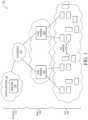
- FIG. 1is a schematic block diagram of an example simplified computer network 100 illustratively comprising nodes/devices at various levels of the network, interconnected by various methods of communication.
- the linksmay be wired links or shared media (e.g., wireless links, PLC links, etc.) where certain nodes, such as, e.g., routers, sensors, computers, etc., may be in communication with other devices, e.g., based on connectivity, distance, signal strength, current operational status, location, etc.
- the cloud layer 110may comprise general connectivity via the Internet 112 , and may contain one or more datacenters 114 with one or more centralized servers 116 or other devices, as will be appreciated by those skilled in the art.
- the edge layer 120various edge devices 122 may perform various data processing functions locally, as opposed to datacenter/cloud-based servers or on the endpoint IoT nodes 132 themselves of IoT device layer 130 .
- edge devices 122may include edge routers and/or other networking devices that provide connectivity between cloud layer 110 and IoT device layer 130 .
- Data packetsmay be exchanged among the nodes/devices of the computer network 100 using predefined network communication protocols such as certain known wired protocols, wireless protocols, PLC protocols, or other shared-media protocols where appropriate.
- a protocolconsists of a set of rules defining how the nodes interact with each other.
- Data packetsmay be exchanged among the nodes/devices of the computer network 100 using predefined network communication protocols such as certain known wired protocols, wireless protocols (e.g., IEEE Std. 802.15.4, Wi-Fi, Bluetooth®, DECT-Ultra Low Energy, LoRa, etc.), PLC protocols, or other shared-media protocols where appropriate.
- a protocolconsists of a set of rules defining how the nodes interact with each other.
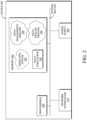
- FIG. 2is a schematic block diagram of an example node/device 200 (e.g., an apparatus) that may be used with one or more embodiments described herein, e.g., as any of the nodes or devices shown in FIG. 1 above or described in further detail below.
- the device 200may comprise one or more network interfaces 210 (e.g., wired, wireless, PLC, etc.), at least one processor 220 , and a memory 240 interconnected by a system bus 250 , as well as a power supply 260 (e.g., battery, plug-in, etc.).
- Network interface(s) 210include the mechanical, electrical, and signaling circuitry for communicating data over links coupled to the network.
- the network interfaces 210may be configured to transmit and/or receive data using a variety of different communication protocols, such as TCP/IP, UDP, etc.
- the device 200may have multiple different types of network connections, e.g., wireless and wired/physical connections, and that the view herein is merely for illustration.
- the network interface 210is shown separately from power supply 260 , for PLC the network interface 210 may communicate through the power supply 260 , or may be an integral component of the power supply. In some specific configurations the PLC signal may be coupled to the power line feeding into the power supply.
- the memory 240comprises a plurality of storage locations that are addressable by the processor 220 and the network interfaces 210 for storing software programs and data structures associated with the embodiments described herein.
- the processor 220may comprise hardware elements or hardware logic adapted to execute the software programs and manipulate the data structures 245 .
- An operating system 242portions of which are typically resident in memory 240 and executed by the processor, functionally organizes the device by, among other things, invoking operations in support of software processes and/or services executing on the device. These software processes/services may comprise an illustrative data management process 248 and/or a data pipeline configuration process 249 , as described herein.
- processor and memory typesincluding various computer-readable media, may be used to store and execute program instructions pertaining to the techniques described herein.
- descriptionillustrates various processes, it is expressly contemplated that various processes may be embodied as modules configured to operate in accordance with the techniques herein (e.g., according to the functionality of a similar process). Further, while the processes have been shown separately, those skilled in the art will appreciate that processes may be routines or modules within other processes.
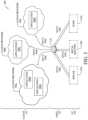
- FIG. 3illustrates an example network architecture 300 for edge to multi-cloud processing and governance, according to various embodiments.
- an IoT network at IoT layer 130that comprises a plurality of nodes 132 , such as node 132 a (e.g., a boiler), node 132 b (e.g., a metal machine), and node 132 c (e.g., a pump).
- the IoT network at IoT layer 130may comprise any numbers of sensors and/or actuators.
- the networkmay be located in an industrial setting, such as a factory, port, substation, or the like, a smart city, a stadium, a conference or office building, or any other location in which IoT devices may be deployed.
- IoT nodes 132 a - 132 cgenerate data 302 a - 302 c , respectively, for consumption by any number of applications 308 hosted by different cloud providers 306 , such as Microsoft Azure, Software AG, Quantela, MQTT/DC, or the like.
- the different applications 308may also require different sets of data 304 a - 304 c from data 302 a - 302 c .
- cloud provider 306 ahosts application 308 a , which is a monitoring application used by the operator of the IoT network.
- cloud provider 306 amay also host application 308 b , which is a developer application that allows the operator of the IoT network to develop and deploy utilities and configurations for the IoT network.
- Another application, application 308 cmay be hosted by an entirely different cloud provider 306 b and be used by the vendor or manufacturer of a particular IoT node 132 for purposes.
- a further application, application 308 dmay be hosted by a third cloud provider 306 c , which is used by technicians for purposes of diagnostics and the like.
- the edge device 122such as a gateway, router, switch, access point, or other device located at the edge of the IoT network
- the lack of harmonization between data consumerscan lead to overly complicated data access policies, virtual models of IoT nodes 132 (e.g., ‘device twins’ or ‘device shadows’) that are often not portable across cloud providers 306 , and increased resource consumption.
- different IoT nodesmay communicate using different protocols within the IoT network. For instance, IoT nodes 132 a - 132 c may communicate using MQTT, Modbus, OPC Unified Architecture (OPC UA), combinations thereof, or other existing communication protocols that are typically used in IoT networks.
- OPC Unified ArchitectureOPC Unified Architecture
- FIG. 4 Aillustrates an example architecture 400 for data management process 248 , according to various embodiments.
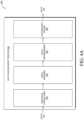
- data management process 248may comprise any or all of the following components: a plurality of protocol connectors 402 , data mappers 404 , a data transformer 406 , and/or a governance engine 408 .
- these componentsare executed on a single device located at the edge of the IoT network.
- further embodimentsprovide for these components to be executed in a distributed manner across multiple devices, in which case the combination of devices can be viewed as a singular device for purposes of the teachings herein.
- functionalities of the components of architecture 400may also be combined, omitted, or implemented as part of other processes, as desired.
- protocol connectors 402may comprise a plurality of southbound connectors that are able to extract data 302 from traffic in the IoT network sent via any number of different protocols.
- protocol connectors 402may include connectors for OPC UA, Modbus, Ethernet/IP, MQTT, and the like. Accordingly, when the device executing data management process 248 (e.g., device 200 ) receives a message from the IoT network, such as a packet, frame, collection thereof, or the like, protocol connectors 402 may process the message using its corresponding connector to extract the corresponding data 302 from the message.
- data mappers 404may process the extracted data 302 . More specifically, in various embodiments, data mappers 404 may normalize the extracted data 302 . Typically, this may entail identifying the data extracted from the traffic in the network as being of a particular data type and grouping the data extracted from the traffic in the network with other data of the particular data type. In some instances, this may also entail associating a unit of measure with the extracted data 302 and/or converting a data value in one unit of measure to that of another.
- data transformer 406may apply any number of data transformation to the data.
- data transformer 406may transform data 302 by applying any number of mathematical and/or symbolic operations to it. For instance, data transformer 406 may apply a data compression or data reduction to the extracted and normalized data 302 , so as to summarize or reduce the volume of data transmitted to the cloud. To do so, data transformer 406 may sample data 302 over time, compute statistics regarding data 302 (e.g., its mean, median, moving average, etc.), apply a compression algorithm to data 302 , combinations thereof, or the like.
- data transformer 406may apply analytics to the extracted and normalized data 302 , so as to transform the data into a different representation, such as an alert or other indication. For instance, data transformer 406 may apply simple heuristics and/or thresholds to data 302 , to transform data 302 into an alert. In another embodiment, data transformer 406 may apply machine learning to data 302 , to transform the data.
- machine learningis concerned with the design and the development of techniques that take as input empirical data (such as network statistics and performance indicators), and recognize complex patterns in these data.
- One very common pattern among machine learning techniquesis the use of an underlying model M, whose parameters are optimized for minimizing the cost function associated to M, given the input data.
- the learning processthen operates by adjusting the parameters a, b, c such that the number of misclassified points is minimal.
- the model Mcan be used very easily to classify new data points.
- Mis a statistical model, and the cost function is inversely proportional to the likelihood of M, given the input data.
- Data transformer 406may employ one or more supervised, unsupervised, or semi-supervised machine learning models.
- supervised learningentails the use of a training set of data that is used to train the model to apply labels to the input data.
- the training datamay include samples of ‘good’ readings or operations and ‘bad’ readings or operations that are labeled as such.
- unsupervised techniquesthat do not require a training set of labels.
- a supervised learning modelmay look for previously seen patterns that have been labeled as such, an unsupervised model may instead look to whether there are sudden changes in the behavior.
- an unsupervised modelmay Semi-supervised learning models take a middle ground approach that uses a greatly reduced set of labeled training data.
- Example machine learning techniques that data transformer 406 can employmay include, but are not limited to, nearest neighbor (NN) techniques (e.g., k-NN models, replicator NN models, etc.), statistical techniques (e.g., Bayesian networks, etc.), clustering techniques (e.g., k-means, mean-shift, etc.), neural networks (e.g., reservoir networks, artificial neural networks, etc.), support vector machines (SVMs), logistic or other regression, Markov models or chains, principal component analysis (PCA) (e.g., for linear models), singular value decomposition (SVD), multi-layer perceptron (MLP) ANNs (e.g., for non-linear models), replicating reservoir networks (e.g., for non-linear models, typically for time series), random forest classification, deep learning models, or the like.
- PCAprincipal component analysis
- MLPmulti-layer perceptron
- data transformer 406may comprise a scripting engine that allows developers to deploy any number of scripts to be applied to data 302 for purposes of the functionalities described above. For instance, an application developer may interface with application 308 b shown previously in FIG. 3 , to develop and push various scripts for execution by data transformer 406 , if allowed to do so by policy. In other cases, previously developed scripts may also be pre-loaded into data transformer 406 and/or made available by the vendor or manufacturer of the device executing data management process 248 for deployment to data transformer 406 .
- governance engine 408may control the sending of data 304 according to a policy.
- governance engine 408may apply a policy that specifies that data 304 may be sent to a particular cloud provider and/or cloud-based application, but should not be sent to others.
- the policy enforced by governance engine 408may control the sending of data 304 on a per-value or per-data type basis. For instance, consider the case of an IoT node reporting a temperature reading and pressure reading. In such a case, governance engine 408 may send the temperature reading to a particular cloud provider as data 304 while restricting the sending of the pressure reading, according to policy.
- the various stakeholders in the data pipelinesare able to participate in the creation and maintenance of the enforced policies.
- the various data pipelines built to support the different network protocols and cloud vendorsresults in a disparate patchwork of policies that require a level of expertise that not every participant may possess.
- personnelsuch as security experts, data compliance representatives, technicians, developers, and the like can participate in the administration of the policies enforced by governance engine 408 .
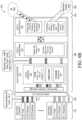
- FIG. 4 Billustrates an example 410 of the operation of data management process 248 during execution, according to various embodiments.
- edge device 122 described previouslye.g., a device 200
- edge device 122may communicate with IoT nodes 132 in the network that comprise devices from n-number of different vendors.
- Each set of vendor devices in IoT nodes 132may generate different sets of data, such as sensor readings, computations, or the like.
- the devices from a first machine vendormay generate data such as a proprietary data value, a temperature reading, and a vibration reading.
- the devices from another machine vendormay generate data such as a temperature reading, a vibration reading, and another data value that is proprietary to that vendor.
- data 302 generated by IoT nodes 132may differ is the network protocol used to convey data 302 in the network.
- the devices from one machine vendormay communicate using the OPC UA protocol, while the devices from another machine vendor may communicate using the Modbus protocol.
- data management process 248 of edge device 122may process data 302 in three stages: a data ingestion phase 412 , a data transformation phase 414 , and a data governance phase 416 . These three processing phases operate in conjunction with one another to allow edge device 122 to provide data 304 to the various cloud providers 306 for consumption by their respective cloud-hosted applications.
- protocol connectors 402may receive messages sent by IoT nodes 132 in their respective protocols, parse the messages, and extract the relevant data 302 from the messages. For instance, one protocol connector may process OPC UA messages sent by one set of IoT nodes 132 , while another protocol connector may process Modbus messages sent by another set of IoT nodes 132 .
- data management process 248may apply a data mapping 418 to the extracted data, to normalize the data 302 . For instance, data management process 248 may identify the various types of reported data 302 and group them by type, such as temperature measurements, vibration measurements, and vendor proprietary data.
- the data mapping 418may also entail standardizing the data on a particular format (e.g., a particular number of digits, unit of measure, etc.).
- the data mapping 418may also entail associating metadata with the extracted data 302 , such as the source device type, its vendor, etc.
- data management process 248may apply various transformations to the results of the data ingestion phase 412 .
- one IoT node 132reports its temperature reading every 10 milliseconds (ms). While this may be acceptable in the IoT network, and even required in some cases, reporting the temperature readings at this frequency to the cloud-providers may represent an unnecessary load on the WAN connection between edge device 122 and the cloud provider(s) 306 to which the measurements are to be reported. Indeed, a monitoring application in the cloud may only need the temperature readings at a frequency of once every second, meaning that the traffic overhead to the cloud provider(s) 306 can be reduced by a factor of one hundred by simply reporting the measurements at one second intervals.
- data transformation phase 414may reduce the volume of data 304 sent to cloud provider(s) 306 by sending only a sampling of the temperature readings (e.g., every hundred), an average or other statistic(s) of the temperature readings in a given time frame, or the like.
- data management process 248may apply any number of different policies to the transformed data, to control how the resulting data 304 is sent to cloud provider(s) 306 .
- the policy enforced during data governance phase 416may further specify how data 304 is sent to cloud providers 306 .
- the policymay specify that edge device 122 should send data 304 to a particular cloud provider 306 via an encrypted tunnel, using a particular set of one or more protocols (e.g., MQTT), how the connection should be monitored and reported, combinations thereof, and the like.
- edge devicesare increasingly sending data from IoT endpoints to multiple cloud providers for consumption by various applications. Indeed, both the manufacturers of many IoT nodes and the operators of those nodes may need access to the data being generated by the IoT nodes. For instance, the manufacturer of an IoT node may monitor its nodes to gain performance insights and perform preventative maintenance. Conversely, the operator of the IoT node, such as the owner of a factory, may collect real-time telemetry data from the device to ensure that their business is running, optimally.
- IoT nodesthere are almost limitless types of IoT nodes, each node supporting different data models that define how the data is processed at the edge (e.g., ingested, transformed, etc.). Additionally, there is a plethora of different cloud analytics services to which the data may need to be sent. Further, the various IoT nodes may generate data differently, meaning that a new data model and data pipeline may need to be defined, potentially on a per-node basis, creating a great amount of overhead on the operator and solutions integrator.
- the techniques introduced hereinallow for the automatic configuration of data models and data management pipelines at the edge of a network, when a new endpoint node joins the network.
- information garnered by one or more network sensors that inspect packets sent by the nodemay be used to drive the pipeline configuration for the edge device.
- Such a configurationmay configure the edge device to extract, map, transform, and/or send data generated by the endpoint node for consumption by any number of applications or other destinations hosted across various cloud providers.
- the techniques described hereinmay be performed by hardware, software, and/or firmware, such as in accordance with data management process 248 and/or data pipeline configuration process 249 , which may include computer executable instructions executed by the processor 220 (or independent processor of interfaces 210 ) to perform functions relating to the techniques described herein.
- a serviceassociates a plurality of descriptive tags with a node in a network, based on an inspection of packets sent by the node that is performed by one or more sensors deployed to the network.
- the serviceidentifies, based on the plurality of descriptive tags, data to be extracted from traffic of the node by an edge device located at an edge of the network.
- the servicedetermines, based on the plurality of descriptive tags, an external destination to which the data should be sent by the edge device after extraction.
- the servicesends a data pipeline configuration to the edge device, wherein the data pipeline configuration causes the edge device to extract the data from the traffic sent by the node and to send the data to the external destination.
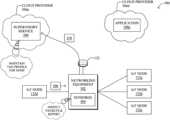
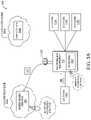
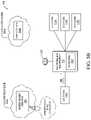
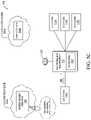
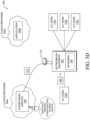
- FIGS. 5 A- 5 Eillustrates an example of the configuration of a data pipeline at an edge of a network, according to various embodiments.
- edge device 122located at the edge of a network to which a new IoT node 132 d joins (e.g., a new sensor, actuator, etc.).
- supervisory service 508that is part of a configuration and control plane and provides supervisory control over edge device 122 , once edge device 122 is enrolled with supervisory service 508 .
- supervisory service 508may take the form of a server that serves Edge Intelligence Control Service by Cisco Systems, Inc., or another device that provides a supervisory service to edge device 122 .
- supervisory service 508is typically located externally to the network in which IoT node 132 d is located, further embodiments provide for supervisory service 508 to be located within that network, as well.
- application 308 ehosted by cloud provider 306 d that is to consume data generated by IoT node 132 d .
- application 308 emay be a monitoring application used by the operator of the network to which IoT node 132 d was added to monitor an industrial process, the manufacturer of IoT node 132 d for purposes of performing diagnostics or updates, etc.
- application 308 emay take the form of a message broker, such as an MQTT message broker to which messages may be published by edge device 122 .
- one or more sensor(s) 504may be deployed to the networking equipment 502 (e.g., switches, routers, etc.) located within the network of IoT node 132 d .
- sensor(s) 504are software-based modules executed directly by networking equipment 502 .
- further embodimentsprovide for sensor(s) 504 to be hardware-based modules communicatively coupled to networking equipment 502 , or a combination of hardware-based and software-based modules deployed to the network.
- IoT node 132 dbegins sending packets 506 to other nodes, such as any of IoT nodes 132 a - 132 c .
- sensor(s) 504may inspect packets 506 , to garner information about IoT node 132 d , not only about the identity of IoT node 132 d , but also regarding its actions that it performs on the network.
- informationmay include, but not limited to, any or all of the following:
- the sensor modules of networking equipment 502then organize the collected information into meaningful, descriptive tags.
- these descriptive tagsare simply a way to categorize nodes and their behaviors, similar to the same way a human may look at a pen or a pencil and categorize them as writing instruments.
- Each nodecan also have multiple descriptive tags associated with it, such as the following:
- the sensor(s) 504 embedded in networking equipment 502may also collect metadata about the communicating nodes/endpoints, including their network identifiers (e.g., IP and MAC addresses), vendor, device-type, firmware version, the switch ID and port where the device is connected, etc. As sensor(s) learns details of a new node in the network, such as IoT node 132 d , sensors) 504 may send its collected metadata about that node, along with its tags, to supervisory service 508 via reporting message 510 . In other words, sensor(s) 504 may function as an extension of supervisory service 508 to acquire information about IoT node 132 d through analysis of its traffic.
- network identifierse.g., IP and MAC addresses
- supervisory service 508may maintain an inventory of each of the nodes in the network, their associated tags, and/or their metadata. Thus, as new nodes are discovered in the network by sensor(s) 504 , supervisory service 508 may add their profile information to a live inventory of nodes/devices in the network. As noted above, the various tags applied by sensor(s) 504 used by supervisory service 508 may be predefined or may be user-defined.
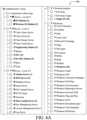
- FIGS. 6 A- 6 Billustrate example listings 600 , 610 , respectively, showing exemplary component and activity tags that may be associated with a network node, in some embodiments.
- the various component tags in listing 600can be used to identify a particular endpoint or other node in the network by its type (e.g., PLC, SCADA station, etc.), its software (e.g., CodeSys, Windows, etc.), or the like.
- analysis of the traffic of the devicecan also lead to various activity tags in listing 610 being applied to that node, as well.
- activity tagsmay distinguish between control system behaviors (e.g., insert program, device init., etc.) and IT behaviors (e.g., host config., ping, etc.).
- supervisory service 508may, based on the tag profile of IoT node 132 d , identify the data to be extracted from the traffic of IoT node 132 d , as shown in FIG. 5 B , in various embodiments. For instance, if the profile of IoT node 132 d includes tags indicating that IoT node 132 d generates certain types of sensor measurements (e.g., temperature, vibration, etc.), supervisory service 508 may determine that this information should be extracted/ingested by edge device 122 through the use of the techniques described previously with respect to FIGS. 4 A- 4 B .
- supervisory service 508may determine, based on the profile and tags associated with IoT node 132 d is the external destination(s) to which edge device 122 should send the data extracted from the traffic of IoT node 132 d .
- application 308 ehosted by a cloud provider 306 d that is external to the network of IoT node 132 d .
- application 308 emay take the form of an MQTT message broker, application associated with the operator of the network in which IoT node 132 d is located, the manufacturer of IoT node 132 d , etc.
- Supervisory service 508may do so, for instance, based on the identity or location of IoT node 132 d , supervisory service 508 may determine that the data from IoT node 132 d should be exported externally to application 308 e.
- supervisory service 508may generate a corresponding data pipeline configuration 512 for edge device 122 .
- a configurationmay identify IoT node 132 d to edge device 122 and the data to be ingested/extracted by edge device 122 from the traffic of IoT node 132 d .
- the data pipeline configuration 512may also configure the appropriate protocol connectors, data mapping(s), data transformation(s), and/or data governance policies for edge device 122 .
- supervisory service 508may push the data pipeline configuration 512 to edge device 122 .
- the above configuration mechanismcan help to quickly and automatically configure a data pipeline for IoT node 132 d .
- this approachmay be repeated any number of times, so as to refine the data pipeline for IoT node 132 d .
- sensor(s) 504detect a new protocol or other characteristic of the packets 506 from IoT node 132 d , after supervisory service 508 sends data pipeline configuration 512 to edge device 122 .
- sensor(s) 504may provide the updated information to supervisory service 508 , which may adjust data pipeline configuration 512 , accordingly (e.g., by configuring a new protocol connector, a new data transformation, etc.).
- Such a mechanismcan also employ the use of digital twins, so as to identify any deviations in the expected behavior of IoT node 132 d and report any anomalies to a user for review. Indeed, it may be the case that IoT node 132 d has been compromised in some way or that its previous data pipeline configuration is no longer meeting its needs and may benefit from additional tuning.
- supervisory service 508may also identify which device(s) would benefit from this new data model, as well as run simulations to compare the current vs. new data model to see what would be optimal to meet the objectives of the operator.
- the operatormay be presented with the choice of “Apply the new data model to all devices (Y/N)” and possibly even an auto-optimization option to the effect of “Always apply the new data models (Y/N)?” which may be provided if the simulation shows that the new model is superior.
- edge device 122may proceed in a similar manner to those of IoT nodes 132 a - 132 c , described previously with respect to FIG. 3 . More specifically, edge device 122 may begin ingesting and extracting data from the traffic of IoT node 132 d according to data pipeline configuration 512 , apply any data mapping, transformations, and/or data governance policies to it, and then export the resulting data 304 d to 308 e.
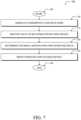
- FIG. 7illustrates an example simplified procedure for the configuration of a data pipeline for an edge device, in accordance with one or more embodiments described herein.
- procedure 700may be performed by a service comprising one or more specially configured devices (e.g., one or more device 200 , etc.).
- the procedure 700may start at step 705 , and continues to step 710 , where, as described in greater detail above, the service may associate a plurality of descriptive tags with a node in a network.
- the tag associationsmay be based on an inspection performed by one or more sensors deployed to the network of packets sent by the node.
- the sensor(s)may perform DPI or other inspection technique, to identify various information about the node, such as its manufacturer, model, device type, protocol(s) that it uses, and/or other information that can be garnered via the packet inspection.
- the servicemay identify, based on the plurality of descriptive tags, data to be extracted from traffic of the node by an edge device located at an edge of the network. For instance, the service may determine that the node is of a certain device type from a particular manufacturer and, based on this, determine that the node generates temperature, vibration, and proprietary measurements that should be extracted by the edge device from the traffic of the node. As would be appreciated, any number of different types of data may be identified for extraction, depending on the identity of the node.
- the servicemay determine, based on the plurality of descriptive tags, an external destination to which the data should be sent by the edge device after extraction, as described in greater detail above.
- the external destinationmay take the form of a cloud-hosted application, monitoring and/or supervisory service (e.g., a service from the manufacturer of the node, a service associated with the operator of the network, etc.), a message broker (e.g., an MQTT message broker), combinations thereof, or the like.
- monitoring and/or supervisory servicee.g., a service from the manufacturer of the node, a service associated with the operator of the network, etc.
- a message brokere.g., an MQTT message broker
- the servicemay send a data pipeline configuration to the edge device.
- the data pipeline configurationcauses the edge device to extract the data from the traffic sent by the node and to send the data to the external destination.
- the data pipeline configurationmay also specify a data transformation that the edge device is to apply to the extracted data, prior to sending it to the external destination. For instance, the configuration may cause the extracted data to be transformed into a different unit of measure, a different number format, an aggregated value, etc.
- the data pipeline configurationmay also cause the edge device to extract the data according to a protocol indicated by at least one of the plurality of descriptive tags. Such a protocol may also differ from the protocol that the edge device uses to send the extracted and/or transformed data on to the external destination.
- Procedure 700then ends at step 730 .
- procedure 700may be optional as described above, the steps shown in FIG. 7 are merely examples for illustration, and certain other steps may be included or excluded as desired. Further, while a particular order of the steps is shown, this ordering is merely illustrative, and any suitable arrangement of the steps may be utilized without departing from the scope of the embodiments herein.
- the techniques described hereintherefore, provide an automated mechanism for the onboarding of a new IoT node to a network and the establishment of a data pipeline at the edge of the network for its data. This avoids complicated configuration schemes that require coordination between multiple parties, such as solution integrators, network operators, and the like.
Landscapes
- Engineering & Computer Science (AREA)
- Computer Networks & Wireless Communication (AREA)
- Signal Processing (AREA)
- Automation & Control Theory (AREA)
- Data Exchanges In Wide-Area Networks (AREA)
Abstract
Description
The present disclosure relates generally to computer networks, and, more particularly, to data pipeline configuration using network sensors.
The Internet of Things, or “IoT” for short, represents an evolution of computer networks that seeks to connect many everyday objects to the Internet. Notably, there has been a recent proliferation of ‘smart’ devices that are Internet-capable such as thermostats, lighting, televisions, cameras, and the like. In many implementations, these devices may also communicate with one another. For example, an IoT motion sensor may communicate with one or more smart lightbulbs, to actuate the lighting in a room when a person enters the room. Vehicles are another class of ‘things’ that are being connected via the IoT for purposes of sharing sensor data, implementing self-driving capabilities, monitoring, and the like.
As the IoT evolves, the variety of IoT devices will continue to grow, as well as the number of applications associated with the IoT devices. For instance, multiple cloud-based, business intelligence (BI) applications may take as input measurements captured by a particular IoT sensor. To this end, data pipelines are often constructed from the edge device(s) of the IoT network to the destination cloud provider.
The embodiments herein may be better understood by referring to the following description in conjunction with the accompanying drawings in which like reference numerals indicate identically or functionally similar elements, of which:
According to one or more embodiments of the disclosure, a service associates a plurality of descriptive tags with a node in a network, based on an inspection of packets sent by the node that is performed by one or more sensors deployed to the network. The service identifies, based on the plurality of descriptive tags, data to be extracted from traffic of the node by an edge device located at an edge of the network. The service determines, based on the plurality of descriptive tags, an external destination to which the data should be sent by the edge device after extraction. The service sends a data pipeline configuration to the edge device, wherein the data pipeline configuration causes the edge device to extract the data from the traffic sent by the node and to send the data to the external destination.
A computer network is a geographically distributed collection of nodes interconnected by communication links and segments for transporting data between end nodes, such as personal computers and workstations, or other devices, such as sensors, etc. Many types of networks are available, ranging from local area networks (LANs) to wide area networks (WANs). LANs typically connect the nodes over dedicated private communications links located in the same general physical location, such as a building or campus. WANs, on the other hand, typically connect geographically dispersed nodes over long-distance communications links, such as common carrier telephone lines, optical lightpaths, synchronous optical networks (SONET), synchronous digital hierarchy (SDH) links, or Powerline Communications (PLC), and others. Other types of networks, such as field area networks (FANs), neighborhood area networks (NANs), personal area networks (PANs), etc. may also make up the components of any given computer network.
In various embodiments, computer networks may include an Internet of Things network. Loosely, the term “Internet of Things” or “IoT” (or “Internet of Everything” or “IoE”) refers to uniquely identifiable objects (things) and their virtual representations in a network-based architecture. In particular, the IoT involves the ability to connect more than just computers and communications devices, but rather the ability to connect “objects” in general, such as lights, appliances, vehicles, heating, ventilating, and air-conditioning (HVAC), windows and window shades and blinds, doors, locks, etc. The “Internet of Things” thus generally refers to the interconnection of objects (e.g., smart objects), such as sensors and actuators, over a computer network (e.g., via IP), which may be the public Internet or a private network.
Often, IoT networks operate within a shared-media mesh networks, such as wireless or PLC networks, etc., and are often on what is referred to as Low-Power and Lossy Networks (LLNs), which are a class of network in which both the routers and their interconnect are constrained. That is, LLN devices/routers typically operate with constraints, e.g., processing power, memory, and/or energy (battery), and their interconnects are characterized by, illustratively, high loss rates, low data rates, and/or instability. IoT networks are comprised of anything from a few dozen to thousands or even millions of devices, and support point-to-point traffic (between devices inside the network), point-to-multipoint traffic (from a central control point such as a root node to a subset of devices inside the network), and multipoint-to-point traffic (from devices inside the network towards a central control point).
Edge computing, also sometimes referred to as “fog” computing, is a distributed approach of cloud implementation that acts as an intermediate layer from local networks (e.g., IoT networks) to the cloud (e.g., centralized and/or shared resources, as will be understood by those skilled in the art). That is, generally, edge computing entails using devices at the network edge to provide application services, including computation, networking, and storage, to the local nodes in the network, in contrast to cloud-based approaches that rely on remote data centers/cloud environments for the services. To this end, an edge node is a functional node that is deployed close to IoT endpoints to provide computing, storage, and networking resources and services. Multiple edge nodes organized or configured together form an edge compute system, to implement a particular solution. Edge nodes and edge systems can have the same or complementary capabilities, in various implementations. That is, each individual edge node does not have to implement the entire spectrum of capabilities. Instead, the edge capabilities may be distributed across multiple edge nodes and systems, which may collaborate to help each other to provide the desired services. In other words, an edge system can include any number of virtualized services and/or data stores that are spread across the distributed edge nodes. This may include a master-slave configuration, publish-subscribe configuration, or peer-to-peer configuration.
Low power and Lossy Networks (LLNs), e.g., certain sensor networks, may be used in a myriad of applications such as for “Smart Grid” and “Smart Cities.” A number of challenges in LLNs have been presented, such as:
1) Links are generally lossy, such that a Packet Delivery Rate/Ratio (PDR) can dramatically vary due to various sources of interferences, e.g., considerably affecting the bit error rate (BER);
2) Links are generally low bandwidth, such that control plane traffic must generally be bounded and negligible compared to the low rate data traffic;
3) There are a number of use cases that require specifying a set of link and node metrics, some of them being dynamic, thus requiring specific smoothing functions to avoid routing instability, considerably draining bandwidth and energy;
4) Constraint-routing may be required by some applications, e.g., to establish routing paths that will avoid non-encrypted links, nodes running low on energy, etc.;
5) Scale of the networks may become very large, e.g., on the order of several thousands to millions of nodes; and
6) Nodes may be constrained with a low memory, a reduced processing capability, a low power supply (e.g., battery).
In other words, LLNs are a class of network in which both the routers and their interconnect are constrained: LLN routers typically operate with constraints, e.g., processing power, memory, and/or energy (battery), and their interconnects are characterized by, illustratively, high loss rates, low data rates, and/or instability. LLNs are comprised of anything from a few dozen and up to thousands or even millions of LLN routers, and support point-to-point traffic (between devices inside the LLN), point-to-multipoint traffic (from a central control point to a subset of devices inside the LLN) and multipoint-to-point traffic (from devices inside the LLN towards a central control point).
An example implementation of LLNs is an “Internet of Things” network. Loosely, the term “Internet of Things” or “IoT” may be used by those in the art to refer to uniquely identifiable objects (things) and their virtual representations in a network-based architecture. In particular, the next frontier in the evolution of the Internet is the ability to connect more than just computers and communications devices, but rather the ability to connect “objects” in general, such as lights, appliances, vehicles, HVAC (heating, ventilating, and air-conditioning), windows and window shades and blinds, doors, locks, etc. The “Internet of Things” thus generally refers to the interconnection of objects (e.g., smart objects), such as sensors and actuators, over a computer network (e.g., IP), which may be the Public Internet or a private network. Such devices have been used in the industry for decades, usually in the form of non-IP or proprietary protocols that are connected to IP networks by way of protocol translation gateways. With the emergence of a myriad of applications, such as the smart grid advanced metering infrastructure (AMI), smart cities, and building and industrial automation, and cars (e.g., that can interconnect millions of objects for sensing things like power quality, tire pressure, and temperature and that can actuate engines and lights), it has been of the utmost importance to extend the IP protocol suite for these networks.
Specifically, as shown in theexample IoT network 100, three illustrative layers are shown, namelycloud layer 110,edge layer 120, andIoT device layer 130. Illustratively, thecloud layer 110 may comprise general connectivity via theInternet 112, and may contain one ormore datacenters 114 with one or morecentralized servers 116 or other devices, as will be appreciated by those skilled in the art. Within theedge layer 120,various edge devices 122 may perform various data processing functions locally, as opposed to datacenter/cloud-based servers or on theendpoint IoT nodes 132 themselves ofIoT device layer 130. For example,edge devices 122 may include edge routers and/or other networking devices that provide connectivity betweencloud layer 110 andIoT device layer 130. Data packets (e.g., traffic and/or messages sent between the devices/nodes) may be exchanged among the nodes/devices of thecomputer network 100 using predefined network communication protocols such as certain known wired protocols, wireless protocols, PLC protocols, or other shared-media protocols where appropriate. In this context, a protocol consists of a set of rules defining how the nodes interact with each other.
Those skilled in the art will understand that any number of nodes, devices, links, etc. may be used in the computer network, and that the view shown herein is for simplicity. Also, those skilled in the art will further understand that while the network is shown in a certain orientation, thenetwork 100 is merely an example illustration that is not meant to limit the disclosure.
Data packets (e.g., traffic and/or messages) may be exchanged among the nodes/devices of thecomputer network 100 using predefined network communication protocols such as certain known wired protocols, wireless protocols (e.g., IEEE Std. 802.15.4, Wi-Fi, Bluetooth®, DECT-Ultra Low Energy, LoRa, etc.), PLC protocols, or other shared-media protocols where appropriate. In this context, a protocol consists of a set of rules defining how the nodes interact with each other.
Network interface(s)210 include the mechanical, electrical, and signaling circuitry for communicating data over links coupled to the network. The network interfaces210 may be configured to transmit and/or receive data using a variety of different communication protocols, such as TCP/IP, UDP, etc. Note that thedevice 200 may have multiple different types of network connections, e.g., wireless and wired/physical connections, and that the view herein is merely for illustration. Also, while thenetwork interface 210 is shown separately frompower supply 260, for PLC thenetwork interface 210 may communicate through thepower supply 260, or may be an integral component of the power supply. In some specific configurations the PLC signal may be coupled to the power line feeding into the power supply.
Thememory 240 comprises a plurality of storage locations that are addressable by theprocessor 220 and the network interfaces210 for storing software programs and data structures associated with the embodiments described herein. Theprocessor 220 may comprise hardware elements or hardware logic adapted to execute the software programs and manipulate thedata structures 245. Anoperating system 242, portions of which are typically resident inmemory 240 and executed by the processor, functionally organizes the device by, among other things, invoking operations in support of software processes and/or services executing on the device. These software processes/services may comprise an illustrativedata management process 248 and/or a datapipeline configuration process 249, as described herein.
It will be apparent to those skilled in the art that other processor and memory types, including various computer-readable media, may be used to store and execute program instructions pertaining to the techniques described herein. Also, while the description illustrates various processes, it is expressly contemplated that various processes may be embodied as modules configured to operate in accordance with the techniques herein (e.g., according to the functionality of a similar process). Further, while the processes have been shown separately, those skilled in the art will appreciate that processes may be routines or modules within other processes.
As noted above, as the IoT evolves, the variety of IoT devices will continue to grow, as well as the number of applications associated with the IoT devices. As a result, multiple cloud-based applications may take as input measurements or other data generated by a particular IoT device/node. For instance, as shown, assume thatIoT nodes 132a-132cgeneratedata 302a-302c, respectively, for consumption by any number of applications308 hosted bydifferent cloud providers 306, such as Microsoft Azure, Software AG, Quantela, MQTT/DC, or the like.
To complicate the collection and distribution ofdata 302a-302c, the different applications308 may also require different sets ofdata 304a-304cfromdata 302a-302c. For instance, assume thatcloud provider 306ahosts application 308a, which is a monitoring application used by the operator of the IoT network. In addition,cloud provider 306amay also hostapplication 308b, which is a developer application that allows the operator of the IoT network to develop and deploy utilities and configurations for the IoT network. Another application,application 308c, may be hosted by an entirelydifferent cloud provider 306band be used by the vendor or manufacturer of aparticular IoT node 132 for purposes. Finally, a further application,application 308d, may be hosted by athird cloud provider 306c, which is used by technicians for purposes of diagnostics and the like.
From the standpoint of theedge device 122, such as a gateway, router, switch, access point, or other device located at the edge of the IoT network, the lack of harmonization between data consumers can lead to overly complicated data access policies, virtual models of IoT nodes132 (e.g., ‘device twins’ or ‘device shadows’) that are often not portable acrosscloud providers 306, and increased resource consumption. In addition, different IoT nodes may communicate using different protocols within the IoT network. For instance,IoT nodes 132a-132cmay communicate using MQTT, Modbus, OPC Unified Architecture (OPC UA), combinations thereof, or other existing communication protocols that are typically used in IoT networks. As a result, the various data pipelines must be configured on an individual basis atedge device 122 and for each of the different combinations of protocols anddestination cloud providers 306.
During execution,protocol connectors 402 may comprise a plurality of southbound connectors that are able to extractdata 302 from traffic in the IoT network sent via any number of different protocols. For instance,protocol connectors 402 may include connectors for OPC UA, Modbus, Ethernet/IP, MQTT, and the like. Accordingly, when the device executing data management process248 (e.g., device200) receives a message from the IoT network, such as a packet, frame, collection thereof, or the like,protocol connectors 402 may process the message using its corresponding connector to extract the correspondingdata 302 from the message.
Oncedata management process 248 has extracteddata 302 from a given message using the appropriate connector inprotocol connectors 402, data mappers404 may process the extracteddata 302. More specifically, in various embodiments, data mappers404 may normalize the extracteddata 302. Typically, this may entail identifying the data extracted from the traffic in the network as being of a particular data type and grouping the data extracted from the traffic in the network with other data of the particular data type. In some instances, this may also entail associating a unit of measure with the extracteddata 302 and/or converting a data value in one unit of measure to that of another.
In various embodiments, oncedata 302 has been extracted and normalized,data transformer 406 may apply any number of data transformation to the data. In some embodiments,data transformer 406 may transformdata 302 by applying any number of mathematical and/or symbolic operations to it. For instance,data transformer 406 may apply a data compression or data reduction to the extracted and normalizeddata 302, so as to summarize or reduce the volume of data transmitted to the cloud. To do so,data transformer 406 may sampledata 302 over time, compute statistics regarding data302 (e.g., its mean, median, moving average, etc.), apply a compression algorithm todata 302, combinations thereof, or the like.
In further embodiments,data transformer 406 may apply analytics to the extracted and normalizeddata 302, so as to transform the data into a different representation, such as an alert or other indication. For instance,data transformer 406 may apply simple heuristics and/or thresholds todata 302, to transformdata 302 into an alert. In another embodiment,data transformer 406 may apply machine learning todata 302, to transform the data.
In general, machine learning is concerned with the design and the development of techniques that take as input empirical data (such as network statistics and performance indicators), and recognize complex patterns in these data. One very common pattern among machine learning techniques is the use of an underlying model M, whose parameters are optimized for minimizing the cost function associated to M, given the input data. For instance, in the context of classification, the model M may be a straight line that separates the data into two classes (e.g., labels) such that M=a*x+b*y+c and the cost function would be the number of misclassified points. The learning process then operates by adjusting the parameters a, b, c such that the number of misclassified points is minimal. After this optimization phase (or learning phase), the model M can be used very easily to classify new data points. Often, M is a statistical model, and the cost function is inversely proportional to the likelihood of M, given the input data.
Example machine learning techniques thatdata transformer 406 can employ may include, but are not limited to, nearest neighbor (NN) techniques (e.g., k-NN models, replicator NN models, etc.), statistical techniques (e.g., Bayesian networks, etc.), clustering techniques (e.g., k-means, mean-shift, etc.), neural networks (e.g., reservoir networks, artificial neural networks, etc.), support vector machines (SVMs), logistic or other regression, Markov models or chains, principal component analysis (PCA) (e.g., for linear models), singular value decomposition (SVD), multi-layer perceptron (MLP) ANNs (e.g., for non-linear models), replicating reservoir networks (e.g., for non-linear models, typically for time series), random forest classification, deep learning models, or the like.
In further embodiments,data transformer 406 may comprise a scripting engine that allows developers to deploy any number of scripts to be applied todata 302 for purposes of the functionalities described above. For instance, an application developer may interface withapplication 308bshown previously inFIG.3 , to develop and push various scripts for execution bydata transformer 406, if allowed to do so by policy. In other cases, previously developed scripts may also be pre-loaded intodata transformer 406 and/or made available by the vendor or manufacturer of the device executingdata management process 248 for deployment todata transformer 406.
According to various embodiments, another potential component ofdata management process 248 isgovernance engine 408 that is responsible for sending thedata 302 transformed bydata transformer 406 to any number of cloud providers asdata 304. In general,governance engine 408 may control the sending ofdata 304 according to a policy. For instance,governance engine 408 may apply a policy that specifies thatdata 304 may be sent to a particular cloud provider and/or cloud-based application, but should not be sent to others. In some embodiments, the policy enforced bygovernance engine 408 may control the sending ofdata 304 on a per-value or per-data type basis. For instance, consider the case of an IoT node reporting a temperature reading and pressure reading. In such a case,governance engine 408 may send the temperature reading to a particular cloud provider asdata 304 while restricting the sending of the pressure reading, according to policy.
As would be appreciated, by unifying the policy enforcement viagovernance engine 408, the various stakeholders in the data pipelines are able to participate in the creation and maintenance of the enforced policies. Today, the various data pipelines built to support the different network protocols and cloud vendors results in a disparate patchwork of policies that require a level of expertise that not every participant may possess. In contrast, by unifying the policy enforcement viagovernance engine 408, personnel such as security experts, data compliance representatives, technicians, developers, and the like can participate in the administration of the policies enforced bygovernance engine 408.
Each set of vendor devices inIoT nodes 132 may generate different sets of data, such as sensor readings, computations, or the like. For instance, the devices from a first machine vendor may generate data such as a proprietary data value, a temperature reading, and a vibration reading. Similarly, the devices from another machine vendor may generate data such as a temperature reading, a vibration reading, and another data value that is proprietary to that vendor.
As would be appreciated, thedata 302 generated from each group ofIoT nodes 132 may use different formats that are set by the device vendors or manufacturers. For instance, two machines from different vendors may both report temperature readings, but using different data attribute labels (e.g., “temp=,” “temperature=,” “##1,” “*_a,” etc.). In addition, the actual data values may differ by vendor, as well. For instance, the different temperature readings may report different levels of precision/number of decimals, use different units of measure (e.g., Celsius, Fahrenheit, Kelvin, etc.), etc.
Another way in whichdata 302 generated byIoT nodes 132 may differ is the network protocol used to conveydata 302 in the network. For instance, the devices from one machine vendor may communicate using the OPC UA protocol, while the devices from another machine vendor may communicate using the Modbus protocol.
In response to receivingdata 302 fromIoT nodes 132,data management process 248 ofedge device 122 may processdata 302 in three stages: adata ingestion phase 412, adata transformation phase 414, and adata governance phase 416. These three processing phases operate in conjunction with one another to allowedge device 122 to providedata 304 to thevarious cloud providers 306 for consumption by their respective cloud-hosted applications.
During thedata ingestion phase 412,protocol connectors 402 may receive messages sent byIoT nodes 132 in their respective protocols, parse the messages, and extract therelevant data 302 from the messages. For instance, one protocol connector may process OPC UA messages sent by one set ofIoT nodes 132, while another protocol connector may process Modbus messages sent by another set ofIoT nodes 132. Onceprotocol connectors 402 have extracted therelevant data 302 from the messages,data management process 248 may apply adata mapping 418 to the extracted data, to normalize thedata 302. For instance,data management process 248 may identify the various types of reporteddata 302 and group them by type, such as temperature measurements, vibration measurements, and vendor proprietary data. In addition, the data mapping418 may also entail standardizing the data on a particular format (e.g., a particular number of digits, unit of measure, etc.). Thedata mapping 418 may also entail associating metadata with the extracteddata 302, such as the source device type, its vendor, etc.
During itsdata transformation phase 414,data management process 248 may apply various transformations to the results of thedata ingestion phase 412. For instance, assume that oneIoT node 132 reports its temperature reading every 10 milliseconds (ms). While this may be acceptable in the IoT network, and even required in some cases, reporting the temperature readings at this frequency to the cloud-providers may represent an unnecessary load on the WAN connection betweenedge device 122 and the cloud provider(s)306 to which the measurements are to be reported. Indeed, a monitoring application in the cloud may only need the temperature readings at a frequency of once every second, meaning that the traffic overhead to the cloud provider(s)306 can be reduced by a factor of one hundred by simply reporting the measurements at one second intervals. Accordingly,data transformation phase 414 may reduce the volume ofdata 304 sent to cloud provider(s)306 by sending only a sampling of the temperature readings (e.g., every hundred), an average or other statistic(s) of the temperature readings in a given time frame, or the like.
During itsdata governance phase 416,data management process 248 may apply any number of different policies to the transformed data, to control how the resultingdata 304 is sent to cloud provider(s)306. For instance, one policy enforced duringdata governance phase 416 may specify that if the data type=‘Temp’ or ‘Vibration,’ then that data is permitted to be sent to destination=‘Azure,’ for consumption by a BI application hosted by Microsoft Azure. Similarly, another policy may specify that if the machine type=‘Vendor 1’ and the data type=‘proprietary,’ then the corresponding data can be sent to a cloud provider associated with the vendor.
In some embodiments, the policy enforced duringdata governance phase 416 may further specify howdata 304 is sent tocloud providers 306. For instance, the policy may specify thatedge device 122 should senddata 304 to aparticular cloud provider 306 via an encrypted tunnel, using a particular set of one or more protocols (e.g., MQTT), how the connection should be monitored and reported, combinations thereof, and the like.
As noted above, edge devices are increasingly sending data from IoT endpoints to multiple cloud providers for consumption by various applications. Indeed, both the manufacturers of many IoT nodes and the operators of those nodes may need access to the data being generated by the IoT nodes. For instance, the manufacturer of an IoT node may monitor its nodes to gain performance insights and perform preventative maintenance. Conversely, the operator of the IoT node, such as the owner of a factory, may collect real-time telemetry data from the device to ensure that their business is running, optimally.
However, there are almost limitless types of IoT nodes, each node supporting different data models that define how the data is processed at the edge (e.g., ingested, transformed, etc.). Additionally, there is a plethora of different cloud analytics services to which the data may need to be sent. Further, the various IoT nodes may generate data differently, meaning that a new data model and data pipeline may need to be defined, potentially on a per-node basis, creating a great amount of overhead on the operator and solutions integrator.
The techniques introduced herein allow for the automatic configuration of data models and data management pipelines at the edge of a network, when a new endpoint node joins the network. In some aspects, information garnered by one or more network sensors that inspect packets sent by the node may be used to drive the pipeline configuration for the edge device. Such a configuration may configure the edge device to extract, map, transform, and/or send data generated by the endpoint node for consumption by any number of applications or other destinations hosted across various cloud providers.
Illustratively, the techniques described herein may be performed by hardware, software, and/or firmware, such as in accordance withdata management process 248 and/or datapipeline configuration process 249, which may include computer executable instructions executed by the processor220 (or independent processor of interfaces210) to perform functions relating to the techniques described herein.
Specifically, in various embodiments, a service associates a plurality of descriptive tags with a node in a network, based on an inspection of packets sent by the node that is performed by one or more sensors deployed to the network. The service identifies, based on the plurality of descriptive tags, data to be extracted from traffic of the node by an edge device located at an edge of the network. The service determines, based on the plurality of descriptive tags, an external destination to which the data should be sent by the edge device after extraction. The service sends a data pipeline configuration to the edge device, wherein the data pipeline configuration causes the edge device to extract the data from the traffic sent by the node and to send the data to the external destination.
Operationally,FIGS.5A-5E illustrates an example of the configuration of a data pipeline at an edge of a network, according to various embodiments. Continuing the previous examples, assume that there is anedge device 122 located at the edge of a network to which anew IoT node 132djoins (e.g., a new sensor, actuator, etc.). Further, assume that there is asupervisory service 508 that is part of a configuration and control plane and provides supervisory control overedge device 122, onceedge device 122 is enrolled withsupervisory service 508. For instance,supervisory service 508 may take the form of a server that serves Edge Intelligence Control Service by Cisco Systems, Inc., or another device that provides a supervisory service to edgedevice 122. Note that whilesupervisory service 508 is typically located externally to the network in whichIoT node 132dis located, further embodiments provide forsupervisory service 508 to be located within that network, as well.
In the cloud, assume that there is anapplication 308ehosted bycloud provider 306dthat is to consume data generated byIoT node 132d. For instance,application 308emay be a monitoring application used by the operator of the network to whichIoT node 132dwas added to monitor an industrial process, the manufacturer ofIoT node 132dfor purposes of performing diagnostics or updates, etc. In further instances,application 308emay take the form of a message broker, such as an MQTT message broker to which messages may be published byedge device 122.
According to various embodiments, one or more sensor(s)504 may be deployed to the networking equipment502 (e.g., switches, routers, etc.) located within the network ofIoT node 132d. Preferably, sensor(s)504 are software-based modules executed directly bynetworking equipment 502. However, further embodiments provide for sensor(s)504 to be hardware-based modules communicatively coupled tonetworking equipment 502, or a combination of hardware-based and software-based modules deployed to the network.
For instance, assume thatIoT node 132dbegins sendingpackets 506 to other nodes, such as any ofIoT nodes 132a-132c. In such a case, sensor(s)504 may inspectpackets 506, to garner information aboutIoT node 132d, not only about the identity ofIoT node 132d, but also regarding its actions that it performs on the network. Such information may include, but not limited to, any or all of the following:
- The device type of the node;
- The manufacturer of the node;
- The model of the node;
- The software and/or hardware versions of the node;
- The address information (e.g., MAC, IP, etc.) of all nodes with which the node is communicating;
- The address information of the node;
- The activity profile of the node (e.g., how is it trying to communicate), such as the protocol(s) that it uses to communicate;
- The commands that are being passed (e.g., SCADA commands, etc.), down to the specific control parameter values;
- Etc.
The sensor modules ofnetworking equipment 502 then organize the collected information into meaningful, descriptive tags. In general, these descriptive tags are simply a way to categorize nodes and their behaviors, similar to the same way a human may look at a pen or a pencil and categorize them as writing instruments. Each node can also have multiple descriptive tags associated with it, such as the following:
- Component Tags—these tags identify device specific details (e.g., Device ID. SCADA station. PLC. Windows device, etc.).
- Activity Tags—these tags identify what the device is doing at the protocol level (e.g., Programming CPU, Heartbeat. Emergency Break. Data Push, etc.).
- User-Defined Tags—these could be custom tags to supply additional context (e.g. a “
Cell 1 Tag”). - Dynamically Generated Tags—these could be added dynamically (e.g., using machine learning) to signify whether the behavior of the device is normal or anomalous, or for other dynamic conditions.
- Scalable Group Tags—These tags are applied to specific packet flows between a defined group of devices/services in the network. For example, in the case shown,
IoT node 132dandIoT nodes 132a-132cmay be tagged as belonging to a particular group.
The sensor(s)504 embedded innetworking equipment 502 may also collect metadata about the communicating nodes/endpoints, including their network identifiers (e.g., IP and MAC addresses), vendor, device-type, firmware version, the switch ID and port where the device is connected, etc. As sensor(s) learns details of a new node in the network, such asIoT node 132d, sensors)504 may send its collected metadata about that node, along with its tags, tosupervisory service 508 viareporting message 510. In other words, sensor(s)504 may function as an extension ofsupervisory service 508 to acquire information aboutIoT node 132dthrough analysis of its traffic.
In this manner,supervisory service 508 may maintain an inventory of each of the nodes in the network, their associated tags, and/or their metadata. Thus, as new nodes are discovered in the network by sensor(s)504,supervisory service 508 may add their profile information to a live inventory of nodes/devices in the network. As noted above, the various tags applied by sensor(s)504 used bysupervisory service 508 may be predefined or may be user-defined.
Referring again toFIGS.5A-5E ,supervisory service 508 may, based on the tag profile ofIoT node 132d, identify the data to be extracted from the traffic ofIoT node 132d, as shown inFIG.5B , in various embodiments. For instance, if the profile ofIoT node 132dincludes tags indicating thatIoT node 132dgenerates certain types of sensor measurements (e.g., temperature, vibration, etc.),supervisory service 508 may determine that this information should be extracted/ingested byedge device 122 through the use of the techniques described previously with respect toFIGS.4A-4B .
As shown inFIG.5C , another parameter thatsupervisory service 508 may determine, based on the profile and tags associated withIoT node 132dis the external destination(s) to whichedge device 122 should send the data extracted from the traffic ofIoT node 132d. For instance, assume that there is anexternal application 308ehosted by acloud provider 306dthat is external to the network ofIoT node 132d. For instance,application 308emay take the form of an MQTT message broker, application associated with the operator of the network in whichIoT node 132dis located, the manufacturer ofIoT node 132d, etc.Supervisory service 508 may do so, for instance, based on the identity or location ofIoT node 132d,supervisory service 508 may determine that the data fromIoT node 132dshould be exported externally toapplication 308e.
According to various embodiments, as shown inFIG.5D , oncesupervisory service 508 has determined the data to be extracted/ingested byedge device 122, as well as the destination for that data,supervisory service 508 may generate a correspondingdata pipeline configuration 512 foredge device 122. For instance, such a configuration may identifyIoT node 132dto edgedevice 122 and the data to be ingested/extracted byedge device 122 from the traffic ofIoT node 132d. In various embodiments, thedata pipeline configuration 512 may also configure the appropriate protocol connectors, data mapping(s), data transformation(s), and/or data governance policies foredge device 122. In turn,supervisory service 508 may push thedata pipeline configuration 512 to edgedevice 122.
As would be appreciated, the above configuration mechanism can help to quickly and automatically configure a data pipeline forIoT node 132d. In further embodiments, this approach may be repeated any number of times, so as to refine the data pipeline forIoT node 132d. For instance, assume that sensor(s)504 detect a new protocol or other characteristic of thepackets 506 fromIoT node 132d, aftersupervisory service 508 sendsdata pipeline configuration 512 to edgedevice 122. In such a case, sensor(s)504 may provide the updated information tosupervisory service 508, which may adjustdata pipeline configuration 512, accordingly (e.g., by configuring a new protocol connector, a new data transformation, etc.). Such a mechanism can also employ the use of digital twins, so as to identify any deviations in the expected behavior ofIoT node 132dand report any anomalies to a user for review. Indeed, it may be the case thatIoT node 132dhas been compromised in some way or that its previous data pipeline configuration is no longer meeting its needs and may benefit from additional tuning.
Another example of how the techniques herein can be adaptive is that if/when new data models, destinations, device types, etc., are added tosupervisory service 508, an administrator can also be alerted to this fact.Supervisory service 508 may also identify which device(s) would benefit from this new data model, as well as run simulations to compare the current vs. new data model to see what would be optimal to meet the objectives of the operator. If the simulations show that the current data model is more effective/efficient at meeting these defined objectives, then the operator may be presented with the choice of “Apply the new data model to all devices (Y/N)” and possibly even an auto-optimization option to the effect of “Always apply the new data models (Y/N)?” which may be provided if the simulation shows that the new model is superior.
As shown inFIG.5E , onceedge device 122 has been configured appropriately to export the data ofIoT node 132dtoapplication 308e, it may proceed in a similar manner to those ofIoT nodes 132a-132c, described previously with respect toFIG.3 . More specifically,edge device 122 may begin ingesting and extracting data from the traffic ofIoT node 132daccording todata pipeline configuration 512, apply any data mapping, transformations, and/or data governance policies to it, and then export the resultingdata 304dto308e.
Atstep 715, as detailed above, the service may identify, based on the plurality of descriptive tags, data to be extracted from traffic of the node by an edge device located at an edge of the network. For instance, the service may determine that the node is of a certain device type from a particular manufacturer and, based on this, determine that the node generates temperature, vibration, and proprietary measurements that should be extracted by the edge device from the traffic of the node. As would be appreciated, any number of different types of data may be identified for extraction, depending on the identity of the node.
Atstep 720, the service may determine, based on the plurality of descriptive tags, an external destination to which the data should be sent by the edge device after extraction, as described in greater detail above. In various cases, the external destination may take the form of a cloud-hosted application, monitoring and/or supervisory service (e.g., a service from the manufacturer of the node, a service associated with the operator of the network, etc.), a message broker (e.g., an MQTT message broker), combinations thereof, or the like. For instance, assume that the descriptive tags identify the node as being from Manufacturer X and of Model Y. In such a case, the service may determine that the data extracted from the traffic of the node should be sent to a cloud-hosted service associated with that manufacturer.
Atstep 725, as detailed above, the service may send a data pipeline configuration to the edge device. In various embodiments, the data pipeline configuration causes the edge device to extract the data from the traffic sent by the node and to send the data to the external destination. In further embodiments, the data pipeline configuration may also specify a data transformation that the edge device is to apply to the extracted data, prior to sending it to the external destination. For instance, the configuration may cause the extracted data to be transformed into a different unit of measure, a different number format, an aggregated value, etc. In various embodiments, the data pipeline configuration may also cause the edge device to extract the data according to a protocol indicated by at least one of the plurality of descriptive tags. Such a protocol may also differ from the protocol that the edge device uses to send the extracted and/or transformed data on to the external destination.Procedure 700 then ends atstep 730.
It should be noted that while certain steps withinprocedure 700 may be optional as described above, the steps shown inFIG.7 are merely examples for illustration, and certain other steps may be included or excluded as desired. Further, while a particular order of the steps is shown, this ordering is merely illustrative, and any suitable arrangement of the steps may be utilized without departing from the scope of the embodiments herein.
The techniques described herein, therefore, provide an automated mechanism for the onboarding of a new IoT node to a network and the establishment of a data pipeline at the edge of the network for its data. This avoids complicated configuration schemes that require coordination between multiple parties, such as solution integrators, network operators, and the like.
While there have been shown and described illustrative embodiments for automatic orchestration of IoT device data management pipeline operations, it is to be understood that various other adaptations and modifications may be made within the intent and scope of the embodiments herein. For example, while specific protocols are used herein for illustrative purposes, other protocols and protocol connectors could be used with the techniques herein, as desired. Further, while the techniques herein are described as being performed by certain locations within a network, the techniques herein could also be performed at other locations, such as at one or more locations fully within the local network, etc.).
The foregoing description has been directed to specific embodiments. It will be apparent, however, that other variations and modifications may be made to the described embodiments, with the attainment of some or all of their advantages. For instance, it is expressly contemplated that the components and/or elements described herein can be implemented as software being stored on a tangible (non-transitory) computer-readable medium (e.g., disks/CDs/RAM/EEPROM/etc.) having program instructions executing on a computer, hardware, firmware, or a combination thereof. Accordingly, this description is to be taken only by way of example and not to otherwise limit the scope of the embodiments herein. Therefore, it is the object of the appended claims to cover all such variations and modifications as come within the true intent and scope of the embodiments herein.
Claims (20)
1. A method comprising:
associating, by a service, a plurality of descriptive tags with a node in a network, based on an inspection of packets sent by the node that is performed by one or more sensors deployed to the network;
identifying, by the service and based on the plurality of descriptive tags, data to be extracted from traffic of the node by an edge device located at an edge of the network;
determining, by the service and based on the plurality of descriptive tags, an external destination to which the data should be sent by the edge device after extraction; and
sending, by the service, a data pipeline configuration to the edge device, wherein the data pipeline configuration causes the edge device to extract the data from the traffic sent by the node and to send the data to the external destination.
2. The method as inclaim 1 , wherein the one or more sensors inspect the packets by performing deep packet inspection (DPI) on the packets.
3. The method as inclaim 1 , wherein the edge device comprises one of: a network router, a network gateway, or a network access point.
4. The method as inclaim 1 , wherein the external destination is a cloud-hosted application that is hosted externally to the network.
5. The method as inclaim 1 , further comprising:
identifying, by the service and based on the plurality of descriptive tags, a transformation to be applied to the data by the edge device and prior to the edge device sending the data to the external destination.
6. The method as inclaim 1 , wherein the external destination comprises an MQTT message broker.
7. The method as inclaim 1 , wherein the plurality of descriptive tags indicate at least one of: a manufacturer of the node, a model of the node, or a device type of the node.
8. The method as inclaim 1 , wherein the plurality of descriptive tags indicate a protocol used by the node, and wherein the data pipeline configuration configures the edge device to extract the data from the traffic sent by the node according to the protocol.
9. The method as inclaim 8 , wherein the data pipeline configuration causes the edge device to send the data to the external destination using a different protocol than the protocol used by the node.
10. The method as inclaim 1 , further comprising:
providing, by the service, an indication that the data pipeline configuration may be out of data, based on one or more descriptive tags being associated with the node.
11. An apparatus, comprising:
one or more network interfaces;
a processor coupled to the one or more network interfaces and configured to execute one or more processes; and
a memory configured to store a process that is executable by the processor, the process when executed configured to:
associate a plurality of descriptive tags with a node in a network, based on an inspection of packets sent by the node that is performed by one or more sensors deployed to the network;
identify, based on the plurality of descriptive tags, data to be extracted from traffic of the node by an edge device located at an edge of the network;
determine, based on the plurality of descriptive tags, an external destination to which the data should be sent by the edge device after extraction; and
send a data pipeline configuration to the edge device, wherein the data pipeline configuration causes the edge device to extract the data from the traffic sent by the node and to send the data to the external destination.
12. The apparatus as inclaim 11 , wherein the one or more sensors inspect the packets by performing deep packet inspection (DPI) on the packets.
13. The apparatus as inclaim 11 , wherein the edge device comprises one of: a network router, a network gateway, or a network access point.
14. The apparatus as inclaim 11 , wherein the external destination is a cloud-hosted application that is hosted externally to the network.
15. The apparatus as inclaim 11 , wherein the process when executed is further configured to:
identify, based on the plurality of descriptive tags, a transformation to be applied to the data by the edge device and prior to the edge device sending the data to the external destination.
16. The apparatus as inclaim 11 , wherein the external destination comprises an MQTT message broker.
17. The apparatus as inclaim 11 , wherein the plurality of descriptive tags indicate at least one of: a manufacturer of the node, a model of the node, or a device type of the node.
18. The apparatus as inclaim 11 , wherein the plurality of descriptive tags indicate a protocol used by the node, and wherein the data pipeline configuration configures the edge device to extract the data from the traffic sent by the node according to the protocol.
19. The apparatus as inclaim 18 , wherein the data pipeline configuration causes the edge device to send the data to the external destination using a different protocol than the protocol used by the node.
20. A tangible, non-transitory, computer-readable medium storing program instructions that cause a device to execute a process comprising:
associating a plurality of descriptive tags with a node in a network, based on an inspection of packets sent by the node that is performed by one or more sensors deployed to the network;
identifying, based on the plurality of descriptive tags, data to be extracted from traffic of the node by an edge device located at an edge of the network;
determining, based on the plurality of descriptive tags, an external destination to which the data should be sent by the edge device after extraction; and
sending a data pipeline configuration to the edge device, wherein the data pipeline configuration causes the edge device to extract the data from the traffic sent by the node and to send the data to the external destination.
Priority Applications (1)
| Application Number | Priority Date | Filing Date | Title |
|---|---|---|---|
| US17/223,396US11616727B2 (en) | 2021-04-06 | 2021-04-06 | Data pipeline configuration using network sensors |
Applications Claiming Priority (1)
| Application Number | Priority Date | Filing Date | Title |
|---|---|---|---|
| US17/223,396US11616727B2 (en) | 2021-04-06 | 2021-04-06 | Data pipeline configuration using network sensors |
Publications (2)
| Publication Number | Publication Date |
|---|---|
| US20220321484A1 US20220321484A1 (en) | 2022-10-06 |
| US11616727B2true US11616727B2 (en) | 2023-03-28 |
Family
ID=83449273
Family Applications (1)
| Application Number | Title | Priority Date | Filing Date |
|---|---|---|---|
| US17/223,396Active2041-09-30US11616727B2 (en) | 2021-04-06 | 2021-04-06 | Data pipeline configuration using network sensors |
Country Status (1)
| Country | Link |
|---|---|
| US (1) | US11616727B2 (en) |
Cited By (1)
| Publication number | Priority date | Publication date | Assignee | Title |
|---|---|---|---|---|
| US11985447B1 (en)* | 2022-12-28 | 2024-05-14 | The Adt Security Corporation | Analytics pipeline management systems for local analytics devices and remote server analytics engines |
Families Citing this family (4)
| Publication number | Priority date | Publication date | Assignee | Title |
|---|---|---|---|---|
| AU2021214552A1 (en)* | 2020-01-29 | 2022-09-22 | Cipher Skin | System for providing powerline communication over flexible mesh for circuit design used in biometric monitoring |
| US12379939B2 (en)* | 2022-10-16 | 2025-08-05 | Oracle International Corporation | Configuring an enriched data metrics pipeline |
| US20240205649A1 (en)* | 2022-12-14 | 2024-06-20 | Red Hat, Inc. | Abstract model generation as a data service for edge devices |
| US20240267296A1 (en)* | 2023-02-06 | 2024-08-08 | Cisco Technology, Inc. | Automatic configuration of iot devices for online data brokerage services |
Citations (10)
| Publication number | Priority date | Publication date | Assignee | Title |
|---|---|---|---|---|
| US8228954B2 (en) | 2007-11-13 | 2012-07-24 | Cisco Technology, Inc. | Routing operations using sensor data |
| US20120281540A1 (en)* | 2011-05-03 | 2012-11-08 | Cisco Technology, Inc. | Mobile service routing in a network environment |
| US20150296043A1 (en) | 2014-04-15 | 2015-10-15 | Smarty Lab Co., Ltd. | DYNAMIC IDENTIFICATION SYSTEM AND METHOD FOR IoT DEVICES |
| US20160150459A1 (en)* | 2014-11-19 | 2016-05-26 | Qualcomm Incorporated | Techniques to support heterogeneous network data path discovery |
| US20160359658A1 (en)* | 2015-06-05 | 2016-12-08 | Cisco Technology, Inc. | Auto update of sensor configuration |
| WO2017216811A1 (en) | 2016-06-16 | 2017-12-21 | Attinad Sotfware Pvt. Ltd. | A system and method of sensor profiling and identity modeling of resources in iot systems |
| US9929913B2 (en) | 2016-03-28 | 2018-03-27 | International Business Machines Corporation | Automatic finding and sharing of IoT connected devices |
| US10530665B2 (en) | 2016-10-14 | 2020-01-07 | Cisco Technology, Inc. | Device management for isolation networks |
| US20200119939A9 (en) | 2013-02-25 | 2020-04-16 | Qualcomm Incorporated | Methods to discover, configure, and leverage relationships in internet of things (iot) networks |
| US10833888B2 (en) | 2017-12-20 | 2020-11-10 | Electronics And Telecommunications Research Institute | IoT device plug-in method and device in data analysis-based automation systems |
- 2021
- 2021-04-06USUS17/223,396patent/US11616727B2/enactiveActive
Patent Citations (10)
| Publication number | Priority date | Publication date | Assignee | Title |
|---|---|---|---|---|
| US8228954B2 (en) | 2007-11-13 | 2012-07-24 | Cisco Technology, Inc. | Routing operations using sensor data |
| US20120281540A1 (en)* | 2011-05-03 | 2012-11-08 | Cisco Technology, Inc. | Mobile service routing in a network environment |
| US20200119939A9 (en) | 2013-02-25 | 2020-04-16 | Qualcomm Incorporated | Methods to discover, configure, and leverage relationships in internet of things (iot) networks |
| US20150296043A1 (en) | 2014-04-15 | 2015-10-15 | Smarty Lab Co., Ltd. | DYNAMIC IDENTIFICATION SYSTEM AND METHOD FOR IoT DEVICES |
| US20160150459A1 (en)* | 2014-11-19 | 2016-05-26 | Qualcomm Incorporated | Techniques to support heterogeneous network data path discovery |
| US20160359658A1 (en)* | 2015-06-05 | 2016-12-08 | Cisco Technology, Inc. | Auto update of sensor configuration |
| US9929913B2 (en) | 2016-03-28 | 2018-03-27 | International Business Machines Corporation | Automatic finding and sharing of IoT connected devices |
| WO2017216811A1 (en) | 2016-06-16 | 2017-12-21 | Attinad Sotfware Pvt. Ltd. | A system and method of sensor profiling and identity modeling of resources in iot systems |
| US10530665B2 (en) | 2016-10-14 | 2020-01-07 | Cisco Technology, Inc. | Device management for isolation networks |
| US10833888B2 (en) | 2017-12-20 | 2020-11-10 | Electronics And Telecommunications Research Institute | IoT device plug-in method and device in data analysis-based automation systems |
Non-Patent Citations (6)
| Title |
|---|
| "Cisco Edge Intelligence", Doc. No. C45-743263-01, Nov. 2020, 2 pages, Cisco. |
| "Network Performance Monitor", online: https://www.solarwinds.com/network-performance-monitor/use-cases/network-device-scanner, accessed Mar. 24, 2021, 4 pages, SolarWinds Worldwide, LLC. |
| Maisl, Fabien, "Cisco Cyber Vision: Under the Hood", online: https://blogs.cisco.com/internet-of-things/cisco-cyber-vision-under-the-hood, Feb. 2020, 5 pages, Cisco.com. |
| Miettinen, et al., "IoT Sentinel: Automated Device-Type Identification for Security Enforcement in IoT", online: https://arxiv.org/pdf/1611.04880.pdf, Dec. 2016, 11 pages, arxiv.org. |
| SD-Access Segmentation Design Guide, May 2018, Cisco Validated Design (Year: 2018).* |
| Shahid, et al., "IoT Devices Recognition Through Network Traffic Analysis", 2018 IEEE International Conference on Big Data (Big Data), Seattle, WA, USA, 2018, pp. 5187-5192. |
Cited By (3)
| Publication number | Priority date | Publication date | Assignee | Title |
|---|---|---|---|---|
| US11985447B1 (en)* | 2022-12-28 | 2024-05-14 | The Adt Security Corporation | Analytics pipeline management systems for local analytics devices and remote server analytics engines |
| US20240259531A1 (en)* | 2022-12-28 | 2024-08-01 | The Adt Security Corporation | Analytics pipeline management systems for local analytics devices and remote server analytics engines |
| US12133025B2 (en)* | 2022-12-28 | 2024-10-29 | The Adt Security Corporation | Analytics pipeline management systems for local analytics devices and remote server analytics engines |
Also Published As
| Publication number | Publication date |
|---|---|
| US20220321484A1 (en) | 2022-10-06 |
Similar Documents
| Publication | Publication Date | Title |
|---|---|---|
| US12218912B2 (en) | Telemetry collection and policy enforcement using asset tagging | |
| US11616727B2 (en) | Data pipeline configuration using network sensors | |
| US11190579B1 (en) | Edge to multi-cloud data processing and governance | |
| US11516199B2 (en) | Zero trust for edge devices | |
| US10212044B2 (en) | Sparse coding of hidden states for explanatory purposes | |
| US11153347B2 (en) | Preserving privacy in exporting device classification rules from on-premise systems | |
| US20220038335A1 (en) | Automatic orchestration of iot device data management pipeline operations | |
| US20220231952A1 (en) | OPTIMAL SELECTION OF A CLOUD-BASED DATA MANAGEMENT SERVICE FOR IoT SENSORS | |
| US20230379350A1 (en) | Continuous trusted access of endpoints | |
| US11425009B2 (en) | Negotiating machine learning model input features based on cost in constrained networks | |
| US11863555B2 (en) | Remote access policies for IoT devices using manufacturer usage description (MUD) files | |
| US11962469B2 (en) | Identifying devices and device intents in an IoT network | |
| US20220021585A1 (en) | Cluster management of edge compute nodes | |
| US11475328B2 (en) | Decomposed machine learning model evaluation system | |
| US12177205B2 (en) | Automated, multi-cloud lifecycle management of digital identities of IoT data originators | |
| US11151476B2 (en) | Learning criticality of misclassifications used as input to classification to reduce the probability of critical misclassification | |
| US11121952B2 (en) | Device health assessment data summarization using machine learning | |
| US20210328986A1 (en) | Revisiting device classification rules upon observation of new endpoint attributes | |
| US12132654B2 (en) | Dynamic intent-based QoS policies for commands within industrial protocols | |
| US11018943B1 (en) | Learning packet capture policies to enrich context for device classification systems | |
| US11381640B2 (en) | Detection of isolated changes in network metrics using smart-peering | |
| US20230379250A1 (en) | Forwarding decisions based on header compression in industrial networks | |
| US12418537B2 (en) | Industrial device MAC authentication bypass bootstrapping | |
| US20210112624A1 (en) | Vendor agnostic sensor telemetry detection, processing, and identification | |
| US20250200298A1 (en) | Language model specialization via prompt analysis |
Legal Events
| Date | Code | Title | Description |
|---|---|---|---|
| AS | Assignment | Owner name:CISCO TECHNOLOGY, INC., CALIFORNIA Free format text:ASSIGNMENT OF ASSIGNORS INTEREST;ASSIGNORS:BARTON, ROBERT E.;HENRY, JEROME;SZIGETI, THOMAS;AND OTHERS;SIGNING DATES FROM 20210324 TO 20210326;REEL/FRAME:055836/0711 | |
| FEPP | Fee payment procedure | Free format text:ENTITY STATUS SET TO UNDISCOUNTED (ORIGINAL EVENT CODE: BIG.); ENTITY STATUS OF PATENT OWNER: LARGE ENTITY | |
| STPP | Information on status: patent application and granting procedure in general | Free format text:DOCKETED NEW CASE - READY FOR EXAMINATION | |
| STPP | Information on status: patent application and granting procedure in general | Free format text:NOTICE OF ALLOWANCE MAILED -- APPLICATION RECEIVED IN OFFICE OF PUBLICATIONS | |
| STCF | Information on status: patent grant | Free format text:PATENTED CASE | |
| CC | Certificate of correction |