US11597515B2 - Charging/re-charging drone assembly system and apparatus - Google Patents
Charging/re-charging drone assembly system and apparatusDownload PDFInfo
- Publication number
- US11597515B2 US11597515B2US16/997,735US202016997735AUS11597515B2US 11597515 B2US11597515 B2US 11597515B2US 202016997735 AUS202016997735 AUS 202016997735AUS 11597515 B2US11597515 B2US 11597515B2
- Authority
- US
- United States
- Prior art keywords
- drone
- charging
- code
- pad
- landing pad
- Prior art date
- Legal status (The legal status is an assumption and is not a legal conclusion. Google has not performed a legal analysis and makes no representation as to the accuracy of the status listed.)
- Active, expires
Links
Images


Classifications
- B—PERFORMING OPERATIONS; TRANSPORTING
- B64—AIRCRAFT; AVIATION; COSMONAUTICS
- B64C—AEROPLANES; HELICOPTERS
- B64C39/00—Aircraft not otherwise provided for
- B64C39/02—Aircraft not otherwise provided for characterised by special use
- B64C39/024—Aircraft not otherwise provided for characterised by special use of the remote controlled vehicle type, i.e. RPV
- B—PERFORMING OPERATIONS; TRANSPORTING
- B64—AIRCRAFT; AVIATION; COSMONAUTICS
- B64F—GROUND OR AIRCRAFT-CARRIER-DECK INSTALLATIONS SPECIALLY ADAPTED FOR USE IN CONNECTION WITH AIRCRAFT; DESIGNING, MANUFACTURING, ASSEMBLING, CLEANING, MAINTAINING OR REPAIRING AIRCRAFT, NOT OTHERWISE PROVIDED FOR; HANDLING, TRANSPORTING, TESTING OR INSPECTING AIRCRAFT COMPONENTS, NOT OTHERWISE PROVIDED FOR
- B64F1/00—Ground or aircraft-carrier-deck installations
- B64F1/007—Helicopter portable landing pads
- B—PERFORMING OPERATIONS; TRANSPORTING
- B64—AIRCRAFT; AVIATION; COSMONAUTICS
- B64U—UNMANNED AERIAL VEHICLES [UAV]; EQUIPMENT THEREFOR
- B64U50/00—Propulsion; Power supply
- B64U50/30—Supply or distribution of electrical power
- B64U50/34—In-flight charging
- B64U50/35—In-flight charging by wireless transmission, e.g. by induction
- B—PERFORMING OPERATIONS; TRANSPORTING
- B64—AIRCRAFT; AVIATION; COSMONAUTICS
- B64U—UNMANNED AERIAL VEHICLES [UAV]; EQUIPMENT THEREFOR
- B64U50/00—Propulsion; Power supply
- B64U50/30—Supply or distribution of electrical power
- B64U50/37—Charging when not in flight
- B64U50/38—Charging when not in flight by wireless transmission
- B—PERFORMING OPERATIONS; TRANSPORTING
- B64—AIRCRAFT; AVIATION; COSMONAUTICS
- B64U—UNMANNED AERIAL VEHICLES [UAV]; EQUIPMENT THEREFOR
- B64U70/00—Launching, take-off or landing arrangements
- B64U70/90—Launching from or landing on platforms
- B64U70/95—Means for guiding the landing UAV towards the platform, e.g. lighting means
- B—PERFORMING OPERATIONS; TRANSPORTING
- B64—AIRCRAFT; AVIATION; COSMONAUTICS
- B64U—UNMANNED AERIAL VEHICLES [UAV]; EQUIPMENT THEREFOR
- B64U10/00—Type of UAV
- B64U10/10—Rotorcrafts
- B64U10/13—Flying platforms
- B64U10/14—Flying platforms with four distinct rotor axes, e.g. quadcopters
- B—PERFORMING OPERATIONS; TRANSPORTING
- B64—AIRCRAFT; AVIATION; COSMONAUTICS
- B64U—UNMANNED AERIAL VEHICLES [UAV]; EQUIPMENT THEREFOR
- B64U20/00—Constructional aspects of UAVs
- B64U20/60—UAVs characterised by the material
- B—PERFORMING OPERATIONS; TRANSPORTING
- B64—AIRCRAFT; AVIATION; COSMONAUTICS
- B64U—UNMANNED AERIAL VEHICLES [UAV]; EQUIPMENT THEREFOR
- B64U2101/00—UAVs specially adapted for particular uses or applications
- B64U2101/30—UAVs specially adapted for particular uses or applications for imaging, photography or videography
- B—PERFORMING OPERATIONS; TRANSPORTING
- B64—AIRCRAFT; AVIATION; COSMONAUTICS
- B64U—UNMANNED AERIAL VEHICLES [UAV]; EQUIPMENT THEREFOR
- B64U30/00—Means for producing lift; Empennages; Arrangements thereof
- B64U30/20—Rotors; Rotor supports
- B64U30/26—Ducted or shrouded rotors
- B—PERFORMING OPERATIONS; TRANSPORTING
- B64—AIRCRAFT; AVIATION; COSMONAUTICS
- B64U—UNMANNED AERIAL VEHICLES [UAV]; EQUIPMENT THEREFOR
- B64U50/00—Propulsion; Power supply
- B64U50/10—Propulsion
- B64U50/19—Propulsion using electrically powered motors
- B—PERFORMING OPERATIONS; TRANSPORTING
- B64—AIRCRAFT; AVIATION; COSMONAUTICS
- B64U—UNMANNED AERIAL VEHICLES [UAV]; EQUIPMENT THEREFOR
- B64U50/00—Propulsion; Power supply
- B64U50/30—Supply or distribution of electrical power
- B64U50/34—In-flight charging
- B—PERFORMING OPERATIONS; TRANSPORTING
- B64—AIRCRAFT; AVIATION; COSMONAUTICS
- B64U—UNMANNED AERIAL VEHICLES [UAV]; EQUIPMENT THEREFOR
- B64U70/00—Launching, take-off or landing arrangements
- B64U70/20—Launching, take-off or landing arrangements for releasing or capturing UAVs in flight by another aircraft
- B—PERFORMING OPERATIONS; TRANSPORTING
- B64—AIRCRAFT; AVIATION; COSMONAUTICS
- B64U—UNMANNED AERIAL VEHICLES [UAV]; EQUIPMENT THEREFOR
- B64U70/00—Launching, take-off or landing arrangements
- B64U70/90—Launching from or landing on platforms
- B64U70/99—Means for retaining the UAV on the platform, e.g. dogs or magnets
- Y—GENERAL TAGGING OF NEW TECHNOLOGICAL DEVELOPMENTS; GENERAL TAGGING OF CROSS-SECTIONAL TECHNOLOGIES SPANNING OVER SEVERAL SECTIONS OF THE IPC; TECHNICAL SUBJECTS COVERED BY FORMER USPC CROSS-REFERENCE ART COLLECTIONS [XRACs] AND DIGESTS
- Y02—TECHNOLOGIES OR APPLICATIONS FOR MITIGATION OR ADAPTATION AGAINST CLIMATE CHANGE
- Y02T—CLIMATE CHANGE MITIGATION TECHNOLOGIES RELATED TO TRANSPORTATION
- Y02T10/00—Road transport of goods or passengers
- Y02T10/60—Other road transportation technologies with climate change mitigation effect
- Y02T10/70—Energy storage systems for electromobility, e.g. batteries
- Y—GENERAL TAGGING OF NEW TECHNOLOGICAL DEVELOPMENTS; GENERAL TAGGING OF CROSS-SECTIONAL TECHNOLOGIES SPANNING OVER SEVERAL SECTIONS OF THE IPC; TECHNICAL SUBJECTS COVERED BY FORMER USPC CROSS-REFERENCE ART COLLECTIONS [XRACs] AND DIGESTS
- Y02—TECHNOLOGIES OR APPLICATIONS FOR MITIGATION OR ADAPTATION AGAINST CLIMATE CHANGE
- Y02T—CLIMATE CHANGE MITIGATION TECHNOLOGIES RELATED TO TRANSPORTATION
- Y02T10/00—Road transport of goods or passengers
- Y02T10/60—Other road transportation technologies with climate change mitigation effect
- Y02T10/7072—Electromobility specific charging systems or methods for batteries, ultracapacitors, supercapacitors or double-layer capacitors
- Y—GENERAL TAGGING OF NEW TECHNOLOGICAL DEVELOPMENTS; GENERAL TAGGING OF CROSS-SECTIONAL TECHNOLOGIES SPANNING OVER SEVERAL SECTIONS OF THE IPC; TECHNICAL SUBJECTS COVERED BY FORMER USPC CROSS-REFERENCE ART COLLECTIONS [XRACs] AND DIGESTS
- Y02—TECHNOLOGIES OR APPLICATIONS FOR MITIGATION OR ADAPTATION AGAINST CLIMATE CHANGE
- Y02T—CLIMATE CHANGE MITIGATION TECHNOLOGIES RELATED TO TRANSPORTATION
- Y02T90/00—Enabling technologies or technologies with a potential or indirect contribution to GHG emissions mitigation
- Y02T90/10—Technologies relating to charging of electric vehicles
- Y02T90/12—Electric charging stations
- Y—GENERAL TAGGING OF NEW TECHNOLOGICAL DEVELOPMENTS; GENERAL TAGGING OF CROSS-SECTIONAL TECHNOLOGIES SPANNING OVER SEVERAL SECTIONS OF THE IPC; TECHNICAL SUBJECTS COVERED BY FORMER USPC CROSS-REFERENCE ART COLLECTIONS [XRACs] AND DIGESTS
- Y02—TECHNOLOGIES OR APPLICATIONS FOR MITIGATION OR ADAPTATION AGAINST CLIMATE CHANGE
- Y02T—CLIMATE CHANGE MITIGATION TECHNOLOGIES RELATED TO TRANSPORTATION
- Y02T90/00—Enabling technologies or technologies with a potential or indirect contribution to GHG emissions mitigation
- Y02T90/10—Technologies relating to charging of electric vehicles
- Y02T90/14—Plug-in electric vehicles
Definitions
- a charging and recharging drone assembly system and apparatusare provided.
- the systemhas a unique charging pad having a plurality of cones which direct the legs of a charging drone into a specific location on the charging pad for charging/re-charging.
- a QR codemay be located in the middle of a cover of a charging pad so that the charging drone may detect the charging pad from the air and may direct the charging drone to land on a specific spot on the landing pad for charging.
- the movable covermay cover the charging pad when the charging pad is not in use to protect the charging pad.
- the charging pad coveropens and exposes a second QR Code located on the top of the actual charging pad.
- a second (or “main”) dronemay be charged while airborne by the charging drone which may provide fresh battery power to the main drone.
- U.S. Pat. No. 10,461,547 to Leediscloses a portable drone battery charger that charges a variety of batteries of different capacities as well as voltage levels is provided.
- the drone battery chargeroperates from an internal battery and may charge a drone battery multiple times because the capacity of the drone battery charger internal battery is many times larger than the done battery.
- U.S. Pat. No. 10,112,728 to Evansdiscloses a charging system for a drone carrying a passenger pod has a base structure connected to a power grid, a row of substantially planar wireless charging pads supported by the base structure, and a computerized controller enabled to communicate with a drone and to initiate, control and stop charging power.
- the computerized controllerdirects the moving drone into a path bringing a charging receiver pad of the passenger pod carried by the drone, and connected to a battery of the passenger pod, into proximity with the row of substantially planar charging pads, and directs the drone to move the carried passenger pod along the row of charging pods, managing speed and direction of the moving drone along the path, as charging of the battery of the passenger pod is accomplished.
- U.S. Pat. No. 10,618,653 to Handiscloses a charging system by autonomous guide of drone includes a drone for being autonomously guided to a charging station on the basis of location and altitude coordinates for charging and for transmitting a charged information to a control station when the charging is completed; a charging station for recognizing the approach of the drone within a chargeable range and for controlling the guide flight of the drone and transmitting a charged information to the control station when the charging is completed; and a control station for detecting the state of charge of the drone in real time and for transmitting a location coordinate and altitude coordinate of the charging station to the drone for guiding flight to the charging station.
- a charging and recharging drone assembly system and apparatusare provided.
- the systemhas a unique charging pad having a plurality of cones which direct the legs of a charging drone into a specific location on the charging pad for charging/re-charging.
- a QR codemay be located in the middle of a cover of a charging pad so that the charging drone may detect the charging pad from the air and may direct the charging drone to land on a specific spot on the landing pad for charging.
- the movable covermay cover the charging pad when the charging pad is not in use to protect the charging pad.
- the charging pad coveropens and exposes a second QR Code located on the top of the actual charging pad.
- a second (or “main”) dronemay be charged while airborne by the charging drone which may provide fresh battery power to the main drone.
- An advantage of the present charging drone and systemis that the present charging drone and system may have a camera which can detect a QR Code located on a top surface of a landing (or “charging”) pad.
- the present charging drone and systemmay have a charging pad which has a movable cover having a QR Code which splits into two units to reveal a second QR Code located on an interior landing pad located underneath the movable cover.
- Still another advantage of the present drone charging/re-charging assembly and systemis that the present drone charging/re-charging assembly and system may allow a main drone to remain airborne almost in perpetuity as a result of the main drone receiving fresh battery power from a plurality of charging drones.
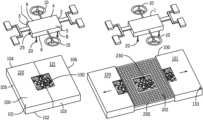
- FIG. 1illustrates a perspective view of the present charging drone airborne and the landing (“charging”) pad wherein a cover of the landing pad is in the closed orientation.
- FIG. 2illustrates a perspective view of the charging drone of the present system airborne and the landing pad wherein the cover of the landing pad is in the open orientation and the charging surface revealed to charge the charging drone.
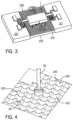
- FIG. 3illustrates a perspective view of the charging drone of the present system landed on the present landing pad wherein the landing (or “charging”) pad is in the open orientation.
- FIG. 4illustrates a close-up view of a leg of the present charging drone located between cone-shaped pillars of the top of the interior landing pad.
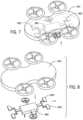
- FIG. 5illustrates a perspective view of the charging drone hovering over the main drone wherein the charging drone is in the process of landing on the main drone to recharge the main drone.
- FIG. 6illustrates a perspective view of charging drone landed on the top surface of the main drone.
- FIG. 7illustrates a perspective view of a second charging drone attached to the underside of the main drone wherein the main drone is transparent for illustrative purposes.
- FIG. 8illustrates the main drone with the second charging drone (with substantially spent batteries) leaving the underside of the main drone and traveling back to the charging pad for recharging of the second charging drone.
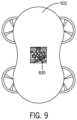
- FIG. 9illustrates the bottom of the main drone with the QR Code of the underside of the main drone visible.
- a charging and recharging drone assembly system and apparatusare provided.
- the systemhas a unique charging pad having a plurality of cones which direct the legs of a charging drone into a specific location on the charging pad for charging/re-charging.
- a QR codemay be located in the middle of a cover of a charging pad so that the charging drone may detect the charging pad from the air and may direct the charging drone to land on a specific spot on the landing pad for charging.
- the movable covermay cover the charging pad when the charging pad is not in use to protect the charging pad.
- the charging pad coveropens and exposes a second QR Code located on the top of the actual charging pad.
- a second (or “main”) dronemay be charged while airborne by the charging drone which may provide fresh battery power to the main drone.
- a first charging drone 1is provided.
- the first charging drone 1may be used in connection with a landing pad 200 ( FIG. 2 ) wherein the landing pad 200 has a movable landing pad cover 100 ( FIG. 1 ).
- the first charging drone 1may have a main body 5 , plurality of propellers 10 and a plurality of legs 20 .
- the first charging drone 1may have at least one camera 25 .
- cameras 25 on both the first charging drone 1 and on a second charging drone 880may at least detect QR Codes 530 , 830 of a main drone 500 ( FIG. 4 ).
- the first charging drone 1may essentially be a flying “battery drone 1 ” which supplies fresh battery power to a second drone 500 (or “main drone” as shown in FIG. 5 ).
- the main drone 500may be made largely of a foam material which is durable and lightweight for prolonged flight.
- the first charging drone 1may have a first side 2 , a second side 3 , a top 5 , a bottom 6 , a front 8 , a back 9 and a main body 4 .
- a landing/charging pad 200 and a landing pad cover 100may be used in connection with the first charging drone 1 (and the second charging drone 880 as discussed below).
- the landing pad cover 100may have a top 101 , a bottom 102 , a front 103 , a back 104 , a first side 105 and a second side 106 . Further, the landing pad cover 100 may have a first unit 120 and a second unit 121 . In an embodiment, the first unit 120 and the second unit 121 may move with respect to each other from a first (or “closed”) orientation ( FIG. 1 ) to a second (or “open”) orientation ( FIG. 2 ).
- the landing pad cover 100may protect the interior landing/charging pad 200 from the weather and other elements by only exposing the interior landing/charging pad 200 for a brief time for charging the first or the second charging drones 1 , 880 (as discussed below).
- the top 101 of the first unit 120 of the landing pad cover 100may have half of a QR Code 130 and the top 101 of the second unit 121 may have the other half of the QR Code 130 . Only when the first unit 120 and the second unit 121 of the landing pad cover 100 are in the first orientation (or “closed” orientation as shown in FIG. 1 ) will the QR Code 130 be readable (and therefore functional) by the camera 25 of the charging drones 1 , 880 . When the first unit 120 and the second unit 121 of the landing cover 100 are in the closed first orientation the interior landing/charging pad 200 ( FIG. 2 ) is concealed and protected.
- the landing pad cover 100may have a sensor/transmitted 133 .
- the sensor/transmitted 133may detect the presence of the charging drones 1 , 880 hovering above it.
- the first unit 120 and the second unit 121may start to move away from each other from the first (or “closed”) orientation of FIG. 1 to the second (or “open”) orientation of FIG. 2 .
- the QR Code 130 located on the top surface 101 of the landing pad cover 100is moveable so that when the charging drone 1 detects the QR code 130 the charging drone 1 may land onto the pad cover 100 in an exact precise position on the landing pad 200 surface.
- the landing pad cover 100may open up when either of the charging drones 1 , 880 is approximately two feet away from the top of the landing pad cover 100 . After either of the charging drones 1 , 880 charges and flies away, the landing pad cover 100 may automatically close again to conceal and protect the interior landing/charging surface 200 .
- the interior landing pad 200may have a top surface 201 and a bottom surface 202 .
- the interior landing pad 200may charge and/or recharge the charging drones 1 , 880 so that the charging drones 1 , 880 then, in turn, fly to and supply power to the main drone 500 to sustain flight 1 of the main drone 500 .
- the top surface 201 of the interior landing pad 200may have a plurality of cone-shaped peaks 220 .
- the cone-shaped peaks 220may surround a plurality of valleys 225 .
- the surface of the plurality of valleys 225may have electrical contacts that allows for the charging of the charging drones 1 , 880 when the charging drones 1 , 880 land on the interior landing surface 200 .
- the bottom of the legs 20 of the charging drones 1 , 880may have downward-facing cone-shaped tips 26 to oppose the upward facing cone peaks 220 .
- the cone-shaped tips 26 of the legs 20may allow the charging drones 1 , 880 to both land on the landing pad surface 200 and may allow the charging drones 1 , 880 to be charged by the landing pad surface 200 .
- the cone-shaped tips 26 of the legs 20 of the charging drones 1 , 880may be metal having exposed electrical components which may establish a connection with the electrical valleys 225 of the interior landing/charging pad 200 so that electrical power may therein be transferred from the interior landing pad 200 to batteries in the charging drones 1 , 880 through the electrical legs 20 of the charging drones 1 , 880 .
- the cone-shaped tips 26 of the legs 20 of the charging drones 1 , 880may have a diameter 33 which is slightly less than a diameter 34 of the space between adjacent cone-shaped peaks 220 so that the cone-shaped peaks 220 direct the legs 20 down into the valleys 225 on the top 201 of the interior landing pad 200 for charging, recharging or for merely ending a flight session for the drones 1 , 880 .
- a second QR Code 230may be located on the top 201 of the interior landing pad 200 .
- the QR Codes 130 , 230are generally identical in the preferred embodiment, in one alternative embodiment, the QR Code 230 of the interior landing pad 200 may be different than the QR Code 130 of the top surface 101 of the landing pad cover 100 to provide different instructions to the charging drones 1 , 880 .
- the QR Code 230 of the interior landing pad 200may, for example, be identical to the QR Code 130 on the landing pad cover 100 so that the charging drones 1 , 880 may continue to read the interior QR Code 230 and, therefore, land on the interior landing pad 200 at the exact right location while the exterior QR Code 130 is in the process of separating in two to expose the interior pad 200 .
- the charging drones 1 , 880may instantaneously switch from reading the cover QR Code 130 to reading the interior QR Code 230 as the landing pad cover 100 slides to the open orientation of FIG. 2 .
- the main drone 500may be used in connection with the charging drones 1 , 880 while the main drone 500 is still in flight.
- the main drone 500may be the operational drone which covers great distance flying, takes pictures and videos, and is functional performing tasks while the two charging drones 1 , 880 are generally identical drones which only serve to power the main drone 500 .
- the main drone 500may have a top surface 501 and a bottom surface 502 .
- the charging drones 1 , 880may recharge their batteries 600 , 800 using the top 201 of the interior landing/charging pad 200 and then may fly to the main drone 500 while the main drone 500 is still in flight. Further, as the battery level of the main drone 500 starts to get low and reaches a predetermined level of power, the main drone 500 may transmit a wireless signal to the landing/charging pad 200 to instruct the landing/charging pad 200 to send the either of the charging drones 1 , 880 to the main drone 500 so as to recharge the main drone 500 with fresh power.
- the first charging drone 1may hover over the main drone 500 when the main drone 500 is running low on power.
- FIG. 5illustrates the first charging drone 1 approaching the main drone 500 in flight
- FIG. 6illustrates the first charging drone 1 landed on a top surface 501 of the main drone 500 while both drones 1 , 500 are still in flight.
- the first charging drone 1may detect the main drone 500 by receiving a wireless transmitter receiver signal from the main drone 500 and further with the help of camera 25 on the first charging drone 1 .
- a QR Code 530FIG. 5
- Still another QR Code 830FIG. 9
- the first charging drone 1After the first charging drone 1 reaches the top surface 501 of the main drone 500 the first charging drone 1 becomes secured to the main drone 500 and can then provide power to the main drone 500 .
- a second charging drone 880which is secured to the underside of the main drone 500 (seen in FIG. 7 ) may then become detached from the underside 502 of the main drone 500 .
- the second charging drone 880may have been providing power to the main drone 500 before the arrival of the first charging drone 1 .
- the second charging drone 880With its substantially spent batteries 800 then becomes detached from the underside 502 of the main drone 500 and flies back to the landing/charging pad 201 for recharging.
- the processcontinues with either the first drone 1 secured to the top 501 of the main drone 500 to power the main drone 500 or the second charging drone 880 secured to the underside of the main drone 500 to power the main drone 500 . Therefore, the batteries 600 of the first charging drone 1 and the batteries 800 of the second charging drone 880 never leave their respective drones 1 , 880 .
- batteries 600 secured to a battery holder 610 of the first charging drone 1may now supply power to the main drone 500 .
- the first charging drone 1may be magnetic and may stick to the magnetic top 501 of the main drone 500 so that the first charging drone 1 does not fall off the main drone 500 in flight.
- a magnet on the second charging drone 880may be used to secure the second charging drone 880 to the underside 502 of the main drone 500 .
- the first charging drone 1 or the second charging drone 880becomes low on power, it sends a signal to the landing/charging pad 200 which will have the non-secured charging drone 1 , 880 fully charged and ready to swap out. The process therefore allows the main drone 500 to be airborne almost in perpetuity.
Landscapes
- Engineering & Computer Science (AREA)
- Aviation & Aerospace Engineering (AREA)
- Computer Networks & Wireless Communication (AREA)
- Chemical & Material Sciences (AREA)
- Combustion & Propulsion (AREA)
- Mechanical Engineering (AREA)
- Remote Sensing (AREA)
- Charge And Discharge Circuits For Batteries Or The Like (AREA)
Abstract
Description
The following application is based on and claims the priority benefit of U.S. provisional application Ser. No. 62/959,048 filed Jan. 9, 2020; 62/888,544 filed Aug. 19, 2019 and 62/892,834 filed Aug. 28, 2019; the entire contents of which are incorporated by reference.
A charging and recharging drone assembly system and apparatus are provided. The system has a unique charging pad having a plurality of cones which direct the legs of a charging drone into a specific location on the charging pad for charging/re-charging. A QR code may be located in the middle of a cover of a charging pad so that the charging drone may detect the charging pad from the air and may direct the charging drone to land on a specific spot on the landing pad for charging. The movable cover may cover the charging pad when the charging pad is not in use to protect the charging pad. When the charging drone approaches the charging pad the charging pad cover opens and exposes a second QR Code located on the top of the actual charging pad. A second (or “main”) drone may be charged while airborne by the charging drone which may provide fresh battery power to the main drone.
Prior drone charging systems are known. For example, U.S. Pat. No. 10,461,547 to Lee discloses a portable drone battery charger that charges a variety of batteries of different capacities as well as voltage levels is provided. The drone battery charger operates from an internal battery and may charge a drone battery multiple times because the capacity of the drone battery charger internal battery is many times larger than the done battery.
Further, U.S. Pat. No. 10,112,728 to Evans discloses a charging system for a drone carrying a passenger pod has a base structure connected to a power grid, a row of substantially planar wireless charging pads supported by the base structure, and a computerized controller enabled to communicate with a drone and to initiate, control and stop charging power. As a drone carrying a passenger pod approaches the charging-system, the computerized controller directs the moving drone into a path bringing a charging receiver pad of the passenger pod carried by the drone, and connected to a battery of the passenger pod, into proximity with the row of substantially planar charging pads, and directs the drone to move the carried passenger pod along the row of charging pods, managing speed and direction of the moving drone along the path, as charging of the battery of the passenger pod is accomplished.
Still further, U.S. Pat. No. 10,618,653 to Han discloses a charging system by autonomous guide of drone includes a drone for being autonomously guided to a charging station on the basis of location and altitude coordinates for charging and for transmitting a charged information to a control station when the charging is completed; a charging station for recognizing the approach of the drone within a chargeable range and for controlling the guide flight of the drone and transmitting a charged information to the control station when the charging is completed; and a control station for detecting the state of charge of the drone in real time and for transmitting a location coordinate and altitude coordinate of the charging station to the drone for guiding flight to the charging station.
However, these patents fail to describe a drone charging/re-charging assembly which is easy to use. Further, these patents fail to describe a drone charging/re-charging assembly which utilizes a cone-shaped charging pad having a QR Code to direct the drone for charging/re-charging the drone.
A charging and recharging drone assembly system and apparatus are provided. The system has a unique charging pad having a plurality of cones which direct the legs of a charging drone into a specific location on the charging pad for charging/re-charging. A QR code may be located in the middle of a cover of a charging pad so that the charging drone may detect the charging pad from the air and may direct the charging drone to land on a specific spot on the landing pad for charging. The movable cover may cover the charging pad when the charging pad is not in use to protect the charging pad. When the charging drone approaches the charging pad the charging pad cover opens and exposes a second QR Code located on the top of the actual charging pad. A second (or “main”) drone may be charged while airborne by the charging drone which may provide fresh battery power to the main drone.
An advantage of the present charging drone and system is that the present charging drone and system may have a camera which can detect a QR Code located on a top surface of a landing (or “charging”) pad.
Yet another advantage of the present charging drone and system is that the present charging drone and system may have a charging pad which has a movable cover having a QR Code which splits into two units to reveal a second QR Code located on an interior landing pad located underneath the movable cover.
Still another advantage of the present drone charging/re-charging assembly and system is that the present drone charging/re-charging assembly and system may allow a main drone to remain airborne almost in perpetuity as a result of the main drone receiving fresh battery power from a plurality of charging drones.
For a more complete understanding of the above listed features and advantages of the present drone assembly and system reference should be made to the detailed description and the detailed drawings. Further, additional features and advantages of the invention are described in, and will be apparent from, the detailed description of the preferred embodiments.
A charging and recharging drone assembly system and apparatus are provided. The system has a unique charging pad having a plurality of cones which direct the legs of a charging drone into a specific location on the charging pad for charging/re-charging. A QR code may be located in the middle of a cover of a charging pad so that the charging drone may detect the charging pad from the air and may direct the charging drone to land on a specific spot on the landing pad for charging. The movable cover may cover the charging pad when the charging pad is not in use to protect the charging pad. When the charging drone approaches the charging pad the charging pad cover opens and exposes a second QR Code located on the top of the actual charging pad. A second (or “main”) drone may be charged while airborne by the charging drone which may provide fresh battery power to the main drone.
Referring first toFIG.1 , in an embodiment afirst charging drone 1 is provided. Thefirst charging drone 1 may be used in connection with a landing pad200 (FIG.2 ) wherein thelanding pad 200 has a movable landing pad cover100 (FIG.1 ). Thefirst charging drone 1 may have amain body 5, plurality ofpropellers 10 and a plurality oflegs 20. In an embodiment, thefirst charging drone 1 may have at least onecamera 25. In an embodiment,cameras 25 on both thefirst charging drone 1 and on a second charging drone880 (as discussed below) may at least detectQR Codes FIG.4 ).
Thefirst charging drone 1 may essentially be a flying “battery drone 1” which supplies fresh battery power to a second drone500 (or “main drone” as shown inFIG.5 ). In an embodiment, themain drone 500 may be made largely of a foam material which is durable and lightweight for prolonged flight. In an embodiment, thefirst charging drone 1 may have afirst side 2, asecond side 3, atop 5, abottom 6, afront 8, aback 9 and amain body 4.
In an embodiment, a landing/charging pad 200 and alanding pad cover 100 may be used in connection with the first charging drone1 (and thesecond charging drone 880 as discussed below). Thelanding pad cover 100 may have atop 101, abottom 102, afront 103, aback 104, afirst side 105 and asecond side 106. Further, thelanding pad cover 100 may have afirst unit 120 and asecond unit 121. In an embodiment, thefirst unit 120 and thesecond unit 121 may move with respect to each other from a first (or “closed”) orientation (FIG.1 ) to a second (or “open”) orientation (FIG.2 ). Thelanding pad cover 100 may protect the interior landing/charging pad 200 from the weather and other elements by only exposing the interior landing/charging pad 200 for a brief time for charging the first or thesecond charging drones 1,880 (as discussed below).
In an embodiment, thetop 101 of thefirst unit 120 of thelanding pad cover 100 may have half of aQR Code 130 and thetop 101 of thesecond unit 121 may have the other half of theQR Code 130. Only when thefirst unit 120 and thesecond unit 121 of thelanding pad cover 100 are in the first orientation (or “closed” orientation as shown inFIG.1 ) will theQR Code 130 be readable (and therefore functional) by thecamera 25 of thecharging drones first unit 120 and thesecond unit 121 of thelanding cover 100 are in the closed first orientation the interior landing/charging pad200 (FIG.2 ) is concealed and protected.
In an embodiment, thelanding pad cover 100 may have a sensor/transmitted133. The sensor/transmitted133 may detect the presence of the charging drones1,880 hovering above it. In an embodiment, once either of the charging drones1,880 is detected by the sensor/transmitted133 oflanding pad cover 100 thefirst unit 120 and thesecond unit 121 may start to move away from each other from the first (or “closed”) orientation ofFIG.1 to the second (or “open”) orientation ofFIG.2 .
In an embodiment, theQR Code 130 located on thetop surface 101 of thelanding pad cover 100 is moveable so that when the chargingdrone 1 detects theQR code 130 the chargingdrone 1 may land onto thepad cover 100 in an exact precise position on thelanding pad 200 surface. In an embodiment, thelanding pad cover 100 may open up when either of the charging drones1,880 is approximately two feet away from the top of thelanding pad cover 100. After either of the charging drones1,880 charges and flies away, thelanding pad cover 100 may automatically close again to conceal and protect the interior landing/charging surface 200.
Referring now toFIGS.3 and4 , when thefirst unit 120 and thesecond unit 121 of thelanding pad cover 100 are in the open position ofFIG.2 , theinterior landing pad 200 becomes exposed. Theinterior landing pad 200 may have atop surface 201 and abottom surface 202. Theinterior landing pad 200 may charge and/or recharge the charging drones1,880 so that the charging drones1,880 then, in turn, fly to and supply power to themain drone 500 to sustainflight 1 of themain drone 500.
Thetop surface 201 of theinterior landing pad 200 may have a plurality of cone-shapedpeaks 220. The cone-shapedpeaks 220 may surround a plurality ofvalleys 225. The surface of the plurality ofvalleys 225 may have electrical contacts that allows for the charging of the charging drones1,880 when the charging drones1,880 land on theinterior landing surface 200. In particular, the bottom of thelegs 20 of the charging drones1,880 may have downward-facing cone-shaped tips26 to oppose the upward facing cone peaks220. The cone-shaped tips26 of thelegs 20 may allow the charging drones1,880 to both land on thelanding pad surface 200 and may allow the charging drones1,880 to be charged by thelanding pad surface 200. In particular, the cone-shaped tips26 of thelegs 20 of the charging drones1,880 may be metal having exposed electrical components which may establish a connection with theelectrical valleys 225 of the interior landing/charging pad 200 so that electrical power may therein be transferred from theinterior landing pad 200 to batteries in the charging drones1,880 through theelectrical legs 20 of the charging drones1,880.
The cone-shaped tips26 of thelegs 20 of the charging drones1,880 may have adiameter 33 which is slightly less than adiameter 34 of the space between adjacent cone-shapedpeaks 220 so that the cone-shapedpeaks 220 direct thelegs 20 down into thevalleys 225 on the top201 of theinterior landing pad 200 for charging, recharging or for merely ending a flight session for thedrones
In an embodiment, asecond QR Code 230 may be located on the top201 of theinterior landing pad 200. Although theQR Codes QR Code 230 of theinterior landing pad 200 may be different than theQR Code 130 of thetop surface 101 of thelanding pad cover 100 to provide different instructions to the charging drones1,880. As stated above, preferably, theQR Code 230 of theinterior landing pad 200 may, for example, be identical to theQR Code 130 on thelanding pad cover 100 so that the charging drones1,880 may continue to read theinterior QR Code 230 and, therefore, land on theinterior landing pad 200 at the exact right location while theexterior QR Code 130 is in the process of separating in two to expose theinterior pad 200. More specifically, the chargingdrones cover QR Code 130 to reading theinterior QR Code 230 as thelanding pad cover 100 slides to the open orientation ofFIG.2 .
Referring now toFIGS.5-9 , in an embodiment, themain drone 500 may be used in connection with the chargingdrones main drone 500 is still in flight. Themain drone 500 may be the operational drone which covers great distance flying, takes pictures and videos, and is functional performing tasks while the two chargingdrones main drone 500.
Themain drone 500 may have atop surface 501 and abottom surface 502. The charging drones1,880 may recharge theirbatteries charging pad 200 and then may fly to themain drone 500 while themain drone 500 is still in flight. Further, as the battery level of themain drone 500 starts to get low and reaches a predetermined level of power, themain drone 500 may transmit a wireless signal to the landing/charging pad 200 to instruct the landing/charging pad 200 to send the either of the charging drones1,880 to themain drone 500 so as to recharge themain drone 500 with fresh power.
As shown inFIG.5 , in an embodiment, the first chargingdrone 1 may hover over themain drone 500 when themain drone 500 is running low on power.FIG.5 illustrates the first chargingdrone 1 approaching themain drone 500 in flight andFIG.6 illustrates the first chargingdrone 1 landed on atop surface 501 of themain drone 500 while bothdrones
In an embodiment, the first chargingdrone 1 may detect themain drone 500 by receiving a wireless transmitter receiver signal from themain drone 500 and further with the help ofcamera 25 on the first chargingdrone 1. In an embodiment, a QR Code530 (FIG.5 ) may be located on thetop surface 501 of themain drone 500 and may operate in a similar manner as theQR Code 230 on the top of theinterior landing pad 200. Still another QR Code830 (FIG.9 ) is present on thebottom 502 of themain drone 500 in a similar manner as theQR Code 530 of thetop surface 501 of themain drone 500.
After the first chargingdrone 1 reaches thetop surface 501 of themain drone 500 the first chargingdrone 1 becomes secured to themain drone 500 and can then provide power to themain drone 500. Once the first chargingdrone 1 is secured to thetop surface 501 of the main drone500 a second chargingdrone 880 which is secured to the underside of the main drone500 (seen inFIG.7 ) may then become detached from theunderside 502 of themain drone 500. The second chargingdrone 880 may have been providing power to themain drone 500 before the arrival of the first chargingdrone 1. Once the first chargingdrone 1 is secured to themain drone 500 and provides power to themain drone 500, the second chargingdrone 880, with its substantially spentbatteries 800 then becomes detached from theunderside 502 of themain drone 500 and flies back to the landing/charging pad 201 for recharging. The process continues with either thefirst drone 1 secured to the top501 of themain drone 500 to power themain drone 500 or the second chargingdrone 880 secured to the underside of themain drone 500 to power themain drone 500. Therefore, thebatteries 600 of the first chargingdrone 1 and thebatteries 800 of the second chargingdrone 880 never leave theirrespective drones
As thelegs 20 of the first chargingdrone 1 touch down on thetop surface 501 of themain drone 500,batteries 600 secured to abattery holder 610 of the first chargingdrone 1 may now supply power to themain drone 500. The first chargingdrone 1 may be magnetic and may stick to themagnetic top 501 of themain drone 500 so that the first chargingdrone 1 does not fall off themain drone 500 in flight. A magnet on the second chargingdrone 880 may be used to secure the second chargingdrone 880 to theunderside 502 of themain drone 500.
In an embodiment, there is always at least one chargingdrone top surface 501 or thebottom surface 502 of the main drone500 (or both when the actual exchange is taking place) to provide themain drone 500 with power. When the first chargingdrone 1 or the second chargingdrone 880 becomes low on power, it sends a signal to the landing/charging pad 200 which will have the non-secured chargingdrone main drone 500 to be airborne almost in perpetuity.
Although embodiments of the invention are shown and described therein, it should be understood that various changes and modifications to the presently preferred embodiments will be apparent to those skilled in the art. Such changes and modifications may be made without departing from the spirit and scope of the invention and without diminishing its attendant advantages.
Claims (11)
1. A drone charging system comprising:
a first drone wherein the first drone supplies power to a second drone when the first drone is attached to the second drone;
a landing pad wherein the landing pad both receives and charges the first drone and wherein the landing pad has a movable cover having a top surface wherein the movable cover has a first unit and a second unit and wherein the first unit is in contact with the second unit in a first orientation and wherein the first unit of the movable cover is not in contact with the second unit in a second orientation;
wherein the first drone flies to the second drone to charge the second drone;
a first QR Code located on the landing pad and wherein the first QR Code provides information to the first drone;
a second QR Code located on the top surface of the movable cover of the landing pad wherein the second QR Code is only readable when the movable cover is in the first orientation and wherein the second QR Code is not readable in the second orientation and wherein a portion of the second QR Code is printed on the first unit of the movable cover and wherein a portion of the second QR Code is printed on the second unit of the movable cover; and
wherein the first QR Code located on the landing pad is completely concealed and not readable by the first drone when then movable cover is in the first orientation.
2. The drone charging system ofclaim 1 further comprising:
a top surface of the landing pad wherein the top surface of the landing pad has a plurality of cone-shaped protrusions and wherein the plurality of cone-shaped protrusions direct a leg of the first drone on the top surface of the landing pad.
3. The drone charging system ofclaim 1 further comprising:
a plurality of legs of the first drone wherein each of the plurality of legs of the first drone have a cone-shaped tip wherein the cone-shaped tip of each of the plurality of legs is directed on the landing pad by a plurality of opposing cone-shaped protrusions of a top surface of the landing pad.
4. The drone charging system ofclaim 1 further comprising:
a first magnet located on the first drone wherein the first magnet of the first drone is attracted to a first magnet of the second drone so that the first magnet of the first drone and the first magnet of the second drone secure the first drone to a top surface of the second drone.
5. The drone charging system ofclaim 1 further comprising:
a QR Code located on a top surface of the second drone wherein the QR Code of the top surface of the second drone directs the first drone to a specific landing position on the top surface of the second drone.
6. The drone charging system ofclaim 1 further comprising:
a QR Code located on a bottom surface of the second drone wherein the QR Code of the bottom surface of the second drone directs the first drone to a specific landing position on the bottom surface of the second drone.
7. The drone charging system ofclaim 1 further comprising:
a camera located on the first drone wherein the camera of the first drone detects a QR Code located on the landing pad.
8. The drone charging system ofclaim 1 further comprising:
a transmitter located on the landing pad wherein the transmitter transmits a wireless signal to the second drone.
9. The drone charging system ofclaim 1 wherein the first QR Code and the second QR Code are identical.
10. The drone charging system ofclaim 1 wherein the first QR Code on the cover of the landing pad and the second QR Code located on the landing pad are not identical.
11. The drone charging system ofclaim 1 wherein the second drone is made of a light foam material.
Priority Applications (1)
| Application Number | Priority Date | Filing Date | Title |
|---|---|---|---|
| US16/997,735US11597515B2 (en) | 2019-08-19 | 2020-08-19 | Charging/re-charging drone assembly system and apparatus |
Applications Claiming Priority (4)
| Application Number | Priority Date | Filing Date | Title |
|---|---|---|---|
| US201962888544P | 2019-08-19 | 2019-08-19 | |
| US201962892834P | 2019-08-28 | 2019-08-28 | |
| US202062959048P | 2020-01-09 | 2020-01-09 | |
| US16/997,735US11597515B2 (en) | 2019-08-19 | 2020-08-19 | Charging/re-charging drone assembly system and apparatus |
Publications (2)
| Publication Number | Publication Date |
|---|---|
| US20210053677A1 US20210053677A1 (en) | 2021-02-25 |
| US11597515B2true US11597515B2 (en) | 2023-03-07 |
Family
ID=74645469
Family Applications (1)
| Application Number | Title | Priority Date | Filing Date |
|---|---|---|---|
| US16/997,735Active2041-05-07US11597515B2 (en) | 2019-08-19 | 2020-08-19 | Charging/re-charging drone assembly system and apparatus |
Country Status (1)
| Country | Link |
|---|---|
| US (1) | US11597515B2 (en) |
Cited By (11)
| Publication number | Priority date | Publication date | Assignee | Title |
|---|---|---|---|---|
| US20230037429A1 (en)* | 2021-08-03 | 2023-02-09 | Powermat Technologies Ltd. | Wireless power receiver design for drones |
| US20230242274A1 (en)* | 2020-04-06 | 2023-08-03 | Workhorse Group Inc. | Flying vehicle systems and methods |
| US20230348106A1 (en)* | 2022-04-27 | 2023-11-02 | Skydio, Inc. | Base Stations For Unmanned Aerial Vehicles (UAVs) |
| US20240262546A1 (en)* | 2023-02-08 | 2024-08-08 | Ford Global Technologies, Llc | Resilient unmanned aerial vehicle landing platforms |
| US12065273B2 (en)* | 2021-12-24 | 2024-08-20 | Toyota Jidosha Kabushiki Kaisha | Takeoff/landing assist device |
| US12214902B2 (en)* | 2021-10-28 | 2025-02-04 | Flir Unmanned Aerial Systems Ulc | Landing systems and methods for unmanned aerial vehicles |
| US20250058871A1 (en)* | 2018-04-26 | 2025-02-20 | Skydio, Inc. | Autonomous Aerial Vehicle Hardware Configuration |
| US20250083841A1 (en)* | 2023-09-11 | 2025-03-13 | Polaris Industries Inc. | Drone integration with vehicle |
| US12344411B1 (en)* | 2024-04-03 | 2025-07-01 | Hoodman Corporation | Foldable launch and landing pad for drones |
| US20250242942A1 (en)* | 2020-01-31 | 2025-07-31 | Southeastern Pennsylvania Unmanned Aircraft Systems, Llc | Drone Delivery System |
| US12391414B2 (en)* | 2022-03-09 | 2025-08-19 | SZ DJI Technology Co., Ltd. | Unmanned aerial vehicle base station and unmanned aerial vehicle system |
Families Citing this family (13)
| Publication number | Priority date | Publication date | Assignee | Title |
|---|---|---|---|---|
| CN111483336B (en)* | 2019-01-28 | 2021-11-23 | 中光电智能机器人股份有限公司 | Unmanned aerial vehicle charging station, charging system and charging method |
| US11597515B2 (en)* | 2019-08-19 | 2023-03-07 | Epazz, Inc. | Charging/re-charging drone assembly system and apparatus |
| US11873116B2 (en) | 2019-10-15 | 2024-01-16 | Skydio, Inc. | Automated docking of unmanned aerial vehicle |
| WO2021245836A1 (en)* | 2020-06-03 | 2021-12-09 | 日本電気株式会社 | Power supply information determination device, power supply information determination system, power supply information determination method, and computer-readable medium |
| US11919665B2 (en)* | 2020-11-20 | 2024-03-05 | TB2 Aerospace | Unmanned aerial vehicles with cargo pods providing supplemental power and docking stations for recharging the cargo pods |
| IL283440A (en)* | 2021-05-25 | 2022-12-01 | Hevendrones Ltd | A drone with a loading dock |
| KR102583405B1 (en)* | 2021-07-05 | 2023-09-27 | 주식회사 아르고스다인 | Drone Station |
| WO2023056516A1 (en)* | 2021-10-07 | 2023-04-13 | Australian Aeronautics Pty Ltd. | Hybrid drone, base station and methods therefor |
| US11691718B2 (en)* | 2021-10-29 | 2023-07-04 | Toyota Motor Engineering & Manufacturing North America, Inc. | Aerial vehicle |
| KR20230081893A (en)* | 2021-11-30 | 2023-06-08 | 현대모비스 주식회사 | Wireless charging method for urban air mobility and device and system therefor |
| US11970293B2 (en)* | 2022-03-26 | 2024-04-30 | Epazz, Inc. | Drone with extendable and rotatable wings and multiple accessory securing panel |
| JP7697435B2 (en)* | 2022-09-01 | 2025-06-24 | トヨタ自動車株式会社 | Take-off and landing assistance equipment |
| US12337992B2 (en)* | 2022-12-01 | 2025-06-24 | Kara E. Johnson | Aircraft takeoff and landing apparatus |
Citations (81)
| Publication number | Priority date | Publication date | Assignee | Title |
|---|---|---|---|---|
| US20070176432A1 (en)* | 2004-02-20 | 2007-08-02 | Rolt Andrew M | Power generating apparatus |
| US20080217486A1 (en)* | 2007-03-05 | 2008-09-11 | Lockheed Martin Corporation | Small unmanned airborne vehicle airframe |
| US20090057486A1 (en)* | 2007-09-04 | 2009-03-05 | Helidex Llc | Modular helicopter deck for offshore oil drilling/production platforms |
| US20100170993A1 (en)* | 2009-01-05 | 2010-07-08 | Kent Paul Misegades | Aerodynamic Fairing for aircraft lift strut |
| US20100320313A1 (en)* | 2008-01-09 | 2010-12-23 | Bernard Hanafin | Combined helicopter landing pad and clamshell enclosure |
| US20110174925A1 (en)* | 2010-01-21 | 2011-07-21 | Jeffrey Ying | Helicopter landing pad |
| US8245469B2 (en)* | 2010-05-20 | 2012-08-21 | Aditazz, Inc. | Deck assembly module for a steel framed building |
| US8256172B2 (en)* | 2008-06-03 | 2012-09-04 | Christopher Benson | Modular free standing structure |
| US20130233964A1 (en)* | 2012-03-07 | 2013-09-12 | Aurora Flight Sciences Corporation | Tethered aerial system for data gathering |
| US9056676B1 (en)* | 2014-05-30 | 2015-06-16 | SZ DJI Technology Co., Ltd | Systems and methods for UAV docking |
| US20150175276A1 (en)* | 2013-12-19 | 2015-06-25 | Kenneth Lee Koster | Delivery platform for unmanned aerial vehicles |
| US9126693B1 (en)* | 2014-03-27 | 2015-09-08 | SZ DJI Technology Co., Ltd | Assisted takeoff |
| US20150336677A1 (en)* | 2012-12-21 | 2015-11-26 | European Aeronautic Defence And Space Company Eads France | In-flight refuelling device for electric storage system and aircraft equipped with such a device |
| US20160001883A1 (en)* | 2014-07-02 | 2016-01-07 | Skycatch, Inc. | Unmanned aerial vehicle landing interface |
| US20160068264A1 (en)* | 2014-09-08 | 2016-03-10 | Qualcomm Incorporated | Methods, Systems and Devices for Delivery Drone Security |
| US9290277B2 (en)* | 2013-12-11 | 2016-03-22 | Hanwha Techwin Co., Ltd. | Surveillance system and surveillance method |
| US20160101856A1 (en)* | 2014-06-23 | 2016-04-14 | Nixie Labs, Inc. | Wearable unmanned aerial vehicles, and associated systems and methods |
| US20160144982A1 (en)* | 2014-05-07 | 2016-05-26 | Deere & Company | Uav docking system and method |
| US20160196756A1 (en)* | 2014-08-05 | 2016-07-07 | Qualcomm Incorporated | Piggybacking Unmanned Aerial Vehicle |
| US9387928B1 (en)* | 2014-12-18 | 2016-07-12 | Amazon Technologies, Inc. | Multi-use UAV docking station systems and methods |
| US9421869B1 (en)* | 2015-09-25 | 2016-08-23 | Amazon Technologies, Inc. | Deployment and adjustment of airborne unmanned aerial vehicles |
| US20160257426A1 (en)* | 2015-03-02 | 2016-09-08 | Reese A. Mozer | Drone aircraft landing and docking systems |
| US20160286128A1 (en)* | 2002-10-01 | 2016-09-29 | Dylan TX ZHOU | Amphibious vtol super drone camera in a mobile case (phone case) with multiple aerial and aquatic flight modes for capturing panoramic virtual reality views, selfie and interactive video |
| US9457899B2 (en)* | 2013-06-24 | 2016-10-04 | The Boeing Company | Modular vehicle lift system |
| US20160291445A1 (en)* | 2015-03-31 | 2016-10-06 | Vantage Robotics, Llc | Miniature stabilized unmanned aerial vehicle gimbal |
| US20160304217A1 (en)* | 2015-01-18 | 2016-10-20 | Foundation Productions, Llc | Apparatus, Systems and Methods for Unmanned Aerial Vehicles |
| US20160311329A1 (en)* | 2015-04-22 | 2016-10-27 | Cristian A. Sobota Rodriguez | Contactless charger and battery management |
| US20160340021A1 (en)* | 2015-01-04 | 2016-11-24 | Beijing Zero Zero Infinity Technology Co., Ltd | Foldable drone |
| US20160355261A1 (en)* | 2015-06-08 | 2016-12-08 | Howard Martin Chin | Airborne Drone Launch and Recovery Apparatus |
| US20160364989A1 (en)* | 2015-06-15 | 2016-12-15 | ImageKeeper LLC | Unmanned aerial vehicle management |
| US9527605B1 (en)* | 2014-12-18 | 2016-12-27 | Amazon Technologies, Inc. | Multi-use unmanned aerial vehicle docking station |
| US20160378108A1 (en)* | 2015-02-19 | 2016-12-29 | Amazon Technologies, Inc. | Collective unmanned aerial vehicle configurations |
| US20170011333A1 (en)* | 2013-12-26 | 2017-01-12 | CyPhy Works, Inc. | Unmanned delivery |
| US9551989B2 (en)* | 2012-05-17 | 2017-01-24 | The Boeing Company | Method and apparatus for extending the operation of an unmanned aerial vehicle |
| US20170023949A1 (en)* | 2015-02-11 | 2017-01-26 | Aerovironment, Inc. | Geographic survey system for vertical take-off and landing (vtol) unmanned aerial vehicles (uavs) |
| US20170050749A1 (en)* | 2015-08-17 | 2017-02-23 | Skyyfish, LLC | Autonomous system for unmanned aerial vehicle landing, charging and takeoff |
| US9589448B1 (en)* | 2015-12-08 | 2017-03-07 | Micro Apps Group Inventions, LLC | Autonomous safety and security device on an unmanned platform under command and control of a cellular phone |
| US20170081043A1 (en)* | 2015-09-23 | 2017-03-23 | Wal-Mart Stores, Inc. | Portable unmanned delivery aircraft launch systems, and methods of delivering products utilizing aircraft launch systems |
| US20170121023A1 (en)* | 2015-10-28 | 2017-05-04 | Wal-Mart Stores, Inc. | Apparatus and method for providing package release to unmanned aerial system |
| US9643722B1 (en)* | 2014-02-28 | 2017-05-09 | Lucas J. Myslinski | Drone device security system |
| US20170129464A1 (en)* | 2014-07-31 | 2017-05-11 | SZ DJI Technology Co., Ltd. | Unmanned aerial vehicle base station system and method |
| US20170129603A1 (en)* | 2015-11-10 | 2017-05-11 | Matternet, Inc. | Methods and systems for transportation using unmanned aerial vehicles |
| US20170225782A1 (en)* | 2015-09-18 | 2017-08-10 | Nixie Labs, Inc. | Stowable unmanned aerial vehicles and associated systems and methods |
| US20170275025A1 (en)* | 2016-03-24 | 2017-09-28 | GE Lighting Solutions, LLC | Luminaire-mounted landing platform for a drone |
| US9783075B2 (en)* | 2015-10-05 | 2017-10-10 | Asylon, Inc. | Methods and apparatus for reconfigurable power exchange for multiple UAV types |
| US20170323129A1 (en)* | 2016-05-07 | 2017-11-09 | Morgan E. Davidson | Navigation Using Self-Describing Fiducials |
| US20180039286A1 (en)* | 2016-08-04 | 2018-02-08 | Echostar Technologies L.L.C. | Midair Tethering of an Unmanned Aerial Vehicle with a Docking Station |
| US9957045B1 (en)* | 2017-09-03 | 2018-05-01 | Brehnden Daly | Stackable drones |
| US20180233055A1 (en)* | 2017-02-13 | 2018-08-16 | Qualcomm Incorporated | Drone user equipment indication |
| US10099561B1 (en)* | 2015-09-25 | 2018-10-16 | Amazon Technologies, Inc. | Airborne unmanned aerial vehicle charging |
| US20180319496A1 (en)* | 2015-01-04 | 2018-11-08 | Hangzhou Zero Zero Technology Co., Ltd | Aerial vehicle and method of operation |
| US20180327091A1 (en)* | 2017-05-12 | 2018-11-15 | Gencore Candeo, Ltd. | Systems and methods for response to emergency situations using unmanned airborne vehicles with improved functionalities |
| US20190016476A1 (en)* | 2017-07-17 | 2019-01-17 | Christopher Julian Scherz | Docking station for unmanned aerial vehicles |
| US20190023133A1 (en)* | 2017-07-19 | 2019-01-24 | X Development Llc | Systems for Charging Aerial Vehicles |
| US20190047462A1 (en)* | 2018-09-25 | 2019-02-14 | Intel Corporation | Modular configurable platform architecture for ca/ad vehicles |
| US20190055018A1 (en)* | 2016-04-29 | 2019-02-21 | SZ DJI Technology Co., Ltd. | Systems and methods for uav transport and data acquisition |
| US20190100108A1 (en)* | 2017-09-29 | 2019-04-04 | Qualcomm Incorporated | Robotic Vehicle Renewable Resource Charging Station Management Systems and Methods |
| US10310501B2 (en)* | 2017-02-15 | 2019-06-04 | International Business Machines Corporation | Managing available energy among multiple drones |
| US20190217952A1 (en)* | 2016-08-19 | 2019-07-18 | Motorola Solutions, Inc. | Tethered aerial drone system |
| US20190233107A1 (en)* | 2018-01-29 | 2019-08-01 | Autoflightx International Limited | Vtol fixed-wing aerial drone with interchangeable cabins |
| US20190245365A1 (en)* | 2016-10-28 | 2019-08-08 | Telefonaktiebolaget Lm Ericsson (Publ) | Stackable automated drone charging station |
| US20190256207A1 (en)* | 2016-11-07 | 2019-08-22 | Ebara Corporation | Wired drone group |
| US20190283871A1 (en)* | 2018-03-15 | 2019-09-19 | T-Mobile Usa, Inc. | Inhibiting cable entanglement in tethered drones |
| US20200017237A1 (en)* | 2018-07-16 | 2020-01-16 | The Boeing Company | DELIVERY LANDING PADS FOR UNMANNED AERIAL VEHICLES (UAVs) |
| US20200044463A1 (en)* | 2016-10-07 | 2020-02-06 | Jinheungtech Co., Ltd. | Unmanned aerial vehicle and unmanned aerial vehicle automatic charging device |
| US20200165008A1 (en)* | 2015-02-05 | 2020-05-28 | Airobotics Ltd. | Centering and Landing Platform for Hovering Flying Vehicles |
| US20200218288A1 (en)* | 2017-02-24 | 2020-07-09 | Flir Detection, Inc. | Control systems for unmanned aerial vehicles |
| US20200218287A1 (en)* | 2019-01-09 | 2020-07-09 | Ford Global Technologies, Llc | Multi-drone automotive systems and methods of use |
| US10719080B2 (en)* | 2015-01-04 | 2020-07-21 | Hangzhou Zero Zero Technology Co., Ltd. | Aerial system and detachable housing |
| US20200369408A1 (en)* | 2019-05-17 | 2020-11-26 | FlyFocus Sp. z.o.o. | Detachable power cable for unmanned aerial vehicle |
| US20200406773A1 (en)* | 2019-06-26 | 2020-12-31 | Alberto Daniel Lacaze | Self-Powered Drone Tether |
| US20210053677A1 (en)* | 2019-08-19 | 2021-02-25 | Shaun Passley | Charging/re-charging drone assembly system and apparatus |
| US10967970B2 (en)* | 2016-02-05 | 2021-04-06 | Vantage Robotics, Llc | Durable modular unmanned aerial vehicle |
| US20210284356A1 (en)* | 2020-03-13 | 2021-09-16 | Wing Aviation Llc | Adhoc geo-fiducial mats for landing uavs |
| USD932369S1 (en)* | 2020-09-16 | 2021-10-05 | ZenaDrone, Inc. | Drone |
| US11148808B2 (en)* | 2016-09-19 | 2021-10-19 | Airrobot Gmbh & Co. Kg | Device for airlifting an object |
| US20210354820A1 (en)* | 2020-05-13 | 2021-11-18 | The Boeing Company | Drone data sharing system |
| US20220019247A1 (en)* | 2020-07-14 | 2022-01-20 | Easy Aerial Inc. | Unmanned aerial vehicle (uav) systems and methods for maintaining continuous uav operation |
| US20220041279A1 (en)* | 2020-08-04 | 2022-02-10 | Hex Technology Limited | Method and system for arranging swarming drones |
| US20220073214A1 (en)* | 2020-09-08 | 2022-03-10 | Wing Aviation Llc | Landing Pad with Charging and Loading Functionality for Unmanned Aerial Vehicle |
| US11370561B2 (en)* | 2020-04-06 | 2022-06-28 | Workhouse Group Inc. | Flying vehicle systems and methods |
- 2020
- 2020-08-19USUS16/997,735patent/US11597515B2/enactiveActive
Patent Citations (87)
| Publication number | Priority date | Publication date | Assignee | Title |
|---|---|---|---|---|
| US20160286128A1 (en)* | 2002-10-01 | 2016-09-29 | Dylan TX ZHOU | Amphibious vtol super drone camera in a mobile case (phone case) with multiple aerial and aquatic flight modes for capturing panoramic virtual reality views, selfie and interactive video |
| US20070176432A1 (en)* | 2004-02-20 | 2007-08-02 | Rolt Andrew M | Power generating apparatus |
| US20080217486A1 (en)* | 2007-03-05 | 2008-09-11 | Lockheed Martin Corporation | Small unmanned airborne vehicle airframe |
| US20090057486A1 (en)* | 2007-09-04 | 2009-03-05 | Helidex Llc | Modular helicopter deck for offshore oil drilling/production platforms |
| US20100320313A1 (en)* | 2008-01-09 | 2010-12-23 | Bernard Hanafin | Combined helicopter landing pad and clamshell enclosure |
| US8256172B2 (en)* | 2008-06-03 | 2012-09-04 | Christopher Benson | Modular free standing structure |
| US20100170993A1 (en)* | 2009-01-05 | 2010-07-08 | Kent Paul Misegades | Aerodynamic Fairing for aircraft lift strut |
| US8297552B2 (en)* | 2010-01-21 | 2012-10-30 | I/O Controls Corporation | Helicopter landing pad |
| US10046863B2 (en)* | 2010-01-21 | 2018-08-14 | I/O Controls Corporation | Helicopter landing pad |
| US20110174925A1 (en)* | 2010-01-21 | 2011-07-21 | Jeffrey Ying | Helicopter landing pad |
| US9296492B2 (en)* | 2010-01-21 | 2016-03-29 | I/O Controls Corporation | Helicopter landing pad |
| US8245469B2 (en)* | 2010-05-20 | 2012-08-21 | Aditazz, Inc. | Deck assembly module for a steel framed building |
| US20130233964A1 (en)* | 2012-03-07 | 2013-09-12 | Aurora Flight Sciences Corporation | Tethered aerial system for data gathering |
| US9551989B2 (en)* | 2012-05-17 | 2017-01-24 | The Boeing Company | Method and apparatus for extending the operation of an unmanned aerial vehicle |
| US20150336677A1 (en)* | 2012-12-21 | 2015-11-26 | European Aeronautic Defence And Space Company Eads France | In-flight refuelling device for electric storage system and aircraft equipped with such a device |
| US9457899B2 (en)* | 2013-06-24 | 2016-10-04 | The Boeing Company | Modular vehicle lift system |
| US9290277B2 (en)* | 2013-12-11 | 2016-03-22 | Hanwha Techwin Co., Ltd. | Surveillance system and surveillance method |
| US20150175276A1 (en)* | 2013-12-19 | 2015-06-25 | Kenneth Lee Koster | Delivery platform for unmanned aerial vehicles |
| US20170011333A1 (en)* | 2013-12-26 | 2017-01-12 | CyPhy Works, Inc. | Unmanned delivery |
| US9643722B1 (en)* | 2014-02-28 | 2017-05-09 | Lucas J. Myslinski | Drone device security system |
| US9126693B1 (en)* | 2014-03-27 | 2015-09-08 | SZ DJI Technology Co., Ltd | Assisted takeoff |
| US20160144982A1 (en)* | 2014-05-07 | 2016-05-26 | Deere & Company | Uav docking system and method |
| US9056676B1 (en)* | 2014-05-30 | 2015-06-16 | SZ DJI Technology Co., Ltd | Systems and methods for UAV docking |
| US20160101856A1 (en)* | 2014-06-23 | 2016-04-14 | Nixie Labs, Inc. | Wearable unmanned aerial vehicles, and associated systems and methods |
| US20160001883A1 (en)* | 2014-07-02 | 2016-01-07 | Skycatch, Inc. | Unmanned aerial vehicle landing interface |
| US20170129464A1 (en)* | 2014-07-31 | 2017-05-11 | SZ DJI Technology Co., Ltd. | Unmanned aerial vehicle base station system and method |
| US20160196756A1 (en)* | 2014-08-05 | 2016-07-07 | Qualcomm Incorporated | Piggybacking Unmanned Aerial Vehicle |
| US20160068264A1 (en)* | 2014-09-08 | 2016-03-10 | Qualcomm Incorporated | Methods, Systems and Devices for Delivery Drone Security |
| US9387928B1 (en)* | 2014-12-18 | 2016-07-12 | Amazon Technologies, Inc. | Multi-use UAV docking station systems and methods |
| US9527605B1 (en)* | 2014-12-18 | 2016-12-27 | Amazon Technologies, Inc. | Multi-use unmanned aerial vehicle docking station |
| US20180319496A1 (en)* | 2015-01-04 | 2018-11-08 | Hangzhou Zero Zero Technology Co., Ltd | Aerial vehicle and method of operation |
| US20160340021A1 (en)* | 2015-01-04 | 2016-11-24 | Beijing Zero Zero Infinity Technology Co., Ltd | Foldable drone |
| US10719080B2 (en)* | 2015-01-04 | 2020-07-21 | Hangzhou Zero Zero Technology Co., Ltd. | Aerial system and detachable housing |
| US10358214B2 (en)* | 2015-01-04 | 2019-07-23 | Hangzhou Zero Zro Technology Co., Ltd. | Aerial vehicle and method of operation |
| US10035589B2 (en)* | 2015-01-04 | 2018-07-31 | Beijing Zero Zero Infinity Technology Co., Ltd | Foldable drone |
| US20160304217A1 (en)* | 2015-01-18 | 2016-10-20 | Foundation Productions, Llc | Apparatus, Systems and Methods for Unmanned Aerial Vehicles |
| US20200165008A1 (en)* | 2015-02-05 | 2020-05-28 | Airobotics Ltd. | Centering and Landing Platform for Hovering Flying Vehicles |
| US20170023949A1 (en)* | 2015-02-11 | 2017-01-26 | Aerovironment, Inc. | Geographic survey system for vertical take-off and landing (vtol) unmanned aerial vehicles (uavs) |
| US20160378108A1 (en)* | 2015-02-19 | 2016-12-29 | Amazon Technologies, Inc. | Collective unmanned aerial vehicle configurations |
| US20160257426A1 (en)* | 2015-03-02 | 2016-09-08 | Reese A. Mozer | Drone aircraft landing and docking systems |
| US20160291445A1 (en)* | 2015-03-31 | 2016-10-06 | Vantage Robotics, Llc | Miniature stabilized unmanned aerial vehicle gimbal |
| US20160311329A1 (en)* | 2015-04-22 | 2016-10-27 | Cristian A. Sobota Rodriguez | Contactless charger and battery management |
| US20160355261A1 (en)* | 2015-06-08 | 2016-12-08 | Howard Martin Chin | Airborne Drone Launch and Recovery Apparatus |
| US20160364989A1 (en)* | 2015-06-15 | 2016-12-15 | ImageKeeper LLC | Unmanned aerial vehicle management |
| US20170050749A1 (en)* | 2015-08-17 | 2017-02-23 | Skyyfish, LLC | Autonomous system for unmanned aerial vehicle landing, charging and takeoff |
| US20170225782A1 (en)* | 2015-09-18 | 2017-08-10 | Nixie Labs, Inc. | Stowable unmanned aerial vehicles and associated systems and methods |
| US20170081043A1 (en)* | 2015-09-23 | 2017-03-23 | Wal-Mart Stores, Inc. | Portable unmanned delivery aircraft launch systems, and methods of delivering products utilizing aircraft launch systems |
| US10099561B1 (en)* | 2015-09-25 | 2018-10-16 | Amazon Technologies, Inc. | Airborne unmanned aerial vehicle charging |
| US9421869B1 (en)* | 2015-09-25 | 2016-08-23 | Amazon Technologies, Inc. | Deployment and adjustment of airborne unmanned aerial vehicles |
| US9783075B2 (en)* | 2015-10-05 | 2017-10-10 | Asylon, Inc. | Methods and apparatus for reconfigurable power exchange for multiple UAV types |
| US20170121023A1 (en)* | 2015-10-28 | 2017-05-04 | Wal-Mart Stores, Inc. | Apparatus and method for providing package release to unmanned aerial system |
| US20170129603A1 (en)* | 2015-11-10 | 2017-05-11 | Matternet, Inc. | Methods and systems for transportation using unmanned aerial vehicles |
| US9589448B1 (en)* | 2015-12-08 | 2017-03-07 | Micro Apps Group Inventions, LLC | Autonomous safety and security device on an unmanned platform under command and control of a cellular phone |
| US10967970B2 (en)* | 2016-02-05 | 2021-04-06 | Vantage Robotics, Llc | Durable modular unmanned aerial vehicle |
| US20170275025A1 (en)* | 2016-03-24 | 2017-09-28 | GE Lighting Solutions, LLC | Luminaire-mounted landing platform for a drone |
| US20190055018A1 (en)* | 2016-04-29 | 2019-02-21 | SZ DJI Technology Co., Ltd. | Systems and methods for uav transport and data acquisition |
| US20170323129A1 (en)* | 2016-05-07 | 2017-11-09 | Morgan E. Davidson | Navigation Using Self-Describing Fiducials |
| US20180039286A1 (en)* | 2016-08-04 | 2018-02-08 | Echostar Technologies L.L.C. | Midair Tethering of an Unmanned Aerial Vehicle with a Docking Station |
| US20190217952A1 (en)* | 2016-08-19 | 2019-07-18 | Motorola Solutions, Inc. | Tethered aerial drone system |
| US11148808B2 (en)* | 2016-09-19 | 2021-10-19 | Airrobot Gmbh & Co. Kg | Device for airlifting an object |
| US20200044463A1 (en)* | 2016-10-07 | 2020-02-06 | Jinheungtech Co., Ltd. | Unmanned aerial vehicle and unmanned aerial vehicle automatic charging device |
| US20190245365A1 (en)* | 2016-10-28 | 2019-08-08 | Telefonaktiebolaget Lm Ericsson (Publ) | Stackable automated drone charging station |
| US20190256207A1 (en)* | 2016-11-07 | 2019-08-22 | Ebara Corporation | Wired drone group |
| US20180233055A1 (en)* | 2017-02-13 | 2018-08-16 | Qualcomm Incorporated | Drone user equipment indication |
| US10310501B2 (en)* | 2017-02-15 | 2019-06-04 | International Business Machines Corporation | Managing available energy among multiple drones |
| US20200218288A1 (en)* | 2017-02-24 | 2020-07-09 | Flir Detection, Inc. | Control systems for unmanned aerial vehicles |
| US20180327091A1 (en)* | 2017-05-12 | 2018-11-15 | Gencore Candeo, Ltd. | Systems and methods for response to emergency situations using unmanned airborne vehicles with improved functionalities |
| US20190016476A1 (en)* | 2017-07-17 | 2019-01-17 | Christopher Julian Scherz | Docking station for unmanned aerial vehicles |
| US10882410B2 (en)* | 2017-07-19 | 2021-01-05 | Wing Aviation Llc | Systems for charging aerial vehicles |
| US20190023133A1 (en)* | 2017-07-19 | 2019-01-24 | X Development Llc | Systems for Charging Aerial Vehicles |
| US9957045B1 (en)* | 2017-09-03 | 2018-05-01 | Brehnden Daly | Stackable drones |
| US20190100108A1 (en)* | 2017-09-29 | 2019-04-04 | Qualcomm Incorporated | Robotic Vehicle Renewable Resource Charging Station Management Systems and Methods |
| US20190233107A1 (en)* | 2018-01-29 | 2019-08-01 | Autoflightx International Limited | Vtol fixed-wing aerial drone with interchangeable cabins |
| US20190283871A1 (en)* | 2018-03-15 | 2019-09-19 | T-Mobile Usa, Inc. | Inhibiting cable entanglement in tethered drones |
| US20200017237A1 (en)* | 2018-07-16 | 2020-01-16 | The Boeing Company | DELIVERY LANDING PADS FOR UNMANNED AERIAL VEHICLES (UAVs) |
| US20190047462A1 (en)* | 2018-09-25 | 2019-02-14 | Intel Corporation | Modular configurable platform architecture for ca/ad vehicles |
| US20200218287A1 (en)* | 2019-01-09 | 2020-07-09 | Ford Global Technologies, Llc | Multi-drone automotive systems and methods of use |
| US20200369408A1 (en)* | 2019-05-17 | 2020-11-26 | FlyFocus Sp. z.o.o. | Detachable power cable for unmanned aerial vehicle |
| US20200406773A1 (en)* | 2019-06-26 | 2020-12-31 | Alberto Daniel Lacaze | Self-Powered Drone Tether |
| US20210053677A1 (en)* | 2019-08-19 | 2021-02-25 | Shaun Passley | Charging/re-charging drone assembly system and apparatus |
| US20210284356A1 (en)* | 2020-03-13 | 2021-09-16 | Wing Aviation Llc | Adhoc geo-fiducial mats for landing uavs |
| US11370561B2 (en)* | 2020-04-06 | 2022-06-28 | Workhouse Group Inc. | Flying vehicle systems and methods |
| US20210354820A1 (en)* | 2020-05-13 | 2021-11-18 | The Boeing Company | Drone data sharing system |
| US20220019247A1 (en)* | 2020-07-14 | 2022-01-20 | Easy Aerial Inc. | Unmanned aerial vehicle (uav) systems and methods for maintaining continuous uav operation |
| US20220041279A1 (en)* | 2020-08-04 | 2022-02-10 | Hex Technology Limited | Method and system for arranging swarming drones |
| US20220073214A1 (en)* | 2020-09-08 | 2022-03-10 | Wing Aviation Llc | Landing Pad with Charging and Loading Functionality for Unmanned Aerial Vehicle |
| USD932369S1 (en)* | 2020-09-16 | 2021-10-05 | ZenaDrone, Inc. | Drone |
Cited By (25)
| Publication number | Priority date | Publication date | Assignee | Title |
|---|---|---|---|---|
| US12365452B2 (en) | 2018-04-26 | 2025-07-22 | Skydio, Inc. | Autonomous aerial vehicle hardware configuration |
| US20250058871A1 (en)* | 2018-04-26 | 2025-02-20 | Skydio, Inc. | Autonomous Aerial Vehicle Hardware Configuration |
| US20250242942A1 (en)* | 2020-01-31 | 2025-07-31 | Southeastern Pennsylvania Unmanned Aircraft Systems, Llc | Drone Delivery System |
| US20240308688A1 (en)* | 2020-04-06 | 2024-09-19 | Workhorse Group Inc. | Flying vehicle systems and methods |
| US20230242274A1 (en)* | 2020-04-06 | 2023-08-03 | Workhorse Group Inc. | Flying vehicle systems and methods |
| US12365494B2 (en)* | 2020-04-06 | 2025-07-22 | Workhorse Group Inc. | Flying vehicle systems and methods |
| US12037137B2 (en)* | 2020-04-06 | 2024-07-16 | Workhorse Group Inc. | Flying vehicle systems and methods |
| US20230037429A1 (en)* | 2021-08-03 | 2023-02-09 | Powermat Technologies Ltd. | Wireless power receiver design for drones |
| US12214902B2 (en)* | 2021-10-28 | 2025-02-04 | Flir Unmanned Aerial Systems Ulc | Landing systems and methods for unmanned aerial vehicles |
| US12065273B2 (en)* | 2021-12-24 | 2024-08-20 | Toyota Jidosha Kabushiki Kaisha | Takeoff/landing assist device |
| US12391414B2 (en)* | 2022-03-09 | 2025-08-19 | SZ DJI Technology Co., Ltd. | Unmanned aerial vehicle base station and unmanned aerial vehicle system |
| US12378017B2 (en) | 2022-04-27 | 2025-08-05 | Skydio, Inc. | Base stations for unmanned aerial vehicles (UAVs) and pedestals for use therewith |
| US12030399B2 (en)* | 2022-04-27 | 2024-07-09 | Skydio, Inc. | Base stations for unmanned aerial vehicles (UAVs) |
| US12017553B2 (en)* | 2022-04-27 | 2024-06-25 | Skydio, Inc. | Base stations for unmanned aerial vehicles (UAVs) |
| US12246610B2 (en) | 2022-04-27 | 2025-03-11 | Skydio, Inc. | Base stations for unmanned aerial vehicles (UAVs) |
| US12415635B2 (en) | 2022-04-27 | 2025-09-16 | Skydio, Inc. | Base stations for unmanned aerial vehicles (UAVs) |
| US12275318B2 (en) | 2022-04-27 | 2025-04-15 | Skydio, Inc. | Base stations for unmanned aerial vehicles (UAVs) |
| US12384570B2 (en) | 2022-04-27 | 2025-08-12 | Skydio, Inc. | Base stations for unmanned aerial vehicles (UAVs) |
| US11884422B2 (en) | 2022-04-27 | 2024-01-30 | Skydio, Inc. | Base stations for unmanned aerial vehicles (UAVs) |
| US20230348104A1 (en)* | 2022-04-27 | 2023-11-02 | Skydio, Inc. | Base Stations For Unmanned Aerial Vehicles (UAVs) |
| US20230348106A1 (en)* | 2022-04-27 | 2023-11-02 | Skydio, Inc. | Base Stations For Unmanned Aerial Vehicles (UAVs) |
| US12172777B2 (en)* | 2023-02-08 | 2024-12-24 | Ford Global Technologies, Llc | Resilient unmanned aerial vehicle landing platforms |
| US20240262546A1 (en)* | 2023-02-08 | 2024-08-08 | Ford Global Technologies, Llc | Resilient unmanned aerial vehicle landing platforms |
| US20250083841A1 (en)* | 2023-09-11 | 2025-03-13 | Polaris Industries Inc. | Drone integration with vehicle |
| US12344411B1 (en)* | 2024-04-03 | 2025-07-01 | Hoodman Corporation | Foldable launch and landing pad for drones |
Also Published As
| Publication number | Publication date |
|---|---|
| US20210053677A1 (en) | 2021-02-25 |
Similar Documents
| Publication | Publication Date | Title |
|---|---|---|
| US11597515B2 (en) | Charging/re-charging drone assembly system and apparatus | |
| US9434267B2 (en) | Systems and methods for UAV battery power backup | |
| US10363826B2 (en) | Systems and methods for UAV battery exchange | |
| US11091043B2 (en) | Multi-zone battery exchange system | |
| US20240235231A1 (en) | Battery management system | |
| US10850838B2 (en) | UAV battery form factor and insertion/ejection methodologies | |
| EP3124381B1 (en) | Post-type apparatus for containing and charging unmanned vertical take-off and landing aircraft and method of containing and charging unmanned vertical take-off and landing aircraft using the same | |
| JP6538214B2 (en) | Method of supplying energy to UAV, and UAV | |
| CN106655322B (en) | Service-type unmanned aerial vehicle, unmanned aerial vehicle charging system and charging method | |
| JP6791561B2 (en) | Methods and devices for supplying energy to UAVs | |
| KR102160734B1 (en) | Image taking system using wireless rechargeable drones | |
| CN107014255B (en) | A kind of method and apparatus of auxiliary unmanned boat capture unmanned plane | |
| CN204297114U (en) | A kind of can high-altitude location four-axle aircraft | |
| CN106143917A (en) | Unmanned plane air-drop thing receives equipment | |
| US20220206513A1 (en) | Method and system for autonomous and random drone travel | |
| US10739793B2 (en) | UAV with selective operational control during holding | |
| JPWO2021245836A5 (en) | POWER SUPPLY INFORMATION DETERMINATION DEVICE, POWER SUPPLY INFORMATION DETERMINATION METHOD, AND PROGRAM | |
| JP7002863B2 (en) | Guidance system and guidance method | |
| KR20190102487A (en) | Drone containment and method using marine light buoy | |
| CN111439380B (en) | Unmanned aerial vehicle battery replacement method | |
| CN108873916A (en) | A kind of flight control method of intelligent balance aircraft | |
| CN205563980U (en) | Remote controller is felt to body | |
| Ngo et al. | Classification of robotic battery service systems for unmanned aerial vehicles | |
| CN113212217A (en) | Automatic get back unmanned aerial vehicle system who targets in place and charge |
Legal Events
| Date | Code | Title | Description |
|---|---|---|---|
| FEPP | Fee payment procedure | Free format text:ENTITY STATUS SET TO UNDISCOUNTED (ORIGINAL EVENT CODE: BIG.); ENTITY STATUS OF PATENT OWNER: SMALL ENTITY | |
| FEPP | Fee payment procedure | Free format text:ENTITY STATUS SET TO SMALL (ORIGINAL EVENT CODE: SMAL); ENTITY STATUS OF PATENT OWNER: SMALL ENTITY | |
| STPP | Information on status: patent application and granting procedure in general | Free format text:NON FINAL ACTION MAILED | |
| STPP | Information on status: patent application and granting procedure in general | Free format text:RESPONSE TO NON-FINAL OFFICE ACTION ENTERED AND FORWARDED TO EXAMINER | |
| STPP | Information on status: patent application and granting procedure in general | Free format text:FINAL REJECTION MAILED | |
| AS | Assignment | Owner name:EPAZZ, INC., ILLINOIS Free format text:ASSIGNMENT OF ASSIGNORS INTEREST;ASSIGNOR:PASSLEY, SHAUN;REEL/FRAME:062566/0456 Effective date:20230201 | |
| STCF | Information on status: patent grant | Free format text:PATENTED CASE | |
| AS | Assignment | Owner name:ZENADRONE, INC., ARIZONA Free format text:ASSIGNMENT OF ASSIGNORS INTEREST;ASSIGNOR:EPAZZ, INC.;REEL/FRAME:070688/0243 Effective date:20241231 |