US11596539B2 - Abdominal instrument and method - Google Patents
Abdominal instrument and methodDownload PDFInfo
- Publication number
- US11596539B2 US11596539B2US16/636,344US201816636344AUS11596539B2US 11596539 B2US11596539 B2US 11596539B2US 201816636344 AUS201816636344 AUS 201816636344AUS 11596539 B2US11596539 B2US 11596539B2
- Authority
- US
- United States
- Prior art keywords
- handling
- surgical instrument
- relation
- instrument according
- distal portion
- Prior art date
- Legal status (The legal status is an assumption and is not a legal conclusion. Google has not performed a legal analysis and makes no representation as to the accuracy of the status listed.)
- Active, expires
Links
- 230000003187abdominal effectEffects0.000titleclaims5
- 238000000034methodMethods0.000titledescription20
- 238000001356surgical procedureMethods0.000claimsabstractdescription62
- 238000006073displacement reactionMethods0.000claimsabstractdescription42
- 208000037265diseases, disorders, signs and symptomsDiseases0.000claimsabstractdescription17
- 238000010992refluxMethods0.000claimsabstractdescription17
- 201000010099diseaseDiseases0.000claimsabstractdescription16
- 238000005452bendingMethods0.000claimsdescription15
- 210000001015abdomenAnatomy0.000claimsdescription13
- 210000005070sphincterAnatomy0.000claimsdescription10
- 210000002318cardiaAnatomy0.000claimsdescription9
- 210000002784stomachAnatomy0.000description33
- 210000003238esophagusAnatomy0.000description25
- 208000021302gastroesophageal reflux diseaseDiseases0.000description12
- 210000001519tissueAnatomy0.000description12
- 210000000683abdominal cavityAnatomy0.000description11
- 239000007943implantSubstances0.000description8
- 238000011282treatmentMethods0.000description5
- 230000007774longtermEffects0.000description4
- 210000000111lower esophageal sphincterAnatomy0.000description4
- 210000000115thoracic cavityAnatomy0.000description4
- 208000034991Hiatal HerniaDiseases0.000description3
- 206010020028Hiatus herniaDiseases0.000description3
- 210000003815abdominal wallAnatomy0.000description3
- 239000002253acidSubstances0.000description3
- 210000003736gastrointestinal contentAnatomy0.000description3
- 239000002184metalSubstances0.000description3
- 230000000151anti-reflux effectEffects0.000description2
- 238000002224dissectionMethods0.000description2
- 210000000981epitheliumAnatomy0.000description2
- 210000003236esophagogastric junctionAnatomy0.000description2
- 239000012530fluidSubstances0.000description2
- 230000006870functionEffects0.000description2
- 238000002513implantationMethods0.000description2
- 210000003205muscleAnatomy0.000description2
- 230000001052transient effectEffects0.000description2
- 206010006784Burning sensationDiseases0.000description1
- 208000017667Chronic DiseaseDiseases0.000description1
- 208000008589ObesityDiseases0.000description1
- 208000009956adenocarcinomaDiseases0.000description1
- 230000004888barrier functionEffects0.000description1
- 210000000038chestAnatomy0.000description1
- 230000008094contradictory effectEffects0.000description1
- 239000003814drugSubstances0.000description1
- 229940079593drugDrugs0.000description1
- 230000002496gastric effectEffects0.000description1
- 210000004907glandAnatomy0.000description1
- 230000001771impaired effectEffects0.000description1
- 238000003780insertionMethods0.000description1
- 230000037431insertionEffects0.000description1
- 238000012830laparoscopic surgical procedureMethods0.000description1
- 238000011866long-term treatmentMethods0.000description1
- 239000000463materialSubstances0.000description1
- 239000012528membraneSubstances0.000description1
- 230000005012migrationEffects0.000description1
- 238000013508migrationMethods0.000description1
- 235000020824obesityNutrition0.000description1
- 238000002355open surgical procedureMethods0.000description1
- 229920000052poly(p-xylylene)Polymers0.000description1
- 239000002861polymer materialSubstances0.000description1
- 229920001296polysiloxanePolymers0.000description1
- -1polytetrafluoroethylenePolymers0.000description1
- 229920001343polytetrafluoroethylenePolymers0.000description1
- 239000004810polytetrafluoroethyleneSubstances0.000description1
- 229920002635polyurethanePolymers0.000description1
- 239000004814polyurethaneSubstances0.000description1
- 230000008439repair processEffects0.000description1
- 230000009466transformationEffects0.000description1
- 230000001131transforming effectEffects0.000description1
- 210000002438upper gastrointestinal tractAnatomy0.000description1
- 230000000007visual effectEffects0.000description1
- 239000011800void materialSubstances0.000description1
Images






Classifications
- A—HUMAN NECESSITIES
- A61—MEDICAL OR VETERINARY SCIENCE; HYGIENE
- A61B—DIAGNOSIS; SURGERY; IDENTIFICATION
- A61B17/00—Surgical instruments, devices or methods
- A61B17/00234—Surgical instruments, devices or methods for minimally invasive surgery
- A—HUMAN NECESSITIES
- A61—MEDICAL OR VETERINARY SCIENCE; HYGIENE
- A61B—DIAGNOSIS; SURGERY; IDENTIFICATION
- A61B17/00—Surgical instruments, devices or methods
- A61B17/02—Surgical instruments, devices or methods for holding wounds open, e.g. retractors; Tractors
- A61B17/0218—Surgical instruments, devices or methods for holding wounds open, e.g. retractors; Tractors for minimally invasive surgery
- A—HUMAN NECESSITIES
- A61—MEDICAL OR VETERINARY SCIENCE; HYGIENE
- A61B—DIAGNOSIS; SURGERY; IDENTIFICATION
- A61B17/00—Surgical instruments, devices or methods
- A61B17/04—Surgical instruments, devices or methods for suturing wounds; Holders or packages for needles or suture materials
- A61B17/0469—Suturing instruments for use in minimally invasive surgery, e.g. endoscopic surgery
- A—HUMAN NECESSITIES
- A61—MEDICAL OR VETERINARY SCIENCE; HYGIENE
- A61B—DIAGNOSIS; SURGERY; IDENTIFICATION
- A61B17/00—Surgical instruments, devices or methods
- A61B17/34—Trocars; Puncturing needles
- A61B17/3468—Trocars; Puncturing needles for implanting or removing devices, e.g. prostheses, implants, seeds, wires
- A—HUMAN NECESSITIES
- A61—MEDICAL OR VETERINARY SCIENCE; HYGIENE
- A61F—FILTERS IMPLANTABLE INTO BLOOD VESSELS; PROSTHESES; DEVICES PROVIDING PATENCY TO, OR PREVENTING COLLAPSING OF, TUBULAR STRUCTURES OF THE BODY, e.g. STENTS; ORTHOPAEDIC, NURSING OR CONTRACEPTIVE DEVICES; FOMENTATION; TREATMENT OR PROTECTION OF EYES OR EARS; BANDAGES, DRESSINGS OR ABSORBENT PADS; FIRST-AID KITS
- A61F5/00—Orthopaedic methods or devices for non-surgical treatment of bones or joints; Nursing devices ; Anti-rape devices
- A61F5/0003—Apparatus for the treatment of obesity; Anti-eating devices
- A61F5/0013—Implantable devices or invasive measures
- A61F5/0069—Implantable devices or invasive measures in the wall of the stomach
- A—HUMAN NECESSITIES
- A61—MEDICAL OR VETERINARY SCIENCE; HYGIENE
- A61F—FILTERS IMPLANTABLE INTO BLOOD VESSELS; PROSTHESES; DEVICES PROVIDING PATENCY TO, OR PREVENTING COLLAPSING OF, TUBULAR STRUCTURES OF THE BODY, e.g. STENTS; ORTHOPAEDIC, NURSING OR CONTRACEPTIVE DEVICES; FOMENTATION; TREATMENT OR PROTECTION OF EYES OR EARS; BANDAGES, DRESSINGS OR ABSORBENT PADS; FIRST-AID KITS
- A61F5/00—Orthopaedic methods or devices for non-surgical treatment of bones or joints; Nursing devices ; Anti-rape devices
- A61F5/0003—Apparatus for the treatment of obesity; Anti-eating devices
- A61F5/0013—Implantable devices or invasive measures
- A61F5/0076—Implantable devices or invasive measures preventing normal digestion, e.g. Bariatric or gastric sleeves
- A61F5/0079—Pyloric or esophageal obstructions
- A—HUMAN NECESSITIES
- A61—MEDICAL OR VETERINARY SCIENCE; HYGIENE
- A61F—FILTERS IMPLANTABLE INTO BLOOD VESSELS; PROSTHESES; DEVICES PROVIDING PATENCY TO, OR PREVENTING COLLAPSING OF, TUBULAR STRUCTURES OF THE BODY, e.g. STENTS; ORTHOPAEDIC, NURSING OR CONTRACEPTIVE DEVICES; FOMENTATION; TREATMENT OR PROTECTION OF EYES OR EARS; BANDAGES, DRESSINGS OR ABSORBENT PADS; FIRST-AID KITS
- A61F5/00—Orthopaedic methods or devices for non-surgical treatment of bones or joints; Nursing devices ; Anti-rape devices
- A61F5/0003—Apparatus for the treatment of obesity; Anti-eating devices
- A61F5/0089—Instruments for placement or removal
- A—HUMAN NECESSITIES
- A61—MEDICAL OR VETERINARY SCIENCE; HYGIENE
- A61B—DIAGNOSIS; SURGERY; IDENTIFICATION
- A61B17/00—Surgical instruments, devices or methods
- A61B17/00234—Surgical instruments, devices or methods for minimally invasive surgery
- A61B2017/00292—Surgical instruments, devices or methods for minimally invasive surgery mounted on or guided by flexible, e.g. catheter-like, means
- A61B2017/00296—Surgical instruments, devices or methods for minimally invasive surgery mounted on or guided by flexible, e.g. catheter-like, means mounted on an endoscope
- A—HUMAN NECESSITIES
- A61—MEDICAL OR VETERINARY SCIENCE; HYGIENE
- A61B—DIAGNOSIS; SURGERY; IDENTIFICATION
- A61B17/00—Surgical instruments, devices or methods
- A61B17/00234—Surgical instruments, devices or methods for minimally invasive surgery
- A61B2017/00292—Surgical instruments, devices or methods for minimally invasive surgery mounted on or guided by flexible, e.g. catheter-like, means
- A61B2017/003—Steerable
- A—HUMAN NECESSITIES
- A61—MEDICAL OR VETERINARY SCIENCE; HYGIENE
- A61B—DIAGNOSIS; SURGERY; IDENTIFICATION
- A61B17/00—Surgical instruments, devices or methods
- A61B17/00234—Surgical instruments, devices or methods for minimally invasive surgery
- A61B2017/00292—Surgical instruments, devices or methods for minimally invasive surgery mounted on or guided by flexible, e.g. catheter-like, means
- A61B2017/003—Steerable
- A61B2017/00305—Constructional details of the flexible means
- A61B2017/00309—Cut-outs or slits
- A—HUMAN NECESSITIES
- A61—MEDICAL OR VETERINARY SCIENCE; HYGIENE
- A61B—DIAGNOSIS; SURGERY; IDENTIFICATION
- A61B17/00—Surgical instruments, devices or methods
- A61B17/00234—Surgical instruments, devices or methods for minimally invasive surgery
- A61B2017/00292—Surgical instruments, devices or methods for minimally invasive surgery mounted on or guided by flexible, e.g. catheter-like, means
- A61B2017/003—Steerable
- A61B2017/00318—Steering mechanisms
- A61B2017/00323—Cables or rods
- A—HUMAN NECESSITIES
- A61—MEDICAL OR VETERINARY SCIENCE; HYGIENE
- A61B—DIAGNOSIS; SURGERY; IDENTIFICATION
- A61B17/00—Surgical instruments, devices or methods
- A61B2017/00367—Details of actuation of instruments, e.g. relations between pushing buttons, or the like, and activation of the tool, working tip, or the like
- A—HUMAN NECESSITIES
- A61—MEDICAL OR VETERINARY SCIENCE; HYGIENE
- A61B—DIAGNOSIS; SURGERY; IDENTIFICATION
- A61B17/00—Surgical instruments, devices or methods
- A61B2017/00367—Details of actuation of instruments, e.g. relations between pushing buttons, or the like, and activation of the tool, working tip, or the like
- A61B2017/00389—Button or wheel for performing multiple functions, e.g. rotation of shaft and end effector
- A—HUMAN NECESSITIES
- A61—MEDICAL OR VETERINARY SCIENCE; HYGIENE
- A61B—DIAGNOSIS; SURGERY; IDENTIFICATION
- A61B17/00—Surgical instruments, devices or methods
- A61B2017/0042—Surgical instruments, devices or methods with special provisions for gripping
- A—HUMAN NECESSITIES
- A61—MEDICAL OR VETERINARY SCIENCE; HYGIENE
- A61B—DIAGNOSIS; SURGERY; IDENTIFICATION
- A61B17/00—Surgical instruments, devices or methods
- A61B2017/0046—Surgical instruments, devices or methods with a releasable handle; with handle and operating part separable
- A61B2017/00473—Distal part, e.g. tip or head
- A—HUMAN NECESSITIES
- A61—MEDICAL OR VETERINARY SCIENCE; HYGIENE
- A61B—DIAGNOSIS; SURGERY; IDENTIFICATION
- A61B17/00—Surgical instruments, devices or methods
- A61B2017/00477—Coupling
- A—HUMAN NECESSITIES
- A61—MEDICAL OR VETERINARY SCIENCE; HYGIENE
- A61B—DIAGNOSIS; SURGERY; IDENTIFICATION
- A61B17/00—Surgical instruments, devices or methods
- A61B2017/00743—Type of operation; Specification of treatment sites
- A61B2017/00818—Treatment of the gastro-intestinal system
- A61B2017/00827—Treatment of gastro-esophageal reflux
- A—HUMAN NECESSITIES
- A61—MEDICAL OR VETERINARY SCIENCE; HYGIENE
- A61B—DIAGNOSIS; SURGERY; IDENTIFICATION
- A61B17/00—Surgical instruments, devices or methods
- A61B2017/00831—Material properties
- A61B2017/00862—Material properties elastic or resilient
- A—HUMAN NECESSITIES
- A61—MEDICAL OR VETERINARY SCIENCE; HYGIENE
- A61B—DIAGNOSIS; SURGERY; IDENTIFICATION
- A61B17/00—Surgical instruments, devices or methods
- A61B2017/00831—Material properties
- A61B2017/00946—Material properties malleable
- A—HUMAN NECESSITIES
- A61—MEDICAL OR VETERINARY SCIENCE; HYGIENE
- A61B—DIAGNOSIS; SURGERY; IDENTIFICATION
- A61B17/00—Surgical instruments, devices or methods
- A61B2017/00969—Surgical instruments, devices or methods used for transplantation
Definitions
- the present inventionrelates generally to an instrument for treating Gastro Esophageal Reflux Disease (GERD) and/or Obesity in a human patient.
- GSDGastro Esophageal Reflux Disease
- Gastro Esophageal Reflux Diseaseor acid reflux disease
- GFDGastro Esophageal Reflux Disease
- LESlower esophageal sphincter
- LEStransient LED relaxation
- impaired expulsion of gastric reflux from the esophagusor a hiatal hernia.
- Gastro Esophageal Reflux Diseasecan be treated in a number of ways, where surgical treatments are sometimes preferred over longtime medication.
- a standard surgical treatmentis Nissen funduplication where the upper portion of the stomach is wrapped around LES to strengthen the sphincter and prevent acid reflux and to repair hiatal hernia. This procedure often done laparoscopically and is hard to perform transorally.
- Another surgical treatmentis to create an anti-reflux valve of fundus tissue.
- This treatmentcan be performed transorally, by using an endoscope to visualize the Z-line and attract tissue creating a suitable valve which is then fastened.
- Such treatmentis hard and requires a skilled endoscopist. It includes numerous steps in each procedure, typically manipulating tissue more than two times and applying a plurality of individual fasteners to create an anti-reflux valve.
- Some patientsalso suffer from hiatal hernia which is an additional step to treat. This both increases time consumption of the endoscopist and each added step increase the risk of mistakes which can potentially be hard to undo.
- a problem with providing an implantable device associated with the esophagusis that the outer surface of the esophagus is only comprised of esophagus muscle tissue, which is very easy to damage or migrate through. This is probably one reason why the Anglechik prosthesis described above has resulted in many complications, such as migration.
- the stomachon the other hand, has a serosa on its outside, thereby providing a much stronger membrane for suturing.
- suturing a device directly to the stomach wallprovides a better result than suturing an implanted device to the esophagus.
- Surgical treatments in the upper gastrointestinal tractare today generally complicated to do in a minimal or non-invasive manner.
- the treatment's level of invasivenessdepends on the arrangement of surgical instruments and the handling thereof.
- a surgical instrument for placement of a movement restriction device for use in a surgical procedure for treating reflux disease in a patientcomprises a sleeve and a holding device configured to engage the movement restriction device, wherein the holding device is configured to be placed within the sleeve and be displaceable in relation to the sleeve.
- the instrumentfurther comprises a first handling portion connected to the sleeve, and a second handling portion connected to the holding device. The handling of at least one of the first and second handling portion creates relative displacement of the holding device in relation to the sleeve, which disengages the holding device from the movement restriction device for performing the placement of the movement restriction device.
- the instrumentprovides secure holding of the movement restriction device during the surgical procedure as well as easy disengagement upon completion of the surgical procedure. The instrument also reduces the risk that the movement restriction device is removed or displaced from its fixated position when the instrument is retracted.
- the surgical instrumentcomprises a distal portion, configured to enter the body of the patient in use, and a proximal portion, configured to remain outside of the body of the patient in use.
- the holding deviceis positioned in the distal portion and the first and second handling portions are positioned in the proximal portion.
- the holding deviceis positioned on an elongated member connected to the second handling portion.
- the holding devicecomprises a protruding member configured to engage a recess of the movement restriction device.
- the first handling portionis linearly displaceable in relation to the second handling portion along a primary length axis of the instrument, and in an alternative embodiment, the first handling portion is rotationally displaceable in relation to the second handling portion around a primary length axis of the instrument.
- the first handling portionmay comprise a threaded portion and at least one of the second handling portion and the sleeve comprises a corresponding threaded portion, such that rotational displacement of the first handling portion in relation to the second handling portion creates linear displacement of the first handling portion in relation to the second handling portion, along the primary length axis of the instrument.
- the distal portionis bent in relation to the primary length axis of the instrument.
- the distal portionmay be bent more than 20° in relation to the primary length axis of the instrument, or more than 30° in relation to the primary length axis of the instrument, or more than 45° in relation to the primary length axis of the instrument, or more than 60° in relation to the primary length axis of the instrument, or more than 75° in relation to the primary length axis of the instrument, or more than 90° in relation to the primary length axis of the instrument.
- the bendenables the instrument to be placed in the required positioned by rotation of the instrument.
- the distal portion of the sleevemay be rigid and a distal portion of the elongated member is flexible, alternatively the distal portion of the sleeve is flexible and a distal portion of the elongated member is rigid.
- the distal portionis flexible such that the distal portion can be bent in relation to the primary length axis of the instrument.
- the distal portionmay be operably flexible such that the surgeon can bend the distal portion during the surgical procedure, which may mean that the elongated member is operably flexible such that the surgeon can bend the distal portion during the surgical procedure.
- the operably flexible distal portionis configured to be bent in excess of 30°.
- the operably flexible distal portionis configured to be bent in excess of 45°.
- the operably flexible distal portionis configured to be bent in excess of 60°.
- the operably flexible distal portionis configured to be bent in excess of 75°.
- the operably flexible distal portionis configured to be bent in excess of 90°.
- the proximal portionfurther comprises a third handling portion for operating the operably flexible distal portion during the surgical procedure.
- the third handling portionmay be linearly displaceable in relation to the second handling portion along a primary length axis of the instrument, for operating the operably flexible distal portion during the surgical procedure.
- the third handling portionis rotationally displaceable in relation to the second handling portion around a primary length axis of the instrument, for operating the operably flexible distal portion during the surgical procedure.
- the third handling portioncomprises a threaded portion and the second handling portion comprises a corresponding threaded portion, such that rotational displacement of the third handling portion in relation to the second handling portion creates linear displacement of the third handling portion in relation to the second handling portion along the primary length axis of the instrument, for operating the operably flexible distal portion during the surgical procedure.
- the sleevecomprises a rigid portion and a flexible portion configured to bend, and wherein the sleeve is displaceable relative to the holding device, such that the point on the surgical instrument in which the bending may start can be moved.
- the surgical instrumentmay be configured to be inserted into the abdomen of a patient through a trocar.
- the first handling portioncomprises at least one groove or recess adapted to house at least part of the second handling portion.
- the first handling portioncomprises at least two grooves or recesses running along the length axis of the instrument.
- the grooves or recessessupports the second handling portion during displacement.
- the grooves or recessesprevent or hinders movement in the width axis of the instrument.
- the at least one groove or recessis adapted to allow relative displacement of the second handling portion and the first handling portion.
- at least part of the second handling portionis positioned in the at least one groove or recess during relative displacement of the first handling portion in relation to the second handling portion.
- the holding deviceis integrated with the elongated member connected to the second handling portion.
- the holding devicemay be integrally formed in one piece with the elongated member. This can be achieved by providing the elongated member in the form of a wire.
- the second handling portionis integrated with the elongated member.
- the second handling portionmay be integrally formed in one piece with the elongated member. This can be achieved by providing the elongated member in the form of a wire.
- the second handling portionis formed of an end of the elongated member distal to the movement restriction device.
- the second handling portioncan be provided by looping the elongated member at an end thereof.
- the elongated memberis a wire
- the wirecan be looped to form the second handling portion. Parts of the loop can then be positioned in the at least one groove or recess on the first handling portion. The loop allows a user of the instrument to easily grasp the second handling portion.
- the holding deviceis formed of an end of the elongated member proximal to the movement restriction device.
- the elongated memberis a wire
- an end of the wiremay be the holding device.
- a recess in the movement restriction devicemay be dimensioned such that the end of the wire can engage the recess.
- At least part of the second handling portionhas a curved shape.
- a general instrumentmay comprise a sleeve, a holding device configured to engage a medical implant or surgical tool, wherein the holding device is configured to be placed within the sleeve and be displaceable in relation to the sleeve, a first handling portion connected to the sleeve, and a second handling portion connected to the holding device.
- the handling of at least one of the first and second handling portioncreates relative displacement of the holding device in relation to the sleeve, which disengages the holding device from the medical implant or surgical tool for performing the placement of the medical implant or surgical tool.
- a surgical method for treating reflux disease in a patient by implanting a movement restriction device with use of a surgical instrumentcomprises making at least one incision in an abdomen of the patient, dissecting in an area comprising a fundus of a stomach, at least partially inserting the surgical instrument holding the movement restriction device in the abdomen of the patient, placing the movement restriction device contacting the fundus of the stomach, on the outside thereof, fixating the movement restriction device to the fundus wall, and disengaging the movement restriction device by displacing the sleeve in relation to the holding device.
- the step of fixating the movement restriction devicecomprises invaginating the movement restriction device in the stomach fundus wall using stomach to stomach sutures or staplers.
- the surgical methodfurther comprises the step of fixating the stomach to the esophagus using suture of staplers.
- the surgical proceduremay comprise the step of rotating the instrument with the bend for positioning the movement restriction device.
- the surgical proceduremay comprise the step of operating the operably flexible distal portion for positioning the movement restriction device.
- the holding devicecomprises a protruding member and the movement restriction device comprises a recess configured to engage the protruding member, and the step of disengaging the movement restriction device by displacing the sleeve in relation to the holding device comprises disengaging the protruding member from the recess.
- the surgical methodmay be a laparoscopic surgical method, in which case the method may further comprise at least one of the steps of:
- FIG. 1shows a patient when a movement restriction device has been implanted
- FIG. 2shows an anatomic view of the stomach, lower portion of the esophagus and the diaphragm.
- FIG. 3shows the surgical instrument, according to a first embodiment
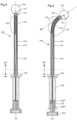
- FIG. 4shows the surgical instrument, according to a first embodiment, in its straight state, in section.
- FIG. 5shows the surgical instrument, according to a first embodiment, in its bent state, in section.
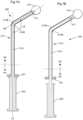
- FIG. 6 Ashows the surgical instrument, according to a first embodiment, when disengaging the movement restriction device, in section.
- FIG. 6 Bshows the surgical instrument, according to an alternative first embodiment, when disengaging the movement restriction device, in section.
- FIG. 7 Ashows the surgical instrument, according to a second embodiment, when disengaging the movement restriction device, in section.
- FIG. 7 Bshows the surgical instrument, according to a second embodiment, when disengaging the movement restriction device, in section.
- FIGS. 8 A- 8 Dshows steps of a surgical procedure for treating reflux disease, using the surgical instrument.
- FIG. 9shows the esophagus and upper part of the stomach when the movement restriction device has been positioned, in section.
- FIG. 10shows the medical instrument according to a third embodiment.
- FIG. 11 Ashows the surgical instrument, according to a third embodiment, when engaging the movement restriction device.
- FIG. 11 Bshows the surgical instrument, according to a third embodiment, when disengaging the movement restriction device.
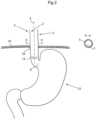
- FIG. 12 Ashows the surgical instrument, according to a third embodiment when positioned inside a trocar, engaging the movement restriction device.
- FIG. 12 Bshows the surgical instrument, according to a third embodiment when positioned inside a trocar, engaging the movement restriction device.
- cardia sphinctercardia muscle and lower esophageal sphincter is to be understood as the sphincter in the esophagus hindering stomach content and stomach acid from reaching the esophagus.
- Surgical procedureis to be understood as any type of surgical procedure, open surgical procedure or laparoscopic surgical procedure.
- the surgical instrumentmay be configured to be inserted into the abdomen of a patient through a laparoscopic trocar.
- the surgical instrumentmay in such cases be configured for insertion into a laparoscopic trocar having a diameter of 80 mm, 100 mm, 120 mm or 150 mm.
- FIG. 1shows a human patent 1 when a surgical procedure for the treatment of reflux disease has been performed.
- a movement restriction device 10has been placed in the fundus portion of the stomach 12 . The function and the operation of the movement restriction device 10 will be described and explained in detail in the following description.
- FIG. 2shows the stomach region of a patient comprising the esophagus 5 which passes through the thoracic diaphragm 18 which further supports the cardia sphincter 14 , which in turn prevents the stomach content and stomach acid from reaching the area of the esophagus 5 .
- the esophagus 5is a substantially tube shaped tissue leading to the stomach 12 comprising stomach tissue.
- the esophagushas an esophagus center axis 4 , being substantially aligned with a cranial-caudal axis of the patient in and having a substantially circular circumference substantially aligned with a horizontal plane of the erect patient.
- the esophagus 5further has an inner 2 and outer 3 substantially cylindrical surface extending radially in relation to the esophagus 5 center axis 4 .
- the cardia sphincter 14In a patient with reflux disease, the cardia sphincter 14 has slid up through the foramen 18 ′ in the thoracic diaphragm 18 and thus is no longer supported by the thoracic diaphragm 18 .
- Reflux diseasemakes the stomach content and stomach acid enter the esophagus 5 and creates a burning sensation in the esophagus tissue, which in long term exposure could affect the cell structure of the inner layer of esophagus tissue transforming the structure from a squamous epithelium to a gland epithelium, a transformation which increases the risk of adenocarcinoma.
- the esophagus 5connects to the stomach at the gastroesophageal junction 8 which normally is placed below the thoracic diaphragm 18 .
- the gastroesophageal junction 8may be positioned in the foramen 18 ′ or in thorax.
- FIG. 3shows a first embodiment of a surgical instrument 100 for placement of a movement restriction device 110 for use in the surgical procedure for treating reflux disease in a patient.
- the instrument 100is made up of a distal portion DP, configured to be inserted into the abdomen of the patient during the surgical procedure, and a proximal portion PP configured to remain outside the body of the patient, and be handled by the surgeon during the surgical procedure.
- the instrument 100comprises a sleeve 113 , the major part of which being placed at the distal portion DP.
- the sleeve 113is connected to or, integrated with, a first handling portion 101 , which is displaceable in relation to the second handling portion 102 .
- a first handling portion 101which is displaceable in relation to the second handling portion 102 .
- a portion of the distal portionis flexible, such that the distal portion can flex and thus bend in relation to a primary length axis LA of the instrument 100 .
- the flexible portion of the distal portion DPis operably flexible such that the surgeon can bend the distal portion during the surgical procedure.
- the flexible portioncan only be bent manually, outside of the patient and ahead of the surgical procedure, such that a suitable angle of the flexible distal portion can be set for the current patient.
- the distal portion of the sleeve 113comprises a flexible sleeve portion 112 .
- the flexible sleeve portion 112could for example comprise a helically wound metal sleeve, a flexible sleeve made from a polymer material, a woven flexible metal sleeve, or a combination of the above.
- the distal portion DP of the instrument 100further comprises a holding device 111 configured to engage and thus hold the movement restriction device 110 during the surgical procedure.
- the holding device 111is configured to be placed within the sleeve 113 and be displaceable in relation to the sleeve 113 .
- the holding device 111comprises a protruding member configured to engage a recess of the movement restriction device 110 , and thereby hold the movement restriction device 110 .
- the movement restriction deviceis connected to, or integrated with, a third handling portion 103 connected to the holding device 111 , which is displaceable in relation to the second handling portion 102 (which will be further elaborated on with reference to FIGS. 4 - 6 ).
- FIGS. 4 and 5shows the surgical instrument 100 according to the first embodiment, in section.
- the movement restriction device 110is held by the holding device 111 having a protruding member which engages a recess of the movement restriction device 110 .
- the protruding memberis fixated to or integrated with the uppermost portion 114 ′ of an elongated member 114 .
- the elongated member 114is operably flexible such that the surgeon can bend the distal portion DP during the surgical procedure.
- the operation device creating the bending motioncomprises a plurality of bending elements 116 having a triangular cross-section, such that the bending elements 116 contacts each other on the left side of the elongated member 114 and are separated by a void on the right side of the elongated member 114 .
- a pull wire 115is fixated to the right side of the uppermost bending element 116 and configured to exert a pulling force on the uppermost bending element, whereby the geometry of the bending elements 116 forces the elongated member 114 to bend and the voids between the bending elements 116 to become smaller.
- the flexible sleeve portion 112bends along with the elongated member 114 placed therein.
- the sleeve 113comprises a rigid portion and a flexible sleeve portion 112 configured to bend, and as the sleeve 113 is displaceable relative to the elongated member 114 and the holding device, the point on the surgical instrument in which the bending may start can be moved by displacing the sleeve 113 which creates a further means for adjusting the instrument.
- the proximal portion of the elongated member 114is connected to, or integrated in, the second handling portion 102 , and thus is the uppermost portion 114 ′ of an elongated member 114 and the holding device 111 connected to the second handling portion 102 .
- the pull wire 115is connected to a third handling portion 103 being the most distal portion of the instrument 100 .
- the third handling portion 103is rotationally displaceable in relation to the second handling portion 102 around a primary length axis LA of the instrument, for operating the pull wire 115 and thus the operably flexible distal portion during the surgical procedure.
- the third handling portion 103comprises a threaded portion 103 T and the second handling portion 102 comprises a corresponding threaded portion 102 T, such that rotational displacement of the third handling portion 103 in relation to the second handling portion 102 creates linear displacement of the third handling portion 103 in relation to the second handling portion 102 , along the primary length axis LA of the instrument 100 .
- the linear displacementpulls the pull wire 115 in the proximal direction causing the operably flexible distal portion to bend.
- FIG. 5shows the first embodiment of the surgical instrument 100 when the third handling portion 103 has been operated by rotation such that the pull wire 115 has been pulled a distance sufficient for the bending elements 116 to bend the operably flexible distal portion to an angle ⁇ between the main length axis LA of the instrument and a bend axis BA, being a length axis of the uppermost portion 114 ′ of an elongated member and of the holding device 111 .
- the operably flexible distal portionis configured to bend to an angle ⁇ exceeding 20°. In one embodiment the operably flexible distal portion is configured to bend to an angle ⁇ exceeding 30°. In one embodiment the operably flexible distal portion is configured to bend to an angle ⁇ exceeding 45°.
- the operably flexible distal portionis configured to bend to an angle ⁇ exceeding 60°. In one embodiment the operably flexible distal portion is configured to bend to an angle ⁇ exceeding 75°. In one embodiment the operably flexible distal portion is configured to bend to an angle ⁇ exceeding 90°.
- the third handling portionis a linearly displaceable handling portion directly causing a linear pull on the pull wire 115 .
- the third handling portionis in such an embodiment slideably connected to the second handling portion and can in such an embodiment be pulled in a proximal direction, along a primary length axis LA of the instrument, for creating the bending of the operably flexible distal portion.
- FIG. 6 Ashows the surgical instrument 100 in accordance with the first embodiment in its straight configuration, in section.
- the first handling portion 101is linearly displaceable in relation to the second handling portion 102 along the primary length axis LA of the instrument.
- linear displacement of the first handling portion 101 in the distal directioncauses the distalmost portion of the sleeve 113 to also move in the distal direction and thus be advanced over and passed the uppermost portion 114 ′ of an elongated member 114 and passed the holding device 111 .
- This relative displacement of the sleeve 113 and the holding device 111disengages the holding device 111 from the movement restriction device 110 , by the protruding member of the holding device being disengaged from the recess in the movement restriction device 110 .
- the surgical instrument 100thus places the movement restriction device inside of the body of the patient and can then be removed from the abdomen.
- FIG. 6 Bshows an alternative embodiment of the surgical instrument 100 in which the first handling portion 101 is rotationally displaceable in relation to the second handling 102 portion around a primary length axis LA of the instrument.
- the first handling portion 101comprises a threaded portion 101 T and the second handling portion 102 and/or the sleeve 113 comprises a corresponding threaded portion 113 T, such that rotational displacement of the first handling portion 101 in relation to the second handling portion 102 creates linear displacement of the first handling portion 101 in relation to the second handling portion 101 , along the primary length axis LA of the instrument.
- FIGS. 7 A and 7 Bshows a second embodiment of the surgical instrument 200 .
- the distal portion DPis bent in relation to the primary length axis LA of the instrument 200 by means of a fixed bend.
- the primary length axis LAis bent in relation to a bent axis BA of the holding device 211 and movement restriction device 210 with an angle ⁇ .
- the angle ⁇ of the bendis exceeding 20°.
- the angle ⁇ of the bendis exceeding 30°.
- the angle ⁇ of the bendis exceeding 45°.
- the angle ⁇ of the bendis exceeding 60°.
- the angle ⁇ of the bendis exceeding 75°.
- the angle ⁇ of the bendis exceeding 90°.
- the sleeve 213is rigid and comprises a rigid bend 213 B while a distal portion of the elongated member 214 is flexible and creates a flexible bend 214 B within the sleeve 213 , such that the elongated member 214 can be displaced in relation to the sleeve 213 even though the bend is fixed.
- a distal portion of the elongated member 214is rigid and comprises a rigid bend, while a distal portion of the sleeve 213 is flexible and forms a flexible bend, such that the elongated member 214 can be displaced in relation to the sleeve 213 even though the bend is fixed.
- FIG. 7 Bshows the second embodiment of the surgical instrument 200 in the state when the elongated member 214 and thus the holding device 211 has been displaced in relation to the sleeve 213 , such that the movement restriction device 210 has been disengaged from the instrument.
- the instrument according to the second embodimentis shown with the sleeve 213 being directly linearly displaceable in relation to the elongated member 214 , however, it is equally conceivable that the instrument according to the second embodiment is equipped with the rotating first handling portion such as shown in FIG. 6 B .
- FIGS. 8 A- 8 Dshows a surgical method for treating reflux disease in a patient by implanting a movement restriction device 310 with use of the surgical instrument 300 according to one of the embodiments herein.
- FIG. 8 Athe instrument 300 holding the movement restriction device 310 has been inserted into the abdomen of the patient though an incision made in the abdomen of the patient.
- the procedural step shown in FIG. 8 Ahas been preceded by the step of dissecting in an area comprising a fundus of a stomach, such that the movement restriction device 310 can be placed engaging the fundus of the patient.
- a grasperis used for holding the stomach wall of the fundus while the surgical instrument operates to place the movement restriction device contacting the fundus of the stomach, on the outside thereof.
- the instrumentmay be positioned by the step of rotating the instrument with the bend for positioning the movement restriction device.
- the distal portion of the surgical instrumentis operably flexible
- the instrumentmay be positioned by the step of operating the operably flexible distal portion for positioning the movement restriction device.
- a general instrumentmay comprise a sleeve, a holding device configured to engage a medical implant or surgical tool, wherein the holding device is configured to be placed within the sleeve and be displaceable in relation to the sleeve, a first handling portion connected to the sleeve, and a second handling portion connected to the holding device.
- the handling of at least one of the first and second handling portioncreates relative displacement of the holding device in relation to the sleeve, which disengages the holding device from the medical implant or surgical tool for performing the placement of the medical implant or surgical tool.
- the movement restriction deviceis invaginated in the stomach fundus wall by means of stomach to stomach sutures 301 by means of a surgical suturing needle. It is however equally conceivable that a stapling device is used in the step of invaginating the movement restriction device in the stomach wall.
- FIGS. 8 B and 8 Cshows the further suturing for invaginating the movement restriction device 310 , such that the movement restriction device 310 is placed fixedly in the created pouch on the outside of the stomach wall, on the outside thereof.
- FIG. 8 Dshows the step of the instrument disengaging the movement restriction device by displacing the sleeve 313 in relation to the holding device 311 .
- the holding device 311comprises a protruding member and the movement restriction device 310 comprises a recess configured to engage the protruding member, such that the step of disengaging the movement restriction device 310 by displacing the sleeve 313 in relation to the holding device 311 comprises disengaging the protruding member from the recess.
- the instrument 310is removed from the abdomen of the patient.
- the procedural steps shown on FIGS. 8 A- 8 Dmay be steps of a laparoscopic surgical method, in which case the surgical method further comprises the steps of introducing a tube through the abdominal wall for filling a fluid or gas into the abdominal cavity, to thereby expand the abdominal cavity creating visual space.
- the methodfurther comprises introducing two or more trocars into the abdominal cavity and introducing a camera into the abdominal cavity through one of the trocars.
- the methodcomprises dissecting in the abdomen using a laparoscopic dissection instrument, before the introduction of the surgical instrument into the abdominal cavity through a trocar.
- the fixation by means of sutures or staplersis performed using a laparoscopic suturing or stapling instrument, and the method is concluded by the removal of the surgical instrument into the abdominal cavity through a trocar.
- FIG. 9shows the esophagus and the upper portion of the stomach when the movement restriction device has been implanted in the fundus wall.
- the movement restriction deviceis fixated by invagination in the stomach 12 wall by means of a plurality of sutures 305 .
- the fixation of the movement restriction devicehas been preceded by the fixation of the stomach fundus wall to the esophagus by means of sutures 305 ′ for the fixed placement of the movement restriction device 310 .
- the movement restriction device 310is preferably made from an elastic, bio-compatible silicone material which may be provided with at least one layer. For example, a metal layer, a Parylene layer, a polytetrafluoroethylene layer or a polyurethane layer.
- the movement restriction devicemay have a maximum diameter of less than 40 mm, or a maximum diameter of less than 30 mm, or a maximum diameter of less than 20 mm.
- FIG. 10shows a third embodiment of a surgical instrument 100 for placement of a movement restriction device 110 for use in the surgical procedure for treating reflux disease in a patient.
- the instrument shown in the third embodimentis similar to the instrument shown in the first embodiment and the corresponding elements are numbered alike.
- the instrument 100comprises a sleeve 113 .
- the sleeve 113is connected to, or integrated with, a first handling portion 101 .
- the first handling 101 portioncomprises a proximal part P and distal part D.
- the first handling portion 101preferably comprises grooves or recesses in which parts of a second handling portion 102 can be positioned.
- the second handling portion 102is preferably integrated with an elongated member 114 extending along the longitudinal axis inside the sleeve 113 .
- the second handling portion 102may be formed by forming a loop of the proximal end of the elongated member such that it can be held in place in the first handling portion 101 by the grooves or recesses thereof.
- the elongated membermay preferably be a wire.
- the first handling portion 101may further comprise at least one stopping portion 104 a , 104 b adapted to stop the relative displacement of the second handling portion 102 at a predetermined amount of displacement.
- the instrument 100further comprises a holding device 111 configured to engage and thus hold the movement restriction device 110 during the surgical procedure.
- the holding device 111is configured to be placed within the sleeve 113 and be displaceable in relation to the sleeve 113 .
- the holding device 111may be integrated with the elongated member 114 such that relative displacement between the first handling portion 101 and the second handling portion 102 leads to relative displacement between the sleeve 113 and the holding device 111 .
- the holding device 111comprises a protruding member configured to engage a recess of the movement restriction device 110 , and thereby hold the movement restriction device 110 .
- FIGS. 11 A and 11 Bshow the surgical instrument 100 in accordance with the third embodiment.
- the second handling portion 102formed as a looped proximal end of the elongated member 114 , and positioned partly within the grooves or recesses of the first handling portion.
- the proximal end of the elongated member 114ends in the holding device 111 .
- the holding device 111extends out of the sleeve 113 such that that the holding member 111 can engage the movement restriction device 110 .
- the first handling portion 101is linearly displaceable in relation to the second handling portion 102 along the primary length axis of the instrument.
- linear displacement of the first handling portion 101 in the distal directioncauses the distalmost portion of the sleeve 113 to also move in the distal direction and thus be advanced over and passed the uppermost portion of an elongated member 114 and passed the holding device 111 .
- This relative displacement of the sleeve 113 and the holding device 111disengages the holding device 111 from the movement restriction device 110 , by the protruding member of the holding device 111 being disengaged from the recess in the movement restriction device 110 .
- this relative displacementcan be achieved by handling the second handling portion 102 from the distal position in the first handling portion 101 to the proximal position in the first handling portion. This achieves a relative displacement of the sleeve 113 and the holding device 111 which disengages the holding device 111 from the movement restriction device 110 .
- the surgical instrument 100thus places the movement restriction device inside of the body of the patient and can then be removed from the abdomen.
- FIGS. 12 A and 12 Bshow the surgical instrument 100 according to the third embodiment, when positioned inside a trocar 112 in a side view.
- the trocar 112assists in expanding the abdominal wall tissue such that the movement restriction device 110 can be positioned in the stomach wall.
- the surgical instrument 100can be removed from the trocar 112 and subsequently the trocar 112 can be removed from the body.
Landscapes
- Health & Medical Sciences (AREA)
- Life Sciences & Earth Sciences (AREA)
- Surgery (AREA)
- Animal Behavior & Ethology (AREA)
- General Health & Medical Sciences (AREA)
- Engineering & Computer Science (AREA)
- Biomedical Technology (AREA)
- Heart & Thoracic Surgery (AREA)
- Veterinary Medicine (AREA)
- Public Health (AREA)
- Medical Informatics (AREA)
- Molecular Biology (AREA)
- Nuclear Medicine, Radiotherapy & Molecular Imaging (AREA)
- Child & Adolescent Psychology (AREA)
- Obesity (AREA)
- Nursing (AREA)
- Orthopedic Medicine & Surgery (AREA)
- Vascular Medicine (AREA)
- Pathology (AREA)
- Surgical Instruments (AREA)
- Paper (AREA)
- Endoscopes (AREA)
Abstract
Description
This application is a National Stage Entry of PCT/EP2018/072042, which designates the U.S. and is tiled Aug. 14, 2018, and claims priority from Swedish Patent Application 1750996-9, tiled Aug. 16, 2017, the entire contents of each of which are hereby incorporated by reference in this application.
The present invention relates generally to an instrument for treating Gastro Esophageal Reflux Disease (GERD) and/or Obesity in a human patient.
Gastro Esophageal Reflux Disease (GERD), or acid reflux disease, is a chronic condition resulting in mucosal damage in the esophagus produced by the recurring occurrence of acid reflux in the esophagus. This is commonly due to transient or permanent changes in the barrier between the esophagus and the stomach. This can be due to incompetence of the lower esophageal sphincter (LES), transient LED relaxation, impaired expulsion of gastric reflux from the esophagus, or a hiatal hernia.
Gastro Esophageal Reflux Disease can be treated in a number of ways, where surgical treatments are sometimes preferred over longtime medication. A standard surgical treatment is Nissen funduplication where the upper portion of the stomach is wrapped around LES to strengthen the sphincter and prevent acid reflux and to repair hiatal hernia. This procedure often done laparoscopically and is hard to perform transorally.
Another surgical treatment is to create an anti-reflux valve of fundus tissue. This treatment can be performed transorally, by using an endoscope to visualize the Z-line and attract tissue creating a suitable valve which is then fastened. Such treatment is hard and requires a skilled endoscopist. It includes numerous steps in each procedure, typically manipulating tissue more than two times and applying a plurality of individual fasteners to create an anti-reflux valve. Some patients also suffer from hiatal hernia which is an additional step to treat. This both increases time consumption of the endoscopist and each added step increase the risk of mistakes which can potentially be hard to undo.
From experience with implantation of medical devices, it is known that sutures between an implanted device and human tissue will not hold in the long term. For long term implantation of a device, there are two possibilities to keep the device in place. A first solution has been to suture human tissue to human tissue, to thereby keep the device in place. A second approach has been to provide sutures holding a device in place in the short term and to allow in-growth of human tissue into the device for holding the device in place over the long term.
A problem with providing an implantable device associated with the esophagus is that the outer surface of the esophagus is only comprised of esophagus muscle tissue, which is very easy to damage or migrate through. This is probably one reason why the Anglechik prosthesis described above has resulted in many complications, such as migration.
The stomach, on the other hand, has a serosa on its outside, thereby providing a much stronger membrane for suturing. Thus, suturing a device directly to the stomach wall provides a better result than suturing an implanted device to the esophagus.
Today, there exists a need for a long term treatment of GERD that is more effective than prior treatments and which does not result in any severe complications.
Surgical treatments in the upper gastrointestinal tract are today generally complicated to do in a minimal or non-invasive manner. The treatment's level of invasiveness depends on the arrangement of surgical instruments and the handling thereof. Thus, there exists a need for an instrument for performing surgical operations in a more effective way than prior instruments for surgical treatments in the stomach cavity.
It is an object of the present invention to overcome, or at least reduce, some of the problems associated with existing surgical treatments of Gastro Esophageal Reflux Disease (GERD). It is another object of the present invention to provide an instrument and method for treating Gastro Esophageal Reflux Disease. These objects and others are obtained by appended claims.
A surgical instrument for placement of a movement restriction device for use in a surgical procedure for treating reflux disease in a patient is provided. The surgical instrument comprises a sleeve and a holding device configured to engage the movement restriction device, wherein the holding device is configured to be placed within the sleeve and be displaceable in relation to the sleeve. The instrument further comprises a first handling portion connected to the sleeve, and a second handling portion connected to the holding device. The handling of at least one of the first and second handling portion creates relative displacement of the holding device in relation to the sleeve, which disengages the holding device from the movement restriction device for performing the placement of the movement restriction device. The instrument provides secure holding of the movement restriction device during the surgical procedure as well as easy disengagement upon completion of the surgical procedure. The instrument also reduces the risk that the movement restriction device is removed or displaced from its fixated position when the instrument is retracted.
According to one embodiment, the surgical instrument comprises a distal portion, configured to enter the body of the patient in use, and a proximal portion, configured to remain outside of the body of the patient in use. The holding device is positioned in the distal portion and the first and second handling portions are positioned in the proximal portion.
According to one embodiment, the holding device is positioned on an elongated member connected to the second handling portion.
According to one embodiment, the holding device comprises a protruding member configured to engage a recess of the movement restriction device.
According to one embodiment, the first handling portion is linearly displaceable in relation to the second handling portion along a primary length axis of the instrument, and in an alternative embodiment, the first handling portion is rotationally displaceable in relation to the second handling portion around a primary length axis of the instrument.
The first handling portion may comprise a threaded portion and at least one of the second handling portion and the sleeve comprises a corresponding threaded portion, such that rotational displacement of the first handling portion in relation to the second handling portion creates linear displacement of the first handling portion in relation to the second handling portion, along the primary length axis of the instrument.
According to one embodiment, the distal portion is bent in relation to the primary length axis of the instrument. The distal portion may be bent more than 20° in relation to the primary length axis of the instrument, or more than 30° in relation to the primary length axis of the instrument, or more than 45° in relation to the primary length axis of the instrument, or more than 60° in relation to the primary length axis of the instrument, or more than 75° in relation to the primary length axis of the instrument, or more than 90° in relation to the primary length axis of the instrument. The bend enables the instrument to be placed in the required positioned by rotation of the instrument.
The distal portion of the sleeve may be rigid and a distal portion of the elongated member is flexible, alternatively the distal portion of the sleeve is flexible and a distal portion of the elongated member is rigid.
According to one embodiment, the distal portion is flexible such that the distal portion can be bent in relation to the primary length axis of the instrument. The distal portion may be operably flexible such that the surgeon can bend the distal portion during the surgical procedure, which may mean that the elongated member is operably flexible such that the surgeon can bend the distal portion during the surgical procedure. In one embodiment the operably flexible distal portion is configured to be bent in excess of 30°. In one embodiment the operably flexible distal portion is configured to be bent in excess of 45°. In one embodiment the operably flexible distal portion is configured to be bent in excess of 60°. In one embodiment the operably flexible distal portion is configured to be bent in excess of 75°. In one embodiment the operably flexible distal portion is configured to be bent in excess of 90°.
According to one embodiment, the proximal portion further comprises a third handling portion for operating the operably flexible distal portion during the surgical procedure. The third handling portion may be linearly displaceable in relation to the second handling portion along a primary length axis of the instrument, for operating the operably flexible distal portion during the surgical procedure. In an alternative embodiment, the third handling portion is rotationally displaceable in relation to the second handling portion around a primary length axis of the instrument, for operating the operably flexible distal portion during the surgical procedure.
According to one embodiment, the third handling portion comprises a threaded portion and the second handling portion comprises a corresponding threaded portion, such that rotational displacement of the third handling portion in relation to the second handling portion creates linear displacement of the third handling portion in relation to the second handling portion along the primary length axis of the instrument, for operating the operably flexible distal portion during the surgical procedure.
According to one embodiment, the sleeve comprises a rigid portion and a flexible portion configured to bend, and wherein the sleeve is displaceable relative to the holding device, such that the point on the surgical instrument in which the bending may start can be moved.
The surgical instrument according to any one of the embodiments herein may be configured to be inserted into the abdomen of a patient through a trocar.
According to one embodiment, the first handling portion comprises at least one groove or recess adapted to house at least part of the second handling portion. Preferably, the first handling portion comprises at least two grooves or recesses running along the length axis of the instrument. The grooves or recesses supports the second handling portion during displacement. Preferably, the grooves or recesses prevent or hinders movement in the width axis of the instrument.
According to one embodiment, the at least one groove or recess is adapted to allow relative displacement of the second handling portion and the first handling portion. Preferably, at least part of the second handling portion is positioned in the at least one groove or recess during relative displacement of the first handling portion in relation to the second handling portion.
According to some embodiments, the holding device is integrated with the elongated member connected to the second handling portion. The holding device may be integrally formed in one piece with the elongated member. This can be achieved by providing the elongated member in the form of a wire.
According to some embodiments, the second handling portion is integrated with the elongated member. The second handling portion may be integrally formed in one piece with the elongated member. This can be achieved by providing the elongated member in the form of a wire.
According to some embodiments, the second handling portion is formed of an end of the elongated member distal to the movement restriction device. The second handling portion can be provided by looping the elongated member at an end thereof. In examples where the elongated member is a wire, the wire can be looped to form the second handling portion. Parts of the loop can then be positioned in the at least one groove or recess on the first handling portion. The loop allows a user of the instrument to easily grasp the second handling portion.
According to some embodiments, the holding device is formed of an end of the elongated member proximal to the movement restriction device. In examples where the elongated member is a wire, an end of the wire may be the holding device. A recess in the movement restriction device may be dimensioned such that the end of the wire can engage the recess.
In some embodiments at least part of the second handling portion has a curved shape.
The disclosed elements of a surgical instrument for placement of a movement restriction device for use in a surgical procedure for treating reflux disease in a patient, may be used for other applications where implants or surgical tools needs to be held and released inside of the body of the patient. A general instrument may comprise a sleeve, a holding device configured to engage a medical implant or surgical tool, wherein the holding device is configured to be placed within the sleeve and be displaceable in relation to the sleeve, a first handling portion connected to the sleeve, and a second handling portion connected to the holding device. The handling of at least one of the first and second handling portion creates relative displacement of the holding device in relation to the sleeve, which disengages the holding device from the medical implant or surgical tool for performing the placement of the medical implant or surgical tool.
A surgical method for treating reflux disease in a patient by implanting a movement restriction device with use of a surgical instrument is further provided. The surgical method comprises making at least one incision in an abdomen of the patient, dissecting in an area comprising a fundus of a stomach, at least partially inserting the surgical instrument holding the movement restriction device in the abdomen of the patient, placing the movement restriction device contacting the fundus of the stomach, on the outside thereof, fixating the movement restriction device to the fundus wall, and disengaging the movement restriction device by displacing the sleeve in relation to the holding device.
According to one embodiment, the step of fixating the movement restriction device comprises invaginating the movement restriction device in the stomach fundus wall using stomach to stomach sutures or staplers.
According to one embodiment, the surgical method further comprises the step of fixating the stomach to the esophagus using suture of staplers.
In embodiments where the distal portion of the surgical instrument is bent, the surgical procedure may comprise the step of rotating the instrument with the bend for positioning the movement restriction device.
In embodiments where the distal portion of the surgical instrument is operably flexible, the surgical procedure may comprise the step of operating the operably flexible distal portion for positioning the movement restriction device.
According to one embodiment, the holding device comprises a protruding member and the movement restriction device comprises a recess configured to engage the protruding member, and the step of disengaging the movement restriction device by displacing the sleeve in relation to the holding device comprises disengaging the protruding member from the recess.
The surgical method may be a laparoscopic surgical method, in which case the method may further comprise at least one of the steps of:
introducing a tube through the abdominal wall,
filling a fluid or gas into the abdominal cavity,
introducing two or more trocars into the abdominal cavity,
introducing a camera into the abdominal cavity through one of the trocars,
dissecting in the abdomen using a laparoscopic dissection instrument,
introducing the surgical instrument into the abdominal cavity through a trocar,
suturing or stapling using a laparoscopic suturing or stapling instrument, and
removing the surgical instrument into the abdominal cavity through a trocar.
Please note that any embodiment or part of embodiment as well as any method or part of method or any apparatus or part of apparatus or any feature or part of feature or any system or part of system or any figure or part of figure could be combined in any applicable way. All examples herein should be seen as part of the general description and therefore possible to combine in any way in general terms.
The invention is now described, by way of example, with reference to the accompanying drawings, in which:
In the following a detailed description of embodiments of the invention will be given with reference to the accompanying drawings. It will be appreciated that the drawings are for illustration only and are not in any way restricting the scope of the invention. Thus, any references to directions, such as “up” or “down”, are only referring to the directions shown in the figures. It should be noted that the features having the same reference numerals have the same function, it should further be noted that features in the different embodiments having different first digit but the same last two digits are similar i.e.110,210 and310. A feature in one embodiment could thus be exchanged for a feature from another embodiment having the same last two digits unless clearly contradictory. The descriptions of the similar features having the same last two digits should thus be seen as complementing each other in describing the fundamental idea of the feature and thereby showing the features versatility.
The terms cardia sphincter, cardia muscle and lower esophageal sphincter is to be understood as the sphincter in the esophagus hindering stomach content and stomach acid from reaching the esophagus.
Surgical procedure is to be understood as any type of surgical procedure, open surgical procedure or laparoscopic surgical procedure. In all of the embodiments herein the surgical instrument may be configured to be inserted into the abdomen of a patient through a laparoscopic trocar. The surgical instrument may in such cases be configured for insertion into a laparoscopic trocar having a diameter of 80 mm, 100 mm, 120 mm or 150 mm.
In a patient with reflux disease, thecardia sphincter 14 has slid up through theforamen 18′ in thethoracic diaphragm 18 and thus is no longer supported by thethoracic diaphragm 18. Reflux disease makes the stomach content and stomach acid enter theesophagus 5 and creates a burning sensation in the esophagus tissue, which in long term exposure could affect the cell structure of the inner layer of esophagus tissue transforming the structure from a squamous epithelium to a gland epithelium, a transformation which increases the risk of adenocarcinoma. Theesophagus 5 connects to the stomach at thegastroesophageal junction 8 which normally is placed below thethoracic diaphragm 18. In the event that the cardia sphincter slides up through theforamen 18′ in thediaphragm 18, thegastroesophageal junction 8 may be positioned in theforamen 18′ or in thorax.
Returning to the embodiment shown inFIG.3 , the distal portion of thesleeve 113 comprises aflexible sleeve portion 112. Theflexible sleeve portion 112 could for example comprise a helically wound metal sleeve, a flexible sleeve made from a polymer material, a woven flexible metal sleeve, or a combination of the above.
The distal portion DP of theinstrument 100 further comprises a holdingdevice 111 configured to engage and thus hold themovement restriction device 110 during the surgical procedure. The holdingdevice 111 is configured to be placed within thesleeve 113 and be displaceable in relation to thesleeve 113. In the embodiment shown inFIG.3 , the holdingdevice 111 comprises a protruding member configured to engage a recess of themovement restriction device 110, and thereby hold themovement restriction device 110. The movement restriction device is connected to, or integrated with, athird handling portion 103 connected to theholding device 111, which is displaceable in relation to the second handling portion102 (which will be further elaborated on with reference toFIGS.4-6 ).
The operation device creating the bending motion comprises a plurality of bendingelements 116 having a triangular cross-section, such that the bendingelements 116 contacts each other on the left side of theelongated member 114 and are separated by a void on the right side of theelongated member 114. Apull wire 115 is fixated to the right side of theuppermost bending element 116 and configured to exert a pulling force on the uppermost bending element, whereby the geometry of the bendingelements 116 forces theelongated member 114 to bend and the voids between the bendingelements 116 to become smaller. Theflexible sleeve portion 112 bends along with theelongated member 114 placed therein. As thesleeve 113 comprises a rigid portion and aflexible sleeve portion 112 configured to bend, and as thesleeve 113 is displaceable relative to theelongated member 114 and the holding device, the point on the surgical instrument in which the bending may start can be moved by displacing thesleeve 113 which creates a further means for adjusting the instrument.
The proximal portion of theelongated member 114 is connected to, or integrated in, thesecond handling portion 102, and thus is theuppermost portion 114′ of anelongated member 114 and the holdingdevice 111 connected to thesecond handling portion 102. Thepull wire 115 is connected to athird handling portion 103 being the most distal portion of theinstrument 100. Thethird handling portion 103 is rotationally displaceable in relation to thesecond handling portion 102 around a primary length axis LA of the instrument, for operating thepull wire 115 and thus the operably flexible distal portion during the surgical procedure. Thethird handling portion 103 comprises a threadedportion 103T and thesecond handling portion 102 comprises a corresponding threadedportion 102T, such that rotational displacement of thethird handling portion 103 in relation to thesecond handling portion 102 creates linear displacement of thethird handling portion 103 in relation to thesecond handling portion 102, along the primary length axis LA of theinstrument 100. The linear displacement pulls thepull wire 115 in the proximal direction causing the operably flexible distal portion to bend.
In an alternative embodiment, the third handling portion is a linearly displaceable handling portion directly causing a linear pull on thepull wire 115. I.e. the third handling portion is in such an embodiment slideably connected to the second handling portion and can in such an embodiment be pulled in a proximal direction, along a primary length axis LA of the instrument, for creating the bending of the operably flexible distal portion.
Turning now to the operation of the holdingdevice 111.FIG.6A shows thesurgical instrument 100 in accordance with the first embodiment in its straight configuration, in section. Thefirst handling portion 101 is linearly displaceable in relation to thesecond handling portion 102 along the primary length axis LA of the instrument. As thefirst handling portion 101 is integrated with thesleeve 113, linear displacement of thefirst handling portion 101 in the distal direction causes the distalmost portion of thesleeve 113 to also move in the distal direction and thus be advanced over and passed theuppermost portion 114′ of anelongated member 114 and passed theholding device 111. This relative displacement of thesleeve 113 and the holdingdevice 111 disengages the holdingdevice 111 from themovement restriction device 110, by the protruding member of the holding device being disengaged from the recess in themovement restriction device 110. Thesurgical instrument 100 thus places the movement restriction device inside of the body of the patient and can then be removed from the abdomen.
In the embodiment shown inFIG.7A , thesleeve 213 is rigid and comprises arigid bend 213B while a distal portion of theelongated member 214 is flexible and creates aflexible bend 214B within thesleeve 213, such that theelongated member 214 can be displaced in relation to thesleeve 213 even though the bend is fixed.
In an alternative embodiment, a distal portion of theelongated member 214 is rigid and comprises a rigid bend, while a distal portion of thesleeve 213 is flexible and forms a flexible bend, such that theelongated member 214 can be displaced in relation to thesleeve 213 even though the bend is fixed.
The instrument according to the second embodiment is shown with thesleeve 213 being directly linearly displaceable in relation to theelongated member 214, however, it is equally conceivable that the instrument according to the second embodiment is equipped with the rotating first handling portion such as shown inFIG.6B .
InFIG.8A , theinstrument 300 holding themovement restriction device 310 has been inserted into the abdomen of the patient though an incision made in the abdomen of the patient. The procedural step shown inFIG.8A has been preceded by the step of dissecting in an area comprising a fundus of a stomach, such that themovement restriction device 310 can be placed engaging the fundus of the patient. A grasper is used for holding the stomach wall of the fundus while the surgical instrument operates to place the movement restriction device contacting the fundus of the stomach, on the outside thereof. In the embodiment when the surgical instrument is bent, the instrument may be positioned by the step of rotating the instrument with the bend for positioning the movement restriction device. In the embodiments where the distal portion of the surgical instrument is operably flexible, the instrument may be positioned by the step of operating the operably flexible distal portion for positioning the movement restriction device.
The disclosed elements of a surgical instrument for placement of a movement restriction device for use in a surgical procedure for treating reflux disease in a patient, may be used for other applications where implants or surgical tools needs to be held and released inside of the body of the patient. A general instrument may comprise a sleeve, a holding device configured to engage a medical implant or surgical tool, wherein the holding device is configured to be placed within the sleeve and be displaceable in relation to the sleeve, a first handling portion connected to the sleeve, and a second handling portion connected to the holding device. The handling of at least one of the first and second handling portion creates relative displacement of the holding device in relation to the sleeve, which disengages the holding device from the medical implant or surgical tool for performing the placement of the medical implant or surgical tool.
In the surgical procedure shown inFIGS.8A-8D , the movement restriction device is invaginated in the stomach fundus wall by means of stomach to stomachsutures 301 by means of a surgical suturing needle. It is however equally conceivable that a stapling device is used in the step of invaginating the movement restriction device in the stomach wall.
The procedural steps shown onFIGS.8A-8D may be steps of a laparoscopic surgical method, in which case the surgical method further comprises the steps of introducing a tube through the abdominal wall for filling a fluid or gas into the abdominal cavity, to thereby expand the abdominal cavity creating visual space. The method further comprises introducing two or more trocars into the abdominal cavity and introducing a camera into the abdominal cavity through one of the trocars. Next, the method comprises dissecting in the abdomen using a laparoscopic dissection instrument, before the introduction of the surgical instrument into the abdominal cavity through a trocar. The fixation by means of sutures or staplers is performed using a laparoscopic suturing or stapling instrument, and the method is concluded by the removal of the surgical instrument into the abdominal cavity through a trocar.
The movement restriction device may have a maximum diameter of less than 40 mm, or a maximum diameter of less than 30 mm, or a maximum diameter of less than 20 mm.
Theinstrument 100 further comprises a holdingdevice 111 configured to engage and thus hold themovement restriction device 110 during the surgical procedure. The holdingdevice 111 is configured to be placed within thesleeve 113 and be displaceable in relation to thesleeve 113. The holdingdevice 111 may be integrated with theelongated member 114 such that relative displacement between thefirst handling portion 101 and thesecond handling portion 102 leads to relative displacement between thesleeve 113 and the holdingdevice 111. In the embodiment shown inFIG.10 , the holdingdevice 111 comprises a protruding member configured to engage a recess of themovement restriction device 110, and thereby hold themovement restriction device 110.
Turning now to the operation of the holdingdevice 111.FIGS.11A and11B show thesurgical instrument 100 in accordance with the third embodiment. InFIG.11A , thesecond handling portion 102 formed as a looped proximal end of theelongated member 114, and positioned partly within the grooves or recesses of the first handling portion. The proximal end of theelongated member 114 ends in theholding device 111. When thesecond handling portion 102 is positioned in the proximal position in thefirst handling portion 101, the holdingdevice 111 extends out of thesleeve 113 such that that the holdingmember 111 can engage themovement restriction device 110.
Thefirst handling portion 101 is linearly displaceable in relation to thesecond handling portion 102 along the primary length axis of the instrument. As thefirst handling portion 101 is integrated with thesleeve 113, linear displacement of thefirst handling portion 101 in the distal direction causes the distalmost portion of thesleeve 113 to also move in the distal direction and thus be advanced over and passed the uppermost portion of anelongated member 114 and passed theholding device 111. This relative displacement of thesleeve 113 and the holdingdevice 111 disengages the holdingdevice 111 from themovement restriction device 110, by the protruding member of the holdingdevice 111 being disengaged from the recess in themovement restriction device 110. In practice, as shown inFIG.11B this relative displacement can be achieved by handling thesecond handling portion 102 from the distal position in thefirst handling portion 101 to the proximal position in the first handling portion. This achieves a relative displacement of thesleeve 113 and the holdingdevice 111 which disengages the holdingdevice 111 from themovement restriction device 110. Thesurgical instrument 100 thus places the movement restriction device inside of the body of the patient and can then be removed from the abdomen.
Please note that any embodiment or part of embodiment as well as any method or part of method or any apparatus or part of apparatus or any feature or part of feature or any system or part of system could be combined in any applicable way. All examples herein should be seen as part of the general description and therefore possible to combine in any way in general terms.
Claims (63)
1. A surgical instrument for abdominal placement of a movement restriction device, adapted to restrict the movement of the cardia sphincter, for use in a surgical procedure for treating reflux disease in a patient, the instrument comprising:
a sleeve,
a holding device configured to engage the movement restriction device, wherein the holding device is configured to be placed within the sleeve and be displaceable in relation to the sleeve,
a first handling portion connected to the sleeve, and
a second handling portion connected to the holding device,
wherein the handling of at least one of the first and second handling portion creates relative displacement of the holding device in relation to the sleeve, which disengages the holding device from the movement restriction device for performing the placement of the movement restriction device
wherein at least part of the surgical instrument is configured to be inserted into the abdomen of a patient through a trocar.
2. The surgical instrument according toclaim 1 , wherein the instrument comprises:
a distal portion, configured to enter the body of the patient in use, and
a proximal portion, configured to remain outside of the body of the patient in use,
wherein the holding device is positioned in the distal portion and the first and second handling portions are positioned in the proximal portion.
3. The surgical instrument according toclaim 1 , wherein the holding device is positioned on an elongated member connected to the second handling portion.
4. The surgical instrument according toclaim 1 , wherein the holding device comprises a protruding member configured to engage a recess of the movement restriction device.
5. The surgical instrument according toclaim 1 , wherein the first handling portion is linearly displaceable in relation to the second handling portion along a primary length axis of the instrument.
6. The surgical instrument according toclaim 1 , wherein the first handling portion is rotationally displaceable in relation to the second handling portion around a primary length axis of the instrument.
7. The surgical instrument according toclaim 6 , wherein the first handling portion comprises a threaded portion and at least one of the second handling portion and the sleeve comprises a corresponding threaded portion, such that rotational displacement of the first handling portion in relation to the second handling portion creates linear displacement of the first handling portion in relation to the second handling portion, along the primary length axis of the instrument.
8. The surgical instrument according toclaim 2 , wherein the distal portion is bent in relation to the primary length axis of the instrument.
9. The surgical instrument according toclaim 8 , wherein the distal portion is bent more than 20° in relation to the primary length axis of the instrument.
10. The surgical instrument according toclaim 1 , wherein a distal portion of the sleeve is rigid and a distal portion of the elongated member is flexible.
11. The surgical instrument according toclaim 1 , wherein a distal portion of the sleeve is flexible and a distal portion of the elongated member is rigid.
12. The surgical instrument according toclaim 2 , wherein the distal portion is flexible such that the distal portion can be bent in relation to the primary length axis of the instrument.
13. The surgical instrument according toclaim 12 , wherein the distal portion is operably flexible such that the surgeon can bend the distal portion during the surgical procedure.
14. The surgical instrument according toclaim 12 , wherein the elongated member is operably flexible such that the surgeon can bend the distal portion during the surgical procedure.
15. The surgical instrument according toclaim 12 , wherein the proximal portion further comprises a third handling portion for operating the operably flexible distal portion during the surgical procedure.
16. The surgical instrument according toclaim 15 , wherein the third handling portion is linearly displaceable in relation to the second handling portion along a primary length axis of the instrument, for operating the operably flexible distal portion during the surgical procedure.
17. The surgical instrument according toclaim 15 , wherein the third handling portion is rotationally displaceable in relation to the second handling portion around a primary length axis of the instrument, for operating the operably flexible distal portion during the surgical procedure.
18. The surgical instrument according toclaim 17 , wherein the third handling portion comprises a threaded portion and the second handling portion comprises a corresponding threaded portion, such that rotational displacement of the third handling portion in relation to the second handling portion creates linear displacement of the third handling portion in relation to the second handling portion along the primary length axis of the instrument, for operating the operably flexible distal portion during the surgical procedure.
19. The surgical instrument according toclaim 1 , wherein the sleeve comprises a rigid portion and a flexible portion configured to bend, and wherein the sleeve is displaceable relative to the holding device, such that the point on the surgical instrument in which the bending may start can be moved.
20. A surgical instrument for abdominal placement of a movement restriction device, adapted to restrict the movement of the cardia sphincter, for use in a surgical procedure for treating reflux disease in a patient, the instrument comprising:
a sleeve,
a holding device configured to engage the movement restriction device, wherein the holding device is configured to be placed within the sleeve and be displaceable in relation to the sleeve,
a first handling portion connected to the sleeve, and
a second handling portion connected to the holding device,
wherein the handling of at least one of the first and second handling portion creates relative displacement of the holding device in relation to the sleeve, which disengages the holding device from the movement restriction device for performing the placement of the movement restriction device
wherein the first handling portion is rotationally displaceable in relation to the second handling portion around a primary length axis of the instrument, and
wherein the first handling portion comprises a threaded portion and at least one of the second handling portion and the sleeve comprises a corresponding threaded portion, such that rotational displacement of the first handling portion in relation to the second handling portion creates linear displacement of the first handling portion in relation to the second handling portion, along the primary length axis of the instrument.
21. The surgical instrument according toclaim 1 , wherein the instrument comprises:
a distal portion, configured to enter the body of the patient in use, and a proximal portion, configured to remain outside of the body of the patient in use,
wherein the holding device is positioned in the distal portion and the first and second handling portions are positioned in the proximal portion.
22. The surgical instrument according toclaim 1 , wherein the holding device is positioned on an elongated member connected to the second handling portion.
23. The surgical instrument according toclaim 1 , wherein the holding device comprises a protruding member configured to engage a recess of the movement restriction device.
24. The surgical instrument according toclaim 1 , wherein the first handling portion is linearly displaceable in relation to the second handling portion along a primary length axis of the instrument.
25. The surgical instrument according toclaim 21 , wherein the distal portion is bent in relation to the primary length axis of the instrument.
26. The surgical instrument according toclaim 25 , wherein the distal portion is bent more than 20° in relation to the primary length axis of the instrument.
27. The surgical instrument according toclaim 20 , wherein a distal portion of the sleeve is rigid and a distal portion of the elongated member is flexible.
28. The surgical instrument according toclaim 1 , wherein a distal portion of the sleeve is flexible and a distal portion of the elongated member is rigid.
29. The surgical instrument according toclaim 1 , wherein the distal portion is flexible such that the distal portion can be bent in relation to the primary length axis of the instrument.
30. The surgical instrument according toclaim 29 , wherein the distal portion is operably flexible such that the surgeon can bend the distal portion during the surgical procedure.
31. The surgical instrument according toclaim 29 , wherein the elongated member is operably flexible such that the surgeon can bend the distal portion during the surgical procedure.
32. The surgical instrument according toclaim 29 , wherein the proximal portion further comprises a third handling portion for operating the operably flexible distal portion during the surgical procedure.
33. The surgical instrument according toclaim 32 , wherein the third handling portion is linearly displaceable in relation to the second handling portion along a primary length axis of the instrument, for operating the operably flexible distal portion during the surgical procedure.
34. The surgical instrument according toclaim 32 , wherein the third handling portion is rotationally displaceable in relation to the second handling portion around a primary length axis of the instrument, for operating the operably flexible distal portion during the surgical procedure.
35. The surgical instrument according toclaim 34 , wherein the third handling portion comprises a threaded portion and the second handling portion comprises a corresponding threaded portion, such that rotational displacement of the third handling portion in relation to the second handling portion creates linear displacement of the third handling portion in relation to the second handling portion along the primary length axis of the instrument, for operating the operably flexible distal portion during the surgical procedure.
36. The surgical instrument according toclaim 1 , wherein the sleeve comprises a rigid portion and a flexible portion configured to bend, and wherein the sleeve is displaceable relative to the holding device, such that the point on the surgical instrument in which the bending may start can be moved.
37. A surgical instrument for abdominal placement of a movement restriction device, adapted to restrict the movement of the cardia sphincter, for use in a surgical procedure for treating reflux disease in a patient, the instrument comprising:
a sleeve,
a holding device configured to engage the movement restriction device, wherein the holding device is configured to be placed within the sleeve and be displaceable in relation to the sleeve,
a first handling portion connected to the sleeve, and
a second handling portion connected to the holding device,
wherein the handling of at least one of the first and second handling portion creates relative displacement of the holding device in relation to the sleeve, which disengages the holding device from the movement restriction device for performing the placement of the movement restriction device,
wherein the instrument further comprises:
a distal portion, configured to enter the body of the patient in use, and a proximal portion, configured to remain outside of the body of the patient in use,
wherein the holding device is positioned in the distal portion and the first and second handling portions are positioned in the proximal portion
wherein the distal portion is flexible such that the distal portion can be bent in relation to the primary length axis of the instrument, and
wherein the proximal portion further comprises a third handling portion for operating the flexible distal portion during the surgical procedure.
38. The surgical instrument according toclaim 37 , wherein the holding device is positioned on an elongated member connected to the second handling portion.
39. The surgical instrument according toclaim 37 , wherein the holding device comprises a protruding member configured to engage a recess of the movement restriction device.
40. The surgical instrument according toclaim 37 , wherein the first handling portion is linearly displaceable in relation to the second handling portion along a primary length axis of the instrument.
41. The surgical instrument according toclaim 37 , wherein the distal portion is bent in relation to the primary length axis of the instrument.
42. The surgical instrument according toclaim 41 , wherein the distal portion is bent more than 20° in relation to the primary length axis of the instrument.
43. The surgical instrument according toclaim 37 , wherein a distal portion of the sleeve is rigid and a distal portion of the elongated member is flexible.
44. The surgical instrument according toclaim 1 , wherein a distal portion of the sleeve is flexible and a distal portion of the elongated member is rigid.
45. The surgical instrument according toclaim 44 , wherein the distal portion is operably flexible such that the surgeon can bend the distal portion during the surgical procedure.
46. The surgical instrument according toclaim 44 , wherein the elongated member is operably flexible such that the surgeon can bend the distal portion during the surgical procedure.
47. The surgical instrument according toclaim 37 , wherein the third handling portion is linearly displaceable in relation to the second handling portion along a primary length axis of the instrument, for operating the operably flexible distal portion during the surgical procedure.
48. The surgical instrument according toclaim 37 , wherein the third handling portion is rotationally displaceable in relation to the second handling portion around a primary length axis of the instrument, for operating the operably flexible distal portion during the surgical procedure.
49. The surgical instrument according toclaim 48 , wherein the third handling portion comprises a threaded portion and the second handling portion comprises a corresponding threaded portion, such that rotational displacement of the third handling portion in relation to the second handling portion creates linear displacement of the third handling portion in relation to the second handling portion along the primary length axis of the instrument, for operating the operably flexible distal portion during the surgical procedure.
50. The surgical instrument according toclaim 37 , wherein the sleeve comprises a rigid portion and a flexible portion configured to bend, and wherein the sleeve is displaceable relative to the holding device, such that the point on the surgical instrument in which the bending may start can be moved.
51. A surgical instrument for abdominal placement of a movement restriction device, adapted to restrict the movement of the cardia sphincter, for use in a surgical procedure for treating reflux disease in a patient, the instrument comprising:
a sleeve,
a holding device configured to engage the movement restriction device, wherein the holding device is configured to be placed within the sleeve and be displaceable in relation to the sleeve,
a first handling portion connected to the sleeve, and
a second handling portion connected to the holding device,
wherein the handling of at least one of the first and second handling portion creates relative displacement of the holding device in relation to the sleeve, which disengages the holding device from the movement restriction device for performing the placement of the movement restriction device
wherein the distal portion is bent in relation to the primary length axis of the instrument.
52. The surgical instrument according toclaim 51 , wherein the holding device is positioned on an elongated member connected to the second handling portion.
53. The surgical instrument according toclaim 51 , wherein the holding device comprises a protruding member configured to engage a recess of the movement restriction device.
54. The surgical instrument according toclaim 51 , wherein the first handling portion is linearly displaceable in relation to the second handling portion along a primary length axis of the instrument.
55. The surgical instrument according toclaim 51 , wherein the distal portion is bent more than 20° in relation to the primary length axis of the instrument.
56. The surgical instrument according toclaim 51 , wherein a distal portion of the sleeve is rigid and a distal portion of the elongated member is flexible.
57. The surgical instrument according toclaim 51 , wherein a distal portion of the sleeve is flexible and a distal portion of the elongated member is rigid.
58. The surgical instrument according toclaim 57 , wherein the distal portion is operably flexible such that the surgeon can bend the distal portion during the surgical procedure.
59. The surgical instrument according toclaim 57 , wherein the elongated member is operably flexible such that the surgeon can bend the distal portion during the surgical procedure.
60. The surgical instrument according toclaim 51 , wherein the third handling portion is linearly displaceable in relation to the second handling portion along a primary length axis of the instrument, for operating the operably flexible distal portion during the surgical procedure.
61. The surgical instrument according toclaim 51 , wherein the third handling portion is rotationally displaceable in relation to the second handling portion around a primary length axis of the instrument, for operating the operably flexible distal portion during the surgical procedure.
62. The surgical instrument according toclaim 61 , wherein the third handling portion comprises a threaded portion and the second handling portion comprises a corresponding threaded portion, such that rotational displacement of the third handling portion in relation to the second handling portion creates linear displacement of the third handling portion in relation to the second handling portion along the primary length axis of the instrument, for operating the operably flexible distal portion during the surgical procedure.
63. The surgical instrument according toclaim 51 , wherein the sleeve comprises a rigid portion and a flexible portion configured to bend, and wherein the sleeve is displaceable relative to the holding device, such that the point on the surgical instrument in which the bending may start can be moved.
Applications Claiming Priority (3)
| Application Number | Priority Date | Filing Date | Title |
|---|---|---|---|
| SE1750996-9 | 2017-08-16 | ||
| SE1750996ASE541401C2 (en) | 2017-08-16 | 2017-08-16 | Abdominal instrument |
| PCT/EP2018/072042WO2019034661A1 (en) | 2017-08-16 | 2018-08-14 | Abdominal instrument and method |
Related Parent Applications (1)
| Application Number | Title | Priority Date | Filing Date |
|---|---|---|---|
| PCT/EP2018/072042A-371-Of-InternationalWO2019034661A1 (en) | 2017-08-16 | 2018-08-14 | Abdominal instrument and method |
Related Child Applications (1)
| Application Number | Title | Priority Date | Filing Date |
|---|---|---|---|
| US18/111,913ContinuationUS12440360B2 (en) | 2017-08-16 | 2023-02-21 | Abdominal instrument and method |
Publications (2)
| Publication Number | Publication Date |
|---|---|
| US20200163786A1 US20200163786A1 (en) | 2020-05-28 |
| US11596539B2true US11596539B2 (en) | 2023-03-07 |
Family
ID=63449428
Family Applications (3)
| Application Number | Title | Priority Date | Filing Date |
|---|---|---|---|
| US16/636,344Active2039-07-22US11596539B2 (en) | 2017-08-16 | 2018-08-14 | Abdominal instrument and method |
| US18/610,706ActiveUS12115092B2 (en) | 2017-08-16 | 2024-03-20 | Reflux treatment device |
| US19/066,222PendingUS20250195251A1 (en) | 2017-08-16 | 2025-02-28 | Surgical Method |
Family Applications After (2)
| Application Number | Title | Priority Date | Filing Date |
|---|---|---|---|
| US18/610,706ActiveUS12115092B2 (en) | 2017-08-16 | 2024-03-20 | Reflux treatment device |
| US19/066,222PendingUS20250195251A1 (en) | 2017-08-16 | 2025-02-28 | Surgical Method |
Country Status (8)
| Country | Link |
|---|---|
| US (3) | US11596539B2 (en) |
| EP (1) | EP3668459A1 (en) |
| JP (3) | JP7339240B2 (en) |
| KR (2) | KR20240059001A (en) |
| CN (2) | CN116269552A (en) |
| AU (3) | AU2018319204B2 (en) |
| SE (1) | SE541401C2 (en) |
| WO (1) | WO2019034661A1 (en) |
Cited By (2)
| Publication number | Priority date | Publication date | Assignee | Title |
|---|---|---|---|---|
| US20230210680A1 (en)* | 2017-08-16 | 2023-07-06 | Peter Forsell | Abdominal instrument and method |
| US12440360B2 (en)* | 2017-08-16 | 2025-10-14 | Peter Forsell | Abdominal instrument and method |
Families Citing this family (1)
| Publication number | Priority date | Publication date | Assignee | Title |
|---|---|---|---|---|
| GB201720946D0 (en)* | 2017-12-15 | 2018-01-31 | Nchain Holdings Ltd | Computer-implemented system and method |
Citations (11)
| Publication number | Priority date | Publication date | Assignee | Title |
|---|---|---|---|---|
| US20050216040A1 (en) | 2004-03-23 | 2005-09-29 | Michael Gertner | Devices and methods to treat a patient |
| CN101083954A (en) | 2004-03-23 | 2007-12-05 | 米尼穆斯外科系统公司 | Devices and methods to treat a patient |
| WO2010087774A1 (en) | 2009-01-29 | 2010-08-05 | Milux Holding S.A. | Obesity treatment |
| US20120022561A1 (en) | 2008-01-29 | 2012-01-26 | Milux Holding S.A. | apparatus for treating gerd |
| US20140058434A1 (en) | 2012-08-21 | 2014-02-27 | Donald K. Jones | Releasable device system |
| US20170127929A1 (en) | 2000-04-14 | 2017-05-11 | Attenuex Technologies, Inc. | Implant with high vapor pressure medium |
| US10420665B2 (en)* | 2010-06-13 | 2019-09-24 | W. L. Gore & Associates, Inc. | Intragastric device for treating obesity |
| US10751209B2 (en)* | 2016-05-19 | 2020-08-25 | Metamodix, Inc. | Pyloric anchor retrieval tools and methods |
| US10828064B2 (en)* | 2018-03-01 | 2020-11-10 | Torax Medical, Inc. | Laparoscopic sizing instrument |
| US20220087504A1 (en)* | 2020-09-22 | 2022-03-24 | Boston Scientific Limited | Medical articulation devices and methods of using the same |
| US20220105323A1 (en)* | 2011-01-21 | 2022-04-07 | Obalon Therapeutics, Inc. | Intragastric device |
Family Cites Families (38)
| Publication number | Priority date | Publication date | Assignee | Title |
|---|---|---|---|---|
| US4412530A (en)* | 1981-09-21 | 1983-11-01 | American Medical Systems, Inc. | Dual-mode valve pressure regulating system |
| US4773393A (en)* | 1986-07-03 | 1988-09-27 | C. R. Bard, Inc. | Hypodermically implantable genitourinary prosthesis |
| US4832680A (en)* | 1986-07-03 | 1989-05-23 | C.R. Bard, Inc. | Apparatus for hypodermically implanting a genitourinary prosthesis |
| US5254126A (en)* | 1992-06-24 | 1993-10-19 | Ethicon, Inc. | Endoscopic suture punch |
| US7060077B2 (en)* | 1992-09-04 | 2006-06-13 | Boston Scientific Scimed, Inc. | Suturing instruments and methods of use |
| US6551328B2 (en)* | 1997-11-03 | 2003-04-22 | Symbiosis Corporation | Surgical instrument for invagination and fundoplication |
| US6097984A (en)* | 1998-11-25 | 2000-08-01 | Medtronic, Inc. | System and method of stimulation for treating gastro-esophageal reflux disease |
| US6238335B1 (en)* | 1998-12-11 | 2001-05-29 | Enteric Medical Technologies, Inc. | Method for treating gastroesophageal reflux disease and apparatus for use therewith |
| US6098629A (en)* | 1999-04-07 | 2000-08-08 | Endonetics, Inc. | Submucosal esophageal bulking device |
| US6494888B1 (en)* | 1999-06-22 | 2002-12-17 | Ndo Surgical, Inc. | Tissue reconfiguration |
| US6540789B1 (en)* | 2000-06-15 | 2003-04-01 | Scimed Life Systems, Inc. | Method for treating morbid obesity |
| US6981978B2 (en)* | 2002-08-30 | 2006-01-03 | Satiety, Inc. | Methods and devices for maintaining a space occupying device in a relatively fixed location within a stomach |
| US7247160B2 (en)* | 2002-12-30 | 2007-07-24 | Calypso Medical Technologies, Inc. | Apparatuses and methods for percutaneously implanting objects in patients |
| US9713465B1 (en)* | 2004-04-19 | 2017-07-25 | Granit Medical Innovation Llc | Surgical closure device and associated method |
| WO2005105003A1 (en)* | 2004-04-26 | 2005-11-10 | Synecor, Llc | Restrictive and/or obstructive implant for inducing weight loss |
| US20050251176A1 (en)* | 2004-05-07 | 2005-11-10 | Usgi Medical Inc. | System for treating gastroesophageal reflux disease |
| ATE506042T1 (en) | 2004-07-09 | 2011-05-15 | Gi Dynamics Inc | DEVICES FOR PLACEMENT OF A GASTROINTESTINAL SLEEVE |
| US20060025802A1 (en) | 2004-07-30 | 2006-02-02 | Sowers William W | Embolic coil delivery system with U-shaped fiber release mechanism |
| US8246533B2 (en)* | 2006-10-20 | 2012-08-21 | Ellipse Technologies, Inc. | Implant system with resonant-driven actuator |
| WO2009036244A1 (en)* | 2007-09-12 | 2009-03-19 | Endometabolic Solutions, Inc. | Devices and methods for treatment of obesity |
| WO2010087773A1 (en)* | 2009-01-29 | 2010-08-05 | Milux Holding S.A. | An apparatus for treating gerd |
| PL2349134T3 (en)* | 2008-10-10 | 2022-09-12 | Implantica Patent Ltd. | DEVICE FOR THE TREATMENT OF OBESITY |
| US20240358492A1 (en)* | 2008-10-10 | 2024-10-31 | Peter Mats Forsell | Apparatus for treating obesity |
| US20120089157A1 (en)* | 2009-01-29 | 2012-04-12 | Milux Holding S.A. | Stomach instrument and method |
| JP5611984B2 (en) | 2009-01-29 | 2014-10-22 | ミルックス・ホールディング・エスエイ | Device for treating obesity |
| US20230138097A1 (en)* | 2009-01-29 | 2023-05-04 | Peter Forsell | Stomach instrument and method |
| US10925764B2 (en)* | 2009-01-29 | 2021-02-23 | Peter Forsell | Obesity treatment |
| US20120089236A1 (en)* | 2010-10-08 | 2012-04-12 | E2 Llc | Anti-Reflux Devices and Methods for Treating Gastro-Esophageal Reflux Disease (GERD) |
| US10595711B2 (en)* | 2009-12-16 | 2020-03-24 | Boston Scientific Scimed, Inc. | System for a minimally-invasive, operative gastrointestinal treatment |
| US20120310138A1 (en)* | 2009-12-18 | 2012-12-06 | Vysera Biomedical Limited | Gastrointestinal implant device and delivery system therefor |
| US8628554B2 (en)* | 2010-06-13 | 2014-01-14 | Virender K. Sharma | Intragastric device for treating obesity |
| US9314362B2 (en)* | 2012-01-08 | 2016-04-19 | Vibrynt, Inc. | Methods, instruments and devices for extragastric reduction of stomach volume |
| WO2014129672A1 (en)* | 2013-02-25 | 2014-08-28 | Olympus Corporation | Surgical tool holding device, endoscope, and medical system |
| KR101693677B1 (en) | 2015-07-03 | 2017-01-10 | 전자부품연구원 | Surgery apparatus |
| SE541401C2 (en)* | 2017-08-16 | 2019-09-17 | Implantica Patent Ltd | Abdominal instrument |
| EP4487822A3 (en)* | 2020-08-24 | 2025-04-09 | Edwards Lifesciences Corporation | Commissure marker for a prosthetic heart valve |
| US20230062862A1 (en)* | 2021-08-30 | 2023-03-02 | Peter Forsell | Treatment of gerd |
| WO2023031038A1 (en)* | 2021-08-30 | 2023-03-09 | Implantica Patent Ltd | Stretching device |
- 2017
- 2017-08-16SESE1750996Apatent/SE541401C2/enunknown
- 2018
- 2018-08-14EPEP18762454.9Apatent/EP3668459A1/enactivePending
- 2018-08-14CNCN202310294241.0Apatent/CN116269552A/enactivePending
- 2018-08-14CNCN201880052734.0Apatent/CN110996859B/enactiveActive
- 2018-08-14USUS16/636,344patent/US11596539B2/enactiveActive
- 2018-08-14KRKR1020247014100Apatent/KR20240059001A/enactivePending
- 2018-08-14AUAU2018319204Apatent/AU2018319204B2/enactiveActive
- 2018-08-14KRKR1020207007197Apatent/KR102662651B1/enactiveActive
- 2018-08-14WOPCT/EP2018/072042patent/WO2019034661A1/ennot_activeCeased
- 2018-08-14JPJP2020508594Apatent/JP7339240B2/enactiveActive
- 2021
- 2021-10-08AUAU2021245239Apatent/AU2021245239B2/enactiveActive
- 2023
- 2023-08-24JPJP2023136085Apatent/JP7648694B2/enactiveActive
- 2024
- 2024-01-12AUAU2024200234Apatent/AU2024200234A1/enactivePending
- 2024-03-20USUS18/610,706patent/US12115092B2/enactiveActive
- 2025
- 2025-02-28USUS19/066,222patent/US20250195251A1/enactivePending
- 2025-03-06JPJP2025035558Apatent/JP2025074355A/enactivePending
Patent Citations (17)
| Publication number | Priority date | Publication date | Assignee | Title |
|---|---|---|---|---|
| US20170127929A1 (en) | 2000-04-14 | 2017-05-11 | Attenuex Technologies, Inc. | Implant with high vapor pressure medium |
| CN101083954A (en) | 2004-03-23 | 2007-12-05 | 米尼穆斯外科系统公司 | Devices and methods to treat a patient |
| US20050216040A1 (en) | 2004-03-23 | 2005-09-29 | Michael Gertner | Devices and methods to treat a patient |
| US11013628B2 (en)* | 2008-01-29 | 2021-05-25 | Peter Forsell | Apparatus for treating obesity and reflux disease |
| US11020258B2 (en)* | 2008-01-29 | 2021-06-01 | Peter Forsell | Apparatus for treating GERD |
| US20120022561A1 (en) | 2008-01-29 | 2012-01-26 | Milux Holding S.A. | apparatus for treating gerd |
| US20210251790A1 (en)* | 2008-01-29 | 2021-08-19 | Peter Forsell | Apparatus for treating obesity |
| US10449076B2 (en)* | 2008-01-29 | 2019-10-22 | Forsell Peter | Method and instrument for treating obesity |
| US10744018B2 (en)* | 2008-01-29 | 2020-08-18 | Forsell Peter | Methods and instruments for treating obesity |
| US10874536B2 (en)* | 2008-01-29 | 2020-12-29 | Peter Forsell | Methods and instruments for treating obesity and gastroesophageal reflux disease |
| WO2010087774A1 (en) | 2009-01-29 | 2010-08-05 | Milux Holding S.A. | Obesity treatment |
| US10420665B2 (en)* | 2010-06-13 | 2019-09-24 | W. L. Gore & Associates, Inc. | Intragastric device for treating obesity |
| US20220105323A1 (en)* | 2011-01-21 | 2022-04-07 | Obalon Therapeutics, Inc. | Intragastric device |
| US20140058434A1 (en) | 2012-08-21 | 2014-02-27 | Donald K. Jones | Releasable device system |
| US10751209B2 (en)* | 2016-05-19 | 2020-08-25 | Metamodix, Inc. | Pyloric anchor retrieval tools and methods |
| US10828064B2 (en)* | 2018-03-01 | 2020-11-10 | Torax Medical, Inc. | Laparoscopic sizing instrument |
| US20220087504A1 (en)* | 2020-09-22 | 2022-03-24 | Boston Scientific Limited | Medical articulation devices and methods of using the same |
Cited By (3)
| Publication number | Priority date | Publication date | Assignee | Title |
|---|---|---|---|---|
| US20230210680A1 (en)* | 2017-08-16 | 2023-07-06 | Peter Forsell | Abdominal instrument and method |
| US20250195251A1 (en)* | 2017-08-16 | 2025-06-19 | Peter Mats Forsell | Surgical Method |
| US12440360B2 (en)* | 2017-08-16 | 2025-10-14 | Peter Forsell | Abdominal instrument and method |
Also Published As
| Publication number | Publication date |
|---|---|
| JP2025074355A (en) | 2025-05-13 |
| WO2019034661A1 (en) | 2019-02-21 |
| EP3668459A1 (en) | 2020-06-24 |
| AU2018319204A1 (en) | 2020-04-02 |
| JP2020531098A (en) | 2020-11-05 |
| JP7648694B2 (en) | 2025-03-18 |
| JP2023162312A (en) | 2023-11-08 |
| AU2021245239B2 (en) | 2023-10-12 |
| US12115092B2 (en) | 2024-10-15 |
| KR20240059001A (en) | 2024-05-03 |
| KR20200054965A (en) | 2020-05-20 |
| SE1750996A1 (en) | 2019-02-17 |
| SE541401C2 (en) | 2019-09-17 |
| AU2024200234A1 (en) | 2024-02-01 |
| AU2021245239A1 (en) | 2021-11-04 |
| AU2018319204B2 (en) | 2021-07-08 |
| KR102662651B1 (en) | 2024-05-02 |
| CN110996859A (en) | 2020-04-10 |
| CN116269552A (en) | 2023-06-23 |
| CN110996859B (en) | 2023-04-11 |
| US20240225875A1 (en) | 2024-07-11 |
| US20200163786A1 (en) | 2020-05-28 |
| US20230210680A1 (en) | 2023-07-06 |
| US20250195251A1 (en) | 2025-06-19 |
| JP7339240B2 (en) | 2023-09-05 |
Similar Documents
| Publication | Publication Date | Title |
|---|---|---|
| US8070673B2 (en) | Devices and methods to treat a patient | |
| US12115092B2 (en) | Reflux treatment device | |
| US8777967B2 (en) | Methods and devices for anchoring to tissue | |
| JP2009219874A (en) | Implantable coil for insertion into hollow body organ | |
| US12440360B2 (en) | Abdominal instrument and method | |
| HK40026238A (en) | Abdominal instrument and method | |
| HK40026238B (en) | Abdominal instrument and method | |
| AU2011265332A1 (en) | Devices and methods to treat a patient |
Legal Events
| Date | Code | Title | Description |
|---|---|---|---|
| FEPP | Fee payment procedure | Free format text:ENTITY STATUS SET TO UNDISCOUNTED (ORIGINAL EVENT CODE: BIG.); ENTITY STATUS OF PATENT OWNER: SMALL ENTITY | |
| FEPP | Fee payment procedure | Free format text:ENTITY STATUS SET TO SMALL (ORIGINAL EVENT CODE: SMAL); ENTITY STATUS OF PATENT OWNER: SMALL ENTITY | |
| STPP | Information on status: patent application and granting procedure in general | Free format text:APPLICATION DISPATCHED FROM PREEXAM, NOT YET DOCKETED | |
| STPP | Information on status: patent application and granting procedure in general | Free format text:DOCKETED NEW CASE - READY FOR EXAMINATION | |
| STPP | Information on status: patent application and granting procedure in general | Free format text:NON FINAL ACTION MAILED | |
| STPP | Information on status: patent application and granting procedure in general | Free format text:RESPONSE TO NON-FINAL OFFICE ACTION ENTERED AND FORWARDED TO EXAMINER | |
| STPP | Information on status: patent application and granting procedure in general | Free format text:NOTICE OF ALLOWANCE MAILED -- APPLICATION RECEIVED IN OFFICE OF PUBLICATIONS | |
| STCF | Information on status: patent grant | Free format text:PATENTED CASE |