US11469586B2 - Over-current protection circuit - Google Patents
Over-current protection circuitDownload PDFInfo
- Publication number
- US11469586B2 US11469586B2US16/862,674US202016862674AUS11469586B2US 11469586 B2US11469586 B2US 11469586B2US 202016862674 AUS202016862674 AUS 202016862674AUS 11469586 B2US11469586 B2US 11469586B2
- Authority
- US
- United States
- Prior art keywords
- transistor
- current
- circuit
- coupled
- transistors
- Prior art date
- Legal status (The legal status is an assumption and is not a legal conclusion. Google has not performed a legal analysis and makes no representation as to the accuracy of the status listed.)
- Active, expires
Links
- 238000012360testing methodMethods0.000claimsdescription41
- 238000000034methodMethods0.000description4
- 238000005259measurementMethods0.000description3
- 239000000523sampleSubstances0.000description3
- 238000004806packaging method and processMethods0.000description2
- 230000004044responseEffects0.000description2
- 230000007704transitionEffects0.000description2
- 230000009471actionEffects0.000description1
- 230000008878couplingEffects0.000description1
- 238000010168coupling processMethods0.000description1
- 238000005859coupling reactionMethods0.000description1
- 238000013213extrapolationMethods0.000description1
- 230000005669field effectEffects0.000description1
- 238000011065in-situ storageMethods0.000description1
- 238000004519manufacturing processMethods0.000description1
- 229910044991metal oxideInorganic materials0.000description1
- 150000004706metal oxidesChemical class0.000description1
- 238000012986modificationMethods0.000description1
- 230000004048modificationEffects0.000description1
- 238000012544monitoring processMethods0.000description1
- 239000004065semiconductorSubstances0.000description1
Images

Classifications
- H—ELECTRICITY
- H02—GENERATION; CONVERSION OR DISTRIBUTION OF ELECTRIC POWER
- H02H—EMERGENCY PROTECTIVE CIRCUIT ARRANGEMENTS
- H02H3/00—Emergency protective circuit arrangements for automatic disconnection directly responsive to an undesired change from normal electric working condition with or without subsequent reconnection ; integrated protection
- H02H3/08—Emergency protective circuit arrangements for automatic disconnection directly responsive to an undesired change from normal electric working condition with or without subsequent reconnection ; integrated protection responsive to excess current
- H—ELECTRICITY
- H02—GENERATION; CONVERSION OR DISTRIBUTION OF ELECTRIC POWER
- H02H—EMERGENCY PROTECTIVE CIRCUIT ARRANGEMENTS
- H02H1/00—Details of emergency protective circuit arrangements
- H02H1/0007—Details of emergency protective circuit arrangements concerning the detecting means
- H—ELECTRICITY
- H03—ELECTRONIC CIRCUITRY
- H03K—PULSE TECHNIQUE
- H03K5/00—Manipulating of pulses not covered by one of the other main groups of this subclass
- H03K5/22—Circuits having more than one input and one output for comparing pulses or pulse trains with each other according to input signal characteristics, e.g. slope, integral
- H03K5/24—Circuits having more than one input and one output for comparing pulses or pulse trains with each other according to input signal characteristics, e.g. slope, integral the characteristic being amplitude
- H—ELECTRICITY
- H02—GENERATION; CONVERSION OR DISTRIBUTION OF ELECTRIC POWER
- H02H—EMERGENCY PROTECTIVE CIRCUIT ARRANGEMENTS
- H02H3/00—Emergency protective circuit arrangements for automatic disconnection directly responsive to an undesired change from normal electric working condition with or without subsequent reconnection ; integrated protection
- H02H3/08—Emergency protective circuit arrangements for automatic disconnection directly responsive to an undesired change from normal electric working condition with or without subsequent reconnection ; integrated protection responsive to excess current
- H02H3/087—Emergency protective circuit arrangements for automatic disconnection directly responsive to an undesired change from normal electric working condition with or without subsequent reconnection ; integrated protection responsive to excess current for DC applications
Definitions
- OCPover-current protection
- An OCP circuitis coupled to a functional circuit (e.g., a motor driver circuit), detects an output current from the functional circuit in excess of a threshold, and, in response, to the detected over-current status, reduces or shuts off the output current of the functional circuit to protect the load and/or IC driving the load. It is desirable to test the OCP circuit itself to determine the current magnitude at which the OCP circuit detects an over-current condition (its “trip point”). Determining the trip point permits devices to be screened for compliance with the devices' over-current specifications.
- a circuitin one example, includes a first transistor, a second transistor, and a sense transistor.
- the first current terminals of the first and second transistorsare coupled together at a power supply node.
- the control terminals of the second and third transistorsare coupled together.
- the second current terminals of the first, second, and third transistorsare coupled together.
- the sense resistoris coupled between the first current terminals of the first and second transistors and the first current terminal of the third transistor.
- the first and second transistorsare configured such that during a first mode of operation, current to a load flows through the first and second transistors, and during a second mode of operation, current to a load is discontinued through the first transistor yet flows through the second transistor.
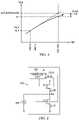
- FIG. 1illustrates a technique for determining the trip point of an over-current protection circuit through extrapolation of current measurements made at currents below the trip point.
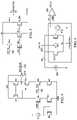
- FIG. 2shows an example integrated circuit with over-current protection for controlling a motor.
- FIG. 3shows an example implementation of at least a portion of the integrated circuit of FIG. 2 for a high side transistor.
- FIG. 4shows an example circuit for generating one of the control signals used in the example of FIG. 3 .
- FIG. 5shows another example of the implementation of the high side transistor.
- FIG. 6shows an example implementation for determining the trip point of a low side transistor.
- An OCP circuitincludes a sense resistor through which flows a current proportional to the output current of the functional circuit flow. A voltage developed across the sense resistor is proportional to the output current. The sense resistor's voltage is provided to an input of a comparator, and a reference voltage (VREF_OCP) is provided to another input of the comparator. The output signal from the comparator indicates whether the sense resistor's voltage exceeds the reference voltage and thus whether the functional circuit is in an over-current state.
- An integrated circuit manufacturermay want to ensure the trip points of its devices are within a narrow range of a nominal value.
- a device specificationmay be that the device has an over-current range of 10 A, that is, that the device will shut off its load current when the load current reaches a level of approximately 10 A. To that end, the trip point of the OCP circuit is determined to screen the devices.
- One technique for testing an OCP circuitis to force an increase in the output current of the functional circuit to the point at which the OCP circuit's comparator trips g., from low to high) while separately monitoring the level of current the output current.
- a wafernormally includes multiple ICs, each with its own OCP circuit. Production testing of over-current protection circuits may occur at the wafer-level, that is, before the wafer is singulated into its individual ICs. Testing multiple ICs concurrently on a wafer requires large amounts of current, and thus may be infeasible. Concurrent testing of multiple ICs (post-packaging) also may require a large amount of current.
- FIG. 1graphically illustrates another option to test each OCP circuit at two or more lower output current levels (e.g., Itrip_A and Itrip_B) while also providing commensurately lower reference voltages (VREF_A and VREF_B) to the comparator, and mathematically extrapolating to determine the output current at which the OCP circuit would trip during normal IC operation (IOCP_EXTRAPOLATED).
- IOCP_EXTRAPOLATEDIOCP_EXTRAPOLATED
- extrapolating lower current level testresults to determine the output current level at which the IC's OCP circuit will trip during normal operation (at reference voltage VREF_OCP) results in an error 110 .
- the examples described hereinimplement a technique to test an OCP circuit at low test current levels while avoiding, or at least reducing, the error noted above.
- FIG. 2illustrates a least a portion of an IC 200 .
- the IC 200includes a functional circuit for driving a motor 200 .
- the functional circuitincludes a high side (HS) transistor coupled to a low side (LS) transistor.
- a controller 201 with over-current protectioncontrols the on/off state of the transistors.
- the transistors in this examplecomprise n-type MOSFET (NMOS) devices.
- the drain of the HS transistoris coupled to a supply voltage node (VM) and the source of the LS transistor is coupled to a ground node.
- the source of the HS transistoris coupled to the drain of the LS transistor at an output node (OUT).
- the output nodecan be coupled to a terminal of a motor 200 to thereby drive the motor.
- the load driven by IC 210is a motor, but the load can be other types of devices in other examples.
- the gates of the HS and LS transistorsare controlled such that both transistors are not on simultaneously. That is, the HS transistor is turned on while the LS transistor is off, LS transistor is turned on while the HS transistor is off, or neither transistor is on.
- current I_HSflows through the HS transistor.
- current I_LSflows through the LS transistor to ground.
- a sense circuit(shown in FIG. 3 ) senses the current through the HS and LS transistors and generates a corresponding current sense signal, CS_HS for the HS transistor and CS_LS for the LS transistor.
- the CS_HS and CS_LS current sense signalsare fed back to the OCP circuit within control 201 and compared to corresponding thresholds to determine whether an over-current condition exists.
- the OCP circuit within controller 201generates an over-current status signal (shown as the OCP_HS indication signal in FIG. 3 ) when I_HS exceeds an upper current limit.
- the OCP circuitgenerates an OCP_LS indication signal when I_HS exceeds an upper current limit.
- Controller 201responds to assertion of either or both of OCP_HS and OCP_LS indication signals in any suitable manner such as by forcing both transistors to be off.
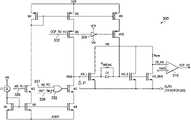
- FIG. 3illustrates an example of a circuit 300 to (a) control the HS transistor during normal (i.e., non-OCP circuit testing) operation and (b) test the over-current protection for the HS transistor.
- Circuit 300includes a current source I 1 , transistors M 1 -M 10 , an OR gate 302 , an inverter 304 , a diode D 1 , resistors Rbreak and Rsns, and a comparator 310 .
- the HS transistoris shown in FIG. 3 as a combination of a larger MOSFET (HS_L) and a smaller MOSFET (HS_S).
- the size of the MOSFETis defined by the ratio of its channel width (W) to its channel length (L).
- the value of W/Lis larger for HS_L than HS_S.
- W/L for HS_Lis ten times as larger as W/L for HS_S.
- the controller 201 of FIG. 2includes the components shown in FIG. 3 except HS_L, HS_S, HS_SNS, and Rsns.
- the combination of Rsns and HS HS_SNScomprises a sense circuit to generate a current sense signal to an input of comparator 310 .
- M 1 -M 3 , M 7 , and M 8comprise NMOS transistors and M 4 -M 6 , M 9 , and M 10 comprise p-type MOSFETs (PMOS).
- Current source I 1(“I 1 ” refers both to the current source device as well as the magnitude of current it produces) is coupled to the drain of and gate of M 1
- the gates of M 1 , M 2 , and M 8are coupled together as are theft sources.
- M 1 and M 2forms a current mirror and M 1 and M 8 forms another current mirror.
- the drain of M 2is coupled to the source of M 3 and the drains of M 3 and M 4 are coupled together.
- the gate of M 3is controlled by a control signal labeled HS_PU, When HS_PU is high (e.g., 5V), M 3 is on, and when HS_PU is low (e.g., ground), M 3 is off. As such, the current through M 2 is mirrored from the current through M 1 (I 1 ) and M 3 functions as a switch to turn on or off the mirrored current through M 2 .
- M 4 , M 5 , and M 9are coupled together as are their sources. As such, M 4 and M 5 forms a current mirror and M 4 and M 9 also forms a current mirror.
- the drain of M 5is coupled to the source of M 6 , and the drains of M 6 and M 7 are coupled together at a node labeled HSG.
- the gate of HS_Lis coupled to the node HSG.
- the source of M 7is coupled to the drain of M 8 .
- the drain of M 9is coupled to the source of M 10 , and the drain of M 10 is coupled to the gate of HS_S.
- Rbreakis coupled across diode D 1 .
- the input of D 1is also coupled to node HSG.
- the output of D 1is coupled to the gates of HS_S and HS_SNS.
- the sources of HS_L, HS_S, and HS_SNSare coupled together at node OUTX, which represents the output node to be coupled to the load (e.g., motor 200 ).
- Zener Z 1is coupled between the gate and drain of HS_L and ensures that the gate-to-source voltage (Vgs) does not become so large as to damage HS_L, HS_S, and HS_SNS.
- the drains of HS_L and HS_Sare coupled to supply voltage node VM.
- Rsnsis coupled between VM and the drain of HS_SNS, The drain of HS_SNS is coupled to an inverting input of comparator 310 .
- the voltage on the inverting input of comparator 310is the high side current sense signal (CS_HS).
- the non-inverting input of comparator 310is coupled to reference voltage VrefA.
- the output of comparator 310provides the high side over current indication signal OCP_HS.
- HS_SNSis smaller than HS_S. In one example, HS_SNS is one-tenth the size of HS_SNS (i.e., its W/L is 10% the W/L of HS_S).
- Any current through either or both of HS_L and HS_Srepresents the output current to the motor (I_HS of FIG. 2 ) and is mirrored through HS_SNS, albeit at a smaller level due to HS SNS being smaller than HS_L and HS_S.
- Rsnshas a small resistance (e.g., 100 ohm) to generate a voltage across Rsns proportional to the output current to the motor.
- the drain current HS_SNSis small enough that the voltage on the inverting input of comparator 310 will be greater than VrefA and thus OCP_HS will be logic low.
- the current HS_SNSwill be larger enough such that the voltage on the comparator's inverting input will be below VrefA and the comparators output (OCP_HS) will be forced high.
- OCP_TM 330 and OCP_TM_HV 332are logic low (e.g., OCP_TM 330 being at ground and OCP_TM_HV being at VM).
- HS_PDalso is logic low, and thus M 7 is in an off state thereby preventing current from flowing through M 7 and M 8 .
- the HS transistoris on and at other times the HS transistor if off.
- HS_PUis forced high by control logic.
- HS_PU being highcauses M 3 to be turned on which permits current to flow through M 4 , M 3 , and M 2 .
- the current flowing through M 4 M 3 , and M 2is mirrored from I 1 via M 1 .
- the current through M 4also is mirrored through M 5 .
- M 6With OCP_TM_HV being low, M 6 is in an on state and the mirrored current through M 5 also flows through M 6 to the gate of HS_L to thereby charge the gate of HS_L turning it on.
- D 1 and Rbreak HS_Salso is turned on.
- Output current to the motor 200thus flows through the combination of HS_L and HS_S.
- a proportional but much smaller current flow through Rsense and HS_SNSthereby generating a voltage on the inverting input of comparator 310 .
- the trip point for the over-current protectionis determined.
- the trip pointoccurs when the CS_HS voltage falls below VrefA.
- the over-current protection test modedetermines the level of the output current to the motor 200 that results in CS_HS falling below VrefA.
- the controller 201may receive an instruction from an external device over an interface to enter the over-current test mode.
- the control logicasserts OCP_TM 330 and OCP_TM_HV to their respective high levels (e.g., 5V for OCP_TM 330 and VCP for OCP_TM_HV 332 ).
- OCP_TM_HVbeing high, MS is off thereby preventing current flow through M 6 .
- HS_PUis forced high and remains high during the over-current protection circuit test mode. With HS_PU high, M 3 is on and current flows through the circuit branch comprising M 4 , M 3 , and M 2 . Current flows through M 4 but not through mirror pair transistor M 5 due to MS being off.
- VrefAThe same reference voltage, VrefA, is used for normal operation as well as for over-current test circuit mode operation.
- An external devicecan be coupled to OUTX to force an output current through HS_S that will result in a large enough current through sense resistor Rsns and HS_SNS so as to cause a large enough voltage drop across Rsns to force the voltage on the comparator's inverting input to drop below VrefA.
- the over-current test circuit modeis performed for a large current through HS_L (e.g., 10 A)
- the test modeis performed with a much smaller current through HS_S, with HS_L being off.
- a source meter/current sinkcan be used to draw current from HS_S.
- the overcurrent protection testmay be performed prior to shipment of the IC to the customer.
- Each of HS_L and HS_Sis formed as multiple transistor “fingers” coupled together in parallel (e.g., drains coupled together and sources coupled together). Each of the fingers is fabricated to have the same W/L ratio.
- the test modeuses a transistor HS_S that is a known fraction (e.g., one-tenth) the size of the HS_L and the over-current trip point for normal operation can be determined to be a corresponding multiple of the current trip point when just the smaller HS_S is used. For example, if HS_S is one-tenth the size of HS_L, then the over-current trip point for normal operation is determined to be ten times the over-current trip point measured during the test mode.
- the measurement of the over-current trip pointoccurs at the same drain-to-source voltage and the same overcurrent protection reference voltage (VrefA), and thus the non-linear nature of the FET current versus voltage characteristic is accounted in the measurement.
- FIG. 4shows a circuit to generate OCP_TM_HV 332 using OCP_TM 330 .
- the circuitincludes a current source I 2 , transistors M 20 -M 27 , and an inverter 410 .
- M 20 -M 22 , M 26 , and M 27are NMOS transistors, and M 23 -M 25 are PMOS transistors.
- M 22is biased on as AVDD is coupled to the gate of M 22 .
- I 2is coupled to the drain and gate of M 20 .
- the gates of M 20 , M 21 , and M 27are coupled together, as are their sources.
- the current I 2 through M 20is mirrored through M 21 , and when M 126 is on, I 2 also is mirrored through M 27 .
- the current mirror ratios of M 20 :M 21 and of M 20 :M 27may be 1:1 or other than 1:1.
- FIG. 5shows an example of a portion of the circuit of FIG. 3 .
- a switch SW 50is coupled between VM and the drain of HS_L rather than D 1 and Rbreak between the gates of HS_L and HS_S. When open, SW 50 prevents current flow through HS_L. SW 50 is closed during the overcurrent protection test mode.
- switch SW 50can be coupled between the source of HS_L and the output node, OUTX.
- switch SW 50can also be implemented at probe-level testing for which separate probe pads are provided at the drains of HS_L and HS_S and by not connecting the probe to the drain of HS_L during over-current testing.
- the padscan be connected to the same VM pin through different bond wires, hence a high threshold is achieved during normal operation.
- FIG. 6shows an example circuit implementation for the low side transistor (LS).
- the LS transistoralso is implemented as a larger transistor LS_L and a smaller transistor (LS_S).
- the sources of LS_L and LS_Sare coupled together at a ground node, and their drains are also coupled and adapted to be coupled to motor 200 .
- Voltage 610represents the voltage developed across a sense resistor and sense transistor coupled to LS_S (in much the same way as shown in FIG. 3 for the high side transistor).
- the voltage (CS) from voltage 610is proportional to the output current (Iout) and is given as n*(Iout/k)*Rsns, where “k” is the relative size ratio of LS_L to LS_S and Rsns is the resistance of the corresponding sense resistor. Voltage CS is provided to the inverting input of comparator 620 . In much the same that OCP_HS is normally low and then transitions to a high state when the high side current exceeds an over-current limit, so too will OCP_LS normally be low and then transition to a high state when the low side current exceeds an over-current limit.
- a switch, SW 1is coupled between the gate of LS_L and the gate of LS_S.
- SW 1is closed (on), the voltage applied to the gate of LS_S is also applied to the gate of LS_L and thus transistors LS_L and LS_S are either both on or both off.
- SW 1is closed during normal operation responsive to OCP_TM 330 being low.
- OCP_TM 330is asserted high (as described above) which causes SW 1 to be open.
- LS_Lis off, but LS_S can be turned on via its gate signal to thereby use LS_S to determine the over-current trip point for comparator 620 .
- the device containing the OCP circuit to be testedmay be connected to a test fixture containing the output current-adjustable load. The testing of the device can be performed at the wafer level or after the device has been packaged into the final packaged integrated circuit.
- the trip point of the OCP circuitis performed at a test load current that is substantially smaller than the load current which will cause the OCP circuit to trip when the device is integrated into and end-user system.
- test load current that trips the OCP circuit's comparatoris then scaled using a scale factor related to the relative size difference of HS_L to HS_SNS. For example, if HS_L is 100 times larger than HS_SNS, then the test load current that trips the OCP circuit can be multiplied by 100 to determine the in-situ load current that will trip the OCP circuit when load current flows through HS_L.
- Coupleis used throughout the specification. The term may cover connections, communications, or signal paths that enable a functional relationship consistent with the description of the present disclosure. For example, if device A generates a signal to control device B to perform an action, in a first example device A is coupled to device B, or in a second example device A is coupled to device B through intervening component C if intervening component C does not substantially alter the functional relationship between device A and device B such that device B is controlled by device A via the control signal generated by device A.
Landscapes
- Physics & Mathematics (AREA)
- Nonlinear Science (AREA)
- Semiconductor Integrated Circuits (AREA)
Abstract
Description
Claims (20)
Applications Claiming Priority (2)
| Application Number | Priority Date | Filing Date | Title |
|---|---|---|---|
| IN201941022077 | 2019-06-04 | ||
| IN201941022077 | 2019-06-04 |
Publications (2)
| Publication Number | Publication Date |
|---|---|
| US20200389008A1 US20200389008A1 (en) | 2020-12-10 |
| US11469586B2true US11469586B2 (en) | 2022-10-11 |
Family
ID=73650126
Family Applications (1)
| Application Number | Title | Priority Date | Filing Date |
|---|---|---|---|
| US16/862,674Active2040-07-23US11469586B2 (en) | 2019-06-04 | 2020-04-30 | Over-current protection circuit |
Country Status (1)
| Country | Link |
|---|---|
| US (1) | US11469586B2 (en) |
Citations (7)
| Publication number | Priority date | Publication date | Assignee | Title |
|---|---|---|---|---|
| US4760293A (en)* | 1982-11-04 | 1988-07-26 | Siemens Aktiengesellschaft | Combined bipolar and MOSFET switch |
| US8018213B2 (en)* | 2008-09-29 | 2011-09-13 | Infineon Technologies Ag | Measuring the current through a load transistor |
| US20120098517A1 (en)* | 2010-10-20 | 2012-04-26 | Rohm Co., Ltd. | High Side Switch Circuit, Interface Circuit and Electronic Device |
| US8233257B2 (en)* | 2008-02-13 | 2012-07-31 | Fujitsu Semiconductor Limited | Power supply circuit, overcurrent protection circuit for the same, and electronic device |
| US20140152280A1 (en)* | 2011-10-05 | 2014-06-05 | Analog Devices, Inc. | Apparatus and method for distributing power-up power dissipation |
| US20150280425A1 (en)* | 2014-03-28 | 2015-10-01 | Infineon Technologies Ag | Power switch device |
| US20190288501A1 (en)* | 2018-03-19 | 2019-09-19 | Kabushiki Kaisha Toshiba | Semiconductor integrated circuit |
- 2020
- 2020-04-30USUS16/862,674patent/US11469586B2/enactiveActive
Patent Citations (7)
| Publication number | Priority date | Publication date | Assignee | Title |
|---|---|---|---|---|
| US4760293A (en)* | 1982-11-04 | 1988-07-26 | Siemens Aktiengesellschaft | Combined bipolar and MOSFET switch |
| US8233257B2 (en)* | 2008-02-13 | 2012-07-31 | Fujitsu Semiconductor Limited | Power supply circuit, overcurrent protection circuit for the same, and electronic device |
| US8018213B2 (en)* | 2008-09-29 | 2011-09-13 | Infineon Technologies Ag | Measuring the current through a load transistor |
| US20120098517A1 (en)* | 2010-10-20 | 2012-04-26 | Rohm Co., Ltd. | High Side Switch Circuit, Interface Circuit and Electronic Device |
| US20140152280A1 (en)* | 2011-10-05 | 2014-06-05 | Analog Devices, Inc. | Apparatus and method for distributing power-up power dissipation |
| US20150280425A1 (en)* | 2014-03-28 | 2015-10-01 | Infineon Technologies Ag | Power switch device |
| US20190288501A1 (en)* | 2018-03-19 | 2019-09-19 | Kabushiki Kaisha Toshiba | Semiconductor integrated circuit |
Also Published As
| Publication number | Publication date |
|---|---|
| US20200389008A1 (en) | 2020-12-10 |
Similar Documents
| Publication | Publication Date | Title |
|---|---|---|
| JP7488438B2 (en) | Current sensing and control for transistor power switches. | |
| US10559559B2 (en) | Integrated protection devices with monitoring of electrical characteristics | |
| US10782334B2 (en) | Testing MOS power switches | |
| US7667442B2 (en) | Constant voltage power supply circuit and method of testing the same | |
| US9429971B2 (en) | Short-circuit protection for voltage regulators | |
| US10451669B2 (en) | Evaluating a gate-source leakage current in a transistor device | |
| JP5806853B2 (en) | Voltage regulator | |
| US10008846B2 (en) | Control device for an electronic fuse and method for controlling an electronic fuse | |
| CN101189795B (en) | Power Controllers and Semiconductor Devices | |
| CN105811759A (en) | Power supply device | |
| US20110292556A1 (en) | Protection circuit and method for electronic devices | |
| US20090180231A1 (en) | Overcurrent protection circuit and voltage regulator incorporating same | |
| US20130238273A1 (en) | Circuit and method for measuring voltage | |
| US9960588B2 (en) | Power switch device | |
| KR20060043676A (en) | Semiconductor integrated circuit with current detection function, and power supply using the same | |
| US10459474B1 (en) | Current sensor | |
| CN115622372A (en) | Driver device for NMOS power transistors and blocking circuits in stress test mode | |
| US20070229141A1 (en) | Electronic fuse for overcurrent protection | |
| US11469586B2 (en) | Over-current protection circuit | |
| CN110676804A (en) | Detection circuit and switch module using same | |
| CN1045141C (en) | Methods and apparatus for isolating a power network from a load during an overcurrent condition | |
| US9438221B2 (en) | Switch device | |
| EP3945324A1 (en) | Transistor package with load current sense modality | |
| JP2004140907A (en) | Overcurrent protection circuit, semiconductor device including overcurrent protection circuit, and method of operation test of overcurrent protection circuit | |
| CN113437725B (en) | Circuit for realizing overcurrent protection by utilizing packaging routing resistor |
Legal Events
| Date | Code | Title | Description |
|---|---|---|---|
| FEPP | Fee payment procedure | Free format text:ENTITY STATUS SET TO UNDISCOUNTED (ORIGINAL EVENT CODE: BIG.); ENTITY STATUS OF PATENT OWNER: LARGE ENTITY | |
| STPP | Information on status: patent application and granting procedure in general | Free format text:APPLICATION DISPATCHED FROM PREEXAM, NOT YET DOCKETED | |
| STPP | Information on status: patent application and granting procedure in general | Free format text:DOCKETED NEW CASE - READY FOR EXAMINATION | |
| STPP | Information on status: patent application and granting procedure in general | Free format text:NON FINAL ACTION MAILED | |
| STPP | Information on status: patent application and granting procedure in general | Free format text:RESPONSE TO NON-FINAL OFFICE ACTION ENTERED AND FORWARDED TO EXAMINER | |
| STPP | Information on status: patent application and granting procedure in general | Free format text:FINAL REJECTION MAILED | |
| STPP | Information on status: patent application and granting procedure in general | Free format text:DOCKETED NEW CASE - READY FOR EXAMINATION | |
| STPP | Information on status: patent application and granting procedure in general | Free format text:NOTICE OF ALLOWANCE MAILED -- APPLICATION RECEIVED IN OFFICE OF PUBLICATIONS | |
| AS | Assignment | Owner name:TEXAS INSTRUMENTS INCORPORATED, TEXAS Free format text:ASSIGNMENT OF ASSIGNORS INTEREST;ASSIGNORS:OJHA, ASHISH;SHANKAR, KRISHNAMURTHY;J, DIVYASREE;AND OTHERS;SIGNING DATES FROM 20201010 TO 20220629;REEL/FRAME:060421/0264 | |
| STPP | Information on status: patent application and granting procedure in general | Free format text:PUBLICATIONS -- ISSUE FEE PAYMENT VERIFIED | |
| STCF | Information on status: patent grant | Free format text:PATENTED CASE |