US11457975B2 - Apparatus and a method for the treatment of a prostatic disease - Google Patents
Apparatus and a method for the treatment of a prostatic diseaseDownload PDFInfo
- Publication number
- US11457975B2 US11457975B2US16/201,642US201816201642AUS11457975B2US 11457975 B2US11457975 B2US 11457975B2US 201816201642 AUS201816201642 AUS 201816201642AUS 11457975 B2US11457975 B2US 11457975B2
- Authority
- US
- United States
- Prior art keywords
- electrode
- prostate
- electrodes
- urethral catheter
- shaft
- Prior art date
- Legal status (The legal status is an assumption and is not a legal conclusion. Google has not performed a legal analysis and makes no representation as to the accuracy of the status listed.)
- Active, expires
Links
Images




Classifications
- A—HUMAN NECESSITIES
- A61—MEDICAL OR VETERINARY SCIENCE; HYGIENE
- A61B—DIAGNOSIS; SURGERY; IDENTIFICATION
- A61B18/00—Surgical instruments, devices or methods for transferring non-mechanical forms of energy to or from the body
- A61B18/04—Surgical instruments, devices or methods for transferring non-mechanical forms of energy to or from the body by heating
- A61B18/12—Surgical instruments, devices or methods for transferring non-mechanical forms of energy to or from the body by heating by passing a current through the tissue to be heated, e.g. high-frequency current
- A61B18/14—Probes or electrodes therefor
- A—HUMAN NECESSITIES
- A61—MEDICAL OR VETERINARY SCIENCE; HYGIENE
- A61B—DIAGNOSIS; SURGERY; IDENTIFICATION
- A61B18/00—Surgical instruments, devices or methods for transferring non-mechanical forms of energy to or from the body
- A61B18/04—Surgical instruments, devices or methods for transferring non-mechanical forms of energy to or from the body by heating
- A61B18/12—Surgical instruments, devices or methods for transferring non-mechanical forms of energy to or from the body by heating by passing a current through the tissue to be heated, e.g. high-frequency current
- A61B18/14—Probes or electrodes therefor
- A61B18/1492—Probes or electrodes therefor having a flexible, catheter-like structure, e.g. for heart ablation
- A—HUMAN NECESSITIES
- A61—MEDICAL OR VETERINARY SCIENCE; HYGIENE
- A61M—DEVICES FOR INTRODUCING MEDIA INTO, OR ONTO, THE BODY; DEVICES FOR TRANSDUCING BODY MEDIA OR FOR TAKING MEDIA FROM THE BODY; DEVICES FOR PRODUCING OR ENDING SLEEP OR STUPOR
- A61M25/00—Catheters; Hollow probes
- A61M25/0017—Catheters; Hollow probes specially adapted for long-term hygiene care, e.g. urethral or indwelling catheters to prevent infections
- A—HUMAN NECESSITIES
- A61—MEDICAL OR VETERINARY SCIENCE; HYGIENE
- A61M—DEVICES FOR INTRODUCING MEDIA INTO, OR ONTO, THE BODY; DEVICES FOR TRANSDUCING BODY MEDIA OR FOR TAKING MEDIA FROM THE BODY; DEVICES FOR PRODUCING OR ENDING SLEEP OR STUPOR
- A61M25/00—Catheters; Hollow probes
- A61M25/0067—Catheters; Hollow probes characterised by the distal end, e.g. tips
- A61M25/0082—Catheter tip comprising a tool
- A—HUMAN NECESSITIES
- A61—MEDICAL OR VETERINARY SCIENCE; HYGIENE
- A61B—DIAGNOSIS; SURGERY; IDENTIFICATION
- A61B18/00—Surgical instruments, devices or methods for transferring non-mechanical forms of energy to or from the body
- A61B2018/00053—Mechanical features of the instrument of device
- A61B2018/00172—Connectors and adapters therefor
- A—HUMAN NECESSITIES
- A61—MEDICAL OR VETERINARY SCIENCE; HYGIENE
- A61B—DIAGNOSIS; SURGERY; IDENTIFICATION
- A61B18/00—Surgical instruments, devices or methods for transferring non-mechanical forms of energy to or from the body
- A61B2018/00053—Mechanical features of the instrument of device
- A61B2018/00172—Connectors and adapters therefor
- A61B2018/00178—Electrical connectors
- A—HUMAN NECESSITIES
- A61—MEDICAL OR VETERINARY SCIENCE; HYGIENE
- A61B—DIAGNOSIS; SURGERY; IDENTIFICATION
- A61B18/00—Surgical instruments, devices or methods for transferring non-mechanical forms of energy to or from the body
- A61B2018/00053—Mechanical features of the instrument of device
- A61B2018/00214—Expandable means emitting energy, e.g. by elements carried thereon
- A—HUMAN NECESSITIES
- A61—MEDICAL OR VETERINARY SCIENCE; HYGIENE
- A61B—DIAGNOSIS; SURGERY; IDENTIFICATION
- A61B18/00—Surgical instruments, devices or methods for transferring non-mechanical forms of energy to or from the body
- A61B2018/00053—Mechanical features of the instrument of device
- A61B2018/00273—Anchoring means for temporary attachment of a device to tissue
- A61B2018/00279—Anchoring means for temporary attachment of a device to tissue deployable
- A61B2018/00285—Balloons
- A—HUMAN NECESSITIES
- A61—MEDICAL OR VETERINARY SCIENCE; HYGIENE
- A61B—DIAGNOSIS; SURGERY; IDENTIFICATION
- A61B18/00—Surgical instruments, devices or methods for transferring non-mechanical forms of energy to or from the body
- A61B2018/00315—Surgical instruments, devices or methods for transferring non-mechanical forms of energy to or from the body for treatment of particular body parts
- A61B2018/00547—Prostate
- A—HUMAN NECESSITIES
- A61—MEDICAL OR VETERINARY SCIENCE; HYGIENE
- A61B—DIAGNOSIS; SURGERY; IDENTIFICATION
- A61B18/00—Surgical instruments, devices or methods for transferring non-mechanical forms of energy to or from the body
- A61B2018/00571—Surgical instruments, devices or methods for transferring non-mechanical forms of energy to or from the body for achieving a particular surgical effect
- A61B2018/00577—Ablation
- A—HUMAN NECESSITIES
- A61—MEDICAL OR VETERINARY SCIENCE; HYGIENE
- A61B—DIAGNOSIS; SURGERY; IDENTIFICATION
- A61B18/00—Surgical instruments, devices or methods for transferring non-mechanical forms of energy to or from the body
- A61B2018/00636—Sensing and controlling the application of energy
- A61B2018/00642—Sensing and controlling the application of energy with feedback, i.e. closed loop control
- A—HUMAN NECESSITIES
- A61—MEDICAL OR VETERINARY SCIENCE; HYGIENE
- A61B—DIAGNOSIS; SURGERY; IDENTIFICATION
- A61B18/00—Surgical instruments, devices or methods for transferring non-mechanical forms of energy to or from the body
- A61B2018/00636—Sensing and controlling the application of energy
- A61B2018/00696—Controlled or regulated parameters
- A61B2018/00702—Power or energy
- A—HUMAN NECESSITIES
- A61—MEDICAL OR VETERINARY SCIENCE; HYGIENE
- A61B—DIAGNOSIS; SURGERY; IDENTIFICATION
- A61B18/00—Surgical instruments, devices or methods for transferring non-mechanical forms of energy to or from the body
- A61B2018/00636—Sensing and controlling the application of energy
- A61B2018/00696—Controlled or regulated parameters
- A61B2018/0072—Current
- A—HUMAN NECESSITIES
- A61—MEDICAL OR VETERINARY SCIENCE; HYGIENE
- A61B—DIAGNOSIS; SURGERY; IDENTIFICATION
- A61B18/00—Surgical instruments, devices or methods for transferring non-mechanical forms of energy to or from the body
- A61B2018/00636—Sensing and controlling the application of energy
- A61B2018/00773—Sensed parameters
- A61B2018/00791—Temperature
- A—HUMAN NECESSITIES
- A61—MEDICAL OR VETERINARY SCIENCE; HYGIENE
- A61B—DIAGNOSIS; SURGERY; IDENTIFICATION
- A61B18/00—Surgical instruments, devices or methods for transferring non-mechanical forms of energy to or from the body
- A61B2018/00636—Sensing and controlling the application of energy
- A61B2018/00773—Sensed parameters
- A61B2018/00827—Current
- A—HUMAN NECESSITIES
- A61—MEDICAL OR VETERINARY SCIENCE; HYGIENE
- A61B—DIAGNOSIS; SURGERY; IDENTIFICATION
- A61B18/00—Surgical instruments, devices or methods for transferring non-mechanical forms of energy to or from the body
- A61B18/04—Surgical instruments, devices or methods for transferring non-mechanical forms of energy to or from the body by heating
- A61B18/12—Surgical instruments, devices or methods for transferring non-mechanical forms of energy to or from the body by heating by passing a current through the tissue to be heated, e.g. high-frequency current
- A61B18/14—Probes or electrodes therefor
- A61B2018/1405—Electrodes having a specific shape
- A61B2018/1425—Needle
- A61B2018/143—Needle multiple needles
- A—HUMAN NECESSITIES
- A61—MEDICAL OR VETERINARY SCIENCE; HYGIENE
- A61B—DIAGNOSIS; SURGERY; IDENTIFICATION
- A61B18/00—Surgical instruments, devices or methods for transferring non-mechanical forms of energy to or from the body
- A61B18/04—Surgical instruments, devices or methods for transferring non-mechanical forms of energy to or from the body by heating
- A61B18/12—Surgical instruments, devices or methods for transferring non-mechanical forms of energy to or from the body by heating by passing a current through the tissue to be heated, e.g. high-frequency current
- A61B18/14—Probes or electrodes therefor
- A61B2018/1467—Probes or electrodes therefor using more than two electrodes on a single probe
- A—HUMAN NECESSITIES
- A61—MEDICAL OR VETERINARY SCIENCE; HYGIENE
- A61M—DEVICES FOR INTRODUCING MEDIA INTO, OR ONTO, THE BODY; DEVICES FOR TRANSDUCING BODY MEDIA OR FOR TAKING MEDIA FROM THE BODY; DEVICES FOR PRODUCING OR ENDING SLEEP OR STUPOR
- A61M25/00—Catheters; Hollow probes
- A61M25/0067—Catheters; Hollow probes characterised by the distal end, e.g. tips
- A61M25/0082—Catheter tip comprising a tool
- A61M2025/0095—Catheter tip comprising a tool being one or more needles protruding from the distal tip and which are not used for injection nor for electro-stimulation, e.g. for fixation purposes
- A—HUMAN NECESSITIES
- A61—MEDICAL OR VETERINARY SCIENCE; HYGIENE
- A61M—DEVICES FOR INTRODUCING MEDIA INTO, OR ONTO, THE BODY; DEVICES FOR TRANSDUCING BODY MEDIA OR FOR TAKING MEDIA FROM THE BODY; DEVICES FOR PRODUCING OR ENDING SLEEP OR STUPOR
- A61M2205/00—General characteristics of the apparatus
- A61M2205/05—General characteristics of the apparatus combined with other kinds of therapy
- A61M2205/054—General characteristics of the apparatus combined with other kinds of therapy with electrotherapy
- A—HUMAN NECESSITIES
- A61—MEDICAL OR VETERINARY SCIENCE; HYGIENE
- A61M—DEVICES FOR INTRODUCING MEDIA INTO, OR ONTO, THE BODY; DEVICES FOR TRANSDUCING BODY MEDIA OR FOR TAKING MEDIA FROM THE BODY; DEVICES FOR PRODUCING OR ENDING SLEEP OR STUPOR
- A61M2210/00—Anatomical parts of the body
- A61M2210/10—Trunk
- A61M2210/1078—Urinary tract
- A61M2210/1089—Urethra
- A61M2210/1096—Male
- A—HUMAN NECESSITIES
- A61—MEDICAL OR VETERINARY SCIENCE; HYGIENE
- A61M—DEVICES FOR INTRODUCING MEDIA INTO, OR ONTO, THE BODY; DEVICES FOR TRANSDUCING BODY MEDIA OR FOR TAKING MEDIA FROM THE BODY; DEVICES FOR PRODUCING OR ENDING SLEEP OR STUPOR
- A61M2210/00—Anatomical parts of the body
- A61M2210/16—Male reproductive, genital organs
- A61M2210/166—Prostate
Definitions
- the disclosure hereingenerally relates to an apparatus and a method for the treatment of a prostatic disease by transfer of electrical energy to a prostate in a body of a patient.
- FIG. 1illustrates a simplified view of the anatomy and location of a prostate 3 , 4 .
- a urethra 1passes upwards through an urethrae membranaceae (“external sphincter muscle”) 2 , through the prostate 3 , 4 which surrounds the urethra, and into a urinary bladder 5 .
- the prostate 3 , 4comprises three lobes: two major lobes 3 , 4 and a median lobe. The median lobe is located generally behind the major lobes 3 , 4 .
- BHPbenign prostatic hyperplasia or hypotrophy
- prostate cancerbenign prostatic hyperplasia or hypotrophy
- BHPis generally caused by enlargement of the 15 median lode of the prostate.
- BHPmay cause the prostate 3 , 4 to compress the adjacent urethra 1 .
- Symptoms of BPHinclude frequent urination, reduced urine flow, lack of control of urination, painful urination, and bloody urination.
- Ablative treatmentsinclude surgery, and induced necrosis of prostate tissue, and the subsequent removal of the necrotic tissue by bodily absorption or discharge via the urethra.
- Methods of inducing necrosis of prostate tissueinclude the heating and/or cooling of the prostate tissue, the introduction of toxic chemicals, and ultrasound. Examples of such methods include laser prostatectomy, interstitial laser coagulation, photosensitive vaporization of the prostate, holmium laser ablation of the prostate, holmium laser enucleation of the prostate, microware irradiation of the prostate, radiofrequency current heating, direct current ablation, and ultrasound treatment.
- Ablative and pharmaceutical treatmentsmay have side effects including reduced libido, impotence, retrograde ejaculation, fatigue, dizziness, headache, and decreased blood pressure.
- induced necrosis treatments for prostatic disease using chemical or cryo ablationare shown in U.S. Pat. Nos. 7,837,670 and 10,004,551, and PCT Publ. No. WO1997036632A1.
- Examples of induced necrosis treatments for prostatic disease using electrical thermal ablationare shown in U.S. Pat. Nos. 5,304,214, 5,370,675 and 6,524,270.
- Minimally invasive treatments of diseases of the prostatethat offer at least one of less pain, faster recovery, lower costs, shorter treatment times, reduced treatment side effects, and reduced use of anesthesia and sedatives may be desirable. Improvements in the operation and control of existing minimally invasive treatments of diseases of the prostate may be desirable.
- the apparatuscomprises a urethral catheter for insertion into a urethra.
- the apparatuscomprises an electrode assembly slidingly receivable within the urethral catheter.
- the electrode assemblycomprises a plurality of extendably mounted electrodes for extension into a prostate adjacent the urethra.
- the plurality of extendably mounted electrodesare for electrolytic generation of at least one of a necrotizing base and a necrotizing acid within the prostate.
- An embodimentcomprises an inflatable balloon adjacent a distal end of the urethral catheter for inflation within a urinary bladder in fluid communication with the urethra, and another inflatable balloon disposed at a proximal end of the urethral bladder and in fluid communication therewith.
- each of the plurality of extendably mounted electrical electrodesare slidingly mounted and are attached at a proximal end thereof to an electrode propeller that is user actuatable.
- the electrode propellermay be linearly actuatable by the user.
- An embodimentcomprises a collar attached to a proximal end of the electrode assembly and rotationally fixed to the electrode propeller.
- the collar and the electrode propellermay be joined at a sliding keyed joint.
- a distal end of the urethral cathetermay comprise a plurality of electrode passageways connecting an interior and exterior of thereof, and the urethral catheter and the electrode assembly are configured to engage with a predetermined rotational orientation to each other for alignment of the plurality of extendably mounted electrodes with the plurality of electrode passageways.
- the urethral catheter and the electrode assemblymay be joined to form a sliding keyed joint.
- a flangemay be attached to the collar, wherein the flange and the electrode propeller are cooperatively arranged for the flange to be received by a finger of a hand and the electrode propeller to be actuated by the thumb of the hand when the flange is so received.
- An embodimentcomprises a disengageable stop arrange to prevent actuation of the electrode propeller until disengaged.
- At least one of the electrode assembly and the urethral cathetercomprise a fastener configured to fasten the electrode assembly to the urethral catheter when the electrode assembly is slidingly received within the urethral catheter.
- An embodimentcomprises a source of the electricity and a controller for the source of the electricity.
- An embodimentcomprises a monitor configured to generate electrical parameter information indicative of an electrical parameter associated with electricity supplied to the plurality of expendably mounted electrodes, wherein the controller is configured to control the electricity supplied to the plurality of expendably mounted electrodes depending on the electrical parameter information.
- the controllermay be configured to change the electricity during the electrolytic generation of at least one of the necrotizing base and the necrotizing acid within the prostate.
- the controllermay have a plurality of electrical modes for a plurality of prostates quality types.
- the electricityis a direct current.
- the plurality of extendably mounted electrodescomprises an electrode within an insulating sheath defining at least two uninsulated distal portions of the electrode.
- each of the plurality of extendably mounted electrodescomprise a rounded tip.
- each of the plurality of extendably mounted electrodeshas a cruciform transverse section.
- An embodimentcomprises a chemical introducible by at least one of the plurality of electrodes into the prostate.
- An embodimentdefines a plurality of channels for each electrode for selective disposition of each electrode within the prostate.
- At least one of the plurality of extendably mounted electrodesis more extendable than at least another one of the plurality of extendable lengths.
- the urethral catheteris more flexible than the electrical assembly.
- the urethral cathetercomprises a fixation element.
- the urethral cathetercomprises a Foley catheter.
- the methodcomprises inserting a urethral catheter into a urethra.
- the methodcomprises inserting an electrode assembly into the urethra.
- the electrode assemblycomprises a plurality of extendably mounted electrodes.
- the methodcomprises extending the plurality of extendably mounted electrodes into a prostate adjacent the urethra.
- the methodcomprises supplying electricity to the plurality of extendably mounted electrodes wherein at least one of a necrotizing base and a necrotizing acid is generated within the prostate.
- the electrode assemblyis disposed within the urethral catheter during insertion of the urethral catheter into the urethra.
- the electrode assemblymay be inserted into the urethral catheter so inserted into the urethra.
- the urethral catheteris more flexible than the electrode assembly.
- An embodimentcomprises extending the plurality of electrodes into the prostate adjacent the urethra comprising a user actuating an electrode propeller attached to the plurality of electrodes to extend a plurality of tips of the plurality of electrodes out of the electrode assembly and into the prostate.
- An embodimentcomprises the step of rotationally fixing a collar attached to a proximal end of the electrode assembly to the electrode propeller.
- An embodimentcomprises the step of joining the electrode propeller and the collar to form a sliding keyed joint.
- An embodimentcomprises disengaging a stop arranged to prevent actuation of the electrode propeller to enable actuation of the electrode propeller.
- An embodimentcomprises the step of generating electrical parameter information indicative of electricity supplied to the plurality of extendably mounted electrodes, wherein the controller is configured to control the electricity supplied to the plurality of extendably mounted electrodes depending on the electrical parameter information.
- An embodimentcomprises the step of changing the electricity supplied to the plurality of extendably mounted electrodes during the electrolytic generation of at least one of the necrotizing base and the necrotizing acid.
- An embodimentcomprises the step of selecting one of a plurality of electricity supply modes, the plurality of electricity supply modes being for treatment of a plurality of prostate quality types.
- An embodimentcomprises the step of changing the disposition of at least one of the plurality of extendably mounted electrodes within the prostate and supplying electricity to the at least one of the plurality of extendably mounted electrodes.
- An embodimentcomprises the step of introducing a chemical to a volume of the prostate, wherein the chemical belongs to a group of chemicals comprising a chemical that counters at least one of the necrotizing acid and the necrotizing base, and a necrotizing chemical that reduces or increases the pH within the prostate.
- An embodimentcomprises the step of introducing the chemical into the prostate via a lumen in at least one of the plurality of electrodes.
- An embodimentcomprises using electromyography to detect a sphincter urethrae membranaceae adjacent the urethra and position the plurality of electrodes relative to the sphincter urethrae membranaceae.
- An embodimentcomprises inflating a first balloon attached to a distal end of the urethral catheter within a urinary bladder in fluid communication with the urethra, and a second balloon disposed adjacent a proximal end of the urethral catheter and in fluid communication with the first balloon.
- An embodimentcomprises introducing a fluid into a balloon attached to a distal end of the urethral catheter and disposed within a urinary bladder in fluid communication with the urethra, and monitoring the pressure of the fluid introduced into the balloon.
- An embodimentcomprises the step of reading an attached identification tag.
- the step of supplying the electricity to the plurality of extendably mounted electrodescomprises supplying electricity to the plurality of electrodes asynchronously.
- An embodimentcomprises the step of withdrawing the plurality of extendable electrodes from the prostate and extending another plurality of extendably mounted electrodes of another electrode assembly into the prostate at a different prostate position.
- An embodimentcomprises the step of activating a fixation element of the urethral catheter.
- the urethral cathetercomprises a Foley catheter.
- the apparatuscomprises an electrode assembly slidingly receivable within a urethral catheter, the electrode assembly comprising a plurality of extendably mounted electrodes for extension through urethral tissue and into a prostate, wherein the plurality of extendably mounted electrodes are for electrolytic generation of at least one of a necrotizing base and a necrotizing acid within the prostate.
- the plurality of extendably mounted 5 electrodescomprises at least on electrolytically corrodible electrode.
- An urethral cathetercomprising a distally attached inflatable balloon for inflation within a body and a proximally attached inflatable balloon in fluid communication with the distally attached inflatable balloon for disposition exterior of the body when the distally attached inflatable balloon is so inflated within the body.
- the apparatuscomprises an electrode assembly slidingly receivable within a urethral catheter.
- the electrode assemblycomprises a plurality of extendably mounted electrodes for extension through urethral tissue and into the prostate.
- the plurality of extendably mounted electrodesare for electrolytic generation of at least one of a necrotizing base and a necrotizing acid within the prostate.
- FIG. 1illustrates a simplified view of the anatomy and location of a prostate.
- FIGS. 2 and 3respectively show perspective and exploded views of an embodiment of an apparatus for the treatment of a prostatic disease
- FIG. 4shows a detail of a distal end of an electrode assembly of the apparatus of FIG. 2 .
- FIG. 5shows a detail of a proximal end of a urethral catheter of the apparatus of FIG. 2 .
- FIGS. 6 and 7show details of a proximal end of the electrode assembly of FIG. 4 , with and without a disengageable stop respectively.
- FIG. 8shows a detail of a flange shown in FIGS. 6 and 7 .
- FIG. 9shows a detail of a distal end of a urethral catheter of the apparatus of FIG. 1 .
- FIG. 10shows a flow chart for an embodiment of a method for treatment of a prostatic disease that may be implemented using the apparatus of FIG. 2 .
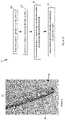
- FIG. 11is a perspective view depicting an apparatus for the treatment of a prostatic disease, in accordance with another embodiment of the disclosure.
- FIG. 12is an exploded view depicting the apparatus of FIG. 11 .
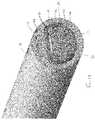
- FIG. 13is a cross sectional view depicting an electrode assembly slidably received within a urethral catheter, in accordance with an embodiment of the disclosure.
- FIG. 14is an exploded view depicting an electrode assembly, in accordance with an embodiment of the disclosure.
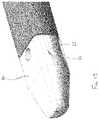
- FIG. 15is a partial, perspective view depicting an electrode tip of an electrode assembly, in accordance with an embodiment of the disclosure.
- FIG. 16is a partial, perspective view depicting an electrode, in accordance with an embodiment of the disclosure.
- FIG. 17is a partial, perspective view depicting a connection of an electrode assembly to an assembly fixture, in accordance with an embodiment of the disclosure.
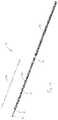
- FIG. 18is an exploded, perspective view depicting a urethral catheter, in accordance with an embodiment of the disclosure.
- FIG. 19is a partial, perspective view depicting a urethral catheter having an inflatable balloon, in accordance with an embodiment of the disclosure.
- FIG. 20is a cross sectional, perspective view depicting a urethral catheter including an anti-stretch device, in accordance with an embodiment of the disclosure.
- FIG. 21is a partial, perspective view depicting a urethral catheter having a first inflatable balloon and a second inflatable balloon, in accordance with an embodiment of the disclosure.
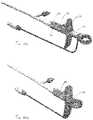
- FIGS. 22A-Bare perspective views depicting an electrode assembly including a handle, in accordance with an embodiment of the disclosure.
- FIG. 23is an exploded, partial perspective view depicting an electrode assembly handle, in accordance with an embodiment of the disclosure.
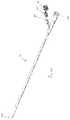
- FIGS. 2 and 3respectively show perspective and exploded views of an embodiment of an apparatus for the treatment of a prostatic disease, the apparatus being generally indicated by the numeral 10 .
- the apparatus 10may be non-implantable.
- the apparatus 10comprises a urethral catheter 12 in the form of a Foley catheter for insertion into a urethra 1 .
- the apparatus 10comprises an electrode assembly 14 slidingly receivable within the urethral catheter 12 .
- FIG. 2shows the electrode assembly 14 received within the urethral catheter 12 .
- FIG. 4shows a detail of the distal tip 18 of the electrode assembly 14 , which is inserted into a proximal opening 24 of a lumen 31 of the urethral catheter 12 .
- the proximal openingis best seen in FIG.
- the electrode assembly 14comprises a plurality of extendably mounted electrodes 20 , 22 in the form of a memory alloy wire for extension into a prostate 3 , 4 adjacent the urethra 1 .
- the plurality of extendably mounted electrodes 20 , 22are for electrolytic generation of at least one of a necrotizing base and a necrotizing acid within the prostate 3 , 4 .
- the plurality of electrodesmay comprise, for example, a pair of electrodes 20 , 22 , or multiple pairs of electrodes.
- One electrolytic reaction that may occur in the prostateis the electrolysis of water, whereby a necrotizing base (OH ⁇ ) may be generated at an electrode that is a cathode, and a necrotizing acid (H+) may be generated at an electrode that is an anode.
- the necrotizing base and necrotizing acidmay each cause necrosis of prostatic tissue to form a necrotic volume of prostatic tissue, which in some embodiments is predetermined prior to treatment.
- the necrotic prostate tissueis absorbed by the body or excreted via the urethra, leaving a void and so reducing the prostate volume, which may reduce the symptoms of BPH or the size of a tumor.
- the urethral cathetercomprises a fixation element in the form of an inflatable balloon adjacent a distal end of thereof, to fix the catheter in a treatment position.
- the inflatable balloonis for inflation within a urinary bladder in fluid communication with the urethra, which aids in the retention of the urethral catheter within the urethra.
- the balloonmay be inflated with saline, air, or generally any suitable form of fluid.
- the saline or airmay be introduced via a urethral catheter inflation port 25 , which is in fluid communication with the balloon via a fluid conduit in the form of another lumen of the urethral catheter 12 .
- the urethral catheter 12comprises another inflatable balloon disposed adjacent a proximal end of the urethral catheter 12 and in fluid communication therewith.
- the other balloonis disposed such that it is external of the urethra when the balloon is inflated within the bladder.
- the other balloonis a visual indicator of the inflation state of the balloon in the bladder, and deflation of the other balloon is indicative of a potentially dangerous state wherein the urethral catheter may slip and so cause the extended electrodes to score the urethral epithelium.
- embodimentsmay comprise a pressure meter in fluid communication with the balloon to monitor the pressure of the fluid within the balloon.
- the pressure gaugemay generate a fluid pressure signal that may trigger an alarm, for example, or stop the supply of electricity when fluid pressure signal is indicative of balloon deflation.
- Each of the plurality of extendably mounted electrical electrodes 20 , 22are slidingly mounted in channels 29 of the electrode assembly 14 , that turn outwardly at the distal end thereof.
- the plurality of extendably mounted electrical electrodes 20 , 22are attached at a proximal end thereof to an electrode propeller 26 in the form of a handle, or generally any user engageable form including but not limited to a knob or plunger, that is user actuatable.
- the electrode propeller 26is linearly actuatable by the user, whereby the separation of the electrode propeller 26 and distal end of the electrode assembly 14 is reduced.
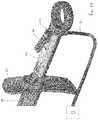
- a collar 28is attached to a proximal end 30 of the electrode assembly 14 .
- the collarmay be integral or differentiated.
- a flange 32can be distally disposed and attached to the collar 28 .
- the flange 32 and the electrode propeller 26are cooperatively arranged for the flange 32 to be received by a finger of a hand and the electrode propeller 26 to be actuated by the thumb of the hand when the flange 28 is so received.
- the thumbmay be inserted in a ring 34 of the electrode propeller 26 .
- a disengageable stop 36is arranged to prevent actuation of the electrode propeller 26 until disengaged, as shown in FIG. 7 .
- the collar 28is rotationally fixed to the electrode propeller 26 .
- the collar 28 and the distal end 30 of the electrode assembly, in this embodiment the electrode propeller 28are joined by a sliding keyed joint 38 .
- One of the distal end 30 of the electrode assembly and the collar 28comprise a key 40 in the form of a longitudinal rib, and the other of the distal end 30 of the electrode assembly and the collar 28 comprises a keyway 42 in the form of a longitudinal groove.
- the key 40is received within the keyway 42 for longitudinal sliding movement between the collar 28 and electrode propeller 26 , while fixing their relative rotational orientation around a common axis.
- a distal end 44 of the urethral catheter 12comprises a plurality of electrode passageways 46 connecting the lumen to the exterior.
- the present embodimenthas two electrode passageways opposite each other for passage of the electrodes 20 , 22 .
- the urethral catheter 12 and the electrode assembly 14are configured to engage with a predetermined rotational orientation to each other for alignment of the plurality of extendably mounted electrodes 20 , 22 with the plurality of electrode passageways.
- the electrode assembly 18has a “D” shaped lateral section that is received by the lumen 31 having a complementary “D” shape, as seen in FIG. 8 .
- the electrode assembly and the lumen 31may generally have any suitable interlocking cross sectional shapes, for example hexagonal, 10 square, or an arbitrary irregular shape.
- the urethral catheter 12 and the electrode assembly 14can be joined to form a sliding keyed joint, as shown in FIG. 2 .
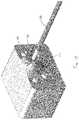
- an attached electrode assembly tip 23is also shown in FIG. 4 .
- the attachmentmay be by an ultrasonic, RF wield, or with adhesive.
- the assembly tip 23has a scoop to assist in insertion.
- the tipmay be replaced with another tip having different electrode port 33 , 35 positions.
- At least one of the electrode assembly 14 and the urethral catheter 12may, as in the present embodiment, comprise a fastener 48 in the form of a clip configured to fasten the electrode assembly 14 to the urethral catheter 12 when the electrode assembly is slidingly received within the urethral catheter. This may prevent accidental withdrawal of the electrodes during a procedure, for example.
- Embodimentsmay comprise a source 27 of the electricity, which is generally but not necessarily in the form of a direct current, and a controller for the source of the electricity.
- the power supplied to the electrodesis low compared to prior methods for treating BPH.
- the power suppliedmay be of the order of milliwatts, for example in the range of 20 to 3200 mW of power per electrode pair.
- the power typically used for each electrode pairis between approximately 190 mW (25 mA into a 300 ohm tissue impedance) to 1600 mW (40 mA into a 1000 ohm tissue impedance).
- a common impedance level seen in tissueis 400 ohms, and treating with 50 mA equates to a required power output of 1000 mW.
- This relatively low powerresults in insignificant heat transfer between the apparatus 10 and body tissues. This reduces or eliminates pain and discomfort from the heating of surrounding tissues during treatment that are experienced with thermal technologies utilizing significantly higher power. It also reduces or eliminates scarring and long healing times associated with a thermal wound.
- RF and microwave technologies using thermal energies to create necrosis in soft tissueoften have power ranges between 15 and 75 W.
- the amount of power delivered by a thermal ablation systemis not based directly on the measurement of the power delivered, but is based on the temperature measurement resulting from the power delivered. In contrast, the amount of charge delivered by the present embodiment is based directly on the measurement of the charge delivered, allowing for more precise control of the size of the necrotic zones.
- the apparatus 10may have an electrical connector 37 in electrical communication with the plurality of extendably mounted electrodes for making an electrical connection with the source 27 .
- the ablation of the prostate tissueis non-thermal, and a form of direct current ablation.
- Some embodimentsmay comprise a monitor configured to generate electrical parameter information indicative of an electrical parameter associated with electricity supplied to the plurality of expendably mounted electrodes.
- the controlleris configured to control the electricity supplied to the plurality of expendably mounted electrodes depending on the electrical parameter information.
- the monitormay measure the impedance experienced by the current in the form of a DC current that is supplied to the electrodes, the current flowing from one of the plurality of electrodes 20 , 22 to another one of the plurality of electrodes 20 , 22 .
- Gas bubbles in the form of hydrogen and oxygenmay be generated in the prostate tissue adjacent the plurality of extendably mounted electrodes during the electrolytic generation of at least one of a necrotizing base and a necrotizing acid within the prostate 3 , 4 , which generally increases the impedance of the current that may flow and decrease the rate at which the necrotizing acid and/or base are generated.
- Chlorine gasmay saturate the cathode surface.
- the tissuemay dehydrate at the anode.
- the controlleris in this but not necessarily in all embodiments configured to change the electricity during the electrolytic generation of at least one of the necrotizing base and the necrotizing acid within the prostate.
- the current and/or voltagemay be reduced or increased so that the rate of gas generation is approximately equal to the rate of gas absorption by the prostate, which manifests in a stable impendence.
- the controllermay turn off the current to allow gas to be absorbed, and after the gas has been absorbed turn on the current.
- the controllerreduces and/or turns off the supplied current when the impedance satisfies a first impendence condition, for example when the impedance is equal to or greater than a first impedance condition. The impedance may then drop as the gas is absorbed.
- the controllerWhen the measured impedance satisfies a second impedance condition, for example the impedance is equal to or less than a second threshold impedance, the controller increases and/or turns on the supplied current. In another embodiment, the controller may in response to determined impendence cause the supplied current to dither, for example oscillate, or fluctuate the current. The electricity supplied to the electrodes may be modulated to prevent the build-up of gas bubbles.
- Electricitymay be supplied to the plurality of electrodes asynchronously, for example first to one pair of electrodes, and then to another pair of electrodes. Switching the supply of electricity to the other pair of electrodes may result in a reduction in impedance because of the absence of gas bubbles thereat.
- the controllerhas a plurality of electrical modes for a plurality of prostates quality types.
- the prostatemay have different impedance depending of its age, or ability to absorb generated gases.
- MM or ultrasound imaginingmay be used to determine the prostate quality type.
- the different modesmay have different temporal electrical profiles.
- the plurality of extendably mounted electrodes 20 , 22may in some embodiments comprise an electrode within an insulating sheath defining at least two uninsulated distal portions of the electrode.
- the uninsulated distal portionseach act as a site for electrolysis, and may assist in reduction of gas build-up, or other sources of impedance.
- the sheathmay take the form of a film, a membrane, a tube or generally any suitable form. This may allow skipping of electrolysis between uninsulated distal portions, the skipping being in response to variations in impedance between the uninsulated distal portions.
- Each of the plurality of extendably mounted electrodescomprises a rounded or ground tip that is coated with platinum. This may reduce the incidence of scoring of the urethral epithelium when the electrodes are withdrawn.
- the electrodesare insulated with a polyimide membrane or generally any suitable form intermediate the distal and proximal ends.
- each of the plurality of extendably mounted electrodeshas a cruciform transverse section. This may maximize the surface area of the extendably mounted electrodes and enable greater current delivery for a given voltage, which may assist in minimizing gas generation in the tissue.
- Embodimentsmay comprise a chemical introducible by at least one of the plurality of electrodes into the prostate.
- At least one of the electrodesmay comprise a lumen connected to the exterior for delivery of the chemical within the prostate.
- the chemicalmay alternatively be attached to the surface of the at least one electrode, and may be a chemical coating on the at least one electrode.
- the chemicalgenerally belongs to a group of chemicals comprising a chemical that counters at least one of the necrotizing acid and the necrotizing base, and a necrotizing chemical that reduces or increases the pH within the prostate. Alternatively or additionally, the chemicals may counter the prostates natural pH buffer. The chemical may start acting before sufficient necrotizing base or acid has been electrolytically generated.
- the chemicalmay comprise an acid salt coating or a basic salt coating, which may cause necrosis before sufficient necrotizing acid and/or necrotizing base has been electrolytically generated.
- the chemicalmay slough off when electricity is supplied to the at least one electrode, for example.
- the chemicalsmay be deposited for treatment of a first volume, and then the electrodes disposed elsewhere for treatment of a second volume by electrolytically generating necrotizing acid or base.
- the shape of the treated volumemay be influenced by the introduction of the chemical.
- a saline solution or saline gelmay be introduced into a volume where ablation of tissue is not desired.
- a saline solution with a pH of 7may be provided adjacent to a treatment volume. This substantially prevents the necrotizing acid and base from advancing into a volume where ablation of tissue is not desired.
- the neutral pH of the salinedilutes the advancing acidic and basic gradient to prevent necrosis in irrigated volumes.
- the saline solutionmay be delivered by any suitable method.
- salinemay be introduced into a body lumen where preservation is desired, such as the urethra, through the therapy delivery catheter or through a separate dedicated irrigation catheter.
- At least one of the plurality of extendably mounted electrodesis more extendable than at least another one of the plurality of extendable lengths.
- the more extendable electrodemay be moved during treatment when the impendence exceeds a threshold value.
- the plurality of extendably mounted electrodescomprise Titanium-Nickel alloy (Nitinol) and may be coated with a corrosion resistant coating in the form of, for example, platinum.
- the electrodesmay be configured to be atraumatic. When extended, the tips of the extendably mounted electrodes penetrate the urethra wall and then penetrate the prostate. The electrode tips may be sufficiently sharp to penetrate the urethra wall.
- At least one of the plurality of extendably mounted electrodesis electrolytically corrodible.
- An electrolytically corrodible electrodeis corroded by the electrolytic process, resulting in the deposition of favorable or at least neutral ions in the ablated prostate area.
- Favorable ionsmay include silver ions that are anti-infective, magnesium ions, or iron ions. Electrode material that is cheaper than Platinum may be used.
- FIG. 10shows a flow chart 50 for steps of an embodiment of a method for the treatment of a prostatic disease that can be performed using the apparatus 10 .
- the methodcomprises the step 52 of inserting the urethral catheter 12 into a urethra 1 .
- the methodcomprises the step 54 of inserting the electrode assembly 14 into the urethra.
- the methodcomprises the step 56 of extending the plurality of extendably mounted electrodes 20 , 22 into a prostate adjacent the urethra 1 .
- the methodcomprises the step 58 of supplying electricity to the plurality of extendably mounted electrodes 20 , 22 .
- One of a necrotizing base and a necrotizing acidis electrolytically generated within the prostate when a current flows from one electrode to another electrode via the prostate.
- the electrode assembly 14is disposed within the urethral catheter 12 during insertion of the urethral catheter 12 into the urethra 1 . In another embodiment, however, the electrode assembly 14 is inserted into the urethral catheter 12 subsequent to insertion of the urethral catheter 12 into the urethra 1 .
- the urethral catheter 12is more flexible than the electrode assembly 14 .
- the urethral catheter 12may comprise, for example, silicone. It may be easier to insert the urethral catheter first. Once inserted, the urethral catheter 12 acts as a guide for the electrode assembly 12 when inserted, and protects the urethra 1 from, for example, accidental puncture by the relatively less flexible electrode assembly.
- the cathodemay be placed proximate the bladder neck or base of the prostate.
- a cathode so placedcreates a large area of necrosis with less relative variation. The area closest to the bladder neck in the prostate is responsible for the greatest contribution to lower urinary tract symptoms due to BPH.
- the anodemay be placed closer to the verumontanum.
- Another embodimentincludes placing the cathodes in the lateral posterior quadrant of the tissue relative to the urethra and placing the anodes in the lateral or lateral anterior quadrant of the tissue relative to the urethra.
- a treatment zoneforms around each of the electrodes and diffuses out generally passively.
- the electrodesmay be placed in the tissue relative to each other such that the treatment zones overlap and coalesce.
- the electrode assembly 14may be removed and the urethral catheter retained to assist in removal of urine from the urinary bladder 5 until at least one of, for example, the urethra is healed, inflammation has decreases, and swelling has decreased.
- An embodimentcomprises the step of changing the disposition of at least one of the plurality of extendably mounted electrodes within the prostate. Electricity is supplied to the at least one of the plurality of extendably mounted electrodes subsequent to the changing of its disposition.
- the plurality of electrodesmay be partially withdrawn or extended further. The electrodes may be fully withdrawn, the urethral catheter partially withdrawn or inserted deeper, and the electrodes extended to extend into a new site within the prostrate. Different sites may be treated, or a new site with little or no generated gas may be found.
- Electromyographymay be used to detect the sphincter urethrae membranaceae (“external sphincter muscle”) 2 adjacent the urethra 1 and prostate, and position the plurality of electrodes relative to the external urethral sphincter muscle. This may result is better positioning of the electrodes.
- the plurality of expendably mounted electrodesmay be withdrawn from the prostate, and another plurality of extendably mounted electrodes of another electrode assembly may be extended into the prostate at different prostate position.
- the treated volumemay be increased, or a new volume with less impedance or no gas bubbles may, which may reduce treatment time.
- an attached identification tagmay be read.
- the identification tagmay be in the form of a radio frequency identification tag; however other types of identification tags may be used.
- the identity information read from the identification tagmay be associated with procedure parameter information, commercial surveillance information, adverse event information for recall for example.
- the associationmay be within a computer data store, for example, that has received the information to be associated via a computer network.
- the electrical assemblycomprises a sensing electrode.
- the sensing electrodeis used to confirm that the electrodes are fully retracted in the apparatus 10 .
- the impendence between each of the extendably mounted electrodes and the sensor electrodeis determined, and a signal generated indicative of the extension state of at least one of the plurality of extendably mounded electrodes.
- the impedance between each of the retractably mounted electrodes and the sensor electrodeis generally lower when the extendably mounted electrodes are withdrawn.
- the monitormay generate the signal when the impedance between each of the retractably mounted electrodes and the sensor electrode is less than a threshold—to indicated that the electrodes are withdrawn and it is safe to remove the apparatus from the urethra—or is greater than a threshold to indicate that at least one of the extendably mounted electrodes is extended and it is not safe to remove the electrode.
- FIGS. 11 and 12respectively show perspective and exploded views of another embodiment of an apparatus 10 for treatment of a prostatic disease.
- the apparatus 10comprises a urethral catheter 12 , and an electrode assembly 14 slidably received within the urethral catheter 12 .
- FIG. 11shows the electrode assembly 14 received within the urethral catheter 12 .
- the urethral catheter 12can include a catheter wall extending between a distal end 44 and a proximal opening 24 defining a lumen 31 therebetween.
- the urethral catheter 12 and the electrode assembly 14are configured to slidably engage with one another via a predetermined rotational orientation to ensure proper alignment.
- the electrode assembly 14 and the lumen 31can generally have any suitable interlocking cross-sectional shape, for example, triangular, square, polygonal, or an arbitrary irregular shape.
- the electrode assembly 14can have a “D” shaped lateral section that is received by a complementary “D” shaped lumen 31 of the catheter 12 .
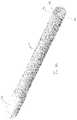
- the electrode assembly 14can include an elongated member or shaft 50 extending between a distal tip 18 and a proximal end 30 .
- the shaft 50can define a plurality of channels 29 shaped and sized to accommodate a plurality of extendably electrodes 20 , 22 therein.
- An electrode tip 23can be operably coupled to the distal end 18 of the shaft 50 .
- the electrode tip 23can define a plurality of electrode ports 33 , 35 configured to guide the electrodes 20 , 22 as they are extended out of the electrode assembly 14 and into surrounding prostatic tissue.
- a usermay choose from a variety of interchangeable electrode tips 23 , which can be selectively coupled to the shaft 50 .
- Various embodiments of electrode tips 23can present different scoops or tapers and/or different electrode port 33 , 35 configurations to accommodate a variety of patient conditions.
- the shaft 50can further define an anti-torsion strip channel 52 , in which an anti-torsion strip 54 can reside.
- An over jacket 56can be configured to at least partially surround the shaft 50 , thereby encouraging the electrodes 20 , 22 and anti-torsion strip 54 to remain within the respective channels 29 , 52 .
- Each of the plurality of extendable mounted electrodes 20 , 22which are slidably mounted in the channels 29 , are configured to promote necrosis of prostatic tissue via an electrolytic reaction.
- each of the plurality of electrodes 20can include a curved tip to ease their deployment out of the electrode assembly 14 .
- Each of the plurality of electrodes 20can include an uninsulated distal portion 58 configured to act as a site for electrolysis, and may be sufficiently sharp to penetrate the urethral wall.
- An insulated sheath 60in the form of a film, membrane, may surround other portions of the electrodes 20 .
- the proximal and 30 of the electrode assembly 14can be operably coupled to an assembly fixture 62 , thereby enabling each of the electrodes 20 to be electrically isolated and coupled to its respective outlet.
- the urethral catheter 12can define a proximal opening 24 through which the electrode assembly 14 is slidably received.
- the urethral catheter 12can further include a catheter inflation port 25 , which in some embodiments can include a slip Luer valve 64 and retaining clamp ring 66 .
- the distal end 44 of the urethral catheter 12can include a blunt, rounded, tapered, or beveled end to ease in insertion of the urethral catheter 12 into a patient.
- the urethral catheter 12can be constructed of silicone, and can be more flexible than the electrode assembly 14 . As such, the urethral catheter 12 can serve as a guide for the electrode assembly 14 , thereby protecting the urethra 1 from inadvertent trauma during insertion of the less flexible electrode assembly 14 .
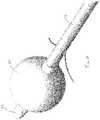
- the urethral catheter 12can include a fixation element in the form of an inflatable balloon 68 adjacent to a distal end 44 thereof, to fix the apparatus 10 in a treatment position.
- the inflatable balloon 68is configured to aid in the retention of the urethral catheter 12 within the urethra 1 .
- the inflatable balloon 68can be inflated with saline, air, or generally any suitable form a fluid.
- the saline or aircan be introduced via the catheter inflation port 25 , which is in fluid communication with the inflatable balloon 68 via a fluid conduit 70 , as shown in FIG. 20 .
- the urethral catheter 12can further include an anti-stretch device 72 , such as a wire, configured to inhibit longitudinal expansion and/or contraction, or a change in the overall length, of the urethral catheter 12 during manipulation of the inflatable balloon 68 .
- an anti-stretch device 72such as a wire, configured to inhibit longitudinal expansion and/or contraction, or a change in the overall length, of the urethral catheter 12 during manipulation of the inflatable balloon 68 .
- the urethral catheter 12can include a second inflatable balloon 74 , such that the first inflatable balloon 68 is positioned distally to an extension of the electrodes 20 , 22 along the urethral catheter 12 , and the second inflatable balloon 74 is positioned proximally to an extension of the electrodes 20 , 22 along the urethral catheter 12 .
- the first inflatable balloon 68 and the second inflatable balloon 74can serve as an aid in maintaining a desired position of the apparatus 10 during extension of the electrodes 20 , 22 .
- the second inflatable balloon 74can be disposed such that it is external of the urethra 1 when inflated, thereby serving as a visual indicator of the inflation state of the first inflatable balloon 68 .
- the plurality of extendably mounted electrodes 20 , 22are attached at a proximal end thereof to a linear actuatable handle.
- the linear actuatable handlecan be an electrode propeller 26 , for example, in the form of a knob or plunger.
- the electrode propeller 26can include a ring, shaped and sized to enable a thumb of the user to be at least partially inserted therein.
- the proximal end 30 of the electrode assembly 14can include a collar 28 configured to interface with the proximal opening 24 of the urethral catheter when the electrode assembly 14 is slidably received within the lumen 31 of the urethral catheter 12 .
- the collarcan define a flange 32 configured be received by a finger of a user, such that linear actuation of the extendable electrodes 20 , 22 can be controlled by a user manipulating the electrode propeller 26 relative to the flange 32 .
- FIG. 22Adepicts the apparatus in a non-extended position, whereby the electrodes 20 , 22 are not extended from the electrode assembly 14 .
- FIG. 22Bdepicts the apparatus a treatment position, whereby the electrodes are extended from the electrode assembly 14 .
- the collar 28 and the electrode propeller 26can be joined by a sliding keyed joint 38 , thereby inhibiting rotation of the electrode propeller 26 relative to the collar 28 .
- the electrode propeller 26can include a key 40 configured to be slidingly received within a corresponding keyway 42 defined by the collar 28 , thereby inhibiting rotation of the electrode propeller 26 relative to the collar 28 .
- the handlecan further include a disengageable stop 36 configured to inhibit actuation of the electrode propeller 26 relative to the collar 28 .
- the handlecan further include a fastener 48 configured to fasten the electrode assembly 14 to the urethral catheter 12 when the electrode assembly 14 is slidingly received within the urethral catheter 12 .
- An electrical connector 37can extend from the handle for connection to a source of electricity 27 , thereby supplying power to the electrodes 20 , 22 .
- An apparatus for the treatment of a prostatic diseasecomprising:
- An apparatus defined by the preceding paragraphcomprising an inflatable balloon adjacent a distal end of the urethral catheter for inflation within a urinary bladder in fluid communication with the urethra, and another inflatable balloon disposed at a proximal end of the urethral bladder and in fluid communication therewith.
- each of the plurality of extendably mounted electrical electrodesare slidingly mounted and are attached at a proximal end thereof to an electrode propeller that is user actuatable.
- An apparatus defined by any one of the preceding paragraphscomprising a collar attached to a proximal end of the electrode assembly and rotationally fixed to the electrode propeller.
- a distal end of the urethral cathetercomprises a plurality of electrode passageways connecting an interior and exterior of thereof, and the urethral catheter and the electrode assembly are configured to engage with a predetermined rotational orientation to each other for alignment of the plurality of extendably mounted electrodes with the plurality of electrode passageways.
- An apparatus defined by any one of the preceding paragraphscomprising a flange attached to the collar, wherein the flange and the electrode propeller are cooperatively arranged for the flange to be received by a finger of a hand and the electrode propeller to be actuated by the thumb of the hand when the flange is so received.
- An apparatus defined by any one of the preceding paragraphscomprising a disengageable stop arrange to prevent actuation of the electrode propeller until disengaged.
- At least one of the electrode assembly and the urethral cathetercomprise a fastener configured to fasten the electrode assembly to the urethral catheter when the electrode assembly is slidingly received within the urethral catheter.
- An apparatus defined by any one of the preceding paragraphscomprising a source of the electricity and a controller for the source of the electricity.
- An apparatus defined by the preceding paragraphcomprising a monitor configured to generate electrical parameter information indicative of an electrical parameter associated with electricity supplied to the plurality of expendably mounted electrodes, wherein the controller is configured to control the electricity supplied to the plurality of expendably mounted electrodes depending on the electrical parameter information.
- controllerconfigured to change the electricity during the electrolytic generation of at least one of the necrotizing base and the necrotizing acid within the prostate.
- controllerhas a plurality of electrical modes for a plurality of prostates quality types.
- An apparatus defined by any one of the proceeding paragraphs wherein the plurality of extendably mounted electrodescomprises an electrode within an insulating sheath defining at least two uninsulated distal portions of the electrode.
- each of the plurality of extendably mounted electrodescomprise a rounded tip.
- each of the plurality of extendably mounted electrodeshas a cruciform transverse section.
- An apparatus defined by any one of the preceding paragraphscomprising a chemical introducible by at least one of the plurality of electrodes into the prostate.
- An apparatusdefined by any one of the preceding paragraphs defining a plurality of channels for each electrode for selective disposition of each electrode within the prostate.
- urethral cathetercomprises a fixation element
- urethral cathetercomprises a Foley catheter.
- the electrode assemblycomprising a plurality of extendably mounted electrodes
- a method defined by any one of the preceding paragraphs wherein extending the plurality of electrodes into the prostate adjacent the urethracomprising a user actuating an electrode propeller attached to the plurality of electrodes to extend a plurality of tips of the plurality of electrodes out of the electrode assembly and into the prostate.
- a method defined by the preceding paragraphcomprising the step of rotationally fixing a collar attached to a proximal end of the electrode assembly to the electrode propeller.
- a method defined by the preceding paragraphcomprising the step of joining the electrode propeller and the collar to form a sliding keyed joint.
- a method defined by any one of the preceding paragraphscomprising disengaging a stop arranged to prevent actuation of the electrode propeller to enable actuation of the electrode propeller.
- a method defined by any one of the preceding paragraphscomprising the step of generating electrical parameter information indicative of electricity supplied to the plurality of extendably mounted electrodes, wherein the controller is configured to control the electricity supplied to the plurality of extendably mounted electrodes depending on the electrical parameter information.
- a method defined by the preceding paragraphcomprising the step of changing the electricity supplied to the plurality of extendably mounted electrodes during the electrolytic generation of at least one of the necrotizing base and the necrotizing acid.
- a method defined by any one of the preceding paragraphscomprising the step of selecting one of a plurality of electricity supply modes, the plurality of electricity supply modes being for treatment of a plurality of prostate quality types.
- a method defined by any one of the preceding paragraphscomprising the step of changing the disposition of at least one of the plurality of extendably mounted electrodes within the prostate and supplying electricity to the at least one of the plurality of extendably mounted electrodes.
- a method defined by any one of the preceding paragraphscomprising the step of introducing a chemical to a volume of the prostate, wherein the chemical belongs to a group of chemicals comprising a chemical that counters at least one of the necrotizing acid and the necrotizing base, and a necrotizing chemical that reduces or increases the pH within the prostate.
- a method defined by the preceding paragraphcomprising introducing the chemical into the prostate via a lumen in at least one of the plurality of electrodes.
- a method defined by any one of the preceding paragraphscomprising using electromyography to detect an sphincter urethrae membranaceae adjacent the urethra and position the plurality of electrodes relative to the sphincter urethrae membranaceae.
- a method defined by any one of the preceding paragraphscomprising inflating a first balloon attached to a distal end of the urethral catheter within a urinary bladder in fluid communication with the urethra, and a second balloon disposed adjacent a proximal end of the urethral catheter and in fluid communication with the first balloon.
- a method defined by any one of the preceding paragraphcomprising introducing a fluid into a balloon attached to a distal end of the urethral catheter and disposed within a urinary bladder in fluid communication with the urethra, and monitoring the pressure of the fluid introduced into the balloon.
- a method defined by any one of the preceding paragraphscomprising the step of reading an attached identification tag.
- a method defined by any one of the preceding paragraphs wherein the step of supplying the electricity to the plurality of extendably mounted electrodescomprises supplying electricity to the plurality of electrodes asynchronously.
- a method defined by any one of the preceding paragraphscomprising the step of withdrawing the plurality of extendable electrodes from the prostate and extending another plurality of extendably mounted electrodes of another electrode assembly into the prostate at a different prostate position.
- a method defined by any one of the preceding paragraphscomprising the step of activating a fixation element of the urethral catheter.
- urethral cathetercomprises a Foley catheter.
- An apparatus for the treatment of a prostatic diseasecomprising an electrode assembly slidingly receivable within a urethral catheter, the electrode assembly comprising a plurality of extendably mounted electrodes for extension through urethral issue and into a prostate, wherein the plurality of extendably mounted electrodes are for electrolytic generation of at least one of a necrotizing base and a necrotizing acid within the prostate.
- a urethral cathetercomprising a distally attached inflatable balloon for inflation within a body and a proximally attached inflatable balloon in fluid communication with the distally attached inflatable balloon for disposition exterior of the body when the distally attached inflatable balloon is so inflated within the body.
- urethral cathetermay not comprise the urethral catheter, which may be a separately supplied for the procedure, for example.
- urethral catheter in the present embodimentsis a Foley catheter or a variation thereof, generally any suitable urethral catheter may be used, examples of which include but are not limited to an intermittent catheter, and a coudé catheter.
- the present embodimentsare, therefore, to be considered in all respects as illustrative and not restrictive. Reference to a feature disclosed herein does not mean that all embodiments must include the feature.
Landscapes
- Health & Medical Sciences (AREA)
- Life Sciences & Earth Sciences (AREA)
- Engineering & Computer Science (AREA)
- Animal Behavior & Ethology (AREA)
- Veterinary Medicine (AREA)
- Public Health (AREA)
- General Health & Medical Sciences (AREA)
- Biomedical Technology (AREA)
- Heart & Thoracic Surgery (AREA)
- Surgery (AREA)
- Anesthesiology (AREA)
- Pulmonology (AREA)
- Biophysics (AREA)
- Hematology (AREA)
- Nuclear Medicine, Radiotherapy & Molecular Imaging (AREA)
- Medical Informatics (AREA)
- Molecular Biology (AREA)
- Physics & Mathematics (AREA)
- Plasma & Fusion (AREA)
- Otolaryngology (AREA)
- Cardiology (AREA)
- Epidemiology (AREA)
- Urology & Nephrology (AREA)
- Surgical Instruments (AREA)
- Electrotherapy Devices (AREA)
- Radiology & Medical Imaging (AREA)
- Orthopedics, Nursing, And Contraception (AREA)
- Radiation-Therapy Devices (AREA)
Abstract
Description
- The treatment of a prostatic disease may be minimally invasive.
- Treatment times may be less than prior art treatment times, for example no more than 10 minutes, for example no more than 8 minutes or no more than 5 minutes.
- The apparatus may be inserted by person with less skill than a urologist, for example a nurse or technician, and may be inserted without the use of transrectal ultrasound guidance.
- There may not be a significant increase in the prostate tissue temperature, for example no more than 10 degrees centigrade.
- There may not be a significant increase in a length of the urethral catheter, in some embodiments less than a 5% increase in length, and in other embodiments less than a 1% increase in length.
- a urethral catheter for insertion into a urethra; and
- an electrode assembly slidingly receivable within the urethral catheter, the electrode assembly comprising a plurality of extendably mounted electrodes for extension into a prostate adjacent the urethra, wherein the plurality of extendably mounted electrodes are for electrolytic generation of at least one of a necrotizing base and a necrotizing acid within the prostate.
Claims (21)
Applications Claiming Priority (2)
| Application Number | Priority Date | Filing Date | Title |
|---|---|---|---|
| AU2017904778AAU2017904778A0 (en) | 2017-11-27 | An apparatus and a method for the treatment of a prostatic disease | |
| AU2017904778 | 2017-11-27 |
Publications (2)
| Publication Number | Publication Date |
|---|---|
| US20190159834A1 US20190159834A1 (en) | 2019-05-30 |
| US11457975B2true US11457975B2 (en) | 2022-10-04 |
Family
ID=66632173
Family Applications (1)
| Application Number | Title | Priority Date | Filing Date |
|---|---|---|---|
| US16/201,642Active2041-08-05US11457975B2 (en) | 2017-11-27 | 2018-11-27 | Apparatus and a method for the treatment of a prostatic disease |
Country Status (8)
| Country | Link |
|---|---|
| US (1) | US11457975B2 (en) |
| EP (1) | EP3716875B1 (en) |
| KR (3) | KR20190001355U (en) |
| CN (1) | CN111629681B (en) |
| AU (1) | AU2018373389B2 (en) |
| DE (1) | DE202018106744U1 (en) |
| SG (1) | SG11202006666XA (en) |
| WO (1) | WO2019104326A1 (en) |
Cited By (1)
| Publication number | Priority date | Publication date | Assignee | Title |
|---|---|---|---|---|
| US20230058649A1 (en)* | 2021-08-17 | 2023-02-23 | Biosense Webster (Israel) Ltd. | Sheath, catheter, and method of controlling radial orientation thereof |
Families Citing this family (6)
| Publication number | Priority date | Publication date | Assignee | Title |
|---|---|---|---|---|
| WO2019168949A1 (en) | 2018-02-28 | 2019-09-06 | Prostacare Pty Ltd | System for managing high impedance changes in a non-thermal ablation system for bph |
| US11213341B2 (en) | 2018-08-13 | 2022-01-04 | Jgmg Bengochea, Llc | Bovie adapter for rotational control and fixation |
| DE102019220537A1 (en)* | 2019-12-23 | 2021-06-24 | Albert-Ludwigs-Universität Freiburg | Devices for enucleation of intracorporeal tissue areas |
| KR102317280B1 (en)* | 2021-06-16 | 2021-10-25 | (주)더스탠다드 | Urethroscope including invasive electrode for treating prostatic disease |
| CN113331938B (en)* | 2021-06-25 | 2022-06-17 | 武汉半边天医疗技术发展有限公司 | Micro-plastic temperature control radio frequency diagnosis and treatment system |
| KR102756167B1 (en)* | 2022-08-31 | 2025-01-22 | 쥬베뉴 주식회사 | Multifunctional epidural catheter comprising sensor for detecting the pressure acted on the combined ballon |
Citations (157)
| Publication number | Priority date | Publication date | Assignee | Title |
|---|---|---|---|---|
| US3698394A (en) | 1971-06-14 | 1972-10-17 | William S Piper | Electrically heated hypodermic needle |
| US3933616A (en) | 1967-02-10 | 1976-01-20 | Chemnor Corporation | Coating of protected electrocatalytic material on an electrode |
| US4003379A (en) | 1974-04-23 | 1977-01-18 | Ellinwood Jr Everett H | Apparatus and method for implanted self-powered medication dispensing |
| US4026304A (en) | 1972-04-12 | 1977-05-31 | Hydro Med Sciences Inc. | Bone generating method and device |
| US4289135A (en) | 1978-11-23 | 1981-09-15 | Tekniska Rontgencentralen Ab | Apparatus for destroying a selected part of biological tissue |
| US4572214A (en) | 1980-04-11 | 1986-02-25 | Ursus Konsult Ab | Electrode device |
| US4639244A (en) | 1983-05-03 | 1987-01-27 | Nabil I. Rizk | Implantable electrophoretic pump for ionic drugs and associated methods |
| US4679561A (en) | 1985-05-20 | 1987-07-14 | The United States Of America As Represented By The United States Department Of Energy | Implantable apparatus for localized heating of tissue |
| US4682596A (en) | 1984-05-22 | 1987-07-28 | Cordis Corporation | Electrosurgical catheter and method for vascular applications |
| US4721123A (en) | 1986-10-23 | 1988-01-26 | Minntech Corporation | Catheter reprocessing system |
| US4919138A (en) | 1987-11-13 | 1990-04-24 | Nordenstrooem Bjoern | Method and apparatus for supplying electric energy to biological tissue for simulating the physiological healing process |
| US4974595A (en) | 1987-11-13 | 1990-12-04 | Nordenstroem Bjoern | Electrode device intended to be introduced into the body of a living being |
| US5002558A (en) | 1989-08-23 | 1991-03-26 | The Beth Israel Hospital Association | Adjustable urethral catheter and method for treating obstructive prostatism |
| US5026371A (en) | 1990-10-01 | 1991-06-25 | Everest Medical Corporation | Handle for polypectome snare with bipolar electrodes |
| US5058605A (en) | 1989-02-22 | 1991-10-22 | Ceske Vysoke Uceni Technicke | Method and device for the controlled local, non-invasive application of dc pulses to human and animal tissues |
| US5084154A (en) | 1989-08-18 | 1992-01-28 | Asahi Kasei Kogyo Kabushiki Kaisha | Hydrogen-evolution electrode having high durability and stability |
| US5098843A (en) | 1987-06-04 | 1992-03-24 | Calvin Noel M | Apparatus for the high efficiency transformation of living cells |
| US5281218A (en) | 1992-06-05 | 1994-01-25 | Cardiac Pathways Corporation | Catheter having needle electrode for radiofrequency ablation |
| US5304214A (en) | 1992-01-21 | 1994-04-19 | Med Institute, Inc. | Transurethral ablation catheter |
| US5314451A (en) | 1993-01-15 | 1994-05-24 | Medtronic, Inc. | Replaceable battery for implantable medical device |
| US5314457A (en) | 1993-04-08 | 1994-05-24 | Jeutter Dean C | Regenerative electrical |
| US5370675A (en) | 1992-08-12 | 1994-12-06 | Vidamed, Inc. | Medical probe device and method |
| US5431625A (en) | 1991-02-01 | 1995-07-11 | Empi, Inc. | Iontophoresis electronic device having a ramped output current |
| US5458627A (en) | 1992-10-15 | 1995-10-17 | Electro-Biology, Inc. | Electrochemically controlled faradic stimulation of osteogenesis |
| US5482054A (en) | 1990-05-10 | 1996-01-09 | Symbiosis Corporation | Edoscopic biopsy forceps devices with selective bipolar cautery |
| US5501662A (en) | 1992-05-22 | 1996-03-26 | Genetronics, Inc. | Implantable electroporation method and apparatus for drug and gene delivery |
| US5507724A (en) | 1992-07-01 | 1996-04-16 | Genetronics, Inc. | Electroporation and iontophoresis apparatus and method for insertion of drugs and genes into cells |
| US5529574A (en) | 1992-08-21 | 1996-06-25 | Frackelton; James P. | Method and apparatus for treatment of the prostate |
| US5536267A (en) | 1993-11-08 | 1996-07-16 | Zomed International | Multiple electrode ablation apparatus |
| US5558673A (en) | 1994-09-30 | 1996-09-24 | Vidamed, Inc. | Medical probe device and method having a flexible resilient tape stylet |
| US5584872A (en) | 1992-11-13 | 1996-12-17 | Scimed Life Systems, Inc. | Electrophysiology energy treatment devices and methods of use |
| US5611350A (en) | 1996-02-08 | 1997-03-18 | John; Michael S. | Method and apparatus for facilitating recovery of patients in deep coma |
| US5630426A (en) | 1995-03-03 | 1997-05-20 | Neovision Corporation | Apparatus and method for characterization and treatment of tumors |
| US5672153A (en) | 1992-08-12 | 1997-09-30 | Vidamed, Inc. | Medical probe device and method |
| US5674267A (en) | 1993-03-30 | 1997-10-07 | Centre National De La Recherche Scientifique | Electric pulse applicator using pairs of needle electrodes for the treatment of biological tissue |
| WO1997036632A1 (en) | 1996-03-29 | 1997-10-09 | Iotek, Inc. | Catheter and method for generating axial tension along catheter body |
| US5680860A (en) | 1994-07-07 | 1997-10-28 | Cardiac Pathways Corporation | Mapping and/or ablation catheter with coilable distal extremity and method for using same |
| US5701895A (en) | 1995-11-13 | 1997-12-30 | Sulzer Intermedics Inc. | Subcutaneous electrical data port |
| US5718686A (en) | 1996-07-02 | 1998-02-17 | Urocath Corporation | Anchoring system and method for indwelling urethral catheter |
| US5807306A (en) | 1992-11-09 | 1998-09-15 | Cortrak Medical, Inc. | Polymer matrix drug delivery apparatus |
| US5810764A (en) | 1992-01-07 | 1998-09-22 | Arthrocare Corporation | Resecting loop electrode and method for electrosurgical cutting and ablation |
| US5820548A (en) | 1996-01-17 | 1998-10-13 | Micronas Intermetall Gmbh | Apparatus for treating malignant tissue changes |
| WO1998047562A1 (en) | 1997-04-24 | 1998-10-29 | Ichor Medical Systems, Inc. | Electrodes and electrode arrays |
| US5868741A (en) | 1997-05-21 | 1999-02-09 | Irvine Biomedical, Inc. | Ablation catheter system having fixation tines |
| US5869326A (en) | 1996-09-09 | 1999-02-09 | Genetronics, Inc. | Electroporation employing user-configured pulsing scheme |
| US5919187A (en) | 1990-03-13 | 1999-07-06 | The Regents Of The University Of California | Method and apparatus for endovascular thermal thrombosis and thermal cancer treatment |
| US5931858A (en) | 1998-01-12 | 1999-08-03 | Cardiac Pacemakers, Inc. | Implantable device for monitoring aerobic capacity of patients |
| US5983131A (en) | 1995-08-11 | 1999-11-09 | Massachusetts Institute Of Technology | Apparatus and method for electroporation of tissue |
| US5985305A (en) | 1996-02-02 | 1999-11-16 | Alza Corporation | Sustained delivery of an active agent using an implantable system |
| US5993434A (en) | 1993-04-01 | 1999-11-30 | Genetronics, Inc. | Method of treatment using electroporation mediated delivery of drugs and genes |
| US6009345A (en) | 1992-08-17 | 1999-12-28 | Genetronics, Inc. | Method and apparatus for a combination of electroporation and iontophoresis for the delivery of drugs and genes |
| US6016452A (en) | 1996-03-19 | 2000-01-18 | Kasevich; Raymond S. | Dynamic heating method and radio frequency thermal treatment |
| US6021347A (en) | 1996-12-05 | 2000-02-01 | Herbst; Ewa | Electrochemical treatment of malignant tumors |
| US6023638A (en) | 1995-07-28 | 2000-02-08 | Scimed Life Systems, Inc. | System and method for conducting electrophysiological testing using high-voltage energy pulses to stun tissue |
| US6049733A (en) | 1994-04-08 | 2000-04-11 | Alza Corporation | Electrotransport system with ion exchange material competitive ion capture |
| US6051017A (en) | 1996-02-20 | 2000-04-18 | Advanced Bionics Corporation | Implantable microstimulator and systems employing the same |
| US6162219A (en) | 1997-10-21 | 2000-12-19 | Akzo Nobel N.V. | Electrode |
| US6165206A (en) | 1998-03-06 | 2000-12-26 | Tu; Hosheng | Apparatus for medical ablation use and methods thereof |
| US6169924B1 (en) | 1999-04-27 | 2001-01-02 | T. Stuart Meloy | Spinal cord stimulation |
| US6171787B1 (en) | 1997-06-26 | 2001-01-09 | Abbott Laboratories | Member of the TNF family useful for treatment and diagnosis of disease |
| US6174309B1 (en) | 1999-02-11 | 2001-01-16 | Medical Scientific, Inc. | Seal & cut electrosurgical instrument |
| US6179833B1 (en) | 1995-06-09 | 2001-01-30 | Engineering & Research Associates, Inc. | Apparatus for thermal ablation |
| EP1080731A2 (en) | 1999-09-01 | 2001-03-07 | Hisamitsu Pharmaceutical Co. Inc. | Composition and device structure for iontophoresis |
| US20010001314A1 (en) | 1997-06-13 | 2001-05-17 | Arthrocare Corporation | Electrosurgical systems and methods for recanalization of occluded body lumens |
| US6238393B1 (en) | 1998-07-07 | 2001-05-29 | Medtronic, Inc. | Method and apparatus for creating a bi-polar virtual electrode used for the ablation of tissue |
| US6245068B1 (en) | 1994-08-08 | 2001-06-12 | Scimed Life Systems, Inc. | Resilient radiopaque electrophysiology electrodes and probes including the same |
| WO2001049195A1 (en) | 1999-12-23 | 2001-07-12 | Prostalund Operations Ab | Method and device for the treatment of prostate tissue |
| WO2001052931A1 (en) | 2000-01-21 | 2001-07-26 | Impulse Dynamics Nv | Blood flow controller |
| US6269270B1 (en) | 1998-10-26 | 2001-07-31 | Birinder Bob Boveja | Apparatus and method for adjunct (add-on) therapy of Dementia and Alzheimer's disease utilizing an implantable lead and external stimulator |
| US6273886B1 (en) | 1998-02-19 | 2001-08-14 | Curon Medical, Inc. | Integrated tissue heating and cooling apparatus |
| WO2001062336A1 (en) | 2000-02-23 | 2001-08-30 | The Trustees Of The University Of Pennsylvania | Regulation of genes via application of specific and selective electrical and electromagnetic signals |
| US20010021868A1 (en) | 1999-12-10 | 2001-09-13 | Ewa Herbst | Electrochemical treatment of tissues, especially tumors |
| US20010034518A1 (en) | 1994-06-24 | 2001-10-25 | Curon Medical, Inc. | Sphincter treatment apparatus |
| US20020002329A1 (en) | 1993-12-03 | 2002-01-03 | Boaz Avitall | Mapping and ablation catheter system |
| US20020026188A1 (en) | 2000-03-31 | 2002-02-28 | Balbierz Daniel J. | Tissue biopsy and treatment apparatus and method |
| US6366808B1 (en) | 2000-03-13 | 2002-04-02 | Edward A. Schroeppel | Implantable device and method for the electrical treatment of cancer |
| US6379353B1 (en)* | 1997-05-19 | 2002-04-30 | Radiotherapeutics Corporation | Apparatus and method for treating tissue with multiple electrodes |
| US6387075B1 (en) | 1998-10-23 | 2002-05-14 | Scimed Life Systems, Inc. | Catheter having improved proximal shaft design |
| US6391026B1 (en) | 1998-09-18 | 2002-05-21 | Pro Duct Health, Inc. | Methods and systems for treating breast tissue |
| US6402745B1 (en) | 2000-02-23 | 2002-06-11 | Peter J. Wilk | Intravenous whip electrode for vein ablation |
| US20020077676A1 (en) | 1999-04-09 | 2002-06-20 | Schroeppel Edward A. | Implantable device and method for the electrical treatment of cancer |
| US6419673B1 (en) | 1996-05-06 | 2002-07-16 | Stuart Edwards | Ablation of rectal and other internal body structures |
| US20020111618A1 (en) | 1999-04-05 | 2002-08-15 | Stewart Mark T. | Ablation catheter assembly with radially decreasing helix and method of use |
| US20020115957A1 (en) | 1998-08-31 | 2002-08-22 | Ying Sun | Electrotransort device comprising blades |
| US6464699B1 (en) | 1997-10-10 | 2002-10-15 | Scimed Life Systems, Inc. | Method and apparatus for positioning a diagnostic or therapeutic element on body tissue and mask element for use with same |
| WO2002098501A2 (en) | 2001-06-07 | 2002-12-12 | Ramot At Tel Aviv University Ltd. | Method and apparatus for treating tumors using low strength electric fields |
| US6591133B1 (en) | 2000-11-27 | 2003-07-08 | Microlin Llc | Apparatus and methods for fluid delivery using electroactive needles and implantable electrochemical delivery devices |
| US20030130711A1 (en) | 2001-09-28 | 2003-07-10 | Pearson Robert M. | Impedance controlled tissue ablation apparatus and method |
| US6595989B1 (en) | 1999-05-11 | 2003-07-22 | Atrionix, Inc. | Balloon anchor wire |
| US6599274B1 (en) | 2000-01-20 | 2003-07-29 | John Kucharczyk | Cell delivery catheter and method |
| US6600953B2 (en) | 2000-12-11 | 2003-07-29 | Impulse Dynamics N.V. | Acute and chronic electrical signal therapy for obesity |
| US6607528B1 (en) | 1999-06-22 | 2003-08-19 | Senorx, Inc. | Shapeable electrosurgical scalpel |
| US6626899B2 (en) | 1999-06-25 | 2003-09-30 | Nidus Medical, Llc | Apparatus and methods for treating tissue |
| US20030191504A1 (en) | 1999-07-30 | 2003-10-09 | Meadows Paul M. | Implantable pulse generators using rechargeable zero-volt technology lithium-ion batteries |
| US6638273B1 (en) | 1996-03-05 | 2003-10-28 | Vnus Medical Technologies, Inc. | Expandable catheter having improved electrode design, and method for applying energy |
| US6638275B1 (en) | 2000-10-05 | 2003-10-28 | Medironic, Inc. | Bipolar ablation apparatus and method |
| US20030212394A1 (en) | 2001-05-10 | 2003-11-13 | Rob Pearson | Tissue ablation apparatus and method |
| US20040010290A1 (en) | 1999-04-09 | 2004-01-15 | Schroeppel Edward A. | Method and device for treating cancer with electrical therapy in conjunction with chemotherapeutic agents and radiation therapy |
| US20040059326A1 (en) | 2001-05-02 | 2004-03-25 | Jesse Flores | Dual-profile steerable catheter |
| US6713291B2 (en) | 1999-01-28 | 2004-03-30 | Alan D. King | Electrodes coated with treating agent and uses thereof |
| US6733485B1 (en) | 2001-05-25 | 2004-05-11 | Advanced Bionics Corporation | Microstimulator-based electrochemotherapy methods and systems |
| US20040172089A1 (en) | 2001-01-30 | 2004-09-02 | Whitehurst Todd K. | Fully implantable miniature neurostimulator for stimulation as a therapy for epilepsy |
| US20040254618A1 (en) | 2000-03-13 | 2004-12-16 | Schroeppel Edward A. | Implantable device and method for the electrical treatment of cancer |
| US20050004438A1 (en) | 2003-06-16 | 2005-01-06 | Ward W. Kenneth | Compound metal analyte sensor |
| US20050004507A1 (en) | 2000-03-13 | 2005-01-06 | Oncostim. Inc. | Method and device for treating cancer with electrical therapy in conjunction with chemotherapeutic agents and radiation therapy |
| US20050054994A1 (en) | 2002-09-25 | 2005-03-10 | Iulian Cioanta | Catheters with suction capability and related methods and systems for obtaining biosamples in vivo |
| US20050080409A1 (en) | 2003-10-10 | 2005-04-14 | Scimed Life Systems, Inc. | Multi-zone bipolar ablation probe assembly |
| US6901296B1 (en) | 2001-05-25 | 2005-05-31 | Advanced Bionics Corporation | Methods and systems for direct electrical current stimulation as a therapy for cancer and other neoplastic diseases |
| US20050131508A1 (en) | 2003-12-11 | 2005-06-16 | Scimed Life Systems, Inc. | Ablation probe with temperature sensitive electrode array |
| US20050159742A1 (en) | 1997-05-09 | 2005-07-21 | Lesh Michael D. | Tissue ablation device and method of use |
| US20050182449A1 (en) | 2001-05-26 | 2005-08-18 | Map Technologies, Llc | Methods for electrosurgical electrolysis |
| US20050197657A1 (en) | 2004-03-02 | 2005-09-08 | Goth Paul R. | Thermokeratoplasty system with a regulated power generator |
| WO2005086683A2 (en) | 2004-03-05 | 2005-09-22 | Arthrocare Corporation | Tip reinforced electrosurgical device |
| US6952615B2 (en) | 2001-09-28 | 2005-10-04 | Shutaro Satake | Radiofrequency thermal balloon catheter |
| US20050222623A1 (en) | 2004-04-06 | 2005-10-06 | Oncostim Inc., A Minnesota Corporation | Partially implantable system for the electrical treatment of cancer |
| US20050222646A1 (en) | 2004-04-06 | 2005-10-06 | Kai Kroll | Method and device for treating cancer with modified output electrical therapy |
| US20050228373A1 (en) | 2003-03-13 | 2005-10-13 | Scimed Life Systems, Inc. | Surface electrode multiple mode operation |
| US20050245923A1 (en) | 2004-04-29 | 2005-11-03 | Medtronic, Inc. | Biopolar virtual electrode for transurethral needle ablation |
| US20050283125A1 (en) | 2003-01-17 | 2005-12-22 | Susanne Barkhahn | Flexible injection needle |
| US20050288730A1 (en) | 2002-04-08 | 2005-12-29 | Mark Deem | Methods and apparatus for renal neuromodulation |
| US20060025756A1 (en) | 2000-01-19 | 2006-02-02 | Francischelli David E | Methods of using high intensity focused ultrasound to form an ablated tissue area |
| WO2006042117A2 (en) | 2004-10-06 | 2006-04-20 | Sherwood Services Ag | Systems and methods for thermally profiling radiofrequency electrodes |
| US20060095032A1 (en) | 1999-11-16 | 2006-05-04 | Jerome Jackson | Methods and systems for determining physiologic characteristics for treatment of the esophagus |
| US7079890B2 (en) | 2003-03-19 | 2006-07-18 | Solco Biomedical Co., Ltd. | Electrochemical therapy apparatus |
| US20060235286A1 (en) | 2005-03-28 | 2006-10-19 | Minnow Medical, Llc | Tuned RF energy for selective treatment of atheroma and other target tissues and/or structures |
| US20060259027A1 (en) | 2005-03-25 | 2006-11-16 | Harry Kwan | Cavity ablation apparatus and method |
| US20070016067A1 (en) | 2005-05-19 | 2007-01-18 | The Johns Hopkins University | Distal bevel-tip needle control device and algorithm |
| US20070073391A1 (en) | 2005-09-28 | 2007-03-29 | Henry Bourang | System and method for delivering a mitral valve repair device |
| US20070179491A1 (en) | 2006-01-31 | 2007-08-02 | Medtronic, Inc. | Sensing needle for ablation therapy |
| US20070191925A1 (en) | 2003-11-24 | 2007-08-16 | Angiomed Gmbh & Co.Medizintechn Kg | Catheter device |
| US20070255207A1 (en) | 2003-12-11 | 2007-11-01 | Masanori Hangai | Balloon Catheter |
| US20070260234A1 (en) | 2006-05-03 | 2007-11-08 | Mccullagh Orla | Diamond-like carbon electrode coating |
| US20080021445A1 (en) | 2004-10-13 | 2008-01-24 | Medtronic, Inc. | Transurethral needle ablation system |
| US20080021275A1 (en) | 2006-01-19 | 2008-01-24 | The General Hospital Corporation | Methods and systems for optical imaging or epithelial luminal organs by beam scanning thereof |
| US20080027379A1 (en) | 2006-07-28 | 2008-01-31 | Taylor Medical, Inc. | Catheter components formed of polymer with particles or fibers |
| US20080071262A1 (en) | 2006-09-14 | 2008-03-20 | Larry Azure | Tissue ablation and removal |
| US20080132885A1 (en) | 2006-12-01 | 2008-06-05 | Boris Rubinsky | Methods for treating tissue sites using electroporation |
| US20080161804A1 (en) | 2006-12-27 | 2008-07-03 | Boston Scientific Scimed, Inc. | Rf ablation probe array advancing device |
| WO2008083407A1 (en) | 2007-01-02 | 2008-07-10 | Aquabeam Llc | Minimally invasive methods and devices for the treatment of prostate diseases |
| US20080243116A1 (en) | 2006-09-21 | 2008-10-02 | Anderson Neil L | Catheter assembly |
| US7556624B2 (en) | 1997-04-07 | 2009-07-07 | Asthmatx, Inc. | Method of increasing gas exchange of a lung |
| US20100049188A1 (en) | 2008-08-20 | 2010-02-25 | Ionix Medical, Inc. | Non-Thermal Ablation System for Treating Tissue |
| WO2010022278A1 (en) | 2008-08-20 | 2010-02-25 | Ionix Medical, Inc. | Catheter for treating tissue with non-thermal ablation |
| WO2010022275A1 (en) | 2008-08-20 | 2010-02-25 | Ionix Medical, Inc. | Non-thermal ablation system for treating tissue |
| US20100145325A1 (en) | 2008-11-06 | 2010-06-10 | Michael Hoey | Systems and Methods for Treatment of Prostatic Tissue |
| US20100168777A1 (en) | 2008-12-29 | 2010-07-01 | Stangenes Todd R | Tissue puncture assemblies and methods for puncturing tissue |
| WO2010081730A1 (en) | 2009-01-16 | 2010-07-22 | Oncotherm Kft. | Intraluminar oncothermia catheter |
| US7837670B2 (en) | 2005-03-22 | 2010-11-23 | Boston Scientific Scimed, Inc. | Methods and devices for delivering therapeutic agents into the prostate gland |
| US20110166569A1 (en) | 1996-12-19 | 2011-07-07 | Whayne James G | Structures For Supporting Multiple Electrode Elements |
| US20110208022A1 (en) | 2008-09-16 | 2011-08-25 | Intersect Partners ,LLC a Limited Liability Corporation | Device and methods for sampling prostate fluid |
| US20110224663A1 (en) | 2008-04-23 | 2011-09-15 | Tornier, Inc. | Control circuitry for a tissue ablation system |
| US20140005676A1 (en) | 2012-06-28 | 2014-01-02 | Ethicon Endo-Surgery, Inc. | Rotary actuatable closure arrangement for surgical end effector |
| US8880195B2 (en)* | 2007-09-14 | 2014-11-04 | Lazure Technologies, Llc | Transurethral systems and methods for ablation treatment of prostate tissue |
| US20160184039A1 (en) | 2012-06-28 | 2016-06-30 | Ethicon Endo-Surgery, Llc | Surgical end effectors having angled tissue-contacting surfaces |
| US10004551B2 (en) | 2009-06-01 | 2018-06-26 | Channel Medsystems, Inc. | Methods and apparatus for treatment of a body cavity or lumen |
| US20190021779A1 (en) | 2017-07-21 | 2019-01-24 | Biosense Webster (Israel) Ltd. | Ablation power supply |
| US20200022748A1 (en) | 2018-02-28 | 2020-01-23 | Prostacare Pty Ltd | System for managing high impedance changes in a non-thermal ablation system for bph |
Family Cites Families (2)
| Publication number | Priority date | Publication date | Assignee | Title |
|---|---|---|---|---|
| US5843019A (en)* | 1992-01-07 | 1998-12-01 | Arthrocare Corporation | Shaped electrodes and methods for electrosurgical cutting and ablation |
| CN201123844Y (en)* | 2007-05-29 | 2008-10-01 | 苏州新区华盛医疗器械厂 | Interventional therapeutic apparatus in prostate cavity |
- 2018
- 2018-11-27WOPCT/US2018/062618patent/WO2019104326A1/ennot_activeCeased
- 2018-11-27SGSG11202006666XApatent/SG11202006666XA/enunknown
- 2018-11-27KRKR2020180005457Upatent/KR20190001355U/ennot_activeWithdrawn
- 2018-11-27KRKR1020247012547Apatent/KR20240063965A/ennot_activeCeased
- 2018-11-27EPEP18880749.9Apatent/EP3716875B1/enactiveActive
- 2018-11-27CNCN201880087677.XApatent/CN111629681B/enactiveActive
- 2018-11-27USUS16/201,642patent/US11457975B2/enactiveActive
- 2018-11-27AUAU2018373389Apatent/AU2018373389B2/enactiveActive
- 2018-11-27DEDE202018106744.3Upatent/DE202018106744U1/enactiveActive
- 2018-11-27KRKR1020207018707Apatent/KR102659146B1/enactiveActive
Patent Citations (185)
| Publication number | Priority date | Publication date | Assignee | Title |
|---|---|---|---|---|
| US3933616A (en) | 1967-02-10 | 1976-01-20 | Chemnor Corporation | Coating of protected electrocatalytic material on an electrode |
| US3698394A (en) | 1971-06-14 | 1972-10-17 | William S Piper | Electrically heated hypodermic needle |
| US4026304A (en) | 1972-04-12 | 1977-05-31 | Hydro Med Sciences Inc. | Bone generating method and device |
| US4003379A (en) | 1974-04-23 | 1977-01-18 | Ellinwood Jr Everett H | Apparatus and method for implanted self-powered medication dispensing |
| US4289135A (en) | 1978-11-23 | 1981-09-15 | Tekniska Rontgencentralen Ab | Apparatus for destroying a selected part of biological tissue |
| US4572214A (en) | 1980-04-11 | 1986-02-25 | Ursus Konsult Ab | Electrode device |
| US4639244A (en) | 1983-05-03 | 1987-01-27 | Nabil I. Rizk | Implantable electrophoretic pump for ionic drugs and associated methods |
| US4682596A (en) | 1984-05-22 | 1987-07-28 | Cordis Corporation | Electrosurgical catheter and method for vascular applications |
| US4679561A (en) | 1985-05-20 | 1987-07-14 | The United States Of America As Represented By The United States Department Of Energy | Implantable apparatus for localized heating of tissue |
| US4721123A (en) | 1986-10-23 | 1988-01-26 | Minntech Corporation | Catheter reprocessing system |
| US5098843A (en) | 1987-06-04 | 1992-03-24 | Calvin Noel M | Apparatus for the high efficiency transformation of living cells |
| US4919138A (en) | 1987-11-13 | 1990-04-24 | Nordenstrooem Bjoern | Method and apparatus for supplying electric energy to biological tissue for simulating the physiological healing process |
| US4974595A (en) | 1987-11-13 | 1990-12-04 | Nordenstroem Bjoern | Electrode device intended to be introduced into the body of a living being |
| US5058605A (en) | 1989-02-22 | 1991-10-22 | Ceske Vysoke Uceni Technicke | Method and device for the controlled local, non-invasive application of dc pulses to human and animal tissues |
| US5084154A (en) | 1989-08-18 | 1992-01-28 | Asahi Kasei Kogyo Kabushiki Kaisha | Hydrogen-evolution electrode having high durability and stability |
| US5002558A (en) | 1989-08-23 | 1991-03-26 | The Beth Israel Hospital Association | Adjustable urethral catheter and method for treating obstructive prostatism |
| US5919187A (en) | 1990-03-13 | 1999-07-06 | The Regents Of The University Of California | Method and apparatus for endovascular thermal thrombosis and thermal cancer treatment |
| US5482054A (en) | 1990-05-10 | 1996-01-09 | Symbiosis Corporation | Edoscopic biopsy forceps devices with selective bipolar cautery |
| US5026371A (en) | 1990-10-01 | 1991-06-25 | Everest Medical Corporation | Handle for polypectome snare with bipolar electrodes |
| US5431625A (en) | 1991-02-01 | 1995-07-11 | Empi, Inc. | Iontophoresis electronic device having a ramped output current |
| US5810764A (en) | 1992-01-07 | 1998-09-22 | Arthrocare Corporation | Resecting loop electrode and method for electrosurgical cutting and ablation |
| US5304214A (en) | 1992-01-21 | 1994-04-19 | Med Institute, Inc. | Transurethral ablation catheter |
| US5501662A (en) | 1992-05-22 | 1996-03-26 | Genetronics, Inc. | Implantable electroporation method and apparatus for drug and gene delivery |
| US5281218A (en) | 1992-06-05 | 1994-01-25 | Cardiac Pathways Corporation | Catheter having needle electrode for radiofrequency ablation |
| US5507724A (en) | 1992-07-01 | 1996-04-16 | Genetronics, Inc. | Electroporation and iontophoresis apparatus and method for insertion of drugs and genes into cells |
| US20050010203A1 (en) | 1992-08-12 | 2005-01-13 | Medtronic Vidamed, Inc. | Medical probe device and method |
| US5672153A (en) | 1992-08-12 | 1997-09-30 | Vidamed, Inc. | Medical probe device and method |
| US5536240A (en) | 1992-08-12 | 1996-07-16 | Vidamed, Inc. | Medical probe device and method |
| US5370675A (en) | 1992-08-12 | 1994-12-06 | Vidamed, Inc. | Medical probe device and method |
| US6009345A (en) | 1992-08-17 | 1999-12-28 | Genetronics, Inc. | Method and apparatus for a combination of electroporation and iontophoresis for the delivery of drugs and genes |
| US5529574A (en) | 1992-08-21 | 1996-06-25 | Frackelton; James P. | Method and apparatus for treatment of the prostate |
| US5458627A (en) | 1992-10-15 | 1995-10-17 | Electro-Biology, Inc. | Electrochemically controlled faradic stimulation of osteogenesis |
| US5807306A (en) | 1992-11-09 | 1998-09-15 | Cortrak Medical, Inc. | Polymer matrix drug delivery apparatus |
| US5584872A (en) | 1992-11-13 | 1996-12-17 | Scimed Life Systems, Inc. | Electrophysiology energy treatment devices and methods of use |
| US5314451A (en) | 1993-01-15 | 1994-05-24 | Medtronic, Inc. | Replaceable battery for implantable medical device |
| US5674267A (en) | 1993-03-30 | 1997-10-07 | Centre National De La Recherche Scientifique | Electric pulse applicator using pairs of needle electrodes for the treatment of biological tissue |
| US5993434A (en) | 1993-04-01 | 1999-11-30 | Genetronics, Inc. | Method of treatment using electroporation mediated delivery of drugs and genes |
| US5314457A (en) | 1993-04-08 | 1994-05-24 | Jeutter Dean C | Regenerative electrical |
| US5536267A (en) | 1993-11-08 | 1996-07-16 | Zomed International | Multiple electrode ablation apparatus |
| US20020002329A1 (en) | 1993-12-03 | 2002-01-03 | Boaz Avitall | Mapping and ablation catheter system |
| US6049733A (en) | 1994-04-08 | 2000-04-11 | Alza Corporation | Electrotransport system with ion exchange material competitive ion capture |
| US20010034518A1 (en) | 1994-06-24 | 2001-10-25 | Curon Medical, Inc. | Sphincter treatment apparatus |
| US5680860A (en) | 1994-07-07 | 1997-10-28 | Cardiac Pathways Corporation | Mapping and/or ablation catheter with coilable distal extremity and method for using same |
| US6245068B1 (en) | 1994-08-08 | 2001-06-12 | Scimed Life Systems, Inc. | Resilient radiopaque electrophysiology electrodes and probes including the same |
| US5558673A (en) | 1994-09-30 | 1996-09-24 | Vidamed, Inc. | Medical probe device and method having a flexible resilient tape stylet |
| US5630426A (en) | 1995-03-03 | 1997-05-20 | Neovision Corporation | Apparatus and method for characterization and treatment of tumors |
| US6179833B1 (en) | 1995-06-09 | 2001-01-30 | Engineering & Research Associates, Inc. | Apparatus for thermal ablation |
| US6023638A (en) | 1995-07-28 | 2000-02-08 | Scimed Life Systems, Inc. | System and method for conducting electrophysiological testing using high-voltage energy pulses to stun tissue |
| US5983131A (en) | 1995-08-11 | 1999-11-09 | Massachusetts Institute Of Technology | Apparatus and method for electroporation of tissue |
| US5701895A (en) | 1995-11-13 | 1997-12-30 | Sulzer Intermedics Inc. | Subcutaneous electrical data port |
| US5820548A (en) | 1996-01-17 | 1998-10-13 | Micronas Intermetall Gmbh | Apparatus for treating malignant tissue changes |
| US5985305A (en) | 1996-02-02 | 1999-11-16 | Alza Corporation | Sustained delivery of an active agent using an implantable system |
| US5611350A (en) | 1996-02-08 | 1997-03-18 | John; Michael S. | Method and apparatus for facilitating recovery of patients in deep coma |
| US6051017A (en) | 1996-02-20 | 2000-04-18 | Advanced Bionics Corporation | Implantable microstimulator and systems employing the same |
| US6638273B1 (en) | 1996-03-05 | 2003-10-28 | Vnus Medical Technologies, Inc. | Expandable catheter having improved electrode design, and method for applying energy |
| US6016452A (en) | 1996-03-19 | 2000-01-18 | Kasevich; Raymond S. | Dynamic heating method and radio frequency thermal treatment |
| WO1997036632A1 (en) | 1996-03-29 | 1997-10-09 | Iotek, Inc. | Catheter and method for generating axial tension along catheter body |
| US6419673B1 (en) | 1996-05-06 | 2002-07-16 | Stuart Edwards | Ablation of rectal and other internal body structures |
| US5718686A (en) | 1996-07-02 | 1998-02-17 | Urocath Corporation | Anchoring system and method for indwelling urethral catheter |
| US5869326A (en) | 1996-09-09 | 1999-02-09 | Genetronics, Inc. | Electroporation employing user-configured pulsing scheme |
| US6021347A (en) | 1996-12-05 | 2000-02-01 | Herbst; Ewa | Electrochemical treatment of malignant tumors |
| US20110166569A1 (en) | 1996-12-19 | 2011-07-07 | Whayne James G | Structures For Supporting Multiple Electrode Elements |
| US7556624B2 (en) | 1997-04-07 | 2009-07-07 | Asthmatx, Inc. | Method of increasing gas exchange of a lung |
| WO1998047562A1 (en) | 1997-04-24 | 1998-10-29 | Ichor Medical Systems, Inc. | Electrodes and electrode arrays |
| US6278895B1 (en) | 1997-04-24 | 2001-08-21 | Ichor Medical Systems, Inc. | Electrodes and electrode arrays for generating electroporation inducing electrical fields |
| US20050159742A1 (en) | 1997-05-09 | 2005-07-21 | Lesh Michael D. | Tissue ablation device and method of use |
| US6379353B1 (en)* | 1997-05-19 | 2002-04-30 | Radiotherapeutics Corporation | Apparatus and method for treating tissue with multiple electrodes |
| US5868741A (en) | 1997-05-21 | 1999-02-09 | Irvine Biomedical, Inc. | Ablation catheter system having fixation tines |
| US20010001314A1 (en) | 1997-06-13 | 2001-05-17 | Arthrocare Corporation | Electrosurgical systems and methods for recanalization of occluded body lumens |
| US6171787B1 (en) | 1997-06-26 | 2001-01-09 | Abbott Laboratories | Member of the TNF family useful for treatment and diagnosis of disease |
| US6464699B1 (en) | 1997-10-10 | 2002-10-15 | Scimed Life Systems, Inc. | Method and apparatus for positioning a diagnostic or therapeutic element on body tissue and mask element for use with same |
| US6162219A (en) | 1997-10-21 | 2000-12-19 | Akzo Nobel N.V. | Electrode |
| US5931858A (en) | 1998-01-12 | 1999-08-03 | Cardiac Pacemakers, Inc. | Implantable device for monitoring aerobic capacity of patients |
| US6273886B1 (en) | 1998-02-19 | 2001-08-14 | Curon Medical, Inc. | Integrated tissue heating and cooling apparatus |
| US6165206A (en) | 1998-03-06 | 2000-12-26 | Tu; Hosheng | Apparatus for medical ablation use and methods thereof |
| US6238393B1 (en) | 1998-07-07 | 2001-05-29 | Medtronic, Inc. | Method and apparatus for creating a bi-polar virtual electrode used for the ablation of tissue |
| US20020115957A1 (en) | 1998-08-31 | 2002-08-22 | Ying Sun | Electrotransort device comprising blades |
| US6391026B1 (en) | 1998-09-18 | 2002-05-21 | Pro Duct Health, Inc. | Methods and systems for treating breast tissue |
| US6387075B1 (en) | 1998-10-23 | 2002-05-14 | Scimed Life Systems, Inc. | Catheter having improved proximal shaft design |
| US6269270B1 (en) | 1998-10-26 | 2001-07-31 | Birinder Bob Boveja | Apparatus and method for adjunct (add-on) therapy of Dementia and Alzheimer's disease utilizing an implantable lead and external stimulator |
| US6713291B2 (en) | 1999-01-28 | 2004-03-30 | Alan D. King | Electrodes coated with treating agent and uses thereof |
| US6174309B1 (en) | 1999-02-11 | 2001-01-16 | Medical Scientific, Inc. | Seal & cut electrosurgical instrument |
| US20020111618A1 (en) | 1999-04-05 | 2002-08-15 | Stewart Mark T. | Ablation catheter assembly with radially decreasing helix and method of use |
| US20090024075A1 (en) | 1999-04-09 | 2009-01-22 | Schroeppel Edward A | Method and Device for Treating Abnormal Tissue Growth With Electrical Therapy |
| US20020077676A1 (en) | 1999-04-09 | 2002-06-20 | Schroeppel Edward A. | Implantable device and method for the electrical treatment of cancer |
| US20120203307A1 (en) | 1999-04-09 | 2012-08-09 | Schroeppel Edward A | Method and device for treating abnormal tissue growth with electrical therapy |
| US7412285B2 (en) | 1999-04-09 | 2008-08-12 | Oncostim, Inc. | Method and device for treating cancer with electrical therapy in conjunction with chemotherapeutic agents and radiation therapy |
| US20040010290A1 (en) | 1999-04-09 | 2004-01-15 | Schroeppel Edward A. | Method and device for treating cancer with electrical therapy in conjunction with chemotherapeutic agents and radiation therapy |
| US6738663B2 (en) | 1999-04-09 | 2004-05-18 | Oncostim, A Minnesota Corporation | Implantable device and method for the electrical treatment of cancer |
| US8014854B2 (en) | 1999-04-09 | 2011-09-06 | Ionix Medical Inc. | Method and device for treating abnormal tissue growth with electrical therapy |
| US6169924B1 (en) | 1999-04-27 | 2001-01-02 | T. Stuart Meloy | Spinal cord stimulation |
| US6595989B1 (en) | 1999-05-11 | 2003-07-22 | Atrionix, Inc. | Balloon anchor wire |
| US20040030334A1 (en) | 1999-06-22 | 2004-02-12 | Senorx, Inc. | Shapeable electrosurgical scalpel |
| US6607528B1 (en) | 1999-06-22 | 2003-08-19 | Senorx, Inc. | Shapeable electrosurgical scalpel |
| US6626899B2 (en) | 1999-06-25 | 2003-09-30 | Nidus Medical, Llc | Apparatus and methods for treating tissue |
| US20030191504A1 (en) | 1999-07-30 | 2003-10-09 | Meadows Paul M. | Implantable pulse generators using rechargeable zero-volt technology lithium-ion batteries |
| EP1080731A2 (en) | 1999-09-01 | 2001-03-07 | Hisamitsu Pharmaceutical Co. Inc. | Composition and device structure for iontophoresis |
| US20060095032A1 (en) | 1999-11-16 | 2006-05-04 | Jerome Jackson | Methods and systems for determining physiologic characteristics for treatment of the esophagus |
| US20010021868A1 (en) | 1999-12-10 | 2001-09-13 | Ewa Herbst | Electrochemical treatment of tissues, especially tumors |
| US6708066B2 (en) | 1999-12-10 | 2004-03-16 | Ewa Herbst | Electrochemical treatment of tissues, especially tumors |
| WO2001049195A1 (en) | 1999-12-23 | 2001-07-12 | Prostalund Operations Ab | Method and device for the treatment of prostate tissue |
| US20060025756A1 (en) | 2000-01-19 | 2006-02-02 | Francischelli David E | Methods of using high intensity focused ultrasound to form an ablated tissue area |
| US6599274B1 (en) | 2000-01-20 | 2003-07-29 | John Kucharczyk | Cell delivery catheter and method |
| WO2001052931A1 (en) | 2000-01-21 | 2001-07-26 | Impulse Dynamics Nv | Blood flow controller |
| US6402745B1 (en) | 2000-02-23 | 2002-06-11 | Peter J. Wilk | Intravenous whip electrode for vein ablation |
| WO2001062336A1 (en) | 2000-02-23 | 2001-08-30 | The Trustees Of The University Of Pennsylvania | Regulation of genes via application of specific and selective electrical and electromagnetic signals |
| US6366808B1 (en) | 2000-03-13 | 2002-04-02 | Edward A. Schroeppel | Implantable device and method for the electrical treatment of cancer |
| US20040254618A1 (en) | 2000-03-13 | 2004-12-16 | Schroeppel Edward A. | Implantable device and method for the electrical treatment of cancer |
| US7742811B2 (en) | 2000-03-13 | 2010-06-22 | Onco Stim | Implantable device and method for the electrical treatment of cancer |
| US20050004507A1 (en) | 2000-03-13 | 2005-01-06 | Oncostim. Inc. | Method and device for treating cancer with electrical therapy in conjunction with chemotherapeutic agents and radiation therapy |
| US8024048B2 (en) | 2000-03-13 | 2011-09-20 | Ionix Medical Inc. | Method and device for treating cancer with electrical therapy in conjunction with chemotherapeutic agents and radiation therapy |
| US20020026188A1 (en) | 2000-03-31 | 2002-02-28 | Balbierz Daniel J. | Tissue biopsy and treatment apparatus and method |
| US20020183735A1 (en) | 2000-04-25 | 2002-12-05 | Edwards Stuart D. | Ablation of rectal and other internal body structures |
| US6638275B1 (en) | 2000-10-05 | 2003-10-28 | Medironic, Inc. | Bipolar ablation apparatus and method |
| US6591133B1 (en) | 2000-11-27 | 2003-07-08 | Microlin Llc | Apparatus and methods for fluid delivery using electroactive needles and implantable electrochemical delivery devices |
| US6600953B2 (en) | 2000-12-11 | 2003-07-29 | Impulse Dynamics N.V. | Acute and chronic electrical signal therapy for obesity |
| US20040172089A1 (en) | 2001-01-30 | 2004-09-02 | Whitehurst Todd K. | Fully implantable miniature neurostimulator for stimulation as a therapy for epilepsy |
| US20040059326A1 (en) | 2001-05-02 | 2004-03-25 | Jesse Flores | Dual-profile steerable catheter |
| US20030212394A1 (en) | 2001-05-10 | 2003-11-13 | Rob Pearson | Tissue ablation apparatus and method |
| US6901296B1 (en) | 2001-05-25 | 2005-05-31 | Advanced Bionics Corporation | Methods and systems for direct electrical current stimulation as a therapy for cancer and other neoplastic diseases |
| US6733485B1 (en) | 2001-05-25 | 2004-05-11 | Advanced Bionics Corporation | Microstimulator-based electrochemotherapy methods and systems |
| US20050182449A1 (en) | 2001-05-26 | 2005-08-18 | Map Technologies, Llc | Methods for electrosurgical electrolysis |
| WO2002098501A2 (en) | 2001-06-07 | 2002-12-12 | Ramot At Tel Aviv University Ltd. | Method and apparatus for treating tumors using low strength electric fields |
| US6952615B2 (en) | 2001-09-28 | 2005-10-04 | Shutaro Satake | Radiofrequency thermal balloon catheter |
| US20030130711A1 (en) | 2001-09-28 | 2003-07-10 | Pearson Robert M. | Impedance controlled tissue ablation apparatus and method |
| US20050288730A1 (en) | 2002-04-08 | 2005-12-29 | Mark Deem | Methods and apparatus for renal neuromodulation |
| US20050054994A1 (en) | 2002-09-25 | 2005-03-10 | Iulian Cioanta | Catheters with suction capability and related methods and systems for obtaining biosamples in vivo |
| US20050283125A1 (en) | 2003-01-17 | 2005-12-22 | Susanne Barkhahn | Flexible injection needle |
| US20050228373A1 (en) | 2003-03-13 | 2005-10-13 | Scimed Life Systems, Inc. | Surface electrode multiple mode operation |
| US7079890B2 (en) | 2003-03-19 | 2006-07-18 | Solco Biomedical Co., Ltd. | Electrochemical therapy apparatus |
| US20050004438A1 (en) | 2003-06-16 | 2005-01-06 | Ward W. Kenneth | Compound metal analyte sensor |
| US20050080409A1 (en) | 2003-10-10 | 2005-04-14 | Scimed Life Systems, Inc. | Multi-zone bipolar ablation probe assembly |
| US20070191925A1 (en) | 2003-11-24 | 2007-08-16 | Angiomed Gmbh & Co.Medizintechn Kg | Catheter device |
| US20050131508A1 (en) | 2003-12-11 | 2005-06-16 | Scimed Life Systems, Inc. | Ablation probe with temperature sensitive electrode array |
| US20070255207A1 (en) | 2003-12-11 | 2007-11-01 | Masanori Hangai | Balloon Catheter |
| US20050197657A1 (en) | 2004-03-02 | 2005-09-08 | Goth Paul R. | Thermokeratoplasty system with a regulated power generator |
| WO2005086683A2 (en) | 2004-03-05 | 2005-09-22 | Arthrocare Corporation | Tip reinforced electrosurgical device |
| US20050222646A1 (en) | 2004-04-06 | 2005-10-06 | Kai Kroll | Method and device for treating cancer with modified output electrical therapy |
| US7720549B2 (en) | 2004-04-06 | 2010-05-18 | Oncostim, Inc. | Partially implantable system for the electrical treatment of abnormal tissue growth |
| US20050222623A1 (en) | 2004-04-06 | 2005-10-06 | Oncostim Inc., A Minnesota Corporation | Partially implantable system for the electrical treatment of cancer |
| US20050245923A1 (en) | 2004-04-29 | 2005-11-03 | Medtronic, Inc. | Biopolar virtual electrode for transurethral needle ablation |
| WO2006042117A2 (en) | 2004-10-06 | 2006-04-20 | Sherwood Services Ag | Systems and methods for thermally profiling radiofrequency electrodes |
| US20080021445A1 (en) | 2004-10-13 | 2008-01-24 | Medtronic, Inc. | Transurethral needle ablation system |
| US7837670B2 (en) | 2005-03-22 | 2010-11-23 | Boston Scientific Scimed, Inc. | Methods and devices for delivering therapeutic agents into the prostate gland |
| US20060259027A1 (en) | 2005-03-25 | 2006-11-16 | Harry Kwan | Cavity ablation apparatus and method |
| US20060235286A1 (en) | 2005-03-28 | 2006-10-19 | Minnow Medical, Llc | Tuned RF energy for selective treatment of atheroma and other target tissues and/or structures |
| US20070016067A1 (en) | 2005-05-19 | 2007-01-18 | The Johns Hopkins University | Distal bevel-tip needle control device and algorithm |
| US20070073391A1 (en) | 2005-09-28 | 2007-03-29 | Henry Bourang | System and method for delivering a mitral valve repair device |
| US20080021275A1 (en) | 2006-01-19 | 2008-01-24 | The General Hospital Corporation | Methods and systems for optical imaging or epithelial luminal organs by beam scanning thereof |
| US20070179491A1 (en) | 2006-01-31 | 2007-08-02 | Medtronic, Inc. | Sensing needle for ablation therapy |
| US20070260234A1 (en) | 2006-05-03 | 2007-11-08 | Mccullagh Orla | Diamond-like carbon electrode coating |
| US20080027379A1 (en) | 2006-07-28 | 2008-01-31 | Taylor Medical, Inc. | Catheter components formed of polymer with particles or fibers |
| US20080071262A1 (en) | 2006-09-14 | 2008-03-20 | Larry Azure | Tissue ablation and removal |
| US20080243116A1 (en) | 2006-09-21 | 2008-10-02 | Anderson Neil L | Catheter assembly |
| US20080132885A1 (en) | 2006-12-01 | 2008-06-05 | Boris Rubinsky | Methods for treating tissue sites using electroporation |
| US20080161804A1 (en) | 2006-12-27 | 2008-07-03 | Boston Scientific Scimed, Inc. | Rf ablation probe array advancing device |
| WO2008083407A1 (en) | 2007-01-02 | 2008-07-10 | Aquabeam Llc | Minimally invasive methods and devices for the treatment of prostate diseases |
| US8880195B2 (en)* | 2007-09-14 | 2014-11-04 | Lazure Technologies, Llc | Transurethral systems and methods for ablation treatment of prostate tissue |
| US20110224663A1 (en) | 2008-04-23 | 2011-09-15 | Tornier, Inc. | Control circuitry for a tissue ablation system |
| US20170231693A1 (en) | 2008-08-20 | 2017-08-17 | Prostacare Pty Ltd | Non-Thermal Ablation System for Treating Tissue |
| US20160206370A1 (en) | 2008-08-20 | 2016-07-21 | Prostacare Pty Ltd | Non-Thermal Ablation System for Treating BPH and Other Growths |
| US20110106072A1 (en) | 2008-08-20 | 2011-05-05 | Ionix Medical, Inc. | Low-Corrosion Electrode for Treating Tissue |
| US10939957B2 (en) | 2008-08-20 | 2021-03-09 | Prostacare Pty Ltd | Non-thermal ablation system for treating tissue |
| US10842555B2 (en) | 2008-08-20 | 2020-11-24 | Prostacare Pty Ltd | Catheter for treating tissue with non-thermal ablation |
| US10736689B2 (en) | 2008-08-20 | 2020-08-11 | Prostacare Pty Ltd | Low-corrosion electrode for treating tissue |
| WO2010022275A1 (en) | 2008-08-20 | 2010-02-25 | Ionix Medical, Inc. | Non-thermal ablation system for treating tissue |
| WO2010022278A1 (en) | 2008-08-20 | 2010-02-25 | Ionix Medical, Inc. | Catheter for treating tissue with non-thermal ablation |
| US20100049031A1 (en) | 2008-08-20 | 2010-02-25 | Ionix Medical, Inc. | Non-Thermal Ablation System for Treating BPH and Other Growths |
| US10575899B2 (en) | 2008-08-20 | 2020-03-03 | Prostacare Pty Ltd | Non-thermal ablation system for treating BPH and other growths |
| US20100049192A1 (en)* | 2008-08-20 | 2010-02-25 | Ionix Medical, Inc. | Catheter for Treating Tissue with Non-Thermal Ablation |
| US9211155B2 (en) | 2008-08-20 | 2015-12-15 | Prostacare Pty Ltd. | Non-thermal ablation system for treating BPH and other growths |
| EP2326274B1 (en) | 2008-08-20 | 2019-10-09 | Ionix Medical, Inc. | Catheter for treating tissue with non-thermal ablation |
| US20190105103A1 (en) | 2008-08-20 | 2019-04-11 | Prostacare Pty Ltd | Non-Thermal Ablation System for Treating Tissue |
| US9597145B2 (en) | 2008-08-20 | 2017-03-21 | Prostacare Pty Ltd | Non-thermal ablation system for treating tissue |
| US20100049188A1 (en) | 2008-08-20 | 2010-02-25 | Ionix Medical, Inc. | Non-Thermal Ablation System for Treating Tissue |
| US10085800B2 (en) | 2008-08-20 | 2018-10-02 | Prostacare Pty Ltd | Non-thermal ablation system for treating tissue |
| US20110208022A1 (en) | 2008-09-16 | 2011-08-25 | Intersect Partners ,LLC a Limited Liability Corporation | Device and methods for sampling prostate fluid |
| US20100145325A1 (en) | 2008-11-06 | 2010-06-10 | Michael Hoey | Systems and Methods for Treatment of Prostatic Tissue |
| US20100168777A1 (en) | 2008-12-29 | 2010-07-01 | Stangenes Todd R | Tissue puncture assemblies and methods for puncturing tissue |
| WO2010081730A1 (en) | 2009-01-16 | 2010-07-22 | Oncotherm Kft. | Intraluminar oncothermia catheter |
| US10004551B2 (en) | 2009-06-01 | 2018-06-26 | Channel Medsystems, Inc. | Methods and apparatus for treatment of a body cavity or lumen |
| US20160184039A1 (en) | 2012-06-28 | 2016-06-30 | Ethicon Endo-Surgery, Llc | Surgical end effectors having angled tissue-contacting surfaces |
| US20140005676A1 (en) | 2012-06-28 | 2014-01-02 | Ethicon Endo-Surgery, Inc. | Rotary actuatable closure arrangement for surgical end effector |
| US20190021779A1 (en) | 2017-07-21 | 2019-01-24 | Biosense Webster (Israel) Ltd. | Ablation power supply |
| US20200022748A1 (en) | 2018-02-28 | 2020-01-23 | Prostacare Pty Ltd | System for managing high impedance changes in a non-thermal ablation system for bph |
Non-Patent Citations (96)
| Title |
|---|
| A. Plesnicar, G. Sersa, L. Vodovnik, J. Jancar, L. Zaletel-Kragelj and S. Plesnicar. Electric Treatment of Human Melanoma Skin Lesions with Low Level Direct Electric Current: An Assessment of Clinical Experience Following a Preliminary Study in Five Patients, European Journal of Surgery 1994; Suppl 574:45-49. |
| A.L. Vandenbogaerde, E.M. Delaey, A.M. Vantieghem, B.E. Himpens, W.J. Merlevede, P.A. de Witte, Abstract of Cytotoxicity and Antiproliferative Effect of Hypericin and Derivatives After Photosensitization. Photochem Photobiol Jan. 1998;67(1):119-25. |
| Application and File history for U.S. Appl. No. 12/544,112, filed Aug. 19, 2009. Inventors: Fruland et al. |
| Application and File history for U.S. Appl. No. 12/544,119, filed Aug. 19, 2009. Inventors: Sundquist et al. |
| Application and File history for U.S. Appl. No. 12/544,127, filed Aug. 19, 2009. Inventors: Holtz et al. |
| Application and File history for U.S. Appl. No. 12/544,134, filed Aug. 19, 2009. Inventors: Nelson et al. |
| Application and File history for U.S. Appl. No. 14/969,889, filed Dec. 15, 2015. Inventors: Fruland et al. |
| Application and File history for U.S. Appl. No. 15/455,358, filed Mar. 10, 2016. Inventors: Nelson et al. |
| Application and File history for U.S. Appl. No. 16/148,756, filed Oct. 1, 2018. Inventors: Nelson et al. |
| Application and File history for U.S. Appl. No. 16/287,551, filed Feb. 27, 2019. Inventors: Kroll et al. |
| Application and File history for U.S. Appl. No. 16/806,890, filed Mar. 2, 2020. Inventors: Fruland et al. |
| B. Wolf, M. Brischwein, W. Baumann, R. Ehret, T. Henning, M. Lehmann, A. Schwinde. Microsensor-Aided Measurements of Cellular Signalling and Metabolism on Tumor Cells, Tumor Biology 1998; 19:374-383. |
| B.N. Singh and C. Dwivedi. Antitumor Drug Delivery by Tissue Electroporation, Anti-Cancer Drugs 1999, 10, pp. 139-146. |
| Belehradek, J.J., Orlowski, S., Raimiriz, L.H., Pron, G., Poddevin, B. and Mir, L.M., "Electropermeabilization of cells and tissues assessed by the qualitative and quantitative electroloading of bleomycin", Biochem. Biophys. Acta, vol. 1190, pp. 155-163, 1994. |
| Berendson J. Simonsson D. Electrochemical aspects of treatment of tissue with direct current. Eur J Surg 1994: Suppl 574: 111-115. |
| Buchwald H, Rohde TD. Implantable pumps. Recent progress and anticipated future advances. ASAIO J 1992; 38 No. 4: 772-778. |
| C. Hauton, M. Charbonnier, L. Cara and J.P. Salles, A New Type of Liposome for Electrochemical Treatment of Cancer: The Lipogelosomes, European Journal of Surgery 1994; Suppl 574: 117-119. |
| C.E. Humphrey, E.H. Seal. Biophysical Approach toward Tumor Regression in Mice, Science, vol. 130, 1959. |
| Chen B, Xie Z, Zhu F. Experimental study on electrochemical treatment of cancer in mice. Eur J Surg 1994; Suppl 574: 75-77. |
| Chou C, McDougall JA, Ahn C, Vora N. Electrochemical treatment of mouse and rat fibrosarcomas with direct current. Bioelectromagnetics 1997; 18: 14-24. |
| D. Liu, Y.L. Xin, B. Ge, F. Zhao, H.C. Zhso. Experimental Studies on Electrolytic Dosage of ECT for Dog's Oesophageal Injury and Clinical Effects of ECT for Oesopohageal Anastomotic Opening Stenosis and Oesophageal Carcinoma, European Journal of Surgery 1994; Suppl 574: 71-72. |
| D. Miklavcic, D. An, J. Belehradek, Jr., L.M. Mir. Abstract of Host's Immune Response in Electrotherapy of Murine Tumors by Direct Current, European Cytokine Network Sep. 1997;8(3):275-9. |
| D.M. Morris, M.D., A.A. Marino, Ph. D., and E. Gonzalez, M.D. Electrochemical Modification of Tumor Growth in Mice, Journal of Surgical Research 53, 306-309 (1992). |
| Dalziel et al., "Let-Go Currents and Voltages," Transactions of the American Institute of Electrical Engineers, Part II: Applications and Industry, 75(2): pp. 49-56, 1956. |
| Damascelli B, Patelli G, Frigerio LF, Lanocita R, Di Tolla GD, Marchiano A., Spreafico C, Garbagnati F, Bonalumi MG, Monfardini L Ticha V, Prino A. First clinical experience with a high-capacity implantable infusion pump for continuous intravenous chemotherapy. Cardiovasc Intervent Radiol 1999; 22:37-43. |
| E. Nilsson. Modelling of the Electrochemical Treatment of Tumours. Dissertation, Department of Chemical Engineering and Technology, Applied Electrochemistry, Royal Institute of Technology, Stockholm 2000. |
| Electro-Cancer Treatment, http://www.st-georg.com/ect.html, retrieved Oct. 25, 1999. |
| G. Sersa, M. Cemazar, D. Miklavcic and D. J. Chaplin, Tumor Blood Flow Modifying Effect of Electrochemotherapy with Bleomycin, Anticancer Research 19: 4017-4022 (1999). |
| G.D. O'Clock, Ph. D. (E.E.), P.E. The Effects of In Vitro Electrical Stimulation on Eukaryotic Cells: Suppression of Malignant Cell Proliferation, Journal of Orthomolecular Medicine, vol. 12, No. 3, 1997. |
| Gravante et al., "Experimental Application of Electrolysis in the Treatment of Liver and Pancreatic Tumours: Principles, Preclinical and Clinical Observations and Future Perspectives," Elsevier Ltd., ScienceDirect, dated Dec. 7, 2009, 15 pages. |
| H. Gong, G. Liu. Effect of Electrochemical Therapy on Immune Functions of Normal and Tumour-Bearing Mice, European Journal of Surgery, Suppl 1994; (574): 73-74. |
| H. von Euler, Electrochemical Treatment of Tumours, Doctoral Thesis, Swedish University of Agricultural Sciences, Uppsala 2002. |
| Habal and Schauble. An implantable DC power unit for control of experimental tumor growth in hamsters. Medical Instrumentation 7 No. 5: 305-306. (1973). |
| Heruth KT, Medtronic SynchroMed drug administration system. Ann NY Acad Sci 1988; 531: 72-75. |
| Hofmann, Dev, Nanda, and Rabussay. electroporation therapy of solid tumors. Critical Reviews in therapeutic Drug Carrier Systems 16(6):523-569 (1999). |
| Hofmann, G.A., Dev. S.B., Dimmer, S. and Nanda, G.S., "Electroporation Therapy: A new approach to the treatment of head and neck cancer, IEEE Transactions on Biomedical Engineering", vol. 46, No. 6, pp. 752-759, 1999. |
| http://www.genetronics, retrieved Jul. 29, 2003. |
| J.C. Weaver. Electroporation: A General Phenomenom for Manipulating Cells and Tissues. J Cell Biochem 1993; 51 No. 4: 426-435. |
| K. Brandisky, I. Daskalov. Abstract of Electrical Field and Current Distributions in Electrochemotherapy, Biolectrochemistry and Bioenergetics Feb. 1999; 48(1):201-8. |
| Kirsch DL, Lerner FN. Electromedicine: the other side of physiology. In: Innovations in pain management: a practical guide for clinicians. Winter Park, FL: GR Press, 1995. |
| L. Vodovnik, D. Miklavcic, G. Sersa. Modified Cell Proliferation Due to Electrical Currents, Medical and Biological Engineering and Computing, 1992, 30, CE21-CE28. |
| L.F. Glass, N.A. Fenske, M. Jaroszeski, R. Perrott, D.T. Harvey, D.S. Reintgen, R. Heller. Abstract of Bleomycin-Mediated Electrochemotherapy of Basal Cell Carcinoma, Journal of the American Academy of Dermatology Jan. 1996; 34(1):82-6. |
| L.H. Ramirez, S. Orlowski, D. An, G. Bindoula, R. Dzodic, P. Ardouin, C. Bognel, J. Belehradek Jr., J-N Munck, and L.M. Mir. Electrochemotherapy on Liver Tumours in Rabbits, British Journal of Cancer (1998) 77(12). 2104-2111. |
| Lao, Y., Ge, T., Zheng, X., Zhang, J. Hua, Y., Mao, S., Feng, X. Electrochemical therapy for intermediate and advanced liver cancer: a report of 50 cases. Eur J Surg 1994; Suppl 574: 51-53. |
| Li K, Xin Y, Gu Y, Xu B, Fan D. Ni B. Effects of direct current on dog liver: possible mechanisms for tumor electrochemical treatment . Bioelectromagnetics 1997; 18: 2-7. |
| M. Belehradek, C. Domenge, B. Luboinski, S. Orlowski, J. Belehradek, Jr., L.M. MIR. Abstract of Electrochemotherapy, A new antitumor treatment. First clinical phase I-II trial. Cancer Dec. 15, 1993; 72(12):3694-700. |
| M. Cemazar, G. Sersa and D. Miklavcic. Electrochemotherapy with Cisplatin in the Treatment of Tumor Cells Resistant to Cisplatin, Anticancer Research 18:4463-4466 (1998). |
| M. Kraus and B. Wolf. Implications of Acidic Tumor Microenvironment for Neoplastic Growth and Cancer Treatment: A Computer Analysis, Tumor Biology 1996; 17: 133-154. |
| M. Kraus and B. Wolf. Physicochemical Microenvironment as Key Regulator for Tumor Microevolution, Invasion, and Immune Response: Targets for Endocytotechnological Approaches in Cancer Treatment, Endocytobiosis & Cell Research, 12, 133-156 (1998). |
| M. Wojcicki, R. Kostyrka, B. Kaczmarek, J. Kordowski, M. Romanowski, M. Kaminski, J. Klonek, S. Zielinski. Abstract of Electrochemical Therapy in Palliative Treatment of Malignant Dysphagia: A Pilot Study, Hepatogastroenterology Jan.-Feb. 1999;46(25):278-84. |
| M.A. Hamza, P.F. White, H.E. Ahmed, E.A. Ghoname. Abstract of Effect of the Frequency of Transcutaneous Electrical Nerve Stimulation on the Postoperative Opioid Analgesic Requirement and Recovery Profile, Anesthesiology Nov. 1999;91(5):1232-8. |
| M.B. Habal. Abstract of Effect of Applied DC Currents on Experimental Tumor Growth in Rats, Journal of Biomedical Materials Research, vol. 14, 789-801 (1980). |
| M.K. Schauble, M.B. Habal. Electropotentials of Tumor Tissues. Journal of Surgical Research 9: 9, 1969. |
| Matsushima Y, Takahashi E, Hagiwara K, Konaka C, Miura H, Kato H, Koshiishi Y. Clinical and experimental studies of anti-tumoural effects of electrochemical therapy (ECT) alone or in combination with chemotherapy. Eur J Surg 1994; Suppl 574: 59-67. |
| Mir LM, Orlowski S, Belehradek Jr J, Paoletti C. Electrochemotherapy potentiation of antitumour effect of bleomycin by local electric pulses. Eur J Cancer 1991; 27:68-72. |
| N. Raghunand. Abstract of pH and Chemotherapy, Symposium 240: The Tumour Microenvironment: Causes and Consequences of Hypoxia and Acidity, p. 5-6, held at the Novartis Foundation, London, 240 Oct. 10-12, 2000. |
| Nordenstrom B. Biologically closed electric circuits: activation of vascular interstitial closed electric circuits for treatment of inoperable cancer. Journal of Bioelectricity 1984; 3(162): 137-153. |
| Nordenstrom B. Preliminary clinical trials of electrophoretic ionization in the treatment of malignant tumors. IRCS Med Sc 1978; 6: 537. |
| Nordenstrom BEW, Eksborg, S., Beving, H. Electrochemical treatment of cancer. II: effect of electrophoretic influence on adriamycin. Am J Clin Oncol (CCT)1990; 13(1): 75-88. |
| Nordenstrom BEW. Biologically closed electric circuits: clinical, experimental and theoretical evidence for an additional circulatory system. Stockholm: Nordic Medical Publications, 1983. |
| Nordenstrom BEW. Electrochemical treatment of cancer. I: variable response to anodic and cathodic fields. Am J Clin Oncol (CCT) 1989; 12(6): 530-536. |
| Nordenstrom BEW. Survey of mechanisms in electrochemical treatment (ECT) of cancer. Eur J Surg 1994: Suppl 574: 93-109. |
| Okino, M. and Mohri, H. Effects of a high voltage electrical impulse and an anti-cancer drug on In Vivo growing tumors. Japanese Journal of Cancer Research, vol. 78, pp. 1319-1321, 1987. |
| Orlowski, S., Belehradek, J. J., Paoletti,C. and Mir, L.M. "Transient electropermeabilization of cells in culture increase of the cytotoxicity of anti-cancer drugs", Biochem, vol. 37, No. 24, pp. 4727-4733, 1988. |
| P. Vaupel, D.K. Kelleher, M. Hockel. Abstract of Oxygen Status of Malignant tumors: Pathogenesis of Hypoxia and Significance for Tumor Therapy. Semin Oncol Apr. 2001; 28(2 Suppl 8):29-35. |
| PCT/US2018/062618, PCT International Search Report and Written Opinion dated Feb. 19, 2019, 7 pages. |
| Quan, K. Analysis of the clinical effectiveness of 144 cases of soft tissue and superficial malignant tumors treated with electrochemical therapy. Eur J Surg 1994; Suppl 574: 37-40. |
| R.A. Gatenby. Abstract of Mathematical Models of Tumour Invasion Mediated by Transformation-Induced Alteration of Microenvironment pH, Symposium 240: The Tumour Microenvironment: Causes and Consequences of Hypoxia and Acidity, p. 2-3, held at the Novartis Foundation, London, 240 Oct. 10-12, 2000. |
| Ranade VV. Drug delivery systems. 4. Implants in drug delivery. J Clin Pharmacol 1990; 30 No. 10: 871-889. |
| Reis A, Henninger T. Zerstorung maligner Wachstumsenergie durch anodische Oxydation. Kim Wochenschrift 1951; _: 39. |
| S. Seguchi, S. Kawauchi, Y. Morimoto, T. Arai, H. Asanuma, M. Hayakawa, M. Kikuchi. Abstract of Critical Parameters in the Cytotoxicity of Photodynamic Therapy Using a Pulsed Laser. Lasers Med Sci 2002, 17(4):265-71. |
| S.A. Grossman, P.S. Staats, Abstract of Current Management of Pain in Patients with Cancer. Oncology (Huntingt) Mar. 1994; 8(3):93-107. |
| S.L. David, D.R. Absolom, C.R. Smith, J. Gams, and M.A. Herbert. Effect of Low Level Direct Current on In Vivo Tumor Growth in Hamsters, Cancer Research 45, 5625-5631, Nov. 1985. |
| Samuelsson, Harnek, Ewers, Jonsson. Electrochemical and megavolt treatment of rat tumors. Eur J Surg Suppl 574:69-70. (1994). |
| Schauble MK, Mutaz HB, Gallick HD. Inhibition of experimental tumor growth in hamsters by small direct currents. Arch Pathol Lab Med 1977; 101: 294. |
| Schecter, DC. "Containment of Tumors Through Electricity." PACE 1979. vol. 2, pp. 100-114. |
| Semrov and Miklacic. Calculation of the electrical parameters in electrochemistry of solid tumors in mice. Comp Biol Med 28:439-448. (2000). |
| Sersa, et al. Improvement of Combined modality therapy with cisplatin and radiation using electroporation of tumors. Int J. Radiation Oncology Biol. Phys. vol. 46, No. 4:1037-1041. (2000). |
| Song Y, Li C, Li Y, Song Q. Chang B, Song L. Liu C. Wang T. Electrochemical therapy in the treatment of malignant tumors on the body surface. Eur J Surg 1994; Suppl 574: 41-43. |
| Song, L., Liu, C., Zhang, B., Wang, T., Song, Y., Li, Y. Electrochemical therapy (ECT) for thyroid adenoma during acupuncture anaesthesia: analysis of 46 patients. Eur J Surg 1994; Suppl 574: 79-81. |
| Srinivasan S, Gahen Jr. GL, Stoner GE. Electrochemistry in the biomedical sciences. In: Bloom H, Gutmann F (eds): Electrochemistry the last thirty and the next thirty years. New York: Plenum Press, 1977. |
| T. Nishi, S.B. Dev., K. Yoshizato, J. Kuratsu, Y. Ushio. Abstract of Treatment of Cancer Using Pulsed Electric Field in Combination With Chemotherapeutic Agents or Genes, Human Cell Mar. 1997;10(1):81-6. |
| T.V. Taylor, P. Engler, B.R. Pullan and S. Holt. Ablation of Neoplasia by Direct Current, British Journal of Cancer (1994), 70, 342-345. |
| Turler, Schaefer, et al. Local treatment of hepatic metastases with low level direct electric current: experimental results. Scand J Gastroenterol. 3:322-328. (2000). |
| Vogelzang NJ, Ruane M, DeMeester TR. Phase I trial of an implanted battery-powered, programmable drug delivery system for continuous doxorubicin administration. J Clin Oncol 1985; 3 No. 3: 407-414. |
| W.R. Panje, M.P. Hier, G.R. Garman, E. Harrell, A. Goldman, I. Bloch. Abstract of Electroporation Therapy of Head and Neck Cancer, Annals of Otology, Rhinology and Laryngology Sep. 1998; 107(9 Pt 1): 779-85. |
| Wang, H. Electrochemical therapy of 74 cases of liver cancer. Eur J Surg 1994; Suppl 574: 55-57. |
| Wigness BD, Dorman FD, Robinson Jr HJ, Arendt EA, Oegema Jr TR,Rohde TD, Buchwald H. Catheter with an anchoring tip for chronic joint capsule perfusion, ASAIO Trans. 1991; 37 No. 3: M290-292. |
| Wolf B, Kraus M, and Sieben U, "Potential of microsensor-based feedback bioactuators for biophysical cancer treatment," Biosensors and Bioelectronics, vol. 12, No. 4, pp. 301-309, 1997. |
| X.Z. Lin, C.M. Jen, C.K. Choud, D.S. Chou, M.J. Sung, T.C. Chou. Saturated Saline Enhances the Effect of Electrochemical Therapy. Digestive Diseases and Sciences 2000: 45(3): 509-514. |
| Xin Y, Xue F, Ge B, Zhao F, Shi B, Zhang W. Electrochemical treatment of lung cancer. Bioelectromagnetics 1997; 18: 8-13. |
| Xin, Y. Organisation and spread of electrochemical therapy (ECT) in China. Eur J Surg 1994; Suppl 577: 25-30. |
| Y. Yen, J.R. Li, B.S. Zhou, F. Rojas, J. Yu and C.K. Chou. Electrochemical Treatment of Human KB Cells In Vitro, Bioelectromagnetics 20:34-41 (1999). |
| Y.L. Xin, D. Liu. Electrostatic Therapy (EST) of Lung Cancer and Pulmonary Metastasis: Report of 15 Cases. European Journal of Surgery 1994; Suppl 574: 91-92. |
| Y.L. Xin, F.Z. Xue, F.G. Zhao. Effectiveness of Electrochemical Therapy in the Treatment of Lung Cancers of Middle and Late Stage, Chinese Medical Journal 1997 110(5): 379-383. |
| Yokoyama, M., Itaoka, T., Nakajima, H., Ikeda, T., Ishikura, T., Nitta, S. [The use of direct current in the local destruction of cancer tissues]. Gan To Kagaku Ryoho Apr. 1989; 16(4 Pt 2-2): 1412-1417. |
Cited By (1)
| Publication number | Priority date | Publication date | Assignee | Title |
|---|---|---|---|---|
| US20230058649A1 (en)* | 2021-08-17 | 2023-02-23 | Biosense Webster (Israel) Ltd. | Sheath, catheter, and method of controlling radial orientation thereof |
Also Published As
| Publication number | Publication date |
|---|---|
| CN111629681A (en) | 2020-09-04 |
| KR20240063965A (en) | 2024-05-10 |
| EP3716875A4 (en) | 2021-08-25 |
| SG11202006666XA (en) | 2020-08-28 |
| KR102659146B1 (en) | 2024-04-22 |
| EP3716875A1 (en) | 2020-10-07 |
| KR20200118407A (en) | 2020-10-15 |
| CN111629681B (en) | 2024-09-27 |
| EP3716875B1 (en) | 2025-10-08 |
| KR20190001355U (en) | 2019-06-07 |
| WO2019104326A1 (en) | 2019-05-31 |
| DE202018106744U1 (en) | 2019-05-13 |
| AU2018373389A1 (en) | 2020-07-16 |
| AU2018373389B2 (en) | 2024-07-18 |
| US20190159834A1 (en) | 2019-05-30 |
Similar Documents
| Publication | Publication Date | Title |
|---|---|---|
| US11457975B2 (en) | Apparatus and a method for the treatment of a prostatic disease | |
| US12303181B2 (en) | Systems and methods for treatment of prostatic tissue | |
| US10736689B2 (en) | Low-corrosion electrode for treating tissue | |
| AU671405B2 (en) | Medical probe device | |
| WO2010022275A1 (en) | Non-thermal ablation system for treating tissue | |
| CN213554888U (en) | Device for treating prostate disease | |
| HK40036687A (en) | An apparatus and a method for the treatment of a prostatic disease | |
| AU2018203011B2 (en) | Systems and methods for treatment of prostatic tissue |
Legal Events
| Date | Code | Title | Description |
|---|---|---|---|
| FEPP | Fee payment procedure | Free format text:ENTITY STATUS SET TO UNDISCOUNTED (ORIGINAL EVENT CODE: BIG.); ENTITY STATUS OF PATENT OWNER: SMALL ENTITY | |
| FEPP | Fee payment procedure | Free format text:ENTITY STATUS SET TO SMALL (ORIGINAL EVENT CODE: SMAL); ENTITY STATUS OF PATENT OWNER: SMALL ENTITY | |
| STPP | Information on status: patent application and granting procedure in general | Free format text:APPLICATION DISPATCHED FROM PREEXAM, NOT YET DOCKETED | |
| STPP | Information on status: patent application and granting procedure in general | Free format text:DOCKETED NEW CASE - READY FOR EXAMINATION | |
| STPP | Information on status: patent application and granting procedure in general | Free format text:NON FINAL ACTION MAILED | |
| STPP | Information on status: patent application and granting procedure in general | Free format text:NOTICE OF ALLOWANCE MAILED -- APPLICATION RECEIVED IN OFFICE OF PUBLICATIONS | |
| AS | Assignment | Owner name:PROSTACARE PTY LTD, AUSTRALIA Free format text:ASSIGNMENT OF ASSIGNORS INTEREST;ASSIGNORS:GILMOUR, ROBERT;LARSON, THAYNE;SIGNING DATES FROM 20190522 TO 20220822;REEL/FRAME:060892/0880 | |
| STPP | Information on status: patent application and granting procedure in general | Free format text:PUBLICATIONS -- ISSUE FEE PAYMENT VERIFIED | |
| STCF | Information on status: patent grant | Free format text:PATENTED CASE |