US11202642B2 - Tool assembly with drive system comprising counterweighted clutch - Google Patents
Tool assembly with drive system comprising counterweighted clutchDownload PDFInfo
- Publication number
- US11202642B2 US11202642B2US16/594,290US201916594290AUS11202642B2US 11202642 B2US11202642 B2US 11202642B2US 201916594290 AUS201916594290 AUS 201916594290AUS 11202642 B2US11202642 B2US 11202642B2
- Authority
- US
- United States
- Prior art keywords
- tool
- energy applicator
- rollers
- assembly
- set forth
- Prior art date
- Legal status (The legal status is an assumption and is not a legal conclusion. Google has not performed a legal analysis and makes no representation as to the accuracy of the status listed.)
- Active, expires
Links
Images









Classifications
- A—HUMAN NECESSITIES
- A61—MEDICAL OR VETERINARY SCIENCE; HYGIENE
- A61B—DIAGNOSIS; SURGERY; IDENTIFICATION
- A61B17/00—Surgical instruments, devices or methods
- A61B17/16—Instruments for performing osteoclasis; Drills or chisels for bones; Trepans
- A61B17/1613—Component parts
- A61B17/162—Chucks or tool parts which are to be held in a chuck
- A—HUMAN NECESSITIES
- A61—MEDICAL OR VETERINARY SCIENCE; HYGIENE
- A61B—DIAGNOSIS; SURGERY; IDENTIFICATION
- A61B17/00—Surgical instruments, devices or methods
- A61B17/16—Instruments for performing osteoclasis; Drills or chisels for bones; Trepans
- A61B17/1613—Component parts
- A61B17/1622—Drill handpieces
- A61B17/1624—Drive mechanisms therefor
- A—HUMAN NECESSITIES
- A61—MEDICAL OR VETERINARY SCIENCE; HYGIENE
- A61B—DIAGNOSIS; SURGERY; IDENTIFICATION
- A61B17/00—Surgical instruments, devices or methods
- A61B17/16—Instruments for performing osteoclasis; Drills or chisels for bones; Trepans
- A61B17/1613—Component parts
- A61B17/1631—Special drive shafts, e.g. flexible shafts
- A—HUMAN NECESSITIES
- A61—MEDICAL OR VETERINARY SCIENCE; HYGIENE
- A61B—DIAGNOSIS; SURGERY; IDENTIFICATION
- A61B17/00—Surgical instruments, devices or methods
- A61B17/32—Surgical cutting instruments
- A61B17/320016—Endoscopic cutting instruments, e.g. arthroscopes, resectoscopes
- A61B17/32002—Endoscopic cutting instruments, e.g. arthroscopes, resectoscopes with continuously rotating, oscillating or reciprocating cutting instruments
- A—HUMAN NECESSITIES
- A61—MEDICAL OR VETERINARY SCIENCE; HYGIENE
- A61B—DIAGNOSIS; SURGERY; IDENTIFICATION
- A61B34/00—Computer-aided surgery; Manipulators or robots specially adapted for use in surgery
- A61B34/20—Surgical navigation systems; Devices for tracking or guiding surgical instruments, e.g. for frameless stereotaxis
- A—HUMAN NECESSITIES
- A61—MEDICAL OR VETERINARY SCIENCE; HYGIENE
- A61B—DIAGNOSIS; SURGERY; IDENTIFICATION
- A61B34/00—Computer-aided surgery; Manipulators or robots specially adapted for use in surgery
- A61B34/30—Surgical robots
- A—HUMAN NECESSITIES
- A61—MEDICAL OR VETERINARY SCIENCE; HYGIENE
- A61B—DIAGNOSIS; SURGERY; IDENTIFICATION
- A61B34/00—Computer-aided surgery; Manipulators or robots specially adapted for use in surgery
- A61B34/70—Manipulators specially adapted for use in surgery
- A—HUMAN NECESSITIES
- A61—MEDICAL OR VETERINARY SCIENCE; HYGIENE
- A61B—DIAGNOSIS; SURGERY; IDENTIFICATION
- A61B90/00—Instruments, implements or accessories specially adapted for surgery or diagnosis and not covered by any of the groups A61B1/00 - A61B50/00, e.g. for luxation treatment or for protecting wound edges
- A61B90/90—Identification means for patients or instruments, e.g. tags
- A61B90/98—Identification means for patients or instruments, e.g. tags using electromagnetic means, e.g. transponders
- F—MECHANICAL ENGINEERING; LIGHTING; HEATING; WEAPONS; BLASTING
- F16—ENGINEERING ELEMENTS AND UNITS; GENERAL MEASURES FOR PRODUCING AND MAINTAINING EFFECTIVE FUNCTIONING OF MACHINES OR INSTALLATIONS; THERMAL INSULATION IN GENERAL
- F16D—COUPLINGS FOR TRANSMITTING ROTATION; CLUTCHES; BRAKES
- F16D1/00—Couplings for rigidly connecting two coaxial shafts or other movable machine elements
- F16D1/06—Couplings for rigidly connecting two coaxial shafts or other movable machine elements for attachment of a member on a shaft or on a shaft-end
- F16D1/08—Couplings for rigidly connecting two coaxial shafts or other movable machine elements for attachment of a member on a shaft or on a shaft-end with clamping hub; with hub and longitudinal key
- F16D1/0852—Couplings for rigidly connecting two coaxial shafts or other movable machine elements for attachment of a member on a shaft or on a shaft-end with clamping hub; with hub and longitudinal key with radial clamping between the mating surfaces of the hub and shaft
- F16D1/087—Couplings for rigidly connecting two coaxial shafts or other movable machine elements for attachment of a member on a shaft or on a shaft-end with clamping hub; with hub and longitudinal key with radial clamping between the mating surfaces of the hub and shaft due to other loading elements in the hub or shaft
- A—HUMAN NECESSITIES
- A61—MEDICAL OR VETERINARY SCIENCE; HYGIENE
- A61B—DIAGNOSIS; SURGERY; IDENTIFICATION
- A61B17/00—Surgical instruments, devices or methods
- A61B17/14—Surgical saws
- A—HUMAN NECESSITIES
- A61—MEDICAL OR VETERINARY SCIENCE; HYGIENE
- A61B—DIAGNOSIS; SURGERY; IDENTIFICATION
- A61B17/00—Surgical instruments, devices or methods
- A61B17/32—Surgical cutting instruments
- A61B17/320068—Surgical cutting instruments using mechanical vibrations, e.g. ultrasonic
- A—HUMAN NECESSITIES
- A61—MEDICAL OR VETERINARY SCIENCE; HYGIENE
- A61B—DIAGNOSIS; SURGERY; IDENTIFICATION
- A61B18/00—Surgical instruments, devices or methods for transferring non-mechanical forms of energy to or from the body
- A61B18/04—Surgical instruments, devices or methods for transferring non-mechanical forms of energy to or from the body by heating
- A61B18/08—Surgical instruments, devices or methods for transferring non-mechanical forms of energy to or from the body by heating by means of electrically-heated probes
- A61B18/082—Probes or electrodes therefor
- A—HUMAN NECESSITIES
- A61—MEDICAL OR VETERINARY SCIENCE; HYGIENE
- A61B—DIAGNOSIS; SURGERY; IDENTIFICATION
- A61B18/00—Surgical instruments, devices or methods for transferring non-mechanical forms of energy to or from the body
- A61B18/04—Surgical instruments, devices or methods for transferring non-mechanical forms of energy to or from the body by heating
- A61B18/12—Surgical instruments, devices or methods for transferring non-mechanical forms of energy to or from the body by heating by passing a current through the tissue to be heated, e.g. high-frequency current
- A61B18/14—Probes or electrodes therefor
- A61B18/148—Probes or electrodes therefor having a short, rigid shaft for accessing the inner body transcutaneously, e.g. for neurosurgery or arthroscopy
- A—HUMAN NECESSITIES
- A61—MEDICAL OR VETERINARY SCIENCE; HYGIENE
- A61B—DIAGNOSIS; SURGERY; IDENTIFICATION
- A61B18/00—Surgical instruments, devices or methods for transferring non-mechanical forms of energy to or from the body
- A61B18/18—Surgical instruments, devices or methods for transferring non-mechanical forms of energy to or from the body by applying electromagnetic radiation, e.g. microwaves
- A—HUMAN NECESSITIES
- A61—MEDICAL OR VETERINARY SCIENCE; HYGIENE
- A61B—DIAGNOSIS; SURGERY; IDENTIFICATION
- A61B17/00—Surgical instruments, devices or methods
- A61B2017/00477—Coupling
- A—HUMAN NECESSITIES
- A61—MEDICAL OR VETERINARY SCIENCE; HYGIENE
- A61B—DIAGNOSIS; SURGERY; IDENTIFICATION
- A61B18/00—Surgical instruments, devices or methods for transferring non-mechanical forms of energy to or from the body
- A61B2018/00053—Mechanical features of the instrument of device
- A61B2018/00172—Connectors and adapters therefor
- A—HUMAN NECESSITIES
- A61—MEDICAL OR VETERINARY SCIENCE; HYGIENE
- A61B—DIAGNOSIS; SURGERY; IDENTIFICATION
- A61B18/00—Surgical instruments, devices or methods for transferring non-mechanical forms of energy to or from the body
- A61B2018/00053—Mechanical features of the instrument of device
- A61B2018/00184—Moving parts
- A61B2018/00202—Moving parts rotating
- A61B2018/00208—Moving parts rotating actively driven, e.g. by a motor
- A—HUMAN NECESSITIES
- A61—MEDICAL OR VETERINARY SCIENCE; HYGIENE
- A61B—DIAGNOSIS; SURGERY; IDENTIFICATION
- A61B18/00—Surgical instruments, devices or methods for transferring non-mechanical forms of energy to or from the body
- A61B2018/00315—Surgical instruments, devices or methods for transferring non-mechanical forms of energy to or from the body for treatment of particular body parts
- A61B2018/00565—Bone
- A—HUMAN NECESSITIES
- A61—MEDICAL OR VETERINARY SCIENCE; HYGIENE
- A61B—DIAGNOSIS; SURGERY; IDENTIFICATION
- A61B18/00—Surgical instruments, devices or methods for transferring non-mechanical forms of energy to or from the body
- A61B2018/00571—Surgical instruments, devices or methods for transferring non-mechanical forms of energy to or from the body for achieving a particular surgical effect
- A61B2018/00601—Cutting
- A—HUMAN NECESSITIES
- A61—MEDICAL OR VETERINARY SCIENCE; HYGIENE
- A61B—DIAGNOSIS; SURGERY; IDENTIFICATION
- A61B18/00—Surgical instruments, devices or methods for transferring non-mechanical forms of energy to or from the body
- A61B18/18—Surgical instruments, devices or methods for transferring non-mechanical forms of energy to or from the body by applying electromagnetic radiation, e.g. microwaves
- A61B2018/1807—Surgical instruments, devices or methods for transferring non-mechanical forms of energy to or from the body by applying electromagnetic radiation, e.g. microwaves using light other than laser radiation
- A—HUMAN NECESSITIES
- A61—MEDICAL OR VETERINARY SCIENCE; HYGIENE
- A61B—DIAGNOSIS; SURGERY; IDENTIFICATION
- A61B34/00—Computer-aided surgery; Manipulators or robots specially adapted for use in surgery
- A61B34/20—Surgical navigation systems; Devices for tracking or guiding surgical instruments, e.g. for frameless stereotaxis
- A61B2034/2046—Tracking techniques
- A61B2034/2055—Optical tracking systems
- A—HUMAN NECESSITIES
- A61—MEDICAL OR VETERINARY SCIENCE; HYGIENE
- A61B—DIAGNOSIS; SURGERY; IDENTIFICATION
- A61B34/00—Computer-aided surgery; Manipulators or robots specially adapted for use in surgery
- A61B34/20—Surgical navigation systems; Devices for tracking or guiding surgical instruments, e.g. for frameless stereotaxis
- A61B2034/2046—Tracking techniques
- A61B2034/2055—Optical tracking systems
- A61B2034/2057—Details of tracking cameras
- A—HUMAN NECESSITIES
- A61—MEDICAL OR VETERINARY SCIENCE; HYGIENE
- A61B—DIAGNOSIS; SURGERY; IDENTIFICATION
- A61B34/00—Computer-aided surgery; Manipulators or robots specially adapted for use in surgery
- A61B34/20—Surgical navigation systems; Devices for tracking or guiding surgical instruments, e.g. for frameless stereotaxis
- A61B2034/2046—Tracking techniques
- A61B2034/2059—Mechanical position encoders
- A—HUMAN NECESSITIES
- A61—MEDICAL OR VETERINARY SCIENCE; HYGIENE
- A61B—DIAGNOSIS; SURGERY; IDENTIFICATION
- A61B34/00—Computer-aided surgery; Manipulators or robots specially adapted for use in surgery
- A61B34/20—Surgical navigation systems; Devices for tracking or guiding surgical instruments, e.g. for frameless stereotaxis
- A61B2034/2068—Surgical navigation systems; Devices for tracking or guiding surgical instruments, e.g. for frameless stereotaxis using pointers, e.g. pointers having reference marks for determining coordinates of body points
Definitions
- the present disclosurerelates, generally, to surgical tools and, more particularly, to systems and tools for use with surgical robotic manipulators.
- the toolcomprises an energy applicator including a shaft extending along an axis between a proximal end and a distal end; and a tool assembly comprising a support structure to support the energy applicator, a connector assembly arranged to engage and releasably lock the energy applicator to the support structure in a locked state, and a drive system coupled to the support structure and configured to rotatably drive the shaft of the energy applicator about the axis; wherein the drive system comprises a counterweighted clutch assembly.
- the tool assemblyis for use with an energy applicator having a shaft extending along an axis between a proximal end and a distal end, the tool assembly comprising: a support structure to support the energy applicator; a connector assembly arranged to engage and releasably lock the energy applicator to the support structure in a locked state; and a drive system coupled to the support structure and configured to rotatably drive the shaft of the energy applicator about the axis; wherein the drive system comprises a counterweighted clutch assembly.
- FIG. 1is a perspective view of a surgical robotic system including a surgical robotic manipulator and an end effector performing a surgical procedure on a patient.
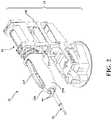
- FIG. 2is a perspective view of one embodiment of the end effector comprising a surgical tool.
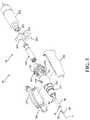
- FIG. 3is an exploded view of the surgical tool.
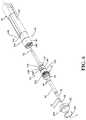
- FIG. 4is an exploded view of an energy applicator, a protective sheath, and an axial connector assembly.
- FIG. 5is a perspective view of the energy applicator, protective sheath, and axial connector assembly of FIG. 4 .
- FIG. 6is an exploded view of the energy applicator, protective sheath, and axial connector assembly of FIG. 4 already pre-assembled and a support structure.
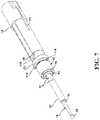
- FIG. 7is a perspective view of the energy applicator, protective sheath, axial connector assembly, and the support structure of FIG. 6 .
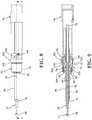
- FIG. 8is an elevational view of the energy applicator, protective sheath, axial connector assembly, and the support structure of FIG. 6 .
- FIG. 9is a cross-sectional view taken along line 9 - 9 of FIG. 8 .
- FIG. 10is an enlarged view of a portion of FIG. 9 .
- FIG. 11is a perspective view of the energy applicator, protective sheath, and a tool assembly, the tool assembly comprising the axial connector assembly, the support structure, and a collet assembly.
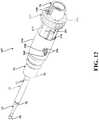
- FIG. 12is another perspective view of the energy applicator, protective sheath, and the tool assembly of FIG. 11 .
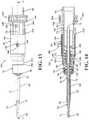
- FIG. 13is an elevational view of the energy applicator, protective sheath, and the tool assembly of FIG. 11 .
- FIG. 14is a cross-sectional view taken along line 14 - 14 of FIG. 13 .
- FIG. 15is an exploded view of the collet assembly illustrating the energy applicator, protective sheath, the axial connector assembly, and the support structure being pre-assembled.
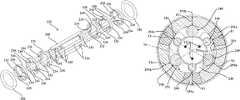
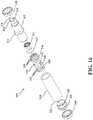
- FIG. 16is an exploded view of a drive assembly of the surgical tool.
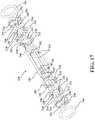
- FIG. 17is an exploded view of a clutch assembly of the drive assembly of FIG. 16 .
- FIG. 18is an elevational view of the drive assembly of FIG. 16 .
- FIG. 19is a cross-sectional view taken along line 19 - 19 of FIG. 18 .
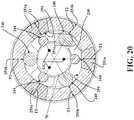
- FIG. 20is a cross-sectional view taken along line 20 - 20 of FIG. 18 .
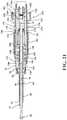
- FIG. 21is another cross-sectional view showing the energy applicator, protective sheath, axial connector assembly, support structure, collet assembly, and drive assembly.
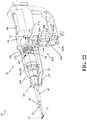
- FIG. 22is a partial perspective view of another embodiment of an end effector, a surgical tool, and an energy applicator, the surgical tool shown having a trigger arranged in a depressed position, and shown having a connector assembly arranged in a locked state.
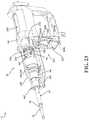
- FIG. 23is another partial perspective view of the end effector, surgical tool, and energy applicator of FIG. 22 , shown with the trigger arranged in a released position, and shown with the connector assembly arranged in an unlocked state.
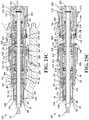
- FIG. 24Ais a broken sectional view of a portion of the surgical tool and energy applicator taken along line 24 - 24 in FIG. 22 , shown with the trigger arranged in the depressed position, and shown with the connector assembly arranged in the locked state.
- FIG. 24Bis another partial broken sectional view of the surgical tool and energy applicator of FIG. 24A , shown with the trigger arranged in a released position, and shown with the connector assembly arranged in the locked state.
- FIG. 24Cis another partial broken sectional view of the surgical tool and energy applicator of FIGS. 24A-24B , shown with the trigger arranged in the released position, and shown with the connector assembly arranged in an unlocked state.
- FIG. 25Ais a broken sectional view of a portion of the surgical tool and energy applicator taken along line 25 - 25 in FIG. 22 , shown with the trigger arranged in the depressed position, and shown with the connector assembly arranged in the locked state.
- FIG. 25Bis another partial broken sectional view of the surgical tool and energy applicator of FIG. 25A , shown with the trigger arranged in a released position, and shown with the connector assembly arranged in the locked state.
- FIG. 25Cis another partial broken sectional view of the surgical tool and energy applicator of FIGS. 25A-25B , shown with the trigger arranged in the released position, and shown with the connector assembly arranged in an unlocked state.
- the system 10is a robotic surgical cutting system for cutting away material from the anatomy of the patient 12 , such as bone or soft tissue.
- the patient 12is undergoing a surgical procedure, and the anatomy includes a femur (F) and a tibia (T) of the patient 12 .
- the surgical proceduremay involve tissue removal.
- the surgical procedureinvolves partial or total knee or hip replacement surgery.
- the system 10is designed to cut away material to be replaced by surgical implants such as hip and knee implants, including unicompartmental, bicompartmental, total knee implants, and other types of prosthetics. Some of these types of implants are disclosed in U.S. Patent Application Publication No. 2012/0330429, entitled, “Prosthetic Implant and Method of Implantation,” the entire disclosure of which is hereby expressly incorporated by reference. It should be appreciated that the system 10 disclosed herein may be used to perform other procedures, either surgical or non-surgical, and/or may be used in industrial applications or other applications.
- the system 10includes a surgical manipulator 14 (e.g., a surgical robot).
- the manipulator 14has a base 16 and a linkage 18 (e.g., an articulable robotic arm).
- the linkage 18may include links forming a serial arm or parallel arm configuration.
- a tool 20couples to the manipulator 14 and is movable relative to the base 16 via the linkage 18 to interact with the anatomy of the patient 12 .
- the tool 20forms part of an end effector 22 attached to the manipulator 14 .
- the tool 20is grasped by the operator (e.g., a surgeon) in some embodiments.
- One exemplary arrangement of the manipulator 14 and the tool 20is described in U.S. Pat. No.
- the manipulator 14 and the tool 20may be arranged in alternative configurations.
- the tool 20comprises an energy applicator 24 to contact the tissue of the patient 12 at a surgical site.
- the energy applicator 24may be a drill, a saw blade, a bur, an ultrasonic vibrating tip, or the like. Other configurations are contemplated.
- the manipulator 14houses a manipulator computer 26 , or other type of control unit.
- the system 10includes a controller which includes software and/or hardware for controlling the manipulator 14 .
- the controllerdirects the motion of the manipulator 14 and controls a position and orientation of the tool 20 with respect to a coordinate system.
- the coordinate systemis a manipulator coordinate system MNPL (see FIG. 1 ).
- the manipulator coordinate system MNPLhas an origin, and the origin is located relative to the manipulator 14 .
- One example of the manipulator coordinate system MNPLis described in U.S. Pat. No. 9,119,655, entitled, “Surgical Manipulator Capable of Controlling a Surgical Instrument in Multiple Modes,” previously referenced.
- the system 10further includes a navigation system 32 .
- a navigation system 32is set up to track movement of various objects. Such objects include, for example, the tool 20 , and the anatomy, e.g., femur F and tibia T.
- the navigation system 32tracks these objects to gather position information of each object in a localizer coordinate system LCLZ. Coordinates in the localizer coordinate system LCLZ may be transformed to the manipulator coordinate system MNPL using conventional transformation techniques.
- the navigation system 32is also capable of displaying a virtual representation of their relative positions and orientations to the operator.
- the navigation system 32includes a computer cart assembly 34 that houses a navigation computer 36 , and/or other types of control units.
- a navigation interfaceis in operative communication with the navigation computer 36 .
- the navigation interfaceincludes one or more displays 38 .
- First and second input devices 40 , 42such as touch screen inputs may be used to input information into the navigation computer 36 or otherwise select/control certain aspects of the navigation computer 36 .
- Other input devicesare contemplated, including a keyboard, mouse, voice-activation, and the like.
- the controllermay be implemented on any suitable device or devices in the system 10 , including, but not limited to, the manipulator computer 26 , the navigation computer 36 , and any combination thereof.
- the navigation system 32also includes a localizer 44 that communicates with the navigation computer 36 .
- the localizer 44is an optical localizer and includes a camera unit 46 .
- the camera unit 46has an outer casing 48 that houses one or more optical position sensors 50 .
- the system 10also includes one or more trackers.
- the trackersmay include a pointer tracker PT, a tool tracker 52 , a first patient tracker 54 , and a second patient tracker 56 .
- the trackersinclude active markers 58 .
- the active markers 58may be light emitting diodes or LEDs.
- the trackers 52 , 54 , 56may have passive markers, such as reflectors, which reflect light emitted from the camera unit 46 . It should be appreciated that other suitable tracking systems and methods not specifically described herein may be utilized.
- the first patient tracker 54is firmly affixed to the femur F of the patient 12 and the second patient tracker 56 is firmly affixed to the tibia T of the patient 12 .
- the patient trackers 54 , 56are firmly affixed to sections of bone.
- the tool tracker 52is firmly attached to the tool 20 . It should be appreciated that the trackers 52 , 54 , 56 may be fixed to their respective components in any suitable manner.
- the trackers 52 , 54 , 56communicate with the camera unit 46 to provide position data to the camera unit 46 .
- the camera unit 46provides the position data of the trackers 52 , 54 , 56 to the navigation computer 36 .
- the navigation computer 36determines and communicates position data of the femur F and tibia T and position data of the tool 20 to the manipulator computer 26 .
- Position data for the femur F, tibia T, and tool 20may be determined by the tracker position data using conventional registration/navigation techniques.
- the position datainclude position information corresponding to the position and/or orientation of the femur F, tibia T, tool 20 , and/or any other objects being tracked.
- the position data described hereinmay be position data, orientation data, or a combination of position data and orientation data.
- the manipulator computer 26transforms the position data from the localizer coordinate system LCLZ into the manipulator coordinate system MNPL by determining a transformation matrix using the navigation-based data for the tool 20 and encoder-based position data for the tool 20 .
- Encoders(not shown) located at joints of the manipulator 14 are used to determine the encoder-based position data.
- the manipulator computer 26uses the encoders to calculate an encoder-based position and orientation of the tool 20 in the manipulator coordinate system MNPL. Since the position and orientation of the tool 20 are also known in the localizer coordinate system LCLZ, the transformation matrix may be generated.
- the controllerincludes a manipulator controller 60 for processing data to direct motion of the manipulator 14 .
- the manipulator controller 60may receive and process data from a single source or from multiple sources.
- the controllerfurther includes a navigation controller 62 for communicating the position data relating to the femur F, tibia T, and tool 20 to the manipulator controller 60 .
- the manipulator controller 60receives and processes the position data provided by the navigation controller 62 to direct movement of the manipulator 14 .
- the navigation controller 62is implemented on the navigation computer 36 .
- the manipulator controller 60 or navigation controller 62may also communicate positions of the patient 12 and the tool 20 to the operator by displaying an image of the femur F and/or tibia T and the tool 20 on the display 38 .
- the manipulator computer 26 or navigation computer 36may also display instructions or request information on the display 38 such that the operator may interact with the manipulator computer 26 for directing the manipulator 14 .
- Other configurationsare contemplated.
- the tool 20includes a drive system 66 that converts electrical signals into a form of energy that is applied to the patient.
- This energymay be mechanical, ultrasonic, thermal, RF, EM, photonic, combinations thereof, and the like.
- the energyis applied to the patient 12 through the energy applicator 24 .
- the end effector 22includes a mounting fixture 64 for removably attaching the tool 20 to the manipulator 14 .
- the energy applicator 24is configured to remove tissue of the patient. As shown in the Figures, the energy applicator 24 comprises a bur. Alternative to a bur, the energy applicator 24 may comprise any type of surgical tool for material cutting, material removal, or other tissue manipulation or treatment at a surgical site.
- the energy applicator 24includes a working portion comprising a head 68 for cutting tissue of the patient 12 , and a shaft 70 extending along a tool axis T between a proximal end 72 and a distal end 74 .
- the shaft 70includes an outer surface 71 in which an annular groove or recess 76 is disposed.
- the groove or recess 76is arranged axially between the proximal end 72 and the distal end 74 , and extends radially inward toward the tool axis T to a bottom 73 .
- the groove or annular recess 76depends inwardly from the outer surface 71 to the bottom 73 .
- the groove or annular recess 76at least partially defines an axial-force receiving surface to promote axial retention of the energy applicator 24 .
- the groove or annular recess 76has a distal surface 75 and a sloped surface 77 , each of which extends from the outer surface 71 of the shaft 70 to the bottom 73 .
- the distal surface 75has a generally toroidal profile and is arranged axially between the distal end 74 and the bottom 73
- the sloped surface 77has a generally conical profile and is arranged axially between the bottom 73 and the proximal end 72 . As shown in FIG.
- the conical, sloped surface 77is formed extending along a first axial distance AD 1 from the outer surface 71 to the bottom 73
- the distal surface 75is formed extending along a second axial distance AD 2 , less than the first axial distance AD 1 , from the outer surface 71 to the bottom 73 .
- the annular groove or recess 76could have different configurations sufficient to promote axial retention of the energy applicator 24 .
- the conical, sloped surface 77is arranged at an acute angle ⁇ 1 relative to the axis T (see FIG. 10 ).
- the acute angle ⁇ 1is greater than zero degrees and less than 90 degrees.
- the acute angle ⁇ 1is 5-60 degrees, 10-30 degrees, or 10-20 degrees, relative to the axis T.
- the shaft 70may include a passage 78 (see FIG. 9 ) extending axially between the proximal end 72 and the distal end 74 for purposes of irrigation and/or suction.
- the head 68 and shaft 70 of the energy applicator 24are integral, unitary, and one-piece, but could be separate parts in other embodiments.
- a protective sheath 80supports the energy applicator 24 .
- the protective sheath 80comprises a nose tube 81 and defines a protective sheath bore 82 (see FIG. 9 ) and receives the shaft 70 of the energy applicator 24 in the protective sheath bore 82 .
- the protective sheath 80includes an enlarged end portion 84 which is configured for releasable attachment, as is described in greater detail below.
- the nose tube 81is formed integrally with and extends from the end portion 84 , and a distal bushing 83 is attached to the distal end of the nose tube 81 .
- the distal bushing 83is configured to be concentrically disposed about the shaft 70 of the energy applicator 24 .
- the distal bushing 83has a first inner diameter ID 1
- the nose tube 81has a second inner diameter ID 2 which is larger than the first inner diameter ID 2
- the end portion 84has a first outer diameter OD 1
- the nose tube 81has a second outer diameter OD 2 which is smaller than the first outer diameter OD 2 .
- the enlarged end portion 84has a cavity 86 and at least one bearing 88 , shown for example in FIG. 10 , disposed in the cavity 86 .
- the protective sheath 80 and the bearing 88form a releasably attachable protective sheath assembly 87 (see FIG. 4 ).
- the bearing 88is configured to receive and rotatably support the shaft 70 in the protective sheath bore 82 .
- the enlarged end portion 84has one or more outer grooves 90 extending axially. The grooves 90 are circumferentially and equally spaced about an outer periphery of the enlarged end portion 84 .
- the grooves 90are spaced circumferentially about the outer surface and extend from a proximal end of the enlarged end portion 84 to a detent pocket 91 .
- the grooves 90are shallower than their corresponding detent pockets 91 , and extend axially from the respective detent pockets 91 to the proximal end of the end portion 84 of the protective sheath 80 .
- other configurationsare contemplated.
- An axial connector assembly 92couples the energy applicator 24 and the protective sheath 80 to a support structure 94 (see FIG. 6 ). As set forth further below, the connector assembly 92 supports the protective sheath 80 and is configured to support or lock the energy applicator 24 relative to the protective sheath 80 .
- the axial connector assembly 92 and the support structure 94are concentrically disposed relative to each other along the axis T. The axial connector assembly 92 releasably engages the energy applicator 24 and the protective sheath 80 such that both of the energy applicator 24 and the protective sheath 80 are replaceable components.
- the support structure 94includes a support sleeve 96 extending axially.
- the support sleeve 96is generally cylindrical in shape.
- the support sleeve 96has a hollow interior cavity 98 with a plurality of internal threads 100 at a distal end thereof.
- the axial connector assembly 92includes a connector member 102 to facilitate releasable connection of the protective sheath 80 to the support sleeve 96 .
- the connector member 102includes a plurality of exterior threads 112 to threadably engage the interior threads 100 of the support sleeve 96 .
- the connector member 102is generally cylindrical in shape.
- the connector member 102includes an interior wall 104 extending radially inwardly to act as a stop for the enlarged end portion 84 of the protective sheath 80 when inserting the protective sheath 80 into the connector member 102 .
- the interior wall 104has an aperture 106 extending axially therethrough to allow the shaft 70 of the energy applicator 24 to extend therethrough.
- the connector member 102includes a flange 108 extending radially outward to engage an interior surface of the support sleeve 96 .
- the connector member 102also includes one or more openings 110 (see also FIG. 4 ) extending radially therethrough.
- the openings 110are disposed axially between the interior wall 104 and the flange 108 .
- the connector member 102is integral, unitary, and one-piece, but could be separate parts in other embodiments.
- the axial connector assembly 92also includes at least one engagement member 114 to releasably couple the protective sheath 80 to the connector member 102 .
- a plurality of engagement members 114are used with one engagement member 114 disposed in each opening 110 .
- Each of the engagement members 114is generally spherical in shape.
- the engagement members 114are ball bearings, such as those formed of stainless steel or other suitable materials.
- the axial connector assembly 92can include any number of engagement members 114 and corresponding openings 110 .
- the axial connector assembly 92also includes a resilient member 116 disposed about the engagement members 114 .
- the resilient member 116may be an O-ring seal, but may have other forms, such as a compression spring or other type of spring.
- the resilient member 116presses the engagement members 114 into their corresponding openings 110 to facilitate a releasable connection to the enlarged end portion 84 of the protective sheath 80 .
- Each of the openings 110are sized and shaped so that the engagement members 114 are capable of being exposed on either side of the openings 110 .
- the resilient member 116can apply a biasing force to the engagement members 114 .
- the engagement members 114are able to engage the enlarged end portion 84 of the protective sheath 80 .
- the openings 110may be sized and shaped to receive the engagement members 114 without allowing the engagement members 114 to fall through the openings 110 when the protective sheath 80 is absent.
- the openings 110could be tapered radially inwardly to a diameter sized to retain the engagement members 114 .
- the engagement members 114When axially coupling the protective sheath 80 to the connector member 102 (which is already fixed to the support sleeve 96 ), the engagement members 114 are sized and shaped to move along and within the grooves 90 defined in the enlarged end portion 84 , under constant bias of the resilient member 116 until the engagement members 114 reach (e.g., are radially aligned with) the detent pockets 91 . At that point, the engagement members 114 are seated in the detent pockets 91 thereby holding the protective sheath 80 to the connector member 102 by virtue of the bias associated with the resilient member 116 .
- the protective sheath 80may be removed by pulling on the protective sheath 80 distally to overcome the bias and urge the engagement members 114 out from the detent pockets 91 .
- the protective sheath 80may require replacement when the bearing 88 is worn. Accordingly, by having the bearing 88 supported in the protective sheath 80 and making the protective sheath 80 removable and replaceable, significant down time can be avoided that might otherwise exist if the entire end effector 22 needed to be taken out of circulation to replace the bearing 88 .
- the protective sheath 80defines one or more weep holes 99 extending radially therethrough.
- the weep holes 99may be spaced axially and/or circumferentially about the protective sheath 80 .
- a first pair of diametrically opposing weep holes 99are located near the enlarged end portion 84 of the protective sheath 80 at a first axial distance from the enlarged end portion 84 .
- a second pair of diametrically opposing weep holes 99are located further away from the enlarged end portion 84 at a second axial distance.
- the second pair of weep holes 99are also located on the protective sheath 80 with approximately 90 degrees of circumferential separation from the first pair of weep holes 99 .
- the weep holes 99are intended to prevent fluid from the surgical site coming into contact with the bearing 88 , which may otherwise shorten the operational life of the bearing 88 .
- fluidmay tend to move between the shaft 70 of the energy applicator 24 and the protective sheath 80 toward the bearing 88 .
- the weep holes 99provide a suitable escape for such fluid before it reaches the bearing 88 .
- the axial connector assembly 92includes a bushing 118 disposed within the connector member 102 at a proximal end of the connector member 102 .
- the bushing 118is generally cylindrical in shape with an aperture 120 extending axially therethrough.
- the bushing 118is fixed axially to the support sleeve 96 and/or the connector member 102 .
- the bushing 118may be floating within the support sleeve 96 .
- the axial connector assembly 92further includes a cam member 122 .
- the cam member 122can also be referred to as a wedge member.
- the cam member 122includes a reduced diameter portion 124 disposed in the aperture 120 of the bushing 118 to rotate relative to the support sleeve 96 .
- the cam member 122rotates relative to the support sleeve 96 .
- the cam member 122includes a cavity 126 extending axially from the proximal end thereof.
- the cavity 126includes a tapered or sloped surface 128 (also referred to as a cam surface or a wedge surface) extending axially and radially inward. In the embodiment shown, the sloped surface 128 is in the form of a conical surface.
- the sloped surface 128is arranged at an acute angle ⁇ 2 relative to the tool axis T.
- the sloped surface 128is at an acute angle ⁇ 2 greater than zero degrees and less than 90 degrees.
- the acute angle ⁇ 2is 5-60 degrees, 10-30 degrees, or 10-20 degrees, relative to the axis T.
- the acute angles ⁇ 1 and ⁇ 2are sized so that at least one engagement member 138 , described further below, becomes wedged between the sloped surfaces 77 , 128 to hold the shaft 70 of the energy applicator 24 , yet is readily releasable from the shaft 70 .
- the difference in the acute angles ⁇ 1 and ⁇ 2may be 4-12 degrees, 6-10 degrees, 7-9 degrees, or 8 degrees relative to the axis T.
- the axial connector assembly 92includes a locking sleeve 130 disposed within the support sleeve 96 .
- the locking sleeve 130extends axially.
- the locking sleeve 130is generally cylindrical in shape.
- the locking sleeve 130has a passage 132 extending axially therethrough to receive the shaft 70 .
- the locking sleeve 130also includes a plurality of openings 134 extending radially therethrough near a distal end thereof to receive the engagement members 138 .
- the openings 134are sized and shaped to allow the engagement members 138 to be exposed radially inwardly relative to the locking sleeve 130 to engage the sloped surface 79 .
- the openings 134are also sized and shaped to allow the engagement members 138 to be exposed radially outwardly relative to the locking sleeve 130 to engage the sloped surface 128 .
- the openings 134may be sized and shaped to prevent the engagement members 138 from passing completely through the openings 134 thereby retaining the engagement members 138 .
- the locking sleeve 130includes a flange 136 extending radially outwardly. In the embodiment shown, the locking sleeve 130 is integral, unitary, and one-piece, but could be separate parts in other embodiments.
- the engagement members 138couple the shaft 70 to the cam member 122 .
- a plurality of engagement members 138are used with one engagement member 138 disposed in each opening 134 of the locking sleeve 130 .
- Each of the engagement members 138is generally spherical in shape. It should be appreciated that the axial connector assembly 92 may include any number of engagement members 138 and corresponding openings 134 .
- the engagement members 138are ball bearings, such as those formed of stainless steel or other suitable materials.
- the axial connector assembly 92also includes a bushing 140 disposed about the locking sleeve 130 and within the support sleeve 96 .
- the bushing 140is generally cylindrical in shape with an aperture 142 extending axially therethrough to allow the locking sleeve 130 to extend therethrough.
- the bushing 140is fixed relative to the support sleeve 96 in the embodiment shown. In other embodiments, the bushing 140 is free to float within the support sleeve 96 between the cam member 122 and the locking sleeve 130 .
- the axial connector assembly 92further includes a ring member 144 disposed about the locking sleeve 130 between the bushing 140 and the flange 136 .
- the ring member 144is generally cylindrical in shape.
- the ring member 144has one or more pockets 145 extending radially therein. In one embodiment, a pair of opposed pockets 145 extend radially therein.
- the support structure 94includes one or more slots 146 in the support sleeve 96 .
- the slots 146extend radially therethrough and are arranged helically about an axis of the support sleeve 96 .
- opposing slots 146are formed helically in the support sleeve 96 .
- the slots 146 in the embodiment shownare located only partially about the support sleeve 96 .
- the support structure 94also includes one or more engagement members 148 disposed in the slots 146 and pockets 145 of the ring member 144 .
- One of the engagement members 148is disposed in each of the slots 146 and pockets 145 .
- the engagement members 148are ball bearings, such as those formed of stainless steel or other suitable materials. However, other configurations are contemplated.
- a collet assembly 157cooperates with the support structure 94 to move the axial connector assembly 92 between locked and unlocked states.
- the collet assembly 157includes a lock collar 158 which is movable relative to the support structure 94 .
- the lock collar 158is elongated axially.
- the lock collar 158is generally cylindrical in shape.
- the lock collar 158is disposed about a portion of the support sleeve 96 of the support structure 94 .
- the lock collar 158includes a wall 160 that defines cutouts 162 spaced circumferentially about the wall 160 and extending axially.
- the lock collar 158includes one or more recesses 164 (see FIG. 15 ) extending axially inward from the distal end.
- the lock collar 158also includes one or more pockets 165 (only one shown in FIG. 15 ) at a distal end extending axially inward.
- the collet assembly 157also includes a release member coupled to the lock collar 158 which is configured to be actuated by the user to move the lock collar 158 , such as to place the connector assembly 92 in the unlocked state. To this end, and in the embodiment illustrated in FIG.
- the release membercomprises a gripping member 166 at a proximal end of the lock collar 158 to be grasped by a user.
- the gripping member 166is generally cylindrical in shape. It should be appreciated that the lock collar 158 may be rotated relative to the support sleeve 96 of the support structure 94 .
- the collet assembly 157also includes a spring member 168 disposed within the lock collar 158 .
- the spring member 168extends axially.
- the spring member 168is a helical torsion spring.
- the spring member 168is generally cylindrical in shape.
- the spring member 168includes a plurality of convolutions 170 .
- the spring member 168includes at least one or more distal tabs 172 extending axially at a distal end.
- the distal tabs 172are disposed inside the opposing pockets 165 of the lock collar 158 and are fixed to the lock collar 158 .
- the spring member 168includes at least one or more proximal tabs 174 extending axially at a proximal end.
- the collet assembly 157includes a first collar member 176 disposed over the support sleeve 96 of the support structure 94 .
- the first collar member 176is generally cylindrical in shape.
- the first collar member 176includes a plurality of protrusions 178 extending axially and radially outward and a plurality of recesses 179 (one partially shown in FIG. 15 ) extending axially inward from a proximal end.
- the first collar member 176also includes a recess 180 in two of the opposed protrusions 178 to receive the tabs 174 of the spring member 168 .
- the collet assembly 157further includes a second collar member 182 disposed over the support sleeve 96 of the support structure 94 .
- the second collar member 182is generally cylindrical in shape.
- the second collar member 182includes a plurality of protrusions 184 extending axially and radially outward.
- the second collar member 182includes one or more recesses 186 extending axially through two of the opposed protrusions 184 .
- the collet assembly 157further includes a bushing 185 disposed against the flange 136 of the locking sleeve 130 to rotatably support the locking sleeve 130 in the support sleeve 96 .
- the tool assembly 187includes a coil spring 188 disposed within the support sleeve 96 of the support structure 94 .
- the coil spring 188has a distal end that abuts the bushing 140 .
- the tool assembly 187includes a plurality of rods 190 disposed in grooves 192 extending axially along an outer periphery of the support sleeve 96 of the support structure 94 .
- the rods 190are also disposed in the recesses 179 of the first collar member 176 and the recesses 186 of the second collar member 182 . It should be appreciated that the rods 190 key and rotatably fix the first collar member 176 and the second collar member 182 to the support sleeve 96 .
- a usergrasps the gripping member 166 and rotates the lock collar 158 clockwise (when viewed from the distal end) to allow disengagement of the energy applicator 24 .
- the rods 190rotationally lock the first collar member 176 and the second collar member 182 to the support sleeve 96 .
- the lock collar 158thus rotates against the bias of the spring member 168 (since the proximal end of the spring member 168 is prevented from rotating).
- the engagement members 148e.g., ball bearings
- the engagement members 148are also moved in the slots 146 by virtue of the engagement members 148 being coupled to the lock collar 158 , i.e., the engagement members 148 are positioned within the recesses 164 located in the distal end of the lock collar 158 . Accordingly, movement of the engagement members 148 is controlled by rotation of the lock collar 158 .
- the engagement members 148when moved by the lock collar 158 , the engagement members 148 follow their corresponding helical paths such that the engagement members 148 are moved both in a planetary fashion about the tool axis T and axially with respect to the tool axis T toward the proximal end of the support sleeve 96 .
- the lock collar 158is configured to rotate, but not to translate relative to the axis T.
- the recesses 164are axially elongated, so that as the lock collar 158 is rotated, and the engagement members 148 follow the helical paths in the slots 146 , the engagement members 148 also translate within the recesses 164 .
- the lock collar 158may also translate axially with the engagement members 148 .
- Axial movement of the ring member 144is facilitated by the engagement members 148 being seated in the pockets 145 of the ring member 144 and captured between the pockets 145 and the recesses 164 .
- the lock collar 158is coupled to the ring member 144 through the engagement members 148 .
- the ring member 144follows the engagement members 148 and is partially rotated and moved axially towards the flange 136 .
- the ring member 144reaches the flange 136 of the locking sleeve 130 , and thereafter moves the locking sleeve 130 and associated bushing 185 proximally against the bias of spring 188 .
- the engagement members 138 that were wedged between the sloped surfaces 77 , 128 of the shaft 70 and the cam member 122are thereby released from their wedged arrangement away from the sloped surface 77 defining the groove 76 of the shaft 70 to unlock the shaft 70 and allow removal of the energy applicator 24 .
- the spring member 168returns to its normal state thereby moving the engagement members 148 in the slots 146 in a reverse direction along their helical paths, which moves the ring member 144 distally to disengage the flange 136 of the locking sleeve 130 , which allows the spring 188 to push the locking sleeve 130 back toward the cam member 122 .
- the engagement members 138fall back into the groove 76 against the sloped surface 77 of the shaft 70 of the energy applicator 24 and wedge against the sloped surface 128 to lock the shaft 70 . This defines the locked state of the axial connector assembly 92 .
- the collet assembly 157operates the axial connector assembly 92 between the locked and unlocked states.
- the collet assembly 157cooperates with the axial connector assembly 92 to apply a force to keep the proximal end 72 of the energy applicator 24 abutting against a shoulder 189 of the tool assembly 187 .
- these engagement members 138impart a force directed against the sloped surface 77 of the energy applicator 24 .
- This forceincludes an axial component applied against the energy applicator in the proximal direction to maintain the abutting contact between the proximal end 72 of the energy applicator 24 and the shoulder 189 (or other reference surface fixed relative to the support structure 94 ).
- the sloping surface 77 of the energy applicator 24may also be referred to as an axial-force receiving surface.
- One purpose of the abutment between the proximal end 72 and the shoulder 189is to consistently match up and enable communication between an identification tag (e.g., a radio frequency identification tag RFID) on the energy applicator 24 and a radio frequency identification reader 199 ( FIG. 19 ) on the tool assembly 187 .
- an identification tage.g., a radio frequency identification tag RFID
- a radio frequency identification reader 199FIG. 19
- This engagement of the proximal end 72 of the energy applicator and the shoulder 189also provides repeatability in establishing the location (e.g., position in X, Y, Z coordinates) of a tool center point (TCP) of the energy applicator 24 for purposes of surgical navigation as described herein.
- TCPtool center point
- the location of the TCPmay be calibrated during manufacture and the details of the calibration, e.g., calibration data, thereafter stored in the RFID tag or other non-volatile memory for retrieval by a tool controller (not shown) that controls operation of the tool 20 , the manipulator controller 60 , and/or the navigation controller 62 .
- a tool controllernot shown
- the system 10(which includes the navigation system 32 ) is capable of retrieving the calibration data to readily determine the TCP in a coordinate system of the tool 20 or other coordinate system with high accuracy.
- the shoulder 189provides a reference location from which to locate the TCP.
- the drive assembly 200includes a drive member 202 , e.g., a rotating drive shaft.
- the drive member 202is generally cylindrical in shape.
- the drive member 202includes a cavity 204 (see FIG. 19 ) extending axially inwardly from a proximal end, a cavity 206 extending axially inwardly from a distal end, and a passage 208 extending axially between the cavities 204 and 206 .
- the drive member 202includes a seal 210 disposed in the cavity 204 and a seal 212 disposed in the cavity 206 .
- the drive member 202includes a flange 214 extending circumferentially and radially outward.
- the drive member 202further includes a pair of opposed flanges 216 extending axially from a proximal end.
- the drive member 202is integral, unitary, and one-piece, but could be separate parts in other embodiments.
- the seal 210seals against a rotatable shaft 252 of an actuator 250 (see FIG. 21 ) to be described and the seal 212 seals against the shaft 70 of the energy applicator 24 .
- the seal 212may comprise a lip seal.
- the drive assembly 200also includes a driven member 218 coupled to the drive member 202 .
- the driven member 218extends axially.
- the driven member 218is generally cylindrical in shape.
- the driven member 218is disposed about the distal end of the drive member 202 and abuts the flange 214 .
- the driven member 218is integral, unitary, and one-piece, but could be separate parts in other embodiments.
- the drive assembly 200includes a drive connector 220 coupled to the driven member 218 to rotate with the driven member 218 .
- the drive connector 220is generally cylindrical in shape.
- the drive connector 220includes a cavity 222 extending axially inwardly from a proximal end and a cavity 224 extending axially inwardly from a distal end.
- the drive connector 220includes a flange 226 extending circumferentially and radially outward that abuts the distal end of the driven member 218 .
- the drive connector 220is integral, unitary, and one-piece, but could be separate parts in other embodiments.
- the drive assembly 200further includes a clutch assembly 228 disposed within the driven member 218 and configured to slideably receive the shaft 70 of the energy applicator 24 .
- the clutch assembly 228is supported by the driven member 218 and rotatable relative to the drive member 202 .
- the clutch assembly 228receives the shaft 70 of the energy applicator 24 for selectively coupling the shaft 70 to the drive member 202 .
- the shaft 70is slideable into the clutch assembly 228 and is slideable out of the clutch assembly 228 .
- the clutch assembly 228includes a plurality of roller holders 230 spaced axially and disposed within the driven member 218 .
- Each of the roller holders 230is generally cylindrical in shape. In the embodiment shown, each of the roller holders 230 are generally disc-shaped.
- Each of the roller holders 230includes an interior aperture 232 extending axially therethrough.
- Each of the roller holders 230also includes opposed flanges 234 extending radially inward.
- Each of the roller holders 230includes a secondary aperture 236 extending axially through one of the flanges 234 and spaced from the interior aperture 232 .
- Each of the roller holders 230includes a recess 238 extending radially into the opposing flange 234 .
- each of the roller holders 230is integral, unitary, and one-piece, but could be separate parts in other embodiments.
- three roller holders 230are disposed adjacent each other at a proximal end of the clutch assembly 228 and three roller holders 230 are disposed adjacent each other at a distal end. These two sets of roller holders 230 are spaced axially from one another and are collectively referred to as a cage.
- Each of the three roller holders 230 at each axial endare oriented so that their respective secondary apertures 236 and recesses 238 are arranged approximately 120 degrees circumferentially relative to each other.
- the clutch assembly 228also includes a plurality of rollers 240 coupled to the roller holders 230 .
- the rollers 240extend axially.
- the rollers 240are generally cylindrical in shape.
- Each of the rollers 240has a shaft 242 extending axially from each axial end.
- the two shafts 242 of a first roller 240are disposed in the apertures 236 of the two outermost (axially) roller holders 230
- the two shafts 242 of a second roller 240are disposed in the apertures 236 of the two innermost (axially) roller holders 230
- the two shafts 242 of a third roller 240are disposed in the apertures 236 of the remaining two roller holders 230 .
- the rollers 240are arranged to be generally parallel to the shaft 70 of the energy applicator 24 when the energy applicator 24 is coupled to the tool assembly 187 .
- the clutch assembly 228also includes a plurality of counterweights 244 coupled to the roller holders 230 .
- the counterweights 244extend axially.
- the counterweights 244are generally cylindrical in shape.
- One of the counterweights 244is disposed in the recesses 238 of each pair of opposing roller holders 230 , i.e., the two outermost roller holders 230 , the two innermost roller holders 230 , and the remaining two roller holders 230 , so that there is one counterweight that corresponds to each roller 240 .
- the roller holders 230 , rollers 240 , and counterweights 244are radially movable relative to the shaft 70 of the energy applicator 24 .
- the clutch assembly 228further includes a pair of resilient members 246 disposed about the rollers 240 and counterweights 244 .
- the resilient members 246are spaced axially from each other.
- the resilient members 246are of an O-ring type.
- the resilient members 246are made of a flexible material. The resilient members 246 act to press the rollers 240 against the shaft 70 during initial insertion of the shaft 70 into the clutch assembly 228 . During insertion, the shaft 70 is located radially inward of the rollers 240 .
- the resilient members 246provide enough biasing force so that once the shaft 70 is initially inserted, the rollers 240 frictionally engage and hold the shaft 70 from falling out of the clutch assembly 228 due to gravity, i.e., before the axial connector assembly 92 is moved back to the locked state to permanently hold the energy applicator 24 in place.
- the driven member 218has a cross-sectional profile as shown in FIG. 20 that comprises a first region 251 a of thickness T 1 , a second region 251 b of thickness T 2 , which is less than T 1 , and the inner cam surface 251 is arcuate in shape from the first region 251 a to the second region 251 b to form cam regions 251 c on either side of the second region 251 b (only one labeled in FIG. 20 ).
- the cam regions 251 cwhen rotated relative to the clutch assembly 228 (either direction) eventually engage the rollers 240 and hold the rollers 240 against the shaft 70 .
- the outer surface of the driven member 218is cylindrical.
- the counterweights 244oppose any centrifugal forces that might otherwise act on the rollers 240 to pull the rollers 240 away from the shaft 70 .
- centrifugal forces acting on the counterweights 244are larger than those acting on the rollers 240 thereby providing resultant forces that maintain contact of the rollers 240 with the shaft 70 , even at full speed.
- Roller 240 /counterweight 244 pairsare shown by dotted lines in FIG. 20 with their paired centers of gravity CG illustrated.
- the clutch assembly 228is counterweighted to maintain contact of the rollers 240 with the shaft 70 when torque is applied to the driven member 218 by the actuator 250 .
- the counterweights 244may be made of denser material than the rollers 240 .
- the counterweights 244are formed of tungsten carbide and the rollers 240 are formed of stainless steel. So, even though the counterweights 244 may be smaller in volume, they are heavier so that the center of gravity CG of each roller 240 /counterweight 244 pair is located closer to the counterweight 244 .
- the clutch assembly 228essentially floats inside the driven member 218 with enough space to accommodate some radial and/or axial movement of the roller holders 230 , rollers 240 , and counterweights 244 .
- the clutch assembly 228comprises three clutch subassemblies, each subassembly comprising a pair of the roller holders 230 and one roller 240 /counterweight 244 pair interconnecting the pair of the roller holders 230 .
- the clutch subassembliesare able to shift relative to one another within the driven member 218 .
- the drive assembly 200includes a washer 247 disposed between the seal 212 and the clutch assembly 228 .
- the drive assembly 200further includes bushings 248 disposed about the drive member 202 and the drive connector 220 to support the drive member 202 , driven member 218 , drive connector 220 , and clutch assembly 228 for rotation within the support structure 94 . Bearings may be used in place of one or more of the bushings 248 in some embodiments.
- the actuator 250is coupled to the drive assembly 200 to form a drive system. More specifically, the actuator 250 is coupled to the drive member 202 to impart rotation to the drive member 202 .
- the actuator 250is of a motor type and includes the shaft 252 .
- the shaft 252engages the drive member 202 and the opposed flanges 216 to rotate the drive member 202 .
- the support structure 94further includes a floating collar or bushing 150 disposed about and movable relative to the support sleeve 96 .
- the floating collar 150is generally cylindrical in shape.
- the floating collar 150includes a raised portion 152 extending radially outward.
- the support structure 94includes a retaining ring 154 disposed in a groove 156 (see FIG. 10 ) in the support sleeve 96 to distally retain axial movement of the floating collar 150 .
- the floating collar 150may be movable axially along and rotatably about the support sleeve 96 .
- the floating collar 150is rotatable about the support sleeve 96 and generally axially constrained between the retaining ring 154 and the lock collar 158 .
- the tool assembly 187also includes an outer floating sheath 194 rotatably disposed about a portion of the lock collar 158 .
- the floating sheath 194is generally cylindrical in shape.
- the floating sheath 194includes a pair of flanges 196 (see FIGS. 3 and 12 ) spaced from one another and extending outwardly in an equal and parallel manner from an outer surface of the floating sheath 194 .
- Each of the flanges 196includes an aperture 198 extending therethrough.
- a gripcomprises a pair of grip members 258 .
- the grip members 258are sized and shaped to engage the floating collar 150 and the second collar member 182 in a clam-shell manner about the outer floating sheath 194 so that the grip is able to rotate relative to the support sleeve 96 during operation.
- a trigger 197is pivotally connected to the grip members 258 near a proximal end of the grip members 258 by a suitable mechanism such as a pin. During actuation, the trigger 197 pivots relative to the grip members 258 .
- the trigger 197is also coupled to the outer floating sheath 194 by a link or lever 260 (see FIGS. 13 and 14 ).
- the lever 260is pivotally connected at one end to the flanges 196 of the outer floating sheath 194 by a suitable mechanism such as a pin.
- the other end of the lever 260is pivotally connected to the trigger 197 at a location spaced from the pivot connection of the trigger 197 with the grip members 258 .
- the trigger 197applies a force on the link 260 , which in turn moves the link 260 .
- the link 260is arranged at an acute angle to the tool axis T (see FIG. 14 ) such that the link 260 applies an axially-directed force to the outer floating sheath 194 thereby moving the outer floating sheath 194 toward the actuator 250 . Since the outer floating sheath 194 axially abuts the protrusions 178 of the first collar member 176 , the first collar member 176 is also urged proximally.
- the rods 190are disposed in the recesses 179 of the first collar member 176 such that as the first collar member 176 moves proximally relative to the support sleeve 96 , the rods 190 are also pushed proximally. Proximal ends of the rods 190 are seated in pockets 205 (see FIG. 3 ) in a switch actuator 207 such that proximal movement of the rods 190 causes the switch actuator 207 to also move proximally to activate a switch (not shown).
- a springacts against the switch actuator 207 , rods 190 , first collar member 176 , link 260 , and/or outer floating sheath 194 to return them to their pre-actuation position. Depression of the trigger 197 may be required to energize the actuator 150 , to switch between different modes, to enable operation of the tool 20 , or the like. Other functions of the trigger 197 are contemplated.
- FIGS. 22-25Canother embodiment of the tool 20 is depicted in FIGS. 22-25C .
- this embodimentis substantially similar to the embodiment illustrated in FIGS. 1-21 , and both embodiments share similar structure and components, as well as similar features, advantages, and operational use.
- common structure and components between the embodimentsare provided with the same reference numerals in the drawings and in the description below.
- certain structure and components common between the embodimentsare not reintroduced or re-described below.
- the illustrated embodiment of the tool 20similarly employs the tool assembly 187 to secure and drive the energy applicator 24 , which likewise has the axial-force receiving surface 77 formed in the shaft 70 .
- the tool assembly 187similarly employs the support structure 94 , the axial connector assembly 92 , the drive system 66 and clutch assembly 228 , the collet assembly 157 , the reference surface 189 , and the protective sheath assembly 87 .
- Each of these components, structural features, and assembliesgenerally cooperate to facilitate operation of the tool 20 in the same way as described above in connection with the embodiment illustrated in FIGS. 1-21 , but are arranged and configured differently as described below.
- the illustrated tool assembly 187likewise employs the release member and the lock collar 158 of the collet assembly 157 to facilitate movement of the axial connector assembly 92 between the locked state (see FIGS. 22, 24A, and 25A ) and the unlocked state (see FIGS. 23, 24C, and 25C ).
- the lock collar 158is slidably movable relative to the support structure 94 .
- the release memberis realized in this embodiment as a release lever 262 which is coupled to the mounting fixture 64 .
- a release mechanism, generally indicated at 264is interposed in force-translating relationship between the release lever 262 and the lock collar 158 .
- the release mechanism 264comprises a pair of arms 266 , an intermediate link 268 , and pins which cooperate to facilitate pivoting movement of the release lever 262 and the intermediate link 268 relative to the mounting fixture 64 . More specifically, an upper pin 269 U, a lower pin 269 L, and a middle pin 269 M are provided in the illustrated embodiment.
- the upper pin 269 Uis coupled to the mounting fixture 64 and supports the intermediate link 268 for pivoting relative to the mounting fixture 64 .
- the lower pin 269 L(shown in phantom in FIGS. 22 and 23 ) is coupled to the release lever 262 and supports the intermediate link 268 for pivoting relative to the release lever 262 .
- the middle pin 269 M(shown in phantom in FIGS.
- each of the arms 266has a first tab 270 which engages the lock collar 158 , and a second tab 272 which abuts the intermediate link 268 .
- the arms 266translate in a direction substantially parallel to the tool axis T in response to pivoting movement of the intermediate link 268 resulting from corresponding movement of the release lever 262 .
- the release mechanism 264could be arranged for actuation by the user in a number of different ways.
- the lock collar 158is biased axially via the spring member 168 which, in this embodiment, is realized as a cylindrical compression spring interposed between the support sleeve 96 and the lock collar 158 (see FIGS. 25A and 25C ).
- the axial connector assembly 92is biased toward the locked state.
- the arms 266also engage and facilitate movement of the ring member 144 which, in turn, abuts the flanges 136 of the locking sleeve 130 .
- the locking sleeve 130is biased by the spring 188 and similarly moves axially to bring the engagement members 138 into abutment between the axial-force receiving surface 77 of the energy applicator 24 and the tapered or sloped surface 128 of the cam member 122 (see FIG. 24A ).
- the driven member 218is coupled to a drive sleeve 274 which, in turn, is coupled to the cam member 122 such that the driven member 218 , the drive sleeve 274 , and the cam member 122 move concurrently.
- the drive sleeve 274rotates with the drive member 202 via a coupling arrangement, generally indicated at 276 , which may comprise a keyed, splined, or similar arrangement of structural features which cooperate to engage and facilitate concurrent rotation.
- a preload assembly 278 with a preload spring 280 and a collar member 282Adjacent to the coupling arrangement 276 , a preload assembly 278 with a preload spring 280 and a collar member 282 are provided. It will be appreciated that the driven member 218 could be coupled to the drive member 202 in a number of different ways.
- the trigger 197is similarly arranged for actuation by the user.
- movement of the trigger 197causes corresponding movement of the link or lever 260 , which abuts and translates force to the outer floating sheath 194 .
- the outer floating sheath 194is disposed about the support sleeve 96 and translates axially in response to force acting on the trigger 197 , and a trigger return mechanism 284 with a return spring 285 facilitates limited, biased, axial movement of the outer floating sheath 194 relative to the support sleeve 96 .
- the outer floating sheath 194is shaped such that movement of the trigger 197 causes corresponding movement of a trigger actuator 286 (e.g., a ball bearing) supported by a portion of the trigger return mechanism 284 .
- movement of the trigger actuator 286causes corresponding movement of a switch mechanism 288 (e.g., a piezoelectric switch) configured to facilitate operation of the tool assembly 187 , such as by generating a variable signal used to effect corresponding variable rotation of the actuator 250 .
- a switch mechanism 288e.g., a piezoelectric switch
- the trigger 197could be configured in a number of different ways sufficient to facilitate operation of the tool assembly 187 .
- the embodiment illustrated in FIGS. 22-25Calso employs a removably-attachable protective sheath assembly 87 .
- the resilient member 116biases one or more engagement members 114 toward the tool axis T and into engagement with the recesses 164 formed in the protective sheath 80 .
- the protective sheath assembly 87comprises a pair of bearings 88 supported in the protective sheath bore 82 , a bearing biasing element 290 , a spacer 292 , and an end cap 294 .
- the spacer 292is disposed between the bearings 88 .
- the bearing biasing element 290biases the bearings 88 and the spacer 292 proximally toward the end cap 294 .
- the end cap 294retains the bearings 88 , the spacer 292 , and the bearing biasing element 290 within the protective sheath bore 82 .
- a tage.g., a radio frequency identification tag RFID
- a reader 199is coupled to the connector member 120 .
- datae.g., calibration data, usage data, and the like
- datamay be read by the reader 199 to, among other things, ensure that the proper protective sheath assembly 87 is being utilized for the surgical procedure, determine the expected life of and/or determine replacement or service of the protective sheath assembly 87 after a predetermined amount of use, and the like.
- Tag RFID Datamay also be written onto the tag RFID via the reader 199 , such as to update the tag RFID after a surgical procedure with a new expected life, number of cycles, duration of use, and the like.
- tags RFID and/or readers 199may be employed to, among other things, identify the specific energy applicator 24 being utilized via calibration data. Other configurations are contemplated.
- inventions of the systems 10 and tools 20 described hereinafford significant advantages in connection with a broad number of medical and/or surgical procedures including, for example, where surgical manipulators 14 are employed.
- the embodiments of the tool assembly 187 described and illustrated hereinare configured such that the energy applicator 24 can be releasably attached in a simple, efficient, and reliable manner, and can be driven to manipulate patient 12 tissue in a number of different ways to accommodate different surgical procedures, user preference, and the like.
Landscapes
- Health & Medical Sciences (AREA)
- Surgery (AREA)
- Life Sciences & Earth Sciences (AREA)
- Engineering & Computer Science (AREA)
- Animal Behavior & Ethology (AREA)
- Veterinary Medicine (AREA)
- Biomedical Technology (AREA)
- Heart & Thoracic Surgery (AREA)
- Medical Informatics (AREA)
- Molecular Biology (AREA)
- Nuclear Medicine, Radiotherapy & Molecular Imaging (AREA)
- General Health & Medical Sciences (AREA)
- Public Health (AREA)
- Oral & Maxillofacial Surgery (AREA)
- Orthopedic Medicine & Surgery (AREA)
- Robotics (AREA)
- Dentistry (AREA)
- General Engineering & Computer Science (AREA)
- Mechanical Engineering (AREA)
- Physics & Mathematics (AREA)
- Electromagnetism (AREA)
- Pathology (AREA)
- Surgical Instruments (AREA)
Abstract
Description
This application is a continuation of U.S. patent application Ser. No. 15/789,562, filed Oct. 20, 2017, which claims priority to and all the benefits of U.S. Provisional Patent Application No. 62/411,039 which was filed on Oct. 21, 2016, the disclosures of each of which are hereby incorporated by reference in their entirety.
The present disclosure relates, generally, to surgical tools and, more particularly, to systems and tools for use with surgical robotic manipulators.
Medical practitioners have found it useful to use surgical robotic manipulators to assist in the performance of surgical procedures. An example of an end effector for a surgical robotic manipulator is disclosed in U.S. Patent Application Publication No. 2014/0276949. There is a need in the art to continuously improve such end effectors.
One example of a tool is provided. The tool comprises an energy applicator including a shaft extending along an axis between a proximal end and a distal end; and a tool assembly comprising a support structure to support the energy applicator, a connector assembly arranged to engage and releasably lock the energy applicator to the support structure in a locked state, and a drive system coupled to the support structure and configured to rotatably drive the shaft of the energy applicator about the axis; wherein the drive system comprises a counterweighted clutch assembly.
One example of a tool assembly is provided. The tool assembly is for use with an energy applicator having a shaft extending along an axis between a proximal end and a distal end, the tool assembly comprising: a support structure to support the energy applicator; a connector assembly arranged to engage and releasably lock the energy applicator to the support structure in a locked state; and a drive system coupled to the support structure and configured to rotatably drive the shaft of the energy applicator about the axis; wherein the drive system comprises a counterweighted clutch assembly.
Other features and advantages of the present disclosure will be readily appreciated, as the same becomes better understood, after reading the subsequent description taken in conjunction with the accompanying drawings.
Certain of the Figures set forth above may have portions of the end effector removed for purposes of illustration.
Referring now to the Figures, wherein like numerals indicate like or corresponding parts throughout the several views, asystem 10 for manipulating an anatomy of apatient 12 are shown throughout. As shown inFIG. 1 , thesystem 10 is a robotic surgical cutting system for cutting away material from the anatomy of thepatient 12, such as bone or soft tissue. InFIG. 1 , thepatient 12 is undergoing a surgical procedure, and the anatomy includes a femur (F) and a tibia (T) of thepatient 12. The surgical procedure may involve tissue removal. In some embodiments, the surgical procedure involves partial or total knee or hip replacement surgery. Thesystem 10 is designed to cut away material to be replaced by surgical implants such as hip and knee implants, including unicompartmental, bicompartmental, total knee implants, and other types of prosthetics. Some of these types of implants are disclosed in U.S. Patent Application Publication No. 2012/0330429, entitled, “Prosthetic Implant and Method of Implantation,” the entire disclosure of which is hereby expressly incorporated by reference. It should be appreciated that thesystem 10 disclosed herein may be used to perform other procedures, either surgical or non-surgical, and/or may be used in industrial applications or other applications.
Thesystem 10 includes a surgical manipulator14 (e.g., a surgical robot). Themanipulator 14 has abase 16 and a linkage18 (e.g., an articulable robotic arm). Thelinkage 18 may include links forming a serial arm or parallel arm configuration. Atool 20 couples to themanipulator 14 and is movable relative to thebase 16 via thelinkage 18 to interact with the anatomy of thepatient 12. Thetool 20 forms part of anend effector 22 attached to themanipulator 14. Thetool 20 is grasped by the operator (e.g., a surgeon) in some embodiments. One exemplary arrangement of themanipulator 14 and thetool 20 is described in U.S. Pat. No. 9,119,655, entitled, “Surgical Manipulator Capable of Controlling a Surgical Instrument in Multiple Modes,” the entire disclosure of which is hereby expressly incorporated by reference. Themanipulator 14 and thetool 20 may be arranged in alternative configurations. Thetool 20 comprises anenergy applicator 24 to contact the tissue of the patient12 at a surgical site. Theenergy applicator 24 may be a drill, a saw blade, a bur, an ultrasonic vibrating tip, or the like. Other configurations are contemplated. Themanipulator 14 houses amanipulator computer 26, or other type of control unit.
Thesystem 10 includes a controller which includes software and/or hardware for controlling themanipulator 14. The controller directs the motion of themanipulator 14 and controls a position and orientation of thetool 20 with respect to a coordinate system. In one embodiment, the coordinate system is a manipulator coordinate system MNPL (seeFIG. 1 ). The manipulator coordinate system MNPL has an origin, and the origin is located relative to themanipulator 14. One example of the manipulator coordinate system MNPL is described in U.S. Pat. No. 9,119,655, entitled, “Surgical Manipulator Capable of Controlling a Surgical Instrument in Multiple Modes,” previously referenced.
Thesystem 10 further includes anavigation system 32. One example of thenavigation system 32 is described in U.S. Pat. No. 9,008,757, filed on Sep. 24, 2013, entitled, “Navigation System Including Optical and Non-Optical Sensors,” the entire disclosure of which is hereby expressly incorporated by reference. Thenavigation system 32 is set up to track movement of various objects. Such objects include, for example, thetool 20, and the anatomy, e.g., femur F and tibia T. Thenavigation system 32 tracks these objects to gather position information of each object in a localizer coordinate system LCLZ. Coordinates in the localizer coordinate system LCLZ may be transformed to the manipulator coordinate system MNPL using conventional transformation techniques. In some embodiments, thenavigation system 32 is also capable of displaying a virtual representation of their relative positions and orientations to the operator.
Thenavigation system 32 includes acomputer cart assembly 34 that houses anavigation computer 36, and/or other types of control units. A navigation interface is in operative communication with thenavigation computer 36. The navigation interface includes one or more displays38. First and second input devices40,42 such as touch screen inputs may be used to input information into thenavigation computer 36 or otherwise select/control certain aspects of thenavigation computer 36. Other input devices are contemplated, including a keyboard, mouse, voice-activation, and the like. The controller may be implemented on any suitable device or devices in thesystem 10, including, but not limited to, themanipulator computer 26, thenavigation computer 36, and any combination thereof.
Thenavigation system 32 also includes alocalizer 44 that communicates with thenavigation computer 36. In one embodiment, thelocalizer 44 is an optical localizer and includes acamera unit 46. Thecamera unit 46 has anouter casing 48 that houses one or moreoptical position sensors 50. Thesystem 10 also includes one or more trackers. The trackers may include a pointer tracker PT, atool tracker 52, afirst patient tracker 54, and a second patient tracker56. The trackers includeactive markers 58. Theactive markers 58 may be light emitting diodes or LEDs. In other embodiments, thetrackers camera unit 46. It should be appreciated that other suitable tracking systems and methods not specifically described herein may be utilized.
In the illustrated embodiment ofFIG. 1 , thefirst patient tracker 54 is firmly affixed to the femur F of thepatient 12 and the second patient tracker56 is firmly affixed to the tibia T of thepatient 12. Thepatient trackers 54,56 are firmly affixed to sections of bone. Thetool tracker 52 is firmly attached to thetool 20. It should be appreciated that thetrackers
Thetrackers camera unit 46 to provide position data to thecamera unit 46. Thecamera unit 46 provides the position data of thetrackers navigation computer 36. In one embodiment, thenavigation computer 36 determines and communicates position data of the femur F and tibia T and position data of thetool 20 to themanipulator computer 26. Position data for the femur F, tibia T, andtool 20 may be determined by the tracker position data using conventional registration/navigation techniques. The position data include position information corresponding to the position and/or orientation of the femur F, tibia T,tool 20, and/or any other objects being tracked. The position data described herein may be position data, orientation data, or a combination of position data and orientation data.
Themanipulator computer 26 transforms the position data from the localizer coordinate system LCLZ into the manipulator coordinate system MNPL by determining a transformation matrix using the navigation-based data for thetool 20 and encoder-based position data for thetool 20. Encoders (not shown) located at joints of themanipulator 14 are used to determine the encoder-based position data. Themanipulator computer 26 uses the encoders to calculate an encoder-based position and orientation of thetool 20 in the manipulator coordinate system MNPL. Since the position and orientation of thetool 20 are also known in the localizer coordinate system LCLZ, the transformation matrix may be generated.
In one embodiment, the controller includes amanipulator controller 60 for processing data to direct motion of themanipulator 14. Themanipulator controller 60 may receive and process data from a single source or from multiple sources.
The controller further includes anavigation controller 62 for communicating the position data relating to the femur F, tibia T, andtool 20 to themanipulator controller 60. Themanipulator controller 60 receives and processes the position data provided by thenavigation controller 62 to direct movement of themanipulator 14. In one embodiment, as shown inFIG. 1 , thenavigation controller 62 is implemented on thenavigation computer 36.
Themanipulator controller 60 ornavigation controller 62 may also communicate positions of thepatient 12 and thetool 20 to the operator by displaying an image of the femur F and/or tibia T and thetool 20 on thedisplay 38. Themanipulator computer 26 ornavigation computer 36 may also display instructions or request information on thedisplay 38 such that the operator may interact with themanipulator computer 26 for directing themanipulator 14. Other configurations are contemplated.
Referring toFIG. 2 , in some embodiments, thetool 20 includes adrive system 66 that converts electrical signals into a form of energy that is applied to the patient. This energy may be mechanical, ultrasonic, thermal, RF, EM, photonic, combinations thereof, and the like. The energy is applied to the patient12 through theenergy applicator 24. In the representative embodiment shown, theend effector 22 includes a mountingfixture 64 for removably attaching thetool 20 to themanipulator 14. In the embodiment shown, theenergy applicator 24 is configured to remove tissue of the patient. As shown in the Figures, theenergy applicator 24 comprises a bur. Alternative to a bur, theenergy applicator 24 may comprise any type of surgical tool for material cutting, material removal, or other tissue manipulation or treatment at a surgical site.
With reference toFIGS. 3 and 4 , in the embodiment shown, theenergy applicator 24 includes a working portion comprising ahead 68 for cutting tissue of thepatient 12, and ashaft 70 extending along a tool axis T between aproximal end 72 and adistal end 74. Theshaft 70 includes anouter surface 71 in which an annular groove orrecess 76 is disposed. The groove orrecess 76 is arranged axially between theproximal end 72 and thedistal end 74, and extends radially inward toward the tool axis T to a bottom73. Put differently, the groove orannular recess 76 depends inwardly from theouter surface 71 to the bottom73. As is explained in greater detail below, the groove orannular recess 76 at least partially defines an axial-force receiving surface to promote axial retention of theenergy applicator 24.
The groove orannular recess 76 has a distal surface75 and asloped surface 77, each of which extends from theouter surface 71 of theshaft 70 to the bottom73. In the illustrated embodiment, the distal surface75 has a generally toroidal profile and is arranged axially between thedistal end 74 and the bottom73, and the slopedsurface 77 has a generally conical profile and is arranged axially between the bottom73 and theproximal end 72. As shown inFIG. 4 , the conical, slopedsurface 77 is formed extending along a first axial distance AD1 from theouter surface 71 to the bottom73, and the distal surface75 is formed extending along a second axial distance AD2, less than the first axial distance AD1, from theouter surface 71 to the bottom73. It will be appreciated that the annular groove orrecess 76 could have different configurations sufficient to promote axial retention of theenergy applicator 24.
The conical, slopedsurface 77 is arranged at an acute angle α1relative to the axis T (seeFIG. 10 ). In some embodiments, the acute angle α1is greater than zero degrees and less than 90 degrees. In other embodiments, the acute angle α1is 5-60 degrees, 10-30 degrees, or 10-20 degrees, relative to the axis T. Theshaft 70 may include a passage78 (seeFIG. 9 ) extending axially between theproximal end 72 and thedistal end 74 for purposes of irrigation and/or suction. In the embodiment shown, thehead 68 andshaft 70 of theenergy applicator 24 are integral, unitary, and one-piece, but could be separate parts in other embodiments.
Referring toFIG. 4 through 10 , aprotective sheath 80 supports theenergy applicator 24. Theprotective sheath 80 comprises anose tube 81 and defines a protective sheath bore82 (seeFIG. 9 ) and receives theshaft 70 of theenergy applicator 24 in the protective sheath bore82. Theprotective sheath 80 includes anenlarged end portion 84 which is configured for releasable attachment, as is described in greater detail below. Thenose tube 81 is formed integrally with and extends from theend portion 84, and adistal bushing 83 is attached to the distal end of thenose tube 81. Thedistal bushing 83 is configured to be concentrically disposed about theshaft 70 of theenergy applicator 24. As is depicted inFIG. 4 , thedistal bushing 83 has a first inner diameter ID1, and thenose tube 81 has a second inner diameter ID2 which is larger than the first inner diameter ID2. Here too inFIG. 4 , theend portion 84 has a first outer diameter OD1 and thenose tube 81 has a second outer diameter OD2 which is smaller than the first outer diameter OD2.
Theenlarged end portion 84 has acavity 86 and at least onebearing 88, shown for example inFIG. 10 , disposed in thecavity 86. In some embodiments, theprotective sheath 80 and thebearing 88 form a releasably attachable protective sheath assembly87 (seeFIG. 4 ). Thebearing 88 is configured to receive and rotatably support theshaft 70 in the protective sheath bore82. Theenlarged end portion 84 has one or moreouter grooves 90 extending axially. Thegrooves 90 are circumferentially and equally spaced about an outer periphery of theenlarged end portion 84. Thegrooves 90 are spaced circumferentially about the outer surface and extend from a proximal end of theenlarged end portion 84 to adetent pocket 91. In the illustrated embodiments, thegrooves 90 are shallower than their corresponding detent pockets91, and extend axially from the respective detent pockets91 to the proximal end of theend portion 84 of theprotective sheath 80. However, it will be appreciated that other configurations are contemplated.
Anaxial connector assembly 92 couples theenergy applicator 24 and theprotective sheath 80 to a support structure94 (seeFIG. 6 ). As set forth further below, theconnector assembly 92 supports theprotective sheath 80 and is configured to support or lock theenergy applicator 24 relative to theprotective sheath 80. Theaxial connector assembly 92 and thesupport structure 94 are concentrically disposed relative to each other along the axis T. Theaxial connector assembly 92 releasably engages theenergy applicator 24 and theprotective sheath 80 such that both of theenergy applicator 24 and theprotective sheath 80 are replaceable components.
Referring toFIG. 10 , in the illustrated embodiment, thesupport structure 94 includes asupport sleeve 96 extending axially. Thesupport sleeve 96 is generally cylindrical in shape. Thesupport sleeve 96 has a hollowinterior cavity 98 with a plurality ofinternal threads 100 at a distal end thereof. Theaxial connector assembly 92 includes aconnector member 102 to facilitate releasable connection of theprotective sheath 80 to thesupport sleeve 96. Theconnector member 102 includes a plurality ofexterior threads 112 to threadably engage theinterior threads 100 of thesupport sleeve 96. Theconnector member 102 is generally cylindrical in shape.
Theconnector member 102 includes aninterior wall 104 extending radially inwardly to act as a stop for theenlarged end portion 84 of theprotective sheath 80 when inserting theprotective sheath 80 into theconnector member 102. Theinterior wall 104 has anaperture 106 extending axially therethrough to allow theshaft 70 of theenergy applicator 24 to extend therethrough. Theconnector member 102 includes aflange 108 extending radially outward to engage an interior surface of thesupport sleeve 96.
Theconnector member 102 also includes one or more openings110 (see alsoFIG. 4 ) extending radially therethrough. Theopenings 110 are disposed axially between theinterior wall 104 and theflange 108. In the embodiment shown, theconnector member 102 is integral, unitary, and one-piece, but could be separate parts in other embodiments.
Theaxial connector assembly 92 also includes at least oneengagement member 114 to releasably couple theprotective sheath 80 to theconnector member 102. In one embodiment, a plurality ofengagement members 114 are used with oneengagement member 114 disposed in eachopening 110. Each of theengagement members 114 is generally spherical in shape. In the embodiment shown, theengagement members 114 are ball bearings, such as those formed of stainless steel or other suitable materials. Theaxial connector assembly 92 can include any number ofengagement members 114 andcorresponding openings 110.
Theaxial connector assembly 92 also includes aresilient member 116 disposed about theengagement members 114. Theresilient member 116 may be an O-ring seal, but may have other forms, such as a compression spring or other type of spring. Theresilient member 116 presses theengagement members 114 into their correspondingopenings 110 to facilitate a releasable connection to theenlarged end portion 84 of theprotective sheath 80.
Each of theopenings 110 are sized and shaped so that theengagement members 114 are capable of being exposed on either side of theopenings 110. By being exposed on a radially outward side of theopenings 110, theresilient member 116 can apply a biasing force to theengagement members 114. By being exposed on a radially inward side of theopenings 110, theengagement members 114 are able to engage theenlarged end portion 84 of theprotective sheath 80. Theopenings 110 may be sized and shaped to receive theengagement members 114 without allowing theengagement members 114 to fall through theopenings 110 when theprotective sheath 80 is absent. For instance, theopenings 110 could be tapered radially inwardly to a diameter sized to retain theengagement members 114.
When axially coupling theprotective sheath 80 to the connector member102 (which is already fixed to the support sleeve96), theengagement members 114 are sized and shaped to move along and within thegrooves 90 defined in theenlarged end portion 84, under constant bias of theresilient member 116 until theengagement members 114 reach (e.g., are radially aligned with) the detent pockets91. At that point, theengagement members 114 are seated in the detent pockets91 thereby holding theprotective sheath 80 to theconnector member 102 by virtue of the bias associated with theresilient member 116. Theprotective sheath 80 may be removed by pulling on theprotective sheath 80 distally to overcome the bias and urge theengagement members 114 out from the detent pockets91.
Theprotective sheath 80 may require replacement when thebearing 88 is worn. Accordingly, by having the bearing88 supported in theprotective sheath 80 and making theprotective sheath 80 removable and replaceable, significant down time can be avoided that might otherwise exist if theentire end effector 22 needed to be taken out of circulation to replace thebearing 88.
Theprotective sheath 80 defines one or more weepholes 99 extending radially therethrough. The weep holes99 may be spaced axially and/or circumferentially about theprotective sheath 80. In the embodiment shown, a first pair of diametrically opposing weepholes 99 are located near theenlarged end portion 84 of theprotective sheath 80 at a first axial distance from theenlarged end portion 84. A second pair of diametrically opposing weepholes 99 are located further away from theenlarged end portion 84 at a second axial distance. The second pair of weepholes 99 are also located on theprotective sheath 80 with approximately 90 degrees of circumferential separation from the first pair of weepholes 99. The weep holes99 are intended to prevent fluid from the surgical site coming into contact with thebearing 88, which may otherwise shorten the operational life of thebearing 88. During use, and owing to temperature gradients in thetool 20 and capillary effects, fluid may tend to move between theshaft 70 of theenergy applicator 24 and theprotective sheath 80 toward thebearing 88. The weep holes99 provide a suitable escape for such fluid before it reaches thebearing 88.
Still referring toFIG. 10 , theaxial connector assembly 92 includes abushing 118 disposed within theconnector member 102 at a proximal end of theconnector member 102. Thebushing 118 is generally cylindrical in shape with anaperture 120 extending axially therethrough. In some embodiments, thebushing 118 is fixed axially to thesupport sleeve 96 and/or theconnector member 102. Alternatively, thebushing 118 may be floating within thesupport sleeve 96.
Theaxial connector assembly 92 further includes acam member 122. Thecam member 122 can also be referred to as a wedge member. Thecam member 122 includes a reduceddiameter portion 124 disposed in theaperture 120 of thebushing 118 to rotate relative to thesupport sleeve 96. Thecam member 122 rotates relative to thesupport sleeve 96. Thecam member 122 includes acavity 126 extending axially from the proximal end thereof. Thecavity 126 includes a tapered or sloped surface128 (also referred to as a cam surface or a wedge surface) extending axially and radially inward. In the embodiment shown, thesloped surface 128 is in the form of a conical surface. Thesloped surface 128 is arranged at an acute angle α2relative to the tool axis T. In some embodiments, thesloped surface 128 is at an acute angle α2greater than zero degrees and less than 90 degrees. In other embodiments, the acute angle α2is 5-60 degrees, 10-30 degrees, or 10-20 degrees, relative to the axis T. The acute angles α1and α2are sized so that at least oneengagement member 138, described further below, becomes wedged between thesloped surfaces shaft 70 of theenergy applicator 24, yet is readily releasable from theshaft 70. The difference in the acute angles α1and α2may be 4-12 degrees, 6-10 degrees, 7-9 degrees, or 8 degrees relative to the axis T.
Theaxial connector assembly 92 includes a lockingsleeve 130 disposed within thesupport sleeve 96. The lockingsleeve 130 extends axially. The lockingsleeve 130 is generally cylindrical in shape. The lockingsleeve 130 has apassage 132 extending axially therethrough to receive theshaft 70. The lockingsleeve 130 also includes a plurality ofopenings 134 extending radially therethrough near a distal end thereof to receive theengagement members 138. Theopenings 134 are sized and shaped to allow theengagement members 138 to be exposed radially inwardly relative to the lockingsleeve 130 to engage the sloped surface79. Theopenings 134 are also sized and shaped to allow theengagement members 138 to be exposed radially outwardly relative to the lockingsleeve 130 to engage the slopedsurface 128. Theopenings 134 may be sized and shaped to prevent theengagement members 138 from passing completely through theopenings 134 thereby retaining theengagement members 138. The lockingsleeve 130 includes aflange 136 extending radially outwardly. In the embodiment shown, the lockingsleeve 130 is integral, unitary, and one-piece, but could be separate parts in other embodiments.
Theengagement members 138 couple theshaft 70 to thecam member 122. In one embodiment, a plurality ofengagement members 138 are used with oneengagement member 138 disposed in each opening134 of the lockingsleeve 130. Each of theengagement members 138 is generally spherical in shape. It should be appreciated that theaxial connector assembly 92 may include any number ofengagement members 138 andcorresponding openings 134. In the embodiment shown, theengagement members 138 are ball bearings, such as those formed of stainless steel or other suitable materials.
Theaxial connector assembly 92 also includes abushing 140 disposed about the lockingsleeve 130 and within thesupport sleeve 96. Thebushing 140 is generally cylindrical in shape with anaperture 142 extending axially therethrough to allow thelocking sleeve 130 to extend therethrough. Thebushing 140 is fixed relative to thesupport sleeve 96 in the embodiment shown. In other embodiments, thebushing 140 is free to float within thesupport sleeve 96 between thecam member 122 and the lockingsleeve 130.
Theaxial connector assembly 92 further includes aring member 144 disposed about the lockingsleeve 130 between thebushing 140 and theflange 136. Thering member 144 is generally cylindrical in shape. Thering member 144 has one ormore pockets 145 extending radially therein. In one embodiment, a pair ofopposed pockets 145 extend radially therein.
Thesupport structure 94 includes one ormore slots 146 in thesupport sleeve 96. Theslots 146 extend radially therethrough and are arranged helically about an axis of thesupport sleeve 96. In the embodiment shown, opposingslots 146 are formed helically in thesupport sleeve 96. Theslots 146 in the embodiment shown are located only partially about thesupport sleeve 96. Thesupport structure 94 also includes one ormore engagement members 148 disposed in theslots 146 andpockets 145 of thering member 144. One of theengagement members 148 is disposed in each of theslots 146 and pockets145. In the embodiment shown, theengagement members 148 are ball bearings, such as those formed of stainless steel or other suitable materials. However, other configurations are contemplated.
With reference toFIGS. 11-15 , acollet assembly 157 cooperates with thesupport structure 94 to move theaxial connector assembly 92 between locked and unlocked states. Thecollet assembly 157 includes alock collar 158 which is movable relative to thesupport structure 94. Thelock collar 158 is elongated axially. Thelock collar 158 is generally cylindrical in shape. Thelock collar 158 is disposed about a portion of thesupport sleeve 96 of thesupport structure 94.
Referring toFIGS. 14 and 15 , thelock collar 158 includes awall 160 that definescutouts 162 spaced circumferentially about thewall 160 and extending axially. Thelock collar 158 includes one or more recesses164 (seeFIG. 15 ) extending axially inward from the distal end. Thelock collar 158 also includes one or more pockets165 (only one shown inFIG. 15 ) at a distal end extending axially inward. Thecollet assembly 157 also includes a release member coupled to thelock collar 158 which is configured to be actuated by the user to move thelock collar 158, such as to place theconnector assembly 92 in the unlocked state. To this end, and in the embodiment illustrated inFIG. 15 , the release member comprises a grippingmember 166 at a proximal end of thelock collar 158 to be grasped by a user. The grippingmember 166 is generally cylindrical in shape. It should be appreciated that thelock collar 158 may be rotated relative to thesupport sleeve 96 of thesupport structure 94.
Thecollet assembly 157 also includes aspring member 168 disposed within thelock collar 158. Thespring member 168 extends axially. In the embodiment shown, thespring member 168 is a helical torsion spring. Thespring member 168 is generally cylindrical in shape. Thespring member 168 includes a plurality ofconvolutions 170. Thespring member 168 includes at least one or moredistal tabs 172 extending axially at a distal end. Thedistal tabs 172 are disposed inside the opposingpockets 165 of thelock collar 158 and are fixed to thelock collar 158. Thespring member 168 includes at least one or moreproximal tabs 174 extending axially at a proximal end.
Thecollet assembly 157 includes afirst collar member 176 disposed over thesupport sleeve 96 of thesupport structure 94. Thefirst collar member 176 is generally cylindrical in shape. Thefirst collar member 176 includes a plurality ofprotrusions 178 extending axially and radially outward and a plurality of recesses179 (one partially shown inFIG. 15 ) extending axially inward from a proximal end. Thefirst collar member 176 also includes arecess 180 in two of the opposedprotrusions 178 to receive thetabs 174 of thespring member 168.
Thecollet assembly 157 further includes asecond collar member 182 disposed over thesupport sleeve 96 of thesupport structure 94. Thesecond collar member 182 is generally cylindrical in shape. Thesecond collar member 182 includes a plurality ofprotrusions 184 extending axially and radially outward. Thesecond collar member 182 includes one ormore recesses 186 extending axially through two of the opposedprotrusions 184. Thecollet assembly 157 further includes abushing 185 disposed against theflange 136 of the lockingsleeve 130 to rotatably support the lockingsleeve 130 in thesupport sleeve 96.
As illustrated, theaxial connector assembly 92,support structure 94, andcollet assembly 157 form atool assembly 187. Thetool assembly 187 includes acoil spring 188 disposed within thesupport sleeve 96 of thesupport structure 94. Thecoil spring 188 has a distal end that abuts thebushing 140. Thetool assembly 187 includes a plurality ofrods 190 disposed ingrooves 192 extending axially along an outer periphery of thesupport sleeve 96 of thesupport structure 94. Therods 190 are also disposed in therecesses 179 of thefirst collar member 176 and therecesses 186 of thesecond collar member 182. It should be appreciated that therods 190 key and rotatably fix thefirst collar member 176 and thesecond collar member 182 to thesupport sleeve 96.
In operation of thecollet assembly 157, a user grasps the grippingmember 166 and rotates thelock collar 158 clockwise (when viewed from the distal end) to allow disengagement of theenergy applicator 24. As thelock collar 158 is rotated, therods 190 rotationally lock thefirst collar member 176 and thesecond collar member 182 to thesupport sleeve 96. Thelock collar 158 thus rotates against the bias of the spring member168 (since the proximal end of thespring member 168 is prevented from rotating).
When rotating thelock collar 158, the engagement members148 (e.g., ball bearings) are also moved in theslots 146 by virtue of theengagement members 148 being coupled to thelock collar 158, i.e., theengagement members 148 are positioned within therecesses 164 located in the distal end of thelock collar 158. Accordingly, movement of theengagement members 148 is controlled by rotation of thelock collar 158. Due to the helical nature of theslots 146, when moved by thelock collar 158, theengagement members 148 follow their corresponding helical paths such that theengagement members 148 are moved both in a planetary fashion about the tool axis T and axially with respect to the tool axis T toward the proximal end of thesupport sleeve 96. Thelock collar 158 is configured to rotate, but not to translate relative to the axis T. As a result, therecesses 164 are axially elongated, so that as thelock collar 158 is rotated, and theengagement members 148 follow the helical paths in theslots 146, theengagement members 148 also translate within therecesses 164. In other embodiments, thelock collar 158 may also translate axially with theengagement members 148.
Axial movement of thering member 144 is facilitated by theengagement members 148 being seated in thepockets 145 of thering member 144 and captured between thepockets 145 and therecesses 164. In essence, thelock collar 158 is coupled to thering member 144 through theengagement members 148. As a result, when theengagement members 148 are moved along their helical paths in theslots 146, thering member 144 follows theengagement members 148 and is partially rotated and moved axially towards theflange 136. First, thering member 144 reaches theflange 136 of the lockingsleeve 130, and thereafter moves the lockingsleeve 130 and associatedbushing 185 proximally against the bias ofspring 188. Theengagement members 138 that were wedged between thesloped surfaces shaft 70 and thecam member 122 are thereby released from their wedged arrangement away from the slopedsurface 77 defining thegroove 76 of theshaft 70 to unlock theshaft 70 and allow removal of theenergy applicator 24. This defines the unlocked state of theaxial connector assembly 92. Since theslots 146 in the embodiment shown are only partially defined about thesupport sleeve 96, only partial rotation of thelock collar 158 is required to unlock theshaft 70 and allow removal of theenergy applicator 24. The rotation required may be 180 degrees or less, 90 degrees or less, or 45 degrees or less.
When the grippingmember 166 is released, thespring member 168 returns to its normal state thereby moving theengagement members 148 in theslots 146 in a reverse direction along their helical paths, which moves thering member 144 distally to disengage theflange 136 of the lockingsleeve 130, which allows thespring 188 to push thelocking sleeve 130 back toward thecam member 122. Theengagement members 138 fall back into thegroove 76 against the slopedsurface 77 of theshaft 70 of theenergy applicator 24 and wedge against the slopedsurface 128 to lock theshaft 70. This defines the locked state of theaxial connector assembly 92. Thecollet assembly 157 operates theaxial connector assembly 92 between the locked and unlocked states.
It should be appreciated that, when theenergy applicator 24 is connected and locked to thetool assembly 187, thecollet assembly 157 cooperates with theaxial connector assembly 92 to apply a force to keep theproximal end 72 of theenergy applicator 24 abutting against ashoulder 189 of thetool assembly 187. In particular, when theengagement members 138 are wedged between thesloped surfaces spring 188, theseengagement members 138 impart a force directed against the slopedsurface 77 of theenergy applicator 24. This force includes an axial component applied against the energy applicator in the proximal direction to maintain the abutting contact between theproximal end 72 of theenergy applicator 24 and the shoulder189 (or other reference surface fixed relative to the support structure94). Thus, the slopingsurface 77 of theenergy applicator 24 may also be referred to as an axial-force receiving surface.
One purpose of the abutment between theproximal end 72 and theshoulder 189 is to consistently match up and enable communication between an identification tag (e.g., a radio frequency identification tag RFID) on theenergy applicator 24 and a radio frequency identification reader199 (FIG. 19 ) on thetool assembly 187. This engagement of theproximal end 72 of the energy applicator and theshoulder 189 also provides repeatability in establishing the location (e.g., position in X, Y, Z coordinates) of a tool center point (TCP) of theenergy applicator 24 for purposes of surgical navigation as described herein. For instance, the location of the TCP may be calibrated during manufacture and the details of the calibration, e.g., calibration data, thereafter stored in the RFID tag or other non-volatile memory for retrieval by a tool controller (not shown) that controls operation of thetool 20, themanipulator controller 60, and/or thenavigation controller 62. By virtue of having a consistent interface (e.g., abutting contact) between thetool assembly 187 and theenergy applicator 24, the system10 (which includes the navigation system32) is capable of retrieving the calibration data to readily determine the TCP in a coordinate system of thetool 20 or other coordinate system with high accuracy. Accordingly, theshoulder 189 provides a reference location from which to locate the TCP.
Referring toFIGS. 16-21 , adrive assembly 200 of thetool 20 is shown. Thedrive assembly 200 includes adrive member 202, e.g., a rotating drive shaft. Thedrive member 202 is generally cylindrical in shape. Thedrive member 202 includes a cavity204 (seeFIG. 19 ) extending axially inwardly from a proximal end, acavity 206 extending axially inwardly from a distal end, and apassage 208 extending axially between thecavities drive member 202 includes aseal 210 disposed in thecavity 204 and aseal 212 disposed in thecavity 206. Thedrive member 202 includes aflange 214 extending circumferentially and radially outward. Thedrive member 202 further includes a pair ofopposed flanges 216 extending axially from a proximal end. In the embodiment shown, thedrive member 202 is integral, unitary, and one-piece, but could be separate parts in other embodiments. It should be appreciated that theseal 210 seals against arotatable shaft 252 of an actuator250 (seeFIG. 21 ) to be described and theseal 212 seals against theshaft 70 of theenergy applicator 24. In the embodiment shown, theseal 212 may comprise a lip seal.
Thedrive assembly 200 also includes a drivenmember 218 coupled to thedrive member 202. The drivenmember 218 extends axially. The drivenmember 218 is generally cylindrical in shape. The drivenmember 218 is disposed about the distal end of thedrive member 202 and abuts theflange 214. In the embodiment shown, the drivenmember 218 is integral, unitary, and one-piece, but could be separate parts in other embodiments.
Thedrive assembly 200 includes adrive connector 220 coupled to the drivenmember 218 to rotate with the drivenmember 218. Thedrive connector 220 is generally cylindrical in shape. Thedrive connector 220 includes acavity 222 extending axially inwardly from a proximal end and acavity 224 extending axially inwardly from a distal end. Thedrive connector 220 includes aflange 226 extending circumferentially and radially outward that abuts the distal end of the drivenmember 218. In the embodiment shown, thedrive connector 220 is integral, unitary, and one-piece, but could be separate parts in other embodiments.
Thedrive assembly 200 further includes aclutch assembly 228 disposed within the drivenmember 218 and configured to slideably receive theshaft 70 of theenergy applicator 24. Theclutch assembly 228 is supported by the drivenmember 218 and rotatable relative to thedrive member 202. Theclutch assembly 228 receives theshaft 70 of theenergy applicator 24 for selectively coupling theshaft 70 to thedrive member 202. Specifically, theshaft 70 is slideable into theclutch assembly 228 and is slideable out of theclutch assembly 228.
With reference toFIGS. 16-20 , theclutch assembly 228 includes a plurality ofroller holders 230 spaced axially and disposed within the drivenmember 218. Each of theroller holders 230 is generally cylindrical in shape. In the embodiment shown, each of theroller holders 230 are generally disc-shaped. Each of theroller holders 230 includes aninterior aperture 232 extending axially therethrough. Each of theroller holders 230 also includesopposed flanges 234 extending radially inward. Each of theroller holders 230 includes asecondary aperture 236 extending axially through one of theflanges 234 and spaced from theinterior aperture 232. Each of theroller holders 230 includes arecess 238 extending radially into the opposingflange 234. In the embodiment shown, each of theroller holders 230 is integral, unitary, and one-piece, but could be separate parts in other embodiments. In one embodiment, threeroller holders 230 are disposed adjacent each other at a proximal end of theclutch assembly 228 and threeroller holders 230 are disposed adjacent each other at a distal end. These two sets ofroller holders 230 are spaced axially from one another and are collectively referred to as a cage. Each of the threeroller holders 230 at each axial end are oriented so that their respectivesecondary apertures 236 and recesses238 are arranged approximately 120 degrees circumferentially relative to each other.
Theclutch assembly 228 also includes a plurality ofrollers 240 coupled to theroller holders 230. Therollers 240 extend axially. Therollers 240 are generally cylindrical in shape. Each of therollers 240 has ashaft 242 extending axially from each axial end. The twoshafts 242 of afirst roller 240 are disposed in theapertures 236 of the two outermost (axially)roller holders 230, the twoshafts 242 of asecond roller 240 are disposed in theapertures 236 of the two innermost (axially)roller holders 230, and the twoshafts 242 of athird roller 240 are disposed in theapertures 236 of the remaining tworoller holders 230. Therollers 240 are arranged to be generally parallel to theshaft 70 of theenergy applicator 24 when theenergy applicator 24 is coupled to thetool assembly 187.
Theclutch assembly 228 also includes a plurality ofcounterweights 244 coupled to theroller holders 230. Thecounterweights 244 extend axially. Thecounterweights 244 are generally cylindrical in shape. One of thecounterweights 244 is disposed in therecesses 238 of each pair of opposingroller holders 230, i.e., the twooutermost roller holders 230, the twoinnermost roller holders 230, and the remaining tworoller holders 230, so that there is one counterweight that corresponds to eachroller 240. It should be appreciated that theroller holders 230,rollers 240, andcounterweights 244 are radially movable relative to theshaft 70 of theenergy applicator 24.
Theclutch assembly 228 further includes a pair ofresilient members 246 disposed about therollers 240 andcounterweights 244. Theresilient members 246 are spaced axially from each other. Theresilient members 246 are of an O-ring type. Theresilient members 246 are made of a flexible material. Theresilient members 246 act to press therollers 240 against theshaft 70 during initial insertion of theshaft 70 into theclutch assembly 228. During insertion, theshaft 70 is located radially inward of therollers 240. Theresilient members 246 provide enough biasing force so that once theshaft 70 is initially inserted, therollers 240 frictionally engage and hold theshaft 70 from falling out of theclutch assembly 228 due to gravity, i.e., before theaxial connector assembly 92 is moved back to the locked state to permanently hold theenergy applicator 24 in place.
Referring toFIG. 20 , in operation of theclutch assembly 228, when torque is applied and the drivenmember 218 is rotated, aninner cam surface 251 of the drivenmember 218 rotates until theinner cam surface 251 engages therollers 240. More specifically, the drivenmember 218 has a cross-sectional profile as shown inFIG. 20 that comprises afirst region 251aof thickness T1, asecond region 251bof thickness T2, which is less than T1, and theinner cam surface 251 is arcuate in shape from thefirst region 251ato thesecond region 251bto formcam regions 251con either side of thesecond region 251b(only one labeled inFIG. 20 ). Thecam regions 251c,when rotated relative to the clutch assembly228 (either direction) eventually engage therollers 240 and hold therollers 240 against theshaft 70. In the embodiment shown, the outer surface of the drivenmember 218 is cylindrical.
During operation of thetool 20, thecounterweights 244 oppose any centrifugal forces that might otherwise act on therollers 240 to pull therollers 240 away from theshaft 70. In other words, by virtue of being heavier than therollers 240, centrifugal forces acting on thecounterweights 244 are larger than those acting on therollers 240 thereby providing resultant forces that maintain contact of therollers 240 with theshaft 70, even at full speed.Roller 240/counterweight 244 pairs are shown by dotted lines inFIG. 20 with their paired centers of gravity CG illustrated. Thus, theclutch assembly 228 is counterweighted to maintain contact of therollers 240 with theshaft 70 when torque is applied to the drivenmember 218 by theactuator 250.
Thecounterweights 244 may be made of denser material than therollers 240. In one embodiment, thecounterweights 244 are formed of tungsten carbide and therollers 240 are formed of stainless steel. So, even though thecounterweights 244 may be smaller in volume, they are heavier so that the center of gravity CG of eachroller 240/counterweight 244 pair is located closer to thecounterweight 244. It should be appreciated that theclutch assembly 228 essentially floats inside the drivenmember 218 with enough space to accommodate some radial and/or axial movement of theroller holders 230,rollers 240, andcounterweights 244. In the embodiment shown, theclutch assembly 228 comprises three clutch subassemblies, each subassembly comprising a pair of theroller holders 230 and oneroller 240/counterweight 244 pair interconnecting the pair of theroller holders 230. The clutch subassemblies are able to shift relative to one another within the drivenmember 218.
Referring toFIGS. 16 and 19 , thedrive assembly 200 includes awasher 247 disposed between theseal 212 and theclutch assembly 228. Thedrive assembly 200 further includesbushings 248 disposed about thedrive member 202 and thedrive connector 220 to support thedrive member 202, drivenmember 218,drive connector 220, andclutch assembly 228 for rotation within thesupport structure 94. Bearings may be used in place of one or more of thebushings 248 in some embodiments.
Referring toFIG. 21 , theactuator 250 is coupled to thedrive assembly 200 to form a drive system. More specifically, theactuator 250 is coupled to thedrive member 202 to impart rotation to thedrive member 202. Theactuator 250 is of a motor type and includes theshaft 252. Theshaft 252 engages thedrive member 202 and theopposed flanges 216 to rotate thedrive member 202.
Thesupport structure 94 further includes a floating collar orbushing 150 disposed about and movable relative to thesupport sleeve 96. The floatingcollar 150 is generally cylindrical in shape. The floatingcollar 150 includes a raisedportion 152 extending radially outward. Thesupport structure 94 includes a retainingring 154 disposed in a groove156 (seeFIG. 10 ) in thesupport sleeve 96 to distally retain axial movement of the floatingcollar 150. It should be appreciated that the floatingcollar 150 may be movable axially along and rotatably about thesupport sleeve 96. In the embodiment shown, the floatingcollar 150 is rotatable about thesupport sleeve 96 and generally axially constrained between the retainingring 154 and thelock collar 158.
Thetool assembly 187 also includes an outer floatingsheath 194 rotatably disposed about a portion of thelock collar 158. The floatingsheath 194 is generally cylindrical in shape. The floatingsheath 194 includes a pair of flanges196 (seeFIGS. 3 and 12 ) spaced from one another and extending outwardly in an equal and parallel manner from an outer surface of the floatingsheath 194. Each of theflanges 196 includes anaperture 198 extending therethrough.
Referring toFIG. 3 , a grip comprises a pair ofgrip members 258. Thegrip members 258 are sized and shaped to engage the floatingcollar 150 and thesecond collar member 182 in a clam-shell manner about the outer floatingsheath 194 so that the grip is able to rotate relative to thesupport sleeve 96 during operation. Atrigger 197 is pivotally connected to thegrip members 258 near a proximal end of thegrip members 258 by a suitable mechanism such as a pin. During actuation, thetrigger 197 pivots relative to thegrip members 258. Thetrigger 197 is also coupled to the outer floatingsheath 194 by a link or lever260 (seeFIGS. 13 and 14 ). More specifically, thelever 260 is pivotally connected at one end to theflanges 196 of the outer floatingsheath 194 by a suitable mechanism such as a pin. The other end of thelever 260 is pivotally connected to thetrigger 197 at a location spaced from the pivot connection of thetrigger 197 with thegrip members 258.
In operation, when thetrigger 197 is depressed (toward the tool axis T), thetrigger 197 applies a force on thelink 260, which in turn moves thelink 260. Thelink 260 is arranged at an acute angle to the tool axis T (seeFIG. 14 ) such that thelink 260 applies an axially-directed force to the outer floatingsheath 194 thereby moving the outer floatingsheath 194 toward theactuator 250. Since the outer floatingsheath 194 axially abuts theprotrusions 178 of thefirst collar member 176, thefirst collar member 176 is also urged proximally. As previously described, therods 190 are disposed in therecesses 179 of thefirst collar member 176 such that as thefirst collar member 176 moves proximally relative to thesupport sleeve 96, therods 190 are also pushed proximally. Proximal ends of therods 190 are seated in pockets205 (seeFIG. 3 ) in aswitch actuator 207 such that proximal movement of therods 190 causes theswitch actuator 207 to also move proximally to activate a switch (not shown). A spring (not shown) acts against theswitch actuator 207,rods 190,first collar member 176, link260, and/or outer floatingsheath 194 to return them to their pre-actuation position. Depression of thetrigger 197 may be required to energize theactuator 150, to switch between different modes, to enable operation of thetool 20, or the like. Other functions of thetrigger 197 are contemplated.
As noted above, another embodiment of thetool 20 is depicted inFIGS. 22-25C . As will be appreciated from the subsequent description below, this embodiment is substantially similar to the embodiment illustrated inFIGS. 1-21 , and both embodiments share similar structure and components, as well as similar features, advantages, and operational use. Thus, common structure and components between the embodiments are provided with the same reference numerals in the drawings and in the description below. Moreover, for the purposes of clarity, consistency, and brevity, certain structure and components common between the embodiments are not reintroduced or re-described below.
Referring now toFIGS. 22-25C , the illustrated embodiment of thetool 20 similarly employs thetool assembly 187 to secure and drive theenergy applicator 24, which likewise has the axial-force receiving surface 77 formed in theshaft 70. To this end, thetool assembly 187 similarly employs thesupport structure 94, theaxial connector assembly 92, thedrive system 66 andclutch assembly 228, thecollet assembly 157, thereference surface 189, and theprotective sheath assembly 87. Each of these components, structural features, and assemblies generally cooperate to facilitate operation of thetool 20 in the same way as described above in connection with the embodiment illustrated inFIGS. 1-21 , but are arranged and configured differently as described below.
As shown inFIGS. 22-23 , the illustratedtool assembly 187 likewise employs the release member and thelock collar 158 of thecollet assembly 157 to facilitate movement of theaxial connector assembly 92 between the locked state (seeFIGS. 22, 24A, and 25A ) and the unlocked state (seeFIGS. 23, 24C, and 25C ). However, in this embodiment, thelock collar 158 is slidably movable relative to thesupport structure 94. In order to facilitate sliding movement of thelock collar 158, the release member is realized in this embodiment as arelease lever 262 which is coupled to the mountingfixture 64. Here, a release mechanism, generally indicated at264, is interposed in force-translating relationship between therelease lever 262 and thelock collar 158.
Therelease mechanism 264 comprises a pair ofarms 266, anintermediate link 268, and pins which cooperate to facilitate pivoting movement of therelease lever 262 and theintermediate link 268 relative to the mountingfixture 64. More specifically, anupper pin 269U, alower pin 269L, and amiddle pin 269M are provided in the illustrated embodiment. Theupper pin 269U is coupled to the mountingfixture 64 and supports theintermediate link 268 for pivoting relative to the mountingfixture 64. Thelower pin 269L (shown in phantom inFIGS. 22 and 23 ) is coupled to therelease lever 262 and supports theintermediate link 268 for pivoting relative to therelease lever 262. Themiddle pin 269M (shown in phantom inFIGS. 22 and 23 ) is coupled to therelease lever 262 and is pivotally coupled to a portion267 (shown in phantom inFIGS. 22 and 23 ) of the mountingfixture 64. Each of thearms 266 has afirst tab 270 which engages thelock collar 158, and asecond tab 272 which abuts theintermediate link 268. As shown inFIGS. 22-23 , thearms 266 translate in a direction substantially parallel to the tool axis T in response to pivoting movement of theintermediate link 268 resulting from corresponding movement of therelease lever 262. It will be appreciated that therelease mechanism 264 could be arranged for actuation by the user in a number of different ways.
As shown inFIGS. 25A and 25C , thelock collar 158 is biased axially via thespring member 168 which, in this embodiment, is realized as a cylindrical compression spring interposed between thesupport sleeve 96 and the lock collar158 (seeFIGS. 25A and 25C ). As a result of the force exerted on thelock collar 158 from thespring member 168, theaxial connector assembly 92 is biased toward the locked state. In addition to engaging and moving thelock collar 158, thearms 266 also engage and facilitate movement of thering member 144 which, in turn, abuts theflanges 136 of the lockingsleeve 130. Here, the lockingsleeve 130 is biased by thespring 188 and similarly moves axially to bring theengagement members 138 into abutment between the axial-force receiving surface 77 of theenergy applicator 24 and the tapered or slopedsurface 128 of the cam member122 (seeFIG. 24A ).
As shown inFIGS. 24A-25C , in the illustrated embodiment, the drivenmember 218 is coupled to adrive sleeve 274 which, in turn, is coupled to thecam member 122 such that the drivenmember 218, thedrive sleeve 274, and thecam member 122 move concurrently. Thedrive sleeve 274 rotates with thedrive member 202 via a coupling arrangement, generally indicated at276, which may comprise a keyed, splined, or similar arrangement of structural features which cooperate to engage and facilitate concurrent rotation. Adjacent to thecoupling arrangement 276, apreload assembly 278 with apreload spring 280 and acollar member 282 are provided. It will be appreciated that the drivenmember 218 could be coupled to thedrive member 202 in a number of different ways.
Referring again toFIGS. 22-25C , in the illustrated embodiment, thetrigger 197 is similarly arranged for actuation by the user. Here too, movement of thetrigger 197 causes corresponding movement of the link orlever 260, which abuts and translates force to the outer floatingsheath 194. Here in this embodiment, the outer floatingsheath 194 is disposed about thesupport sleeve 96 and translates axially in response to force acting on thetrigger 197, and atrigger return mechanism 284 with areturn spring 285 facilitates limited, biased, axial movement of the outer floatingsheath 194 relative to thesupport sleeve 96. As shown inFIGS. 24A-24B , the outer floatingsheath 194 is shaped such that movement of thetrigger 197 causes corresponding movement of a trigger actuator286 (e.g., a ball bearing) supported by a portion of thetrigger return mechanism 284. Here, movement of thetrigger actuator 286 causes corresponding movement of a switch mechanism288 (e.g., a piezoelectric switch) configured to facilitate operation of thetool assembly 187, such as by generating a variable signal used to effect corresponding variable rotation of theactuator 250. However, it will be appreciated that thetrigger 197 could be configured in a number of different ways sufficient to facilitate operation of thetool assembly 187.
As noted above, the embodiment illustrated inFIGS. 22-25C also employs a removably-attachableprotective sheath assembly 87. Here too in this embodiment, theresilient member 116 biases one ormore engagement members 114 toward the tool axis T and into engagement with therecesses 164 formed in theprotective sheath 80. It will be appreciated that any suitable number ofengagement members 114 could be employed to engage in any suitable number ofrecesses 164. In this embodiment, theprotective sheath assembly 87 comprises a pair ofbearings 88 supported in the protective sheath bore82, abearing biasing element 290, aspacer 292, and anend cap 294. Here, thespacer 292 is disposed between thebearings 88. Thebearing biasing element 290 biases thebearings 88 and thespacer 292 proximally toward theend cap 294. Theend cap 294 retains thebearings 88, thespacer 292, and thebearing biasing element 290 within the protective sheath bore82.
As shown inFIG. 24A , in this embodiment, a tag (e.g., a radio frequency identification tag RFID) is coupled to theend cap 294, and areader 199 is coupled to theconnector member 120. Here, data (e.g., calibration data, usage data, and the like) that is stored on the tag RFID may be read by thereader 199 to, among other things, ensure that the properprotective sheath assembly 87 is being utilized for the surgical procedure, determine the expected life of and/or determine replacement or service of theprotective sheath assembly 87 after a predetermined amount of use, and the like. Data may also be written onto the tag RFID via thereader 199, such as to update the tag RFID after a surgical procedure with a new expected life, number of cycles, duration of use, and the like. Here too as shown inFIG. 24A , other tags RFID and/orreaders 199 may be employed to, among other things, identify thespecific energy applicator 24 being utilized via calibration data. Other configurations are contemplated.
The embodiments of thesystems 10 andtools 20 described herein afford significant advantages in connection with a broad number of medical and/or surgical procedures including, for example, wheresurgical manipulators 14 are employed. Specifically, it will be appreciated that the embodiments of thetool assembly 187 described and illustrated herein are configured such that theenergy applicator 24 can be releasably attached in a simple, efficient, and reliable manner, and can be driven to manipulatepatient 12 tissue in a number of different ways to accommodate different surgical procedures, user preference, and the like.
The present invention has been described in an illustrative manner. It is to be understood that the terminology, which has been used, is intended to be in the nature of words of description rather than of limitation. Many modifications and variations of the present invention are possible in light of the above teachings. Therefore, the present invention may be practiced other than as specifically described.
Claims (18)
1. A tool comprising:
an energy applicator including a shaft extending along an axis between a proximal end and a distal end; and
a tool assembly comprising a support structure to support the energy applicator, a connector assembly arranged to engage and releasably lock the energy applicator to the support structure in a locked state, and a drive system coupled to the support structure and configured to rotatably drive the shaft of the energy applicator about the axis;
wherein the drive system comprises a counterweighted clutch assembly.
2. The tool as set forth inclaim 1 , wherein the clutch assembly includes a plurality of roller holders, a plurality of rollers, and a plurality of counterweights.
3. The tool as set forth inclaim 2 , wherein the clutch assembly comprises a plurality of clutch subassemblies, each of the clutch subassemblies comprising a pair of the roller holders, one of the rollers, and one of the counterweights.
4. The tool as set forth inclaim 3 , wherein each of the clutch subassemblies has a center of gravity located closer to the one of the counterweights than to the one of the rollers.
5. The tool as set forth inclaim 3 , wherein each of the plurality of clutch subassemblies are movable relative to the axis, and the plurality of counterweights and the plurality of rollers are weighted such that centrifugal forces acting on the clutch subassemblies urge the plurality of rollers into contact with the shaft of the energy applicator.
6. The tool as set forth inclaim 2 , wherein each of the counterweights are heavier than each of the rollers.
7. The tool as set forth inclaim 2 , wherein each of the counterweights are formed of a first material and each of the rollers are formed of a second material less dense than the first material.
8. The tool as set forth inclaim 7 , wherein the first material is tungsten carbide and the second material is stainless steel.
9. The tool as set forth inclaim 2 , wherein the drive system comprises a drive member and a driven member, the driven member having an inner cam surface shaped to selectively engage the plurality of rollers and radially press the rollers into contact with the shaft of the energy applicator upon rotation of the driven member.
10. A tool assembly for use with an energy applicator having a shaft extending along an axis between a proximal end and a distal end, the tool assembly comprising:
a support structure to support the energy applicator;
a connector assembly arranged to engage and releasably lock the energy applicator to the support structure in a locked state; and
a drive system coupled to the support structure and configured to rotatably drive the shaft of the energy applicator about the axis;
wherein the drive system comprises a counterweighted clutch assembly.
11. The tool assembly as set forth inclaim 10 , wherein the clutch assembly includes a plurality of roller holders, a plurality of rollers, and a plurality of counterweights.
12. The tool assembly as set forth inclaim 11 , wherein the clutch assembly comprises a plurality of clutch subassemblies, each of the clutch subassemblies comprising a pair of the roller holders, one of the rollers, and one of the counterweights.
13. The tool assembly as set forth inclaim 12 , wherein each of the clutch subassemblies has a center of gravity located closer to the one of the counterweights than to the one of the rollers.
14. The tool assembly as set forth inclaim 12 , wherein each of the plurality of clutch subassemblies are movable relative to the axis; and
wherein the plurality of counterweights and the plurality of rollers are weighted such that centrifugal forces acting on the clutch subassemblies urge the plurality of rollers into contact with the shaft of the energy applicator when the connector assembly engages and releasably locks the energy applicator to the support structure in the locked state.
15. The tool assembly as set forth inclaim 11 , wherein each of the counterweights are heavier than each of the rollers.
16. The tool assembly as set forth inclaim 11 , wherein each of the counterweights are formed of a first material and each of the rollers are formed of a second material less dense than the first material.
17. The tool assembly as set forth inclaim 16 , wherein the first material is tungsten carbide and the second material is stainless steel.
18. The tool assembly as set forth inclaim 11 , wherein the drive system comprises a drive member and a driven member, the driven member having an inner cam surface shaped to selectively engage the plurality of rollers and radially press the rollers into contact with the shaft of the energy applicator upon rotation of the driven member when the connector assembly engages and releasably locks the energy applicator to the support structure in the locked state.
Priority Applications (3)
| Application Number | Priority Date | Filing Date | Title |
|---|---|---|---|
| US16/594,290US11202642B2 (en) | 2016-10-21 | 2019-10-07 | Tool assembly with drive system comprising counterweighted clutch |
| US17/533,892US11918233B2 (en) | 2016-10-21 | 2021-11-23 | Systems and tools for use with surgical robotic manipulators |
| US18/430,908US12295593B2 (en) | 2016-10-21 | 2024-02-02 | Systems and tools for use with surgical robotic manipulators |
Applications Claiming Priority (3)
| Application Number | Priority Date | Filing Date | Title |
|---|---|---|---|
| US201662411039P | 2016-10-21 | 2016-10-21 | |
| US15/789,562US10456207B2 (en) | 2016-10-21 | 2017-10-20 | Systems and tools for use with surgical robotic manipulators |
| US16/594,290US11202642B2 (en) | 2016-10-21 | 2019-10-07 | Tool assembly with drive system comprising counterweighted clutch |
Related Parent Applications (1)
| Application Number | Title | Priority Date | Filing Date |
|---|---|---|---|
| US15/789,562ContinuationUS10456207B2 (en) | 2016-10-21 | 2017-10-20 | Systems and tools for use with surgical robotic manipulators |
Related Child Applications (1)
| Application Number | Title | Priority Date | Filing Date |
|---|---|---|---|
| US17/533,892ContinuationUS11918233B2 (en) | 2016-10-21 | 2021-11-23 | Systems and tools for use with surgical robotic manipulators |
Publications (2)
| Publication Number | Publication Date |
|---|---|
| US20200030045A1 US20200030045A1 (en) | 2020-01-30 |
| US11202642B2true US11202642B2 (en) | 2021-12-21 |
Family
ID=60269936
Family Applications (4)
| Application Number | Title | Priority Date | Filing Date |
|---|---|---|---|
| US15/789,562Active2038-04-19US10456207B2 (en) | 2016-10-21 | 2017-10-20 | Systems and tools for use with surgical robotic manipulators |
| US16/594,290Active2038-05-27US11202642B2 (en) | 2016-10-21 | 2019-10-07 | Tool assembly with drive system comprising counterweighted clutch |
| US17/533,892Active2038-07-29US11918233B2 (en) | 2016-10-21 | 2021-11-23 | Systems and tools for use with surgical robotic manipulators |
| US18/430,908ActiveUS12295593B2 (en) | 2016-10-21 | 2024-02-02 | Systems and tools for use with surgical robotic manipulators |
Family Applications Before (1)
| Application Number | Title | Priority Date | Filing Date |
|---|---|---|---|
| US15/789,562Active2038-04-19US10456207B2 (en) | 2016-10-21 | 2017-10-20 | Systems and tools for use with surgical robotic manipulators |
Family Applications After (2)
| Application Number | Title | Priority Date | Filing Date |
|---|---|---|---|
| US17/533,892Active2038-07-29US11918233B2 (en) | 2016-10-21 | 2021-11-23 | Systems and tools for use with surgical robotic manipulators |
| US18/430,908ActiveUS12295593B2 (en) | 2016-10-21 | 2024-02-02 | Systems and tools for use with surgical robotic manipulators |
Country Status (4)
| Country | Link |
|---|---|
| US (4) | US10456207B2 (en) |
| EP (1) | EP3528720B1 (en) |
| AU (3) | AU2017345734B2 (en) |
| WO (1) | WO2018075935A1 (en) |
Cited By (2)
| Publication number | Priority date | Publication date | Assignee | Title |
|---|---|---|---|---|
| US20220304703A1 (en)* | 2021-03-26 | 2022-09-29 | Depuy Ireland Unlimited Company | Surgical component connecting device, kit, and methods of use |
| US12295593B2 (en) | 2016-10-21 | 2025-05-13 | Mako Surgical Corp. | Systems and tools for use with surgical robotic manipulators |
Families Citing this family (40)
| Publication number | Priority date | Publication date | Assignee | Title |
|---|---|---|---|---|
| US9370372B2 (en) | 2013-09-04 | 2016-06-21 | Mcginley Engineered Solutions, Llc | Drill bit penetration measurement systems and methods |
| WO2015070159A1 (en) | 2013-11-08 | 2015-05-14 | Mcginley Engineered Solutions, Llc. | Surgical saw with sensing technology for determining cut through of bone and depth of the saw blade during surgery |
| EP3188671A4 (en) | 2014-09-05 | 2018-03-14 | Mcginley Engineered Solutions LLC | Instrument leading edge measurement system and method |
| US10117713B2 (en) | 2015-07-01 | 2018-11-06 | Mako Surgical Corp. | Robotic systems and methods for controlling a tool removing material from a workpiece |
| US10390869B2 (en)* | 2015-10-27 | 2019-08-27 | Mcginley Engineered Solutions, Llc | Techniques and instruments for placement of orthopedic implants relative to bone features |
| US10321921B2 (en) | 2015-10-27 | 2019-06-18 | Mcginley Engineered Solutions, Llc | Unicortical path detection for a surgical depth measurement system |
| US10321920B2 (en) | 2015-11-06 | 2019-06-18 | Mcginley Engineered Solutions, Llc | Measurement system for use with surgical burr instrument |
| AU2018321969B2 (en) | 2017-08-25 | 2022-08-11 | Mcginley Engineered Solutions, Llc | Sensing of surgical instrument placement relative to anatomic structures |
| US10806525B2 (en) | 2017-10-02 | 2020-10-20 | Mcginley Engineered Solutions, Llc | Surgical instrument with real time navigation assistance |
| US10603054B2 (en) | 2017-10-31 | 2020-03-31 | Sicage Llc | Parallel guide for surgical implants |
| US11576684B2 (en)* | 2017-11-21 | 2023-02-14 | Mcginley Engineered Solutions, Llc | Drill bit data management for penetration-monitoring drill |
| US11292135B2 (en) | 2018-05-31 | 2022-04-05 | Mako Surgical Corp. | Rotating switch sensor for a robotic system |
| US11931017B2 (en) | 2018-06-04 | 2024-03-19 | Valuebiotech Israel Ltd. | Actuation connector for a tool |
| US11253330B2 (en) | 2018-09-26 | 2022-02-22 | Mako Surgical Corp. | Systems and tools for use with surgical robotic manipulators |
| AU2019391083B2 (en) | 2018-12-04 | 2025-07-24 | Mako Surgical Corp. | Mounting system with sterile barrier assembly for use in coupling surgical components |
| CN109620415B (en) | 2019-02-14 | 2024-03-26 | 北京水木天蓬医疗技术有限公司 | Robot-assisted ultrasonic bone power system |
| US11690680B2 (en) | 2019-03-19 | 2023-07-04 | Mako Surgical Corp. | Trackable protective packaging for tools and methods for calibrating tool installation using the same |
| US11786259B1 (en)* | 2019-05-28 | 2023-10-17 | Mirus Llc | Systems and methods for ultrasonically-assisted placement of orthopedic implants |
| AU2020287489A1 (en)* | 2019-06-06 | 2022-01-06 | Stryker European Operations Limited | Rotary surgical cutting tool and related accessories |
| EP3983047A4 (en)* | 2019-07-15 | 2023-07-19 | Corindus, Inc. | MANIPULATION OF AN ELONGATED MEDICAL DEVICE |
| CN110338888B (en)* | 2019-07-18 | 2024-05-07 | 浙江荷清柔性电子技术有限公司 | Implant applicator |
| US11529180B2 (en) | 2019-08-16 | 2022-12-20 | Mcginley Engineered Solutions, Llc | Reversible pin driver |
| CN114599306A (en) | 2019-10-01 | 2022-06-07 | 马科外科公司 | Surgical system for guiding robotic manipulators |
| EP4103074B1 (en)* | 2020-02-13 | 2025-07-16 | Smith & Nephew, Inc. | Systems for robotic-assisted insertion of medical fasteners |
| US11389222B2 (en)* | 2020-02-18 | 2022-07-19 | DePuy Synthes Products, Inc. | Medical pin removal tool |
| US11478260B2 (en)* | 2020-07-17 | 2022-10-25 | Asfora Ip, Llc | Parallel guide for access needle |
| US20230329833A1 (en) | 2020-09-22 | 2023-10-19 | Mobius Imaging, Llc | Mount Assemblies For Use With Navigated Surgical Systems |
| EP4216859B1 (en) | 2020-09-24 | 2024-12-11 | MAKO Surgical Corp. | Interlocking collet system for a surgical device |
| US12178667B2 (en) | 2021-02-16 | 2024-12-31 | Mako Surgical Corp. | Clamp assembly for fixing a navigation tracker to a portion of bone |
| EP4297686A2 (en) | 2021-02-26 | 2024-01-03 | Stryker European Operations Limited | Tracker and related accessories for a surgical navigation system |
| EP4297683A2 (en) | 2021-02-26 | 2024-01-03 | Mobius Imaging LLC | Rotational tracker adapter with biasing mechanism |
| CN113288428A (en)* | 2021-04-30 | 2021-08-24 | 北京长木谷医疗科技有限公司 | Surgical instrument clamping device for orthopedic surgery robot |
| US20230013867A1 (en)* | 2021-07-19 | 2023-01-19 | Mako Surgical Corp. | Surgical Tool Guard |
| CN113796964B (en)* | 2021-09-27 | 2023-06-20 | 天衍医疗器材有限公司 | Terminal device of orthopedic surgery robot |
| WO2023154301A2 (en) | 2022-02-08 | 2023-08-17 | Mobius Imaging, Llc | Resilient drape assemblies with guides for use with surgical robots |
| CN119072279A (en) | 2022-04-22 | 2024-12-03 | 马科外科公司 | Sterilizable surgical device with battery switch |
| EP4547140A1 (en) | 2022-06-29 | 2025-05-07 | Mobius Imaging, LLC | Mount assemblies with anchors for use with navigated surgical systems |
| CN117982229B (en)* | 2022-10-31 | 2024-11-05 | 北京和华瑞博医疗科技有限公司 | Connecting device and surgical robot |
| WO2024129671A1 (en) | 2022-12-12 | 2024-06-20 | Mobius Imaging, Llc | Stabilization assembly for a mobile medical system |
| CN116616857A (en)* | 2023-06-12 | 2023-08-22 | 北京和华瑞博医疗科技有限公司 | Tool components, actuators and surgical robotic systems |
Citations (13)
| Publication number | Priority date | Publication date | Assignee | Title |
|---|---|---|---|---|
| US4692073A (en) | 1985-02-25 | 1987-09-08 | Martindell J Richard | Handle adapter and chuck apparatus for power bits |
| US5013194A (en) | 1988-09-08 | 1991-05-07 | Wienhold James L | Chuck assembly for tool bits |
| US5595273A (en)* | 1995-06-09 | 1997-01-21 | Ford Motor Company | Reverse lock for one-way clutch |
| US20050277869A1 (en)* | 2004-03-22 | 2005-12-15 | Alcon, Inc. | Method of operating an ultrasound handpiece |
| US20080167652A1 (en)* | 2007-01-09 | 2008-07-10 | Helmut Reinhard | Tool for making drill-holes in bones or removing cylindrical drill-hole cores from bones of the human body |
| EP2272446A2 (en) | 2002-07-22 | 2011-01-12 | Medtronic, Inc. | Surgical instrument with rotary cutting member and adaptor |
| US20110243673A1 (en)* | 2010-04-02 | 2011-10-06 | Bohus Svagr | Retractable drill bit apparatus, system, and method |
| US20120330429A1 (en) | 2011-06-23 | 2012-12-27 | Stryker Corporation | Prosthetic implant and method of implantation |
| US20140276949A1 (en) | 2013-03-15 | 2014-09-18 | Stryker Corporation | End Effector of a Surgical Robotic Manipulator |
| US9008757B2 (en) | 2012-09-26 | 2015-04-14 | Stryker Corporation | Navigation system including optical and non-optical sensors |
| US9119655B2 (en) | 2012-08-03 | 2015-09-01 | Stryker Corporation | Surgical manipulator capable of controlling a surgical instrument in multiple modes |
| US20180168639A1 (en)* | 2016-12-21 | 2018-06-21 | Ethicon Endo-Surgery, Llc | Surgical end effectors with expandable tissue stop arrangements |
| US10456207B2 (en) | 2016-10-21 | 2019-10-29 | Mako Surgical Corp. | Systems and tools for use with surgical robotic manipulators |
Family Cites Families (17)
| Publication number | Priority date | Publication date | Assignee | Title |
|---|---|---|---|---|
| US6017354A (en) | 1996-08-15 | 2000-01-25 | Stryker Corporation | Integrated system for powered surgical tools |
| EP2314233B1 (en) | 2001-08-08 | 2013-06-12 | Stryker Corporation | A surgical tool system with an intermediate attachment located between the handpiece and an accessory or an implant, the attachment able to transmit energy from the handpiece to the accessory or the implant and the transmission of data signals from the accessory or implant to the handpiece |
| US7237990B2 (en) | 2002-08-08 | 2007-07-03 | Stryker Corporation | Surgical tool system with quick release coupling assembly |
| US7887559B2 (en) | 2002-08-08 | 2011-02-15 | Stryker Corporation | Surgical cutting accessory with encapsulated RFID chip |
| US8317785B2 (en)* | 2003-05-16 | 2012-11-27 | Trod Medical | Medical device using a coiled electrode |
| US8055323B2 (en)* | 2003-08-05 | 2011-11-08 | Imquant, Inc. | Stereotactic system and method for defining a tumor treatment region |
| WO2005013841A1 (en)* | 2003-08-07 | 2005-02-17 | Xoran Technologies, Inc. | Intra-operative ct scanner |
| US20060184396A1 (en)* | 2005-01-28 | 2006-08-17 | Dennis Charles L | System and method for surgical navigation |
| US7837694B2 (en) | 2005-04-28 | 2010-11-23 | Warsaw Orthopedic, Inc. | Method and apparatus for surgical instrument identification |
| US20080108991A1 (en)* | 2006-11-08 | 2008-05-08 | General Electric Company | Method and apparatus for performing pedicle screw fusion surgery |
| US9179912B2 (en) | 2008-02-14 | 2015-11-10 | Ethicon Endo-Surgery, Inc. | Robotically-controlled motorized surgical cutting and fastening instrument |
| DE102008024438A1 (en) | 2008-05-14 | 2009-11-19 | Aesculap Ag | Surgical drive unit, surgical instrument and surgical drive system |
| US20100305439A1 (en)* | 2009-05-27 | 2010-12-02 | Eyal Shai | Device and Method for Three-Dimensional Guidance and Three-Dimensional Monitoring of Cryoablation |
| EP2586396A1 (en)* | 2011-10-26 | 2013-05-01 | Metronor AS | System for ensuring precision in medical treatment |
| US9820818B2 (en) | 2012-08-03 | 2017-11-21 | Stryker Corporation | System and method for controlling a surgical manipulator based on implant parameters |
| US10130382B2 (en) | 2014-03-27 | 2018-11-20 | Medtronic Xomed, Inc. | Powered surgical handpiece having a surgical tool with an RFID tag |
| EP3177218B1 (en) | 2014-08-08 | 2021-01-20 | Smith & Nephew, Inc | Load sensing resection device |
- 2017
- 2017-10-20WOPCT/US2017/057673patent/WO2018075935A1/ennot_activeCeased
- 2017-10-20AUAU2017345734Apatent/AU2017345734B2/enactiveActive
- 2017-10-20EPEP17795122.5Apatent/EP3528720B1/enactiveActive
- 2017-10-20USUS15/789,562patent/US10456207B2/enactiveActive
- 2019
- 2019-10-07USUS16/594,290patent/US11202642B2/enactiveActive
- 2021
- 2021-11-23USUS17/533,892patent/US11918233B2/enactiveActive
- 2023
- 2023-07-13AUAU2023204658Apatent/AU2023204658B2/enactiveActive
- 2024
- 2024-02-02USUS18/430,908patent/US12295593B2/enactiveActive
- 2025
- 2025-02-21AUAU2025201274Apatent/AU2025201274B2/enactiveActive
Patent Citations (13)
| Publication number | Priority date | Publication date | Assignee | Title |
|---|---|---|---|---|
| US4692073A (en) | 1985-02-25 | 1987-09-08 | Martindell J Richard | Handle adapter and chuck apparatus for power bits |
| US5013194A (en) | 1988-09-08 | 1991-05-07 | Wienhold James L | Chuck assembly for tool bits |
| US5595273A (en)* | 1995-06-09 | 1997-01-21 | Ford Motor Company | Reverse lock for one-way clutch |
| EP2272446A2 (en) | 2002-07-22 | 2011-01-12 | Medtronic, Inc. | Surgical instrument with rotary cutting member and adaptor |
| US20050277869A1 (en)* | 2004-03-22 | 2005-12-15 | Alcon, Inc. | Method of operating an ultrasound handpiece |
| US20080167652A1 (en)* | 2007-01-09 | 2008-07-10 | Helmut Reinhard | Tool for making drill-holes in bones or removing cylindrical drill-hole cores from bones of the human body |
| US20110243673A1 (en)* | 2010-04-02 | 2011-10-06 | Bohus Svagr | Retractable drill bit apparatus, system, and method |
| US20120330429A1 (en) | 2011-06-23 | 2012-12-27 | Stryker Corporation | Prosthetic implant and method of implantation |
| US9119655B2 (en) | 2012-08-03 | 2015-09-01 | Stryker Corporation | Surgical manipulator capable of controlling a surgical instrument in multiple modes |
| US9008757B2 (en) | 2012-09-26 | 2015-04-14 | Stryker Corporation | Navigation system including optical and non-optical sensors |
| US20140276949A1 (en) | 2013-03-15 | 2014-09-18 | Stryker Corporation | End Effector of a Surgical Robotic Manipulator |
| US10456207B2 (en) | 2016-10-21 | 2019-10-29 | Mako Surgical Corp. | Systems and tools for use with surgical robotic manipulators |
| US20180168639A1 (en)* | 2016-12-21 | 2018-06-21 | Ethicon Endo-Surgery, Llc | Surgical end effectors with expandable tissue stop arrangements |
Non-Patent Citations (2)
| Title |
|---|
| International Search Report for Application No. PCT/US2017/057673 dated Mar. 26, 2018, 3 pages. |
| Partial International Search Report for PCT/US2017/057673 dated Jan. 26, 2018, 3 pages. |
Cited By (3)
| Publication number | Priority date | Publication date | Assignee | Title |
|---|---|---|---|---|
| US12295593B2 (en) | 2016-10-21 | 2025-05-13 | Mako Surgical Corp. | Systems and tools for use with surgical robotic manipulators |
| US20220304703A1 (en)* | 2021-03-26 | 2022-09-29 | Depuy Ireland Unlimited Company | Surgical component connecting device, kit, and methods of use |
| US12082826B2 (en)* | 2021-03-26 | 2024-09-10 | Depuy Ireland Unlimited Company, Loughbeg Industrial Estate | Surgical component connecting device, kit, and methods of use |
Also Published As
| Publication number | Publication date |
|---|---|
| AU2023204658B2 (en) | 2024-11-21 |
| US20240164796A1 (en) | 2024-05-23 |
| WO2018075935A1 (en) | 2018-04-26 |
| AU2017345734A1 (en) | 2019-05-09 |
| AU2025201274A1 (en) | 2025-03-13 |
| US11918233B2 (en) | 2024-03-05 |
| AU2025201274B2 (en) | 2025-09-04 |
| US10456207B2 (en) | 2019-10-29 |
| US20200030045A1 (en) | 2020-01-30 |
| US20220079604A1 (en) | 2022-03-17 |
| US12295593B2 (en) | 2025-05-13 |
| AU2017345734B2 (en) | 2023-04-13 |
| US20180110572A1 (en) | 2018-04-26 |
| AU2023204658A1 (en) | 2023-08-03 |
| EP3528720A1 (en) | 2019-08-28 |
| EP3528720B1 (en) | 2025-08-06 |
Similar Documents
| Publication | Publication Date | Title |
|---|---|---|
| US12295593B2 (en) | Systems and tools for use with surgical robotic manipulators | |
| US11253330B2 (en) | Systems and tools for use with surgical robotic manipulators | |
| US20220125531A1 (en) | Systems, Methods, And End Effectors For Guiding Prostheses | |
| US20250143805A1 (en) | Surgical system for positioning prosthetic component and/or for constraining movement of surgical tool | |
| US20230240793A1 (en) | Quick-Connect Mounting System For Surgical Components | |
| Horise et al. | FBG-based sensorized light pipe for robotic intraocular illumination facilitates bimanual retinal microsurgery | |
| CN120603551A (en) | Tracking assembly and robotic system |
Legal Events
| Date | Code | Title | Description |
|---|---|---|---|
| FEPP | Fee payment procedure | Free format text:ENTITY STATUS SET TO UNDISCOUNTED (ORIGINAL EVENT CODE: BIG.); ENTITY STATUS OF PATENT OWNER: LARGE ENTITY | |
| STPP | Information on status: patent application and granting procedure in general | Free format text:DOCKETED NEW CASE - READY FOR EXAMINATION | |
| AS | Assignment | Owner name:MAKO SURGICAL CORP., FLORIDA Free format text:ASSIGNMENT OF ASSIGNORS INTEREST;ASSIGNOR:FLATT, JAMES E.;REEL/FRAME:052762/0164 Effective date:20180201 | |
| STPP | Information on status: patent application and granting procedure in general | Free format text:NOTICE OF ALLOWANCE MAILED -- APPLICATION RECEIVED IN OFFICE OF PUBLICATIONS | |
| STPP | Information on status: patent application and granting procedure in general | Free format text:AWAITING TC RESP., ISSUE FEE NOT PAID | |
| STPP | Information on status: patent application and granting procedure in general | Free format text:PUBLICATIONS -- ISSUE FEE PAYMENT VERIFIED | |
| STCF | Information on status: patent grant | Free format text:PATENTED CASE | |
| MAFP | Maintenance fee payment | Free format text:PAYMENT OF MAINTENANCE FEE, 4TH YEAR, LARGE ENTITY (ORIGINAL EVENT CODE: M1551); ENTITY STATUS OF PATENT OWNER: LARGE ENTITY Year of fee payment:4 |