US11191528B2 - External hand control for surgical power tool - Google Patents
External hand control for surgical power toolDownload PDFInfo
- Publication number
- US11191528B2 US11191528B2US14/795,203US201514795203AUS11191528B2US 11191528 B2US11191528 B2US 11191528B2US 201514795203 AUS201514795203 AUS 201514795203AUS 11191528 B2US11191528 B2US 11191528B2
- Authority
- US
- United States
- Prior art keywords
- housing
- power tool
- control device
- handpiece
- surgical
- Prior art date
- Legal status (The legal status is an assumption and is not a legal conclusion. Google has not performed a legal analysis and makes no representation as to the accuracy of the status listed.)
- Active
Links
Images



Classifications
- A—HUMAN NECESSITIES
- A61—MEDICAL OR VETERINARY SCIENCE; HYGIENE
- A61B—DIAGNOSIS; SURGERY; IDENTIFICATION
- A61B17/00—Surgical instruments, devices or methods
- A—HUMAN NECESSITIES
- A61—MEDICAL OR VETERINARY SCIENCE; HYGIENE
- A61B—DIAGNOSIS; SURGERY; IDENTIFICATION
- A61B17/00—Surgical instruments, devices or methods
- A61B17/16—Instruments for performing osteoclasis; Drills or chisels for bones; Trepans
- A61B17/1613—Component parts
- A61B17/1626—Control means; Display units
- A—HUMAN NECESSITIES
- A61—MEDICAL OR VETERINARY SCIENCE; HYGIENE
- A61B—DIAGNOSIS; SURGERY; IDENTIFICATION
- A61B17/00—Surgical instruments, devices or methods
- A61B2017/00017—Electrical control of surgical instruments
- A61B2017/00199—Electrical control of surgical instruments with a console, e.g. a control panel with a display
- A—HUMAN NECESSITIES
- A61—MEDICAL OR VETERINARY SCIENCE; HYGIENE
- A61B—DIAGNOSIS; SURGERY; IDENTIFICATION
- A61B17/00—Surgical instruments, devices or methods
- A61B2017/00017—Electrical control of surgical instruments
- A61B2017/00225—Systems for controlling multiple different instruments, e.g. microsurgical systems
- A—HUMAN NECESSITIES
- A61—MEDICAL OR VETERINARY SCIENCE; HYGIENE
- A61B—DIAGNOSIS; SURGERY; IDENTIFICATION
- A61B17/00—Surgical instruments, devices or methods
- A61B2017/00367—Details of actuation of instruments, e.g. relations between pushing buttons, or the like, and activation of the tool, working tip, or the like
- A—HUMAN NECESSITIES
- A61—MEDICAL OR VETERINARY SCIENCE; HYGIENE
- A61B—DIAGNOSIS; SURGERY; IDENTIFICATION
- A61B17/00—Surgical instruments, devices or methods
- A61B2017/0046—Surgical instruments, devices or methods with a releasable handle; with handle and operating part separable
- A—HUMAN NECESSITIES
- A61—MEDICAL OR VETERINARY SCIENCE; HYGIENE
- A61B—DIAGNOSIS; SURGERY; IDENTIFICATION
- A61B17/00—Surgical instruments, devices or methods
- A61B2017/00681—Aspects not otherwise provided for
- A61B2017/00725—Calibration or performance testing
- A—HUMAN NECESSITIES
- A61—MEDICAL OR VETERINARY SCIENCE; HYGIENE
- A61B—DIAGNOSIS; SURGERY; IDENTIFICATION
- A61B17/00—Surgical instruments, devices or methods
- A61B2017/00681—Aspects not otherwise provided for
- A61B2017/00734—Aspects not otherwise provided for battery operated
- A—HUMAN NECESSITIES
- A61—MEDICAL OR VETERINARY SCIENCE; HYGIENE
- A61B—DIAGNOSIS; SURGERY; IDENTIFICATION
- A61B17/00—Surgical instruments, devices or methods
- A61B2017/00982—General structural features
- A—HUMAN NECESSITIES
- A61—MEDICAL OR VETERINARY SCIENCE; HYGIENE
- A61B—DIAGNOSIS; SURGERY; IDENTIFICATION
- A61B2560/00—Constructional details of operational features of apparatus; Accessories for medical measuring apparatus
- A61B2560/04—Constructional details of apparatus
- A61B2560/0443—Modular apparatus
- A61B2560/045—Modular apparatus with a separable interface unit, e.g. for communication
Definitions
- This disclosurerelates to a device for the controlled operation of a surgical power tool, and more particularly to a wireless control device mounted to the handpiece of the power tool.
- a surgical power tooltypically requires the use of electrically or pneumatically powered tools, such as burrs and saws.
- operation of a surgical power toolis controlled either by a foot pedal or a hand control/input (e.g., a pushbutton, switch, or lever located on the handpiece of the tool).
- a foot pedal controllere.g., a pushbutton, switch, or lever located on the handpiece of the tool.
- a common drawback of a foot pedal controlleris the lack of mobility in the operating room. Many surgical suites are crowded with medical equipment and hospital staff, making the physician's movement around the patient (and relocation of the foot pedal) complicated and time consuming
- a system utilizing a controller located along the handpiece of the power toolcan cause problems of visibility of control of the power tool.
- the control devicecan include a housing, an input element located on the housing, and a control unit.
- the housingcan be sized and configured to be coupled to a surgical power tool.
- the input elementcan be located proximate the top of the housing for receiving a user input.
- the control unitcan be located within the housing, where the control unit sends user input information received at the input element to the surgical power tool.
- the control devicecan be coupled to the surgical power tool, the control device can be moved along or around the handpiece of the surgical power tool.
- the control devicecan include a housing, a pressure responsive touch pad, and a control unit.
- the housingcan include arms for coupling the control device to the power tool. The arms can extend from the housing and can engage at least a portion of the outer perimeter of the handpiece of the power tool.
- the pressure responsive touch padcan be located on a top surface of the control device and can receive a user input.
- the control unitcan send user input information received at the input element to the power tool for directing a speed of the power tool or other functions.
- a further aspect of the present disclosureis directed to a method of controlling a surgical power tool using a control unit movable and releasably coupled to the handpiece of a surgical power tool.
- the control devicecan be first oriented with respect to the handpiece such that the opening between arms extending from the bottom surface of the control device is positioned over the handpiece.
- the control devicecan then be pressed onto the handpiece as the arms flex/expand to advance over and/or around the handpiece.
- the control devicecan be moved by the surgeon along the body of the handpiece.
- the surgeoncan slide and/or rotate the control device along/around the handpiece.
- the surgeoncan then activate the power tool by providing pressure at the input surface. By varying the pressure at the input surface, the input information can be varied resulting in a corresponding change in the operation of the power tool.
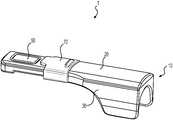
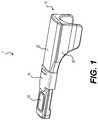
- FIGS. 1-2are perspective views of an example control device
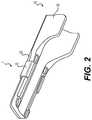
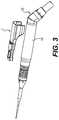
- FIG. 3is a perspective view of an example control device and surgical power tool
- FIGS. 4A-4Bare perspectives views of an example control device coupled to a surgical power tool
- FIG. 5is an exploded view of the example control device of FIG. 1 ;
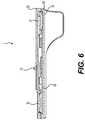
- FIG. 6is a section view of the example control device of FIG. 1 ;
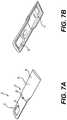
- FIGS. 7A-7Bare perspective views of an example top housing cover
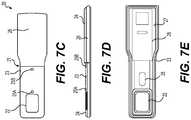
- FIG. 7Cis a top view of the top housing cover of FIG. 7A ;
- FIG. 7Dis a side view of the top housing cover of FIG. 7A ;
- FIG. 7Eis a bottom view of the top housing cover of FIG. 7A ;
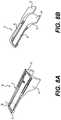
- FIGS. 8A-8Bare perspective views of an example bottom housing cover
- FIG. 8Cis a top view of the bottom housing cover of FIG. 8A ;
- FIG. 8Dis a side view of the bottom housing cover of FIG. 8A ;
- FIG. 8Eis a bottom view of the bottom housing cover of FIG. 8A ;
- FIG. 8Fis an end view of the bottom housing cover of FIG. 8A ;
- FIGS. 9A-9Bare perspective views of an example input element
- FIG. 9Cis a top view of the example input element of FIG. 9A ;
- FIG. 9Dis a side view of the example input element of FIG. 9A ;
- FIG. 9Eis a bottom view of the example input element of FIG. 9A ;
- FIG. 9Fis an end view of the example input element of FIG. 9A ;
- FIG. 10Ais a perspective view of an example control unit
- FIG. 10Bis a top view of the example control unit of FIG. 10A ;
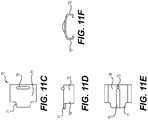
- FIGS. 11A-11Bare perspective views of an example slide cover
- FIG. 11Cis a top view of the example slide cover of FIG. 11A ;
- FIG. 11Dis a side view of the example slide cover of FIG. 11A ;
- FIG. 11Eis a bottom view of the example slide cover of FIG. 11A ;
- FIG. 11Fis an end view of the example slide cover of FIG. 11A ;
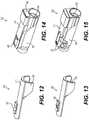
- FIG. 12is a perspective views of an example control device
- FIG. 13is a perspective views of an example control device
- FIG. 14is a perspective views of an example control device.
- FIG. 15is a perspective views of an example control device.
- FIG. 1provides a top perspective view of an example control device 1 .
- the control device 1can include a housing 10 , an input element 50 , and a control unit 60 (not shown).
- the housing 10is sized and configured for coupling the control device 1 to a surgical power tool 100 .
- the housing 10can include various engagement features that allow the housing 10 /control device 1 to be releasably and/or moveably coupled to the power tool 100 .
- the bottom surface of the housing 10can have a shape complementary to the outer surface of the power tool 100 .
- the housing 10can include arms 32 for securing the housing 10 to the power tool 100 .
- FIG. 3illustrates the control device 1 aligned with the handpiece 110 of an example surgical power tool 100 .
- the example power tool 100can include any number of power tools typically used in a surgical procedure.
- the power tool 100can be used in any number of surgical procedures in orthopaedics, traumatology, neurosurgery, neurotology, spinal procedures, otolaryngology, cranio-facial surgery, etc.
- Example power tools 100include, for example, drills, saws, shavers, drivers, reamers, pinners, staplers, microdebriders, etc.
- Anspach XMax® series or the E-Max® series, pneumatic and electric power tools, respectively,are contemplated for use with the disclosed control device and are commercially available from DePuy Synthes Products, Inc. of Raynham, Mass.
- the power tool 100can be electrically (wired or wireless) and/or pneumatically powered.
- the housing 10 of the control device 1can be coupled to the handpiece 110 of the power tool 100 .
- the surgeonmay wish to position the control device 1 at various locations along and/or around the handpiece 110 of the power tool 100 . For example, as different length attachments (e.g., burrs, blades) are attached to the handpiece 110 , the distance between the surgical site/working area and the surgeon's grip position on the control device 1 /handpiece 110 increases, making control more difficult.
- control device 1can be positioned at any location along the handpiece 110 .
- the control device 1can be located rearward on the handpiece 110 , proximate the control end 120 of the power tool 100 .
- the control device 1can be located forward on the handpiece 110 , proximate the operating end 130 of the power tool 100 .
- FIG. 5provides an exploded view of the various components of an example control device 1 .
- FIG. 6provides a cross-section view of the example control device 1 illustrated in FIG. 1 .
- the control device 1can include a housing 10 , an input element 50 , a control unit 60 , and a slide cover 70 movable along the housing 10 .
- the housing 10can include a top housing 20 and a bottom housing 30 .
- the top housing 20 and the bottom housing 30can be permanently or releasably coupled together.
- the top housing 20 and the bottom housing 30can be coupled using screws, hooks, clips, welds, or any other form of mechanical fastener known in the art.
- top housing 20 and the bottom housing 30can be coupled using a chemical fastener/adhesive.
- the top housing and the bottom housing 30can be coupled using a pressure-sensitive adhesive 40 or an epoxy.
- the top housing 20 and the bottom housing 30can be formed as a single, integral housing.
- FIGS. 7A-7Eprovide various views of an example top housing 20 .
- the top housing 20can include an elongated body portion 21 sized and configured to extend along a length of the handpiece 110 of the surgical power tool 100 .
- the top housing 20can include an opening 22 providing access to the input element 50 .
- the opening 22can be located proximate an input position (input element contacts 63 ) on the control unit 60 such that user input information received at the input element 50 is transferred/received by the control unit 60 .
- the top housing 20can also include a recessed surface 23 sized and configured to accommodate movement of the slide cover 70 .
- the top housing 20can also an engagement feature for fixing the position of the slide cover 70 .
- the top surface 24 of the top housing 20can include protrusions 25 for engaging a corresponding recess 73 provided in the slide cover 70 .
- the first protrusion 25 Acan secure the slide cover 70 is a first, non-operating, position where the slide cover 70 covers over at least a portion of the input element 50 and prevents accidental activation of the power tool 100 .
- the second protrusion 25 Bcan be used to secure the slide cover 70 in a second, operating, position away from the input element 50 , illustrated, for example, in FIG. 1 .
- the top housing 20can include an outer grip surface 26 to accommodate a secure grip by the surgeon during the use, illustrated in FIGS. 7A, 7C, and 7D .
- the grip surface 26can include a contoured outer surface and/or textured surface features to enhance grip/purchase between the surgeon's hand and the control device 1 .
- the inside surface 27 of the top housing 20can include recessed portions 28 as illustrated in FIGS. 7B and 7E . These recessed portions 28 can be sized and configured to accommodate the input element 50 and control unit 60 components.
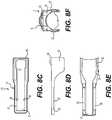
- FIGS. 8A-8Fprovide various views of an example bottom housing 30 .
- the bottom housing 30can include an elongated body portion 31 sized and configured to extend along a length of the handpiece 110 of the surgical power tool 100 .
- the bottom housing 30can include an engagement feature for coupling the bottom housing 30 to the handpiece 110 .
- the bottom housing 30can be permanently or releasably coupled to the handpiece 110 .
- the engagement featurescan be provided such that the bottom housing 30 is moveably coupled along the handpiece 110 .
- the bottom housing 30may slide along and/or rotate around the handpiece 110 .
- the surgeonmay couple the housing 10 /bottom housing 30 to the handpiece 110 and wish to relocate along the body of the handpiece 110 before/during/after the surgical procedure.
- the housing 10 /bottom housing 30may slide along the body of the handpiece 110 to the desired position.
- the housing 10 /bottom housing 30may also be fixed to the power tool 100 such that it does not side along/rotate with respect to the body of the handpiece 110 .
- the engagement features included on the bottom housing 30can include arms 32 extending in a direction away from bottom surface 33 of the housing 10 /bottom housing 30 and around/towards the handpiece 110 of the power tool 100 .
- the arms 32can be configured to engage at least a portion of the outer perimeter of the handpiece 110 . It is contemplated that the arms 32 can be sized and configured to engage a portion of the power tool 100 other than the handpiece 110 .
- the arms 32can engage the outer perimeter of the handpiece 110 /power tool 100 by a snap fit, press fit, a weld, or any other mechanical or chemical fastener known in the art.
- the arms 32can include an inside surface 34 having a shape corresponding to the shape of the handpiece 110 /power tool. As illustrated in FIGS. 8B, 8E and 8F , the inside surface 34 defines a round surface corresponding to the outside perimeter of the handpiece 110 .
- the bottom housing 30can include a bottom surface 33 having a shape corresponding to the shape of the handpiece 110 /power tool 100 . For example, as illustrated in FIGS. 8B and 8F , the bottom surface 33 has a rounded shaped corresponding to the cylindrical shape of the handpiece 110 .
- the bottom housing 30can include recessed surfaces 35 sized and configured to accommodate movement of the slide cover 70 .
- the bottom surface 33 of the bottom housing 30can include recessed surfaces 35 extending along the left and right side of the body portion 31 of the bottom housing 30 .
- the recessed surfaces 35provide a groove/slot for the arms 72 of the slide cover 70 .
- the recessed surfaces 35can extend along the entire length of the bottom housing 30 .
- the recessed surfaces 35can extend along only a portion of the length of the bottom housing 30 and the ends of the recessed surfaces 35 act as stops for the slide cover 70 . That is, movement of the recessed cover between a first position and a second position is limited by contact between the arms 72 and the ends of the recessed surfaces 35 .
- the top surface 36 of the bottom housing 30can include recessed portions 37 as illustrated in FIGS. 8A and 8C . These recessed portions 37 can be sized and configured to accommodate the input element 50 and the control unit 60 .
- the inside surface 36can also include an anchor point 38 for coupling the bottom housing 30 to the input element 50 .
- the bottom housing 30can include two circular-shaped cavities 38 for receiving a similarly-shaped anchors 54 extending from the input element 50 .
- the anchors 54 of the input element 50can be permanently and/or releasably coupled to the bottom housing 30 .
- the anchors 54can be press fit, snap fit, welded, or coupled to the bottom housing 30 using any other mechanical or chemical fastener known in the art.
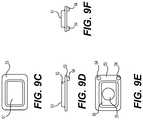
- FIGS. 9A-9Fprovide various views of an example input element 50 .
- the input element 50can include a pressure responsive touch pad for receiving the surgeon's input.
- the input element 50can facilitate an electrical and/or mechanical connection that translates a user input at the input surface 51 to the control unit 60 , thereby controlling operation of the surgical power tool 100 .
- the input surface 51can be located at the top surface 24 of the top housing 10 .
- the input surface 51can be accessible via the opening 22 provided in the top housing 10 .
- the input element 50can extend from inside the housing 10 and partially into and/or through the opening 22 provided in the top housing 20 .
- the input surface 51is recessed below the top surface 24 of the top housing 20 .
- the input surface 51can have a shape corresponding to the shape of the opening 22 .
- the input surface 51 and the opening 22can define rectangular shape. It is contemplated that the input surface 51 and/or the opening 22 can define can define any suitable shape including, for example, circular, elliptical, square, rectangular, or any other regular or irregular shape.
- the input element 50can include a pressure responsive touch pad.
- the input element 50can be constructed from a flexible/compliant material.
- the input element 50can be constructed from silicone rubber any other flexible/compliant material known in the art.
- the input element 50can be constructed having uniform flexibility/elasticity.
- various portions of the input element 50can have differing flexibility/elasticity.
- the input surface 51can extend in a direction parallel to the base portion of the input element 50 .
- the input element 50can include flexible side walls 52 that extend between the input surface 51 and the base portion 53 .
- the flexible side walls 52can be provided such that pressure on the input surface 51 can result in translational movement of the input surface 51 with respect to the base portion 53 .
- the side walls 52can have increased flexibility with respect to the input surface 51 and/or the base portion 53 .
- the input element 50can be permanently or releasably coupled to the housing 10 .
- the input element 50can be integrally formed with the housing 10 .
- the input element 50can include anchors 54 sized and configured for coupling the input element 50 to the housing 10 .
- the anchors 54can extend from the base portion 53 in a direction away from the input surface 51 .
- the input element 50can include any number of anchors 54 suitable for coupling the input element 50 to the housing 10 . When assembled, the anchors 54 can extend through opening 64 provided in the control unit 60 before coupling to the housing 10 .
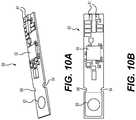
- FIGS. 10A and 10Bprovide a perspective and plan view of an example control unit 60 .
- the control unit 60can be located within the housing 10 and can be used to send user input information received at the input element 50 to the surgical power tool 100 to direct operation of the power tool 100 .
- the control unit 60can provide a wired or wireless communication link with the corresponding control unit of the power tool 100 .
- the control unit 60can include a PCB (printed circuit board), a flexible circuit or any other circuitry for electrically connecting the electronic components of the control unit 60 and providing two-way communication between the control unit 60 and the power tool 100 .
- the control unit 60can facilitate two-way communication between the control device 1 and the power tool 100 , i.e., the control unit 60 be used to communicate input information received at the input element 50 to surgical power tool 100 and also receive operation information from the power tool 100 .
- Components of the control unit 60can include battery contacts 61 , a wireless communication unit 62 (e.g., radio chip antenna, microcontroller with integrated radio, etc.) for communicating with the power tool, and input element contacts 63 , an analog-to-digital converter for converting the user's input into an electrical signal for wireless transmission to the power tool, etc.
- a battery 80can be positioned in-line with the control unit 60 . As illustrated in FIGS. 7E and 8C , the top housing 20 and the bottom housing 30 can include recessed portions 28 and 27 sized and configured to receive the battery to ensure the low profile design of the housing 10 .
- a compressive pad 81may be included within the housing 10 to secure the position of the battery 80 against contacts 61 provided on the control unit 60 .
- the input element 50can be located within the control device 1 /housing 10 at a position proximate the control unit 60 such that a user input at the input surface 51 activates the input element contacts 63 on the control unit 60 .
- the input element 50can include a carbon or gold pill 55 placed on the bottom surface 56 of the input element 50 proximate the contacts 63 .
- the carbon pill 55can be provided within the input element 50 by means of a silicone overmold (or other insulative material).
- the pill 55comes into contact with the control unit contacts 63 and completes an electrical connection.
- the force to operate (actuation force) the input element 50is approximately 100 g (+/ ⁇ 25 g).
- Varying the user input provided at the input surface 51can vary the input information received at/measured by the control unit 60 . That is, varying the input information can result in a corresponding change in power tool 100 operation.
- the control device 1can be used to control the on/off function, speed, torque, direction, illumination, irrigation, suction, or any other function completed by a surgical power tool.
- the increased pressure/force applied at the input surface 51can correspond to an increased power tool 100 speed, torque, etc.
- varying the location and/or direction of the user input on the input surface 51can result in a corresponding change in input information and power tool 100 operation.
- applying input force at a certain location on the input surface 51can be used to provide a specific operation instructions to the power tool 100 (e.g., on/off, speed, torque, direction).
- sweeping/moving the finger across the input surface 51can also be used to provide a specific instruction to the power tool 100 (e.g., on/off, speed, torque, direction).
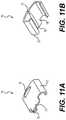
- FIGS. 11A-11Fprovide various views of an example slide cover 70 .
- the slide cover 70is movable along the housing 10 (top housing 20 and bottom housing 30 ) between a first, non-operating, position where the slide cover 70 covers over at least a portion of the input element 50 and a second, operating, position allowing access to the input element 50 .
- the second, operating, positionis illustrated in FIG. 1 .
- the slide cover 70can include an extension 71 provided at the distal end of the slide cover 70 for extending over/covering the input surface 51 of the input element 50 when the slide cover 70 is in (or proximate) the first, non-operating, position.
- the slide cover 70can also include two downwardly extending arms 72 that wrap around the side edge of the housing 10 (top housing 20 and bottom housing 30 ).
- the arms 72can extend around at last a portion of the side and bottom surfaces of the housing 10 to engage the recessed surfaces 35 provided on the bottom surface 33 of the housing 10 /bottom housing 30 .
- the arms 72can move along the recessed surfaces 35 between a first and second position. The ends of the recessed surfaces 35 can act as a stop for the slide cover 70 .
- the slide cover 70can include an engagement feature for fixing the position of the slide cover 70 along the housing 10 /top housing 20 .
- the slide cover 70can include recesses 73 on its bottom surface 74 for engaging a corresponding protrusion 25 provided in the top housing 20 .
- the bottom surface 74can also include an elongated channel 75 terminating proximate the circular-shaped recess 73 .
- the engagement features, recess 73 and elongated channel 75can have any suitable shape/profile corresponding to the protrusion 25 .
- the recess 73 and elongated channel 75can have a circular, elliptical, square, rectangular, or any other regular or irregular shape.
- the protrusions 25 provided in the top housing 20move along the channel 75 of the slide cover 70 .
- the corresponding housing protrusion 25engages the recess 73 provided in the slide cover 70 . The surgeon can disengage the engagement features (protrusion/recess) using hand force.
- the slide cover 70can include a grip surface 76 to accommodate a secure grip and provide a leverage point to facilitate movement of the slide cover 70 by the surgeon. As illustrated in FIGS. 11A, 11C, 11D , the grip surface 76 can include a contoured protrusion extending from the top surface 77 of the slide cover 70 . The grip surface 76 can also include a surface feature/texture on the top and/or side surfaces 77 , 78 of the slide cover 70 .
- the slide cover 70is slidably coupled to the housing 10 (top housing 20 and bottom housing 30 ).
- the side cover 70can have a width and height corresponding to the width and height of the housing 1 .
- the slide cover 70can be received within the recessed surface 23 of the top housing 20 such that the width and height corresponds to the width and height of the housing 10 .
- the grip surface 76 of the slide cover 70may extend above the width/height of the housing 10 .
- the height/width of the grip surface of the slide cover 70is less than the height/width of the housing 10 .
- the control device 1is first coupled to and positioned appropriately on the handpiece 110 of a surgical power tool 100 .
- the surgeonmay orient with control device 1 such that the bottom surface 33 of the housing 1 and the opening between arms 32 aligns with the handpiece 110 .
- the control device 1is then coupled to the handpiece 110 by a press-fit or snap-fit connection.
- the arms 32 of the housing 10can flex/separate to advance over and around the handpiece 110 .
- the surgeonmay wish to position the control device 1 at various locations along and/or around the handpiece 110 of the power tool 100 .
- the position of the control device 1can be adjusted along/around the handpiece 110 as desired by the surgeon.
- the surgeoncan slide the control device 1 forward or rearward along the handpiece 110 .
- the surgeoncan also rotate the control device 1 around the perimeter of the handpiece 110 .
- the surgeoncan fix the location of the control device 1 by engaging a mechanical fastener/connection between the housing 10 and the handpiece 110 .
- the surgeoncan fix the position of the control device 1 with respect to the handpiece 110 by grasping the control device 1 and handpiece 110 around the periphery. The surgeon can then move the slide cover 70 to an operating position such that the input surface 51 of the input element 50 is exposed.
- the surgeonmay provide pressure on the grip surface 76 in the direction of desired movement sufficient to overcome engagement between the engagement features between the slide cover 70 and the top housing 10 .
- lateral pressuremay be applied to the protrusion extending from the top surface 77 of the slide cover 70 .
- the surgeonmay grasp the slide cover 76 at its side edges and pull/push the slide cover back, away from the input element 50 .
- the surgeoncan then position the power tool 100 at its desired location at/in the surgical site to complete the medical procedure.
- the input element 50can be activated by pressure applied by the surgeon's finger(s)/thumb at the input surface 51 .
- depressing the input element 50causes a carbon pill 55 overmolded into the input element 50 to complete an electrical connection with a corresponding contact 63 provided on the control unit 60 .
- user input informationis then transmitted to the power tool 100 .
- pressure on the input surface 51the surgeon is able to vary the input information provided to the power tool 100 .
- the surgeoncan remove the power tool 100 from the surgical site. Before or after removing the power tool 100 , the surgeon can reposition/close the slide cover 70 such that the slide cover 70 is positioned over the input surface 51 . Closing the slide cover 70 is performed in a similar (but opposite) fashion as opening. The surgeon can provide pressure on the grip surface 76 in the direction of desired movement sufficient to overcome engagement between the engagement features between the slide cover 70 and the top housing 10 .
- the recess 73 provided on the slide covercan engages the protrusion 25 provided in the top housing 10 .
- the surgeonprevents accidental activation of the power tool 100 .
- the surgeoncan then safely remove the control device 1 from the handpiece 110 . If a mechanical fastener was used to fix the position on the handpiece 110 it must be disengaged. The surgeon can then slide/pull the control device 1 off of the handpiece 110 . Once the control device is removed from the handpiece 110 it can be sterilized for reuse, recycled and/or disposed of Because the control device 1 can be separated from the handpiece 110 (upon completion of or during the surgical procedure), the control device 1 can be easily be cleaned and sterilized separate from the power tool 100 .
- FIG. 12provides another example control device 200 .
- the control device 200is similar to the control device 1 depicted in FIG. 1 , like reference symbols are used to indicate like elements. The differences between the control device 200 and the control device 1 are discussed below.
- the control device 200can include a sliding magnet 250 for providing input information to the control unit. As the magnet 250 is moved along the housing 210 is activates the contacts provided on the control unit. For example, the magnet 250 is moved between an on/off position along the housing 210 , thereby providing on/off instructions to the power tool.
- FIG. 13provides another example control device 300 .
- the control device 300is similar to the control device 1 depicted in FIG. 1 , like reference symbols are used to indicate like elements. The differences between the control device 300 and the control device 1 are discussed below.
- the control device 300can also include a sliding magnet 350 for providing input information to the control unit. As the magnet 350 moves along the housing 310 , the contacts on the control unit is activated. In the control device 300 , the direction and/or location of the magnet 350 along the housing can be used vary the input information received at the control unit.
- FIG. 14provides another example control device 400 .
- the control device 400is similar to the control device 1 depicted in FIG. 1 , like reference symbols are used to indicate like elements. The differences between the control device 400 and the control device 1 are discussed below.
- the control device 400can include a popple/snap dome input element 450 . Pressure provided at the input surface of the input element 450 completes the electrical connection between the input element 450 and contacts of the control unit. Releasing the pressure on the input surface disengages the electrical connection. As the popple/snap dome input element 450 is moved depressed/released a corresponding on/off instruction is sent to the power tool.
- the control device 400includes a force sensor input element 450 .
- the control device 400can also include a replaceable and/or rechargeable battery 480 .
- the battery 480can be accessed via an opening provided at the proximal end of the control device 400 .
- FIG. 15provides another example control device 500 .
- the control device 500is similar to the control device 1 depicted in FIG. 1 , like reference symbols are used to indicate like elements. The differences between the control device 500 and the control device 1 are discussed below.
- the control device 500can include a capacitive touch sensor input element 550 .
- the capacitive input element 550can include multiple input surfaces capable of providing different input information to the power tool. For example, the various input surface can each provide separate instructions regarding speed, torque, illumination, irrigation, or any other function completed by the power tool.
Landscapes
- Health & Medical Sciences (AREA)
- Surgery (AREA)
- Life Sciences & Earth Sciences (AREA)
- Biomedical Technology (AREA)
- Medical Informatics (AREA)
- Veterinary Medicine (AREA)
- Public Health (AREA)
- Engineering & Computer Science (AREA)
- General Health & Medical Sciences (AREA)
- Heart & Thoracic Surgery (AREA)
- Nuclear Medicine, Radiotherapy & Molecular Imaging (AREA)
- Molecular Biology (AREA)
- Animal Behavior & Ethology (AREA)
- Dentistry (AREA)
- Oral & Maxillofacial Surgery (AREA)
- Orthopedic Medicine & Surgery (AREA)
- Surgical Instruments (AREA)
- Dental Tools And Instruments Or Auxiliary Dental Instruments (AREA)
Abstract
Description
Claims (20)
Priority Applications (13)
| Application Number | Priority Date | Filing Date | Title |
|---|---|---|---|
| US14/795,203US11191528B2 (en) | 2015-07-09 | 2015-07-09 | External hand control for surgical power tool |
| AU2016204499AAU2016204499B2 (en) | 2015-07-09 | 2016-06-29 | External hand control for surgical power tool |
| EP16178569.6AEP3132757B1 (en) | 2015-07-09 | 2016-07-08 | External hand control for surgical power tool |
| EP20159337.3AEP3679872B1 (en) | 2015-07-09 | 2016-07-08 | External hand control for surgical power tool |
| JP2016135802AJP6873620B2 (en) | 2015-07-09 | 2016-07-08 | External manual control for surgical power instruments |
| CN202310399133.XACN116616831A (en) | 2015-07-09 | 2016-07-08 | External manual control for a surgical power tool |
| ES20159337TES2915593T3 (en) | 2015-07-09 | 2016-07-08 | External manual control for surgical power tool |
| EP22166858.5AEP4042953A1 (en) | 2015-07-09 | 2016-07-08 | External hand control for surgical power tool |
| CN201610537623.1ACN106333714A (en) | 2015-07-09 | 2016-07-08 | External manual controls for surgical power tools |
| AU2021200940AAU2021200940B2 (en) | 2015-07-09 | 2021-02-12 | External hand control for surgical power tool |
| JP2021024000AJP7155311B2 (en) | 2015-07-09 | 2021-02-18 | External manual controls for power surgical instruments |
| US17/379,770US20220008048A1 (en) | 2015-07-09 | 2021-07-19 | External hand control for surgical power tool |
| AU2022275503AAU2022275503B2 (en) | 2015-07-09 | 2022-11-25 | External hand control for surgical power tool |
Applications Claiming Priority (1)
| Application Number | Priority Date | Filing Date | Title |
|---|---|---|---|
| US14/795,203US11191528B2 (en) | 2015-07-09 | 2015-07-09 | External hand control for surgical power tool |
Related Child Applications (1)
| Application Number | Title | Priority Date | Filing Date |
|---|---|---|---|
| US17/379,770ContinuationUS20220008048A1 (en) | 2015-07-09 | 2021-07-19 | External hand control for surgical power tool |
Publications (2)
| Publication Number | Publication Date |
|---|---|
| US20170007219A1 US20170007219A1 (en) | 2017-01-12 |
| US11191528B2true US11191528B2 (en) | 2021-12-07 |
Family
ID=56799210
Family Applications (2)
| Application Number | Title | Priority Date | Filing Date |
|---|---|---|---|
| US14/795,203ActiveUS11191528B2 (en) | 2015-07-09 | 2015-07-09 | External hand control for surgical power tool |
| US17/379,770PendingUS20220008048A1 (en) | 2015-07-09 | 2021-07-19 | External hand control for surgical power tool |
Family Applications After (1)
| Application Number | Title | Priority Date | Filing Date |
|---|---|---|---|
| US17/379,770PendingUS20220008048A1 (en) | 2015-07-09 | 2021-07-19 | External hand control for surgical power tool |
Country Status (6)
| Country | Link |
|---|---|
| US (2) | US11191528B2 (en) |
| EP (3) | EP3132757B1 (en) |
| JP (2) | JP6873620B2 (en) |
| CN (2) | CN116616831A (en) |
| AU (3) | AU2016204499B2 (en) |
| ES (1) | ES2915593T3 (en) |
Cited By (1)
| Publication number | Priority date | Publication date | Assignee | Title |
|---|---|---|---|---|
| US20230157771A1 (en)* | 2018-07-17 | 2023-05-25 | Verb Surgical Inc. | Robotic surgical pedal with integrated foot sensor |
Families Citing this family (9)
| Publication number | Priority date | Publication date | Assignee | Title |
|---|---|---|---|---|
| US11191528B2 (en) | 2015-07-09 | 2021-12-07 | DePuy Synthes Products, Inc. | External hand control for surgical power tool |
| DE102018133504A1 (en) | 2018-12-21 | 2020-06-25 | Aesculap Ag | Integrated power unit IPU |
| DE102019101308A1 (en)* | 2019-01-18 | 2020-07-23 | Aesculap Ag | Integrated power unit IPU |
| US12408904B2 (en) | 2019-04-12 | 2025-09-09 | Stryker European Operations Limited | Handswitch and connector for powered surgical handpiece |
| DE102020109069A1 (en)* | 2020-04-01 | 2021-10-07 | Aesculap Ag | Smart drill with data monitoring / smart medical electric drive instrument with data monitoring |
| CN113208688B (en)* | 2021-03-19 | 2022-08-16 | 桂林医学院 | Skull incision equipment |
| DE102021116915A1 (en)* | 2021-06-30 | 2023-01-05 | B. Braun New Ventures GmbH | Medical remote control, control system and control method |
| DE102022211015A1 (en)* | 2022-10-18 | 2024-04-18 | Inomed Medizintechnik Gmbh | Input attachment, surgical device, arrangement for intraoperative use and use of an input attachment |
| WO2025072916A1 (en)* | 2023-09-28 | 2025-04-03 | The Trustees Of Columbia University In The City Of New York | Ergonomic surgical device |
Citations (59)
| Publication number | Priority date | Publication date | Assignee | Title |
|---|---|---|---|---|
| US5196007A (en) | 1991-06-07 | 1993-03-23 | Alan Ellman | Electrosurgical handpiece with activator |
| US5373317A (en) | 1993-05-28 | 1994-12-13 | Welch Allyn, Inc. | Control and display section for borescope or endoscope |
| US5524327A (en)* | 1994-11-14 | 1996-06-11 | Mednext, Inc. | Malleable clip |
| US5873814A (en) | 1996-07-12 | 1999-02-23 | Adair; Edwin L. | Sterile encapsulated endoscopic video monitor and method |
| JP2000254136A (en) | 1999-03-09 | 2000-09-19 | Olympus Optical Co Ltd | Ultrasonic instrument |
| US20030048598A1 (en)* | 2001-09-13 | 2003-03-13 | Lg Electronics Inc. | Portable electronic device having LCD and touch screen |
| US6715078B1 (en)* | 2000-03-28 | 2004-03-30 | Ncr Corporation | Methods and apparatus for secure personal identification number and data encryption |
| US20040180703A1 (en)* | 2003-03-10 | 2004-09-16 | Samsung Electronics Co., Ltd | Bar type portable wireless terminal |
| US20050004559A1 (en) | 2003-06-03 | 2005-01-06 | Senorx, Inc. | Universal medical device control console |
| US20050020909A1 (en)* | 2003-07-10 | 2005-01-27 | Moctezuma De La Barrera Jose Luis | Display device for surgery and method for using the same |
| US20050078817A1 (en)* | 2003-10-13 | 2005-04-14 | Hanbit Precision Co., Ltd. | Apparatus for opening and closing cover of cellular phone |
| US20060068834A1 (en) | 2004-09-30 | 2006-03-30 | Jones Paul H | Method and apparatus for detachable and configurable user interfaces for ultrasound systems |
| CN2800368Y (en) | 2005-03-28 | 2006-07-26 | 广东威创日新电子有限公司 | Pointer pen for writing |
| US7179223B2 (en) | 2002-08-06 | 2007-02-20 | Olympus Optical Co., Ltd. | Endoscope apparatus having an internal channel |
| US20070117425A1 (en)* | 2005-11-22 | 2007-05-24 | Lih Duo International Co., Ltd. | Ic embedding seat |
| US20080077158A1 (en) | 2006-06-16 | 2008-03-27 | Hani Haider | Method and Apparatus for Computer Aided Surgery |
| US20080188870A1 (en) | 2005-09-20 | 2008-08-07 | Jacques Andre | Device and Method for Controlling a Remote Appliance |
| US20090253472A1 (en) | 2006-03-28 | 2009-10-08 | Jai-Chul Kim | Case for a hand held device |
| US20090256817A1 (en)* | 2008-02-28 | 2009-10-15 | New York University | Method and apparatus for providing input to a processor, and a sensor pad |
| US7738971B2 (en) | 2007-01-10 | 2010-06-15 | Ethicon Endo-Surgery, Inc. | Post-sterilization programming of surgical instruments |
| US7846150B2 (en) | 2004-11-01 | 2010-12-07 | Stryker Corporation | Apparatus and method for synchronizing a wireless remote control to a central control unit so as to allow remote control of a medical device over a secure wireless connection |
| US7883458B2 (en) | 2003-06-27 | 2011-02-08 | Stryker Corporation | System for remotely controlling two or more medical devices |
| CN102149338A (en) | 2008-09-12 | 2011-08-10 | 伊西康内外科公司 | Ultrasonic device for fingertip control |
| CN102198014A (en) | 2011-03-11 | 2011-09-28 | 西安交通大学 | Wireless control system of high-frequency electrotome |
| US20120203213A1 (en)* | 2008-09-12 | 2012-08-09 | Kimball Cory G | Activation feature for surgical instrument with pencil grip |
| CN202419252U (en) | 2012-01-10 | 2012-09-05 | 曹文虎 | Touch pressure lamp |
| US20120283707A1 (en) | 2011-03-01 | 2012-11-08 | Giordano James R | Surgical instrument with wireless communication between control unit and remote sensor |
| JP2013192952A (en) | 2012-03-22 | 2013-09-30 | Ethicon Endo Surgery Inc | Activation feature section for surgical instrument with pencil grip |
| US20130307529A1 (en) | 2012-05-16 | 2013-11-21 | Adrian Baumgartner | Measuring device |
| US20140039382A1 (en)* | 2011-02-17 | 2014-02-06 | Abbott Diabetes Care Inc. | Analyte Meter Module for Medication Delivery Device |
| US8746530B2 (en) | 2007-01-10 | 2014-06-10 | Ethicon Endo-Surgery, Inc. | Surgical instrument with wireless communication between control unit and remote sensor |
| US8840603B2 (en) | 2007-01-10 | 2014-09-23 | Ethicon Endo-Surgery, Inc. | Surgical instrument with wireless communication between control unit and sensor transponders |
| US20150083772A1 (en) | 2013-09-23 | 2015-03-26 | Ethicon Endo-Surgery, Inc. | Surgical stapler with rotary cam drive and return |
| US20150182230A1 (en)* | 2012-05-23 | 2015-07-02 | Stryker Corporation | Battery and control module for both energizing and controlling a powered surgical tool that is releasably attached to the module |
| US20150272557A1 (en)* | 2014-03-26 | 2015-10-01 | Ethicon Endo-Surgery, Inc. | Modular surgical instrument system |
| US20150272579A1 (en)* | 2014-03-26 | 2015-10-01 | Ethicon Endo-Surgery, Inc. | Modular powered surgical instrument with detachable shaft assemblies |
| US20150301601A1 (en) | 2014-04-17 | 2015-10-22 | MAQUET GmbH | Operating device for controlling a medical apparatus |
| US20170007219A1 (en) | 2015-07-09 | 2017-01-12 | DePuy Synthes Products, Inc. | External hand control for surgical power tool |
| US20170086834A1 (en) | 2015-09-25 | 2017-03-30 | Ethicon Endo-Surgery, Llc | Hybrid robotic surgery with manual and robotic modes |
| US9757101B2 (en) | 2012-10-18 | 2017-09-12 | Societe Pour La Conception Des Applications Des Techniques Electroniques | Device for controlling a surgical handpiece |
| US20180049795A1 (en) | 2016-08-16 | 2018-02-22 | Ethicon Endo-Surgery, Llc | Modular surgical robotic tool |
| US20180049794A1 (en) | 2016-08-16 | 2018-02-22 | Ethicon Endo-Surgery, Llc | Modular surgical robotic tool |
| US20180199949A1 (en) | 2014-09-26 | 2018-07-19 | DePuy Synthes Products, Inc. | Surgical tool with feedback |
| RU2664168C2 (en) | 2013-03-01 | 2018-08-15 | Этикон Эндо-Серджери, Инк. | Electromechanical surgical device with signal relay arrangement |
| EP2245981B1 (en) | 2009-04-28 | 2018-09-19 | Aktormed GmbH | Remote control for an operations assistance system |
| US10149711B2 (en) | 2012-03-30 | 2018-12-11 | Depuy Mitek, Llc | Surgical impact tool |
| EP3506281A1 (en) | 2017-12-28 | 2019-07-03 | Ethicon LLC | Sterile field interactive control displays |
| US20190201139A1 (en) | 2017-12-28 | 2019-07-04 | Ethicon Llc | Communication arrangements for robot-assisted surgical platforms |
| US20190217460A1 (en) | 2018-01-18 | 2019-07-18 | Ingersoll-Rand Company | Add-on user interface module for precision power tools |
| WO2019162761A1 (en) | 2018-02-20 | 2019-08-29 | Ethicon Llc | Wireless robotic surgical instrument communication |
| WO2019173574A1 (en) | 2018-03-09 | 2019-09-12 | Stryker Corporation | Systems and methods for remotely controlling a surgical instrument of console-based surgical systems |
| US10456010B2 (en) | 2005-04-18 | 2019-10-29 | Transenterix Europe S.A.R.L. | Device and methods of improving laparoscopic surgery |
| US10517682B2 (en) | 2007-01-10 | 2019-12-31 | Ethicon Llc | Surgical instrument with wireless communication between control unit and remote sensor |
| WO2020051443A1 (en) | 2018-09-07 | 2020-03-12 | Ethicon Llc | Adaptably connectable and reassignable system accessories for modular energy system |
| US10588629B2 (en) | 2009-11-20 | 2020-03-17 | Covidien Lp | Surgical console and hand-held surgical device |
| EP3687024A1 (en) | 2018-01-26 | 2020-07-29 | TTI (Macao Commercial Offshore) Limited | An electrical apparatus, a power system, a power tool, a network of power tools and a power tool controller |
| US20200375681A1 (en) | 2019-06-03 | 2020-12-03 | Bausch & Lomb Incorporated | Detachable Finger-Activated Surgical Control Device |
| US20200405404A1 (en) | 2019-06-27 | 2020-12-31 | Ethicon Llc | Cooperative robotic surgical systems |
| US10993717B2 (en) | 2006-01-31 | 2021-05-04 | Ethicon Llc | Surgical stapling system comprising a control system |
Family Cites Families (12)
| Publication number | Priority date | Publication date | Assignee | Title |
|---|---|---|---|---|
| US5691898A (en)* | 1995-09-27 | 1997-11-25 | Immersion Human Interface Corp. | Safe and low cost computer peripherals with force feedback for consumer applications |
| US6106484A (en)* | 1998-05-12 | 2000-08-22 | Medical Device Technologies, Inc. | Reusable automated biopsy needle handle |
| GB2353170A (en)* | 1999-08-06 | 2001-02-14 | Nokia Mobile Phones Ltd | Slide assembly for a communication unit |
| JP2001103146A (en) | 1999-09-28 | 2001-04-13 | Matsushita Electric Ind Co Ltd | Howling prevention device for telephone |
| JP2003000612A (en)* | 2001-06-18 | 2003-01-07 | Olympus Optical Co Ltd | Energy treating system |
| KR200211455Y1 (en)* | 2000-08-08 | 2001-01-15 | 엘지정보통신주식회사 | Mobile station |
| US20050273109A1 (en)* | 2004-06-02 | 2005-12-08 | Minnesota Scientific, Inc. | Computer controlled reaming device |
| JP2007004685A (en)* | 2005-06-27 | 2007-01-11 | Hitachi Ltd | Communication information monitoring device |
| US20150148791A1 (en)* | 2011-11-05 | 2015-05-28 | Medtronic Ardian Luxemborug S.a.r.l. | Systems, devices and methods for cryogenic renal neuromodulation |
| KR101995486B1 (en)* | 2012-06-26 | 2019-07-02 | 엘지전자 주식회사 | Mobile terminal and control method thereof |
| US9271797B2 (en)* | 2013-07-02 | 2016-03-01 | Gyrus Acmi, Inc. | Robotic surgery |
| CN104156088A (en)* | 2013-05-14 | 2014-11-19 | 汉王科技股份有限公司 | Active capacitive pen and touch device |
- 2015
- 2015-07-09USUS14/795,203patent/US11191528B2/enactiveActive
- 2016
- 2016-06-29AUAU2016204499Apatent/AU2016204499B2/enactiveActive
- 2016-07-08ESES20159337Tpatent/ES2915593T3/enactiveActive
- 2016-07-08EPEP16178569.6Apatent/EP3132757B1/enactiveActive
- 2016-07-08CNCN202310399133.XApatent/CN116616831A/enactivePending
- 2016-07-08JPJP2016135802Apatent/JP6873620B2/enactiveActive
- 2016-07-08CNCN201610537623.1Apatent/CN106333714A/enactivePending
- 2016-07-08EPEP20159337.3Apatent/EP3679872B1/enactiveActive
- 2016-07-08EPEP22166858.5Apatent/EP4042953A1/enactivePending
- 2021
- 2021-02-12AUAU2021200940Apatent/AU2021200940B2/enactiveActive
- 2021-02-18JPJP2021024000Apatent/JP7155311B2/enactiveActive
- 2021-07-19USUS17/379,770patent/US20220008048A1/enactivePending
- 2022
- 2022-11-25AUAU2022275503Apatent/AU2022275503B2/enactiveActive
Patent Citations (66)
| Publication number | Priority date | Publication date | Assignee | Title |
|---|---|---|---|---|
| US5196007A (en) | 1991-06-07 | 1993-03-23 | Alan Ellman | Electrosurgical handpiece with activator |
| US5373317A (en) | 1993-05-28 | 1994-12-13 | Welch Allyn, Inc. | Control and display section for borescope or endoscope |
| US5373317B1 (en) | 1993-05-28 | 2000-11-21 | Welch Allyn Inc | Control and display section for borescope or endoscope |
| US5524327A (en)* | 1994-11-14 | 1996-06-11 | Mednext, Inc. | Malleable clip |
| US5873814A (en) | 1996-07-12 | 1999-02-23 | Adair; Edwin L. | Sterile encapsulated endoscopic video monitor and method |
| JP2000254136A (en) | 1999-03-09 | 2000-09-19 | Olympus Optical Co Ltd | Ultrasonic instrument |
| US6715078B1 (en)* | 2000-03-28 | 2004-03-30 | Ncr Corporation | Methods and apparatus for secure personal identification number and data encryption |
| US20030048598A1 (en)* | 2001-09-13 | 2003-03-13 | Lg Electronics Inc. | Portable electronic device having LCD and touch screen |
| US7179223B2 (en) | 2002-08-06 | 2007-02-20 | Olympus Optical Co., Ltd. | Endoscope apparatus having an internal channel |
| US20040180703A1 (en)* | 2003-03-10 | 2004-09-16 | Samsung Electronics Co., Ltd | Bar type portable wireless terminal |
| US20050004559A1 (en) | 2003-06-03 | 2005-01-06 | Senorx, Inc. | Universal medical device control console |
| US7883458B2 (en) | 2003-06-27 | 2011-02-08 | Stryker Corporation | System for remotely controlling two or more medical devices |
| US20050020909A1 (en)* | 2003-07-10 | 2005-01-27 | Moctezuma De La Barrera Jose Luis | Display device for surgery and method for using the same |
| US20050078817A1 (en)* | 2003-10-13 | 2005-04-14 | Hanbit Precision Co., Ltd. | Apparatus for opening and closing cover of cellular phone |
| US20060068834A1 (en) | 2004-09-30 | 2006-03-30 | Jones Paul H | Method and apparatus for detachable and configurable user interfaces for ultrasound systems |
| US7846150B2 (en) | 2004-11-01 | 2010-12-07 | Stryker Corporation | Apparatus and method for synchronizing a wireless remote control to a central control unit so as to allow remote control of a medical device over a secure wireless connection |
| CN2800368Y (en) | 2005-03-28 | 2006-07-26 | 广东威创日新电子有限公司 | Pointer pen for writing |
| US10456010B2 (en) | 2005-04-18 | 2019-10-29 | Transenterix Europe S.A.R.L. | Device and methods of improving laparoscopic surgery |
| US20080188870A1 (en) | 2005-09-20 | 2008-08-07 | Jacques Andre | Device and Method for Controlling a Remote Appliance |
| US20070117425A1 (en)* | 2005-11-22 | 2007-05-24 | Lih Duo International Co., Ltd. | Ic embedding seat |
| US10993717B2 (en) | 2006-01-31 | 2021-05-04 | Ethicon Llc | Surgical stapling system comprising a control system |
| US20090253472A1 (en) | 2006-03-28 | 2009-10-08 | Jai-Chul Kim | Case for a hand held device |
| US20080077158A1 (en) | 2006-06-16 | 2008-03-27 | Hani Haider | Method and Apparatus for Computer Aided Surgery |
| US8840603B2 (en) | 2007-01-10 | 2014-09-23 | Ethicon Endo-Surgery, Inc. | Surgical instrument with wireless communication between control unit and sensor transponders |
| US10517682B2 (en) | 2007-01-10 | 2019-12-31 | Ethicon Llc | Surgical instrument with wireless communication between control unit and remote sensor |
| US7738971B2 (en) | 2007-01-10 | 2010-06-15 | Ethicon Endo-Surgery, Inc. | Post-sterilization programming of surgical instruments |
| US8746530B2 (en) | 2007-01-10 | 2014-06-10 | Ethicon Endo-Surgery, Inc. | Surgical instrument with wireless communication between control unit and remote sensor |
| US11000277B2 (en) | 2007-01-10 | 2021-05-11 | Ethicon Llc | Surgical instrument with wireless communication between control unit and remote sensor |
| US20090256817A1 (en)* | 2008-02-28 | 2009-10-15 | New York University | Method and apparatus for providing input to a processor, and a sensor pad |
| US9023071B2 (en) | 2008-09-12 | 2015-05-05 | Ethicon Endo-Surgery, Inc. | Ultrasonic device for fingertip control |
| US20120203213A1 (en)* | 2008-09-12 | 2012-08-09 | Kimball Cory G | Activation feature for surgical instrument with pencil grip |
| CN102149338A (en) | 2008-09-12 | 2011-08-10 | 伊西康内外科公司 | Ultrasonic device for fingertip control |
| EP2245981B1 (en) | 2009-04-28 | 2018-09-19 | Aktormed GmbH | Remote control for an operations assistance system |
| US10588629B2 (en) | 2009-11-20 | 2020-03-17 | Covidien Lp | Surgical console and hand-held surgical device |
| US20140039382A1 (en)* | 2011-02-17 | 2014-02-06 | Abbott Diabetes Care Inc. | Analyte Meter Module for Medication Delivery Device |
| US20120283707A1 (en) | 2011-03-01 | 2012-11-08 | Giordano James R | Surgical instrument with wireless communication between control unit and remote sensor |
| CN102198014A (en) | 2011-03-11 | 2011-09-28 | 西安交通大学 | Wireless control system of high-frequency electrotome |
| CN202419252U (en) | 2012-01-10 | 2012-09-05 | 曹文虎 | Touch pressure lamp |
| JP2013192952A (en) | 2012-03-22 | 2013-09-30 | Ethicon Endo Surgery Inc | Activation feature section for surgical instrument with pencil grip |
| US10149711B2 (en) | 2012-03-30 | 2018-12-11 | Depuy Mitek, Llc | Surgical impact tool |
| US20190059968A1 (en) | 2012-03-30 | 2019-02-28 | Depuy Mitek, Llc | Surgical impact tool |
| US20130307529A1 (en) | 2012-05-16 | 2013-11-21 | Adrian Baumgartner | Measuring device |
| EP2852336B1 (en) | 2012-05-23 | 2021-06-23 | Stryker Corporation | Battery and control module for a powered surgical tool, the module including a switch and sensors for both the surgical tool and the switch |
| US20150182230A1 (en)* | 2012-05-23 | 2015-07-02 | Stryker Corporation | Battery and control module for both energizing and controlling a powered surgical tool that is releasably attached to the module |
| US10076340B2 (en) | 2012-05-23 | 2018-09-18 | Stryker Corporation | Surgical tool system with a tool unit that includes a power generating unit and a battery and control module that is releasably attached to the tool unit for energizing and controlling the power generating unit |
| US9757101B2 (en) | 2012-10-18 | 2017-09-12 | Societe Pour La Conception Des Applications Des Techniques Electroniques | Device for controlling a surgical handpiece |
| RU2664168C2 (en) | 2013-03-01 | 2018-08-15 | Этикон Эндо-Серджери, Инк. | Electromechanical surgical device with signal relay arrangement |
| US20150083772A1 (en) | 2013-09-23 | 2015-03-26 | Ethicon Endo-Surgery, Inc. | Surgical stapler with rotary cam drive and return |
| US20150272579A1 (en)* | 2014-03-26 | 2015-10-01 | Ethicon Endo-Surgery, Inc. | Modular powered surgical instrument with detachable shaft assemblies |
| US20150272557A1 (en)* | 2014-03-26 | 2015-10-01 | Ethicon Endo-Surgery, Inc. | Modular surgical instrument system |
| US20150301601A1 (en) | 2014-04-17 | 2015-10-22 | MAQUET GmbH | Operating device for controlling a medical apparatus |
| US20180199949A1 (en) | 2014-09-26 | 2018-07-19 | DePuy Synthes Products, Inc. | Surgical tool with feedback |
| US20170007219A1 (en) | 2015-07-09 | 2017-01-12 | DePuy Synthes Products, Inc. | External hand control for surgical power tool |
| EP3132757B1 (en) | 2015-07-09 | 2020-07-01 | DePuy Synthes Products, Inc. | External hand control for surgical power tool |
| US20170086834A1 (en) | 2015-09-25 | 2017-03-30 | Ethicon Endo-Surgery, Llc | Hybrid robotic surgery with manual and robotic modes |
| US20180049794A1 (en) | 2016-08-16 | 2018-02-22 | Ethicon Endo-Surgery, Llc | Modular surgical robotic tool |
| US20180049795A1 (en) | 2016-08-16 | 2018-02-22 | Ethicon Endo-Surgery, Llc | Modular surgical robotic tool |
| US20190201139A1 (en) | 2017-12-28 | 2019-07-04 | Ethicon Llc | Communication arrangements for robot-assisted surgical platforms |
| EP3506281A1 (en) | 2017-12-28 | 2019-07-03 | Ethicon LLC | Sterile field interactive control displays |
| US20190217460A1 (en) | 2018-01-18 | 2019-07-18 | Ingersoll-Rand Company | Add-on user interface module for precision power tools |
| EP3687024A1 (en) | 2018-01-26 | 2020-07-29 | TTI (Macao Commercial Offshore) Limited | An electrical apparatus, a power system, a power tool, a network of power tools and a power tool controller |
| WO2019162761A1 (en) | 2018-02-20 | 2019-08-29 | Ethicon Llc | Wireless robotic surgical instrument communication |
| WO2019173574A1 (en) | 2018-03-09 | 2019-09-12 | Stryker Corporation | Systems and methods for remotely controlling a surgical instrument of console-based surgical systems |
| WO2020051443A1 (en) | 2018-09-07 | 2020-03-12 | Ethicon Llc | Adaptably connectable and reassignable system accessories for modular energy system |
| US20200375681A1 (en) | 2019-06-03 | 2020-12-03 | Bausch & Lomb Incorporated | Detachable Finger-Activated Surgical Control Device |
| US20200405404A1 (en) | 2019-06-27 | 2020-12-31 | Ethicon Llc | Cooperative robotic surgical systems |
Non-Patent Citations (3)
| Title |
|---|
| Extended European Search Report, dated Jan. 24, 2017, received in connection with European Patent Application No. 16178539.6. |
| Search Report, dated Mar. 24, 2020, received in connection with CN Patent Application No. 201610537623.1 (English translation). |
| Supplementary Search Report, dated Nov. 9, 2020, received in connection with corresponding CN Patent Application No. 201610537623.1 (English translation). |
Cited By (3)
| Publication number | Priority date | Publication date | Assignee | Title |
|---|---|---|---|---|
| US20230157771A1 (en)* | 2018-07-17 | 2023-05-25 | Verb Surgical Inc. | Robotic surgical pedal with integrated foot sensor |
| US11786320B2 (en)* | 2018-07-17 | 2023-10-17 | Verb Surgical Inc. | Robotic surgical pedal with integrated foot sensor |
| US12144569B2 (en) | 2018-07-17 | 2024-11-19 | Verb Surgical Inc. | Robotic surgical pedal with integrated foot sensor |
Also Published As
| Publication number | Publication date |
|---|---|
| ES2915593T3 (en) | 2022-06-23 |
| EP3132757B1 (en) | 2020-07-01 |
| EP3679872A1 (en) | 2020-07-15 |
| JP2017018598A (en) | 2017-01-26 |
| JP2021073071A (en) | 2021-05-13 |
| AU2022275503A1 (en) | 2023-01-05 |
| JP7155311B2 (en) | 2022-10-18 |
| CN106333714A (en) | 2017-01-18 |
| AU2016204499A1 (en) | 2017-02-02 |
| EP3132757A1 (en) | 2017-02-22 |
| AU2016204499B2 (en) | 2021-02-18 |
| EP4042953A1 (en) | 2022-08-17 |
| CN116616831A (en) | 2023-08-22 |
| AU2022275503B2 (en) | 2024-05-16 |
| AU2021200940A1 (en) | 2021-03-11 |
| AU2021200940B2 (en) | 2022-08-25 |
| EP3679872B1 (en) | 2022-05-18 |
| US20170007219A1 (en) | 2017-01-12 |
| US20220008048A1 (en) | 2022-01-13 |
| JP6873620B2 (en) | 2021-05-19 |
Similar Documents
| Publication | Publication Date | Title |
|---|---|---|
| US20220008048A1 (en) | External hand control for surgical power tool | |
| EP1937177B1 (en) | Device and method for controlling a remote appliance | |
| JP6382235B2 (en) | Articulatable surgical instrument with a conductive path for signal communication | |
| JP6339114B2 (en) | Rotary powered surgical instrument with multiple degrees of freedom | |
| JP6345707B2 (en) | Surgical instrument with soft stop | |
| US9585676B1 (en) | Surgical device with variable size wire/pin gripping mechanism | |
| RU2646575C2 (en) | End effector straightened by sensor when removed through trocar | |
| US8968285B2 (en) | Portable surgical instruments | |
| JP6333864B2 (en) | Electromechanical surgical device with signal relay configuration | |
| JP6444897B2 (en) | Thumbwheel switch configuration for surgical instruments | |
| JP2016513993A (en) | Rotating electric joint joint for surgical instruments | |
| JP6461826B2 (en) | Multiple processor motor control for modular surgical instruments | |
| JP6336492B2 (en) | Method for controlling a surgical instrument with a removable tool part | |
| JP6325007B2 (en) | Joystick switch assembly for surgical instruments |
Legal Events
| Date | Code | Title | Description |
|---|---|---|---|
| AS | Assignment | Owner name:DEPUY SYNTHES PRODUCTS, INC., MASSACHUSETTS Free format text:ASSIGNMENT OF ASSIGNORS INTEREST;ASSIGNORS:BUCINA, STEPHEN M.;KASPER, JAMES H.;BEAUSSE, CEDRIC;AND OTHERS;REEL/FRAME:036911/0715 Effective date:20151029 | |
| STPP | Information on status: patent application and granting procedure in general | Free format text:FINAL REJECTION MAILED | |
| STPP | Information on status: patent application and granting procedure in general | Free format text:DOCKETED NEW CASE - READY FOR EXAMINATION | |
| STPP | Information on status: patent application and granting procedure in general | Free format text:NON FINAL ACTION MAILED | |
| STPP | Information on status: patent application and granting procedure in general | Free format text:RESPONSE TO NON-FINAL OFFICE ACTION ENTERED AND FORWARDED TO EXAMINER | |
| STPP | Information on status: patent application and granting procedure in general | Free format text:FINAL REJECTION MAILED | |
| STPP | Information on status: patent application and granting procedure in general | Free format text:DOCKETED NEW CASE - READY FOR EXAMINATION | |
| STPP | Information on status: patent application and granting procedure in general | Free format text:NOTICE OF ALLOWANCE MAILED -- APPLICATION RECEIVED IN OFFICE OF PUBLICATIONS | |
| STPP | Information on status: patent application and granting procedure in general | Free format text:PUBLICATIONS -- ISSUE FEE PAYMENT RECEIVED | |
| STPP | Information on status: patent application and granting procedure in general | Free format text:PUBLICATIONS -- ISSUE FEE PAYMENT VERIFIED | |
| STCF | Information on status: patent grant | Free format text:PATENTED CASE | |
| STPP | Information on status: patent application and granting procedure in general | Free format text:WITHDRAW FROM ISSUE AWAITING ACTION | |
| STPP | Information on status: patent application and granting procedure in general | Free format text:DOCKETED NEW CASE - READY FOR EXAMINATION | |
| STPP | Information on status: patent application and granting procedure in general | Free format text:NOTICE OF ALLOWANCE MAILED -- APPLICATION RECEIVED IN OFFICE OF PUBLICATIONS | |
| STPP | Information on status: patent application and granting procedure in general | Free format text:PUBLICATIONS -- ISSUE FEE PAYMENT VERIFIED | |
| STCF | Information on status: patent grant | Free format text:PATENTED CASE | |
| MAFP | Maintenance fee payment | Free format text:PAYMENT OF MAINTENANCE FEE, 4TH YEAR, LARGE ENTITY (ORIGINAL EVENT CODE: M1551); ENTITY STATUS OF PATENT OWNER: LARGE ENTITY Year of fee payment:4 |