US11134927B2 - Endoscopic treatment tool - Google Patents
Endoscopic treatment toolDownload PDFInfo
- Publication number
- US11134927B2 US11134927B2US16/145,511US201816145511AUS11134927B2US 11134927 B2US11134927 B2US 11134927B2US 201816145511 AUS201816145511 AUS 201816145511AUS 11134927 B2US11134927 B2US 11134927B2
- Authority
- US
- United States
- Prior art keywords
- distal end
- sheath
- fixing
- treatment tool
- intermediate portion
- Prior art date
- Legal status (The legal status is an assumption and is not a legal conclusion. Google has not performed a legal analysis and makes no representation as to the accuracy of the status listed.)
- Active, expires
Links
- 238000012277endoscopic treatmentMethods0.000titleclaimsabstractdescription38
- 238000011282treatmentMethods0.000claimsabstractdescription84
- 238000003780insertionMethods0.000claimsdescription34
- 230000037431insertionEffects0.000claimsdescription34
- 210000000078clawAnatomy0.000claimsdescription17
- 238000001574biopsyMethods0.000description12
- 238000005452bendingMethods0.000description11
- 238000012634optical imagingMethods0.000description7
- 238000004891communicationMethods0.000description6
- 238000000034methodMethods0.000description5
- 230000003287optical effectEffects0.000description4
- 239000000956alloySubstances0.000description2
- 239000000470constituentSubstances0.000description2
- 230000007423decreaseEffects0.000description2
- 238000010586diagramMethods0.000description2
- 230000003902lesionEffects0.000description2
- 229910052751metalInorganic materials0.000description2
- 239000002184metalSubstances0.000description2
- XLYOFNOQVPJJNP-UHFFFAOYSA-NwaterSubstancesOXLYOFNOQVPJJNP-UHFFFAOYSA-N0.000description2
- WAIPAZQMEIHHTJ-UHFFFAOYSA-N[Cr].[Co]Chemical class[Cr].[Co]WAIPAZQMEIHHTJ-UHFFFAOYSA-N0.000description1
- 229920000122acrylonitrile butadiene styrenePolymers0.000description1
- 229910045601alloyInorganic materials0.000description1
- 238000005286illuminationMethods0.000description1
- 238000003384imaging methodMethods0.000description1
- 238000007689inspectionMethods0.000description1
- 210000004072lungAnatomy0.000description1
- 239000000463materialSubstances0.000description1
- 229910001000nickel titaniumInorganic materials0.000description1
- 210000000056organAnatomy0.000description1
- 210000004798organs belonging to the digestive systemAnatomy0.000description1
- 239000011347resinSubstances0.000description1
- 229920005989resinPolymers0.000description1
- 230000000241respiratory effectEffects0.000description1
- 239000010935stainless steelSubstances0.000description1
- 229910001220stainless steelInorganic materials0.000description1
Images

Classifications
- A—HUMAN NECESSITIES
- A61—MEDICAL OR VETERINARY SCIENCE; HYGIENE
- A61B—DIAGNOSIS; SURGERY; IDENTIFICATION
- A61B10/00—Instruments for taking body samples for diagnostic purposes; Other methods or instruments for diagnosis, e.g. for vaccination diagnosis, sex determination or ovulation-period determination; Throat striking implements
- A61B10/02—Instruments for taking cell samples or for biopsy
- A61B10/04—Endoscopic instruments, e.g. catheter-type instruments
- A—HUMAN NECESSITIES
- A61—MEDICAL OR VETERINARY SCIENCE; HYGIENE
- A61B—DIAGNOSIS; SURGERY; IDENTIFICATION
- A61B1/00—Instruments for performing medical examinations of the interior of cavities or tubes of the body by visual or photographical inspection, e.g. endoscopes; Illuminating arrangements therefor
- A—HUMAN NECESSITIES
- A61—MEDICAL OR VETERINARY SCIENCE; HYGIENE
- A61B—DIAGNOSIS; SURGERY; IDENTIFICATION
- A61B1/00—Instruments for performing medical examinations of the interior of cavities or tubes of the body by visual or photographical inspection, e.g. endoscopes; Illuminating arrangements therefor
- A61B1/00131—Accessories for endoscopes
- A61B1/00133—Drive units for endoscopic tools inserted through or with the endoscope
- A—HUMAN NECESSITIES
- A61—MEDICAL OR VETERINARY SCIENCE; HYGIENE
- A61B—DIAGNOSIS; SURGERY; IDENTIFICATION
- A61B1/00—Instruments for performing medical examinations of the interior of cavities or tubes of the body by visual or photographical inspection, e.g. endoscopes; Illuminating arrangements therefor
- A61B1/06—Instruments for performing medical examinations of the interior of cavities or tubes of the body by visual or photographical inspection, e.g. endoscopes; Illuminating arrangements therefor with illuminating arrangements
- A61B1/0661—Endoscope light sources
- A—HUMAN NECESSITIES
- A61—MEDICAL OR VETERINARY SCIENCE; HYGIENE
- A61B—DIAGNOSIS; SURGERY; IDENTIFICATION
- A61B17/00—Surgical instruments, devices or methods
- A61B17/34—Trocars; Puncturing needles
- A—HUMAN NECESSITIES
- A61—MEDICAL OR VETERINARY SCIENCE; HYGIENE
- A61B—DIAGNOSIS; SURGERY; IDENTIFICATION
- A61B8/00—Diagnosis using ultrasonic, sonic or infrasonic waves
- A61B8/12—Diagnosis using ultrasonic, sonic or infrasonic waves in body cavities or body tracts, e.g. by using catheters
- A—HUMAN NECESSITIES
- A61—MEDICAL OR VETERINARY SCIENCE; HYGIENE
- A61B—DIAGNOSIS; SURGERY; IDENTIFICATION
- A61B10/00—Instruments for taking body samples for diagnostic purposes; Other methods or instruments for diagnosis, e.g. for vaccination diagnosis, sex determination or ovulation-period determination; Throat striking implements
- A61B10/02—Instruments for taking cell samples or for biopsy
- A61B2010/0208—Biopsy devices with actuators, e.g. with triggered spring mechanisms
- A—HUMAN NECESSITIES
- A61—MEDICAL OR VETERINARY SCIENCE; HYGIENE
- A61B—DIAGNOSIS; SURGERY; IDENTIFICATION
- A61B10/00—Instruments for taking body samples for diagnostic purposes; Other methods or instruments for diagnosis, e.g. for vaccination diagnosis, sex determination or ovulation-period determination; Throat striking implements
- A61B10/02—Instruments for taking cell samples or for biopsy
- A61B10/04—Endoscopic instruments, e.g. catheter-type instruments
- A61B2010/045—Needles
Definitions
- the present inventionrelates to an endoscopic treatment tool.
- This applicationis a continuation application based on PCT Patent Application No. PCT/JP2016/061039, filed Apr. 4, 2016, the content of which is incorporated herein by reference.
- An inspection method called a biopsyin which a small amount of living tissue is collected and observed with a microscope, is known.
- a puncture needleconsisting a needle tube
- a sheath accommodating the puncture needleis caused to protrude from a treatment tool channel.
- the puncture needleis caused to protrude from the sheath and puncture the examination target part
- the living tissueis collected in the puncture needle
- the puncture needleis retracted into the sheath and extracted from the body.
- PCT International Publication No. WO2014/125707describes an endoscopic treatment tool used for such a purpose.
- An endoscopic treatment toolincludes a sheath inserted into a treatment tool insertion channel of an endoscope; a treatment portion which is inserted into the sheath and capable of protruding and retracting from a distal end of the sheath; and a manipulation main body configured to manipulate the sheath and the treatment portion, wherein the manipulation main body includes a distal end-fixing portion capable of being fixed to a proximal end side-opening portion of the treatment tool insertion channel; an intermediate portion which is connected to a proximal end of the sheath, slidably connected to the distal end-fixing portion, and capable of adjusting a protruding length of the sheath from a distal end of the treatment tool insertion channel by advancing and retracting in a direction of a longitudinal axis of the sheath with respect to the distal end-fixing portion; a proximal end-manipulating unit to which a proximal end of the treatment
- One of the distal end-fixing portion and the intermediate portionis inserted and connected to the other thereof to partially overlap each other in the direction of the longitudinal axis, the support member is rotatably engaged with a member disposed on an outer side among the distal end-fixing portion and the intermediate portion, and the support member is configured to fix the fixing member at an arbitrary position of the manipulation main body in the circumferential direction.
- a second aspect of the present inventionis the endoscopic treatment tool according to the first aspect, wherein the fixing member may be a screw which protrudes outward from the support member and is locked to the support member, and the fixing member may be configured to be changeable a protruding direction of the screw with respect to the manipulation main body by rotating the support member with respect to the manipulation main body.
- the fixing membermay be a screw which protrudes outward from the support member and is locked to the support member, and the fixing member may be configured to be changeable a protruding direction of the screw with respect to the manipulation main body by rotating the support member with respect to the manipulation main body.
- a third aspect of the present inventionis the endoscopic treatment tool according to the first or second aspect, wherein the distal end-fixing portion may be slidably inserted into a large-diameter portion located on a distal end side of the intermediate portion, and the support member may be engaged with the large-diameter portion so as to be rotatable around the longitudinal axis.
- a fourth aspect of the present inventionis the endoscopic treatment tool according to the first aspect, wherein the manipulation main body may further include a rotary cylinder provided in the distal end-fixing portion so as to be immovable in the direction of the longitudinal axis and rotatable around the longitudinal axis with respect to the distal end-fixing portion, the distal end-fixing portion may be slidably inserted into a large-diameter portion located on the distal end side of the intermediate portion, the support member may be rotatably engaged with the intermediate portion, and a relative position between the distal end-fixing portion and the intermediate portion around the longitudinal axis may be changeable in a state in which a position in the direction of the longitudinal axis of the intermediate portion with respect to the distal end-fixing portion is fixed by the fixing member.
- the manipulation main bodymay further include a rotary cylinder provided in the distal end-fixing portion so as to be immovable in the direction of the longitudinal axis and rotatable around the longitudinal
- a fifth aspect of the present inventionis the endoscopic treatment tool according to the third or fourth aspect, wherein a concave portion recessed in the axial direction of the fixing member may be formed at a distal end portion of the fixing member.
- a sixth aspect of the present inventionis a handle in an endoscopic treatment tool equipped with a sheath inserted into a treatment tool insertion channel of an endoscope, and a treatment portion which is inserted into the sheath and capable of protruding and retracting from a distal end of the sheath, the handle manipulating the sheath and the treatment portion, the handle including: a distal end-fixing portion capable of being fixed to a proximal end side-opening portion of the treatment tool insertion channel; an intermediate portion which is connected to a proximal end of the sheath and is slidably connected to the distal end-fixing portion, the proximal end-manipulating unit advancing and retracting in a direction of a longitudinal axis of the sheath with respect to the distal end-fixing portion, thereby adjusting a protruding length from a distal end of the treatment tool insertion channel of the sheath; a proximal end-manipulating unit to which
- a seventh aspect of the present inventionis an endoscopic treatment tool, including: a sheath inserted into a treatment tool insertion channel of an endoscope; a treatment portion which is inserted into the sheath and capable of protruding and retracting from a distal end of the sheath; and a manipulation main body configured to manipulate the sheath and the treatment portion, wherein the manipulation main body includes: a distal end-fixing portion; an intermediate portion configured to be capable of adjusting a protruding length of the sheath from the distal end of the treatment tool insertion channel by advancing and retracting in a direction of a longitudinal axis of the sheath with respect to the distal end-fixing portion; a proximal end-manipulating unit which advances and retracts the treatment portion with respect to the sheath by sliding against the intermediate portion; a support member rotatably engaged with one of the distal end-fixing portion and the intermediate portion; and a fixing member which is movably supported at an arbitrary position in
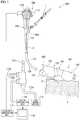
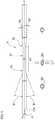
- FIG. 1is a schematic diagram illustrating a configuration of an endoscope system including an endoscopic treatment tool according to a first embodiment of the present invention.
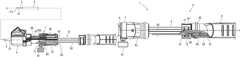
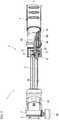
- FIG. 2is a side view illustrating an endoscopic treatment tool according to a first embodiment of the present invention.
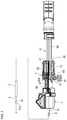
- FIG. 3is a partial cross-sectional view of the endoscopic treatment tool according to the first embodiment of the present invention.
- FIG. 4is a side view illustrating a distal end side of a puncture needle of the endoscopic treatment tool according to the first embodiment of the present invention.
- FIG. 5is a partial cross-sectional view of a stopper and a needle slider of the endoscopic treatment tool according to the first embodiment of the present invention.
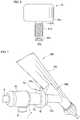
- FIG. 6is a side view illustrating a fixing screw according to the first embodiment of the present invention.
- FIG. 7is a perspective view illustrating a state in which the endoscopic treatment tool according to the first embodiment of the present invention is attached to a port of a proximal end.
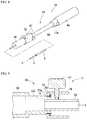
- FIG. 8is a perspective view illustrating a modified example of the endoscopic treatment tool according to the first embodiment of the present invention.
- FIG. 9is a cross-sectional view illustrating a distal end portion of a modified example of the endoscopic treatment tool according to the first embodiment of the present invention.
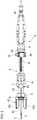
- FIG. 10is a side view illustrating an endoscopic treatment tool according to a second embodiment of the present invention.
- FIG. 1is a diagram illustrating a schematic configuration of a biopsy system 200 of the present embodiment including a treatment tool 1 and an ultrasonic endoscope (an endoscope) 100 .
- a side of a manipulating unit manipulated by the operatoris referred to as a proximal end, and a side inserted into the body is referred to as a distal end.
- a “longitudinal axis X”in terms of including a central axis and the longitudinal axis of the manipulating unit 4 .
- an ultrasonic endoscope(hereinafter referred to as an “endoscope”) 100 includes an insertion unit 101 to be inserted into the body from a distal end, and an endoscope-manipulating unit 109 attached to a proximal end of the insertion unit 101 .
- the endoscope 100further includes a universal cable 112 , a light source device 113 , an optical observation unit 114 , and an ultrasonic observation unit 115 .
- One end of the universal cable 112is connected to the endoscope-manipulating unit 109 .
- the light source device 113 , the optical observation unit 114 , and the ultrasonic observation unit 115are connected to the other end thereof via branching cables 112 a , 112 b and 112 c.
- the insertion unit 101is constituted by a distal end rigid portion 102 , a bending portion 105 , and a flexible tube portion 106 in order from the distal side.
- the distal end rigid portion 102is provided with an optical imaging mechanism 103 for performing the optical observation, and an ultrasonic scanning mechanism 104 for performing the ultrasonic observation.
- the light source device 113is a device for emitting illumination light at the time of imaging by the optical imaging mechanism 103 .
- the optical observation unit 114is configured to display an image captured by an image sensor of the optical imaging mechanism 103 on a monitor 116 .
- the ultrasonic observation unit 115is configured to receive a signal which is output from the ultrasonic scanning mechanism 104 , generate an image on the basis of the received signal, and display the image on the monitor 116 .
- the bending portion 105is bent in a predetermined direction by performing the pulling manipulation of an angle wire (not illustrated) extending to the manipulating unit 109 fixed to a distal end of the bending portion 105 , by using the manipulating unit 109 .
- the bending portion 105is capable of bending in two directions along a scanning direction of the ultrasonic wave.
- an endoscopewhich has a small outer diameter of the insertion unit and is bendable in two directions is used.
- an endoscope bendable in four directions with a large outside diameter but a high degree of freedom of manipulationmay be used.
- the flexible tube portion 106is flexibly formed to guide the distal end rigid portion 102 to a desired position in a luminal tissue or in a body cavity.
- a treatment tool insertion channel (hereinafter simply referred to as a “channel”) 107 for inserting the treatment tool 1 , and a conduit (not illustrated) for performing air and water supply and suctionare provided in the insertion unit 101 over the entire length.
- the manipulating unit 109is provided with a bending manipulation mechanism 110 for pulling an angle wire (not illustrated) to bend the bending portion 105 , and a plurality of switches 111 for performing feeding of air or water or suction through the conduit.
- a distal end of the channel 107is opened in the vicinity of a distal end portion of the insertion unit 101 , and a proximal end of the channel 107 is opened to a side surface on the distal side of the endoscope-manipulating unit 109 .
- a proximal end port 108 formed in a flange shapeis fixed to the proximal end of the channel 107 .
- the treatment tool 1 used together with the endoscope 100is capable of being fixed to the proximal end port 108 .
- FIG. 2is a side view of the treatment tool 1 .
- FIG. 3is a partial cross-sectional view of the manipulation main body of the treatment tool 1 .
- the treatment tool 1is inserted into the channel 107 of the insertion unit 101 of the endoscope 100 , and a holder (a distal end-fixing portion) to be described later is used while being fixed to the proximal end port 108 of the endoscope 100 .
- the treatment tool 1includes a sheath 2 , a puncture needle (treatment portion) 3 , and a manipulating unit (handle) 4 .
- the sheath 2 and the puncture needle 3are provided over substantially the entire length of the treatment tool, and the manipulating unit 4 is provided at a proximal end portion of the sheath 2 and the puncture needle 3 .
- the sheath 2is an elongated tubular member having flexibility.
- the sheath 2has an outer diameter that is insertable into the channel 107 of the endoscope 100 .
- a lumen through which the puncture needle 3 is insertedis formed over the entire length in the longitudinal direction.
- the sheath 2is formed of a resin, metal coil or the like.
- the puncture needle 3is constituted by a needle tube of a hollow member. A distal end of the puncture needle 3 is inclined with respect to a central axis C of the puncture needle 3 and is formed sharply to be able to penetrate the living tissue. A specific shape of the distal end of the puncture needle 3 may be appropriately selected from various known shapes in consideration of the target tissue and the like.
- the puncture needle 3is made of a metal having flexibility and having elasticity that easily restores to a linear state even if it is bent by an external force.
- an alloy materialsuch as a stainless alloy, a nickel titanium alloy, a cobalt chromium alloy or the like may be adopted.
- FIG. 4is a side view illustrating a distal end side of the puncture needle 3 .
- a basic shape of the puncture needle 3is substantially cylindrical as illustrated in FIG. 4 .
- a flattened flat portion 32which is crushed in a radial direction over a certain length, and has a long axis L 1 and a short axis L 2 in a cross section in a direction orthogonal to the central axis C of the puncture needle 3 , is formed at a part of the distal end side of the puncture needle 3 .
- a length of the short axis L 2is a value that is less than an outer diameter d 1 in the basic shape of the puncture needle 3 .
- a length L 3 of the flat portion 32 and the positions of the distal end and the proximal endare set such that the flat portion 32 is always positioned over the entire length of the bending portion 105 of the endoscope 100 in the operation at the time of using the treatment tool 1 to be described later. That is, in both a state in which the puncture needle 3 protrudes (advances) most from the endoscope 100 and a state in which the puncture needle 3 is retracted most in the channel 107 at the time of use, the flat portion 32 is located over the entire length of the bending portion 105 .
- the thickness direction of the flat portion 32substantially coincide with the orientations of the opening surface 31 a of the opening 31 at the distal end of the puncture needle 3 .
- the term “opening direction”means a direction in which a normal to the opening surface 31 a extends at an intersection between the opening surface 31 a on which the end surface of the puncture needle 3 in the opening 31 is located and the axis C, and the expression “the thickness direction and the opening orientation are coincident” means that the short axis L 2 and the normal are located on the same plane. That is, a circumference position of a distal point of the puncture needle 3 is positioned in line with the short axis when viewed from the direction of the central axis C.
- a distal end-connecting portion 33 that connects the flat portion 32 and a cylindrical regionis provided on a distal end side of the flat portion 32 .
- a proximal end-connecting portion 34 that connects the flat portion 32 and the cylindrical regionis provided on a proximal end side of the flat portion 32 .
- the distal end-connecting portion 33 and the proximal end-connecting portion 34are formed into a tapered shape in which a dimension in the thickness direction of the flat portion 32 gradually increases as it is separated from the flat portion 32 .
- a taper angle ⁇ 1 formed by an outer circumferential surface of the distal end-connecting portion 33 and the axis Cis, for example, 20 degrees, which is larger than a taper angle ⁇ 2 (for example, 5 degrees) of the outer circumferential surface of the proximal end-connecting portion 34 .
- the dimension of the distal end-connecting portion 33is shorter than the dimension of the proximal end-connecting portion 34 in the direction in which the axis C extends.
- the manipulating unit 4includes a distal end-fixing portion 5 , an intermediate portion 6 , a sheath adjuster (a support member) 7 , and a needle slider (a proximal end-manipulating unit) 9 .
- the distal end-fixing portion 5includes a slide lock 51 , a holder 52 , and a proximal end tubular portion 53 .
- the slide lock 51is configured to be attachable to and detachable from the proximal end port 108 of the endoscope 100 .
- the manipulating unit 4is capable of being fixed to the endoscope 100 .
- the holder 52is provided on the distal end side of the slide lock 51 and has a pair of wall portions 52 a and 52 b .
- the pair of wall portions 52 a and 52 b of the holder 52are substantially parallel to each other.
- a distance between the wall portion 52 a and the wall portion 52 bis set to a value at which a distal side of the manipulating unit 109 of the endoscope 100 can fit without rattling.
- a communication passage 50(see FIG. 3 ) communicating in a direction of a longitudinal axis X of the manipulating unit 4 is formed in the distal end-fixing portion 5 .
- the sheath 2 and the puncture needle 3are inserted into the communication passage 50 .
- the proximal end tubular portion 53is provided on a proximal side of the slide lock 51 , and is formed in a double tubular shape having an annular groove 53 a through which the intermediate portion 6 is insertable on the radially outer side in the communication passage 50 .
- a support pipe 51made of, for example, stainless steel protrudes from a distal end portion of the distal end-fixing portion 5 .
- the intermediate portion 6is a tubular long axis member made of, for example, ABS resin or the like.
- the intermediate portion 6has a lumen 61 through which the sheath 2 and the puncture needle 3 is insertable.
- a large-diameter portion 63 having a diameter larger than the proximal end sideis formed at a distal end portion of the intermediate portion 6 .
- a first insertion hole 65is formed in the large-diameter portion 63 .
- the first insertion hole 65is an annular hole formed to be adjacent to the outer side of the lumen 61 in the radial direction, and has an opening width through which the proximal end tubular portion 53 of the distal end-fixing portion 5 is insertable.
- a convex portion 64 protruding radially outwardis formed on an outer circumferential surface of a proximal end portion of the intermediate portion 6 .
- a rack 62is formed on the outer circumferential surface of the intermediate portion 6 .
- the rack 62is configured such that a plurality of teeth, which are extending in the direction orthogonal to the longitudinal axis X, are formed to be lined in a direction of the axis X.
- the sheath adjuster 7is provided to fix the protruding length of the sheath 2 from the channel 107 .
- the sheath adjuster 7is a tubular member, and the distal end (large-diameter portion 63 ) of the intermediate portion 6 is inserted into the sheath adjuster 7 .
- Irregularitiesare provided on an outer circumferential surface of the sheath adjuster 7 so that the operator can easily grasp it.
- the sheath adjuster 7is formed with a thread hole 82 opening in the direction orthogonal to the longitudinal axis X.
- the thread hole 82is configured so that the fixing screw 81 is capable of being be screwed.
- the fixing screw (fixing member) 81is screwed to the distal end portion of the sheath adjuster 7 .
- FIG. 6is a side view of the fixing screw 81 .
- the fixing screw 81includes a head portion 81 a having a substantially cylindrical shape, a shaft portion 81 b , and a distal end portion 81 c .
- the head portion 81 ahas a cylindrical shape.
- the head portion 81 ais a portion manipulated by the operator and has a size easy for the operator to manipulate, and a gripping groove orthogonal to the rotation direction of the fixing screw 81 is formed on an outer circumferential surface thereof.
- the shaft portion 81 bhas a thread groove 81 d that is capable of being screwed into the thread hole 82 of the sheath adjuster 7 to be described later.
- a concave portion 81 e recessed toward the head portion 81 ais formed in the distal end portion 81 c.
- FIG. 5is a partial cross-sectional view of the stopper 10 and the needle slider 9 of the treatment tool 1 .
- the needle slider 9is provided with a communication passage 91 extending in the direction of the longitudinal axis X.
- the puncture needle 3is inserted through the communication passage 91 over the entire length, and the puncture needle 3 is fixed to the needle slider 9 .
- An enlarged-diameter portion 93 having an outer diameter larger than a distal end diameter of the needle slider 9is formed at a distal end portion of the needle slider 9 .
- the enlarged-diameter portion 93has an outer diameter larger than a proximal end side and a distal end side of the enlarged-diameter portion 93 , and the enlarged-diameter portion 93 is formed such that the outer circumferential surface of the needle slider 9 is risen.
- the enlarged-diameter portion 93functions as a finger hook portion on which the operator hooks the finger when advancing and retracting the needle slider 9 .
- a proximal end-opening portion 92is provided at a proximal end portion of the needle slider 9 .
- An opening of the proximal end of the puncture needle 3communicates with the proximal end-opening portion 92 , and a stylet (not illustrated) is capable of bring inserted into the puncture needle 3 from the proximal end-opening portion 92 .
- the proximal end-opening portion 92is configured that a known syringe or the like is capable of being connected and is configured to be capable of suctioning an object inside the puncture needle 3 .
- a convex portion 94 protruding in the direction orthogonal to the longitudinal axis Xis formed in the communication passage 91 of the needle slider 9 .
- the convex portion 94is configured to be capable of engaging with the protrusion 64 of the intermediate portion 6 .
- a tubular stopper 10is provided on the distal end side of the needle slider 9 .
- the stopper 10is provided to regulate the advancing position of the needle slider 9 with respect to the intermediate portion 6 .
- the stopper 10has a lumen formed along the longitudinal axis X.
- the intermediate portion 6is inserted into the lumen of the stopper 10 at the distal end side of the needle slider 9 and the stopper 10 is attached to the intermediate portion 6 to be slidable in the direction of the longitudinal axis X while suppressing a relative rotation about the longitudinal axis X.
- the stopper 10is provided with a slide button 11 which protrudes to the outer circumferential surface of the stopper 10 and is slidable in the direction orthogonal to the longitudinal axis X.
- the slide button 11is provided to be slidable in a direction orthogonal to the direction of the longitudinal axis X of the stopper 10
- a stopper claw portion 12 protruding in the direction orthogonal to the longitudinal axis Xis formed on an inner circumferential surface side of the tubular portion of the stopper 10 .
- the stopper claw portion 12is configured to be capable of engaging with the rack 62 of the intermediate portion 6 .
- the stopper claw portion 12 and the rack 62 of the intermediate portion 6are configured to be engaged or disengaged.
- the stopper 10is fixed with respect to the intermediate portion 6 to regulate the advance of the needle slider 9 .
- the stopper 10is configured to be freely advance and retract with respect to the intermediate portion 6 .
- the sheath 2 , the puncture needle 3 and the manipulating unit 4 of the treatment tool 1are configured as follows.
- the puncture needle 3is inserted into the intermediate portion 6 , and a proximal end portion of the puncture needle 3 and the needle slider 9 are fixed.
- the intermediate portion 6 and a proximal end of the sheath 2are fixed.
- the proximal end portion of the intermediate portion 6is inserted through the needle slider 9 from the distal end side of the needle slider 9 .
- the needle slider 9is configured to be capable of advancing and retracting in the direction of the longitudinal axis X with respect to the intermediate portion 6 .
- the intermediate portion 6 and the distal end-fixing portion 5 , and the intermediate portion 6 and the needle slider 8are slidable in the direction of the longitudinal axis X, while suppressed the relative rotation about the longitudinal axis X, by engaging the grooves, the convex portions or the like (not illustrated) formed on the outer circumferential surface.
- the needle slider 9is provided to adjust a position of the puncture needle 3 with respect to the sheath 2 .
- the puncture needle 3is configured to advance and retract with respect to the sheath 2 in accordance with the advance and retract of the needle slider 9 with respect to the intermediate portion 6 .
- An amount of advance and retract of the puncture needle 3 with respect to the sheath 2is capable of adjusting by advancing and retracting manipulation of the needle slider 9 in the direction of the longitudinal axis X with respect to the intermediate portion 6 .
- One of the distal end-fixing portion 5 and the intermediate portion 6is connected to the other end by being inserted into the other to partially overlap in the direction of the longitudinal axis X. That is, the proximal end tubular portion 53 of the distal end-fixing portion 5 and the large-diameter portion 63 of the intermediate portion 6 have a nested structure that is arranged coaxially on the longitudinal axis X and inserted therethrough. In the present embodiment, the proximal end tubular portion 53 is inserted into the large-diameter portion 63 .
- the sheath adjuster 7is engaged with a member disposed on the outside among the distal end-fixing portion 5 and the intermediate portion 6 .
- the sheath adjuster 7is fixed to the large-diameter portion 63 provided at the distal end of the intermediate portion 6 .
- the position of the intermediate portion 6 with respect to the distal end-fixing portion 53 in the direction of the longitudinal axis Xis fixed by the fixing screw 81 , and the protruding length of the sheath 2 from the channel 107 is fixed.
- the sheath adjuster 7includes a screw support portion 71 and a finger hook portion 72 .
- the screw support portion 71 and the finger hook portion 72are disposed to surround the large-diameter portion 63 , are freely rotatable about the longitudinal axis X, and is engaged with respect to the intermediate portion 6 to be immovable in the direction of the longitudinal axis X. Therefore, the sheath adjuster 7 is configured to move in the direction of the longitudinal axis X together with the intermediate portion 6 .
- the head portion 81 a of the fixing screw 81protrudes to the outer circumferential side of the sheath adjuster 7 .
- the fixing screw 81is tightened to the sheath adjuster 7 , the distal end portion 81 c abuts against the outer circumferential surface of the proximal end tubular portion 53 of the distal end-fixing portion 5 to fix the position in the direction of the longitudinal axis X between the intermediate portion 6 and the distal end-fixing portion 5 .
- the distal end portion of the support pipe 51is inserted into the channel 107 when the treatment tool 1 is attached to the endoscope 100 .
- the support pipe 51is inserted into the intermediate portion 6 .
- the proximal end of the support pipe 51is located on a side closer to the proximal end side than a distal end of the needle slider 9 in a state in which the needle slider 9 is most advanced with respect to the intermediate portion 6 .
- the sheath 2is inserted into the support pipe 51 , and the proximal end portion of the sheath 2 protrudes from the proximal end of the support pipe 51 and is fixed to the intermediate portion 6 by adhesion or the like.
- the biopsy system 150having the aforementioned configuration at the time of use will be described.
- a descriptionwill be given of an example of a biopsy procedure of puncturing the puncture needle 3 of the treatment instrument 1 with a lesion located in the deep part of the lung as a target tissue and collecting cells and the like of the lesion through the inside of the puncture needle 3 .
- the needle slider 9is pulled toward the proximal end side, the convex portion 94 engages with the protrusion 64 of the intermediate portion 6 inside the needle slider 9 , and the stopper claw portion 12 and the rack 62 are engaged with each other, and the stopper 10 is fixed to the intermediate portion 6 to regulate the advance of the needle slider 9 .
- the puncture needle 3is accommodated and held in the distal end of the sheath 2 .
- the operatorinserts the insertion unit 101 of the endoscope 100 into the body, and while observing with the optical imaging mechanism 103 , introduces the distal end portion of the insertion unit 101 to the vicinity of the target tissue, while appropriately bending the bending portion 105 .
- the operatordetermines a biopsy target site on the basis of the observation results obtained by the optical imaging mechanism 103 and the ultrasonic scanning mechanism 104 .
- the operatorengages the slide lock 51 provided on the manipulating unit 4 of the treatment tool 1 with the proximal end port 108 , in the state of inserting the sheath 2 of the treatment tool 1 into the channel 107 from the proximal end port 108 provided in the manipulating unit 109 of the endoscope 100 , and disposing the distal end side of the manipulating unit 109 between a pair of wall portions 52 a and 52 b of the holder 52 .
- the manipulating unit 4 of the treatment tool 1is fixed to the endoscope 100 so as not to rotate with respect to the manipulating unit 109 .
- the operatorloosens the fixing screw 81 , causes the intermediate portion 6 to slide in the direction of the longitudinal axis X with respect to the distal end-fixing portion 5 , while observing the inside of the body with the optical imaging mechanism 103 and the ultrasonic scanning mechanism 104 , thereby adjusting the amount of protrusion of the sheath 2 from the distal end of the insertion unit 101 of the endoscope 100 to an appropriate amount.
- the sheath adjuster 7since the sheath adjuster 7 is engaged with the intermediate portion 6 so as to be relatively rotatable about the longitudinal axis X, in a state (an unfixed state) in which the fixing screw 81 is not in contact with the outer circumferential surface of the distal end-fixing portion 5 , the fixing screw 81 also becomes rotatable with respect to the intermediate portion 6 .
- the protruding position of the head portion 81 a of the fixing screw 81 with respect to the intermediate portion 6 in the circumferential directionis capable of being moved and fixed to an arbitrary position.
- a concave portion 81 eis formed in the distal end portion 81 c of the fixing screw 81 , the distal end portion 81 c of the fixing screw 81 and the outer circumferential surface of the distal end-fixing portion 5 come into point contact with each other. As a result, the fixing screw 81 is easily bitten by the distal end-fixing portion 5 , and the fixing state of the intermediate portion 6 to the distal end-fixing portion 5 is capable of being stabilized by the fixing screw 81 .
- the stopper 10is capable of freely advancing and retracting with respect to the intermediate portion 6 .
- the operatormoves the stopper 10 to the distal side with respect to the intermediate portion 6 , adjusts the amount of protrusion of the puncture needle 3 with respect to the sheath 2 to a desired amount of protrusion, causes the slide button 11 to slide, and fix the stopper claw portion 12 to the rack 62 of the intermediate portion 6 .
- a scale(not illustrated) provided in the intermediate portion 6 may be referred to.
- the stopper 10is fixed to the intermediate portion 6 to regulate the advance of the needle slider 9 .
- the maximum protruding length of the puncture needle 3 from the sheath 2is capable of being adjusted by adjusting the fixing position of the stopper 10 with respect to the intermediate portion 6 .
- the styletis inserted to the extent that it protrudes from the distal end of the puncture needle 3 .
- the operatorpushes the enlarged-diameter portion 93 of the needle slider 9 toward the distal end side. Since the proximal end side of the puncture needle 3 protrudes from the proximal end of the sheath 2 and is fixed to the needle slider 9 , by causing the needle slider 9 to slide with respect to the intermediate portion 6 , the puncture needle 3 is capable of protruding and retracting from the distal end of the sheath 2 .
- the needle slider 9is advanced to a position at which the needle slider 9 comes into contact with the stopper 10 , the distal end of the puncture needle 3 protrudes from the sheath 2 and is inserted into the biopsy target tissue T.
- the puncture needle 3 exposed from the surface of a biopsy target tissue Tis capable of being observed by the optical imaging mechanism 103 , and the puncture needle 3 inserted into the biopsy target tissue T is capable of being observed by the ultrasonic scanning mechanism 104 . Further, at this time, it is possible to adopt a configuration in which the puncture needle 3 is punctured into the tissue at high speed by a known automatic puncture mechanism.
- the operatorextrudes a tissue that is not a biopsy target that has entered the puncture needle 3 with a stylet, and then removes the stylet from the puncture needle 3 .
- a known syringeis fixed to the proximal end-opening portion 92 , and the tissue collected in the distal end of the puncture needle 3 is suctioned and collected.
- the needle slider 9is retracted toward the proximal side with respect to the intermediate portion 6 , and the distal end of the puncture needle 3 is accommodated in the sheath 2 .
- the operatorpulls the enlarged-diameter portion 93 of the needle slider 9 toward the proximal side, and moves the needle slider 9 toward the proximal side.
- the needle slider 9is pulled by a predetermined amount or more, the convex portion 94 and the protrusion 64 are engaged with each other, and the needle slider 9 is locked to the intermediate portion 6 .
- the operatorretracts the stopper 10 to the proximal side to a position at which the stopper 10 comes into contact with the distal end of the needle slider 9 , causes the slide button 11 to slide in the direction orthogonal to the longitudinal axis X, and locks the stopper claw portion 12 with the rack 62 .
- the slide button 11slides in the direction orthogonal to the longitudinal axis X, and locks the stopper claw portion 12 with the rack 62 .
- the slide lock 51is detached from the proximal end port 108 of the endoscope 100 , and the treatment tool 1 is extracted from the channel 107 .
- the endoscope 100is extracted from a patient and a series of manipulations is completed.
- the sheath adjuster 7 having the head portion 81 a of the fixing screw 81 protruding radially outwardis engaged with the large-diameter portion 63 of the intermediate portion 6 so as to be rotatable around the longitudinal axis X, the protruding position of the head portion 81 a of the fixing screw 81 is capable of being adjusted to an arbitrary position.
- the treatment tool 1the manipulating unit 4
- the fixing screw 81 of the manipulating unit 4does not interfere with the manipulation. Therefore, it is possible to provide the treatment tool 1 capable of keeping the manipulating properties in a suitable state, even if the dominant hand or holding method of the operator changes.
- the concave portion 81 eis formed in the distal end portion 81 c of the fixing screw 81 , the distal end portion 81 c of the fixing screw 81 makes point contact with the outer circumferential surface of the proximal end tubular portion 53 of the distal end-fixing portion 5 .
- the fixing screw 81is easily bitten by the outer circumferential surface of the proximal end tubular portion 53 , and the fixing state of the intermediate portion 6 to the distal end-fixing portion 5 is capable of being stabilized by the fixing screw 81 .
- the configuration in which the fixing screw 81 is included as the fixing portionis provided as an example, but the fixing portion is not limited to the fixing screw.
- a configuration in which a locking claw capable of protruding and retracting inward and outward in the radial direction of the sheath adjuster 7 and a convex portion capable of engaging with the locking claware formed on the outer circumferential surface of the intermediate portion 6 , or the like may be adopted.
- FIG. 8is a perspective view illustrating a modified example of the treatment tool according to the present embodiment.
- FIG. 9is a partial cross-sectional view illustrating a distal end portion of the manipulating unit 4 A of FIG. 8 . In FIG. 9 , the description of the sheath and the puncture needle is omitted.
- a sheath adjuster 7 Ais provided at a proximal end of a distal end-fixing portion 5 A.
- the outer circumferential surface of the distal end portion of the distal end-fixing portion 5 Adecreases in diameter to form a stepped portion 55 .
- the stepped portion 55is inserted into the distal end opening of the sheath adjuster 7 A and disposed so that the distal end surface 74 of the sheath adjuster 7 A comes into contact with a proximal end surface 55 a of the stepped portion 55 .
- a ring 54is externally fitted to the proximal end portion of the distal end-fixing portion 5 A to sandwich the distal end opening of the sheath adjuster 7 with the stepped portion 55 .
- the sheath adjuster 7 Ais engaged with the distal end-fixing portion 5 A so as to be immovable in the direction of the longitudinal axis X and rotatable about the longitudinal axis X.
- the distal end of the intermediate portion 6 Ais inserted into the proximal end portion of the distal end-fixing portion 5 A.
- the fixing screw 81is screwed to the screw hole 72 A of the sheath adjuster 7 A.
- the distal end portion 81 c of the fixing screw 81comes into contact with the outer circumferential surface of the intermediate portion 6 A, and is configured to fix the position between the intermediate portion 6 A and the distal end portion 81 c in the direction of the longitudinal axis X.
- the sheath adjuster 7 Ais provided to be rotatable with respect to the distal end-fixing portion 5 A, the direction of the fixing screw 81 is capable of being adjusted to an arbitrary position. Therefore, it is possible to provide the treatment tool 1 A in which the fixing screw 81 does not interfere with the operation and the manipulating properties is capable of being kept in a suitable state even if the dominant hand or holding method of the operator changes.
- FIG. 10is a side view of the treatment tool 1 B according to the present embodiment.
- a distal end-fixing portion 5 B and a large-diameter portion 63 of the intermediate portion 6are illustrated in a partial sectional view.
- the same reference numeralsare given to the configurations and the like which are the same as those already described, and redundant explanations will be omitted.
- the treatment tool 1 Bfurther includes a rotary cylinder 56 provided in the distal end-fixing portion 5 B.
- the rotary cylinder 56has a substantially cylindrical shape, and a proximal end tubular portion 53 B is inserted through the rotary cylinder 56 .
- a concave portion 531which decreases in diameter in accordance with the size of the rotary cylinder 56 is formed on the outer circumferential surface of the distal end-fixing portion 5 B, and a wall portion 532 is formed on the distal end side and the proximal end side of the concave portion 531 .
- the rotary cylinder 56is disposed to cover the concave portion 531 , and is disposed to be in contact with the wall portions 532 on the distal end side and the proximal end side.
- the rotary cylinder 56is provided to be immovable in the direction of the longitudinal axis X and rotatable about the longitudinal axis X with respect to the proximal end tubular portion 53 B of the distal end-fixing portion 5 B of the manipulating unit 4 B within the concave portion 531 .
- the distal end-fixing portion 5 B and the rotary cylinder 56are slidably inserted into the large-diameter portion 63 of the intermediate portion 6 .
- the sheath adjuster 7is rotatably engaged with the intermediate portion 6 around the longitudinal axis X, and the fixing screw 81 is disposed at an arbitrary position in the circumferential direction of the large-diameter portion 63 and is configured to be fixable.
- the fixing screw 81is tightened to the sheath adjuster 7 , the distal end portion 81 c comes into contact with the rotary cylinder 56 , and the position in the direction of the longitudinal axis X between the distal end-fixing portion 5 B and the intermediate portion 6 is fixed.
- the rotary cylinder 56is rotatably attached to the distal end-fixing portion 5 B, in a state in which the position in the direction of the longitudinal axis X of the intermediate portion 6 with respect to the distal end-fixing portion 5 B is fixed by the fixing screw 81 , the relative position between the sheath adjuster 7 and the intermediate portion 6 around the longitudinal axis X is capable of being changed.
- the sheath adjuster 7is provided to be rotatable with respect to the intermediate portion 6 , the position of the fixing screw 81 in the circumference direction is capable of being adjusted to an arbitrary position. Therefore, it is possible to provide the treatment tool 1 B that is capable of being kept the manipulating properties in a suitable state even if the dominant hand or holding method of the operator changes.
- the relative position between the sheath adjuster 7 and the intermediate portion 6 around the direction of longitudinal axis Xis capable of being changed.
- the sheath adjuster 7is rotatable about the longitudinal axis X with respect to the manipulating unit 4 B (the distal end-fixing portion 5 B, the intermediate portion 6 , and the needle slider 9 ). Therefore, the manipulation is capable of performed in a state that the circumferential position of the fixing screw 81 with respect to the manipulating unit 4 B is moved to a desired position the position of the fixing in accordance with the manipulating properties of the operator.
- the configuration of the treatment portionis not limited thereto.
- a configuration in which the puncture needle 3 does not include the flat portion 32may also be applied to the case where it is desired to fix the orientation of the opening surface 31 a in a predetermined direction.
- the treatment toolis also applicable to a treatment tool that preferably fixes the position in the circumferential direction of the endoscope 100 with respect to the insertion unit 101 .
Landscapes
- Health & Medical Sciences (AREA)
- Life Sciences & Earth Sciences (AREA)
- Surgery (AREA)
- Molecular Biology (AREA)
- General Health & Medical Sciences (AREA)
- Veterinary Medicine (AREA)
- Engineering & Computer Science (AREA)
- Biomedical Technology (AREA)
- Heart & Thoracic Surgery (AREA)
- Medical Informatics (AREA)
- Nuclear Medicine, Radiotherapy & Molecular Imaging (AREA)
- Animal Behavior & Ethology (AREA)
- Pathology (AREA)
- Public Health (AREA)
- Radiology & Medical Imaging (AREA)
- Physics & Mathematics (AREA)
- Biophysics (AREA)
- Optics & Photonics (AREA)
- Endoscopes (AREA)
- Surgical Instruments (AREA)
Abstract
Description
Claims (14)
Applications Claiming Priority (1)
| Application Number | Priority Date | Filing Date | Title |
|---|---|---|---|
| PCT/JP2016/061039WO2017175278A1 (en) | 2016-04-04 | 2016-04-04 | Treatment tool for endoscope |
Related Parent Applications (1)
| Application Number | Title | Priority Date | Filing Date |
|---|---|---|---|
| PCT/JP2016/061039ContinuationWO2017175278A1 (en) | 2016-04-04 | 2016-04-04 | Treatment tool for endoscope |
Publications (2)
| Publication Number | Publication Date |
|---|---|
| US20190029658A1 US20190029658A1 (en) | 2019-01-31 |
| US11134927B2true US11134927B2 (en) | 2021-10-05 |
Family
ID=60000351
Family Applications (1)
| Application Number | Title | Priority Date | Filing Date |
|---|---|---|---|
| US16/145,511Active2037-02-12US11134927B2 (en) | 2016-04-04 | 2018-09-28 | Endoscopic treatment tool |
Country Status (5)
| Country | Link |
|---|---|
| US (1) | US11134927B2 (en) |
| EP (1) | EP3441009B1 (en) |
| JP (1) | JP6535132B2 (en) |
| CN (1) | CN108882923B (en) |
| WO (1) | WO2017175278A1 (en) |
Families Citing this family (1)
| Publication number | Priority date | Publication date | Assignee | Title |
|---|---|---|---|---|
| CN112998768A (en)* | 2021-04-16 | 2021-06-22 | 广州敦博医道科技有限公司 | Superfine abdominal cavity optical biopsy forceps |
Citations (8)
| Publication number | Priority date | Publication date | Assignee | Title |
|---|---|---|---|---|
| US20080208214A1 (en)* | 2007-02-26 | 2008-08-28 | Olympus Medical Systems Corp. | Applicator and tissue fastening method through natural orifice |
| US20120197119A1 (en) | 2011-01-28 | 2012-08-02 | Olympus Medical Systems Corp. | Treatment instrument |
| JP2014014461A (en) | 2012-07-06 | 2014-01-30 | Olympus Medical Systems Corp | Advance/retreat assisting tool of endoscope processing device |
| WO2014125707A1 (en) | 2013-02-15 | 2014-08-21 | オリンパスメディカルシステムズ株式会社 | Biopsy system |
| WO2014132673A1 (en) | 2013-02-27 | 2014-09-04 | オリンパスメディカルシステムズ株式会社 | Insertion/removal-support tool for endoscopic instrument |
| WO2015076154A1 (en) | 2013-11-21 | 2015-05-28 | オリンパスメディカルシステムズ株式会社 | Endoscopic treatment device |
| WO2016042849A1 (en) | 2014-09-16 | 2016-03-24 | オリンパス株式会社 | Biopsy system |
| US20170268558A1 (en)* | 2016-03-18 | 2017-09-21 | Gyrus Acmi, Inc., D.B.A. Olympus Surgical Technologies America | Captive Screw Device |
Family Cites Families (1)
| Publication number | Priority date | Publication date | Assignee | Title |
|---|---|---|---|---|
| WO2014132527A1 (en)* | 2013-02-27 | 2014-09-04 | オリンパスメディカルシステムズ株式会社 | Forward/backward movement assistance tool for endoscopic treatment instrument |
- 2016
- 2016-04-04WOPCT/JP2016/061039patent/WO2017175278A1/ennot_activeCeased
- 2016-04-04EPEP16897837.7Apatent/EP3441009B1/enactiveActive
- 2016-04-04CNCN201680084303.3Apatent/CN108882923B/enactiveActive
- 2016-04-04JPJP2018510029Apatent/JP6535132B2/enactiveActive
- 2018
- 2018-09-28USUS16/145,511patent/US11134927B2/enactiveActive
Patent Citations (11)
| Publication number | Priority date | Publication date | Assignee | Title |
|---|---|---|---|---|
| US20080208214A1 (en)* | 2007-02-26 | 2008-08-28 | Olympus Medical Systems Corp. | Applicator and tissue fastening method through natural orifice |
| US20120197119A1 (en) | 2011-01-28 | 2012-08-02 | Olympus Medical Systems Corp. | Treatment instrument |
| US20130310684A1 (en)* | 2011-01-28 | 2013-11-21 | Olympus Medical Systems Corp. | Treatment instrument |
| JP2014014461A (en) | 2012-07-06 | 2014-01-30 | Olympus Medical Systems Corp | Advance/retreat assisting tool of endoscope processing device |
| WO2014125707A1 (en) | 2013-02-15 | 2014-08-21 | オリンパスメディカルシステムズ株式会社 | Biopsy system |
| EP2957209A1 (en) | 2013-02-15 | 2015-12-23 | Olympus Corporation | Biopsy system |
| WO2014132673A1 (en) | 2013-02-27 | 2014-09-04 | オリンパスメディカルシステムズ株式会社 | Insertion/removal-support tool for endoscopic instrument |
| WO2015076154A1 (en) | 2013-11-21 | 2015-05-28 | オリンパスメディカルシステムズ株式会社 | Endoscopic treatment device |
| US20160045100A1 (en)* | 2013-11-21 | 2016-02-18 | Olympus Corporation | Endoscopic treatment device |
| WO2016042849A1 (en) | 2014-09-16 | 2016-03-24 | オリンパス株式会社 | Biopsy system |
| US20170268558A1 (en)* | 2016-03-18 | 2017-09-21 | Gyrus Acmi, Inc., D.B.A. Olympus Surgical Technologies America | Captive Screw Device |
Non-Patent Citations (3)
| Title |
|---|
| Extended Supplementary European Search Report dated Nov. 11, 2019 in European Patent Application No. 16 89 7837.7. |
| International Search Report dated May 31, 2016 issued in PCT/JP2016/061039. |
| Notice of Allowance dated May 7, 2019 in Japanese Patent Application No. 2018-510029. |
Also Published As
| Publication number | Publication date |
|---|---|
| CN108882923B (en) | 2021-06-15 |
| CN108882923A (en) | 2018-11-23 |
| EP3441009A4 (en) | 2019-12-11 |
| EP3441009A1 (en) | 2019-02-13 |
| JPWO2017175278A1 (en) | 2019-01-10 |
| EP3441009B1 (en) | 2021-01-06 |
| US20190029658A1 (en) | 2019-01-31 |
| JP6535132B2 (en) | 2019-06-26 |
| WO2017175278A1 (en) | 2017-10-12 |
Similar Documents
| Publication | Publication Date | Title |
|---|---|---|
| US9839414B2 (en) | Biopsy system | |
| US20230110289A1 (en) | Endoscopic Ultrasound Fine Needle Aspiration Device | |
| US9820724B2 (en) | Endoscope puncture needle and biopsy system | |
| US9693803B2 (en) | Puncture needle for endoscope and biopsy system | |
| JP6906073B2 (en) | Handle for medical devices | |
| US20160367231A1 (en) | Biopsy system | |
| WO2015076154A1 (en) | Endoscopic treatment device | |
| WO2016047202A1 (en) | Endoscope puncture needle | |
| JP2012235878A (en) | Biopsy device | |
| US11134927B2 (en) | Endoscopic treatment tool | |
| JP6284464B2 (en) | Endoscopic puncture needle | |
| WO2016042849A1 (en) | Biopsy system | |
| JP5893814B1 (en) | Tissue collection system | |
| JP5985128B1 (en) | Biopsy system and treatment tool | |
| CN117694974A (en) | Ultrasonic pulmonary endoscope |
Legal Events
| Date | Code | Title | Description |
|---|---|---|---|
| AS | Assignment | Owner name:OLYMPUS CORPORATION, JAPAN Free format text:ASSIGNMENT OF ASSIGNORS INTEREST;ASSIGNOR:ETO, HIROFUMI;REEL/FRAME:047003/0859 Effective date:20180927 | |
| FEPP | Fee payment procedure | Free format text:ENTITY STATUS SET TO UNDISCOUNTED (ORIGINAL EVENT CODE: BIG.); ENTITY STATUS OF PATENT OWNER: LARGE ENTITY | |
| STPP | Information on status: patent application and granting procedure in general | Free format text:DOCKETED NEW CASE - READY FOR EXAMINATION | |
| STPP | Information on status: patent application and granting procedure in general | Free format text:NON FINAL ACTION MAILED | |
| STPP | Information on status: patent application and granting procedure in general | Free format text:FINAL REJECTION MAILED | |
| STPP | Information on status: patent application and granting procedure in general | Free format text:DOCKETED NEW CASE - READY FOR EXAMINATION | |
| STPP | Information on status: patent application and granting procedure in general | Free format text:NOTICE OF ALLOWANCE MAILED -- APPLICATION RECEIVED IN OFFICE OF PUBLICATIONS | |
| STPP | Information on status: patent application and granting procedure in general | Free format text:PUBLICATIONS -- ISSUE FEE PAYMENT VERIFIED | |
| STCF | Information on status: patent grant | Free format text:PATENTED CASE | |
| MAFP | Maintenance fee payment | Free format text:PAYMENT OF MAINTENANCE FEE, 4TH YEAR, LARGE ENTITY (ORIGINAL EVENT CODE: M1551); ENTITY STATUS OF PATENT OWNER: LARGE ENTITY Year of fee payment:4 |