RELATED APPLICATIONSThis application is a continuation of U.S. patent application Ser. No. 14/438,705, filed Apr. 27, 2015, which is a national stage filing under 35 U.S.C. § 371 of International Application Number PCT/GB2013/052766, filed Oct. 23, 2013, which claims the benefit of priority under 35 U.S.C. § 119(e) to U.S. Provisional Patent Application No. 61/718,899, filed Oct. 26, 2012, and which claims priority to United Kingdom Patent Application Number 1313121.4, filed Jul. 23, 2013, the entire contents of each of which applications are incorporated herein by reference in their entirety for all purposes.
In some aspects, the present invention relates to the formation of an array of membranes comprising amphipathic molecules using an array of volumes of polar medium. A further aspect relates to an apparatus suitable for forming an array of membranes. In other aspects, the present invention relates to the formation of an array of volumes of polar medium. Such an array of volumes of a polar medium may be used in a range of applications, including the formation of membranes comprising amphipathic molecules.
Spatially defined arrays of small volumes of fluid in the nanolitre to picolitre range may be used in a wide range of biological, pharmaceutical and other analytical applications. A droplet array provides the opportunity to facilitate high throughput processing of small volumes of individual droplets or groups of droplets and may be used for example to compartmentalise reactions, cell sorting and screening applications such as protein crystallisation, analysis of blood or spinal fluid and waste processing. The ability to address and replace the volumes of fluid in the array is an important aspect, for example for carrying out reactions on the volumes and replenishing the array. Microfluidic static droplet arrays are disclosed in Lab Chip, 2011, 11, 3949.
Lipid bilayers are thin polar membranes formed from two layers of lipid molecules. Lipid bilayers are found in cell membranes of most living organisms and are usually composed of phospholipids. They are impermeable to most hydrophilic molecules and ions, and enable cells to regulate their salt concentrations and pH by pumping ions across the lipid bilayer using transmembrane proteins known as ion pumps. Lipid bilayers, or more generally bilayers of amphipathic molecules, also serve as excellent platforms for a range of experimental studies. Holden et al, J. Am. Chem. Soc. 2007, 129, 8650-8655 disclose the formation of functional bionetworks of aqueous droplets comprising lipid bilayers provided between droplets. Such networks can act as light sensors, batteries and electrical components by incorporating pumps, channels and pores into the bilayers. Sackmann, Science, New Series, Vol 271, No. 5245 (Jan. 5, 1996), pp. 43-48 provides a review of the scientific and practical applications of supported lipid-protein bilayers including their use in electrooptical biosensors. Jung et al, J. Am. Chem. Soc., 2009, 131 (3), 1006-1014 have developed optical assays for the detection of protein ligand binding on supported bilayers.
The ability to form a membrane of amphipathic molecules between two droplets of aqueous solution in a hydrophobic medium such as oil has been demonstrated in WO-2008/012552. Each droplet comprises a layer of amphipathic molecules encapsulating a hydrophilic medium, the droplet being provided in a hydrophobic medium. The droplets are brought into contact to form the membrane of amphipathic molecules therebetween. Electrodes may be provided within the hydrophilic interior of each droplet in order to measure ion flow across the bilayer. A droplet array may be provided in a container having an array of micromachined dimples in which individual droplets may rest.
Another application disclosed in WO-2009/024775 is to form membranes of amphipathic molecules between the volumes of hydrophilic medium in an array and a layer of hydrophilic medium formed by a hydrated support in contact with the volumes of hydrophilic medium. This document discloses a method for producing a droplet interface bilayer, wherein droplets are prepared by contacting an oil/lipid solution with an aqueous solution and the resulting droplets of aqueous solution are brought into contact with an aqueous agarose gel support layer.
It is desirable to use membranes of amphipathic molecules to hold membrane proteins. The provision of ion channel nanopores in highly resistive amphipathic bilayers for the detection of DNA has been previously well documented. Aqueous solutions are provided on either side of the amphipathic bilayer and ion flow through the nanopore takes place under a potential gradient. DNA may be caused to translocate the pore and the change in ion flow during translocation of DNA through the pore may be measured in order to determine its nucleotide sequence. The lipid bilayer may be suspended across an aperture by methods well known in the art such as patch clamping or painting. As an alternative, WO-2009/077734 discloses a plurality of individually addressable lipid bilayers formed across an array of microwell apertures, each microwell containing an electrode and an aqueous medium in contact with the lipid bilayer.
A first aspect of the present invention is concerned with convenient and effective formation of an array of membranes comprising amphipathic molecules.
According to the first aspect of the present invention, there is provided a method of forming an array of membranes comprising amphipathic molecules, the method comprising:
providing an apparatus comprising a support defining an array of compartments having openings through which polar medium may be introduced;
disposing polar medium and apolar medium onto the support to provide volumes comprising polar medium within respective compartments so that the volumes polar medium are constrained from contacting volumes comprising polar medium in neighbouring compartments, and a layer comprising apolar medium extending across the openings in the support in contact with the volumes comprising polar medium; and
flowing polar medium across the openings in the support to displace apolar medium and form a layer comprising polar medium extending across the openings in the support in contact with the volumes comprising polar medium and membranes comprising amphipathic molecules at the interfaces between the layer comprising polar medium and the volumes comprising polar medium.
Such a method provides a convenient and effective way to form an array of membranes comprising amphipathic molecules. Use of an apparatus that comprises a support defining an array of compartments having openings, allows an array of volumes comprising polar medium to be disposed within the respective compartments through the openings. As a result, the volumes comprising polar medium are constrained from contacting volumes comprising polar medium in neighbouring compartments, thereby allowing the volumes of polar medium to be used independently, facilitating a range of array-based applications. Such an apparatus may be made to accommodate volumes of any selected size. Typically, the volumes comprising polar medium may have an average volume in the range from 0.4 pL to 400 nL.
To form membranes comprising amphipathic molecules, there is provided a layer comprising apolar medium extending across the openings in the support in contact with the volumes comprising polar medium. Polar medium is flowed across the openings in the support to displace apolar medium and form a layer comprising polar medium extending across the openings in the support in contact with the volumes comprising polar medium. The membranes comprising amphipathic molecules are formed at the interfaces between the layer comprising polar medium and the volumes comprising polar medium. In general, and as described further below, the amphipathic molecules may be provided in the layer comprising apolar medium and/or the polar medium flowed across the openings in the support.
This provides a convenient and effective way to form the membranes. By displacing the apolar medium apolar medium by the polar medium, the membranes are reliably formed.
There are now described various methods of forming an array of membranes.
Several different methods may be applied for disposing the volumes comprising polar medium within respective compartments. The particular method used depends in part on the structure of the support and whether the individual volumes of polar medium are preformed prior to addition to the support or formed subsequently following addition of polar medium to the support. The support may comprise gaps between the compartments or alternatively the support may be provided without gaps between compartments. A first and second types of possible method will now be described.
In the first type of possible method for disposing the volumes comprising polar medium within respective compartments, the volumes are pre-formed before disposition in the compartments. Some possible techniques for this are as follows.
In one possible technique, the polar medium and apolar medium may be disposed onto the support by forming an emulsion of the volumes comprising polar medium in an apolar medium and flowing the emulsion over the support. In this case, volumes comprising polar medium within the apolar medium are introduced into the compartments through the openings. This allows the compartments to be filled in a straightforward manner. The dimensions of the individual volumes of polar medium as well as that of the compartment may be selected such that a single volume of polar medium is provided per compartment.
The partitions of the support may comprises gaps that allow flow of apolar medium between the compartments, as described in more detail below. The gaps are chosen to be of a size that constrains the volumes of polar medium within the compartments whereas the apolar medium is able to flow between the gaps.
The emulsion may further comprise the amphipathic molecules. This facilitates the formation of the membranes when polar medium is flowed across the openings in the support to form the layer comprising polar medium. The presence of the amphipathic molecules also stabilises the emulsion.
Typically, the emulsion contains more volumes comprising polar medium than the number of compartments. The excess of volumes comprising polar medium assists in filling a reasonably large proportion of the compartments. Accordingly, to remove the excess volumes comprising polar medium, the support may be washed with the apolar medium. This washing may be performed leaving volumes comprising polar medium inside compartments, and leaving a layer of the apolar medium used for washing as the layer of apolar medium extending across the openings in the support in contact with the volumes comprising polar medium.
In another possible technique, volumes comprising polar medium may be dispensed directly into individual compartments, for example by acoustic droplet injection. With this technique, the dispensing may be controlled such that the correct number of volumes comprising the polar medium are dispensed without the need to remove excess volumes.
Where the volumes comprising polar medium are preformed, they may be droplets of an aqueous buffer solution. Such droplets are easy to form and manipulate.
Where the volumes comprising polar medium are preformed, they may be beads of an aqueous gel. Such beads are again easy to form and manipulate and may be shaped as desired
Advantageously, the aqueous gel may be a bead, which being relatively hard, provides advantages in manipulating the volumes comprising polar medium. Advantages in filling the compartments may be obtained by flowing an emulsion or suspension of the beads over the support under positive pressure. The use of a bead which resists the pressure permits relatively high positive pressures to be used.
In the second type of possible method, the respective volumes comprising polar medium may be provided in respective compartments by disposing polar medium onto the support, so that the polar medium enters into the compartments through the openings and the layer comprising apolar medium is provided subsequently, for example by flowing the apolar medium across the support, or by another technique such as spraying.
The polar medium may be disposed onto the support by flowing polar medium across the support. Excess polar medium may thereafter be displaced, leaving discrete volumes comprising polar medium in the compartments. In one example, a gas is flowed across the substrate to displace the excess polar medium between the step of flowing polar medium and the step of flowing apolar medium. In another example, the apolar medium is flowed across the substrate layer comprising apolar medium, this flow itself displacing the excess polar medium.
Alternatively, the polar medium may be disposed onto the support by injecting discrete volumes comprising polar medium into the compartments.
An advantage of providing the individual volumes of polar medium in this way is that the polar medium may be added to the support in the absence of amphiphilic molecules.
The support may be pre-treated with a pre-treatment apolar medium prior to disposing the respective volumes comprising polar medium in the respective compartments. In the case where the polar medium is disposed onto the support by flowing polar medium across the support, advantageously, the partitions of the support may comprises gaps that allow flow of apolar medium between the compartments, as described in more detail below. In this case, a pretreatment may provide some degree of sealing of the gaps connecting the respective compartments, thereby constraining the flow of polar medium between the gaps so that the polar medium enters into the compartments through the openings. This assists in the eventual formation of discrete volumes of polar medium by reducing the tendency of the volumes in neighbouring compartments to contact each other. This is particularly beneficial where no amphiphilic molecules are initially present in the volumes of polar media provided within the array of compartments as they may easily converge if they contact one another.
The addition of pretreatment may also be used change the contact angle between the pretreated material of the support and a volume of polar medium disposed within a compartment. The pretreatment may be used for example to increase the phobicity of the support to the polar medium and provide a volume having a more convex shape in order to optimise formation of the membrane at the interface between the volume of polar medium and the layer of polar medium. The use of a pretreatment to alter the phobicity of the support to a desired level permits the use of a wider number of materials to be considered in making the support. This can be useful for example in the case where a particular material is desirable from a manufacturing point of view but does not have the correct properties with regards to the polar and apolar media. The layer comprising apolar medium may further comprise the amphipathic molecules. This facilitates the formation of the membranes when polar medium is flowed across the openings in the support to form the layer comprising polar medium.
In one example, the apolar medium may comprise the amphipathic molecules prior to the addition of the layer of apolar medium to the support. Alternatively, the amphipathic molecules may be added to the layer of apolar medium following addition of the layer to the support.
Where the layer comprising apolar medium further comprises the amphipathic molecules, between the steps of providing a layer comprising apolar medium extending across the openings in the support in contact with the volumes comprising polar medium and flowed across the openings in the support, the apparatus may be left for a period of time in order to allow the amphipathic molecules to migrate to the interface between the layer comprising apolar medium and the volumes comprising polar medium.
In another example, the polar medium that is flowed across the openings in the support may further comprise the amphipathic molecules. This similarly facilitates the formation of the membranes when polar medium is flowed across the openings in the support to form the layer comprising polar medium.
In yet another example, the pre-treatment of apolar medium may further comprise amphipathic molecules, so that the membranes comprising amphipathic molecules are formed after the step of flowing polar medium across the openings in the support to form a layer comprising polar medium.
The membranes comprising amphipathic molecules may be used for a range of applications such as detection of an analyte at the membrane interface, determination of a property of the membrane interface, or passage of an analyte across one or more membrane interfaces. In some applications, the membranes may be used to analyse a sample comprising an analyte, for example a biological sample.
In one type of application, there may be used membrane proteins, such as ion channels or pores that are inserted into the membranes comprising amphipathic molecules. The membrane proteins may initially be contained in the volumes comprising polar medium or in the layer comprising polar medium. Alternatively the membrane proteins may be provided in the apolar medium. The membrane proteins typically spontaneously insert in the membranes comprising amphipathic molecules. Insertion of the membrane proteins into the membrane can be assisted where necessary for example by means such as the application of a potential difference across the membrane.
Some applications may use measurement of electrical properties across the membranes, for example ion current flow. To provide for such measurements, the support may further comprise respective electrodes in each compartment making electrical contact with the volumes comprising polar medium. Other types of measurements may be carried out for example optical measurements such as fluorescence measurements and FET measurements. Optical measurements and electrical measurements may be carried out simultaneously (Heron A J et al., J Am Chem Soc. 2009; 131(5):1652-3).
In the case that the apparatus comprises respective electrodes in each compartment, the pretreatment, where used, preferably does not cover the electrode surface and is localised elsewhere on the support.
The apparatus may further comprise a common electrode arranged so that the common electrode makes electrical contact with the layer comprising polar medium, when disposed extending across the support over the openings.
The apparatus may further comprise an electrical circuit connected between the common electrode and the respective electrodes in each compartment, the electrical circuit being arranged to take electrical measurements. Such electrical measurements may be dependent on a process occurring at or through the membranes comprising amphipathic molecules.
In the embodiment of forming an array of membranes whereby an emulsion of volumes comprising polar medium in an apolar medium is formed and flowed over the support, a stable emulsion is required in order to prevent the volumes of polar medium from merging with each other. Merging of volumes gives rise to larger volumes which may be unable to be accommodated in a compartment and which also gives rise to an increased range of sizes of volumes. Droplet merging may be prevented or minimised by adding amphiphilic molecules to the apolar medium or polar medium prior to forming the emulsion such that a volume of polar medium is effectively coated with a layer of amphiphilic molecules. However this can in some circumstances give rise to an increased electrical resistance between the electrode and the volume of polar medium due the electrode being coated with amphiphilic molecules. In an alternative embodiment of forming an array of membranes whereby the individual volumes of polar medium are provided in the respective compartments prior to the addition of amphiphilic molecules, the volumes of polar medium are able to directly contact the electrode surfaces.
The support may have a variety of advantageous constructions.
The support may comprise a base and partitions extending from the base that define the compartments and constrain the volumes comprising polar medium from contacting volumes comprising polar medium in neighbouring compartments.
In a first possible type of construction of the support, the partitions comprise inner portions and outer portions, the inner portions defining inner recesses of the compartments without gaps therebetween, the volumes comprising polar medium being disposed within the inner recesses of the respective compartments, and the outer portions extending outwardly from the inner portions defining outer portions of the compartments and in which gaps allowing the flow of apolar medium between the compartments are formed. Effectively, the gaps in the partitions extend partway to the base. This construction has advantages of providing reliable and controlled formation of the membranes.
Where the apparatus comprises respective electrodes provided in each compartment, the electrodes may be provided at the base.
The volumes comprising polar medium may fill the inner recesses. The gaps between the outer portions assist in filling of the inner recesses. A meniscus may therefore form across the inner recess. Particular advantage is achieved in the case that polar medium is disposed in respective compartments by flowing polar medium across the support, and excess polar medium is displaced by a displacing fluid, which may be a gas or may be the apolar medium flowed across the substrate to form the layer. In this case, the gaps between the outer portions assist in permitting flow of the displacing fluid across the substrate, so that the apolar medium fills the inner recesses.
The gaps between the outer portions assist the formation of membranes by allowing the displacement of apolar medium between the compartments when the polar medium is brought into contact with the polar medium in the recesses.
The inner recesses and the outer portions of the partitions may have dimensions selected for the volumes comprising polar medium to form a meniscus across the inner recess and the layer comprising polar medium may form meniscuses across the outer portions. Those meniscuses extend towards each other to an extent that brings the layer comprising polar medium in contact with the volumes comprising polar medium. Thus the geometry controls the formation of the membranes providing reliability in the formation. This also allows control of the size and stability of the membranes comprising amphipathic molecules.
The outer portions are set back from the edges of the inner recesses as viewed from the openings. Although not essential, this assists the functions described above of assisting in the filling of the inner recesses by polar medium and in the layer comprising polar medium forming meniscuses across the outer portions.
The outer portions may be pillars extending from the inner portion.
The support may be designed as follows to facilitate formation of the membranes comprising amphipathic molecules.
Advantageously, the outer ends of the partitions may extend in a common plane. This improves the adhesion of the layer comprising polar medium to the support and therefore improves the stability of formation of the membranes comprising amphipathic molecules.
The edges of the outer ends of the partitions provide pinning of the layer comprising polar medium to the support. Advantageously, to assist such pinning, the partitions may be designed so that the total length per compartment of the edges of the outer ends of the partitions in the common plane is greater than the largest circumference of the largest notional sphere that can be accommodated within the compartments.
The inner recesses and/or outer portions may have surfaces having a patterning that is arranged to retain apolar medium, for example a plurality of indentations that extend outwardly of the compartments, or in general any microfabricated surface features. The retention of apolar medium may advantageously be used to change the surface properties of the substrate, for example to control the formation of membranes in an application where they are formed.
Apolar medium provided retained by the patterning may serve to change the contact angle between the volumes of polar medium and the support. This can in some embodiments increase the phobicity of the support to the polar medium and provide volumes of polar medium having a more convex outer surface. This may subsequently result in a smaller membrane formed at the interface between the volume of polar medium and the layer of polar medium. The base of the compartments typically do not have microfabricated surface features, such that any pretreatment of apolar medium added to the apparatus is localised and retained at the partitions. As such contact between the respective electrodes in the base of each compartment, if present, and the pretreatment, if present, is minimised.
According to a second aspect of the present invention, there is provided an apparatus for forming an array of volumes comprising polar medium, the apparatus comprising a support that comprises partitions which comprise inner portions and outer portions, the inner portions defining inner recesses without gaps therebetween that are capable of constraining volumes comprising polar medium that may be contained in neighbouring inner recesses from contacting each other, and the outer portions extending outwardly from the inner portions and having gaps allowing the flow of an apolar medium across the substrate.
An apparatus in accordance with the second aspect of the present invention may be used as the apparatus in the first aspect of the present invention.
In a second possible type of construction of the support, the partitions may have gaps extending to the base allowing the flow of apolar medium between the compartments. This facilitates filling of the compartments with the volumes comprising polar medium because the gaps allow for displacement of the apolar medium that may enter the compartments beforehand.
In a third possible type of construction of the support, the partitions may have no gaps allowing the flow of apolar medium between the compartments. This type of construction has the advantage of maximising the electrical isolation of the compartments.
According to a third aspect of the present invention, there is provided an apparatus for holding volumes comprising polar medium comprising:
a support comprising a base and partitions that extend from the base and define an array of compartments containing an apolar medium; and
at least some of the compartments also containing volumes comprising polar medium within the apolar medium that are constrained by the partitions from contacting volumes comprising polar medium in neighbouring compartments.
The apparatus according to the second and third aspects of the invention may be used as a droplet array in a wide range of biological, pharmaceutical or industrial applications, as discussed above.
An apparatus in accordance with the third aspect of the present invention may be used as the apparatus in the first aspect of the present invention, or in a fourth aspect of the invention, according to which, there is provided a method of forming an array of volumes comprising polar medium, the method comprising:
providing a support comprising a base and partitions extending from the base and defining an array of compartments; and
disposing an apolar medium in the compartments and volumes comprising polar medium within the apolar medium in at least some of the compartments so that the volumes comprising polar medium in respective compartments are constrained by the partitions from contacting volumes comprising polar medium in neighbouring compartments.
Such a support provides a convenient and effective way to hold an array of volumes comprising polar medium within the apolar medium. The partitions constrain the volumes comprising polar medium in respective compartments from contacting volumes comprising polar medium in neighbouring compartments, thereby allowing volumes, which may be individual volumes, of polar medium to be used independently, facilitating a range of array-based applications. Such an apparatus may be made to accommodate volumes of any selected size. Typically, the volumes comprising polar medium might have an average diameter in the range from 5 μm to 500 μm, or an average volume in the range from 0.4 pL to 400 nL.
The support is easy to fill with the volumes comprising the polar medium. In one possible technique, the volumes comprising polar medium may be disposed within the compartments by forming an emulsion of the volumes comprising polar medium in an apolar medium and flowing the emulsion over the support. This allows the compartments to be filled in a straightforward manner Typically, the emulsion contains more volumes comprising polar medium than the number of compartments. The excess of volumes comprising polar medium assists in filling a reasonably large proportion of the compartments. Accordingly, to remove the excess volumes comprising polar medium, the support may be washed with the apolar medium. This washing may be performed leaving volumes comprising polar medium inside compartments.
In another technique, volumes comprising polar medium may be dispensed directly into individual compartments, for example by acoustic droplet injection. With this technique, the dispensing may be controlled such that the correct number of volumes comprising the polar medium are dispensed without the need to remove excess volumes.
The support may be used to form membranes comprising amphipathic molecules between the volumes comprising polar medium and a layer comprising polar medium. That is, a layer comprising polar medium may be disposed extending across the support over the openings of the compartments and in contact via the amphipathic membrane with at least some of the volumes comprising polar medium. The membranes comprising amphipathic molecules are formed at the interfaces between the layer comprising polar medium and the volumes comprising polar medium.
In an embodiment, the amphipathic molecules may be provided in the volumes comprising polar medium and/or the apolar medium in order to provide a layer comprising amphipathic molecules around the volumes comprising polar medium disposed within the compartments prior to provision of the layer comprising polar medium.
If for example the volumes comprising the polar medium are provided in the form of liquid droplets in the apolar medium, the presence of a layer of amphipathic molecules around the volumes reduces the tendency of the volumes to merge with each other. Thus it is preferable that the amphipathic molecules are added to either the apolar medium or the volumes comprising the polar medium before formation of the droplets in the apolar medium. If the individual droplets do not contact each other prior to being introduced into the compartments, the droplets of polar medium may be provided in the apolar medium in the absence of amphipathic molecules. In this latter case, the amphipathic molecules may be subsequently added, for example in the layer comprising polar medium, in order to provide a layer of amphipathic molecules around the volumes comprising the polar medium provided within the apolar medium.
The membranes comprising amphipathic molecules may be used for a range of applications such as detection of an analyte at the membrane interface, determination of a property of the membrane interface, or passage of an analyte across one or more membrane interfaces In some applications, the membranes may be used to analyse a sample comprising an analyte, for example a biological sample.
In one type of application, there may be used membrane proteins, such as ion channels or pores that are inserted into the membranes comprising amphipathic molecules. The membrane proteins may initially be contained in the volumes comprising polar medium or in the layer comprising polar medium. Alternatively the membrane proteins may be provided in the apolar medium. This causes the membrane proteins to spontaneously insert, after formation of membranes comprising amphipathic molecules.
Some applications may use measurement of electrical properties across the membranes, for example ion current flow. To provide for such measurements, the support may further comprise respective electrodes in each compartment making electrical contact with the volumes comprising polar medium. Other types of measurements may be carried out for example optical measurements such as fluorescence measurements and FET measurements. Optical measurements and electrical measurements may be carried out simultaneously (Heron A J et al., J Am Chem Soc. 2009; 131(5):1652-3).
A compartment may contain a single volume of polar medium. Alternatively, a compartment may comprise more than one volume of polar medium, for example two volumes. The volumes comprising polar medium may be provided one on top of the other. The membranes comprising amphipathic molecules may be formed at the interfaces between a layer comprising polar medium and the volumes comprising polar medium. Membranes proteins may be provided at the interface between the volumes comprising polar medium to provide an ion or analyte transport pathway between the electrode and the hydrophilic layer.
The compartments of the array may be arranged in various ways, for example in a square packed, rectangular packed or hexagonal packed arrangement.
The apparatus may further comprise a common electrode arranged so that the common electrode makes electrical contact with the layer comprising polar medium, when disposed extending across the support over the openings.
The apparatus may further comprise an electrical circuit connected between the common electrode and the respective electrodes in each compartment, the electrical circuit being arranged to take electrical measurements. Such electrical measurements may be dependent on a process occurring at or through the membranes comprising amphipathic molecules.
The support may have a variety of advantageous constructions.
In a first possible type of construction, the partitions may have gaps allowing the flow of apolar medium between the compartments. This facilitates filling of the compartments with the volumes comprising polar medium because the gaps allow for displacement of the apolar medium that may enter the compartments beforehand.
In a construction having gaps, a first possibility is for the gaps to extend to the base. This construction has the advantage that the flow of apolar medium may occur between the compartments.
In a construction having gaps, a second possibility is for the gaps to extend partway to the base. For example, the support may have a construction in which the partitions comprise inner portions defining the inner portions of the compartments without gaps therebetween and outer portions that extend outwardly from the inner portion defining the inner portions of the compartments and in which said gaps are formed. This construction has the advantage that the electrical isolation of the compartments is improved whilst still permitting the flow of apolar medium between the compartments.
In a second possible type of construction, the partitions may have no gaps allowing the flow of apolar medium between the compartments. This type of construction has the advantage of maximising the electrical isolation of the compartments.
In this second possible type of construction, the partitions may have a profile as viewed across the support that comprises, around individual compartments, one or more salient portions which serve to reduce the contact between a volume of polar medium and the inner partition surface. This reduction in the contact surface area reduces the surface tension between the volume of polar medium and the inner partition surface and enables the volume to move within a compartment more easily and for example move to the base of the compartment in order to contact the electrode surface. The dimensions and number of salient portions provided around the surface of an inner partition of a compartment may vary. The reduction in contact between the droplet and the inner partitions surface enables a larger droplet to be incorporated than would have otherwise been possible in the absence of such salient portions.
The partitions may comprise one or more re-entrant portions providing channels allowing outflow of apolar medium displaced by entry of a volume of polar medium into the compartment. Such a profile is advantageous in filling of the compartments with the volumes comprising polar medium because the re-entrant portions allow for displacement of the apolar medium that may enter the compartments beforehand. The dimensions of a channel may vary. The apolar medium is more easily displaced through channels having a greater cross-sectional area. The partitions may comprise both one or more salient portions and one or more re-entrant portions. The dimensions of the one or more re-entrant portions may also determine the extent of surface contact between a volume of the polar medium and the inner partition surface.
The support may be designed as follows to facilitate formation of the membranes comprising amphipathic molecules.
Advantageously, the outer ends of the partitions may extend in a common plane. This improves the adhesion of the layer comprising polar medium to the support and therefore improves the stability of formation of the membranes comprising amphipathic molecules.
The edges of the outer ends of the partitions provide pinning of the layer comprising polar medium to the support. Advantageously, to assist such pinning, the partitions may be designed so that the total length per compartment of the edges of the outer ends of the partitions in the common plane is greater than the largest circumference of the largest notional sphere that can be accommodated within the compartments.
The dimensions of the openings of the compartments may be selected so that when the layer comprising polar medium is provided extending across the support over the openings, the layer comprising polar medium forms a meniscus extending into the compartment to an extent that brings the layer comprising polar medium in contact with at least some of the volumes comprising polar medium. This allows control of the size and stability of the membranes comprising amphipathic molecules. In the construction where the gaps extend partway down the base defining inner and outer portions, the arrangement and dimensions of the outer portions will determine whether the meniscus is pinned at the outer portions or the inner portions.
The following comments about the polar and apolar media apply to all the aspects of the present invention.
The polar medium may be a hydrophilic medium. The apolar medium may be a hydrophobic medium. In a particular embodiment, a single volume of polar medium is provided in a compartment.
The volumes comprising polar medium are typically volumes comprising an aqueous medium, for example an aqueous buffer solution.
The polar medium of respective volumes provided in the compartments may be the same or different. The volumes may each comprise different substances or differing concentrations of the same substance. For example, the volumes comprising polar medium may contain varying amounts of a substance A and the polar layer may comprise a substance B wherein a detectable interaction or reaction may occur between A and B. In this way substance B may pass through the ion-channels into the respective volumes comprising the polar medium. By detecting the individual interactions or reactions, for example a fluorescent signal, a multitude of ion channel experiments may be carried our simultaneously for example to determine an optimal reaction or interaction between B and A.
The layer comprising polar medium may typically comprise an aqueous medium, for example an aqueous buffer solution.
The polar medium of the layer may be the same or different polar medium as the respective volumes provided in the compartments. They may comprise different substances or differing concentrations of the same substance.
Embodiments of the present invention will now be described by way of non-limitative example with reference to the accompanying drawings, in which:
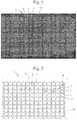
FIG. 1 is an image in plan view of an apparatus holding an array of volumes of polar medium;
FIG. 2 is a partial plan view of the support of the apparatus ofFIG. 1;
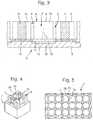
FIG. 3 is a cross-sectional side view of a single compartment of the support taken along line inFIG. 2;
FIG. 4 is an isometric projection of an alternative pattern for pillars of the partitions defining compartments;
FIG. 5 is a plan view of the pillars in the pattern ofFIG. 4;
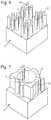
FIGS. 6 and 7 are isometric projections of further alternative patterns for the pillars;
FIGS. 8 and 9 are plan views of further alternative patterns for the pillars;
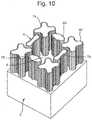
FIG. 10 is an isometric projection of an alternative pattern for pillars of the partitions defining compartments;
FIG. 11 is a plan view of the pillars in the pattern ofFIG. 10;
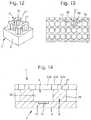
FIG. 12 is an isometric projection of a first alternative construction for the partitions;
FIG. 13 is a plan view of the partitions ofFIG. 12;
FIG. 14 is a cross-sectional side of a single compartment of a support of the apparatus in which the partitions have a second alternative construction;
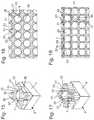
FIG. 15 is an isometric projection of the second alternative construction for the partitions;
FIG. 16 is a plan view of the partitions ofFIG. 15;
FIG. 17 is an isometric projection of a modified construction for the partitions;
FIG. 18 is a plan view of the partitions ofFIG. 17;
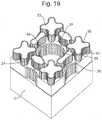
FIG. 19 is an isometric projection of a modified construction for the partitions;
FIG. 20 is a plan view of the partitions ofFIG. 19;
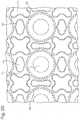
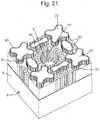
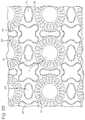
FIG. 21 is an isometric projection of a modified construction for the partitions;
FIG. 22 is a plan view of the partitions ofFIG. 21;
FIG. 23 is an isometric projection of a modified construction for the partitions;
FIG. 24 is a plan view of the partitions ofFIG. 23;
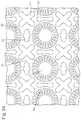
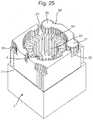
FIG. 25 is an isometric projection of a modified construction for the partitions;
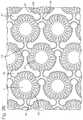
FIG. 26 is a plan view of the partitions ofFIG. 25;
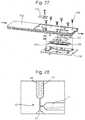
FIG. 27 is a diagram of a flow cell assembly incorporating an array;
FIG. 28 is an image of droplets of aqueous solution made by a microfluidic flow junction;
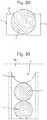
FIG. 29 is a schematic cross-sectional view of an apparatus containing a bead protruding out of a compartment;
FIG. 30 is a schematic cross-sectional view of an apparatus containing plural volumes of hydrophilic medium;
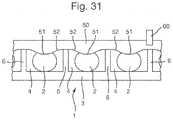
FIG. 31 is a cross-sectional view of part of the apparatus provided with a layer of polar medium;
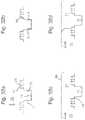
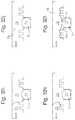
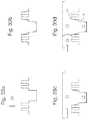
FIG. 32 is a set of schematic side views of a compartment in successive steps of a method;
FIG. 33 is a set of schematic side views of a compartment in successive steps of a method;
FIG. 34 is a schematic side view of a compartment having a pre-treatment apolar medium applied;
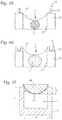
FIG. 35 is a side view of a compartment at the start point of a computer simulation;
FIGS. 36 (A) and (B) are side views of a compartment during the computer simulation;
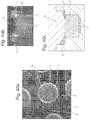
FIG. 36C is a confocal image of a compartment in which an inner recess is filled with a volume of polar medium;
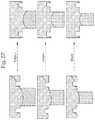
FIG. 37 are side views of compartments of different size during a computer simulation;
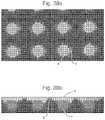
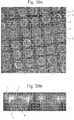
FIG. 38 is a set of images of a support in the construction ofFIG. 21 in which inner recesses are filled with volumes of polar medium;
FIG. 39 are images of a support in the construction ofFIG. 19 in which inner recesses are filled with volumes of polar medium;
FIGS. 40 (A) and (B) are images of a support in the construction ofFIG. 19 after formation of an array of membranes; and
FIG. 40(C) is a schematic side view of a compartment having a formed membrane.
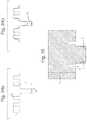
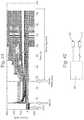
FIG. 41 is a graph of current against time showing electrical data obtained for measurement of ion current flow through an MspA nanopore;
FIG. 42 is a diagram of an electrical circuit of the apparatus;
FIG. 43 is a graph of lifetime against size for various volumes of polar medium;
FIGS. 44(a) to (c) are schematic side views of a droplets of different size in a compartment;
FIGS. 45 and 46 are schematic cross-sectional views of the apparatus of the type shown inFIGS. 15 and 16;
FIG. 47 is a side view of a meniscus formed across the opening of a compartment;
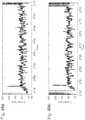
FIG. 48 shows current traces as a function of time in ms showing helicase-controlled DNA movement through an MspA-(B2C) nanopore which is inserted in tri-block co-polymer under an applied potential of 180 mV, wherein A and B show examples of two helicase-controlled DNA translocations through MspA nanopores.
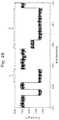
FIG. 49 shows a current trace showing characteristic block levels corresponding to the presence (block labelled2) and absence (block labelled1) of thrombin;
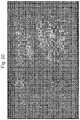
FIG. 50 shows a Brightfield image of a chip which has been exposed to MspA-(B2C) (SEQ ID NO: 1) nanopores; and
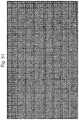
FIG. 51 shows an Brightfield image of chip which has not been exposed to MspA-(B2C) (SEQ ID NO: 1) nanopores.
The specification refers to various sequences as follows.
SEQ ID NO: 1 shows the amino-acid sequence of MspA-(B2C). The amino-acid sequence of MspA-(B2C) is a variant of SEQ ID NO: 2 with the following mutations G75S/G77S/L88N/Q126R.
SEQ ID NO: 2 shows the amino acid sequence of the mature form of the MS-B1 mutant of the MspA monomer. This mutant lacks the signal sequence and includes the following mutations: D90N, D91N, D93N, D118R, D134R and E139K.
SEQ ID NO: 3 shows one of the polynucleotide sequences used in Example 5. It is connected at its 3′ end to the 5′ end of SEQ ID NO: 4 via four spacer units.
SEQ ID NO: 4 shows one of the polynucleotide sequences used in Example 5. It is connected at its 5′ end to the 3′ end of SEQ ID NO: 3 via four spacer units.
SEQ ID NO: 5 shows the polynucleotide sequence encoding one subunit of α-hemolysin-E111N/K147N (α-HL-NN; (Stoddart, D. S., et al., (2009),Proceedings of the National Academy of Sciences of the United States of America106, p 7702-7707).
SEQ ID NO: 6 shows the amino acid sequence of one subunit of α-HL-NN.
SEQ ID NO: 7, shown below, is the polynucleotide sequence of an aptamer, where X is an abasic site. XXXXXXXXXXXXXXXXXXXXXXXAAAAAAAGGTTGGTGTGGTTGG. This sequence does not comply with WIPO ST.25 and so has not been included in the sequence listing.
SEQ ID NO: 8 shows the polynucleotide sequence of a strand of DNA. The strand has a BHQ1 label attached to the thymine atposition 1 in the sequence and a FAM label attached to the thymine atposition 15 in the sequence.
SEQ ID NO: 9 shows the polynucleotide sequence encoding the MspA-(B2C) mutant MspA monomer. The amino-acid sequence of MspA-(B2C) is a variant of SEQ ID NO: 2 with the following mutations G75S/G77S/L88N/Q126R.
SEQ ID NO: 10 shows the polynucleotide sequence encoding the MS-B1 mutant of the MspA monomer. This mutant includes the following mutations: D90N, D91N, D93N, D118R, D134R and E139K.
FIG. 1 shows anapparatus1 holding an array ofvolumes2 of a polar medium in apolar medium. Theapparatus1 comprises asupport3 providing an array ofcompartments4. In use, all thecompartments4 contain apolar medium. At least some of the compartments4 (in this example most of the compartments4) containsingle volumes2 of a polar medium in the apolar medium.
The construction of thesupport3 is shown in more detail inFIGS. 2 and 3. Thesupport3 comprises abase5 andpartitions6 that extend from thebase5. Thepartitions6 compriseplural pillars7 that extend out from thebase5 as shown inFIG. 3, in this example perpendicularly. Thecompartments4 have openings provided at the distal ends of thepillars7. These openings provide communication from thecompartments4 into the space adjacent thesupport3, and volumes of polar medium may be introduced into thecompartments4 through the openings.
Thepillars7 may have different shapes as shown inFIG. 2 so that they define thecompartments4 in a regular square array. Thepillars7 are shaped so that they constrain thevolumes2 of polar medium in thecompartments4 from contactingvolumes2 comprising polar medium in neighbouring compartments. In this example, thepillars7 include across-shaped pillar7ain the corners ofcompartments4 with arms protruding into thecompartment4 andfurther pillars7balong the each side of thecompartment4, withgaps8 between thecross-shaped pillars7aand thefurther pillars7b. Thecompartments4 are arranged such that thevolumes2 of polar medium are physically separated from each other. This prevents thevolumes2 of polar medium from merging or contacting each other to form interfaces. This provides a very stable array ofvolumes2 of polar medium which is capable of being stored over a long period of time. Herein, the terms “inner” and “outer” describe relative locations within thecompartments4 from the openings at the outer end towards thebase5 at the inner end.
Thepillars7 havegaps8 therebetween. In this example, thegaps8 extend the entire distance from the openings to thebase5. Thegaps8 are of sufficient size to allow the flow of an apolar medium between thecompartments4, whilst maintaining the separation of thevolumes2 of polar medium in thecompartments4. The provision ofgaps8 allows the apolar medium to flow between thecompartments4. This greatly aids in filling of thecompartments4 as apolar medium may be displaced by avolume2 of polar medium entering acompartment4 through an opening. Thegaps8 also allow the level of apolar medium in thesupport3 to be controlled and equalised across the array. Thegaps8 between thepillars7 are such that thevolumes2 of polar medium are constrained from moving through thegaps8 between thecompartments4 or from contactingvolumes2 comprising polar medium in neighbouring compartments.
Optionally, adam10 may be provided around the perimeter of thesupport3 which aids in filling the peripheral edges of thesupport3 with apolar medium. One ormore channels11 may be provided in thedam10 through which apolar medium may be introduced or drained from thesupport3.
Thesupport3 may be prepared from a range of different materials having a high electrical resistance, including without limitation undoped crystalline silicon (i.e. a silicon wafer), SU8, polycarbonate, and/or polyester, and including any combination of these or other materials. Thesupport3 may be manufactured using conventional techniques for such materials, including, without limitation, deposition and removal techniques for example etching or laser processing.
As shown inFIG. 3, thebase5 comprises asubstrate12. Thesubstrate12 supports anelectrode13 in eachcompartment4. In this example, theelectrodes13 are shown recessed into thesubstrate12, but they could alternatively be deposited as an outer layer on an exposed surface of thesubstrate12. Theelectrodes13 are provided to make electrical contact with thevolumes2 of polar medium contained in thecompartments4 and are discussed in more detail below.
Thesubstrate12 may comprise asurface coating14 that is optional. Thesurface coating14 may provide a high resistance outer layer. One possible combination of materials for thebase5 is that the base is made of undoped crystalline silicon (i.e. a silicon wafer) and thecoating14 to be made of SU8. In the example shown inFIG. 2, thesurface coating14 is provided on top of thesubstrate12 and so hasapertures15 aligned with theelectrodes13 to allow electrical contact between theelectrodes13 and thevolumes2 of polar medium. As an alternative theelectrodes12 could be patterned in the same layer as thesurface coating14 or on top of thesurface coating14.
Thepartitions6 may be made of the same or different material to thebase12 of thesupport3 and may have the same or different surface properties. Thepartitions6 are typically apolar and may be made for example from Permex. Thepartitions6 may optionally comprise a surface coating (not shown) to modify their electrical and/or physical properties.
The particular shapes and arrangement of thepillars7 shown inFIG. 2 is not essential and thepillars7 may have a variety of different shapes to define thecompartments4 so as to constrain thevolumes2 of polar medium in thecompartments4 from contactingvolumes2 comprising polar medium in neighbouring compartments. By way of example,FIGS. 4 to 8 show some examples of alternative shapes and arrangements for thepillars7, as follows.
FIGS. 4 and 5 show asupport3 wherein thepartitions6 comprisepillars7 includingcross-shaped pillars7aandfurther pillars7bin a similar arrangement toFIG. 2. Thus thepillars7 are combined with short and long pitches to prevent merging of thevolumes2 of polar medium and improve pillar stability.
FIGS. 6 to 9 show other supports3 in which thepillars7 have modified shapes and patterns. In each case,pillars7 havegaps8 that extend the entire distance from the openings to thebase5. Thepillars7 are arranged in a pattern that definescompartments4 in regions of thesupport3 where thepillars7 are widely spaced from each other. Thegaps8 between thepillars7 are such that thevolumes2 of polar medium are constrained from moving between thecompartments4 or from contactingvolumes2 comprising polar medium in neighbouring compartments. InFIG. 6, thepartitions6 comprise an array ofcircular pillars7d.
InFIG. 7 thepartitions6 comprise an array oftri-star pillars7g. Thetri-star pillars7ghave three arms with curved re-entrant sides and enlarged ends. Thetri-star pillars7gdefine a plurality ofcompartments4, with threetri-star pillars7gequi-spaced around each compartment. InFIGS. 8 and 9, thepartitions6 comprise an array ofcross-shaped pillars7hand T-shaped pillars7i, respectively, defining a plurality ofcompartments4. Thecross-shaped pillars7gand T-shapedpillars7hhave re-entrant sides.
In these examples ofFIGS. 7 to 9, the number ofpillars7 that are required to provide acompartment4 is less than for example the arrangement ofFIG. 2 or 6. The provision of a reduced number ofpillars7 makes fabrication of the array easier and increases the mechanical resilience of the individual pillars.
It has also been found that the circular pillars as shown inFIG. 6 are mechanically less resilient and are more prone to collapse, or distortion than the more structurally resilient pillars of for exampleFIG. 4 orFIGS. 7 to 9, especially forpillars7 of heights of the order of 100 μm and pillar widths of the order of 25 μm.Pillars7 having a higher width:height ratio are therefore preferred.
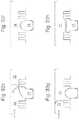
FIGS. 11 and 12 show asupport3 wherein thepartitions6 comprisepillars7 includingcross-shaped pillars7aandfurther pillars7bhaving the same overall arrangement asFIG. 4 except for a modification that thesurfaces62 of thecross-shaped pillars7aandfurther pillars7bare micro-patterned with a patterning as follows. In particular, thosesurfaces62 are indented with a plurality ofindentations63 that extend outwardly of thecompartment4, along the entire length of thecross-shaped pillars7aandfurther pillars7b. In this example, theindentations63 are rectangular in cross-section.
Thesurfaces62 between theindentations63 lie in a common curved plane extending around thecompartment4. Thesesurfaces62 physically constrain avolume2 of polar medium inside thecompartment4. Thus, the dimensions of thesurfaces62 control the size of thevolume2 of polar medium that may be accommodated in thecompartment4.
Theindentations63 hold apolar medium that reduces the surface area of thepartitions6 that is in contact with avolume2 of polar medium. This modifies the surface properties of thepillars7, repelling polar medium and therefore assisting in constraining avolume2 of polar medium held in thecompartment4, and in allowing entry of the polar medium into the compartment. In general, the patterning could comprise other surfaces features to achieve this effect.
Theindentations63 and surfaces62 have widths that are small compared to the size of the volume ofvolume2 of polar medium held in thecompartment4. Theindentations63 and surfaces62 have widths preferably of at most 20 μm, more preferably of at most 10 μm. For example, if the dimensions of acompartment4 are characterised with reference to the diameter d of the largest notional sphere that can be accommodated within thecompartment4, then theindentations63 and surfaces62 have widths that are at most 0.1d, preferably at most 0.05d. In a typical example where the diameter d is 140 μm, theindentations63 and surfaces62 have widths that are 5 μm. The depth of theindentations63 is chosen to allow the channels to retain the apolar medium. In the example ofFIGS. 11 and 12, the channels have a depth of 5 μm, providing an aspect ratio of 1:1. However,deeper indentations63 provide more effective retention of apolar medium.
In all the constructions shown in the figures, thepillars7 have the same height so that the outer ends9 of thepillars7 extend in a common plane, as shown inFIG. 3, to provide thesupport3 with a brush-like planar upper surface. Whilst the provision of pillars having the same height is a preferred construction, constructions may be provided having pillars of differing heights.
There will now be described some alternative constructions for thepartitions6 in which thepartitions6 do not havepillars7 andgaps8 extending the entire distance to thebase5. In general, reducing the depth of any gaps in the partitions can increase the electrical isolation betweencompartments4 and reduce the tendency for offset currents between theelectrodes13 ofdifferent compartments4, for example if the apolar medium becomes hydrated sufficiently to provide an electrical conductivity path betweenelectrodes13. Apart from the alternative constructions of thepartitions6, supports2 otherwise have the same construction as described above.
A first alternative construction for the partitions is shown inFIGS. 12 and 13 and arranged as follows. In the first alternative construction, thepartitions6 have no gaps allowing the flow of apolar medium between thecompartments4. In particular, thepartitions6 haverecesses30 that define thecompartments4 without gaps between thosecompartments4. Thepartitions6 may be formed by acommon body31 extending from thebase5. In that case, thebase5 has planar surfaces forming the inner ends of thecompartments4. Thecommon body31 may be formed as a separate layer laminated with thebase5, but alternatively may be integral with thebase5 and therecesses30 formed by removing material.
In this example, thepartitions6 have a profile as viewed across thesupport3 that is the same as the profile of theinner portion20 of the partitions in the second alternative construction. That is, the profile is undulating and comprises, aroundindividual compartments4, pluralsalient portions32 that protrude into thecompartment4 and pluralre-entrant portions33 where thecompartment4 protrudes into thepartitions6.
Thesalient portions32 are arranged physically to constrain avolume2 of polar medium inside thecompartment4. Thus, the dimensions of thesalient portions32 control the size of thevolume2 of polar medium that may be accommodated in thecompartment4.
There-entrant portions33 provide channels that extend outside avolume2 of polar medium accommodated in thecompartment4. Therefore, there-entrant portions33 allow outflow of apolar medium displaced by entry of avolume2 of polar medium into thecompartment4.
This undulating structure also reduces the surface area of thepartitions6 that is in contact with avolume2 of polar medium. This serves to allow the avolume2 of polar medium to move to the base of thecompartment4 and thereby assist in making electrical contact with theelectrode13.
In principle, any number ofre-entrant portions33 could in principle be provided such as 3, 4, 5, 6 etc. However one would need to balance the number ofsalient portions32 with the contact surface for thevolume2 of polar medium.
Thesalient portions32 as shown inFIG. 12 have rounded edges. Alternatively thesalient portions32 may have sharp edges. Such sharp edges may reduce further the extent of contact between the edge of thecompartment4 and thevolume2 of polar medium. Conversely, sharp edges may puncture the layer of amphiphilic molecules. It is advantageous to reduce the extent of contact of thevolume2 of polar medium with the inner surface of thecompartment4. Havingsalient portions32 enableslarger volumes2 of the polar medium to be used for a given volume ofcompartment4.
As can be seen fromFIG. 12, the dimensions and shape of there-entrant portions33 determines the surface area which is capable of being contacted by avolume2 of polar medium. Thesalient portions32 andre-entrant portions33 are interrelated in that generally the greater the cross-sectional width of there-entrant portion33, the greater the reduction in surface area of the walls of thecompartment4.
Thus, compared to the constructions described above, in the first alternative construction, thepartitions6 provide the same function of constraining thevolumes2 of polar medium and preventing them from contacting or merging, but the electrical isolation betweencompartments4 is increased due to the absence of gaps in thepartitions6. The absence of gaps in thepartitions6 also reduces the beneficial effect of allowing flow of apolar medium betweencompartments4, but this is to some extent mitigated when fillingcompartments4 by there-entrant portions33 providing channels allowing outflow of displaced apolar medium which assists insertion of avolume2 of polar medium. This allows for avolume2 of polar medium of maximum size to be inserted, the movement of which is constrained by thesalient portions32.
Thepartitions6 have the same height so that the outer ends34 of thepartitions6 extend in a common plane, as shown inFIG. 12, to provide thesupport3 with a brush-like planar upper surface.
There will now be described some alternative constructions for thepartitions6 in which thepartitions6 comprise inner portions defining inner recesses of the compartments without gaps therebetween, and outer portions extending outwardly from the inner portions defining outer portions of the compartments with gaps allowing the flow of apolar medium between the compartments. Thus, effectively the gaps extend partway to thebase5. Apart from the alternative constructions of thepartitions6, the followingsupports2 otherwise have the same construction as described above.
A second alternative construction for the partitions is shown inFIGS. 14, 15 and 16 and arranged as follows.
Theapparatus1 for holding an array ofvolumes2 of a polar medium in apolar medium comprises asupport3 providing an array ofcompartments4. In use, all thecompartments4 contain apolar medium, and at least some of thecompartments4 containsingle volumes2 of a polar medium in the apolar medium.
Thesupport3 comprises abase5 andpartitions6 that extend from thebase5. Herein, the terms “inner” and “outer” describe relative locations within thecompartments4 from the openings at the outer end towards thebase5 at the inner end.
As described in more detail below, thepartitions6 definecompartments4 having openings provided at the distal ends of thepartitions6. These openings provide communication from thecompartments4 into the space adjacent thesupport3, and volumes of polar medium may be introduced into thecompartments4 through the openings. Thecompartments4 are arranged such that thevolumes2 of polar medium are physically separated from each other. This prevents thevolumes2 of polar medium from merging or contacting each other to form interfaces. This provides a very stable array ofvolumes2 of polar medium which is capable of being stored over a long period of time.
Optionally, a dam (taking the form shown inFIG. 1) may be provided around the perimeter of thesupport3 which aids in filling the peripheral edges of thesupport3 with apolar medium. One or more channels may be provided in the dam through which apolar medium may be introduced or drained from thesupport3.
Thesupport3 may be prepared from a range of different materials having a high electrical resistance, including without limitation undoped crystalline silicon (i.e. a silicon wafer), SUB, polycarbonate, and/or polyester, and including any combination of these or other materials. Thesupport3 may be manufactured using conventional techniques for such materials, including, without limitation, deposition and removal techniques for example etching or laser processing.
Thebase5 comprises asubstrate12. Thesubstrate12 supports anelectrode13 in eachcompartment4. In this example, theelectrodes13 are shown recessed into thesubstrate12, but they could alternatively be deposited as an outer layer on an exposed surface of thesubstrate12. Theelectrodes13 are provided to make electrical contact with thevolumes2 of polar medium contained in thecompartments4 and are discussed in more detail below.
Thesubstrate12 may optionally comprise a surface coating. The surface coating may provide a high resistance outer layer. One possible combination of materials for thebase5 is that thebase5 is made of undoped crystalline silicon (i.e. a silicon wafer) and the coating to be made of SUB. Such a surface coating may be provided on top of thesubstrate12 with apertures aligned with theelectrodes13 to allow electrical contact between theelectrodes13 and thevolumes2 of polar medium. As an alternative, theelectrodes12 could be patterned in the same layer as the surface coating or on top of the surface coating.
Thepartitions6 may be made of the same or different material to thebase12 of thesupport3 and may have the same or different surface properties. Thepartitions6 are typically apolar and may be made for example from Permex. Thepartitions6 may optionally comprise a surface coating (not shown) to modify their electrical and/or physical properties.
FIGS. 15 and 16 show a particular arrangement of thepartitions6, but this is not essential and thepartitions6 may have a variety of different arrangements to define thecompartments4 so as to constrain thevolumes2 of polar medium in thecompartments4 from contactingvolumes2 comprising polar medium in neighbouring compartments.
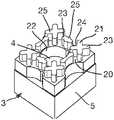
In the arrangement ofFIGS. 15 and 16, thepartitions6 compriseinner portions20 andouter portions21.
Theinner portions20 of thepartitions6 defineinner recesses22 that form the inner portions of thecompartments4 without gaps between those inner portions of thecompartments4. Theinner portions20 of thepartitions6 may be formed by a common body extending from thebase5. In that case, thebase5 has planar surfaces forming the inner ends of thecompartments4. Theinner portions20 may be formed as a separate layer laminated with thebase5 after removal of material to form apertures that become theinner recesses5. Alternatively theinner portions20 may be integral with thebase5 and therecesses22 formed by removing material of the integral member.
In this example, theinner portions20 of thepartitions6 have a profile as viewed across thesupport3 that is circular aroundindividual compartments4.
Theouter portions21 of thepartitions6 extend outwardly from theinner portions20 and define the outer portions of thecompartments4. In this example, theouter portions21 of thepartitions6 compriseplural pillars23 that extend out from theinner portions20 of thepartitions6 as shown inFIG. 15, in this example perpendicularly, with a similar pattern to thepillars7 in the construction of thepartitions6 shown inFIGS. 4 and 5. In particular, across-shaped pillar23ain the corners of thecompartments4 with arms extending towards thecompartment4 and pluralfurther pillars23balong the each side of thecompartment4, withgaps24 between thecross-shaped pillars23aand thefurther pillars23b, and between thefurther pillars23b.
Thepillars23 havegaps24 therebetween. In this example, thegaps24 extend to theinner portions20 of the partitions and hence only partway to thebase5. Thegaps24 are of sufficient size to allow the flow of an apolar medium between thecompartments4, whilst maintaining the separation of thevolumes2 of polar medium in thecompartments4. The provision ofgaps24 allows the apolar medium to flow between thecompartments4. This aids in filling of thecompartments4 as apolar medium may be displaced by avolume2 of polar medium entering acompartment4. Further description of this is given below. Thegaps24 also allows the level of apolar medium in thesupport3 to be controlled and equalised across the array. Thus, compared to the constructions described above, in the second alternative construction, thepartitions4 provide the same function of constraining thevolumes2 of polar medium and preventing them from contacting or merging, and thegaps24 provide the same function to thegaps8 of allowing flow of apolar medium betweencompartments4. However, the electrical isolation betweencompartments4 is increased due to the absence of gaps in theinner portions20.
Thepillars23 are set back from the edges of theinner recesses22 as viewed from the openings of thoseinner recesses22. This creates a step on the upper surface of theinner portions20 of thepartitions6 between any givenpillar23 and the adjacentinner recesses22.
Thepillars23 have the same height so that the outer ends25 of thepillars24 extend in a common plane, as shown inFIG. 15, to provide thesupport3 with a brush-like planar upper surface.
The relative heights of theinner portions20 andouter portions21 of thepartitions6 may be varied. In one typical embodiment, theinner portions20 have a height of 90 μm and a diameter of 170 μm, andouter portions21 have a height of 60 μm.
In this example, the inner portions of the partitions further comprise twore-entrant portions28. As can be seen fromFIGS. 15 and 16, the dimensions of the re-entrant portions are relatively small compared to the inner surface ofcompartment4.
A modified construction for the partitions is shown inFIGS. 17 and 18. This is similar to the construction ofFIGS. 15 and 16 except for the following modifications.
Firstly, theinner recesses22 formed by theinner portions20 of thepartitions6 have a profile as viewed from the openings of thecompartments4 across thesupport3 that is not circular. In particular, the profile is undulating and comprises, aroundindividual compartments4, pluralsalient portions26 that protrude into thecompartment4 and pluralre-entrant portions27 where thecompartment4 protrudes into thepartitions6.
Thesalient portions26 are arranged physically to constrain avolume2 of polar medium inside thecompartment4. Thus, the dimensions of thesalient portions26 control the size of thevolume2 of polar medium that may be accommodated in thecompartment4.
There-entrant portions27 provide channels that extend outside avolume2 of polar medium accommodated in thecompartment4. Effectively therefore, theinner portions20 of thepartitions6 have surfaces that are indented with a plurality of channels that extend outwardly of theinner recesses22. Therefore, there-entrant portions27 allow outflow of apolar medium displaced by entry of avolume2 of polar medium into thecompartment4.
This undulating structure also reduces the surface area of thepartitions6 that is in contact with avolume2 of polar medium. This serves to allow avolume2 of polar medium to move to the base of thecompartment4 and thereby assist in making electrical contact with theelectrode13.
In principle, any number ofre-entrant portions27 could in principle be provided such as 3, 4, 5, 6 etc. However one would need to balance the number ofsalient portions26 with the contact surface for thevolume2 of polar medium.
Secondly, thepillars23 of theouter portions21 of thepartitions6 have a different pattern. In particular, a cross-shaped pillar23cin the corners of thecompartments4 with arms extending in a direction along the side of thecompartment4 and a pair of further pillars23calong the each side of thecompartment4, withgaps24 between the cross-shaped pillars23cand the further pillars23d, and between the further pillars23d. This is enable thepillars23 to fit on theinner portion20, but thepillars23 have the same function and effect.
Thesalient portions26 as shown inFIG. 17 have rounded edges. Alternatively thesalient portions26 may have sharper edges. It is advantageous to reduce the extent of contact of thevolume2 of polar medium with the inner surface of thecompartment4. Havingsalient portions26 enableslarger volumes2 of the polar medium to be used for a given volume ofcompartment4.
As can be seen fromFIG. 17, the dimensions and shape of there-entrant portions27 determines the surface area which is capable of being contacted by avolume2 of polar medium. Thesalient portions26 andre-entrant portions27 are interrelated in that generally the greater the cross-sectional width of there-entrant portion27, the greater the reduction in surface area of the walls of thecompartment4.
A modified construction for thepartitions6 is shown inFIGS. 19 and 20. This is similar to the construction ofFIG. 15 except for a modification that thesurfaces64 of theinner recesses22 and thesurfaces66 of thepillars23 have a patterning described further below.
A yet further modified construction for thepartitions6 is shown inFIGS. 21 and 22. This is the same as the construction ofFIG. 19 except for the size of the patterning.
A yet further modified construction for thepartitions6 is shown inFIGS. 23 and 24. This is the same as the construction ofFIG. 15 except for a modification that thesurfaces64 of the inner recesses22 (but not thesurfaces66 of the pillars23) have a patterning as described below.
A yet further modified construction for thepartitions6 is shown inFIGS. 25 and 26.
The patterning on the various surfaces of thecompartments4 shown inFIGS. 19 to 26 will now be described in more detail.
In particular, thesurfaces64 of theinner recesses22 are indented with a plurality ofindentations65 that extend outwardly of theinner recesses22, and hence outwardly of thecompartments4, along the entire length ofinner recesses22. In this example, theindentations65 are rectangular in cross-section. Similarly, surfaces66 of thepillars23 are indented with a plurality ofindentations67 that extend outwardly of the compartments4 (except in the construction ofFIG. 15). In this example, theindentations67 are rectangular in cross-section.
Thesurfaces64 of each inner recesses22 between theindentations65 lie in a common curved plane extending around theinner recess22. Thesesurfaces64 physically constrain avolume2 of polar medium inside theinner recess22. Thus, the dimensions of thesurfaces64 control the size of thevolume2 of polar medium that may be accommodated in theinner recess22.
Theindentations65 hold polar medium that reduces the surface area of thepartitions6 that is in contact with avolume2 of polar medium. This modifies the surface properties of thepillars7, repelling polar medium and therefore assisting in constraining avolume2 of polar medium held in theinner recess22, and in allowing entry of the polar medium into theinner recess22. In general, the patterning could comprise other surfaces features to achieve this effect.
An initial pre-treatment of apolar medium70 is applied as described below. Theindentations65 and67 assist in spreading the pre-treatment of apolar medium70 by wicking it over thesubstrate3.
The pre-treatment of apolar medium70 added to thepartitions6 is held within theindentations65 by surface tension/capillarity which serves to increase the phobicity of thepartitions6 to the polar medium and therefore the contact angle between thevolume2 of polar medium and thepartitions6. This helps define the shape of the meniscus of thevolume2 of polar medium.Indentations65 having a high capillarity are preferred as they retain the apolar medium more effectively and prevent or hinder flow of apolar medium onto the surface of theelectrode12. Thus polar medium added subsequently to the compartments is able to directly contact theelectrodes13.
Theindentations65 and surfaces64 have widths according to an embodiment preferably of at most 20 μm, more preferably of at most 10 μm. Theindentations65 and surfaces64 have widths that is small compared to the size of the volume ofvolume2 of polar medium held in theinner recess22. For example, if the dimensions of theinner recess22 are characterised with reference to the diameter d of the largest notional sphere that can be accommodated within theinner recess22, then theindentations65 and surfaces64 have widths that are preferably at most 0.1d, more preferably at most 0.05d. By way of example, where theinner recess22 has a depth of 90 μm, theouter portions23 have a height of 30 μm and the diameter d is 140 μm, theindentations65 and surfaces64 may have widths that are 5 μm. Similarly, in the construction ofFIG. 19, theindentations65 and surfaces64 have widths that are 5 μm.
The depth of theindentations65 is chosen to allow the channels to retain the polar medium. By way of example, in the construction ofFIG. 19, theindentations65 have a depth of 5 μm, providing an aspect ratio of 1:1.
However,deeper indentations65 provide more effective capture and retention of polar medium. By way of example, in the construction ofFIG. 25 andFIG. 21, theindentations65 have a depth of 50 μm, providing an aspect ratio of 10:1. This captures and retains oil more effectively within the channels due to higher capillarity. The available droplet diameter d is 100 μm. An added benefit of the higher aspect wells is that they provide a smaller droplet diameter which in turn provides a smaller amphipathic membrane area.
Thesurfaces66 of thepillars23 between theindentations67 lie in a common curved plane extending around theinner recess22. Theindentations67 hold polar medium which repels the apolar medium. The pre-treatment of apolar medium70 added to thepartitions6 is held within theindentations65 by surface tension/capillarity which serves to increase the phobicity of thepartitions6 to the polar medium and thereby assists in the filling of theinner recess22.
Theindentations67 and surfaces66 have widths preferably of at most 20 μm, more preferably of at most 10 μm. Theindentations67 and surfaces66 have widths that is small compared to the size of the volume ofvolume2 of polar medium held in theinner recess22. For example, if the dimensions of theinner recess22 are characterised with reference to the diameter d of the largest notional sphere that can be accommodated within theinner recess22, then theindentations65 and surfaces64 have widths that are preferably at most 0.1d, more preferably at most 0.05d. By way of example, where theinner recess22 has a depth of 90 μm, theouter portions23 have a height of 30 μm and the diameter d is 140 μm, theindentations65 and surfaces64 may have widths that are 5 μm. However,deeper indentations67 provide more effective retention of polar medium, but it is difficult to providehigher aspect indentations67 due to the limited space.
The following comments apply to thesupport3 with any of the above-described constructions.
Thesupport3 may comprise any number ofcompartments4. Thesupport3 may comprise, for example, number ofcompartments4 in the range from 2 to 106, but may typically be in the range from 100 to 100,000.
Anindividual compartment4 has a notional cross-sectional area defined by the spacing between thepartitions6 and a notional volume defined by the height of thepartitions6. The notional volume is typically the same for allcompartments4 of the array.
As in the examples above, thecompartments4 may have irregularly shaped peripheries as viewed across thesupport3. Irrespective of the shape of thecompartments4, in the case where a compartment contains a single volume of the polar medium, the dimensions of acompartment4 may be characterised with reference to the largest notional sphere that can be accommodated within thecompartment4. That is approximately the size of thelargest volume2 of polar medium that could be accommodated in the case that thevolumes2 of polar medium are spherical (which is not essential). Indeed, in the case where the volumes of polar medium are liquid, they can deform depending upon the dimensions of the compartment and the surface properties of the support. Such a size may typically be between 50 μm and 500 μm, more typically between 70 μm and 200 μm
The array will typically containvolumes2 of polar medium of a substantially similar size.
The dimensions of thecompartment4 may be chosen depending upon the size of thevolumes2 of polar medium to be contained. Thevolumes2 of polar medium typically have an average diameter in the range from 5 μm to 500 μm or an average volume in the range from 0.4 pL to 400 nL. The density of thecompartments4 in thesupport3 is therefore dependent upon the size of thevolumes2 of polar medium and the particular arrangement of thepartitions6.
In the above examples, thepartitions6 have a regularly repeating pattern so that thecompartments4 have the same size and shape across thesupport3 and are arranged in a regular array. This is not essential. Thepartitions6 andcompartments4 may have alternatively have differing shapes and/or sizes across thesupport3 and/or thecompartments4 may be arranged in an irregular array.
The nature of the polar medium of thevolumes2 of polar medium is as follows.
The polar medium may be a hydrophilic medium. The hydrophilic medium may for example comprise an aqueous medium.
In one example, the polar medium of thevolumes2 is an aqueous buffer solution. The buffer solution may comprise a supporting electrolyte.
The array may be filled with an emulsion or filled with volumes of apolar and polar volumes by use of a flow-cell assembly such as shown inFIG. 27. InFIG. 27, anarray101 attached to an ASIC/PCB105 is inserted into thearray retainer102. Aprotective gasket107 is placed on the surface of the array and the array is affixed to thefluidic module103 usingscrews109. Fluid may be flowed over the surface of the array in order to fill the compartments.Valve rotor110 may be rotated in order to fluidically seal the flow cell. Fluid enters the flow-cell from a fluid reservoir (not shown) and exits the flow cell, as shown by the arrows.
In an example where thevolumes2 are pre-formed before being disposed in the compartments, thevolumes2 may be droplets of an aqueous buffer solution. In that case, they may be made in conventional manner, for example using a microfluidic flow T-junction40 as shown inFIG. 28 comprising afirst flow channel41 containing the polar medium and asecond flow channel42 comprising the apolar medium. The twoflow channels41 and42 intersect at the T-junction spontaneously formingdroplets43 which flow downstream from the T-junction and may be collected in avessel44 as an emulsion of thedroplets43 in the apolar medium. The size of thedroplets43 is determined by the flow rates of the polar and apolar fluids as well as the width of the apertures of therespective flow channels41 and42.FIG. 28 also showsdroplets43 that have been formed by the T-junction40.
Droplets may be provided having different amounts of substances, by for example providing a third flow channel containing a different polar medium to the first flow channel which intersects with the first channel to form a common flow channel prior to intersecting at the T-junction. The flow rates of the third and first flow channels may be varied to provide droplets having varying ratios of components.
In another example where thevolumes2 are pre-formed before being disposed in the compartments, thevolumes2 of polar medium may be beads of an aqueous gel, such as an agarose gel. The gel may comprise an aqueous buffer solution as the liquid phase. The buffer solution may comprise a supporting electrolyte. Examples of such are non-crosslinked or crosslinked hydrogels such as agarose or sepharose. A bead may be formed in-situ from a droplet for example by cooling or crosslinking with UV. A bead introduced into the apolar medium may form a droplet, for example by melting. The volume of polar medium may be provided within a porous plastic or glass bead.
Where thevolumes2 of polar medium are beads of an aqueous gel, they may have sufficient rigidity to protrude out of the compartments.FIG. 29 shows an apparatus that is an example of this. In this example, the bead protrude above the height of thepartitions6 and themeniscus52 is formed as shown.
It may be the case that, when thevolumes2 of polar medium are beads of an aqueous gel, the leakage currents between thecompartments4 is reduced. Gel beads can be made in a conventional manner in T-piece droplet maker by merging a stream liquid gel at an elevated temperature into a stream of the apolar medium and allowing to cool, thereby to form an emulsion of beads of gel in the apolar medium. Gel beads may also be easier to locate onto a spiked electrode in the well and are generally more dimensionally stable.
In the case of using gels, shapes other than spherical may be created, for example elongate cigar shaped structures which might be employed in deep recesses (thus maximising the internal volume of thevolume2 of polar medium). This would have the advantage of extending the lifetime of thevolume2 of polar medium for example if the redox mediator were contained within thevolume2 of polar medium.
The aqueous gel may be a cross-linked gel. These are gels in which the matrix is cross-linked, which increases the hardness of the gel, providing a higher structural integrity than gels that are not cross-linked. For example, agarose gels may be cross-linked. Beads of cross-linked gel are commercially available and may be mixed with apolar medium to form an emulsion of beads of gel in the apolar medium. One possibility is cross-linked agarose beads with a particle size of 160 μm and an agarose content of 6.8-7.2% (as available for example fromWorkBeads™200 SEC, BioWorks), which are highly porous and physically stable. The beads may be supplied from the manufacturer and may be coated with an amphipathic layer by introducing the beads into an apolar medium containing amphipathic molecules. This also permits an easier method of manufacture ofsuch volumes2 of polar medium.
Cross-linked gels may also provide advantages in insertingvolumes2 of polar medium intocompartments4 during manufacture theapparatus1 as described below.
Although in the above examples, asingle volume2 of polar medium is contained in an individual compartment, as an alternativeplural volumes2 of polar medium may be contained in acompartment4. As an example of this,FIG. 30 shows anapparatus1 in which twovolumes2 of polar medium are provided within asingle compartment4. Thevolumes2 of polar medium are positioned on top of each other and may have afurther layer50 comprising polar medium provided in contact with one of thevolumes2 of polar medium. An membrane comprising amphipathic molecules may be provided at any interface betweenvolumes2 of polar medium, as well as at the interface between one of thevolumes2 of polar medium and thelayer50 of polar medium. Ion channels may also be provided in any such membranes. Provision ofplural volumes2 of polar medium in acompartment4, for example as shown inFIG. 30, may increase the effective amount of the polar medium relative to the volume of thecompartment4. This provides advantages such as enabling a larger amount of mediator to be provided.
The nature of the apolar medium is as follows.
The apolar medium may be a hydrophobic medium.
The apolar medium may comprise a hydrocarbon or an oil or a mixture thereof. Suitable oils include silicone oil, AR20 or hexadecane. The apolar medium may be substantially immiscible with the polar medium of thevolumes2.
Theapparatus1 holding the array ofvolumes2 of polar medium in asupport3, as described above, may have a wide range of biological, pharmaceutical and other analytical applications. It provides the opportunity to facilitate high throughput processing ofsmall volumes2 or groups ofvolumes2 and may be used for example to compartmentalise reactions, cell sorting and screening applications such as protein crystallisation, analysis of blood or spinal fluid and waste processing. The ability to address and replace thevolumes2 of polar medium in the array is an important aspect, for example for carrying out reactions on thevolumes2 and replenishing the array.
In some applications, theapparatus1 holding the array ofvolumes2 of polar medium in asupport3, as described above, may be provided with alayer50 of a polar medium as shown inFIG. 31 (which illustrates by way of example the case that thevolumes2 of polar medium are droplets in an apolar medium). Thelayer50 of a polar medium extends across thesupport3 over the openings of thecompartments4. Thus thelayer50 of a polar medium rests on thepartitions6. Thelayer50 of a polar medium is also in contact with at least some of thevolumes2 of polar medium preferably all of them. Membranes comprising amphipathic molecules are formed at theinterfaces51 between thelayer50 of polar medium and thevolumes2 of polar medium.
In order to form the membranes comprising amphipathic molecules, the amphipathic molecules may initially be provided in any one of more of thevolumes2 of polar medium, the layer of apolar medium or thelayer50 of a polar medium. In any of these cases, the membranes may form when thelayer50 of polar medium is flowed across thesupport3. In the case of the amphipathic molecules being provided in thevolumes2 of polar medium, thevolumes2 of polar medium disposed within thecompartments4 may comprise a layer of amphipathic molecules around the surfaces thereof prior to provision of thelayer50 of a polar medium. In the case of the amphipathic molecules being provided in thelayer50 of a polar medium, thelayer50 of a polar medium may comprise a layer of amphipathic molecules on the surface that is brought into contact with thevolumes2 of polar medium.
The membranes comprising amphipathic molecules form at the at theinterfaces51 when thelayer50 of polar medium and thevolumes2 of polar medium are brought into contact. The membranes comprising amphipathic molecules separate thelayer50 of polar medium and thevolumes2 of polar medium.
The polar medium of thelayer50 may be the same or different material as thevolumes2 of polar medium. The polar medium of thelayer50 may be a hydrophilic medium. The hydrophilic medium may for example comprise an aqueous medium. In one example, the hydrophilic medium of thelayer50 comprises an aqueous buffer solution. The buffer solution may comprise a supporting electrolyte.
The nature of the amphipathic molecules is as follows.
The amphipathic molecules may be of any type that is capable of forming a membrane at theinterfaces51 between thelayer50 of polar medium and thevolumes2 of polar medium.
The method and apparatus of the invention is suitable for use with numerous different types of amphipathic molecules.
In one example, the amphipathic molecules may comprise a lipid, which may have a single component or a mixture of components, as is conventional when forming lipid bilayers.
Any lipids that form a lipid bilayer may be used. The lipids are chosen such that a lipid bilayer having the required properties, such as surface charge, ability to support membrane proteins, packing density or mechanical properties, is formed. The lipids can comprise one or more different lipids. For instance, the lipids can contain up to 100 lipids. The lipids preferably contain 1 to 10 lipids. The lipids may comprise naturally-occurring lipids and/or artificial lipids.
The lipids typically comprise a head group, an interfacial moiety and two hydrophobic tail groups which may be the same or different. Suitable head groups include, but are not limited to, neutral head groups, such as diacylglycerides (DG) and ceramides (CM); zwitterionic head groups, such as phosphatidylcholine (PC), phosphatidylethanolamine (PE) and sphingomyelin (SM); negatively charged head groups, such as phosphatidylglycerol (PG); phosphatidylserine (PS), phosphatidylinositol (PI), phosphatic acid (PA) and cardiolipin (CA); and positively charged headgroups, such as trimethylammonium-Propane (TAP). Suitable interfacial moieties include, but are not limited to, naturally-occurring interfacial moieties, such as glycerol-based or ceramide-based moieties. Suitable hydrophobic tail groups include, but are not limited to, saturated hydrocarbon chains, such as lauric acid (n-Dodecanolic acid), myristic acid (n-Tetradecononic acid), palmitic acid (n-Hexadecanoic acid), stearic acid (n-Octadecanoic) and arachidic (n-Eicosanoic); unsaturated hydrocarbon chains, such as oleic acid (cis-9-Octadecanoic); and branched hydrocarbon chains, such as phytanoyl. The length of the chain and the position and number of the double bonds in the unsaturated hydrocarbon chains can vary. The length of the chains and the position and number of the branches, such as methyl groups, in the branched hydrocarbon chains can vary. The hydrophobic tail groups can be linked to the interfacial moiety as an ether or an ester.
The lipids can also be chemically-modified. The head group or the tail group of the lipids may be chemically-modified. Suitable lipids whose head groups have been chemically-modified include, but are not limited to, PEG-modified lipids, such as 1,2-Diacyl-sn-Glycero-3-Phosphoethanolamine-N-[Methoxy(Polyethylene glycol)-2000]; functionionalised PEG Lipids, such as 1,2-Distearoyl-sn-Glycero-3 Phosphoethanolamine-N-[Biotinyl(Polyethylene Glycol)2000]; and lipids modified for conjugation, such as 1,2-Dioleoyl-sn-Glycero-3-Phosphoethanolamine-N-(succinyl) and 1,2-Dipalmitoyl-snGlycero-3-Phosphoethanolamine-N-(Biotinyl). Suitable lipids whose tail groups have been chemically-modified include, but are not limited to, polymerisable lipids, such as 1,2-bis(10,12-tricosadiynoyl)-sn-Glycero-3-Phosphocholine; fluorinated lipids, such as 1-Palmitoyl-2-(16-Fluoropalmitoyl)-sn-Glycero-3-Phosphocholine; deuterated lipids, such as 1,2-Dipalmitoyl-D62-sn-Glycero-3-Phosphocholine; and ether linked lipids, such as 1,2-Di-O-phytanyl-sn-Glycero-3-Phosphocholine. Examples of suitable lipids include without limitation phytanoyl lipids such as 1,2-diphytanoyl-sn-glycero-3-phosphocholine (DPhPC) and 1,2-diphytanoyl-sn-glycero-3-phosphoethanolamine (DPhPE). However such naturally occurring lipids are prone to biological degradation for example by proteins or detergents and are not able to withstand high voltages. Preferably the amphipathic layer is non-naturally occurring. Amphipathic polymer membranes are preferred over lipid membranes due to their ability to withstand higher voltages.
In another example, the amphipathic molecules may comprise an amphipathic compound comprising a first outer hydrophilic group, a hydrophobic core group, and a second outer hydrophilic group, wherein each of the first and second outer hydrophilic groups is linked to the hydrophobic core group.
Some such amphipathic compounds are disclosed in the International Patent Application filed on the same day as this application entitled “Droplet Interfaces” [ONT Ref: ONT IP 039] which is incorporated herein by reference.
Other such amphipathic compounds are disclosed in U.S. Pat. No. 6,916,488 which is incorporated herein by reference and discloses a number of polymeric materials that can be employed in theapparatus1 as planar amphipathic membranes. In particular triblock copolymers are disclosed, for example silicon triblock copolymer membranes such as poly(2-methyloxazoline)-block-poly(dimethylsiloxane)-block-poly(2-methyloxazoline) (PMOXA-PDMS-PMOXA).
The use of such triblock copolymers as amphipathic membranes in the present invention is particularly preferred due to their ability to withstand high voltages, their robustness as well as their ability to withstand biological degradation from detergents and proteins. Their ability to withstand biological degradation allows the direct application and measurement of biological samples to the array, such as for example blood or serum. The polar layer applied to the top surface may be the sample to be determined. Examples of silicone triblock polymers that may be employed are 7-22-7 PMOXA-PDMS-PMOXA, 6-45-6 PMOXA-PE-PMOXA and 6-30-6 PMOXA-PDMS-PMOXA, where the nomenclature refers to the number of subunits. For example, 6-30-6 PMOXA-PDMS-PMOXA is comprised of 30 PDMS monomer units and 6 PMOXA monomer units.
Depending on the nature of the amphipathic molecules, the membranes may be bilayers of the amphipathic molecules or may be monolayers of the amphipathic molecules.
Some possible methods of forming an array ofvolumes2 in theapparatus1 are as follows.
First, there is provided theapparatus1 comprising thesupport3 arranged as described above.
In a first type of method, thevolumes2 of polar medium are pre-formed in the apolar medium before disposition in the compartments. There will now be described an example of this type of method in which first an emulsion of thevolumes2 of a polar medium in an apolar medium is made using the methods mentioned above.
The amphipathic molecules may be provided to thevolumes2 of a polar medium or the apolar medium. This may be achieved simply by adding the amphipathic molecules to the emulsion and whereupon they migrate to the interfaces between thevolumes2 of a polar medium and the apolar medium. Alternatively the amphipathic molecules may be added to the apolar medium prior to forming the emulsion.
To dispose the polar medium and apolar medium on thesupport3, the emulsion is flowed over thesupport3. This has the effect that the apolar medium flows into thecompartments4 andrespective volumes2 of polar medium within the apolar medium further flow into at least some of thecompartments4 through the openings. This has been found to occur naturally as the emulsion flows over the upper surface of thesupport3, assisted by the design of thesupport3 as describe above. The apolar medium andvolumes2 of polar medium are drawn into the array by capillary forces. In addition insupports2 having gaps betweencompartments4, the apolar medium flows between compartments through the gaps.
The emulsion typically containsmore volumes2 of polar medium than the number of compartments to ensure that a relatively large proportion of thecompartments4 are populated withvolumes2 of polar medium. Theexcess volumes2 of a polar medium may be removed by washing thesupport3 with the apolar medium. The washing leavesvolumes2 of polar medium in the compartments and leaves a layer of the apolar medium used for washing as a layer of apolar medium extending across the openings in contact with thevolumes2 of polar medium.
In this method, the emulsion may further comprise the amphipathic molecules. This facilitates the formation of the membranes when polar medium is flowed across the openings in the support to form a layer comprising polar medium, as described below. The presence of the amphipathic molecules also stabilises the emulsion.
The relative viscosities of the polar medium of thevolumes2 and apolar medium may be selected to be sufficiently similar thatvolumes2 of a polar medium does flowing the emulsion over thesupport3 do not float at the surface of the apolar medium away from thesupport3. It is noted however that typically thevolumes2 of polar medium are drawn and held within thecompartments4 by capillary forces such that even if an apolar medium of a higher density than thevolumes2 of polar medium is used, thevolumes2 of a polar medium tend to remain within the apolar medium at the electrode surface.
This method also intrinsically provides a layer comprising apolar medium that extends across the openings of thecompartments4 in contact with thevolumes2 of polar medium in thecompartments4, being the apolar medium of the emulsion, or the apolar medium used to wash thesupport3.
A dye may be incorporated into thevolumes2 of polar medium such that the presence of droplets in the array may be more easily visualised. A coloured dye, preferably of a different colour to that added to thevolumes2 of polar medium may be added to the apolar medium to more easily visualise the distribution of the apolar medium across thesupport3. The incorporation of dyes within thevolumes2 of polar medium and/or apolar medium may be employed as a quality control check during fabrication to ensure that thecompartments4 are sufficiently populated withvolumes2 of polar medium and/or the apolar medium is properly distributed.
When thevolumes2 of polar medium are beads of an aqueous cross-linked gel, the emulsion may be flowed over thesupport3 under positive pressure. This is possible because the cross-linked gels are harder and able to withstand the pressure, which is chosen having regard to the mechanical properties of the cross-linked gel. In contrast, beads of gel and droplets of solution can have a greater tendency to deform and merge under pressure. The use of such a positive pressure assists in filling of thecompartments4. This is particular advantageous when using a support with the first alternative construction or other constructions without gaps between the compartments, which are in general terms harder to fill.
In another example of the first type of method in which thevolumes2 of polar medium are pre-formed in the apolar medium, the volumes comprising polar medium may be dispensed directly into individual compartments, for example by acoustic droplet injection. With this technique, the dispensing may be controlled such that the correct number of volumes comprising the polar medium are dispensed without the need to remove excess volumes. In one embodiment of this technique, thesubstrate3 comprisescompartments4 without gaps in the partitions, in which case it is desirable that the width of thevolumes2 of polar medium is less than the width of the opening of thecompartment4. Thevolume2 may consist of a polar medium or comprise a polar medium within an apolar medium. In another embodiment, thesubstrate3 comprisescompartments4 havinggaps8 in thepartitions6, wherein thegaps8 extend fully from the openings to thebase5 of thesupport3. In a yet further embodiment, thesubstrate3 comprisescompartments4 havinggaps8 in thepartitions6, wherein the gaps may extend partially from the openings to thebase5. In the case that the gaps extend fully from the openings to the base of the support, a pretreatment may be advantageously added to the support prior to the addition of the volumes in order to constrain the droplets and prevent them from merging.
In a second type of method, thevolumes2 of polar medium are formed in thecompartments4 from a larger amount of polar medium that is flowed into the cell. Examples of such methods will now be described with reference to the schematic flow diagrams ofFIGS. 32 to 34 which show thesupport3 in successive steps of the method. InFIG. 32, thesupport3 is of the type described above in which thepartitions6 compriseinner portions20 defininginner recesses21 without gaps, andouter portions21 withgaps23 InFIG. 32, thesupport3 is illustrated schematically, and could for example be any of the second to eleventh alterative constructions described above.
First thesupport3 is provided as shown inFIG. 32(a).
Thesupport3 is pre-treated with a pre-treatment apolar medium70 as shown inFIG. 32(b). The pre-treatment apolar medium70 may be of the same or different material from the layer of apolar medium subsequently applied as described below.
The pre-treatment apolar medium70 (which may be diluted in a solvent) is added to the substrate3 (for example by pipette) and allowed to spread across the substrate by capillarity. The pre-treatment apolar medium70 collects inside the corners of theinner recess22 and around thepillars23 of theouter portions21, in particular in the corners between thepillars23 and the upper surface of theinner portion20.
Next,polar medium71 and apolar medium74 are disposed on thesupport3 as follows.
Polar medium71 is flowed across thesupport3 so that thepolar medium71 enters into thecompartments4 through the openings, as shown inFIG. 32(c). One way of doing this is to attach one end of theapparatus1 to aflow cell60. At least a portion of the are of theelectrode13 is free from apolar medium and therefore thevolume2 of polar medium makes electrical contact with theelectrode13.
In contrast to the first type of method wherein thevolumes2 of polar medium and the apolar medium are disposed on thesupport3 together, for example in an emulsion, herein the layer of apolar medium is provided subsequently.
Excesspolar medium71 is removed by flowing a displacement fluid having a different phase from the polar medium across thesubstrate3, leaving thevolumes2 comprising polar medium in thecompartments4. Two alternative approaches for this are described.
The first approach is illustrated inFIGS. 32(d) and (e). In the first approach, the displacement fluid is apolar medium74 which is flowed across thesubstrate3 as shown inFIG. 32(d). Clipping of thepolar medium71 takes place at the outer edge of the inner portion, as shown inFIG. 32(e). Relaxation of the volume of polar medium takes place as shown byFIG. 32(j) to leave thevolumes2 comprising polar medium in thecompartments4. This first approach leaves alayer73 comprising apolar medium extending across the openings of thecompartments4 in contact with thevolumes2 comprising polar medium.
The second approach is illustrated inFIGS. 32(f) to (i) which steps occur instead ofFIGS. 32(d) and (e). In the second approach, the displacement fluid is agas72 which is flowed across thesubstrate3 as shown inFIG. 32(f). Clipping of thepolar medium71 takes place at the outer edge of the inner portion, as shown inFIG. 32(g), leaving thevolumes2 comprising polar medium in thecompartments4 and a layer of thegas72 extending across the openings of thecompartments4 in contact with thevolumes2 comprising polar medium, as shown inFIG. 32(h). Thegas72 is preferably inert, and may be air or any other gas.
Thereafter, apolar medium74 is flowed across thesubstrate3, as shown inFIG. 32(i), displacing thegas72 to provide alayer73 comprising apolar medium extending across the openings of thecompartments4 in contact with thevolumes2 comprising polar medium, as shown inFIG. 32(j). As an alternative to being flowed, thelayer73 of apolar medium74 could be provided across thesubstrate3 using some other technique such as spraying.
In each of the first and second approaches, the displacement fluid flows across thesupport3, through the gaps in theouter portions23 and therefore scrapes across the openings of thecompartments4 to displace or clip the excess polar medium. Thus, the geometry and physical properties of theouter portions23 and theinner recesses22, including the effect of theindentations65 when present, control the process of disposing thevolumes2 of polar medium in theinner recesses22. The effectiveness of clipping and the ultimate shape of thevolume2 of polar medium is determined by a number of factors such as the relative heights of theouter portions23 andinner recesses20, the aspect ratio of theinner recesses20. The dimensions of theinner recesses22 and theouter portions23 of thepartitions6 are ideally selected so that thevolumes2 comprising polar medium form a meniscus across theinner recess22 as shown inFIGS. 32(h) and (j).
By way of a counter-example,FIG. 33(a) shows steps of a method corresponding to that ofFIG. 32, except that thesupport3 having a larger ratio of pillar height to depth of the inner recess compared to that ofFIG. 32. Due to the increased pillar height, clipping of the polar medium by the displacingfluid74 takes place at theouter edge15 of the pillar as opposed to theouter edge10 of the inner recess as shown inFIG. 33(e). This results in a larger volume of polar medium being retained in thecompartment4 as shown byFIG. 33(f). Due to the increased volume of the polar medium in the compartment a larger interface is formed following flowing of the polar medium over the support, as shown inFIG. 33(h). In general the smaller the membrane interface, the lower the noise and electrical resistance. Thus the membrane interface as shown in the method ofFIG. 32 is preferred to the membrane interface as shown in the method ofFIG. 33.
As regards specific dimensions of the geometry, it should be noted that the optimum dimensions are very much dependent upon the material system, including respective surface energies of the material of thesubstrate3, the apolar medium and the polar medium. Also because filling is a dynamic process, it also depends to some extent upon the flow rate across thesubstrate3. Thus the preferred dimensions dependent on the material system. Any reference to particular dimensions herein hold for a material system where thesubstrate3 is the epoxy resin TMMS, the apolar medium is silicone oil AR20 and the polar medium is 1M KCl.
As an alternative to flowingpolar medium71 across the support into thecompartments4 and then removing the excess polar medium by flowing a displacement fluid, thevolumes2 could be disposed on the support by injectingdiscrete volumes2 of polar medium into thecompartments4 through air, for example using a printing technique. In that case the apolar medium74 is then subsequently disposed on the support.
The pre-treatment apolar medium70 also has a beneficial role in the formation ofvolumes2 of polar medium.
Firstly, in the case ofcompartments4 having gaps therebetween, the pre-treatment apolar medium70 sits in the gaps and seals them against flow of the polar medium. This assists in forming discrete volumes of polar medium by reducing the tendency of the volumes in neighbouring compartments to contact and merge.
Secondly, the pre-treatment apolar medium70 may also serve to coat thesupport3 and may modify the surface properties in a beneficial way. Depending on the surface properties of thesupport3 and the properties of the pre-treatment apolar medium70, the addition of pre-treatment apolar medium70 may change the contact angle between thesupport3 and a volume of polar medium disposed within a compartment. The pre-treatment apolar medium70 may be used for example to increase the phobicity of thesupport3 to the polar medium and provide a volume having a more convex shape. The use of a pretreatment to alter the phobicity of thesupport3 to a desired level permits the use of a wider number of materials to be considered in making thesupport3. This can be useful for example in the case where a particular material is desirable from a manufacturing point of view but does not have appropriate material properties.
The aspect ratio of theinner recesses22 is an important consideration. Aspect ratios (length:width) that are too large can result in a meniscus of the pre-treatment apolar medium70 forming which spans theelectrode13 as illustrated inFIG. 34(b). If the aspect ratio (depth d:width w) is too small, clipping can result in the removal of polar medium from the compartment. Desirably, theinner recesses22 have a ratio of depth to width, where the width of an inner recesses is defined as the diameter of the largest notional sphere that can be accommodated within theinner recess22, that is at least 1:3, preferably at least 2:3. Desirably, theinner recesses22 have a ratio of depth to width, where the width of an inner recesses is defined as the diameter of the largest notional sphere that can be accommodated within the inner recess, that is at most 3:1, preferably at most 3:2.
The effectiveness of clipping and the ultimate shape of the volume of polar medium is determined by a number of factors such as the relative values of height (h) of the outer portions, the depth (d) of the inner recess, the width (w) of the inner recess and the length (l) between a respective outer portion and an inner recess of a compartment, as shown in34(a). The optimum dimensions for forming the array also depend upon factors such as the relative surface energies of the material of the support, the apolar medium and the polar medium. The process for forming an array also depends upon the flow rate of the apolar and polar media across the support.
A computer simulation of the second approach will now be described.
FIG. 35 shows the start point of the computer simulation, where thesubstrate3 has been pre-treated with a pre-treatment apolar medium70, in this example oil, and then filled with apolar medium71, in this example an aqueous buffer solution.FIG. 35 also shows the front of the apolar medium74 in its start point before being flowed across thesubstrate3.
FIGS. 36(A) and (B) show the computer simulation after the apolar medium74 has flowed across thesubstrate3,FIG. 36(A) showing the initial state andFIG. 36(B) showing the steady state after the system has been allowed to relax.FIG. 36(B) shows that thevolume2 of polar medium has pinned to the surfaces of theinner recess22.
FIG. 36(C) shows a confocal image of acompartment4 of the substrate containing avolume2 of polar medium. As predicted by the computer simulation, thevolume2 of polar medium has pinned to the surfaces of theinner recess22.
FIG. 37 shows a relaxation from the initial to steady state, similar to that ofFIGS. 36(A) and (B), in simulations forinner recesses22 having widths of 130 μm, 110 μm and 90 μm, all of which show pinning of thevolume2 of polar medium to the surfaces of theinner recess22. These results also show that the meniscus of thevolume2 of polar medium, at its interface with the apolar medium, does not protrude above the edges of theinner recess22, which helps to achieve membrane size control.
FIGS. 38(A) and (B) are images showing the formation ofvolumes2 of polar medium, in this case aqueous buffer solution, in the construction ofFIG. 21.Uniform volumes2 of polar medium were observed, pinned to the surfaces of theinner recess22.
FIGS. 39(A) and (B) are images showing the formation ofvolumes2 of polar medium, in this case aqueous buffer solution, in the construction ofFIG. 19.Uniform volumes2 of polar medium were observed, pinned to the surfaces of theinner recess22.
The pre-treatment apolar medium70 may comprise the amphipathic molecules but this risks the amphipathic molecules providing an electrically insulating layer across theelectrode13, so it is preferred that the pre-treatment apolar medium70 does not comprise the amphipathic molecules.
Thelayer73 comprising apolar medium may comprise amphipathic molecules. The apolar medium74 which is flowed across thesubstrate3 may comprise the amphipathic molecules. Alternatively, the apolar medium74 which is flowed across thesubstrate3 may not comprise the amphipathic molecules so that the initially provided alayer73 similarly does not comprise the amphipathic molecules, in which case the amphipathic molecules may be subsequently added to thelayer73 comprising apolar medium.
In any of those cases, after formation of thelayer73 comprising apolar medium, theapparatus1 is left for a period of time that allows the amphipathic molecules to migrate to the interface between thelayer73 comprising apolar medium and thevolumes2 comprising polar medium. Typically theapparatus1 may be incubated for a period of time of the order of 30 mins.
As another alternative, the amphipathic molecules may be provided in the polar medium75 that is subsequently flowed across thesupport3 as described below. A method of forming an array of membranes using theapparatus1 is performed by forming an array ofvolumes2 by the method described above, and then performing the following steps. These steps are illustrated inFIG. 32 for that method of forming an array ofvolumes2 of polar medium but is generally applicable to any of the methods of forming an array ofvolumes2 of polar medium described herein.
Polar medium75 is flowed across thesupport3 to cover the openings of the compartments, as shown inFIG. 32(k). The polar medium displaces the apolar medium of thelayer73 comprising apolar medium to form alayer76 comprising polar medium extending across the openings in thesupport3 as shown inFIG. 32(1).FIG. 40(C) shows a more detailed view. Thelayer75 comprising polar medium is brought in contact with thevolumes2 comprising polar medium forming aninterface77 with each of thevolumes2 comprising polar medium.
In the case that the amphipathic molecules are already present, membranes78 comprising amphipathic molecules are formed at the thoseinterfaces77. This occurs simply by flowing thepolar medium75 over thesupport3.
Alternatively, the amphipathic molecules may be provided in the polar medium75 that is subsequently flowed across thesupport3. In that case, after formation of thelayer75 comprising polar medium, theapparatus1 is left for a period of time that allows the amphipathic molecules to migrate to theinterfaces77 between thelayer75 comprising polar medium and thevolumes2 comprising polar medium, and thereby form the membranes78. Typically theapparatus1 may be incubated for a period of time of the order of 30 mins.FIG. 31 shows an equivalent example for the case that thevolume2 of polar medium is a droplet in the apolar medium introduced into thecompartment4 using an emulsion as described above, showing thelayer50 of polar medium that has been formed by flowing polar medium across thesupport3 in the same way.
The geometry and physical properties of theouter portions23, including the effect of theindentations67 when present, control the geometry of thelayer75 comprising polar medium extending across thesupport3. The dimensions of theinner recesses22 and theouter portions23 of thepartitions6 are selected having regard to the dimensions of theinner recesses22 so that thevolumes2 comprising polar medium form a meniscus across theouter portions23 as shown inFIG. 32(1). The meniscuses of thevolumes2 comprising polar medium and thelayer75 comprising polar medium extend towards each other to an extent that brings them into contact. Thus the geometry controls the formation of the membranes78 providing reliability in that formation. This also allows control of the size and stability of the membranes78 comprising amphipathic molecules.
The relative heights of the pillars to the inner recesses is therefore a design consideration. In the case of a particular material system where thesubstrate2 is made of epoxy resin TMMS, the apolar medium is silicone oil AR20 and the polar medium is 1M KCl, when the height of the pillar was 60 μm and the height of the inner recess was 90 μm (1:1.5), clipping of thevolume2 of polar medium took place at the upper edge of thepartition6, which resulted in avolume2 of polar medium which protruded from the inner recess. This resulted in a ‘muffin’ shaped droplet with a large membrane area (large interface). Whilst this membrane can work, it is not an ideal shape, as larger membranes are prone to more leaks, have a higher capacitance and are often electrically more noisy. In the case of the material system mentioned above, ratios of the height of the pillars to the inner recesses of 30:90 and 30:120 were shown to be effective.
By way of example,FIGS. 40(A) and 40(B) are images of asupport3 with the construction ofFIG. 19 in which membranes have been formed in the case of the polar medium being an aqueous buffer solution.
Theapparatus1 may be kept in the state with or without thelayer75 of polar medium, in storage or during transport from a manufacturing facility to the point of use of theapparatus1. Thelayer50 of polar medium may be applied after such storage or transport, if not already present.
In the first type of method of forming thevolumes2 of polar medium wherein thevolumes2 of polar medium are pre-formed as droplets in an emulsion, in order for the droplets to be incorporated into thecompartments4, they need to be provided within a fairly narrow range of size distribution and therefore it is necessary for the emulsion to be stable. The formation of a stable emulsion may be achieved by the presence of amphiphilic molecules which form interfaces between the droplets and apolar medium. In the absence of amphiphilic molecules, the emulsion is unstable. This tends to result in some degree of merging of the droplets to form larger droplets which are unable to fit correctly within thecompartments4.
A potential drawback however with the method of providing a stable emulsion is that during the process of filling thecompartments4, the apolar medium tends to coat the surfaces of theelectrodes13 provided in eachcompartment4 resulting in a layer between theelectrode13 and thevolume2 of polar medium that is an electrically resistive. Electrical contact between theelectrode13 and thevolume2 of polar medium may be necessary requirement if it is desired to sense electrical signals such as ion flow across a membrane. The presence of amphiphilic molecules in the layer across theelectrode13 further exacerbates the problem of poor electrical contact. Due to the presence of both apolar and polar groups, it is difficult to displace amphiphilic molecules from the surface of theelectrode13 by modifying its surface characteristics.
The second type of method may be applied to reduce the problem of poor electrical contact by assemblingindividual volumes2 of polar medium in thecompartments4 in the absence of amphiphilic molecules. The apolar medium added to thesubstrate3 is largely localised at the surface of thepartitions6 and away from theelectrode13. Thus, the pre-treatment apolar medium70 may further comprises the amphipathic molecules, so that the membranes comprising amphipathic molecules are formed after the step of flowingpolar medium8 across thesupport3 to displace apolar medium and form a layer of polar medium.
However, if the pre-treatment apolar medium70 does not include amphipathic molecules, thevolumes2 of polar medium are assembled in the absence of the stabilising amphiphilic molecules, and so merging of volumes between neighbouring compartments is much more of an issue. As such, semi-closed structures are preferred (structures comprising partitions having no or few gaps provided on the surfaces of wells) due to the fact that the individual volumes are confined within the wells. However the method will also work to some extent with open structures (pillars having gaps that extend the height of the compartments) due to the fact that the pre-treatment apolar medium70 can, depending upon the separation between the pillars, partially span the gaps between the partitions thus effectively providing a semi-closed structure.
Theapparatus1 may have membrane proteins inserted into the membranes comprising amphipathic molecules formed at theinterfaces51. The membrane proteins may be ion channels or pores.
Such membrane proteins that are capable of insertion into the membranes comprising amphipathic molecules may initially be provided in either or both of thelayer50 of polar medium and thevolumes2 of polar medium, prior to bringing thelayer50 of polar medium and thevolumes2 of polar medium into contact. In some material systems, bringing thelayer50 of polar medium and thevolumes2 of polar medium into contact to form the membranes comprising amphipathic molecules may cause the membrane proteins to spontaneously insert into the membranes. Insertion of the membrane proteins into the membrane can be assisted where necessary for example by means such as the application of a potential difference across themembrane2.
Alternatively the membrane proteins may be provided in the apolar medium.
The membrane proteins may be used to perform analysis of a sample in thelayer50 of polar medium.
To facilitate this, thelayer50 of polar medium may comprise the sample to be analysed at the time it is initially added. As an alternative, thelayer50 of polar medium may be provided as described above without the sample to be analysed. This allows the apparatus to be prepared for storage and transportation prior to use. In that case, prior to performing the analysis, there may be carried out a step of displacing thelayer50 of polar medium by a further layer of polar medium that comprises the sample to be analysed.
Membrane proteins that are ion channels may be used to measure the translocation of an analyte through the ion channel by measurement of current flow under a potential difference applied across the ion channel. The membrane itself is highly resistive and has a resistance typically of the order of 1GΩ or greater. Thus ion flow takes places substantially exclusively through the ion channel. By way of example,FIG. 41 shows electrical data obtained for measurement of ion current flow through an MspA nanopore illustrating pore insertion.
The ion channel may be a nanopore for determining the sequence of a polynucleotide. The current may be measured wherein the magnitude and duration of each current episode may be used to determine the sequence. The array may comprise an enzyme for control of translocation of the polynucleotide through a nanopore.
The ion channel may be provided in thelayer50 of polar medium external to thevolumes2 of polar medium. It is possible that more than one ion channel may insert into the membrane or none at all. In practice there will be a Poisson distribution of ion channels in the membranes. Following insertion of the ion channels, the membranes may be measured, for example by measurement of ion flow through the channel, in order to determine which membranes contain a single ion channel. Droplets containing a single channel may be selected for further experimentation. The percentage of droplet interfaces containing single ion channels may be optimised by varying the concentration of ion channels in the polar medium.
Alternatively the ion channel may be provided in the apolar medium. Formation of an ion channel in a membrane may be checked optically by for example providing a fluorophore in the polar interior of the droplet and a quencher in the polar meniscus layer. If an ion channel is present in the membrane at theinterface51, the quencher and fluorophore will come within close proximity of one another, extinguishing the fluorescent signal.
The magnitude of ion flow is dependent upon the potential difference applied across the ion channel and therefore is it desirable to provide a stable reference potential. Both members of the redox couple are required in order to provide a stable reference potential. However, one member may be provided and the other member generated in situ, for example by oxidation or reduction of the redox member present.
Electrical measurements may be taken as follows.
Theapparatus1 further comprises acommon electrode60 arranged above thesupport3 as shown inFIG. 31 so that thecommon electrode60 makes electrical contact with thelayer50 of polar medium once it has been provided.
As shown inFIG. 42, theapparatus1 further comprises anelectrical circuit61 connected between thecommon electrode60 and therespective electrodes13 in eachcompartment4. Theelectrical circuit13 is arranged to take the electrical measurements and may have a conventional construction, for example as discussed in more detail in WO-2009/077734 which is incorporated herein by reference.
Theelectrical circuit61 is configured to take electrical measurements dependent on a process occurring at or through the membranes. Where a sample containing an analyte is provided, for example in the layer of a polar medium, the process may analyse the sample. The polar medium of thelayer50 applied to thesupport3 may be for example the liquid sample to be analysed. This sample may be a biological sample such as blood, serum, urine, interstitial fluid, tears or sperm. The liquid sample may be derived from a solid or semi-solid sample. The sample may be agricultural, environmental or industrial in origin. It may be a forensic sample.
An electrochemical measurement apparatus typically comprises working, counter and reference electrodes wherein a potentiostat measures the potential difference between the working and reference electrodes and measures current flow between the working and counter electrodes. Because no current flow takes place through the reference electrode a constant potential difference is maintained between the reference electrode and working electrode. Alternatively, a two electrode system may be employed, as is the case with theapparatus1, wherein a potential is provided between a counter and a counter/reference electrode and ion flow takes place between these electrodes. This however results in consumption of one or the other member of the redox couple depending upon the polarity of the potential applied. The rate of consumption of the redox member is dependent upon the magnitude of the ion flow.
In the case of measurement of the translocation of a polynucleotide, the polynucleotide is caused to translocate the pore under a positive potential applied across the pore. Application of a positive potential results in the oxidation of one member of the redox couple which ultimately will become depleted. Once depletion of a redox member occurs, the reference potential will start to drift, therefore limiting the lifetime of the measurement. In the case of one or both members of the redox couple provided within the droplet the lifetime of the measurement is dependent upon the amount of the reduced member of the redox couple, which in turn is dependent upon the concentration of the redox member and the droplet volume.
Theapparatus1 provides a stable array ofvolumes2 of polar medium on which membranes may be formed in-situ. Such an array has advantages over an apparatus comprising an array of individual apertures across which suspended amphipathic membranes are provided. In the latter case, it is possible that leakage can occur at the membrane edges over time. Bycontrast volumes2 of polar medium contained in an apolar medium are extremely stable. Amphipathic membranes formed from triblock copolymers are very stable and resistant to biological degradation. However it has proved very difficult to provide amphipathic membranes made from triblock copolymers, in particular silicon triblock copolymers, across an array of microwell apertures by methods such as described in WO2009/077734. By contrast it is relatively straightforward to prepare silicon triblock droplets. This enables nanopore arrays to be provided having very stable membranes and having a low susceptibility to biological attack. This also enables the direct application of samples such as biological samples to the amphipathic membrane.
Theapparatus1 would typically be single use. Thereafter the components of theapparatus1, namely the biological sample, thevolumes2 of polar medium and apolar medium may be simply removed from thesupport3, and thesupport3 cleaned and repopulated withvolumes2 of polar medium and apolar medium. This allows reuse of the silicon chip and the electrode array comprising the array and the electrodes, which are expensive components of the array chip. It also allows for replenishment of the redox couple.
A particular application is wherein theapparatus1 is housed in a single use handheld device for use with a computation means such as a laptop. Data is generated by the device and transmitted to the computation means by USB or other transmission means. The computation means would typically comprise a stored algorithm by which to generate event and base calling data.
Alternatively theapparatus1 could be housed in a reusable device wherein the device comprises flow conduits allowing the array to be cleaned by flushing with solution stored in on-board fluid reservoirs.
Having regard to the electrical requirements, theelectrodes13 may be arranged as follows.
Theelectrodes13 provide an electrical contact to thevolumes2 of polar medium and may be used to provide a potential difference across the membrane of amphipathic molecules. Electrical connections may extend from theelectrodes13 through thesupport3 to an electrical circuit.
Theelectrodes13 may be of any shape, for example circular. Anindividual electrode13 may extend across the whole width of acompartment4 or across a partial width thereof. In general, theelectrodes13 may protrude above thebase5 or may be integral with thebase5.
Some or all surfaces of thecompartments4 may be hydrophobic, including the outer surfaces of thepartitions6 inside thecompartments4. This assists positioning of avolume2 of polar medium on anelectrode13 and thereby facilitates the making of an electrical contact.
Theelectrodes13 may include other features to assist the making of an electrical contact to thevolumes2 of polar medium.
One option is for the exposed surfaces of theelectrodes13 may be roughened, for example by provision of a layer of Pt black on a Pt electrode.
Another option is for theelectrodes13 to comprisespikes16 protruding into thecompartment4 to penetrate the volumes of polar medium. Following penetration of avolume2 of polar medium by aspike16 it tends to reform around the electrode effectively resealing thevolume2 of polar medium.
Exposed surfaces of theelectrodes13 may be hydrophilic and/or surfaces of thecompartments4 around theelectrodes13, for example the exposed surfaces of thesurface coating14, that may be hydrophobic. This can reduce the tendency of the apolar medium to coat the exposed surfaces of the electrodes and thereby act as an electrically insulating layer.
Theelectrode13 may be a reference electrode such as Ag/AgCl in order to provide a stable reference potential with respect to a counter electrode. Alternatively theelectrode13 may be an electrochemically inert material such as Au, Pt, Pd or C and the electrode potential provided by one or both members of a redox couple located within the polar interior of the droplet. Types of redox couples that may be employed are for example Fe(II)/Fe(III), Ru (III)/Ru (II) and ferrocene/ferrocinium. Specific examples of redox couples that may be employed are ferri/ferrocyanide, ruthenium hexamine and ferrocene monocarboxylic acid.
FIG. 43 shows the droplet lifetime for various droplet diameters for ferro/ferricyanide as the redox couple. As can be seen from the graph, a 200 mM concentration of ferrocyanide in a 200 μm diameter droplet has a lifetime of approximately 140 hrs for a current flow of 100 pA.
Thesupport3 is designed as follows to assist the formation of membranes of amphipathic molecules.
As shown inFIG. 31, thelayer50 of polar medium forms a meniscus57 that protrudes into thecompartments4 to contact thevolumes2 of polar medium. All the constructions of thesupport3 described above provide the advantage that the upper surfaces of thepartitions6 assist in the formation and pinning of themeniscus52. In particular, the various, convoluted shapes of the upper surface of thepartitions6 provides pinning points for thelayer50 of polar medium in order to form themeniscus52.
A meniscus formed in a conventional square type of well structure is not pinned uniformly around the edges of the well. As such, stresses on the meniscus are created at the corners of the well. In order to optimise meniscus formation in a well type structures, it is beneficial to provide further features on the wells in order to pin the polar layer. All the constructions of thesupport3 described above provide such features, being for example the convoluted shapes of thevarious pillars7 and23 and the undulating shape of thecommon body31 around therecess30. Themeniscus52 may be pinned around these undulations effectively creating a more distributed pinnedmeniscus52 in thecompartment4.
In general terms, such pinning is achieved in the constructions of thesupport3 described above because in each case the total length percompartment4 of the edges of the outer ends of thepartitions6 in the common plane is greater than the largest circumference of the largest notional sphere that can be accommodated within thecompartments4.
Thelayer50 of polar medium forms themeniscus52 with thepartitions6 which extends into thecompartment4 and contacts thevolume2 of polar medium provided therein to form a membrane. Thecompartments4 are designed with openings having dimensions selected so that the layer of a polar medium when applied will form ameniscus52 extending into thecompartment4 to an extent that brings thelayer50 of polar medium into contact with at least some of thevolumes2 of polar medium.
The ability to form a membrane is dependent upon the height of thevolume2 of polar medium within thecompartment4 and the extent to which themeniscus52 extends into thecompartment4. This in turn is dependent upon the surface interaction between thepartitions6, the polar medium and the apolar medium, as well as the dimensions and shape of thecompartment4 defined by thepartitions6. These parameters, and/or the sizes of thevolumes2 of polar medium, may be selected such that a polar medium applied to the top surface of thesupport3 will spontaneously form membranes with thevolumes2 of polar medium.
This is illustrated schematically inFIGS. 44(a) to (c) for the case that thevolumes2 of polar medium are droplets in the apolar medium.FIG. 44(a) shows the case that there is no contact between thelayer50 of polar medium and thevolume2 of polar medium so that a membrane is not formed due thevolume2 of polar medium being too small and/or themeniscus52 not extending sufficiently into thecompartment4.
FIG. 44(b) shows the case whereby thevolume2 of polar medium and themeniscus52 just contact one another. However, the size of the membrane may be insufficient. Also the membrane formation may be sensitive to other parameters. The size of thevolume2 of polar medium is temperature dependent and a small drop in temperature can result in contraction of thevolume2 of polar medium leading to the non-formation of a membrane. Furthermore, whilst thevolumes2 of polar medium are designed to be substantially similar in size, a small variation in the droplet size may occur, resulting in unreliable membrane formation.
FIG. 44(c) shows the case where thevolume2 of polar medium is made larger and/or themeniscus52 extends further into thecompartment4 such that a substantial droplet interface is formed. This reduces the chances that the membrane will not be formed as well as providing a large surface area for ion channel insertion.
FIGS. 45 and 46 are schematic cross-sectional views of theapparatus1 of the type shown inFIGS. 15 to 18 wherein thepartitions6 compriseinner portions20 andouter portions21 that comprisepillars23 havinggaps24 therebetween, for the case that thevolumes2 of polar medium are droplets in the apolar medium.FIGS. 45 and 46 show the influence of the height and density of thepillars23 on the pinning of themeniscus52.
InFIG. 45, themeniscus52 is pinned at the edges of theinner portions20 and not thepillars23. Additional apolar medium is pinned at the interface between thepillar23 and the edge of therecesses22 of theinner portion20. Thepillars23 therefore serve to control the distribution of apolar medium but do not influence the formation of themeniscus52 which is controlled by therecesses22.
InFIG. 46, the arrangement of thepillars23 is such that themeniscus52 is determined by thepillars23 themselves and not therecesses22 in theinner portions20. InFIG. 46, two sets ofpillars23 are provided betweenneighbouring compartments4 on theinner portions23 of thepartitions4. Alternatively for example, a single pillar might be provided having a larger height than that shown inFIG. 1.
Whether themeniscus52 forms according to that ofFIG. 45 or 46 will depend upon the arrangement and relative dimensions of thepillars23 of theouter portions21 and therecesses22 of theinner portions20.
Compartments4 with no gaps between thepartitions6 have the tendency to flood with apolar medium. This is disadvantageous as this prevents formation of the membrane interface between the twovolumes2 of the hydrophilic medium.
FIG. 47 shows ameniscus52 formed by a polar liquid at the surface of thesupport3. The size and degree of curvature of themeniscus52 of thelayer50 of polar medium applied to the upper surface of thesupport3 can be controlled across a wide range. The curvature of themeniscus52 will be determined by the contact angle between the polar liquid and thepartitions6, which is a property of the material system of the polar medium, the apolar medium and the surface properties of thepartitions6. It will also be determined by the dimensions across the opening of thecompartment4 on which themeniscus52 is formed and the height of thepartitions6.
For example, for acompartment4 having a width b between thepartitions6, a height c and a contact angle θ between the surface of the pillar and themeniscus52, ameniscus52 will be formed above the base of the compartment when:
The distance h that themeniscus52 extends into the compartment can be determined, and can be controlled in combination with the size of thevolumes2 of polar medium to control the size of themeniscus52. Conceptually, assuming a perfectlyspherical volume2 of polar medium of diameter d, an interface will be formed between themeniscus52 and thevolume2 of polar medium when the diameter d≥c−h. For a diameter d of 150 μm, Permex being the material of thepartitions6 and a the polar medium of thelayer50 being 1M HEPES, suitable values for b and c are b=150 μm, a=30 μm, c<170 μm.
For a pillar array, menisci52 are formed on thepartitions6 in what is known as a superhydrophobic or Fakir state. The Fakir state occurs when:
where a is the pillar thickness and where Φsis a dimensionless term which is equal to the fraction of solid in contact with the liquid.
Although the above examples are given assuming a perfectlyspherical volume2 of polar medium for ease of understanding, this might not be the case. In the case of a gel, thevolume2 of polar medium may be designed to have other shapes. Furthermore, even if the shape prior to entering thecompartment4 is spherical in shape, it may deform to some extent depending upon the nature of interaction with thesupport3 and/or surface of theelectrode13, thus changing the height of thevolume2 of polar medium after it is contained in thecompartment4. This factor also needs to be taken into account when assessing the height of thevolume2 of polar medium in order to be able to spontaneously form membranes.
The widths and heights of thecompartments4 may be selected as follows. To take account of the differing profiles of thecompartments4 across thesupport3, for this purpose, the width of acompartment4 is defined as the diameter of the largest notional sphere that can be accommodated within thecompartment4.
The width of thecompartment4 may be chosen to be a value less than 2 times the average diameter of the volumes of polar medium in order to avoid the possibility that more than onevolume2 of polar medium may be contained in a side by side relationship within acompartment4 where desirable. Where the volume of polar medium is a liquid droplet, the compartment width may have a value less than 2 times, for example 1.75 times the width, to take account of the fact that the droplets may deform, thus reducing their average width.
For the case that thevolumes2 of polar medium are droplets in the apolar medium, the width of thecompartment4 may further be chosen to be a value greater than the average diameter of avolume2 of polar medium such that it may freely insert into thecompartment4. For this purpose, the width will typically be at least 1.05 times the average diameter of thevolumes2 of polar medium. The width will typically be at most 1.5 times the average diameter of thevolumes2 of polar medium. Widths greater than this provide the possibility that thevolume2 of polar medium may move within thecompartment4. Ideally thevolume2 of polar medium is provided in a closely packed arrangement within thecompartment4.
The height of thecompartment4 is determined by the height of thepartitions6. The height of thecompartment4 is chosen depending upon the size of thevolumes2 of polar medium and the ability to form a membrane with a polar liquid. The pillar height is typically between 1.1 and 1.3× the height of the droplet in the droplet zone. Thecompartments4 may have heights that are at least 1.1 times the average diameter of the volumes of polar medium. Thecompartments4 may have heights that are at most 1.3 times the average diameter of the volumes of polar medium. In a particular embodiment where the volume of polar medium is a bead, it may extend beyond the height of the partitions.
Some examples of experiments performed using anapparatus1 as described above will now be given. In various examples, theapparatus1 was formed as an array chip.
The first example is as follows.
Droplets of polar medium in apolar medium may be prepared as follows. 2 mg/ml of 6-30-6 PMOXA-PDMS-PMOXA triblock copolymer was dissolved in AR20 silicon oil to provide the apolar medium. The polar medium consisting of 625 mM NaCl, 75 mM potassium ferrocyanide and 25 mM potassium ferricyanide in 100 mM HEPES. Droplets were prepared in a microfluidic T-junction (Chip type: Dolomite, part no. 3000158) having two intersecting channels of 300 μm width. The channels narrow towards the intersection to provide channel widths at the intersection of 105 μm. The polar and apolar solutions were flowed along the channels at respective solution flow rates of 3-4 ul/min and 15-17 ul/min to provide droplets having a droplet size of between 150-160 μm.
The flow rates can be varied to provide droplets of different dimensions.
A silicon wafer having an array of Pt connectors spaced apart by 200 μm by 225 μm was coated with a 2-3 μm layer of SU photoresist. Permex pillars were added to the base support by a standard photolithographic process wherein uncrosslinked Permex precursor is applied to the base and the precursor cross linked by exposure to UV light through a patterned mask. The uncrosslinked precursor was subsequently washed away to reveal the pillar structure. The resulting array was a 38×128 droplet zone with a pillar shape according toFIG. 2. The pillar height was 160 μm. Droplets of 145 μm in diameter were added to the array in the form of an AR20 oil/droplet emulsion as described above.
The emulsion was applied to the top surface of the array and oil and droplets were drawn into the array by capillary action. Excess droplets were removed by flowing AR20 silicon oil over the array. The droplets were held in the array by surface tension.
The array was placed into a flow cell and the polar medium containing an MspA protein nanopore was flowed over the surface of the array to provide ion channels in the droplet interfaces.
Droplet interfaces containing single MspA nanopores were selected for experimentation and measurement of DNA was carried out by measuring ion flow through the individual nanopores during translocation of DNA.
The second example is as follows.
Apparatuses were prepared according to the following general method.
Array chips were fabricated in clean-room facilities. A 6 in Si wafer with a 1 μm thermal oxide (SiMat) was used a base support. The wafer was initially treated with 200 W, O2 plasma in a plasma processor (Oxford Instruments), it then underwent a dehydration bake at 150° C. for 15 minutes in a hotplate (Electronic Micro Systems Ltd). The wafer was coated with a 1 μm layer of SU-8 2 photoresist (MicroChem Corp.) in a spin-coater (Electronic Micro Systems Ltd, 3000 rpm for 30 seconds), soft baked at 65° C. and 2 min at 95° C. in a hotplate, flood exposed (110 mJ/cm2) in a UV mask aligner (Quintel Corp.) and then post-exposure baked (PEB) for 1 min at 65° C. followed by 2 min at 95° C. in a hotplate. The wafer is then spin-coated with a 120 μm thick layer of SU-8 3050 (1250 rpm for 30 s) and soft baked for 5 min at 65° C. followed by 2.5 h at 95° C. in a level hot plate. After cooling, it is exposed (260 mJ/cm2) in the mask aligner using the photomask patterned with the microfluidic network. A PEB is then carried out: 2 min at 65° C. and 15 min at 95° C. The channel features are developed by immersion of the wafer in Microposit EC Solvent (Rhom Haas Electronic Materials), in an appropriately size beaker, and shaken for 10 min and finally rinsed. Once the channels have been formed, the wafer is treated with O2 plasma for 1 min at 200 W to promote adhesion of the top layer and the SU-8 resist.
The channels are sealed with a layer of 100 μm thick film laminate resist, SUEX (DJ DevCorp) using a Exclam-Plus laminator (GMP) with the top roller set at 45° C., with a pressure setting at 1 mm thickness and a speed of 50 cm/min. A post lamination bake of 3 min at 65° C. was then carried out. After cooling, the SUEX layer was exposed (1400 mJ/cm2) using the fluidic port mask. It should be noted that the protective polymer layer on the laminate is left on. The PEB is 3 min at 65° C. followed by 7 min at 95° C., again with the protective film on. The wafer is then developed using propylene glycol monomethyl ether acetate (Sigma-Aldrich) for 10 min and rinsed thoroughly with isopropanol, making sure the all residual developer is rinsed from the interior of the channels. The wafers are finally hard baked at 150° C. for 1 h and diced into individual array chips.
EXAMPLE 1This example describes the method used to produce the triblock co-polymer droplets which were used to fill the interconnecting droplet zones on the array.
Materials and Methods
The T-junction chips were prepared for droplet generation by affixing nanoport assemblies (Upchurch Scientific) as fluidic interfaces.
The droplet generation mechanism in a T-junction is well documented in the literature [Garstecki et al., Lab Chip, 2006, 6, 437-446 and Thorsen et al., Physical Review Letters, 2001, 86, 18, 4163-4166]. Taking into account the fluid viscosities of the reagents involved the chosen T-junction geometry was 50 μm channel width for both cases (oil and buffer).
1.1—Droplet Reagents
In order to make aqueous phase droplets in oil, buffer was used as the disperse phase, while a silicon oil (e.g. AR20), was used as the continuous phase. Both buffer and triblock co-polymer-containing oil were prepared as described below.
A solution of buffer (buffer1) was prepared by adding 298 mg of KCl (99.99% Purity, Sigma) to 10 mL of degassed DI water. To this solution 30.35 mg of 2-Amino-2-(hydroxymethyl)-1,3-propanediol (99.9%, Sigma) was added. The solution was buffered topH 8 using small quantities of HCl and NaOH. 316.5 mg of K2[Fe(CN)6] (99.9%, Sigma) and 82.3 mg of K3[Fe(CN)6] (99.9%, Sigma) was added to the solution and stirred until dissolved.
Oil-triblock co-polymer solution was prepared by adding 20 mg of polymer (6-33-6, PMOXA-PDMS-PMOXA, PolymerSource) to 1 mL of AR20 (99%, Sigma). The polymer was left stirring in the oil for 24 hrs until all of the polymer had dissolved.
1.2—Droplet Generation Setup
The droplet generation setup consisted of two syringe pumps (Elite, Harvard Apparatus), two gastight syringes (Hamilton), peak tubing (Upchurch Scientific), and a custom made T-junction microfluidic chip. Once the syringes were loaded with oil and buffer and mounted on the syringe pumps, the peak tubing was used to establish the fluidic connections to the ports on the chip. The oil syringe was connected to the continuous phase channel input while the buffer was connected to the disperse phase channel input.
Both syringe pumps were set to infuse at a flow rate of 10 μL/min, which produced an average droplet size (diameter) of 129.46 μm, with a standard deviation of 10.87 μm. The droplets were then collected in a vial.
EXAMPLE 2This example describes the method used to produce droplet-interface-bilayers (DIBs) using a number of different tri-block co-polymers in different oils. The ability to form bilayers and to allow insertion of biological nanopores (such as mutants of MspA) was also investigated.
Materials and Methods
Experiments 2.1, 2.3 and 2.4 were carried out on the below combinations of tri-block co-polymer and oil.
1—6-33-6 (PMOXA-PDMS-PMOXA) PolymerSource (20 mg/mL) in AR20 oil (polyphenyl-methylsiloxane, Sigma Aldrich).
2—6-33-6 (PMOXA-PDMS-PMOXA) PolymerSource (20 mg/mL) in PDMS-OH 65 cSt oil (poly(dimethylsiloxane), hydroxyl terminated, Sigma Aldrich).
3—6-45PE-6 (PMOXA-PE-PMOXA, where PE=a polyelethylene hydrocarbon chain approximately 45 carbon atoms in length.) PolymerSource (20 mg/mL) in hexadecane (99.9%, Sigma Aldrich).
4—6-32-6 (PMOXA-PDMS-PMOXA) HighForce (20 mg/mL) in AR20 oil (polyphenyl-methylsiloxane, Sigma Aldrich).
2.1—Droplet Stability Experiments
Droplet stability was measured off-line by preparing solutions of buffer and triblock ABA polymer in various oils. A small 0.5 cm′ tray was prepared using polycarbonate and a glass slide. The tray was filled with oil. To the oil, 1 μL buffer droplets were added and monitored over 24 hrs. Droplets that exhibited only a small degree of merging were progressed to electrical DIBs testing.
2.2—Experimental Set-Up
The experimental system was as follows. A 700B axopatch was connected inside a shielded box containing two micro-manipulators. The entire faraday cage was placed on an inverted microscope (Nikon) such that it was possible to view the manipulation of the droplets from underneath. This allowed the droplets to be moved without opening the Faraday cage.
Within the Faraday cage, the electrodes of the 700B axopatch were connected via pure gold (Au) wire
The Au was prepared for use in the droplet setup by flaming the end such that the wire formed a small gold bead. The Au wire was cleaned by emersion in conc.HNO3for 30 s, and washed thoroughly with DI water. The ball-ended wire was then repeatedly moved through a liquid agarose solution prepared from the buffer (5% wt low-melt agarose, Lonza/Buffer 400 mM KCl, 75 mM K2[Fe(CN)6] (99.9%, Sigma) and 25 mM K3[Fe(CN)6] (99.9%, Sigma), 10 mM Tris). Once a small bead had formed on the end the agarose was allowed to cool, and the wire was stored in an excess of buffer solution in order to come to equilibrium.
The droplet chamber was mounted on the stage within the Faraday cage, and the electrodes were mounted such that both fell within the central section of the chamber. The manipulators were situated such that a full range of movement in X and Y directions were achievable by both electrodes over the area of the chamber. The chamber was then filled to the brim with the AR20 tri-block co-polymer solution and allowed to stand for a few minutes. 1 μL of buffer was pipetted directly onto each of the agarose tipped Au wires and both electrodes were moved directly under the AR20/triblock co-polymer solution. The droplets were left under the solution for 30 s before movement.
2.3—Bilayer Formation
To form a membrane with the droplet pair, a waveform of ±20 mV was applied to the electrodes in addition to a bias voltage of 180 mV. The current response was monitored as the indicator of the formation of a capacitive membrane. The droplets were carefully brought together such that contact between the two buffer volumes was made. The droplets were left in this state until a membrane was formed. In situations where the membrane growth was very slow, the droplets were moved in the XY direction, which forced exclusion of the AR20/triblock co-polymer between the droplets and facilitated membrane growth.
2.4—Nanopore Insertion Experiments
In order to insert trans-membrane pores across the membrane, a 0.0005 mg/ml solution of MspA-(B2C) (SEQ ID NO: 1 and 9) was added to the buffer that formed the analyte. Insertion of the pore was observed by an instantaneous increase in current. This was performed in the absence of the waveform, but under the applied bias potential.
Results
The different tri-block co-polymer and oil combinations that were investigated are shown in Table 1 below.
| TABLE 1 |
|
| Tri-Block | | Off-line | Membrane | MspA-(B2C) |
| Co-Polymer | Oil | Stability Test | Formation | Pore Insertion |
|
| 6-33-6 | AR20 | stable droplets | capacitive membrane | pores inserted |
| PolymerSource | | formed | growth observed |
| 6-33-6 | PDMS-OH | stable droplets | capacitive membrane | pores inserted |
| PolymerSource | 65cSt | formed | growth observed |
| 6-45PE-6 | C16 | stable droplets | capacitive membrane | pores inserted |
| PolymerSource | | formed | growth observed |
| 6-32-6 | AR20 | stable droplets | capacitive membrane | pores inserted |
| HighForce | | formed | growth observed |
|
Capacitive membrane growth and pore insertion was observed for all of the tri-block co-polymer/oils tested. Membrane growth and MspA-(B2C) (SEQ ID NO: 1 and 9) pore insertion were observed for the 6-33-6 PolymerSource tri-block co-polymer used with AR20 silicone oil. Membrane growth and pore insertion were observed for the 6-45PE-6 PolymerSource used with hexadecane as an example of a triblock co-polymer which does not have the PDMS central core structure.
EXAMPLE 3This example describes the method used to produce the array chips which are assembled with patterned interconnecting droplet zones.
Materials and Methods
3.1—Array Chip Formation
3.1.1 Array Chip Fabrication
The array chips were fabricated in clean-room facilities. A 6 in Si wafer with a 1 μm thermal oxide (SiMat) was used as a base for the support. The wafer was initially treated with 200 W, O2plasma in a plasma processor (Oxford Instruments), it then underwent a dehydration bake at 150° C. for 15 minutes in a hotplate (Electronic Micro Systems Ltd). The wafer was coated with a 1 μm layer of SU-8 2 photoresist (MicroChem Corp.) in a spin-coater (Electronic Micro Systems Ltd, 3000 rpm for 30 seconds), soft baked at 65° C. and 2 min at 95° C. in a hotplate, flood exposed (110 mJ/cm2) in a UV mask aligner (Quintel Corp.) and then post-exposure baked (PEB) for 1 min at 65° C. followed by 2 min at 95° C. in a hotplate. The wafer was then spin-coated with a 120 μm thick layer of SU-8 3050 (1250 rpm for 30 s) and soft baked for 5 min at 65° C. followed by 2.5 h at 95° C. in a level hot plate. After cooling, it was exposed (260 mJ/cm2) in the mask aligner using the photomask patterned with the microfluidic network. A PEB was then carried out: 2 min at 65° C. and 15 min at 95° C. The channel features were developed by immersion of the wafer in Microposit EC Solvent (Rhom Haas Electronic Materials), in an appropriately size beaker, and shaken for 10 min and finally rinsed. Once the channels had been formed, the wafer was treated with O2plasma for 1 min at 200 W to promote adhesion of the top layer and the SU-8 resist.
The channels were sealed with a layer of 100 μm thick film laminate resist, SUEX (DJ DevCorp) using a Exclam-Plus laminator (GMP) with the top roller set at 45° C., with a pressure setting at 1 mm thickness and a speed of 50 cm/min. A post lamination bake of 3 min at 65° C. was then carried out. After cooling, the SUEX layer was exposed (1400 mJ/cm2) using the fluidic port mask. It should be noted that the protective polymer layer on the laminate was left on. The PEB was 3 min at 65° C. followed by 7 min at 95° C., again with the protective film on. The wafer was then developed using propylene glycol monomethyl ether acetate (Sigma-Aldrich) for 10 min and rinsed thoroughly with isopropanol, making sure the all residual developer was rinsed from the interior of the channels. The wafers were finally hard baked at 150° C. for 1 h and diced into individual chips.
3.1.2 Open Structure Array Chip Fabrication
The functional structure array chips were fabricated in clean-room facilities. A 6 inch Si wafer (Silex) containing bias and electrodes was used as substrate. The wafer was initially treated with 200 W, O2plasma in a plasma processor (Oxford Instruments), it then underwent a dehydration bake at 150° C. for 15 minutes in a hotplate (Electronic Micro Systems Ltd). The wafer was coated with a 1 μm layer of SU-8 2 photoresist (MicroChem Corp.) in a spin-coater (Electronic Micro Systems Ltd, 3000 rpm for 30 seconds), soft baked at 65° C. and 2 min at 95° C. in a hotplate, exposed (110 mJ/cm2) in a UV mask aligner (Quintel Corp.) with a Seed layer mask. The wafer was then post-exposure baked (PEB) for 1 min at 65° C. followed by 2 min at 95° C. in a hotplate and developed in EC Solvent for 1 min. The Seed layer function was to improve adhesion of the high aspect ratio and it also ensured that only the desired area of the electrodes was exposed to solution.
A layer of dry-film resist TMMF 2030 (Tokyo Ohka Kogyo Co. Ltd.) was applied to the wafer using an Excelam-Plus roll laminator (GMP Co. Ltd.) with a top roll temperature of 85° C. The process was then repeated five times, to achieve a 150 μm thickness. The wafer was then exposed to UV in the mask aligner using a Pillar structure mask. A PEB at 95° C. was carried out in a hotplate for 10 min previous to development of the resist in EC Solvent for 12 min. The wafer was then treated with a 200 W O2plasma and hard baked in an oven at 200° C. for 1 h.
At this stage the wafer with the formed pillar structure was diced into individual devices and packaged onto ASIC-containing PCBs.
3.1.3 Closed Structure Array Chip Fabrication
This type of functional structure was fabricated in the same base substrate as the open structure array chip fabrication, i.e. a Silex wafer containing bias and electrodes. A Seed layer was formed in the same way as described in the previous section. Then the wafer was laminated with four layers of TMMF 2030 dry-film resist, with the same process parameters as described above. These four layers, with an overall thickness of 120 μm, were then exposed using the Wells mask. The wafer was subsequently laminated with a fifth layer of TMMF 2030 and exposed using the Pillars mask. The wafers then underwent a PEB at 95° C. for 10 min, were developed in EC Solvent for 12 min, 2 min O2plasma at 200 W and a hard bake at 200° C. for 1 h.
At this stage the wafer with the formed well and pillar structures, was diced into individual devices and packaged onto ASIC-containing PCBs.
EXAMPLE 4This example describes the method used to populate the array chips, which were assembled with patterned interconnecting droplet zones, with tri-block copolymer droplets formed using the method detailed in Example 1.
Materials and Methods
4.1—Membrane Formation on Open Structure Arrays
To dispense the droplets onto the array of interconnecting droplet zones, a 1000 μL micro-pipette (Gibson) was used. The pipette tip was cut by 1 mm to, enlarge the orifice and prevent droplet merging due to shear stress. The droplets were then slowly dispensed onto the surface of the interconnecting droplet zones, ensuring that the entire area was cover with a large excess. Most of the excess droplet solution was then removed by inclining the array, in order to allow gravity to remove the excess droplets which had not been captured in the droplet zones. At this point, a flow cell large enough to fit the entire area of the array was placed on top of it, sealed and then filled with oil. This step was carried out because droplets can stick to one another and flushing the flow cell with oil removes the remaining droplets from the top of the capture array. Finally, tri-block co-polymer membranes were formed between each individual droplet and a common aqueous volume by flushing the bulk of the oil away and substituting it for an aqueous phase i.e.buffer1. As the oil was displaced from the flow cell, the aqueous solution came into contact with the top part of the capture structure as well as the top of each droplet. The self assembled triblock copolymer layer prevented the two aqueous phases from merging; providing the droplet was big enough to be in contact with the bulk aqueous solution. The cross-section of theapparatus1 is as shown inFIG. 31.
EXAMPLE 5This example describes the insertion of MspA-(B2C) (SEQ ID NO: 1 and 9) pores into tri-block co-polymer droplets (6-33-6 PolymerSource droplets in AR20 (Sigma Aldrich) and helicase controlled DNA movement through the nanopore. The droplets used in these experiments were made of cross-linked agarose beads (Bio-Works) (140-150 μm) which had been coated in tri-block co-polymer in AR20 silicone oil.
Materials and Methods
5.1—Agarose Bead Preparation
The cross-linked agarose beads were obtained from Bio-Works in a broad range of sizes (130-250 μm). The droplets were then sieved using filters to obtain beads that were in the size range 140-150 μm and stored in pure water. The beads were then centrifuged and buffer exchanged (625 mM KCl, 75 mM potassium ferrocyanide, 25 mM potassium ferricyanide, 100 mM CAPS, pH 10.0) at least 5 times Immediately after the final buffer exchange and centrifuge step (to remove excess water) the beads were extracted and immersed in 10 mg/mL 6-33-6 PolymerSource triblock co-polymer in AR20 silicone oil. The beads were briefly vortexed for 30 sec in the oil, and left to stand for 1 hour.
5.2—Membrane Formation
Cross-linked agarose beads in 6-33-6 PolymerSource triblock co-polymer/AR20 were added to the array, and manually inserted into the interconnecting droplet zones Immediately after filling, a small amount of 10 mg/mL 6-33-6 PolymerSource triblock co-polymer/AR20 (˜50 uL) was added to the surface of the array to immerse the beads and keep them under oil. They were incubated in this state for 5 mins. After this the chip was assembled and buffer (625 mM KCl, 75 mM potassium ferrocyanide, 25 mM potassium ferricyanide, 100 mM CAPS, pH 10.0) was immediately flowed through. The array was then ready for testing.
5.3—Pore Insertion and Helicase Controlled DNA Movement
In order for pores to insert into the triblock co-polymer, a solution of buffer (625 mM KCl, 75 mM potassium ferrocyanide, 25 mM potassium ferricyanide, 100 mM CAPS, pH 10.0) with MspA-(B2C) (SEQ ID NO: 1 and 9) was flowed over the array. A holding potential of +180 mV was applied and pores were allowed to enter bilayers until at least 10% occupancy was achieved. Once pores had inserted, then buffer solution (625 mM KCl, 75 mM potassium ferrocyanide, 25 mM potassium ferricyanide, 100 mM CAPS, pH 10.0) containing no MspA-(B2C) (SEQ ID NO: 1 and 9) was then flowed over the array to prevent further pores inserting into the tri-block co-polymer. In order to observe helicase-controlled DNA movement, a solution containing DNA (SEQ ID NO: 3 connected via 4 spacer groups to SEQ ID NO: 4, 1 nM), helicase enzyme (100 nM), dTTP (5 mM), Mg2+ (10 mM) in buffer (625 mM KCl, 75 mM potassium ferrocyanide, 25 mM potassium ferricyanide, 100 mM CAPS, pH 10.0) was flowed over the array. A holding potential of +180 mV was applied and helicase-controlled DNA movement was observed.
Results
Upon the exposure of the tri-block co-polymer covered agarose droplets to MspA-(B2C) nanopores, insertion of the pores into the tri-block co-polymer were observed. On the addition of DNA (SEQ ID NO: 3 connected via 4 spacer groups to SEQ ID NO: 4, 1 nM) and helicase enzyme to the system, helicase controlled DNA translocation through the MspA-(B2C) nanopore was observed. Two example current traces showing helicase-controlled DNA movement through nanopores inserted into agarose droplets are shown inFIGS. 48A and B.
EXAMPLE 6This example describes the insertion of alpha-hemolysin-(E111N/K147N)7(SEQ ID NO: 5 and 6) pores into tri-block co-polymer droplets (6-33-6 PolymerSource droplets in AR20 (Sigma Aldrich) and how this system was used to detect the presence of the protein thrombin. The droplets used in these experiments were made of low melt agarose.
Materials and Methods
6.1—Agarose Bead Preparation
The droplet generation setup consisted of two syringe pumps (Elite, Harvard Apparatus), two gastight syringes (Hamilton), peak tubing (Upchurch Scientific), and a custom made T-junction microfluidic chip. Once the syringes were loaded with 6-33-6 triblock copolymer in AR20 oil in one and 2% low melt agarose (Lonza) in buffer (625 mM KCl, 75 mM potassium ferrocyanide, 25 mM potassium ferricyanide, 100 mM CAPS, pH 10.0) in the other and mounted on the syringe pumps, the peak tubing was used to establish the fluidic connections to the ports on the chip. The oil syringe was connected to the continuous phase channel input while the buffer was connected to the disperse phase channel input. In order to make agarose droplets, the set-up was placed in an oven at 50° C. in order for the agarose solution to remain fluid during the droplet generation process.
Both syringe pumps were set to infuse at a flow rate of 10 μL/min for the agarose in buffer and 25 μL/min for the 6-33-6 in AR20 oil, which produced an average droplet size (diameter) of 150 μm, with a standard deviation of 5 μm. The droplets were then collected in a vial.
6.2—Membrane Formation
The tri-block co-polymer membrane was formed as described in Example 5.
6.3—Pore Insertion and Detection of the Protein Thrombin
In order for pores to insert into the triblock co-polymer, a solution of buffer (625 mM KCl, 75 mM potassium ferrocyanide, 25 mM potassium ferricyanide, 100 mM CAPS, pH 10.0) with alpha-hemolysin-(E111N/K147N)7(SEQ ID NO: 5 and 6) was flowed over the array. A holding potential of +180 mV was applied and pores were allowed to enter bilayers until at least 10% occupancy was achieved. Once pores had inserted, then buffer solution (625 mM KCl, 75 mM potassium ferrocyanide, 25 mM potassium ferricyanide, 100 mM CAPS, pH 10.0) containing no alpha-hemolysin-(E111N/K147N)7(SEQ ID NO: 5 and 6) was then flowed over the array to prevent further pores inserting into the tri-block co-polymer. In order to observe thrombin binding to an aptamer, a solution containing the aptamer (SEQ ID NO: 7, 1 μM) and thrombin (1 μM) in buffer (625 mM KCl, 75 mM potassium ferrocyanide, 25 mM potassium ferricyanide, 100 mM CAPS, pH 10.0) was flowed over the array. A holding potential of +180 mV was applied and characteristic block levels corresponding to the presence and absence of thrombin were detected.
Results
Upon the exposure of the tri-block co-polymer covered agarose droplets to alpha-hemolysin-(E111N/K147N)7(SEQ ID NO: 5 and 6) nanopores, insertion of the pores into the tri-block co-polymer was observed. On the addition of thrombin and aptamer (SEQ ID NO: 7) to the system, characteristic block levels corresponding to the presence and absence of thrombin were observed. Current traces were obtained showing the block produced in the absence of bound thrombin (1) and in the presence of thrombin (2), as shown inFIG. 49 which is a current trace (which is low-pass filtered) showing characteristic block levels corresponding to the presence (block labelled2) and absence (block labelled1).
EXAMPLE 7This example describes how optical measurements were used to determine whether MspA-(B2C) (SEQ ID NO: 1 and 9) pores had inserted into triblock copolymer droplets.
Materials and Methods
7.1—Droplet Formation
With the ExoI/DNA buffer1 (962.5 μM KCl, 7.5 mM potassium ferrocyanide, 2.5 mM potassium ferricyanide, 100 mM CAPS (pH10), 50 μM EDTA, 50 nM Eco ExoI, 5 μM FAM/BHQ1-labelledPolyT 30 mer (SEQ ID NO: 8)) and triblock copolymer (6-30-6) in AR20 oil in separate 1 mL Hamilton syringes, droplets were prepared by flowing at 16 μL/min (buffer1) and 4 μL/min (triblock copolymer in oil), respectively through a Dolomite T-piece.
7.2—Array Population and Pore Insertion
Using a 200 μL pipette tip with the end cut off, 200 μL of droplets were pipette onto four clean arrays. Excess droplets were washed off with 2 mg/mL Triblock 6-30-6 in oil. 500 μL of buffer2 (962.5 μM KCl, 7.5 mM potassium ferrocyanide, 2.5 mM potassium ferricyanide, 100 mM CAPS (pH10), 50 μM EDTA) was then flowed over each of the four arrays in order to cover the droplets. Brightfield images of each array were obtained using the fluorescence microscope.
Buffers3 and4 were then prepared as shown in the Table 2 below. Buffer3 (which contained MspA-(B2C) nanopores) (500 μL) was flowed over two arrays and Buffer4 (which contained no nanopores as a control) was flowed over the other two arrays.Buffer3 and4 were left on the arrays for 30 minutes before Mg2+ containing buffer (buffer 5-0.5 M MgCl2, 100 mM CAPS, pH10, 7.5 mM potassium ferrocyanide, 2.5 mM potassium ferricyanide) was flowed across all four arrays. The arrays were then left overnight at room temperature before acquiring Brightfield and FITC (2 s exposure) images of each array using a 5× lens.
| MspA-(B2C) | 7.5 μL | |
| Storage buffer | — | 7.5μL |
| Buffer |
| 2 | 1492.5 μL | 1492.5 μL |
| |
| Storage buffer = 50 mM Tris HCl, pH 9.0, 100 mM NaCl, 0.1% DDM |
Results
This example describes how optical measurements can be used to determine whether MspA-(B2C) (SEQ ID NO: 1 and 9) pores have inserted into triblock copolymer droplets. MspA-(B2C) (SEQ ID NO: 1 and 9) pores were allowed to insert into triblock copolymer droplets, which contained Exol enzyme and fluorphore/quencher-labeled DNA substrate (SEQ ID NO: 8). By subsequently flowing a Mg2+-containing buffer across the top of the droplets, flow of Mg2+ cations into the droplets, through inserted nanopores, activated the Exol, allowing it to digest the fluorophore/quencher DNA, resulting in a fluorescence increase. The arrays that were treated with MspA-(B2C) (SEQ ID NO: 1 and 9) containing buffer (buffer3) showed bright spots on the arrays which indicates that pores have inserted into the droplets, as shown inFIG. 50.FIG. 51 shows a control experiment where buffer which contained no MspA-(B2C) (SEQ ID NO: 1 and 9) (buffer4) was used. The absence of bright spots shows that under control conditions (absence of MspA-(B2C) nanopores) Mg2+ cannot penetrate the triblock copolymer, therefore, preventing activation of the enzyme and an increase in fluorescence. By comparison ofFIG. 50 andFIG. 51 it is clear that the droplets which were exposed to buffer containing nanopores showed bright spots which corresponded to insertion of nanopores into the triblock copolymer.
EXAMPLE 8This example describes the method used to populate the arrays, which were assembled with patterned interconnecting droplet zones.
Materials and Methods
8.2 Membrane Formation on Semi-Closed Structure Arrays
Using a micropipette, 50 μL of a 150 μL AR20/1 ml hexane mixture was dispensed onto the surface of a dry array at a temperature of 100° C. and left for 1 h to allow the oil to be distributed through the array surface by capillarity and for the hexane to evaporate. The array was mounted on an array holder and a 1.5 mm thick gasket was placed on it, aligned in such a way that the array was completely open and surrounded. The buffer intended to fill in each of the individual wells was then dispensed on top of the array (700 μL); the gasket should contain the buffer volume. The array was then placed in a vacuum chamber and pumped down to 25 mbar for 1 min such that volumes of buffer were provided in the wells It was then removed from the vacuum chamber and placed on a flow cell assembly clamp, where a flow cell was aligned to the holder and clamped to seal the assembly. An AR20 flow-front (700 μL) was then slowly pushed through the flow cell with a pipette; in this step the individual aqueous volumes contained within the wells were separated from the bulk and encapsulated in oil. This step was followed by a 5 mL air flow-front which displaced the excess oil out of the flow cell. The flow cell was then unclamped and disassembled allowing 30 μL of oil with a 10 mg/mL concentration of tri-block co-polymer (TBCP) to be dispensed on top of the array and left to incubate for 20 min. After the incubation step the excess oil was removed by placing the array at 90° and allowing it to flow off the array so it can be dried with a tissue. At this stage the aqueous volumes were ready to form TBCP membranes.
Once the wells had been filled with aqueous and TBCP had been introduced into the system the array was then assembled into an assay flow cell, where buffer was then introduced. As the buffer flow front travelled over the array, it displaced any excess oil left allowing the bulk buffer volume to form TBCP membranes.
EXAMPLE 9This example describes the method used to populate arrays with volumes of polar and apolar media according to that shown inFIGS. 21 and 22 and as shown schematicallyFIG. 32.
Oil Pretreatment
An array was subjected to an oil preconditioning with a small amount of AR-20 silicone oil to fill the micro-patterning of the well and cover the pillars and surface in a thin oil film. A 1 mL syringe barrel of a Harvard syringe pump was primed with AR-20 oil and the dispense speed set to 2 μl/sec. 1.7 μl of AR20 silicone oil was dispensed onto the centre of a hexagonal close packed array of dimensions 6.04 mm×14.47 mm having 2048 compartments spaced with a pitch of 200 μm, a well height of 90 μm and a pillar height of 30 μm and allowed to spread through the array. The array was then subjected to 100 deg. C. in an oven for 30 mins and subsequently removed and allowed to cool. The array was inspected to ensure the oil had reached the edges of the array before use.
Buffer Filling
10 ml of buffer (600 mM KCl, 100 mM Hepes, 75 mM Potassium Ferrocyanide (II), 25 mM Potassium Ferricyanide (III), pH 8) was degassed and loaded into a flow-cell reservoir. The array was placed in the flow-cell as shown inFIG. 27 and the array was filled with buffer under vacuum (approx. 35 mBar) to provide volumes of buffer in the compartments.
Oil Filling
Immediately following the buffer filling step, 5 μl of 10 mg/ml TBCP/AR-20 was added to the flow-cell and flowed over the top of the array under vacuum. This was left to incubate for approx. 5 minute to ensure that the TBCP covered the entire array. Excess buffer was removed from the non-array areas and excess oil was removed from the array under vacuum.
Addition of Buffer Layer
Following the oil filling step, a further amount of buffer was flowed over the array in order to provide a buffer layer/TBCP/volume of buffer interface. The layer of buffer also minimises evaporation of water from the volumes of buffer in the compartments.
EXAMPLE 10This example describes how the method used to populate the arrays described in Example 8 was modified in order to produce confocal microscopy images showing the uniform population of the interconnecting droplet zones and membrane formation. The images show that the aqueous volumes pinned to the walls of the wells resulting in the control of membrane size.
Materials and Methods
The various images described above were taken by confocal imaging. In order to render the materials involved in the experiments distinguishable in confocal microscopy, fluorescent dyes were diluted in the reagents. The oil (AR20) was dyed with BODIPY 493/503 (green) and the buffer solution, which formed the discrete volumes, was dyed with Sulforhodamine B (red). The remaining materials were not dyed and therefore appear as dark regions in the confocal images. In membrane formation experiments (shown inFIGS. 39 and 40) the incubation oil, with 10 mg/mL of TBCP, was also dyed with BODIPY 493/503. The bulk buffer which was flowed over the array after the first aqueous volume had pinned to the walls of the inner wells was not dyed. The confocal microscopy samples were prepared with the above reagents using the method described in the previous section (Example 8), and then imaged using a Nikon A1 Confocal Microscope.