US11029019B1 - Ceiling fan light and fan control systems and methods - Google Patents
Ceiling fan light and fan control systems and methodsDownload PDFInfo
- Publication number
- US11029019B1 US11029019B1US16/894,272US202016894272AUS11029019B1US 11029019 B1US11029019 B1US 11029019B1US 202016894272 AUS202016894272 AUS 202016894272AUS 11029019 B1US11029019 B1US 11029019B1
- Authority
- US
- United States
- Prior art keywords
- light
- fan
- remote control
- wall switch
- switch
- Prior art date
- Legal status (The legal status is an assumption and is not a legal conclusion. Google has not performed a legal analysis and makes no representation as to the accuracy of the status listed.)
- Active
Links
Images


Classifications
- F—MECHANICAL ENGINEERING; LIGHTING; HEATING; WEAPONS; BLASTING
- F21—LIGHTING
- F21V—FUNCTIONAL FEATURES OR DETAILS OF LIGHTING DEVICES OR SYSTEMS THEREOF; STRUCTURAL COMBINATIONS OF LIGHTING DEVICES WITH OTHER ARTICLES, NOT OTHERWISE PROVIDED FOR
- F21V33/00—Structural combinations of lighting devices with other articles, not otherwise provided for
- F21V33/0088—Ventilating systems
- F21V33/0096—Fans, e.g. ceiling fans
- F—MECHANICAL ENGINEERING; LIGHTING; HEATING; WEAPONS; BLASTING
- F04—POSITIVE - DISPLACEMENT MACHINES FOR LIQUIDS; PUMPS FOR LIQUIDS OR ELASTIC FLUIDS
- F04D—NON-POSITIVE-DISPLACEMENT PUMPS
- F04D25/00—Pumping installations or systems
- F04D25/02—Units comprising pumps and their driving means
- F04D25/08—Units comprising pumps and their driving means the working fluid being air, e.g. for ventilation
- F04D25/088—Ceiling fans
- F—MECHANICAL ENGINEERING; LIGHTING; HEATING; WEAPONS; BLASTING
- F04—POSITIVE - DISPLACEMENT MACHINES FOR LIQUIDS; PUMPS FOR LIQUIDS OR ELASTIC FLUIDS
- F04D—NON-POSITIVE-DISPLACEMENT PUMPS
- F04D27/00—Control, e.g. regulation, of pumps, pumping installations or pumping systems specially adapted for elastic fluids
- F04D27/007—Conjoint control of two or more different functions
- F—MECHANICAL ENGINEERING; LIGHTING; HEATING; WEAPONS; BLASTING
- F04—POSITIVE - DISPLACEMENT MACHINES FOR LIQUIDS; PUMPS FOR LIQUIDS OR ELASTIC FLUIDS
- F04D—NON-POSITIVE-DISPLACEMENT PUMPS
- F04D29/00—Details, component parts, or accessories
- F04D29/005—Decorative aspects, i.e. features which have no effect on the functioning of the pump
- F—MECHANICAL ENGINEERING; LIGHTING; HEATING; WEAPONS; BLASTING
- F21—LIGHTING
- F21V—FUNCTIONAL FEATURES OR DETAILS OF LIGHTING DEVICES OR SYSTEMS THEREOF; STRUCTURAL COMBINATIONS OF LIGHTING DEVICES WITH OTHER ARTICLES, NOT OTHERWISE PROVIDED FOR
- F21V23/00—Arrangement of electric circuit elements in or on lighting devices
- F21V23/04—Arrangement of electric circuit elements in or on lighting devices the elements being switches
- F21V23/0435—Arrangement of electric circuit elements in or on lighting devices the elements being switches activated by remote control means
- H—ELECTRICITY
- H02—GENERATION; CONVERSION OR DISTRIBUTION OF ELECTRIC POWER
- H02P—CONTROL OR REGULATION OF ELECTRIC MOTORS, ELECTRIC GENERATORS OR DYNAMO-ELECTRIC CONVERTERS; CONTROLLING TRANSFORMERS, REACTORS OR CHOKE COILS
- H02P6/00—Arrangements for controlling synchronous motors or other dynamo-electric motors using electronic commutation dependent on the rotor position; Electronic commutators therefor
- H02P6/08—Arrangements for controlling the speed or torque of a single motor
- H—ELECTRICITY
- H05—ELECTRIC TECHNIQUES NOT OTHERWISE PROVIDED FOR
- H05B—ELECTRIC HEATING; ELECTRIC LIGHT SOURCES NOT OTHERWISE PROVIDED FOR; CIRCUIT ARRANGEMENTS FOR ELECTRIC LIGHT SOURCES, IN GENERAL
- H05B47/00—Circuit arrangements for operating light sources in general, i.e. where the type of light source is not relevant
- H05B47/10—Controlling the light source
- H05B47/175—Controlling the light source by remote control
- H05B47/19—Controlling the light source by remote control via wireless transmission
Definitions
- This inventionrelates to ceiling fan light and fan controls, and in particular to systems, devices, and methods for ceiling fan remote controls that allows the wall switches and remotes to both separately and independently control the ceiling fan lights and fan.
- a problem with conventional ceiling fan remote controlsis the light kit can only be controlled with the remote control transmitter. Once you turn the light off using the remote control transmitter, when you come back into the room, you have to find the remote control transmitter to turn the light back on. When the room is dark, such as nightime, it can be a significant nuisance to have to blindly search for the remote control transmitter. If the remote control transmitter is misplaced, it can be even more frustrating.
- newer homestypically have two wall switches in a room, one for an overhead light and another for a ceiling fan.
- This two switch configurationis good for a manually (pull chain) controlled ceiling fan with light.
- One switchpowers the ceiling fan and the other switch powers the light.
- the customercan control the fan and light independently from the two switches.
- FIG. 1is a prior art schematic 1 of a standard ceiling fan 50 installed with no remote control.
- FIG. 1shows the how a typical ceiling fan 50 is connected to single wall switch 10 .
- the light 60 and fan motor 50 wires 43 and 42respectively are connected together to the 120 VAC line wire 22 coming from the single wall switch 10 .
- the 120 VAC neutral wire 21is connected to the ceiling fan motor and light neutral wire 41 as shown connected in the junction box 30 .
- the fan motor 50 and light 60can be operated from the single wall switch 10 .
- the wiresare typically connected together in the junction box 30 using wire nuts and covered by the ceiling fan canopy 40 .
- the single wall switch 10When energized, the single wall switch 10 provides power to the combination ceiling fan motor 50 and light assembly 60 . In order to operate the fan motor 50 and light 60 independently, the customer must manually control the fan and light using the pull chains 55 and 56 on the ceiling fan.
- FIG. 2is a prior art schematic 100 of a ceiling fan installed with a single wall switch 110 , connected to a remote control receiver 170 and controllable by a remote control transmitter 115 .
- FIG. 2shows a typical Prior Art ceiling fan remote control receiver 170 connected to a single wall switch 110
- the input line wire 132 of the remote control receiver 170is connected to the 120 VAC line wire 122 coming from the single wall switch 110 and connected in the junction box 130 .
- the input neutral wire 131 of the remote control receiveris connect to the 120 VAC neutral wire 121 as shown connected in the junction box 130 .
- the output of the remote control receiver ceiling fan motor line wire 172is connected to the ceiling fan motor line wire 142 .
- the output of the remote control receiver light line wire 173is connected to the ceiling fan light line wire 143 .
- the output of the remote control receiver neutral wire 171is connected to the ceiling fan motor and light neutral wire 141 .
- the single wall switch 110 configurationprovides power to the combination ceiling fan motor 150 and light assembly 160 .
- the customerIn order to operate the fan motor 150 and light 160 independently, the customer must control the fan and light individually using the remote control transmitter 115 and/or the pull chains 155 and 156 on the ceiling fan.
- a first objective of the present inventionis to provide systems, devices and methods for controlling a ceiling fan remote control system so that a single wall switch can activate the ceiling fan light(s) if the remote control transmitter is not available.
- a second objective of the present inventionis to provide systems, devices, and methods for ceiling fan remote control systems that allows the wall switches to both separately and independently control the ceiling fan lights and fan.
- a third objective of the present inventionis to provide systems, devices, and methods for ceiling fan remote control systems that allows the wall switches and remote control transmitters to both separately and independently control the ceiling fan lights and fan.
- a fourth objective of the present inventionis to provide systems, devices and methods for ceiling fan remote control receivers that can be connected to two separate wall switches that allows a ceiling fan remote control system that allows for both the wall switch and remote control transmitter to each control the light.
- a fifth objective of the present inventionis to provide systems, devices and methods for ceiling fan remote control receivers that can be connected to two separate wall switches that allows a ceiling fan remote control system that allows for both the wall switches and remote control transmitter to each control the light and the fan.
- a remote control receivertypically has an internal memory and remembers the last state of the ceiling fan and light kit when the power is turned off at the wall switch. When the power is restored at the wall switch it will resume operation in the previous state. For example, if the fan is set on medium speed and the light kit is on, it will remember that condition when the wall switch is turned off and then resume that condition when the wall switch is turned on.
- the lightcan be independently controlled with the wall light switch. For example, if the light wall switch is turned off and the light on the fan is off and then the light wall switch is turned on, the light will come on. This would be impossible with a conventional remote control system.
- the fan wall switchis off and the fan is off and then the fan wall switch is turned on, the fan will come on to its previous on setting (for example, high, medium or low—whichever it was last set on prior to turning off).
- a preferred embodimentcan include a system of controlling a ceiling fan remote control system, comprising: a ceiling fan having a remote control for controlling light to the ceiling fan, and a wall switch having an on and an off state, wherein the wall switch control will operate the ceiling fan light with or without the remote control.
- togglingcan includes up to approximately 10 seconds between turning the switch off and back on.
- Additional embodimentscan include systems with a single wall switch for controlling power to both the light and the fan. Still further embodiments can include having a wall switch having a first switch for controlling power to the light and a second switch for controlling power to the fan.
- Embodimentscan allow for both the wall switch and the remote control to each be able to turn on and turn off power to the light and fan, independently and/or in combination with one another.
- the embodimentsallow for the wall switch or wall switches to over-ride operating the remote control for operating the ceiling light and/or ceiling fan.
- the wall switch or wall switchescan be used to run power to the ceiling fan light and/or ceiling fan with or without the remote control transmitter that can be used for operating the ceiling fan light and/or the ceiling fan.
- the embodimentscan include operations that allow the user to use a toggling action with the wall switch or wall switches to turn on the ceiling fan light and/or ceiling fan without using the remote control, wherein toggling can includes up to approximately 10 seconds between turning the switch off and back on.
- FIG. 1is a prior art schematic of a standard ceiling fan installed with no remote control.
- FIG. 2is a prior art schematic of a ceiling fan installed with a single wall switch connected to a conventional remote control receiver and external remote control transmitter for controlling the ceiling fan and light.
- FIG. 3is a schematic of the ceiling fan installed with two wall switches, connected to the novel remote control receiver and external remote control transmitter for controlling the ceiling fan and light.
- FIG. 4is a schematic of the single wall switch control for the ceiling fan and novel remote control of the invention when installed in a single wall switch configuration.
- FIG. 5is a first embodiment schematic of the two wall switches controlling the ceiling fan and remote control of the invention where the fan switch provides power to the ceiling fan and light kit and must be powered on for them to operate.
- FIG. 6is a second embodiment schematic of two wall switches controlling the ceiling fan and remote control of the invention where the fan switch or light switch can provide power to the ceiling fan and light kit, thus allowing either switch to be powered on for the novel invention to control the ceiling fan and light.
- FIG. 7is a third embodiment schematic of two wall switches controlling the ceiling fan and remote control of the invention where the fan switch or light switch can provide power to the remote control receiver and control the operation of the fan and light, but the fan switch must be powered on to provide power to the ceiling fan and the light switch must be powered on to provide power to the light kit.
- FIG. 8is a fourth embodiment schematic similar to FIG. 7 but having a brushless DC motor powering the fan.
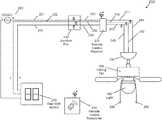
- FIG. 3is a schematic 200 of a ceiling fan using the novel invention that is connected to a dual wall switch 210 circuit which provides power and control of the ceiling fan motor and light.
- FIG. 3shows the novel ceiling fan remote control unit 270 connected to the dual wall switch 210 circuit.
- the novel remote control receiver 270has 3 input wires ( 231 , 232 and 233 ) as opposed to the typical 2 input wires.
- the input of the remote control receiver ceiling fan motor line wire 232is connected to the 120 VAC line wire 222 coming from the ceiling fan motor control wall switch 210 .
- the input of the remote control receiver ceiling fan light line wire 233is connected to the 120 VAC line wire 223 coming from the ceiling fan light control wall switch 210 .
- the input of the remote control receiver neutral wire 231is connected to the 120 VAC neutral wire 221 as shown connected in the junction box 230 . These wires can be connected together using wire nuts in the junction box and covered by the canopy 240 .
- the output of the remote control receiver ceiling fan motor line 272is connected to the ceiling fan motor line wire 242 .
- the output of the remote control receiver light line wire 273is connected to the ceiling fan light line wire 243 .
- the output of the remote control receiver neutral wire 271is connected to the ceiling fan motor and light neutral wire 241 .
- These wirescan be connected together using wire nuts, pin and socket connectors or the like and covered by the canopy 240 .
- the dual wall switch 210 configurationallows independent control of the ceiling fan motor and light.
- the ceiling fan motor control wall switch 210When the ceiling fan motor control wall switch 210 is switched from an off state to an on state, the ceiling fan motor can turn on. In this case, it can remember the last state of the ceiling fan motor speed (such as high, medium or low) and power on to that fan speed.
- the ceiling fan light control wall switch 210When the ceiling fan light control wall switch 210 is switched from an off state to an on state, the ceiling fan light can turn on. The customer may control the fan and light independently with the remote control transmitter 215 .
- FIG. 4is a schematic 300 of the single wall switch control 310 for the ceiling fan 350 and remote control of the invention using two wires going into the junction box 330 .
- FIG. 4shows how the novel ceiling fan remote control receiver 370 can be connected to a single wall switch 310 instead of a dual wall switch circuit as shown in FIG. 3 .
- the input of the remote control receiver ceiling fan motor line wire 332 and ceiling fan light line wire 333is connected to the 120 VAC line wire 322 coming from the single ceiling fan control wall switch 310 .
- the output of the novel remote control receiver wiresare connected as described in FIG. 3 description above. Connecting the novel remote control receiver 370 in this configuration allows full compatibility with homes that only have a single wall switch 310 .
- the single wall switchprovides power to the remote control receiver 370 , which provides power to the ceiling fan motor and light so it can function as a traditional remote control unit.
- the ceiling fan motor and lightcan turn on. In this case, it can remember the last state of the ceiling fan motor speed (such as high, medium or low) and power on to that fan speed.
- the customermay control the fan and light independently with the remote control transmitter 315 .
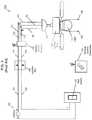
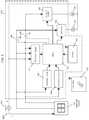
- FIG. 5is a schematic 400 of a first embodiment of this invention connected to a dual wall switch 410 circuit.
- the 120 VAC line voltage 420 from ceiling fan motor wall switch 412 and its neutral wire 421is connected to the DC power supply 425 of the remote control receiver 435 .
- the DC power supply 425converts the 120 VAC to a low voltage DC voltage that the MCU 430 and other components on the circuit board require.
- the 120 VAC line voltages from ceiling fan motor wall switch 412 and light wall switch 414are connected to the fan switch detection 442 and light switch detection 444 circuits respectively in the remote control receiver 470 .
- the MCU 430monitors the switch detection circuits 442 and 444 and outputs a signal to control the ceiling fan motor 450 through the fan control circuit 455 and the light 460 through the light control circuit 465 .
- the fan control circuit 455can turn the fan motor 450 on and off and can cause the fan to operate at varying speeds, for example low, medium, and high rpms.
- the light control circuit 465can turn the light 460 on and off and can cause the light 460 to dim in brightness from a fully on light output to a lower light output.
- the MCU 430is connected to a rf module 435 circuit that can receive a radio frequency signal from an external transmitter allowing the MCU 450 to control various function of the remote control such as fan on and off and multiple fan speeds, light on and off and various brightness's.
- the light switch detection circuit 444allows the MCU 430 to control the light according to the operation as defined in table 1 below.
- Table 1shows the Operation of the Light when installed in a dual wall switch configuration that can be used with FIG. 5 . as described below.
- the fan switch detection circuit 442allows the MCU 430 to control the fan according to the operation as defined in table 2 below.
- Table 2shows the operation of the fan when installed in a dual switch configuration.
- the ceiling fan motor wall switch 410must be powered on for the remote control receiver 470 to provide power to the fan motor 450 and light 460 .
- the customerwould typically keep the fan motor wall switch powered on and then control the light and fan with the remote control transmitter 415 or optionally using the wall switch control according to tables 1 and 2.
- the fan and light switch detection circuits 442 and 444respectively allows the MCU 430 to control the light 460 and fan motor 450 according to the operation as defined in table 3.
- TABLE 3shows operation of the fan and light when installed in a single wall switch configuration.
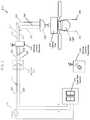
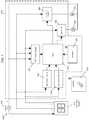
- FIG. 6is a schematic 500 of a second embodiment of this invention connected to a dual wall switch circuit 510 .
- the customercan turn on either the ceiling fan motor wall switch or the light wall switch to allow the remote control receiver 570 to provide power to the fan motor 550 and light 560 .
- Relays 580 and 590are closed according to which wall switch is powered on so that it can provide power to the fan motor and light. Only one relay may be closed at a time in order for the switch detection circuit to operate correctly. If both relays were closed, the switch detection circuits 542 and 544 could not detect the individual switch operation due to the feedback of the AC voltage through the closed circuit.
- the MCUwould close relay 580 (leaving relay 590 open) thereby providing power to the fan motor and light.
- the light switch detection circuit 544could detect the wall switch operation allowing the MCU to control the light accordingly.
- the fan motor switch detection circuit 542can operate effectively to control the fan according to table 2.
- the MCUwould close relay 590 (leaving 580 open) thereby providing power to the fan motor and light.
- both the light wall switch and the fan motor wall switchare powered on the MCU will close only relay 580 , thereby providing power to the fan motor and light and allowing the switch detection circuit 542 and 544 to work properly.
- the customercan control the light and fan with the remote control transmitter or optionally using the wall switch control according to tables 1 and 2 above. If the schematic 500 is connected to a single wall switch as shown it FIG. 4 its operation would be as described in table 3 below.
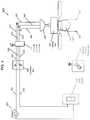
- FIG. 7is a schematic 600 of a third embodiment of this invention connected to a dual wall switch circuit 610 .
- its operationis similar to FIG. 5 and FIG. 6 , but the customer must turn on which ever wall switch in the dual switch 610 they intend to operate for the fan motor and light to have power and function correctly. If they want the fan motor to operate, they must have the fan motor wall switch powered on. If they want the light to operate, they must have the light wall switch in the dual switch 510 powered on. If they want both the fan motor and light to operate, both wall switches must be powered on.
- the remote control transmittercan control the fan motor and/or light independently as described previously. The light may be operated as described previously in FIG. 5 and table 1 and the fan motor may be operated as described previously in FIG. 5 and table 2. If the schematic 600 is connected to a single wall switch as shown it FIG. 4 its operation would be as described previously in FIG. 5 . and table 3 below.
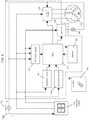
- FIG. 8is a schematic 700 of a fourth embodiment of this invention that the same as FIG. 7 but has a brushless DC motor powering the fan instead of an AC motor.
- the fan motor control 755has 3 output wires that power the brushless DC motor 750 . Each of the three output wires sequentially excite the coils to drive the DC motor 750 .
- This same brushless DC motor 750 and fan motor control 750can be used in FIG. 5 and FIG. 6 to power a DC motor fan as well.
- the wall switchcan include a single wall switch for controlling power to both the ceiling fan and the light.
- the wall switchcan include two separate wall switches, with one switch controlling power to the light and the other switch controlling power to the fan.
- the wall switchcan be a switch panel with one or more switches for controlling power to the light and/or the fan.
- the inventioncan be used with other applications, such as but not limited to being used with a smart computer system that controls lights and ceiling fans I a home, and the like.
- the inventioncan be use with other applications, such as part of a smart phone for controlling the fans/and/or lights in any type of building.
- the toggling action between turning the wall switch to an off position and back to an on position in the tables 1, 2 and 3includes up to approximately 10 seconds between turning the switch off and back on.
- the toggling actioncan be used with one wall switch for controlling power to the light.
- the toggling actioncan be used with one wall switch for controlling power to the fan.
- the toggling actioncan be used with a single wall switch for controlling power to both the light and the ceiling fan.
- the novel toggling actioncan also be used with a pull chain that is used to supply power to the light and/or the ceiling fan.
Landscapes
- Engineering & Computer Science (AREA)
- General Engineering & Computer Science (AREA)
- Mechanical Engineering (AREA)
- Power Engineering (AREA)
- Computer Networks & Wireless Communication (AREA)
- Structures Of Non-Positive Displacement Pumps (AREA)
- Control Of Positive-Displacement Air Blowers (AREA)
Abstract
Description
This invention relates to ceiling fan light and fan controls, and in particular to systems, devices, and methods for ceiling fan remote controls that allows the wall switches and remotes to both separately and independently control the ceiling fan lights and fan.
A problem with conventional ceiling fan remote controls is the light kit can only be controlled with the remote control transmitter. Once you turn the light off using the remote control transmitter, when you come back into the room, you have to find the remote control transmitter to turn the light back on. When the room is dark, such as nightime, it can be a significant nuisance to have to blindly search for the remote control transmitter. If the remote control transmitter is misplaced, it can be even more frustrating.
Examples of prior art ceiling fans with remote controls include U.S. Pat. No. 4,719,446 to Hart; U.S. Pat. No. 4,621,992 to Angott; and U.S. Pat. No. 5,041,825 to Hart et al., which are all incorporated by reference in their entirety.
Most conventional ceiling fan remote controls are only powered by a single power source from a single wall switch. This was great in older homes that only had a single wall switch in a room for an overhead light.
However, newer homes typically have two wall switches in a room, one for an overhead light and another for a ceiling fan. This two switch configuration is good for a manually (pull chain) controlled ceiling fan with light. One switch powers the ceiling fan and the other switch powers the light. The customer can control the fan and light independently from the two switches.
However, as previously mentioned, conventional remote controls are only connected to one of the wall switches and the customer uses the remote control transmitter to send signals to the remote control receiver to operate the ceiling fan and the light. Thus, if the customer has the two switch configuration, he/she loses the functionality of the other switch.
When energized, thesingle wall switch 10 provides power to the combinationceiling fan motor 50 andlight assembly 60. In order to operate thefan motor 50 andlight 60 independently, the customer must manually control the fan and light using thepull chains
The output of the remote control receiverlight line wire 173 is connected to the ceiling fanlight line wire 143. The output of the remote control receiverneutral wire 171 is connected to the ceiling fan motor and lightneutral wire 141. When energized, thesingle wall switch 110 configuration provides power to the combinationceiling fan motor 150 andlight assembly 160. In order to operate thefan motor 150 andlight 160 independently, the customer must control the fan and light individually using theremote control transmitter 115 and/or thepull chains
Thus, there is a need for a ceiling fan remote control receiver that can be connected to two separate wall switches that allows a ceiling fan remote control system that allows for both the wall switch and remote transmitter to each control the light.
A first objective of the present invention is to provide systems, devices and methods for controlling a ceiling fan remote control system so that a single wall switch can activate the ceiling fan light(s) if the remote control transmitter is not available.
A second objective of the present invention is to provide systems, devices, and methods for ceiling fan remote control systems that allows the wall switches to both separately and independently control the ceiling fan lights and fan.
A third objective of the present invention is to provide systems, devices, and methods for ceiling fan remote control systems that allows the wall switches and remote control transmitters to both separately and independently control the ceiling fan lights and fan.
A fourth objective of the present invention is to provide systems, devices and methods for ceiling fan remote control receivers that can be connected to two separate wall switches that allows a ceiling fan remote control system that allows for both the wall switch and remote control transmitter to each control the light.
A fifth objective of the present invention is to provide systems, devices and methods for ceiling fan remote control receivers that can be connected to two separate wall switches that allows a ceiling fan remote control system that allows for both the wall switches and remote control transmitter to each control the light and the fan.
A remote control receiver typically has an internal memory and remembers the last state of the ceiling fan and light kit when the power is turned off at the wall switch. When the power is restored at the wall switch it will resume operation in the previous state. For example, if the fan is set on medium speed and the light kit is on, it will remember that condition when the wall switch is turned off and then resume that condition when the wall switch is turned on.
Thus, if the light is turned off and the customer turns off the wall switch when leaving the room and then returns to the room and turns the wall switch on, the light will still be off for conventional remote controls.
With the new remote control system that can be connected to two separate wall switches, the light can be independently controlled with the wall light switch. For example, if the light wall switch is turned off and the light on the fan is off and then the light wall switch is turned on, the light will come on. This would be impossible with a conventional remote control system.
Additionally, if the fan wall switch is off and the fan is off and then the fan wall switch is turned on, the fan will come on to its previous on setting (for example, high, medium or low—whichever it was last set on prior to turning off).
A preferred embodiment can include a system of controlling a ceiling fan remote control system, comprising: a ceiling fan having a remote control for controlling light to the ceiling fan, and a wall switch having an on and an off state, wherein the wall switch control will operate the ceiling fan light with or without the remote control.
In this system with the wall switch in an off position, and the light is off, then switching the wall switch on will turn on the light.
In this system with the wall switch in an on position, and the light is on, then switching the wall switch off will turn off the light.
In this system with the wall switch wherein with the wall switch in an on position, and the light is off, then toggling for switching the wall switch off and on will turn on the light.
In this system, wherein toggling can includes up to approximately 10 seconds between turning the switch off and back on.
Additional embodiments can include systems with a single wall switch for controlling power to both the light and the fan. Still further embodiments can include having a wall switch having a first switch for controlling power to the light and a second switch for controlling power to the fan.
Embodiments can allow for both the wall switch and the remote control to each be able to turn on and turn off power to the light and fan, independently and/or in combination with one another.
The embodiments allow for the wall switch or wall switches to over-ride operating the remote control for operating the ceiling light and/or ceiling fan.
The wall switch or wall switches can be used to run power to the ceiling fan light and/or ceiling fan with or without the remote control transmitter that can be used for operating the ceiling fan light and/or the ceiling fan. The embodiments can include operations that allow the user to use a toggling action with the wall switch or wall switches to turn on the ceiling fan light and/or ceiling fan without using the remote control, wherein toggling can includes up to approximately 10 seconds between turning the switch off and back on.
Further objects and advantages of this invention will be apparent from the following detailed description of the presently preferred embodiments which are illustrated schematically in the accompanying drawings.
The drawing figures depict one or more implementations in accord with the present concepts, by way of example only, not by way of limitations. In the figures, like reference numerals refer to the same or similar elements.
Before explaining the disclosed embodiments of the present invention in detail it is to be understood that the invention is not limited in its applications to the details of the particular arrangements shown since the invention is capable of other embodiments. Also, the terminology used herein is for the purpose of description and not of limitation.
In the Summary above and in the Detailed Description of Preferred Embodiments and in the accompanying drawings, reference is made to particular features (including method steps) of the invention. It is to be understood that the disclosure of the invention in this specification does not include all possible combinations of such particular features. For example, where a particular feature is disclosed in the context of a particular aspect or embodiment of the invention, that feature can also be used, to the extent possible, in combination with and/or in the context of other particular aspects and embodiments of the invention, and in the invention generally.
In this section, some embodiments of the invention will be described more fully with reference to the accompanying drawings, in which preferred embodiments of the invention are shown. This invention may, however, be embodied in many different forms and should not be construed as limited to the embodiments set forth herein. Rather, these embodiments are provided so that this disclosure will be thorough and complete, and will convey the scope of the invention to those skilled in the art. Like numbers refer to like elements throughout, and prime notation is used to indicate similar elements in alternative embodiments.
Other technical advantages may become readily apparent to one of ordinary skill in the art after review of the following figures and description.
It should be understood at the outset that, although exemplary embodiments are illustrated in the figures and described below, the principles of the present disclosure may be implemented using any number of techniques, whether currently known or not. The present disclosure should in no way be limited to the exemplary implementations and techniques illustrated in the drawings and described below.
Unless otherwise specifically noted, articles depicted in the drawings are not necessarily drawn to scale.
A list of components will now be described.
- 1 single wall switch control for ceiling fan and no remote control (prior art)
- 10 wall switch
- 20 power supply (120 VAC)
- 21 neutral wire
- 22 wall switch line wire
- 30 junction box
- 40 ceiling fan canopy
- 41 ceiling fan motor and light neutral wire
- 42 fan motor line wire
- 43 light line wire
- 50 fan motor
- 55 fan pull chain
- 56 light pull chain
- 60 an overhead light
- 100 single wall switch control for ceiling fan & light and remote. (prior art)
- 110 wall switch
- 115 remote control transmitter
- 120 power supply (120 VAC)
- 121 neutral wire
- 122 wall switch line wire
- 130 junction box
- 131 remote control receiver input neutral wire
- 132 remote control receiver input line wire
- 140 ceiling fan canopy
- 141 ceiling fan motor and light neutral wire
- 142 ceiling fan motor line wire
- 143 ceiling fan light line wire
- 150 fan motor
- 155 pull chains
- 160 overhead light
- 170 remote control receiver
- 171 remote control receiver output neutral wire
- 172 remote control receiver output motor line wire
- 173 remote control receiver output light line wire
- 200 two wall switches for controlling ceiling fan and remote control
- 210 dual wall switch
- 215 remote control transmitter
- 220 power supply (120 VAC)
- 221 neutral wire
- 222 fan motor wall switch line wire
- 223 light wall switch line wire
- 230 junction box
- 231 remote control receiver input neutral wire
- 232 remote control receiver input fan motor line wire
- 233 remote control receiver input light line wire
- 240 ceiling fan canopy
- 241 ceiling fan motor and light neutral wire
- 242 ceiling fan motor line wire
- 243 ceiling fan light line wire
- 250 fan motor
- 260 overhead light
- 270 remote control receiver
- 271 remote control receiver output neutral wire
- 272 remote control receiver output motor line wire
- 273 remote control receiver output light line wire
- 300 single wall switch control for ceiling fan and remote control (two wires)
- 310 wall switch
- 315 remote transmitter
- 320 power supply (120 VAC)
- 321 neutral wire
- 322 wall switch line wire
- 330 junction box
- 331 remote control receiver input neutral wire
- 332 remote control receiver input fan motor line wire
- 333 remote control receiver input light line wire
- 340 canopy
- 341 ceiling fan motor and light neutral wire
- 342 ceiling fan motor line wire
- 343 ceiling fan light line wire
- 350 Fan motor
- 360 overhead light
- 370 remote control receiver
- 371 remote control receiver output neutral wire
- 372 remote control receiver output motor line wire
- 373 remote control receiver output light line wire
- 400 two wall switches controlling ceiling fan and remote control first embodiment
- 410 dual wall switch (two switches)
- 412 fan wall switch line voltage wire
- 414 light wall switch line voltage wire
- 415 remote transmitter
- 420 power supply (120 VAC)
- 421 120 VAC neutral wire
- 425 DC Power Supply
- 430 MCU
- 435 RF receiver module
- 442 Fan motor switch detection circuit
- 444 light switch detection circuit
- 450 fan motor
- 455 fan motor control
- 460 light
- 465 light control
- 470 remote control receiver
- 500 dual (two) wall switches controlling ceiling fan and remote control second embodiment
- 510 dual wall switch (two switches)
- 515 remote transmitter
- 520 power supply (120 VAC)
- 525 DC Power Supply
- 530 MCU
- 535 RF receiver module
- 542 Fan motor switch detection circuit
- 544 light switch detection circuit
- 550 fan motor
- 555 fan motor control
- 560 light
- 565 light control
- 580 relay switch
- 590 relay switch
- 600 dual (two) wall switches controlling ceiling fan and remote control third embodiment
- 610 dual wall switch (two switches)
- 615 remote transmitter
- 620 power supply (120 VAC)
- 625 DC Power Supply
- 630 MCU
- 635 RF receiver module
- 642 Fan motor switch detection
- 644 light switch detection
- 650 fan motor
- 655 fan motor control
- 660 light
- 665 light control
- 700 dual (two) wall switches controlling ceiling fan and remote control fourth embodiment
- 710 dual wall switch (two switches)
- 715 remote transmitter
- 720 power supply (120 VAC)
- 725 DC Power Supply
- 730 MCU
- 735 RF receiver module
- 742 Fan motor switch detection
- 744 light switch detection
- 750 brushless DC fan motor
- 755 fan motor control
- 760 light
- 765 light control
The output of the remote control receiverneutral wire 271 is connected to the ceiling fan motor and lightneutral wire 241. These wires can be connected together using wire nuts, pin and socket connectors or the like and covered by thecanopy 240. Thedual wall switch 210 configuration allows independent control of the ceiling fan motor and light.
When the ceiling fan motorcontrol wall switch 210 is switched from an off state to an on state, the ceiling fan motor can turn on. In this case, it can remember the last state of the ceiling fan motor speed (such as high, medium or low) and power on to that fan speed. When the ceiling fan lightcontrol wall switch 210 is switched from an off state to an on state, the ceiling fan light can turn on. The customer may control the fan and light independently with theremote control transmitter 215.
In this configuration the input of the remote control receiver ceiling fanmotor line wire 332 and ceiling fanlight line wire 333 is connected to the 120VAC line wire 322 coming from the single ceiling fancontrol wall switch 310.
The output of the novel remote control receiver wires are connected as described inFIG. 3 description above. Connecting the novelremote control receiver 370 in this configuration allows full compatibility with homes that only have asingle wall switch 310. The single wall switch provides power to theremote control receiver 370, which provides power to the ceiling fan motor and light so it can function as a traditional remote control unit. Whensingle wall switch 310 is switched from an off state to an on state, the ceiling fan motor and light can turn on. In this case, it can remember the last state of the ceiling fan motor speed (such as high, medium or low) and power on to that fan speed.
Just as described inFIG. 3 , The customer may control the fan and light independently with theremote control transmitter 315.
It's operation is as follows.
The 120VAC line voltage 420 from ceiling fanmotor wall switch 412 and itsneutral wire 421 is connected to theDC power supply 425 of theremote control receiver 435. theDC power supply 425 converts the 120 VAC to a low voltage DC voltage that theMCU 430 and other components on the circuit board require.
The 120 VAC line voltages from ceiling fanmotor wall switch 412 andlight wall switch 414 are connected to thefan switch detection 442 andlight switch detection 444 circuits respectively in theremote control receiver 470.
TheMCU 430 monitors theswitch detection circuits ceiling fan motor 450 through thefan control circuit 455 and the light460 through thelight control circuit 465.
Thefan control circuit 455 can turn thefan motor 450 on and off and can cause the fan to operate at varying speeds, for example low, medium, and high rpms.
Thelight control circuit 465 can turn the light460 on and off and can cause the light460 to dim in brightness from a fully on light output to a lower light output.
TheMCU 430 is connected to arf module 435 circuit that can receive a radio frequency signal from an external transmitter allowing theMCU 450 to control various function of the remote control such as fan on and off and multiple fan speeds, light on and off and various brightness's.
The lightswitch detection circuit 444 allows theMCU 430 to control the light according to the operation as defined in table 1 below.
Table 1 shows the Operation of the Light when installed in a dual wall switch configuration that can be used withFIG. 5 . as described below.
| TABLE 1 |
| Control of light using the wall switch |
| when installed in a two wall switch configuration |
| State of | Action of | ||||
| State of Light | Light Before | Light Wall | State of Light | ||
| Wall Switch | Action | Switch | After Action | ||
| Off | Off | Turn On | On | ||
| On | On | Turn Off | Off | ||
| On | Off | Turn Off | On | ||
| and Turn On | |||||
Referring to TABLE 1 with the wall switch in an off position, and the light is off, then switching the wall switch on will turn on the light.
With the wall switch in an on position, and the light is on, then switching the wall switch off will turn off the light.
With the wall switch in an on position, and the light is off, then switching the wall switch off and on will turn on the light. This toggling of the wall switch can work up to approximately 10 seconds between turning the switch off and back on.
Referring toFIG. 5 , the fanswitch detection circuit 442 allows theMCU 430 to control the fan according to the operation as defined in table 2 below.
Table 2 shows the operation of the fan when installed in a dual switch configuration.
| !TABLE 2 |
| Operation of the Fan when installed in a dual wall switch configuration: |
| Control of fan using the wall switch when installed in a two |
| wall switch configuration |
| State of Fan | |||
| State of Fan | Before | Action of Fan | State of Fan |
| Wall Switch | Action | Wall Switch | After Action |
| Off | Off | Turn On | On (Speed Set to |
| Last Saved | |||
| Speed) | |||
| On | On | Turn Off | Off |
| On | Off | Turn Off and | On (Speed Set to |
| Turn On | Last Saved | ||
| Speed) | |||
Referring to TABLE 2 with the wall switch in an off position, and the fan is off, then switching the wall switch on will turn on the fan to the last saved speed.
With the wall switch in an on position, and the fan is on, then switching the wall switch off will turn off the fan.
With the wall switch in an on position, and the fan is off, then switching the wall switch off and on will turn on the fan to the last saved speed. This toggling of the wall switch can work up to approximately 10 seconds between turning the switch off and back on.
In this embodiment, the ceiling fanmotor wall switch 410 must be powered on for theremote control receiver 470 to provide power to thefan motor 450 and light460. Thus, the customer would typically keep the fan motor wall switch powered on and then control the light and fan with theremote control transmitter 415 or optionally using the wall switch control according to tables 1 and 2.
If connected to asingle wall switch 110 as shown inFIG. 4 , the fan and lightswitch detection circuits MCU 430 to control the light460 andfan motor 450 according to the operation as defined in table 3.
TABLE 3 shows operation of the fan and light when installed in a single wall switch configuration.
| TABLE 3 |
| Operation of the Fan and Light when installed in a single wall switch |
| configuration. |
| Control of light and fan using the wall switch when installed in a |
| single all switch configuration |
| State of Fan | State of Fan and | ||
| State of | and Light | Action of | Light After |
| Wall Switch | Before Action | Wall Switch | Action |
| Off | Off | Turn On | Fan and Light Set |
| to Last Saved | |||
| Setting | |||
| On | On | Turn Off | Off |
| On | Off | Turn Off | Light On and Fan |
| and Turn | Set to Last Saved | ||
| On | Speed | ||
Referring to TABLE 3 with the wall switch in an off position, and the fan is off, then switching the wall switch on will turn on the fan to the last saved fan speed setting.
With the wall switch in an on position, and the fan is on, then switching the wall switch off will turn off the fan.
With the wall switch in an on position, and the fan is off, then switching the wall switch off and on will turn on the fan to the last saved fan speed setting. This toggling of the wall switch can work up to approximately 10 seconds between turning the switch off and back on.
In this embodiment, its operation is similar toFIG. 5 , but the customer can turn on either the ceiling fan motor wall switch or the light wall switch to allow theremote control receiver 570 to provide power to thefan motor 550 and light560.Relays switch detection circuits relay 590 open) thereby providing power to the fan motor and light. In this case, if the light wall switch is controlled according to table 1 above, the lightswitch detection circuit 544 could detect the wall switch operation allowing the MCU to control the light accordingly. Additionally, the fan motorswitch detection circuit 542 can operate effectively to control the fan according to table 2. Conversely, If the light wall switch is powered on and the fan motor wall switch is powered off, the MCU would close relay590 (leaving580 open) thereby providing power to the fan motor and light. If both the light wall switch and the fan motor wall switch are powered on the MCU will closeonly relay 580, thereby providing power to the fan motor and light and allowing theswitch detection circuit FIG. 4 its operation would be as described in table 3 below.
This same brushless DC motor750 and fan motor control750 can be used inFIG. 5 andFIG. 6 to power a DC motor fan as well.
While the embodiments refer to a wall switch, the wall switch can include a single wall switch for controlling power to both the ceiling fan and the light. The wall switch can include two separate wall switches, with one switch controlling power to the light and the other switch controlling power to the fan. The wall switch can be a switch panel with one or more switches for controlling power to the light and/or the fan.
The invention can be used with other applications, such as but not limited to being used with a smart computer system that controls lights and ceiling fans I a home, and the like.
Additionally, the invention can be use with other applications, such as part of a smart phone for controlling the fans/and/or lights in any type of building.
The toggling action between turning the wall switch to an off position and back to an on position in the tables 1, 2 and 3 includes up to approximately 10 seconds between turning the switch off and back on. The toggling action can be used with one wall switch for controlling power to the light. The toggling action can be used with one wall switch for controlling power to the fan. The toggling action can be used with a single wall switch for controlling power to both the light and the ceiling fan.
The novel toggling action can also be used with a pull chain that is used to supply power to the light and/or the ceiling fan.
Tables 1, 2 and 3 can work with all the described embodiments.
The term “approximately”/“approximate” can be +/−10% of the amount referenced. Additionally, preferred amounts and ranges can include the amounts and ranges referenced without the prefix of being approximately.
Although specific advantages have been enumerated above, various embodiments may include some, none, or all of the enumerated advantages.
Modifications, additions, or omissions may be made to the systems, apparatuses, and methods described herein without departing from the scope of the disclosure. For example, the components of the systems and apparatuses may be integrated or separated. Moreover, the operations of the systems and apparatuses disclosed herein may be performed by more, fewer, or other components and the methods described may include more, fewer, or other steps. Additionally, steps may be performed in any suitable order. As used in this document, “each” refers to each member of a set or each member of a subset of a set.
To aid the Patent Office and any readers of any patent issued on this application in interpreting the claims appended hereto, applicants wish to note that they do not intend any of the appended claims or claim elements to invoke 35 U.S.C. 112(f) unless the words “means for” or “step for” are explicitly used in the particular claim.
While the invention has been described, disclosed, illustrated and shown in various terms of certain embodiments or modifications which it has presumed in practice, the scope of the invention is not intended to be, nor should it be deemed to be, limited thereby and such other modifications or embodiments as may be suggested by the teachings herein are particularly reserved especially as they fall within the breadth and scope of the claims here appended.
Claims (17)
1. A system for controlling a ceiling fan light, comprising:
a ceiling fan with a light;
a remote control for controlling light to the ceiling fan;
a wall switch having an on and an off state, wherein the wall switch control will operate the ceiling fan light with or without the remote control, wherein with the wall switch in an on position, and the light is off, then toggling for switching the wall switch off and on will turn on the light, and wherein toggling includes up to approximately 10 seconds between turning the switch off and back on.
2. The system ofclaim 1 , wherein with the wall switch in an off position, and the light is off, then switching the wall switch on will turn on the light.
3. The system ofclaim 1 , wherein with the wall switch in an on position, and the light is on, then switching the wall switch off will turn off the light.
4. The system ofclaim 1 , wherein the wall switch includes two switches with first switch for turning on power to the light, and a second switch for turning on power to the ceiling fan, wherein the first switch operates the light with or without the remote control, and wherein the second switch operates the ceiling fan with or without the remote control.
5. The system ofclaim 1 , wherein the wall switch includes a single switch for controlling power to both the ceiling fan and the light.
6. The system ofclaim 1 , further comprising:
a remote control receiver in the ceiling fan for receiving control signals from the remote control;
one junction box for passing through wires from the wall switch to the remote control receiver;
a single remote control receiver input neutral wire from the remote control receiver and passing through the one junction box to the remote control receiver;
a single remote control receiver input fan motor line wire from the one junction box and the remote control receiver; and
a single remote control receiver input light line wire between the one junction box and the remote control receiver.
7. A system for controlling a ceiling fan and light, comprising:
a ceiling fan having a light;
a remote control for controlling both the fan and the light; and
a wall switch having an on state and an off state, wherein the wall switch control will operate the ceiling fan light and the ceiling fan with or without the remote control, wherein with the fan and the light are both powered off and not running and the wall switch was in the on state, followed by switching the wall switch to an off position, and followed by toggling the wall switch to an on position, will provide power to both the fan and the light, and, wherein toggling includes up to approximately 10 seconds between turning the switch off and back on.
8. The system ofclaim 7 , wherein with the fan and the light are both powered off and not running, and switching the wall switch to the on state will activate power to both the fan and the light to run at a last active setting for the both the fan and the light.
9. The system ofclaim 7 , wherein with both the fan and the light are powered on and running, and switching the wall switch to the off state will turn off power to both the fan and the light.
10. The system ofclaim 7 , wherein the wall switch includes:
a single switch for controlling power to both the ceiling fan and the light.
11. The system ofclaim 7 , wherein the wall switch includes two switches with a first switch for turning on power to the light, and a second switch for turning on power to the ceiling fan, wherein the first switch operates the light with or without the remote control, and wherein the second switch operates the ceiling fan with or without the remote control.
12. The system ofclaim 7 , further comprising:
a remote control receiver in the ceiling fan for receiving control signals from the remote control;
one junction box for passing through wires from the wall switch to the remote control receiver;
a single remote control receiver input neutral wire from the remote control receiver and passing through the one junction box to the remote control receiver;
a single remote control receiver input fan motor line wire from the one junction box and the remote control receiver; and
a single remote control receiver input light line wire between the one junction box and the remote control receiver.
13. A system for controlling operation of a ceiling fan, comprising:
a ceiling fan having a light;
a remote control for controlling both the fan and the light; and
a fan wall switch having an on and an off state, wherein the fan wall switch control will operate the ceiling fan with or without the remote, wherein with the fan wall switch being in an on position and the fan not being powered and not running, followed by turning the wall switch to an off position and toggling the wall switch to the on position will cause the fan to start running, and wherein toggling includes up to approximately 10 seconds between turning the switch off and back on.
14. The system ofclaim 13 , wherein with the fan wall switch being in an off position with no power to the fan and the fan not running, and turning the fan wall switch to an on position, will cause the fan to run on a last speed set that the fan was powered to run on.
15. The system ofclaim 13 , wherein with the fan wall switch being in an on position with the fan powered and running, and turning the wall switch to an off position will stop power to the fan and turn the fan off.
16. The system ofclaim 13 , wall switch includes:
a first wall switch for turning the power on and off to the fan; and
a second wall switch for turning the power on and off to the light.
17. The system ofclaim 13 , further comprising:
a remote control receiver in the ceiling fan for receiving control signals from the remote control;
one junction box for passing through wires from the wall switch to the remote control receiver;
a single remote control receiver input neutral wire from the remote control receiver and passing through the one junction box to the remote control receiver;
a single remote control receiver input fan motor line wire from the one junction box and the remote control receiver; and
a single remote control receiver input light line wire between the one junction box and the remote control receiver.
Priority Applications (2)
| Application Number | Priority Date | Filing Date | Title |
|---|---|---|---|
| US16/894,272US11029019B1 (en) | 2020-06-05 | 2020-06-05 | Ceiling fan light and fan control systems and methods |
| US17/327,320US11378271B1 (en) | 2020-06-05 | 2021-05-21 | Ceiling fan light and fan control systems and methods |
Applications Claiming Priority (1)
| Application Number | Priority Date | Filing Date | Title |
|---|---|---|---|
| US16/894,272US11029019B1 (en) | 2020-06-05 | 2020-06-05 | Ceiling fan light and fan control systems and methods |
Related Child Applications (1)
| Application Number | Title | Priority Date | Filing Date |
|---|---|---|---|
| US17/327,320DivisionUS11378271B1 (en) | 2020-06-05 | 2021-05-21 | Ceiling fan light and fan control systems and methods |
Publications (1)
| Publication Number | Publication Date |
|---|---|
| US11029019B1true US11029019B1 (en) | 2021-06-08 |
Family
ID=76213384
Family Applications (2)
| Application Number | Title | Priority Date | Filing Date |
|---|---|---|---|
| US16/894,272ActiveUS11029019B1 (en) | 2020-06-05 | 2020-06-05 | Ceiling fan light and fan control systems and methods |
| US17/327,320ActiveUS11378271B1 (en) | 2020-06-05 | 2021-05-21 | Ceiling fan light and fan control systems and methods |
Family Applications After (1)
| Application Number | Title | Priority Date | Filing Date |
|---|---|---|---|
| US17/327,320ActiveUS11378271B1 (en) | 2020-06-05 | 2021-05-21 | Ceiling fan light and fan control systems and methods |
Country Status (1)
| Country | Link |
|---|---|
| US (2) | US11029019B1 (en) |
Cited By (3)
| Publication number | Priority date | Publication date | Assignee | Title |
|---|---|---|---|---|
| US20220243734A1 (en)* | 2020-06-16 | 2022-08-04 | Delta T, Llc | Ceiling fan with germicidal capabilities |
| US11477873B1 (en)* | 2021-11-10 | 2022-10-18 | Air Cool Industrial Co., Ltd. | Switch control system for motor and lamp of fan |
| US11514776B1 (en)* | 2021-08-11 | 2022-11-29 | Kuo-Tsun Lin | Ceiling fan control system |
Citations (8)
| Publication number | Priority date | Publication date | Assignee | Title |
|---|---|---|---|---|
| US4621992A (en) | 1984-04-26 | 1986-11-11 | Clifford G. Dimmitt | Remotely controlled ceiling fan and light assembly |
| US4719446A (en) | 1984-05-07 | 1988-01-12 | Casablanca Fan Company, Inc. | Remote control for combined ceiling fan and light fixture |
| US5041825A (en) | 1989-11-03 | 1991-08-20 | Casablanca Industries, Inc. | Remote control system for combined ceiling fan and light fixture |
| US6036331A (en)* | 1999-04-20 | 2000-03-14 | Acquisto; Sam T. | Ceiling fan with lighted blades |
| US20100308657A1 (en) | 2009-06-05 | 2010-12-09 | Bucher John C | Electronic Control Module Activated by Toggling a Wall Switch |
| US10568187B1 (en) | 2018-03-23 | 2020-02-18 | Chien Luen Industries, Co., Ltd., Inc. | Color changing LED (light emitting diode) module for ceiling fans |
| US10756662B2 (en)* | 2017-06-09 | 2020-08-25 | Lutron Technology Company Llc | Motor control device |
| US10865981B1 (en)* | 2020-05-05 | 2020-12-15 | Robert Petrollini | Ceiling fan light attachment apparatus |
Family Cites Families (4)
| Publication number | Priority date | Publication date | Assignee | Title |
|---|---|---|---|---|
| US4322632A (en) | 1980-03-24 | 1982-03-30 | Teccor Electronics, Inc. | Remote load selector |
| US5541584A (en)* | 1992-05-15 | 1996-07-30 | Hunter Fan Company | Remote control for a ceiling fan |
| US7652439B2 (en)* | 2007-08-07 | 2010-01-26 | Air Cool Industrial Co., Ltd. | Changeover device of pull cord control and wireless remote control for a DC brushless-motor ceiling fan |
| US9907149B1 (en)* | 2012-02-07 | 2018-02-27 | Dolan Designs Incorporated | Combined lighting device with an integrated dimming control system |
- 2020
- 2020-06-05USUS16/894,272patent/US11029019B1/enactiveActive
- 2021
- 2021-05-21USUS17/327,320patent/US11378271B1/enactiveActive
Patent Citations (9)
| Publication number | Priority date | Publication date | Assignee | Title |
|---|---|---|---|---|
| US4621992A (en) | 1984-04-26 | 1986-11-11 | Clifford G. Dimmitt | Remotely controlled ceiling fan and light assembly |
| US4719446A (en) | 1984-05-07 | 1988-01-12 | Casablanca Fan Company, Inc. | Remote control for combined ceiling fan and light fixture |
| US5041825A (en) | 1989-11-03 | 1991-08-20 | Casablanca Industries, Inc. | Remote control system for combined ceiling fan and light fixture |
| US6036331A (en)* | 1999-04-20 | 2000-03-14 | Acquisto; Sam T. | Ceiling fan with lighted blades |
| US20100308657A1 (en) | 2009-06-05 | 2010-12-09 | Bucher John C | Electronic Control Module Activated by Toggling a Wall Switch |
| US10756662B2 (en)* | 2017-06-09 | 2020-08-25 | Lutron Technology Company Llc | Motor control device |
| US10568187B1 (en) | 2018-03-23 | 2020-02-18 | Chien Luen Industries, Co., Ltd., Inc. | Color changing LED (light emitting diode) module for ceiling fans |
| US10897806B1 (en) | 2018-03-23 | 2021-01-19 | Chien Luen Industries Co., Ltd., Inc. | Color changing LED (light emitting diode) module for ceiling fans |
| US10865981B1 (en)* | 2020-05-05 | 2020-12-15 | Robert Petrollini | Ceiling fan light attachment apparatus |
Cited By (3)
| Publication number | Priority date | Publication date | Assignee | Title |
|---|---|---|---|---|
| US20220243734A1 (en)* | 2020-06-16 | 2022-08-04 | Delta T, Llc | Ceiling fan with germicidal capabilities |
| US11514776B1 (en)* | 2021-08-11 | 2022-11-29 | Kuo-Tsun Lin | Ceiling fan control system |
| US11477873B1 (en)* | 2021-11-10 | 2022-10-18 | Air Cool Industrial Co., Ltd. | Switch control system for motor and lamp of fan |
Also Published As
| Publication number | Publication date |
|---|---|
| US11378271B1 (en) | 2022-07-05 |
Similar Documents
| Publication | Publication Date | Title |
|---|---|---|
| US11378271B1 (en) | Ceiling fan light and fan control systems and methods | |
| US11696384B2 (en) | Multiple location load control system | |
| JP6389512B2 (en) | Low power consumption standby circuit device, air conditioner, and air conditioner control method | |
| US8324755B2 (en) | Power management system and method of operating the same | |
| US6653899B2 (en) | Audio amplifier power and temperature controller having network detecting and associated methods | |
| US20190156867A1 (en) | Multiple location load control system | |
| US20140159618A1 (en) | Electric-motor furniture drive having a power supply device | |
| US20080150363A1 (en) | Dual-input redundant power supply | |
| US9949338B2 (en) | Device to allow a two-way switch to operate in a multiple-switch electrical circuit | |
| US10910982B2 (en) | Air conditioner | |
| US20190277527A1 (en) | Adaptor module and methods for controlling a replacement motor | |
| CN108566103B (en) | One-key switch device for secondary radar and implementation method thereof | |
| US7973562B1 (en) | Universal sink/source I/O module for industrial controller | |
| US10433402B2 (en) | Remote switch device and remote control electric device | |
| EP3572737A1 (en) | Air conditioner | |
| EP3432433A1 (en) | Power coversion device and power supply system | |
| CN113053697A (en) | Relay control circuit, relay system and relay control method | |
| US20200067505A1 (en) | Power switch and control method thereof | |
| US20010054884A1 (en) | Power source connection controller and power source connection controlling method | |
| KR100411106B1 (en) | System For Air Conditioner Controlling In Vehicles | |
| KR101166386B1 (en) | Apparatus for communication for reduction of standby power and method thereof | |
| US10667355B1 (en) | System for electrical lighting fixtures | |
| KR100604988B1 (en) | Remote control switching device | |
| KR200341470Y1 (en) | Power-saving plug socket | |
| KR200366911Y1 (en) | A switching device for remote control |
Legal Events
| Date | Code | Title | Description |
|---|---|---|---|
| FEPP | Fee payment procedure | Free format text:ENTITY STATUS SET TO UNDISCOUNTED (ORIGINAL EVENT CODE: BIG.); ENTITY STATUS OF PATENT OWNER: SMALL ENTITY | |
| FEPP | Fee payment procedure | Free format text:ENTITY STATUS SET TO SMALL (ORIGINAL EVENT CODE: SMAL); ENTITY STATUS OF PATENT OWNER: SMALL ENTITY | |
| STCF | Information on status: patent grant | Free format text:PATENTED CASE | |
| MAFP | Maintenance fee payment | Free format text:PAYMENT OF MAINTENANCE FEE, 4TH YR, SMALL ENTITY (ORIGINAL EVENT CODE: M2551); ENTITY STATUS OF PATENT OWNER: SMALL ENTITY Year of fee payment:4 |