US10973552B2 - Surgical system for bone screw insertion and rod reduction - Google Patents
Surgical system for bone screw insertion and rod reductionDownload PDFInfo
- Publication number
- US10973552B2 US10973552B2US16/150,357US201816150357AUS10973552B2US 10973552 B2US10973552 B2US 10973552B2US 201816150357 AUS201816150357 AUS 201816150357AUS 10973552 B2US10973552 B2US 10973552B2
- Authority
- US
- United States
- Prior art keywords
- housing
- screw
- reduction device
- rod reduction
- insertion instrument
- Prior art date
- Legal status (The legal status is an assumption and is not a legal conclusion. Google has not performed a legal analysis and makes no representation as to the accuracy of the status listed.)
- Active, expires
Links
Images




Classifications
- A—HUMAN NECESSITIES
- A61—MEDICAL OR VETERINARY SCIENCE; HYGIENE
- A61B—DIAGNOSIS; SURGERY; IDENTIFICATION
- A61B17/00—Surgical instruments, devices or methods
- A61B17/56—Surgical instruments or methods for treatment of bones or joints; Devices specially adapted therefor
- A61B17/58—Surgical instruments or methods for treatment of bones or joints; Devices specially adapted therefor for osteosynthesis, e.g. bone plates, screws or setting implements
- A61B17/68—Internal fixation devices, including fasteners and spinal fixators, even if a part thereof projects from the skin
- A61B17/70—Spinal positioners or stabilisers, e.g. stabilisers comprising fluid filler in an implant
- A61B17/7001—Screws or hooks combined with longitudinal elements which do not contact vertebrae
- A61B17/7032—Screws or hooks with U-shaped head or back through which longitudinal rods pass
- A—HUMAN NECESSITIES
- A61—MEDICAL OR VETERINARY SCIENCE; HYGIENE
- A61B—DIAGNOSIS; SURGERY; IDENTIFICATION
- A61B17/00—Surgical instruments, devices or methods
- A61B17/56—Surgical instruments or methods for treatment of bones or joints; Devices specially adapted therefor
- A61B17/58—Surgical instruments or methods for treatment of bones or joints; Devices specially adapted therefor for osteosynthesis, e.g. bone plates, screws or setting implements
- A61B17/68—Internal fixation devices, including fasteners and spinal fixators, even if a part thereof projects from the skin
- A61B17/70—Spinal positioners or stabilisers, e.g. stabilisers comprising fluid filler in an implant
- A61B17/7074—Tools specially adapted for spinal fixation operations other than for bone removal or filler handling
- A61B17/7076—Tools specially adapted for spinal fixation operations other than for bone removal or filler handling for driving, positioning or assembling spinal clamps or bone anchors specially adapted for spinal fixation
- A61B17/7082—Tools specially adapted for spinal fixation operations other than for bone removal or filler handling for driving, positioning or assembling spinal clamps or bone anchors specially adapted for spinal fixation for driving, i.e. rotating, screws or screw parts specially adapted for spinal fixation, e.g. for driving polyaxial or tulip-headed screws
- A—HUMAN NECESSITIES
- A61—MEDICAL OR VETERINARY SCIENCE; HYGIENE
- A61B—DIAGNOSIS; SURGERY; IDENTIFICATION
- A61B17/00—Surgical instruments, devices or methods
- A61B17/56—Surgical instruments or methods for treatment of bones or joints; Devices specially adapted therefor
- A61B17/58—Surgical instruments or methods for treatment of bones or joints; Devices specially adapted therefor for osteosynthesis, e.g. bone plates, screws or setting implements
- A61B17/68—Internal fixation devices, including fasteners and spinal fixators, even if a part thereof projects from the skin
- A61B17/70—Spinal positioners or stabilisers, e.g. stabilisers comprising fluid filler in an implant
- A61B17/7074—Tools specially adapted for spinal fixation operations other than for bone removal or filler handling
- A61B17/7083—Tools for guidance or insertion of tethers, rod-to-anchor connectors, rod-to-rod connectors, or longitudinal elements
- A61B17/7086—Rod reducers, i.e. devices providing a mechanical advantage to allow a user to force a rod into or onto an anchor head other than by means of a rod-to-bone anchor locking element; rod removers
Definitions
- the present disclosurerelates generally to a surgical instrument for securing a spinal fixation device during an orthopedic spine surgery procedure, and more particularly, to a surgical system and method for inserting a bone screw into a vertebral body and reducing a spinal rod into the bone screw.
- the spinal columnis a complex system of bones and connective tissues that provide support for the human body and protection for the spinal cord and nerves.
- the adult spineincludes an upper portion and a lower portion.
- the upper portioncontains twenty-four discrete bones, which are subdivided into three areas including seven cervical vertebrae, twelve thoracic vertebrae, and five lumbar vertebrae.
- the lower portionincludes the sacral and coccygeal bones.
- the cylindrical shaped bones, called vertebral bodies,progressively increase in size from the upper portion downwards to the lower portion.
- the intervertebral discalong with two posterior facet joints cushion and dampen the various translational and rotational forces exerted upon the spinal column.
- the intervertebral discis a spacer located between two vertebral bodies.
- the facetsprovide stability to the posterior portion of adjacent vertebrae.
- the spinal cordis housed in the canal of the vertebral bodies. It is protected posteriorly by the lamina.
- the laminais a curved surface with three main protrusions. Two transverse processes extend laterally from the lamina, while the spinous process extends caudally and posteriorly.
- the vertebral bodies and laminaare connected by a bone bridge called the pedicle.
- the spineis a flexible structure capable of a large range of motion.
- disorders, diseases, and types of injurywhich restrict the range of motion of the spine or interfere with important elements of the nervous system.
- the problemsinclude, but are not limited to, scoliosis, kyphosis, excessive lordosis, spondylolisthesis, slipped or ruptured disc, degenerative disc disease, vertebral body fracture, and tumors.
- Persons suffering from any of the above conditionstypically experience extreme and/or debilitating pain, and often times diminished nerve function.
- These conditions and their treatmentscan be further complicated if the patient is suffering from osteoporosis, or bone tissue thinning and loss of bone density.
- Spinal fixation apparatusesare widely employed in surgical processes for correcting spinal injuries and diseases.
- interbody implantsinclude interbody spacers, metal cages, and cadaver and human bone implants.
- other spinal fixation apparatusesare commonly employed, such as bone screws and spinal rods to connect the interbody implant with the cranial and caudal vertebrae.
- spinal fixation apparatusessuch as bone screws and spinal rods to connect the interbody implant with the cranial and caudal vertebrae.
- complex spine casessuch as scoliosis, and minimally invasive surgical procedures, it is often challenging to insert bone screws and align them with a spinal rod.
- the present disclosureis direct to a system including a screw insertion instrument that captures a bone screw and/or a rod reduction device to facilitate ease of insertion of the bone screw into a vertebral body and/or a spinal rod into a saddle of the bone screw.
- a screw insertion instrumentincludes a housing, a knob, a drive shaft, and a screw alignment post.
- the housingincludes a proximal portion and a distal portion, and the proximal portion includes a proximal body portion defining a channel extending longitudinally therethrough along a longitudinal axis of the housing.
- the knobis coupled to the proximal portion of the housing and defines an aperture therethrough that is aligned with the longitudinal axis of the housing.
- the drive shaftextends through the aperture of the knob and the proximal portion of the housing.
- the screw alignment postis coupled to the distal portion of the housing and is aligned with the longitudinal axis of the housing.
- the housingincludes an intermediate portion disposed distally of the proximal portion.
- the intermediate portionincludes a recess defined therein that is aligned and in communication with the channel of the proximal portion.
- the housingmay further include a connecting portion interconnecting the intermediate portion with the distal portion.
- the connecting portionmay be radially offset from the longitudinal axis of the housing.
- the distal portion of the housingmay include a distal body portion and first and second arms extending distally therefrom.
- a proximal end portion of the screw alignment postmay be secured to the distal body portion and an elongated body of the screw alignment post may extend distally between the first and second arms.
- the screw insertion instrumentincludes a handle disposed between the housing and the knob.
- the handledefines a channel extending longitudinally therethrough that is aligned with the longitudinal axis of the housing.
- the handlemay include a body portion disposed over the proximal portion of the housing and a head portion disposed within a cavity defined in a distal end of the knob.
- the proximal portion of the housingmay include a threaded outer surface threadingly engaged with a threaded inner surface of the aperture of the knob.
- a proximal portion of the drive shaftmay be secured within the aperture of the knob, and a distal portion of the drive shaft may be secured to the proximal portion of the housing.
- a system for securing spinal fixation devicesincludes a screw insertion instrument and a rod reduction device.
- the screw insertion instrumentincludes a housing, a knob, a drive shaft, and a screw alignment post.
- the housingincludes a proximal portion and a distal portion, and the proximal portion includes a proximal body portion defining a channel extending longitudinally therethrough along a longitudinal axis of the housing.
- the knobis coupled to the proximal portion of the housing and defines an aperture therethrough that is aligned with the longitudinal axis of the housing.
- the drive shaftextends through the aperture of the knob and the proximal portion of the housing.
- the screw alignment postis coupled to the distal portion of the housing and is aligned with the longitudinal axis of the housing.
- the rod reduction deviceis removably received within the housing of the screw insertion instrument.
- a tail portion of the drive shaft of the screw insertion instrumentis releasably engaged with a head portion of a shaft of the rod reduction device.
- a proximal portion of the drive shaftmay be secured within the aperture of the knob, and the knob may be movable between an engaged position and a released position to move the drive shaft longitudinally.
- the drive shaftmay be movable distally when the knob is moved from the released position to the engaged position and proximally when the knob is moved from the engaged position to the released position.
- a distal portion of the drive shaftmay be secured to the proximal portion of the housing such that, when the knob is in the engaged position, rotation of the drive shaft results in rotation of the housing and the rod reduction device.
- the systemmay include a bone screw, and the screw alignment post may include a distal end portion releasably engaged with the bone screw.
- the housingincludes an intermediate portion disposed distally of the proximal portion.
- the intermediate portionincludes a recess defined therein that is aligned and in communication with the channel of the proximal portion.
- a shaft of the rod reduction deviceis disposed within the recess of the intermediate portion and extends along the longitudinal axis of the housing.
- the housingmay include a connecting portion interconnecting the intermediate portion with the distal portion.
- the connecting portionmay be radially offset from the longitudinal axis of the housing.
- a housing and an anvil of the rod reduction devicemay be disposed between the intermediate and distal portions of the housing of the screw insertion instrument.
- the distal portion of the housingmay include a distal body portion and first and second arms extending distally therefrom. Arm members of the rod reduction device may extend around the distal body portion and be offset about 90° with respect to the first and second arms of the housing.
- a method of securing spinal fixation devicesincludes attaching a bone screw to a screw alignment post of a screw insertion instrument and fastening the bone screw to a bony structure.
- the screw insertion instrumentincludes a housing, a knob, a drive shaft, and the screw alignment post.
- the housingincludes a proximal portion and a distal portion, and the proximal portion includes a proximal body portion defining a channel extending longitudinally therethrough along a longitudinal axis of the housing.
- the knobis coupled to the proximal portion of the housing and defines an aperture therethrough that is aligned with the longitudinal axis of the housing.
- the drive shaftextends through the aperture of the knob and the proximal portion of the housing.
- the screw alignment postis coupled to the distal portion of the housing and is aligned with the longitudinal axis of the housing.
- the methodincludes securing a rod reduction device within the housing of the screw insertion instrument and attaching the rod reduction device to the bone screw prior to fastening the bone screw.
- Securing the rod reduction devicemay include rotating the knob of the screw insertion instrument to an engaged position to move the drive shaft distally such that a tail portion of the drive shaft engages a head portion of a shaft of the rod reduction device.
- the methodfurther includes removing the screw insertion instrument from the rod reduction device after fastening the bone screw, leaving the rod reduction device attached to the bone screw.
- Removing the screw insertion instrumentmay include rotating the knob of the screw insertion instrument to a released position to move the drive shaft proximally such that a tail portion of the drive shaft disengages a head portion of a shaft of the rod reduction device.
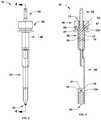
- FIG. 1is an exploded view, with parts separated, of a screw insertion instrument in accordance with an embodiment of the present disclosure
- FIG. 2is side view of the assembled screw insertion instrument of FIG. 1 ;
- FIG. 3is a front view of the screw insertion instrument of FIGS. 1 and 2 ;
- FIG. 4is a side cross-sectional view of the screw insertion instrument of FIGS. 1-3 , taken along line 4 - 4 of FIG. 3 ;
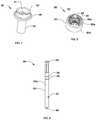
- FIG. 5is a perspective view of a housing of the screw insertion instrument of FIGS. 1-4 ;
- FIG. 6is a perspective view of a screw alignment post of the screw insertion instrument of FIGS. 1-4 ;
- FIG. 7is a perspective view of a handle of the screw insertion instrument of FIGS. 1-4 ;
- FIG. 8is a top perspective view of a knob of the screw insertion instrument of FIGS. 1-4 ;
- FIG. 9is a perspective view of a drive shaft of the screw insertion instrument of FIGS. 1-4 ;
- FIG. 10is a perspective view of a system including the screw insertion instrument of FIGS. 1-4 coupled to a bone screw and a rod reduction device in accordance with an embodiment of the present disclosure.
- FIG. 11is a perspective view of the bone screw and the rod reduction device of the system of FIG. 10 , and further including a spinal rod in accordance with an embodiment of the present disclosure.
- the term “clinician”refers to a doctor (e.g., a surgeon), a nurse, or any other care provider, and may include support personnel.
- proximalrefers to a portion of a system, device, or component thereof that is closer to a clinician
- distalwill refer to the portion of the system, device, or component thereof that is farther from the clinician.
- Ceranialrefers to a spine segment closer to the head of a patient, whereas “caudal” refers to the spine segment closer to the feet of the patient.
- a screw insertion instrument 10includes a housing 20 , a screw alignment post 30 extending distally from the housing 20 , a handle 40 , a knob 50 , and a drive shaft 60 extending proximally from the housing 20 .
- the screw insertion instrument 10defines a longitudinal axis “X” through a center thereof.
- the screw insertion instrument 10is configured to releasably engage and drive a bone screw 100 ( FIG. 10 ) into a bony structure of a spine (e.g., a pedicle or facet of a vertebral body), and to releasably couple with a rod reduction device 200 ( FIG. 10 ) for reducing a spinal rod 300 ( FIG. 11 ) into the bone screw 100 .
- the housing 20 of the screw insertion instrument 10is a unitary structure including, from proximal end to distal end, a proximal portion 20 a , an intermediate portion 20 b , a connecting portion 20 c , and a distal portion 20 d .
- the proximal portion 20 aincludes a proximal body portion 22 that is substantially cylindrical and defines a channel 23 extending longitudinally therethrough along longitudinal axis “X.”
- the proximal body portion 22is configured to support the handle 40 (see e.g., FIG.
- the proximal body portion 22also defines a proximal through hole 25 extending therethrough along an axis transverse to the longitudinal axis “X” and is disposed distally of the outer threaded surface 22 a.
- the intermediate portion 20 b of the housing 20includes an intermediate body portion 24 defining a recess 24 a in an inner surface thereof that is aligned and in communication with the channel 23 of the proximal portion 20 a of the housing 20 .
- the connecting portion 20 cincludes an elongated connecting member 26 , such as a rod or bar, interconnecting the proximal and intermediate portions 20 a , 20 b with the distal portion 20 d .
- the elongated connecting member 26is radially offset from the longitudinal axis “X.”
- the distal portion 20 dincludes a distal body portion 28 having first and second arms 28 a , 28 b extending distally therefrom in opposed relation to each other.
- the first and second arms 28 a , 28 bare radially offset from the longitudinal axis “X” and are configured to align with and/or engage an outer portion of a bone screw 100 ( FIG. 10 ).
- the distal body portion 28includes a cavity 27 ( FIG. 4 ) defined in a distal surface thereof that is configured to receive a portion of the screw alignment post 30 .
- the distal body portion 28also defines a distal through hole 29 extending therethrough along an axis transverse to the longitudinal axis “X.”
- a screw alignment post 30includes an elongated body 32 including a proximal end portion 32 a and a distal end portion 32 b .
- the proximal end portion 32 aincludes a through hole 33 defined therethrough that is configured to align with the distal through hole 29 of the distal portion 20 d of the housing 20 .
- the proximal end portion 32 amay have a shaped outer surface that is complementary in geometry with the cavity 27 of the distal body portion 28 of the housing 20 to aid in aligning the through hole 33 of the screw alignment post 30 with the distal through hole 29 of the distal portion 20 d of the housing 20 .
- the proximal end portion 32 a of the screw alignment post 30is received within the distal body portion 28 of the housing 20 , and is secured thereto via a distal pin 70 ( FIGS. 1 and 4 ) positioned through the distal through hole 29 of the housing 20 and the through hole 33 of the screw alignment post 30 .
- the elongated body 32 of the screw alignment post 30extends distally between the first and second arms 28 a and 28 b of the distal portion 20 d of the housing 20 and along the longitudinal axis “X” for aligning a bone screw 100 ( FIG. 10 ) with the housing 20 .
- the distal end portion 32 b of the screw alignment post 30includes a hex shaped region 34 a and a distal protrusion 34 b extending distally from the hex shaped region 34 a that are configured to engage a portion of the bone screw 100 ( FIG. 10 ).
- the screw alignment post 30may assume other shapes and configurations depending upon the bone screw(s) utilized with the screw insertion instrument 10 as is within the purview of those skilled in the art.
- the screw alignment post 30may be spring-loaded or adjustable to accommodate various bone screw types and sizes.
- the handle 40includes a head portion 42 , a body portion 44 extending distally from the head portion 42 , and a flange 46 extending radially outwardly from the head portion 42 at a transition area with the body portion 44 .
- the handle 40defines a channel 41 extending longitudinally therethrough along longitudinal axis “X.”
- the body portion 44is sized to receive the proximal portion 20 a of the housing 20 therein (see e.g., FIG. 4 ).
- the knob 50includes a knob body 52 including an aperture 53 extending therethrough from proximal end 52 a to a distal end 52 b of the knob body 52 .
- a distal portion of the aperture 53defines a threaded inner surface 55 .
- the proximal end 52 aincludes a proximal surface 54 on which indicia 54 a , such as instructional information, may be disposed.
- the distal end 52 bdefines a cavity 57 ( FIG.
- knob 50 and the housing 20may include a ratchet mechanism and/or the knob 50 may assume locked and unlocked positions with respect to the housing 20 .
- the drive shaft 60includes a head portion 62 , an elongated body 64 , and a tail portion 66 .
- the head portion 62is configured to mate with a variety of instruments, such as manual or powered drive handles and/or devices.
- the head portion 62is a hex head, however, it should be understood that the head portion 62 may assume other shapes and configuration depending upon the instrument utilized to drive the drive shaft 60 as is within the purview of those skilled in the art.
- the elongate body 64includes a plurality of grooves 65 defined in an outer surface 64 a thereof that are configured to engage a plurality of retaining ring and washer assemblies 72 ( FIGS.
- the elongate body 64also defines a through hole 67 therethrough, distal of the plurality of grooves 65 , that is configured to align with the proximal through hole 25 of the proximal portion 20 a of the housing 20 .
- the elongate body 64 of the drive shaft 60is received within the proximal portion 20 a of the housing 20 and is secured thereto via a proximal pin 74 positioned through the proximal through hole 25 ( FIG. 5 ) of the housing 20 and the through hole 67 of the drive shaft 60 .
- the mechanical engagement between the drive shaft 60 and the housing 20restricts the longitudinal distance in which the knob 50 moves the housing 20 proximally or distally along the drive shaft 60 , and the knob 50 controls the depth in which the drive shaft 60 moves relative to the handle 40 .
- the tail portion 66 of the drive shaft 60is a distal protrusion shaped and sized to engage a proximal end of a rod reduction device 200 ( FIG. 10 ). It should be understood, however, that the tail portion 66 of the drive shaft 60 may assume other shapes and/or sizes that are configured to engage a rod reduction device 200 , as is within the purview of those skilled in the art.
- Suitable bone screwsinclude, for example, polyaxial pedicle screws such as those shown in U.S. Pat. No. 8,882,817, taper lock screws such as those shown in U.S. Pat. Nos. 7,988,694 and 8,162,991, set screw systems such as those shown in U.S. Pat. No. 5,733,286, mono-axial screws such as those shown in U.S. Patent Appl. Pub. No. 2009/0105716, and uniplanar screws such as those shown in U.S. Patent Appl. Pub. No. 2009/0105769, the entire contents of each of which are hereby incorporated by reference herein.
- suitable rod reduction devicesinclude, for example, those shown in U.S. Pat. Nos. 8,303,595, 8,961,523, and 8,308,729, the entire contents of each of which are hereby incorporated by reference herein.
- the bone screw 100includes a housing 110 and a screw member 120 .
- the housing 110defines a saddle 112 therein, and the screw member 120 includes a head (not shown) disposed within the housing 110 and a threaded shaft 122 extending from the head distally through the housing 110 .
- the rod reduction device 200includes a housing 210 , arm members 220 , an anvil 230 , a shaft 240 , and a button 250 .
- the arm members 220extend distally from the housing 210 and are configured to engage the housing 110 of the bone screw 100 .
- the anvil 230is coupled to the shaft 240 and disposed around the arm members 220 such that proximal and distal translation of the anvil 230 causes each arm member 220 to pivot with respect to the housing 210 .
- the shaft 240includes a head portion 242 having a proximal recess 243 defined therein, an elongated threaded body 244 extending distally from the head portion 242 , and a distal end portion 246 secured to the anvil 230 .
- the button 250is slidably disposed in the housing 210 and configured to rotate and/or linearly move the shaft 240 relative to the housing 210 .
- a system 1is assembled as shown in FIG. 10 .
- the rod reduction device 200is releasably attached to the screw insertion instrument 10 .
- the shaft 240 of the rod reduction device 200is inserted into the housing 20 of the screw insertion instrument 10 such that the shaft 240 extends along the longitudinal axis “X” of the screw insertion instrument 10 , with a portion of the shaft 240 is disposed within the recess 24 a of the intermediate portion 20 b of the housing 20 .
- the anvil 230 of the rod reduction device 200is disposed between the housing 210 of the rod reduction device 200 and the distal body portion 28 of the housing 20 of the screw insertion instrument 10 , and is longitudinally movable therebetween by rotating the head portion 242 of the shaft 240 to adjust the fit of the anvil 230 within the housing 20 of the screw insertion instrument 10 .
- the arm members 220 of the rod reduction device 200extend around the distal body portion 28 of the housing 20 of the screw insertion instrument 10 and are offset by about 90° with respect to the first and second arms 28 a and 28 b of the housing 20 .
- the knob 50 of the screw insertion instrument 10is rotatable (e.g., clockwise) to an engaged position to move the knob 50 and thus, the drive shaft 60 and the housing 20 distally such that the tail portion 66 (see e.g., FIG. 9 ) of the drive shaft 60 engages the recess 243 ( FIG. 11 ) defined in the head portion 242 of the shaft 240 to lock or hold the rod reduction device 200 firmly within the housing 20 of the screw insertion instrument 10 .
- the bone screw 100is aligned with the screw alignment post 30 of the screw insertion instrument 10 and attached to the distal end portion 32 b of the screw alignment post 30 . Distal ends of the arm members 220 of the rod reduction device 200 are attached to the housing 110 of the bone screw 100 .
- a clinicianmay perform various discectomy or disc procedures to prepare a disc space and then, if the clinician needs to attach posterior instrumentation, the clinician attaches a driver instrument (e.g., a manual or powered drive handle and/or device) to the head portion 62 of the drive shaft 60 of the screw insertion instrument 10 which has been assembled with the rod reduction device 200 as described above, to drive the bone screw 100 into a bony structure, e.g., a vertebral body.
- a driver instrumente.g., a manual or powered drive handle and/or device
- the screw insertion instrument 10is removed by turning the knob 50 (e.g., counter clockwise) to a released position to move the knob 50 , the drive shaft 60 , and the housing 20 proximally to release the tail portion 66 of the drive shaft 60 from the head portion 242 of the shaft 240 of the rod reduction device 200 .
- the screw insertion instrument 10may then be separated from the rod reduction device 200 .
- the rod reduction device 200is left attached to the bone screw 100 , and a spinal rod 300 is inserted between the anvil 230 of the rod reduction device 200 and the housing 110 of the bone screw 100 . Any compression or distraction maneuvers may be performed, and the rod reduction device 200 is then used to push the spinal rod 200 fully into the saddle 112 of the housing 110 of the bone screw 100 by either turning the head portion 242 of the shaft 240 or actuating the button 250 of the housing 210 to lower the anvil 230 towards the bone screw 100 .
- the spinal rod 300Once the spinal rod 300 is fully reduced, the bone screw 100 may be partially or fully locked to the spinal rod 300 (e.g., a locking instrument may be used to lock the spinal rod in the saddle of the bone screw), and the rod reduction device 200 is removed.
- the system 1may be provided in a kit.
- the kitis an assembled package including a screw insertion instrument 10 , a rod reduction device 200 , and optionally, a plurality of bone screws 100 and a plurality of spinal rods 300 .
- the screw insertion instrument 10may be provided with a variety of alignment posts 30 and/or drive shafts 60 having, for example, different lengths, proximal and/or distal profiles, etc. to accommodate the use of the screw insertion instrument 10 with a variety of bone screws, rod reduction devices, and driver instruments.
- the plurality of bone screws 100 and plurality of spinal rods 300may also include a number of different diameter, shapes, and/or lengths. Accordingly, a clinician may pick and choose the components necessary to assemble a screw insertion instrument for use with a rod reduction device, as well as bone screw(s) and spinal rod(s) desired for a surgical procedure.
Landscapes
- Health & Medical Sciences (AREA)
- Orthopedic Medicine & Surgery (AREA)
- Neurology (AREA)
- Life Sciences & Earth Sciences (AREA)
- Surgery (AREA)
- Heart & Thoracic Surgery (AREA)
- Engineering & Computer Science (AREA)
- Biomedical Technology (AREA)
- Nuclear Medicine, Radiotherapy & Molecular Imaging (AREA)
- Medical Informatics (AREA)
- Molecular Biology (AREA)
- Animal Behavior & Ethology (AREA)
- General Health & Medical Sciences (AREA)
- Public Health (AREA)
- Veterinary Medicine (AREA)
- Surgical Instruments (AREA)
Abstract
Description
Claims (17)
Priority Applications (1)
| Application Number | Priority Date | Filing Date | Title |
|---|---|---|---|
| US16/150,357US10973552B2 (en) | 2015-05-28 | 2018-10-03 | Surgical system for bone screw insertion and rod reduction |
Applications Claiming Priority (3)
| Application Number | Priority Date | Filing Date | Title |
|---|---|---|---|
| US201562167367P | 2015-05-28 | 2015-05-28 | |
| US15/165,423US10117678B2 (en) | 2015-05-28 | 2016-05-26 | Surgical system for bone screw insertion and rod reduction |
| US16/150,357US10973552B2 (en) | 2015-05-28 | 2018-10-03 | Surgical system for bone screw insertion and rod reduction |
Related Parent Applications (1)
| Application Number | Title | Priority Date | Filing Date |
|---|---|---|---|
| US15/165,423DivisionUS10117678B2 (en) | 2015-05-28 | 2016-05-26 | Surgical system for bone screw insertion and rod reduction |
Publications (2)
| Publication Number | Publication Date |
|---|---|
| US20190029730A1 US20190029730A1 (en) | 2019-01-31 |
| US10973552B2true US10973552B2 (en) | 2021-04-13 |
Family
ID=56081388
Family Applications (2)
| Application Number | Title | Priority Date | Filing Date |
|---|---|---|---|
| US15/165,423Active2036-06-15US10117678B2 (en) | 2015-05-28 | 2016-05-26 | Surgical system for bone screw insertion and rod reduction |
| US16/150,357Active2036-09-17US10973552B2 (en) | 2015-05-28 | 2018-10-03 | Surgical system for bone screw insertion and rod reduction |
Family Applications Before (1)
| Application Number | Title | Priority Date | Filing Date |
|---|---|---|---|
| US15/165,423Active2036-06-15US10117678B2 (en) | 2015-05-28 | 2016-05-26 | Surgical system for bone screw insertion and rod reduction |
Country Status (2)
| Country | Link |
|---|---|
| US (2) | US10117678B2 (en) |
| EP (1) | EP3097879B1 (en) |
Families Citing this family (7)
| Publication number | Priority date | Publication date | Assignee | Title |
|---|---|---|---|---|
| US9451990B2 (en)* | 2004-02-17 | 2016-09-27 | Globus Medical, Inc. | Facet joint replacement instruments and methods |
| US8545505B2 (en)* | 2010-01-15 | 2013-10-01 | Pioneer Surgical Technology, Inc. | Low friction rod persuader |
| US8206395B2 (en)* | 2010-06-18 | 2012-06-26 | Spine Wave, Inc. | Surgical instrument and method for the distraction or compression of bones |
| EP3288473B1 (en)* | 2015-04-30 | 2022-12-28 | K2M, Inc. | Rod reducer |
| DE102016106608A1 (en)* | 2016-04-11 | 2017-10-12 | Aesculap Ag | Instrument for guiding a rod into an implant receptacle |
| WO2018075639A1 (en) | 2016-10-18 | 2018-04-26 | K2M, Inc. | Rod reducer |
| US10485590B2 (en)* | 2017-01-18 | 2019-11-26 | K2M, Inc. | Rod reducing device |
Citations (60)
| Publication number | Priority date | Publication date | Assignee | Title |
|---|---|---|---|---|
| US3604487A (en) | 1969-03-10 | 1971-09-14 | Richard S Gilbert | Orthopedic screw driving means |
| US5364397A (en) | 1993-06-01 | 1994-11-15 | Zimmer, Inc. | Spinal coupler seater with dual jaws and an independent plunger |
| US5720751A (en)* | 1996-11-27 | 1998-02-24 | Jackson; Roger P. | Tools for use in seating spinal rods in open ended implants |
| US5733286A (en) | 1997-02-12 | 1998-03-31 | Third Millennium Engineering, Llc | Rod securing polyaxial locking screw and coupling element assembly |
| US5910141A (en) | 1997-02-12 | 1999-06-08 | Sdgi Holdings, Inc. | Rod introduction apparatus |
| US6440133B1 (en) | 2001-07-03 | 2002-08-27 | Sdgi Holdings, Inc. | Rod reducer instruments and methods |
| US20030040746A1 (en) | 2001-07-20 | 2003-02-27 | Mitchell Margaret E. | Spinal stabilization system and method |
| US6648888B1 (en) | 2002-09-06 | 2003-11-18 | Endius Incorporated | Surgical instrument for moving a vertebra |
| US20030225408A1 (en) | 2002-06-04 | 2003-12-04 | Howmedica Osteonics Corp. | Apparatus for securing a spinal rod system |
| US6743231B1 (en) | 2000-10-02 | 2004-06-01 | Sulzer Spine-Tech Inc. | Temporary spinal fixation apparatuses and methods |
| US6790208B2 (en) | 2000-03-28 | 2004-09-14 | Showa Ika Kohgyo Co., Ltd. | Rod gripper |
| US20040267275A1 (en) | 2003-06-26 | 2004-12-30 | Cournoyer John R. | Spinal implant holder and rod reduction systems and methods |
| US20050059969A1 (en) | 2003-09-17 | 2005-03-17 | Depuy Acromed, Inc. | Rod approximator |
| US20050149053A1 (en) | 2003-12-17 | 2005-07-07 | Varieur Michael S. | Instruments and methods for bone anchor engagement and spinal rod reduction |
| US20050192589A1 (en) | 2004-02-06 | 2005-09-01 | Douglas Raymond | Devices and methods for inserting a spinal fixation element |
| US20050228400A1 (en) | 2004-03-31 | 2005-10-13 | Chao Nam T | Instrument for inserting, adjusting and removing pedicle screws and other orthopedic implants |
| US20060036255A1 (en)* | 2004-08-13 | 2006-02-16 | Pond John D Jr | System and method for positioning a connecting member adjacent the spinal column in minimally invasive procedures |
| US20060036260A1 (en) | 2004-08-06 | 2006-02-16 | Runco Thomas J | Instrument for guiding a rod into an implant in a spinal fixation system |
| US20060089651A1 (en) | 2004-10-26 | 2006-04-27 | Trudeau Jeffrey L | Apparatus and method for anchoring a surgical rod |
| US20060200132A1 (en) | 2005-03-04 | 2006-09-07 | Chao Nam T | Instruments and methods for manipulating a vertebra |
| US20060264962A1 (en) | 2003-09-24 | 2006-11-23 | Chin Kingsley R | System and method for spinal implant placement |
| US7156849B2 (en) | 2003-06-16 | 2007-01-02 | Depuy Spine, Inc. | Rod reduction nut and driver tool |
| US7160300B2 (en) | 2004-02-27 | 2007-01-09 | Jackson Roger P | Orthopedic implant rod reduction tool set and method |
| US7179261B2 (en) | 2003-12-16 | 2007-02-20 | Depuy Spine, Inc. | Percutaneous access devices and bone anchor assemblies |
| US7250052B2 (en) | 2002-10-30 | 2007-07-31 | Abbott Spine Inc. | Spinal stabilization systems and methods |
| US20070213722A1 (en) | 2006-03-09 | 2007-09-13 | Jones Scott A | Dual action rod reducing and locking device and method |
| US20070270867A1 (en) | 2006-04-11 | 2007-11-22 | Sdgi Holdings, Inc. | Multi-directional rod reducer instrument and method |
| US20070276379A1 (en) | 2005-02-09 | 2007-11-29 | Miller Keith E | Reducing instrument for spinal surgery |
| US20080015601A1 (en) | 2006-06-14 | 2008-01-17 | Michael Castro | Reduction device and method of use |
| US7371239B2 (en) | 2004-07-06 | 2008-05-13 | Synthes (U.S.A.) | Spinal rod insertion instrument |
| US20080172062A1 (en) | 2007-01-12 | 2008-07-17 | Depuy Spine, Inc. | Bone anchor manipulation device |
| US20080262556A1 (en)* | 2007-02-27 | 2008-10-23 | Jacofsky Marc C | Modular polyaxial pedicle screw system |
| US7462182B2 (en) | 2004-08-10 | 2008-12-09 | Warsaw Orthopedic, Inc. | Reducing instrument for spinal surgery |
| US20090018593A1 (en) | 2007-07-13 | 2009-01-15 | Michael Barrus | Rod reduction device and method of use |
| US7491207B2 (en) | 2004-04-12 | 2009-02-17 | Synthes Usa, Llc | Rod persuader |
| US7520879B2 (en) | 2006-02-07 | 2009-04-21 | Warsaw Orthopedic, Inc. | Surgical instruments and techniques for percutaneous placement of spinal stabilization elements |
| US20090105716A1 (en) | 2007-10-23 | 2009-04-23 | Michael Barrus | Mono-axial, taper lock bone screw |
| US20090105769A1 (en) | 2007-10-22 | 2009-04-23 | Andy Rock | Uni-planar, taper lock bone screw |
| US7572264B2 (en) | 2005-06-28 | 2009-08-11 | Warsaw Orthopedic, Inc. | Driver instrument for use in a surgical application |
| US7608081B2 (en) | 2005-05-23 | 2009-10-27 | Custom Spine, Inc. | Rod reducer |
| US7618442B2 (en) | 2003-10-21 | 2009-11-17 | Theken Spine, Llc | Implant assembly and method for use in an internal structure stabilization system |
| US7621918B2 (en) | 2004-11-23 | 2009-11-24 | Jackson Roger P | Spinal fixation tool set and method |
| US7651502B2 (en) | 2004-09-24 | 2010-01-26 | Jackson Roger P | Spinal fixation tool set and method for rod reduction and fastener insertion |
| US7666189B2 (en) | 2004-09-29 | 2010-02-23 | Synthes Usa, Llc | Less invasive surgical system and methods |
| US20100262198A1 (en) | 2009-03-26 | 2010-10-14 | Reto Braunschweiler | Instrument set for inserting a stabilization system into the spinal column of a body |
| US7887541B2 (en) | 2007-07-26 | 2011-02-15 | Depuy Spine, Inc. | Spinal rod reduction instruments and methods for use |
| US7922749B2 (en) | 2006-04-14 | 2011-04-12 | Warsaw Orthopedic, Inc. | Reducing device |
| US20110087298A1 (en) | 2008-06-11 | 2011-04-14 | K2M, Inc. | Rod reduction device |
| US20110118791A1 (en) | 2008-06-11 | 2011-05-19 | K2M, Inc. | Rod reduction device |
| US20110172714A1 (en) | 2008-06-27 | 2011-07-14 | K2M, Inc. | System and method for performing spinal surgery |
| US7988694B2 (en) | 2005-09-29 | 2011-08-02 | K2M, Inc. | Spinal fixation system having locking and unlocking devices for use with a multi-planar, taper lock screw |
| US8162991B2 (en) | 2006-07-27 | 2012-04-24 | K2M, Inc. | Multi-planar, taper lock screw |
| US20130184763A1 (en) | 2012-01-16 | 2013-07-18 | K2M, Inc. | Rod reducer, compressor, distractor system |
| US20140031872A1 (en)* | 2004-02-27 | 2014-01-30 | Roger P. Jackson | Spinal fixation tool set and method |
| WO2014062692A1 (en) | 2012-10-18 | 2014-04-24 | Deroyal Industries, Inc. | Driver apparatus for a pedicle screw assembly |
| US20140163625A1 (en) | 2012-08-03 | 2014-06-12 | Alphatec Spine, Inc. | Instrument and method for reducing and securing spinal rods |
| US8764756B2 (en) | 2011-02-22 | 2014-07-01 | K2M, Inc. | Single action anti-torque rod reducer |
| US8882817B2 (en) | 2010-08-20 | 2014-11-11 | K2M, Inc. | Spinal fixation system |
| US20150100097A1 (en) | 2013-10-07 | 2015-04-09 | K2M, Inc. | Rod reducer |
| US20150100098A1 (en) | 2013-10-07 | 2015-04-09 | K2M, Inc. | Rod reducer |
- 2016
- 2016-05-26USUS15/165,423patent/US10117678B2/enactiveActive
- 2016-05-27EPEP16171675.8Apatent/EP3097879B1/enactiveActive
- 2018
- 2018-10-03USUS16/150,357patent/US10973552B2/enactiveActive
Patent Citations (65)
| Publication number | Priority date | Publication date | Assignee | Title |
|---|---|---|---|---|
| US3604487A (en) | 1969-03-10 | 1971-09-14 | Richard S Gilbert | Orthopedic screw driving means |
| US5364397A (en) | 1993-06-01 | 1994-11-15 | Zimmer, Inc. | Spinal coupler seater with dual jaws and an independent plunger |
| US5720751A (en)* | 1996-11-27 | 1998-02-24 | Jackson; Roger P. | Tools for use in seating spinal rods in open ended implants |
| US5733286A (en) | 1997-02-12 | 1998-03-31 | Third Millennium Engineering, Llc | Rod securing polyaxial locking screw and coupling element assembly |
| US5910141A (en) | 1997-02-12 | 1999-06-08 | Sdgi Holdings, Inc. | Rod introduction apparatus |
| US6790208B2 (en) | 2000-03-28 | 2004-09-14 | Showa Ika Kohgyo Co., Ltd. | Rod gripper |
| US6743231B1 (en) | 2000-10-02 | 2004-06-01 | Sulzer Spine-Tech Inc. | Temporary spinal fixation apparatuses and methods |
| US6440133B1 (en) | 2001-07-03 | 2002-08-27 | Sdgi Holdings, Inc. | Rod reducer instruments and methods |
| US20030040746A1 (en) | 2001-07-20 | 2003-02-27 | Mitchell Margaret E. | Spinal stabilization system and method |
| US20030225408A1 (en) | 2002-06-04 | 2003-12-04 | Howmedica Osteonics Corp. | Apparatus for securing a spinal rod system |
| US6648888B1 (en) | 2002-09-06 | 2003-11-18 | Endius Incorporated | Surgical instrument for moving a vertebra |
| US7250052B2 (en) | 2002-10-30 | 2007-07-31 | Abbott Spine Inc. | Spinal stabilization systems and methods |
| US7156849B2 (en) | 2003-06-16 | 2007-01-02 | Depuy Spine, Inc. | Rod reduction nut and driver tool |
| US20040267275A1 (en) | 2003-06-26 | 2004-12-30 | Cournoyer John R. | Spinal implant holder and rod reduction systems and methods |
| US20050059969A1 (en) | 2003-09-17 | 2005-03-17 | Depuy Acromed, Inc. | Rod approximator |
| US20060264962A1 (en) | 2003-09-24 | 2006-11-23 | Chin Kingsley R | System and method for spinal implant placement |
| US7618442B2 (en) | 2003-10-21 | 2009-11-17 | Theken Spine, Llc | Implant assembly and method for use in an internal structure stabilization system |
| US7179261B2 (en) | 2003-12-16 | 2007-02-20 | Depuy Spine, Inc. | Percutaneous access devices and bone anchor assemblies |
| US20050149053A1 (en) | 2003-12-17 | 2005-07-07 | Varieur Michael S. | Instruments and methods for bone anchor engagement and spinal rod reduction |
| US20050192589A1 (en) | 2004-02-06 | 2005-09-01 | Douglas Raymond | Devices and methods for inserting a spinal fixation element |
| US7160300B2 (en) | 2004-02-27 | 2007-01-09 | Jackson Roger P | Orthopedic implant rod reduction tool set and method |
| US20140031872A1 (en)* | 2004-02-27 | 2014-01-30 | Roger P. Jackson | Spinal fixation tool set and method |
| US20050228400A1 (en) | 2004-03-31 | 2005-10-13 | Chao Nam T | Instrument for inserting, adjusting and removing pedicle screws and other orthopedic implants |
| US7226453B2 (en) | 2004-03-31 | 2007-06-05 | Depuy Spine, Inc. | Instrument for inserting, adjusting and removing pedicle screws and other orthopedic implants |
| US7491207B2 (en) | 2004-04-12 | 2009-02-17 | Synthes Usa, Llc | Rod persuader |
| US7371239B2 (en) | 2004-07-06 | 2008-05-13 | Synthes (U.S.A.) | Spinal rod insertion instrument |
| US20060036260A1 (en) | 2004-08-06 | 2006-02-16 | Runco Thomas J | Instrument for guiding a rod into an implant in a spinal fixation system |
| US7462182B2 (en) | 2004-08-10 | 2008-12-09 | Warsaw Orthopedic, Inc. | Reducing instrument for spinal surgery |
| US20060036255A1 (en)* | 2004-08-13 | 2006-02-16 | Pond John D Jr | System and method for positioning a connecting member adjacent the spinal column in minimally invasive procedures |
| US7651502B2 (en) | 2004-09-24 | 2010-01-26 | Jackson Roger P | Spinal fixation tool set and method for rod reduction and fastener insertion |
| US7666189B2 (en) | 2004-09-29 | 2010-02-23 | Synthes Usa, Llc | Less invasive surgical system and methods |
| US20060089651A1 (en) | 2004-10-26 | 2006-04-27 | Trudeau Jeffrey L | Apparatus and method for anchoring a surgical rod |
| US7621918B2 (en) | 2004-11-23 | 2009-11-24 | Jackson Roger P | Spinal fixation tool set and method |
| US20070276379A1 (en) | 2005-02-09 | 2007-11-29 | Miller Keith E | Reducing instrument for spinal surgery |
| US20060200132A1 (en) | 2005-03-04 | 2006-09-07 | Chao Nam T | Instruments and methods for manipulating a vertebra |
| US7608081B2 (en) | 2005-05-23 | 2009-10-27 | Custom Spine, Inc. | Rod reducer |
| US7572264B2 (en) | 2005-06-28 | 2009-08-11 | Warsaw Orthopedic, Inc. | Driver instrument for use in a surgical application |
| US7988694B2 (en) | 2005-09-29 | 2011-08-02 | K2M, Inc. | Spinal fixation system having locking and unlocking devices for use with a multi-planar, taper lock screw |
| US7520879B2 (en) | 2006-02-07 | 2009-04-21 | Warsaw Orthopedic, Inc. | Surgical instruments and techniques for percutaneous placement of spinal stabilization elements |
| US20070213722A1 (en) | 2006-03-09 | 2007-09-13 | Jones Scott A | Dual action rod reducing and locking device and method |
| US7927334B2 (en) | 2006-04-11 | 2011-04-19 | Warsaw Orthopedic, Inc. | Multi-directional rod reducer instrument and method |
| US20070270867A1 (en) | 2006-04-11 | 2007-11-22 | Sdgi Holdings, Inc. | Multi-directional rod reducer instrument and method |
| US7922749B2 (en) | 2006-04-14 | 2011-04-12 | Warsaw Orthopedic, Inc. | Reducing device |
| US20080015601A1 (en) | 2006-06-14 | 2008-01-17 | Michael Castro | Reduction device and method of use |
| US8162991B2 (en) | 2006-07-27 | 2012-04-24 | K2M, Inc. | Multi-planar, taper lock screw |
| US20080172062A1 (en) | 2007-01-12 | 2008-07-17 | Depuy Spine, Inc. | Bone anchor manipulation device |
| US20080262556A1 (en)* | 2007-02-27 | 2008-10-23 | Jacofsky Marc C | Modular polyaxial pedicle screw system |
| US8961523B2 (en) | 2007-07-13 | 2015-02-24 | K2M, Inc. | Rod reduction device and method of use |
| US20090018593A1 (en) | 2007-07-13 | 2009-01-15 | Michael Barrus | Rod reduction device and method of use |
| US7887541B2 (en) | 2007-07-26 | 2011-02-15 | Depuy Spine, Inc. | Spinal rod reduction instruments and methods for use |
| US20090105769A1 (en) | 2007-10-22 | 2009-04-23 | Andy Rock | Uni-planar, taper lock bone screw |
| US20090105716A1 (en) | 2007-10-23 | 2009-04-23 | Michael Barrus | Mono-axial, taper lock bone screw |
| US20110087298A1 (en) | 2008-06-11 | 2011-04-14 | K2M, Inc. | Rod reduction device |
| US8303595B2 (en) | 2008-06-11 | 2012-11-06 | K2M, Inc. | Rod reduction device |
| US8308729B2 (en) | 2008-06-11 | 2012-11-13 | K2M, Inc. | Rod reduction device |
| US20110118791A1 (en) | 2008-06-11 | 2011-05-19 | K2M, Inc. | Rod reduction device |
| US20110172714A1 (en) | 2008-06-27 | 2011-07-14 | K2M, Inc. | System and method for performing spinal surgery |
| US20100262198A1 (en) | 2009-03-26 | 2010-10-14 | Reto Braunschweiler | Instrument set for inserting a stabilization system into the spinal column of a body |
| US8882817B2 (en) | 2010-08-20 | 2014-11-11 | K2M, Inc. | Spinal fixation system |
| US8764756B2 (en) | 2011-02-22 | 2014-07-01 | K2M, Inc. | Single action anti-torque rod reducer |
| US20130184763A1 (en) | 2012-01-16 | 2013-07-18 | K2M, Inc. | Rod reducer, compressor, distractor system |
| US20140163625A1 (en) | 2012-08-03 | 2014-06-12 | Alphatec Spine, Inc. | Instrument and method for reducing and securing spinal rods |
| WO2014062692A1 (en) | 2012-10-18 | 2014-04-24 | Deroyal Industries, Inc. | Driver apparatus for a pedicle screw assembly |
| US20150100097A1 (en) | 2013-10-07 | 2015-04-09 | K2M, Inc. | Rod reducer |
| US20150100098A1 (en) | 2013-10-07 | 2015-04-09 | K2M, Inc. | Rod reducer |
Non-Patent Citations (2)
| Title |
|---|
| Australian Search Report for Application No. 2016203448 dated Mar. 10, 2020, 1 page. |
| European Search Report EP16171675.8 dated Oct. 21, 2016. |
Also Published As
| Publication number | Publication date |
|---|---|
| US20160346011A1 (en) | 2016-12-01 |
| EP3097879B1 (en) | 2023-04-05 |
| EP3097879A1 (en) | 2016-11-30 |
| US10117678B2 (en) | 2018-11-06 |
| US20190029730A1 (en) | 2019-01-31 |
Similar Documents
| Publication | Publication Date | Title |
|---|---|---|
| USRE49410E1 (en) | Rod reducer, compressor, distractor system | |
| US11633216B2 (en) | Spondylisthesis reduction system | |
| US12369899B2 (en) | Devices and systems for surgical retraction | |
| US10973552B2 (en) | Surgical system for bone screw insertion and rod reduction | |
| US10603026B2 (en) | Devices and systems for surgical retraction | |
| EP2878276B1 (en) | System for corrective spinal surgery | |
| US8016832B2 (en) | Installation systems for spinal stabilization system and related methods | |
| US10813670B2 (en) | Spinal stabilization system | |
| US9801662B2 (en) | Spinal stabilization system | |
| US9095378B2 (en) | Spinal stabilization system | |
| US20170143385A1 (en) | Spinal rod reduction system | |
| AU2016203448B2 (en) | Surgical system for bone screw insertion and rod reduction |
Legal Events
| Date | Code | Title | Description |
|---|---|---|---|
| AS | Assignment | Owner name:K2M, INC., VIRGINIA Free format text:ASSIGNMENT OF ASSIGNORS INTEREST;ASSIGNOR:ANGUS, OLIVIA;REEL/FRAME:047046/0301 Effective date:20160607 | |
| FEPP | Fee payment procedure | Free format text:ENTITY STATUS SET TO UNDISCOUNTED (ORIGINAL EVENT CODE: BIG.); ENTITY STATUS OF PATENT OWNER: LARGE ENTITY | |
| STPP | Information on status: patent application and granting procedure in general | Free format text:DOCKETED NEW CASE - READY FOR EXAMINATION | |
| STPP | Information on status: patent application and granting procedure in general | Free format text:NON FINAL ACTION MAILED | |
| STPP | Information on status: patent application and granting procedure in general | Free format text:RESPONSE TO NON-FINAL OFFICE ACTION ENTERED AND FORWARDED TO EXAMINER | |
| STPP | Information on status: patent application and granting procedure in general | Free format text:RESPONSE AFTER FINAL ACTION FORWARDED TO EXAMINER | |
| STPP | Information on status: patent application and granting procedure in general | Free format text:NOTICE OF ALLOWANCE MAILED -- APPLICATION RECEIVED IN OFFICE OF PUBLICATIONS | |
| STPP | Information on status: patent application and granting procedure in general | Free format text:PUBLICATIONS -- ISSUE FEE PAYMENT RECEIVED | |
| STPP | Information on status: patent application and granting procedure in general | Free format text:PUBLICATIONS -- ISSUE FEE PAYMENT VERIFIED | |
| STCF | Information on status: patent grant | Free format text:PATENTED CASE | |
| MAFP | Maintenance fee payment | Free format text:PAYMENT OF MAINTENANCE FEE, 4TH YEAR, LARGE ENTITY (ORIGINAL EVENT CODE: M1551); ENTITY STATUS OF PATENT OWNER: LARGE ENTITY Year of fee payment:4 | |
| AS | Assignment | Owner name:ANKURA TRUST COMPANY, LLC, AS COLLATERAL AGENT, CONNECTICUT Free format text:PATENT SECURITY AGREEMENT;ASSIGNORS:K2M, INC.;VB SPINE US OPCO LLC;VB SPINE LLC;REEL/FRAME:071682/0116 Effective date:20250616 | |
| AS | Assignment | Owner name:TEXAS CAPITAL BANK, AS COLLATERAL AGENT, TEXAS Free format text:SECURITY INTEREST;ASSIGNORS:K2M, INC.;VB SPINE US OPCO LLC;REEL/FRAME:072340/0397 Effective date:20250401 |