US10940018B2 - Expandable interbody implant with lordosis correction - Google Patents
Expandable interbody implant with lordosis correctionDownload PDFInfo
- Publication number
- US10940018B2 US10940018B2US15/599,638US201715599638AUS10940018B2US 10940018 B2US10940018 B2US 10940018B2US 201715599638 AUS201715599638 AUS 201715599638AUS 10940018 B2US10940018 B2US 10940018B2
- Authority
- US
- United States
- Prior art keywords
- implant
- end portion
- extendable support
- support element
- movement
- Prior art date
- Legal status (The legal status is an assumption and is not a legal conclusion. Google has not performed a legal analysis and makes no representation as to the accuracy of the status listed.)
- Active, expires
Links
Images









Classifications
- A—HUMAN NECESSITIES
- A61—MEDICAL OR VETERINARY SCIENCE; HYGIENE
- A61F—FILTERS IMPLANTABLE INTO BLOOD VESSELS; PROSTHESES; DEVICES PROVIDING PATENCY TO, OR PREVENTING COLLAPSING OF, TUBULAR STRUCTURES OF THE BODY, e.g. STENTS; ORTHOPAEDIC, NURSING OR CONTRACEPTIVE DEVICES; FOMENTATION; TREATMENT OR PROTECTION OF EYES OR EARS; BANDAGES, DRESSINGS OR ABSORBENT PADS; FIRST-AID KITS
- A61F2/00—Filters implantable into blood vessels; Prostheses, i.e. artificial substitutes or replacements for parts of the body; Appliances for connecting them with the body; Devices providing patency to, or preventing collapsing of, tubular structures of the body, e.g. stents
- A61F2/02—Prostheses implantable into the body
- A61F2/30—Joints
- A61F2/44—Joints for the spine, e.g. vertebrae, spinal discs
- A61F2/4455—Joints for the spine, e.g. vertebrae, spinal discs for the fusion of spinal bodies, e.g. intervertebral fusion of adjacent spinal bodies, e.g. fusion cages
- A61F2/447—Joints for the spine, e.g. vertebrae, spinal discs for the fusion of spinal bodies, e.g. intervertebral fusion of adjacent spinal bodies, e.g. fusion cages substantially parallelepipedal, e.g. having a rectangular or trapezoidal cross-section
- A—HUMAN NECESSITIES
- A61—MEDICAL OR VETERINARY SCIENCE; HYGIENE
- A61F—FILTERS IMPLANTABLE INTO BLOOD VESSELS; PROSTHESES; DEVICES PROVIDING PATENCY TO, OR PREVENTING COLLAPSING OF, TUBULAR STRUCTURES OF THE BODY, e.g. STENTS; ORTHOPAEDIC, NURSING OR CONTRACEPTIVE DEVICES; FOMENTATION; TREATMENT OR PROTECTION OF EYES OR EARS; BANDAGES, DRESSINGS OR ABSORBENT PADS; FIRST-AID KITS
- A61F2/00—Filters implantable into blood vessels; Prostheses, i.e. artificial substitutes or replacements for parts of the body; Appliances for connecting them with the body; Devices providing patency to, or preventing collapsing of, tubular structures of the body, e.g. stents
- A61F2/02—Prostheses implantable into the body
- A61F2/30—Joints
- A61F2/44—Joints for the spine, e.g. vertebrae, spinal discs
- A61F2/4455—Joints for the spine, e.g. vertebrae, spinal discs for the fusion of spinal bodies, e.g. intervertebral fusion of adjacent spinal bodies, e.g. fusion cages
- A—HUMAN NECESSITIES
- A61—MEDICAL OR VETERINARY SCIENCE; HYGIENE
- A61F—FILTERS IMPLANTABLE INTO BLOOD VESSELS; PROSTHESES; DEVICES PROVIDING PATENCY TO, OR PREVENTING COLLAPSING OF, TUBULAR STRUCTURES OF THE BODY, e.g. STENTS; ORTHOPAEDIC, NURSING OR CONTRACEPTIVE DEVICES; FOMENTATION; TREATMENT OR PROTECTION OF EYES OR EARS; BANDAGES, DRESSINGS OR ABSORBENT PADS; FIRST-AID KITS
- A61F2/00—Filters implantable into blood vessels; Prostheses, i.e. artificial substitutes or replacements for parts of the body; Appliances for connecting them with the body; Devices providing patency to, or preventing collapsing of, tubular structures of the body, e.g. stents
- A61F2/02—Prostheses implantable into the body
- A61F2/30—Joints
- A61F2/46—Special tools for implanting artificial joints
- A61F2/4603—Special tools for implanting artificial joints for insertion or extraction of endoprosthetic joints or of accessories thereof
- A61F2/4611—Special tools for implanting artificial joints for insertion or extraction of endoprosthetic joints or of accessories thereof of spinal prostheses
- A—HUMAN NECESSITIES
- A61—MEDICAL OR VETERINARY SCIENCE; HYGIENE
- A61F—FILTERS IMPLANTABLE INTO BLOOD VESSELS; PROSTHESES; DEVICES PROVIDING PATENCY TO, OR PREVENTING COLLAPSING OF, TUBULAR STRUCTURES OF THE BODY, e.g. STENTS; ORTHOPAEDIC, NURSING OR CONTRACEPTIVE DEVICES; FOMENTATION; TREATMENT OR PROTECTION OF EYES OR EARS; BANDAGES, DRESSINGS OR ABSORBENT PADS; FIRST-AID KITS
- A61F2/00—Filters implantable into blood vessels; Prostheses, i.e. artificial substitutes or replacements for parts of the body; Appliances for connecting them with the body; Devices providing patency to, or preventing collapsing of, tubular structures of the body, e.g. stents
- A61F2/02—Prostheses implantable into the body
- A61F2/30—Joints
- A61F2/44—Joints for the spine, e.g. vertebrae, spinal discs
- A61F2/441—Joints for the spine, e.g. vertebrae, spinal discs made of inflatable pockets or chambers filled with fluid, e.g. with hydrogel
- A—HUMAN NECESSITIES
- A61—MEDICAL OR VETERINARY SCIENCE; HYGIENE
- A61F—FILTERS IMPLANTABLE INTO BLOOD VESSELS; PROSTHESES; DEVICES PROVIDING PATENCY TO, OR PREVENTING COLLAPSING OF, TUBULAR STRUCTURES OF THE BODY, e.g. STENTS; ORTHOPAEDIC, NURSING OR CONTRACEPTIVE DEVICES; FOMENTATION; TREATMENT OR PROTECTION OF EYES OR EARS; BANDAGES, DRESSINGS OR ABSORBENT PADS; FIRST-AID KITS
- A61F2/00—Filters implantable into blood vessels; Prostheses, i.e. artificial substitutes or replacements for parts of the body; Appliances for connecting them with the body; Devices providing patency to, or preventing collapsing of, tubular structures of the body, e.g. stents
- A61F2/02—Prostheses implantable into the body
- A61F2/48—Operating or control means, e.g. from outside the body, control of sphincters
- A61F2/484—Fluid means, i.e. hydraulic or pneumatic
- A—HUMAN NECESSITIES
- A61—MEDICAL OR VETERINARY SCIENCE; HYGIENE
- A61F—FILTERS IMPLANTABLE INTO BLOOD VESSELS; PROSTHESES; DEVICES PROVIDING PATENCY TO, OR PREVENTING COLLAPSING OF, TUBULAR STRUCTURES OF THE BODY, e.g. STENTS; ORTHOPAEDIC, NURSING OR CONTRACEPTIVE DEVICES; FOMENTATION; TREATMENT OR PROTECTION OF EYES OR EARS; BANDAGES, DRESSINGS OR ABSORBENT PADS; FIRST-AID KITS
- A61F2/00—Filters implantable into blood vessels; Prostheses, i.e. artificial substitutes or replacements for parts of the body; Appliances for connecting them with the body; Devices providing patency to, or preventing collapsing of, tubular structures of the body, e.g. stents
- A61F2/02—Prostheses implantable into the body
- A61F2/30—Joints
- A61F2002/30001—Additional features of subject-matter classified in A61F2/28, A61F2/30 and subgroups thereof
- A61F2002/30316—The prosthesis having different structural features at different locations within the same prosthesis; Connections between prosthetic parts; Special structural features of bone or joint prostheses not otherwise provided for
- A61F2002/30329—Connections or couplings between prosthetic parts, e.g. between modular parts; Connecting elements
- A—HUMAN NECESSITIES
- A61—MEDICAL OR VETERINARY SCIENCE; HYGIENE
- A61F—FILTERS IMPLANTABLE INTO BLOOD VESSELS; PROSTHESES; DEVICES PROVIDING PATENCY TO, OR PREVENTING COLLAPSING OF, TUBULAR STRUCTURES OF THE BODY, e.g. STENTS; ORTHOPAEDIC, NURSING OR CONTRACEPTIVE DEVICES; FOMENTATION; TREATMENT OR PROTECTION OF EYES OR EARS; BANDAGES, DRESSINGS OR ABSORBENT PADS; FIRST-AID KITS
- A61F2/00—Filters implantable into blood vessels; Prostheses, i.e. artificial substitutes or replacements for parts of the body; Appliances for connecting them with the body; Devices providing patency to, or preventing collapsing of, tubular structures of the body, e.g. stents
- A61F2/02—Prostheses implantable into the body
- A61F2/30—Joints
- A61F2002/30001—Additional features of subject-matter classified in A61F2/28, A61F2/30 and subgroups thereof
- A61F2002/30316—The prosthesis having different structural features at different locations within the same prosthesis; Connections between prosthetic parts; Special structural features of bone or joint prostheses not otherwise provided for
- A61F2002/30329—Connections or couplings between prosthetic parts, e.g. between modular parts; Connecting elements
- A61F2002/30331—Connections or couplings between prosthetic parts, e.g. between modular parts; Connecting elements made by longitudinally pushing a protrusion into a complementarily-shaped recess, e.g. held by friction fit
- A61F2002/30362—Connections or couplings between prosthetic parts, e.g. between modular parts; Connecting elements made by longitudinally pushing a protrusion into a complementarily-shaped recess, e.g. held by friction fit with possibility of relative movement between the protrusion and the recess
- A61F2002/3037—Translation along the common longitudinal axis, e.g. piston
- A61F2002/30372—Translation along the common longitudinal axis, e.g. piston with additional means for limiting said translation
- A—HUMAN NECESSITIES
- A61—MEDICAL OR VETERINARY SCIENCE; HYGIENE
- A61F—FILTERS IMPLANTABLE INTO BLOOD VESSELS; PROSTHESES; DEVICES PROVIDING PATENCY TO, OR PREVENTING COLLAPSING OF, TUBULAR STRUCTURES OF THE BODY, e.g. STENTS; ORTHOPAEDIC, NURSING OR CONTRACEPTIVE DEVICES; FOMENTATION; TREATMENT OR PROTECTION OF EYES OR EARS; BANDAGES, DRESSINGS OR ABSORBENT PADS; FIRST-AID KITS
- A61F2/00—Filters implantable into blood vessels; Prostheses, i.e. artificial substitutes or replacements for parts of the body; Appliances for connecting them with the body; Devices providing patency to, or preventing collapsing of, tubular structures of the body, e.g. stents
- A61F2/02—Prostheses implantable into the body
- A61F2/30—Joints
- A61F2002/30001—Additional features of subject-matter classified in A61F2/28, A61F2/30 and subgroups thereof
- A61F2002/30316—The prosthesis having different structural features at different locations within the same prosthesis; Connections between prosthetic parts; Special structural features of bone or joint prostheses not otherwise provided for
- A61F2002/30329—Connections or couplings between prosthetic parts, e.g. between modular parts; Connecting elements
- A61F2002/30383—Connections or couplings between prosthetic parts, e.g. between modular parts; Connecting elements made by laterally inserting a protrusion, e.g. a rib into a complementarily-shaped groove
- A61F2002/30403—Longitudinally-oriented cooperating ribs and grooves on mating lateral surfaces of a mainly longitudinal connection
- A—HUMAN NECESSITIES
- A61—MEDICAL OR VETERINARY SCIENCE; HYGIENE
- A61F—FILTERS IMPLANTABLE INTO BLOOD VESSELS; PROSTHESES; DEVICES PROVIDING PATENCY TO, OR PREVENTING COLLAPSING OF, TUBULAR STRUCTURES OF THE BODY, e.g. STENTS; ORTHOPAEDIC, NURSING OR CONTRACEPTIVE DEVICES; FOMENTATION; TREATMENT OR PROTECTION OF EYES OR EARS; BANDAGES, DRESSINGS OR ABSORBENT PADS; FIRST-AID KITS
- A61F2/00—Filters implantable into blood vessels; Prostheses, i.e. artificial substitutes or replacements for parts of the body; Appliances for connecting them with the body; Devices providing patency to, or preventing collapsing of, tubular structures of the body, e.g. stents
- A61F2/02—Prostheses implantable into the body
- A61F2/30—Joints
- A61F2002/30001—Additional features of subject-matter classified in A61F2/28, A61F2/30 and subgroups thereof
- A61F2002/30316—The prosthesis having different structural features at different locations within the same prosthesis; Connections between prosthetic parts; Special structural features of bone or joint prostheses not otherwise provided for
- A61F2002/30329—Connections or couplings between prosthetic parts, e.g. between modular parts; Connecting elements
- A61F2002/30471—Connections or couplings between prosthetic parts, e.g. between modular parts; Connecting elements connected by a hinged linkage mechanism, e.g. of the single-bar or multi-bar linkage type
- A—HUMAN NECESSITIES
- A61—MEDICAL OR VETERINARY SCIENCE; HYGIENE
- A61F—FILTERS IMPLANTABLE INTO BLOOD VESSELS; PROSTHESES; DEVICES PROVIDING PATENCY TO, OR PREVENTING COLLAPSING OF, TUBULAR STRUCTURES OF THE BODY, e.g. STENTS; ORTHOPAEDIC, NURSING OR CONTRACEPTIVE DEVICES; FOMENTATION; TREATMENT OR PROTECTION OF EYES OR EARS; BANDAGES, DRESSINGS OR ABSORBENT PADS; FIRST-AID KITS
- A61F2/00—Filters implantable into blood vessels; Prostheses, i.e. artificial substitutes or replacements for parts of the body; Appliances for connecting them with the body; Devices providing patency to, or preventing collapsing of, tubular structures of the body, e.g. stents
- A61F2/02—Prostheses implantable into the body
- A61F2/30—Joints
- A61F2002/30001—Additional features of subject-matter classified in A61F2/28, A61F2/30 and subgroups thereof
- A61F2002/30316—The prosthesis having different structural features at different locations within the same prosthesis; Connections between prosthetic parts; Special structural features of bone or joint prostheses not otherwise provided for
- A61F2002/30329—Connections or couplings between prosthetic parts, e.g. between modular parts; Connecting elements
- A61F2002/30476—Connections or couplings between prosthetic parts, e.g. between modular parts; Connecting elements locked by an additional locking mechanism
- A61F2002/30482—Connections or couplings between prosthetic parts, e.g. between modular parts; Connecting elements locked by an additional locking mechanism using a locking cam
- A—HUMAN NECESSITIES
- A61—MEDICAL OR VETERINARY SCIENCE; HYGIENE
- A61F—FILTERS IMPLANTABLE INTO BLOOD VESSELS; PROSTHESES; DEVICES PROVIDING PATENCY TO, OR PREVENTING COLLAPSING OF, TUBULAR STRUCTURES OF THE BODY, e.g. STENTS; ORTHOPAEDIC, NURSING OR CONTRACEPTIVE DEVICES; FOMENTATION; TREATMENT OR PROTECTION OF EYES OR EARS; BANDAGES, DRESSINGS OR ABSORBENT PADS; FIRST-AID KITS
- A61F2/00—Filters implantable into blood vessels; Prostheses, i.e. artificial substitutes or replacements for parts of the body; Appliances for connecting them with the body; Devices providing patency to, or preventing collapsing of, tubular structures of the body, e.g. stents
- A61F2/02—Prostheses implantable into the body
- A61F2/30—Joints
- A61F2002/30001—Additional features of subject-matter classified in A61F2/28, A61F2/30 and subgroups thereof
- A61F2002/30316—The prosthesis having different structural features at different locations within the same prosthesis; Connections between prosthetic parts; Special structural features of bone or joint prostheses not otherwise provided for
- A61F2002/30329—Connections or couplings between prosthetic parts, e.g. between modular parts; Connecting elements
- A61F2002/30476—Connections or couplings between prosthetic parts, e.g. between modular parts; Connecting elements locked by an additional locking mechanism
- A61F2002/30515—Connections or couplings between prosthetic parts, e.g. between modular parts; Connecting elements locked by an additional locking mechanism using a locking wedge or block
- A—HUMAN NECESSITIES
- A61—MEDICAL OR VETERINARY SCIENCE; HYGIENE
- A61F—FILTERS IMPLANTABLE INTO BLOOD VESSELS; PROSTHESES; DEVICES PROVIDING PATENCY TO, OR PREVENTING COLLAPSING OF, TUBULAR STRUCTURES OF THE BODY, e.g. STENTS; ORTHOPAEDIC, NURSING OR CONTRACEPTIVE DEVICES; FOMENTATION; TREATMENT OR PROTECTION OF EYES OR EARS; BANDAGES, DRESSINGS OR ABSORBENT PADS; FIRST-AID KITS
- A61F2/00—Filters implantable into blood vessels; Prostheses, i.e. artificial substitutes or replacements for parts of the body; Appliances for connecting them with the body; Devices providing patency to, or preventing collapsing of, tubular structures of the body, e.g. stents
- A61F2/02—Prostheses implantable into the body
- A61F2/30—Joints
- A61F2002/30001—Additional features of subject-matter classified in A61F2/28, A61F2/30 and subgroups thereof
- A61F2002/30316—The prosthesis having different structural features at different locations within the same prosthesis; Connections between prosthetic parts; Special structural features of bone or joint prostheses not otherwise provided for
- A61F2002/30535—Special structural features of bone or joint prostheses not otherwise provided for
- A61F2002/30537—Special structural features of bone or joint prostheses not otherwise provided for adjustable
- A—HUMAN NECESSITIES
- A61—MEDICAL OR VETERINARY SCIENCE; HYGIENE
- A61F—FILTERS IMPLANTABLE INTO BLOOD VESSELS; PROSTHESES; DEVICES PROVIDING PATENCY TO, OR PREVENTING COLLAPSING OF, TUBULAR STRUCTURES OF THE BODY, e.g. STENTS; ORTHOPAEDIC, NURSING OR CONTRACEPTIVE DEVICES; FOMENTATION; TREATMENT OR PROTECTION OF EYES OR EARS; BANDAGES, DRESSINGS OR ABSORBENT PADS; FIRST-AID KITS
- A61F2/00—Filters implantable into blood vessels; Prostheses, i.e. artificial substitutes or replacements for parts of the body; Appliances for connecting them with the body; Devices providing patency to, or preventing collapsing of, tubular structures of the body, e.g. stents
- A61F2/02—Prostheses implantable into the body
- A61F2/30—Joints
- A61F2002/30001—Additional features of subject-matter classified in A61F2/28, A61F2/30 and subgroups thereof
- A61F2002/30316—The prosthesis having different structural features at different locations within the same prosthesis; Connections between prosthetic parts; Special structural features of bone or joint prostheses not otherwise provided for
- A61F2002/30535—Special structural features of bone or joint prostheses not otherwise provided for
- A61F2002/30537—Special structural features of bone or joint prostheses not otherwise provided for adjustable
- A61F2002/30538—Special structural features of bone or joint prostheses not otherwise provided for adjustable for adjusting angular orientation
- A—HUMAN NECESSITIES
- A61—MEDICAL OR VETERINARY SCIENCE; HYGIENE
- A61F—FILTERS IMPLANTABLE INTO BLOOD VESSELS; PROSTHESES; DEVICES PROVIDING PATENCY TO, OR PREVENTING COLLAPSING OF, TUBULAR STRUCTURES OF THE BODY, e.g. STENTS; ORTHOPAEDIC, NURSING OR CONTRACEPTIVE DEVICES; FOMENTATION; TREATMENT OR PROTECTION OF EYES OR EARS; BANDAGES, DRESSINGS OR ABSORBENT PADS; FIRST-AID KITS
- A61F2/00—Filters implantable into blood vessels; Prostheses, i.e. artificial substitutes or replacements for parts of the body; Appliances for connecting them with the body; Devices providing patency to, or preventing collapsing of, tubular structures of the body, e.g. stents
- A61F2/02—Prostheses implantable into the body
- A61F2/30—Joints
- A61F2/46—Special tools for implanting artificial joints
- A61F2/4603—Special tools for implanting artificial joints for insertion or extraction of endoprosthetic joints or of accessories thereof
- A61F2002/4629—Special tools for implanting artificial joints for insertion or extraction of endoprosthetic joints or of accessories thereof connected to the endoprosthesis or implant via a threaded connection
- A—HUMAN NECESSITIES
- A61—MEDICAL OR VETERINARY SCIENCE; HYGIENE
- A61F—FILTERS IMPLANTABLE INTO BLOOD VESSELS; PROSTHESES; DEVICES PROVIDING PATENCY TO, OR PREVENTING COLLAPSING OF, TUBULAR STRUCTURES OF THE BODY, e.g. STENTS; ORTHOPAEDIC, NURSING OR CONTRACEPTIVE DEVICES; FOMENTATION; TREATMENT OR PROTECTION OF EYES OR EARS; BANDAGES, DRESSINGS OR ABSORBENT PADS; FIRST-AID KITS
- A61F2/00—Filters implantable into blood vessels; Prostheses, i.e. artificial substitutes or replacements for parts of the body; Appliances for connecting them with the body; Devices providing patency to, or preventing collapsing of, tubular structures of the body, e.g. stents
- A61F2/02—Prostheses implantable into the body
- A61F2/30—Joints
- A61F2/46—Special tools for implanting artificial joints
- A61F2002/4688—Special tools for implanting artificial joints having operating or control means
- A61F2002/4692—Special tools for implanting artificial joints having operating or control means fluid
- A—HUMAN NECESSITIES
- A61—MEDICAL OR VETERINARY SCIENCE; HYGIENE
- A61F—FILTERS IMPLANTABLE INTO BLOOD VESSELS; PROSTHESES; DEVICES PROVIDING PATENCY TO, OR PREVENTING COLLAPSING OF, TUBULAR STRUCTURES OF THE BODY, e.g. STENTS; ORTHOPAEDIC, NURSING OR CONTRACEPTIVE DEVICES; FOMENTATION; TREATMENT OR PROTECTION OF EYES OR EARS; BANDAGES, DRESSINGS OR ABSORBENT PADS; FIRST-AID KITS
- A61F2/00—Filters implantable into blood vessels; Prostheses, i.e. artificial substitutes or replacements for parts of the body; Appliances for connecting them with the body; Devices providing patency to, or preventing collapsing of, tubular structures of the body, e.g. stents
- A61F2/02—Prostheses implantable into the body
- A61F2/30—Joints
- A61F2/46—Special tools for implanting artificial joints
- A61F2002/4688—Special tools for implanting artificial joints having operating or control means
- A61F2002/4692—Special tools for implanting artificial joints having operating or control means fluid
- A61F2002/4693—Special tools for implanting artificial joints having operating or control means fluid hydraulic
- A61F2002/484—
Definitions
- Intervertebral implantsare commonly used in spinal surgery, such as in interbody fusion procedures, in which an implant (e.g., a spacer or cage) is placed in the disc space between two vertebrae to be fused together. At least a portion of the disc is typically removed before the implant is positioned in the intervertebral space, and the implant may be supplemented with bone graft material to promote fusion of the vertebrae. Interbody fusion procedures may also be performed in conjunction with other types of fixation, such as pedicle screw fixation, to provide additional stability, particularly while the vertebrae fuse together.
- an implante.g., a spacer or cage
- fixationsuch as pedicle screw fixation
- Different interbody fusion procedurescan be distinguished by their location along the spine (e.g., in the cervical, thoracic, or lumbar regions); by the type of implant used; and by the surgical approach to the intervertebral space, in which different surgical approaches often imply different structural characteristics of the implant or implants used.
- Different surgical approaches to the spineinclude anterior, posterior, and lateral.
- Examples of interbody fusion techniques performed along a posterior approachinclude posterior lumbar interbody fusion (PLIF) and transforaminal lumbar interbody fusion (TLIF).
- PLIF techniquestypically include positioning two intervertebral implants into the intervertebral space along a posterior to anterior direction, with one implant being positioned towards the left side of the spine and one implant being positioned towards the right side of the spine.
- TLIF techniquestypically include positioning one intervertebral implant into the intervertebral space (often towards the anterior portion of the intervertebral space) from the posterior of the patient, but the spine is approached on one side from a more lateral position than in PLIF techniques.
- the implants used in such TLIF techniquesare often curved, such that they have an overall kidney bean-like shape.
- Interbody fusion techniques performed along a lateral approachoften involve implants that are generally symmetric along their linear longitudinal axis (e.g., having a substantially rectangular or oval shape), but the implants are typically larger than those used in PLIF or TLIF techniques. That is, intervertebral implants used in lateral approaches often cover a substantial portion of the disc space.
- intervertebral implantsinclude expandable implants. Such implants often have an initially contracted configuration, such that they have a low profile in the superior-inferior direction, in order to ease insertion into the intervertebral space. Such expandable implants can then be expanded in the superior-inferior direction after implantation, so as to securely engage and stabilize the vertebrae on both sides of the intervertebral space. Examples of such expandable intervertebral implants are disclosed in U.S. Pat. No. 8,992,620 (“the '620 Patent”) and in U.S. patent application Ser. No. 15/481,854 filed on Apr.
- Expandable interbody implantsin accordance with aspects of the invention include opposing first and second surfaces for engaging respective vertebral bodies on each side of an intervertebral space, the first and second surfaces being located on respective first and second members.
- first and second surfacesbeing located on respective first and second members.
- the first memberis desirably connected to the second member such that the first member moves away from the second member by a larger distance at a first end of the implant than at a second end of the implant.
- At least one extendable support elementmay be connected between the first and second members, which extendable support element may be actuatable to induce the movement of the entire first member away from the second member.
- the first membermay be connected to the second member by a connecting member positioned at the second end of the implant.
- the extendable support elementmay drive the movement of the first member away from the second member at both the first and second ends of the implant.
- the entire movement of the first membermay be induced by a single source, such as one or more extendable support elements controlled by the same source.
- the connecting membermay constrain the movement of the first member at the second end to follow a defined path, based on that movement of the first member induced by the single source.
- a spinal implant for placement between first and second vertebral bodiesincludes first and second members having respective first and second surfaces for engaging respective vertebral bodies.
- the first and second surfacesmay be on opposing sides of the implant to engage the respective vertebral bodies on each side of the intervertebral space.
- the implantmay include at least one extendable support element connected between the first and second members.
- the extendable support elementis desirably actuatable to induce movement of the entire first member away from the second member.
- the first and second membersare preferably connected together such that, when movement of the first member away from the second member is induced by the extendable support element, the first member moves away from the second member by a larger distance at a first end of the implant than at a second end of the implant.
- the first membermay be connected to the second member by a connecting member positioned at the second end of the implant.
- the connecting membermay extend at an oblique angle to the longitudinal axis of the implant, the longitudinal axis extending between the first and second ends of the implant.
- the connecting membermay be a rotatable linkage. A first end of the linkage may be pivotably connected to the first member and a second end of the linkage may be pivotably connected to the second member.
- the connecting membermay include a plurality of rotatable linkages connected between the first and second members.
- the connecting membermay be an extension of the first member which is slidably received within a track defined within the second member.
- the connecting membermay be configured such that the first member rotates about a point spaced apart from the implant proximate the second end of the implant.
- the extension and the trackmay be curved so as to constrain the movement of the first member away from the second member such that the first member rotates about a point spaced apart from the implant proximate the second end of the implant.
- the extendable support elementmay be positioned intermediate the first and second ends of the implant.
- the extendable support elementmay be rigidly mounted to the second member at an oblique angle with respect to the second surface.
- the extendable support elementmay be configured to be extended by a fluid.
- the extendable support elementmay be rigidly mounted to the second member, and the extendable support element may be connected to the first member by a pivotable connection such that the first member can pivot with respect to the extendable support element.
- the extendable support elementmay be rigidly mounted to the second member, and the extendable support element may slidably engage the first member.
- the extendable support elementmay slidably engage the first member along mating curved surfaces.
- the implantmay include at least one post extending between the first and second members, which post constrains the maximum movement of the first member away from the second member.
- the postmay be positioned proximate the first end of the implant, such that the post constrains the maximum movement of the first member away from the second member at the first end.
- the first end of the implantmay be at a distal end of the implant and the second end of the implant may be at a proximal end of the implant, where the implant has a longitudinal axis extending between the distal and proximal ends.
- the implantmay include a connector at the second end of the implant that is structured to securely engage an inserter for positioning the implant.
- the implantmay extend along a longitudinal axis between distal and proximal ends of the implant, where the first end of the implant is positioned on one side of the longitudinal axis and the second end of the implant is positioned on an opposing side of the longitudinal axis from the first end.
- the implantmay include a connector at the proximal end of the implant that is structured to securely engage an inserter for positioning the implant.
- the at least one extendable support elementincludes first and second extendable support elements spaced apart along the longitudinal axis of the implant.
- the longitudinal axismay be curved, such that the implant has a curved, kidney bean-like shape between its proximal and distal ends.
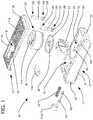
- FIG. 1is an exploded, perspective view of an implant in accordance with one embodiment of the present invention.
- FIGS. 2A-Bare perspective views of the embodiment of the implant of FIG. 1 in a contracted configuration.
- FIGS. 3A-Bare perspective views of the embodiment of the implant of FIG. 1 in an extended configuration.
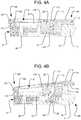
- FIG. 4Ais a cross-sectional side elevation view of the embodiment of the implant of FIG. 1 in a contracted configuration.
- FIG. 4Bis a cross-sectional side elevation view of the embodiment of the implant of FIG. 1 in an extended configuration.
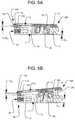
- FIG. 5Ais a cross-sectional side elevation view of the embodiment of the implant of FIG. 1 in a contracted configuration.
- FIG. 5Bis a cross-sectional side elevation view of the embodiment of the implant of FIG. 1 in an extended configuration.
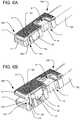
- FIG. 6Ais a perspective, cross-sectional view of the embodiment of the implant of FIG. 1 in a contracted configuration, connected to a delivery tool.
- FIG. 6Bis a perspective, cross-sectional view of the embodiment of the implant of FIG. 1 in an extended configuration, connected to the delivery tool.
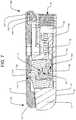
- FIG. 7is a cross-sectional side elevation view of the embodiment of the implant of FIG. 1 in a contracted configuration.
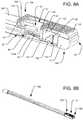
- FIG. 8Ais a perspective, cross-sectional view of the embodiment of the implant of FIG. 1 in a contracted configuration, connected to the delivery tool.
- FIG. 8Bis a perspective view of the embodiment of the implant of FIG. 1 in a contracted configuration, connected to the delivery tool.
- FIG. 9Ais a perspective view of an implant in accordance with another embodiment of the present invention in a contracted configuration.
- FIG. 9Bis an exploded, perspective view of the embodiment of the implant of FIG. 9A .
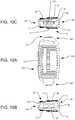
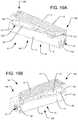
- FIG. 10Ais a top plan view of the embodiment of the implant of FIG. 9A .
- FIG. 10Bis a front elevation view of the embodiment of the implant of FIG. 9A in a contracted configuration.
- FIG. 10Cis a rear elevation view of the embodiment of the implant of FIG. 9A in a contracted configuration.
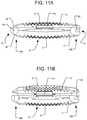
- FIG. 11Ais a side elevation view of the embodiment of the implant of FIG. 9A in a contracted configuration.
- FIG. 11Bis a side elevation view of the embodiment of the implant of FIG. 9A in an extended configuration.
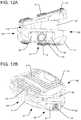
- FIG. 12Ais a rear elevation view of the embodiment of the implant of FIG. 9A in an extended configuration.
- FIG. 12Bis a perspective view of the embodiment of the implant of FIG. 9A in an extended configuration.
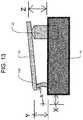
- FIG. 13is a schematic illustration of certain geometrical relationships in connection with implants in accordance with embodiments of the present invention.
- FIG. 14Ais a cross-sectional rear elevation view of an implant in accordance with another embodiment of the present invention in an extended configuration.
- FIG. 14Bis a perspective, cross-sectional view of the embodiment of the implant of FIG. 14A in an extended configuration.
- FIG. 15Ais a rear elevation view of the embodiment of the implant of FIG. 14A in an extended configuration.
- FIG. 15Bis a perspective view of the embodiment of the implant of FIG. 14A in an extended configuration.
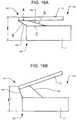
- FIG. 16Ais a schematic illustration of components of an implant in accordance with another embodiment of the present invention in a contracted configuration.
- FIG. 16Bis a schematic illustration of the components of the embodiment of the implant of FIG. 16A in an extended configuration.
- FIGS. 17A-Bare perspective views of an implant in accordance with another embodiment of the present invention in a contracted configuration.
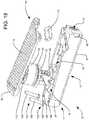
- FIG. 18is an exploded, perspective view of the embodiment of the implant of FIGS. 17A-B .
- FIGS. 19A-Bare perspective views of the embodiment of the implant of FIGS. 17A-B in an extended configuration.
- FIG. 19Cis a rear perspective view of the embodiment of the implant of FIGS. 17A-B in an extended configuration.
- FIG. 20Ais a rear elevation view of the embodiment of FIGS. 17A-B in an extended configuration.
- FIG. 20Bis a side elevation view of the embodiment of FIGS. 17A-B in an extended configuration.
- FIGS. 21A-Bare top perspective views of an implant in accordance with another embodiment of the present invention in an extended configuration.
- FIG. 21Cis a bottom perspective view of the implant of FIGS. 21A-B .
- FIG. 22is a rear elevation view of an embodiment similar to that of FIGS. 21A-B in an extended configuration.
- FIG. 23is a rear perspective view of the implant of FIGS. 21A-B in an extended configuration between two vertebral bodies.
- FIG. 24is an exploded, perspective view of the embodiment of the implant of FIGS. 21A-B .
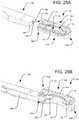
- FIG. 25Ais a perspective view of the embodiment of the implant of FIG. 21A-B in a contracted configuration, adjacent to the distal end of a delivery tool.
- FIG. 25Bis a perspective cross-sectional view of the embodiment of the implant of FIGS. 21A-B in a extended configuration, connected to the delivery tool.
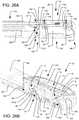
- FIG. 26Ais a cross-sectional top plan view of the embodiment of the implant of FIGS. 21A-B connected to the delivery tool.
- FIG. 26Bis a perspective cross-sectional view of the embodiment of the implant of FIGS. 21A-B in an extended configuration, connected to the delivery tool.
- FIGS. 1-8Billustrate an embodiment of an intervertebral implant 10 in accordance with the present invention.
- the implant 10generally includes a housing 11 and a top end plate 13 , and the housing defines an interior cavity 15 within it.
- the top end plate 13may include an opening 6 within it, bounded by connecting members or struts 44 extending between the proximal and distal sides of the top end plate 13 , which opening 6 communicates with the interior cavity 15 .
- the bottom 12 of the housing 11may also include one or more openings 7 within it, which openings communicate with the interior cavity 15 , as shown in FIGS. 5A-6B .
- the bottom 12 of the housing 11has a bottom end surface 8 and the top end plate 13 has a top end surface 9 .
- the top end plate 13is movably connected to the housing 11 on the opposite side of the housing 11 from the bottom end surface 8 .
- the top and bottom end surfacesare the bone engaging surfaces of the implant, for engaging vertebrae above and below the implant when placed into the patient.
- the implant 10is expandable by moving the top end plate 13 away from the housing 11 , from the contracted configuration illustrated in FIGS. 2A-B to the extended configuration illustrated in FIGS. 3A-B .
- the implant 10includes at least one extendable support element in the form of a piston 22 attached to the underside of the top end plate 13 , which piston 22 is slidably received within a corresponding cylinder 16 defined within the housing 11 .
- the sliding of the piston 22 along the cylinder 16results in the movement of the top end plate away from the housing 11 .
- the piston 22 and cylinder 16may operate as part of a hydraulic system, in which the sliding of the piston 22 away from the bottom of the cylinder is driven by pressurized fluid within the cylinder 16 , as discussed in the '620 Patent and the '854 Application.
- a seal member 23which may be in the form of an o-ring, is positioned so as to seal the sliding interface between the cylinder 16 and the piston 22 , in order to prevent the pressurized fluid from escaping through that interface.
- the seal member 23may be seated within a corresponding groove 45 defined in the outer surface of the piston 22 .
- the seal member 23may be seated within a corresponding groove defined in the outer surface of the cylinder 16 abutting the piston 22 , as disclosed in embodiments of the '854 Application.
- the implant 10also includes a locking system to lock the position of the top end plate 13 by preventing the top end plate 13 from translating back towards the housing 11 .
- That locking systemmay include inter-engaging locking elements.
- the implant 10may include a lower lock support 20 positioned within the housing 11 and a corresponding upper lock support 17 (see FIGS. 5B and 7 ) connected to the underside of the top end plate 13 .
- the upper lock support 17may be positioned within and fixed with respect to the piston 22 .
- the upper lock support 17may be integrally formed with the piston 22 .
- the lower lock support 20is rotatably received about an axle 56 mounted within the cylinder 16 , and a bushing 58 may be provided at the top end of the axle 56 to constrain the axial position of the lower lock support 20 with respect to the axle 56 .
- a bushing 58may be provided at the top end of the axle 56 to constrain the axial position of the lower lock support 20 with respect to the axle 56 .
- the implantmay include a pushable unlocking tether 212 a engaged with lower lock support 20 so as to rotate the lower lock support 20 in the unlock direction when the unlocking tether 212 a is pushed in the distal direction.
- the distal end of the unlocking tether 212 amay have an extension 101 having a laterally projecting tab 102 coupled with a receptacle 104 of the lower lock support 20 so as to rotate the lower lock support 20 about the axle 56 .
- the top end plate 13will be allowed to move back towards the housing 11 , as disclosed in the '620 Patent.
- the unlocking tether 212 amay be biased in the proximal direction by a linear spring 72 , so as to bias the lower lock support 20 into locking engagement with the upper lock support 17 when the unlocking tether 212 a is not being depressed.
- the housing 11may include a channel 66 formed within it, which may serve as a pressure channel for delivering a pressurized fluid (e.g., saline) to the interior of the cylinder 16 in order to drive the movement of the piston 22 to expand the implant.
- a pressurized fluide.g., saline
- the unlocking tether 212 amay be positioned in the pressure channel 66 .
- the unlocking tether 212 amay be positioned in a distinct channel within the housing 11 from the pressure channel 66 that delivers the hydraulic fluid.
- the implant 10preferably defines a leading nose 32 at a distal end 106 of the implant and an engagement region 33 at a proximal end 108 of the implant.
- the leading nose 32may have a top tapered and/or rounded face 35 and a bottom tapered and/or rounded face 36 .
- the leading nose 32may additionally include inwardly directed side tapered and/or rounded faces (not shown).
- the tapered and/or rounded faces 35 , 36 of the leading noseenable non-traumatic insertion of the implant 10 past neural elements and between vertebral bodies.
- the distal endmay also include structures that aid in manipulating the implant in situ (e.g., steering elements that facilitate at least partial rotation of the implant).
- the engagement region 33includes a delivery tool anchor 37 , which may be in the form of a threaded bore, that allows secure attachment of the implant 10 to a delivery tool 100 , such as one illustrated in U.S. Pat. Nos. 8,070,813; 8,998,924; 9,028,550 (hereinafter “the '550 Patent”); U.S. Provisional Patent Application No. 62/319,460 filed on Apr. 7, 2016, entitled Surgical Insertion Instruments (hereinafter “the '460 Application”); or U.S. patent application Ser. No. 15/480,781 filed on Apr.
- the engagement region 33also contains one or more of the pressure input ports for delivering a pressurized fluid to the interior of cylinder 16 in order to expand the implant 10 .
- the delivery tool anchor 37may also serve as a pressure input port, by communicating with pressure channel 66 .
- the insertermay be structured such that the pressurized fluid is deliverable through the structure anchored to the delivery tool anchor 37 .
- the engagement region 33may also include one or more engagement features, such as a recess 82 , which may be engageable by the delivery tool in order to act as an anti-rotation feature for securing the rotational orientation of the implant 10 with respect to the delivery tool anchor 37 , as also disclosed in the '460 Application and the '781 Application.
- engagement featuressuch as a recess 82 , which may be engageable by the delivery tool in order to act as an anti-rotation feature for securing the rotational orientation of the implant 10 with respect to the delivery tool anchor 37 , as also disclosed in the '460 Application and the '781 Application.
- Implant 10is configured to be implanted between opposing vertebral bodies in the spine to facilitate bony fusion between those vertebral bodies.
- the implant 10is shown in its collapsed or contracted configuration in FIGS. 2A-B and in one example of its expanded configuration in FIGS. 3A-B .
- the implant 10can be inserted easily into the intervertebral body space through a minimal incision and with minimal tissue removal. Once in that space, the implant 10 can be expanded against the two opposing vertebral bodies to distract them and thereby restore height to the intervertebral space. This provides stable opposition of the implant 10 to both vertebral bodies and optimizes the bony fusion process.
- the fusion processcan also be enhanced by filling the interior cavity 15 with autologous and/or allogeneic bone graft, a bone growth enabling matrix, and/or bone growth stimulating substances prior to and/or after insertion into the body.
- the implant 10is preferably configured such that there is differential expansion at each end of the implant.
- the implantis structured such that the top end plate 13 moves further from the housing 11 at the distal end 106 of the implant than at the proximal end 108 of the implant.
- the implant top end plate 13is connected to the housing 11 at the proximal end 108 by a connecting member that permits such expansion.
- the connecting memberis a linkage 110 pivotably connected to the top end plate 13 at a top end 107 of the linkage and pivotably connected to the housing 11 at a bottom end 109 of the linkage.
- the linkage 110rotates with respect to both the housing 11 and the top end plate 13 so as to guide the top end plate 13 away from the housing 11 along a defined path at the proximal end 108 of the implant 10 , as shown in FIGS. 3A-6B .
- the piston 22may initially be spaced from the bottom of the cylinder 16 by a distance D P1 , and the vertical distance between the top and bottom ends 107 , 109 of the linkage 110 is D L1 . Then, in an extended configuration, as illustrated in FIG.
- the distance from the piston 22 to the bottom of the cylinder 16may be increased to D P2
- the vertical distance between the top and bottom ends 107 , 109 of the linkage 110may be increased to D L2 .
- D P1may be 0 mm
- D P2may be 3 mm
- D L1may be 0.62 mm
- D L2may be 1.26 mm.
- the linkageprovides for 0.64 mm of expansion at the proximal end 108 of the top end plate 13 .
- the piston 22may be connected to the top end plate 13 by a pivotable connection, such as a rotatable pin connection.
- the top of the piston 22may include a protruding fulcrum 112 shaped to be received within a corresponding recess 114 in the underside 116 of the top end plate 13 .
- the top end plate 13may also include at least one relief 118 in its underside 116 to provide clearance for part of the piston 22 during expansion, as shown in FIGS. 4A-B and 8 A.
- the implant 10may include a stop member to constrain the maximum expansion of the implant.
- a stop memberto constrain the maximum expansion of the implant.
- at least one post 120may be connected at a top end 122 to the top end plate 13 such that the bottom end 124 of the post 120 is received by the housing 11 .
- the post 120may be slidably received through a slot 126 in the housing 11 , and an enlarged portion 128 having a larger dimension than the slot 126 may be provided on the bottom end 124 of the post 120 , so as to stop further expansion of the implant when the enlarged portion 128 engages the slot 126 , as shown in FIG. 6B .
- two such posts 120(with two corresponding slots 126 ) may be provided in some embodiments.
- the extendable support elementmay deviate from being perpendicular to the top and bottom end surfaces 9 , 8 when the implant 10 is in the contracted configuration.
- the piston 22 and corresponding cylinder 16may be angled at least slightly towards the distal end 106 of the implant 10 .
- angling the piston 22 and cylinder 16 in that mannermay space the bottom of the cylinder 16 at its proximal end further away from the bottom end surface 8 of the housing 11 than at the distal end of the cylinder 16 .
- That additional space at the proximal end of the cylinder 16is preferably sufficient for the extension 101 of the unlocking tether 212 a to pass between the bottom of the cylinder 16 and the bottom end surface 8 of the housing, such that the extension 101 can control the rotation of the lower lock support 20 , as discussed above.
- the overall height of the implant 10may be desirably minimized.
- the movement of the piston 22 during expansionwill have at least some horizontal component, which will desirably force the linkage 110 to rotate during expansion, thus providing the desired expansion at the proximal end 108 of the implant 10 .
- FIGS. 1-8Bis desirably structured to be used in a PLIF technique. That is, the generally linear shape of the implant between the distal 106 and proximal 108 ends of the implant may be particularly suitable for inserting two such implants into an intervertebral space (one on either side of the spine) along a posterior to anterior direction, such that the distal end 106 of the implant 10 is positioned more anteriorly with respect to the spine than the more posteriorly positioned proximal end 108 of the implant. Desirably, the differential expansion discussed above, when used in such a PLIF technique, allows for lordosis correction.
- the anterior portion of the spinal columnwill be lifted to correct lordosis.
- the posterior portion of the spinewill receive some lifting in order to decompress nerve roots.
- a connecting membere.g., linkage 110
- the differential expansion at both the proximal and distal ends of the implantcan be driven by a single input, such as one or more extendable support elements controlled by the same source (e.g., a single source of pressurized hydraulic fluid).
- a single inputsuch as one or more extendable support elements controlled by the same source (e.g., a single source of pressurized hydraulic fluid).
- Mechanisms similar to those discussed above for providing differential expansion of the anterior and posterior portions of the spinal columncan also be included in implants structured to be used in a TLIF technique or along a lateral approach.
- implants structured to be used in a TLIF techniquefor example, an implant structured to be used in a lateral approach is illustrated in FIGS. 9A-12B .
- the same reference numerals used in FIGS. 1-8B in connection with components of the PLIF implant discussed aboveare used to indicate similar components in the lateral implant of FIGS. 9A-12B .
- FIGS. 9A-12Bsimilarly includes a top end plate 13 and a housing 11 defining an interior cavity 15 within it.
- the implant 10may include two such interior cavities 15 , although more or fewer such cavities may be provided.
- the top end plate 13may include openings 6 within it, bounded by connecting members or struts 44 extending between the proximal and distal sides of the top end plate 13 , which openings 6 communicate with the respective interior cavities 15 .
- the bottom 12 of the housing 11may also include one or more openings 7 within it, which openings also communicate with the interior cavities 15 .
- the bottom 12 of the housing 11has a bottom end surface 8
- the top end plate 13has a top end surface 9 .
- the top end plate 13is movably connected to the housing 11 on the opposite side of the housing 11 from the bottom end surface 8 .
- the implant 10is expandable by moving the top end plate 13 away from the housing 11 from the contracted configuration illustrated in FIGS. 9A and 10B-11A to the extended configuration illustrated in FIGS. 11B-12B .
- the extendable support elementsmay include pistons 22 slidably received within corresponding cylinders 16 .
- the pistons 22may both be driven by a pressurized fluid delivered through a channel 66 as discussed above and in the '854 Application.
- the implant 10may also include a locking system having inter-engaging locking elements, which locking elements may also be unlockable to allow the top end plate 13 to move back towards the housing 11 , as discussed above.
- the locking elementsmay be interconnected so as to be simultaneously unlockable, as disclosed in the '854 Application and in the '620 Patent.
- the extension 101 of the unlocking tether 212 amay be elongated so as to extend between both lower lock supports 20 , and two laterally projecting tabs 102 may be provided to couple with both lower lock supports 20 so as to simultaneously rotate them about the corresponding axles 56 .
- the implant 10preferably defines a leading nose 32 at a distal end 106 of the implant and an engagement region 33 at a proximal end 108 of the implant.
- the leading nose 32may have a top tapered and/or rounded face 35 and a bottom tapered and/or rounded face 36 .
- the leading nose 32may additionally include inwardly directed side tapered and/or rounded faces 34 .
- the engagement region 33includes a delivery tool anchor 37 for secure attachment of the implant 10 to a delivery tool 100 , as discussed above.
- the engagement region 33may also include one or more engagement features, such as one or more recesses 82 , which may be engageable by the delivery tool in order to act as an anti-rotation feature for securing the rotational orientation of the implant 10 with respect to the delivery tool anchor 37 .
- the engagement region 33may also contain one or more of the pressure input ports for delivering a pressurized fluid to the interior of cylinder 16 in order to expand the implant 10 .
- the lateral implant 10 of FIGS. 9A-12Bmay be configured to produce differential expansion at opposing ends of the implant. Since the lateral embodiment of FIGS. 9A-12B is desirably inserted laterally into the disc space between two vertebral bodies, the differential expansion may be between the opposing ends of the implant on either side of the longitudinal axis, rather than between the proximal 108 and distal 106 ends of the implant. In that regard, the lateral implant is desirably positioned in the spine such that one of those ends is an anterior end 130 of the implant and the other end is a posterior end of the implant 132 . Thus, like the embodiment of FIGS. 1-8B , the embodiment of FIGS.
- 9A-12Bmay allow for lordosis correction by providing expansion at both the anterior and posterior ends of the implant, with the anterior end 130 expanding by a greater amount than the posterior end 132 .
- the pistons 22may be pivotably connected to the top end plate 13 by respective fulcrums 112 , as in the embodiment of FIGS. 1-8B .
- the top end plate 13may be connected to the housing 11 at the posterior end 132 of the implant by a connecting member, such as by a rotatable linkage 110 pivotably connected to the top end plate 13 and the housing 11 .
- the lateral embodiment of the implant 10may also include one or more stop members to constrain the maximum expansion of the implant, as discussed above in connection with the PLIF embodiment.
- the pistons 22may be angled towards the anterior end 130 of the implant, as discussed in connection with the PLIF embodiment, which may allow a mechanism (such as a rack, as disclosed in the '854 Application) to pass between the bottom of the cylinders 16 and the bottom end surface 8 of the housing 11 , so as to engage lower lock supports of the locking system.
- An implant structured to be used in a TLIF techniquewhich similarly allows for differential expansion between the anterior 130 and posterior 132 ends of the implant 10 may also be provided in accordance with the present invention.
- Such an implantmay generally be configured like the lateral implant of FIGS. 9A-12B , in that one or more extendable support elements may be provided on an anterior side of the longitudinal axis and a connecting member, such as a linkage 110 , may be provided on the opposing, posterior side of the longitudinal axis.
- TLIF embodimentA primary difference between such a TLIF embodiment and the lateral embodiment discussed above may be that the longitudinal axis of the TLIF implant may be curved, rather than straight, such that the outer geometry of the implant has a curved, kidney bean-like shape between its proximal 108 and distal 106 ends.
- An exemplary outer geometry for such a TLIF implantis illustrated in the '854 Application.
- the linkage 110causes the top end plate 13 to rotate during the expansion induced by the extendable support elements.
- the top end plate 13will thus have an instantaneous center of rotation spaced posteriorly from the implant 10 , although the location of the instantaneous center of rotation will move during the expansion of the implant.
- the greater the distance X that the center of rotation R of the top end plate 13 is spaced from the implant 10the greater the posterior expansion Y will be.
- various geometriescan be adjusted in order to create the desired amount of posterior expansion Y relative to the anterior expansion Z provided by the extendable support elements.
- the length of the linkage 110 and its position within the implant 10i.e., where its top and bottom ends 107 , 109 are connected to the top end plate 13 and to the housing 11 , respectively) can be varied.
- a posteriorly-spaced center of rotationcan be provided by other mechanisms.
- the linkage 110may be replaced by another connecting member in the form of an extension 134 slidably received within a track 136 .
- the extension 134may be rigidly connected to the top end plate 13 (e.g., either integrally formed with or rigidly secured to the top end plate 13 ) and slidably received within a track 136 in the housing 11 .
- the extension 134may have an arcuate shape, and the track 136 may have a matching arcuate shape, such that the top end plate 13 is constrained to follow a defined path when pushed outwardly by the extendable support elements (e.g., pistons 22 ).
- the arcuate shapesmay of the extension 134 and track 136 may define a fixed radius, such that the center of rotation R of the top end plate 13 has a fixed location during expansion of the implant 10 .
- the pin connection of the embodiments of FIGS. 1-12Bmay be replaced with a slidable interface between the top of the pistons 22 and the underside 116 of the top end plate 13 .
- the underside 116 of the top end plate 13may include concave surfaces 138
- the tops of the pistons 22may include convex surfaces 140 shaped to slidably engage the respective concave surfaces 138 during expansion.
- the embodiment of the implant illustrated in FIGS. 14A-15Bmay also include one or more stop members to constrain the maximum expansion of the implant, as discussed above.
- the above-discussed mechanisms that connect the housing 11 to the top end plate 13 in order to provide differential expansioncan also be used in embodiments of implants used in PLIF and TLIF techniques.
- such PLIF and TLIF implantswould be structured as discussed above, except that the linkages 110 would be replaced by extensions 134 slidably received within tracks 136 , and the fulcrums 112 and corresponding recesses 114 may be replaced by concave and convex surfaces 138 , 140 between the extendable support elements and the top end plate 13 .
- the connection between the top end plate 13 and the housing 11 that constrains the movement of the top end plate 13 during expansion and that defines the posterior expansion of the implantmay be replaced with a four-bar linkage 142 , as schematically illustrated in FIGS. 16A-B . That is, the top end plate 13 may be connected to the housing 11 by a posterior linkage 144 and an anterior linkage 146 , both pivotably connected to the top end plate 13 and the housing 11 at each end.
- the lengths of the linkages B and D, as well as the distances A, C between the connections,can be designed so as to produce the desired movement of the top end plate 13 , which includes the desired expansion of the posterior end 132 (i.e., expanded height E′ minus unexpanded height E at the posterior end 132 ).
- the connection between the extension member (not shown) and the top end plate 13may be designed to permit sliding between those components. For example, mating concave and convex surfaces as discussed above in connection with FIG. 14A may be employed.
- FIGS. 17A-20BAnother embodiment of an implant 10 in accordance with the present invention is illustrated in FIGS. 17A-20B .
- the same reference numerals used above in connection with the components of the PLIF and lateral implantsare used to indicate similar components in the implant of FIGS. 17A-20B .
- the embodiment of FIGS. 17A-20Bincludes a top end plate 13 and a housing 11 defining one or more interior cavities 15 within it.
- the implant 10 illustrated in FIGS. 17A-20Bdoes not include an opening 6 within the top end plate 13 like the other embodiments discussed above, this embodiment could include such an opening 6 .
- the bottom 12 of the housing 11may also include one or more openings (not shown) within it, which openings also communicate with the interior cavities 15 .
- the bottom 12 of the housing 11has a bottom end surface 8
- the top end plate 13has a top end surface 9 .
- the top end plate 13is movably connected to the housing 11 on the opposite side of the housing 11 from the bottom end surface 8 .
- the implant 10is expandable by moving the top end plate 13 away from the housing 11 , from the contracted configuration illustrated in FIGS. 17A-B to the extended configuration illustrated in FIGS. 19A-20B .
- the implant 10 of FIGS. 17A-20Bincludes at least one extendable support element, which may be in the form of a piston 22 slidably received within a corresponding cylinder 16 defined within the housing 11 .
- the pistonmay be driven by a pressurized fluid delivered through a channel as discussed above and in the '854 Application.
- the implant 10may also include a locking system having inter-engaging locking elements, which locking elements may also be unlockable to allow the top end plate 13 to move back towards the housing 11 , as discussed above.
- the implant 10may include a lower lock support 20 positioned within the housing 11 and a corresponding upper lock support (not shown) connected to the underside of the top end plate 13 as discussed above, as well as in the '620 Patent and the '854 Application.
- the maximum expansion of the implantmay be constrained by a stop member, such as one or more posts 120 slidably received through corresponding slots 126 in the housing 11 , and the piston 22 may be angled so as to permit an unlocking mechanism to pass between the bottom of the cylinder 16 and the bottom end surface 8 of the housing 11 , so as to engage the lower lock support 20 of the locking system, as discussed above
- the implant 10 of FIGS. 17A-20Bpreferably defines a leading nose 32 at a distal end 106 of the implant and an engagement region 33 at the proximal end 108 of the implant.
- the leading nose 32may having a top tapered and/or rounded face 35 and a bottom tapered and/or rounded face 36 .
- the leading nose 32may additionally include inwardly directed side tapered and/or rounded faces 34 .
- the engagement region 33includes a delivery tool anchor 37 for secure attachment of the implant 10 to a delivery tool, as discussed above.
- the engagement region 33may also include one or more engagement features, such as one or more recesses 82 , which may be engageable by the delivery tool in order to act as an anti-rotation feature for securing the rotational orientation of the implant 10 with respect to the delivery tool anchor 37 .
- the engagement region 33may also contain one or more pressure input ports for delivery of a pressured fluid to the interior of the cylinder 16 in order to expand the implant.
- the delivery tool anchor 37may also serve as a pressure input port, as discussed above.
- the embodiment of FIGS. 17A-20Bmay also be configured to produce differential expansion at opposing ends of the implant.
- the implantmay be structured such that the top end plate 13 moves further away from the housing 11 at the distal end 106 of the implant than at the proximal end 108 of the implant.
- the top end plate 13may move further away from the housing along one longitudinal side 148 of the implant than at the other longitudinal side 150 of the implant.
- the top end plate 13may be configured to angulate within two orthogonal planes during expansion, or within one plane that is oriented at an oblique angle with respect to a longitudinal axis of the implant 10 .
- the top end surface 9 of the top end plate 13desirably forms a compound angle with respect to the housing 11 in the extended configuration, as shown in FIGS. 19C-20B .
- the connecting memberi.e., linkage 110
- the connecting memberbetween the top end plate 13 and the housing 11 may be oriented along an oblique angle with respect to the longitudinal axis of the implant 10 .
- the fulcrum 112 at the top of the piston 22 that is pivotably connected to the top end plate 13may also be oriented at an oblique angle to the longitudinal axis (e.g., the fulcrum 112 may be oriented parallel to the linkage 110 ).
- FIGS. 17A-20Bmay be particularly useful in an oblique transforaminal approach.
- implant 10may be inserted into an intervertebral space along a transforaminal approach, essentially similar to a TLIF technique, except that the implant may be positioned diagonally across the intervertebral space, rather than being positioned along the anterior portion of the intervertebral space.
- the top end plate 13may be configured to angulate within multiple planes, as discussed above.
- FIGS. 21A-26BAnother embodiment of an implant 10 in accordance with the present invention is illustrated in FIGS. 21A-26B .
- Such implant 10is desirably structured to be used in a lateral approach.
- the same reference numerals used above in connection with the other, previously-described embodimentsare used to indicate similar components in the implant of FIGS. 21A-26B .
- the embodiment of FIGS. 21A-26Bincludes a top end plate 13 and a housing 11 defining an interior cavity 15 within it.
- the top end plate 13may include an opening 6 within it, bounded by connecting members or struts 44 extending between the proximal and distal sides of the top end plate 13 , which opening 6 communicates with the interior cavity 15 .
- the bottom 12 of the housing 11may also include an opening 7 within it, which opening also communicates with the interior cavity 15 .
- the bottom 12 of the housing 11 of the embodiment of FIGS. 21A-26Bhas a bottom end surface 8
- the top end plate 13has a top end surface 9 .
- the top end plate 13is movably connected to the housing 11 on the opposite side of the housing 11 from the bottom end surface 8 .
- the implant 10is expandable by moving the top end plate 13 away from the housing 11 , from the contracted configuration illustrated in FIG. 25A to the extended configuration illustrated in FIGS. 21A-23, 25B, and 26B .
- the implant 10 of FIGS. 21A-26Bmay include two extendable support elements, although one or more than two may alternatively be provided.
- the extendable support elementsare preferably in the form of pistons 22 slidably received within corresponding cylinders 16 defined within the housing 11 .
- the pistonsmay be driven by a pressurized fluid delivered through a channel as discussed above and in the '854 Application.
- the implant 10may also include a locking system having inter-engaging locking elements, which locking elements may also be unlockable to allow the top end plate 13 to move back towards the housing 11 , as discussed above.
- the implant 10may include lower lock supports 20 positioned within the housing 11 and corresponding upper lock supports 17 (see FIG. 26B ) connected to the underside of the top end plate 13 , as discussed above, as well as in the '620 Patent and the '854 Application.
- the upper lock supports 17may be positioned within and fixed with respect to the respective pistons 22 .
- the upper lock supports 17may be integrally formed with the pistons 22 .
- the structure and operation of the locking system of the embodiment of FIGS. 21A-26Bis similar to those discussed above and in the '620 Patent and the '854 Application.
- the lower lock supports 20are rotatably received about corresponding axles 56 mounted within the cylinders 16 , and bushings 58 may be provided at the top ends of the axles 56 to constrain the axial positions of the lower lock supports 20 with respect to the axles 56 .
- a pushable unlocking tether 212 amay be engaged with the lower lock supports 20 so as to rotate the lower lock supports 20 in the unlock direction when the unlocking tether 212 a is pushed in the distal direction.
- the unlocking tether 212 amay have an elongated extension 101 having laterally projecting tabs 102 coupled with corresponding receptacles 104 of the lower lock supports 20 so as to simultaneously rotate the lower lock supports 20 about the associated axles 56 .
- the unlocking tether 212 amay also be biased in the proximal direction by a linear spring 72 .
- the pistons 22may be angled so as to permit the unlocking tether 212 a or other unlocking mechanism to pass between the bottom of the cylinders 16 and the bottom end surface 8 of the housing 11 , so as to engage the lower lock supports 20 of the locking system.
- the maximum expansion of the implantmay also be constrained by a stop member, such as one or more posts 120 slidably received through corresponding slots 126 in the housing 11 .
- the housing 11may include a channel 66 formed within it, which may serve as a pressure channel for delivering a pressurized fluid (e.g., saline) to the interior of the cylinders 16 in order to drive the movement of the pistons 22 to expand the implant.
- a pressurized fluide.g., saline
- the delivery tool 100may include an outlet 152 for delivering the pressurized fluid.
- the outletis desirably at the distal end of a fluid delivery cannula 154 , which may project from the distal end of the delivery tool 100 .
- the fluid delivery cannula 154may be a separate structure positionable within or attached to the delivery tool 100 , or the fluid delivery cannula 154 may be an integral part of the tool 100 .
- the projecting distal end of the delivery cannula 154desirably forms a sealing connection within the channel 66 due to its engagement with an o-ring 156 positioned within the channel 66 .
- the unlocking tether 212 amay be positioned within the pressure channel 66 , although other embodiments (not shown) may have the unlocking tether 212 a positioned in a distinct channel within the housing 11 from the pressure channel 66 that delivers the hydraulic fluid.
- the engagement region 33 at the proximal end of the implant 10desirably includes a delivery tool anchor 37 for secure attachment to the delivery tool 100 , such as via a threaded connection to a rotatable threaded member 158 of the delivery tool 100 .
- the engagement region 33may also include one or more engagement features, such as one or more recesses 82 , which may be engageable by a finger 160 of the delivery tool 100 in order to act as an anti-rotation feature for securing the rotational orientation of the implant 10 with respect to the delivery tool anchor 37 .
- the engagement region 33may also contain one or more pressure input ports 38 for delivery of a pressurized fluid to the interior of the cylinders 16 in order to expand the implant.
- the delivery tool anchor 37may serve as the pressure input port, as discussed in connection with other embodiments above, the pressure input port 38 in the embodiment of FIGS. 21A-26B may be a different opening in the engagement region 33 , as shown in FIGS. 21A-24 .
- the implant 10may also include a bone graft input/infusion port 319 structured to receive autologous and/or allogeneic bone graft, a bone growth enabling matrix, and/or bone growth stimulating substances after the implant is inserted into the body.
- the port 319which is desirably located at the proximal end of the implant, such as part of the engagement region 33 , communicates with the interior cavity 15 via passage 392 .
- the graft materialmay be supplied to the implant by a bone graft supply line 404 of the insertion tool 100 , which supply line 404 may define a channel that communicates with the passage 392 in the implant 10 when the insertion tool 100 is connected to the implant 10 , as shown in FIG. 25B .
- a bone graft supply line 404 of the insertion tool 100which supply line 404 may define a channel that communicates with the passage 392 in the implant 10 when the insertion tool 100 is connected to the implant 10 , as shown in FIG. 25B .
- graft materialmay be supplied to the interior cavity 15 of the implant via the bone graft supply line 404 of the insertion tool 100 .
- Such supplymay cause the graft material to flow out of the openings 6 , 7 in the top and bottom of the implant, as well as possibly through the opened space between the top end plate 13 and the housing 11 , such that the graft material may flow into and at least partially fill the disc space, where it can desirably promote fusion of the adjacent vertebrae.
- graft materialmay be supplied through the port 319 and passage 392 and into the interior cavity 15 of the implant 10 from any one of the embodiments of graft injector assemblies disclosed in U.S. Patent Application Publication No. 2015/0112352, the disclosure of which is incorporated by reference herein as if fully set forth herein, and such graft injector assemblies may be loaded using the devices and methods disclosed in U.S. patent application Ser. No. 15/241,339 filed Aug. 19, 2016, entitled Bone Graft Delivery Loading Assembly, the disclosure of which is also incorporated by reference herein as if fully set forth herein.
- any of the other embodiments of the implants 10 disclosed herein and discussed abovemay also include a bone graft input/infusion port 319 and associated passage 392 for likewise supplying bone graft material to the interior cavity 15 of the implant.
- the embodiment of FIGS. 21A-26Bmay also be configured to produce differential expansion at opposing ends of the implant. Since the lateral embodiment of FIGS. 21A-26B is desirably inserted laterally into the disc space between two vertebral bodies, the differential expansion may be between the opposing ends of the implant on either side of the longitudinal axis, rather than between the proximal 108 and distal 106 ends of the implant. In that regard, the lateral implant is desirably positioned in the spine such that one of those ends is an anterior end 130 of the implant and the other end is a posterior end of the implant 132 . Thus, the embodiment of FIGS.
- 9A-12Bmay allow for lordosis correction by providing expansion at both the anterior and posterior ends of the implant, with the anterior end 130 expanding by a greater amount than the posterior end 132 .
- the pistons 22may be pivotably connected to the top end plate 13 by respective fulcrums 112 .
- the top end plate 13may be connected to the housing 11 at the posterior end 132 of the implant by one or more connecting members, such as by rotatable linkages 110 pivotably connected to the top end plate 13 and the housing 11 . As shown in FIGS.
- multiple (e.g., two) linkages 110may be provided along the posterior end 132 of the implant, rather than a single linkage as in the other embodiments described above. Providing more linkages 110 in that manner may desirably divide the applied shear force over the various linkages, thus reducing the shear force experienced by any one linkage.
- Such linkages 110may be pivotably connected to the top end plate 13 by a common upper pin 162 , and the linkages may be pivotably connected to the housing 11 by a common lower pin 164 . In an alternative embodiment (not shown), however, separate pins may be provided for each linkage 110 connection, rather than common pins as shown.
- FIG. 22depicts a version of the implant 10 of FIGS. 21A-21C mirrored about its midline.
- Such mirrored implant 10may be inserted along a lateral approach to the spine from the opposite side of the body to that on which the implant of FIGS. 21A-C may be inserted.
- the embodiments of the implant 10 disclosed aboveincluded pistons 22 and cylinders 16 driven by hydraulic pressure to expand the implant 10
- other forms of extendable support elementsmay alternatively be used.
- the implant 10may be expanded by bellows, rotating cam lift mechanisms, rotating screw lift mechanisms, or other such devices.
- the embodiments of the implant 10 discussed aboveinvolve expansion wherein the entire top end plate 13 moves away from the housing 11 , by providing some expansion at the posterior end of the implant, although less expansion than at the anterior end of the implant. In other variations (not shown) of any of the above-discussed embodiments, however, there may be no expansion provided at the posterior end of the implant.
- the connecting membercould be replaced by a pin connection at the posterior end of the implant, which pin connection permits rotation of the top end plate 13 about the pin connection but does not involve the top end plate 13 moving away from the housing 11 at the posterior end.
- the implant 10may instead be constructed to provide greater expansion at a different end of the implant (e.g., at the posterior end), by employing substantially the same mechanisms discussed above, except in rearranged locations within the implant.
- the locations of the components controlling the expansion, such as the extendable support elements and linkages,may be mirrored within the implant. That way, the implant 10 can be used to provide curvature correction in a different direction than that discussed above. Additionally, or alternatively, the surgeon can modify the direction and/or plane of the applied curvature correction by varying the orientation of the implant with respect to the spine.
- any one of the implantscan be inserted into and/or reoriented within the disc space such that the implant is oriented with respect to the longitudinal axis of the spine so as to provide curvature correction in a desired longitudinal plane and in a desired direction within that plane.
- Some or all of the components or portions of components of the implants 10 disclosed hereinmay be created by an additive manufacturing or 3D printing process, e.g., using Laser Rapid Manufacturing (LRM) technology. Additionally, or alternatively, some of the components or portions of components may be manufactured from a porous material, such as a porous metal. Such porous metal may be in the form of a porous, commercially-pure titanium matrix or a porous, titanium alloy (e.g., a Ti6Al4V alloy), such as those manufactured by Howmedica Osteonics Corp. under the trademark TRITANIUM®. Examples of additive manufacturing processes for creating some or all of the components of the implants 10 disclosed herein, including some such processes for creating porous materials, are disclosed in U.S. Pat. Nos.
- the top end plate 13 and the bottom 12 of the housing 11may include a porous titanium matrix formed via 3D printing, and then various features of the implant 10 may be further defined by machining of those components. For example, surface features to increase frictional engagement with the vertebrae above and below the implant may be defined in the porous matrix by machining the bottom end surface 8 and the top end surface 9 .
- the porous materialmay also be supplemented by or replaced with solid or denser material in at least portions of the implant 10 , however.
- the tops of projecting ridges and other features along the top and bottom end surfaces 9 , 8may be formed from solid material, while the surrounding base portions that interconnect those features are formed from a porous matrix.
- Solid (non-porous) materialmay also be used in the portions of the implants 10 that enclose the hydraulic fluid.
- Solid materialwhich may be constructed with a smooth surface finish, may also be used along the interfaces between components that slide with respect to one another. Solid material may also be used in portions of the implants 10 where additional structural integrity is needed due to the loads that will be applied by the spine.
- the periphery of the top end plate 13may be constructed of solid material.
- the struts 44may be constructed of solid material, in order to increase the strength to the top end plate 13 .
- portions of the implants 10 where additional structural integrity is neededmay be constructed of a porous metal material, but the density of that material may be increased in those portions. Examples of implants having both solid and porous portions, as well as methods of creating the same, are disclosed in U.S. Provisional Patent Application No. 62/245,004, filed on Oct. 22, 2015, and U.S. Patent Application Publication No. 2016/0199193, the entire disclosures of which are hereby incorporated by reference herein as if fully set forth herein.
Landscapes
- Health & Medical Sciences (AREA)
- Engineering & Computer Science (AREA)
- Biomedical Technology (AREA)
- Orthopedic Medicine & Surgery (AREA)
- Neurology (AREA)
- Transplantation (AREA)
- Heart & Thoracic Surgery (AREA)
- Oral & Maxillofacial Surgery (AREA)
- Cardiology (AREA)
- Vascular Medicine (AREA)
- Life Sciences & Earth Sciences (AREA)
- Animal Behavior & Ethology (AREA)
- General Health & Medical Sciences (AREA)
- Public Health (AREA)
- Veterinary Medicine (AREA)
- Physical Education & Sports Medicine (AREA)
- Prostheses (AREA)
Abstract
Description
Claims (20)
Priority Applications (3)
| Application Number | Priority Date | Filing Date | Title |
|---|---|---|---|
| US15/599,638US10940018B2 (en) | 2016-05-20 | 2017-05-19 | Expandable interbody implant with lordosis correction |
| US17/158,499US11806249B2 (en) | 2016-05-20 | 2021-01-26 | Expandable interbody implant with lordosis correction |
| US18/374,708US20240033103A1 (en) | 2016-05-20 | 2023-09-29 | Expandable Interbody Implant with Lordosis Correction |
Applications Claiming Priority (2)
| Application Number | Priority Date | Filing Date | Title |
|---|---|---|---|
| US201662339459P | 2016-05-20 | 2016-05-20 | |
| US15/599,638US10940018B2 (en) | 2016-05-20 | 2017-05-19 | Expandable interbody implant with lordosis correction |
Related Child Applications (1)
| Application Number | Title | Priority Date | Filing Date |
|---|---|---|---|
| US17/158,499ContinuationUS11806249B2 (en) | 2016-05-20 | 2021-01-26 | Expandable interbody implant with lordosis correction |
Publications (2)
| Publication Number | Publication Date |
|---|---|
| US20170333199A1 US20170333199A1 (en) | 2017-11-23 |
| US10940018B2true US10940018B2 (en) | 2021-03-09 |
Family
ID=58738970
Family Applications (3)
| Application Number | Title | Priority Date | Filing Date |
|---|---|---|---|
| US15/599,638Active2037-12-19US10940018B2 (en) | 2016-05-20 | 2017-05-19 | Expandable interbody implant with lordosis correction |
| US17/158,499Active2037-10-26US11806249B2 (en) | 2016-05-20 | 2021-01-26 | Expandable interbody implant with lordosis correction |
| US18/374,708PendingUS20240033103A1 (en) | 2016-05-20 | 2023-09-29 | Expandable Interbody Implant with Lordosis Correction |
Family Applications After (2)
| Application Number | Title | Priority Date | Filing Date |
|---|---|---|---|
| US17/158,499Active2037-10-26US11806249B2 (en) | 2016-05-20 | 2021-01-26 | Expandable interbody implant with lordosis correction |
| US18/374,708PendingUS20240033103A1 (en) | 2016-05-20 | 2023-09-29 | Expandable Interbody Implant with Lordosis Correction |
Country Status (4)
| Country | Link |
|---|---|
| US (3) | US10940018B2 (en) |
| EP (1) | EP3245982B1 (en) |
| JP (1) | JP2017205522A (en) |
| AU (1) | AU2017203369B2 (en) |
Cited By (3)
| Publication number | Priority date | Publication date | Assignee | Title |
|---|---|---|---|---|
| US11185420B2 (en)* | 2016-12-30 | 2021-11-30 | Tobb Ekonomi Ve Teknoloji Universitesi | Expandable cage |
| US20240033103A1 (en)* | 2016-05-20 | 2024-02-01 | Howmedica Osteonics Corp. | Expandable Interbody Implant with Lordosis Correction |
| US12318307B2 (en) | 2021-07-16 | 2025-06-03 | Blue Ocean Spine Gmbh | Adjustable spinal implants, associated instruments and methods |
Families Citing this family (26)
| Publication number | Priority date | Publication date | Assignee | Title |
|---|---|---|---|---|
| US9220547B2 (en) | 2009-03-27 | 2015-12-29 | Spinal Elements, Inc. | Flanged interbody fusion device |
| US9265620B2 (en) | 2011-03-18 | 2016-02-23 | Raed M. Ali, M.D., Inc. | Devices and methods for transpedicular stabilization of the spine |
| US12193948B2 (en) | 2013-03-13 | 2025-01-14 | Life Spine, Inc. | Expandable implant assembly |
| US10426632B2 (en) | 2013-03-13 | 2019-10-01 | Life Spine, Inc. | Expandable spinal interbody assembly |
| US10687962B2 (en) | 2013-03-14 | 2020-06-23 | Raed M. Ali, M.D., Inc. | Interbody fusion devices, systems and methods |
| US9861495B2 (en) | 2013-03-14 | 2018-01-09 | Raed M. Ali, M.D., Inc. | Lateral interbody fusion devices, systems and methods |
| US10500061B2 (en)* | 2015-08-13 | 2019-12-10 | K2M, Inc. | Adjustable spinal implant |
| US10285825B2 (en)* | 2016-04-07 | 2019-05-14 | Howmedica Osteonics Corp. | Surgical insertion instruments |
| US10786367B2 (en)* | 2016-07-21 | 2020-09-29 | Seaspine, Inc. | Expandable implant |
| AU2017251734B2 (en) | 2016-10-26 | 2022-10-20 | Vb Spine Us Opco Llc | Expandable interbody implant with lateral articulation |
| US10888430B2 (en)* | 2017-06-21 | 2021-01-12 | NVision Biomedical Technologies, LLC | Expandable/variable lordotic angle vertebral implant and reading system therefor |
| US11896494B2 (en) | 2017-07-10 | 2024-02-13 | Life Spine, Inc. | Expandable implant assembly |
| EP3456297B1 (en) | 2017-09-15 | 2023-10-04 | Howmedica Osteonics Corp. | Instruments for expandable interbody implants |
| US11173047B2 (en) | 2018-06-07 | 2021-11-16 | Stryker European Operations Holdings Llc | Surgical instrument with angled drive shaft |
| AU2019342137A1 (en) | 2018-09-20 | 2021-03-25 | Spinal Elements, Inc. | Spinal implant device |
| US11382764B2 (en) | 2019-06-10 | 2022-07-12 | Life Spine, Inc. | Expandable implant assembly with compression features |
| US12042395B2 (en) | 2019-06-11 | 2024-07-23 | Life Spine, Inc. | Expandable implant assembly |
| US20210077274A1 (en)* | 2019-09-16 | 2021-03-18 | FBC Device ApS | Expandable Spinal Interbody Implant |
| US11857432B2 (en) | 2020-04-13 | 2024-01-02 | Life Spine, Inc. | Expandable implant assembly |
| US11602439B2 (en) | 2020-04-16 | 2023-03-14 | Life Spine, Inc. | Expandable implant assembly |
| US12336917B2 (en) | 2020-05-15 | 2025-06-24 | Life Spine, Inc. | Steerable implant assembly |
| US11602440B2 (en) | 2020-06-25 | 2023-03-14 | Life Spine, Inc. | Expandable implant assembly |
| US11554020B2 (en) | 2020-09-08 | 2023-01-17 | Life Spine, Inc. | Expandable implant with pivoting control assembly |
| US11911284B2 (en) | 2020-11-19 | 2024-02-27 | Spinal Elements, Inc. | Curved expandable interbody devices and deployment tools |
| WO2022133456A1 (en) | 2020-12-17 | 2022-06-23 | Spinal Elements, Inc. | Spinal implant device |
| US11944553B2 (en)* | 2021-01-08 | 2024-04-02 | DePuy Synthes Products, Inc. | Expanding spinal fusion cage |
Citations (190)
| Publication number | Priority date | Publication date | Assignee | Title |
|---|---|---|---|---|
| US3875595A (en) | 1974-04-15 | 1975-04-08 | Edward C Froning | Intervertebral disc prosthesis and instruments for locating same |
| US4932975A (en) | 1989-10-16 | 1990-06-12 | Vanderbilt University | Vertebral prosthesis |
| US4969888A (en) | 1989-02-09 | 1990-11-13 | Arie Scholten | Surgical protocol for fixation of osteoporotic bone using inflatable device |
| US5236460A (en) | 1990-02-12 | 1993-08-17 | Midas Rex Pneumatic Tools, Inc. | Vertebral body prosthesis |
| US5653763A (en) | 1996-03-29 | 1997-08-05 | Fastenetix, L.L.C. | Intervertebral space shape conforming cage device |
| US5665122A (en) | 1995-01-31 | 1997-09-09 | Kambin; Parviz | Expandable intervertebral cage and surgical method |
| US5723013A (en) | 1995-02-06 | 1998-03-03 | Jbs S.A. | Spacer implant for substituting missing vertebrae |
| US5827328A (en) | 1996-11-22 | 1998-10-27 | Buttermann; Glenn R. | Intervertebral prosthetic device |
| US5865848A (en) | 1997-09-12 | 1999-02-02 | Artifex, Ltd. | Dynamic intervertebral spacer and method of use |
| US5916267A (en) | 1997-04-07 | 1999-06-29 | Arthit Sitiso | Anterior spinal implant system for vertebral body prosthesis |
| US5980522A (en) | 1994-07-22 | 1999-11-09 | Koros; Tibor | Expandable spinal implants |
| US5989290A (en) | 1995-05-24 | 1999-11-23 | Biedermann; Lutz | Height-adjustable artificial vertebral body |
| US6039761A (en) | 1997-02-12 | 2000-03-21 | Li Medical Technologies, Inc. | Intervertebral spacer and tool and method for emplacement thereof |
| US6102950A (en) | 1999-01-19 | 2000-08-15 | Vaccaro; Alex | Intervertebral body fusion device |
| US6127597A (en) | 1997-03-07 | 2000-10-03 | Discotech N.V. | Systems for percutaneous bone and spinal stabilization, fixation and repair |
| US6159244A (en) | 1999-07-30 | 2000-12-12 | Suddaby; Loubert | Expandable variable angle intervertebral fusion implant |
| US6176881B1 (en) | 1997-04-15 | 2001-01-23 | Synthes | Telescopic vertebral prosthesis |
| US6193756B1 (en) | 1997-09-30 | 2001-02-27 | Sulzer Orthopaedie Ag | Tubular support body for bridging two vertebrae |
| US6214012B1 (en) | 1998-11-13 | 2001-04-10 | Harrington Arthritis Research Center | Method and apparatus for delivering material to a desired location |
| WO2001056513A1 (en) | 2000-02-04 | 2001-08-09 | Michelson Gary K | Expandable push-in interbody spinal fusion implant |
| US6296665B1 (en) | 2000-03-20 | 2001-10-02 | Electro-Biology, Inc. | Method and apparatus for spinal fixation |
| US20010056302A1 (en) | 2000-03-22 | 2001-12-27 | Boyer Michael L. | Skeletal reconstruction cages |
| US6371989B1 (en) | 1996-09-13 | 2002-04-16 | Jean-Luc Chauvin | Method of providing proper vertebral spacing |
| US6375682B1 (en) | 2001-08-06 | 2002-04-23 | Lewis W. Fleischmann | Collapsible, rotatable and expandable spinal hydraulic prosthetic device |
| US6375683B1 (en) | 1997-05-02 | 2002-04-23 | Stryker France S.A. | Implant in particular for replacing a vertebral body in surgery of the spine |
| US6395032B1 (en) | 1998-12-11 | 2002-05-28 | Dimso (Distribution Medicale Du Sud-Ouest) | Intervertebral disc prosthesis with liquid chamber |
| US20020128716A1 (en) | 1999-07-26 | 2002-09-12 | Howard Cohen | Spinal surgical prosthesis |
| US6454806B1 (en) | 1999-07-26 | 2002-09-24 | Advanced Prosthetic Technologies, Inc. | Spinal surgical prosthesis |
| US20020138146A1 (en) | 2000-04-18 | 2002-09-26 | Jackson Roger P. | Anterior expandable spinal fusion cage system |
| US20020136146A1 (en) | 1998-09-18 | 2002-09-26 | Lee Chul-Woo | Near-field optical storage medium and optical data storage system therefor |
| US20020151976A1 (en) | 1998-10-29 | 2002-10-17 | Kevin Foley | Expandable intervertebral spacers |
| WO2003003951A1 (en) | 2001-07-02 | 2003-01-16 | Surgicraft Limited | Collapsible and expandable instrument for insertion in a dorsal vertebra |
| US6527803B1 (en) | 1998-06-23 | 2003-03-04 | Dimso (Distribution Medicale Du Sud-Ouest) | Intersomatic spine implant having anchoring elements |
| US6562074B2 (en) | 2001-10-17 | 2003-05-13 | Medicinelodge, Inc. | Adjustable bone fusion implant and method |
| US20030114899A1 (en) | 1999-07-27 | 2003-06-19 | Woods Carla Mann | Patient programmer for implantable devices |
| US6582467B1 (en) | 2000-10-31 | 2003-06-24 | Vertelink Corporation | Expandable fusion cage |
| US6585699B2 (en) | 2000-04-13 | 2003-07-01 | Nna/S | Drug delivery device provided with a one-way mechanism |
| US20040030346A1 (en) | 1999-10-21 | 2004-02-12 | George Frey | Devices and techniques for a posterior lateral disc space approach |
| US6692495B1 (en) | 1999-10-14 | 2004-02-17 | Fred Zacouto | Vertebral fixator and articulation |
| WO2004016250A1 (en) | 2002-08-19 | 2004-02-26 | Orchid Health Care | Sustained release pharmaceutical composition of a cephalosporin antibiotic |
| WO2004016205A2 (en) | 2002-08-15 | 2004-02-26 | Coppes Justin K | Intervertebral disc implant |
| US6723126B1 (en) | 2002-11-01 | 2004-04-20 | Sdgi Holdings, Inc. | Laterally expandable cage |
| US6730088B2 (en) | 2001-08-29 | 2004-05-04 | Chung-Chun Yeh | Device for fixing spinal column under treatment |
| US20040097928A1 (en) | 1995-03-27 | 2004-05-20 | Thomas Zdeblick | Interbody fusion device and method for restoration of normal spinal anatomy |
| US20040133273A1 (en) | 2002-11-15 | 2004-07-08 | Cox Daniel L. | Apparatuses and methods for heart valve repair |
| US6764491B2 (en) | 1999-10-21 | 2004-07-20 | Sdgi Holdings, Inc. | Devices and techniques for a posterior lateral disc space approach |
| EP1442715A2 (en) | 2003-01-30 | 2004-08-04 | Surgical Navigation Technologies, Inc. | Tunable spinal implant and apparatus for its post-operative tuning |
| US20040153065A1 (en) | 2003-02-03 | 2004-08-05 | Lim Roy K. | Expanding interbody implant and articulating inserter and method |
| US20040181229A1 (en) | 2001-06-04 | 2004-09-16 | Michelson Gary K. | Instrumentation for use with dynamic single-lock anterior cervical plate system having non-detachably fastened and moveable segments |
| US20040186576A1 (en) | 2003-03-20 | 2004-09-23 | Spineco, Inc., An Ohio Corporation | Expandable spherical spinal implant |
| US6835207B2 (en) | 1996-07-22 | 2004-12-28 | Fred Zacouto | Skeletal implant |
| US20050033437A1 (en) | 2002-05-23 | 2005-02-10 | Pioneer Laboratories, Inc. | Artificial disc device |
| US20050043800A1 (en) | 2003-07-31 | 2005-02-24 | Paul David C. | Prosthetic spinal disc replacement |
| US20050049590A1 (en) | 2003-03-07 | 2005-03-03 | Neville Alleyne | Spinal implant with securement spikes |
| US6866682B1 (en) | 1999-09-02 | 2005-03-15 | Stryker Spine | Distractable corpectomy device |
| US6875235B2 (en) | 1999-10-08 | 2005-04-05 | Bret A. Ferree | Prosthetic joints with contained compressible resilient members |
| US20050085910A1 (en) | 2003-10-16 | 2005-04-21 | Sweeney Patrick J. | Vertebral prosthesis |
| US20050107881A1 (en) | 2003-05-02 | 2005-05-19 | Neville Alleyne | Artificial spinal disk |
| US20050113842A1 (en) | 2002-05-06 | 2005-05-26 | Rudolf Bertagnoli | Instrumentation and methods for preparation of an intervertebral space |
| US20050216084A1 (en) | 2003-04-22 | 2005-09-29 | Fleischmann Lewis W | Collapsible, rotatable, and tiltable hydraulic spinal disc prosthesis system with selectable modular components |
| US20050229433A1 (en) | 2004-03-03 | 2005-10-20 | Cachia Victor V | Catheter deliverable foot implant and method of delivering the same |
| US6960232B2 (en) | 2002-04-25 | 2005-11-01 | Blackstone Medical, Inc. | Artificial intervertebral disc |
| US20050251260A1 (en) | 2002-08-15 | 2005-11-10 | David Gerber | Controlled artificial intervertebral disc implant |
| US20050273170A1 (en) | 2004-06-08 | 2005-12-08 | Navarro Richard R | Prosthetic intervertebral spinal disc with integral microprocessor |
| US20050273169A1 (en) | 2004-02-23 | 2005-12-08 | Thomas Purcell | Artificial intervertebral disc assembly |
| US20050273171A1 (en) | 2003-08-05 | 2005-12-08 | Gordon Charles R | Method of inserting an expandable intervertebral implant without overdistraction |
| US6981989B1 (en) | 2003-04-22 | 2006-01-03 | X-Pantu-Flex Drd Limited Liability Company | Rotatable and reversibly expandable spinal hydraulic prosthetic device |
| US20060036259A1 (en) | 2004-08-03 | 2006-02-16 | Carl Allen L | Spine treatment devices and methods |
| US7001431B2 (en) | 1994-05-06 | 2006-02-21 | Disc Dynamics, Inc. | Intervertebral disc prosthesis |
| US7018415B1 (en) | 2002-09-23 | 2006-03-28 | Sdgi Holdings, Inc. | Expandable spinal fusion device and methods of promoting spinal fusion |
| US7018416B2 (en) | 2000-07-06 | 2006-03-28 | Zimmer Spine, Inc. | Bone implants and methods |
| US20060085073A1 (en) | 2004-10-18 | 2006-04-20 | Kamshad Raiszadeh | Medical device systems for the spine |
| US20060089719A1 (en) | 2004-10-21 | 2006-04-27 | Trieu Hai H | In situ formation of intervertebral disc implants |
| EP1415624B1 (en) | 2002-10-30 | 2006-05-17 | Mauricio Rodolfo Carrasco | Implant for vertebral replacement and restoration of the normal spinal curvature |
| US20060106416A1 (en) | 2004-10-29 | 2006-05-18 | Douglas Raymond | Expandable ports and methods for minimally invasive surgery |
| US20060116767A1 (en) | 2002-11-14 | 2006-06-01 | Sepitec Foundation | Implant Used in Procedures for Stiffening the Vertebral Column |
| US7060037B2 (en) | 2002-05-08 | 2006-06-13 | Medport, Llc | Digital thermometer for measuring body temperature |
| US7060073B2 (en) | 1999-10-21 | 2006-06-13 | Sdgi Holdings, Inc. | Devices and techniques for a posterior lateral disc space approach |
| US7066958B2 (en) | 2002-05-10 | 2006-06-27 | Ferree Bret A | Prosthetic components with partially contained compressible resilient members |
| US20060142860A1 (en) | 2003-04-04 | 2006-06-29 | Theken Disc, Llc | Artificial disc prosthesis |
| US20060142861A1 (en) | 2004-12-29 | 2006-06-29 | Murray Ian P | Spinal disc replacement |
| US20060147332A1 (en) | 2004-12-30 | 2006-07-06 | Howmedica Osteonics Corp. | Laser-produced porous structure |
| US20060167547A1 (en) | 2005-01-21 | 2006-07-27 | Loubert Suddaby | Expandable intervertebral fusion implants having hinged sidewalls |
| US7094257B2 (en) | 2003-02-14 | 2006-08-22 | Zimmer Spine, Inc. | Expandable intervertebral implant cage |
| US20060200244A1 (en) | 2003-02-05 | 2006-09-07 | Richard Assaker | Vertebral replacement and distraction device for placing said implant |
| US20060235426A1 (en) | 2005-04-15 | 2006-10-19 | Sdgi Holdings, Inc. | Instruments, implants and methods for positioning implants into a spinal disc space |
| US20060235535A1 (en) | 1999-10-08 | 2006-10-19 | Ferree Bret A | Artificial disc and joint replacements with modular cushioning components |
| US7166110B2 (en) | 2004-01-09 | 2007-01-23 | Yundt Kent D | Method, system and apparatus for interbody fusion |
| US20070050033A1 (en) | 2005-09-01 | 2007-03-01 | Reo Michael L | Prosthetic intervertebral discs |
| US20070050030A1 (en) | 2005-08-23 | 2007-03-01 | Kim Richard C | Expandable implant device with interchangeable spacer |
| US20070073395A1 (en) | 2003-04-11 | 2007-03-29 | Daniel Baumgartner | Anchoring means for intervertebral implants |
| US7204853B2 (en) | 2003-08-05 | 2007-04-17 | Flexuspine, Inc. | Artificial functional spinal unit assemblies |
| US20070093903A1 (en) | 2003-10-08 | 2007-04-26 | Cheng David M | Spine replacement system for the treatment of spine instability and degenerative disc disease |
| US20070093901A1 (en) | 2005-09-26 | 2007-04-26 | Thomas Grotz | Selectively Expanding Spine Cage, Hydraulically Controllable in Three Dimensions for Enhanced Spinal Fusion |
| US7214243B2 (en) | 2002-10-21 | 2007-05-08 | 3Hbfm, Llc | Intervertebral disk prosthesis |
| US7217293B2 (en) | 2003-11-21 | 2007-05-15 | Warsaw Orthopedic, Inc. | Expandable spinal implant |
| US20070123987A1 (en) | 2005-11-02 | 2007-05-31 | Bernstein Avi J | Curvilinear cervical interbody device |
| US20070179611A1 (en) | 2005-12-22 | 2007-08-02 | Dipoto Gene P | Methods and devices for replacement of intervertebral discs |
| US20070233254A1 (en) | 2005-09-26 | 2007-10-04 | Thomas Grotz | Selectively expanding spine cage, hydraulically controllable in three dimensions for vertebral body replacement |
| US20070255409A1 (en) | 2006-04-27 | 2007-11-01 | Sdgi Holdings, Inc. | Expandable implant, instrument, and method |
| WO2007124078A2 (en) | 2006-04-19 | 2007-11-01 | Spinal Kinetics, Inc. | Prosthetic intervertebral discs implantable by minimally invasive surgical techniques |
| US20070255413A1 (en) | 2006-04-27 | 2007-11-01 | Sdgi Holdings, Inc. | Expandable intervertebral spacers and methods of use |
| US20070255415A1 (en)* | 2006-05-01 | 2007-11-01 | Sdgi Holdings, Inc. | Expandable intervertebral spacers and methods of use |
| US7291158B2 (en) | 2004-11-12 | 2007-11-06 | Boston Scientific Scimed, Inc. | Cutting balloon catheter having a segmented blade |
| US7291150B2 (en) | 1999-12-01 | 2007-11-06 | Sdgi Holdings, Inc. | Intervertebral stabilising device |
| US20070270961A1 (en) | 2006-04-25 | 2007-11-22 | Sdgi Holdings, Inc. | Spinal implant with deployable and retractable barbs |
| US20070270964A1 (en) | 2006-04-27 | 2007-11-22 | Sdgi Holdings, Inc. | Expandable vertebral implant and methods of use |
| US20070288092A1 (en) | 2006-06-01 | 2007-12-13 | Bambakidis Nicholas | Expandable intervertebral implant and method |
| US7316686B2 (en) | 1999-08-26 | 2008-01-08 | Warsaw Orthopedic, Inc. | Devices and methods for implanting fusion cages |
| US7316714B2 (en) | 2003-08-05 | 2008-01-08 | Flexuspine, Inc. | Artificial functional spinal unit assemblies |
| US20080021555A1 (en) | 2006-07-19 | 2008-01-24 | John White | Expandable vertebral body implants and methods of use |
| WO2008011371A2 (en) | 2006-07-21 | 2008-01-24 | Warsaw Orthopedic, Inc. | Implant with nested members and methods of use |
| US20080021556A1 (en) | 2006-07-21 | 2008-01-24 | Edie Jason A | Expandable vertebral implant and methods of use |
| US20080058931A1 (en) | 2006-07-21 | 2008-03-06 | John White | Expandable vertebral implant and methods of use |
| US20080065082A1 (en) | 2006-09-08 | 2008-03-13 | Narissa Chang | Steerable rasp/trial inserter |
| US20080077150A1 (en) | 2006-09-22 | 2008-03-27 | Linh Nguyen | Steerable rasp/trial member inserter and method of use |
| US7351261B2 (en) | 2004-06-30 | 2008-04-01 | Depuy Spine, Inc. | Multi-joint implant |
| US20080086276A1 (en) | 2006-10-10 | 2008-04-10 | Nobuyuki Naka | Stress component measurement method |
| US20080097441A1 (en) | 2004-10-20 | 2008-04-24 | Stanley Kyle Hayes | Systems and methods for posterior dynamic stabilization of the spine |
| US20080103601A1 (en) | 1999-07-26 | 2008-05-01 | Ladislau Biro | Corpectomy vertebral body replacement implant system |
| US20080114467A1 (en) | 2006-11-09 | 2008-05-15 | Warsaw Orthopedic, Inc. | Expanding Vertebral Body Implant |
| US20080140207A1 (en) | 2006-12-07 | 2008-06-12 | Interventional Spine, Inc. | Intervertebral implant |
| US20080147193A1 (en) | 2006-11-23 | 2008-06-19 | Wilfried Matthis | Expandable intervertebral implant |
| WO2008086276A2 (en) | 2007-01-05 | 2008-07-17 | Universtiy Of Virginia Patent Foundation | Expandable intervertebral prosthesis device for posterior implantation and related method thereof |
| US20080177387A1 (en) | 2006-11-01 | 2008-07-24 | Warsaw Orthopedic, Inc. | Implants and Related Devices for Monitoring Bony Fusion |
| US20080215153A1 (en) | 2003-08-07 | 2008-09-04 | Buttermann Glenn Robin | Apparatus and method for performing spinal surgery |
| WO2008112607A2 (en) | 2007-03-09 | 2008-09-18 | Blue Fury Consulting, Llc | Spinal implant |
| US20080281424A1 (en) | 2006-11-29 | 2008-11-13 | John Parry | Orthopaedic Implants and Prostheses |
| US7452359B1 (en) | 1988-06-13 | 2008-11-18 | Warsaw Orthopedic, Inc. | Apparatus for inserting spinal implants |
| US20080288073A1 (en) | 2007-05-17 | 2008-11-20 | Depuy Spine, Inc. | Self-Distracting Cage |
| US20080300598A1 (en) | 2007-05-31 | 2008-12-04 | Spine Wave, Inc. | Expandable Interbody Fusion Device |
| WO2008148210A1 (en) | 2007-06-06 | 2008-12-11 | The Royal Institution For The Advancement Of Learning/Mcgill University | Prostethic vertebral body |
| US7470273B2 (en) | 2004-06-25 | 2008-12-30 | Ebi, Llc | Tool for intervertebral implant manipulation |
| US20090005874A1 (en) | 2003-04-22 | 2009-01-01 | Fleischmann Lewis W | Compressible, rotatable, and tiltable hydraulic spinal disc prosthesis system with selectable modular components |
| US20090005819A1 (en) | 2007-05-22 | 2009-01-01 | Eden Spine, Llc | Interspinous vertebral implant |
| US20090018661A1 (en) | 2003-08-01 | 2009-01-15 | Spinal Kinetics, Inc. | Prosthetic Intervertebral Discs |
| US20090043312A1 (en) | 2007-08-06 | 2009-02-12 | Koulisis Christo | Articulating Transforaminal Lumbar Interbody Fusion Inserter Device and Associated Method of Use |
| US20090048676A1 (en) | 2005-09-27 | 2009-02-19 | Fabian Jr Henry F | Spine surgery method and motion preserving implant |
| WO2009033100A1 (en) | 2007-09-07 | 2009-03-12 | Intrinsic Therapeutics, Inc. | Bone anchoring systems |
| US7507241B2 (en) | 2004-04-05 | 2009-03-24 | Expanding Orthopedics Inc. | Expandable bone device |
| US7520900B2 (en) | 2000-08-30 | 2009-04-21 | Warsaw Orthopedic, Inc. | Intervertebral disc nucleus implants and methods |
| WO2009064787A2 (en) | 2007-11-12 | 2009-05-22 | Synthes (U.S.A.) | Adjustable height intervertebral implant |
| US7537664B2 (en) | 2002-11-08 | 2009-05-26 | Howmedica Osteonics Corp. | Laser-produced porous surface |
| US20090171389A1 (en) | 2007-12-31 | 2009-07-02 | Meera Sankaran | Bone fusion device and methods |
| US20090204215A1 (en) | 2008-02-07 | 2009-08-13 | K2M, Inc. | Expandable vertebral device with cam lock |
| US20090216331A1 (en) | 2008-02-22 | 2009-08-27 | Innvotec Surgicals, Inc. | Spinal Implant with expandable fixation |
| US20090222100A1 (en) | 2008-02-28 | 2009-09-03 | Stryker Spine | Tool for implanting expandable intervertebral implant |
| WO2009114381A1 (en) | 2008-03-07 | 2009-09-17 | Synthes Usa, Llc | Expandable interbody spacer device |
| US20090270987A1 (en) | 2008-04-24 | 2009-10-29 | Warsaw Orthopedic, Inc. | Expandable vertebral implants and methods of use |
| CN101610741A (en) | 2006-11-29 | 2009-12-23 | 外科技术有限公司 | Orthopaedic implants and prosthese |
| CN101631516A (en) | 2007-03-13 | 2010-01-20 | 新特斯有限责任公司 | Adjustable intervertebral implant |
| US20100016970A1 (en) | 2008-07-17 | 2010-01-21 | John Kapitan | Spinal interbody spacers |
| US20100057204A1 (en)* | 2008-02-22 | 2010-03-04 | Murali Kadaba | Hydraulically Actuated Expanding Spine Cage With Extendable Locking Anchor |
| US7722674B1 (en) | 2005-08-12 | 2010-05-25 | Innvotec Surgical Inc. | Linearly expanding spine cage for enhanced spinal fusion |
| WO2010074704A1 (en) | 2008-12-22 | 2010-07-01 | Synthes Usa, Llc | Expandable vertebral body replacement device and method |
| US20100249930A1 (en) | 2009-03-31 | 2010-09-30 | Medicinelodge, Inc. Dba Imds Co-Innovation | Double bundle acl repair |
| US7854766B2 (en) | 2004-05-13 | 2010-12-21 | Moskowitz Nathan C | Artificial total lumbar disc for unilateral safe and simple posterior placement in the lumbar spine, and removable bifunctional screw which drives vertical sliding expansile plate expansion, and interplate widening, and angled traction spikes |
| WO2011011609A2 (en) | 2009-07-22 | 2011-01-27 | Spinex Tec, Llc. | Methods and apparatuses for vertebral body distraction and fusion employing a coaxial screw gear sleeve mechanism |
| US7883543B2 (en) | 2004-10-01 | 2011-02-08 | Spinal Generations, Llc | Vertebral prosthesis and spinal fixation system |
| US20110130835A1 (en) | 2008-12-10 | 2011-06-02 | Innvotec Surgical, Inc. | Adjustable Distraction Cage With Linked Locking Mechanisms |
| US20120059469A1 (en) | 2009-03-31 | 2012-03-08 | Medicinelodge, Inc. Dba Imds Co-Innovation | Double bundle acl repair system |
| US8147861B2 (en) | 2006-08-15 | 2012-04-03 | Howmedica Osteonics Corp. | Antimicrobial implant |
| US8153785B2 (en) | 2009-04-06 | 2012-04-10 | Cheminpharma LLC | Stabilizing ligands for regulation of protein function |
| US20120130387A1 (en) | 2009-04-16 | 2012-05-24 | Coalign Innovations, Inc. | Insertion Handle For Surgical Implants |
| US8350186B2 (en) | 2005-12-30 | 2013-01-08 | Howmedica Osteonics Corp. | Laser-produced implants |
| US20130096677A1 (en) | 2011-10-18 | 2013-04-18 | Dr. Thomas H. Myers | Acl implants, instruments, and methods |
| US20130158664A1 (en) | 2011-12-19 | 2013-06-20 | Warsaw Orthopedic, Inc. | Expandable interbody implant and methods of use |
| US20130158669A1 (en) | 2012-02-13 | 2013-06-20 | Arno Sungarian | Expandable Self-Anchoring Interbody Cage for Orthopedic Applications |
| US20130197648A1 (en) | 2010-10-11 | 2013-08-01 | Heinrich Boehm | Implant for the spinal column and actuating instrument |
| US20130197642A1 (en) | 2012-01-28 | 2013-08-01 | Mark J. Ernst | Expandable implant for mammalian bony segment stabilization |
| US20130197647A1 (en) | 2005-03-31 | 2013-08-01 | Life Spine, Inc. | Expandable spinal interbody and intravertebral body devices |
| US20130204368A1 (en) | 2012-02-06 | 2013-08-08 | Warsaw Orthopedic, Inc | Pultrusion Process for Preparing Composites Having Low Percentage of Fibers and Articles Made from Same |
| US20130204374A1 (en) | 2012-02-05 | 2013-08-08 | Michael J. Milella, Jr. | In-situ formed spinal implant |
| US20130253650A1 (en) | 2008-12-10 | 2013-09-26 | Coalign Innovations, Inc. | Adjustable Distraction Cage With Linked Locking Mechanisms |
| WO2013173767A1 (en) | 2012-05-18 | 2013-11-21 | Trinity Orthopedics, Llc | Articulating interbody cage and methods thereof |
| US8728387B2 (en) | 2005-12-06 | 2014-05-20 | Howmedica Osteonics Corp. | Laser-produced porous surface |
| WO2014144696A1 (en) | 2013-03-15 | 2014-09-18 | Lanx, Inc. | Expandable fusion cage system |
| US20150025634A1 (en)* | 2013-07-19 | 2015-01-22 | Heinrich Boehm | Expandable implant for the spinal column |
| US20150112352A1 (en) | 2013-10-23 | 2015-04-23 | Stryker Spine | Percutaneous bone graft delivery system and method |
| US9028550B2 (en) | 2005-09-26 | 2015-05-12 | Coalign Innovations, Inc. | Selectively expanding spine cage with enhanced bone graft infusion |
| US9135374B2 (en) | 2012-04-06 | 2015-09-15 | Howmedica Osteonics Corp. | Surface modified unit cell lattice structures for optimized secure freeform fabrication |
| US9180010B2 (en) | 2012-04-06 | 2015-11-10 | Howmedica Osteonics Corp. | Surface modified unit cell lattice structures for optimized secure freeform fabrication |
| US20150351925A1 (en)* | 2013-01-24 | 2015-12-10 | Biomet Spine, Llc | Adjustable interbody fusion device and method of use |
| US20160089247A1 (en) | 2013-05-13 | 2016-03-31 | Biomet Spine, Llc | Adjustable interbody fusion devices |
| FR3026294A1 (en) | 2014-09-30 | 2016-04-01 | Yellowsteps | INTERSOMATIC CAGE WITH ADJUSTABLE COVER AND METHOD OF MANUFACTURING THE SAME |
| WO2016063283A1 (en) | 2014-10-21 | 2016-04-28 | Nlt Spine Ltd. | Adjustable implant |
| US20160199193A1 (en) | 2015-01-14 | 2016-07-14 | Stryker European Holdings I, Llc | Spinal implant with porous and solid surfaces |
| WO2016183382A1 (en) | 2015-05-12 | 2016-11-17 | Nuvasive, Inc. | Expandable lordosis intervertebral implants |
| US9662224B2 (en) | 2014-02-07 | 2017-05-30 | Globus Medical, Inc. | Variable lordosis spacer and related methods of use |
| WO2017117513A1 (en) | 2015-12-30 | 2017-07-06 | Nuvasive, Inc. | Lordotic expandable fusion implant |
Family Cites Families (4)
| Publication number | Priority date | Publication date | Assignee | Title |
|---|---|---|---|---|
| US20160022434A1 (en)* | 2012-08-08 | 2016-01-28 | James C. Robinson | Expandable intervertebral cage assemblies |
| US9782265B2 (en)* | 2013-02-15 | 2017-10-10 | Globus Medical, Inc | Articulating and expandable vertebral implant |
| US10492923B2 (en)* | 2014-06-25 | 2019-12-03 | Seaspine, Inc. | Expanding implant with hinged arms |
| AU2017203369B2 (en)* | 2016-05-20 | 2022-04-28 | Vb Spine Us Opco Llc | Expandable interbody implant with lordosis correction |
- 2017
- 2017-05-19AUAU2017203369Apatent/AU2017203369B2/enactiveActive
- 2017-05-19JPJP2017099864Apatent/JP2017205522A/enactivePending
- 2017-05-19EPEP17172001.4Apatent/EP3245982B1/enactiveActive
- 2017-05-19USUS15/599,638patent/US10940018B2/enactiveActive
- 2021
- 2021-01-26USUS17/158,499patent/US11806249B2/enactiveActive
- 2023
- 2023-09-29USUS18/374,708patent/US20240033103A1/enactivePending
Patent Citations (287)
| Publication number | Priority date | Publication date | Assignee | Title |
|---|---|---|---|---|
| US3875595A (en) | 1974-04-15 | 1975-04-08 | Edward C Froning | Intervertebral disc prosthesis and instruments for locating same |
| US7452359B1 (en) | 1988-06-13 | 2008-11-18 | Warsaw Orthopedic, Inc. | Apparatus for inserting spinal implants |
| US4969888A (en) | 1989-02-09 | 1990-11-13 | Arie Scholten | Surgical protocol for fixation of osteoporotic bone using inflatable device |
| US4932975A (en) | 1989-10-16 | 1990-06-12 | Vanderbilt University | Vertebral prosthesis |
| US5236460A (en) | 1990-02-12 | 1993-08-17 | Midas Rex Pneumatic Tools, Inc. | Vertebral body prosthesis |
| US7001431B2 (en) | 1994-05-06 | 2006-02-21 | Disc Dynamics, Inc. | Intervertebral disc prosthesis |
| US5980522A (en) | 1994-07-22 | 1999-11-09 | Koros; Tibor | Expandable spinal implants |
| US5665122A (en) | 1995-01-31 | 1997-09-09 | Kambin; Parviz | Expandable intervertebral cage and surgical method |
| US5723013A (en) | 1995-02-06 | 1998-03-03 | Jbs S.A. | Spacer implant for substituting missing vertebrae |
| US20040097928A1 (en) | 1995-03-27 | 2004-05-20 | Thomas Zdeblick | Interbody fusion device and method for restoration of normal spinal anatomy |
| US5989290A (en) | 1995-05-24 | 1999-11-23 | Biedermann; Lutz | Height-adjustable artificial vertebral body |
| US5653763A (en) | 1996-03-29 | 1997-08-05 | Fastenetix, L.L.C. | Intervertebral space shape conforming cage device |
| US6835207B2 (en) | 1996-07-22 | 2004-12-28 | Fred Zacouto | Skeletal implant |
| US6371989B1 (en) | 1996-09-13 | 2002-04-16 | Jean-Luc Chauvin | Method of providing proper vertebral spacing |
| US5827328A (en) | 1996-11-22 | 1998-10-27 | Buttermann; Glenn R. | Intervertebral prosthetic device |
| US6039761A (en) | 1997-02-12 | 2000-03-21 | Li Medical Technologies, Inc. | Intervertebral spacer and tool and method for emplacement thereof |
| US6127597A (en) | 1997-03-07 | 2000-10-03 | Discotech N.V. | Systems for percutaneous bone and spinal stabilization, fixation and repair |
| US5916267A (en) | 1997-04-07 | 1999-06-29 | Arthit Sitiso | Anterior spinal implant system for vertebral body prosthesis |
| US6176881B1 (en) | 1997-04-15 | 2001-01-23 | Synthes | Telescopic vertebral prosthesis |
| JP2001518824A (en) | 1997-04-15 | 2001-10-16 | ジンテーズ アクチエンゲゼルシャフト クール | Telescopic vertebral body prosthesis |
| US6375683B1 (en) | 1997-05-02 | 2002-04-23 | Stryker France S.A. | Implant in particular for replacing a vertebral body in surgery of the spine |
| US5865848A (en) | 1997-09-12 | 1999-02-02 | Artifex, Ltd. | Dynamic intervertebral spacer and method of use |
| US6193756B1 (en) | 1997-09-30 | 2001-02-27 | Sulzer Orthopaedie Ag | Tubular support body for bridging two vertebrae |
| US6527803B1 (en) | 1998-06-23 | 2003-03-04 | Dimso (Distribution Medicale Du Sud-Ouest) | Intersomatic spine implant having anchoring elements |
| US20020136146A1 (en) | 1998-09-18 | 2002-09-26 | Lee Chul-Woo | Near-field optical storage medium and optical data storage system therefor |
| US20020151976A1 (en) | 1998-10-29 | 2002-10-17 | Kevin Foley | Expandable intervertebral spacers |
| US6214012B1 (en) | 1998-11-13 | 2001-04-10 | Harrington Arthritis Research Center | Method and apparatus for delivering material to a desired location |
| US6395032B1 (en) | 1998-12-11 | 2002-05-28 | Dimso (Distribution Medicale Du Sud-Ouest) | Intervertebral disc prosthesis with liquid chamber |
| US6102950A (en) | 1999-01-19 | 2000-08-15 | Vaccaro; Alex | Intervertebral body fusion device |
| US6454806B1 (en) | 1999-07-26 | 2002-09-24 | Advanced Prosthetic Technologies, Inc. | Spinal surgical prosthesis |
| US7282063B2 (en) | 1999-07-26 | 2007-10-16 | Advanced Prosthetic Technologies, Inc. | Artificial disc spinal surgical prosthesis |
| US20080103601A1 (en) | 1999-07-26 | 2008-05-01 | Ladislau Biro | Corpectomy vertebral body replacement implant system |
| US20040153156A1 (en) | 1999-07-26 | 2004-08-05 | Howard Cohen | Artificial disc spinal surgical prosthesis |
| US20020128716A1 (en) | 1999-07-26 | 2002-09-12 | Howard Cohen | Spinal surgical prosthesis |
| US6719796B2 (en) | 1999-07-26 | 2004-04-13 | Advanced Prosthetic Technologies, Inc. | Spinal surgical prosthesis |
| US7824445B2 (en) | 1999-07-26 | 2010-11-02 | Ladislau Biro | Corpectomy vertebral body replacement implant system |
| US20030114899A1 (en) | 1999-07-27 | 2003-06-19 | Woods Carla Mann | Patient programmer for implantable devices |
| US6159244A (en) | 1999-07-30 | 2000-12-12 | Suddaby; Loubert | Expandable variable angle intervertebral fusion implant |
| US7316686B2 (en) | 1999-08-26 | 2008-01-08 | Warsaw Orthopedic, Inc. | Devices and methods for implanting fusion cages |
| US6866682B1 (en) | 1999-09-02 | 2005-03-15 | Stryker Spine | Distractable corpectomy device |
| US20060235535A1 (en) | 1999-10-08 | 2006-10-19 | Ferree Bret A | Artificial disc and joint replacements with modular cushioning components |
| US6875235B2 (en) | 1999-10-08 | 2005-04-05 | Bret A. Ferree | Prosthetic joints with contained compressible resilient members |
| US6692495B1 (en) | 1999-10-14 | 2004-02-17 | Fred Zacouto | Vertebral fixator and articulation |
| US20090105836A1 (en) | 1999-10-21 | 2009-04-23 | George Frey | Devices and techniques for a posterior lateral disc space approach |
| US6830570B1 (en) | 1999-10-21 | 2004-12-14 | Sdgi Holdings, Inc. | Devices and techniques for a posterior lateral disc space approach |
| US7060073B2 (en) | 1999-10-21 | 2006-06-13 | Sdgi Holdings, Inc. | Devices and techniques for a posterior lateral disc space approach |
| US7481812B2 (en) | 1999-10-21 | 2009-01-27 | Warsaw Orthopedic, Inc. | Devices and techniques for a posterior lateral disc space approach |
| US6764491B2 (en) | 1999-10-21 | 2004-07-20 | Sdgi Holdings, Inc. | Devices and techniques for a posterior lateral disc space approach |
| US20060264968A1 (en) | 1999-10-21 | 2006-11-23 | George Frey | Devices and techniques for a posterior lateral disc space approach |
| US7967863B2 (en) | 1999-10-21 | 2011-06-28 | Warsaw Orthopedic, Inc. | Devices and techniques for a posterior lateral disc space approach |
| US7935124B2 (en) | 1999-10-21 | 2011-05-03 | Warsaw Orthopedic, Inc. | Devices and techniques for a posterior lateral disc space approach |
| US20040030346A1 (en) | 1999-10-21 | 2004-02-12 | George Frey | Devices and techniques for a posterior lateral disc space approach |
| US7291150B2 (en) | 1999-12-01 | 2007-11-06 | Sdgi Holdings, Inc. | Intervertebral stabilising device |
| WO2001056513A1 (en) | 2000-02-04 | 2001-08-09 | Michelson Gary K | Expandable push-in interbody spinal fusion implant |
| US6296665B1 (en) | 2000-03-20 | 2001-10-02 | Electro-Biology, Inc. | Method and apparatus for spinal fixation |
| US20010056302A1 (en) | 2000-03-22 | 2001-12-27 | Boyer Michael L. | Skeletal reconstruction cages |
| US6585699B2 (en) | 2000-04-13 | 2003-07-01 | Nna/S | Drug delivery device provided with a one-way mechanism |
| US20020138146A1 (en) | 2000-04-18 | 2002-09-26 | Jackson Roger P. | Anterior expandable spinal fusion cage system |
| US7018416B2 (en) | 2000-07-06 | 2006-03-28 | Zimmer Spine, Inc. | Bone implants and methods |
| US7520900B2 (en) | 2000-08-30 | 2009-04-21 | Warsaw Orthopedic, Inc. | Intervertebral disc nucleus implants and methods |
| US6582467B1 (en) | 2000-10-31 | 2003-06-24 | Vertelink Corporation | Expandable fusion cage |
| US20040181229A1 (en) | 2001-06-04 | 2004-09-16 | Michelson Gary K. | Instrumentation for use with dynamic single-lock anterior cervical plate system having non-detachably fastened and moveable segments |
| WO2003003951A1 (en) | 2001-07-02 | 2003-01-16 | Surgicraft Limited | Collapsible and expandable instrument for insertion in a dorsal vertebra |
| US6375682B1 (en) | 2001-08-06 | 2002-04-23 | Lewis W. Fleischmann | Collapsible, rotatable and expandable spinal hydraulic prosthetic device |
| US6730088B2 (en) | 2001-08-29 | 2004-05-04 | Chung-Chun Yeh | Device for fixing spinal column under treatment |
| US6562074B2 (en) | 2001-10-17 | 2003-05-13 | Medicinelodge, Inc. | Adjustable bone fusion implant and method |
| US20030130739A1 (en) | 2001-10-17 | 2003-07-10 | Medicinelodge, Inc. | Adjustable bone fusion implant and method |
| US6960232B2 (en) | 2002-04-25 | 2005-11-01 | Blackstone Medical, Inc. | Artificial intervertebral disc |
| US20050113842A1 (en) | 2002-05-06 | 2005-05-26 | Rudolf Bertagnoli | Instrumentation and methods for preparation of an intervertebral space |
| US7060037B2 (en) | 2002-05-08 | 2006-06-13 | Medport, Llc | Digital thermometer for measuring body temperature |
| US7066958B2 (en) | 2002-05-10 | 2006-06-27 | Ferree Bret A | Prosthetic components with partially contained compressible resilient members |
| US20050033437A1 (en) | 2002-05-23 | 2005-02-10 | Pioneer Laboratories, Inc. | Artificial disc device |
| WO2004016205A3 (en) | 2002-08-15 | 2004-05-27 | Justin K Coppes | Intervertebral disc implant |
| US20050197702A1 (en) | 2002-08-15 | 2005-09-08 | Coppes Justin K. | Intervertebral disc implant |
| US7563284B2 (en) | 2002-08-15 | 2009-07-21 | Synthes Usa, Llc | Intervertebral disc implant |
| WO2004016205A2 (en) | 2002-08-15 | 2004-02-26 | Coppes Justin K | Intervertebral disc implant |
| US20050251260A1 (en) | 2002-08-15 | 2005-11-10 | David Gerber | Controlled artificial intervertebral disc implant |
| US7563286B2 (en) | 2002-08-15 | 2009-07-21 | Synthes Usa, Llc | Controlled artificial intervertebral disc implant |
| WO2004016250A1 (en) | 2002-08-19 | 2004-02-26 | Orchid Health Care | Sustained release pharmaceutical composition of a cephalosporin antibiotic |
| US7018415B1 (en) | 2002-09-23 | 2006-03-28 | Sdgi Holdings, Inc. | Expandable spinal fusion device and methods of promoting spinal fusion |
| US7214243B2 (en) | 2002-10-21 | 2007-05-08 | 3Hbfm, Llc | Intervertebral disk prosthesis |
| EP1415624B1 (en) | 2002-10-30 | 2006-05-17 | Mauricio Rodolfo Carrasco | Implant for vertebral replacement and restoration of the normal spinal curvature |
| US6723126B1 (en) | 2002-11-01 | 2004-04-20 | Sdgi Holdings, Inc. | Laterally expandable cage |
| US20040088054A1 (en) | 2002-11-01 | 2004-05-06 | Bret Berry | Laterally expandable cage |
| US6953477B2 (en) | 2002-11-01 | 2005-10-11 | Sdgi Holdings, Inc. | Laterally expandable cage |
| US7537664B2 (en) | 2002-11-08 | 2009-05-26 | Howmedica Osteonics Corp. | Laser-produced porous surface |
| US8992703B2 (en) | 2002-11-08 | 2015-03-31 | Howmedica Osteonics Corp. | Laser-produced porous surface |
| US20060116767A1 (en) | 2002-11-14 | 2006-06-01 | Sepitec Foundation | Implant Used in Procedures for Stiffening the Vertebral Column |
| US20040133273A1 (en) | 2002-11-15 | 2004-07-08 | Cox Daniel L. | Apparatuses and methods for heart valve repair |
| EP1442715A2 (en) | 2003-01-30 | 2004-08-04 | Surgical Navigation Technologies, Inc. | Tunable spinal implant and apparatus for its post-operative tuning |
| EP1442715A3 (en) | 2003-01-30 | 2004-11-03 | Surgical Navigation Technologies, Inc. | Tunable spinal implant and apparatus for its post-operative tuning |
| CN1756516A (en) | 2003-02-03 | 2006-04-05 | Sdgi控股股份有限公司 | Expanding interbody implant and articulating inserter and method |
| US20040153065A1 (en) | 2003-02-03 | 2004-08-05 | Lim Roy K. | Expanding interbody implant and articulating inserter and method |
| US20060200244A1 (en) | 2003-02-05 | 2006-09-07 | Richard Assaker | Vertebral replacement and distraction device for placing said implant |
| US7094257B2 (en) | 2003-02-14 | 2006-08-22 | Zimmer Spine, Inc. | Expandable intervertebral implant cage |
| US20050049590A1 (en) | 2003-03-07 | 2005-03-03 | Neville Alleyne | Spinal implant with securement spikes |
| US7824444B2 (en) | 2003-03-20 | 2010-11-02 | Spineco, Inc. | Expandable spherical spinal implant |
| US20040186576A1 (en) | 2003-03-20 | 2004-09-23 | Spineco, Inc., An Ohio Corporation | Expandable spherical spinal implant |
| US7771480B2 (en) | 2003-04-04 | 2010-08-10 | Theken Spine, Llc | Artificial disc prosthesis |
| US7806935B2 (en) | 2003-04-04 | 2010-10-05 | Theken Spine, Llc | Artificial disc prosthesis |
| US20060149377A1 (en) | 2003-04-04 | 2006-07-06 | Theken Disc, Llc | Artificial disc prosthesis |
| US20060142860A1 (en) | 2003-04-04 | 2006-06-29 | Theken Disc, Llc | Artificial disc prosthesis |
| US20070073395A1 (en) | 2003-04-11 | 2007-03-29 | Daniel Baumgartner | Anchoring means for intervertebral implants |
| US7628815B2 (en) | 2003-04-11 | 2009-12-08 | Synthes Usa, Llc | Intervertebral implant with moveable endcaps |
| US20050216084A1 (en) | 2003-04-22 | 2005-09-29 | Fleischmann Lewis W | Collapsible, rotatable, and tiltable hydraulic spinal disc prosthesis system with selectable modular components |
| US7419505B2 (en) | 2003-04-22 | 2008-09-02 | Fleischmann Lewis W | Collapsible, rotatable, and tiltable hydraulic spinal disc prosthesis system with selectable modular components |
| US6981989B1 (en) | 2003-04-22 | 2006-01-03 | X-Pantu-Flex Drd Limited Liability Company | Rotatable and reversibly expandable spinal hydraulic prosthetic device |
| US20090005874A1 (en) | 2003-04-22 | 2009-01-01 | Fleischmann Lewis W | Compressible, rotatable, and tiltable hydraulic spinal disc prosthesis system with selectable modular components |
| US20080065221A1 (en) | 2003-05-02 | 2008-03-13 | Neville Alleyne | Artificial spinal disk |
| US7407513B2 (en) | 2003-05-02 | 2008-08-05 | Smart Disc, Inc. | Artificial spinal disk |
| US20080065220A1 (en) | 2003-05-02 | 2008-03-13 | Neville Alleyne | Artificial spinal disk |
| US20050107881A1 (en) | 2003-05-02 | 2005-05-19 | Neville Alleyne | Artificial spinal disk |
| US7621956B2 (en) | 2003-07-31 | 2009-11-24 | Globus Medical, Inc. | Prosthetic spinal disc replacement |
| US20050043800A1 (en) | 2003-07-31 | 2005-02-24 | Paul David C. | Prosthetic spinal disc replacement |
| US20090018661A1 (en) | 2003-08-01 | 2009-01-15 | Spinal Kinetics, Inc. | Prosthetic Intervertebral Discs |
| US7316714B2 (en) | 2003-08-05 | 2008-01-08 | Flexuspine, Inc. | Artificial functional spinal unit assemblies |
| US20050273171A1 (en) | 2003-08-05 | 2005-12-08 | Gordon Charles R | Method of inserting an expandable intervertebral implant without overdistraction |
| US7204853B2 (en) | 2003-08-05 | 2007-04-17 | Flexuspine, Inc. | Artificial functional spinal unit assemblies |
| US8057549B2 (en) | 2003-08-07 | 2011-11-15 | Dynamic Spine, Inc. | Apparatus and method for performing spinal surgery |
| US20080215153A1 (en) | 2003-08-07 | 2008-09-04 | Buttermann Glenn Robin | Apparatus and method for performing spinal surgery |
| US20070093903A1 (en) | 2003-10-08 | 2007-04-26 | Cheng David M | Spine replacement system for the treatment of spine instability and degenerative disc disease |
| US20050085910A1 (en) | 2003-10-16 | 2005-04-21 | Sweeney Patrick J. | Vertebral prosthesis |
| JP2008502372A (en) | 2003-10-22 | 2008-01-31 | パイオニア ラボラトリーズ インコーポレイテッド | Artificial intervertebral disc device |
| US7217293B2 (en) | 2003-11-21 | 2007-05-15 | Warsaw Orthopedic, Inc. | Expandable spinal implant |
| US7166110B2 (en) | 2004-01-09 | 2007-01-23 | Yundt Kent D | Method, system and apparatus for interbody fusion |
| US7670359B2 (en) | 2004-01-09 | 2010-03-02 | Yundt Kent D | Method, system and apparatus for interbody fusion |
| US20050273169A1 (en) | 2004-02-23 | 2005-12-08 | Thomas Purcell | Artificial intervertebral disc assembly |
| US7485145B2 (en) | 2004-02-23 | 2009-02-03 | Alphatec Spine, Incorporated | Artificial intervertebral disc assembly |
| US20050229433A1 (en) | 2004-03-03 | 2005-10-20 | Cachia Victor V | Catheter deliverable foot implant and method of delivering the same |
| US7507241B2 (en) | 2004-04-05 | 2009-03-24 | Expanding Orthopedics Inc. | Expandable bone device |
| US7854766B2 (en) | 2004-05-13 | 2010-12-21 | Moskowitz Nathan C | Artificial total lumbar disc for unilateral safe and simple posterior placement in the lumbar spine, and removable bifunctional screw which drives vertical sliding expansile plate expansion, and interplate widening, and angled traction spikes |
| US20050273170A1 (en) | 2004-06-08 | 2005-12-08 | Navarro Richard R | Prosthetic intervertebral spinal disc with integral microprocessor |
| US7470273B2 (en) | 2004-06-25 | 2008-12-30 | Ebi, Llc | Tool for intervertebral implant manipulation |
| US7351261B2 (en) | 2004-06-30 | 2008-04-01 | Depuy Spine, Inc. | Multi-joint implant |
| US20060036259A1 (en) | 2004-08-03 | 2006-02-16 | Carl Allen L | Spine treatment devices and methods |
| US7883543B2 (en) | 2004-10-01 | 2011-02-08 | Spinal Generations, Llc | Vertebral prosthesis and spinal fixation system |
| WO2006044786A3 (en) | 2004-10-18 | 2007-01-11 | Kamshad Raiszadeh | Medical device systems for the spine |
| US20060085073A1 (en) | 2004-10-18 | 2006-04-20 | Kamshad Raiszadeh | Medical device systems for the spine |
| WO2006044786A2 (en) | 2004-10-18 | 2006-04-27 | Kamshad Raiszadeh | Medical device systems for the spine |
| US20080097441A1 (en) | 2004-10-20 | 2008-04-24 | Stanley Kyle Hayes | Systems and methods for posterior dynamic stabilization of the spine |
| US8025680B2 (en) | 2004-10-20 | 2011-09-27 | Exactech, Inc. | Systems and methods for posterior dynamic stabilization of the spine |
| US20060089719A1 (en) | 2004-10-21 | 2006-04-27 | Trieu Hai H | In situ formation of intervertebral disc implants |
| US20060106416A1 (en) | 2004-10-29 | 2006-05-18 | Douglas Raymond | Expandable ports and methods for minimally invasive surgery |
| US7291158B2 (en) | 2004-11-12 | 2007-11-06 | Boston Scientific Scimed, Inc. | Cutting balloon catheter having a segmented blade |
| US20060142861A1 (en) | 2004-12-29 | 2006-06-29 | Murray Ian P | Spinal disc replacement |
| US20060147332A1 (en) | 2004-12-30 | 2006-07-06 | Howmedica Osteonics Corp. | Laser-produced porous structure |
| US20060167547A1 (en) | 2005-01-21 | 2006-07-27 | Loubert Suddaby | Expandable intervertebral fusion implants having hinged sidewalls |
| US20130197647A1 (en) | 2005-03-31 | 2013-08-01 | Life Spine, Inc. | Expandable spinal interbody and intravertebral body devices |
| US20060235426A1 (en) | 2005-04-15 | 2006-10-19 | Sdgi Holdings, Inc. | Instruments, implants and methods for positioning implants into a spinal disc space |
| US7819921B2 (en) | 2005-08-12 | 2010-10-26 | Coalign Innovations, Inc. | Linearly expanding spine cage for enhanced spinal fusion |
| US7722674B1 (en) | 2005-08-12 | 2010-05-25 | Innvotec Surgical Inc. | Linearly expanding spine cage for enhanced spinal fusion |
| US20070050030A1 (en) | 2005-08-23 | 2007-03-01 | Kim Richard C | Expandable implant device with interchangeable spacer |
| US20070050033A1 (en) | 2005-09-01 | 2007-03-01 | Reo Michael L | Prosthetic intervertebral discs |
| US7731753B2 (en) | 2005-09-01 | 2010-06-08 | Spinal Kinetics, Inc. | Prosthetic intervertebral discs |
| US8480741B2 (en) | 2005-09-26 | 2013-07-09 | Coalign Innovations, Inc. | Selectively expanding spine cage, hydraulically controllable in three dimensions for vertebral body replacement |
| US7985256B2 (en) | 2005-09-26 | 2011-07-26 | Coalign Innovations, Inc. | Selectively expanding spine cage, hydraulically controllable in three dimensions for enhanced spinal fusion |
| US20080161933A1 (en) | 2005-09-26 | 2008-07-03 | Innvotec Surgical, Inc. | Selectively expanding spine cage, hydraulically controllable in three dimensions for vertebral body replacement |
| US20110270398A1 (en) | 2005-09-26 | 2011-11-03 | Coalign Innovations, Inc. | Selectively Expanding Spine Cage, Hydraulically Controllable In Three Dimensions For Enhanced Spinal Fusion |
| US8394143B2 (en) | 2005-09-26 | 2013-03-12 | Coalign Innovations, Inc. | Selectively expanding spine cage, hydraulically controllable in three dimensions for enhanced spinal fusion |
| US8454695B2 (en) | 2005-09-26 | 2013-06-04 | Coalign Innovations, Inc. | Selectively expanding spine cage, hydraulically controllable in three dimensions for enhanced spinal fusion |
| US8070813B2 (en) | 2005-09-26 | 2011-12-06 | Coalign Innovations, Inc. | Selectively expanding spine cage, hydraulically controllable in three dimensions for vertebral body replacement |
| US20070233254A1 (en) | 2005-09-26 | 2007-10-04 | Thomas Grotz | Selectively expanding spine cage, hydraulically controllable in three dimensions for vertebral body replacement |
| US20080147194A1 (en) | 2005-09-26 | 2008-06-19 | Innvotec Srgical, Inc. | Selectively expanding spine cage, hydraulically controllable in three dimensions for enhanced spinal fusion |
| US9028550B2 (en) | 2005-09-26 | 2015-05-12 | Coalign Innovations, Inc. | Selectively expanding spine cage with enhanced bone graft infusion |
| US20070093901A1 (en) | 2005-09-26 | 2007-04-26 | Thomas Grotz | Selectively Expanding Spine Cage, Hydraulically Controllable in Three Dimensions for Enhanced Spinal Fusion |
| US20120116518A1 (en) | 2005-09-26 | 2012-05-10 | Coalign Innovations, Inc. | Selectively Expanding Spine Cage, Hydraulically Controllable In Three Dimensions for Vertebral Body Replacement |
| US20090048676A1 (en) | 2005-09-27 | 2009-02-19 | Fabian Jr Henry F | Spine surgery method and motion preserving implant |
| US8062373B2 (en) | 2005-09-27 | 2011-11-22 | Fabian Jr Henry F | Spine surgery method and motion preserving implant |
| US20070123987A1 (en) | 2005-11-02 | 2007-05-31 | Bernstein Avi J | Curvilinear cervical interbody device |
| US8728387B2 (en) | 2005-12-06 | 2014-05-20 | Howmedica Osteonics Corp. | Laser-produced porous surface |
| US20070179611A1 (en) | 2005-12-22 | 2007-08-02 | Dipoto Gene P | Methods and devices for replacement of intervertebral discs |
| US8350186B2 (en) | 2005-12-30 | 2013-01-08 | Howmedica Osteonics Corp. | Laser-produced implants |
| US20110288646A1 (en) | 2006-04-04 | 2011-11-24 | Nathan Moskowitz | Artificial total lumbar disc for unilateral safe and simple posterior placement in the lumbar spine, and removeable bifunctional screw which drives vertical sliding expansile plate expansion, and interplate widening, and angled traction spikes |
| WO2007124078A2 (en) | 2006-04-19 | 2007-11-01 | Spinal Kinetics, Inc. | Prosthetic intervertebral discs implantable by minimally invasive surgical techniques |
| CN101686860A (en) | 2006-04-19 | 2010-03-31 | 脊椎动力学公司 | Artificial discs that can be implanted by minimally invasive surgical techniques |
| WO2007124078A3 (en) | 2006-04-19 | 2008-07-24 | Spinal Kinetics Inc | Prosthetic intervertebral discs implantable by minimally invasive surgical techniques |
| US20070270961A1 (en) | 2006-04-25 | 2007-11-22 | Sdgi Holdings, Inc. | Spinal implant with deployable and retractable barbs |
| US20070255409A1 (en) | 2006-04-27 | 2007-11-01 | Sdgi Holdings, Inc. | Expandable implant, instrument, and method |
| US20070270964A1 (en) | 2006-04-27 | 2007-11-22 | Sdgi Holdings, Inc. | Expandable vertebral implant and methods of use |
| US7794501B2 (en) | 2006-04-27 | 2010-09-14 | Wasaw Orthopedic, Inc. | Expandable intervertebral spacers and methods of use |
| US20070255413A1 (en) | 2006-04-27 | 2007-11-01 | Sdgi Holdings, Inc. | Expandable intervertebral spacers and methods of use |
| US8187331B2 (en) | 2006-04-27 | 2012-05-29 | Warsaw Orthopedic, Inc. | Expandable vertebral implant and methods of use |
| US20070255415A1 (en)* | 2006-05-01 | 2007-11-01 | Sdgi Holdings, Inc. | Expandable intervertebral spacers and methods of use |
| US7708779B2 (en) | 2006-05-01 | 2010-05-04 | Warsaw Orthopedic, Inc. | Expandable intervertebral spacers and methods of use |
| US20070288092A1 (en) | 2006-06-01 | 2007-12-13 | Bambakidis Nicholas | Expandable intervertebral implant and method |
| US7862618B2 (en) | 2006-07-19 | 2011-01-04 | Warsaw Orthopedic, Inc. | Expandable vertebral body implants and methods of use |
| US20080021555A1 (en) | 2006-07-19 | 2008-01-24 | John White | Expandable vertebral body implants and methods of use |
| US20080058930A1 (en) | 2006-07-21 | 2008-03-06 | Edie Jason A | Implant with nested members and methods of use |
| US7731752B2 (en) | 2006-07-21 | 2010-06-08 | Warsaw Orthopedic, Inc. | Implant with nested members and methods of use |
| US20080058931A1 (en) | 2006-07-21 | 2008-03-06 | John White | Expandable vertebral implant and methods of use |
| WO2008011371A3 (en) | 2006-07-21 | 2008-03-13 | Warsaw Orthopedic Inc | Implant with nested members and methods of use |
| WO2008011371A2 (en) | 2006-07-21 | 2008-01-24 | Warsaw Orthopedic, Inc. | Implant with nested members and methods of use |
| US20080021556A1 (en) | 2006-07-21 | 2008-01-24 | Edie Jason A | Expandable vertebral implant and methods of use |
| US8147861B2 (en) | 2006-08-15 | 2012-04-03 | Howmedica Osteonics Corp. | Antimicrobial implant |
| US20080065082A1 (en) | 2006-09-08 | 2008-03-13 | Narissa Chang | Steerable rasp/trial inserter |
| US20080077150A1 (en) | 2006-09-22 | 2008-03-27 | Linh Nguyen | Steerable rasp/trial member inserter and method of use |
| WO2008039811A3 (en) | 2006-09-26 | 2008-07-03 | Innvotec Surgical Inc | Selectively expanding spine cage, hydraulically controllable in three dimensions for enhanced spinal fusion |
| WO2008039811A2 (en) | 2006-09-26 | 2008-04-03 | Innvotec Surgical, Inc. | Selectively expanding spine cage, hydraulically controllable in three dimensions for enhanced spinal fusion |
| US20080086276A1 (en) | 2006-10-10 | 2008-04-10 | Nobuyuki Naka | Stress component measurement method |
| US20080177387A1 (en) | 2006-11-01 | 2008-07-24 | Warsaw Orthopedic, Inc. | Implants and Related Devices for Monitoring Bony Fusion |
| US20080114467A1 (en) | 2006-11-09 | 2008-05-15 | Warsaw Orthopedic, Inc. | Expanding Vertebral Body Implant |
| US8366777B2 (en) | 2006-11-23 | 2013-02-05 | Biedermann Technologies Gmbh & Co. Kg | Expandable intervertebral implant |
| US20080147193A1 (en) | 2006-11-23 | 2008-06-19 | Wilfried Matthis | Expandable intervertebral implant |
| CN101610741A (en) | 2006-11-29 | 2009-12-23 | 外科技术有限公司 | Orthopaedic implants and prosthese |
| US20080281424A1 (en) | 2006-11-29 | 2008-11-13 | John Parry | Orthopaedic Implants and Prostheses |
| US8105382B2 (en) | 2006-12-07 | 2012-01-31 | Interventional Spine, Inc. | Intervertebral implant |
| US20080140207A1 (en) | 2006-12-07 | 2008-06-12 | Interventional Spine, Inc. | Intervertebral implant |
| WO2008086276A2 (en) | 2007-01-05 | 2008-07-17 | Universtiy Of Virginia Patent Foundation | Expandable intervertebral prosthesis device for posterior implantation and related method thereof |
| WO2008086276A3 (en) | 2007-01-05 | 2009-12-30 | Universtiy Of Virginia Patent Foundation | Expandable intervertebral prosthesis device for posterior implantation and related method thereof |
| WO2008112607A3 (en) | 2007-03-09 | 2008-12-04 | Blue Fury Consulting Llc | Spinal implant |
| WO2008112607A2 (en) | 2007-03-09 | 2008-09-18 | Blue Fury Consulting, Llc | Spinal implant |
| CN101631516A (en) | 2007-03-13 | 2010-01-20 | 新特斯有限责任公司 | Adjustable intervertebral implant |
| CN101686865A (en) | 2007-03-28 | 2010-03-31 | 英沃特克外科器械公司 | Selectively expanding spine cage, hydraulically controllable in three dimensions for vertebral body replacement |
| WO2008121251A3 (en) | 2007-03-28 | 2009-08-13 | Innvotec Surgical Inc | Selectively expanding spine cage, hydraulically controllable in three dimensions for vertebral body replacement |
| CN101686865B (en) | 2007-03-28 | 2013-05-22 | 联合创新公司 | Selectively expanding spine cage, hydraulically controllable in three dimensions for vertebral body replacement |
| WO2008121251A2 (en) | 2007-03-28 | 2008-10-09 | Innvotec Surgical, Inc. | Selectively expanding spine cage, hydraulically controllable in three dimensions for vertebral body replacement |
| US20080288073A1 (en) | 2007-05-17 | 2008-11-20 | Depuy Spine, Inc. | Self-Distracting Cage |
| US8273124B2 (en) | 2007-05-17 | 2012-09-25 | Depuy Spine, Inc. | Self-distracting cage |
| US20090005819A1 (en) | 2007-05-22 | 2009-01-01 | Eden Spine, Llc | Interspinous vertebral implant |
| US8021395B2 (en) | 2007-05-22 | 2011-09-20 | Eden Spine, Llc | Interspinous vertebral implant |
| US20080300598A1 (en) | 2007-05-31 | 2008-12-04 | Spine Wave, Inc. | Expandable Interbody Fusion Device |
| US7967867B2 (en) | 2007-05-31 | 2011-06-28 | Spine Wave, Inc. | Expandable interbody fusion device |
| WO2008148210A1 (en) | 2007-06-06 | 2008-12-11 | The Royal Institution For The Advancement Of Learning/Mcgill University | Prostethic vertebral body |
| US20090043312A1 (en) | 2007-08-06 | 2009-02-12 | Koulisis Christo | Articulating Transforaminal Lumbar Interbody Fusion Inserter Device and Associated Method of Use |
| WO2009033100A1 (en) | 2007-09-07 | 2009-03-12 | Intrinsic Therapeutics, Inc. | Bone anchoring systems |
| WO2009064787A2 (en) | 2007-11-12 | 2009-05-22 | Synthes (U.S.A.) | Adjustable height intervertebral implant |
| WO2009064787A3 (en) | 2007-11-12 | 2009-08-27 | Synthes (U.S.A.) | Adjustable height intervertebral implant |
| US7985231B2 (en) | 2007-12-31 | 2011-07-26 | Kyphon Sarl | Bone fusion device and methods |
| US20090171389A1 (en) | 2007-12-31 | 2009-07-02 | Meera Sankaran | Bone fusion device and methods |
| US20090204215A1 (en) | 2008-02-07 | 2009-08-13 | K2M, Inc. | Expandable vertebral device with cam lock |
| US8353961B2 (en) | 2008-02-07 | 2013-01-15 | K2M, Inc. | Expandable vertebral device with cam lock |
| US8435296B2 (en) | 2008-02-22 | 2013-05-07 | Coalign Innovations, Inc. | Hydraulically actuated expanding spine cage with extendable locking anchor |
| US20090216331A1 (en) | 2008-02-22 | 2009-08-27 | Innvotec Surgicals, Inc. | Spinal Implant with expandable fixation |
| WO2009105182A1 (en) | 2008-02-22 | 2009-08-27 | Innvotec Surgical, Inc. | Spinal implant with expandable fixation |
| US20100057204A1 (en)* | 2008-02-22 | 2010-03-04 | Murali Kadaba | Hydraulically Actuated Expanding Spine Cage With Extendable Locking Anchor |
| US20090222100A1 (en) | 2008-02-28 | 2009-09-03 | Stryker Spine | Tool for implanting expandable intervertebral implant |
| US8267939B2 (en) | 2008-02-28 | 2012-09-18 | Stryker Spine | Tool for implanting expandable intervertebral implant |
| WO2009114381A1 (en) | 2008-03-07 | 2009-09-17 | Synthes Usa, Llc | Expandable interbody spacer device |
| US20090270987A1 (en) | 2008-04-24 | 2009-10-29 | Warsaw Orthopedic, Inc. | Expandable vertebral implants and methods of use |
| US8062368B2 (en) | 2008-04-24 | 2011-11-22 | Warsaw Orthopedic, Inc. | Expandable vertebral implants and methods of use |
| US20100016970A1 (en) | 2008-07-17 | 2010-01-21 | John Kapitan | Spinal interbody spacers |
| US20100145456A1 (en) | 2008-12-10 | 2010-06-10 | Simpson Philip J | Lockable spinal implant |
| WO2010068725A2 (en) | 2008-12-10 | 2010-06-17 | Innvotec Surgical, Inc. | Lockable expanding spine cage |
| US8992620B2 (en) | 2008-12-10 | 2015-03-31 | Coalign Innovations, Inc. | Adjustable distraction cage with linked locking mechanisms |
| US20100145455A1 (en) | 2008-12-10 | 2010-06-10 | Innvotec Surgical, Inc. | Lockable spinal implant |
| US20120245695A1 (en) | 2008-12-10 | 2012-09-27 | Coalign Innovations, Inc. | Lockable Spinal Implant |
| US20110130835A1 (en) | 2008-12-10 | 2011-06-02 | Innvotec Surgical, Inc. | Adjustable Distraction Cage With Linked Locking Mechanisms |
| US8696751B2 (en) | 2008-12-10 | 2014-04-15 | Coalign Innovations, Inc. | Adjustable distraction cage with linked locking mechanisms |
| US20130253650A1 (en) | 2008-12-10 | 2013-09-26 | Coalign Innovations, Inc. | Adjustable Distraction Cage With Linked Locking Mechanisms |
| WO2010068725A3 (en) | 2008-12-10 | 2010-10-14 | Coalign Innovations, Inc. | Lockable expanding spine cage |
| US8192495B2 (en) | 2008-12-10 | 2012-06-05 | Coalign Innovations, Inc. | Lockable spinal implant |
| WO2010074704A1 (en) | 2008-12-22 | 2010-07-01 | Synthes Usa, Llc | Expandable vertebral body replacement device and method |
| US20120059469A1 (en) | 2009-03-31 | 2012-03-08 | Medicinelodge, Inc. Dba Imds Co-Innovation | Double bundle acl repair system |
| US20100249930A1 (en) | 2009-03-31 | 2010-09-30 | Medicinelodge, Inc. Dba Imds Co-Innovation | Double bundle acl repair |
| US20110137416A1 (en) | 2009-03-31 | 2011-06-09 | Thomas H. Myers | Double bundle acl repair |
| US20120283830A1 (en) | 2009-03-31 | 2012-11-08 | Imds Corporation | Double bundle acl repair |
| US8153785B2 (en) | 2009-04-06 | 2012-04-10 | Cheminpharma LLC | Stabilizing ligands for regulation of protein function |
| US8998924B2 (en) | 2009-04-16 | 2015-04-07 | Coalign Innovations, Inc. | Insertion handle for surgical implants |
| US20120130387A1 (en) | 2009-04-16 | 2012-05-24 | Coalign Innovations, Inc. | Insertion Handle For Surgical Implants |
| WO2011011609A3 (en) | 2009-07-22 | 2011-06-09 | Spinex Tec, Llc. | Methods and apparatuses for vertebral body distraction and fusion employing a coaxial screw gear sleeve mechanism |
| WO2011011609A2 (en) | 2009-07-22 | 2011-01-27 | Spinex Tec, Llc. | Methods and apparatuses for vertebral body distraction and fusion employing a coaxial screw gear sleeve mechanism |
| US20110138948A1 (en)* | 2009-07-22 | 2011-06-16 | Jimenez Omar F | Coaxial screw gear sleeve mechanism |
| US8303663B2 (en) | 2009-07-22 | 2012-11-06 | Spinex Tec, Llc | Methods and apparatuses for vertebral body distraction and fusion employing a coaxial screw gear sleeve mechanism |
| WO2011150077A1 (en) | 2010-05-25 | 2011-12-01 | Coalign Innovations, Inc. | Adjustable distraction cage with linked locking mechanisms |
| US20130197648A1 (en) | 2010-10-11 | 2013-08-01 | Heinrich Boehm | Implant for the spinal column and actuating instrument |
| US20130096677A1 (en) | 2011-10-18 | 2013-04-18 | Dr. Thomas H. Myers | Acl implants, instruments, and methods |
| US20130158664A1 (en) | 2011-12-19 | 2013-06-20 | Warsaw Orthopedic, Inc. | Expandable interbody implant and methods of use |
| US20130197642A1 (en) | 2012-01-28 | 2013-08-01 | Mark J. Ernst | Expandable implant for mammalian bony segment stabilization |
| US20130204374A1 (en) | 2012-02-05 | 2013-08-08 | Michael J. Milella, Jr. | In-situ formed spinal implant |
| US20130204368A1 (en) | 2012-02-06 | 2013-08-08 | Warsaw Orthopedic, Inc | Pultrusion Process for Preparing Composites Having Low Percentage of Fibers and Articles Made from Same |
| US20130158669A1 (en) | 2012-02-13 | 2013-06-20 | Arno Sungarian | Expandable Self-Anchoring Interbody Cage for Orthopedic Applications |
| US9180010B2 (en) | 2012-04-06 | 2015-11-10 | Howmedica Osteonics Corp. | Surface modified unit cell lattice structures for optimized secure freeform fabrication |
| US9135374B2 (en) | 2012-04-06 | 2015-09-15 | Howmedica Osteonics Corp. | Surface modified unit cell lattice structures for optimized secure freeform fabrication |
| WO2013173767A1 (en) | 2012-05-18 | 2013-11-21 | Trinity Orthopedics, Llc | Articulating interbody cage and methods thereof |
| US20150351925A1 (en)* | 2013-01-24 | 2015-12-10 | Biomet Spine, Llc | Adjustable interbody fusion device and method of use |
| WO2014144696A1 (en) | 2013-03-15 | 2014-09-18 | Lanx, Inc. | Expandable fusion cage system |
| US20160089247A1 (en) | 2013-05-13 | 2016-03-31 | Biomet Spine, Llc | Adjustable interbody fusion devices |
| US20150025634A1 (en)* | 2013-07-19 | 2015-01-22 | Heinrich Boehm | Expandable implant for the spinal column |
| US20150112352A1 (en) | 2013-10-23 | 2015-04-23 | Stryker Spine | Percutaneous bone graft delivery system and method |
| US9662224B2 (en) | 2014-02-07 | 2017-05-30 | Globus Medical, Inc. | Variable lordosis spacer and related methods of use |
| FR3026294A1 (en) | 2014-09-30 | 2016-04-01 | Yellowsteps | INTERSOMATIC CAGE WITH ADJUSTABLE COVER AND METHOD OF MANUFACTURING THE SAME |
| US20170296352A1 (en) | 2014-09-30 | 2017-10-19 | Yellowsteps | Interbody fusion cage with adjustable cover, and related manufacture method |
| WO2016063283A1 (en) | 2014-10-21 | 2016-04-28 | Nlt Spine Ltd. | Adjustable implant |
| US20170312090A1 (en)* | 2014-10-21 | 2017-11-02 | Nlt Spine Ltd. | Adjustable implant |
| US20160199193A1 (en) | 2015-01-14 | 2016-07-14 | Stryker European Holdings I, Llc | Spinal implant with porous and solid surfaces |
| WO2016183382A1 (en) | 2015-05-12 | 2016-11-17 | Nuvasive, Inc. | Expandable lordosis intervertebral implants |
| WO2017117513A1 (en) | 2015-12-30 | 2017-07-06 | Nuvasive, Inc. | Lordotic expandable fusion implant |
Non-Patent Citations (6)
| Title |
|---|
| Extended European Search Report for Application No. 17172001.4 dated Sep. 28, 2017. |
| U.S. Appl. No. 15/241,339, filed Aug. 19, 2016. |
| U.S. Appl. No. 15/480,781, filed Apr. 6, 2017. |
| U.S. Appl. No. 15/481,854, filed Apr. 7, 2017. |
| U.S. Appl. No. 62/245,004, filed Oct. 22, 2015. |
| U.S. Appl. No. 62/319,460, filed Aug. 7, 2016. |
Cited By (3)
| Publication number | Priority date | Publication date | Assignee | Title |
|---|---|---|---|---|
| US20240033103A1 (en)* | 2016-05-20 | 2024-02-01 | Howmedica Osteonics Corp. | Expandable Interbody Implant with Lordosis Correction |
| US11185420B2 (en)* | 2016-12-30 | 2021-11-30 | Tobb Ekonomi Ve Teknoloji Universitesi | Expandable cage |
| US12318307B2 (en) | 2021-07-16 | 2025-06-03 | Blue Ocean Spine Gmbh | Adjustable spinal implants, associated instruments and methods |
Also Published As
| Publication number | Publication date |
|---|---|
| US20210145600A1 (en) | 2021-05-20 |
| US20170333199A1 (en) | 2017-11-23 |
| AU2017203369A1 (en) | 2017-12-07 |
| EP3245982A1 (en) | 2017-11-22 |
| JP2017205522A (en) | 2017-11-24 |
| EP3245982B1 (en) | 2023-11-01 |
| US20240033103A1 (en) | 2024-02-01 |
| AU2017203369B2 (en) | 2022-04-28 |
| US11806249B2 (en) | 2023-11-07 |
Similar Documents
| Publication | Publication Date | Title |
|---|---|---|
| US20210145600A1 (en) | Expandable Interbody Implant with Lordosis Correction | |
| AU2017202311B2 (en) | Expandable interbody implant | |
| US12016784B2 (en) | Variable lordotic interbody spacer | |
| US20230181332A1 (en) | Expandable and angularly adjustable intervertebral cages with articulating joint | |
| US7887589B2 (en) | Minimally invasive spinal disc stabilizer and insertion tool | |
| US10653531B2 (en) | Prosthetic device | |
| WO2022133130A1 (en) | Anchored intervertebral implants | |
| CN116887788A (en) | anchored intervertebral implant |
Legal Events
| Date | Code | Title | Description |
|---|---|---|---|
| AS | Assignment | Owner name:HOWMEDICA OSTEONICS CORP., NEW JERSEY Free format text:ASSIGNMENT OF ASSIGNORS INTEREST;ASSIGNORS:SHARIFI-MEHR, AMIR ALI;BUCHERT, OLIVER;REEL/FRAME:043064/0488 Effective date:20170711 | |
| STPP | Information on status: patent application and granting procedure in general | Free format text:RESPONSE TO NON-FINAL OFFICE ACTION ENTERED AND FORWARDED TO EXAMINER | |
| STPP | Information on status: patent application and granting procedure in general | Free format text:NON FINAL ACTION MAILED | |
| STPP | Information on status: patent application and granting procedure in general | Free format text:RESPONSE TO NON-FINAL OFFICE ACTION ENTERED AND FORWARDED TO EXAMINER | |
| STPP | Information on status: patent application and granting procedure in general | Free format text:FINAL REJECTION MAILED | |
| STPP | Information on status: patent application and granting procedure in general | Free format text:ADVISORY ACTION MAILED | |
| STPP | Information on status: patent application and granting procedure in general | Free format text:DOCKETED NEW CASE - READY FOR EXAMINATION | |
| STPP | Information on status: patent application and granting procedure in general | Free format text:NON FINAL ACTION MAILED | |
| STCF | Information on status: patent grant | Free format text:PATENTED CASE | |
| MAFP | Maintenance fee payment | Free format text:PAYMENT OF MAINTENANCE FEE, 4TH YEAR, LARGE ENTITY (ORIGINAL EVENT CODE: M1551); ENTITY STATUS OF PATENT OWNER: LARGE ENTITY Year of fee payment:4 | |
| AS | Assignment | Owner name:VB SPINE US OPCO LLC, DELAWARE Free format text:ASSIGNMENT OF ASSIGNORS INTEREST;ASSIGNOR:HOWMEDICA OSTEONICS CORP.;REEL/FRAME:071224/0768 Effective date:20250328 | |
| AS | Assignment | Owner name:ANKURA TRUST COMPANY, LLC, AS COLLATERAL AGENT, CONNECTICUT Free format text:PATENT SECURITY AGREEMENT;ASSIGNORS:K2M, INC.;VB SPINE US OPCO LLC;VB SPINE LLC;REEL/FRAME:071682/0116 Effective date:20250616 | |
| AS | Assignment | Owner name:TEXAS CAPITAL BANK, AS COLLATERAL AGENT, TEXAS Free format text:SECURITY INTEREST;ASSIGNORS:K2M, INC.;VB SPINE US OPCO LLC;REEL/FRAME:072340/0397 Effective date:20250401 |