US10924270B2 - Secret calculation system, secret calculation apparatus, and secret calculation method - Google Patents
Secret calculation system, secret calculation apparatus, and secret calculation methodDownload PDFInfo
- Publication number
- US10924270B2 US10924270B2US15/755,888US201615755888AUS10924270B2US 10924270 B2US10924270 B2US 10924270B2US 201615755888 AUS201615755888 AUS 201615755888AUS 10924270 B2US10924270 B2US 10924270B2
- Authority
- US
- United States
- Prior art keywords
- mod
- secret calculation
- calculation apparatus
- secret
- bit
- Prior art date
- Legal status (The legal status is an assumption and is not a legal conclusion. Google has not performed a legal analysis and makes no representation as to the accuracy of the status listed.)
- Active, expires
Links
Images
Classifications
- H—ELECTRICITY
- H04—ELECTRIC COMMUNICATION TECHNIQUE
- H04L—TRANSMISSION OF DIGITAL INFORMATION, e.g. TELEGRAPHIC COMMUNICATION
- H04L9/00—Cryptographic mechanisms or cryptographic arrangements for secret or secure communications; Network security protocols
- H04L9/08—Key distribution or management, e.g. generation, sharing or updating, of cryptographic keys or passwords
- H04L9/0861—Generation of secret information including derivation or calculation of cryptographic keys or passwords
- H—ELECTRICITY
- H04—ELECTRIC COMMUNICATION TECHNIQUE
- H04L—TRANSMISSION OF DIGITAL INFORMATION, e.g. TELEGRAPHIC COMMUNICATION
- H04L9/00—Cryptographic mechanisms or cryptographic arrangements for secret or secure communications; Network security protocols
- H04L9/08—Key distribution or management, e.g. generation, sharing or updating, of cryptographic keys or passwords
- H04L9/0816—Key establishment, i.e. cryptographic processes or cryptographic protocols whereby a shared secret becomes available to two or more parties, for subsequent use
- H04L9/085—Secret sharing or secret splitting, e.g. threshold schemes
- G—PHYSICS
- G06—COMPUTING OR CALCULATING; COUNTING
- G06F—ELECTRIC DIGITAL DATA PROCESSING
- G06F7/00—Methods or arrangements for processing data by operating upon the order or content of the data handled
- G06F7/38—Methods or arrangements for performing computations using exclusively denominational number representation, e.g. using binary, ternary, decimal representation
- G06F7/48—Methods or arrangements for performing computations using exclusively denominational number representation, e.g. using binary, ternary, decimal representation using non-contact-making devices, e.g. tube, solid state device; using unspecified devices
- G06F7/483—Computations with numbers represented by a non-linear combination of denominational numbers, e.g. rational numbers, logarithmic number system or floating-point numbers
- G06F7/485—Adding; Subtracting
- G—PHYSICS
- G06—COMPUTING OR CALCULATING; COUNTING
- G06F—ELECTRIC DIGITAL DATA PROCESSING
- G06F7/00—Methods or arrangements for processing data by operating upon the order or content of the data handled
- G06F7/38—Methods or arrangements for performing computations using exclusively denominational number representation, e.g. using binary, ternary, decimal representation
- G06F7/48—Methods or arrangements for performing computations using exclusively denominational number representation, e.g. using binary, ternary, decimal representation using non-contact-making devices, e.g. tube, solid state device; using unspecified devices
- G06F7/544—Methods or arrangements for performing computations using exclusively denominational number representation, e.g. using binary, ternary, decimal representation using non-contact-making devices, e.g. tube, solid state device; using unspecified devices for evaluating functions by calculation
- G06F7/5443—Sum of products
- G—PHYSICS
- G06—COMPUTING OR CALCULATING; COUNTING
- G06F—ELECTRIC DIGITAL DATA PROCESSING
- G06F7/00—Methods or arrangements for processing data by operating upon the order or content of the data handled
- G06F7/58—Random or pseudo-random number generators
- G06F7/582—Pseudo-random number generators
- G—PHYSICS
- G06—COMPUTING OR CALCULATING; COUNTING
- G06F—ELECTRIC DIGITAL DATA PROCESSING
- G06F7/00—Methods or arrangements for processing data by operating upon the order or content of the data handled
- G06F7/60—Methods or arrangements for performing computations using a digital non-denominational number representation, i.e. number representation without radix; Computing devices using combinations of denominational and non-denominational quantity representations, e.g. using difunction pulse trains, STEELE computers, phase computers
- G06F7/72—Methods or arrangements for performing computations using a digital non-denominational number representation, i.e. number representation without radix; Computing devices using combinations of denominational and non-denominational quantity representations, e.g. using difunction pulse trains, STEELE computers, phase computers using residue arithmetic
- G06F7/727—Modulo N arithmetic, with N being either (2**n)-1,2**n or (2**n)+1, e.g. mod 3, mod 4 or mod 5
- G—PHYSICS
- G09—EDUCATION; CRYPTOGRAPHY; DISPLAY; ADVERTISING; SEALS
- G09C—CIPHERING OR DECIPHERING APPARATUS FOR CRYPTOGRAPHIC OR OTHER PURPOSES INVOLVING THE NEED FOR SECRECY
- G09C1/00—Apparatus or methods whereby a given sequence of signs, e.g. an intelligible text, is transformed into an unintelligible sequence of signs by transposing the signs or groups of signs or by replacing them by others according to a predetermined system
- H—ELECTRICITY
- H04—ELECTRIC COMMUNICATION TECHNIQUE
- H04L—TRANSMISSION OF DIGITAL INFORMATION, e.g. TELEGRAPHIC COMMUNICATION
- H04L2209/00—Additional information or applications relating to cryptographic mechanisms or cryptographic arrangements for secret or secure communication H04L9/00
- H04L2209/46—Secure multiparty computation, e.g. millionaire problem
Definitions
- the present inventionrelates to a secret calculation apparatus, secret calculation system, and secret calculation method, and particularly to a secret calculation system, in which a plurality of secret calculation apparatuses calculate an output of a given function while communicating with each other and input/output information for the function cannot be obtained unless data is shared by a predetermined number of the secret calculation apparatuses, a secret calculation apparatus that constitutes such a secret calculation system, and a secret calculation method by the secret calculation system.
- Non-Patent Literature 2describes a secret calculation method when the number of apparatuses is two.
- Non-Patent Literatures 1 and 2are incorporated herein in its entirety by reference thereto. The following analysis is given by the present inventor.
- the number of the apparatusesis N and that input/output information for a function cannot be obtained when the number of the apparatuses is less than K.
- different values on the fieldare assigned to all the apparatuses.
- the (K-1) th order polynomials F and Gi.e., the coefficients of F and G
- F(0) and G(0)can be calculated and the secrets A and B can be derived.
- This valueis H(X[i]) obtained by plugging X[i] into a polynomial H with a coefficient obtained by adding the corresponding coefficients of F and G. Therefore, A+B is divided and distributed among a plurality of apparatuses as A and B.
- K number of apparatuses or morecan derive the (K-1) th order polynomial H (i.e., the coefficient of the polynomial H). In other words, H(0) can be calculated and the secret A+B can be derived.
- the degree of His 2K unlike the case of A and B.
- 2K number of apparatuses or morecan derive the 2K-degree polynomial H (i.e., the coefficient of the polynomial H), making it possible to calculate H(0).
- A*Bis divided and distributed differently from A and B.
- the i th apparatusIn order to divide and distribute A*B using the (K-1) th order polynomial in the same way as A and B are divided and distributed, the i th apparatus generates a (K-1) th polynomial G from H[i] and gives G(X[i]) to a j th apparatus. As described, all functions involving addition and multiplication can be calculated.
- Non-Patent Literature 1multiplication and addition on a field is easily performed. 2K ⁇ N+1, however, is imposed as a condition. Further, if K is less than 2, a single apparatus will be able to derive the secret. Therefore, N should be 3 or greater. Since X[i] should be a different value for a different i, available fields do not include GF(2). Since available fields do not include GF(2), exclusive OR cannot be performed using addition.
- Non-Patent Literature 2describes the method using two apparatuses.
- a biti.e., an element b on GF(2)
- bits A and Bare divided and distributed between apparatuses 1 and 2
- the apparatus 1holds C and E
- BE+F mod 2.
- GA+B mod 2 where G is the exclusive OR of A and B
- Each apparatusis able to calculate the dividing and distributing of the exclusive OR of the two distributed values with a small calculation amount without communicating with the other apparatus.
- the value sent by the apparatus 1 to the apparatus 2depends on the input to the apparatus 2.
- a technology between the apparatuses 1 and 2 called oblivious transferis used to make sure that the apparatus 1 is oblivious of the input to the apparatus 2. According to such a technology, however, the apparatuses 1 and 2 will require a large amount of calculation and communication.
- Non-Patent Literature 1it becomes possible to calculate logical conjunction in a distributed manner with a small amount of communication and calculation.
- calculating exclusive OR in a distributed mannerrequires communication and a certain amount of calculation as in the case of logical conjunction calculation.
- Non-Patent Literature 2has an advantage that calculating exclusive OR in a distributed manner does not require communication.
- logical conjunctionrequires communication as well as calculation.
- a secret calculation system relating to a first aspect of the present inventioncomprises three secret calculation apparatuses.
- the i th secret calculation apparatuscomprises a first multiplicator that derives a logical conjunction of S[i] and S′[i], and a second multiplicator that derives a logical conjunction of T[i] and T′[i].
- the i th secret calculation apparatuscomprises a first subtractor that derives a difference between the logical conjunction derived by the first multiplicator and the logical conjunction derived by the second multiplicator.
- a secret calculation apparatus relating to a second aspect of the present inventionis a secret calculation apparatus included in the secret calculation system.
- a secret calculation method relating to a third aspect of the present inventionuses three secret calculation apparatuses.
- the secret calculation methodincludes deriving a logical conjunction of S[i] and S′[i] as a first logical conjunction, and deriving a logical conjunction of T[i] and T′[i] as a second logical conjunction.
- the secret calculation methodincludes deriving a difference between the first logical conjunction and the second logical conjunction.
- the secret calculation system, the secret calculation apparatus, and the secret calculation method relating to the present inventionrealizes a secret calculation in which addition is easy and the amount of communication and calculation required for multiplication is small.
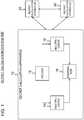
- FIG. 1is a block diagram illustrating the configuration of a secret calculation system relating to an exemplary embodiment.
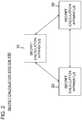
- FIG. 2is a drawing showing the configuration of a secret calculation system relating to a first exemplary embodiment.
- FIG. 3is a block diagram illustrating the configuration of a secret calculation apparatus in the secret calculation system relating to the first exemplary embodiment.
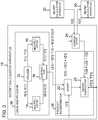
- FIG. 4is a block diagram illustrating the configuration of a secret calculation apparatus in a secret calculation system relating to a second exemplary embodiment.
- FIG. 1is a block diagram illustrating the configuration of a secret calculation system 100 relating to an exemplary embodiment.
- the secret calculation system 100comprises three secret calculation apparatuses 10 , 20 , and 30 .
- the secret calculation apparatuses 10 , 20 , and 30will be referred to as the first, the second and the third secret calculation apparatuses, respectively.
- FIG. 2is a drawing illustrating the configuration of the secret calculation system 100 relating to the present exemplary embodiment.
- the secret calculation system 100comprises three secret calculation apparatuses 10 , 20 , and 30 .
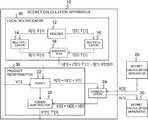
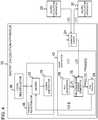
- FIG. 3is a block diagram illustrating the configuration of the secret calculation apparatus 10 .
- the secret calculation apparatuses 20 and 30are configured identically to the secret calculation apparatus 10 .
- the secret calculation apparatus 10comprises a local multiplicator 36 , a product redistributor 38 , and a communicator 24 .
- the local multiplicator 36comprises the holder 12 , the multiplicators and 16 , and the subtractor 18 .
- the product redistributor 38comprises an adder 22 and an adder/subtractor 26 .
- the secret calculation apparatuses 10 , 20 , and 30divide a value W and hold the divided values.
- the holder 12 of the secret calculation apparatus 20holds (R[2], R[1] ⁇ W mod Q)
- the holder 12 of the secret calculation apparatus 30holds (R[3], R[2] ⁇ W mod Q).
- bit Wis divided and distributed among the secret calculation apparatuses 10 , 20 , and 30 as follows.
- bit W′is divided and distributed among the secret calculation apparatuses 10 , 20 , and 30 as follows.
- bit Wis divided and distributed among the apparatuses 10 , 20 , and 30 .
- the bit Wis negated while remaining distributed as follows.
- the multiplicator 14calculates the logical conjunction of the first element of the first input S[1] and the first element of the second input S′[1] held by the holder 12 and outputs the result to the subtractor 18 .
- the multiplicator 16calculates the logical conjunction of the second element of the first input T[2] and the second element of the second input T′[ 1 ] and outputs the result to the subtractor 18 .
- the logical conjunction W′′cannot be restored only from the local product elements calculated by the secret calculation apparatuses.
- (U[1], U[2], U[3])equals W ⁇ W′ divided and distributed into three values.
- each secret calculation apparatusis able to calculate the newly distributed value without communicating with the other secret calculation apparatuses.
- sum operationscan be performed any number of times without having the apparatuses communicate with each other until the input of a next product.
- a productis calculated using the result of a product calculation, the next processing should be performed.
- the product redistributors 38 of the secret calculation apparatuses 10 , 20 , and 30are used.
- the secret calculation apparatuses 10 , 20 , and 30supplies a given mask V[i] to the product redistributor 38 .
- the communicator 24 of the secret calculation apparatus 30transmits the derived first sum X[3] to the secret calculation apparatus 20 .
- the secret calculation apparatuses 10 , 20 , and 30receive the first sums X[ 2 ], X[3], and X[ 1 ], respectively, from the communicators 24 and output the received first sums X[ 2 ], X[3], and X[ 1 ] to the adder/subtractors 26 .
- Each of the secret calculation apparatuses 10 , 20 , and 30calculates an output first element S′′[i] and an output second element T′′[i] using the first sums X[ 1 ], X[ 2 ], and X[3] calculated by its own adder 22 and the received first sums X[ 2 ], X[3], and X[ 1 ].
- the fact that the value of the logical conjunction W′′, like W and W′, can be restored by two secret calculation apparatusescan be explained on the basis of the restoration method in the case where the secret calculation apparatuses 10 and 20 cooperate with each other.
- the logical conjunction W′′can be restored using the output first element S′′[1] from the secret calculation apparatus 10 and the output second element T′′[2] from the secret calculation apparatus 20 as follows.
- the sum mod Q of two values divided and distributed among three secret calculation apparatusescan be calculated without having these secret calculation apparatuses communicate with each other and can be held by the three secret calculation apparatuses in a distributed manner.
- a method for holding the sum calculation resultis the same as the method for holding each of the two bits in the beginning.
- the secret calculation system of the present exemplary embodimentby calculating the product mod Q of two values divided and distributed among three secret calculation apparatuses while having these secret calculation apparatuses communicate with each other, the calculation result can be held by the three secret calculation apparatuses in a distributed manner.
- the entire communication amount generated at this timeis only 3n bits and is significantly less than the communication amount required in the secret calculation between two apparatuses described in Non-Patent Literature 2.
- a method for holding the value of the product calculation resultis the same as the method for holding each of the two values in the beginning.
- both product and sum calculation resultsare held by the same method as that for holding the values before the calculations. As a result, it becomes possible to further continue product and sum operations on the calculation results.
- a function described by sum and product mod Qcan be calculated using three secret calculation apparatuses with a small communication amount while the data is divided and distributed.
- any polynomial mod Qcan be calculated while data is distributed and hidden among a plurality of secret calculation apparatuses. Further, the amount of communication and calculation required for such calculation can be reduced, compared with the related technologies.
- a secret calculation systemalso contributes to preventing the administrator of the secret calculation apparatuses from stealing the data. This is because, with different administrators allocated to a plurality of secret calculation apparatuses, no administrator is able to refer to the data in all the secret calculation apparatuses and this will prevent the stealing of the data by an administrator.
- FIG. 4is a block diagram illustrating the configuration of a secret calculation apparatus 10 in the secret calculation system of the present exemplary embodiment.
- Secret calculation apparatuses 20 and 30are configured identically to the secret calculation apparatus 10 .
- the secret calculation apparatus 10further comprises a mask generator 42 , compared with the secret calculation apparatus 10 ( FIG. 3 ) of the first exemplary embodiment.
- the mask generator 42comprises a key generator 28 , a pseudorandom number generator 32 , and a subtractor 34 . Further, since the operation of the local multiplicator 36 and the product redistributor 38 in the present exemplary embodiment is the same as that of these elements in the first exemplary embodiment, the explanation will be omitted.
- the mask generator 42achieves this.
- Kis a safety variable.
- the key generators 28 of the secret calculation apparatuses 10 , 20 , and 30generate K-bit keys L[ 1 ], L[ 2 ], and L[3].
- the communicator 24 of the secret calculation apparatus 10transmits the generated key L[ 1 ] to the secret calculation apparatus 30 .
- the communicator 24 of the secret calculation apparatus 20transmits the generated key L[ 2 ] to the secret calculation apparatus 10 .
- the communicator 24 of the secret calculation apparatus 30transmits the generated key L[3] to the secret calculation apparatus 20 .
- the communicators 24 of the secret calculation apparatuses 10 , 20 , and 30receive the keys L[ 2 ], L[3], and L[ 1 ] from the secret calculation apparatuses 20 , 30 , and 10 , respectively.
- the received keyswill be referred to as the received keys hereinafter.
- the pseudorandom number generator 32has a pseudorandom number generator PRG.
- the PRGis a pseudorandom number generator that outputs an nN-bit string from a K-bit string.
- the pseudorandom number generator 32 of the secret calculation apparatus 10generates a first pseudorandom number PRG (L[ 1 ]) from the key L[ 1 ] and a second pseudorandom number PRG (L[ 2 ]) from the received key L[ 2 ].
- the subtractor 34generates N number of n-bit random numbers by dividing the first and the second pseudorandom numbers PRG (L[ 1 ]) and PRG (L[ 2 ]) by n bits and deriving the difference mod Q of each.
- the secret calculation apparatus 20generates a first pseudorandom number PRG (L[ 2 ]) and a second pseudorandom number
- PRG (L[3])using the pseudorandom number generator 32 , and generates a string of N number of n-bit random numbers from the first and the second pseudorandom numbers PRG (L[ 2 ]) and PRG (L[3]) using the subtractor 34 .
- the secret calculation apparatus 30similarly generates a first pseudorandom number PRG (L[3]) and a second pseudorandom number PRG (L[ 1 ]) using the pseudorandom number generator 32 , and generates a string of N number of n-bit random numbers from the first and the second pseudorandom numbers PRG (L[3]) and PRG (L[ 1 ]) using the subtractor 34 .
- the mask generator 42 of the secret calculation apparatus 20supplies the generated random number V[i.2] to the adder 22 of the product redistributor 38 .
- the mask generator 42 of the secret calculation apparatus 30supplies the generated random number V[i.3] to the adder 22 of the product redistributor 38 .
- the secret calculation system relating to the present exemplary embodimentbrings the same effects as the secret calculation system relating to the first exemplary embodiment. Further, according to the secret calculation system of the present exemplary embodiment, it becomes possible to perform secret calculations of a large amount of products at high speed by utilizing a mask generated by the mask generator.
- a communicatorthat transmits the sum X[i] calculated by the adder to an ⁇ (i+1 mod 3)+1 ⁇ th secret calculation apparatus and receives a sum X[i mod 3+1] calculated by the adder of an (i mod 3+1) th secret calculation apparatus;
- Kis a natural number
- Nis a natural number
- the communicatortransmits the key L[i] to an ⁇ (i+1 mod 3)+1 ⁇ th secret calculation apparatus and receives a key L[i mod 3+1] calculated by the key generator of an (i mod 3+1) th secret calculation apparatus,
- the pseudorandom number generatorgenerates a first pseudorandom number on the basis of the key L[i] and generates a second pseudorandom number on the basis of the key L[i mod 3+1], and the second subtractor extracts every n bits from the first and the second pseudorandom numbers and calculates the difference mod Q.
Landscapes
- Engineering & Computer Science (AREA)
- General Physics & Mathematics (AREA)
- Physics & Mathematics (AREA)
- Theoretical Computer Science (AREA)
- Pure & Applied Mathematics (AREA)
- Mathematical Analysis (AREA)
- Mathematical Optimization (AREA)
- Computational Mathematics (AREA)
- Computing Systems (AREA)
- General Engineering & Computer Science (AREA)
- Computer Security & Cryptography (AREA)
- Computer Networks & Wireless Communication (AREA)
- Signal Processing (AREA)
- Nonlinear Science (AREA)
- Mathematical Physics (AREA)
- Storage Device Security (AREA)
Abstract
Description
This application is a National Stage of International Application No. PCT/JP2016/075186, filed Aug. 29, 2016, claiming priority based on Japanese Patent Application No. 2015-169992, Aug. 31, 2015, the disclosures of which are incorporated herein in their entirety by reference thereto.
The present invention relates to a secret calculation apparatus, secret calculation system, and secret calculation method, and particularly to a secret calculation system, in which a plurality of secret calculation apparatuses calculate an output of a given function while communicating with each other and input/output information for the function cannot be obtained unless data is shared by a predetermined number of the secret calculation apparatuses, a secret calculation apparatus that constitutes such a secret calculation system, and a secret calculation method by the secret calculation system.
Non-Patent Literature (NPL) 1 describes a secret calculation method that divides a secret S, which is a value on a field, and distributes it among a plurality of apparatuses using a polynomial F that satisfies F(0)=S in the polynomial F on the field.
Further, Non-PatentLiterature 2 describes a secret calculation method when the number of apparatuses is two.
[NPL 1]
Tal Rabin, Michael Ben-Or, “Verifiable Secret Sharing and Multiparty Protocols with Honest Majority (Extended Abstract),” STOC 1989, pp. 73-85.
[NPL 2]
Oded Goldreich, Ronen Vainish, “How to Solve any Protocol Problem—An Efficiency Improvement,” CRYPTO 1987, pp. 73-86.
Each disclosure ofNon-Patent Literatures
In the method described inNon-Patent Literature 1, a value (secret S) on a field is divided and distributed among a plurality of apparatuses using a polynomial F that satisfies F(0)=S in the polynomial F on the field. Here, let us assume that the number of the apparatuses is N and that input/output information for a function cannot be obtained when the number of the apparatuses is less than K. Further, we'll assume that different values on the field are assigned to all the apparatuses. Specifically, the value on the field assigned to an apparatus i is X[i] (i=1, . . . , N). When a secret A is divided and distributed among the plurality of apparatuses, F[i]:=F(X[i]) related to a (K-1)thorder polynomial F randomly selected where F(0)=A is given to the ithapparatus. Similarly for a secret B, G[i]:=G(X[i]) related to a (K-1)thorder polynomial G where G(0)=B is given to the ithapparatus. The (K-1)thorder polynomials F and G (i.e., the coefficients of F and G) can be derived when K number of apparatuses or more get together. In other words, F(0) and G(0) can be calculated and the secrets A and B can be derived.
At this time, in order to calculate the value obtained by dividing and distributing A+B, the ithapparatus calculate H[i]=F[i]+G[i]. This value is H(X[i]) obtained by plugging X[i] into a polynomial H with a coefficient obtained by adding the corresponding coefficients of F and G. Therefore, A+B is divided and distributed among a plurality of apparatuses as A and B. As in the case of A and B, K number of apparatuses or more can derive the (K-1)thorder polynomial H (i.e., the coefficient of the polynomial H). In other words, H(0) can be calculated and the secret A+B can be derived.
Further, in a case of 2K≤N+1, in order to calculate values obtained by dividing and distributing A*B, the ithapparatus calculate H[i]=F[i]*G[i]. This value is H(X[i]) obtained by plugging X[i] into a 2K-degree polynomial H(X)=F(X)*G(X). Therefore, A*B is divided and distributed among a plurality of apparatuses as A and B. It should be note that the degree of H is 2K unlike the case of A and B. As a result, 2K number of apparatuses or more can derive the 2K-degree polynomial H (i.e., the coefficient of the polynomial H), making it possible to calculate H(0). Here, A*B is divided and distributed differently from A and B. In order to divide and distribute A*B using the (K-1)thorder polynomial in the same way as A and B are divided and distributed, the ithapparatus generates a (K-1)thpolynomial G from H[i] and gives G(X[i]) to a jthapparatus. As described, all functions involving addition and multiplication can be calculated.
According to the method described in Non-PatentLiterature 1, multiplication and addition on a field is easily performed. 2K≤N+1, however, is imposed as a condition. Further, if K is less than 2, a single apparatus will be able to derive the secret. Therefore, N should be 3 or greater. Since X[i] should be a different value for a different i, available fields do not include GF(2). Since available fields do not include GF(2), exclusive OR cannot be performed using addition.
Non-PatentLiterature 2 describes the method using two apparatuses. In this method, when a bit, i.e., an element b on GF(2), is divided and distributed between two apparatuses, b and c where b+c=b mod 2 is divided and distributed between the two apparatuses. In such a method, when bits A and B are divided and distributed betweenapparatuses apparatus 1 holds C and E, and theapparatus 2 holds D and F where A=C+D mod 2, B=E+F mod 2. At this time, G=A+B mod 2 where G is the exclusive OR of A and B, and theapparatuses E mod 2 and J=D+F mod 2, respectively. Each apparatus is able to calculate the dividing and distributing of the exclusive OR of the two distributed values with a small calculation amount without communicating with the other apparatus.
Similarly, when A and B are divided and distributed, out of L and M where L+M=K mod 2, i.e., each fragment of K=A·B, the logical conjunction of these two bits, theapparatus 1 obtains L and theapparatus 2 obtains M as follows. Theapparatus 1 randomly generates L. At this time, M=(C+D)·(E+F)=L mod 2. Then, depending on the values of D and F held by theapparatus 2, theapparatus 1 returns the following to theapparatus 2 without knowing the value of M: M=(C+0)·(E+0)+L mod 2 when (D, F)=(0, 0); M=(C+0)·(1+E)+L mod 2 when (D, F)=(0, 1); M=(1+C)·(E+0)+L mod 2 when (D, F)=(1, 0); and M=(1+C)·(1+E)+L mod 2 when (D, F)=(1, 1). In other words, the value sent by theapparatus 1 to theapparatus 2 depends on the input to theapparatus 2. A technology between theapparatuses apparatus 1 is oblivious of the input to theapparatus 2. According to such a technology, however, theapparatuses
According to the method described inNon-Patent Literature 1, it becomes possible to calculate logical conjunction in a distributed manner with a small amount of communication and calculation. In the method described inNon-Patent Literature 1, however, calculating exclusive OR in a distributed manner requires communication and a certain amount of calculation as in the case of logical conjunction calculation.
Meanwhile, the method described in Non-PatentLiterature 2 has an advantage that calculating exclusive OR in a distributed manner does not require communication. In the method described inNon-Patent Literature 2, however, logical conjunction requires communication as well as calculation.
Therefore, what is desired is to enable a plurality of apparatuses to calculate the original exclusive OR of the bit, i.e., GF(2), in a distributed manner without having these apparatuses communicate with each other and to calculate the logical conjunction of the bit in a distributed manner with a small amount of communication and calculation as well. By achieving this, it becomes possible to have a plurality of apparatuses calculate a function in a distributed manner at high speed without letting any of the apparatuses know (calculate) the data by breaking the function into logic gates and describing it with exclusive OR and logical conjunction.
It is an object of the present invention to provide a secret calculation system, secret calculation apparatus, and secret calculation method realizing a secret calculation in which addition is easy and the amount of communication and calculation required for multiplication is small.
A secret calculation system relating to a first aspect of the present invention comprises three secret calculation apparatuses. An ithsecret calculation apparatus (i=1, 2, 3) comprises a holder that holds (S[i], T[i]) and (S′[i], T′[i]) as distributed values of an n-bit number W and an n-bit W′ (n=any natural number), respectively. Further, the ithsecret calculation apparatus comprises a first multiplicator that derives a logical conjunction of S[i] and S′[i], and a second multiplicator that derives a logical conjunction of T[i] and T′[i]. Further, the ithsecret calculation apparatus comprises a first subtractor that derives a difference between the logical conjunction derived by the first multiplicator and the logical conjunction derived by the second multiplicator.
A secret calculation apparatus relating to a second aspect of the present invention is a secret calculation apparatus included in the secret calculation system.
A secret calculation method relating to a third aspect of the present invention uses three secret calculation apparatuses. The secret calculation method includes having an ithsecret calculation apparatus (i=1, 2, 3) hold (S[i], T[i]) and (S′[i], T′[i]) as distributed values of an n-bit number W and an n-bit W′ (n is any natural number), respectively. Further, the secret calculation method includes deriving a logical conjunction of S[i] and S′[i] as a first logical conjunction, and deriving a logical conjunction of T[i] and T′[i] as a second logical conjunction. Further, the secret calculation method includes deriving a difference between the first logical conjunction and the second logical conjunction.
The secret calculation system, the secret calculation apparatus, and the secret calculation method relating to the present invention realizes a secret calculation in which addition is easy and the amount of communication and calculation required for multiplication is small.
First, a summary of an exemplary embodiment will be given. Note that drawing reference signs in the summary are given solely to facilitate understanding and are not intended to limit the present invention to the modes shown in the drawings.
Further, when R[1], R[2], R[3] and R′[1], R′[2], R′[3] are n-bit random numbers that satisfy R[1]+R[2]+R[3]=0 mod Q, and R′[1]+R′[2]+R′[3]=0 mod Q, the distributed values are as follows.
(S[1],T[1])=(R[1],R[3]−WmodQ),
(S[2],T[2])=(R[2],R[1]−WmodQ),
(S[3],T[3])=(R[3],R[2]−WmodQ),
(S′[1],T′[1])=(R′[1],R′[3]−W′ modQ),
(S′[2],T′[2])=(R′[2],R′[1]−W′ modQ),
(S′[3],T′[3])=(R′[3],R′[2]−W′ modQ)
(S[1],T[1])=(R[1],R[3]−WmodQ),
(S[2],T[2])=(R[2],R[1]−WmodQ),
(S[3],T[3])=(R[3],R[2]−WmodQ),
(S′[1],T′[1])=(R′[1],R′[3]−W′ modQ),
(S′[2],T′[2])=(R′[2],R′[1]−W′ modQ),
(S′[3],T′[3])=(R′[3],R′[2]−W′ modQ)
Here, Q is an integer coprime to 3 (for instance Q=2^n where n is a natural number).
In this secret calculation system, the ithapparatus is able to derive a local product element U[i]=(T[i]·T′[i]−S[i]·S′[i])/3 mod Q using the first and the second multiplicators and the first subtractor. Here, since U[1]+U[2]+U[3]=WW′ mod Q, three apparatuses can cooperate to restore the logical conjunction W″=W·W′ mod Q. According to the secret calculation system of an exemplary embodiment, it becomes possible to perform addition without having the apparatuses communicate with each other and calculate logical conjunction with a small amount of calculation.
Next, a secret calculation system relating to a first exemplary embodiment will be described with reference to the drawings.
Thesecret calculation apparatuses holder 12 of thesecret calculation apparatus 10 holds (R[1], R[3]−W mod Q) using three randomly selected numbers R[1], R[2], and R[3] for n, which is an integer not less than 1, where R[1]+R[2]+R[3]=0 mod Q. Similarly, theholder 12 of thesecret calculation apparatus 20 holds (R[2], R[1]−W mod Q) and theholder 12 of thesecret calculation apparatus 30 holds (R[3], R[2]−W mod Q). Here, Q and 3 are coprime (for instance Q=2^n where n is a natural number).
When two out of the threesecret calculation apparatuses secret calculation apparatuses holder 12 of thesecret calculation apparatus 10 and R[1]−W mod Q held by theholder 12 of thesecret calculation apparatus 20.
(Addition without Communication)
Next, how thesecret calculation apparatuses secret calculation apparatuses
Here, it is assumed that the bit W is divided and distributed among thesecret calculation apparatuses mod 2, theholder 12 of thesecret calculation apparatus 10 holds (S[1], T[1]):=(R[1], W+R[2] mod 2). Similarly, theholder 12 of thesecret calculation apparatus 20 holds (S[2], T[2]):=(R[2], W+R[3] mod 2), and theholder 12 of thesecret calculation apparatus 30 holds (S[3], T[3]):=(R[3], W+R[1] mod 2).
Meanwhile, it is assumed that the bit W′ is divided and distributed among thesecret calculation apparatuses
Using three randomly selected bits R′[1], R′[2], and R′[3] where R′[1]+R′[2]+R′[3]=0mod 2, theholder 12 of thesecret calculation apparatus 10 holds (S′[1], T′[1]):=(R′[1], W′+R′[2] mod 2). Similarly, theholder 12 of thesecret calculation apparatus 20 holds (S′[2], T′[2]):=(R′[2], W′+R′[3] mod 2), and theholder 12 of thesecret calculation apparatus 30 holds (S′[3], T′[3]):=(R′[3], W′+R′[1] mod 2).
At this time, thesecret calculation apparatus 10 calculates (S″[1], T″[1])=(S[1]+S′[1]mod 2, T[1]+T′[1] mod 2). Similarly, thesecret calculation apparatus 20 calculates (S″[2], T″[2])=(S[2]+S′[2]mod 2, T[2]+T′[2] mod 2). Further, thesecret calculation apparatus 30 calculates (S″[3], T″[3])=(S[3]+S′[3]mod 2, T[3]+T′[3] mod 2). Each of thesecret calculation apparatuses mod 2 in a distributed manner. W″ can be restored from these results as the original W or W′. Therefore, addition can be performed without having thesecret calculation apparatuses
(Negation)
Next, the operation of negation will be described. When the bit W is divided and distributed among theapparatuses
The bit W is assumed to be distributed among thesecret calculation apparatuses mod 2, theholder 12 of thesecret calculation apparatus 10 holds (S[1], T[1]):=(R[1], W +R[2] mod 2). Similarly, theholder 12 of thesecret calculation apparatus 20 holds (S[2], T[2]):=(R[2], W+R[3] mod 2). Further, theholder 12 of thesecret calculation apparatus 30 holds (S[3], T[3]) =(R[3], W+R[1] mod 2).
At this time, thesecret calculation apparatus 10 calculates (S′[1], T′[1])=(S[1], T[1]+1 mod 2). Similarly, thesecret calculation apparatus 20 calculates (S′[2], T′[2])=(S[2], T[2]+1 mod 2). Further, thesecret calculation apparatus 30 calculates (S′[3], T′[3])=(S[3], T[3]+1 mod 2). Each of thesecret calculation apparatuses mod 2 in a distributed manner. W′ can be restored from these results as the original W′. Therefore, negation can be performed without having thesecret calculation apparatuses
(Logical Conjunction)
Next, the operation of logical conjunction will be described. Thelocal multiplicator 36 and the product redistributor38 shown inFIG. 3 are used in the logical conjunction operation. When the bits W and W′ are divided and distributed among thesecret calculation apparatuses
The bit W is assumed to be distributed among thesecret calculation apparatuses holder 12 of thesecret calculation apparatus 10 holds (S[1], T[1]):=(R[1], R[3]−W mod Q). Similarly, theholder 12 of thesecret calculation apparatus 20 holds (S[2], T[2]):=(R[2], R[1]−W mod 2). Further, theholder 12 of thesecret calculation apparatus 30 holds (S[3], T[3])=(R[3], R[2]−W mod Q).
Meanwhile, the bit W′ is assumed to be distributed among thesecret calculation apparatuses holder 12 of thesecret calculation apparatus 10 holds (S′[1], T′[1])=(R′[1], R′[3]−W′ mod Q). Similarly, theholder 12 of thesecret calculation apparatus 20 holds (S′[2], T′[2]):=(R′[2], R′[1]−W′ mod Q). Further, theholder 12 of thesecret calculation apparatus 30 holds (S′[3], T′[3]):=(R′[3], R′[2]−W′ mod Q).
At this time, in thelocal multiplicator 36 of thesecret calculation apparatus 10, themultiplicator 14 calculates the logical conjunction of the first element of the first input S[1] and the first element of the second input S′[1] held by theholder 12 and outputs the result to thesubtractor 18. Meanwhile, themultiplicator 16 calculates the logical conjunction of the second element of the first input T[2] and the second element of the second input T′[1] and outputs the result to thesubtractor 18. Thesubtractor 18 calculates a local product element U[1]=(T[1]·T′[1]−S[1]·S′[1])/3 mod Q on the basis of the outputs from themultiplicators
Similarly, thelocal multiplicator 36 of thesecret calculation apparatus 20 calculates a local product element U[2]=(T[2]·T′[2]−S[2]·S′[2])/3 mod Q. Further, thelocal multiplicator 36 of thesecret calculation apparatus 30 calculates a local product element U[3]=(T[3]−T′[3]—S[3]·S′[3])/3 mod Q. With each of the calculation results, thesecret calculation apparatuses
At this time, like the original W or W′, the logical conjunction W″ cannot be restored only from the local product elements calculated by the secret calculation apparatuses. The logical conjunction W″ can be directly restored from the local product elements calculated by the secret calculation apparatuses by calculating W″=U[1]+U[2]+U[3] mod Q. The following calculations indicate that the logical conjunction W″ can be restored.
Further, since Q and 3 are coprime, the reciprocal of 3 mod Q can always be calculated.
As described, (U[1], U[2], U[3]) equals W·W′ divided and distributed into three values. Similarly, when (U′[1], U′[2], U′[3]) equals Z divided and distributed into three values where Z=U′[1]+U′[2]+U′[3] mod Q, W·W′+Z mod Q is divided and distributed into the following three values: (U[1]+U′[1] mod Q, U[2]+U′[2] mod Q, U[3] +U′[3] mod Q). Let's assume that thesecret calculation apparatus 10 holds U[1] and U′[1], the secret calculation apparatus20 U[2] and U′[2], and the secret calculation apparatus 30 U[3] and U′[3]. In this case, each secret calculation apparatus is able to calculate the newly distributed value without communicating with the other secret calculation apparatuses. In other words, when a function is constituted by sums and products mod Q, sum operations can be performed any number of times without having the apparatuses communicate with each other until the input of a next product. When a product is calculated using the result of a product calculation, the next processing should be performed.
In order to divide the logical conjunction W″ and distribute it among the three secret calculation apparatuses in the same manner as W and W′, theproduct redistributors 38 of thesecret calculation apparatuses
Here, there are randomly selected masks V[1], V[2], and V[3] where V[1]+V[2]+V[3]=0 mod Q, and the mask V[1] is given to thesecret calculation apparatus 10, the mask V[2] to thesecret calculation apparatus 20, and the mask V[3] to thesecret calculation apparatus 30 in advance.
Thesecret calculation apparatuses product redistributor 38. Theadder 22 of thesecret calculation apparatus 30 calculates the sum of the local product element U[3] and the mask V[3] as in X[3]=U[3]+V[3] mod Q and calls the result a first sum X[3]. Then thecommunicator 24 of thesecret calculation apparatus 30 transmits the derived first sum X[3] to thesecret calculation apparatus 20. Similarly, theadder 22 of thesecret calculation apparatus 20 generates a first sum X[2]=U[2]+V[2] mod n^2 and transmits the generated first sum X[2] to thesecret calculation apparatus 10 via thecommunicator 24 of thesecret calculation apparatus 20. Further, theadder 22 of thesecret calculation apparatus 10 generates a first sum X[1]=U[1]+V[1] mod Q and transmits the generated first sum X[1] to thesecret calculation apparatus 30 via thecommunicator 24 of thesecret calculation apparatus 10.
Thesecret calculation apparatuses communicators 24 and output the received first sums X[2], X[3], and X[1] to the adder/subtractors 26. Each of thesecret calculation apparatuses own adder 22 and the received first sums X[2], X[3], and X[1]. More concretely, the adder/subtractor 26 of thesecret calculation apparatus 10 calculates (S″[1], T″[1])=(X[1]−X[2] mod Q, −2X[1]−X[2] mod Q). Similarly, the adder/subtractor 26 of thesecret calculation apparatus 20 calculates (S″[2], T″[2])=(X[2]−X[3] mod Q, −2X[2]−X[3] mod Q). Further, the adder/subtractor 26 of thesecret calculation apparatus 30 calculates (S″[3], T″[3])=(X[3]−X[1] mod Q, −2X[3]−X[1] mod Q).
Without loss of generality, the fact that the value of the logical conjunction W″, like W and W′, can be restored by two secret calculation apparatuses can be explained on the basis of the restoration method in the case where thesecret calculation apparatuses secret calculation apparatus 10 and the output second element T″[2] from thesecret calculation apparatus 20 as follows.
Further, the following calculation shows the logical conjunction W″ is divided and distributed as W and W′.
(Effects)
By using the secret calculation system relating to the present exemplary embodiment, the sum mod Q of two values divided and distributed among three secret calculation apparatuses can be calculated without having these secret calculation apparatuses communicate with each other and can be held by the three secret calculation apparatuses in a distributed manner. Here, a method for holding the sum calculation result is the same as the method for holding each of the two bits in the beginning.
Further, according to the secret calculation system of the present exemplary embodiment, by calculating the product mod Q of two values divided and distributed among three secret calculation apparatuses while having these secret calculation apparatuses communicate with each other, the calculation result can be held by the three secret calculation apparatuses in a distributed manner. The entire communication amount generated at this time is only 3n bits and is significantly less than the communication amount required in the secret calculation between two apparatuses described inNon-Patent Literature 2. Here, a method for holding the value of the product calculation result is the same as the method for holding each of the two values in the beginning.
As described, both product and sum calculation results are held by the same method as that for holding the values before the calculations. As a result, it becomes possible to further continue product and sum operations on the calculation results. In other words, according to the secret calculation system of the present exemplary embodiment, a function described by sum and product mod Q can be calculated using three secret calculation apparatuses with a small communication amount while the data is divided and distributed.
As described above, according to the present exemplary embodiment, any polynomial mod Q can be calculated while data is distributed and hidden among a plurality of secret calculation apparatuses. Further, the amount of communication and calculation required for such calculation can be reduced, compared with the related technologies. In a case where a service is provided with the secret calculation apparatuses handling secret data, such a secret calculation system also contributes to preventing the administrator of the secret calculation apparatuses from stealing the data. This is because, with different administrators allocated to a plurality of secret calculation apparatuses, no administrator is able to refer to the data in all the secret calculation apparatuses and this will prevent the stealing of the data by an administrator.
Next, a secret calculation system relating to a second exemplary embodiment will be described with reference to the drawings.FIG. 4 is a block diagram illustrating the configuration of asecret calculation apparatus 10 in the secret calculation system of the present exemplary embodiment.Secret calculation apparatuses secret calculation apparatus 10.
InFIG. 4 , in the present exemplary embodiment, thesecret calculation apparatus 10 further comprises amask generator 42, compared with the secret calculation apparatus10 (FIG. 3 ) of the first exemplary embodiment. Themask generator 42 comprises akey generator 28, apseudorandom number generator 32, and asubtractor 34. Further, since the operation of thelocal multiplicator 36 and the product redistributor38 in the present exemplary embodiment is the same as that of these elements in the first exemplary embodiment, the explanation will be omitted.
In the first exemplary embodiment, it is assumed that thesecret calculation apparatuses mask generator 42 achieves this.
Here, K is a safety variable. Thekey generators 28 of thesecret calculation apparatuses communicator 24 of thesecret calculation apparatus 10 transmits the generated key L[1] to thesecret calculation apparatus 30. Similarly, thecommunicator 24 of thesecret calculation apparatus 20 transmits the generated key L[2] to thesecret calculation apparatus 10. Further, thecommunicator 24 of thesecret calculation apparatus 30 transmits the generated key L[3] to thesecret calculation apparatus 20.
Thecommunicators 24 of thesecret calculation apparatuses secret calculation apparatuses
Thepseudorandom number generator 32 has a pseudorandom number generator PRG. Here, the PRG is a pseudorandom number generator that outputs an nN-bit string from a K-bit string. Thepseudorandom number generator 32 of thesecret calculation apparatus 10 generates a first pseudorandom number PRG (L[1]) from the key L[1] and a second pseudorandom number PRG (L[2]) from the received key L[2]. Thesubtractor 34 generates N number of n-bit random numbers by dividing the first and the second pseudorandom numbers PRG (L[1]) and PRG (L[2]) by n bits and deriving the difference mod Q of each. Here, an ithn-bit random number from the first one is V[i.1] (i=1, . . . , N).
Similarly, thesecret calculation apparatus 20 generates a first pseudorandom number PRG (L[2]) and a second pseudorandom number
PRG (L[3]) using thepseudorandom number generator 32, and generates a string of N number of n-bit random numbers from the first and the second pseudorandom numbers PRG (L[2]) and PRG (L[3]) using thesubtractor 34. Here, an ithn-bit random number from the first one is V[i.2] (i=1, . . . , N). Further, thesecret calculation apparatus 30 similarly generates a first pseudorandom number PRG (L[3]) and a second pseudorandom number PRG (L[1]) using thepseudorandom number generator 32, and generates a string of N number of n-bit random numbers from the first and the second pseudorandom numbers PRG (L[3]) and PRG (L[1]) using thesubtractor 34. Here, an ithn-bit random number from the first one is V[i.3] (i=1, . . . , N).
Themask generator 42 of thesecret calculation apparatus 10 supplies the generated random number V[i.1] (i=1, . . . , N) to theadder 22 of theproduct redistributor 38. Similarly, themask generator 42 of thesecret calculation apparatus 20 supplies the generated random number V[i.2] to theadder 22 of theproduct redistributor 38. Further, themask generator 42 of thesecret calculation apparatus 30 supplies the generated random number V[i.3] to theadder 22 of theproduct redistributor 38.
The secret calculation system relating to the present exemplary embodiment brings the same effects as the secret calculation system relating to the first exemplary embodiment. Further, according to the secret calculation system of the present exemplary embodiment, it becomes possible to perform secret calculations of a large amount of products at high speed by utilizing a mask generated by the mask generator.
Further, the following modes are possible in the present invention.
[Mode 1]
As the secret calculation system relating to the first aspect.
[Mode 2]
The secret calculation system according toMode 1, wherein the distributed values are
(S[1],T[1])=(R[1],R[3]−WmodQ),
(S[2],T[2])=(R[2],R[1]−WmodQ),
(S[3],T[3])=(R[3],R[2]−WmodQ),
(S′[1],T′[1])=(R′[1],R′[3]−W′ modQ),
(S′[2],T′[2])=(R′[2],R′[1]−W′ modQ),
(S′[3],T′[3])=(R′[3],R′[2]−W′ modQ)
(S[1],T[1])=(R[1],R[3]−WmodQ),
(S[2],T[2])=(R[2],R[1]−WmodQ),
(S[3],T[3])=(R[3],R[2]−WmodQ),
(S′[1],T′[1])=(R′[1],R′[3]−W′ modQ),
(S′[2],T′[2])=(R′[2],R′[1]−W′ modQ),
(S′[3],T′[3])=(R′[3],R′[2]−W′ modQ)
when R[1], R[2], R[3] and R′[1], R′[2], R′[3] are n-bit random numbers that satisfy R[1]+R[2]+R[3]=0 mod Q, and R′[1]+R′[2]+R′[3]=0 mod Q (Q is an integer coprime to 3).
[Mode 3]
The secret calculation system according toMode
an adder that derives a sum X[i] of U[i] and V[i];
a communicator that transmits the sum X[i] calculated by the adder to an {(i+1 mod 3)+1}thsecret calculation apparatus and receives a sum X[i mod 3+1] calculated by the adder of an (i mod 3+1)thsecret calculation apparatus; and
an adder/subtractor that calculates distributed values (S″[i], T″[i]) of a product W·W′ on the basis of addition/subtraction using the sum X[i] and the sum X[i mod 3+1]
when V[1], V[2], and V[3] are n-bit random numbers that satisfy V[1]+V[2]+V[3]=0 mod Q.
[Mode 4]
The secret calculation system according to Mode 3, wherein the distributed values are (S″[i], T″[i]) =(X[i]−X[i mod 3+1] mode Q, −2X[i]−X[i mod 3+1]).
[Mode 5]
The secret calculation system according to any one ofModes 1 to 4, wherein
the ithsecret calculation apparatus (i=1, 2, 3) comprises:
a key generator that generates a K-bit key L[i] (K is a natural number); a pseudorandom number generator that generates an nN-bit random number (N is a natural number) from a K-bit key; and
a second subtractor that extracts every n bits from two nN-bit numbers and derives the difference mod Q (Q is an integer coprime to 3), the communicator transmits the key L[i] to an {(i+1 mod 3)+1}thsecret calculation apparatus and receives a key L[i mod 3+1] calculated by the key generator of an (i mod 3+1)thsecret calculation apparatus,
the pseudorandom number generator generates a first pseudorandom number on the basis of the key L[i] and generates a second pseudorandom number on the basis of the key L[i mod 3+1], and the second subtractor extracts every n bits from the first and the second pseudorandom numbers and calculates the difference mod Q.
[Mode 6]
The secret calculation system according to Mode 5, wherein the adder of the ithsecret calculation apparatus (i=1, 2, 3) uses a value calculated by the second subtractor as the random number V[i].
[Mode 7]
As the secret calculation apparatus relating to the second aspect.
[Mode 8]
As the secret calculation method relating to the third aspect.
[Mode 9]
The secret calculation method according to Mode 8, wherein the distributed values are
(S[1],T[1])=(R[1],R[3]−WmodQ),
(S[2],T[2])=(R[2],R[1]−WmodQ),
(S[3],T[3])=(R[3],R[2]−WmodQ),
(S′[1],T′[1])=(R′[1],R′[3]−W′ modQ),
(S′[2],T′[2])=(R′[2],R′[1]−W′ modQ),
(S′[3],T′[3]) =(R′[3],R′[2]−W′ modQ)
(S[1],T[1])=(R[1],R[3]−WmodQ),
(S[2],T[2])=(R[2],R[1]−WmodQ),
(S[3],T[3])=(R[3],R[2]−WmodQ),
(S′[1],T′[1])=(R′[1],R′[3]−W′ modQ),
(S′[2],T′[2])=(R′[2],R′[1]−W′ modQ),
(S′[3],T′[3]) =(R′[3],R′[2]−W′ modQ)
when R[1], R[2], R[3] and R′[1], R′[2], R′[3] are n-bit random numbers that satisfy R[1] +R[2] +R[3] =0 mod Q, and R′[1] +R′[2] +R′[3] =0 mod Q (Q is an integer coprime to 3).
[Mode 10]
The secret calculation method according to Mode 8 or 9 including: having the ithsecret calculation apparatus (i=1, 2, 3) hold a local product element U[i]=(S[i]·S′[i]−T[i]·T′[i])/3 mod Q (Q is an integer coprime to 3) calculated using the derived difference;
having the ithsecret calculation apparatus derive a sum X[i] of U[i] and V[i];
having the ithsecret calculation apparatus transmit the calculated sum X[i] to an {(i+1 mod 3)+1}thsecret calculation apparatus;
having the ithsecret calculation apparatus receive a sum X[i mod 3+1] calculated by an (i mod 3+1)thsecret calculation apparatus; and
having the ithsecret calculation apparatus calculate distributed values (S″[i], T″[i]) of a product W·W′ on the basis of addition/subtraction using the sum X[i] and the sum X[i mod 3+1]
when V[1], V[2], and V[3] are n-bit random numbers that satisfy V[1]+V[2]+V[3]=0 mod Q.
[Mode 11]
The secret calculation method according toMode 10, wherein
the distributed values are (S″[i], T″[i]) =(X[i]−X[i mod 3+1] mode Q, −2X[i]−X[i mod 3+1]).
Further, the disclosure of each Non-Patent Literature cited above is incorporated herein in its entirety by reference thereto. It should be noted that other objects, features and aspects of the present invention will become apparent in the entire disclosure and that modifications may be done without departing the gist and scope of the present invention as disclosed herein and claimed as appended herewith. Also it should be noted that any combination of the disclosed and/or claimed elements, matters and/or items may fall under the modifications. Particularly, the ranges of the numerical values used in the present description should be interpreted as a numeric value or small range example included in these ranges even in cases where no explanation is provided.
10,20,30: secret calculation apparatus
12: holder
14,16: multiplicator
18,34: subtractor
22: adder
24: communicator
26: adder/subtractor
28: key generator
32: pseudorandom number generator
36: local multiplicator
38: product redistributor
42: mask generator
100: secret calculation system
Claims (10)
1. A secret calculation system comprising three secret calculation apparatuses sharing an n-bit number W and an n-bit W′ (n=any natural number) in secret to each other, wherein
an ithsecret calculation apparatus (i=1, 2, 3) comprises:
a holder that holds (S[i], T[i]) and (S′[i], T′[i]) as distributed values of the n-bit number W and the n-bit W′, respectively; and
a hardware processor configured to implement:
a first multiplicator that derives a logical conjunction of S[i] and S′[i];
a second multiplicator that derives a logical conjunction of T[i] and T′[i]; and
a first subtractor that derives a difference between the logical conjunction derived by the first multiplicator and the logical conjunction derived by the second multiplicator.
2. The secret calculation system according toclaim 1 , wherein
the distributed values are
(S[1],T[1])=(R[1],R[3]−WmodQ),
(S[2],T[2])=(R[2],R[1]−WmodQ),
(S[3],T[3])=(R[3],R[2]−WmodQ),
(S′[1],T′[1])=(R′[1],R′[3]−W′ modQ),
(S′[2],T′[2])=(R′[2],R′[1]−W′ modQ),
(S′[3],T′[3])=(R′[3],R′[2]−W′ modQ)
(S[1],T[1])=(R[1],R[3]−WmodQ),
(S[2],T[2])=(R[2],R[1]−WmodQ),
(S[3],T[3])=(R[3],R[2]−WmodQ),
(S′[1],T′[1])=(R′[1],R′[3]−W′ modQ),
(S′[2],T′[2])=(R′[2],R′[1]−W′ modQ),
(S′[3],T′[3])=(R′[3],R′[2]−W′ modQ)
when R[1], R[2], R[3] and R′[1], R′[2], R′ [3] are n-bit random numbers that satisfy R[1]+R[2]+R[3]=0 mod Q, and R′[1]+R′[2]+R′[3]=0 mod Q (Q is an integer coprime to 3).
3. The secret calculation system according toclaim 1 , wherein
the holder holds a local product element U[i]=(S[i]·S′[i]−T[i]·T′[i])/3 mod Q (Q is an integer coprime to 3) calculated using the first and the second multiplicators and the first subtractor, and
wherein the hardware processor of the ithsecret calculation apparatus (i=1, 2, 3) further configured to implement:
an adder that derives a sum X[i] of U[i] and V[i];
a communicator that transmits the sum X[i] calculated by the adder to an {(i+1 mod 3)+1}thsecret calculation apparatus and receives a sum X[i mod 3+1] calculated by the adder of an (i mod 3+1)thsecret calculation apparatus; and
an adder/subtractor that calculates distributed values (S″[i], T″[i]) of a product W·W′ on the basis of addition/subtraction using the sum X[i] and the sum X[i mod 3+1]
when V[1], V[2], and V[3] are n-bit random numbers that satisfy V[1]+V[2]+V[3]=0 mod Q.
4. The secret calculation system according toclaim 3 , wherein the distributed values are (S″[i], T″[i])=(X[i]−X[i mod 3+1] mode Q, −2X[i]−X[i mod 3+1]).
5. The secret calculation system according toclaim 1 , wherein
the hardware processor of the ithsecret calculation apparatus (i=1, 2, 3) further configured to implement:
a key generator that generates a K-bit key L[i] (K is a natural number);
a pseudorandom number generator that generates an nN-bit random number (N is a natural number) from a K-bit key; and
a second subtractor that extracts every n bits from two nN-bit numbers and derives the difference mod Q (Q is an integer coprime to 3),
the communicator transmits the key L[i] to an {(i+1 mod 3)+1}thsecret calculation apparatus and receives a key L[i mod 3+1] calculated by the key generator of an (i mod 3+1)thsecret calculation apparatus,
the pseudorandom number generator generates a first pseudorandom number on the basis of the key L[i] and generates a second pseudorandom number on the basis of the key L[i mod 3+1], and
the second subtractor extracts every n bits from the first and the second pseudorandom numbers and calculates the difference mod Q.
6. The secret calculation system according toclaim 5 , wherein the adder of the ithsecret calculation apparatus (i=1, 2, 3) uses a value calculated by the second subtractor as the random number V[i].
7. A secret calculation apparatus included in the secret calculation system according toclaim 1 .
8. A secret calculation method using three secret calculation apparatuses sharing an n-bit number W and an n-bit W′ (n=any natural number) in secret to each other, the secret calculation method including:
having an ithsecret calculation apparatus (i=1, 2, 3) hold (S [i], T[i]) and (S′[i], T′[i]) as distributed values of an n-bit number W and the n-bit W′, respectively;
having the ithsecret calculation apparatus derive a logical conjunction of S[i] and S′[i] as a first logical conjunction;
having the ithsecret calculation apparatus derive a logical conjunction of T[i] and T′[i] as a second logical conjunction; and
having the ithsecret calculation apparatus derive a difference between the first logical conjunction and the second logical conjunction.
9. The secret calculation method according toclaim 8 , wherein
the distributed values are
(S[1],T[1])=(R[1],R[3]−WmodQ),
(S[2],T[2])=(R[2],R[1]−WmodQ),
(S[3],T[3])=(R[3],R[2]−WmodQ),
(S′[1],T′[1])=(R′[1],R′[3]−W′ modQ),
(S′[2],T′[2])=(R′[2],R′[1]−W′ modQ),
(S′[3],T′[3])=(R′[3],R′[2]−W′ modQ)
(S[1],T[1])=(R[1],R[3]−WmodQ),
(S[2],T[2])=(R[2],R[1]−WmodQ),
(S[3],T[3])=(R[3],R[2]−WmodQ),
(S′[1],T′[1])=(R′[1],R′[3]−W′ modQ),
(S′[2],T′[2])=(R′[2],R′[1]−W′ modQ),
(S′[3],T′[3])=(R′[3],R′[2]−W′ modQ)
when R[1], R[2], R[3] and R′ [1], R′[2], R′[3] are n-bit random numbers that satisfy R[1]+R[2]+R[3]=0 mod Q, and R′[1]+R′[2]+R′[3]=0 mod Q (Q is an integer coprime to 3).
10. The secret calculation method according toclaim 8 including:
having the ithsecret calculation apparatus (i=1, 2, 3) hold a local product element U[i]=(S[i]·S′[i]−T[i]·T′[i])/3 mod Q (Q is an integer coprime to 3) calculated using the derived difference;
having the ithsecret calculation apparatus derive a sum X[i] of U[i] and V[i];
having the ithsecret calculation apparatus transmit the calculated sum X[i] to an {(i+1 mod 3)+1}thsecret calculation apparatus;
having the ithsecret calculation apparatus receive a sum X[i mod 3+1] calculated by an (i mod 3+1)thsecret calculation apparatus; and
having the ithsecret calculation apparatus calculate distributed values (S″[i], T″[i]) of a product W·W′ on the basis of addition/subtraction using the sum X[i] and the sum X[i mod 3+1] when V[1], V[2], and V[3] are n-bit random numbers that satisfy V[1]+V[2]+V[3]=0 mod Q.
Applications Claiming Priority (4)
| Application Number | Priority Date | Filing Date | Title |
|---|---|---|---|
| JP2015-169992 | 2015-08-31 | ||
| JPJP2015-169992 | 2015-08-31 | ||
| JP2015169992 | 2015-08-31 | ||
| PCT/JP2016/075186WO2017038761A1 (en) | 2015-08-31 | 2016-08-29 | Secret calculation system, secret calculation device, and secret calculation method |
Publications (2)
| Publication Number | Publication Date |
|---|---|
| US20180270057A1 US20180270057A1 (en) | 2018-09-20 |
| US10924270B2true US10924270B2 (en) | 2021-02-16 |
Family
ID=58187571
Family Applications (1)
| Application Number | Title | Priority Date | Filing Date |
|---|---|---|---|
| US15/755,888Active2037-05-22US10924270B2 (en) | 2015-08-31 | 2016-08-29 | Secret calculation system, secret calculation apparatus, and secret calculation method |
Country Status (4)
| Country | Link |
|---|---|
| US (1) | US10924270B2 (en) |
| EP (1) | EP3346455B1 (en) |
| JP (1) | JP6607257B2 (en) |
| WO (1) | WO2017038761A1 (en) |
Families Citing this family (4)
| Publication number | Priority date | Publication date | Assignee | Title |
|---|---|---|---|---|
| US11599681B2 (en)* | 2017-05-18 | 2023-03-07 | Nec Corporation | Bit decomposition secure computation apparatus, bit combining secure computation apparatus, method and program |
| US11381390B2 (en) | 2017-10-31 | 2022-07-05 | Nec Corporation | Secure computation apparatus, system, method and program |
| JP7334789B2 (en)* | 2019-10-04 | 2023-08-29 | 日本電気株式会社 | Secure Computing System, Secure Computing Server, Auxiliary Server, Secure Computing Method and Program |
| JP7396373B2 (en)* | 2020-01-20 | 2023-12-12 | 日本電気株式会社 | Secure computation system, secure computation server device, secure computation method, and secure computation program |
Citations (9)
| Publication number | Priority date | Publication date | Assignee | Title |
|---|---|---|---|---|
| WO2009093603A1 (en) | 2008-01-21 | 2009-07-30 | Nippon Telegraph And Telephone Corporation | Secure computing system |
| US20110138192A1 (en)* | 2009-12-04 | 2011-06-09 | Kocher Paul C | Verifiable, Leak-Resistant Encryption and Decryption |
| JP2011199821A (en) | 2010-02-24 | 2011-10-06 | Nippon Telegr & Teleph Corp <Ntt> | Secret calculation system, secret calculation method, and calculation device |
| US20120185946A1 (en)* | 2011-01-14 | 2012-07-19 | Microsoft Corporation | Secure computing in multi-tenant data centers |
| WO2012102203A1 (en) | 2011-01-24 | 2012-08-02 | 日本電信電話株式会社 | Confidential product-sum computation method, confidential product-sum computation system, computation apparatus, and program for same |
| WO2012121333A1 (en) | 2011-03-10 | 2012-09-13 | 日本電信電話株式会社 | Secure multiply-accumulate union system, computation device, secure multiply-accumulate union method, and program thereof |
| US20120233460A1 (en) | 2011-03-09 | 2012-09-13 | Microsoft Corporation | Server-aided multi-party protocols |
| WO2014112548A1 (en) | 2013-01-17 | 2014-07-24 | 日本電信電話株式会社 | Secure-computation system, computing device, secure-computation method, and program |
| US8977847B1 (en)* | 2013-03-13 | 2015-03-10 | Emc Corporation | Distributed challenge-response authentication |
- 2016
- 2016-08-29JPJP2017538016Apatent/JP6607257B2/enactiveActive
- 2016-08-29EPEP16841793.9Apatent/EP3346455B1/enactiveActive
- 2016-08-29WOPCT/JP2016/075186patent/WO2017038761A1/ennot_activeCeased
- 2016-08-29USUS15/755,888patent/US10924270B2/enactiveActive
Patent Citations (17)
| Publication number | Priority date | Publication date | Assignee | Title |
|---|---|---|---|---|
| WO2009093603A1 (en) | 2008-01-21 | 2009-07-30 | Nippon Telegraph And Telephone Corporation | Secure computing system |
| US20110040963A1 (en) | 2008-01-21 | 2011-02-17 | Nippon Telegraph And Telephone Corporation | Secure computing system, secure computing method, secure computing apparatus, and program therefor |
| US9300469B2 (en) | 2008-01-21 | 2016-03-29 | Nippon Telegraph And Telephone Corporation | Secure computing system, secure computing method, secure computing apparatus, and program therefor |
| US20110138192A1 (en)* | 2009-12-04 | 2011-06-09 | Kocher Paul C | Verifiable, Leak-Resistant Encryption and Decryption |
| JP2011199821A (en) | 2010-02-24 | 2011-10-06 | Nippon Telegr & Teleph Corp <Ntt> | Secret calculation system, secret calculation method, and calculation device |
| US20120185946A1 (en)* | 2011-01-14 | 2012-07-19 | Microsoft Corporation | Secure computing in multi-tenant data centers |
| US20130304780A1 (en)* | 2011-01-24 | 2013-11-14 | Nippon Telegraph And Telephone Corporation | Secure sum-of-product computation method, secure sum-of-product computation system, computation apparatus and programs therefor |
| US9292258B2 (en) | 2011-01-24 | 2016-03-22 | Nippon Telegraph And Telephone Corporation | Secure sum-of-product computation method, secure sum-of-product computation system, computation apparatus and programs therefor |
| WO2012102203A1 (en) | 2011-01-24 | 2012-08-02 | 日本電信電話株式会社 | Confidential product-sum computation method, confidential product-sum computation system, computation apparatus, and program for same |
| US20120233460A1 (en) | 2011-03-09 | 2012-09-13 | Microsoft Corporation | Server-aided multi-party protocols |
| US9077539B2 (en) | 2011-03-09 | 2015-07-07 | Microsoft Technology Licensing, Llc | Server-aided multi-party protocols |
| WO2012121333A1 (en) | 2011-03-10 | 2012-09-13 | 日本電信電話株式会社 | Secure multiply-accumulate union system, computation device, secure multiply-accumulate union method, and program thereof |
| US20130339728A1 (en)* | 2011-03-10 | 2013-12-19 | Nippon Telegraph And Telephone Corporation | Secure product-sum combination system, computing apparatus, secure product-sum combination method and program therefor |
| US9064123B2 (en) | 2011-03-10 | 2015-06-23 | Nippon Telegraph And Telephone Corporation | Secure product-sum combination system, computing apparatus, secure product-sum combination method and program therefor |
| WO2014112548A1 (en) | 2013-01-17 | 2014-07-24 | 日本電信電話株式会社 | Secure-computation system, computing device, secure-computation method, and program |
| US20150358155A1 (en)* | 2013-01-17 | 2015-12-10 | Nippon Telegraph And Telephone Corporation | Secret computation system, arithmetic unit, secret computation method and program |
| US8977847B1 (en)* | 2013-03-13 | 2015-03-10 | Emc Corporation | Distributed challenge-response authentication |
Non-Patent Citations (7)
| Title |
|---|
| Araki, Toshinori, et al., "High-Throughput Semi-Honest Secure Three-Party Computation with an Honest Majority", Computer and Communications Security, 2016, pp. 805-817 (14 pages). |
| Bogdanov, Dan, et al., "High-performance secure multi-party computation for data mining applications", International Journal of Information Security, vol. 11, No. 6, 2012, 28 pages. |
| Communication dated Apr. 18, 2019 from the European Patent Office in application No. 16841793.9. |
| International Search Report of PCT/JP2016/075186 dated Oct. 11, 2016 [PCT/ISA/210]. |
| Oded Goldreich, "How to Solve any Protocol Problem-An Efficiency Improvement," CRYPTO 1987, pp. 73-86. |
| Oded Goldreich, "How to Solve any Protocol Problem—An Efficiency Improvement," CRYPTO 1987, pp. 73-86. |
| Tal Rabin et al., "Verifiable Secret Sharing and Multiparty Protocols with Honest Majority (Extended Abstract)", STOC 1989, pp. 73-85. |
Also Published As
| Publication number | Publication date |
|---|---|
| JPWO2017038761A1 (en) | 2018-07-12 |
| EP3346455A1 (en) | 2018-07-11 |
| EP3346455B1 (en) | 2020-09-30 |
| WO2017038761A1 (en) | 2017-03-09 |
| JP6607257B2 (en) | 2019-11-20 |
| US20180270057A1 (en) | 2018-09-20 |
| EP3346455A4 (en) | 2019-05-22 |
Similar Documents
| Publication | Publication Date | Title |
|---|---|---|
| US9973334B2 (en) | Homomorphically-created symmetric key | |
| US9143325B2 (en) | Masking with shared random bits | |
| EP3467808B1 (en) | Encryption device, encryption method, decryption device, and decryption method | |
| García-Martínez et al. | Pseudo-random bit generator based on multi-modal maps | |
| US10490107B2 (en) | Secret calculation device, method, recording medium, and secret calculation system | |
| RU2603550C2 (en) | Data processing device, data processing method, and program | |
| US10567158B2 (en) | Cryptographic device and an encoding device | |
| CN108933650B (en) | Data encryption and decryption method and device | |
| US10924270B2 (en) | Secret calculation system, secret calculation apparatus, and secret calculation method | |
| US10305689B2 (en) | Encryption apparatus, decryption apparatus, cryptography processing system, encryption method, decryption method, encryption program, and decryption program | |
| US9565018B2 (en) | Protecting cryptographic operations using conjugacy class functions | |
| EP3611870A1 (en) | Homomorphic key encoding for white box implementations | |
| EP3698262B1 (en) | Protecting modular inversion operation from external monitoring attacks | |
| KR100834096B1 (en) | Encryption method of block cipher algorithm ARRIA corresponding to higher power analysis attack | |
| CN111712816B (en) | Using cryptographic masking for efficient use of Montgomery multiplications | |
| US11314506B2 (en) | Secure computation device, comparison method, comparison program recording medium, and secure computation system | |
| US9590805B1 (en) | Ladder-based cryptographic techniques using pre-computed points | |
| JP7259875B2 (en) | Information processing device, secure calculation method and program | |
| EP4080488A1 (en) | Secret random number generation system, secret calculation device, secret random number generation method, and program | |
| CN110249299A (en) | Generate method, chip and the electronic equipment of random number | |
| KR100817048B1 (en) | Encryption Method and Device for Countermeasures of DCs in ECC Based on Various Point Representation | |
| Datta et al. | A probabilistic algebraic attack on the grain family of stream ciphers | |
| Rajashekarappa et al. | Study on cryptanalysis of the tiny encryption algorithm | |
| JP6371197B2 (en) | Cryptographic processing device | |
| Asif et al. | Research Article A Novel Image Encryption Technique Based on Mobius Transformation |
Legal Events
| Date | Code | Title | Description |
|---|---|---|---|
| AS | Assignment | Owner name:NEC CORPORATION, JAPAN Free format text:ASSIGNMENT OF ASSIGNORS INTEREST;ASSIGNOR:FURUKAWA, JUN;REEL/FRAME:045457/0031 Effective date:20171030 | |
| FEPP | Fee payment procedure | Free format text:ENTITY STATUS SET TO UNDISCOUNTED (ORIGINAL EVENT CODE: BIG.); ENTITY STATUS OF PATENT OWNER: LARGE ENTITY | |
| STPP | Information on status: patent application and granting procedure in general | Free format text:DOCKETED NEW CASE - READY FOR EXAMINATION | |
| STPP | Information on status: patent application and granting procedure in general | Free format text:NON FINAL ACTION MAILED | |
| STPP | Information on status: patent application and granting procedure in general | Free format text:RESPONSE TO NON-FINAL OFFICE ACTION ENTERED AND FORWARDED TO EXAMINER | |
| STCF | Information on status: patent grant | Free format text:PATENTED CASE | |
| MAFP | Maintenance fee payment | Free format text:PAYMENT OF MAINTENANCE FEE, 4TH YEAR, LARGE ENTITY (ORIGINAL EVENT CODE: M1551); ENTITY STATUS OF PATENT OWNER: LARGE ENTITY Year of fee payment:4 |