US10797125B2 - Electronic device having display circuitry with rounded corners - Google Patents
Electronic device having display circuitry with rounded cornersDownload PDFInfo
- Publication number
- US10797125B2 US10797125B2US15/985,485US201815985485AUS10797125B2US 10797125 B2US10797125 B2US 10797125B2US 201815985485 AUS201815985485 AUS 201815985485AUS 10797125 B2US10797125 B2US 10797125B2
- Authority
- US
- United States
- Prior art keywords
- display
- demultiplexer
- circuitry
- circuit blocks
- pixels
- Prior art date
- Legal status (The legal status is an assumption and is not a legal conclusion. Google has not performed a legal analysis and makes no representation as to the accuracy of the status listed.)
- Active, expires
Links
- 239000010410layerSubstances0.000description5
- 239000000463materialSubstances0.000description5
- 230000001413cellular effectEffects0.000description3
- 239000000758substrateSubstances0.000description3
- 238000010586diagramMethods0.000description2
- 239000011521glassSubstances0.000description2
- 239000004973liquid crystal related substanceSubstances0.000description2
- 230000000873masking effectEffects0.000description2
- 239000004033plasticSubstances0.000description2
- 239000010409thin filmSubstances0.000description2
- 229910052782aluminiumInorganic materials0.000description1
- XAGFODPZIPBFFR-UHFFFAOYSA-NaluminiumChemical compound[Al]XAGFODPZIPBFFR-UHFFFAOYSA-N0.000description1
- 239000000919ceramicSubstances0.000description1
- 239000011247coating layerSubstances0.000description1
- 239000003086colorantSubstances0.000description1
- 239000002131composite materialSubstances0.000description1
- 238000005516engineering processMethods0.000description1
- 239000000835fiberSubstances0.000description1
- AMGQUBHHOARCQH-UHFFFAOYSA-Nindium;oxotinChemical compound[In].[Sn]=OAMGQUBHHOARCQH-UHFFFAOYSA-N0.000description1
- 229910052751metalInorganic materials0.000description1
- 239000002184metalSubstances0.000description1
- 238000012986modificationMethods0.000description1
- 230000004048modificationEffects0.000description1
- 230000007935neutral effectEffects0.000description1
- 239000004065semiconductorSubstances0.000description1
- 229910000679solderInorganic materials0.000description1
- 229910001220stainless steelInorganic materials0.000description1
- 239000010935stainless steelSubstances0.000description1
Images
Classifications
- H01L27/3276—
- G—PHYSICS
- G09—EDUCATION; CRYPTOGRAPHY; DISPLAY; ADVERTISING; SEALS
- G09G—ARRANGEMENTS OR CIRCUITS FOR CONTROL OF INDICATING DEVICES USING STATIC MEANS TO PRESENT VARIABLE INFORMATION
- G09G3/00—Control arrangements or circuits, of interest only in connection with visual indicators other than cathode-ray tubes
- G09G3/20—Control arrangements or circuits, of interest only in connection with visual indicators other than cathode-ray tubes for presentation of an assembly of a number of characters, e.g. a page, by composing the assembly by combination of individual elements arranged in a matrix no fixed position being assigned to or needed to be assigned to the individual characters or partial characters
- G09G3/2092—Details of a display terminals using a flat panel, the details relating to the control arrangement of the display terminal and to the interfaces thereto
- G—PHYSICS
- G09—EDUCATION; CRYPTOGRAPHY; DISPLAY; ADVERTISING; SEALS
- G09G—ARRANGEMENTS OR CIRCUITS FOR CONTROL OF INDICATING DEVICES USING STATIC MEANS TO PRESENT VARIABLE INFORMATION
- G09G3/00—Control arrangements or circuits, of interest only in connection with visual indicators other than cathode-ray tubes
- G09G3/20—Control arrangements or circuits, of interest only in connection with visual indicators other than cathode-ray tubes for presentation of an assembly of a number of characters, e.g. a page, by composing the assembly by combination of individual elements arranged in a matrix no fixed position being assigned to or needed to be assigned to the individual characters or partial characters
- G09G3/22—Control arrangements or circuits, of interest only in connection with visual indicators other than cathode-ray tubes for presentation of an assembly of a number of characters, e.g. a page, by composing the assembly by combination of individual elements arranged in a matrix no fixed position being assigned to or needed to be assigned to the individual characters or partial characters using controlled light sources
- G09G3/30—Control arrangements or circuits, of interest only in connection with visual indicators other than cathode-ray tubes for presentation of an assembly of a number of characters, e.g. a page, by composing the assembly by combination of individual elements arranged in a matrix no fixed position being assigned to or needed to be assigned to the individual characters or partial characters using controlled light sources using electroluminescent panels
- G09G3/32—Control arrangements or circuits, of interest only in connection with visual indicators other than cathode-ray tubes for presentation of an assembly of a number of characters, e.g. a page, by composing the assembly by combination of individual elements arranged in a matrix no fixed position being assigned to or needed to be assigned to the individual characters or partial characters using controlled light sources using electroluminescent panels semiconductive, e.g. using light-emitting diodes [LED]
- G09G3/3208—Control arrangements or circuits, of interest only in connection with visual indicators other than cathode-ray tubes for presentation of an assembly of a number of characters, e.g. a page, by composing the assembly by combination of individual elements arranged in a matrix no fixed position being assigned to or needed to be assigned to the individual characters or partial characters using controlled light sources using electroluminescent panels semiconductive, e.g. using light-emitting diodes [LED] organic, e.g. using organic light-emitting diodes [OLED]
- G09G3/3225—Control arrangements or circuits, of interest only in connection with visual indicators other than cathode-ray tubes for presentation of an assembly of a number of characters, e.g. a page, by composing the assembly by combination of individual elements arranged in a matrix no fixed position being assigned to or needed to be assigned to the individual characters or partial characters using controlled light sources using electroluminescent panels semiconductive, e.g. using light-emitting diodes [LED] organic, e.g. using organic light-emitting diodes [OLED] using an active matrix
- H01L51/5237—
- H—ELECTRICITY
- H10—SEMICONDUCTOR DEVICES; ELECTRIC SOLID-STATE DEVICES NOT OTHERWISE PROVIDED FOR
- H10K—ORGANIC ELECTRIC SOLID-STATE DEVICES
- H10K50/00—Organic light-emitting devices
- H10K50/80—Constructional details
- H10K50/84—Passivation; Containers; Encapsulations
- H—ELECTRICITY
- H10—SEMICONDUCTOR DEVICES; ELECTRIC SOLID-STATE DEVICES NOT OTHERWISE PROVIDED FOR
- H10K—ORGANIC ELECTRIC SOLID-STATE DEVICES
- H10K59/00—Integrated devices, or assemblies of multiple devices, comprising at least one organic light-emitting element covered by group H10K50/00
- H10K59/10—OLED displays
- H10K59/12—Active-matrix OLED [AMOLED] displays
- H10K59/131—Interconnections, e.g. wiring lines or terminals
- H—ELECTRICITY
- H10—SEMICONDUCTOR DEVICES; ELECTRIC SOLID-STATE DEVICES NOT OTHERWISE PROVIDED FOR
- H10K—ORGANIC ELECTRIC SOLID-STATE DEVICES
- H10K59/00—Integrated devices, or assemblies of multiple devices, comprising at least one organic light-emitting element covered by group H10K50/00
- H10K59/80—Constructional details
- H10K59/87—Passivation; Containers; Encapsulations
- G—PHYSICS
- G09—EDUCATION; CRYPTOGRAPHY; DISPLAY; ADVERTISING; SEALS
- G09G—ARRANGEMENTS OR CIRCUITS FOR CONTROL OF INDICATING DEVICES USING STATIC MEANS TO PRESENT VARIABLE INFORMATION
- G09G2310/00—Command of the display device
- G09G2310/02—Addressing, scanning or driving the display screen or processing steps related thereto
- G09G2310/0264—Details of driving circuits
- G09G2310/0297—Special arrangements with multiplexing or demultiplexing of display data in the drivers for data electrodes, in a pre-processing circuitry delivering display data to said drivers or in the matrix panel, e.g. multiplexing plural data signals to one D/A converter or demultiplexing the D/A converter output to multiple columns
- H01L27/323—
- H—ELECTRICITY
- H10—SEMICONDUCTOR DEVICES; ELECTRIC SOLID-STATE DEVICES NOT OTHERWISE PROVIDED FOR
- H10K—ORGANIC ELECTRIC SOLID-STATE DEVICES
- H10K59/00—Integrated devices, or assemblies of multiple devices, comprising at least one organic light-emitting element covered by group H10K50/00
- H10K59/40—OLEDs integrated with touch screens
Definitions
- Thisrelates generally to electronic devices and, more particularly, to electronic devices with displays.
- Electronic devicesoften include displays.
- devicessuch as cellular telephones, tablet computers, laptop computers, wristwatch devices, and other devices may have displays.
- An electronic devicemay have a housing and a display in the housing.
- An array of pixelsmay form an active display area that displays images for a user.
- the displaymay have an inactive area that contains display driver circuitry and other structures that do not display images.
- Display driver circuitrymay be formed in the inactive area.
- the display driver circuitrymay include one or more display driver integrated circuits. Signal routing lines may supply multiplexed signals such as multiplexed data signals from the display driver circuitry to demultiplexer circuitry.
- the demultiplexer circuitrymay provide corresponding demultiplexed signals to the pixels in the active area over signal routing lines.
- the demultiplexer circuitrymay have demultiplexer circuit blocks. Each of the demultiplexer circuit blocks may have the same area and layout.
- the demultiplexer circuit blocksmay run in a strip across the width of the display.
- a first set of the demultiplexer circuit blocksmay extend in a straight line parallel to an edge of the active area.
- a second set of the demultiplexer circuit blocksmay be arranged in a staircase pattern forming a line that angles away from the line of the first set of demultiplexer circuit blocks. This arrangement may help relieve signal routing line crowing.
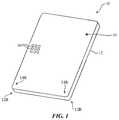
- FIG. 1is a perspective view of an illustrative electronic device in accordance with an embodiment.
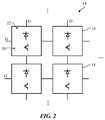
- FIG. 2is a circuit diagram of a portion of an array of pixels in a display in accordance with an embodiment.
- FIG. 3is a top view of a portion of a display showing an illustrative layout for demultiplexer circuitry and signal lines in an inactive display region and a portion of an associated active display area with rounded corners in accordance with an embodiment.
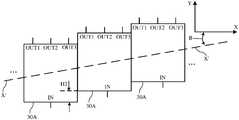
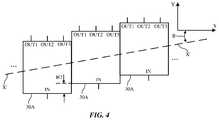
- FIG. 4is a circuit layout diagram showing how some of the demultiplexer circuit blocks in the demultiplexer circuitry may be arranged in a staircase pattern in accordance with an embodiment.
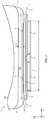
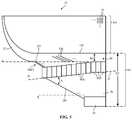
- FIG. 5is a top view of a portion of a display in accordance with an embodiment.
- An electronic device such as electronic device 10 of FIG. 1may have a display.
- Electronic device 10may be a computing device such as a laptop computer, a computer monitor containing an embedded computer, a tablet computer, a cellular telephone, a media player, or other handheld or portable electronic device, a smaller device such as a wrist-watch device, a pendant device, a headphone or earpiece device, a device embedded in eyeglasses or other equipment worn on a user's head, or other wearable or miniature device, a television, a computer display that does not contain an embedded computer, a gaming device, a navigation device, an embedded system such as a system in which electronic equipment with a display is mounted in a kiosk or automobile, equipment that implements the functionality of two or more of these devices, or other electronic equipment.
- device 10is a portable device such as a cellular telephone, media player, tablet computer, or other portable computing device. Other configurations may be used for device 10 if desired.
- FIG. 1is merely illustrative.
- Device 10may include a display such as display 14 .
- Display 14may be mounted in a housing such as housing 12 .
- Housing 12which may sometimes be referred to as an enclosure or case, may be formed of plastic, glass, ceramics, fiber composites, metal (e.g., stainless steel, aluminum, etc.), other suitable materials, or a combination of any two or more of these materials.
- Housing 12may be formed using a unibody configuration in which some or all of housing 12 is machined or molded as a single structure or may be formed using multiple structures (e.g., an internal frame structure, one or more structures that form exterior housing surfaces, etc.).
- Display 14may be a touch screen display that incorporates a layer of conductive capacitive touch sensor electrodes or other touch sensor components (e.g., resistive touch sensor components, acoustic touch sensor components, force-based touch sensor components, light-based touch sensor components, etc.) or may be a display that is not touch-sensitive.
- Capacitive touch screen electrodesmay be formed from an array of indium tin oxide pads or other transparent conductive structures.
- Display 14may include an array of pixels 18 . Pixels 18 may be arranged in rows and columns in an array that covers most or all of the front face of device 10 (as an example). The array of pixels 18 in device 10 may display images for a user and may therefore sometimes be referred to the active area of display 14 .
- the active area of display 14may have a rectangular shape with rounded (curved) corners or other suitable shape and may, if desired, be bordered along one or more edges by an inactive border region (e.g., a portion of display 14 that is free of pixels 18 and that does not emit light).
- display 14has rounded corners 14 R to accommodate rounded corners 12 R of housing 12 .
- a display cover layermay overlap the active area and the inactive area of display 14 .
- the portion of the display cover layer overlapping pixels 18 of the active areamay be free of masking materials to allow users to view images being displayed by the pixels.
- the portion of the display cover layer that overlaps the inactive areamay have an internal coating layer of opaque masking material (e.g., black ink, white ink, gray ink, ink of non-neutral colors, etc.) to help hide display circuitry (integrated circuits, signal lines, etc.) and other inactive area structures from view by a user.
- Display system 14may be a liquid crystal display with liquid crystal display pixels, an organic light-emitting diode display with organic light-emitting diode pixels, a display having an array of crystalline semiconductor light-emitting diode dies, and/or displays based on other display technologies.
- each pixel 18may include circuitry such as transistor(s) 20 .
- Transistors 20may be, for example, thin-film transistors that are fabricated on a display substrate. Transistors 20 may be used in forming pixel circuitry in each pixel 18 .
- each pixel 18may include an organic light-emitting diode such as diode 22 that is controlled by corresponding thin-film transistor pixel circuitry formed from one or more transistors 20 .
- the pixel circuitry of each pixel 18may be configured to receive data on signal lines such a data lines D.
- One or more control lines G(sometimes referred to as scan lines, emission enable lines, gate lines, etc.) may be used in providing each pixel 18 with control signals. The control signals may be used to control the loading of data into pixels 18 .
- a common set of gate lines Gmay span each row of pixels 18 and a common data line D may span each column of pixels 18 and/or other arrangements may be used for routing the data and gate lines in display 14 .
- data lines (and/or gates lines)may run horizontally and/or data lines (and/or gate lines) may include both horizontal and/or vertical sections.
- data lines Drun vertically and at least parts of gate lines G run horizontally.
- Other arrangementsmay be used for the gate and data lines in display 14 , if desired.
- the configuration of FIG. 2is merely illustrative.
- display 14may include an active area such as active area AA and an inactive area such as inactive area IA.
- Active area AAhas pixels 18 and is configured to display images for a user.
- Inactive area IAcontains display driver circuitry and does not contain pixels.
- One or more display driver integrated circuitssuch as display driver integrated circuit 24 may receive image data from control circuitry such as a microprocessor or other content source in device 10 .
- display driver circuitrysuch as display driver integrated circuit 24 may supply data and control signals to pixels 18 (e.g., using signal lines such as data lines D and gate lines G of FIG. 2 ).
- the contacts (pads) of integrated circuit 24may be bonded to signal traces on a substrate associated with display 14 in regions such as illustrative bond pad region 26 (e.g., using solder bonds).
- Gap 34 in region 26may be used for registration marks (fiducials), panel identification information, and other information.
- Signal routing lines 28may be used to route (“fan out”) the signals from the bond pads in regions 26 to demultiplexer circuitry 30 .
- Demultiplexer circuitry 30may perform signal demultiplexing operations (e.g., data demultiplexing).
- demultiplexer circuitry 30may contain a strip of 1:N demultiplexers that extends across the width of display 14 .
- the value of Nmay be at least 2, at least 3, 2-5, 2-4, 2-10, less than 5, or other suitable value. In one illustrative configuration, the value of N is 3.
- M signals on M routing lines 28may be demultiplexed to produced N*M signals on N*M corresponding signal routing lines 32 .
- Signal routing lines 32may be used to route (fan out) the demultiplexer output signals that demultiplexer circuitry 30 provides at its output to pixels 18 in active area AA.
- display 14may have any suitable number of pixels, gate lines G, and data lines D, etc.
- integrated circuit 24has about 900 bonding pads for providing about 900 corresponding data signals (e.g., data signals that have not yet been demultiplexed and that are therefore sometimes referred to as multiplexed data signals)
- demultiplexer circuitry 30has about 900 corresponding inputs associated with 900 respective 1:3 demultiplexers (sometimes referred to as demultiplexer blocks or demultiplexer circuit blocks).
- Demultiplexer circuitry 30demultiplexes the 900 multiplexed data signals and supplies about 2700 corresponding data line signals (sometimes referred to as demultiplexed signals or demultiplexed data line signals) on 2700 corresponding outputs.
- Data routing lines 32include about 2700 lines to route the demultiplexed data signals from the outputs of demultiplexer circuitry 30 (e.g., the outputs of the 900 demultiplexer circuits in circuitry 30 ) to about 2700 corresponding vertical data lines D in display 14 (e.g., a data line D corresponding to each column of pixels 18 , etc.). Other amounts of demultiplexing and different fan-out arrangements may be used, if desired.
- demultiplexer circuit blocks 30 A in demultiplexer circuitry 30may be arranged in a staircase pattern.
- Demultiplexer circuit blocks 30 B in demultiplexer circuitry 30may extend horizontally in a straight line running parallel to the straight lower edge of active area AA and parallel to the X dimension of FIG. 3
- demultiplexer circuit blocks 20 A in demultiplexer circuitry 20may extend in a line that runs diagonally along longitudinal axes X′. Dimensions X and X′ may be oriented at a non-zero angle with respect to each other.
- demultiplexer circuit blocks 30 Amay each be offset vertically by a vertical distance H 2 (e.g., 0.1 microns to 10 microns, at least 0.05 microns, at least 0.2 microns, at least 0.5 microns, at least 2 microns, at least 5 microns, less than 20 microns, or other suitable amount).
- demultiplexer circuit blocks 30 Aextend in a line along a dimension (axis) X′ that is oriented at a non-zero angle B with respect to horizontal dimension (axis) X (e.g., the dimension along which demultiplexer circuit blocks 30 B extend in a line).
- the set of demultiplexer circuit blocks (1:N demultiplexers) 30 Aextends along an axis X′ that is oriented at a non-zero angle B with respect to the horizontal axis (X axis) that runs parallel to lower edge 18 E of active area AA along which the set of demultiplexer circuit blocks 30 B extends, there is more room for the signal routing lines (see, e.g., lines 32 L) in regions 32 BT than would be possible if X′ were oriented horizontally.
- Thisallows height H 1 of the region occupied by signal routing lines 28 to be reduced and allows the height H 3 of inactive area IA (i.e., the lower inactive border of display 14 ) to be reduced.
- the angle A between axis X′ and routing lines such as line 28 L at the left and right edges of signal routing lines 28also is increased (becomes less shallow) as a result of the presence of the tilt (staircase) configuration of demultiplexer circuit blocks 30 A.
- the use of the tilted line of demultiplexer circuit blocks 30 Aalso reduces the signal routing bottleneck that would otherwise be present at region 32 BT and allows height H 1 of routing lines 32 to be reduced.
- Demultiplexer circuit blocks 30 A and 30 Bmay, if desired, each be formed using a common (shared) layout so that the size of blocks 30 B (e.g., the area consumed on the substrate of display 14 ) is the same as the size of blocks 30 A.
Landscapes
- Engineering & Computer Science (AREA)
- Physics & Mathematics (AREA)
- Computer Hardware Design (AREA)
- General Physics & Mathematics (AREA)
- Theoretical Computer Science (AREA)
- Microelectronics & Electronic Packaging (AREA)
- Devices For Indicating Variable Information By Combining Individual Elements (AREA)
- Optics & Photonics (AREA)
Abstract
Description
Claims (13)
Priority Applications (1)
| Application Number | Priority Date | Filing Date | Title |
|---|---|---|---|
| US15/985,485US10797125B2 (en) | 2017-08-30 | 2018-05-21 | Electronic device having display circuitry with rounded corners |
Applications Claiming Priority (2)
| Application Number | Priority Date | Filing Date | Title |
|---|---|---|---|
| US201762552288P | 2017-08-30 | 2017-08-30 | |
| US15/985,485US10797125B2 (en) | 2017-08-30 | 2018-05-21 | Electronic device having display circuitry with rounded corners |
Publications (2)
| Publication Number | Publication Date |
|---|---|
| US20190067407A1 US20190067407A1 (en) | 2019-02-28 |
| US10797125B2true US10797125B2 (en) | 2020-10-06 |
Family
ID=65437996
Family Applications (1)
| Application Number | Title | Priority Date | Filing Date |
|---|---|---|---|
| US15/985,485Active2038-08-10US10797125B2 (en) | 2017-08-30 | 2018-05-21 | Electronic device having display circuitry with rounded corners |
Country Status (1)
| Country | Link |
|---|---|
| US (1) | US10797125B2 (en) |
Families Citing this family (5)
| Publication number | Priority date | Publication date | Assignee | Title |
|---|---|---|---|---|
| KR102111045B1 (en)* | 2017-10-31 | 2020-05-14 | 엘지디스플레이 주식회사 | Display device |
| KR102749500B1 (en) | 2018-12-21 | 2025-01-03 | 삼성디스플레이 주식회사 | Display apparatus |
| WO2021223189A1 (en)* | 2020-05-07 | 2021-11-11 | 京东方科技集团股份有限公司 | Array substrate and display device |
| KR20240056899A (en)* | 2022-10-21 | 2024-05-02 | 삼성디스플레이 주식회사 | Display panel |
| CN118918778B (en)* | 2022-11-10 | 2025-10-10 | 武汉天马微电子有限公司 | Display panel and display device |
Citations (26)
| Publication number | Priority date | Publication date | Assignee | Title |
|---|---|---|---|---|
| US20050117611A1 (en)* | 2003-11-27 | 2005-06-02 | Dong-Yong Shin | Display device using demultiplexer |
| US20050270258A1 (en)* | 2004-06-07 | 2005-12-08 | Dong-Yong Shin | Organic electroluminescent display and demultiplexer |
| US20060007768A1 (en)* | 2004-06-30 | 2006-01-12 | Yang-Wan Kim | Demultiplexer, and light emitting display using the same and display panel thereof |
| US20070040770A1 (en)* | 2005-08-16 | 2007-02-22 | Yang-Wan Kim | Organic light emitting display (OLED) |
| US7205972B1 (en)* | 2002-12-16 | 2007-04-17 | Lg. Philips Lcd Co., Ltd. | Method and apparatus for driving liquid crystal display |
| US20080252588A1 (en)* | 2005-02-25 | 2008-10-16 | Tpo Hong Kong Holding Limited | Column Electrode Driving Circuit and Display Device Using It |
| US20090128545A1 (en)* | 2007-11-16 | 2009-05-21 | Seung-Kyu Lee | Display device and control method thereof |
| US20090174649A1 (en)* | 2008-01-08 | 2009-07-09 | Dong-Gyu Kim | Liquid crystal display and control method for charging subpixels thereof |
| US20090251455A1 (en)* | 2008-04-02 | 2009-10-08 | Ok-Kyung Park | Flat panel display and method of driving the flat panel display |
| US7619602B2 (en)* | 2003-11-27 | 2009-11-17 | Samsung Mobile Display Co., Ltd. | Display device using demultiplexer and driving method thereof |
| US20110227848A1 (en)* | 2010-03-16 | 2011-09-22 | Hitachi Displays, Ltd. | Display device |
| US20130081756A1 (en)* | 2011-09-30 | 2013-04-04 | Jeremy C. Franklin | Methods for Forming Electronic Devices with Bent Display Edges |
| US8427442B2 (en)* | 2009-05-27 | 2013-04-23 | Wintek Corporation | Touch apparatus and touch sensing method |
| US20130313528A1 (en)* | 2012-05-22 | 2013-11-28 | Samsung Display Co., Ltd. | Organic light-emitting display apparatus and method of manufacturing the same |
| US20140139771A1 (en)* | 2012-11-19 | 2014-05-22 | Lg Display Co., Ltd. | Display device |
| US20150109279A1 (en) | 2013-10-18 | 2015-04-23 | Apple Inc. | Organic Light Emitting Diode Displays with Improved Driver Circuitry |
| US20150145843A1 (en)* | 2013-11-26 | 2015-05-28 | Samsung Display Co., Ltd. | Display apparatus |
| US9177500B2 (en)* | 2011-01-31 | 2015-11-03 | Global Oled Technology Llc | Display with secure decryption of image signals |
| US20160055789A1 (en) | 2014-08-20 | 2016-02-25 | Innolux Corporation | Display pael |
| US20160293118A1 (en)* | 2015-03-31 | 2016-10-06 | Samsung Display Co, Ltd. | Display device |
| US20170192596A1 (en)* | 2015-12-31 | 2017-07-06 | Lg Display Co., Ltd. | Electronic Device |
| US20170193914A1 (en) | 2015-12-31 | 2017-07-06 | Lg Display Co., Ltd. | Array substrate and display device including the same |
| US9733755B2 (en)* | 2015-05-08 | 2017-08-15 | Xiamen Tianma Micro-Electronics Co., Ltd. | Touch panel and drive circuit thereof |
| US9753195B2 (en) | 2015-06-25 | 2017-09-05 | Apple Inc. | Border structures for displays |
| US20180182324A1 (en)* | 2016-06-23 | 2018-06-28 | Wuhan China Star Optoelectronics Technology Co., Ltd. | High resolution demultiplexer driver circuit |
| US10186194B2 (en)* | 2013-05-10 | 2019-01-22 | Samsung Display Co., Ltd. | Display device and method of driving the same |
- 2018
- 2018-05-21USUS15/985,485patent/US10797125B2/enactiveActive
Patent Citations (27)
| Publication number | Priority date | Publication date | Assignee | Title |
|---|---|---|---|---|
| US7205972B1 (en)* | 2002-12-16 | 2007-04-17 | Lg. Philips Lcd Co., Ltd. | Method and apparatus for driving liquid crystal display |
| US7619602B2 (en)* | 2003-11-27 | 2009-11-17 | Samsung Mobile Display Co., Ltd. | Display device using demultiplexer and driving method thereof |
| US20050117611A1 (en)* | 2003-11-27 | 2005-06-02 | Dong-Yong Shin | Display device using demultiplexer |
| US7738512B2 (en)* | 2003-11-27 | 2010-06-15 | Samsung Mobile Display Co., Ltd. | Display device using demultiplexer |
| US20050270258A1 (en)* | 2004-06-07 | 2005-12-08 | Dong-Yong Shin | Organic electroluminescent display and demultiplexer |
| US20060007768A1 (en)* | 2004-06-30 | 2006-01-12 | Yang-Wan Kim | Demultiplexer, and light emitting display using the same and display panel thereof |
| US20080252588A1 (en)* | 2005-02-25 | 2008-10-16 | Tpo Hong Kong Holding Limited | Column Electrode Driving Circuit and Display Device Using It |
| US20070040770A1 (en)* | 2005-08-16 | 2007-02-22 | Yang-Wan Kim | Organic light emitting display (OLED) |
| US20090128545A1 (en)* | 2007-11-16 | 2009-05-21 | Seung-Kyu Lee | Display device and control method thereof |
| US20090174649A1 (en)* | 2008-01-08 | 2009-07-09 | Dong-Gyu Kim | Liquid crystal display and control method for charging subpixels thereof |
| US20090251455A1 (en)* | 2008-04-02 | 2009-10-08 | Ok-Kyung Park | Flat panel display and method of driving the flat panel display |
| US8427442B2 (en)* | 2009-05-27 | 2013-04-23 | Wintek Corporation | Touch apparatus and touch sensing method |
| US20110227848A1 (en)* | 2010-03-16 | 2011-09-22 | Hitachi Displays, Ltd. | Display device |
| US9177500B2 (en)* | 2011-01-31 | 2015-11-03 | Global Oled Technology Llc | Display with secure decryption of image signals |
| US20130081756A1 (en)* | 2011-09-30 | 2013-04-04 | Jeremy C. Franklin | Methods for Forming Electronic Devices with Bent Display Edges |
| US20130313528A1 (en)* | 2012-05-22 | 2013-11-28 | Samsung Display Co., Ltd. | Organic light-emitting display apparatus and method of manufacturing the same |
| US20140139771A1 (en)* | 2012-11-19 | 2014-05-22 | Lg Display Co., Ltd. | Display device |
| US10186194B2 (en)* | 2013-05-10 | 2019-01-22 | Samsung Display Co., Ltd. | Display device and method of driving the same |
| US20150109279A1 (en) | 2013-10-18 | 2015-04-23 | Apple Inc. | Organic Light Emitting Diode Displays with Improved Driver Circuitry |
| US20150145843A1 (en)* | 2013-11-26 | 2015-05-28 | Samsung Display Co., Ltd. | Display apparatus |
| US20160055789A1 (en) | 2014-08-20 | 2016-02-25 | Innolux Corporation | Display pael |
| US20160293118A1 (en)* | 2015-03-31 | 2016-10-06 | Samsung Display Co, Ltd. | Display device |
| US9733755B2 (en)* | 2015-05-08 | 2017-08-15 | Xiamen Tianma Micro-Electronics Co., Ltd. | Touch panel and drive circuit thereof |
| US9753195B2 (en) | 2015-06-25 | 2017-09-05 | Apple Inc. | Border structures for displays |
| US20170193914A1 (en) | 2015-12-31 | 2017-07-06 | Lg Display Co., Ltd. | Array substrate and display device including the same |
| US20170192596A1 (en)* | 2015-12-31 | 2017-07-06 | Lg Display Co., Ltd. | Electronic Device |
| US20180182324A1 (en)* | 2016-06-23 | 2018-06-28 | Wuhan China Star Optoelectronics Technology Co., Ltd. | High resolution demultiplexer driver circuit |
Also Published As
| Publication number | Publication date |
|---|---|
| US20190067407A1 (en) | 2019-02-28 |
Similar Documents
| Publication | Publication Date | Title |
|---|---|---|
| US10797125B2 (en) | Electronic device having display circuitry with rounded corners | |
| US12038659B2 (en) | Displays with data lines that accommodate openings | |
| US11049445B2 (en) | Electronic devices with narrow display borders | |
| KR102181916B1 (en) | Displays with supplemental loading structures | |
| US11223020B2 (en) | Flexible display panel with bent substrate | |
| US10210830B2 (en) | Display having vertical gate line extensions and minimized borders | |
| US20170359890A1 (en) | Display device including bending part | |
| US20120218219A1 (en) | Displays with minimized borders | |
| CN107003769A (en) | Display device with position input function | |
| US20250155761A1 (en) | Displays with Data Lines that Accommodate Openings | |
| KR102504496B1 (en) | Touch sensor integrated type display device | |
| KR102635823B1 (en) | Display panel and display device using the same | |
| WO2018038814A1 (en) | Dummy pixels in electronic device displays | |
| US20240292660A1 (en) | Enlarging Active Areas of Displays Using Variable Pixel and/or Transistor Densities | |
| US12396341B2 (en) | Enlarging active areas of displays in electronic devices | |
| US12405502B2 (en) | Pixel layouts for electronic device displays | |
| US20170005116A1 (en) | Displays Having Substrate Ledge Support | |
| US10964235B1 (en) | Electronic devices with narrow border displays | |
| KR102542876B1 (en) | Liquid crystal display device | |
| CN107710126A (en) | Display device with touch panel | |
| US12426445B1 (en) | Devices with displays having transparent openings and shorted pixels | |
| US20240065057A1 (en) | Fanout Lines with Shielding in an Active Area | |
| US12185616B1 (en) | Devices with displays having transparent openings and transition regions | |
| US10950679B1 (en) | Display having vertically driven gate and data paths | |
| CN120569001A (en) | Display device |
Legal Events
| Date | Code | Title | Description |
|---|---|---|---|
| FEPP | Fee payment procedure | Free format text:ENTITY STATUS SET TO UNDISCOUNTED (ORIGINAL EVENT CODE: BIG.); ENTITY STATUS OF PATENT OWNER: LARGE ENTITY | |
| AS | Assignment | Owner name:APPLE INC., CALIFORNIA Free format text:ASSIGNMENT OF ASSIGNORS INTEREST;ASSIGNORS:YU, CHENG-HO;JAMSHIDI ROUDBARI, ABBAS;YEH, SHIN-HUNG;AND OTHERS;SIGNING DATES FROM 20180511 TO 20180514;REEL/FRAME:046231/0331 | |
| STPP | Information on status: patent application and granting procedure in general | Free format text:DOCKETED NEW CASE - READY FOR EXAMINATION | |
| STPP | Information on status: patent application and granting procedure in general | Free format text:NON FINAL ACTION MAILED | |
| STPP | Information on status: patent application and granting procedure in general | Free format text:RESPONSE TO NON-FINAL OFFICE ACTION ENTERED AND FORWARDED TO EXAMINER | |
| STPP | Information on status: patent application and granting procedure in general | Free format text:FINAL REJECTION MAILED | |
| STPP | Information on status: patent application and granting procedure in general | Free format text:RESPONSE AFTER FINAL ACTION FORWARDED TO EXAMINER | |
| STPP | Information on status: patent application and granting procedure in general | Free format text:ADVISORY ACTION MAILED | |
| STPP | Information on status: patent application and granting procedure in general | Free format text:NOTICE OF ALLOWANCE MAILED -- APPLICATION RECEIVED IN OFFICE OF PUBLICATIONS | |
| STCF | Information on status: patent grant | Free format text:PATENTED CASE | |
| MAFP | Maintenance fee payment | Free format text:PAYMENT OF MAINTENANCE FEE, 4TH YEAR, LARGE ENTITY (ORIGINAL EVENT CODE: M1551); ENTITY STATUS OF PATENT OWNER: LARGE ENTITY Year of fee payment:4 |