US10725977B1 - Managing file system state during replication jobs - Google Patents
Managing file system state during replication jobsDownload PDFInfo
- Publication number
- US10725977B1 US10725977B1US16/659,488US201916659488AUS10725977B1US 10725977 B1US10725977 B1US 10725977B1US 201916659488 AUS201916659488 AUS 201916659488AUS 10725977 B1US10725977 B1US 10725977B1
- Authority
- US
- United States
- Prior art keywords
- file system
- identifier
- read
- source file
- replication
- Prior art date
- Legal status (The legal status is an assumption and is not a legal conclusion. Google has not performed a legal analysis and makes no representation as to the accuracy of the status listed.)
- Active
Links
Images


Classifications
- G—PHYSICS
- G06—COMPUTING OR CALCULATING; COUNTING
- G06F—ELECTRIC DIGITAL DATA PROCESSING
- G06F16/00—Information retrieval; Database structures therefor; File system structures therefor
- G06F16/10—File systems; File servers
- G06F16/11—File system administration, e.g. details of archiving or snapshots
- G06F16/122—File system administration, e.g. details of archiving or snapshots using management policies
- G—PHYSICS
- G06—COMPUTING OR CALCULATING; COUNTING
- G06F—ELECTRIC DIGITAL DATA PROCESSING
- G06F16/00—Information retrieval; Database structures therefor; File system structures therefor
- G06F16/10—File systems; File servers
- G06F16/17—Details of further file system functions
- G06F16/178—Techniques for file synchronisation in file systems
Definitions
- the present inventionrelates generally to file systems, and more particularly, but not exclusively, to managing file system recovery in a distributed file system environment.
- Modern computingoften requires the collection, processing, or storage of very large data sets or file systems. Accordingly, to accommodate the capacity requirements as well as other requirements, such as, high availability, redundancy, latency/access considerations, or the like, modern file systems may be very large or distributed across multiple hosts, networks, or data centers, and so on. File systems may require various backup or restore operations. Na ⁇ ve backup strategies may cause significant storage or performance overhead. For example, in some cases, the size or distributed nature of a modern hyper-scale file systems may make it difficult to determine the objects that need to be replicated. Also, the large number of files in modern distributed file system may make managing state or protection information difficult because of the resources that may be required to visit the files to manage state or protection information for files. Thus, it is with respect to these considerations and others that the present invention has been made.
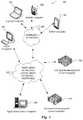
- FIG. 1illustrates a system environment in which various embodiments may be implemented
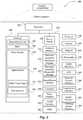
- FIG. 2illustrates a schematic embodiment of a client computer
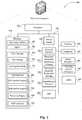
- FIG. 3illustrates a schematic embodiment of a network computer
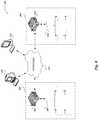
- FIG. 4illustrates a logical architecture of system for managing file system state during replication jobs in accordance with one or more of the various embodiments
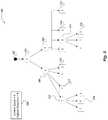
- FIG. 5illustrates a logical representation of file system 500 for managing file system state during replication jobs in accordance with one or more of the various embodiments
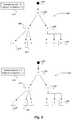
- FIG. 6illustrates a logical represent of two file systems arranged for replicating file system objects in distributed file systems in accordance with one or more of the various embodiments
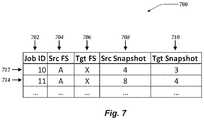
- FIG. 7illustrates of logical schematic of a portion of a data structure for managing file system state during replication jobs in accordance with one or more of the various embodiments
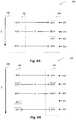
- FIG. 8Aillustrates a logical schematic of a system for managing file system state during replication jobs in accordance with one or more of the various embodiments
- FIG. 8Billustrates a logical schematic of a system for managing file system state during replication jobs in accordance with one or more of the various embodiments
- FIG. 9illustrates a logical representation of a portion of file a system for managing file system state during replication jobs in accordance with one or more of the various embodiments
- FIG. 10illustrates a logical representation of a portion of a file system for managing file system state during replication jobs in accordance with one or more of the various embodiments
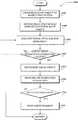
- FIG. 11illustrates an overview flowchart for a process for managing file system state during replication jobs in accordance with one or more of the various embodiments
- FIG. 12illustrates a flowchart of a process for replicating file system objects in distributed file systems in accordance with one or more of the various embodiments
- FIG. 13illustrates a flowchart of a process for replicating a file system object in a distributed file system in accordance with one or more of the various embodiments
- FIG. 14illustrates a flowchart of a process for writing a file system object to a file system in a distributed file system in accordance with one or more of the various embodiments
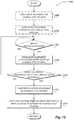
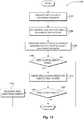
- FIG. 15illustrates a flowchart of a process for managing file system state during replication jobs in accordance with one or more of the various embodiments
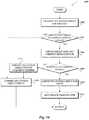
- FIG. 16illustrates a flowchart of a process for managing file system state during replication jobs in accordance with one or more of the various embodiments
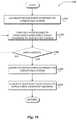
- FIG. 17illustrates a flowchart of a process for managing file system state during replication jobs in accordance with one or more of the various embodiments
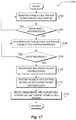
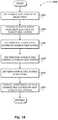
- FIG. 18illustrates a flowchart of a process for managing file system state during replication jobs in accordance with one or more of the various embodiments
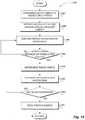
- FIG. 19illustrates a flowchart of a process for managing file system state during replication jobs in accordance with one or more of the various embodiments.
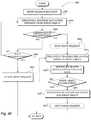
- FIG. 20illustrates a flowchart of a process for managing file system state during replication jobs in accordance with one or more of the various embodiments.
- the term “or”is an inclusive “or” operator, and is equivalent to the term “and/or,” unless the context clearly dictates otherwise.
- the term “based on”is not exclusive and allows for being based on additional factors not described, unless the context clearly dictates otherwise.
- the meaning of “a,” “an,” and “the”include plural references.
- the meaning of “in”includes “in” and “on.”
- enginerefers to logic embodied in hardware or software instructions, which can be written in a programming language, such as C, C++, Objective-C, COBOL, JavaTM, PHP, Perl, JavaScript, Ruby, VBScript, Microsoft .NETTM languages such as C#, or the like.
- An enginemay be compiled into executable programs or written in interpreted programming languages.
- Software enginesmay be callable from other engines or from themselves.
- Engines described hereinrefer to one or more logical modules that can be merged with other engines or applications, or can be divided into sub-engines.
- the enginescan be stored in non-transitory computer-readable medium or computer storage device and be stored on and executed by one or more general purpose computers, thus creating a special purpose computer configured to provide the engine.
- file system objectrefers to entities stored in a file system. These may include files, directories, or the like. In this document for brevity and clarity all objects stored in a file system may be referred to as file system objects.
- blockrefers to the file system data objects that comprise a file system object.
- file system objectsuch as, directory objects or small files may be comprised of a single block.
- larger file system objectssuch as large document files may be comprised of many blocks.
- Blocksusually are arranged to have a fixed size to simplify the management of a file system. This may include fixing blocks to a particular size based on requirements associated with underlying storage hardware, such as, solid state drives (SSDs) or hard disk drives (HDDs), or the like.
- SSDssolid state drives
- HDDshard disk drives
- file system objects, such as, filesmay be of various sizes, comprised of the number of blocks necessary to represent or contain the entire file system object.
- Epochrefers to time periods in the life of a file system. Epochs may be generated sequentially such that epoch 1 comes before epoch 2 in time. Prior epochs are bounded in the sense that they have a defined beginning and end. The current epoch has a beginning but not an end because it is still running. Epochs may be used to track the birth and death of file system objects, or the like.
- Snapshotrefers to a point time version of the file system or a portion of the file system. Snapshots preserve the version of the file system objects at the time the snapshot was taken. Snapshots may be sequentially labeled such that snapshot 1 is the first snapshot taken in a file system and snapshot 2 is the second snapshot, and so on. The sequential labeling may be file system-wide even though snapshots may cover the same or different portions of the file system. Snapshots demark the end of the current file system epoch and the beginning of the next file system epoch.
- the epoch value or its number labelmay be assumed to be greater than the number label of the newest snapshot.
- Epoch boundariesmay be formed when a snapshot is taken.
- the epoche.g., epoch count value
- Each epoch boundaryis created when a snapshot was created.
- a new snapshotis created, it may be assigned a number label that has the same as the epoch it is closing and thus be one less than the new current epoch that begins running when the new snapshot is taken.
- mirror relationshiprefers to two file systems that are arranged such that one of the file systems is periodically backed up to the other.
- the file system that is being backede.g., the mirrored file system
- the file system that is receiving the backed up objects from the source file systemis the target file system.
- replication snapshotrefers to a snapshot that is generated for a replication job. Replication snapshots are regular snapshots that are associated with a failed or completed replication job. Similarly, replication snapshot numbers are the snapshot numbers associated with a replication snapshot.
- configuration informationrefers to information that may include rule based policies, pattern matching, scripts (e.g., computer readable instructions), or the like, that may be provided from various sources, including, configuration files, databases, user input, built-in defaults, or the like, or combination thereof.
- various embodimentsare directed to managing data in a file system.
- a source file system that may be mirrored on a target file systemmay be provided such that the mirroring may be performed by executing one or more replication jobs that copy one or more changes on the source file system to the target file system.
- a root object of the source file systemmay be associated with a current read-only identifier such that the current read-only identifier may correspond to a current update epoch of the source file system.
- a replication job that copies objects from the source file system to the target file systemmay be execute such that the copied objects may be different on the target file system.
- a write request that may be directed to the source file systemmay be received.
- one or more write objects that may be associated with the write requestmay be determined such that determining the one or more write objects may include determining a position of the one or more write objects within the source file system.
- the source file systemmay be traversed upwards from the position of the one or more write objects such that each object that may be subsequently visited by the upward traversal may be a parent object of a currently visited object.
- a read-only identifier associated with each visited objectmay be determined such that the traversal may be terminated based on one or more of the read-only identifier matching the current read-only identifier or the root object being reached.
- determining the read-only identifier associated with each visited objectmay include determining that the read-only identifier may be stale based on a mismatch of an update epoch and the current update epoch for each visited object.
- the write requestmay be enabled based on the mismatch of the read-only identifier and current read-only identifier.
- a turn-around objectmay be determined based on the read-only identifier matching the current read-only identifier.
- the traversal directionmay be reversed at the turn-around object such that the source file system may be traversed in the downwards direction towards the one or more write objects.
- an update epoch of each object visited during the downward traversal of the file system from the root objectmay be modified such that the modified update epoch matches the current update epoch.
- the write requestmay be allowed to be execute based on one or more of each visited object being associated with a stale read-only identifier or an absence of an association to a read-only identifier.
- FIG. 1shows components of one embodiment of an environment in which embodiments of the invention may be practiced. Not all of the components may be required to practice the invention, and variations in the arrangement and type of the components may be made without departing from the spirit or scope of the invention.
- system 100 of FIG. 1includes local area networks (LANs)/wide area networks (WANs)—(network) 110 , wireless network 108 , client computers 102 - 105 , application server computer 116 , file system management server computer 118 , file system management server computer 120 , or the like.
- LANslocal area networks
- WANswide area networks
- client computers 102 - 105may operate over one or more wired or wireless networks, such as networks 108 , or 110 .
- client computers 102 - 105may include virtually any computer capable of communicating over a network to send and receive information, perform various online activities, offline actions, or the like.
- one or more of client computers 102 - 105may be configured to operate within a business or other entity to perform a variety of services for the business or other entity.
- client computers 102 - 105may be configured to operate as a web server, firewall, client application, media player, mobile telephone, game console, desktop computer, or the like.
- Computers that may operate as client computer 102may include computers that typically connect using a wired or wireless communications medium such as personal computers, multiprocessor systems, microprocessor-based or programmable electronic devices, network PCs, or the like.
- client computers 102 - 105may include virtually any portable computer capable of connecting to another computer and receiving information such as, laptop computer 103 , mobile computer 104 , tablet computers 105 , or the like.
- portable computersare not so limited and may also include other portable computers such as cellular telephones, display pagers, radio frequency (RF) devices, infrared (IR) devices, Personal Digital Assistants (PDAs), handheld computers, wearable computers, integrated devices combining one or more of the preceding computers, or the like.
- client computers 102 - 105typically range widely in terms of capabilities and features.
- client computers 102 - 105may access various computing applications, including a browser, or other web-based application.
- Client computers 102 - 105may further be configured to include a client application that enables an end-user to log into an end-user account that may be managed by another computer, such as application server computer 116 , file system management server computer 118 , file system management server computer 120 , or the like.
- client applicationthat enables an end-user to log into an end-user account that may be managed by another computer, such as application server computer 116 , file system management server computer 118 , file system management server computer 120 , or the like.
- Such an end-user accountin one non-limiting example, may be configured to enable the end-user to manage one or more online activities, including in one non-limiting example, project management, software development, system administration, configuration management, search activities, social networking activities, browse various websites, communicate with other users, or the like.
- client computersmay be arranged to enable users to display reports, interactive user-interfaces, or results provided by application server computer 116 , file system management server computer 118 , file system management server computer 120 .
- Wireless network 108may further include an autonomous system of terminals, gateways, routers, and the like connected by wireless radio links, and the like. These connectors may be configured to move freely and randomly and organize themselves arbitrarily, such that the topology of wireless network 108 may change rapidly.
- wireless network 108may enable a radio connection through a radio network access such as Global System for Mobil communication (GSM), General Packet Radio Services (GPRS), Enhanced Data GSM Environment (EDGE), code division multiple access (CDMA), time division multiple access (TDMA), Wideband Code Division Multiple Access (WCDMA), High Speed Downlink Packet Access (HSDPA), Long Term Evolution (LTE), and the like.
- GSMGlobal System for Mobil communication
- GPRSGeneral Packet Radio Services
- EDGEEnhanced Data GSM Environment
- CDMAcode division multiple access
- TDMAtime division multiple access
- WCDMAWideband Code Division Multiple Access
- HSDPAHigh Speed Downlink Packet Access
- LTELong Term Evolution
- Network 110is configured to couple network computers with other computers, including, application server computer 116 , file system management server computer 118 , file system management server computer 120 , client computers 102 , and client computers 103 - 105 through wireless network 108 , or the like.
- Network 110is enabled to employ any form of computer readable media for communicating information from one electronic device to another.
- network 110can include the Internet in addition to local area networks (LANs), wide area networks (WANs), direct connections, such as through a universal serial bus (USB) port, Ethernet port, other forms of computer-readable media, or any combination thereof.
- LANslocal area networks
- WANswide area networks
- USBuniversal serial bus
- Ethernet portother forms of computer-readable media, or any combination thereof.
- a routeracts as a link between LANs, enabling messages to be sent from one to another.
- communication links within LANstypically include twisted wire pair or coaxial cable
- communication links between networksmay utilize analog telephone lines, full or fractional dedicated digital lines including T1, T2, T3, and T4, or other carrier mechanisms including, for example, E-carriers, Integrated Services Digital Networks (ISDNs), Digital Subscriber Lines (DSLs), wireless links including satellite links, or other communications links known to those skilled in the art.
- ISDNsIntegrated Services Digital Networks
- DSLsDigital Subscriber Lines
- communication linksmay further employ any of a variety of digital signaling technologies, including without limit, for example, DS-0, DS-1, DS-2, DS-3, DS-4, OC-3, OC-12, OC-48, or the like.
- remote computers and other related electronic devicescould be remotely connected to either LANs or WANs via a modem and temporary telephone link.
- network 110may be configured to transport information of an Internet Protocol (IP).
- IPInternet Protocol
- communication mediatypically embodies computer readable instructions, data structures, program modules, or other transport mechanism and includes any information non-transitory delivery media or transitory delivery media.
- communication mediaincludes wired media such as twisted pair, coaxial cable, fiber optics, wave guides, and other wired media and wireless media such as acoustic, RF, infrared, and other wireless media.
- file system management server computer 118 or file system management server computer 120are described in more detail below in conjunction with FIG. 3 .
- FIG. 1illustrates file system management server computer 118 or file system management server computer 120 , or the like, each as a single computer, the innovations or embodiments are not so limited.
- one or more functions of file system management server computer 118 or file system management server computer 120 , or the like,may be distributed across one or more distinct network computers.
- file system management server computer 118 or file system management server computer 120may be implemented using a plurality of network computers.
- FIG. 2shows one embodiment of client computer 200 that may include many more or less components than those shown.
- Client computer 200may represent, for example, one or more embodiment of mobile computers or client computers shown in FIG. 1 .
- Client computer 200may include processor 202 in communication with memory 204 via bus 228 .
- Client computer 200may also include power supply 230 , network interface 232 , audio interface 256 , display 250 , keypad 252 , illuminator 254 , video interface 242 , input/output interface 238 , haptic interface 264 , global positioning systems (GPS) receiver 258 , open air gesture interface 260 , temperature interface 262 , camera(s) 240 , projector 246 , pointing device interface 266 , processor-readable stationary storage device 234 , and processor-readable removable storage device 236 .
- Client computer 200may optionally communicate with a base station (not shown), or directly with another computer. And in one embodiment, although not shown, a gyroscope may be employed within client computer 200 to measuring or maintaining an orientation of client computer 200 .
- Power supply 230may provide power to client computer 200 .
- a rechargeable or non-rechargeable batterymay be used to provide power.
- the powermay also be provided by an external power source, such as an AC adapter or a powered docking cradle that supplements or recharges the battery.
- Network interface 232includes circuitry for coupling client computer 200 to one or more networks, and is constructed for use with one or more communication protocols and technologies including, but not limited to, protocols and technologies that implement any portion of the OSI model for mobile communication (GSM), CDMA, time division multiple access (TDMA), UDP, TCP/IP, SMS, MMS, GPRS, WAP, UWB, WiMax, SIP/RTP, GPRS, EDGE, WCDMA, LTE, UMTS, OFDM, CDMA2000, EV-DO, HSDPA, or any of a variety of other wireless communication protocols.
- GSMOSI model for mobile communication
- CDMACode Division Multiple Access
- TDMAtime division multiple access
- UDPUser Datagram Protocol/IP
- SMSSMS
- MMSmobility management Entity
- GPRSWireless Fidelity
- WAPWireless Fidelity
- UWBWireless Fidelity
- WiMaxWireless Fidelity
- SIP/RTPGPRS
- EDGEWCDMA
- Audio interface 256may be arranged to produce and receive audio signals such as the sound of a human voice.
- audio interface 256may be coupled to a speaker and microphone (not shown) to enable telecommunication with others or generate an audio acknowledgment for some action.
- a microphone in audio interface 256can also be used for input to or control of client computer 200 , e.g., using voice recognition, detecting touch based on sound, and the like.
- Display 250may be a liquid crystal display (LCD), gas plasma, electronic ink, light emitting diode (LED), Organic LED (OLED) or any other type of light reflective or light transmissive display that can be used with a computer.
- Display 250may also include a touch interface 244 arranged to receive input from an object such as a stylus or a digit from a human hand, and may use resistive, capacitive, surface acoustic wave (SAW), infrared, radar, or other technologies to sense touch or gestures.
- SAWsurface acoustic wave
- Projector 246may be a remote handheld projector or an integrated projector that is capable of projecting an image on a remote wall or any other reflective object such as a remote screen.
- Video interface 242may be arranged to capture video images, such as a still photo, a video segment, an infrared video, or the like.
- video interface 242may be coupled to a digital video camera, a web-camera, or the like.
- Video interface 242may comprise a lens, an image sensor, and other electronics.
- Image sensorsmay include a complementary metal-oxide-semiconductor (CMOS) integrated circuit, charge-coupled device (CCD), or any other integrated circuit for sensing light.
- CMOScomplementary metal-oxide-semiconductor
- CCDcharge-coupled device
- Keypad 252may comprise any input device arranged to receive input from a user.
- keypad 252may include a push button numeric dial, or a keyboard.
- Keypad 252may also include command buttons that are associated with selecting and sending images.
- Illuminator 254may provide a status indication or provide light. Illuminator 254 may remain active for specific periods of time or in response to event messages. For example, when illuminator 254 is active, it may back-light the buttons on keypad 252 and stay on while the client computer is powered. Also, illuminator 254 may back-light these buttons in various patterns when particular actions are performed, such as dialing another client computer. Illuminator 254 may also cause light sources positioned within a transparent or translucent case of the client computer to illuminate in response to actions.
- client computer 200may also comprise hardware security module (HSM) 268 for providing additional tamper resistant safeguards for generating, storing or using security/cryptographic information such as, keys, digital certificates, passwords, passphrases, two-factor authentication information, or the like.
- HSMhardware security module
- hardware security modulemay be employed to support one or more standard public key infrastructures (PKI), and may be employed to generate, manage, or store keys pairs, or the like.
- PKIpublic key infrastructure
- HSM 268may be a stand-alone computer, in other cases, HSM 268 may be arranged as a hardware card that may be added to a client computer.
- Client computer 200may also comprise input/output interface 238 for communicating with external peripheral devices or other computers such as other client computers and network computers.
- the peripheral devicesmay include an audio headset, virtual reality headsets, display screen glasses, remote speaker system, remote speaker and microphone system, and the like.
- Input/output interface 238can utilize one or more technologies, such as Universal Serial Bus (USB), Infrared, WiFi, WiMax, BluetoothTM, and the like.
- Input/output interface 238may also include one or more sensors for determining geolocation information (e.g., GPS), monitoring electrical power conditions (e.g., voltage sensors, current sensors, frequency sensors, and so on), monitoring weather (e.g., thermostats, barometers, anemometers, humidity detectors, precipitation scales, or the like), or the like.
- Sensorsmay be one or more hardware sensors that collect or measure data that is external to client computer 200 .
- applicationssuch as, operating system 206 , other client apps 224 , web browser 226 , or the like, may be arranged to employ geo-location information to select one or more localization features, such as, time zones, languages, currencies, calendar formatting, or the like. Localization features may be used in display objects, data models, data objects, user-interfaces, reports, as well as internal processes or databases.
- geo-location information used for selecting localization informationmay be provided by GPS 258 .
- geolocation informationmay include information provided using one or more geolocation protocols over the networks, such as, wireless network 108 or network 111 .
- Human interface componentscan be peripheral devices that are physically separate from client computer 200 , allowing for remote input or output to client computer 200 .
- information routed as described here through human interface componentssuch as display 250 or keyboard 252 can instead be routed through network interface 232 to appropriate human interface components located remotely.
- human interface peripheral componentsthat may be remote include, but are not limited to, audio devices, pointing devices, keypads, displays, cameras, projectors, and the like. These peripheral components may communicate over a Pico Network such as BluetoothTM, ZigbeeTM and the like.
- a client computermay include web browser application 226 that is configured to receive and to send web pages, web-based messages, graphics, text, multimedia, and the like.
- the client computer's browser applicationmay employ virtually any programming language, including a wireless application protocol messages (WAP), and the like.
- WAPwireless application protocol
- the browser applicationis enabled to employ Handheld Device Markup Language (HDML), Wireless Markup Language (WML), WMLScript, JavaScript, Standard Generalized Markup Language (SGML), HyperText Markup Language (HTML), eXtensible Markup Language (XML), HTML5, and the like.
- HDMLHandheld Device Markup Language
- WMLWireless Markup Language
- WMLScriptWireless Markup Language
- JavaScriptStandard Generalized Markup Language
- SGMLStandard Generalized Markup Language
- HTMLHyperText Markup Language
- XMLeXtensible Markup Language
- HTML5HyperText Markup Language
- Memory 204may include RAM, ROM, or other types of memory. Memory 204 illustrates an example of computer-readable storage media (devices) for storage of information such as computer-readable instructions, data structures, program modules or other data. Memory 204 may store BIOS 208 for controlling low-level operation of client computer 200 . The memory may also store operating system 206 for controlling the operation of client computer 200 . It will be appreciated that this component may include a general-purpose operating system such as a version of UNIX, or LINUXTM, or a specialized client computer communication operating system such as Windows PhoneTM, or the Symbian® operating system. The operating system may include, or interface with a Java virtual machine module that enables control of hardware components or operating system operations via Java application programs.
- BIOS 208for controlling low-level operation of client computer 200 .
- the memorymay also store operating system 206 for controlling the operation of client computer 200 . It will be appreciated that this component may include a general-purpose operating system such as a version of UNIX, or LINUXTM, or
- data storage 210might also be stored on another component of client computer 200 , including, but not limited to, non-transitory processor-readable removable storage device 236 , processor-readable stationary storage device 234 , or even external to the client computer.
- Applications 220may include computer executable instructions which, when executed by client computer 200 , transmit, receive, or otherwise process instructions and data. Applications 220 may include, for example, client user interface engine 222 , other client applications 224 , web browser 226 , or the like. Client computers may be arranged to exchange communications one or more servers.
- client computer 200may include an embedded logic hardware device instead of a CPU, such as, an Application Specific Integrated Circuit (ASIC), Field Programmable Gate Array (FPGA), Programmable Array Logic (PAL), or the like, or combination thereof.
- the embedded logic hardware devicemay directly execute its embedded logic to perform actions.
- client computer 200may include one or more hardware micro-controllers instead of CPUs.
- FIG. 3shows one embodiment of network computer 300 that may be included in a system implementing one or more of the various embodiments.
- Network computer 300may include many more or less components than those shown in FIG. 3 . However, the components shown are sufficient to disclose an illustrative embodiment for practicing these innovations.
- Network computer 300may represent, for example, one or more embodiments of a file system management server computer such as file system management server computer 118 , or the like, of FIG. 1 .
- Network interface 332includes circuitry for coupling network computer 300 to one or more networks, and is constructed for use with one or more communication protocols and technologies including, but not limited to, protocols and technologies that implement any portion of the Open Systems Interconnection model (OSI model), global system for mobile communication (GSM), code division multiple access (CDMA), time division multiple access (TDMA), user datagram protocol (UDP), transmission control protocol/Internet protocol (TCP/IP), Short Message Service (SMS), Multimedia Messaging Service (MMS), general packet radio service (GPRS), WAP, ultra-wide band (UWB), IEEE 802.16 Worldwide Interoperability for Microwave Access (WiMax), Session Initiation Protocol/Real-time Transport Protocol (SIP/RTP), or any of a variety of other wired and wireless communication protocols.
- Network interface 332is sometimes known as a transceiver, transceiving device, or network interface card (NIC).
- Network computer 300may optionally communicate with a base station (not shown), or directly with another computer.
- Display 350may be a liquid crystal display (LCD), gas plasma, electronic ink, light emitting diode (LED), Organic LED (OLED) or any other type of light reflective or light transmissive display that can be used with a computer.
- display 350may be a handheld projector or pico projector capable of projecting an image on a wall or other object.
- Network computer 300may also comprise input/output interface 338 for communicating with external devices or computers not shown in FIG. 3 .
- Input/output interface 338can utilize one or more wired or wireless communication technologies, such as USBTM, FirewireTM, WiFi, WiMax, ThunderboltTM, Infrared, BluetoothTM, ZigbeeTM, serial port, parallel port, and the like.
- Human interface componentsinclude any component that allows the computer to take input from, or send output to, a human user of a computer. Accordingly, pointing devices such as mice, styluses, track balls, or the like, may communicate through pointing device interface 358 to receive user input.
- GPS transceiver 340can determine the physical coordinates of network computer 300 on the surface of the Earth, which typically outputs a location as latitude and longitude values. GPS transceiver 340 can also employ other geo-positioning mechanisms, including, but not limited to, triangulation, assisted GPS (AGPS), Enhanced Observed Time Difference (E-OTD), Cell Identifier (CI), Service Area Identifier (SAI), Enhanced Timing Advance (ETA), Base Station Subsystem (BSS), or the like, to further determine the physical location of network computer 300 on the surface of the Earth. It is understood that under different conditions, GPS transceiver 340 can determine a physical location for network computer 300 . In one or more embodiments, however, network computer 300 may, through other components, provide other information that may be employed to determine a physical location of the client computer, including for example, a Media Access Control (MAC) address, IP address, and the like.
- MACMedia Access Control
- applicationssuch as, operating system 306 , file system engine 322 , replication engine 324 , recovery engine 326 , web services 329 , or the like, may be arranged to employ geo-location information to select one or more localization features, such as, time zones, languages, currencies, currency formatting, calendar formatting, or the like. Localization features may be used in user interfaces, dashboards, reports, as well as internal processes or databases.
- geo-location information used for selecting localization informationmay be provided by GPS 340 .
- geolocation informationmay include information provided using one or more geolocation protocols over the networks, such as, wireless network 108 or network 111 .
- file system engine 322may be located in virtual servers running in a cloud-based computing environment rather than being tied to one or more specific physical network computers.
- network computer 300may include an embedded logic hardware device instead of a CPU, such as, an Application Specific Integrated Circuit (ASIC), Field Programmable Gate Array (FPGA), Programmable Array Logic (PAL), or the like, or combination thereof.
- the embedded logic hardware devicemay directly execute its embedded logic to perform actions.
- the network computermay include one or more hardware microcontrollers instead of a CPU.
- the one or more microcontrollersmay directly execute their own embedded logic to perform actions and access their own internal memory and their own external Input and Output Interfaces (e.g., hardware pins or wireless transceivers) to perform actions, such as System On a Chip (SOC), or the like.
- SOCSystem On a Chip
- FIG. 4illustrates a logical architecture of system 400 for managing file system state during replication jobs in accordance with one or more of the various embodiments.
- two or more file systemssuch as, file system 402 and file system 404 may be arranged to be communicatively coupled to one or more networks, such as, networks 416 .
- one or more clientssuch as, client computer 416 and client computer 418 may be arranged to access file system 402 or file system 404 over networks 416 .
- file system object 412 or file system object 414may represent the various objects or entities that may be stored in file system 402 or file system 404 .
- file system objectsmay include, files, documents, directories, folders, change records, backups, snapshots, replication snapshots, replication information, versions, branches, recovery points, or the like.
- the implementation details that enable file system 402 or file system 404 to operatemay be hidden from clients, such that they may be arranged to use file system 402 or file system 404 the same way they use other conventional file systems, including local file systems. Accordingly, in one or more of the various embodiments, clients may be unaware that they are using a distributed file system that supports replicating file objects to other file systems because file system engines or replication engines may be arranged to mimic the interface or behavior of one or more standard file systems.
- file system 402 and file system 404are illustrated as using one file system management computer each with one set of file system objects, the innovations are not so limited. Innovations herein contemplate file systems that include one or more file system management computers or one or more file system object data stores. In some embodiments, file system object stores may be located remotely from one or more file system management computers. Also, a logical file system object store or file system may be spread across two or more cloud computing environments, storage clusters, or the like.
- one or more replication enginesmay be running on a file system management computer, such as, file system management computer 406 or file system management computer 410 .
- replication enginesmay be arranged to perform actions to replicate of one or more portions of one or more file systems.
- the replication enginemay be arranged to enable users to associate one or more portions of a source file system with a target file system.
- configuration informationmay be employed to identify a portion of the source file system and a location in the target file system.
- file system 402it may be desirable to configure file systems, such as, file system 402 to be replicate onto one or more different file systems, such as, file system 404 .
- a replication engine running on a source file systemsuch as, file system 402 may be arranged to replicate its file system objects on one or more target file systems, such as, file system 404 .
- replication enginesmay be arranged to replicate file system objects based on snapshot values or current update epochs associated with the file systems. As described below in more detail.
- file systemsmay be arranged as mirrored pairs such that a source file system is configured to automatically be replicated on a target file system.
- replication enginesmay execute replication jobs that copy changes from the source file system to the target file system.
- replication enginesmay be arranged to copy file system objects that have been added or modified to the source file system since the previous replication job.
- the target file systemmay be arranged to be read-only, except for writes associated with a replication job.
- usersmay be assured the target file system is not modified via writes from users or other file system clients.
- source file systemis arranged to be mirrored on a target file system
- the source file system and the target file systemare considered to be in a mirroring relationship.
- replication jobsmay be unexpectedly interrupted by equipment or system failures.
- a network switch that connects a source file system with its target file systemmay fail during a replication job.
- the state of the target file systemmay be unknown with respect to the source file system.
- mirroring relationshipsmay be experience planned or unplanned interruptions such that the state of the source file system or the target file system become unknown. For example, while a mirroring relationship is interrupted either the source file system or target file system may experience modifications that happen separate from the mirroring relationship.
- recovery enginessuch as, recovery engine 326 may be arranged to perform actions that return the state of the target file system to a known state. For example, if a replication job is interrupted the target file system may have successfully mirrored some but not all of the file system objects.
- the target file systemmay be enabled for writing outside of the mirroring relationship. Such as activity may cause the target file system to have an unknown state with respect to its source file system.
- conventional systemsmay be arranged to compare each file system object on the source file system with its mirrored counterpart on the target file system.
- the size or number of file system objects in some distributed file systemsmay make such comparisons disadvantageous because rebuilding the mirrored state from scratch may consume excessive computing or networking resources.
- recovery enginesmay be arranged to employ one or more known recovery points that indicate a known state of a given file system. Accordingly, in some embodiments, recovery engines may be arranged to maintain a database or mapping of the recovery points of the source file system and the target file system. In one or more of the various embodiments, a file system management system may be arranged to associate recovery points of the source file system with recovery points of the target system.
- recovery enginemay be arranged to determine corresponding recovery points on each file system to determine the file system objects that may need to be recopied to target file system.
- recovery pointsmay be associated with a successfully completed replication jobs.
- organizationsmay desire to reverse the roles of a mirrored file system pair such that the original source file system becomes the target file system and the original target file system becomes the source file system. Accordingly, in some embodiments, the recovery points on each file system may be employed to ensure mirroring of the previous target file system on the new target file system.
- organizationsmay temporarily activate the target file system (making it writable) and disable the source file system. For example, if an organization intends to perform a planned system upgrade on the source file system, the organization may accept writes on the target file system while the source file system off-line. Accordingly, if the original source file system is brought back online, recovery points may be employed to update the source file system with writes or other changes that were written to the target file system while the source file system was out of service.
- FIG. 5illustrates a logical representation of file system 500 for managing file system state during replication jobs in accordance with one or more of the various embodiments.
- file system 500is represented as a tree
- various data structuresmay be used to store the data that represents the tree-like structure of the file system.
- Data structuresmay include tabular formats that include keys, self-referencing fields, child-parent relationships, or the like, to implement tree data structures, such as, graphs, trees, or the like, for managing a file system, such as, file system 500 .
- root 502is the beginning of a portion of a file system. Root 502 is not a file system object per se, rather, it indicates a position in a distributed file system.
- Directory 504represents the parent file system object of all the objects under root 502 .
- Directory 504is the parent of directory 506 and directory 508 .
- Directory 510 , file object 512 , and file object 514are children of directory 506 ;
- directory 514 , file object 516 , and file object 518are direct children of directory 508 ;
- file object 520is a direct child of directory 510 ;
- file object 524is a direct child of directory 514 .
- meta-data 526includes the current update epoch and highest snapshot number for file system 500 .
- one file systemmay be designated the source file system and one or more other file systems may be designated target file systems.
- the portions of the two or more file systemshave the same file system logical structure.
- the file systemsmay have different physical or implementations or representations as long as they logically represent the same structure.
- file system objectsare not modified subsequent to the generation follow-on snapshots, they remain associated with their current/last snapshot.
- directory 514is associated with snapshot 2 because for this example, it was modified or created after snapshot 1 was generated (during epoch 2) and has remained unmodified since then. Accordingly, by observation, a modification to file object 524 caused it to be associated with snapshot 2 which forced its parent, directory 514 to also be associated with snapshot 2.
- a file system objectis modified in a current epoch, it will be associated with the next snapshot that closes or ends the current epoch.
- a replication enginesuch as, replication engine 324 , may be arranged to employ the snapshot or epoch information of the file system objects in a file system to determine which file system objects should be copied to one or more target file systems.
- replication enginesmay be arranged to track the last snapshot associated with the last replication job for a file system.
- a replication enginemay be arranged to trigger the generation of a new snapshot prior to starting a replication jobs.
- a replication enginemay be arranged perform replication jobs based on existing snapshots.
- a replication enginemay be configured to launch a replication jobs every other snapshot, with the rules for generating snapshots being independent from the replication engine.
- replication enginesmay be arranged to execute one or more rules that define whether the replication engine should trigger a new snapshot for each replication job or use existing snapshots. In some embodiments, such rules may be provided by configuration files, user-input, built-in defaults, or the like, or combination thereof.
- file system enginessuch as, file system engine 322 may be arranged to update parent object meta-data (e.g., current update epoch or snapshot number) before a write operation is committed or otherwise consider stable. For example, if file object 520 is updated, the file system engine may be arranged to examine the epoch/snapshot information for directory 510 , directory 506 , and directory 504 before committing the update to file object 520 .
- parent object meta-datae.g., current update epoch or snapshot number
- the file system enginemay be arranged to examine the epoch/snapshot information for directory 510 , directory 506 , and directory 504 before committing the update to file object 520 .
- directory 510 , directory 506 and directory 508may be associated the current epoch (5) before the write to file object 520 is committed (which will also associated file object 520 with epoch 5) since the update is occurring during the current epoch (epoch 5).
- file system enginemay generate recovery points based on replication jobs that run to completion.
- the file system objects for replication jobsmay be determined based on snapshots.
- a replication snapshot on a source file systemmay generated before starting a replication job.
- the target file systemmay associate the file system objects copied from the source file system with a replication snapshot on the target file system.
- the replication snapshot number of the source file systemmay be paired with the replication snapshot number on the target file system to provide a recovery point.
- the replication snapshot on the source file systemmay remain valid. However, in some embodiments, since the replication job did not run to completion, a recovery point that includes that replication snapshot of the failed replication job will not be created.
- FIG. 6illustrates a logical represent of two file systems arranged for replicating file system objects in distributed file systems in accordance with one or more of the various embodiments.
- file system 600may be considered the source file system.
- file system 600starts at root 602 and includes various file system objects, including, directory 604 , directory 606 , directory 608 , file object 610 , file object 612 , file object 614 , and so on.
- file system 616may be considered the target file system.
- file system 616starts at root 618 and includes various file system objects, including, directory 620 , directory 622 , directory 624 , file object 626 , file object 628 , file object 630 , and so on.
- circles in FIG. 6represent directory objects (file system objects that have children) and rectangles in FIG. 6 represent file system objects that are files, documents, blocks, or the like.
- the latest snapshot number for each file system objectis indicated by the number in the center of each file system object.
- directory object 606is associated with snapshot number 5.
- a replication enginemay be associated with a determined snapshot.
- a replication enginemay be arranged to trigger the generation of a snapshot before starting a replication job.
- the replication enginemay base a replication job on a snapshot that already exists.
- the replication enginemay be arranged to initiate a replication job for the highest snapshot in file system 600 , snapshot 5.
- the replication enginemay traverse file system 600 to identify file system objects that need to be copied to file system 616 .
- the current epoch for file system 600is epoch 6 and the latest snapshot is snapshot 5.
- the replication enginemay be arranged to find the file system objects that have changed since the last replication job.
- meta-data 634 for file system 616shows that the current epoch for file system 616 is epoch 5 and the latest snapshot for file system 616 is snapshot 4.
- the meta-data 632 or meta-data 634may be stored such that they are accessible from either file system 600 or file system 616 .
- one or more file systemsmay be provided meta-data information from another file system.
- file systemsmay be arranged to communicate meta-data information, such as, meta-data 632 or meta-data 634 to another file system.
- source file systemsmay be arranged to maintain a local copy of meta-data for the one or more target file systems.
- the source clustermay store the target cluster's Current Epoch/Highest Snapshot values.
- file system 600 and file system 616may be considered synced for replication.
- configuring a replication target file systemmay include configuring the file system engine that manages the target file system to stay in-sync with the source file system.
- staying in-syncmay include configuring the target file system to be read-only except for replication activity. This enables snapshots on the target file system to mirror the snapshots on the source file system. For example, if independent writes were allowed on the target file system, the snapshots on the target file system may cover different file system objects than the same numbered snapshots on the source file system. This would break the replication process unless additional actions are taken to sync up the target file systems with the source file system.
- a replication engineis configured to replicate file system 600 on file system 616 .
- snapshot 5 of file system 600is the latest snapshot that the replication engine is configured to replicate.
- the replication enginemay be arranged to determine the file system objects in file system 600 that need to be replicated on file system 616 . So, in this case, where file system 616 has been synced to snapshot 4 of file system 600 , the replication engine may be arranged to identify the file system objects on file system 600 that are associated with snapshot 5. The file system objects associated with snapshot 5 on file system 600 are the file system objects that need to be replicated on file system 616 .
- the replication enginemay be arranged to compare the snapshot numbers associated with a file system object with the snapshot number of the snapshot that is being replicated to the target file system. Further, in one or more of the various embodiments, the replication engine may begin this comparison at the root of the source file system, root 602 in this example.
- the comparisondiscovers or identifies file system objects that have been modified since the previous replication job, those file system objects are the ones that need to be copied to the target file system.
- Such objectsmay be described as being in the replication snapshot. This means that that the file system object has changes that occurred during the lifetime of the snapshot the replication job is based on—the replication snapshot.
- the replication enginemay be arranged to descend into that object to identify the file system objects in that directory object that may need to be replicated.
- the replication engineencounters a directory object that is not in the replication snapshot, the replication engine does not have to descend into the that directory. This optimization leverages the guarantee that the snapshot value of a parent object is the same as the highest (or newest) snapshot that is associated with one or more of its children objects.
- writing the data associated with the identified file system objects to the target file systemsalso includes updating the snapshot information and current epoch of the target file system.
- file system 600is being replication to file system 616 .
- FIG. 6shows how file system 616 appears before the replication has completed.
- file system 616will appear the same as file system 600 , including an update to meta-data 634 that will record the current epoch for file system 616 as epoch 6 and set the highest snapshot to snapshot 5.
- file system objects that a replication engine would identify for replicationinclude directory 604 , directory 606 , and file object 612 as these are the only objects in file system 600 that are associated with snapshot 5 of file system 600 .
- file system 616will look the same as file system 600 . Accordingly, in this example: directory 620 will be associated with snapshot 5 (for file system 616 ); directory 622 will be associated with snapshot 5; and file object 628 will be modified to include the content of file object 612 and will be associated with snapshot 5.
- the replication engineafter the replication engine has written the changes associated with the replication job to the one or more target file systems, it may be arranged to trigger the generation of a snapshot to capture the changes made by the replication job.
- a replication jobmay start with a snapshot, the replication snapshot, on the source file system.
- One or more file system objects on the source file systemare determined based on the replication snapshot.
- the determined file system objectsmay then be copied and written to the target file system.
- a snapshotis taken on the target file system to preserve the association of the written file system objects to target file system replication snapshot.
- a target file systemmay be configured close the target file systems current update epoch before a new replication job starts rather than doing at the completion of a replication job.
- the target file systemmay be at current update epoch 4, when a new replication job starts, one of the replication engines first actions may be to trigger a snapshot on the target file system. In this example, that would generate snapshot 4 and set the current update epoch to epoch 5 on the target file system. Then in this example, the file system objects associated with the pending replication job will be modified on the target file system during epoch 5 of the target file system, which will result in them being associated with snapshot 5 when it is generated.
- snapshot values of paired or mirrored file systemsmay be employed to determine the file system objects that may have changes to rollback or discard if the replication engine is syncing a file system that has a current snapshot that is higher to a file system that has a lower snapshot.
- the file system objects on the first file system that are associated with snapshot 5may be rolled back or discarded to bring first file system in sync to snapshot 4 of the second file system.
- keeping the current epoch of the source file system and the target file system the same valuemay be not be a requirement. It this example, it is described as such for clarity and brevity.
- a source file system and a target file systemmay be configured to maintain distinct and different values for current epoch and highest snapshot even though the content of the file system objects may be the same.
- a source file systemmay have been active much longer than the target file system. Accordingly, for example, a source file system may have a current epoch of 1005 while the target file system has a current epoch of 5.
- the epoch 1001 of the source file systemmay correspond to epoch 1 of the target file system.
- the target file systemhas a current epoch of 1005 and the source target file system has a current epoch of 6, at the end of a replication job, the target file system will have a current epoch of 1006.
- traversing the portion of file system starting from a designated root object and skipping the one or more parent objects that are unassociated with the replication snapshotimproves efficiency and performance of the network computer or its one or more processors by reducing consumption of computing resources to perform the traversal.
- This increased performance and efficiencyis realized because the replication engine or file system engine is not required to visit each object in the file store to determine if it has changed or otherwise is eligible for replication.
- increased performance and efficiencymay be realized because the need for additional object level change tracking is eliminated.
- an alternative conventional implementationmay include maintaining a table of objects that have been changed since the last the replication job. However, for large file systems, the size of such a table may grow to consume a disadvantageous amount of memory.
- replication enginesmay be arranged to designate or generate a snapshot as a replication snapshot.
- replication snapshots on source file systemsmay be snapshots that represent the file system objects that need to be copied to from a source file system to a target file system.
- replication snapshots on target file systemmay be associated with the file system objects copied from a source file system as part of a completed replication job.
- the replication snapshot on the source file systemremains viable. However, in some embodiments, even though some file system objects may have been copied to the target file system, since the replication job did not run to completion the target file system may not provide a corresponding replication snapshot.
- FIG. 7illustrates of logical schematic of a portion of data structure 700 for managing file system state during replication jobs in accordance with one or more of the various embodiments.
- data structure 700may be arranged to include columns for storing various attributes of recovery points.
- column 702stores replication job identifiers
- column 704stores source file system identifiers
- column 706stores target file system identifiers
- column 708stores the replication snapshot number of the source file system
- column 710stores the replication snapshot number of the target file system.
- row 712illustrates a recovery point record.
- row 712shows that file system A is being mirrored on file system X.
- file system Ais the source file system and file system X is target file system in a mirroring relationship.
- row 712shows that replication snapshot number for the source file system is 4 and the replication snapshot number for the target file system is 3.
- the informationincludes row 712 may be considered a recovery point for file system A and X.
- Row 712shows that replication snapshot 4 on the source file system corresponds to replication snapshot 3 on the target file system.
- the file systemis guaranteeing that at the completion of replication job 10, snapshot 4 on the source file system and snapshot 3 on the target file system are associated with identical copies of the file system objects.
- row 714shows that replication snapshot 8 on the source file system corresponds to replication snapshot 4 on the target file system.
- the file systemis guaranteeing that at the completion of replication job 11, snapshot 8 on the source file system and snapshot 4 on the target file system are associated with identical copies of the file system objects.
- FIG. 8Aillustrates a logical schematic of system 800 for managing file system state during replication jobs in accordance with one or more of the various embodiments.
- replication enginesmay be arranged to execute various replication jobs between source file systems and target file systems.
- system 800includes source file system 802 , target file system 804 , or the like.
- vector 806represents the passage of time.
- source file system 802may be a file system enabled for read/write activity.
- source file system 802may be configured to be mirrored with target file system 804 .
- the arrow from source file system 802 to target file system 804 at time 808represents a mirroring relationship between source file system 802 to target file system 804 .
- source file system 802is writable (R/W) and target file system 804 is read-only (R/O) except for write actions comprising replication jobs.
- file system enginesmay be ensured that the target file system maintains a faithful mirror of the data stored on source file system 802 .
- target file system 804is writable by users, the mirroring relationship may be disrupted because other users or services may introduce changes on file system 804 that may break the mirroring relationship.
- the mirroring relationshipmay be considered interrupted.
- there may be various planned or unplanned reasons for such an interruptionsuch as, planned upgrades, network failures, or the like.
- the contents of target file system 804may be in an undetermined state with respect to source file system 802 .
- target file system 804may be considered out of sync with source file system 802 .
- an indeterminate number of file system objectsmay have been copied from source file system 802 before the interruption.
- the interruption to the mirroring relationshipmay be considered resolved.
- a recovery enginesuch as, recovery engine 326 may be arranged to perform various actions to restore target file system 804 to a known state before the mirroring relationship restored.
- target file system 804may be set to RIO mode to prevent file system clients from modifying target file system 802 while the mirroring relationship is reestablished.
- the recovery enginemay determine the most recent recovery point associated with the mirroring. Accordingly, in one or more of the various embodiments, the recovery point may be arranged to include the source replication snapshot number and the target replication snapshot number associated with the last replication job that ran to completion.
- the recovery enginemay be arranged to revert or rollback target file system 804 to target replication snapshot determined from the recovery point. Since, in one or more of the various embodiments, the target replication snapshot number identifies the snapshot on the target file system that corresponds to the last replication job, it may be employed to identify modifications to target file system 804 that occurred during the interruption of the mirroring relationship.
- the snapshot number associated with various parent file system objectsenable the recovery engine to quickly determine if file system objects should be discarded. For example, if a target replication snapshot number is 4, the recovery engine can assume that any file system objects associated with a snapshot number of 4 or less should be retained and any file system objects associated with a snapshot number greater than 4 should be reverted and discarded because modifications associated with snapshots or a current epoch other than the target replication snapshot included in the recovery point may be associated with modifications that occurred while the mirroring relationship was interrupted. Likewise, in some embodiments, such file system objects may be file system objects copied during an interrupted replication job.
- Reverting the modifications to target file system 804 that may be unassociated with the recovery pointrestores target file system 804 to a known state that corresponds to the last completed replication job associated with the mirroring relationship.
- a replication enginemay return to periodically executing replication jobs as part of a mirroring policy.
- FIG. 8Billustrates a logical schematic of system 800 for managing file system state during replication jobs in accordance with one or more of the various embodiments.
- replication enginesmay be arranged to execute various replication jobs between source file systems and target file systems.
- system 800includes source file system 802 , target file system 804 , or the like.
- vector 806represents the passage of time.
- source file system 802 and target file system 804may be considered to be in an active mirroring relationship. Accordingly, in this example, the arrow between source file system 802 and target file system 804 represent the direction of the mirroring relationship.
- a replication enginemay be copying file system objects associated with replication snapshots from source file system 802 to target file system 804 .
- the mirroring relationship between source file system 802 and target file system 804may be disrupted. As described above, this scenario may occur for various planned or unplanned reasons.
- a recovery enginemay be arranged to determine a recovery point based on the last completed replication job.
- source file system 802may take the role of the target file system
- target file system 804may take the role of source file system.
- a source file systemmay be changed to the target file system.
- the file system objects not included in the last completed replication jobneed to be discarded. See, the description for time 812 above regarding how recovery points may be employed to facilitate determining which file system objects on a file system, such as, source file system 802 may be discarded to prepare file system 802 to mirror target file system 804 .
- source/target designations for source file system 802 and target file system 804have been maintained even though the roles have reversed.
- the source/target roles associated with file systemcan vary. And, that the file system sending files to another file system is the source file system and the file system that is receiving those files is the target file system.
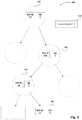
- FIG. 9illustrates a logical representation of a portion of file system 900 for managing file system state during replication jobs in accordance with one or more of the various embodiments.
- file system 900is represented as a tree
- various data structuresmay be used to store the data that represents the tree-like structure of the file system.
- Data structuresmay include tabular formats that include keys, self-referencing fields, child-parent relationships, or the like, to implement tree data structures, such as, graphs, trees, or the like, for managing a file system, such as, file system 900 .
- circlesare used to illustrate directory/folder file system objects.
- rectanglesare used to represent other file system objects, such as, files, documents, or the like.
- nodes and edges represented using dashed linesrepresent one or more other file system objects that may comprise file system 900 .
- file system objectsmay be associated with update epochs, read-only identifiers, or the like.
- additional meta-datasuch as, timestamps, permission information, size, information, or the like.
- some or all of this type of informationmay be stored in inode data structures.
- the read-only identifiers and update epochsare illustrates using the boxes that are inside of the file system objects labeled as ‘R/O ID’ for read-only identifiers and ‘UE’ for the update epochs.
- file system enginemay be arranged to configure file system as read-only by generating a read-only identifier and associating it with file system objects that are considered read-only. Accordingly, write requests directed to file system objects associated with a valid read-only identifiers may be rejected.
- setting read-only identifiers on all of the file system objects in a file systemmay consume a disadvantageous amount of resources or time.
- file system enginesmay be arranged to set a read-only identifier on the root of the file system that is being configured to be read-only.
- entire file systemsmay be set to read-only mode by setting one read-only identifier in one file system object.
- file system enginesmay be arranged to check if the write objects may be associated with a current (e.g., active or valid) read-only identifier. In some embodiments, if the write objects are associated with a current read-only identifier, the file system engine may be arranged to deny the write request.
- a file system enginehas marked file system 900 as read-only by providing a read-only identifier and associating it with file system object 902 .
- file system object 902may be considered the root directory of file system 900 .
- the file system enginehas associated the read-only identifier with a value of 123 with file system object 902 .
- the update epoch for file system object 902is updated to the current update epoch for the file system.
- box 910represents the data structure storing the current update epoch for the file system. Accordingly, in this example, the current update epoch is 5 (e.g, epoch 5) so the update epoch for file system object 902 is set to 5 to match the current update epoch of the file system.
- a write requestmay be received for file system object 908 .
- the file system enginemay be arranged to examine the meta-data associated with file system object 908 to determine if a current read-only identifier is associated with the object. In this example, file system object 908 is not associated with a read-only identifier.
- the file system enginemay begin examining the ancestor file system objects of file system object 908 looking for a current read-only identifier.
- the file system enginemay be arranged to visit the direct parent object of file system object 908 .
- file system object 906is the parent of file system object 908 .
- file system enginesmay be arranged to check each visited ancestor object for a current read-only identifier.
- file system object 906does not have current read-only identifier, so the file system engine may advance to the next ancestor, file system object 904 to look file system object a current read-only identifier.
- file system object 904may be the next file system object encountered by the file system engine.
- file system object 904is associated with a read-only identifier, but it is a stale read-only identifier rather than a current read-only identifier.
- stale read-only identifiersmay be read-only identifier associated with file system objects that are not at the current update epoch.
- file system object 906is associated with read-only identifier 456 it is not associated with the current update epoch of the file system. Accordingly, in some embodiments, the read-only identifier for file system object 904 may be considered stale. In one or more of the various embodiments, the read-only identifier may be considered stale because the update epoch associated with file system object 904 is less than the current update epoch for the file system.
- file system enginesmay be arranged to continue working up the file system tree because the read-only identifier associated with file system object 904 may be considered stale. So, in some embodiments, the file system engine may examine the next higher ancestor. In this example, the file system engine may next encounter file system object 902 .
- file system objecthas a read-only identifier and its update epoch matches the current update epoch for the file system.
- this conditionmay indicate the all objects descending from file system object 902 are read-only objects.
- the file system enginemay be arranged to deny the write request.
- itmay be advantageous to update the file system objects that were visited during the search for a current read-only identifier. For example, the relevant data structures may been loaded into local memory or caches so the expensive of looking them up again may be avoided.
- file system enginesmay be arranged to update the visited ancestors to with the current read-only identifier and the current update epoch.
- file system enginesmay be arranged to reverse the traversal and walk back down to file system object 908 (e.g., the write object) setting the current read-only identifier and the update epoch as it goes.
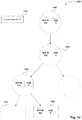
- FIG. 10illustrates a logical representation of a portion of file system 1000 for managing file system state during replication jobs in accordance with one or more of the various embodiments.
- file system 1000is represented as a tree
- various data structuresmay be used to store the data that represents the tree-like structure of the file system.
- Data structuresmay include tabular formats that include keys, self-referencing fields, child-parent relationships, or the like, to implement tree data structures, such as, graphs, trees, or the like, for managing a file system, such as, file system 1000 .
- file system 1000includes file system object 1002 , file system object 1004 , file system object 1006 , file system object 1008 , file system object 1012 , and a data structure 1010 for storing the current update epoch of the file system.
- file system 1000may be considered the same or similar to file system 900 described above. Accordingly, for brevity and clarity a detailed description of the elements in file system 1000 is not duplicated here.
- file system 1000shows how file system 900 may be represented after the write request described in FIG. 9 has been processed. Accordingly, in this example, the read-only identifier for the write object (file system object 1008 ) and its ancestors (e.g., file system object 1006 , file system object 1004 , and file system object 1002 ) are set to read-only identifier 123 .
- the file system enginecan immediately determine that the write request should be denied. Similarly, in this example, if a write request comes in for one or more siblings of file system object 1008 (e.g., file system object 1012 , or the like), the file system engine may determine its read-only status by examining file system object 1006 rather than being required to walk up to file system object 1002 .
- FIGS. 11-20represent generalized operations for managing file system state during replication jobs in accordance with one or more of the various embodiments.
- processes 1100 , 1200 , 1300 , 1400 , 1500 , 1600 , 1700 , 1800 , 1900 , and 2000 described in conjunction with FIGS. 11-20may be implemented by or executed by one or more processors on a single network computer, such as network computer 300 of FIG. 3 .
- these processes, or portions thereofmay be implemented by or executed on a plurality of network computers, such as network computer 300 of FIG. 3 .
- these processes, or portions thereofmay be implemented by or executed on one or more virtualized computers, such as, those in a cloud-based environment.
- embodimentsare not so limited and various combinations of network computers, client computers, or the like may be utilized.
- the processes described in conjunction with FIGS. 11-20may perform actions for managing file system state during replication jobs in accordance with at least one of the various embodiments or architectures such as those described in conjunction with FIGS. 4-8 .
- some or all of the actions performed by processes 1100 , 1200 , 1300 , 1400 , 1500 , 1600 , 1700 , 1800 , 1900 , and 2000may be executed in part by file system engine 322 , replication engine 324 , or recovery engine 326 .
- FIG. 11illustrates an overview flowchart for process 1100 for managing file system state during replication jobs in accordance with one or more of the various embodiments.
- a replication enginesuch as, replication engine 324 may be instantiated to perform various, starting at block 1104 ; otherwise, control may loop back to decision block 1102 .
- the replication engine or file system enginemay establish or confirm a secure communication channel between a source file system and one or more target file systems.
- a replication engine or a file system enginemay be arranged to select or employ a secure channel that may be configured separately.
- replication enginesmay use one or more virtual private networks, secure tunnels, secure connections, or the like, that have been setup prior to the start of a replication job.
- replication engines or file system enginesmay be arranged to establish a new secure connection for each replication job. In other embodiments, preexisting secure connections may be used.
- secure connectionsmay be established using conventional or customized methods.
- the some or all of the credential information that is necessary for establish the secure communication channelsmay be stored in configuration information or provided via user input, and may include, SSL/TLS certificates, passwords, pass phrases, one or more cryptographic keys or key pairs, or the like, or combination thereof.
- the replication enginemay be arranged to determine one or more file system objects for replication based on the current update epoch or a designated source replication snapshot. As described above, and in more detail below, the replication engine may be arranged to scan the source file system to identify file system objects to include in the replication job. Generally, in one or more of the various embodiments, file system objects associated with the replication snapshot are file system objects that were modified during the epoch that was closed or ended by the replication snapshot.
- the replication enginemay be arranged to communicate the one or more file system objects that are selected for replication from the source file system to the target file system.
- the replication enginemay use the secure communication channel that was described for block 1104 .
- controlmay be returned to a calling process.
- FIG. 12illustrates a flowchart of process 1200 for replicating file system objects in distributed file systems in accordance with one or more of the various embodiments.
- replication enginesmay be instantiated to perform various actions to perform replication jobs.
- Process 1200describes one or more of the various actions for replicating file system objects in a distributed file system.
- the replication enginemay generate a first snapshot for replication of the source file system. In some embodiments, if replication is being setup or performed for the first time, the replication engine may generate a first replication snapshot.
- this blockmay be optional because the source file system and the one or more target file systems may be in sync. For example, they may be brand new file systems that are setup with replication rules before users are allowed to store data in the source file system. In this case, a special first replication snapshot it not required, normal replication job snapshots (e.g., block 1208 ) may suffice.
- normal replication job snapshotse.g., block 1208
- the one or more target file systemmight not be synced with the source file system.
- one or more of the target file systemmay be new or otherwise empty file systems.
- the replication enginemay initialize the one or more target file systems with the file system objects on the source file system. In some cases, the entire contents of the source file system may be copied or otherwise regenerated onto the one or more target file system.
- this blockmay be optional because the source file system and the one or more target file systems may be in sync. For example, they may all be brand new file systems that are setup with replication rules before users are allowed to store data in the source file system.
- replication enginesmay be arranged to employ policy rules, configuration information, user input, or the like, to determine if a replication job should be initiated. For example, in some embodiments, replication engines may be arranged to execute a replication job every hour (or other time periods). Likewise, in one or more of the various embodiments, replication engines may be arranged to execute replication jobs if one or more conditions are met, such as, time-of-day, number of modifications to the source file system, the occurrence of one or more events, actions performed by specific applications, or the like.
- replication enginesmay be arranged to initiate replication jobs upon the occurrence of one or more triggering conditions or events that may be associated with one or more applications, servers, users, file system objects, or the like. For example, rules may be provided that execute a replication job each time a specific directory or file is modified or if one or more applications perform a particular action.
- a replication enginemay be configured to initiate a replication job each time a caching component writes stored values to persistent storage.
- the replication enginemay be arranged to evaluate the snapshot associated with the root of the source file system to determine if the a replication snapshot should be generated. Accordingly, the replication engine may compare the snapshot number associated with the root file system object with the snapshot number associated with the last replication job. As discussed above, if the snapshot of the root object is the same as the last replication snapshot, it indicates that none of the file system objects below the root object have been modified at least since the last replication job was executed. Accordingly, the replication job may be considered completed before it does any more work.
- the root objectmay be considered a root of a portion of the source file system that is being replicated rather than being restricted to being the root of the entire source file system. Accordingly, in this context, the root object may be the root object of replication job.
- controlmay flow to block 1212 ; otherwise, control may loop back to decision block 1206 because the replication job is complete since there are no file system objects to replicate.
- the replication enginemay generate a replication snapshot on the source file system.
- the replication snapshotmay be based on the entire source file system, or a portion of the source file system.
- the replication enginemay be arranged to copy the one or more file system objects that are associated with replication snapshot from the source file system to the one or more target file systems.
- the replication enginemay be arranged to trigger a snapshot to occur on the one or more target file systems. For example, if the replication snapshot is snapshot 5 on the source file system and the current update epoch on the target file system is epoch 5, the writes on the target file system that are associated with the replication job will occur in epoch 5 on the target file system.
- the replication enginemay trigger the file system engine to close epoch 5 by creating snapshot 5 to associate the modifications performed by the replication job with snapshot 5. Next, control may be returned to a calling process.
- FIG. 13illustrates a flowchart of process 1300 for replicating a file system object in a distributed file system in accordance with one or more of the various embodiments.
- a replication snapshot numbermay be provided to a replication engine.
- the replication enginemay generate or trigger the generation of the replication snapshot.
- replication enginesmay be arranged to trigger a snapshot to be taken before it runs one or more replication jobs.
- the replication enginemay be provided a snapshot number corresponding to snapshot that is already available on the source file system.
- the replication enginemay determine a file system object to examine for replication eligibility. In one or more of the various embodiments, one or more file system objects in the source file system may qualify for the pending replication job. In one or more of the various embodiments, the replication engine may scan the source file system to identify one or more file system objects that may be eligible for the replication job.
- the replication enginemay be arranged to compare the replication snapshot number to the latest snapshot number that is associated with the one or more file system objects.
- controlmay flow to block 1310 ; otherwise, control may be returned to a calling process.
- the replication snapshotis snapshot X and the snapshot associated with the file system object is snapshot X
- the file system objectmay be eligible for replication.
- the replication enginemay be arranged to test if the file system object has been modified in the replication snapshot meaning it was modified during the epoch that corresponds to the replication snapshot.
- the file system objectmay be written to the one or more target file systems.
- the file system objectis a file object (e.g., documents, files, blocks, or the like) the meta-data and changed contents of the of the file system object may be copied to the target file system.
- controlmay flow to block 1014 ; otherwise, control may be returned to a calling process.
- a directory objecte.g., a file system object that is a parent of other file system objects
- the replication enginemay be arranged to descend into the file system object to check for child file system objects that may be stale. Note, if the directory object is not stale, the replication engine may skip over the directory object rather than descend into it because it is guaranteed that the child objects will not be eligible for replication. For example, if a child file system object is eligible for replication, its parent object will be eligible as well. Next, control may be returned to a calling process.
- FIG. 14illustrates a flowchart of process 1400 for writing a file system object to a file system in a distributed file system in accordance with one or more of the various embodiments.
- a file system objectmay be provided to a file system engine for writing (e.g., creating, updating, deleting, or the like).
- controlmay flow to block 1416 ; otherwise, control may flow to block 1406 .
- the file system enginemay check the current update epoch or snapshot numbers for each parent of the file system object. If the immediate parent of the file system object is not in the current update epoch or in the latest snapshot (e.g., the replication snapshot) the file system engine will examine the parents object's parent (if any) to determine if it is current update epoch or latest snapshot. Accordingly, in some embodiments, the file system engine may be arranged to visit each parent object in ascending order. It may terminate its ascent upon discovering the first ancestor that is in the current update epoch or in the latest snapshot.
- controlmay flow to block 1414 ; otherwise, control may flow to block 1410 .
- the file system enginemay be arranged to queue the file system object write operation.
- file system enginemay be arranged to perform one or more pre-commit operations before committing the write to stable/persistent storage. Accordingly, during the execution of the one or more pre-commit actions, the file system object write may be may be queued until the pre-commit tasks have been executed.
- the file system enginemay be arranged to add an update parent(s) job to a local work queue.
- one or more ancestors of the file system objectmay be updated to reflect that they or one or more of their children have been modified in the current update epoch or that they are associated with the latest snapshot.
- the file system object writemay continue, In this example, process 1400 may dequeue the write operation for the file system object and pass control to block 1414 . Next, control may be returned to a calling process.
- the file system object meta-datamay be updated to reflect that it has been updated in the current epoch or associated with the latest snapshot, such as, a replication snapshot.
- the file system object writemay be committed to stable storage. Next, control may be returned to a calling process.
- FIG. 15illustrates a flowchart of process 1500 for managing file system state during replication jobs in accordance with one or more of the various embodiments.
- a replication enginemay be arranged to generate a replication snapshot on the source file system.
- a file system enginemay be arranged to copy one or more file system objects that may be associated with the replication snapshot to a target file system.
- controlmay flow to block 1508 ; otherwise, control may loop back to block 1504 .
- a replication enginemay be arranged to generate a replication snapshot on the target file system. As described above, the replication engine may traverse the source file system using the source replication snapshot number to determine if file system objects are associated with the pending replication job.
- a recovery enginemay be arranged to generate a recovery point based on the replication snapshot number associated with the replication snapshot on the source file system and the replication snapshot number associated with the replication snapshot on the target file system.
- controlmay be returned to a calling process.
- FIG. 16illustrates a flowchart of process 1600 for managing file system state during replication jobs in accordance with one or more of the various embodiments.
- a source file systemmay be arranged to be mirrored by a target file system.
- one file systemmay be arranged to mirror another file system.
- the source file systemmay be considered to be in a mirroring relationship with a designated target file system.
- a replication enginemay be arranged to create replication snapshots on the source file system and copy the file system objects associated with the replication snapshot to the target file system.
- the file system objects copied to the target file systemmay be associated with a replication snapshot on the target file system.
- the snapshot numbers for each file systemmay run independently. For example, a source replication snapshot may be associated with snapshot number 5 on the source file system while the corresponding target replication snapshot may be associated with snapshot number 4 on the target file system.
- various parameters associated with the mirroring relationshipmay be defined via configuration information.
- the replication periodmay be set via configuration information to a value of once per hour, or the like.
- Other parametersmay include defining one or more portions of the source file system to include in the mirroring relationship.
- a portion of the source file systemmay be dedicated to temporary data that is deemed unsuitable for mirroring.
- configuration informationmay include setting, rules, or instructions that act to exclude a portion of the source file system from the mirroring relationship.
- controlmay flow to block 1606 ; otherwise, control may loop back to block 1602 .
- controlmay flow to block 1606 ; otherwise, control may loop back to block 1602 .
- planned or unplanned interruptions of the mirroring relationshipmay occur.
- one or more clientsmay modify contents of the target file system.
- the target file systemmay be set to read-only to ensure that changes to the target file system may be limited to actions associated with replication jobs.
- the target file systemmay modified, including being made writable. Accordingly, in one or more of the various embodiments, during the interruption of the mirroring relationship one or more file system clients (users or administrators) may modify the target file system.
- this blockis marked as optional because in some cases, clients may not modify the target file system during the interruption of the mirroring relationship.
- controlmay flow to block 1610 ; otherwise, control may loop back to block 1606 .
- the mirroring relationshipmay be reestablished.
- the reestablishment of the mirroring relationshipmay be automatic or driven by administrator actions. For example, if the mirroring relationship is interrupted by a power failure that causes the mirroring to be interrupted, the source file system and target file system (or associated components) may automatically restart and restart the mirroring after power is restored.
- if the interruption was caused by planned maintenancesuch as, replacing or upgrading networking equipment disposed between the source file system and the target file system
- administratorsmay be enabled to restore the mirroring relationship after the planned maintenance is completed.
- file system engines, recovery engines, or the likemay be arranged to monitor various metrics or services (e.g., watchdog processes) to determine if the conditions merit the restoration of the mirroring relationship.
- rules or conditions for determining if the mirroring relationship should be restoredmay be determined from configuration information. Accordingly, in some embodiments, organizations may be enabled to tailor one or more of the conditions for restoring mirroring based on the needs of that organization.
- a recovery enginemay be arranged to initiate a recovery job.
- a file system engineneeds to ensure the current state of the target file system.
- a brute force full-copy of the contents of the source file system to the target file systemmay be unnecessary.
- the recovery jobmay be arranged to restore the target file system to a known condition while avoiding unnecessary copying of file system objects from the source file system to the target file system.
- the recovery enginemay be arranged to determine recovery point information for the source file system and the target file system.
- each file system(source or target) may locally a copy of the recovery points for each completed replication job.
- a file system management platformmay be arranged to store recovery point information, as well.
- recovery enginesmay be arranged to determine the location or access methods for the appropriate recovery point information based on paths, network addresses, security credentials, or the like, that may be obtained from configuration information.
- the recovery point informationmay at least include replication snapshot numbers that correspond to completed replication jobs. Accordingly, in one or more of the various embodiments, the recovery engine may be arranged to determine the most recent replication snapshot number from the determined recovery point information.
- the recovery enginemay be arranged to revert contents of the target file system based on the recovery point information.
- the recovery enginemay be arranged to employ the replication snapshot number to identify file system objects that may be associated with a completed replication job.
- the recovery enginemay be arranged to traverse the target file system to identify file system objects associated with the current epoch of the target file system.
- the current epochwill be associated with an epoch number that is greater that snapshot numbers of previously completed snapshot. For example, if the current epoch value is 5 and the replication snapshot number is 4, file system objects associated with the current epoch value may be discarded to revert a target file system back to how it was at the completion of the last replication job.
- the target file systemmay be considered to be in known mirror state such that it mirrors the contents of the source file system as of the source replication snapshot that is included in the recovery point information.
- mirroring actionsmay be performed to mirror the source file system on the target file system.
- controlmay be returned to a calling process.
- FIG. 17illustrates a flowchart of process 1700 for managing file system state during replication jobs in accordance with one or more of the various embodiments.
- a source file systemmay be arranged to be mirrored by a target file system.
- controlmay flow to block 1706 ; otherwise, control may loop back to block 1702 ;
- one or more clientsmay modify the contents of either the target file system or the source file system.
- either the source file system or the target file systemmay be modified via one or more clients. This may include writes, deletes, or the like.
- controlmay flow to block 1710 ; otherwise, control may loop back block 1706 .
- role reversalmeans that the file system that was the source file system is re-purposed as the target file system and the file system that was target file system is re-purposed as the source file system in a mirroring relationship.
- the source file systemwill be consistently referred to as the source file system even though its role may be reversed such that it becomes the target file system in the reversed mirroring relationship. After role reversal, the source file system becomes the target file system and the target file system becomes the source file system. But for brevity and clarity herein the ‘names’ used to refer to each file system remain unchanged.
- a recovery enginemay be arranged to determine recovery point information. As described above, the recovery engine may be arranged to obtain the replication snapshot number of the source file system from the recovery point information. In one or more of the various embodiments, the replication snapshot number may be associated with a completed replication job that copied the replication snapshot from the source file system to the target file system.
- the recovery enginemay be arranged to revert contents of the source file system based on the recovery point information.
- the source file systembecomes the target file system and the previous target file system becomes the source file system.
- the target file system in the mirroring relationshiphas to be reverted to a known condition based on the replication snapshot included in the recovery point.
- modifications made to the original target file system while the mirroring relationship is interruptedmay be included in a subsequent replication snapshot that is copied to the new target file system (e.g., the original source file system) via a replication job.
- a replication enginemay begin to perform actions (e.g., replication jobs) to mirror the contents of the original target file system on the original source file system. Accordingly, in some embodiments, the original target file system becomes the new source file system and original source file system becomes the new target file system.
- actionse.g., replication jobs
- controlmay be returned to a calling process.
- FIG. 18illustrates a flowchart of process 1800 for managing file system state during replication jobs in accordance with one or more of the various embodiments.
- a source file systemmay be configured to be read-only.
- file system enginemay be arranged to set a file system as read-only by associating a current read-only identifier with the root of the file system. Accordingly, in one or more of the various embodiments, the file system engine may be arranged to set a current read-only identifier at the root of a file system to effectively mark the entire file system as read-only.
- a file system enginemay be arranged to generate a replication snapshot and copy the associated file system objects to the target file system.
- reversing the roles of the source file system and target file system in a mirroring relationshipmay include executing one or more replication jobs to synchronized the contents of the source file system and the target file system.
- the file system enginemay be arranged to generate replication snapshot and execute a replication job that may be based on the replication snapshot.
- the file system enginemay be arranged to configure the original source file system as the target file system in the mirroring relationship. In one or more of the various embodiments, if the necessary replication jobs may successfully complete, the file system engine may be arranged to configure the original source file system to be the new target file system—reversing the mirroring relationship.
- the file system enginemay be arranged to configure the new source file system as writable. In one or more of the various embodiments, if the role reversal completed successfully, the new source file system may be enabled for writing to process write requests from one or more clients.
- the file system enginemay employ the replication engine to perform actions to enforce the mirroring relationship. As described above, in some embodiments, if the mirroring relationship is reestablished, period replication jobs may be executed to mirror the contents of the new source file system on the new target file system.
- controlmay be returned to a calling process.
- FIG. 19illustrates a flowchart of process 1900 for managing file system state during replication jobs in accordance with one or more of the various embodiments.
- the file system enginemay be arranged to determine the root object of the original source file system.
- a root file system objectmay be considered to be the top node of a portion of the file system tree.
- the file system enginein preparation for a role reversal replication job the file system engine may be arranged to determine the file system object that acts as the root of the file system.
- the file system enginemay be arranged to update the read-only identifier and the update epoch for the file system object associated with the root of the file system.
- the file system enginemay be arranged to associate a current read-only identifier with the root file system object.
- the update epoch associated with the root file system objectmay be set to the current update epoch of the file system. Accordingly, in some embodiments, the root file system object may be considered associated with a current read-only identifier.
- a replication enginemay be arranged to execute a replication job that copies changes from the source file system to the target file system.
- a replication jobin preparation for reversing the roles of a source file system and a target file system, may be executed to synchronize the contents of the source file system and the target file system before role reversal occurs.
- controlmay flow to block 1910 ; otherwise, control may loop back to block 1906 .
- clientsmay continue to inadvertently or deliberately attempt to write to the file system.
- the file system enginemay be arranged to determine write object associated with the write request.
- file system enginemay be arranged to lookup or retrieve the meta-data associated with the file system objects that may be associated with the write request.
- file system enginemay be arranged to employ one or more indices, caches, or the like, to quickly lookup the meta-data for write objects that may be the target of the write request.
- the file system enginemay be arranged to traverse upwards in the source file system from the write object.
- the file system enginemay be arranged to determine the parent file system objects of the write object based on the meta-data of the write object. Accordingly, in some embodiments, this information may be employed to determine the file system object that is the parent of the write object. For example, for some embodiments, if the write object is associated with a file, the parent file system object may be a file system object that represents a directory or folder in the file system. Likewise, in some embodiments, if the write object is a file system objects that represents a folder or directory, its parent file system object may be another directory or folder that includes the write object.
- a current read-only identifierif a current read-only identifier is encountered during the upwards traverse, control may flow to block 1916 ; otherwise, control be returned to the calling process.
- the file system engineFor each file system object visited during the traversal, the file system engine may be arranged to determine if the file system object is associated with a current read-only identifier.
- a current read-only identifieris a read-only identifier assigned to a file system object that is associated with an update epoch that is the same as the current update epoch of the file system.
- the file system enginemay be arranged to deny the write request because a current read-only identifier was discovered during the traversal the ancestors of the write object.
- controlmay be returned to a calling process.
- FIG. 20illustrates a flowchart of process 2000 for managing file system state during replication jobs in accordance with one or more of the various embodiments.
- the file system enginemay be arranged to begin processing a write request.
- various clients of a file systemmay be enabled to submit file system commands, such as, read, writes, updates, or the like, via one or more file system interfaces or APIs.
- write requestsmay be received even though a file system has been configured into read-only mode to support role reversal (e.g., flipping source file systems to become target file systems, or the like).
- the write requestmay be arranged to include information that at least identifies the file system objects associated with the write. Accordingly, in some embodiments, these file system objects may be considered or described as write objects.
- write requestcould be a request to perform actions that may be modify the contents of a file system rather than being strictly limited to requests to write new data to the file system.
- the file system enginemay be arranged to iteratively traverse the file system upwards from the write object associated with the write request.
- the file system enginemay be arranged to identify the folder or directory that includes the write objects that may be associated with the write requests.
- folder or directoriesare file system objects that may be the parents of other file system objects.
- the file system enginemay be arranged to identify the parent file system object of the write objects. Further, in some embodiments, the file system engine may be arranged to begin walking up the spine of the file system tree. Accordingly, in some embodiments, at each iteration, the file system engine may be arranged to identify the parent of the current file system object. After visiting one parent file system object the file system engine may visit its parent file system object, and so on.
- controlmay flow to block 2014 ; otherwise, control may flow to decision block 2008 .
- the file system enginemay be arranged to examine the meta-data associated with each file system object at it is visited.
- each file system objectmay be associated with read-only identifier.
- the file system objectmay be considered to be configured to be read-only.
- a read-only identifiermay be absent or have a nil/null value. In such cases, for some embodiments, file system objects may be treated the same as if they may be associated to a stale read-only identifier.
- a read-only identifiermay be considered current if update epoch associated with a file system object may be the same as the current update epoch of the file system. In one or more of the various embodiments, if a file system object has a read-only identifier and it is associated with a previous update epoch rather than the current update epoch for the file system, the read-only identifier may considered to be stale.
- controlmay flow to block 2010 ; otherwise, control may loop back to block 2004 to continue the upwards traversal.
- file system enginesmay be arranged to continue walking up the file system tree until the root of the file system may be encountered.
- the file system enginemay be arranged to allow the write request.
- the file system enginesince the root file system object has been visited and the read-only identifier examined and found to be absent or not current, the file system engine may be arranged to allow the write request to be processed. Note, in some embodiments, at this point, the write object and intervening parent file system objects have been examined to determine if they may be associated with a current read-only identifier. Accordingly, in some embodiments, because none of the parent file system objects or the write object may be associated with a current read-only identifier, the write request may be allowed.
- controlmay be returned to a calling process.
- the file system enginemay be arranged to deny the write request.
- the file system enginemay be arranged to deny the write request.
- this blockis marked optional because in some embodiments the file system engine may be arranged to deny of the write request later on in the process.
- the file system enginemay be arranged to iteratively traverse downwards towards the write object. In one or more of the various embodiments, the file system engine may be arranged to traverse the file system tree back down to the write object. In some embodiments, this may be a low impact (e.g., low latency) operation because the meta-data associated with the visited parent file system objects may be stored locally or otherwise previously obtained during the upward direction traversal.
- thismay be a low impact (e.g., low latency) operation because the meta-data associated with the visited parent file system objects may be stored locally or otherwise previously obtained during the upward direction traversal.
- the file system enginemay be arranged to update the read-only identifier and update epoch of the file system object encountered during the downward traversal.
- the read-only identifiermay set to the current read-only identifier that was determined during the upwards traversal through the file system.
- the update epoch value for each file system object visited during the downwards traversalmay be set to the current update epoch of the file system.
- the file system enginemay be arranged to update the read-only identifier and update epoch for the write object that may be associated with the write request.
- the read-only identifiermay set to the current read-only identifier that was determined during the upwards traversal through the file system.
- the update epoch value for the write objectmay be set to the current update epoch of the file system.
- the file system enginemay be arranged to deny the write request.
- the file system enginemay be arranged to deny the write request.
- this blockis marked optional because in some embodiments the file system engine may be arranged to deny of the write request later on in the process.
- controlmay be returned to a calling process.
- each block in each flowchart illustration, and combinations of blocks in each flowchart illustrationcan be implemented by computer program instructions.
- These program instructionsmay be provided to a processor to produce a machine, such that the instructions, which execute on the processor, create means for implementing the actions specified in each flowchart block or blocks.
- the computer program instructionsmay be executed by a processor to cause a series of operational steps to be performed by the processor to produce a computer-implemented process such that the instructions, which execute on the processor, provide steps for implementing the actions specified in each flowchart block or blocks.
- the computer program instructionsmay also cause at least some of the operational steps shown in the blocks of each flowchart to be performed in parallel.
- each block in each flowchart illustrationsupports combinations of means for performing the specified actions, combinations of steps for performing the specified actions and program instruction means for performing the specified actions. It will also be understood that each block in each flowchart illustration, and combinations of blocks in each flowchart illustration, can be implemented by special purpose hardware based systems, which perform the specified actions or steps, or combinations of special purpose hardware and computer instructions.
- special purpose hardware based systemswhich perform the specified actions or steps, or combinations of special purpose hardware and computer instructions.
- the logic in the illustrative flowchartsmay be executed using an embedded logic hardware device instead of a CPU, such as, an Application Specific Integrated Circuit (ASIC), Field Programmable Gate Array (FPGA), Programmable Array Logic (PAL), or the like, or combination thereof.
- the embedded logic hardware devicemay directly execute its embedded logic to perform actions.
- a microcontrollermay be arranged to directly execute its own embedded logic to perform actions and access its own internal memory and its own external Input and Output Interfaces (e.g., hardware pins or wireless transceivers) to perform actions, such as System On a Chip (SOC), or the like.
- SOCSystem On a Chip
Landscapes
- Engineering & Computer Science (AREA)
- Theoretical Computer Science (AREA)
- Data Mining & Analysis (AREA)
- Databases & Information Systems (AREA)
- Physics & Mathematics (AREA)
- General Engineering & Computer Science (AREA)
- General Physics & Mathematics (AREA)
- Information Retrieval, Db Structures And Fs Structures Therefor (AREA)
Abstract
Description
The present invention relates generally to file systems, and more particularly, but not exclusively, to managing file system recovery in a distributed file system environment.
Modern computing often requires the collection, processing, or storage of very large data sets or file systems. Accordingly, to accommodate the capacity requirements as well as other requirements, such as, high availability, redundancy, latency/access considerations, or the like, modern file systems may be very large or distributed across multiple hosts, networks, or data centers, and so on. File systems may require various backup or restore operations. Naïve backup strategies may cause significant storage or performance overhead. For example, in some cases, the size or distributed nature of a modern hyper-scale file systems may make it difficult to determine the objects that need to be replicated. Also, the large number of files in modern distributed file system may make managing state or protection information difficult because of the resources that may be required to visit the files to manage state or protection information for files. Thus, it is with respect to these considerations and others that the present invention has been made.
Non-limiting and non-exhaustive embodiments of the present innovations are described with reference to the following drawings. In the drawings, like reference numerals refer to like parts throughout the various figures unless otherwise specified. For a better understanding of the described innovations, reference will be made to the following Detailed Description of Various Embodiments, which is to be read in association with the accompanying drawings, wherein:
Various embodiments now will be described more fully hereinafter with reference to the accompanying drawings, which form a part hereof, and which show, by way of illustration, specific exemplary embodiments by which the invention may be practiced. The embodiments may, however, be embodied in many different forms and should not be construed as limited to the embodiments set forth herein; rather, these embodiments are provided so that this disclosure will be thorough and complete, and will fully convey the scope of the embodiments to those skilled in the art. Among other things, the various embodiments may be methods, systems, media or devices. Accordingly, the various embodiments may take the form of an entirely hardware embodiment, an entirely software embodiment or an embodiment combining software and hardware aspects. The following detailed description is, therefore, not to be taken in a limiting sense.
Throughout the specification and claims, the following terms take the meanings explicitly associated herein, unless the context clearly dictates otherwise. The phrase “in one embodiment” as used herein does not necessarily refer to the same embodiment, though it may. Furthermore, the phrase “in another embodiment” as used herein does not necessarily refer to a different embodiment, although it may. Thus, as described below, various embodiments may be readily combined, without departing from the scope or spirit of the invention.
In addition, as used herein, the term “or” is an inclusive “or” operator, and is equivalent to the term “and/or,” unless the context clearly dictates otherwise. The term “based on” is not exclusive and allows for being based on additional factors not described, unless the context clearly dictates otherwise. In addition, throughout the specification, the meaning of “a,” “an,” and “the” include plural references. The meaning of “in” includes “in” and “on.”
For example embodiments, the following terms are also used herein according to the corresponding meaning, unless the context clearly dictates otherwise.
As used herein the term, “engine” refers to logic embodied in hardware or software instructions, which can be written in a programming language, such as C, C++, Objective-C, COBOL, Java™, PHP, Perl, JavaScript, Ruby, VBScript, Microsoft .NET™ languages such as C#, or the like. An engine may be compiled into executable programs or written in interpreted programming languages. Software engines may be callable from other engines or from themselves. Engines described herein refer to one or more logical modules that can be merged with other engines or applications, or can be divided into sub-engines. The engines can be stored in non-transitory computer-readable medium or computer storage device and be stored on and executed by one or more general purpose computers, thus creating a special purpose computer configured to provide the engine.
As used herein the terms “file system object,” or “object” refer to entities stored in a file system. These may include files, directories, or the like. In this document for brevity and clarity all objects stored in a file system may be referred to as file system objects.
As used herein the terms “block,” or “file system object block” refer to the file system data objects that comprise a file system object. For example, small sized file system objects, such as, directory objects or small files may be comprised of a single block. Whereas, larger file system objects, such as large document files may be comprised of many blocks. Blocks usually are arranged to have a fixed size to simplify the management of a file system. This may include fixing blocks to a particular size based on requirements associated with underlying storage hardware, such as, solid state drives (SSDs) or hard disk drives (HDDs), or the like. However, file system objects, such as, files may be of various sizes, comprised of the number of blocks necessary to represent or contain the entire file system object.
As used herein the terms “epoch,” or “file system epoch” refer to time periods in the life of a file system. Epochs may be generated sequentially such thatepoch 1 comes beforeepoch 2 in time. Prior epochs are bounded in the sense that they have a defined beginning and end. The current epoch has a beginning but not an end because it is still running. Epochs may be used to track the birth and death of file system objects, or the like.
As used herein the term “snapshot” refers to a point time version of the file system or a portion of the file system. Snapshots preserve the version of the file system objects at the time the snapshot was taken. Snapshots may be sequentially labeled such thatsnapshot 1 is the first snapshot taken in a file system andsnapshot 2 is the second snapshot, and so on. The sequential labeling may be file system-wide even though snapshots may cover the same or different portions of the file system. Snapshots demark the end of the current file system epoch and the beginning of the next file system epoch. Accordingly, in some embodiments, if a file system is arranged to number epochs and snapshots sequentially, the epoch value or its number label may be assumed to be greater than the number label of the newest snapshot. Epoch boundaries may be formed when a snapshot is taken. The epoch (e.g., epoch count value) is incremented if a snapshot is created. Each epoch boundary is created when a snapshot was created. In some case, if a new snapshot is created, it may be assigned a number label that has the same as the epoch it is closing and thus be one less than the new current epoch that begins running when the new snapshot is taken.
As used herein the terms “mirror relationship,” or “mirroring relationship” refer to two file systems that are arranged such that one of the file systems is periodically backed up to the other. The file system that is being backed (e.g., the mirrored file system) is the source file system. The file system that is receiving the backed up objects from the source file system is the target file system.
As used herein the term “replication snapshot” refers to a snapshot that is generated for a replication job. Replication snapshots are regular snapshots that are associated with a failed or completed replication job. Similarly, replication snapshot numbers are the snapshot numbers associated with a replication snapshot.
As used herein the term “configuration information” refers to information that may include rule based policies, pattern matching, scripts (e.g., computer readable instructions), or the like, that may be provided from various sources, including, configuration files, databases, user input, built-in defaults, or the like, or combination thereof.
The following briefly describes embodiments of the invention in order to provide a basic understanding of some aspects of the invention. This brief description is not intended as an extensive overview. It is not intended to identify key or critical elements, or to delineate or otherwise narrow the scope. Its purpose is merely to present some concepts in a simplified form as a prelude to the more detailed description that is presented later.
Briefly stated, various embodiments are directed to managing data in a file system. In one or more of the various embodiments, a source file system that may be mirrored on a target file system may be provided such that the mirroring may be performed by executing one or more replication jobs that copy one or more changes on the source file system to the target file system.
In one or more of the various embodiments, a root object of the source file system may be associated with a current read-only identifier such that the current read-only identifier may correspond to a current update epoch of the source file system.
In one or more of the various embodiments, a replication job that copies objects from the source file system to the target file system may be execute such that the copied objects may be different on the target file system.
In one or more of the various embodiments, a write request that may be directed to the source file system may be received.
In one or more of the various embodiments, one or more write objects that may be associated with the write request may be determined such that determining the one or more write objects may include determining a position of the one or more write objects within the source file system.
In one or more of the various embodiments, the source file system may be traversed upwards from the position of the one or more write objects such that each object that may be subsequently visited by the upward traversal may be a parent object of a currently visited object.
In one or more of the various embodiments, a read-only identifier associated with each visited object may be determined such that the traversal may be terminated based on one or more of the read-only identifier matching the current read-only identifier or the root object being reached. In one or more of the various embodiments, determining the read-only identifier associated with each visited object may include determining that the read-only identifier may be stale based on a mismatch of an update epoch and the current update epoch for each visited object.
In one or more of the various embodiments, the write request may be enabled based on the mismatch of the read-only identifier and current read-only identifier. In one or more of the various embodiments, a turn-around object may be determined based on the read-only identifier matching the current read-only identifier. In one or more of the various embodiments, the traversal direction may be reversed at the turn-around object such that the source file system may be traversed in the downwards direction towards the one or more write objects.
In one or more of the various embodiments, the current read-only identifier may be associated with each object visited during the downward traversal.
In one or more of the various embodiments, the source file system may be designated as a new target file system. In some embodiments, the target file system may be designated as a new source file system. And, in some embodiments, one or more other replication jobs may be employed to mirror the new source file system on the new target file system.
In one or more of the various embodiments, an update epoch of each object visited during the downward traversal of the file system from the root object may be modified such that the modified update epoch matches the current update epoch.
In one or more of the various embodiments, an update epoch of the one or more write objects may be modified based on a denial of the write request such that the modified update epoch matches the current update epoch.
In one or more of the various embodiments, the write request may be allowed to be execute based on one or more of each visited object being associated with a stale read-only identifier or an absence of an association to a read-only identifier.
Illustrated Operating Environment
At least one embodiment of client computers102-105 is described in more detail below in conjunction withFIG. 2 . In one embodiment, at least some of client computers102-105 may operate over one or more wired or wireless networks, such asnetworks 108, or110. Generally, client computers102-105 may include virtually any computer capable of communicating over a network to send and receive information, perform various online activities, offline actions, or the like. In one embodiment, one or more of client computers102-105 may be configured to operate within a business or other entity to perform a variety of services for the business or other entity. For example, client computers102-105 may be configured to operate as a web server, firewall, client application, media player, mobile telephone, game console, desktop computer, or the like. However, client computers102-105 are not constrained to these services and may also be employed, for example, as for end-user computing in other embodiments. It should be recognized that more or less client computers (as shown inFIG. 1 ) may be included within a system such as described herein, and embodiments are therefore not constrained by the number or type of client computers employed.
Computers that may operate asclient computer 102 may include computers that typically connect using a wired or wireless communications medium such as personal computers, multiprocessor systems, microprocessor-based or programmable electronic devices, network PCs, or the like. In some embodiments, client computers102-105 may include virtually any portable computer capable of connecting to another computer and receiving information such as,laptop computer 103,mobile computer 104,tablet computers 105, or the like. However, portable computers are not so limited and may also include other portable computers such as cellular telephones, display pagers, radio frequency (RF) devices, infrared (IR) devices, Personal Digital Assistants (PDAs), handheld computers, wearable computers, integrated devices combining one or more of the preceding computers, or the like. As such, client computers102-105 typically range widely in terms of capabilities and features. Moreover, client computers102-105 may access various computing applications, including a browser, or other web-based application.
A web-enabled client computer may include a browser application that is configured to send requests and receive responses over the web. The browser application may be configured to receive and display graphics, text, multimedia, and the like, employing virtually any web-based language. In one embodiment, the browser application is enabled to employ JavaScript, HyperText Markup Language (HTML), eXtensible Markup Language (XML), JavaScript Object Notation (JSON), Cascading Style Sheets (CSS), or the like, or combination thereof, to display and send a message. In one embodiment, a user of the client computer may employ the browser application to perform various activities over a network (online). However, another application may also be used to perform various online activities.
Client computers102-105 also may include at least one other client application that is configured to receive or send content between another computer. The client application may include a capability to send or receive content, or the like. The client application may further provide information that identifies itself, including a type, capability, name, and the like. In one embodiment, client computers102-105 may uniquely identify themselves through any of a variety of mechanisms, including an Internet Protocol (IP) address, a phone number, Mobile Identification Number (MIN), an electronic serial number (ESN), a client certificate, or other device identifier. Such information may be provided in one or more network packets, or the like, sent between other client computers,application server computer 116, file systemmanagement server computer 118, file systemmanagement server computer 120, or other computers.
Client computers102-105 may further be configured to include a client application that enables an end-user to log into an end-user account that may be managed by another computer, such asapplication server computer 116, file systemmanagement server computer 118, file systemmanagement server computer 120, or the like. Such an end-user account, in one non-limiting example, may be configured to enable the end-user to manage one or more online activities, including in one non-limiting example, project management, software development, system administration, configuration management, search activities, social networking activities, browse various websites, communicate with other users, or the like. Also, client computers may be arranged to enable users to display reports, interactive user-interfaces, or results provided byapplication server computer 116, file systemmanagement server computer 118, file systemmanagement server computer 120.
Wireless network108 is configured to couple client computers103-105 and its components withnetwork 110. Wireless network108 may include any of a variety of wireless sub-networks that may further overlay stand-alone ad-hoc networks, and the like, to provide an infrastructure-oriented connection for client computers103-105. Such sub-networks may include mesh networks, Wireless LAN (WLAN) networks, cellular networks, and the like. In one embodiment, the system may include more than one wireless network.
Wireless network108 may further include an autonomous system of terminals, gateways, routers, and the like connected by wireless radio links, and the like. These connectors may be configured to move freely and randomly and organize themselves arbitrarily, such that the topology of wireless network108 may change rapidly.
Wireless network108 may further employ a plurality of access technologies including 2nd (2G), 3rd (3G), 4th (4G) 5th (5G) generation radio access for cellular systems, WLAN, Wireless Router (WR) mesh, and the like. Access technologies such as 2G, 3G, 4G, 5G, and future access networks may enable wide area coverage for mobile computers, such as client computers103-105 with various degrees of mobility. In one non-limiting example, wireless network108 may enable a radio connection through a radio network access such as Global System for Mobil communication (GSM), General Packet Radio Services (GPRS), Enhanced Data GSM Environment (EDGE), code division multiple access (CDMA), time division multiple access (TDMA), Wideband Code Division Multiple Access (WCDMA), High Speed Downlink Packet Access (HSDPA), Long Term Evolution (LTE), and the like. In essence, wireless network108 may include virtually any wireless communication mechanism by which information may travel between client computers103-105 and another computer, network, a cloud-based network, a cloud instance, or the like.
Additionally, communication media typically embodies computer readable instructions, data structures, program modules, or other transport mechanism and includes any information non-transitory delivery media or transitory delivery media. By way of example, communication media includes wired media such as twisted pair, coaxial cable, fiber optics, wave guides, and other wired media and wireless media such as acoustic, RF, infrared, and other wireless media.
Also, one embodiment of file systemmanagement server computer 118 or file systemmanagement server computer 120 are described in more detail below in conjunction withFIG. 3 . AlthoughFIG. 1 illustrates file systemmanagement server computer 118 or file systemmanagement server computer 120, or the like, each as a single computer, the innovations or embodiments are not so limited. For example, one or more functions of file systemmanagement server computer 118 or file systemmanagement server computer 120, or the like, may be distributed across one or more distinct network computers. Moreover, in one or more embodiments, file systemmanagement server computer 118 or file systemmanagement server computer 120 may be implemented using a plurality of network computers. Further, in one or more of the various embodiments, file systemmanagement server computer 118 or file systemmanagement server computer 120, or the like, may be implemented using one or more cloud instances in one or more cloud networks. Accordingly, these innovations and embodiments are not to be construed as being limited to a single environment, and other configurations, and other architectures are also envisaged.
Illustrative Client Computer
Further,client computer 200 may also comprise hardware security module (HSM)268 for providing additional tamper resistant safeguards for generating, storing or using security/cryptographic information such as, keys, digital certificates, passwords, passphrases, two-factor authentication information, or the like. In some embodiments, hardware security module may be employed to support one or more standard public key infrastructures (PKI), and may be employed to generate, manage, or store keys pairs, or the like. In some embodiments,HSM 268 may be a stand-alone computer, in other cases,HSM 268 may be arranged as a hardware card that may be added to a client computer.
Input/output interface 238 may also include one or more sensors for determining geolocation information (e.g., GPS), monitoring electrical power conditions (e.g., voltage sensors, current sensors, frequency sensors, and so on), monitoring weather (e.g., thermostats, barometers, anemometers, humidity detectors, precipitation scales, or the like), or the like. Sensors may be one or more hardware sensors that collect or measure data that is external toclient computer 200.
In at least one of the various embodiments, applications, such as,operating system 206,other client apps 224,web browser 226, or the like, may be arranged to employ geo-location information to select one or more localization features, such as, time zones, languages, currencies, calendar formatting, or the like. Localization features may be used in display objects, data models, data objects, user-interfaces, reports, as well as internal processes or databases. In at least one of the various embodiments, geo-location information used for selecting localization information may be provided byGPS 258. Also, in some embodiments, geolocation information may include information provided using one or more geolocation protocols over the networks, such as, wireless network108 or network111.
Human interface components can be peripheral devices that are physically separate fromclient computer 200, allowing for remote input or output toclient computer 200. For example, information routed as described here through human interface components such asdisplay 250 orkeyboard 252 can instead be routed throughnetwork interface 232 to appropriate human interface components located remotely. Examples of human interface peripheral components that may be remote include, but are not limited to, audio devices, pointing devices, keypads, displays, cameras, projectors, and the like. These peripheral components may communicate over a Pico Network such as Bluetooth™, Zigbee™ and the like. One non-limiting example of a client computer with such peripheral human interface components is a wearable computer, which might include a remote pico projector along with one or more cameras that remotely communicate with a separately located client computer to sense a user's gestures toward portions of an image projected by the pico projector onto a reflected surface such as a wall or the user's hand.
A client computer may includeweb browser application 226 that is configured to receive and to send web pages, web-based messages, graphics, text, multimedia, and the like. The client computer's browser application may employ virtually any programming language, including a wireless application protocol messages (WAP), and the like. In one or more embodiments, the browser application is enabled to employ Handheld Device Markup Language (HDML), Wireless Markup Language (WML), WMLScript, JavaScript, Standard Generalized Markup Language (SGML), HyperText Markup Language (HTML), eXtensible Markup Language (XML), HTML5, and the like.
Other examples of application programs include calendars, search programs, email client applications, IM applications, SMS applications, Voice Over Internet Protocol (VOIP) applications, contact managers, task managers, transcoders, database programs, word processing programs, security applications, spreadsheet programs, games, search programs, visualization applications, and so forth.
Additionally, in one or more embodiments (not shown in the figures),client computer 200 may include an embedded logic hardware device instead of a CPU, such as, an Application Specific Integrated Circuit (ASIC), Field Programmable Gate Array (FPGA), Programmable Array Logic (PAL), or the like, or combination thereof. The embedded logic hardware device may directly execute its embedded logic to perform actions. Also, in one or more embodiments (not shown in the figures),client computer 200 may include one or more hardware micro-controllers instead of CPUs. In one or more embodiments, the one or more micro-controllers may directly execute their own embedded logic to perform actions and access its own internal memory and its own external Input and Output Interfaces (e.g., hardware pins or wireless transceivers) to perform actions, such as System On a Chip (SOC), or the like.
Illustrative Network Computer
Network computers, such as,network computer 300 may include aprocessor 302 that may be in communication with amemory 304 via abus 328. In some embodiments,processor 302 may be comprised of one or more hardware processors, or one or more processor cores. In some cases, one or more of the one or more processors may be specialized processors designed to perform one or more specialized actions, such as, those described herein.Network computer 300 also includes apower supply 330,network interface 332,audio interface 356,display 350,keyboard 352, input/output interface 338, processor-readablestationary storage device 334, and processor-readableremovable storage device 336.Power supply 330 provides power to networkcomputer 300.
Also, input/output interface 338 may also include one or more sensors for determining geolocation information (e.g., GPS), monitoring electrical power conditions (e.g., voltage sensors, current sensors, frequency sensors, and so on), monitoring weather (e.g., thermostats, barometers, anemometers, humidity detectors, precipitation scales, or the like), or the like. Sensors may be one or more hardware sensors that collect or measure data that is external to networkcomputer 300. Human interface components can be physically separate fromnetwork computer 300, allowing for remote input or output to networkcomputer 300. For example, information routed as described here through human interface components such asdisplay 350 orkeyboard 352 can instead be routed through thenetwork interface 332 to appropriate human interface components located elsewhere on the network. Human interface components include any component that allows the computer to take input from, or send output to, a human user of a computer. Accordingly, pointing devices such as mice, styluses, track balls, or the like, may communicate throughpointing device interface 358 to receive user input.
In at least one of the various embodiments, applications, such as,operating system 306,file system engine 322,replication engine 324,recovery engine 326,web services 329, or the like, may be arranged to employ geo-location information to select one or more localization features, such as, time zones, languages, currencies, currency formatting, calendar formatting, or the like. Localization features may be used in user interfaces, dashboards, reports, as well as internal processes or databases. In at least one of the various embodiments, geo-location information used for selecting localization information may be provided byGPS 340. Also, in some embodiments, geolocation information may include information provided using one or more geolocation protocols over the networks, such as, wireless network108 or network111.
Furthermore, in one or more of the various embodiments,file system engine 322,replication engine 324,recovery engine 326,web services 329, or the like, may be operative in a cloud-based computing environment. In one or more of the various embodiments, these applications, and others, that comprise the management platform may be executing within virtual machines or virtual servers that may be managed in a cloud-based based computing environment. In one or more of the various embodiments, in this context the applications may flow from one physical network computer within the cloud-based environment to another depending on performance and scaling considerations automatically managed by the cloud computing environment. Likewise, in one or more of the various embodiments, virtual machines or virtual servers dedicated to filesystem engine 322,replication engine 324,recovery engine 326,web services 329, or the like, may be provisioned and de-commissioned automatically.
Also, in one or more of the various embodiments,file system engine 322,replication engine 324,recovery engine 326,web services 329, or the like, may be located in virtual servers running in a cloud-based computing environment rather than being tied to one or more specific physical network computers.
Further,network computer 300 may also comprise hardware security module (HSM)360 for providing additional tamper resistant safeguards for generating, storing or using security/cryptographic information such as, keys, digital certificates, passwords, passphrases, two-factor authentication information, or the like. In some embodiments, hardware security module may be employ to support one or more standard public key infrastructures (PKI), and may be employed to generate, manage, or store keys pairs, or the like. In some embodiments,HSM 360 may be a stand-alone network computer, in other cases,HSM 360 may be arranged as a hardware card that may be installed in a network computer.
Additionally, in one or more embodiments (not shown in the figures),network computer 300 may include an embedded logic hardware device instead of a CPU, such as, an Application Specific Integrated Circuit (ASIC), Field Programmable Gate Array (FPGA), Programmable Array Logic (PAL), or the like, or combination thereof. The embedded logic hardware device may directly execute its embedded logic to perform actions. Also, in one or more embodiments (not shown in the figures), the network computer may include one or more hardware microcontrollers instead of a CPU. In one or more embodiments, the one or more microcontrollers may directly execute their own embedded logic to perform actions and access their own internal memory and their own external Input and Output Interfaces (e.g., hardware pins or wireless transceivers) to perform actions, such as System On a Chip (SOC), or the like.
Illustrative Logical System Architecture
In one or more of the various embodiments, the implementation details that enablefile system 402 orfile system 404 to operate may be hidden from clients, such that they may be arranged to usefile system 402 orfile system 404 the same way they use other conventional file systems, including local file systems. Accordingly, in one or more of the various embodiments, clients may be unaware that they are using a distributed file system that supports replicating file objects to other file systems because file system engines or replication engines may be arranged to mimic the interface or behavior of one or more standard file systems.
Also, whilefile system 402 andfile system 404 are illustrated as using one file system management computer each with one set of file system objects, the innovations are not so limited. Innovations herein contemplate file systems that include one or more file system management computers or one or more file system object data stores. In some embodiments, file system object stores may be located remotely from one or more file system management computers. Also, a logical file system object store or file system may be spread across two or more cloud computing environments, storage clusters, or the like.
In some embodiments, one or more replication engines, such as,replication engine 324 may be running on a file system management computer, such as, filesystem management computer 406 or filesystem management computer 410. In some embodiments, replication engines may be arranged to perform actions to replicate of one or more portions of one or more file systems.
In one or more of the various embodiments, the replication engine may be arranged to enable users to associate one or more portions of a source file system with a target file system. In one or more of the various embodiments, configuration information may be employed to identify a portion of the source file system and a location in the target file system.
In one or more of the various embodiments, it may be desirable to configure file systems, such as,file system 402 to be replicate onto one or more different file systems, such as,file system 404. Accordingly, upon being triggered (e.g., via schedules, user input, continuous replication, or the like), a replication engine running on a source file system, such as,file system 402 may be arranged to replicate its file system objects on one or more target file systems, such as,file system 404. In some embodiments, replication engines may be arranged to replicate file system objects based on snapshot values or current update epochs associated with the file systems. As described below in more detail.
In one or more of the various embodiments, file systems may be arranged as mirrored pairs such that a source file system is configured to automatically be replicated on a target file system. Accordingly, in one or more of the various embodiments, replication engines may execute replication jobs that copy changes from the source file system to the target file system. In some embodiments, replication engines may be arranged to copy file system objects that have been added or modified to the source file system since the previous replication job.
In some embodiments, to help ensure that the target file system provides a faithful copy of the source file system, the target file system may be arranged to be read-only, except for writes associated with a replication job. Thus, in some embodiments, users may be assured the target file system is not modified via writes from users or other file system clients.
In one or more of the various embodiments, if source file system is arranged to be mirrored on a target file system, the source file system and the target file system are considered to be in a mirroring relationship.
However, in some embodiments, replication jobs may be unexpectedly interrupted by equipment or system failures. For example, a network switch that connects a source file system with its target file system may fail during a replication job. Thus, in some embodiments, the state of the target file system may be unknown with respect to the source file system.
Also, in some embodiments, more generally, mirroring relationships may be experience planned or unplanned interruptions such that the state of the source file system or the target file system become unknown. For example, while a mirroring relationship is interrupted either the source file system or target file system may experience modifications that happen separate from the mirroring relationship.
Accordingly, in one or more of the various embodiments, recovery engines, such as,recovery engine 326 may be arranged to perform actions that return the state of the target file system to a known state. For example, if a replication job is interrupted the target file system may have successfully mirrored some but not all of the file system objects.
Also, in some cases, during the mirroring relationship interruption the target file system may be enabled for writing outside of the mirroring relationship. Such as activity may cause the target file system to have an unknown state with respect to its source file system.
In some cases, in response to mirror relationship interruptions, conventional systems may be arranged to compare each file system object on the source file system with its mirrored counterpart on the target file system. However, in some embodiments, the size or number of file system objects in some distributed file systems may make such comparisons disadvantageous because rebuilding the mirrored state from scratch may consume excessive computing or networking resources.
Therefore, in one or more of the various embodiments, recovery engines may be arranged to employ one or more known recovery points that indicate a known state of a given file system. Accordingly, in some embodiments, recovery engines may be arranged to maintain a database or mapping of the recovery points of the source file system and the target file system. In one or more of the various embodiments, a file system management system may be arranged to associate recovery points of the source file system with recovery points of the target system.
Accordingly, in some embodiments, recovery engine may be arranged to determine corresponding recovery points on each file system to determine the file system objects that may need to be recopied to target file system. In one or more of the various embodiments, recovery points may be associated with a successfully completed replication jobs.
Also, in one or more of the various embodiments, organizations may desire to reverse the roles of a mirrored file system pair such that the original source file system becomes the target file system and the original target file system becomes the source file system. Accordingly, in some embodiments, the recovery points on each file system may be employed to ensure mirroring of the previous target file system on the new target file system.
Also, in one or more of the various embodiments, organizations may temporarily activate the target file system (making it writable) and disable the source file system. For example, if an organization intends to perform a planned system upgrade on the source file system, the organization may accept writes on the target file system while the source file system off-line. Accordingly, if the original source file system is brought back online, recovery points may be employed to update the source file system with writes or other changes that were written to the target file system while the source file system was out of service.
In this example, circles are used to illustrate directory/folder file system objects. And, rectangles are used to represent other file system objects, such as, files, documents, or the like. The number in the center of the file system object represents the last/latest snapshot associated with the given file system object.
In this example, for some embodiments,root 502 is the beginning of a portion of a file system.Root 502 is not a file system object per se, rather, it indicates a position in a distributed file system.Directory 504 represents the parent file system object of all the objects underroot 502.Directory 504 is the parent ofdirectory 506 anddirectory 508.Directory 510,file object 512, andfile object 514 are children ofdirectory 506;directory 514,file object 516, andfile object 518 are direct children ofdirectory 508;file object 520 is a direct child ofdirectory 510; andfile object 524 is a direct child ofdirectory 514. Also, in this example, for some embodiments, meta-data 526 includes the current update epoch and highest snapshot number forfile system 500.
In this example, file system objects infile system 500 are associated with snapshots ranging fromsnapshot 1 tosnapshot 4. The current epoch isnumber 5. Each time a snapshot is generated, the current epoch is ended and the new snapshot is associated with ending the current epoch. A new current epoch may then be generated by incrementing the last current epoch number. Accordingly, in this example, if another snapshot is generated, it will have a snapshot number of 5 and the current epoch will becomeepoch 6.
In one or more of the various embodiments, if two or more file systems, such as,file system 500 are arranged for replication, one file system may be designated the source file system and one or more other file systems may be designated target file systems. In some embodiments, the portions of the two or more file systems have the same file system logical structure. In some embodiments, the file systems may have different physical or implementations or representations as long as they logically represent the same structure.
In one or more of the various embodiments, at steady-state, parent file system objects, such as,directory 504,directory 506,directory 508,directory 510,directory 514, or the like, have a snapshot number based on the most recent snapshot associated with any of its children. For example, in this example,directory 504 has a snapshot value of 4 because its descendant,file object 518 has a snapshot value of 4. Similarly,directory 508 has the same snapshot value asfile object 518. Continuing with this example, this is becausefile object 518 was modified or created sometime aftersnapshot 3 was generated and beforesnapshot 4 was generated.
In one or more of the various embodiments, if file system objects are not modified subsequent to the generation follow-on snapshots, they remain associated with their current/last snapshot. For example, in this example,directory 514 is associated withsnapshot 2 because for this example, it was modified or created aftersnapshot 1 was generated (during epoch 2) and has remained unmodified since then. Accordingly, by observation, a modification to fileobject 524 caused it to be associated withsnapshot 2 which forced its parent,directory 514 to also be associated withsnapshot 2. In other words, for some embodiments, if a file system object is modified in a current epoch, it will be associated with the next snapshot that closes or ends the current epoch.
Compare, for example, in some embodiments, howdirectory 510 is associated withsnapshot 1 and all of its children are also associated withsnapshot 1. This indicates thatdirectory 510 and its children were created duringepoch 1 before the first snapshot (snapshot 1) was generated and that they have remained unmodified subsequent tosnapshot 1.
In one or more of the various embodiments, iffile system 500 is being replicated, a replication engine, such as,replication engine 324, may be arranged to employ the snapshot or epoch information of the file system objects in a file system to determine which file system objects should be copied to one or more target file systems.
In one or more of the various embodiments, replication engines may be arranged to track the last snapshot associated with the last replication job for a file system. For example, in some embodiments, a replication engine may be arranged to trigger the generation of a new snapshot prior to starting a replication jobs. Also, in some embodiments, a replication engine may be arranged perform replication jobs based on existing snapshots. For example, in some embodiments, a replication engine may be configured to launch a replication jobs every other snapshot, with the rules for generating snapshots being independent from the replication engine. Generally, in one or more of the various embodiments, replication engines may be arranged to execute one or more rules that define whether the replication engine should trigger a new snapshot for each replication job or use existing snapshots. In some embodiments, such rules may be provided by configuration files, user-input, built-in defaults, or the like, or combination thereof.
In one or more of the various embodiments, file system engines, such as,file system engine 322 may be arranged to update parent object meta-data (e.g., current update epoch or snapshot number) before a write operation is committed or otherwise consider stable. For example, iffile object 520 is updated, the file system engine may be arranged to examine the epoch/snapshot information fordirectory 510,directory 506, anddirectory 504 before committing the update to fileobject 520. Accordingly, in this example, iffile object 520 is updated,directory 510,directory 506 anddirectory 508 may be associated the current epoch (5) before the write to fileobject 520 is committed (which will also associatedfile object 520 with epoch 5) since the update is occurring during the current epoch (epoch 5).
Also, in one or more of the various embodiments, file system engine may generate recovery points based on replication jobs that run to completion. As discussed above, the file system objects for replication jobs may be determined based on snapshots. In some embodiments, a replication snapshot on a source file system may generated before starting a replication job. Thus, if the replication job completes without error, the target file system may associate the file system objects copied from the source file system with a replication snapshot on the target file system. Accordingly, in one or more of the various embodiments, the replication snapshot number of the source file system may be paired with the replication snapshot number on the target file system to provide a recovery point.
In one or more of the various embodiments, a recovery point includes a replication snapshot number of the source file system and a replication snapshot number of the target file system. However, in some embodiments, the replication snapshot number on the source file system may be generated before the replication job starts because it may be used to determine which file system objects to include in the job. Similarly, in some embodiments, the replication snapshot number on the target file system represents a snapshot associated with a completed replication job. Note, the value of the snapshot numbers on each file system do not be to the same. They do need to correspond to each other, but since each file system maintains its own snapshot numbers and current epochs, the values of the snapshot numbers included in a recovery point may be different.
In one or more of the various embodiments, if a replication job is interrupted, the replication snapshot on the source file system may remain valid. However, in some embodiments, since the replication job did not run to completion, a recovery point that includes that replication snapshot of the failed replication job will not be created.
Similar toFIG. 5 , circles inFIG. 6 represent directory objects (file system objects that have children) and rectangles inFIG. 6 represent file system objects that are files, documents, blocks, or the like. The latest snapshot number for each file system object is indicated by the number in the center of each file system object. For example,directory object 606 is associated withsnapshot number 5.
In one or more of the various embodiments, if a replication engine initiates a replication job, that job may be associated with a determined snapshot. In some embodiments, a replication engine may be arranged to trigger the generation of a snapshot before starting a replication job. In other embodiments, the replication engine may base a replication job on a snapshot that already exists. In this example, the replication engine may be arranged to initiate a replication job for the highest snapshot in file system600,snapshot 5.
Accordingly, in one or more of the various embodiments, the replication engine may traverse file system600 to identify file system objects that need to be copied to filesystem 616. In this example, as shown in the meta-data (meta-data632) for file system600, the current epoch for file system600 isepoch 6 and the latest snapshot issnapshot 5. In some embodiments, the replication engine may be arranged to find the file system objects that have changed since the last replication job. In this example, meta-data 634 forfile system 616 shows that the current epoch forfile system 616 isepoch 5 and the latest snapshot forfile system 616 issnapshot 4.
Note, in one or more of the various embodiments, the meta-data 632 or meta-data 634 may be stored such that they are accessible from either file system600 orfile system 616. Likewise, in some embodiments, one or more file systems may be provided meta-data information from another file system. In some embodiments, file systems may be arranged to communicate meta-data information, such as, meta-data 632 or meta-data 634 to another file system. In some embodiments, source file systems may be arranged to maintain a local copy of meta-data for the one or more target file systems. For example, in some embodiments, the source cluster may store the target cluster's Current Epoch/Highest Snapshot values.
In one or more of the various embodiments, file system600 andfile system 616 may be considered synced for replication. In some embodiments, configuring a replication target file system may include configuring the file system engine that manages the target file system to stay in-sync with the source file system. In some embodiments, staying in-sync may include configuring the target file system to be read-only except for replication activity. This enables snapshots on the target file system to mirror the snapshots on the source file system. For example, if independent writes were allowed on the target file system, the snapshots on the target file system may cover different file system objects than the same numbered snapshots on the source file system. This would break the replication process unless additional actions are taken to sync up the target file systems with the source file system.
In this example, a replication engine is configured to replicate file system600 onfile system 616. For this example, it can also be assumed thatsnapshot 5 of file system600 is the latest snapshot that the replication engine is configured to replicate.
Accordingly, in this example, in one or more of the various embodiments, the replication engine may be arranged to determine the file system objects in file system600 that need to be replicated onfile system 616. So, in this case, wherefile system 616 has been synced tosnapshot 4 of file system600, the replication engine may be arranged to identify the file system objects on file system600 that are associated withsnapshot 5. The file system objects associated withsnapshot 5 on file system600 are the file system objects that need to be replicated onfile system 616.
In one or more of the various embodiments, the replication engine may be arranged to compare the snapshot numbers associated with a file system object with the snapshot number of the snapshot that is being replicated to the target file system. Further, in one or more of the various embodiments, the replication engine may begin this comparison at the root of the source file system,root 602 in this example.
In one or more of the various embodiments, if the comparison discovers or identifies file system objects that have been modified since the previous replication job, those file system objects are the ones that need to be copied to the target file system. Such objects may be described as being in the replication snapshot. This means that that the file system object has changes that occurred during the lifetime of the snapshot the replication job is based on—the replication snapshot. If a directory object is determined to be in the replication snapshot, the replication engine may be arranged to descend into that object to identify the file system objects in that directory object that may need to be replicated. In contrast, if the replication engine encounters a directory object that is not in the replication snapshot, the replication engine does not have to descend into the that directory. This optimization leverages the guarantee that the snapshot value of a parent object is the same as the highest (or newest) snapshot that is associated with one or more of its children objects.
In one or more of the various embodiments, if the replication engine identifies file system objects in the source file system that may be eligible for replication, the contents of those file system objects may be copied to target file system. In one or more of the various embodiments, writing the data associated with the identified file system objects to the target file systems also includes updating the snapshot information and current epoch of the target file system.
In this example, file system600 is being replication to filesystem 616.FIG. 6 shows howfile system 616 appears before the replication has completed. At the completion of the replication job,file system 616 will appear the same as file system600, including an update to meta-data 634 that will record the current epoch forfile system 616 asepoch 6 and set the highest snapshot tosnapshot 5.
In this example, the file system objects that a replication engine would identify for replication includedirectory 604,directory 606, andfile object 612 as these are the only objects in file system600 that are associated withsnapshot 5 of file system600. In one or more of the various embodiments, after these file system object are copied to filesystem 616,file system 616 will look the same as file system600. Accordingly, in this example:directory 620 will be associated with snapshot 5 (for file system616);directory 622 will be associated withsnapshot 5; andfile object 628 will be modified to include the content offile object 612 and will be associated withsnapshot 5.
In one or more of the various embodiments, after the replication engine has written the changes associated with the replication job to the one or more target file systems, it may be arranged to trigger the generation of a snapshot to capture the changes made by the replication job.
In summary, in one or more of the various embodiments, a replication job may start with a snapshot, the replication snapshot, on the source file system. One or more file system objects on the source file system are determined based on the replication snapshot. The determined file system objects may then be copied and written to the target file system. After all the determined file system objects are written to the target file system, a snapshot is taken on the target file system to preserve the association of the written file system objects to target file system replication snapshot. Note, in one or more embodiments, there may be variations of the above. For example, a target file system may be configured close the target file systems current update epoch before a new replication job starts rather than doing at the completion of a replication job. For example, the target file system may be atcurrent update epoch 4, when a new replication job starts, one of the replication engines first actions may be to trigger a snapshot on the target file system. In this example, that would generatesnapshot 4 and set the current update epoch toepoch 5 on the target file system. Then in this example, the file system objects associated with the pending replication job will be modified on the target file system duringepoch 5 of the target file system, which will result in them being associated withsnapshot 5 when it is generated.
Similarly, in one or more of the various embodiments, snapshot values of paired or mirrored file systems may be employed to determine the file system objects that may have changes to rollback or discard if the replication engine is syncing a file system that has a current snapshot that is higher to a file system that has a lower snapshot. Continuing with the example described above, the file system objects on the first file system that are associated withsnapshot 5 may be rolled back or discarded to bring first file system in sync tosnapshot 4 of the second file system.
In one or more of the various embodiments, keeping the current epoch of the source file system and the target file system the same value may be not be a requirement. It this example, it is described as such for clarity and brevity. However, in one or more of the various embodiments, a source file system and a target file system may be configured to maintain distinct and different values for current epoch and highest snapshot even though the content of the file system objects may be the same. For example, a source file system may have been active much longer than the target file system. Accordingly, for example, a source file system may have a current epoch of 1005 while the target file system has a current epoch of 5. In this example, the epoch 1001 of the source file system may correspond toepoch 1 of the target file system. Likewise, for example, if the target file system has a current epoch of 1005 and the source target file system has a current epoch of 6, at the end of a replication job, the target file system will have a current epoch of 1006.
In one or more of the various embodiments, traversing the portion of file system starting from a designated root object and skipping the one or more parent objects that are unassociated with the replication snapshot improves efficiency and performance of the network computer or its one or more processors by reducing consumption of computing resources to perform the traversal. This increased performance and efficiency is realized because the replication engine or file system engine is not required to visit each object in the file store to determine if it has changed or otherwise is eligible for replication. Likewise, in some embodiments, increased performance and efficiency may be realized because the need for additional object level change tracking is eliminated. For example, an alternative conventional implementation may include maintaining a table of objects that have been changed since the last the replication job. However, for large file systems, the size of such a table may grow to consume a disadvantageous amount of memory.
In one or more of the various embodiments, as described above, replication engines may be arranged to designate or generate a snapshot as a replication snapshot. In some embodiments, replication snapshots on source file systems may be snapshots that represent the file system objects that need to be copied to from a source file system to a target file system. And, in some embodiments, replication snapshots on target file system may be associated with the file system objects copied from a source file system as part of a completed replication job.
In one or more of the various embodiments, if the replication job is interrupted, the replication snapshot on the source file system remains viable. However, in some embodiments, even though some file system objects may have been copied to the target file system, since the replication job did not run to completion the target file system may not provide a corresponding replication snapshot.
In one or more of the various embodiments,data structure 700 may be arranged to include columns for storing various attributes of recovery points. In this example,column 702 stores replication job identifiers,column 704 stores source file system identifiers,column 706 stores target file system identifiers,column 708 stores the replication snapshot number of the source file system,column 710 stores the replication snapshot number of the target file system.
In this example,row 712 illustrates a recovery point record. In this example,row 712 shows that file system A is being mirrored on file system X. Thus, in this example, file system A is the source file system and file system X is target file system in a mirroring relationship. Also, in this example,row 712 shows that replication snapshot number for the source file system is 4 and the replication snapshot number for the target file system is 3. Accordingly, in some embodiments, the information includesrow 712 may be considered a recovery point for file system A and X. Row712 shows thatreplication snapshot 4 on the source file system corresponds toreplication snapshot 3 on the target file system. Accordingly, in some embodiments, the file system is guaranteeing that at the completion ofreplication job 10,snapshot 4 on the source file system andsnapshot 3 on the target file system are associated with identical copies of the file system objects.
Likewise, in this example,row 714 shows thatreplication snapshot 8 on the source file system corresponds toreplication snapshot 4 on the target file system. Accordingly, in some embodiments, the file system is guaranteeing that at the completion ofreplication job 11,snapshot 8 on the source file system andsnapshot 4 on the target file system are associated with identical copies of the file system objects.
In this example, for some embodiments, attime 808,source file system 802 may be a file system enabled for read/write activity. In this example,source file system 802 may be configured to be mirrored withtarget file system 804. Accordingly, the arrow fromsource file system 802 to targetfile system 804 attime 808 represents a mirroring relationship betweensource file system 802 to targetfile system 804. As indicated by R/W or R/O,source file system 802 is writable (R/W) andtarget file system 804 is read-only (R/O) except for write actions comprising replication jobs. Accordingly, in some embodiments, file system engines may be ensured that the target file system maintains a faithful mirror of the data stored onsource file system 802. In contrast, iftarget file system 804 is writable by users, the mirroring relationship may be disrupted because other users or services may introduce changes onfile system 804 that may break the mirroring relationship.
Attime 810, the mirroring relationship may be considered interrupted. In this example, there may be various planned or unplanned reasons for such an interruption, such as, planned upgrades, network failures, or the like. In some embodiments, as a result of the interruption, the contents oftarget file system 804 may be in an undetermined state with respect tosource file system 802. Note, if the contents oftarget file system 804 may have been modified while the mirroring relationship is interrupted,target file system 804 may be considered out of sync withsource file system 802. Also, in some embodiments, if a replication job may be interrupted, an indeterminate number of file system objects may have been copied fromsource file system 802 before the interruption.
Attime 812, in some embodiments, the interruption to the mirroring relationship may be considered resolved. In some embodiments, a recovery engine, such as,recovery engine 326 may be arranged to perform various actions to restoretarget file system 804 to a known state before the mirroring relationship restored.
In one or more of the various embodiments,target file system 804 may be set to RIO mode to prevent file system clients from modifyingtarget file system 802 while the mirroring relationship is reestablished.
Also, in one or more of the various embodiments, the recovery engine may determine the most recent recovery point associated with the mirroring. Accordingly, in one or more of the various embodiments, the recovery point may be arranged to include the source replication snapshot number and the target replication snapshot number associated with the last replication job that ran to completion.
In one or more of the various embodiments, the recovery engine may be arranged to revert or rollbacktarget file system 804 to target replication snapshot determined from the recovery point. Since, in one or more of the various embodiments, the target replication snapshot number identifies the snapshot on the target file system that corresponds to the last replication job, it may be employed to identify modifications to targetfile system 804 that occurred during the interruption of the mirroring relationship.
In one or more of the various embodiments, the snapshot number associated with various parent file system objects enable the recovery engine to quickly determine if file system objects should be discarded. For example, if a target replication snapshot number is 4, the recovery engine can assume that any file system objects associated with a snapshot number of 4 or less should be retained and any file system objects associated with a snapshot number greater than 4 should be reverted and discarded because modifications associated with snapshots or a current epoch other than the target replication snapshot included in the recovery point may be associated with modifications that occurred while the mirroring relationship was interrupted. Likewise, in some embodiments, such file system objects may be file system objects copied during an interrupted replication job.
Reverting the modifications to targetfile system 804 that may be unassociated with the recovery point restorestarget file system 804 to a known state that corresponds to the last completed replication job associated with the mirroring relationship.
Attime 814, the mirroring relationship betweensource file system 802 andtarget file system 804 has been reestablished. In some embodiments, iftarget file system 804 is reverted to a known recovery point, a replication engine may return to periodically executing replication jobs as part of a mirroring policy.
In this example, similar toFIG. 8A , attime 816,source file system 802 andtarget file system 804 may be considered to be in an active mirroring relationship. Accordingly, in this example, the arrow betweensource file system 802 andtarget file system 804 represent the direction of the mirroring relationship. Thus, in this example, a replication engine may be copying file system objects associated with replication snapshots fromsource file system 802 to targetfile system 804.
Attime 818, for various reasons, the mirroring relationship betweensource file system 802 andtarget file system 804 may be disrupted. As described above, this scenario may occur for various planned or unplanned reasons.
Attime 820, the mirroring relationship has been severed and either file system (source file system 802 or target file system804) may be involved in other file system operations that may not be automatically copied to either file system.
Attime 822, in this scenario, the organization intends to reverse the roles of the file systems. Accordingly, in one or more of the various embodiments, a recovery engine may be arranged to determine a recovery point based on the last completed replication job. However, since, in this example, the mirroring relationship is being reversed, the original source file system,source file system 802 may take the role of the target file system, while the original target file system,target file system 804 may take the role of source file system.
Accordingly, in some embodiments, a source file system may be changed to the target file system. However, before a file system can become a target file system in a mirroring relationship, the file system objects not included in the last completed replication job need to be discarded. See, the description fortime 812 above regarding how recovery points may be employed to facilitate determining which file system objects on a file system, such as,source file system 802 may be discarded to preparefile system 802 to mirrortarget file system 804.
At time824, if the reversion ofsource file system 802 to the last good replication snapshot is completed, another mirroring relationship may be established that copies data fromtarget file system 804 to sourcefile system 802.
Note, for brevity and clarity, the source/target designations forsource file system 802 andtarget file system 804 have been maintained even though the roles have reversed. One of ordinary skill in the art will appreciate that the source/target roles associated with file system can vary. And, that the file system sending files to another file system is the source file system and the file system that is receiving those files is the target file system.
In this example, circles are used to illustrate directory/folder file system objects. And, rectangles are used to represent other file system objects, such as, files, documents, or the like. Also, in this example, nodes and edges represented using dashed lines represent one or more other file system objects that may comprisefile system 900.
In some embodiments, file system objects may be associated with update epochs, read-only identifiers, or the like. In some embodiments, there may be additional meta-data, such as, timestamps, permission information, size, information, or the like. In some embodiments, some or all of this type of information may be stored in inode data structures. In this example, the read-only identifiers and update epochs are illustrates using the boxes that are inside of the file system objects labeled as ‘R/O ID’ for read-only identifiers and ‘UE’ for the update epochs.
In one or more of the various embodiments, file system engine may be arranged to configure file system as read-only by generating a read-only identifier and associating it with file system objects that are considered read-only. Accordingly, write requests directed to file system objects associated with a valid read-only identifiers may be rejected.
However, in some embodiments, setting read-only identifiers on all of the file system objects in a file system may consume a disadvantageous amount of resources or time.
Accordingly, in one or more of the various embodiments, file system engines may be arranged to set a read-only identifier on the root of the file system that is being configured to be read-only. Thus, in some embodiments, entire file systems may be set to read-only mode by setting one read-only identifier in one file system object.
In one or more of the various embodiments, as write requests are received, file system engines may be arranged to check if the write objects may be associated with a current (e.g., active or valid) read-only identifier. In some embodiments, if the write objects are associated with a current read-only identifier, the file system engine may be arranged to deny the write request.
In this example, a file system engine has markedfile system 900 as read-only by providing a read-only identifier and associating it withfile system object 902. In this example,file system object 902 may be considered the root directory offile system 900. Accordingly, in this example, the file system engine has associated the read-only identifier with a value of 123 withfile system object 902. Also of note, the update epoch forfile system object 902 is updated to the current update epoch for the file system. In this example,box 910 represents the data structure storing the current update epoch for the file system. Accordingly, in this example, the current update epoch is 5 (e.g, epoch 5) so the update epoch forfile system object 902 is set to 5 to match the current update epoch of the file system.
Some time later, a write request may be received forfile system object 908. Accordingly, in some embodiments, the file system engine may be arranged to examine the meta-data associated withfile system object 908 to determine if a current read-only identifier is associated with the object. In this example,file system object 908 is not associated with a read-only identifier.
Accordingly, in some embodiments, the file system engine may begin examining the ancestor file system objects offile system object 908 looking for a current read-only identifier. In some embodiments, the file system engine may be arranged to visit the direct parent object offile system object 908.
In this example,file system object 906 is the parent offile system object 908. In some embodiments, file system engines may be arranged to check each visited ancestor object for a current read-only identifier. In this example,file system object 906 does not have current read-only identifier, so the file system engine may advance to the next ancestor,file system object 904 to look file system object a current read-only identifier.
In this example, for some embodiments,file system object 904 may be the next file system object encountered by the file system engine. In this example,file system object 904 is associated with a read-only identifier, but it is a stale read-only identifier rather than a current read-only identifier.
In one or more of the various embodiments, stale read-only identifiers may be read-only identifier associated with file system objects that are not at the current update epoch. In this example, whilefile system object 906 is associated with read-only identifier 456 it is not associated with the current update epoch of the file system. Accordingly, in some embodiments, the read-only identifier forfile system object 904 may be considered stale. In one or more of the various embodiments, the read-only identifier may be considered stale because the update epoch associated withfile system object 904 is less than the current update epoch for the file system.
In one or more of the various embodiments, file system engines may be arranged to continue working up the file system tree because the read-only identifier associated withfile system object 904 may be considered stale. So, in some embodiments, the file system engine may examine the next higher ancestor. In this example, the file system engine may next encounterfile system object 902.
In this example, file system object has a read-only identifier and its update epoch matches the current update epoch for the file system. In one or more of the various embodiments, this condition may indicate the all objects descending fromfile system object 902 are read-only objects.
In one or more of the various embodiments, at this point, the file system engine may be arranged to deny the write request. In some embodiments, it may be advantageous to update the file system objects that were visited during the search for a current read-only identifier. For example, the relevant data structures may been loaded into local memory or caches so the expensive of looking them up again may be avoided.
Accordingly, in one or more of the various embodiments, file system engines may be arranged to update the visited ancestors to with the current read-only identifier and the current update epoch. In some embodiments, file system engines may be arranged to reverse the traversal and walk back down to file system object908 (e.g., the write object) setting the current read-only identifier and the update epoch as it goes.
In this example,file system 1000, includesfile system object 1002,file system object 1004,file system object 1006,file system object 1008,file system object 1012, and adata structure 1010 for storing the current update epoch of the file system.
In this example,file system 1000 may be considered the same or similar tofile system 900 described above. Accordingly, for brevity and clarity a detailed description of the elements infile system 1000 is not duplicated here.
In this example,file system 1000 shows howfile system 900 may be represented after the write request described inFIG. 9 has been processed. Accordingly, in this example, the read-only identifier for the write object (file system object1008) and its ancestors (e.g.,file system object 1006,file system object 1004, and file system object1002) are set to read-only identifier 123.
Accordingly, in one or more of the various embodiments, if a subsequent write request is directed towardsfile system object 1008, the file system engine can immediately determine that the write request should be denied. Similarly, in this example, if a write request comes in for one or more siblings of file system object1008 (e.g.,file system object 1012, or the like), the file system engine may determine its read-only status by examiningfile system object 1006 rather than being required to walk up tofile system object 1002.
Generalized Operations
Atblock 1104, in one or more of the various embodiments, the replication engine or file system engine may establish or confirm a secure communication channel between a source file system and one or more target file systems. In some embodiments, a replication engine or a file system engine may be arranged to select or employ a secure channel that may be configured separately. For example, in some embodiments, replication engines may use one or more virtual private networks, secure tunnels, secure connections, or the like, that have been setup prior to the start of a replication job. In some embodiments, replication engines or file system engines may be arranged to establish a new secure connection for each replication job. In other embodiments, preexisting secure connections may be used.
In one or more of the various embodiments, secure connections may be established using conventional or customized methods. In some embodiments, the some or all of the credential information that is necessary for establish the secure communication channels may be stored in configuration information or provided via user input, and may include, SSL/TLS certificates, passwords, pass phrases, one or more cryptographic keys or key pairs, or the like, or combination thereof.
At block1106, in one or more of the various embodiments, the replication engine may be arranged to determine one or more file system objects for replication based on the current update epoch or a designated source replication snapshot. As described above, and in more detail below, the replication engine may be arranged to scan the source file system to identify file system objects to include in the replication job. Generally, in one or more of the various embodiments, file system objects associated with the replication snapshot are file system objects that were modified during the epoch that was closed or ended by the replication snapshot.
At block1110, in one or more of the various embodiments, the replication engine may be arranged to communicate the one or more file system objects that are selected for replication from the source file system to the target file system. In one or more of the various embodiments, the replication engine may use the secure communication channel that was described forblock 1104. Next, control may be returned to a calling process.
In some embodiments, this block may be optional because the source file system and the one or more target file systems may be in sync. For example, they may be brand new file systems that are setup with replication rules before users are allowed to store data in the source file system. In this case, a special first replication snapshot it not required, normal replication job snapshots (e.g., block1208) may suffice.
Atblock 1204, in one or more of the various embodiments, optionally, if the source file system and one or more target file system are being setup as replication pairs, the one or more target file system might not be synced with the source file system. For example, one or more of the target file system may be new or otherwise empty file systems. Accordingly, for example, the replication engine may initialize the one or more target file systems with the file system objects on the source file system. In some cases, the entire contents of the source file system may be copied or otherwise regenerated onto the one or more target file system.
In some embodiments, this block may be optional because the source file system and the one or more target file systems may be in sync. For example, they may all be brand new file systems that are setup with replication rules before users are allowed to store data in the source file system.
Atdecision block 1206, in one or more of the various embodiments, if a replication job is started, control may flow to block1208; otherwise, control may loop back todecision block 1206. In one or more of the various embodiments, as discussed above replication engines may be arranged to employ policy rules, configuration information, user input, or the like, to determine if a replication job should be initiated. For example, in some embodiments, replication engines may be arranged to execute a replication job every hour (or other time periods). Likewise, in one or more of the various embodiments, replication engines may be arranged to execute replication jobs if one or more conditions are met, such as, time-of-day, number of modifications to the source file system, the occurrence of one or more events, actions performed by specific applications, or the like. In some embodiments, replication engines may be arranged to initiate replication jobs upon the occurrence of one or more triggering conditions or events that may be associated with one or more applications, servers, users, file system objects, or the like. For example, rules may be provided that execute a replication job each time a specific directory or file is modified or if one or more applications perform a particular action. For example, a replication engine may be configured to initiate a replication job each time a caching component writes stored values to persistent storage.
Atblock 1208, in one or more of the various embodiments, the replication engine may be arranged to evaluate the snapshot associated with the root of the source file system to determine if the a replication snapshot should be generated. Accordingly, the replication engine may compare the snapshot number associated with the root file system object with the snapshot number associated with the last replication job. As discussed above, if the snapshot of the root object is the same as the last replication snapshot, it indicates that none of the file system objects below the root object have been modified at least since the last replication job was executed. Accordingly, the replication job may be considered completed before it does any more work. Note, in some embodiments, the root object may be considered a root of a portion of the source file system that is being replicated rather than being restricted to being the root of the entire source file system. Accordingly, in this context, the root object may be the root object of replication job.
Atdecision block 1210, in one or more of the various embodiments, if the snapshot number associated with the root file system object is different than the snapshot number associated with the last replication snapshot, control may flow to block1212; otherwise, control may loop back todecision block 1206 because the replication job is complete since there are no file system objects to replicate.
Atblock 1212, in one or more of the various embodiments, the replication engine may generate a replication snapshot on the source file system. In some embodiments, the replication snapshot may be based on the entire source file system, or a portion of the source file system.
Atblock 1214, in one or more of the various embodiments, the replication engine may be arranged to copy the one or more file system objects that are associated with replication snapshot from the source file system to the one or more target file systems. In one or more of the various embodiments, if the copying of file system objects associated with the replication job is complete, the replication engine may be arranged to trigger a snapshot to occur on the one or more target file systems. For example, if the replication snapshot issnapshot 5 on the source file system and the current update epoch on the target file system isepoch 5, the writes on the target file system that are associated with the replication job will occur inepoch 5 on the target file system. Upon completion of the replication job, the replication engine may trigger the file system engine to closeepoch 5 by creatingsnapshot 5 to associate the modifications performed by the replication job withsnapshot 5. Next, control may be returned to a calling process.
Atblock 1304, in one or more of the various embodiments, the replication engine may determine a file system object to examine for replication eligibility. In one or more of the various embodiments, one or more file system objects in the source file system may qualify for the pending replication job. In one or more of the various embodiments, the replication engine may scan the source file system to identify one or more file system objects that may be eligible for the replication job.
Atblock 1306, in one or more of the various embodiments, the replication engine may be arranged to compare the replication snapshot number to the latest snapshot number that is associated with the one or more file system objects.
Atdecision block 1308, in one or more of the various embodiments, if the file system object is stale, control may flow to block1310; otherwise, control may be returned to a calling process. For example, if the replication snapshot is snapshot X and the snapshot associated with the file system object is snapshot X, the file system object may be eligible for replication. In one or more of the various embodiments, the replication engine may be arranged to test if the file system object has been modified in the replication snapshot meaning it was modified during the epoch that corresponds to the replication snapshot.
Atblock 1310, in one or more of the various embodiments, the file system object may be written to the one or more target file systems. In one or more of the various embodiments, if the file system object is a file object (e.g., documents, files, blocks, or the like) the meta-data and changed contents of the of the file system object may be copied to the target file system.
Atdecision block 1312, in one or more of the various embodiments, if the file system object is a directory object (e.g., a file system object that is a parent of other file system objects), control may flow to block1014; otherwise, control may be returned to a calling process.
Atblock 1314, in one or more of the various embodiments, because the file system object is a stale directory object, the replication engine may be arranged to descend into the file system object to check for child file system objects that may be stale. Note, if the directory object is not stale, the replication engine may skip over the directory object rather than descend into it because it is guaranteed that the child objects will not be eligible for replication. For example, if a child file system object is eligible for replication, its parent object will be eligible as well. Next, control may be returned to a calling process.
Atdecision block 1404, in one or more of the various embodiments, if the file system object is in the current update epoch of the file system, control may flow to block1416; otherwise, control may flow to block1406.
Atblock 1406, in one or more of the various embodiments, the file system engine may check the current update epoch or snapshot numbers for each parent of the file system object. If the immediate parent of the file system object is not in the current update epoch or in the latest snapshot (e.g., the replication snapshot) the file system engine will examine the parents object's parent (if any) to determine if it is current update epoch or latest snapshot. Accordingly, in some embodiments, the file system engine may be arranged to visit each parent object in ascending order. It may terminate its ascent upon discovering the first ancestor that is in the current update epoch or in the latest snapshot.
Atdecision block 1408, in one or more of the various embodiments, if the parents' of the file system object (if any) are in the current epoch of the file system, control may flow to block1414; otherwise, control may flow to block1410.
Atblock 1410, in one or more of the various embodiments, the file system engine may be arranged to queue the file system object write operation. In one or more of the various embodiments, file system engine may be arranged to perform one or more pre-commit operations before committing the write to stable/persistent storage. Accordingly, during the execution of the one or more pre-commit actions, the file system object write may be may be queued until the pre-commit tasks have been executed.
Atblock 1412, in one or more of the various embodiments, the file system engine may be arranged to add an update parent(s) job to a local work queue. In one or more of the various embodiments, one or more ancestors of the file system object may be updated to reflect that they or one or more of their children have been modified in the current update epoch or that they are associated with the latest snapshot. In some embodiments, if the parents are updated successfully, the file system object write may continue, In this example,process 1400 may dequeue the write operation for the file system object and pass control to block1414. Next, control may be returned to a calling process.
Atblock 1414, in one or more of the various embodiments, the file system object meta-data may be updated to reflect that it has been updated in the current epoch or associated with the latest snapshot, such as, a replication snapshot. Atblock 1416, in one or more of the various embodiments, the file system object write may be committed to stable storage. Next, control may be returned to a calling process.
Atblock 1504, in one or more of the various embodiments, a file system engine may be arranged to copy one or more file system objects that may be associated with the replication snapshot to a target file system.
Atdecision block 1506, in one or more of the various embodiments, if the replication job is complete, control may flow to block1508; otherwise, control may loop back toblock 1504.
Atblock 1508, in one or more of the various embodiments, a replication engine may be arranged to generate a replication snapshot on the target file system. As described above, the replication engine may traverse the source file system using the source replication snapshot number to determine if file system objects are associated with the pending replication job.
Atblock 1510, in one or more of the various embodiments, a recovery engine may be arranged to generate a recovery point based on the replication snapshot number associated with the replication snapshot on the source file system and the replication snapshot number associated with the replication snapshot on the target file system.
Next, in one or more of the various embodiments, control may be returned to a calling process.
In one or more of the various embodiments, various parameters associated with the mirroring relationship may be defined via configuration information. For example, the replication period may be set via configuration information to a value of once per hour, or the like. Other parameters may include defining one or more portions of the source file system to include in the mirroring relationship. For example, a portion of the source file system may be dedicated to temporary data that is deemed unsuitable for mirroring. Thus, for this example, configuration information may include setting, rules, or instructions that act to exclude a portion of the source file system from the mirroring relationship.
Atdecision block 1604, in one or more of the various embodiments, if the mirroring relationship may be interrupted, control may flow to block1606; otherwise, control may loop back toblock 1602. As discussed above, for various reasons, planned or unplanned interruptions of the mirroring relationship may occur.
Atblock 1606, in one or more of the various embodiments, optionally, one or more clients may modify contents of the target file system. As mentioned above, in some embodiments, while the mirroring relationship is operative, the target file system may be set to read-only to ensure that changes to the target file system may be limited to actions associated with replication jobs. However, in some embodiments, as a consequence of the interruption of the mirroring relationship, the target file system may modified, including being made writable. Accordingly, in one or more of the various embodiments, during the interruption of the mirroring relationship one or more file system clients (users or administrators) may modify the target file system.
Note, for some embodiments, this block is marked as optional because in some cases, clients may not modify the target file system during the interruption of the mirroring relationship.
Atdecision block 1608, in one or more of the various embodiments, if the mirroring relationship may be reestablished, control may flow to block1610; otherwise, control may loop back toblock 1606. At some time after being interrupted, the mirroring relationship may be reestablished. In some embodiments, the reestablishment of the mirroring relationship may be automatic or driven by administrator actions. For example, if the mirroring relationship is interrupted by a power failure that causes the mirroring to be interrupted, the source file system and target file system (or associated components) may automatically restart and restart the mirroring after power is restored.
Also, for example, in some embodiments, if the interruption was caused by planned maintenance, such as, replacing or upgrading networking equipment disposed between the source file system and the target file system, administrators may be enabled to restore the mirroring relationship after the planned maintenance is completed.
In one or more of the various embodiments, file system engines, recovery engines, or the like, may be arranged to monitor various metrics or services (e.g., watchdog processes) to determine if the conditions merit the restoration of the mirroring relationship. In some embodiments, rules or conditions for determining if the mirroring relationship should be restored may be determined from configuration information. Accordingly, in some embodiments, organizations may be enabled to tailor one or more of the conditions for restoring mirroring based on the needs of that organization.
Atblock 1610, in one or more of the various embodiments, a recovery engine may be arranged to initiate a recovery job. In one or more of the various embodiments, before mirroring can restart, a file system engine needs to ensure the current state of the target file system. In some embodiments, even though there has been an interruption in the mirroring relationship, often most of the file system objects on the target file system may be intact. Thus, in one or more of the various embodiments, a brute force full-copy of the contents of the source file system to the target file system may be unnecessary.
Accordingly, in one or more of the various embodiments, the recovery job may be arranged to restore the target file system to a known condition while avoiding unnecessary copying of file system objects from the source file system to the target file system.
Atblock 1612, in one or more of the various embodiments, the recovery engine may be arranged to determine recovery point information for the source file system and the target file system. In one or more of the various embodiments, each file system (source or target) may locally a copy of the recovery points for each completed replication job. Also, in some embodiments, a file system management platform may be arranged to store recovery point information, as well. In one or more of the various embodiments, recovery engines may be arranged to determine the location or access methods for the appropriate recovery point information based on paths, network addresses, security credentials, or the like, that may be obtained from configuration information.
As described above, the recovery point information may at least include replication snapshot numbers that correspond to completed replication jobs. Accordingly, in one or more of the various embodiments, the recovery engine may be arranged to determine the most recent replication snapshot number from the determined recovery point information.
Atblock 1614, in one or more of the various embodiments, the recovery engine may be arranged to revert contents of the target file system based on the recovery point information. In one or more of the various embodiments, the recovery engine may be arranged to employ the replication snapshot number to identify file system objects that may be associated with a completed replication job.
Accordingly, in some embodiments, as described above, the recovery engine may be arranged to traverse the target file system to identify file system objects associated with the current epoch of the target file system. As described above, the current epoch will be associated with an epoch number that is greater that snapshot numbers of previously completed snapshot. For example, if the current epoch value is 5 and the replication snapshot number is 4, file system objects associated with the current epoch value may be discarded to revert a target file system back to how it was at the completion of the last replication job. Accordingly, in one or more of the various embodiments, if the modifications associated with snapshot numbers (including the current epoch number) are greater than the replication snapshot number are reverted, the target file system may be considered to be in known mirror state such that it mirrors the contents of the source file system as of the source replication snapshot that is included in the recovery point information.
Atblock 1616, in one or more of the various embodiments, mirroring actions (e.g., replication jobs) may be performed to mirror the source file system on the target file system.
Next, in one or more of the various embodiments, control may be returned to a calling process.
Atdecision block 1704, in one or more of the various embodiments, if the mirroring relationship may be disrupted, control may flow to block1706; otherwise, control may loop back to block1702;
Atblock 1706, in one or more of the various embodiments, optionally, one or more clients may modify the contents of either the target file system or the source file system. As described above, whether the interruption in the mirroring relationship is planned or unplanned, either the source file system or the target file system may be modified via one or more clients. This may include writes, deletes, or the like.
Atdecision block 1708, in one or more of the various embodiments, if the roles of the source file system and target file system are reversed, control may flow to block1710; otherwise, control may loop backblock 1706. In one or more of the various embodiments, role reversal means that the file system that was the source file system is re-purposed as the target file system and the file system that was target file system is re-purposed as the source file system in a mirroring relationship.
Note, in this discussion the source file system will be consistently referred to as the source file system even though its role may be reversed such that it becomes the target file system in the reversed mirroring relationship. After role reversal, the source file system becomes the target file system and the target file system becomes the source file system. But for brevity and clarity herein the ‘names’ used to refer to each file system remain unchanged.
Atblock 1710, in one or more of the various embodiments, a recovery engine may be arranged to determine recovery point information. As described above, the recovery engine may be arranged to obtain the replication snapshot number of the source file system from the recovery point information. In one or more of the various embodiments, the replication snapshot number may be associated with a completed replication job that copied the replication snapshot from the source file system to the target file system.
Atblock 1712, in one or more of the various embodiments, the recovery engine may be arranged to revert contents of the source file system based on the recovery point information. In a role reversal scenario the source file system becomes the target file system and the previous target file system becomes the source file system. However, in one or more of the various embodiments, before a mirroring relationship can be established, the target file system in the mirroring relationship has to be reverted to a known condition based on the replication snapshot included in the recovery point.
Note, in the role reversal scenario the original target file system does not need to be reverted. In some embodiments, modifications made to the original target file system while the mirroring relationship is interrupted may be included in a subsequent replication snapshot that is copied to the new target file system (e.g., the original source file system) via a replication job.
Atblock 1714, in one or more of the various embodiments, a replication engine may begin to perform actions (e.g., replication jobs) to mirror the contents of the original target file system on the original source file system. Accordingly, in some embodiments, the original target file system becomes the new source file system and original source file system becomes the new target file system.
Next, in one or more of the various embodiments, control may be returned to a calling process.
Atblock 1804, in one or more of the various embodiments, a file system engine may be arranged to generate a replication snapshot and copy the associated file system objects to the target file system. As described above, in some embodiments, reversing the roles of the source file system and target file system in a mirroring relationship may include executing one or more replication jobs to synchronized the contents of the source file system and the target file system. Accordingly, in one or more of the various embodiments, the file system engine may be arranged to generate replication snapshot and execute a replication job that may be based on the replication snapshot.
Atblock 1806, in one or more of the various embodiments, the file system engine may be arranged to configure the original target file system as the source file system in the mirroring relationship. In one or more of the various embodiments, if the necessary replication jobs may successfully complete, the file system engine may be arranged to configure the original target file system to be the new source file system.
Atblock 1808, in one or more of the various embodiments, the file system engine may be arranged to configure the original source file system as the target file system in the mirroring relationship. In one or more of the various embodiments, if the necessary replication jobs may successfully complete, the file system engine may be arranged to configure the original source file system to be the new target file system—reversing the mirroring relationship.
Atblock 1810, in one or more of the various embodiments, the file system engine may be arranged to configure the new source file system as writable. In one or more of the various embodiments, if the role reversal completed successfully, the new source file system may be enabled for writing to process write requests from one or more clients.
Atblock 1812, in one or more of the various embodiments, the file system engine may employ the replication engine to perform actions to enforce the mirroring relationship. As described above, in some embodiments, if the mirroring relationship is reestablished, period replication jobs may be executed to mirror the contents of the new source file system on the new target file system.
Next, in one or more of the various embodiments, control may be returned to a calling process.
Atblock 1904, in one or more of the various embodiments, the file system engine may be arranged to update the read-only identifier and the update epoch for the file system object associated with the root of the file system. In one or more of the various embodiments, the file system engine may be arranged to associate a current read-only identifier with the root file system object. Also, in some embodiments, because the status of the root file system object is being changed, the update epoch associated with the root file system object may be set to the current update epoch of the file system. Accordingly, in some embodiments, the root file system object may be considered associated with a current read-only identifier.
Atblock 1906, in one or more of the various embodiments, a replication engine may be arranged to execute a replication job that copies changes from the source file system to the target file system. In one or more of the various embodiments, in preparation for reversing the roles of a source file system and a target file system, a replication job may be executed to synchronize the contents of the source file system and the target file system before role reversal occurs.
Atdecision block 1908, in one or more of the various embodiments, if a client issues a write request directed to the source file system, control may flow to block1910; otherwise, control may loop back toblock 1906. In one or more of the various embodiments, even the source file system has been set to read-only mode, clients may continue to inadvertently or deliberately attempt to write to the file system.
Atblock 1910, in one or more of the various embodiments, the file system engine may be arranged to determine write object associated with the write request. In one or more of the various embodiments, file system engine may be arranged to lookup or retrieve the meta-data associated with the file system objects that may be associated with the write request. For example, in some embodiments, file system engine may be arranged to employ one or more indices, caches, or the like, to quickly lookup the meta-data for write objects that may be the target of the write request.
Atblock 1912, in one or more of the various embodiments, the file system engine may be arranged to traverse upwards in the source file system from the write object. As described above, in one or more of the various embodiments, the file system engine may be arranged to determine the parent file system objects of the write object based on the meta-data of the write object. Accordingly, in some embodiments, this information may be employed to determine the file system object that is the parent of the write object. For example, for some embodiments, if the write object is associated with a file, the parent file system object may be a file system object that represents a directory or folder in the file system. Likewise, in some embodiments, if the write object is a file system objects that represents a folder or directory, its parent file system object may be another directory or folder that includes the write object.
Atdecision block 1914, in one or more of the various embodiments, if a current read-only identifier is encountered during the upwards traverse, control may flow to block1916; otherwise, control be returned to the calling process. For each file system object visited during the traversal, the file system engine may be arranged to determine if the file system object is associated with a current read-only identifier. As described above, for some embodiments, a current read-only identifier is a read-only identifier assigned to a file system object that is associated with an update epoch that is the same as the current update epoch of the file system.
Atblock 1916, in one or more of the various embodiments, the file system engine may be arranged to deny the write request because a current read-only identifier was discovered during the traversal the ancestors of the write object.
Next, in one or more of the various embodiments, control may be returned to a calling process.
In one or more of the various embodiments, the write request may be arranged to include information that at least identifies the file system objects associated with the write. Accordingly, in some embodiments, these file system objects may be considered or described as write objects.
Note, one of ordinary skill in the art will appreciate the a write request could be a request to perform actions that may be modify the contents of a file system rather than being strictly limited to requests to write new data to the file system.
Atblock 2004, in one or more of the various embodiments, the file system engine may be arranged to iteratively traverse the file system upwards from the write object associated with the write request. In one or more of the various embodiments, the file system engine may be arranged to identify the folder or directory that includes the write objects that may be associated with the write requests. As described above, in some embodiments, folder or directories are file system objects that may be the parents of other file system objects.
In one or more of the various embodiments, the file system engine may be arranged to identify the parent file system object of the write objects. Further, in some embodiments, the file system engine may be arranged to begin walking up the spine of the file system tree. Accordingly, in some embodiments, at each iteration, the file system engine may be arranged to identify the parent of the current file system object. After visiting one parent file system object the file system engine may visit its parent file system object, and so on.
Atdecision block 2006, in one or more of the various embodiments, if a current read-only identifier is encountered, control may flow to block2014; otherwise, control may flow todecision block 2008. In one or more of the various embodiments, the file system engine may be arranged to examine the meta-data associated with each file system object at it is visited.
As described above, each file system object may be associated with read-only identifier. In some embodiments, if a read-only identifier is current, the file system object may be considered to be configured to be read-only. Note, in some embodiments, a read-only identifier may be absent or have a nil/null value. In such cases, for some embodiments, file system objects may be treated the same as if they may be associated to a stale read-only identifier.
In one or more of the various embodiments, a read-only identifier may be considered current if update epoch associated with a file system object may be the same as the current update epoch of the file system. In one or more of the various embodiments, if a file system object has a read-only identifier and it is associated with a previous update epoch rather than the current update epoch for the file system, the read-only identifier may considered to be stale.
Atdecision block 2008, in one or more of the various embodiments, if the root of the file system may be encountered, control may flow to block2010; otherwise, control may loop back to block2004 to continue the upwards traversal. In one or more of the various embodiments, file system engines may be arranged to continue walking up the file system tree until the root of the file system may be encountered.
Atblock 2010, in one or more of the various embodiments, the file system engine may be arranged to allow the write request. In one or more of the various embodiments, since the root file system object has been visited and the read-only identifier examined and found to be absent or not current, the file system engine may be arranged to allow the write request to be processed. Note, in some embodiments, at this point, the write object and intervening parent file system objects have been examined to determine if they may be associated with a current read-only identifier. Accordingly, in some embodiments, because none of the parent file system objects or the write object may be associated with a current read-only identifier, the write request may be allowed.
Next, in one or more of the various embodiments, control may be returned to a calling process.
Atblock 2012, in one or more of the various embodiments, optionally, the file system engine may be arranged to deny the write request. As described above, in some embodiments, if a write object or one or more of its parent file system objects may be associated with a current read-only identifier, that file system object is considered read-only. Accordingly, in some embodiments, the file system engine may be arranged to deny the write request.
Note, this block is marked optional because in some embodiments the file system engine may be arranged to deny of the write request later on in the process.
Atblock 2014, in one or more of the various embodiments, the file system engine may be arranged to iteratively traverse downwards towards the write object. In one or more of the various embodiments, the file system engine may be arranged to traverse the file system tree back down to the write object. In some embodiments, this may be a low impact (e.g., low latency) operation because the meta-data associated with the visited parent file system objects may be stored locally or otherwise previously obtained during the upward direction traversal.
Atblock 2016, in one or more of the various embodiments, the file system engine may be arranged to update the read-only identifier and update epoch of the file system object encountered during the downward traversal. In one or more of the various embodiments, the read-only identifier may set to the current read-only identifier that was determined during the upwards traversal through the file system. In some embodiments, the update epoch value for each file system object visited during the downwards traversal may be set to the current update epoch of the file system.
Atdecision block 2018, in one or more of the various embodiments, if the write object associated with the write request is encountered, control may flow to block2020; otherwise, control may flow back toblock 2014.
Atblock 2020, in one or more of the various embodiments, the file system engine may be arranged to update the read-only identifier and update epoch for the write object that may be associated with the write request. In one or more of the various embodiments, the read-only identifier may set to the current read-only identifier that was determined during the upwards traversal through the file system. In some embodiments, the update epoch value for the write object may be set to the current update epoch of the file system.
Atblock 2022, in one or more of the various embodiments, optionally, the file system engine may be arranged to deny the write request. As described above, in some embodiments, if a write object or one or more of its parent file system objects may be associated with a current read-only identifier, that file system object is considered read-only. Accordingly, in some embodiments, the file system engine may be arranged to deny the write request.
Note, this block is marked optional because in some embodiments the file system engine may be arranged to deny of the write request later on in the process.
Next, in one or more of the various embodiments, control may be returned to a calling process.
It will be understood that each block in each flowchart illustration, and combinations of blocks in each flowchart illustration, can be implemented by computer program instructions. These program instructions may be provided to a processor to produce a machine, such that the instructions, which execute on the processor, create means for implementing the actions specified in each flowchart block or blocks. The computer program instructions may be executed by a processor to cause a series of operational steps to be performed by the processor to produce a computer-implemented process such that the instructions, which execute on the processor, provide steps for implementing the actions specified in each flowchart block or blocks. The computer program instructions may also cause at least some of the operational steps shown in the blocks of each flowchart to be performed in parallel. Moreover, some of the steps may also be performed across more than one processor, such as might arise in a multi-processor computer system. In addition, one or more blocks or combinations of blocks in each flowchart illustration may also be performed concurrently with other blocks or combinations of blocks, or even in a different sequence than illustrated without departing from the scope or spirit of the invention.
Accordingly, each block in each flowchart illustration supports combinations of means for performing the specified actions, combinations of steps for performing the specified actions and program instruction means for performing the specified actions. It will also be understood that each block in each flowchart illustration, and combinations of blocks in each flowchart illustration, can be implemented by special purpose hardware based systems, which perform the specified actions or steps, or combinations of special purpose hardware and computer instructions. The foregoing example should not be construed as limiting or exhaustive, but rather, an illustrative use case to show an implementation of at least one of the various embodiments of the invention.
Further, in one or more embodiments (not shown in the figures), the logic in the illustrative flowcharts may be executed using an embedded logic hardware device instead of a CPU, such as, an Application Specific Integrated Circuit (ASIC), Field Programmable Gate Array (FPGA), Programmable Array Logic (PAL), or the like, or combination thereof. The embedded logic hardware device may directly execute its embedded logic to perform actions. In one or more embodiments, a microcontroller may be arranged to directly execute its own embedded logic to perform actions and access its own internal memory and its own external Input and Output Interfaces (e.g., hardware pins or wireless transceivers) to perform actions, such as System On a Chip (SOC), or the like.
Claims (28)
1. A method for managing data in a file system over a network using one or more processors that execute instructions to perform actions, comprising:
providing a source file system that is mirrored on a target file system, wherein the mirroring is performed by executing one or more replication jobs that copy one or more changes on the source file system to the target file system;
associating a root object of the source file system with a current read-only identifier, wherein the current read-only identifier corresponds to a current update epoch of the source file system;
executing a replication job that copies objects from the source file system to the target file system, wherein the copied objects are different on the target file system;
receiving a write request that is directed to the source file system;
determining one or more write objects that are associated with the write request, wherein determining the one or more write objects includes determining a position of the one or more write objects within the source file system;
traversing the source file system upward from the position of the one or more write objects, wherein each object that is subsequently visited by an upward traversal is a parent object of a currently visited object;
determining a read-only identifier associated with each visited object, wherein the upward traversal is terminated based on one or more of the read-only identifier matching the current read-only identifier or the root object being reached; and
enabling the write request based on the read-only identifier mis-matching the current read-only identifier.
2. The method ofclaim 1 , further comprising:
determining a turn-around object based on the read-only identifier matching the current read-only identifier;
reversing the upward traversal direction at the turn-around object, wherein the source file system is traversed in the downwards direction towards the one or more write objects; and
associating the current read-only identifier with each object visited during a downward traversal.
3. The method ofclaim 1 , further comprising:
designating the source file system as a new target file system;
designating the target file system as a new source file system; and
employing one or more other replication jobs to mirror the new source file system on the new target file system.
4. The method ofclaim 1 , wherein determining the read-only identifier associated with each visited object, further comprises, determining the read-only identifier is stale based on a mismatch of an update epoch and the current update epoch for each visited object.
5. The method ofclaim 1 , further comprising, modifying an update epoch of each object visited during a downward traversal of the file system from the root object, wherein the modified update epoch matches the current update epoch.
6. The method ofclaim 1 , further comprising, modifying an update epoch of the one or more write objects based on a denial of the write request, wherein the modified update epoch matches the current update epoch.
7. The method ofclaim 1 , further comprising, allowing the write request to be executed based on one or more of each visited object being associated with a stale read-only identifier or an absence of an association to a read-only identifier.
8. A system for managing data in a file system comprising:
a network computer, comprising:
a transceiver that communicates over the network;
a memory that stores at least instructions; and
one or more processors that execute instructions that perform actions, including:
providing a source file system that is mirrored on a target file system, wherein the mirroring is performed by executing one or more replication jobs that copy one or more changes on the source file system to the target file system;
associating a root object of the source file system with a current read-only identifier, wherein the current read-only identifier corresponds to a current update epoch of the source file system;
executing a replication job that copies objects from the source file system to the target file system, wherein the copied objects are different on the target file system;
receiving a write request that is directed to the source file system;
determining one or more write objects that are associated with the write request, wherein determining the one or more write objects includes determining a position of the one or more write objects within the source file system;
traversing the source file system upward from the position of the one or more write objects, wherein each object that is subsequently visited by an upward traversal is a parent object of a currently visited object;
determining a read-only identifier associated with each visited object, wherein the upward traversal is terminated based on one or more of the read-only identifier matching the current read-only identifier or the root object being reached; and
enabling the write request based on the read-only identifier mis-matching the current read-only identifier; and
a client computer, comprising:
a transceiver that communicates over the network;
a memory that stores at least instructions; and
one or more processors that execute instructions that perform actions, including, providing the write request.
9. The system ofclaim 8 , wherein the one or more network computer processors execute instructions that perform actions, further comprising:
determining a turn-around object based on the read-only identifier matching the current read-only identifier;
reversing the upward traversal direction at the turn-around object, wherein the source file system is traversed in the downwards direction towards the one or more write objects; and
associating the current read-only identifier with each object visited during a downward traversal.
10. The system ofclaim 8 , wherein the one or more network computer processors execute instructions that perform actions, further comprising:
designating the source file system as a new target file system;
designating the target file system as a new source file system; and
employing one or more other replication jobs to mirror the new source file system on the new target file system.
11. The system ofclaim 8 , wherein determining the read-only identifier associated with each visited object, further comprises, determining the read-only identifier is stale based on a mismatch of an update epoch and the current update epoch for each visited object.
12. The system ofclaim 8 , wherein the one or more network computer processors execute instructions that perform actions, further comprising, modifying an update epoch of each object visited during a downward traversal of the file system from the root object, wherein the modified update epoch matches the current update epoch.
13. The system ofclaim 8 , wherein the one or more network computer processors execute instructions that perform actions, further comprising, modifying an update epoch of the one or more write objects based on a denial of the write request, wherein the modified update epoch matches the current update epoch.
14. The system ofclaim 8 , wherein the one or more network computer processors execute instructions that perform actions, further comprising, allowing the write request to be executed based on one or more of each visited object being associated with a stale read-only identifier or an absence of an association to a read-only identifier.
15. A processor readable non-transitory storage media that includes instructions for managing data in a file system over a network, wherein execution of the instructions by one or more processors on one or more network computers performs actions, comprising:
providing a source file system that is mirrored on a target file system, wherein the mirroring is performed by executing one or more replication jobs that copy one or more changes on the source file system to the target file system;
associating a root object of the source file system with a current read-only identifier, wherein the current read-only identifier corresponds to a current update epoch of the source file system;
executing a replication job that copies objects from the source file system to the target file system, wherein the copied objects are different on the target file system;
receiving a write request that is directed to the source file system;
determining one or more write objects that are associated with the write request, wherein determining the one or more write objects includes determining a position of the one or more write objects within the source file system;
traversing the source file system upward from the position of the one or more write objects, wherein each object that is subsequently visited by an upward traversal is a parent object of a currently visited object;
determining a read-only identifier associated with each visited object, wherein the upward traversal is terminated based on one or more of the read-only identifier matching the current read-only identifier or the root object being reached; and
enabling the write request based on the read-only identifier mis-matching the current read-only identifier.
16. The processor readable non-transitory storage media ofclaim 15 , further comprising:
determining a turn-around object based on the read-only identifier matching the current read-only identifier;
reversing the upward traversal direction at the turn-around object, wherein the source file system is traversed in the downwards direction towards the one or more write objects; and
associating the current read-only identifier with each object visited during a downward traversal.
17. The processor readable non-transitory storage media ofclaim 15 , further comprising:
designating the source file system as a new target file system;
designating the target file system as a new source file system; and
employing one or more other replication jobs to mirror the new source file system on the new target file system.
18. The processor readable non-transitory storage media ofclaim 15 , wherein determining the read-only identifier associated with each visited object, further comprises, determining the read-only identifier is stale based on a mismatch of an update epoch and the current update epoch for each visited object.
19. The processor readable non-transitory storage media ofclaim 15 , further comprising, modifying an update epoch of each object visited during a downward traversal of the file system from the root object, wherein the modified update epoch matches the current update epoch.
20. The processor readable non-transitory storage media ofclaim 15 , further comprising, modifying an update epoch of the one or more write objects based on a denial of the write request, wherein the modified update epoch matches the current update epoch.
21. The processor readable non-transitory storage media ofclaim 15 , further comprising, allowing the write request to be executed based on one or more of each visited object being associated with a stale read-only identifier or an absence of an association to a read-only identifier.
22. A network computer for managing data in a file system, comprising:
a transceiver that communicates over the network;
a memory that stores at least instructions; and
one or more processors that execute instructions that perform actions, including:
providing a source file system that is mirrored on a target file system, wherein the mirroring is performed by executing one or more replication jobs that copy one or more changes on the source file system to the target file system;
associating a root object of the source file system with a current read-only identifier, wherein the current read-only identifier corresponds to a current update epoch of the source file system;
executing a replication job that copies objects from the source file system to the target file system, wherein the copied objects are different on the target file system;
receiving a write request that is directed to the source file system;
determining one or more write objects that are associated with the write request, wherein determining the one or more write objects includes determining a position of the one or more write objects within the source file system;
traversing the source file system upward from the position of the one or more write objects, wherein each object that is subsequently visited by an upward traversal is a parent object of a currently visited object;
determining a read-only identifier associated with each visited object, wherein the upward traversal is terminated based on one or more of the read-only identifier matching the current read-only identifier or the root object being reached; and
enabling the write request based on the read-only identifier mismatching the current read-only identifier.
23. The network computer ofclaim 22 , wherein the one or more processors execute instructions that perform actions, further comprising:
determining a turn-around object based on the read-only identifier matching the current read-only identifier;
reversing the upward traversal direction at the turn-around object, wherein the source file system is traversed in the downwards direction towards the one or more write objects; and
associating the current read-only identifier with each object visited during a downward traversal.
24. The network computer ofclaim 22 , wherein the one or more processors execute instructions that perform actions, further comprising:
designating the source file system as a new target file system;
designating the target file system as a new source file system; and
employing one or more other replication jobs to mirror the new source file system on the new target file system.
25. The network computer ofclaim 22 , wherein determining the read-only identifier associated with each visited object, further comprises, determining the read-only identifier is stale based on a mismatch of an update epoch and the current update epoch for each visited object.
26. The network computer ofclaim 22 , wherein the one or more processors execute instructions that perform actions, further comprising, modifying an update epoch of each object visited during a downward traversal of the file system from the root object, wherein the modified update epoch matches the current update epoch.
27. The network computer ofclaim 22 , wherein the one or more processors execute instructions that perform actions, further comprising, modifying an update epoch of the one or more write objects based on a denial of the write request, wherein the modified update epoch matches the current update epoch.
28. The network computer ofclaim 22 , wherein the one or more processors execute instructions that perform actions, further comprising, allowing the write request to be executed based on one or more of each visited object being associated with a stale read-only identifier or an absence of an association to a read-only identifier.
Priority Applications (1)
| Application Number | Priority Date | Filing Date | Title |
|---|---|---|---|
| US16/659,488US10725977B1 (en) | 2019-10-21 | 2019-10-21 | Managing file system state during replication jobs |
Applications Claiming Priority (1)
| Application Number | Priority Date | Filing Date | Title |
|---|---|---|---|
| US16/659,488US10725977B1 (en) | 2019-10-21 | 2019-10-21 | Managing file system state during replication jobs |
Publications (1)
| Publication Number | Publication Date |
|---|---|
| US10725977B1true US10725977B1 (en) | 2020-07-28 |
Family
ID=71783412
Family Applications (1)
| Application Number | Title | Priority Date | Filing Date |
|---|---|---|---|
| US16/659,488ActiveUS10725977B1 (en) | 2019-10-21 | 2019-10-21 | Managing file system state during replication jobs |
Country Status (1)
| Country | Link |
|---|---|
| US (1) | US10725977B1 (en) |
Cited By (26)
| Publication number | Priority date | Publication date | Assignee | Title |
|---|---|---|---|---|
| US11113296B1 (en)* | 2020-04-14 | 2021-09-07 | Google Llc | Metadata management for a transactional storage system |
| US11151001B2 (en)* | 2020-01-28 | 2021-10-19 | Qumulo, Inc. | Recovery checkpoints for distributed file systems |
| US11256682B2 (en) | 2016-12-09 | 2022-02-22 | Qumulo, Inc. | Managing storage quotas in a shared storage system |
| US11294718B2 (en) | 2020-01-24 | 2022-04-05 | Qumulo, Inc. | Managing throughput fairness and quality of service in file systems |
| US11294604B1 (en) | 2021-10-22 | 2022-04-05 | Qumulo, Inc. | Serverless disk drives based on cloud storage |
| US11347699B2 (en) | 2018-12-20 | 2022-05-31 | Qumulo, Inc. | File system cache tiers |
| US11354273B1 (en) | 2021-11-18 | 2022-06-07 | Qumulo, Inc. | Managing usable storage space in distributed file systems |
| US11360936B2 (en) | 2018-06-08 | 2022-06-14 | Qumulo, Inc. | Managing per object snapshot coverage in filesystems |
| US11372819B1 (en) | 2021-01-28 | 2022-06-28 | Qumulo, Inc. | Replicating files in distributed file systems using object-based data storage |
| US11435901B1 (en) | 2021-03-16 | 2022-09-06 | Qumulo, Inc. | Backup services for distributed file systems in cloud computing environments |
| US11461241B2 (en) | 2021-03-03 | 2022-10-04 | Qumulo, Inc. | Storage tier management for file systems |
| US11461286B2 (en) | 2014-04-23 | 2022-10-04 | Qumulo, Inc. | Fair sampling in a hierarchical filesystem |
| US11567660B2 (en) | 2021-03-16 | 2023-01-31 | Qumulo, Inc. | Managing cloud storage for distributed file systems |
| US11599508B1 (en) | 2022-01-31 | 2023-03-07 | Qumulo, Inc. | Integrating distributed file systems with object stores |
| US11669255B2 (en) | 2021-06-30 | 2023-06-06 | Qumulo, Inc. | Distributed resource caching by reallocation of storage caching using tokens and agents with non-depleted cache allocations |
| US11722150B1 (en) | 2022-09-28 | 2023-08-08 | Qumulo, Inc. | Error resistant write-ahead log |
| US11729269B1 (en) | 2022-10-26 | 2023-08-15 | Qumulo, Inc. | Bandwidth management in distributed file systems |
| US11734147B2 (en) | 2020-01-24 | 2023-08-22 | Qumulo Inc. | Predictive performance analysis for file systems |
| US11775481B2 (en) | 2020-09-30 | 2023-10-03 | Qumulo, Inc. | User interfaces for managing distributed file systems |
| US11921677B1 (en) | 2023-11-07 | 2024-03-05 | Qumulo, Inc. | Sharing namespaces across file system clusters |
| US11934660B1 (en) | 2023-11-07 | 2024-03-19 | Qumulo, Inc. | Tiered data storage with ephemeral and persistent tiers |
| US11966592B1 (en) | 2022-11-29 | 2024-04-23 | Qumulo, Inc. | In-place erasure code transcoding for distributed file systems |
| US12222903B1 (en) | 2024-08-09 | 2025-02-11 | Qumulo, Inc. | Global namespaces for distributed file systems |
| US12292853B1 (en) | 2023-11-06 | 2025-05-06 | Qumulo, Inc. | Object-based storage with garbage collection and data consolidation |
| US12346290B2 (en) | 2022-07-13 | 2025-07-01 | Qumulo, Inc. | Workload allocation for file system maintenance |
| US12443559B2 (en) | 2025-04-18 | 2025-10-14 | Qumulo, Inc. | Object-based storage with garbage collection and data consolidation |
Citations (164)
| Publication number | Priority date | Publication date | Assignee | Title |
|---|---|---|---|---|
| US5165031A (en) | 1990-05-16 | 1992-11-17 | International Business Machines Corporation | Coordinated handling of error codes and information describing errors in a commit procedure |
| US5319773A (en) | 1990-05-16 | 1994-06-07 | International Business Machines Corporation | Asynchronous resynchronization of a commit procedure |
| US5410684A (en) | 1990-05-16 | 1995-04-25 | International Business Machines Corporation | Log name exchange for recovery of protected resources |
| US5953719A (en) | 1997-09-15 | 1999-09-14 | International Business Machines Corporation | Heterogeneous database system with dynamic commit procedure control |
| WO2000072201A1 (en) | 1999-05-24 | 2000-11-30 | Platinum Technology Ip, Inc. | Method and apparatus for selecting aggregate levels and cross product levels for a data warehouse |
| US6236996B1 (en) | 1997-10-31 | 2001-05-22 | Sun Microsystems, Inc. | System and method for restricting database access to managed object information using a permissions table that specifies access rights to the managed objects |
| US20010039622A1 (en) | 1998-03-03 | 2001-11-08 | David Hitz | File access control in a multi-protocol file server |
| US6385641B1 (en) | 1998-06-05 | 2002-05-07 | The Regents Of The University Of California | Adaptive prefetching for computer network and web browsing with a graphic user interface |
| US20020083073A1 (en) | 2000-12-22 | 2002-06-27 | Vaidya Neelam N. | Managing a layered hierarchical data set |
| US6415283B1 (en) | 1998-10-13 | 2002-07-02 | Orack Corporation | Methods and apparatus for determining focal points of clusters in a tree structure |
| US20020099691A1 (en) | 1998-06-24 | 2002-07-25 | Michael Dean Lore | Method and apparatus for aggregation of data in a database management system |
| US6496944B1 (en) | 1999-10-06 | 2002-12-17 | International Business Machines Corporation | Method for database assisted file system restore |
| US20030033308A1 (en) | 2001-08-03 | 2003-02-13 | Patel Sujal M. | System and methods for providing a distributed file system utilizing metadata to track information about data stored throughout the system |
| US20030182313A1 (en) | 2002-03-19 | 2003-09-25 | Federwisch Michael L. | System and method for determining changes in two snapshots and for transmitting changes to destination snapshot |
| US6772735B2 (en) | 2000-07-22 | 2004-08-10 | Robert Bosch Gmbh | Method for controlling an injection valve |
| US20040255048A1 (en) | 2001-08-01 | 2004-12-16 | Etai Lev Ran | Virtual file-sharing network |
| EP1498829A1 (en) | 2003-07-18 | 2005-01-19 | SAP Aktiengesellschaft | Method and computer system for aggregating information |
| US20050015674A1 (en) | 2003-07-01 | 2005-01-20 | International Business Machines Corporation | Method, apparatus, and program for converting, administering, and maintaining access control lists between differing filesystem types |
| US20050027748A1 (en) | 2003-07-30 | 2005-02-03 | International Business Machines Corporation | Apparatus method and system for asynchronous replication of a hierarchically-indexed data store |
| US6874130B1 (en) | 2000-02-17 | 2005-03-29 | International Business Machines Corporation | Copy/move graphical user interface apparatus and method |
| US20050091663A1 (en) | 2003-03-28 | 2005-04-28 | Bagsby Denis L. | Integration service and domain object for telecommunications operational support |
| US6892211B2 (en) | 1993-06-03 | 2005-05-10 | Network Appliance, Inc. | Copy on write file system consistency and block usage |
| US20050119996A1 (en) | 2003-11-28 | 2005-06-02 | Hitachi, Ltd. | Method and program of collecting performance data for storage network |
| US20050195660A1 (en) | 2004-02-11 | 2005-09-08 | Kavuri Ravi K. | Clustered hierarchical file services |
| US20050223019A1 (en) | 2004-03-31 | 2005-10-06 | Microsoft Corporation | Block-level sampling in statistics estimation |
| US6965903B1 (en) | 2002-05-07 | 2005-11-15 | Oracle International Corporation | Techniques for managing hierarchical data with link attributes in a relational database |
| US20060004890A1 (en) | 2004-06-10 | 2006-01-05 | International Business Machines Corporation | Methods and systems for providing directory services for file systems |
| US20060053139A1 (en) | 2004-09-03 | 2006-03-09 | Red Hat, Inc. | Methods, systems, and computer program products for implementing single-node and cluster snapshots |
| US20060123005A1 (en) | 2004-12-02 | 2006-06-08 | International Business Machines Corporation | System and method for supporting a plurality of access control list types for a file system in an operating system |
| US20060173842A1 (en) | 2001-05-04 | 2006-08-03 | Microsoft Corporation | Decision-theoretic methods for identifying relevant substructures of a hierarchical file structure to enhance the efficiency of document access, browsing, and storage |
| US20060271604A1 (en) | 2003-07-08 | 2006-11-30 | Shoens Kurt A | Management of file system snapshots |
| US20070027985A1 (en) | 2005-08-01 | 2007-02-01 | Network Appliance, Inc. | Rule-based performance analysis of storage appliances |
| US7213040B1 (en) | 2002-10-29 | 2007-05-01 | Novell, Inc. | Apparatus for policy based storage of file data and meta-data changes over time |
| US20070100655A1 (en) | 2004-02-09 | 2007-05-03 | Steve Siverson | Real estate transaction method |
| US20070118561A1 (en) | 2005-11-21 | 2007-05-24 | Oracle International Corporation | Path-caching mechanism to improve performance of path-related operations in a repository |
| US20080028006A1 (en) | 2006-07-26 | 2008-01-31 | Zhen Liu | System and apparatus for optimally trading off the replication overhead and consistency level in distributed applications |
| US20080059399A1 (en) | 2004-02-12 | 2008-03-06 | International Business Machines Corporation | Method for supporting multiple filesystem implementations |
| US20080059541A1 (en) | 2006-08-18 | 2008-03-06 | Fachan Neal T | Systems and methods for a snapshot of data |
| US20080082593A1 (en) | 2006-09-28 | 2008-04-03 | Konstantin Komarov | Using shrinkable read-once snapshots for online data backup |
| US20080172366A1 (en) | 1998-06-29 | 2008-07-17 | Clifford Lee Hannel | Query Interface to Policy Server |
| US20080228772A1 (en) | 2007-03-12 | 2008-09-18 | Robert Plamondon | Systems and methods of prefreshening cached objects based on user's current web page |
| US20080256474A1 (en) | 2007-04-16 | 2008-10-16 | Al Chakra | Interactive Progress Bar |
| US20080270928A1 (en) | 2007-04-30 | 2008-10-30 | Al Chakra | Implementation of an Interactive Progress Bar in a Test Application Environment |
| US20080282244A1 (en) | 2007-05-07 | 2008-11-13 | Microsoft Corporation | Distributed transactional deadlock detection |
| US20080288306A1 (en) | 2001-10-11 | 2008-11-20 | Visual Sciences Technologies, Llc | System, method and computer program product for processing and visualization of information |
| US20080313217A1 (en) | 2003-06-26 | 2008-12-18 | Standbysoft Llc | Method and apparatus for exchanging sub-hierarchical structures within a hierarchical file system |
| US20090077087A1 (en) | 2007-09-18 | 2009-03-19 | Akihiro Urano | Access controller that controls access to files by using access control list |
| US20090138500A1 (en) | 2007-10-12 | 2009-05-28 | Yuan Zhiqiang | Method of compact display combined with property-table-view for a complex relational data structure |
| US20090222509A1 (en) | 2008-02-29 | 2009-09-03 | Chao King | System and Method for Sharing Storage Devices over a Network |
| US20090274047A1 (en) | 2008-05-05 | 2009-11-05 | Cisco Technology, Inc. | Distributed Bi-Directional Flow Control in Wireless Mesh Networks |
| US7636743B2 (en) | 2005-12-19 | 2009-12-22 | Commvault Systems, Inc. | Pathname translation in a data replication system |
| US7644580B2 (en) | 2005-12-02 | 2010-01-12 | John Deere Forestry Oy | Control coupling for changing the feeding speed of feeding members in a delimbing and cutting apparatus |
| US20100036895A1 (en) | 2008-08-06 | 2010-02-11 | International Business Machines Corporation | Representation of system clock changes in time based file systems |
| US7693876B2 (en) | 2007-01-24 | 2010-04-06 | Netapp, Inc. | Monitoring usage rate patterns in storage resources |
| US20100161557A1 (en) | 2006-08-18 | 2010-06-24 | Anderson Robert J | Systems and methods for a snapshot of data |
| US20100179959A1 (en) | 2003-07-08 | 2010-07-15 | Kurt Alan Shoens | Systems and methods of searching for and determining modified blocks in a file system |
| US20100217948A1 (en) | 2009-02-06 | 2010-08-26 | Mason W Anthony | Methods and systems for data storage |
| US20100241668A1 (en) | 2009-03-17 | 2010-09-23 | Microsoft Corporation | Local Computer Account Management at Domain Level |
| US20100287512A1 (en) | 2009-05-06 | 2010-11-11 | Gan jeff | Visual hierarchy explorer |
| US20110039622A1 (en) | 2009-08-12 | 2011-02-17 | 3 Legged Dog, Inc. | Interactive system and method for digital artifact relocation and activation |
| US20110066668A1 (en) | 2009-08-28 | 2011-03-17 | Guarraci Brian J | Method and System for Providing On-Demand Services Through a Virtual File System at a Computing Device |
| US7937421B2 (en) | 2002-11-14 | 2011-05-03 | Emc Corporation | Systems and methods for restriping files in a distributed file system |
| US20110125799A1 (en) | 2009-11-25 | 2011-05-26 | International Business Machines Corporation | Extensible Access Control List Framework |
| US20110125973A1 (en) | 2009-11-25 | 2011-05-26 | Yosef Lev | System and Method for Performing Dynamic Mixed Mode Read Validation In a Software Transactional Memory |
| US7962709B2 (en) | 2005-12-19 | 2011-06-14 | Commvault Systems, Inc. | Network redirector systems and methods for performing data replication |
| US20110202925A1 (en) | 2010-02-18 | 2011-08-18 | International Business Machines Corporation | Optimized capacity planning |
| US8027827B2 (en) | 2008-05-08 | 2011-09-27 | International Business Machines Corporation | Device, system, and method of storage controller having simulated volumes |
| US20110246724A1 (en) | 2010-03-31 | 2011-10-06 | Marathe Virendra J | System and Method for Providing Locale-Based Optimizations In a Transactional Memory |
| US8046378B1 (en) | 2007-09-26 | 2011-10-25 | Network Appliance, Inc. | Universal quota entry identification |
| US8108429B2 (en) | 2004-05-07 | 2012-01-31 | Quest Software, Inc. | System for moving real-time data events across a plurality of devices in a network for simultaneous data protection, replication, and access services |
| US20120036463A1 (en) | 2010-08-06 | 2012-02-09 | Krakovsky Dmitri I | Metric navigator |
| US20120066179A1 (en) | 2010-09-14 | 2012-03-15 | Hitachi, Ltd | Server apparatus and control method of the same |
| US20120096059A1 (en) | 2010-10-13 | 2012-04-19 | Hitachi, Ltd. | Storage apparatus and file system management method |
| US20120136843A1 (en) | 2002-07-30 | 2012-05-31 | Stored Iq, Inc. | Method and apparatus for managing file systems and file-based data storage |
| US20120166478A1 (en) | 2010-12-16 | 2012-06-28 | Gautam Das | Just-in-time analytics on large file systems |
| US8296312B1 (en) | 2008-01-14 | 2012-10-23 | Netapp, Inc. | Search and update of attributes in file systems |
| US20120317079A1 (en) | 2011-06-08 | 2012-12-13 | Kurt Alan Shoens | Systems and methods of data replication of a file system |
| US8364648B1 (en) | 2007-04-09 | 2013-01-29 | Quest Software, Inc. | Recovering a database to any point-in-time in the past with guaranteed data consistency |
| US20130091168A1 (en) | 2011-10-05 | 2013-04-11 | Ajit Bhave | System for organizing and fast searching of massive amounts of data |
| US8448170B2 (en) | 2009-11-25 | 2013-05-21 | Novell, Inc. | System and method for providing annotated service blueprints in an intelligent workload management system |
| US8463825B1 (en) | 2010-04-27 | 2013-06-11 | Tintri Inc. | Hybrid file system for virtual machine storage |
| US8489656B2 (en) | 2010-05-28 | 2013-07-16 | Commvault Systems, Inc. | Systems and methods for performing data replication |
| US20130191355A1 (en) | 2002-07-30 | 2013-07-25 | Storediq, Inc. | System, Method and Apparatus for Enterprise Policy Management |
| US8515911B1 (en) | 2009-01-06 | 2013-08-20 | Emc Corporation | Methods and apparatus for managing multiple point in time copies in a file system |
| US20130227236A1 (en) | 2011-03-18 | 2013-08-29 | Fusion-Io, Inc. | Systems and methods for storage allocation |
| US20130311454A1 (en) | 2011-03-17 | 2013-11-21 | Ahmed K. Ezzat | Data source analytics |
| US20130318194A1 (en) | 2012-05-25 | 2013-11-28 | Dell Products, Lp | Micro-Staging Device and Method for Micro-Staging |
| US8612404B2 (en) | 2002-07-30 | 2013-12-17 | Stored Iq, Inc. | Harvesting file system metsdata |
| US20140006354A1 (en) | 2010-05-03 | 2014-01-02 | Panzura, Inc. | Executing a cloud command for a distributed filesystem |
| US8645323B2 (en) | 2012-04-10 | 2014-02-04 | International Business Machines Corporation | Large volume data replication using job replication |
| US20140040199A1 (en)* | 2012-07-31 | 2014-02-06 | Wojclech Golab | Data Management Using Writeable Snapshots in Multi-Versioned Distributed B-Trees |
| US20140040693A1 (en) | 2012-07-31 | 2014-02-06 | International Business Machines Corporation | Rate Adaptive Transmission of Wireless Broadcast Packets |
| US20140101389A1 (en) | 2012-10-08 | 2014-04-10 | Fusion-Io | Cache management |
| US20140156956A1 (en) | 2012-12-05 | 2014-06-05 | Josef Ezra | System, method and a non-transitory computer readable medium for creating a warranted snapshot |
| US20140181441A1 (en) | 2012-12-21 | 2014-06-26 | Commvault Systems, Inc. | Identifying files for multiple secondary copy operations using data obtained during backup of primary storage |
| US8776050B2 (en) | 2003-08-20 | 2014-07-08 | Oracle International Corporation | Distributed virtual machine monitor for managing multiple virtual resources across multiple physical nodes |
| US8782655B2 (en) | 2008-07-01 | 2014-07-15 | Hewlett-Packard Development Company, L.P. | Controlling computing resource consumption |
| US8806154B1 (en) | 2011-05-06 | 2014-08-12 | Chelsio Communications, Inc. | Thin provisioning row snapshot with reference count map |
| US20140258609A1 (en) | 2011-11-21 | 2014-09-11 | Huawei Technologies Co., Ltd. | Quality of service control method for storage system |
| US8838887B1 (en) | 2012-03-30 | 2014-09-16 | Emc Corporation | Drive partitioning for automated storage tiering |
| US8838931B1 (en) | 2012-03-30 | 2014-09-16 | Emc Corporation | Techniques for automated discovery and performing storage optimizations on a component external to a data storage system |
| US20140281307A1 (en) | 2013-03-14 | 2014-09-18 | Fusion-Io, Inc. | Handling snapshot information for a storage device |
| US20140280485A1 (en) | 2013-03-15 | 2014-09-18 | Appsense Limited | Pre-fetching remote resources |
| US20140281411A1 (en) | 2013-03-15 | 2014-09-18 | Soft Machines, Inc. | Method for dependency broadcasting through a source organized source view data structure |
| US8849764B1 (en) | 2013-06-13 | 2014-09-30 | DataGravity, Inc. | System and method of data intelligent storage |
| US8868797B1 (en) | 2012-03-30 | 2014-10-21 | Emc Corporation | Techniques for automated discovery of storage devices and their performance characteristics |
| US20140344222A1 (en) | 2013-05-16 | 2014-11-20 | Oracle International Corporation | Method and apparatus for replication size estimation and progress monitoring |
| US20140372607A1 (en) | 2010-03-15 | 2014-12-18 | Cleversafe, Inc. | Adjusting allocation of dispersed storage network resources |
| US20140372384A1 (en) | 2013-06-13 | 2014-12-18 | DataGravity, Inc. | Live restore for a data intelligent storage system |
| US20140373032A1 (en) | 2013-06-12 | 2014-12-18 | Microsoft Corporation | Prefetching content for service-connected applications |
| US8972694B1 (en) | 2012-03-26 | 2015-03-03 | Emc Corporation | Dynamic storage allocation with virtually provisioned devices |
| US20150067142A1 (en) | 2013-08-30 | 2015-03-05 | Citrix Systems, Inc. | Aggregation of metrics for tracking electronic computing resources based on user class hierarchy |
| US20150067086A1 (en) | 2013-09-05 | 2015-03-05 | Google Inc. | Isolating Clients of Distributed Storage Systems |
| US9015214B2 (en) | 2012-01-31 | 2015-04-21 | Hitachi Solutions, Ltd. | Process of generating a list of files added, changed, or deleted of a file server |
| US9026765B1 (en) | 2012-09-11 | 2015-05-05 | Emc Corporation | Performing write operations in a multi-tiered storage environment |
| US20150135331A1 (en) | 2013-11-14 | 2015-05-14 | Futurewei Technologies, Inc. | Multiprotocol access control list with guaranteed protocol compliance |
| US9047017B1 (en) | 2011-12-20 | 2015-06-02 | Emc Corporation | Techniques for automated evaluation and movement of data between storage tiers |
| US20150193347A1 (en) | 2014-01-06 | 2015-07-09 | Dropbox, Inc. | Predictive caching and fetch priority |
| US20150215405A1 (en) | 2014-01-24 | 2015-07-30 | Electronics And Telecommunications Research Institute | Methods of managing and storing distributed files based on information-centric network |
| US20150234879A1 (en) | 2014-02-17 | 2015-08-20 | International Business Machines Corporation | Storage quota management |
| US20150242263A1 (en) | 2014-02-27 | 2015-08-27 | Commvault Systems, Inc. | Dataflow alerts for an information management system |
| US9143379B1 (en) | 2012-05-01 | 2015-09-22 | Time Warner Cable Enterprises Llc | Power fluctuation detection and analysis |
| US20150278329A1 (en)* | 2014-03-26 | 2015-10-01 | International Business Machines Corporation | Replication of a relational database |
| US20150278282A1 (en) | 2014-03-31 | 2015-10-01 | Wal-Mart Stores, Inc. | Integrating database management system and external cache |
| US9158653B2 (en) | 2010-03-21 | 2015-10-13 | Hewlett-Packard Development Company, L.P. | Determining impact of virtual storage backup jobs |
| US9171145B2 (en) | 2013-05-24 | 2015-10-27 | Symantec Corporation | Protecting cryptographic secrets using file system attributes |
| US9244976B1 (en) | 2010-12-16 | 2016-01-26 | The George Washington University and Board of Regents | Just-in-time analytics on large file systems and hidden databases |
| US20160034356A1 (en) | 2014-08-04 | 2016-02-04 | Cohesity, Inc. | Backup operations in a tree-based distributed file system |
| US20160071233A1 (en)* | 2014-09-10 | 2016-03-10 | Oracle International Corporation | Graph Processing Using a Mutable Multilevel Graph Representation |
| US20160139836A1 (en) | 2014-11-14 | 2016-05-19 | Commvault Systems, Inc. | Unified snapshot storage management |
| US9384252B2 (en) | 2012-06-05 | 2016-07-05 | International Business Machines Corporation | User initiated replication in a synchronized object replication system |
| US20160224430A1 (en) | 2013-06-13 | 2016-08-04 | DataGravity, Inc. | Triggering discovery points based on change |
| US20160246816A1 (en) | 2015-02-24 | 2016-08-25 | Canon Kabushiki Kaisha | Virtual file system |
| US20160306810A1 (en) | 2015-04-15 | 2016-10-20 | Futurewei Technologies, Inc. | Big data statistics at data-block level |
| US20160314046A1 (en) | 2015-04-21 | 2016-10-27 | Commvault Systems, Inc. | Content-independent and database management system-independent synthetic full backup of a database based on snapshot technology |
| US20160335278A1 (en) | 2014-01-24 | 2016-11-17 | Hitachi Data Systems Engineering UK Limited | Method, system and computer program product for replicating file system objects from a source file system to a target file system and for de-cloning snapshot-files in a file system |
| US9501487B1 (en) | 2014-06-30 | 2016-11-22 | Emc Corporation | Change tree incremental backup |
| US20160359859A1 (en) | 2015-06-03 | 2016-12-08 | Folium LLC | System For Secure File Access |
| US20160357677A1 (en) | 2014-12-14 | 2016-12-08 | Via Alliance Semiconductor Co., Ltd. | Multiple data prefetchers that defer to one another based on prefetch effectiveness by memory access type |
| US9519664B1 (en)* | 2013-09-20 | 2016-12-13 | Amazon Technologies, Inc. | Index structure navigation using page versions for read-only nodes |
| US20160380878A1 (en) | 2006-08-22 | 2016-12-29 | Centurylink Intellectual Property Llc | System and Method of Routing Calls on a Packet Network |
| US9547560B1 (en) | 2015-06-26 | 2017-01-17 | Amazon Technologies, Inc. | Amortized snapshots |
| US20170046143A1 (en) | 2015-08-12 | 2017-02-16 | Oracle International Corporation | Peoplesoft cloud manager |
| US9600193B2 (en) | 2015-02-04 | 2017-03-21 | Delphix Corporation | Replicating snapshots from a source storage system to a target storage system |
| US20170091046A1 (en) | 2015-09-30 | 2017-03-30 | Commvault Systems, Inc. | Dynamic triggering of block-level backups based on block change thresholds and corresponding file identities using indexing in a data storage management system |
| US20170123683A1 (en) | 2015-10-30 | 2017-05-04 | Netapp, Inc. | Method for Non-Disruptively Aligning I/O Access of a Host Operating System with the Underlying Storage System |
| US20170163728A1 (en) | 2015-12-08 | 2017-06-08 | Pure Storage, Inc. | Synchronizing snapshots between storage systems |
| US20170201582A1 (en) | 2015-06-15 | 2017-07-13 | Graduate School At Shenzhen, Tsinghua University | Cross-protocol distributed cloud storage system and data management method based on operation control unit |
| US9753782B2 (en) | 2014-04-24 | 2017-09-05 | Empire Technology Development Llc | Resource consumption optimization |
| US9753932B1 (en) | 2017-02-10 | 2017-09-05 | Qumulo, Inc. | Space accounting for storage system snapshots |
| US20170286455A1 (en) | 2016-03-31 | 2017-10-05 | Splunk Inc. | Technology Add-On Packages Controlling a Data Input and Query System |
| US9785377B2 (en) | 2014-11-05 | 2017-10-10 | Seagate Technology Llc | Tracking hot areas of disk drive |
| US20170316321A1 (en) | 2016-04-29 | 2017-11-02 | Appdynamics Llc | Predictive rollup and caching for application performance data |
| US20180040029A1 (en) | 2016-08-03 | 2018-02-08 | Facebook, Inc. | Creative score for online content |
| US20180176120A1 (en)* | 2016-12-21 | 2018-06-21 | Juniper Networks, Inc. | Maintaining coherency in distributed operating systems for network devices |
| US20180176082A1 (en)* | 2016-12-21 | 2018-06-21 | Juniper Networks, Inc. | Communicating state information in distributed operating systems |
| US20180288057A1 (en) | 2017-03-31 | 2018-10-04 | Hewlett Packard Enterprise Development Lp | Multi-protocol access control lists |
| US20180314423A1 (en) | 2017-04-27 | 2018-11-01 | International Business Machines Corporation | Automatic tiering of storage using dynamic grouping |
| US10140185B1 (en) | 2015-03-31 | 2018-11-27 | Maginatics Llc | Epoch based snapshot summary |
| US20190095112A1 (en) | 2017-09-26 | 2019-03-28 | Seagate Technology Llc | Data Storage System with Asynchronous Data Replication |
| US20190163591A1 (en) | 2016-09-05 | 2019-05-30 | Huawei Technologies Co., Ltd. | Remote Data Replication Method and System |
| US10318401B2 (en) | 2017-04-20 | 2019-06-11 | Qumulo, Inc. | Triggering the increased collection and distribution of monitoring information in a distributed processing system |
| US10437509B1 (en) | 2018-04-27 | 2019-10-08 | EMC IP Holding Company LLC | Creating consistent snapshots on synchronously replicated storage resources |
| US20200004977A1 (en) | 2018-06-27 | 2020-01-02 | International Business Machines Corporation | Filesystem view separation for data confidentiality and integrity using lattice-based security domains |
- 2019
- 2019-10-21USUS16/659,488patent/US10725977B1/enactiveActive
Patent Citations (165)
| Publication number | Priority date | Publication date | Assignee | Title |
|---|---|---|---|---|
| US5319773A (en) | 1990-05-16 | 1994-06-07 | International Business Machines Corporation | Asynchronous resynchronization of a commit procedure |
| US5410684A (en) | 1990-05-16 | 1995-04-25 | International Business Machines Corporation | Log name exchange for recovery of protected resources |
| US5165031A (en) | 1990-05-16 | 1992-11-17 | International Business Machines Corporation | Coordinated handling of error codes and information describing errors in a commit procedure |
| US6892211B2 (en) | 1993-06-03 | 2005-05-10 | Network Appliance, Inc. | Copy on write file system consistency and block usage |
| US5953719A (en) | 1997-09-15 | 1999-09-14 | International Business Machines Corporation | Heterogeneous database system with dynamic commit procedure control |
| US6236996B1 (en) | 1997-10-31 | 2001-05-22 | Sun Microsystems, Inc. | System and method for restricting database access to managed object information using a permissions table that specifies access rights to the managed objects |
| US20010039622A1 (en) | 1998-03-03 | 2001-11-08 | David Hitz | File access control in a multi-protocol file server |
| US6385641B1 (en) | 1998-06-05 | 2002-05-07 | The Regents Of The University Of California | Adaptive prefetching for computer network and web browsing with a graphic user interface |
| US20020099691A1 (en) | 1998-06-24 | 2002-07-25 | Michael Dean Lore | Method and apparatus for aggregation of data in a database management system |
| US20080172366A1 (en) | 1998-06-29 | 2008-07-17 | Clifford Lee Hannel | Query Interface to Policy Server |
| US6415283B1 (en) | 1998-10-13 | 2002-07-02 | Orack Corporation | Methods and apparatus for determining focal points of clusters in a tree structure |
| WO2000072201A1 (en) | 1999-05-24 | 2000-11-30 | Platinum Technology Ip, Inc. | Method and apparatus for selecting aggregate levels and cross product levels for a data warehouse |
| US6496944B1 (en) | 1999-10-06 | 2002-12-17 | International Business Machines Corporation | Method for database assisted file system restore |
| US6874130B1 (en) | 2000-02-17 | 2005-03-29 | International Business Machines Corporation | Copy/move graphical user interface apparatus and method |
| US6772735B2 (en) | 2000-07-22 | 2004-08-10 | Robert Bosch Gmbh | Method for controlling an injection valve |
| US20020083073A1 (en) | 2000-12-22 | 2002-06-27 | Vaidya Neelam N. | Managing a layered hierarchical data set |
| US20060173842A1 (en) | 2001-05-04 | 2006-08-03 | Microsoft Corporation | Decision-theoretic methods for identifying relevant substructures of a hierarchical file structure to enhance the efficiency of document access, browsing, and storage |
| US20040255048A1 (en) | 2001-08-01 | 2004-12-16 | Etai Lev Ran | Virtual file-sharing network |
| US20030033308A1 (en) | 2001-08-03 | 2003-02-13 | Patel Sujal M. | System and methods for providing a distributed file system utilizing metadata to track information about data stored throughout the system |
| US20080288306A1 (en) | 2001-10-11 | 2008-11-20 | Visual Sciences Technologies, Llc | System, method and computer program product for processing and visualization of information |
| US20030182313A1 (en) | 2002-03-19 | 2003-09-25 | Federwisch Michael L. | System and method for determining changes in two snapshots and for transmitting changes to destination snapshot |
| US6965903B1 (en) | 2002-05-07 | 2005-11-15 | Oracle International Corporation | Techniques for managing hierarchical data with link attributes in a relational database |
| US20120136843A1 (en) | 2002-07-30 | 2012-05-31 | Stored Iq, Inc. | Method and apparatus for managing file systems and file-based data storage |
| US8612404B2 (en) | 2002-07-30 | 2013-12-17 | Stored Iq, Inc. | Harvesting file system metsdata |
| US20130191355A1 (en) | 2002-07-30 | 2013-07-25 | Storediq, Inc. | System, Method and Apparatus for Enterprise Policy Management |
| US7213040B1 (en) | 2002-10-29 | 2007-05-01 | Novell, Inc. | Apparatus for policy based storage of file data and meta-data changes over time |
| US7937421B2 (en) | 2002-11-14 | 2011-05-03 | Emc Corporation | Systems and methods for restriping files in a distributed file system |
| US20050091663A1 (en) | 2003-03-28 | 2005-04-28 | Bagsby Denis L. | Integration service and domain object for telecommunications operational support |
| US20080313217A1 (en) | 2003-06-26 | 2008-12-18 | Standbysoft Llc | Method and apparatus for exchanging sub-hierarchical structures within a hierarchical file system |
| US20050015674A1 (en) | 2003-07-01 | 2005-01-20 | International Business Machines Corporation | Method, apparatus, and program for converting, administering, and maintaining access control lists between differing filesystem types |
| US20100179959A1 (en) | 2003-07-08 | 2010-07-15 | Kurt Alan Shoens | Systems and methods of searching for and determining modified blocks in a file system |
| US20060271604A1 (en) | 2003-07-08 | 2006-11-30 | Shoens Kurt A | Management of file system snapshots |
| EP1498829A1 (en) | 2003-07-18 | 2005-01-19 | SAP Aktiengesellschaft | Method and computer system for aggregating information |
| US20050027748A1 (en) | 2003-07-30 | 2005-02-03 | International Business Machines Corporation | Apparatus method and system for asynchronous replication of a hierarchically-indexed data store |
| US8776050B2 (en) | 2003-08-20 | 2014-07-08 | Oracle International Corporation | Distributed virtual machine monitor for managing multiple virtual resources across multiple physical nodes |
| US20050119996A1 (en) | 2003-11-28 | 2005-06-02 | Hitachi, Ltd. | Method and program of collecting performance data for storage network |
| US20070100655A1 (en) | 2004-02-09 | 2007-05-03 | Steve Siverson | Real estate transaction method |
| US20050195660A1 (en) | 2004-02-11 | 2005-09-08 | Kavuri Ravi K. | Clustered hierarchical file services |
| US20080059399A1 (en) | 2004-02-12 | 2008-03-06 | International Business Machines Corporation | Method for supporting multiple filesystem implementations |
| US20050223019A1 (en) | 2004-03-31 | 2005-10-06 | Microsoft Corporation | Block-level sampling in statistics estimation |
| US8108429B2 (en) | 2004-05-07 | 2012-01-31 | Quest Software, Inc. | System for moving real-time data events across a plurality of devices in a network for simultaneous data protection, replication, and access services |
| US20060004890A1 (en) | 2004-06-10 | 2006-01-05 | International Business Machines Corporation | Methods and systems for providing directory services for file systems |
| US20060053139A1 (en) | 2004-09-03 | 2006-03-09 | Red Hat, Inc. | Methods, systems, and computer program products for implementing single-node and cluster snapshots |
| US20060123005A1 (en) | 2004-12-02 | 2006-06-08 | International Business Machines Corporation | System and method for supporting a plurality of access control list types for a file system in an operating system |
| US20070027985A1 (en) | 2005-08-01 | 2007-02-01 | Network Appliance, Inc. | Rule-based performance analysis of storage appliances |
| US20070118561A1 (en) | 2005-11-21 | 2007-05-24 | Oracle International Corporation | Path-caching mechanism to improve performance of path-related operations in a repository |
| US7644580B2 (en) | 2005-12-02 | 2010-01-12 | John Deere Forestry Oy | Control coupling for changing the feeding speed of feeding members in a delimbing and cutting apparatus |
| US7962709B2 (en) | 2005-12-19 | 2011-06-14 | Commvault Systems, Inc. | Network redirector systems and methods for performing data replication |
| US7636743B2 (en) | 2005-12-19 | 2009-12-22 | Commvault Systems, Inc. | Pathname translation in a data replication system |
| US20080028006A1 (en) | 2006-07-26 | 2008-01-31 | Zhen Liu | System and apparatus for optimally trading off the replication overhead and consistency level in distributed applications |
| US20100161557A1 (en) | 2006-08-18 | 2010-06-24 | Anderson Robert J | Systems and methods for a snapshot of data |
| US20080059541A1 (en) | 2006-08-18 | 2008-03-06 | Fachan Neal T | Systems and methods for a snapshot of data |
| US20160380878A1 (en) | 2006-08-22 | 2016-12-29 | Centurylink Intellectual Property Llc | System and Method of Routing Calls on a Packet Network |
| US20080082593A1 (en) | 2006-09-28 | 2008-04-03 | Konstantin Komarov | Using shrinkable read-once snapshots for online data backup |
| US7693876B2 (en) | 2007-01-24 | 2010-04-06 | Netapp, Inc. | Monitoring usage rate patterns in storage resources |
| US20080228772A1 (en) | 2007-03-12 | 2008-09-18 | Robert Plamondon | Systems and methods of prefreshening cached objects based on user's current web page |
| US8364648B1 (en) | 2007-04-09 | 2013-01-29 | Quest Software, Inc. | Recovering a database to any point-in-time in the past with guaranteed data consistency |
| US20080256474A1 (en) | 2007-04-16 | 2008-10-16 | Al Chakra | Interactive Progress Bar |
| US20080270928A1 (en) | 2007-04-30 | 2008-10-30 | Al Chakra | Implementation of an Interactive Progress Bar in a Test Application Environment |
| US20080282244A1 (en) | 2007-05-07 | 2008-11-13 | Microsoft Corporation | Distributed transactional deadlock detection |
| US20090077087A1 (en) | 2007-09-18 | 2009-03-19 | Akihiro Urano | Access controller that controls access to files by using access control list |
| US8046378B1 (en) | 2007-09-26 | 2011-10-25 | Network Appliance, Inc. | Universal quota entry identification |
| US20090138500A1 (en) | 2007-10-12 | 2009-05-28 | Yuan Zhiqiang | Method of compact display combined with property-table-view for a complex relational data structure |
| US8296312B1 (en) | 2008-01-14 | 2012-10-23 | Netapp, Inc. | Search and update of attributes in file systems |
| US20090222509A1 (en) | 2008-02-29 | 2009-09-03 | Chao King | System and Method for Sharing Storage Devices over a Network |
| US20090274047A1 (en) | 2008-05-05 | 2009-11-05 | Cisco Technology, Inc. | Distributed Bi-Directional Flow Control in Wireless Mesh Networks |
| US8027827B2 (en) | 2008-05-08 | 2011-09-27 | International Business Machines Corporation | Device, system, and method of storage controller having simulated volumes |
| US8782655B2 (en) | 2008-07-01 | 2014-07-15 | Hewlett-Packard Development Company, L.P. | Controlling computing resource consumption |
| US20100036895A1 (en) | 2008-08-06 | 2010-02-11 | International Business Machines Corporation | Representation of system clock changes in time based file systems |
| US8515911B1 (en) | 2009-01-06 | 2013-08-20 | Emc Corporation | Methods and apparatus for managing multiple point in time copies in a file system |
| US20100217948A1 (en) | 2009-02-06 | 2010-08-26 | Mason W Anthony | Methods and systems for data storage |
| US20100241668A1 (en) | 2009-03-17 | 2010-09-23 | Microsoft Corporation | Local Computer Account Management at Domain Level |
| US20100287512A1 (en) | 2009-05-06 | 2010-11-11 | Gan jeff | Visual hierarchy explorer |
| US20110039622A1 (en) | 2009-08-12 | 2011-02-17 | 3 Legged Dog, Inc. | Interactive system and method for digital artifact relocation and activation |
| US20110066668A1 (en) | 2009-08-28 | 2011-03-17 | Guarraci Brian J | Method and System for Providing On-Demand Services Through a Virtual File System at a Computing Device |
| US20110125799A1 (en) | 2009-11-25 | 2011-05-26 | International Business Machines Corporation | Extensible Access Control List Framework |
| US20110125973A1 (en) | 2009-11-25 | 2011-05-26 | Yosef Lev | System and Method for Performing Dynamic Mixed Mode Read Validation In a Software Transactional Memory |
| US8448170B2 (en) | 2009-11-25 | 2013-05-21 | Novell, Inc. | System and method for providing annotated service blueprints in an intelligent workload management system |
| US20110202925A1 (en) | 2010-02-18 | 2011-08-18 | International Business Machines Corporation | Optimized capacity planning |
| US20140372607A1 (en) | 2010-03-15 | 2014-12-18 | Cleversafe, Inc. | Adjusting allocation of dispersed storage network resources |
| US9158653B2 (en) | 2010-03-21 | 2015-10-13 | Hewlett-Packard Development Company, L.P. | Determining impact of virtual storage backup jobs |
| US20110246724A1 (en) | 2010-03-31 | 2011-10-06 | Marathe Virendra J | System and Method for Providing Locale-Based Optimizations In a Transactional Memory |
| US8463825B1 (en) | 2010-04-27 | 2013-06-11 | Tintri Inc. | Hybrid file system for virtual machine storage |
| US20140006354A1 (en) | 2010-05-03 | 2014-01-02 | Panzura, Inc. | Executing a cloud command for a distributed filesystem |
| US8489656B2 (en) | 2010-05-28 | 2013-07-16 | Commvault Systems, Inc. | Systems and methods for performing data replication |
| US20120036463A1 (en) | 2010-08-06 | 2012-02-09 | Krakovsky Dmitri I | Metric navigator |
| US20120066179A1 (en) | 2010-09-14 | 2012-03-15 | Hitachi, Ltd | Server apparatus and control method of the same |
| US20120096059A1 (en) | 2010-10-13 | 2012-04-19 | Hitachi, Ltd. | Storage apparatus and file system management method |
| US9244976B1 (en) | 2010-12-16 | 2016-01-26 | The George Washington University and Board of Regents | Just-in-time analytics on large file systems and hidden databases |
| US9244975B2 (en) | 2010-12-16 | 2016-01-26 | The George Washington University | Just-in-time analytics on large file systems |
| US20120166478A1 (en) | 2010-12-16 | 2012-06-28 | Gautam Das | Just-in-time analytics on large file systems |
| US20130311454A1 (en) | 2011-03-17 | 2013-11-21 | Ahmed K. Ezzat | Data source analytics |
| US20130227236A1 (en) | 2011-03-18 | 2013-08-29 | Fusion-Io, Inc. | Systems and methods for storage allocation |
| US8806154B1 (en) | 2011-05-06 | 2014-08-12 | Chelsio Communications, Inc. | Thin provisioning row snapshot with reference count map |
| US20120317079A1 (en) | 2011-06-08 | 2012-12-13 | Kurt Alan Shoens | Systems and methods of data replication of a file system |
| US20130091168A1 (en) | 2011-10-05 | 2013-04-11 | Ajit Bhave | System for organizing and fast searching of massive amounts of data |
| US20140258609A1 (en) | 2011-11-21 | 2014-09-11 | Huawei Technologies Co., Ltd. | Quality of service control method for storage system |
| US9047017B1 (en) | 2011-12-20 | 2015-06-02 | Emc Corporation | Techniques for automated evaluation and movement of data between storage tiers |
| US9015214B2 (en) | 2012-01-31 | 2015-04-21 | Hitachi Solutions, Ltd. | Process of generating a list of files added, changed, or deleted of a file server |
| US8972694B1 (en) | 2012-03-26 | 2015-03-03 | Emc Corporation | Dynamic storage allocation with virtually provisioned devices |
| US8868797B1 (en) | 2012-03-30 | 2014-10-21 | Emc Corporation | Techniques for automated discovery of storage devices and their performance characteristics |
| US8838887B1 (en) | 2012-03-30 | 2014-09-16 | Emc Corporation | Drive partitioning for automated storage tiering |
| US8838931B1 (en) | 2012-03-30 | 2014-09-16 | Emc Corporation | Techniques for automated discovery and performing storage optimizations on a component external to a data storage system |
| US8645323B2 (en) | 2012-04-10 | 2014-02-04 | International Business Machines Corporation | Large volume data replication using job replication |
| US9143379B1 (en) | 2012-05-01 | 2015-09-22 | Time Warner Cable Enterprises Llc | Power fluctuation detection and analysis |
| US20130318194A1 (en) | 2012-05-25 | 2013-11-28 | Dell Products, Lp | Micro-Staging Device and Method for Micro-Staging |
| US9384252B2 (en) | 2012-06-05 | 2016-07-05 | International Business Machines Corporation | User initiated replication in a synchronized object replication system |
| US20140040199A1 (en)* | 2012-07-31 | 2014-02-06 | Wojclech Golab | Data Management Using Writeable Snapshots in Multi-Versioned Distributed B-Trees |
| US20140040693A1 (en) | 2012-07-31 | 2014-02-06 | International Business Machines Corporation | Rate Adaptive Transmission of Wireless Broadcast Packets |
| US9026765B1 (en) | 2012-09-11 | 2015-05-05 | Emc Corporation | Performing write operations in a multi-tiered storage environment |
| US20140101389A1 (en) | 2012-10-08 | 2014-04-10 | Fusion-Io | Cache management |
| US20140156956A1 (en) | 2012-12-05 | 2014-06-05 | Josef Ezra | System, method and a non-transitory computer readable medium for creating a warranted snapshot |
| US20140181441A1 (en) | 2012-12-21 | 2014-06-26 | Commvault Systems, Inc. | Identifying files for multiple secondary copy operations using data obtained during backup of primary storage |
| US20140281307A1 (en) | 2013-03-14 | 2014-09-18 | Fusion-Io, Inc. | Handling snapshot information for a storage device |
| US20140281411A1 (en) | 2013-03-15 | 2014-09-18 | Soft Machines, Inc. | Method for dependency broadcasting through a source organized source view data structure |
| US20140280485A1 (en) | 2013-03-15 | 2014-09-18 | Appsense Limited | Pre-fetching remote resources |
| US20140344222A1 (en) | 2013-05-16 | 2014-11-20 | Oracle International Corporation | Method and apparatus for replication size estimation and progress monitoring |
| US9171145B2 (en) | 2013-05-24 | 2015-10-27 | Symantec Corporation | Protecting cryptographic secrets using file system attributes |
| US20140373032A1 (en) | 2013-06-12 | 2014-12-18 | Microsoft Corporation | Prefetching content for service-connected applications |
| US20140372384A1 (en) | 2013-06-13 | 2014-12-18 | DataGravity, Inc. | Live restore for a data intelligent storage system |
| US20160224430A1 (en) | 2013-06-13 | 2016-08-04 | DataGravity, Inc. | Triggering discovery points based on change |
| US8849764B1 (en) | 2013-06-13 | 2014-09-30 | DataGravity, Inc. | System and method of data intelligent storage |
| US20150067142A1 (en) | 2013-08-30 | 2015-03-05 | Citrix Systems, Inc. | Aggregation of metrics for tracking electronic computing resources based on user class hierarchy |
| US20150067086A1 (en) | 2013-09-05 | 2015-03-05 | Google Inc. | Isolating Clients of Distributed Storage Systems |
| US9519664B1 (en)* | 2013-09-20 | 2016-12-13 | Amazon Technologies, Inc. | Index structure navigation using page versions for read-only nodes |
| US20150135331A1 (en) | 2013-11-14 | 2015-05-14 | Futurewei Technologies, Inc. | Multiprotocol access control list with guaranteed protocol compliance |
| US20150193347A1 (en) | 2014-01-06 | 2015-07-09 | Dropbox, Inc. | Predictive caching and fetch priority |
| US20150215405A1 (en) | 2014-01-24 | 2015-07-30 | Electronics And Telecommunications Research Institute | Methods of managing and storing distributed files based on information-centric network |
| US20160335278A1 (en) | 2014-01-24 | 2016-11-17 | Hitachi Data Systems Engineering UK Limited | Method, system and computer program product for replicating file system objects from a source file system to a target file system and for de-cloning snapshot-files in a file system |
| US20150234879A1 (en) | 2014-02-17 | 2015-08-20 | International Business Machines Corporation | Storage quota management |
| US20150242263A1 (en) | 2014-02-27 | 2015-08-27 | Commvault Systems, Inc. | Dataflow alerts for an information management system |
| US20150278329A1 (en)* | 2014-03-26 | 2015-10-01 | International Business Machines Corporation | Replication of a relational database |
| US20150278282A1 (en) | 2014-03-31 | 2015-10-01 | Wal-Mart Stores, Inc. | Integrating database management system and external cache |
| US9753782B2 (en) | 2014-04-24 | 2017-09-05 | Empire Technology Development Llc | Resource consumption optimization |
| US9501487B1 (en) | 2014-06-30 | 2016-11-22 | Emc Corporation | Change tree incremental backup |
| US20160034356A1 (en) | 2014-08-04 | 2016-02-04 | Cohesity, Inc. | Backup operations in a tree-based distributed file system |
| US20160071233A1 (en)* | 2014-09-10 | 2016-03-10 | Oracle International Corporation | Graph Processing Using a Mutable Multilevel Graph Representation |
| US9785377B2 (en) | 2014-11-05 | 2017-10-10 | Seagate Technology Llc | Tracking hot areas of disk drive |
| US20160139836A1 (en) | 2014-11-14 | 2016-05-19 | Commvault Systems, Inc. | Unified snapshot storage management |
| US20160357677A1 (en) | 2014-12-14 | 2016-12-08 | Via Alliance Semiconductor Co., Ltd. | Multiple data prefetchers that defer to one another based on prefetch effectiveness by memory access type |
| US9600193B2 (en) | 2015-02-04 | 2017-03-21 | Delphix Corporation | Replicating snapshots from a source storage system to a target storage system |
| US20160246816A1 (en) | 2015-02-24 | 2016-08-25 | Canon Kabushiki Kaisha | Virtual file system |
| US10140185B1 (en) | 2015-03-31 | 2018-11-27 | Maginatics Llc | Epoch based snapshot summary |
| US20160306810A1 (en) | 2015-04-15 | 2016-10-20 | Futurewei Technologies, Inc. | Big data statistics at data-block level |
| US20160314046A1 (en) | 2015-04-21 | 2016-10-27 | Commvault Systems, Inc. | Content-independent and database management system-independent synthetic full backup of a database based on snapshot technology |
| US20160359859A1 (en) | 2015-06-03 | 2016-12-08 | Folium LLC | System For Secure File Access |
| US20170201582A1 (en) | 2015-06-15 | 2017-07-13 | Graduate School At Shenzhen, Tsinghua University | Cross-protocol distributed cloud storage system and data management method based on operation control unit |
| US9547560B1 (en) | 2015-06-26 | 2017-01-17 | Amazon Technologies, Inc. | Amortized snapshots |
| US20170046143A1 (en) | 2015-08-12 | 2017-02-16 | Oracle International Corporation | Peoplesoft cloud manager |
| US20170091046A1 (en) | 2015-09-30 | 2017-03-30 | Commvault Systems, Inc. | Dynamic triggering of block-level backups based on block change thresholds and corresponding file identities using indexing in a data storage management system |
| US20170123683A1 (en) | 2015-10-30 | 2017-05-04 | Netapp, Inc. | Method for Non-Disruptively Aligning I/O Access of a Host Operating System with the Underlying Storage System |
| US20170163728A1 (en) | 2015-12-08 | 2017-06-08 | Pure Storage, Inc. | Synchronizing snapshots between storage systems |
| US20170286455A1 (en) | 2016-03-31 | 2017-10-05 | Splunk Inc. | Technology Add-On Packages Controlling a Data Input and Query System |
| US20170316321A1 (en) | 2016-04-29 | 2017-11-02 | Appdynamics Llc | Predictive rollup and caching for application performance data |
| US20180040029A1 (en) | 2016-08-03 | 2018-02-08 | Facebook, Inc. | Creative score for online content |
| US20190163591A1 (en) | 2016-09-05 | 2019-05-30 | Huawei Technologies Co., Ltd. | Remote Data Replication Method and System |
| US20180176120A1 (en)* | 2016-12-21 | 2018-06-21 | Juniper Networks, Inc. | Maintaining coherency in distributed operating systems for network devices |
| US20180176082A1 (en)* | 2016-12-21 | 2018-06-21 | Juniper Networks, Inc. | Communicating state information in distributed operating systems |
| US9753932B1 (en) | 2017-02-10 | 2017-09-05 | Qumulo, Inc. | Space accounting for storage system snapshots |
| US20180288057A1 (en) | 2017-03-31 | 2018-10-04 | Hewlett Packard Enterprise Development Lp | Multi-protocol access control lists |
| US10318401B2 (en) | 2017-04-20 | 2019-06-11 | Qumulo, Inc. | Triggering the increased collection and distribution of monitoring information in a distributed processing system |
| US20180314423A1 (en) | 2017-04-27 | 2018-11-01 | International Business Machines Corporation | Automatic tiering of storage using dynamic grouping |
| US20190095112A1 (en) | 2017-09-26 | 2019-03-28 | Seagate Technology Llc | Data Storage System with Asynchronous Data Replication |
| US10437509B1 (en) | 2018-04-27 | 2019-10-08 | EMC IP Holding Company LLC | Creating consistent snapshots on synchronously replicated storage resources |
| US20200004977A1 (en) | 2018-06-27 | 2020-01-02 | International Business Machines Corporation | Filesystem view separation for data confidentiality and integrity using lattice-based security domains |
Non-Patent Citations (148)
| Title |
|---|
| Chimera, "Value Bars: An Information Visualization and Navigation Tool for Multi-attribute Listings", CHI '92, Monterey, CA, May 3-7, 1992, pp. 293-294. |
| Cudre-Mauroux, et al., "TrajStore: An Adaptive Storage System for Very Large Trajectory Sets", ICDE 2010, Long Beach, CA, Mar. 1-6, 2010, pp. 109-120. |
| European Communication and European Search Report for European Application No. 17206518.7 dated Apr. 5, 2018, pp. 1-8. |
| European Communication and European Search Report for European Application No. 17206518.7 dated Apr. 5, 2018. |
| European Communication and European Search Report for European Application No. 18155779.4, dated Apr. 17, 2018, pp. 1-15. |
| European Communication and European Search Report for European Application No. 18155779.4, dated Apr. 17, 2018. |
| Hitz et al. "Merging NT and UNIX filesystem permissions", In Proceedings of the 2nd conference on USENIX Windows NT Symposium—vol. 2 (pp. 10-10). USENIX Association. (Year: 1998, Aug.), pp. 1-10. |
| Kappes et al, "Virtualization-aware Access Control for Multitenant Filesysterns", University of Ioannina, Greece, Technical Report No. DCS2013-1, 8, 61-64. (Year: 2013), pp. 1-6. |
| Karatza et al. Epoch load sharing in a network of workstations, Simulation Symposium, 2001. Proceedings. 34th Annual Apr. 22-26, 2001, Piscataway, NJ, USA, IEEE, Apr. 22, 2001 (Apr. 22, 2001), pp. 36-42, XP010541274, ISBN: 978-0-7695-1092-7. |
| KARATZA H.D., HILZER R.C.: "Epoch load sharing in a network of workstations", SIMULATION SYMPOSIUM, 2001. PROCEEDINGS. 34TH ANNUAL 22-26 APRIL 2001, PISCATAWAY, NJ, USA,IEEE, 22 April 2001 (2001-04-22) - 26 April 2001 (2001-04-26), pages 36 - 42, XP010541274, ISBN: 978-0-7695-1092-7 |
| Office Communication for U.S. Appl. No. 14/595,598 dated Dec. 31, 2019, pp. 1-23. |
| Office Communication for U.S. Appl. No. 14/595,598 dated Dec. 31, 2019. |
| Office Communication for U.S. Appl. No. 14/659,114 dated Nov. 19, 2018, pp. 1-41. |
| Office Communication for U.S. Appl. No. 14/859,114 dated Jan. 31, 2019, pp. 1-5. |
| Office Communication for U.S. Appl. No. 14/859,114 dated Jan. 31, 2019. |
| Office Communication for U.S. Appl. No. 14/859,114 dated Jun. 27, 2018, pp. 1-40. |
| Office Communication for U.S. Appl. No. 14/859,114 dated Jun. 27, 2018. |
| Office Communication for U.S. Appl. No. 14/859,114 dated Mar. 13, 2020, pp. 1-22. |
| Office Communication for U.S. Appl. No. 14/859,114 dated Mar. 13, 2020. |
| Office Communication for U.S. Appl. No. 14/859,114 dated Mar. 7, 2019, pp. 1-39. |
| Office Communication for U.S. Appl. No. 14/859,114 dated Mar. 7, 2019. |
| Office Communication for U.S. Appl. No. 14/859,114 dated Nov. 19, 2018. |
| Office Communication for U.S. Appl. No. 14/859,114 dated Nov. 26, 2019, pp. 1-43. |
| Office Communication for U.S. Appl. No. 14/859,114 dated Nov. 26, 2019. |
| Office Communication for U.S. Appl. No. 14/859,114 dated Sep. 13, 2019, pp. 1-8. |
| Office Communication for U.S. Appl. No. 14/859,114 dated Sep. 13, 2019. |
| Office Communication for U.S. Appl. No. 15/288,853 dated Mar. 25, 2019, pp. 1-25. |
| Office Communication for U.S. Appl. No. 15/288,853 dated Mar. 25, 2019. |
| Office Communication for U.S. Appl. No. 15/288,853 dated Sep. 19, 2018, pp. 1-27. |
| Office Communication for U.S. Appl. No. 15/288,853 dated Sep. 19, 2018. |
| Office Communication for U.S. Appl. No. 15/473,051 dated Jun. 30, 2017, pp. 1-22. |
| Office Communication for U.S. Appl. No. 15/473,051 dated Jun. 30, 2017. |
| Office Communication for U.S. Appl. No. 15/474,047 dated Aug. 15, 2018, pp. 1-24. |
| Office Communication for U.S. Appl. No. 15/474,047 dated Aug. 15, 2018. |
| Office Communication for U.S. Appl. No. 15/474,047 dated Jun. 11, 2018, pp. 1-7. |
| Office Communication for U.S. Appl. No. 15/474,047 dated Jun. 11, 2018. |
| Office Communication for U.S. Appl. No. 15/474,047 dated Mar. 9, 2018, pp. 1-12. |
| Office Communication for U.S. Appl. No. 15/474,047 dated Mar. 9, 2018. |
| Office Communication for U.S. Appl. No. 15/474,047 dated Sep. 18, 2017, p. 1-24. |
| Office Communication for U.S. Appl. No. 15/474,047 dated Sep. 18, 2017. |
| Office Communication for U.S. Appl. No. 15/694,604 dated Jun. 3, 2019, pp. 1-14. |
| Office Communication for U.S. Appl. No. 15/694,604 dated Nov. 20, 2019, pp. 1-24. |
| Office Communication for U.S. Appl. No. 15/694,604 dated Nov. 20, 2019. |
| Office Communication for U.S. Appl. No. 15/854,447 dated May 6, 2019, pp. 1-31. |
| Office Communication for U.S. Appl. No. 15/854,447 dated May 6, 2019. |
| Office Communication for U.S. Appl. No. 15/957,809 dated Jan. 24, 2019, pp. 1-24. |
| Office Communication for U.S. Appl. No. 15/957,809 dated Jan. 24, 2019. |
| Office Communication for U.S. Appl. No. 15/957,809 dated Jun. 28, 2018, pp. 1-42. |
| Office Communication for U.S. Appl. No. 15/957,809 dated Jun. 28, 2018. |
| Office Communication for U.S. Appl. No. 15/967,499 dated Jun. 27, 2018, pp. 1-25. |
| Office Communication for U.S. Appl. No. 15/967,499 dated Jun. 27, 2018. |
| Office Communication for U.S. Appl. No. 16/004,182 dated Aug. 23, 2018, pp. 1-46. |
| Office Communication for U.S. Appl. No. 16/004,182 dated Aug. 23, 2018. |
| Office Communication for U.S. Appl. No. 16/004,182 dated Mar. 5, 2019, pp. 1-46. |
| Office Communication for U.S. Appl. No. 16/004,182 dated Mar. 5, 2019. |
| Office Communication for U.S. Appl. No. 16/004,208 dated Aug. 27, 2018, pp. 1-11. |
| Office Communication for U.S. Appl. No. 16/004,208 dated Aug. 27, 2018. |
| Office Communication for U.S. Appl. No. 16/125,573 dated Nov. 21, 2019, pp. 1-24. |
| Office Communication for U.S. Appl. No. 16/125,573 dated Nov. 21. 2019. |
| Office Communication for U.S. Appl. No. 16/226,587 dated Aug. 5, 2019, pp. 1-55. |
| Office Communication for U.S. Appl. No. 16/226,587 dated Aug. 5, 2019. |
| Office Communication for U.S. Appl. No. 16/226,587 dated Feb. 25, 2019, pp. 1-65. |
| Office Communication for U.S. Appl. No. 16/226,587 dated Feb. 25, 2019. |
| Office Communication for U.S. Appl. No. 16/226,587 dated Oct. 24, 2019, pp. 1-6. |
| Office Communication for U.S. Appl. No. 16/226,587 dated Oct. 24, 2019. |
| Office Communication for U.S. Appl. No. 16/228,716 dated Feb. 28, 2019, pp. 1-27. |
| Office Communication for U.S. Appl. No. 16/228,716 dated Feb. 28, 2019. |
| Office Communication for U.S. Appl. No. 16/228,716 dated Jun. 24, 2019, pp. 1-28. |
| Office Communication for U.S. Appl. No. 16/228,716 dated Jun. 24, 2019. |
| Office Communication for U.S. Appl. No. 16/231,354 dated Jul. 10, 2019, pp. 1-19. |
| Office Communication for U.S. Appl. No. 16/231,354 dated Jul. 10, 2019. |
| Office Communication for U.S. Appl. No. 16/231,354 dated Mar. 25, 2019, pp. 1-19. |
| Office Communication for U.S. Appl. No. 16/231,354 dated Mar. 25, 2019. |
| Office Communication for U.S. Appl. No. 16/234,334 dated Apr. 5, 2019, pp. 1-24. |
| Office Communication for U.S. Appl. No. 16/234,334 dated Apr. 5, 2019. |
| Office Communication for U.S. Appl. No. 16/234,334 dated Jan. 16, 2020, pp. 1-8. |
| Office Communication for U.S. Appl. No. 16/234,334 dated Oct. 11, 2019, pp. 1-22. |
| Office Communication for U.S. Appl. No. 16/234,334 dated Oct. 11, 2019. |
| Office Communication for U.S. Appl. No. 16/234,395 dated Aug. 8, 2019, pp. 1-28. |
| Office Communication for U.S. Appl. No. 16/234,395 dated Aug. 8, 2019. |
| Office Communication for U.S. Appl. No. 16/234,395 dated Mar. 28, 2019, pp. 1-36. |
| Office Communication for U.S. Appl. No. 16/234,395 dated Mar. 28, 2019. |
| Office Communication for U.S. Appl. No. 16/262,756 dated Apr. 2, 2019, pp. 1-40. |
| Office Communication for U.S. Appl. No. 16/262,756 dated Apr. 2, 2019. |
| Office Communication for U.S. Appl. No. 16/262,756 dated Aug. 5, 2019, pp. 1-48. |
| Office Communication for U.S. Appl. No. 16/262,756 dated Aug. 5, 2019. |
| Office Communication for U.S. Appl. No. 16/262,756 dated Jan. 28, 2020, pp. 1-27. |
| Office Communication for U.S. Appl. No. 16/262,756 dated Jan. 28, 2020. |
| Office Communication for U.S. Appl. No. 16/262,756 dated Oct. 25, 2019, pp. 1-6. |
| Office Communication for U.S. Appl. No. 16/262,756 dated Oct. 25, 2019. |
| Office Communication for U.S. Appl. No. 16/262,790 dated Apr. 18, 2019, pp. 1-24. |
| Office Communication for U.S. Appl. No. 16/262,790 dated Apr. 18, 2019. |
| Office Communication for U.S. Appl. No. 16/262,790 dated Aug. 23, 2019, pp. 1-20, |
| Office Communication for U.S. Appl. No. 16/262,790 dated Aug. 23, 2019. |
| Office Communication for U.S. Appl. No. 16/262,790 dated Feb. 6, 2020, pp. 1-8. |
| Office Communication for U.S. Appl. No. 16/262,790 dated Feb. 6, 2020. |
| Office Communication for U.S. Appl. No. 16/434,157 dated Jan. 29, 2020, pp. 1-12. |
| Office Communication for U.S. Appl. No. 16/434,157 dated Jan. 29, 2020. |
| Office Communication for U.S. Appl. No. 16/434,157 dated Jul. 25, 2019, pp. 1-16. |
| Office Communication for U.S. Appl. No. 16/434,157 dated Jul. 25, 2019. |
| Office Communication for U.S. Appl. No. 16/436,825 dated Jul. 11, 2019, pp. 1-22. |
| Office Communication for U.S. Appl. No. 16/436,825 dated Jul. 11, 2019. |
| Office Communication for U.S. Appl. No. 16/505,562 dated Aug. 30, 2019, pp. 1-46. |
| Office Communication for U.S. Appl. No. 16/505,562 dated Aug. 30, 2019. |
| Office Communication for U.S. Appl. No. 16/752,451 dated Mar. 12, 2020, pp. 1-14. |
| Office Communication for U.S. Appl. No. 16/752,451 dated Mar. 12, 2020. |
| Office Communication for U.S. Appl. No. 16/775,041 dated Mar. 11, 2020, pp. 1-8. |
| Office Communication for U.S. Appl. No. 16/775,041 dated Mar. 11, 2020. |
| Official Communication for U.S. Appl. No. 14/595,043 dated Aug. 27, 2019, pp. 1-34. |
| Official Communication for U.S. Appl. No. 14/595,043 dated Aug. 27, 2019. |
| Official Communication for U.S. Appl. No. 14/595,043 dated Feb. 23, 2018, pp. 1-22. |
| Official Communication for U.S. Appl. No. 14/595,043 dated Feb. 23, 2018. |
| Official Communication for U.S. Appl. No. 14/595,043 dated Jun. 7, 2019, pp. 1-29. |
| Official Communication for U.S. Appl. No. 14/595,043 dated Jun. 7, 2019. |
| Official Communication for U.S. Appl. No. 14/595,043 dated May 25, 2018, pp. 1-14. |
| Official Communication for U.S. Appl. No. 14/595,043 dated May 25, 2018. |
| Official Communication for U.S. Appl. No. 14/595,043 dated May 4, 2017, pp. 1-38. |
| Official Communication for U.S. Appl. No. 14/595,043 dated May 4, 2017. |
| Official Communication for U.S. Appl. No. 14/595,043 dated Oct. 5, 2018, pp. 1-26. |
| Official Communication for U.S. Appl. No. 14/595,043 dated Oct. 5, 2018. |
| Official Communication for U.S. Appl. No. 14/658,015 dated Apr. 27, 2017, pp. 1-8. |
| Official Communication for U.S. Appl. No. 14/658,015 dated Apr. 27, 2017. |
| Official Communication for U.S. Appl. No. 14/658,015 dated Jan. 4, 2018, pp. 1-35. |
| Official Communication for U.S. Appl. No. 14/658,015 dated Jan. 4, 2018. |
| Official Communication for U.S. Appl. No. 14/658,015 dated Jul. 13, 2018, pp. 1-18. |
| Official Communication for U.S. Appl. No. 14/658,015 dated Jul. 13, 2018. |
| Official Communication for U.S. Appl. No. 14/659,114 dated Jul. 24, 2017, pp. 1-165. |
| Official Communication for U.S. Appl. No. 14/859,061 dated Sep. 22, 2017, pp. 1-29. |
| Official Communication for U.S. Appl. No. 14/859,061 dated Sep. 22, 2017. |
| Official Communication for U.S. Appl. No. 14/859,114 dated Feb. 21, 2018 |
| Official Communication for U.S. Appl. No. 14/859,114 dated Feb. 21, 2018, pp. 1-27. |
| Official Communication for U.S. Appl. No. 14/859,114 dated Jul. 24, 2017. |
| Official Communication for U.S. Appl. No. 14/859,114 dated May 11, 2018, pp. 1-7. |
| Official Communication for U.S. Appl. No. 14/859,114 dated May 11, 2018. |
| Official Communication for U.S. Appl. No. 15/694,604 dated Jun. 3, 2019. |
| Official Communication for U.S. Appl. No. 15/694,604 dated Nov. 20, 2019, pp. 1-24. |
| Official Communication for U.S. Appl. No. 15/831,236 dated Aug. 15, 2018, pp. 1-27. |
| Official Communication for U.S. Appl. No. 15/831,236 dated Aug. 15, 2018. |
| Official Communication for U.S. Appl. No. 15/831,236 dated Mar. 30, 2018, pp. 1-8. |
| Official Communication for U.S. Appl. No. 15/831,236 dated Mar. 30, 2018. |
| Official Communication for U.S. Appl. No. 16/004,182 dated Aug. 23, 2018. |
| Official Communication for U.S. Appl. No. 16/004,182 dated Jan. 7, 2020, pp. 1-54. |
| Official Communication for U.S. Appl. No. 16/004,182 dated Jan. 7, 2020. |
| Official Communication for U.S. Appl. No. 16/004,182 dated Jul. 3, 2019, pp. 1-50. |
| Official Communication for U.S. Appl. No. 16/004,182 dated Jul. 3, 2019. |
| Official Communication for U.S. Appl. No. 16/004,182 dated Mar. 5, 2019. |
| Official Communication for U.S. Appl. No. 16/004,182 dated May 22, 2019, pp. 1-6. |
| Official Communication for U.S. Appl. No. 16/004,182 dated May 22, 2019. |
Cited By (32)
| Publication number | Priority date | Publication date | Assignee | Title |
|---|---|---|---|---|
| US11461286B2 (en) | 2014-04-23 | 2022-10-04 | Qumulo, Inc. | Fair sampling in a hierarchical filesystem |
| US11256682B2 (en) | 2016-12-09 | 2022-02-22 | Qumulo, Inc. | Managing storage quotas in a shared storage system |
| US11360936B2 (en) | 2018-06-08 | 2022-06-14 | Qumulo, Inc. | Managing per object snapshot coverage in filesystems |
| US11347699B2 (en) | 2018-12-20 | 2022-05-31 | Qumulo, Inc. | File system cache tiers |
| US11294718B2 (en) | 2020-01-24 | 2022-04-05 | Qumulo, Inc. | Managing throughput fairness and quality of service in file systems |
| US11734147B2 (en) | 2020-01-24 | 2023-08-22 | Qumulo Inc. | Predictive performance analysis for file systems |
| US11372735B2 (en)* | 2020-01-28 | 2022-06-28 | Qumulo, Inc. | Recovery checkpoints for distributed file systems |
| US11151001B2 (en)* | 2020-01-28 | 2021-10-19 | Qumulo, Inc. | Recovery checkpoints for distributed file systems |
| US11113296B1 (en)* | 2020-04-14 | 2021-09-07 | Google Llc | Metadata management for a transactional storage system |
| US11762868B2 (en)* | 2020-04-14 | 2023-09-19 | Google Llc | Metadata management for a transactional storage system |
| US20210382892A1 (en)* | 2020-04-14 | 2021-12-09 | Google Llc | Metadata Management for a Transactional Storage System |
| US11775481B2 (en) | 2020-09-30 | 2023-10-03 | Qumulo, Inc. | User interfaces for managing distributed file systems |
| US11372819B1 (en) | 2021-01-28 | 2022-06-28 | Qumulo, Inc. | Replicating files in distributed file systems using object-based data storage |
| US11461241B2 (en) | 2021-03-03 | 2022-10-04 | Qumulo, Inc. | Storage tier management for file systems |
| US11435901B1 (en) | 2021-03-16 | 2022-09-06 | Qumulo, Inc. | Backup services for distributed file systems in cloud computing environments |
| US11567660B2 (en) | 2021-03-16 | 2023-01-31 | Qumulo, Inc. | Managing cloud storage for distributed file systems |
| US11669255B2 (en) | 2021-06-30 | 2023-06-06 | Qumulo, Inc. | Distributed resource caching by reallocation of storage caching using tokens and agents with non-depleted cache allocations |
| US11294604B1 (en) | 2021-10-22 | 2022-04-05 | Qumulo, Inc. | Serverless disk drives based on cloud storage |
| US11354273B1 (en) | 2021-11-18 | 2022-06-07 | Qumulo, Inc. | Managing usable storage space in distributed file systems |
| US11599508B1 (en) | 2022-01-31 | 2023-03-07 | Qumulo, Inc. | Integrating distributed file systems with object stores |
| US12346290B2 (en) | 2022-07-13 | 2025-07-01 | Qumulo, Inc. | Workload allocation for file system maintenance |
| US11722150B1 (en) | 2022-09-28 | 2023-08-08 | Qumulo, Inc. | Error resistant write-ahead log |
| US11729269B1 (en) | 2022-10-26 | 2023-08-15 | Qumulo, Inc. | Bandwidth management in distributed file systems |
| US11966592B1 (en) | 2022-11-29 | 2024-04-23 | Qumulo, Inc. | In-place erasure code transcoding for distributed file systems |
| US12292853B1 (en) | 2023-11-06 | 2025-05-06 | Qumulo, Inc. | Object-based storage with garbage collection and data consolidation |
| US11934660B1 (en) | 2023-11-07 | 2024-03-19 | Qumulo, Inc. | Tiered data storage with ephemeral and persistent tiers |
| US12038877B1 (en) | 2023-11-07 | 2024-07-16 | Qumulo, Inc. | Sharing namespaces across file system clusters |
| US12019875B1 (en) | 2023-11-07 | 2024-06-25 | Qumulo, Inc. | Tiered data storage with ephemeral and persistent tiers |
| US11921677B1 (en) | 2023-11-07 | 2024-03-05 | Qumulo, Inc. | Sharing namespaces across file system clusters |
| US12222903B1 (en) | 2024-08-09 | 2025-02-11 | Qumulo, Inc. | Global namespaces for distributed file systems |
| US12443568B1 (en) | 2024-11-12 | 2025-10-14 | Qumulo, Inc. | Verifying performance characteristics of network infrastructure for file systems |
| US12443559B2 (en) | 2025-04-18 | 2025-10-14 | Qumulo, Inc. | Object-based storage with garbage collection and data consolidation |
Similar Documents
| Publication | Publication Date | Title |
|---|---|---|
| US10725977B1 (en) | Managing file system state during replication jobs | |
| US10621147B1 (en) | Replicating file system objects in distributed file systems | |
| US11372735B2 (en) | Recovery checkpoints for distributed file systems | |
| US11151092B2 (en) | Data replication in distributed file systems | |
| US11157458B1 (en) | Replicating files in distributed file systems using object-based data storage | |
| US11360936B2 (en) | Managing per object snapshot coverage in filesystems | |
| US20220138150A1 (en) | Managing cluster to cluster replication for distributed file systems | |
| US11347699B2 (en) | File system cache tiers | |
| US9436693B1 (en) | Dynamic network access of snapshotted versions of a clustered file system | |
| US11599508B1 (en) | Integrating distributed file systems with object stores | |
| US11435901B1 (en) | Backup services for distributed file systems in cloud computing environments | |
| US9189495B1 (en) | Replication and restoration | |
| US10417103B2 (en) | Fault-tolerant methods, systems and architectures for data storage, retrieval and distribution | |
| US10606812B2 (en) | Continuous replication for secure distributed filesystems | |
| US12346290B2 (en) | Workload allocation for file system maintenance | |
| US10614241B1 (en) | Access verification for distributed file systems | |
| US11294604B1 (en) | Serverless disk drives based on cloud storage | |
| US10860414B1 (en) | Change notification in distributed file systems | |
| US9495434B1 (en) | Geographic distribution of files | |
| US11461241B2 (en) | Storage tier management for file systems | |
| US10614033B1 (en) | Client aware pre-fetch policy scoring system | |
| US11567660B2 (en) | Managing cloud storage for distributed file systems | |
| US12038877B1 (en) | Sharing namespaces across file system clusters | |
| US11775481B2 (en) | User interfaces for managing distributed file systems | |
| US9223500B1 (en) | File clones in a distributed file system |
Legal Events
| Date | Code | Title | Description |
|---|---|---|---|
| FEPP | Fee payment procedure | Free format text:ENTITY STATUS SET TO UNDISCOUNTED (ORIGINAL EVENT CODE: BIG.); ENTITY STATUS OF PATENT OWNER: SMALL ENTITY | |
| FEPP | Fee payment procedure | Free format text:ENTITY STATUS SET TO SMALL (ORIGINAL EVENT CODE: SMAL); ENTITY STATUS OF PATENT OWNER: SMALL ENTITY | |
| STCF | Information on status: patent grant | Free format text:PATENTED CASE | |
| MAFP | Maintenance fee payment | Free format text:PAYMENT OF MAINTENANCE FEE, 4TH YR, SMALL ENTITY (ORIGINAL EVENT CODE: M2551); ENTITY STATUS OF PATENT OWNER: SMALL ENTITY Year of fee payment:4 |