US10653442B2 - Drug delivery systems and methods - Google Patents
Drug delivery systems and methodsDownload PDFInfo
- Publication number
- US10653442B2 US10653442B2US15/849,705US201715849705AUS10653442B2US 10653442 B2US10653442 B2US 10653442B2US 201715849705 AUS201715849705 AUS 201715849705AUS 10653442 B2US10653442 B2US 10653442B2
- Authority
- US
- United States
- Prior art keywords
- fluid
- catheter
- drug delivery
- delivery device
- drug
- Prior art date
- Legal status (The legal status is an assumption and is not a legal conclusion. Google has not performed a legal analysis and makes no representation as to the accuracy of the status listed.)
- Active, expires
Links
- 238000012377drug deliveryMethods0.000titleclaimsabstractdescription68
- 238000000034methodMethods0.000titleabstractdescription82
- 239000012530fluidSubstances0.000claimsdescription353
- 238000004891communicationMethods0.000claimsdescription28
- 230000007704transitionEffects0.000claimsdescription9
- 239000003814drugSubstances0.000abstractdescription167
- 229940079593drugDrugs0.000abstractdescription166
- 210000001175cerebrospinal fluidAnatomy0.000abstractdescription117
- 238000001802infusionMethods0.000abstractdescription113
- 230000010349pulsationEffects0.000abstractdescription33
- 230000029058respiratory gaseous exchangeEffects0.000abstractdescription13
- 238000007913intrathecal administrationMethods0.000description64
- 239000000872bufferSubstances0.000description23
- 230000000541pulsatile effectEffects0.000description15
- 239000000463materialSubstances0.000description14
- 238000010586diagramMethods0.000description12
- 210000000038chestAnatomy0.000description10
- 238000001415gene therapyMethods0.000description10
- 210000004705lumbosacral regionAnatomy0.000description10
- 241000700605VirusesSpecies0.000description9
- 238000002347injectionMethods0.000description9
- 239000007924injectionSubstances0.000description9
- 230000001276controlling effectEffects0.000description8
- 238000003780insertionMethods0.000description8
- 230000037431insertionEffects0.000description8
- FAPWRFPIFSIZLT-UHFFFAOYSA-MSodium chlorideChemical compound[Na+].[Cl-]FAPWRFPIFSIZLT-UHFFFAOYSA-M0.000description7
- 230000008602contractionEffects0.000description7
- 210000004072lungAnatomy0.000description7
- 239000011780sodium chlorideSubstances0.000description7
- 238000002604ultrasonographyMethods0.000description7
- VYPSYNLAJGMNEJ-UHFFFAOYSA-NSilicium dioxideChemical compoundO=[Si]=OVYPSYNLAJGMNEJ-UHFFFAOYSA-N0.000description6
- 108700005077Viral GenesProteins0.000description6
- 210000004556brainAnatomy0.000description6
- 238000009826distributionMethods0.000description6
- 239000005350fused silica glassSubstances0.000description6
- 238000009593lumbar punctureMethods0.000description6
- 210000000278spinal cordAnatomy0.000description6
- 210000000115thoracic cavityAnatomy0.000description6
- 230000008878couplingEffects0.000description5
- 238000010168coupling processMethods0.000description5
- 238000005859coupling reactionMethods0.000description5
- 238000003384imaging methodMethods0.000description5
- 238000002595magnetic resonance imagingMethods0.000description5
- 229920002635polyurethanePolymers0.000description5
- 239000004814polyurethaneSubstances0.000description5
- 238000003860storageMethods0.000description5
- 230000001360synchronised effectEffects0.000description5
- 238000002560therapeutic procedureMethods0.000description5
- 230000001174ascending effectEffects0.000description4
- 210000003169central nervous systemAnatomy0.000description4
- 210000003703cisterna magnaAnatomy0.000description4
- 238000009513drug distributionMethods0.000description4
- 230000009977dual effectEffects0.000description4
- 230000000694effectsEffects0.000description4
- 230000006870functionEffects0.000description4
- 239000002502liposomeSubstances0.000description4
- 238000012545processingMethods0.000description4
- 241000702421DependoparvovirusSpecies0.000description3
- 108091034117OligonucleotideProteins0.000description3
- 239000000074antisense oligonucleotideSubstances0.000description3
- 238000012230antisense oligonucleotidesMethods0.000description3
- 239000007853buffer solutionSubstances0.000description3
- 210000003591cerebellar nucleiAnatomy0.000description3
- 210000001638cerebellumAnatomy0.000description3
- 230000001684chronic effectEffects0.000description3
- 239000006185dispersionSubstances0.000description3
- 238000006073displacement reactionMethods0.000description3
- 238000002594fluoroscopyMethods0.000description3
- 238000010362genome editingMethods0.000description3
- 210000002161motor neuronAnatomy0.000description3
- 108020004707nucleic acidsProteins0.000description3
- 150000007523nucleic acidsChemical class0.000description3
- 102000039446nucleic acidsHuman genes0.000description3
- 229920001296polysiloxanePolymers0.000description3
- 108090000623proteins and genesProteins0.000description3
- 238000005086pumpingMethods0.000description3
- 210000003594spinal gangliaAnatomy0.000description3
- 239000000853adhesiveSubstances0.000description2
- 230000001070adhesive effectEffects0.000description2
- 210000003484anatomyAnatomy0.000description2
- 239000000560biocompatible materialSubstances0.000description2
- 238000013461designMethods0.000description2
- 238000001514detection methodMethods0.000description2
- 230000007246mechanismEffects0.000description2
- 229910052751metalInorganic materials0.000description2
- 239000002184metalSubstances0.000description2
- 238000000520microinjectionMethods0.000description2
- 238000012986modificationMethods0.000description2
- 230000004048modificationEffects0.000description2
- 238000012544monitoring processMethods0.000description2
- 230000003534oscillatory effectEffects0.000description2
- 230000002572peristaltic effectEffects0.000description2
- 229920000642polymerPolymers0.000description2
- 210000001519tissueAnatomy0.000description2
- 238000012800visualizationMethods0.000description2
- 241001269524DuraSpecies0.000description1
- HBBGRARXTFLTSG-UHFFFAOYSA-NLithium ionChemical compound[Li+]HBBGRARXTFLTSG-UHFFFAOYSA-N0.000description1
- 241001465754MetazoaSpecies0.000description1
- 239000004696Poly ether ether ketoneSubstances0.000description1
- 239000004642PolyimideSubstances0.000description1
- 208000036758Postinfectious cerebellitisDiseases0.000description1
- RTAQQCXQSZGOHL-UHFFFAOYSA-NTitaniumChemical compound[Ti]RTAQQCXQSZGOHL-UHFFFAOYSA-N0.000description1
- 230000001133accelerationEffects0.000description1
- 230000001154acute effectEffects0.000description1
- 230000001580bacterial effectEffects0.000description1
- JUPQTSLXMOCDHR-UHFFFAOYSA-Nbenzene-1,4-diol;bis(4-fluorophenyl)methanoneChemical compoundOC1=CC=C(O)C=C1.C1=CC(F)=CC=C1C(=O)C1=CC=C(F)C=C1JUPQTSLXMOCDHR-UHFFFAOYSA-N0.000description1
- 238000001574biopsyMethods0.000description1
- 239000000919ceramicSubstances0.000description1
- 230000008859changeEffects0.000description1
- 238000006243chemical reactionMethods0.000description1
- 239000003795chemical substances by applicationSubstances0.000description1
- 150000001875compoundsChemical class0.000description1
- 230000003750conditioning effectEffects0.000description1
- 239000004020conductorSubstances0.000description1
- 238000009792diffusion processMethods0.000description1
- 239000000975dyeSubstances0.000description1
- -1e.g.Substances0.000description1
- 238000005516engineering processMethods0.000description1
- 238000001914filtrationMethods0.000description1
- 239000005556hormoneSubstances0.000description1
- 229940088597hormoneDrugs0.000description1
- 238000001990intravenous administrationMethods0.000description1
- 150000002605large moleculesChemical class0.000description1
- 239000004973liquid crystal related substanceSubstances0.000description1
- 229910001416lithium ionInorganic materials0.000description1
- 230000007774longtermEffects0.000description1
- 229920002521macromoleculePolymers0.000description1
- 238000004519manufacturing processMethods0.000description1
- 238000005259measurementMethods0.000description1
- 239000012528membraneSubstances0.000description1
- 150000002739metalsChemical class0.000description1
- 238000003801millingMethods0.000description1
- 238000002156mixingMethods0.000description1
- 238000000465mouldingMethods0.000description1
- HLXZNVUGXRDIFK-UHFFFAOYSA-Nnickel titaniumChemical compound[Ti].[Ti].[Ti].[Ti].[Ti].[Ti].[Ti].[Ti].[Ti].[Ti].[Ti].[Ni].[Ni].[Ni].[Ni].[Ni].[Ni].[Ni].[Ni].[Ni].[Ni].[Ni].[Ni].[Ni].[Ni]HLXZNVUGXRDIFK-UHFFFAOYSA-N0.000description1
- 229910001000nickel titaniumInorganic materials0.000description1
- 230000003287optical effectEffects0.000description1
- 230000010355oscillationEffects0.000description1
- 230000002085persistent effectEffects0.000description1
- 230000035479physiological effects, processes and functionsEffects0.000description1
- 101150086837pic geneProteins0.000description1
- 229920002530polyetherether ketonePolymers0.000description1
- 229920001721polyimidePolymers0.000description1
- 238000002360preparation methodMethods0.000description1
- 230000008569processEffects0.000description1
- 230000001105regulatory effectEffects0.000description1
- 230000003252repetitive effectEffects0.000description1
- 239000012858resilient materialSubstances0.000description1
- 230000004044responseEffects0.000description1
- 230000000284resting effectEffects0.000description1
- 230000000717retained effectEffects0.000description1
- 239000000523sampleSubstances0.000description1
- 239000012781shape memory materialSubstances0.000description1
- 150000003384small moleculesChemical class0.000description1
- 239000007779soft materialSubstances0.000description1
- 239000000243solutionSubstances0.000description1
- 229910001220stainless steelInorganic materials0.000description1
- 239000010935stainless steelSubstances0.000description1
- 210000000130stem cellAnatomy0.000description1
- 210000002330subarachnoid spaceAnatomy0.000description1
- 238000007920subcutaneous administrationMethods0.000description1
- 239000000126substanceSubstances0.000description1
- 239000000758substrateSubstances0.000description1
- 230000009885systemic effectEffects0.000description1
- 229940124597therapeutic agentDrugs0.000description1
- 230000001225therapeutic effectEffects0.000description1
- 239000010936titaniumSubstances0.000description1
- 229910052719titaniumInorganic materials0.000description1
- 230000001052transient effectEffects0.000description1
- 230000005641tunnelingEffects0.000description1
- 238000003466weldingMethods0.000description1
Images





Classifications
- A—HUMAN NECESSITIES
- A61—MEDICAL OR VETERINARY SCIENCE; HYGIENE
- A61B—DIAGNOSIS; SURGERY; IDENTIFICATION
- A61B17/00—Surgical instruments, devices or methods
- A61B17/34—Trocars; Puncturing needles
- A61B17/3401—Puncturing needles for the peridural or subarachnoid space or the plexus, e.g. for anaesthesia
- A—HUMAN NECESSITIES
- A61—MEDICAL OR VETERINARY SCIENCE; HYGIENE
- A61B—DIAGNOSIS; SURGERY; IDENTIFICATION
- A61B5/00—Measuring for diagnostic purposes; Identification of persons
- A61B5/02—Detecting, measuring or recording for evaluating the cardiovascular system, e.g. pulse, heart rate, blood pressure or blood flow
- A61B5/0205—Simultaneously evaluating both cardiovascular conditions and different types of body conditions, e.g. heart and respiratory condition
- A—HUMAN NECESSITIES
- A61—MEDICAL OR VETERINARY SCIENCE; HYGIENE
- A61B—DIAGNOSIS; SURGERY; IDENTIFICATION
- A61B5/00—Measuring for diagnostic purposes; Identification of persons
- A61B5/03—Measuring fluid pressure within the body other than blood pressure, e.g. cerebral pressure ; Measuring pressure in body tissues or organs
- A61B5/032—Spinal fluid pressure
- A—HUMAN NECESSITIES
- A61—MEDICAL OR VETERINARY SCIENCE; HYGIENE
- A61B—DIAGNOSIS; SURGERY; IDENTIFICATION
- A61B5/00—Measuring for diagnostic purposes; Identification of persons
- A61B5/48—Other medical applications
- A61B5/4836—Diagnosis combined with treatment in closed-loop systems or methods
- A61B5/4839—Diagnosis combined with treatment in closed-loop systems or methods combined with drug delivery
- A—HUMAN NECESSITIES
- A61—MEDICAL OR VETERINARY SCIENCE; HYGIENE
- A61M—DEVICES FOR INTRODUCING MEDIA INTO, OR ONTO, THE BODY; DEVICES FOR TRANSDUCING BODY MEDIA OR FOR TAKING MEDIA FROM THE BODY; DEVICES FOR PRODUCING OR ENDING SLEEP OR STUPOR
- A61M1/00—Suction or pumping devices for medical purposes; Devices for carrying-off, for treatment of, or for carrying-over, body-liquids; Drainage systems
- A61M1/84—Drainage tubes; Aspiration tips
- A—HUMAN NECESSITIES
- A61—MEDICAL OR VETERINARY SCIENCE; HYGIENE
- A61M—DEVICES FOR INTRODUCING MEDIA INTO, OR ONTO, THE BODY; DEVICES FOR TRANSDUCING BODY MEDIA OR FOR TAKING MEDIA FROM THE BODY; DEVICES FOR PRODUCING OR ENDING SLEEP OR STUPOR
- A61M25/00—Catheters; Hollow probes
- A61M25/0021—Catheters; Hollow probes characterised by the form of the tubing
- A61M25/0023—Catheters; Hollow probes characterised by the form of the tubing by the form of the lumen, e.g. cross-section, variable diameter
- A61M25/0026—Multi-lumen catheters with stationary elements
- A—HUMAN NECESSITIES
- A61—MEDICAL OR VETERINARY SCIENCE; HYGIENE
- A61M—DEVICES FOR INTRODUCING MEDIA INTO, OR ONTO, THE BODY; DEVICES FOR TRANSDUCING BODY MEDIA OR FOR TAKING MEDIA FROM THE BODY; DEVICES FOR PRODUCING OR ENDING SLEEP OR STUPOR
- A61M25/00—Catheters; Hollow probes
- A61M25/0067—Catheters; Hollow probes characterised by the distal end, e.g. tips
- A61M25/0082—Catheter tip comprising a tool
- A61M25/0084—Catheter tip comprising a tool being one or more injection needles
- A—HUMAN NECESSITIES
- A61—MEDICAL OR VETERINARY SCIENCE; HYGIENE
- A61M—DEVICES FOR INTRODUCING MEDIA INTO, OR ONTO, THE BODY; DEVICES FOR TRANSDUCING BODY MEDIA OR FOR TAKING MEDIA FROM THE BODY; DEVICES FOR PRODUCING OR ENDING SLEEP OR STUPOR
- A61M5/00—Devices for bringing media into the body in a subcutaneous, intra-vascular or intramuscular way; Accessories therefor, e.g. filling or cleaning devices, arm-rests
- A61M5/14—Infusion devices, e.g. infusing by gravity; Blood infusion; Accessories therefor
- A61M5/142—Pressure infusion, e.g. using pumps
- A—HUMAN NECESSITIES
- A61—MEDICAL OR VETERINARY SCIENCE; HYGIENE
- A61M—DEVICES FOR INTRODUCING MEDIA INTO, OR ONTO, THE BODY; DEVICES FOR TRANSDUCING BODY MEDIA OR FOR TAKING MEDIA FROM THE BODY; DEVICES FOR PRODUCING OR ENDING SLEEP OR STUPOR
- A61M5/00—Devices for bringing media into the body in a subcutaneous, intra-vascular or intramuscular way; Accessories therefor, e.g. filling or cleaning devices, arm-rests
- A61M5/14—Infusion devices, e.g. infusing by gravity; Blood infusion; Accessories therefor
- A61M5/168—Means for controlling media flow to the body or for metering media to the body, e.g. drip meters, counters ; Monitoring media flow to the body
- A61M5/172—Means for controlling media flow to the body or for metering media to the body, e.g. drip meters, counters ; Monitoring media flow to the body electrical or electronic
- A61M5/1723—Means for controlling media flow to the body or for metering media to the body, e.g. drip meters, counters ; Monitoring media flow to the body electrical or electronic using feedback of body parameters, e.g. blood-sugar, pressure
- A—HUMAN NECESSITIES
- A61—MEDICAL OR VETERINARY SCIENCE; HYGIENE
- A61M—DEVICES FOR INTRODUCING MEDIA INTO, OR ONTO, THE BODY; DEVICES FOR TRANSDUCING BODY MEDIA OR FOR TAKING MEDIA FROM THE BODY; DEVICES FOR PRODUCING OR ENDING SLEEP OR STUPOR
- A61M5/00—Devices for bringing media into the body in a subcutaneous, intra-vascular or intramuscular way; Accessories therefor, e.g. filling or cleaning devices, arm-rests
- A61M5/178—Syringes
- A61M5/31—Details
- A61M5/32—Needles; Details of needles pertaining to their connection with syringe or hub; Accessories for bringing the needle into, or holding the needle on, the body; Devices for protection of needles
- A61M5/3286—Needle tip design, e.g. for improved penetration
- A—HUMAN NECESSITIES
- A61—MEDICAL OR VETERINARY SCIENCE; HYGIENE
- A61M—DEVICES FOR INTRODUCING MEDIA INTO, OR ONTO, THE BODY; DEVICES FOR TRANSDUCING BODY MEDIA OR FOR TAKING MEDIA FROM THE BODY; DEVICES FOR PRODUCING OR ENDING SLEEP OR STUPOR
- A61M5/00—Devices for bringing media into the body in a subcutaneous, intra-vascular or intramuscular way; Accessories therefor, e.g. filling or cleaning devices, arm-rests
- A61M5/178—Syringes
- A61M5/31—Details
- A61M5/32—Needles; Details of needles pertaining to their connection with syringe or hub; Accessories for bringing the needle into, or holding the needle on, the body; Devices for protection of needles
- A61M5/329—Needles; Details of needles pertaining to their connection with syringe or hub; Accessories for bringing the needle into, or holding the needle on, the body; Devices for protection of needles characterised by features of the needle shaft
- A61M5/3291—Shafts with additional lateral openings
- A—HUMAN NECESSITIES
- A61—MEDICAL OR VETERINARY SCIENCE; HYGIENE
- A61B—DIAGNOSIS; SURGERY; IDENTIFICATION
- A61B17/00—Surgical instruments, devices or methods
- A61B2017/00681—Aspects not otherwise provided for
- A61B2017/00685—Archimedes screw
- A—HUMAN NECESSITIES
- A61—MEDICAL OR VETERINARY SCIENCE; HYGIENE
- A61M—DEVICES FOR INTRODUCING MEDIA INTO, OR ONTO, THE BODY; DEVICES FOR TRANSDUCING BODY MEDIA OR FOR TAKING MEDIA FROM THE BODY; DEVICES FOR PRODUCING OR ENDING SLEEP OR STUPOR
- A61M5/00—Devices for bringing media into the body in a subcutaneous, intra-vascular or intramuscular way; Accessories therefor, e.g. filling or cleaning devices, arm-rests
- A61M5/14—Infusion devices, e.g. infusing by gravity; Blood infusion; Accessories therefor
- A61M5/168—Means for controlling media flow to the body or for metering media to the body, e.g. drip meters, counters ; Monitoring media flow to the body
- A61M5/172—Means for controlling media flow to the body or for metering media to the body, e.g. drip meters, counters ; Monitoring media flow to the body electrical or electronic
- A61M5/1723—Means for controlling media flow to the body or for metering media to the body, e.g. drip meters, counters ; Monitoring media flow to the body electrical or electronic using feedback of body parameters, e.g. blood-sugar, pressure
- A61M2005/1726—Means for controlling media flow to the body or for metering media to the body, e.g. drip meters, counters ; Monitoring media flow to the body electrical or electronic using feedback of body parameters, e.g. blood-sugar, pressure the body parameters being measured at, or proximate to, the infusion site
- A—HUMAN NECESSITIES
- A61—MEDICAL OR VETERINARY SCIENCE; HYGIENE
- A61M—DEVICES FOR INTRODUCING MEDIA INTO, OR ONTO, THE BODY; DEVICES FOR TRANSDUCING BODY MEDIA OR FOR TAKING MEDIA FROM THE BODY; DEVICES FOR PRODUCING OR ENDING SLEEP OR STUPOR
- A61M25/00—Catheters; Hollow probes
- A61M2025/0001—Catheters; Hollow probes for pressure measurement
- A61M2025/0002—Catheters; Hollow probes for pressure measurement with a pressure sensor at the distal end
- A—HUMAN NECESSITIES
- A61—MEDICAL OR VETERINARY SCIENCE; HYGIENE
- A61M—DEVICES FOR INTRODUCING MEDIA INTO, OR ONTO, THE BODY; DEVICES FOR TRANSDUCING BODY MEDIA OR FOR TAKING MEDIA FROM THE BODY; DEVICES FOR PRODUCING OR ENDING SLEEP OR STUPOR
- A61M25/00—Catheters; Hollow probes
- A61M2025/0001—Catheters; Hollow probes for pressure measurement
- A61M2025/0003—Catheters; Hollow probes for pressure measurement having an additional lumen transmitting fluid pressure to the outside for measurement
- A—HUMAN NECESSITIES
- A61—MEDICAL OR VETERINARY SCIENCE; HYGIENE
- A61M—DEVICES FOR INTRODUCING MEDIA INTO, OR ONTO, THE BODY; DEVICES FOR TRANSDUCING BODY MEDIA OR FOR TAKING MEDIA FROM THE BODY; DEVICES FOR PRODUCING OR ENDING SLEEP OR STUPOR
- A61M25/00—Catheters; Hollow probes
- A61M2025/0007—Epidural catheters
- A—HUMAN NECESSITIES
- A61—MEDICAL OR VETERINARY SCIENCE; HYGIENE
- A61M—DEVICES FOR INTRODUCING MEDIA INTO, OR ONTO, THE BODY; DEVICES FOR TRANSDUCING BODY MEDIA OR FOR TAKING MEDIA FROM THE BODY; DEVICES FOR PRODUCING OR ENDING SLEEP OR STUPOR
- A61M25/00—Catheters; Hollow probes
- A61M25/0021—Catheters; Hollow probes characterised by the form of the tubing
- A61M25/0023—Catheters; Hollow probes characterised by the form of the tubing by the form of the lumen, e.g. cross-section, variable diameter
- A61M25/0026—Multi-lumen catheters with stationary elements
- A61M25/003—Multi-lumen catheters with stationary elements characterized by features relating to least one lumen located at the distal part of the catheter, e.g. filters, plugs or valves
- A61M2025/0031—Multi-lumen catheters with stationary elements characterized by features relating to least one lumen located at the distal part of the catheter, e.g. filters, plugs or valves characterized by lumina for withdrawing or delivering, i.e. used for extracorporeal circuit treatment
- A—HUMAN NECESSITIES
- A61—MEDICAL OR VETERINARY SCIENCE; HYGIENE
- A61M—DEVICES FOR INTRODUCING MEDIA INTO, OR ONTO, THE BODY; DEVICES FOR TRANSDUCING BODY MEDIA OR FOR TAKING MEDIA FROM THE BODY; DEVICES FOR PRODUCING OR ENDING SLEEP OR STUPOR
- A61M25/00—Catheters; Hollow probes
- A61M25/0043—Catheters; Hollow probes characterised by structural features
- A61M2025/0057—Catheters delivering medicament other than through a conventional lumen, e.g. porous walls or hydrogel coatings
- A—HUMAN NECESSITIES
- A61—MEDICAL OR VETERINARY SCIENCE; HYGIENE
- A61M—DEVICES FOR INTRODUCING MEDIA INTO, OR ONTO, THE BODY; DEVICES FOR TRANSDUCING BODY MEDIA OR FOR TAKING MEDIA FROM THE BODY; DEVICES FOR PRODUCING OR ENDING SLEEP OR STUPOR
- A61M25/00—Catheters; Hollow probes
- A61M25/01—Introducing, guiding, advancing, emplacing or holding catheters
- A61M25/06—Body-piercing guide needles or the like
- A61M25/0662—Guide tubes
- A61M2025/0681—Systems with catheter and outer tubing, e.g. sheath, sleeve or guide tube
- A—HUMAN NECESSITIES
- A61—MEDICAL OR VETERINARY SCIENCE; HYGIENE
- A61M—DEVICES FOR INTRODUCING MEDIA INTO, OR ONTO, THE BODY; DEVICES FOR TRANSDUCING BODY MEDIA OR FOR TAKING MEDIA FROM THE BODY; DEVICES FOR PRODUCING OR ENDING SLEEP OR STUPOR
- A61M25/00—Catheters; Hollow probes
- A61M25/01—Introducing, guiding, advancing, emplacing or holding catheters
- A61M25/09—Guide wires
- A61M2025/09133—Guide wires having specific material compositions or coatings; Materials with specific mechanical behaviours, e.g. stiffness, strength to transmit torque
- A61M2025/09141—Guide wires having specific material compositions or coatings; Materials with specific mechanical behaviours, e.g. stiffness, strength to transmit torque made of shape memory alloys which take a particular shape at a certain temperature
- A—HUMAN NECESSITIES
- A61—MEDICAL OR VETERINARY SCIENCE; HYGIENE
- A61M—DEVICES FOR INTRODUCING MEDIA INTO, OR ONTO, THE BODY; DEVICES FOR TRANSDUCING BODY MEDIA OR FOR TAKING MEDIA FROM THE BODY; DEVICES FOR PRODUCING OR ENDING SLEEP OR STUPOR
- A61M25/00—Catheters; Hollow probes
- A61M25/01—Introducing, guiding, advancing, emplacing or holding catheters
- A61M25/09—Guide wires
- A61M2025/09175—Guide wires having specific characteristics at the distal tip
- A—HUMAN NECESSITIES
- A61—MEDICAL OR VETERINARY SCIENCE; HYGIENE
- A61M—DEVICES FOR INTRODUCING MEDIA INTO, OR ONTO, THE BODY; DEVICES FOR TRANSDUCING BODY MEDIA OR FOR TAKING MEDIA FROM THE BODY; DEVICES FOR PRODUCING OR ENDING SLEEP OR STUPOR
- A61M2202/00—Special media to be introduced, removed or treated
- A61M2202/04—Liquids
- A61M2202/0464—Cerebrospinal fluid
- A—HUMAN NECESSITIES
- A61—MEDICAL OR VETERINARY SCIENCE; HYGIENE
- A61M—DEVICES FOR INTRODUCING MEDIA INTO, OR ONTO, THE BODY; DEVICES FOR TRANSDUCING BODY MEDIA OR FOR TAKING MEDIA FROM THE BODY; DEVICES FOR PRODUCING OR ENDING SLEEP OR STUPOR
- A61M2210/00—Anatomical parts of the body
- A61M2210/10—Trunk
- A61M2210/1003—Spinal column
- A—HUMAN NECESSITIES
- A61—MEDICAL OR VETERINARY SCIENCE; HYGIENE
- A61M—DEVICES FOR INTRODUCING MEDIA INTO, OR ONTO, THE BODY; DEVICES FOR TRANSDUCING BODY MEDIA OR FOR TAKING MEDIA FROM THE BODY; DEVICES FOR PRODUCING OR ENDING SLEEP OR STUPOR
- A61M2230/00—Measuring parameters of the user
- A61M2230/005—Parameter used as control input for the apparatus
- A—HUMAN NECESSITIES
- A61—MEDICAL OR VETERINARY SCIENCE; HYGIENE
- A61M—DEVICES FOR INTRODUCING MEDIA INTO, OR ONTO, THE BODY; DEVICES FOR TRANSDUCING BODY MEDIA OR FOR TAKING MEDIA FROM THE BODY; DEVICES FOR PRODUCING OR ENDING SLEEP OR STUPOR
- A61M25/00—Catheters; Hollow probes
- A61M25/0021—Catheters; Hollow probes characterised by the form of the tubing
- A61M25/0041—Catheters; Hollow probes characterised by the form of the tubing pre-formed, e.g. specially adapted to fit with the anatomy of body channels
- A—HUMAN NECESSITIES
- A61—MEDICAL OR VETERINARY SCIENCE; HYGIENE
- A61M—DEVICES FOR INTRODUCING MEDIA INTO, OR ONTO, THE BODY; DEVICES FOR TRANSDUCING BODY MEDIA OR FOR TAKING MEDIA FROM THE BODY; DEVICES FOR PRODUCING OR ENDING SLEEP OR STUPOR
- A61M25/00—Catheters; Hollow probes
- A61M25/0067—Catheters; Hollow probes characterised by the distal end, e.g. tips
- A61M25/0068—Static characteristics of the catheter tip, e.g. shape, atraumatic tip, curved tip or tip structure
- A—HUMAN NECESSITIES
- A61—MEDICAL OR VETERINARY SCIENCE; HYGIENE
- A61M—DEVICES FOR INTRODUCING MEDIA INTO, OR ONTO, THE BODY; DEVICES FOR TRANSDUCING BODY MEDIA OR FOR TAKING MEDIA FROM THE BODY; DEVICES FOR PRODUCING OR ENDING SLEEP OR STUPOR
- A61M25/00—Catheters; Hollow probes
- A61M25/0067—Catheters; Hollow probes characterised by the distal end, e.g. tips
- A61M25/0082—Catheter tip comprising a tool
- A—HUMAN NECESSITIES
- A61—MEDICAL OR VETERINARY SCIENCE; HYGIENE
- A61M—DEVICES FOR INTRODUCING MEDIA INTO, OR ONTO, THE BODY; DEVICES FOR TRANSDUCING BODY MEDIA OR FOR TAKING MEDIA FROM THE BODY; DEVICES FOR PRODUCING OR ENDING SLEEP OR STUPOR
- A61M25/00—Catheters; Hollow probes
- A61M25/0097—Catheters; Hollow probes characterised by the hub
- A—HUMAN NECESSITIES
- A61—MEDICAL OR VETERINARY SCIENCE; HYGIENE
- A61M—DEVICES FOR INTRODUCING MEDIA INTO, OR ONTO, THE BODY; DEVICES FOR TRANSDUCING BODY MEDIA OR FOR TAKING MEDIA FROM THE BODY; DEVICES FOR PRODUCING OR ENDING SLEEP OR STUPOR
- A61M25/00—Catheters; Hollow probes
- A61M25/01—Introducing, guiding, advancing, emplacing or holding catheters
- A61M25/0105—Steering means as part of the catheter or advancing means; Markers for positioning
- A61M25/0133—Tip steering devices
- A61M25/0147—Tip steering devices with movable mechanical means, e.g. pull wires
- A—HUMAN NECESSITIES
- A61—MEDICAL OR VETERINARY SCIENCE; HYGIENE
- A61M—DEVICES FOR INTRODUCING MEDIA INTO, OR ONTO, THE BODY; DEVICES FOR TRANSDUCING BODY MEDIA OR FOR TAKING MEDIA FROM THE BODY; DEVICES FOR PRODUCING OR ENDING SLEEP OR STUPOR
- A61M27/00—Drainage appliance for wounds or the like, i.e. wound drains, implanted drains
- A61M27/002—Implant devices for drainage of body fluids from one part of the body to another
- A61M27/006—Cerebrospinal drainage; Accessories therefor, e.g. valves
- A—HUMAN NECESSITIES
- A61—MEDICAL OR VETERINARY SCIENCE; HYGIENE
- A61M—DEVICES FOR INTRODUCING MEDIA INTO, OR ONTO, THE BODY; DEVICES FOR TRANSDUCING BODY MEDIA OR FOR TAKING MEDIA FROM THE BODY; DEVICES FOR PRODUCING OR ENDING SLEEP OR STUPOR
- A61M5/00—Devices for bringing media into the body in a subcutaneous, intra-vascular or intramuscular way; Accessories therefor, e.g. filling or cleaning devices, arm-rests
- A61M5/14—Infusion devices, e.g. infusing by gravity; Blood infusion; Accessories therefor
- A61M5/158—Needles for infusions; Accessories therefor, e.g. for inserting infusion needles, or for holding them on the body
Definitions
- Systems and methodsare disclosed herein for delivering a drug to a subject (e.g., via intrathecal delivery into the cerebrospinal fluid (CSF) or subarachnoid space of the subject's brain or spine).
- CSFcerebrospinal fluid
- drugrefers to any functional agent that can be delivered to a human or animal subject, including hormones, stem cells, gene therapies, chemicals, compounds, small and large molecules, dyes, antibodies, viruses, therapeutic agents, etc.
- a drug delivery systemcan be configured to deliver a drug to a patient in coordination with a physiological parameter of the patient (e.g., the patient's natural cerebrospinal fluid (CSF) pulsation or the patient's heart or respiration rate).
- a drug delivery systemcan be configured to use a combination of infusion and aspiration to control delivery of a drug to a patient.
- Catheters, controllers, and other components for use in the above systemsare also disclosed, as are various methods of using such systems.
- a drug delivery devicecan include an elongate body having a fluid lumen formed therein; and a fluid port formed in the delivery device, the fluid port being defined by a helical slit formed in a wall of the delivery device.
- the helical slitcan extend from an interior surface of the body to an exterior surface of the body.
- the helical slitcan act as a fluid communication path between an interior of the fluid lumen and an exterior of the delivery device.
- the helical slitcan be formed through an exterior wall of the delivery device.
- the helical slitcan be formed in a sidewall of a reduced-diameter portion of the delivery device.
- the helical slitcan be formed in a sidewall of an inner tube that projects from a distal end of the body.
- the delivery devicecan include an atraumatic distal tip defined by a substantially spherical bulb.
- the delivery devicecan include a second, distal-facing fluid port.
- the delivery devicecan include a tapered transition between a larger diameter proximal portion of the delivery device and a reduced diameter distal portion of the delivery device.
- the tapered transitioncan be at least one of conical, convex, and concave.
- the delivery devicecan be or can include a catheter.
- the delivery devicecan be or can include a needle.
- the delivery devicecan include an inflatable member disposed at a distal end of the delivery device.
- the inflatable membercan be deployable from within a sharpened distal tip of the device.
- the inflatable membercan include a fluid port therein.
- the fluid port of the inflatable membercan include a helical slit.
- a drug delivery devicecan include an elongate body having a fluid lumen therein and a fluid port through which fluid can move between an interior of the fluid lumen and a location exterior to the delivery device; wherein at least a portion of the fluid lumen is helically-shaped.
- the helically-shaped portion of the fluid lumencan be adjacent to the fluid port.
- the helically-shaped portion of the fluid lumencan include a tubular passage that defines a plurality of looped coils.
- a drug delivery devicecan include a needle having a sharpened distal tip; and an inflatable member selectively deployable from a distal end of the sharpened tip, the inflatable member having a fluid port formed therein; wherein the fluid port comprises a helical slit.
- a patient-specific infusion methodcan include determining a total CSF volume of a patient; aspirating a volume of CSF from the patient based on the determined total CSF volume of the patient; and infusing a drug into an intrathecal space of the patient.
- the methodcan include, after infusing the drug, infusing the aspirated CSF of the patient to push the drug in a desired direction within the intrathecal space.
- the total CSF volumecan be determined from a pre-operative image of the patient's central nervous system.
- the aspirated volume of CSFcan be in the range of about 1% to about 20% of the total CSF volume of the patient.
- the drugcan be infused while the volume of CSF is aspirated.
- a drug delivery methodcan include inserting a needle into an intrathecal space of a patient; inserting a fluid delivery catheter through the needle and into the intrathecal space; infusing a drug through the catheter and into the intrathecal space; and infusing a chaser through the needle behind the drug to push the drug through the intrathecal space.
- the chasercan include at least one of a drug, a buffer, artificial CSF, natural CSF previously aspirated from the patient, and saline.
- the chasercan include previously-aspirated CSF.
- the CSFcan be aspirated and infused using the same syringe in a closed system.
- the needlecan protrude into the intrathecal space by a distance in the range of 0 cm to 1 cm.
- the cathetercan protrude from the needle by a distance in the range of 0 cm to 1 cm.
- a drug delivery systemincludes a catheter having at least one fluid lumen; a pump configured to infuse fluid through the catheter; a sensor configured to measure a physiological parameter of a patient; and a controller that controls the pump to coordinate infusion of a drug through the catheter with the physiological parameter measured by the sensor.
- the controllercan synchronize infusion frequency with a frequency of a patient's natural intrathecal pulsation as measured by the sensor.
- the controllercan synchronize infusion phase with a phase of a patient's natural intrathecal pulsation as measured by the sensor.
- the controllercan establish a sinusoidal approximation of the patient's natural intrathecal pulsation as measured by the sensor.
- the controllercan synchronize infusions with the ascending wave of the sinusoidal approximation.
- the controllercan synchronize infusions with the descending wave of the sinusoidal approximation.
- the sensorcan be configured to measure intrathecal pressure.
- the sensorcan include a first sensor configured to measure intrathecal pressure and a second sensor configured to measure heart rate.
- the controllercan be operable in a learning mode in which no infusion is performed and the controller establishes a correlation between heart rate and intrathecal pressure based on the output of the first and second sensors; and an infusion mode in which the controller coordinates infusion of the drug through the catheter with the intrathecal pulsation of the patient based on the output of the second sensor.
- the systemcan include an implantable infusion port in fluid communication with the catheter and an extracorporeal injector configured to mate with the infusion port.
- the cathetercan include first and second fluid lumens.
- the controllercan be configured to control the pump to alternately aspirate fluid through the first fluid lumen and infuse fluid through the second fluid lumen in coordination with the physiological parameter measured by the sensor.
- the sensorcan be configured to measure at least one of heart rate, intrathecal pressure, intrathecal pulsation rate, respiration rate, lung capacity, chest expansion, chest contraction, intrathoracic pressure, and intraabdominal pressure.
- a method of delivering a drug to a patientincludes inserting a catheter into an intrathecal space of the patient; measuring a physiological parameter of the patient using a sensor; and with a controller, controlling a pump to coordinate infusion of a drug through the catheter with the physiological parameter measured by the sensor.
- the methodcan include synchronizing infusion frequency with a frequency of the patient's natural intrathecal pulsation as measured by the sensor.
- the methodcan include synchronizing infusion phase with a phase of the patient's natural intrathecal pulsation as measured by the sensor.
- the methodcan include establishing a sinusoidal approximation of the patient's natural intrathecal pulsation as measured by the sensor and synchronizing infusions with an ascending wave of the sinusoidal approximation.
- the methodcan include establishing a sinusoidal approximation of the patient's natural intrathecal pulsation as measured by the sensor and synchronizing infusions with a descending wave of the sinusoidal approximation.
- the sensorcan be configured to measure intrathecal pressure.
- the sensorcan include a first sensor configured to measure intrathecal pressure and a second sensor configured to measure heart rate.
- the methodcan include establishing a correlation between heart rate and intrathecal pressure based on the output of the first and second sensors when no infusion is performed; and coordinating infusion of the drug through the catheter with the intrathecal pulsation of the patient based on the output of the second sensor.
- the cathetercan include first and second fluid lumens, and the method can include controlling the pump to alternately aspirate fluid through the first fluid lumen and infuse fluid through the second fluid lumen in coordination with the physiological parameter measured by the sensor.
- the sensorcan be configured to measure at least one of heart rate, intrathecal pressure, intrathecal pulsation rate, respiration rate, lung capacity, chest expansion, chest contraction, intrathoracic pressure, and intraabdominal pressure.
- the cathetercan be inserted such that it extends along the spinal cord of the patient with at least a portion of the catheter being disposed in the cervical region of the patient's spine and at least a portion of the catheter being disposed in the lumbar region of the patient's spine.
- the methodcan include delivering a plurality of different drugs through the catheter, each of the drugs being delivered through a respective fluid lumen of the catheter.
- the methodcan include, with the controller, controlling the pump to aspirate fluid through the catheter.
- the cathetercan include a plurality of outlet ports spaced in a cranial-caudal direction along the length of the catheter and the method can include infusing a drug through a first port of the catheter and aspirating fluid through a second port of the catheter, the second port being cranial to the first port.
- the drugcan be infused through a port of the catheter disposed in the cervical region of the patient's spine to propel the infused drug into the cranial space.
- the methodcan include aspirating a volume of CSF from the patient; infusing a drug through a first, proximal port of the catheter while aspirating CSF through a second, distal port of the catheter to form a bolus of drug between the first and second ports; and infusing the previously-extracted CSF at a location proximal to the bolus to urge the bolus in a distal direction.
- the volume of CSF aspirated from the patientcan be about 10% by volume of the patient's total CSF.
- the cathetercan be inserted through a percutaneous lumbar puncture in the patient.
- the infusioncan include alternating between infusing a first volume of the drug and aspirating a second volume of the drug, the second volume being less than the first volume.
- the drugcan be delivered to a target region, the target region being at least one of an intrathecal space of the patient, a subpial region of the patient, a cerebellum of the patient, a dentate nucleus of the patient, a dorsal root ganglion of the patient, and a motor neuron of the patient.
- the drugcan include at least one of an antisense oligonucleotide, a stereopure nucleic acid, a virus, adeno-associated virus (AAV), non-viral gene therapy, vexosomes, and liposomes.
- the methodcan include at least one of performing gene therapy by delivering the drug, performing gene editing by delivering the drug, performing gene switching by delivering the drug, and performing non-viral gene therapy by delivering the drug.
- the methodcan include determining a total CSF volume of the patient and tailoring the infusion based on the total CSF volume.
- a method of delivering a drug to a patientincludes inserting a catheter into an intrathecal space of the patient; with a controller, controlling a pump to infuse a drug through the catheter; with the controller, controlling the pump to aspirate fluid through the catheter; and controlling said infusion and said aspiration to target delivery of the drug to a target site within the patient.
- the infusioncan override the natural CSF pulsation of the patient to urge the drug towards the target site.
- the infusioncan coordinate with the natural CSF pulsation of the patient to urge the drug towards the target site.
- the infusioncan include delivering a bolus of the drug and then performing pulsatile delivery of a fluid behind the bolus to urge the bolus towards the target site.
- the fluidcan include at least one of a drug, a buffer solution, and CSF aspirated from the patient through the catheter. At least a portion of the catheter can be disposed in the target region. At least one of the infusion and the aspiration can be coordinated with a physiological parameter of the patient.
- the physiological parametercan be at least one of heart rate, intrathecal pressure, intrathecal pulsation rate, respiration rate, lung capacity, chest expansion, chest contraction, intrathoracic pressure, and intraabdominal pressure.
- the cathetercan include first and second fluid lumens, and the method can include controlling the pump to alternately aspirate fluid through the first fluid lumen and infuse fluid through the second fluid lumen.
- the cathetercan be inserted such that it extends along the spinal cord of the patient with at least a portion of the catheter being disposed in the cervical region of the patient's spine and at least a portion of the catheter being disposed in the lumbar region of the patient's spine.
- the methodcan include aspirating a volume of CSF from the patient; infusing a drug through a first, proximal port of the catheter while aspirating CSF through a second, distal port of the catheter to form a bolus of drug between the first and second ports; and infusing the previously-extracted CSF at a location proximal to the bolus to urge the bolus in a distal direction.
- the methodcan include alternating between infusing a first volume of the drug and aspirating a second volume of the drug, the second volume being less than the first volume.
- the target sitecan be at least one of an intrathecal space of the patient, a subpial region of the patient, a cerebellum of the patient, a dentate nucleus of the patient, a dorsal root ganglion of the patient, and a motor neuron of the patient.
- the drugcan include at least one of an antisense oligonucleotide, a stereopure nucleic acid, a virus, adeno-associated virus (AAV), non-viral gene therapy, vexosomes, and liposomes.
- the methodcan include at least one of performing gene therapy by delivering the drug, performing gene editing by delivering the drug, performing gene switching by delivering the drug, and performing non-viral gene therapy by delivering the drug.
- the methodcan include determining a total CSF volume of the patient and tailoring the infusion and/or the aspiration based on the total CSF volume.
- a drug delivery catheterincludes a tip having a first fluid lumen that extends to a first fluid port, a second fluid lumen that extends to a second fluid port, and a guidewire lumen; a hub; and a body having a first fluid tube that defines a first fluid lumen that is in fluid communication with the first fluid lumen of the tip, a second fluid tube that defines a second fluid lumen that is in fluid communication with the second fluid lumen of the tip, a guidewire having a distal end disposed within the guidewire lumen of the tip, and a sheath that defines at least one interior channel in which the guidewire and the first and second fluid tubes are disposed, wherein the sheath extends from a distal end of the hub to a proximal end of the tip.
- the tipcan have a tapered distal end.
- the first and second fluid portscan be offset from a central longitudinal axis of the tip. At least one of the first and second fluid ports can be aimed perpendicular to, or at an oblique angle with respect to, the central longitudinal axis of the tip.
- the first and second fluid tubescan extend uninterrupted through the hub.
- the first and second fluid tubescan terminate within the hub at respective connectors to which proximal extension tubes can be selectively coupled.
- the guidewirecan extend uninterrupted through the hub.
- the first and second fluid tubescan have respective fluid connectors at proximal ends thereof. At least one of the first and second fluid tubes can be formed from fused silica. At least one of the first and second fluid tubes can be coated in shrink tubing.
- the sheathcan be formed form polyurethane.
- the sheathcan include an opening formed therein in fluid communication with a fluid port of at least one of the first and second fluid tubes. At least one of the first and second ports can have a helical interior. At least one of the first and second ports can have an interior that tapers towards the distal end of the port.
- the first fluid portcan be proximal to the second fluid port.
- the cathetercan include an auger rotatably mounted within the catheter.
- the cathetercan include a piezoelectric transducer disposed within the catheter.
- a percutaneous needle deviceincludes an elongate shaft that defines at least one lumen therein; a sensor disposed at a distal end of the elongate shaft; a display mounted to the elongate shaft configured to display an output of the sensor; and a connector disposed at a proximal end of the elongate shaft for making a fluid connection with the at least one lumen.
- the devicecan include a fluid reservoir and a flush dome in fluid communication with the lumen of the needle, wherein actuation of the flush dome is effective to pump fluid from the reservoir through the lumen of the needle.
- a catheterin some embodiments, includes an elongate body having one or more fluid lumens formed therein; and a fluid port formed in the catheter, the fluid port being defined by a helical slit formed in a wall of the catheter.
- the cathetercan include an atraumatic distal tip defined by a substantially spherical bulb.
- the cathetercan include a second, distal-facing fluid port.
- the helical slitcan be formed in a sidewall of a reduced-diameter portion of the catheter.
- the cathetercan include a tapered transition between a main body of the catheter and a reduced-diameter portion of the catheter.
- a patient-specific infusion methodincludes determining a total CSF volume of a patient; aspirating a volume of CSF from the patient based on the determined total CSF volume of the patient; and infusing a drug into an intrathecal space of the patient.
- the methodcan include, after infusing the drug, infusing the aspirated CSF of the patient to push the drug in a desired direction within the intrathecal space.
- the total CSF volumecan be determined from a pre-operative image of the patient's central nervous system.
- the aspirated volume of CSFcan be in the range of about 1% to about 20% of the total CSF volume of the patient.
- the drugcan be infused while the volume of CSF is aspirated.
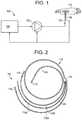
- FIG. 1is a schematic view of a drug delivery system
- FIG. 2is a perspective view of a catheter that can be used with the system of FIG. 1 ;
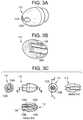
- FIG. 3Ais a perspective view of a tip of the catheter of FIG. 2 ;
- FIG. 3Bis a sectional view of the tip of the catheter of FIG. 2 ;
- FIG. 3Cis a series of design views of the tip of the catheter of FIG. 2 ;
- FIG. 4is a sectional view of a body of the catheter of FIG. 2 ;
- FIG. 5is a perspective view of a hub of the catheter of FIG. 2 , with a portion of the hub shown as transparent;
- FIG. 6Ais a sectional view of the hub of FIG. 5 , shown with integrated connectors;
- FIG. 6Bis an end view of the hub of FIG. 5 , shown with integrated connectors;
- FIG. 7Ais a plan view of a first bend profile of a guidewire of the catheter of FIG. 2 ;
- FIG. 7Bis a plan view of a second bend profile of a guidewire of the catheter of FIG. 2 ;
- FIG. 7Cis a plan view of a third bend profile of a guidewire of the catheter of FIG. 2 ;
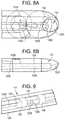
- FIG. 8Ais a perspective, partially-transparent view of a tip that can be used with the catheter of FIG. 2 ;
- FIG. 8Bis a profile, partially-transparent view of the tip of FIG. 8A ;
- FIG. 9is a perspective, partially-transparent view of the body of the catheter of FIG. 2 , shown with a side exit port;
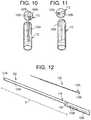
- FIG. 10is a perspective and end view of a tip that can be used with the catheter of FIG. 2 ;
- FIG. 11is a perspective and end view of a tip that can be used with the catheter of FIG. 2 ;
- FIG. 12is a perspective view with a detail, partially-transparent inset of a catheter that can be used with the system of FIG. 1 ;
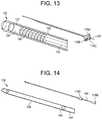
- FIG. 13is a perspective view with a detail, partially-transparent inset of a catheter that can be used with the system of FIG. 1 ;
- FIG. 14is a perspective view with a detail, partially-transparent inset of a catheter that can be used with the system of FIG. 1 ;
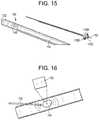
- FIG. 15is a perspective view with a detail, partially-transparent inset of a catheter that can be used with the system of FIG. 1 ;
- FIG. 16is a schematic view of a focused ultrasound system that can be used with the system of FIG. 1 ;
- FIG. 17is a schematic hardware diagram of a controller of the system of FIG. 1 ;
- FIG. 18is a functional block diagram of the controller of FIG. 17 ;
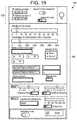
- FIG. 19is a screen capture of a graphical user interface that can be implemented by the controller of FIG. 17 ;
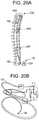
- FIG. 20Ais a perspective view of a catheter of the system of FIG. 1 implanted in a patient and shown with an infusion port;
- FIG. 20Bis a perspective schematic view of the catheter and patient of FIG. 20A ;
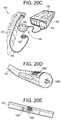
- FIG. 20Cis a perspective view of the catheter and patient of FIG. 20A , shown with an infusion port, an injector, and a controller;
- FIG. 20Dis a perspective view of a distal fluid port of the catheter of FIG. 20A ;
- FIG. 20Eis a perspective view of a middle or proximal fluid port of the catheter of FIG. 20A ;
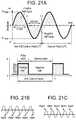
- FIG. 21Ais a diagram illustrating the controller of the system of FIG. 1 coordinating control of a pump with a sensed physiological parameter
- FIG. 21Bis a diagram illustrating use of the system of FIG. 1 to synchronize delivery of a drug with an ascending wave of the patient's natural CSF pulsation;
- FIG. 21Cis a diagram illustrating use of the system of FIG. 1 to synchronize delivery of a drug with a descending wave of the patient's natural CSF pulsation;
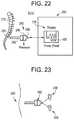
- FIG. 22is a schematic diagram of a drug delivery system with a smart lumbar puncture needle
- FIG. 23is a schematic diagram of a drug delivery system with manual pumps
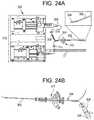
- FIG. 24Ais a schematic view of a drug delivery system
- FIG. 24Bis a perspective view of a needle, hub, and catheter of the system of FIG. 24A ;
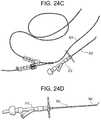
- FIG. 24Cis a perspective view of a needle, hub, and catheter of the system of FIG. 24A , shown with the catheter outside of the needle;
- FIG. 24Dis a perspective view of a needle, hub, and catheter of the system of FIG. 24A , shown with the catheter inserted through the needle;
- FIG. 24Eis a perspective view of a catheter of the system of FIG. 24A protruding from a needle of the system of FIG. 24A ;
- FIG. 24Fis a perspective view of a catheter of the system of FIG. 24A protruding from a needle of the system of FIG. 24A ;
- FIG. 24Gis a perspective view of a catheter of the system of FIG. 24A protruding from a needle of the system of FIG. 24A ;
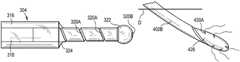
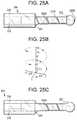
- FIG. 25Ais a side view of a catheter tip having a helical fluid port
- FIG. 25Cis a perspective view of the catheter tip of FIG. 25A ;
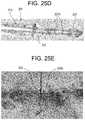
- FIG. 25Dis another perspective view of the catheter tip of FIG. 25A ;
- FIG. 25Eis a photograph of an exemplary distribution pattern achieved using the catheter tip of FIG. 25A ;
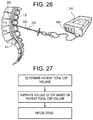
- FIG. 27is a schematic diagram of an exemplary method of patient-specific infusion
- FIG. 29is a sectional side view of a tip of another needle that can be used with the system of FIG. 28A ;
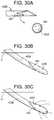
- FIG. 30Ais a schematic view of a tip of another needle that can be used with the system of FIG. 28A ;
- FIG. 30Cis a schematic view of the needle tip of FIG. 30A with a fluid being infused through the inflatable member.
- a drug delivery systemcan be configured to deliver a drug to a patient in coordination with a physiological parameter of the patient (e.g., the patient's natural cerebrospinal fluid (CSF) pulsation or the patient's heart or respiration rate).
- a drug delivery systemcan be configured to use a combination of infusion and aspiration to control delivery of a drug to a patient.
- Catheters, controllers, and other components for use in the above systemsare also disclosed, as are various methods of using such systems.
- systems and methodsare provided in which a drug is injected or otherwise delivered to the central nervous system of a patient in coordination with the natural CSF flow.
- the drugcan be injected in a plurality of stages synchronized in phase and/or frequency with the natural CSF pulse.
- the systems and methods hereincan allow for a drug to be delivered more efficiently to a patient than in the case of traditional techniques. For example, a smaller quantity of the drug can be delivered and still reach the target destination, thereby reducing cost and/or possible side effects of delivering a large quantity of the drug.
- a drugcan be delivered to the intrathecal space of a patient via an injection site in the patient's spine (e.g., a lumbar region, a thoracic region, a cervical region, and so forth) and can be transported via the intrathecal space to a target location that is cranial to the injection site (e.g., the brain or a more-cranial region of the spine).
- the drugcan be transported to a location that is caudal to the injection site.
- the systems and methods disclosed hereincan include fully programmable customized injection and/or aspiration profiles which can be synchronized by real-time monitoring of physiological parameters of the patient, such as heart rate, CSF pressure, CSF pulsation rate, respiration rate, lung capacity, chest expansion and contraction, intrathoracic pressure, intraabdominal pressure, and the like. This can allow the end user to fine-tune injection/aspiration doses per cycle, time length and profile of each microinjection, relative timing (or phase) of microinjections, and other parameters.
- the systems and methods disclosed hereincan include real-time inline pressure sensing for estimating drug delivery efficiency and ensuring patient safety.
- the systems and methods disclosed hereincan include custom built catheters with various lumen quantities, lumen sizes, port placement locations, and other properties.
- the catheterscan be directionality-optimized for efficient mixing and/or such that they are adapted for a particular anatomy.
- FIG. 1is a schematic diagram of an exemplary drug delivery system 100 .
- the system 100can include a catheter 102 , a controller 104 , a pump or actuator 106 , and one or more sensors 108 .
- the pump 106can be configured to pump a drug or a drug-containing fluid through the catheter 102 and into a patient 110 (e.g., into an intrathecal space of the patient).
- the pump 106can also be configured to aspirate fluid from the patient.
- the pump 106can be controlled by the controller 104 to synchronize or otherwise coordinate delivery of the drug and/or aspiration of fluid with a physiological parameter of the patient, which can be measured by the sensor 108 .
- Exemplary physiological parameterscan include heart rate, CSF pressure, CSF pulsation rate, respiration rate, lung capacity, chest expansion and contraction, intrathoracic pressure, intraabdominal pressure, and the like.
- the catheter 102can include a tip portion 112 , a body 114 , and a hub 116 .
- a first portion 114 d of the body 114can extend between the tip 112 and the distal end of the hub 116 .
- a second portion 114 p of the body 114can extend proximally from the hub 116 to one or more connectors 118 or other features for coupling the catheter 102 to the system 100 , e.g., for attaching the catheter to the pump 106 .
- the catheter 102can have an overall length of about 1 meter.
- the tip 112includes a first fluid lumen 120 A with a first fluid port 122 A and a second fluid lumen 120 B with a second fluid port 122 B, though it will be appreciated that the tip can include any number of fluid lumens (e.g., zero, one, two, three, four, five, more than five, etc.) and any number of fluid ports (e.g., zero, one, two, three, four, five, more than five, etc.).
- the fluid ports 122 A, 122 Bcan be aimed in a substantially distal direction and can be offset from the central longitudinal axis of the tip 112 , as shown.
- the fluid ports 122 A, 122 Bcan be aimed laterally, e.g., in a direction substantially perpendicular to the central longitudinal axis of the tip 112 . Having the fluid ports slightly offset from center or aimed laterally can advantageously reduce the risk of the ports becoming occluded during insertion or use of the catheter 102 .
- the catheter 102can include a steering mechanism to facilitate remote positioning of the catheter within the patient.
- the catheter 102can be configured to receive a guidewire 124 therethrough to allow the catheter to be inserted over the guidewire or to be steered by the guidewire.
- the tip 112includes a guidewire lumen 126 .
- the guidewire lumen 126can be a closed, blind hole as shown, or can be open to an exterior of the tip 112 .
- the catheter 102can include one or more steering wires (not shown) that terminate at the tip 112 .
- the wirescan extend proximally from the tip 112 to a proximal end of the catheter 102 , where they can be selectively tensioned to steer the tip of the catheter within the patient.
- the catheter 102can include first and second steering wires that extend longitudinally therethrough and which are anchored to the tip 112 at diametrically-opposed locations about the outer periphery of the tip.
- the steering wirescan extend through respective sleeves or tubes in the body 114 of the catheter 102 to the proximal end of the catheter where tension can be selectively applied thereto to steer the tip 112 of the catheter.
- the tip 112can be formed from various materials, including biocompatible materials, stainless steel, titanium, ceramics, polymers, and the like.
- the tip 112can be radiopaque or can include one or more radiopaque markers to facilitate visualization under fluoroscopy or other imaging techniques.
- the tip 112can have an outside diameter of about 3 French to about 5 French.
- the tip 112can have an outside diameter of about 1 mm to about 3 mm.
- FIG. 4is a cross-sectional view of the distal portion 114 d of the catheter body 114 .
- the body 114can include an outer sheath 128 that defines an interior channel 130 .
- One or more fluid tubes 132 A, 132 Bcan be disposed within the interior channel, each fluid tube defining a respective fluid lumen 134 A, 134 B.
- the interior channel 130can also contain a guidewire 124 or one or more steering wires (not shown).
- the distal body portion 114 dincludes a first fluid tube 132 A having a lumen 134 A in fluid communication with the first fluid lumen 120 A of the tip 112 , a second fluid tube 132 B having a lumen 134 B in fluid communication with the second fluid lumen 120 B of the tip, and a guidewire 124 .
- the sheath 128can have various cross-sectional profiles.
- the sheath 128can have a circular transverse cross-section that defines a single interior channel 130 as shown.
- the sheath 128can have multiple interior channels.
- Each of the fluid tubes 132 A, 132 Bcan be disposed within its own independent channel of the sheath 128 , or the sheath itself can define the fluid tubes.
- the guidewire 124can be disposed in its own independent channel of the sheath 128 and the fluid tubes 132 A, 132 B can be disposed in a separate channel of the sheath.
- the guidewire channelcan have a circular cross-section and the fluid tube channel can have a crescent or D-shaped cross-section.
- the fluid tubes 132 A, 132 Bcan be formed from any of a variety of materials, including fused silica, polyurethane, etc. Use of fused silica can be advantageous when using the system 100 to deliver viruses, as viruses may be less prone to sticking to fused silica fluid tubes.
- fluid tubes used for drug deliverycan be formed from fused silica and fluid tubes not used for drug delivery (e.g., buffer delivery tubes or aspiration tubes) can be formed from a material other than fused silica, such as polyurethane.
- the fluid tubes 132 A, 132 Bcan be coated with a shrink tubing or an outer sheath to provide stress and strain relief for the fluid tubes.
- the sheath 128can be formed from any of a variety of materials, including polyurethane. While use of the fluid tubes 132 A, 132 B to communicate fluid is generally described herein, the fluid tubes can also be used for other purposes, such as inserting a biopsy probe or other instrument, or inserting a sensor 108 .
- the fluid tubes 132 A, 132 Bcan have an inside diameter of about 0.005 inches to about 0.050 inches.
- the fluid tubes 132 A, 132 Bcan have an inside diameter of about 0.010 inches to about 0.020 inches.
- the body 114can have an outside diameter of about 3 French to about 5 French.
- the body 114can have an outside diameter of about 1 mm to about 3 mm.
- the hub 116can include respective channels for receiving the first fluid tube 132 A, the second fluid tube 132 B, and the guidewire 124 .
- Each channelcan include proximal and distal openings.
- the channelscan merge within the body of the hub 116 such that they each share a common distal opening.
- the sheath 128 of the distal body portion 114 dcan be received through the distal opening of the hub 116 and into the guidewire channel of the hub.
- the fluid tubes 132 A, 132 Bcan penetrate the sidewall of the sheath 128 within the body of the hub 116 .
- the hub 116can thus form a seal between the sheath 128 and the fluid tubes 132 A, 132 B, support the fluid tubes and the guidewire 124 , and guide these components into the inner channel(s) 130 of the sheath of the distal body portion 114 d.
- the hub 116can be a “pass-through” type hub in which the first and second fluid tubes 132 A, 132 B extend completely through the hub uninterrupted as shown in FIG. 5 .
- the first and second fluid tubes 132 A, 132 Bcan terminate within the hub at respective connector ports 136 A, 136 B.
- the connector ports 136 A, 136 Bcan allow selective coupling and decoupling of the proximal body portion 114 p (e.g., proximal extension tubes) to the first and second fluid tubes 132 A, 132 B.
- the guidewire 124can continue to extend completely through the hub 116 uninterrupted, or it too can terminate within the hub at a connector where a proximal guide wire extension can be selectively coupled thereto.
- a proximal guide wire extensioncan be selectively coupled thereto.
- Any of a variety of connector typescan be used to couple the fluid tubes to the proximal extension tubes, including zero-dead-volume micro-connectors or fittings available from Valco Instruments Co. Inc. of Houston, Tex.
- the proximal body portion 114 pcan include a sheath similar to that of the distal body portion 114 d , or can be formed by the fluid tubes 132 A, 132 B extending proximally from the hub 116 , or from one or more extension tubes coupled to the fluid tubes 132 A, 132 B at the hub 116 .
- the proximal end of the catheter 102can include one or more connectors 118 for making a fluid connection with the fluid tubes 132 A, 132 B of the catheter.
- the fluid tubes 132 A, 132 B(or proximal extension tubes as the case may be) can include a connector 118 at a proximal end thereof. Any of a variety of connector types can be used, including zero-dead-volume micro-connectors or fittings available from Valco Instruments Co. Inc. of Houston, Tex.
- the guidewire 124can be disposed within the catheter 102 and can be used to guide, steer, or otherwise control insertion of the catheter into the patient.
- the guidewire 124can be cylindrical and can have a substantially-straight profile.
- the guidewire 124can extend completely through the catheter 102 , or can terminate in a blind bore 126 formed in the tip 112 of the catheter.
- the guidewire 124can be inserted into the patient first and guided to a target site, and the catheter 102 can then be inserted over the guidewire to position a portion of the catheter at the target site.
- the catheter 102can be inserted before or simultaneously with the guidewire 124 , and the guidewire can be used to steer or guide the catheter.
- the guidewire 124can have a resting configuration that deviates from a straight line at or near a distal end of the guidewire.
- the guidewire 124has a straight distal portion 124 d and a straight proximal portion 124 p joined by a curved elbow such that a central longitudinal axis of the distal portion extends at an oblique angle with respect to a central longitudinal axis of the proximal portion.
- FIG. 7 Athe guidewire 124 has a straight distal portion 124 d and a straight proximal portion 124 p joined by a curved elbow such that a central longitudinal axis of the distal portion extends at an oblique angle with respect to a central longitudinal axis of the proximal portion.
- the guidewire 124has a curved distal portion 124 d joined to a straight proximal portion 124 p such that a central longitudinal axis of the distal portion extends at an oblique angle with respect to a central longitudinal axis of the proximal portion.
- the guidewire 124has a straight distal portion 124 d and a straight proximal portion 124 p that meet at an angled bend such that a central longitudinal axis of the distal portion extends at an oblique angle with respect to a central longitudinal axis of the proximal portion.
- the guidewire 124can be used to navigate the catheter 102 through the patient by twisting the proximal end of the guidewire to turn the bent distal portion and thereby steer or aim the catheter. While a single guidewire 124 is shown, it will be appreciated that the catheter 102 can include any number of guidewires and/or guidewire lumens.
- the guidewire 124can be formed from any of a variety of materials, including shape-memory metals such as Nitinol.
- any of the catheters disclosed hereincan be steerable.
- a steering mechanismcan be provided to allow the distal end of the catheter 102 to be guided during insertion or at another desired time.
- the catheter 102can include one or more steering wires having a first end coupled to the distal tip 112 of the catheter and having a second end at the proximal end of the catheter through which tension can be selectively applied to the steering wires to direct or steer the tip of the catheter in a desired direction.
- the steering wirescan be embedded in the sidewalls of the catheter 102 or can extend through a lumen of the catheter.
- the catheter 102can include a coaxial steering catheter (not shown) extending therethrough.
- a distal end of the steering cathetercan be curved or biased towards a curved shape such that, when the steering catheter is deployed distally from the tip of the primary catheter 102 , the primary catheter can be steered or guided along the curve of the steering catheter. The steering catheter can then be retracted back into the primary catheter 102 to discontinue the curved guidance.
- the steering cathetercan be formed from or can include shape memory or resilient materials such that the steering catheter is deformable between a substantially straight line configuration when retracted into the primary catheter 102 and a flexed or curved configuration when deployed from the primary catheter.
- the steering cathetercan be longitudinally translatable relative to the primary catheter 102 to allow for deployment and retraction.
- any of the catheters disclosed hereincan include a camera or imaging device, which can be integral with the catheter or can be inserted through a working channel of the catheter.
- Any of the catheters disclosed hereincan include markings visible under fluoroscopy, CT, MRI, or other imaging techniques to allow the catheter to be visualized in images captured using such techniques.
- the catheter 102can be configured to withstand high internal pressures.
- the catheter 102can be configured to withstand a pressure of at least about 100 psi, at least about 200 psi, and/or at least about 500 psi.
- FIGS. 8A-8Billustrate an exemplary catheter tip having side-facing ports.
- the tip 112includes a first fluid lumen 120 A that extends to a distal-facing port 122 A.
- the distal-facing port 122 Acan be formed in an angled or slash-cut distal face of the tip 112 .
- the tip 112also includes a second fluid lumen 120 B that extends to a side-facing port 122 B.
- the tip 112can also include a guidewire lumen for receiving the distal end of a guide wire 124 .
- the central channel 130 of the sheath 128can act as a fluid lumen, e.g., for delivering a buffer or for delivering a drug.
- the tip 112can include a side-facing port 122 C in fluid communication with the central channel 130 of the sheath 128 .
- the catheter 102can include one or more fluid ports formed proximal to the tip portion 112 of the catheter, e.g., formed in the body 114 of the catheter.
- FIG. 9illustrates an exemplary catheter body 114 having a side-facing port 122 B.
- one or more of the fluid tubes 132 A, 132 B extending through the sheath 128 of the body 114can terminate within the body or can otherwise have a fluid port disposed in the body.
- the sheath 128can have a slit or opening 122 B aligned with the port of the fluid tube 132 B, such that fluid exiting the fluid tube can flow through the opening in the sheath or such that fluid can flow through the sheath and into the port of the fluid tube.
- the catheter 102can include one or more plugs 138 disposed within the channel 130 of the sheath 128 to prevent fluid exiting or entering the fluid tube 132 B from flowing proximally and/or distally within the sheath, instead guiding the fluid out of the sheath through the opening or slit 122 B formed therein, or guiding incoming fluid into the fluid port of the tube.
- the plugs 138can be formed from a rigid material, from an adhesive, silicone, or various other materials.
- FIG. 10illustrates an exemplary catheter tip 112 in which one of the fluid lumens 120 A has a thread formed on an interior surface thereof to define a helical or “corkscrew” shape.
- the helical shape of the fluid lumen 120 Acan promote turbulent flow of fluid therefrom encouraging dispersion or even distribution of the fluid. It will be appreciated that more than one of the fluid lumens can have a helical tip.
- FIG. 11illustrates an exemplary catheter tip 112 in which one of the fluid lumens 120 A tapers or narrows towards the distal end to create a nozzle.
- This nozzlecan create a jet-stream effect, increasing the velocity of the infusate as it is delivered. It will be appreciated that more than one of the fluid lumens can have a nozzle tip. As also shown in FIGS. 10-11 , one or more of the fluid lumens can have a simple cylindrical tip.
- the catheter 102can include any number of lumens extending therethrough.
- a dual-lumen cathetercan be used.
- the dual lumen cathetercan include an infusion lumen and a pressure sensor lumen, an infusion lumen and an aspiration lumen, two infusion lumens, etc.
- a tri-lumen cathetercan be used.
- the tri-lumen cathetercan include an infusion lumen, an aspiration lumen, and a pressure sensor lumen, two infusion lumens and an aspiration lumen, three infusion lumens, etc.
- FIG. 10illustrates an exemplary tri-lumen catheter having an infusion lumen 120 A, an aspiration lumen 120 B, and a pressure sensor lumen 120 C.
- FIG. 11illustrates an exemplary dual-lumen catheter an infusion lumen 120 A and an aspiration lumen 120 B.
- the cathetercan include a valve system to control the direction of fluid flow therethrough.
- a valve systemcan include one-way valves on each lumen to prevent infusion into an aspiration lumen and vice versa.
- the valve systemcan facilitate use of a single syringe or other pump to infuse and withdraw fluid, or can facilitate infusion and aspiration through a single lumen.
- the senor 108can be mounted to the catheter 102 , formed integrally with the catheter, threaded through a lumen of the catheter, etc.
- the catheter 102can include a sensor 108 embedded in the tip portion 112 of the catheter, or can include a sensor threaded through a dedicated sensor lumen of the catheter.
- the catheter 102can include a first fluid lumen 120 A that extends to a fluid port 122 A formed at the terminal distal end of the catheter.
- the catheter 102can also include a second fluid lumen 120 B that extends to fluid ports 122 B which are spaced a distance D apart from the distal end of the catheter in a proximal direction.
- the second fluid lumen 120 Bcan include one or more side-facing ports 122 B.
- the second fluid lumen 120 Bcan include a distal facing port.
- one of the fluid lumens 120 A, 120 Bcan be used to deliver a drug or other fluid and the other fluid lumen can be used to aspirate fluid from the patient.
- the catheter 102can thus be used to create a “push-pull” effect at a target site, in which a drug is infused at the distal end of the catheter via the first fluid lumen 120 A and then drawn back toward the proximal end of the catheter by the flow of fluid being aspirated through the second fluid lumen 120 B.
- the opposite arrangementcan also be used, in which the drug is infused through the proximal port(s) and aspirated through the distal port(s).
- a proximal end of the catheter 102can have first and second connectors 118 A, 118 B corresponding respectively to the first and second fluid lumens 120 A, 120 B.
- the offset fluid ports 122 A, 122 Bcan be used to coordinate delivery with a physiological parameter of the patient, such as natural CSF flow.
- An external peristaltic pump or other devicecan be used to drive the infusion and/or aspiration.
- the outer sheath 128 of the body 114can taper inward to the first lumen 120 A after the termination of the second lumen 120 B.
- the catheter 102can include features for controlling delivery of fluid through the catheter.
- the catheter 102can include an internal auger 140 .
- the auger 140can have an elongate flexible shaft 142 that extends through the catheter 102 to a proximal end of the catheter, where it can be coupled to a motor for driving rotation of the auger.
- the motorcan be part of the controller 104 or can be a separate component.
- the controller 104can start and stop rotation of the auger 140 , and/or can control the speed or direction of auger rotation to control delivery of fluid through the fluid lumen 120 in which the auger is disposed.
- the auger 140can be disposed in a fluid tube 132 extending through a sheath portion 128 of the catheter 102 .
- the auger 140can also be disposed distal to a terminal distal end of a fluid tube 132 , with the auger shaft 142 extending through the fluid tube.
- the auger 140can thus be disposed within the sheath 128 of the catheter 102 but distal to a fluid tube 132 of the catheter.
- the auger 140can advantageously control fluid delivery through the catheter 102 and generate more turbulent flow of fluid from the catheter.
- a proximal end of the cathetercan have first and second connectors 118 A, 118 B corresponding respectively to the first and second fluid lumens and a third port or connector 118 C through which the auger shaft 142 can extend.
- the auger 140can be used to coordinate delivery with a physiological parameter of the patient, such as natural CSF flow.
- the catheter 102can include an internal, reciprocating piston or inner tube 144 .
- the catheter 102can include a fixed outer tube 128 and a slidable inner tube 144 disposed coaxially within the outer tube.
- the inner tube 144can be configured to translate longitudinally with respect to the outer tube 128 .
- the inner tube 144can include a valve 146 , e.g., at a terminal distal end thereof.
- Exemplary valvesinclude one-way valves, duck-bill valves, spring-biased check valves, and the like.
- a sealcan be formed between the inner tube 144 and the outer tube 128 , e.g., at a proximal end of the catheter 102 .
- the inner tube 144can be loaded with a drug-containing fluid.
- the inner tube 144can then be pulled proximally with respect to the outer tube 128 to cause the drug-containing fluid to flow through a one-way valve 146 into the distal end of the outer tube.
- the inner tube 144can then be pushed distally, closing the one-way valve 146 and expelling the drug-containing fluid out of the distal end of the outer tube 128 and into the patient.
- the translating tubes 128 , 144can allow a fixed or predetermined volume of drug-containing infusate to be delivered with each reciprocation of the inner tube 144 .
- the proximal ends of the outer and inner tubes 128 , 144can include connectors 118 A, 118 B, e.g., for supplying fluid to the outer and inner tubes.
- the reciprocating inner tube 144can be used to coordinate delivery with a physiological parameter of the patient, such as natural CSF flow.
- the catheter 102can include a transducer 148 , such as a piezoelectric transducer, to help control delivery of a drug through the catheter.
- the transducer 148can be formed on a flex circuit or other substrate disposed adjacent to a fluid port 122 of the catheter 102 .
- the transducer 148can include an electrically-conductive lead or wire 150 that extends proximally therefrom through the catheter 102 to the controller 104 .
- an electric potentialcan be applied to the transducer 148 to induce vibration or other movement of the transducer. This movement can control distribution of the drug from the catheter 102 .
- the system 100can include one or more transducers for delivering focused ultrasound to the patient.
- a focused ultrasound system 152can aim ultrasonic waves toward a location at which drug-containing infusate 154 exits the catheter 102 .
- the focused ultrasoundcan enhance dispersion of the drug, and/or control the direction and degree to which the drug disperses.
- Focused ultrasoundcan be used to coordinate delivery with a physiological parameter of the patient, such as natural CSF flow. Focused ultrasound can also be used to enhance or direct drug distribution without pulsatile delivery.
- FIG. 17illustrates a block diagram of the physical components of an exemplary embodiment of the controller 104 .
- the controller 104can be a tablet computer, mobile device, smart phone, laptop computer, desktop computer, cloud-based computer, server computer, and so forth. One or more portions of the controller 104 can be implanted in the patient. Delivery control software can execute on the controller 104 .
- the softwarecan execute on a local hardware component (e.g., a tablet computer, smart phone, laptop computer, or the like) or can execute remotely (e.g., on a server or cloud-connected computing device in communications coupling with the controller).
- the illustrated controller 104includes a processor 156 which controls the operation of the controller 104 , for example by executing embedded software, operating systems, device drivers, application programs, and so forth.
- the processor 156can include any type of microprocessor or central processing unit (CPU), including programmable general-purpose or special-purpose processors and/or any of a variety of proprietary or commercially-available single or multi-processor systems.
- the term processorcan refer to microprocessors, microcontrollers, ASICs, FPGAs, PICs, processors that read and interpret program instructions from internal or external memory or registers, and so forth.
- the controller 104also includes a memory 158 , which provides temporary or permanent storage for code to be executed by the processor 156 or for data that is processed by the processor.
- the memory 158can include read-only memory (ROM), flash memory, one or more varieties of random access memory (RAM), and/or a combination of memory technologies.
- ROMread-only memory
- RAMrandom access memory
- the various components of the controller 104can be interconnected via any one or more separate traces, physical busses, communication lines, etc.
- the controller 104can also include a power supply 166 and appropriate regulating and conditioning circuitry.
- Exemplary power suppliesinclude batteries, such as polymer lithium ion batteries, or adapters for coupling the controller 104 to a DC or AC power source (e.g., a USB adapter or a wall adapter).
- the controller 104can include a sensor input module 168 configured to receive information from the sensor(s) 108 .
- the sensor input module 168can read and interpret output signals supplied from the sensors 108 to the processor 156 , e.g., via a general purpose input/output pin of the processor.
- the sensor input module 168can optionally perform various processing on the sensor signals, such as frequency detection, phase detection, debouncing, analog-to-digital conversion, filtering, and so forth.
- the controller 104can also include a delivery control module 170 configured to control the pump or actuator 106 to infuse or aspirate fluid from the patient and/or to control the catheter 102 (e.g., an auger, piston, transducer, ultrasound system, etc.).
- the delivery control module 170can cause power to be supplied to the pump 106 to begin pumping infusate through the catheter 102 , or cause an electronically-actuated valve to open such that infusate stored under pressure is placed in fluid communication with the catheter and flows therethrough.
- the controller 104can include a user input module 172 configured to receive one or more user inputs, e.g., as supplied by a user via the interface 160 .
- user inputscan include infusion parameters, patient information, treatment protocols, and so forth, as discussed further below.
- FIG. 19illustrates an exemplary graphical user interface 176 that can be displayed to the user by the display module 174 and through which a user can supply information to the user input module 172 .
- the illustrated interface 176is configured for use with a pump system 106 that includes first and second motors or linear actuators that can be operated to apply a force to respective syringe pumps for delivering infusate to the catheter 102 and for withdrawing or aspirating fluid from the catheter.
- the user interface 176can include a motor communication panel 178 for displaying various information associated with the motors. This information can include the connection status of the motors, an IP or other software address of the motors, and a motor communication frequency or update time. The user can interact with the motor communication panel 178 to select or change the motor addresses and the update time.
- the user interface 176can include a motor setting panel 180 for adjusting various motor settings and for displaying the current setting to the user.
- the motor setting panel 180can include controls for the motor velocity, motor acceleration, distance of syringe movement as a function of motor steps, current motor positions, infusion frequency, infusion amplitude, infusion rate, infusion phase, and so forth.
- the controller 104can be configured to control various infusion and/or aspiration parameters to achieve customized delivery. This can allow the delivery to be tailored based on the therapeutic application. Exemplary parameters that can be controlled by the controller 104 include infusion type, infusion rate, infusion volume, time between infusions, oscillatory rate, infusion and withdraw ratio, infusion phase timing, aspiration type, aspiration rate, time between aspirations, aspiration volume, and so forth.
- the system 106can include a peristaltic pump, an auger pump, a gear pump, a piston pump, a bladder pump, etc. One or more portions of the system 106 can be implanted in the patient.
- the system 106can include any of a variety of implantable or extracorporeal pumps.
- the system 106can include a fully-implanted, programmable pump and a fully-implanted fluid reservoir containing fluid to be delivered using the system.
- the entire system 106can be implantable, e.g., to facilitate chronic treatment methods.
- the sensor 108can be a single sensor or a plurality of sensors. Exemplary sensors include pressure sensors, electrocardiogram sensors, heart rate sensors, temperature sensors, PH sensors, respiration rate sensors, respiration volume sensors, lung capacity sensors, chest expansion and contraction sensors, intrathoracic pressure sensors, intraabdominal pressure sensors, and the like. One or more of the sensors 108 can be implanted in the patient. One or more of the sensors 108 can be mounted on, inserted through, or formed in or on the catheter 102 . The sensors 108 can also be remote from the catheter 102 . In some embodiments, the sensors 108 can include a pressure sensor disposed in or on the catheter 102 for measuring CSF pressure adjacent to the catheter and an ECG sensor for measuring the patient's heart rate. The sensors 108 can be connected (via wires or via a wireless connection) to the sensor input module 168 of the controller 104 .
- one or more components of the delivery system 100 and, in some embodiments, all components of the delivery systemcan be implanted in the patient. Implanting some or all of the delivery system 100 can facilitate chronic or long-term drug delivery (e.g., over a period of days, weeks, months, or years) via non-invasive or outpatient procedures.
- each of the fluid ports 122 P, 122 M, 122 Dincludes a sensor 108 P, 108 M, 108 D mounted adjacent or in proximity thereto.
- a proximal end of the catheter 102can be coupled to a fully implanted, transcutanous, or extracorporeal infusion port 182 through which fluid can be delivered to (or removed from) the various lumens of the catheter and through which one or more sensors 108 on the catheter can be coupled to a controller 104 or other device.
- a quick-connector system 184can be used to couple the catheter 102 to the infusion port 182 .
- the micro-connector 184can include air and/or bacterial filters and can be a zero-dead-volume connector.
- the pump 106 and the controller 104can be mounted together in a chassis or housing 188 , as shown in FIG. 20C , which can be coupled to an injector 190 configured to mate with the infusion port 182 .
- the injector 190can include magnetic alignment features 186 for ensuring that the injector is properly aligned with respect to a subcutaneous infusion port 182 .
- the distal or cranial/cervical tip of the catheter 102can have a modified shape to encourage turbulent flow therethrough (e.g., a helical or corkscrew shaped lumen or fluid port 122 D as described above). Any of a variety of other shapes can be used.
- the other ports 122 M, 122 Pcan be similarly configured, can have a simple circular cross-section as shown in FIG. 20E , or can have any other configuration described herein.
- the system 100 illustrated in FIGS. 20A-20Ecan be used in acute and/or chronic applications in any of a variety of ways.
- the catheter 102can be used for localized delivery of different drugs to different areas of the spine.
- the catheter 102can be used to deliver the same drug with substantially instantaneous distribution along the entire spinal column.
- one port of the catheter 102can be used to aspirate while another is used to infuse in order to draw the infused fluid through the spinal canal.
- fluidcan be infused through a lower-lumbar port 122 P and fluid can be aspirated through a cervical port 122 D to “pull” the infused fluid up the spinal column.
- fluidcan be infused through a port 122 D disposed in the cervical region of the patient's spine to propel infused drug into the cranial space.
- the catheter 102can be used to substantially contain an infused drug to a given area of the spine.
- fluidcan be infused through a lower-lumbar port 122 P and fluid can be withdrawn from a mid-lumbar port 122 M to keep the infused drug between the two ports 122 P, 122 M in the lumbar region of the patient's spine.
- infusions and aspirations via multiple lumens and portscan be staged or combined in a sequence to create and advance a significant bolus at improved, controlled, and convenient rates.
- the methodcan include simultaneous aspiration/infusion between deliberately spaced ports.
- the deliverycan be enhanced by a preparation step of removing a safe amount of CSF to be replaced in later procedure steps when advancing the bolus.
- the methodcan include a final stage of synchronized pulsatile infusion.
- the methodcan allow a large bolus to be formed more quickly, can allow controlled dosing, and/or can allow the bolus to be delivered closer to the brain or other target site.
- the methodcan be performed using a catheter that tapers from the proximal end towards the distal end.
- a tapered catheter profile in which the catheter diameter reduces distal of each portcan enable the catheter to be longer, be easier to introduce/navigate, and have device reach significantly closer to the target site. Port designs and locations can be optimized based on dose and other factors.
- the cathetercan be placed such that fluid exiting the ports flows against patient anatomy (e.g., a blind lumen end, lumen sidewall, or lumen constriction) to promote turbulent flow of the infusate upon exiting the catheter.
- patient anatomye.g., a blind lumen end, lumen sidewall, or lumen constriction
- a volume of patient CSFcan be aspirated through one or more ports of the catheter. In an exemplary embodiment, about 10% by volume of the patient's CSF can be aspirated through the catheter and stored in a reservoir.
- the amount of CSF that is aspiratedcan be based on a clinically-determined safe level.
- CSFcan be aspirated from the patient through a distal fluid port 122 D of the catheter 102 while a drug is simultaneously infused into the patient through a middle port 122 M of the catheter. This can cause a bolus of drug to form between the middle and distal ports 122 M, 122 D.
- the portscan be located along the length of the catheter to define the bolus size or dose.
- the bolus of drugcan be advanced within the patient. This can be achieved by infusing previously-aspirated CSF from the reservoir into the patient through a proximal port 122 P of the catheter 102 .
- This infusioncan urge the bolus distally towards the target site and can continue until normal or safe CSF pressure is reached within the patient.
- other fluidcan be used instead or in addition, such as drug-containing fluid.
- infusion of CSF and/or drug-containing fluidcan be performed in a pulsatile manner in coordination with one or more physiological parameters of the patient.
- the above methodcan also be performed using only a proximal port 122 P and a distal port 122 D.
- the proximal, middle, and distal ports 122 P, 122 M, 122 Dcan be spaced along the length of the spinal column as shown in FIG. 20A , or can all be contained in a discrete region of the spine (e.g., the cervical spine, the thoracic spine, the lumbar spine, etc.).
- the systems disclosed hereincan be used in any of a variety of drug delivery methods.
- the infusion pump 106can be configured to pump a drug or a drug-containing fluid through the catheter 102 and into a patient (e.g., into an intrathecal space of the patient).
- the catheter 102can be inserted into the patient at any of a variety of locations.
- a percutaneous puncturecan be formed in the patient using a needle.
- the puncturecan be formed in the lumbar region of the spine, or in any other region of the spine, e.g., the cervical region between C1 and C2.
- the needlecan have a bent distal tip that helps steer the catheter 102 to be parallel to the spinal cord.
- the catheter 102can be inserted through the needle and guided through the intrathecal space along the spinal cord.
- the infusioncan be performed in proximity to the percutaneous puncture, or the catheter 102 can be advanced some distance within the patient.
- the catheter 102can be inserted in the lumbar spine and advanced to the cervical spine or to the cisterna magna. Infusion can be performed at any point along the length of the catheter 102 . Fluid can be infused from a distal end of the catheter 102 (e.g., in a cervical region of the spine), the catheter can be withdrawn proximally, and further infusion can be performed at a more caudal location (e.g., in a lumbar region of the spine).
- the pump 106can be controlled by the controller 104 to synchronize or otherwise coordinate delivery of the drug with the patient's natural CSF flow or pulsation, or with other physiological parameters of the patient (e.g., heart rate, respiration rate, lung capacity, chest expansion and contraction, intrathoracic pressure, intraabdominal pressure, etc.).
- the infusion profilecan be tailored to override the natural CSF pulsation to drive the infusate to a target site. Alternatively, or in addition, the infusion profile can be tailored to coordinate with and leverage the natural CSF pulsation to move the infusate towards the target site.
- Readings from a pressure sensor 108can be received by the controller 104 , which can perform signal processing on the sensor output to determine various characteristics of the patient's CSF flow (e.g., phase, rate, magnitude, etc.). The controller 104 can then control the pump 106 based on these measured characteristics to deliver a drug in coordination with the natural CSF flow, optionally synchronizing the delivery in real time. For example, as shown in the upper portion of FIG. 21A , the controller 104 can convert the measured pulsatile flow of the CSF into a sinusoidal approximation. The controller 104 can then output a pump control signal, as shown in the lower portion of FIG. 21A , to drive the infusion pump 106 in coordination with the CSF pulsation.
- a pump control signalas shown in the lower portion of FIG. 21A
- the pressure sensed by the pressure sensor 108can be influenced by the infusion through the catheter 102 . Accordingly, it can be desirable to have another way of detecting or estimating CSF flow.
- the system 100can be operated initially in a “learning” mode in which no infusion takes place and the controller 104 establishes a correlation between CSF pulsation and heart rate (e.g., as detected by an ECG sensor 108 in communications coupling with the controller). In general, CSF pulsation tracks heart rate with a slight delay.
- the system 100can be operated in an “infusion” mode in which infusate is delivered through the catheter 102 and the CSF pulsation is detected or estimated based on measured heart rate (instead of or in addition to detecting or estimating the CSF pulsation based on the pressure sensor 108 output).
- the system 100can interpolate or estimate the CSF flow based on the ECG output, without necessarily having to rely on the pressure sensor output. This can allow the pressure sensor to be used for other purposes, such as monitoring the infusion pressure to allow the controller 104 to automatically regulate delivery to a target pressure or pressure range.
- a drugcan be delivered to the intrathecal space via a simple bolus injection (a fast infusion of a volume of fluid) which then just diffuses slowly along the spinal column.
- a bolus injectioncan be performed to deliver the drug and then the system can be used to create a pulsation behind the bolus by changing oscillation rate/pulsation rate to override the natural CSF pulse and make the bolus move more quickly towards a target location (e.g., the brain).
- the pulsationcan be created by repeatedly withdrawing or aspirating a volume of CSF and then pumping that same volume back into the patient to create a pulse.
- infusion of the drug itselfcan be used to create a pulsation effect to urge the drug along the intrathecal space.
- a first volume of the drugcan be infused (e.g., 0.1 ml) and then a second, smaller volume can be withdrawn (e.g., 0.05 ml). This can be repeated to create a pulse with a net infusion on each cycle. The process can be repeated until the desired dose is delivered. While an infusion-to-withdrawal ratio of 2:1 is discussed above, it will be appreciated that any ratio can be used.
- the rate of infusion and withdrawalcan be controlled (e.g., by infusing quickly and withdrawing slowly) to create a burst of fluid towards a target location (e.g., the top of the spinal column).
- infusion and/or aspirationcan be coordinated with one or more physiological parameters of a patient (e.g., natural CSF flow, heart rate, respiration rate, etc.).
- physiological parameters of a patiente.g., natural CSF flow, heart rate, respiration rate, etc.
- the direction of drug distribution at an intrathecal target sitecan be controlled at least to some degree based on the timing at which the drug is delivered relative to the timing of the CSF flow. For example, infusion that is synchronized with the ascending wave of CSF flow, as shown in FIG. 21B , can be distributed to a greater degree in the cranial direction whereas infusion that is synchronized with the descending wave of CSF flow, as shown in FIG. 21C , can be distributed to a greater degree in the caudal direction of the spinal canal.
- a dual- or multi-lumen cathetercan be used for alternating, repetitive infusion and aspiration, which can further enhance drug distribution.
- the systems and methods disclosed hereincan provide an improved means for delivering a drug to the intrathecal space, as compared with traditional lumbar bolus injections which do not reach the remote portions of the spinal canal or brain efficiently (if at all).
- intrathecal deliveryis generally described in the examples given above, it will be appreciated that the systems and methods herein can be used in other applications, with appropriate modification of size or other parameters as will be appreciated by those having ordinary skill in the art.
- the systems and methods disclosed hereincan be used for intrarterial or intravenous delivery.
- Such systems and methodscan include infusion and/or aspiration that is coordinated with one or more physiological parameters of a patient (e.g., natural CSF flow, heart rate, respiration rate, etc.).
- the drugcan be delivered in a non-pulsatile manner and/or without necessarily coordinating the delivery with a physiological parameter of the patient.
- alternating or otherwise-coordinated aspiration and infusioncan be used to deliver the drug to a target site.
- the drugcan be infused and then a buffer can be infused behind the drug to enhance distribution or to move the drug towards a target site.
- An exemplary methodcan include inserting at least a portion of a catheter into a patient and delivering a drug to a target region of the patient. At least a portion of the catheter can be disposed in the target region.
- the drugcan be delivered in a pulsatile manner.
- the drugcan be delivered in coordination with a physiological parameter of the patient (e.g., the patient's natural CSF flow and/or the patient's heart rate).
- the target regioncan be an intrathecal space of the patient.
- the target regioncan be a subpial region of the patient (e.g., a subpial region of the spinal cord and/or a subpial region of the brain).
- the target regioncan be a cerebellum of the patient.
- the target regioncan be a dentate nucleus of the patient.
- the target regioncan be a dorsal root ganglion of the patient.
- the target regioncan be a motor neuron of the patient.
- the drugcan include an antisense oligonucleotide.
- the drugcan include a stereopure nucleic acid.
- the drugcan include a virus.
- the drugcan include adeno-associated virus (AAV).
- the drugcan include a non-viral gene therapy.
- the drugcan include vexosomes.
- the drugcan include liposomes.
- the methodcan include performing gene therapy by delivering the drug (e.g., by delivering a virus such as AAV).
- the methodcan include performing gene editing by delivering the drug (e.g., by delivering a virus such as AAV).
- the methodcan include performing gene switching by delivering the drug (e.g., by delivering a virus such as AAV).
- the methodcan include performing non-viral gene therapy by delivering the drug (e.g., by delivering vexosomes and/or liposomes).
- the methodcan include determining a total CSF volume of the patient and tailoring the delivery based on the total CSF volume. For example, MRI or other imaging techniques, with or without contrast, can be used to assess the overall CSF volume of the patient. The delivery of the drug can then be tailored based on the measured volume. For example, a larger volume of buffer can be used with patients having a greater total CSF volume and a smaller volume of buffer can be used with patients having a lesser total CSF volume.
- infusion amplitude, infusion velocity, aspiration volume, aspiration amplitude, and other parameterscan be varied in accordance with the measured total CSF volume.
- the infusion volumecan range from about 0.05 mL and about 50 mL.
- the infusion ratecan range from about 0.5 mL/min to about 50 mL/min.
- FIG. 22illustrates a drug delivery system 200 that includes a lumbar puncture needle 292 .
- the needle 292can include a sensor 294 (e.g., a pressure sensor) mounted adjacent a distal tip of the needle. Accordingly, upon insertion of the needle 292 into the patient 210 , the sensor 294 can measure the pressure or other properties of the patient's CSF.
- the needle 292can also include an integrated or remote display 296 for displaying the output of the sensor 294 to a user. In some embodiments, the display 296 can be mounted along the length of the needle 292 , distal to a proximal Luer or other connector 298 of the needle.
- the needle body 292can be a tubular metal shaft with a sharpened or angled tip.
- Fluid tubingcan be coupled to the needle 292 , e.g., via a proximal connector 298 , and to a programmable pump 106 .
- a controller 104 of the type described abovecan be programmed to control the pump 106 to deliver fluid through the needle 292 , e.g., in a pulsatile fashion in coordination with a physiological parameter of the patient.
- the needle 292can be used to deliver a drug, to deliver a buffer, and/or to aspirate fluid.
- a catheter 102 of the type described abovecan be inserted through the needle 292 and the fluid delivery or aspiration can be performed through the catheter.
- a manual pump 206can be provided instead of or in addition to the programmable pump 106 and controller 104 shown in FIG. 22 .
- a first fluid lumen of the needle 292(or of a catheter 102 inserted through the needle) can be coupled to a first pump 206 A that includes a first reservoir and a first flush dome.
- a second fluid lumen of the needle 292(or of a catheter 102 inserted through the needle) can be coupled to a second pump 206 B that includes a second reservoir and a second flush dome.
- a usercan exert manual finger pressure on the first and second flush domes to selectively press fluid contained in the first and second reservoirs into the patient.
- the user's manual actuation rate and actuation pressurecan dictate the infusion frequency and volume.
- a usercan thus pulse the delivery manually.
- the flush domescan be configured such that each successive actuation of the dome delivers a fixed and predetermined volume of fluid.
- each push of the flush domecan be configured to deliver 0.1 ml of fluid.
- one of the reservoirscan be filled with a buffer solution and the other reservoir can be filled with a drug-containing solution.
- FIGS. 24A-24Gillustrate a drug delivery system 300 that can include a needle 302 and a catheter 304 insertable through the needle.
- the needle 302can be a lumbar puncture needle.
- the catheter 304can be a single lumen catheter or a multi-lumen catheter. For example, a dual-lumen catheter that bifurcates at a proximal portion of the catheter can be used as shown.
- Fluid tubing 306can be coupled to the catheter 304 , e.g., via one or more proximal connectors 308 , and to a programmable pump system 310 .
- the needle 302 or catheter 304can also be connected directly to the pump system 310 .
- the pump system 310can include first and second pumps configured to infuse and/or aspirate fluid through respective lumens of the catheter 304 .
- Any of a variety of pumpscan be used, including a linear-actuator syringe pump of the type shown in FIG. 24A .
- a controller 104 of the type described abovecan be programmed to control the pump system 310 to deliver fluid through the catheter 304 , e.g., in a pulsatile fashion in coordination with a physiological parameter of the patient.
- the catheter 304can be used to deliver a drug, to deliver a buffer or other fluid, and/or to aspirate fluid.
- the catheter 304can be omitted and fluid can be infused through the needle 302 directly and/or aspirated through the needle directly.
- One or more of the fluid connectionscan be made with the needle 302 instead of or in addition to the catheter 304 .
- the fluid tubing through which a drug is to be deliveredcan be coupled directly to the catheter 304 to deliver the drug through the catheter and fluid tubing through which a buffer, chaser, or other fluid is to be delivered can be coupled directly to the needle 302 to deliver the fluid through the needle.
- the needle 302can be defined by a hollow tubular body configured to receive a catheter and/or fluid therethrough.
- the needle 302can be a lumbar puncture needle sized and configured for insertion into the intrathecal space through a lumbar insertion point.
- the needle 302can have a curved distal tip configured to naturally steer the needle into the intrathecal space as the needle is inserted into the patient in the lumbar region of the spine.
- An openingcan be formed in the distal end of the needle 302 through which an inserted catheter 304 can extend.
- the proximal end of the needlecan be coupled to a fluid hub 312 .
- the hub 312can be a “W” hub.
- the hub 312can include a plurality of ports.
- the hub 312can include a distal port to which the needle 302 can be attached and placed in fluid communication with the hub.
- the hub 312can include one or more proximal ports.
- the proximal portscan guide a catheter 304 inserted though the hub 312 into the central lumen of the needle 302 .
- the proximal portscan attach the hub 312 to respective fluid lines and place the hub in fluid communication with said fluid lines.
- the fluid linescan be used to direct fluid into the hub 312 and through a needle 302 attached thereto.
- the hub 312can be a “Y” hub.
- the hub 312can include a distal port attached to the needle 302 and a proximal port through which a dual-lumen catheter 304 is inserted to guide the catheter through the needle.
- the dual lumen catheter 304can split or bifurcate at a location proximal to the hub 312 into first and second fluid lines, e.g., for carrying a drug and a buffer, respectively.
- the hub 312can include one or more additional ports through which a fluid can be introduced into, or withdrawn from, the needle 302 . These ports can be used to deliver drug or buffer to the needle 302 or to aspirate fluid from the needle, instead of or in addition to doing so using the catheter 304 .
- the hubcan be omitted and fluid can be delivered to or aspirated from the needle 302 directly.
- the needle 302can be directly attached to the pump system 310 via one or more fluid lines, or a catheter 304 can be directly attached to the pump system via one or more fluid lines and inserted through the needle without a proximal hub.
- the system 300can include one or more valves to control or limit fluid flow through the system.
- the system 300can include check valves 314 disposed in-line with respective fluid paths from the pump system 310 to the patient to isolate the paths from one another in a single direction or in both directions.
- the system 300can include first and second independent fluid sections or channels.
- the first fluid section or channelcan include a first pump configured to deliver a first fluid through a first fluid tube and through a first fluid lumen of the catheter 304 .
- the second fluid section or channelcan include a second pump configured to deliver a second fluid through a second fluid tube and through a second fluid lumen of the catheter 304 .
- a first valvee.g., a check valve
- a second valvee.g., a check valve
- only one of the first and second fluid channelsincludes a valve.
- the first fluid sectioncan be used to infuse a drug and the second fluid section can be used to infuse a fluid, e.g., drug, buffer, chaser, CSF, artificial CSF, saline, etc.
- the first fluid sectioncan be used to infuse a fluid and the second fluid section can be used to aspirate a fluid.
- the needle 302 or the catheter 304can include a sensor 314 (e.g., a pressure sensor) mounted adjacent a distal tip of thereof. Accordingly, upon insertion of the needle 302 or catheter 304 into the patient, the sensor 314 can measure the pressure or other properties of the patient's CSF.
- the needle 302 or catheter 304can also include an integrated or remote display for displaying the output of the sensor 314 to a user. In some embodiments, the display can be mounted along the length of the needle or catheter, distal to a proximal hub or other connector.
- the needle bodycan be a tubular shaft with a sharpened or angled tip. A distal end of the needle can be curved in one or more planes.
- the catheter 304can be inserted through the needle 302 such that a distal end of the catheter protrudes from the needle.
- the cathetercan be inserted such that it is recessed relative to the distal end of the needle, or such that the distal ends of the needle and of the catheter are flush.
- the needle 302can have a length in the range of about 2 inches to about 5 inches, e.g., a length of about 3.5 inches.
- the hub 312can have a length in the range of about 1 inch to about 3 inches, e.g., about 2 inches.
- the needle 302can have an outside diameter in the range of about 26 gauge to about 10 gauge, e.g., about 17 gauge.
- the catheter 304can have an outside diameter in the range of about 0.020 inches to about 0.125 inches.
- the needle 302can have an inside diameter in the range of about 0.020 inches to about 0.2 inches.
- the catheter 304can be inserted through the needle 302 such that the catheter protrudes from the distal end of the needle by a protrusion distance.
- the protrusion distancecan be in the range of about 1 mm to about 5 cm, e.g., about 1 cm.
- the protrusion distancecan be zero such that the catheter 304 does not protrude from the needle 302 .
- Limiting the degree to which the catheter 304 protrudes from the needle 302can advantageously obviate the need to thread the catheter through the intrathecal space. This can be make the delivery procedure safer and/or less invasive and reduce the level of skill required to use the system 300 .
- FIGS. 25A-25Dillustrate an exemplary catheter 304 that can be used in the system 300 .
- the catheter 304can include a tubular body 316 that defines one or more fluid lumens 318 .
- the catheter 304can include one or more ports 320 that place the inner fluid lumen 318 of the catheter in fluid communication with the exterior of the catheter. Fluid can be infused or aspirated through the ports 320 .
- the illustrated catheterincludes a port 320 A in the form of a helical-shaped slit.
- FIG. 25Bschematically illustrates an exemplary helical-shaped slit geometry in three-dimensions.
- the slit 320 Acan be formed in the sidewall of the catheter, in the sidewall of a reduced-diameter distal portion of the catheter, or in the sidewall of an inner tube projecting from a distal end of the catheter.
- the inner tubecan extend the full length of the catheter or along only a portion of the catheter length.
- the inner tubecan be affixed to the catheter using an adhesive, sonic welding, or other techniques.
- the inner tubecan be formed integrally with the main catheter body, e.g., via a molding or milling process.
- the cathetercan include a front-facing port 320 B.
- the front-facing portcan be defined by a circular opening formed in a distal-facing end wall of the catheter 304 .
- a helical-shaped slitis shown, the catheter 304 can alternatively or additionally have ports with other shapes.
- Exemplary port shapesinclude circular holes, a plurality of discrete holes arranged in a helical pattern about the catheter, cage or mesh type openings, and so forth.
- a helical-shaped slit port 320 Acan advantageously increase the dispersion of fluid infused through the catheter 304 into a surrounding medium.
- the distal end of the catheter 304can have an atraumatic geometry.
- the cathetercan include a substantially spherical or bulb-shaped portion 322 at a distal end thereof as shown.
- the cathetercan include a fillet or flange 324 to transition between the different diameters.
- a tapered transitioncan be formed between the reduced distal portion of the catheter and the enlarged proximal portion of the catheter.
- the tapered transitioncan be conical.
- the tapered transitioncan be convexly or concavely curved.
- the distal portion of the catheter 304can be formed from, coated with, or impregnated with a radiopaque, magnetic, or other image-able material.
- a separate inner tube in which the fluid port is formedcan be formed from such a material and attached to the outer catheter body.
- the image-able materialcan facilitate visualization and guidance of the tip of the catheter under fluoroscopy or other imaging techniques such as MRI, CT, PET, and the like.
- the catheter 304can be formed form any of a variety of materials. Exemplary materials include polyimide, PEEK, polyurethane, silicone, and combinations thereof.
- the drug delivery system 300can be used in a manner similar or identical to the drug delivery systems described above.
- FIG. 26illustrates an exemplary method of using the system 300 .
- the needle 302can be inserted percutaneously into a patient in the lumbar region of the patient's spine, e.g., using standard lumbar puncture technique.
- the curved distal end of the needle 302can help guide the distal opening of the needle into the intrathecal space IS without damaging the spinal cord SC.
- the needle 302can be inserted into the intrathecal space only to a small degree, e.g., about 1 cm in to the intrathecal space.
- a catheter 304can be inserted through the needle 302 to position a distal tip of the catheter within the intrathecal space.
- the catheter 304only protrudes from the needle 302 by a small amount, e.g., by about 1 cm.
- the proximal end of the catheter 304 or the needle 302can be coupled to a pump system 310 for infusing or aspirating fluid through the catheter or the needle.
- the pump systemincludes separate drug and buffer channels, each having a respective pump.
- the pump systemcan be coupled to dual lumens of the catheter, e.g., at a bifurcated proximal portion of the catheter.
- a first channel of the pump systemcan be coupled to the needle and a second channel of the pump system can be coupled to the catheter.
- the cathetercan be omitted and the pump system can include a single channel coupled to the needle, or can include multiple channels coupled to the needle.
- a controller 104e.g., a programmable computer processor, or a user can control the pump system 310 to infuse and/or aspirate fluid from the patient via the catheter and/or needle.
- a drugcan be infused through a first fluid channel of the system 300 and, thereafter, a chaser can be infused through the same or a different fluid channel of the system to push the drug through the intrathecal space of the patient.
- exemplary chasersinclude drug-containing fluid, buffer fluid, artificial CSF, natural CSF previously aspirated from the patient, saline, etc.
- the chasercan be CSF previously aspirated from the patient and the CSF can be aspirated and infused using the same syringe without removing the CSF from the syringe, thereby maintaining a closed sterile system.
- the catheter 304 or needle 302can include any of the features of the needle 402 described below.
- FIG. 28Aillustrates an exemplary drug delivery system 400 that can be used for intrathecal infusion and/or aspiration of fluid.
- the system 400is substantially similar to the system 300 described above, though in the system 400 , fluid is delivered or aspirated directly through the needle 402 , without inserting a catheter through the needle.
- the needle 402can be coupled at a proximal end thereof to a pump system 410 .
- the pump system 410can have multiple fluid channels (e.g., one channel for drug and another channel for chaser).
- the pump system 410can be connected to the needle 402 by one or more fluid tubes.
- a hubcan be formed on or coupled to the needle 402 to connect the needle to the fluid tubes.
- a Y-connector portcan be used to connect the pump system 410 to the needle 402 .
- the needle 402can have various diameters and, in an exemplary embodiment, can be a 22 gauge needle.
- One or more valves 414can be disposed in-line in the fluid tubes, in the needle 402 , or in the pump system 410 .
- the valves 414can be one-way valves, check valves, etc.
- the needlecan have any of a variety of fluid ports formed therein.
- the needle 402can include a helical slit fluid port 420 A formed adjacent a distal tip of the needle.
- the fluid port 420 Acan be laser-cut.
- the needle 402 Acan have a helical inner lumen 418 disposed adjacent to a distal fluid port 420 B.
- the helically-shaped inner lumen 418can facilitate turbulent flow of infusate through the distal fluid port to better disperse the fluid.
- the helically-shaped inner lumen 418can be a tubular passage that defines a plurality of looped coils.
- the needle 402can include a sharpened pencil tip.
- the needle 402 Bcan include an inflatable member 426 , e.g., a balloon or membrane, disposed in a distal end of the needle.
- the needle 402can include a sharpened tip.
- the inflatable member 426can be initially retracted within the tip of the needle 402 , and the sharpened tip can be used to pierce the patient's dura D or other tissue to facilitate needle insertion. Once the distal tip of the needle 402 is positioned in a desired location, e.g., within the intrathecal space, the inflatable member 426 can be deployed outside of the needle, as shown in FIG. 30B .
- the inflatable member 426can be achieved by infusing fluid through the needle 402 .
- the inflatable member 426can include one or more fluid ports formed therein, through which fluid can be infused or aspirated.
- the inflatable member 426can include a helical fluid port 420 A formed therein through which fluid can be infused.
- the inflatable member 426can be formed from a soft material, e.g., a material softer than the material used to form the needle 402 , to define an atraumatic tip when the inflatable member is deployed.
- the inflatable member 426can be formed from a flexible biocompatible material such as silicone.
- the needle 402can include any of the features of the catheter 304 or needle 302 described above.
- volume displacement of CSFcan be used to move an infused drug through the intrathecal space of the patient.
- fluidcan be aspirated from the intrathecal space before, during, or after drug infusion to urge the drug in a desired direction within the intrathecal space.
- the fluid used for such volume displacementcan be in the range of about 1% to about 20% of the patient's total CSF volume.
- the fluidcan be aspirated from the patient and then subsequently re-infused.
- a specific patient's CSF volumecan be determined, for example by calculating or estimating.
- a preoperative or intraoperative image of the patientcan be captured.
- the imagecan be one or more MRI images of the patient's head and spine and/or entire central nervous system.
- Image processing routines or manual estimation techniquescan be used, e.g., with correlation to a 3D anatomical model, to calculate or estimate the total CSF volume of the patient.
- the calculated or estimated CSF volumecan be used to tailor an infusion and/or aspiration profile to that particular patient.
- about 1% to about 20% of the calculated or estimated total CSF volumecan be aspirated from the patient and re-infused behind an infused drug to urge the drug in a desired direction, e.g., cranially or caudally within the patient's intrathecal space.
- a methodcan include measuring the CSF head to body volume of a human using magnetic resonance imaging or other means.
- the methodcan include therapy or drug infusion performed by removal and/or infusion of 0.5 to 20% of the patient's total CSF volume.
- the methodcan include therapy or drug infusion performed by removal and/or infusion of artificial CSF, buffer solutions, or saline in conjunction with delivery of drug or therapy.
- the methodcan include delivering the drug or therapy at volume flow rates in the range of about 0.1 ml/min to about 30 ml/min.
- FIG. 27illustrates an exemplary method of patient-specific infusion. As shown, the method can include determining the patient's total CSF volume, aspirating a volume of CSF based on the patient's total CSF volume, and infusing a drug.
- the infusion flow rate of the systems disclosed hereincan be in the range of about 0.001 ml/min to about 50 ml/min.
Landscapes
- Health & Medical Sciences (AREA)
- Life Sciences & Earth Sciences (AREA)
- Engineering & Computer Science (AREA)
- Biomedical Technology (AREA)
- Heart & Thoracic Surgery (AREA)
- Veterinary Medicine (AREA)
- Animal Behavior & Ethology (AREA)
- General Health & Medical Sciences (AREA)
- Public Health (AREA)
- Hematology (AREA)
- Anesthesiology (AREA)
- Biophysics (AREA)
- Surgery (AREA)
- Pulmonology (AREA)
- Medical Informatics (AREA)
- Molecular Biology (AREA)
- Pathology (AREA)
- Physics & Mathematics (AREA)
- Vascular Medicine (AREA)
- Physiology (AREA)
- Cardiology (AREA)
- Neurology (AREA)
- Orthopedic Medicine & Surgery (AREA)
- Nuclear Medicine, Radiotherapy & Molecular Imaging (AREA)
- Medicinal Chemistry (AREA)
- Chemical & Material Sciences (AREA)
- Bioinformatics & Cheminformatics (AREA)
- Pharmacology & Pharmacy (AREA)
- Diabetes (AREA)
- Ophthalmology & Optometry (AREA)
- Otolaryngology (AREA)
- Mechanical Engineering (AREA)
- Infusion, Injection, And Reservoir Apparatuses (AREA)
- Media Introduction/Drainage Providing Device (AREA)
- Pharmaceuticals Containing Other Organic And Inorganic Compounds (AREA)
Abstract
Description
Claims (19)
Priority Applications (2)
| Application Number | Priority Date | Filing Date | Title |
|---|---|---|---|
| US15/849,705US10653442B2 (en) | 2016-12-21 | 2017-12-21 | Drug delivery systems and methods |
| US16/877,065US20200275948A1 (en) | 2016-12-21 | 2020-05-18 | Drug delivery systems and methods |
Applications Claiming Priority (2)
| Application Number | Priority Date | Filing Date | Title |
|---|---|---|---|
| US201662437168P | 2016-12-21 | 2016-12-21 | |
| US15/849,705US10653442B2 (en) | 2016-12-21 | 2017-12-21 | Drug delivery systems and methods |
Related Child Applications (1)
| Application Number | Title | Priority Date | Filing Date |
|---|---|---|---|
| US16/877,065ContinuationUS20200275948A1 (en) | 2016-12-21 | 2020-05-18 | Drug delivery systems and methods |
Publications (2)
| Publication Number | Publication Date |
|---|---|
| US20180185058A1 US20180185058A1 (en) | 2018-07-05 |
| US10653442B2true US10653442B2 (en) | 2020-05-19 |
Family
ID=62627187
Family Applications (2)
| Application Number | Title | Priority Date | Filing Date |
|---|---|---|---|
| US15/849,705Active2038-07-27US10653442B2 (en) | 2016-12-21 | 2017-12-21 | Drug delivery systems and methods |
| US16/877,065AbandonedUS20200275948A1 (en) | 2016-12-21 | 2020-05-18 | Drug delivery systems and methods |
Family Applications After (1)
| Application Number | Title | Priority Date | Filing Date |
|---|---|---|---|
| US16/877,065AbandonedUS20200275948A1 (en) | 2016-12-21 | 2020-05-18 | Drug delivery systems and methods |
Country Status (9)
| Country | Link |
|---|---|
| US (2) | US10653442B2 (en) |
| EP (1) | EP3558424A4 (en) |
| JP (2) | JP2020501800A (en) |
| KR (1) | KR20190098131A (en) |
| CN (2) | CN114887153A (en) |
| AU (2) | AU2017379070A1 (en) |
| BR (1) | BR112019012640A2 (en) |
| CA (1) | CA3045135A1 (en) |
| WO (1) | WO2018119179A1 (en) |
Cited By (5)
| Publication number | Priority date | Publication date | Assignee | Title |
|---|---|---|---|---|
| US20200237977A1 (en)* | 2017-03-17 | 2020-07-30 | Irras Ab | Fluid Exchange System and Related Methods |
| US11071847B1 (en) | 2019-12-24 | 2021-07-27 | Encompass Vascular, Inc. | Medical devices for fluid delivery |
| US11654268B2 (en) | 2021-02-23 | 2023-05-23 | Encompass Vascular, Inc. | Medical devices for fluid delivery and methods of use and manufacture |
| US11759550B2 (en) | 2021-04-30 | 2023-09-19 | Encompass Vascular, Inc. | Medical devices for fluid delivery and methods of use and manufacture |
| US12310378B2 (en) | 2020-06-29 | 2025-05-27 | Jbt Marel Corporation | Produce processing dosing system |
Families Citing this family (30)
| Publication number | Priority date | Publication date | Assignee | Title |
|---|---|---|---|---|
| AU2016262467B2 (en)* | 2015-05-11 | 2020-09-10 | Alcyone Therapeutics, Inc. | Drug delivery systems and methods |
| EP3487872A1 (en) | 2016-07-22 | 2019-05-29 | Evaxion Biotech ApS | Chimeric proteins for inducing immunity towards infection with s. aureus |
| CN114887153A (en)* | 2016-12-21 | 2022-08-12 | 亚克安娜治疗学有限公司 | Drug delivery systems and methods |
| EP3586893A1 (en) | 2018-06-21 | 2020-01-01 | Medtronic, Inc. | Optimized intrathecal drug delivery |
| EP3593833B1 (en)* | 2018-07-13 | 2024-11-06 | Medtronic, Inc. | Catheter for increased intrathecal drug dispersion |
| EP3826650A4 (en) | 2018-07-23 | 2022-07-27 | Enclear Therapies, Inc. | METHODS OF TREATING NEUROLOGICAL DISORDERS |
| JP2022510573A (en) | 2018-07-23 | 2022-01-27 | エンクリアー セラピーズ, インク. | How to treat neuropathy |
| US10940290B2 (en) | 2018-08-27 | 2021-03-09 | Alcyone Lifesciences, Inc. | Fluid delivery systems and methods |
| IL284887B2 (en)* | 2019-01-22 | 2025-06-01 | Univ Pennsylvania | Microcatheter for medical and/or diagnostic interventions in the subarachnoid space |
| USD937414S1 (en)* | 2019-03-12 | 2021-11-30 | Neurescue Aps | Reboa catheter tip |
| EP3950025A4 (en)* | 2019-03-29 | 2022-06-01 | Toppan Printing Co., Ltd. | Cell transplantation device and cell transplantation system |
| KR20220011123A (en) | 2019-04-11 | 2022-01-27 | 엔클리어 테라피스, 인크. | Cerebrospinal fluid improvement method and device and system therefor |
| USD896373S1 (en)* | 2019-06-27 | 2020-09-15 | Karl Storz Endovision, Inc. | Cystoscope distal tip |
| USD896374S1 (en)* | 2019-06-27 | 2020-09-15 | Karl Storz Endovision, Inc. | Cystoscope distal tip |
| WO2021011731A1 (en)* | 2019-07-17 | 2021-01-21 | Alcyone Lifesciences, Inc. | Image-guided lumbar puncture aspiration and injector system and method |
| WO2021021800A1 (en)* | 2019-07-29 | 2021-02-04 | Bionaut Labs Ltd. | Devices for safe and reliable access to sub arachnoid and subdural space |
| CA3149258A1 (en)* | 2019-08-28 | 2021-03-04 | Pj ANAND | Fluid delivery system |
| US11672476B2 (en)* | 2019-09-17 | 2023-06-13 | Medtronic, Inc. | Intrathecal catheter with means to measure quality of drug dispersion |
| US20210077714A1 (en)* | 2019-09-17 | 2021-03-18 | Medtronic, Inc. | Implantable system for increasing intrathecal drug dispersion |
| US11344714B2 (en) | 2019-11-04 | 2022-05-31 | Medtronic, Inc. | Intrathecal catheter with features to reduce drug dispersion |
| WO2021101767A1 (en)* | 2019-11-18 | 2021-05-27 | Boston Scientific Scimed, Inc. | Medical devices for endoscopically dispensing agents and related methods of use |
| US20220031203A1 (en)* | 2020-07-30 | 2022-02-03 | Board Of Regents, The University Of Texas System | Systems and Methods for Detecting Cerebrospinal Fluid |
| EP4221801A4 (en) | 2020-09-29 | 2024-11-06 | Enclear Therapies, Inc. | METHOD AND SYSTEM FOR MANAGING SUBARACHNOID FLUID |
| US11744939B2 (en) | 2020-10-29 | 2023-09-05 | Medtronic, Inc. | Cyclic intrathecal drug delivery system and biomarker monitoring |
| US20240225550A9 (en)* | 2021-02-26 | 2024-07-11 | The Texas A&M University System | Catheter control system |
| WO2023146694A1 (en)* | 2022-01-26 | 2023-08-03 | Massachusetts Institute Of Technology | An implantable closed-loop system for monitoring and treatment |
| WO2024104574A1 (en)* | 2022-11-16 | 2024-05-23 | Straub Medical Ag | Catheter assemblies for thrombectomy or atherectomy |
| WO2024123449A1 (en)* | 2022-12-06 | 2024-06-13 | Boston Scientific Scimed Inc. | Tri-tube repositioning sheath |
| US20240285854A1 (en)* | 2023-02-28 | 2024-08-29 | Enclear Therapies, Inc. | Csf therapeutic delivery system |
| WO2025017559A1 (en)* | 2023-07-20 | 2025-01-23 | Cytora Ltd. | Methods for treating neurological diseases |
Citations (24)
| Publication number | Priority date | Publication date | Assignee | Title |
|---|---|---|---|---|
| US5254089A (en)* | 1992-04-02 | 1993-10-19 | Boston Scientific Corp. | Medication dispensing balloon catheter |
| US5325865A (en) | 1990-02-26 | 1994-07-05 | Baxter International, Inc. | Intracranial pressure monitoring system |
| US5352683A (en) | 1993-03-05 | 1994-10-04 | Virginia Commonwealth University Medical College Of Virginia | Method for the treatment of chronic pain |
| US5502058A (en) | 1993-03-05 | 1996-03-26 | Virginia Commonwealth University | Method for the treatment of pain |
| US5814014A (en) | 1996-04-30 | 1998-09-29 | Medtronic Incorporated | Techniques of treating neurodegenerative disorders by brain infusion |
| US20030014016A1 (en) | 2001-07-13 | 2003-01-16 | Purdy Phillip D. | Methods and apparatuses for navigating the subaracnhnoid space |
| US20040024358A1 (en) | 1999-03-03 | 2004-02-05 | The Uab Research Foundation | Direct central nervous system catheter and temperature control system |
| US20040037986A1 (en)* | 1998-12-28 | 2004-02-26 | Tayside University Hospitals Nhs Trust, A British Corporation | Blood-flow tubing |
| US20040193045A1 (en) | 2003-02-21 | 2004-09-30 | Nelson Scarborough | Spinal fluid introduction |
| US20040254525A1 (en) | 2003-04-08 | 2004-12-16 | Uber Arthur E. | Fluid delivery systems, devices and methods for delivery of hazardous fluids |
| US20050020962A1 (en) | 2002-01-04 | 2005-01-27 | Sanford Reich | Diagnostic algorithms for a csf physiologic controller |
| US20050075624A1 (en) | 2003-10-02 | 2005-04-07 | Medtronic, Inc. | Pressure sensing in implantable medical devices |
| US20050148927A1 (en) | 2003-12-26 | 2005-07-07 | Lev Ludin | Closed loop system and method for controlling muscle activity via an intrathecal catheter |
| US20060135945A1 (en) | 2004-10-05 | 2006-06-22 | Avigen, Inc., The Regents Of The University Of California | Stepped cannula |
| US20060199779A1 (en) | 2004-10-27 | 2006-09-07 | Canji Inc. | Compositions and methods for short interfering nucleic acid inhibition of NAv1.8 |
| US20070142770A1 (en)* | 2005-12-21 | 2007-06-21 | Boston Scientific Scimed, Inc. | Echogenic occlusive balloon and delivery system |
| US20090054824A1 (en) | 2007-08-21 | 2009-02-26 | Cook Critical Care Incorporated | Multi-lumen catheter assembly |
| US20100312084A1 (en) | 2006-08-17 | 2010-12-09 | Milan Radojicic | Systems and methods for lumbar cerebrospinal fluid access and treatment |
| US20110288408A1 (en) | 2003-08-07 | 2011-11-24 | Medtronic, Inc. | Diastolic coronary perfusion detection for timed delivery of therapeutic and/or diagnostic agents |
| US20120130314A1 (en)* | 2009-05-19 | 2012-05-24 | Tayside Flow Technologies Ltd. | Vascular graft |
| US20120330249A1 (en)* | 2004-04-12 | 2012-12-27 | Clark Timothy W I | Multi-lumen catheter |
| US20130035660A1 (en) | 2011-08-01 | 2013-02-07 | Alcyone Lifesciences, Inc. | Multidirectional microfluidic drug delivery devices with conformable balloons |
| US20140012226A1 (en) | 2012-07-03 | 2014-01-09 | Milestone Scientific, Inc. | Drug infusion with pressure sensing and non-continuous flow for identification of and injection into fluid-filled anatomic spaces |
| US20160331897A1 (en) | 2015-05-11 | 2016-11-17 | Alcyone Lifesciences, Inc. | Drug delivery systems and methods |
Family Cites Families (23)
| Publication number | Priority date | Publication date | Assignee | Title |
|---|---|---|---|---|
| US3920013A (en)* | 1975-01-06 | 1975-11-18 | Jason H Bodzin | Subclavian vena puncture devices |
| US4737146A (en)* | 1979-12-25 | 1988-04-12 | Yoshikiyo Amaki | Multi-lumen epidural catheter |
| DE3402573A1 (en)* | 1983-07-23 | 1985-08-22 | Werner Dr.med. 4330 Mülheim Schubert | Balloon dilation apparatus with a cutting tool on a primarily single-lumen multi-purpose catheter |
| US4601712A (en)* | 1983-11-16 | 1986-07-22 | Gould Inc. | Drip chamber |
| US4925444A (en)* | 1987-08-07 | 1990-05-15 | Baxter Travenol Laboratories, Inc. | Closed multi-fluid delivery system and method |
| US5529463A (en)* | 1994-04-19 | 1996-06-25 | Cordis Corporation | Pumping apparatus for perfusion and other fluid catheterization procedures |
| US5968068A (en)* | 1996-09-12 | 1999-10-19 | Baxter International Inc. | Endovascular delivery system |
| US7452353B2 (en)* | 1999-07-19 | 2008-11-18 | I-Flow Corporation | Catheter for uniform delivery of medication |
| US6758836B2 (en)* | 2002-02-07 | 2004-07-06 | C. R. Bard, Inc. | Split tip dialysis catheter |
| US20050283124A1 (en)* | 2002-06-05 | 2005-12-22 | Timothy Simon | Needle with slotted tip |
| JP2004049586A (en)* | 2002-07-22 | 2004-02-19 | Piolax Medical Device:Kk | Insertion device for tubular organ treatment tools |
| US7070582B2 (en)* | 2002-08-09 | 2006-07-04 | Boston Scientific Scimed, Inc. | Injection devices that provide reduced outflow of therapeutic agents and methods of delivering therapeutic agents |
| US8328752B2 (en)* | 2006-06-30 | 2012-12-11 | Cvdevices, Llc | Devices, systems, and methods for promotion of infarct healing and reinforcement of border zone |
| US8435204B2 (en)* | 2006-10-09 | 2013-05-07 | Neurofluidics, Inc. | Cerebrospinal fluid purification system |
| US8262672B2 (en)* | 2008-04-16 | 2012-09-11 | Medtronic, Inc. | Medical delivery device construction |
| CN201304171Y (en)* | 2008-11-13 | 2009-09-09 | 陆海斌 | Medical internal channel sacculus sleeve type intubation |
| JP2011125389A (en)* | 2009-12-15 | 2011-06-30 | Terumo Corp | Indwelling needle |
| JP5399301B2 (en)* | 2010-03-12 | 2014-01-29 | テルモ株式会社 | catheter |
| US20120157970A1 (en)* | 2010-12-20 | 2012-06-21 | Martin Michael Mcculloch | Spiral flow infusion cannula |
| US8936581B2 (en)* | 2011-03-22 | 2015-01-20 | Becton, Dickinson And Company | Catheter having a spiral slit |
| CN108310505B (en)* | 2012-04-23 | 2021-07-30 | 埃癸斯医学技术有限责任公司 | multi-lumen catheter |
| ES2869328T3 (en)* | 2012-12-18 | 2021-10-25 | Alcyone Lifesciences Inc | Devices and methods for reducing or preventing reflux in an administration system |
| CN114887153A (en)* | 2016-12-21 | 2022-08-12 | 亚克安娜治疗学有限公司 | Drug delivery systems and methods |
- 2017
- 2017-12-21CNCN202210525715.3Apatent/CN114887153A/enactivePending
- 2017-12-21USUS15/849,705patent/US10653442B2/enactiveActive
- 2017-12-21CACA3045135Apatent/CA3045135A1/enactivePending
- 2017-12-21JPJP2019533517Apatent/JP2020501800A/enactivePending
- 2017-12-21KRKR1020197015348Apatent/KR20190098131A/ennot_activeCeased
- 2017-12-21BRBR112019012640-6Apatent/BR112019012640A2/ennot_activeApplication Discontinuation
- 2017-12-21WOPCT/US2017/067796patent/WO2018119179A1/ennot_activeCeased
- 2017-12-21CNCN201780072200.XApatent/CN110022916B/enactiveActive
- 2017-12-21AUAU2017379070Apatent/AU2017379070A1/ennot_activeAbandoned
- 2017-12-21EPEP17884346.2Apatent/EP3558424A4/ennot_activeWithdrawn
- 2020
- 2020-05-18USUS16/877,065patent/US20200275948A1/ennot_activeAbandoned
- 2022
- 2022-08-01JPJP2022122687Apatent/JP2022136324A/enactivePending
- 2023
- 2023-08-25AUAU2023219955Apatent/AU2023219955A1/ennot_activeAbandoned
Patent Citations (28)
| Publication number | Priority date | Publication date | Assignee | Title |
|---|---|---|---|---|
| US5325865A (en) | 1990-02-26 | 1994-07-05 | Baxter International, Inc. | Intracranial pressure monitoring system |
| US5254089A (en)* | 1992-04-02 | 1993-10-19 | Boston Scientific Corp. | Medication dispensing balloon catheter |
| US5352683A (en) | 1993-03-05 | 1994-10-04 | Virginia Commonwealth University Medical College Of Virginia | Method for the treatment of chronic pain |
| US5502058A (en) | 1993-03-05 | 1996-03-26 | Virginia Commonwealth University | Method for the treatment of pain |
| US5814014A (en) | 1996-04-30 | 1998-09-29 | Medtronic Incorporated | Techniques of treating neurodegenerative disorders by brain infusion |
| US20040037986A1 (en)* | 1998-12-28 | 2004-02-26 | Tayside University Hospitals Nhs Trust, A British Corporation | Blood-flow tubing |
| US20040024358A1 (en) | 1999-03-03 | 2004-02-05 | The Uab Research Foundation | Direct central nervous system catheter and temperature control system |
| US7014624B2 (en) | 1999-03-03 | 2006-03-21 | The Uab Research Foundation | Direct central nervous system catheter and temperature control system |
| US20030014016A1 (en) | 2001-07-13 | 2003-01-16 | Purdy Phillip D. | Methods and apparatuses for navigating the subaracnhnoid space |
| US20050020962A1 (en) | 2002-01-04 | 2005-01-27 | Sanford Reich | Diagnostic algorithms for a csf physiologic controller |
| US20040193045A1 (en) | 2003-02-21 | 2004-09-30 | Nelson Scarborough | Spinal fluid introduction |
| US20040254525A1 (en) | 2003-04-08 | 2004-12-16 | Uber Arthur E. | Fluid delivery systems, devices and methods for delivery of hazardous fluids |
| US20110288408A1 (en) | 2003-08-07 | 2011-11-24 | Medtronic, Inc. | Diastolic coronary perfusion detection for timed delivery of therapeutic and/or diagnostic agents |
| US20050075624A1 (en) | 2003-10-02 | 2005-04-07 | Medtronic, Inc. | Pressure sensing in implantable medical devices |
| US20050148927A1 (en) | 2003-12-26 | 2005-07-07 | Lev Ludin | Closed loop system and method for controlling muscle activity via an intrathecal catheter |
| US7226430B2 (en) | 2003-12-26 | 2007-06-05 | Codman & Shurtleff, Inc. | Closed loop system and method for controlling muscle activity via an intrathecal catheter |
| US20120330249A1 (en)* | 2004-04-12 | 2012-12-27 | Clark Timothy W I | Multi-lumen catheter |
| US20060135945A1 (en) | 2004-10-05 | 2006-06-22 | Avigen, Inc., The Regents Of The University Of California | Stepped cannula |
| US20060199779A1 (en) | 2004-10-27 | 2006-09-07 | Canji Inc. | Compositions and methods for short interfering nucleic acid inhibition of NAv1.8 |
| US20070142770A1 (en)* | 2005-12-21 | 2007-06-21 | Boston Scientific Scimed, Inc. | Echogenic occlusive balloon and delivery system |
| US20100312084A1 (en) | 2006-08-17 | 2010-12-09 | Milan Radojicic | Systems and methods for lumbar cerebrospinal fluid access and treatment |
| US20090054824A1 (en) | 2007-08-21 | 2009-02-26 | Cook Critical Care Incorporated | Multi-lumen catheter assembly |
| US20120130314A1 (en)* | 2009-05-19 | 2012-05-24 | Tayside Flow Technologies Ltd. | Vascular graft |
| US20130035660A1 (en) | 2011-08-01 | 2013-02-07 | Alcyone Lifesciences, Inc. | Multidirectional microfluidic drug delivery devices with conformable balloons |
| US20140012226A1 (en) | 2012-07-03 | 2014-01-09 | Milestone Scientific, Inc. | Drug infusion with pressure sensing and non-continuous flow for identification of and injection into fluid-filled anatomic spaces |
| US20160331897A1 (en) | 2015-05-11 | 2016-11-17 | Alcyone Lifesciences, Inc. | Drug delivery systems and methods |
| US9682193B2 (en) | 2015-05-11 | 2017-06-20 | Alcyone Lifesciences, Inc. | Drug delivery systems and methods |
| US20170258996A1 (en) | 2015-05-11 | 2017-09-14 | Alcyone Lifesciences, Inc. | Drug delivery systems and methods |
Non-Patent Citations (8)
| Title |
|---|
| Alperin, N. et al., "Magnetic resonance imaging-based measurements of cerebrospinal fluid and blood flow as indicators of intracranial compliance in patients with Chiari malformation," J. Neurosurg., 2005, v. 103, pp. 46-52. |
| Hettiarachchi, H. D. M., et al., "The Effect of Pulsatile Flow on Intrathecal Drug Delivery in the Spinal Canal," Annals of Biomed. Eng., 2011, v. 39, pp. 2592-2602. |
| International Search Report and Written Opinion for Application No. PCT/US16/31719, dated Sep. 26, 2016 (15 pages). |
| International Search Report and Written Opinion for Application No. PCT/US2017/067796 (10 pages). |
| Invitation to Pay Additional Fees for Application No. PCT/US16/31719, dated Jul. 12, 2016 (2 pages). |
| Seo, E., et al., "Computed tomographic evaluation of cervical vertebral canal and spinal cord morphometry in normal dogs," J. Vet. Sci., 2014, v. 15, pp. 187-193. |
| U.S. Appl. No. 15/151,585, filed May 11, 2016, Drug Delivery Systems and Methods. |
| U.S. Appl. No. 15/605,449, filed May 25, 2017, Drug Delivery Systems and Methods. |
Cited By (12)
| Publication number | Priority date | Publication date | Assignee | Title |
|---|---|---|---|---|
| US20200237977A1 (en)* | 2017-03-17 | 2020-07-30 | Irras Ab | Fluid Exchange System and Related Methods |
| US12042597B2 (en)* | 2017-03-17 | 2024-07-23 | Irras Usa, Inc. | Fluid exchange system and related methods |
| US11071847B1 (en) | 2019-12-24 | 2021-07-27 | Encompass Vascular, Inc. | Medical devices for fluid delivery |
| US11167111B1 (en) | 2019-12-24 | 2021-11-09 | Encompass Vascular, Inc. | Medical devices for fluid delivery |
| US11491312B2 (en) | 2019-12-24 | 2022-11-08 | Encompass Vascular, Inc. | Medical devices for fluid delivery |
| US12090286B2 (en) | 2019-12-24 | 2024-09-17 | Encompass Vascular, Inc. | Medical devices for fluid delivery |
| US12310378B2 (en) | 2020-06-29 | 2025-05-27 | Jbt Marel Corporation | Produce processing dosing system |
| US11654268B2 (en) | 2021-02-23 | 2023-05-23 | Encompass Vascular, Inc. | Medical devices for fluid delivery and methods of use and manufacture |
| US11654269B2 (en) | 2021-02-23 | 2023-05-23 | Encompass Vascular, Inc. | Medical devices for fluid delivery and methods of use and manufacture |
| US12226599B2 (en) | 2021-02-23 | 2025-02-18 | Encompass Vascular, Inc. | Medical devices for fluid delivery and methods of use and manufacture |
| US11759550B2 (en) | 2021-04-30 | 2023-09-19 | Encompass Vascular, Inc. | Medical devices for fluid delivery and methods of use and manufacture |
| US11918768B2 (en) | 2021-04-30 | 2024-03-05 | Encompass Vascular, Inc. | Medical devices for fluid delivery and methods of use and manufacture |
Also Published As
| Publication number | Publication date |
|---|---|
| JP2022136324A (en) | 2022-09-15 |
| CN114887153A (en) | 2022-08-12 |
| EP3558424A1 (en) | 2019-10-30 |
| CA3045135A1 (en) | 2018-06-28 |
| CN110022916B (en) | 2022-06-03 |
| US20200275948A1 (en) | 2020-09-03 |
| US20180185058A1 (en) | 2018-07-05 |
| JP2020501800A (en) | 2020-01-23 |
| BR112019012640A2 (en) | 2019-11-19 |
| EP3558424A4 (en) | 2020-07-01 |
| CN110022916A (en) | 2019-07-16 |
| AU2017379070A1 (en) | 2019-05-30 |
| WO2018119179A1 (en) | 2018-06-28 |
| AU2023219955A1 (en) | 2023-09-14 |
| KR20190098131A (en) | 2019-08-21 |
Similar Documents
| Publication | Publication Date | Title |
|---|---|---|
| US10653442B2 (en) | Drug delivery systems and methods | |
| AU2020286295B2 (en) | Drug delivery systems and methods | |
| US20230173224A1 (en) | Drug Delivery Systems and Methods | |
| US12042597B2 (en) | Fluid exchange system and related methods |
Legal Events
| Date | Code | Title | Description |
|---|---|---|---|
| FEPP | Fee payment procedure | Free format text:ENTITY STATUS SET TO UNDISCOUNTED (ORIGINAL EVENT CODE: BIG.); ENTITY STATUS OF PATENT OWNER: SMALL ENTITY | |
| FEPP | Fee payment procedure | Free format text:ENTITY STATUS SET TO SMALL (ORIGINAL EVENT CODE: SMAL); ENTITY STATUS OF PATENT OWNER: SMALL ENTITY | |
| AS | Assignment | Owner name:ALCYONE LIFESCIENCES, INC., MASSACHUSETTS Free format text:ASSIGNMENT OF ASSIGNORS INTEREST;ASSIGNORS:ANAND, PJ;BROPHY, MORGAN;SINGH, DEEP ARJUN;AND OTHERS;REEL/FRAME:045095/0812 Effective date:20180118 | |
| STPP | Information on status: patent application and granting procedure in general | Free format text:DOCKETED NEW CASE - READY FOR EXAMINATION | |
| STPP | Information on status: patent application and granting procedure in general | Free format text:NON FINAL ACTION MAILED | |
| STPP | Information on status: patent application and granting procedure in general | Free format text:RESPONSE TO NON-FINAL OFFICE ACTION ENTERED AND FORWARDED TO EXAMINER | |
| STPP | Information on status: patent application and granting procedure in general | Free format text:NOTICE OF ALLOWANCE MAILED -- APPLICATION RECEIVED IN OFFICE OF PUBLICATIONS | |
| STPP | Information on status: patent application and granting procedure in general | Free format text:PUBLICATIONS -- ISSUE FEE PAYMENT VERIFIED | |
| STCF | Information on status: patent grant | Free format text:PATENTED CASE | |
| AS | Assignment | Owner name:ALCYONE THERAPEUTICS, INC., MASSACHUSETTS Free format text:CHANGE OF NAME;ASSIGNOR:ALCYONE LIFESCIENCES, INC.;REEL/FRAME:058734/0707 Effective date:20201125 | |
| FEPP | Fee payment procedure | Free format text:MAINTENANCE FEE REMINDER MAILED (ORIGINAL EVENT CODE: REM.); ENTITY STATUS OF PATENT OWNER: SMALL ENTITY | |
| FEPP | Fee payment procedure | Free format text:SURCHARGE FOR LATE PAYMENT, SMALL ENTITY (ORIGINAL EVENT CODE: M2554); ENTITY STATUS OF PATENT OWNER: SMALL ENTITY | |
| MAFP | Maintenance fee payment | Free format text:PAYMENT OF MAINTENANCE FEE, 4TH YR, SMALL ENTITY (ORIGINAL EVENT CODE: M2551); ENTITY STATUS OF PATENT OWNER: SMALL ENTITY Year of fee payment:4 |