US10638094B2 - Side rearview vision assembly with telescoping head - Google Patents
Side rearview vision assembly with telescoping headDownload PDFInfo
- Publication number
- US10638094B2 US10638094B2US15/621,306US201715621306AUS10638094B2US 10638094 B2US10638094 B2US 10638094B2US 201715621306 AUS201715621306 AUS 201715621306AUS 10638094 B2US10638094 B2US 10638094B2
- Authority
- US
- United States
- Prior art keywords
- camera
- support arm
- vehicle
- positioning arm
- arm
- Prior art date
- Legal status (The legal status is an assumption and is not a legal conclusion. Google has not performed a legal analysis and makes no representation as to the accuracy of the status listed.)
- Active, expires
Links
- 230000007246mechanismEffects0.000description4
- 230000008901benefitEffects0.000description2
- 238000009434installationMethods0.000description2
- 210000003128headAnatomy0.000description1
- 238000005259measurementMethods0.000description1
- 238000012986modificationMethods0.000description1
- 230000004048modificationEffects0.000description1
- 210000004761scalpAnatomy0.000description1
Images

Classifications
- H—ELECTRICITY
- H04—ELECTRIC COMMUNICATION TECHNIQUE
- H04N—PICTORIAL COMMUNICATION, e.g. TELEVISION
- H04N7/00—Television systems
- H04N7/18—Closed-circuit television [CCTV] systems, i.e. systems in which the video signal is not broadcast
- H04N7/183—Closed-circuit television [CCTV] systems, i.e. systems in which the video signal is not broadcast for receiving images from a single remote source
- B—PERFORMING OPERATIONS; TRANSPORTING
- B60—VEHICLES IN GENERAL
- B60R—VEHICLES, VEHICLE FITTINGS, OR VEHICLE PARTS, NOT OTHERWISE PROVIDED FOR
- B60R1/00—Optical viewing arrangements; Real-time viewing arrangements for drivers or passengers using optical image capturing systems, e.g. cameras or video systems specially adapted for use in or on vehicles
- B—PERFORMING OPERATIONS; TRANSPORTING
- B60—VEHICLES IN GENERAL
- B60R—VEHICLES, VEHICLE FITTINGS, OR VEHICLE PARTS, NOT OTHERWISE PROVIDED FOR
- B60R1/00—Optical viewing arrangements; Real-time viewing arrangements for drivers or passengers using optical image capturing systems, e.g. cameras or video systems specially adapted for use in or on vehicles
- B60R1/002—Optical viewing arrangements; Real-time viewing arrangements for drivers or passengers using optical image capturing systems, e.g. cameras or video systems specially adapted for use in or on vehicles specially adapted for covering the peripheral part of the vehicle, e.g. for viewing tyres, bumpers or the like
- B60R1/003—Optical viewing arrangements; Real-time viewing arrangements for drivers or passengers using optical image capturing systems, e.g. cameras or video systems specially adapted for use in or on vehicles specially adapted for covering the peripheral part of the vehicle, e.g. for viewing tyres, bumpers or the like for viewing trailer hitches
- B—PERFORMING OPERATIONS; TRANSPORTING
- B60—VEHICLES IN GENERAL
- B60R—VEHICLES, VEHICLE FITTINGS, OR VEHICLE PARTS, NOT OTHERWISE PROVIDED FOR
- B60R1/00—Optical viewing arrangements; Real-time viewing arrangements for drivers or passengers using optical image capturing systems, e.g. cameras or video systems specially adapted for use in or on vehicles
- B60R1/006—Side-view mirrors, e.g. V-shaped mirrors located at the front or rear part of the vehicle
- B—PERFORMING OPERATIONS; TRANSPORTING
- B60—VEHICLES IN GENERAL
- B60R—VEHICLES, VEHICLE FITTINGS, OR VEHICLE PARTS, NOT OTHERWISE PROVIDED FOR
- B60R1/00—Optical viewing arrangements; Real-time viewing arrangements for drivers or passengers using optical image capturing systems, e.g. cameras or video systems specially adapted for use in or on vehicles
- B60R1/02—Rear-view mirror arrangements
- B60R1/06—Rear-view mirror arrangements mounted on vehicle exterior
- B60R1/078—Rear-view mirror arrangements mounted on vehicle exterior easily removable; mounted for bodily outward movement, e.g. when towing
- B—PERFORMING OPERATIONS; TRANSPORTING
- B60—VEHICLES IN GENERAL
- B60R—VEHICLES, VEHICLE FITTINGS, OR VEHICLE PARTS, NOT OTHERWISE PROVIDED FOR
- B60R1/00—Optical viewing arrangements; Real-time viewing arrangements for drivers or passengers using optical image capturing systems, e.g. cameras or video systems specially adapted for use in or on vehicles
- B60R1/12—Mirror assemblies combined with other articles, e.g. clocks
- B—PERFORMING OPERATIONS; TRANSPORTING
- B60—VEHICLES IN GENERAL
- B60R—VEHICLES, VEHICLE FITTINGS, OR VEHICLE PARTS, NOT OTHERWISE PROVIDED FOR
- B60R1/00—Optical viewing arrangements; Real-time viewing arrangements for drivers or passengers using optical image capturing systems, e.g. cameras or video systems specially adapted for use in or on vehicles
- B60R1/20—Real-time viewing arrangements for drivers or passengers using optical image capturing systems, e.g. cameras or video systems specially adapted for use in or on vehicles
- B60R1/22—Real-time viewing arrangements for drivers or passengers using optical image capturing systems, e.g. cameras or video systems specially adapted for use in or on vehicles for viewing an area outside the vehicle, e.g. the exterior of the vehicle
- B60R1/23—Real-time viewing arrangements for drivers or passengers using optical image capturing systems, e.g. cameras or video systems specially adapted for use in or on vehicles for viewing an area outside the vehicle, e.g. the exterior of the vehicle with a predetermined field of view
- B60R1/26—Real-time viewing arrangements for drivers or passengers using optical image capturing systems, e.g. cameras or video systems specially adapted for use in or on vehicles for viewing an area outside the vehicle, e.g. the exterior of the vehicle with a predetermined field of view to the rear of the vehicle
- B—PERFORMING OPERATIONS; TRANSPORTING
- B60—VEHICLES IN GENERAL
- B60R—VEHICLES, VEHICLE FITTINGS, OR VEHICLE PARTS, NOT OTHERWISE PROVIDED FOR
- B60R1/00—Optical viewing arrangements; Real-time viewing arrangements for drivers or passengers using optical image capturing systems, e.g. cameras or video systems specially adapted for use in or on vehicles
- B60R1/20—Real-time viewing arrangements for drivers or passengers using optical image capturing systems, e.g. cameras or video systems specially adapted for use in or on vehicles
- B60R1/22—Real-time viewing arrangements for drivers or passengers using optical image capturing systems, e.g. cameras or video systems specially adapted for use in or on vehicles for viewing an area outside the vehicle, e.g. the exterior of the vehicle
- B60R1/28—Real-time viewing arrangements for drivers or passengers using optical image capturing systems, e.g. cameras or video systems specially adapted for use in or on vehicles for viewing an area outside the vehicle, e.g. the exterior of the vehicle with an adjustable field of view
- B—PERFORMING OPERATIONS; TRANSPORTING
- B60—VEHICLES IN GENERAL
- B60R—VEHICLES, VEHICLE FITTINGS, OR VEHICLE PARTS, NOT OTHERWISE PROVIDED FOR
- B60R11/00—Arrangements for holding or mounting articles, not otherwise provided for
- B60R11/04—Mounting of cameras operative during drive; Arrangement of controls thereof relative to the vehicle
- B—PERFORMING OPERATIONS; TRANSPORTING
- B60—VEHICLES IN GENERAL
- B60R—VEHICLES, VEHICLE FITTINGS, OR VEHICLE PARTS, NOT OTHERWISE PROVIDED FOR
- B60R1/00—Optical viewing arrangements; Real-time viewing arrangements for drivers or passengers using optical image capturing systems, e.g. cameras or video systems specially adapted for use in or on vehicles
- B60R1/12—Mirror assemblies combined with other articles, e.g. clocks
- B60R2001/1253—Mirror assemblies combined with other articles, e.g. clocks with cameras, video cameras or video screens
- B—PERFORMING OPERATIONS; TRANSPORTING
- B60—VEHICLES IN GENERAL
- B60R—VEHICLES, VEHICLE FITTINGS, OR VEHICLE PARTS, NOT OTHERWISE PROVIDED FOR
- B60R11/00—Arrangements for holding or mounting articles, not otherwise provided for
- B60R2011/0001—Arrangements for holding or mounting articles, not otherwise provided for characterised by position
- B60R2011/004—Arrangements for holding or mounting articles, not otherwise provided for characterised by position outside the vehicle
- B—PERFORMING OPERATIONS; TRANSPORTING
- B60—VEHICLES IN GENERAL
- B60R—VEHICLES, VEHICLE FITTINGS, OR VEHICLE PARTS, NOT OTHERWISE PROVIDED FOR
- B60R11/00—Arrangements for holding or mounting articles, not otherwise provided for
- B60R2011/0042—Arrangements for holding or mounting articles, not otherwise provided for characterised by mounting means
- B60R2011/008—Adjustable or movable supports
- B60R2011/0082—Adjustable or movable supports collapsible, e.g. for storing after use
- B—PERFORMING OPERATIONS; TRANSPORTING
- B60—VEHICLES IN GENERAL
- B60R—VEHICLES, VEHICLE FITTINGS, OR VEHICLE PARTS, NOT OTHERWISE PROVIDED FOR
- B60R11/00—Arrangements for holding or mounting articles, not otherwise provided for
- B60R2011/0042—Arrangements for holding or mounting articles, not otherwise provided for characterised by mounting means
- B60R2011/008—Adjustable or movable supports
- B60R2011/0084—Adjustable or movable supports with adjustment by linear movement in their operational position
- B—PERFORMING OPERATIONS; TRANSPORTING
- B60—VEHICLES IN GENERAL
- B60R—VEHICLES, VEHICLE FITTINGS, OR VEHICLE PARTS, NOT OTHERWISE PROVIDED FOR
- B60R11/00—Arrangements for holding or mounting articles, not otherwise provided for
- B60R2011/0042—Arrangements for holding or mounting articles, not otherwise provided for characterised by mounting means
- B60R2011/008—Adjustable or movable supports
- B60R2011/0085—Adjustable or movable supports with adjustment by rotation in their operational position
- B—PERFORMING OPERATIONS; TRANSPORTING
- B60—VEHICLES IN GENERAL
- B60R—VEHICLES, VEHICLE FITTINGS, OR VEHICLE PARTS, NOT OTHERWISE PROVIDED FOR
- B60R11/00—Arrangements for holding or mounting articles, not otherwise provided for
- B60R2011/0042—Arrangements for holding or mounting articles, not otherwise provided for characterised by mounting means
- B60R2011/008—Adjustable or movable supports
- B60R2011/0092—Adjustable or movable supports with motorization
- B—PERFORMING OPERATIONS; TRANSPORTING
- B60—VEHICLES IN GENERAL
- B60R—VEHICLES, VEHICLE FITTINGS, OR VEHICLE PARTS, NOT OTHERWISE PROVIDED FOR
- B60R2300/00—Details of viewing arrangements using cameras and displays, specially adapted for use in a vehicle
- B60R2300/10—Details of viewing arrangements using cameras and displays, specially adapted for use in a vehicle characterised by the type of camera system used
- B60R2300/105—Details of viewing arrangements using cameras and displays, specially adapted for use in a vehicle characterised by the type of camera system used using multiple cameras
- B—PERFORMING OPERATIONS; TRANSPORTING
- B60—VEHICLES IN GENERAL
- B60R—VEHICLES, VEHICLE FITTINGS, OR VEHICLE PARTS, NOT OTHERWISE PROVIDED FOR
- B60R2300/00—Details of viewing arrangements using cameras and displays, specially adapted for use in a vehicle
- B60R2300/40—Details of viewing arrangements using cameras and displays, specially adapted for use in a vehicle characterised by the details of the power supply or the coupling to vehicle components
- B60R2300/408—Details of viewing arrangements using cameras and displays, specially adapted for use in a vehicle characterised by the details of the power supply or the coupling to vehicle components using a data bus
- B—PERFORMING OPERATIONS; TRANSPORTING
- B60—VEHICLES IN GENERAL
- B60R—VEHICLES, VEHICLE FITTINGS, OR VEHICLE PARTS, NOT OTHERWISE PROVIDED FOR
- B60R2300/00—Details of viewing arrangements using cameras and displays, specially adapted for use in a vehicle
- B60R2300/60—Details of viewing arrangements using cameras and displays, specially adapted for use in a vehicle characterised by monitoring and displaying vehicle exterior scenes from a transformed perspective
- B60R2300/607—Details of viewing arrangements using cameras and displays, specially adapted for use in a vehicle characterised by monitoring and displaying vehicle exterior scenes from a transformed perspective from a bird's eye viewpoint
- B—PERFORMING OPERATIONS; TRANSPORTING
- B60—VEHICLES IN GENERAL
- B60R—VEHICLES, VEHICLE FITTINGS, OR VEHICLE PARTS, NOT OTHERWISE PROVIDED FOR
- B60R2300/00—Details of viewing arrangements using cameras and displays, specially adapted for use in a vehicle
- B60R2300/80—Details of viewing arrangements using cameras and displays, specially adapted for use in a vehicle characterised by the intended use of the viewing arrangement
- B60R2300/802—Details of viewing arrangements using cameras and displays, specially adapted for use in a vehicle characterised by the intended use of the viewing arrangement for monitoring and displaying vehicle exterior blind spot views
- B—PERFORMING OPERATIONS; TRANSPORTING
- B60—VEHICLES IN GENERAL
- B60R—VEHICLES, VEHICLE FITTINGS, OR VEHICLE PARTS, NOT OTHERWISE PROVIDED FOR
- B60R2300/00—Details of viewing arrangements using cameras and displays, specially adapted for use in a vehicle
- B60R2300/80—Details of viewing arrangements using cameras and displays, specially adapted for use in a vehicle characterised by the intended use of the viewing arrangement
- B60R2300/8046—Details of viewing arrangements using cameras and displays, specially adapted for use in a vehicle characterised by the intended use of the viewing arrangement for replacing a rear-view mirror system
Definitions
- the inventionrelates to side rearview vision systems for motor vehicles. More particularly, the invention relates to a side rearview vision system that pivots a camera to variable orientations depending on whether the positioning arm is telescoped outwardly in an extended position, retracted inwardly to a retracted position or folded into a folded position.
- Certain vehiclesare equipped with structures such as tow bars and the like to tow trailers, campers, boats, mobile homes, etc.
- the towed vehiclesare so wide that typical side view mirrors do not extend far enough from the vehicle to allow the vehicle operator to see around the towed vehicle.
- the towing vehiclecan be equipped with cameras designed to enhance the view of the vehicle operator of hard-to-see areas around the periphery of the vehicle.
- the camerascan be incorporated into the side view mirrors and configured to provide views of the sides of the vehicles.
- a side rearview vision assembly for a vehicleincludes a base that is fixedly secured to the vehicle.
- a support armis pivotally secured to the base.
- a positioning armis secured to the support arm and is movable with respect to the support arm.
- the positioning armdefines a distal end.
- a camerais attached to the distal end of the positioning arm such that the camera moves with the positioning arm as the positioning arm moves relative to said support arm.
- the camerais configured to provide images exterior to the vehicle.
- a camera motoris operatively connected to the camera and changes its orientation with respect to the distal end of said positioning arm.
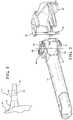
- FIG. 1is a side view of a side rearview vision assembly according to one embodiment of the invention, secured to a vehicle, partially cut away;
- FIG. 2is an exploded perspective view of the base and support arm of the side rearview vision assembly
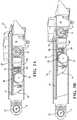
- FIG. 3 ais a partially cut away top view of the side rearview vision assembly of FIG. 1 illustrating the camera a retracted position;
- FIG. 3 bis a partially cut away top view of the side rearview vision assembly of FIG. 1 illustrating the camera in an extended position;
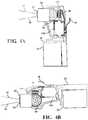
- FIGS. 4 a and 4 bare partially cut away top views of the side rearview vision assembly in unfolded and folded positions, respectively.
- side rearview vision assemblyhaving a camera mounted to a telescoping head.
- the camerais positioned at the end of an arm extendable away from a vehicle and pivotable with respect to the vehicle.
- side rearview vision assemblyis defined to mean an assembly attached to the vehicle and which permits the vehicle operator to adequately see rearward and, if present, around any towed vehicle secured to the motor vehicle.
- the side rearview vision assembly 10is configured for installation on a vehicle 12 .
- the side rearview vision assembly 10is configured for installation on a side door of the vehicle.
- the side rearview vision assembly 10can be installed on other portions of the vehicle, such as for example the non-limiting examples of the frame, quarter panels or fenders.
- the side rearview vision assembly 10is further configured to provide the occupants of the vehicle with a view extending to the rear of the vehicle.
- the side rearview vision assembly 10can optionally be configured as a break-away design, although it should be understood that the side rearview vision assembly 10 can be practiced without a break-away design.
- the side rearview vision assembly 10includes a base or bracket 14 , a support arm 16 , and an image generating device 20 .
- the image generating device 20is a camera capable of generating an electronic signal of a video feed.
- the base 12 and support arm 16are known in the industry and therefore will only be briefly described herein.
- the base 14is configured to attach the support arm 16 and the camera 20 to the vehicle 12 .
- the base 14includes a base structure 22 (best seen in FIG. 2 ) and a base cover or scalp (not shown).
- the base structure 22is configured to mount the support arm 16 to the vehicle 12 . Any desired mechanism, device or structure, sufficient to mount the support arm 16 to the vehicle 12 can be used.
- the base structure 22can be configured such that the support arm 16 can pivot about a substantially vertical axis A-A ( FIG. 2 ).
- the side rearview vision assembly 10can be configured to pivot about an axis that is not substantially vertical.
- the base coveris configured to cover the base structure 22 with an aesthetically pleasing appearance that may or may not match the color and finish of the vehicle. Any desired base cover can be used.
- the base coveris not shown for purposes of drawing simplification.
- the support arm 16extend from the base 14 and are configured to connect the base 14 with the camera 20 .
- the support arm 16is hollow and has a rectangular cross-sectional shape.
- the support arm 16can have other cross-sectional shapes, such as ovular or circular cross-sectional shapes, sufficient to connect the base 14 with the camera 20 .
- the support arm 16includes a positioning arm 24 .
- the support arm 16 in the positioning arm 24have internal mechanisms and devices configured to retract the camera 20 to a retracted position and extend the camera 20 to an extended position.
- the camera 20is fixedly secured to a distal end 26 of the positioning arm 24 .
- the positioning arm 24moves within the support arm 16 .
- FIG. 1illustrates a single support arm 16 , it should be appreciated that in other embodiments a quantity of two or more support arms can be used.
- a housing 30covers and protects the camera 20 .
- the housing 30may be of any desired shape and includes various outer walls that merge together in a smooth manner such as to present a pleasing appearance.
- a substantially rearward facing portion of the housing 30is open and forms a cavity 32 .
- the cavity 32is configured to receive the camera 20 .
- a suitable shaped support member(not shown) is secured within the housing 30 and serves to movably support the camera 20 within the cavity 32 . Mechanisms used to control the position and orientation of the camera 20 within the housing 30 will be discussed in greater detail subsequently.
- the camera 20is of the type to provide real-time digital images. However, in other embodiments, the camera 20 can provide other types of images.
- the images from the camera 20can be digitally combined with other images from other cameras to provide the vehicle occupants with a virtual “around-the-vehicle” view.
- power and image conducting cablesextend from the camera 20 . In certain embodiments, the power and image conducting cables can be ducted through the support arm 16 and the positioning arm 24 to controls (not shown) located within the interior of the vehicle.
- the support arm 16has a motor assembly 42 secured therein.
- the motor assembly 42is mounted into the base 14 using bolts 44 holding U-shaped attachments straps 46 against projections 48 in the base 14 .
- a detent bar 50is urged outwardly by springs (not shown) forcing the detent bar 50 away from the base 14 .
- the detent bar 50provides a stop when the support arm 16 is rotated.
- the detent bar 50also provides a load to prevent forward break-away.
- the motor assembly 42provides for the pivoting of the support arm 16 between a retracted position and an outward position (the outward position is shown in FIG. 2 ). When the support arm 16 is in the retracted position, the support arm 16 extends along the vehicle 12 generally parallel thereto. When the support arm 16 is in the outward position, the support arm 16 extends generally perpendicularly to the side of the vehicle 12 .
- the support arm 16include a front portion 54 and a rear portion 56 .
- the front portion 54includes a rack 60 .
- the positioning arm 24also includes a front portion 62 and a rear portion 64 .
- On the front portion 62 of the positioning arm 24is an inboard contact surface 66 and an outboard contact surface 70 , with the contact surfaces 66 , 70 engaging rails (not shown) to guide the positioning arm 24 in a telescoping relationship with the support arm 16 .
- a pinion 74is secured to the positioning arm 24 by a pin 76 .
- the pinion 74is powered by a motor, which is housed within a cavity 78 of the positioning arm 24 .
- the motordrives the pinion 74 in a traditional manner.
- a wheel 80is mounted to the positioning arm 24 and assists in the telescoping movement of the positioning arm 24 with respect to the support arm 16 due to its ability to ride along the rear portion 56 of the support arm 16 .
- a spring 84extends between a boss 86 and a positioning arm abutment surface 88 to ensure the pinion 74 engages the rack 60 .
- the support arm 16includes a folding axis defined by a pivot hole 82 .
- the side rearview vision assembly 10folds along the axis defined by the pivot hole 82 and telescopes by having the positioning arm 24 relative to the support arm 16 and a coaxial manner.
- the camera 20is shown at the distal end 26 of the positioning arm 24 .
- the housing 30 for the camera 20is shown cutaway in these Figures.
- the camera 20is shown to include a lens 90 .
- the lens 90provides a field-of-view, graphically represented by lines 92 in a manner to depict generally a field-of-view, but not representing an actual angle or range of angles through which the field-of-view extends.
- the lens 90is shown to extend beyond the camera 20 , it should be appreciated by those skilled in the art that the lens may be encased within the body of the camera 20 .
- the camera 20is pivotally secured to the distal end 26 of the positioning arm 24 .
- the camera 20is pivoted by a camera gear 94 , which is driven by a worm gear 96 .
- the worm gear 96is fixedly secured to a driveshaft 100 that is driven by a camera motor 102 .
- the camera motor 102is secured to the distal end 26 of the positioning arm 24 and is operatively connected to the camera 20 .
- the camera motor 102changes the orientation of the camera 20 with respect to the distal ends 26 to change the field-of-view 92 of the camera 20 with respect to the vehicle 12 .
- the camera 20is oriented by the camera gear 94 such that its field of view 92 extends perpendicular to the positioning arm 24 .
- the side rearview vision assembly 10will be able to capture images rearward and to the side of the vehicle 12 .
- the camera 20will be able to capture images that are further out from the vehicle 12 .
- the camera 20is oriented by the camera gear 94 such that the field-of-view 92 extends parallel to the positioning arm 24 and parallel to the support arm 16 .
- the field-of-view 92may even be coaxial with the support arm 16 .
- the field-of-view 92is generally parallel to the side of the vehicle 12 .
- the camera 20is operating even though the support arm 16 and the positioning arm 24 have been moved to the folded position by the motor assembly 42 that prohibits the support arm 16 about an axis defined by the pivot hole 82 .
- the operation of the camera 20 when it is disposed immediately adjacent the vehicle 12 due to the folding of the support arm 16 about the pivot hole 82is independent of whether the positioning arm 24 is retracted into the support arm 16 or whether the positioning arm 24 is telescoped out away from the support arm 16 .
- the orientations of the camera 20 as shown in FIGS. 4 a and 4 bare the two extreme orientations of the camera 20 .
- the camera 20may operate in other orientations with respect to the side of the vehicle 12 or the orientation of the positioning arm 24 .
- the camera 20may be oriented such that the field-of-view 92 extends out and away from the side of the vehicle 12 . This may be done by a driver of the vehicle 12 when towing an extremely wide load.
- the orientation of the camera 20may also be modified if the support arm 16 is in a position other than the fully extended position or the fully folded position.
Landscapes
- Engineering & Computer Science (AREA)
- Multimedia (AREA)
- Mechanical Engineering (AREA)
- Signal Processing (AREA)
- Fittings On The Vehicle Exterior For Carrying Loads, And Devices For Holding Or Mounting Articles (AREA)
Abstract
Description
This patent application is a continuation-in-part of a patent application having U.S. application Ser. No. 14/013,378 claiming priority from U.S. provisional application Ser. No. 61/694,293, filed Aug. 29, 2012, which is incorporate herein, and is also a continuation-in-part of a patent application having U.S. application Ser. No. 14/830,406, which is a continuation of application Ser. No. 13/234,824, filed Sep. 16, 2011, which is incorporated herein.
The invention relates to side rearview vision systems for motor vehicles. More particularly, the invention relates to a side rearview vision system that pivots a camera to variable orientations depending on whether the positioning arm is telescoped outwardly in an extended position, retracted inwardly to a retracted position or folded into a folded position.
Certain vehicles are equipped with structures such as tow bars and the like to tow trailers, campers, boats, mobile homes, etc. Sometimes the towed vehicles are so wide that typical side view mirrors do not extend far enough from the vehicle to allow the vehicle operator to see around the towed vehicle. Accordingly, it is known to equip the towing vehicle with side view mirrors that can extend, in a telescoping manner, from a retracted position that is relatively close to the vehicle to an extended position sufficient to allow the vehicle operator to adequately see around the towed vehicle.
In certain embodiments, the towing vehicle can be equipped with cameras designed to enhance the view of the vehicle operator of hard-to-see areas around the periphery of the vehicle. In some embodiments, the cameras can be incorporated into the side view mirrors and configured to provide views of the sides of the vehicles.
A side rearview vision assembly for a vehicle includes a base that is fixedly secured to the vehicle. A support arm is pivotally secured to the base. A positioning arm is secured to the support arm and is movable with respect to the support arm. The positioning arm defines a distal end. A camera is attached to the distal end of the positioning arm such that the camera moves with the positioning arm as the positioning arm moves relative to said support arm. The camera is configured to provide images exterior to the vehicle. A camera motor is operatively connected to the camera and changes its orientation with respect to the distal end of said positioning arm.
Advantages of the invention will be readily appreciated as the same becomes better understood by reference to the following detailed description when considered in connection with the accompanying drawings, wherein:
The invention will now be described with occasional reference to the specific embodiments of the invention. This invention may, however, be embodied in different forms and should not be construed as limited to the embodiments set forth herein. Rather, these embodiments are provided so that this disclosure will be thorough and complete, and will fully convey the scope of the invention to those skilled in the art.
Unless otherwise defined, all technical and scientific terms used herein have the same meaning as commonly understood by one of ordinary skill in the art to which this invention belongs. The terminology used in the description of the invention herein is for describing particular embodiments only and is not intended to be limiting of the invention. As used in the description of the invention and the appended claims, the singular forms “a,” “an,” and “the” are intended to include the plural forms as well, unless the context clearly indicates otherwise.
Unless otherwise indicated, all numbers expressing quantities of dimensions such as length, width, height, and so forth as used in the specification and claims are to be understood as being modified in all instances by the term “about.” Accordingly, unless otherwise indicated, the numerical properties set forth in the specification and claims are approximations that may vary depending on the desired properties sought to be obtained in embodiments of the present invention. Notwithstanding that the numerical ranges and parameters setting forth the broad scope of the invention are approximations, the numerical values set forth in the specific examples are reported as precisely as possible. Any numerical values, however, inherently contain certain errors necessarily resulting from error found in their respective measurements.
The description and Figures disclose a side rearview vision assembly having a camera mounted to a telescoping head. Generally, the camera is positioned at the end of an arm extendable away from a vehicle and pivotable with respect to the vehicle. The term “side rearview vision assembly”, as used herein, is defined to mean an assembly attached to the vehicle and which permits the vehicle operator to adequately see rearward and, if present, around any towed vehicle secured to the motor vehicle.
Referring now toFIG. 1 , a side rearview vision assembly is shown generally at10. The siderearview vision assembly 10 is configured for installation on avehicle 12. In certain embodiments, the siderearview vision assembly 10 is configured for installation on a side door of the vehicle. However, it should be understood that in other embodiments the siderearview vision assembly 10 can be installed on other portions of the vehicle, such as for example the non-limiting examples of the frame, quarter panels or fenders. The siderearview vision assembly 10 is further configured to provide the occupants of the vehicle with a view extending to the rear of the vehicle. In certain embodiments, the siderearview vision assembly 10 can optionally be configured as a break-away design, although it should be understood that the siderearview vision assembly 10 can be practiced without a break-away design.
The siderearview vision assembly 10 includes a base orbracket 14, asupport arm 16, and animage generating device 20. In the preferred embodiment, theimage generating device 20 is a camera capable of generating an electronic signal of a video feed. Thebase 12 andsupport arm 16 are known in the industry and therefore will only be briefly described herein.
Thebase 14 is configured to attach thesupport arm 16 and thecamera 20 to thevehicle 12. In the illustrated embodiment, thebase 14 includes a base structure22 (best seen inFIG. 2 ) and a base cover or scalp (not shown). Thebase structure 22 is configured to mount thesupport arm 16 to thevehicle 12. Any desired mechanism, device or structure, sufficient to mount thesupport arm 16 to thevehicle 12 can be used. Optionally, thebase structure 22 can be configured such that thesupport arm 16 can pivot about a substantially vertical axis A-A (FIG. 2 ). In still other embodiments, the siderearview vision assembly 10 can be configured to pivot about an axis that is not substantially vertical.
The base cover is configured to cover thebase structure 22 with an aesthetically pleasing appearance that may or may not match the color and finish of the vehicle. Any desired base cover can be used. The base cover is not shown for purposes of drawing simplification.
Thesupport arm 16 extend from thebase 14 and are configured to connect the base14 with thecamera 20. In the illustrated embodiment, thesupport arm 16 is hollow and has a rectangular cross-sectional shape. However, in other embodiments, thesupport arm 16 can have other cross-sectional shapes, such as ovular or circular cross-sectional shapes, sufficient to connect the base14 with thecamera 20. In the illustrated embodiment, thesupport arm 16 includes apositioning arm 24. Thesupport arm 16 in thepositioning arm 24 have internal mechanisms and devices configured to retract thecamera 20 to a retracted position and extend thecamera 20 to an extended position. Thecamera 20 is fixedly secured to adistal end 26 of thepositioning arm 24. Thepositioning arm 24 moves within thesupport arm 16. Mechanisms and devices for telescoping thecamera 20 relative to thebase 14 andvehicle 12 are well known in the art and need not be described in detail herein, (see, e.g. U.S. Pat. No. 7,748,857 to Belcher, et al. and assigned to SMR Patents S.à.r.l.). While the embodiment shown inFIG. 1 illustrates asingle support arm 16, it should be appreciated that in other embodiments a quantity of two or more support arms can be used.
Ahousing 30 covers and protects thecamera 20. Thehousing 30 may be of any desired shape and includes various outer walls that merge together in a smooth manner such as to present a pleasing appearance. A substantially rearward facing portion of thehousing 30 is open and forms acavity 32. Thecavity 32 is configured to receive thecamera 20. A suitable shaped support member (not shown) is secured within thehousing 30 and serves to movably support thecamera 20 within thecavity 32. Mechanisms used to control the position and orientation of thecamera 20 within thehousing 30 will be discussed in greater detail subsequently.
In the illustrated embodiment, thecamera 20 is of the type to provide real-time digital images. However, in other embodiments, thecamera 20 can provide other types of images. Optionally, the images from thecamera 20 can be digitally combined with other images from other cameras to provide the vehicle occupants with a virtual “around-the-vehicle” view. While not shown in the Figures, power and image conducting cables extend from thecamera 20. In certain embodiments, the power and image conducting cables can be ducted through thesupport arm 16 and thepositioning arm 24 to controls (not shown) located within the interior of the vehicle.
Referring toFIG. 2 , thesupport arm 16 has amotor assembly 42 secured therein. Themotor assembly 42 is mounted into the base14 usingbolts 44 holding U-shaped attachments straps46 against projections48 in thebase 14. Adetent bar 50 is urged outwardly by springs (not shown) forcing thedetent bar 50 away from thebase 14. Thedetent bar 50 provides a stop when thesupport arm 16 is rotated. Thedetent bar 50 also provides a load to prevent forward break-away. Themotor assembly 42 provides for the pivoting of thesupport arm 16 between a retracted position and an outward position (the outward position is shown inFIG. 2 ). When thesupport arm 16 is in the retracted position, thesupport arm 16 extends along thevehicle 12 generally parallel thereto. When thesupport arm 16 is in the outward position, thesupport arm 16 extends generally perpendicularly to the side of thevehicle 12.
Referring toFIGS. 3aand 3b , thesupport arm 16 include afront portion 54 and arear portion 56. Thefront portion 54 includes arack 60. Thepositioning arm 24 also includes afront portion 62 and arear portion 64. On thefront portion 62 of thepositioning arm 24 is an inboard contact surface66 and anoutboard contact surface 70, with the contact surfaces66,70 engaging rails (not shown) to guide thepositioning arm 24 in a telescoping relationship with thesupport arm 16.
Apinion 74 is secured to thepositioning arm 24 by apin 76. Thepinion 74 is powered by a motor, which is housed within acavity 78 of thepositioning arm 24. The motor drives thepinion 74 in a traditional manner. When thepinion 74 rotates, it engages therack 60 to translate the rotational motion of the motor in thecavity 78 into lateral motion of thepositioning arm 24. Awheel 80 is mounted to thepositioning arm 24 and assists in the telescoping movement of thepositioning arm 24 with respect to thesupport arm 16 due to its ability to ride along therear portion 56 of thesupport arm 16. Aspring 84 extends between aboss 86 and a positioningarm abutment surface 88 to ensure thepinion 74 engages therack 60.
Thesupport arm 16 includes a folding axis defined by apivot hole 82. With reference back toFIG. 2 , the siderearview vision assembly 10 folds along the axis defined by thepivot hole 82 and telescopes by having thepositioning arm 24 relative to thesupport arm 16 and a coaxial manner.
Referring toFIGS. 4aand 4b , thecamera 20 is shown at thedistal end 26 of thepositioning arm 24. For purposes of clarity, thehousing 30 for thecamera 20 is shown cutaway in these Figures. Thecamera 20 is shown to include alens 90. Thelens 90 provides a field-of-view, graphically represented bylines 92 in a manner to depict generally a field-of-view, but not representing an actual angle or range of angles through which the field-of-view extends. Although thelens 90 is shown to extend beyond thecamera 20, it should be appreciated by those skilled in the art that the lens may be encased within the body of thecamera 20.
Thecamera 20 is pivotally secured to thedistal end 26 of thepositioning arm 24. Thecamera 20 is pivoted by acamera gear 94, which is driven by aworm gear 96. Theworm gear 96 is fixedly secured to adriveshaft 100 that is driven by acamera motor 102. More specifically, thecamera motor 102 is secured to thedistal end 26 of thepositioning arm 24 and is operatively connected to thecamera 20. Thecamera motor 102 changes the orientation of thecamera 20 with respect to the distal ends26 to change the field-of-view 92 of thecamera 20 with respect to thevehicle 12.
Referring specifically toFIG. 4a , thecamera 20 is oriented by thecamera gear 94 such that its field ofview 92 extends perpendicular to thepositioning arm 24. This is a typical orientation for thecamera 20 as the field-of-view 92 in this instance is generally parallel to the side of thevehicle 12 and facing the rearward of thevehicle 12. In such an orientation, the siderearview vision assembly 10 will be able to capture images rearward and to the side of thevehicle 12. In the situation where thepositioning arm 24 is fully extended out from thesupport arm 16, thecamera 20 will be able to capture images that are further out from thevehicle 12. This will benefit the driver of thevehicle 12 when thevehicle 12 is towing an object that is longer or wider than what thecamera 20 is designed to capture when thepositioning arm 24 is retracted into thesupport arm 16, which is the normal operational position of the siderearview vision assembly 10.
Referring specifically toFIG. 4b , thecamera 20 is oriented by thecamera gear 94 such that the field-of-view 92 extends parallel to thepositioning arm 24 and parallel to thesupport arm 16. In some embodiments, the field-of-view 92 may even be coaxial with thesupport arm 16. As with the situation shown inFIG. 4a , the field-of-view 92 is generally parallel to the side of thevehicle 12. Unlike the situation shown inFIG. 4a , thecamera 20 is operating even though thesupport arm 16 and thepositioning arm 24 have been moved to the folded position by themotor assembly 42 that prohibits thesupport arm 16 about an axis defined by thepivot hole 82. The operation of thecamera 20 when it is disposed immediately adjacent thevehicle 12 due to the folding of thesupport arm 16 about thepivot hole 82 is independent of whether thepositioning arm 24 is retracted into thesupport arm 16 or whether thepositioning arm 24 is telescoped out away from thesupport arm 16.
In addition, the orientations of thecamera 20 as shown inFIGS. 4aand 4b are the two extreme orientations of thecamera 20. Thecamera 20 may operate in other orientations with respect to the side of thevehicle 12 or the orientation of thepositioning arm 24. In other words, thecamera 20 may be oriented such that the field-of-view 92 extends out and away from the side of thevehicle 12. This may be done by a driver of thevehicle 12 when towing an extremely wide load. The orientation of thecamera 20 may also be modified if thesupport arm 16 is in a position other than the fully extended position or the fully folded position.
The invention has been described in an illustrative manner. It is to be understood that the terminology, which has been used, is intended to be in the nature of words of description rather than of limitation.
Many modifications and variations of the invention are possible in light of the above teachings. Therefore, within the scope of the appended claims, the invention may be practiced other than as specifically described.
Claims (8)
1. A side rearview vision assembly for a vehicle comprising:
a base fixedly secured to the vehicle;
a support arm pivotally secured to said base, said support arm pivotal between retracted and extended positions;
a positioning arm secured to said support arm and movable with respect to said support arm, said positioning arm defining a distal end;
an image generating device comprising at least one camera attached to said distal end of said positioning arm such that said at least one camera moves with said positioning arm as said positioning arm moves relative to said support arm, said at least one camera configured to provide images exterior to the vehicle through a defined field of view; and
a camera motor operatively connected to said at least one camera to change orientation of said at least one camera based on the position and orientation of said distal end of said positioning arm with respect to the vehicle, such that the defined field of view of said at least one camera remains independent of the position and orientation of said distal end of said positioning arm.
2. A side rearview vision assembly as set forth inclaim 1 wherein said camera motor is secured to said distal end of said positioning arm.
3. A side rearview vision assembly as set forth inclaim 2 including a camera gear fixedly secured to said camera.
4. A side rearview vision assembly as set forth inclaim 3 wherein said camera motor includes a shaft having a worm gear fixedly secured thereto extending out from said camera motor for providing rotational motion.
5. A side rearview vision assembly as set forth inclaim 4 wherein said worm gear engages said camera gear.
6. A side rearview vision assembly as set forth inclaim 5 wherein said camera is oriented by said camera motor independently of said position of said support arm.
7. A side rearview assembly as set forth inclaim 6 wherein said positioning arm telescopes with respect to said support arm.
8. A side rearview vision assembly for a vehicle comprising:
a base fixedly secured to the vehicle;
a support arm secured to said base;
a positioning arm secured to said support arm and moves telescopically with respect to said support arm, said positioning arm defining a distal end having a position and an orientation; and
a camera attached to said distal end of said positioning arm such that said camera moves with said positioning arm as said positioning arm moves relative to said support arm and the vehicle, such that said camera remains independent of the position and orientation of said distal end of said positioning arm.
Priority Applications (3)
| Application Number | Priority Date | Filing Date | Title |
|---|---|---|---|
| US15/621,306US10638094B2 (en) | 2011-09-16 | 2017-06-13 | Side rearview vision assembly with telescoping head |
| EP18176479.6AEP3415371B1 (en) | 2017-06-13 | 2018-06-07 | Side rearview vision assembly with telescoping head |
| US16/444,625US10594989B2 (en) | 2011-09-16 | 2019-06-18 | Safety mirror with telescoping head and motor vehicle |
Applications Claiming Priority (5)
| Application Number | Priority Date | Filing Date | Title |
|---|---|---|---|
| US13/234,824US20120069184A1 (en) | 2010-09-17 | 2011-09-16 | Rear view device for a motor vehicle |
| US201261694293P | 2012-08-29 | 2012-08-29 | |
| US14/013,378US9815410B2 (en) | 2012-08-29 | 2013-08-29 | Side mirror assembly with stationary camera and telescoping mirror head |
| US14/830,406US20150358590A1 (en) | 2010-09-17 | 2015-08-19 | Rear view device for a motor vehicle |
| US15/621,306US10638094B2 (en) | 2011-09-16 | 2017-06-13 | Side rearview vision assembly with telescoping head |
Related Parent Applications (2)
| Application Number | Title | Priority Date | Filing Date |
|---|---|---|---|
| US14/013,378Continuation-In-PartUS9815410B2 (en) | 2011-09-16 | 2013-08-29 | Side mirror assembly with stationary camera and telescoping mirror head |
| US14/830,406Continuation-In-PartUS20150358590A1 (en) | 2010-09-17 | 2015-08-19 | Rear view device for a motor vehicle |
Related Child Applications (1)
| Application Number | Title | Priority Date | Filing Date |
|---|---|---|---|
| US15/902,149Continuation-In-PartUS10343609B2 (en) | 2011-09-16 | 2018-02-22 | Safety mirror and motor vehicle |
Publications (2)
| Publication Number | Publication Date |
|---|---|
| US20170280111A1 US20170280111A1 (en) | 2017-09-28 |
| US10638094B2true US10638094B2 (en) | 2020-04-28 |
Family
ID=59898855
Family Applications (1)
| Application Number | Title | Priority Date | Filing Date |
|---|---|---|---|
| US15/621,306Active2032-01-02US10638094B2 (en) | 2011-09-16 | 2017-06-13 | Side rearview vision assembly with telescoping head |
Country Status (1)
| Country | Link |
|---|---|
| US (1) | US10638094B2 (en) |
Cited By (2)
| Publication number | Priority date | Publication date | Assignee | Title |
|---|---|---|---|---|
| US20220317435A1 (en)* | 2021-04-02 | 2022-10-06 | Nantong Schmidt Opto-Electrical Technology Co. Ltd. | Elastic worm gear assembly and use thereof |
| US20240190350A1 (en)* | 2020-06-24 | 2024-06-13 | Magna Mirrors Of America, Inc. | Vehicular extendable camera assembly |
Families Citing this family (6)
| Publication number | Priority date | Publication date | Assignee | Title |
|---|---|---|---|---|
| DE102018116836B4 (en)* | 2018-07-11 | 2020-02-06 | Motherson Innovations Company Limited | Rearview device and vehicle with such a rearview device |
| DE102019204418B3 (en)* | 2019-03-29 | 2020-06-18 | Continental Automotive Gmbh | Camera arm device for a mirror replacement system for a motor vehicle and motor vehicle |
| KR102703277B1 (en)* | 2019-06-19 | 2024-09-04 | 현대자동차주식회사 | Vertical Folding Camera Monitoring System |
| CN112158136B (en)* | 2020-10-13 | 2021-07-20 | 广州新程北斗信息科技有限公司 | An Internet of Vehicles Information Interaction Terminal |
| CN112298047A (en)* | 2020-10-30 | 2021-02-02 | 陈亚萍 | Visual module and visual system of vehicle and vehicle |
| CN113525253B (en)* | 2021-09-15 | 2021-12-10 | 大连理工江苏研究院有限公司 | Vehicle-mounted image recognition device and method |
Citations (22)
| Publication number | Priority date | Publication date | Assignee | Title |
|---|---|---|---|---|
| DE69618192T2 (en) | 1995-05-22 | 2002-07-18 | Donnelly Corp., Holland | VEHICLE REVIEW SYSTEM WITH PANORAMIC VIEW |
| DE69709810T2 (en) | 1996-09-19 | 2002-09-19 | Renault Vehicules Industriels, Saint Priest | Rearview device with camera for motor vehicles |
| US20030103142A1 (en)* | 2001-12-03 | 2003-06-05 | Murakami Corporation | Camera built-in exterior rearview mirror |
| US6812831B2 (en) | 2001-06-08 | 2004-11-02 | Fuji Jukogyo Kabushiki Kaisha | Vehicle surroundings monitoring apparatus |
| US20040230358A1 (en) | 2003-02-21 | 2004-11-18 | Stam Joseph S. | Monitoring and automatic equipment control systems |
| US20040246608A1 (en)* | 2001-10-30 | 2004-12-09 | Wellington Jason Kingsley | Power telescoping vehicle mirror assembly |
| WO2006018951A1 (en) | 2004-08-18 | 2006-02-23 | Olympus Corporation | Image creating method, and image creating apparatus |
| US20060187304A1 (en) | 2005-02-18 | 2006-08-24 | Denso Corporation | Device for monitoring the vicinities of a vehicle |
| US20070127564A1 (en) | 2005-12-05 | 2007-06-07 | Shih-Hsiung Li | Image display device for car monitoring system |
| US20070263090A1 (en) | 2006-05-12 | 2007-11-15 | Koichi Abe | Method and Apparatus for Automatic Exposure of an In-Vehicle Camera |
| US20080055411A1 (en) | 2006-09-06 | 2008-03-06 | Dong Wook Lee | External Monitoring System for Securing Driver's Field of Vision for Vehicles |
| US20080089557A1 (en) | 2005-05-10 | 2008-04-17 | Olympus Corporation | Image processing apparatus, image processing method, and computer program product |
| US20080116943A1 (en) | 2006-11-20 | 2008-05-22 | Rajendran Nair | True-differential DVI/HDMI line driver |
| DE102007054342B3 (en) | 2007-11-14 | 2009-06-25 | Hahn, Carl H., Prof. Dr. | Side rearview mirror less motor vehicle rear view device for passenger car, has camera unit with angle of vision that extends transverse to vehicle during actuation of turn-signal lever in respective direction |
| US7630803B2 (en) | 2001-03-05 | 2009-12-08 | Gentex Corporation | Image processing system to control vehicle headlamps or other vehicle equipment |
| US20100039494A1 (en) | 2007-02-16 | 2010-02-18 | Autonetworks Technologies, Ltd. | Vehicle-mounted video communication system and vehicle-mounted image pickup system |
| US20100079267A1 (en) | 2008-09-29 | 2010-04-01 | Tsun-Huang Lin | Automobile Anti-Collision Early-Warning Device |
| US20100259371A1 (en) | 2009-04-10 | 2010-10-14 | Jui-Hung Wu | Bird-View Parking Aid Apparatus with Ultrasonic Obstacle Marking and Method of Maneuvering the same |
| US20110317049A1 (en) | 2010-06-23 | 2011-12-29 | Seiko Epson Corporation | Imaging device and imaging control circuit |
| US20120062743A1 (en) | 2009-02-27 | 2012-03-15 | Magna Electronics Inc. | Alert system for vehicle |
| US8366318B2 (en) | 2009-07-17 | 2013-02-05 | Dental Imaging Technologies Corporation | Intraoral X-ray sensor with embedded standard computer interface |
| US9129495B1 (en)* | 2014-06-03 | 2015-09-08 | AISIN Technical Center of America, Inc. | Multi-purpose side camera |
- 2017
- 2017-06-13USUS15/621,306patent/US10638094B2/enactiveActive
Patent Citations (22)
| Publication number | Priority date | Publication date | Assignee | Title |
|---|---|---|---|---|
| DE69618192T2 (en) | 1995-05-22 | 2002-07-18 | Donnelly Corp., Holland | VEHICLE REVIEW SYSTEM WITH PANORAMIC VIEW |
| DE69709810T2 (en) | 1996-09-19 | 2002-09-19 | Renault Vehicules Industriels, Saint Priest | Rearview device with camera for motor vehicles |
| US7630803B2 (en) | 2001-03-05 | 2009-12-08 | Gentex Corporation | Image processing system to control vehicle headlamps or other vehicle equipment |
| US6812831B2 (en) | 2001-06-08 | 2004-11-02 | Fuji Jukogyo Kabushiki Kaisha | Vehicle surroundings monitoring apparatus |
| US20040246608A1 (en)* | 2001-10-30 | 2004-12-09 | Wellington Jason Kingsley | Power telescoping vehicle mirror assembly |
| US20030103142A1 (en)* | 2001-12-03 | 2003-06-05 | Murakami Corporation | Camera built-in exterior rearview mirror |
| US20040230358A1 (en) | 2003-02-21 | 2004-11-18 | Stam Joseph S. | Monitoring and automatic equipment control systems |
| WO2006018951A1 (en) | 2004-08-18 | 2006-02-23 | Olympus Corporation | Image creating method, and image creating apparatus |
| US20060187304A1 (en) | 2005-02-18 | 2006-08-24 | Denso Corporation | Device for monitoring the vicinities of a vehicle |
| US20080089557A1 (en) | 2005-05-10 | 2008-04-17 | Olympus Corporation | Image processing apparatus, image processing method, and computer program product |
| US20070127564A1 (en) | 2005-12-05 | 2007-06-07 | Shih-Hsiung Li | Image display device for car monitoring system |
| US20070263090A1 (en) | 2006-05-12 | 2007-11-15 | Koichi Abe | Method and Apparatus for Automatic Exposure of an In-Vehicle Camera |
| US20080055411A1 (en) | 2006-09-06 | 2008-03-06 | Dong Wook Lee | External Monitoring System for Securing Driver's Field of Vision for Vehicles |
| US20080116943A1 (en) | 2006-11-20 | 2008-05-22 | Rajendran Nair | True-differential DVI/HDMI line driver |
| US20100039494A1 (en) | 2007-02-16 | 2010-02-18 | Autonetworks Technologies, Ltd. | Vehicle-mounted video communication system and vehicle-mounted image pickup system |
| DE102007054342B3 (en) | 2007-11-14 | 2009-06-25 | Hahn, Carl H., Prof. Dr. | Side rearview mirror less motor vehicle rear view device for passenger car, has camera unit with angle of vision that extends transverse to vehicle during actuation of turn-signal lever in respective direction |
| US20100079267A1 (en) | 2008-09-29 | 2010-04-01 | Tsun-Huang Lin | Automobile Anti-Collision Early-Warning Device |
| US20120062743A1 (en) | 2009-02-27 | 2012-03-15 | Magna Electronics Inc. | Alert system for vehicle |
| US20100259371A1 (en) | 2009-04-10 | 2010-10-14 | Jui-Hung Wu | Bird-View Parking Aid Apparatus with Ultrasonic Obstacle Marking and Method of Maneuvering the same |
| US8366318B2 (en) | 2009-07-17 | 2013-02-05 | Dental Imaging Technologies Corporation | Intraoral X-ray sensor with embedded standard computer interface |
| US20110317049A1 (en) | 2010-06-23 | 2011-12-29 | Seiko Epson Corporation | Imaging device and imaging control circuit |
| US9129495B1 (en)* | 2014-06-03 | 2015-09-08 | AISIN Technical Center of America, Inc. | Multi-purpose side camera |
Non-Patent Citations (1)
| Title |
|---|
| European Search Report for application No. EP 10 17 8378 dated Nov. 2, 2011; 5 pp. |
Cited By (4)
| Publication number | Priority date | Publication date | Assignee | Title |
|---|---|---|---|---|
| US20240190350A1 (en)* | 2020-06-24 | 2024-06-13 | Magna Mirrors Of America, Inc. | Vehicular extendable camera assembly |
| US12311845B2 (en)* | 2020-06-24 | 2025-05-27 | Magna Mirrors Of America, Inc. | Vehicular extendable camera assembly |
| US20220317435A1 (en)* | 2021-04-02 | 2022-10-06 | Nantong Schmidt Opto-Electrical Technology Co. Ltd. | Elastic worm gear assembly and use thereof |
| US11966039B2 (en)* | 2021-04-02 | 2024-04-23 | Nantong Schmidt Opto-Electrical Technology Co. Ltd. | Elastic worm gear assembly and use thereof |
Also Published As
| Publication number | Publication date |
|---|---|
| US20170280111A1 (en) | 2017-09-28 |
Similar Documents
| Publication | Publication Date | Title |
|---|---|---|
| US10638094B2 (en) | Side rearview vision assembly with telescoping head | |
| US12214727B2 (en) | Vehicular exterior rearview mirror assembly with extendable and retractable mirror head | |
| US6139159A (en) | Adjustable exterior rearview mirror for vehicles | |
| US9321410B2 (en) | Pivoting mechanism for movably attaching a camera to a vehicle | |
| US9150156B2 (en) | Vehicle mirror assembly | |
| US9057833B2 (en) | Vehicle mirror assembly | |
| US7216993B2 (en) | Foldable vehicle external mirror having auxiliary mirror | |
| US9815410B2 (en) | Side mirror assembly with stationary camera and telescoping mirror head | |
| US20030103142A1 (en) | Camera built-in exterior rearview mirror | |
| EP3415371B1 (en) | Side rearview vision assembly with telescoping head | |
| US10594989B2 (en) | Safety mirror with telescoping head and motor vehicle | |
| WO2012118788A1 (en) | Rearview device support assembly | |
| US11628772B2 (en) | Powerfold actuator for exterior mirror | |
| ES2883419T3 (en) | Rear view mirrors for vehicles | |
| US20060250500A1 (en) | Device for monitoring the exterior of a motor vehicle | |
| US7114817B2 (en) | Extendable foldable mirror | |
| US7540619B2 (en) | Single arm tow mirror assembly | |
| US20230278497A1 (en) | Exterior rearview mirror assembly for vehicles | |
| CN115366808A (en) | A vehicle reversing camera system and automobile | |
| RU2274561C1 (en) | Vehicle external rear view mirror | |
| AU2002313391A1 (en) | Foldable vehicle external mirror having auxiliary mirror |
Legal Events
| Date | Code | Title | Description |
|---|---|---|---|
| AS | Assignment | Owner name:SMR PATENT S.A.R.L., LUXEMBOURG Free format text:ASSIGNMENT OF ASSIGNORS INTEREST;ASSIGNORS:HENION, PAUL;BROOKS, DARRYL;HOTTMANN, PHILIPP;AND OTHERS;SIGNING DATES FROM 20170609 TO 20170612;REEL/FRAME:042693/0455 | |
| STPP | Information on status: patent application and granting procedure in general | Free format text:NON FINAL ACTION MAILED | |
| STPP | Information on status: patent application and granting procedure in general | Free format text:RESPONSE TO NON-FINAL OFFICE ACTION ENTERED AND FORWARDED TO EXAMINER | |
| STPP | Information on status: patent application and granting procedure in general | Free format text:FINAL REJECTION MAILED | |
| STPP | Information on status: patent application and granting procedure in general | Free format text:DOCKETED NEW CASE - READY FOR EXAMINATION | |
| STPP | Information on status: patent application and granting procedure in general | Free format text:NOTICE OF ALLOWANCE MAILED -- APPLICATION RECEIVED IN OFFICE OF PUBLICATIONS | |
| STCF | Information on status: patent grant | Free format text:PATENTED CASE | |
| MAFP | Maintenance fee payment | Free format text:PAYMENT OF MAINTENANCE FEE, 4TH YEAR, LARGE ENTITY (ORIGINAL EVENT CODE: M1551); ENTITY STATUS OF PATENT OWNER: LARGE ENTITY Year of fee payment:4 |