US10483791B2 - Series-connected battery packs, system and method - Google Patents
Series-connected battery packs, system and methodDownload PDFInfo
- Publication number
- US10483791B2 US10483791B2US15/603,862US201715603862AUS10483791B2US 10483791 B2US10483791 B2US 10483791B2US 201715603862 AUS201715603862 AUS 201715603862AUS 10483791 B2US10483791 B2US 10483791B2
- Authority
- US
- United States
- Prior art keywords
- battery pack
- operable
- circuit
- voltage
- battery
- Prior art date
- Legal status (The legal status is an assumption and is not a legal conclusion. Google has not performed a legal analysis and makes no representation as to the accuracy of the status listed.)
- Active, expires
Links
- 238000000034methodMethods0.000titleclaimsabstractdescription10
- 238000010276constructionMethods0.000description17
- 238000007599dischargingMethods0.000description8
- 229910052744lithiumInorganic materials0.000description5
- WHXSMMKQMYFTQS-UHFFFAOYSA-NLithiumChemical compound[Li]WHXSMMKQMYFTQS-UHFFFAOYSA-N0.000description4
- 230000002159abnormal effectEffects0.000description4
- 239000011159matrix materialSubstances0.000description4
- 229910001416lithium ionInorganic materials0.000description3
- 229910008088Li-MnInorganic materials0.000description2
- 229910006327Li—MnInorganic materials0.000description2
- 229910007966Li-CoInorganic materials0.000description1
- HBBGRARXTFLTSG-UHFFFAOYSA-NLithium ionChemical compound[Li+]HBBGRARXTFLTSG-UHFFFAOYSA-N0.000description1
- 229910008295Li—CoInorganic materials0.000description1
- 229910005580NiCdInorganic materials0.000description1
- 229910005813NiMHInorganic materials0.000description1
- KLARSDUHONHPRF-UHFFFAOYSA-N[Li].[Mn]Chemical compound[Li].[Mn]KLARSDUHONHPRF-UHFFFAOYSA-N0.000description1
- 239000002253acidSubstances0.000description1
- OJIJEKBXJYRIBZ-UHFFFAOYSA-Ncadmium nickelChemical compound[Ni].[Cd]OJIJEKBXJYRIBZ-UHFFFAOYSA-N0.000description1
- CKFRRHLHAJZIIN-UHFFFAOYSA-Ncobalt lithiumChemical compound[Li].[Co]CKFRRHLHAJZIIN-UHFFFAOYSA-N0.000description1
- 239000010432diamondSubstances0.000description1
- 229910003460diamondInorganic materials0.000description1
- 229910052987metal hydrideInorganic materials0.000description1
- 239000011029spinelSubstances0.000description1
- 229910052596spinelInorganic materials0.000description1
- 230000000007visual effectEffects0.000description1
- 239000002023woodSubstances0.000description1
Images



Classifications
- H—ELECTRICITY
- H02—GENERATION; CONVERSION OR DISTRIBUTION OF ELECTRIC POWER
- H02J—CIRCUIT ARRANGEMENTS OR SYSTEMS FOR SUPPLYING OR DISTRIBUTING ELECTRIC POWER; SYSTEMS FOR STORING ELECTRIC ENERGY
- H02J9/00—Circuit arrangements for emergency or stand-by power supply, e.g. for emergency lighting
- H02J9/04—Circuit arrangements for emergency or stand-by power supply, e.g. for emergency lighting in which the distribution system is disconnected from the normal source and connected to a standby source
- H02J9/06—Circuit arrangements for emergency or stand-by power supply, e.g. for emergency lighting in which the distribution system is disconnected from the normal source and connected to a standby source with automatic change-over, e.g. UPS systems
- H—ELECTRICITY
- H02—GENERATION; CONVERSION OR DISTRIBUTION OF ELECTRIC POWER
- H02J—CIRCUIT ARRANGEMENTS OR SYSTEMS FOR SUPPLYING OR DISTRIBUTING ELECTRIC POWER; SYSTEMS FOR STORING ELECTRIC ENERGY
- H02J7/00—Circuit arrangements for charging or depolarising batteries or for supplying loads from batteries
- H02J7/0013—Circuit arrangements for charging or depolarising batteries or for supplying loads from batteries acting upon several batteries simultaneously or sequentially
- H02J7/0025—Sequential battery discharge in systems with a plurality of batteries
- H—ELECTRICITY
- H02—GENERATION; CONVERSION OR DISTRIBUTION OF ELECTRIC POWER
- H02J—CIRCUIT ARRANGEMENTS OR SYSTEMS FOR SUPPLYING OR DISTRIBUTING ELECTRIC POWER; SYSTEMS FOR STORING ELECTRIC ENERGY
- H02J7/00—Circuit arrangements for charging or depolarising batteries or for supplying loads from batteries
- H—ELECTRICITY
- H02—GENERATION; CONVERSION OR DISTRIBUTION OF ELECTRIC POWER
- H02J—CIRCUIT ARRANGEMENTS OR SYSTEMS FOR SUPPLYING OR DISTRIBUTING ELECTRIC POWER; SYSTEMS FOR STORING ELECTRIC ENERGY
- H02J7/00—Circuit arrangements for charging or depolarising batteries or for supplying loads from batteries
- H02J7/0013—Circuit arrangements for charging or depolarising batteries or for supplying loads from batteries acting upon several batteries simultaneously or sequentially
- H02J7/0014—Circuits for equalisation of charge between batteries
- H02J7/0016—Circuits for equalisation of charge between batteries using shunting, discharge or bypass circuits
- H02J7/0021—
- H—ELECTRICITY
- H02—GENERATION; CONVERSION OR DISTRIBUTION OF ELECTRIC POWER
- H02J—CIRCUIT ARRANGEMENTS OR SYSTEMS FOR SUPPLYING OR DISTRIBUTING ELECTRIC POWER; SYSTEMS FOR STORING ELECTRIC ENERGY
- H02J7/00—Circuit arrangements for charging or depolarising batteries or for supplying loads from batteries
- H02J7/0013—Circuit arrangements for charging or depolarising batteries or for supplying loads from batteries acting upon several batteries simultaneously or sequentially
- H02J7/0024—Parallel/serial switching of connection of batteries to charge or load circuit
- H02J7/0026—
- H—ELECTRICITY
- H02—GENERATION; CONVERSION OR DISTRIBUTION OF ELECTRIC POWER
- H02J—CIRCUIT ARRANGEMENTS OR SYSTEMS FOR SUPPLYING OR DISTRIBUTING ELECTRIC POWER; SYSTEMS FOR STORING ELECTRIC ENERGY
- H02J7/00—Circuit arrangements for charging or depolarising batteries or for supplying loads from batteries
- H02J7/0047—Circuit arrangements for charging or depolarising batteries or for supplying loads from batteries with monitoring or indicating devices or circuits
- H02J7/0048—Detection of remaining charge capacity or state of charge [SOC]
- H02J7/0049—Detection of fully charged condition
- H—ELECTRICITY
- H02—GENERATION; CONVERSION OR DISTRIBUTION OF ELECTRIC POWER
- H02J—CIRCUIT ARRANGEMENTS OR SYSTEMS FOR SUPPLYING OR DISTRIBUTING ELECTRIC POWER; SYSTEMS FOR STORING ELECTRIC ENERGY
- H02J7/00—Circuit arrangements for charging or depolarising batteries or for supplying loads from batteries
- H02J7/0063—Circuit arrangements for charging or depolarising batteries or for supplying loads from batteries with circuits adapted for supplying loads from the battery
- H—ELECTRICITY
- H01—ELECTRIC ELEMENTS
- H01M—PROCESSES OR MEANS, e.g. BATTERIES, FOR THE DIRECT CONVERSION OF CHEMICAL ENERGY INTO ELECTRICAL ENERGY
- H01M10/00—Secondary cells; Manufacture thereof
- H01M10/42—Methods or arrangements for servicing or maintenance of secondary cells or secondary half-cells
- H01M10/425—Structural combination with electronic components, e.g. electronic circuits integrated to the outside of the casing
- H01M10/4257—Smart batteries, e.g. electronic circuits inside the housing of the cells or batteries
- H02J2007/0067—
- H02J2007/0098—
- H02J2009/068—
- H—ELECTRICITY
- H02—GENERATION; CONVERSION OR DISTRIBUTION OF ELECTRIC POWER
- H02J—CIRCUIT ARRANGEMENTS OR SYSTEMS FOR SUPPLYING OR DISTRIBUTING ELECTRIC POWER; SYSTEMS FOR STORING ELECTRIC ENERGY
- H02J2207/00—Indexing scheme relating to details of circuit arrangements for charging or depolarising batteries or for supplying loads from batteries
- H02J2207/20—Charging or discharging characterised by the power electronics converter
- H—ELECTRICITY
- H02—GENERATION; CONVERSION OR DISTRIBUTION OF ELECTRIC POWER
- H02J—CIRCUIT ARRANGEMENTS OR SYSTEMS FOR SUPPLYING OR DISTRIBUTING ELECTRIC POWER; SYSTEMS FOR STORING ELECTRIC ENERGY
- H02J7/00—Circuit arrangements for charging or depolarising batteries or for supplying loads from batteries
- H02J7/0029—Circuit arrangements for charging or depolarising batteries or for supplying loads from batteries with safety or protection devices or circuits
- H02J7/00302—Overcharge protection
- H02J7/0065—
- H—ELECTRICITY
- H02—GENERATION; CONVERSION OR DISTRIBUTION OF ELECTRIC POWER
- H02J—CIRCUIT ARRANGEMENTS OR SYSTEMS FOR SUPPLYING OR DISTRIBUTING ELECTRIC POWER; SYSTEMS FOR STORING ELECTRIC ENERGY
- H02J9/00—Circuit arrangements for emergency or stand-by power supply, e.g. for emergency lighting
- H02J9/04—Circuit arrangements for emergency or stand-by power supply, e.g. for emergency lighting in which the distribution system is disconnected from the normal source and connected to a standby source
- H02J9/06—Circuit arrangements for emergency or stand-by power supply, e.g. for emergency lighting in which the distribution system is disconnected from the normal source and connected to a standby source with automatic change-over, e.g. UPS systems
- H02J9/068—Electronic means for switching from one power supply to another power supply, e.g. to avoid parallel connection
- H—ELECTRICITY
- H02—GENERATION; CONVERSION OR DISTRIBUTION OF ELECTRIC POWER
- H02P—CONTROL OR REGULATION OF ELECTRIC MOTORS, ELECTRIC GENERATORS OR DYNAMO-ELECTRIC CONVERTERS; CONTROLLING TRANSFORMERS, REACTORS OR CHOKE COILS
- H02P27/00—Arrangements or methods for the control of AC motors characterised by the kind of supply voltage
- H02P27/04—Arrangements or methods for the control of AC motors characterised by the kind of supply voltage using variable-frequency supply voltage, e.g. inverter or converter supply voltage
- H02P27/06—Arrangements or methods for the control of AC motors characterised by the kind of supply voltage using variable-frequency supply voltage, e.g. inverter or converter supply voltage using DC to AC converters or inverters
- H02P27/08—Arrangements or methods for the control of AC motors characterised by the kind of supply voltage using variable-frequency supply voltage, e.g. inverter or converter supply voltage using DC to AC converters or inverters with pulse width modulation
- Y—GENERAL TAGGING OF NEW TECHNOLOGICAL DEVELOPMENTS; GENERAL TAGGING OF CROSS-SECTIONAL TECHNOLOGIES SPANNING OVER SEVERAL SECTIONS OF THE IPC; TECHNICAL SUBJECTS COVERED BY FORMER USPC CROSS-REFERENCE ART COLLECTIONS [XRACs] AND DIGESTS
- Y02—TECHNOLOGIES OR APPLICATIONS FOR MITIGATION OR ADAPTATION AGAINST CLIMATE CHANGE
- Y02E—REDUCTION OF GREENHOUSE GAS [GHG] EMISSIONS, RELATED TO ENERGY GENERATION, TRANSMISSION OR DISTRIBUTION
- Y02E60/00—Enabling technologies; Technologies with a potential or indirect contribution to GHG emissions mitigation
- Y02E60/10—Energy storage using batteries
Definitions
- the present inventionrelates to battery power sources and battery-powered devices and, more particularly, to series-connected battery packs in such power sources and devices.
- two or more battery packsmay be connected in series. When connected in series, the voltage of each pack is added to a total terminal voltage of the system. However, operation of series-connected battery packs is generally limited by the pack having the lowest capacity.
- one or more solutions to maximize the discharge energy of series-connected battery packs in a systemmay be provided.
- an ability to mix and match packs with different capacities, different states of charge, different nominal voltages, etc. in the systemmay be provided.
- the systemmay be controlled to work at less than full capacity of battery packs. For example, a proportional discharge energy may be drawn from each pack based upon the capacity/condition of the pack so that the packs reach end of discharge substantially simultaneously. In another example, the pack at its end of discharge may be disconnected from the circuit, after which operation of the system is continued through to end of discharge of all series-connected packs in the system.
- the systemmay provide a charge platform so that, during charging, each battery pack is brought to substantially the same state of charge.
- the platformmay provide a series connection between the battery packs during discharge, and, during charging, each battery pack may be connected independently or in a parallel connection to a power source.
- the charge platformmay not address different capacities between the battery packs.
- a battery power devicemay generally include a housing defining a first support operable to support a first battery pack, and a second support operable to support a second battery pack; a circuit selectively electrically connecting the first battery pack and the second battery pack in series, the circuit including an output terminal to provide an output voltage to a powered device, a first bypass portion operable to selectively electrically disconnect the first battery pack from the circuit, and a second bypass portion operable to selectively electrically disconnect the second battery pack from the circuit; and a boost converter electrically connected to the circuit and operable to boost a voltage at the output terminal.
- the boost converteris selectively electrically connected in series with the first battery pack and the second battery pack, the boost converter being operable to boost a first voltage of the first battery pack and a second voltage of the second battery pack to the output voltage.
- the first battery packmay have a first nominal voltage, and the second battery pack may have a second nominal voltage different than the first nominal voltage.
- the first battery packmay have a first capacity, and the second battery pack may have a second capacity different than the first capacity.
- the first battery packmay have a first state of charge, and the second battery pack may have a second state of charge different than the first state of charge.
- a power systemmay generally include a first battery pack; a second battery pack; and a battery power device operable to provide an output voltage to a powered device.
- the battery power devicemay generally include a housing defining a first support operable to support the first battery pack, and a second support operable to support the second battery pack, a circuit selectively electrically connecting the first battery pack and the second battery pack in series, the circuit including an output terminal to provide the output voltage to the powered device, a first bypass portion operable to selectively electrically disconnect the first battery pack from the circuit, and a second bypass portion operable to selectively electrically disconnect the second battery pack from the circuit, and a boost converter electrically connected to the circuit and operable to boost a voltage at the output terminal.
- a method of powering a powered devicemay generally include selectively electrically connecting a first battery pack and a second battery pack in a circuit in series; providing an output voltage at an output terminal; boosting a voltage at the output terminal; and, when one of the first battery pack and the second battery pack reaches an end of discharge condition, selectively electrically disconnecting the one of the first battery pack and the second battery pack from the circuit.
- boostingmay include selectively electrically connecting a boost converter in series with the first battery pack and the second battery pack, and operating the boost converter to boost a first voltage of the first battery pack and a second voltage of the second battery pack to the output voltage.
- Selectively electrically connectingmay include selectively electrically connecting in the circuit in series a first battery pack having one of a first nominal voltage, a first capacity, and a first state of charge and with a second battery pack having a corresponding one of a second nominal voltage, a second capacity, and a second state of charge different than the first.
- the methodmay include removably connecting the first battery pack to a housing of the device and/or removably connecting the second battery pack to the housing of the device.
- Selectively electrically disconnectingmay include determining characteristics or condition of the first battery pack, and controlling operation of a bypass portion.
- controllingmay include disconnecting the first battery pack from the circuit.
- controllingmay include determining whether to control the bypass portion to connect the other battery pack to the circuit.
- the methodmay include determining an input voltage of the powered device, and wherein boosting includes boosting the voltage at the output terminal to the input voltage.
- a battery power devicemay generally include a housing assembly defining a first support operable to support a first battery pack, and a second support operable to support a second battery pack; a discharge circuit including an output terminal to provide an output voltage to a powered device and selectively electrically connecting the first battery pack and the second battery pack in series for discharging; and charging circuitry including an input terminal to receive power from a power source and selectively electrically connecting the first battery pack and the second battery pack to the power source for charging.
- a switch arrangementmay be provided to selectively and alternatively electrically connect the first battery pack and the second battery pack to the discharge circuit and to the charging circuitry.
- the devicemay include a controller operable to control the switch arrangement based on a signal indicative of a connection status of one of the output terminal and the input terminal.
- the switch arrangementmay include an actuator operable by a user.
- the housing assemblyincludes a removable carrier portion providing the first support and the second support, the charging circuitry being supported by the removable carrier portion.
- the battery packsmay be connected in parallel by the charging circuitry.
- the battery packsmay be independently charged by the charging circuitry.
- the battery packsmay be charged by the charging circuitry to approximately the same state-of-charge and/or to approximately the same capacity.
- a battery power devicemay generally include a housing defining a first support operable to support a first battery pack, and a second support operable to support a second battery pack; a discharge circuit selectively connecting the first battery pack and the second battery pack in series, the discharge circuit including an output terminal to provide an output voltage to a powered device; and a balance circuit selectively connected to the first battery pack and the second battery pack, the balance circuit being operable to transfer energy between the first battery pack and the second battery pack.
- the devicemay include a controller operable to control operation of the balance circuit.
- the controllermay be operable to determine a non-use condition of the discharge circuit, and operate the balance circuit during the non-use condition.
- a battery power devicemay be used with a multi-phase motor and may generally include a housing defining a first support operable to support a first battery pack, a second support operable to support a second battery pack; a first switch arrangement between the first battery pack and the motor; and a second switch arrangement between the second battery pack and the motor, the first switch arrangement and the second switch arrangement being operable to selectively connected the first battery pack and the second battery pack across each phase of the motor, the first switch arrangement and the second switch arrangement being operated to provide the required energy from at least one of the first battery pack and the second battery pack to each phase of the motor.
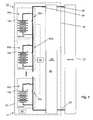
- FIG. 1is a schematic view of a power system including serially-connected battery packs.
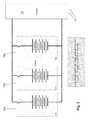
- FIG. 2is a schematic view of a portion of the system shown in FIG. 1 .
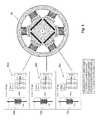
- FIG. 3is a schematic view of charging circuit for a power system, such as the system of FIG. 1 .
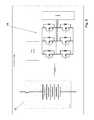
- FIG. 4is a schematic view of a balancing circuit for a power system, such as the system of FIG. 1 .
- FIG. 5is a schematic view of a matrix converter of a power system.
- FIG. 6is a schematic view of an inverter/bridge of the matrix converter shown in FIG. 5 .
- FIGS. 1-2illustrate a battery power system 10 including a battery power device 14 supporting and electrically connecting a number of separate battery packs 18 a , 18 b . . . 18 n in series and operable to provide an output voltage to a powered device 22 .
- the system 10is operable as a power source for various heavy-duty, high-voltage devices, including power tools similar to corded AC power tools, such as miter saws, planers, band saws, diamond coring motors, drills, grinders, magnetic drill presses, rotary and demolition hammers, compressors, etc., outdoor power equipment, such as string trimmers, blowers, hedge trimmers, lawn mowers, chain saws, pressure washers, wood chippers, snow blowers, etc.
- the system 10may be constructed with an output or an auxiliary output and be operable to provide power in a manner similar to a generator.
- the device 14includes a housing assembly 26 defining a number of battery pack bays or support portions 30 a , 30 b . . . 30 n , each operable to support a battery pack 18 .
- the device 14includes a circuit 34 supported by the housing assembly 26 and operable to selectively connect the supported battery packs 18 in series.
- the circuit 34includes, for each support portion 30 , (see FIG. 2 ) a circuit portion 38 with terminals 42 operable to electrically connect to terminals 46 of the supported battery pack 18 .
- the circuit 34includes (see FIG. 1 ) output terminals 50 electrically connectable to the powered device 22 (e.g., a motor/drive of a power tool (e.g., the motor 90 (see FIG. 5 ), a machine, etc.) to provide an output voltage to the powered device 22 .
- the powered device 22e.g., a motor/drive of a power tool (e.g., the motor 90 (see FIG. 5 ), a machine, etc.
- a boost converter 54is electrically connected to the circuit 34 and operable to boost a voltage across the output terminals 50 .
- the boost converter 54is selectively connected in the circuit 34 in series with the circuit portions 38 .
- the boost converter 54is operable to boost the voltage of the battery pack(s) 18 to the output voltage.
- the boost converter 54boosts the input voltage of the supported battery pack(s) 18 to a set or desired output voltage (e.g., 120V, 240 V, 400 V, etc.). Regardless of the input voltage to the circuit 34 (e.g., number of supported battery packs 18 , state-of-charge of the supported battery pack(s) 18 , nominal voltage of the supported battery pack(s) 18 , etc.), the output voltage of the device 14 is the same—the set output voltage provided by the boost converter 54 . Because the output voltage covers a wide range of common voltages used worldwide (e.g., 110 V to 240 V), the device 14 may provide a universal power source.
- a set or desired output voltagee.g. 120V, 240 V, 400 V, etc.
- the boost converter 54may be provided by distributed boost converters (not shown; e.g., a boost converter being provided for each circuit portion 38 ). In such constructions, each separate boost converter is operable to boost the voltage of an associated supported battery pack 18 to a set or desired voltage for the battery pack 18 .
- a controller 58is electrically connected to the circuit 34 and is operable to configure, communicate with and/or control the system 10 and components of/connected to the system 10 .
- the controller 58is operable to determine characteristics and/or conditions of the battery pack(s) 18 connected to the circuit 34 .
- each battery pack 18includes (see FIG. 2 ) a pack controller 62 , and the controller 58 is operable to communicate with each pack controller 62 to determine characteristics (e.g., nominal voltage, capacity, cell chemistry, etc.) and/or conditions (e.g., state-of-charge, temperature, etc.) of the associated battery pack 18 .
- the controller 58(and the controller(s) 62 ) includes combinations of hardware and software.
- the controller 58includes a processing unit (e.g., a microprocessor, a microcontroller, or another suitable programmable device), non-transitory computer-readable media, and an input/output interface.
- the processing unit, the media, and the input/output interfaceare connected by one or more control and/or data buses.
- the computer-readable mediastores program instructions and data.
- the processing unitis configured to retrieve instructions from the media and execute the instructions to perform the control processes and methods described herein.
- the input/output interfacetransmits data from the controller 58 to external systems, networks, and/or devices and receives data from external systems, networks, and/or devices.
- the input/output interfacestores data received from external sources to the media and/or provides the data to the processing unit.
- the circuit 34includes a bypass portion 66 a , 66 b . . . 66 n operable to selectively disconnect each associated supported battery pack 18 a , 18 b . . . 18 n from the circuit 34 .
- the controller 58controls the associated bypass portion 66 a , 66 b . . . 66 n to disconnect the battery pack 18 a , 18 b . . . 18 n from the circuit 34 .
- operation of the system 10is able to continue through to end of discharge of all remaining series-connected packs 18 a , 18 b . . . 18 n in the system 10 .
- Each bypass portion 66 a , 66 b . . . 66 nmay include one or more switches, such as, for example, a XOR switches, operable so that the associated battery pack 18 a , 18 b . . . 18 n is normally connected in series in the circuit 34 (a “connected” condition) and is disconnected when the battery pack 18 a , 18 b . . . 18 n is disabled (a “disconnected” condition).
- This arrangementforms a “smart cell” so that the associated battery pack 18 a , 18 b . . . 18 n is either put in the circuit 34 or bypassed.
- the battery pack 18 a , 18 b . . . 18 nmay be switched into and out of the circuit 34 based on disabling of the battery pack 18 a , 18 b . . . 18 n (e.g., SOC, temperature, etc.)
- This arrangementallows all battery packs 18 a , 18 b . . . 18 n in the system 10 to be completely discharged.
- the controller 58may control the associated bypass portion 66 a , 66 b . . . 66 n to again connect the battery pack 18 a , 18 b . . . 18 n to the circuit 34 if it is determined that the condition has been removed and the battery pack 18 a , 18 b . . . 18 n is operational.
- the substituted battery packmay be connected to the circuit 34 .
- the controller 58may communicate with the substituted battery pack (e.g., with its battery pack controller (not shown)) to determine whether the battery pack is operational (not disabled due to SOC, an abnormal condition, etc.) and, if the battery pack is determined to be operational, control the associated bypass portion 66 a , 66 b . . . 66 n to connect the substituted battery pack to the circuit 34 .
- the associated bypass portion 66 a , 66 b . . . 66 nmay reset to the connected condition.
- the associated bypass portion 66 a , 66 b . . . 66 nwould then be controlled as described above based on the condition of the substituted battery pack.
- the controller 58is electrically connected to the boost converter 54 and is operable to communicate with and control the boost converter 54 .
- the boost converter 54can be controlled to boost the input voltage (of the battery pack(s) battery pack 18 a , 18 b . . . 18 n ) as necessary based on the load of the powered device 22 .
- the powered device 22may also include a controller (not shown) communicating with the controller 58 .
- the powered device controllermay communicate information relating to the powered device 22 (e.g., the load, a desired input voltage, a desired motor speed (when the powered device 22 includes a motor), etc.) to the controller 58 . Based on this information, the controller 58 controls the boost converter 54 to supply the necessary voltage to the powered device 22 .
- the input voltage to the motoris modulated through pulse-width modulation (PWM) to get a lower average voltage, resulting in a lower speed.
- PWMpulse-width modulation
- the motorcould send a request (e.g., through the powered device controller) to the boost converter 54 (e.g., to the controller 58 ) that it needs a given input voltage, speed, etc. (e.g., 75%).
- the motorwould run “full on” but at a slower speed because the input voltage from the boost converter 54 is lower. This operation eliminates switching losses, heat, etc., associated with PWM of the motor.
- Each battery pack 18 a , 18 b . . . 18 ncan have any battery chemistry such as, for example, lead acid, Nickel-cadmium (“NiCd”), Nickel-Metal Hydride (“NiMH”), Lithium (“Li”), Lithium-ion (“Li-ion”), another Lithium-based chemistry or another rechargeable or nonrechargeable battery chemistry.
- the battery packs 18 a , 18 b . . . 18 ncan have a battery chemistry of Li, Li-ion or another Li-based chemistry and can supply an average discharge current equal to or greater than approximately 20 A and generally up to 100 A or more.
- the battery packs 18 a , 18 b . . . 18 ncan have a chemistry of Lithium Cobalt (“Li—Co”), Lithium Manganese (“Li—Mn”) Spinel or Li—Mn Nickel.
- Li—CoLithium Cobalt
- Li—MnLithium Manganese
- Li—Mn NickelLi—Mn Nickel
- Each battery pack 18 a , 18 b . . . 18 nhas a number of cells electrically connected to provide a nominal voltage (e.g., 12 V, 18 V, 20 V, 28 V, 36 V, 40 V, 56 V, 60 V, 120 V, etc.) for the pack 18 , and, in the system 10 , the battery packs 18 may have different nominal voltages. Also, each battery pack 18 a , 18 b . . . 18 n has a state-of-charge (e.g., fully charged to end of discharge threshold), and, in the system 10 , the battery packs 18 a , 18 b . . . 18 n may have different states-of-charge.
- a nominal voltagee.g. 12 V, 18 V, 20 V, 28 V, 36 V, 40 V, 56 V, 60 V, 120 V, etc.
- each battery pack 18 a , 18 b . . . 18 nhas a state-of-charge (e.g., fully
- each battery pack 18 a , 18 b . . . 18 nhas a capacity (e.g., 2 Ah, 4 Ah, etc.), and, in the system 10 , the battery packs 18 a , 18 b . . . 18 n may have different capacities (based on different capacity cells, parallel-connected cells, etc.).
- one battery pack 18 amay have one nominal voltage (e.g., 18 V), while another battery pack 18 b has a different nominal voltage (e.g., 56 V). Also, one battery pack 18 a may have one state-of-charge (e.g., fully charged (100% SOC)) while another battery pack 18 b has a different SOC (e.g., 75% SOC).
- one nominal voltagee.g., 18 V
- another battery pack 18 bhas a different nominal voltage (e.g., 56 V).
- one battery pack 18 amay have one state-of-charge (e.g., fully charged (100% SOC)) while another battery pack 18 b has a different SOC (e.g., 75% SOC).
- the system 10operates with the boost converter 54 to provide the set output voltage (e.g., 400 V) with the input voltage provided by the 18 V battery pack 18 a and the 56 V battery pack 18 b (and any other connected battery pack(s) 18 ), regardless of the relative states-of-charge of and capacity of the pack(s) battery packs 18 a , 18 b . . . 18 n.
- the set output voltagee.g. 400 V
- FIG. 3illustrates a charging arrangement for the multiple battery packs, such as the battery packs 18 a , 18 b . . . 18 n shown in FIGS. 1-2 . It should be understood that the illustrated charging arrangement may be used with or independently of the boost arrangement described above.
- the battery packs 18 a , 18 b . . . 18 nare connected in parallel to charging circuitry 70 .
- the charging circuitry 70includes input terminals 74 connectable to a power source (not shown) to provide power the charging circuitry 70 .
- the charging circuitry 70may independently connect the battery packs 18 a , 18 b . . . 18 n to the power source so that each battery pack 18 a , 18 b . . . 18 n is independently and separately charged.
- the charging circuitry 70may be supported in the housing assembly 26 of the device 14 so that the housing assembly 26 provides a unitary discharging/charging carrier/platform.
- the housing assembly 26may be include (see FIG. 1 ) a carrier portion 78 providing the support portions 30 a , 30 b . . . 30 n and supporting the battery packs 18 a , 18 b . . . 18 n as a unit.
- the carrier portion 78 with the battery packs 18 a , 18 b . . . 18 ncan be separated from the remainder of the housing assembly 26 and transported as a unit between different work sites, a charging location, etc.
- the carrier portion 78may be constructed to be used with multiple devices 14 (one shown) and may be interchanged between devices 14 .
- the battery packs 18 a , 18 b . . . 18 nare selectively connected in series in the circuit 34 to provide power at the output terminals 50 (a “discharge” condition of the device 14 ).
- the battery packs 18 a , 18 b . . . 18 nare to be charged, the battery packs 18 a , 18 b . . . 18 n are disconnected from the series connection in the circuit 34 and connected in parallel (or independently) to the charging circuitry 70 (a “charge” condition of the device 14 ).
- An indicator 82(see FIG. 1 ) provides an indication (visual, audible, tactile, combinations thereof, etc.) of the discharge/charge condition of the device 14 .
- each battery pack 18 a , 18 b . . . 18 nis charged independently to avoid overcharging the higher SOC pack(s) 18 a , 18 b . . . 18 n while sufficiently charging the lower SOC pack(s) 18 a , 18 b . . . 18 n and to thereby bring the battery packs 18 a , 18 b . . . 18 n to substantially the same state of charge (given sufficient charging time).
- the battery pack 18 a , 18 b . . . 18 nmay be disconnected from the power source to avoid overcharging.
- the charging circuitry 70may charge all battery packs 18 a , 18 b . . . 18 n to the same capacity, rather than state-of-charge.
- the controller 58communicates with and determines the capacity of the battery packs 18 a , 18 b . . . 18 n .
- the charging circuitry 70is controlled to only apply the capacity that the smallest capacity battery pack 18 a , 18 b . . . 18 n can receive, and all battery packs 18 a , 18 b . . . 18 n are charged to that capacity.
- a switch arrangement(not shown) is provided to change the connection of the battery packs 18 a , 18 b . . . 18 n as necessary for discharging and charging.
- the output terminals 50are disconnected from the battery packs 18 a , 18 b . . . 18 n , and the battery packs 18 a , 18 b . . . 18 n are connected in parallel.
- the battery packs 18 a , 18 b . . . 18 nare disconnected from the power source (e.g., by disconnecting the input terminals 74 from the battery packs 18 a , 18 b . . . 18 n or by disconnecting the input terminals 74 from the power source)
- the battery packs 18 a , 18 b . . . 18 nare connected in series and to the output terminals 50 .
- the controller 58may control the switch arrangement based on information relating to the operation of the device 14 .
- the controller 58may, for example, determine or receive a signal indicative of the connection status of the input terminals 74 relative to the power source and/or the output terminals 50 relative to the powered device 22 and control the switch arrangement accordingly.
- the controller 58may control the switch arrangement to the charge condition, regardless of the connection status of the terminals 50 , 74 , until the battery packs 18 a , 18 b . . . 18 n are sufficiently charged for discharging operations.
- the switching arrangementmay be user actuated.
- An actuatormay be connected to the switch arrangement and/or to the controller 58 to select the discharge condition or the charged condition.
- the usermay be prevented from selecting the discharge condition (e.g., by the controller 58 ) until the battery packs 18 a , 18 b . . . 18 n are sufficiently charged for discharging operations.
- FIG. 4illustrates a balancing arrangement for the multiple battery packs, such as the battery packs 18 a , 18 b . . . 18 n shown in FIGS. 1-2 , operable to rebalance the battery packs 18 a , 18 b . . . 18 n .
- the illustrated balancing arrangementmay be used with or independently of the boost arrangement and/or the charging arrangement described above.
- a balancing circuit 86is selectively connected to the battery packs 18 a , 18 b . . . 18 n .
- the balancing circuit 86may include an isolated DC-DC power converter.
- the balancing circuit 86operates to transfer energy from the high SOC battery pack(s) 18 a , 18 b . . . 18 n to the low SOC battery pack(s) 18 a , 18 b . . . 18 n to balance the battery packs 18 a , 18 b . . . 18 n (e.g., to within 10% state-of-charge).
- the balancing circuit 86may be selectively connected to and disconnected from the battery packs 18 a , 18 b . . . 18 n .
- a switch arrangement(not shown) may be provided to operate the device 14 between a “balancing” condition, in which the balancing circuit 86 is connected to the battery packs 18 a , 18 b . . . 18 n and is operable to balance the battery packs 18 a , 18 b . . . 18 n , and an “inoperable” condition, in which the balancing circuit 86 is not operable to balance the battery packs 18 a , 18 b . . . 18 n (e.g., is disconnected).
- the balancing circuit 86would generally operate in the background (e.g., when the device 14 is not being discharged) and take some time (e.g., 15 minutes or more depending on the relative SOCs of the battery packs 18 a , 18 b . . . 18 n ) to balance the battery packs 18 a , 18 b . . . 18 n .
- Use of the balancing circuit 86may improve the runtime of the system 10 by maximizing the energy available from all of the battery packs 18 a , 18 b . . . 18 n when they are discharged in series.
- the controller 58may control operation of the balancing circuit 86 (e.g., connection of the switch arrangement) based on information relating to the operation of the device 14 . For example, the controller 58 may determine non-use and/or predict periods of non-use (e.g., off-peak hours) sufficient to operate the balancing circuit 86 .
- the balancing circuit 86can operate more quickly (fast balance) by discharging the higher SOC battery pack(s) 18 a , 18 b . . . 18 n to power a charging circuit to charge the lower SOC battery pack(s) 18 a , 18 b . . . 18 n .
- the balancing circuit 86includes a charging circuit (not shown) to be powered by the higher SOC battery pack(s) 18 a , 18 b . . . 18 n.
- FIGS. 5-6illustrate a matrix power arrangement for a multi-phase motor 90 in which energy is drawn from each battery pack 18 a , 18 b . . . 18 n based on its state of charge and applied to the motor 90 .
- each battery pack 18 a , 18 b . . . 18 nhas its own connection to the motor 90 .
- An inverter/bridge 94 a , 94 b . . . 94 nis provided between each battery pack 18 a , 18 b . . . 18 n and the motor 90 .
- the battery packs 18 a , 18 b . . . 18 nare selectively connected across each phase of the motor 90 , and switching is operated to provide the required energy to each phase of the motor 90 .
- the battery packs 18 a , 18 b . . . 18 ncan be connected in series and/or parallel combinations with the motor 90 to achieve the desired runtime/power output with battery packs 18 a , 18 b . . . 18 n having different SOCs, capacities, nominal voltages, etc.
- the arrangementmay include a DC-DC converter bypass element for lower power dissipation.
- the inventionprovides, among other things, a battery power device, system and method with series-connected battery packs.
- a boost convertermay convert the voltage of the series-connected battery packs to a set output voltage.
- the battery packsmay be selectively connected in series for discharging and in parallel for charging.
- a balance circuitmay transfer energy between the battery packs to balance the states of charge of the battery packs.
- multiple battery packsare selectively connected across each phase of the motor, and switching is operated to provide the required energy to each phase of the motor.
Landscapes
- Engineering & Computer Science (AREA)
- Power Engineering (AREA)
- Business, Economics & Management (AREA)
- Emergency Management (AREA)
- Charge And Discharge Circuits For Batteries Or The Like (AREA)
- Secondary Cells (AREA)
Abstract
Description
The present application claims priority to U.S. Provisional Application No. 62/341,397, filed May 25, 2016, the entire contents of which are hereby incorporated by reference.
The present invention relates to battery power sources and battery-powered devices and, more particularly, to series-connected battery packs in such power sources and devices.
To provide a desired operating voltage, two or more battery packs may be connected in series. When connected in series, the voltage of each pack is added to a total terminal voltage of the system. However, operation of series-connected battery packs is generally limited by the pack having the lowest capacity.
For battery packs including lithium-based battery cells, discharge of series-connected packs is stopped when one of the packs is disabled, for example, because the pack has reached an end of discharge condition (e.g., state of charge (SOC) below a threshold), is experiencing an abnormal condition (e.g., excessive temperature, cell voltage drop, etc.). This requirement presents challenges with series-connected battery packs, especially with packs having different capacities, different states of charge, etc. When one pack reaches its end of discharge condition, the other battery pack(s) will have remaining capacity that will not be harnessed by the system.
In some aspects, one or more solutions to maximize the discharge energy of series-connected battery packs in a system may be provided. In some aspects, an ability to mix and match packs with different capacities, different states of charge, different nominal voltages, etc. in the system may be provided.
In some embodiments, the system may be controlled to work at less than full capacity of battery packs. For example, a proportional discharge energy may be drawn from each pack based upon the capacity/condition of the pack so that the packs reach end of discharge substantially simultaneously. In another example, the pack at its end of discharge may be disconnected from the circuit, after which operation of the system is continued through to end of discharge of all series-connected packs in the system.
In some embodiments, the system may provide a charge platform so that, during charging, each battery pack is brought to substantially the same state of charge. For example, the platform may provide a series connection between the battery packs during discharge, and, during charging, each battery pack may be connected independently or in a parallel connection to a power source. The charge platform may not address different capacities between the battery packs.
In one independent aspect, a battery power device may generally include a housing defining a first support operable to support a first battery pack, and a second support operable to support a second battery pack; a circuit selectively electrically connecting the first battery pack and the second battery pack in series, the circuit including an output terminal to provide an output voltage to a powered device, a first bypass portion operable to selectively electrically disconnect the first battery pack from the circuit, and a second bypass portion operable to selectively electrically disconnect the second battery pack from the circuit; and a boost converter electrically connected to the circuit and operable to boost a voltage at the output terminal.
In some embodiments, the boost converter is selectively electrically connected in series with the first battery pack and the second battery pack, the boost converter being operable to boost a first voltage of the first battery pack and a second voltage of the second battery pack to the output voltage.
The first battery pack may have a first nominal voltage, and the second battery pack may have a second nominal voltage different than the first nominal voltage. The first battery pack may have a first capacity, and the second battery pack may have a second capacity different than the first capacity. The first battery pack may have a first state of charge, and the second battery pack may have a second state of charge different than the first state of charge.
In another independent aspect, a power system may generally include a first battery pack; a second battery pack; and a battery power device operable to provide an output voltage to a powered device. The battery power device may generally include a housing defining a first support operable to support the first battery pack, and a second support operable to support the second battery pack, a circuit selectively electrically connecting the first battery pack and the second battery pack in series, the circuit including an output terminal to provide the output voltage to the powered device, a first bypass portion operable to selectively electrically disconnect the first battery pack from the circuit, and a second bypass portion operable to selectively electrically disconnect the second battery pack from the circuit, and a boost converter electrically connected to the circuit and operable to boost a voltage at the output terminal.
In yet another independent aspect, a method of powering a powered device may generally include selectively electrically connecting a first battery pack and a second battery pack in a circuit in series; providing an output voltage at an output terminal; boosting a voltage at the output terminal; and, when one of the first battery pack and the second battery pack reaches an end of discharge condition, selectively electrically disconnecting the one of the first battery pack and the second battery pack from the circuit.
In some embodiments, boosting may include selectively electrically connecting a boost converter in series with the first battery pack and the second battery pack, and operating the boost converter to boost a first voltage of the first battery pack and a second voltage of the second battery pack to the output voltage. Selectively electrically connecting may include selectively electrically connecting in the circuit in series a first battery pack having one of a first nominal voltage, a first capacity, and a first state of charge and with a second battery pack having a corresponding one of a second nominal voltage, a second capacity, and a second state of charge different than the first.
The method may include removably connecting the first battery pack to a housing of the device and/or removably connecting the second battery pack to the housing of the device.
Selectively electrically disconnecting may include determining characteristics or condition of the first battery pack, and controlling operation of a bypass portion. When the first battery pack is to be disabled, controlling may include disconnecting the first battery pack from the circuit. When another battery pack is substituted for a disabled first battery pack, controlling may include determining whether to control the bypass portion to connect the other battery pack to the circuit.
The method may include determining an input voltage of the powered device, and wherein boosting includes boosting the voltage at the output terminal to the input voltage.
In a further independent aspect, a battery power device may generally include a housing assembly defining a first support operable to support a first battery pack, and a second support operable to support a second battery pack; a discharge circuit including an output terminal to provide an output voltage to a powered device and selectively electrically connecting the first battery pack and the second battery pack in series for discharging; and charging circuitry including an input terminal to receive power from a power source and selectively electrically connecting the first battery pack and the second battery pack to the power source for charging.
A switch arrangement may be provided to selectively and alternatively electrically connect the first battery pack and the second battery pack to the discharge circuit and to the charging circuitry. The device may include a controller operable to control the switch arrangement based on a signal indicative of a connection status of one of the output terminal and the input terminal. The switch arrangement may include an actuator operable by a user.
In some constructions, the housing assembly includes a removable carrier portion providing the first support and the second support, the charging circuitry being supported by the removable carrier portion.
For charging, the battery packs may be connected in parallel by the charging circuitry. The battery packs may be independently charged by the charging circuitry. During a charging cycle, the battery packs may be charged by the charging circuitry to approximately the same state-of-charge and/or to approximately the same capacity.
In another independent aspect, a battery power device may generally include a housing defining a first support operable to support a first battery pack, and a second support operable to support a second battery pack; a discharge circuit selectively connecting the first battery pack and the second battery pack in series, the discharge circuit including an output terminal to provide an output voltage to a powered device; and a balance circuit selectively connected to the first battery pack and the second battery pack, the balance circuit being operable to transfer energy between the first battery pack and the second battery pack.
The device may include a controller operable to control operation of the balance circuit. The controller may be operable to determine a non-use condition of the discharge circuit, and operate the balance circuit during the non-use condition.
In yet another independent aspect, a battery power device may be used with a multi-phase motor and may generally include a housing defining a first support operable to support a first battery pack, a second support operable to support a second battery pack; a first switch arrangement between the first battery pack and the motor; and a second switch arrangement between the second battery pack and the motor, the first switch arrangement and the second switch arrangement being operable to selectively connected the first battery pack and the second battery pack across each phase of the motor, the first switch arrangement and the second switch arrangement being operated to provide the required energy from at least one of the first battery pack and the second battery pack to each phase of the motor.
Other independent aspects of the invention may become apparent by consideration of the detailed description, claims and accompanying drawings.
Before any independent embodiments of the invention are explained in detail, it is to be understood that the invention is not limited in its application to the details of construction and the arrangement of components set forth in the following description or illustrated in the following drawings. The invention is capable of other independent embodiments and of being practiced or of being carried out in various ways. Also, it is to be understood that the phraseology and terminology used herein is for the purpose of description and should not be regarded as limiting.
Use of “including” and “comprising” and variations thereof as used herein is meant to encompass the items listed thereafter and equivalents thereof as well as additional items. Use of “consisting of” and variations thereof as used herein is meant to encompass only the items listed thereafter and equivalents thereof.
Thedevice 14 includes ahousing assembly 26 defining a number of battery pack bays or supportportions battery pack 18. Thedevice 14 includes acircuit 34 supported by thehousing assembly 26 and operable to selectively connect the supportedbattery packs 18 in series. Thecircuit 34 includes, for eachsupport portion 30, (seeFIG. 2 ) acircuit portion 38 withterminals 42 operable to electrically connect toterminals 46 of the supportedbattery pack 18. Thecircuit 34 includes (seeFIG. 1 )output terminals 50 electrically connectable to the powered device22 (e.g., a motor/drive of a power tool (e.g., the motor90 (seeFIG. 5 ), a machine, etc.) to provide an output voltage to thepowered device 22.
Aboost converter 54 is electrically connected to thecircuit 34 and operable to boost a voltage across theoutput terminals 50. In the illustrated construction, theboost converter 54 is selectively connected in thecircuit 34 in series with thecircuit portions 38. Theboost converter 54 is operable to boost the voltage of the battery pack(s)18 to the output voltage.
In the illustrated construction, theboost converter 54 boosts the input voltage of the supported battery pack(s)18 to a set or desired output voltage (e.g., 120V, 240 V, 400 V, etc.). Regardless of the input voltage to the circuit34 (e.g., number of supported battery packs18, state-of-charge of the supported battery pack(s)18, nominal voltage of the supported battery pack(s)18, etc.), the output voltage of thedevice 14 is the same—the set output voltage provided by theboost converter 54. Because the output voltage covers a wide range of common voltages used worldwide (e.g., 110 V to 240 V), thedevice 14 may provide a universal power source.
In other constructions (not shown), theboost converter 54 may be provided by distributed boost converters (not shown; e.g., a boost converter being provided for each circuit portion38). In such constructions, each separate boost converter is operable to boost the voltage of an associated supportedbattery pack 18 to a set or desired voltage for thebattery pack 18.
Acontroller 58 is electrically connected to thecircuit 34 and is operable to configure, communicate with and/or control thesystem 10 and components of/connected to thesystem 10. In the illustrated construction, thecontroller 58 is operable to determine characteristics and/or conditions of the battery pack(s)18 connected to thecircuit 34. In the illustrated construction, eachbattery pack 18 includes (seeFIG. 2 ) apack controller 62, and thecontroller 58 is operable to communicate with eachpack controller 62 to determine characteristics (e.g., nominal voltage, capacity, cell chemistry, etc.) and/or conditions (e.g., state-of-charge, temperature, etc.) of the associatedbattery pack 18.
The controller58 (and the controller(s)62) includes combinations of hardware and software. Thecontroller 58 includes a processing unit (e.g., a microprocessor, a microcontroller, or another suitable programmable device), non-transitory computer-readable media, and an input/output interface. The processing unit, the media, and the input/output interface are connected by one or more control and/or data buses. The computer-readable media stores program instructions and data. The processing unit is configured to retrieve instructions from the media and execute the instructions to perform the control processes and methods described herein.
The input/output interface transmits data from thecontroller 58 to external systems, networks, and/or devices and receives data from external systems, networks, and/or devices. The input/output interface stores data received from external sources to the media and/or provides the data to the processing unit.
Thecircuit 34 includes abypass portion 66a,66b. . .66noperable to selectively disconnect each associated supportedbattery pack circuit 34. In the illustrated construction, when it is determined that abattery pack controller 58 controls the associatedbypass portion 66a,66b. . .66nto disconnect thebattery pack circuit 34. After the disabled battery pack is disconnected, operation of thesystem 10 is able to continue through to end of discharge of all remaining series-connectedpacks system 10.
Eachbypass portion 66a,66b. . .66nmay include one or more switches, such as, for example, a XOR switches, operable so that the associatedbattery pack battery pack battery pack circuit 34 or bypassed. The battery packs18a,18b. . .18nmay be switched into and out of thecircuit 34 based on disabling of thebattery pack system 10 to be completely discharged.
If abattery pack circuit 34 before end of discharge (e.g., due to an abnormal condition), thecontroller 58 may control the associatedbypass portion 66a,66b. . .66nto again connect thebattery pack circuit 34 if it is determined that the condition has been removed and thebattery pack
If another battery pack (not shown) is substituted for adisconnected battery pack circuit 34. For example, thecontroller 58 may communicate with the substituted battery pack (e.g., with its battery pack controller (not shown)) to determine whether the battery pack is operational (not disabled due to SOC, an abnormal condition, etc.) and, if the battery pack is determined to be operational, control the associatedbypass portion 66a,66b. . .66nto connect the substituted battery pack to thecircuit 34.
Alternatively, when abattery pack support portion bypass portion 66a,66b. . .66nmay reset to the connected condition. During subsequent operation, the associatedbypass portion 66a,66b. . .66nwould then be controlled as described above based on the condition of the substituted battery pack.
Thecontroller 58 is electrically connected to theboost converter 54 and is operable to communicate with and control theboost converter 54. Theboost converter 54 can be controlled to boost the input voltage (of the battery pack(s)battery pack powered device 22.
Thepowered device 22 may also include a controller (not shown) communicating with thecontroller 58. The powered device controller may communicate information relating to the powered device22 (e.g., the load, a desired input voltage, a desired motor speed (when thepowered device 22 includes a motor), etc.) to thecontroller 58. Based on this information, thecontroller 58 controls theboost converter 54 to supply the necessary voltage to thepowered device 22.
For example, normally, to reduce the speed of a motor, the input voltage to the motor is modulated through pulse-width modulation (PWM) to get a lower average voltage, resulting in a lower speed. With thebattery power device 14 including theboost converter 54, because theboost converter 54 provides the input voltage to the motor, the motor could send a request (e.g., through the powered device controller) to the boost converter54 (e.g., to the controller58) that it needs a given input voltage, speed, etc. (e.g., 75%). In such a case, rather than being partially on (e.g., 75%) by pulse-width modulating the motor switches/transistors, the motor would run “full on” but at a slower speed because the input voltage from theboost converter 54 is lower. This operation eliminates switching losses, heat, etc., associated with PWM of the motor.
Eachbattery pack
Eachbattery pack pack 18, and, in thesystem 10, the battery packs18 may have different nominal voltages. Also, eachbattery pack system 10, the battery packs18a,18b. . .18nmay have different states-of-charge. In addition, eachbattery pack system 10, the battery packs18a,18b. . .18nmay have different capacities (based on different capacity cells, parallel-connected cells, etc.).
For example, onebattery pack 18amay have one nominal voltage (e.g., 18 V), while anotherbattery pack 18bhas a different nominal voltage (e.g., 56 V). Also, onebattery pack 18amay have one state-of-charge (e.g., fully charged (100% SOC)) while anotherbattery pack 18bhas a different SOC (e.g., 75% SOC). In this example, thesystem 10 operates with theboost converter 54 to provide the set output voltage (e.g., 400 V) with the input voltage provided by the 18V battery pack 18aand the 56V battery pack 18b(and any other connected battery pack(s)18), regardless of the relative states-of-charge of and capacity of the pack(s) battery packs18a,18b. . .18n.
As shown inFIG. 3 , for charging, the battery packs18a,18b. . .18nare connected in parallel to chargingcircuitry 70. The chargingcircuitry 70 includesinput terminals 74 connectable to a power source (not shown) to provide power the chargingcircuitry 70. In other constructions (not shown), the chargingcircuitry 70 may independently connect the battery packs18a,18b. . .18nto the power source so that eachbattery pack
The chargingcircuitry 70 may be supported in thehousing assembly 26 of thedevice 14 so that thehousing assembly 26 provides a unitary discharging/charging carrier/platform. Thehousing assembly 26 may be include (seeFIG. 1 ) acarrier portion 78 providing thesupport portions carrier portion 78 with the battery packs18a,18b. . .18ncan be separated from the remainder of thehousing assembly 26 and transported as a unit between different work sites, a charging location, etc. Thecarrier portion 78 may be constructed to be used with multiple devices14 (one shown) and may be interchanged betweendevices 14.
During discharge operations, the battery packs18a,18b. . .18nare selectively connected in series in thecircuit 34 to provide power at the output terminals50 (a “discharge” condition of the device14). When the battery packs18a,18b. . .18nare to be charged, the battery packs18a,18b. . .18nare disconnected from the series connection in thecircuit 34 and connected in parallel (or independently) to the charging circuitry70 (a “charge” condition of the device14). An indicator82 (seeFIG. 1 ) provides an indication (visual, audible, tactile, combinations thereof, etc.) of the discharge/charge condition of thedevice 14.
During charging, eachbattery pack battery pack battery pack
During charging, the chargingcircuitry 70 may charge all battery packs18a,18b. . .18nto the same capacity, rather than state-of-charge. Thecontroller 58 communicates with and determines the capacity of the battery packs18a,18b. . .18n. The chargingcircuitry 70 is controlled to only apply the capacity that the smallestcapacity battery pack capacity battery pack
In order to provide selective series discharging along with parallel charging, a switch arrangement (not shown) is provided to change the connection of the battery packs18a,18b. . .18nas necessary for discharging and charging. Generally, when theinput terminals 74 are connected to the power source, theoutput terminals 50 are disconnected from the battery packs18a,18b. . .18n, and the battery packs18a,18b. . .18nare connected in parallel. When the battery packs18a,18b. . .18nare disconnected from the power source (e.g., by disconnecting theinput terminals 74 from the battery packs18a,18b. . .18nor by disconnecting theinput terminals 74 from the power source), the battery packs18a,18b. . .18nare connected in series and to theoutput terminals 50.
In some constructions, thecontroller 58 may control the switch arrangement based on information relating to the operation of thedevice 14. Thecontroller 58 may, for example, determine or receive a signal indicative of the connection status of theinput terminals 74 relative to the power source and/or theoutput terminals 50 relative to thepowered device 22 and control the switch arrangement accordingly. As another example, when the connected battery packs18a,18b. . .18nare discharged or disabled, thecontroller 58 may control the switch arrangement to the charge condition, regardless of the connection status of theterminals
In other constructions, the switching arrangement may be user actuated. An actuator may be connected to the switch arrangement and/or to thecontroller 58 to select the discharge condition or the charged condition. When the connected battery packs18a,18b. . .18nare discharged or disabled, the user may be prevented from selecting the discharge condition (e.g., by the controller58) until the battery packs18a,18b. . .18nare sufficiently charged for discharging operations.
A balancingcircuit 86 is selectively connected to the battery packs18a,18b. . .18n. The balancingcircuit 86 may include an isolated DC-DC power converter. The balancingcircuit 86 operates to transfer energy from the high SOC battery pack(s)18a,18b. . .18nto the low SOC battery pack(s)18a,18b. . .18nto balance the battery packs18a,18b. . .18n(e.g., to within 10% state-of-charge).
The balancingcircuit 86 may be selectively connected to and disconnected from the battery packs18a,18b. . .18n. A switch arrangement (not shown) may be provided to operate thedevice 14 between a “balancing” condition, in which thebalancing circuit 86 is connected to the battery packs18a,18b. . .18nand is operable to balance the battery packs18a,18b. . .18n, and an “inoperable” condition, in which thebalancing circuit 86 is not operable to balance the battery packs18a,18b. . .18n(e.g., is disconnected).
The balancingcircuit 86 would generally operate in the background (e.g., when thedevice 14 is not being discharged) and take some time (e.g., 15 minutes or more depending on the relative SOCs of the battery packs18a,18b. . .18n) to balance the battery packs18a,18b. . .18n. Use of the balancingcircuit 86 may improve the runtime of thesystem 10 by maximizing the energy available from all of the battery packs18a,18b. . .18nwhen they are discharged in series.
Thecontroller 58 may control operation of the balancing circuit86 (e.g., connection of the switch arrangement) based on information relating to the operation of thedevice 14. For example, thecontroller 58 may determine non-use and/or predict periods of non-use (e.g., off-peak hours) sufficient to operate the balancingcircuit 86.
Because cells can discharge at higher rates than when charged, the balancingcircuit 86 can operate more quickly (fast balance) by discharging the higher SOC battery pack(s)18a,18b. . .18nto power a charging circuit to charge the lower SOC battery pack(s)18a,18b. . .18n. In such constructions, the balancingcircuit 86 includes a charging circuit (not shown) to be powered by the higher SOC battery pack(s)18a,18b. . .18n.
The battery packs18a,18b. . .18nare selectively connected across each phase of themotor 90, and switching is operated to provide the required energy to each phase of themotor 90. With the illustrated arrangement, the battery packs18a,18b. . .18ncan be connected in series and/or parallel combinations with themotor 90 to achieve the desired runtime/power output with battery packs18a,18b. . .18nhaving different SOCs, capacities, nominal voltages, etc. The arrangement may include a DC-DC converter bypass element for lower power dissipation.
The operation, construction and charging of battery packs, including those with lithium-based battery cells, are described and illustrated in U.S. Pat. No. 7,157,882, issued Jan. 2, 2007; U.S. Pat. No. 7,253,585, issued Aug. 7, 2007; U.S. Pat. No. 7,176,654, issued Feb. 13, 2007; U.S. Pat. No. 7,589,500, issued Sep. 15, 2009; U.S. Pat. No. 7,714,538, issued May 11, 2010; and U.S. Pat. No. 7,425,816, issued Sep. 16, 2008; the entire contents of all of which are hereby incorporated by reference.
Thus, the invention provides, among other things, a battery power device, system and method with series-connected battery packs. A boost converter may convert the voltage of the series-connected battery packs to a set output voltage. The battery packs may be selectively connected in series for discharging and in parallel for charging. A balance circuit may transfer energy between the battery packs to balance the states of charge of the battery packs. In a matrix power arrangement, multiple battery packs are selectively connected across each phase of the motor, and switching is operated to provide the required energy to each phase of the motor.
One or more independent advantages and/or independent features may be set forth in the following claims:
Claims (20)
1. A power device comprising:
a housing defining a first support operable to support a first battery pack including a first plurality of battery cells, and a second support operable to support a second battery pack including a second plurality of battery cells;
a circuit selectively electrically connecting the first battery pack and the second battery pack in series, the circuit including
an output terminal to provide an output voltage,
a first bypass portion operable to selectively electrically disconnect the first battery pack from the circuit, and
a second bypass portion operable to selectively electrically disconnect the second battery pack from the circuit;
a motor receiving the output voltage from the output terminal; and
a boost converter electrically connected to the circuit and operable to boost the output voltage at the output terminal, wherein boost converter is controlled to boost the output voltage based on a characteristic of the motor.
2. The device ofclaim 1 , wherein the boost converter is selectively electrically connected in series with the first battery pack and the second battery pack, the boost converter being operable to boost a first voltage of the first battery pack and a second voltage of the second battery pack to the output voltage.
3. The device ofclaim 1 , wherein the device is configured to operate with a first battery pack having one of a first nominal voltage, a first capacity, and a first state of charge and with a second battery pack having a corresponding one of a second nominal voltage, a second capacity, and a second state of charge different than the first.
4. The device ofclaim 1 , wherein the first support is operable to removably support the first battery pack and the second support is operable to removably support the second battery pack.
5. The device ofclaim 1 , further comprising a controller operable to
determine characteristics or condition of the first battery pack, and
control operation of the first bypass portion.
6. The device ofclaim 5 , wherein, when the first battery pack is to be disabled, the controller controls the first bypass portion to disconnect the first battery pack from the circuit.
7. The device ofclaim 6 , wherein, when another battery pack is substituted for a disabled first battery pack, the controller is operable to determine whether to control the first bypass portion to connect the other battery pack to the circuit.
8. The device ofclaim 1 , further comprising a controller operable to
determine an input voltage of the motor, and
control the boost converter to the voltage at the output terminal to the input voltage.
9. A power system comprising:
a first battery pack including a first plurality of battery cells;
a second battery pack including a second plurality of battery cells; and
a battery power device operable to provide an output voltage to a motor, the battery power device including
a housing defining a first support operable to support the first battery pack, and a second support operable to support the second battery pack,
a circuit selectively electrically connecting the first battery pack and the second battery pack in series, the circuit including
an output terminal to provide the output voltage to the motor,
a first bypass portion operable to selectively electrically disconnect the first battery pack from the circuit, and
a second bypass portion operable to selectively electrically disconnect the second battery pack from the circuit, and
a boost converter electrically connected to the circuit and operable to boost a voltage at the output terminal, wherein boost converter is controlled to boost the voltage based on a characteristic of the motor.
10. The system ofclaim 9 , wherein the boost converter is selectively electrically connected in series with the first battery pack and the second battery pack, the boost converter being operable to boost a first voltage of the first battery pack and a second voltage of the second battery pack to the output voltage.
11. The system ofclaim 9 , wherein the first battery pack has a first nominal voltage and the second battery pack has a second nominal voltage different than the first nominal voltage.
12. The system ofclaim 9 , wherein the first battery pack has a first capacity and the second battery pack has a second capacity different than the first capacity.
13. The system ofclaim 9 , wherein the first battery pack has a first state of charge and the second battery pack has a second state of charge different than the first state of charge.
14. The system ofclaim 9 , wherein the first battery pack includes
a battery pack housing removably supported by the first support,
a battery cell supported by the battery pack housing, and
a terminal operable to connect the battery cell to the circuit.
15. The system ofclaim 14 , wherein the second battery pack includes
a second battery pack housing removably supported by the second support,
a second battery cell supported by the battery pack housing, and
a second terminal operable to connect the battery cell to the circuit.
16. The system ofclaim 9 , further comprising a controller operable to
determine characteristics or condition of the first battery pack, and
control operation of the first bypass portion.
17. The system ofclaim 16 , wherein, when the first battery pack is to be disabled, the controller controls the first bypass portion to disconnect the first battery pack from the circuit.
18. The system ofclaim 17 , wherein, when another battery pack is substituted for a disabled first battery pack, the controller is operable to determine whether to control the first bypass portion to connect the other battery pack to the circuit.
19. The system ofclaim 9 , further comprising a controller operable to
determine an input voltage of the motor, and
control the boost converter to the voltage at the output terminal to the input voltage.
20. A method of powering a motor, the method comprising:
selectively electrically connecting a first battery pack and a second battery pack in a circuit in series, wherein the first battery pack includes a first plurality of battery cells and the second battery pack includes a second plurality of battery cells;
providing an output voltage at an output terminal;
boosting a voltage at the output terminal;
receiving, at the motor, the output voltage from the output terminal; and
when one of the first battery pack and the second battery pack reaches an end of discharge condition, selectively electrically disconnecting the one of the first battery pack and the second battery pack from the circuit
wherein the voltage at the output terminal is boosted based on a characteristic of the motor.
Priority Applications (4)
| Application Number | Priority Date | Filing Date | Title |
|---|---|---|---|
| US15/603,862US10483791B2 (en) | 2016-05-25 | 2017-05-24 | Series-connected battery packs, system and method |
| US16/654,203US11095148B2 (en) | 2016-05-25 | 2019-10-16 | Series-connected battery packs, system and method |
| US17/389,770US11757294B2 (en) | 2016-05-25 | 2021-07-30 | Series-connected battery packs, system and method |
| US18/457,619US20230402855A1 (en) | 2016-05-25 | 2023-08-29 | Series-connected battery packs, system and method |
Applications Claiming Priority (2)
| Application Number | Priority Date | Filing Date | Title |
|---|---|---|---|
| US201662341397P | 2016-05-25 | 2016-05-25 | |
| US15/603,862US10483791B2 (en) | 2016-05-25 | 2017-05-24 | Series-connected battery packs, system and method |
Related Child Applications (1)
| Application Number | Title | Priority Date | Filing Date |
|---|---|---|---|
| US16/654,203ContinuationUS11095148B2 (en) | 2016-05-25 | 2019-10-16 | Series-connected battery packs, system and method |
Publications (2)
| Publication Number | Publication Date |
|---|---|
| US20170346334A1 US20170346334A1 (en) | 2017-11-30 |
| US10483791B2true US10483791B2 (en) | 2019-11-19 |
Family
ID=60411541
Family Applications (4)
| Application Number | Title | Priority Date | Filing Date |
|---|---|---|---|
| US15/603,862Active2037-06-10US10483791B2 (en) | 2016-05-25 | 2017-05-24 | Series-connected battery packs, system and method |
| US16/654,203ActiveUS11095148B2 (en) | 2016-05-25 | 2019-10-16 | Series-connected battery packs, system and method |
| US17/389,770Active2037-09-05US11757294B2 (en) | 2016-05-25 | 2021-07-30 | Series-connected battery packs, system and method |
| US18/457,619PendingUS20230402855A1 (en) | 2016-05-25 | 2023-08-29 | Series-connected battery packs, system and method |
Family Applications After (3)
| Application Number | Title | Priority Date | Filing Date |
|---|---|---|---|
| US16/654,203ActiveUS11095148B2 (en) | 2016-05-25 | 2019-10-16 | Series-connected battery packs, system and method |
| US17/389,770Active2037-09-05US11757294B2 (en) | 2016-05-25 | 2021-07-30 | Series-connected battery packs, system and method |
| US18/457,619PendingUS20230402855A1 (en) | 2016-05-25 | 2023-08-29 | Series-connected battery packs, system and method |
Country Status (5)
| Country | Link |
|---|---|
| US (4) | US10483791B2 (en) |
| CN (2) | CN213185534U (en) |
| DE (1) | DE112017002637T5 (en) |
| TW (1) | TWM553883U (en) |
| WO (1) | WO2017205466A1 (en) |
Cited By (7)
| Publication number | Priority date | Publication date | Assignee | Title |
|---|---|---|---|---|
| US20220360091A1 (en)* | 2021-05-04 | 2022-11-10 | Exro Technologies Inc. | Battery Control Systems and Methods |
| US11539222B2 (en)* | 2019-04-04 | 2022-12-27 | Yazaki Corporation | Battery control unit and battery system |
| US11722026B2 (en) | 2019-04-23 | 2023-08-08 | Dpm Technologies Inc. | Fault tolerant rotating electric machine |
| US11967913B2 (en) | 2021-05-13 | 2024-04-23 | Exro Technologies Inc. | Method and apparatus to drive coils of a multiphase electric machine |
| US12088176B2 (en) | 2021-07-08 | 2024-09-10 | Exro Technologies Inc. | Dynamically reconfigurable power converter utilizing windings of electric machine |
| US12176836B2 (en) | 2018-09-05 | 2024-12-24 | Dpm Technologies Inc. | Systems and methods for intelligent energy storage and provisioning using an energy storage control system |
| US12301037B2 (en) | 2021-09-21 | 2025-05-13 | Volvo Car Corporation | Intelligent battery cell |
Families Citing this family (34)
| Publication number | Priority date | Publication date | Assignee | Title |
|---|---|---|---|---|
| US20170302095A1 (en)* | 2016-04-18 | 2017-10-19 | Vitec Videocom Inc. | Smart charger with selective discharge capability |
| US10483791B2 (en) | 2016-05-25 | 2019-11-19 | Milwaukee Electric Tool Corporation | Series-connected battery packs, system and method |
| EP4094978A1 (en)* | 2016-12-12 | 2022-11-30 | Honeywell International Inc. | Adaptive balancing for battery management |
| WO2018129516A2 (en) | 2017-01-09 | 2018-07-12 | Milwaukee Electric Tool Corporation | Battery pack |
| US11450895B2 (en)* | 2017-08-25 | 2022-09-20 | Positec Power Tools (Suzhou) Co., Ltd | Electric tool and method for supplying power to electric tool |
| US11218009B2 (en)* | 2018-04-18 | 2022-01-04 | Milwaukee Electric Tool Corporation | Tool circuitry for series-type connected battery packs |
| JP2020031486A (en)* | 2018-08-22 | 2020-02-27 | 株式会社マキタ | Voltage supply device |
| KR102549233B1 (en)* | 2018-10-23 | 2023-06-28 | 주식회사 엘지에너지솔루션 | Booster kit for battery reuse |
| JP7222687B2 (en)* | 2018-12-11 | 2023-02-15 | 株式会社Soken | Charging system and programming of the charging system |
| CN109713757A (en)* | 2019-01-29 | 2019-05-03 | 葛文博 | Group-wise switchs equalizing circuit |
| US10924008B2 (en)* | 2019-07-09 | 2021-02-16 | Nio Usa, Inc. | Devices, systems, and methods for charging electric vehicles |
| US11289924B2 (en)* | 2019-08-09 | 2022-03-29 | Techtronic Cordless Gp | Battery pack including a high- and low-current discharge terminals |
| CN110797939A (en)* | 2019-10-18 | 2020-02-14 | 惠州志顺电子实业有限公司 | Battery power supply control circuit and device |
| KR102857396B1 (en) | 2019-11-29 | 2025-09-11 | 삼성전자 주식회사 | Electronic device for managing a plurality of batteries connected in series and operating method thereof |
| CN111591140A (en)* | 2020-05-15 | 2020-08-28 | 华为技术有限公司 | Battery management system and vehicle |
| CN113746149B (en)* | 2020-05-27 | 2025-05-27 | 北京小米移动软件有限公司 | Charging system, method, device and terminal equipment |
| DE102020118418A1 (en) | 2020-07-13 | 2022-01-13 | Duesenfeld Gmbh | Accumulator discharge device for discharging accumulators and method for discharging a plurality of accumulators |
| WO2022024508A1 (en)* | 2020-07-31 | 2022-02-03 | パナソニックIpマネジメント株式会社 | Back-up power supply system and mobile body |
| CN112202160B (en)* | 2020-10-20 | 2022-06-03 | 国网四川省电力公司电力科学研究院 | A direct-mounted busbar type energy storage control system and control method |
| CN114696381A (en)* | 2020-12-29 | 2022-07-01 | 李尔公司 | System and method for parallel battery pack charging |
| US11202190B1 (en)* | 2021-02-01 | 2021-12-14 | Tmrw Foundation Ip S. À R.L. | Backup battery, communications device and method thereof |
| CN114944675A (en)* | 2021-02-10 | 2022-08-26 | 华为数字能源技术有限公司 | Energy storage system and detection method thereof |
| FR3120277B1 (en)* | 2021-02-26 | 2023-05-12 | Otonohm | Device for storage and concomitant generation of at least one electrical voltage, and associated management method |
| EP4109701A1 (en) | 2021-06-23 | 2022-12-28 | Hilti Aktiengesellschaft | Machine tool and method for carrying out charge balancing between batteries in a machine tool |
| EP4109703A1 (en) | 2021-06-23 | 2022-12-28 | Hilti Aktiengesellschaft | Machine tool and method for operating a machine tool |
| CN222484314U (en)* | 2021-09-30 | 2025-02-14 | 米沃奇电动工具公司 | Battery pack charger and system |
| EP4170852A1 (en)* | 2021-10-22 | 2023-04-26 | Hitachi Energy Switzerland AG | Fault response bypass system for an energy storage bank |
| EP4178068B1 (en)* | 2021-10-29 | 2024-04-17 | Nanjing Chervon Industry Co., Ltd. | Charging device |
| US20240421696A1 (en)* | 2021-12-14 | 2024-12-19 | Milwaukee Electric Tool Corporation | Short circuit mitigation in a power tool |
| EP4292863A1 (en)* | 2022-05-13 | 2023-12-20 | Solaredge Technologies Ltd. | Charge storage device |
| TWI878693B (en)* | 2022-07-07 | 2025-04-01 | 仁寶電腦工業股份有限公司 | Battery module and operation method thereof |
| TWI869813B (en)* | 2023-04-06 | 2025-01-11 | 飛宏科技股份有限公司 | Method of smart battery control |
| FR3151718A1 (en)* | 2023-07-26 | 2025-01-31 | Pellenc | Power supply system and method for multi-phase electric motor |
| CN119765558A (en)* | 2024-12-24 | 2025-04-04 | 苏州新灵能电子科技有限公司 | A battery status monitoring and active balancing control method and system |
Citations (23)
| Publication number | Priority date | Publication date | Assignee | Title |
|---|---|---|---|---|
| US5952815A (en)* | 1997-07-25 | 1999-09-14 | Minnesota Mining & Manufacturing Co. | Equalizer system and method for series connected energy storing devices |
| US6046514A (en)* | 1997-07-25 | 2000-04-04 | 3M Innovative Properties Company | Bypass apparatus and method for series connected energy storage devices |
| US6373225B1 (en)* | 2000-08-31 | 2002-04-16 | Fujitsu Limited | Charge circuit that performs charge control by comparing a plurality of battery voltages |
| US20040135544A1 (en)* | 2002-11-25 | 2004-07-15 | Tiax, Llc | System and method for determining and balancing state of charge among series connected electrical energy storage units |
| US7157882B2 (en)* | 2002-11-22 | 2007-01-02 | Milwaukee Electric Tool Corporation | Method and system for battery protection employing a selectively-actuated switch |
| US7176654B2 (en)* | 2002-11-22 | 2007-02-13 | Milwaukee Electric Tool Corporation | Method and system of charging multi-cell lithium-based batteries |
| US7253585B2 (en)* | 2002-11-22 | 2007-08-07 | Milwaukee Electric Tool Corporation | Battery pack |
| US7425816B2 (en)* | 2002-11-22 | 2008-09-16 | Milwaukee Electric Tool Corporation | Method and system for pulse charging of a lithium-based battery |
| US20090153097A1 (en) | 2007-12-12 | 2009-06-18 | Hyundai Motor Company | Battery charging apparatus |
| US7589500B2 (en)* | 2002-11-22 | 2009-09-15 | Milwaukee Electric Tool Corporation | Method and system for battery protection |
| US7714538B2 (en)* | 2002-11-22 | 2010-05-11 | Milwaukee Electric Tool Corporation | Battery pack |
| US20100213897A1 (en)* | 2009-02-23 | 2010-08-26 | Lawrence Tze-Leung Tse | Battery-Cell Converter Management Systems |
| EP2477304A1 (en) | 2011-01-12 | 2012-07-18 | ArvinMeritor Technology, LLC | Method and apparatus for generating a charging circuit |
| US20120306506A1 (en)* | 2011-05-31 | 2012-12-06 | Renesas Electronics Corporation | Voltage monitoring system and voltage monitoring module |
| US20130038289A1 (en) | 2010-02-20 | 2013-02-14 | Lawrence Tze-Leung Tse | Battery-cell converter systems |
| US8515605B2 (en)* | 2007-05-23 | 2013-08-20 | Toyota Jidosha Kabushiki Kaisha | On-vehicle equipment control system and vehicle |
| US20140125284A1 (en) | 2012-10-30 | 2014-05-08 | Board Of Trustees Of The University Of Alabama | Distributed battery power electronics architecture and control |
| US8729957B2 (en)* | 2011-04-28 | 2014-05-20 | Zoll Circulation, Inc. | Battery management system with MOSFET boost system |
| US20140184161A1 (en)* | 2012-12-31 | 2014-07-03 | Seeo, Inc. | Solid-state active switch matrix for high energy, moderate power battery systems |
| US20140300311A1 (en) | 2013-04-08 | 2014-10-09 | Magnadyne Corporation | Portable power bank and battery booster |
| US8917061B2 (en)* | 2009-09-18 | 2014-12-23 | Schneider Electric It Corporation | System and method for battery cell balancing |
| US20150037634A1 (en)* | 2013-07-30 | 2015-02-05 | Johnson Controls Technology Company | Printed circuit board interconnect for cells in a battery system |
| US20160020443A1 (en) | 2014-05-18 | 2016-01-21 | Black & Decker Inc. | Power Tool System |
Family Cites Families (35)
| Publication number | Priority date | Publication date | Assignee | Title |
|---|---|---|---|---|
| JP2001224139A (en)* | 2000-02-08 | 2001-08-17 | Sony Corp | Charging apparatus, battery pack and charging method for secondary battery |
| US6771045B1 (en)* | 2002-09-05 | 2004-08-03 | Ise Corporation | Systems and methods for battery charging and equalization |
| US20050275372A1 (en)* | 2004-06-14 | 2005-12-15 | Crowell Jonathan C | Power controller for managing arrays of smart battery packs |
| US7609031B2 (en)* | 2005-12-02 | 2009-10-27 | Southwest Electronic Energy Corporation | Method for balancing lithium secondary cells and modules |
| US7808131B2 (en)* | 2006-10-12 | 2010-10-05 | Xtreme Power Inc. | Precision battery pack circuits |
| US7960943B2 (en)* | 2006-11-17 | 2011-06-14 | Cobasys, Llc | Modular battery system having battery monitoring and data collection capability |
| JP4713513B2 (en)* | 2007-02-13 | 2011-06-29 | プライムアースEvエナジー株式会社 | Charge / discharge device |
| US8049460B2 (en)* | 2007-07-18 | 2011-11-01 | Tesla Motors, Inc. | Voltage dividing vehicle heater system and method |
| US7880434B2 (en)* | 2008-05-21 | 2011-02-01 | Southwest Electronic Energy Corporation | System for balancing a plurality of battery pack system modules connected in series |
| KR20110021397A (en)* | 2009-08-26 | 2011-03-04 | 에스비리모티브 주식회사 | Battery management system |
| US8423215B2 (en)* | 2010-08-10 | 2013-04-16 | Tesla Motors, Inc. | Charge rate modulation of metal-air cells as a function of ambient oxygen concentration |
| US8532854B2 (en)* | 2010-10-01 | 2013-09-10 | GM Global Technology Operations LLC | Method and apparatus for managing multiple battery packs in a hybrid or electric vehicle |
| US9024586B2 (en)* | 2010-10-14 | 2015-05-05 | GM Global Technology Operations LLC | Battery fault tolerant architecture for cell failure modes series bypass circuit |
| US10017057B2 (en)* | 2011-10-19 | 2018-07-10 | Larry Nelson | Apparatus and method for charging and discharging a dual battery system |
| WO2012054617A1 (en)* | 2010-10-19 | 2012-04-26 | Larry Nelson | Apparatus and method for charging and discharging a dual battery system |
| US10128674B2 (en)* | 2010-10-19 | 2018-11-13 | Larry Nelson | Apparatus and method for charging and discharging a multiple battery system |
| JP2014063567A (en)* | 2011-01-26 | 2014-04-10 | Sony Corp | Battery pack and power consumption apparatus |
| WO2012115182A1 (en)* | 2011-02-25 | 2012-08-30 | 学校法人慶應義塾 | Therapeutic agent for corneal sensory nerve damage containing semaphorin inhibitor as active ingredient |
| FR2972304A1 (en)* | 2011-03-02 | 2012-09-07 | Commissariat Energie Atomique | BATTERY WITH INDIVIDUAL MANAGEMENT OF CELLS |
| BR112013023584A2 (en)* | 2011-03-17 | 2016-12-06 | Ev Chip Energy Ltd | battery pack system |
| US20140017528A1 (en)* | 2011-03-31 | 2014-01-16 | Yuji Uehara | Rack-mount power supply device and battery pack including detachable connector |
| JP2012244843A (en)* | 2011-05-23 | 2012-12-10 | Hitachi Ltd | Battery system |
| WO2012173993A1 (en)* | 2011-06-17 | 2012-12-20 | Southwest Electric Energy Group | Module bypass switch for balancing battery pack system modules with bypass current monitoring |
| US8929455B2 (en)* | 2011-07-01 | 2015-01-06 | Mitsubishi Electric Research Laboratories, Inc. | Method for selecting transform types from mapping table for prediction modes |
| US10211488B2 (en)* | 2013-02-01 | 2019-02-19 | Husqvarna Ab | Battery pack interface system |
| US9472979B2 (en)* | 2013-03-14 | 2016-10-18 | Milwaukee Electric Tool Corporation | Power tool having multiple battery packs |
| DK2973935T3 (en)* | 2013-03-15 | 2019-02-25 | Glx Power Systems Inc | PROCEDURE AND APPARATUS FOR CREATING A DYNAMIC CONFIGURABLE ENERGY STORAGE DEVICE |
| US9455581B2 (en)* | 2013-08-14 | 2016-09-27 | Chin-Long Wey | Safety-critical smart battery management system with the capability of charging single battery cells and discharging battery pack |
| JP6296608B2 (en)* | 2014-06-26 | 2018-03-20 | Fdk株式会社 | Uninterruptible power system |
| US9768625B2 (en)* | 2014-07-04 | 2017-09-19 | Makita Corporation | Battery pack, and method for controlling the same |
| WO2016057528A1 (en)* | 2014-10-06 | 2016-04-14 | Black & Decker Inc. | Portable Power Supply |
| CN104617633B (en)* | 2015-02-24 | 2017-01-25 | 刘光辰 | An intelligent battery, a power transfer bus system, and a method for equalizing charging and discharging |
| US10749430B2 (en)* | 2015-03-13 | 2020-08-18 | Positec Power Tools (Suzhou) Co., Ltd. | Power transmission apparatus and control method therefor, and power supply system |
| EP3356188B1 (en)* | 2015-09-30 | 2020-09-02 | Relectrify Pty Ltd | Battery system |
| US10483791B2 (en) | 2016-05-25 | 2019-11-19 | Milwaukee Electric Tool Corporation | Series-connected battery packs, system and method |
- 2017
- 2017-05-24USUS15/603,862patent/US10483791B2/enactiveActive
- 2017-05-24WOPCT/US2017/034176patent/WO2017205466A1/ennot_activeCeased
- 2017-05-24DEDE112017002637.7Tpatent/DE112017002637T5/enactivePending
- 2017-05-24CNCN202020145190.7Upatent/CN213185534U/enactiveActive
- 2017-05-24CNCN201790000880.XUpatent/CN210092893U/enactiveActive
- 2017-05-25TWTW106207532Upatent/TWM553883U/ennot_activeIP Right Cessation
- 2019
- 2019-10-16USUS16/654,203patent/US11095148B2/enactiveActive
- 2021
- 2021-07-30USUS17/389,770patent/US11757294B2/enactiveActive
- 2023
- 2023-08-29USUS18/457,619patent/US20230402855A1/enactivePending
Patent Citations (28)
| Publication number | Priority date | Publication date | Assignee | Title |
|---|---|---|---|---|
| US5952815A (en)* | 1997-07-25 | 1999-09-14 | Minnesota Mining & Manufacturing Co. | Equalizer system and method for series connected energy storing devices |
| US6046514A (en)* | 1997-07-25 | 2000-04-04 | 3M Innovative Properties Company | Bypass apparatus and method for series connected energy storage devices |
| US6373225B1 (en)* | 2000-08-31 | 2002-04-16 | Fujitsu Limited | Charge circuit that performs charge control by comparing a plurality of battery voltages |
| US7589500B2 (en)* | 2002-11-22 | 2009-09-15 | Milwaukee Electric Tool Corporation | Method and system for battery protection |
| US7157882B2 (en)* | 2002-11-22 | 2007-01-02 | Milwaukee Electric Tool Corporation | Method and system for battery protection employing a selectively-actuated switch |
| US7176654B2 (en)* | 2002-11-22 | 2007-02-13 | Milwaukee Electric Tool Corporation | Method and system of charging multi-cell lithium-based batteries |
| US7253585B2 (en)* | 2002-11-22 | 2007-08-07 | Milwaukee Electric Tool Corporation | Battery pack |
| US7425816B2 (en)* | 2002-11-22 | 2008-09-16 | Milwaukee Electric Tool Corporation | Method and system for pulse charging of a lithium-based battery |
| US7714538B2 (en)* | 2002-11-22 | 2010-05-11 | Milwaukee Electric Tool Corporation | Battery pack |
| US20040135544A1 (en)* | 2002-11-25 | 2004-07-15 | Tiax, Llc | System and method for determining and balancing state of charge among series connected electrical energy storage units |
| US8515605B2 (en)* | 2007-05-23 | 2013-08-20 | Toyota Jidosha Kabushiki Kaisha | On-vehicle equipment control system and vehicle |
| US9731667B2 (en)* | 2007-05-23 | 2017-08-15 | Toyota Jidosha Kabushiki Kaisha | On-vehicle equipment control system and vehicle |
| US20090153097A1 (en) | 2007-12-12 | 2009-06-18 | Hyundai Motor Company | Battery charging apparatus |
| US20100213897A1 (en)* | 2009-02-23 | 2010-08-26 | Lawrence Tze-Leung Tse | Battery-Cell Converter Management Systems |
| US8917061B2 (en)* | 2009-09-18 | 2014-12-23 | Schneider Electric It Corporation | System and method for battery cell balancing |
| US20130038289A1 (en) | 2010-02-20 | 2013-02-14 | Lawrence Tze-Leung Tse | Battery-cell converter systems |
| EP2477304A1 (en) | 2011-01-12 | 2012-07-18 | ArvinMeritor Technology, LLC | Method and apparatus for generating a charging circuit |
| US8729957B2 (en)* | 2011-04-28 | 2014-05-20 | Zoll Circulation, Inc. | Battery management system with MOSFET boost system |
| US20120306506A1 (en)* | 2011-05-31 | 2012-12-06 | Renesas Electronics Corporation | Voltage monitoring system and voltage monitoring module |
| US8988078B2 (en)* | 2011-05-31 | 2015-03-24 | Renesas Electronics Corporation | Voltage monitoring system and voltage monitoring module |
| US20140125284A1 (en) | 2012-10-30 | 2014-05-08 | Board Of Trustees Of The University Of Alabama | Distributed battery power electronics architecture and control |
| US9368991B2 (en)* | 2012-10-30 | 2016-06-14 | The Board Of Trustees Of The University Of Alabama | Distributed battery power electronics architecture and control |
| US20140184161A1 (en)* | 2012-12-31 | 2014-07-03 | Seeo, Inc. | Solid-state active switch matrix for high energy, moderate power battery systems |
| US9362757B2 (en)* | 2012-12-31 | 2016-06-07 | Seeo, Inc. | Solid-state active switch matrix for high energy, moderate power battery systems |
| US20140300311A1 (en) | 2013-04-08 | 2014-10-09 | Magnadyne Corporation | Portable power bank and battery booster |
| US20150037634A1 (en)* | 2013-07-30 | 2015-02-05 | Johnson Controls Technology Company | Printed circuit board interconnect for cells in a battery system |
| US20160020443A1 (en) | 2014-05-18 | 2016-01-21 | Black & Decker Inc. | Power Tool System |
| US9406915B2 (en) | 2014-05-18 | 2016-08-02 | Black & Decker, Inc. | Power tool system |
Non-Patent Citations (1)
| Title |
|---|
| International Search Report and Written Opinion for Application No. PCT/US2017/034176 dated Sep. 8, 2017 (12 pages). |
Cited By (10)
| Publication number | Priority date | Publication date | Assignee | Title |
|---|---|---|---|---|
| US12176836B2 (en) | 2018-09-05 | 2024-12-24 | Dpm Technologies Inc. | Systems and methods for intelligent energy storage and provisioning using an energy storage control system |
| US11539222B2 (en)* | 2019-04-04 | 2022-12-27 | Yazaki Corporation | Battery control unit and battery system |
| US11722026B2 (en) | 2019-04-23 | 2023-08-08 | Dpm Technologies Inc. | Fault tolerant rotating electric machine |
| US20220360091A1 (en)* | 2021-05-04 | 2022-11-10 | Exro Technologies Inc. | Battery Control Systems and Methods |
| US20220368135A1 (en)* | 2021-05-04 | 2022-11-17 | Exro Technologies Inc. | Battery Control Systems and Methods |
| US11708005B2 (en)* | 2021-05-04 | 2023-07-25 | Exro Technologies Inc. | Systems and methods for individual control of a plurality of battery cells |
| US11897362B2 (en)* | 2021-05-04 | 2024-02-13 | Exro Technologies Inc. | Systems and methods for individual control of a plurality of controllable units of battery cells |
| US11967913B2 (en) | 2021-05-13 | 2024-04-23 | Exro Technologies Inc. | Method and apparatus to drive coils of a multiphase electric machine |
| US12088176B2 (en) | 2021-07-08 | 2024-09-10 | Exro Technologies Inc. | Dynamically reconfigurable power converter utilizing windings of electric machine |
| US12301037B2 (en) | 2021-09-21 | 2025-05-13 | Volvo Car Corporation | Intelligent battery cell |
Also Published As
| Publication number | Publication date |
|---|---|
| WO2017205466A1 (en) | 2017-11-30 |
| US20200052524A1 (en) | 2020-02-13 |
| DE112017002637T5 (en) | 2019-04-11 |
| US20230402855A1 (en) | 2023-12-14 |
| TWM553883U (en) | 2018-01-01 |
| CN213185534U (en) | 2021-05-11 |
| US11095148B2 (en) | 2021-08-17 |
| US11757294B2 (en) | 2023-09-12 |
| CN210092893U (en) | 2020-02-18 |
| US20210359526A1 (en) | 2021-11-18 |
| US20170346334A1 (en) | 2017-11-30 |
Similar Documents
| Publication | Publication Date | Title |
|---|---|---|
| US20230402855A1 (en) | Series-connected battery packs, system and method | |
| US11476677B2 (en) | Battery pack charge cell balancing | |
| JP3869585B2 (en) | Discharge method of multiple secondary batteries and assembled battery | |
| EP4396921A1 (en) | Mode-based disabling of communication bus of a battery management system | |
| US11848580B2 (en) | Broadcast of discharge current based on state-of-health imbalance between battery packs | |
| US11594892B2 (en) | Battery pack with series or parallel identification signal | |
| JP5488877B2 (en) | Electric tool | |
| US11489343B2 (en) | Hardware short circuit protection in a large battery pack | |
| US11552479B2 (en) | Battery charge balancing circuit for series connections | |
| US11777329B2 (en) | Method for controlling a charging or discharging current of a removable battery pack and/or an electrical device and system for carrying out the method | |
| US11411407B1 (en) | Large-format battery management systems with gateway PCBA | |
| CN105150874B (en) | Power battery management system and power supply control method thereof | |
| WO2023155071A1 (en) | Management of battery packs | |
| KR20170060849A (en) | Battery Pack and Electric Vehicle Including The Same | |
| JP3419115B2 (en) | Battery charge / discharge protection device | |
| CN210517868U (en) | Energy storage power supply | |
| JP7598271B2 (en) | Battery control device, power storage system, and battery control method | |
| US20250132595A1 (en) | Vehicle battery jump starter powered by a removable and rechargeable battery pack | |
| TWI869813B (en) | Method of smart battery control | |
| CN212849938U (en) | A charge-discharge protection circuit for BMS | |
| WO2024030557A1 (en) | Battery system with low power auxiliary output | |
| WO2024030560A2 (en) | Charging and discharging systems for battery systems including multiple battery packs | |
| EP4402575A1 (en) | Large-format battery management systems with gateway pcba | |
| CN118056188A (en) | Large battery management system with gateway PCBA | |
| KR20200002182A (en) | A management device for Hybrid Balancing Battery and that of battery management method |
Legal Events
| Date | Code | Title | Description |
|---|---|---|---|
| AS | Assignment | Owner name:MILWAUKEE ELECTRIC TOOL CORPORATION, WISCONSIN Free format text:ASSIGNMENT OF ASSIGNORS INTEREST;ASSIGNORS:MERGENER, MATTHEW J.;OBERMANN, TIMOTHY RYAN;GLASGOW, KEVIN L.;AND OTHERS;SIGNING DATES FROM 20080409 TO 20170808;REEL/FRAME:044913/0085 | |
| STPP | Information on status: patent application and granting procedure in general | Free format text:FINAL REJECTION MAILED | |
| STPP | Information on status: patent application and granting procedure in general | Free format text:DOCKETED NEW CASE - READY FOR EXAMINATION | |
| STPP | Information on status: patent application and granting procedure in general | Free format text:NOTICE OF ALLOWANCE MAILED -- APPLICATION RECEIVED IN OFFICE OF PUBLICATIONS | |
| STCF | Information on status: patent grant | Free format text:PATENTED CASE | |
| MAFP | Maintenance fee payment | Free format text:PAYMENT OF MAINTENANCE FEE, 4TH YEAR, LARGE ENTITY (ORIGINAL EVENT CODE: M1551); ENTITY STATUS OF PATENT OWNER: LARGE ENTITY Year of fee payment:4 |