US10373554B2 - Pixels and reference circuits and timing techniques - Google Patents
Pixels and reference circuits and timing techniquesDownload PDFInfo
- Publication number
- US10373554B2 US10373554B2US15/361,660US201615361660AUS10373554B2US 10373554 B2US10373554 B2US 10373554B2US 201615361660 AUS201615361660 AUS 201615361660AUS 10373554 B2US10373554 B2US 10373554B2
- Authority
- US
- United States
- Prior art keywords
- current
- driving transistor
- voltage
- terminal
- cycle
- Prior art date
- Legal status (The legal status is an assumption and is not a legal conclusion. Google has not performed a legal analysis and makes no representation as to the accuracy of the status listed.)
- Active, expires
Links
- 238000000034methodMethods0.000titleclaimsabstractdescription21
- 238000007599dischargingMethods0.000claimsdescription4
- 229920001621AMOLEDPolymers0.000abstractdescription3
- 239000011159matrix materialSubstances0.000abstractdescription3
- 239000003990capacitorSubstances0.000description121
- 238000010586diagramMethods0.000description26
- 238000012544monitoring processMethods0.000description24
- 230000006870functionEffects0.000description22
- 238000005259measurementMethods0.000description19
- 230000015556catabolic processEffects0.000description16
- 238000006731degradation reactionMethods0.000description16
- 238000004519manufacturing processMethods0.000description13
- 239000004065semiconductorSubstances0.000description11
- 239000000463materialSubstances0.000description10
- 229910044991metal oxideInorganic materials0.000description10
- 150000004706metal oxidesChemical class0.000description10
- OHKOGUYZJXTSFX-KZFFXBSXSA-NticarcillinChemical compoundC=1([C@@H](C(O)=O)C(=O)N[C@H]2[C@H]3SC([C@@H](N3C2=O)C(O)=O)(C)C)C=CSC=1OHKOGUYZJXTSFX-KZFFXBSXSA-N0.000description7
- 230000004044responseEffects0.000description6
- 239000000284extractSubstances0.000description5
- 230000032683agingEffects0.000description4
- 238000005516engineering processMethods0.000description4
- 230000007547defectEffects0.000description3
- 230000010354integrationEffects0.000description3
- 238000012986modificationMethods0.000description3
- 230000004048modificationEffects0.000description3
- 230000000737periodic effectEffects0.000description3
- 230000000007visual effectEffects0.000description3
- 230000003466anti-cipated effectEffects0.000description2
- 230000008901benefitEffects0.000description2
- 230000008859changeEffects0.000description2
- 238000013461designMethods0.000description2
- 239000010409thin filmSubstances0.000description2
- 230000003213activating effectEffects0.000description1
- 229910021417amorphous siliconInorganic materials0.000description1
- 230000003190augmentative effectEffects0.000description1
- 238000010276constructionMethods0.000description1
- 230000008878couplingEffects0.000description1
- 238000010168coupling processMethods0.000description1
- 238000005859coupling reactionMethods0.000description1
- 230000001934delayEffects0.000description1
- 230000006866deteriorationEffects0.000description1
- 238000005401electroluminescenceMethods0.000description1
- 230000002452interceptive effectEffects0.000description1
- 230000005055memory storageEffects0.000description1
- 239000000203mixtureSubstances0.000description1
- 230000009467reductionEffects0.000description1
- 238000012358sourcingMethods0.000description1
Images




Classifications
- G—PHYSICS
- G09—EDUCATION; CRYPTOGRAPHY; DISPLAY; ADVERTISING; SEALS
- G09G—ARRANGEMENTS OR CIRCUITS FOR CONTROL OF INDICATING DEVICES USING STATIC MEANS TO PRESENT VARIABLE INFORMATION
- G09G3/00—Control arrangements or circuits, of interest only in connection with visual indicators other than cathode-ray tubes
- G09G3/20—Control arrangements or circuits, of interest only in connection with visual indicators other than cathode-ray tubes for presentation of an assembly of a number of characters, e.g. a page, by composing the assembly by combination of individual elements arranged in a matrix no fixed position being assigned to or needed to be assigned to the individual characters or partial characters
- G09G3/22—Control arrangements or circuits, of interest only in connection with visual indicators other than cathode-ray tubes for presentation of an assembly of a number of characters, e.g. a page, by composing the assembly by combination of individual elements arranged in a matrix no fixed position being assigned to or needed to be assigned to the individual characters or partial characters using controlled light sources
- G09G3/30—Control arrangements or circuits, of interest only in connection with visual indicators other than cathode-ray tubes for presentation of an assembly of a number of characters, e.g. a page, by composing the assembly by combination of individual elements arranged in a matrix no fixed position being assigned to or needed to be assigned to the individual characters or partial characters using controlled light sources using electroluminescent panels
- G09G3/32—Control arrangements or circuits, of interest only in connection with visual indicators other than cathode-ray tubes for presentation of an assembly of a number of characters, e.g. a page, by composing the assembly by combination of individual elements arranged in a matrix no fixed position being assigned to or needed to be assigned to the individual characters or partial characters using controlled light sources using electroluminescent panels semiconductive, e.g. using light-emitting diodes [LED]
- G09G3/3208—Control arrangements or circuits, of interest only in connection with visual indicators other than cathode-ray tubes for presentation of an assembly of a number of characters, e.g. a page, by composing the assembly by combination of individual elements arranged in a matrix no fixed position being assigned to or needed to be assigned to the individual characters or partial characters using controlled light sources using electroluminescent panels semiconductive, e.g. using light-emitting diodes [LED] organic, e.g. using organic light-emitting diodes [OLED]
- G09G3/3225—Control arrangements or circuits, of interest only in connection with visual indicators other than cathode-ray tubes for presentation of an assembly of a number of characters, e.g. a page, by composing the assembly by combination of individual elements arranged in a matrix no fixed position being assigned to or needed to be assigned to the individual characters or partial characters using controlled light sources using electroluminescent panels semiconductive, e.g. using light-emitting diodes [LED] organic, e.g. using organic light-emitting diodes [OLED] using an active matrix
- G09G3/3233—Control arrangements or circuits, of interest only in connection with visual indicators other than cathode-ray tubes for presentation of an assembly of a number of characters, e.g. a page, by composing the assembly by combination of individual elements arranged in a matrix no fixed position being assigned to or needed to be assigned to the individual characters or partial characters using controlled light sources using electroluminescent panels semiconductive, e.g. using light-emitting diodes [LED] organic, e.g. using organic light-emitting diodes [OLED] using an active matrix with pixel circuitry controlling the current through the light-emitting element
- G—PHYSICS
- G09—EDUCATION; CRYPTOGRAPHY; DISPLAY; ADVERTISING; SEALS
- G09G—ARRANGEMENTS OR CIRCUITS FOR CONTROL OF INDICATING DEVICES USING STATIC MEANS TO PRESENT VARIABLE INFORMATION
- G09G2300/00—Aspects of the constitution of display devices
- G09G2300/08—Active matrix structure, i.e. with use of active elements, inclusive of non-linear two terminal elements, in the pixels together with light emitting or modulating elements
- G09G2300/0809—Several active elements per pixel in active matrix panels
- G09G2300/0819—Several active elements per pixel in active matrix panels used for counteracting undesired variations, e.g. feedback or autozeroing
- G—PHYSICS
- G09—EDUCATION; CRYPTOGRAPHY; DISPLAY; ADVERTISING; SEALS
- G09G—ARRANGEMENTS OR CIRCUITS FOR CONTROL OF INDICATING DEVICES USING STATIC MEANS TO PRESENT VARIABLE INFORMATION
- G09G2310/00—Command of the display device
- G09G2310/06—Details of flat display driving waveforms
- G09G2310/061—Details of flat display driving waveforms for resetting or blanking
- G—PHYSICS
- G09—EDUCATION; CRYPTOGRAPHY; DISPLAY; ADVERTISING; SEALS
- G09G—ARRANGEMENTS OR CIRCUITS FOR CONTROL OF INDICATING DEVICES USING STATIC MEANS TO PRESENT VARIABLE INFORMATION
- G09G2310/00—Command of the display device
- G09G2310/08—Details of timing specific for flat panels, other than clock recovery
- G—PHYSICS
- G09—EDUCATION; CRYPTOGRAPHY; DISPLAY; ADVERTISING; SEALS
- G09G—ARRANGEMENTS OR CIRCUITS FOR CONTROL OF INDICATING DEVICES USING STATIC MEANS TO PRESENT VARIABLE INFORMATION
- G09G2320/00—Control of display operating conditions
- G09G2320/02—Improving the quality of display appearance
- G09G2320/0233—Improving the luminance or brightness uniformity across the screen
- G—PHYSICS
- G09—EDUCATION; CRYPTOGRAPHY; DISPLAY; ADVERTISING; SEALS
- G09G—ARRANGEMENTS OR CIRCUITS FOR CONTROL OF INDICATING DEVICES USING STATIC MEANS TO PRESENT VARIABLE INFORMATION
- G09G2320/00—Control of display operating conditions
- G09G2320/02—Improving the quality of display appearance
- G09G2320/029—Improving the quality of display appearance by monitoring one or more pixels in the display panel, e.g. by monitoring a fixed reference pixel
- G09G2320/0295—Improving the quality of display appearance by monitoring one or more pixels in the display panel, e.g. by monitoring a fixed reference pixel by monitoring each display pixel
- G—PHYSICS
- G09—EDUCATION; CRYPTOGRAPHY; DISPLAY; ADVERTISING; SEALS
- G09G—ARRANGEMENTS OR CIRCUITS FOR CONTROL OF INDICATING DEVICES USING STATIC MEANS TO PRESENT VARIABLE INFORMATION
- G09G2320/00—Control of display operating conditions
- G09G2320/04—Maintaining the quality of display appearance
- G09G2320/043—Preventing or counteracting the effects of ageing
- G09G2320/045—Compensation of drifts in the characteristics of light emitting or modulating elements
- G—PHYSICS
- G09—EDUCATION; CRYPTOGRAPHY; DISPLAY; ADVERTISING; SEALS
- G09G—ARRANGEMENTS OR CIRCUITS FOR CONTROL OF INDICATING DEVICES USING STATIC MEANS TO PRESENT VARIABLE INFORMATION
- G09G2320/00—Control of display operating conditions
- G09G2320/06—Adjustment of display parameters
- G09G2320/0693—Calibration of display systems
- G—PHYSICS
- G09—EDUCATION; CRYPTOGRAPHY; DISPLAY; ADVERTISING; SEALS
- G09G—ARRANGEMENTS OR CIRCUITS FOR CONTROL OF INDICATING DEVICES USING STATIC MEANS TO PRESENT VARIABLE INFORMATION
- G09G2330/00—Aspects of power supply; Aspects of display protection and defect management
- G09G2330/10—Dealing with defective pixels
- G—PHYSICS
- G09—EDUCATION; CRYPTOGRAPHY; DISPLAY; ADVERTISING; SEALS
- G09G—ARRANGEMENTS OR CIRCUITS FOR CONTROL OF INDICATING DEVICES USING STATIC MEANS TO PRESENT VARIABLE INFORMATION
- G09G2330/00—Aspects of power supply; Aspects of display protection and defect management
- G09G2330/12—Test circuits or failure detection circuits included in a display system, as permanent part thereof
Definitions
- the present disclosurerelates to pixels, current biasing, and signal timing of light emissive visual display technology, and particularly to systems and methods for programming and calibrating pixels and pixel current biasing in active matrix light emitting diode device (AMOLED) and other emissive displays.
- AMOLEDactive matrix light emitting diode device
- a system for generating currents for pixels of an emissive display systemeach pixel having a light-emitting device, the system comprising: a plurality of pixels; a plurality of current generating circuits for providing a current for at least one respective pixel; and a controller coupled to said current generating circuits for controlling said current generating circuits over a plurality of signal lines; wherein each current generating circuit comprises: at least one driving transistor for providing the current for the pixel; and a storage capacitance for being programmed and for setting a magnitude of the current provided by the at least one driving transistor; wherein the controller's controlling each current generating circuit comprises: during a programming cycle charging the storage capacitance to a defined level; and subsequent to the programming cycle, during a calibration cycle, partially discharging the storage capacitance as a function of characteristics of the at least one driving transistor.
- the at least one driving transistorcomprises a driving transistor and the controller's controlling each current generating circuit further comprises: during the programming cycle charging the storage capacitance connected to a gate terminal of the driving transistor to include at least a threshold voltage of the driving transistor, such that during an emission cycle, a voltage across the source terminal and the drain terminal during the emission cycle is a function of the threshold voltage of the driving transistor.
- the at least one driving transistorcomprises a driving transistor and the controller's controlling each current generating circuit further comprises: during the programming cycle charging the storage capacitance connected to a gate terminal of the driving transistor to include at least a first voltage applied to a source terminal of the driving transistor, such that during an emission cycle, during which a first voltage is maintained at the source terminal of the driving transistor, a voltage across the source terminal and the drain terminal is independent of the first voltage.
- each current generating circuitcomprises one of a reference current sink and a reference current source for providing the current for the at least one respective pixels, the current provided to provide reference current biasing for the at least one respective pixels.
- each pixelcomprises the current generating circuit for providing the current for said pixel, the current provided to drive the light-emitting device of said pixel.
- the light emitting deviceis an Organic Light Emitting Diode (OLED).
- the controller's controlling each current generating circuitfurther comprises: during a reset cycle commencing substantially simultaneously with an emission cycle, resetting to a low reference voltage at least one of an anode of the OLED and a terminal of the at least one driving transistor.
- a method for generating currents for pixels of an emissive display systemeach pixel having a light-emitting device, the system comprising a plurality of pixels, a plurality of current generating circuits for providing a current for at least one respective pixel, each current generating circuit comprising at least one driving transistor for providing the current for the pixel, and a storage capacitance for being programmed and for setting a magnitude of the current provided by the at least one driving transistor, the method comprising: controlling each current generating circuit over a plurality of lines comprising: charging the storage capacitance to a defined level during a programming cycle; and subsequent to the programming cycle, during a calibration cycle, partially discharging the storage capacitance as a function of characteristics of the at least one driving transistor.
- the at least one driving transistorcomprises a driving transistor and controlling each current generating circuit further comprises: during the programming cycle, charging the storage capacitance connected to a gate terminal of the driving transistor to include at least a threshold voltage of the driving transistor, such that during an emission cycle a voltage across the source terminal and the drain terminal is a function of the threshold voltage of the driving transistor.
- the at least one driving transistorcomprises a driving transistor and controlling each current generating circuit further comprises: during the programming cycle charging the storage capacitance connected to a gate terminal of the driving transistor to include at least a first voltage applied to a source terminal of the driving transistor, such that during an emission cycle, during which a first voltage is maintained at the source terminal of the driving transistor, a voltage across the source terminal and the drain terminal is independent of the first voltage.
- the controlling each current generating circuitfurther comprises: during a reset cycle commencing substantially simultaneously with an emission cycle, resetting to a low reference voltage at least one of an anode of the OLED and a terminal of the at least one driving transistor.
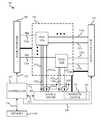
- FIG. 1illustrates an example display system utilizing the methods and comprising the pixels and current biasing elements disclosed
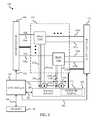
- FIG. 2is a circuit diagram of a current sink according to one embodiment
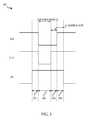
- FIG. 3is a timing diagram of current sink and source programming and calibration according to one embodiment
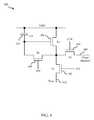
- FIG. 4is a circuit diagram of a current source according to a further embodiment
- FIG. 5is a circuit diagram of a 4T1C pixel circuit according to an embodiment
- FIG. 6Ais a timing diagram illustrating a programming and driving of a 4T1C pixel circuit
- FIG. 6Bis a timing diagram illustrating a programming and measuring of a 4T1C pixel circuit
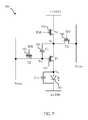
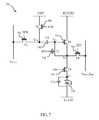
- FIG. 7is a circuit diagram of a 6T1C pixel circuit according to an embodiment
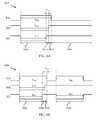
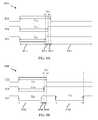
- FIG. 8Ais a timing diagram illustrating a programming and driving of a 6T1C pixel circuit
- FIG. 8Bis a timing diagram illustrating a programming and measuring of a 6T1C pixel circuit
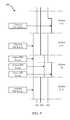
- FIG. 9is a timing diagram for improved driving of rows of pixels
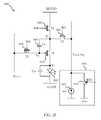
- FIG. 10is a circuit diagram of a 4T1C pixel circuit operated in current mode according to an embodiment
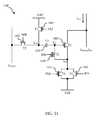
- FIG. 11is a circuit diagram of a 6T1C pixel circuit operated in current mode according to an embodiment
- FIG. 12is a timing diagram illustrating a programming and driving of 4T1C and 6T1C pixel circuits of FIG. 10 and FIG. 11 .
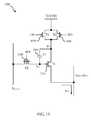
- FIG. 13is a circuit diagram of a 4T1C reference current sink according to an embodiment
- FIG. 14is a circuit diagram of a 6T1C reference current sink according to an embodiment
- FIG. 15is a circuit diagram of a 4T1C reference current source according to an embodiment
- FIG. 16is a circuit diagram of a 6T1C reference current source according to an embodiment
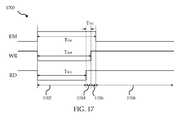
- FIG. 17is a reference row timing diagram illustrating a programming and driving of 4T1C, 6T1C, sinks and sources of FIGS. 13, 14, 15, and 16 ;
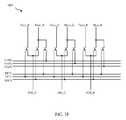
- FIG. 18is a schematic diagram of on-panel multiplexing of data and monitor lines.
- Some displaysutilize a current-bias voltage-programming driving scheme, each of its pixels being a current-biased voltage-programmed (CBVP) pixel.
- CBVPcurrent-biased voltage-programmed
- a number of current biasing elements provided for a display and pixels of the displayalthough designed to be uniformly and exactly alike and programmed to provide the desired current biasing level and respectively desired luminance, in fact exhibit deviations in current biasing and respectively luminance provided.
- the programming of the current biasing elements and pixelsare augmented with calibration and optionally monitoring and compensation.
- FIG. 1is a diagram of an example display system 150 implementing the methods and comprising the circuits described further below.
- the display system 150includes a display panel 120 , an address driver 108 , a source driver 104 , a controller 102 , and a memory storage 106 .
- the display panel 120includes an array of pixels 110 a 110 b (only two explicitly shown) arranged in rows and columns. Each of the pixels 110 a 110 b is individually programmable to emit light with individually programmable luminance values and is a current biased voltage programmed pixel (CBVP).
- the controller 102receives digital data indicative of information to be displayed on the display panel 120 .
- the controller 102sends signals 132 to the source driver 104 and scheduling signals 134 to the address driver 108 to drive the pixels 110 in the display panel 120 to display the information indicated.
- the plurality of pixels 110 of the display panel 120thus comprise a display array or display screen adapted to dynamically display information according to the input digital data received by the controller 102 .
- the display screencan display images and streams of video information from data received by the controller 102 .
- the supply voltage 114provides a constant power voltage or can serve as an adjustable voltage supply that is controlled by signals from the controller 102 .
- the display system 150incorporates features from current biasing elements 155 a , 155 b , either current sources or sinks (current sinks are shown) to provide biasing currents to the pixels 110 a 110 b in the display panel 120 to thereby decrease programming time for the pixels 110 .
- current biasing elements 155 a , 155 bmay form part of the source driver 104 or may be integrated as separate elements. It is to be understood that the current biasing elements 155 a , 155 b used to provide current biasing to the pixels may be current sources rather than current sinks depicted in FIG. 1 .
- the display system 150is implemented with a display screen that includes an array of pixels, such as the pixels 110 a , 110 b , and that the display screen is not limited to a particular number of rows and columns of pixels.
- the display system 150can be implemented with a display screen with a number of rows and columns of pixels commonly available in displays for mobile devices, monitor-based devices, and/or projection-devices.
- a display screenwith a number of rows and columns of pixels commonly available in displays for mobile devices, monitor-based devices, and/or projection-devices.
- a number of different types of pixels, each responsible for reproducing color of a particular channel or color such as red, green, or bluewill be present in the display.
- Pixels of this kindmay also be referred to as “subpixels” as a group of them collectively provide a desired color at a particular row and column of the display, which group of subpixels may collectively also be referred to as a “pixel”.
- Each pixel 110 a , 110 bis operated by a driving circuit or pixel circuit that generally includes a driving transistor and a light emitting device.
- the pixel 110 a , 110 bmay refer to the pixel circuit.
- the light emitting devicecan optionally be an organic light emitting diode, but implementations of the present disclosure apply to pixel circuits having other electroluminescence devices, including current-driven light emitting devices and those listed above.
- the driving transistor in the pixel 110 a , 110 bcan optionally be an n-type or p-type amorphous silicon thin-film transistor, but implementations of the present disclosure are not limited to pixel circuits having a particular polarity of transistor or only to pixel circuits having thin-film transistors.
- the pixel circuit 110 a , 110 bcan also include a storage capacitor for storing programming information and allowing the pixel circuit 110 to drive the light emitting device after being addressed.
- the display panel 120can be an active matrix display array.
- each of the pixels 110 a , 110 b in the display panel 120are coupled to a respective select line 124 a , 124 b , a respective supply line 126 a , 126 b , a respective data line 122 a , 122 b , a respective current bias line 123 a , 123 b , and a respective monitor line 128 a , 128 b .
- a read linemay also be included for controlling connections to the monitor line.
- the supply voltage 114can also provide a second supply line to each pixel 110 a , 110 b .
- each pixelcan be coupled to a first supply line 126 a , 126 b charged with Vdd and a second supply line 127 a , 127 b coupled with Vss, and the pixel circuits 110 a , 110 b can be situated between the first and second supply lines to facilitate driving current between the two supply lines during an emission phase of the pixel circuit.
- each of the pixels 110 in the pixel array of the display 120is coupled to appropriate select lines, supply lines, data lines, and monitor lines. It is noted that aspects of the present disclosure apply to pixels having additional connections, such as connections to additional select lines, and to pixels having fewer connections, and pixels sharing various connections.
- the select line 124 ais provided by the address driver 108 , and can be utilized to enable, for example, a programming operation of the pixel 110 a by activating a switch or transistor to allow the data line 122 a to program the pixel 110 a .
- the data line 122 aconveys programming information from the source driver 104 to the pixel 110 a .
- the data line 122 acan be utilized to apply a programming voltage or a programming current to the pixel 110 a in order to program the pixel 110 a to emit a desired amount of luminance.
- the programming voltage (or programming current) supplied by the source driver 104 via the data line 122 ais a voltage (or current) appropriate to cause the pixel 110 a to emit light with a desired amount of luminance according to the digital data received by the controller 102 .
- the programming voltage (or programming current)can be applied to the pixel 110 a during a programming operation of the pixel 110 a so as to charge a storage device within the pixel 110 a , such as a storage capacitor, thereby enabling the pixel 110 a to emit light with the desired amount of luminance during an emission operation following the programming operation.
- the storage device in the pixel 110 acan be charged during a programming operation to apply a voltage to one or more of a gate or a source terminal of the driving transistor during the emission operation, thereby causing the driving transistor to convey the driving current through the light emitting device according to the voltage stored on the storage device.
- Current biasing element 155 aprovides a biasing current to the pixel 110 a over the current bias line 123 a in the display panel 120 to thereby decrease programming time for the pixel 110 a .
- the current biasing element 155 ais also coupled to the data line 122 a and uses the data line 122 a to program its current output when not in use to program the pixels, as described hereinbelow.
- the current biasing elements 155 a , 155 bare also coupled to a reference/monitor line 160 which is coupled to the controller 102 , for monitoring and controlling of the current biasing elements 155 a , 155 b.
- the driving current that is conveyed through the light emitting device by the driving transistor during the emission operation of the pixel 110 ais a current that is supplied by the first supply line 126 a and is drained to a second supply line 127 a .
- the first supply line 126 a and the second supply line 127 aare coupled to the voltage supply 114 .
- the first supply line 126 acan provide a positive supply voltage (e.g., the voltage commonly referred to in circuit design as “Vdd”) and the second supply line 127 a can provide a negative supply voltage (e.g., the voltage commonly referred to in circuit design as “Vss”).
- Implementations of the present disclosurecan be realized where one or the other of the supply lines (e.g., the supply line 127 a ) is fixed at a ground voltage or at another reference voltage.
- the display system 150also includes a monitoring system 112 .
- the monitor line 128 aconnects the pixel 110 a to the monitoring system 112 .
- the monitoring system 112can be integrated with the source driver 104 , or can be a separate stand-alone system.
- the monitoring system 112can optionally be implemented by monitoring the current and/or voltage of the data line 122 a during a monitoring operation of the pixel 110 a , and the monitor line 128 a can be entirely omitted.
- the monitor line 128 aallows the monitoring system 112 to measure a current or voltage associated with the pixel 110 a and thereby extract information indicative of a degradation or aging of the pixel 110 a or indicative of a temperature of the pixel 110 a .
- display panel 120includes temperature sensing circuitry devoted to sensing temperature implemented in the pixels 110 a , while in other embodiments, the pixels 110 a comprise circuitry which participates in both sensing temperature and driving the pixels.
- the monitoring system 112can extract, via the monitor line 128 a , a current flowing through the driving transistor within the pixel 110 a and thereby determine, based on the measured current and based on the voltages applied to the driving transistor during the measurement, a threshold voltage of the driving transistor or a shift thereof.
- the monitoring system 112extracts information regarding the current biasing elements via data lines 122 a , 122 b or the reference/monitor line 160 and in some embodiments this is performed in cooperation with or by the controller 102 .
- the monitoring system 112can also extract an operating voltage of the light emitting device (e.g., a voltage drop across the light emitting device while the light emitting device is operating to emit light). The monitoring system 112 can then communicate signals 132 to the controller 102 and/or the memory 106 to allow the display system 150 to store the extracted aging information in the memory 106 . During subsequent programming and/or emission operations of the pixel 110 a , the aging information is retrieved from the memory 106 by the controller 102 via memory signals 136 , and the controller 102 then compensates for the extracted degradation information in subsequent programming and/or emission operations of the pixel 110 a .
- an operating voltage of the light emitting devicee.g., a voltage drop across the light emitting device while the light emitting device is operating to emit light.
- the monitoring system 112can then communicate signals 132 to the controller 102 and/or the memory 106 to allow the display system 150 to store the extracted aging information in the memory 106 .
- the aging informationis retrieved from
- the programming information conveyed to the pixel 110 a via the data line 122 acan be appropriately adjusted during a subsequent programming operation of the pixel 110 a such that the pixel 110 a emits light with a desired amount of luminance that is independent of the degradation of the pixel 110 a .
- an increase in the threshold voltage of the driving transistor within the pixel 110 acan be compensated for by appropriately increasing the programming voltage applied to the pixel 110 a .
- the monitoring system 112can extract the bias current of a current biasing element 155 a .
- the monitoring system 112can then communicate signals 132 to the controller 102 and/or the memory 106 to allow the display system 150 to store the extracted information in the memory 106 .
- the informationis retrieved from the memory 106 by the controller 102 via memory signals 136 , and the controller 102 then compensates for the errors in current previously measured using adjustments in subsequent programming of the current biasing element 155 a.
- the current sink 200corresponds, for example, to a single current biasing element 155 a , 155 b of the display system 150 depicted in FIG. 1 which provides a bias current Ibias over current bias lines 123 a , 123 b to a CBVP pixel 110 a , 110 b .
- the current sink 200 depicted in FIG. 2is based on PMOS transistors.
- a PMOS based current sourceis also contemplated, structured and functioning according to similar principles described here. It should be understood that variations of this current sink and its functioning are contemplated and include different types of transistors (PMOS, NMOS, or CMOS) and different semiconductor materials (e.g., LTPS, Metal Oxide, etc.).
- the current sink 200includes a first switch transistor 202 (T 4 ) controlled by an enable signal EN coupled to its gate terminal, and being coupled via one of a source and drain terminal to a current bias line 223 (Ibias) corresponding to, for example, a current bias line 123 a of FIG. 1 , and coupled via the other of the source and drain terminals of the first switch transistor 202 to a first terminal of a storage capacitance 210 .
- a gate terminal of a current drive transistor 206 (T 1 )is coupled to a second terminal of the storage capacitance 210 , while one of the source and gate terminals of the current drive transistor 206 is coupled to the first terminal of the storage capacitance 210 .
- the other of the source and gate terminals of the current drive transistor 206is coupled to VSS.
- a gate terminal of a second switch transistor 208 (T 2 )is coupled to a write signal line (WR), while one of its source and drain terminals is coupled to a voltage bias or data line (Vbias) 222 , corresponding, for example, to data line 122 a depicted in FIG. 1 .
- the other of the source and drain terminals of the second switch transistor 208is coupled to the second terminal of the storage capacitance 210 .
- a gate terminal of a third switch transistor 204is coupled to a calibration control line (CAL), while one of its source and drain terminals is coupled to a reference monitor line 260 , corresponding, for example, to reference monitor line 160 depicted in FIG. 1 .
- the other of the source and drain terminals of the third switch transistor 204is coupled to the first terminal of the storage capacitance 210 .
- the data linesare shared, being used for providing voltage biasing or data for the pixels during certain time periods during a frame and being used for providing voltage biasing for the current biasing element, here a current sink, during other time periods of a frame. This re-use of the data lines allows for the added benefits of programming and compensation of the numerous individual current sinks using only one extra reference monitoring line 160 .
- the complete control cycle 300occurs typically once per frame and includes four smaller cycles, a disconnect cycle 302 , a programming cycle 304 , a calibration cycle 306 , and a settling cycle 308 .
- the current sink 200ceases to provide biasing current Ibias to the current bias line 223 in response to the EN signal going high and the first transistor switch 202 turning off.
- both the second and third switch transistors 208 , 204remain off.
- the duration of the disconnect cycle 302also provides a settling time for the current sink 200 circuit.
- the EN signalremains high throughout the entire control cycle 300 , only going low once the current sink 200 circuit has been programmed, calibrated, and settled and is ready to provide the bias current over the current bias line 223 .
- the programming cycle 304begins with the WR signal going low turning on the second switch transistor 208 and with the CAL signal going low turning on the third switch transistor 204 .
- the third switch transistor 204connects the reference monitor line 260 over which there is transmitted a known reference signal (can be voltage or current) to the first terminal of the storage capacitance 210 , while the second switch transistor 208 connects the voltage bias or data line 222 being input with voltage Vbias to the gate terminal of the current driving transistor 206 and the second terminal of the storage capacitance 210 .
- the storage capacitance 210is charged to a defined value. This value is roughly that which is anticipated as necessary to control the current driving transistor 206 to deliver the appropriate current biasing Ibias taking into account optional calibration described below.
- the circuitis reconfigured to discharge some of the voltage (charge) of the storage capacitance 210 though the current driving transistor 206 .
- the calibration signal CALgoes high, turning off the third switch transistor 204 and disconnecting the first terminal of the storage capacitance 210 from the reference monitor line 260 .
- the amount dischargedis a function of the main element of the current sink 200 , namely the current driving transistor 206 or its related components. For example, if the current driving transistor 206 is “strong”, the discharge occurs relatively quickly and relatively more charge is discharged from the storage capacitance 210 through the current driving transistor 206 during the fixed duration of the calibration cycle 306 .
- the current driving transistor 206is “weak”, the discharge occurs relatively slowly and relatively less charge is discharged from the storage capacitance 210 through the current driving transistor 206 during the fixed duration of the calibration cycle 306 .
- the voltage (charge) stored in the storage capacitance 210is reduced comparatively more for relatively strong current driving transistors versus comparatively less for relatively weak current driving transistors thereby providing some compensation for non-uniformity and variations in current driving transistors across the display whether due to variations in fabrication or variations in degradation over time.
- a settling cycle 308is performed prior to provision of the biasing current Ibias to the current bias line 223 .
- the first and third switch transistors 202 , 204remain off while the WR signal goes high to also turn the second switch transistor 208 off.
- the enable signal ENgoes low turning on the first switch transistor 202 and allowing the current driving transistor 206 to sink the Ibias current on the current bias line 223 according to the voltage (charge) stored in the storage capacitance 210 , which as mentioned above, has a value which has been drained as a function of the current driving transistor 206 in order to provide compensation for the specific characteristics of the current driving transistor 206 .
- the calibration cycle 306is eliminated.
- the compensation manifested as a change in the voltage (charge) stored by the storage capacitance 210 as a function of the characteristics of the current driving transistor 206is not automatically provided.
- a form of manual compensationmay be utilized in combination with monitoring.
- the current of the current sink 200is measured through the reference monitor line 260 by controlling the CAL signal to go low, turning on the third switch transistor 204 .
- the reference monitor line 160is shared and hence during measurement of the current sink 200 of interest all other current sinks are programmed or otherwise controlled such that they do not source or sink any current on the reference monitor line 160 .
- the controller 102 and memory 106(possibly in cooperation with other components of the display system 150 ) adjusts the voltage Vbias used to program the current sink 200 to compensate for the deviations from the expected or desired current sinking exhibited by the current sink 200 .
- This monitoring and compensationneed not be performed every frame and can be performed in a periodic manner over the lifetime of the display to correct for degradation of the current sink 200 .
- a combination of calibration and monitoring and compensationis used.
- the calibrationcan occur every frame in combination with periodic monitoring and compensation.
- the current source 400corresponds, for example, to a single current biasing element 155 a , 155 b of the display system 150 depicted in FIG. 1 which provides a bias current Ibias over current bias lines 123 a , 123 b to a CBVP pixel 110 a , 110 b .
- the current source 400 depicted in FIG. 4is based on PMOS transistors. It should be understood that variations of this current source and its functioning are contemplated and include different types of transistors (PMOS, NMOS, or CMOS) and different semiconductor materials (e.g., LTPS, Metal Oxide, etc.).
- the current source 400includes a first switch transistor 402 (T 4 ) controlled by an enable signal EN coupled to its gate terminal, and being coupled via one of a source and drain terminal of the first transistor switch 405 to a current bias line 423 (Ibias) corresponding to, for example, a current bias line 123 a of FIG. 1 .
- a gate terminal of a current drive transistor 406 (T 1 )is coupled to a first terminal of a storage capacitance 410 , while a first of the source and drain terminals of the current drive transistor 406 is coupled to the other of the source and drain terminals of the first switch transistor 402 , and a second of the source and drain terminals of the current drive transistor 406 is coupled to a second terminal of the storage capacitance 410 .
- the second terminal of the storage capacitance 410is coupled to VDD.
- a gate terminal of a second switch transistor 408 (T 2 )is coupled to a write signal line (WR), while one of its source and drain terminals is coupled to the first terminal of the storage capacitance 410 and the other of its source and drain terminals is coupled to the first of the source and drain terminals of the current driving transistor 406 .
- a gate terminal of a third switch transistor 404 (T 3 )is coupled to a calibration control line (CAL), while one of its source and drain terminals is coupled to a voltage bias monitor line 460 , corresponding, for example, to voltage bias or data lines 122 a , 122 b depicted in FIG. 1 .
- the other of the source and drain terminals of the third switch transistor 404is coupled to the first of the source and drain terminals of the current drive transistor 406 .
- the current sourceis not coupled to a reference monitor line 160 such as that depicted in FIG. 1 .
- the storage capacitance 410 of the current source 400is programmed to a defined value using the voltage bias signal Vbias provided over the voltage bias or data line 122 a and VDD.
- the data lines 122 a , 122 bserve as monitor lines as and when needed.
- FIG. 3an example of a timing of a current control cycle 300 for programming and calibrating the current source 400 depicted in FIG. 4 will now be described.
- the timing of the current control cycle 300 for programming the current source 400 of FIG. 4is the same as that for the current sink 200 of FIG. 2 .
- the complete control cycle 300occurs typically once per frame and includes four smaller cycles, a disconnect cycle 302 , a programming cycle 304 , a calibration cycle 306 , and a settling cycle 308 .
- the current source 400ceases to provide biasing current Ibias to the current bias line 423 in response to the EN signal going high and the first transistor switch 402 turning off.
- both the second and third switch transistors 408 , 404remain off.
- the duration of the disconnect cycle 402also provides a settling time for the current source 400 circuit.
- the EN signalremains high throughout the entire control cycle 300 , only going low once the current source 400 circuit has been programmed, calibrated, and settled and is ready to provide the bias current over the current bias line 423 .
- the programming cycle 304begins with the WR signal going low turning on the second switch transistor 408 and with the CAL signal going low turning on the third switch transistor 404 .
- the third switch transistor 404 and the second switch transistor 408connects the voltage bias monitor line 460 over which there is transmitted a known Vbias signal to the first terminal of the storage capacitance 410 .
- the storage capacitance 410is charged to a defined value. This value is roughly that which is anticipated as necessary to control the current driving transistor 406 to deliver the appropriate current biasing Ibias taking into account optional calibration described below.
- the circuitis reconfigured to discharge some of the voltage (charge) of the storage capacitance 410 though the current driving transistor 406 .
- the calibration signal CALgoes high, turning off the third switch transistor 404 and disconnecting the first terminal of the storage capacitance 410 from the voltage bias monitor line 460 .
- the amount dischargedis a function of the main element of the current source 400 , namely the current driving transistor 406 or its related components. For example, if the current driving transistor 406 is “strong”, the discharge occurs relatively quickly and relatively more charge is discharged from the storage capacitance 410 through the current driving transistor 406 during the fixed duration of the calibration cycle 306 .
- the current driving transistor 406is “weak,” the discharge occurs relatively slowly and relatively less charge is discharged from the storage capacitance 410 through the current driving transistor 406 during the fixed duration of the calibration cycle 306 .
- the voltage (charge) stored in the storage capacitance 410is reduced comparatively more for relatively strong current driving transistors versus comparatively less for relatively weak current driving transistors thereby providing some compensation for non-uniformity and variations in current driving transistors across the display whether due to variations in fabrication or degradation over time.
- a settling cycle 308is performed prior to provision of the biasing current Ibias to the current bias line 423 .
- the first and third switch transistors 402 , 404remain off while the WR signal goes high to also turn the second switch transistor 408 off.
- the enable signal ENgoes low turning on the first switch transistor 402 and allowing the current driving transistor 406 to source the Ibias current on the current bias line 423 according to the voltage (charge) stored in the storage capacitance 410 , which as mentioned above, has a value which has been drained as a function of the current driving transistor 406 in order to provide compensation for the specific characteristics of the current driving transistor 406 .
- the calibration cycle 306is eliminated.
- the compensation manifested as a change in the voltage (charge) stored by the storage capacitance 410 as a function of the characteristics of the current driving transistor 406is not automatically provided.
- a form of manual compensationmay be utilized in combination with monitoring for the current source 400 .
- the current of the current source 400is measured through the voltage bias monitor line 460 by controlling the CAL signal to go low, turning on the third switch transistor 404 .
- the controller 102 and memory 106(possibly in cooperation with other components of the display system 150 ) adjusts the voltage Vbias used to program the current source 400 to compensate for the deviations from the expected or desired current sourcing exhibited by the current source 400 .
- This monitoring and compensationneed not be performed every frame and can be performed in a periodic manner over the lifetime of the display to correct for degradation of the current source 400 .
- each current sink 200 of FIG. 2 and the current source 400 of FIG. 4have each been depicted as possessing a single current driving transistor 206 , 406 it should be understood that each may comprise a cascaded transistor structure for providing the same functionality as shown and described in association with FIG. 2 and FIG. 4 .
- the 4T1C pixel circuit 500corresponds, for example, to a single pixel 110 a of the display system 150 depicted in FIG. 1 which in some embodiments is not necessarily a current biased pixel.
- the 4T1C pixel circuit 500 depicted in FIG. 5is based on NMOS transistors. It should be understood that variations of this pixel and its functioning are contemplated and include different types of transistors (PMOS, NMOS, or CMOS) and different semiconductor materials (e.g. LTPS, Metal Oxide, etc.).
- the 4T1C pixel circuit 500includes a driving transistor 510 (T 1 ), a light emitting device 520 , a first switch transistor 530 (T 2 ), a second switch transistor 540 (T 3 ), a third switch transistor 550 (T 4 ), and a storage capacitor 560 (C S ).
- Each of the driving transistor 510 , the first switch transistor 530 , the second switch transistor 540 , and the third switch transistor 550having first, second, and gate terminals, and each of the light emitting device 520 and the storage capacitor 560 having first and second terminals.
- the gate terminal of the driving transistor 510is coupled to a first terminal of the storage capacitor 560 , while the first terminal of the driving transistor 510 is coupled to the second terminal of the storage capacitor 560 , and the second terminal of the driving transistor 510 is coupled to the first terminal of the light emitting device 520 .
- the second terminal of the light emitting device 520is coupled to a first reference potential ELVSS.
- a capacitance of the light-emitting device 520is depicted in FIG. 5 as C LD In some embodiments, the light emitting device 520 is an OLED.
- the gate terminal of the first switch transistor 530is coupled to a write signal line (WR), while the first terminal of the first switch transistor 530 is coupled to a data signal line (V DATA ), and the second terminal of the first switch transistor 530 is coupled to the gate terminal of the driving transistor 510 .
- a node common to the gate terminal of the driving transistor 510 and the storage capacitor 560 as well as the first switch transistor 530is labelled by its voltage V G in the figure.
- the gate terminal of the second switch transistor 540is coupled to a read signal line (RD), while the first terminal of the second switch transistor 540 is coupled to a monitor signal line (V MON ), and the second terminal of the second switch transistor 540 is coupled to the second terminal of the storage capacitor 560 .
- the gate terminal of the third switch transistor 550is coupled to an emission signal line (EM), while the first terminal of the third switch transistor 550 is coupled to a second reference potential ELVDD, and the second terminal of the third switch transistor 550 is coupled to the second terminal of the storage capacitor 560 .
- EMemission signal line
- ELVDDsecond reference potential
- V Svoltage
- the complete display timing 600 Aoccurs typically once per frame and includes a programming cycle 602 A, a calibration cycle 604 A, a settling cycle 606 A, and an emission cycle 608 A.
- the programming cycle 602 Aover a period T RD , the read signal (RD) and write signal (WR) are held low while the emission (EM) signal is held high.
- the emission signal (EM)is held high throughout the programming, calibration, and settling cycles 602 A 604 A 606 A to ensure the third switch transistor 550 remains off during those cycles (T EM ).
- the first switch transistor 530 and the second switch transistor 540are both on.
- the voltage of the storage capacitor 560 and therefore the voltage V SG of the driving transistor 510is charged to a value of V MON ⁇ V DATA where V MON is a voltage of the monitor line and V DATA is a voltage of the data line.
- V MONis a voltage of the monitor line
- V DATAis a voltage of the data line.
- the read line (RD)goes high to turn off the second switch transistor 540 to discharge some of the voltage (charge) of the storage capacitor 560 through the driving transistor 510 .
- the amount dischargedis a function of the characteristics of the driving transistor 510 . For example, if the driving transistor 510 is “strong”, the discharge occurs relatively quickly and relatively more charge is discharged from the storage capacitor 560 through the driving transistor 510 during the fixed duration T IPC of the calibration cycle 604 A. On the other hand, if the driving transistor 510 is “weak”, the discharge occurs relatively slowly and relatively less charge is discharged from the storage capacitor 560 through the driving transistor 510 during the calibration cycle 604 A.
- the voltage (charge) stored in the storage capacitor 560is reduced comparatively more for relatively strong driving transistors versus comparatively less for relatively weak driving transistors, thereby providing some compensation for non-uniformity and variations in the driving transistors across the display whether due to variations in fabrication or variations in degradation over time.
- a settling cycle 606 Ais performed prior to the emission.
- the second and third switch transistors 540 , 550remain off, while the write signal (WR) goes high to also turn off the first switch transistor 530 .
- the emission signal (EM)goes low turning on the third switch transistor 550 allowing current to flow through the light emitting device 520 according to the calibrated stored voltage on the storage capacitor 560 .
- the complete measurement timing 600 Boccurs typically in the same time period as a display frame and includes a programming cycle 602 B, a calibration cycle 604 B, a settling cycle 606 B, and a measurement cycle 610 B.
- the programming cycle 602 B, calibration cycle 604 B, settling cycle 606 B,are performed substantially the same as described above in connection with FIG. 6A , however, a number of the voltages set for V DATA , V MON , and stored on the storage capacitor 560 are determined with the goal of measuring the pixel circuit 500 instead of displaying any particular luminance according to image data.
- a measuring cycle 610 B having duration T MScommences.
- the emission signal (EM)goes high turning off the third switch transistor 550
- the read signal (RD)goes low turning on the second switch transistor 540 to provide read access to the monitor line.
- the programming voltage V SG for the driving transistor 510is set to the desired level through the programming 602 B, and calibration 604 B cycles, and then during the duration T MS of the measurement cycle 610 B the current/charge is observed on the monitor line V MON .
- the voltage V MON on the monitor lineis kept at a high enough level in order to operate the driving transistor 510 in saturation mode for measurement of the driving transistor 510 .
- the programming voltage V SG for the driving transistor 510is set to the highest possible voltage available on the data line V DATA , for example a value corresponding to peak-white gray-scale, through the programming 602 B, and calibration 604 B cycles, in order to operate the driving transistor 510 in the triode region (switch mode).
- the voltage/current of the light emitting device 520can be directly modulated/measured through the monitor line.
- the 6T1C pixel circuit 700corresponds, for example, to a single pixel 110 a of the display system 150 depicted in FIG. 1 which in some embodiments is not necessarily a current biased pixel.
- the 6T1C pixel circuit 700 depicted in FIG. 7is based on NMOS transistors. It should be understood that variations of this pixel and its functioning are contemplated and include different types of transistors (PMOS, NMOS, or CMOS) and different semiconductor materials (e.g. LTPS, Metal Oxide, etc.).
- the 6T1C pixel circuit 700includes a driving transistor 710 (T 1 ), a light emitting device 720 , a storage capacitor 730 (C S ), a first switch transistor 740 (T 2 ), a second switch transistor 750 (T 3 ), a third switch transistor 760 (T 4 ), a fourth switch transistor 770 (T 5 ), and a fifth switch transistor 780 (T 6 ).
- Each of the driving transistor 710 , the first switch transistor 740 , the second switch transistor 750 , the third switch transistor 760 , the fourth switch transistor 770 , and the fifth switch transistor 780having first, second, and gate terminals, and each of the light emitting device 720 and the storage capacitor 730 having first and second terminals.
- the gate terminal of the driving transistor 710is coupled to a first terminal of the storage capacitor 730 , while the first terminal of the driving transistor 710 is coupled to a first reference potential ELVDD, and the second terminal of the driving transistor 710 is coupled to the first terminal of the third switch transistor 760 .
- the gate terminal of the third switch transistor 760is coupled to a read signal line (RD) and the second terminal of the third switch transistor 760 is coupled to a monitor/reference current line V MON /I REF .
- the gate terminal of the fourth switch transistor 770is coupled to an emission signal line (EM), while the first terminal of the fourth switch transistor 770 is coupled to the first terminal of the third switch transistor 760 , and the second terminal of the fourth switch transistor 770 is coupled to the first terminal of the light emitting device 720 .
- a second terminal of the light emitting device 720is coupled to a second reference potential ELVSS.
- a capacitance of the light-emitting device 720is depicted in FIG. 7 as C LD .
- the light emitting device 720is an OLED.
- the gate terminal of the first switch transistor 740is coupled to a write signal line (WR), while the first terminal of the first switch transistor 740 is coupled to the first terminal of the storage capacitor 730 , and the second terminal of the first switch transistor 740 is coupled to the first terminal of the third switch transistor 760 .
- the gate terminal of the second switch transistor 750is coupled to the write signal line (WR), while the first terminal of the second switch transistor 750 is coupled to a data signal line (V DATA ), and the second terminal of the second switch transistor 750 is coupled to the second terminal of the storage capacitor 730 .
- a node common to the gate terminal of the driving transistor 710 and the storage capacitor 730 as well as the first switch transistor 740is labelled by its voltage V G in the figure.
- the gate terminal of the fifth switch transistor 780is coupled to the emission signal line (EM), while the first terminal of the fifth switch transistor 780 is coupled to reference potential VBP, and the second terminal of the fifth switch transistor 780 is coupled to the second terminal of the storage capacitor 730 .
- a node common to the second terminal of the storage capacitor 730 , the second switch transistor 750 , and the fifth switch transistor 780is labelled by its voltage V CB in FIG. 7 .
- the complete display timing 800 Aoccurs typically once per frame and includes a programming cycle 802 A, a calibration cycle 804 A, a settling cycle 806 A, and an emission cycle 808 A.
- the programming cycle 802 Aover a period T RD , the read signal (RD) and write signal (WR) are held low while the emission (EM) signal is held high.
- the emission signal (EM)is held high throughout the programming, calibration, and settling cycles 802 A 804 A 806 A to ensure the fourth switch transistor 770 and the fifth switch transistor 780 remain off during those cycles (T EM ).
- V DATAis a voltage on the data line
- V DDis the voltage of the first reference potential (also referred to as ELVDD)
- V SG (T 1 )the voltage across the gate terminal and the first terminal of the driving transistor 710
- V th (T 1 )is a threshold voltage of the driving transistor 710 .
- V DATAis set taking into account a desired programming voltage for causing the pixel 700 to emit light at a desired luminance according to image data.
- the read line (RD)goes high to turn off the third switch transistor 760 to discharge some of the voltage (charge) of the storage capacitor 730 through the driving transistor 710 .
- the amount dischargedis a function of the characteristics of the driving transistor 710 . For example, if the driving transistor 710 is “strong”, the discharge occurs relatively quickly and relatively more charge is discharged from the storage capacitor 730 through the driving transistor 710 during the fixed duration T IPC of the calibration cycle 804 A. On the other hand, if the driving transistor 710 is “weak,” the discharge occurs relatively slowly and relatively less charge is discharged from the storage capacitor 730 through the driving transistor 710 during the calibration cycle 804 A.
- the voltage (charge) stored in the storage capacitor 730is reduced comparatively more for relatively strong driving transistors versus comparatively less for relatively weak driving transistors, thereby providing some compensation for non-uniformity and variations in the driving transistors across the display whether due to variations in fabrication or variations in degradation over time.
- a settling cycle 806 Ais performed prior to the emission cycle 808 A.
- the third, fourth, and fifth switch transistors 760 , 770 , and 780remain off, while the write signal (WR) goes high to also turn off the first and second switch transistors 740 , 750 .
- the emission signal (EM)goes low turning on the fourth and fifth switch transistors 770 , 780 .
- the complete measurement timing 800 Boccurs typically in the same time period as a display frame and includes a programming cycle 802 B, a calibration cycle 804 B, a settling cycle 806 B, and a measurement cycle 810 B.
- the programming cycle 802 B, calibration cycle 804 B, settling cycle 806 B,are performed substantially the same as described above in connection with FIG. 8A , however, a number of voltages set for V DATA , V MON , VBP, and stored on the storage capacitor 730 are determined with the goal of measuring the pixel circuit 700 instead of displaying any particular luminance according to image data.
- a measuring cycle 810 B having duration T MScommences.
- the read signal (RD)goes low turning on the third switch transistor 760 to provide read access to the monitor line.
- the emission signal (EM)is kept low, and hence the fourth and fifth switch transistors 770 , 780 are kept on during the entire duration T MS of the measurement.
- the programming voltage V SG for the driving transistor 710is set to the desired level through the programming 802 B, and calibration 804 B, settling 806 B, and emission 808 B cycles, and then during the duration T MS of the measurement cycle 810 B the current/charge is observed on the monitor line V MON .
- the voltage of the second reference potential (ELVSS)is raised to a high enough level (for example to ELVDD) in order to avoid interference from the light emitting device 720 .
- the programming voltage V SG for the driving transistor 710is set to the lowest possible voltage available on the data line V DATA , for example a value corresponding to black-level gray-scale, through the programming 802 B, calibration 804 B, settling 806 B and emission 808 B cycles, in order to avoid interfering with the current of the light emitting device 720 .
- FIG. 9a diagram for improved timing 900 for driving rows of pixels, such as the 4T1C and 6T1C pixels described herein, similar to the timing cycles illustrated herein, will now be described.
- the improved timing 900is shown in relation to its application to four consecutive rows, Row #(i ⁇ 2), Row #(i ⁇ 1), Row #(i), and Row #(i+1).
- the high emission signal EMspans three rows, Row #(i+1), Row #(i), Row #(i ⁇ 1), the leading EM token spanning row Row #(i+1) is followed by the active EM token spanning Row #(i) which is followed by the trailing EM token spanning Row #(i ⁇ 1). These are used to ensure steady-state condition for all pixels on a row during the active programming time of Row #(i).
- the start of an active RD token on Row #(i)trails the leading EM token but is in line with an Active WR token, and corresponds to the simultaneous going low of the RD and WR signals at the start of the programming cycle described in association with other timing diagrams herein.
- the Active RD tokenends prior to the end of the Active WR token for Row #(i), which corresponds to the calibration cycle allowing for partial discharge of the storage capacitor through the driving transistor.
- a trailing RD token Row #(i ⁇ 2)is asserted with a gap after the active RD token (and once EN is low and the pixel is just beginning to emit light) in order to reset the anode of the light-emitting device (OLED) and drain of the driving transistor to a low reference voltage available on the monitor line.
- This further “reset cycle” via the monitor lineis particularly useful in embodiments such as the 6T1C pixels 700 , 1100 of FIG. 7 and FIG. 11 .
- the 4T1C pixel circuit 1000corresponds, for example, to a single pixel 110 a of the display system 150 depicted in FIG. 1 .
- the embodiment depicted in FIG. 10is a current biased pixel.
- An associated biasing circuit 1070 for biasing the 4T1C pixel circuit 1000is illustrated.
- the biasing circuit 1070is coupled to the 4T1C pixel circuit 1000 via the monitoring/current bias line (V MON /I REF ).
- the 4T1C pixel circuit 1000 depicted in FIG. 10is based on NMOS transistors. It should be understood that variations of this pixel and its functioning are contemplated and include different types of transistors (PMOS, NMOS, or CMOS) and different semiconductor materials (e.g., LTPS, Metal Oxide, etc.).
- the 4T1C pixel circuit 1000is structured substantially the same as the 4T1C pixel circuit 500 illustrated in FIG. 5 .
- the 4T1C pixel circuit 1000includes a driving transistor 1010 (T 1 ), a light emitting device 1020 , a first switch transistor 1030 (T 2 ), a second switch transistor 1040 (T 3 ), a third switch transistor 1050 (T 4 ), and a storage capacitor 1060 (C S ).
- Each of the driving transistor 1010 , the first switch transistor 1030 , the second switch transistor 1040 , and the third switch transistor 1050having first, second, and gate terminals, and each of the light emitting device 1020 and the storage capacitor 1060 having first and second terminals.
- the gate terminal of the driving transistor 1010is coupled to a first terminal of the storage capacitor 1060 , while the first terminal of the driving transistor 1010 is coupled to the second terminal of the storage capacitor 1060 , and the second terminal of the driving transistor 1010 is coupled to the first terminal of the light emitting device 1020 .
- the second terminal of the light emitting device 1020is coupled to a first reference potential ELVSS.
- a capacitance of the light-emitting device 1020is depicted in FIG. 10 as C LD .
- the light emitting device 1020is an OLED.
- the gate terminal of the first switch transistor 1030is coupled to a write signal line (WR), while the first terminal of the first switch transistor 1030 is coupled to a data signal line (V DATA ), and the second terminal of the first switch transistor 1030 is coupled to the gate terminal of the driving transistor 1010 .
- a node common to the gate terminal of the driving transistor 1010 and the storage capacitor 1060 as well as the first switch transistor 1030is labelled by its voltage V G in the figure.
- the gate terminal of the second switch transistor 1040is coupled to a read signal line (RD), while the first terminal of the second switch transistor 1040 is coupled to a monitor/reference current line (V MON /I REF ), and the second terminal of the second switch transistor 1040 is coupled to the second terminal of the storage capacitor 1060 .
- the gate terminal of the third switch transistor 1050is coupled to an emission signal line (EM), while the first terminal of the third switch transistor 1050 is coupled to a second reference potential ELVDD, and the second terminal of the third switch transistor 1050 is coupled to the second terminal of the storage capacitor 1060 .
- EMemission signal line
- ELVDDsecond reference potential
- V Svoltage
- a biasing circuit 1070coupled to the monitor/reference current line is a biasing circuit 1070 , including a current source 1072 providing reference current I RF for current biasing of the pixel, as well as a reference voltage V REF which is selectively coupled to the monitor/reference current line via a switch 1074 which is controlled by a reset (RST) signal.
- 4T1C pixel 1000The functioning of 4T1C pixel 1000 is substantially similar to that described hereinabove with respect to the 4T1C pixel 500 of FIG. 5 .
- the 4T1C pixel 1000 of FIG. 10operates in current mode in cooperation with biasing circuit 1070 , a timing of which operation is described in connection with FIG. 12 hereinbelow.
- the 6T1C pixel circuit 1100corresponds, for example, to a single pixel 110 a of the display system 150 depicted in FIG. 1 .
- the embodiment depicted in FIG. 11is a current biased pixel.
- An associated biasing circuit 1190 for biasing the 6T1C pixel circuit 1100is illustrated.
- the biasing circuit 1190is coupled to the 6T1C pixel circuit 1100 via the monitoring/current bias line (V MON /I REF ).
- the 6T1C pixel circuit 1100 depicted in FIG. 11is based on NMOS transistors. It should be understood that variations of this pixel and its functioning are contemplated and include different types of transistors (PMOS, NMOS, or CMOS) and different semiconductor materials (e.g. LTPS, Metal Oxide, etc.).
- the 6T1C pixel circuit 1100is structured substantially the same as the 6T1C pixel circuit 700 illustrated in FIG. 7 .
- the 6T1C pixel circuit 1100includes a driving transistor 1110 (T 1 ), a light emitting device 1120 , a storage capacitor 1130 (C S ), a first switch transistor 1140 (T 2 ), a second switch transistor 1150 (T 3 ), a third switch transistor 1160 (T 4 ), a fourth switch transistor 1170 (T 5 ), and a fifth switch transistor 1180 (T 6 ).
- Each of the driving transistor 1110 , the first switch transistor 1140 , the second switch transistor 1150 , the third switch transistor 1160 , the fourth switch transistor 1170 , and the fifth switch transistor 1180having first, second, and gate terminals, and each of the light emitting device 1120 and the storage capacitor 1130 having first and second terminals.
- the gate terminal of the driving transistor 1110is coupled to a first terminal of the storage capacitor 1130 , while the first terminal of the driving transistor 1110 is coupled to a first reference potential ELVDD, and the second terminal of the driving transistor 1110 is coupled to the first terminal of the third switch transistor 1160 .
- the gate terminal of the third switch transistor 1160is coupled to a read signal line (RD) and the second terminal of the third switch transistor 1160 is coupled to a monitor/reference current line V MON /I REF .
- the gate terminal of the fourth switch transistor 1170is coupled to an emission signal line (EM), while the first terminal of the fourth switch transistor 1170 is coupled to the first terminal of the third switch transistor 1160 , and the second terminal of the fourth switch transistor 1170 is coupled to the first terminal of the light emitting device 1120 .
- a second terminal of the light emitting device 1120is coupled to a second reference potential ELVSS.
- a capacitance of the light-emitting device 1120is depicted in FIG. 11 as C LD In some embodiments, the light emitting device 1120 is an OLED.
- the gate terminal of the first switch transistor 1140is coupled to a write signal line (WR), while the first terminal of the first switch transistor 1140 is coupled to the first terminal of the storage capacitor 1130 , and the second terminal of the first switch transistor 1140 is coupled to the first terminal of the third switch transistor 1160 .
- the gate terminal of the second switch transistor 1150is coupled to the write signal line (WR), while the first terminal of the second switch transistor 1150 is coupled to a data signal line (V DATA ), and the second terminal of the second switch transistor 1150 is coupled to the second terminal of the storage capacitor 1130 .
- a node common to the gate terminal of the driving transistor 1110 and the storage capacitor 1130 as well as the first switch transistor 1140is labelled by its voltage V G in the figure.
- the gate terminal of the fifth switch transistor 1180is coupled to the emission signal line (EM), while the first terminal of the fifth switch transistor 1180 is coupled to VBP, and the second terminal of the fifth switch transistor 1180 is coupled to the second terminal of the storage capacitor 1130 .
- a node common to the second terminal of the storage capacitor 1130 , the second switch transistor 1150 , and the fifth switch transistor 1180is labelled by its voltage V CB in FIG. 11 .
- a biasing circuit 1190coupled to the monitor/reference current line is a biasing circuit 1190 , including a current sink 1192 providing reference current I REF for current biasing of the pixel, as well as a reference voltage V REF which is selectively coupled to the monitor/reference current line via a switch 1194 which is controlled by a reset (RST) signal.
- RSTreset
- the complete display timing 1200occurs typically once per frame and includes first and second programming cycles 1202 , 1203 , a calibration cycle 1204 , a settling cycle 1206 , and an emission cycle 1208 .
- first programming cycle 1202over a period T RST the reset (RST) signal, read signal (RD), and write signal (WR) are held low while the emission (EM) signal is held high.
- the emission signal (EM)is held high throughout the programming, calibration, and settling cycles 1202 , 1203 , 1204 , 1206 the entire duration thereof T EM .
- the 4T1C and 6T1C pixel circuits 1000 , 1100function as described above in connection with FIG. 5 and FIG. 7 with the exception that they are current biased.
- a reference voltage V REFis coupled through the switch 1174 and the second switch transistor 1040 to the node common to the storage capacitor 1060 , the driving transistor 1010 , and the third switch transistor 1050 , to reset voltage V S to V REF .
- the voltage of the storage capacitor 1060 and therefore the voltage V SG of the driving transistor 1010is charged to a value of V REF ⁇ V DATA where V REF is a voltage of the monitor line and V DATA is a voltage of the data line.
- each pixel of a rowis driven with a reference current I REF during programming of the pixel, including during both the first and second programming cycles 1202 , 1203 .
- a reference voltage V REFis coupled through the switch 1194 and the third switch transistor 1160 to the node common to the first switch transistor 1140 , the driving transistor 1110 , and the third switch transistor 1160 , and the fourth switch transistor 1170 , to reset voltage V D to V REF , and the first switch transistor 1140 , the second switch transistor 1150 , and the third switch transistor 1160 are all on.
- V DATAset taking into account a desired programming voltage for causing the pixel 1100 to emit light at a desired luminance according to image data.
- the rest (RST) signalgoes high turning off the switch 1194 and disconnecting the monitor/reference current line from the reference voltage V REF .
- the read signalstays high allowing the reference current source 1192 I REF to continue to bias the pixel 1000 during the second programming cycle 1203 .
- each pixel of a rowis driven with the reference current I REF during programming of the pixel, including during both the first and second programming cycles 1202 , 1203 .
- the read line (RD)goes high to turn off the third switch transistor 1260 to discharge some of the voltage (charge) of the storage capacitor 1130 through the driving transistor 1110 and to stop current biasing by the bias circuit 1190 .
- the amount dischargedis a function of the characteristics of the driving transistor 1110 . For example, if the driving transistor 1110 is “strong”, the discharge occurs relatively quickly and relatively more charge is discharged from the storage capacitor 1130 through the driving transistor 1110 during the fixed duration T IPC of the calibration cycle 1204 . On the other hand, if the driving transistor 1110 is “weak”, the discharge occurs relatively slowly and relatively less charge is discharged from the storage capacitor 1130 through the driving transistor 1110 during the calibration cycle 1204 .
- the voltage (charge) stored in the storage capacitor 1130is reduced comparatively more for relatively strong driving transistors versus comparatively less for relatively weak driving transistors, thereby providing some compensation for non-uniformity and variations in the driving transistors across the display whether due to variations in fabrication or variations in degradation over time.
- a settling cycle 1206is performed prior to the emission cycle 1208 .
- the third, fourth, and fifth switch transistors 1160 , 1170 , and 1180remain off, while the write signal (WR) goes high to also turn off the first and second switch transistors 1140 , 1150 .
- the emission signal (EM)goes low turning on the fourth and fifth switch transistors 1170 , 1180 .
- the 4T1C reference current sink 1300corresponds, for example, to a sink 155 a of the display system 150 depicted in FIG. 1 or a sink 1192 depicted in FIG. 11 .
- the 4T1C reference current sink 1300 depicted in FIG. 13is based on NMOS transistors. It should be understood that variations of this sink and its functioning are contemplated and include different types of transistors (PMOS, NMOS, or CMOS) and different semiconductor materials (e.g., LTPS, Metal Oxide, etc.).
- the 4T1C reference current sink 1300includes a driving transistor 1310 (T 1 ), a first switch transistor 1330 (T 2 ), a second switch transistor 1340 (T 3 ), a third switch transistor 1350 (T 4 ), and a storage capacitor 1360 (C S ).
- Each of the driving transistor 1310 , the first switch transistor 1330 , the second switch transistor 1340 , and the third switch transistor 1350having first, second, and gate terminals, and the storage capacitor 1360 having first and second terminals.
- the gate terminal of the driving transistor 1310is coupled to a first terminal of the storage capacitor 1360 , while the first terminal of the driving transistor 1310 is coupled to the second terminal of the storage capacitor 1360 , and the second terminal of the driving transistor 1310 is coupled to a reference potential VBS.
- the gate terminal of the first switch transistor 1330is coupled to a write signal line (WR), while the first terminal of the first switch transistor 1330 is coupled to a data signal line (V DATA ), and the second terminal of the first switch transistor 1330 is coupled to the gate terminal of the driving transistor 1310 .
- a node common to the gate terminal of the driving transistor 1310 and the storage capacitor 1360 as well as the first switch transistor 1330is labelled by its voltage V G in the figure.
- the gate terminal of the second switch transistor 1340is coupled to a read signal line (RD), while the first terminal of the second switch transistor 1340 is coupled to a monitor signal line (V MON ), and the second terminal of the second switch transistor 1340 is coupled to the second terminal of the storage capacitor 1360 .
- the gate terminal of the third switch transistor 1350is coupled to an emission signal line (EM), while the first terminal of the third switch transistor 1350 is coupled to the monitor signal line, and the second terminal of the third switch transistor 1350 is coupled to the second terminal of the storage capacitor 1360 .
- a node common to the second terminal of the storage capacitor 1360 , the driving transistor 1310 , the second switch transistor 1340 , and the third switch transistor 1350is labelled by its voltage V S in the figure.
- the 6T1C reference current sink 1400corresponds, for example, to a sink 155 a of the display system 150 depicted in FIG. 1 or a sink 1192 depicted in FIG. 11 .
- the 6T1C reference current sink 1400 depicted in FIG. 14is based on NMOS transistors. It should be understood that variations of this sink and its functioning are contemplated and include different types of transistors (PMOS, NMOS, or CMOS) and different semiconductor materials (e.g. LTPS, Metal Oxide, etc.).
- the 6T1C reference current sink 1400includes a driving transistor 1410 (T 1 ), a storage capacitor 1430 (C S ), a first switch transistor 1440 (T 2 ), a second switch transistor 1450 (T 3 ), a third switch transistor 1460 (T 4 ), a fourth switch transistor 1470 (T 5 ), and a fifth switch transistor 1480 (T 6 ).
- Each of the driving transistor 1410 , the first switch transistor 1440 , the second switch transistor 1450 , the third switch transistor 1460 , the fourth switch transistor 1470 , and the fifth switch transistor 1480having first, second, and gate terminals, and the storage capacitor 1430 having first and second terminals.
- the gate terminal of the driving transistor 1410is coupled to a first terminal of the storage capacitor 1430 , while the first terminal of the driving transistor 1410 is coupled to the monitor/current reference line (V MON /I REF ), and the second terminal of the driving transistor 1410 is coupled to the first terminal of the third switch transistor 1460 .
- the gate terminal of the third switch transistor 1460is coupled to a read signal line (RD) and the second terminal of the third switch transistor 1460 is coupled to VBS.
- the gate terminal of the fourth switch transistor 1470is coupled to an emission signal line (EM), while the first terminal of the fourth switch transistor 1470 is coupled to the first terminal of the third switch transistor 1460 , and the second terminal of the fourth switch transistor 1470 is coupled to the second terminal of the third switch transistor 1460 .
- the gate terminal of the first switch transistor 1440is coupled to a write signal line (WR), while the first terminal of the first switch transistor 1440 is coupled to the first terminal of the storage capacitor 1430 , and the second terminal of the first switch transistor 1440 is coupled to the first terminal of the third switch transistor 1460 .
- the gate terminal of the second switch transistor 1450is coupled to the write signal line (WR), while the first terminal of the second switch transistor 1450 is coupled to a data signal line (V DATA ), and the second terminal of the second switch transistor 1450 is coupled to the second terminal of the storage capacitor 1430 .
- a node common to the gate terminal of the driving transistor 1410 and the storage capacitor 1430 as well as the first switch transistor 1440is labelled by its voltage V G in the figure.
- the gate terminal of the fifth switch transistor 1480is coupled to the emission signal line (EM), while the first terminal of the fifth switch transistor 1480 is coupled to VBP, and the second terminal of the fifth switch transistor 1480 is coupled to the second terminal of the storage capacitor 1430 .
- a node common to the second terminal of the storage capacitor 1430 , the second switch transistor 1450 , and the fifth switch transistor 1480is labelled by its voltage V CB in FIG. 14 .
- 6T1C reference current sink 1400The functioning of the 6T1C reference current sink 1400 will be described in connection with the timing diagram of FIG. 17 discussed hereinbelow.
- the 4T1C reference current source 1500corresponds, for example, to a source 155 a of the display system 150 depicted in FIG. 1 or a source 1072 depicted in FIG. 10 .
- the 4T1C reference current source 1500 depicted in FIG. 15is based on NMOS transistors. It should be understood that variations of this source and its functioning are contemplated and include different types of transistors (PMOS, NMOS, or CMOS) and different semiconductor materials (e.g. LTPS, Metal Oxide, etc.).
- the 4T1C reference current source 1500includes a driving transistor 1510 (T 1 ), a first switch transistor 1530 (T 2 ), a second switch transistor 1540 (T 3 ), a third switch transistor 1550 (T 4 ), and a storage capacitor 1560 (C S ).
- Each of the driving transistor 1510 , the first switch transistor 1530 , the second switch transistor 1540 , and the third switch transistor 1550having first, second, and gate terminals, and the storage capacitor 1560 having first and second terminals.
- the gate terminal of the driving transistor 1510is coupled to a first terminal of the storage capacitor 1560 , while the first terminal of the driving transistor 1510 is coupled to the second terminal of the storage capacitor 1560 , and the second terminal of the driving transistor 1510 is coupled to a monitor/reference current line V MON /I REF .
- the gate terminal of the first switch transistor 1530is coupled to a write signal line (WR), while the first terminal of the first switch transistor 1530 is coupled to a data signal line (V DATA ), and the second terminal of the first switch transistor 1530 is coupled to the gate terminal of the driving transistor 1510 .
- a node common to the gate terminal of the driving transistor 1510 and the storage capacitor 1560 as well as the first switch transistor 1530is labelled by its voltage V G in the figure.
- the gate terminal of the second switch transistor 1540is coupled to a read signal line (RD), while the first terminal of the second switch transistor 1540 is coupled to a reference potential (ELVDD), and the second terminal of the second switch transistor 1540 is coupled to the second terminal of the storage capacitor 1560 .
- the gate terminal of the third switch transistor 1550is coupled to an emission signal line (EM), while the first terminal of the third switch transistor 1550 is coupled to ELVDD, and the second terminal of the third switch transistor 1550 is coupled to the second terminal of the storage capacitor 1560 .
- a node common to the second terminal of the storage capacitor 1560 , the driving transistor 1510 , the second switch transistor 1540 , and the third switch transistor 1550is labelled by its voltage V S in the figure.
- the 6T1C reference current source 1600corresponds, for example, to a source 155 a of the display system 150 depicted in FIG. 1 or a source 1072 depicted in FIG. 10 .
- the 6T1C reference current source 1600 depicted in FIG. 16is based on NMOS transistors. It should be understood that variations of this source and its functioning are contemplated and include different types of transistors (PMOS, NMOS, or CMOS) and different semiconductor materials (e.g., LTPS, Metal Oxide, etc.).
- the 6T1C reference current source 1600includes a driving transistor 1610 (T 1 ), a storage capacitor 1630 (C S ), a first switch transistor 1640 (T 2 ), a second switch transistor 1650 (T 3 ), a third switch transistor 1660 (T 4 ), a fourth switch transistor 1670 (T 5 ), and a fifth switch transistor 1680 (T 6 ).
- Each of the driving transistor 1610 , the first switch transistor 1640 , the second switch transistor 1650 , the third switch transistor 1660 , the fourth switch transistor 1670 , and the fifth switch transistor 1680having first, second, and gate terminals, and the storage capacitor 1630 having first and second terminals.
- the gate terminal of the driving transistor 1610is coupled to a first terminal of the storage capacitor 1630 , while the first terminal of the driving transistor 1610 is coupled to a reference potential (ELVSS), and the second terminal of the driving transistor 1610 is coupled to the first terminal of the third switch transistor 1660 .
- the gate terminal of the third switch transistor 1660is coupled to a read signal line (RD) and the second terminal of the third switch transistor 1660 is coupled to a monitor/reference current line V MON /I REF .
- the gate terminal of the fourth switch transistor 1670is coupled to an emission signal line (EM), while the first terminal of the fourth switch transistor 1670 is coupled to the first terminal of the third switch transistor 1660 , and the second terminal of the fourth switch transistor 1670 is coupled to the second terminal of the third switch transistor 1660 .
- the gate terminal of the first switch transistor 1640is coupled to a write signal line (WR), while the first terminal of the first switch transistor 1640 is coupled to the first terminal of the storage capacitor 1630 , and the second terminal of the first switch transistor 1640 is coupled to the first terminal of the third switch transistor 1660 .
- the gate terminal of the second switch transistor 1650is coupled to the write signal line (WR), while the first terminal of the second switch transistor 1650 is coupled to a data signal line (V DATA ), and the second terminal of the second switch transistor 1650 is coupled to the second terminal of the storage capacitor 1630 .
- a node common to the gate terminal of the driving transistor 1610 and the storage capacitor 1630 as well as the first switch transistor 1640is labelled by its voltage V G in the figure.
- the gate terminal of the fifth switch transistor 1680is coupled to the emission signal line (EM), while the first terminal of the fifth switch transistor 1680 is coupled to VBP, and the second terminal of the fifth switch transistor 1680 is coupled to the second terminal of the storage capacitor 1630 .
- a node common to the second terminal of the storage capacitor 1630 , the second switch transistor 1650 , and the fifth switch transistor 1680is labelled by its voltage V CB in FIG. 16 .
- 6T1C reference current source 1600The functioning of the 6T1C reference current source 1600 will be described in connection with the timing diagram of FIG. 17 discussed hereinbelow.
- FIG. 17an example of a reference row timing 1700 for the 4T1C reference current sink 1300 depicted in FIG. 13 , the 6T1C reference current sink 1400 depicted in FIG. 14 , the 4T1C reference current source 1500 depicted in FIG. 15 , and the 6T1C reference current source 1600 depicted in FIG. 16 will now be described. All of these current sinks and sources 1300 , 1400 , 1500 , 1600 , use the same control signals (EM, WR, RD) and similar timing as the active rows, making them convenient for integration in the display panel for example at the first or the last row of the display panel.
- the complete display timing 1700occurs typically once per frame and includes programming cycle 1702 , a calibration cycle 1704 , a settling cycle 1706 , and an emission cycle 1708 .
- programming cycle 1702the read signal (RD), and write signal (WR) are held low while the emission (EM) signal is held high.
- the emission signal (EM)is held high throughout the programming, calibration, and settling cycles 1202 , 1204 , 1206 for the entire duration thereof T EM .
- the first switch transistor 1330 and the second switch transistor 1340are both on.
- the voltage of the storage capacitor 1360 and therefore the voltage V SG of the driving transistor 1310is charged to a value of V MON ⁇ V DATA where V MON is a voltage of the monitor line and V DATA is a voltage of the data line.
- V MONis a voltage of the monitor line
- V DATAis a voltage of the data line.
- the read line (RD)goes high to turn off the second switch transistor 1340 to discharge some of the voltage (charge) of the storage capacitor 1360 through the driving transistor 1310 .
- the amount dischargedis a function of the characteristics of the driving transistor 1310 . For example, if the driving transistor 1310 is “strong,” the discharge occurs relatively quickly and relatively more charge is discharged from the storage capacitor 1360 through the driving transistor 1310 during the fixed duration T IPC of the calibration cycle 1704 . On the other hand, if the driving transistor 1310 is “weak,” the discharge occurs relatively slowly and relatively less charge is discharged from the storage capacitor 1360 through the driving transistor 1310 during the calibration cycle 1704 .
- the voltage (charge) stored in the storage capacitor 1360is reduced comparatively more for relatively strong driving transistors versus comparatively less for relatively weak driving transistors, thereby providing some compensation for non-uniformity and variations in the reference currents being provided across the display whether due to variations in fabrication or variations in degradation over time.
- a settling cycle 1706is performed prior to the emission.
- the second and third switch transistors 1340 , 1350remain off, while the write signal (WR) goes high to also turn off the first switch transistor 1330 .
- the emission signal (EM)goes low turning on the third switch transistor 1350 allowing reference current I REF to be provided to the monitor/reference current line according to the calibrated stored voltage on the storage capacitor 1360 .
- V DATAis a voltage on the data line
- V MONis the voltage on the monitor/reference current line
- V SG (T 1 )the voltage across the gate terminal and the first terminal of the driving transistor 1410
- V th (T 1 )is a threshold voltage of the driving transistor 1410 .
- V DATAis set taking into account a desired programming voltage for causing the reference current sink 1400 to generate a reference current at a desired level.
- the read line (RD)goes high to turn off the third switch transistor 1460 to discharge some of the voltage (charge) of the storage capacitor 1430 through the driving transistor 1410 .
- the amount dischargedis a function of the characteristics of the driving transistor 1410 . For example, if the driving transistor 1410 is “strong”, the discharge occurs relatively quickly and relatively more charge is discharged from the storage capacitor 1430 through the driving transistor 1410 during the fixed duration T IPC of the calibration cycle 1704 . On the other hand, if the driving transistor 1410 is “weak,” the discharge occurs relatively slowly and relatively less charge is discharged from the storage capacitor 1430 through the driving transistor 1410 during the calibration cycle 1704 .
- the voltage (charge) stored in the storage capacitor 1430is reduced comparatively more for relatively strong driving transistors versus comparatively less for relatively weak driving transistors, thereby providing some compensation for non-uniformity and variations in the current sinks 1400 across the display whether due to variations in fabrication or variations in degradation over time.
- a settling cycle 1706is performed prior to the emission cycle 1708 .
- the third, fourth, and fifth switch transistors 1460 , 1470 , and 1480remain off, while the write signal (WR) goes high to also turn off the first and second switch transistors 1440 , 1450 .
- the emission signal (EM)goes low turning on the fourth and fifth switch transistors 1470 , 1480 .
- the first switch transistor 1530 and the second switch transistor 1540are both on.
- the voltage of the storage capacitor 1560 and therefore the voltage V SG of the driving transistor 1510is charged to a value of V DD ⁇ V DATA where V DD is a voltage of the reference potential ELVDD line and V DATA is a voltage of the data line. At least one of these voltages are set in accordance with a desired programming voltage for causing the reference current source 1500 to generate a reference current at a desired level.
- the read line (RD)goes high to turn off the second switch transistor 1540 to discharge some of the voltage (charge) of the storage capacitor 1560 through the driving transistor 1510 .
- the amount dischargedis a function of the characteristics of the driving transistor 1510 . For example, if the driving transistor 1510 is “strong,” the discharge occurs relatively quickly and relatively more charge is discharged from the storage capacitor 1560 through the driving transistor 1510 during the fixed duration T IPC of the calibration cycle 1704 . On the other hand, if the driving transistor 1510 is “weak,” the discharge occurs relatively slowly and relatively less charge is discharged from the storage capacitor 1560 through the driving transistor 1510 during the calibration cycle 1704 .
- the voltage (charge) stored in the storage capacitor 1560is reduced comparatively more for relatively strong driving transistors versus comparatively less for relatively weak driving transistors, thereby providing some compensation for non-uniformity and variations in the reference currents being provided across the display whether due to variations in fabrication or variations in degradation over time.
- a settling cycle 1706is performed prior to the emission cycle.
- the second and third switch transistors 1540 , 1550remain off, while the write signal (WR) goes high to also turn off the first switch transistor 1530 .
- the emission signal (EM)goes low turning on the third switch transistor 1550 allowing reference current I REF to be provided to the monitor/reference current line according to the calibrated stored voltage on the storage capacitor 1560 .
- V DATAis a voltage on the data line
- V DDis the voltage of the reference potential ELVDD
- V SG (T 1 )the voltage across the gate terminal and the first terminal of the driving transistor 1610
- V th (T 1 )is a threshold voltage of the driving transistor 1610 .
- V DATAis set taking into account a desired programming voltage for causing the reference current source 1600 to generate a reference current at a desired level.
- the read line (RD)goes high to turn off the third switch transistor 1660 to discharge some of the voltage (charge) of the storage capacitor 1630 through the driving transistor 1610 .
- the amount dischargedis a function of the characteristics of the driving transistor 1610 . For example, if the driving transistor 1610 is “strong,” the discharge occurs relatively quickly and relatively more charge is discharged from the storage capacitor 1630 through the driving transistor 1610 during the fixed duration T IPC of the calibration cycle 1704 . On the other hand, if the driving transistor 1610 is “weak,” the discharge occurs relatively slowly and relatively less charge is discharged from the storage capacitor 1630 through the driving transistor 1610 during the calibration cycle 1704 .
- the voltage (charge) stored in the storage capacitor 1630is reduced comparatively more for relatively strong driving transistors versus comparatively less for relatively weak driving transistors, thereby providing some compensation for non-uniformity and variations in the current sources 1600 across the display whether due to variations in fabrication or variations in degradation over time.
- a settling cycle 1706is performed prior to the emission cycle 1708 .
- the third, fourth, and fifth switch transistors 1660 , 1670 , and 1680remain off, while the write signal (WR) goes high to also turn off the first and second switch transistors 1640 , 1650 .
- the emission signal (EM)goes low turning on the fourth and fifth switch transistors 1670 , 1680 .
- a driver chip(not shown) provides driver signals over data/monitor lines DM_R, DM_G, and DM_B for red, green, and blue pixels of, for example, a column. Each of these lines is connected via two switches to a separate respective data and monitor lines.
- DM_Ris coupled to Data_R and Mon_R for red subpixels
- DM_Gis coupled to Data_G and Mon_G for green subpixels
- DM_Bis coupled to Data_B and Mon_B for blue subpixels.
- DENdata enable
- MENmonitor enable
- Each monitor lineis connected via an additional switch to a separate reference voltage.
- MON_Ris coupled to VrefR
- MON_Gis coupled to VrefG
- MON_Bis coupled to VrefB.
- These respective additional switches coupling the monitor lines to the respective reference voltagesare controlled by a reset enable (REN) signal line (corresponding to the RST signal described herein).
- RENreset enable
Landscapes
- Engineering & Computer Science (AREA)
- Physics & Mathematics (AREA)
- Computer Hardware Design (AREA)
- General Physics & Mathematics (AREA)
- Theoretical Computer Science (AREA)
- Control Of Indicators Other Than Cathode Ray Tubes (AREA)
- Control Of El Displays (AREA)
Abstract
Description
This application is a continuation-in-part of U.S. patent application Ser. No. 15/215,036, filed Jul. 20, 2016, which claims priority to Canadian Application No. 2,898,282, filed Jul. 24, 2015, each of which is hereby incorporated by reference herein in its entirety.
The present disclosure relates to pixels, current biasing, and signal timing of light emissive visual display technology, and particularly to systems and methods for programming and calibrating pixels and pixel current biasing in active matrix light emitting diode device (AMOLED) and other emissive displays.
According to a first aspect there is provided a system for generating currents for pixels of an emissive display system, each pixel having a light-emitting device, the system comprising: a plurality of pixels; a plurality of current generating circuits for providing a current for at least one respective pixel; and a controller coupled to said current generating circuits for controlling said current generating circuits over a plurality of signal lines; wherein each current generating circuit comprises: at least one driving transistor for providing the current for the pixel; and a storage capacitance for being programmed and for setting a magnitude of the current provided by the at least one driving transistor; wherein the controller's controlling each current generating circuit comprises: during a programming cycle charging the storage capacitance to a defined level; and subsequent to the programming cycle, during a calibration cycle, partially discharging the storage capacitance as a function of characteristics of the at least one driving transistor.
In some embodiments, the at least one driving transistor comprises a driving transistor and the controller's controlling each current generating circuit further comprises: during the programming cycle charging the storage capacitance connected to a gate terminal of the driving transistor to include at least a threshold voltage of the driving transistor, such that during an emission cycle, a voltage across the source terminal and the drain terminal during the emission cycle is a function of the threshold voltage of the driving transistor.
In some embodiments, the at least one driving transistor comprises a driving transistor and the controller's controlling each current generating circuit further comprises: during the programming cycle charging the storage capacitance connected to a gate terminal of the driving transistor to include at least a first voltage applied to a source terminal of the driving transistor, such that during an emission cycle, during which a first voltage is maintained at the source terminal of the driving transistor, a voltage across the source terminal and the drain terminal is independent of the first voltage.
In some embodiments, the first voltage is one of VDD and VMON. In some embodiments, each current generating circuit comprises one of a reference current sink and a reference current source for providing the current for the at least one respective pixels, the current provided to provide reference current biasing for the at least one respective pixels. In some embodiments, each pixel comprises the current generating circuit for providing the current for said pixel, the current provided to drive the light-emitting device of said pixel. In some embodiments, the light emitting device is an Organic Light Emitting Diode (OLED).
In some embodiments, the controller's controlling each current generating circuit further comprises: during a reset cycle commencing substantially simultaneously with an emission cycle, resetting to a low reference voltage at least one of an anode of the OLED and a terminal of the at least one driving transistor.
According to a second aspect there is provided a method for generating currents for pixels of an emissive display system, each pixel having a light-emitting device, the system comprising a plurality of pixels, a plurality of current generating circuits for providing a current for at least one respective pixel, each current generating circuit comprising at least one driving transistor for providing the current for the pixel, and a storage capacitance for being programmed and for setting a magnitude of the current provided by the at least one driving transistor, the method comprising: controlling each current generating circuit over a plurality of lines comprising: charging the storage capacitance to a defined level during a programming cycle; and subsequent to the programming cycle, during a calibration cycle, partially discharging the storage capacitance as a function of characteristics of the at least one driving transistor.
In some embodiments, the at least one driving transistor comprises a driving transistor and controlling each current generating circuit further comprises: during the programming cycle, charging the storage capacitance connected to a gate terminal of the driving transistor to include at least a threshold voltage of the driving transistor, such that during an emission cycle a voltage across the source terminal and the drain terminal is a function of the threshold voltage of the driving transistor.
In some embodiments, the at least one driving transistor comprises a driving transistor and controlling each current generating circuit further comprises: during the programming cycle charging the storage capacitance connected to a gate terminal of the driving transistor to include at least a first voltage applied to a source terminal of the driving transistor, such that during an emission cycle, during which a first voltage is maintained at the source terminal of the driving transistor, a voltage across the source terminal and the drain terminal is independent of the first voltage.
In some embodiments, the controlling each current generating circuit further comprises: during a reset cycle commencing substantially simultaneously with an emission cycle, resetting to a low reference voltage at least one of an anode of the OLED and a terminal of the at least one driving transistor.
The foregoing and additional aspects and embodiments of the present disclosure will be apparent to those of ordinary skill in the art in view of the detailed description of various embodiments and/or aspects, which is made with reference to the drawings, a brief description of which is provided next.
The foregoing and other advantages of the disclosure will become apparent upon reading the following detailed description and upon reference to the drawings.
While the present disclosure is susceptible to various modifications and alternative forms, specific embodiments or implementations have been shown by way of example in the drawings and will be described in detail herein. It should be understood, however, that the disclosure is not intended to be limited to the particular forms disclosed. Rather, the disclosure is to cover all modifications, equivalents, and alternatives falling within the spirit and scope of an invention as defined by the appended claims.
Many modern display technologies suffer from defects, variations, and non-uniformities, from the moment of fabrication, and can suffer further from aging and deterioration over the operational lifetime of the display, which result in the production of images which deviate from those which are intended. Methods of image calibration and compensation are used to correct for those defects in order to produce images which are more accurate, uniform, or otherwise more closely reproduce the image represented by the image data. Some displays utilize a current-bias voltage-programming driving scheme, each of its pixels being a current-biased voltage-programmed (CBVP) pixel. In such displays a further requirement for producing and maintaining accurate image reproduction is that the current biasing elements, that is the current sources or sinks, which provide current biasing provide the appropriate level of current biasing to those pixels.
Due to unavoidable variations in fabrication and variations in degradation through use, a number of current biasing elements provided for a display and pixels of the display, although designed to be uniformly and exactly alike and programmed to provide the desired current biasing level and respectively desired luminance, in fact exhibit deviations in current biasing and respectively luminance provided. In order to correct for visual defects that would otherwise arise from the non-uniformity and inaccuracies of these current sources or sinks and the pixels, the programming of the current biasing elements and pixels are augmented with calibration and optionally monitoring and compensation.
As the resolution of an array semiconductor device increases, the number of lines and elements required to drive, calibrate, and/or monitor the array increases dramatically. This can result in higher power consumption, higher manufacturing costs, and a larger physical foot print. In the case of a CBVP pixel display, providing circuitry to program, calibrate, and monitor current sources or sinks can increase cost and complexity of integration as the number of rows or columns increases.
The systems and methods disclosed below address these issues through control timing and calibration of pixel circuits and a family of current biasing elements while utilizing circuits which are integrated on the display in a manner which use existing display components.
While the embodiments described herein will be in the context of AMOLED displays it should be understood that the systems and methods described herein are applicable to any other display comprising pixels which might utilize current biasing, including but not limited to light emitting diode displays (LED), electroluminescent displays (ELD), organic light emitting diode displays (OLED), plasma display panels (PSP), among other displays.
It should be understood that the embodiments described herein pertain to systems and methods of calibration and compensation and do not limit the display technology underlying their operation and the operation of the displays in which they are implemented. The systems and methods described herein are applicable to any number of various types and implementations of various visual display technologies.
Thedisplay panel 120 includes an array ofpixels 110a110b(only two explicitly shown) arranged in rows and columns. Each of thepixels 110a110bis individually programmable to emit light with individually programmable luminance values and is a current biased voltage programmed pixel (CBVP). Thecontroller 102 receives digital data indicative of information to be displayed on thedisplay panel 120. Thecontroller 102 sendssignals 132 to thesource driver 104 andscheduling signals 134 to theaddress driver 108 to drive the pixels110 in thedisplay panel 120 to display the information indicated. The plurality of pixels110 of thedisplay panel 120 thus comprise a display array or display screen adapted to dynamically display information according to the input digital data received by thecontroller 102. The display screen can display images and streams of video information from data received by thecontroller 102. Thesupply voltage 114 provides a constant power voltage or can serve as an adjustable voltage supply that is controlled by signals from thecontroller 102. Thedisplay system 150 incorporates features from current biasingelements pixels 110a110bin thedisplay panel 120 to thereby decrease programming time for the pixels110. Although shown separately from thesource driver 104, current biasingelements source driver 104 or may be integrated as separate elements. It is to be understood that thecurrent biasing elements FIG. 1 .
For illustrative purposes, only twopixels display system 150 inFIG. 1 . It is understood that thedisplay system 150 is implemented with a display screen that includes an array of pixels, such as thepixels display system 150 can be implemented with a display screen with a number of rows and columns of pixels commonly available in displays for mobile devices, monitor-based devices, and/or projection-devices. In a multichannel or color display, a number of different types of pixels, each responsible for reproducing color of a particular channel or color such as red, green, or blue, will be present in the display. Pixels of this kind may also be referred to as “subpixels” as a group of them collectively provide a desired color at a particular row and column of the display, which group of subpixels may collectively also be referred to as a “pixel”.
Eachpixel pixel pixel pixel circuit display panel 120 can be an active matrix display array.
As illustrated inFIG. 1 , each of thepixels display panel 120 are coupled to a respectiveselect line respective supply line respective data line current bias line respective monitor line supply voltage 114 can also provide a second supply line to eachpixel first supply line second supply line pixel circuits display 120 is coupled to appropriate select lines, supply lines, data lines, and monitor lines. It is noted that aspects of the present disclosure apply to pixels having additional connections, such as connections to additional select lines, and to pixels having fewer connections, and pixels sharing various connections.
With reference to thepixel 110aof thedisplay panel 120, theselect line 124ais provided by theaddress driver 108, and can be utilized to enable, for example, a programming operation of thepixel 110aby activating a switch or transistor to allow thedata line 122ato program thepixel 110a. The data line122aconveys programming information from thesource driver 104 to thepixel 110a. For example, thedata line 122acan be utilized to apply a programming voltage or a programming current to thepixel 110ain order to program thepixel 110ato emit a desired amount of luminance. The programming voltage (or programming current) supplied by thesource driver 104 via thedata line 122ais a voltage (or current) appropriate to cause thepixel 110ato emit light with a desired amount of luminance according to the digital data received by thecontroller 102. The programming voltage (or programming current) can be applied to thepixel 110aduring a programming operation of thepixel 110aso as to charge a storage device within thepixel 110a, such as a storage capacitor, thereby enabling thepixel 110ato emit light with the desired amount of luminance during an emission operation following the programming operation. For example, the storage device in thepixel 110acan be charged during a programming operation to apply a voltage to one or more of a gate or a source terminal of the driving transistor during the emission operation, thereby causing the driving transistor to convey the driving current through the light emitting device according to the voltage stored on the storage device.Current biasing element 155aprovides a biasing current to thepixel 110aover thecurrent bias line 123ain thedisplay panel 120 to thereby decrease programming time for thepixel 110a. Thecurrent biasing element 155ais also coupled to thedata line 122aand uses thedata line 122ato program its current output when not in use to program the pixels, as described hereinbelow. In some embodiments, thecurrent biasing elements monitor line 160 which is coupled to thecontroller 102, for monitoring and controlling of thecurrent biasing elements
Generally, in thepixel 110a, the driving current that is conveyed through the light emitting device by the driving transistor during the emission operation of thepixel 110ais a current that is supplied by thefirst supply line 126aand is drained to asecond supply line 127a. Thefirst supply line 126aand thesecond supply line 127aare coupled to thevoltage supply 114. Thefirst supply line 126acan provide a positive supply voltage (e.g., the voltage commonly referred to in circuit design as “Vdd”) and thesecond supply line 127acan provide a negative supply voltage (e.g., the voltage commonly referred to in circuit design as “Vss”). Implementations of the present disclosure can be realized where one or the other of the supply lines (e.g., thesupply line 127a) is fixed at a ground voltage or at another reference voltage.
Thedisplay system 150 also includes amonitoring system 112. With reference again to thepixel 110aof thedisplay panel 120, themonitor line 128aconnects thepixel 110ato themonitoring system 112. Themonitoring system 112 can be integrated with thesource driver 104, or can be a separate stand-alone system. In particular, themonitoring system 112 can optionally be implemented by monitoring the current and/or voltage of thedata line 122aduring a monitoring operation of thepixel 110a, and themonitor line 128acan be entirely omitted. Themonitor line 128aallows themonitoring system 112 to measure a current or voltage associated with thepixel 110aand thereby extract information indicative of a degradation or aging of thepixel 110aor indicative of a temperature of thepixel 110a. In some embodiments,display panel 120 includes temperature sensing circuitry devoted to sensing temperature implemented in thepixels 110a, while in other embodiments, thepixels 110acomprise circuitry which participates in both sensing temperature and driving the pixels. For example, themonitoring system 112 can extract, via themonitor line 128a, a current flowing through the driving transistor within thepixel 110aand thereby determine, based on the measured current and based on the voltages applied to the driving transistor during the measurement, a threshold voltage of the driving transistor or a shift thereof. In some embodiments themonitoring system 112 extracts information regarding the current biasing elements viadata lines monitor line 160 and in some embodiments this is performed in cooperation with or by thecontroller 102.
Themonitoring system 112 can also extract an operating voltage of the light emitting device (e.g., a voltage drop across the light emitting device while the light emitting device is operating to emit light). Themonitoring system 112 can then communicatesignals 132 to thecontroller 102 and/or thememory 106 to allow thedisplay system 150 to store the extracted aging information in thememory 106. During subsequent programming and/or emission operations of thepixel 110a, the aging information is retrieved from thememory 106 by thecontroller 102 via memory signals136, and thecontroller 102 then compensates for the extracted degradation information in subsequent programming and/or emission operations of thepixel 110a. For example, once the degradation information is extracted, the programming information conveyed to thepixel 110avia thedata line 122acan be appropriately adjusted during a subsequent programming operation of thepixel 110asuch that thepixel 110aemits light with a desired amount of luminance that is independent of the degradation of thepixel 110a. In an example, an increase in the threshold voltage of the driving transistor within thepixel 110acan be compensated for by appropriately increasing the programming voltage applied to thepixel 110a. In a similar manner, themonitoring system 112 can extract the bias current of acurrent biasing element 155a. Themonitoring system 112 can then communicatesignals 132 to thecontroller 102 and/or thememory 106 to allow thedisplay system 150 to store the extracted information in thememory 106. During subsequent programming of thecurrent biasing element 155a, the information is retrieved from thememory 106 by thecontroller 102 via memory signals136, and thecontroller 102 then compensates for the errors in current previously measured using adjustments in subsequent programming of thecurrent biasing element 155a.
Referring toFIG. 2 , the structure of acurrent sink 200 circuit according to an embodiment will now be described. Thecurrent sink 200 corresponds, for example, to a singlecurrent biasing element display system 150 depicted inFIG. 1 which provides a bias current Ibias overcurrent bias lines CBVP pixel current sink 200 depicted inFIG. 2 is based on PMOS transistors. A PMOS based current source is also contemplated, structured and functioning according to similar principles described here. It should be understood that variations of this current sink and its functioning are contemplated and include different types of transistors (PMOS, NMOS, or CMOS) and different semiconductor materials (e.g., LTPS, Metal Oxide, etc.).
Thecurrent sink 200 includes a first switch transistor202 (T4) controlled by an enable signal EN coupled to its gate terminal, and being coupled via one of a source and drain terminal to a current bias line223 (Ibias) corresponding to, for example, acurrent bias line 123aofFIG. 1 , and coupled via the other of the source and drain terminals of thefirst switch transistor 202 to a first terminal of astorage capacitance 210. A gate terminal of a current drive transistor206 (T1) is coupled to a second terminal of thestorage capacitance 210, while one of the source and gate terminals of thecurrent drive transistor 206 is coupled to the first terminal of thestorage capacitance 210. The other of the source and gate terminals of thecurrent drive transistor 206 is coupled to VSS. A gate terminal of a second switch transistor208 (T2) is coupled to a write signal line (WR), while one of its source and drain terminals is coupled to a voltage bias or data line (Vbias)222, corresponding, for example, todata line 122adepicted inFIG. 1 . The other of the source and drain terminals of thesecond switch transistor 208 is coupled to the second terminal of thestorage capacitance 210. A gate terminal of a third switch transistor204 (T3) is coupled to a calibration control line (CAL), while one of its source and drain terminals is coupled to areference monitor line 260, corresponding, for example, to referencemonitor line 160 depicted inFIG. 1 . The other of the source and drain terminals of thethird switch transistor 204 is coupled to the first terminal of thestorage capacitance 210. As mentioned above the data lines are shared, being used for providing voltage biasing or data for the pixels during certain time periods during a frame and being used for providing voltage biasing for the current biasing element, here a current sink, during other time periods of a frame. This re-use of the data lines allows for the added benefits of programming and compensation of the numerous individual current sinks using only one extrareference monitoring line 160.
With reference also toFIG. 3 , an example of a timing of acurrent control cycle 300 for programming and calibrating thecurrent sink 200 depicted inFIG. 2 will now be described. Thecomplete control cycle 300 occurs typically once per frame and includes four smaller cycles, adisconnect cycle 302, aprogramming cycle 304, acalibration cycle 306, and a settlingcycle 308. During thedisconnect cycle 302, thecurrent sink 200 ceases to provide biasing current Ibias to thecurrent bias line 223 in response to the EN signal going high and thefirst transistor switch 202 turning off. By virtue of the CAL and WR signals being high, both the second andthird switch transistors disconnect cycle 302 also provides a settling time for thecurrent sink 200 circuit. The EN signal remains high throughout theentire control cycle 300, only going low once thecurrent sink 200 circuit has been programmed, calibrated, and settled and is ready to provide the bias current over thecurrent bias line 223. Once thecurrent sink 200 has settled after thedisconnect cycle 302 has completed, theprogramming cycle 304 begins with the WR signal going low turning on thesecond switch transistor 208 and with the CAL signal going low turning on thethird switch transistor 204. During theprogramming cycle 304 therefore, thethird switch transistor 204 connects thereference monitor line 260 over which there is transmitted a known reference signal (can be voltage or current) to the first terminal of thestorage capacitance 210, while thesecond switch transistor 208 connects the voltage bias ordata line 222 being input with voltage Vbias to the gate terminal of thecurrent driving transistor 206 and the second terminal of thestorage capacitance 210. As a result, thestorage capacitance 210 is charged to a defined value. This value is roughly that which is anticipated as necessary to control thecurrent driving transistor 206 to deliver the appropriate current biasing Ibias taking into account optional calibration described below.
After theprogramming cycle 304 and during thecalibration cycle 306, the circuit is reconfigured to discharge some of the voltage (charge) of thestorage capacitance 210 though thecurrent driving transistor 206. The calibration signal CAL goes high, turning off thethird switch transistor 204 and disconnecting the first terminal of thestorage capacitance 210 from thereference monitor line 260. The amount discharged is a function of the main element of thecurrent sink 200, namely thecurrent driving transistor 206 or its related components. For example, if thecurrent driving transistor 206 is “strong”, the discharge occurs relatively quickly and relatively more charge is discharged from thestorage capacitance 210 through thecurrent driving transistor 206 during the fixed duration of thecalibration cycle 306. On the other hand, if thecurrent driving transistor 206 is “weak”, the discharge occurs relatively slowly and relatively less charge is discharged from thestorage capacitance 210 through thecurrent driving transistor 206 during the fixed duration of thecalibration cycle 306. As a result the voltage (charge) stored in thestorage capacitance 210 is reduced comparatively more for relatively strong current driving transistors versus comparatively less for relatively weak current driving transistors thereby providing some compensation for non-uniformity and variations in current driving transistors across the display whether due to variations in fabrication or variations in degradation over time.
After thecalibration cycle 306, a settlingcycle 308 is performed prior to provision of the biasing current Ibias to thecurrent bias line 223. During thesettling cycle 308, the first andthird switch transistors second switch transistor 208 off. After completion of the duration of the settlingcycle 308, the enable signal EN goes low turning on thefirst switch transistor 202 and allowing thecurrent driving transistor 206 to sink the Ibias current on thecurrent bias line 223 according to the voltage (charge) stored in thestorage capacitance 210, which as mentioned above, has a value which has been drained as a function of thecurrent driving transistor 206 in order to provide compensation for the specific characteristics of thecurrent driving transistor 206.
In some embodiments, thecalibration cycle 306 is eliminated. In such a case, the compensation manifested as a change in the voltage (charge) stored by thestorage capacitance 210 as a function of the characteristics of thecurrent driving transistor 206 is not automatically provided. In such a case a form of manual compensation may be utilized in combination with monitoring.
In some embodiments, after acurrent sink 200 has been programmed, and prior to providing the biasing current over thecurrent bias line 223, the current of thecurrent sink 200 is measured through thereference monitor line 260 by controlling the CAL signal to go low, turning on thethird switch transistor 204. As illustrated inFIG. 1 , in some embodiments thereference monitor line 160 is shared and hence during measurement of thecurrent sink 200 of interest all other current sinks are programmed or otherwise controlled such that they do not source or sink any current on thereference monitor line 160. Once the current of thecurrent sink 200 has been measured in response to known programming of thecurrent sink 200 and possibly after a number of various current measurements in response to various programming values have been measured and stored inmemory 106, thecontroller 102 and memory106 (possibly in cooperation with other components of the display system150) adjusts the voltage Vbias used to program thecurrent sink 200 to compensate for the deviations from the expected or desired current sinking exhibited by thecurrent sink 200. This monitoring and compensation, need not be performed every frame and can be performed in a periodic manner over the lifetime of the display to correct for degradation of thecurrent sink 200.
In some embodiments a combination of calibration and monitoring and compensation is used. In such a case the calibration can occur every frame in combination with periodic monitoring and compensation.
Referring toFIG. 4 , the structure of acurrent source 400 circuit according to an embodiment will now be described. Thecurrent source 400 corresponds, for example, to a singlecurrent biasing element display system 150 depicted inFIG. 1 which provides a bias current Ibias overcurrent bias lines CBVP pixel current source 400 into thedisplay system 150 is slightly different from that depicted inFIG. 1 for acurrent sink 200. Thecurrent source 400 depicted inFIG. 4 is based on PMOS transistors. It should be understood that variations of this current source and its functioning are contemplated and include different types of transistors (PMOS, NMOS, or CMOS) and different semiconductor materials (e.g., LTPS, Metal Oxide, etc.).
Thecurrent source 400 includes a first switch transistor402 (T4) controlled by an enable signal EN coupled to its gate terminal, and being coupled via one of a source and drain terminal of the first transistor switch405 to a current bias line423 (Ibias) corresponding to, for example, acurrent bias line 123aofFIG. 1 . A gate terminal of a current drive transistor406 (T1) is coupled to a first terminal of astorage capacitance 410, while a first of the source and drain terminals of thecurrent drive transistor 406 is coupled to the other of the source and drain terminals of thefirst switch transistor 402, and a second of the source and drain terminals of thecurrent drive transistor 406 is coupled to a second terminal of thestorage capacitance 410. The second terminal of thestorage capacitance 410 is coupled to VDD. A gate terminal of a second switch transistor408 (T2) is coupled to a write signal line (WR), while one of its source and drain terminals is coupled to the first terminal of thestorage capacitance 410 and the other of its source and drain terminals is coupled to the first of the source and drain terminals of thecurrent driving transistor 406. A gate terminal of a third switch transistor404 (T3) is coupled to a calibration control line (CAL), while one of its source and drain terminals is coupled to a voltagebias monitor line 460, corresponding, for example, to voltage bias ordata lines FIG. 1 . The other of the source and drain terminals of thethird switch transistor 404 is coupled to the first of the source and drain terminals of thecurrent drive transistor 406.
In the embodiment depicted inFIG. 4 , the current source is not coupled to areference monitor line 160 such as that depicted inFIG. 1 . Instead of thecurrent source 400 being programmed with Vbias and a reference voltage as in the case of thecurrent sink 200, thestorage capacitance 410 of thecurrent source 400 is programmed to a defined value using the voltage bias signal Vbias provided over the voltage bias ordata line 122aand VDD. In this embodiment thedata lines
Referring once again toFIG. 3 , an example of a timing of acurrent control cycle 300 for programming and calibrating thecurrent source 400 depicted inFIG. 4 will now be described. The timing of thecurrent control cycle 300 for programming thecurrent source 400 ofFIG. 4 is the same as that for thecurrent sink 200 ofFIG. 2 .
Thecomplete control cycle 300 occurs typically once per frame and includes four smaller cycles, adisconnect cycle 302, aprogramming cycle 304, acalibration cycle 306, and a settlingcycle 308. During thedisconnect cycle 302, thecurrent source 400 ceases to provide biasing current Ibias to thecurrent bias line 423 in response to the EN signal going high and thefirst transistor switch 402 turning off. By virtue of the CAL and WR signals being high, both the second andthird switch transistors disconnect cycle 402 also provides a settling time for thecurrent source 400 circuit. The EN signal remains high throughout theentire control cycle 300, only going low once thecurrent source 400 circuit has been programmed, calibrated, and settled and is ready to provide the bias current over thecurrent bias line 423. Once thecurrent source 400 has settled after thedisconnect cycle 302 has completed, theprogramming cycle 304 begins with the WR signal going low turning on thesecond switch transistor 408 and with the CAL signal going low turning on thethird switch transistor 404. During theprogramming cycle 304 therefore, thethird switch transistor 404 and thesecond switch transistor 408 connects the voltagebias monitor line 460 over which there is transmitted a known Vbias signal to the first terminal of thestorage capacitance 410. As a result, since the second terminal of thestorage capacitance 410 is coupled top VDD, thestorage capacitance 410 is charged to a defined value. This value is roughly that which is anticipated as necessary to control thecurrent driving transistor 406 to deliver the appropriate current biasing Ibias taking into account optional calibration described below.
After theprogramming cycle 304 and during thecalibration cycle 306, the circuit is reconfigured to discharge some of the voltage (charge) of thestorage capacitance 410 though thecurrent driving transistor 406. The calibration signal CAL goes high, turning off thethird switch transistor 404 and disconnecting the first terminal of thestorage capacitance 410 from the voltagebias monitor line 460. The amount discharged is a function of the main element of thecurrent source 400, namely thecurrent driving transistor 406 or its related components. For example, if thecurrent driving transistor 406 is “strong”, the discharge occurs relatively quickly and relatively more charge is discharged from thestorage capacitance 410 through thecurrent driving transistor 406 during the fixed duration of thecalibration cycle 306. On the other hand, if thecurrent driving transistor 406 is “weak,” the discharge occurs relatively slowly and relatively less charge is discharged from thestorage capacitance 410 through thecurrent driving transistor 406 during the fixed duration of thecalibration cycle 306. As a result the voltage (charge) stored in thestorage capacitance 410 is reduced comparatively more for relatively strong current driving transistors versus comparatively less for relatively weak current driving transistors thereby providing some compensation for non-uniformity and variations in current driving transistors across the display whether due to variations in fabrication or degradation over time.
After thecalibration cycle 306, a settlingcycle 308 is performed prior to provision of the biasing current Ibias to thecurrent bias line 423. During the settling cycle, the first andthird switch transistors second switch transistor 408 off. After completion of the duration of the settlingcycle 308, the enable signal EN goes low turning on thefirst switch transistor 402 and allowing thecurrent driving transistor 406 to source the Ibias current on thecurrent bias line 423 according to the voltage (charge) stored in thestorage capacitance 410, which as mentioned above, has a value which has been drained as a function of thecurrent driving transistor 406 in order to provide compensation for the specific characteristics of thecurrent driving transistor 406.
In some embodiments, thecalibration cycle 306 is eliminated. In such a case, the compensation manifested as a change in the voltage (charge) stored by thestorage capacitance 410 as a function of the characteristics of thecurrent driving transistor 406 is not automatically provided. In such a case, as with the embodiment above in the context of a current sink200 a form of manual compensation may be utilized in combination with monitoring for thecurrent source 400.
In some embodiments, after acurrent source 400 has been programmed, and prior to providing the biasing current over thecurrent bias line 423, the current of thecurrent source 400 is measured through the voltagebias monitor line 460 by controlling the CAL signal to go low, turning on thethird switch transistor 404.
Once the current of thecurrent source 400 has been measured in response to known programming of thecurrent source 400 and possibly after a number of various current measurements in response to various programming values have been measured and stored inmemory 106, thecontroller 102 and memory106 (possibly in cooperation with other components of the display system150) adjusts the voltage Vbias used to program thecurrent source 400 to compensate for the deviations from the expected or desired current sourcing exhibited by thecurrent source 400. This monitoring and compensation, need not be performed every frame and can be performed in a periodic manner over the lifetime of the display to correct for degradation of thecurrent source 400.
Although thecurrent sink 200 ofFIG. 2 and thecurrent source 400 ofFIG. 4 have each been depicted as possessing a singlecurrent driving transistor FIG. 2 andFIG. 4 .
With reference toFIG. 5 , the structure of a four transistor, single capacitor (4T1C)pixel circuit 500 according to an embodiment will now be described. The4T1C pixel circuit 500 corresponds, for example, to asingle pixel 110aof thedisplay system 150 depicted inFIG. 1 which in some embodiments is not necessarily a current biased pixel. The4T1C pixel circuit 500 depicted inFIG. 5 is based on NMOS transistors. It should be understood that variations of this pixel and its functioning are contemplated and include different types of transistors (PMOS, NMOS, or CMOS) and different semiconductor materials (e.g. LTPS, Metal Oxide, etc.).
The4T1C pixel circuit 500 includes a driving transistor510 (T1), alight emitting device 520, a first switch transistor530 (T2), a second switch transistor540 (T3), a third switch transistor550 (T4), and a storage capacitor560 (CS). Each of the drivingtransistor 510, thefirst switch transistor 530, thesecond switch transistor 540, and thethird switch transistor 550 having first, second, and gate terminals, and each of thelight emitting device 520 and thestorage capacitor 560 having first and second terminals.
The gate terminal of the drivingtransistor 510 is coupled to a first terminal of thestorage capacitor 560, while the first terminal of the drivingtransistor 510 is coupled to the second terminal of thestorage capacitor 560, and the second terminal of the drivingtransistor 510 is coupled to the first terminal of thelight emitting device 520. The second terminal of thelight emitting device 520 is coupled to a first reference potential ELVSS. A capacitance of the light-emittingdevice 520 is depicted inFIG. 5 as CLDIn some embodiments, thelight emitting device 520 is an OLED. The gate terminal of thefirst switch transistor 530 is coupled to a write signal line (WR), while the first terminal of thefirst switch transistor 530 is coupled to a data signal line (VDATA), and the second terminal of thefirst switch transistor 530 is coupled to the gate terminal of the drivingtransistor 510. A node common to the gate terminal of the drivingtransistor 510 and thestorage capacitor 560 as well as thefirst switch transistor 530 is labelled by its voltage VGin the figure. The gate terminal of thesecond switch transistor 540 is coupled to a read signal line (RD), while the first terminal of thesecond switch transistor 540 is coupled to a monitor signal line (VMON), and the second terminal of thesecond switch transistor 540 is coupled to the second terminal of thestorage capacitor 560. The gate terminal of thethird switch transistor 550 is coupled to an emission signal line (EM), while the first terminal of thethird switch transistor 550 is coupled to a second reference potential ELVDD, and the second terminal of thethird switch transistor 550 is coupled to the second terminal of thestorage capacitor 560. A node common to the second terminal of thestorage capacitor 560, the drivingtransistor 510, thesecond switch transistor 540, and thethird switch transistor 550 is labelled by its voltage VSin the figure.
With reference also toFIG. 6A , an example of adisplay timing 600A for the4T1C pixel circuit 500 depicted inFIG. 5 will now be described. The complete display timing600A occurs typically once per frame and includes aprogramming cycle 602A, acalibration cycle 604A, a settlingcycle 606A, and anemission cycle 608A. During theprogramming cycle 602A over a period TRD, the read signal (RD) and write signal (WR) are held low while the emission (EM) signal is held high. The emission signal (EM) is held high throughout the programming, calibration, and settlingcycles 602Athird switch transistor 550 remains off during those cycles (TEM).
During theprogramming cycle 602A thefirst switch transistor 530 and thesecond switch transistor 540 are both on. The voltage of thestorage capacitor 560 and therefore the voltage VSGof the drivingtransistor 510 is charged to a value of VMON−VDATAwhere VMONis a voltage of the monitor line and VDATAis a voltage of the data line. These voltages are set in accordance with a desired programming voltage for causing thepixel 500 to emit light at a desired luminance according to image data.
At the beginning of thecalibration cycle 604A, the read line (RD) goes high to turn off thesecond switch transistor 540 to discharge some of the voltage (charge) of thestorage capacitor 560 through the drivingtransistor 510. The amount discharged is a function of the characteristics of the drivingtransistor 510. For example, if the drivingtransistor 510 is “strong”, the discharge occurs relatively quickly and relatively more charge is discharged from thestorage capacitor 560 through the drivingtransistor 510 during the fixed duration TIPCof thecalibration cycle 604A. On the other hand, if the drivingtransistor 510 is “weak”, the discharge occurs relatively slowly and relatively less charge is discharged from thestorage capacitor 560 through the drivingtransistor 510 during thecalibration cycle 604A. As a result, the voltage (charge) stored in thestorage capacitor 560 is reduced comparatively more for relatively strong driving transistors versus comparatively less for relatively weak driving transistors, thereby providing some compensation for non-uniformity and variations in the driving transistors across the display whether due to variations in fabrication or variations in degradation over time.
After thecalibration cycle 604A, a settlingcycle 606A is performed prior to the emission. During thesettling cycle 606A the second andthird switch transistors first switch transistor 530. After completion of the duration of the settlingcycle 606A at the start of theemission cycle 608A, the emission signal (EM) goes low turning on thethird switch transistor 550 allowing current to flow through thelight emitting device 520 according to the calibrated stored voltage on thestorage capacitor 560.
With reference also toFIG. 6B , an example of ameasurement timing 600B for the4T1C pixel circuit 500 depicted inFIG. 5 will now be described. Thecomplete measurement timing 600B occurs typically in the same time period as a display frame and includes aprogramming cycle 602B, acalibration cycle 604B, a settlingcycle 606B, and ameasurement cycle 610B. Theprogramming cycle 602B,calibration cycle 604B, settlingcycle 606B, are performed substantially the same as described above in connection withFIG. 6A , however, a number of the voltages set for VDATA, VMON, and stored on thestorage capacitor 560 are determined with the goal of measuring thepixel circuit 500 instead of displaying any particular luminance according to image data.
Once theprogramming cycle 602B,calibration cycle 604B, and settlingcycle 606B are completed, a measuringcycle 610B having duration TMScommences. At the beginning of the measuringcycle 610B, the emission signal (EM) goes high turning off thethird switch transistor 550, while the read signal (RD) goes low turning on thesecond switch transistor 540 to provide read access to the monitor line.
For measurement of the drivingtransistor 510, the programming voltage VSGfor the drivingtransistor 510 is set to the desired level through theprogramming 602B, andcalibration 604B cycles, and then during the duration TMSof themeasurement cycle 610B the current/charge is observed on the monitor line VMON. The voltage VMONon the monitor line is kept at a high enough level in order to operate the drivingtransistor 510 in saturation mode for measurement of the drivingtransistor 510.
For measurement of thelight emitting device 520, the programming voltage VSGfor the drivingtransistor 510 is set to the highest possible voltage available on the data line VDATA, for example a value corresponding to peak-white gray-scale, through theprogramming 602B, andcalibration 604B cycles, in order to operate the drivingtransistor 510 in the triode region (switch mode). In this condition, during the duration TMSof themeasurement cycle 610B the voltage/current of thelight emitting device 520 can be directly modulated/measured through the monitor line.
With reference toFIG. 7 , the structure of a six transistor, single capacitor (6T1C)pixel circuit 700 according to an embodiment will now be described. The6T1C pixel circuit 700 corresponds, for example, to asingle pixel 110aof thedisplay system 150 depicted inFIG. 1 which in some embodiments is not necessarily a current biased pixel. The6T1C pixel circuit 700 depicted inFIG. 7 is based on NMOS transistors. It should be understood that variations of this pixel and its functioning are contemplated and include different types of transistors (PMOS, NMOS, or CMOS) and different semiconductor materials (e.g. LTPS, Metal Oxide, etc.).
The6T1C pixel circuit 700 includes a driving transistor710 (T1), alight emitting device 720, a storage capacitor730 (CS), a first switch transistor740 (T2), a second switch transistor750 (T3), a third switch transistor760 (T4), a fourth switch transistor770 (T5), and a fifth switch transistor780 (T6). Each of the drivingtransistor 710, thefirst switch transistor 740, thesecond switch transistor 750, thethird switch transistor 760, thefourth switch transistor 770, and thefifth switch transistor 780, having first, second, and gate terminals, and each of thelight emitting device 720 and thestorage capacitor 730 having first and second terminals.
The gate terminal of the drivingtransistor 710 is coupled to a first terminal of thestorage capacitor 730, while the first terminal of the drivingtransistor 710 is coupled to a first reference potential ELVDD, and the second terminal of the drivingtransistor 710 is coupled to the first terminal of thethird switch transistor 760. The gate terminal of thethird switch transistor 760 is coupled to a read signal line (RD) and the second terminal of thethird switch transistor 760 is coupled to a monitor/reference current line VMON/IREF. The gate terminal of thefourth switch transistor 770 is coupled to an emission signal line (EM), while the first terminal of thefourth switch transistor 770 is coupled to the first terminal of thethird switch transistor 760, and the second terminal of thefourth switch transistor 770 is coupled to the first terminal of thelight emitting device 720. A second terminal of thelight emitting device 720 is coupled to a second reference potential ELVSS. A capacitance of the light-emittingdevice 720 is depicted inFIG. 7 as CLD. In some embodiments, thelight emitting device 720 is an OLED. The gate terminal of thefirst switch transistor 740 is coupled to a write signal line (WR), while the first terminal of thefirst switch transistor 740 is coupled to the first terminal of thestorage capacitor 730, and the second terminal of thefirst switch transistor 740 is coupled to the first terminal of thethird switch transistor 760. The gate terminal of thesecond switch transistor 750 is coupled to the write signal line (WR), while the first terminal of thesecond switch transistor 750 is coupled to a data signal line (VDATA), and the second terminal of thesecond switch transistor 750 is coupled to the second terminal of thestorage capacitor 730. A node common to the gate terminal of the drivingtransistor 710 and thestorage capacitor 730 as well as thefirst switch transistor 740 is labelled by its voltage VGin the figure. The gate terminal of thefifth switch transistor 780 is coupled to the emission signal line (EM), while the first terminal of thefifth switch transistor 780 is coupled to reference potential VBP, and the second terminal of thefifth switch transistor 780 is coupled to the second terminal of thestorage capacitor 730. A node common to the second terminal of thestorage capacitor 730, thesecond switch transistor 750, and thefifth switch transistor 780 is labelled by its voltage VCBinFIG. 7 .
With reference also toFIG. 8A , an example of a display timing800A for the6T1C pixel circuit 700 depicted inFIG. 7 will now be described. The complete display timing800A occurs typically once per frame and includes aprogramming cycle 802A, acalibration cycle 804A, a settlingcycle 806A, and an emission cycle808A. During theprogramming cycle 802A over a period TRD, the read signal (RD) and write signal (WR) are held low while the emission (EM) signal is held high. The emission signal (EM) is held high throughout the programming, calibration, and settlingcycles 802Afourth switch transistor 770 and thefifth switch transistor 780 remain off during those cycles (TEM).
During theprogramming cycle 802A thefirst switch transistor 740, thesecond switch transistor 750, and thethird switch transistor 760 are all on. The voltage of the storage capacitor730 VCSis charged to a value of VCB−VG=VDATA−(VDD−VSG(T1))≈VDATA−VDATA−VDD+Vth(T1), where VDATAis a voltage on the data line, VDDis the voltage of the first reference potential (also referred to as ELVDD), VSG(T1) the voltage across the gate terminal and the first terminal of the drivingtransistor 710, and Vth(T1) is a threshold voltage of the drivingtransistor 710. Here VDATAis set taking into account a desired programming voltage for causing thepixel 700 to emit light at a desired luminance according to image data.
At the beginning of thecalibration cycle 804A, the read line (RD) goes high to turn off thethird switch transistor 760 to discharge some of the voltage (charge) of thestorage capacitor 730 through the drivingtransistor 710. The amount discharged is a function of the characteristics of the drivingtransistor 710. For example, if the drivingtransistor 710 is “strong”, the discharge occurs relatively quickly and relatively more charge is discharged from thestorage capacitor 730 through the drivingtransistor 710 during the fixed duration TIPCof thecalibration cycle 804A. On the other hand, if the drivingtransistor 710 is “weak,” the discharge occurs relatively slowly and relatively less charge is discharged from thestorage capacitor 730 through the drivingtransistor 710 during thecalibration cycle 804A. As a result, the voltage (charge) stored in thestorage capacitor 730 is reduced comparatively more for relatively strong driving transistors versus comparatively less for relatively weak driving transistors, thereby providing some compensation for non-uniformity and variations in the driving transistors across the display whether due to variations in fabrication or variations in degradation over time.
After thecalibration cycle 804A, a settlingcycle 806A is performed prior to the emission cycle808A. During thesettling cycle 806A the third, fourth, andfifth switch transistors second switch transistors cycle 806A at the start of the emission cycle808A, the emission signal (EM) goes low turning on the fourth andfifth switch transistors transistor 710 to be driven with a voltage VSG=VDD−VG=VDD−(VBP−VCS)=VDD−VBP+VDATA−VDD+Vth(T1)=VDATA+Vth(T1)−VBP. This allows current to flow through thelight emitting device 720 according to the calibrated stored voltage on thestorage capacitor 730, and which is also a function of the threshold voltage Vth(T1) of the drivingtransistor 710 and which is independent of VDD.
With reference also toFIG. 8B , an example of ameasurement timing 800B for the6T1C pixel circuit 700 depicted inFIG. 7 will now be described. Thecomplete measurement timing 800B occurs typically in the same time period as a display frame and includes aprogramming cycle 802B, acalibration cycle 804B, a settlingcycle 806B, and ameasurement cycle 810B. Theprogramming cycle 802B,calibration cycle 804B, settlingcycle 806B, are performed substantially the same as described above in connection withFIG. 8A , however, a number of voltages set for VDATA, VMON, VBP, and stored on thestorage capacitor 730 are determined with the goal of measuring thepixel circuit 700 instead of displaying any particular luminance according to image data.
Once theprogramming cycle 802B,calibration cycle 804B, and settlingcycle 806B are completed, a measuringcycle 810B having duration TMScommences. At the beginning of the measuringcycle 810B, the read signal (RD) goes low turning on thethird switch transistor 760 to provide read access to the monitor line. The emission signal (EM) is kept low, and hence the fourth andfifth switch transistors
For measurement of the drivingtransistor 710, the programming voltage VSGfor the drivingtransistor 710 is set to the desired level through theprogramming 802B, andcalibration 804B, settling806B, and emission808B cycles, and then during the duration TMSof themeasurement cycle 810B the current/charge is observed on the monitor line VMON. The voltage of the second reference potential (ELVSS) is raised to a high enough level (for example to ELVDD) in order to avoid interference from thelight emitting device 720.
For measurement of thelight emitting device 720, the programming voltage VSGfor the drivingtransistor 710 is set to the lowest possible voltage available on the data line VDATA, for example a value corresponding to black-level gray-scale, through theprogramming 802B,calibration 804B, settling806B and emission808B cycles, in order to avoid interfering with the current of thelight emitting device 720.
With reference toFIG. 9 , a diagram forimproved timing 900 for driving rows of pixels, such as the 4T1C and 6T1C pixels described herein, similar to the timing cycles illustrated herein, will now be described.
For illustrative purposes theimproved timing 900 is shown in relation to its application to four consecutive rows, Row #(i−2), Row #(i−1), Row #(i), and Row #(i+1). The high emission signal EM spans three rows, Row #(i+1), Row #(i), Row #(i−1), the leading EM token spanning row Row #(i+1) is followed by the active EM token spanning Row #(i) which is followed by the trailing EM token spanning Row #(i−1). These are used to ensure steady-state condition for all pixels on a row during the active programming time of Row #(i). The start of an active RD token on Row #(i) trails the leading EM token but is in line with an Active WR token, and corresponds to the simultaneous going low of the RD and WR signals at the start of the programming cycle described in association with other timing diagrams herein. The Active RD token ends prior to the end of the Active WR token for Row #(i), which corresponds to the calibration cycle allowing for partial discharge of the storage capacitor through the driving transistor. A trailing RD token Row #(i−2) is asserted with a gap after the active RD token (and once EN is low and the pixel is just beginning to emit light) in order to reset the anode of the light-emitting device (OLED) and drain of the driving transistor to a low reference voltage available on the monitor line. This further “reset cycle” via the monitor line is particularly useful in embodiments such as the6T1C pixels FIG. 7 andFIG. 11 .
With reference toFIG. 10 , the structure of a four transistor, single capacitor (4T1C)pixel circuit 1000 operated in current mode according to an embodiment will now be described. The4T1C pixel circuit 1000 corresponds, for example, to asingle pixel 110aof thedisplay system 150 depicted inFIG. 1 . The embodiment depicted inFIG. 10 is a current biased pixel. An associatedbiasing circuit 1070 for biasing the4T1C pixel circuit 1000 is illustrated. Thebiasing circuit 1070 is coupled to the4T1C pixel circuit 1000 via the monitoring/current bias line (VMON/IREF). The4T1C pixel circuit 1000 depicted inFIG. 10 is based on NMOS transistors. It should be understood that variations of this pixel and its functioning are contemplated and include different types of transistors (PMOS, NMOS, or CMOS) and different semiconductor materials (e.g., LTPS, Metal Oxide, etc.).
The4T1C pixel circuit 1000 is structured substantially the same as the4T1C pixel circuit 500 illustrated inFIG. 5 . The4T1C pixel circuit 1000 includes a driving transistor1010 (T1), alight emitting device 1020, a first switch transistor1030 (T2), a second switch transistor1040 (T3), a third switch transistor1050 (T4), and a storage capacitor1060 (CS). Each of the drivingtransistor 1010, thefirst switch transistor 1030, thesecond switch transistor 1040, and thethird switch transistor 1050 having first, second, and gate terminals, and each of thelight emitting device 1020 and thestorage capacitor 1060 having first and second terminals.
The gate terminal of the drivingtransistor 1010 is coupled to a first terminal of thestorage capacitor 1060, while the first terminal of the drivingtransistor 1010 is coupled to the second terminal of thestorage capacitor 1060, and the second terminal of the drivingtransistor 1010 is coupled to the first terminal of thelight emitting device 1020. The second terminal of thelight emitting device 1020 is coupled to a first reference potential ELVSS. A capacitance of the light-emittingdevice 1020 is depicted inFIG. 10 as CLD. In some embodiments, thelight emitting device 1020 is an OLED. The gate terminal of thefirst switch transistor 1030 is coupled to a write signal line (WR), while the first terminal of thefirst switch transistor 1030 is coupled to a data signal line (VDATA), and the second terminal of thefirst switch transistor 1030 is coupled to the gate terminal of the drivingtransistor 1010. A node common to the gate terminal of the drivingtransistor 1010 and thestorage capacitor 1060 as well as thefirst switch transistor 1030 is labelled by its voltage VGin the figure. The gate terminal of thesecond switch transistor 1040 is coupled to a read signal line (RD), while the first terminal of thesecond switch transistor 1040 is coupled to a monitor/reference current line (VMON/IREF), and the second terminal of thesecond switch transistor 1040 is coupled to the second terminal of thestorage capacitor 1060. The gate terminal of thethird switch transistor 1050 is coupled to an emission signal line (EM), while the first terminal of thethird switch transistor 1050 is coupled to a second reference potential ELVDD, and the second terminal of thethird switch transistor 1050 is coupled to the second terminal of thestorage capacitor 1060. A node common to the second terminal of thestorage capacitor 1060, the drivingtransistor 1010, thesecond switch transistor 1040, and thethird switch transistor 1050 is labelled by its voltage VSin the figure.
Coupled to the monitor/reference current line is abiasing circuit 1070, including acurrent source 1072 providing reference current IRFfor current biasing of the pixel, as well as a reference voltage VREFwhich is selectively coupled to the monitor/reference current line via aswitch 1074 which is controlled by a reset (RST) signal.
The functioning of4T1C pixel 1000 is substantially similar to that described hereinabove with respect to the4T1C pixel 500 ofFIG. 5 . The4T1C pixel 1000 ofFIG. 10 , however, operates in current mode in cooperation withbiasing circuit 1070, a timing of which operation is described in connection withFIG. 12 hereinbelow.
With reference toFIG. 11 , the structure of a six transistor, single capacitor (6T1C)pixel circuit 1100 operated in current mode according to an embodiment will now be described. The6T1C pixel circuit 1100 corresponds, for example, to asingle pixel 110aof thedisplay system 150 depicted inFIG. 1 . The embodiment depicted inFIG. 11 is a current biased pixel. An associatedbiasing circuit 1190 for biasing the6T1C pixel circuit 1100 is illustrated. Thebiasing circuit 1190 is coupled to the6T1C pixel circuit 1100 via the monitoring/current bias line (VMON/IREF). The6T1C pixel circuit 1100 depicted inFIG. 11 is based on NMOS transistors. It should be understood that variations of this pixel and its functioning are contemplated and include different types of transistors (PMOS, NMOS, or CMOS) and different semiconductor materials (e.g. LTPS, Metal Oxide, etc.).
The6T1C pixel circuit 1100 is structured substantially the same as the6T1C pixel circuit 700 illustrated inFIG. 7 . The6T1C pixel circuit 1100 includes a driving transistor1110 (T1), alight emitting device 1120, a storage capacitor1130 (CS), a first switch transistor1140 (T2), a second switch transistor1150 (T3), a third switch transistor1160 (T4), a fourth switch transistor1170 (T5), and a fifth switch transistor1180 (T6). Each of the drivingtransistor 1110, thefirst switch transistor 1140, thesecond switch transistor 1150, thethird switch transistor 1160, thefourth switch transistor 1170, and thefifth switch transistor 1180, having first, second, and gate terminals, and each of thelight emitting device 1120 and thestorage capacitor 1130 having first and second terminals.
The gate terminal of the drivingtransistor 1110 is coupled to a first terminal of thestorage capacitor 1130, while the first terminal of the drivingtransistor 1110 is coupled to a first reference potential ELVDD, and the second terminal of the drivingtransistor 1110 is coupled to the first terminal of thethird switch transistor 1160. The gate terminal of thethird switch transistor 1160 is coupled to a read signal line (RD) and the second terminal of thethird switch transistor 1160 is coupled to a monitor/reference current line VMON/IREF. The gate terminal of thefourth switch transistor 1170 is coupled to an emission signal line (EM), while the first terminal of thefourth switch transistor 1170 is coupled to the first terminal of thethird switch transistor 1160, and the second terminal of thefourth switch transistor 1170 is coupled to the first terminal of thelight emitting device 1120. A second terminal of thelight emitting device 1120 is coupled to a second reference potential ELVSS. A capacitance of the light-emittingdevice 1120 is depicted inFIG. 11 as CLDIn some embodiments, thelight emitting device 1120 is an OLED. The gate terminal of thefirst switch transistor 1140 is coupled to a write signal line (WR), while the first terminal of thefirst switch transistor 1140 is coupled to the first terminal of thestorage capacitor 1130, and the second terminal of thefirst switch transistor 1140 is coupled to the first terminal of thethird switch transistor 1160. The gate terminal of thesecond switch transistor 1150 is coupled to the write signal line (WR), while the first terminal of thesecond switch transistor 1150 is coupled to a data signal line (VDATA), and the second terminal of thesecond switch transistor 1150 is coupled to the second terminal of thestorage capacitor 1130. A node common to the gate terminal of the drivingtransistor 1110 and thestorage capacitor 1130 as well as thefirst switch transistor 1140 is labelled by its voltage VGin the figure. The gate terminal of thefifth switch transistor 1180 is coupled to the emission signal line (EM), while the first terminal of thefifth switch transistor 1180 is coupled to VBP, and the second terminal of thefifth switch transistor 1180 is coupled to the second terminal of thestorage capacitor 1130. A node common to the second terminal of thestorage capacitor 1130, thesecond switch transistor 1150, and thefifth switch transistor 1180 is labelled by its voltage VCBinFIG. 11 .
Coupled to the monitor/reference current line is abiasing circuit 1190, including acurrent sink 1192 providing reference current IREFfor current biasing of the pixel, as well as a reference voltage VREFwhich is selectively coupled to the monitor/reference current line via aswitch 1194 which is controlled by a reset (RST) signal.
With reference also toFIG. 12 , an example of adisplay timing 1200 for the4T1C pixel circuit 1000 depicted inFIG. 10 and the6T1C pixel circuit 1100 depicted inFIG. 11 will now be described. Thecomplete display timing 1200 occurs typically once per frame and includes first andsecond programming cycles calibration cycle 1204, a settlingcycle 1206, and anemission cycle 1208. During thefirst programming cycle 1202 over a period TRSTthe reset (RST) signal, read signal (RD), and write signal (WR) are held low while the emission (EM) signal is held high. The emission signal (EM) is held high throughout the programming, calibration, and settlingcycles emission cycles 6T1C pixel circuits FIG. 5 andFIG. 7 with the exception that they are current biased.
For the4T1C pixel circuit 1000, during the first programming cycle1202 a reference voltage VREFis coupled through the switch1174 and thesecond switch transistor 1040 to the node common to thestorage capacitor 1060, the drivingtransistor 1010, and thethird switch transistor 1050, to reset voltage VSto VREF. The voltage of thestorage capacitor 1060 and therefore the voltage VSGof the drivingtransistor 1010 is charged to a value of VREF−VDATAwhere VREFis a voltage of the monitor line and VDATAis a voltage of the data line. These voltages are set in accordance with a desired programming voltage for causing thepixel 1000 to emit light at a desired luminance according to image data. At the end of thefirst programming cycle 1202, the rest signal goes high turning off theswitch 1074 and disconnecting the monitor/reference current line from the reference voltage VREF. After the first programming cycle the read signal stays high allowing the reference current IREFto continue to bias thepixel 1000 during thesecond programming cycle 1203. To achieve a desirable level of compensation for both threshold and mobility variations, each pixel of a row is driven with a reference current IREFduring programming of the pixel, including during both the first andsecond programming cycles
For the6T1C pixel circuit 1100, during the first programming cycle1202 a reference voltage VREFis coupled through theswitch 1194 and thethird switch transistor 1160 to the node common to thefirst switch transistor 1140, the drivingtransistor 1110, and thethird switch transistor 1160, and thefourth switch transistor 1170, to reset voltage VDto VREF, and thefirst switch transistor 1140, thesecond switch transistor 1150, and thethird switch transistor 1160 are all on. The voltage of the storage capacitor1130 VCSis charged to a value of VCB−VG=VDATA−(VDD−VSG(T1))≈VDATA−VDD+Vth(T1), where VDATAis a voltage on the data line, VDDis the voltage of the first reference potential (also referred to as ELVDD), VSG(T1) the voltage across the gate terminal and the first terminal of the drivingtransistor 1110, and Vth(T1) is a threshold voltage of the drivingtransistor 1110. Here VDATAset taking into account a desired programming voltage for causing thepixel 1100 to emit light at a desired luminance according to image data.
At the end of thefirst programming cycle 1202, the rest (RST) signal goes high turning off theswitch 1194 and disconnecting the monitor/reference current line from the reference voltage VREF. After thefirst programming cycle 1202 the read signal stays high allowing the reference current source1192 IREFto continue to bias thepixel 1000 during thesecond programming cycle 1203. To achieve a desirable level of compensation for both threshold and mobility variations, each pixel of a row is driven with the reference current IREFduring programming of the pixel, including during both the first andsecond programming cycles
At the beginning of thecalibration cycle 1204, the read line (RD) goes high to turn off the third switch transistor1260 to discharge some of the voltage (charge) of thestorage capacitor 1130 through the drivingtransistor 1110 and to stop current biasing by thebias circuit 1190. The amount discharged is a function of the characteristics of the drivingtransistor 1110. For example, if the drivingtransistor 1110 is “strong”, the discharge occurs relatively quickly and relatively more charge is discharged from thestorage capacitor 1130 through the drivingtransistor 1110 during the fixed duration TIPCof thecalibration cycle 1204. On the other hand, if the drivingtransistor 1110 is “weak”, the discharge occurs relatively slowly and relatively less charge is discharged from thestorage capacitor 1130 through the drivingtransistor 1110 during thecalibration cycle 1204. As a result, the voltage (charge) stored in thestorage capacitor 1130 is reduced comparatively more for relatively strong driving transistors versus comparatively less for relatively weak driving transistors, thereby providing some compensation for non-uniformity and variations in the driving transistors across the display whether due to variations in fabrication or variations in degradation over time.
After thecalibration cycle 1204, a settlingcycle 1206 is performed prior to theemission cycle 1208. During thesettling cycle 1206 the third, fourth, andfifth switch transistors second switch transistors cycle 1206 at the start of theemission cycle 1208, the emission signal (EM) goes low turning on the fourth andfifth switch transistors transistor 1110 to be driven with a voltage VSG=VDD−VG=VDD−(VBP−VCS)=VDD−VBP+VDATA−VDD+Vth(T1)=VDATA+Vth(T1)−VBP. This allows current to flow through thelight emitting device 1120 according to the calibrated stored voltage on thestorage capacitor 1130, and which is also a function of the threshold voltage Vth(T1) of the drivingtransistor 1110 and which is independent of VDD.
With reference toFIG. 13 , the structure of a four transistor, single capacitor (4T1C) referencecurrent sink 1300 according to an embodiment will now be described. The 4T1C referencecurrent sink 1300 corresponds, for example, to asink 155aof thedisplay system 150 depicted inFIG. 1 or asink 1192 depicted inFIG. 11 . The 4T1C referencecurrent sink 1300 depicted inFIG. 13 is based on NMOS transistors. It should be understood that variations of this sink and its functioning are contemplated and include different types of transistors (PMOS, NMOS, or CMOS) and different semiconductor materials (e.g., LTPS, Metal Oxide, etc.).
The 4T1C referencecurrent sink 1300 includes a driving transistor1310 (T1), a first switch transistor1330 (T2), a second switch transistor1340 (T3), a third switch transistor1350 (T4), and a storage capacitor1360 (CS). Each of the drivingtransistor 1310, thefirst switch transistor 1330, thesecond switch transistor 1340, and thethird switch transistor 1350 having first, second, and gate terminals, and thestorage capacitor 1360 having first and second terminals.
The gate terminal of the drivingtransistor 1310 is coupled to a first terminal of thestorage capacitor 1360, while the first terminal of the drivingtransistor 1310 is coupled to the second terminal of thestorage capacitor 1360, and the second terminal of the drivingtransistor 1310 is coupled to a reference potential VBS. The gate terminal of thefirst switch transistor 1330 is coupled to a write signal line (WR), while the first terminal of thefirst switch transistor 1330 is coupled to a data signal line (VDATA), and the second terminal of thefirst switch transistor 1330 is coupled to the gate terminal of the drivingtransistor 1310. A node common to the gate terminal of the drivingtransistor 1310 and thestorage capacitor 1360 as well as thefirst switch transistor 1330 is labelled by its voltage VGin the figure. The gate terminal of thesecond switch transistor 1340 is coupled to a read signal line (RD), while the first terminal of thesecond switch transistor 1340 is coupled to a monitor signal line (VMON), and the second terminal of thesecond switch transistor 1340 is coupled to the second terminal of thestorage capacitor 1360. The gate terminal of thethird switch transistor 1350 is coupled to an emission signal line (EM), while the first terminal of thethird switch transistor 1350 is coupled to the monitor signal line, and the second terminal of thethird switch transistor 1350 is coupled to the second terminal of thestorage capacitor 1360. A node common to the second terminal of thestorage capacitor 1360, the drivingtransistor 1310, thesecond switch transistor 1340, and thethird switch transistor 1350 is labelled by its voltage VSin the figure.
The functioning of the 4T1C referencecurrent sink 1300 will be described in connection with the timing diagram ofFIG. 17 discussed hereinbelow.
With reference toFIG. 14 , the structure of a six transistor, single capacitor (6T1C) referencecurrent sink 1400 according to an embodiment will now be described. The 6T1C referencecurrent sink 1400 corresponds, for example, to asink 155aof thedisplay system 150 depicted inFIG. 1 or asink 1192 depicted inFIG. 11 . The 6T1C referencecurrent sink 1400 depicted inFIG. 14 is based on NMOS transistors. It should be understood that variations of this sink and its functioning are contemplated and include different types of transistors (PMOS, NMOS, or CMOS) and different semiconductor materials (e.g. LTPS, Metal Oxide, etc.).
The 6T1C referencecurrent sink 1400 includes a driving transistor1410 (T1), a storage capacitor1430 (CS), a first switch transistor1440 (T2), a second switch transistor1450 (T3), a third switch transistor1460 (T4), a fourth switch transistor1470 (T5), and a fifth switch transistor1480 (T6). Each of the drivingtransistor 1410, thefirst switch transistor 1440, thesecond switch transistor 1450, thethird switch transistor 1460, thefourth switch transistor 1470, and thefifth switch transistor 1480, having first, second, and gate terminals, and thestorage capacitor 1430 having first and second terminals.
The gate terminal of the drivingtransistor 1410 is coupled to a first terminal of thestorage capacitor 1430, while the first terminal of the drivingtransistor 1410 is coupled to the monitor/current reference line (VMON/IREF), and the second terminal of the drivingtransistor 1410 is coupled to the first terminal of thethird switch transistor 1460. The gate terminal of thethird switch transistor 1460 is coupled to a read signal line (RD) and the second terminal of thethird switch transistor 1460 is coupled to VBS. The gate terminal of thefourth switch transistor 1470 is coupled to an emission signal line (EM), while the first terminal of thefourth switch transistor 1470 is coupled to the first terminal of thethird switch transistor 1460, and the second terminal of thefourth switch transistor 1470 is coupled to the second terminal of thethird switch transistor 1460. The gate terminal of thefirst switch transistor 1440 is coupled to a write signal line (WR), while the first terminal of thefirst switch transistor 1440 is coupled to the first terminal of thestorage capacitor 1430, and the second terminal of thefirst switch transistor 1440 is coupled to the first terminal of thethird switch transistor 1460. The gate terminal of thesecond switch transistor 1450 is coupled to the write signal line (WR), while the first terminal of thesecond switch transistor 1450 is coupled to a data signal line (VDATA), and the second terminal of thesecond switch transistor 1450 is coupled to the second terminal of thestorage capacitor 1430. A node common to the gate terminal of the drivingtransistor 1410 and thestorage capacitor 1430 as well as thefirst switch transistor 1440 is labelled by its voltage VGin the figure. The gate terminal of thefifth switch transistor 1480 is coupled to the emission signal line (EM), while the first terminal of thefifth switch transistor 1480 is coupled to VBP, and the second terminal of thefifth switch transistor 1480 is coupled to the second terminal of thestorage capacitor 1430. A node common to the second terminal of thestorage capacitor 1430, thesecond switch transistor 1450, and thefifth switch transistor 1480 is labelled by its voltage VCBinFIG. 14 .
The functioning of the 6T1C referencecurrent sink 1400 will be described in connection with the timing diagram ofFIG. 17 discussed hereinbelow.
With reference toFIG. 15 , the structure of a four transistor, single capacitor (4T1C) referencecurrent source 1500 according to an embodiment will now be described. The 4T1C referencecurrent source 1500 corresponds, for example, to asource 155aof thedisplay system 150 depicted inFIG. 1 or asource 1072 depicted inFIG. 10 . The 4T1C referencecurrent source 1500 depicted inFIG. 15 is based on NMOS transistors. It should be understood that variations of this source and its functioning are contemplated and include different types of transistors (PMOS, NMOS, or CMOS) and different semiconductor materials (e.g. LTPS, Metal Oxide, etc.).
The 4T1C referencecurrent source 1500 includes a driving transistor1510 (T1), a first switch transistor1530 (T2), a second switch transistor1540 (T3), a third switch transistor1550 (T4), and a storage capacitor1560 (CS). Each of the drivingtransistor 1510, thefirst switch transistor 1530, thesecond switch transistor 1540, and thethird switch transistor 1550 having first, second, and gate terminals, and thestorage capacitor 1560 having first and second terminals.
The gate terminal of the drivingtransistor 1510 is coupled to a first terminal of thestorage capacitor 1560, while the first terminal of the drivingtransistor 1510 is coupled to the second terminal of thestorage capacitor 1560, and the second terminal of the drivingtransistor 1510 is coupled to a monitor/reference current line VMON/IREF. The gate terminal of thefirst switch transistor 1530 is coupled to a write signal line (WR), while the first terminal of thefirst switch transistor 1530 is coupled to a data signal line (VDATA), and the second terminal of thefirst switch transistor 1530 is coupled to the gate terminal of the drivingtransistor 1510. A node common to the gate terminal of the drivingtransistor 1510 and thestorage capacitor 1560 as well as thefirst switch transistor 1530 is labelled by its voltage VGin the figure. The gate terminal of thesecond switch transistor 1540 is coupled to a read signal line (RD), while the first terminal of thesecond switch transistor 1540 is coupled to a reference potential (ELVDD), and the second terminal of thesecond switch transistor 1540 is coupled to the second terminal of thestorage capacitor 1560. The gate terminal of thethird switch transistor 1550 is coupled to an emission signal line (EM), while the first terminal of thethird switch transistor 1550 is coupled to ELVDD, and the second terminal of thethird switch transistor 1550 is coupled to the second terminal of thestorage capacitor 1560. A node common to the second terminal of thestorage capacitor 1560, the drivingtransistor 1510, thesecond switch transistor 1540, and thethird switch transistor 1550 is labelled by its voltage VSin the figure.
The functioning of the 4T1C referencecurrent source 1500 will be described in connection with the timing diagram ofFIG. 17 discussed hereinbelow.
With reference toFIG. 16 , the structure of a six transistor, single capacitor (6T1C) referencecurrent source 1600 according to an embodiment will now be described. The 6T1C referencecurrent source 1600 corresponds, for example, to asource 155aof thedisplay system 150 depicted inFIG. 1 or asource 1072 depicted inFIG. 10 . The 6T1C referencecurrent source 1600 depicted inFIG. 16 is based on NMOS transistors. It should be understood that variations of this source and its functioning are contemplated and include different types of transistors (PMOS, NMOS, or CMOS) and different semiconductor materials (e.g., LTPS, Metal Oxide, etc.).
The 6T1C referencecurrent source 1600 includes a driving transistor1610 (T1), a storage capacitor1630 (CS), a first switch transistor1640 (T2), a second switch transistor1650 (T3), a third switch transistor1660 (T4), a fourth switch transistor1670 (T5), and a fifth switch transistor1680 (T6). Each of the drivingtransistor 1610, thefirst switch transistor 1640, thesecond switch transistor 1650, thethird switch transistor 1660, thefourth switch transistor 1670, and thefifth switch transistor 1680, having first, second, and gate terminals, and thestorage capacitor 1630 having first and second terminals.
The gate terminal of the drivingtransistor 1610 is coupled to a first terminal of thestorage capacitor 1630, while the first terminal of the drivingtransistor 1610 is coupled to a reference potential (ELVSS), and the second terminal of the drivingtransistor 1610 is coupled to the first terminal of thethird switch transistor 1660. The gate terminal of thethird switch transistor 1660 is coupled to a read signal line (RD) and the second terminal of thethird switch transistor 1660 is coupled to a monitor/reference current line VMON/IREF. The gate terminal of thefourth switch transistor 1670 is coupled to an emission signal line (EM), while the first terminal of thefourth switch transistor 1670 is coupled to the first terminal of thethird switch transistor 1660, and the second terminal of thefourth switch transistor 1670 is coupled to the second terminal of thethird switch transistor 1660. The gate terminal of thefirst switch transistor 1640 is coupled to a write signal line (WR), while the first terminal of thefirst switch transistor 1640 is coupled to the first terminal of thestorage capacitor 1630, and the second terminal of thefirst switch transistor 1640 is coupled to the first terminal of thethird switch transistor 1660. The gate terminal of thesecond switch transistor 1650 is coupled to the write signal line (WR), while the first terminal of thesecond switch transistor 1650 is coupled to a data signal line (VDATA), and the second terminal of thesecond switch transistor 1650 is coupled to the second terminal of thestorage capacitor 1630. A node common to the gate terminal of the drivingtransistor 1610 and thestorage capacitor 1630 as well as thefirst switch transistor 1640 is labelled by its voltage VGin the figure. The gate terminal of thefifth switch transistor 1680 is coupled to the emission signal line (EM), while the first terminal of thefifth switch transistor 1680 is coupled to VBP, and the second terminal of thefifth switch transistor 1680 is coupled to the second terminal of thestorage capacitor 1630. A node common to the second terminal of thestorage capacitor 1630, thesecond switch transistor 1650, and thefifth switch transistor 1680 is labelled by its voltage VCBinFIG. 16 .
The functioning of the 6T1C referencecurrent source 1600 will be described in connection with the timing diagram ofFIG. 17 discussed hereinbelow.
With reference also toFIG. 17 , an example of areference row timing 1700 for the 4T1C referencecurrent sink 1300 depicted inFIG. 13 , the 6T1C referencecurrent sink 1400 depicted inFIG. 14 , the 4T1C referencecurrent source 1500 depicted inFIG. 15 , and the 6T1C referencecurrent source 1600 depicted inFIG. 16 will now be described. All of these current sinks andsources
Thecomplete display timing 1700 occurs typically once per frame and includesprogramming cycle 1702, acalibration cycle 1704, a settlingcycle 1706, and anemission cycle 1708. During theprogramming cycle 1702 the read signal (RD), and write signal (WR) are held low while the emission (EM) signal is held high. The emission signal (EM) is held high throughout the programming, calibration, and settlingcycles
For the 4T1C referencecurrent sink 1300 depicted inFIG. 13 , during theprogramming cycle 1702, thefirst switch transistor 1330 and thesecond switch transistor 1340 are both on. The voltage of thestorage capacitor 1360 and therefore the voltage VSGof the drivingtransistor 1310 is charged to a value of VMON−VDATAwhere VMONis a voltage of the monitor line and VDATAis a voltage of the data line. These voltages are set in accordance with a desired programming voltage for causing the referencecurrent sink 1300 to generate a reference current at a desired level.
At the beginning of thecalibration cycle 1704, the read line (RD) goes high to turn off thesecond switch transistor 1340 to discharge some of the voltage (charge) of thestorage capacitor 1360 through the drivingtransistor 1310. The amount discharged is a function of the characteristics of the drivingtransistor 1310. For example, if the drivingtransistor 1310 is “strong,” the discharge occurs relatively quickly and relatively more charge is discharged from thestorage capacitor 1360 through the drivingtransistor 1310 during the fixed duration TIPCof thecalibration cycle 1704. On the other hand, if the drivingtransistor 1310 is “weak,” the discharge occurs relatively slowly and relatively less charge is discharged from thestorage capacitor 1360 through the drivingtransistor 1310 during thecalibration cycle 1704. As a result, the voltage (charge) stored in thestorage capacitor 1360 is reduced comparatively more for relatively strong driving transistors versus comparatively less for relatively weak driving transistors, thereby providing some compensation for non-uniformity and variations in the reference currents being provided across the display whether due to variations in fabrication or variations in degradation over time.
After thecalibration cycle 1704, a settlingcycle 1706 is performed prior to the emission. During thesettling cycle 1706 the second andthird switch transistors first switch transistor 1330. After completion of the duration of the settlingcycle 1706 at the start of theemission cycle 1708, the emission signal (EM) goes low turning on thethird switch transistor 1350 allowing reference current IREFto be provided to the monitor/reference current line according to the calibrated stored voltage on thestorage capacitor 1360.
For the 6T1C referencecurrent sink 1400 depicted inFIG. 14 , during theprogramming cycle 1702 thefirst switch transistor 1440, thesecond switch transistor 1450, and thethird switch transistor 1460 are all on. The voltage of the storage capacitor1430 VCSis charged to a value of VCB−VG=VDATA−(VMON−VSG(T1))≈VDATA−VMON+Vth(T1), where VDATAis a voltage on the data line, VMONis the voltage on the monitor/reference current line, VSG(T1) the voltage across the gate terminal and the first terminal of the drivingtransistor 1410, and Vth(T1) is a threshold voltage of the drivingtransistor 1410. Here VDATAis set taking into account a desired programming voltage for causing the referencecurrent sink 1400 to generate a reference current at a desired level.
At the beginning of thecalibration cycle 1704, the read line (RD) goes high to turn off thethird switch transistor 1460 to discharge some of the voltage (charge) of thestorage capacitor 1430 through the drivingtransistor 1410. The amount discharged is a function of the characteristics of the drivingtransistor 1410. For example, if the drivingtransistor 1410 is “strong”, the discharge occurs relatively quickly and relatively more charge is discharged from thestorage capacitor 1430 through the drivingtransistor 1410 during the fixed duration TIPCof thecalibration cycle 1704. On the other hand, if the drivingtransistor 1410 is “weak,” the discharge occurs relatively slowly and relatively less charge is discharged from thestorage capacitor 1430 through the drivingtransistor 1410 during thecalibration cycle 1704. As a result, the voltage (charge) stored in thestorage capacitor 1430 is reduced comparatively more for relatively strong driving transistors versus comparatively less for relatively weak driving transistors, thereby providing some compensation for non-uniformity and variations in thecurrent sinks 1400 across the display whether due to variations in fabrication or variations in degradation over time.
After thecalibration cycle 1704, a settlingcycle 1706 is performed prior to theemission cycle 1708. During thesettling cycle 1706 the third, fourth, andfifth switch transistors second switch transistors cycle 1706 at the start of theemission cycle 1708, the emission signal (EM) goes low turning on the fourth andfifth switch transistors transistor 1410 to be driven with a voltage VSG=VMON−VG=VMON−(VBP−VCS)=VMON−VBP+VDATA−VMON+Vth(T1)=VDATA+Vth(T1)−VBP. This allows reference current IREFto be provided to the monitor/reference current line according to the calibrated stored voltage on thestorage capacitor 1430, and which is also a function of the threshold voltage Vth(T1) of the drivingtransistor 1410 and which is independent of VMONand independent of VDD.
For the 4T1C referencecurrent source 1500 depicted inFIG. 15 , during theprogramming cycle 1702, thefirst switch transistor 1530 and thesecond switch transistor 1540 are both on. The voltage of thestorage capacitor 1560 and therefore the voltage VSGof the drivingtransistor 1510 is charged to a value of VDD−VDATAwhere VDDis a voltage of the reference potential ELVDD line and VDATAis a voltage of the data line. At least one of these voltages are set in accordance with a desired programming voltage for causing the referencecurrent source 1500 to generate a reference current at a desired level.
At the beginning of thecalibration cycle 1704, the read line (RD) goes high to turn off thesecond switch transistor 1540 to discharge some of the voltage (charge) of thestorage capacitor 1560 through the drivingtransistor 1510. The amount discharged is a function of the characteristics of the drivingtransistor 1510. For example, if the drivingtransistor 1510 is “strong,” the discharge occurs relatively quickly and relatively more charge is discharged from thestorage capacitor 1560 through the drivingtransistor 1510 during the fixed duration TIPCof thecalibration cycle 1704. On the other hand, if the drivingtransistor 1510 is “weak,” the discharge occurs relatively slowly and relatively less charge is discharged from thestorage capacitor 1560 through the drivingtransistor 1510 during thecalibration cycle 1704. As a result, the voltage (charge) stored in thestorage capacitor 1560 is reduced comparatively more for relatively strong driving transistors versus comparatively less for relatively weak driving transistors, thereby providing some compensation for non-uniformity and variations in the reference currents being provided across the display whether due to variations in fabrication or variations in degradation over time.
After thecalibration cycle 1704, a settlingcycle 1706 is performed prior to the emission cycle. During thesettling cycle 1706 the second andthird switch transistors first switch transistor 1530. After completion of the duration of the settlingcycle 1706 at the start of theemission cycle 1708, the emission signal (EM) goes low turning on thethird switch transistor 1550 allowing reference current IREFto be provided to the monitor/reference current line according to the calibrated stored voltage on thestorage capacitor 1560.
For and the 6T1C referencecurrent source 1600 depicted inFIG. 16 , during theprogramming cycle 1702 thefirst switch transistor 1640, thesecond switch transistor 1650, and thethird switch transistor 1660 are all on. The voltage of the storage capacitor1630 VCSis charged to a value of VCB−VG=VDATA−(VDD−VSG(T1))≈VDATA−VDD+Vth(T1), where VDATAis a voltage on the data line, VDDis the voltage of the reference potential ELVDD, VSG(T1) the voltage across the gate terminal and the first terminal of the drivingtransistor 1610, and Vth(T1) is a threshold voltage of the drivingtransistor 1610. Here VDATAis set taking into account a desired programming voltage for causing the referencecurrent source 1600 to generate a reference current at a desired level.
At the beginning of thecalibration cycle 1704, the read line (RD) goes high to turn off thethird switch transistor 1660 to discharge some of the voltage (charge) of thestorage capacitor 1630 through the drivingtransistor 1610. The amount discharged is a function of the characteristics of the drivingtransistor 1610. For example, if the drivingtransistor 1610 is “strong,” the discharge occurs relatively quickly and relatively more charge is discharged from thestorage capacitor 1630 through the drivingtransistor 1610 during the fixed duration TIPCof thecalibration cycle 1704. On the other hand, if the drivingtransistor 1610 is “weak,” the discharge occurs relatively slowly and relatively less charge is discharged from thestorage capacitor 1630 through the drivingtransistor 1610 during thecalibration cycle 1704. As a result, the voltage (charge) stored in thestorage capacitor 1630 is reduced comparatively more for relatively strong driving transistors versus comparatively less for relatively weak driving transistors, thereby providing some compensation for non-uniformity and variations in thecurrent sources 1600 across the display whether due to variations in fabrication or variations in degradation over time.
After thecalibration cycle 1704, a settlingcycle 1706 is performed prior to theemission cycle 1708. During thesettling cycle 1706 the third, fourth, andfifth switch transistors second switch transistors cycle 1706 at the start of theemission cycle 1708, the emission signal (EM) goes low turning on the fourth andfifth switch transistors transistor 1610 to be driven with a voltage VSG=VDD−VG=VDD−(VBP−VCS)=VDD−VBP+VDATA−VDD+Vth(T1)=VDATA+Vth(T1)−VBP. This allows reference current IREFto be provided to the monitor/reference current line according to the calibrated stored voltage on thestorage capacitor 1630, and which is also a function of the threshold voltage Vth(T1) of the drivingtransistor 1610 and which is independent of VDD.
With reference toFIG. 18 , on-panel multiplexing 1800 of data and monitor lines will now be discussed. A driver chip (not shown) provides driver signals over data/monitor lines DM_R, DM_G, and DM_B for red, green, and blue pixels of, for example, a column. Each of these lines is connected via two switches to a separate respective data and monitor lines. For example, DM_R is coupled to Data_R and Mon_R for red subpixels, DM_G is coupled to Data_G and Mon_G for green subpixels, and DM_B is coupled to Data_B and Mon_B for blue subpixels. The switches demultiplexing the DM_X signals on the Data_X and Mon_X lines and are controlled respectively by a data enable (DEN) signal line (corresponding to the WR signal described herein) and a monitor enable (MEN) signal line (corresponding to the RD signal described herein). Each monitor line is connected via an additional switch to a separate reference voltage. For example MON_R is coupled to VrefR, MON_G is coupled to VrefG, and MON_B is coupled to VrefB. These respective additional switches coupling the monitor lines to the respective reference voltages are controlled by a reset enable (REN) signal line (corresponding to the RST signal described herein). The multiplexing provides a reduction in the I/O count of the driver chip (not shown).
While particular implementations and applications of the present disclosure have been illustrated and described, it is to be understood that the present disclosure is not limited to the precise construction and compositions disclosed herein and that various modifications, changes, and variations can be apparent from the foregoing descriptions without departing from the spirit and scope of an invention as defined in the appended claims.
Claims (16)
1. A system for generating currents for pixels of an emissive display system, each pixel having a light-emitting device, the system comprising:
a plurality of pixels;
a plurality of current generating circuits for providing a current for at least one respective pixel; and
a controller coupled to said current generating circuits for controlling said current generating circuits over a plurality of signal lines;
wherein each current generating circuit comprises:
at least one driving transistor for providing the current for the pixel; and
a storage capacitance for being programmed and for setting a magnitude of the current provided by the at least one driving transistor;
wherein the controller's controlling each current generating circuit comprises:
during a programming cycle charging the storage capacitance to a defined level; and
subsequent to the programming cycle, during a calibration cycle, partially discharging the storage capacitance as a function of characteristics of the at least one driving transistor.
2. The system ofclaim 1 , wherein the at least one driving transistor comprises a driving transistor and the controller's controlling each current generating circuit further comprises:
during the programming cycle charging the storage capacitance connected to a gate terminal of the driving transistor to include at least a threshold voltage of the driving transistor, such that during an emission cycle, a voltage across the source terminal and the drain terminal during the emission cycle is a function of the threshold voltage of the driving transistor.
3. The system ofclaim 1 , wherein the at least one driving transistor comprises a driving transistor and the controller's controlling each current generating circuit further comprises:
during the programming cycle charging the storage capacitance connected to a gate terminal of the driving transistor to include at least a first voltage applied to a source terminal of the driving transistor, such that during an emission cycle, during which a first voltage is maintained at the source terminal of the driving transistor, a voltage across the source terminal and the drain terminal is independent of the first voltage.
4. The system ofclaim 3 , wherein the first voltage is one of VDDand VMON.
5. The system ofclaim 1 , wherein each current generating circuit comprises one of a reference current sink and a reference current source for providing the current for the at least one respective pixels, the current provided to provide reference current biasing for the at least one respective pixels.
6. The system ofclaim 1 , wherein each pixel comprises the current generating circuit for providing the current for said pixel, the current provided to drive the light-emitting device of said pixel.
7. The system ofclaim 6 , wherein the light emitting device is an Organic Light Emitting Diode (OLED).
8. The system ofclaim 7 , wherein the controller's controlling each current generating circuit further comprises:
during a reset cycle commencing substantially simultaneously with an emission cycle, resetting to a low reference voltage at least one of an anode of the OLED and a terminal of the at least one driving transistor.
9. A method for generating currents for pixels of an emissive display system, each pixel having a light-emitting device, the system comprising a plurality of pixels, a plurality of current generating circuits for providing a current for at least one respective pixel, each current generating circuit comprising at least one driving transistor for providing the current for the pixel, and a storage capacitance for being programmed and for setting a magnitude of the current provided by the at least one driving transistor, the method comprising:
controlling each current generating circuit over a plurality of lines comprising:
charging the storage capacitance to a defined level during a programming cycle; and
subsequent to the programming cycle, during a calibration cycle, partially discharging the storage capacitance as a function of characteristics of the at least one driving transistor.
10. The method ofclaim 9 wherein the at least one driving transistor comprises a driving transistor and controlling each current generating circuit further comprises:
during the programming cycle, charging the storage capacitance connected to a gate terminal of the driving transistor to include at least a threshold voltage of the driving transistor, such that during an emission cycle a voltage across the source terminal and the drain terminal is a function of the threshold voltage of the driving transistor.
11. The method ofclaim 9 wherein the at least one driving transistor comprises a driving transistor and controlling each current generating circuit further comprises:
during the programming cycle charging the storage capacitance connected to a gate terminal of the driving transistor to include at least a first voltage applied to a source terminal of the driving transistor, such that during an emission cycle, during which a first voltage is maintained at the source terminal of the driving transistor, a voltage across the source terminal and the drain terminal is independent of the first voltage.
12. The method ofclaim 11 , wherein the first voltage is one of VDDand VMON.
13. The method ofclaim 9 , wherein each current generating circuit comprises one of a reference current sink and a reference current source for providing the current for the at least one respective pixels, the current provided to provide reference current biasing for the at least one respective pixels.
14. The method ofclaim 9 , wherein each pixel comprises the current generating circuit for providing the current for said pixel, the current provided to drive the light-emitting device of said pixel.
15. The method ofclaim 14 , wherein the light emitting device is an Organic Light Emitting Diode (OLED).
16. The method ofclaim 15 , wherein the controlling each current generating circuit further comprises:
during a reset cycle commencing substantially simultaneously with an emission cycle, resetting to a low reference voltage at least one of an anode of the OLED and a terminal of the at least one driving transistor.
Priority Applications (5)
| Application Number | Priority Date | Filing Date | Title |
|---|---|---|---|
| US15/361,660US10373554B2 (en) | 2015-07-24 | 2016-11-28 | Pixels and reference circuits and timing techniques |
| US15/797,661US10657895B2 (en) | 2015-07-24 | 2017-10-30 | Pixels and reference circuits and timing techniques |
| CN201711214956.1ACN108154849B (en) | 2016-11-28 | 2017-11-28 | Pixel, reference circuit and timing technique |
| DE102017221266.7ADE102017221266A1 (en) | 2016-11-28 | 2017-11-28 | Pixels, reference circuits and clock cycles |
| US16/451,216US20190311676A1 (en) | 2015-07-24 | 2019-06-25 | Pixels and reference circuits and timing techniques |
Applications Claiming Priority (4)
| Application Number | Priority Date | Filing Date | Title |
|---|---|---|---|
| CA2898282 | 2015-07-24 | ||
| CA2898282ACA2898282A1 (en) | 2015-07-24 | 2015-07-24 | Hybrid calibration of current sources for current biased voltage progra mmed (cbvp) displays |
| US15/215,036US10410579B2 (en) | 2015-07-24 | 2016-07-20 | Systems and methods of hybrid calibration of bias current |
| US15/361,660US10373554B2 (en) | 2015-07-24 | 2016-11-28 | Pixels and reference circuits and timing techniques |
Related Parent Applications (1)
| Application Number | Title | Priority Date | Filing Date |
|---|---|---|---|
| US15/215,036Continuation-In-PartUS10410579B2 (en) | 2015-07-24 | 2016-07-20 | Systems and methods of hybrid calibration of bias current |
Related Child Applications (2)
| Application Number | Title | Priority Date | Filing Date |
|---|---|---|---|
| US15/797,661Continuation-In-PartUS10657895B2 (en) | 2015-07-24 | 2017-10-30 | Pixels and reference circuits and timing techniques |
| US16/451,216ContinuationUS20190311676A1 (en) | 2015-07-24 | 2019-06-25 | Pixels and reference circuits and timing techniques |
Publications (2)
| Publication Number | Publication Date |
|---|---|
| US20170076670A1 US20170076670A1 (en) | 2017-03-16 |
| US10373554B2true US10373554B2 (en) | 2019-08-06 |
Family
ID=58236979
Family Applications (1)
| Application Number | Title | Priority Date | Filing Date |
|---|---|---|---|
| US15/361,660Active2037-02-18US10373554B2 (en) | 2015-07-24 | 2016-11-28 | Pixels and reference circuits and timing techniques |
Country Status (1)
| Country | Link |
|---|---|
| US (1) | US10373554B2 (en) |
Cited By (1)
| Publication number | Priority date | Publication date | Assignee | Title |
|---|---|---|---|---|
| US20250182687A1 (en)* | 2023-12-05 | 2025-06-05 | Samsung Display Co., Ltd. | Pixel and display device including the same |
Families Citing this family (7)
| Publication number | Priority date | Publication date | Assignee | Title |
|---|---|---|---|---|
| CA2898282A1 (en)* | 2015-07-24 | 2017-01-24 | Ignis Innovation Inc. | Hybrid calibration of current sources for current biased voltage progra mmed (cbvp) displays |
| KR102423861B1 (en)* | 2016-04-08 | 2022-07-22 | 엘지디스플레이 주식회사 | Current Sensing Type Sensing Unit And Organic Light Emitting Display Including The Same |
| US10535305B2 (en)* | 2017-08-02 | 2020-01-14 | Shenzhen China Star Optoelectronics Semiconductor Display Technology Co., Ltd. | AMOLED display panel with function of temperature compensation and display device thereof |
| TWI671727B (en)* | 2018-10-05 | 2019-09-11 | 友達光電股份有限公司 | Display panel |
| JP7345268B2 (en)* | 2019-04-18 | 2023-09-15 | Tianma Japan株式会社 | Display device and its control method |
| CN115705823B (en)* | 2021-08-05 | 2025-09-16 | 京东方科技集团股份有限公司 | Pixel driving circuit, driving method thereof, display substrate and display device |
| US20250308448A1 (en)* | 2024-03-29 | 2025-10-02 | Samsung Display Co., Ltd. | Sub-pixel, display device including the sub-pixel, and display system including the display device |
Citations (619)
| Publication number | Priority date | Publication date | Assignee | Title |
|---|---|---|---|---|
| AU729652A (en) | 1952-01-08 | 1952-03-13 | Maatschappij Voor Kolenbewerking Stamicarbon N. V | Multi hydrocyclone or multi vortex chamber and method of treating a suspension therein |
| US3506851A (en) | 1966-12-14 | 1970-04-14 | North American Rockwell | Field effect transistor driver using capacitor feedback |
| US3750987A (en) | 1970-08-10 | 1973-08-07 | K Gobel | Bearing for supporting roof components above roof ceilings |
| US3774055A (en) | 1972-01-24 | 1973-11-20 | Nat Semiconductor Corp | Clocked bootstrap inverter circuit |
| US4090096A (en) | 1976-03-31 | 1978-05-16 | Nippon Electric Co., Ltd. | Timing signal generator circuit |
| US4354162A (en) | 1981-02-09 | 1982-10-12 | National Semiconductor Corporation | Wide dynamic range control amplifier with offset correction |
| US4758831A (en) | 1984-11-05 | 1988-07-19 | Kabushiki Kaisha Toshiba | Matrix-addressed display device |
| GB2205431A (en) | 1986-09-27 | 1988-12-07 | Junichi Nishizawa | Color display device |
| US4963860A (en) | 1988-02-01 | 1990-10-16 | General Electric Company | Integrated matrix display circuitry |
| US4975691A (en) | 1987-06-16 | 1990-12-04 | Interstate Electronics Corporation | Scan inversion symmetric drive |
| US4996523A (en) | 1988-10-20 | 1991-02-26 | Eastman Kodak Company | Electroluminescent storage display with improved intensity driver circuits |
| US5051739A (en) | 1986-05-13 | 1991-09-24 | Sanyo Electric Co., Ltd. | Driving circuit for an image display apparatus with improved yield and performance |
| CA1294034C (en) | 1985-01-09 | 1992-01-07 | Hiromu Hosokawa | Color uniformity compensation apparatus for cathode ray tubes |
| EP0478186A2 (en) | 1990-09-25 | 1992-04-01 | THORN EMI plc | Display device |
| US5134387A (en) | 1989-11-06 | 1992-07-28 | Texas Digital Systems, Inc. | Multicolor display system |
| US5153420A (en) | 1990-11-28 | 1992-10-06 | Xerox Corporation | Timing independent pixel-scale light sensing apparatus |
| CA2109951A1 (en) | 1991-05-24 | 1992-11-26 | Robert Hotto | Dc integrating display driver employing pixel status memories |
| US5170158A (en) | 1989-06-30 | 1992-12-08 | Kabushiki Kaisha Toshiba | Display apparatus |
| US5204661A (en) | 1990-12-13 | 1993-04-20 | Xerox Corporation | Input/output pixel circuit and array of such circuits |
| US5222082A (en) | 1991-02-28 | 1993-06-22 | Thomson Consumer Electronics, S.A. | Shift register useful as a select line scanner for liquid crystal display |
| US5266515A (en) | 1992-03-02 | 1993-11-30 | Motorola, Inc. | Fabricating dual gate thin film transistors |
| WO1994025954A1 (en) | 1993-04-30 | 1994-11-10 | Prime View Hk Limited | Apparatus for recovery of threshold voltage shift in amorphous silicon thin-film transistor device |
| US5408267A (en) | 1993-07-06 | 1995-04-18 | The 3Do Company | Method and apparatus for gamma correction by mapping, transforming and demapping |
| US5498880A (en) | 1995-01-12 | 1996-03-12 | E. I. Du Pont De Nemours And Company | Image capture panel using a solid state device |
| US5572444A (en) | 1992-08-19 | 1996-11-05 | Mtl Systems, Inc. | Method and apparatus for automatic performance evaluation of electronic display devices |
| US5589847A (en) | 1991-09-23 | 1996-12-31 | Xerox Corporation | Switched capacitor analog circuits using polysilicon thin film technology |
| JPH0990405A (en) | 1995-09-21 | 1997-04-04 | Sharp Corp | Thin film transistor |
| US5619033A (en) | 1995-06-07 | 1997-04-08 | Xerox Corporation | Layered solid state photodiode sensor array |
| US5648276A (en) | 1993-05-27 | 1997-07-15 | Sony Corporation | Method and apparatus for fabricating a thin film semiconductor device |
| US5670973A (en) | 1993-04-05 | 1997-09-23 | Cirrus Logic, Inc. | Method and apparatus for compensating crosstalk in liquid crystal displays |
| US5684365A (en) | 1994-12-14 | 1997-11-04 | Eastman Kodak Company | TFT-el display panel using organic electroluminescent media |
| US5686935A (en) | 1995-03-06 | 1997-11-11 | Thomson Consumer Electronics, S.A. | Data line drivers with column initialization transistor |
| US5691783A (en) | 1993-06-30 | 1997-11-25 | Sharp Kabushiki Kaisha | Liquid crystal display device and method for driving the same |
| US5701505A (en) | 1992-09-14 | 1997-12-23 | Fuji Xerox Co., Ltd. | Image data parallel processing apparatus |
| US5712653A (en) | 1993-12-27 | 1998-01-27 | Sharp Kabushiki Kaisha | Image display scanning circuit with outputs from sequentially switched pulse signals |
| US5714968A (en) | 1994-08-09 | 1998-02-03 | Nec Corporation | Current-dependent light-emitting element drive circuit for use in active matrix display device |
| WO1998011554A1 (en) | 1996-09-16 | 1998-03-19 | Atmel Corporation | Clock feedthrough reduction system for switched current memory cells |
| US5744824A (en) | 1994-06-15 | 1998-04-28 | Sharp Kabushiki Kaisha | Semiconductor device method for producing the same and liquid crystal display including the same |
| US5745660A (en) | 1995-04-26 | 1998-04-28 | Polaroid Corporation | Image rendering system and method for generating stochastic threshold arrays for use therewith |
| US5748160A (en) | 1995-08-21 | 1998-05-05 | Mororola, Inc. | Active driven LED matrices |
| US5747928A (en) | 1994-10-07 | 1998-05-05 | Iowa State University Research Foundation, Inc. | Flexible panel display having thin film transistors driving polymer light-emitting diodes |
| US5758129A (en) | 1993-07-21 | 1998-05-26 | Pgm Systems, Inc. | Data display apparatus |
| JPH10153759A (en) | 1996-11-26 | 1998-06-09 | Matsushita Electric Ind Co Ltd | Liquid crystal display |
| US5784042A (en) | 1991-03-19 | 1998-07-21 | Hitachi, Ltd. | Liquid crystal display device and method for driving the same |
| CA2249592A1 (en) | 1997-01-28 | 1998-07-30 | Casio Computer Co., Ltd. | Active matrix electroluminescent display device and a driving method thereof |
| US5790234A (en) | 1995-12-27 | 1998-08-04 | Canon Kabushiki Kaisha | Eyeball detection apparatus |
| JPH10254410A (en) | 1997-03-12 | 1998-09-25 | Pioneer Electron Corp | Organic electroluminescent display device, and driving method therefor |
| US5815303A (en) | 1997-06-26 | 1998-09-29 | Xerox Corporation | Fault tolerant projective display having redundant light modulators |
| US5835376A (en) | 1995-10-27 | 1998-11-10 | Total Technology, Inc. | Fully automated vehicle dispatching, monitoring and billing |
| US5870071A (en) | 1995-09-07 | 1999-02-09 | Frontec Incorporated | LCD gate line drive circuit |
| US5874803A (en) | 1997-09-09 | 1999-02-23 | The Trustees Of Princeton University | Light emitting device with stack of OLEDS and phosphor downconverter |
| US5880582A (en) | 1996-09-04 | 1999-03-09 | Sumitomo Electric Industries, Ltd. | Current mirror circuit and reference voltage generating and light emitting element driving circuits using the same |
| CA2303302A1 (en) | 1997-09-15 | 1999-03-25 | Silicon Image, Inc. | High density column drivers for an active matrix display |
| US5903248A (en) | 1997-04-11 | 1999-05-11 | Spatialight, Inc. | Active matrix display having pixel driving circuits with integrated charge pumps |
| US5917280A (en) | 1997-02-03 | 1999-06-29 | The Trustees Of Princeton University | Stacked organic light emitting devices |
| US5923794A (en) | 1996-02-06 | 1999-07-13 | Polaroid Corporation | Current-mediated active-pixel image sensing device with current reset |
| JPH11231805A (en) | 1998-02-10 | 1999-08-27 | Sanyo Electric Co Ltd | Display device |
| US5949398A (en) | 1996-04-12 | 1999-09-07 | Thomson Multimedia S.A. | Select line driver for a display matrix with toggling backplane |
| EP0940796A1 (en) | 1997-08-21 | 1999-09-08 | Seiko Epson Corporation | Active matrix display |
| US5952789A (en) | 1997-04-14 | 1999-09-14 | Sarnoff Corporation | Active matrix organic light emitting diode (amoled) display pixel structure and data load/illuminate circuit therefor |
| WO1999048079A1 (en) | 1998-03-19 | 1999-09-23 | Holloman Charles J | Analog driver for led or similar display element |
| JPH11282419A (en) | 1998-03-31 | 1999-10-15 | Nec Corp | Element driving device and method and image display device |
| US6023259A (en) | 1997-07-11 | 2000-02-08 | Fed Corporation | OLED active matrix using a single transistor current mode pixel design |
| JP2000056847A (en) | 1998-08-14 | 2000-02-25 | Nec Corp | Constant current driving circuit |
| JP2000077192A (en) | 1998-09-01 | 2000-03-14 | Pioneer Electronic Corp | Organic electroluminescent panel and manufacture thereof |
| JP2000089198A (en) | 1998-09-11 | 2000-03-31 | Seiko Epson Corp | Compensation method for liquid crystal applied voltage of liquid crystal display device, liquid crystal display device, electronic device, and voltage detection method for liquid crystal layer |
| CA2242720C (en) | 1998-07-09 | 2000-05-16 | Ibm Canada Limited-Ibm Canada Limitee | Programmable led driver |
| US6069365A (en) | 1997-11-25 | 2000-05-30 | Alan Y. Chow | Optical processor based imaging system |
| CA2354018A1 (en) | 1998-12-14 | 2000-06-22 | Alan Richard | Portable microdisplay system |
| US6081131A (en) | 1997-11-12 | 2000-06-27 | Seiko Epson Corporation | Logical amplitude level conversion circuit, liquid crystal device and electronic apparatus |
| EP1028471A2 (en) | 1999-02-09 | 2000-08-16 | SANYO ELECTRIC Co., Ltd. | Electroluminescence display device |
| US6157583A (en) | 1999-03-02 | 2000-12-05 | Motorola, Inc. | Integrated circuit memory having a fuse detect circuit and method therefor |
| JP2000352941A (en) | 1999-06-14 | 2000-12-19 | Sony Corp | Display device |
| US6166489A (en) | 1998-09-15 | 2000-12-26 | The Trustees Of Princeton University | Light emitting device using dual light emitting stacks to achieve full-color emission |
| US6177915B1 (en) | 1990-06-11 | 2001-01-23 | International Business Machines Corporation | Display system having section brightness control and method of operating system |
| WO2001027910A1 (en) | 1999-10-12 | 2001-04-19 | Koninklijke Philips Electronics N.V. | Led display device |
| US6225846B1 (en) | 1997-01-23 | 2001-05-01 | Mitsubishi Denki Kabushiki Kaisha | Body voltage controlled semiconductor integrated circuit |
| US6229508B1 (en) | 1997-09-29 | 2001-05-08 | Sarnoff Corporation | Active matrix light emitting diode pixel structure and concomitant method |
| US6229506B1 (en) | 1997-04-23 | 2001-05-08 | Sarnoff Corporation | Active matrix light emitting diode pixel structure and concomitant method |
| US6232939B1 (en) | 1997-11-10 | 2001-05-15 | Hitachi, Ltd. | Liquid crystal display apparatus including scanning circuit having bidirectional shift register stages |
| EP1103947A2 (en) | 1999-11-29 | 2001-05-30 | Sel Semiconductor Energy Laboratory Co., Ltd. | EL display device and electronic apparatus |
| US20010002703A1 (en) | 1999-11-30 | 2001-06-07 | Jun Koyama | Electric device |
| US6246180B1 (en) | 1999-01-29 | 2001-06-12 | Nec Corporation | Organic el display device having an improved image quality |
| US20010004190A1 (en) | 1999-12-15 | 2001-06-21 | Semiconductor Energy Laboratory Co., Ltd. | EL disply device |
| US6252248B1 (en) | 1998-06-08 | 2001-06-26 | Sanyo Electric Co., Ltd. | Thin film transistor and display |
| US6259424B1 (en) | 1998-03-04 | 2001-07-10 | Victor Company Of Japan, Ltd. | Display matrix substrate, production method of the same and display matrix circuit |
| US20010009283A1 (en) | 2000-01-26 | 2001-07-26 | Tatsuya Arao | Semiconductor device and method of manufacturing the semiconductor device |
| US6268841B1 (en) | 1998-01-09 | 2001-07-31 | Sharp Kabushiki Kaisha | Data line driver for a matrix display and a matrix display |
| US6274887B1 (en) | 1998-11-02 | 2001-08-14 | Semiconductor Energy Laboratory Co., Ltd. | Semiconductor device and manufacturing method therefor |
| US20010013806A1 (en) | 2000-02-15 | 2001-08-16 | Hiromi Notani | Semiconductor integrated circuit |
| US20010015653A1 (en) | 2000-02-23 | 2001-08-23 | U.S. Philips Corporation. | Integrated circuit with test interface |
| EP1130565A1 (en) | 1999-07-14 | 2001-09-05 | Sony Corporation | Current drive circuit and display comprising the same, pixel circuit, and drive method |
| US20010020926A1 (en) | 2000-02-15 | 2001-09-13 | Kuijk Karel Elbert | Display device |
| US20010026127A1 (en) | 1998-02-27 | 2001-10-04 | Kiyoshi Yoneda | Color display apparatus having electroluminescence elements |
| US20010026257A1 (en) | 2000-03-27 | 2001-10-04 | Hajime Kimura | Electro-optical device |
| US20010026179A1 (en) | 2000-03-24 | 2001-10-04 | Takanori Saeki | Clock control circuit and clock control method |
| US6300928B1 (en) | 1997-08-09 | 2001-10-09 | Lg Electronics Inc. | Scanning circuit for driving liquid crystal display |
| US6303963B1 (en) | 1998-12-03 | 2001-10-16 | Semiconductor Energy Laboratory Co., Ltd. | Electro-optical device and semiconductor circuit |
| US20010030323A1 (en) | 2000-03-29 | 2001-10-18 | Sony Corporation | Thin film semiconductor apparatus and method for driving the same |
| US6306694B1 (en) | 1999-03-12 | 2001-10-23 | Semiconductor Energy Laboratory Co., Ltd. | Process of fabricating a semiconductor device |
| US6307322B1 (en) | 1999-12-28 | 2001-10-23 | Sarnoff Corporation | Thin-film transistor circuitry with reduced sensitivity to variance in transistor threshold voltage |
| US20010033199A1 (en) | 2000-02-07 | 2001-10-25 | Yuuichi Aoki | Variable-gain circuit |
| US6310962B1 (en) | 1997-08-20 | 2001-10-30 | Samsung Electronics Co., Ltd. | MPEG2 moving picture encoding/decoding system |
| US20010035863A1 (en) | 2000-04-26 | 2001-11-01 | Hajime Kimura | Electronic device and driving method thereof |
| US20010038098A1 (en) | 2000-02-29 | 2001-11-08 | Shunpei Yamazaki | Light-emitting device |
| US6316786B1 (en) | 1998-08-29 | 2001-11-13 | International Business Machines Corporation | Organic opto-electronic devices |
| US20010040541A1 (en) | 1997-09-08 | 2001-11-15 | Kiyoshi Yoneda | Semiconductor device having laser-annealed semiconductor device, display device and liquid crystal display device |
| US6320325B1 (en) | 2000-11-06 | 2001-11-20 | Eastman Kodak Company | Emissive display with luminance feedback from a representative pixel |
| US20010043173A1 (en) | 1997-09-04 | 2001-11-22 | Ronald Roy Troutman | Field sequential gray in active matrix led display using complementary transistor pixel circuits |
| US6323832B1 (en) | 1986-09-27 | 2001-11-27 | Junichi Nishizawa | Color display device |
| US6323631B1 (en) | 2001-01-18 | 2001-11-27 | Sunplus Technology Co., Ltd. | Constant current driver with auto-clamped pre-charge function |
| US20010045929A1 (en) | 2000-01-21 | 2001-11-29 | Prache Olivier F. | Gray scale pixel driver for electronic display and method of operation therefor |
| US20010052898A1 (en) | 2000-02-01 | 2001-12-20 | Semiconductor Energy Laboratory Co., Ltd. | Semiconductor display device and method of driving the same |
| US20010052606A1 (en) | 2000-05-22 | 2001-12-20 | Koninklijke Philips Electronics N.V. | Display device |
| US20010052940A1 (en) | 2000-02-01 | 2001-12-20 | Yoshio Hagihara | Solid-state image-sensing device |
| US6333729B1 (en) | 1997-07-10 | 2001-12-25 | Lg Electronics Inc. | Liquid crystal display |
| US20020000576A1 (en) | 2000-06-22 | 2002-01-03 | Kazutaka Inukai | Display device |
| US20020012057A1 (en) | 2000-05-26 | 2002-01-31 | Hajime Kimura | MOS sensor and drive method thereof |
| US20020011796A1 (en) | 2000-05-08 | 2002-01-31 | Semiconductor Energy Laboratory Co., Ltd. | Light-emitting device, and electric device using the same |
| US20020011799A1 (en) | 2000-04-06 | 2002-01-31 | Semiconductor Energy Laboratory Co., Ltd. | Electronic device and driving method |
| US20020011981A1 (en) | 2000-07-20 | 2002-01-31 | Koninklijke Philips Electronics N.V. | Display device |
| US6345085B1 (en) | 1999-11-05 | 2002-02-05 | Lg. Philips Lcd Co., Ltd. | Shift register |
| US20020015031A1 (en) | 2000-07-24 | 2002-02-07 | Seiko Epson Corporation | Electro-optical panel, method for driving the same, electrooptical device, and electronic equipment |
| US20020015032A1 (en) | 2000-07-25 | 2002-02-07 | Jun Koyama | Driver circuit of a display device |
| US6348835B1 (en) | 1999-05-27 | 2002-02-19 | Nec Corporation | Semiconductor device with constant current source circuit not influenced by noise |
| EP1184833A2 (en) | 2000-09-04 | 2002-03-06 | Sel Semiconductor Energy Laboratory Co., Ltd. | Method of driving EL display device |
| US20020030528A1 (en) | 2000-06-14 | 2002-03-14 | Shoichiro Matsumoto | Level shifter for use in active matrix display apparatus |
| US20020030647A1 (en) | 2000-06-06 | 2002-03-14 | Michael Hack | Uniform active matrix oled displays |
| JP2002091376A (en) | 2000-06-27 | 2002-03-27 | Hitachi Ltd | Image display device and driving method thereof |
| US6365917B1 (en) | 1998-11-25 | 2002-04-02 | Semiconductor Energy Laboratory Co., Ltd. | Semiconductor device |
| EP1194013A1 (en) | 2000-09-29 | 2002-04-03 | Eastman Kodak Company | A flat-panel display with luminance feedback |
| US20020048829A1 (en) | 2000-04-19 | 2002-04-25 | Shunpei Yamazaki | Light emitting device and fabricating method thereof |
| US20020047565A1 (en) | 2000-07-28 | 2002-04-25 | Wintest Corporation | Apparatus and method for evaluating organic EL display |
| US20020050795A1 (en) | 2000-10-27 | 2002-05-02 | Nec Corporation | Active matrix organic el display device and method of forming the same |
| US20020052086A1 (en) | 2000-10-31 | 2002-05-02 | Mitsubishi Denki Kabushiki Kaisha | Semiconductor device and method of manufacturing same |
| US6384804B1 (en) | 1998-11-25 | 2002-05-07 | Lucent Techonologies Inc. | Display comprising organic smart pixels |
| US6384427B1 (en) | 1999-10-29 | 2002-05-07 | Semiconductor Energy Laboratory Co., Ltd. | Electronic device |
| US20020053401A1 (en) | 2000-10-31 | 2002-05-09 | Nobuyuki Ishikawa | Organic luminescence display device and process for production thereof |
| US6388653B1 (en) | 1998-03-03 | 2002-05-14 | Hitachi, Ltd. | Liquid crystal display device with influences of offset voltages reduced |
| US6392617B1 (en) | 1999-10-27 | 2002-05-21 | Agilent Technologies, Inc. | Active matrix light emitting diode display |
| US6396469B1 (en) | 1997-09-12 | 2002-05-28 | International Business Machines Corporation | Method of displaying an image on liquid crystal display and a liquid crystal display |
| US6399988B1 (en) | 1999-03-26 | 2002-06-04 | Semiconductor Energy Laboratory Co., Ltd. | Thin film transistor having lightly doped regions |
| US20020070909A1 (en) | 2000-11-22 | 2002-06-13 | Mitsuru Asano | Active matrix type display apparatus |
| US20020080108A1 (en) | 2000-12-26 | 2002-06-27 | Hannstar Display Corp. | Gate lines driving circuit and driving method |
| US6414661B1 (en) | 2000-02-22 | 2002-07-02 | Sarnoff Corporation | Method and apparatus for calibrating display devices and automatically compensating for loss in their efficiency over time |
| US20020084463A1 (en) | 2001-01-04 | 2002-07-04 | International Business Machines Corporation | Low-power organic light emitting diode pixel circuit |
| US6417825B1 (en) | 1998-09-29 | 2002-07-09 | Sarnoff Corporation | Analog active matrix emissive display |
| US6420988B1 (en) | 1998-12-03 | 2002-07-16 | Semiconductor Energy Laboratory Co., Ltd. | Digital analog converter and electronic device using the same |
| US6420834B2 (en) | 2000-03-27 | 2002-07-16 | Semiconductor Energy Laboratory Co., Ltd. | Light emitting device and a method of manufacturing the same |
| US6420758B1 (en) | 1998-11-17 | 2002-07-16 | Semiconductor Energy Laboratory Co., Ltd. | Semiconductor device having an impurity region overlapping a gate electrode |
| US20020101433A1 (en) | 1996-12-19 | 2002-08-01 | Mcknight Douglas | Display system having electrode modulation to alter a state of an electro-optic layer |
| US20020101172A1 (en) | 2001-01-02 | 2002-08-01 | Bu Lin-Kai | Oled active driving system with current feedback |
| CA2436451A1 (en) | 2001-02-05 | 2002-08-15 | International Business Machines Corporation | Liquid crystal display device |
| US20020113248A1 (en) | 2001-02-19 | 2002-08-22 | Semiconductor Energy Laboratory Co., Ltd. | Light emitting device and method of manufacturing the same |
| US20020117722A1 (en) | 1999-05-12 | 2002-08-29 | Kenichi Osada | Semiconductor integrated circuit device |
| CA2507276A1 (en) | 2001-02-16 | 2002-08-29 | Ignis Innovation Inc. | Pixel current driver for organic light emitting diode displays |
| WO2002067327A2 (en) | 2001-02-16 | 2002-08-29 | Ignis Innovation Inc. | Pixel current driver for organic light emitting diode displays |
| US6445376B2 (en) | 1997-09-12 | 2002-09-03 | Sean T. Parrish | Alternative power for a portable computer via solar cells |
| US20020122308A1 (en) | 2001-03-05 | 2002-09-05 | Fuji Xerox Co., Ltd. | Apparatus for driving light emitting element and system for driving light emitting element |
| TW502233B (en) | 1999-06-17 | 2002-09-11 | Sony Corp | Image display apparatus |
| US20020130686A1 (en) | 2001-03-14 | 2002-09-19 | Micron Technology, Inc. | CMOS gate array with vertical transistors |
| JP2002268576A (en) | 2000-12-05 | 2002-09-20 | Matsushita Electric Ind Co Ltd | Image display device, method of manufacturing image display device, and image display driver IC |
| JP2002278513A (en) | 2001-03-19 | 2002-09-27 | Sharp Corp | Electro-optical device |
| US20020140712A1 (en) | 2001-03-30 | 2002-10-03 | Takayuki Ouchi | Image display apparatus |
| US6468638B2 (en) | 1999-03-16 | 2002-10-22 | Alien Technology Corporation | Web process interconnect in electronic assemblies |
| US20020154084A1 (en) | 2000-06-16 | 2002-10-24 | Yukio Tanaka | Active matrix display device, its driving method, and display element |
| US6473065B1 (en) | 1998-11-16 | 2002-10-29 | Nongqiang Fan | Methods of improving display uniformity of organic light emitting displays by calibrating individual pixel |
| US20020158587A1 (en) | 2001-02-15 | 2002-10-31 | Naoaki Komiya | Organic EL pixel circuit |
| US20020158666A1 (en) | 2001-04-27 | 2002-10-31 | Munehiro Azami | Semiconductor device |
| US20020158823A1 (en) | 1997-10-31 | 2002-10-31 | Matthew Zavracky | Portable microdisplay system |
| US20020167471A1 (en) | 2001-05-09 | 2002-11-14 | Everitt James W. | System for providing pulse amplitude modulation for oled display drivers |
| JP2002333862A (en) | 2001-02-21 | 2002-11-22 | Semiconductor Energy Lab Co Ltd | Light emission device and electronic equipment |
| US6489952B1 (en) | 1998-11-17 | 2002-12-03 | Semiconductor Energy Laboratory Co., Ltd. | Active matrix type semiconductor display device |
| US20020181275A1 (en) | 2001-04-27 | 2002-12-05 | International Business Machines Corporation | Data register and access method thereof |
| US20020180721A1 (en) | 1997-03-12 | 2002-12-05 | Mutsumi Kimura | Pixel circuit display apparatus and electronic apparatus equipped with current driving type light-emitting device |
| US20020180369A1 (en) | 2001-02-21 | 2002-12-05 | Jun Koyama | Light emitting device and electronic appliance |
| US20020186214A1 (en) | 2001-06-05 | 2002-12-12 | Eastman Kodak Company | Method for saving power in an organic electroluminescent display using white light emitting elements |
| US20020190924A1 (en) | 2001-01-19 | 2002-12-19 | Mitsuru Asano | Active matrix display |
| US20020190332A1 (en) | 2001-06-15 | 2002-12-19 | Lg Electronics Inc. | Thin film transistor, and organic EL display thereof and method for fabricating the same |
| US20020190971A1 (en) | 2001-04-27 | 2002-12-19 | Kabushiki Kaisha Toshiba | Display apparatus, digital-to-analog conversion circuit and digital-to-analog conversion method |
| US20020196213A1 (en) | 2001-06-21 | 2002-12-26 | Hajime Akimoto | Image display |
| US20020195967A1 (en) | 2001-06-22 | 2002-12-26 | Kim Sung Ki | Electro-luminescence panel |
| US20020195968A1 (en) | 2001-06-22 | 2002-12-26 | International Business Machines Corporation | Oled current drive pixel circuit |
| US6501098B2 (en) | 1998-11-25 | 2002-12-31 | Semiconductor Energy Laboratory Co, Ltd. | Semiconductor device |
| US6501466B1 (en) | 1999-11-18 | 2002-12-31 | Sony Corporation | Active matrix type display apparatus and drive circuit thereof |
| US20030001858A1 (en) | 2001-01-18 | 2003-01-02 | Thomas Jack | Creation of a mosaic image by tile-for-pixel substitution |
| US20030001828A1 (en) | 2001-05-31 | 2003-01-02 | Mitsuru Asano | Active matrix type display apparatus, active matrix type organic electroluminescence display apparatus, and driving methods thereof |
| US20030016190A1 (en) | 2001-03-21 | 2003-01-23 | Canon Kabushiki Kaisha | Drive circuit to be used in active matrix type light-emitting element array |
| JP2003022035A (en) | 2001-07-10 | 2003-01-24 | Sharp Corp | Organic EL panel and manufacturing method thereof |
| US6512271B1 (en) | 1998-11-16 | 2003-01-28 | Semiconductor Energy Laboratory Co., Ltd. | Semiconductor device |
| US20030020413A1 (en) | 2001-07-27 | 2003-01-30 | Masanobu Oomura | Active matrix display |
| US6518594B1 (en) | 1998-11-16 | 2003-02-11 | Semiconductor Energy Laboratory Co., Ltd. | Semiconductor devices |
| US20030030603A1 (en) | 2001-08-09 | 2003-02-13 | Nec Corporation | Drive circuit for display device |
| US6522315B2 (en) | 1997-02-17 | 2003-02-18 | Seiko Epson Corporation | Display apparatus |
| US6524895B2 (en) | 1998-12-25 | 2003-02-25 | Semiconductor Energy Laboratory Co., Ltd. | Semiconductor device and method of fabricating the same |
| US6531713B1 (en) | 1999-03-19 | 2003-03-11 | Semiconductor Energy Laboratory Co., Ltd. | Electro-optical device and manufacturing method thereof |
| JP2003076331A (en) | 2001-08-31 | 2003-03-14 | Seiko Epson Corp | Display device and electronic equipment |
| US6535185B2 (en) | 2000-03-06 | 2003-03-18 | Lg Electronics Inc. | Active driving circuit for display panel |
| US6542138B1 (en) | 1999-09-11 | 2003-04-01 | Koninklijke Philips Electronics N.V. | Active matrix electroluminescent display device |
| US20030062524A1 (en) | 2001-08-29 | 2003-04-03 | Hajime Kimura | Light emitting device, method of driving a light emitting device, element substrate, and electronic equipment |
| US20030062844A1 (en) | 2001-09-10 | 2003-04-03 | Seiko Epson Corporation | Unit circuit, electronic circuit, electronic apparatus, electro-optic apparatus, driving method, and electronic equipment |
| JP2003099000A (en) | 2001-09-25 | 2003-04-04 | Matsushita Electric Ind Co Ltd | Driving method, driving circuit, and display device for current-driven display panel |
| US20030071821A1 (en) | 2001-10-11 | 2003-04-17 | Sundahl Robert C. | Luminance compensation for emissive displays |
| US20030071804A1 (en) | 2001-09-28 | 2003-04-17 | Semiconductor Energy Laboratory Co., Ltd. | Light emitting device and electronic apparatus using the same |
| WO2003034389A2 (en) | 2001-10-19 | 2003-04-24 | Clare Micronix Integrated Systems, Inc. | System and method for providing pulse amplitude modulation for oled display drivers |
| US20030076048A1 (en) | 2001-10-23 | 2003-04-24 | Rutherford James C. | Organic electroluminescent display device driving method and apparatus |
| US6559839B1 (en) | 1999-09-28 | 2003-05-06 | Mitsubishi Denki Kabushiki Kaisha | Image display apparatus and method using output enable signals to display interlaced images |
| US6559594B2 (en) | 2000-02-03 | 2003-05-06 | Semiconductor Energy Laboratory Co., Ltd. | Light-emitting device |
| EP1310939A2 (en) | 2001-09-28 | 2003-05-14 | Sel Semiconductor Energy Laboratory Co., Ltd. | A light emitting device and electronic apparatus using the same |
| US20030090481A1 (en) | 2001-11-13 | 2003-05-15 | Hajime Kimura | Display device and method for driving the same |
| US20030090445A1 (en) | 2001-11-14 | 2003-05-15 | Industrial Technology Research Institute | Current driver for active matrix organic light emitting diode |
| US20030090447A1 (en) | 2001-09-21 | 2003-05-15 | Hajime Kimura | Display device and driving method thereof |
| JP2003150082A (en) | 2001-11-15 | 2003-05-21 | Matsushita Electric Ind Co Ltd | EL display device driving method, EL display device, manufacturing method thereof, and information display device |
| US20030095087A1 (en) | 2001-11-20 | 2003-05-22 | International Business Machines Corporation | Data voltage current drive amoled pixel circuit |
| US20030098829A1 (en) | 2001-11-28 | 2003-05-29 | Shang-Li Chen | Active matrix led pixel driving circuit |
| US6573584B1 (en) | 1999-10-29 | 2003-06-03 | Kyocera Corporation | Thin film electronic device and circuit board mounting the same |
| US6573195B1 (en) | 1999-01-26 | 2003-06-03 | Semiconductor Energy Laboratory Co., Ltd. | Method for manufacturing a semiconductor device by performing a heat-treatment in a hydrogen atmosphere |
| US6576926B1 (en) | 1999-02-23 | 2003-06-10 | Semiconductor Energy Laboratory Co., Ltd. | Semiconductor device and fabrication method thereof |
| US6577302B2 (en) | 2000-03-31 | 2003-06-10 | Koninklijke Philips Electronics N.V. | Display device having current-addressed pixels |
| US20030107560A1 (en) | 2001-01-15 | 2003-06-12 | Akira Yumoto | Active-matrix display, active-matrix organic electroluminescent display, and methods of driving them |
| US20030107561A1 (en) | 2001-10-17 | 2003-06-12 | Katsuhide Uchino | Display apparatus |
| US6580408B1 (en) | 1999-06-03 | 2003-06-17 | Lg. Philips Lcd Co., Ltd. | Electro-luminescent display including a current mirror |
| US20030112208A1 (en) | 2001-03-21 | 2003-06-19 | Masashi Okabe | Self-luminous display |
| US20030112205A1 (en) | 2001-12-18 | 2003-06-19 | Sanyo Electric Co., Ltd. | Display apparatus with function for initializing luminance data of optical element |
| US20030111966A1 (en) | 2001-12-19 | 2003-06-19 | Yoshiro Mikami | Image display apparatus |
| JP2003173165A (en) | 2001-09-29 | 2003-06-20 | Toshiba Corp | Display device |
| TW538650B (en) | 2000-09-29 | 2003-06-21 | Seiko Epson Corp | Driving method for electro-optical device, electro-optical device, and electronic apparatus |
| US6583398B2 (en) | 1999-12-14 | 2003-06-24 | Koninklijke Philips Electronics N.V. | Image sensor |
| EP1321922A2 (en) | 2001-12-13 | 2003-06-25 | Seiko Epson Corporation | Pixel circuit for light emitting element |
| US20030117348A1 (en) | 2001-12-20 | 2003-06-26 | Koninklijke Philips Electronics N.V. | Active matrix electroluminescent display device |
| US6587086B1 (en) | 1999-10-26 | 2003-07-01 | Semiconductor Energy Laboratory Co., Ltd. | Electro-optical device |
| US20030122474A1 (en) | 2002-01-03 | 2003-07-03 | Lee Tae Hoon | Color cathode ray tube |
| JP2003186439A (en) | 2001-12-21 | 2003-07-04 | Matsushita Electric Ind Co Ltd | EL display device, driving method thereof, and information display device |
| JP2003195809A (en) | 2001-12-28 | 2003-07-09 | Matsushita Electric Ind Co Ltd | EL display device, driving method thereof, and information display device |
| US20030128199A1 (en) | 2001-10-30 | 2003-07-10 | Semiconductor Energy Laboratory Co., Ltd. | Signal line drive circuit and light emitting device and driving method therefor |
| US6594606B2 (en) | 2001-05-09 | 2003-07-15 | Clare Micronix Integrated Systems, Inc. | Matrix element voltage sensing for precharge |
| US20030140958A1 (en) | 2002-01-28 | 2003-07-31 | Cheng-Chieh Yang | Solar photoelectric module |
| WO2003063124A1 (en) | 2002-01-17 | 2003-07-31 | Nec Corporation | Semiconductor device incorporating matrix type current load driving circuits, and driving method thereof |
| EP1335430A1 (en) | 2002-02-12 | 2003-08-13 | Eastman Kodak Company | A flat-panel light emitting pixel with luminance feedback |
| US20030156104A1 (en) | 2002-02-14 | 2003-08-21 | Seiko Epson Corporation | Display driver circuit, display panel, display device, and display drive method |
| AU764896B2 (en) | 1996-08-30 | 2003-09-04 | Canon Kabushiki Kaisha | Mounting method for a combination solar battery and roof unit |
| US6617644B1 (en) | 1998-11-09 | 2003-09-09 | Semiconductor Energy Laboratory Co., Ltd. | Semiconductor device and method of manufacturing the same |
| US20030169247A1 (en) | 2002-03-07 | 2003-09-11 | Kazuyoshi Kawabe | Display device having improved drive circuit and method of driving same |
| US20030169219A1 (en) | 2001-10-19 | 2003-09-11 | Lechevalier Robert | System and method for exposure timing compensation for row resistance |
| US20030169241A1 (en) | 2001-10-19 | 2003-09-11 | Lechevalier Robert E. | Method and system for ramp control of precharge voltage |
| WO2003075256A1 (en) | 2002-03-05 | 2003-09-12 | Nec Corporation | Image display and its control method |
| US20030174152A1 (en) | 2002-02-04 | 2003-09-18 | Yukihiro Noguchi | Display apparatus with function which makes gradiation control easier |
| WO2003077231A2 (en) | 2002-03-13 | 2003-09-18 | Koninklijke Philips Electronics N.V. | Two sided display device |
| JP2003271095A (en) | 2002-03-14 | 2003-09-25 | Nec Corp | Driving circuit for current control element and image display device |
| US20030178617A1 (en) | 2002-03-20 | 2003-09-25 | International Business Machines Corporation | Self-aligned nanotube field effect transistor and method of fabricating same |
| US20030185438A1 (en) | 1997-09-16 | 2003-10-02 | Olympus Optical Co., Ltd. | Color image processing apparatus |
| US20030189535A1 (en) | 2002-04-04 | 2003-10-09 | Shoichiro Matsumoto | Semiconductor device and display apparatus |
| CN1448908A (en) | 2002-03-29 | 2003-10-15 | 精工爱普生株式会社 | Electronic device, method for driving electronic device, electrooptical device and electronic apparatus |
| US20030197663A1 (en) | 2001-12-27 | 2003-10-23 | Lee Han Sang | Electroluminescent display panel and method for operating the same |
| US6639244B1 (en) | 1999-01-11 | 2003-10-28 | Semiconductor Energy Laboratory Co., Ltd. | Semiconductor device and method of fabricating the same |
| JP2003308046A (en) | 2002-02-18 | 2003-10-31 | Sanyo Electric Co Ltd | Display device |
| US6641933B1 (en) | 1999-09-24 | 2003-11-04 | Semiconductor Energy Laboratory Co., Ltd. | Light-emitting EL display device |
| US20030206060A1 (en) | 2000-05-16 | 2003-11-06 | Fujitsu Limited | Operational amplifier circuit |
| US20030214465A1 (en) | 2002-05-17 | 2003-11-20 | Semiconductor Energy Laboratory Co., Ltd. | Display apparatus and driving method thereof |
| US6661180B2 (en) | 2001-03-22 | 2003-12-09 | Semiconductor Energy Laboratory Co., Ltd. | Light emitting device, driving method for the same and electronic apparatus |
| US6661397B2 (en) | 2001-03-30 | 2003-12-09 | Hitachi, Ltd. | Emissive display using organic electroluminescent devices |
| US20030227262A1 (en) | 2002-06-11 | 2003-12-11 | Samsung Sdi Co., Ltd. | Light emitting display, light emitting display panel, and driving method thereof |
| EP1372136A1 (en) | 2002-06-12 | 2003-12-17 | Seiko Epson Corporation | Scan driver and a column driver for active matrix display device and corresponding method |
| WO2003105117A2 (en) | 2002-06-07 | 2003-12-18 | Casio Computer Co., Ltd. | Display device and its driving method |
| US20030230980A1 (en) | 2002-06-18 | 2003-12-18 | Forrest Stephen R | Very low voltage, high efficiency phosphorescent oled in a p-i-n structure |
| US20030230141A1 (en) | 2002-06-18 | 2003-12-18 | Gilmour Daniel A. | Optical fuel level sensor |
| CA2483645A1 (en) | 2002-06-21 | 2003-12-31 | Josuke Nakata | Light-receiving or light-emitting device and its production method |
| TW569173B (en) | 2002-08-05 | 2004-01-01 | Etoms Electronics Corp | Driver for controlling display cycle of OLED and its method |
| US20040004589A1 (en) | 2002-07-04 | 2004-01-08 | Li-Wei Shih | Driving circuit of display |
| WO2004003877A2 (en) | 2002-06-27 | 2004-01-08 | Casio Computer Co., Ltd. | Current drive apparatus and drive method thereof, and electroluminescent display apparatus using the circuit |
| US6677713B1 (en) | 2002-08-28 | 2004-01-13 | Au Optronics Corporation | Driving circuit and method for light emitting device |
| EP1381019A1 (en) | 2002-07-10 | 2004-01-14 | Pioneer Corporation | Automatic luminance adjustment device and method |
| CA2463653A1 (en) | 2002-07-09 | 2004-01-15 | Casio Computer Co., Ltd. | Driving device, display apparatus using the same, and driving method therefor |
| US6680580B1 (en) | 2002-09-16 | 2004-01-20 | Au Optronics Corporation | Driving circuit and method for light emitting device |
| US6687266B1 (en) | 2002-11-08 | 2004-02-03 | Universal Display Corporation | Organic light emitting materials and devices |
| US6686699B2 (en) | 2001-05-30 | 2004-02-03 | Sony Corporation | Active matrix type display apparatus, active matrix type organic electroluminescence display apparatus, and driving methods thereof |
| US6690344B1 (en) | 1999-05-14 | 2004-02-10 | Ngk Insulators, Ltd. | Method and apparatus for driving device and display |
| US6690000B1 (en) | 1998-12-02 | 2004-02-10 | Nec Corporation | Image sensor |
| US20040027063A1 (en) | 2002-03-13 | 2004-02-12 | Ryuji Nishikawa | Organic EL panel and manufacturing method thereof |
| US6694248B2 (en) | 1995-10-27 | 2004-02-17 | Total Technology Inc. | Fully automated vehicle dispatching, monitoring and billing |
| WO2004015668A1 (en) | 2002-08-06 | 2004-02-19 | Koninklijke Philips Electronics N.V. | Electroluminescent display device to display low brightness uniformly |
| US6697057B2 (en) | 2000-10-27 | 2004-02-24 | Semiconductor Energy Laboratory Co., Ltd. | Display device and method of driving the same |
| US20040041750A1 (en) | 2001-08-29 | 2004-03-04 | Katsumi Abe | Current load device and method for driving the same |
| CA2498136A1 (en) | 2002-09-09 | 2004-03-18 | Matthew Stevenson | Organic electronic device having improved homogeneity |
| US20040056604A1 (en) | 2002-09-19 | 2004-03-25 | Jun-Ren Shih | Pixel structure for an active matrix OLED |
| US20040066357A1 (en) | 2002-09-02 | 2004-04-08 | Canon Kabushiki Kaisha | Drive circuit, display apparatus, and information display apparatus |
| US20040070558A1 (en) | 2000-05-24 | 2004-04-15 | Eastman Kodak Company | OLED display with aging compensation |
| US20040070557A1 (en) | 2002-10-11 | 2004-04-15 | Mitsuru Asano | Active-matrix display device and method of driving the same |
| US6724151B2 (en) | 2001-11-06 | 2004-04-20 | Lg. Philips Lcd Co., Ltd. | Apparatus and method of driving electro luminescence panel |
| WO2004034364A1 (en) | 2002-10-08 | 2004-04-22 | Koninklijke Philips Electronics N.V. | Electroluminescent display devices |
| US20040080262A1 (en) | 2002-10-29 | 2004-04-29 | Lg.Philips Lcd Co., Ltd. | Dual panel type organic electro luminescent display device and manufacturing method for the same |
| EP1418566A2 (en) | 2002-11-08 | 2004-05-12 | Tohoku Pioneer Corporation | Drive methods and drive devices for active type light emitting display panel |
| US20040090400A1 (en) | 2002-11-05 | 2004-05-13 | Yoo Juhn Suk | Data driving apparatus and method of driving organic electro luminescence display panel |
| US6738034B2 (en) | 2000-06-27 | 2004-05-18 | Hitachi, Ltd. | Picture image display device and method of driving the same |
| US6738035B1 (en) | 1997-09-22 | 2004-05-18 | Nongqiang Fan | Active matrix LCD based on diode switches and methods of improving display uniformity of same |
| US20040095338A1 (en) | 2002-08-30 | 2004-05-20 | Seiko Epson Corporation | Electronic circuit, method of driving electronic circuit, electro-optical device, method of driving electro-optical device, and electronic apparatus |
| US20040108518A1 (en) | 2002-03-29 | 2004-06-10 | Seiko Epson Corporation | Electronic device, method for driving the electronic device, electro-optical device, and electronic equipment |
| EP1429312A2 (en) | 2002-12-12 | 2004-06-16 | Seiko Epson Corporation | Electro-optical device, method of driving electro optical device, and electronic apparatus |
| US20040113903A1 (en) | 2002-12-11 | 2004-06-17 | Yoshiro Mikami | Low-power driven display device |
| US6753834B2 (en) | 2001-03-30 | 2004-06-22 | Hitachi, Ltd. | Display device and driving method thereof |
| US6756741B2 (en) | 2002-07-12 | 2004-06-29 | Au Optronics Corp. | Driving circuit for unit pixel of organic light emitting displays |
| US6756958B2 (en) | 2000-11-30 | 2004-06-29 | Hitachi, Ltd. | Liquid crystal display device |
| US20040130516A1 (en) | 2001-02-16 | 2004-07-08 | Arokia Nathan | Organic light emitting diode display having shield electrodes |
| US20040135749A1 (en) | 2003-01-14 | 2004-07-15 | Eastman Kodak Company | Compensating for aging in OLED devices |
| EP1439520A2 (en) | 2003-01-20 | 2004-07-21 | SANYO ELECTRIC Co., Ltd. | Display device of active matrix drive type |
| US20040145547A1 (en) | 2003-01-21 | 2004-07-29 | Oh Choon-Yul | Luminescent display, and driving method and pixel circuit thereof, and display device |
| US6771028B1 (en) | 2003-04-30 | 2004-08-03 | Eastman Kodak Company | Drive circuitry for four-color organic light-emitting device |
| US20040150594A1 (en) | 2002-07-25 | 2004-08-05 | Semiconductor Energy Laboratory Co., Ltd. | Display device and drive method therefor |
| US20040150592A1 (en) | 2003-01-10 | 2004-08-05 | Eastman Kodak Company | Correction of pixels in an organic EL display device |
| US20040155841A1 (en) | 2002-11-27 | 2004-08-12 | Seiko Epson Corporation | Electro-optical device, method of driving electro-optical device, and electronic apparatus |
| US6780687B2 (en) | 2000-01-28 | 2004-08-24 | Semiconductor Energy Laboratory Co., Ltd. | Method of manufacturing a semiconductor device having a heat absorbing layer |
| US6781567B2 (en) | 2000-09-29 | 2004-08-24 | Seiko Epson Corporation | Driving method for electro-optical device, electro-optical device, and electronic apparatus |
| US20040171619A1 (en) | 2001-07-26 | 2004-09-02 | Jozsef Barkoczy | Novel 2h-pyridazine-3-one derivatives, pharmaceutical compositions containing the same and a process for the preparation of the active ingredient |
| US6788231B1 (en) | 2003-02-21 | 2004-09-07 | Toppoly Optoelectronics Corporation | Data driver |
| US20040174349A1 (en) | 2003-03-04 | 2004-09-09 | Libsch Frank Robert | Driving circuits for displays |
| US20040174347A1 (en) | 2003-03-07 | 2004-09-09 | Wein-Town Sun | Data driver and related method used in a display device for saving space |
| US20040174354A1 (en) | 2003-02-24 | 2004-09-09 | Shinya Ono | Display apparatus controlling brightness of current-controlled light emitting element |
| GB2399935A (en) | 2003-03-24 | 2004-09-29 | Hitachi Ltd | Display apparatus |
| US20040189627A1 (en) | 2003-03-05 | 2004-09-30 | Casio Computer Co., Ltd. | Display device and method for driving display device |
| EP1465143A2 (en) | 2003-04-01 | 2004-10-06 | Samsung SDI Co., Ltd. | Light emitting display, display panel, and driving method thereof |
| EP1467408A2 (en) | 2003-04-09 | 2004-10-13 | Eastman Kodak Company | An oled display with integrated photosensor |
| US20040201554A1 (en) | 2003-04-10 | 2004-10-14 | Shinichi Satoh | Method of driving display panel and drive for carrying out same |
| US6806638B2 (en) | 2002-12-27 | 2004-10-19 | Au Optronics Corporation | Display of active matrix organic light emitting diode and fabricating method |
| US20040207615A1 (en) | 1999-07-14 | 2004-10-21 | Akira Yumoto | Current drive circuit and display device using same pixel circuit, and drive method |
| EP1473689A2 (en) | 2003-04-30 | 2004-11-03 | Samsung SDI Co., Ltd. | Pixel circuit, display panel, image display device and driving method thereof |
| CA2522396A1 (en) | 2003-04-25 | 2004-11-11 | Visioneered Image Systems, Inc. | Led illumination source/display with individual led brightness monitoring capability and calibration method |
| US20040227697A1 (en) | 2003-05-14 | 2004-11-18 | Canon Kabushiki Kaisha | Signal processing apparatus, signal processing method, correction value generation apparatus, correction value generation method, and display apparatus manufacturing method |
| US20040233125A1 (en) | 2003-05-23 | 2004-11-25 | Gino Tanghe | Method for displaying images on a large-screen organic light-emitting diode display, and display used therefore |
| US20040239696A1 (en) | 2003-05-27 | 2004-12-02 | Mitsubishi Denki Kabushiki Kaisha | Image display device supplied with digital signal and image display method |
| US20040239596A1 (en) | 2003-02-19 | 2004-12-02 | Shinya Ono | Image display apparatus using current-controlled light emitting element |
| US6828950B2 (en) | 2000-08-10 | 2004-12-07 | Semiconductor Energy Laboratory Co., Ltd. | Display device and method of driving the same |
| US20040252085A1 (en) | 2003-05-16 | 2004-12-16 | Semiconductor Energy Laboratory Co., Ltd. | Display device |
| US20040251844A1 (en) | 2003-05-28 | 2004-12-16 | Mitsubishi Denki Kabushiki Kaisha | Display device with light emitting elements |
| US20040252089A1 (en) | 2003-05-16 | 2004-12-16 | Shinya Ono | Image display apparatus controlling brightness of current-controlled light emitting element |
| US20040257353A1 (en) | 2003-05-19 | 2004-12-23 | Seiko Epson Corporation | Electro-optical device and driving device thereof |
| US20040256617A1 (en) | 2002-08-26 | 2004-12-23 | Hiroyasu Yamada | Display device and display device driving method |
| US20040257355A1 (en) | 2003-06-18 | 2004-12-23 | Nuelight Corporation | Method and apparatus for controlling an active matrix display |
| JP2005004147A (en) | 2003-04-16 | 2005-01-06 | Okamoto Isao | Sticker and its manufacturing method, photography holder |
| US20050007357A1 (en) | 2003-05-19 | 2005-01-13 | Sony Corporation | Pixel circuit, display device, and driving method of pixel circuit |
| US20050030267A1 (en) | 2003-08-07 | 2005-02-10 | Gino Tanghe | Method and system for measuring and controlling an OLED display element for improved lifetime and light output |
| US20050035709A1 (en) | 2003-08-11 | 2005-02-17 | Hitachi Displays, Ltd. | Organic electroluminescent display device |
| US20050041002A1 (en)* | 2001-09-07 | 2005-02-24 | Hiroshi Takahara | El display panel, its driving method, and el display apparatus |
| CA2438363A1 (en) | 2003-08-28 | 2005-02-28 | Ignis Innovation Inc. | A pixel circuit for amoled displays |
| US6861670B1 (en) | 1999-04-01 | 2005-03-01 | Semiconductor Energy Laboratory Co., Ltd. | Semiconductor device having multi-layer wiring |
| JP2005057217A (en) | 2003-08-07 | 2005-03-03 | Renesas Technology Corp | Semiconductor integrated circuit device |
| WO2005022498A2 (en) | 2003-09-02 | 2005-03-10 | Koninklijke Philips Electronics N.V. | Active matrix display devices |
| US20050052379A1 (en) | 2003-08-19 | 2005-03-10 | Waterman John Karl | Display driver architecture for a liquid crystal display and method therefore |
| US20050057459A1 (en) | 2003-08-29 | 2005-03-17 | Seiko Epson Corporation | Electro-optical device, method of driving the same, and electronic apparatus |
| CA2443206A1 (en) | 2003-09-23 | 2005-03-23 | Ignis Innovation Inc. | Amoled display backplanes - pixel driver circuits, array architecture, and external compensation |
| EP1517290A2 (en) | 2003-08-29 | 2005-03-23 | Seiko Epson Corporation | Driving circuit for electroluminescent display device and its related method of operation |
| US6873320B2 (en) | 2000-09-05 | 2005-03-29 | Kabushiki Kaisha Toshiba | Display device and driving method thereof |
| US6873117B2 (en) | 2002-09-30 | 2005-03-29 | Pioneer Corporation | Display panel and display device |
| CN1601594A (en) | 2003-09-22 | 2005-03-30 | 统宝光电股份有限公司 | Active matrix organic light emitting diode pixel driving circuit and driving method thereof |
| US20050067971A1 (en) | 2003-09-29 | 2005-03-31 | Michael Gillis Kane | Pixel circuit for an active matrix organic light-emitting diode display |
| US20050068270A1 (en) | 2003-09-17 | 2005-03-31 | Hiroki Awakura | Display apparatus and display control method |
| US20050067970A1 (en) | 2003-09-26 | 2005-03-31 | International Business Machines Corporation | Active-matrix light emitting display and method for obtaining threshold voltage compensation for same |
| US6876346B2 (en) | 2000-09-29 | 2005-04-05 | Sanyo Electric Co., Ltd. | Thin film transistor for supplying power to element to be driven |
| EP1521203A2 (en) | 2003-10-02 | 2005-04-06 | Alps Electric Co., Ltd. | Capacitance detector circuit, capacitance detector method and fingerprint sensor using the same |
| US6878968B1 (en) | 1999-05-10 | 2005-04-12 | Semiconductor Energy Laboratory Co., Ltd. | Semiconductor device |
| US20050088103A1 (en) | 2003-10-28 | 2005-04-28 | Hitachi., Ltd. | Image display device |
| US20050088085A1 (en) | 2003-09-30 | 2005-04-28 | Ryuji Nishikawa | Organic EL panel |
| US20050110727A1 (en) | 2003-11-26 | 2005-05-26 | Dong-Yong Shin | Demultiplexing device and display device using the same |
| US20050110420A1 (en) | 2003-11-25 | 2005-05-26 | Eastman Kodak Company | OLED display with aging compensation |
| US6900485B2 (en) | 2003-04-30 | 2005-05-31 | Hynix Semiconductor Inc. | Unit pixel in CMOS image sensor with enhanced reset efficiency |
| US20050117096A1 (en) | 2003-12-02 | 2005-06-02 | Motorola, Inc. | Color Display and Solar Cell Device |
| US6903734B2 (en) | 2000-12-22 | 2005-06-07 | Lg.Philips Lcd Co., Ltd. | Discharging apparatus for liquid crystal display |
| US20050123193A1 (en) | 2003-12-05 | 2005-06-09 | Nokia Corporation | Image adjustment with tone rendering curve |
| WO2005055185A1 (en) | 2003-11-25 | 2005-06-16 | Eastman Kodak Company | Aceing compensation in an oled display |
| US6909114B1 (en) | 1998-11-17 | 2005-06-21 | Semiconductor Energy Laboratory Co., Ltd. | Semiconductor device having LDD regions |
| US6911960B1 (en) | 1998-11-30 | 2005-06-28 | Sanyo Electric Co., Ltd. | Active-type electroluminescent display |
| US6911964B2 (en) | 2002-11-07 | 2005-06-28 | Duke University | Frame buffer pixel circuit for liquid crystal display |
| US20050140600A1 (en) | 2003-11-27 | 2005-06-30 | Yang-Wan Kim | Light emitting display, display panel, and driving method thereof |
| US20050140598A1 (en) | 2003-12-30 | 2005-06-30 | Kim Chang Y. | Electro-luminescence display device and driving method thereof |
| US20050140610A1 (en) | 2002-03-14 | 2005-06-30 | Smith Euan C. | Display driver circuits |
| US6914448B2 (en) | 2002-03-15 | 2005-07-05 | Sanyo Electric Co., Ltd. | Transistor circuit |
| US20050156831A1 (en) | 2002-04-23 | 2005-07-21 | Semiconductor Energy Laboratory Co., Ltd. | Light emitting device and production system of the same |
| WO2005069267A1 (en) | 2004-01-07 | 2005-07-28 | Koninklijke Philips Electronics N.V. | Threshold voltage compensation method for electroluminescent display devices |
| US20050168416A1 (en) | 2004-01-30 | 2005-08-04 | Nec Electronics Corporation | Display apparatus, and driving circuit for the same |
| US6937215B2 (en) | 2003-11-03 | 2005-08-30 | Wintek Corporation | Pixel driving circuit of an organic light emitting diode display panel |
| US6937220B2 (en) | 2001-09-25 | 2005-08-30 | Sharp Kabushiki Kaisha | Active matrix display panel and image display device adapting same |
| US6943500B2 (en) | 2001-10-19 | 2005-09-13 | Clare Micronix Integrated Systems, Inc. | Matrix element precharge voltage adjusting apparatus and method |
| JP2005258326A (en) | 2004-03-15 | 2005-09-22 | Toshiba Matsushita Display Technology Co Ltd | Active matrix type display device and driving method therefor |
| US20050212787A1 (en) | 2004-03-24 | 2005-09-29 | Sanyo Electric Co., Ltd. | Display apparatus that controls luminance irregularity and gradation irregularity, and method for controlling said display apparatus |
| US20050225686A1 (en) | 2002-05-14 | 2005-10-13 | Hanna Brummack | Device comprising a solar cell arrangement and a liquid crystal display |
| US6956547B2 (en) | 2001-06-30 | 2005-10-18 | Lg.Philips Lcd Co., Ltd. | Driving circuit and method of driving an organic electroluminescence device |
| US20050243037A1 (en) | 2004-04-29 | 2005-11-03 | Ki-Myeong Eom | Light-emitting display |
| US20050248515A1 (en) | 2004-04-28 | 2005-11-10 | Naugler W E Jr | Stabilized active matrix emissive display |
| US20050258867A1 (en) | 2004-05-21 | 2005-11-24 | Seiko Epson Corporation | Electronic circuit, electro-optical device, electronic device and electronic apparatus |
| US20050260777A1 (en) | 2001-08-21 | 2005-11-24 | Brabec Christoph J | Organic luminous diode, method for the production thefeof and uses thereof |
| US6970149B2 (en) | 2002-09-14 | 2005-11-29 | Electronics And Telecommunications Research Institute | Active matrix organic light emitting diode display panel circuit |
| US20050269959A1 (en) | 2004-06-02 | 2005-12-08 | Sony Corporation | Pixel circuit, active matrix apparatus and display apparatus |
| US20050269960A1 (en) | 2004-06-07 | 2005-12-08 | Kyocera Corporation | Display with current controlled light-emitting device |
| US6975332B2 (en) | 2004-03-08 | 2005-12-13 | Adobe Systems Incorporated | Selecting a transfer function for a display device |
| WO2005122121A1 (en) | 2004-06-05 | 2005-12-22 | Koninklijke Philips Electronics N.V. | Active matrix display devices |
| US20050285825A1 (en) | 2004-06-29 | 2005-12-29 | Ki-Myeong Eom | Light emitting display and driving method thereof |
| US20050285822A1 (en) | 2004-06-29 | 2005-12-29 | Damoder Reddy | High-performance emissive display device for computers, information appliances, and entertainment systems |
| CA2472671A1 (en) | 2004-06-29 | 2005-12-29 | Ignis Innovation Inc. | Voltage-programming scheme for current-driven amoled displays |
| CA2567076A1 (en) | 2004-06-29 | 2006-01-05 | Ignis Innovation Inc. | Voltage-programming scheme for current-driven amoled displays |
| US20060007072A1 (en) | 2004-06-02 | 2006-01-12 | Samsung Electronics Co., Ltd. | Display device and driving method thereof |
| US20060012311A1 (en) | 2004-07-12 | 2006-01-19 | Sanyo Electric Co., Ltd. | Organic electroluminescent display device |
| US20060012310A1 (en) | 2004-07-16 | 2006-01-19 | Zhining Chen | Circuit for driving an electronic component and method of operating an electronic device having the circuit |
| CA2523841A1 (en) | 2004-11-16 | 2006-01-29 | Ignis Innovation Inc. | System and driving method for active matrix light emitting device display |
| US20060022305A1 (en) | 2004-07-30 | 2006-02-02 | Atsuhiro Yamashita | Active-matrix-driven display device |
| US6995510B2 (en) | 2001-12-07 | 2006-02-07 | Hitachi Cable, Ltd. | Light-emitting unit and method for producing same as well as lead frame used for producing light-emitting unit |
| US20060030084A1 (en) | 2002-08-24 | 2006-02-09 | Koninklijke Philips Electronics, N.V. | Manufacture of electronic devices comprising thin-film circuit elements |
| US20060038750A1 (en) | 2004-06-02 | 2006-02-23 | Matsushita Electric Industrial Co., Ltd. | Driving apparatus of plasma display panel and plasma display |
| US20060038758A1 (en) | 2002-06-18 | 2006-02-23 | Routley Paul R | Display driver circuits |
| US20060038762A1 (en) | 2004-08-21 | 2006-02-23 | Chen-Jean Chou | Light emitting device display circuit and drive method thereof |
| US20060044227A1 (en) | 2004-06-18 | 2006-03-02 | Eastman Kodak Company | Selecting adjustment for OLED drive voltage |
| JP2006065148A (en) | 2004-08-30 | 2006-03-09 | Sony Corp | Display device, and its driving method |
| US20060066527A1 (en) | 2004-09-24 | 2006-03-30 | Chen-Jean Chou | Active matrix light emitting device display pixel circuit and drive method |
| US20060066533A1 (en) | 2004-09-27 | 2006-03-30 | Toshihiro Sato | Display device and the driving method of the same |
| US7022556B1 (en) | 1998-11-11 | 2006-04-04 | Semiconductor Energy Laboratory Co., Ltd. | Exposure device, exposure method and method of manufacturing semiconductor device |
| US7023408B2 (en) | 2003-03-21 | 2006-04-04 | Industrial Technology Research Institute | Pixel circuit for active matrix OLED and driving method |
| US7027015B2 (en) | 2001-08-31 | 2006-04-11 | Intel Corporation | Compensating organic light emitting device displays for color variations |
| US20060077134A1 (en) | 2003-01-24 | 2006-04-13 | Koninklijke Philips Electronics N.V. | Active matrix display devices |
| US20060077194A1 (en) | 2004-10-08 | 2006-04-13 | Jeong Jin T | Pixel circuit and light emitting display comprising the same |
| US20060077077A1 (en) | 2004-10-08 | 2006-04-13 | Oh-Kyong Kwon | Data driving apparatus in a current driving type display device |
| CA2526782A1 (en) | 2004-12-15 | 2006-04-20 | Ignis Innovation Inc. | Method and system for programming, calibrating and driving a light emitting device display |
| US7034793B2 (en) | 2001-05-23 | 2006-04-25 | Au Optronics Corporation | Liquid crystal display device |
| US20060092185A1 (en) | 2004-10-19 | 2006-05-04 | Seiko Epson Corporation | Electro-optical device, method of driving the same, and electronic apparatus |
| CN1776922A (en) | 2004-11-19 | 2006-05-24 | 株式会社日立制作所 | Manufacturing method of field effect transistor and field effect transistor manufactured by the method |
| WO2006053424A1 (en) | 2004-11-16 | 2006-05-26 | Ignis Innovation Inc. | System and driving method for active matrix light emitting device display |
| US20060114196A1 (en) | 2004-12-01 | 2006-06-01 | Samsung Sdi Co., Ltd. | Organic electroluminescence display and method of operating the same |
| DE202006005427U1 (en) | 2006-04-04 | 2006-06-08 | Emde, Thomas | lighting device |
| US7061451B2 (en) | 2001-02-21 | 2006-06-13 | Semiconductor Energy Laboratory Co., Ltd, | Light emitting device and electronic device |
| US20060125740A1 (en) | 2004-12-13 | 2006-06-15 | Casio Computer Co., Ltd. | Light emission drive circuit and its drive control method and display unit and its display drive method |
| WO2006063448A1 (en) | 2004-12-15 | 2006-06-22 | Ignis Innovation Inc. | Method and system for programming, calibrating and driving a light emitting device display |
| US20060139253A1 (en) | 2004-12-24 | 2006-06-29 | Choi Sang M | Pixel and light emitting display |
| US20060145964A1 (en) | 2005-01-05 | 2006-07-06 | Sung-Chon Park | Display device and driving method thereof |
| CA2495726A1 (en) | 2005-01-28 | 2006-07-28 | Ignis Innovation Inc. | Locally referenced voltage programmed pixel for amoled displays |
| US7088051B1 (en) | 2005-04-08 | 2006-08-08 | Eastman Kodak Company | OLED display with control |
| DE202006007613U1 (en) | 2006-05-11 | 2006-08-17 | Beck, Manfred | Photovoltaic system for production of electrical energy, has thermal fuse provided in connecting lines between photovoltaic unit and hand-over point, where fuse has preset marginal temperature corresponding to fire temperature |
| US20060191178A1 (en) | 2003-07-08 | 2006-08-31 | Koninklijke Philips Electronics N.V. | Display device |
| US20060208971A1 (en) | 2003-05-02 | 2006-09-21 | Deane Steven C | Active matrix oled display device with threshold voltage drift compensation |
| US20060209012A1 (en) | 2005-02-23 | 2006-09-21 | Pixtronix, Incorporated | Devices having MEMS displays |
| US7112820B2 (en) | 2003-06-20 | 2006-09-26 | Au Optronics Corp. | Stacked capacitor having parallel interdigitized structure for use in thin film transistor liquid crystal display |
| US7113864B2 (en) | 1995-10-27 | 2006-09-26 | Total Technology, Inc. | Fully automated vehicle dispatching, monitoring and billing |
| US20060214888A1 (en) | 2004-09-20 | 2006-09-28 | Oliver Schneider | Method and circuit arrangement for the ageing compensation of an organic light-emitting diode and circuit arrangement |
| US7116058B2 (en) | 2004-11-30 | 2006-10-03 | Wintek Corporation | Method of improving the stability of active matrix OLED displays driven by amorphous silicon thin-film transistors |
| US20060221009A1 (en) | 2005-04-05 | 2006-10-05 | Koichi Miwa | Drive circuit for electroluminescent device |
| US20060227082A1 (en) | 2005-04-06 | 2006-10-12 | Renesas Technology Corp. | Semiconductor intergrated circuit for display driving and electronic device having light emitting display |
| US7122835B1 (en) | 1999-04-07 | 2006-10-17 | Semiconductor Energy Laboratory Co., Ltd. | Electrooptical device and a method of manufacturing the same |
| US20060232522A1 (en) | 2005-04-14 | 2006-10-19 | Roy Philippe L | Active-matrix display, the emitters of which are supplied by voltage-controlled current generators |
| US20060244697A1 (en) | 2005-04-28 | 2006-11-02 | Lee Jae S | Light emitting display device and method of driving the same |
| US20060244391A1 (en) | 2005-05-02 | 2006-11-02 | Semiconductor Energy Laboratory Co., Ltd. | Display device, and driving method and electronic apparatus of the display device |
| US20060261841A1 (en) | 2004-08-20 | 2006-11-23 | Koninklijke Philips Electronics N.V. | Data signal driver for light emitting display |
| US20060264143A1 (en) | 2003-12-08 | 2006-11-23 | Ritdisplay Corporation | Fabricating method of an organic electroluminescent device having solar cells |
| CA2557713A1 (en) | 2005-09-13 | 2006-11-26 | Ignis Innovation Inc. | Compensation technique for luminance degradation in electro-luminance devices |
| US7141821B1 (en) | 1998-11-10 | 2006-11-28 | Semiconductor Energy Laboratory Co., Ltd. | Semiconductor device having an impurity gradient in the impurity regions and method of manufacture |
| WO2006128069A2 (en) | 2005-05-25 | 2006-11-30 | Nuelight Corporation | Digital drive architecture for flat panel displays |
| US20060273997A1 (en) | 2005-04-12 | 2006-12-07 | Ignis Innovation, Inc. | Method and system for compensation of non-uniformities in light emitting device displays |
| US20060279478A1 (en) | 2005-06-09 | 2006-12-14 | Seiko Epson Corporation | Light-emitting device, driving method thereof, and electronic apparatus |
| US20060284801A1 (en) | 2005-06-20 | 2006-12-21 | Lg Philips Lcd Co., Ltd. | Driving circuit for organic light emitting diode, display device using the same and driving method of organic light emitting diode display device |
| US20060290614A1 (en) | 2005-06-08 | 2006-12-28 | Arokia Nathan | Method and system for driving a light emitting device display |
| WO2006137337A1 (en) | 2005-06-23 | 2006-12-28 | Tpo Hong Kong Holding Limited | Liquid crystal display having photoelectric converting function |
| US20070001937A1 (en) | 2005-06-30 | 2007-01-04 | Lg. Philips Lcd Co., Ltd. | Organic light emitting diode display |
| US20070001945A1 (en) | 2005-07-04 | 2007-01-04 | Semiconductor Energy Laboratory Co., Ltd. | Display device and driving method thereof |
| US7161566B2 (en) | 2003-01-31 | 2007-01-09 | Eastman Kodak Company | OLED display with aging compensation |
| WO2007003877A2 (en) | 2005-06-30 | 2007-01-11 | Dry Ice Limited | Cooling receptacle |
| US20070008251A1 (en) | 2005-07-07 | 2007-01-11 | Makoto Kohno | Method of correcting nonuniformity of pixels in an oled |
| US20070008268A1 (en) | 2005-06-25 | 2007-01-11 | Lg. Philips Lcd Co., Ltd. | Organic light emitting diode display |
| US20070008297A1 (en) | 2005-04-20 | 2007-01-11 | Bassetti Chester F | Method and apparatus for image based power control of drive circuitry of a display pixel |
| US7164417B2 (en) | 2001-03-26 | 2007-01-16 | Eastman Kodak Company | Dynamic controller for active-matrix displays |
| US20070035707A1 (en) | 2005-06-20 | 2007-02-15 | Digital Display Innovations, Llc | Field sequential light source modulation for a digital display system |
| US20070035489A1 (en) | 2005-08-08 | 2007-02-15 | Samsung Sdi Co., Ltd. | Flat panel display device and control method of the same |
| US20070040782A1 (en) | 2005-08-16 | 2007-02-22 | Samsung Electronics Co., Ltd. | Method for driving liquid crystal display having multi-channel single-amplifier structure |
| US20070040773A1 (en) | 2005-08-18 | 2007-02-22 | Samsung Electronics Co., Ltd. | Data driver circuits for a display in which a data current is generated responsive to the selection of a subset of a plurality of reference currents based on a gamma signal and methods of operating the same |
| US20070046195A1 (en) | 2005-08-31 | 2007-03-01 | Univision Technology Inc. | Organic light-emitting display and fabricating method thereof |
| US20070057873A1 (en) | 2003-05-23 | 2007-03-15 | Sony Corporation | Pixel circuit, display unit, and pixel circuit drive method |
| US20070057874A1 (en) | 2003-07-03 | 2007-03-15 | Thomson Licensing S.A. | Display device and control circuit for a light modulator |
| US7199516B2 (en) | 2002-01-25 | 2007-04-03 | Semiconductor Energy Laboratory Co., Ltd. | Display device and method for manufacturing thereof |
| US20070075957A1 (en) | 2005-10-04 | 2007-04-05 | Yi-Cheng Chen | Flat panel display, image correction circuit and method of the same |
| US20070080906A1 (en) | 2003-10-02 | 2007-04-12 | Pioneer Corporation | Display apparatus with active matrix display panel, and method for driving same |
| US20070080918A1 (en) | 2001-11-29 | 2007-04-12 | Genshiro Kawachi | Display device |
| US20070080905A1 (en) | 2003-05-07 | 2007-04-12 | Toshiba Matsushita Display Technology Co., Ltd. | El display and its driving method |
| US20070085801A1 (en) | 2005-10-18 | 2007-04-19 | Samsung Electronics Co., Ltd. | Flat panel display and method of driving the same |
| US20070109232A1 (en) | 2005-10-13 | 2007-05-17 | Teturo Yamamoto | Method for driving display and display |
| US20070128583A1 (en) | 2005-04-15 | 2007-06-07 | Seiko Epson Corporation | Electronic circuit, method of driving the same, electro-optical device, and electronic apparatus |
| US7235810B1 (en) | 1998-12-03 | 2007-06-26 | Semiconductor Energy Laboratory Co., Ltd. | Semiconductor device and method of fabricating the same |
| US20070164941A1 (en) | 2006-01-16 | 2007-07-19 | Kyong-Tae Park | Display device with enhanced brightness and driving method thereof |
| WO2007079572A1 (en) | 2006-01-09 | 2007-07-19 | Ignis Innovation Inc. | Method and system for driving an active matrix display circuit |
| US7274363B2 (en) | 2001-12-28 | 2007-09-25 | Pioneer Corporation | Panel display driving device and driving method |
| US20070236440A1 (en) | 2006-04-06 | 2007-10-11 | Emagin Corporation | OLED active matrix cell designed for optimal uniformity |
| US20070242008A1 (en) | 2006-04-17 | 2007-10-18 | William Cummings | Mode indicator for interferometric modulator displays |
| US20070241999A1 (en) | 2006-04-14 | 2007-10-18 | Toppoly Optoelectronics Corp. | Systems for displaying images involving reduced mura |
| CA2651893A1 (en) | 2006-05-16 | 2007-11-22 | Steve Amo | Large scale flexible led video display and control system therefor |
| US20070273294A1 (en) | 2006-05-23 | 2007-11-29 | Canon Kabushiki Kaisha | Organic elecroluminescence display apparatus, method of producing the same, and method of repairing a defect |
| US7304621B2 (en) | 2003-04-09 | 2007-12-04 | Matsushita Electric Industrial Co., Ltd. | Display apparatus, source driver and display panel |
| US20070285359A1 (en) | 2006-05-16 | 2007-12-13 | Shinya Ono | Display apparatus |
| US7310092B2 (en) | 2002-04-24 | 2007-12-18 | Seiko Epson Corporation | Electronic apparatus, electronic system, and driving method for electronic apparatus |
| US20070296672A1 (en) | 2006-06-22 | 2007-12-27 | Lg.Philips Lcd Co., Ltd. | Organic light-emitting diode display device and driving method thereof |
| US7315295B2 (en) | 2000-09-29 | 2008-01-01 | Seiko Epson Corporation | Driving method for electro-optical device, electro-optical device, and electronic apparatus |
| US20080001544A1 (en) | 2002-12-11 | 2008-01-03 | Hitachi Displays, Ltd. | Organic Light-Emitting Display Device |
| US7317434B2 (en) | 2004-12-03 | 2008-01-08 | Dupont Displays, Inc. | Circuits including switches for electronic devices and methods of using the electronic devices |
| US7317429B2 (en) | 2001-12-28 | 2008-01-08 | Casio Computer Co., Ltd. | Display panel and display panel driving method |
| US7333077B2 (en) | 2002-11-27 | 2008-02-19 | Semiconductor Energy Laboratory Co., Ltd. | Display device and electronic device |
| US20080042948A1 (en) | 2006-08-17 | 2008-02-21 | Sony Corporation | Display device and electronic equipment |
| US20080043044A1 (en) | 2006-06-23 | 2008-02-21 | Samsung Electronics Co., Ltd. | Method and circuit of selectively generating gray-scale voltage |
| US20080048951A1 (en) | 2006-04-13 | 2008-02-28 | Naugler Walter E Jr | Method and apparatus for managing and uniformly maintaining pixel circuitry in a flat panel display |
| US20080055134A1 (en) | 2006-08-31 | 2008-03-06 | Kongning Li | Reduced component digital to analog decoder and method |
| US20080055209A1 (en) | 2006-08-30 | 2008-03-06 | Eastman Kodak Company | Method and apparatus for uniformity and brightness correction in an amoled display |
| US20080062106A1 (en) | 2006-09-12 | 2008-03-13 | Industrial Technology Research Institute | System for increasing circuit reliability and method thereof |
| US20080074360A1 (en) | 2006-09-22 | 2008-03-27 | Au Optronics Corp. | Organic light emitting diode display and related pixel circuit |
| US20080074413A1 (en) | 2006-09-26 | 2008-03-27 | Casio Computer Co., Ltd. | Display apparatus, display driving apparatus and method for driving same |
| US7355574B1 (en) | 2007-01-24 | 2008-04-08 | Eastman Kodak Company | OLED display with aging and efficiency compensation |
| US20080094426A1 (en) | 2004-10-25 | 2008-04-24 | Barco N.V. | Backlight Modulation For Display |
| WO2008057369A1 (en) | 2006-11-09 | 2008-05-15 | Eastman Kodak Company | Data driver and display device |
| US20080111766A1 (en) | 2006-11-13 | 2008-05-15 | Sony Corporation | Display device, method for driving the same, and electronic apparatus |
| US20080122803A1 (en) | 2006-11-27 | 2008-05-29 | Microsoft Corporation | Touch Sensing Using Shadow and Reflective Modes |
| US20080122819A1 (en) | 2006-11-28 | 2008-05-29 | Gyu Hyeong Cho | Data driving circuit and organic light emitting display comprising the same |
| US20080129906A1 (en) | 2006-12-01 | 2008-06-05 | Ching-Yao Lin | Liquid crystal display system capable of improving display quality and method for driving the same |
| US7402467B1 (en) | 1999-03-26 | 2008-07-22 | Semiconductor Energy Laboratory Co., Ltd. | Method of manufacturing a semiconductor device |
| US20080198103A1 (en) | 2007-02-20 | 2008-08-21 | Sony Corporation | Display device and driving method thereof |
| US20080219232A1 (en) | 2002-08-22 | 2008-09-11 | Michael Heubel | Lan based wireless communications system |
| US20080231641A1 (en) | 2005-09-01 | 2008-09-25 | Toshihiko Miyashita | Display Device, and Circuit and Method for Driving Same |
| US20080231625A1 (en) | 2007-03-22 | 2008-09-25 | Sony Corporation | Display apparatus and drive method thereof and electronic device |
| US20080230118A1 (en) | 2005-11-28 | 2008-09-25 | Mitsubishi Electric Coporation | Printing Mask and Solar Cell |
| US20080265786A1 (en) | 1999-06-23 | 2008-10-30 | Semiconductor Energy Laboratory Co., Ltd. | EL display device and electronic device |
| US7466166B2 (en) | 2004-04-20 | 2008-12-16 | Panasonic Corporation | Current driver |
| US7474285B2 (en) | 2002-05-17 | 2009-01-06 | Semiconductor Energy Laboratory Co., Ltd. | Display apparatus and driving method thereof |
| US20090009459A1 (en) | 2006-02-22 | 2009-01-08 | Toshihiko Miyashita | Display Device and Method for Driving Same |
| US20090015532A1 (en) | 2007-07-12 | 2009-01-15 | Renesas Technology Corp. | Display device and driving circuit thereof |
| US20090032807A1 (en) | 2005-04-18 | 2009-02-05 | Seiko Epson Corporation | Method of Manufacturing Semiconductor Element, Semiconductor Element, Electronic Device, and Electronic Equipment |
| US7495501B2 (en) | 2005-12-27 | 2009-02-24 | Semiconductor Energy Laboratory Co., Ltd. | Charge pump circuit and semiconductor device having the same |
| US20090051283A1 (en) | 2007-08-21 | 2009-02-26 | Cok Ronald S | Led device having improved contrast |
| US20090058789A1 (en) | 2007-08-27 | 2009-03-05 | Jinq Kaih Technology Co., Ltd. | Digital play system, LCD display module and display control method |
| US7502000B2 (en) | 2004-02-12 | 2009-03-10 | Canon Kabushiki Kaisha | Drive circuit and image forming apparatus using the same |
| CN101395653A (en) | 2006-01-09 | 2009-03-25 | 伊格尼斯创新有限公司 | Method and system for driving an active matrix display circuit |
| US7515124B2 (en) | 2004-05-24 | 2009-04-07 | Rohm Co., Ltd. | Organic EL drive circuit and organic EL display device using the same organic EL drive circuit |
| WO2009059028A2 (en) | 2007-11-02 | 2009-05-07 | Tigo Energy, Inc., | Apparatuses and methods to reduce safety risks associated with photovoltaic systems |
| US7535449B2 (en) | 2003-02-12 | 2009-05-19 | Seiko Epson Corporation | Method of driving electro-optical device and electronic apparatus |
| US20090146926A1 (en) | 2007-12-05 | 2009-06-11 | Si-Duk Sung | Driving apparatus and driving method for an organic light emitting device |
| US20090153459A9 (en) | 2004-12-03 | 2009-06-18 | Seoul National University Industry Foundation | Picture element structure of current programming method type active matrix organic emitting diode display and driving method of data line |
| US20090153448A1 (en) | 2007-12-13 | 2009-06-18 | Sony Corporation | Self-luminous display device and driving method of the same |
| US20090162961A1 (en) | 2003-12-15 | 2009-06-25 | Koninklijke Philips Electronics, N.V. | Active matrix device with photo sensor |
| US20090160743A1 (en) | 2007-12-21 | 2009-06-25 | Sony Corporation | Self-luminous display device and driving method of the same |
| US20090174628A1 (en) | 2008-01-04 | 2009-07-09 | Tpo Display Corp. | OLED display, information device, and method for displaying an image in OLED display |
| US7569849B2 (en) | 2001-02-16 | 2009-08-04 | Ignis Innovation Inc. | Pixel driver circuit and pixel circuit having the pixel driver circuit |
| US20090201281A1 (en) | 2005-09-12 | 2009-08-13 | Cambridge Display Technology Limited | Active Matrix Display Drive Control Systems |
| US20090201230A1 (en) | 2006-06-30 | 2009-08-13 | Cambridge Display Technology Limited | Active Matrix Organic Electro-Optic Devices |
| US20090206764A1 (en) | 2006-05-18 | 2009-08-20 | Thomson Licensing | Driver for Controlling a Light Emitting Element, in Particular an Organic Light Emitting Diode |
| US20090213046A1 (en) | 2008-02-22 | 2009-08-27 | Lg Display Co., Ltd. | Organic light emitting diode display and method of driving the same |
| US20090225011A1 (en) | 2008-03-10 | 2009-09-10 | Sang-Moo Choi | Pixel and organic light emitting display using the same |
| US20090244046A1 (en) | 2008-03-26 | 2009-10-01 | Fujifilm Corporation | Pixel circuit, display apparatus, and pixel circuit drive control method |
| CA2672590A1 (en) | 2008-07-29 | 2009-10-07 | Ignis Innovation Inc. | Method and system for driving light emitting display |
| US20090251486A1 (en) | 2005-08-10 | 2009-10-08 | Seiko Epson Corporation | Image display apparatus and image adjusting method |
| US7604718B2 (en) | 2003-02-19 | 2009-10-20 | Bioarray Solutions Ltd. | Dynamically configurable electrode formed of pixels |
| WO2009127065A1 (en) | 2008-04-18 | 2009-10-22 | Ignis Innovation Inc. | System and driving method for light emitting device display |
| US7609239B2 (en) | 2006-03-16 | 2009-10-27 | Princeton Technology Corporation | Display control system of a display panel and control method thereof |
| US20090278777A1 (en) | 2008-05-08 | 2009-11-12 | Chunghwa Picture Tubes, Ltd. | Pixel circuit and driving method thereof |
| US7619594B2 (en) | 2005-05-23 | 2009-11-17 | Au Optronics Corp. | Display unit, array display and display panel utilizing the same and control method thereof |
| GB2460018A (en) | 2008-05-07 | 2009-11-18 | Cambridge Display Tech Ltd | Active Matrix Displays |
| US20090289964A1 (en) | 1999-06-15 | 2009-11-26 | Sharp Kabushiki Kaisha | Liquid crystal display method and liquid crystal display device improving motion picture display grade |
| JP2009282158A (en) | 2008-05-20 | 2009-12-03 | Samsung Electronics Co Ltd | Display device |
| US20090295423A1 (en) | 2008-05-29 | 2009-12-03 | Levey Charles I | Compensation scheme for multi-color electroluminescent display |
| US7639211B2 (en) | 2005-07-21 | 2009-12-29 | Seiko Epson Corporation | Electronic circuit, electronic device, method of driving electronic device, electro-optical device, and electronic apparatus |
| US20100026725A1 (en) | 2006-08-31 | 2010-02-04 | Cambridge Display Technology Limited | Display Drive Systems |
| US20100039451A1 (en) | 2008-08-12 | 2010-02-18 | Lg Display Co., Ltd. | Liquid crystal display and driving method thereof |
| US20100045646A1 (en) | 2007-03-08 | 2010-02-25 | Noritaka Kishi | Display device and its driving method |
| US20100052524A1 (en) | 2008-08-29 | 2010-03-04 | Fujifilm Corporation | Color display device and method for manufacturing the same |
| WO2010023270A1 (en) | 2008-09-01 | 2010-03-04 | Barco N.V. | Method and system for compensating ageing effects in light emitting diode display devices |
| US7683899B2 (en) | 2000-10-12 | 2010-03-23 | Hitachi, Ltd. | Liquid crystal display device having an improved lighting device |
| US7688289B2 (en) | 2004-03-29 | 2010-03-30 | Rohm Co., Ltd. | Organic EL driver circuit and organic EL display device |
| US20100078230A1 (en) | 2008-09-30 | 2010-04-01 | Michael Nathaniel Rosenblatt | Integrated touch sensor and solar assembly |
| US20100079419A1 (en) | 2008-09-30 | 2010-04-01 | Makoto Shibusawa | Active matrix display |
| US7697052B1 (en) | 1999-02-17 | 2010-04-13 | Semiconductor Energy Laboratory Co., Ltd. | Electronic view finder utilizing an organic electroluminescence display |
| US20100097335A1 (en) | 2008-10-20 | 2010-04-22 | Samsung Electronics Co. Ltd. | Apparatus and method for determining input in computing equipment with touch screen |
| US20100134456A1 (en) | 2007-03-22 | 2010-06-03 | Pioneer Corporation | Organic electroluminescent element, display incorporating electroluminescent element,and electrical generator |
| US20100133994A1 (en) | 2008-12-02 | 2010-06-03 | Song Jung-Bae | Organic light emitting diode display and method for manufacturing the same |
| US20100134475A1 (en) | 2008-11-28 | 2010-06-03 | Casio Computer Co., Ltd. | Pixel driving device, light emitting device, and property parameter acquisition method in a pixel driving device |
| US20100140600A1 (en) | 2007-06-28 | 2010-06-10 | 3M Innovative Properties Company | Thin film transistors incorporating interfacial conductive clusters |
| US20100141564A1 (en) | 2008-12-05 | 2010-06-10 | Sang-Moo Choi | Pixel and organic light emitting display device using the same |
| WO2010066030A1 (en) | 2008-12-09 | 2010-06-17 | Ignis Innovation Inc. | Low power circuit and driving method for emissive displays |
| US20100156279A1 (en) | 2008-12-19 | 2010-06-24 | Shinichiro Tamura | Organic emitting device |
| US20100225634A1 (en) | 2009-03-04 | 2010-09-09 | Levey Charles I | Electroluminescent display compensated drive signal |
| US20100237374A1 (en) | 2009-03-20 | 2010-09-23 | Electronics And Telecommunications Research Institute | Transparent Organic Light Emitting Diode Lighting Device |
| US20100251295A1 (en) | 2009-03-31 | 2010-09-30 | At&T Intellectual Property I, L.P. | System and Method to Create a Media Content Summary Based on Viewer Annotations |
| US7808008B2 (en) | 2007-06-29 | 2010-10-05 | Semiconductor Energy Laboratory Co., Ltd. | Display device and driving method thereof |
| WO2010120733A1 (en) | 2009-04-13 | 2010-10-21 | Global Oled Technology Llc | Display device using capacitor coupled light emission control transitors |
| US20100269889A1 (en) | 2009-04-27 | 2010-10-28 | MHLEED Inc. | Photoelectric Solar Panel Electrical Safety System Permitting Access for Fire Suppression |
| US20100277400A1 (en) | 2009-05-01 | 2010-11-04 | Leadis Technology, Inc. | Correction of aging in amoled display |
| US20100315449A1 (en) | 2009-06-16 | 2010-12-16 | Ignis Innovation Inc. | Compensation technique for color shift in displays |
| US20100315319A1 (en) | 2009-06-12 | 2010-12-16 | Cok Ronald S | Display with pixel arrangement |
| US7859492B2 (en) | 2005-06-15 | 2010-12-28 | Global Oled Technology Llc | Assuring uniformity in the output of an OLED |
| US20110050741A1 (en) | 2009-09-02 | 2011-03-03 | Jin-Tae Jeong | Organic light emitting display device and driving method thereof |
| US7903127B2 (en) | 2004-10-08 | 2011-03-08 | Samsung Mobile Display Co., Ltd. | Digital/analog converter, display device using the same, and display panel and driving method thereof |
| US20110063197A1 (en) | 2009-09-14 | 2011-03-17 | Bo-Yong Chung | Pixel circuit and organic light emitting display apparatus including the same |
| US20110069089A1 (en) | 2009-09-23 | 2011-03-24 | Microsoft Corporation | Power management for organic light-emitting diode (oled) displays |
| US20110074762A1 (en) | 2009-09-30 | 2011-03-31 | Casio Computer Co., Ltd. | Light-emitting apparatus and drive control method thereof as well as electronic device |
| US20110084993A1 (en) | 2008-03-19 | 2011-04-14 | Global Oled Technology Llc | Oled display panel with pwm control |
| EP2317499A2 (en) | 2009-10-09 | 2011-05-04 | Samsung Mobile Display Co., Ltd. | Organic light emitting display and method of driving the same |
| US20110109350A1 (en) | 2009-11-12 | 2011-05-12 | Ignis Innovation Inc. | Stable Current Source for System Integration to Display Substrate |
| US7944414B2 (en) | 2004-05-28 | 2011-05-17 | Casio Computer Co., Ltd. | Display drive apparatus in which display pixels in a plurality of specific rows are set in a selected state with periods at least overlapping each other, and gradation current is supplied to the display pixels during the selected state, and display apparatus |
| US7948170B2 (en) | 2003-02-24 | 2011-05-24 | Ignis Innovation Inc. | Pixel having an organic light emitting diode and method of fabricating the pixel |
| US20110133636A1 (en) | 2008-08-08 | 2011-06-09 | Sony Corporation | Display device and method of manufacturing same |
| US7969390B2 (en) | 2005-09-15 | 2011-06-28 | Semiconductor Energy Laboratory Co., Ltd. | Display device and driving method thereof |
| US7978170B2 (en) | 2005-12-08 | 2011-07-12 | Lg Display Co., Ltd. | Driving apparatus of backlight and method of driving backlight using the same |
| US20110169805A1 (en) | 2010-01-12 | 2011-07-14 | Seiko Epson Corporation | Electric optical apparatus, driving method thereof and electronic device |
| US20110180825A1 (en) | 2010-01-27 | 2011-07-28 | Sang-Pil Lee | Organic light emitting device display and method of manufacturing the same |
| US7989392B2 (en) | 2000-09-13 | 2011-08-02 | Monsanto Technology, Llc | Herbicidal compositions containing glyphosate bipyridilium |
| US20110191042A1 (en) | 2010-02-04 | 2011-08-04 | Ignis Innovation Inc. | System and methods for extracting correlation curves for an organic light emitting device |
| US20110205221A1 (en) | 2010-02-19 | 2011-08-25 | Chih-Lung Lin | Display and compensation circuit therefor |
| US8063852B2 (en) | 2004-10-13 | 2011-11-22 | Samsung Mobile Display Co., Ltd. | Light emitting display and light emitting display panel |
| US8102343B2 (en) | 2007-03-30 | 2012-01-24 | Seiko Epson Corporation | Liquid crystal device, driving circuit for liquid crystal device, method of driving liquid crystal device, and electronic apparatus |
| US20120026146A1 (en) | 2010-08-02 | 2012-02-02 | Samsung Mobile Display Co., Ltd. | Pixel and organic light emitting display device using the same |
| US8159007B2 (en) | 2002-08-12 | 2012-04-17 | Aptina Imaging Corporation | Providing current to compensate for spurious current while receiving signals through a line |
| US8242979B2 (en) | 2002-12-27 | 2012-08-14 | Semiconductor Energy Laboratory Co., Ltd. | Display device |
| US20120212468A1 (en) | 2008-02-11 | 2012-08-23 | Qualcomm Mems Technologies, Inc. | Method and apparatus for sensing, measurement or characterization of display elements integrated with the display drive scheme, and system and applications using the same |
| US20120299978A1 (en) | 2011-05-27 | 2012-11-29 | Ignis Innovation Inc. | Systems and methods for aging compensation in amoled displays |
| US20120299976A1 (en) | 2011-05-26 | 2012-11-29 | Chimei Innolux Corporation | Display device and control method thereof |
| US20130009930A1 (en) | 2011-07-08 | 2013-01-10 | Se Hyoung Cho | Display device and driving method thereof |
| US20130032831A1 (en) | 2011-08-03 | 2013-02-07 | Ignis Innovation Inc. | Organic light emitting diode and method of manufacturing |
| US8378362B2 (en) | 2009-08-05 | 2013-02-19 | Lg Display Co., Ltd. | Organic light emitting diode display and method of manufacturing the same |
| US20130113785A1 (en) | 2011-11-08 | 2013-05-09 | Chimei Innolux Corporation | Stereophonic display devices |
| TWM485337U (en) | 2014-05-29 | 2014-09-01 | Jin-Yu Guo | Bellows coupling device |
| US20140267215A1 (en) | 2013-03-15 | 2014-09-18 | Ignis Innovation Inc. | Amoled displays with multiple readout circuits |
| US8872739B2 (en) | 2006-04-05 | 2014-10-28 | Semiconductor Energy Laboratory Co., Ltd. | Semiconductor device, display device, and electronic device |
| US20170025063A1 (en)* | 2015-07-24 | 2017-01-26 | Ignis Innovation Inc. | Systems and methods of hybrid calibration of bias current |
- 2016
- 2016-11-28USUS15/361,660patent/US10373554B2/enactiveActive
Patent Citations (765)
| Publication number | Priority date | Publication date | Assignee | Title |
|---|---|---|---|---|
| AU729652A (en) | 1952-01-08 | 1952-03-13 | Maatschappij Voor Kolenbewerking Stamicarbon N. V | Multi hydrocyclone or multi vortex chamber and method of treating a suspension therein |
| US3506851A (en) | 1966-12-14 | 1970-04-14 | North American Rockwell | Field effect transistor driver using capacitor feedback |
| US3750987A (en) | 1970-08-10 | 1973-08-07 | K Gobel | Bearing for supporting roof components above roof ceilings |
| US3774055A (en) | 1972-01-24 | 1973-11-20 | Nat Semiconductor Corp | Clocked bootstrap inverter circuit |
| US4090096A (en) | 1976-03-31 | 1978-05-16 | Nippon Electric Co., Ltd. | Timing signal generator circuit |
| US4354162A (en) | 1981-02-09 | 1982-10-12 | National Semiconductor Corporation | Wide dynamic range control amplifier with offset correction |
| US4758831A (en) | 1984-11-05 | 1988-07-19 | Kabushiki Kaisha Toshiba | Matrix-addressed display device |
| CA1294034C (en) | 1985-01-09 | 1992-01-07 | Hiromu Hosokawa | Color uniformity compensation apparatus for cathode ray tubes |
| US5051739A (en) | 1986-05-13 | 1991-09-24 | Sanyo Electric Co., Ltd. | Driving circuit for an image display apparatus with improved yield and performance |
| GB2205431A (en) | 1986-09-27 | 1988-12-07 | Junichi Nishizawa | Color display device |
| US6323832B1 (en) | 1986-09-27 | 2001-11-27 | Junichi Nishizawa | Color display device |
| US4975691A (en) | 1987-06-16 | 1990-12-04 | Interstate Electronics Corporation | Scan inversion symmetric drive |
| US4963860A (en) | 1988-02-01 | 1990-10-16 | General Electric Company | Integrated matrix display circuitry |
| US4996523A (en) | 1988-10-20 | 1991-02-26 | Eastman Kodak Company | Electroluminescent storage display with improved intensity driver circuits |
| US5170158A (en) | 1989-06-30 | 1992-12-08 | Kabushiki Kaisha Toshiba | Display apparatus |
| US5134387A (en) | 1989-11-06 | 1992-07-28 | Texas Digital Systems, Inc. | Multicolor display system |
| US5278542A (en) | 1989-11-06 | 1994-01-11 | Texas Digital Systems, Inc. | Multicolor display system |
| US6177915B1 (en) | 1990-06-11 | 2001-01-23 | International Business Machines Corporation | Display system having section brightness control and method of operating system |
| EP0478186A2 (en) | 1990-09-25 | 1992-04-01 | THORN EMI plc | Display device |
| US5153420A (en) | 1990-11-28 | 1992-10-06 | Xerox Corporation | Timing independent pixel-scale light sensing apparatus |
| US5204661A (en) | 1990-12-13 | 1993-04-20 | Xerox Corporation | Input/output pixel circuit and array of such circuits |
| US5222082A (en) | 1991-02-28 | 1993-06-22 | Thomson Consumer Electronics, S.A. | Shift register useful as a select line scanner for liquid crystal display |
| US5784042A (en) | 1991-03-19 | 1998-07-21 | Hitachi, Ltd. | Liquid crystal display device and method for driving the same |
| CA2109951A1 (en) | 1991-05-24 | 1992-11-26 | Robert Hotto | Dc integrating display driver employing pixel status memories |
| US5589847A (en) | 1991-09-23 | 1996-12-31 | Xerox Corporation | Switched capacitor analog circuits using polysilicon thin film technology |
| US5266515A (en) | 1992-03-02 | 1993-11-30 | Motorola, Inc. | Fabricating dual gate thin film transistors |
| US5572444A (en) | 1992-08-19 | 1996-11-05 | Mtl Systems, Inc. | Method and apparatus for automatic performance evaluation of electronic display devices |
| US5701505A (en) | 1992-09-14 | 1997-12-23 | Fuji Xerox Co., Ltd. | Image data parallel processing apparatus |
| US5670973A (en) | 1993-04-05 | 1997-09-23 | Cirrus Logic, Inc. | Method and apparatus for compensating crosstalk in liquid crystal displays |
| WO1994025954A1 (en) | 1993-04-30 | 1994-11-10 | Prime View Hk Limited | Apparatus for recovery of threshold voltage shift in amorphous silicon thin-film transistor device |
| US5648276A (en) | 1993-05-27 | 1997-07-15 | Sony Corporation | Method and apparatus for fabricating a thin film semiconductor device |
| US5691783A (en) | 1993-06-30 | 1997-11-25 | Sharp Kabushiki Kaisha | Liquid crystal display device and method for driving the same |
| US5408267A (en) | 1993-07-06 | 1995-04-18 | The 3Do Company | Method and apparatus for gamma correction by mapping, transforming and demapping |
| US5758129A (en) | 1993-07-21 | 1998-05-26 | Pgm Systems, Inc. | Data display apparatus |
| US5712653A (en) | 1993-12-27 | 1998-01-27 | Sharp Kabushiki Kaisha | Image display scanning circuit with outputs from sequentially switched pulse signals |
| US5744824A (en) | 1994-06-15 | 1998-04-28 | Sharp Kabushiki Kaisha | Semiconductor device method for producing the same and liquid crystal display including the same |
| US5714968A (en) | 1994-08-09 | 1998-02-03 | Nec Corporation | Current-dependent light-emitting element drive circuit for use in active matrix display device |
| US5747928A (en) | 1994-10-07 | 1998-05-05 | Iowa State University Research Foundation, Inc. | Flexible panel display having thin film transistors driving polymer light-emitting diodes |
| US5684365A (en) | 1994-12-14 | 1997-11-04 | Eastman Kodak Company | TFT-el display panel using organic electroluminescent media |
| US5498880A (en) | 1995-01-12 | 1996-03-12 | E. I. Du Pont De Nemours And Company | Image capture panel using a solid state device |
| US5686935A (en) | 1995-03-06 | 1997-11-11 | Thomson Consumer Electronics, S.A. | Data line drivers with column initialization transistor |
| US5745660A (en) | 1995-04-26 | 1998-04-28 | Polaroid Corporation | Image rendering system and method for generating stochastic threshold arrays for use therewith |
| US5619033A (en) | 1995-06-07 | 1997-04-08 | Xerox Corporation | Layered solid state photodiode sensor array |
| US5748160A (en) | 1995-08-21 | 1998-05-05 | Mororola, Inc. | Active driven LED matrices |
| US5870071A (en) | 1995-09-07 | 1999-02-09 | Frontec Incorporated | LCD gate line drive circuit |
| JPH0990405A (en) | 1995-09-21 | 1997-04-04 | Sharp Corp | Thin film transistor |
| US5835376A (en) | 1995-10-27 | 1998-11-10 | Total Technology, Inc. | Fully automated vehicle dispatching, monitoring and billing |
| US7113864B2 (en) | 1995-10-27 | 2006-09-26 | Total Technology, Inc. | Fully automated vehicle dispatching, monitoring and billing |
| US6694248B2 (en) | 1995-10-27 | 2004-02-17 | Total Technology Inc. | Fully automated vehicle dispatching, monitoring and billing |
| US6430496B1 (en) | 1995-10-27 | 2002-08-06 | Trak Software, Inc. | Fully automated vehicle dispatching, monitoring and billing |
| US7343243B2 (en) | 1995-10-27 | 2008-03-11 | Total Technology, Inc. | Fully automated vehicle dispatching, monitoring and billing |
| US20080228562A1 (en) | 1995-10-27 | 2008-09-18 | Total Technology Inc. | Fully Automated Vehicle Dispatching, Monitoring and Billing |
| US5790234A (en) | 1995-12-27 | 1998-08-04 | Canon Kabushiki Kaisha | Eyeball detection apparatus |
| US5923794A (en) | 1996-02-06 | 1999-07-13 | Polaroid Corporation | Current-mediated active-pixel image sensing device with current reset |
| US5949398A (en) | 1996-04-12 | 1999-09-07 | Thomson Multimedia S.A. | Select line driver for a display matrix with toggling backplane |
| AU764896B2 (en) | 1996-08-30 | 2003-09-04 | Canon Kabushiki Kaisha | Mounting method for a combination solar battery and roof unit |
| US5880582A (en) | 1996-09-04 | 1999-03-09 | Sumitomo Electric Industries, Ltd. | Current mirror circuit and reference voltage generating and light emitting element driving circuits using the same |
| WO1998011554A1 (en) | 1996-09-16 | 1998-03-19 | Atmel Corporation | Clock feedthrough reduction system for switched current memory cells |
| JPH10153759A (en) | 1996-11-26 | 1998-06-09 | Matsushita Electric Ind Co Ltd | Liquid crystal display |
| US20020101433A1 (en) | 1996-12-19 | 2002-08-01 | Mcknight Douglas | Display system having electrode modulation to alter a state of an electro-optic layer |
| US6225846B1 (en) | 1997-01-23 | 2001-05-01 | Mitsubishi Denki Kabushiki Kaisha | Body voltage controlled semiconductor integrated circuit |
| CA2249592A1 (en) | 1997-01-28 | 1998-07-30 | Casio Computer Co., Ltd. | Active matrix electroluminescent display device and a driving method thereof |
| US5990629A (en) | 1997-01-28 | 1999-11-23 | Casio Computer Co., Ltd. | Electroluminescent display device and a driving method thereof |
| US5917280A (en) | 1997-02-03 | 1999-06-29 | The Trustees Of Princeton University | Stacked organic light emitting devices |
| US6522315B2 (en) | 1997-02-17 | 2003-02-18 | Seiko Epson Corporation | Display apparatus |
| JPH10254410A (en) | 1997-03-12 | 1998-09-25 | Pioneer Electron Corp | Organic electroluminescent display device, and driving method therefor |
| US20020180721A1 (en) | 1997-03-12 | 2002-12-05 | Mutsumi Kimura | Pixel circuit display apparatus and electronic apparatus equipped with current driving type light-emitting device |
| US20030063081A1 (en) | 1997-03-12 | 2003-04-03 | Seiko Epson Corporation | Pixel circuit, display apparatus and electronic apparatus equipped with current driving type light-emitting device |
| US5903248A (en) | 1997-04-11 | 1999-05-11 | Spatialight, Inc. | Active matrix display having pixel driving circuits with integrated charge pumps |
| US5952789A (en) | 1997-04-14 | 1999-09-14 | Sarnoff Corporation | Active matrix organic light emitting diode (amoled) display pixel structure and data load/illuminate circuit therefor |
| US6229506B1 (en) | 1997-04-23 | 2001-05-08 | Sarnoff Corporation | Active matrix light emitting diode pixel structure and concomitant method |
| US5815303A (en) | 1997-06-26 | 1998-09-29 | Xerox Corporation | Fault tolerant projective display having redundant light modulators |
| US6333729B1 (en) | 1997-07-10 | 2001-12-25 | Lg Electronics Inc. | Liquid crystal display |
| US6023259A (en) | 1997-07-11 | 2000-02-08 | Fed Corporation | OLED active matrix using a single transistor current mode pixel design |
| US6300928B1 (en) | 1997-08-09 | 2001-10-09 | Lg Electronics Inc. | Scanning circuit for driving liquid crystal display |
| US6310962B1 (en) | 1997-08-20 | 2001-10-30 | Samsung Electronics Co., Ltd. | MPEG2 moving picture encoding/decoding system |
| EP0940796A1 (en) | 1997-08-21 | 1999-09-08 | Seiko Epson Corporation | Active matrix display |
| US6373453B1 (en) | 1997-08-21 | 2002-04-16 | Seiko Epson Corporation | Active matrix display |
| US20010043173A1 (en) | 1997-09-04 | 2001-11-22 | Ronald Roy Troutman | Field sequential gray in active matrix led display using complementary transistor pixel circuits |
| US20010040541A1 (en) | 1997-09-08 | 2001-11-15 | Kiyoshi Yoneda | Semiconductor device having laser-annealed semiconductor device, display device and liquid crystal display device |
| US5874803A (en) | 1997-09-09 | 1999-02-23 | The Trustees Of Princeton University | Light emitting device with stack of OLEDS and phosphor downconverter |
| US6396469B1 (en) | 1997-09-12 | 2002-05-28 | International Business Machines Corporation | Method of displaying an image on liquid crystal display and a liquid crystal display |
| US6445376B2 (en) | 1997-09-12 | 2002-09-03 | Sean T. Parrish | Alternative power for a portable computer via solar cells |
| US6100868A (en) | 1997-09-15 | 2000-08-08 | Silicon Image, Inc. | High density column drivers for an active matrix display |
| CA2303302A1 (en) | 1997-09-15 | 1999-03-25 | Silicon Image, Inc. | High density column drivers for an active matrix display |
| US20030185438A1 (en) | 1997-09-16 | 2003-10-02 | Olympus Optical Co., Ltd. | Color image processing apparatus |
| US6738035B1 (en) | 1997-09-22 | 2004-05-18 | Nongqiang Fan | Active matrix LCD based on diode switches and methods of improving display uniformity of same |
| US6229508B1 (en) | 1997-09-29 | 2001-05-08 | Sarnoff Corporation | Active matrix light emitting diode pixel structure and concomitant method |
| US6618030B2 (en) | 1997-09-29 | 2003-09-09 | Sarnoff Corporation | Active matrix light emitting diode pixel structure and concomitant method |
| US20010024186A1 (en) | 1997-09-29 | 2001-09-27 | Sarnoff Corporation | Active matrix light emitting diode pixel structure and concomitant method |
| US6909419B2 (en) | 1997-10-31 | 2005-06-21 | Kopin Corporation | Portable microdisplay system |
| US20020158823A1 (en) | 1997-10-31 | 2002-10-31 | Matthew Zavracky | Portable microdisplay system |
| US6232939B1 (en) | 1997-11-10 | 2001-05-15 | Hitachi, Ltd. | Liquid crystal display apparatus including scanning circuit having bidirectional shift register stages |
| US6081131A (en) | 1997-11-12 | 2000-06-27 | Seiko Epson Corporation | Logical amplitude level conversion circuit, liquid crystal device and electronic apparatus |
| US6069365A (en) | 1997-11-25 | 2000-05-30 | Alan Y. Chow | Optical processor based imaging system |
| US6268841B1 (en) | 1998-01-09 | 2001-07-31 | Sharp Kabushiki Kaisha | Data line driver for a matrix display and a matrix display |
| JPH11231805A (en) | 1998-02-10 | 1999-08-27 | Sanyo Electric Co Ltd | Display device |
| US20010026127A1 (en) | 1998-02-27 | 2001-10-04 | Kiyoshi Yoneda | Color display apparatus having electroluminescence elements |
| US20020036463A1 (en) | 1998-02-27 | 2002-03-28 | Kiyoshi Yoneda | Color display apparatus having electroluminescence elements |
| US20020171613A1 (en) | 1998-03-03 | 2002-11-21 | Mitsuru Goto | Liquid crystal display device with influences of offset voltages reduced |
| US6388653B1 (en) | 1998-03-03 | 2002-05-14 | Hitachi, Ltd. | Liquid crystal display device with influences of offset voltages reduced |
| US6259424B1 (en) | 1998-03-04 | 2001-07-10 | Victor Company Of Japan, Ltd. | Display matrix substrate, production method of the same and display matrix circuit |
| US6097360A (en) | 1998-03-19 | 2000-08-01 | Holloman; Charles J | Analog driver for LED or similar display element |
| US6288696B1 (en) | 1998-03-19 | 2001-09-11 | Charles J Holloman | Analog driver for led or similar display element |
| WO1999048079A1 (en) | 1998-03-19 | 1999-09-23 | Holloman Charles J | Analog driver for led or similar display element |
| CA2368386A1 (en) | 1998-03-19 | 1999-09-23 | Charles J. Holloman | Analog driver for led or similar display element |
| US6091203A (en) | 1998-03-31 | 2000-07-18 | Nec Corporation | Image display device with element driving device for matrix drive of multiple active elements |
| JPH11282419A (en) | 1998-03-31 | 1999-10-15 | Nec Corp | Element driving device and method and image display device |
| US6252248B1 (en) | 1998-06-08 | 2001-06-26 | Sanyo Electric Co., Ltd. | Thin film transistor and display |
| US6144222A (en) | 1998-07-09 | 2000-11-07 | International Business Machines Corporation | Programmable LED driver |
| CA2242720C (en) | 1998-07-09 | 2000-05-16 | Ibm Canada Limited-Ibm Canada Limitee | Programmable led driver |
| JP2000056847A (en) | 1998-08-14 | 2000-02-25 | Nec Corp | Constant current driving circuit |
| US6316786B1 (en) | 1998-08-29 | 2001-11-13 | International Business Machines Corporation | Organic opto-electronic devices |
| JP2000077192A (en) | 1998-09-01 | 2000-03-14 | Pioneer Electronic Corp | Organic electroluminescent panel and manufacture thereof |
| JP2000089198A (en) | 1998-09-11 | 2000-03-31 | Seiko Epson Corp | Compensation method for liquid crystal applied voltage of liquid crystal display device, liquid crystal display device, electronic device, and voltage detection method for liquid crystal layer |
| US6166489A (en) | 1998-09-15 | 2000-12-26 | The Trustees Of Princeton University | Light emitting device using dual light emitting stacks to achieve full-color emission |
| US6417825B1 (en) | 1998-09-29 | 2002-07-09 | Sarnoff Corporation | Analog active matrix emissive display |
| US6274887B1 (en) | 1998-11-02 | 2001-08-14 | Semiconductor Energy Laboratory Co., Ltd. | Semiconductor device and manufacturing method therefor |
| US7279711B1 (en) | 1998-11-09 | 2007-10-09 | Semiconductor Energy Laboratory Co., Ltd. | Ferroelectric liquid crystal and goggle type display devices |
| US6617644B1 (en) | 1998-11-09 | 2003-09-09 | Semiconductor Energy Laboratory Co., Ltd. | Semiconductor device and method of manufacturing the same |
| US7141821B1 (en) | 1998-11-10 | 2006-11-28 | Semiconductor Energy Laboratory Co., Ltd. | Semiconductor device having an impurity gradient in the impurity regions and method of manufacture |
| US7022556B1 (en) | 1998-11-11 | 2006-04-04 | Semiconductor Energy Laboratory Co., Ltd. | Exposure device, exposure method and method of manufacturing semiconductor device |
| US6512271B1 (en) | 1998-11-16 | 2003-01-28 | Semiconductor Energy Laboratory Co., Ltd. | Semiconductor device |
| US6473065B1 (en) | 1998-11-16 | 2002-10-29 | Nongqiang Fan | Methods of improving display uniformity of organic light emitting displays by calibrating individual pixel |
| US6518594B1 (en) | 1998-11-16 | 2003-02-11 | Semiconductor Energy Laboratory Co., Ltd. | Semiconductor devices |
| US6489952B1 (en) | 1998-11-17 | 2002-12-03 | Semiconductor Energy Laboratory Co., Ltd. | Active matrix type semiconductor display device |
| US6909114B1 (en) | 1998-11-17 | 2005-06-21 | Semiconductor Energy Laboratory Co., Ltd. | Semiconductor device having LDD regions |
| US6420758B1 (en) | 1998-11-17 | 2002-07-16 | Semiconductor Energy Laboratory Co., Ltd. | Semiconductor device having an impurity region overlapping a gate electrode |
| US6384804B1 (en) | 1998-11-25 | 2002-05-07 | Lucent Techonologies Inc. | Display comprising organic smart pixels |
| US6501098B2 (en) | 1998-11-25 | 2002-12-31 | Semiconductor Energy Laboratory Co, Ltd. | Semiconductor device |
| US6365917B1 (en) | 1998-11-25 | 2002-04-02 | Semiconductor Energy Laboratory Co., Ltd. | Semiconductor device |
| US6911960B1 (en) | 1998-11-30 | 2005-06-28 | Sanyo Electric Co., Ltd. | Active-type electroluminescent display |
| US6690000B1 (en) | 1998-12-02 | 2004-02-10 | Nec Corporation | Image sensor |
| US6303963B1 (en) | 1998-12-03 | 2001-10-16 | Semiconductor Energy Laboratory Co., Ltd. | Electro-optical device and semiconductor circuit |
| US20020030190A1 (en) | 1998-12-03 | 2002-03-14 | Hisashi Ohtani | Electro-optical device and semiconductor circuit |
| US6420988B1 (en) | 1998-12-03 | 2002-07-16 | Semiconductor Energy Laboratory Co., Ltd. | Digital analog converter and electronic device using the same |
| US7235810B1 (en) | 1998-12-03 | 2007-06-26 | Semiconductor Energy Laboratory Co., Ltd. | Semiconductor device and method of fabricating the same |
| CA2354018A1 (en) | 1998-12-14 | 2000-06-22 | Alan Richard | Portable microdisplay system |
| US6524895B2 (en) | 1998-12-25 | 2003-02-25 | Semiconductor Energy Laboratory Co., Ltd. | Semiconductor device and method of fabricating the same |
| US6639244B1 (en) | 1999-01-11 | 2003-10-28 | Semiconductor Energy Laboratory Co., Ltd. | Semiconductor device and method of fabricating the same |
| US6573195B1 (en) | 1999-01-26 | 2003-06-03 | Semiconductor Energy Laboratory Co., Ltd. | Method for manufacturing a semiconductor device by performing a heat-treatment in a hydrogen atmosphere |
| US6246180B1 (en) | 1999-01-29 | 2001-06-12 | Nec Corporation | Organic el display device having an improved image quality |
| EP1028471A2 (en) | 1999-02-09 | 2000-08-16 | SANYO ELECTRIC Co., Ltd. | Electroluminescence display device |
| US6940214B1 (en) | 1999-02-09 | 2005-09-06 | Sanyo Electric Co., Ltd. | Electroluminescence display device |
| US7697052B1 (en) | 1999-02-17 | 2010-04-13 | Semiconductor Energy Laboratory Co., Ltd. | Electronic view finder utilizing an organic electroluminescence display |
| US6576926B1 (en) | 1999-02-23 | 2003-06-10 | Semiconductor Energy Laboratory Co., Ltd. | Semiconductor device and fabrication method thereof |
| US6157583A (en) | 1999-03-02 | 2000-12-05 | Motorola, Inc. | Integrated circuit memory having a fuse detect circuit and method therefor |
| US6306694B1 (en) | 1999-03-12 | 2001-10-23 | Semiconductor Energy Laboratory Co., Ltd. | Process of fabricating a semiconductor device |
| US6468638B2 (en) | 1999-03-16 | 2002-10-22 | Alien Technology Corporation | Web process interconnect in electronic assemblies |
| US6531713B1 (en) | 1999-03-19 | 2003-03-11 | Semiconductor Energy Laboratory Co., Ltd. | Electro-optical device and manufacturing method thereof |
| US7402467B1 (en) | 1999-03-26 | 2008-07-22 | Semiconductor Energy Laboratory Co., Ltd. | Method of manufacturing a semiconductor device |
| US6399988B1 (en) | 1999-03-26 | 2002-06-04 | Semiconductor Energy Laboratory Co., Ltd. | Thin film transistor having lightly doped regions |
| US6861670B1 (en) | 1999-04-01 | 2005-03-01 | Semiconductor Energy Laboratory Co., Ltd. | Semiconductor device having multi-layer wiring |
| US7122835B1 (en) | 1999-04-07 | 2006-10-17 | Semiconductor Energy Laboratory Co., Ltd. | Electrooptical device and a method of manufacturing the same |
| US6878968B1 (en) | 1999-05-10 | 2005-04-12 | Semiconductor Energy Laboratory Co., Ltd. | Semiconductor device |
| US20020117722A1 (en) | 1999-05-12 | 2002-08-29 | Kenichi Osada | Semiconductor integrated circuit device |
| US6690344B1 (en) | 1999-05-14 | 2004-02-10 | Ngk Insulators, Ltd. | Method and apparatus for driving device and display |
| US6348835B1 (en) | 1999-05-27 | 2002-02-19 | Nec Corporation | Semiconductor device with constant current source circuit not influenced by noise |
| US6580408B1 (en) | 1999-06-03 | 2003-06-17 | Lg. Philips Lcd Co., Ltd. | Electro-luminescent display including a current mirror |
| JP2000352941A (en) | 1999-06-14 | 2000-12-19 | Sony Corp | Display device |
| US20090289964A1 (en) | 1999-06-15 | 2009-11-26 | Sharp Kabushiki Kaisha | Liquid crystal display method and liquid crystal display device improving motion picture display grade |
| TW502233B (en) | 1999-06-17 | 2002-09-11 | Sony Corp | Image display apparatus |
| US6583775B1 (en) | 1999-06-17 | 2003-06-24 | Sony Corporation | Image display apparatus |
| US20080265786A1 (en) | 1999-06-23 | 2008-10-30 | Semiconductor Energy Laboratory Co., Ltd. | EL display device and electronic device |
| EP1130565A1 (en) | 1999-07-14 | 2001-09-05 | Sony Corporation | Current drive circuit and display comprising the same, pixel circuit, and drive method |
| US20040207615A1 (en) | 1999-07-14 | 2004-10-21 | Akira Yumoto | Current drive circuit and display device using same pixel circuit, and drive method |
| US6859193B1 (en) | 1999-07-14 | 2005-02-22 | Sony Corporation | Current drive circuit and display device using the same, pixel circuit, and drive method |
| US6542138B1 (en) | 1999-09-11 | 2003-04-01 | Koninklijke Philips Electronics N.V. | Active matrix electroluminescent display device |
| US6693610B2 (en) | 1999-09-11 | 2004-02-17 | Koninklijke Philips Electronics N.V. | Active matrix electroluminescent display device |
| US20030122747A1 (en) | 1999-09-11 | 2003-07-03 | Koninklijke Philips Electronics N.V. | Active matrix electroluminescent display device |
| US6641933B1 (en) | 1999-09-24 | 2003-11-04 | Semiconductor Energy Laboratory Co., Ltd. | Light-emitting EL display device |
| US6559839B1 (en) | 1999-09-28 | 2003-05-06 | Mitsubishi Denki Kabushiki Kaisha | Image display apparatus and method using output enable signals to display interlaced images |
| WO2001027910A1 (en) | 1999-10-12 | 2001-04-19 | Koninklijke Philips Electronics N.V. | Led display device |
| US6587086B1 (en) | 1999-10-26 | 2003-07-01 | Semiconductor Energy Laboratory Co., Ltd. | Electro-optical device |
| US6392617B1 (en) | 1999-10-27 | 2002-05-21 | Agilent Technologies, Inc. | Active matrix light emitting diode display |
| US6670637B2 (en) | 1999-10-29 | 2003-12-30 | Semiconductor Energy Laboratory Co., Ltd. | Electronic device |
| US6384427B1 (en) | 1999-10-29 | 2002-05-07 | Semiconductor Energy Laboratory Co., Ltd. | Electronic device |
| US6573584B1 (en) | 1999-10-29 | 2003-06-03 | Kyocera Corporation | Thin film electronic device and circuit board mounting the same |
| US6345085B1 (en) | 1999-11-05 | 2002-02-05 | Lg. Philips Lcd Co., Ltd. | Shift register |
| US6501466B1 (en) | 1999-11-18 | 2002-12-31 | Sony Corporation | Active matrix type display apparatus and drive circuit thereof |
| US6680577B1 (en) | 1999-11-29 | 2004-01-20 | Semiconductor Energy Laboratory Co., Ltd. | EL display device and electronic apparatus |
| EP1103947A2 (en) | 1999-11-29 | 2001-05-30 | Sel Semiconductor Energy Laboratory Co., Ltd. | EL display device and electronic apparatus |
| US20010002703A1 (en) | 1999-11-30 | 2001-06-07 | Jun Koyama | Electric device |
| US6583398B2 (en) | 1999-12-14 | 2003-06-24 | Koninklijke Philips Electronics N.V. | Image sensor |
| US6593691B2 (en) | 1999-12-15 | 2003-07-15 | Semiconductor Energy Laboratory Co., Ltd. | EL display device |
| US20010004190A1 (en) | 1999-12-15 | 2001-06-21 | Semiconductor Energy Laboratory Co., Ltd. | EL disply device |
| US6307322B1 (en) | 1999-12-28 | 2001-10-23 | Sarnoff Corporation | Thin-film transistor circuitry with reduced sensitivity to variance in transistor threshold voltage |
| US20010045929A1 (en) | 2000-01-21 | 2001-11-29 | Prache Olivier F. | Gray scale pixel driver for electronic display and method of operation therefor |
| US20010009283A1 (en) | 2000-01-26 | 2001-07-26 | Tatsuya Arao | Semiconductor device and method of manufacturing the semiconductor device |
| US6780687B2 (en) | 2000-01-28 | 2004-08-24 | Semiconductor Energy Laboratory Co., Ltd. | Method of manufacturing a semiconductor device having a heat absorbing layer |
| US20010052898A1 (en) | 2000-02-01 | 2001-12-20 | Semiconductor Energy Laboratory Co., Ltd. | Semiconductor display device and method of driving the same |
| US20010052940A1 (en) | 2000-02-01 | 2001-12-20 | Yoshio Hagihara | Solid-state image-sensing device |
| US6559594B2 (en) | 2000-02-03 | 2003-05-06 | Semiconductor Energy Laboratory Co., Ltd. | Light-emitting device |
| US20010033199A1 (en) | 2000-02-07 | 2001-10-25 | Yuuichi Aoki | Variable-gain circuit |
| US20010013806A1 (en) | 2000-02-15 | 2001-08-16 | Hiromi Notani | Semiconductor integrated circuit |
| US20010020926A1 (en) | 2000-02-15 | 2001-09-13 | Kuijk Karel Elbert | Display device |
| US6414661B1 (en) | 2000-02-22 | 2002-07-02 | Sarnoff Corporation | Method and apparatus for calibrating display devices and automatically compensating for loss in their efficiency over time |
| US20010015653A1 (en) | 2000-02-23 | 2001-08-23 | U.S. Philips Corporation. | Integrated circuit with test interface |
| US20010038098A1 (en) | 2000-02-29 | 2001-11-08 | Shunpei Yamazaki | Light-emitting device |
| JP2001318627A (en) | 2000-02-29 | 2001-11-16 | Semiconductor Energy Lab Co Ltd | Light emitting device |
| US6583776B2 (en) | 2000-02-29 | 2003-06-24 | Semiconductor Energy Laboratory Co., Ltd. | Light-emitting device |
| US20040080470A1 (en) | 2000-02-29 | 2004-04-29 | Semiconductor Energy Laboratory Co., Ltd., A Japan Corporation | Light-emitting device |
| US7995010B2 (en) | 2000-02-29 | 2011-08-09 | Semiconductor Energy Laboratory Co., Ltd. | Light-emitting device |
| US7129917B2 (en) | 2000-02-29 | 2006-10-31 | Semiconductor Energy Laboratory Co., Ltd. | Light-emitting device |
| US8493295B2 (en) | 2000-02-29 | 2013-07-23 | Semiconductor Energy Laboratory Co., Ltd. | Light-emitting device |
| US6535185B2 (en) | 2000-03-06 | 2003-03-18 | Lg Electronics Inc. | Active driving circuit for display panel |
| US20010026179A1 (en) | 2000-03-24 | 2001-10-04 | Takanori Saeki | Clock control circuit and clock control method |
| US20020163314A1 (en) | 2000-03-27 | 2002-11-07 | Semiconductor Energy Laboratory Co., Ltd., A Japan Corporation | Light emitting device and a method of manufacturing the same |
| US6475845B2 (en) | 2000-03-27 | 2002-11-05 | Semiconductor Energy Laboratory Co., Ltd. | Electro-optical device |
| US20010026257A1 (en) | 2000-03-27 | 2001-10-04 | Hajime Kimura | Electro-optical device |
| US6420834B2 (en) | 2000-03-27 | 2002-07-16 | Semiconductor Energy Laboratory Co., Ltd. | Light emitting device and a method of manufacturing the same |
| US20010030323A1 (en) | 2000-03-29 | 2001-10-18 | Sony Corporation | Thin film semiconductor apparatus and method for driving the same |
| US6577302B2 (en) | 2000-03-31 | 2003-06-10 | Koninklijke Philips Electronics N.V. | Display device having current-addressed pixels |
| US20020011799A1 (en) | 2000-04-06 | 2002-01-31 | Semiconductor Energy Laboratory Co., Ltd. | Electronic device and driving method |
| US20020048829A1 (en) | 2000-04-19 | 2002-04-25 | Shunpei Yamazaki | Light emitting device and fabricating method thereof |
| US6611108B2 (en) | 2000-04-26 | 2003-08-26 | Semiconductor Energy Laboratory Co., Ltd. | Electronic device and driving method thereof |
| US20010035863A1 (en) | 2000-04-26 | 2001-11-01 | Hajime Kimura | Electronic device and driving method thereof |
| US20020011796A1 (en) | 2000-05-08 | 2002-01-31 | Semiconductor Energy Laboratory Co., Ltd. | Light-emitting device, and electric device using the same |
| US20030206060A1 (en) | 2000-05-16 | 2003-11-06 | Fujitsu Limited | Operational amplifier circuit |
| CN1381032A (en) | 2000-05-22 | 2002-11-20 | 皇家菲利浦电子有限公司 | Active matrix electroluminescent display device |
| US20010052606A1 (en) | 2000-05-22 | 2001-12-20 | Koninklijke Philips Electronics N.V. | Display device |
| US6806857B2 (en) | 2000-05-22 | 2004-10-19 | Koninklijke Philips Electronics N.V. | Display device |
| US7321348B2 (en) | 2000-05-24 | 2008-01-22 | Eastman Kodak Company | OLED display with aging compensation |
| US20040070558A1 (en) | 2000-05-24 | 2004-04-15 | Eastman Kodak Company | OLED display with aging compensation |
| US20020012057A1 (en) | 2000-05-26 | 2002-01-31 | Hajime Kimura | MOS sensor and drive method thereof |
| US20020030647A1 (en) | 2000-06-06 | 2002-03-14 | Michael Hack | Uniform active matrix oled displays |
| US20020030528A1 (en) | 2000-06-14 | 2002-03-14 | Shoichiro Matsumoto | Level shifter for use in active matrix display apparatus |
| US20020154084A1 (en) | 2000-06-16 | 2002-10-24 | Yukio Tanaka | Active matrix display device, its driving method, and display element |
| US20020000576A1 (en) | 2000-06-22 | 2002-01-03 | Kazutaka Inukai | Display device |
| JP2002091376A (en) | 2000-06-27 | 2002-03-27 | Hitachi Ltd | Image display device and driving method thereof |
| US6738034B2 (en) | 2000-06-27 | 2004-05-18 | Hitachi, Ltd. | Picture image display device and method of driving the same |
| US20020011981A1 (en) | 2000-07-20 | 2002-01-31 | Koninklijke Philips Electronics N.V. | Display device |
| US20020015031A1 (en) | 2000-07-24 | 2002-02-07 | Seiko Epson Corporation | Electro-optical panel, method for driving the same, electrooptical device, and electronic equipment |
| US20020015032A1 (en) | 2000-07-25 | 2002-02-07 | Jun Koyama | Driver circuit of a display device |
| US20020047565A1 (en) | 2000-07-28 | 2002-04-25 | Wintest Corporation | Apparatus and method for evaluating organic EL display |
| US6828950B2 (en) | 2000-08-10 | 2004-12-07 | Semiconductor Energy Laboratory Co., Ltd. | Display device and method of driving the same |
| EP1184833A2 (en) | 2000-09-04 | 2002-03-06 | Sel Semiconductor Energy Laboratory Co., Ltd. | Method of driving EL display device |
| US20020047852A1 (en) | 2000-09-04 | 2002-04-25 | Kazutaka Inukai | Method of driving EL display device |
| US6873320B2 (en) | 2000-09-05 | 2005-03-29 | Kabushiki Kaisha Toshiba | Display device and driving method thereof |
| US7989392B2 (en) | 2000-09-13 | 2011-08-02 | Monsanto Technology, Llc | Herbicidal compositions containing glyphosate bipyridilium |
| US7315295B2 (en) | 2000-09-29 | 2008-01-01 | Seiko Epson Corporation | Driving method for electro-optical device, electro-optical device, and electronic apparatus |
| US6876346B2 (en) | 2000-09-29 | 2005-04-05 | Sanyo Electric Co., Ltd. | Thin film transistor for supplying power to element to be driven |
| US6781567B2 (en) | 2000-09-29 | 2004-08-24 | Seiko Epson Corporation | Driving method for electro-optical device, electro-optical device, and electronic apparatus |
| EP1194013A1 (en) | 2000-09-29 | 2002-04-03 | Eastman Kodak Company | A flat-panel display with luminance feedback |
| US20040032382A1 (en) | 2000-09-29 | 2004-02-19 | Cok Ronald S. | Flat-panel display with luminance feedback |
| TW538650B (en) | 2000-09-29 | 2003-06-21 | Seiko Epson Corp | Driving method for electro-optical device, electro-optical device, and electronic apparatus |
| US7683899B2 (en) | 2000-10-12 | 2010-03-23 | Hitachi, Ltd. | Liquid crystal display device having an improved lighting device |
| US6697057B2 (en) | 2000-10-27 | 2004-02-24 | Semiconductor Energy Laboratory Co., Ltd. | Display device and method of driving the same |
| US20020050795A1 (en) | 2000-10-27 | 2002-05-02 | Nec Corporation | Active matrix organic el display device and method of forming the same |
| US20020053401A1 (en) | 2000-10-31 | 2002-05-09 | Nobuyuki Ishikawa | Organic luminescence display device and process for production thereof |
| US20020052086A1 (en) | 2000-10-31 | 2002-05-02 | Mitsubishi Denki Kabushiki Kaisha | Semiconductor device and method of manufacturing same |
| US6320325B1 (en) | 2000-11-06 | 2001-11-20 | Eastman Kodak Company | Emissive display with luminance feedback from a representative pixel |
| US20020070909A1 (en) | 2000-11-22 | 2002-06-13 | Mitsuru Asano | Active matrix type display apparatus |
| US6756958B2 (en) | 2000-11-30 | 2004-06-29 | Hitachi, Ltd. | Liquid crystal display device |
| JP2002268576A (en) | 2000-12-05 | 2002-09-20 | Matsushita Electric Ind Co Ltd | Image display device, method of manufacturing image display device, and image display driver IC |
| US6903734B2 (en) | 2000-12-22 | 2005-06-07 | Lg.Philips Lcd Co., Ltd. | Discharging apparatus for liquid crystal display |
| US20020080108A1 (en) | 2000-12-26 | 2002-06-27 | Hannstar Display Corp. | Gate lines driving circuit and driving method |
| US20020101172A1 (en) | 2001-01-02 | 2002-08-01 | Bu Lin-Kai | Oled active driving system with current feedback |
| US6433488B1 (en) | 2001-01-02 | 2002-08-13 | Chi Mei Optoelectronics Corp. | OLED active driving system with current feedback |
| US6777712B2 (en) | 2001-01-04 | 2004-08-17 | International Business Machines Corporation | Low-power organic light emitting diode pixel circuit |
| US20030179626A1 (en) | 2001-01-04 | 2003-09-25 | International Business Machines Corporation | Low-power organic light emitting diode pixel circuit |
| US6580657B2 (en) | 2001-01-04 | 2003-06-17 | International Business Machines Corporation | Low-power organic light emitting diode pixel circuit |
| US20020084463A1 (en) | 2001-01-04 | 2002-07-04 | International Business Machines Corporation | Low-power organic light emitting diode pixel circuit |
| CA2432530A1 (en) | 2001-01-04 | 2002-07-11 | International Business Machines Corporation | Low-power organic light emitting diode pixel circuit |
| US20030107560A1 (en) | 2001-01-15 | 2003-06-12 | Akira Yumoto | Active-matrix display, active-matrix organic electroluminescent display, and methods of driving them |
| US7612745B2 (en) | 2001-01-15 | 2009-11-03 | Sony Corporation | Active matrix type display device, active matrix type organic electroluminescent display device, and methods of driving such display devices |
| US20030001858A1 (en) | 2001-01-18 | 2003-01-02 | Thomas Jack | Creation of a mosaic image by tile-for-pixel substitution |
| US6323631B1 (en) | 2001-01-18 | 2001-11-27 | Sunplus Technology Co., Ltd. | Constant current driver with auto-clamped pre-charge function |
| US7432885B2 (en) | 2001-01-19 | 2008-10-07 | Sony Corporation | Active matrix display |
| US20020190924A1 (en) | 2001-01-19 | 2002-12-19 | Mitsuru Asano | Active matrix display |
| CA2436451A1 (en) | 2001-02-05 | 2002-08-15 | International Business Machines Corporation | Liquid crystal display device |
| US20020158587A1 (en) | 2001-02-15 | 2002-10-31 | Naoaki Komiya | Organic EL pixel circuit |
| US6924602B2 (en) | 2001-02-15 | 2005-08-02 | Sanyo Electric Co., Ltd. | Organic EL pixel circuit |
| US7569849B2 (en) | 2001-02-16 | 2009-08-04 | Ignis Innovation Inc. | Pixel driver circuit and pixel circuit having the pixel driver circuit |
| CA2507276A1 (en) | 2001-02-16 | 2002-08-29 | Ignis Innovation Inc. | Pixel current driver for organic light emitting diode displays |
| US20060027807A1 (en) | 2001-02-16 | 2006-02-09 | Arokia Nathan | Pixel current driver for organic light emitting diode displays |
| CA2438577A1 (en) | 2001-02-16 | 2002-08-29 | Ignis Innovation Inc. | Pixel current driver for organic light emitting diode displays |
| WO2002067327A2 (en) | 2001-02-16 | 2002-08-29 | Ignis Innovation Inc. | Pixel current driver for organic light emitting diode displays |
| US7248236B2 (en) | 2001-02-16 | 2007-07-24 | Ignis Innovation Inc. | Organic light emitting diode display having shield electrodes |
| US20040130516A1 (en) | 2001-02-16 | 2004-07-08 | Arokia Nathan | Organic light emitting diode display having shield electrodes |
| US20040129933A1 (en) | 2001-02-16 | 2004-07-08 | Arokia Nathan | Pixel current driver for organic light emitting diode displays |
| US7414600B2 (en) | 2001-02-16 | 2008-08-19 | Ignis Innovation Inc. | Pixel current driver for organic light emitting diode displays |
| US7485478B2 (en) | 2001-02-19 | 2009-02-03 | Semiconductor Energy Laboratory Co., Ltd. | Light emitting device and method of manufacturing the same |
| US7825419B2 (en) | 2001-02-19 | 2010-11-02 | Semiconductor Energy Laboratory Co., Ltd. | Light emitting device and method of manufacturing the same |
| US7264979B2 (en) | 2001-02-19 | 2007-09-04 | Semiconductor Energy Laboratory Co., Ltd. | Method of manufacturing light emitting device |
| US20020113248A1 (en) | 2001-02-19 | 2002-08-22 | Semiconductor Energy Laboratory Co., Ltd. | Light emitting device and method of manufacturing the same |
| US8497525B2 (en) | 2001-02-19 | 2013-07-30 | Semiconductor Energy Laboratory Co., Ltd. | Light emitting device and method of manufacturing the same |
| JP2002333862A (en) | 2001-02-21 | 2002-11-22 | Semiconductor Energy Lab Co Ltd | Light emission device and electronic equipment |
| US20020180369A1 (en) | 2001-02-21 | 2002-12-05 | Jun Koyama | Light emitting device and electronic appliance |
| US7061451B2 (en) | 2001-02-21 | 2006-06-13 | Semiconductor Energy Laboratory Co., Ltd, | Light emitting device and electronic device |
| US20020122308A1 (en) | 2001-03-05 | 2002-09-05 | Fuji Xerox Co., Ltd. | Apparatus for driving light emitting element and system for driving light emitting element |
| US20020130686A1 (en) | 2001-03-14 | 2002-09-19 | Micron Technology, Inc. | CMOS gate array with vertical transistors |
| US6597203B2 (en) | 2001-03-14 | 2003-07-22 | Micron Technology, Inc. | CMOS gate array with vertical transistors |
| JP2002278513A (en) | 2001-03-19 | 2002-09-27 | Sharp Corp | Electro-optical device |
| US20030016190A1 (en) | 2001-03-21 | 2003-01-23 | Canon Kabushiki Kaisha | Drive circuit to be used in active matrix type light-emitting element array |
| US6777888B2 (en) | 2001-03-21 | 2004-08-17 | Canon Kabushiki Kaisha | Drive circuit to be used in active matrix type light-emitting element array |
| US20030112208A1 (en) | 2001-03-21 | 2003-06-19 | Masashi Okabe | Self-luminous display |
| US6661180B2 (en) | 2001-03-22 | 2003-12-09 | Semiconductor Energy Laboratory Co., Ltd. | Light emitting device, driving method for the same and electronic apparatus |
| US7164417B2 (en) | 2001-03-26 | 2007-01-16 | Eastman Kodak Company | Dynamic controller for active-matrix displays |
| US20020140712A1 (en) | 2001-03-30 | 2002-10-03 | Takayuki Ouchi | Image display apparatus |
| US6661397B2 (en) | 2001-03-30 | 2003-12-09 | Hitachi, Ltd. | Emissive display using organic electroluminescent devices |
| US6753834B2 (en) | 2001-03-30 | 2004-06-22 | Hitachi, Ltd. | Display device and driving method thereof |
| US20020190971A1 (en) | 2001-04-27 | 2002-12-19 | Kabushiki Kaisha Toshiba | Display apparatus, digital-to-analog conversion circuit and digital-to-analog conversion method |
| US20020181275A1 (en) | 2001-04-27 | 2002-12-05 | International Business Machines Corporation | Data register and access method thereof |
| US20020158666A1 (en) | 2001-04-27 | 2002-10-31 | Munehiro Azami | Semiconductor device |
| US6975142B2 (en) | 2001-04-27 | 2005-12-13 | Semiconductor Energy Laboratory Co., Ltd. | Semiconductor device |
| US20020167471A1 (en) | 2001-05-09 | 2002-11-14 | Everitt James W. | System for providing pulse amplitude modulation for oled display drivers |
| US6594606B2 (en) | 2001-05-09 | 2003-07-15 | Clare Micronix Integrated Systems, Inc. | Matrix element voltage sensing for precharge |
| US7034793B2 (en) | 2001-05-23 | 2006-04-25 | Au Optronics Corporation | Liquid crystal display device |
| US6686699B2 (en) | 2001-05-30 | 2004-02-03 | Sony Corporation | Active matrix type display apparatus, active matrix type organic electroluminescence display apparatus, and driving methods thereof |
| US20030001828A1 (en) | 2001-05-31 | 2003-01-02 | Mitsuru Asano | Active matrix type display apparatus, active matrix type organic electroluminescence display apparatus, and driving methods thereof |
| US20020186214A1 (en) | 2001-06-05 | 2002-12-12 | Eastman Kodak Company | Method for saving power in an organic electroluminescent display using white light emitting elements |
| US20020190332A1 (en) | 2001-06-15 | 2002-12-19 | Lg Electronics Inc. | Thin film transistor, and organic EL display thereof and method for fabricating the same |
| US20020196213A1 (en) | 2001-06-21 | 2002-12-26 | Hajime Akimoto | Image display |
| US20020195967A1 (en) | 2001-06-22 | 2002-12-26 | Kim Sung Ki | Electro-luminescence panel |
| US20020195968A1 (en) | 2001-06-22 | 2002-12-26 | International Business Machines Corporation | Oled current drive pixel circuit |
| US6734636B2 (en) | 2001-06-22 | 2004-05-11 | International Business Machines Corporation | OLED current drive pixel circuit |
| US6956547B2 (en) | 2001-06-30 | 2005-10-18 | Lg.Philips Lcd Co., Ltd. | Driving circuit and method of driving an organic electroluminescence device |
| JP2003022035A (en) | 2001-07-10 | 2003-01-24 | Sharp Corp | Organic EL panel and manufacturing method thereof |
| US20040171619A1 (en) | 2001-07-26 | 2004-09-02 | Jozsef Barkoczy | Novel 2h-pyridazine-3-one derivatives, pharmaceutical compositions containing the same and a process for the preparation of the active ingredient |
| US20030020413A1 (en) | 2001-07-27 | 2003-01-30 | Masanobu Oomura | Active matrix display |
| US6693388B2 (en) | 2001-07-27 | 2004-02-17 | Canon Kabushiki Kaisha | Active matrix display |
| US20030030603A1 (en) | 2001-08-09 | 2003-02-13 | Nec Corporation | Drive circuit for display device |
| US6809706B2 (en) | 2001-08-09 | 2004-10-26 | Nec Corporation | Drive circuit for display device |
| US20050260777A1 (en) | 2001-08-21 | 2005-11-24 | Brabec Christoph J | Organic luminous diode, method for the production thefeof and uses thereof |
| US20040041750A1 (en) | 2001-08-29 | 2004-03-04 | Katsumi Abe | Current load device and method for driving the same |
| US20030062524A1 (en) | 2001-08-29 | 2003-04-03 | Hajime Kimura | Light emitting device, method of driving a light emitting device, element substrate, and electronic equipment |
| JP2003076331A (en) | 2001-08-31 | 2003-03-14 | Seiko Epson Corp | Display device and electronic equipment |
| US7027015B2 (en) | 2001-08-31 | 2006-04-11 | Intel Corporation | Compensating organic light emitting device displays for color variations |
| US20050041002A1 (en)* | 2001-09-07 | 2005-02-24 | Hiroshi Takahara | El display panel, its driving method, and el display apparatus |
| JP2004054188A (en) | 2001-09-10 | 2004-02-19 | Seiko Epson Corp | Unit circuit, electronic circuit, electronic device, electro-optical device, driving method, and electronic device |
| US7760162B2 (en) | 2001-09-10 | 2010-07-20 | Seiko Epson Corporation | Unit circuit, electronic circuit, electronic apparatus, electro-optic apparatus, driving method, and electronic equipment which can compensate for variations in characteristics of transistors to drive current-type driven elements |
| US20030062844A1 (en) | 2001-09-10 | 2003-04-03 | Seiko Epson Corporation | Unit circuit, electronic circuit, electronic apparatus, electro-optic apparatus, driving method, and electronic equipment |
| US6858991B2 (en) | 2001-09-10 | 2005-02-22 | Seiko Epson Corporation | Unit circuit, electronic circuit, electronic apparatus, electro-optic apparatus, driving method, and electronic equipment |
| US7859520B2 (en) | 2001-09-21 | 2010-12-28 | Semiconductor Energy Laboratory Co., Ltd. | Display device and driving method thereof |
| US20030090447A1 (en) | 2001-09-21 | 2003-05-15 | Hajime Kimura | Display device and driving method thereof |
| JP2003099000A (en) | 2001-09-25 | 2003-04-04 | Matsushita Electric Ind Co Ltd | Driving method, driving circuit, and display device for current-driven display panel |
| US6937220B2 (en) | 2001-09-25 | 2005-08-30 | Sharp Kabushiki Kaisha | Active matrix display panel and image display device adapting same |
| US20030071804A1 (en) | 2001-09-28 | 2003-04-17 | Semiconductor Energy Laboratory Co., Ltd. | Light emitting device and electronic apparatus using the same |
| EP1310939A2 (en) | 2001-09-28 | 2003-05-14 | Sel Semiconductor Energy Laboratory Co., Ltd. | A light emitting device and electronic apparatus using the same |
| JP2003173165A (en) | 2001-09-29 | 2003-06-20 | Toshiba Corp | Display device |
| US20030071821A1 (en) | 2001-10-11 | 2003-04-17 | Sundahl Robert C. | Luminance compensation for emissive displays |
| US20030107561A1 (en) | 2001-10-17 | 2003-06-12 | Katsuhide Uchino | Display apparatus |
| US20030169219A1 (en) | 2001-10-19 | 2003-09-11 | Lechevalier Robert | System and method for exposure timing compensation for row resistance |
| US20030169241A1 (en) | 2001-10-19 | 2003-09-11 | Lechevalier Robert E. | Method and system for ramp control of precharge voltage |
| WO2003034389A2 (en) | 2001-10-19 | 2003-04-24 | Clare Micronix Integrated Systems, Inc. | System and method for providing pulse amplitude modulation for oled display drivers |
| US6943500B2 (en) | 2001-10-19 | 2005-09-13 | Clare Micronix Integrated Systems, Inc. | Matrix element precharge voltage adjusting apparatus and method |
| US20030076048A1 (en) | 2001-10-23 | 2003-04-24 | Rutherford James C. | Organic electroluminescent display device driving method and apparatus |
| US20030128199A1 (en) | 2001-10-30 | 2003-07-10 | Semiconductor Energy Laboratory Co., Ltd. | Signal line drive circuit and light emitting device and driving method therefor |
| US6724151B2 (en) | 2001-11-06 | 2004-04-20 | Lg. Philips Lcd Co., Ltd. | Apparatus and method of driving electro luminescence panel |
| US20030090481A1 (en) | 2001-11-13 | 2003-05-15 | Hajime Kimura | Display device and method for driving the same |
| US20030090445A1 (en) | 2001-11-14 | 2003-05-15 | Industrial Technology Research Institute | Current driver for active matrix organic light emitting diode |
| JP2003150082A (en) | 2001-11-15 | 2003-05-21 | Matsushita Electric Ind Co Ltd | EL display device driving method, EL display device, manufacturing method thereof, and information display device |
| US20030095087A1 (en) | 2001-11-20 | 2003-05-22 | International Business Machines Corporation | Data voltage current drive amoled pixel circuit |
| US7071932B2 (en) | 2001-11-20 | 2006-07-04 | Toppoly Optoelectronics Corporation | Data voltage current drive amoled pixel circuit |
| US20030098829A1 (en) | 2001-11-28 | 2003-05-29 | Shang-Li Chen | Active matrix led pixel driving circuit |
| US20070080918A1 (en) | 2001-11-29 | 2007-04-12 | Genshiro Kawachi | Display device |
| US6995510B2 (en) | 2001-12-07 | 2006-02-07 | Hitachi Cable, Ltd. | Light-emitting unit and method for producing same as well as lead frame used for producing light-emitting unit |
| JP2003177709A (en) | 2001-12-13 | 2003-06-27 | Seiko Epson Corp | Pixel circuit for light emitting element |
| EP1321922A2 (en) | 2001-12-13 | 2003-06-25 | Seiko Epson Corporation | Pixel circuit for light emitting element |
| US20030122745A1 (en) | 2001-12-13 | 2003-07-03 | Seiko Epson Corporation | Pixel circuit for light emitting element |
| US20030112205A1 (en) | 2001-12-18 | 2003-06-19 | Sanyo Electric Co., Ltd. | Display apparatus with function for initializing luminance data of optical element |
| US20030111966A1 (en) | 2001-12-19 | 2003-06-19 | Yoshiro Mikami | Image display apparatus |
| US20030117348A1 (en) | 2001-12-20 | 2003-06-26 | Koninklijke Philips Electronics N.V. | Active matrix electroluminescent display device |
| US7129914B2 (en) | 2001-12-20 | 2006-10-31 | Koninklijke Philips Electronics N. V. | Active matrix electroluminescent display device |
| JP2003186439A (en) | 2001-12-21 | 2003-07-04 | Matsushita Electric Ind Co Ltd | EL display device, driving method thereof, and information display device |
| US20030197663A1 (en) | 2001-12-27 | 2003-10-23 | Lee Han Sang | Electroluminescent display panel and method for operating the same |
| US7274363B2 (en) | 2001-12-28 | 2007-09-25 | Pioneer Corporation | Panel display driving device and driving method |
| US7317429B2 (en) | 2001-12-28 | 2008-01-08 | Casio Computer Co., Ltd. | Display panel and display panel driving method |
| JP2003195809A (en) | 2001-12-28 | 2003-07-09 | Matsushita Electric Ind Co Ltd | EL display device, driving method thereof, and information display device |
| US20030122474A1 (en) | 2002-01-03 | 2003-07-03 | Lee Tae Hoon | Color cathode ray tube |
| US20050145891A1 (en) | 2002-01-17 | 2005-07-07 | Nec Corporation | Semiconductor device provided with matrix type current load driving circuits, and driving method thereof |
| WO2003063124A1 (en) | 2002-01-17 | 2003-07-31 | Nec Corporation | Semiconductor device incorporating matrix type current load driving circuits, and driving method thereof |
| US7199516B2 (en) | 2002-01-25 | 2007-04-03 | Semiconductor Energy Laboratory Co., Ltd. | Display device and method for manufacturing thereof |
| US20030140958A1 (en) | 2002-01-28 | 2003-07-31 | Cheng-Chieh Yang | Solar photoelectric module |
| US20030174152A1 (en) | 2002-02-04 | 2003-09-18 | Yukihiro Noguchi | Display apparatus with function which makes gradiation control easier |
| US6720942B2 (en) | 2002-02-12 | 2004-04-13 | Eastman Kodak Company | Flat-panel light emitting pixel with luminance feedback |
| EP1335430A1 (en) | 2002-02-12 | 2003-08-13 | Eastman Kodak Company | A flat-panel light emitting pixel with luminance feedback |
| US20030151569A1 (en) | 2002-02-12 | 2003-08-14 | Eastman Kodak Company | Flat-panel light emitting pixel with luminance feedback |
| US20030156104A1 (en) | 2002-02-14 | 2003-08-21 | Seiko Epson Corporation | Display driver circuit, display panel, display device, and display drive method |
| JP2003308046A (en) | 2002-02-18 | 2003-10-31 | Sanyo Electric Co Ltd | Display device |
| WO2003075256A1 (en) | 2002-03-05 | 2003-09-12 | Nec Corporation | Image display and its control method |
| US20110090210A1 (en) | 2002-03-05 | 2011-04-21 | Isao Sasaki | Image display apparatus and control method therefor |
| US20100328294A1 (en) | 2002-03-05 | 2010-12-30 | Isao Sasaki | Image display apparatus and control method therefor |
| US7876294B2 (en) | 2002-03-05 | 2011-01-25 | Nec Corporation | Image display and its control method |
| US20050206590A1 (en) | 2002-03-05 | 2005-09-22 | Nec Corporation | Image display and Its control method |
| US20050219188A1 (en) | 2002-03-07 | 2005-10-06 | Kazuyoshi Kawabe | Display device having improved drive circuit and method of driving same |
| US20030169247A1 (en) | 2002-03-07 | 2003-09-11 | Kazuyoshi Kawabe | Display device having improved drive circuit and method of driving same |
| WO2003077231A2 (en) | 2002-03-13 | 2003-09-18 | Koninklijke Philips Electronics N.V. | Two sided display device |
| US20040027063A1 (en) | 2002-03-13 | 2004-02-12 | Ryuji Nishikawa | Organic EL panel and manufacturing method thereof |
| JP2003271095A (en) | 2002-03-14 | 2003-09-25 | Nec Corp | Driving circuit for current control element and image display device |
| US20050140610A1 (en) | 2002-03-14 | 2005-06-30 | Smith Euan C. | Display driver circuits |
| US6914448B2 (en) | 2002-03-15 | 2005-07-05 | Sanyo Electric Co., Ltd. | Transistor circuit |
| US20030178617A1 (en) | 2002-03-20 | 2003-09-25 | International Business Machines Corporation | Self-aligned nanotube field effect transistor and method of fabricating same |
| CN1448908A (en) | 2002-03-29 | 2003-10-15 | 精工爱普生株式会社 | Electronic device, method for driving electronic device, electrooptical device and electronic apparatus |
| US20040108518A1 (en) | 2002-03-29 | 2004-06-10 | Seiko Epson Corporation | Electronic device, method for driving the electronic device, electro-optical device, and electronic equipment |
| US6954194B2 (en) | 2002-04-04 | 2005-10-11 | Sanyo Electric Co., Ltd. | Semiconductor device and display apparatus |
| US20030189535A1 (en) | 2002-04-04 | 2003-10-09 | Shoichiro Matsumoto | Semiconductor device and display apparatus |
| US20050156831A1 (en) | 2002-04-23 | 2005-07-21 | Semiconductor Energy Laboratory Co., Ltd. | Light emitting device and production system of the same |
| US7310092B2 (en) | 2002-04-24 | 2007-12-18 | Seiko Epson Corporation | Electronic apparatus, electronic system, and driving method for electronic apparatus |
| US20050225686A1 (en) | 2002-05-14 | 2005-10-13 | Hanna Brummack | Device comprising a solar cell arrangement and a liquid crystal display |
| US7474285B2 (en) | 2002-05-17 | 2009-01-06 | Semiconductor Energy Laboratory Co., Ltd. | Display apparatus and driving method thereof |
| US20030214465A1 (en) | 2002-05-17 | 2003-11-20 | Semiconductor Energy Laboratory Co., Ltd. | Display apparatus and driving method thereof |
| US20080290805A1 (en) | 2002-06-07 | 2008-11-27 | Casio Computer Co., Ltd. | Display device and its driving method |
| WO2003105117A2 (en) | 2002-06-07 | 2003-12-18 | Casio Computer Co., Ltd. | Display device and its driving method |
| US20030227262A1 (en) | 2002-06-11 | 2003-12-11 | Samsung Sdi Co., Ltd. | Light emitting display, light emitting display panel, and driving method thereof |
| EP1372136A1 (en) | 2002-06-12 | 2003-12-17 | Seiko Epson Corporation | Scan driver and a column driver for active matrix display device and corresponding method |
| US20060038758A1 (en) | 2002-06-18 | 2006-02-23 | Routley Paul R | Display driver circuits |
| US20030230141A1 (en) | 2002-06-18 | 2003-12-18 | Gilmour Daniel A. | Optical fuel level sensor |
| US20030230980A1 (en) | 2002-06-18 | 2003-12-18 | Forrest Stephen R | Very low voltage, high efficiency phosphorescent oled in a p-i-n structure |
| CA2483645A1 (en) | 2002-06-21 | 2003-12-31 | Josuke Nakata | Light-receiving or light-emitting device and its production method |
| US7220997B2 (en) | 2002-06-21 | 2007-05-22 | Josuke Nakata | Light receiving or light emitting device and itsd production method |
| US20040263437A1 (en) | 2002-06-27 | 2004-12-30 | Casio Computer Co., Ltd. | Current drive circuit and drive method thereof, and electroluminescent display apparatus using the circuit |
| WO2004003877A2 (en) | 2002-06-27 | 2004-01-08 | Casio Computer Co., Ltd. | Current drive apparatus and drive method thereof, and electroluminescent display apparatus using the circuit |
| US20040004589A1 (en) | 2002-07-04 | 2004-01-08 | Li-Wei Shih | Driving circuit of display |
| US20040196275A1 (en) | 2002-07-09 | 2004-10-07 | Casio Computer Co., Ltd. | Driving device, display apparatus using the same, and driving method therefor |
| CA2463653A1 (en) | 2002-07-09 | 2004-01-15 | Casio Computer Co., Ltd. | Driving device, display apparatus using the same, and driving method therefor |
| US7245277B2 (en) | 2002-07-10 | 2007-07-17 | Pioneer Corporation | Display panel and display device |
| EP1381019A1 (en) | 2002-07-10 | 2004-01-14 | Pioneer Corporation | Automatic luminance adjustment device and method |
| US6756741B2 (en) | 2002-07-12 | 2004-06-29 | Au Optronics Corp. | Driving circuit for unit pixel of organic light emitting displays |
| US20040150594A1 (en) | 2002-07-25 | 2004-08-05 | Semiconductor Energy Laboratory Co., Ltd. | Display device and drive method therefor |
| TW569173B (en) | 2002-08-05 | 2004-01-01 | Etoms Electronics Corp | Driver for controlling display cycle of OLED and its method |
| WO2004015668A1 (en) | 2002-08-06 | 2004-02-19 | Koninklijke Philips Electronics N.V. | Electroluminescent display device to display low brightness uniformly |
| US8159007B2 (en) | 2002-08-12 | 2012-04-17 | Aptina Imaging Corporation | Providing current to compensate for spurious current while receiving signals through a line |
| US20080219232A1 (en) | 2002-08-22 | 2008-09-11 | Michael Heubel | Lan based wireless communications system |
| US20060030084A1 (en) | 2002-08-24 | 2006-02-09 | Koninklijke Philips Electronics, N.V. | Manufacture of electronic devices comprising thin-film circuit elements |
| US20040256617A1 (en) | 2002-08-26 | 2004-12-23 | Hiroyasu Yamada | Display device and display device driving method |
| US6677713B1 (en) | 2002-08-28 | 2004-01-13 | Au Optronics Corporation | Driving circuit and method for light emitting device |
| US20040095338A1 (en) | 2002-08-30 | 2004-05-20 | Seiko Epson Corporation | Electronic circuit, method of driving electronic circuit, electro-optical device, method of driving electro-optical device, and electronic apparatus |
| US20040066357A1 (en) | 2002-09-02 | 2004-04-08 | Canon Kabushiki Kaisha | Drive circuit, display apparatus, and information display apparatus |
| CA2498136A1 (en) | 2002-09-09 | 2004-03-18 | Matthew Stevenson | Organic electronic device having improved homogeneity |
| US20040183759A1 (en) | 2002-09-09 | 2004-09-23 | Matthew Stevenson | Organic electronic device having improved homogeneity |
| US6970149B2 (en) | 2002-09-14 | 2005-11-29 | Electronics And Telecommunications Research Institute | Active matrix organic light emitting diode display panel circuit |
| US6680580B1 (en) | 2002-09-16 | 2004-01-20 | Au Optronics Corporation | Driving circuit and method for light emitting device |
| US20040056604A1 (en) | 2002-09-19 | 2004-03-25 | Jun-Ren Shih | Pixel structure for an active matrix OLED |
| US6753655B2 (en) | 2002-09-19 | 2004-06-22 | Industrial Technology Research Institute | Pixel structure for an active matrix OLED |
| US6873117B2 (en) | 2002-09-30 | 2005-03-29 | Pioneer Corporation | Display panel and display device |
| US7554512B2 (en) | 2002-10-08 | 2009-06-30 | Tpo Displays Corp. | Electroluminescent display devices |
| WO2004034364A1 (en) | 2002-10-08 | 2004-04-22 | Koninklijke Philips Electronics N.V. | Electroluminescent display devices |
| US7057588B2 (en) | 2002-10-11 | 2006-06-06 | Sony Corporation | Active-matrix display device and method of driving the same |
| US20040070557A1 (en) | 2002-10-11 | 2004-04-15 | Mitsuru Asano | Active-matrix display device and method of driving the same |
| US20040080262A1 (en) | 2002-10-29 | 2004-04-29 | Lg.Philips Lcd Co., Ltd. | Dual panel type organic electro luminescent display device and manufacturing method for the same |
| US20040090400A1 (en) | 2002-11-05 | 2004-05-13 | Yoo Juhn Suk | Data driving apparatus and method of driving organic electro luminescence display panel |
| US6911964B2 (en) | 2002-11-07 | 2005-06-28 | Duke University | Frame buffer pixel circuit for liquid crystal display |
| US6687266B1 (en) | 2002-11-08 | 2004-02-03 | Universal Display Corporation | Organic light emitting materials and devices |
| US7193589B2 (en) | 2002-11-08 | 2007-03-20 | Tohoku Pioneer Corporation | Drive methods and drive devices for active type light emitting display panel |
| EP1418566A2 (en) | 2002-11-08 | 2004-05-12 | Tohoku Pioneer Corporation | Drive methods and drive devices for active type light emitting display panel |
| US20040090186A1 (en) | 2002-11-08 | 2004-05-13 | Tohoku Pioneer Corporation | Drive methods and drive devices for active type light emitting display panel |
| US7333077B2 (en) | 2002-11-27 | 2008-02-19 | Semiconductor Energy Laboratory Co., Ltd. | Display device and electronic device |
| US20040155841A1 (en) | 2002-11-27 | 2004-08-12 | Seiko Epson Corporation | Electro-optical device, method of driving electro-optical device, and electronic apparatus |
| US20040113903A1 (en) | 2002-12-11 | 2004-06-17 | Yoshiro Mikami | Low-power driven display device |
| US20080001544A1 (en) | 2002-12-11 | 2008-01-03 | Hitachi Displays, Ltd. | Organic Light-Emitting Display Device |
| US7319465B2 (en) | 2002-12-11 | 2008-01-15 | Hitachi, Ltd. | Low-power driven display device |
| EP1429312A2 (en) | 2002-12-12 | 2004-06-16 | Seiko Epson Corporation | Electro-optical device, method of driving electro optical device, and electronic apparatus |
| US20040150595A1 (en) | 2002-12-12 | 2004-08-05 | Seiko Epson Corporation | Electro-optical device, method of driving electro-optical device, and electronic apparatus |
| US8242979B2 (en) | 2002-12-27 | 2012-08-14 | Semiconductor Energy Laboratory Co., Ltd. | Display device |
| US6806638B2 (en) | 2002-12-27 | 2004-10-19 | Au Optronics Corporation | Display of active matrix organic light emitting diode and fabricating method |
| US20040150592A1 (en) | 2003-01-10 | 2004-08-05 | Eastman Kodak Company | Correction of pixels in an organic EL display device |
| US20040135749A1 (en) | 2003-01-14 | 2004-07-15 | Eastman Kodak Company | Compensating for aging in OLED devices |
| EP1439520A2 (en) | 2003-01-20 | 2004-07-21 | SANYO ELECTRIC Co., Ltd. | Display device of active matrix drive type |
| JP2004226960A (en) | 2003-01-21 | 2004-08-12 | Samsung Sdi Co Ltd | Light emitting display device, driving method thereof, and pixel circuit |
| US20040145547A1 (en) | 2003-01-21 | 2004-07-29 | Oh Choon-Yul | Luminescent display, and driving method and pixel circuit thereof, and display device |
| US20060077134A1 (en) | 2003-01-24 | 2006-04-13 | Koninklijke Philips Electronics N.V. | Active matrix display devices |
| US7161566B2 (en) | 2003-01-31 | 2007-01-09 | Eastman Kodak Company | OLED display with aging compensation |
| US7535449B2 (en) | 2003-02-12 | 2009-05-19 | Seiko Epson Corporation | Method of driving electro-optical device and electronic apparatus |
| US20040239596A1 (en) | 2003-02-19 | 2004-12-02 | Shinya Ono | Image display apparatus using current-controlled light emitting element |
| US7604718B2 (en) | 2003-02-19 | 2009-10-20 | Bioarray Solutions Ltd. | Dynamically configurable electrode formed of pixels |
| US7358941B2 (en) | 2003-02-19 | 2008-04-15 | Kyocera Corporation | Image display apparatus using current-controlled light emitting element |
| US6788231B1 (en) | 2003-02-21 | 2004-09-07 | Toppoly Optoelectronics Corporation | Data driver |
| US7948170B2 (en) | 2003-02-24 | 2011-05-24 | Ignis Innovation Inc. | Pixel having an organic light emitting diode and method of fabricating the pixel |
| US20040174354A1 (en) | 2003-02-24 | 2004-09-09 | Shinya Ono | Display apparatus controlling brightness of current-controlled light emitting element |
| US20040174349A1 (en) | 2003-03-04 | 2004-09-09 | Libsch Frank Robert | Driving circuits for displays |
| US20040189627A1 (en) | 2003-03-05 | 2004-09-30 | Casio Computer Co., Ltd. | Display device and method for driving display device |
| US20040174347A1 (en) | 2003-03-07 | 2004-09-09 | Wein-Town Sun | Data driver and related method used in a display device for saving space |
| US7023408B2 (en) | 2003-03-21 | 2006-04-04 | Industrial Technology Research Institute | Pixel circuit for active matrix OLED and driving method |
| GB2399935A (en) | 2003-03-24 | 2004-09-29 | Hitachi Ltd | Display apparatus |
| EP1465143A2 (en) | 2003-04-01 | 2004-10-06 | Samsung SDI Co., Ltd. | Light emitting display, display panel, and driving method thereof |
| US6919871B2 (en) | 2003-04-01 | 2005-07-19 | Samsung Sdi Co., Ltd. | Light emitting display, display panel, and driving method thereof |
| US7304621B2 (en) | 2003-04-09 | 2007-12-04 | Matsushita Electric Industrial Co., Ltd. | Display apparatus, source driver and display panel |
| EP1467408A2 (en) | 2003-04-09 | 2004-10-13 | Eastman Kodak Company | An oled display with integrated photosensor |
| US20040201554A1 (en) | 2003-04-10 | 2004-10-14 | Shinichi Satoh | Method of driving display panel and drive for carrying out same |
| JP2005004147A (en) | 2003-04-16 | 2005-01-06 | Okamoto Isao | Sticker and its manufacturing method, photography holder |
| CA2522396A1 (en) | 2003-04-25 | 2004-11-11 | Visioneered Image Systems, Inc. | Led illumination source/display with individual led brightness monitoring capability and calibration method |
| US6771028B1 (en) | 2003-04-30 | 2004-08-03 | Eastman Kodak Company | Drive circuitry for four-color organic light-emitting device |
| EP1473689A2 (en) | 2003-04-30 | 2004-11-03 | Samsung SDI Co., Ltd. | Pixel circuit, display panel, image display device and driving method thereof |
| US6900485B2 (en) | 2003-04-30 | 2005-05-31 | Hynix Semiconductor Inc. | Unit pixel in CMOS image sensor with enhanced reset efficiency |
| US20060208971A1 (en) | 2003-05-02 | 2006-09-21 | Deane Steven C | Active matrix oled display device with threshold voltage drift compensation |
| US20070080905A1 (en) | 2003-05-07 | 2007-04-12 | Toshiba Matsushita Display Technology Co., Ltd. | El display and its driving method |
| US20040227697A1 (en) | 2003-05-14 | 2004-11-18 | Canon Kabushiki Kaisha | Signal processing apparatus, signal processing method, correction value generation apparatus, correction value generation method, and display apparatus manufacturing method |
| US20040252085A1 (en) | 2003-05-16 | 2004-12-16 | Semiconductor Energy Laboratory Co., Ltd. | Display device |
| US20040252089A1 (en) | 2003-05-16 | 2004-12-16 | Shinya Ono | Image display apparatus controlling brightness of current-controlled light emitting element |
| TWI239501B (en) | 2003-05-16 | 2005-09-11 | Chi Mei Optoelectronics Corp | Image display device |
| US7259737B2 (en) | 2003-05-16 | 2007-08-21 | Shinya Ono | Image display apparatus controlling brightness of current-controlled light emitting element |
| US7274345B2 (en) | 2003-05-19 | 2007-09-25 | Seiko Epson Corporation | Electro-optical device and driving device thereof |
| US20050007357A1 (en) | 2003-05-19 | 2005-01-13 | Sony Corporation | Pixel circuit, display device, and driving method of pixel circuit |
| US20040257353A1 (en) | 2003-05-19 | 2004-12-23 | Seiko Epson Corporation | Electro-optical device and driving device thereof |
| US20070057873A1 (en) | 2003-05-23 | 2007-03-15 | Sony Corporation | Pixel circuit, display unit, and pixel circuit drive method |
| US20040233125A1 (en) | 2003-05-23 | 2004-11-25 | Gino Tanghe | Method for displaying images on a large-screen organic light-emitting diode display, and display used therefore |
| US20040239696A1 (en) | 2003-05-27 | 2004-12-02 | Mitsubishi Denki Kabushiki Kaisha | Image display device supplied with digital signal and image display method |
| US20040251844A1 (en) | 2003-05-28 | 2004-12-16 | Mitsubishi Denki Kabushiki Kaisha | Display device with light emitting elements |
| US20070069998A1 (en) | 2003-06-18 | 2007-03-29 | Naugler W Edward Jr | Method and apparatus for controlling pixel emission |
| US20040257355A1 (en) | 2003-06-18 | 2004-12-23 | Nuelight Corporation | Method and apparatus for controlling an active matrix display |
| US7106285B2 (en) | 2003-06-18 | 2006-09-12 | Nuelight Corporation | Method and apparatus for controlling an active matrix display |
| US7112820B2 (en) | 2003-06-20 | 2006-09-26 | Au Optronics Corp. | Stacked capacitor having parallel interdigitized structure for use in thin film transistor liquid crystal display |
| US20070057874A1 (en) | 2003-07-03 | 2007-03-15 | Thomson Licensing S.A. | Display device and control circuit for a light modulator |
| US20060191178A1 (en) | 2003-07-08 | 2006-08-31 | Koninklijke Philips Electronics N.V. | Display device |
| US7262753B2 (en) | 2003-08-07 | 2007-08-28 | Barco N.V. | Method and system for measuring and controlling an OLED display element for improved lifetime and light output |
| US20050030267A1 (en) | 2003-08-07 | 2005-02-10 | Gino Tanghe | Method and system for measuring and controlling an OLED display element for improved lifetime and light output |
| JP2005057217A (en) | 2003-08-07 | 2005-03-03 | Renesas Technology Corp | Semiconductor integrated circuit device |
| US20050035709A1 (en) | 2003-08-11 | 2005-02-17 | Hitachi Displays, Ltd. | Organic electroluminescent display device |
| US20050052379A1 (en) | 2003-08-19 | 2005-03-10 | Waterman John Karl | Display driver architecture for a liquid crystal display and method therefore |
| CA2438363A1 (en) | 2003-08-28 | 2005-02-28 | Ignis Innovation Inc. | A pixel circuit for amoled displays |
| JP2005099715A (en) | 2003-08-29 | 2005-04-14 | Seiko Epson Corp | Electronic circuit driving method, electronic circuit, electronic device, electro-optical device, electronic apparatus, and electronic device driving method |
| US20050083270A1 (en) | 2003-08-29 | 2005-04-21 | Seiko Epson Corporation | Electronic circuit, method of driving the same, electronic device, electro-optical device, electronic apparatus, and method of driving the electronic device |
| US20050057459A1 (en) | 2003-08-29 | 2005-03-17 | Seiko Epson Corporation | Electro-optical device, method of driving the same, and electronic apparatus |
| EP1517290A2 (en) | 2003-08-29 | 2005-03-23 | Seiko Epson Corporation | Driving circuit for electroluminescent display device and its related method of operation |
| WO2005022498A2 (en) | 2003-09-02 | 2005-03-10 | Koninklijke Philips Electronics N.V. | Active matrix display devices |
| US20050068270A1 (en) | 2003-09-17 | 2005-03-31 | Hiroki Awakura | Display apparatus and display control method |
| CN1601594A (en) | 2003-09-22 | 2005-03-30 | 统宝光电股份有限公司 | Active matrix organic light emitting diode pixel driving circuit and driving method thereof |
| US20070182671A1 (en) | 2003-09-23 | 2007-08-09 | Arokia Nathan | Pixel driver circuit |
| CA2443206A1 (en) | 2003-09-23 | 2005-03-23 | Ignis Innovation Inc. | Amoled display backplanes - pixel driver circuits, array architecture, and external compensation |
| CA2519097A1 (en) | 2003-09-23 | 2005-03-31 | Ignis Innovation Inc. | Pixel driver circuit |
| US20070080908A1 (en) | 2003-09-23 | 2007-04-12 | Arokia Nathan | Circuit and method for driving an array of light emitting pixels |
| WO2005029455A1 (en) | 2003-09-23 | 2005-03-31 | Ignis Innovation Inc. | Pixel driver circuit |
| US7038392B2 (en) | 2003-09-26 | 2006-05-02 | International Business Machines Corporation | Active-matrix light emitting display and method for obtaining threshold voltage compensation for same |
| US20050067970A1 (en) | 2003-09-26 | 2005-03-31 | International Business Machines Corporation | Active-matrix light emitting display and method for obtaining threshold voltage compensation for same |
| US20050067971A1 (en) | 2003-09-29 | 2005-03-31 | Michael Gillis Kane | Pixel circuit for an active matrix organic light-emitting diode display |
| US20050088085A1 (en) | 2003-09-30 | 2005-04-28 | Ryuji Nishikawa | Organic EL panel |
| EP1521203A2 (en) | 2003-10-02 | 2005-04-06 | Alps Electric Co., Ltd. | Capacitance detector circuit, capacitance detector method and fingerprint sensor using the same |
| US20070080906A1 (en) | 2003-10-02 | 2007-04-12 | Pioneer Corporation | Display apparatus with active matrix display panel, and method for driving same |
| US20050088103A1 (en) | 2003-10-28 | 2005-04-28 | Hitachi., Ltd. | Image display device |
| US6937215B2 (en) | 2003-11-03 | 2005-08-30 | Wintek Corporation | Pixel driving circuit of an organic light emitting diode display panel |
| US6995519B2 (en) | 2003-11-25 | 2006-02-07 | Eastman Kodak Company | OLED display with aging compensation |
| US7224332B2 (en) | 2003-11-25 | 2007-05-29 | Eastman Kodak Company | Method of aging compensation in an OLED display |
| WO2005055186A1 (en) | 2003-11-25 | 2005-06-16 | Eastman Kodak Company | An oled display with aging compensation |
| WO2005055185A1 (en) | 2003-11-25 | 2005-06-16 | Eastman Kodak Company | Aceing compensation in an oled display |
| US20050110420A1 (en) | 2003-11-25 | 2005-05-26 | Eastman Kodak Company | OLED display with aging compensation |
| CN1886774A (en) | 2003-11-25 | 2006-12-27 | 伊斯曼柯达公司 | OLED display with aging compensation |
| TW200526065A (en) | 2003-11-25 | 2005-08-01 | Eastman Kodak Co | An OLED display with aging compensation |
| US20050110727A1 (en) | 2003-11-26 | 2005-05-26 | Dong-Yong Shin | Demultiplexing device and display device using the same |
| US20050140600A1 (en) | 2003-11-27 | 2005-06-30 | Yang-Wan Kim | Light emitting display, display panel, and driving method thereof |
| US20050117096A1 (en) | 2003-12-02 | 2005-06-02 | Motorola, Inc. | Color Display and Solar Cell Device |
| US7339636B2 (en) | 2003-12-02 | 2008-03-04 | Motorola, Inc. | Color display and solar cell device |
| US20050123193A1 (en) | 2003-12-05 | 2005-06-09 | Nokia Corporation | Image adjustment with tone rendering curve |
| US20060264143A1 (en) | 2003-12-08 | 2006-11-23 | Ritdisplay Corporation | Fabricating method of an organic electroluminescent device having solar cells |
| US20090162961A1 (en) | 2003-12-15 | 2009-06-25 | Koninklijke Philips Electronics, N.V. | Active matrix device with photo sensor |
| US20050140598A1 (en) | 2003-12-30 | 2005-06-30 | Kim Chang Y. | Electro-luminescence display device and driving method thereof |
| WO2005069267A1 (en) | 2004-01-07 | 2005-07-28 | Koninklijke Philips Electronics N.V. | Threshold voltage compensation method for electroluminescent display devices |
| US20070001939A1 (en) | 2004-01-30 | 2007-01-04 | Nec Electronics Corporation | Display apparatus, and driving circuit for the same |
| US7595776B2 (en) | 2004-01-30 | 2009-09-29 | Nec Electronics Corporation | Display apparatus, and driving circuit for the same |
| US20050168416A1 (en) | 2004-01-30 | 2005-08-04 | Nec Electronics Corporation | Display apparatus, and driving circuit for the same |
| US7502000B2 (en) | 2004-02-12 | 2009-03-10 | Canon Kabushiki Kaisha | Drive circuit and image forming apparatus using the same |
| US6975332B2 (en) | 2004-03-08 | 2005-12-13 | Adobe Systems Incorporated | Selecting a transfer function for a display device |
| JP2005258326A (en) | 2004-03-15 | 2005-09-22 | Toshiba Matsushita Display Technology Co Ltd | Active matrix type display device and driving method therefor |
| US20050212787A1 (en) | 2004-03-24 | 2005-09-29 | Sanyo Electric Co., Ltd. | Display apparatus that controls luminance irregularity and gradation irregularity, and method for controlling said display apparatus |
| US7688289B2 (en) | 2004-03-29 | 2010-03-30 | Rohm Co., Ltd. | Organic EL driver circuit and organic EL display device |
| US7466166B2 (en) | 2004-04-20 | 2008-12-16 | Panasonic Corporation | Current driver |
| US20050248515A1 (en) | 2004-04-28 | 2005-11-10 | Naugler W E Jr | Stabilized active matrix emissive display |
| US20050243037A1 (en) | 2004-04-29 | 2005-11-03 | Ki-Myeong Eom | Light-emitting display |
| JP2005338819A (en) | 2004-05-21 | 2005-12-08 | Seiko Epson Corp | Electronic circuit, electro-optical device, electronic device, and electronic apparatus |
| US20050258867A1 (en) | 2004-05-21 | 2005-11-24 | Seiko Epson Corporation | Electronic circuit, electro-optical device, electronic device and electronic apparatus |
| US7515124B2 (en) | 2004-05-24 | 2009-04-07 | Rohm Co., Ltd. | Organic EL drive circuit and organic EL display device using the same organic EL drive circuit |
| US7944414B2 (en) | 2004-05-28 | 2011-05-17 | Casio Computer Co., Ltd. | Display drive apparatus in which display pixels in a plurality of specific rows are set in a selected state with periods at least overlapping each other, and gradation current is supplied to the display pixels during the selected state, and display apparatus |
| US20050269959A1 (en) | 2004-06-02 | 2005-12-08 | Sony Corporation | Pixel circuit, active matrix apparatus and display apparatus |
| US20060038750A1 (en) | 2004-06-02 | 2006-02-23 | Matsushita Electric Industrial Co., Ltd. | Driving apparatus of plasma display panel and plasma display |
| US20060007072A1 (en) | 2004-06-02 | 2006-01-12 | Samsung Electronics Co., Ltd. | Display device and driving method thereof |
| US20070103419A1 (en) | 2004-06-02 | 2007-05-10 | Sony Corporation | Pixel circuit, active matrix apparatus and display apparatus |
| WO2005122121A1 (en) | 2004-06-05 | 2005-12-22 | Koninklijke Philips Electronics N.V. | Active matrix display devices |
| US20070236430A1 (en) | 2004-06-05 | 2007-10-11 | Koninklijke Philips Electronics, N.V. | Active Matrix Display Devices |
| US20050269960A1 (en) | 2004-06-07 | 2005-12-08 | Kyocera Corporation | Display with current controlled light-emitting device |
| US20060044227A1 (en) | 2004-06-18 | 2006-03-02 | Eastman Kodak Company | Selecting adjustment for OLED drive voltage |
| CA2567076A1 (en) | 2004-06-29 | 2006-01-05 | Ignis Innovation Inc. | Voltage-programming scheme for current-driven amoled displays |
| US20050285822A1 (en) | 2004-06-29 | 2005-12-29 | Damoder Reddy | High-performance emissive display device for computers, information appliances, and entertainment systems |
| US8115707B2 (en) | 2004-06-29 | 2012-02-14 | Ignis Innovation Inc. | Voltage-programming scheme for current-driven AMOLED displays |
| CA2472671A1 (en) | 2004-06-29 | 2005-12-29 | Ignis Innovation Inc. | Voltage-programming scheme for current-driven amoled displays |
| US20050285825A1 (en) | 2004-06-29 | 2005-12-29 | Ki-Myeong Eom | Light emitting display and driving method thereof |
| US20060012311A1 (en) | 2004-07-12 | 2006-01-19 | Sanyo Electric Co., Ltd. | Organic electroluminescent display device |
| US20060012310A1 (en) | 2004-07-16 | 2006-01-19 | Zhining Chen | Circuit for driving an electronic component and method of operating an electronic device having the circuit |
| US20060022305A1 (en) | 2004-07-30 | 2006-02-02 | Atsuhiro Yamashita | Active-matrix-driven display device |
| US20060261841A1 (en) | 2004-08-20 | 2006-11-23 | Koninklijke Philips Electronics N.V. | Data signal driver for light emitting display |
| US20060038762A1 (en) | 2004-08-21 | 2006-02-23 | Chen-Jean Chou | Light emitting device display circuit and drive method thereof |
| JP2006065148A (en) | 2004-08-30 | 2006-03-09 | Sony Corp | Display device, and its driving method |
| US20060214888A1 (en) | 2004-09-20 | 2006-09-28 | Oliver Schneider | Method and circuit arrangement for the ageing compensation of an organic light-emitting diode and circuit arrangement |
| US20060066527A1 (en) | 2004-09-24 | 2006-03-30 | Chen-Jean Chou | Active matrix light emitting device display pixel circuit and drive method |
| US20060066533A1 (en) | 2004-09-27 | 2006-03-30 | Toshihiro Sato | Display device and the driving method of the same |
| US20060077194A1 (en) | 2004-10-08 | 2006-04-13 | Jeong Jin T | Pixel circuit and light emitting display comprising the same |
| US7327357B2 (en) | 2004-10-08 | 2008-02-05 | Samsung Sdi Co., Ltd. | Pixel circuit and light emitting display comprising the same |
| US7903127B2 (en) | 2004-10-08 | 2011-03-08 | Samsung Mobile Display Co., Ltd. | Digital/analog converter, display device using the same, and display panel and driving method thereof |
| US20060077077A1 (en) | 2004-10-08 | 2006-04-13 | Oh-Kyong Kwon | Data driving apparatus in a current driving type display device |
| US8063852B2 (en) | 2004-10-13 | 2011-11-22 | Samsung Mobile Display Co., Ltd. | Light emitting display and light emitting display panel |
| US20060092185A1 (en) | 2004-10-19 | 2006-05-04 | Seiko Epson Corporation | Electro-optical device, method of driving the same, and electronic apparatus |
| US20080094426A1 (en) | 2004-10-25 | 2008-04-24 | Barco N.V. | Backlight Modulation For Display |
| US8319712B2 (en) | 2004-11-16 | 2012-11-27 | Ignis Innovation Inc. | System and driving method for active matrix light emitting device display |
| US7889159B2 (en) | 2004-11-16 | 2011-02-15 | Ignis Innovation Inc. | System and driving method for active matrix light emitting device display |
| US20060125408A1 (en) | 2004-11-16 | 2006-06-15 | Arokia Nathan | System and driving method for active matrix light emitting device display |
| WO2006053424A1 (en) | 2004-11-16 | 2006-05-26 | Ignis Innovation Inc. | System and driving method for active matrix light emitting device display |
| CA2523841A1 (en) | 2004-11-16 | 2006-01-29 | Ignis Innovation Inc. | System and driving method for active matrix light emitting device display |
| CN1776922A (en) | 2004-11-19 | 2006-05-24 | 株式会社日立制作所 | Manufacturing method of field effect transistor and field effect transistor manufactured by the method |
| US7116058B2 (en) | 2004-11-30 | 2006-10-03 | Wintek Corporation | Method of improving the stability of active matrix OLED displays driven by amorphous silicon thin-film transistors |
| US20060114196A1 (en) | 2004-12-01 | 2006-06-01 | Samsung Sdi Co., Ltd. | Organic electroluminescence display and method of operating the same |
| US20090153459A9 (en) | 2004-12-03 | 2009-06-18 | Seoul National University Industry Foundation | Picture element structure of current programming method type active matrix organic emitting diode display and driving method of data line |
| US7317434B2 (en) | 2004-12-03 | 2008-01-08 | Dupont Displays, Inc. | Circuits including switches for electronic devices and methods of using the electronic devices |
| US20060125740A1 (en) | 2004-12-13 | 2006-06-15 | Casio Computer Co., Ltd. | Light emission drive circuit and its drive control method and display unit and its display drive method |
| CA2526782A1 (en) | 2004-12-15 | 2006-04-20 | Ignis Innovation Inc. | Method and system for programming, calibrating and driving a light emitting device display |
| US20060158402A1 (en) | 2004-12-15 | 2006-07-20 | Arokia Nathan | Method and system for programming, calibrating and driving a light emitting device display |
| WO2006063448A1 (en) | 2004-12-15 | 2006-06-22 | Ignis Innovation Inc. | Method and system for programming, calibrating and driving a light emitting device display |
| US20100033469A1 (en) | 2004-12-15 | 2010-02-11 | Ignis Innovation Inc. | Method and system for programming, calibrating and driving a light emitting device display |
| CA2526782C (en) | 2004-12-15 | 2007-08-21 | Ignis Innovation Inc. | Method and system for programming, calibrating and driving a light emitting device display |
| US7619597B2 (en) | 2004-12-15 | 2009-11-17 | Ignis Innovation Inc. | Method and system for programming, calibrating and driving a light emitting device display |
| US20060139253A1 (en) | 2004-12-24 | 2006-06-29 | Choi Sang M | Pixel and light emitting display |
| US20060145964A1 (en) | 2005-01-05 | 2006-07-06 | Sung-Chon Park | Display device and driving method thereof |
| CA2495726A1 (en) | 2005-01-28 | 2006-07-28 | Ignis Innovation Inc. | Locally referenced voltage programmed pixel for amoled displays |
| US8044893B2 (en) | 2005-01-28 | 2011-10-25 | Ignis Innovation Inc. | Voltage programmed pixel circuit, display system and driving method thereof |
| US20060209012A1 (en) | 2005-02-23 | 2006-09-21 | Pixtronix, Incorporated | Devices having MEMS displays |
| US20060221009A1 (en) | 2005-04-05 | 2006-10-05 | Koichi Miwa | Drive circuit for electroluminescent device |
| US7995008B2 (en) | 2005-04-05 | 2011-08-09 | Global Oled Technology Llc | Drive circuit for electroluminescent device |
| US20060227082A1 (en) | 2005-04-06 | 2006-10-12 | Renesas Technology Corp. | Semiconductor intergrated circuit for display driving and electronic device having light emitting display |
| US7088051B1 (en) | 2005-04-08 | 2006-08-08 | Eastman Kodak Company | OLED display with control |
| US20060273997A1 (en) | 2005-04-12 | 2006-12-07 | Ignis Innovation, Inc. | Method and system for compensation of non-uniformities in light emitting device displays |
| US20060232522A1 (en) | 2005-04-14 | 2006-10-19 | Roy Philippe L | Active-matrix display, the emitters of which are supplied by voltage-controlled current generators |
| US20070128583A1 (en) | 2005-04-15 | 2007-06-07 | Seiko Epson Corporation | Electronic circuit, method of driving the same, electro-optical device, and electronic apparatus |
| US20090032807A1 (en) | 2005-04-18 | 2009-02-05 | Seiko Epson Corporation | Method of Manufacturing Semiconductor Element, Semiconductor Element, Electronic Device, and Electronic Equipment |
| US20070008297A1 (en) | 2005-04-20 | 2007-01-11 | Bassetti Chester F | Method and apparatus for image based power control of drive circuitry of a display pixel |
| US20060244697A1 (en) | 2005-04-28 | 2006-11-02 | Lee Jae S | Light emitting display device and method of driving the same |
| US20060244391A1 (en) | 2005-05-02 | 2006-11-02 | Semiconductor Energy Laboratory Co., Ltd. | Display device, and driving method and electronic apparatus of the display device |
| US7619594B2 (en) | 2005-05-23 | 2009-11-17 | Au Optronics Corp. | Display unit, array display and display panel utilizing the same and control method thereof |
| WO2006128069A2 (en) | 2005-05-25 | 2006-11-30 | Nuelight Corporation | Digital drive architecture for flat panel displays |
| US20060290614A1 (en) | 2005-06-08 | 2006-12-28 | Arokia Nathan | Method and system for driving a light emitting device display |
| US20060279478A1 (en) | 2005-06-09 | 2006-12-14 | Seiko Epson Corporation | Light-emitting device, driving method thereof, and electronic apparatus |
| US7859492B2 (en) | 2005-06-15 | 2010-12-28 | Global Oled Technology Llc | Assuring uniformity in the output of an OLED |
| US20060284801A1 (en) | 2005-06-20 | 2006-12-21 | Lg Philips Lcd Co., Ltd. | Driving circuit for organic light emitting diode, display device using the same and driving method of organic light emitting diode display device |
| US20070035707A1 (en) | 2005-06-20 | 2007-02-15 | Digital Display Innovations, Llc | Field sequential light source modulation for a digital display system |
| WO2006137337A1 (en) | 2005-06-23 | 2006-12-28 | Tpo Hong Kong Holding Limited | Liquid crystal display having photoelectric converting function |
| US20100079711A1 (en) | 2005-06-23 | 2010-04-01 | TPO Hong Holding Limited | Liquid crystal display device equipped with a photovoltaic conversion function |
| US20070008268A1 (en) | 2005-06-25 | 2007-01-11 | Lg. Philips Lcd Co., Ltd. | Organic light emitting diode display |
| US20070001937A1 (en) | 2005-06-30 | 2007-01-04 | Lg. Philips Lcd Co., Ltd. | Organic light emitting diode display |
| WO2007003877A2 (en) | 2005-06-30 | 2007-01-11 | Dry Ice Limited | Cooling receptacle |
| US20070001945A1 (en) | 2005-07-04 | 2007-01-04 | Semiconductor Energy Laboratory Co., Ltd. | Display device and driving method thereof |
| US20070008251A1 (en) | 2005-07-07 | 2007-01-11 | Makoto Kohno | Method of correcting nonuniformity of pixels in an oled |
| US7639211B2 (en) | 2005-07-21 | 2009-12-29 | Seiko Epson Corporation | Electronic circuit, electronic device, method of driving electronic device, electro-optical device, and electronic apparatus |
| US8144081B2 (en) | 2005-07-21 | 2012-03-27 | Seiko Epson Corporation | Electronic circuit, electronic device, method of driving electronic device, electro-optical device, and electronic apparatus |
| US20070035489A1 (en) | 2005-08-08 | 2007-02-15 | Samsung Sdi Co., Ltd. | Flat panel display device and control method of the same |
| US20090251486A1 (en) | 2005-08-10 | 2009-10-08 | Seiko Epson Corporation | Image display apparatus and image adjusting method |
| US20070040782A1 (en) | 2005-08-16 | 2007-02-22 | Samsung Electronics Co., Ltd. | Method for driving liquid crystal display having multi-channel single-amplifier structure |
| US20070040773A1 (en) | 2005-08-18 | 2007-02-22 | Samsung Electronics Co., Ltd. | Data driver circuits for a display in which a data current is generated responsive to the selection of a subset of a plurality of reference currents based on a gamma signal and methods of operating the same |
| US20070046195A1 (en) | 2005-08-31 | 2007-03-01 | Univision Technology Inc. | Organic light-emitting display and fabricating method thereof |
| US20080231641A1 (en) | 2005-09-01 | 2008-09-25 | Toshihiko Miyashita | Display Device, and Circuit and Method for Driving Same |
| US20090201281A1 (en) | 2005-09-12 | 2009-08-13 | Cambridge Display Technology Limited | Active Matrix Display Drive Control Systems |
| US20070063932A1 (en) | 2005-09-13 | 2007-03-22 | Arokia Nathan | Compensation technique for luminance degradation in electro-luminance devices |
| CA2557713A1 (en) | 2005-09-13 | 2006-11-26 | Ignis Innovation Inc. | Compensation technique for luminance degradation in electro-luminance devices |
| US7969390B2 (en) | 2005-09-15 | 2011-06-28 | Semiconductor Energy Laboratory Co., Ltd. | Display device and driving method thereof |
| US20070075957A1 (en) | 2005-10-04 | 2007-04-05 | Yi-Cheng Chen | Flat panel display, image correction circuit and method of the same |
| US20070109232A1 (en) | 2005-10-13 | 2007-05-17 | Teturo Yamamoto | Method for driving display and display |
| US20070085801A1 (en) | 2005-10-18 | 2007-04-19 | Samsung Electronics Co., Ltd. | Flat panel display and method of driving the same |
| US20080230118A1 (en) | 2005-11-28 | 2008-09-25 | Mitsubishi Electric Coporation | Printing Mask and Solar Cell |
| US7978170B2 (en) | 2005-12-08 | 2011-07-12 | Lg Display Co., Ltd. | Driving apparatus of backlight and method of driving backlight using the same |
| US7495501B2 (en) | 2005-12-27 | 2009-02-24 | Semiconductor Energy Laboratory Co., Ltd. | Charge pump circuit and semiconductor device having the same |
| CN101395653A (en) | 2006-01-09 | 2009-03-25 | 伊格尼斯创新有限公司 | Method and system for driving an active matrix display circuit |
| US8253665B2 (en) | 2006-01-09 | 2012-08-28 | Ignis Innovation Inc. | Method and system for driving an active matrix display circuit |
| US20120169793A1 (en) | 2006-01-09 | 2012-07-05 | Ignis Innovation Inc. | Method and system for driving an active matrix display |
| US8564513B2 (en) | 2006-01-09 | 2013-10-22 | Ignis Innovation, Inc. | Method and system for driving an active matrix display circuit |
| WO2007079572A1 (en) | 2006-01-09 | 2007-07-19 | Ignis Innovation Inc. | Method and system for driving an active matrix display circuit |
| US20080088549A1 (en) | 2006-01-09 | 2008-04-17 | Arokia Nathan | Method and system for driving an active matrix display circuit |
| US20070164941A1 (en) | 2006-01-16 | 2007-07-19 | Kyong-Tae Park | Display device with enhanced brightness and driving method thereof |
| US20090009459A1 (en) | 2006-02-22 | 2009-01-08 | Toshihiko Miyashita | Display Device and Method for Driving Same |
| US7609239B2 (en) | 2006-03-16 | 2009-10-27 | Princeton Technology Corporation | Display control system of a display panel and control method thereof |
| DE202006005427U1 (en) | 2006-04-04 | 2006-06-08 | Emde, Thomas | lighting device |
| US8872739B2 (en) | 2006-04-05 | 2014-10-28 | Semiconductor Energy Laboratory Co., Ltd. | Semiconductor device, display device, and electronic device |
| US20070236440A1 (en) | 2006-04-06 | 2007-10-11 | Emagin Corporation | OLED active matrix cell designed for optimal uniformity |
| US20080048951A1 (en) | 2006-04-13 | 2008-02-28 | Naugler Walter E Jr | Method and apparatus for managing and uniformly maintaining pixel circuitry in a flat panel display |
| US20070241999A1 (en) | 2006-04-14 | 2007-10-18 | Toppoly Optoelectronics Corp. | Systems for displaying images involving reduced mura |
| US20070242008A1 (en) | 2006-04-17 | 2007-10-18 | William Cummings | Mode indicator for interferometric modulator displays |
| DE202006007613U1 (en) | 2006-05-11 | 2006-08-17 | Beck, Manfred | Photovoltaic system for production of electrical energy, has thermal fuse provided in connecting lines between photovoltaic unit and hand-over point, where fuse has preset marginal temperature corresponding to fire temperature |
| CA2651893A1 (en) | 2006-05-16 | 2007-11-22 | Steve Amo | Large scale flexible led video display and control system therefor |
| US20090121988A1 (en) | 2006-05-16 | 2009-05-14 | Steve Amo | Large scale flexible led video display and control system therefor |
| US20070285359A1 (en) | 2006-05-16 | 2007-12-13 | Shinya Ono | Display apparatus |
| US20090206764A1 (en) | 2006-05-18 | 2009-08-20 | Thomson Licensing | Driver for Controlling a Light Emitting Element, in Particular an Organic Light Emitting Diode |
| US20070273294A1 (en) | 2006-05-23 | 2007-11-29 | Canon Kabushiki Kaisha | Organic elecroluminescence display apparatus, method of producing the same, and method of repairing a defect |
| US20070296672A1 (en) | 2006-06-22 | 2007-12-27 | Lg.Philips Lcd Co., Ltd. | Organic light-emitting diode display device and driving method thereof |
| US7920116B2 (en) | 2006-06-23 | 2011-04-05 | Samsung Electronics Co., Ltd. | Method and circuit of selectively generating gray-scale voltage |
| US20080043044A1 (en) | 2006-06-23 | 2008-02-21 | Samsung Electronics Co., Ltd. | Method and circuit of selectively generating gray-scale voltage |
| US20090201230A1 (en) | 2006-06-30 | 2009-08-13 | Cambridge Display Technology Limited | Active Matrix Organic Electro-Optic Devices |
| US20080042948A1 (en) | 2006-08-17 | 2008-02-21 | Sony Corporation | Display device and electronic equipment |
| US20080055209A1 (en) | 2006-08-30 | 2008-03-06 | Eastman Kodak Company | Method and apparatus for uniformity and brightness correction in an amoled display |
| US20080055134A1 (en) | 2006-08-31 | 2008-03-06 | Kongning Li | Reduced component digital to analog decoder and method |
| US20100026725A1 (en) | 2006-08-31 | 2010-02-04 | Cambridge Display Technology Limited | Display Drive Systems |
| US20080062106A1 (en) | 2006-09-12 | 2008-03-13 | Industrial Technology Research Institute | System for increasing circuit reliability and method thereof |
| US20080074360A1 (en) | 2006-09-22 | 2008-03-27 | Au Optronics Corp. | Organic light emitting diode display and related pixel circuit |
| US20080074413A1 (en) | 2006-09-26 | 2008-03-27 | Casio Computer Co., Ltd. | Display apparatus, display driving apparatus and method for driving same |
| WO2008057369A1 (en) | 2006-11-09 | 2008-05-15 | Eastman Kodak Company | Data driver and display device |
| US20080111766A1 (en) | 2006-11-13 | 2008-05-15 | Sony Corporation | Display device, method for driving the same, and electronic apparatus |
| US20080122803A1 (en) | 2006-11-27 | 2008-05-29 | Microsoft Corporation | Touch Sensing Using Shadow and Reflective Modes |
| US20080122819A1 (en) | 2006-11-28 | 2008-05-29 | Gyu Hyeong Cho | Data driving circuit and organic light emitting display comprising the same |
| US20080129906A1 (en) | 2006-12-01 | 2008-06-05 | Ching-Yao Lin | Liquid crystal display system capable of improving display quality and method for driving the same |
| US7355574B1 (en) | 2007-01-24 | 2008-04-08 | Eastman Kodak Company | OLED display with aging and efficiency compensation |
| US20080198103A1 (en) | 2007-02-20 | 2008-08-21 | Sony Corporation | Display device and driving method thereof |
| US20100045646A1 (en) | 2007-03-08 | 2010-02-25 | Noritaka Kishi | Display device and its driving method |
| US20080231625A1 (en) | 2007-03-22 | 2008-09-25 | Sony Corporation | Display apparatus and drive method thereof and electronic device |
| US20100134456A1 (en) | 2007-03-22 | 2010-06-03 | Pioneer Corporation | Organic electroluminescent element, display incorporating electroluminescent element,and electrical generator |
| US8102343B2 (en) | 2007-03-30 | 2012-01-24 | Seiko Epson Corporation | Liquid crystal device, driving circuit for liquid crystal device, method of driving liquid crystal device, and electronic apparatus |
| US20100140600A1 (en) | 2007-06-28 | 2010-06-10 | 3M Innovative Properties Company | Thin film transistors incorporating interfacial conductive clusters |
| US7808008B2 (en) | 2007-06-29 | 2010-10-05 | Semiconductor Energy Laboratory Co., Ltd. | Display device and driving method thereof |
| US20090015532A1 (en) | 2007-07-12 | 2009-01-15 | Renesas Technology Corp. | Display device and driving circuit thereof |
| US20090051283A1 (en) | 2007-08-21 | 2009-02-26 | Cok Ronald S | Led device having improved contrast |
| US20090058789A1 (en) | 2007-08-27 | 2009-03-05 | Jinq Kaih Technology Co., Ltd. | Digital play system, LCD display module and display control method |
| WO2009059028A2 (en) | 2007-11-02 | 2009-05-07 | Tigo Energy, Inc., | Apparatuses and methods to reduce safety risks associated with photovoltaic systems |
| US20090146926A1 (en) | 2007-12-05 | 2009-06-11 | Si-Duk Sung | Driving apparatus and driving method for an organic light emitting device |
| US20090153448A1 (en) | 2007-12-13 | 2009-06-18 | Sony Corporation | Self-luminous display device and driving method of the same |
| US20090160743A1 (en) | 2007-12-21 | 2009-06-25 | Sony Corporation | Self-luminous display device and driving method of the same |
| US7868859B2 (en) | 2007-12-21 | 2011-01-11 | Sony Corporation | Self-luminous display device and driving method of the same |
| US20090174628A1 (en) | 2008-01-04 | 2009-07-09 | Tpo Display Corp. | OLED display, information device, and method for displaying an image in OLED display |
| US20120212468A1 (en) | 2008-02-11 | 2012-08-23 | Qualcomm Mems Technologies, Inc. | Method and apparatus for sensing, measurement or characterization of display elements integrated with the display drive scheme, and system and applications using the same |
| US20090213046A1 (en) | 2008-02-22 | 2009-08-27 | Lg Display Co., Ltd. | Organic light emitting diode display and method of driving the same |
| US20090225011A1 (en) | 2008-03-10 | 2009-09-10 | Sang-Moo Choi | Pixel and organic light emitting display using the same |
| US20110084993A1 (en) | 2008-03-19 | 2011-04-14 | Global Oled Technology Llc | Oled display panel with pwm control |
| US20090244046A1 (en) | 2008-03-26 | 2009-10-01 | Fujifilm Corporation | Pixel circuit, display apparatus, and pixel circuit drive control method |
| WO2009127065A1 (en) | 2008-04-18 | 2009-10-22 | Ignis Innovation Inc. | System and driving method for light emitting device display |
| GB2460018A (en) | 2008-05-07 | 2009-11-18 | Cambridge Display Tech Ltd | Active Matrix Displays |
| US20090278777A1 (en) | 2008-05-08 | 2009-11-12 | Chunghwa Picture Tubes, Ltd. | Pixel circuit and driving method thereof |
| JP2009282158A (en) | 2008-05-20 | 2009-12-03 | Samsung Electronics Co Ltd | Display device |
| US20090295423A1 (en) | 2008-05-29 | 2009-12-03 | Levey Charles I | Compensation scheme for multi-color electroluminescent display |
| US20100039453A1 (en) | 2008-07-29 | 2010-02-18 | Ignis Innovation Inc. | Method and system for driving light emitting display |
| CA2672590A1 (en) | 2008-07-29 | 2009-10-07 | Ignis Innovation Inc. | Method and system for driving light emitting display |
| US20110133636A1 (en) | 2008-08-08 | 2011-06-09 | Sony Corporation | Display device and method of manufacturing same |
| US20100039451A1 (en) | 2008-08-12 | 2010-02-18 | Lg Display Co., Ltd. | Liquid crystal display and driving method thereof |
| US20100052524A1 (en) | 2008-08-29 | 2010-03-04 | Fujifilm Corporation | Color display device and method for manufacturing the same |
| WO2010023270A1 (en) | 2008-09-01 | 2010-03-04 | Barco N.V. | Method and system for compensating ageing effects in light emitting diode display devices |
| US20100079419A1 (en) | 2008-09-30 | 2010-04-01 | Makoto Shibusawa | Active matrix display |
| US20100078230A1 (en) | 2008-09-30 | 2010-04-01 | Michael Nathaniel Rosenblatt | Integrated touch sensor and solar assembly |
| US20100097335A1 (en) | 2008-10-20 | 2010-04-22 | Samsung Electronics Co. Ltd. | Apparatus and method for determining input in computing equipment with touch screen |
| US20100134475A1 (en) | 2008-11-28 | 2010-06-03 | Casio Computer Co., Ltd. | Pixel driving device, light emitting device, and property parameter acquisition method in a pixel driving device |
| US20100133994A1 (en) | 2008-12-02 | 2010-06-03 | Song Jung-Bae | Organic light emitting diode display and method for manufacturing the same |
| US20100141564A1 (en) | 2008-12-05 | 2010-06-10 | Sang-Moo Choi | Pixel and organic light emitting display device using the same |
| WO2010066030A1 (en) | 2008-12-09 | 2010-06-17 | Ignis Innovation Inc. | Low power circuit and driving method for emissive displays |
| US20100207920A1 (en) | 2008-12-09 | 2010-08-19 | Ignis Innovation Inc. | Low power circuit and driving method for emissive displays |
| US20100156279A1 (en) | 2008-12-19 | 2010-06-24 | Shinichiro Tamura | Organic emitting device |
| US20100225634A1 (en) | 2009-03-04 | 2010-09-09 | Levey Charles I | Electroluminescent display compensated drive signal |
| US20100237374A1 (en) | 2009-03-20 | 2010-09-23 | Electronics And Telecommunications Research Institute | Transparent Organic Light Emitting Diode Lighting Device |
| US20100251295A1 (en) | 2009-03-31 | 2010-09-30 | At&T Intellectual Property I, L.P. | System and Method to Create a Media Content Summary Based on Viewer Annotations |
| WO2010120733A1 (en) | 2009-04-13 | 2010-10-21 | Global Oled Technology Llc | Display device using capacitor coupled light emission control transitors |
| US20100269889A1 (en) | 2009-04-27 | 2010-10-28 | MHLEED Inc. | Photoelectric Solar Panel Electrical Safety System Permitting Access for Fire Suppression |
| US20100277400A1 (en) | 2009-05-01 | 2010-11-04 | Leadis Technology, Inc. | Correction of aging in amoled display |
| US20100315319A1 (en) | 2009-06-12 | 2010-12-16 | Cok Ronald S | Display with pixel arrangement |
| US20100315449A1 (en) | 2009-06-16 | 2010-12-16 | Ignis Innovation Inc. | Compensation technique for color shift in displays |
| US8378362B2 (en) | 2009-08-05 | 2013-02-19 | Lg Display Co., Ltd. | Organic light emitting diode display and method of manufacturing the same |
| US20110050741A1 (en) | 2009-09-02 | 2011-03-03 | Jin-Tae Jeong | Organic light emitting display device and driving method thereof |
| US20110063197A1 (en) | 2009-09-14 | 2011-03-17 | Bo-Yong Chung | Pixel circuit and organic light emitting display apparatus including the same |
| US20110069089A1 (en) | 2009-09-23 | 2011-03-24 | Microsoft Corporation | Power management for organic light-emitting diode (oled) displays |
| US20110074762A1 (en) | 2009-09-30 | 2011-03-31 | Casio Computer Co., Ltd. | Light-emitting apparatus and drive control method thereof as well as electronic device |
| EP2317499A2 (en) | 2009-10-09 | 2011-05-04 | Samsung Mobile Display Co., Ltd. | Organic light emitting display and method of driving the same |
| US20110109350A1 (en) | 2009-11-12 | 2011-05-12 | Ignis Innovation Inc. | Stable Current Source for System Integration to Display Substrate |
| US8283967B2 (en) | 2009-11-12 | 2012-10-09 | Ignis Innovation Inc. | Stable current source for system integration to display substrate |
| US20110169805A1 (en) | 2010-01-12 | 2011-07-14 | Seiko Epson Corporation | Electric optical apparatus, driving method thereof and electronic device |
| US20110180825A1 (en) | 2010-01-27 | 2011-07-28 | Sang-Pil Lee | Organic light emitting device display and method of manufacturing the same |
| US20110191042A1 (en) | 2010-02-04 | 2011-08-04 | Ignis Innovation Inc. | System and methods for extracting correlation curves for an organic light emitting device |
| US20110205221A1 (en) | 2010-02-19 | 2011-08-25 | Chih-Lung Lin | Display and compensation circuit therefor |
| US20120026146A1 (en) | 2010-08-02 | 2012-02-02 | Samsung Mobile Display Co., Ltd. | Pixel and organic light emitting display device using the same |
| US20120299976A1 (en) | 2011-05-26 | 2012-11-29 | Chimei Innolux Corporation | Display device and control method thereof |
| US20120299978A1 (en) | 2011-05-27 | 2012-11-29 | Ignis Innovation Inc. | Systems and methods for aging compensation in amoled displays |
| US20130009930A1 (en) | 2011-07-08 | 2013-01-10 | Se Hyoung Cho | Display device and driving method thereof |
| US20130032831A1 (en) | 2011-08-03 | 2013-02-07 | Ignis Innovation Inc. | Organic light emitting diode and method of manufacturing |
| US20130113785A1 (en) | 2011-11-08 | 2013-05-09 | Chimei Innolux Corporation | Stereophonic display devices |
| US20140267215A1 (en) | 2013-03-15 | 2014-09-18 | Ignis Innovation Inc. | Amoled displays with multiple readout circuits |
| TWM485337U (en) | 2014-05-29 | 2014-09-01 | Jin-Yu Guo | Bellows coupling device |
| US20170025063A1 (en)* | 2015-07-24 | 2017-01-26 | Ignis Innovation Inc. | Systems and methods of hybrid calibration of bias current |
Non-Patent Citations (122)
| Title |
|---|
| Ahnood et al.: "Effect of threshold voltage instability on field effect mobility in thin film transistors deduced from constant current measurements"; dated Aug. 2009 (3 pages). |
| Alexander et al.: "Pixel circuits and drive schemes for glass and elastic AMOLED displays"; dated Jul. 2005 (9 pages). |
| Alexander et al.: "Unique Electrical Measurement Technology for Compensation, Inspection, and Process Diagnostics of AMOLED HDTV"; dated May 2010 (4 pages). |
| Ashtiani et al.: "AMOLED Pixel Circuit With Electronic Compensation of Luminance Degradation"; dated Mar. 2007 (4 pages). |
| Chaji et al.: "A Current-Mode Comparator for Digital Calibration of Amorphous Silicon AMOLED Displays"; dated Jul. 2008 (5 pages). |
| Chaji et al.: "A fast settling current driver based on the CCII for AMOLED displays"; dated Dec. 2009 (6 pages). |
| Chaji et al.: "A Low-Cost Stable Amorphous Silicon AMOLED Display with Full V˜T- and V˜O˜L˜E˜D Shift Compensation"; dated May 2007 (4 pages). |
| Chaji et al.: "A low-power driving scheme for a-Si:H active-matrix organic light-emitting diode displays"; dated Jun. 2005 (4 pages). |
| Chaji et al.: "A low-power high-performance digital circuit for deep submicron technologies"; dated Jun. 2005 (4 pages). |
| Chaji et al.: "A novel a-Si:H AMOLED pixel circuit based on short-term stress stability of a-Si:H TFTs"; dated Oct. 2005 (3 pages). |
| Chaji et al.: "A Novel Driving Scheme and Pixel Circuit for AMOLED Displays"; dated Jun. 2006 (4 pages). |
| Chaji et al.: "A novel driving scheme for high-resolution large-area a-Si:H AMOLED displays"; dated Aug. 2005 (4 pages). |
| Chaji et al.: "A Stable Voltage-Programmed Pixel Circuit for a-Si:H AMOLED Displays"; dated Dec. 2006 (12 pages). |
| Chaji et al.: "A Sub-μA fast-settling current-programmed pixel circuit for AMOLED displays"; dated Sep. 2007. |
| Chaji et al.: "An Enhanced and Simplified Optical Feedback Pixel Circuit for AMOLED Displays"; dated Oct. 2006. |
| Chaji et al.: "Compensation technique for DC and transient instability of thin film transistor circuits for large-area devices"; dated Aug. 2008. |
| Chaji et al.: "Driving scheme for stable operation of 2-TFT a-Si AMOLED pixel"; dated Apr. 2005 (2 pages). |
| Chaji et al.: "Dynamic-effect compensating technique for stable a-Si:H AMOLED displays"; dated Aug. 2005 (4 pages). |
| Chaji et al.: "Electrical Compensation of OLED Luminance Degradation"; dated Dec. 2007 (3 pages). |
| Chaji et al.: "eUTDSP: a design study of a new VLIW-based DSP architecture"; dated May 2003 (4 pages). |
| Chaji et al.: "Fast and Offset-Leakage Insensitive Current-Mode Line Driver for Active Matrix Displays and Sensors"; dated Feb. 2009 (8 pages). |
| Chaji et al.: "High Speed Low Power Adder Design With a New Logic Style: Pseudo Dynamic Logic (SDL)"; dated Oct. 2001 (4 pages). |
| Chaji et al.: "High-precision, fast current source for large-area current-programmed a-Si flat panels"; dated Sep. 2006 (4 pages). |
| Chaji et al.: "Low-Cost AMOLED Television with IGNIS Compensating Technology"; dated May 2008 (4 pages). |
| Chaji et al.: "Low-Cost Stable a-Si:H AMOLED Display for Portable Applications"; dated Jun. 2006 (4 pages). |
| Chaji et al.: "Low-Power Low-Cost Voltage-Programmed a-Si:H AMOLED Display"; dated Jun. 2008 (5 pages). |
| Chaji et al.: "Merged phototransistor pixel with enhanced near infrared response and flicker noise reduction for biomolecular imaging"; dated Nov. 2008 (3 pages). |
| Chaji et al.: "Parallel Addressing Scheme for Voltage-Programmed Active-Matrix OLED Displays"; dated May 2007 (6 pages). |
| Chaji et al.: "Pseudo dynamic logic (SDL): a high-speed and low-power dynamic logic family"; dated 2002 (4 pages). |
| Chaji et al.: "Stable a-Si:H circuits based on short-term stress stability of amorphous silicon thin film transistors"; dated May 2006 (4 pages). |
| Chaji et al.: "Stable Pixel Circuit for Small-Area High- Resolution a-Si:H AMOLED Displays"; dated Oct. 2008 (6 pages). |
| Chaji et al.: "Stable RGBW AMOLED display with OLED degradation compensation using electrical feedback"; dated Feb. 2010 (2 pages). |
| Chaji et al.: "Thin-Film Transistor Integration for Biomedical Imaging and AMOLED Displays"; dated May 2008 (177 pages). |
| Chapter 3: Color Spaces"Keith Jack: "Video Demystified: "A Handbook for the Digital Engineer" 2001 Referex ORD-0000-00-00 USA EP040425529 ISBN: 1-878707-56-6 pp. 32-33. |
| Chapter 8: Alternative Flat Panel Display 1-25 Technologies ; Willem den Boer: "Active Matrix Liquid Crystal Display: Fundamentals and Applications" 2005 Referex ORD-000-00-00 U.K.; XP040426102 ISBN: 0-7506-7813-5 pp. 206-209 p. 208. |
| European Partial Search Report Application No. 12 15 6251.6 European Patent Office dated May 30, 2012 (7 pages). |
| European Patent Office Communication Application No. 05 82 1114 dated Jan. 11, 2013 (9 pages). |
| European Patent Office Communication with Supplemental European Search Report for EP Application No. 07 70 1644.2 dated Aug. 18 2009 (12 pages). |
| European Search Report and Written Opinion for Application No. 08 86 5338 dated Nov. 2, 2011 (7 pages). |
| European Search Report Application No. 10 83 4294.0-1903 dated Apr. 8, 2013 (9 pages). |
| European Search Report Application No. EP 05 80 7905 dated Apr. 2, 2009 (5 pages). |
| European Search Report Application No. EP 05 82 1114 dated Mar. 27, 2009 (2 pages). |
| European Search Report Application No. EP 07 70 1644 dated Aug. 5, 2009. |
| European Search Report Application No. EP 10 17 5764 dated Oct. 18, 2010 (2 pages). |
| European Search Report Application No. EP 10 82 9593.2 European Patent Office dated May 17, 2013 (7 pages). |
| European Search Report Application No. EP 12 15 6251.6 European Patent Office dated Oct. 12, 2012 (18 pages). |
| European Search Report Application No. EP. 11 175 225.9 dated Nov. 4, 2011 (9 pages). |
| European Search Report dated Mar. 26, 2012 in corresponding European Patent Application No. 10000421.7 (6 pages). |
| European Search Report for European Application No. EP 04 78 6661 dated Mar. 9, 2009. |
| European Search Report for European Application No. EP 05 75 9141 dated Oct. 30, 2009. |
| European Search Report for European Application No. EP 05 82 1114 dated Mar. 27, 2009 (2 pages). |
| European Search Report for European Application No. EP 07 71 9579 dated May 20, 2009. |
| European Supplementary Search Report Application No. EP 09 80 2309 dated May 8, 2011 (14 pages). |
| European Supplementary Search Report Application No. EP 09 83 1339.8 dated Mar. 26, 2012 (11 pages). |
| Extended European Search Report Application No. EP 06 75 2777.0 dated Dec. 6, 2010 (21 pages). |
| Extended European Search Report Application No. EP 09 73 2338.0 dated May 24, 2011 (8 pages). |
| Extended European Search Report Application No. EP 11 17 5223, 4 dated Nov. 8, 2011 (8 pages). |
| Extended European Search Report Application No. EP 12 17 4465.0 European Patent Office dated Sep. 7, 2012 (9 pages). |
| Extended European Search Report Application No. EP 15173106.4 dated Oct. 15, 2013 (8 pages). |
| Extended European Search Report dated Apr. 27, 2011 issued during prosecution of European patent application No. 09733076.5 (13 pages). |
| Extended European Search Report for Application No. EP 14181848.4, dated Mar. 5, 2015, (9 pages). |
| Fan et al. "LTPS_TFT Pixel Circuit Compensation for TFT Threshold Voltage Shift and IR-Drop on the Power Line for Amolded Displays" 5 pages copyright 2012. |
| Goh et al. "A New a-Si:H Thin-Film Transistor Pixel Circuit for Active-Matrix Organic Light-Emitting Diodes" IEEE Electron Device Letters vol. 24 No. 9 Sep. 2003 pp. 583-585. |
| Goh et al., "A New a-Si:H Thin Film Transistor Pixel Circul for Active-Matrix Organic Light-Emitting Diodes", IEEE Electron Device Letters, vol. 24, No. 9, Sep. 2003, 4 pages. |
| International Search Report Application No. PCT/CA2005/001844 dated Mar. 28, 2006 (2 pages). |
| International Search Report Application No. PCT/CA2006/000941 dated Oct. 3, 2006 (2 pages). |
| International Search Report Application No. PCT/CA2007/000013 dated May 7, 2007. |
| International Search Report Application No. PCT/CA2009/001049 dated Dec. 7, 2009 (4 pages). |
| International Search Report Application No. PCT/CA2009/001769 dated Apr. 8, 2010. |
| International Search Report Application No. PCT/IB2010/002898 Canadian Intellectual Property Office dated Jul. 28, 2009 (5 pages). |
| International Search Report Application No. PCT/IB2010/055481 dated Apr. 7, 2011 (3 pages). |
| International Search Report Application No. PCT/IB2011/051103 dated Jul. 8, 2011 3 pages. |
| International Search Report Application No. PCT/IB2012/052651 5 pages dated Sep. 11, 2012. |
| International Search Report Application No. PCT/IB2013/059074, dated Dec. 18, 2013 (5 pages). |
| International Search Report dated Jul. 30, 2009 for International Application No. PCT/CA2009/000501 (4 pages). |
| International Search Report for Application No. PCT/IB2014/059409, Canadian Intellectual Property Office, dated Jun. 12, 2014 (4 pages). |
| International Search Report for International Application No. PCT/CA02/00180 dated Jul. 31, 2002 (3 pages). |
| International Search Report for International Application No. PCT/CA2004/001741 dated Feb. 21, 2005. |
| International Search Report for International Application No. PCT/CA2005/001007 dated Oct. 18, 2005. |
| International Search Report for International Application No. PCT/CA2005/001844 dated Mar. 28, 2006 (2 pages). |
| International Search Report for International Application No. PCT/CA2007/000652 dated Jul. 25, 2007. |
| International Search Report for International Application No. PCT/CA2008/002307, dated Apr. 28, 2009 (3 pages). |
| International Search Report for International Application No. PCT/IB2011/055135, Canadian Patent Office, dated Apr. 16, 2012 (5 pages). |
| International Searching Authority Written Opinion Application No. PCT/CA2009/001769 dated Apr. 8, 2010 (8 pages). |
| International Searching Authority Written Opinion Application No. PCT/IB2010/002898 Canadian Intellectual Property Office dated Mar. 30, 2011 (8 pages). |
| International Searching Authority Written Opinion Application No. PCT/IB2010/055481 dated Apr. 7, 2011 (6 pages ). |
| International Searching Authority Written Opinion Application No. PCT/IB2011/051103 dated Jul. 8, 2011 6 pages. |
| International Searching Authority Written Opinion Application No. PCT/IB2012/052651 6 pages dated Sep. 11, 2012. |
| International Searching Authority Written Opinion Application No. PCT/IB2013/059074, dated Dec. 18, 2013 (8 pages ). |
| Jafarabadiashtiani et al.: "A New Driving Method for a-Si AMOLED Displays Based on Voltage Feedback"; dated May 2005 (4 pages). |
| Lee et al.: "Ambipolar Thin-Film Transistors Fabricated by PECVD Nanocrystalline Silicon"; dated May 2006 (6 pages). |
| Ma e y et al: "Organic Light-Emitting Diode/Thin Film Transistor Integration for foldable Displays" Conference record of the 1997 International display research conference and international workshops on LCD technology and emissive technology. Toronto, Sep. 15-19, 1997 (6 pages). |
| Matsueda y et al.: "35.1: 2.5-in. AMOLED with Integrated 6-bit Gamma Compensated Digital Data Driver"; dated May 2004 (4 pages). |
| Nathan et al., "Amorphous Silicon Thin Film Transistor Circuit Integration for Organic LED Displays on Glass and Plastic", IEEE Journal of Solid-State Circuits, vol. 39, No. 9, Sep. 2004, pp. 1477-1486. |
| Nathan et al.: "Backplane Requirements for Active Matrix Organic Light Emitting Diode Displays"; dated Sep. 2006 (16 pages). |
| Nathan et al.: "Call for papers second international workshop on compact thin-film transistor (TFT) modeling for circuit simulation"; dated Sep. 2009 (1 page). |
| Nathan et al.: "Driving schemes for a-Si and LTPS AMOLED displays"; dated Dec. 2005 (11 pages). |
| Nathan et al.: "Invited Paper: a -Si for AMOLED—Meeting the Performance and Cost Demands of Display Applications (Cell Phone to HDTV)"; dated Jun. 2006 (4 pages). |
| Nathan et al.: "Thin film imaging technology on glass and plastic" ICM 2000, Proceedings of the 12th International Conference on Microelectronics, (IEEE Cat. No. 00EX453), Tehran Iran; dated Oct. 31-Nov. 2, 2000, pp. 11-14, ISBN: 964-360-057-2, p. 13, col. 1, line 11-48; (4 pages). |
| Nathan et al.: "Thin film imaging technology on glass and plastic"; dated Oct. 31-Nov. 2, 2000 (4 pages). |
| Office Action issued in Chinese Patent Application 200910246264.4 dated Jul. 5, 2013; 8 pages. |
| Ono et al. "Shared Pixel Compensation Circuit for AM-OLED Displays" Proceedings of the 9th Asian Symposium on Information Display (ASID) pp. 462-465 New Delhi dated Oct. 8-12, 2006 (4 pages). |
| Patent Abstracts of Japan, vol. 2000, No. 09, Oct. 13, 2000—JP 2000 172199 A, Jun. 3, 2000, abstract. |
| Patent Abstracts of Japan, vol. 2002, No. 03, Apr. 3, 2002 (Apr. 4, 2004 & JP 2001 318627 A (Semiconductor EnergyLab DO LTD), Nov. 16, 2001, abstract, paragraphs '01331-01801, paragraph '01691, paragraph '01701, paragraph'01721 and figure 10. |
| Philipp: "Charge transfer sensing" Sensor Review, vol. 19, No. 2, Dec. 31, 1999 (Dec. 31, 1999), 10 pages. |
| Rafati et al.: "Comparison of a 17 b multiplier in Dual-rail domino and in Dual-rail D L (D L) logic styles"; dated 2002 (4 pages). |
| Safavaian et al.: "Three-TFT image sensor for real-time digital X-ray imaging"; dated Feb. 2, 2006 (2 pages). |
| Safavian et al.: "3-TFT active pixel sensor with correlated double sampling readout circuit for real-time medical x-ray imaging"; dated Jun. 2006 (4 pages). |
| Safavian et al.: "A novel current scaling active pixel sensor with correlated double sampling readout circuit for real time medical x-ray imaging"; dated May 2007 (7 pages). |
| Safavian et al.: "A novel hybrid active-passive pixel with correlated double sampling CMOS readout circuit for medical x-ray imaging"; dated May 2008 (4 pages). |
| Safavian et al.: "Self-compensated a-Si:H detector with current-mode readout circuit for digital X-ray fluoroscopy"; dated Aug. 2005 (4 pages). |
| Safavian et al.: "TFT active image sensor with current-mode readout circuit for digital x-ray fluoroscopy [5969D-82]"; dated Sep. 2005 (9 pages). |
| Sanford, James L., et al., "4.2 TFT AMOLED Pixel Circuits and Driving Methods", SID 03 Digest, ISSN/0003, 2003, pp. 10-13. |
| Smith, Lindsay I., "A tutorial on Principal Components Analysis," dated Feb. 26, 2001 (27 pages). |
| Stewart M. et al., "Polysilicon TFT technology for active matrix OLED displays" IEEE transactions on electron devices, vol. 48, No. 5; Dated May 2001 (7 pages). |
| Tatsuya Sasaoka et al., 24.4L; Late-News Paper: A 13.0-inch AM-Oled Display with Top Emitting Structure and Adaptive Current Mode Programmed Pixel Circuit (TAC), SID 01 Digest, (2001), pp. 384-387. |
| Vygranenko et al.: "Stability of indium-oxide thin-film transistors by reactive ion beam assisted deposition"; dated Feb. 2009. |
| Wang et al.: "Indium oxides by reactive ion beam assisted evaporation: From material study to device application"; dated Mar. 2009 (6 pages). |
| Written Opinion dated Jul. 30, 2009 for International Application No. PCT/CA2009/000501 (6 pages). |
| Written Opinion for Application No. PCT/IB2014/059409, Canadian Intellectual Property Office, dated Jun. 12, 2014 (5 pages). |
| Yi He et al., "Current-Source a-Si:H Thin Film Transistor Circuit for Active-Matrix Organic Light-Emitting Displays", IEEE Electron Device Letters, vol. 21, No. 12, Dec. 2000, pp. 590-592. |
| Zhiguo Meng et al; "24.3: Active-Matrix Organic Light-Emitting Diode Display implemented Using Metal-Induced Unilaterally Crystallized Polycrystalline Silicon Thin-Film Transistors", SID 01Digest, (2001), pp. 380-383. |
Cited By (1)
| Publication number | Priority date | Publication date | Assignee | Title |
|---|---|---|---|---|
| US20250182687A1 (en)* | 2023-12-05 | 2025-06-05 | Samsung Display Co., Ltd. | Pixel and display device including the same |
Also Published As
| Publication number | Publication date |
|---|---|
| US20170076670A1 (en) | 2017-03-16 |
Similar Documents
| Publication | Publication Date | Title |
|---|---|---|
| US10657895B2 (en) | Pixels and reference circuits and timing techniques | |
| US11501705B2 (en) | Systems and methods of pixel calibration based on improved reference values | |
| US10373554B2 (en) | Pixels and reference circuits and timing techniques | |
| US10410579B2 (en) | Systems and methods of hybrid calibration of bias current | |
| US10650742B2 (en) | Pixel circuits for amoled displays | |
| US10586491B2 (en) | Pixel circuits for mitigation of hysteresis | |
| US9934725B2 (en) | Pixel circuits for AMOLED displays | |
| US10818266B2 (en) | Systems and methods of reduced memory bandwidth compensation | |
| US20190311676A1 (en) | Pixels and reference circuits and timing techniques | |
| US10515585B2 (en) | Pixel circuits for AMOLED displays | |
| US11984076B2 (en) | Display panel compensation methods | |
| CN110264955A (en) | The determination method of display system, the system for controlling display and circuit element characteristic | |
| CN108154849B (en) | Pixel, reference circuit and timing technique | |
| CN109727576B (en) | Pixel, reference circuit and timing technique |
Legal Events
| Date | Code | Title | Description |
|---|---|---|---|
| AS | Assignment | Owner name:IGNIS INNOVATION INC., CANADA Free format text:ASSIGNMENT OF ASSIGNORS INTEREST;ASSIGNORS:CHAJI, GHOLAMREZA;AZIZI, YASER;SIGNING DATES FROM 20161117 TO 20161122;REEL/FRAME:040425/0288 | |
| STPP | Information on status: patent application and granting procedure in general | Free format text:NOTICE OF ALLOWANCE MAILED -- APPLICATION RECEIVED IN OFFICE OF PUBLICATIONS | |
| STCF | Information on status: patent grant | Free format text:PATENTED CASE | |
| MAFP | Maintenance fee payment | Free format text:PAYMENT OF MAINTENANCE FEE, 4TH YEAR, LARGE ENTITY (ORIGINAL EVENT CODE: M1551); ENTITY STATUS OF PATENT OWNER: LARGE ENTITY Year of fee payment:4 | |
| AS | Assignment | Owner name:IGNIS INNOVATION INC., VIRGIN ISLANDS, BRITISH Free format text:ASSIGNMENT OF ASSIGNORS INTEREST;ASSIGNOR:IGNIS INNOVATION INC.;REEL/FRAME:063706/0406 Effective date:20230331 |