US10350066B2 - Steerable delivery system for replacement mitral valve and methods of use - Google Patents
Steerable delivery system for replacement mitral valve and methods of useDownload PDFInfo
- Publication number
- US10350066B2 US10350066B2US15/245,669US201615245669AUS10350066B2US 10350066 B2US10350066 B2US 10350066B2US 201615245669 AUS201615245669 AUS 201615245669AUS 10350066 B2US10350066 B2US 10350066B2
- Authority
- US
- United States
- Prior art keywords
- slots
- delivery system
- proximal
- elongate tubular
- distal
- Prior art date
- Legal status (The legal status is an assumption and is not a legal conclusion. Google has not performed a legal analysis and makes no representation as to the accuracy of the status listed.)
- Active, expires
Links
Images













Classifications
- A—HUMAN NECESSITIES
- A61—MEDICAL OR VETERINARY SCIENCE; HYGIENE
- A61F—FILTERS IMPLANTABLE INTO BLOOD VESSELS; PROSTHESES; DEVICES PROVIDING PATENCY TO, OR PREVENTING COLLAPSING OF, TUBULAR STRUCTURES OF THE BODY, e.g. STENTS; ORTHOPAEDIC, NURSING OR CONTRACEPTIVE DEVICES; FOMENTATION; TREATMENT OR PROTECTION OF EYES OR EARS; BANDAGES, DRESSINGS OR ABSORBENT PADS; FIRST-AID KITS
- A61F2/00—Filters implantable into blood vessels; Prostheses, i.e. artificial substitutes or replacements for parts of the body; Appliances for connecting them with the body; Devices providing patency to, or preventing collapsing of, tubular structures of the body, e.g. stents
- A61F2/02—Prostheses implantable into the body
- A61F2/24—Heart valves ; Vascular valves, e.g. venous valves; Heart implants, e.g. passive devices for improving the function of the native valve or the heart muscle; Transmyocardial revascularisation [TMR] devices; Valves implantable in the body
- A61F2/2442—Annuloplasty rings or inserts for correcting the valve shape; Implants for improving the function of a native heart valve
- A61F2/2466—Delivery devices therefor
- A—HUMAN NECESSITIES
- A61—MEDICAL OR VETERINARY SCIENCE; HYGIENE
- A61F—FILTERS IMPLANTABLE INTO BLOOD VESSELS; PROSTHESES; DEVICES PROVIDING PATENCY TO, OR PREVENTING COLLAPSING OF, TUBULAR STRUCTURES OF THE BODY, e.g. STENTS; ORTHOPAEDIC, NURSING OR CONTRACEPTIVE DEVICES; FOMENTATION; TREATMENT OR PROTECTION OF EYES OR EARS; BANDAGES, DRESSINGS OR ABSORBENT PADS; FIRST-AID KITS
- A61F2/00—Filters implantable into blood vessels; Prostheses, i.e. artificial substitutes or replacements for parts of the body; Appliances for connecting them with the body; Devices providing patency to, or preventing collapsing of, tubular structures of the body, e.g. stents
- A61F2/02—Prostheses implantable into the body
- A61F2/24—Heart valves ; Vascular valves, e.g. venous valves; Heart implants, e.g. passive devices for improving the function of the native valve or the heart muscle; Transmyocardial revascularisation [TMR] devices; Valves implantable in the body
- A61F2/2427—Devices for manipulating or deploying heart valves during implantation
- A61F2/2436—Deployment by retracting a sheath
- A—HUMAN NECESSITIES
- A61—MEDICAL OR VETERINARY SCIENCE; HYGIENE
- A61F—FILTERS IMPLANTABLE INTO BLOOD VESSELS; PROSTHESES; DEVICES PROVIDING PATENCY TO, OR PREVENTING COLLAPSING OF, TUBULAR STRUCTURES OF THE BODY, e.g. STENTS; ORTHOPAEDIC, NURSING OR CONTRACEPTIVE DEVICES; FOMENTATION; TREATMENT OR PROTECTION OF EYES OR EARS; BANDAGES, DRESSINGS OR ABSORBENT PADS; FIRST-AID KITS
- A61F2/00—Filters implantable into blood vessels; Prostheses, i.e. artificial substitutes or replacements for parts of the body; Appliances for connecting them with the body; Devices providing patency to, or preventing collapsing of, tubular structures of the body, e.g. stents
- A61F2/02—Prostheses implantable into the body
- A61F2/24—Heart valves ; Vascular valves, e.g. venous valves; Heart implants, e.g. passive devices for improving the function of the native valve or the heart muscle; Transmyocardial revascularisation [TMR] devices; Valves implantable in the body
- A61F2/2427—Devices for manipulating or deploying heart valves during implantation
- A—HUMAN NECESSITIES
- A61—MEDICAL OR VETERINARY SCIENCE; HYGIENE
- A61F—FILTERS IMPLANTABLE INTO BLOOD VESSELS; PROSTHESES; DEVICES PROVIDING PATENCY TO, OR PREVENTING COLLAPSING OF, TUBULAR STRUCTURES OF THE BODY, e.g. STENTS; ORTHOPAEDIC, NURSING OR CONTRACEPTIVE DEVICES; FOMENTATION; TREATMENT OR PROTECTION OF EYES OR EARS; BANDAGES, DRESSINGS OR ABSORBENT PADS; FIRST-AID KITS
- A61F2/00—Filters implantable into blood vessels; Prostheses, i.e. artificial substitutes or replacements for parts of the body; Appliances for connecting them with the body; Devices providing patency to, or preventing collapsing of, tubular structures of the body, e.g. stents
- A61F2/95—Instruments specially adapted for placement or removal of stents or stent-grafts
- A61F2/9517—Instruments specially adapted for placement or removal of stents or stent-grafts handle assemblies therefor
- A—HUMAN NECESSITIES
- A61—MEDICAL OR VETERINARY SCIENCE; HYGIENE
- A61M—DEVICES FOR INTRODUCING MEDIA INTO, OR ONTO, THE BODY; DEVICES FOR TRANSDUCING BODY MEDIA OR FOR TAKING MEDIA FROM THE BODY; DEVICES FOR PRODUCING OR ENDING SLEEP OR STUPOR
- A61M25/00—Catheters; Hollow probes
- A61M25/0043—Catheters; Hollow probes characterised by structural features
- A61M25/005—Catheters; Hollow probes characterised by structural features with embedded materials for reinforcement, e.g. wires, coils, braids
- A61M25/0051—Catheters; Hollow probes characterised by structural features with embedded materials for reinforcement, e.g. wires, coils, braids made from fenestrated or weakened tubing layer
- A—HUMAN NECESSITIES
- A61—MEDICAL OR VETERINARY SCIENCE; HYGIENE
- A61F—FILTERS IMPLANTABLE INTO BLOOD VESSELS; PROSTHESES; DEVICES PROVIDING PATENCY TO, OR PREVENTING COLLAPSING OF, TUBULAR STRUCTURES OF THE BODY, e.g. STENTS; ORTHOPAEDIC, NURSING OR CONTRACEPTIVE DEVICES; FOMENTATION; TREATMENT OR PROTECTION OF EYES OR EARS; BANDAGES, DRESSINGS OR ABSORBENT PADS; FIRST-AID KITS
- A61F2/00—Filters implantable into blood vessels; Prostheses, i.e. artificial substitutes or replacements for parts of the body; Appliances for connecting them with the body; Devices providing patency to, or preventing collapsing of, tubular structures of the body, e.g. stents
- A61F2/95—Instruments specially adapted for placement or removal of stents or stent-grafts
- A61F2/962—Instruments specially adapted for placement or removal of stents or stent-grafts having an outer sleeve
- A61F2/97—Instruments specially adapted for placement or removal of stents or stent-grafts having an outer sleeve the outer sleeve being splittable
- A61F2002/9517—
- A—HUMAN NECESSITIES
- A61—MEDICAL OR VETERINARY SCIENCE; HYGIENE
- A61F—FILTERS IMPLANTABLE INTO BLOOD VESSELS; PROSTHESES; DEVICES PROVIDING PATENCY TO, OR PREVENTING COLLAPSING OF, TUBULAR STRUCTURES OF THE BODY, e.g. STENTS; ORTHOPAEDIC, NURSING OR CONTRACEPTIVE DEVICES; FOMENTATION; TREATMENT OR PROTECTION OF EYES OR EARS; BANDAGES, DRESSINGS OR ABSORBENT PADS; FIRST-AID KITS
- A61F2220/00—Fixations or connections for prostheses classified in groups A61F2/00 - A61F2/26 or A61F2/82 or A61F9/00 or A61F11/00 or subgroups thereof
- A61F2220/0025—Connections or couplings between prosthetic parts, e.g. between modular parts; Connecting elements
- A61F2220/0041—Connections or couplings between prosthetic parts, e.g. between modular parts; Connecting elements using additional screws, bolts, dowels or rivets, e.g. connecting screws
Definitions
- Certain embodiments disclosed hereinrelate generally to prostheses for implantation within a lumen or body cavity and delivery systems for a prosthesis.
- the prostheses and delivery systemsrelate in some embodiments to replacement heart valves, such as replacement mitral heart valves.
- Human heart valveswhich include the aortic, pulmonary, mitral and tricuspid valves, function essentially as one-way valves operating in synchronization with the pumping heart.
- the valvesallow blood to flow downstream, but block blood from flowing upstream.
- Diseased heart valvesexhibit impairments such as narrowing of the valve or regurgitation, which inhibit the valves' ability to control blood flow.
- Such impairmentsreduce the heart's blood-pumping efficiency and can be a debilitating and life threatening condition.
- valve insufficiencycan lead to conditions such as heart hypertrophy and dilation of the ventricle.
- extensive effortshave been made to develop methods and apparatuses to repair or replace impaired heart valves.
- Prosthesesexist to correct problems associated with impaired heart valves.
- mechanical and tissue-based heart valve prosthesescan be used to replace impaired native heart valves.
- substantial efforthas been dedicated to developing replacement heart valves, particularly tissue-based replacement heart valves that can be delivered with less trauma to the patient than through open heart surgery.
- Replacement valvesare being designed to be delivered through minimally invasive procedures and even percutaneous procedures.
- Such replacement valvesoften include a tissue-based valve body that is connected to an expandable frame that is then delivered to the native valve's annulus.
- prosthesesincluding but not limited to replacement heart valves that can be compacted for delivery and then controllably expanded for controlled placement has proven to be particularly challenging.
- An additional challengerelates to the ability of such prostheses to be secured relative to intralumenal tissue, e.g., tissue within any body lumen or cavity, in an atraumatic manner.
- Delivering a prosthesis to a desired location in the human bodycan also be challenging.
- Obtaining access to perform procedures in the heart or in other anatomical locationsmay require delivery of devices percutaneously through tortuous vasculature or through open or semi-open surgical procedures.
- the ability to control the deployment of the prosthesis at the desired locationcan also be challenging.
- Embodiments of the present disclosureare directed to a prosthesis, such as but not limited to a replacement heart valve. Further embodiments are directed to delivery systems, devices and/or methods of use to deliver and/or controllably deploy a prosthesis, such as but not limited to a replacement heart valve, to a desired location within the body. In some embodiments, a replacement heart valve and methods for delivering a replacement heart valve to a native heart valve, such as a mitral valve, are provided.
- the present disclosureincludes, but is not limited to, the following numbered embodiments.
- a delivery system for delivering an expandable implant to a body locationcomprising an elongate shaft assembly comprising a proximal end and a distal end, wherein the elongate shaft assembly comprises an implant retention area configured to retain the expandable implant in a compressed configuration
- the elongate shaft assemblycomprises an elongate tubular shaft comprising a proximal end and a distal end and a longitudinal axis extending between the proximal end and the distal end
- the elongate tubular shaftcomprises a plurality of slots spaced apart longitudinally along a length of the elongate tubular shaft, each of the plurality of slots being oriented substantially perpendicular to the longitudinal axis and comprising a proximal side, a distal side, and two circumferentially spaced apart opposite ends, wherein each slot forms a gap between the proximal and distal sides of the slot that is configured to close upon application of force to the elongate tubular shaft, wherein the
- the plurality of slotscomprises a proximal slot section that extends parallel to the longitudinal axis of the elongate tubular shaft, a transition slot section that is angled relative to the longitudinal axis to move the transition slot section from a first circumferential location aligned with the proximal slot section to a second circumferential location, and a distal slot section that extends from the second circumferential location and is parallel to the longitudinal axis of the elongate tubular shaft, the distal slot section being circumferentially offset from the proximal slot section.
- proximal slot sectioncomprises a plurality of identical slots
- distal slot sectioncomprises a plurality of identical slots
- the plurality of slotscomprises a first slot section having a plurality of slots with a first width, a second slot section having a plurality of slots with a second width, and a third slot section having a plurality of slots with a third width, wherein the third width is greater than the second width and the second width is greater than the first width.
- the plurality of slotscomprises a first transition section between the first slot section and the second slot section, and a second transition section between the second slot section and the third slot section, wherein the first transition section comprises a plurality of slots having different widths that are between the first width and the second width, and wherein the second transition section comprises a plurality of slots having different widths that are between the second width and the third width.
- each of the plurality of slotscomprises a central tooth and triangular gaps positioned on opposite sides of the triangular gaps.
- Embodiment 9further comprising one or more pull wires configured to apply a force that causes bending of the elongate tubular shaft along the plurality of slots wherein the one or more pull wires attached to a tear drop shaped connector in communication with the actuator.
- the elongate shaft assemblyfurther comprises a retention ring at the distal end of the elongate tubular shaft configured to radially restrain at least a portion of the expandable implant.
- Embodiment 11wherein one or more pull wires extend within the elongate tubular shaft and attach to a proximal portion of the retention ring, the one or more pull wires configured to apply a force that causes bending of the elongate tubular shaft along the plurality of slots.
- the elongate shaft assemblyfurther comprises an outer shaft assembly slideable over the elongate tubular shaft, the outer shaft assembly configured to radially restrain at least a portion of the expandable implant.
- Embodiment 13further comprising an actuating knob configured to bend the elongate tubular shaft while simultaneously moving the outer shaft assembly distally.
- the elongate shaft assemblyfurther comprises an inner shaft assembly slideable within the elongate shaft assembly configured to engage a proximal end of the expandable implant.
- the plurality of slots of the elongate tubular shaftare configured for positioning between the septum between right and left atria and a native mitral valve of a heart, and wherein the plurality of slots are configured to bend the elongate tubular shaft to direct the implant retention area toward the native mitral valve.
- a method of steering a delivery system to a native mitral valve for delivery of a replacement mitral valvecomprising advancing a delivery system into a heart in a patient, the delivery system retaining a replacement mitral valve in a collapsed configuration, the delivery system being delivered through the septum between the right atrium and the left atrium, steering a delivery component of the delivery system from the septum toward the native mitral valve, the delivery component comprising a plurality of slots that enable bending of the delivery component toward the native mitral valve, and expanding the replacement mitral valve from the delivery system at the native mitral valve.
- Embodiment 21further comprising actuating a pull wire connected to the delivery component to cause bending of the delivery component toward the native mitral valve along the plurality of slots.
- Embodiment 22further comprising releasing the pull wire so that the delivery component translates to an original position prior to bending.
- steeringcomprises actuating a knob on a handle of the delivery system.
- Embodiment 31wherein the rigid live-on sheath allows some bending of the proximal end of the delivery system.
- a delivery system for delivering an expandable implant to a body locationcomprising an elongate shaft assembly comprising a proximal end and a distal end, wherein the elongate shaft assembly comprises an implant retention area configured to retain the expandable implant in a compressed configuration
- the elongate shaft assemblycomprises an elongate tubular shaft comprising a proximal end and a distal end and a longitudinal axis extending between the proximal end and the distal end
- the proximal end of the elongate tubular shaftcomprises a plurality of slot rings spaced apart longitudinally along a length of the elongate tubular shaft, each of the plurality of slot rings comprising a circumferentially repeating pattern of a first longitudinal slot longitudinally overlapping with a second longitudinal slot, wherein the first longitudinal slot intersects a first circumferential slot and the second longitudinal slot intersects a second circumferential slot, wherein the first and second circumferential slots circumferentially overlap.
- a delivery system for delivering an expandable implant to a body locationcomprising an elongate shaft assembly comprising a proximal end and a distal end and a lumen extending between the proximal end and the distal end, wherein the elongate shaft assembly comprises an implant retention area configured to retain a distal end of the expandable implant in a compressed configuration, a mid shaft assembly located within the lumen of the elongate shaft assembly and comprising a proximal end and a distal end and a lumen extending between the proximal end and the distal end, wherein the distal end of the mid shaft assembly comprises an outer retention ring configured to retain a proximal end of the expandable implant in the compressed configuration, an inner assembly located within the lumen of the mid shaft assembly and comprising a proximal end and a distal end and a lumen extending between the proximal end and the distal end, wherein the distal end of the inner assembly is configured to releasably
- a delivery system for delivering a replacement mitral valve prosthesis to a native mitral valve of a patientcomprising a handle, the handle comprising a first section, the first section comprising a rotatable outer sheath assembly knob, and a translatable nose cone assembly actuator, threading on an outer surface of the first section, wherein the threading is located between the rotatable outer sheath assembly knob and the translatable nose cone assembly actuator, a second section, the second section configured to translate over the first section and comprising a rotatable deflection knob, a rotatable mid shaft retraction knob, the rotatable mid shaft retraction knob having threading on an internal surface mating with the threading on the outer surface of the first section, a deflection indicator section having at least one deflection indicator, wherein the rotation of the rotatable mid shaft retraction knob translates the second section along the threading on the outer surface of the first section, a nose cone shaft having a proximal end and a dis
- Embodiment 39further comprising a stationary shaft having a proximal end and a distal end and a lumen to pass over the outer sheath assembly, the proximal end of the stationary shaft being operably connected to the handle.
- Embodiment 40further comprising a live-on introducer sheath having a proximal and distal end and a lumen to pass over the stationary shaft, the live-on introducer sheath having a gasket on an inside surface of the lumen in contact with the stationary shaft.
- a delivery system for delivering an expandable implant to a body locationcomprising an elongate deflectable delivery component configured to at least partially retain the expandable implant, the elongate deflectable delivery component configured to bend to assist in steering the delivery system to the body location, and a handle comprising a rotatable deflection actuator configured to cause desired bending of the deflectable delivery component, threading on an outer surface of the handle, and a rotatable retraction actuator configured to mate with the threading, the rotatable retraction actuator being operably connected to the elongate deflectable delivery component, wherein rotation of the rotatable retraction actuator causes the rotatable retraction actuator and the rotatable deflection actuator to translate proximally along the threading, thereby translating the elongate deflectable delivery component proximally to at least partially release the expandable implant.
- the deflectable delivery componentcomprises a mid-shaft and an outer retention ring configured to partially retain the expandable implant.
- the delivery system of any one of Embodiments 42-46further comprising an outer sheath assembly configured to slide over the deflectable delivery component, and wherein the handle comprises an outer sheath actuator configured to move the outer sheath relative to the deflectable delivery component.
- the delivery system of any one of Embodiments 42-47further comprising an inner assembly configured to at least partially engage the expandable implant, wherein rotation of the rotatable retraction actuator causes translation of the elongate deflectable delivery component proximally relative to the inner assembly.
- the delivery system of any one of Embodiments 42-48further comprising a nose cone shaft and a nose cone at a distal end of the nose cone shaft, and wherein the handle comprises a nose cone actuator.
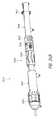
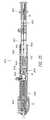
- FIG. 1shows an embodiment of a delivery system.
- FIG. 2Ashows a cross-sectional view of the distal end of the delivery system of FIG. 1 loaded with the valve prosthesis of FIG. 3 .
- FIG. 2Bshows a cross-sectional view of the distal end of the delivery system of FIG. 1 without the valve prosthesis of FIG. 3 .
- FIG. 3shows a side view of an embodiment of a valve prosthesis that may be delivered using the delivery systems described herein.
- FIG. 4shows a perspective view of the distal end of the delivery system of FIG. 1 .
- FIG. 5show components of the delivery system of FIG. 4 with the outer sheath assembly moved proximally and out of view.
- FIG. 6show components of the delivery system of FIG. 5 with the mid shaft assembly moved proximally and out of view.
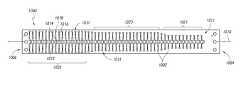
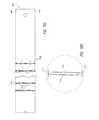
- FIG. 7illustrates a flat pattern of an embodiment of the mid shaft.
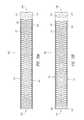
- FIGS. 8A-Billustrate flat patterns of alternate embodiments of the mid shaft.
- FIG. 9shows the pull wire position at the distal end of the delivery system of FIG. 1 .
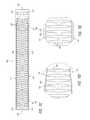
- FIGS. 10A-10Dillustrate flat patterns of the proximal portion of the outer sheath assembly.
- FIGS. 11A-Eillustrate flat patterns of the distal portion of the outer sheath assembly.
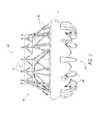
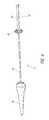
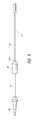
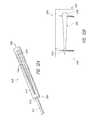
- FIGS. 12A-Billustrate a proximal wire connector for retaining a pull wire in the handle.
- FIG. 13illustrates a schematic representation of a transfemoral delivery approach.
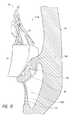
- FIG. 14illustrates bending of a delivery system.
- FIG. 15illustrates a schematic representation of a valve prosthesis positioned within a native mitral valve.
- FIG. 16shows a side view of an alternate embodiment of a valve prosthesis that may be delivered using the delivery systems described herein.
- FIG. 17shows the valve prosthesis frame of FIG. 16 located within a heart.
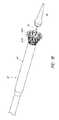
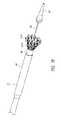
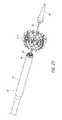
- FIGS. 18-21show steps of a method for delivery of the valve prosthesis of FIG. 16 to an anatomical location.
- FIG. 22shows an alternate embodiment of a delivery system.
- FIG. 23shows a perspective view of the distal end of the delivery system of FIG. 22 .
- FIGS. 24A-Billustrate the handle of the delivery system of FIG. 22 in a distal and proximal position, respectively.
- FIG. 25illustrates a cross-section of the delivery system of FIG. 22 .
- a delivery device or system 10is shown.
- the delivery systemcan be used deploy a prosthesis, such as a replacement heart valve, within the body.
- Replacement heart valvescan be delivered to a patient's heart mitral valve annulus or other heart valve location in various ways, such as by open surgery, minimally-invasive surgery, and percutaneous or transcatheter delivery through the patient's vasculature.
- Example transfemoral approachesmay be found in U.S. Pat. Pub. No. 2015/0238315, filed Feb. 20, 2015, the entirety of which is hereby incorporated by reference in its entirety.
- delivery system 10is described in connection with a percutaneous delivery approach, and more specifically a transfemoral delivery approach, it should be understood that features of delivery system 10 can be applied to other delivery system, including delivery systems for a transapical delivery approach. Further examples of devices, systems and methods are described in U.S. Provisional Application Nos. 62/163,932, filed May 19, 2015, and 62/210,165, filed Aug. 26, 2015 and U.S. application Ser. No. 15/141,684, filed Apr. 26, 2016, the entirety of each of which is incorporated by reference.
- delivery system 10 as described hereincan have components, features, and/or functionality similar to those described with respect to delivery systems, devices and methods described in at least paragraphs [0006]-[0037] and [0078]-[0170] of U.S. Provisional Application No. 62/163,932, filed May 19, 2015, including the description relating to FIGS. 1-40B, and all of these descriptions are expressly incorporated by reference herein.
- delivery system 10 as described hereincan have components, features, and/or functionality similar to those described with respect to the systems, devices and methods described with respect to paragraphs [0171]-[0197] of U.S. Provisional Application No. 62/163,932, filed May 19, 2015, including the description relating to FIGS. A1-A5, B1-B6, C1-C2 and 41A-42B, and U.S. Provisional Application No. 62/210,165, filed Aug. 26, 2015, and all of these descriptions are expressly incorporated by reference herein.
- the delivery system 10can be used to deploy a prosthesis, such as a replacement heart valve as described elsewhere in this specification, within the body.
- the delivery system 10can receive and/or cover portions of the prosthesis such as a first end 301 and second end 303 of the prosthesis 70 illustrated in FIG. 3 below.
- the delivery system 10may be used to deliver an expandable implant or prosthesis 70 , where the prosthesis 70 includes the first end 301 and the second end 303 , and wherein the second 303 end is configured to be deployed or expanded before the first end 301 .
- the delivery system 10can be relatively flexible. In some embodiments, the delivery system 10 is particularly suitable for delivering a replacement heart valve to a mitral valve location through a transseptal approach (e.g., between the right atrium and left atrium via a transseptal puncture).
- a transseptal approache.g., between the right atrium and left atrium via a transseptal puncture.
- the delivery system 10can include an elongate shaft assembly 12 comprising a proximal end 11 and a distal end 13 , wherein a handle 14 is coupled to the proximal end of the assembly 12 .
- the elongate shaft assembly 12can be used to hold the prosthesis for advancement of the same through the vasculature to a treatment location.
- the delivery system 10can further comprise a relatively rigid live-on sheath 51 surrounding the elongate shaft assembly 12 that can prevent unwanted motion of the elongate shaft assembly 12 .
- the elongate shaft assembly 12can include an implant retention area 16 (shown in FIGS. 2A-B with FIG. 2A showing the prosthesis 70 and FIG.
- the elongate shaft assembly 12can hold an expandable prosthesis in a compressed state at implant retention area 16 for advancement of the prosthesis within the body. The elongate shaft assembly 12 may then be used to allow controlled expansion of the prosthesis at the treatment location.
- the implant retention area 16is shown in FIGS. 2A-B at the distal end of the delivery system, but may also be at other locations.
- the prosthesis 70may be rotated in the implant retention area 16 , such as through the rotation of the inner assembly 18 discussed herein.
- the elongate shaft assembly 12can include one or more subassemblies such as an inner assembly 18 , a mid shaft assembly 20 , an outer sheath assembly 22 , and nose cone assembly 31 as will be described in more detail below.
- the outer sheath assembly 22can form an radially outer covering, or sheath, to surround an implant retention area 16 .
- the mid shaft assembly 20can be composed of a mid shaft 50 with its distal end attached to outer retention member or outer retention ring 40 .
- the inner assembly 18can be composed of an inner retention shaft 42 and an inner retention member 32 .
- the most radially-inward assemblyis the nose cone assembly 31 which includes the nose cone shaft 30 having its distal end connected to the nose cone 28 .
- the elongate shaft assembly 12and more specifically the nose cone assembly 31 , inner assembly 18 , mid shaft assembly 20 , and outer sheath assembly 22 , can be configured to deliver a prosthesis 70 positioned within the implant retention area 16 (shown in FIG. 2A ) to a treatment location.
- One or more of the subassembliescan then be moved to allow the prosthesis 70 to be released at the treatment location.
- one or more of the subassembliesmay be movable with respect to one or more of the other subassemblies.
- the handle 14can include various control mechanisms that can be used to control the movement of the various subassemblies as will also be described in more detail below. In this way, the prosthesis 70 can be controllably loaded onto the delivery system 10 and then later deployed within the body.
- FIG. 2Afurther shows an example of the prosthesis 70 that can be inserted into the delivery system 10 , specifically into the implant retention area 16 .
- the prosthesisis shown with only the bare metal frame illustrated.
- the implant or prosthesis 70can take any number of different forms. A particular example of frame for a prosthesis is shown in FIG. 3 , though it will be understood that other designs can also be used.
- the prosthesis 70can include one or more sets of anchors, such as distal (or ventricular) anchors 80 extending proximally when the prosthesis frame is in an expanded configuration and proximal (or atrial) anchors 82 extending distally when the prosthesis frame is in an expanded configuration.
- the prosthesiscan further include struts 72 which may end in mushroom-shaped tabs 74 at the first end 301 as well as a flap 81 surrounding the frame near the second end 303 . Further discussion on the annular flap 81 can be found in U.S. application Ser. No. 14/716,507, filed May 19, 2015, hereby incorporated by reference in its entirety.
- the inner retention member 32 , the outer retention ring 40 and the outer sheath assembly 22can cooperate to hold the prosthesis 70 in a compacted configuration.
- the inner retention member 32is shown engaging struts 72 at the proximal end of the prosthesis 70 .
- slots located between radially extending teeth on the inner retention member 32can receive and engage the struts 72 which may end in mushroom-shaped tabs 74 on the proximal end of the prosthesis 70 .
- the outer retention ring 40can be positioned over the inner retention member 32 so that the first end 301 of the prosthesis 70 is trapped therebetween, securely attaching it to the delivery system 10 .
- the distal anchors 80can be located in a delivered configuration where the distal anchors 80 point generally distally (as illustrated, axially away from the main body of the prosthesis frame and away from the handle of the delivery system).
- the distal anchors 80can be restrained in this delivered configuration by the outer sheath assembly 22 . Accordingly, when the outer sheath 22 is withdrawn proximally, the distal anchors 80 can flip positions to a deployed configuration (e.g., pointing generally proximally).
- FIG. 2Aalso shows the proximal anchors 82 extending distally in their delivered configuration within the outer sheath assembly 22 and within the outer retention ring 40 . In other embodiments, the distal anchors 80 can be held to point generally proximally in the delivered configuration and compressed against the body of the prosthesis frame.
- the delivery system 10may be provided to users with a prosthesis 70 preinstalled.
- the prosthesis 70can be loaded onto the delivery system shortly before use, such as by a physician or nurse.
- FIG. 4-6illustrate further views of delivery system 10 with different assemblies translated proximally and described in detail.
- FIG. 4shows an outer sheath assembly 22 in its distal most position relative to nose cone 28 .
- a live-on sheath 51can be used to cover the outer sheath assembly 22 and provide structural support during bending, though its use is optional.
- the outer sheath assembly 22is disposed so as to be slidable over the inner assembly 18 , the mid shaft assembly 20 , and the nose cone assembly 31 .
- the outer sheath assembly 22can be a single piece tube or multiple pieces connected together to provide different characteristics along different sections of the tube.
- the illustrated outer sheath assembly 22has a first segment 56 , a second segment 58 , and a third segment 60 , where the first segment 56 is proximal to the second segment 58 , and the second segment 58 is proximal to the third segment 60 .
- the third segment 60 of the outer sheathis shown in contact with the proximal end of the nose cone 28 .
- a prosthesis 70can be held within the outer shaft assembly 22 for advancement of the same through the vasculature to a treatment location.
- the first segment 56may be a tube and is preferably formed plastic, but could also be a metal hypotube or other material. A further discussion of the first segment 56 is below with respect to FIGS. 10A-10D .
- the second segment 58can be a metal hypotube which in some embodiments may be cut or have slots.
- the tube 58can be covered or encapsulated with a layer of ePTFE, PTFE, or other material so that the outer surface of the outer sheath assembly is generally smooth.
- the covered second segment 58is shown in FIG. 4 .
- the third segment 60can be a tube formed of a plastic or metal material.
- the third segmentis formed of ePTFE or PTFE.
- this sheathing materialcan be relatively thick to prevent tearing and to help maintain a self-expanding implant in a compacted configuration.
- the material of the third segment 60is the same material as the coating on the cut hypotube 1058 .
- the full construction of the second segment 58 and third segment 60are discussed in detail below with respect to FIGS. 11A-E .
- the third segment 60can include one or more wings or tabs 63 , shown in FIG. 4 , extending distally from a distal end of the third segment 60 .
- the tabs 63can be configured to bend, curve, or fold radially outward from the third segment 60 .
- the one or more tabs 63can facilitate loading of a replacement valve within the third segment 60 when the replacement valve is initially loaded into the delivery system 10 .
- the one or more tabs 63can be removed prior to use within a patient, such as shown in FIG. 10 of U.S. Provisional App. No. 62/210,165 filed Aug. 26, 2015.
- the one or more tabs 63can be formed by cutting the third segment 60 via methods including, but not limited to, laser cutting.
- FIG. 5illustrates the system 10 with the outer sheath assembly 22 removed (e.g., by pulling the outer sheath assembly 22 proximally), thus partially exposing the mid shaft assembly 20 including a portion of or all of a prosthesis (not shown) in the implant retention area 16 .
- the mid shaft assembly 20can be a single piece tube or multiple pieces connected together to provide different characteristics along different sections of the tube.
- the illustrated mid shaft assembly 20has a first segment 53 , a second segment or mid shaft 50 distal to the first segment, and a third segment 40 distal the mid-shaft 50 being the outer retention ring 40 .
- the first segmentcan extend distally away from the handle and be connected to the second segment or mid shaft 50 at the distal end of the first segment.
- the distal end of the second segment 50can attach to the outer retention ring 40 (e.g., third segment).
- Each of the segmentscan be a tube, for example a metal or polymer tube, such as described with respect to the outer sheath assembly 22 . Further discussion of the mid shaft 50 construction can be found below with respect to FIGS. 7-8 .
- the mid shaft assembly 20can translate or slide over the inner assembly 18 , which thereby causes the outer retention ring 40 to slide over the inner assembly 18 and encircle the inner retention member 32 described below.
- the outer retention ring 40encircles a portion of the prosthesis 70 , in particular the proximal portion, thus preventing the prosthesis 70 from expanding.
- the outer retention ring 40can also circumferentially surround the inner retention member 32 .
- the mid shaft assembly 20can be translated proximally with respect to the inner assembly 18 into the proximally-retracted outer sheath assembly 22 , thus exposing a proximal portion of the prosthesis 70 held within the outer retention ring 40 .
- a taper 61may be provided at the proximal end of the outer retention ring 40 to allow it to more easily slide into the outer sheath assembly 22 . In this way the outer retention ring 40 can be used to help secure a prosthesis to or release it from the delivery system 10 .
- the outer retention ring 40can have a cylindrical or elongate tubular shape.
- the outer retention ring 40can cover a substantial length of the prosthesis 70 .
- the outer retention ring 40can cover over 1 ⁇ 8, 1 ⁇ 4, 1 ⁇ 3, or 1 ⁇ 2 of the prosthesis 70 .
- the outer retention ring 40can cover a substantial length of the atrial anchors 82 .
- the outer retention ring 40can cover over 75%, over 80%, over 85%, or over 90% of the atrial anchors 82 .
- the outer retention ring 40can be about 15, 17, 17, 18, 19, or 20 mm in length or a range between those lengths. In some embodiments, the outer retention ring 40 can be between about 10 and about 30 mm in length.
- FIG. 6shows approximately the same view as FIG. 5 , but with the mid shaft assembly 20 , including the outer retention ring 40 and mid shaft 50 , removed, thereby partially exposing the inner assembly 18 (including the inner retention member 32 attached to inner retention shaft 42 ) and nose cone assembly 31 (including the nose cone shaft 30 attached to the nose cone 28 ).
- the inner assembly 18can be composed of the inner retention shaft 42 with the inner retention member 32 attached to the distal end of the inner retention shaft 42 .
- the inner retention shaft 42can comprise a tube, such as a hypodermic tube or hypotube (not shown).
- the tubecan be made from one of any number of different materials including nitinol, stainless steel, and medical grade plastics.
- the tubecan be a single piece tube or multiple pieces connected together. Using a tube made of multiple pieces can allow the tube to provide different characteristics along different sections of the tube, such as rigidity and flexibility.
- a first segment (now shown) of the inner assembly 18can be made of a hypotube can extend along a majority of the length of the inner assembly 18 .
- metal hypotubeextends from within the handle 16 at the proximal end towards the distal end up until a second segment (or inner retention shaft) 42 of the inner assembly 18 before the implant retention area 16 .
- the hypotubecan provide column strength (pushability) to the inner assembly.
- the handle 16can allow for rotation of the second segment 42 , which can allow for rotation of the prosthesis 70 .
- a second segment 42 of the inner assembly 18can be made of a more flexible material.
- the second segment 42can comprise a wire such as a multi-stranded wire, wire rope, or wire coil.
- the wirecan surround a more flexible tube, such as a plastic tube, or it may be formed as a tube without any additional inner materials or core.
- the wirecan be a hollow core wire rope.
- the wirecan provide the inner assembly 18 with strength, but it can also provide more flexibility to allow for navigating the curvosities of the vasculature, such as within the heart.
- the inner assembly 18can also include a prosthesis retention mechanism such as an inner retention member 32 at a distal end of the second segment 42 that can be used to engage with the prosthesis, as discussed with respect to FIG. 2A .
- the inner retention member 32may be a ring and can include a plurality of slots configured to engage with struts 72 on the prosthesis 70 .
- the inner retention member 32can also be considered to be part of the implant retention area 16 , and may be at the proximal end of the implant retention area 16 .
- an outer retention membersuch as outer retention ring 40 can cover both the prosthesis and the inner retention member 32 to secure the prosthesis on the delivery system 10 .
- the nose cone assembly 31may be an elongate member, and in some embodiments, may have a nose cone 28 on its distal end.
- the nose cone 28can be made of polyurethane for atraumatic entry and to minimize injury to venous vasculature.
- the nose cone 28can also be radiopaque to provide for visibility under fluoroscopy.
- the nose cone shaft 30may include a lumen sized and configured to slidably accommodate a guidewire so that the delivery system 10 can be advanced over the guidewire through the vasculature.
- the nose cone shaft 30may be connected from the nose cone 28 to the handle, or may be formed of different segments such as the other assemblies. Further, the nose cone shaft 30 can be formed of different materials, such as plastic or metal, similar to those described in detail above.
- This viewalso illustrates that the nose cone shaft 36 can be slidably disposed within the inner assembly 18 , thus allowing the nose cone shaft 28 (and thus nose cone 28 ) and the inner retention member 32 to move separately from one another during deployment and use.
- the inner retention member 32 and outer retention ring 40 and the delivery system 10generally may be similar to those disclosed in U.S. Pat. Nos. 8,414,644 and 8,652,203, the entire contents of both of which are hereby incorporated by reference herein and made a part of this specification. This is inclusive of the entire disclosure, including other apparatuses and methods described therein, and is not in any way limited to the disclosure of the inner and outer retentions and/or the delivery system.
- embodiments of the system 10can be configured to be flexible when located in a patient and can allow for steering of the system 10 in a particular direction as desired by a user.
- embodiments of the system 10can provide for controlled steerability to allow a user to better navigate and turn the distal end of the system 10 from the septum between the left and right atrial and into the native mitral valve annulus.
- no guidewireis required to steer the system 10 .
- FIG. 5illustrates an embodiment of the second segment (e.g., mid shaft) 50 of the mid shaft assembly 20 .
- the mid shaft 50can be formed from a tube that comprises a series of discrete slots 402 that can be located along the length of the mid shaft 50 .
- the slots 402can be oriented substantially perpendicular to a longitudinal axis of the mid shaft 50 , with each slot having a proximal side, a distal side, and two circumferentially spaced apart opposite ends.
- the slots 402 in the mid shaft 50rotate partially circumferentially around the mid shaft 50 .
- the slots 402can form a gap configured to close upon application of a force which, in this particular slot configuration allows the mid shaft 50 to steer as guided by the configuration of the slots 402 , such as described below. By varying the characteristics of the slots 402 , different bending characteristics of the mid shaft 50 can occur.
- FIG. 7shows a flat pattern 900 of the mid shaft 50 shown in FIG. 5 , where the flat pattern illustrates how the tube forming the mid shaft 50 is cut if the tube were to be longitudinally cut along its length to form slots 902 and laid flat.
- the tube formed from the flat pattern 900can be formed by seamless drawn tubing where slots are laser cut into the tube.
- a spine 931can be formed along its length between the ends of each slots 902 .
- the mid shaft 50may be made of a laser cut metal tube, where the tube has a flat pattern 900 as illustrated in FIG. 7 .
- the flat pattern 900can have a series of slots 902 , in some embodiments greater than 40 slots 902 , along its length from the proximal end 904 to the distal end 906 .
- the slots 902may be discrete slots, each spaced apart longitudinally from each other. While FIG. 7 shows slots 902 that are approximately equally spaced longitudinally from each other, other embodiments may include slots that have varying spacing there between. Slots 902 may be provided along substantially the entire length of the tube as illustrated, or may be provided only in portions along the length of the tube.
- the flat pattern 900can be considered to include a center line 908 extending longitudinally from the proximal end to the distal end, with the slots 902 oriented perpendicular or substantially perpendicular to the center line.
- the slots 902may be oriented perpendicular or substantially perpendicular to a longitudinal axis of the mid shaft 50 , and may extend or rotate circumferentially around the mid shaft 50 .
- Slots 902can rotate circumferentially around the flat pattern 900 in the tubular form almost the entirety of the mid shaft 50 , for example over 80, 100, 120, 170, 180, 200, 220, 280, 300, 320, or 340 degrees circumferentially, leaving a small gap between lateral ends of each slot.
- proximal slots 921may have the same circumferential position over a portion of the length of the tube (here the proximal slot section). As illustrated, there are 16 proximal slots 921 which may be identical to each other, each having a center portion located on the center line 908 and extending transversely from the center line 908 in a symmetrical pattern about the center line 908 (e.g., parallel to the longitudinal axis of the mid shaft 50 ).
- proximal slots 921Distal to the proximal slots 921 are a plurality of transition slots 923 similar in shape to the proximal slots 921 , but having center portions that gradually move transversely further away from the center line 908 so that the transition slots 923 are angled relative to the center line 908 . As illustrated, there may be 5 such transition slots 923 . Whereas the proximal slots 921 are oriented perpendicular or substantially perpendicular to the longitudinal axis of the shaft 50 , the transition slots 923 are slightly angled relative to proximal slots 921 .
- Distal to the transition slots 923are a plurality of distal slots 925 in a distal slot section, for example 21 distal slots 925 , which may have the same circumferential position over a proximal portion of the tube.
- the distal slots 925may be identical to each other.
- the distal slots 925may also be identical to the proximal slots 921 .
- the distal slots 925may each have a center portion that is circumferentially offset from the center portions of the proximal slots 921 , and may continue longitudinally along the length of the tube from the proximalmost transition slot.
- the distal slots 925may be oriented perpendicular or substantially perpendicular to the longitudinal axis of the shaft 50 and the center line 908 .
- the slots 902can be located at different circumferential positions along the length of the flat pattern 900 .
- the center portions of the distal slots 925 and the center portions of the proximal slots 921can be about 0-180° apart, preferably from about 45° to about 90°.
- Other circumferential changessuch as, for example, 10, 20, 30, 40, 45, 50, 60, 70, 80, or 90° could be used as well.
- a majority of the slots 902can be the proximal slots 921 and the distal slots 925 , with only a small number of transition slots 923 between the two locations.
- approximately half or more of the slots 902can be proximal slots, though in other embodiments the number of slots 902 in these positions can change.
- the spine 931will rotate along a circumference of the tube as well.
- the spine 932will extend linearly along the proximal slots 921 , turn at an angle to follow the transition slots 923 , and again extend linearly along the distal slots 925 .
- the slots 902themselves can be generally identical throughout the length of the mid shaft 50 , though there may be some minor variations. This can allow the proximal end 904 to generally always be activated (e.g., at least some slight bending) during application of a force at the distal end 906 .
- Each individual slot 902 as illustrated in FIG. 7has a width (as measured circumferentially or transverse to the longitudinal axis of the mid shaft 50 ) which is much greater than its length (as measured along the longitudinal axis of the mid shaft 50 ).
- Each slot 902forms three teeth which extend toward the distal end 906 of the mid shaft 50 , with a larger tooth 916 located in the center of the slot 902 and two smaller teeth 918 symmetrically located on opposite sides of the larger tooth 916 extending at a slight angle away from the center line 908 .
- the slot 902forms a center gap 919 and two side gaps 914 that the teeth move distally into when the mid shaft 50 is longitudinally compressed.
- gaps 920 and circumferentially outward from the smaller side teethare triangular shaped gaps 912 .
- each slotthere is a W-shaped slot 910 which defines in part end gaps 922 having a greater length than the small end of the triangular slots 912 .
- the ends of the slots 902may be considered to be T-shaped, which can distribute strain evenly on the edge of the slots 902 and allow the mid shaft 50 to return to its original position after bending. All portions of each slot 902 can be connected as a single slot, or can be broken into a number of different pieces.
- the slot patterns described hereinadvantageously provide for a desired deformation of the slots 902 and therefore the mid shaft 50 as a force is applied to the mid shaft 50 .
- a proximal force applied to a distal end of the mid shaft 50will bend or steer the mid shaft 50 in a direction aligned with the slots 902 , thereby closing the slots and bending the mid shaft 50 in the direction of the closure.
- the mid shaft 50can bend in more than one dimension to follow the closure of the slots 902 , allowing 3-dimensional bending (and thus 3-dimensional steering) in part due to the transition slots 923 .
- the bending in the proximal and distal sectionscan occur simultaneously or in a two-part manner, depending on the size of the slots 902 and/or the strength of the force applied to the mid shaft 50 .
- the proximal section having proximal slots 921will experience the bending first, following by the transition section having transition slots 923 , followed by the distal section having distal slots 925 .
- the above referenced live-on sheath 51can at least partially surround the proximal section and can stiffen the proximal section during delivery.
- the live-on sheathmay at least partially cover the proximal section, providing an outer wall barrier to prevent bending of the proximal section and proximal slots 921 , because it can be advantageous for the distal section and distal slots 925 to provide more guiding during implantation than the proximal slots 921 .
- the further the distance from the distal end 906the greater the moment generated by each pound of pull, causing the proximal end 904 to bend first, followed by the distal end 906 .
- a usercan better control the articulation of the mid shaft 50 .
- it is advantageous for the proximal slots 921 to be activated by the least forcebecause it can then always be activated during bending, thus providing stability for fine tuning the distal section 925 and providing torque to the entire delivery system 10 for additional positioning.
- FIGS. 8A-Bshow alternate embodiments of a flat pattern 1000 for mid shaft 50 .
- the series of slots 1002can extend generally linearly over the entire length of the mid shaft 50 , extending from the proximal end 1004 to the distal end 1006 , where the centers of the slots 1002 remain parallel to the longitudinal axis.
- a spine 1031can be formed along its length between the ends of each slots 1002 .
- the flat pattern 1000 of FIGS. 8A-8Bwill generally have a single plane of motion, which will be generally aligned with the center 1010 of the slots 1002 .
- FIGS. 8A-Bshows slots 1002 that are approximately equally spaced longitudinally from each other, other embodiments may include slots that have varying spacing there between. Slots 1002 may be provided along substantially the entire length of the tube as illustrated, or may be provided only in portions along the length of the tube.
- the flat pattern 1000can be considered to include a center line 1010 extending longitudinally from the proximal end 1004 to the distal end 1006 , with the slots 1002 oriented perpendicular or substantially perpendicular to the center line.
- the slots 1002may be oriented perpendicular or substantially perpendicular to a longitudinal axis of the mid shaft 50 , and may extend or rotate circumferentially around the mid shaft 50 .
- the slotscan change in dimensions from the proximal end 1004 to the distal end 1006 .
- Thiscan allow for different articulation of the mid shaft 50 at different portions, creating a staged effect so that different sections of the mid shaft 50 bend at different times.
- the further the distance from the distal end 1006the greater the moment generated by each pound of pull, causing the proximal end 1004 to bend first, followed by the distal end 1006 .
- a usercan better control the articulation of the mid shaft 50 .
- proximal slot section or proximal slots 1021may be smaller over a portion of the length of the tube.
- proximal slot section or proximal slots 1021there are 16 proximal slots 1021 which may be identical to each other, each having a center portion located on the center line 1010 and extending transversely from the center line 1010 in a symmetrical pattern about the center line 1010 .
- proximal slots 1021Distal to the proximal slots 1021 are a plurality of middle slots 1023 (or a middle slot section) having a larger width than the proximal slots 1021 but remaining centered on center line 1010 . As illustrated, there may be 21 such middle slots 1023 .
- Distal to the middle slots 1023are a plurality of distal slots 1025 (or a distal slot section), for example 18 distal slots 1025 , which have a greater width than the middle slots 1023 and proximal slots 1021 .
- the distal slots 1025may be identical to each other.
- the distal slots 1025may each be centered on center line 1010 , and may continue longitudinally along the length of the tube from the distalmost middle slot 1023 .
- FIG. 8Bhas a similar configuration to FIG. 8A , but there are transition sections between the proximal slot section and the middle slot section, and between the middle slot section and the distal slot section. In these transition sections, there are slots that gradually increase in width from the more proximal slot section to the more distal slot section.
- the spine 1031will thus extend linearly parallel to center line 1010 but will increase in width from the proximal slots 1021 to the middle slots 1023 and further increase in width from the middle slots 1023 to the distal slots 1025 .
- the decrease in slot width from the distal end 1006 to the proximal end 1004can allow the mid shaft 50 to bend at the distal end 1006 prior to the proximal end 1004 .
- the higher the momente.g., force ⁇ distance from the force
- the forceis located at the distal end 1006 , and thus the highest moment will be experienced at the proximal end 1004 as it is the farthest distance from the force.
- distal slots 1025be larger than the proximal slots 1021 , and thus the spine 1031 around the distal slots 1025 is smaller than around the proximal slots 1021 , the distal end 1006 will bend first as there is significantly less material to bend and thus a lower moment is needed to bend, even though the distance from the force is the smallest.
- having the transition slots 1023 with a width between the width of the distal slots 1025 and the width of the proximal slots 1021thus creating a generally gradual change in width, can provide stress relief that would otherwise concentrate near the proximal end 1004 .
- the slots 1002themselves can be generally identical in shape throughout the length of the mid shaft 50 , though the dimensions (e.g., width) of the slots 1002 can vary.
- Each individual slot 1002 as illustrated in FIGS. 8A-Bhas a width (as measured circumferentially or transverse to the longitudinal axis of the mid shaft 50 ) which is much greater than its length.
- Each slot 1002forms a single tooth 1016 which extend toward the proximal end 1004 of the mid shaft 50 and is located generally centered on longitudinal center line 1010 . Proximal to the tooth 1016 , the slot 1002 forms a center gap 1018 the tooth 1016 can move proximally into when the mid shaft 50 is longitudinally compressed.
- each slotthere is a circular slot 1014 which defines in part end gaps having a greater length than the small end of a triangular slot 1012 located between the circular slot 1014 and the center gap 1018 . All portions of each slot 1002 can be connected as a single slot, or can be broken into a number of different pieces.
- the flat pattern 1000 shown in FIGS. 8A-Bcan also allow for an organic compound bend. While the embodiment shown in FIGS. 8A-B generally only bends on a single plane, the mid shaft 50 can be configured to provide for slight bending outside of the plane, which can be used to properly place the implant 70 in a patient. Specifically, as the mid shaft 50 steers in the direction by a user, there can be a bending outside of the two dimensional plane. For example, there is space on the circumferential sides of the tooth 1016 for the tooth 1016 to move laterally, which gives some lateral flexibility (e.g., outside of the single plane of motion) when the mid shaft 50 impacts a portion of a patient's anatomy.
- the flat pattern 1000can allow for a more forgiving pattern which can conform to the particular anatomy of a patient while the flat pattern 900 of FIG. 7 is more repeatable and provides for greater control as it does not conform to the anatomy.
- a pull wire 612(such as a 0.018 inch diameter pull wire) can be used to connect the outer retention ring 40 to the handle 14 .
- the handle 14can have a steering knob/actuator 610 (shown in FIG. 1 ) in order to apply a force and control the bending of the mid shaft 50 .
- the pull wire 612can be connected to the nose cone 28 , thereby providing a steering point more distal than the outer retention ring 40 .
- the steering knob 610can compensate for foreshortening of the delivery system 10 during bending. As the different components of the delivery system 10 bend (for example, the mid shaft bending to close slots 402 or the hypotube 150 of the outer sheath assembly 22 bending to close slots 152 described below), the mid shaft 50 and the outer sheath assembly 22 will reduce in length due to the closure of the slots, which could cause accidental release of prosthesis 70 .
- the steering knob 610can be configured to move the outer sheath assembly 22 distally during activation of the steering knob 610 , while simultaneously pulling on the pull wire 612 . This can prevent unwanted relative motion of the components of the delivery system 10 or unbalanced forces, in particular unwanted release of the prosthesis 70 .
- the steering knob 610 in the handle 14can be connected to a pull wire 612 generally at the proximal end of the system 10 .
- the pull wire 612can extend through the lumen of the mid shaft 50 and on the outside of the inner assembly 18 .
- the pull wire 612can connect to the outer retention ring connecter 614 which connects the distal portion of the mid shaft 50 to the outer retention ring 40 .
- the outer retention ring connecter 614can act as a weld spot for the pull wire 612 through, for example, a groove in the outer retention ring connector 614 .
- the outer retention ring connector 614can be connected to the mid shaft 50 by a series of rivets, though the attachment mechanism is not limiting.
- the pull wire 612can be connected to the handle 14 through a proximal wire connector 1200 shown in FIGS. 12A-12B having a proximal end 1202 and a distal end 1204 .
- the proximal wire connector 1200has a generally tubular shape which can be located/attached within a housing of the handle 14 .
- the proximal wire connector 1200can have a length of about 0.50 inches.
- the pull wire 612can extend through an aperture 1212 forming a longitudinal lumen along a length of the proximal wire connector 1200 at a distal end 1204 .
- pull wire 612can attach within the longitudinal lumen radially inward from a generally tear-drop shaped groove 1206 having a larger end 1208 nearest the proximal end 1202 and a smaller end 1210 near the distal end 1204 .
- the groove 1206can extend through a radius of the proximal wire connector 1200 to meet with the longitudinal lumen.
- the larger end 1208can have a radius of curvature of about 0.250 inches and the smaller end 1210 can have a radius of curvature of about 0.0050 inches.
- the pull wire 612can then be welded in place in the longitudinal lumen radially inward from the larger end 1208 .
- the tear-drop shaped groove 1206is advantageous as the amount of heat the pull wire 612 is exposed to during welding decreases from the proximal end 1202 to the distal end 1204 as more mass is present neared the distal end 1204 .
- the weldcan be more consistent and less prone to issues caused by any heat-affected-zone during welding.
- the tear-shaped groove 1206allows for about 5% loss or less.
- a usercan thus manipulate the steering knob 610 to provide or relax a proximal force on the pull wire 612 .
- the proximal wire connector 1200can be placed in a channel in handle 14 that narrows at one point distal to the proximal wire connector 1200 .
- the channelcan be pulled proximally by the steering knob 610 and once the proximal wire connector 1200 abuts the narrowed portion of the channel on its distal end, the proximal wire connector 1200 (and thus the pull wire 612 ) will be pulled proximally along with the channel, creating a proximal force on the pull wire 612 .
- the mid shaft 50will bend in the direction of the slot openings.
- the slot pattern on the mid shaft 50will cause the mid shaft 50 to bend along the direction of the slots 402 with the enactment of the pull wire 612 force.
- the mid shaft 50can bend in at least two directions, thus giving the device 10 3-dimensional steerability.
- the disclosed methodis advantageous as the pull wire 612 will not be put under compression, which could lead to kinking.
- the mid shaft 50can translate back (e.g., “spring back”) to its original position. This can occur at least partially due to the material (e.g., nitinol) and partially due to the construction of the ends of slots 902 , which are generally T-shaped. This can be advantageous because, as discussed below, the pull wire 612 will not be compressed, thus avoiding kinks. In some embodiments, the mid shaft 50 will remain in the bent configuration even upon removal of the force. In some alternate embodiments, a second pull wire can be used, located in a different portion of the mid shaft 50 .
- the second pull wirecan located 90° or 180° from the pull wire 612 , thus allowing for two-way steering of the mid shaft 50 .
- a usercan operate both pull wires independently, or they can operate in tandem with one another to produce the desired bend in the mid shaft 50 .
- the outer sheath assembly 22can be composed of a number of different parts, namely a first segment 56 a second segment 58 , and a third segment 60 . These different segments can have different features, builds, or constructions allowing for the segments to have properties advantageous to that particular section.
- first segment 56which can be in the tube of a form having a lumen throughout its length.
- FIGS. 10A-10Dillustrate the first segment 56 in an unrolled configuration, or a flat pattern for the tube.
- This segment 56can be formed from laser cut stainless steel, though the particular material or method of cutting is not limiting.
- the first segmentcan be formed from a series of transverse and longitudinal slot pairs 710 , which are designed to transmit torque (e.g., rotating the delivery system 10 clockwise/counter-clockwise) while being flexible.
- the delivery system 10can be rotated anywhere between 0 to 180° to reposition the prosthesis 70 .
- Each slot of the slot pairs 710can be composed of a shorter longitudinal slot 712 and a longer circumferential slot 714 with its end connected approximately at the middle of the longitudinal slot 712 .
- the circumferential slot 714can be slightly on angle from the longitudinal slot 712 and thus not perpendicular to the longitudinal axis.
- each of the slot pairs 710can form a generally T-shaped pattern.
- the slot patternscan be formed with circumferential slots 714 of each slot pair generally overlapping one another circumferentially and spaced apart in the longitudinal direction.
- the longitudinal slots 712 of the pair 710can then be located on circumferentially opposite sides of circumferential slots 714 so that they can each longitudinally overlap both of the longitudinal slots 712 .
- These slot pairs 710can then be repeated around the circumference of the first segment 56 to form slot rings 716 .
- the pairs 710can be spaced apart on the slot rings 714 to provide for tensile strength.
- the longitudinal slots 712can have a length of about 0.5, 0.6, 0.61, 0.7, or 0.8 inches, though the particular length is not limiting. Further, the longitudinal slots 712 can have a width of about 0.0005, 0.001, 0.0015, or 0.0002 inches. Longitudinal slots 712 of the slot pairs 712 can be spaced about 0.302 inches apart.
- FIG. 10Ahas a proximal end 702 that is generally flat
- FIG. 10Cshows a proximal end 702 which has a pair of notches 704 which can help align the part with the handle 14 , for example providing an audible or tactile “click” when installed properly.
- embodiments of the disclosed slot configurationcan maintain strength and torque-transmission of, for example, stainless steel, while providing new flexibility.
- the configurationcan handle compression, tension, and torque transmission with nearly 1:1 with no stretching.
- a knob on the handle 14can translate the outer sheath assembly 22 wherein every inch of turning of the knob results in an inch of translation of the outer sheath assembly 22 , hence the 1:1 ratio.
- Thisis advantageous over other types of shafts, such as those formed of PEBAX, which would act like a rubber band where a user would see no response for an inch of travel of the knob as the PEBAX would stretch the whole time, and a user would be unsure when the translation would reach the distal end.
- embodiments of the disclosed outer sheath assembly 22can have minimal stretching. For example, if a 40 lb weight were attached to the outer sheath assembly, it would only stretch about 0.1 inches over an approximate 40 inches of length. Other types of sheathes, again such as PEBAX, would stretch up to 1.5 inches with the same application of force.
- the outer sheath assembly 22can include a third segment 60 and a second segment 58 , the second segment 58 being proximal to the third segment 60 .
- the third segment 60may be larger in inner diameter and outer diameter than the second segment 58 , and may be sized in length and inner diameter to receive a prosthesis 70 as described herein in a collapsed configuration. These two segments can each have a different diameter, thereby forming a stepped configuration.
- the second segment 58is still generally positioned at a distal portion of the delivery system 10 while the delivery system 10 is being used to deliver the replacement valve towards the in situ implantation site.
- the outer sheath assembly 22may include other segments positioned proximal of the second segment 58 . Such segments may, for example, couple the second segment 58 to a handle of the delivery system 10 .
- the third segment 60can be positioned radially outward from a replacement valve when the delivery system 10 is in an initial, delivery configuration such that the replacement valve is maintained in the delivery system 10 in an undeployed configuration.
- the second segment 58can be formed from a hypotube 150 (such as a nitinol hypotube) as shown in the embodiment in FIGS. 11A-E showing a flat pattern of the hypotube 150 .
- the hypotube 150can have a plurality of spaced slots 152 extending along the length from a distal end 156 to a proximal end 154 of the hypotube 150 .
- a spine 161can be formed along its length between the ends of each slots 152 .
- the slots 152can be generally open and wide towards the middle, thereby allowing ePTFE to pass through the slots so that the first side and second side can be sintered together during manufacturing, thereby fully covering the hypotube 150 in ePTFE.
- the slots 152can be a number, e.g., greater than 40 , generally repeating and identical slots that extend along the length of the hypotube 150 . Slots 152 may be provided along substantially the entire length of the tube as illustrated, or may be provided only in portions along the length of the tube. In some embodiments, as shown in FIG. 11B-C , the hypotube 150 may have a pair of rectangular slots 157 on its proximal and distal ends 156 .
- the rectangular slots 157can differ in size between the two ends or may be the same in size.
- the hypotube 150may only have the rectangular slots 157 on the proximal end 154 , and instead the spaced slots 152 can extend almost to the distalmost end 156 . This configuration is shown in FIG. 11A .
- the slots 152may be formed with a generally H-shaped structure centered on the hypotube 150 .
- the slots 152may have a generally T-shaped ends 153 spaced circumferentially opposite one another on the flat hypotube 150 .
- These T-shaped ends 153can be connected by a circumferential slot 155 extending circumferentially between the two slots.
- the circumferential slot 155can change in height between the two w-shaped slots.
- the circumferential slot 155can have a greater height in the middle than where the circumferential slot 155 connects to the T-shaped ends 153 .
- each of the slots 152may generally have the same dimensions along the length of the hypotube 150 .
- the slots 152may change in width between the proximal end 154 to the distal end 156 .
- the proximal endmay have slots 152 having a smaller width than the slots at the distal end 156 .
- the slots 152can progressively increase in width from the proximal end 154 to the distal end 154 , where the majority of slots are the large width slots.
- the first three slots 152 from the proximal endcan have a shorter width than the slots 152 on the proximal end, with the first three slots 152 increasing in width from the proximalmost slot to the distalmost slot of the first three slots 152 .
- slots and slot configurationscan be used. This progression of slot size can be useful in making strain apply more evenly across the hypotube 150 as a proximal force applied to the distal end 154 tends to apply first to the proximal-most slot. Thus, smaller slots 152 at the proximal end 154 can withstand a greater force as there is more material. Further, the spine 161 will increase in width from the proximal end 154 to the distal end 156 , while remaining generally parallel with the longitudinal axis of the hypotube 150 .
- slotscan be used.
- slotscan be spaced offset from one another to create, for example, a spiral pattern.
- adjacent slotscan be offset by about 90°, thereby forming a repeating pattern along the longitudinal lengths of the hypotube 150 .
- the outer sheath assembly 22can include a lumen running therethrough to allow the sheath assembly 22 to be moveable or slideable relative to components contained therein.
- the walls forming the third segment 60 and/or the walls forming the second segment 58can be formed from one or more materials, such as PTFE, ePTFE, PEBAX, ULTEM, PEEK, urethane, nitinol, stainless steel, and/or any other biocompatible material.
- the third segment 60is formed from one or more materials which allow the third segment 60 to be compliant and flexible while still maintaining a sufficient degree of radial strength to maintain a replacement valve within the third segment 60 without substantial radial deformation which could increase friction between the third segment 60 and a replacement valve contained therein, sufficient column strength to resist buckling of the third segment 60 , and sufficient tear resistance to reduce the likelihood that the replacement valve causes the third segment 60 to tear. Flexibility of the third segment 60 can be advantageous, particularly for a transseptal approach. For example, while being retracted along a curved member, the third segment 60 can follow the curved member without applying significant forces upon the curved member which may cause the curved member to decrease in radius. Rather, the third segment 60 can bend and/or kink as it is being retracted along such a curved member such that the radius of the curved member is maintained.
- the hypotube 150can be optimized for maximum flexibility and minimum strain while providing for structural rigidity.
- the hypotube 150can be formed from stainless still instead of nitinol, which can advantageously incase processing/manufacturing, though other materials can be used as well.
- the hypotube 150can be about 5.5, 6.0, 6.3, 6.5, 7.0, or 7.5 inches in length, the particular dimensions of the hypotube 150 is not limiting.
- the delivery system 10can be used in a method for percutaneous delivery of the replacement mitral valve to treat patients with moderate to severe mitral regurgitation.
- the below methodsare just a few examples of the how the delivery system may be used. It will be understood that the delivery systems described herein can be used as part of other methods as well.
- the delivery system 10can be placed in the ipsilateral femoral vein 1074 and advanced to the right atrium 1076 .
- a transseptal puncture using known techniquescan then be performed to obtain access to the left atrium 1078 .
- the delivery system 10can then be advanced in to the left atrium 1078 and then to the left ventricle 1080 .
- FIG. 13shows the delivery system 10 extending from the ipsilateral femoral vein 1074 to the left atrium 1078 .
- a guide wireis not necessary to position the delivery system 10 in the proper position, although in other embodiments, one or more guide wires may still be used.
- a usercan torque the entire delivery system 10 to further manipulate and control the position of the delivery system 10 .
- a usercan then place the replacement mitral valve in the proper location. This can advantageously allow delivery of a replacement valve to an in situ implantation site, such as a native mitral valve, via a wider variety of approaches, such as a transseptal approach.
- FIG. 14illustrates the bending motion of the outer sheath assembly 22 .
- the mid shaft 50(not shown but within outer sheath assembly 22 ) can be bent through actuation of the steering knob 610 .
- the mid shaft 50As the mid shaft 50 is bent, it will press against an inner surface of the outer sheath assembly 22 , thereby forcing the outer sheath assembly 22 to bend along with the mid shaft 50 .
- an inner surface of the mid shaft 50will press against an outer surface of the inner retention shaft 42 , which will press against the nose cone shaft 30 , thus bending the inner retention shaft 42 and the nose cone shaft 30 along with the mid shaft 50 .
- the distal end of the delivery system 50will bend as shown in FIG. 14 due to the actuation of the mid shaft 50 .
- the outer sheath assembly 22can be substantially bent to conform to the bending of the mid shaft 50 .
- the embodiment shown in FIG. 14can allow for three-dimensional bending of the delivery system 10 .
- the nose cone 28can be angled approximately 90° from a longitudinal axis of the delivery system 10 when in an unbent position.
- FIG. 14shows one particular position, and the delivery system 10 can be bent into other angles as well.
- the delivery system 10can be bent in a manner to align with the anatomy of a heart, thus allowing the delivery system 10 to pass through the transseptal puncture and position the delivery system 10 to deliver a prosthesis 70 into the mitral valve annulus.
- the bending experienced by the delivery system especially between the right atrium 1076 and the mitral valveare relatively complex and are generally not in a single plane, although single plane flexibility can be used. This part of the delivery system may experience bending between 110-180 degrees and typically between 130-160 degrees, of course this is dependent on the actual anatomy of the patient.
- FIG. 15illustrates a schematic representation of an embodiment of a replacement heart valve (prosthesis 70 ) positioned within a native mitral valve of a heart 83 . Further details regarding how the prosthesis 70 may be positioned at the native mitral valve are described in U.S. patent application Ser. No. 14/716,507, filed May 19, 2015, the entirety of which is hereby incorporated by reference, including but not limited to FIGS. 13A-15 and paragraphs [0036]-[0045]. A portion of the native mitral valve is shown schematically and represents typical anatomy, including a left atrium 1078 positioned above an annulus 106 and a left ventricle 1080 positioned below the annulus 106 .
- the portion of the prosthesis 70 disposed upstream of the annulus 106 (toward the left atrium 1078 )can be referred to as being positioned supra-annularly.
- the portion generally within the annulus 106is referred to as positioned intra-annularly.
- the portion downstream of the annulus 106is referred to as being positioned sub-annularly (toward the left ventricle 1080 ).
- the replacement heart valve(e.g., prosthesis 70 ) can be disposed so that the mitral annulus 106 is between the distal anchors 80 and the proximal anchors 82 .
- the prosthesis 70can be positioned such that ends or tips of the distal anchors 80 contact the annulus 106 as shown, for example, in FIG. 15 .
- the prosthesis 10can be positioned such that ends or tips of the distal anchors 80 do not contact the annulus 106 .
- the prosthesis 70can be positioned such that the distal anchors 80 do not extend around the leaflet 108 .
- the prosthesis 70can be at least partially surrounded by an annular flap 81 between the distal anchors 82 and the proximal anchors 82 .
- This flap 81can wrap around the frame of the prosthesis 70 and help position the prosthesis 70 in the desired position in the body.
- the replacement heart valve 70can be positioned so that the ends or tips of the distal anchors 80 are on a ventricular side of the mitral annulus 106 and the ends or tips of the proximal anchors 82 are on an atrial side of the mitral annulus 106 .
- the distal anchors 80can be positioned such that the ends or tips of the distal anchors 80 are on a ventricular side of the native leaflets beyond a location where chordae tendineae 110 connect to free ends of the native leaflets.
- the distal anchors 80may extend between at least some of the chordae tendineae 110 and, in some situations such as those shown in FIG. 15 , can contact or engage a ventricular side of the annulus 106 .
- the distal anchors 80may not contact the annulus 106 , though the distal anchors 80 may still contact the native leaflet 108 . In some situations, the distal anchors 80 can contact tissue of the left ventricle 104 beyond the annulus 106 and/or a ventricular side of the leaflets.
- the distal anchors 80(along with the frame) can be moved toward the ventricular side of the annulus 106 with the distal anchors 80 extending between at least some of the chordae tendineae 110 to provide tension on the chordae tendineae 110 .
- the degree of tension provided on the chordae tendineae 110can differ. For example, little to no tension may be present in the chordae tendineae 110 where the leaflet 108 is shorter than or similar in size to the distal anchors 80 . A greater degree of tension may be present in the chordae tendineae 110 where the leaflet 108 is longer than the distal anchors 80 and, as such, takes on a compacted form and is pulled proximally.
- chordae tendineae 110An even greater degree of tension may be present in the chordae tendineae 110 where the leaflets 108 are even longer relative to the distal anchors 80 .
- the leaflet 108can be sufficiently long such that the distal anchors 80 do not contact the annulus 106 .
- the proximal anchors 82can be positioned such that the ends or tips of the proximal anchors 82 are adjacent the atrial side of the annulus 106 and/or tissue of the left atrium 1078 beyond the annulus 106 . In some situations, some or all of the proximal anchors 82 may only occasionally contact or engage atrial side of the annulus 106 and/or tissue of the left atrium 1078 beyond the annulus 106 . For example, as illustrate in FIG. 15 , the proximal anchors 82 may be spaced from the atrial side of the annulus 106 and/or tissue of the left atrium 1078 beyond the annulus 106 . The proximal anchors 82 could provide axial stability for the prosthesis 10 .
- some or all of the proximal anchors 82may not contact an annular flap 81 . This may occur when the annular flap 81 is in a collapsed configuration although it may also occur when the annular flap 81 is in an expanded configuration. In some situations, some or all of the proximal anchors 82 may contact the annular flap 81 . This may occur when the annular flap 81 is in an expanded configuration although it may also occur when the annular flap 81 is in a collapsed configuration. It is also contemplated that some or all of the proximal anchors 82 may contact the atrial side of the annulus 106 and/or tissue of the left atrium 1078 beyond the annulus 106
- the annular flap 81can be positioned such that a proximal portion of the annular flap 81 is positioned along or adjacent an atrial side of the annulus 106 .
- the proximal portioncan be positioned between the atrial side of the annulus 106 and the proximal anchors 82 .
- the proximal portioncan extend radially outward such that the annular flap 81 is positioned along or adjacent tissue of the left atrium 1078 beyond the annulus 106 .
- the annular flap 81can create a seal over the atrial side of the annulus 106 when the flap 81 is in the expanded state.
- FIG. 16illustrates an alternate embodiment of a valve prosthesis 1010 which can be used in conjunction with the delivery systems disclosed herein.
- the illustrated prosthesis 1010includes a frame 1020 that may be self-expanding or balloon expandable.
- the prosthesis 1010may be a replacement valve that can be designed to replace a damaged or diseased native heart valve such as a mitral valve, as discussed above.
- the additional features of the replacement valveare not shown in FIG. 16 in order to more clearly illustrate features of the frame 1020 .
- the prosthesis 1010is not limited to being a replacement valve.
- FIG. 16that only a front portion of the frame 1020 is shown for further ease of illustration.
- the frame 1020can be made of many different materials, but is preferably made from metal.
- the frame 1020can be made from a shape memory material, such as nitinol.
- a wire frame or a metal tubecan be used to make the frame 1020 .
- the wire frame of a metal tubecan be cut or etched to remove all but the desired metal skeleton.
- a metal tubeis laser cut in a repeating pattern to form the frame 1020 .
- one of the anchors 1022can include an eyelet, which can help manufacturing with alignment.
- the eyeletcan serve as a reference position for frame dimensional measurements as well as alignment. However, the eyelet may not be included in all embodiments.
- the flat patterncan be cut from a metal tube and then the tube can be shaped and/or bent to the expanded shape shown in FIG. 16 .
- the frame 1020is self-expanding so that it naturally assumes the expanded shape or configuration.
- the frame 1020can further be expanded and/or compressed and/or otherwise worked to have the desired shape or shapes, such as for introduction and implantation.
- the framewhen in an expanded configuration, such as in a fully expanded configuration, has a bulbous or slightly bulbous shape, with a middle portion 1033 being larger than the proximal 1032 and distal 1034 ends.
- the inside diameter of the both endscan be the same, or it can be bigger on one end than the other, while still having a middle portion 1033 larger than both the proximal and distal ends 1032 / 1034 .
- the effective diameter of the distal frame end 1034is smaller than the effective diameter of the middle portion 1033 .
- the bulbous shape of the frame 1020can advantageously allow the frame 1020 to engage a native valve annulus or other body cavity, while spacing the inlet and outlet from the heart or vessel wall.
- the frame 1020may not have a bulbous portion, and can have substantially the same outer dimension along its entire length (e.g., cylindrical), or it may have one end larger than the other end.
- the prosthesis 1010 and frame 1020may be similar to the replacement heart valves and associated frames disclosed in U.S. Pat. No. 8,403,983, U.S. Publication Nos. 2010/0298931, 2011/0313515, 2012/0078353, 2014/0277390, 2014/0277422, and 2014/0277427, and U.S. patent application Ser. No. 15/141,684, filed Apr. 26, 2016, the entireties of each of which are hereby incorporated by reference and made a part of this specification. This is inclusive of the entire disclosure and is not in any way limited to the disclosure of the replacement heart valves and associated frames.
- FIG. 16illustrates the frame in an expanded configuration with a number of proximal struts 1012 that extend substantially longitudinally to enlarged proximal ends 1013 .
- a proximal row of circumferentially-expansible struts 1017connects the proximal struts 1012 , having a zig-zag or undulating shape such that between each proximal strut 1012 , the struts 1017 form a V-shape. From the distal ends of each of the V's, vertical struts 1015 extend substantially longitudinally in a distal direction.
- the distal ends of the vertical struts 1015then connect to a row of diamond-shaped cells 1023 formed by a plurality of circumferentially-expansible struts 1014 having a zig-zag or undulating shape.
- the proximalmost row of struts 1014extend distally away from the distal ends of the vertical struts 1015 in a V-shape, thereby forming hexagonal-shaped cells 1021 bounded by the proximal row of struts 1017 , the vertical struts 1015 , and the proximalmost row of struts 1014 .
- FIG. 1The embodiment of FIG.
- 16further comprises a second, distal row of diamond-shaped cells 1023 further defined by additional circumferentially-expansible struts 1014 , wherein the proximalmost corner of the second row of diamond-shaped cells 1023 coincides with the distalmost corner of the hexagonal-shaped cells 1021 and the side corners of the diamond-shaped cells in the first, proximal row.
- the illustrated embodimentincludes one ring, or row of hexagonal or generally hexagonal cells 1021 shown in proximal portion 1016 of the frame 1020 , and two rows of diamond-shaped cells 1023 shown in distal portion 1018 .
- the proximal portion 1016includes the portion of the hexagonal cells 1021 extending proximally from the distal end of vertical struts 1015 and may be considered to be or to include a substantially non-foreshortening portion. Foreshortening refers to the ability of the frame to longitudinally shorten as the frame radially expands.
- the distal portion 1018includes the diamond-shaped cells 1023 extending distally from the distal ends of the vertical struts 1015 and may be considered a foreshortening portion.
- the hexagonal cells 1021can be irregular hexagons.
- the hexagonal cells 1021can be symmetrical about a vertical axis extending from proximal to distal ends of the hexagonal cell 1021 .
- Vertical struts 1015can form opposite sides, while circumferentially-expansible struts 1014 of two adjacent diamond-shaped cells 1023 in the proximalmost row can form a base of the hexagonal cell 1021 ending at a distalmost corner that is distal to the distal ends of the vertical struts 1015 .
- circumferentially-expansible struts 1014can connect to the vertical struts 1015 .
- the proximal row of circumferentially-expansible struts 1017can form the upper sides of the hexagonal cell 1021 that extend to a proximalmost corner of the hexagonal cell 1021 that is proximal to the proximal ends of vertical struts 1015 .
- These circumferentially-expansible struts 1017can connect to the proximal ends of the vertical struts 1015 .
- two of the sides of the hexagonal cells 1021can be one length, while the other four sides of the hexagonal cells 1021 can be a greater length.
- the two sides with the same lengthcan be generally parallel to one another.
- the frame 1020has a proximal portion 1016 and a distal portion 1018 .
- the proximal struts 1012 and the majority of the hexagonal cells 1021are included in the proximal portion 1016
- circumferentially-expansible struts 1014form the distal portion 1018 having a first, proximal row of diamond-shaped cells 1023 and a second, distal row of diamond-shaped cells 1023 .
- adjacent cells between the proximal row and the distal rowmay share common struts.
- the diamond-shaped cells 1023 in the second, distal rowmay have a larger longitudinal height than the diamond-shaped cells 1023 in the first, proximal row.
- the struts 1014become more parallel with respect to the longitudinal axis of the frame, causing an outer diameter of the frame to decrease and the longitudinal length of the frame to increase in the distal portion 1018 .
- the longitudinal length of the framecan decrease due to foreshortening of the diamond-shaped cells 1023 in distal portion 1018 .
- the frame lengthdoes not substantially change length in the proximal portion 1016 due to the vertical struts 1015 , although the proximal row of circumferentially-expansible struts 1017 in the proximal portion 1016 may allow for some foreshortening.
- the frame 1020 shown in FIG. 16can have a relatively squat configuration.
- the ratio of the width of the largest portion of the frame 1020 to the height (e.g., extending from the proximal 1032 to distal end 1034 ) of the frame 1020 when the frame is in its expanded configurationcan be about 3:1, about 2.5:1, about 2.0:1, about 1.5:1, about 4:3, about 1.3:1, about 1.25:1, or about 1.0:1.
- the width at the largest portion of the frame 1020can be greater than the height.
- the frame 1020can have a larger aspect ratio than the prosthesis 70 shown in FIG. 15 .
- the height of portion 1016can be greater than, equal to, or less than the height of portion 1018 .
- the height of proximal portion 1016can be approximately 1 ⁇ 2 the height of distal portion 1018 .
- the frame 1020can have an overall height of about 32 mm (or about 32 mm).
- the frame 1020can have an inner diameter of 40 mm (or about 40 mm).
- the frame 1020can have a height of 29, 30, 31, 33, 34, 35, or 36 mm (or about 29, about 30, about 31, about 33, about 34, about 35, or about 36 mm).
- Foreshortening of the frame 1020can be used to engage and secure the prosthesis to intralumenal tissue in a body cavity, for example tissue at or adjacent a native valve, such as a native valve annulus and/or leaflets.
- Opposing anchors 1022 , 1024can be constructed on the frame 1020 so that portions of the anchors, such as tips or ends 1026 , 1028 , move closer together as the frame foreshortens. As one example, this can allow the anchors 1022 , 1024 to grasp tissue on opposite sides of the native mitral annulus to thereby secure the prosthesis at the mitral valve.
- one set of anchors(such as anchors 1024 ) are secured to or grasp tissue, while the other set of anchors (such as anchors 1022 ) are used to provide stabilization and help align the prosthesis, and may or may not directly engage tissue, as described further below.
- the anchors 1022 , 1024 and anchor tips 1026 , 1028are preferably located along the frame 1020 with at least part of the foreshortening portion positioned between the anchors so that a portion of the anchors will move closer together with expansion of the frame.
- distal anchors 1024are connected to the distal portion 1018 , and may extend from distalmost corners of the diamond-shaped cells 1023 .
- the distal anchors 1024extend distally from distalmost corners of the proximal row of diamond-shaped cells 1023 , such that the second, distal row of diamond-shaped cells 1023 extend longitudinally alongside a portion of the distal anchors.
- each of the anchors 1022 , 1024is positioned or extends generally radially outwardly from the frame 1020 so that the anchor tips 1026 , 1028 are generally spaced away or radially outward from the rest of the frame 1020 and from where the base of the anchors connect to the frame.
- the anchor tipsmay be located radially outward from the middle portion 1033 of the frame, with the tips 1026 and 1028 being axially spaced from one another.
- the middle portion 1033which has the largest cross-sectional dimension when the frame is radially expanded, can be defined by the proximalmost row of diamond-shaped cells 1023 .
- the anchors 1022 , 1024can include a base located on the anchor on a side opposite the tip. The base can be for example where the anchor begins to extend from or away from the frame 1020 .
- Proximal anchors 1022are shown having a single strut extending into the hexagonal cells 1021 of portion 1016 .
- the anchor 1022extends from a proximal intersection of two segments of the hexagonal cell 1021 , for example, from the proximalmost corner of the hexagonal cells 1021 .
- the proximal anchors 1022extend generally distally into the hexagonal cells 1021 while curving outwards away from the frame 1020 .
- the anchor 1022extends radially outwardly from the frame 1020 as it extends generally distally towards the tip 1026 .
- the tips 1026 of the proximal anchors 1022can end after extending approximately half the length or more of the hexagonal cells 1021 . Further, the tips 1026 can extend farther outwards than the main body of the frame 1020 .
- the tip 1026 of the anchor 1022also includes an enlarged or bulbed portion 1026 , which can be generally circular in shape, though the particular shape is not limiting.
- the bulbed portion 1026is located at the distal end, though the bulbed portion 1026 can be positioned in other locations along the anchor 1022 .
- the bulbed portion 1026can have a radius greater than the width of the rest of the anchor 1022 , making the bulbed portion 1026 larger than the rest of the anchor 1022 .
- the enlarged or bulbed portionscan extend in a direction generally or substantially perpendicular to the longitudinal axis, caused for example by gradual bending of the anchor 1022 distally and radially outwardly.
- the distal anchors 1024are shown having looped ends 1048 .
- the looped endscan be larger near the tip to form a type of elongated teardrop.
- the tips 1028may be substantially flat.
- the looped endmay assist the frame in not getting caught up on structures at or near the treatment location.
- each loopcan be configured so that when the frame is deployed in-situ and expands, the movement of each loop from a delivered position to a deployed position avoids getting caught on the papillary muscles.
- Each distal anchor 1024is connected to the frame at a base 1042 .
- the base of the distal anchormay be at a location where the corners of adjacent cells meet, such that the base is proximal to the distal end 1034 of the frame.
- the base of the distal anchormay be at a distal most corner of a cell, which corresponds to a distal most point on the frame
- the distal anchors as illustratedextend from the base 1042 generally distally before bending back around in an arcuate and/or bent segment where the distal anchor extends generally proximally and radially outwardly from the frame.
- the anchors 1024may also extend generally distally and radially inwardly from the base with respect to the frame such that the distal most point on the prosthesis has a smaller inside diameter than where the base 1042 connects to the frame.
- the inside diameter at the distal most pointcan be the same or substantially the same as the inside diameter of the proximal end, or may be smaller.
- the anchors 1024may extend distally from the base 1042 and bend or curve radially inwardly and then curve approximately in a half-circle first further radially inwardly, and then around so that the anchor extends radially outwardly. This half-circle can provide a space for the distal ends of the leaflets to be stored, such as in the configurations described below.
- the anchorsmay then extend in a linear segment radially outwardly and proximally. Finally, the anchor may extend towards the tip 1028 in a direction parallel or substantially parallel to the longitudinal axis.
- the anchor as illustratedis bent around about 180 degrees from its base so that the tip 1028 extends in the opposite, proximal direction, which may be parallel or substantially parallel to the longitudinal axis of the frame.
- the distal anchors 1024are bent near the tips 1028 such that the ends of the anchors point proximally and are generally parallel with the longitudinal axis of the frame.
- the tip 1028may extend generally proximally but still extend radially outwardly inclined or at an acute angle relative to the longitudinal axis of the frame
- each of the anchorscan extend radially outwardly from the frame at an anchor base and terminate at an anchor tip.
- the anchorscan be connected to the frame at one of many different locations including apices, junctions, other parts of struts, etc.
- the anchorscan comprise first, second, third, or more spaced apart bending stages along the length of each anchor.
- the anchorscan also extend either distally or proximally before and/or after one or more of the bending stages. A portion of the anchor may extend with the frame before or after any bending stages.
- the tips or ends 1013 of proximal struts 1012can be enlarged relative to other portions of the tips 1013 .
- the ends of tips 1013can have a generally “mushroom” shape.
- the proximal struts 1012 and enlarged tips 1013can form locking tabs used to engage a locking mechanism of a delivery system for the prosthesis.
- the longitudinal extensions 1012 and the mushroom tips 1013can be inclined generally radially inward.
- FIG. 17shows the location of the prosthesis 1010 (with only the frame 1020 showing) delivered to a native mitral valve and located between left atrium 1078 and left ventricle 1080 .
- the prosthesis 1010may engage native tissue in a manner similar to that discussed in detail above with conjunction to FIG. 15 .
- FIGS. 18-21illustrate a method of delivery of the prosthesis 1010 to a desired anatomical position in a patient, such as to replace a mitral valve, to illustrate how the delivery system 10 is utilized to release the prosthesis. While the below disclosure is discussed with relation to prosthesis 1010 , similar or the same procedure can be performed with respect to prosthesis 70 .
- the prosthesis 1010can be located within the system 10 , similar to as shown in FIG. 2A .
- the distal end 1034 of the prosthesis 1010and specifically the distal anchors 1024 , are restrained within the third segment 60 of the outer sheath assembly 22 , thus preventing expansion of the prosthesis 1010 .
- the distal anchors 1024can extend distally when positioned in the third segment 60 .
- the proximal end 1032 of the prosthesis 1010is restrained within the outer retention ring 40 and within a portion of the inner retention member 32 .
- the system 10can first be positioned to a particular location in a patient's body, such as at the native mitral valve, through the use of the steering mechanisms discussed herein or other techniques.
- the outer sheath assembly 22can be moved relatively proximally away from the nose cone 28 to uncover at least a portion of the prosthesis 1010 , in particular the distal end 1034 of the prosthesis 1010 .
- the distal anchors 1024can flip proximally and the distal end 1034 begins to expand radially outward.
- the nose coneis positioned in the left ventricle, thus having the prosthesis 1010 be generally perpendicular to the plane of the mitral annulus.
- the distal anchors 1024which may be considered ventricular anchors, expand radially outward within the left ventricle.
- the distal anchors 1024can be located above the papillary heads, but below the mitral annulus and mitral leaflets. In some embodiments, the distal anchors 1024 may contact and/or extend between the chordae in the left ventricle, as well as contact the leaflets, as they expand radially.
- the distal anchors 1024may not contact and/or extend between the chordae or contact the leaflets. Depending on the position of the prosthesis 1010 , the distal ends of the distal anchors 1024 may be at or below where the chordae connect to the free edge of the native leaflets.
- outer sheath assembly 22can be further moved relatively away from the nose cone 28 to further uncover the prosthesis 1010 .
- the distal end 1034 of the prosthesis 1010is expanded outwardly.
- the proximal end 1032 of the prosthesis 1010can remain covered by the outer retention ring 40 during this step such that the proximal end 1032 remains in a radially compacted state.
- the system 10may be withdrawn proximally so that the distal anchors 1024 capture and engage the leaflets of the mitral valve, or may be moved proximally to reposition the prosthesis 1010 .
- the system 10may be torqued, which may cause the distal anchors 1024 to put tension on the chordae through which at least some of the distal anchors may extend between. However, in some embodiments the distal anchors 1024 may not put tension on the chordae. In some embodiments, the distal anchors 1024 may capture the native leaflet and be between the chordae without any further movement of the system 10 after withdrawing the outer sheath assembly 22 .
- the system 10may be moved proximally or distally to cause the distal or ventricular anchors 1024 to properly capture the native mitral valve leaflets.
- the tips of the ventricular anchors 1024may be moved proximally to engage a ventricular side of the native annulus, so that the native leaflets are positioned between the anchors 1024 and the body of the prosthesis 1010 .
- the prosthesis 1010When the prosthesis 1010 is in its final position, there may or may not be tension on the chordae, though the distal anchors 1024 can be located between at least some of the chordae.
- the outer retention ring 40can be moved relatively proximally to expose the inner retention member 32 , thus beginning the expansion of the proximal end 1032 of the prosthesis 1010 .
- the proximal end 1032 of the prosthesis 1010may be expanded within the left atrium.
- the outer retention ring 40can continue to be moved proximally such that the proximal end 1032 of the prosthesis 1010 can radially expand to its fully expanded configuration.
- the nose cone 28can be withdrawn through the center of the expanded prosthesis 1010 and into the outer sheath assembly 22 .
- the system 10can then be removed from the patient.
- FIGS. 22-24Bshow embodiments of a delivery system 5000 which can have some modifications over the above-discussed system 10 .
- components discussed belowcan be incorporated into the system 10 above, but for ease of disclosure they will be discussed separately below. Further, reference numbers discussed above are used for unmodified components discussed below.
- the delivery system 5000can be utilized similar to how system 10 was described to deliver prostheses such as the prostheses 70 and 1010 .
- the delivery system 5000can include an elongate shaft assembly 5012 comprising a proximal end 5011 and a distal end 5013 , wherein a handle 5014 is coupled to the proximal end of the assembly 5012 .
- the elongate shaft assembly 5012can be used to hold the prosthesis 70 / 1010 for advancement of the same through the vasculature to a treatment location.
- a stationary sheath (or shaft) 5021Surrounding the outer sheath assembly 22 can be a stationary sheath (or shaft) 5021 .
- the stationary sheath 5021can extend partially down the length of the system 5000 .
- the proximal end of the stationary sheath 5021can be fixed to the handle 5014 .
- the introducer sheath 5023Surrounding the stationary sheath 5021 can be the integrated (or live-on) introducer sheath 5023 .
- the introducer sheath 5023can be relatively rigid, and approximately a foot in length, though the particular dimensions are not limiting.
- the introducer sheath 5023can contain a hemostasis gasket within its lumen that can seal with the stationary sheath 5021 .
- introducer sheath 5023can be a braided 72D Pebax shaft with a PTFE internal liner, though other materials can be used as well.
- the introducer sheath 5023can include a port assembly 5025 for flushing of the lumen of the introducer sheath 5023 .
- the stationary sheath 5021allows the outer sheath assembly 22 to be withdrawn through the introducer sheath 5023 without unwanted movement of the system 5000 .
- the gasket of the introducer sheath 5023was sealed onto the outer sheath assembly 22
- attempts to retract the outer sheath assembly 22may move the entire system 5000 forward instead due to the high friction of the gasket on the outer sheath assembly 22 .
- the delivery system 5000can include a spacer sleeve 5020 located concentrically between the mid shaft 50 of the mid shaft assembly 20 and the inner retention shaft 42 of the inner assembly 18 and proximal to the outer retention ring 40 .
- the pull wire 612can pass along an outer surface of the spacer sleeve 5020 .
- the spacer sleeve 5020can be made of a polymer material such as braided Pebax and can be lined, for example with PTFE, on the inner diameter, though the particular material is not limiting.
- the spacer sleeve 5020can advantageously reduce friction as the mid shaft 50 and inner retention shaft 42 are made of metal.
- the mid shaft 50can have teeth that would break on the inner retention shaft 42 upon bending of the mid shaft assembly 20 .
- the spacer sleeve 5020can act as a buffer between the mid shaft 50 and the inner retention shaft 42 .
- the spacer sleeve 5020can take up any gap in radius between the mid shaft 50 and the inner retention shaft 42 , preventing compressing or snaking of the inner assembly 18 during bending.
- the spacer sleeve 5020can float between the two layers (inner assembly 18 running through its lumen and the mid shaft assembly 20 being on the outside) which can take out any of the extra space.
- the inner assembly 18no longer snakes and is held concentric. This can lead to a 1:1 motion during prosthesis 70 / 1010 release and a smooth and reliable prosthesis 70 / 1010 release.
- the spacer sleeve 5020can be mechanically contained by the other lumens and components (e.g., radially by the inner assembly 18 and mid shaft assembly 20 and longitudinally by the outer retention ring 40 and the first segment 43 of the mid shaft assembly 20 ), and is thus not physically attached to any of the other components, allowing the spacer sleeve 5020 to be “floating” in that area.
- the spacer sleeve 5020may have a shorter length than the mid shaft 50 , in some embodiments approximately 1 cm shorter.
- the floating aspect of the spacer sleeve 5020allows it to move where needed during deflection and provide a support and/or lubricious bear surface/surfaces.
- the spacer sleeve 5020can be connected to other components.
- FIGS. 24A-Bshow an embodiment of a handle 5014 that can be used in conjunction with the systems discussed in detail above.
- FIG. 25illustrates a cross-section of the handle 5014 in the distal position.
- the handle 5014can include an outer sheath assembly knob 5033 which can be rotated for translating the outer sheath 22 , a deflection knob 5032 which can be rotated for bending the system 5000 (specifically activating the pull wires 612 to deflect the mid shaft 50 ), an indicator 5036 (discussed below), a mid shaft retraction knob 5035 which can be rotated for translating the mid shaft assembly 20 , and a nose cone articulator 5037 which can be translated longitudinally for translating the nose cone assembly 31 .
- the deflection knob 5032can distally pull the pull wire 612 while also proximally pushing the mid shaft assembly 20 , thus preventing accidental release of the prosthesis 70 / 1010 .
- the deflection knob 5032 , indicator section 5036 , and mid shaft retraction knob 5035can be generally connected and translated as one section, or sleigh, 5038 over the rest of the handle 5014 designated as stationary portion 5030 .
- the stationary portion 5030includes outer threads 5031 that can be threadably attached to the mid shaft retraction knob 5035 , such as with inner threads 5041 .
- the proximal end of the mid shaft assembly 20can be attached to an internal surface of the mid shaft retraction knob 5035 .
- the mid shaft retraction knob 5035As the mid shaft retraction knob 5035 is rotated, it translates proximally or distally on the outer threads 5031 of the handle 5014 .
- the mid shaft assembly 20 , deflection knob 5032 , and indicator section 5036translate along the thread as well.
- the sleigh 5038can have a distal position ( FIG. 24A ) and a proximal position ( FIG. 24B ) where the sleigh 5038 is translated over the threads 5031 of the stationary portion 5030 of the handle 5014 .
- Indicators section 5036can include indicators on the outer surface of the handle 5014 in order to provide a user with visual or auditory indications of the locations of certain parts of the system 5000 .
- the indicators 5036can provide visual or auditory indications of the deflection of the distal end of the system 5000 .
- the indicator 5036can contain “speed bumps” on an inside surface of a slot that can provide a clicking sound as the distal end of the system 5000 is deflected.
- the indicators 5036can include a number of a tab running through a slot with a number of markings, each marking being one rotation of the deflection knob 5032 as the tab passes through the slot.
- proximal connections of the mid shaft assembly 20 and the inner assembly 18can include snap features to secure them (typically as rigid hypotubes on their proximal end) to the internal portions of the handle 5014 . These snap features can provide strong connections and can resist both torque and compression/tension. In some embodiments, the snap connections can be supported externally from another component, which further prevents them from disengaging during use. Additionally, in some embodiments an O-ring can be used to seal the snap mechanisms hemostatically.
- FIGS. 18-21Discussed next is the operation of the distal end of the system 5000 , shown in FIGS. 18-21 , based on the embodiment discussed with respect to FIGS. 22-24B .
- the operation of the handleis described with reference to delivery of a replacement mitral valve prosthesis, though the handle and delivery system can be used to deliver other devices as well.
- the distal end 5013 of the system 5000is positioned into the desired location, such as at the mitral valve.
- the deflection knob 5032can be rotated to pull the pull wire 612 attached to the outer retention ring 40 .
- the mid shaft 50will bend along the direction of the pull wire 612 .
- this bendingcan be used to position the system 5000 , in particular the distal end, at the desired patient location, such as at the native mitral valve.
- rotation of the deflection knobcan help steer the distal end of the delivery system 5000 through the septum and left atrium and into the left ventricle so that the prosthesis 1010 is located at the native mitral valve.
- rotation of the deflection knob 5032can push the mid shaft 50 distally, in some cases simultaneously with the pulling of the pull wire 612 , thus preventing unwanted release of the prosthesis 1010 .
- the deflection knob 5032can perform this action by having two sets of threads 5043 / 5045 on its internal surface that are in opposite directions. One of the threads is attached to the pull wire 612 , and the other is attached to the mid shaft 50 . Thus, when the deflection knob 5032 is rotated, one set of threads 5043 pull the pull wire 612 proximally while the other set of threads 5045 push the mid shaft 50 distally.
- the system 5000can be used to place the prosthesis 1010 , covered by the outer sheath assembly 22 at this time, so that a central portion of the prosthesis 1010 is along the plane formed by the native mitral annulus.
- the atrial anchors 1022can be located in the left atrium and the ventricular anchors 1024 can be located in the left ventricle.
- the outer sheath assembly knob 5033can be rotated in order to retract the outer sheath assembly 22 proximally relative to the nose cone 28 , as shown in FIG. 18 .
- the distal end of the prosthesis 1010begins to expand, and the ventricular anchors 1024 flip from a distal position within outer sheath assembly 22 to a proximal position outside of the outer sheath assembly 22 .
- the ventricular anchors 1024can be located below the native mitral valve leaflets and between the chordae at this time, or may be distal to where the chordae connect to the free edge of the native valve leaflets.
- the outer sheath assembly knob 5033can be rotated further in order to further retract the outer sheath assembly 22 , exposing the outer retention ring 40 as shown in FIG. 19 .
- the prosthesis 1010can be repositioned as need be in the mitral valve area.
- the system 5000can be moved proximally or distally to capture the native valve leaflets by the ventricular anchors 1024 , with the ventricular anchors 1024 positioned behind (or radially outward) of the native valve leaflets.
- rotation of the outer sheath assembly knob 5033 to release the prosthesis 1010will cause the ventricular anchors 1024 to hold the native mitral valve leaflets, such as shown in FIG. 15 as well as extend between chordae.
- the system 5000can be moved proximally to capture and hold the native mitral valve leaflets.
- the mid shaft retraction knob 5035can then be rotated to retract the mid shaft assembly 20 proximally, as shown in FIG. 20 . This allows the proximal end of the prosthesis 1010 to begin expanding. Further rotation of the mid shaft retraction knob 5035 exposes the inner retention ring 32 , thus releasing the prosthesis 1010 and allowing it to fully expand into position as shown in FIG. 21 , giving the prosthesis 1010 the final position shown in FIG. 15 and FIG. 17 .
- the nose cone articulator 5037can be moved proximally in order to withdraw the nose cone 28 through the prosthesis 1010 and into the outer sheath assembly 22 so that the nose cone 28 does not catch on tissue while removing the system 5000 . Once the nose cone 28 is in the proper position, the entire system 5000 can be withdrawn from the patient.
- the above recited rangescan be specific ranges, and not within a particular % of the value. For example, within less than or equal to 10 wt./vol. % of, within less than or equal to 5 wt./vol. % of, within less than or equal to 1 wt./vol. % of, within less than or equal to 0.1 wt./vol. % of, and within less than or equal to 0.01 wt./vol. % of the stated amount.
Landscapes
- Health & Medical Sciences (AREA)
- Cardiology (AREA)
- Life Sciences & Earth Sciences (AREA)
- Biomedical Technology (AREA)
- Engineering & Computer Science (AREA)
- General Health & Medical Sciences (AREA)
- Heart & Thoracic Surgery (AREA)
- Animal Behavior & Ethology (AREA)
- Public Health (AREA)
- Veterinary Medicine (AREA)
- Vascular Medicine (AREA)
- Transplantation (AREA)
- Oral & Maxillofacial Surgery (AREA)
- Pulmonology (AREA)
- Biophysics (AREA)
- Anesthesiology (AREA)
- Hematology (AREA)
- Prostheses (AREA)
- Surgery (AREA)
- Nuclear Medicine, Radiotherapy & Molecular Imaging (AREA)
- Medical Informatics (AREA)
- Molecular Biology (AREA)
Abstract
Description
This Application claims the benefit of U.S. Provisional Application No. 62/211,574, filed Aug. 28, 2015, titled “STEERABLE DELIVERY SYSTEM FOR REPLACMENT MITRAL VALVE AND METHODS OF USE,” and U.S. Provisional Application No. 62/349,326, filed Jun. 13, 2016, titled “STEERABLE DELIVERY SYSTEM FOR REPLACMENT MITRAL VALVE AND METHODS OF USE,” the entirety of each of which is incorporated herein by reference.
Field
Certain embodiments disclosed herein relate generally to prostheses for implantation within a lumen or body cavity and delivery systems for a prosthesis. In particular, the prostheses and delivery systems relate in some embodiments to replacement heart valves, such as replacement mitral heart valves.
Background
Human heart valves, which include the aortic, pulmonary, mitral and tricuspid valves, function essentially as one-way valves operating in synchronization with the pumping heart. The valves allow blood to flow downstream, but block blood from flowing upstream. Diseased heart valves exhibit impairments such as narrowing of the valve or regurgitation, which inhibit the valves' ability to control blood flow. Such impairments reduce the heart's blood-pumping efficiency and can be a debilitating and life threatening condition. For example, valve insufficiency can lead to conditions such as heart hypertrophy and dilation of the ventricle. Thus, extensive efforts have been made to develop methods and apparatuses to repair or replace impaired heart valves.
Prostheses exist to correct problems associated with impaired heart valves. For example, mechanical and tissue-based heart valve prostheses can be used to replace impaired native heart valves. More recently, substantial effort has been dedicated to developing replacement heart valves, particularly tissue-based replacement heart valves that can be delivered with less trauma to the patient than through open heart surgery. Replacement valves are being designed to be delivered through minimally invasive procedures and even percutaneous procedures. Such replacement valves often include a tissue-based valve body that is connected to an expandable frame that is then delivered to the native valve's annulus.
Development of prostheses including but not limited to replacement heart valves that can be compacted for delivery and then controllably expanded for controlled placement has proven to be particularly challenging. An additional challenge relates to the ability of such prostheses to be secured relative to intralumenal tissue, e.g., tissue within any body lumen or cavity, in an atraumatic manner.
Delivering a prosthesis to a desired location in the human body, for example delivering a replacement heart valve to the mitral valve, can also be challenging. Obtaining access to perform procedures in the heart or in other anatomical locations may require delivery of devices percutaneously through tortuous vasculature or through open or semi-open surgical procedures. The ability to control the deployment of the prosthesis at the desired location can also be challenging.
Embodiments of the present disclosure are directed to a prosthesis, such as but not limited to a replacement heart valve. Further embodiments are directed to delivery systems, devices and/or methods of use to deliver and/or controllably deploy a prosthesis, such as but not limited to a replacement heart valve, to a desired location within the body. In some embodiments, a replacement heart valve and methods for delivering a replacement heart valve to a native heart valve, such as a mitral valve, are provided.
The present disclosure includes, but is not limited to, the following numbered embodiments.
A delivery system for delivering an expandable implant to a body location, the delivery system comprising an elongate shaft assembly comprising a proximal end and a distal end, wherein the elongate shaft assembly comprises an implant retention area configured to retain the expandable implant in a compressed configuration, wherein the elongate shaft assembly comprises an elongate tubular shaft comprising a proximal end and a distal end and a longitudinal axis extending between the proximal end and the distal end, wherein the elongate tubular shaft comprises a plurality of slots spaced apart longitudinally along a length of the elongate tubular shaft, each of the plurality of slots being oriented substantially perpendicular to the longitudinal axis and comprising a proximal side, a distal side, and two circumferentially spaced apart opposite ends, wherein each slot forms a gap between the proximal and distal sides of the slot that is configured to close upon application of force to the elongate tubular shaft, wherein the opposite ends of the slots are separated from each other by a spine portion extending longitudinally along the length of the elongate tubular shaft, and wherein the position and/or shape of the slots varies along the length of the elongate tubular shaft to provide different bending characteristics to different portions of the elongate tubular shaft.
The delivery system ofEmbodiment 1, wherein the plurality of slots comprises a proximal slot section that extends parallel to the longitudinal axis of the elongate tubular shaft, a transition slot section that is angled relative to the longitudinal axis to move the transition slot section from a first circumferential location aligned with the proximal slot section to a second circumferential location, and a distal slot section that extends from the second circumferential location and is parallel to the longitudinal axis of the elongate tubular shaft, the distal slot section being circumferentially offset from the proximal slot section.
The delivery system of Embodiment 2, wherein the proximal slot section comprises a plurality of identical slots and the distal slot section comprises a plurality of identical slots.
The delivery system of any one of Embodiments 1-3, wherein the plurality of slots have varying widths over the length of the elongate tubular shaft, the widths of the slots being defined between the two circumferentially spaced apart opposite ends.
The delivery system ofEmbodiment 4, wherein the plurality of slots comprises a first slot section having a plurality of slots with a first width, a second slot section having a plurality of slots with a second width, and a third slot section having a plurality of slots with a third width, wherein the third width is greater than the second width and the second width is greater than the first width.
The delivery system of Embodiment 5, wherein the plurality of slots comprises a first transition section between the first slot section and the second slot section, and a second transition section between the second slot section and the third slot section, wherein the first transition section comprises a plurality of slots having different widths that are between the first width and the second width, and wherein the second transition section comprises a plurality of slots having different widths that are between the second width and the third width.
The delivery system of any one of Embodiments 1-6, wherein each of the plurality of slots comprises a central tooth and triangular gaps positioned on opposite sides of the triangular gaps.
The delivery system of any one of Embodiments 1-7, further comprising one or more pull wires configured to apply a force that causes bending of the elongate tubular shaft along the plurality of slots.
The delivery system of any one of Embodiments 1-8, further comprising a handle comprising an actuator configured to cause controlled bending of the elongate tubular shaft along the plurality of slots.
The delivery system of Embodiment 9, further comprising one or more pull wires configured to apply a force that causes bending of the elongate tubular shaft along the plurality of slots wherein the one or more pull wires attached to a tear drop shaped connector in communication with the actuator.
The delivery system of any one of Embodiments 1-10, wherein the elongate shaft assembly further comprises a retention ring at the distal end of the elongate tubular shaft configured to radially restrain at least a portion of the expandable implant.
The delivery system ofEmbodiment 11, wherein one or more pull wires extend within the elongate tubular shaft and attach to a proximal portion of the retention ring, the one or more pull wires configured to apply a force that causes bending of the elongate tubular shaft along the plurality of slots.
The delivery system of any one of Embodiments 1-12, wherein the elongate shaft assembly further comprises an outer shaft assembly slideable over the elongate tubular shaft, the outer shaft assembly configured to radially restrain at least a portion of the expandable implant.
The method ofEmbodiment 13, further comprising an actuating knob configured to bend the elongate tubular shaft while simultaneously moving the outer shaft assembly distally.
The delivery system of any one of Embodiments 1-14, wherein the elongate shaft assembly further comprises an inner shaft assembly slideable within the elongate shaft assembly configured to engage a proximal end of the expandable implant.
The delivery system of any one of Embodiments 1-15, wherein the plurality of slots of the elongate tubular shaft are configured for positioning between the septum between right and left atria and a native mitral valve of a heart, and wherein the plurality of slots are configured to bend the elongate tubular shaft to direct the implant retention area toward the native mitral valve.
The delivery system of any one of Embodiments 1-16, wherein the plurality of slots are configured to bend the elongate tubular shaft first in two dimensions and then in three dimensions.
The delivery system of any one of Embodiments 1-17, wherein the plurality of slots are configured to bend the elongate tubular shaft in multiple stages.
The delivery system of any one of Embodiments 1-18, wherein the plurality of slots are configured to bend the elongate tubular shaft in three dimensions.
The delivery system of any one of Embodiments 1-19, further comprising a sheath around the elongate tubular shaft configured to prevent bending of the proximal end of the elongate tubular shaft.
A method of steering a delivery system to a native mitral valve for delivery of a replacement mitral valve, the method comprising advancing a delivery system into a heart in a patient, the delivery system retaining a replacement mitral valve in a collapsed configuration, the delivery system being delivered through the septum between the right atrium and the left atrium, steering a delivery component of the delivery system from the septum toward the native mitral valve, the delivery component comprising a plurality of slots that enable bending of the delivery component toward the native mitral valve, and expanding the replacement mitral valve from the delivery system at the native mitral valve.
The method of Embodiment 21, further comprising actuating a pull wire connected to the delivery component to cause bending of the delivery component toward the native mitral valve along the plurality of slots.
The method ofEmbodiment 22, further comprising releasing the pull wire so that the delivery component translates to an original position prior to bending.
The method of Embodiment 23, wherein the pull wire is never compressed during the actuating and releasing.
The method of any one of Embodiments 21-24, further comprising actuating two pull wires connected to the delivery component to cause bending of the delivery component toward the native mitral valve along the plurality of slots.
The method of any one of Embodiments 21-25, wherein the delivery component first bends in a proximal section along a first plurality of slots and then bends in a distal section along a second plurality of slots, wherein the second plurality of slots are different from the first plurality of slots.
The method of any one of Embodiments 21-26, wherein steering the delivery component causes bending of the delivery component within a single plane.
The method of Embodiment 27, wherein steering the delivery component causes bending of the delivery component in three dimensions.
The method of any one of Embodiments 21-28, wherein the delivery component is steered toward the native mitral valve without the use of a guidewire.
The method of any one of Embodiments 21-29, wherein steering comprises actuating a knob on a handle of the delivery system.
The method of any one of Embodiments 21-30, further comprising a rigid live-on sheath at least partially surrounding a proximal end of the delivery component to prevent substantial bending at a proximal end of the delivery component and allow substantial bending at a distal end of the delivery component.
The method ofEmbodiment 31, wherein the rigid live-on sheath allows some bending of the proximal end of the delivery system.
A delivery system for delivering an expandable implant to a body location, the delivery system comprising an elongate shaft assembly comprising a proximal end and a distal end, wherein the elongate shaft assembly comprises an implant retention area configured to retain the expandable implant in a compressed configuration, wherein the elongate shaft assembly comprises an elongate tubular shaft comprising a proximal end and a distal end and a longitudinal axis extending between the proximal end and the distal end, wherein the proximal end of the elongate tubular shaft comprises a plurality of slot rings spaced apart longitudinally along a length of the elongate tubular shaft, each of the plurality of slot rings comprising a circumferentially repeating pattern of a first longitudinal slot longitudinally overlapping with a second longitudinal slot, wherein the first longitudinal slot intersects a first circumferential slot and the second longitudinal slot intersects a second circumferential slot, wherein the first and second circumferential slots circumferentially overlap.
The delivery system of Embodiment 33, wherein the distal end of the elongate tubular shaft comprises a plurality of generally H-shaped slots.
A delivery system for delivering an expandable implant to a body location, the delivery system comprising an elongate shaft assembly comprising a proximal end and a distal end and a lumen extending between the proximal end and the distal end, wherein the elongate shaft assembly comprises an implant retention area configured to retain a distal end of the expandable implant in a compressed configuration, a mid shaft assembly located within the lumen of the elongate shaft assembly and comprising a proximal end and a distal end and a lumen extending between the proximal end and the distal end, wherein the distal end of the mid shaft assembly comprises an outer retention ring configured to retain a proximal end of the expandable implant in the compressed configuration, an inner assembly located within the lumen of the mid shaft assembly and comprising a proximal end and a distal end and a lumen extending between the proximal end and the distal end, wherein the distal end of the inner assembly is configured to releasably retain the proximal end of the expandable implant, and a spacer sleeve comprising a proximal end and a distal end and a lumen extending between the proximal end and the distal end, the spacer sleeve located radially between the mid shaft assembly and the inner assembly, wherein the spacer sleeve is located within the lumen of the mid shaft assembly, and the inner assembly is located within the lumen of the spacer sleeve.
The delivery system of Embodiment 35, wherein the spacer sleeve is not connected to the inner assembly or the mid shaft.
The delivery system of any one of Embodiments 35-36, wherein the spacer sleeve is sized to prevent snaking of the inner assembly.
The delivery system of any one of Embodiments 35-37, wherein the spacer sleeve comprises plastic.
A delivery system for delivering a replacement mitral valve prosthesis to a native mitral valve of a patient, the delivery system comprising a handle, the handle comprising a first section, the first section comprising a rotatable outer sheath assembly knob, and a translatable nose cone assembly actuator, threading on an outer surface of the first section, wherein the threading is located between the rotatable outer sheath assembly knob and the translatable nose cone assembly actuator, a second section, the second section configured to translate over the first section and comprising a rotatable deflection knob, a rotatable mid shaft retraction knob, the rotatable mid shaft retraction knob having threading on an internal surface mating with the threading on the outer surface of the first section, a deflection indicator section having at least one deflection indicator, wherein the rotation of the rotatable mid shaft retraction knob translates the second section along the threading on the outer surface of the first section, a nose cone shaft having a proximal end and a distal end, the proximal end of the nose cone shaft being operably connected to the translatable nose cone assembly actuator and the distal end of the nose cone shaft attached to a nose cone, an inner shaft having a proximal end and a distal end and a lumen to pass over the nose cone shaft, the proximal end of the inner shaft being operably connected to the handle and the distal end attached to an inner retention ring, a mid shaft having a proximal end and a distal end and a lumen to pass over the inner shaft, the proximal end of the mid shaft being operably connected to the rotatable mid shaft retraction knob and a distal end of the mid shaft attached to an outer retention ring, the mid shaft having a plurality of slots configured to allow the mid shaft to bend, a pull wire having a proximal end and a distal end, the proximal end of the pull wire being operably connected to the rotatable deflection knob and the distal end of the pull wire attached to the outer retention ring or the mid shaft, a spacer sleeve located between the mid shaft and the inner shaft, an outer sheath assembly having a proximal end and a distal end and a lumen to pass over the mid shaft, the proximal end of the outer sheath assembly being operably connected to the rotatable outer sheath assembly knob and the distal end of the outer sheath assembly comprising a capsule, a replacement mitral valve prosthesis comprising an expandable frame extending between a first end and a second end, a plurality of atrial anchors configured to be positioned on an atrial side of the native mitral valve, and a plurality of ventricular anchors configured to be positioned on a ventricular side of the native mitral valve, wherein the replacement mitral valve prosthesis is configured to expand from a compressed configuration to an expanded configuration, wherein, in the compressed configuration, the first end is releasably held within the inner retention ring and radially compressed within the outer retention ring, and the second end is radially compressed within the capsule, wherein the ventricular anchors extend distally in the compressed configuration, wherein rotation of the deflection knob is configured to pull the pull wire proximally and push the mid shaft distally, thereby causing desired bending of the mid shaft to assist in steering a distal end of the system to the native mitral valve, wherein rotation of the rotatable outer sheath assembly knob is configured to translate the outer sheath assembly proximally to uncover the second end of the replacement mitral valve when the distal end of the system is located at the native mitral valve, thereby allowing the second end to expand and the ventricular anchors to flip so that they extend proximally while located on a ventricular side of an annulus of the native mitral valve, wherein rotation of the rotatable mid shaft knob is configured to translate the mid shaft proximally to uncover the first end of the replacement mitral valve, allowing the first end to expand and release from inner retention ring with the atrial anchors located on an atrial side of the annulus of the native mitral valve, and wherein translation of the translatable nose cone assembly actuator is configured to translate the nose cone shaft proximally through the expanded replacement mitral valve.
The delivery system of Embodiment 39, further comprising a stationary shaft having a proximal end and a distal end and a lumen to pass over the outer sheath assembly, the proximal end of the stationary shaft being operably connected to the handle.
The delivery system ofEmbodiment 40, further comprising a live-on introducer sheath having a proximal and distal end and a lumen to pass over the stationary shaft, the live-on introducer sheath having a gasket on an inside surface of the lumen in contact with the stationary shaft.
A delivery system for delivering an expandable implant to a body location, the delivery system comprising an elongate deflectable delivery component configured to at least partially retain the expandable implant, the elongate deflectable delivery component configured to bend to assist in steering the delivery system to the body location, and a handle comprising a rotatable deflection actuator configured to cause desired bending of the deflectable delivery component, threading on an outer surface of the handle, and a rotatable retraction actuator configured to mate with the threading, the rotatable retraction actuator being operably connected to the elongate deflectable delivery component, wherein rotation of the rotatable retraction actuator causes the rotatable retraction actuator and the rotatable deflection actuator to translate proximally along the threading, thereby translating the elongate deflectable delivery component proximally to at least partially release the expandable implant.
The delivery system ofEmbodiment 42, wherein rotation of the rotatable deflection actuator causes desired bending of the deflectable delivery component while simultaneously applying a distal force to the deflectable delivery component.
The delivery system of any one of Embodiments 42-43, further comprising a pull wire operably connected between the rotatable deflection knob and the deflectable delivery component.
The delivery system of any one of Embodiments 42-44, wherein the deflectable delivery component comprises a mid-shaft and an outer retention ring configured to partially retain the expandable implant.
The delivery system of any one of Embodiments 42-45, wherein the deflectable delivery component comprises a plurality of slots configured to allow the mid-shaft to bend.
The delivery system of any one of Embodiments 42-46, further comprising an outer sheath assembly configured to slide over the deflectable delivery component, and wherein the handle comprises an outer sheath actuator configured to move the outer sheath relative to the deflectable delivery component.
The delivery system of any one of Embodiments 42-47, further comprising an inner assembly configured to at least partially engage the expandable implant, wherein rotation of the rotatable retraction actuator causes translation of the elongate deflectable delivery component proximally relative to the inner assembly.
The delivery system of any one of Embodiments 42-48, further comprising a nose cone shaft and a nose cone at a distal end of the nose cone shaft, and wherein the handle comprises a nose cone actuator.
The present specification and drawings provide aspects and features of the disclosure in the context of several embodiments of replacement heart valves, delivery systems and methods that are configured for use in the vasculature of a patient, such as for replacement of natural heart valves in a patient. These embodiments may be discussed in connection with replacing specific valves such as the patient's aortic or mitral valve. However, it is to be understood that the features and concepts discussed herein can be applied to products other than heart valve implants. For example, the controlled positioning, deployment, and securing features described herein can be applied to medical implants, for example other types of expandable prostheses, for use elsewhere in the body, such as within an artery, a vein, or other body cavities or locations. In addition, particular features of a valve, delivery system, etc. should not be taken as limiting, and features of any one embodiment discussed herein can be combined with features of other embodiments as desired and when appropriate. While certain of the embodiments described herein are described in connection with a transfemoral delivery approach, it should be understood that these embodiments can be used for other delivery approaches such as, for example, transapical approaches. Moreover, it should be understood that certain of the features described in connection with some embodiments can be incorporated with other embodiments, including those which are described in connection with different delivery approaches.
Delivery System
With reference toFIG. 1 , an embodiment of a delivery device orsystem 10 is shown. The delivery system can be used deploy a prosthesis, such as a replacement heart valve, within the body. Replacement heart valves can be delivered to a patient's heart mitral valve annulus or other heart valve location in various ways, such as by open surgery, minimally-invasive surgery, and percutaneous or transcatheter delivery through the patient's vasculature. Example transfemoral approaches may be found in U.S. Pat. Pub. No. 2015/0238315, filed Feb. 20, 2015, the entirety of which is hereby incorporated by reference in its entirety. While thedelivery system 10 is described in connection with a percutaneous delivery approach, and more specifically a transfemoral delivery approach, it should be understood that features ofdelivery system 10 can be applied to other delivery system, including delivery systems for a transapical delivery approach. Further examples of devices, systems and methods are described in U.S. Provisional Application Nos. 62/163,932, filed May 19, 2015, and 62/210,165, filed Aug. 26, 2015 and U.S. application Ser. No. 15/141,684, filed Apr. 26, 2016, the entirety of each of which is incorporated by reference. In particular,delivery system 10 as described herein can have components, features, and/or functionality similar to those described with respect to delivery systems, devices and methods described in at least paragraphs [0006]-[0037] and [0078]-[0170] of U.S. Provisional Application No. 62/163,932, filed May 19, 2015, including the description relating to FIGS. 1-40B, and all of these descriptions are expressly incorporated by reference herein. Moreover,delivery system 10 as described herein can have components, features, and/or functionality similar to those described with respect to the systems, devices and methods described with respect to paragraphs [0171]-[0197] of U.S. Provisional Application No. 62/163,932, filed May 19, 2015, including the description relating to FIGS. A1-A5, B1-B6, C1-C2 and 41A-42B, and U.S. Provisional Application No. 62/210,165, filed Aug. 26, 2015, and all of these descriptions are expressly incorporated by reference herein.
Thedelivery system 10 can be used to deploy a prosthesis, such as a replacement heart valve as described elsewhere in this specification, within the body. Thedelivery system 10 can receive and/or cover portions of the prosthesis such as afirst end 301 andsecond end 303 of theprosthesis 70 illustrated inFIG. 3 below. For example, thedelivery system 10 may be used to deliver an expandable implant orprosthesis 70, where theprosthesis 70 includes thefirst end 301 and thesecond end 303, and wherein the second303 end is configured to be deployed or expanded before thefirst end 301.
Thedelivery system 10 can be relatively flexible. In some embodiments, thedelivery system 10 is particularly suitable for delivering a replacement heart valve to a mitral valve location through a transseptal approach (e.g., between the right atrium and left atrium via a transseptal puncture).
As shown inFIG. 1 , thedelivery system 10 can include anelongate shaft assembly 12 comprising aproximal end 11 and adistal end 13, wherein ahandle 14 is coupled to the proximal end of theassembly 12. Theelongate shaft assembly 12 can be used to hold the prosthesis for advancement of the same through the vasculature to a treatment location. Thedelivery system 10 can further comprise a relatively rigid live-onsheath 51 surrounding theelongate shaft assembly 12 that can prevent unwanted motion of theelongate shaft assembly 12. Theelongate shaft assembly 12 can include an implant retention area16 (shown inFIGS. 2A-B withFIG. 2A showing theprosthesis 70 andFIG. 2B with theprosthesis 70 removed) at its distal end that can be used for this purpose. In some embodiments, theelongate shaft assembly 12 can hold an expandable prosthesis in a compressed state atimplant retention area 16 for advancement of the prosthesis within the body. Theelongate shaft assembly 12 may then be used to allow controlled expansion of the prosthesis at the treatment location. Theimplant retention area 16 is shown inFIGS. 2A-B at the distal end of the delivery system, but may also be at other locations. In some embodiments, theprosthesis 70 may be rotated in theimplant retention area 16, such as through the rotation of theinner assembly 18 discussed herein.
As shown in cross-sectional view ofFIGS. 2A-B , theelongate shaft assembly 12 can include one or more subassemblies such as aninner assembly 18, amid shaft assembly 20, anouter sheath assembly 22, andnose cone assembly 31 as will be described in more detail below.
As shown, theouter sheath assembly 22 can form an radially outer covering, or sheath, to surround animplant retention area 16. Moving radially inward, themid shaft assembly 20 can be composed of amid shaft 50 with its distal end attached to outer retention member orouter retention ring 40. Moving further inwards, theinner assembly 18 can be composed of aninner retention shaft 42 and aninner retention member 32. Further, the most radially-inward assembly is thenose cone assembly 31 which includes thenose cone shaft 30 having its distal end connected to thenose cone 28.
Theelongate shaft assembly 12, and more specifically thenose cone assembly 31,inner assembly 18,mid shaft assembly 20, andouter sheath assembly 22, can be configured to deliver aprosthesis 70 positioned within the implant retention area16 (shown inFIG. 2A ) to a treatment location. One or more of the subassemblies can then be moved to allow theprosthesis 70 to be released at the treatment location. For example, one or more of the subassemblies may be movable with respect to one or more of the other subassemblies. Thehandle 14 can include various control mechanisms that can be used to control the movement of the various subassemblies as will also be described in more detail below. In this way, theprosthesis 70 can be controllably loaded onto thedelivery system 10 and then later deployed within the body.
Additional details and example designs for a prosthesis are described in U.S. Pat. Nos. 8,403,983, 8,414,644, 8,652,203 and U.S. Patent Publication Nos. 2011/0313515, 2012/0215303, 2014/0277390, 2014/0277422, 2014/0277427, the entirety of these patents and publications are hereby incorporated by reference and made a part of this specification. Further details and embodiments of a replacement heart valve or prosthesis and its method of implantation are described in U.S. patent application Ser. No. 14/716,507, filed May 19, 2015, and Ser. No. 15/141,684, filed Apr. 28, 2016 the entirety of each of which is hereby incorporated by reference and made a part of this specification.
As will be discussed below, theinner retention member 32, theouter retention ring 40 and theouter sheath assembly 22 can cooperate to hold theprosthesis 70 in a compacted configuration. Theinner retention member 32 is shown engagingstruts 72 at the proximal end of theprosthesis 70. For example, slots located between radially extending teeth on theinner retention member 32 can receive and engage thestruts 72 which may end in mushroom-shapedtabs 74 on the proximal end of theprosthesis 70. Theouter retention ring 40 can be positioned over theinner retention member 32 so that thefirst end 301 of theprosthesis 70 is trapped therebetween, securely attaching it to thedelivery system 10.
As shown inFIG. 2A , thedistal anchors 80 can be located in a delivered configuration where thedistal anchors 80 point generally distally (as illustrated, axially away from the main body of the prosthesis frame and away from the handle of the delivery system). Thedistal anchors 80 can be restrained in this delivered configuration by theouter sheath assembly 22. Accordingly, when theouter sheath 22 is withdrawn proximally, thedistal anchors 80 can flip positions to a deployed configuration (e.g., pointing generally proximally).FIG. 2A also shows the proximal anchors82 extending distally in their delivered configuration within theouter sheath assembly 22 and within theouter retention ring 40. In other embodiments, thedistal anchors 80 can be held to point generally proximally in the delivered configuration and compressed against the body of the prosthesis frame.
Thedelivery system 10 may be provided to users with aprosthesis 70 preinstalled. In other embodiments, theprosthesis 70 can be loaded onto the delivery system shortly before use, such as by a physician or nurse.
Theouter sheath assembly 22 will now be described, which is shown inFIG. 4 . Specifically,FIG. 4 shows anouter sheath assembly 22 in its distal most position relative tonose cone 28. Further, as shown, a live-onsheath 51 can be used to cover theouter sheath assembly 22 and provide structural support during bending, though its use is optional. Theouter sheath assembly 22 is disposed so as to be slidable over theinner assembly 18, themid shaft assembly 20, and thenose cone assembly 31. Like thenose cone assembly 31,inner assembly 18 and themid shaft assembly 20, theouter sheath assembly 22 can be a single piece tube or multiple pieces connected together to provide different characteristics along different sections of the tube. As has been mentioned, in some embodiments it can be desirable, and/or needful, for thedelivery system 10 to have greater flexibility at the distal end of the device, where flexibility is not as necessary for the proximal end. The illustratedouter sheath assembly 22 has afirst segment 56, asecond segment 58, and athird segment 60, where thefirst segment 56 is proximal to thesecond segment 58, and thesecond segment 58 is proximal to thethird segment 60. Thethird segment 60 of the outer sheath is shown in contact with the proximal end of thenose cone 28. In this position, aprosthesis 70 can be held within theouter shaft assembly 22 for advancement of the same through the vasculature to a treatment location. Thefirst segment 56 may be a tube and is preferably formed plastic, but could also be a metal hypotube or other material. A further discussion of thefirst segment 56 is below with respect toFIGS. 10A-10D .
Thesecond segment 58 can be a metal hypotube which in some embodiments may be cut or have slots. Thetube 58 can be covered or encapsulated with a layer of ePTFE, PTFE, or other material so that the outer surface of the outer sheath assembly is generally smooth. The coveredsecond segment 58 is shown inFIG. 4 . Thethird segment 60 can be a tube formed of a plastic or metal material. In a preferred embodiment, the third segment is formed of ePTFE or PTFE. In some embodiments this sheathing material can be relatively thick to prevent tearing and to help maintain a self-expanding implant in a compacted configuration. In some embodiments the material of thethird segment 60 is the same material as the coating on the cut hypotube1058. The full construction of thesecond segment 58 andthird segment 60 are discussed in detail below with respect toFIGS. 11A-E .
In some embodiments thethird segment 60 can include one or more wings ortabs 63, shown inFIG. 4 , extending distally from a distal end of thethird segment 60. Thetabs 63 can be configured to bend, curve, or fold radially outward from thethird segment 60. The one ormore tabs 63 can facilitate loading of a replacement valve within thethird segment 60 when the replacement valve is initially loaded into thedelivery system 10. In some embodiments, the one ormore tabs 63 can be removed prior to use within a patient, such as shown in FIG. 10 of U.S. Provisional App. No. 62/210,165 filed Aug. 26, 2015. The one ormore tabs 63 can be formed by cutting thethird segment 60 via methods including, but not limited to, laser cutting.
Through the use of thehandle 14, themid shaft assembly 20 can translate or slide over theinner assembly 18, which thereby causes theouter retention ring 40 to slide over theinner assembly 18 and encircle theinner retention member 32 described below. As shown inFIG. 2A , theouter retention ring 40 encircles a portion of theprosthesis 70, in particular the proximal portion, thus preventing theprosthesis 70 from expanding. Theouter retention ring 40 can also circumferentially surround theinner retention member 32. Further, themid shaft assembly 20 can be translated proximally with respect to theinner assembly 18 into the proximally-retractedouter sheath assembly 22, thus exposing a proximal portion of theprosthesis 70 held within theouter retention ring 40. A taper61 may be provided at the proximal end of theouter retention ring 40 to allow it to more easily slide into theouter sheath assembly 22. In this way theouter retention ring 40 can be used to help secure a prosthesis to or release it from thedelivery system 10. Theouter retention ring 40 can have a cylindrical or elongate tubular shape.
Further, as shown inFIG. 2A , theouter retention ring 40 can cover a substantial length of theprosthesis 70. For example, theouter retention ring 40 can cover over ⅛, ¼, ⅓, or ½ of theprosthesis 70. In addition, theouter retention ring 40 can cover a substantial length of the atrial anchors82. For example, theouter retention ring 40 can cover over 75%, over 80%, over 85%, or over 90% of the atrial anchors82. Theouter retention ring 40 can be about 15, 17, 17, 18, 19, or 20 mm in length or a range between those lengths. In some embodiments, theouter retention ring 40 can be between about 10 and about 30 mm in length.
As mentioned theinner assembly 18 can be composed of theinner retention shaft 42 with theinner retention member 32 attached to the distal end of theinner retention shaft 42. Similar to the assemblies above, theinner retention shaft 42 can comprise a tube, such as a hypodermic tube or hypotube (not shown). The tube can be made from one of any number of different materials including nitinol, stainless steel, and medical grade plastics. The tube can be a single piece tube or multiple pieces connected together. Using a tube made of multiple pieces can allow the tube to provide different characteristics along different sections of the tube, such as rigidity and flexibility.
In some embodiments a first segment (now shown) of theinner assembly 18 can be made of a hypotube can extend along a majority of the length of theinner assembly 18. For example, metal hypotube extends from within thehandle 16 at the proximal end towards the distal end up until a second segment (or inner retention shaft)42 of theinner assembly 18 before theimplant retention area 16. The hypotube can provide column strength (pushability) to the inner assembly. Further, thehandle 16 can allow for rotation of thesecond segment 42, which can allow for rotation of theprosthesis 70. Asecond segment 42 of theinner assembly 18 can be made of a more flexible material. For example, thesecond segment 42 can comprise a wire such as a multi-stranded wire, wire rope, or wire coil. The wire can surround a more flexible tube, such as a plastic tube, or it may be formed as a tube without any additional inner materials or core. Thus, in some embodiments, the wire can be a hollow core wire rope. The wire can provide theinner assembly 18 with strength, but it can also provide more flexibility to allow for navigating the curvosities of the vasculature, such as within the heart.
Theinner assembly 18 can also include a prosthesis retention mechanism such as aninner retention member 32 at a distal end of thesecond segment 42 that can be used to engage with the prosthesis, as discussed with respect toFIG. 2A . For example, theinner retention member 32 may be a ring and can include a plurality of slots configured to engage withstruts 72 on theprosthesis 70. Theinner retention member 32 can also be considered to be part of theimplant retention area 16, and may be at the proximal end of theimplant retention area 16. With struts or other parts of aprosthesis 70 engaged with theinner retention member 32, an outer retention member such asouter retention ring 40 can cover both the prosthesis and theinner retention member 32 to secure the prosthesis on thedelivery system 10.
Further, as shown inFIG. 6 , thenose cone assembly 31 may be an elongate member, and in some embodiments, may have anose cone 28 on its distal end. Thenose cone 28 can be made of polyurethane for atraumatic entry and to minimize injury to venous vasculature. Thenose cone 28 can also be radiopaque to provide for visibility under fluoroscopy.
Thenose cone shaft 30 may include a lumen sized and configured to slidably accommodate a guidewire so that thedelivery system 10 can be advanced over the guidewire through the vasculature. However, embodiments of thesystem 10 discussed herein may not use a guide wire and thus thenose cone shaft 30 can be solid. Thenose cone shaft 30 may be connected from thenose cone 28 to the handle, or may be formed of different segments such as the other assemblies. Further, thenose cone shaft 30 can be formed of different materials, such as plastic or metal, similar to those described in detail above.
This view also illustrates that the nose cone shaft36 can be slidably disposed within theinner assembly 18, thus allowing the nose cone shaft28 (and thus nose cone28) and theinner retention member 32 to move separately from one another during deployment and use.
Theinner retention member 32 andouter retention ring 40 and thedelivery system 10 generally may be similar to those disclosed in U.S. Pat. Nos. 8,414,644 and 8,652,203, the entire contents of both of which are hereby incorporated by reference herein and made a part of this specification. This is inclusive of the entire disclosure, including other apparatuses and methods described therein, and is not in any way limited to the disclosure of the inner and outer retentions and/or the delivery system.
Steerable Mid Shaft Construction
Advantageously, embodiments of thesystem 10 can be configured to be flexible when located in a patient and can allow for steering of thesystem 10 in a particular direction as desired by a user. In particular, in a transfemoral approach to the mitral valve, embodiments of thesystem 10 can provide for controlled steerability to allow a user to better navigate and turn the distal end of thesystem 10 from the septum between the left and right atrial and into the native mitral valve annulus. In some embodiments, no guidewire is required to steer thesystem 10. Although particular shaft constructions are described below with respect to themid shaft assembly 20, it will be appreciated that these constructions may be applied to other components as well.
As mentioned,FIG. 5 illustrates an embodiment of the second segment (e.g., mid shaft)50 of themid shaft assembly 20. As shown inFIG. 5 , themid shaft 50 can be formed from a tube that comprises a series ofdiscrete slots 402 that can be located along the length of themid shaft 50. Theslots 402 can be oriented substantially perpendicular to a longitudinal axis of themid shaft 50, with each slot having a proximal side, a distal side, and two circumferentially spaced apart opposite ends. Theslots 402 in themid shaft 50 rotate partially circumferentially around themid shaft 50. Theslots 402 can form a gap configured to close upon application of a force which, in this particular slot configuration allows themid shaft 50 to steer as guided by the configuration of theslots 402, such as described below. By varying the characteristics of theslots 402, different bending characteristics of themid shaft 50 can occur.
Theflat pattern 900 can be considered to include acenter line 908 extending longitudinally from the proximal end to the distal end, with theslots 902 oriented perpendicular or substantially perpendicular to the center line. In other words, theslots 902 may be oriented perpendicular or substantially perpendicular to a longitudinal axis of themid shaft 50, and may extend or rotate circumferentially around themid shaft 50.Slots 902 can rotate circumferentially around theflat pattern 900 in the tubular form almost the entirety of themid shaft 50, for example over 80, 100, 120, 170, 180, 200, 220, 280, 300, 320, or 340 degrees circumferentially, leaving a small gap between lateral ends of each slot.
Some of theslots 902, for example those closer to theproximal end 904 of the tube (herein referred to as proximal slots921), may have the same circumferential position over a portion of the length of the tube (here the proximal slot section). As illustrated, there are 16proximal slots 921 which may be identical to each other, each having a center portion located on thecenter line 908 and extending transversely from thecenter line 908 in a symmetrical pattern about the center line908 (e.g., parallel to the longitudinal axis of the mid shaft50). Distal to theproximal slots 921 are a plurality oftransition slots 923 similar in shape to theproximal slots 921, but having center portions that gradually move transversely further away from thecenter line 908 so that thetransition slots 923 are angled relative to thecenter line 908. As illustrated, there may be 5such transition slots 923. Whereas theproximal slots 921 are oriented perpendicular or substantially perpendicular to the longitudinal axis of theshaft 50, thetransition slots 923 are slightly angled relative toproximal slots 921.
Distal to thetransition slots 923 are a plurality ofdistal slots 925 in a distal slot section, for example 21distal slots 925, which may have the same circumferential position over a proximal portion of the tube. Thedistal slots 925 may be identical to each other. Thedistal slots 925 may also be identical to theproximal slots 921. Thedistal slots 925 may each have a center portion that is circumferentially offset from the center portions of theproximal slots 921, and may continue longitudinally along the length of the tube from the proximalmost transition slot. Like theproximal slots 921, thedistal slots 925 may be oriented perpendicular or substantially perpendicular to the longitudinal axis of theshaft 50 and thecenter line 908.
It will therefore be appreciated that theslots 902 can be located at different circumferential positions along the length of theflat pattern 900. For example, the center portions of thedistal slots 925 and the center portions of theproximal slots 921 can be about 0-180° apart, preferably from about 45° to about 90°. Other circumferential changes, such as, for example, 10, 20, 30, 40, 45, 50, 60, 70, 80, or 90° could be used as well. A majority of theslots 902 can be theproximal slots 921 and thedistal slots 925, with only a small number oftransition slots 923 between the two locations. Further, approximately half or more of theslots 902 can be proximal slots, though in other embodiments the number ofslots 902 in these positions can change. Further, as shown inFIG. 7 , thespine 931 will rotate along a circumference of the tube as well. The spine932 will extend linearly along theproximal slots 921, turn at an angle to follow thetransition slots 923, and again extend linearly along thedistal slots 925.
Theslots 902 themselves can be generally identical throughout the length of themid shaft 50, though there may be some minor variations. This can allow theproximal end 904 to generally always be activated (e.g., at least some slight bending) during application of a force at thedistal end 906. Eachindividual slot 902 as illustrated inFIG. 7 has a width (as measured circumferentially or transverse to the longitudinal axis of the mid shaft50) which is much greater than its length (as measured along the longitudinal axis of the mid shaft50). Eachslot 902 forms three teeth which extend toward thedistal end 906 of themid shaft 50, with alarger tooth 916 located in the center of theslot 902 and twosmaller teeth 918 symmetrically located on opposite sides of thelarger tooth 916 extending at a slight angle away from thecenter line 908. Distal to each tooth, theslot 902 forms acenter gap 919 and twoside gaps 914 that the teeth move distally into when themid shaft 50 is longitudinally compressed. Between thelarger tooth 916 and the twoside teeth 918 aregaps 920 and circumferentially outward from the smaller side teeth are triangular shapedgaps 912. At the lateral ends of each slot there is a W-shapedslot 910 which defines inpart end gaps 922 having a greater length than the small end of thetriangular slots 912. More generally, the ends of theslots 902 may be considered to be T-shaped, which can distribute strain evenly on the edge of theslots 902 and allow themid shaft 50 to return to its original position after bending. All portions of eachslot 902 can be connected as a single slot, or can be broken into a number of different pieces.
The slot patterns described herein advantageously provide for a desired deformation of theslots 902 and therefore themid shaft 50 as a force is applied to themid shaft 50. For example, using the pull wire(s) as described below, a proximal force applied to a distal end of themid shaft 50 will bend or steer themid shaft 50 in a direction aligned with theslots 902, thereby closing the slots and bending themid shaft 50 in the direction of the closure. Thus, when a force is applied, themid shaft 50 can bend in more than one dimension to follow the closure of theslots 902, allowing 3-dimensional bending (and thus 3-dimensional steering) in part due to thetransition slots 923. Moreover, the bending in the proximal and distal sections can occur simultaneously or in a two-part manner, depending on the size of theslots 902 and/or the strength of the force applied to themid shaft 50. Typically, when a pulling force is applied to the distal end of the mid shaft, the proximal section havingproximal slots 921 will experience the bending first, following by the transition section havingtransition slots 923, followed by the distal section havingdistal slots 925. However, in some embodiments, the above referenced live-onsheath 51 can at least partially surround the proximal section and can stiffen the proximal section during delivery. For example, when crossing a native mitral valve annulus from a transseptal access location, the live-on sheath may at least partially cover the proximal section, providing an outer wall barrier to prevent bending of the proximal section andproximal slots 921, because it can be advantageous for the distal section anddistal slots 925 to provide more guiding during implantation than theproximal slots 921. Specifically, the further the distance from thedistal end 906, the greater the moment generated by each pound of pull, causing theproximal end 904 to bend first, followed by thedistal end 906. Thus, a user can better control the articulation of themid shaft 50. However, it is advantageous for theproximal slots 921 to be activated by the least force because it can then always be activated during bending, thus providing stability for fine tuning thedistal section 925 and providing torque to theentire delivery system 10 for additional positioning.
Theflat pattern 1000 can be considered to include acenter line 1010 extending longitudinally from theproximal end 1004 to thedistal end 1006, with theslots 1002 oriented perpendicular or substantially perpendicular to the center line. In other words, theslots 1002 may be oriented perpendicular or substantially perpendicular to a longitudinal axis of themid shaft 50, and may extend or rotate circumferentially around themid shaft 50.
Further, as shown inFIG. 8A-B the slots can change in dimensions from theproximal end 1004 to thedistal end 1006. This can allow for different articulation of themid shaft 50 at different portions, creating a staged effect so that different sections of themid shaft 50 bend at different times. Specifically, the further the distance from thedistal end 1006, the greater the moment generated by each pound of pull, causing theproximal end 1004 to bend first, followed by thedistal end 1006. Thus, a user can better control the articulation of themid shaft 50.
Some of theslots 1002, for example those closer to the proximal end of the tube (herein referred to as the proximal slot section or proximal slots1021), may be smaller over a portion of the length of the tube. As illustrated inFIG. 8A , there are 16proximal slots 1021 which may be identical to each other, each having a center portion located on thecenter line 1010 and extending transversely from thecenter line 1010 in a symmetrical pattern about thecenter line 1010. Distal to theproximal slots 1021 are a plurality of middle slots1023 (or a middle slot section) having a larger width than theproximal slots 1021 but remaining centered oncenter line 1010. As illustrated, there may be 21 suchmiddle slots 1023.
Distal to themiddle slots 1023 are a plurality of distal slots1025 (or a distal slot section), for example 18distal slots 1025, which have a greater width than themiddle slots 1023 andproximal slots 1021. Thedistal slots 1025 may be identical to each other. Thedistal slots 1025 may each be centered oncenter line 1010, and may continue longitudinally along the length of the tube from the distalmostmiddle slot 1023.FIG. 8B has a similar configuration toFIG. 8A , but there are transition sections between the proximal slot section and the middle slot section, and between the middle slot section and the distal slot section. In these transition sections, there are slots that gradually increase in width from the more proximal slot section to the more distal slot section. Thespine 1031 will thus extend linearly parallel tocenter line 1010 but will increase in width from theproximal slots 1021 to themiddle slots 1023 and further increase in width from themiddle slots 1023 to thedistal slots 1025.
The decrease in slot width from thedistal end 1006 to theproximal end 1004 can allow themid shaft 50 to bend at thedistal end 1006 prior to theproximal end 1004. Specifically, typically the higher the moment (e.g., force×distance from the force), the quicker the specific area will bend/deflect. In themid shaft 50, the force is located at thedistal end 1006, and thus the highest moment will be experienced at theproximal end 1004 as it is the farthest distance from the force. However, by havingdistal slots 1025 be larger than theproximal slots 1021, and thus thespine 1031 around thedistal slots 1025 is smaller than around theproximal slots 1021, thedistal end 1006 will bend first as there is significantly less material to bend and thus a lower moment is needed to bend, even though the distance from the force is the smallest. Further, having thetransition slots 1023 with a width between the width of thedistal slots 1025 and the width of theproximal slots 1021, thus creating a generally gradual change in width, can provide stress relief that would otherwise concentrate near theproximal end 1004.
Theslots 1002 themselves can be generally identical in shape throughout the length of themid shaft 50, though the dimensions (e.g., width) of theslots 1002 can vary. Eachindividual slot 1002 as illustrated inFIGS. 8A-B has a width (as measured circumferentially or transverse to the longitudinal axis of the mid shaft50) which is much greater than its length. Eachslot 1002 forms asingle tooth 1016 which extend toward theproximal end 1004 of themid shaft 50 and is located generally centered onlongitudinal center line 1010. Proximal to thetooth 1016, theslot 1002 forms acenter gap 1018 thetooth 1016 can move proximally into when themid shaft 50 is longitudinally compressed. At the lateral ends of each slot there is acircular slot 1014 which defines in part end gaps having a greater length than the small end of atriangular slot 1012 located between thecircular slot 1014 and thecenter gap 1018. All portions of eachslot 1002 can be connected as a single slot, or can be broken into a number of different pieces.
Further, theflat pattern 1000 shown inFIGS. 8A-B can also allow for an organic compound bend. While the embodiment shown inFIGS. 8A-B generally only bends on a single plane, themid shaft 50 can be configured to provide for slight bending outside of the plane, which can be used to properly place theimplant 70 in a patient. Specifically, as themid shaft 50 steers in the direction by a user, there can be a bending outside of the two dimensional plane. For example, there is space on the circumferential sides of thetooth 1016 for thetooth 1016 to move laterally, which gives some lateral flexibility (e.g., outside of the single plane of motion) when themid shaft 50 impacts a portion of a patient's anatomy. Over the course of the entiremid shaft 50, the slight amount of lateral motion can provide for motion similar to that of theflat pattern 900 shown inFIG. 7 . Therefore, theflat pattern 1000 can allow for a more forgiving pattern which can conform to the particular anatomy of a patient while theflat pattern 900 ofFIG. 7 is more repeatable and provides for greater control as it does not conform to the anatomy.
Described next is the construction for enacting a force and thus causing the bending of the above disclosedmid shafts 50 having flat patterns as described above. As shown inFIG. 9 , which has theouter sheath assembly 22 andmid shaft assembly 20 other than theouter retention ring 40 removed, a pull wire612 (such as a 0.018 inch diameter pull wire) can be used to connect theouter retention ring 40 to thehandle 14. Thehandle 14 can have a steering knob/actuator610 (shown inFIG. 1 ) in order to apply a force and control the bending of themid shaft 50. In some embodiments, thepull wire 612 can be connected to thenose cone 28, thereby providing a steering point more distal than theouter retention ring 40.
Further, the steeringknob 610 can compensate for foreshortening of thedelivery system 10 during bending. As the different components of thedelivery system 10 bend (for example, the mid shaft bending to closeslots 402 or thehypotube 150 of theouter sheath assembly 22 bending to closeslots 152 described below), themid shaft 50 and theouter sheath assembly 22 will reduce in length due to the closure of the slots, which could cause accidental release ofprosthesis 70. Thus, the steeringknob 610 can be configured to move theouter sheath assembly 22 distally during activation of thesteering knob 610, while simultaneously pulling on thepull wire 612. This can prevent unwanted relative motion of the components of thedelivery system 10 or unbalanced forces, in particular unwanted release of theprosthesis 70.
The steeringknob 610 in thehandle 14 can be connected to apull wire 612 generally at the proximal end of thesystem 10. Thepull wire 612 can extend through the lumen of themid shaft 50 and on the outside of theinner assembly 18. Thepull wire 612 can connect to the outerretention ring connecter 614 which connects the distal portion of themid shaft 50 to theouter retention ring 40. Specifically, the outerretention ring connecter 614 can act as a weld spot for thepull wire 612 through, for example, a groove in the outerretention ring connector 614. The outerretention ring connector 614 can be connected to themid shaft 50 by a series of rivets, though the attachment mechanism is not limiting.
Thepull wire 612 can be connected to thehandle 14 through aproximal wire connector 1200 shown inFIGS. 12A-12B having aproximal end 1202 and adistal end 1204. Theproximal wire connector 1200 has a generally tubular shape which can be located/attached within a housing of thehandle 14. Theproximal wire connector 1200 can have a length of about 0.50 inches. Thepull wire 612 can extend through anaperture 1212 forming a longitudinal lumen along a length of theproximal wire connector 1200 at adistal end 1204. As shown, pullwire 612 can attach within the longitudinal lumen radially inward from a generally tear-drop shapedgroove 1206 having alarger end 1208 nearest theproximal end 1202 and asmaller end 1210 near thedistal end 1204. Thegroove 1206 can extend through a radius of theproximal wire connector 1200 to meet with the longitudinal lumen. Thelarger end 1208 can have a radius of curvature of about 0.250 inches and thesmaller end 1210 can have a radius of curvature of about 0.0050 inches.
Thepull wire 612 can then be welded in place in the longitudinal lumen radially inward from thelarger end 1208. The tear-drop shapedgroove 1206 is advantageous as the amount of heat thepull wire 612 is exposed to during welding decreases from theproximal end 1202 to thedistal end 1204 as more mass is present neared thedistal end 1204. Thus, the weld can be more consistent and less prone to issues caused by any heat-affected-zone during welding. Further, whereas most welding occurs at a 20% loss, the tear-shapedgroove 1206 allows for about 5% loss or less.
A user can thus manipulate thesteering knob 610 to provide or relax a proximal force on thepull wire 612. Specifically, theproximal wire connector 1200 can be placed in a channel inhandle 14 that narrows at one point distal to theproximal wire connector 1200. The channel can be pulled proximally by the steeringknob 610 and once theproximal wire connector 1200 abuts the narrowed portion of the channel on its distal end, the proximal wire connector1200 (and thus the pull wire612) will be pulled proximally along with the channel, creating a proximal force on thepull wire 612. As proximal force is enacted onto thepull wire 612, themid shaft 50 will bend in the direction of the slot openings. The slot pattern on themid shaft 50 will cause themid shaft 50 to bend along the direction of theslots 402 with the enactment of thepull wire 612 force. As mentioned above, in the embodiment shown inFIG. 7 , themid shaft 50 can bend in at least two directions, thus giving thedevice 10 3-dimensional steerability. The disclosed method is advantageous as thepull wire 612 will not be put under compression, which could lead to kinking.
As the force on thepull wire 612 is removed, themid shaft 50 can translate back (e.g., “spring back”) to its original position. This can occur at least partially due to the material (e.g., nitinol) and partially due to the construction of the ends ofslots 902, which are generally T-shaped. This can be advantageous because, as discussed below, thepull wire 612 will not be compressed, thus avoiding kinks. In some embodiments, themid shaft 50 will remain in the bent configuration even upon removal of the force. In some alternate embodiments, a second pull wire can be used, located in a different portion of themid shaft 50. For example, the second pull wire can located 90° or 180° from thepull wire 612, thus allowing for two-way steering of themid shaft 50. A user can operate both pull wires independently, or they can operate in tandem with one another to produce the desired bend in themid shaft 50.
Outer Sheath Assembly Construction
As mentioned above, theouter sheath assembly 22 can be composed of a number of different parts, namely a first segment56 asecond segment 58, and athird segment 60. These different segments can have different features, builds, or constructions allowing for the segments to have properties advantageous to that particular section.
Starting at the proximalmost portion of theouter sheath assembly 22 isfirst segment 56 which can be in the tube of a form having a lumen throughout its length.FIGS. 10A-10D illustrate thefirst segment 56 in an unrolled configuration, or a flat pattern for the tube. Thissegment 56 can be formed from laser cut stainless steel, though the particular material or method of cutting is not limiting.
As shown in the figures, the first segment can be formed from a series of transverse and longitudinal slot pairs710, which are designed to transmit torque (e.g., rotating thedelivery system 10 clockwise/counter-clockwise) while being flexible. Thedelivery system 10 can be rotated anywhere between 0 to 180° to reposition theprosthesis 70. Each slot of the slot pairs710 can be composed of a shorterlongitudinal slot 712 and a longercircumferential slot 714 with its end connected approximately at the middle of thelongitudinal slot 712. Thecircumferential slot 714 can be slightly on angle from thelongitudinal slot 712 and thus not perpendicular to the longitudinal axis. Thus each of the slot pairs710 can form a generally T-shaped pattern. This T-shape will allow thefirst segment 56 to translate back to its original position as the T-shaped pattern can distribute strain more evenly. As shown inFIGS. 10A-10D the slot patterns can be formed withcircumferential slots 714 of each slot pair generally overlapping one another circumferentially and spaced apart in the longitudinal direction. Thelongitudinal slots 712 of thepair 710 can then be located on circumferentially opposite sides ofcircumferential slots 714 so that they can each longitudinally overlap both of thelongitudinal slots 712. These slot pairs710 can then be repeated around the circumference of thefirst segment 56 to form slot rings716. Thepairs 710 can be spaced apart on the slot rings714 to provide for tensile strength.
Further, the slot rings714 can be repeated along the length of thefirst segment 56, wherein they can be repeated at a length of about 0.251 inches. The slot rings716 can extend along approximately 38.251 inches of thefirst segment 56. In some embodiments, the slot rings716 are not found in a portion at the beginning and end of thefirst segment 56. This portion can be about 0.719 inches in length. Any number of slot rings716 can be used, and the number of slot rings716 is not limiting.
Thelongitudinal slots 712 can have a length of about 0.5, 0.6, 0.61, 0.7, or 0.8 inches, though the particular length is not limiting. Further, thelongitudinal slots 712 can have a width of about 0.0005, 0.001, 0.0015, or 0.0002 inches.Longitudinal slots 712 of the slot pairs712 can be spaced about 0.302 inches apart.
On the other hand, thecircumferential slots 714 can have a width (as measured circumferentially or transverse to the longitudinal axis of the mid shaft50) of about 0.2765 inches. In some embodiments, thecircumferential slots 714 can have a width that increases in thickness, wherein the thickness portion of thecircumferential slots 714 can be located in the middle of thecircumferential slots 714, thus forming an extended ovaloid shape. This ovaloid can have a radius of about 1.881 inches. For example, the thickness of thecircumferential slots 714 can transition from approximately 0.001 inches at the beginning and end of thecircumferential slots 714 to about approximately double in thickness.Circumferential slots 714 of the slot pairs710 can have an overlap of approximately 0.251 inches. They can be spaced apart by approximately 0.026 inches.
As shown,FIG. 10A has aproximal end 702 that is generally flat, whereasFIG. 10C shows aproximal end 702 which has a pair ofnotches 704 which can help align the part with thehandle 14, for example providing an audible or tactile “click” when installed properly.
Advantageously, embodiments of the disclosed slot configuration can maintain strength and torque-transmission of, for example, stainless steel, while providing new flexibility. The configuration can handle compression, tension, and torque transmission with nearly 1:1 with no stretching. For example, a knob on thehandle 14 can translate theouter sheath assembly 22 wherein every inch of turning of the knob results in an inch of translation of theouter sheath assembly 22, hence the 1:1 ratio. This is advantageous over other types of shafts, such as those formed of PEBAX, which would act like a rubber band where a user would see no response for an inch of travel of the knob as the PEBAX would stretch the whole time, and a user would be unsure when the translation would reach the distal end. The distal end would then translate suddenly and with no control, which could cause serious problems in a patient. Further, embodiments of the disclosedouter sheath assembly 22 can have minimal stretching. For example, if a 40 lb weight were attached to the outer sheath assembly, it would only stretch about 0.1 inches over an approximate 40 inches of length. Other types of sheathes, again such as PEBAX, would stretch up to 1.5 inches with the same application of force.
Moving distally, theouter sheath assembly 22 can include athird segment 60 and asecond segment 58, thesecond segment 58 being proximal to thethird segment 60. Thethird segment 60 may be larger in inner diameter and outer diameter than thesecond segment 58, and may be sized in length and inner diameter to receive aprosthesis 70 as described herein in a collapsed configuration. These two segments can each have a different diameter, thereby forming a stepped configuration.
It should be noted that thesecond segment 58, relative to the overall length of thedelivery system 10, is still generally positioned at a distal portion of thedelivery system 10 while thedelivery system 10 is being used to deliver the replacement valve towards the in situ implantation site. Moreover, theouter sheath assembly 22 may include other segments positioned proximal of thesecond segment 58. Such segments may, for example, couple thesecond segment 58 to a handle of thedelivery system 10. Thethird segment 60 can be positioned radially outward from a replacement valve when thedelivery system 10 is in an initial, delivery configuration such that the replacement valve is maintained in thedelivery system 10 in an undeployed configuration.
Thesecond segment 58 can be formed from a hypotube150 (such as a nitinol hypotube) as shown in the embodiment inFIGS. 11A-E showing a flat pattern of thehypotube 150. As shown, thehypotube 150 can have a plurality of spacedslots 152 extending along the length from adistal end 156 to aproximal end 154 of thehypotube 150. Thus, when wrapped in a tube form, aspine 161 can be formed along its length between the ends of eachslots 152. As shown, theslots 152 can be generally open and wide towards the middle, thereby allowing ePTFE to pass through the slots so that the first side and second side can be sintered together during manufacturing, thereby fully covering thehypotube 150 in ePTFE. Theslots 152 can be a number, e.g., greater than40, generally repeating and identical slots that extend along the length of thehypotube 150.Slots 152 may be provided along substantially the entire length of the tube as illustrated, or may be provided only in portions along the length of the tube. In some embodiments, as shown inFIG. 11B-C , thehypotube 150 may have a pair ofrectangular slots 157 on its proximal and distal ends156. Therectangular slots 157 can differ in size between the two ends or may be the same in size. In some embodiments, thehypotube 150 may only have therectangular slots 157 on theproximal end 154, and instead the spacedslots 152 can extend almost to thedistalmost end 156. This configuration is shown inFIG. 11A .
As shown, theslots 152 may be formed with a generally H-shaped structure centered on thehypotube 150. Theslots 152 may have a generally T-shaped ends153 spaced circumferentially opposite one another on theflat hypotube 150. These T-shaped ends153 can be connected by acircumferential slot 155 extending circumferentially between the two slots. Thecircumferential slot 155 can change in height between the two w-shaped slots. For example, thecircumferential slot 155 can have a greater height in the middle than where thecircumferential slot 155 connects to the T-shaped ends153. As shown inFIGS. 11A-B , each of theslots 152 may generally have the same dimensions along the length of thehypotube 150.
In the embodiment shown inFIG. 11C , theslots 152 may change in width between theproximal end 154 to thedistal end 156. For example, as shown, the proximal end may haveslots 152 having a smaller width than the slots at thedistal end 156. Further, theslots 152 can progressively increase in width from theproximal end 154 to thedistal end 154, where the majority of slots are the large width slots. As shown inFIG. 11C , the first threeslots 152 from the proximal end can have a shorter width than theslots 152 on the proximal end, with the first threeslots 152 increasing in width from the proximalmost slot to the distalmost slot of the first threeslots 152. Any number of slots and slot configurations can be used. This progression of slot size can be useful in making strain apply more evenly across thehypotube 150 as a proximal force applied to thedistal end 154 tends to apply first to the proximal-most slot. Thus,smaller slots 152 at theproximal end 154 can withstand a greater force as there is more material. Further, thespine 161 will increase in width from theproximal end 154 to thedistal end 156, while remaining generally parallel with the longitudinal axis of thehypotube 150.
In some embodiments, smaller slots can be used. For example, slots can be spaced offset from one another to create, for example, a spiral pattern. In some embodiments, adjacent slots can be offset by about 90°, thereby forming a repeating pattern along the longitudinal lengths of thehypotube 150.
Theouter sheath assembly 22 can include a lumen running therethrough to allow thesheath assembly 22 to be moveable or slideable relative to components contained therein. The walls forming thethird segment 60 and/or the walls forming thesecond segment 58 can be formed from one or more materials, such as PTFE, ePTFE, PEBAX, ULTEM, PEEK, urethane, nitinol, stainless steel, and/or any other biocompatible material. Preferably, thethird segment 60 is formed from one or more materials which allow thethird segment 60 to be compliant and flexible while still maintaining a sufficient degree of radial strength to maintain a replacement valve within thethird segment 60 without substantial radial deformation which could increase friction between thethird segment 60 and a replacement valve contained therein, sufficient column strength to resist buckling of thethird segment 60, and sufficient tear resistance to reduce the likelihood that the replacement valve causes thethird segment 60 to tear. Flexibility of thethird segment 60 can be advantageous, particularly for a transseptal approach. For example, while being retracted along a curved member, thethird segment 60 can follow the curved member without applying significant forces upon the curved member which may cause the curved member to decrease in radius. Rather, thethird segment 60 can bend and/or kink as it is being retracted along such a curved member such that the radius of the curved member is maintained.
Thehypotube 150 can be optimized for maximum flexibility and minimum strain while providing for structural rigidity. Thus, thehypotube 150 can be formed from stainless still instead of nitinol, which can advantageously incase processing/manufacturing, though other materials can be used as well. Thehypotube 150 can be about 5.5, 6.0, 6.3, 6.5, 7.0, or 7.5 inches in length, the particular dimensions of thehypotube 150 is not limiting.
Delivery Method
Methods of use of the delivery system in connection with a replacement mitral valve will now be described. In particular, thedelivery system 10 can be used in a method for percutaneous delivery of the replacement mitral valve to treat patients with moderate to severe mitral regurgitation. The below methods are just a few examples of the how the delivery system may be used. It will be understood that the delivery systems described herein can be used as part of other methods as well.
As shown inFIG. 13 , in one embodiment thedelivery system 10 can be placed in the ipsilateralfemoral vein 1074 and advanced to theright atrium 1076. A transseptal puncture using known techniques can then be performed to obtain access to theleft atrium 1078. Thedelivery system 10 can then be advanced in to theleft atrium 1078 and then to theleft ventricle 1080.FIG. 13 shows thedelivery system 10 extending from the ipsilateralfemoral vein 1074 to theleft atrium 1078. In embodiments of the disclosure, a guide wire is not necessary to position thedelivery system 10 in the proper position, although in other embodiments, one or more guide wires may still be used.
Accordingly, it can be advantageous for a user to be able to steer thedelivery system 10 through the complex areas of the heart in order to place a replacement mitral valve in line with the native mitral valve. This task can be performed with or without the use of a guide wire with the above disclosed system. The distal end of the delivery system can be inserted into theleft atrium 1078. A user can then turn thesteering knob 610 on thehandle 14 in order to cause bending of themid shaft 50, and thus the distal end of thedelivery system 10. A user can then continue to pass the bent delivery system through the transseptal puncture and into theleft atrium 1078. A user can then further manipulate thesteering knob 610 to create an even greater bend in themid shaft 50. Further, a user can torque theentire delivery system 10 to further manipulate and control the position of thedelivery system 10. In the fully bent configuration, a user can then place the replacement mitral valve in the proper location. This can advantageously allow delivery of a replacement valve to an in situ implantation site, such as a native mitral valve, via a wider variety of approaches, such as a transseptal approach.
As shown inFIG. 14 , theouter sheath assembly 22, specificallysecond segment 58 can be substantially bent to conform to the bending of themid shaft 50. The embodiment shown inFIG. 14 can allow for three-dimensional bending of thedelivery system 10. For example, as shown, thenose cone 28 can be angled approximately 90° from a longitudinal axis of thedelivery system 10 when in an unbent position. However,FIG. 14 shows one particular position, and thedelivery system 10 can be bent into other angles as well. Thedelivery system 10 can be bent in a manner to align with the anatomy of a heart, thus allowing thedelivery system 10 to pass through the transseptal puncture and position thedelivery system 10 to deliver aprosthesis 70 into the mitral valve annulus.
It should be understood that the bending experienced by the delivery system especially between theright atrium 1076 and the mitral valve are relatively complex and are generally not in a single plane, although single plane flexibility can be used. This part of the delivery system may experience bending between 110-180 degrees and typically between 130-160 degrees, of course this is dependent on the actual anatomy of the patient.
Further descriptions of the delivery methodology, as well of a discussion of a guide wire which can be used in some embodiments, can be found in U.S. Provisional App. No. 62/210,165, filed Aug. 26, 2015.
Reference is now made toFIG. 15 which illustrates a schematic representation of an embodiment of a replacement heart valve (prosthesis70) positioned within a native mitral valve of aheart 83. Further details regarding how theprosthesis 70 may be positioned at the native mitral valve are described in U.S. patent application Ser. No. 14/716,507, filed May 19, 2015, the entirety of which is hereby incorporated by reference, including but not limited to FIGS. 13A-15 and paragraphs [0036]-[0045]. A portion of the native mitral valve is shown schematically and represents typical anatomy, including aleft atrium 1078 positioned above anannulus 106 and aleft ventricle 1080 positioned below theannulus 106. Theleft atrium 1078 and leftventricle 1080 communicate with one another through amitral annulus 106. Also shown schematically inFIG. 15 is a nativemitral leaflet 108 havingchordae tendineae 110 that connect a downstream end of themitral leaflet 108 to the papillary muscle of theleft ventricle 1080. The portion of theprosthesis 70 disposed upstream of the annulus106 (toward the left atrium1078) can be referred to as being positioned supra-annularly. The portion generally within theannulus 106 is referred to as positioned intra-annularly. The portion downstream of theannulus 106 is referred to as being positioned sub-annularly (toward the left ventricle1080).
As shown in the situation illustrated inFIG. 15 , the replacement heart valve (e.g., prosthesis70) can be disposed so that themitral annulus 106 is between thedistal anchors 80 and the proximal anchors82. In some situations, theprosthesis 70 can be positioned such that ends or tips of thedistal anchors 80 contact theannulus 106 as shown, for example, inFIG. 15 . In some situations, theprosthesis 10 can be positioned such that ends or tips of thedistal anchors 80 do not contact theannulus 106. In some situations, theprosthesis 70 can be positioned such that thedistal anchors 80 do not extend around theleaflet 108. Further, theprosthesis 70 can be at least partially surrounded by anannular flap 81 between thedistal anchors 82 and the proximal anchors82. Thisflap 81 can wrap around the frame of theprosthesis 70 and help position theprosthesis 70 in the desired position in the body.
As illustrated inFIG. 15 , thereplacement heart valve 70 can be positioned so that the ends or tips of thedistal anchors 80 are on a ventricular side of themitral annulus 106 and the ends or tips of the proximal anchors82 are on an atrial side of themitral annulus 106. Thedistal anchors 80 can be positioned such that the ends or tips of thedistal anchors 80 are on a ventricular side of the native leaflets beyond a location wherechordae tendineae 110 connect to free ends of the native leaflets. Thedistal anchors 80 may extend between at least some of thechordae tendineae 110 and, in some situations such as those shown inFIG. 15 , can contact or engage a ventricular side of theannulus 106. It is also contemplated that in some situations, thedistal anchors 80 may not contact theannulus 106, though thedistal anchors 80 may still contact thenative leaflet 108. In some situations, thedistal anchors 80 can contact tissue of the left ventricle104 beyond theannulus 106 and/or a ventricular side of the leaflets.
During delivery, the distal anchors80 (along with the frame) can be moved toward the ventricular side of theannulus 106 with thedistal anchors 80 extending between at least some of thechordae tendineae 110 to provide tension on thechordae tendineae 110. The degree of tension provided on thechordae tendineae 110 can differ. For example, little to no tension may be present in thechordae tendineae 110 where theleaflet 108 is shorter than or similar in size to the distal anchors80. A greater degree of tension may be present in thechordae tendineae 110 where theleaflet 108 is longer than thedistal anchors 80 and, as such, takes on a compacted form and is pulled proximally. An even greater degree of tension may be present in thechordae tendineae 110 where theleaflets 108 are even longer relative to the distal anchors80. Theleaflet 108 can be sufficiently long such that thedistal anchors 80 do not contact theannulus 106.
The proximal anchors82 can be positioned such that the ends or tips of the proximal anchors82 are adjacent the atrial side of theannulus 106 and/or tissue of theleft atrium 1078 beyond theannulus 106. In some situations, some or all of the proximal anchors82 may only occasionally contact or engage atrial side of theannulus 106 and/or tissue of theleft atrium 1078 beyond theannulus 106. For example, as illustrate inFIG. 15 , the proximal anchors82 may be spaced from the atrial side of theannulus 106 and/or tissue of theleft atrium 1078 beyond theannulus 106. The proximal anchors82 could provide axial stability for theprosthesis 10. In some situations, some or all of the proximal anchors82 may not contact anannular flap 81. This may occur when theannular flap 81 is in a collapsed configuration although it may also occur when theannular flap 81 is in an expanded configuration. In some situations, some or all of the proximal anchors82 may contact theannular flap 81. This may occur when theannular flap 81 is in an expanded configuration although it may also occur when theannular flap 81 is in a collapsed configuration. It is also contemplated that some or all of the proximal anchors82 may contact the atrial side of theannulus 106 and/or tissue of theleft atrium 1078 beyond theannulus 106
Theannular flap 81 can be positioned such that a proximal portion of theannular flap 81 is positioned along or adjacent an atrial side of theannulus 106. The proximal portion can be positioned between the atrial side of theannulus 106 and the proximal anchors82. The proximal portion can extend radially outward such that theannular flap 81 is positioned along or adjacent tissue of theleft atrium 1078 beyond theannulus 106. Theannular flap 81 can create a seal over the atrial side of theannulus 106 when theflap 81 is in the expanded state.
Alternate Valve Prosthesis
Theframe 1020 can be made of many different materials, but is preferably made from metal. In some embodiments, theframe 1020 can be made from a shape memory material, such as nitinol. A wire frame or a metal tube can be used to make theframe 1020. The wire frame of a metal tube can be cut or etched to remove all but the desired metal skeleton. In some embodiments a metal tube is laser cut in a repeating pattern to form theframe 1020. As shown, one of theanchors 1022 can include an eyelet, which can help manufacturing with alignment. As theframe 1020 can be generally round and symmetric, the eyelet can serve as a reference position for frame dimensional measurements as well as alignment. However, the eyelet may not be included in all embodiments. Further, more eyelets can be included on theanchors 1022 as well, and the particular number of eyelets is not limiting. The flat pattern can be cut from a metal tube and then the tube can be shaped and/or bent to the expanded shape shown inFIG. 16 . In some embodiments, theframe 1020 is self-expanding so that it naturally assumes the expanded shape or configuration. Theframe 1020 can further be expanded and/or compressed and/or otherwise worked to have the desired shape or shapes, such as for introduction and implantation.
As shown, the frame when in an expanded configuration, such as in a fully expanded configuration, has a bulbous or slightly bulbous shape, with amiddle portion 1033 being larger than the proximal1032 and distal1034 ends. In some embodiments, the inside diameter of the both ends can be the same, or it can be bigger on one end than the other, while still having amiddle portion 1033 larger than both the proximal anddistal ends 1032/1034. In some embodiments, the effective diameter of thedistal frame end 1034 is smaller than the effective diameter of themiddle portion 1033. The bulbous shape of theframe 1020 can advantageously allow theframe 1020 to engage a native valve annulus or other body cavity, while spacing the inlet and outlet from the heart or vessel wall. This can help reduce undesired contact between the prosthesis and the heart or vessel, such as the ventricular wall of the heart. In some embodiments, theframe 1020 may not have a bulbous portion, and can have substantially the same outer dimension along its entire length (e.g., cylindrical), or it may have one end larger than the other end. Theprosthesis 1010 andframe 1020 may be similar to the replacement heart valves and associated frames disclosed in U.S. Pat. No. 8,403,983, U.S. Publication Nos. 2010/0298931, 2011/0313515, 2012/0078353, 2014/0277390, 2014/0277422, and 2014/0277427, and U.S. patent application Ser. No. 15/141,684, filed Apr. 26, 2016, the entireties of each of which are hereby incorporated by reference and made a part of this specification. This is inclusive of the entire disclosure and is not in any way limited to the disclosure of the replacement heart valves and associated frames.
A number of struts collectively make up theframe 1020.FIG. 16 illustrates the frame in an expanded configuration with a number ofproximal struts 1012 that extend substantially longitudinally to enlarged proximal ends1013. A proximal row of circumferentially-expansible struts 1017 connects theproximal struts 1012, having a zig-zag or undulating shape such that between eachproximal strut 1012, thestruts 1017 form a V-shape. From the distal ends of each of the V's,vertical struts 1015 extend substantially longitudinally in a distal direction. The distal ends of thevertical struts 1015 then connect to a row of diamond-shapedcells 1023 formed by a plurality of circumferentially-expansible struts 1014 having a zig-zag or undulating shape. As illustrated, the proximalmost row ofstruts 1014 extend distally away from the distal ends of thevertical struts 1015 in a V-shape, thereby forming hexagonal-shapedcells 1021 bounded by the proximal row ofstruts 1017, thevertical struts 1015, and the proximalmost row ofstruts 1014. The embodiment ofFIG. 16 further comprises a second, distal row of diamond-shapedcells 1023 further defined by additional circumferentially-expansible struts 1014, wherein the proximalmost corner of the second row of diamond-shapedcells 1023 coincides with the distalmost corner of the hexagonal-shapedcells 1021 and the side corners of the diamond-shaped cells in the first, proximal row.
The proximal struts1012 and thevertical struts 1015 may be arranged so that they are parallel or generally or substantially parallel to a longitudinal axis of the frame. The proximal struts1012 and thevertical struts 1015 can further be inclined relative to the longitudinal axis so that the proximal ends of theproximal struts 1012 are closer to the longitudinal axis than distal ends of theproximal struts 1012. The longitudinal axis of theframe 1020 may be defined as the central axis that extends through the center of theframe 1020 between the proximal1032 and distal1034 ends.
The illustrated embodiment includes one ring, or row of hexagonal or generallyhexagonal cells 1021 shown inproximal portion 1016 of theframe 1020, and two rows of diamond-shapedcells 1023 shown indistal portion 1018. As discussed in more detail below, theproximal portion 1016 includes the portion of thehexagonal cells 1021 extending proximally from the distal end ofvertical struts 1015 and may be considered to be or to include a substantially non-foreshortening portion. Foreshortening refers to the ability of the frame to longitudinally shorten as the frame radially expands. Thedistal portion 1018 includes the diamond-shapedcells 1023 extending distally from the distal ends of thevertical struts 1015 and may be considered a foreshortening portion. In some embodiments, thehexagonal cells 1021 can be irregular hexagons. For example, thehexagonal cells 1021 can be symmetrical about a vertical axis extending from proximal to distal ends of thehexagonal cell 1021.Vertical struts 1015 can form opposite sides, while circumferentially-expansible struts 1014 of two adjacent diamond-shapedcells 1023 in the proximalmost row can form a base of thehexagonal cell 1021 ending at a distalmost corner that is distal to the distal ends of thevertical struts 1015. These circumferentially-expansible struts 1014 can connect to thevertical struts 1015. Further, the proximal row of circumferentially-expansible struts 1017 can form the upper sides of thehexagonal cell 1021 that extend to a proximalmost corner of thehexagonal cell 1021 that is proximal to the proximal ends ofvertical struts 1015. These circumferentially-expansible struts 1017 can connect to the proximal ends of thevertical struts 1015. In some embodiments, two of the sides of thehexagonal cells 1021 can be one length, while the other four sides of thehexagonal cells 1021 can be a greater length. In some embodiments, the two sides with the same length can be generally parallel to one another.
As described above, theframe 1020 has aproximal portion 1016 and adistal portion 1018. InFIG. 16 it can be seen that theproximal struts 1012 and the majority of thehexagonal cells 1021 are included in theproximal portion 1016, while circumferentially-expansible struts 1014 form thedistal portion 1018 having a first, proximal row of diamond-shapedcells 1023 and a second, distal row of diamond-shapedcells 1023. As illustrated, adjacent cells between the proximal row and the distal row may share common struts. In some embodiments, the diamond-shapedcells 1023 in the second, distal row may have a larger longitudinal height than the diamond-shapedcells 1023 in the first, proximal row. When the frame is radially collapsed or compacted, thestruts 1014 become more parallel with respect to the longitudinal axis of the frame, causing an outer diameter of the frame to decrease and the longitudinal length of the frame to increase in thedistal portion 1018. As the frame moves from a compacted position to an expanded position, the longitudinal length of the frame can decrease due to foreshortening of the diamond-shapedcells 1023 indistal portion 1018. But, the frame length does not substantially change length in theproximal portion 1016 due to thevertical struts 1015, although the proximal row of circumferentially-expansible struts 1017 in theproximal portion 1016 may allow for some foreshortening.
Theframe 1020 shown inFIG. 16 can have a relatively squat configuration. For example, the ratio of the width of the largest portion of theframe 1020 to the height (e.g., extending from the proximal1032 to distal end1034) of theframe 1020 when the frame is in its expanded configuration can be about 3:1, about 2.5:1, about 2.0:1, about 1.5:1, about 4:3, about 1.3:1, about 1.25:1, or about 1.0:1. Thus, in some embodiments the width at the largest portion of theframe 1020 can be greater than the height. Generally, theframe 1020 can have a larger aspect ratio than theprosthesis 70 shown inFIG. 15 . In some embodiments, the height ofportion 1016 can be greater than, equal to, or less than the height ofportion 1018. In some embodiments, the height ofproximal portion 1016 can be approximately ½ the height ofdistal portion 1018. In some embodiments, theframe 1020 can have an overall height of about 32 mm (or about 32 mm). Theframe 1020 can have an inner diameter of 40 mm (or about 40 mm). In some embodiments, theframe 1020 can have a height of 29, 30, 31, 33, 34, 35, or 36 mm (or about 29, about 30, about 31, about 33, about 34, about 35, or about 36 mm).
Foreshortening of theframe 1020 can be used to engage and secure the prosthesis to intralumenal tissue in a body cavity, for example tissue at or adjacent a native valve, such as a native valve annulus and/or leaflets. Opposinganchors frame 1020 so that portions of the anchors, such as tips or ends1026,1028, move closer together as the frame foreshortens. As one example, this can allow theanchors
Theanchors anchor tips frame 1020 with at least part of the foreshortening portion positioned between the anchors so that a portion of the anchors will move closer together with expansion of the frame. As shown,distal anchors 1024 are connected to thedistal portion 1018, and may extend from distalmost corners of the diamond-shapedcells 1023. As illustrated, thedistal anchors 1024 extend distally from distalmost corners of the proximal row of diamond-shapedcells 1023, such that the second, distal row of diamond-shapedcells 1023 extend longitudinally alongside a portion of the distal anchors.
Preferably, each of theanchors frame 1020 so that theanchor tips frame 1020 and from where the base of the anchors connect to the frame. For example, the anchor tips may be located radially outward from themiddle portion 1033 of the frame, with thetips middle portion 1033, which has the largest cross-sectional dimension when the frame is radially expanded, can be defined by the proximalmost row of diamond-shapedcells 1023. Theanchors frame 1020.
In some embodiments, thetip 1026 of theanchor 1022 also includes an enlarged orbulbed portion 1026, which can be generally circular in shape, though the particular shape is not limiting. As illustrated, thebulbed portion 1026 is located at the distal end, though thebulbed portion 1026 can be positioned in other locations along theanchor 1022. Thebulbed portion 1026 can have a radius greater than the width of the rest of theanchor 1022, making thebulbed portion 1026 larger than the rest of theanchor 1022. As illustrated, the enlarged or bulbed portions can extend in a direction generally or substantially perpendicular to the longitudinal axis, caused for example by gradual bending of theanchor 1022 distally and radially outwardly.
As another example, thedistal anchors 1024 are shown having looped ends1048. The looped ends can be larger near the tip to form a type of elongated teardrop. In some embodiments, thetips 1028 may be substantially flat. The looped end may assist the frame in not getting caught up on structures at or near the treatment location. For example, each loop can be configured so that when the frame is deployed in-situ and expands, the movement of each loop from a delivered position to a deployed position avoids getting caught on the papillary muscles.
Eachdistal anchor 1024 is connected to the frame at abase 1042. As illustrated inFIG. 21 , the base of the distal anchor may be at a location where the corners of adjacent cells meet, such that the base is proximal to thedistal end 1034 of the frame. In other embodiments, the base of the distal anchor may be at a distal most corner of a cell, which corresponds to a distal most point on the frame The distal anchors as illustrated extend from thebase 1042 generally distally before bending back around in an arcuate and/or bent segment where the distal anchor extends generally proximally and radially outwardly from the frame. As shown, theanchors 1024 may also extend generally distally and radially inwardly from the base with respect to the frame such that the distal most point on the prosthesis has a smaller inside diameter than where thebase 1042 connects to the frame. The inside diameter at the distal most point can be the same or substantially the same as the inside diameter of the proximal end, or may be smaller. As illustrated, theanchors 1024 may extend distally from thebase 1042 and bend or curve radially inwardly and then curve approximately in a half-circle first further radially inwardly, and then around so that the anchor extends radially outwardly. This half-circle can provide a space for the distal ends of the leaflets to be stored, such as in the configurations described below. The anchors may then extend in a linear segment radially outwardly and proximally. Finally, the anchor may extend towards thetip 1028 in a direction parallel or substantially parallel to the longitudinal axis. Thus, the anchor as illustrated is bent around about 180 degrees from its base so that thetip 1028 extends in the opposite, proximal direction, which may be parallel or substantially parallel to the longitudinal axis of the frame. For example, inFIG. 16 it can be seen that thedistal anchors 1024 are bent near thetips 1028 such that the ends of the anchors point proximally and are generally parallel with the longitudinal axis of the frame. Alternatively, thetip 1028 may extend generally proximally but still extend radially outwardly inclined or at an acute angle relative to the longitudinal axis of the frame
It will be understood that the anchors can have various other configurations, including the various embodiments that follow. In some embodiments, each of the anchors can extend radially outwardly from the frame at an anchor base and terminate at an anchor tip. The anchors can be connected to the frame at one of many different locations including apices, junctions, other parts of struts, etc. The anchors can comprise first, second, third, or more spaced apart bending stages along the length of each anchor. The anchors can also extend either distally or proximally before and/or after one or more of the bending stages. A portion of the anchor may extend with the frame before or after any bending stages.
The tips or ends1013 ofproximal struts 1012 can be enlarged relative to other portions of the tips1013. For example, the ends of tips1013 can have a generally “mushroom” shape. The proximal struts1012 and enlarged tips1013 can form locking tabs used to engage a locking mechanism of a delivery system for the prosthesis. In some embodiments, thelongitudinal extensions 1012 and the mushroom tips1013 can be inclined generally radially inward.
Delivery Method
Thesystem 10 can first be positioned to a particular location in a patient's body, such as at the native mitral valve, through the use of the steering mechanisms discussed herein or other techniques. With reference next to the step ofFIG. 18 once thesystem 10 has positioned theprosthesis 1010 at the in situ target location, e.g. the native mitral valve, theouter sheath assembly 22 can be moved relatively proximally away from thenose cone 28 to uncover at least a portion of theprosthesis 1010, in particular thedistal end 1034 of theprosthesis 1010. At this point, thedistal anchors 1024 can flip proximally and thedistal end 1034 begins to expand radially outward. For example, if thesystem 10 has been delivered to a native mitral valve location through a transseptal approach, the nose cone is positioned in the left ventricle, thus having theprosthesis 1010 be generally perpendicular to the plane of the mitral annulus. Thedistal anchors 1024, which may be considered ventricular anchors, expand radially outward within the left ventricle. Thedistal anchors 1024 can be located above the papillary heads, but below the mitral annulus and mitral leaflets. In some embodiments, thedistal anchors 1024 may contact and/or extend between the chordae in the left ventricle, as well as contact the leaflets, as they expand radially. In some embodiments, thedistal anchors 1024 may not contact and/or extend between the chordae or contact the leaflets. Depending on the position of theprosthesis 1010, the distal ends of thedistal anchors 1024 may be at or below where the chordae connect to the free edge of the native leaflets.
With reference next to the step ofFIG. 19 ,outer sheath assembly 22 can be further moved relatively away from thenose cone 28 to further uncover theprosthesis 1010. As shown in the illustrated embodiment, thedistal end 1034 of theprosthesis 1010 is expanded outwardly. It should be noted that theproximal end 1032 of theprosthesis 1010 can remain covered by theouter retention ring 40 during this step such that theproximal end 1032 remains in a radially compacted state. At this time, thesystem 10 may be withdrawn proximally so that thedistal anchors 1024 capture and engage the leaflets of the mitral valve, or may be moved proximally to reposition theprosthesis 1010. Further, thesystem 10 may be torqued, which may cause thedistal anchors 1024 to put tension on the chordae through which at least some of the distal anchors may extend between. However, in some embodiments thedistal anchors 1024 may not put tension on the chordae. In some embodiments, thedistal anchors 1024 may capture the native leaflet and be between the chordae without any further movement of thesystem 10 after withdrawing theouter sheath assembly 22.
Accordingly, during this step thesystem 10 may be moved proximally or distally to cause the distal orventricular anchors 1024 to properly capture the native mitral valve leaflets. In particular, the tips of the ventricular anchors1024 may be moved proximally to engage a ventricular side of the native annulus, so that the native leaflets are positioned between theanchors 1024 and the body of theprosthesis 1010. When theprosthesis 1010 is in its final position, there may or may not be tension on the chordae, though thedistal anchors 1024 can be located between at least some of the chordae.
As shown inFIG. 20 , once thedistal end 1034 of theprosthesis 1010 is fully expanded (or as fully expanded as possible at this point), theouter retention ring 40 can be moved relatively proximally to expose theinner retention member 32, thus beginning the expansion of theproximal end 1032 of theprosthesis 1010. For example, in a mitral valve replacement procedure, after the distal orventricular anchors 1024 are positioned between at least some of the chordae tendineae and/or engage the native mitral valve annulus, theproximal end 1032 of theprosthesis 1010 may be expanded within the left atrium.
With reference next to the step ofFIG. 21 , theouter retention ring 40 can continue to be moved proximally such that theproximal end 1032 of theprosthesis 1010 can radially expand to its fully expanded configuration. After expansion and release of theprosthesis 1010, thenose cone 28 can be withdrawn through the center of the expandedprosthesis 1010 and into theouter sheath assembly 22. Thesystem 10 can then be removed from the patient.
Alternative Systems and Modifications
As shown inFIG. 22 , thedelivery system 5000 can include anelongate shaft assembly 5012 comprising aproximal end 5011 and adistal end 5013, wherein ahandle 5014 is coupled to the proximal end of theassembly 5012. Theelongate shaft assembly 5012 can be used to hold theprosthesis 70/1010 for advancement of the same through the vasculature to a treatment location.
Surrounding theouter sheath assembly 22 can be a stationary sheath (or shaft)5021. Thestationary sheath 5021 can extend partially down the length of thesystem 5000. The proximal end of thestationary sheath 5021 can be fixed to thehandle 5014.
Surrounding thestationary sheath 5021 can be the integrated (or live-on)introducer sheath 5023. Theintroducer sheath 5023 can be relatively rigid, and approximately a foot in length, though the particular dimensions are not limiting. Theintroducer sheath 5023 can contain a hemostasis gasket within its lumen that can seal with thestationary sheath 5021. In some embodiments,introducer sheath 5023 can be a braided 72D Pebax shaft with a PTFE internal liner, though other materials can be used as well. Further, theintroducer sheath 5023 can include aport assembly 5025 for flushing of the lumen of theintroducer sheath 5023.
Thestationary sheath 5021 allows theouter sheath assembly 22 to be withdrawn through theintroducer sheath 5023 without unwanted movement of thesystem 5000. For example, if the gasket of theintroducer sheath 5023 was sealed onto theouter sheath assembly 22, attempts to retract theouter sheath assembly 22 may move theentire system 5000 forward instead due to the high friction of the gasket on theouter sheath assembly 22.
Moving now toFIG. 23 , the outer sheath assembly60 (shown inFIG. 4 ) and mid shaft assembly20 (shown inFIG. 5 ) have been removed from thedistal end 5013 ofFIG. 22 , though theouter retention ring 40 remains for clarity. As shown, thedelivery system 5000 can include aspacer sleeve 5020 located concentrically between themid shaft 50 of themid shaft assembly 20 and theinner retention shaft 42 of theinner assembly 18 and proximal to theouter retention ring 40. Thepull wire 612 can pass along an outer surface of thespacer sleeve 5020. Thespacer sleeve 5020 can be made of a polymer material such as braided Pebax and can be lined, for example with PTFE, on the inner diameter, though the particular material is not limiting. Thespacer sleeve 5020 can advantageously reduce friction as themid shaft 50 andinner retention shaft 42 are made of metal. Further, themid shaft 50 can have teeth that would break on theinner retention shaft 42 upon bending of themid shaft assembly 20. Thus, thespacer sleeve 5020 can act as a buffer between themid shaft 50 and theinner retention shaft 42. Further, thespacer sleeve 5020 can take up any gap in radius between themid shaft 50 and theinner retention shaft 42, preventing compressing or snaking of theinner assembly 18 during bending.
Accordingly, thespacer sleeve 5020 can float between the two layers (inner assembly 18 running through its lumen and themid shaft assembly 20 being on the outside) which can take out any of the extra space. Thus, when theprosthesis 70/1010 is released, theinner assembly 18 no longer snakes and is held concentric. This can lead to a 1:1 motion duringprosthesis 70/1010 release and a smooth andreliable prosthesis 70/1010 release.
Thespacer sleeve 5020 can be mechanically contained by the other lumens and components (e.g., radially by theinner assembly 18 andmid shaft assembly 20 and longitudinally by theouter retention ring 40 and the first segment43 of the mid shaft assembly20), and is thus not physically attached to any of the other components, allowing thespacer sleeve 5020 to be “floating” in that area. In some embodiments, thespacer sleeve 5020 may have a shorter length than themid shaft 50, in some embodiments approximately 1 cm shorter. The floating aspect of thespacer sleeve 5020 allows it to move where needed during deflection and provide a support and/or lubricious bear surface/surfaces. However, in some embodiments, thespacer sleeve 5020 can be connected to other components.
Further,FIGS. 24A-B show an embodiment of ahandle 5014 that can be used in conjunction with the systems discussed in detail above.FIG. 25 illustrates a cross-section of thehandle 5014 in the distal position. As shown, thehandle 5014 can include an outersheath assembly knob 5033 which can be rotated for translating theouter sheath 22, adeflection knob 5032 which can be rotated for bending the system5000 (specifically activating thepull wires 612 to deflect the mid shaft50), an indicator5036 (discussed below), a midshaft retraction knob 5035 which can be rotated for translating themid shaft assembly 20, and anose cone articulator 5037 which can be translated longitudinally for translating thenose cone assembly 31. In some embodiments, thedeflection knob 5032 can distally pull thepull wire 612 while also proximally pushing themid shaft assembly 20, thus preventing accidental release of theprosthesis 70/1010.
Thedeflection knob 5032,indicator section 5036, and midshaft retraction knob 5035 can be generally connected and translated as one section, or sleigh,5038 over the rest of thehandle 5014 designated asstationary portion 5030.
Specifically, as shown thestationary portion 5030 includesouter threads 5031 that can be threadably attached to the midshaft retraction knob 5035, such as withinner threads 5041. The proximal end of themid shaft assembly 20 can be attached to an internal surface of the midshaft retraction knob 5035. Thus, as the midshaft retraction knob 5035 is rotated, it translates proximally or distally on theouter threads 5031 of thehandle 5014. Thus, as the midshaft retraction knob 5035 is rotated, themid shaft assembly 20,deflection knob 5032, andindicator section 5036 translate along the thread as well. Accordingly, thesleigh 5038 can have a distal position (FIG. 24A ) and a proximal position (FIG. 24B ) where thesleigh 5038 is translated over thethreads 5031 of thestationary portion 5030 of thehandle 5014.
In some embodiments, proximal connections of themid shaft assembly 20 and theinner assembly 18 can include snap features to secure them (typically as rigid hypotubes on their proximal end) to the internal portions of thehandle 5014. These snap features can provide strong connections and can resist both torque and compression/tension. In some embodiments, the snap connections can be supported externally from another component, which further prevents them from disengaging during use. Additionally, in some embodiments an O-ring can be used to seal the snap mechanisms hemostatically.
Operation of Handle
Discussed next is the operation of the distal end of thesystem 5000, shown inFIGS. 18-21 , based on the embodiment discussed with respect toFIGS. 22-24B . The operation of the handle is described with reference to delivery of a replacement mitral valve prosthesis, though the handle and delivery system can be used to deliver other devices as well.
First, thedistal end 5013 of thesystem 5000 is positioned into the desired location, such as at the mitral valve. Thedeflection knob 5032 can be rotated to pull thepull wire 612 attached to theouter retention ring 40. Thus, as thedeflection knob 5032 is rotated, themid shaft 50 will bend along the direction of thepull wire 612. Thus, this bending can be used to position thesystem 5000, in particular the distal end, at the desired patient location, such as at the native mitral valve. In some embodiments, rotation of the deflection knob can help steer the distal end of thedelivery system 5000 through the septum and left atrium and into the left ventricle so that theprosthesis 1010 is located at the native mitral valve.
Further, rotation of thedeflection knob 5032 can push themid shaft 50 distally, in some cases simultaneously with the pulling of thepull wire 612, thus preventing unwanted release of theprosthesis 1010. Thedeflection knob 5032 can perform this action by having two sets ofthreads 5043/5045 on its internal surface that are in opposite directions. One of the threads is attached to thepull wire 612, and the other is attached to themid shaft 50. Thus, when thedeflection knob 5032 is rotated, one set ofthreads 5043 pull thepull wire 612 proximally while the other set ofthreads 5045 push themid shaft 50 distally.
Thesystem 5000 can be used to place theprosthesis 1010, covered by theouter sheath assembly 22 at this time, so that a central portion of theprosthesis 1010 is along the plane formed by the native mitral annulus. Thus, at this time theatrial anchors 1022 can be located in the left atrium and the ventricular anchors1024 can be located in the left ventricle.
Next, the outersheath assembly knob 5033 can be rotated in order to retract theouter sheath assembly 22 proximally relative to thenose cone 28, as shown inFIG. 18 . Thus, the distal end of theprosthesis 1010 begins to expand, and the ventricular anchors1024 flip from a distal position withinouter sheath assembly 22 to a proximal position outside of theouter sheath assembly 22. The ventricular anchors1024 can be located below the native mitral valve leaflets and between the chordae at this time, or may be distal to where the chordae connect to the free edge of the native valve leaflets. Further, the outersheath assembly knob 5033 can be rotated further in order to further retract theouter sheath assembly 22, exposing theouter retention ring 40 as shown inFIG. 19 .
At this time, theprosthesis 1010 can be repositioned as need be in the mitral valve area. For example, thesystem 5000 can be moved proximally or distally to capture the native valve leaflets by the ventricular anchors1024, with the ventricular anchors1024 positioned behind (or radially outward) of the native valve leaflets. In some embodiments, rotation of the outersheath assembly knob 5033 to release theprosthesis 1010 will cause the ventricular anchors1024 to hold the native mitral valve leaflets, such as shown inFIG. 15 as well as extend between chordae. In some embodiments, thesystem 5000 can be moved proximally to capture and hold the native mitral valve leaflets.
Once theprosthesis 1010 is in the desired position, such as with the ventricular anchors1024 secured to tissue on a ventricular side of the native mitral valve annulus, the midshaft retraction knob 5035 can then be rotated to retract themid shaft assembly 20 proximally, as shown inFIG. 20 . This allows the proximal end of theprosthesis 1010 to begin expanding. Further rotation of the midshaft retraction knob 5035 exposes theinner retention ring 32, thus releasing theprosthesis 1010 and allowing it to fully expand into position as shown inFIG. 21 , giving theprosthesis 1010 the final position shown inFIG. 15 andFIG. 17 .
After release of theprosthesis 1010, thenose cone articulator 5037 can be moved proximally in order to withdraw thenose cone 28 through theprosthesis 1010 and into theouter sheath assembly 22 so that thenose cone 28 does not catch on tissue while removing thesystem 5000. Once thenose cone 28 is in the proper position, theentire system 5000 can be withdrawn from the patient.
From the foregoing description, it will be appreciated that an inventive product and approaches for implant delivery systems are disclosed. While several components, techniques and aspects have been described with a certain degree of particularity, it is manifest that many changes can be made in the specific designs, constructions and methodology herein above described without departing from the spirit and scope of this disclosure.
Certain features that are described in this disclosure in the context of separate implementations can also be implemented in combination in a single implementation. Conversely, various features that are described in the context of a single implementation can also be implemented in multiple implementations separately or in any suitable subcombination. Moreover, although features may be described above as acting in certain combinations, one or more features from a claimed combination can, in some cases, be excised from the combination, and the combination may be claimed as any subcombination or variation of any subcombination.
Moreover, while methods may be depicted in the drawings or described in the specification in a particular order, such methods need not be performed in the particular order shown or in sequential order, and that all methods need not be performed, to achieve desirable results. Other methods that are not depicted or described can be incorporated in the example methods and processes. For example, one or more additional methods can be performed before, after, simultaneously, or between any of the described methods. Further, the methods may be rearranged or reordered in other implementations. Also, the separation of various system components in the implementations described above should not be understood as requiring such separation in all implementations, and it should be understood that the described components and systems can generally be integrated together in a single product or packaged into multiple products. Additionally, other implementations are within the scope of this disclosure.
Conditional language, such as “can,” “could,” “might,” or “may,” unless specifically stated otherwise, or otherwise understood within the context as used, is generally intended to convey that certain embodiments include or do not include, certain features, elements, and/or steps. Thus, such conditional language is not generally intended to imply that features, elements, and/or steps are in any way required for one or more embodiments.
Conjunctive language such as the phrase “at least one of X, Y, and Z,” unless specifically stated otherwise, is otherwise understood with the context as used in general to convey that an item, term, etc. may be either X, Y, or Z. Thus, such conjunctive language is not generally intended to imply that certain embodiments require the presence of at least one of X, at least one of Y, and at least one of Z.
Language of degree used herein, such as the terms “approximately,” “about,” “generally,” and “substantially” as used herein represent a value, amount, or characteristic close to the stated value, amount, or characteristic that still performs a desired function or achieves a desired result. For example, the terms “approximately”, “about”, “generally,” and “substantially” may refer to an amount that is within less than or equal to 10% of, within less than or equal to 5% of, within less than or equal to 1% of, within less than or equal to 0.1% of, and within less than or equal to 0.01% of the stated amount. If the stated amount is 0 (e.g., none, having no), the above recited ranges can be specific ranges, and not within a particular % of the value. For example, within less than or equal to 10 wt./vol. % of, within less than or equal to 5 wt./vol. % of, within less than or equal to 1 wt./vol. % of, within less than or equal to 0.1 wt./vol. % of, and within less than or equal to 0.01 wt./vol. % of the stated amount.
Some embodiments have been described in connection with the accompanying drawings. The figures are drawn to scale, but such scale should not be limiting, since dimensions and proportions other than what are shown are contemplated and are within the scope of the disclosed inventions. Distances, angles, etc. are merely illustrative and do not necessarily bear an exact relationship to actual dimensions and layout of the devices illustrated. Components can be added, removed, and/or rearranged. Further, the disclosure herein of any particular feature, aspect, method, property, characteristic, quality, attribute, element, or the like in connection with various embodiments can be used in all other embodiments set forth herein. Additionally, it will be recognized that any methods described herein may be practiced using any device suitable for performing the recited steps.
While a number of embodiments and variations thereof have been described in detail, other modifications and methods of using the same will be apparent to those of skill in the art. Accordingly, it should be understood that various applications, modifications, materials, and substitutions can be made of equivalents without departing from the unique and inventive disclosure herein or the scope of the claims.
Claims (18)
1. A delivery system for delivering an expandable implant to a body location, the delivery system comprising:
an elongate shaft assembly comprising a proximal end and a distal end, wherein the elongate shaft assembly comprises an implant retention area configured to retain the expandable implant in a compressed configuration, wherein the elongate shaft assembly comprises:
an elongate tubular shaft comprising a proximal end and a distal end and a longitudinal axis extending between the proximal end and the distal end, wherein the elongate tubular shaft comprises a plurality of slots spaced apart longitudinally along a length of the elongate tubular shaft, each of the plurality of slots being oriented substantially perpendicular to the longitudinal axis and comprising a proximal side, a distal side, and two circumferentially spaced apart opposite ends;
wherein each slot forms a gap between the proximal and distal sides of the slot that is configured to close upon application of force to the elongate tubular shaft;
wherein the opposite ends of the slots are separated from each other by a spine portion extending longitudinally along the length of the elongate tubular shaft;
wherein the position and/or shape of the slots varies along the length of the elongate tubular shaft to provide different bending characteristics to different portions of the elongate tubular shaft;
wherein the plurality of slots have varying widths over the length of the elongate tubular shaft, the widths of the slots being defined between the two circumferentially spaced apart opposite ends; and
wherein the plurality of slots comprises a first slot section having a plurality of slots with a first width, a second slot section having a plurality of slots with a second width, and a third slot section having a plurality of slots with a third width, wherein the third width is greater than the second width and the second width is greater than the first width.
2. The delivery system ofclaim 1 , wherein the plurality of slots comprises a proximal slot section that extends parallel to the longitudinal axis of the elongate tubular shaft, a transition slot section that is angled relative to the longitudinal axis to move the transition slot section from a first circumferential location aligned with the proximal slot section to a second circumferential location, and a distal slot section that extends from the second circumferential location and is parallel to the longitudinal axis of the elongate tubular shaft, the distal slot section being circumferentially offset from the proximal slot section.
3. The delivery system ofclaim 1 , wherein the plurality of slots comprises a first transition section between the first slot section and the second slot section, and a second transition section between the second slot section and the third slot section, wherein the first transition section comprises a plurality of slots having different widths that are between the first width and the second width, and wherein the second transition section comprises a plurality of slots having different widths that are between the second width and the third width.
4. The delivery system ofclaim 1 , wherein each of the plurality of slots comprises a central tooth and triangular gaps positioned on opposite sides of the central tooth.
5. The delivery system ofclaim 1 , further comprising one or more pull wires configured to apply a force that causes bending of the elongate tubular shaft along the plurality of slots.
6. The delivery system ofclaim 1 , wherein the elongate shaft assembly further comprises an outer shaft assembly slideable over the elongate tubular shaft, the outer shaft assembly configured to radially restrain at least a portion of the expandable implant.
7. The delivery system ofclaim 6 , further comprising an actuating knob configured to bend the elongate tubular shaft while simultaneously moving the outer shaft assembly distally.
8. The delivery system ofclaim 1 , wherein the plurality of slots are configured to bend the elongate tubular shaft in multiple stages.
9. The delivery system ofclaim 1 , further comprising a sheath around the elongate tubular shaft configured to prevent bending of the proximal end of the elongate tubular shaft.
10. A delivery system for delivering an expandable implant to a body location, the delivery system comprising:
an elongate shaft assembly comprising a proximal end and a distal end, wherein the elongate shaft assembly comprises an implant retention area configured to retain the expandable implant in a compressed configuration, wherein the elongate shaft assembly comprises:
an elongate tubular shaft comprising a proximal end and a distal end and a longitudinal axis extending between the proximal end and the distal end, wherein the elongate tubular shaft comprises a plurality of slots spaced apart longitudinally along a length of the elongate tubular shaft, each of the plurality of slots being oriented substantially perpendicular to the longitudinal axis and comprising a proximal side, a distal side, and two circumferentially spaced apart opposite ends; and
an outer shaft assembly slideable over the elongate tubular shaft, the outer shaft assembly configured to radially restrain at least a portion of the expandable implant;
wherein each slot forms a gap between the proximal and distal sides of the slot that is configured to close upon application of force to the elongate tubular shaft;
wherein the opposite ends of the slots are separated from each other by a spine portion extending longitudinally along the length of the elongate tubular shaft; and
wherein the position and/or shape of the slots varies along the length of the elongate tubular shaft to provide different bending characteristics to different portions of the elongate tubular shaft; and
an actuating knob configured to bend the elongate tubular shaft while simultaneously moving the outer shaft assembly distally.
11. The delivery system ofclaim 10 , wherein the plurality of slots comprises a proximal slot section that extends parallel to the longitudinal axis of the elongate tubular shaft, a transition slot section that is angled relative to the longitudinal axis to move the transition slot section from a first circumferential location aligned with the proximal slot section to a second circumferential location, and a distal slot section that extends from the second circumferential location and is parallel to the longitudinal axis of the elongate tubular shaft, the distal slot section being circumferentially offset from the proximal slot section.
12. The delivery system ofclaim 10 , wherein the plurality of slots have varying widths over the length of the elongate tubular shaft, the widths of the slots being defined between the two circumferentially spaced apart opposite ends.
13. The delivery system ofclaim 12 , wherein the plurality of slots comprises a first slot section having a plurality of slots with a first width, a second slot section having a plurality of slots with a second width, and a third slot section having a plurality of slots with a third width, wherein the third width is greater than the second width and the second width is greater than the first width.
14. The delivery system ofclaim 13 , wherein the plurality of slots comprises a first transition section between the first slot section and the second slot section, and a second transition section between the second slot section and the third slot section, wherein the first transition section comprises a plurality of slots having different widths that are between the first width and the second width, and wherein the second transition section comprises a plurality of slots having different widths that are between the second width and the third width.
15. The delivery system ofclaim 10 , wherein each of the plurality of slots comprises a central tooth and triangular gaps positioned on opposite sides of the central tooth.
16. The delivery system ofclaim 10 , further comprising one or more pull wires configured to apply a force that causes bending of the elongate tubular shaft along the plurality of slots.
17. The delivery system ofclaim 10 , wherein the plurality of slots are configured to bend the elongate tubular shaft in multiple stages.
18. The delivery system ofclaim 10 , further comprising a sheath around the elongate tubular shaft configured to prevent bending of the proximal end of the elongate tubular shaft.
Priority Applications (15)
| Application Number | Priority Date | Filing Date | Title |
|---|---|---|---|
| US15/245,669US10350066B2 (en) | 2015-08-28 | 2016-08-24 | Steerable delivery system for replacement mitral valve and methods of use |
| CA3098226ACA3098226C (en) | 2015-08-28 | 2016-08-26 | Steerable delivery system for replacement mitral valve and methods of use |
| EP21150598.7AEP3834777B1 (en) | 2015-08-28 | 2016-08-26 | Steerable delivery system for replacement mitral valve |
| CN202411467098.1ACN119326558A (en) | 2015-08-28 | 2016-08-26 | Steerable delivery system for mitral valve replacement and methods of use |
| ES21150598TES2977933T3 (en) | 2015-08-28 | 2016-08-26 | Addressable delivery system for mitral valve replacement |
| EP24154688.6AEP4389085A3 (en) | 2015-08-28 | 2016-08-26 | Steerable delivery system for replacement mitral valve and methods of use |
| EP16842679.9AEP3340936B1 (en) | 2015-08-28 | 2016-08-26 | Steerable delivery system for replacement mitral valve |
| PCT/US2016/048957WO2017040269A1 (en) | 2015-08-28 | 2016-08-26 | Steerable delivery system for replacement mitral valve and methods of use |
| CN201680060442.2ACN108135697B (en) | 2015-08-28 | 2016-08-26 | Steerable delivery system and method of use for mitral valve replacement |
| CA2977538ACA2977538C (en) | 2015-08-28 | 2016-08-26 | Steerable delivery system for replacement mitral valve and methods of use |
| CN202011277776.XACN112386370B (en) | 2015-08-28 | 2016-08-26 | Steerable delivery system for mitral valve replacement and methods of use |
| CA3214438ACA3214438A1 (en) | 2015-08-28 | 2016-08-26 | Steerable delivery system for replacement mitral valve and methods of use |
| US16/447,196US11253364B2 (en) | 2015-08-28 | 2019-06-20 | Steerable delivery system for replacement mitral valve and methods of use |
| US17/666,392US12161553B2 (en) | 2015-08-28 | 2022-02-07 | Steerable delivery system for replacement mitral valve and methods of use |
| US18/932,102US20250049570A1 (en) | 2015-08-28 | 2024-10-30 | Steerable delivery system for replacement heart valve |
Applications Claiming Priority (3)
| Application Number | Priority Date | Filing Date | Title |
|---|---|---|---|
| US201562211574P | 2015-08-28 | 2015-08-28 | |
| US201662349326P | 2016-06-13 | 2016-06-13 | |
| US15/245,669US10350066B2 (en) | 2015-08-28 | 2016-08-24 | Steerable delivery system for replacement mitral valve and methods of use |
Related Child Applications (1)
| Application Number | Title | Priority Date | Filing Date |
|---|---|---|---|
| US16/447,196ContinuationUS11253364B2 (en) | 2015-08-28 | 2019-06-20 | Steerable delivery system for replacement mitral valve and methods of use |
Publications (2)
| Publication Number | Publication Date |
|---|---|
| US20170056171A1 US20170056171A1 (en) | 2017-03-02 |
| US10350066B2true US10350066B2 (en) | 2019-07-16 |
Family
ID=58103321
Family Applications (4)
| Application Number | Title | Priority Date | Filing Date |
|---|---|---|---|
| US15/245,669Active2037-06-22US10350066B2 (en) | 2015-08-28 | 2016-08-24 | Steerable delivery system for replacement mitral valve and methods of use |
| US16/447,196Active2037-07-13US11253364B2 (en) | 2015-08-28 | 2019-06-20 | Steerable delivery system for replacement mitral valve and methods of use |
| US17/666,392Active2037-08-27US12161553B2 (en) | 2015-08-28 | 2022-02-07 | Steerable delivery system for replacement mitral valve and methods of use |
| US18/932,102PendingUS20250049570A1 (en) | 2015-08-28 | 2024-10-30 | Steerable delivery system for replacement heart valve |
Family Applications After (3)
| Application Number | Title | Priority Date | Filing Date |
|---|---|---|---|
| US16/447,196Active2037-07-13US11253364B2 (en) | 2015-08-28 | 2019-06-20 | Steerable delivery system for replacement mitral valve and methods of use |
| US17/666,392Active2037-08-27US12161553B2 (en) | 2015-08-28 | 2022-02-07 | Steerable delivery system for replacement mitral valve and methods of use |
| US18/932,102PendingUS20250049570A1 (en) | 2015-08-28 | 2024-10-30 | Steerable delivery system for replacement heart valve |
Country Status (6)
| Country | Link |
|---|---|
| US (4) | US10350066B2 (en) |
| EP (3) | EP4389085A3 (en) |
| CN (3) | CN108135697B (en) |
| CA (3) | CA2977538C (en) |
| ES (1) | ES2977933T3 (en) |
| WO (1) | WO2017040269A1 (en) |
Cited By (26)
| Publication number | Priority date | Publication date | Assignee | Title |
|---|---|---|---|---|
| US10912644B2 (en) | 2018-10-05 | 2021-02-09 | Shifamed Holdings, Llc | Prosthetic cardiac valve devices, systems, and methods |
| US11207498B2 (en)* | 2019-08-20 | 2021-12-28 | Velano Vascular, Inc. | Fluid transfer devices with extended length catheters and methods of using the same |
| US11471282B2 (en) | 2019-03-19 | 2022-10-18 | Shifamed Holdings, Llc | Prosthetic cardiac valve devices, systems, and methods |
| US11583661B2 (en) | 2017-03-21 | 2023-02-21 | Velano Vascular, Inc. | Devices and methods for fluid transfer through a placed peripheral intravenous catheter |
| US20230105492A1 (en)* | 2020-03-03 | 2023-04-06 | Shifamed Holdings, Llc | Prosthetic cardiac valve devices, systems, and methods |
| US11666444B2 (en) | 2017-08-03 | 2023-06-06 | The Regents Of The University Of California | Atrial cage for placement, securing and anchoring of atrioventricular valves |
| US11833034B2 (en) | 2016-01-13 | 2023-12-05 | Shifamed Holdings, Llc | Prosthetic cardiac valve devices, systems, and methods |
| US12053371B2 (en) | 2020-08-31 | 2024-08-06 | Shifamed Holdings, Llc | Prosthetic valve delivery system |
| US12138160B2 (en) | 2014-11-26 | 2024-11-12 | Edwards Lifesciences Corporation | Transcatheter prosthetic heart valve and delivery system |
| US12201521B2 (en) | 2021-03-22 | 2025-01-21 | Shifamed Holdings, Llc | Anchor position verification for prosthetic cardiac valve devices |
| US12285330B2 (en) | 2013-03-14 | 2025-04-29 | Edwards Lifesciences Cardiaq Llc | Prosthesis for atraumatically grasping intralumenal tissue and methods of delivery |
| US12290456B2 (en) | 2018-08-21 | 2025-05-06 | Shifamed Holdings, Llc | Prosthetic cardiac valve devices, systems, and methods |
| US12295839B2 (en) | 2019-04-23 | 2025-05-13 | Edwards Lifesciences Corporation | Motorized implant delivery system |
| US12295584B2 (en) | 2015-03-20 | 2025-05-13 | Edwards Lifesciences Corporation | Systems and methods for delivering an implantable device |
| US12303385B2 (en) | 2013-02-04 | 2025-05-20 | Edwards Lifesciences Corporation | Method of implanting a spacer body in a mitral valve |
| US12310853B2 (en) | 2014-09-28 | 2025-05-27 | Edwards Lifesciences Corporation | Systems and methods for treating cardiac dysfunction |
| US12318290B2 (en) | 2010-09-23 | 2025-06-03 | Edwards Lifesciences Cardiaq Llc | Replacement heart valves, delivery devices and methods |
| US12329635B2 (en) | 2020-12-04 | 2025-06-17 | Shifamed Holdings, Llc | Flared prosthetic cardiac valve delivery devices and systems |
| US12343252B2 (en) | 2009-04-15 | 2025-07-01 | Edwards Lifesciences Cardiaq Llc | Vascular implant and delivery system |
| US12364587B2 (en) | 2020-12-18 | 2025-07-22 | Edwards Lifesciences Corporation | Storage jar assembly for a prosthetic heart valve |
| US12376961B2 (en) | 2008-05-01 | 2025-08-05 | Edwards Lifesciences Corporation | Method of implanting a prosthetic heart valve assembly |
| US12403008B2 (en) | 2018-10-19 | 2025-09-02 | Shifamed Holdings, Llc | Adjustable medical device |
| US12403004B2 (en) | 2014-06-06 | 2025-09-02 | Edwards Lifesciences Corporation | Method for replacing a tricuspid valve |
| US12409031B2 (en) | 2009-12-04 | 2025-09-09 | Edwards Lifesciences Corporation | Prosthetic valve having a multi-part frame |
| US12427016B2 (en) | 2009-04-29 | 2025-09-30 | Edwards Lifesciences Corporation | Apparatus and method for replacing a diseased cardiac valve |
| US12440335B2 (en) | 2023-05-11 | 2025-10-14 | Edwards Lifesciences Corporation | Delivery system for aided replacement valve recapture and repositioning post-deployment |
Families Citing this family (111)
| Publication number | Priority date | Publication date | Assignee | Title |
|---|---|---|---|---|
| JP2007527742A (en) | 2004-02-03 | 2007-10-04 | アトリア メディカル インク | Apparatus and method for controlling pressure in a living body |
| WO2010128501A1 (en) | 2009-05-04 | 2010-11-11 | V-Wave Ltd. | Device and method for regulating pressure in a heart chamber |
| US20210161637A1 (en) | 2009-05-04 | 2021-06-03 | V-Wave Ltd. | Shunt for redistributing atrial blood volume |
| US12186176B2 (en) | 2009-05-04 | 2025-01-07 | V-Wave Ltd. | Shunt for redistributing atrial blood volume |
| US8870950B2 (en) | 2009-12-08 | 2014-10-28 | Mitral Tech Ltd. | Rotation-based anchoring of an implant |
| US20110224785A1 (en) | 2010-03-10 | 2011-09-15 | Hacohen Gil | Prosthetic mitral valve with tissue anchors |
| US8579964B2 (en) | 2010-05-05 | 2013-11-12 | Neovasc Inc. | Transcatheter mitral valve prosthesis |
| US9763657B2 (en) | 2010-07-21 | 2017-09-19 | Mitraltech Ltd. | Techniques for percutaneous mitral valve replacement and sealing |
| US11653910B2 (en) | 2010-07-21 | 2023-05-23 | Cardiovalve Ltd. | Helical anchor implantation |
| US9554897B2 (en) | 2011-04-28 | 2017-01-31 | Neovasc Tiara Inc. | Methods and apparatus for engaging a valve prosthesis with tissue |
| US9308087B2 (en) | 2011-04-28 | 2016-04-12 | Neovasc Tiara Inc. | Sequentially deployed transcatheter mitral valve prosthesis |
| US8852272B2 (en) | 2011-08-05 | 2014-10-07 | Mitraltech Ltd. | Techniques for percutaneous mitral valve replacement and sealing |
| WO2013021374A2 (en) | 2011-08-05 | 2013-02-14 | Mitraltech Ltd. | Techniques for percutaneous mitral valve replacement and sealing |
| EP2739214B1 (en) | 2011-08-05 | 2018-10-10 | Cardiovalve Ltd | Percutaneous mitral valve replacement and sealing |
| US9345573B2 (en) | 2012-05-30 | 2016-05-24 | Neovasc Tiara Inc. | Methods and apparatus for loading a prosthesis onto a delivery system |
| US20150351906A1 (en) | 2013-01-24 | 2015-12-10 | Mitraltech Ltd. | Ventricularly-anchored prosthetic valves |
| US9572665B2 (en) | 2013-04-04 | 2017-02-21 | Neovasc Tiara Inc. | Methods and apparatus for delivering a prosthetic valve to a beating heart |
| EP2999412B1 (en) | 2013-05-21 | 2020-05-06 | V-Wave Ltd. | Apparatus for delivering devices for reducing left atrial pressure |
| EP3174502B1 (en) | 2014-07-30 | 2022-04-06 | Cardiovalve Ltd | Apparatus for implantation of an articulatable prosthetic valve |
| US9974651B2 (en) | 2015-02-05 | 2018-05-22 | Mitral Tech Ltd. | Prosthetic valve with axially-sliding frames |
| CN110141399B (en) | 2015-02-05 | 2021-07-27 | 卡迪尔维尔福股份有限公司 | Prosthetic valve with axial sliding frame |
| EP3291773A4 (en) | 2015-05-07 | 2019-05-01 | The Medical Research, Infrastructure, And Health Services Fund Of The Tel Aviv Medical Center | TEMPORARY INTERAURICULAR SHUNTS |
| CA3007660A1 (en) | 2015-12-15 | 2017-06-22 | Neovasc Tiara Inc. | Transseptal delivery system |
| US10433952B2 (en) | 2016-01-29 | 2019-10-08 | Neovasc Tiara Inc. | Prosthetic valve for avoiding obstruction of outflow |
| US10531866B2 (en) | 2016-02-16 | 2020-01-14 | Cardiovalve Ltd. | Techniques for providing a replacement valve and transseptal communication |
| US20190231525A1 (en) | 2016-08-01 | 2019-08-01 | Mitraltech Ltd. | Minimally-invasive delivery systems |
| CA3031187A1 (en) | 2016-08-10 | 2018-02-15 | Cardiovalve Ltd. | Prosthetic valve with concentric frames |
| CA3042588A1 (en) | 2016-11-21 | 2018-05-24 | Neovasc Tiara Inc. | Methods and systems for rapid retraction of a transcatheter heart valve delivery system |
| EP3544664B1 (en)* | 2016-11-22 | 2021-09-22 | Boston Scientific Scimed, Inc. | Medical delivery system |
| US11291807B2 (en) | 2017-03-03 | 2022-04-05 | V-Wave Ltd. | Asymmetric shunt for redistributing atrial blood volume |
| US20180303609A1 (en)* | 2017-04-19 | 2018-10-25 | Medtronic Vascular, Inc. | Catheter-based delivery device having segment with non-uniform width helical spine |
| US10933214B2 (en)* | 2017-04-26 | 2021-03-02 | Biosense Webster (Israel) Ltd. | Method for producing a deflectable insertion tool |
| EP4112009A1 (en)* | 2017-07-06 | 2023-01-04 | Edwards Lifesciences Corporation | Steerable rail delivery system |
| US10537426B2 (en) | 2017-08-03 | 2020-01-21 | Cardiovalve Ltd. | Prosthetic heart valve |
| US11793633B2 (en) | 2017-08-03 | 2023-10-24 | Cardiovalve Ltd. | Prosthetic heart valve |
| US10575948B2 (en) | 2017-08-03 | 2020-03-03 | Cardiovalve Ltd. | Prosthetic heart valve |
| US12064347B2 (en) | 2017-08-03 | 2024-08-20 | Cardiovalve Ltd. | Prosthetic heart valve |
| US10888421B2 (en) | 2017-09-19 | 2021-01-12 | Cardiovalve Ltd. | Prosthetic heart valve with pouch |
| US11246704B2 (en) | 2017-08-03 | 2022-02-15 | Cardiovalve Ltd. | Prosthetic heart valve |
| CN107496055B (en)* | 2017-08-10 | 2021-06-08 | 上海微创心通医疗科技有限公司 | Heart valve delivery catheter and delivery system |
| CA3073834A1 (en) | 2017-08-25 | 2019-02-28 | Neovasc Tiara Inc. | Sequentially deployed transcatheter mitral valve prosthesis |
| US20190083242A1 (en) | 2017-09-19 | 2019-03-21 | Cardiovalve Ltd. | Systems and methods for implanting a prosthetic valve within a native heart valve |
| US20190091021A1 (en)* | 2017-09-22 | 2019-03-28 | St. Jude Medical, Cardiology Division, Inc. | Articulating Retainer For Transcatheter Heart Valve Delivery Systems |
| GB201720803D0 (en) | 2017-12-13 | 2018-01-24 | Mitraltech Ltd | Prosthetic Valve and delivery tool therefor |
| GB201800399D0 (en) | 2018-01-10 | 2018-02-21 | Mitraltech Ltd | Temperature-control during crimping of an implant |
| US10898698B1 (en) | 2020-05-04 | 2021-01-26 | V-Wave Ltd. | Devices with dimensions that can be reduced and increased in vivo, and methods of making and using the same |
| WO2019142152A1 (en) | 2018-01-20 | 2019-07-25 | V-Wave Ltd. | Devices and methods for providing passage between heart chambers |
| CN117481869A (en) | 2018-01-25 | 2024-02-02 | 爱德华兹生命科学公司 | Delivery system for assisting in recapture and repositioning of replacement valves after deployment |
| US11051934B2 (en) | 2018-02-28 | 2021-07-06 | Edwards Lifesciences Corporation | Prosthetic mitral valve with improved anchors and seal |
| WO2019195860A2 (en) | 2018-04-04 | 2019-10-10 | Vdyne, Llc | Devices and methods for anchoring transcatheter heart valve |
| JP7074930B2 (en)* | 2018-05-23 | 2022-05-24 | コーシム・ソチエタ・ア・レスポンサビリタ・リミタータ | Device for in-situ delivery of heart valve prosthesis |
| US12186187B2 (en) | 2018-09-20 | 2025-01-07 | Vdyne, Inc. | Transcatheter deliverable prosthetic heart valves and methods of delivery |
| US11344413B2 (en) | 2018-09-20 | 2022-05-31 | Vdyne, Inc. | Transcatheter deliverable prosthetic heart valves and methods of delivery |
| US10595994B1 (en) | 2018-09-20 | 2020-03-24 | Vdyne, Llc | Side-delivered transcatheter heart valve replacement |
| US11278437B2 (en) | 2018-12-08 | 2022-03-22 | Vdyne, Inc. | Compression capable annular frames for side delivery of transcatheter heart valve replacement |
| US11071627B2 (en) | 2018-10-18 | 2021-07-27 | Vdyne, Inc. | Orthogonally delivered transcatheter heart valve frame for valve in valve prosthesis |
| US10321995B1 (en) | 2018-09-20 | 2019-06-18 | Vdyne, Llc | Orthogonally delivered transcatheter heart valve replacement |
| US11109969B2 (en) | 2018-10-22 | 2021-09-07 | Vdyne, Inc. | Guidewire delivery of transcatheter heart valve |
| CN113271890B (en) | 2018-11-08 | 2024-08-30 | 内奥瓦斯克迪亚拉公司 | Ventricular deployment of transcatheter mitral valve prosthesis |
| CN111345926B (en)* | 2018-12-20 | 2021-06-15 | 先健科技(深圳)有限公司 | Conveying device and conveying system |
| US11253359B2 (en) | 2018-12-20 | 2022-02-22 | Vdyne, Inc. | Proximal tab for side-delivered transcatheter heart valves and methods of delivery |
| US10653522B1 (en) | 2018-12-20 | 2020-05-19 | Vdyne, Inc. | Proximal tab for side-delivered transcatheter heart valve prosthesis |
| CN111374797B (en)* | 2018-12-27 | 2025-04-29 | 上海微创心通医疗科技有限公司 | A delivery catheter and delivery device for artificial valve |
| CN111374796B (en)* | 2018-12-27 | 2025-08-29 | 上海微创心通医疗科技有限公司 | Artificial valve delivery catheter and delivery device |
| WO2020146842A1 (en) | 2019-01-10 | 2020-07-16 | Vdyne, Llc | Anchor hook for side-delivery transcatheter heart valve prosthesis |
| US11185409B2 (en) | 2019-01-26 | 2021-11-30 | Vdyne, Inc. | Collapsible inner flow control component for side-delivered transcatheter heart valve prosthesis |
| US11273032B2 (en) | 2019-01-26 | 2022-03-15 | Vdyne, Inc. | Collapsible inner flow control component for side-deliverable transcatheter heart valve prosthesis |
| SG11202108429PA (en)* | 2019-02-20 | 2021-09-29 | Edwards Lifesciences Corp | Counterflexing steerable catheter for transcatheter heart valve therapy |
| WO2020181154A2 (en) | 2019-03-05 | 2020-09-10 | Vdyne, Inc. | Tricuspid regurgitation control devices for orthogonal transcatheter heart valve prosthesis |
| CA3132873A1 (en) | 2019-03-08 | 2020-09-17 | Neovasc Tiara Inc. | Retrievable prosthesis delivery system |
| US10758346B1 (en) | 2019-03-14 | 2020-09-01 | Vdyne, Inc. | A2 clip for side-delivered transcatheter mitral valve prosthesis |
| US11173027B2 (en) | 2019-03-14 | 2021-11-16 | Vdyne, Inc. | Side-deliverable transcatheter prosthetic valves and methods for delivering and anchoring the same |
| US11076956B2 (en) | 2019-03-14 | 2021-08-03 | Vdyne, Inc. | Proximal, distal, and anterior anchoring tabs for side-delivered transcatheter mitral valve prosthesis |
| US10631983B1 (en) | 2019-03-14 | 2020-04-28 | Vdyne, Inc. | Distal subannular anchoring tab for side-delivered transcatheter valve prosthesis |
| CA3135753C (en) | 2019-04-01 | 2023-10-24 | Neovasc Tiara Inc. | Controllably deployable prosthetic valve |
| US12226602B2 (en)* | 2019-04-03 | 2025-02-18 | V-Wave Ltd. | Systems for delivering implantable devices across an atrial septum |
| US11612385B2 (en)* | 2019-04-03 | 2023-03-28 | V-Wave Ltd. | Systems and methods for delivering implantable devices across an atrial septum |
| US11491006B2 (en) | 2019-04-10 | 2022-11-08 | Neovasc Tiara Inc. | Prosthetic valve with natural blood flow |
| CA3138875A1 (en) | 2019-05-04 | 2020-11-12 | Vdyne, Inc. | Cinch device and method for deployment of a side-delivered prosthetic heart valve in a native annulus |
| EP3972499A1 (en) | 2019-05-20 | 2022-03-30 | V-Wave Ltd. | Systems and methods for creating an interatrial shunt |
| US11779742B2 (en) | 2019-05-20 | 2023-10-10 | Neovasc Tiara Inc. | Introducer with hemostasis mechanism |
| JP7520897B2 (en) | 2019-06-20 | 2024-07-23 | ニオバスク ティアラ インコーポレイテッド | Thin prosthetic mitral valve |
| CN114502102A (en)* | 2019-07-29 | 2022-05-13 | 爱德华兹生命科学公司 | Delivery systems for medical implants |
| EP4480458A3 (en) | 2019-08-20 | 2025-04-09 | Vdyne, Inc. | Delivery devices for side-deliverable transcatheter prosthetic valves |
| US11672661B2 (en) | 2019-08-22 | 2023-06-13 | Silara Medtech Inc. | Annuloplasty systems and methods |
| CN120531525A (en) | 2019-08-26 | 2025-08-26 | 维迪内股份有限公司 | Laterally deliverable transcatheter prosthetic valve and method for its delivery and anchoring |
| WO2021080782A1 (en)* | 2019-10-23 | 2021-04-29 | Edwards Lifesciences Corporation | Systems and methods for tricuspid valve treatment |
| US11819629B2 (en)* | 2019-12-06 | 2023-11-21 | Medtronic CV Luxembourg S.a.r.l. | Catheter shaft with uniform bending stiffness circumferentially |
| CN111134755B (en)* | 2019-12-17 | 2021-07-20 | 先健科技(深圳)有限公司 | Supports and Medical Devices |
| US11234813B2 (en) | 2020-01-17 | 2022-02-01 | Vdyne, Inc. | Ventricular stability elements for side-deliverable prosthetic heart valves and methods of delivery |
| US20210369454A1 (en)* | 2020-02-10 | 2021-12-02 | Synedcor LLC | System and Method for Percutaneously Delivering a Tricuspid Valve |
| WO2021216442A1 (en) | 2020-04-20 | 2021-10-28 | Surmodics Md, Llc | Radial balloon catheter |
| WO2021228099A1 (en)* | 2020-05-11 | 2021-11-18 | Shanghai Newmed Medical Co., Ltd. | Delivery pipes, guide pipes and tissue repair devices |
| WO2021252321A1 (en)* | 2020-06-08 | 2021-12-16 | Edwards Lifesciences Corporation | Capsule for a delivery apparatus for a prosthetic medical device |
| US11759343B2 (en)* | 2020-07-06 | 2023-09-19 | Venus Medtech (Hangzhou) Inc. | Distal end structure of sheath for delivering interventional instrument and sheath |
| US11234702B1 (en) | 2020-11-13 | 2022-02-01 | V-Wave Ltd. | Interatrial shunt having physiologic sensor |
| US12357459B2 (en) | 2020-12-03 | 2025-07-15 | Cardiovalve Ltd. | Transluminal delivery system |
| WO2022173790A1 (en)* | 2021-02-10 | 2022-08-18 | Silara Medtech Inc. | Driving handle, apparatus and method for recapturing an implant |
| US20220265422A1 (en)* | 2021-02-22 | 2022-08-25 | Medtronic, Inc. | Transcatheter valve replacement delivery device with engageable capsule portions and methods |
| CN113101012B (en)* | 2021-03-09 | 2022-04-05 | 金仕生物科技(常熟)有限公司 | Transcatheter heart valve delivery system |
| US20230016149A1 (en)* | 2021-07-16 | 2023-01-19 | Medtronic, Inc. | Transcatheter valve delivery system with omnidirectional steering and methods of use thereof |
| WO2023028005A1 (en)* | 2021-08-27 | 2023-03-02 | Edwards Lifesciences Corporation | Delivery apparatus and methods for implanting prosthetic devices |
| US20230148846A1 (en)* | 2021-11-17 | 2023-05-18 | Greene Group Industries, Llc | Single Piece Stamped Flexure |
| WO2023095095A1 (en)* | 2021-11-29 | 2023-06-01 | Bluesail New Valve Technology Asia Ltd. | Anchor delivery system with one-way valve and associated methods |
| AU2023252664A1 (en) | 2022-04-14 | 2024-10-17 | V-Wave Ltd. | Interatrial shunt with expanded neck region |
| CN115887067A (en)* | 2022-12-20 | 2023-04-04 | 上海申淇医疗科技有限公司 | Medical devices and medical device delivery devices |
| CN118267592A (en)* | 2022-12-30 | 2024-07-02 | 杭州德晋医疗科技有限公司 | Interventional guidance system |
| CN116250971B (en)* | 2023-05-09 | 2023-08-11 | 杭州启明医疗器械股份有限公司 | Expandable sheath for transcatheter delivery system and delivery system |
| CN116370154B (en)* | 2023-05-09 | 2023-09-05 | 杭州启明医疗器械股份有限公司 | Sheath and delivery system for loading and retrieval of prosthetic implants |
| WO2024249176A1 (en)* | 2023-05-26 | 2024-12-05 | Anteris Technologies Corporation | Medical device delivery systems |
| US12296122B2 (en) | 2023-10-18 | 2025-05-13 | V-Wave Ltd. | Hybrid devices with dimensions that can be adjusted in vivo and methods of manufacturing thereof |
Citations (426)
| Publication number | Priority date | Publication date | Assignee | Title |
|---|---|---|---|---|
| GB1264471A (en) | 1968-01-12 | 1972-02-23 | ||
| US3657744A (en) | 1970-05-08 | 1972-04-25 | Univ Minnesota | Method for fixing prosthetic implants in a living body |
| US3671979A (en) | 1969-09-23 | 1972-06-27 | Univ Utah | Catheter mounted artificial heart valve for implanting in close proximity to a defective natural heart valve |
| GB1315844A (en) | 1970-05-12 | 1973-05-02 | Nat Res Dev | Prosthetic cardiac valve |
| US3739402A (en) | 1970-10-15 | 1973-06-19 | Cutter Lab | Bicuspid fascia lata valve |
| US4056854A (en) | 1976-09-28 | 1977-11-08 | The United States Of America As Represented By The Department Of Health, Education And Welfare | Aortic heart valve catheter |
| US4079468A (en) | 1976-01-01 | 1978-03-21 | Domingo Santo Liotta | Low profile gluteraldehyde-fixed porcine aortic prosthetic device |
| US4204283A (en) | 1977-05-05 | 1980-05-27 | National Research Development Corporation | Prosthetic valve |
| US4222126A (en) | 1978-12-14 | 1980-09-16 | The United States Of America As Represented By The Secretary Of The Department Of Health, Education & Welfare | Unitized three leaflet heart valve |
| US4265694A (en) | 1978-12-14 | 1981-05-05 | The United States Of America As Represented By The Department Of Health, Education And Welfare | Method of making unitized three leaflet heart valve |
| US4339831A (en) | 1981-03-27 | 1982-07-20 | Medtronic, Inc. | Dynamic annulus heart valve and reconstruction ring |
| US4340977A (en) | 1980-09-19 | 1982-07-27 | Brownlee Richard T | Catenary mitral valve replacement |
| US4470157A (en) | 1981-04-27 | 1984-09-11 | Love Jack W | Tricuspid prosthetic tissue heart valve |
| US4477930A (en) | 1982-09-28 | 1984-10-23 | Mitral Medical International, Inc. | Natural tissue heat valve and method of making same |
| US4490859A (en) | 1982-01-20 | 1985-01-01 | University Of Sheffield | Artificial heart valves |
| US4553545A (en) | 1981-09-16 | 1985-11-19 | Medinvent S.A. | Device for application in blood vessels or other difficultly accessible locations and its use |
| US4777951A (en) | 1986-09-19 | 1988-10-18 | Mansfield Scientific, Inc. | Procedure and catheter instrument for treating patients for aortic stenosis |
| US4865600A (en) | 1981-08-25 | 1989-09-12 | Baxter International Inc. | Mitral valve holder |
| US4994077A (en) | 1989-04-21 | 1991-02-19 | Dobben Richard L | Artificial heart valve for implantation in a blood vessel |
| US5326371A (en) | 1991-01-24 | 1994-07-05 | Autogenics | Rapid assembly, concentric mating stent, tissue heart valve with enhanced clamping and tissue alignment |
| US5332402A (en) | 1992-05-12 | 1994-07-26 | Teitelbaum George P | Percutaneously-inserted cardiac valve |
| US5370685A (en) | 1991-07-16 | 1994-12-06 | Stanford Surgical Technologies, Inc. | Endovascular aortic valve replacement |
| US5411552A (en) | 1990-05-18 | 1995-05-02 | Andersen; Henning R. | Valve prothesis for implantation in the body and a catheter for implanting such valve prothesis |
| US5415667A (en) | 1990-06-07 | 1995-05-16 | Frater; Robert W. M. | Mitral heart valve replacements |
| US5554185A (en) | 1994-07-18 | 1996-09-10 | Block; Peter C. | Inflatable prosthetic cardiovascular valve for percutaneous transluminal implantation of same |
| US5697382A (en) | 1994-05-05 | 1997-12-16 | Autogenics | Heart valve assembly method |
| WO1997049355A1 (en) | 1996-06-24 | 1997-12-31 | Adiam Medizintechnik Gmbh & Co. Kg | Mitral valve prosthesis |
| US5840081A (en) | 1990-05-18 | 1998-11-24 | Andersen; Henning Rud | System and method for implanting cardiac valves |
| US5855601A (en) | 1996-06-21 | 1999-01-05 | The Trustees Of Columbia University In The City Of New York | Artificial heart valve and method and device for implanting the same |
| US5944690A (en) | 1997-03-17 | 1999-08-31 | C.R. Bard, Inc. | Slidable control mechanism for steerable catheter |
| US5957949A (en) | 1997-05-01 | 1999-09-28 | World Medical Manufacturing Corp. | Percutaneous placement valve stent |
| US6113631A (en) | 1996-06-24 | 2000-09-05 | Adiam Medizintechnik Gmbh & Co. Kg | Mitral valve prosthesis |
| CA2304325A1 (en) | 1999-04-08 | 2000-10-08 | Cordis Corporation | Stent with variable wall thickness |
| WO2000061034A1 (en) | 1999-04-09 | 2000-10-19 | Endotex Interventional Systems, Inc. | Coiled-sheet stent-graft with slidable exo-skeleton |
| US6251093B1 (en) | 1991-07-16 | 2001-06-26 | Heartport, Inc. | Methods and apparatus for anchoring an occluding member |
| US20010007956A1 (en) | 1996-12-31 | 2001-07-12 | Brice Letac | Valve prosthesis for implantation in body channels |
| US6312465B1 (en) | 1999-07-23 | 2001-11-06 | Sulzer Carbomedics Inc. | Heart valve prosthesis with a resiliently deformable retaining member |
| EP1171059A1 (en) | 1999-04-23 | 2002-01-16 | St. Jude Medical Cardiovascular Group, Inc. | Artificial heart valve attachment apparatus |
| US20020032481A1 (en) | 2000-09-12 | 2002-03-14 | Shlomo Gabbay | Heart valve prosthesis and sutureless implantation of a heart valve prosthesis |
| US6358277B1 (en) | 2000-06-21 | 2002-03-19 | The International Heart Institute Of Montana Foundation | Atrio-ventricular valvular device |
| US20020045929A1 (en) | 2000-10-13 | 2002-04-18 | Juan-Carlos Diaz | Stent delivery system with hydraulic deployment |
| US20020052644A1 (en) | 1998-12-11 | 2002-05-02 | Shaolian Samuel M. | Implantable vascular graft |
| US6440164B1 (en) | 1999-10-21 | 2002-08-27 | Scimed Life Systems, Inc. | Implantable prosthetic valve |
| EP1239901A1 (en) | 1999-12-22 | 2002-09-18 | Precision Vascular Systems, Inc. | Torquable guiding member system |
| US6458153B1 (en) | 1999-12-31 | 2002-10-01 | Abps Venture One, Ltd. | Endoluminal cardiac and venous valve prostheses and methods of manufacture and delivery thereof |
| EP1255510A1 (en) | 2000-01-31 | 2002-11-13 | Cook Biotech, Inc. | Stent valves and uses of same |
| US6482228B1 (en) | 2000-11-14 | 2002-11-19 | Troy R. Norred | Percutaneous aortic valve replacement |
| EP1259194A1 (en) | 2000-03-03 | 2002-11-27 | Patricia E. Thorpe | Bulbous valve and stent for treating vascular reflux |
| EP1281375A2 (en) | 2001-08-03 | 2003-02-05 | Philipp Bonhoeffer | Implantation device and method for an endoprosthesis |
| US6527800B1 (en) | 2000-06-26 | 2003-03-04 | Rex Medical, L.P. | Vascular device and method for valve leaflet apposition |
| US20030105517A1 (en) | 2001-12-05 | 2003-06-05 | White Geoffrey Hamilton | Non-foreshortening stent |
| US20030120333A1 (en) | 2001-12-20 | 2003-06-26 | The Cleveland Clinic Foundation | Furcated endovascular prosthesis |
| US20030130729A1 (en) | 2002-01-04 | 2003-07-10 | David Paniagua | Percutaneously implantable replacement heart valve device and method of making same |
| US6610088B1 (en) | 2000-05-03 | 2003-08-26 | Shlomo Gabbay | Biologically covered heart valve prosthesis |
| US20030176914A1 (en) | 2003-01-21 | 2003-09-18 | Rabkin Dmitry J. | Multi-segment modular stent and methods for manufacturing stents |
| US6629534B1 (en) | 1999-04-09 | 2003-10-07 | Evalve, Inc. | Methods and apparatus for cardiac valve repair |
| US20030199971A1 (en) | 2002-04-23 | 2003-10-23 | Numed, Inc. | Biological replacement valve assembly |
| WO2003092554A1 (en) | 2002-05-03 | 2003-11-13 | The General Hospital Corporation | Involuted endovascular valve and method of construction |
| US20030220683A1 (en) | 2002-05-22 | 2003-11-27 | Zarouhi Minasian | Endoluminal device having barb assembly and method of using same |
| EP1369098A1 (en) | 2002-06-07 | 2003-12-10 | Medtronic AVE Inc. | Controlled deployment delivery system |
| US6676698B2 (en) | 2000-06-26 | 2004-01-13 | Rex Medicol, L.P. | Vascular device with valve for approximating vessel wall |
| US6695878B2 (en) | 2000-06-26 | 2004-02-24 | Rex Medical, L.P. | Vascular device for valve leaflet apposition |
| US6712836B1 (en) | 1999-05-13 | 2004-03-30 | St. Jude Medical Atg, Inc. | Apparatus and methods for closing septal defects and occluding blood flow |
| US6716207B2 (en) | 2001-05-22 | 2004-04-06 | Scimed Life Systems, Inc. | Torqueable and deflectable medical device shaft |
| WO2004030569A2 (en) | 2002-10-01 | 2004-04-15 | Ample Medical, Inc. | Devices, systems, and methods for reshaping a heart valve annulus |
| US6730118B2 (en) | 2001-10-11 | 2004-05-04 | Percutaneous Valve Technologies, Inc. | Implantable prosthetic valve |
| US6729356B1 (en) | 2000-04-27 | 2004-05-04 | Endovascular Technologies, Inc. | Endovascular graft for providing a seal with vasculature |
| US6746422B1 (en) | 2000-08-23 | 2004-06-08 | Norborn Medical, Inc. | Steerable support system with external ribs/slots that taper |
| US6749560B1 (en) | 1999-10-26 | 2004-06-15 | Circon Corporation | Endoscope shaft with slotted tube |
| US20040117009A1 (en) | 2002-09-23 | 2004-06-17 | Cali Douglas S. | Prosthetic mitral valve |
| US20040133273A1 (en) | 2002-11-15 | 2004-07-08 | Cox Daniel L. | Apparatuses and methods for heart valve repair |
| US6767362B2 (en) | 2000-04-06 | 2004-07-27 | Edwards Lifesciences Corporation | Minimally-invasive heart valves and methods of use |
| GB2398245A (en) | 2003-02-06 | 2004-08-18 | Great Ormond Street Hospital F | Valve Prosthesis and Implantation |
| US6780200B2 (en) | 2000-09-19 | 2004-08-24 | Adiam Life Science Ag | Prosthetic mitral heart valve |
| US6790229B1 (en) | 1999-05-25 | 2004-09-14 | Eric Berreklouw | Fixing device, in particular for fixing to vascular wall tissue |
| US6790230B2 (en) | 2001-04-30 | 2004-09-14 | Universitatsklinikum Freiburg | Vascular implant |
| US20040210307A1 (en) | 2003-04-18 | 2004-10-21 | Alexander Khairkhahan | Percutaneous transcatheter heart valve replacement |
| US20040210304A1 (en) | 1999-11-17 | 2004-10-21 | Corevalve, S.A. | Prosthetic valve for transluminal delivery |
| US20040215325A1 (en) | 1996-03-05 | 2004-10-28 | Penn Ian M. | Expandable stent |
| EP1472996A1 (en) | 2003-04-30 | 2004-11-03 | Medtronic Vascular, Inc. | Percutaneously delivered temporary valve |
| US20040225353A1 (en) | 2003-05-05 | 2004-11-11 | Rex Medical | Percutaneous aortic valve |
| US20040236411A1 (en) | 2001-07-19 | 2004-11-25 | The Cleveland Clinic Foundation | Prosthetic cardiac valve and method for making same |
| US20050033398A1 (en) | 2001-07-31 | 2005-02-10 | Jacques Seguin | Assembly for setting a valve prosthesis in a corporeal duct |
| WO2005011534A1 (en) | 2003-07-31 | 2005-02-10 | Cook Incorporated | Prosthetic valve devices and methods of making such devices |
| US6875231B2 (en) | 2002-09-11 | 2005-04-05 | 3F Therapeutics, Inc. | Percutaneously deliverable heart valve |
| US20050075727A1 (en) | 2001-10-29 | 2005-04-07 | Wheatley David John | Mitral valve prosthesis |
| US20050090887A1 (en) | 2003-10-22 | 2005-04-28 | Pryor Jack D. | Delivery system for long self-expanding stents |
| US20050096738A1 (en) | 2003-10-06 | 2005-05-05 | Cali Douglas S. | Minimally invasive valve replacement system |
| US20050107872A1 (en) | 2003-11-17 | 2005-05-19 | Mensah Eugene A. | Implantable heart valve prosthetic devices having intrinsically conductive polymers |
| US20050137686A1 (en) | 2003-12-23 | 2005-06-23 | Sadra Medical, A Delaware Corporation | Externally expandable heart valve anchor and method |
| US20050137693A1 (en) | 2003-12-23 | 2005-06-23 | Haug Ulrich R. | Methods and apparatus for endovascularly replacing a patient's heart valve |
| US20050137691A1 (en) | 2003-12-23 | 2005-06-23 | Sadra Medical | Two piece heart valve and anchor |
| US20050137687A1 (en) | 2003-12-23 | 2005-06-23 | Sadra Medical | Heart valve anchor and method |
| US20050137682A1 (en) | 2003-12-22 | 2005-06-23 | Henri Justino | Stent mounted valve |
| US20050159811A1 (en) | 2001-12-27 | 2005-07-21 | Ernest Lane | Bioprosthetic heart valve |
| US20050182486A1 (en) | 2004-02-13 | 2005-08-18 | Shlomo Gabbay | Support apparatus and heart valve prosthesis for sutureless implantation |
| US20050216079A1 (en) | 2000-09-20 | 2005-09-29 | Ample Medical, Inc. | Heart valve annulus device and method of using same |
| US20050234546A1 (en) | 2004-02-05 | 2005-10-20 | Alan Nugent | Transcatheter delivery of a replacement heart valve |
| US20050283231A1 (en) | 2004-06-16 | 2005-12-22 | Haug Ulrich R | Everting heart valve |
| US20060020327A1 (en) | 2004-05-05 | 2006-01-26 | Lashinski Randall T | Nonstented heart valves with formed in situ support |
| US20060052867A1 (en) | 2004-09-07 | 2006-03-09 | Medtronic, Inc | Replacement prosthetic heart valve, system and method of implant |
| US20060058872A1 (en) | 2003-12-23 | 2006-03-16 | Amr Salahieh | Methods and apparatus for endovascular heart valve replacement comprising tissue grasping elements |
| US7018406B2 (en) | 1999-11-17 | 2006-03-28 | Corevalve Sa | Prosthetic valve for transluminal delivery |
| US20060095115A1 (en) | 2004-05-10 | 2006-05-04 | Youssef Bladillah | Stent and method of manufacturing same |
| US20060100687A1 (en) | 2004-11-10 | 2006-05-11 | Creganna Technologies Limited | Elongate tubular member for use in medical device shafts |
| WO2006070372A2 (en) | 2004-12-30 | 2006-07-06 | Ventor Technologies, Ltd. | Fluid flow prosthetic device |
| US20060173537A1 (en) | 2001-03-23 | 2006-08-03 | Jibin Yang | Rolled minimally invasive heart valves |
| WO2006085225A1 (en) | 2005-02-10 | 2006-08-17 | Sorin Biomedica Cardio S.R.L. | Cardiac-valve prosthesis |
| WO2006089236A1 (en) | 2005-02-18 | 2006-08-24 | The Cleveland Clinic Foundation | Apparatus and methods for replacing a cardiac valve |
| US20060212110A1 (en) | 2003-03-17 | 2006-09-21 | Osborne Thomas A | Vascular valve with removable support component |
| US20060241745A1 (en) | 2005-04-21 | 2006-10-26 | Solem Jan O | Blood flow controlling apparatus |
| US20060259135A1 (en) | 2005-04-20 | 2006-11-16 | The Cleveland Clinic Foundation | Apparatus and method for replacing a cardiac valve |
| US20060265056A1 (en) | 2005-05-13 | 2006-11-23 | Corevalve, Inc. | Heart valve prosthesis and methods of manufacture and use |
| WO2006127765A1 (en) | 2005-05-24 | 2006-11-30 | Corevalve, Inc. | A non-cylindrical prosthetic valve system for transluminal delivery |
| US20060287717A1 (en) | 2005-05-24 | 2006-12-21 | Rowe Stanton J | Methods for rapid deployment of prosthetic heart valves |
| EP1734903A1 (en) | 2004-03-11 | 2006-12-27 | Percutaneous Cardiovascular Solutions Pty Limited | Percutaneous heart valve prosthesis |
| US20060293745A1 (en) | 2004-01-23 | 2006-12-28 | Carpentier Alain F | Anatomically approximate prosthetic mitral heart valve |
| US20070050021A1 (en) | 2005-08-25 | 2007-03-01 | Derrick Johnson | Four-leaflet stented mitral heart valve |
| WO2007025028A1 (en) | 2005-08-25 | 2007-03-01 | The Cleveland Clinic Foundation | Percutaneous atrioventricular valve and method of use |
| US7186265B2 (en) | 2003-12-10 | 2007-03-06 | Medtronic, Inc. | Prosthetic cardiac valves and systems and methods for implanting thereof |
| US7192440B2 (en) | 2003-10-15 | 2007-03-20 | Xtent, Inc. | Implantable stent delivery devices and methods |
| US7198646B2 (en) | 2000-02-28 | 2007-04-03 | Fraunhofer-Gesellschaft Zur Forderung Der Angewandten Forschung E.V. | Device for fastening and anchoring cardiac valve prostheses |
| US20070100432A1 (en) | 2005-10-24 | 2007-05-03 | Cook Incorporated | Removable covering for implantable frame projections |
| WO2007058857A2 (en) | 2005-11-10 | 2007-05-24 | Arshad Quadri | Balloon-expandable, self-expanding, vascular prosthesis connecting stent |
| US20070129794A1 (en) | 2005-10-05 | 2007-06-07 | Fidel Realyvasquez | Method and apparatus for prosthesis attachment using discrete elements |
| US20070142906A1 (en) | 2005-11-04 | 2007-06-21 | Jen. Cardiotec Gmbh | Self-expandable medical instrument for treating defects in a patient's heart |
| EP1827558A2 (en) | 2004-12-17 | 2007-09-05 | Biocardia, Inc. | Steerable guide catheters and methods for their use |
| US20070213813A1 (en) | 2005-12-22 | 2007-09-13 | Symetis Sa | Stent-valves for valve replacement and associated methods and systems for surgery |
| US7276078B2 (en) | 2004-06-30 | 2007-10-02 | Edwards Lifesciences Pvt | Paravalvular leak detection, sealing, and prevention |
| US20070255394A1 (en) | 2006-04-28 | 2007-11-01 | Medtronic, Inc. | Method and apparatus for cardiac valve replacement |
| WO2007123658A1 (en) | 2006-03-28 | 2007-11-01 | Medtronic, Inc. | Prosthetic cardiac valve formed from pericardium material and methods of making same |
| DE102006052564B3 (en) | 2006-11-06 | 2007-12-13 | Georg Lutter | Mitral valve stent for surgical implantation and fixation of heart valve prosthesis to heart, has stent clips arranged distally, where one of stent clips forms section that is externally rolled in unfolded condition of stent |
| US20080021546A1 (en) | 2006-07-18 | 2008-01-24 | Tim Patz | System for deploying balloon-expandable heart valves |
| WO2008013915A2 (en) | 2006-07-28 | 2008-01-31 | Arshad Quadri | Percutaneous valve prosthesis and system and method for implanting same |
| US20080071366A1 (en) | 2006-09-19 | 2008-03-20 | Yosi Tuval | Axial-force fixation member for valve |
| US20080082164A1 (en) | 2006-10-02 | 2008-04-03 | Friedman Robert S | Sutureless heart valve attachment |
| US20080082165A1 (en) | 2006-09-28 | 2008-04-03 | Heart Leaflet Technologies, Inc. | Delivery Tool For Percutaneous Delivery Of A Prosthesis |
| US20080097581A1 (en) | 1998-03-30 | 2008-04-24 | Shanley John F | Expandable medical device with beneficial agent concentration gradient |
| US7381219B2 (en) | 2003-12-23 | 2008-06-03 | Sadra Medical, Inc. | Low profile heart valve and delivery system |
| WO2008070797A2 (en) | 2006-12-06 | 2008-06-12 | Medtronic Corevalve, Inc. | System and method for transapical delivery of an annulus anchored self-expanding valve |
| US20080147179A1 (en) | 2006-12-19 | 2008-06-19 | St. Jude Medical, Inc. | Prosthetic heart valve including stent structure and tissue leaflets, and related methods |
| US20080147183A1 (en) | 2006-12-14 | 2008-06-19 | Mikolaj Styrc | Endovalve |
| EP1935377A1 (en) | 2006-12-19 | 2008-06-25 | Sorin Biomedica Cardio S.R.L. | Instrument for in situ deployment of cardiac valve prostheses |
| US20080177381A1 (en) | 2007-01-19 | 2008-07-24 | The Cleveland Clinic Foundation | Method for implanting a cardiovascular valve |
| US20080183273A1 (en) | 2007-01-19 | 2008-07-31 | Thierry Mesana | Stented heart valve devices and methods for atrioventricular valve replacement |
| WO2008103722A2 (en) | 2007-02-23 | 2008-08-28 | Endovalve, Inc. | Mitral valve system |
| US20080208328A1 (en) | 2007-02-23 | 2008-08-28 | Endovalve, Inc. | Systems and Methods For Placement of Valve Prosthesis System |
| US20080228254A1 (en) | 2007-02-16 | 2008-09-18 | Ryan Timothy R | Delivery systems and methods of implantation for replacement prosthetic heart valves |
| US7429269B2 (en) | 2003-07-08 | 2008-09-30 | Ventor Technologies Ltd. | Aortic prosthetic devices |
| WO2008125153A1 (en) | 2007-04-13 | 2008-10-23 | Jenavalve Technology Inc. | Medical device for treating a heart valve insufficiency or stenosis |
| US7445631B2 (en) | 2003-12-23 | 2008-11-04 | Sadra Medical, Inc. | Methods and apparatus for endovascularly replacing a patient's heart valve |
| US7462191B2 (en) | 2004-06-30 | 2008-12-09 | Edwards Lifesciences Pvt, Inc. | Device and method for assisting in the implantation of a prosthetic valve |
| WO2008150529A1 (en) | 2007-06-04 | 2008-12-11 | St. Jude Medical, Inc. | Prosthetic heart valves |
| US20090005863A1 (en) | 2006-02-16 | 2009-01-01 | Goetz Wolfgang | Minimally invasive heart valve replacement |
| WO2009026563A2 (en) | 2007-08-23 | 2009-02-26 | Direct Flow Medical, Inc. | Translumenally implantable heart valve with formed in place support |
| WO2009033469A1 (en) | 2007-09-13 | 2009-03-19 | Georg Lutter | Heart valve stent |
| WO2009045331A1 (en) | 2007-09-28 | 2009-04-09 | St. Jude Medical, Inc. | Two-stage collapsible/expandable prosthetic heart valves and anchoring systems |
| WO2009053497A1 (en) | 2007-10-25 | 2009-04-30 | Symetis Sa | Stents, valved-stents and methods and systems for delivery thereof |
| US20090138079A1 (en) | 2007-10-10 | 2009-05-28 | Vector Technologies Ltd. | Prosthetic heart valve for transfemoral delivery |
| US7553324B2 (en) | 2003-10-14 | 2009-06-30 | Xtent, Inc. | Fixed stent delivery devices and methods |
| US20090171456A1 (en) | 2007-12-28 | 2009-07-02 | Kveen Graig L | Percutaneous heart valve, system, and method |
| US20090182413A1 (en) | 2008-01-11 | 2009-07-16 | Burkart Dustin C | Stent having adjacent elements connected by flexible webs |
| WO2009091509A1 (en) | 2008-01-16 | 2009-07-23 | St. Jude Medical, Inc. | Delivery and retrieval systems for collapsible/expandable prosthetic heart valves |
| US20090188964A1 (en) | 2006-06-01 | 2009-07-30 | Boris Orlov | Membrane augmentation, such as of for treatment of cardiac valves, and fastening devices for membrane augmentation |
| WO2009094500A1 (en) | 2008-01-24 | 2009-07-30 | Medtronic Vascular Inc. | Infundibular reducer device delivery system and related methods |
| US20090270972A1 (en) | 2006-05-23 | 2009-10-29 | All-Vascular Pty Ltd. | Endovenous valve transfer stent |
| US20090276040A1 (en) | 2008-05-01 | 2009-11-05 | Edwards Lifesciences Corporation | Device and method for replacing mitral valve |
| US20090276027A1 (en) | 2008-05-01 | 2009-11-05 | Medtronic Vasscular, Inc. | Stent Graft Delivery System and Method of Use |
| US20090281618A1 (en) | 2008-04-23 | 2009-11-12 | Medtronic, Inc. | Prosthetic Heart Valve Devices and Methods of Valve Replacement |
| US20090287296A1 (en) | 2008-05-16 | 2009-11-19 | Sorin Biomedica Cardio S.R.L. | Atraumatic prosthetic heart valve prosthesis |
| US7621948B2 (en) | 2003-07-21 | 2009-11-24 | The Trustees Of The University Of Pennsylvania | Percutaneous heart valve |
| US20090292350A1 (en) | 2008-01-24 | 2009-11-26 | Medtronic, Inc. | Stents for Prosthetic Heart Valves |
| EP2124826A1 (en) | 2007-02-15 | 2009-12-02 | Medtronic, Inc. | Multi-layered stents and methods of implanting |
| WO2010005524A2 (en) | 2008-06-30 | 2010-01-14 | Bolton Medical, Inc. | Abdominal aortic aneurysms: systems and methods of use |
| WO2010008549A1 (en) | 2008-07-15 | 2010-01-21 | St. Jude Medical, Inc. | Axially anchoring collapsible and re-expandable prosthetic heart valves for various disease states |
| WO2010022138A2 (en) | 2008-08-22 | 2010-02-25 | Edwards Lifesciences Corporation | Prosthetic heart valve and delivery apparatus |
| US20100069882A1 (en) | 2008-09-18 | 2010-03-18 | Boston Scientific Scimed, Inc. | Medical device with preferential bending |
| EP2168536A1 (en) | 2003-03-12 | 2010-03-31 | Cook Incorporated | Prosthetic valve that permits retrograde flow |
| WO2010037141A1 (en) | 2008-09-29 | 2010-04-01 | Cardiaq Valve Technologies, Inc. | Heart valve |
| WO2010040009A1 (en) | 2008-10-01 | 2010-04-08 | Cardiaq Valve Technologies, Inc. | Delivery system for vascular implant |
| US20100114305A1 (en) | 2008-10-30 | 2010-05-06 | Wei-Chang Kang | Implantable Valvular Prosthesis |
| WO2010057262A1 (en) | 2008-11-21 | 2010-05-27 | Percutaneous Cardiovascular Solutions Pty Limited | Heart valve prosthesis and method |
| US7748389B2 (en) | 2003-12-23 | 2010-07-06 | Sadra Medical, Inc. | Leaflet engagement elements and methods for use thereof |
| US20100191326A1 (en) | 2007-06-26 | 2010-07-29 | Alkhatib Yousef F | Apparatus and method for implanting collapsible/expandable prosthetic heart valves |
| US20100217382A1 (en) | 2009-02-25 | 2010-08-26 | Edwards Lifesciences | Mitral valve replacement with atrial anchoring |
| US20100249911A1 (en) | 2007-11-05 | 2010-09-30 | St Jude Medical Inc. | Collapsible/expandable prosthetic heart valves with non-expanding stent posts and retrieval features |
| US20100249894A1 (en) | 2009-03-31 | 2010-09-30 | Edwards Lifesciences Corporation | Prosthetic heart valve system |
| US7806919B2 (en) | 2008-04-01 | 2010-10-05 | Medtronic Vascular, Inc. | Double-walled stent system |
| US20100256723A1 (en) | 2009-04-03 | 2010-10-07 | Medtronic Vascular, Inc. | Prosthetic Valve With Device for Restricting Expansion |
| US7824443B2 (en) | 2003-12-23 | 2010-11-02 | Sadra Medical, Inc. | Medical implant delivery and deployment tool |
| US20100305685A1 (en) | 2009-06-02 | 2010-12-02 | Millwee Billie J | Stented prosthetic heart valves |
| EP2262451A1 (en) | 2008-03-02 | 2010-12-22 | Transcatheter Technologies GmbH | Stent, which can be decreased in diameter again in a controlled manner from the expanded state |
| WO2011008538A1 (en) | 2009-06-29 | 2011-01-20 | Med Institute, Inc. | Slotted pusher rod for flexible delivery system |
| WO2011025945A1 (en) | 2009-08-27 | 2011-03-03 | Medtronic Inc. | Transcatheter valve delivery systems and methods |
| WO2011035327A1 (en) | 2009-09-21 | 2011-03-24 | Medtronic Inc. | Stented transcatheter prosthetic heart valve delivery system and method |
| US7918880B2 (en) | 2005-02-16 | 2011-04-05 | Boston Scientific Scimed, Inc. | Self-expanding stent and delivery system |
| WO2011057087A1 (en) | 2009-11-05 | 2011-05-12 | The Trustees University Of Pennsylvania | Valve prosthesis |
| US7959672B2 (en) | 2003-12-23 | 2011-06-14 | Sadra Medical | Replacement valve and anchor |
| US7972378B2 (en) | 2008-01-24 | 2011-07-05 | Medtronic, Inc. | Stents for prosthetic heart valves |
| US7981151B2 (en) | 2007-10-15 | 2011-07-19 | Edwards Lifesciences Corporation | Transcatheter heart valve with micro-anchors |
| US7993392B2 (en) | 2006-12-19 | 2011-08-09 | Sorin Biomedica Cardio S.R.L. | Instrument and method for in situ deployment of cardiac valve prostheses |
| US20110208298A1 (en) | 2010-02-24 | 2011-08-25 | Medtronic Ventor Technologies Ltd | Mitral Prosthesis and Methods for Implantation |
| US8016877B2 (en) | 1999-11-17 | 2011-09-13 | Medtronic Corevalve Llc | Prosthetic valve for transluminal delivery |
| WO2011111047A2 (en) | 2010-03-10 | 2011-09-15 | Mitraltech Ltd. | Prosthetic mitral valve with tissue anchors |
| US20110264196A1 (en) | 2010-04-23 | 2011-10-27 | Medtronic, Inc. | Stents for Prosthetic Heart Valves |
| WO2011137531A1 (en) | 2010-05-05 | 2011-11-10 | Neovasc Inc. | Transcatheter mitral valve prosthesis |
| US8070800B2 (en) | 2006-05-05 | 2011-12-06 | Children's Medical Center Corporation | Transcatheter heart valve prostheses |
| US8080054B2 (en) | 2003-10-02 | 2011-12-20 | Edwards Lifesciences Corporation | Implantable prosthetic valve with non-laminar flow |
| US20110313515A1 (en) | 2010-06-21 | 2011-12-22 | Arshad Quadri | Replacement heart valve |
| EP2398543A1 (en) | 2009-02-20 | 2011-12-28 | Boston Scientific Scimed, Inc. | Asymmetric dual directional steerable catheter sheath |
| US20120022639A1 (en) | 2010-07-21 | 2012-01-26 | Hacohen Gil | Guide wires with commissural anchors to advance a prosthetic valve |
| US8109996B2 (en) | 2004-03-03 | 2012-02-07 | Sorin Biomedica Cardio, S.R.L. | Minimally-invasive cardiac-valve prosthesis |
| US20120041550A1 (en) | 2003-12-23 | 2012-02-16 | Sadra Medical, Inc. | Methods and Apparatus for Endovascular Heart Valve Replacement Comprising Tissue Grasping Elements |
| WO2012023978A2 (en) | 2010-08-17 | 2012-02-23 | St. Jude Medical, Inc. | Delivery system for collapsible heart valve |
| US8137398B2 (en) | 2008-10-13 | 2012-03-20 | Medtronic Ventor Technologies Ltd | Prosthetic valve having tapered tip when compressed for delivery |
| US8136218B2 (en) | 2008-04-29 | 2012-03-20 | Medtronic, Inc. | Prosthetic heart valve, prosthetic heart valve assembly and method for making same |
| US20120078360A1 (en) | 2010-09-23 | 2012-03-29 | Nasser Rafiee | Prosthetic devices, systems and methods for replacing heart valves |
| US8157852B2 (en) | 2008-01-24 | 2012-04-17 | Medtronic, Inc. | Delivery systems and methods of implantation for prosthetic heart valves |
| US20120101572A1 (en) | 2010-10-21 | 2012-04-26 | Medtronic, Inc. | Mitral Bioprosthesis with Low Ventricular Profile |
| US8167934B2 (en) | 2006-09-28 | 2012-05-01 | Laboratoires Perouse | Implant which is intended to be placed in a blood vessel |
| EP2446915A1 (en) | 2010-11-02 | 2012-05-02 | Cook Medical Technologies LLC | Introducer assembly and dilator tip therefor |
| US20120123529A1 (en) | 2010-10-05 | 2012-05-17 | Edwards Lifesciences Corporation | Prosthetic heart valve |
| US8182530B2 (en) | 2004-10-02 | 2012-05-22 | Christoph Hans Huber | Methods and devices for repair or replacement of heart valves or adjacent tissue without the need for full cardiopulmonary support |
| US8219229B2 (en) | 2006-03-02 | 2012-07-10 | Edwards Lifesciences Corporation | Virtual heart valve |
| US8220121B2 (en) | 2007-09-14 | 2012-07-17 | Cook Medical Technologies Llc | Device for loading a self-expandable prosthesis into a sheath |
| CA2827556A1 (en) | 2011-01-11 | 2012-07-19 | Hans Reiner Figulla | Prosthetic valve for replacing an atrioventricular heart valve |
| US8236045B2 (en) | 2006-12-22 | 2012-08-07 | Edwards Lifesciences Corporation | Implantable prosthetic valve assembly and method of making the same |
| US8246675B2 (en) | 2003-12-23 | 2012-08-21 | Laboratoires Perouse | Kit for implanting in a duct |
| US8246678B2 (en) | 2003-12-23 | 2012-08-21 | Sadra Medicl, Inc. | Methods and apparatus for endovascularly replacing a patient's heart valve |
| US20120215303A1 (en) | 2009-09-29 | 2012-08-23 | Cardiaq Valve Technologies, Inc. | Replacement heart valve and method |
| US8287584B2 (en) | 2005-11-14 | 2012-10-16 | Sadra Medical, Inc. | Medical implant deployment tool |
| US20120271398A1 (en) | 2009-11-02 | 2012-10-25 | Symetis Sa | Aortic bioprosthesis and systems for delivery thereof |
| US20120290062A1 (en) | 2006-11-07 | 2012-11-15 | Mcnamara Edward | Intra-atrial implants made of non-braided material |
| US8313525B2 (en) | 2008-03-18 | 2012-11-20 | Medtronic Ventor Technologies, Ltd. | Valve suturing and implantation procedures |
| US8323335B2 (en) | 2008-06-20 | 2012-12-04 | Edwards Lifesciences Corporation | Retaining mechanisms for prosthetic valves and methods for using |
| US20120310328A1 (en) | 2011-05-31 | 2012-12-06 | Edwards Lifesciences Corporation | System and method for treating valve insufficiency or vessel dilatation |
| WO2012177942A2 (en) | 2011-06-21 | 2012-12-27 | Hanson Gifford, Iii | Prosthetic heart valve devices and associated systems and methods |
| US20130006294A1 (en) | 2005-12-30 | 2013-01-03 | C.R. Bard Inc. | Embolus blood clot filter with bio-resorbable coated filter members |
| US8353953B2 (en) | 2009-05-13 | 2013-01-15 | Sorin Biomedica Cardio, S.R.L. | Device for the in situ delivery of heart valves |
| US20130030520A1 (en) | 2011-07-27 | 2013-01-31 | Walter Lee | Delivery systems for prosthetic heart valve |
| US20130035759A1 (en) | 2011-08-05 | 2013-02-07 | Yossi Gross | Techniques for percutaneous mitral valve replacement and sealing |
| WO2013028387A2 (en) | 2011-08-11 | 2013-02-28 | Tendyne Holdings, Inc. | Improvements for prosthetic valves and related inventions |
| US8414644B2 (en) | 2009-04-15 | 2013-04-09 | Cardiaq Valve Technologies, Inc. | Vascular implant and delivery system |
| US8444689B2 (en) | 2009-03-30 | 2013-05-21 | Causper Medical Inc. | Valve prosthesis with movably attached claspers with apex |
| US8449599B2 (en) | 2009-12-04 | 2013-05-28 | Edwards Lifesciences Corporation | Prosthetic valve for replacing mitral valve |
| WO2013075215A1 (en) | 2011-11-23 | 2013-05-30 | Neovasc Inc. | Sequentially deployed transcatheter mitral valve prosthesis |
| US8454685B2 (en) | 2008-06-06 | 2013-06-04 | Edwards Lifesciences Corporation | Low profile transcatheter heart valve |
| US8460368B2 (en) | 2008-02-29 | 2013-06-11 | Edwards Lifesciences Corporation | Expandable member for deploying a prosthetic device |
| US8470023B2 (en) | 2007-02-05 | 2013-06-25 | Boston Scientific Scimed, Inc. | Percutaneous valve, system, and method |
| US8475523B2 (en) | 2010-02-17 | 2013-07-02 | Medtronic, Inc. | Distal tip assembly for a heart valve delivery catheter |
| US8475521B2 (en) | 2007-09-07 | 2013-07-02 | Sorin Group Italia S.R.L. | Streamlined delivery system for in situ deployment of cardiac valve prostheses |
| US8479380B2 (en) | 2009-08-28 | 2013-07-09 | Medtronic 3F Therapeutics, Inc. | Crimping device and method of use |
| US8491650B2 (en) | 2010-04-08 | 2013-07-23 | Medtronic, Inc. | Transcatheter prosthetic heart valve delivery system and method with stretchable stability tube |
| US8511244B2 (en) | 2008-04-23 | 2013-08-20 | Medtronic, Inc. | Methods and apparatuses for assembly of a pericardial prosthetic heart valve |
| US8512401B2 (en) | 2010-04-12 | 2013-08-20 | Medtronic, Inc. | Transcatheter prosthetic heart valve delivery system with funnel recapturing feature and method |
| WO2013120181A1 (en) | 2012-02-14 | 2013-08-22 | Neovasc Inc. | Methods and apparatus for engaging a valve prosthesis with tissue |
| US8518106B2 (en) | 2010-02-17 | 2013-08-27 | Medtronic, Inc. | Catheter assembly with valve crimping accessories |
| US8518096B2 (en) | 2002-09-03 | 2013-08-27 | Lifeshield Sciences Llc | Elephant trunk thoracic endograft and delivery system |
| US20130253635A1 (en) | 2008-02-26 | 2013-09-26 | Jenavalve Technology, Inc. | Stent for the positioning and anchoring of a valvular prosthesis in an implantation site in the heart of a patient |
| US20130253642A1 (en) | 2012-03-22 | 2013-09-26 | Stephen Brecker | Replacement heart valve |
| US8562663B2 (en) | 2010-10-26 | 2013-10-22 | Medtronic Ventor Technologies Ltd. | Devices and methods for loading a prosthesis onto a delivery system |
| US8579963B2 (en) | 2010-04-13 | 2013-11-12 | Medtronic, Inc. | Transcatheter prosthetic heart valve delivery device with stability tube and method |
| WO2013175468A2 (en) | 2012-05-20 | 2013-11-28 | Tel Hashomer Medical Research Infrastructure And Services Ltd. | Prosthetic mitral valve |
| US20130331929A1 (en) | 2011-09-09 | 2013-12-12 | Endoluminal Sciences Pty Ltd. | Means for Controlled Sealing of Endovascular Devices |
| US20130338766A1 (en) | 2012-06-19 | 2013-12-19 | Boston Scientific Scimed, Inc. | Replacement Heart Valve |
| US20130345786A1 (en) | 2008-06-20 | 2013-12-26 | Vysera Biomedical Limited | Valve device |
| US8617236B2 (en) | 2004-11-05 | 2013-12-31 | Sadra Medical, Inc. | Medical devices and delivery systems for delivering medical devices |
| US20140018912A1 (en) | 2011-01-11 | 2014-01-16 | Symetis Sa | Method and Apparatus Useful for Transcatheter Aortic Valve Implantation |
| US20140025163A1 (en) | 2011-01-25 | 2014-01-23 | Emory University | Systems, devices and methods for surgical and precutaneous replacement of a valve |
| WO2014018432A2 (en) | 2012-07-27 | 2014-01-30 | W. L. Gore & Associates, Inc. | Multi-frame prosthetic valve apparatus and methods |
| US8640521B2 (en) | 2007-07-12 | 2014-02-04 | Sorin Group Italia S.R.L. | Expandable prosthetic valve crimping device |
| US8652145B2 (en) | 2011-12-14 | 2014-02-18 | Edwards Lifesciences Corporation | System and method for crimping a prosthetic valve |
| US8652203B2 (en) | 2010-09-23 | 2014-02-18 | Cardiaq Valve Technologies, Inc. | Replacement heart valves, delivery devices and methods |
| US8652201B2 (en) | 2006-04-26 | 2014-02-18 | The Cleveland Clinic Foundation | Apparatus and method for treating cardiovascular diseases |
| US8679404B2 (en) | 2010-03-05 | 2014-03-25 | Edwards Lifesciences Corporation | Dry prosthetic heart valve packaging system |
| US8679174B2 (en) | 2005-01-20 | 2014-03-25 | JenaValve Technology, GmbH | Catheter for the transvascular implantation of prosthetic heart valves |
| US20140088565A1 (en) | 2005-05-12 | 2014-03-27 | Covidien Lp | Implant delivery system with interlocked rx port orientation |
| US8685086B2 (en) | 2006-02-18 | 2014-04-01 | The Cleveland Clinic Foundation | Apparatus and method for replacing a diseased cardiac valve |
| US20140100651A1 (en) | 2012-02-21 | 2014-04-10 | California Institute Of Technology | Medical Device Fastener Mechanisms |
| US8721714B2 (en) | 2008-09-17 | 2014-05-13 | Medtronic Corevalve Llc | Delivery system for deployment of medical devices |
| US8728155B2 (en) | 2011-03-21 | 2014-05-20 | Cephea Valve Technologies, Inc. | Disk-based valve apparatus and method for the treatment of valve dysfunction |
| US8728154B2 (en) | 2007-08-24 | 2014-05-20 | St. Jude Medical, Inc. | Prosthetic aortic heart valves |
| US8740974B2 (en) | 1999-01-27 | 2014-06-03 | Medtronic, Inc. | Cardiac valve procedure methods and devices |
| US8740976B2 (en) | 2010-04-21 | 2014-06-03 | Medtronic, Inc. | Transcatheter prosthetic heart valve delivery system with flush report |
| US8747458B2 (en) | 2007-08-20 | 2014-06-10 | Medtronic Ventor Technologies Ltd. | Stent loading tool and method for use thereof |
| US20140163668A1 (en) | 2010-09-23 | 2014-06-12 | Nasser Rafiee | Methods and systems for delivering prostheses using rail techniques |
| US20140172077A1 (en) | 2012-12-19 | 2014-06-19 | W. L. Gore & Associates, Inc. | Multi-frame prosthetic heart valve |
| US20140172083A1 (en) | 2012-12-19 | 2014-06-19 | W. L. Gore & Associates, Inc. | Geometric prosthetic heart valves |
| EP2745805A1 (en) | 2003-12-23 | 2014-06-25 | Sadra Medical, Inc. | Repositionable heart valve |
| US8764818B2 (en) | 2011-07-20 | 2014-07-01 | Boston Scientific Scimed, Inc. | Heart valve replacement |
| EP2749254A1 (en) | 2003-12-23 | 2014-07-02 | Sadra Medical, Inc. | Repositionable heart valve |
| US8771344B2 (en) | 2010-04-09 | 2014-07-08 | Medtronic, Inc. | Transcatheter heart valve delivery system with reduced area moment of inertia |
| EP2750630A1 (en) | 2011-10-19 | 2014-07-09 | Twelve, Inc. | Devices, systems and methods for heart valve replacement |
| US20140194981A1 (en) | 2013-01-10 | 2014-07-10 | Medtronic CV Luxembourg S.a.r.l. | Anti-Paravalvular Leakage Components for a Transcatheter Valve Prosthesis |
| US8778020B2 (en) | 2011-11-08 | 2014-07-15 | Boston Scientific Scimed, Inc. | Replacement heart valve leaflet stitching method and device |
| WO2014110019A1 (en) | 2013-01-08 | 2014-07-17 | Medtronic Inc. | Valve prosthesis and method for delivery |
| US8784337B2 (en) | 2010-03-31 | 2014-07-22 | Boston Scientific Scimed, Inc. | Catheter with an improved flexural rigidity profile |
| US8784478B2 (en) | 2006-10-16 | 2014-07-22 | Medtronic Corevalve, Inc. | Transapical delivery system with ventruculo-arterial overlfow bypass |
| US8784481B2 (en) | 2007-09-28 | 2014-07-22 | St. Jude Medical, Inc. | Collapsible/expandable prosthetic heart valves with native calcified leaflet retention features |
| US20140207231A1 (en) | 2013-01-24 | 2014-07-24 | Mitraltech Ltd. | Anchoring of prosthetic valve supports |
| US8790387B2 (en) | 2008-10-10 | 2014-07-29 | Edwards Lifesciences Corporation | Expandable sheath for introducing an endovascular delivery device into a body |
| US20140214160A1 (en) | 2009-03-17 | 2014-07-31 | Mitrassist Medical Ltd. | Heart valve prosthesis with collapsible valve and method of delivery thereof |
| US8795357B2 (en) | 2011-07-15 | 2014-08-05 | Edwards Lifesciences Corporation | Perivalvular sealing for transcatheter heart valve |
| US20140222139A1 (en) | 2008-10-10 | 2014-08-07 | Edwards Lifesciences Corporation | Expandable introducer sheath |
| US20140222142A1 (en) | 2012-08-13 | 2014-08-07 | Medtronic, Inc. | Heart Valve Prosthesis |
| US20140222136A1 (en) | 2013-02-04 | 2014-08-07 | Edwards Lifesciences Corporation | Prosthetic valve for replacing mitral valve |
| WO2014121042A1 (en) | 2013-02-01 | 2014-08-07 | Medtronic CV Luxembourg S.a.r.l. | Anti-paravalvular leakage component for a transcatheter valve prosthesis |
| US8808356B2 (en) | 2008-07-15 | 2014-08-19 | St. Jude Medical, Inc. | Collapsible and re-expandable prosthetic heart valve cuff designs and complementary technological applications |
| US8828079B2 (en) | 2007-07-26 | 2014-09-09 | Boston Scientific Scimed, Inc. | Circulatory valve, system and method |
| US20140257467A1 (en) | 2013-03-11 | 2014-09-11 | Neovasc Tiara Inc. | Prosthetic valve with anti-pivoting mechanism |
| US8834564B2 (en) | 2006-09-19 | 2014-09-16 | Medtronic, Inc. | Sinus-engaging valve fixation member |
| EP2777617A1 (en) | 2013-03-15 | 2014-09-17 | CardiAQ Valve Technologies, Inc. | Prosthesis with outer skirt |
| US20140277422A1 (en) | 2013-03-14 | 2014-09-18 | Cardiaq Valve Technologies, Inc. | Prosthesis with outer skirt |
| US20140277427A1 (en) | 2013-03-14 | 2014-09-18 | Cardiaq Valve Technologies, Inc. | Prosthesis for atraumatically grasping intralumenal tissue and methods of delivery |
| WO2014145338A1 (en) | 2013-03-15 | 2014-09-18 | Navigate Cardiac Structures, Inc. | Catheter-guided replacement valves apparatus and methods |
| WO2014139545A1 (en) | 2012-03-22 | 2014-09-18 | Symetis Sa | Improvements relating to transcatheter stent-valves |
| US20140277390A1 (en) | 2013-03-14 | 2014-09-18 | CardiAQ Value Technologies, Inc. | Prosthesis for atraumatically grasping intralumenal tissue and methods of delivery |
| WO2014149865A1 (en) | 2013-03-15 | 2014-09-25 | Medtronic Vascular Galway | Stented prosthetic heart valve and methods for making |
| US20140296973A1 (en) | 2005-07-27 | 2014-10-02 | Medtronic 3F Therapeutics, Inc. | Methods and systems for cardiac valve delivery |
| US20140296975A1 (en) | 2013-04-02 | 2014-10-02 | Tendyne Holdlings, Inc. | Inflatable Annular Sealing Device for Prosthetic Mitral Valve |
| US20140303719A1 (en) | 2011-06-24 | 2014-10-09 | Inceptus Medical, Llc | Percutaneously implantable artificial heart valve system and associated methods and devices |
| WO2014164364A1 (en) | 2013-03-13 | 2014-10-09 | Aortic Innovations, Llc | Dual frame stent and valve devices and implantation |
| WO2014163706A1 (en) | 2013-03-12 | 2014-10-09 | St. Jude Medical, Cardiology Division, Inc. | Paravalvular leak protection |
| US8858620B2 (en) | 2003-12-23 | 2014-10-14 | Sadra Medical Inc. | Methods and apparatus for endovascularly replacing a heart valve |
| US20140309728A1 (en) | 2005-11-16 | 2014-10-16 | Edwards Lifesciences Corporation | Transapical method of delivering prosthetic heart valve |
| US8870948B1 (en) | 2013-07-17 | 2014-10-28 | Cephea Valve Technologies, Inc. | System and method for cardiac valve repair and replacement |
| US8870950B2 (en) | 2009-12-08 | 2014-10-28 | Mitral Tech Ltd. | Rotation-based anchoring of an implant |
| US20140324164A1 (en) | 2011-08-05 | 2014-10-30 | Mitraltech Ltd. | Techniques for percutaneous mitral valve replacement and sealing |
| US20140324160A1 (en) | 2010-03-05 | 2014-10-30 | Edwards Lifesciences Corporation | Low-profile heart valve and delivery system |
| US8876893B2 (en) | 2010-04-27 | 2014-11-04 | Medtronic, Inc. | Transcatheter prosthetic heart valve delivery device with passive trigger release |
| US20140330371A1 (en) | 2013-05-03 | 2014-11-06 | Medtronic, Inc. | Prosthetic valves and associated appartuses, systems and methods |
| US20140330372A1 (en) | 2013-05-03 | 2014-11-06 | Medtronic, Inc. | Medical Devices for Implanting in a Valve and Associated Methods |
| US20140330368A1 (en) | 2013-05-03 | 2014-11-06 | Medtronic, Inc. | Valve Delivery Tool |
| US20140336754A1 (en) | 2006-04-29 | 2014-11-13 | Medtronic, Inc. | Multiple Component Prosthetic Heart Valve Assemblies and Methods for Delivering Them |
| US20140343670A1 (en) | 2013-05-20 | 2014-11-20 | Edwards Lifesciences Corporation | Prosthetic heart valve delivery apparatus |
| US20140343669A1 (en) | 2013-04-04 | 2014-11-20 | Neovasc Tiara Inc. | Methods and apparatus for delivering a prosthetic valve to a beating heart |
| US20140350666A1 (en) | 2008-12-23 | 2014-11-27 | Sorin Group Italia S.R.L. | Expandable prosthetic valve having anchoring appendages |
| US20140350668A1 (en) | 2013-03-13 | 2014-11-27 | Symetis Sa | Prosthesis Seals and Methods for Sealing an Expandable Prosthesis |
| US20140358223A1 (en) | 2011-09-22 | 2014-12-04 | Mehr Medical Llc | Prostheses |
| WO2014194178A1 (en) | 2013-05-30 | 2014-12-04 | Mark Christianson | Structural members for prosthetic mitral valves |
| US20140364939A1 (en) | 2013-06-11 | 2014-12-11 | Medtronic, Inc. | Delivery System with Inline Sheath |
| US20140364943A1 (en) | 2010-09-27 | 2014-12-11 | Edwards Lifesciences Corporation | Methods of delivery of flexible heart valves |
| US20140371844A1 (en) | 2013-06-18 | 2014-12-18 | St. Jude Medical, Cardiology Division, Inc. | Transcatheter mitral valve and delivery system |
| US20140371847A1 (en) | 2009-12-15 | 2014-12-18 | Edwards Lifesciences Corporation | Expansion device and method for treating vascular passageways |
| US20140371848A1 (en) | 2010-04-27 | 2014-12-18 | Medtronic Vascular, Inc. | Transcatheter prosthetic heart valve delivery device with biased release features |
| US20140371842A1 (en) | 2013-06-12 | 2014-12-18 | Edwards Lifesciences Corporation | Cardiac implant with integrated suture fasteners |
| WO2014204807A1 (en) | 2013-06-19 | 2014-12-24 | Aga Medical Corporation | Collapsible valve having paravalvular leak protection |
| WO2014210124A1 (en) | 2013-06-25 | 2014-12-31 | Mark Christianson | Thrombus management and structural compliance features for prosthetic heart valves |
| US20150005863A1 (en) | 2013-06-26 | 2015-01-01 | St. Jude Medical, Cardiology Division, Inc. | Puckering Seal for Reduced Paravalvular Leakage |
| US8926693B2 (en) | 2010-02-17 | 2015-01-06 | Medtronic, Inc. | Heart valve delivery catheter with safety button |
| US8926694B2 (en) | 2012-03-28 | 2015-01-06 | Medtronic Vascular Galway Limited | Dual valve prosthesis for transcatheter valve implantation |
| US20150018944A1 (en) | 2013-07-11 | 2015-01-15 | Medtronic, Inc. | Valve Positioning Device |
| US8945209B2 (en) | 2011-05-20 | 2015-02-03 | Edwards Lifesciences Corporation | Encapsulated heart valve |
| US20150039083A1 (en) | 2011-09-22 | 2015-02-05 | Mehr Medical Llc | Devices, systems and methods for repairing lumenal systems |
| US8961593B2 (en) | 2008-02-28 | 2015-02-24 | Medtronic, Inc. | Prosthetic heart valve systems |
| US8986375B2 (en) | 2013-03-12 | 2015-03-24 | Medtronic, Inc. | Anti-paravalvular leakage component for a transcatheter valve prosthesis |
| US8998980B2 (en) | 2010-04-09 | 2015-04-07 | Medtronic, Inc. | Transcatheter prosthetic heart valve delivery system with recapturing feature and method |
| US9005273B2 (en) | 2003-12-23 | 2015-04-14 | Sadra Medical, Inc. | Assessing the location and performance of replacement heart valves |
| US9011523B2 (en) | 2011-06-20 | 2015-04-21 | Jacques Seguin | Prosthetic leaflet assembly for repairing a defective cardiac valve and methods of using the same |
| US9011521B2 (en) | 2003-12-23 | 2015-04-21 | Sadra Medical, Inc. | Methods and apparatus for endovascularly replacing a patient's heart valve |
| US9011524B2 (en) | 2009-04-24 | 2015-04-21 | Medtronic, Inc. | Prosthetic heart valves and methods of attaching same |
| US9028545B2 (en) | 2005-06-13 | 2015-05-12 | Edwards Lifesciences Corporation | Method of delivering a prosthetic heart valve |
| US9034033B2 (en) | 2011-10-19 | 2015-05-19 | Twelve, Inc. | Prosthetic heart valve devices, prosthetic mitral valves and associated systems and methods |
| US20150142103A1 (en) | 2012-07-28 | 2015-05-21 | Tendyne Holdings, Inc. | Multi-component designs for heart valve retrieval device, sealing structures and stent assembly |
| US20150148731A1 (en) | 2009-09-04 | 2015-05-28 | Edward I. McNamara | Methods and devices for intra-atrial shunts having adjustable sizes |
| WO2015077274A1 (en) | 2013-11-19 | 2015-05-28 | St. Jude Medical, Cardiology Division, Inc. | Sealing structures for paravalvular leak protection |
| US9055937B2 (en) | 2011-04-01 | 2015-06-16 | Edwards Lifesciences Corporation | Apical puncture access and closure system |
| WO2015095475A1 (en)* | 2013-12-19 | 2015-06-25 | Bendit Technologies Ltd. | Steering tool |
| US20150196390A1 (en) | 2014-01-15 | 2015-07-16 | Jianlu Ma | Device and Method for Mitral Valve Regurgitation Treatment |
| EP2898858A1 (en) | 2014-01-24 | 2015-07-29 | St. Jude Medical, Cardiology Division, Inc. | Stationary intra-annular halo designs for paravalvular leak (pvl) reduction - passive channel filling cuff designs |
| US20150272737A1 (en) | 2014-03-26 | 2015-10-01 | St. Jude Medical, Cardiology Division, Inc. | Transcatheter mitral valve stent frames |
| US9155619B2 (en) | 2011-02-25 | 2015-10-13 | Edwards Lifesciences Corporation | Prosthetic heart valve delivery apparatus |
| US20150297346A1 (en) | 2014-04-17 | 2015-10-22 | Medtronic Vascular Galway | Hinged transcatheter prosthetic heart valve delivery system |
| US9173737B2 (en) | 2008-04-23 | 2015-11-03 | Medtronic, Inc. | Stented heart valve devices |
| US9186249B2 (en) | 2012-08-10 | 2015-11-17 | Sorin Group Italia S.R.L. | Valve prosthesis and kit |
| US20150335429A1 (en) | 2011-10-19 | 2015-11-26 | Twelve, Inc. | Prosthetic heart valve devices, prosthetic mitral valves and associated systems and methods |
| US20150351903A1 (en) | 2011-10-19 | 2015-12-10 | Twelve, Inc. | Devices, systems and methods for heart valve replacement |
| US20150359629A1 (en) | 2014-06-12 | 2015-12-17 | Caisson Interventional, LLC | Two stage anchor and mitral valve assembly |
| US20160000591A1 (en) | 2013-03-18 | 2016-01-07 | Venus Medtech (Hangzhou), Inc. | Stent and securely-installed artificial valve replacement device having same |
| EP2967858A2 (en) | 2013-03-15 | 2016-01-20 | Twelve, Inc. | Prosthetic heart valve devices, prosthetic mitral valves and associated systems and methods |
| WO2016016899A1 (en) | 2014-07-30 | 2016-02-04 | Mitraltech Ltd. | Articulatable prosthetic valve |
| US20160030170A1 (en) | 2013-03-12 | 2016-02-04 | St. Jude Medical, Cardiology Division, Inc. | Self-actuating sealing portions for a paravalvular leak protection |
| US9277993B2 (en) | 2011-12-20 | 2016-03-08 | Boston Scientific Scimed, Inc. | Medical device delivery systems |
| US9277990B2 (en) | 2012-05-04 | 2016-03-08 | St. Jude Medical, Cardiology Division, Inc. | Hypotube shaft with articulation mechanism |
| US20160074160A1 (en) | 2013-05-30 | 2016-03-17 | Tendyne Holdings, Inc. | Structural members for prosthetic mitral valves |
| US9295551B2 (en) | 2007-04-13 | 2016-03-29 | Jenavalve Technology Gmbh | Methods of implanting an endoprosthesis |
| US20160113765A1 (en) | 2014-10-23 | 2016-04-28 | Caisson Interventional, LLC | Systems and methods for heart valve therapy |
| US20160113768A1 (en) | 2014-10-23 | 2016-04-28 | Caisson Interventional, LLC | Systems and methods for heart valve therapy |
| US20160158010A1 (en) | 2013-07-31 | 2016-06-09 | Transcatheter Technologies Gmbh | Handle assembly for implant delivery apparatus comprising a force limiter, a displacement limiter and/or a brake frame assembly |
| US20160166383A1 (en) | 2013-07-16 | 2016-06-16 | Transcatheter Technologies Gmbh | Set comprising an apparatus and a medical implant |
| EP3037064A1 (en) | 2014-12-23 | 2016-06-29 | Transcatheter Technologies GmbH | Minimally invasive mitral valve replacement with brim |
| US20160184097A1 (en) | 2013-07-31 | 2016-06-30 | Transcatheter Technologies Gmbh | Handle assembly for implant delivery apparatus comprising a force limiter, a displacement limiter and/or a brake frame assembly |
| US20160199206A1 (en) | 2013-07-31 | 2016-07-14 | Transcatheter Technologies Gmbh | Handle assembly for implant delivery apparatus comprising a force limiter, a displacement limiter and/or a brake frame assembly |
| EP3046511A2 (en) | 2013-09-16 | 2016-07-27 | Symetis SA | Method and apparatus for compressing/loading stent-valves |
| US20160213473A1 (en) | 2012-11-13 | 2016-07-28 | Mitraltech Ltd. | Percutaneously-deliverable mechanical valve |
| US20160235529A1 (en) | 2013-10-05 | 2016-08-18 | Sino Medical Sciences Technology, Inc. | Device and Method for Mitral Valve Regurgitation Treatment |
| EP3057541A1 (en) | 2013-10-15 | 2016-08-24 | Boston Scientific Scimed, Inc. | Methods and systems for loading and delivering a stent |
| US9445897B2 (en) | 2012-05-01 | 2016-09-20 | Direct Flow Medical, Inc. | Prosthetic implant delivery device with introducer catheter |
| US20160279386A1 (en) | 2013-11-12 | 2016-09-29 | St. Jude Medical, Cardiology Division, Inc. | Introducer with Steerable Distal Tip Section |
| US9456877B2 (en) | 2006-12-01 | 2016-10-04 | Boston Scientific Scimed, Inc. | Direct drive instruments and methods of use |
| US9586025B2 (en) | 2009-06-24 | 2017-03-07 | Shifamed Holdings, Llc | Steerable delivery sheaths |
| EP3142603A1 (en) | 2014-05-14 | 2017-03-22 | Sorin Group Italia S.r.l. | Implant device and implantation kit |
| US20170128209A1 (en) | 2011-10-19 | 2017-05-11 | Twelve, Inc. | Prosthetic heart valve devices, prosthetic mitral valves and associated systems and methods |
| EP3184083A1 (en) | 2010-05-27 | 2017-06-28 | Medtronic Vascular Galway | Catheter assembly with prosthesis crimping and prosthesis retaining accessories |
| US9700329B2 (en) | 2006-02-27 | 2017-07-11 | Biomet Manufacturing, Llc | Patient-specific orthopedic instruments |
| US20170216575A1 (en) | 2010-10-29 | 2017-08-03 | Medtronic, Inc. | Telescoping catheter delivery system for left heart endocardial device placement |
| US20170216023A1 (en) | 2016-01-29 | 2017-08-03 | Neovasc Tiara Inc. | Prosthetic valve for avoiding obstruction of outflow |
| US20170258614A1 (en) | 2016-03-10 | 2017-09-14 | Medtronic Vascular, Inc. | Steerable catheter with multiple bending radii via a steering mechanism with telescoping tubular components |
| US9795479B2 (en) | 2012-12-27 | 2017-10-24 | Venus Medtech (Hangzhou), Inc. | Apparatus and set for folding or unfolding a medical implant comprising a clamping mechanism, implant and method |
| US20170325954A1 (en) | 2016-05-13 | 2017-11-16 | St. Jude Medical, Cardiology Division, Inc. | Mitral valve delivery device |
| US9833313B2 (en) | 2013-03-11 | 2017-12-05 | St. Jude Medical, Cardiology Division, Inc. | Transcatheter valve replacement |
| US20170348096A1 (en) | 2016-06-02 | 2017-12-07 | Medtronic Vascular, Inc. | Transcatheter valve delivery system with septum hole closure tip assembly |
| US20170367823A1 (en) | 2015-02-05 | 2017-12-28 | Mitraltech Ltd. | Prosthetic Heart Valve with Compressible Frames |
| US9861473B2 (en) | 2005-04-15 | 2018-01-09 | Boston Scientific Scimed Inc. | Valve apparatus, system and method |
| US9861476B2 (en) | 2003-12-23 | 2018-01-09 | Boston Scientific Scimed Inc. | Leaflet engagement elements and methods for use thereof |
| US9861477B2 (en) | 2015-01-26 | 2018-01-09 | Boston Scientific Scimed Inc. | Prosthetic heart valve square leaflet-leaflet stitch |
| US9867698B2 (en) | 2013-01-08 | 2018-01-16 | Medtronic, Inc. | Valve prosthesis and method for delivery |
| US9877830B2 (en) | 2014-03-14 | 2018-01-30 | Venus Medtech (Hangzhou) Inc. | Heart valve assembly comprising twofold sealing |
| US9889029B2 (en) | 2012-09-21 | 2018-02-13 | Shanghai Microport Cardioflow Medtech Co., Ltd. | Implant delivery system |
| US9895225B2 (en) | 2012-03-23 | 2018-02-20 | Sorin Group Italia S.R.L. | Collapsible valve prosthesis |
| WO2018035375A1 (en) | 2016-08-19 | 2018-02-22 | Edwards Lifesciences Corporation | Steerable delivery system for replacement mitral valve and methods of use |
| US20180055636A1 (en) | 2016-08-29 | 2018-03-01 | Francisco Valencia | Methods of Steering and Delivery of Intravascular Devices |
| EP3294220A1 (en) | 2015-05-14 | 2018-03-21 | Cephea Valve Technologies, Inc. | Cardiac valve delivery devices and systems |
| US9925045B2 (en) | 2013-10-21 | 2018-03-27 | Medtronic Vascular Galway | Systems, devices and methods for transcatheter valve delivery |
| US20180085218A1 (en) | 2013-03-01 | 2018-03-29 | St. Jude Medical, Cardiology Division, Inc. | Transapical mitral valve replacement |
| US20180110534A1 (en) | 2013-05-09 | 2018-04-26 | Gyrus Acmi, Inc. D/B/A Olympus Surgical Technologies America | Oscillating lithotripter |
Family Cites Families (20)
| Publication number | Priority date | Publication date | Assignee | Title |
|---|---|---|---|---|
| US7637903B2 (en)* | 2004-02-09 | 2009-12-29 | Cryocor, Inc. | Catheter articulation segment with alternating cuts |
| US7959634B2 (en)* | 2004-03-29 | 2011-06-14 | Soteira Inc. | Orthopedic surgery access devices |
| US9232997B2 (en) | 2006-11-07 | 2016-01-12 | Corvia Medical, Inc. | Devices and methods for retrievable intra-atrial implants |
| US8834551B2 (en) | 2007-08-31 | 2014-09-16 | Rex Medical, L.P. | Vascular device with valve for approximating vessel wall |
| AU2010266027B2 (en)* | 2009-06-24 | 2015-05-07 | Shifamed Holdings, Llc | Steerable medical delivery devices and methods of use |
| GB0921240D0 (en)* | 2009-12-03 | 2010-01-20 | Angiomed Ag | Stent device delivery system and method of making such |
| EP2444030A1 (en) | 2010-08-31 | 2012-04-25 | Biotronik AG | Medical valve implant for implantation in an animal body and/or human body |
| US9393918B2 (en) | 2013-07-26 | 2016-07-19 | GM Global Technology Operations LLC | Methods, systems and apparatus for providing application generated information for presentation at an automotive head unit |
| WO2015073287A1 (en)* | 2013-11-12 | 2015-05-21 | St. Jude Medical, Cardiology Division, Inc. | Pneumatically power-assisted tavi delivery system |
| EP3107497B1 (en) | 2014-02-21 | 2020-07-22 | Edwards Lifesciences CardiAQ LLC | Delivery device for controlled deployment of a replacement valve |
| ES2711663T3 (en) | 2014-03-18 | 2019-05-06 | Nvt Ag | Cardiac valve implant |
| US9532870B2 (en) | 2014-06-06 | 2017-01-03 | Edwards Lifesciences Corporation | Prosthetic valve for replacing a mitral valve |
| US9662203B2 (en) | 2014-06-11 | 2017-05-30 | Medtronic Vascular, Inc. | Prosthetic valve with vortice-inducing baffle |
| EP3028668B1 (en) | 2014-12-05 | 2024-10-30 | Nvt Ag | Prosthetic heart valve system and delivery system therefor |
| US9974651B2 (en) | 2015-02-05 | 2018-05-22 | Mitral Tech Ltd. | Prosthetic valve with axially-sliding frames |
| EP3302364B2 (en) | 2015-06-04 | 2023-05-10 | Epygon | Atrio-ventricular valve stent with native leaflet grasping and holding mechanism |
| US10117744B2 (en) | 2015-08-26 | 2018-11-06 | Edwards Lifesciences Cardiaq Llc | Replacement heart valves and methods of delivery |
| US10470876B2 (en) | 2015-11-10 | 2019-11-12 | Edwards Lifesciences Corporation | Transcatheter heart valve for replacing natural mitral valve |
| CA3031187A1 (en) | 2016-08-10 | 2018-02-15 | Cardiovalve Ltd. | Prosthetic valve with concentric frames |
| US10758348B2 (en) | 2016-11-02 | 2020-09-01 | Edwards Lifesciences Corporation | Supra and sub-annular mitral valve delivery system |
- 2016
- 2016-08-24USUS15/245,669patent/US10350066B2/enactiveActive
- 2016-08-26CACA2977538Apatent/CA2977538C/enactiveActive
- 2016-08-26CNCN201680060442.2Apatent/CN108135697B/enactiveActive
- 2016-08-26EPEP24154688.6Apatent/EP4389085A3/enactivePending
- 2016-08-26EPEP21150598.7Apatent/EP3834777B1/enactiveActive
- 2016-08-26CACA3214438Apatent/CA3214438A1/enactivePending
- 2016-08-26WOPCT/US2016/048957patent/WO2017040269A1/ennot_activeCeased
- 2016-08-26EPEP16842679.9Apatent/EP3340936B1/enactiveActive
- 2016-08-26ESES21150598Tpatent/ES2977933T3/enactiveActive
- 2016-08-26CNCN202011277776.XApatent/CN112386370B/enactiveActive
- 2016-08-26CNCN202411467098.1Apatent/CN119326558A/enactivePending
- 2016-08-26CACA3098226Apatent/CA3098226C/enactiveActive
- 2019
- 2019-06-20USUS16/447,196patent/US11253364B2/enactiveActive
- 2022
- 2022-02-07USUS17/666,392patent/US12161553B2/enactiveActive
- 2024
- 2024-10-30USUS18/932,102patent/US20250049570A1/enactivePending
Patent Citations (600)
| Publication number | Priority date | Publication date | Assignee | Title |
|---|---|---|---|---|
| GB1264471A (en) | 1968-01-12 | 1972-02-23 | ||
| US3671979A (en) | 1969-09-23 | 1972-06-27 | Univ Utah | Catheter mounted artificial heart valve for implanting in close proximity to a defective natural heart valve |
| US3657744A (en) | 1970-05-08 | 1972-04-25 | Univ Minnesota | Method for fixing prosthetic implants in a living body |
| GB1315844A (en) | 1970-05-12 | 1973-05-02 | Nat Res Dev | Prosthetic cardiac valve |
| US3739402A (en) | 1970-10-15 | 1973-06-19 | Cutter Lab | Bicuspid fascia lata valve |
| US4079468A (en) | 1976-01-01 | 1978-03-21 | Domingo Santo Liotta | Low profile gluteraldehyde-fixed porcine aortic prosthetic device |
| US4056854A (en) | 1976-09-28 | 1977-11-08 | The United States Of America As Represented By The Department Of Health, Education And Welfare | Aortic heart valve catheter |
| US4204283A (en) | 1977-05-05 | 1980-05-27 | National Research Development Corporation | Prosthetic valve |
| US4222126A (en) | 1978-12-14 | 1980-09-16 | The United States Of America As Represented By The Secretary Of The Department Of Health, Education & Welfare | Unitized three leaflet heart valve |
| US4265694A (en) | 1978-12-14 | 1981-05-05 | The United States Of America As Represented By The Department Of Health, Education And Welfare | Method of making unitized three leaflet heart valve |
| US4340977A (en) | 1980-09-19 | 1982-07-27 | Brownlee Richard T | Catenary mitral valve replacement |
| US4339831A (en) | 1981-03-27 | 1982-07-20 | Medtronic, Inc. | Dynamic annulus heart valve and reconstruction ring |
| US4470157A (en) | 1981-04-27 | 1984-09-11 | Love Jack W | Tricuspid prosthetic tissue heart valve |
| US4865600A (en) | 1981-08-25 | 1989-09-12 | Baxter International Inc. | Mitral valve holder |
| US4553545A (en) | 1981-09-16 | 1985-11-19 | Medinvent S.A. | Device for application in blood vessels or other difficultly accessible locations and its use |
| US4490859A (en) | 1982-01-20 | 1985-01-01 | University Of Sheffield | Artificial heart valves |
| US4477930A (en) | 1982-09-28 | 1984-10-23 | Mitral Medical International, Inc. | Natural tissue heat valve and method of making same |
| US4777951A (en) | 1986-09-19 | 1988-10-18 | Mansfield Scientific, Inc. | Procedure and catheter instrument for treating patients for aortic stenosis |
| US4994077A (en) | 1989-04-21 | 1991-02-19 | Dobben Richard L | Artificial heart valve for implantation in a blood vessel |
| US7618446B2 (en) | 1990-05-18 | 2009-11-17 | Edwards Lifesciences Ag | Valve prosthesis for implantation in the body and a catheter for implanting such valve prosthesis |
| US6168614B1 (en) | 1990-05-18 | 2001-01-02 | Heartport, Inc. | Valve prosthesis for implantation in the body |
| US5411552A (en) | 1990-05-18 | 1995-05-02 | Andersen; Henning R. | Valve prothesis for implantation in the body and a catheter for implanting such valve prothesis |
| US6582462B1 (en) | 1990-05-18 | 2003-06-24 | Heartport, Inc. | Valve prosthesis for implantation in the body and a catheter for implanting such valve prosthesis |
| US5840081A (en) | 1990-05-18 | 1998-11-24 | Andersen; Henning Rud | System and method for implanting cardiac valves |
| US5415667A (en) | 1990-06-07 | 1995-05-16 | Frater; Robert W. M. | Mitral heart valve replacements |
| US5326371A (en) | 1991-01-24 | 1994-07-05 | Autogenics | Rapid assembly, concentric mating stent, tissue heart valve with enhanced clamping and tissue alignment |
| US5370685A (en) | 1991-07-16 | 1994-12-06 | Stanford Surgical Technologies, Inc. | Endovascular aortic valve replacement |
| US5545214A (en) | 1991-07-16 | 1996-08-13 | Heartport, Inc. | Endovascular aortic valve replacement |
| US6251093B1 (en) | 1991-07-16 | 2001-06-26 | Heartport, Inc. | Methods and apparatus for anchoring an occluding member |
| US5332402A (en) | 1992-05-12 | 1994-07-26 | Teitelbaum George P | Percutaneously-inserted cardiac valve |
| US5697382A (en) | 1994-05-05 | 1997-12-16 | Autogenics | Heart valve assembly method |
| US5554185A (en) | 1994-07-18 | 1996-09-10 | Block; Peter C. | Inflatable prosthetic cardiovascular valve for percutaneous transluminal implantation of same |
| US20040215325A1 (en) | 1996-03-05 | 2004-10-28 | Penn Ian M. | Expandable stent |
| US5855601A (en) | 1996-06-21 | 1999-01-05 | The Trustees Of Columbia University In The City Of New York | Artificial heart valve and method and device for implanting the same |
| US6086612A (en) | 1996-06-24 | 2000-07-11 | Adiam Medizintechnik Gmbh & Co. Kg | Mitral valve prosthesis |
| WO1997049355A1 (en) | 1996-06-24 | 1997-12-31 | Adiam Medizintechnik Gmbh & Co. Kg | Mitral valve prosthesis |
| US6113631A (en) | 1996-06-24 | 2000-09-05 | Adiam Medizintechnik Gmbh & Co. Kg | Mitral valve prosthesis |
| US6908481B2 (en) | 1996-12-31 | 2005-06-21 | Edwards Lifesciences Pvt, Inc. | Value prosthesis for implantation in body channels |
| US20010007956A1 (en) | 1996-12-31 | 2001-07-12 | Brice Letac | Valve prosthesis for implantation in body channels |
| US7585321B2 (en) | 1996-12-31 | 2009-09-08 | Edwards Lifesciences Pvt, Inc. | Methods of implanting a prosthetic heart valve within a native heart valve |
| US5944690A (en) | 1997-03-17 | 1999-08-31 | C.R. Bard, Inc. | Slidable control mechanism for steerable catheter |
| US5957949A (en) | 1997-05-01 | 1999-09-28 | World Medical Manufacturing Corp. | Percutaneous placement valve stent |
| US20080097581A1 (en) | 1998-03-30 | 2008-04-24 | Shanley John F | Expandable medical device with beneficial agent concentration gradient |
| US20020052644A1 (en) | 1998-12-11 | 2002-05-02 | Shaolian Samuel M. | Implantable vascular graft |
| US20140236288A1 (en) | 1999-01-27 | 2014-08-21 | Medtronic, Inc. | Valve prostheses |
| US8740974B2 (en) | 1999-01-27 | 2014-06-03 | Medtronic, Inc. | Cardiac valve procedure methods and devices |
| US20020016623A1 (en) | 1999-04-08 | 2002-02-07 | Kula John S. | Stent with variable wall thickness |
| CA2304325A1 (en) | 1999-04-08 | 2000-10-08 | Cordis Corporation | Stent with variable wall thickness |
| JP2002540889A (en) | 1999-04-09 | 2002-12-03 | エンドテックス・インターベンショナル・システムズ・インコーポレイテッド | Spiral sheet implant with slidable exoskeleton |
| US6629534B1 (en) | 1999-04-09 | 2003-10-07 | Evalve, Inc. | Methods and apparatus for cardiac valve repair |
| WO2000061034A1 (en) | 1999-04-09 | 2000-10-19 | Endotex Interventional Systems, Inc. | Coiled-sheet stent-graft with slidable exo-skeleton |
| EP1171059A1 (en) | 1999-04-23 | 2002-01-16 | St. Jude Medical Cardiovascular Group, Inc. | Artificial heart valve attachment apparatus |
| US6712836B1 (en) | 1999-05-13 | 2004-03-30 | St. Jude Medical Atg, Inc. | Apparatus and methods for closing septal defects and occluding blood flow |
| US6790229B1 (en) | 1999-05-25 | 2004-09-14 | Eric Berreklouw | Fixing device, in particular for fixing to vascular wall tissue |
| US7524330B2 (en) | 1999-05-25 | 2009-04-28 | Eric Berreklouw | Fixing device, in particular for fixing to vascular wall tissue |
| US6312465B1 (en) | 1999-07-23 | 2001-11-06 | Sulzer Carbomedics Inc. | Heart valve prosthesis with a resiliently deformable retaining member |
| US6440164B1 (en) | 1999-10-21 | 2002-08-27 | Scimed Life Systems, Inc. | Implantable prosthetic valve |
| US6749560B1 (en) | 1999-10-26 | 2004-06-15 | Circon Corporation | Endoscope shaft with slotted tube |
| US7018406B2 (en) | 1999-11-17 | 2006-03-28 | Corevalve Sa | Prosthetic valve for transluminal delivery |
| US20070043435A1 (en) | 1999-11-17 | 2007-02-22 | Jacques Seguin | Non-cylindrical prosthetic valve system for transluminal delivery |
| US8998979B2 (en) | 1999-11-17 | 2015-04-07 | Medtronic Corevalve Llc | Transcatheter heart valves |
| US8721708B2 (en) | 1999-11-17 | 2014-05-13 | Medtronic Corevalve Llc | Prosthetic valve for transluminal delivery |
| US7329278B2 (en) | 1999-11-17 | 2008-02-12 | Corevalve, Inc. | Prosthetic valve for transluminal delivery |
| US8016877B2 (en) | 1999-11-17 | 2011-09-13 | Medtronic Corevalve Llc | Prosthetic valve for transluminal delivery |
| US20040210304A1 (en) | 1999-11-17 | 2004-10-21 | Corevalve, S.A. | Prosthetic valve for transluminal delivery |
| US7892281B2 (en) | 1999-11-17 | 2011-02-22 | Medtronic Corevalve Llc | Prosthetic valve for transluminal delivery |
| EP1239901A1 (en) | 1999-12-22 | 2002-09-18 | Precision Vascular Systems, Inc. | Torquable guiding member system |
| EP1239901B1 (en) | 1999-12-22 | 2007-10-24 | Precision Vascular Systems, Inc. | Torquable guiding member system |
| US6458153B1 (en) | 1999-12-31 | 2002-10-01 | Abps Venture One, Ltd. | Endoluminal cardiac and venous valve prostheses and methods of manufacture and delivery thereof |
| US6652578B2 (en) | 1999-12-31 | 2003-11-25 | Abps Venture One, Ltd. | Endoluminal cardiac and venous valve prostheses and methods of manufacture and delivery thereof |
| US8221493B2 (en) | 1999-12-31 | 2012-07-17 | Abps Venture One, Ltd. | Endoluminal cardiac and venous valve prostheses and methods of manufacture and delivery thereof |
| EP1255510A1 (en) | 2000-01-31 | 2002-11-13 | Cook Biotech, Inc. | Stent valves and uses of same |
| US7198646B2 (en) | 2000-02-28 | 2007-04-03 | Fraunhofer-Gesellschaft Zur Forderung Der Angewandten Forschung E.V. | Device for fastening and anchoring cardiac valve prostheses |
| EP1259194A1 (en) | 2000-03-03 | 2002-11-27 | Patricia E. Thorpe | Bulbous valve and stent for treating vascular reflux |
| US6767362B2 (en) | 2000-04-06 | 2004-07-27 | Edwards Lifesciences Corporation | Minimally-invasive heart valves and methods of use |
| US6729356B1 (en) | 2000-04-27 | 2004-05-04 | Endovascular Technologies, Inc. | Endovascular graft for providing a seal with vasculature |
| US6610088B1 (en) | 2000-05-03 | 2003-08-26 | Shlomo Gabbay | Biologically covered heart valve prosthesis |
| US6358277B1 (en) | 2000-06-21 | 2002-03-19 | The International Heart Institute Of Montana Foundation | Atrio-ventricular valvular device |
| US6527800B1 (en) | 2000-06-26 | 2003-03-04 | Rex Medical, L.P. | Vascular device and method for valve leaflet apposition |
| US6695878B2 (en) | 2000-06-26 | 2004-02-24 | Rex Medical, L.P. | Vascular device for valve leaflet apposition |
| US6676698B2 (en) | 2000-06-26 | 2004-01-13 | Rex Medicol, L.P. | Vascular device with valve for approximating vessel wall |
| US20110029067A1 (en) | 2000-06-26 | 2011-02-03 | Mcguckin Jr James F | Vascular device with valve for approximating vessel wall |
| US20040186561A1 (en) | 2000-06-26 | 2004-09-23 | Mcguckin James F. | Vascular device for valve leaflet apposition |
| US6746422B1 (en) | 2000-08-23 | 2004-06-08 | Norborn Medical, Inc. | Steerable support system with external ribs/slots that taper |
| US7803185B2 (en) | 2000-09-12 | 2010-09-28 | Shlomo Gabbay | Method of implantation of a heart valve prosthesis through a tubular catheter |
| US20020032481A1 (en) | 2000-09-12 | 2002-03-14 | Shlomo Gabbay | Heart valve prosthesis and sutureless implantation of a heart valve prosthesis |
| US6780200B2 (en) | 2000-09-19 | 2004-08-24 | Adiam Life Science Ag | Prosthetic mitral heart valve |
| US20050216079A1 (en) | 2000-09-20 | 2005-09-29 | Ample Medical, Inc. | Heart valve annulus device and method of using same |
| US20020045929A1 (en) | 2000-10-13 | 2002-04-18 | Juan-Carlos Diaz | Stent delivery system with hydraulic deployment |
| US6482228B1 (en) | 2000-11-14 | 2002-11-19 | Troy R. Norred | Percutaneous aortic valve replacement |
| US20060173537A1 (en) | 2001-03-23 | 2006-08-03 | Jibin Yang | Rolled minimally invasive heart valves |
| US6790230B2 (en) | 2001-04-30 | 2004-09-14 | Universitatsklinikum Freiburg | Vascular implant |
| US6716207B2 (en) | 2001-05-22 | 2004-04-06 | Scimed Life Systems, Inc. | Torqueable and deflectable medical device shaft |
| US20040236411A1 (en) | 2001-07-19 | 2004-11-25 | The Cleveland Clinic Foundation | Prosthetic cardiac valve and method for making same |
| US20050033398A1 (en) | 2001-07-31 | 2005-02-10 | Jacques Seguin | Assembly for setting a valve prosthesis in a corporeal duct |
| EP1281375A2 (en) | 2001-08-03 | 2003-02-05 | Philipp Bonhoeffer | Implantation device and method for an endoprosthesis |
| US8579965B2 (en) | 2001-08-03 | 2013-11-12 | Jenavalve Technology, Inc. | Methods of implanting an implantation device |
| US8585756B2 (en) | 2001-08-03 | 2013-11-19 | Jenavalve Technology, Inc. | Methods of treating valves |
| US8303653B2 (en) | 2001-08-03 | 2012-11-06 | Philipp Bonhoeffer | Implant implantation unit and procedure for implanting the unit |
| US8216301B2 (en) | 2001-08-03 | 2012-07-10 | Philipp Bonhoeffer | Implant implantation unit |
| US7393360B2 (en) | 2001-10-11 | 2008-07-01 | Edwards Lifesciences Pvt, Inc. | Implantable prosthetic valve |
| US7510575B2 (en) | 2001-10-11 | 2009-03-31 | Edwards Lifesciences Corporation | Implantable prosthetic valve |
| US6730118B2 (en) | 2001-10-11 | 2004-05-04 | Percutaneous Valve Technologies, Inc. | Implantable prosthetic valve |
| US6893460B2 (en) | 2001-10-11 | 2005-05-17 | Percutaneous Valve Technologies Inc. | Implantable prosthetic valve |
| US20050075727A1 (en) | 2001-10-29 | 2005-04-07 | Wheatley David John | Mitral valve prosthesis |
| US20030105517A1 (en) | 2001-12-05 | 2003-06-05 | White Geoffrey Hamilton | Non-foreshortening stent |
| US20030120333A1 (en) | 2001-12-20 | 2003-06-26 | The Cleveland Clinic Foundation | Furcated endovascular prosthesis |
| US20050159811A1 (en) | 2001-12-27 | 2005-07-21 | Ernest Lane | Bioprosthetic heart valve |
| US20030130729A1 (en) | 2002-01-04 | 2003-07-10 | David Paniagua | Percutaneously implantable replacement heart valve device and method of making same |
| US20030199971A1 (en) | 2002-04-23 | 2003-10-23 | Numed, Inc. | Biological replacement valve assembly |
| WO2003092554A1 (en) | 2002-05-03 | 2003-11-13 | The General Hospital Corporation | Involuted endovascular valve and method of construction |
| US20030220683A1 (en) | 2002-05-22 | 2003-11-27 | Zarouhi Minasian | Endoluminal device having barb assembly and method of using same |
| EP1369098A1 (en) | 2002-06-07 | 2003-12-10 | Medtronic AVE Inc. | Controlled deployment delivery system |
| US8518096B2 (en) | 2002-09-03 | 2013-08-27 | Lifeshield Sciences Llc | Elephant trunk thoracic endograft and delivery system |
| US6875231B2 (en) | 2002-09-11 | 2005-04-05 | 3F Therapeutics, Inc. | Percutaneously deliverable heart valve |
| US20040117009A1 (en) | 2002-09-23 | 2004-06-17 | Cali Douglas S. | Prosthetic mitral valve |
| WO2004030569A2 (en) | 2002-10-01 | 2004-04-15 | Ample Medical, Inc. | Devices, systems, and methods for reshaping a heart valve annulus |
| US20040133273A1 (en) | 2002-11-15 | 2004-07-08 | Cox Daniel L. | Apparatuses and methods for heart valve repair |
| US20030176914A1 (en) | 2003-01-21 | 2003-09-18 | Rabkin Dmitry J. | Multi-segment modular stent and methods for manufacturing stents |
| GB2398245A (en) | 2003-02-06 | 2004-08-18 | Great Ormond Street Hospital F | Valve Prosthesis and Implantation |
| EP2168536B1 (en) | 2003-03-12 | 2016-04-27 | Cook Medical Technologies LLC | Prosthetic valve that permits retrograde flow |
| EP2168536A1 (en) | 2003-03-12 | 2010-03-31 | Cook Incorporated | Prosthetic valve that permits retrograde flow |
| US20060212110A1 (en) | 2003-03-17 | 2006-09-21 | Osborne Thomas A | Vascular valve with removable support component |
| US20040210307A1 (en) | 2003-04-18 | 2004-10-21 | Alexander Khairkhahan | Percutaneous transcatheter heart valve replacement |
| EP1472996A1 (en) | 2003-04-30 | 2004-11-03 | Medtronic Vascular, Inc. | Percutaneously delivered temporary valve |
| US20040225353A1 (en) | 2003-05-05 | 2004-11-11 | Rex Medical | Percutaneous aortic valve |
| US7201772B2 (en) | 2003-07-08 | 2007-04-10 | Ventor Technologies, Ltd. | Fluid flow prosthetic device |
| US7429269B2 (en) | 2003-07-08 | 2008-09-30 | Ventor Technologies Ltd. | Aortic prosthetic devices |
| US7442204B2 (en) | 2003-07-08 | 2008-10-28 | Ventor Technologies, Ltd. | Fluid flow prosthetic device |
| US7621948B2 (en) | 2003-07-21 | 2009-11-24 | The Trustees Of The University Of Pennsylvania | Percutaneous heart valve |
| US8118866B2 (en) | 2003-07-21 | 2012-02-21 | The Trustees Of The University Of Pennsylvania | Method for heart valve implantation |
| WO2005011534A1 (en) | 2003-07-31 | 2005-02-10 | Cook Incorporated | Prosthetic valve devices and methods of making such devices |
| US8080054B2 (en) | 2003-10-02 | 2011-12-20 | Edwards Lifesciences Corporation | Implantable prosthetic valve with non-laminar flow |
| US20050096738A1 (en) | 2003-10-06 | 2005-05-05 | Cali Douglas S. | Minimally invasive valve replacement system |
| US7553324B2 (en) | 2003-10-14 | 2009-06-30 | Xtent, Inc. | Fixed stent delivery devices and methods |
| US7192440B2 (en) | 2003-10-15 | 2007-03-20 | Xtent, Inc. | Implantable stent delivery devices and methods |
| US20050090887A1 (en) | 2003-10-22 | 2005-04-28 | Pryor Jack D. | Delivery system for long self-expanding stents |
| US20050107872A1 (en) | 2003-11-17 | 2005-05-19 | Mensah Eugene A. | Implantable heart valve prosthetic devices having intrinsically conductive polymers |
| US7186265B2 (en) | 2003-12-10 | 2007-03-06 | Medtronic, Inc. | Prosthetic cardiac valves and systems and methods for implanting thereof |
| US20050137682A1 (en) | 2003-12-22 | 2005-06-23 | Henri Justino | Stent mounted valve |
| US20060058872A1 (en) | 2003-12-23 | 2006-03-16 | Amr Salahieh | Methods and apparatus for endovascular heart valve replacement comprising tissue grasping elements |
| US7959672B2 (en) | 2003-12-23 | 2011-06-14 | Sadra Medical | Replacement valve and anchor |
| US20050137687A1 (en) | 2003-12-23 | 2005-06-23 | Sadra Medical | Heart valve anchor and method |
| US8951299B2 (en) | 2003-12-23 | 2015-02-10 | Sadra Medical, Inc. | Medical devices and delivery systems for delivering medical devices |
| EP2745805A1 (en) | 2003-12-23 | 2014-06-25 | Sadra Medical, Inc. | Repositionable heart valve |
| US20150012085A1 (en) | 2003-12-23 | 2015-01-08 | Sadra Medical, Inc. | Repositionable Heart Valve and Method |
| US8858620B2 (en) | 2003-12-23 | 2014-10-14 | Sadra Medical Inc. | Methods and apparatus for endovascularly replacing a heart valve |
| US8252052B2 (en) | 2003-12-23 | 2012-08-28 | Sadra Medical, Inc. | Methods and apparatus for endovascularly replacing a patient's heart valve |
| US7748389B2 (en) | 2003-12-23 | 2010-07-06 | Sadra Medical, Inc. | Leaflet engagement elements and methods for use thereof |
| US20050137691A1 (en) | 2003-12-23 | 2005-06-23 | Sadra Medical | Two piece heart valve and anchor |
| US8246678B2 (en) | 2003-12-23 | 2012-08-21 | Sadra Medicl, Inc. | Methods and apparatus for endovascularly replacing a patient's heart valve |
| US8246675B2 (en) | 2003-12-23 | 2012-08-21 | Laboratoires Perouse | Kit for implanting in a duct |
| US7824443B2 (en) | 2003-12-23 | 2010-11-02 | Sadra Medical, Inc. | Medical implant delivery and deployment tool |
| EP2926766B1 (en) | 2003-12-23 | 2016-02-24 | Boston Scientific Scimed, Inc. | Repositionable heart valve |
| US7381219B2 (en) | 2003-12-23 | 2008-06-03 | Sadra Medical, Inc. | Low profile heart valve and delivery system |
| US8048153B2 (en) | 2003-12-23 | 2011-11-01 | Sadra Medical, Inc. | Low profile heart valve and delivery system |
| US20050137686A1 (en) | 2003-12-23 | 2005-06-23 | Sadra Medical, A Delaware Corporation | Externally expandable heart valve anchor and method |
| US8182528B2 (en) | 2003-12-23 | 2012-05-22 | Sadra Medical, Inc. | Locking heart valve anchor |
| US8828078B2 (en) | 2003-12-23 | 2014-09-09 | Sadra Medical, Inc. | Methods and apparatus for endovascular heart valve replacement comprising tissue grasping elements |
| EP2749254A1 (en) | 2003-12-23 | 2014-07-02 | Sadra Medical, Inc. | Repositionable heart valve |
| EP2985006A1 (en) | 2003-12-23 | 2016-02-17 | Boston Scientific Scimed, Inc. | Repositionable heart valve |
| US20070010876A1 (en) | 2003-12-23 | 2007-01-11 | Amr Salahieh | Externally Expandable Heart Valve Anchor and Method |
| US20120041550A1 (en) | 2003-12-23 | 2012-02-16 | Sadra Medical, Inc. | Methods and Apparatus for Endovascular Heart Valve Replacement Comprising Tissue Grasping Elements |
| US9861476B2 (en) | 2003-12-23 | 2018-01-09 | Boston Scientific Scimed Inc. | Leaflet engagement elements and methods for use thereof |
| EP2926766A1 (en) | 2003-12-23 | 2015-10-07 | Boston Scientific Scimed, Inc. | Repositionable heart valve |
| US9011521B2 (en) | 2003-12-23 | 2015-04-21 | Sadra Medical, Inc. | Methods and apparatus for endovascularly replacing a patient's heart valve |
| US20050137693A1 (en) | 2003-12-23 | 2005-06-23 | Haug Ulrich R. | Methods and apparatus for endovascularly replacing a patient's heart valve |
| US9005273B2 (en) | 2003-12-23 | 2015-04-14 | Sadra Medical, Inc. | Assessing the location and performance of replacement heart valves |
| US7445631B2 (en) | 2003-12-23 | 2008-11-04 | Sadra Medical, Inc. | Methods and apparatus for endovascularly replacing a patient's heart valve |
| US20060293745A1 (en) | 2004-01-23 | 2006-12-28 | Carpentier Alain F | Anatomically approximate prosthetic mitral heart valve |
| US20050234546A1 (en) | 2004-02-05 | 2005-10-20 | Alan Nugent | Transcatheter delivery of a replacement heart valve |
| US20050182486A1 (en) | 2004-02-13 | 2005-08-18 | Shlomo Gabbay | Support apparatus and heart valve prosthesis for sutureless implantation |
| US8109996B2 (en) | 2004-03-03 | 2012-02-07 | Sorin Biomedica Cardio, S.R.L. | Minimally-invasive cardiac-valve prosthesis |
| US20150157458A1 (en) | 2004-03-11 | 2015-06-11 | Percutaneous Cardiovascular Solutions Pty Limited | Percutaneous heart valve prosthesis |
| US8979922B2 (en) | 2004-03-11 | 2015-03-17 | Percutaneous Cardiovascular Solutions Pty Limited | Percutaneous heart valve prosthesis |
| EP1734903A1 (en) | 2004-03-11 | 2006-12-27 | Percutaneous Cardiovascular Solutions Pty Limited | Percutaneous heart valve prosthesis |
| EP2308425A1 (en) | 2004-03-11 | 2011-04-13 | Percutaneous Cardiovascular Solutions Pty Limited | Percutaneous Heart Valve Prosthesis |
| US20060020327A1 (en) | 2004-05-05 | 2006-01-26 | Lashinski Randall T | Nonstented heart valves with formed in situ support |
| US20060095115A1 (en) | 2004-05-10 | 2006-05-04 | Youssef Bladillah | Stent and method of manufacturing same |
| US8992608B2 (en) | 2004-06-16 | 2015-03-31 | Sadra Medical, Inc. | Everting heart valve |
| US20050283231A1 (en) | 2004-06-16 | 2005-12-22 | Haug Ulrich R | Everting heart valve |
| US8668733B2 (en) | 2004-06-16 | 2014-03-11 | Sadra Medical, Inc. | Everting heart valve |
| US7628805B2 (en) | 2004-06-30 | 2009-12-08 | Edwards Lifesciences Pvt, Inc. | Paravalvular leak detection, sealing and prevention |
| US7276078B2 (en) | 2004-06-30 | 2007-10-02 | Edwards Lifesciences Pvt | Paravalvular leak detection, sealing, and prevention |
| US7462191B2 (en) | 2004-06-30 | 2008-12-09 | Edwards Lifesciences Pvt, Inc. | Device and method for assisting in the implantation of a prosthetic valve |
| US8591570B2 (en) | 2004-09-07 | 2013-11-26 | Medtronic, Inc. | Prosthetic heart valve for replacing previously implanted heart valve |
| US20140052242A1 (en) | 2004-09-07 | 2014-02-20 | Medtronic, Inc. | Replacement prosthetic heart valve, system and method of implant |
| US20060052867A1 (en) | 2004-09-07 | 2006-03-09 | Medtronic, Inc | Replacement prosthetic heart valve, system and method of implant |
| US20080161911A1 (en) | 2004-09-07 | 2008-07-03 | Revuelta Jose M | Replacement prosthetic heart valve, system and method of implant |
| US8182530B2 (en) | 2004-10-02 | 2012-05-22 | Christoph Hans Huber | Methods and devices for repair or replacement of heart valves or adjacent tissue without the need for full cardiopulmonary support |
| US8617236B2 (en) | 2004-11-05 | 2013-12-31 | Sadra Medical, Inc. | Medical devices and delivery systems for delivering medical devices |
| US20060100687A1 (en) | 2004-11-10 | 2006-05-11 | Creganna Technologies Limited | Elongate tubular member for use in medical device shafts |
| US8939960B2 (en) | 2004-12-17 | 2015-01-27 | Biocardia, Inc. | Steerable guide catheters and methods for their use |
| EP1827558A2 (en) | 2004-12-17 | 2007-09-05 | Biocardia, Inc. | Steerable guide catheters and methods for their use |
| WO2006070372A2 (en) | 2004-12-30 | 2006-07-06 | Ventor Technologies, Ltd. | Fluid flow prosthetic device |
| US8679174B2 (en) | 2005-01-20 | 2014-03-25 | JenaValve Technology, GmbH | Catheter for the transvascular implantation of prosthetic heart valves |
| US20140214153A1 (en) | 2005-01-20 | 2014-07-31 | Jenavalve Technology Gmbh | Methods of implanting an endoprosthesis |
| EP2319458A1 (en) | 2005-02-10 | 2011-05-11 | Sorin Biomedica Cardio S.r.l. | Cardiac-valve prosthesis |
| WO2006085225A1 (en) | 2005-02-10 | 2006-08-17 | Sorin Biomedica Cardio S.R.L. | Cardiac-valve prosthesis |
| US7918880B2 (en) | 2005-02-16 | 2011-04-05 | Boston Scientific Scimed, Inc. | Self-expanding stent and delivery system |
| WO2006089236A1 (en) | 2005-02-18 | 2006-08-24 | The Cleveland Clinic Foundation | Apparatus and methods for replacing a cardiac valve |
| US20060195183A1 (en) | 2005-02-18 | 2006-08-31 | The Cleveland Clinic Foundation | Apparatus and methods for replacing a cardiac valve |
| US9861473B2 (en) | 2005-04-15 | 2018-01-09 | Boston Scientific Scimed Inc. | Valve apparatus, system and method |
| US20060259135A1 (en) | 2005-04-20 | 2006-11-16 | The Cleveland Clinic Foundation | Apparatus and method for replacing a cardiac valve |
| US20140309732A1 (en) | 2005-04-21 | 2014-10-16 | Edwards Lifesciences Corporation | Blood flow controlling apparatus |
| US8758432B2 (en) | 2005-04-21 | 2014-06-24 | Edwards Lifesciences Ag | Blood flow controlling apparatus |
| US20060241745A1 (en) | 2005-04-21 | 2006-10-26 | Solem Jan O | Blood flow controlling apparatus |
| US20140088565A1 (en) | 2005-05-12 | 2014-03-27 | Covidien Lp | Implant delivery system with interlocked rx port orientation |
| US7914569B2 (en) | 2005-05-13 | 2011-03-29 | Medtronics Corevalve Llc | Heart valve prosthesis and methods of manufacture and use |
| US8226710B2 (en) | 2005-05-13 | 2012-07-24 | Medtronic Corevalve, Inc. | Heart valve prosthesis and methods of manufacture and use |
| US20060265056A1 (en) | 2005-05-13 | 2006-11-23 | Corevalve, Inc. | Heart valve prosthesis and methods of manufacture and use |
| WO2006127765A1 (en) | 2005-05-24 | 2006-11-30 | Corevalve, Inc. | A non-cylindrical prosthetic valve system for transluminal delivery |
| US8500798B2 (en) | 2005-05-24 | 2013-08-06 | Edwards Lifesciences Corporation | Rapid deployment prosthetic heart valve |
| US20060287717A1 (en) | 2005-05-24 | 2006-12-21 | Rowe Stanton J | Methods for rapid deployment of prosthetic heart valves |
| JP2008541865A (en) | 2005-05-24 | 2008-11-27 | コアヴァルヴ,インコーポレイテッド | Non-cylindrical prosthetic valve system for transluminal delivery |
| US9028545B2 (en) | 2005-06-13 | 2015-05-12 | Edwards Lifesciences Corporation | Method of delivering a prosthetic heart valve |
| US20140296973A1 (en) | 2005-07-27 | 2014-10-02 | Medtronic 3F Therapeutics, Inc. | Methods and systems for cardiac valve delivery |
| WO2007025028A1 (en) | 2005-08-25 | 2007-03-01 | The Cleveland Clinic Foundation | Percutaneous atrioventricular valve and method of use |
| US20070050021A1 (en) | 2005-08-25 | 2007-03-01 | Derrick Johnson | Four-leaflet stented mitral heart valve |
| US20070129794A1 (en) | 2005-10-05 | 2007-06-07 | Fidel Realyvasquez | Method and apparatus for prosthesis attachment using discrete elements |
| US20070100432A1 (en) | 2005-10-24 | 2007-05-03 | Cook Incorporated | Removable covering for implantable frame projections |
| US20070142906A1 (en) | 2005-11-04 | 2007-06-21 | Jen. Cardiotec Gmbh | Self-expandable medical instrument for treating defects in a patient's heart |
| US8092520B2 (en) | 2005-11-10 | 2012-01-10 | CardiAQ Technologies, Inc. | Vascular prosthesis connecting stent |
| WO2007058857A2 (en) | 2005-11-10 | 2007-05-24 | Arshad Quadri | Balloon-expandable, self-expanding, vascular prosthesis connecting stent |
| US8287584B2 (en) | 2005-11-14 | 2012-10-16 | Sadra Medical, Inc. | Medical implant deployment tool |
| US20140309728A1 (en) | 2005-11-16 | 2014-10-16 | Edwards Lifesciences Corporation | Transapical method of delivering prosthetic heart valve |
| US20150018938A1 (en) | 2005-12-22 | 2015-01-15 | Symetis Sa | Stent-valves for valve replacement and associated methods and systems for surgery |
| US20070213813A1 (en) | 2005-12-22 | 2007-09-13 | Symetis Sa | Stent-valves for valve replacement and associated methods and systems for surgery |
| US20130006294A1 (en) | 2005-12-30 | 2013-01-03 | C.R. Bard Inc. | Embolus blood clot filter with bio-resorbable coated filter members |
| US7947075B2 (en) | 2006-02-16 | 2011-05-24 | Transcatheter Technologies Gmbh | Minimally invasive heart valve replacement |
| US20090005863A1 (en) | 2006-02-16 | 2009-01-01 | Goetz Wolfgang | Minimally invasive heart valve replacement |
| US8685086B2 (en) | 2006-02-18 | 2014-04-01 | The Cleveland Clinic Foundation | Apparatus and method for replacing a diseased cardiac valve |
| US9700329B2 (en) | 2006-02-27 | 2017-07-11 | Biomet Manufacturing, Llc | Patient-specific orthopedic instruments |
| US8219229B2 (en) | 2006-03-02 | 2012-07-10 | Edwards Lifesciences Corporation | Virtual heart valve |
| US8075615B2 (en) | 2006-03-28 | 2011-12-13 | Medtronic, Inc. | Prosthetic cardiac valve formed from pericardium material and methods of making same |
| US9331328B2 (en) | 2006-03-28 | 2016-05-03 | Medtronic, Inc. | Prosthetic cardiac valve from pericardium material and methods of making same |
| WO2007123658A1 (en) | 2006-03-28 | 2007-11-01 | Medtronic, Inc. | Prosthetic cardiac valve formed from pericardium material and methods of making same |
| US8652201B2 (en) | 2006-04-26 | 2014-02-18 | The Cleveland Clinic Foundation | Apparatus and method for treating cardiovascular diseases |
| US20070255394A1 (en) | 2006-04-28 | 2007-11-01 | Medtronic, Inc. | Method and apparatus for cardiac valve replacement |
| US20140336754A1 (en) | 2006-04-29 | 2014-11-13 | Medtronic, Inc. | Multiple Component Prosthetic Heart Valve Assemblies and Methods for Delivering Them |
| US8070800B2 (en) | 2006-05-05 | 2011-12-06 | Children's Medical Center Corporation | Transcatheter heart valve prostheses |
| US20090270972A1 (en) | 2006-05-23 | 2009-10-29 | All-Vascular Pty Ltd. | Endovenous valve transfer stent |
| US20090188964A1 (en) | 2006-06-01 | 2009-07-30 | Boris Orlov | Membrane augmentation, such as of for treatment of cardiac valves, and fastening devices for membrane augmentation |
| US20080021546A1 (en) | 2006-07-18 | 2008-01-24 | Tim Patz | System for deploying balloon-expandable heart valves |
| US20090306768A1 (en) | 2006-07-28 | 2009-12-10 | Cardiaq Valve Technologies, Inc. | Percutaneous valve prosthesis and system and method for implanting same |
| WO2008013915A2 (en) | 2006-07-28 | 2008-01-31 | Arshad Quadri | Percutaneous valve prosthesis and system and method for implanting same |
| US8747460B2 (en) | 2006-09-19 | 2014-06-10 | Medtronic Ventor Technologies Ltd. | Methods for implanting a valve prothesis |
| US20080071366A1 (en) | 2006-09-19 | 2008-03-20 | Yosi Tuval | Axial-force fixation member for valve |
| US8834564B2 (en) | 2006-09-19 | 2014-09-16 | Medtronic, Inc. | Sinus-engaging valve fixation member |
| US8052750B2 (en) | 2006-09-19 | 2011-11-08 | Medtronic Ventor Technologies Ltd | Valve prosthesis fixation techniques using sandwiching |
| US20140379077A1 (en) | 2006-09-19 | 2014-12-25 | Medtronic, Inc. | Sinus-Engaging Valve Fixation Member |
| US8876894B2 (en) | 2006-09-19 | 2014-11-04 | Medtronic Ventor Technologies Ltd. | Leaflet-sensitive valve fixation member |
| US8876895B2 (en) | 2006-09-19 | 2014-11-04 | Medtronic Ventor Technologies Ltd. | Valve fixation member having engagement arms |
| US8771346B2 (en) | 2006-09-19 | 2014-07-08 | Medtronic Ventor Technologies Ltd. | Valve prosthetic fixation techniques using sandwiching |
| US9138312B2 (en) | 2006-09-19 | 2015-09-22 | Medtronic Ventor Technologies Ltd. | Valve prostheses |
| US8771345B2 (en) | 2006-09-19 | 2014-07-08 | Medtronic Ventor Technologies Ltd. | Valve prosthesis fixation techniques using sandwiching |
| US20080082165A1 (en) | 2006-09-28 | 2008-04-03 | Heart Leaflet Technologies, Inc. | Delivery Tool For Percutaneous Delivery Of A Prosthesis |
| US8167934B2 (en) | 2006-09-28 | 2012-05-01 | Laboratoires Perouse | Implant which is intended to be placed in a blood vessel |
| US20080082164A1 (en) | 2006-10-02 | 2008-04-03 | Friedman Robert S | Sutureless heart valve attachment |
| US8784478B2 (en) | 2006-10-16 | 2014-07-22 | Medtronic Corevalve, Inc. | Transapical delivery system with ventruculo-arterial overlfow bypass |
| DE102006052564B3 (en) | 2006-11-06 | 2007-12-13 | Georg Lutter | Mitral valve stent for surgical implantation and fixation of heart valve prosthesis to heart, has stent clips arranged distally, where one of stent clips forms section that is externally rolled in unfolded condition of stent |
| US20120290062A1 (en) | 2006-11-07 | 2012-11-15 | Mcnamara Edward | Intra-atrial implants made of non-braided material |
| US9456877B2 (en) | 2006-12-01 | 2016-10-04 | Boston Scientific Scimed, Inc. | Direct drive instruments and methods of use |
| WO2008070797A2 (en) | 2006-12-06 | 2008-06-12 | Medtronic Corevalve, Inc. | System and method for transapical delivery of an annulus anchored self-expanding valve |
| US8747459B2 (en) | 2006-12-06 | 2014-06-10 | Medtronic Corevalve Llc | System and method for transapical delivery of an annulus anchored self-expanding valve |
| US20140214154A1 (en) | 2006-12-06 | 2014-07-31 | Medtronic Corevalve Llc | Methods for delivering a self-expanding valve |
| US20080147183A1 (en) | 2006-12-14 | 2008-06-19 | Mikolaj Styrc | Endovalve |
| US7993392B2 (en) | 2006-12-19 | 2011-08-09 | Sorin Biomedica Cardio S.R.L. | Instrument and method for in situ deployment of cardiac valve prostheses |
| EP1935377A1 (en) | 2006-12-19 | 2008-06-25 | Sorin Biomedica Cardio S.R.L. | Instrument for in situ deployment of cardiac valve prostheses |
| EP1935377B1 (en) | 2006-12-19 | 2010-03-24 | Sorin Biomedica Cardio S.R.L. | Instrument for in situ deployment of cardiac valve prostheses |
| US20080147179A1 (en) | 2006-12-19 | 2008-06-19 | St. Jude Medical, Inc. | Prosthetic heart valve including stent structure and tissue leaflets, and related methods |
| EP2238947A2 (en) | 2006-12-19 | 2010-10-13 | Sorin Biomedica Cardio S.r.l. | Instrument for in situ deployment of cardiac valve prostheses |
| US8236045B2 (en) | 2006-12-22 | 2012-08-07 | Edwards Lifesciences Corporation | Implantable prosthetic valve assembly and method of making the same |
| US20080183273A1 (en) | 2007-01-19 | 2008-07-31 | Thierry Mesana | Stented heart valve devices and methods for atrioventricular valve replacement |
| US20080177381A1 (en) | 2007-01-19 | 2008-07-24 | The Cleveland Clinic Foundation | Method for implanting a cardiovascular valve |
| US8470023B2 (en) | 2007-02-05 | 2013-06-25 | Boston Scientific Scimed, Inc. | Percutaneous valve, system, and method |
| EP2124826A1 (en) | 2007-02-15 | 2009-12-02 | Medtronic, Inc. | Multi-layered stents and methods of implanting |
| US20080228254A1 (en) | 2007-02-16 | 2008-09-18 | Ryan Timothy R | Delivery systems and methods of implantation for replacement prosthetic heart valves |
| US20080208328A1 (en) | 2007-02-23 | 2008-08-28 | Endovalve, Inc. | Systems and Methods For Placement of Valve Prosthesis System |
| WO2008103722A2 (en) | 2007-02-23 | 2008-08-28 | Endovalve, Inc. | Mitral valve system |
| US8070802B2 (en) | 2007-02-23 | 2011-12-06 | The Trustees Of The University Of Pennsylvania | Mitral valve system |
| US7753949B2 (en) | 2007-02-23 | 2010-07-13 | The Trustees Of The University Of Pennsylvania | Valve prosthesis systems and methods |
| WO2008125153A1 (en) | 2007-04-13 | 2008-10-23 | Jenavalve Technology Inc. | Medical device for treating a heart valve insufficiency or stenosis |
| US9295551B2 (en) | 2007-04-13 | 2016-03-29 | Jenavalve Technology Gmbh | Methods of implanting an endoprosthesis |
| WO2008150529A1 (en) | 2007-06-04 | 2008-12-11 | St. Jude Medical, Inc. | Prosthetic heart valves |
| US20100191326A1 (en) | 2007-06-26 | 2010-07-29 | Alkhatib Yousef F | Apparatus and method for implanting collapsible/expandable prosthetic heart valves |
| US8640521B2 (en) | 2007-07-12 | 2014-02-04 | Sorin Group Italia S.R.L. | Expandable prosthetic valve crimping device |
| US8828079B2 (en) | 2007-07-26 | 2014-09-09 | Boston Scientific Scimed, Inc. | Circulatory valve, system and method |
| US20140379068A1 (en) | 2007-07-26 | 2014-12-25 | Boston Scientific Scimed, Inc. | Circulatory Valve, System and Method |
| US8747458B2 (en) | 2007-08-20 | 2014-06-10 | Medtronic Ventor Technologies Ltd. | Stent loading tool and method for use thereof |
| US20140230515A1 (en) | 2007-08-20 | 2014-08-21 | Medtronic Ventor Technologies Ltd. | Stent loading tool and method for use thereof |
| WO2009026563A2 (en) | 2007-08-23 | 2009-02-26 | Direct Flow Medical, Inc. | Translumenally implantable heart valve with formed in place support |
| US8728154B2 (en) | 2007-08-24 | 2014-05-20 | St. Jude Medical, Inc. | Prosthetic aortic heart valves |
| US8486137B2 (en) | 2007-09-07 | 2013-07-16 | Sorin Group Italia S.R.L. | Streamlined, apical delivery system for in situ deployment of cardiac valve prostheses |
| US8475521B2 (en) | 2007-09-07 | 2013-07-02 | Sorin Group Italia S.R.L. | Streamlined delivery system for in situ deployment of cardiac valve prostheses |
| US20110004296A1 (en) | 2007-09-13 | 2011-01-06 | Georg Lutter | Heart Valve Stent |
| WO2009033469A1 (en) | 2007-09-13 | 2009-03-19 | Georg Lutter | Heart valve stent |
| US9078749B2 (en) | 2007-09-13 | 2015-07-14 | Georg Lutter | Truncated cone heart valve stent |
| US8220121B2 (en) | 2007-09-14 | 2012-07-17 | Cook Medical Technologies Llc | Device for loading a self-expandable prosthesis into a sheath |
| US8961595B2 (en) | 2007-09-28 | 2015-02-24 | St. Jude Medical, Inc. | Two-stage collapsible/expandable prosthetic heart valves and anchoring systems |
| WO2009045331A1 (en) | 2007-09-28 | 2009-04-09 | St. Jude Medical, Inc. | Two-stage collapsible/expandable prosthetic heart valves and anchoring systems |
| US8784481B2 (en) | 2007-09-28 | 2014-07-22 | St. Jude Medical, Inc. | Collapsible/expandable prosthetic heart valves with native calcified leaflet retention features |
| US9364321B2 (en) | 2007-09-28 | 2016-06-14 | St. Jude Medical, Inc. | Collapsible/expandable prosthetic heart valves with native calcified leaflet retention features |
| US20090138079A1 (en) | 2007-10-10 | 2009-05-28 | Vector Technologies Ltd. | Prosthetic heart valve for transfemoral delivery |
| US7981151B2 (en) | 2007-10-15 | 2011-07-19 | Edwards Lifesciences Corporation | Transcatheter heart valve with micro-anchors |
| US20140277402A1 (en) | 2007-10-25 | 2014-09-18 | Symetis Sa | Stents, valved-stents and methods and systems for delivery thereof |
| US8647381B2 (en) | 2007-10-25 | 2014-02-11 | Symetis Sa | Stents, valved-stents, and methods and systems for delivery thereof |
| WO2009053497A1 (en) | 2007-10-25 | 2009-04-30 | Symetis Sa | Stents, valved-stents and methods and systems for delivery thereof |
| US20100249911A1 (en) | 2007-11-05 | 2010-09-30 | St Jude Medical Inc. | Collapsible/expandable prosthetic heart valves with non-expanding stent posts and retrieval features |
| US20090171456A1 (en) | 2007-12-28 | 2009-07-02 | Kveen Graig L | Percutaneous heart valve, system, and method |
| EP2237746A2 (en) | 2007-12-28 | 2010-10-13 | Boston Scientific Limited | Percutaneous heart valve, system, and method |
| US20090182413A1 (en) | 2008-01-11 | 2009-07-16 | Burkart Dustin C | Stent having adjacent elements connected by flexible webs |
| WO2009091509A1 (en) | 2008-01-16 | 2009-07-23 | St. Jude Medical, Inc. | Delivery and retrieval systems for collapsible/expandable prosthetic heart valves |
| US9180004B2 (en) | 2008-01-16 | 2015-11-10 | St. Jude Medical, Inc. | Delivery and retrieval systems for collapsible/expandable prosthetic heart valves |
| US20140142694A1 (en) | 2008-01-24 | 2014-05-22 | Medtronic, Inc. | Stents For Prosthetic Heart Valves |
| WO2009094500A1 (en) | 2008-01-24 | 2009-07-30 | Medtronic Vascular Inc. | Infundibular reducer device delivery system and related methods |
| US8673000B2 (en) | 2008-01-24 | 2014-03-18 | Medtronic, Inc. | Stents for prosthetic heart valves |
| US8157852B2 (en) | 2008-01-24 | 2012-04-17 | Medtronic, Inc. | Delivery systems and methods of implantation for prosthetic heart valves |
| US20090292350A1 (en) | 2008-01-24 | 2009-11-26 | Medtronic, Inc. | Stents for Prosthetic Heart Valves |
| US7972378B2 (en) | 2008-01-24 | 2011-07-05 | Medtronic, Inc. | Stents for prosthetic heart valves |
| US9339382B2 (en) | 2008-01-24 | 2016-05-17 | Medtronic, Inc. | Stents for prosthetic heart valves |
| US20130253635A1 (en) | 2008-02-26 | 2013-09-26 | Jenavalve Technology, Inc. | Stent for the positioning and anchoring of a valvular prosthesis in an implantation site in the heart of a patient |
| US8961593B2 (en) | 2008-02-28 | 2015-02-24 | Medtronic, Inc. | Prosthetic heart valve systems |
| US8460368B2 (en) | 2008-02-29 | 2013-06-11 | Edwards Lifesciences Corporation | Expandable member for deploying a prosthetic device |
| US9161834B2 (en) | 2008-02-29 | 2015-10-20 | Edwards Lifesciences Corporation | Expandable member for deploying a prosthetic device |
| EP2262451B1 (en) | 2008-03-02 | 2017-05-24 | Venus MedTech (HangZhou), Inc. | Stent, which can be decreased in diameter again in a controlled manner from the expanded state |
| EP2262451A1 (en) | 2008-03-02 | 2010-12-22 | Transcatheter Technologies GmbH | Stent, which can be decreased in diameter again in a controlled manner from the expanded state |
| US9681968B2 (en) | 2008-03-02 | 2017-06-20 | Venus Medtech (Hangzhou), Inc. | Stent which is reduceable again in its diameter from an expanded state in a controlled manner |
| US20140371845A1 (en) | 2008-03-18 | 2014-12-18 | Medtronic Ventor Technologies, Ltd. | Valve Suturing and Implantation Procedures |
| US8845718B2 (en) | 2008-03-18 | 2014-09-30 | Medtronic Ventor Technologies, Ltd. | Valve suturing and implantation procedures |
| US8313525B2 (en) | 2008-03-18 | 2012-11-20 | Medtronic Ventor Technologies, Ltd. | Valve suturing and implantation procedures |
| US7806919B2 (en) | 2008-04-01 | 2010-10-05 | Medtronic Vascular, Inc. | Double-walled stent system |
| US7815673B2 (en) | 2008-04-01 | 2010-10-19 | Medtronic Vascular, Inc. | Double-walled stent system |
| EP2285317A1 (en) | 2008-04-01 | 2011-02-23 | Medtronic Vascular Inc. | Double-walled stent system |
| US8511244B2 (en) | 2008-04-23 | 2013-08-20 | Medtronic, Inc. | Methods and apparatuses for assembly of a pericardial prosthetic heart valve |
| US20090281618A1 (en) | 2008-04-23 | 2009-11-12 | Medtronic, Inc. | Prosthetic Heart Valve Devices and Methods of Valve Replacement |
| US9173737B2 (en) | 2008-04-23 | 2015-11-03 | Medtronic, Inc. | Stented heart valve devices |
| US8136218B2 (en) | 2008-04-29 | 2012-03-20 | Medtronic, Inc. | Prosthetic heart valve, prosthetic heart valve assembly and method for making same |
| US20090276040A1 (en) | 2008-05-01 | 2009-11-05 | Edwards Lifesciences Corporation | Device and method for replacing mitral valve |
| WO2009134701A2 (en) | 2008-05-01 | 2009-11-05 | Edwards Lifesciences Corporation | Device and method for replacing mitral valve |
| US20090276027A1 (en) | 2008-05-01 | 2009-11-05 | Medtronic Vasscular, Inc. | Stent Graft Delivery System and Method of Use |
| US20130053950A1 (en) | 2008-05-01 | 2013-02-28 | Edwards Lifesciences Corporation | Device and method for replacing mitral valve |
| US20090287296A1 (en) | 2008-05-16 | 2009-11-19 | Sorin Biomedica Cardio S.R.L. | Atraumatic prosthetic heart valve prosthesis |
| US8454685B2 (en) | 2008-06-06 | 2013-06-04 | Edwards Lifesciences Corporation | Low profile transcatheter heart valve |
| US8323335B2 (en) | 2008-06-20 | 2012-12-04 | Edwards Lifesciences Corporation | Retaining mechanisms for prosthetic valves and methods for using |
| US8597348B2 (en) | 2008-06-20 | 2013-12-03 | Edwards Lifesciences Corporation | Retaining mechanisms for prosthetic valves |
| US20130345786A1 (en) | 2008-06-20 | 2013-12-26 | Vysera Biomedical Limited | Valve device |
| WO2010005524A2 (en) | 2008-06-30 | 2010-01-14 | Bolton Medical, Inc. | Abdominal aortic aneurysms: systems and methods of use |
| US9220594B2 (en) | 2008-07-15 | 2015-12-29 | St. Jude Medical, Inc. | Collapsible and re-expandable prosthetic heart valve cuff designs and complementary technological applications |
| US8808356B2 (en) | 2008-07-15 | 2014-08-19 | St. Jude Medical, Inc. | Collapsible and re-expandable prosthetic heart valve cuff designs and complementary technological applications |
| US20140350663A1 (en) | 2008-07-15 | 2014-11-27 | St. Jude Medical, Inc. | Collapsible and re-expandable prosthetic heart valve cuff designs and complementary technological applications |
| EP2815723A1 (en) | 2008-07-15 | 2014-12-24 | St. Jude Medical, Inc. | Collapsible and re-expandable prosthetic heart valve cuff designs and complementary technological applications |
| US9289296B2 (en) | 2008-07-15 | 2016-03-22 | St. Jude Medical, Inc. | Collapsible and re-expandable prosthetic heart valve cuff designs and complementary technological applications |
| US9351831B2 (en) | 2008-07-15 | 2016-05-31 | St. Jude Medical, Inc. | Collapsible and re-expandable prosthetic heart valve cuff designs and complementary technological applications |
| US9351832B2 (en) | 2008-07-15 | 2016-05-31 | St. Jude Medical, Inc. | Collapsible and re-expandable prosthetic heart valve cuff designs and complementary technological applications |
| WO2010008549A1 (en) | 2008-07-15 | 2010-01-21 | St. Jude Medical, Inc. | Axially anchoring collapsible and re-expandable prosthetic heart valves for various disease states |
| EP2815725A1 (en) | 2008-07-15 | 2014-12-24 | St. Jude Medical, Inc. | Collapsible and re-expandable prosthetic heart valve cuff designs and complementary technological applications |
| US8652202B2 (en) | 2008-08-22 | 2014-02-18 | Edwards Lifesciences Corporation | Prosthetic heart valve and delivery apparatus |
| WO2010022138A2 (en) | 2008-08-22 | 2010-02-25 | Edwards Lifesciences Corporation | Prosthetic heart valve and delivery apparatus |
| US20140214155A1 (en) | 2008-09-17 | 2014-07-31 | Medtronic Corevalve Llc | Methods For Deployment Of Medical Devices |
| US8721714B2 (en) | 2008-09-17 | 2014-05-13 | Medtronic Corevalve Llc | Delivery system for deployment of medical devices |
| US20100069882A1 (en) | 2008-09-18 | 2010-03-18 | Boston Scientific Scimed, Inc. | Medical device with preferential bending |
| US20130131788A1 (en) | 2008-09-29 | 2013-05-23 | Cardiaq Valve Technologies, Inc. | Body cavity prosthesis |
| WO2010037141A1 (en) | 2008-09-29 | 2010-04-01 | Cardiaq Valve Technologies, Inc. | Heart valve |
| US8403983B2 (en) | 2008-09-29 | 2013-03-26 | Cardiaq Valve Technologies, Inc. | Heart valve |
| WO2010040009A1 (en) | 2008-10-01 | 2010-04-08 | Cardiaq Valve Technologies, Inc. | Delivery system for vascular implant |
| US8911455B2 (en) | 2008-10-01 | 2014-12-16 | Cardiaq Valve Technologies, Inc. | Delivery system for vascular implant |
| US8790387B2 (en) | 2008-10-10 | 2014-07-29 | Edwards Lifesciences Corporation | Expandable sheath for introducing an endovascular delivery device into a body |
| US20140222139A1 (en) | 2008-10-10 | 2014-08-07 | Edwards Lifesciences Corporation | Expandable introducer sheath |
| US20140379067A1 (en) | 2008-10-10 | 2014-12-25 | Edwards Lifesciences Corporation | Expandable sheath for introducing an endovascular delivery device into a body |
| US8137398B2 (en) | 2008-10-13 | 2012-03-20 | Medtronic Ventor Technologies Ltd | Prosthetic valve having tapered tip when compressed for delivery |
| US20100114305A1 (en) | 2008-10-30 | 2010-05-06 | Wei-Chang Kang | Implantable Valvular Prosthesis |
| US20120101571A1 (en) | 2008-11-21 | 2012-04-26 | Percutaneous Cardiovascular Solutions Pty Limited | Heart valve prosthesis and method |
| WO2010057262A1 (en) | 2008-11-21 | 2010-05-27 | Percutaneous Cardiovascular Solutions Pty Limited | Heart valve prosthesis and method |
| US20140350666A1 (en) | 2008-12-23 | 2014-11-27 | Sorin Group Italia S.R.L. | Expandable prosthetic valve having anchoring appendages |
| EP2398543A1 (en) | 2009-02-20 | 2011-12-28 | Boston Scientific Scimed, Inc. | Asymmetric dual directional steerable catheter sheath |
| US9326815B2 (en) | 2009-02-20 | 2016-05-03 | Boston Scientific Scimed Inc. | Asymmetric dual directional steerable catheter sheath |
| US8500733B2 (en) | 2009-02-20 | 2013-08-06 | Boston Scientific Scimed, Inc. | Asymmetric dual directional steerable catheter sheath |
| US8252051B2 (en) | 2009-02-25 | 2012-08-28 | Edwards Lifesciences Corporation | Method of implanting a prosthetic valve in a mitral valve with pulmonary vein anchoring |
| US20100217382A1 (en) | 2009-02-25 | 2010-08-26 | Edwards Lifesciences | Mitral valve replacement with atrial anchoring |
| US20140214160A1 (en) | 2009-03-17 | 2014-07-31 | Mitrassist Medical Ltd. | Heart valve prosthesis with collapsible valve and method of delivery thereof |
| US9078751B2 (en) | 2009-03-17 | 2015-07-14 | Mitrassist Medical Ltd. | Heart valve prosthesis with collapsible valve and method of delivery thereof |
| US8444689B2 (en) | 2009-03-30 | 2013-05-21 | Causper Medical Inc. | Valve prosthesis with movably attached claspers with apex |
| US20100249894A1 (en) | 2009-03-31 | 2010-09-30 | Edwards Lifesciences Corporation | Prosthetic heart valve system |
| US20100256723A1 (en) | 2009-04-03 | 2010-10-07 | Medtronic Vascular, Inc. | Prosthetic Valve With Device for Restricting Expansion |
| US8414644B2 (en) | 2009-04-15 | 2013-04-09 | Cardiaq Valve Technologies, Inc. | Vascular implant and delivery system |
| US8795356B2 (en) | 2009-04-15 | 2014-08-05 | Cardiaq Valve Technologies, Inc. | Vascular implant |
| US9011524B2 (en) | 2009-04-24 | 2015-04-21 | Medtronic, Inc. | Prosthetic heart valves and methods of attaching same |
| US8353953B2 (en) | 2009-05-13 | 2013-01-15 | Sorin Biomedica Cardio, S.R.L. | Device for the in situ delivery of heart valves |
| US20100305685A1 (en) | 2009-06-02 | 2010-12-02 | Millwee Billie J | Stented prosthetic heart valves |
| US20120059454A1 (en) | 2009-06-02 | 2012-03-08 | Medtronic, Inc. | Stented Prosthetic Heart Valves |
| US9586025B2 (en) | 2009-06-24 | 2017-03-07 | Shifamed Holdings, Llc | Steerable delivery sheaths |
| WO2011008538A1 (en) | 2009-06-29 | 2011-01-20 | Med Institute, Inc. | Slotted pusher rod for flexible delivery system |
| WO2011025945A1 (en) | 2009-08-27 | 2011-03-03 | Medtronic Inc. | Transcatheter valve delivery systems and methods |
| US8414645B2 (en) | 2009-08-27 | 2013-04-09 | Medtronic, Inc. | Transcatheter valve delivery systems and methods |
| US8479380B2 (en) | 2009-08-28 | 2013-07-09 | Medtronic 3F Therapeutics, Inc. | Crimping device and method of use |
| US20150148731A1 (en) | 2009-09-04 | 2015-05-28 | Edward I. McNamara | Methods and devices for intra-atrial shunts having adjustable sizes |
| WO2011035327A1 (en) | 2009-09-21 | 2011-03-24 | Medtronic Inc. | Stented transcatheter prosthetic heart valve delivery system and method |
| US8974524B2 (en) | 2009-09-21 | 2015-03-10 | Medtronic, Inc. | Stented transcatheter prosthetic heart valve delivery system and method |
| US20120215303A1 (en) | 2009-09-29 | 2012-08-23 | Cardiaq Valve Technologies, Inc. | Replacement heart valve and method |
| US20130144378A1 (en) | 2009-09-29 | 2013-06-06 | Cardiaq Valve Technologies, Inc. | Method of securing an intralumenal frame assembly |
| US20120271398A1 (en) | 2009-11-02 | 2012-10-25 | Symetis Sa | Aortic bioprosthesis and systems for delivery thereof |
| WO2011057087A1 (en) | 2009-11-05 | 2011-05-12 | The Trustees University Of Pennsylvania | Valve prosthesis |
| EP2496182A1 (en) | 2009-11-05 | 2012-09-12 | The Trustees Of The University Of Pennsylvania | Valve prosthesis |
| US9289291B2 (en) | 2009-11-05 | 2016-03-22 | The Trustees Of The University Of Pennsylvania | Valve prosthesis |
| US9084676B2 (en) | 2009-12-04 | 2015-07-21 | Edwards Lifesciences Corporation | Apparatus for treating a mitral valve |
| US8449599B2 (en) | 2009-12-04 | 2013-05-28 | Edwards Lifesciences Corporation | Prosthetic valve for replacing mitral valve |
| US8585755B2 (en) | 2009-12-04 | 2013-11-19 | Edwards Lifesciences Corporation | Prosthetic apparatus for implantation at mitral valve |
| US8870950B2 (en) | 2009-12-08 | 2014-10-28 | Mitral Tech Ltd. | Rotation-based anchoring of an implant |
| US20150045880A1 (en) | 2009-12-08 | 2015-02-12 | Mitraltech Ltd. | Implant for rotation-based anchoring |
| US20140371847A1 (en) | 2009-12-15 | 2014-12-18 | Edwards Lifesciences Corporation | Expansion device and method for treating vascular passageways |
| US8518106B2 (en) | 2010-02-17 | 2013-08-27 | Medtronic, Inc. | Catheter assembly with valve crimping accessories |
| US8475523B2 (en) | 2010-02-17 | 2013-07-02 | Medtronic, Inc. | Distal tip assembly for a heart valve delivery catheter |
| US8926693B2 (en) | 2010-02-17 | 2015-01-06 | Medtronic, Inc. | Heart valve delivery catheter with safety button |
| US20110208298A1 (en) | 2010-02-24 | 2011-08-25 | Medtronic Ventor Technologies Ltd | Mitral Prosthesis and Methods for Implantation |
| US20110208297A1 (en) | 2010-02-24 | 2011-08-25 | Medtronic Ventor Technologies Ltd. | Mitral Prosthesis and Methods for Implantation |
| US20140324160A1 (en) | 2010-03-05 | 2014-10-30 | Edwards Lifesciences Corporation | Low-profile heart valve and delivery system |
| US8679404B2 (en) | 2010-03-05 | 2014-03-25 | Edwards Lifesciences Corporation | Dry prosthetic heart valve packaging system |
| WO2011111047A2 (en) | 2010-03-10 | 2011-09-15 | Mitraltech Ltd. | Prosthetic mitral valve with tissue anchors |
| US20110224785A1 (en) | 2010-03-10 | 2011-09-15 | Hacohen Gil | Prosthetic mitral valve with tissue anchors |
| US20150157457A1 (en) | 2010-03-10 | 2015-06-11 | Mitraltech Ltd. | Axially-shortening prosthetic valve |
| US8784337B2 (en) | 2010-03-31 | 2014-07-22 | Boston Scientific Scimed, Inc. | Catheter with an improved flexural rigidity profile |
| US8491650B2 (en) | 2010-04-08 | 2013-07-23 | Medtronic, Inc. | Transcatheter prosthetic heart valve delivery system and method with stretchable stability tube |
| US8771344B2 (en) | 2010-04-09 | 2014-07-08 | Medtronic, Inc. | Transcatheter heart valve delivery system with reduced area moment of inertia |
| US8998980B2 (en) | 2010-04-09 | 2015-04-07 | Medtronic, Inc. | Transcatheter prosthetic heart valve delivery system with recapturing feature and method |
| US8512401B2 (en) | 2010-04-12 | 2013-08-20 | Medtronic, Inc. | Transcatheter prosthetic heart valve delivery system with funnel recapturing feature and method |
| US8986372B2 (en) | 2010-04-12 | 2015-03-24 | Medtronic, Inc. | Transcatheter prosthetic heart valve delivery system with funnel recapturing feature and method |
| US8579963B2 (en) | 2010-04-13 | 2013-11-12 | Medtronic, Inc. | Transcatheter prosthetic heart valve delivery device with stability tube and method |
| US8740976B2 (en) | 2010-04-21 | 2014-06-03 | Medtronic, Inc. | Transcatheter prosthetic heart valve delivery system with flush report |
| US20140100653A1 (en) | 2010-04-23 | 2014-04-10 | Medtronic Corevalve Llc | Stents For Prosthetic Heart Valves |
| US20110264196A1 (en) | 2010-04-23 | 2011-10-27 | Medtronic, Inc. | Stents for Prosthetic Heart Valves |
| US8876893B2 (en) | 2010-04-27 | 2014-11-04 | Medtronic, Inc. | Transcatheter prosthetic heart valve delivery device with passive trigger release |
| US20140371848A1 (en) | 2010-04-27 | 2014-12-18 | Medtronic Vascular, Inc. | Transcatheter prosthetic heart valve delivery device with biased release features |
| WO2011137531A1 (en) | 2010-05-05 | 2011-11-10 | Neovasc Inc. | Transcatheter mitral valve prosthesis |
| US20140039611A1 (en) | 2010-05-05 | 2014-02-06 | Neovasc Inc. | Transcatheter mitral valve prosthesis |
| EP2566416A1 (en) | 2010-05-05 | 2013-03-13 | Neovasc Inc. | Transcatheter mitral valve prosthesis |
| US8579964B2 (en) | 2010-05-05 | 2013-11-12 | Neovasc Inc. | Transcatheter mitral valve prosthesis |
| US9248014B2 (en) | 2010-05-05 | 2016-02-02 | Neovasc Tiara Inc. | Transcatheter mitral valve prosthesis |
| US9241790B2 (en) | 2010-05-05 | 2016-01-26 | Neovasc Tiara Inc. | Transcatheter mitral valve prosthesis |
| EP3184083A1 (en) | 2010-05-27 | 2017-06-28 | Medtronic Vascular Galway | Catheter assembly with prosthesis crimping and prosthesis retaining accessories |
| US20110313515A1 (en) | 2010-06-21 | 2011-12-22 | Arshad Quadri | Replacement heart valve |
| US20120022639A1 (en) | 2010-07-21 | 2012-01-26 | Hacohen Gil | Guide wires with commissural anchors to advance a prosthetic valve |
| US9700411B2 (en) | 2010-08-17 | 2017-07-11 | St. Jude Medical, Inc. | Delivery system for collapsible heart valve |
| WO2012023978A2 (en) | 2010-08-17 | 2012-02-23 | St. Jude Medical, Inc. | Delivery system for collapsible heart valve |
| US20120078360A1 (en) | 2010-09-23 | 2012-03-29 | Nasser Rafiee | Prosthetic devices, systems and methods for replacing heart valves |
| US8652203B2 (en) | 2010-09-23 | 2014-02-18 | Cardiaq Valve Technologies, Inc. | Replacement heart valves, delivery devices and methods |
| US20140163668A1 (en) | 2010-09-23 | 2014-06-12 | Nasser Rafiee | Methods and systems for delivering prostheses using rail techniques |
| US20140364943A1 (en) | 2010-09-27 | 2014-12-11 | Edwards Lifesciences Corporation | Methods of delivery of flexible heart valves |
| US20120123529A1 (en) | 2010-10-05 | 2012-05-17 | Edwards Lifesciences Corporation | Prosthetic heart valve |
| US20120101572A1 (en) | 2010-10-21 | 2012-04-26 | Medtronic, Inc. | Mitral Bioprosthesis with Low Ventricular Profile |
| US8562663B2 (en) | 2010-10-26 | 2013-10-22 | Medtronic Ventor Technologies Ltd. | Devices and methods for loading a prosthesis onto a delivery system |
| US20170216575A1 (en) | 2010-10-29 | 2017-08-03 | Medtronic, Inc. | Telescoping catheter delivery system for left heart endocardial device placement |
| EP2446915B1 (en) | 2010-11-02 | 2018-01-24 | Cook Medical Technologies LLC | Introducer assembly and dilator tip therefor |
| EP2446915A1 (en) | 2010-11-02 | 2012-05-02 | Cook Medical Technologies LLC | Introducer assembly and dilator tip therefor |
| US9125738B2 (en) | 2011-01-11 | 2015-09-08 | Hans Reiner Figulla | Prosthetic valve for replacing an atrioventricular heart valve |
| CA2827556A1 (en) | 2011-01-11 | 2012-07-19 | Hans Reiner Figulla | Prosthetic valve for replacing an atrioventricular heart valve |
| US20140018912A1 (en) | 2011-01-11 | 2014-01-16 | Symetis Sa | Method and Apparatus Useful for Transcatheter Aortic Valve Implantation |
| US20140025163A1 (en) | 2011-01-25 | 2014-01-23 | Emory University | Systems, devices and methods for surgical and precutaneous replacement of a valve |
| US9155619B2 (en) | 2011-02-25 | 2015-10-13 | Edwards Lifesciences Corporation | Prosthetic heart valve delivery apparatus |
| US8728155B2 (en) | 2011-03-21 | 2014-05-20 | Cephea Valve Technologies, Inc. | Disk-based valve apparatus and method for the treatment of valve dysfunction |
| US9055937B2 (en) | 2011-04-01 | 2015-06-16 | Edwards Lifesciences Corporation | Apical puncture access and closure system |
| US20140052237A1 (en) | 2011-04-28 | 2014-02-20 | Neovasc, Inc. | Methods and apparatus for engaging a valve prosthesis with tissue |
| US20130211508A1 (en) | 2011-04-28 | 2013-08-15 | Neovasc Inc. | Sequentially deployed transcatheter mitral valve prosthesis |
| US8945209B2 (en) | 2011-05-20 | 2015-02-03 | Edwards Lifesciences Corporation | Encapsulated heart valve |
| US20120310328A1 (en) | 2011-05-31 | 2012-12-06 | Edwards Lifesciences Corporation | System and method for treating valve insufficiency or vessel dilatation |
| US9011523B2 (en) | 2011-06-20 | 2015-04-21 | Jacques Seguin | Prosthetic leaflet assembly for repairing a defective cardiac valve and methods of using the same |
| US20130310928A1 (en) | 2011-06-21 | 2013-11-21 | Foundry Newco Xii, Inc. | Prosthetic heart valve devices and associated systems and methods |
| WO2012177942A2 (en) | 2011-06-21 | 2012-12-27 | Hanson Gifford, Iii | Prosthetic heart valve devices and associated systems and methods |
| US20150327994A1 (en) | 2011-06-21 | 2015-11-19 | Twelve, Inc. | Prosthetic heart valve devices and associated systems and methods |
| US20140303719A1 (en) | 2011-06-24 | 2014-10-09 | Inceptus Medical, Llc | Percutaneously implantable artificial heart valve system and associated methods and devices |
| US20140343671A1 (en) | 2011-07-15 | 2014-11-20 | Edwards Lifesciences Corporation | Perivalvular sealing for transcatheter heart valve |
| US8795357B2 (en) | 2011-07-15 | 2014-08-05 | Edwards Lifesciences Corporation | Perivalvular sealing for transcatheter heart valve |
| US8764818B2 (en) | 2011-07-20 | 2014-07-01 | Boston Scientific Scimed, Inc. | Heart valve replacement |
| US20130030520A1 (en) | 2011-07-27 | 2013-01-31 | Walter Lee | Delivery systems for prosthetic heart valve |
| US20130035759A1 (en) | 2011-08-05 | 2013-02-07 | Yossi Gross | Techniques for percutaneous mitral valve replacement and sealing |
| US20140324164A1 (en) | 2011-08-05 | 2014-10-30 | Mitraltech Ltd. | Techniques for percutaneous mitral valve replacement and sealing |
| WO2013028387A2 (en) | 2011-08-11 | 2013-02-28 | Tendyne Holdings, Inc. | Improvements for prosthetic valves and related inventions |
| US20130331929A1 (en) | 2011-09-09 | 2013-12-12 | Endoluminal Sciences Pty Ltd. | Means for Controlled Sealing of Endovascular Devices |
| US20140358223A1 (en) | 2011-09-22 | 2014-12-04 | Mehr Medical Llc | Prostheses |
| US20150039083A1 (en) | 2011-09-22 | 2015-02-05 | Mehr Medical Llc | Devices, systems and methods for repairing lumenal systems |
| US20150335429A1 (en) | 2011-10-19 | 2015-11-26 | Twelve, Inc. | Prosthetic heart valve devices, prosthetic mitral valves and associated systems and methods |
| US20170128209A1 (en) | 2011-10-19 | 2017-05-11 | Twelve, Inc. | Prosthetic heart valve devices, prosthetic mitral valves and associated systems and methods |
| EP2750630A1 (en) | 2011-10-19 | 2014-07-09 | Twelve, Inc. | Devices, systems and methods for heart valve replacement |
| US20150351903A1 (en) | 2011-10-19 | 2015-12-10 | Twelve, Inc. | Devices, systems and methods for heart valve replacement |
| US20150328001A1 (en) | 2011-10-19 | 2015-11-19 | Twelve, Inc. | Prosthetic heart valve devices, prosthetic mitral valves and associated systems and methods |
| US9034033B2 (en) | 2011-10-19 | 2015-05-19 | Twelve, Inc. | Prosthetic heart valve devices, prosthetic mitral valves and associated systems and methods |
| US9034032B2 (en) | 2011-10-19 | 2015-05-19 | Twelve, Inc. | Prosthetic heart valve devices, prosthetic mitral valves and associated systems and methods |
| US9039757B2 (en) | 2011-10-19 | 2015-05-26 | Twelve, Inc. | Prosthetic heart valve devices, prosthetic mitral valves and associated systems and methods |
| US8778020B2 (en) | 2011-11-08 | 2014-07-15 | Boston Scientific Scimed, Inc. | Replacement heart valve leaflet stitching method and device |
| WO2013075215A1 (en) | 2011-11-23 | 2013-05-30 | Neovasc Inc. | Sequentially deployed transcatheter mitral valve prosthesis |
| US8652145B2 (en) | 2011-12-14 | 2014-02-18 | Edwards Lifesciences Corporation | System and method for crimping a prosthetic valve |
| US9277993B2 (en) | 2011-12-20 | 2016-03-08 | Boston Scientific Scimed, Inc. | Medical device delivery systems |
| WO2013120181A1 (en) | 2012-02-14 | 2013-08-22 | Neovasc Inc. | Methods and apparatus for engaging a valve prosthesis with tissue |
| US20140100651A1 (en) | 2012-02-21 | 2014-04-10 | California Institute Of Technology | Medical Device Fastener Mechanisms |
| WO2014139545A1 (en) | 2012-03-22 | 2014-09-18 | Symetis Sa | Improvements relating to transcatheter stent-valves |
| US20160038281A1 (en) | 2012-03-22 | 2016-02-11 | Symetis Sa | Improvements relating to transcatheter stent-valves |
| US20130253642A1 (en) | 2012-03-22 | 2013-09-26 | Stephen Brecker | Replacement heart valve |
| US9895225B2 (en) | 2012-03-23 | 2018-02-20 | Sorin Group Italia S.R.L. | Collapsible valve prosthesis |
| US8926694B2 (en) | 2012-03-28 | 2015-01-06 | Medtronic Vascular Galway Limited | Dual valve prosthesis for transcatheter valve implantation |
| US9445897B2 (en) | 2012-05-01 | 2016-09-20 | Direct Flow Medical, Inc. | Prosthetic implant delivery device with introducer catheter |
| US9277990B2 (en) | 2012-05-04 | 2016-03-08 | St. Jude Medical, Cardiology Division, Inc. | Hypotube shaft with articulation mechanism |
| WO2013175468A2 (en) | 2012-05-20 | 2013-11-28 | Tel Hashomer Medical Research Infrastructure And Services Ltd. | Prosthetic mitral valve |
| US20150173897A1 (en) | 2012-05-20 | 2015-06-25 | Tel Hashomer Medical Research Infrastructure And Services Ltd. | Prosthetic mitral valve |
| WO2013192305A2 (en) | 2012-06-19 | 2013-12-27 | Boston Scientific Scimed, Inc. | Replacement heart valve |
| US20130338766A1 (en) | 2012-06-19 | 2013-12-19 | Boston Scientific Scimed, Inc. | Replacement Heart Valve |
| WO2014018432A2 (en) | 2012-07-27 | 2014-01-30 | W. L. Gore & Associates, Inc. | Multi-frame prosthetic valve apparatus and methods |
| US20150142103A1 (en) | 2012-07-28 | 2015-05-21 | Tendyne Holdings, Inc. | Multi-component designs for heart valve retrieval device, sealing structures and stent assembly |
| US9186249B2 (en) | 2012-08-10 | 2015-11-17 | Sorin Group Italia S.R.L. | Valve prosthesis and kit |
| US20140222142A1 (en) | 2012-08-13 | 2014-08-07 | Medtronic, Inc. | Heart Valve Prosthesis |
| US9889029B2 (en) | 2012-09-21 | 2018-02-13 | Shanghai Microport Cardioflow Medtech Co., Ltd. | Implant delivery system |
| US20160213473A1 (en) | 2012-11-13 | 2016-07-28 | Mitraltech Ltd. | Percutaneously-deliverable mechanical valve |
| US20140172083A1 (en) | 2012-12-19 | 2014-06-19 | W. L. Gore & Associates, Inc. | Geometric prosthetic heart valves |
| WO2014099655A1 (en) | 2012-12-19 | 2014-06-26 | W. L. Gore & Associates, Inc. | Multi-frame prosthetic heart valve |
| US20140172077A1 (en) | 2012-12-19 | 2014-06-19 | W. L. Gore & Associates, Inc. | Multi-frame prosthetic heart valve |
| US9795479B2 (en) | 2012-12-27 | 2017-10-24 | Venus Medtech (Hangzhou), Inc. | Apparatus and set for folding or unfolding a medical implant comprising a clamping mechanism, implant and method |
| US9867698B2 (en) | 2013-01-08 | 2018-01-16 | Medtronic, Inc. | Valve prosthesis and method for delivery |
| WO2014110019A1 (en) | 2013-01-08 | 2014-07-17 | Medtronic Inc. | Valve prosthesis and method for delivery |
| US9066801B2 (en) | 2013-01-08 | 2015-06-30 | Medtronic, Inc. | Valve prosthesis and method for delivery |
| WO2014110171A2 (en) | 2013-01-10 | 2014-07-17 | Medtronic CV Luxembourg S.a.r.l. | Anti-paravalvular leakage components for a transcatheter valve prosthesis |
| US20140194981A1 (en) | 2013-01-10 | 2014-07-10 | Medtronic CV Luxembourg S.a.r.l. | Anti-Paravalvular Leakage Components for a Transcatheter Valve Prosthesis |
| US20140207231A1 (en) | 2013-01-24 | 2014-07-24 | Mitraltech Ltd. | Anchoring of prosthetic valve supports |
| US20150351906A1 (en) | 2013-01-24 | 2015-12-10 | Mitraltech Ltd. | Ventricularly-anchored prosthetic valves |
| WO2014121042A1 (en) | 2013-02-01 | 2014-08-07 | Medtronic CV Luxembourg S.a.r.l. | Anti-paravalvular leakage component for a transcatheter valve prosthesis |
| US20140222136A1 (en) | 2013-02-04 | 2014-08-07 | Edwards Lifesciences Corporation | Prosthetic valve for replacing mitral valve |
| US20180085218A1 (en) | 2013-03-01 | 2018-03-29 | St. Jude Medical, Cardiology Division, Inc. | Transapical mitral valve replacement |
| US20140257467A1 (en) | 2013-03-11 | 2014-09-11 | Neovasc Tiara Inc. | Prosthetic valve with anti-pivoting mechanism |
| US9833313B2 (en) | 2013-03-11 | 2017-12-05 | St. Jude Medical, Cardiology Division, Inc. | Transcatheter valve replacement |
| WO2014163706A1 (en) | 2013-03-12 | 2014-10-09 | St. Jude Medical, Cardiology Division, Inc. | Paravalvular leak protection |
| US8986375B2 (en) | 2013-03-12 | 2015-03-24 | Medtronic, Inc. | Anti-paravalvular leakage component for a transcatheter valve prosthesis |
| US20160030170A1 (en) | 2013-03-12 | 2016-02-04 | St. Jude Medical, Cardiology Division, Inc. | Self-actuating sealing portions for a paravalvular leak protection |
| US20140350668A1 (en) | 2013-03-13 | 2014-11-27 | Symetis Sa | Prosthesis Seals and Methods for Sealing an Expandable Prosthesis |
| WO2014164364A1 (en) | 2013-03-13 | 2014-10-09 | Aortic Innovations, Llc | Dual frame stent and valve devices and implantation |
| US20160030169A1 (en) | 2013-03-13 | 2016-02-04 | Aortic Innovations, Llc | Dual frame stent and valve devices and implantation |
| US20140277427A1 (en) | 2013-03-14 | 2014-09-18 | Cardiaq Valve Technologies, Inc. | Prosthesis for atraumatically grasping intralumenal tissue and methods of delivery |
| US20140277422A1 (en) | 2013-03-14 | 2014-09-18 | Cardiaq Valve Technologies, Inc. | Prosthesis with outer skirt |
| US20140277390A1 (en) | 2013-03-14 | 2014-09-18 | CardiAQ Value Technologies, Inc. | Prosthesis for atraumatically grasping intralumenal tissue and methods of delivery |
| US20160030171A1 (en) | 2013-03-15 | 2016-02-04 | Navigate Caediac Structures, Inc. | Catheter-guided replacement valves apparatus and methods |
| EP2777617A1 (en) | 2013-03-15 | 2014-09-17 | CardiAQ Valve Technologies, Inc. | Prosthesis with outer skirt |
| EP2967858A2 (en) | 2013-03-15 | 2016-01-20 | Twelve, Inc. | Prosthetic heart valve devices, prosthetic mitral valves and associated systems and methods |
| WO2014149865A1 (en) | 2013-03-15 | 2014-09-25 | Medtronic Vascular Galway | Stented prosthetic heart valve and methods for making |
| WO2014145338A1 (en) | 2013-03-15 | 2014-09-18 | Navigate Cardiac Structures, Inc. | Catheter-guided replacement valves apparatus and methods |
| US20160000591A1 (en) | 2013-03-18 | 2016-01-07 | Venus Medtech (Hangzhou), Inc. | Stent and securely-installed artificial valve replacement device having same |
| US20140296975A1 (en) | 2013-04-02 | 2014-10-02 | Tendyne Holdlings, Inc. | Inflatable Annular Sealing Device for Prosthetic Mitral Valve |
| US20140343669A1 (en) | 2013-04-04 | 2014-11-20 | Neovasc Tiara Inc. | Methods and apparatus for delivering a prosthetic valve to a beating heart |
| US20140330368A1 (en) | 2013-05-03 | 2014-11-06 | Medtronic, Inc. | Valve Delivery Tool |
| US20140330371A1 (en) | 2013-05-03 | 2014-11-06 | Medtronic, Inc. | Prosthetic valves and associated appartuses, systems and methods |
| US20140330372A1 (en) | 2013-05-03 | 2014-11-06 | Medtronic, Inc. | Medical Devices for Implanting in a Valve and Associated Methods |
| US20180110534A1 (en) | 2013-05-09 | 2018-04-26 | Gyrus Acmi, Inc. D/B/A Olympus Surgical Technologies America | Oscillating lithotripter |
| US20140343670A1 (en) | 2013-05-20 | 2014-11-20 | Edwards Lifesciences Corporation | Prosthetic heart valve delivery apparatus |
| US20160074160A1 (en) | 2013-05-30 | 2016-03-17 | Tendyne Holdings, Inc. | Structural members for prosthetic mitral valves |
| WO2014194178A1 (en) | 2013-05-30 | 2014-12-04 | Mark Christianson | Structural members for prosthetic mitral valves |
| US20140364939A1 (en) | 2013-06-11 | 2014-12-11 | Medtronic, Inc. | Delivery System with Inline Sheath |
| US20140371842A1 (en) | 2013-06-12 | 2014-12-18 | Edwards Lifesciences Corporation | Cardiac implant with integrated suture fasteners |
| WO2014205064A1 (en) | 2013-06-18 | 2014-12-24 | St. Jude Medical, Cardiology Division, Inc. | Transcatheter mitral valve and delivery system |
| US20140371844A1 (en) | 2013-06-18 | 2014-12-18 | St. Jude Medical, Cardiology Division, Inc. | Transcatheter mitral valve and delivery system |
| WO2014204807A1 (en) | 2013-06-19 | 2014-12-24 | Aga Medical Corporation | Collapsible valve having paravalvular leak protection |
| US20160143732A1 (en) | 2013-06-19 | 2016-05-26 | Aga Medical Corporation | Collapsible valve having paravalvular leak protection |
| US20160106537A1 (en) | 2013-06-25 | 2016-04-21 | Tendyne Holdings, Inc | Thrombus management and structural compliance features for prosthetic heart valves |
| WO2014210124A1 (en) | 2013-06-25 | 2014-12-31 | Mark Christianson | Thrombus management and structural compliance features for prosthetic heart valves |
| US20150005863A1 (en) | 2013-06-26 | 2015-01-01 | St. Jude Medical, Cardiology Division, Inc. | Puckering Seal for Reduced Paravalvular Leakage |
| US20150018944A1 (en) | 2013-07-11 | 2015-01-15 | Medtronic, Inc. | Valve Positioning Device |
| US20160166383A1 (en) | 2013-07-16 | 2016-06-16 | Transcatheter Technologies Gmbh | Set comprising an apparatus and a medical implant |
| US8870948B1 (en) | 2013-07-17 | 2014-10-28 | Cephea Valve Technologies, Inc. | System and method for cardiac valve repair and replacement |
| US20160184097A1 (en) | 2013-07-31 | 2016-06-30 | Transcatheter Technologies Gmbh | Handle assembly for implant delivery apparatus comprising a force limiter, a displacement limiter and/or a brake frame assembly |
| US20160199206A1 (en) | 2013-07-31 | 2016-07-14 | Transcatheter Technologies Gmbh | Handle assembly for implant delivery apparatus comprising a force limiter, a displacement limiter and/or a brake frame assembly |
| US20160158010A1 (en) | 2013-07-31 | 2016-06-09 | Transcatheter Technologies Gmbh | Handle assembly for implant delivery apparatus comprising a force limiter, a displacement limiter and/or a brake frame assembly |
| EP3046511A2 (en) | 2013-09-16 | 2016-07-27 | Symetis SA | Method and apparatus for compressing/loading stent-valves |
| EP3046511B1 (en) | 2013-09-16 | 2018-03-28 | Symetis SA | Method and apparatus for compressing/loading stent-valves |
| US20160235529A1 (en) | 2013-10-05 | 2016-08-18 | Sino Medical Sciences Technology, Inc. | Device and Method for Mitral Valve Regurgitation Treatment |
| EP3057541B1 (en) | 2013-10-15 | 2018-01-10 | Boston Scientific Scimed, Inc. | Methods and systems for loading and delivering a stent |
| EP3057541A1 (en) | 2013-10-15 | 2016-08-24 | Boston Scientific Scimed, Inc. | Methods and systems for loading and delivering a stent |
| US9925045B2 (en) | 2013-10-21 | 2018-03-27 | Medtronic Vascular Galway | Systems, devices and methods for transcatheter valve delivery |
| US20160279386A1 (en) | 2013-11-12 | 2016-09-29 | St. Jude Medical, Cardiology Division, Inc. | Introducer with Steerable Distal Tip Section |
| WO2015077274A1 (en) | 2013-11-19 | 2015-05-28 | St. Jude Medical, Cardiology Division, Inc. | Sealing structures for paravalvular leak protection |
| WO2015095475A1 (en)* | 2013-12-19 | 2015-06-25 | Bendit Technologies Ltd. | Steering tool |
| US20150196390A1 (en) | 2014-01-15 | 2015-07-16 | Jianlu Ma | Device and Method for Mitral Valve Regurgitation Treatment |
| US20150209141A1 (en) | 2014-01-24 | 2015-07-30 | St. Jude Medical, Cardiology Division, Inc. | Stationary intra-annular halo designs for paravalvular leak (pvl) reduction-passive channel filling cuff designs |
| EP2898858A1 (en) | 2014-01-24 | 2015-07-29 | St. Jude Medical, Cardiology Division, Inc. | Stationary intra-annular halo designs for paravalvular leak (pvl) reduction - passive channel filling cuff designs |
| US9877830B2 (en) | 2014-03-14 | 2018-01-30 | Venus Medtech (Hangzhou) Inc. | Heart valve assembly comprising twofold sealing |
| WO2015148241A1 (en) | 2014-03-26 | 2015-10-01 | St. Jude Medical, Cardiology Division, Inc. | Transcatheter mitral valve stent frames |
| US20150272737A1 (en) | 2014-03-26 | 2015-10-01 | St. Jude Medical, Cardiology Division, Inc. | Transcatheter mitral valve stent frames |
| US20150297346A1 (en) | 2014-04-17 | 2015-10-22 | Medtronic Vascular Galway | Hinged transcatheter prosthetic heart valve delivery system |
| EP3142603B1 (en) | 2014-05-14 | 2018-03-07 | Sorin Group Italia S.r.l. | Implant device and implantation kit |
| EP3142603A1 (en) | 2014-05-14 | 2017-03-22 | Sorin Group Italia S.r.l. | Implant device and implantation kit |
| US20150359629A1 (en) | 2014-06-12 | 2015-12-17 | Caisson Interventional, LLC | Two stage anchor and mitral valve assembly |
| WO2016016899A1 (en) | 2014-07-30 | 2016-02-04 | Mitraltech Ltd. | Articulatable prosthetic valve |
| US20160113765A1 (en) | 2014-10-23 | 2016-04-28 | Caisson Interventional, LLC | Systems and methods for heart valve therapy |
| US20160113766A1 (en) | 2014-10-23 | 2016-04-28 | Caisson Interventional, LLC | Systems and methods for heart valve therapy |
| US20160113768A1 (en) | 2014-10-23 | 2016-04-28 | Caisson Interventional, LLC | Systems and methods for heart valve therapy |
| EP3037064B1 (en) | 2014-12-23 | 2018-03-14 | Venus MedTech (HangZhou), Inc. | Minimally invasive mitral valve replacement with brim |
| EP3037064A1 (en) | 2014-12-23 | 2016-06-29 | Transcatheter Technologies GmbH | Minimally invasive mitral valve replacement with brim |
| US9861477B2 (en) | 2015-01-26 | 2018-01-09 | Boston Scientific Scimed Inc. | Prosthetic heart valve square leaflet-leaflet stitch |
| US20170367823A1 (en) | 2015-02-05 | 2017-12-28 | Mitraltech Ltd. | Prosthetic Heart Valve with Compressible Frames |
| EP3294220A1 (en) | 2015-05-14 | 2018-03-21 | Cephea Valve Technologies, Inc. | Cardiac valve delivery devices and systems |
| US20170216023A1 (en) | 2016-01-29 | 2017-08-03 | Neovasc Tiara Inc. | Prosthetic valve for avoiding obstruction of outflow |
| US20170258614A1 (en) | 2016-03-10 | 2017-09-14 | Medtronic Vascular, Inc. | Steerable catheter with multiple bending radii via a steering mechanism with telescoping tubular components |
| US20170325954A1 (en) | 2016-05-13 | 2017-11-16 | St. Jude Medical, Cardiology Division, Inc. | Mitral valve delivery device |
| US20170348096A1 (en) | 2016-06-02 | 2017-12-07 | Medtronic Vascular, Inc. | Transcatheter valve delivery system with septum hole closure tip assembly |
| WO2018035375A1 (en) | 2016-08-19 | 2018-02-22 | Edwards Lifesciences Corporation | Steerable delivery system for replacement mitral valve and methods of use |
| US20180055636A1 (en) | 2016-08-29 | 2018-03-01 | Francisco Valencia | Methods of Steering and Delivery of Intravascular Devices |
Non-Patent Citations (53)
| Title |
|---|
| "CardiAQTM Valve Technologies reports Successful First-in-Human Trans-Apical implantation of its Second Generation Transcatheter Mitral Valve," CardiAQ Valve Technologies Press Release, May 20, 2014. |
| "Company Overview," at TVT on Jun. 25, 2009. |
| "Update," Applicant believes this may have been presented on Jun. 6, 2010 at TVT. |
| Backer, Ole De, MD, et al., "Percutaneous Transcatheter Mitral Valve Replacement—An Overview of Devices in Preclinical and Early Clinical Evaluation," Contemporary Reviews in Interventional Cardiology, Circ Cardiovasc Interv. 2014;7:400-409, Applicant believes this may have been available as early as Jun. of 2014. |
| Bavaria, Joseph E M.D. et al.: "Transcatheter Mitral Valve Implantation: The Future Gold Standard for MR?," Applicant requests the Examiner to consider this reference to be prior art as of Dec. of 2010. |
| Bavaria, Joseph E. M.D.: "CardiAQ Valve Technologies: Transcatheter Mitral Valve Implantation," Sep. 21, 2009. |
| Berreklouw, Eric, PhD, et al., "Sutureless Mitral Valve Replacement With Bioprostheses and Nitinol Attachment Rings: Feasibility in Acute Pig Experiments," The Journal of Thoracic and Cardiovascular Surgery, vol. 142, No. 2, Aug. 2011 in 7 pages, Applicant believes this may have been available online as early as Feb. 7, 2011. |
| BioSpace, "CardiAQ Valve Technologies (CVT) Reports Cardiovascular Medicine Milestone: First-In-Humannonsurgical Percutaneous Implantation of a Bioprosthetic Mitral Heart Valve," Jun. 14, 2012, p. 1, http://www.biospace.com/News/cardiaq-valve-technologies-cvt-reports/263900. |
| BioSpace, "CardiAQ Valve Technologies (CVT) Reports First-In-Human Percutaneous Transfemoral, Transseptal Implantation With Its Second Generation Transcatheter Bioprosthetic Mitral Heart Valve," Jun. 23, 2015, p. 1, http://www.biospace.com/News/cardiaq-valve-technologies-cvt-reports-first- in/382370. |
| Boudjemline, Younes, et al., "Steps Toward the Percutaneous Replacement of Atrioventricular Valves," JACC, vol. 46, No. 2, Jul. 19, 2005:360-5. |
| CardiAQ Valve Technologies, "Innovations in Heart Valve Therapy," In3 San Francisco, Jun. 18, 2008, PowerPoint presentation in 19 slides. |
| Chiam, Paul T.L., et al., "Percutaneous Transcatheter Aortic Valve Implantation: Assessing Results, Judging Outcomes, and Planning Trials," JACC: Cardiovascular Interventions, The American College of Cardiology Foundation, vol. 1, No. 4, Aug. 2008:341-50. |
| Condado, Jose Antonio, et al., "Percutaneous Treatment of Heart Valves," Rev Esp Cardio. 2006;59(12):1225-31, Applicant believes this may have been available as early as Dec. of 2006. |
| Dave Fornell, "Transcatheter Mitral Valve replacement Devices in Development," Diagnostic and Interventional Cardiology, Dec. 30, 2014, p. 3, <http://www.dicardiology.com/article/transcatheter-mitral-valve-replacement-devices-development>. |
| Engager System, Precise Valve Positioning, Transcatheter Aortic Valve Implantation System, Transcatheter Aortic Valve Replacement—TAVR I Medtronic Engager, http://www.medtronic-engager.com/home/transcatheter-aortic-valve-repl., 2014 Medtronic, Inc. in 2 pages. Applicant believes this may have been available online as early as Aug. 25, 2013. |
| Fanning, Jonathon P., et al., "Transcatheter Aortic Valve Implantation (TAVI): Valve Design and Evolution," International Journal of Cardiology 168 (2013) 1822-1831, Applicant believes this may have been available as early as Oct. 3, 2013. |
| Feldman, Ted, MD. "Prospects for Percutaneous Valve Therapies," Circulation 2007;116:2866-2877. Applicant believes that this may be available as early as Dec. 11, 2007. |
| Fitzgerald, Peter J. M.D., "Tomorrow's Technology: Percutaneous Mitral Valve Replacement, Chordal Shortening, and Beyond," Transcatheter Valve Therapies (TVT) Conference. Seattle, WA. Applicant believes this may have been available as early as Jun. 7, 2010. |
| Grube, E. et al, "Percutaneous aortic valve replacement for severe aortic stenosis in high-risk patients using the second- and current third-generation self-expanding CoreValve prosthesis: device success and 30-day clinical outcome." J Am Coll Cardiol. Jul. 3, 2007;50(1):69-76. Epub Jun. 6, 2007. |
| Horvath et al.: "Transapical Aortic Valve Replacement under Real-time Magnetic Resonance Imaging Guidance: Experimental Results with Balloon- Expandable and Self-Expanding Stents," http://www.ncbi.nlm.nih.gov/pmc/articles/PMC3038190/. Jun. 2011. |
| Int'l. Search Report for PCT/US2016/048957, completed Nov. 30, 2016. |
| Karimi, Houshang, et al., "Percutaneous Valve Therapies," SIS 2007 Yearbook, Chapter 11, pp. 1-11. |
| Kronemyer, Bob, "CardiAQ Valve Technologies: Percutaneous Mitral Valve Replacement," Start Up—Windhover Review of Emerging Medical Ventures, vol. 14, Issue No. 6, Jun. 2009, pp. 48-49. |
| Leon, Martin B., et aL, "Transcatheter Aortic Valve Replacement in Patients with Critical Aortic Stenosis: Rationale, Device Descriptions, Early Clinical Experiences, and Perspectives," Semin. Thorac. Cardiovasc. Surg. 18:165-174, 2006 in 10 pages, Applicant believes this may have been available as early as the Summer of 2006. |
| Lutter, Georg, et al., "Off-Pump Transapical Mitral Valve Replacement," European Journal of Cardio-thoracic Surgery 36 (2009) 124-128, Applicant believes this may have been available as early as Apr. 25, 2009. |
| Ma, Liang, et al., "'Double-Crowned Valved Stents for Off-Pump Mitral Valve Replacement," European Journal of Cardio-thoracic Surgery 28 (2005) 194-199, Applicant believes this may have been available as early as Aug. of 2005. |
| Mack, Michael M.D., "Advantages and Limitations of Surgical Mitral Valve Replacement; Lessons for the Transcatheter Approach," Applicant believes this may have been available as early as Jun. 7, 2010. Applicant believes this may have been presented at the Texas Cardiovascular Innovative Ventures (TCIV) Conference in Dallas, TX on Dec. 8, 2010. |
| Mack, Michael, M.D., "Antegrade Transcatheter Mitral valve Implantation: A Short-term Experience in Swine Model," Applicant believes this may have been presented on May of 2011 at TVT. |
| Mack, Michael, M.D., "Antegrade Transcatheter Mitral valve Implantation: On-Going Experience in Swine Model," Applicant believes this may have been presented on Nov. of 2011 at TCT. |
| Masson, Jean-Bernard, et al., "Percutaneous Treatment of Mitral Regurgitation," Circulation: Cardiovascular Interventions, 2:140-146, Applicant believes this may have been available as early as Apr. 14, 2009. |
| Neovasc corporate presentation, Oct. 2009, available at http://www.neovasc.com/investors/documents/Neovasc-Corporate-Presentation-October-2009.pdf. |
| NJ350: Vote for Your Favorite New Jersey Innovations, Jun. 27, 2014, http://www.kilmerhouse.com/2014/06/nj350-vote-for-your-favorite-new-jersey-innovations/. |
| Ostrovsky, Gene, "Transcatheter Mitral Valve Implantation Technology from CardiAQ," medGadget, Jan. 15, 2010, available at: http://www.medgadget.com/2010/01/transcatheter_mitral_valve_implantation_technology_from_cardiaq.html. |
| Piazza, Nicoló, MD, et al., "Anatomy of the Aortic Valvar Complex and Its Implications for Transcatheter Implantation of the Aortic Valve," Contemporary Reviews in Interventional Cardiology, Circ. Cardiovasc. Intervent., 2008;1:74-81, Applicant believes this may have been available as early as Aug. of 2008. |
| Pluth, James R., M.D., et al., "Aortic and Mitral Valve Replacement with Cloth-Covered Braunwald-Cutter Prosthesis, A Three-Year Follow-up," The Annals of Thoracic Surgery, vol. 20, No. 3, Sep. 1975, pp. 239-248. |
| Preston-Maher, Georgia L., et al., "A Technical Review of Minimally Invasive Mitral Valve Replacements," Cardiovascular Engineering and Technology, vol. 6, No. 2, Jun. 2015, pp. 174-184. Applicant believes this may have been available as early as Nov. 25, 2014. |
| Quadri, Arshad M.D., "Transcatheter Mitral Valve Implantation (TMVI) (An Acute In Vivo Study)," Applicant believes this may have been presented on Sep. 22, 2010 at TCT. |
| Ratz, J. Brent et al., "Any experiences making an expandable stent frame?" Arch-Pub.com, Architecture Forums: Modeling, Multiple forum postings from Feb. 3, 2009 to Feb. 4, 2009, http://www.arch-pub.com. |
| Ratz, J. Brent, "In3 Company Overview," Jun. 24, 2009. |
| Ratz, J. Brent, "LSI EMT Spotlight," May 15, 2009. |
| Ruiz, Carlos E., "Overview of Novel Transcatheter Valve Technologies," Applicant believes this may have been presented on May 27, 2010 at EuroPCR. |
| Seidel, Wolfgang, et al., "A Mitral Valve Prosthesis and a Study of Thrombosis on Heart Valves in Dogs," JSR—vol. II, No. 3—May 1962, submitted for publication Oct. 9, 1961. |
| Sondergaard, Lars, "CardiAQ TMVR FIH—Generation 2," Applicants believe this may have been presented in 2014 at the TVT symposium. |
| Sondergaard, Lars, et al., "Transcatheter Mitral Valve Implantation: CardiAQ™," Applicant believes this may have been presented at EuroPCR 2013. |
| Sondergaard, Lars, et al., "Transcatheter Mitral Valve Implantation: CardiAQ™," Applicant believes this may have been presented at TCT 2013. |
| Spillner, J. et al., "New Sutureless ‘Atrial- Mitral-Valve Prosthesis’ for Minimally Invasive Mitral Valve Therapy," Textile Research Journal, 2010, in 7 pages, Applicant believes this may have been available as early as Aug. 9, 2010. |
| Taramasso et al.: "New devices for TAVI: technologies and initial clinical experiences" http://www.nature.com/nrcardio/journal/v11/n3/full/nrcardio.2013.221.html?message-global=remove#access. Jan. 21, 2014. |
| The Journal of the American College of Cardiology, "Transapical Mitral Implantation of the Tiara Bioprosthesis Pre-Clinical Results," Feb. 2014, <http://interventions.onlinejacc.org/article.aspx?articleid=1831234>. |
| Treede et al.: "Transapical transcatheter aortic valve implantation using the JenaValve™ system: acute and 30-day results of the multicentre CE-mark study." http://ejcts.oxfordjournals.org/content/41/6/e131.long. Apr. 16, 2012. |
| Van Mieghem, et al., "Anatomy of the Mitral Valvular Complez and Its Implications for Transcatheter Interventions for Mitral Regurgitation," J. Am. Coll. Cardiol., 56:617-626 (Aug. 17, 2010). |
| Vu, Duc-Thang, et al., "Novel Sutureless Mitral Valve Implantation Method Involving a Bayonet Insertion and Release Mechanism: A Proof of Concept Study in Pigs," The Journal of Thoracic and Cardiovascular Surgery, vol. 143, No. 4, 985-988, Apr. 2012, Applicant believes this may have been available online as early as Feb. 13, 2012. |
| Wayback Machine, Cleveland Clinic Lerner Research Institute, Transcatheter Mitral Stent/Valve Prosthetic, https://web.archive.org/web/20130831094624/http://mds.clevelandclinic.org/Portfolio.aspx?n=331, indicated as archived on Aug. 31, 2013. |
| Webb, John G., et al., "Transcatheter Aortic Valve Implantation: The Evolution of Prostheses, Delivery Systems and Approaches," Archives of Cardiovascular Disease (2012) 105, 153-159. Applicant believes this may have been available as early as Mar. 16, 2012. |
Cited By (33)
| Publication number | Priority date | Publication date | Assignee | Title |
|---|---|---|---|---|
| US12376961B2 (en) | 2008-05-01 | 2025-08-05 | Edwards Lifesciences Corporation | Method of implanting a prosthetic heart valve assembly |
| US12343252B2 (en) | 2009-04-15 | 2025-07-01 | Edwards Lifesciences Cardiaq Llc | Vascular implant and delivery system |
| US12427016B2 (en) | 2009-04-29 | 2025-09-30 | Edwards Lifesciences Corporation | Apparatus and method for replacing a diseased cardiac valve |
| US12433743B2 (en) | 2009-12-04 | 2025-10-07 | Edwards Lifesciences Corporation | System for replacing a native valve of the heart |
| US12409031B2 (en) | 2009-12-04 | 2025-09-09 | Edwards Lifesciences Corporation | Prosthetic valve having a multi-part frame |
| US12318290B2 (en) | 2010-09-23 | 2025-06-03 | Edwards Lifesciences Cardiaq Llc | Replacement heart valves, delivery devices and methods |
| US12357453B2 (en) | 2013-02-04 | 2025-07-15 | Edwards Lifesciences Corporation | Prosthetic heart valve with atrial sealing member |
| US12303385B2 (en) | 2013-02-04 | 2025-05-20 | Edwards Lifesciences Corporation | Method of implanting a spacer body in a mitral valve |
| US12285330B2 (en) | 2013-03-14 | 2025-04-29 | Edwards Lifesciences Cardiaq Llc | Prosthesis for atraumatically grasping intralumenal tissue and methods of delivery |
| US12403004B2 (en) | 2014-06-06 | 2025-09-02 | Edwards Lifesciences Corporation | Method for replacing a tricuspid valve |
| US12310853B2 (en) | 2014-09-28 | 2025-05-27 | Edwards Lifesciences Corporation | Systems and methods for treating cardiac dysfunction |
| US12138160B2 (en) | 2014-11-26 | 2024-11-12 | Edwards Lifesciences Corporation | Transcatheter prosthetic heart valve and delivery system |
| US12295584B2 (en) | 2015-03-20 | 2025-05-13 | Edwards Lifesciences Corporation | Systems and methods for delivering an implantable device |
| US11833034B2 (en) | 2016-01-13 | 2023-12-05 | Shifamed Holdings, Llc | Prosthetic cardiac valve devices, systems, and methods |
| US11583661B2 (en) | 2017-03-21 | 2023-02-21 | Velano Vascular, Inc. | Devices and methods for fluid transfer through a placed peripheral intravenous catheter |
| US12017016B2 (en) | 2017-03-21 | 2024-06-25 | Velano Vascular, Inc. | Devices and methods for fluid transfer through a placed peripheral intravenous catheter |
| US12138402B2 (en) | 2017-03-21 | 2024-11-12 | Velano Vascular, Inc. | Devices and methods for fluid transfer through a placed peripheral intravenous catheter |
| US11666444B2 (en) | 2017-08-03 | 2023-06-06 | The Regents Of The University Of California | Atrial cage for placement, securing and anchoring of atrioventricular valves |
| US12290456B2 (en) | 2018-08-21 | 2025-05-06 | Shifamed Holdings, Llc | Prosthetic cardiac valve devices, systems, and methods |
| US11986389B2 (en) | 2018-10-05 | 2024-05-21 | Shifamed Holdings, Llc | Prosthetic cardiac valve devices, systems, and methods |
| US11672657B2 (en) | 2018-10-05 | 2023-06-13 | Shifamed Holdings, Llc | Prosthetic cardiac valve devices, systems, and methods |
| US10912644B2 (en) | 2018-10-05 | 2021-02-09 | Shifamed Holdings, Llc | Prosthetic cardiac valve devices, systems, and methods |
| US12419743B2 (en) | 2018-10-05 | 2025-09-23 | Shifamed Holdings, Llc | Prosthetic cardiac valve devices, systems, and methods |
| US12403008B2 (en) | 2018-10-19 | 2025-09-02 | Shifamed Holdings, Llc | Adjustable medical device |
| US11471282B2 (en) | 2019-03-19 | 2022-10-18 | Shifamed Holdings, Llc | Prosthetic cardiac valve devices, systems, and methods |
| US12295839B2 (en) | 2019-04-23 | 2025-05-13 | Edwards Lifesciences Corporation | Motorized implant delivery system |
| US11207498B2 (en)* | 2019-08-20 | 2021-12-28 | Velano Vascular, Inc. | Fluid transfer devices with extended length catheters and methods of using the same |
| US20230105492A1 (en)* | 2020-03-03 | 2023-04-06 | Shifamed Holdings, Llc | Prosthetic cardiac valve devices, systems, and methods |
| US12053371B2 (en) | 2020-08-31 | 2024-08-06 | Shifamed Holdings, Llc | Prosthetic valve delivery system |
| US12329635B2 (en) | 2020-12-04 | 2025-06-17 | Shifamed Holdings, Llc | Flared prosthetic cardiac valve delivery devices and systems |
| US12364587B2 (en) | 2020-12-18 | 2025-07-22 | Edwards Lifesciences Corporation | Storage jar assembly for a prosthetic heart valve |
| US12201521B2 (en) | 2021-03-22 | 2025-01-21 | Shifamed Holdings, Llc | Anchor position verification for prosthetic cardiac valve devices |
| US12440335B2 (en) | 2023-05-11 | 2025-10-14 | Edwards Lifesciences Corporation | Delivery system for aided replacement valve recapture and repositioning post-deployment |
Also Published As
| Publication number | Publication date |
|---|---|
| ES2977933T3 (en) | 2024-09-03 |
| US12161553B2 (en) | 2024-12-10 |
| EP3340936A1 (en) | 2018-07-04 |
| CN108135697B (en) | 2020-12-08 |
| CN112386370B (en) | 2024-11-08 |
| CA3098226A1 (en) | 2017-03-09 |
| US11253364B2 (en) | 2022-02-22 |
| CA2977538A1 (en) | 2017-03-09 |
| EP3340936B1 (en) | 2021-02-17 |
| US20190298520A1 (en) | 2019-10-03 |
| CN119326558A (en) | 2025-01-21 |
| CA3098226C (en) | 2023-11-14 |
| US20220151782A1 (en) | 2022-05-19 |
| US20250049570A1 (en) | 2025-02-13 |
| EP3834777B1 (en) | 2024-01-31 |
| CN108135697A (en) | 2018-06-08 |
| US20170056171A1 (en) | 2017-03-02 |
| CA3214438A1 (en) | 2017-03-09 |
| EP4389085A3 (en) | 2024-10-02 |
| CN112386370A (en) | 2021-02-23 |
| CA2977538C (en) | 2020-12-22 |
| WO2017040269A1 (en) | 2017-03-09 |
| EP4389085A2 (en) | 2024-06-26 |
| EP3340936A4 (en) | 2018-09-19 |
| EP3834777A1 (en) | 2021-06-16 |
Similar Documents
| Publication | Publication Date | Title |
|---|---|---|
| US12161553B2 (en) | Steerable delivery system for replacement mitral valve and methods of use | |
| US11931258B2 (en) | Steerable delivery system for replacement mitral valve and methods of use | |
| US11883287B2 (en) | Steerable rail delivery system | |
| US20220142777A1 (en) | Delivery system for medical implant | |
| EP4099955B1 (en) | Delivery system configurations | |
| EP3107497B1 (en) | Delivery device for controlled deployment of a replacement valve | |
| HK40055767A (en) | Steerable delivery system for replacement mitral valve | |
| HK40055767B (en) | Steerable delivery system for replacement mitral valve | |
| HK40029712B (en) | Steerable rail delivery system |
Legal Events
| Date | Code | Title | Description |
|---|---|---|---|
| AS | Assignment | Owner name:EDWARDS LIFESCIENCES CARDIAQ LLC, CALIFORNIA Free format text:ASSIGNMENT OF ASSIGNORS INTEREST;ASSIGNORS:COOPER, ALEXANDER H;LANDON, DAVID ROBERT;SANCHEZ, JULIO CESAR;AND OTHERS;SIGNING DATES FROM 20160802 TO 20160908;REEL/FRAME:040347/0857 | |
| STPP | Information on status: patent application and granting procedure in general | Free format text:NON FINAL ACTION MAILED | |
| STPP | Information on status: patent application and granting procedure in general | Free format text:RESPONSE TO NON-FINAL OFFICE ACTION ENTERED AND FORWARDED TO EXAMINER | |
| STPP | Information on status: patent application and granting procedure in general | Free format text:PUBLICATIONS -- ISSUE FEE PAYMENT RECEIVED | |
| STPP | Information on status: patent application and granting procedure in general | Free format text:PUBLICATIONS -- ISSUE FEE PAYMENT VERIFIED | |
| STCF | Information on status: patent grant | Free format text:PATENTED CASE | |
| MAFP | Maintenance fee payment | Free format text:PAYMENT OF MAINTENANCE FEE, 4TH YEAR, LARGE ENTITY (ORIGINAL EVENT CODE: M1551); ENTITY STATUS OF PATENT OWNER: LARGE ENTITY Year of fee payment:4 |