US10342919B2 - Fluid delivery devices, systems and methods - Google Patents
Fluid delivery devices, systems and methodsDownload PDFInfo
- Publication number
- US10342919B2 US10342919B2US14/722,106US201514722106AUS10342919B2US 10342919 B2US10342919 B2US 10342919B2US 201514722106 AUS201514722106 AUS 201514722106AUS 10342919 B2US10342919 B2US 10342919B2
- Authority
- US
- United States
- Prior art keywords
- fluid delivery
- passageway
- septum
- cannula
- delivery device
- Prior art date
- Legal status (The legal status is an assumption and is not a legal conclusion. Google has not performed a legal analysis and makes no representation as to the accuracy of the status listed.)
- Active, expires
Links
- 239000012530fluidSubstances0.000titleclaimsabstractdescription427
- 238000000034methodMethods0.000titleabstractdescription22
- 238000003780insertionMethods0.000claimsdescription94
- 230000037431insertionEffects0.000claimsdescription94
- 239000012790adhesive layerSubstances0.000claimsdescription15
- 238000002347injectionMethods0.000abstractdescription64
- 239000007924injectionSubstances0.000abstractdescription64
- NOESYZHRGYRDHS-UHFFFAOYSA-NinsulinChemical compoundN1C(=O)C(NC(=O)C(CCC(N)=O)NC(=O)C(CCC(O)=O)NC(=O)C(C(C)C)NC(=O)C(NC(=O)CN)C(C)CC)CSSCC(C(NC(CO)C(=O)NC(CC(C)C)C(=O)NC(CC=2C=CC(O)=CC=2)C(=O)NC(CCC(N)=O)C(=O)NC(CC(C)C)C(=O)NC(CCC(O)=O)C(=O)NC(CC(N)=O)C(=O)NC(CC=2C=CC(O)=CC=2)C(=O)NC(CSSCC(NC(=O)C(C(C)C)NC(=O)C(CC(C)C)NC(=O)C(CC=2C=CC(O)=CC=2)NC(=O)C(CC(C)C)NC(=O)C(C)NC(=O)C(CCC(O)=O)NC(=O)C(C(C)C)NC(=O)C(CC(C)C)NC(=O)C(CC=2NC=NC=2)NC(=O)C(CO)NC(=O)CNC2=O)C(=O)NCC(=O)NC(CCC(O)=O)C(=O)NC(CCCNC(N)=N)C(=O)NCC(=O)NC(CC=3C=CC=CC=3)C(=O)NC(CC=3C=CC=CC=3)C(=O)NC(CC=3C=CC(O)=CC=3)C(=O)NC(C(C)O)C(=O)N3C(CCC3)C(=O)NC(CCCCN)C(=O)NC(C)C(O)=O)C(=O)NC(CC(N)=O)C(O)=O)=O)NC(=O)C(C(C)CC)NC(=O)C(CO)NC(=O)C(C(C)O)NC(=O)C1CSSCC2NC(=O)C(CC(C)C)NC(=O)C(NC(=O)C(CCC(N)=O)NC(=O)C(CC(N)=O)NC(=O)C(NC(=O)C(N)CC=1C=CC=CC=1)C(C)C)CC1=CN=CN1NOESYZHRGYRDHS-UHFFFAOYSA-N0.000abstractdescription12
- 102000004877InsulinHuman genes0.000abstractdescription6
- 108090001061InsulinProteins0.000abstractdescription6
- 229940125396insulinDrugs0.000abstractdescription6
- 239000000463materialSubstances0.000description39
- 230000000903blocking effectEffects0.000description13
- 230000006870functionEffects0.000description13
- 210000003491skinAnatomy0.000description13
- 241001631457CannulaSpecies0.000description10
- 238000001802infusionMethods0.000description10
- 210000001519tissueAnatomy0.000description10
- 238000003466weldingMethods0.000description10
- 230000014759maintenance of locationEffects0.000description8
- 238000011144upstream manufacturingMethods0.000description8
- 239000000853adhesiveSubstances0.000description7
- 230000001070adhesive effectEffects0.000description7
- 238000004891communicationMethods0.000description5
- 229910052751metalInorganic materials0.000description5
- 239000002184metalSubstances0.000description5
- 206010033675panniculitisDiseases0.000description5
- 239000004033plasticSubstances0.000description5
- 238000007789sealingMethods0.000description5
- 210000004304subcutaneous tissueAnatomy0.000description5
- 239000003814drugSubstances0.000description4
- 210000002615epidermisAnatomy0.000description4
- 239000011248coating agentSubstances0.000description3
- 238000000576coating methodMethods0.000description3
- 230000006835compressionEffects0.000description3
- 238000007906compressionMethods0.000description3
- 229940079593drugDrugs0.000description3
- 239000010935stainless steelSubstances0.000description3
- 229910001220stainless steelInorganic materials0.000description3
- 229910045601alloyInorganic materials0.000description2
- 239000000956alloySubstances0.000description2
- 230000008878couplingEffects0.000description2
- 238000010168coupling processMethods0.000description2
- 238000005859coupling reactionMethods0.000description2
- 210000004207dermisAnatomy0.000description2
- 206010012601diabetes mellitusDiseases0.000description2
- 239000013536elastomeric materialSubstances0.000description2
- 230000035876healingEffects0.000description2
- 238000009434installationMethods0.000description2
- 230000007246mechanismEffects0.000description2
- 229920000642polymerPolymers0.000description2
- 230000008569processEffects0.000description2
- 230000009467reductionEffects0.000description2
- 239000000126substanceSubstances0.000description2
- 238000012360testing methodMethods0.000description2
- 102000004190EnzymesHuman genes0.000description1
- 108090000790EnzymesProteins0.000description1
- IAYPIBMASNFSPL-UHFFFAOYSA-NEthylene oxideChemical compoundC1CO1IAYPIBMASNFSPL-UHFFFAOYSA-N0.000description1
- 241001465754MetazoaSpecies0.000description1
- 208000012266Needlestick injuryDiseases0.000description1
- FAPWRFPIFSIZLT-UHFFFAOYSA-MSodium chlorideChemical compound[Na+].[Cl-]FAPWRFPIFSIZLT-UHFFFAOYSA-M0.000description1
- 230000000844anti-bacterial effectEffects0.000description1
- 239000000427antigenSubstances0.000description1
- 102000036639antigensHuman genes0.000description1
- 108091007433antigensProteins0.000description1
- 238000013459approachMethods0.000description1
- 238000005452bendingMethods0.000description1
- 238000005422blastingMethods0.000description1
- 210000001124body fluidAnatomy0.000description1
- 239000002775capsuleSubstances0.000description1
- 230000008859changeEffects0.000description1
- 238000012512characterization methodMethods0.000description1
- 239000003086colorantSubstances0.000description1
- 238000002788crimpingMethods0.000description1
- 238000002716delivery methodMethods0.000description1
- UREBDLICKHMUKA-CXSFZGCWSA-NdexamethasoneChemical compoundC1CC2=CC(=O)C=C[C@]2(C)[C@]2(F)[C@@H]1[C@@H]1C[C@@H](C)[C@@](C(=O)CO)(O)[C@@]1(C)C[C@@H]2OUREBDLICKHMUKA-CXSFZGCWSA-N0.000description1
- 229960003957dexamethasoneDrugs0.000description1
- 238000006073displacement reactionMethods0.000description1
- 230000000694effectsEffects0.000description1
- 229940088597hormoneDrugs0.000description1
- 239000005556hormoneSubstances0.000description1
- 208000015181infectious diseaseDiseases0.000description1
- 238000012986modificationMethods0.000description1
- 230000004048modificationEffects0.000description1
- 210000003205muscleAnatomy0.000description1
- 229910001000nickel titaniumInorganic materials0.000description1
- 229910052755nonmetalInorganic materials0.000description1
- 230000001681protective effectEffects0.000description1
- 230000005855radiationEffects0.000description1
- 230000003014reinforcing effectEffects0.000description1
- 239000012858resilient materialSubstances0.000description1
- 230000000284resting effectEffects0.000description1
- 238000012552reviewMethods0.000description1
- 239000003566sealing materialSubstances0.000description1
- 229920002379silicone rubberPolymers0.000description1
- 239000011780sodium chlorideSubstances0.000description1
- 230000001960triggered effectEffects0.000description1
- 229940088594vitaminDrugs0.000description1
- 239000011782vitaminSubstances0.000description1
- 229930003231vitaminNatural products0.000description1
- 235000013343vitaminNutrition0.000description1
- XLYOFNOQVPJJNP-UHFFFAOYSA-NwaterSubstancesOXLYOFNOQVPJJNP-UHFFFAOYSA-N0.000description1
Images













Classifications
- A—HUMAN NECESSITIES
- A61—MEDICAL OR VETERINARY SCIENCE; HYGIENE
- A61M—DEVICES FOR INTRODUCING MEDIA INTO, OR ONTO, THE BODY; DEVICES FOR TRANSDUCING BODY MEDIA OR FOR TAKING MEDIA FROM THE BODY; DEVICES FOR PRODUCING OR ENDING SLEEP OR STUPOR
- A61M5/00—Devices for bringing media into the body in a subcutaneous, intra-vascular or intramuscular way; Accessories therefor, e.g. filling or cleaning devices, arm-rests
- A61M5/14—Infusion devices, e.g. infusing by gravity; Blood infusion; Accessories therefor
- A61M5/158—Needles for infusions; Accessories therefor, e.g. for inserting infusion needles, or for holding them on the body
- A61M5/1582—Double lumen needles
- A—HUMAN NECESSITIES
- A61—MEDICAL OR VETERINARY SCIENCE; HYGIENE
- A61K—PREPARATIONS FOR MEDICAL, DENTAL OR TOILETRY PURPOSES
- A61K9/00—Medicinal preparations characterised by special physical form
- A61K9/0012—Galenical forms characterised by the site of application
- A61K9/0019—Injectable compositions; Intramuscular, intravenous, arterial, subcutaneous administration; Compositions to be administered through the skin in an invasive manner
- A—HUMAN NECESSITIES
- A61—MEDICAL OR VETERINARY SCIENCE; HYGIENE
- A61K—PREPARATIONS FOR MEDICAL, DENTAL OR TOILETRY PURPOSES
- A61K9/00—Medicinal preparations characterised by special physical form
- A61K9/0012—Galenical forms characterised by the site of application
- A61K9/0019—Injectable compositions; Intramuscular, intravenous, arterial, subcutaneous administration; Compositions to be administered through the skin in an invasive manner
- A61K9/0021—Intradermal administration, e.g. through microneedle arrays, needleless injectors
- A—HUMAN NECESSITIES
- A61—MEDICAL OR VETERINARY SCIENCE; HYGIENE
- A61M—DEVICES FOR INTRODUCING MEDIA INTO, OR ONTO, THE BODY; DEVICES FOR TRANSDUCING BODY MEDIA OR FOR TAKING MEDIA FROM THE BODY; DEVICES FOR PRODUCING OR ENDING SLEEP OR STUPOR
- A61M39/00—Tubes, tube connectors, tube couplings, valves, access sites or the like, specially adapted for medical use
- A61M39/02—Access sites
- A61M39/0247—Semi-permanent or permanent transcutaneous or percutaneous access sites to the inside of the body
- A—HUMAN NECESSITIES
- A61—MEDICAL OR VETERINARY SCIENCE; HYGIENE
- A61M—DEVICES FOR INTRODUCING MEDIA INTO, OR ONTO, THE BODY; DEVICES FOR TRANSDUCING BODY MEDIA OR FOR TAKING MEDIA FROM THE BODY; DEVICES FOR PRODUCING OR ENDING SLEEP OR STUPOR
- A61M39/00—Tubes, tube connectors, tube couplings, valves, access sites or the like, specially adapted for medical use
- A61M39/02—Access sites
- A61M39/04—Access sites having pierceable self-sealing members
- A—HUMAN NECESSITIES
- A61—MEDICAL OR VETERINARY SCIENCE; HYGIENE
- A61M—DEVICES FOR INTRODUCING MEDIA INTO, OR ONTO, THE BODY; DEVICES FOR TRANSDUCING BODY MEDIA OR FOR TAKING MEDIA FROM THE BODY; DEVICES FOR PRODUCING OR ENDING SLEEP OR STUPOR
- A61M5/00—Devices for bringing media into the body in a subcutaneous, intra-vascular or intramuscular way; Accessories therefor, e.g. filling or cleaning devices, arm-rests
- A61M5/14—Infusion devices, e.g. infusing by gravity; Blood infusion; Accessories therefor
- A61M5/162—Needle sets, i.e. connections by puncture between reservoir and tube ; Connections between reservoir and tube
- A—HUMAN NECESSITIES
- A61—MEDICAL OR VETERINARY SCIENCE; HYGIENE
- A61M—DEVICES FOR INTRODUCING MEDIA INTO, OR ONTO, THE BODY; DEVICES FOR TRANSDUCING BODY MEDIA OR FOR TAKING MEDIA FROM THE BODY; DEVICES FOR PRODUCING OR ENDING SLEEP OR STUPOR
- A61M5/00—Devices for bringing media into the body in a subcutaneous, intra-vascular or intramuscular way; Accessories therefor, e.g. filling or cleaning devices, arm-rests
- A61M5/14—Infusion devices, e.g. infusing by gravity; Blood infusion; Accessories therefor
- A61M5/168—Means for controlling media flow to the body or for metering media to the body, e.g. drip meters, counters ; Monitoring media flow to the body
- A—HUMAN NECESSITIES
- A61—MEDICAL OR VETERINARY SCIENCE; HYGIENE
- A61M—DEVICES FOR INTRODUCING MEDIA INTO, OR ONTO, THE BODY; DEVICES FOR TRANSDUCING BODY MEDIA OR FOR TAKING MEDIA FROM THE BODY; DEVICES FOR PRODUCING OR ENDING SLEEP OR STUPOR
- A61M5/00—Devices for bringing media into the body in a subcutaneous, intra-vascular or intramuscular way; Accessories therefor, e.g. filling or cleaning devices, arm-rests
- A61M5/14—Infusion devices, e.g. infusing by gravity; Blood infusion; Accessories therefor
- A61M5/168—Means for controlling media flow to the body or for metering media to the body, e.g. drip meters, counters ; Monitoring media flow to the body
- A61M5/16804—Flow controllers
- A—HUMAN NECESSITIES
- A61—MEDICAL OR VETERINARY SCIENCE; HYGIENE
- A61M—DEVICES FOR INTRODUCING MEDIA INTO, OR ONTO, THE BODY; DEVICES FOR TRANSDUCING BODY MEDIA OR FOR TAKING MEDIA FROM THE BODY; DEVICES FOR PRODUCING OR ENDING SLEEP OR STUPOR
- A61M5/00—Devices for bringing media into the body in a subcutaneous, intra-vascular or intramuscular way; Accessories therefor, e.g. filling or cleaning devices, arm-rests
- A61M5/14—Infusion devices, e.g. infusing by gravity; Blood infusion; Accessories therefor
- A61M5/158—Needles for infusions; Accessories therefor, e.g. for inserting infusion needles, or for holding them on the body
- A61M2005/1581—Right-angle needle-type devices
- A—HUMAN NECESSITIES
- A61—MEDICAL OR VETERINARY SCIENCE; HYGIENE
- A61M—DEVICES FOR INTRODUCING MEDIA INTO, OR ONTO, THE BODY; DEVICES FOR TRANSDUCING BODY MEDIA OR FOR TAKING MEDIA FROM THE BODY; DEVICES FOR PRODUCING OR ENDING SLEEP OR STUPOR
- A61M5/00—Devices for bringing media into the body in a subcutaneous, intra-vascular or intramuscular way; Accessories therefor, e.g. filling or cleaning devices, arm-rests
- A61M5/14—Infusion devices, e.g. infusing by gravity; Blood infusion; Accessories therefor
- A61M5/158—Needles for infusions; Accessories therefor, e.g. for inserting infusion needles, or for holding them on the body
- A61M2005/1587—Needles for infusions; Accessories therefor, e.g. for inserting infusion needles, or for holding them on the body suitable for being connected to an infusion line after insertion into a patient
- A—HUMAN NECESSITIES
- A61—MEDICAL OR VETERINARY SCIENCE; HYGIENE
- A61M—DEVICES FOR INTRODUCING MEDIA INTO, OR ONTO, THE BODY; DEVICES FOR TRANSDUCING BODY MEDIA OR FOR TAKING MEDIA FROM THE BODY; DEVICES FOR PRODUCING OR ENDING SLEEP OR STUPOR
- A61M39/00—Tubes, tube connectors, tube couplings, valves, access sites or the like, specially adapted for medical use
- A61M39/02—Access sites
- A61M39/0247—Semi-permanent or permanent transcutaneous or percutaneous access sites to the inside of the body
- A61M2039/027—Semi-permanent or permanent transcutaneous or percutaneous access sites to the inside of the body having a particular valve, seal or septum
- A—HUMAN NECESSITIES
- A61—MEDICAL OR VETERINARY SCIENCE; HYGIENE
- A61M—DEVICES FOR INTRODUCING MEDIA INTO, OR ONTO, THE BODY; DEVICES FOR TRANSDUCING BODY MEDIA OR FOR TAKING MEDIA FROM THE BODY; DEVICES FOR PRODUCING OR ENDING SLEEP OR STUPOR
- A61M39/00—Tubes, tube connectors, tube couplings, valves, access sites or the like, specially adapted for medical use
- A61M39/02—Access sites
- A61M39/0247—Semi-permanent or permanent transcutaneous or percutaneous access sites to the inside of the body
- A61M2039/0294—Semi-permanent or permanent transcutaneous or percutaneous access sites to the inside of the body having a specific shape matching the shape of a tool to be inserted therein, e.g. for easy introduction, for sealing purposes, guide
- A—HUMAN NECESSITIES
- A61—MEDICAL OR VETERINARY SCIENCE; HYGIENE
- A61M—DEVICES FOR INTRODUCING MEDIA INTO, OR ONTO, THE BODY; DEVICES FOR TRANSDUCING BODY MEDIA OR FOR TAKING MEDIA FROM THE BODY; DEVICES FOR PRODUCING OR ENDING SLEEP OR STUPOR
- A61M5/00—Devices for bringing media into the body in a subcutaneous, intra-vascular or intramuscular way; Accessories therefor, e.g. filling or cleaning devices, arm-rests
- A61M5/14—Infusion devices, e.g. infusing by gravity; Blood infusion; Accessories therefor
- A61M5/158—Needles for infusions; Accessories therefor, e.g. for inserting infusion needles, or for holding them on the body
- A—HUMAN NECESSITIES
- A61—MEDICAL OR VETERINARY SCIENCE; HYGIENE
- A61M—DEVICES FOR INTRODUCING MEDIA INTO, OR ONTO, THE BODY; DEVICES FOR TRANSDUCING BODY MEDIA OR FOR TAKING MEDIA FROM THE BODY; DEVICES FOR PRODUCING OR ENDING SLEEP OR STUPOR
- A61M5/00—Devices for bringing media into the body in a subcutaneous, intra-vascular or intramuscular way; Accessories therefor, e.g. filling or cleaning devices, arm-rests
- A61M5/178—Syringes
- A61M5/31—Details
- A61M5/32—Needles; Details of needles pertaining to their connection with syringe or hub; Accessories for bringing the needle into, or holding the needle on, the body; Devices for protection of needles
- A61M5/3202—Devices for protection of the needle before use, e.g. caps
Definitions
- the inventionrelates generally to devices that can be inserted in and attached to a living being for the purpose of facilitating the introduction of a fluid, such as medicine, into the living being.
- the inventionalso relates to systems that include one or more such devices, and to methods of delivering fluid into a living being.
- Examples of devices that can be used to deliver fluids to a living beinginclude: U.S. Pat. Nos. 4,755,173; 4,966,588; 5,968,011; 6,017,328; 6,056,718; 6,074,371; 6,685,674; 6,736,797; U.S. Patent Application Pub. Nos. 2002/0072720; 2004/0006316; 2005/0101910; 2005/0107743; and abandoned Ser. No. 09/110,360 (incorporated by reference in U.S. Pat. No. 6,074,371).
- Some embodiments of the present fluid delivery devices, systems and methodsmay be used to deliver fluid such as insulin to users such as people with diabetes. Some embodiments of the present fluid delivery devices may be configured to be worn for an extended period of time (e.g., multiple days) and allow a user to inject a fluid (such as a physician-prescribed drug) into the user's body without the need to repeatedly puncture the user's skin with a needle.
- a fluidsuch as a physician-prescribed drug
- the present fluid delivery devices, systems and methodsinclude many different features that distinguish them from prior devices, and certain of those features are different in many ways from the features of prior devices. Different embodiments of the present fluid delivery devices, systems and methods include one or more of these features, which are interchangeable between embodiments to the extent that they are not inconsistent with the other features of a given embodiment.
- Some embodiments of the present fluid delivery devicesinclude, broadly, a body, a cannula, a needle guide, and a septum.
- the bodymay be made from one or more pieces, such as two pieces.
- the bodymay include one or more fluid delivery passageways.
- One or more of the fluid delivery passagewaysmay be oriented at a non-parallel angle to the normal direction of installation of the device.
- one the of the passagewaysmay extend into and be angled with respect to another.
- the devicesalso may include a passageway closing structure that at least partially blocks one of the passageways in a first position and another of the passageways in a second position.
- the passageway or passageways that are not blocked in a given positionmay remain at least partially unobstructed and, more preferably, substantially unobstructed.
- the passageway closing structuremay be actuated or shifted between positions by an injection device, such as an injection needle.
- some or all of the fluid delivery passagewaysmay be defined in part by a fitting adapted to be releasably coupled to an infusion pump connector fitting.
- the devicemay allow for fluid delivery from a pump and fluid delivery from another structure, such as a syringe.
- the cannula and the body of the devicesmay be integrally formed, such that the cannula comprises a tube-like structure that extends outwardly from the body (e.g., from the bottom surface of the body).
- the devicesalso may include an insertion device that is coupled to the body and that may be used to aid in insertion of the device, and a needle guard that is coupled to the body and that may be used to protect users from inadvertent needle sticks.
- a rigid cannulamay be used instead of a needle guide and a soft cannula.
- Some embodiments of the present systems(which may be characterized as fluid delivery systems) include one or more of the present fluid delivery devices that have been sterilized and enclosed in a package, with or without instructions for use contained within the package.
- Some embodiments of the present methods(which may be characterized as fluid delivery methods) include installing one of the present fluid delivery devices to a user, and delivering fluid through the device and into the user.
- FIG. 1is a perspective view of one embodiment of the present fluid delivery devices.
- FIGS. 2A and 2Bare exploded views of the fluid delivery device show in FIG. 1 . The views are taken from different perspectives.
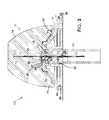
- FIG. 3is a cross-sectional view of the fluid delivery device shown in FIG. 1 , taken along a plane that intersects the middle of both rotation-restricting recesses of the base element of the body.
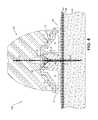
- FIG. 4is a cross-sectional view of the fluid delivery device shown in FIG. 1 , taken along a plane that intersects the middle of both rotation-restricting recesses of the base element of the body, showing the device installed to a user.
- Most of the background lines shown in FIG. 3have been eliminated from this figure (and from the remaining figures) in an effort to make the figure easier to review.
- FIG. 5Ais a cross-sectional view of the fluid delivery device shown in FIG. 1 , taken along a plane that is perpendicular to the plane along which the FIG. 3 and FIG. 4 cross sections were taken, showing the device installed to a user and the insertion device removed.
- FIG. 5Bis an enlarged detail view of a portion of the FIG. 5A view, showing aspects of one of the present septa.
- FIG. 5Cis a cross-sectional view of an embodiment of the FIG. 1 fluid delivery device that includes a septum having a retention flange.
- FIG. 5Dis a cross-sectional view of another embodiment of the FIG. 1 fluid delivery device that includes a septum having a retention flange and a retention collar extending perpendicularly from the retention flange.
- FIG. 5Eis an enlarged detail view of a portion of the FIG. 5A view, showing aspects of one of the present fluid delivery devices.
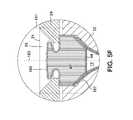
- FIG. 5Fis an enlarged detail view showing aspects of another embodiment of the present fluid delivery devices, and more specifically another of the present septa.
- FIG. 5Gshows the boundary illustrated in FIG. 5E in perspective.
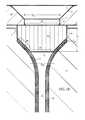
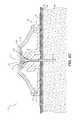
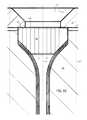
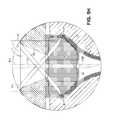
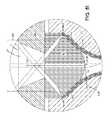
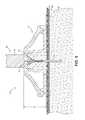
- FIGS. 5H-5Jshow enlarged detail views of cross sections of a portion of different embodiments of the present fluid delivery devices.
- FIG. 6is a cross-sectional view of the fluid delivery device shown in FIG. 1 , taken along the same plane as FIG. 5A , showing an injection needle inserted into the device.
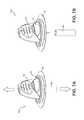
- FIGS. 7A and 7Bare perspective views of the FIG. 1 fluid delivery device, showing the result of trying to decouple the insertion device and needle guard from the body using equal and opposite forces: the needle guard uncouples first.
- FIG. 8is a cross-sectional view of an embodiment of the present fluid delivery devices that includes a body cavity that is in fluid communication with the exterior of the device through at least one opening in a sidewall of the device.
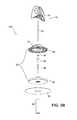
- FIG. 9is a perspective exploded view of another embodiment of the present fluid delivery devices.
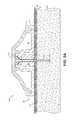
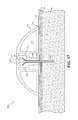
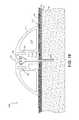
- FIG. 10is a cross-sectional view of the fluid delivery device shown in FIG. 9 , taken along a plane that does not intersect either rotation-restricting recess of the base element of the body, showing the device installed to a user and the insertion device removed.
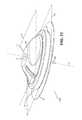
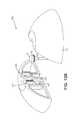
- FIG. 11is a perspective view showing the position of different perimeters of one of the present fluid delivery devices, the different perimeters being positioned in different planes that intersect the device.
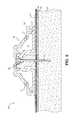
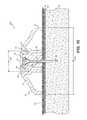
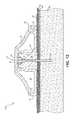
- FIG. 12is a cross-sectional view of a fluid delivery device having a cannula integral with the body.
- FIGS. 13A and 13Bare exploded views of an embodiment of a fluid delivery device that is assembled from at least two body pieces, or elements, of substantially equal height. The views are taken from different perspectives.
- FIG. 14is a perspective view of the assembled version of the fluid delivery device shown in FIGS. 13A and 13B .
- FIG. 15is a cross-sectional view of the FIGS. 13A and 13B embodiment, taken along line 15 - 15 shown in FIG. 16 .
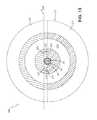
- FIGS. 16 and 17are cross-sectional views, respectively, of the two different elements that comprise the body of the FIGS. 13A and 13B fluid delivery device, taken along the plane at which the front surfaces of each element meet.
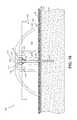
- FIG. 18shows an embodiment of a fluid delivery device similar to the one depicted in FIGS. 13A and 13B , but having a rigid cannula with a sharp end.
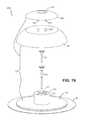
- FIG. 19is an exploded perspective view of an embodiment of the present fluid delivery devices that includes a body made from a majority (volumetrically) of septum material.
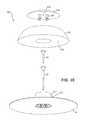
- FIG. 20is an exploded view of the FIG. 19 fluid delivery device, shown from the bottom perspective looking toward the top.
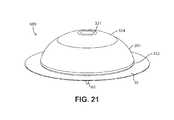
- FIG. 21is a perspective view of the assembled version of the fluid delivery device shown in FIG. 19 .
- FIG. 22is a cross-sectional view of the FIG. 19 fluid delivery device, taken along a plane that intersects two of the four cap element attachment protrusions of the base element of the depicted embodiment.
- FIG. 23is a cross-sectional view of a version of the FIG. 19 fluid delivery device that includes a septum extension that is positioned within the needle guide and cannula passageways.
- FIG. 24is a cross-sectional view of a version of the FIG. 19 fluid delivery device that includes a rigid cannula having a sharp end.
- FIG. 25is a perspective view of an embodiment of the present fluid delivery devices that includes a fluid delivery passageway having at least a portion that is oriented at an angle that is not parallel with the normal direction of insertion of the device.
- FIG. 26is a perspective view from the bottom of the FIG. 25 fluid delivery device.
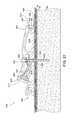
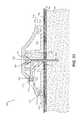
- FIG. 27is a cross-sectional view of the FIG. 25 fluid delivery device, taken along a plane that intersects the non-recessed portion of the bottom surface of the body.
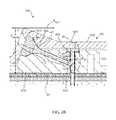
- FIG. 28is an enlarged detail of the FIG. 27 view.
- FIGS. 29 and 30show different perspective views of a multi-inlet embodiment of one of the present fluid delivery devices that includes a passageway closing structure.
- FIG. 31is a cross-sectional view of the FIGS. 29 and 30 fluid delivery device, taken in a plane that intersects the middles of both inlets, and shows the passageway closing structure in its biased position.
- FIG. 32is another cross-sectional view of the FIGS. 29 and 30 fluid delivery device, showing the passageway closing structure in another position.
- FIG. 33is an enlarged view of a detail from FIG. 32 .
- FIG. 34is an enlarged view of a detail from FIG. 31 , in which the passageway closing structure has returned to its normally-biased position after an injection needle has been removed.
- FIGS. 35 and 36are enlarged detail views similar to FIGS. 33 and 34 , and depict another embodiment of the present passageway closing structures.
- FIG. 37is a perspective view of another multi-inlet embodiment of one of the present fluid devices that includes a passageway closing structure, showing the passageway closing structure in one position.
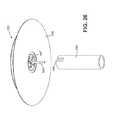
- FIG. 38is a perspective view of the FIG. 37 fluid delivery device, showing the passageway closing structure in another position.
- FIG. 39is a perspective view of the passageway closing structure of the FIG. 37 fluid delivery device.
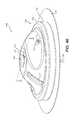
- FIG. 40is another perspective view of the FIG. 37 fluid delivery device, showing the passageway closing structure blocking flow into and through the centrally-oriented fluid delivery passageway.
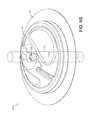
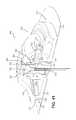
- FIG. 41is a perspective cross-sectional view (minus the cross-hatching), taken along line 41 - 41 in FIG. 40 , showing how the opening in the passageway closing structure of the FIG. 37 fluid delivery device aligns with the laterally-oriented fluid delivery passageway.
- FIG. 42is another perspective view of the FIG. 37 fluid delivery device, showing the passageway closing structure allowing flow into and through the centrally-oriented fluid delivery passageway.
- FIG. 43is a perspective cross-sectional view (minus the cross-hatching), taken along line 43 - 43 in FIG. 42 , showing how a portion of the passageway closing structure of the FIG. 37 fluid delivery device blocks flow through the laterally-oriented fluid delivery passageway and out of the body of the device.
- an element of a device, system or method that “comprises,” “has,” “contains,” or “includes” one or more recited featurespossesses those features, but is not limited to possessing only those features; it may possess features that are not recited.
- a structure that is configured in a certain waymust be configured in at least that way, but also may be configured in a way or ways that are not specified.
- a fluid delivery devicecomprising a body having a first inlet, a first fluid delivery passageway extending from the first inlet, and a second fluid delivery passageway; a cannula having a portion that is coaxial with a portion of one of the first and second fluid delivery passageways; and a passageway closing structure oriented in a first position that substantially prevents fluid from flowing from the first inlet through the first fluid delivery passageway and out of the body, while allowing fluid to flow through the second fluid delivery passageway; the passageway closing structure being movable to a second position that substantially prevents fluid from flowing through the second fluid delivery passageway while allowing fluid to flow through the first fluid delivery passageway, is a fluid delivery device that possesses the recited body, cannula, and passageway closing structure, but is not limited to possessing only the recited elements (thus, other non-recited elements are not excluded).
- the fluid delivery devicealso may include one or more septa.
- the passageway closing structuremay pivot about an axis that is centered within a portion of one of the fluid delivery passageways.
- an axis that is centered within or parallel to a portion of a passagewayis one that is centered within or parallel to at least the portion, and may be centered within or parallel to the entire passageway.
- a structuree.g., a needle guide “having” a portion positioned within a fluid delivery passageway has at least the portion positioned in the passageway, and may be positioned entirely within the passageway.
- the present fluid delivery devicesmay be used to deliver fluid to a living being for any of a variety of reasons.
- some embodiments of the present fluid delivery devicesmay be used to deliver insulin to the subcutaneous tissue of a person with diabetes.
- embodiments of the present fluid delivery devicesalso may be used to deliver other fluids, such as saline, medication other than insulin, chemicals, enzymes, antigens, hormones, vitamins or the like, into subcutaneous tissue or other types of tissue, such as the epidermis, dermis, and different types of sub-dermal tissue such as muscle.
- the embodiments of the present fluid delivery devices shown in the figuresare adapted for use with humans; however, those of ordinary skill in the art will, in light of this disclosure, understand that other embodiments may be adapted for use with animals.
- the present fluid delivery devicesmay be characterized as ports, fluid delivery ports, injection ports, injection aides, infusion ports or infusion devices.
- the present fluid delivery systemsmay be characterized as injection systems or infusion systems.
- FIG. 1is a perspective view of one embodiment of the present fluid delivery devices.
- Fluid delivery device 100includes a multi-piece body 20 , an insertion device 70 that is coupled to body 20 at a first location, and a needle guard 80 that is coupled to body 20 at a second location.
- Device 100also includes a generically-depicted adhesive layer 30 (which may include a protective backing sheet).
- Adhesive layer 30may include a pad having two opposing, adhesive-coated sides, one of which is attached to the relevant portion of the bottom surface of body 20 and the other of which will be attached to a user's body (e.g., once a backing sheet has been removed).
- one of the two opposing sidesmay be welded (e.g., ultrasonically welded) to the bottom surface of body 20 instead of being attached via an adhesive.
- a portion (e.g., all) of the bottom surface of body 20may be configured to adhere directly to a living being's skin, such as by making the bottom surface material from a material that chemically reacts with and adheres to skin.
- Adhesive layer 30is one example of an adhesive portion (of a fluid delivery device) that is configured to adhere directly to a living being's skin.
- the cannula of device 100(see cannula 60 in FIG. 3 ) is example of a cannula having a portion extending from the adhesive portion.
- FIGS. 2A and 2Bare exploded perspective views of the components of one embodiment of fluid delivery device 100 .
- body 20may include a first element 22 (which may be characterized as a base element) and a second element 24 (which may be characterized as a top element or a cap element).
- Device 100also may include a septum 40 , a needle guide 50 , and a cannula 60 .
- Septum 40is one type of sealing mechanism.
- Insertion device 70comprising an insertion needle 72 connected to an insertion device hub 74 .
- a portion 73 of insertion needle 72is located above the bottom surface of body 20 and is exposed when insertion device 70 is fully inserted in body 20 .
- One manner in which this exposure is accomplishedis by providing insertion device hub 74 with an insertion needle access region 76 that allows access to portion 73 when insertion device 70 is fully inserted in body 20 .
- insertion needle 72could be configured such that portion 73 extends outwardly to a side of hub 74 , such that no access region is needed. Still other embodiments that allow access to a portion of insertion needle 73 are possible.
- the insertion needle access regioncomprises an opening that extends from one side of the hub to the other.
- the access regioncomprises a recess that extends from one side of the hub to (but not beyond) a portion of the insertion needle.
- the access regionmay be located anywhere along the hub, and need not be closer to the top of hub 74 than the bottom of hub 74 (as is the depicted access region).
- Body 20 and insertion device 70may be configured such that insertion device 70 cannot rotate with respect to body 20 when fully inserted in body 20 .
- One manner of achieving this configurationcomprises providing hub 74 with rotation-restricting protrusions 71 , which extend in a downstream or downward direction from the main portion of insertion device hub 74 , and by providing cap element 24 of body 20 with rotation-restricting recesses 77 .
- When insertion device 70 is fully inserted in body 20as shown in FIG. 3 , at least a portion of each protrusion 71 extends into each recess 77 such that the recess side walls interfere with the protrusions to prevent rotation of the insertion device relative to body 20 .
- the embodiment shownincludes two protrusions and two recesses, other embodiments may include fewer or greater numbers of each.
- Body 20includes a fluid delivery passageway 25 , which extends from entrance opening 21 (which also may be characterized as inlet port 21 , or inlet 21 ) in cap element 24 through exit opening 23 in base element 22 .
- Cap element 24includes a portion 26 that tapers inwardly, or in a downstream direction, and extends from entrance opening 21 to a straight-walled portion 27 (“straight” meaning that, in this embodiment, the portion has no bend and a constant diameter), which extends to the bottom surface of cap element 24 and terminates at cap element exit opening 28 .
- the portion of cap element 24 that overlaps an outer portion of septum 40may be characterized as a sealing mechanism-retaining shoulder, or a septum retaining shoulder.
- Base element 22includes a base element entrance opening 31 from which a straight-walled portion 32 extends.
- Straight-walled portion 32ends at tapered wall portion 33 , which extends into another straight-walled portion 34 .
- Straight-walled portion 34extends into a tapered portion 35 that ends at exit opening 23 .
- Fluid delivery passageway 25is characterized by all of these portions and openings.
- FIG. 3shows that cap element 24 is permanently attached to base element 22 at a location 29 that is closer to the outer perimeter 37 of body 20 than to the center of the body (which is not numbered, but which runs through the center of insertion needle 72 ).
- Location 29is where the portions of cap element attachment protrusion 43 and base element attachment recess 41 are joined together as a result of the permanent attachment. If ultrasonic welding is used, which is one suitable technique, the bottom of the protrusion 43 and the lowest part of the recess 41 comprise location 29 .
- the energy director that is shown in FIG. 3 proximate location 29is eliminated by the ultrasonic welding.
- Two elements, or pieces, that are “permanently attached” to each otherare attached such that a user of the device will not be able to separate them without destroying or significantly impairing the usefulness of the device.
- An alternative way to achieve this type of permanent attachmentis through the use of an adhesive or adhesives.
- Other welding techniquesthat may be used include but are not limited to laser welding, hot plate welding, vibration welding, and friction welding.
- location 29lies in a plane (not shown) that is substantially perpendicular to an axis (not shown) that is parallel to a portion of fluid delivery passageway 25 .
- the axisalso is parallel to a portion of the cannula passageway of cannula 60 .
- the planealso may be characterized as being, in this embodiment, parallel to the bottom surface of body 20 .
- the planemay be referred to as a device plane, and it is a plane in which the two body elements—cap element 24 and base element 22 —may be assembled.
- FIG. 3shows that body 20 , and more specifically cap element 24 , may include a fluid delivery passageway identification feature 45 that is positioned near entrance opening 21 of body 20 .
- a fluid delivery passageway identification feature 45may help a user to locate the inlet port of the body more quickly, especially if the identification feature stands out in some way from the remainder of the body, such as by its color, by being a protrusion (as in the embodiment of the identification feature in the figures), or by being recessed.
- the identification featurecan encircle entrance opening 21 , as shown, or it may not.
- insertion device hub 74may be provided with a complimentary identification feature configuration (e.g., a recess, as shown, but not labeled) that compliments or otherwise fits with identification feature 45 .
- FIG. 3shows one way that body 20 and needle guard 80 may be coupled to each other.
- Base element 22may include a needle guard holding recess 47 that is configured to accept a top portion of needle guard 80 such that needle guard 80 may be held to body through a friction fit, or any other suitable means of engagement.
- Cannula 60 of fluid delivery device 100has a portion (specifically, an upper portion in the depicted embodiment) positioned within fluid delivery passageway 25 .
- Cannula 60has a portion that is substantially coaxial with a portion of fluid delivery passageway 25 . More specifically, in the depicted embodiment, cannula 60 is coaxial with fluid delivery passageway 25 .
- Needle guide 50has a portion (specifically, all in the depicted embodiment) positioned within fluid delivery passageway 25 and also within cannula 60 (or the cannula passageway of cannula 60 ).
- Needle guide 50has a portion that is substantially coaxial with a portion of fluid delivery passageway 25 . More specifically, in the depicted embodiment, needle guide 50 is coaxial with fluid delivery passageway 25 .
- Needle guide 50also has a portion that is substantially coaxial with a portion of cannula 60 . More specifically, in the depicted embodiment, needle guide 50 is coaxial with cannula 60 (or the cannul
- FIG. 4shows a cross-sectional view of fluid delivery device 100 installed to a living being.
- the “installation” of one of the present fluid delivery devices to a living being or a userrefers to the process by which a portion of the cannula is inserted below the outer surface of the skin.
- the device, and more specifically the bottom surface (unnumbered) of adhesive layer 30comprises an engagement surface that engages, or is in contact with, the skin of a living being when the device is installed to a living being.
- This figureshows that at least a portion (and, in this embodiment, all) of fluid delivery passageway 25 (as characterized by an axis (not shown) running through it from inlet port 21 to exit opening 23 ) is substantially perpendicular to the engagement surface of the device.
- FIG. 3shows that the end of insertion needle 72 extends slightly below the end of cannula 60 because the insertion needle is responsible for piercing the user's body tissue, which includes epidermis 92 , dermis 94 and subcutaneous tissue 96 .
- the portion of cannula 60 that is downstream of the end of needle guide 50fits snugly around insertion needle 72 for the purpose of reducing the likelihood that the cannula will buckle, crimp or bend as the fluid delivery device is installed to a user.
- the friction between the lower portion of the cannula passageway and the outer surface of insertion needle 72contributes to the reduction in that likelihood. That friction may be increased by grit blasting the insertion needle using any suitable material.
- cannula 60may terminate coincident with insertion needle 72 and be configured with the same angle of taper as insertion needle 72 to further the reduction in that likelihood.
- cannula 60is positioned such that any portion of it that is above the user's skin when fluid delivery device 100 is used (or is inserted into the living being) is positioned within outer perimeter 37 of body 20 . If the bottom of central portion 49 stopped above epidermis 92 instead of resting against epidermis 92 , cannula 60 would be positioned such that any exposed portion of it that is above the user's skin when fluid delivery device 100 is used (or is inserted into the living being) would be positioned within outer perimeter 37 of body 20 .
- body 20is configured and cannula 60 is positioned such that any portion (e.g., any exposed portion) of cannula 60 that is above the user's skin when fluid delivery device 100 is used (or is inserted into the living being) is positioned within outer perimeter 37 of body 20 .
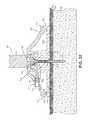
- FIG. 5Ashows an embodiment of fluid delivery device 100 installed to a living being. Insertion device 70 has been removed. FIG. 5A also shows that fluid delivery device 100 is configured such that fluid exiting fluid delivery device 100 and into a living body must exit fluid delivery device 100 through cannula 60 . Although there is a small gap visible in this and other figures between cap element 24 and base element 22 near septum 40 , the small gap is effectively eliminated when the cap element 24 is permanently attached to base element 22 and septum 40 is compressed.
- FIG. 5Ashows that in some embodiments of the present fluid delivery devices, the bottommost portion of the septum located within the fluid delivery passageway (bottom surface 44 of septum 40 , in the depicted embodiment) is closer to the inlet port than to the bottom surface of the body. More specifically, FIG. 5A shows an embodiment of the present fluid delivery devices in which the bottommost portion of the septum located within the fluid delivery passageway is closer to the plane (not shown) in which the inlet port is positioned than to the bottommost portion (or the plane (not shown) in which the bottommost portion is positioned) of the body, which bottommost portion comprises the bottom of central portion 49 of base element 22 in the depicted embodiment.
- FIG. 5Aalso shows that in some embodiments of the present fluid delivery devices, the bottommost portion of the septum located within the fluid delivery passageway is closer to the inlet port than the exit port (exit opening 23 , in this embodiment) of the body. More specifically, FIG. 5A shows an embodiment of the present fluid delivery devices in which the bottommost portion of the septum located within the fluid delivery passageway is closer to the plane (not shown) in which the inlet port is positioned than to the plane (not shown) in which the exit port of the body is positioned.
- a spacee.g., open space
- a structuree.g., a portion of a structure such as a septum or a needle guide
- a structuree.g., a portion of a structure such as a septum or a needle guide
- a structure or structurese.g., a needle guide and/or a cannula
- body 20includes a cavity within cap element 24 and base element 22 comprising open space 19 .
- Body 20is sealed against fluid entering this open space by virtue of the permanent attachment between the two elements at location 29 and the compression seal that each element creates with septum 40 .
- Open space 19may be characterized as non-fluid delivery passageway open space within body 20 .
- FIG. 5Bis a detail view of a portion of fluid delivery device 100 around septum 40 , and illustrates some of the features of the depicted embodiment of fluid delivery device 100 .
- the depicted embodiment of septum 40includes an accessible surface portion 42 (or, an “accessible portion”) that is positioned downstream (or below, in this embodiment) of inlet port 21 and that is accessible to an injection structure such as an injection needle during normal use of the fluid delivery device (“normal use” does not include accessing the septum with an injection needle by somehow inserting the injection needle through the septum retaining shoulder of cap element 24 ).
- accessible surface portion 42is a portion of the top surface of the septum.
- the outer surface of septum 40includes the top surface (of which accessible surface portion 42 is a part), a side wall 46 extending downstream from the top surface, a portion 48 that is tapered inwardly (or in a downstream direction), and a bottom surface 44 that, in this embodiment, is substantially parallel with the top surface.
- the side wallis straight and parallel to an axis (not shown in this figure, but see axis 103 in FIG. 5E ) that is centered within a portion (and, in the embodiment, all) of fluid delivery passageway 25 .
- the majority of side wall 46is in contact with (and may be radially compressed by) a surrounding portion or portions of the fluid delivery device. More specifically, the majority of side wall 46 is in contact with a surrounding portion of the body.
- portion 48has an upstream section that is tapered at a constant angle and a downstream section with a concave taper that matches the corresponding convex taper of a portion of needle guide 50 .
- the downstream section of portion 48also may be characterized as having a taper of non-constant angle because, in the downstream direction, the material defining that section is curved (not flat).
- the corresponding portion of needle guide 50also may be characterized as tapering at a non-constant angle, the tapering being inwardly or in a downstream direction.
- Accessible surface portion 42has a perimeter, which is defined by cap element exit opening 28 .
- the perimeterhas a greatest width W 42 , which comprises the greatest distance between any two points along the perimeter that are connected by a straight line.
- the perimeteris circular in shape, and greatest width W 42 comprises the diameter of the circle.
- Other embodiments of the present fluid delivery devicesmay have cap element exit openings, and therefore accessible portions of the septa, that have different shapes.
- Bottom surface 44 of septum 40has a perimeter that, in the depicted embodiment, is circular.
- the perimeterhas a greatest width W 44 , which comprises the greatest distance between any two points along the perimeter that are connected by a straight line.
- greatest width W 44comprises the diameter of the circle defined by bottom surface 44 , although in other embodiments the bottom surface may be shaped differently.
- Bottom surface 44may be more broadly characterized as a portion of the exterior surface of septum 40 (a “surface portion”) that is adjacent to open space 15 that is downstream of the surface portion and within fluid delivery passageway 25 .
- the perimeter of bottom surface 44is smaller than the perimeter of accessible surface portion 42 .
- the linear distance represented by the perimeter of bottom surface 44(which, for this embodiment, is a circumference) is smaller than the linear distance represented by the perimeter of accessible surface portion 42 (which also is a circumference, in this embodiment).
- Greatest width W 44also is less that greatest width W 42 .
- This relationship between the size of the perimeters of the two surface portions (accessible surface portion 42 and bottom surface 44 )may be true of the septa used with other embodiments, such as any of the septa used with the multi-inlet embodiments described below.
- Cannula 60has a smallest internal width W c (see FIG. 5A ), which is the width of the smallest portion of the material forming the cannula passageway.
- greatest width W 42is at least twice as great as the smallest internal width W c of cannula 60 .
- FIG. 5Balso shows that septum 40 has a height S H , which runs in a direction parallel to the axis described above, and a middle S M that is one-half of the height.
- the middlein this embodiment, is in contact with a surrounding portion of fluid delivery device 100 .
- the surrounding portionmay be body material (as shown), or it may be needle guide material or cannula material in other embodiments.
- the middlealso may be radially compressed by the material surrounding it.
- FIG. 5Cshows another embodiment of fluid delivery device 100 that includes a septum 140 , which has a lower portion that is similar in shape to the lower portion of septum 40 , but that includes a septum retention flange 139 extending from the septum's central portion 137 .
- Septum 140has a shape in this embodiment that is symmetrical about the axis (not shown) that is centered within fluid delivery passageway 25 .
- the surface area of septum 140 that is in contact with cap element 24 ′is greater than the surface area of the septum's exposed portion (see FIGS.
- Septum retention flange 139is oriented parallel to the engagement surface of the device and is perpendicular to the intended direction of insertion of the device.
- the flangeis configured to help prevent upstream and downstream movement of septum 140 that might otherwise occur as a needle (e.g., an insertion or injection needle) is inserted through or withdrawn from the septum.
- FIG. 5Dshows another septum embodiment—septum 140 ′—that includes a septum retention collar 135 protruding in a downstream direction from the septum retention flange 139 .
- Collar 135may help prevent lateral septum movement (or movement that includes a directional component that is perpendicular to the intended direction of insertion of the device) that might otherwise occur during needle insertion or withdrawal.
- a given septume.g., the portion of septum 40 that includes accessible surface portion 42
- may be artificially-colorede.g., by adding a coloring agent to the material that forms the septum. This may enhance the contrast between the septum and the remainder of the fluid delivery device.
- FIG. 5Ewhich depicts the same detail shown in FIG. 5B , highlights certain aspects of the embodiment of fluid delivery device 100 shown in FIG. 1 .
- FIG. 5Eshows that the body has a boundary 101 (also described as a “first inlet boundary” and an “inlet boundary”) extending upstream and downstream of inlet port 21 (or inlet 21 ) parallel to an axis 103 centered within a portion (and, in the depicted embodiment, all) of fluid delivery passageway 25 .
- FIG. 5Ealso shows that the outer surface of septum 40 includes an exposed portion located within boundary 101 and a remaining non-exposed portion. The exposed portion is encircled by the dashed line labeled 105 .
- the remaining non-exposed portionwhich comprises all of the outer surface of septum 40 other than exposed portion 105 , is encircled by the dashed line labeled 107 .
- an injection needleis not shown in this figure, one can see that an injection needle that enters exposed portion 105 in a downstream direction and exits septum 40 through part of remaining non-exposed portion 107 that is substantially perpendicular to axis 103 (the part can be any part of bottom surface 44 in this embodiment) will exit septum 40 into a portion of open space 15 that will be within fluid delivery passageway 25 and downstream of the part through which the injection needle exited.
- 1-5B and 5Eis an example of one that is configured such that an injection needle that enters the exposed portion of the septum (which is within the boundary) in a downstream direction and exits the septum (a) through part of the remaining non-exposed portion that is substantially perpendicular to an axis that is centered within a portion of the fluid delivery passageway or (b) through part of the remaining non-exposed portion that has a tangent that is not parallel to the axis, exits the first sealing mechanism into open space that is (c) within the first fluid delivery passageway and (d) downstream of the part through which the injection needle exited.
- FIG. 5Fdepicts another embodiment of the present fluid delivery devices that has this configuration.
- FIG. 5Fshows another configuration of exposed portion 105 of one of the present septa: septum 40 ′.
- FIG. 5Gshows how boundary 101 looks in perspective.
- FIGS. 5H-5Jdepicts an embodiment of the present fluid delivery devices that is configured such that an injection needle that enters the exposed portion of the septum (which is within the boundary) in a downstream direction and exits the septum (a) through part of the remaining non-exposed portion that is substantially perpendicular to an axis that is centered within a portion of the fluid delivery passageway or (b) through part of the remaining non-exposed portion that has a tangent that is not parallel to the axis, exits the septum into open space that is (c) within the fluid delivery passageway and (d) downstream of the part through which the injection needle exited.
- 5H-5Jalso depicts an embodiment of the present fluid delivery devices that is configured such that an injection needle that enters the exposed portion of the septum (which is within the boundary) in a downstream direction and exits the septum through part of the remaining non-exposed portion that is not parallel to the axis either (a) exits the septum into open space that is (i) within the fluid delivery passageway and (ii) downstream of the part, or (b) contacts a portion of the fluid delivery device that is tapered inwardly.
- injection needles IN 1 and IN 2shown in phantom, have each entered exposed portion 105 of septum 40 in a downstream direction and have exited the septum through part (IN 1 P and IN 2 P, respectively) of remaining non-exposed portion 107 that is not parallel to axis 103 and contacted a portion of the fluid delivery device (in this embodiment, a portion of needle guide 5130 ) that is tapered inwardly.
- Injection needle IN 3shown in phantom, has entered exposed portion 105 of septum 40 in a downstream direction and has exited the septum through part (IN 3 P) of remaining non-exposed portion 107 that is not parallel to axis 103 , the exiting being into open space (a central portion of open space 15 ) that is within fluid delivery passageway 25 and downstream of part IN 3 P. Furthermore, as FIG. 5H shows, injection needle IN 3 has entered exposed portion 105 of septum 40 in a downstream direction and exited septum 40 through part (IN 3 P) of remaining non-exposed portion 107 that is substantially perpendicular to axis 103 , the exiting being into open space that is within fluid delivery passageway 25 and downstream of part IN 3 P.
- injection needles IN 1 and IN 2have each entered the exposed portion (not labeled) of septum 40 ′′ in a downstream direction and have exited the septum through part (IN 1 P and IN 2 P, respectively) of the remaining non-exposed portion (not labeled) that is not parallel to axis 103 and contacted a portion of the fluid delivery device that is tapered inwardly.
- Injection needle IN 3shown in phantom, has entered the exposed portion of septum 40 ′′ in a downstream direction and has exited the septum through part (IN 3 P) of the remaining non-exposed portion that is not parallel to axis 103 , the exiting being into open space (a central portion of open space 15 ) that is within fluid delivery passageway 25 and downstream of part IN 3 P. Furthermore, as FIG.
- injection needle IN 3has entered the exposed portion of septum 40 ′′ in a downstream direction and exited septum 40 ′′ through part (IN 3 P) of the remaining non-exposed portion that has a tangent 109 that is not parallel to axis 103 , the exiting being into open space that is within fluid delivery passageway 25 and downstream of part IN 3 P.
- injection needles IN 1 and IN 2have each entered exposed portion 105 of septum 40 ′′′ in a downstream direction and have exited the septum through part (IN 1 P and IN 2 P, respectively) of remaining non-exposed portion 107 that is not parallel to axis 103 and contacted a portion of the fluid delivery device (in this embodiment, portion 33 ) that is tapered inwardly.
- Injection needle IN 3shown in phantom, has entered exposed portion 105 of septum 40 ′′′ in a downstream direction and has exited the septum through part (IN 3 P) of remaining non-exposed portion 107 that is not parallel to axis 103 , the exiting being into open space (a central portion of open space 15 ) that is within fluid delivery passageway 25 and downstream of part IN 3 P. Furthermore, as FIG.
- injection needle IN 3has entered exposed portion 105 of septum 40 ′′′ in a downstream direction and exited septum 40 ′′′ through part (IN 3 P) of remaining non-exposed portion 107 that has a tangent 109 that is not parallel to axis 103 , the exiting being into open space that is within fluid delivery passageway 25 and downstream of part IN 3 P.
- the septa shown in each of FIGS. 3-5B and 5E-5Jinclude a portion that is positioned within fluid delivery passageway 25 .
- the portioncomprises all of the respective septa.
- Each of the septa depicted in these figuresalso includes a portion positioned within needle guide 50 (or, more specifically, the needle guide passageway (unnumbered) of needle guide 50 ).
- this portioncomprises a lower portion of the depicted septum, specifically portion 48 (see FIG. 5B ).
- portion 48is also positioned within cannula 60 , or, more specifically, the cannula passageway (unnumbered) of cannula 60 .
- FIG. 6depicts an injection device 90 fully inserted into fluid delivery device 100 .
- the injection devicemay be used to inject fluid (e.g., insulin) into the subcutaneous tissue of a user.
- the depicted embodiment of injection device 90comprises a standard syringe that includes a generically-depicted plunger portion 91 and an injection structure 93 that comprises, in this embodiment, a standard syringe needle.
- Other injection devicesmay be used with embodiments of the present fluid delivery devices to deliver fluid to a user.
- Fluid delivery device 100includes a needle control portion that is configured to prevent a needle (e.g., injection needle 93 ) sized to inject fluid through the fluid delivery device and into a living being from piercing cannula 60 during normal fluid injection.
- a needlee.g., injection needle 93
- the needle control portioncomprises needle guide 50 , which protects the inner wall of cannula 60 (which defines the cannula passageway) from being contacted by the injection needle, and which includes a shaft portion having a sufficiently small inner diameter such that any injection needle sized to deliver fluid to a living being through the device will not be able to tilt enough to pierce any portion of the cannula that is accessible to the injection needle downstream of the end of the needle guide.
- injection needle 93terminates above the lowermost end of needle guide 50 . Needle control portions other than a needle guide may be used in other embodiments.
- a portion of the opening in cap element 24could be configured to define a portion of the fluid delivery passageway that is sufficiently small enough to perform the function of the shaft portion of needle guide 50 .
- FIG. 6shows that the depicted embodiment of fluid delivery device 100 is an example of a fluid delivery device that is configured such that a needle sized to inject fluid through the fluid delivery device (which may involve the fluid only being in contact with a lower portion of the device, such as the lower portion of cannula 60 ) and into a living being cannot pierce the cannula during normal fluid injection.
- the depicted embodiment of fluid delivery device 100is one that is configured such that, when properly installed to a living being, a needle inserted through the septum to deliver fluid to the living being (e.g., injection needle 93 ) will not puncture the living being's skin.
- FIGS. 7A and 7Billustrate that the depicted embodiment of fluid delivery device 100 is configured such that pulling insertion device 70 and needle guard 80 in opposite directions (as indicated by the two arrows in FIG. 7A ) with equal force to uncouple them from body 20 causes needle guard 80 to uncouple from body 20 first.
- This configurationmay be achieved in different ways.
- the friction force between insertion device 70which is fully inserted in body 20
- septum 40is greater than the friction force between body 20 and needle guard 80 .
- Septum 40may be a non-split septum, which adds to the friction force between it and insertion needle 72 of insertion device 70 .
- septum 40may be split, or otherwise configured to produce less friction force against the withdrawal of an insertion needle, and insertion device hub 74 and body 20 (more specifically, cap element 24 ) may be configured to engage one another (e.g., through a friction fit or interlocking parts) in a way that (a) makes it necessary to use more force to uncouple insertion device 70 from body 20 than it takes to uncouple needle guard 80 from body 20 , or (b) makes it not possible to uncouple insertion device 70 from body 20 by pulling on insertion device 70 and needle guard 80 in equal and opposite directions without first manipulating insertion device 70 relative to body 20 (e.g., by twisting insertion device 70 to unlock it from body 20 ).
- FIG. 8shows another embodiment of the present fluid delivery devices.
- Fluid delivery device 200is similar to fluid delivery device 100 .
- body cavity 19 of body 20 of fluid delivery device 200is open to the exterior of body 20 by virtue of a body cavity opening.
- body 20includes at least two body cavity openings 17 that are positioned in cap element 24 and that are in fluid communication with body cavity 19 .
- Body cavity 19 in both fluid delivery device 200 and fluid delivery device 100will not contact fluid that is being delivered through the fluid delivery passageway of body 20 to a living being (meaning that the body cavity will not contact the fluid as it is delivered through the body to a living being).
- the otherwise sealed condition of body 20is breached (e.g., around septum 40 or location 29 ), and fluid gets into body cavity 19 , that fluid can drain out of body cavity 19 through one or more of body cavity openings 17 .
- FIGS. 1-8show some examples of suitable configurations for cap element 24 and base element 22 of body 20 .
- FIG. 9Another suitable configuration of these elements is shown in FIG. 9 .
- FIG. 9is an exploded perspective view of fluid delivery device 300 , which includes a body 20 having cap element 24 (which may also be described as a septum cap) and base element 22 (which may also be described as a base), septum 40 , needle guide 50 , cannula 60 and adhesive layer 30 .
- An insertion device and a needle guardmay be coupled to body 20 of fluid delivery device 300 in similar fashion to how they are coupled to fluid delivery device 100 .
- Base 22 of this embodimentincludes rotation-restricting recesses 77 .
- Base 22also includes cap recess 81 that comprises, in this embodiment, an annular groove that is parallel with fluid delivery passageway 25 .
- Cap 24includes a top portion 83 and a base-engaging section 85 extending downstream from top portion 83 .
- Cap 24may be coupled to base 22 in any suitable manner. In one embodiment, cap 24 may be permanently attached to base 22 using ultrasonic welding or any other suitable permanent attachment technique, such as those described above.
- FIG. 10is a cross-sectional view of fluid delivery device 300 inserted in a living being, and shows that fluid delivery passageway 25 of this embodiment may comprise the same openings and portions as the embodiment of fluid delivery device 100 shown, for example, in FIGS. 3 and 4 .
- FIG. 10also shows that cap 24 has an outer perimeter OP cap , base 22 has an outer perimeter OP base , and OP base is greater than OP cap .
- the outer perimeter of base 22is also the same as the outer perimeter 37 of body 20 .
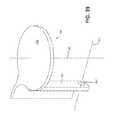
- FIG. 11shows fluid delivery device 100 ′, which is similar to fluid delivery device 100 except for lacking identification feature 45 .
- body 20has a first perimeter 39 at top 12 and a second perimeter (which, in this embodiment, comprises outer perimeter 37 ) that is close to the bottom surface of the body (which is the bottom surface of the base element).
- First perimeter 39is positioned in a first plane P 1 , which is perpendicular to axis 9 that is centered within the fluid delivery passageway of the body (and that is, therefore, parallel to a portion of the fluid delivery passageway).
- Second perimeter 37is positioned in a second plane P 2 , which is parallel to and downstream of first plane P 1 .
- second perimeter 37is greater than first perimeter 39 . This means that the linear distance represented by second perimeter 37 is larger than the linear distance represented by first perimeter 39 .
- Fluid delivery device 400includes cannula 160 that is integral with (or integrally formed with), and extends from, body 20 .
- needle guide 50is in direct contact with a portion of the body material forming fluid delivery passageway 25 .
- FIGS. 13A-17show aspects of an embodiment that assembles in a plane that is substantially parallel to an axis of at least a portion of the fluid delivery passageway.
- the assembly planeis parallel to the axis of the fluid delivery passageway.
- FIGS. 13A-17also show an example of a body that comprises multiple body elements of substantially equal height assembled in at least one device plane that is substantially parallel to an axis of a portion of the fluid delivery passageway.
- the phrase “an axis of a portion of [a/the] fluid delivery passageway”means an axis that is centered within and running parallel to the portion in question. Such an axis does not intersect the fluid delivery passageway wall portion that defines the portion in question.
- Fluid delivery device 500is similar in some respects to the previously-depicted embodiments. It includes a body 220 , a septum 40 , a needle guide 50 and a cannula 60 .
- Body 220comprises two elements 222 and 224 that assembly in a device plane that, in this embodiment, is parallel to fluid delivery passageway 225 .
- Body 220also includes needle guard holding recess 247 that is configured to accept a top portion of a needle guard such that the needle guard may be held to body through a friction fit, or any other suitable means of engagement.
- Elements 222 and 224have substantially the same height. More specifically, height H 222 and H 224 (see FIG. 13A , not labeled in FIG. 13B ) are equal in this embodiment.
- FIG. 14shows fluid delivery device 500 in its assembled state.
- Elements 222 and 224may be coupled to each other using any suitable attachment method, including any of those discussed above.
- element 224may include one or more male engagement members 243 that fit at least partially into female engagement recesses 241 of element 222 , and ultrasonic welding may be used to permanently attach the two elements together at the location where the male engagement members meet the female engagement recesses.
- the members and recessesmeet in the device plane P 500 shown in FIG. 15 , which is taken along line 15 - 15 shown in FIG. 16 .
- body 220are similar in function to those of body 20 , and thus have been numbered as they are for body 20 except for a 200 added to the number.
- inlet port 221is similar in shape and function and to inlet port 21 .
- Some of the features of body 220are labeled in FIGS. 16 and 17 . Although an identification feature is not shown as part of this embodiment, it may be provided in other embodiments.
- body 220does not include any body cavity openings in fluid communication with body cavity 219 , one or more body cavity openings similar to body cavity openings 17 from body 20 may be provided in other embodiments.
- Some embodiments of the present fluid delivery devicesmay use a cannula having a sharp end, which may be a centerpoint end or a beveled end (as shown) and which in some embodiments may be characterized as having a “tipped” end.
- a cannulamay be open at one end, as shown in FIG. 18 , or it may be closed at one end and have an opening somewhere along its shaft, upstream of the end.
- Such a cannulamay be sufficiently rigid that its lower portion can be inserted into a living being without using an insertion needle, such as insertion needle 72 shown in FIG. 3 .
- FIG. 18depicts an embodiment of fluid delivery device 500 that includes such a cannula 260 and a septum 240 .
- Septum 240is shaped differently from septum 40 of fluid delivery device 100 .
- a cannula and septum like those shown in FIG. 18may be substituted for the cannula, needle guide and septum combinations of any of the present fluid delivery devices, such as cannula 60 , needle guide 50 and septum 40 in the embodiment of fluid delivery device 100 depicted in FIGS. 1 and 2 .
- Cannula 260is illustrated as having a tapered portion at the exit opening of the body. In other embodiments, no such tapered portion exists (the same is true of cannula 360 show in FIG. 24 , discussed below).
- FIGS. 19-22depict another of the present fluid delivery devices that has a multi-element body.
- Fluid delivery device 600includes body 320 , needle guide 50 , cannula 60 and adhesive layer 30 .
- Body 320includes a base element 322 , a cap element 324 , and an intermediate element 301 .
- Intermediate element 301may be made from the same material (e.g., a self-sealing material such as an elastomeric material) as any of the present septa, and it may be sized relative to base element 322 and cap 324 such that a volumetric majority of body 320 is a self-sealing body material. The volumetric majority may be determined by any suitable test, including any suitable water displacement test.
- a portion of the material from which intermediate element 301 may be formedcomprises, or forms, a septum for the fluid delivery passageway of the device.
- Cap element 324may define an upper portion of the fluid delivery passageway 325 .
- cap element 324includes entrance opening 321 (or inlet port 321 , or inlet 321 ) of the device, a portion 326 that tapers inwardly, or in a downstream direction, and extends from entrance opening 321 to a straight-walled portion 327 , which extends to the bottom surface of cap element 24 and terminates at cap element exit opening 328 .
- Cap element 324also includes cap element attachment protrusions 343 (four of them in this embodiment) that can be positioned in base element attachment recesses 341 of base element 322 .
- the locations 329 at which the protrusions and recesses meet after attachmentdefines a device plane that is substantially perpendicular to an axis centered within a portion of fluid delivery passageway 325 .
- Intermediate element 301includes multiple openings 303 sized to allow cap element attachment protrusions 343 to pass through them. As FIG. 22 shows, intermediate element 301 also includes an inner portion 302 and an outer portion 304 . Inner portion 302 has a thickness, or a height, that is suitable for a septum. A central section of inner portion 302 is positioned in fluid delivery passageway 325 , and acts as a septum for the passageway that substantially prevents fluid from flowing through the passageway (until an injection needle or the like is inserted through the septum).
- Base element 322may define a lower part of fluid delivery passageway 325 .
- Base element 322includes a base element entrance opening 331 from which a tapered wall portion 333 extends.
- Tapered wall portion 333which may include an upper portion having a inward, or downstream, taper of constant angle and a lower portion that tapers, but not at a constant angle.
- Tapered wall portion 333extends into straight-walled portion 334 , which extends into another tapered portion 335 that terminates at exit opening, or exit port, 323 .
- An inner portion 307 of base element 322fits within the recess defined by the inner wall of outer portion 304 and the bottom of inner portion 302 .
- Inner portion 307includes inner central portion 349 and needle guard holding recess 347 .
- Needle guide 50extends up to and contacts an outer surface (a portion of the bottom surface, in this embodiment) of inner portion 302 of intermediate element 301 .
- the portion of the intermediate element 301 acting as the septum for the fluid delivery passagewaydoes not include any material that is positioned within needle guide 50 or cannula 60 .
- inner portion 302may include a septum protrusion positioned to fit within a portion of the needle guide (and, more specifically, the needle guide passageway) and the cannula (and, more specifically, the cannula passageway).
- the embodiment of fluid delivery device 600 shown in FIG. 23includes such a protrusion: septum extension 309 .
- FIG. 24shows an example of a version of fluid delivery device 600 that includes a rigid cannula 360 having a sharp end.
- Fluid delivery device 600is another embodiment of a fluid delivery device having an outer perimeter (outer perimeter 337 ) and a cannula positioned such that any portion of the cannula that is above a user's skin when the device is used is positioned within the outer perimeter of the device.
- a portion (more specifically, a majority) of the outer surface of body 320has a convex shape.
- Some embodiments of the present fluid delivery devicescomprise multiple inlets, a fluid delivery passageway extending from each inlet, and a septum for each passageway where the septa are not in contact with each other.
- One of the fluid delivery passagewaysmay be oriented at a non-zero angle to another of the passageways.
- One fluid delivery passagewaymay extend into another.
- Some multi-inlet embodimentscomprise only one outlet.
- FIGS. 25-28illustrate an example of an embodiment fitting each of these characterizations.
- Fluid delivery device 700includes a body 620 and an adhesive layer 630 attached to the body. As with all of the present fluid delivery devices, device 700 may also include an insertion device (not shown) and a needle guard 680 .
- Body 620includes rotation-restricting recesses 677 , which function like the rotation-restricting recesses described above.
- the insertion device hub of any insertion device used with body 620may be provided with complimentary rotation-restricting protrusions that function like those described above.
- Body 620also includes a needle guard holding recess 647 , which functions like the needle guard holding recess described above. In this embodiment, needle guard holding recess 647 is not a generally cylindrical recess—it extends around the base element of body 620 less than 360 degrees.
- Needle guard 680has a notch 681 corresponding to the non-recessed portion of the base element, as shown in FIG. 26 .
- Body 620includes two inlet ports, 605 and 615 .
- Inlet port 605(also inlet 605 or entrance opening 605 ) is centered within the cap element of body 620 .
- Inlet port 605also is perpendicular to the normal direction that fluid delivery device 700 will be installed to a living being (that direction being substantially parallel to cannula 660 , discussed below), and to an axis (not shown) centered within a portion of the fluid delivery passageway extending from it.
- Inlet 615is not centered within the cap element of body 620 .
- Inlet 615is oriented at an angle between zero and ninety degrees to the axis centered within the central fluid delivery passageway and to the normal direction of insertion of the device.
- FIG. 26shows that inlet 615 is bordered by an injection device shoulder 617 that is parallel to the plane in which inlet 615 lies.
- injection device shoulder 617may be configured such that a portion of an injection device, such as a portion of the plunger of a standard syringe, rests against it when an injection of fluid through inlet 615 takes place.
- FIG. 27shows fluid delivery device 700 in cross section and installed to a living being.
- body 620includes a cap element 624 and a base element 622 .
- Cap element 624includes a cap element attachment protrusion 643 , which functions like the cap element protrusion described above.
- Base element 622includes a base element attachment recess 641 , which functions like the base element attachment recess described above.
- the cap and base elements of this embodimentmay be permanently attached to each other using any of the techniques described above.
- the two elementsmay be assembled in a device plane that is perpendicular to the central fluid delivery passageway's axis and to the normal insertion direction of the device.
- the device planeis defined by the location 629 where the base and cap elements are attached to each other.
- Body 620includes fluid delivery passageway 635 extending to exit opening 623 from inlet 605 , and fluid delivery passageway 645 extending from inlet 615 into fluid delivery passageway 635 at a non-zero angle, such as an angle A (see FIG. 28 ) that is greater than zero and less than or equal to 90 degrees.
- a portion of inlet 615is downstream of inlet 605 , and a portion of inlet 615 is upstream of inlet 605 .
- Device 700also includes a needle guide 665 , which has a portion positioned within fluid delivery passageway 645 . Needle guide 665 is coaxial with fluid delivery passageway 645 in this embodiment.
- Device 700also includes a septum 662 positioned within fluid delivery passageway 645 . Septum 662 has an accessible portion that is recessed downstream of inlet 615 , and has a portion positioned within needle guide 665 .
- Fluid delivery device 700includes another needle guide 655 that has a portion positioned within, and is coaxial with, fluid delivery passageway 635 .
- Device 700also includes a cannula 660 having a portion (in this embodiment, an upper portion) positioned within fluid delivery passageway 635 .
- fluid delivery passageway 635 , needle guide 655 and cannula 660are coaxial with each other.
- Device 700also includes another septum 652 , which is separate from septum 662 , having a portion positioned within fluid delivery passageway 635 , but no portion (in this embodiment) positioned within either needle guide 655 or cannula 660 .
- Septum 652is wedged between a portion of cap element 624 and a portion of base element 622 and helps to seal body cavity 619 , as does septum 662 .
- Both cannula 660 and needle guide 655have a side opening (unnumbered) that allows fluid to enter fluid delivery passageway 635 from passageway 645 .
- Body 620is characterized by outer perimeter 637 .
- FIG. 28is an enlarged detail of a portion of the FIG. 27 view, and shows that fluid delivery device 700 is an embodiment of a device in which the length of the fluid delivery passageway of the body of the device is greater than the height of the device above the device's engagement surface.
- the engagement surface of the devicewhich is the bottom surface of adhesive layer 630 , lies in plane P ES .
- the engagement surfacemay be curved to fit a user's skin, but in at least one orientation the engagement surface lies in plane P ES .
- Fluid delivery passageway 645is oriented at a non-perpendicular angle to (a) the engagement surface of device 700 , and (b) the bottom surface of body 620 , which is parallel to the engagement surface.
- the topmost plane P TOP in which the top of device 700 liesis parallel to plane P ES .
- the bodyhas a height H body characterized by the distance between planes P TOP and P ES taken along a line extending perpendicularly between both planes.
- Fluid delivery passageway 635has a length L 2 that comprises length L 1 , which extends between inlet 605 and the location at which the axis centered within fluid delivery passageway 645 meets the axis centered within fluid delivery passageway 635 , and length L 4 , which extends from the end of L 1 to exit opening 623 of body 620 .
- the longest fluid delivery passageway within body 620comprises a combination of fluid delivery passageways 645 and 635 , and has a length of L 3 (which extends from inlet 615 to the location defined by the downstream end of L 1 ) plus L 4 .
- Some embodiments of the multi-inlet fluid delivery devicesmay be configured for connection to an infusion pump, and may include a passageway closing structure that can be moved between positions. In one position, the passageway closing structure inhibits some fluid flow through one of the passageways while allowing it through another, and in another position the opposite effect may be achieved.
- the passageway closing structuremay be biased to one of the positions.
- FIGS. 29-34depict different aspects of such a fluid delivery device.
- Fluid delivery device 800is similar in some respects to the embodiment of fluid delivery device 100 depicted, for example, in FIGS. 1-2B .
- Fluid delivery device 800includes a body 720 having two fluid delivery passageways, and an adhesive layer 730 attached to the body.
- Device 800also may include an insertion device, like insertion device 70 , and a needle guard, like needle guard 80 .
- Body 720and more specifically the cap element of the body, may include rotation-restricting recesses 777 that function like the rotation-restricting recesses described above. Any insertion device used with body 720 may be provided with complimentary rotation-restricting protrusions that function like those described above.
- Body 720also includes a needle guard holding recess 747 , which functions like the needle guard holding recesses described above.
- Body 720includes two inlet ports, 705 and 715 .
- Inlet port 705(also inlet 705 or entrance opening 705 ) is centered within the cap element of body 720 .
- Inlet port 705also is perpendicular to the normal direction that fluid delivery device 800 will be installed to a living being, and to an axis (not shown) centered within a portion of the fluid delivery passageway extending from it.
- Inlet 715is not centered within the cap element of body 720 .
- Inlet 715is oriented at an angle of ninety degrees to the axis centered within the central fluid delivery passageway and to the normal direction of insertion of the device.
- Body 720also includes an inlet fitting 717 extending downstream from inlet 715 .
- Inlet fitting 717defines an outer portion of the laterally-oriented fluid delivery passageway of body 720 , and may be adapted to be releasably coupled to an infusion pump connector fitting.
- inlet fitting 717which is depicted generically in FIGS. 29-34 —may comprise a male or female Luer fitting that can be engaged with a complimentary female or male Luer fitting coupled to a pump through tubing.
- Inlet fitting 717may have any configuration suited for being releasably coupled to an infusion pump connector fitting.
- FIG. 31is a cross-sectional view of fluid delivery device 800 in an inserted position.
- body 720includes a cap element 724 and a base element 722 .
- Cap element 724includes a cap element attachment protrusion 743 , which functions like the cap element protrusions described above.
- Base element 722includes a base element attachment recess 741 , which functions like the base element attachment recesses described above.
- the cap and base elements of this embodimentmay be permanently attached to each other using any of the techniques described above.
- the two elementsmay be assembled in a device plane that is perpendicular to the central fluid delivery passageway's axis and to the normal insertion direction of the device.
- the device planeis defined by the location 729 where the base and cap elements are attached to each other.
- FIG. 31shows that body 720 includes fluid delivery passageway 735 extending from inlet 705 to exit opening 723 , and fluid delivery passageway 745 extending from inlet 715 into fluid delivery passageway 735 at a non-zero angle (such as 90 degrees) that can be measured between an axis centered within a portion of fluid delivery passageway 735 and an axis centered within a portion of fluid delivery passageway 745 .
- Device 800also includes a septum 762 positioned within fluid delivery passageway 745 . Septum 762 has an accessible portion that is recessed downstream of inlet 715 . The size of septum 762 can be varied to suit the configuration or configurations of the infusion pump connector fittings with which device 800 works.
- Such infusion pump connector fittingsgenerally include a septum-piercing element through which fluid flows, and the septum thickness and style (e.g., split vs. non-split) may be configured to work with a given septum-piercing element.
- septum thickness and stylee.g., split vs. non-split
- Fluid delivery device 800includes needle guide 755 that has a portion positioned within, and is coaxial with, fluid delivery passageway 735 .
- Device 800also includes a cannula 760 having a portion (in this embodiment, an upper portion) positioned within and coaxial with fluid delivery passageway 735 .
- fluid delivery passageway 735 , needle guide 755 and cannula 760are coaxial with each other.
- Device 800also includes another septum 752 , which is separate from septum 762 , having a portion positioned within fluid delivery passageway 735 .
- Septum 752is configured like septum 40 from the embodiment of fluid delivery device 100 shown, for example, in FIGS. 1-2B .
- Body 720also includes a sealed body cavity 719 .
- Both cannula 760 and needle guide 755have a side opening (unnumbered) that allows fluid to enter fluid delivery passageway 735 from passageway 745 .
- Body 720is characterized by outer perimeter 737 .
- FIGS. 31-34show that fluid delivery device 800 also includes a passageway closing structure 790 .
- the passageway closing structureis disposed in fluid delivery passageway 735 (and, in this embodiment, within the needle guide passageway) and is coupled to needle guide 755 .
- Passageway closing structure 790 in this embodimentis biased toward a first position, shown in FIG. 31 , that at least partially blocks, or obstructs, fluid delivery passageway 735 while leaving fluid delivery passageway 745 substantially (and, in this embodiment, completely) unobstructed.
- passageway closing structure 790prevents fluid from flowing unobstructed in a downstream direction through the portion of fluid delivery passageway 735 that is upstream of the junction location of the two passageways.
- Passageway closing structure 790may have any suitable shape. For example, it may have an edge that is curved to match the configuration of the portion of the inner wall of needle guide 755 that it contacts or approaches in the first position. Furthermore, if passageway closing structure 790 is structured to contact needle guide 755 (opposite its coupling location to needle guide 755 ) in order to at least partially block fluid flow through fluid delivery passageway 735 , the passageway closing structure may be coated with a material that helps to increase the friction between it and needle guide 755 in order to help it maintain its first position. Passageway closing structure 790 may be made from any suitable material. For example, passageway closing structure 790 may be made from the same material as needle guide 755 in some embodiments, and from a different material in other embodiments.
- Passageway closing structuremay be biased to the first position shown in FIG. 31 in any suitable fashion.
- passageway closing structure 790may be biased using a spring, superelastic or shape memory properties of a material, or magnetic forces. Other biasing techniques may be used.
- passageway closing structure 790may be biased to the second position shown in FIG. 32 such that it is moved to the FIG. 31 first position by fluid flowing into fluid delivery passageway 735 from fluid delivery passageway 745 , such as fluid driven by a pump.
- FIG. 32depicts the result of moving passageway closing structure 790 to a second position using an injection device (such as injection device 90 ) in which the passageway closing structure at least partially (more preferably substantially, and most preferably completely) blocks fluid from flowing through fluid delivery passageway 745 , while allowing fluid to flow through fluid delivery passageway 735 . More specifically, passageway closing structure 790 in the second position at least partially (more preferably substantially, and most preferably completely) blocks fluid from flowing through fluid delivery passageway 745 and out of body 720 , while allowing fluid to flow through fluid delivery passageway 735 and out of body 720 .
- an injection devicesuch as injection device 90
- FIGS. 33 and 34are enlarged detail views of the cross-sections shown in FIGS. 31 and 32 , respectively. They show close-ups of passageway closing structure 790 in the second position ( FIG. 33 ) as a result of the force applied by injection needle 93 , and in the first position ( FIG. 34 ) again after the needle has been removed.
- FIGS. 35 and 36show enlarged detail views of another embodiment of passageway closing structure 790 .
- passageway closing structure 790is made from the same material as needle guide 755 , and, more specifically, is cut from (stamped from, etc.) the needle guide material.
- passageway closing structure 790is disposed in fluid delivery passageway 735 . It also is disposed in the needle guide passageway in the first position ( FIG. 36 ) but not the second position ( FIG. 35 ).
- needle guide 755 and passageway closing structure 790may be made from a material, such as a nickel-titanium alloy, that is treated to have superelastic properties such that it can be biased (e.g., resiliently biased) in a first position, forced into a second position, and then returns substantially to the first position when the second position force is removed.
- a materialsuch as a nickel-titanium alloy
- Fluid delivery device 900is similar to fluid delivery device 800 , except that device 900 includes passageway closing structure 791 instead of passageway closing structure 790 .
- Passageway closing structure 791may achieve the same result as passageway closing structure 790 , but does so in a different way.
- the embodiments of cap element 724 and base element 722 of device 900are similar to the embodiments of those elements in device 800 , except that they are configured to work with passageway closing structure 791 . As a result, both elements include a slot in which passageway closing structure 791 can slide.
- Passageway closing structure 791is shown in perspective in FIG. 39 . It includes a passageway blocking cap 793 that is configured to reside outside of fluid delivery passageway 735 in the first position, which at least partially (more preferably substantially, and most preferably completely) blocks fluid from flowing through fluid delivery passageway 735 and out of body 720 . Cap 793 achieves this blocking because it is positioned to prevent fluid from entering fluid delivery passageway 735 through inlet 705 by covering inlet 705 . Cap 793 is shaped like a partial disc that has a diameter greater than the diameter of inlet 705 . Passageway blocking cap 793 is coupled to (and, in this embodiment, integrally formed with) passageway blocking section 795 , which is shaped (in this embodiment) like part of a cylinder.
- Passageway blocking cap 793is oriented substantially perpendicular to the axis about which section 795 pivots, or rotates.
- Passageway blocking section 795includes an opening 797 through which fluid from fluid delivery passageway 745 can flow when passageway closing structure 791 is in its first position.
- passageway closing structure 791may be configured such that, when in its first position, an axis X 793 that runs through the center of cap 793 intersects an axis X 797 that runs through the center of opening 797 .
- FIGS. 40-43illustrate how passageway closing structure 791 pivots, and the slots in the cap and base elements of body 720 that enable it to do so.
- FIG. 40is another perspective view of fluid delivery device 900 , and shows passageway closing structure 791 in a first position in which fluid flow into and through fluid delivery passageway 735 is blocked because passageway blocking cap 793 is covering inlet 705 .
- FIG. 41is a perspective cross-sectional view of device 900 , taken along line 41 - 41 in FIG. 40 . This figure shows that cap element 724 includes a slot 792 , which in this embodiment is arcuate-shaped, that receives a portion of passageway blocking section 795 of structure 791 .
- Base elementincludes a slot 794 , which is also arcuate-shaped, that receives a lower portion of passageway blocking section 795 .
- opening 797 of passageway blocking structure 791is aligned with a portion of fluid delivery passageway 745 , thus allowing fluid to flow through it, into a lower portion of fluid delivery passageway 735 , and out of body 720 .
- the fluid that flows through substantially unobstructed fluid delivery passageway 745may be injected using a pump (not shown) that is coupled to device 900 through inlet fitting 717 .
- passageway blocking section 795has been pivoted into the path of the portion of fluid delivery passageway 745 that was aligned with opening 797 in the first position.
- cap 793has been pivoted out of the path of inlet 705 .
- fluidcan flow into and through fluid delivery passageway 735 , but fluid cannot flow through fluid delivery passageway 745 and out of body 720 .
- the axis (not shown) about which passageway blocking structure 791 pivotsis substantially parallel to (a) an axis centered within a portion of fluid delivery passageway 735 , and (b) the normal direction of insertion of device 900 into a living being.
- the present fluid delivery systemsmay include on or more of the present fluid delivery devices that are sterilized (e.g., with ethylene oxide or gamma radiation) and sealed in a package, which may take the form of a pouch, tray, box (such as a box containing multiple trays), tube, or the like.
- the packagemay include instructions for use on the outside of the package or on material (e.g., a folded piece of paper) placed in the package.
- one set of instructions for usemay be placed in the package.
- the systemsalso may include a vial or vials of fluid to be delivered to the user (such as insulin).
- the materials from which the elements of the present fluid delivery devices may be madeshould be biocompatible.
- the septa that may be used with some embodiments of the present fluid delivery devicesmay be characterized as self-sealing septa, or resealing septa, and may be made from a resilient material.
- a suitable material for such septais silicone elastomer, which may be described as an elastomeric material, although other materials may be used.
- the injection structure chosen to inject fluid into a given embodiment of the present fluid delivery devicesis an injection needle
- the injection needle usedshould be sized such that the septum will reseal when the needle is withdrawn.
- the needle sizeshould be chosen in light of the septum material and the radial pressure the needle will exert on the septum material it contacts such that the needle does not leave a septum opening when withdrawn that is large enough for fluid to leak upstream through it.
- the bodies of the present fluid delivery devicesmay be made from many different materials, such as any suitable medical grade plastic.
- the insertion hubs (or handles)e.g., insertion hub 74 ) of the present fluid delivery devices that include them also may be made, for example, from any suitable medical grade plastic.
- the insertion structures (e.g., insertion needle 72 ) of the present fluid delivery devices that include themmay be made from any suitable material, such as stainless steel or a suitably rigid polymer.
- the needle guides (e.g., needle guide 50 ) of the present fluid delivery devices that include themmay be made from any suitable material, such as stainless steel, although other materials may be used.
- the embodiments of the present needle guides that are made from metal, such as an alloy,may be characterized as metal needle guides.
- the soft cannulas (e.g., cannula 60 ) of the present fluid delivery devices that include themmay be made from many different materials, such as any suitable medical grade plastic. Those that are not made from metal may be characterized as non-rigid cannulas or non-metal cannulas.
- the needle guards (e.g., needle guard 80 ) of the present fluid delivery devices that include themmay be made from many different materials, such as any suitable medical grade plastic.
- the adhesive layers or pads (e.g., adhesive layer 30 ) of the present fluid delivery devices that include themmay be made from any suitable material, and any adhesive that is used may include an anti-bacterial and/or healing promotion substance (such as dexamethasone, or the like) that reduces the risk of infection and speeds the healing process once the fluid delivery device is removed from the user.
- the rigid cannulas (e.g., cannula 260 ) of the present fluid delivery devices that include themmay be made from any suitable material—such as stainless steel, any suitable alloy or any suitably rigid polymer. Versions of the present rigid cannulas that are made from metal may (in such embodiments) be characterized as metal cannulas.
- the material chosenmay, be translucent, transparent, semi-transparent, or opaque in different embodiments.
- Embodiments of the present fluid delivery devices that use a soft cannulamay be inserted using any well-known and appropriately configured insertion device, such as the insertion devices shown in FIGS. 1-4 . Inserting one of the present fluid delivery devices into a user using only such an insertion device may be characterized as non-spring driven insertion, or insertion using force applied directly by hand. Other suitable insertion devices include those that are triggered by releasing the potential force built up in a compressed spring. Insertion using a spring-driven device may be characterized as spring-driven insertion. Some embodiments of such devices may be used with the insertion device shown in FIGS. 1-4 to achieve insertion of one of the present fluid delivery devices into a user. Still other insertion devices could be computer-controlled.
- insertion of the embodiments of the present insertion devices that include non-rigid cannulas without any reinforcing coatingshould be relatively quick and forceful to reduce the chance of the cannula crimping or bending during insertion.
- the insertion of embodiments that include a rigid cannula or a non-rigid cannula that has been reinforced in some mannermay be achieved more slowly and, in some cases, with less force.
- an outer surface of the exposed portion of the cannulamay be coated with a fluid soluble coating that provides a sharp tip, or point, at the end of the cannula, but that dissolves in the bodily fluids of the user after insertion.
- a fluid soluble coatingthat provides a sharp tip, or point, at the end of the cannula, but that dissolves in the bodily fluids of the user after insertion.
- Different injection devicesmay be used to facilitate the delivery of fluid to, for example, the subcutaneous tissue of a user.
- a standard syringe and syringe needlemay be used.
- the syringe needlemay be sharp and open at its end, sharp and open somewhere along its shaft other than at its end, blunt and open at its end, or blunt and open somewhere along its shaft other than at its end.
- Other suitable injection devicesinclude pen-like devices having some sort of needle that is generally concealed. Injection of fluid into a patient using one of these injection devices may be characterized as delivering fluid to a user from a non-pump source, or delivering fluid to a user from a source that is not connected to a pump.
- a pumpmay be used in the fluid delivery process. For example, this is true of the fluid delivery devices that include an inlet fitting such as inlet fitting 717 .
- insertion of one of the present fluid delivery devices into the tissue of a userstill may, in some embodiments, be characterized as being at a substantially perpendicular angle to a target skin location of a user/living being because the rigid cannula or non-rigid cannula and insertion structure will enter the user's tissue at an angle that is substantially perpendicular to the plane in which the target tissue lies.
- Some embodiments of the present methodsinclude the use of the insertion and/or injection techniques described above.
- the cap elements of the multi-element embodiments that include themcan have configurations other than those depicted in the figures.
- Such cap elementsmay have an inlet that is not circular (e.g., the inlet may be rectangular, hexagonal, or octagonal), and the wall of the portion of the cap element that forms the upper portion of a given fluid delivery passageway may be straight-walled, may have a taper of constant angle, or may have a taper of non-constant angle.
- multiple cannulasmay extend from and be coupled to a body of one of the present fluid delivery devices such that the delivery of medication may be spread to different areas of a user's tissue.
- a single inletmay be in fluid communication with multiple cannulas positioned to delivery fluid to a target tissue location; alternatively, a body may have multiple inlets, each of which is in fluid communication with a cannula positioned to deliver fluid to a target tissue location.
- the package containing one or more of the present fluid delivery devicesalso may include one or more capsules, or vials, containing a prescribed amount of fluid.
- the packagealso may include a pump and associated tubing for coupling to a fitting such an inlet fitting 717 .
- some embodiments of the present fluid delivery devicesmay have only one inlet (although two inlets are illustrated in FIGS. 27 and 31 , for example).
- Some embodiments of such a devicemay include a rigid cannula having a sharp end, and the cannula may be oriented with respect to the body as shown, for example, in FIG. 18 .
- Some embodiments of such a devicealso may include only one fluid delivery passageway that includes a portion angled at a non-parallel angle to the normal direction of insertion device and another portion angled parallel to the normal direction of insertion.
- an upper portion of a given fluid delivery passagewaymay be set at an angle other than parallel to an intended direction of insertion for the device.
- any portion of the cannula that is exposed when not inserted into a usermay be set at a non-parallel angle to an intended direction of insertion for the device.
- the needle guides shown in the figuresare configured such that at least some open space exists below the bottommost portion of the septum positioned within the needle guide and above the beginning of the straight-walled portion of the needle guide.
- the bottommost portion of the septum positioned within the needle guidemay extend even further downstream such that there is less such open space than what is shown in the figures down to no such open space.
- onemay want to put the length (or thickness) of the septum in compression to cause the septum to exert a radial force on the needle guide that tends to restrict upstream and downstream movement of the septum relative to the needle guide. Having at least some open space beneath the bottommost portion of the septum and the uppermost portion of the straight-walled portion of the needle guide may facilitate such compression.
Landscapes
- Health & Medical Sciences (AREA)
- Life Sciences & Earth Sciences (AREA)
- Veterinary Medicine (AREA)
- Public Health (AREA)
- General Health & Medical Sciences (AREA)
- Animal Behavior & Ethology (AREA)
- Heart & Thoracic Surgery (AREA)
- Biomedical Technology (AREA)
- Anesthesiology (AREA)
- Engineering & Computer Science (AREA)
- Hematology (AREA)
- Dermatology (AREA)
- Vascular Medicine (AREA)
- Chemical & Material Sciences (AREA)
- Medicinal Chemistry (AREA)
- Pharmacology & Pharmacy (AREA)
- Epidemiology (AREA)
- Pulmonology (AREA)
- Gastroenterology & Hepatology (AREA)
- Biophysics (AREA)
- Infusion, Injection, And Reservoir Apparatuses (AREA)
- Medical Preparation Storing Or Oral Administration Devices (AREA)
Abstract
Description
This is a division of U.S. application Ser. No. 13/557,026, now U.S. Pat. No. 9,039,660, filed Jul. 24, 2012, which is a continuation of U.S. application Ser. No. 11/592,719, now U.S. Pat. No. 8,226,614, filed Nov. 3, 2006, which claims priority to U.S. Provisional Patent Application Ser. No. 60/733,311 filed Nov. 3, 2006, all of which are incorporated by reference without disclaimer.
1. Field of the Invention
The invention relates generally to devices that can be inserted in and attached to a living being for the purpose of facilitating the introduction of a fluid, such as medicine, into the living being. The invention also relates to systems that include one or more such devices, and to methods of delivering fluid into a living being.
2. Description of Related Art
Examples of devices that can be used to deliver fluids to a living being include: U.S. Pat. Nos. 4,755,173; 4,966,588; 5,968,011; 6,017,328; 6,056,718; 6,074,371; 6,685,674; 6,736,797; U.S. Patent Application Pub. Nos. 2002/0072720; 2004/0006316; 2005/0101910; 2005/0107743; and abandoned Ser. No. 09/110,360 (incorporated by reference in U.S. Pat. No. 6,074,371).
Some embodiments of the present fluid delivery devices, systems and methods may be used to deliver fluid such as insulin to users such as people with diabetes. Some embodiments of the present fluid delivery devices may be configured to be worn for an extended period of time (e.g., multiple days) and allow a user to inject a fluid (such as a physician-prescribed drug) into the user's body without the need to repeatedly puncture the user's skin with a needle. The present fluid delivery devices, systems and methods include many different features that distinguish them from prior devices, and certain of those features are different in many ways from the features of prior devices. Different embodiments of the present fluid delivery devices, systems and methods include one or more of these features, which are interchangeable between embodiments to the extent that they are not inconsistent with the other features of a given embodiment.
Some embodiments of the present fluid delivery devices include, broadly, a body, a cannula, a needle guide, and a septum. The body may be made from one or more pieces, such as two pieces. The body may include one or more fluid delivery passageways. One or more of the fluid delivery passageways may be oriented at a non-parallel angle to the normal direction of installation of the device. In some embodiments that include two or more fluid delivery passageways, one the of the passageways may extend into and be angled with respect to another. In some multi-fluid delivery passageway embodiments, the devices also may include a passageway closing structure that at least partially blocks one of the passageways in a first position and another of the passageways in a second position. The passageway or passageways that are not blocked in a given position may remain at least partially unobstructed and, more preferably, substantially unobstructed. In some embodiments, the passageway closing structure may be actuated or shifted between positions by an injection device, such as an injection needle. In some multi-fluid delivery passageway embodiments, some or all of the fluid delivery passageways may be defined in part by a fitting adapted to be releasably coupled to an infusion pump connector fitting. Thus, in such embodiments, the device may allow for fluid delivery from a pump and fluid delivery from another structure, such as a syringe.
The cannula and the body of the devices may be integrally formed, such that the cannula comprises a tube-like structure that extends outwardly from the body (e.g., from the bottom surface of the body). The devices also may include an insertion device that is coupled to the body and that may be used to aid in insertion of the device, and a needle guard that is coupled to the body and that may be used to protect users from inadvertent needle sticks. In some embodiments of the present fluid delivery devices, a rigid cannula may be used instead of a needle guide and a soft cannula.
Some embodiments of the present systems (which may be characterized as fluid delivery systems) include one or more of the present fluid delivery devices that have been sterilized and enclosed in a package, with or without instructions for use contained within the package.
Some embodiments of the present methods (which may be characterized as fluid delivery methods) include installing one of the present fluid delivery devices to a user, and delivering fluid through the device and into the user.
The following drawings illustrate by way of example and not limitation. Identical reference numbers do not necessarily indicate an identical structure. Rather, the same reference number may be used to indicate a similar feature or a feature with similar functionality, as may non-identical reference numbers. Every feature of each embodiment is not always labeled in every figure in which that embodiment appears, in order to keep the figures clear. The figures are drawn to scale, meaning the sizes of the depicted elements are accurate relative to each other for at least one set of embodiments of the present fluid delivery devices.
The terms “comprise” (and any form of comprise, such as “comprises” and “comprising”), “have” (and any form of have, such as “has” and “having”), “contain” (and any form of contain, such as “contains” and “containing”), and “include” (and any form of include, such as “includes” and “including”) are open-ended linking verbs. As a result, a device, a system or a method that “comprises,” “has,” “contains,” or “includes” one or more recited elements or steps possesses those recited elements or steps, but is not limited to possessing only those elements or steps; it may possess elements or steps that are not recited. Likewise, an element of a device, system or method that “comprises,” “has,” “contains,” or “includes” one or more recited features possesses those features, but is not limited to possessing only those features; it may possess features that are not recited. Furthermore, a structure that is configured in a certain way must be configured in at least that way, but also may be configured in a way or ways that are not specified.
Thus, and by way of example, a fluid delivery device comprising a body having a first inlet, a first fluid delivery passageway extending from the first inlet, and a second fluid delivery passageway; a cannula having a portion that is coaxial with a portion of one of the first and second fluid delivery passageways; and a passageway closing structure oriented in a first position that substantially prevents fluid from flowing from the first inlet through the first fluid delivery passageway and out of the body, while allowing fluid to flow through the second fluid delivery passageway; the passageway closing structure being movable to a second position that substantially prevents fluid from flowing through the second fluid delivery passageway while allowing fluid to flow through the first fluid delivery passageway, is a fluid delivery device that possesses the recited body, cannula, and passageway closing structure, but is not limited to possessing only the recited elements (thus, other non-recited elements are not excluded). For example, the fluid delivery device also may include one or more septa.
Furthermore, the elements recited are not limited to possessing only the recited features. For example, the passageway closing structure may pivot about an axis that is centered within a portion of one of the fluid delivery passageways. As another example, an axis that is centered within or parallel to a portion of a passageway is one that is centered within or parallel to at least the portion, and may be centered within or parallel to the entire passageway. Similarly, a structure (e.g., a needle guide) “having” a portion positioned within a fluid delivery passageway has at least the portion positioned in the passageway, and may be positioned entirely within the passageway.
In any of the claims, the term “consisting of” or “consisting essentially of” may be substituted for any of the open-ended linking verbs recited above, in order to change the scope of a given claim from what it would otherwise be using the open-ended linking verb.
The terms “a” and “an” are defined as one or more than one unless this disclosure explicitly requires otherwise. The terms “substantially” is defined as at least close to (and includes) a given value or state (preferably within 10% of, more preferably within 1% of, and most preferably within 0.1% of).
The present fluid delivery devices may be used to deliver fluid to a living being for any of a variety of reasons. For example, some embodiments of the present fluid delivery devices may be used to deliver insulin to the subcutaneous tissue of a person with diabetes. However, embodiments of the present fluid delivery devices also may be used to deliver other fluids, such as saline, medication other than insulin, chemicals, enzymes, antigens, hormones, vitamins or the like, into subcutaneous tissue or other types of tissue, such as the epidermis, dermis, and different types of sub-dermal tissue such as muscle. The embodiments of the present fluid delivery devices shown in the figures are adapted for use with humans; however, those of ordinary skill in the art will, in light of this disclosure, understand that other embodiments may be adapted for use with animals.
The present fluid delivery devices may be characterized as ports, fluid delivery ports, injection ports, injection aides, infusion ports or infusion devices. The present fluid delivery systems may be characterized as injection systems or infusion systems.
In this embodiment,location 29 lies in a plane (not shown) that is substantially perpendicular to an axis (not shown) that is parallel to a portion offluid delivery passageway 25. (The axis also is parallel to a portion of the cannula passageway ofcannula 60.) The plane also may be characterized as being, in this embodiment, parallel to the bottom surface ofbody 20. The plane may be referred to as a device plane, and it is a plane in which the two body elements—cap element 24 andbase element 22—may be assembled.
This figure, likeFIG. 3 , also shows that the end ofinsertion needle 72 extends slightly below the end ofcannula 60 because the insertion needle is responsible for piercing the user's body tissue, which includesepidermis 92,dermis 94 andsubcutaneous tissue 96. The portion ofcannula 60 that is downstream of the end ofneedle guide 50 fits snugly aroundinsertion needle 72 for the purpose of reducing the likelihood that the cannula will buckle, crimp or bend as the fluid delivery device is installed to a user. The friction between the lower portion of the cannula passageway and the outer surface ofinsertion needle 72 contributes to the reduction in that likelihood. That friction may be increased by grit blasting the insertion needle using any suitable material. Although not shown, the lowermost end ofcannula 60 may terminate coincident withinsertion needle 72 and be configured with the same angle of taper asinsertion needle 72 to further the reduction in that likelihood. AsFIG. 4 shows,cannula 60 is positioned such that any portion of it that is above the user's skin whenfluid delivery device 100 is used (or is inserted into the living being) is positioned withinouter perimeter 37 ofbody 20. If the bottom ofcentral portion 49 stopped aboveepidermis 92 instead of resting againstepidermis 92,cannula 60 would be positioned such that any exposed portion of it that is above the user's skin whenfluid delivery device 100 is used (or is inserted into the living being) would be positioned withinouter perimeter 37 ofbody 20. Stated another way,body 20 is configured andcannula 60 is positioned such that any portion (e.g., any exposed portion) ofcannula 60 that is above the user's skin whenfluid delivery device 100 is used (or is inserted into the living being) is positioned withinouter perimeter 37 ofbody 20.
As shown inFIGS. 3-5A ,body 20 includes a cavity withincap element 24 andbase element 22 comprisingopen space 19.Body 20 is sealed against fluid entering this open space by virtue of the permanent attachment between the two elements atlocation 29 and the compression seal that each element creates withseptum 40.Open space 19 may be characterized as non-fluid delivery passageway open space withinbody 20.
AsFIG. 5B shows, the perimeter ofbottom surface 44 is smaller than the perimeter ofaccessible surface portion 42. This means that the linear distance represented by the perimeter of bottom surface44 (which, for this embodiment, is a circumference) is smaller than the linear distance represented by the perimeter of accessible surface portion42 (which also is a circumference, in this embodiment). Greatest width W44also is less that greatest width W42. This relationship between the size of the perimeters of the two surface portions (accessible surface portion 42 and bottom surface44) may be true of the septa used with other embodiments, such as any of the septa used with the multi-inlet embodiments described below.
Septum shapes other than the one shown, for example, inFIGS. 1-5B may be used forseptum 40. For example,FIG. 5C shows another embodiment offluid delivery device 100 that includes aseptum 140, which has a lower portion that is similar in shape to the lower portion ofseptum 40, but that includes aseptum retention flange 139 extending from the septum'scentral portion 137.Septum 140 has a shape in this embodiment that is symmetrical about the axis (not shown) that is centered withinfluid delivery passageway 25. The surface area ofseptum 140 that is in contact withcap element 24′ is greater than the surface area of the septum's exposed portion (seeFIGS. 5E and 5F for a description of a septum's “exposed” portion).Septum retention flange 139 is oriented parallel to the engagement surface of the device and is perpendicular to the intended direction of insertion of the device. The flange is configured to help prevent upstream and downstream movement ofseptum 140 that might otherwise occur as a needle (e.g., an insertion or injection needle) is inserted through or withdrawn from the septum.FIG. 5D shows another septum embodiment—septum 140′—that includes aseptum retention collar 135 protruding in a downstream direction from theseptum retention flange 139.Collar 135 may help prevent lateral septum movement (or movement that includes a directional component that is perpendicular to the intended direction of insertion of the device) that might otherwise occur during needle insertion or withdrawal.
Furthermore, some or all of a given septum (e.g., the portion ofseptum 40 that includes accessible surface portion42) may be artificially-colored (e.g., by adding a coloring agent to the material that forms the septum). This may enhance the contrast between the septum and the remainder of the fluid delivery device.
Each ofFIGS. 5H-5J depicts an embodiment of the present fluid delivery devices that is configured such that an injection needle that enters the exposed portion of the septum (which is within the boundary) in a downstream direction and exits the septum (a) through part of the remaining non-exposed portion that is substantially perpendicular to an axis that is centered within a portion of the fluid delivery passageway or (b) through part of the remaining non-exposed portion that has a tangent that is not parallel to the axis, exits the septum into open space that is (c) within the fluid delivery passageway and (d) downstream of the part through which the injection needle exited. Each ofFIGS. 5H-5J also depicts an embodiment of the present fluid delivery devices that is configured such that an injection needle that enters the exposed portion of the septum (which is within the boundary) in a downstream direction and exits the septum through part of the remaining non-exposed portion that is not parallel to the axis either (a) exits the septum into open space that is (i) within the fluid delivery passageway and (ii) downstream of the part, or (b) contacts a portion of the fluid delivery device that is tapered inwardly.
InFIG. 5H , for example, injection needles IN1 and IN2, shown in phantom, have each entered exposedportion 105 ofseptum 40 in a downstream direction and have exited the septum through part (IN1P and IN2P, respectively) of remainingnon-exposed portion 107 that is not parallel toaxis 103 and contacted a portion of the fluid delivery device (in this embodiment, a portion of needle guide5130) that is tapered inwardly. Injection needle IN3, shown in phantom, has entered exposedportion 105 ofseptum 40 in a downstream direction and has exited the septum through part (IN3P) of remainingnon-exposed portion 107 that is not parallel toaxis 103, the exiting being into open space (a central portion of open space15) that is withinfluid delivery passageway 25 and downstream of part IN3P. Furthermore, asFIG. 5H shows, injection needle IN3 has entered exposedportion 105 ofseptum 40 in a downstream direction and exitedseptum 40 through part (IN3P) of remainingnon-exposed portion 107 that is substantially perpendicular toaxis 103, the exiting being into open space that is withinfluid delivery passageway 25 and downstream of part IN3P.
InFIG. 5I , injection needles IN1 and IN2 have each entered the exposed portion (not labeled) ofseptum 40″ in a downstream direction and have exited the septum through part (IN1P and IN2P, respectively) of the remaining non-exposed portion (not labeled) that is not parallel toaxis 103 and contacted a portion of the fluid delivery device that is tapered inwardly. Injection needle IN3, shown in phantom, has entered the exposed portion ofseptum 40″ in a downstream direction and has exited the septum through part (IN3P) of the remaining non-exposed portion that is not parallel toaxis 103, the exiting being into open space (a central portion of open space15) that is withinfluid delivery passageway 25 and downstream of part IN3P. Furthermore, asFIG. 5I shows, injection needle IN3 has entered the exposed portion ofseptum 40″ in a downstream direction and exitedseptum 40″ through part (IN3P) of the remaining non-exposed portion that has a tangent109 that is not parallel toaxis 103, the exiting being into open space that is withinfluid delivery passageway 25 and downstream of part IN3P.
InFIG. 5J , injection needles IN1 and IN2 have each entered exposedportion 105 ofseptum 40′″ in a downstream direction and have exited the septum through part (IN1P and IN2P, respectively) of remainingnon-exposed portion 107 that is not parallel toaxis 103 and contacted a portion of the fluid delivery device (in this embodiment, portion33) that is tapered inwardly. Injection needle IN3, shown in phantom, has entered exposedportion 105 ofseptum 40′″ in a downstream direction and has exited the septum through part (IN3P) of remainingnon-exposed portion 107 that is not parallel toaxis 103, the exiting being into open space (a central portion of open space15) that is withinfluid delivery passageway 25 and downstream of part IN3P. Furthermore, asFIG. 5J shows, injection needle IN3 has entered exposedportion 105 ofseptum 40′″ in a downstream direction and exitedseptum 40′″ through part (IN3P) of remainingnon-exposed portion 107 that has a tangent109 that is not parallel toaxis 103, the exiting being into open space that is withinfluid delivery passageway 25 and downstream of part IN3P.
The septa shown in each ofFIGS. 3-5B and 5E-5J include a portion that is positioned withinfluid delivery passageway 25. In the depicted embodiments, the portion comprises all of the respective septa. Each of the septa depicted in these figures also includes a portion positioned within needle guide50 (or, more specifically, the needle guide passageway (unnumbered) of needle guide50). In the depicted embodiments, this portion comprises a lower portion of the depicted septum, specifically portion48 (seeFIG. 5B ). Some ofportion 48 is also positioned withincannula 60, or, more specifically, the cannula passageway (unnumbered) ofcannula 60.
Generally,FIG. 6 shows that the depicted embodiment offluid delivery device 100 is an example of a fluid delivery device that is configured such that a needle sized to inject fluid through the fluid delivery device (which may involve the fluid only being in contact with a lower portion of the device, such as the lower portion of cannula60) and into a living being cannot pierce the cannula during normal fluid injection. Furthermore, asFIG. 6 shows, the depicted embodiment offluid delivery device 100 is one that is configured such that, when properly installed to a living being, a needle inserted through the septum to deliver fluid to the living being (e.g., injection needle93) will not puncture the living being's skin. These configurations are achieved in this embodiment through choosing the height H offluid delivery device 100 to be greater than the length ofinjection needle 93 and by configuringneedle guide 50 to overlap all portions ofcannula 60 that would otherwise be exposed to an injection needle inserted properly throughseptum 60.
When the fluid delivery device is made from two or more pieces or elements, there are many suitable configurations for those elements.FIGS. 1-8 , for example, show some examples of suitable configurations forcap element 24 andbase element 22 ofbody 20. Another suitable configuration of these elements is shown inFIG. 9 .
The cannulas shown in the figures described above are separate from the body of the depicted fluid delivery devices. In some other embodiments, the cannula may be integrally formed with the body. An example of such an embodiment isfluid delivery device 400, shown inFIG. 12 .Fluid delivery device 400 includescannula 160 that is integral with (or integrally formed with), and extends from,body 20. In this embodiment,needle guide 50 is in direct contact with a portion of the body material formingfluid delivery passageway 25.
Multi-piece or multi-element bodies other than those shown inFIGS. 1-12 are possible. For example,FIGS. 13A-17 show aspects of an embodiment that assembles in a plane that is substantially parallel to an axis of at least a portion of the fluid delivery passageway. In the depicted embodiment, the assembly plane is parallel to the axis of the fluid delivery passageway. These figures also show an example of a body that comprises multiple body elements of substantially equal height assembled in at least one device plane that is substantially parallel to an axis of a portion of the fluid delivery passageway. The phrase “an axis of a portion of [a/the] fluid delivery passageway” means an axis that is centered within and running parallel to the portion in question. Such an axis does not intersect the fluid delivery passageway wall portion that defines the portion in question.
The features ofbody 220 are similar in function to those ofbody 20, and thus have been numbered as they are forbody 20 except for a200 added to the number. Thus,inlet port 221 is similar in shape and function and toinlet port 21. Some of the features ofbody 220 are labeled inFIGS. 16 and 17 . Although an identification feature is not shown as part of this embodiment, it may be provided in other embodiments. Althoughbody 220 does not include any body cavity openings in fluid communication withbody cavity 219, one or more body cavity openings similar tobody cavity openings 17 frombody 20 may be provided in other embodiments.
Some embodiments of the present fluid delivery devices may use a cannula having a sharp end, which may be a centerpoint end or a beveled end (as shown) and which in some embodiments may be characterized as having a “tipped” end. Such a cannula may be open at one end, as shown inFIG. 18 , or it may be closed at one end and have an opening somewhere along its shaft, upstream of the end. Such a cannula may be sufficiently rigid that its lower portion can be inserted into a living being without using an insertion needle, such asinsertion needle 72 shown inFIG. 3 .FIG. 18 depicts an embodiment offluid delivery device 500 that includes such acannula 260 and aseptum 240.Septum 240 is shaped differently fromseptum 40 offluid delivery device 100. A cannula and septum like those shown inFIG. 18 may be substituted for the cannula, needle guide and septum combinations of any of the present fluid delivery devices, such ascannula 60,needle guide 50 andseptum 40 in the embodiment offluid delivery device 100 depicted inFIGS. 1 and 2 .Cannula 260 is illustrated as having a tapered portion at the exit opening of the body. In other embodiments, no such tapered portion exists (the same is true of cannula360 show inFIG. 24 , discussed below).
Multi-Inlet Fluid Delivery Devices
Some embodiments of the present fluid delivery devices comprise multiple inlets, a fluid delivery passageway extending from each inlet, and a septum for each passageway where the septa are not in contact with each other. One of the fluid delivery passageways may be oriented at a non-zero angle to another of the passageways. One fluid delivery passageway may extend into another. Some multi-inlet embodiments comprise only one outlet.FIGS. 25-28 illustrate an example of an embodiment fitting each of these characterizations.
The topmost plane PTOPin which the top ofdevice 700 lies is parallel to plane PES. The body has a height Hbodycharacterized by the distance between planes PTOPand PEStaken along a line extending perpendicularly between both planes.Fluid delivery passageway 635 has a length L2that comprises length L1, which extends betweeninlet 605 and the location at which the axis centered withinfluid delivery passageway 645 meets the axis centered withinfluid delivery passageway 635, and length L4, which extends from the end of L1to exit opening623 ofbody 620. The longest fluid delivery passageway withinbody 620 comprises a combination offluid delivery passageways inlet 615 to the location defined by the downstream end of L1) plus L4.
Some embodiments of the multi-inlet fluid delivery devices may be configured for connection to an infusion pump, and may include a passageway closing structure that can be moved between positions. In one position, the passageway closing structure inhibits some fluid flow through one of the passageways while allowing it through another, and in another position the opposite effect may be achieved. The passageway closing structure may be biased to one of the positions.FIGS. 29-34 depict different aspects of such a fluid delivery device.
Bothcannula 760 andneedle guide 755 have a side opening (unnumbered) that allows fluid to enterfluid delivery passageway 735 frompassageway 745.Body 720 is characterized byouter perimeter 737.
Another multi-inlet embodiment that includes a passageway closing structure is depicted inFIGS. 37-43 .Fluid delivery device 900 is similar tofluid delivery device 800, except thatdevice 900 includespassageway closing structure 791 instead ofpassageway closing structure 790.Passageway closing structure 791 may achieve the same result aspassageway closing structure 790, but does so in a different way. The embodiments ofcap element 724 andbase element 722 ofdevice 900 are similar to the embodiments of those elements indevice 800, except that they are configured to work withpassageway closing structure 791. As a result, both elements include a slot in whichpassageway closing structure 791 can slide.
In the first position shown inFIGS. 40 and 41 , opening797 ofpassageway blocking structure 791 is aligned with a portion offluid delivery passageway 745, thus allowing fluid to flow through it, into a lower portion offluid delivery passageway 735, and out ofbody 720. The fluid that flows through substantially unobstructedfluid delivery passageway 745 may be injected using a pump (not shown) that is coupled todevice 900 through inlet fitting717.
In the second position shown inFIGS. 42 and 43 , a portion ofpassageway blocking section 795 has been pivoted into the path of the portion offluid delivery passageway 745 that was aligned with opening797 in the first position. In addition,cap 793 has been pivoted out of the path ofinlet 705. As a result, fluid can flow into and throughfluid delivery passageway 735, but fluid cannot flow throughfluid delivery passageway 745 and out ofbody 720. The axis (not shown) about whichpassageway blocking structure 791 pivots is substantially parallel to (a) an axis centered within a portion offluid delivery passageway 735, and (b) the normal direction of insertion ofdevice 900 into a living being.
The present fluid delivery systems may include on or more of the present fluid delivery devices that are sterilized (e.g., with ethylene oxide or gamma radiation) and sealed in a package, which may take the form of a pouch, tray, box (such as a box containing multiple trays), tube, or the like. The package may include instructions for use on the outside of the package or on material (e.g., a folded piece of paper) placed in the package. In some embodiments of systems that include a package containing multiple trays for resale, one set of instructions for use may be placed in the package. The systems also may include a vial or vials of fluid to be delivered to the user (such as insulin).
The materials from which the elements of the present fluid delivery devices may be made should be biocompatible. The septa that may be used with some embodiments of the present fluid delivery devices may be characterized as self-sealing septa, or resealing septa, and may be made from a resilient material. One example of a suitable material for such septa is silicone elastomer, which may be described as an elastomeric material, although other materials may be used. If the injection structure chosen to inject fluid into a given embodiment of the present fluid delivery devices is an injection needle, the injection needle used should be sized such that the septum will reseal when the needle is withdrawn. For example, the needle size should be chosen in light of the septum material and the radial pressure the needle will exert on the septum material it contacts such that the needle does not leave a septum opening when withdrawn that is large enough for fluid to leak upstream through it.
The bodies of the present fluid delivery devices (e.g., both the caps and bases of the two-element bodies) may be made from many different materials, such as any suitable medical grade plastic. The insertion hubs (or handles) (e.g., insertion hub74) of the present fluid delivery devices that include them also may be made, for example, from any suitable medical grade plastic. The insertion structures (e.g., insertion needle72) of the present fluid delivery devices that include them may be made from any suitable material, such as stainless steel or a suitably rigid polymer. The needle guides (e.g., needle guide50) of the present fluid delivery devices that include them may be made from any suitable material, such as stainless steel, although other materials may be used. The embodiments of the present needle guides that are made from metal, such as an alloy, may be characterized as metal needle guides. The soft cannulas (e.g., cannula60) of the present fluid delivery devices that include them may be made from many different materials, such as any suitable medical grade plastic. Those that are not made from metal may be characterized as non-rigid cannulas or non-metal cannulas.
The needle guards (e.g., needle guard80) of the present fluid delivery devices that include them may be made from many different materials, such as any suitable medical grade plastic. The adhesive layers or pads (e.g., adhesive layer30) of the present fluid delivery devices that include them may be made from any suitable material, and any adhesive that is used may include an anti-bacterial and/or healing promotion substance (such as dexamethasone, or the like) that reduces the risk of infection and speeds the healing process once the fluid delivery device is removed from the user. The rigid cannulas (e.g., cannula260) of the present fluid delivery devices that include them may be made from any suitable material—such as stainless steel, any suitable alloy or any suitably rigid polymer. Versions of the present rigid cannulas that are made from metal may (in such embodiments) be characterized as metal cannulas.
If a medical grade plastic is used for one of the elements discussed above, the material chosen may, be translucent, transparent, semi-transparent, or opaque in different embodiments.
Embodiments of the present fluid delivery devices that use a soft cannula may be inserted using any well-known and appropriately configured insertion device, such as the insertion devices shown inFIGS. 1-4 . Inserting one of the present fluid delivery devices into a user using only such an insertion device may be characterized as non-spring driven insertion, or insertion using force applied directly by hand. Other suitable insertion devices include those that are triggered by releasing the potential force built up in a compressed spring. Insertion using a spring-driven device may be characterized as spring-driven insertion. Some embodiments of such devices may be used with the insertion device shown inFIGS. 1-4 to achieve insertion of one of the present fluid delivery devices into a user. Still other insertion devices could be computer-controlled. Other forces that may be used to insert one of the present fluid delivery device into a user include pneumatic and hydraulic forces. In general, insertion of the embodiments of the present insertion devices that include non-rigid cannulas without any reinforcing coating should be relatively quick and forceful to reduce the chance of the cannula crimping or bending during insertion. The insertion of embodiments that include a rigid cannula or a non-rigid cannula that has been reinforced in some manner may be achieved more slowly and, in some cases, with less force.
As an alternative to the use of insertion devices with needles for inserting embodiments of the present fluid delivery devices that have a non-rigid cannula, an outer surface of the exposed portion of the cannula may be coated with a fluid soluble coating that provides a sharp tip, or point, at the end of the cannula, but that dissolves in the bodily fluids of the user after insertion. Such a coating is described in paragraphs 0035 to 0045 of U.S. Patent Application Pub. No. 2002/0072720, which paragraphs are incorporated by reference.
Different injection devices may be used to facilitate the delivery of fluid to, for example, the subcutaneous tissue of a user. For example, a standard syringe and syringe needle may be used. The syringe needle may be sharp and open at its end, sharp and open somewhere along its shaft other than at its end, blunt and open at its end, or blunt and open somewhere along its shaft other than at its end. Other suitable injection devices include pen-like devices having some sort of needle that is generally concealed. Injection of fluid into a patient using one of these injection devices may be characterized as delivering fluid to a user from a non-pump source, or delivering fluid to a user from a source that is not connected to a pump. In other embodiments of the present devices, systems and methods, a pump may be used in the fluid delivery process. For example, this is true of the fluid delivery devices that include an inlet fitting such as inlet fitting717.
While the target tissue of a patient may be pinched and/or pulled outwardly from the body slightly to isolate it, insertion of one of the present fluid delivery devices into the tissue of a user still may, in some embodiments, be characterized as being at a substantially perpendicular angle to a target skin location of a user/living being because the rigid cannula or non-rigid cannula and insertion structure will enter the user's tissue at an angle that is substantially perpendicular to the plane in which the target tissue lies.
Some embodiments of the present methods include the use of the insertion and/or injection techniques described above.
The present fluid delivery devices, systems and methods are not intended to be limited to the particular forms disclosed. Rather, they include all modifications, equivalents, and alternatives falling within the scope of the claims. For example, the cap elements of the multi-element embodiments that include them can have configurations other than those depicted in the figures. Such cap elements may have an inlet that is not circular (e.g., the inlet may be rectangular, hexagonal, or octagonal), and the wall of the portion of the cap element that forms the upper portion of a given fluid delivery passageway may be straight-walled, may have a taper of constant angle, or may have a taper of non-constant angle.
As another example, multiple cannulas may extend from and be coupled to a body of one of the present fluid delivery devices such that the delivery of medication may be spread to different areas of a user's tissue. For example, a single inlet may be in fluid communication with multiple cannulas positioned to delivery fluid to a target tissue location; alternatively, a body may have multiple inlets, each of which is in fluid communication with a cannula positioned to deliver fluid to a target tissue location.
As another example, in some embodiments of the present fluid delivery systems, the package containing one or more of the present fluid delivery devices also may include one or more capsules, or vials, containing a prescribed amount of fluid. The package also may include a pump and associated tubing for coupling to a fitting such aninlet fitting 717.
As another example, some embodiments of the present fluid delivery devices that include a fluid delivery passageway having a portion oriented at an angle that is not parallel to the normal direction of insertion of the device may have only one inlet (although two inlets are illustrated inFIGS. 27 and 31 , for example). Some embodiments of such a device may include a rigid cannula having a sharp end, and the cannula may be oriented with respect to the body as shown, for example, inFIG. 18 . Some embodiments of such a device also may include only one fluid delivery passageway that includes a portion angled at a non-parallel angle to the normal direction of insertion device and another portion angled parallel to the normal direction of insertion.
As another example, an upper portion of a given fluid delivery passageway (including the inlet) may be set at an angle other than parallel to an intended direction of insertion for the device. Similarly, any portion of the cannula that is exposed when not inserted into a user (no such portions are shown in the figures, but may exist) may be set at a non-parallel angle to an intended direction of insertion for the device.
As another example, the needle guides shown in the figures are configured such that at least some open space exists below the bottommost portion of the septum positioned within the needle guide and above the beginning of the straight-walled portion of the needle guide. In other embodiments, the bottommost portion of the septum positioned within the needle guide may extend even further downstream such that there is less such open space than what is shown in the figures down to no such open space. In some embodiments of the present fluid delivery devices, one may want to put the length (or thickness) of the septum in compression to cause the septum to exert a radial force on the needle guide that tends to restrict upstream and downstream movement of the septum relative to the needle guide. Having at least some open space beneath the bottommost portion of the septum and the uppermost portion of the straight-walled portion of the needle guide may facilitate such compression.
The claims are not to be interpreted as including means-plus- or step-plus-function limitations, unless such a limitation is explicitly recited in a given claim using the phrase(s) “means for” or “step for,” respectively.
Claims (10)
1. A fluid delivery device comprising:
two septa that are not in contact with each other, the two septa comprising a first septum and a second septum;
a needle guide in which the first septum is at least partially positioned, the first septum having a width, and the needle guide having a length and an internal diameter along a majority of the length that is narrower than the width;
a body that includes a cap element permanently attached to a base element, the cap and base elements capturing the two septa, the body having first and second fluid delivery passageways;
a cannula coaxial with one of the first and second fluid delivery passageways; and
a second needle guide in contact with both the second septum and the cannula;
where the needle guide is distinct from the cap element and from the base element and the cap element contacts each of the two septa, and the fluid delivery device is configured such that fluid exiting the fluid delivery device into a living being must exit from the cannula.
2. The fluid delivery device ofclaim 1 , where the cannula is integrally formed with, and extends away from, the body.
3. The fluid delivery device ofclaim 1 , where the cannula includes a portion that is positioned within the second fluid delivery passageway.
4. The fluid delivery device ofclaim 1 , where the first septum is positioned within the first fluid delivery passageway.
5. The fluid delivery device ofclaim 4 , where the body includes two rotation-restricting recesses, and the fluid delivery device further comprises:
an insertion device comprising an insertion device hub that includes two rotation-restricting protrusions, each of which is configured to extend into a respective one of the two rotation-restricting recesses.
6. The fluid delivery device ofclaim 5 , further comprising:
a needle guard coupled to the body.
7. The fluid delivery device ofclaim 6 , further comprising:
an adhesive layer attached to the body.
8. The fluid delivery device ofclaim 7 , where the first fluid delivery passageway feeds into the second fluid delivery passageway, the cannula is coaxial with and positioned partially within the second fluid delivery passageway, and the second needle guide is positioned within the cannula.
9. The fluid delivery device ofclaim 8 , where the first fluid delivery passageway is closer to being parallel with the adhesive layer than to being perpendicular to the adhesive layer.
10. The fluid delivery device ofclaim 9 , where the needle guide is positioned within the first fluid delivery passageway.
Priority Applications (2)
| Application Number | Priority Date | Filing Date | Title |
|---|---|---|---|
| US14/722,106US10342919B2 (en) | 2005-11-03 | 2015-05-26 | Fluid delivery devices, systems and methods |
| US16/460,565US11771823B2 (en) | 2005-11-03 | 2019-07-02 | Fluid delivery devices, systems and methods |
Applications Claiming Priority (4)
| Application Number | Priority Date | Filing Date | Title |
|---|---|---|---|
| US73331105P | 2005-11-03 | 2005-11-03 | |
| US11/592,719US8226614B2 (en) | 2005-11-03 | 2006-11-03 | Fluid delivery devices, systems and methods |
| US13/557,026US9039660B2 (en) | 2005-11-03 | 2012-07-24 | Fluid delivery devices, systems and methods |
| US14/722,106US10342919B2 (en) | 2005-11-03 | 2015-05-26 | Fluid delivery devices, systems and methods |
Related Parent Applications (1)
| Application Number | Title | Priority Date | Filing Date |
|---|---|---|---|
| US13/557,026DivisionUS9039660B2 (en) | 2005-11-03 | 2012-07-24 | Fluid delivery devices, systems and methods |
Related Child Applications (1)
| Application Number | Title | Priority Date | Filing Date |
|---|---|---|---|
| US16/460,565DivisionUS11771823B2 (en) | 2005-11-03 | 2019-07-02 | Fluid delivery devices, systems and methods |
Publications (2)
| Publication Number | Publication Date |
|---|---|
| US20160015892A1 US20160015892A1 (en) | 2016-01-21 |
| US10342919B2true US10342919B2 (en) | 2019-07-09 |
Family
ID=38023901
Family Applications (4)
| Application Number | Title | Priority Date | Filing Date |
|---|---|---|---|
| US11/592,719Active2031-01-22US8226614B2 (en) | 2005-11-03 | 2006-11-03 | Fluid delivery devices, systems and methods |
| US13/557,026ActiveUS9039660B2 (en) | 2005-11-03 | 2012-07-24 | Fluid delivery devices, systems and methods |
| US14/722,106Active2028-03-13US10342919B2 (en) | 2005-11-03 | 2015-05-26 | Fluid delivery devices, systems and methods |
| US16/460,565Active2029-07-22US11771823B2 (en) | 2005-11-03 | 2019-07-02 | Fluid delivery devices, systems and methods |
Family Applications Before (2)
| Application Number | Title | Priority Date | Filing Date |
|---|---|---|---|
| US11/592,719Active2031-01-22US8226614B2 (en) | 2005-11-03 | 2006-11-03 | Fluid delivery devices, systems and methods |
| US13/557,026ActiveUS9039660B2 (en) | 2005-11-03 | 2012-07-24 | Fluid delivery devices, systems and methods |
Family Applications After (1)
| Application Number | Title | Priority Date | Filing Date |
|---|---|---|---|
| US16/460,565Active2029-07-22US11771823B2 (en) | 2005-11-03 | 2019-07-02 | Fluid delivery devices, systems and methods |
Country Status (7)
| Country | Link |
|---|---|
| US (4) | US8226614B2 (en) |
| EP (1) | EP1948267A4 (en) |
| CN (1) | CN101389366B (en) |
| AU (1) | AU2006311708A1 (en) |
| MX (1) | MX2008005782A (en) |
| RU (1) | RU2424003C2 (en) |
| WO (1) | WO2007056309A2 (en) |
Families Citing this family (54)
| Publication number | Priority date | Publication date | Assignee | Title |
|---|---|---|---|---|
| US9788771B2 (en) | 2006-10-23 | 2017-10-17 | Abbott Diabetes Care Inc. | Variable speed sensor insertion devices and methods of use |
| EP1940491B1 (en)* | 2005-08-22 | 2021-10-27 | Medtronic Minimed, Inc. | Fluid delivery device |
| CN101389366B (en)* | 2005-11-03 | 2012-12-26 | 巴顿医疗设备有限公司 | Fluid delivery devices and system |
| WO2009016638A1 (en) | 2007-08-01 | 2009-02-05 | Medingo Ltd. | Device for facilitating infusion of therapeutic fluids and sensing of bodily analytes |
| US8303545B2 (en)* | 2007-09-07 | 2012-11-06 | Stat Medical Devices, Inc. | Infusion device and method of using and making the same |
| WO2009035449A1 (en)* | 2007-09-10 | 2009-03-19 | Medtronic, Inc. | Implantable therapeutic substance delivery system with catheter access port block and method of use |
| EP3001194B1 (en) | 2009-08-31 | 2019-04-17 | Abbott Diabetes Care, Inc. | Medical devices and methods |
| LT3622883T (en) | 2010-03-24 | 2021-08-25 | Abbott Diabetes Care, Inc. | Medical device inserters and processes of inserting and using medical devices |
| CA2826102C (en) | 2011-02-09 | 2019-12-03 | Becton, Dickinson And Company | One-piece molded catheter and method of manufacture |
| CA2858199C (en)* | 2011-12-07 | 2020-05-12 | Becton, Dickinson And Company | Infusion device with releasable fluid connector |
| ES2666386T3 (en) | 2011-12-07 | 2018-05-04 | Becton, Dickinson And Company | Needle protection sets and infusion devices for use with them |
| USD747457S1 (en) | 2012-12-07 | 2016-01-12 | Becton, Dickinson And Company | Infusion set needle guard |
| USD754843S1 (en) | 2012-12-07 | 2016-04-26 | Becton, Dickinson And Company | Infusion set assembly |
| USD756504S1 (en) | 2012-12-07 | 2016-05-17 | Becton, Dickinson And Company | Infusion set base |
| USD747458S1 (en) | 2012-12-07 | 2016-01-12 | Becton, Dickinson And Company | Infusion set insertion needle assembly |
| USD747459S1 (en) | 2012-12-07 | 2016-01-12 | Becton, Dickinson And Company | Infusion set assembly |
| USD747456S1 (en) | 2012-12-07 | 2016-01-12 | Becton, Dickinson And Company | Infusion set assembly |
| CN103007376A (en)* | 2013-01-17 | 2013-04-03 | 无锡顶点医疗器械有限公司 | Insulin pump infusion device |
| US10940263B2 (en) | 2013-03-04 | 2021-03-09 | Becton, Dickinson And Company | Single step removal of cannula guard and adhesive liner in medical device |
| CN203577031U (en)* | 2013-09-27 | 2014-05-07 | 艾科美医疗器械(深圳)有限公司 | Insulin infusion adapter port capable of being loaded and unloaded in random direction |
| JP6424164B2 (en)* | 2013-09-30 | 2018-11-14 | テルモ株式会社 | Puncture device |
| CA2926370C (en)* | 2013-10-10 | 2018-06-26 | F. Hoffmann-La Roche Ag | Carrier system for an object worn on the body and method of production |
| US9265881B2 (en)* | 2013-10-14 | 2016-02-23 | Medtronic Minimed, Inc. | Therapeutic agent injection device |
| US10322264B2 (en)* | 2014-01-31 | 2019-06-18 | United Arab Emirates University | Systems and methods for using a microcannula introducer for skin and soft tissue augmentation |
| US20150230868A1 (en)* | 2014-02-18 | 2015-08-20 | JJ Dogs LLC | Needle Guide For Percutaneous Lung Biopsy |
| WO2016065190A1 (en) | 2014-10-23 | 2016-04-28 | Abbott Diabetes Care Inc. | Electrodes having at least one sensing structure and methods for making and using the same |
| AU201610626S (en)* | 2015-08-14 | 2016-04-22 | Fresenius Kabi Deutschland Gmbh | Venous access port |
| USD794184S1 (en)* | 2016-03-11 | 2017-08-08 | Laborie Medical Technologies, Corp. | Catheter connector |
| US9827369B2 (en)* | 2016-03-16 | 2017-11-28 | Baxter International Inc. | Percutaneous administration device and method for injecting medicinal substances |
| EP4442297A3 (en) | 2016-04-29 | 2025-01-01 | ICU Medical, Inc. | Subcutaneous insertion systems, devices and related methods |
| USD806241S1 (en) | 2016-07-07 | 2017-12-26 | Becton, Dickinson And Company | Septum seal |
| US10238852B2 (en)* | 2016-10-05 | 2019-03-26 | Becton, Dickinson And Company | Septum housing |
| US11071478B2 (en) | 2017-01-23 | 2021-07-27 | Abbott Diabetes Care Inc. | Systems, devices and methods for analyte sensor insertion |
| EP3618712A1 (en) | 2017-05-03 | 2020-03-11 | Abbott Diabetes Care Inc. | Systems, devices, and methods with duration-based adjustment of sensor data |
| JP1603611S (en)* | 2017-09-29 | 2018-05-14 | ||
| US11918348B2 (en) | 2017-12-05 | 2024-03-05 | Abbott Diabetes Care Inc. | Medical devices having a dynamic surface profile and methods for production and use thereof |
| WO2019189432A1 (en)* | 2018-03-30 | 2019-10-03 | テルモ株式会社 | Administering instrument and drug solution administering system |
| CN112423664B (en) | 2018-06-07 | 2025-01-21 | 雅培糖尿病护理公司 | Focused sterilization and sterilized sub-assemblies for analyte monitoring systems |
| EP4218567B1 (en) | 2018-06-07 | 2025-03-12 | Abbott Diabetes Care, Inc. | Focused sterilization and sterilized sub-assemblies for analyte monitoring systems |
| USD926325S1 (en) | 2018-06-22 | 2021-07-27 | Dexcom, Inc. | Wearable medical monitoring device |
| CN110368550B (en)* | 2019-07-05 | 2024-04-26 | 天津迪玛克医疗器械有限公司 | Shear type transfusion harbor structure and assembling method |
| CN110327512B (en)* | 2019-07-05 | 2024-04-30 | 天津迪玛克医疗器械有限公司 | Novel transfusion port structure and assembling method |
| US11642472B2 (en) | 2019-08-27 | 2023-05-09 | Black Tie Medical Inc. | Hub for coupling a cannula with a transfer device |
| US11324881B2 (en) | 2019-11-21 | 2022-05-10 | Medtronic Minimed, Inc. | Systems for wearable infusion port and associated pump |
| EP4061468A1 (en)* | 2019-11-21 | 2022-09-28 | Medtronic MiniMed, Inc. | Systems for wearable infusion port and associated pump |
| US11559624B2 (en) | 2019-11-21 | 2023-01-24 | Medtronic Minimed, Inc. | Systems for wearable infusion port and associated pump |
| WO2021225565A1 (en)* | 2020-05-04 | 2021-11-11 | Zhytariuk Ihor Tarasovych | Single-use medical syringe |
| CA3188510A1 (en) | 2020-08-31 | 2022-03-03 | Vivek S. RAO | Systems, devices, and methods for analyte sensor insertion |
| US20220409856A1 (en)* | 2021-06-24 | 2022-12-29 | Becton, Dickinson And Company | Apparatus for retaining and sealing septum in insertion mechanism for fluid delivery device |
| USD1013864S1 (en) | 2021-08-26 | 2024-02-06 | Deka Products Limited Partnership | Fluid administration apparatus assembly |
| USD1057941S1 (en) | 2022-08-26 | 2025-01-14 | Deka Products Limited Partnership | Patient care assembly component |
| USD1090862S1 (en) | 2022-08-26 | 2025-08-26 | Deka Products Limited Partnership | Adhering assembly for medical devices and the like |
| USD1043976S1 (en) | 2022-08-26 | 2024-09-24 | Deka Products Limited Partnership | Fluid transfer connector |
| WO2024070145A1 (en)* | 2022-09-29 | 2024-04-04 | テルモ株式会社 | Cannula port, cradle device and drug solution administration device |
Citations (153)
| Publication number | Priority date | Publication date | Assignee | Title |
|---|---|---|---|---|
| FR575559A (en) | 1923-03-24 | 1924-08-01 | Collin Et Cie | Surgical instrument for punctures and gas insufflations |
| US3547119A (en) | 1967-12-08 | 1970-12-15 | Baxter Laboratories Inc | Catheter assembly |
| US3620209A (en) | 1970-05-08 | 1971-11-16 | Harvey Kravitz | Device for reducing the pain of injections of medicines and other biologicals |
| GB1482052A (en) | 1974-04-04 | 1977-08-03 | Baxter Travenol Lab | Adjustable valve |
| US4311137A (en) | 1980-04-30 | 1982-01-19 | Sherwood Medical Industries Inc. | Infusion device |
| US4315513A (en) | 1980-03-10 | 1982-02-16 | Nawash Michael S | Gastrostomy and other percutaneous transport tubes |
| US4430081A (en) | 1981-01-06 | 1984-02-07 | Cook, Inc. | Hemostasis sheath |
| JPS59118152A (en) | 1982-07-06 | 1984-07-07 | エイチティーアイ・バイオ―プロダクツ・インコーポレーテッド | Method and instrument for monitoring body organ of animal |
| US4525164A (en) | 1981-04-24 | 1985-06-25 | Biotek, Inc. | Wearable medication infusion system with arcuated reservoir |
| US4531937A (en) | 1983-01-24 | 1985-07-30 | Pacesetter Systems, Inc. | Introducer catheter apparatus and method of use |
| US4534758A (en) | 1983-07-15 | 1985-08-13 | Eli Lilly & Company | Controlled release infusion system |
| US4568335A (en) | 1981-08-28 | 1986-02-04 | Markwell Medical Institute, Inc. | Device for the controlled infusion of medications |
| US4578063A (en) | 1984-09-14 | 1986-03-25 | W. L. Gore & Assoc., Inc. | Central venous catheter |
| WO1987001041A1 (en) | 1985-08-15 | 1987-02-26 | Carin Arvidsson | Injection ingress |
| US4675006A (en) | 1986-01-06 | 1987-06-23 | Regents Of The University Of Minnesota | Needle support system |
| EP0239244A1 (en) | 1986-02-25 | 1987-09-30 | Pacesetter Infusion Ltd. | Subcutaneous injection set |
| FR2607012A1 (en) | 1986-11-24 | 1988-05-27 | Boc Group Plc | CATHETER ASSEMBLY FOR INTRAVENOUS ADMINISTRATION |
| US4755173A (en) | 1986-02-25 | 1988-07-05 | Pacesetter Infusion, Ltd. | Soft cannula subcutaneous injection set |
| US4772261A (en) | 1987-01-29 | 1988-09-20 | Board Of Regents, The University Of Texas System | Intramedullary catheter |
| US4817631A (en) | 1985-05-23 | 1989-04-04 | Schnepp Pesch Wolfram | Method for removing tissue from a body |
| US4874377A (en) | 1988-05-26 | 1989-10-17 | Davis Newgard Revocable Family Living Trust | Self-occluding intravascular cannula assembly |
| US4904241A (en) | 1986-10-16 | 1990-02-27 | Medical Engineering Corp. | Septum with a needle stop at the fluid transfer port |
| US4966588A (en) | 1986-07-25 | 1990-10-30 | H. G. Wallace Limited | Device suitable for the administration of a therapeutic substance |
| JPH03126438A (en) | 1989-10-09 | 1991-05-29 | Olympus Optical Co Ltd | Skin terminal |
| US5080654A (en) | 1989-09-18 | 1992-01-14 | Applied Medical Technology, Inc. | Fluid injection device for intravenous delivery system |
| US5092849A (en) | 1987-08-25 | 1992-03-03 | Shiley Infusaid, Inc. | Implantable device |
| US5108377A (en) | 1988-02-02 | 1992-04-28 | C.R. Bard, Inc. | Micro-injection port |
| US5122114A (en) | 1991-02-01 | 1992-06-16 | Board Of Regents, University Of Texas System | Method of using intramedullary catheter |
| WO1992020400A1 (en) | 1991-05-24 | 1992-11-26 | Sumitomo Pharmaceuticals Company, Limited | Instrument for applying pharmaceutical to inside of brain |
| US5176662A (en) | 1990-08-23 | 1993-01-05 | Minimed Technologies, Ltd. | Subcutaneous injection set with improved cannula mounting arrangement |
| US5176653A (en) | 1990-02-15 | 1993-01-05 | Joel Metals | Improvements to implantable vascular access devices |
| US5257980A (en) | 1993-04-05 | 1993-11-02 | Minimed Technologies, Ltd. | Subcutaneous injection set with crimp-free soft cannula |
| US5306243A (en) | 1992-03-11 | 1994-04-26 | Care Medical Devices, Inc. | Medical valve |
| US5332398A (en) | 1992-02-01 | 1994-07-26 | Board Of Regents, The University Of Texas System | Intramedullary catheter |
| US5342316A (en) | 1991-02-14 | 1994-08-30 | Wallace Henry G | Resealable sampling port |
| US5370625A (en) | 1989-08-15 | 1994-12-06 | United States Surgical Corporation | Trocar guide tube positioning device |
| CN2189466Y (en) | 1993-07-19 | 1995-02-15 | 黑龙江省佳木斯医学院附属医院 | Multifunctional three-way valve type transfusion device |
| US5409466A (en) | 1993-08-17 | 1995-04-25 | Watson; Robert L. | Transdermal injection appliance |
| US5522803A (en) | 1993-03-09 | 1996-06-04 | Pharma Plast International A/S | Infusion set for an intermittent or continuous administration of a therapeutical substance |
| US5545143A (en) | 1993-01-21 | 1996-08-13 | T. S. I. Medical | Device for subcutaneous medication delivery |
| US5545152A (en) | 1994-10-28 | 1996-08-13 | Minimed Inc. | Quick-connect coupling for a medication infusion system |
| US5569206A (en) | 1993-09-14 | 1996-10-29 | United States Surgical Corporation | Trocar adapter seal |
| US5584813A (en) | 1995-06-07 | 1996-12-17 | Minimed Inc. | Subcutaneous injection set |
| US5607407A (en) | 1994-05-09 | 1997-03-04 | Tolkoff; Marc J. | Catheter assembly |
| US5618295A (en) | 1993-10-16 | 1997-04-08 | Samsung Electro-Mechanics Co., Ltd. | Apparatus for preparing skin in advance |
| US5647851A (en) | 1995-06-12 | 1997-07-15 | Pokras; Norman M. | Method and apparatus for vibrating an injection device |
| US5718682A (en) | 1996-06-28 | 1998-02-17 | United States Surgical Corporation | Access port device and method of manufacture |
| US5727770A (en) | 1997-02-07 | 1998-03-17 | Core Dynamics, Inc. | Double valve cannula seal |
| US5749861A (en) | 1996-02-26 | 1998-05-12 | Industrie Borla S.P.A. | Connector with protection valve for medical infusion/transfusion lines and the like |
| US5797879A (en) | 1996-08-26 | 1998-08-25 | Decampli; William M. | Apparatus and methods for providing selectively adjustable blood flow through a vascular graft |
| US5839895A (en) | 1994-09-13 | 1998-11-24 | Fishburne, Jr.; Cotesworth P. | Apparatus and methods for the vibrational treatment of oral tissue and dental materials |
| US5848989A (en) | 1997-06-05 | 1998-12-15 | Davinci Biomedical Research Products, Inc. | Implantable port with low profile housing for delivery/collection of fluids and implantation method |
| US5851197A (en) | 1997-02-05 | 1998-12-22 | Minimed Inc. | Injector for a subcutaneous infusion set |
| US5871500A (en) | 1988-01-25 | 1999-02-16 | Baxter International Inc. | Pre-slit injection site and tapered cannula |
| US5873844A (en) | 1997-01-22 | 1999-02-23 | Campero; Manuel | Method and apparatus for numbing tissue before inserting a needle |
| US5925017A (en) | 1995-10-11 | 1999-07-20 | Science Incorporated | Fluid delivery device with bolus injection site |
| US5951521A (en) | 1998-09-25 | 1999-09-14 | Minimed Inc. | Subcutaneous implantable sensor set having the capability to remove deliver fluids to an insertion site |
| US5954687A (en) | 1995-04-28 | 1999-09-21 | Medtronic, Inc. | Burr hole ring with catheter for use as an injection port |
| US5954684A (en) | 1993-09-30 | 1999-09-21 | Becton Dickinson And Company | Iontophoretic drug delivery system and method for using same |
| US5968011A (en) | 1997-06-20 | 1999-10-19 | Maersk Medical A/S | Subcutaneous injection set |
| US5980506A (en) | 1998-03-20 | 1999-11-09 | Mathiasen; Orla | Subcutaneous infusion device |
| US5989224A (en) | 1998-02-23 | 1999-11-23 | Dexide Corporation | Universal seal for use with endoscopic cannula |
| US6056718A (en) | 1998-03-04 | 2000-05-02 | Minimed Inc. | Medication infusion set |
| US6068613A (en) | 1989-06-16 | 2000-05-30 | Kriesel; Marshall S. | Fluid delivery device |
| US6074371A (en) | 1998-09-10 | 2000-06-13 | Magnolia Medical, Llc | Blunt injection needle for a pen-type injector |
| US6086575A (en) | 1998-03-20 | 2000-07-11 | Maersk Medical A/S | Subcutaneous infusion device |
| US6093172A (en) | 1997-02-05 | 2000-07-25 | Minimed Inc. | Injector for a subcutaneous insertion set |
| US6110154A (en) | 1996-10-08 | 2000-08-29 | Hakko Electric Machine Works, Co. Ltd. | Valve and valved trocar jacket tube |
| US6123690A (en) | 1998-03-20 | 2000-09-26 | Maersk Medical A/S | Subcutaneous infusion device |
| DE19912459A1 (en) | 1999-03-19 | 2000-09-28 | Disetronic Licensing Ag | Penetration for supplying an injectable product, e.g. for a diabetic, comprises a support with a lower puncturing catheter, and a guide member which can be connected to a reservoir. |
| US6176235B1 (en) | 1995-05-12 | 2001-01-23 | Jacques Benarrouch | Oscillatory pressure device for removing the mucus |
| US6231531B1 (en) | 1999-04-09 | 2001-05-15 | Agilent Technologies, Inc. | Apparatus and method for minimizing pain perception |
| US6254586B1 (en) | 1998-09-25 | 2001-07-03 | Minimed Inc. | Method and kit for supplying a fluid to a subcutaneous placement site |
| US6293925B1 (en) | 1997-12-31 | 2001-09-25 | Minimed Inc. | Insertion device for an insertion set and method of using the same |
| US6302866B1 (en) | 1998-05-14 | 2001-10-16 | Disetronic Licensing Ag | Catheter head for subcutaneous administration of an substance |
| US20010053889A1 (en)* | 1998-05-14 | 2001-12-20 | Rolf Marggi | Catheter head for subcutaneous administration of an active substance |
| US20010053887A1 (en) | 2000-05-08 | 2001-12-20 | Joel Douglas | Micro infusion drug delivery device |
| US20010056064A1 (en) | 2000-06-16 | 2001-12-27 | Aoki Thomas T. | System and method for treating eye and nerve diseases in diabetic and non-diabetic patients |
| US6344033B1 (en) | 1997-05-20 | 2002-02-05 | Baxter International, Inc. | Needleless connector |
| US6355021B1 (en) | 1998-07-14 | 2002-03-12 | Maersk Medical A/S | Medical puncturing device |
| US6387098B1 (en) | 1999-10-21 | 2002-05-14 | Peter Alexander Cole | Intramedullary catheter nail apparatus and method |
| EP1205211A1 (en) | 2000-11-08 | 2002-05-15 | Adeva Medical Gesellschaft für Entwicklung und Vertrieb von Medizinischen Implantat-Artikeln mbH | Single-needle-port |
| WO2002040083A2 (en) | 2000-11-09 | 2002-05-23 | Insulet Corporation | Transcutaneous delivery means |
| US20020065484A1 (en) | 2000-11-29 | 2002-05-30 | Douglas Joel Sterling | Dual lumen subcutaneous injection set for use with a reservoir that has a septum |
| US20020072733A1 (en) | 2000-09-08 | 2002-06-13 | Flaherty J. Christopher | Devices, systems and methods for patient infusion |
| US20020072720A1 (en) | 2000-12-11 | 2002-06-13 | Hague Clifford W. | Rigid soluble materials for use with needle-less infusion sets, sensor sets and injection devices and methods of making the same |
| US6413244B1 (en) | 1997-03-26 | 2002-07-02 | Disetronic Licensing Ag | Catheter system for skin passage units |
| US20020107476A1 (en) | 1998-08-18 | 2002-08-08 | Minimed Inc. | External infusion device with remote programming, bolus estimator and/or vibration alarm capabilities |
| US20020120231A1 (en) | 2000-01-18 | 2002-08-29 | Douglas Joel S. | Subcutaneous injection set with secondary injection septum |
| US20020123719A1 (en) | 1998-11-13 | 2002-09-05 | Elan Pharma International Limited | Drug delivery systems and methods |
| US20020123724A1 (en) | 2001-03-04 | 2002-09-05 | Douglas Joel S. | Infusion hub assembly and fluid line disconnect system |
| US20020128600A1 (en) | 2001-01-17 | 2002-09-12 | Robert Nissels | Suction piece for or on a device administering an injectable product |
| US6461329B1 (en) | 2000-03-13 | 2002-10-08 | Medtronic Minimed, Inc. | Infusion site leak detection system and method of using the same |
| US20020151855A1 (en) | 1999-09-29 | 2002-10-17 | Joel Douglas | Reusable medication delivery device |
| US20020161332A1 (en) | 2001-04-13 | 2002-10-31 | Kirk Ramey | Infusion set with tape |
| US20020173769A1 (en)* | 2001-05-18 | 2002-11-21 | Gray Larry B. | Infusion set for a fluid pump |
| US6488663B1 (en) | 2001-05-09 | 2002-12-03 | Arta Plast Ab | Infusion apparatus for administering a medicine |
| CN2538364Y (en) | 2002-03-27 | 2003-03-05 | 鞍山钢铁集团公司 | Abdominocentesis perfusion chemotherapeutic apparatus |
| US20030073952A1 (en) | 2001-10-12 | 2003-04-17 | Flaherty J. Christopher | Laminated patient infusion device |
| US20030088238A1 (en) | 2001-09-26 | 2003-05-08 | Poulsen Jens Ulrik | Modular drug delivery system |
| US20030100885A1 (en) | 1999-10-14 | 2003-05-29 | Pettis Ronald J. | Methods and devices for administration of substances into the intradermal layer of skin for systemic absorption |
| US6572586B1 (en) | 2000-07-25 | 2003-06-03 | Animas Corporation | Low profile infusion set |
| US6579267B2 (en) | 2001-01-05 | 2003-06-17 | Applied Diabetes Research, Inc. | Pivoting joint infusion assembly |
| US20030114751A1 (en) | 2001-11-30 | 2003-06-19 | Christoph Pedain | Device and method for administering a substance |
| US6585695B1 (en) | 1998-10-29 | 2003-07-01 | Minimed Inc. | Reservoir connector |
| US6602229B2 (en) | 2001-08-24 | 2003-08-05 | Ronald G. Coss | Vibrating injection needle |
| US6629949B1 (en) | 2000-05-08 | 2003-10-07 | Sterling Medivations, Inc. | Micro infusion drug delivery device |
| US20030199823A1 (en) | 1997-12-31 | 2003-10-23 | Minimed Inc. | Insertion device for an insertion set and method of using the same |
| US20030216686A1 (en) | 2002-03-08 | 2003-11-20 | Applied Diabetes Research, Inc. | Low profile, pivotal connection infusion assembly |
| US20030213723A1 (en) | 2002-05-17 | 2003-11-20 | Carl Lombardi | Loose powder compact |
| US20040002682A1 (en) | 1997-02-05 | 2004-01-01 | Medtronic Minimed, Inc. | Insertion device for an insertion set and method of using the same |
| US20040001809A1 (en) | 2002-06-26 | 2004-01-01 | Pharmasonics, Inc. | Methods and apparatus for enhancing a response to nucleic acid vaccines |
| US6673440B2 (en) | 2000-11-06 | 2004-01-06 | Sterling Medivations, Inc. | Subcutaneous injection set tubing with solvent bonding |
| US20040006316A1 (en) | 2002-07-02 | 2004-01-08 | Patton Catherine C. | Infusion device and method thereof |
| US6702761B1 (en) | 2000-03-06 | 2004-03-09 | Fonar Corporation | Vibration assisted needle device |
| US20040073160A1 (en) | 2000-06-29 | 2004-04-15 | Pinkerton Thomas C. | Intradermal delivery of substances |
| US6736797B1 (en) | 1998-06-19 | 2004-05-18 | Unomedical A/S | Subcutaneous infusion set |
| US6749589B1 (en) | 2000-01-18 | 2004-06-15 | Sterling Medications, Inc. | Subcutaneous injection set for use with a reservoir that has a septum |
| US6749587B2 (en) | 2001-02-22 | 2004-06-15 | Insulet Corporation | Modular infusion device and method |
| US20040143216A1 (en) | 2002-08-30 | 2004-07-22 | Spectrx, Inc. | Adapter connector for an infusion set and inserter system |
| US20040204687A1 (en) | 2001-09-27 | 2004-10-14 | Mogensen Lasse Wesseltoft | Injector device for placing a subcutaneous infusion set |
| US20040204690A1 (en) | 2003-04-08 | 2004-10-14 | Kenji Yashiro | Connector set for medical use and indwelling catheter set using such connector set |
| US20040204691A1 (en) | 2003-04-08 | 2004-10-14 | Kenji Yashiro | Indwelling catheter set |
| US6805693B2 (en) | 2001-09-07 | 2004-10-19 | Medtronic Minimed, Inc. | Infusion device and driving mechanism for same |
| US20040260235A1 (en) | 2003-03-31 | 2004-12-23 | Sterling Medivations, Inc. | Infusion device having offset flow path |
| US20040267238A1 (en) | 2001-06-29 | 2004-12-30 | Haarala Brett T. | Percutaneous access |
| US20050092387A1 (en) | 2003-10-31 | 2005-05-05 | Gregory Schorn | Refill kit for an implantable pump |
| US20050101933A1 (en) | 2003-11-10 | 2005-05-12 | James Marrs | Subcutaneous infusion device and method |
| US20050101910A1 (en) | 2003-11-10 | 2005-05-12 | Medtronic Minimed, Inc. | Subcutaneous infusion set |
| US20050107743A1 (en) | 2003-11-18 | 2005-05-19 | Fangrow Thomas F.Jr. | Infusion set |
| US20050104473A1 (en) | 2003-09-30 | 2005-05-19 | Mitsunobu Yoshida | Electrostatic actuator, electrostatic actuator driving method, electromechanical transducer, waveform output device, and electric element |
| US20050113761A1 (en) | 2003-11-10 | 2005-05-26 | Mark Faust | Subcutaneous infusion device and method including release feature for adhesive portion |
| US6908459B2 (en) | 2001-12-07 | 2005-06-21 | Becton, Dickinson And Company | Needleless luer access connector |
| EP1566193A1 (en) | 2004-02-18 | 2005-08-24 | Unomedical a/s | Infusion device provided with septum housing |
| US20050240154A1 (en) | 2004-04-21 | 2005-10-27 | Unomedical A/S: | Infusion set with patch |
| US6960192B1 (en) | 2002-04-23 | 2005-11-01 | Insulet Corporation | Transcutaneous fluid delivery system |
| US6964649B2 (en) | 1999-12-08 | 2005-11-15 | Boston Scientific Scimed., Inc. | Needle-less injection apparatus and method |
| US20060015076A1 (en) | 2004-07-15 | 2006-01-19 | Jorg Heinzerling | Puncture device with a flexible catheter tube for connecting to a medical infusion line |
| US20060030815A1 (en) | 2004-07-23 | 2006-02-09 | Roland Csincsura | Coupling mechanism for connecting a catheter to a medical infusion line |
| US7022108B2 (en) | 2003-05-09 | 2006-04-04 | Medsolve Technologies, Inc. | Method for delivery of therapeutic and/or diagnostic agents |
| US7033339B1 (en) | 1998-05-29 | 2006-04-25 | Becton Dickinson And Company (Part Interest) | Self sealing luer receiving stopcock |
| US20060129090A1 (en) | 2004-12-03 | 2006-06-15 | Medtronic Minimed, Inc. | Multi-position infusion set device and process |
| US7083597B2 (en) | 2001-01-05 | 2006-08-01 | Applied Diabetes Research, Inc. | Pivoting joint infusion system with seal |
| US20060173386A1 (en) | 2005-01-26 | 2006-08-03 | Lindquist Sherrill F | Injection distraction device |
| WO2006097111A2 (en) | 2005-03-17 | 2006-09-21 | Unomedical A/S | Gateway system |
| WO2007040853A1 (en) | 2005-08-22 | 2007-04-12 | Patton Medical Devices, Lp | Fluid delivery devices, systems and methods |
| US20070088385A1 (en) | 2005-10-14 | 2007-04-19 | Perry Eric S | Vibrating tourniquet |
| WO2007056309A2 (en) | 2005-11-03 | 2007-05-18 | Patton Medical Devices, Lp | Fluid delivery devices, systems and methods |
| US20070219510A1 (en) | 2006-03-20 | 2007-09-20 | Medical Components, Inc. | Venous access port assembly and methods of assembly and use |
| US7303543B1 (en) | 2004-12-03 | 2007-12-04 | Medtronic Minimed, Inc. | Medication infusion set |
| US20080051714A1 (en) | 2006-08-23 | 2008-02-28 | Medtronic Minimed, Inc. | Infusion medium delivery system, device and method with needle inserter and needle inserter device and method |
| US7713258B2 (en) | 2007-01-09 | 2010-05-11 | Calibra Medical, Inc. | Disposable infusion device facilitating tissue fold formation for cannula deployment and method |
| US7892216B2 (en) | 2006-02-07 | 2011-02-22 | Icu Medical, Inc. | Infusion set |
Family Cites Families (2)
| Publication number | Priority date | Publication date | Assignee | Title |
|---|---|---|---|---|
| US5098405A (en)* | 1991-01-31 | 1992-03-24 | Becton, Dickinson And Company | Apparatus and method for a side port cathether adapter with a one piece integral combination valve |
| FR2805168B1 (en)* | 2000-02-18 | 2003-01-10 | Cie Euro Etude Rech Paroscopie | IMPLANTABLE DEVICE FOR INJECTING MEDICAL SUBSTANCES |
- 2006
- 2006-11-03CNCN2006800475377Apatent/CN101389366B/enactiveActive
- 2006-11-03RURU2008122063/14Apatent/RU2424003C2/ennot_activeIP Right Cessation
- 2006-11-03MXMX2008005782Apatent/MX2008005782A/enactiveIP Right Grant
- 2006-11-03AUAU2006311708Apatent/AU2006311708A1/ennot_activeAbandoned
- 2006-11-03USUS11/592,719patent/US8226614B2/enactiveActive
- 2006-11-03WOPCT/US2006/043231patent/WO2007056309A2/enactiveApplication Filing
- 2006-11-03EPEP06836993Apatent/EP1948267A4/ennot_activeWithdrawn
- 2012
- 2012-07-24USUS13/557,026patent/US9039660B2/enactiveActive
- 2015
- 2015-05-26USUS14/722,106patent/US10342919B2/enactiveActive
- 2019
- 2019-07-02USUS16/460,565patent/US11771823B2/enactiveActive
Patent Citations (208)
| Publication number | Priority date | Publication date | Assignee | Title |
|---|---|---|---|---|
| FR575559A (en) | 1923-03-24 | 1924-08-01 | Collin Et Cie | Surgical instrument for punctures and gas insufflations |
| US3547119A (en) | 1967-12-08 | 1970-12-15 | Baxter Laboratories Inc | Catheter assembly |
| US3620209A (en) | 1970-05-08 | 1971-11-16 | Harvey Kravitz | Device for reducing the pain of injections of medicines and other biologicals |
| GB1482052A (en) | 1974-04-04 | 1977-08-03 | Baxter Travenol Lab | Adjustable valve |
| CA1027540A (en) | 1974-04-04 | 1978-03-07 | Baxter Travenol Laboratories | Adjustable valve |
| US4315513A (en) | 1980-03-10 | 1982-02-16 | Nawash Michael S | Gastrostomy and other percutaneous transport tubes |
| US4311137A (en) | 1980-04-30 | 1982-01-19 | Sherwood Medical Industries Inc. | Infusion device |
| US4430081A (en) | 1981-01-06 | 1984-02-07 | Cook, Inc. | Hemostasis sheath |
| US4525164A (en) | 1981-04-24 | 1985-06-25 | Biotek, Inc. | Wearable medication infusion system with arcuated reservoir |
| US4568335A (en) | 1981-08-28 | 1986-02-04 | Markwell Medical Institute, Inc. | Device for the controlled infusion of medications |
| JPS59118152A (en) | 1982-07-06 | 1984-07-07 | エイチティーアイ・バイオ―プロダクツ・インコーポレーテッド | Method and instrument for monitoring body organ of animal |
| US4531937A (en) | 1983-01-24 | 1985-07-30 | Pacesetter Systems, Inc. | Introducer catheter apparatus and method of use |
| US4534758A (en) | 1983-07-15 | 1985-08-13 | Eli Lilly & Company | Controlled release infusion system |
| US4578063A (en) | 1984-09-14 | 1986-03-25 | W. L. Gore & Assoc., Inc. | Central venous catheter |
| US4817631A (en) | 1985-05-23 | 1989-04-04 | Schnepp Pesch Wolfram | Method for removing tissue from a body |
| WO1987001041A1 (en) | 1985-08-15 | 1987-02-26 | Carin Arvidsson | Injection ingress |
| US4675006A (en) | 1986-01-06 | 1987-06-23 | Regents Of The University Of Minnesota | Needle support system |
| EP0239244A1 (en) | 1986-02-25 | 1987-09-30 | Pacesetter Infusion Ltd. | Subcutaneous injection set |
| US4755173A (en) | 1986-02-25 | 1988-07-05 | Pacesetter Infusion, Ltd. | Soft cannula subcutaneous injection set |
| US4966588A (en) | 1986-07-25 | 1990-10-30 | H. G. Wallace Limited | Device suitable for the administration of a therapeutic substance |
| US4904241A (en) | 1986-10-16 | 1990-02-27 | Medical Engineering Corp. | Septum with a needle stop at the fluid transfer port |
| FR2607012A1 (en) | 1986-11-24 | 1988-05-27 | Boc Group Plc | CATHETER ASSEMBLY FOR INTRAVENOUS ADMINISTRATION |
| WO1988003816A1 (en) | 1986-11-24 | 1988-06-02 | The Boc Group Plc | Improved catheter assembly |
| US4772261A (en) | 1987-01-29 | 1988-09-20 | Board Of Regents, The University Of Texas System | Intramedullary catheter |
| US5092849A (en) | 1987-08-25 | 1992-03-03 | Shiley Infusaid, Inc. | Implantable device |
| US5871500A (en) | 1988-01-25 | 1999-02-16 | Baxter International Inc. | Pre-slit injection site and tapered cannula |
| US5108377A (en) | 1988-02-02 | 1992-04-28 | C.R. Bard, Inc. | Micro-injection port |
| US4874377A (en) | 1988-05-26 | 1989-10-17 | Davis Newgard Revocable Family Living Trust | Self-occluding intravascular cannula assembly |
| US6068613A (en) | 1989-06-16 | 2000-05-30 | Kriesel; Marshall S. | Fluid delivery device |
| US5370625A (en) | 1989-08-15 | 1994-12-06 | United States Surgical Corporation | Trocar guide tube positioning device |
| US5080654A (en) | 1989-09-18 | 1992-01-14 | Applied Medical Technology, Inc. | Fluid injection device for intravenous delivery system |
| JPH03126438A (en) | 1989-10-09 | 1991-05-29 | Olympus Optical Co Ltd | Skin terminal |
| US5176653A (en) | 1990-02-15 | 1993-01-05 | Joel Metals | Improvements to implantable vascular access devices |
| US5176662A (en) | 1990-08-23 | 1993-01-05 | Minimed Technologies, Ltd. | Subcutaneous injection set with improved cannula mounting arrangement |
| US5122114A (en) | 1991-02-01 | 1992-06-16 | Board Of Regents, University Of Texas System | Method of using intramedullary catheter |
| US5342316A (en) | 1991-02-14 | 1994-08-30 | Wallace Henry G | Resealable sampling port |
| WO1992020400A1 (en) | 1991-05-24 | 1992-11-26 | Sumitomo Pharmaceuticals Company, Limited | Instrument for applying pharmaceutical to inside of brain |
| US5332398A (en) | 1992-02-01 | 1994-07-26 | Board Of Regents, The University Of Texas System | Intramedullary catheter |
| US5306243A (en) | 1992-03-11 | 1994-04-26 | Care Medical Devices, Inc. | Medical valve |
| US6017328A (en) | 1993-01-21 | 2000-01-25 | Magnolia Medical, Llc | Device for subcutaneous medication delivery |
| US5545143A (en) | 1993-01-21 | 1996-08-13 | T. S. I. Medical | Device for subcutaneous medication delivery |
| US5522803A (en) | 1993-03-09 | 1996-06-04 | Pharma Plast International A/S | Infusion set for an intermittent or continuous administration of a therapeutical substance |
| US5257980A (en) | 1993-04-05 | 1993-11-02 | Minimed Technologies, Ltd. | Subcutaneous injection set with crimp-free soft cannula |
| CN2189466Y (en) | 1993-07-19 | 1995-02-15 | 黑龙江省佳木斯医学院附属医院 | Multifunctional three-way valve type transfusion device |
| US5409466A (en) | 1993-08-17 | 1995-04-25 | Watson; Robert L. | Transdermal injection appliance |
| US5569206A (en) | 1993-09-14 | 1996-10-29 | United States Surgical Corporation | Trocar adapter seal |
| US5954684A (en) | 1993-09-30 | 1999-09-21 | Becton Dickinson And Company | Iontophoretic drug delivery system and method for using same |
| US5618295A (en) | 1993-10-16 | 1997-04-08 | Samsung Electro-Mechanics Co., Ltd. | Apparatus for preparing skin in advance |
| US5607407A (en) | 1994-05-09 | 1997-03-04 | Tolkoff; Marc J. | Catheter assembly |
| US5839895A (en) | 1994-09-13 | 1998-11-24 | Fishburne, Jr.; Cotesworth P. | Apparatus and methods for the vibrational treatment of oral tissue and dental materials |
| US5545152A (en) | 1994-10-28 | 1996-08-13 | Minimed Inc. | Quick-connect coupling for a medication infusion system |
| US5954687A (en) | 1995-04-28 | 1999-09-21 | Medtronic, Inc. | Burr hole ring with catheter for use as an injection port |
| US6176235B1 (en) | 1995-05-12 | 2001-01-23 | Jacques Benarrouch | Oscillatory pressure device for removing the mucus |
| US5584813A (en) | 1995-06-07 | 1996-12-17 | Minimed Inc. | Subcutaneous injection set |
| US5647851A (en) | 1995-06-12 | 1997-07-15 | Pokras; Norman M. | Method and apparatus for vibrating an injection device |
| US5925017A (en) | 1995-10-11 | 1999-07-20 | Science Incorporated | Fluid delivery device with bolus injection site |
| US5749861A (en) | 1996-02-26 | 1998-05-12 | Industrie Borla S.P.A. | Connector with protection valve for medical infusion/transfusion lines and the like |
| US5718682A (en) | 1996-06-28 | 1998-02-17 | United States Surgical Corporation | Access port device and method of manufacture |
| US5797879A (en) | 1996-08-26 | 1998-08-25 | Decampli; William M. | Apparatus and methods for providing selectively adjustable blood flow through a vascular graft |
| US6110154A (en) | 1996-10-08 | 2000-08-29 | Hakko Electric Machine Works, Co. Ltd. | Valve and valved trocar jacket tube |
| US5873844A (en) | 1997-01-22 | 1999-02-23 | Campero; Manuel | Method and apparatus for numbing tissue before inserting a needle |
| US6093172A (en) | 1997-02-05 | 2000-07-25 | Minimed Inc. | Injector for a subcutaneous insertion set |
| US5851197A (en) | 1997-02-05 | 1998-12-22 | Minimed Inc. | Injector for a subcutaneous infusion set |
| US20040002682A1 (en) | 1997-02-05 | 2004-01-01 | Medtronic Minimed, Inc. | Insertion device for an insertion set and method of using the same |
| US5727770A (en) | 1997-02-07 | 1998-03-17 | Core Dynamics, Inc. | Double valve cannula seal |
| US6413244B1 (en) | 1997-03-26 | 2002-07-02 | Disetronic Licensing Ag | Catheter system for skin passage units |
| US6344033B1 (en) | 1997-05-20 | 2002-02-05 | Baxter International, Inc. | Needleless connector |
| US5848989A (en) | 1997-06-05 | 1998-12-15 | Davinci Biomedical Research Products, Inc. | Implantable port with low profile housing for delivery/collection of fluids and implantation method |
| US5968011A (en) | 1997-06-20 | 1999-10-19 | Maersk Medical A/S | Subcutaneous injection set |
| US20030199823A1 (en) | 1997-12-31 | 2003-10-23 | Minimed Inc. | Insertion device for an insertion set and method of using the same |
| US6293925B1 (en) | 1997-12-31 | 2001-09-25 | Minimed Inc. | Insertion device for an insertion set and method of using the same |
| US5989224A (en) | 1998-02-23 | 1999-11-23 | Dexide Corporation | Universal seal for use with endoscopic cannula |
| US6520938B1 (en) | 1998-03-04 | 2003-02-18 | Medtronic Minimed, Inc. | Medication infusion set |
| US6056718A (en) | 1998-03-04 | 2000-05-02 | Minimed Inc. | Medication infusion set |
| US6086575A (en) | 1998-03-20 | 2000-07-11 | Maersk Medical A/S | Subcutaneous infusion device |
| US6123690A (en) | 1998-03-20 | 2000-09-26 | Maersk Medical A/S | Subcutaneous infusion device |
| US5980506A (en) | 1998-03-20 | 1999-11-09 | Mathiasen; Orla | Subcutaneous infusion device |
| US6302866B1 (en) | 1998-05-14 | 2001-10-16 | Disetronic Licensing Ag | Catheter head for subcutaneous administration of an substance |
| US20010053889A1 (en)* | 1998-05-14 | 2001-12-20 | Rolf Marggi | Catheter head for subcutaneous administration of an active substance |
| US7033339B1 (en) | 1998-05-29 | 2006-04-25 | Becton Dickinson And Company (Part Interest) | Self sealing luer receiving stopcock |
| US6736797B1 (en) | 1998-06-19 | 2004-05-18 | Unomedical A/S | Subcutaneous infusion set |
| US6840922B2 (en) | 1998-07-14 | 2005-01-11 | Unomedical A/S | Medical puncturing device |
| US6355021B1 (en) | 1998-07-14 | 2002-03-12 | Maersk Medical A/S | Medical puncturing device |
| US20020045867A1 (en) | 1998-07-14 | 2002-04-18 | Maersk Medical A/S | Medical puncturing device |
| US20030212364A1 (en) | 1998-08-18 | 2003-11-13 | Medtronic Minimed, Inc. | External infusion device with remote programming, bolus estimator and/or vibration alarm capabilities |
| US20020107476A1 (en) | 1998-08-18 | 2002-08-08 | Minimed Inc. | External infusion device with remote programming, bolus estimator and/or vibration alarm capabilities |
| US6074371A (en) | 1998-09-10 | 2000-06-13 | Magnolia Medical, Llc | Blunt injection needle for a pen-type injector |
| US5951521A (en) | 1998-09-25 | 1999-09-14 | Minimed Inc. | Subcutaneous implantable sensor set having the capability to remove deliver fluids to an insertion site |
| US6254586B1 (en) | 1998-09-25 | 2001-07-03 | Minimed Inc. | Method and kit for supplying a fluid to a subcutaneous placement site |
| US6585695B1 (en) | 1998-10-29 | 2003-07-01 | Minimed Inc. | Reservoir connector |
| US20040030285A1 (en) | 1998-11-13 | 2004-02-12 | Gilad Lavi | Drug delivery systems and methods |
| US20030023203A1 (en) | 1998-11-13 | 2003-01-30 | Elan Pharma International Limited | Drug delivery systems & methods |
| US20040015134A1 (en) | 1998-11-13 | 2004-01-22 | Elan Pharma International, Ltd. | Drug delivery systems and methods |
| US20020123719A1 (en) | 1998-11-13 | 2002-09-05 | Elan Pharma International Limited | Drug delivery systems and methods |
| DE19912459A1 (en) | 1999-03-19 | 2000-09-28 | Disetronic Licensing Ag | Penetration for supplying an injectable product, e.g. for a diabetic, comprises a support with a lower puncturing catheter, and a guide member which can be connected to a reservoir. |
| US6231531B1 (en) | 1999-04-09 | 2001-05-15 | Agilent Technologies, Inc. | Apparatus and method for minimizing pain perception |
| US20020151855A1 (en) | 1999-09-29 | 2002-10-17 | Joel Douglas | Reusable medication delivery device |
| US6641566B2 (en) | 1999-09-29 | 2003-11-04 | Sterling Medivations, Inc. | Reusable medication delivery device |
| US20030100885A1 (en) | 1999-10-14 | 2003-05-29 | Pettis Ronald J. | Methods and devices for administration of substances into the intradermal layer of skin for systemic absorption |
| US6387098B1 (en) | 1999-10-21 | 2002-05-14 | Peter Alexander Cole | Intramedullary catheter nail apparatus and method |
| US6964649B2 (en) | 1999-12-08 | 2005-11-15 | Boston Scientific Scimed., Inc. | Needle-less injection apparatus and method |
| US20020120231A1 (en) | 2000-01-18 | 2002-08-29 | Douglas Joel S. | Subcutaneous injection set with secondary injection septum |
| US6749589B1 (en) | 2000-01-18 | 2004-06-15 | Sterling Medications, Inc. | Subcutaneous injection set for use with a reservoir that has a septum |
| US20040143241A1 (en) | 2000-01-18 | 2004-07-22 | Joel Douglas | Subcutaneous injection set for use with a reservoir that has a septum |
| US6702761B1 (en) | 2000-03-06 | 2004-03-09 | Fonar Corporation | Vibration assisted needle device |
| US7008383B1 (en) | 2000-03-06 | 2006-03-07 | Fonar Corporation | Method of conducting a needle biopsy procedure |
| US6461329B1 (en) | 2000-03-13 | 2002-10-08 | Medtronic Minimed, Inc. | Infusion site leak detection system and method of using the same |
| US20010053887A1 (en) | 2000-05-08 | 2001-12-20 | Joel Douglas | Micro infusion drug delivery device |
| US6659982B2 (en) | 2000-05-08 | 2003-12-09 | Sterling Medivations, Inc. | Micro infusion drug delivery device |
| US6629949B1 (en) | 2000-05-08 | 2003-10-07 | Sterling Medivations, Inc. | Micro infusion drug delivery device |
| US20010056064A1 (en) | 2000-06-16 | 2001-12-27 | Aoki Thomas T. | System and method for treating eye and nerve diseases in diabetic and non-diabetic patients |
| US20040073160A1 (en) | 2000-06-29 | 2004-04-15 | Pinkerton Thomas C. | Intradermal delivery of substances |
| US6572586B1 (en) | 2000-07-25 | 2003-06-03 | Animas Corporation | Low profile infusion set |
| US20030097092A1 (en) | 2000-09-08 | 2003-05-22 | Flaherty J. Christopher | Devices, systems and methods for patient infusion |
| US20020072733A1 (en) | 2000-09-08 | 2002-06-13 | Flaherty J. Christopher | Devices, systems and methods for patient infusion |
| US7029455B2 (en) | 2000-09-08 | 2006-04-18 | Insulet Corporation | Devices, systems and methods for patient infusion |
| US6673440B2 (en) | 2000-11-06 | 2004-01-06 | Sterling Medivations, Inc. | Subcutaneous injection set tubing with solvent bonding |
| EP1205211A1 (en) | 2000-11-08 | 2002-05-15 | Adeva Medical Gesellschaft für Entwicklung und Vertrieb von Medizinischen Implantat-Artikeln mbH | Single-needle-port |
| WO2002040083A2 (en) | 2000-11-09 | 2002-05-23 | Insulet Corporation | Transcutaneous delivery means |
| US20020123740A1 (en) | 2000-11-09 | 2002-09-05 | Flaherty J. Christopher | Transcutaneous delivery means |
| US6699218B2 (en) | 2000-11-09 | 2004-03-02 | Insulet Corporation | Transcutaneous delivery means |
| US20020065484A1 (en) | 2000-11-29 | 2002-05-30 | Douglas Joel Sterling | Dual lumen subcutaneous injection set for use with a reservoir that has a septum |
| US20020072720A1 (en) | 2000-12-11 | 2002-06-13 | Hague Clifford W. | Rigid soluble materials for use with needle-less infusion sets, sensor sets and injection devices and methods of making the same |
| US7569034B2 (en) | 2001-01-05 | 2009-08-04 | Lynch George R | Low profile pivoting joint infusion assembly |
| US6579267B2 (en) | 2001-01-05 | 2003-06-17 | Applied Diabetes Research, Inc. | Pivoting joint infusion assembly |
| US20030176852A1 (en) | 2001-01-05 | 2003-09-18 | Lynch George R | Low profile pivoting joint infusion assembly |
| US7083597B2 (en) | 2001-01-05 | 2006-08-01 | Applied Diabetes Research, Inc. | Pivoting joint infusion system with seal |
| US20020128600A1 (en) | 2001-01-17 | 2002-09-12 | Robert Nissels | Suction piece for or on a device administering an injectable product |
| US6749587B2 (en) | 2001-02-22 | 2004-06-15 | Insulet Corporation | Modular infusion device and method |
| US20020123724A1 (en) | 2001-03-04 | 2002-09-05 | Douglas Joel S. | Infusion hub assembly and fluid line disconnect system |
| US6685674B2 (en) | 2001-03-04 | 2004-02-03 | Sterling Medivations, Inc. | Infusion hub assembly and fluid line disconnect system |
| US20020161332A1 (en) | 2001-04-13 | 2002-10-31 | Kirk Ramey | Infusion set with tape |
| US6488663B1 (en) | 2001-05-09 | 2002-12-03 | Arta Plast Ab | Infusion apparatus for administering a medicine |
| US20020173769A1 (en)* | 2001-05-18 | 2002-11-21 | Gray Larry B. | Infusion set for a fluid pump |
| US20040267238A1 (en) | 2001-06-29 | 2004-12-30 | Haarala Brett T. | Percutaneous access |
| US6602229B2 (en) | 2001-08-24 | 2003-08-05 | Ronald G. Coss | Vibrating injection needle |
| US6805693B2 (en) | 2001-09-07 | 2004-10-19 | Medtronic Minimed, Inc. | Infusion device and driving mechanism for same |
| US20030088238A1 (en) | 2001-09-26 | 2003-05-08 | Poulsen Jens Ulrik | Modular drug delivery system |
| US20040204687A1 (en) | 2001-09-27 | 2004-10-14 | Mogensen Lasse Wesseltoft | Injector device for placing a subcutaneous infusion set |
| CN1558782A (en) | 2001-09-27 | 2004-12-29 | ��ŵҽ������˾ | Injector device for placing subcutaneous infusion set |
| US20030073952A1 (en) | 2001-10-12 | 2003-04-17 | Flaherty J. Christopher | Laminated patient infusion device |
| US20030114751A1 (en) | 2001-11-30 | 2003-06-19 | Christoph Pedain | Device and method for administering a substance |
| US6908459B2 (en) | 2001-12-07 | 2005-06-21 | Becton, Dickinson And Company | Needleless luer access connector |
| US20030216686A1 (en) | 2002-03-08 | 2003-11-20 | Applied Diabetes Research, Inc. | Low profile, pivotal connection infusion assembly |
| CN2538364Y (en) | 2002-03-27 | 2003-03-05 | 鞍山钢铁集团公司 | Abdominocentesis perfusion chemotherapeutic apparatus |
| US6960192B1 (en) | 2002-04-23 | 2005-11-01 | Insulet Corporation | Transcutaneous fluid delivery system |
| US20030213723A1 (en) | 2002-05-17 | 2003-11-20 | Carl Lombardi | Loose powder compact |
| US20040001809A1 (en) | 2002-06-26 | 2004-01-01 | Pharmasonics, Inc. | Methods and apparatus for enhancing a response to nucleic acid vaccines |
| US8262627B2 (en) | 2002-07-02 | 2012-09-11 | Patton Medical Devices, Lp | Infusion device |
| US7731680B2 (en) | 2002-07-02 | 2010-06-08 | Patton Medical Devices, Lp | Infusion device |
| US7338465B2 (en) | 2002-07-02 | 2008-03-04 | Patton Medical Devices, Lp | Infusion device and method thereof |
| US8221386B2 (en) | 2002-07-02 | 2012-07-17 | Patton Medical Devices, Lp | Method relating to infusion device |
| US8366683B2 (en) | 2002-07-02 | 2013-02-05 | Patton Medical Devices, Lp | Infusion devices |
| US8221362B2 (en) | 2002-07-02 | 2012-07-17 | Patton Medical Devices, Lp | Infusion device |
| US8221361B2 (en) | 2002-07-02 | 2012-07-17 | Patton Medical Devices, Lp | Infusion devices |
| US8777925B2 (en) | 2002-07-02 | 2014-07-15 | Medtronic Minimed, Inc. | Methods relating to infusion device |
| US20040006316A1 (en) | 2002-07-02 | 2004-01-08 | Patton Catherine C. | Infusion device and method thereof |
| US8216208B2 (en) | 2002-07-02 | 2012-07-10 | Patton Medical Devices, Lp | Method relating to infusion device |
| US7935090B2 (en) | 2002-07-02 | 2011-05-03 | Patton Medical Devices, Lp | Infusion device |
| US9486575B2 (en) | 2002-07-02 | 2016-11-08 | Medtronic Minimed, Inc. | Infusion device |
| US20070093757A1 (en) | 2002-07-02 | 2007-04-26 | Patton Catherine C | Infusion Device |
| US20070093756A1 (en) | 2002-07-02 | 2007-04-26 | Patton Catherine C | Infusion Device |
| US7524300B2 (en) | 2002-07-02 | 2009-04-28 | Patton Medical Devices, Lp | Infusion device |
| US20070049877A1 (en) | 2002-07-02 | 2007-03-01 | Patton Catherine C | Infusion Device |
| US20070049876A1 (en) | 2002-07-02 | 2007-03-01 | Patton Catherine C | Infusion Device |
| US7704228B2 (en) | 2002-07-02 | 2010-04-27 | Patton Medical Devices, Lp | Infusion device |
| US20070049874A1 (en) | 2002-07-02 | 2007-03-01 | Patton Catherine C | Infusion Device |
| US20060217659A1 (en) | 2002-07-02 | 2006-09-28 | Patton Catherine C | Infusion devices |
| US20060264901A1 (en) | 2002-07-02 | 2006-11-23 | Patton Catherine C | Method relating to infusion device |
| US20060264900A1 (en) | 2002-07-02 | 2006-11-23 | Patton Catherine C | Method relating to infusion device |
| US20060264818A1 (en) | 2002-07-02 | 2006-11-23 | Patton Catherine C | Infusion device |
| US20070049875A1 (en) | 2002-07-02 | 2007-03-01 | Patton Catherine C | Infusion Device |
| US20040143216A1 (en) | 2002-08-30 | 2004-07-22 | Spectrx, Inc. | Adapter connector for an infusion set and inserter system |
| US20040260235A1 (en) | 2003-03-31 | 2004-12-23 | Sterling Medivations, Inc. | Infusion device having offset flow path |
| US20040204691A1 (en) | 2003-04-08 | 2004-10-14 | Kenji Yashiro | Indwelling catheter set |
| US20040204690A1 (en) | 2003-04-08 | 2004-10-14 | Kenji Yashiro | Connector set for medical use and indwelling catheter set using such connector set |
| US7022108B2 (en) | 2003-05-09 | 2006-04-04 | Medsolve Technologies, Inc. | Method for delivery of therapeutic and/or diagnostic agents |
| US20050104473A1 (en) | 2003-09-30 | 2005-05-19 | Mitsunobu Yoshida | Electrostatic actuator, electrostatic actuator driving method, electromechanical transducer, waveform output device, and electric element |
| US20050092387A1 (en) | 2003-10-31 | 2005-05-05 | Gregory Schorn | Refill kit for an implantable pump |
| US7520867B2 (en) | 2003-11-10 | 2009-04-21 | Medtronic Minimed, Inc. | Subcutaneous infusion set |
| US20050101933A1 (en) | 2003-11-10 | 2005-05-12 | James Marrs | Subcutaneous infusion device and method |
| US20050101910A1 (en) | 2003-11-10 | 2005-05-12 | Medtronic Minimed, Inc. | Subcutaneous infusion set |
| US20050113761A1 (en) | 2003-11-10 | 2005-05-26 | Mark Faust | Subcutaneous infusion device and method including release feature for adhesive portion |
| US20090163878A1 (en) | 2003-11-10 | 2009-06-25 | Medtronic Minimed, Inc. | Multi-position infusion set device and process |
| US7309326B2 (en) | 2003-11-18 | 2007-12-18 | Icu Medical, Inc. | Infusion set |
| US20050107743A1 (en) | 2003-11-18 | 2005-05-19 | Fangrow Thomas F.Jr. | Infusion set |
| WO2005049117A2 (en) | 2003-11-18 | 2005-06-02 | Icu Medical, Inc. | Infusion set |
| EP1566193A1 (en) | 2004-02-18 | 2005-08-24 | Unomedical a/s | Infusion device provided with septum housing |
| US20050240154A1 (en) | 2004-04-21 | 2005-10-27 | Unomedical A/S: | Infusion set with patch |
| US20060015076A1 (en) | 2004-07-15 | 2006-01-19 | Jorg Heinzerling | Puncture device with a flexible catheter tube for connecting to a medical infusion line |
| US20060030815A1 (en) | 2004-07-23 | 2006-02-09 | Roland Csincsura | Coupling mechanism for connecting a catheter to a medical infusion line |
| US7494481B2 (en) | 2004-12-03 | 2009-02-24 | Medtronic Minimed, Inc. | Multi-position infusion set device and process |
| US20080045891A1 (en) | 2004-12-03 | 2008-02-21 | Medtronic Minimed, Inc. | Medication infusion set |
| US7303543B1 (en) | 2004-12-03 | 2007-12-04 | Medtronic Minimed, Inc. | Medication infusion set |
| US20060129090A1 (en) | 2004-12-03 | 2006-06-15 | Medtronic Minimed, Inc. | Multi-position infusion set device and process |
| US20060173386A1 (en) | 2005-01-26 | 2006-08-03 | Lindquist Sherrill F | Injection distraction device |
| WO2006097111A2 (en) | 2005-03-17 | 2006-09-21 | Unomedical A/S | Gateway system |
| US20080021375A1 (en) | 2005-08-22 | 2008-01-24 | John Burns | Fluid Delivery Devices, Systems and Methods |
| WO2007040853A1 (en) | 2005-08-22 | 2007-04-12 | Patton Medical Devices, Lp | Fluid delivery devices, systems and methods |
| US8551047B2 (en) | 2005-08-22 | 2013-10-08 | Patton Medical Devices, Lp | Fluid delivery devices, systems and methods |
| US20070088385A1 (en) | 2005-10-14 | 2007-04-19 | Perry Eric S | Vibrating tourniquet |
| WO2007056309A2 (en) | 2005-11-03 | 2007-05-18 | Patton Medical Devices, Lp | Fluid delivery devices, systems and methods |
| US8226614B2 (en) | 2005-11-03 | 2012-07-24 | Patton Medical Devices, Lp | Fluid delivery devices, systems and methods |
| US7931615B2 (en) | 2006-02-07 | 2011-04-26 | Icu Medical, Inc. | Infusion set |
| US7892216B2 (en) | 2006-02-07 | 2011-02-22 | Icu Medical, Inc. | Infusion set |
| US20070219510A1 (en) | 2006-03-20 | 2007-09-20 | Medical Components, Inc. | Venous access port assembly and methods of assembly and use |
| US20080051714A1 (en) | 2006-08-23 | 2008-02-28 | Medtronic Minimed, Inc. | Infusion medium delivery system, device and method with needle inserter and needle inserter device and method |
| US7713258B2 (en) | 2007-01-09 | 2010-05-11 | Calibra Medical, Inc. | Disposable infusion device facilitating tissue fold formation for cannula deployment and method |
Non-Patent Citations (236)
| Title |
|---|
| "Insuflon" retrieved on Nov. 12, 2004 from http://www.poara.com/eng/insuflon/insuflon.htm. |
| Altman et al., "The Revised Consort Statement for Reporting Randomized Trials: Explanation and Elaboration," Annals Internal Medicine, 134:663-694, 2001. |
| American Diabetes Association "Standards of medical care for patients with diabetes mellitus." Diabetes Care, 25:213-29, 2002. |
| Anderson et al., "The use of an indwelling Teflon catheter for subcutaneous heparin administration during pregnancy. A randomized crossover study." Arch. Intern. Med., 153:841-4, 1993. |
| Chinese Search Report issued in Chinese Application No. 2006800475377, dated Aug. 27, 2012. |
| Dyer et al., "Insuflon Versus Subcutaneous Injection for Cytokine Administration in Children for Cytokine Administration in Children and Adolescents: A Randomized Crossover Study," J. Pediatric Oncology Nursing, 21:79-86, 2004. |
| English Translation of Office Action issued in Chinese Application No. 038158213, dated Feb. 20, 2009. |
| English Translation of Office Action issued in Chinese Application No. 038158213, dated Jul. 6, 2007. |
| English Translation of Office Action issued in Chinese Patent App. No. 03815821.3, dated Jun. 26, 2009. |
| English Translation of Office Action issued in Japanese Application No. 2004-519654, dated Apr. 28, 2008. |
| English Translation of Office Action issued in Japanese Application No. 2004-519654, dated Nov. 25, 2008. |
| Examination Report issued in Indian Patent Application No. 2424/DELNP/2008, dated Dec. 21, 2015. |
| Examination Report issued in Indian Patent Application No. 4282/DELNP/2008, dated Jan. 25, 2016. |
| Extended European Search Report issued in European Patent Application No. 06789895.7, dated Aug. 3, 2016. |
| FDA, Section 510(k) Notification for Viggo Insuflon, Aug. 24 1998, Silver Spring, Maryland. |
| File History of U.S. Appl. No. 09/110,360, filed Jul. 6, 1998. |
| Graham et al.;"Control of Important Clinical Parameters for Patients with Type 2 Diabetes Mellitus," Diabetes,. 51:A-274, 2002 (Abstract No. 1112-P). |
| Hanas et al., "X-ray appearance of the indwelling catheter when using insuflon for insulin injections." Department of Pediatrics Uddevalla Hospital, Uddevalla, Sweden. Abstracts of the 17th Annual Meeting of ISGD, Hormone Research 35:58, 1991. |
| Hanas et al.: "Metabolic control is not altered when using indwelling catheters for insulin injections."Diabetes Care, 17:716-8, 1994. |
| Hanas et al.; "Experience of Pain from Insulin Injections Using Syringes Pens and Indwelling Catheters." Department of Pediatrics, Uddevalla Hospital, Uddevalla Sweden. Abstract. 1989. |
| Hanas et al.; "Side effects and indwelling times of subcutaneous catheters for insulin injections: a new device for injecting insulin with a minimum of pain in the treatment of insulin-dependent diabetes mellitus." Diabetes Res. Clin. Pract., 10:73-83, 1990. |
| Hanas et al.; "Unchanged insulin absorption after 4 days' use of subcutaneous indwelling catheters for insulin injections." Diabetes Care, 20:487-90, 1997. |
| Hanas, "Reducing injection pain in children and adolescents with diabetes: a review of indwelling catheters," Pediatric Diabetes, 5:102, 2004. |
| Heine, "A Randomized trial of continuous subcutaneous insulin infusion and intensive injection therapy in type 1 diabetes for patients with long-standing poor glycemic control," Diabetes Care, Nov. 1, 2002. |
| Henry et al., "Intensive conventional insulin therapy for type II diabetes. Metabolic effects during a 6-mo outpatient trial." Diabetes Care, 16:21-31, 1993. |
| Hunt et al. "NIDDM patients' fears and hopes about insulin therapy. The basis of patient reluctance." Diabetes Care, 20:292-8, 1997. |
| International Search Report and Written Opinion issued in PCT/US06/32609, dated Feb. 27, 2007. |
| International Search Report and Written Opinion issued in PCT/US06/43231, dated May 14, 2007. |
| Kaar et al., "Insulin Administration via a Subcutaneous Catheter: Effects on absorption," Diabetes Care, 16:1412-1413, 1993. |
| Knip et al., "No evidence of an accelerated absorption of exogenous insulin after using a subcutaneous catheter for 5 days in children with IDDM" Diabetes Care, Jun. 17:627, 1994. |
| Koro et al., "Glycemic control from 1988 to 2000 among U.S. adults diagnosed with type 2 diabetes: a preliminary report," Diabetes Care, 27:17-20, 2004. |
| Lamacraft et al., "Subcutaneous cannulae for morphine boluses in children: assessment of a technique," J. Pain Symptom Manage., 13:43-9, 1997. |
| Liu et al., "Insulin absorption is faster when keeping the infusion site in use for three days during continuous subcutaneous insulin infusion." Diabetes Res. Clin. Pract., 12:19-24, 1991. |
| Long and Hughes,. "Indwelling cannula for insulin administration in diabetes mellitus." Arch. Dis. Child, 66:348-9, 1991. |
| McGrath et al., "A new analogue scale for assessing children's pain: an initial validation study," Pain, Mar; 64:435-43, 1996. |
| Minutes of Oral Proceeds issued in European Patent Application No. 03739327.9, dated Apr. 4, 2013. |
| Notice of Allowance issued in U.S. Appl. No. 11/466,349, dated Jun. 6, 2013. |
| Notice of Allowance issued in U.S. Appl. No. 14/332,185, dated Jul. 7, 2016. |
| Notice of Allowance, issued in U.S. Appl. No. 11/483,218, dated Feb. 10, 2009. |
| Notice of Allowance, issued in U.S. Appl. No. 11/483,218, dated Oct. 7, 2008. |
| Office Action in Canadian App. No. 2,490,549, dated Feb. 23, 2010. |
| Office Action in Canadian Patent Application No. 2,490,549, dated Dec. 20, 2010. |
| Office Action in U.S. Appl. No. 10/188,591, dated Dec. 15, 2005. |
| Office Action in U.S. Appl. No. 10/188,591, dated Dec. 15, 2006. |
| Office Action in U.S. Appl. No. 10/188,591, dated Feb. 27, 2006. |
| Office Action in U.S. Appl. No. 10/188,591, dated Jun. 7, 2006. |
| Office Action in U.S. Appl. No. 10/188,591, dated May 30, 2007. |
| Office Action in U.S. Appl. No. 10/188,591, dated Sep. 20, 2006. |
| Office Action in U.S. Appl. No. 11/372,681, dated Aug. 24, 2007. |
| Office Action in U.S. Appl. No. 11/372,681, dated Aug. 25, 2006. |
| Office Action in U.S. Appl. No. 11/372,681, dated Aug. 6, 2009. |
| Office Action in U.S. Appl. No. 11/372,681, dated Dec. 16, 2010. |
| Office Action in U.S. Appl. No. 11/372,681, dated Dec. 27, 2007. |
| Office Action in U.S. Appl. No. 11/372,681, dated Feb. 20, 2009. |
| Office Action in U.S. Appl. No. 11/372,681, dated Feb. 23, 2007. |
| Office Action in U.S. Appl. No. 11/372,681, dated May 1, 2008. |
| Office Action in U.S. Appl. No. 11/372,681, dated May 6, 2010. |
| Office Action in U.S. Appl. No. 11/372,681, dated Nov. 20, 2009. |
| Office Action in U.S. Appl. No. 11/372,681, dated Sep. 12, 2008. |
| Office Action in U.S. Appl. No. 11/466,349 dated Jun. 12, 2009. |
| Office Action in U.S. Appl. No. 11/466,349, dated May 4, 2011. |
| Office Action in U.S. Appl. No. 11/466,349, dated Nov. 6, 2009. |
| Office Action in U.S. Appl. No. 11/482,265, dated Apr. 3, 2008. |
| Office Action in U.S. Appl. No. 11/482,265, dated Aug. 25, 2006. |
| Office Action in U.S. Appl. No. 11/482,265, dated Dec. 11, 2007. |
| Office Action in U.S. Appl. No. 11/482,265, dated Dec. 16, 2010. |
| Office Action in U.S. Appl. No. 11/482,265, dated Jan. 12, 2009. |
| Office Action in U.S. Appl. No. 11/482,265, dated Jun. 10, 2010. |
| Office Action in U.S. Appl. No. 11/482,265, dated May 29, 2009. |
| Office Action in U.S. Appl. No. 11/482,265, dated May 30, 2007. |
| Office Action in U.S. Appl. No. 11/482,265, dated Nov. 17, 2009. |
| Office Action in U.S. Appl. No. 11/482,265, dated Nov. 30, 2006. |
| Office Action in U.S. Appl. No. 11/483,218, dated Apr. 8, 2008. |
| Office Action in U.S. Appl. No. 11/483,218, dated Aug. 25, 2006. |
| Office Action in U.S. Appl. No. 11/483,218, dated Jul. 27, 2007. |
| Office Action in U.S. Appl. No. 11/483,218, dated Mar. 26, 2007. |
| Office Action in U.S. Appl. No. 11/483,218, dated Nov. 30, 2006. |
| Office Action in U.S. Appl. No. 11/483,219, dated Apr. 3, 2008. |
| Office Action in U.S. Appl. No. 11/483,219, dated Aug. 11, 2006. |
| Office Action in U.S. Appl. No. 11/483,219, dated Dec. 11, 2007. |
| Office Action in U.S. Appl. No. 11/483,219, dated Dec. 16, 2010. |
| Office Action in U.S. Appl. No. 11/483,219, dated Jan. 12, 2009. |
| Office Action in U.S. Appl. No. 11/483,219, dated Jun. 9, 2010. |
| Office Action in U.S. Appl. No. 11/483,219, dated May 29, 2009. |
| Office Action in U.S. Appl. No. 11/483,219, dated May 30, 2007. |
| Office Action in U.S. Appl. No. 11/483,219, dated Nov. 17, 2009. |
| Office Action in U.S. Appl. No. 11/483,219, dated Nov. 30, 2006. |
| Office Action in U.S. Appl. No. 11/532,747, dated Dec. 27, 2007. |
| Office Action in U.S. Appl. No. 11/532,747, dated Jun. 30, 2008. |
| Office Action in U.S. Appl. No. 11/532,747, dated Mar. 18, 2009. |
| Office Action in U.S. Appl. No. 11/532,747, dated Mar. 31, 2010. |
| Office Action in U.S. Appl. No. 11/532,747, dated Nov. 17, 2011. |
| Office Action in U.S. Appl. No. 11/532,747, dated Oct. 21, 2009. |
| Office Action in U.S. Appl. No. 11/532,747, dated Oct. 8, 2008. |
| Office Action in U.S. Appl. No. 11/532,772, dated Apr. 28, 2010. |
| Office Action in U.S. Appl. No. 11/532,772, dated Jan. 12, 2011. |
| Office Action in U.S. Appl. No. 11/532,772, dated Jun. 2, 2009. |
| Office Action in U.S. Appl. No. 11/532,772, dated Nov. 12, 2008. |
| Office Action in U.S. Appl. No. 11/532,772, dated Oct. 23, 2009. |
| Office Action in U.S. Appl. No. 11/532,824, dated Apr. 1, 2009. |
| Office Action in U.S. Appl. No. 11/532,824, dated May 12, 2010. |
| Office Action in U.S. Appl. No. 11/532,824, dated Oct. 22, 2009. |
| Office Action in U.S. Appl. No. 11/532,836, dated Aug. 6, 2009. |
| Office Action in U.S. Appl. No. 11/532,836, dated Feb. 20, 2009. |
| Office Action in U.S. Appl. No. 11/532,836, dated Jan. 11, 2011. |
| Office Action in U.S. Appl. No. 11/532,836, dated Jan. 29, 2008. |
| Office Action in U.S. Appl. No. 11/532,836, dated Jun. 27, 2008. |
| Office Action in U.S. Appl. No. 11/532,836, dated May 20, 2010. |
| Office Action in U.S. Appl. No. 11/532,836, dated Nov. 19, 2009. |
| Office Action in U.S. Appl. No. 11/532,836, dated Sep. 17, 2008. |
| Office Action in U.S. Appl. No. 11/532,845, dated Apr. 9, 2009. |
| Office Action in U.S. Appl. No. 11/532,845, dated Oct. 30, 2009. |
| Office Action in U.S. Appl. No. 11/532,858, dated Apr. 9, 2009. |
| Office Action in U.S. Appl. No. 11/532,858, dated Oct. 30, 2009. |
| Office Action in U.S. Appl. No. 11/592,719, dated Dec. 10, 2010. |
| Office Action in U.S. Appl. No. 11/592,719, dated Jun. 1, 2011. |
| Office Action in U.S. Appl. No. 11/592,719, dated Nov. 18, 2010. |
| Office Action in U.S. Appl. No. 11/592,719, dated Oct. 18, 2010. |
| Office Action in U.S. Appl. No. 12/042,206, dated Mar. 23, 2011. |
| Office Action in U.S. Appl. No. 12/042,206, dated Sep. 20, 2010. |
| Office Action in U.S. Appl. No. 12/042,212, dated Jan. 18, 2011. |
| Office Action issued in Australian Patent Application No. 2006311708, dated Sep. 22, 2011. |
| Office Action issued in Australian Patent Application No. 2013206380, dated Nov. 24, 2014. |
| Office Action Issued in Australian Patent Application No. 2015258342, dated Aug. 22, 2016. |
| Office Action issued in Australian Patent Application No. 2015258342, dated Jul. 3, 2017. |
| Office Action issued in Australian Patent Application No. 2015258342, dated May 10, 2017. |
| Office Action issued in Chinese Application No. 2006800475377, dated Jul. 13, 2011. |
| Office Action issued in Chinese Application No. 2006800475377, dated Oct. 29, 2010. |
| Office Action issued in Chinese Patent Application No. 200680038075.2, dated Feb. 29, 2012. |
| Office Action issued in Chinese Patent Application No. 200680038075.2, dated Jan. 14, 2014. |
| Office Action issued in Chinese Patent Application No. 200680038075.2, dated Mar. 4, 2013. |
| Office Action issued in Chinese Patent Application No. 200680038075.2, dated Nov. 23, 2010. |
| Office Action issued in European Patent Application No. 03739327.9, dated Apr. 9, 2012. |
| Office Action issued in European Patent Application No. 03739327.9, dated Sep. 21, 2015. |
| Office Action issued in European Patent Application No. 03739327.9, dated Sep. 24, 2014. |
| Office Action issued in New Zealand Patent Application No. 566773, dated Oct. 9, 2009. |
| Office Action issued in New Zealand Patent Application No. 567891, dated Nov. 9, 2009. |
| Office Action issued in Russian Application No. 2008110940, dated Jun. 11, 2010. |
| Office Action issued in Russian Patent Application No. 2008122063, dated Oct. 5, 2010. |
| Office Action issued in U.S. Appl. No. 11/466,349, dated Jul. 21, 2011. |
| Office Action issued in U.S. Appl. No. 11/466,349, dated Mar. 19, 2012. |
| Office Action issued in U.S. Appl. No. 14/332,185, dated Apr. 8, 2015. |
| Office Action issued in U.S. Appl. No. 14/332,185, dated Aug. 20, 2015. |
| Office Action Issued in U.S. Appl. No. 14/332,185, dated Dec. 17, 2014. |
| Office Action issued in U.S. Appl. No. 14/332,185, dated May 2, 2016. |
| Office Communication issued in Mexican Patent Application No. MX/a/2012/009448, dated Feb. 25, 2014. (Machine Translation). |
| Record of Examiner Interview issued in European Patent Application No. 03739327.9, dated Apr. 3, 2017. |
| Response to Office Action in U.S. Appl. No. 10/188,591, dated Jan. 19, 2006. |
| Response to Office Action in U.S. Appl. No. 10/188,591, dated Mar. 13, 2006. |
| Response to Office Action in U.S. Appl. No. 10/188,591, dated Mar. 15, 2007. |
| Response to Office Action in U.S. Appl. No. 10/188,591, dated Sep. 1, 2006. |
| Response to Office Action in U.S. Appl. No. 10/188,591, dated Sep. 26, 2006. |
| Response to Office Action in U.S. Appl. No. 10/188,591, dated Sep. 28, 2007. |
| Response to Office Action in U.S. Appl. No. 11/372,681, dated Apr. 12, 2011. |
| Response to Office Action in U.S. Appl. No. 11/372,681, dated Aug. 1, 2008. |
| Response to Office Action in U.S. Appl. No. 11/372,681, dated Dec. 18, 2008. |
| Response to Office Action in U.S. Appl. No. 11/372,681, dated Jun. 25, 2007. |
| Response to Office Action in U.S. Appl. No. 11/372,681, dated Mar. 20, 2008. |
| Response to Office Action in U.S. Appl. No. 11/372,681, dated Mar. 22, 2010. |
| Response to Office Action in U.S. Appl. No. 11/372,681, dated May 20, 2009. |
| Response to Office Action in U.S. Appl. No. 11/372,681, dated Nov. 26, 2007. |
| Response to Office Action in U.S. Appl. No. 11/372,681, dated Nov. 27, 2006. |
| Response to Office Action in U.S. Appl. No. 11/372,681, dated Nov. 5, 2010. |
| Response to Office Action in U.S. Appl. No. 11/372,681, dated Sep. 8, 2009. |
| Response to Office Action in U.S. Appl. No. 11/466,349, dated Mar. 8, 2010. |
| Response to Office Action in U.S. Appl. No. 11/466,349, dated Sep. 14, 2009. |
| Response to Office Action in U.S. Appl. No. 11/482,265, dated Apr. 12, 2011. |
| Response to Office Action in U.S. Appl. No. 11/482,265, dated Apr. 13, 2009. |
| Response to Office Action in U.S. Appl. No. 11/482,265, dated Apr. 19, 2010. |
| Response to Office Action in U.S. Appl. No. 11/482,265, dated Aug. 31, 2009. |
| Response to Office Action in U.S. Appl. No. 11/482,265, dated Feb. 28, 2007. |
| Response to Office Action in U.S. Appl. No. 11/482,265, dated Mar. 20, 2008. |
| Response to Office Action in U.S. Appl. No. 11/482,265, dated Nov. 9, 2010. |
| Response to Office Action in U.S. Appl. No. 11/482,265, dated Oct. 3, 2008. |
| Response to Office Action in U.S. Appl. No. 11/482,265, dated Sep. 12, 2007. |
| Response to Office Action in U.S. Appl. No. 11/482,265, dated Sep. 15, 2006. |
| Response to Office Action in U.S. Appl. No. 11/483,218, dated Aug. 4, 2008. |
| Response to Office Action in U.S. Appl. No. 11/483,218, dated Feb. 28, 2007. |
| Response to Office Action in U.S. Appl. No. 11/483,218, dated May 10, 2007. |
| Response to Office Action in U.S. Appl. No. 11/483,218, dated Sep. 15, 2006. |
| Response to Office Action in U.S. Appl. No. 11/483,219, dated Apr. 12, 2011. |
| Response to Office Action in U.S. Appl. No. 11/483,219, dated Apr. 13, 2009. |
| Response to Office Action in U.S. Appl. No. 11/483,219, dated Apr. 19, 2010. |
| Response to Office Action in U.S. Appl. No. 11/483,219, dated Aug. 31, 2009. |
| Response to Office Action in U.S. Appl. No. 11/483,219, dated Feb. 28, 2007. |
| Response to Office Action in U.S. Appl. No. 11/483,219, dated Mar. 20, 2008. |
| Response to Office Action in U.S. Appl. No. 11/483,219, dated Nov. 9, 2010. |
| Response to Office Action in U.S. Appl. No. 11/483,219, dated Oct. 3, 2008. |
| Response to Office Action in U.S. Appl. No. 11/483,219, dated Sep. 12, 2007. |
| Response to Office Action in U.S. Appl. No. 11/483,219, dated Sep. 15, 2006. |
| Response to Office Action in U.S. Appl. No. 11/532,747, dated Apr. 12, 2011. |
| Response to Office Action in U.S. Appl. No. 11/532,747, dated Aug. 4, 2008. |
| Response to Office Action in U.S. Appl. No. 11/532,747, dated Jul. 17, 2009. |
| Response to Office Action in U.S. Appl. No. 11/532,747, dated Mar. 20, 2008. |
| Response to Office Action in U.S. Appl. No. 11/532,747, dated Mar. 22, 2010. |
| Response to Office Action in U.S. Appl. No. 11/532,747, dated Mar. 9, 2009. |
| Response to Office Action in U.S. Appl. No. 11/532,747, dated Sep. 30, 2010. |
| Response to Office Action in U.S. Appl. No. 11/532,772, dated Apr. 11, 2011. |
| Response to Office Action in U.S. Appl. No. 11/532,772, dated Mar. 12, 2009. |
| Response to Office Action in U.S. Appl. No. 11/532,772, dated Mar. 23, 2010. |
| Response to Office Action in U.S. Appl. No. 11/532,772, dated Oct. 28, 2010. |
| Response to Office Action in U.S. Appl. No. 11/532,772, dated Sep. 8, 2009. |
| Response to Office Action in U.S. Appl. No. 11/532,824, dated Jul. 1, 2009. |
| Response to Office Action in U.S. Appl. No. 11/532,824, dated Mar. 22, 2010. |
| Response to Office Action in U.S. Appl. No. 11/532,824, dated Oct. 12, 2010. |
| Response to Office Action in U.S. Appl. No. 11/532,836, dated Apr. 12, 2011. |
| Response to Office Action in U.S. Appl. No. 11/532,836, dated Apr. 19, 2010. |
| Response to Office Action in U.S. Appl. No. 11/532,836, dated Aug. 4, 2008. |
| Response to Office Action in U.S. Appl. No. 11/532,836, dated Dec. 17, 2008. |
| Response to Office Action in U.S. Appl. No. 11/532,836, dated Mar. 20, 2008. |
| Response to Office Action in U.S. Appl. No. 11/532,836, dated May 20, 2009. |
| Response to Office Action in U.S. Appl. No. 11/532,836, dated Nov. 22, 2010. |
| Response to Office Action in U.S. Appl. No. 11/532,836, dated Sep. 8, 2009. |
| Response to Office Action in U.S. Appl. No. 11/532,845, dated Feb. 1, 2010. |
| Response to Office Action in U.S. Appl. No. 11/532,845, dated Jul. 9, 2009. |
| Response to Office Action in U.S. Appl. No. 11/532,858, dated Feb. 1, 2010. |
| Response to Office Action in U.S. Appl. No. 11/532,858, dated Jul. 9, 2009. |
| Response to Office Action in U.S. Appl. No. 11/592,719, dated Apr. 11, 2011. |
| Response to Office Action in U.S. Appl. No. 12/042,206, dated Jan. 20, 2011. |
| Response to Office Action in U.S. Appl. No. 12/042,212, dated Apr. 18, 2011. |
| Response to Office Action issued in U.S. Appl. No. 11/466,349, dated Dec. 21, 2011. |
| Response to Office Action issued in U.S. Appl. No. 11/466,349, dated Sep. 19, 2012. |
| Response to Office Action issued in U.S. Appl. No. 14/332,185, dated Aug. 10, 2015. |
| Response to Office Action issued in U.S. Appl. No. 14/332,185, dated Jan. 8, 2016. |
| Response to Office Action issued in U.S. Appl. No. 14/332,185, dated Jun. 16, 2016. |
| Response to Office Action Issued in U.S. Appl. No. 14/332,185, dated Mar. 17, 2015. |
| Response to Office Action, in U.S. Appl. No. 11/483,218, dated Jan. 6, 2008. |
| Response to Office Action, in U.S. Appl. No. 11/483,218, dated Jan. 7, 2009. |
| Selam and Charles, "Devices for insulin administration." Diabetes Care, 13:955-79, 1990. |
| Su et al., "The Relationship between Regimen Burden and Psychological Well Being in Persons with Type 1 Diabetes: Inhaled vs Injectable Insulin," American Diabetes Association 62nd Annual Meeting and Scientific Sessions, San Francisco, CA, Jun. 14-18, 2002 (Abstract No. 1843-P, p. A448). |
| Summons to Attend Oral Proceedings issued in European Patent Application No. 03739327.9, dated Aug. 9, 2016 |
| Supplementary Search Report issued in European Patent Application No. 03739327.9, dated Jul. 5, 2012. |
| Taddio et al., "Use of lidocaine-priolcaine cream for vaccination pain in infants," J. Pediatr., 124:643-648, 1994. |
| Testa et al., "Patient satisfaction with insulin therapy in type 2 diabetes: a randomized trial of injectable vs. inhaled insulin." American Diabetes Association 62nd Annual Meeting and Scientific Sessions, Jun. 14-18, 2002, San Francisco, CA, US. |
| Text of Office Action, in Japanese App. No. 2004-519654, dated Oct. 16, 2009. (English translation). |
| Zambanini et al., "Injection related anxiety in insulin-treated diabetes." Diabetes Res. Clin. Pract., 46:239-46, 1999. |
Also Published As
| Publication number | Publication date |
|---|---|
| US20070135774A1 (en) | 2007-06-14 |
| AU2006311708A1 (en) | 2007-05-18 |
| WO2007056309A2 (en) | 2007-05-18 |
| US20160015892A1 (en) | 2016-01-21 |
| CN101389366A (en) | 2009-03-18 |
| US9039660B2 (en) | 2015-05-26 |
| US8226614B2 (en) | 2012-07-24 |
| CN101389366B (en) | 2012-12-26 |
| WO2007056309A3 (en) | 2007-07-12 |
| RU2008122063A (en) | 2009-12-10 |
| US20190388617A1 (en) | 2019-12-26 |
| EP1948267A4 (en) | 2012-12-19 |
| HK1130707A1 (en) | 2010-01-08 |
| RU2424003C2 (en) | 2011-07-20 |
| US20130023834A1 (en) | 2013-01-24 |
| MX2008005782A (en) | 2008-10-01 |
| EP1948267A2 (en) | 2008-07-30 |
| US11771823B2 (en) | 2023-10-03 |
Similar Documents
| Publication | Publication Date | Title |
|---|---|---|
| US11771823B2 (en) | Fluid delivery devices, systems and methods | |
| EP1940491B1 (en) | Fluid delivery device | |
| US9067010B2 (en) | Infusion device and method of using and making the same | |
| US6749589B1 (en) | Subcutaneous injection set for use with a reservoir that has a septum | |
| US20230226324A1 (en) | Intravenous catheter assembly | |
| US5057084A (en) | Implantable infusion device | |
| ES2215359T3 (en) | FLUID TRANSFER PROCEDURE. | |
| EP2111888A2 (en) | Needleless luer access connector | |
| AU2015258342A1 (en) | Fluid delivery devices, systems and methods | |
| AU2013206380A1 (en) | Fluid delivery devices, systems and methods | |
| HK1130707B (en) | Fluid delivery devices and systems | |
| AU2013206062A1 (en) | Fluid delivery devices, systems and methods | |
| HK1128251B (en) | Fluid delivery devices, systems and methods | |
| IE912287A1 (en) | Implantable infusion device |
Legal Events
| Date | Code | Title | Description |
|---|---|---|---|
| AS | Assignment | Owner name:MEDTRONIC MINIMED, INC., CALIFORNIA Free format text:ASSIGNMENT OF ASSIGNORS INTEREST;ASSIGNOR:PATTON MEDICAL DEVICES, LP;REEL/FRAME:036904/0683 Effective date:20130731 Owner name:PATTON MEDICAL DEVICES, LP, TEXAS Free format text:ASSIGNMENT OF ASSIGNORS INTEREST;ASSIGNORS:TURNER, BRANDON;BURNS, JOHN;BENZON, DAN;AND OTHERS;SIGNING DATES FROM 20061221 TO 20070103;REEL/FRAME:036904/0338 | |
| STPP | Information on status: patent application and granting procedure in general | Free format text:NOTICE OF ALLOWANCE MAILED -- APPLICATION RECEIVED IN OFFICE OF PUBLICATIONS | |
| STPP | Information on status: patent application and granting procedure in general | Free format text:PUBLICATIONS -- ISSUE FEE PAYMENT VERIFIED | |
| STCF | Information on status: patent grant | Free format text:PATENTED CASE | |
| MAFP | Maintenance fee payment | Free format text:PAYMENT OF MAINTENANCE FEE, 4TH YEAR, LARGE ENTITY (ORIGINAL EVENT CODE: M1551); ENTITY STATUS OF PATENT OWNER: LARGE ENTITY Year of fee payment:4 |