US10285736B2 - Connection element and spine stabilization system - Google Patents
Connection element and spine stabilization systemDownload PDFInfo
- Publication number
- US10285736B2 US10285736B2US15/351,602US201615351602AUS10285736B2US 10285736 B2US10285736 B2US 10285736B2US 201615351602 AUS201615351602 AUS 201615351602AUS 10285736 B2US10285736 B2US 10285736B2
- Authority
- US
- United States
- Prior art keywords
- coupling
- connection element
- longitudinal axis
- coupling element
- fixation device
- Prior art date
- Legal status (The legal status is an assumption and is not a legal conclusion. Google has not performed a legal analysis and makes no representation as to the accuracy of the status listed.)
- Active, expires
Links
- 230000006641stabilisationEffects0.000titleclaimsabstractdescription25
- 238000011105stabilizationMethods0.000titleclaimsabstractdescription25
- 230000008878couplingEffects0.000claimsabstractdescription388
- 238000010168coupling processMethods0.000claimsabstractdescription388
- 238000005859coupling reactionMethods0.000claimsabstractdescription388
- 210000000988bone and boneAnatomy0.000claimsabstractdescription114
- 239000000463materialSubstances0.000claimsdescription7
- 238000010276constructionMethods0.000claimsdescription5
- 239000004033plasticSubstances0.000claimsdescription5
- 229920003023plasticPolymers0.000claimsdescription5
- 230000005484gravityEffects0.000claimsdescription3
- 239000007769metal materialSubstances0.000claimsdescription3
- 238000004804windingMethods0.000claimsdescription3
- 230000002349favourable effectEffects0.000description11
- 238000000034methodMethods0.000description10
- 230000008569processEffects0.000description10
- 238000002513implantationMethods0.000description3
- 239000004696Poly ether ether ketoneSubstances0.000description2
- 230000008901benefitEffects0.000description2
- 239000007943implantSubstances0.000description2
- 239000003607modifierSubstances0.000description2
- 229920002530polyetherether ketonePolymers0.000description2
- OKTJSMMVPCPJKN-UHFFFAOYSA-NCarbonChemical compound[C]OKTJSMMVPCPJKN-UHFFFAOYSA-N0.000description1
- 229910001069Ti alloyInorganic materials0.000description1
- RTAQQCXQSZGOHL-UHFFFAOYSA-NTitaniumChemical compound[Ti]RTAQQCXQSZGOHL-UHFFFAOYSA-N0.000description1
- 208000027418Wounds and injuryDiseases0.000description1
- WAIPAZQMEIHHTJ-UHFFFAOYSA-N[Cr].[Co]Chemical class[Cr].[Co]WAIPAZQMEIHHTJ-UHFFFAOYSA-N0.000description1
- 238000005452bendingMethods0.000description1
- 230000000903blocking effectEffects0.000description1
- 229910052799carbonInorganic materials0.000description1
- 238000005266castingMethods0.000description1
- 230000006378damageEffects0.000description1
- 230000007423decreaseEffects0.000description1
- 238000006073displacement reactionMethods0.000description1
- 239000000835fiberSubstances0.000description1
- 208000014674injuryDiseases0.000description1
- 238000003754machiningMethods0.000description1
- 238000004519manufacturing processMethods0.000description1
- 229910052751metalInorganic materials0.000description1
- 239000002184metalSubstances0.000description1
- 150000002739metalsChemical class0.000description1
- 230000004048modificationEffects0.000description1
- 238000012986modificationMethods0.000description1
- 238000007493shaping processMethods0.000description1
- 239000010936titaniumSubstances0.000description1
- 229910052719titaniumInorganic materials0.000description1
- 230000007704transitionEffects0.000description1
Images






Classifications
- A—HUMAN NECESSITIES
- A61—MEDICAL OR VETERINARY SCIENCE; HYGIENE
- A61B—DIAGNOSIS; SURGERY; IDENTIFICATION
- A61B17/00—Surgical instruments, devices or methods
- A61B17/56—Surgical instruments or methods for treatment of bones or joints; Devices specially adapted therefor
- A61B17/58—Surgical instruments or methods for treatment of bones or joints; Devices specially adapted therefor for osteosynthesis, e.g. bone plates, screws or setting implements
- A61B17/68—Internal fixation devices, including fasteners and spinal fixators, even if a part thereof projects from the skin
- A61B17/70—Spinal positioners or stabilisers, e.g. stabilisers comprising fluid filler in an implant
- A61B17/7001—Screws or hooks combined with longitudinal elements which do not contact vertebrae
- A61B17/7002—Longitudinal elements, e.g. rods
- A61B17/7011—Longitudinal element being non-straight, e.g. curved, angled or branched
- A—HUMAN NECESSITIES
- A61—MEDICAL OR VETERINARY SCIENCE; HYGIENE
- A61B—DIAGNOSIS; SURGERY; IDENTIFICATION
- A61B17/00—Surgical instruments, devices or methods
- A61B17/56—Surgical instruments or methods for treatment of bones or joints; Devices specially adapted therefor
- A61B17/58—Surgical instruments or methods for treatment of bones or joints; Devices specially adapted therefor for osteosynthesis, e.g. bone plates, screws or setting implements
- A61B17/68—Internal fixation devices, including fasteners and spinal fixators, even if a part thereof projects from the skin
- A61B17/70—Spinal positioners or stabilisers, e.g. stabilisers comprising fluid filler in an implant
- A61B17/7001—Screws or hooks combined with longitudinal elements which do not contact vertebrae
- A61B17/7002—Longitudinal elements, e.g. rods
- A61B17/7004—Longitudinal elements, e.g. rods with a cross-section which varies along its length
- A61B17/7005—Parts of the longitudinal elements, e.g. their ends, being specially adapted to fit in the screw or hook heads
- A—HUMAN NECESSITIES
- A61—MEDICAL OR VETERINARY SCIENCE; HYGIENE
- A61B—DIAGNOSIS; SURGERY; IDENTIFICATION
- A61B17/00—Surgical instruments, devices or methods
- A61B17/56—Surgical instruments or methods for treatment of bones or joints; Devices specially adapted therefor
- A61B17/58—Surgical instruments or methods for treatment of bones or joints; Devices specially adapted therefor for osteosynthesis, e.g. bone plates, screws or setting implements
- A61B17/68—Internal fixation devices, including fasteners and spinal fixators, even if a part thereof projects from the skin
- A61B17/70—Spinal positioners or stabilisers, e.g. stabilisers comprising fluid filler in an implant
- A61B17/7001—Screws or hooks combined with longitudinal elements which do not contact vertebrae
- A61B17/7002—Longitudinal elements, e.g. rods
- A61B17/701—Longitudinal elements with a non-circular, e.g. rectangular, cross-section
- A—HUMAN NECESSITIES
- A61—MEDICAL OR VETERINARY SCIENCE; HYGIENE
- A61B—DIAGNOSIS; SURGERY; IDENTIFICATION
- A61B17/00—Surgical instruments, devices or methods
- A61B17/56—Surgical instruments or methods for treatment of bones or joints; Devices specially adapted therefor
- A61B17/58—Surgical instruments or methods for treatment of bones or joints; Devices specially adapted therefor for osteosynthesis, e.g. bone plates, screws or setting implements
- A61B17/68—Internal fixation devices, including fasteners and spinal fixators, even if a part thereof projects from the skin
- A61B17/70—Spinal positioners or stabilisers, e.g. stabilisers comprising fluid filler in an implant
- A61B17/7001—Screws or hooks combined with longitudinal elements which do not contact vertebrae
- A61B17/7002—Longitudinal elements, e.g. rods
- A61B17/7019—Longitudinal elements having flexible parts, or parts connected together, such that after implantation the elements can move relative to each other
- A—HUMAN NECESSITIES
- A61—MEDICAL OR VETERINARY SCIENCE; HYGIENE
- A61B—DIAGNOSIS; SURGERY; IDENTIFICATION
- A61B17/00—Surgical instruments, devices or methods
- A61B17/56—Surgical instruments or methods for treatment of bones or joints; Devices specially adapted therefor
- A61B17/58—Surgical instruments or methods for treatment of bones or joints; Devices specially adapted therefor for osteosynthesis, e.g. bone plates, screws or setting implements
- A61B17/68—Internal fixation devices, including fasteners and spinal fixators, even if a part thereof projects from the skin
- A61B17/70—Spinal positioners or stabilisers, e.g. stabilisers comprising fluid filler in an implant
- A61B17/7001—Screws or hooks combined with longitudinal elements which do not contact vertebrae
- A61B17/7002—Longitudinal elements, e.g. rods
- A61B17/7019—Longitudinal elements having flexible parts, or parts connected together, such that after implantation the elements can move relative to each other
- A61B17/7026—Longitudinal elements having flexible parts, or parts connected together, such that after implantation the elements can move relative to each other with a part that is flexible due to its form
- A—HUMAN NECESSITIES
- A61—MEDICAL OR VETERINARY SCIENCE; HYGIENE
- A61B—DIAGNOSIS; SURGERY; IDENTIFICATION
- A61B17/00—Surgical instruments, devices or methods
- A61B17/56—Surgical instruments or methods for treatment of bones or joints; Devices specially adapted therefor
- A61B17/58—Surgical instruments or methods for treatment of bones or joints; Devices specially adapted therefor for osteosynthesis, e.g. bone plates, screws or setting implements
- A61B17/68—Internal fixation devices, including fasteners and spinal fixators, even if a part thereof projects from the skin
- A61B17/70—Spinal positioners or stabilisers, e.g. stabilisers comprising fluid filler in an implant
- A61B17/7001—Screws or hooks combined with longitudinal elements which do not contact vertebrae
- A61B17/7002—Longitudinal elements, e.g. rods
- A61B17/7019—Longitudinal elements having flexible parts, or parts connected together, such that after implantation the elements can move relative to each other
- A61B17/7031—Longitudinal elements having flexible parts, or parts connected together, such that after implantation the elements can move relative to each other made wholly or partly of flexible material
- A—HUMAN NECESSITIES
- A61—MEDICAL OR VETERINARY SCIENCE; HYGIENE
- A61B—DIAGNOSIS; SURGERY; IDENTIFICATION
- A61B17/00—Surgical instruments, devices or methods
- A61B17/56—Surgical instruments or methods for treatment of bones or joints; Devices specially adapted therefor
- A61B17/58—Surgical instruments or methods for treatment of bones or joints; Devices specially adapted therefor for osteosynthesis, e.g. bone plates, screws or setting implements
- A61B17/68—Internal fixation devices, including fasteners and spinal fixators, even if a part thereof projects from the skin
- A61B17/70—Spinal positioners or stabilisers, e.g. stabilisers comprising fluid filler in an implant
- A61B17/7001—Screws or hooks combined with longitudinal elements which do not contact vertebrae
- A61B17/7032—Screws or hooks with U-shaped head or back through which longitudinal rods pass
- A61B17/7034—Screws or hooks with U-shaped head or back through which longitudinal rods pass characterised by a lateral opening
- A—HUMAN NECESSITIES
- A61—MEDICAL OR VETERINARY SCIENCE; HYGIENE
- A61B—DIAGNOSIS; SURGERY; IDENTIFICATION
- A61B17/00—Surgical instruments, devices or methods
- A61B17/56—Surgical instruments or methods for treatment of bones or joints; Devices specially adapted therefor
- A61B17/58—Surgical instruments or methods for treatment of bones or joints; Devices specially adapted therefor for osteosynthesis, e.g. bone plates, screws or setting implements
- A61B17/68—Internal fixation devices, including fasteners and spinal fixators, even if a part thereof projects from the skin
- A61B17/70—Spinal positioners or stabilisers, e.g. stabilisers comprising fluid filler in an implant
- A61B17/7001—Screws or hooks combined with longitudinal elements which do not contact vertebrae
- A61B17/7032—Screws or hooks with U-shaped head or back through which longitudinal rods pass
Definitions
- connection elements for spine stabilization systemsgenerally, and more specifically to a connection element for a spine stabilization system with a first end for fixing to a first bone fixation device, a second end for fixing to a second bone fixation device and an intermediate portion arranged or formed between the two ends and defining a longitudinal axis.
- the present inventionfurther relates to spine stabilization systems generally, and more specifically to a spine stabilization system comprising at least one first bone fixation device, at least one second bone fixation device and at least one connection element, which at least one connection element comprises a first end for fixing to the at least one first bone fixation device, a second end for fixing to the at least one second bone fixation device and an intermediate portion arranged or formed between the two ends and defining a longitudinal axis.
- connection elements and spine stabilization systems of the above-described typeare known for example from EP 1 658 815 B1.
- the connection elements described in this European Patentcomprise resilient elements and have first and second ends, which are each circular cylindrical in form and the longitudinal axes of which coincide. They may be fixed in clamped manner in corresponding bone fixation device receptacles.
- connection elementsA disadvantage of the known connection elements is, however, that the intermediate portion can only be oriented in a defined way with very considerable effort.
- a connection element for a spine stabilization systemcomprises a first end for fixing to a first bone fixation device, a second end for fixing to a second bone fixation device and an intermediate portion arranged or formed between the two ends and defining a longitudinal axis. At least one of the two ends takes the form of a coupling element for fixing the connection element to a bone fixation device in at least one defined orientation relative to the longitudinal axis.
- the coupling elementhas a shape other than a circular cylinder.
- a spine stabilization systemcomprises at least one first bone fixation device, at least one second bone fixation device and at least one connection element.
- Said at least one connection elementcomprises a first end for fixing to the at least one first bone fixation device, a second end for fixing to the at least one second bone fixation device and an intermediate portion arranged or formed between the two ends and defining a longitudinal axis.
- At least one of the two endstakes the form of a coupling element for fixing the connection element to a bone fixation device in at least one defined orientation relative to the longitudinal axis and wherein the coupling element has a shape other than a circular cylinder.
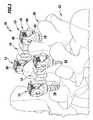
- FIG. 1is a schematic perspective overall view of a spine stabilization system fixed to a spinal column;
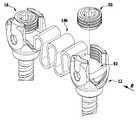
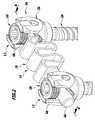
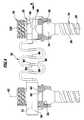
- FIG. 2is a view of a first exemplary embodiment of a connection element, fixed to two bone screws;
- FIG. 3is an exploded representation of the arrangement of FIG. 2 ;
- FIG. 4is partially sectional view of the arrangement in FIG. 2 along line 4 - 4 ;
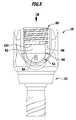
- FIG. 5is a view in the direction of arrow A in FIG. 4 ;
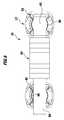
- FIG. 6is a view in the direction of arrow B in FIG. 5 ;
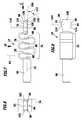
- FIG. 7is a side view of the connection element of FIG. 3 ;
- FIG. 8is a view of the connection element of FIG. 7 in the direction of arrow C;
- FIG. 9is a view of the connection element of FIG. 7 in the direction of arrow D;
- FIG. 10is a schematic perspective view of a second exemplary embodiment of a connection element in the process of being fixed to two bone screws;
- FIG. 11is a view of the arrangement of FIG. 10 in the direction of arrow E;
- FIG. 12is a view of the arrangement of FIG. 11 in the direction of arrow F;
- FIG. 13is a side view of the second exemplary embodiment of a connection element
- FIG. 14is a view of the connection element of FIG. 13 in the direction of arrow G;
- FIG. 15is a view of the connection element of FIG. 13 in the direction of arrow H;
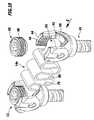
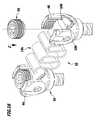
- FIG. 16is a schematic perspective view of a third exemplary embodiment of a connection element in the process of being fixed to two bone screws;
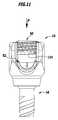
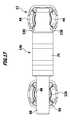
- FIG. 17is a view of the arrangement of FIG. 16 in the direction of arrow I;
- FIG. 18is a side view of the connection element of FIG. 17 ;
- FIG. 19is a view of the connection element of FIG. 18 in the direction of arrow J;
- FIG. 20is a schematic perspective view of a fourth exemplary embodiment of a connection element in the process of being fixed to a bone screw with a further rod-shaped connection element;
- FIG. 21is an exploded representation of the arrangement of FIG. 20 ;
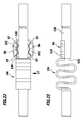
- FIG. 22is a view of the arrangement of FIG. 21 in the direction of arrow K;
- FIG. 23is a view of the two connection elements in FIG. 22 in the direction of arrow L;
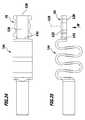
- FIG. 24is a view of the connection element of FIG. 25 in the direction of arrow M;
- FIG. 25is a side view of the connection element of FIG. 23 ;
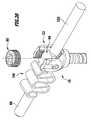
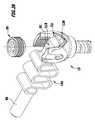
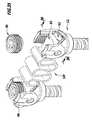
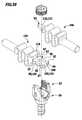
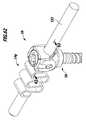
- FIG. 26is a schematic perspective view of a fifth exemplary embodiment of a connection element in the process of being fixed to a bone screw;
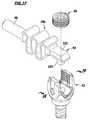
- FIG. 27is an exploded representation of the arrangement of FIG. 26 ;
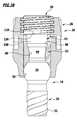
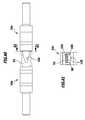
- FIG. 28is a partially sectional view of the arrangement of FIG. 27 along line 28 - 28 ;
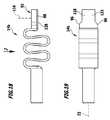
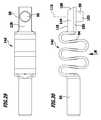
- FIG. 29is a view of the connection element of FIG. 30 in the direction of arrow N;
- FIG. 30is a side view of the connection element of FIG. 27 ;
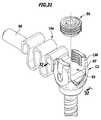
- FIG. 31is a schematic perspective view of a sixth exemplary embodiment of a connection element in the process of being fixed to a bone screw;
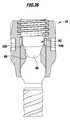
- FIG. 32is a partially sectional view along line 32 - 32 of FIG. 31 ;
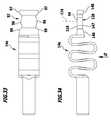
- FIG. 33is a view of the connection element of FIG. 34 in the direction of arrow O;
- FIG. 34is a side view of the connection element of FIG. 32 ;
- FIG. 35is a schematic perspective view of a seventh exemplary embodiment of a connection element in the process of being fixed to two bone screws;
- FIG. 36is a partially sectional view along line 36 - 36 in FIG. 35 ;
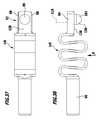
- FIG. 37is a view of the connection element of FIG. 38 in the direction of arrow P;
- FIG. 38is a side view of the connection element of FIG. 35 ;
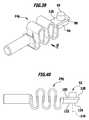
- FIG. 39is a perspective view of an eighth exemplary embodiment of a connection element
- FIG. 40is a view of the connection element of FIG. 39 in the direction of arrow Q;
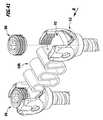
- FIG. 41is a schematic perspective view of a ninth exemplary embodiment of a connection element in the process of being fixed to two bone screws;
- FIG. 42is a view of the arrangement of FIG. 41 in the direction of arrow R;
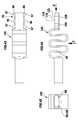
- FIG. 43is a view of the connection element of FIG. 44 in the direction of arrow T;
- FIG. 44is a side view of the connection element of FIG. 41 ;
- FIG. 45is a view of the connection element of FIG. 44 in the direction of arrow S;
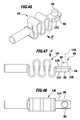
- FIG. 46is a perspective view of a tenth exemplary embodiment of a connection element
- FIG. 47is a view of the connection element of FIG. 46 in the direction of arrow U;
- FIG. 48is a view of the connection element of FIG. 47 in the direction of arrow V;
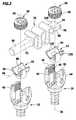
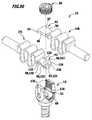
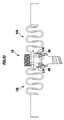
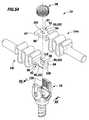
- FIG. 49is a schematic perspective view of an eleventh and a twelfth exemplary embodiment of a connection element in the process of being jointly fixed to a single bone screw;
- FIG. 50is an exploded representation of the arrangement of FIG. 49 ;
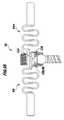
- FIG. 51is a partially sectional view of the arrangement of FIG. 49 along line 51 - 51 ;
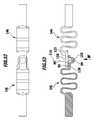
- FIG. 52is a view of the two connection elements of FIG. 53 in the direction of arrow W;
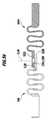
- FIG. 53is a partially sectional side view of the coupled-together connection elements of FIG. 49 ;
- FIG. 54is a schematic perspective view of a thirteenth and a fourteenth exemplary embodiment of a connection element in the process of being jointly fixed to a single bone screw;
- FIG. 55is a partially sectional view along line 55 - 55 in FIG. 54 ;
- FIG. 56is a partially sectional side view of the two coupled-together connection elements of FIG. 55 ;
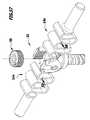
- FIG. 57is a schematic perspective view of a fifteenth and a sixteenth exemplary embodiment of a connection element in the process of being jointly fixed to a single bone screw;
- FIG. 58is a partially sectional view of the arrangement of FIG. 57 along line 58 - 58 ;
- FIG. 59is an exploded representation of the arrangement of FIG. 57 ;
- FIG. 60is a plan view of the coupled-together connection elements of FIG. 57 ;
- FIG. 61is a sectional view along line 61 - 61 in FIG. 60 ;
- FIG. 62is a schematic perspective view of a seventeenth exemplary embodiment of a connection element which is fixed to a bone screw with a further rod-shaped connection element;
- FIG. 63is a partially sectional view of the arrangement of FIG. 62 along line 63 - 63 ;
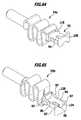
- FIG. 64is a perspective view of the connection element of FIG. 63 from above;
- FIG. 65is a perspective view of the connection element of FIG. 64 from below;
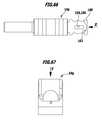
- FIG. 66is a view of the connection element of FIG. 67 in the direction of arrow Y;
- FIG. 67is a view of the connection element of FIG. 66 in the direction of arrow X.
- the present inventionrelates to a connection element for a spine stabilization system with a first end for fixing to a first bone fixation device, a second end for fixing to a second bone fixation device and an intermediate portion arranged or formed between the two ends and defining a longitudinal axis, wherein at least one of the two ends takes the form of a coupling element for fixing the connection element to a bone fixation device in at least one defined orientation relative to the longitudinal axis and wherein the coupling element has a shape other than a circular cylinder.
- connection elementwith a defined orientation, i.e. in particular to fix it with a defined orientation to the bone fixation devices.
- Ends in the form of circular cylindersdo not define any preferential direction due to their rotationally symmetrical shape. Although they do allow any desired orientation of the connection element and thus orientation of the intermediate portion relative to the longitudinal axis thereof, this may actually be disadvantageous if, for example, the intermediate portion likewise defines a preferential direction, which is possible in particular in the case of flexible or partially flexible intermediate portions, and is therefore intended to be oriented in defined manner relative to the bone fixation devices.
- the coupling elementis configured by definition, unlike a circular cylinder, to be not fully rotationally symmetrical, such that even in the case of a connection element receptacle which is provided on a bone fixation device and may be configured to be rotationally symmetrical or substantially rotationally symmetrical, a defined orientation of the connection element and thus of the intermediate portion thereof relative to the longitudinal axis is possible, and that without an operator having to make particularly great efforts.
- precisely one defined orientationis possible, due to a shaping of the coupling element.
- the two endsare favourably configured in the form of a coupling element which has a shape other than a circular cylinder. In this way, an optimal connection with two bone fixation devices may be achieved.
- connection elementmay be simply produced if the coupling element is made in one piece.
- the coupling elementmay be formed by machining or produced by casting.
- connection elementTo improve the stability of the connection element, it is advantageous for it to be in one piece.
- the coupling elementcan be fixed simply and reliably to at least one bone fixation device with a defined orientation relative thereto, it is favourable for the coupling element to comprise a coupling element main body and at least one coupling member arranged or formed on the coupling element main body.
- the at least one coupling membermay serve in particular to co-operate with a corresponding part on the bone fixation device or indeed with a further coupling member on a further connection element, for example to be able in this way to lengthen the connection element if required.
- the at least one coupling membermay be configured to be brought into positive engagement with correspondingly provided further coupling members on other connection elements or on a bone fixation device.
- the at least one coupling memberextends in a coupling member direction which extends parallel to or transversely of the longitudinal axis.
- a connection element receptacleis configured on a bone fixation device
- an optimal connection with a bone fixation devicecan be achieved by corresponding predetermination of the coupling member direction, in particular rotation or axial displacement relative to the bone fixation device may in this way be simply and reliably prevented.
- connection elementmay be simply constructed if the coupling element main body is given the form of a straight or oblique general cylinder and if a cylinder longitudinal axis defined by the cylinder extends transversely of the longitudinal axis.
- a general cylinderhas the same cross-sectional area in mutually parallel section planes. The cross-sectional area may have any desired shape but deviates according to the invention from a circle in order to avoid undefined orientation of the intermediate portion relative to the bone fixation devices.
- a cylinder longitudinal axis of the general cylindermay also extend parallel to the longitudinal axis of the connection element.
- the coupling element main bodyprefferably has a cross-sectional area which is circular, quadrangular or in the form of a multiple lobe member.
- the cross-sectional areamay be rectangular or square.
- Such basic shapesare simple to produce and allow a defined orientation of the connection element relative to a bone fixation device.
- the at least one coupling membertakes the form of a coupling projection or a coupling receptacle. It may thus co-operate in desired manner with corresponding recesses and projections.
- the coupling projectionis crowned, spherical, cylindrical, conical, cuboidal or takes the form of a combination of one or more of these shapes.
- the coupling projectionmay be conformed to a connection element receptacle of a bone fixation device, so as in particular to allow interlocking engagement.
- the coupling receptaclemay be hollow-crowned, hollow-spherical, hollow-cylindrical, cuboidal, in the form of a through opening in the coupling element main body or in the form of a combination of one or more of these shapes.
- a coupling receptacle shaped in this waymay co-operate with a correspondingly shaped coupling projection of a further connection element, in order for example in this way to couple two ends of two connection elements together and fix them jointly to a bone fixation device.
- the coupling receptaclemay favourably take the form of a set-back portion or a groove. These may extend parallel to or transversely of the longitudinal axis.
- the coupling receptaclemay, in cooperation with a further coupling member, prevent relative motion of the connection element relative to a bone fixation device parallel to and/or transversely of the longitudinal axis.
- connection elementfavourably has two, three or more coupling members. It is also possible for there to be in particular four, five or six coupling members.
- the coupling membershave coupling member longitudinal axes oriented in different directions, in order in this way to limit movement of the connection element relative to a bone fixation device or a further connection element in different directions.
- connection elementmay be simply constructed if the coupling element has two coupling members arranged or formed in mirror-symmetrical manner relative to a mirror plane containing the longitudinal axis. These may for example be set-back portions or grooves extending parallel to one another.
- the coupling elementmay be mirror-symmetrical relative to a mirror plane containing the longitudinal axis. It is thus possible, depending on the shape of the coupling element, to predetermine for example one, two or four defined orientations of the connection element relative to a bone fixation device.
- connection elementmay be particularly simply constructed if it is mirror-symmetrical relative to a mirror plane containing the longitudinal axis.
- connection elementin a particularly space-saving manner and optionally with a further connection element jointly in a connection element receptacle of a fixation device, it is advantageous for a centre of gravity of the coupling element to be spaced from the longitudinal axis.
- connection elementmay be improved and the risk of injury minimized if an end face of the coupling element facing away from the intermediate portion is inclined relative to the longitudinal axis or rounded.
- Such an end facemay be simply produced if an end face plane defined by the end face and the longitudinal axis form an end face angle of inclination which lies within a range of around 30° to 90°, preferably in a range of around 45° to 75°.
- the coupling element main bodymay include a portion of a circular cylinder, which has a circular cylinder axis extending transversely of the longitudinal axis.
- the coupling element main bodymay engage in a corresponding recess in such a way that movement parallel to the longitudinal axis of the connection element relative to a bone fixation device or a further connection element may be simply and reliably limited.
- the coupling element main bodymay furthermore be favourable for the coupling element main body to have a planar surface portion which defines a plane which extends parallel to or transversely of the longitudinal axis.
- a surface portion which defines a plane extending parallel to the longitudinal axisallows a flat contact for example with a fixing element for fixing the connection element to the bone fixation device.
- two ends of two connection elementsmay thus also abut flatly against one another.
- connection elementmay comprise a connection element contact face for application against a further connection element.
- connection element contact facemay be configured to abut an end of the further connection element.
- connection element contact facepreferably takes the form at least in part of a hollow-cylindrical wall surface.
- Such a configurationmakes it possible in particular to receive an end of a further connection element in the form of a circular cylinder and extending in the direction of the longitudinal axis or parallel thereto.
- connection element contact facetakes the form at least in part of a planar contact face portion.
- connection element contact faceis simple to produce and apply against a corresponding planar connection element contact face.
- the coupling element main bodymay comprise two, three or more coupling element main body side faces which are planar or concavely curved away from the coupling element main body and inclined relative to one another.
- coupling element main body side faces inclined relative to one anothereven if they are planar, may produce a concave shape facing away from the coupling element main body.
- Such a coupling element main bodymay in particular co-operate with a corresponding convex side face of a bone fixation device.
- connection elementmay be further simplified if mutually adjacent planar coupling element main body side faces form an obtuse angle between them.
- the intermediate portionbe a winding leaf spring element in the form of a strip and to comprise at least one recess open laterally in a recess direction transverse to a longitudinal axis defined by the intermediate portion.
- Such an intermediate portionmakes it possible to set a defined resilience of the connection element and a defined anisotropy of the resilience in the circumferential direction relative to the longitudinal axis.
- the connection element with the recessesmay be simply and reliably handled, for example with a correspondingly shaped holding instrument.
- blocking elementsmay also be temporarily inserted into the recesses, in order to limit the resilience of the connection element temporarily completely or in part, in particular during implantation.
- the coupling elementmay define at least one preferential direction transverse to the longitudinal axis and for the preferential direction and the recess direction to form an orientation angle in a range from 0° to 180°.
- the orientation anglepreferably lies in a range from 0° to 90°.
- the coupling elementpreferably defines two or more preferential directions. This allows an operator to arrange the connection element in different but defined orientations relative to the bone fixation device.
- a preferential angle between two preferential directions of the coupling elementis advantageous for a preferential angle between two preferential directions of the coupling element to correspond to an angle 180°/n, wherein n is the number of preferential directions defined overall by the coupling member. If for example the coupling element defines two preferential directions, the preferential angle amounts in particular to 90°.
- connection elementis advantageously made from a metallic material or a plastics material.
- the materialsare preferably biocompatible and have the stability required for the application.
- the metallic materialprefferably be or contain titanium, a titanium alloy or a cobalt-chromium alloy. Such materials are extremely suitable as implant materials.
- plastics materialit is moreover advantageous for the plastics material to be or contain polyetherether ketone or carbon fibre reinforced polyetherether ketone. Such a plastics material is likewise biocompatible and has the stability required for the application.
- the present inventionfurther relates to a spine stabilization system comprising at least one first bone fixation device, at least one second bone fixation device and at least one connection element, which at least one connection element comprises a first end for fixing to the at least one first bone fixation device, a second end for fixing to the at least one second bone fixation device and an intermediate portion arranged or formed between the two ends and defining a longitudinal axis, wherein at least one of the two ends takes the form of a coupling element for fixing the connection element to a bone fixation device in at least one defined orientation relative to the longitudinal axis and wherein the coupling element has a shape other than a circular cylinder.
- the at least one first and/or the at least second bone fixation devicesmay take the form of pedicle screws.
- the pedicle screwsmay take the form of polyaxial pedicle screws.
- Pedicle screwsare in particular designed to be fixed to the pedicles of vertebrae. If connection elements are fixed to the pedicle screws, the mobility of a patient's spinal column may be wholly or partially restricted in a defined manner.
- the at least one first and/or the at least one second bone fixation deviceto have a fixing part and a holding part and for the holding part to have a connection element receptacle for receiving at least one end of a connection element.
- the holding partmay optionally be connected movably or immovably with the fixing part.
- the holding partis preferably fixable in an implantation position relative to the fixing part. This allows the holding part first of all to be oriented in the desired manner relative to the fixing part and then fixed, for example with simultaneous fixing of the connection element in the connection element receptacle.
- connection element receptaclemay be formed in a particularly simple manner if the holding part has two wall portions arranged symmetrically to one another and laterally defining the connection element receptacle. Overall, a holding part which is fork-shaped may be formed in this way. It may also be stated that the connection element receptacle is formed by a slot in the holding part.
- the at least one first and/or the at least one second bone fixation deviceto comprise a fixing screw with an external thread and for the connection element receptacle to comprise an internal thread corresponding to the external thread.
- the fixing screwallows simple fixing of an end of a connection element inserted into the connection element receptacle temporarily or permanently to the first or second bone fixation device.
- the coupling element main bodyprefferably has a planar clamping surface portion for a distal end of the fixing screw, which clamping surface portion defines a plane extending parallel or substantially parallel to the longitudinal axis. It is thus in particular possible to clamp the clamping surface portion flatly with a distal end of the fixing screw.
- the intermediate portionis preferably at least partially flexible. With such an intermediate portion a defined mobility of the spine stabilization system may be preset. It is favourable for the intermediate portion to predetermine an anisotropic flexibility. In this way, for example, flexion and extension in a patient's median plane may be partially enabled, but not sideways bending of the spinal column.
- connection elementsmay be made for the spine stabilization system to comprise two connection elements, which have mutually corresponding coupling elements which may be fixed jointly in a connection element receptacle of the at least one first and/or the at least one second bone fixation device.
- connection elementsmay in this way be simply extended.
- connection elementswhich are of a length which specifically allows connection between two bone fixation devices. It is for example moreover possible, with a single fixing screw, to fix not only one connection element in clamped manner to the bone fixation device, but also two connection elements to a single bone fixation device.
- the coupling elements of the two connection elementsprefferably have mutually corresponding coupling members, which, in a coupling position in which the two coupling elements are held jointly in a connection element receptacle of the at least one first and/or of the at least one second bone fixation device, co-operate in force- and/or positive-locking manner or are in engagement with one another.
- the coupling membersallow direct, in particular a positive-locking coupling between the two connection elements, and not just between the connection elements and bone fixation device.
- FIG. 1is a schematic representation of a spine stabilization system 10 comprising a total of four bone fixation devices 12 and two connection elements 14 .
- the bone fixation devices 12take the form of bone screws 16 .
- FIGS. 1 to 6show “polyaxial” bone screws 16 , by way of example.
- the bone screws 16are screwed into the pedicles 18 of vertebrae 20 of a spinal column 22 .
- one bone screw 16is screwed for example into pedicles 18 of adjacent vertebrae 20 , said bone screws then being coupled together via a connection element 14 .
- the polyaxial bone screws 16comprise a fixing part 24 and a holding part 26 .
- the fixing part 24comprises a shank defining a longitudinal axis 28 and having an external thread 32 for screwing into bone.
- a proximal end of the shank 30takes the form of a spherical head 34 , on which the holding part 26 is movably mounted.
- the holding part 26is substantially in the form of a sleeve and has a hollow-spherical seat 36 on the distal side for the head 34 , such that the holding part 26 is pivotable in a mounted position about a centre point of the head 34 relative to the fixing part 24 .
- the holding part 26comprises two notches 40 diametrically opposite one another relative to the longitudinal axis 28 , so as to form two wall portions 44 arranged symmetrically relative to one another and relative to the longitudinal axis 28 and laterally defining a connection element receptacle 42 .
- an internal thread 46is formed on the holding part 26 in the region of the wall portions 44 , which internal thread corresponds to an external thread 48 on a fixing screw 50 .
- the holding part 26comprises a clamping member 52 in the form of an insert 54 .
- Thishas a hollow dome-shaped distal end 56 , which may be brought into contact with the head 34 .
- a proximal endsubstantially takes the form of a half cylinder sleeve 58 , the cylinder sleeve longitudinal axis 60 of which extends transversely of a holding part longitudinal axis 62 .
- the cylinder sleeve 58defines a hollow-cylindrical contact surface 64 for in particular a first end 66 , in the form of a cylindrical rod, of the connection element 14 .
- the insert 54has a through opening extending coaxially to the holding part longitudinal axis 62 in the form of a bore 68 .
- the first end 66may, as shown schematically in FIG. 4 , be inserted into the connection element receptacle 42 defined on the distal side by the contact surface 64 and secured in clamped manner with the fixing screw 50 .
- the holding part 26is fixed in clamped manner relative to the fixing part 24 in a desired implantation position, in that the clamping force introduced by means of the fixing screw 50 is transferred via the first end 66 to the insert 54 , which in turn presses on the head 34 .
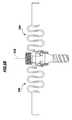
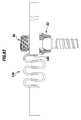
- connection element 14comprises the first end 66 and a second end 70 and an at least partially flexible intermediate portion 74 arranged or formed therebetween and defining a longitudinal axis 72 .
- Said intermediate portiontakes the form of a winding leaf spring element 76 in the form of a strip.
- itcomprises a total of five recesses 78 and 80 which are laterally open transversely of the longitudinal axis 72 in a recess direction 82 .
- the three recesses 80are open in opposing directions relative to the recesses 78 . Due to the configuration as a leaf spring element 76 , the intermediate portion 74 and thus the connection element 14 are resilient in a defined manner.
- a resilience of the intermediate portion 74may additionally optionally be varied by one or more stiffness modifiers 84 .
- Thesemay for example be arranged or configured in the form of short projections 86 in the form of strips on one or both surfaces 88 and 90 respectively of the leaf spring element 76 . Preferably, they are in one piece with the leaf spring element 76 .
- Further examples of the configuration of stiffness modifiers 84are known from DE 20 2010 008 865 U1.
- connection element 14takes the form of a coupling element 92 for fixing the connection element 14 to the bone fixation device 12 in at least one defined orientation relative to the longitudinal axis 72 . It has a shape other than a circular cylinder. It is moreover of one-piece configuration, as is the connection element 14 overall.
- the coupling element 92has a coupling element main body 94 and a total of four coupling members 96 and 98 .
- the coupling members 96which take the form of coupling projections 102 facing convexly away from the coupling element main body 94 , extend in a coupling member direction 104 , which extends transversely of the longitudinal axis 72 .
- the coupling members 98take the form of set-back portions 100 on the cuboidal coupling element main body 94 and define a coupling member direction 106 which extends parallel to the longitudinal axis 72 .
- an end face 108 of the coupling element 92 facing away from the intermediate portion 74is inclined relative to the longitudinal axis 72 .
- the end face 108defines an end face plane 110 , which forms an end face angle of inclination 112 with the longitudinal axis 72 which preferably lies in a range from around 30° to around 90°.
- the end face angle of inclination 112amounts to around 60°.
- the side faces 114 facing away from the coupling element main body 94 and defined by the coupling members 96together form a portion of a circular cylinder, the longitudinal axis of which defines a preferential direction 116 of the coupling element 92 . This extends transversely of the longitudinal axis 72 .
- a diameter defined by the coupling members 96is conformed to an internal diameter of the internal thread 46 , such that the coupling element 92 may be fixed to the bone screw 16 in defined orientation relative to the longitudinal axis 72 .
- a centre of gravity of the coupling element 92is spaced from the longitudinal axis 72 .
- a top 118 of the coupling element main body 94defines a planar surface portion 120 , which defines a plane extending parallel to the longitudinal axis 72 .
- the surface portion 120forms a clamping surface portion 122 for a distal end 124 of the fixing screw 50 . In this way, to clamp the coupling element 92 in the connection element receptacle 42 the end 124 may be pressed substantially flatly against the clamping face portion 122 .
- the set-back portions 100are arranged and dimensioned such that they abut edges 126 of the insert 54 extending parallel to the longitudinal axis 72 and facing in the proximal direction.
- connection element 14defines a preferential direction 116 , and may thus be fixed precisely in a defined manner in the connection element receptacle 42 .
- connection element 14is additionally secured parallel to the longitudinal axis 72 relative to the bone screw 16 , and thus cannot be moved parallel to the longitudinal axis 72 relative to the bone screw 16 even when the fixing screw 50 needs to be loosened a little. Rotation of the connection element 14 about the longitudinal axis 72 relative to the bone screw 16 is likewise not possible.
- connection elementswill be described in greater detail below, these differing substantially in the configuration of their coupling elements. Identical or comparable parts and elements are therefore designated with the same reference signs.
- FIGS. 10 to 15are schematic representations of a second exemplary embodiment of a connection element denoted overall with reference sign 14 a .
- the difference in the construction of the connection element 14is the shape of the coupling element 92 .
- Thislikewise has a cuboidal coupling element main body 94 , away from which two coupling members 96 extend laterally transversely of the longitudinal axis 72 .
- An end face 108 facing away from the intermediate portion 74is rounded and forms together with the coupling members 96 a part of a cylindrical disc which comprises a cylindrical side face 114 .
- a diameter of the coupling element 92 defined by the side face 114corresponds to an internal diameter of the internal thread 46 , such that the coupling element 92 may be inserted into the connection element receptacle 42 for axial securing of the connection element 14 a in the direction of the longitudinal axis 72 relative to the bone screw 16 .
- two further coupling members 98 extending parallel to the longitudinal axis 72are formed on the coupling element main body 94 in the form of set-back portions 100 .
- the coupling element 92defines a preferential direction 116 which extends transversely of the longitudinal axis 72 .
- the top 118 of the coupling element 92forms a planar clamping surface portion 122 for the distal end 124 of the clamping screw 50 .
- connection element 14 amay be oriented both parallel to the longitudinal axis 72 and in the circumferential direction thereof in a defined manner relative to the bone screw 16 .
- FIGS. 16 to 19are schematic representations of a third exemplary embodiment of a connection element and are designated overall with the reference sign 14 b . It differs from the connection element 14 in the configuration of the coupling element 92 .
- the coupling element 92has a cuboidal coupling element main body 94 , the top 118 of which defines a planar clamping surface portion 122 .
- An end face 118 facing away from the intermediate portion 74is likewise planar and extends transversely of the longitudinal axis 72 .
- Two coupling members 96 projecting laterally, i.e. transversely of the longitudinal axis 72are formed on the coupling element main body 94 , as are two coupling members 98 extending parallel to the longitudinal axis 72 .
- the coupling members 98are formed in the bottom 128 of the coupling element main body 94 in the form of set-back portions 100 , which extend parallel to the longitudinal axis 72 over the entire length of the coupling element 92 . They are dimensioned and sized such that they in turn abut the edges 126 of the insert 54 .
- the coupling element main body 94has a width which corresponds to a clearance between the two wall portions 44 , such that the coupling element 72 may be inserted into the connection element receptacle 42 .
- the coupling members 96abut the wall portions at concavely curved side faces 130 facing away therefrom, these side faces facing substantially in the direction of the intermediate portion 74 when the coupling element 92 has been inserted.
- the coupling members 96are conformed in shape to the side faces 130 , such that flat contact between the coupling element 92 and the side faces 130 is possible.
- the side faces 130thus form a limit stop for the connection element 14 b , such that it can only be moved so far parallel to the longitudinal axis 72 in the direction of the bone screw 16 before the coupling members 96 strike against the side faces 130 . Rotation of the coupling element 92 in the connection element receptacle 42 is not possible.
- the coupling element 92defines a preferential direction 116 which extends transversely of the longitudinal axis 72 .
- FIGS. 20 to 25are schematic representations of a fourth exemplary embodiment of a connection element designated overall with the reference sign 14 c . It differs in structure from the connection element 14 in the coupling element 92 forming a second end.
- the coupling element 92has a substantially cuboidal coupling element main body 94 , which comprises two coupling members 96 in the form of coupling projections 102 , which protrude laterally on the coupling element main body 94 transversely of the longitudinal axis 72 .
- the coupling members 96define a diameter which corresponds to an internal diameter of the internal thread 46 .
- Each of the coupling members 96is adjoined both on a side facing the intermediate portion 74 and on a side remote therefrom by two coupling members 97 , which likewise take the form of coupling projections. These project a little further from the coupling element main body 94 than the coupling members 96 . Furthermore they have an external contour which is conformed to the concave side faces 130 of the wall portions 44 . In this way, the coupling element 92 , as is readily visible for example in FIG. 22 , may be inserted in a substantially positive-locking manner from above into the connection element receptacle 42 .
- the top 118 of the coupling element 92is planar and forms a clamping surface portion 122 for the distal end 124 of the fixing screw 50 .
- the coupling element 92further has a connection element contact face 134 for application against a further connection element, for example in the form of a connecting rod 132 , which is elongate and takes the form of a circular cylinder.
- the connection element contact face 134takes the form of a hollow-cylindrical wall face 136 , against which an outer face 138 of the connecting rod 132 may be flatly applied. Facing away from the intermediate portion 74 in the direction of the coupling element 92 is a striking surface 140 , against which an end face 142 of the connecting rod 132 may strike.
- the particular configuration of the coupling element 92allows this to be fixed on the bone screw 16 together with the connecting rod 132 .
- the connecting rod 132is then held clamped between the coupling element 92 and the insert 54 , the coupling element 92 is between the connecting rod 132 and the fixing screw 50 .
- FIGS. 26 to 30are schematic representations of a fifth exemplary embodiment of a connection element designated overall with the reference sign 14 d . It differs in structure from the connection element 14 in the configuration of the coupling element 92 .
- the coupling element 92in turn has a cuboidal main body with an end face 108 facing away from the intermediate portion 74 and inclined relative to the longitudinal axis 72 .
- the top 118 of the coupling element 92is planar and forms a clamping surface portion 122 for the distal end 124 of the fixing screw 50 .
- Main body side faces 144 extending substantially parallel to the longitudinal axis 72are curved at the point of transition to the bottom 128 and form coupling members 98 in the form of set-back portions 100 .
- the curvature of the coupling members 98corresponds to an internal diameter defined by the contact surface 64 of the insert 54 , such that the coupling members 98 abut substantially flatly against the contact surface 64 . This is readily visible for example from FIG. 28 .
- a further coupling member 99protrudes from the bottom 128 transversely of the longitudinal axis 72 and defines a preferential direction 116 .
- the coupling member 99takes the form of a coupling projection 103 and has the shape of a cone extending away from the bottom 128 .
- the coneis dimensioned such that it may be introduced into the bore 68 of the insert 54 .
- thismay be secured to the bone screw 16 both parallel to the longitudinal axis 72 and against rotation about the same.
- FIGS. 31 to 34are schematic representations of a sixth exemplary embodiment of a connection element designated overall with the reference sign 14 e . It differs in structure from the connection element 14 in the configuration of the coupling element 92 .
- the coupling element 92has a substantially cuboidal coupling element main body 94 with two laterally projecting coupling members 96 . These are convexly curved away from the coupling element main body 94 and define a diameter which corresponds to an internal diameter of the internal thread 46 .
- the coupling members 97have an outer contour, such that they may be applied at least in places substantially flatly against the side faces 130 of the wall portions 44 .
- further coupling projections 99adjoin the coupling members 96 , said further coupling projections substantially taking the form of the coupling projections 96 of the connection element 14 b .
- the coupling members 96have an outer contour, which at least in part allows a flat contact against the side faces 130 of the wall portions 44 .
- the top 118 of the coupling element 92forms a planar clamping surface portion 122 for the distal end 124 of the fixing screw 50 .
- the bottom 128 of the coupling element 92is formed by three coupling element main body side faces 146 , 147 and 148 inclined relative to one another.
- the coupling element main body side face 147extends parallel to the top 148 and substantially in the region of the coupling members 96 .
- the coupling element main body side face 148is inclined relative to the coupling element main body side face 147 and forms an obtuse angle with the latter.
- the coupling element main body side face 148extends substantially in the region of the coupling members 97 .
- the coupling element main body side face 146extends substantially in the region of the coupling members 99 and forms an obtuse angle with the coupling element main body side face 147 . Overall, the three coupling element main body side faces 146 , 147 and 148 together form a substantially concavely curved bottom 128 of the coupling element 92 .
- the coupling element 92defines a preferential direction 116 which extends transversely of the longitudinal axis 72 .
- connection element 14 eto be secured to the bone screw 16 with the fixing screw 50 both parallel to the longitudinal axis 72 and against rotation about this.
- FIGS. 35 to 38are schematic representations of a seventh exemplary embodiment of a connection element designated overall with the reference sign 14 f . It differs from the connection element 14 in the configuration of the coupling element 92 .
- the coupling element main body 94is substantially cuboidal and has at its bottom 128 two coupling members 98 in the form of set-back portions 100 extending parallel to the longitudinal axis, such that the coupling element 92 may be applied with the set-back portions 100 against the edges 126 of the insert 54 .
- the width of the main bodycorresponds substantially to an inside width between the wall portions 44 .
- a coupling member 99protrudes from the bottom 128 transversely of the longitudinal axis 72 , said coupling member being substantially cylindrical and defining an external diameter which corresponds to an internal diameter of the bore 68 of the insert 54 .
- An end 150 of the coupling member 99 facing away from the coupling element main body 94takes the form of a hemisphere 152 .
- the coupling element 92thus defines a preferential direction 116 and allows the connection element 14 f to be secured to the bone screw 16 by means of the fixing screw 50 in a direction parallel to the longitudinal axis 72 and against rotation about the longitudinal axis 72 .
- FIGS. 39 and 40are schematic representations of an eighth exemplary embodiment of a connection element designated overall with reference sign 14 g . It differs from the connection element 14 in the configuration of the coupling element 92 .
- the coupling element 92has a substantially cuboidal main body 94 , with two coupling members 98 extending parallel to the longitudinal axis 72 and taking the form of set-back portions 100 .
- the top 118 of the coupling element 92forms a planar clamping surface portion 122 for the distal end 124 of the fixing screw 50 .
- the coupling member 99is dimensioned such that it may be introduced in particular into the bore 68 in the insert 54 .
- the coupling element 92defines a preferential direction 116 and allows the connection element 14 g to be fixed to a bone screw 16 with the fixing screw 50 both parallel to the longitudinal axis 72 and against rotation about the longitudinal axis 72 .
- FIGS. 41 to 45are schematic representations of a ninth exemplary embodiment of a connection element designated overall with the reference sign 14 h . This differs in structure from the connection element 14 in the configuration of the coupling element 92 .
- the coupling element 92corresponds in structure substantially to the coupling element 92 of the connection element 14 c . It likewise comprises coupling members 96 and 97 and has a top 118 which forms a planar clamping surface portion 122 .
- the bottom 128 of the coupling element 92is likewise planar.
- coupling members 98extending parallel to the longitudinal axis 72 take the form of set-back portions 100 , which are arranged and dimensioned such that they abut the edges 126 of the insert 54 when the coupling element 92 engages in the connection element receptacle 42 .
- the coupling element 92defines a preferential direction 116 and may be secured with the fixing screw 50 in the connection element receptacle 42 both against movement parallel to the longitudinal axis 72 and against rotation about the longitudinal axis 72 .
- FIGS. 46 to 48are schematic representations of a tenth exemplary embodiment of a connection element designated overall with the reference sign 14 i . It differs from the connection element 14 in the configuration of the coupling element 92 .
- the coupling element 92is configured substantially identically to the coupling element 92 of the connection element 14 d . It differs therefrom in that side faces 114 of the coupling element main body facing away from one another bear two coupling members 96 protruding diametrically away from one another and taking the form of coupling projections 102 .
- the coupling members 96define an external diameter which corresponds to an internal diameter of the internal thread 46 .
- connection element 92 of the connection element 14 imay thus be inserted in similar manner to the connection element 14 d into the connection element receptacle 42 , wherein in addition the coupling members 96 assist the conical coupling member 99 protruding from the bottom 128 in preventing movement of the connection element 14 i relative to the bone screw 16 parallel to the longitudinal axis 72 .
- the coupling member 92 of the connection element 14 ialso defines a preferential direction 116 , which extends transversely of the longitudinal axis 72 .
- the coupling element 92 of the connection element 14 jis substantially cuboidal and, like the coupling element 92 of the connection element 14 a , has two coupling members 96 in the form of coupling projections 102 protruding from the coupling element main body 94 in diametrically opposed directions.
- two coupling members 98are formed on the coupling element 92 which take the form of set-back portions 100 , extend parallel to one another and extend as far as the end face 108 .
- the set-back portions 100are dimensioned such that they may abut the edges 126 of the insert 54 .
- a coupling member 97 in the form of a coupling recess 154is formed on the top 118 of the coupling element 92 .
- the coupling recess 154is hollow-spherical in shape. It is arranged and formed substantially coaxially to the coupling member 99 .
- the top 118furthermore forms a connection element contact face 134 .
- a corresponding connection element contact face 134 of the coupling element 92 of the connection element 14 kmay be applied thereto.
- the coupling element 92 of the connection element 14 khas a planar top 118 , which forms a planar clamping surface portion 122 for the end 124 of the fixing screw 50 .
- the coupling element main body 94is substantially cuboidal and likewise has two coupling members 96 projecting transversely of the longitudinal axis 72 . These define a common external diameter, which corresponds to an internal diameter of the internal thread 46 .
- coupling members 97in the form of coupling projections with a shape corresponding to the concave side faces 130 of the wall portions 44 adjoin the coupling members 96 .
- a further coupling member 99projects from the bottom 128 of the coupling element 92 of the connection element 14 k , and has a shape corresponding to the coupling recess 154 , such that the coupling member 99 may be introduced in positive-locking manner into the coupling recess 154 .
- connection elements 14 j and 14 kmay be fixed with their two coupling elements 92 jointly in a connection element receptacle 42 of a bone screw 16 .
- the coupling element 92 of the connection element 14 jis inserted in the described manner into the connection element receptacle 42 , such that the coupling member 99 protrudes into the bore 68 .
- the connection element 14 kmay be inserted with its coupling element 92 into the connection element receptacle 42 , such that the coupling member 92 protrudes into the coupling recess 154 .
- connection elements 14 j and 14 kmay be fixed in jointly clamped manner to the bone screw 16 .
- the particular configuration of the coupling elements 92 of the connection elements 14 j and 14 k in practiceallows simple extension of a connection element.
- FIGS. 54 to 56are schematic representations of a thirteenth and a fourteenth exemplary embodiment of a connection element, designated with reference signs 14 l and 14 m .
- the connection elements 14 l and 14 mdiffer from the connection element 14 in the configuration of their coupling elements 92 .
- the coupling element 92 of the connection element 14 lhas a substantially cuboidal main body.
- two coupling members 98take the form of lateral set-back portions 100 , which are dimensioned and arranged such that they may be placed onto the edges 126 of the insert 54 .
- the bottom 128is planar.
- the top 118is likewise planar and forms a connection element contact face 134 for application against the connection element 14 m .
- a coupling member 99 in the form of a coupling projectionprotrudes from the top 118 in a direction transverse to the longitudinal axis 72 .
- the coupling member 99is of substantially elongate, cuboidal construction with rounded end edges and slightly inclined side faces, so as to form overall a slightly conical projection.
- the coupling element 92 of the connection element 14 mhas a substantially cuboidal coupling element main body 94 , away from which two coupling members 96 in the form of coupling projections 102 extend transversely of the longitudinal axis 72 in diametrically opposed directions.
- the coupling projections 102are curved convexly away from the coupling element main body 94 and together define common an external diameter which corresponds to an internal diameter of the internal thread 46 .
- the coupling members 96are adjoined on their side facing away from the intermediate portion 74 by two coupling members 97 in the form of coupling projections, which have an outer contour conformed to the side faces 130 of the wall portions 44 .
- the coupling element 92is provided with a coupling recess 144 extending transversely of the longitudinal axis 72 and taking the form of a through opening 156 .
- the through opening 156substantially takes the shape of an elongate hole with rounded corners. Moreover, it is slightly conical, such that the coupling member 99 may be inserted in positive-locking manner into the coupling recess 154 .
- the bottom 128 of the coupling element 92 of the connection element 14 mis planar, like the top 118 .
- the top 118forms a planar clamping surface portion 122 for the distal end 124 of the fixing screw 50 .
- connection elements 14 l and 14 mmay be coupled together and fixed jointly to a single bone screw 16 .
- the coupling element 92 of the connection element 14 lis inserted into the connection element receptacle 42 , such that the coupling member 99 faces away from the fixing part 24 .
- the coupling element 92 of the connection element 14 mmay be inserted into the connection element receptacle 42 , such that the coupling recess 154 receives the coupling member 99 .
- the coupling elements 92may be fixed in clamped manner to the holding part.
- connection element 14 nhas a coupling element 92 , which corresponds substantially to the coupling element 92 of the connection element 14 h . It differs merely in the configuration of a coupling member 99 in the form of a coupling recess 154 .
- the coupling recess 154extends from the end face 108 towards the intermediate portion 74 , in such a way that its width decreases, such that overall an equal-sided prism is formed as a hollow.
- the coupling recess 154also extends from the top 118 . In other words, the coupling recess 154 opens away from the top 118 and from the end face 108 .
- the top 118furthermore forms a planar clamping surface portion 122 .
- a boundary face 158 of the coupling recess 154 extending parallel to the bottom 128forms a connection element contact face 134 for application against the connection element 14 o , specifically the coupling element 92 thereof.
- the coupling element 92 of the connection element 14 ohas the shape of an equal-sided prism and corresponds to the coupling recess 154 .
- the coupling element 92may thus be introduced completely into the coupling recess 154 , as illustrated schematically by way of example in FIG. 60 .
- the top 118 of the coupling element 92 of the connection element 14 ofurthermore forms a planar clamping surface portion 122 .
- the bottom 128 of the coupling element 92abuts the boundary face 158 .
- connection elements 14 n and 14 otogether form a unit, which has the same shape as the coupling element 92 of the connection element 14 h .
- the two connection elements 14 n and 14 omay be secured to the bone screw 16 in a direction parallel to the longitudinal axis 72 and against rotation about the same.
- FIGS. 62 to 67are schematic representations of a seventeenth exemplary embodiment of a connection element designated overall with the reference sign 14 p . It differs from the connection element 14 in the configuration of the coupling element 92 .
- the coupling element 92 of the connection element 14 pcorresponds in structure substantially to the coupling element 92 of the connection element 14 c .
- Two coupling members 96protrude laterally from a substantially cuboidal coupling element main body 94 in diametrically opposing directions, which define a common external diameter conformed to an internal diameter of the internal thread 46 .
- the coupling members 97 protruding on either side of the coupling members 96have an external contour which is in turn conformed to the concave side faces 130 of the wall portions 44 .
- the coupling members 97 formed at the free end of the coupling element 92additionally extend beyond the top 118 and thereby enlarge the end face 108 of the coupling element 92 in comparison with the end face 108 of the coupling element 92 of the connection element 14 c .
- an end wall 160is formed in this way which has a side face 162 facing in the direction of the intermediate portion 74 , which side face takes the form of a hollow-cylindrical wall portion.
- An internal diameter defined by the side face 162is conformed to an external diameter of the external thread 48 of the fixing screw 50 .
- the width of the end wall 160corresponds substantially to the distance between the two wall portions 44 , such that the end wall 160 closes the connection element receptacle 42 in a direction facing away from the intermediate portion 44 .
- the coupling element 92further comprises a further coupling member 99 in the form of a coupling recess 154 , which takes the form of a through opening 156 , specifically the form of an elongate hole.
- the through openingconnects the top 118 with the hollow-cylindrical connection element contact face 134 , which is formed on the bottom 128 of the coupling element 92 .
- the through opening 156allows the use of a fixing screw 50 , which is inserted conventionally, i.e. it does not comprise a substantially planar distal end 124 but rather an end which tapers to a point.
- connection element 14 pLike the connection element 14 c , the connection element 14 p , together with an elongate, circular cylindrical connecting rod 132 , allows fixing with the fixing screw 50 in the connection element receptacle 42 of the bone screw 16 .
- the connection element 14 pthus allows connecting rods 132 to be extended simply and without further auxiliary means.
- connection elementsmay be produced from biocompatible metals or plastics. They are preferably of one-piece construction.
- connection elementsmay be combined in virtually any desired way. They may optionally be arranged or formed on connection elements with resilient intermediate portions 74 or indeed on non-resilient or substantially non-resilient intermediate portions, for example on circular cylindrical connecting rods. In particular it is also conceivable for connection elements to have two coupling elements. These may be of identical or indeed different configuration.
- coupling membersmay be combined with one another in principle in any desired manner for the coupling elements.
- through openingsmay also be provided on coupling elements which were described above and did not have any through openings.
Landscapes
- Health & Medical Sciences (AREA)
- Orthopedic Medicine & Surgery (AREA)
- Life Sciences & Earth Sciences (AREA)
- Neurology (AREA)
- Surgery (AREA)
- Heart & Thoracic Surgery (AREA)
- Engineering & Computer Science (AREA)
- Biomedical Technology (AREA)
- Nuclear Medicine, Radiotherapy & Molecular Imaging (AREA)
- Medical Informatics (AREA)
- Molecular Biology (AREA)
- Animal Behavior & Ethology (AREA)
- General Health & Medical Sciences (AREA)
- Public Health (AREA)
- Veterinary Medicine (AREA)
- Surgical Instruments (AREA)
- Prostheses (AREA)
Abstract
Description
This application is a continuation of commonly-owned co-pending U.S. application Ser. No. 14/480,745 filed on Sep. 9, 2014, which claims the benefit of Germanpatent application number 10 2013 110 173.9 filed on Sep. 16, 2013, each of which is incorporated by reference herein in its entirety and for all purposes.
The present invention relates to connection elements for spine stabilization systems generally, and more specifically to a connection element for a spine stabilization system with a first end for fixing to a first bone fixation device, a second end for fixing to a second bone fixation device and an intermediate portion arranged or formed between the two ends and defining a longitudinal axis.
The present invention further relates to spine stabilization systems generally, and more specifically to a spine stabilization system comprising at least one first bone fixation device, at least one second bone fixation device and at least one connection element, which at least one connection element comprises a first end for fixing to the at least one first bone fixation device, a second end for fixing to the at least one second bone fixation device and an intermediate portion arranged or formed between the two ends and defining a longitudinal axis.
Connection elements and spine stabilization systems of the above-described type are known for example fromEP 1 658 815 B1. The connection elements described in this European Patent comprise resilient elements and have first and second ends, which are each circular cylindrical in form and the longitudinal axes of which coincide. They may be fixed in clamped manner in corresponding bone fixation device receptacles.
A disadvantage of the known connection elements is, however, that the intermediate portion can only be oriented in a defined way with very considerable effort.
In a first aspect of the invention, a connection element for a spine stabilization system comprises a first end for fixing to a first bone fixation device, a second end for fixing to a second bone fixation device and an intermediate portion arranged or formed between the two ends and defining a longitudinal axis. At least one of the two ends takes the form of a coupling element for fixing the connection element to a bone fixation device in at least one defined orientation relative to the longitudinal axis. The coupling element has a shape other than a circular cylinder.
In a second aspect of the invention, a spine stabilization system comprises at least one first bone fixation device, at least one second bone fixation device and at least one connection element. Said at least one connection element comprises a first end for fixing to the at least one first bone fixation device, a second end for fixing to the at least one second bone fixation device and an intermediate portion arranged or formed between the two ends and defining a longitudinal axis. At least one of the two ends takes the form of a coupling element for fixing the connection element to a bone fixation device in at least one defined orientation relative to the longitudinal axis and wherein the coupling element has a shape other than a circular cylinder.
The foregoing summary and the following description may be better understood in conjunction with the drawing figures, of which:
Although the invention is illustrated and described herein with reference to specific embodiments, the invention is not intended to be limited to the details shown. Rather, various modifications may be made in the details within the scope and range of equivalents of the claims and without departing from the invention.
The present invention relates to a connection element for a spine stabilization system with a first end for fixing to a first bone fixation device, a second end for fixing to a second bone fixation device and an intermediate portion arranged or formed between the two ends and defining a longitudinal axis, wherein at least one of the two ends takes the form of a coupling element for fixing the connection element to a bone fixation device in at least one defined orientation relative to the longitudinal axis and wherein the coupling element has a shape other than a circular cylinder.
This particular configuration makes it possible for an operator simply and reliably to implant the connection element with a defined orientation, i.e. in particular to fix it with a defined orientation to the bone fixation devices. Ends in the form of circular cylinders, as provided in the case of the connection elements known fromEP 1 658 815 B1, do not define any preferential direction due to their rotationally symmetrical shape. Although they do allow any desired orientation of the connection element and thus orientation of the intermediate portion relative to the longitudinal axis thereof, this may actually be disadvantageous if, for example, the intermediate portion likewise defines a preferential direction, which is possible in particular in the case of flexible or partially flexible intermediate portions, and is therefore intended to be oriented in defined manner relative to the bone fixation devices. It is precisely this problem that is solved by the particular configuration of at least one of the two ends, or indeed of both ends, in the form of a coupling element having a shape other than a circular cylinder. In particular, the coupling element is configured by definition, unlike a circular cylinder, to be not fully rotationally symmetrical, such that even in the case of a connection element receptacle which is provided on a bone fixation device and may be configured to be rotationally symmetrical or substantially rotationally symmetrical, a defined orientation of the connection element and thus of the intermediate portion thereof relative to the longitudinal axis is possible, and that without an operator having to make particularly great efforts. Preferably, precisely one defined orientation is possible, due to a shaping of the coupling element.
The two ends are favourably configured in the form of a coupling element which has a shape other than a circular cylinder. In this way, an optimal connection with two bone fixation devices may be achieved.
The connection element may be simply produced if the coupling element is made in one piece. For example it may be formed by machining or produced by casting.
To improve the stability of the connection element, it is advantageous for it to be in one piece.
So that the connection element can be fixed simply and reliably to at least one bone fixation device with a defined orientation relative thereto, it is favourable for the coupling element to comprise a coupling element main body and at least one coupling member arranged or formed on the coupling element main body. The at least one coupling member may serve in particular to co-operate with a corresponding part on the bone fixation device or indeed with a further coupling member on a further connection element, for example to be able in this way to lengthen the connection element if required. In particular, the at least one coupling member may be configured to be brought into positive engagement with correspondingly provided further coupling members on other connection elements or on a bone fixation device.
Preferably, the at least one coupling member extends in a coupling member direction which extends parallel to or transversely of the longitudinal axis. Depending on how in particular a connection element receptacle is configured on a bone fixation device, an optimal connection with a bone fixation device can be achieved by corresponding predetermination of the coupling member direction, in particular rotation or axial displacement relative to the bone fixation device may in this way be simply and reliably prevented.
The connection element may be simply constructed if the coupling element main body is given the form of a straight or oblique general cylinder and if a cylinder longitudinal axis defined by the cylinder extends transversely of the longitudinal axis. A general cylinder has the same cross-sectional area in mutually parallel section planes. The cross-sectional area may have any desired shape but deviates according to the invention from a circle in order to avoid undefined orientation of the intermediate portion relative to the bone fixation devices. Alternatively, a cylinder longitudinal axis of the general cylinder may also extend parallel to the longitudinal axis of the connection element.
It is favourable for the coupling element main body to have a cross-sectional area which is circular, quadrangular or in the form of a multiple lobe member. In particular, the cross-sectional area may be rectangular or square. Such basic shapes are simple to produce and allow a defined orientation of the connection element relative to a bone fixation device.
Advantageously the at least one coupling member takes the form of a coupling projection or a coupling receptacle. It may thus co-operate in desired manner with corresponding recesses and projections.
Preferably the coupling projection is crowned, spherical, cylindrical, conical, cuboidal or takes the form of a combination of one or more of these shapes. In particular, the coupling projection may be conformed to a connection element receptacle of a bone fixation device, so as in particular to allow interlocking engagement.
According to a further preferred embodiment of the invention, provision may be made for the coupling receptacle to be hollow-crowned, hollow-spherical, hollow-cylindrical, cuboidal, in the form of a through opening in the coupling element main body or in the form of a combination of one or more of these shapes. In particular, a coupling receptacle shaped in this way may co-operate with a correspondingly shaped coupling projection of a further connection element, in order for example in this way to couple two ends of two connection elements together and fix them jointly to a bone fixation device.
The coupling receptacle may favourably take the form of a set-back portion or a groove. These may extend parallel to or transversely of the longitudinal axis.
It is advantageous for the coupling receptacle to be open in a direction transversely of and/or parallel to the longitudinal axis. Thus, it may, in cooperation with a further coupling member, prevent relative motion of the connection element relative to a bone fixation device parallel to and/or transversely of the longitudinal axis.
The connection element favourably has two, three or more coupling members. It is also possible for there to be in particular four, five or six coupling members. In particular, the coupling members have coupling member longitudinal axes oriented in different directions, in order in this way to limit movement of the connection element relative to a bone fixation device or a further connection element in different directions.
The connection element may be simply constructed if the coupling element has two coupling members arranged or formed in mirror-symmetrical manner relative to a mirror plane containing the longitudinal axis. These may for example be set-back portions or grooves extending parallel to one another.
It may moreover be favourable for the coupling element to be mirror-symmetrical relative to a mirror plane containing the longitudinal axis. It is thus possible, depending on the shape of the coupling element, to predetermine for example one, two or four defined orientations of the connection element relative to a bone fixation device.
The connection element may be particularly simply constructed if it is mirror-symmetrical relative to a mirror plane containing the longitudinal axis.
To fix the connection element in a particularly space-saving manner and optionally with a further connection element jointly in a connection element receptacle of a fixation device, it is advantageous for a centre of gravity of the coupling element to be spaced from the longitudinal axis.
Introduction of the connection element into the body of a patient, in particular in minimally invasive operations, may be improved and the risk of injury minimized if an end face of the coupling element facing away from the intermediate portion is inclined relative to the longitudinal axis or rounded.
Such an end face may be simply produced if an end face plane defined by the end face and the longitudinal axis form an end face angle of inclination which lies within a range of around 30° to 90°, preferably in a range of around 45° to 75°.
It is advantageous for the coupling element main body to include a portion of a circular cylinder, which has a circular cylinder axis extending transversely of the longitudinal axis. For example, the coupling element main body may engage in a corresponding recess in such a way that movement parallel to the longitudinal axis of the connection element relative to a bone fixation device or a further connection element may be simply and reliably limited.
It may furthermore be favourable for the coupling element main body to have a planar surface portion which defines a plane which extends parallel to or transversely of the longitudinal axis. In particular, a surface portion which defines a plane extending parallel to the longitudinal axis allows a flat contact for example with a fixing element for fixing the connection element to the bone fixation device. Furthermore, two ends of two connection elements may thus also abut flatly against one another.
According to a further preferred embodiment of the invention, provision may be made for the coupling element to comprise a connection element contact face for application against a further connection element. In particular, the connection element contact face may be configured to abut an end of the further connection element. Such a configuration enables particularly good and reliable coupling with a further connection element.
The connection element contact face preferably takes the form at least in part of a hollow-cylindrical wall surface. Such a configuration makes it possible in particular to receive an end of a further connection element in the form of a circular cylinder and extending in the direction of the longitudinal axis or parallel thereto.
It is favourable for the connection element contact face to take the form at least in part of a planar contact face portion. Such a connection element contact face is simple to produce and apply against a corresponding planar connection element contact face.
According to a further preferred embodiment of the invention, provision may be made for the coupling element main body to comprise two, three or more coupling element main body side faces which are planar or concavely curved away from the coupling element main body and inclined relative to one another. In particular, coupling element main body side faces inclined relative to one another, even if they are planar, may produce a concave shape facing away from the coupling element main body. Such a coupling element main body may in particular co-operate with a corresponding convex side face of a bone fixation device.
Production of the connection element may be further simplified if mutually adjacent planar coupling element main body side faces form an obtuse angle between them.
It is favourable for the intermediate portion to be a winding leaf spring element in the form of a strip and to comprise at least one recess open laterally in a recess direction transverse to a longitudinal axis defined by the intermediate portion. Such an intermediate portion makes it possible to set a defined resilience of the connection element and a defined anisotropy of the resilience in the circumferential direction relative to the longitudinal axis. Furthermore, the connection element with the recesses may be simply and reliably handled, for example with a correspondingly shaped holding instrument. In addition, blocking elements may also be temporarily inserted into the recesses, in order to limit the resilience of the connection element temporarily completely or in part, in particular during implantation.
According to a further preferred embodiment of the invention, provision may be made for the coupling element to define at least one preferential direction transverse to the longitudinal axis and for the preferential direction and the recess direction to form an orientation angle in a range from 0° to 180°. The orientation angle preferably lies in a range from 0° to 90°. As a result of this configuration of the coupling element, an orientation of the connection element may be specified relative to the longitudinal axis and thus also an orientation of the recess direction for example relative to the part of the bone fixation device on which the connection element receptacle is formed to receive one end of the connection element.
The coupling element preferably defines two or more preferential directions. This allows an operator to arrange the connection element in different but defined orientations relative to the bone fixation device.
It is advantageous for a preferential angle between two preferential directions of the coupling element to correspond to an angle 180°/n, wherein n is the number of preferential directions defined overall by the coupling member. If for example the coupling element defines two preferential directions, the preferential angle amounts in particular to 90°.
The connection element is advantageously made from a metallic material or a plastics material. The materials are preferably biocompatible and have the stability required for the application.
It is favourable for the metallic material to be or contain titanium, a titanium alloy or a cobalt-chromium alloy. Such materials are extremely suitable as implant materials.
It is moreover advantageous for the plastics material to be or contain polyetherether ketone or carbon fibre reinforced polyetherether ketone. Such a plastics material is likewise biocompatible and has the stability required for the application.
The present invention further relates to a spine stabilization system comprising at least one first bone fixation device, at least one second bone fixation device and at least one connection element, which at least one connection element comprises a first end for fixing to the at least one first bone fixation device, a second end for fixing to the at least one second bone fixation device and an intermediate portion arranged or formed between the two ends and defining a longitudinal axis, wherein at least one of the two ends takes the form of a coupling element for fixing the connection element to a bone fixation device in at least one defined orientation relative to the longitudinal axis and wherein the coupling element has a shape other than a circular cylinder.
Such spine stabilization systems having any one of the above-described connection elements then likewise have the advantages described herein.
It is favourable for the at least one first and/or the at least second bone fixation devices to take the form of pedicle screws. In particular, the pedicle screws may take the form of polyaxial pedicle screws. Pedicle screws are in particular designed to be fixed to the pedicles of vertebrae. If connection elements are fixed to the pedicle screws, the mobility of a patient's spinal column may be wholly or partially restricted in a defined manner.
It is moreover favourable for the at least one first and/or the at least one second bone fixation device to have a fixing part and a holding part and for the holding part to have a connection element receptacle for receiving at least one end of a connection element. The holding part may optionally be connected movably or immovably with the fixing part. The holding part is preferably fixable in an implantation position relative to the fixing part. This allows the holding part first of all to be oriented in the desired manner relative to the fixing part and then fixed, for example with simultaneous fixing of the connection element in the connection element receptacle.
A connection element receptacle may be formed in a particularly simple manner if the holding part has two wall portions arranged symmetrically to one another and laterally defining the connection element receptacle. Overall, a holding part which is fork-shaped may be formed in this way. It may also be stated that the connection element receptacle is formed by a slot in the holding part.
It is favourable for the at least one first and/or the at least one second bone fixation device to comprise a fixing screw with an external thread and for the connection element receptacle to comprise an internal thread corresponding to the external thread. The fixing screw allows simple fixing of an end of a connection element inserted into the connection element receptacle temporarily or permanently to the first or second bone fixation device.
It is moreover advantageous for the coupling element main body to have a planar clamping surface portion for a distal end of the fixing screw, which clamping surface portion defines a plane extending parallel or substantially parallel to the longitudinal axis. It is thus in particular possible to clamp the clamping surface portion flatly with a distal end of the fixing screw.
The intermediate portion is preferably at least partially flexible. With such an intermediate portion a defined mobility of the spine stabilization system may be preset. It is favourable for the intermediate portion to predetermine an anisotropic flexibility. In this way, for example, flexion and extension in a patient's median plane may be partially enabled, but not sideways bending of the spinal column.
According to a further preferred embodiment of the invention, provision may be made for the spine stabilization system to comprise two connection elements, which have mutually corresponding coupling elements which may be fixed jointly in a connection element receptacle of the at least one first and/or the at least one second bone fixation device. This allows a particularly compact structure of the spine stabilization system to be achieved. In particular, connection elements may in this way be simply extended.
In particular, it is also possible to use only short connection elements, which are of a length which specifically allows connection between two bone fixation devices. It is for example moreover possible, with a single fixing screw, to fix not only one connection element in clamped manner to the bone fixation device, but also two connection elements to a single bone fixation device.
It is advantageous for the coupling elements of the two connection elements to have mutually corresponding coupling members, which, in a coupling position in which the two coupling elements are held jointly in a connection element receptacle of the at least one first and/or of the at least one second bone fixation device, co-operate in force- and/or positive-locking manner or are in engagement with one another. The coupling members allow direct, in particular a positive-locking coupling between the two connection elements, and not just between the connection elements and bone fixation device.
The bone screws16 are screwed into thepedicles 18 ofvertebrae 20 of aspinal column 22. For stabilization thereof, in each case onebone screw 16 is screwed for example intopedicles 18 ofadjacent vertebrae 20, said bone screws then being coupled together via aconnection element 14.
The polyaxial bone screws16 comprise a fixingpart 24 and a holdingpart 26. The fixingpart 24 comprises a shank defining alongitudinal axis 28 and having anexternal thread 32 for screwing into bone. A proximal end of theshank 30 takes the form of aspherical head 34, on which the holdingpart 26 is movably mounted. The holdingpart 26 is substantially in the form of a sleeve and has a hollow-spherical seat 36 on the distal side for thehead 34, such that the holdingpart 26 is pivotable in a mounted position about a centre point of thehead 34 relative to the fixingpart 24. Starting from itsproximal end 38, the holdingpart 26 comprises twonotches 40 diametrically opposite one another relative to thelongitudinal axis 28, so as to form twowall portions 44 arranged symmetrically relative to one another and relative to thelongitudinal axis 28 and laterally defining aconnection element receptacle 42. Starting from theend 38, aninternal thread 46 is formed on the holdingpart 26 in the region of thewall portions 44, which internal thread corresponds to anexternal thread 48 on a fixingscrew 50.
In addition, the holdingpart 26 comprises a clampingmember 52 in the form of aninsert 54. This has a hollow dome-shapeddistal end 56, which may be brought into contact with thehead 34. A proximal end substantially takes the form of ahalf cylinder sleeve 58, the cylinder sleevelongitudinal axis 60 of which extends transversely of a holding partlongitudinal axis 62. Thecylinder sleeve 58 defines a hollow-cylindrical contact surface 64 for in particular afirst end 66, in the form of a cylindrical rod, of theconnection element 14.
In addition, theinsert 54 has a through opening extending coaxially to the holding partlongitudinal axis 62 in the form of abore 68.
Thefirst end 66 may, as shown schematically inFIG. 4 , be inserted into theconnection element receptacle 42 defined on the distal side by thecontact surface 64 and secured in clamped manner with the fixingscrew 50. At the same time, the holdingpart 26 is fixed in clamped manner relative to the fixingpart 24 in a desired implantation position, in that the clamping force introduced by means of the fixingscrew 50 is transferred via thefirst end 66 to theinsert 54, which in turn presses on thehead 34.
Theconnection element 14 comprises thefirst end 66 and asecond end 70 and an at least partially flexibleintermediate portion 74 arranged or formed therebetween and defining alongitudinal axis 72. Said intermediate portion takes the form of a windingleaf spring element 76 in the form of a strip. In addition, it comprises a total of fiverecesses longitudinal axis 72 in arecess direction 82. The threerecesses 80 are open in opposing directions relative to therecesses 78. Due to the configuration as aleaf spring element 76, theintermediate portion 74 and thus theconnection element 14 are resilient in a defined manner.
A resilience of theintermediate portion 74 may additionally optionally be varied by one ormore stiffness modifiers 84. These may for example be arranged or configured in the form ofshort projections 86 in the form of strips on one or bothsurfaces leaf spring element 76. Preferably, they are in one piece with theleaf spring element 76. Further examples of the configuration ofstiffness modifiers 84 are known fromDE 20 2010 008 865 U1.
Thesecond end 70 of theconnection element 14 takes the form of acoupling element 92 for fixing theconnection element 14 to thebone fixation device 12 in at least one defined orientation relative to thelongitudinal axis 72. It has a shape other than a circular cylinder. It is moreover of one-piece configuration, as is theconnection element 14 overall.
Thecoupling element 92 has a coupling elementmain body 94 and a total of fourcoupling members coupling members 96, which take the form ofcoupling projections 102 facing convexly away from the coupling elementmain body 94, extend in acoupling member direction 104, which extends transversely of thelongitudinal axis 72. Thecoupling members 98 take the form of set-back portions 100 on the cuboidal coupling elementmain body 94 and define acoupling member direction 106 which extends parallel to thelongitudinal axis 72.
Furthermore, anend face 108 of thecoupling element 92 facing away from theintermediate portion 74 is inclined relative to thelongitudinal axis 72. Theend face 108 defines anend face plane 110, which forms an end face angle ofinclination 112 with thelongitudinal axis 72 which preferably lies in a range from around 30° to around 90°. In the case of theconnection element 14 illustrated schematically inFIGS. 1 to 9 , the end face angle ofinclination 112 amounts to around 60°.
The side faces114 facing away from the coupling elementmain body 94 and defined by thecoupling members 96 together form a portion of a circular cylinder, the longitudinal axis of which defines apreferential direction 116 of thecoupling element 92. This extends transversely of thelongitudinal axis 72. A diameter defined by thecoupling members 96 is conformed to an internal diameter of theinternal thread 46, such that thecoupling element 92 may be fixed to thebone screw 16 in defined orientation relative to thelongitudinal axis 72.
A centre of gravity of thecoupling element 92 is spaced from thelongitudinal axis 72.
A top118 of the coupling elementmain body 94 defines aplanar surface portion 120, which defines a plane extending parallel to thelongitudinal axis 72. Thesurface portion 120 forms a clampingsurface portion 122 for adistal end 124 of the fixingscrew 50. In this way, to clamp thecoupling element 92 in theconnection element receptacle 42 theend 124 may be pressed substantially flatly against the clampingface portion 122.
The set-back portions 100 are arranged and dimensioned such that they abutedges 126 of theinsert 54 extending parallel to thelongitudinal axis 72 and facing in the proximal direction.
Theconnection element 14 defines apreferential direction 116, and may thus be fixed precisely in a defined manner in theconnection element receptacle 42. By thecoupling members 96 theconnection element 14 is additionally secured parallel to thelongitudinal axis 72 relative to thebone screw 16, and thus cannot be moved parallel to thelongitudinal axis 72 relative to thebone screw 16 even when the fixingscrew 50 needs to be loosened a little. Rotation of theconnection element 14 about thelongitudinal axis 72 relative to thebone screw 16 is likewise not possible.
Further exemplary embodiments of connection elements will be described in greater detail below, these differing substantially in the configuration of their coupling elements. Identical or comparable parts and elements are therefore designated with the same reference signs.
This likewise has a cuboidal coupling elementmain body 94, away from which twocoupling members 96 extend laterally transversely of thelongitudinal axis 72. Anend face 108 facing away from theintermediate portion 74 is rounded and forms together with the coupling members96 a part of a cylindrical disc which comprises acylindrical side face 114. A diameter of thecoupling element 92 defined by theside face 114 corresponds to an internal diameter of theinternal thread 46, such that thecoupling element 92 may be inserted into theconnection element receptacle 42 for axial securing of theconnection element 14ain the direction of thelongitudinal axis 72 relative to thebone screw 16.
In addition, twofurther coupling members 98 extending parallel to thelongitudinal axis 72 are formed on the coupling elementmain body 94 in the form of set-back portions 100. When thesecond end 70 has been inserted into theconnection element receptacle 42, these abut theedges 126 of theinsert 54.
Thecoupling element 92 defines apreferential direction 116 which extends transversely of thelongitudinal axis 72. The top118 of thecoupling element 92 forms a planarclamping surface portion 122 for thedistal end 124 of the clampingscrew 50.
Because of its configuration, theconnection element 14amay be oriented both parallel to thelongitudinal axis 72 and in the circumferential direction thereof in a defined manner relative to thebone screw 16.
Thecoupling element 92 has a cuboidal coupling elementmain body 94, the top118 of which defines a planarclamping surface portion 122. Anend face 118 facing away from theintermediate portion 74 is likewise planar and extends transversely of thelongitudinal axis 72.
Twocoupling members 96 projecting laterally, i.e. transversely of thelongitudinal axis 72 are formed on the coupling elementmain body 94, as are two couplingmembers 98 extending parallel to thelongitudinal axis 72. Thecoupling members 98 are formed in thebottom 128 of the coupling elementmain body 94 in the form of set-back portions 100, which extend parallel to thelongitudinal axis 72 over the entire length of thecoupling element 92. They are dimensioned and sized such that they in turn abut theedges 126 of theinsert 54.
The coupling elementmain body 94 has a width which corresponds to a clearance between the twowall portions 44, such that thecoupling element 72 may be inserted into theconnection element receptacle 42.
Thecoupling members 96 abut the wall portions at concavely curved side faces130 facing away therefrom, these side faces facing substantially in the direction of theintermediate portion 74 when thecoupling element 92 has been inserted. Thecoupling members 96 are conformed in shape to the side faces130, such that flat contact between thecoupling element 92 and the side faces130 is possible. The side faces130 thus form a limit stop for theconnection element 14b, such that it can only be moved so far parallel to thelongitudinal axis 72 in the direction of thebone screw 16 before thecoupling members 96 strike against the side faces130. Rotation of thecoupling element 92 in theconnection element receptacle 42 is not possible. Overall, thecoupling element 92 defines apreferential direction 116 which extends transversely of thelongitudinal axis 72.
Each of thecoupling members 96 is adjoined both on a side facing theintermediate portion 74 and on a side remote therefrom by twocoupling members 97, which likewise take the form of coupling projections. These project a little further from the coupling elementmain body 94 than thecoupling members 96. Furthermore they have an external contour which is conformed to the concave side faces130 of thewall portions 44. In this way, thecoupling element 92, as is readily visible for example inFIG. 22 , may be inserted in a substantially positive-locking manner from above into theconnection element receptacle 42.
The top118 of thecoupling element 92 is planar and forms a clampingsurface portion 122 for thedistal end 124 of the fixingscrew 50.
Thecoupling element 92 further has a connectionelement contact face 134 for application against a further connection element, for example in the form of a connectingrod 132, which is elongate and takes the form of a circular cylinder. The connectionelement contact face 134 takes the form of a hollow-cylindrical wall face 136, against which anouter face 138 of the connectingrod 132 may be flatly applied. Facing away from theintermediate portion 74 in the direction of thecoupling element 92 is astriking surface 140, against which anend face 142 of the connectingrod 132 may strike.
The particular configuration of thecoupling element 92 allows this to be fixed on thebone screw 16 together with the connectingrod 132. The connectingrod 132 is then held clamped between thecoupling element 92 and theinsert 54, thecoupling element 92 is between the connectingrod 132 and the fixingscrew 50.
Thecoupling element 92 in turn has a cuboidal main body with anend face 108 facing away from theintermediate portion 74 and inclined relative to thelongitudinal axis 72. The top118 of thecoupling element 92 is planar and forms a clampingsurface portion 122 for thedistal end 124 of the fixingscrew 50.
Main body side faces144 extending substantially parallel to thelongitudinal axis 72 are curved at the point of transition to the bottom128 andform coupling members 98 in the form of set-back portions 100. The curvature of thecoupling members 98 corresponds to an internal diameter defined by thecontact surface 64 of theinsert 54, such that thecoupling members 98 abut substantially flatly against thecontact surface 64. This is readily visible for example fromFIG. 28 .
Afurther coupling member 99 protrudes from the bottom128 transversely of thelongitudinal axis 72 and defines apreferential direction 116. Thecoupling member 99 takes the form of acoupling projection 103 and has the shape of a cone extending away from the bottom128. The cone is dimensioned such that it may be introduced into thebore 68 of theinsert 54.
Through the particular configuration of thecoupling element 92, this may be secured to thebone screw 16 both parallel to thelongitudinal axis 72 and against rotation about the same.
Thecoupling element 92 has a substantially cuboidal coupling elementmain body 94 with two laterally projectingcoupling members 96. These are convexly curved away from the coupling elementmain body 94 and define a diameter which corresponds to an internal diameter of theinternal thread 46.
Facing away from theintermediate portion 74, acoupling member 97 in the form of a further coupling projection in each case adjoins thecoupling members 96. Thecoupling members 97 have an outer contour, such that they may be applied at least in places substantially flatly against the side faces130 of thewall portions 44.
On the proximal side,further coupling projections 99 adjoin thecoupling members 96, said further coupling projections substantially taking the form of thecoupling projections 96 of theconnection element 14b. Thecoupling members 96 have an outer contour, which at least in part allows a flat contact against the side faces130 of thewall portions 44.
The top118 of thecoupling element 92 forms a planarclamping surface portion 122 for thedistal end 124 of the fixingscrew 50. Thebottom 128 of thecoupling element 92 is formed by three coupling element main body side faces146,147 and148 inclined relative to one another. The coupling element mainbody side face 147 extends parallel to the top148 and substantially in the region of thecoupling members 96. The coupling element mainbody side face 148 is inclined relative to the coupling element mainbody side face 147 and forms an obtuse angle with the latter. The coupling element mainbody side face 148 extends substantially in the region of thecoupling members 97.
The coupling element mainbody side face 146 extends substantially in the region of thecoupling members 99 and forms an obtuse angle with the coupling element mainbody side face 147. Overall, the three coupling element main body side faces146,147 and148 together form a substantially concavelycurved bottom 128 of thecoupling element 92.
Thecoupling element 92 defines apreferential direction 116 which extends transversely of thelongitudinal axis 72.
The configuration of thecoupling element 92 allows theconnection element 14eto be secured to thebone screw 16 with the fixingscrew 50 both parallel to thelongitudinal axis 72 and against rotation about this.
The coupling elementmain body 94 is substantially cuboidal and has at its bottom128 twocoupling members 98 in the form of set-back portions 100 extending parallel to the longitudinal axis, such that thecoupling element 92 may be applied with the set-back portions 100 against theedges 126 of theinsert 54. The width of the main body corresponds substantially to an inside width between thewall portions 44.
Acoupling member 99 protrudes from the bottom128 transversely of thelongitudinal axis 72, said coupling member being substantially cylindrical and defining an external diameter which corresponds to an internal diameter of thebore 68 of theinsert 54. Anend 150 of thecoupling member 99 facing away from the coupling elementmain body 94 takes the form of a hemisphere152.
Thecoupling element 92 thus defines apreferential direction 116 and allows theconnection element 14fto be secured to thebone screw 16 by means of the fixingscrew 50 in a direction parallel to thelongitudinal axis 72 and against rotation about thelongitudinal axis 72.
Thecoupling element 92 has a substantially cuboidalmain body 94, with twocoupling members 98 extending parallel to thelongitudinal axis 72 and taking the form of set-back portions 100. The top118 of thecoupling element 92 forms a planarclamping surface portion 122 for thedistal end 124 of the fixingscrew 50.
Acoupling member 99 in the form of a cone with truncated point protrudes from thebottom 128 of the coupling elementmain body 94. Thecoupling member 99 is dimensioned such that it may be introduced in particular into thebore 68 in theinsert 54.
Thecoupling element 92 defines apreferential direction 116 and allows theconnection element 14gto be fixed to abone screw 16 with the fixingscrew 50 both parallel to thelongitudinal axis 72 and against rotation about thelongitudinal axis 72.
Thecoupling element 92 corresponds in structure substantially to thecoupling element 92 of theconnection element 14c. It likewise comprisescoupling members clamping surface portion 122. Thebottom 128 of thecoupling element 92 is likewise planar. However, unlike withcoupling element 92 of theconnection element 14c, with theconnection element 14h coupling members 98 extending parallel to thelongitudinal axis 72 take the form of set-back portions 100, which are arranged and dimensioned such that they abut theedges 126 of theinsert 54 when thecoupling element 92 engages in theconnection element receptacle 42.
Thecoupling element 92 defines apreferential direction 116 and may be secured with the fixingscrew 50 in theconnection element receptacle 42 both against movement parallel to thelongitudinal axis 72 and against rotation about thelongitudinal axis 72.
Thecoupling member 92 of theconnection element 14ialso defines apreferential direction 116, which extends transversely of thelongitudinal axis 72.
Thecoupling element 92 of theconnection element 14jis substantially cuboidal and, like thecoupling element 92 of theconnection element 14a, has twocoupling members 96 in the form ofcoupling projections 102 protruding from the coupling elementmain body 94 in diametrically opposed directions.
An end of thecoupling element 92 facing away from theintermediate portion 74 takes the form of acylindrical end face 108, so as to form overall a planar cylindrical disc. The top128 of thecoupling element 92 forms aplanar surface portion 120. Acoupling member 99 in the form of a substantiallycylindrical coupling projection 103 protrudes from the bottom128 transversely of thelongitudinal axis 72, and the end of said coupling projection facing away from the coupling elementmain body 94 is spherically rounded. The external diameter of thecoupling member 99 is conformed to the internal diameter of thebore 68 of theinsert 54.
Furthermore, twocoupling members 98 are formed on thecoupling element 92 which take the form of set-back portions 100, extend parallel to one another and extend as far as theend face 108. The set-back portions 100 are dimensioned such that they may abut theedges 126 of theinsert 54.
Acoupling member 97 in the form of acoupling recess 154 is formed on the top118 of thecoupling element 92. Thecoupling recess 154 is hollow-spherical in shape. It is arranged and formed substantially coaxially to thecoupling member 99.
The top118 furthermore forms a connectionelement contact face 134. A corresponding connectionelement contact face 134 of thecoupling element 92 of theconnection element 14kmay be applied thereto.
Thecoupling element 92 of theconnection element 14khas a planar top118, which forms a planarclamping surface portion 122 for theend 124 of the fixingscrew 50. The coupling elementmain body 94 is substantially cuboidal and likewise has twocoupling members 96 projecting transversely of thelongitudinal axis 72. These define a common external diameter, which corresponds to an internal diameter of theinternal thread 46.
In the direction away from theintermediate portion 74,coupling members 97 in the form of coupling projections with a shape corresponding to the concave side faces130 of thewall portions 44 adjoin thecoupling members 96.
Afurther coupling member 99 projects from thebottom 128 of thecoupling element 92 of theconnection element 14k, and has a shape corresponding to thecoupling recess 154, such that thecoupling member 99 may be introduced in positive-locking manner into thecoupling recess 154.
The twoconnection elements coupling elements 92 jointly in aconnection element receptacle 42 of abone screw 16. First of all, thecoupling element 92 of theconnection element 14jis inserted in the described manner into theconnection element receptacle 42, such that thecoupling member 99 protrudes into thebore 68. Then theconnection element 14kmay be inserted with itscoupling element 92 into theconnection element receptacle 42, such that thecoupling member 92 protrudes into thecoupling recess 154.
With the fixingscrew 50 the twoconnection elements bone screw 16. The particular configuration of thecoupling elements 92 of theconnection elements
Thecoupling element 92 of the connection element14lhas a substantially cuboidal main body. Twocoupling members 96 in the form ofcoupling projections 102 protrude therefrom transversely of thelongitudinal axis 72 and facing in diametrically opposed directions. These are curved convexly away from the coupling elementmain body 94 and together define an external diameter which corresponds to an internal diameter of theinternal thread 46.
On the bottom128, parallel to thelongitudinal axis 72, twocoupling members 98 take the form of lateral set-back portions 100, which are dimensioned and arranged such that they may be placed onto theedges 126 of theinsert 54. The bottom128 is planar. The top118 is likewise planar and forms a connectionelement contact face 134 for application against theconnection element 14m. In addition, acoupling member 99 in the form of a coupling projection protrudes from the top118 in a direction transverse to thelongitudinal axis 72. Thecoupling member 99 is of substantially elongate, cuboidal construction with rounded end edges and slightly inclined side faces, so as to form overall a slightly conical projection.
Thecoupling element 92 of theconnection element 14mhas a substantially cuboidal coupling elementmain body 94, away from which twocoupling members 96 in the form ofcoupling projections 102 extend transversely of thelongitudinal axis 72 in diametrically opposed directions.
Thecoupling projections 102 are curved convexly away from the coupling elementmain body 94 and together define common an external diameter which corresponds to an internal diameter of theinternal thread 46.
Thecoupling members 96 are adjoined on their side facing away from theintermediate portion 74 by twocoupling members 97 in the form of coupling projections, which have an outer contour conformed to the side faces130 of thewall portions 44.
In addition, thecoupling element 92 is provided with acoupling recess 144 extending transversely of thelongitudinal axis 72 and taking the form of a through opening156. The through opening156 substantially takes the shape of an elongate hole with rounded corners. Moreover, it is slightly conical, such that thecoupling member 99 may be inserted in positive-locking manner into thecoupling recess 154.
Thebottom 128 of thecoupling element 92 of theconnection element 14mis planar, like the top118. The top118 forms a planarclamping surface portion 122 for thedistal end 124 of the fixingscrew 50.
Like theconnection elements connection elements 14land14mmay be coupled together and fixed jointly to asingle bone screw 16. To this end, first of all thecoupling element 92 of the connection element14lis inserted into theconnection element receptacle 42, such that thecoupling member 99 faces away from the fixingpart 24. Then thecoupling element 92 of theconnection element 14mmay be inserted into theconnection element receptacle 42, such that thecoupling recess 154 receives thecoupling member 99. Finally thecoupling elements 92 may be fixed in clamped manner to the holding part.
Theconnection element 14nhas acoupling element 92, which corresponds substantially to thecoupling element 92 of theconnection element 14h. It differs merely in the configuration of acoupling member 99 in the form of acoupling recess 154.
Thecoupling recess 154 extends from theend face 108 towards theintermediate portion 74, in such a way that its width decreases, such that overall an equal-sided prism is formed as a hollow. Thecoupling recess 154 also extends from the top118. In other words, thecoupling recess 154 opens away from the top118 and from theend face 108.
The top118 furthermore forms a planarclamping surface portion 122. A boundary face158 of thecoupling recess 154 extending parallel to the bottom128 forms a connectionelement contact face 134 for application against the connection element14o, specifically thecoupling element 92 thereof.
Thecoupling element 92 of the connection element14ohas the shape of an equal-sided prism and corresponds to thecoupling recess 154. Thecoupling element 92 may thus be introduced completely into thecoupling recess 154, as illustrated schematically by way of example inFIG. 60 .
The top118 of thecoupling element 92 of the connection element14ofurthermore forms a planarclamping surface portion 122. Thebottom 128 of thecoupling element 92 abuts the boundary face158.
The coupled-together coupling elements 92 of theconnection elements 14nand14otogether form a unit, which has the same shape as thecoupling element 92 of theconnection element 14h. Using the fixingscrew 50, the twoconnection elements 14nand14omay be secured to thebone screw 16 in a direction parallel to thelongitudinal axis 72 and against rotation about the same.
Thecoupling element 92 of theconnection element 14pcorresponds in structure substantially to thecoupling element 92 of theconnection element 14c. Twocoupling members 96 protrude laterally from a substantially cuboidal coupling elementmain body 94 in diametrically opposing directions, which define a common external diameter conformed to an internal diameter of theinternal thread 46.
Thecoupling members 97 protruding on either side of thecoupling members 96 have an external contour which is in turn conformed to the concave side faces130 of thewall portions 44. Thecoupling members 97 formed at the free end of thecoupling element 92 additionally extend beyond the top118 and thereby enlarge theend face 108 of thecoupling element 92 in comparison with theend face 108 of thecoupling element 92 of theconnection element 14c. Overall, anend wall 160 is formed in this way which has aside face 162 facing in the direction of theintermediate portion 74, which side face takes the form of a hollow-cylindrical wall portion. An internal diameter defined by theside face 162 is conformed to an external diameter of theexternal thread 48 of the fixingscrew 50.
The width of theend wall 160 corresponds substantially to the distance between the twowall portions 44, such that theend wall 160 closes theconnection element receptacle 42 in a direction facing away from theintermediate portion 44.
Thecoupling element 92 further comprises afurther coupling member 99 in the form of acoupling recess 154, which takes the form of a through opening156, specifically the form of an elongate hole. The through opening connects the top118 with the hollow-cylindrical connectionelement contact face 134, which is formed on thebottom 128 of thecoupling element 92. The through opening156 allows the use of a fixingscrew 50, which is inserted conventionally, i.e. it does not comprise a substantially planardistal end 124 but rather an end which tapers to a point.
Like theconnection element 14c, theconnection element 14p, together with an elongate, circularcylindrical connecting rod 132, allows fixing with the fixingscrew 50 in theconnection element receptacle 42 of thebone screw 16. Theconnection element 14pthus allows connectingrods 132 to be extended simply and without further auxiliary means.
The above-described exemplary embodiments of connection elements may be produced from biocompatible metals or plastics. They are preferably of one-piece construction.
The coupling elements of the connection elements may be combined in virtually any desired way. They may optionally be arranged or formed on connection elements with resilientintermediate portions 74 or indeed on non-resilient or substantially non-resilient intermediate portions, for example on circular cylindrical connecting rods. In particular it is also conceivable for connection elements to have two coupling elements. These may be of identical or indeed different configuration.
Furthermore, the described coupling members may be combined with one another in principle in any desired manner for the coupling elements. For example, through openings may also be provided on coupling elements which were described above and did not have any through openings.
Claims (20)
1. A connection element for a spine stabilization system, comprising:
a first end for fixing to a first bone fixation device,
a second end for fixing to a second bone fixation device, and
an intermediate portion arranged or formed between the first and second ends and defining a longitudinal axis,
wherein:
at least one of the first and second ends takes the form of a coupling element for fixing the connection element to a bone fixation device in at least one defined orientation relative to the longitudinal axis,
the coupling element has a shape other than a circular cylinder;
the coupling element comprises a coupling element main body having a planar bottom side and at least one coupling member arranged or formed on the coupling element main body, and
the at least one coupling member extends parallel to the longitudinal axis and comprises set-back portions on the bottom side thereof, the set-back portions having one side face each which extends parallel to the bottom side.
2. The connection element according toclaim 1 , wherein at least one of:
the first and second ends take the form of a coupling element having a shape other than a circular cylinder,
the coupling element is of a one-piece construction, and
the connection element is of a one-piece construction.
3. The connection element according toclaim 1 , wherein:
the at least one coupling member extends in a coupling member direction which extends parallel to or transversely of the longitudinal axis.
4. The connection element according toclaim 1 , wherein:
the coupling element main body takes the form of a straight or oblique general cylinder, and
a cylinder longitudinal axis defined by the cylinder extends transversely of the longitudinal axis.
5. The connection element according toclaim 1 , wherein:
the at least one coupling member comprises a coupling projection or a coupling receptacle.
6. The connection element according toclaim 1 , wherein at least one of:
the coupling element is mirror-symmetrical relative to a mirror plane containing the longitudinal axis,
a center of gravity of the coupling element is spaced from the longitudinal axis, and
an end face of the coupling element facing away from the intermediate portion is inclined relative to the longitudinal axis or rounded.
7. The connection element according toclaim 1 , wherein:
the coupling element comprises a connection element contact face for application against a further connection element, in particular against an end of the further connection element.
8. The connection element according toclaim 7 , wherein at least one of:
the connection element contact face at least in part takes the form of a hollow-cylindrical wall face, and
the connection element contact face at least in part takes the form of a planar contact face portion.
9. The connection element according toclaim 1 , wherein the intermediate portion is a winding leaf spring element in the form of a strip and comprises at least one recess open laterally in a recess direction transverse to the longitudinal axis.
10. The connection element according toclaim 1 , wherein the connection element is made from a metallic material or a plastics material.
11. The connection element according toclaim 1 , wherein the intermediate portion is at least in part flexible.
12. The connection element according toclaim 1 , wherein:
the at least one coupling member comprises coupling projections which protrude laterally from the coupling element main body transversely to the longitudinal axis.
13. The connection element according toclaim 1 , wherein the coupling element comprises a top which forms a planar clamping surface portion.
14. The connection element according toclaim 1 , wherein:
the coupling element comprises a top which forms a planar clamping surface portion.
15. A spine stabilization system, comprising:
at least one first bone fixation device,
at least one second bone fixation device, and
at least one connection element, the at least one connection element comprising:
a first end for fixing to the at least one first bone fixation device,
a second end for fixing to the at least one second bone fixation device, and
an intermediate portion arranged or formed between the first and second ends and defining a longitudinal axis,
wherein:
at least one of the first and second ends takes the form of a coupling element for fixing the connection element to the at least one first of the at least one second bone fixation device in at least one defined orientation relative to the longitudinal axis,
the coupling element has a shape other than a circular cylinder,
the coupling element comprises a coupling element main body having a planar bottom side and at least one coupling member arranged or formed on the coupling element main body, and
the at least one coupling member extends parallel to the longitudinal axis and comprises set-back portions on the bottom side thereof, the set-back portions having one side face each which extends parallel to the bottom side.
16. The spine stabilization system according toclaim 15 , wherein:
the at least one coupling member comprises coupling projections which protrude laterally from the coupling element main body transversely to the longitudinal axis.
17. The spine stabilization system according toclaim 15 , wherein the coupling element comprises a top forming a planar clamping surface portion.
18. The spine stabilization system according toclaim 15 , wherein:
the coupling element comprises a top forming a planar clamping surface portion.
19. A connection element for a spine stabilization system, comprising:
a first end for fixing to a first bone fixation device,
a second end for fixing to a second bone fixation device, and
an intermediate portion arranged or formed between the first and second ends and defining a longitudinal axis,
wherein:
at least one of the first and second ends takes the form of a coupling element for fixing the connection element to a bone fixation device in at least one defined orientation relative to the longitudinal axis, and
the coupling element has a shape other than a circular cylinder,
the coupling element comprises a coupling element main body and first coupling members in the form of coupling projections arranged or formed on each side of the coupling element main body, which first coupling members protrude laterally from the coupling element main body transversely to the longitudinal axis, and
each of the first coupling members is adjoined both on a side facing the intermediate portion and on a side remote therefrom by two second coupling members, which likewise take the form of coupling projections.
20. A spine stabilization system, comprising:
at least one first bone fixation device,
at least one second bone fixation device, and
at least one connection element, the at least one connection element comprising:
a first end for fixing to the at least one first bone fixation device,
a second end for fixing to the at least one second bone fixation device, and
an intermediate portion arranged or formed between the first and second ends and defining a longitudinal axis,
wherein:
at least one of the first and second ends takes the form of a coupling element for fixing the connection element to a bone fixation device in at least one defined orientation relative to the longitudinal axis, and
the coupling element has a shape other than a circular cylinder,
the coupling element comprises a coupling element main body and first coupling members in the form of coupling projections arranged or formed on each side of the coupling element main body, which first coupling members protrude laterally from the coupling element main body transversely to the longitudinal axis, and
each of the first coupling members is adjoined both on a side facing the intermediate portion and on a side remote therefrom by two second coupling members, which likewise take the form of coupling projections.
Priority Applications (1)
| Application Number | Priority Date | Filing Date | Title |
|---|---|---|---|
| US15/351,602US10285736B2 (en) | 2013-09-16 | 2016-11-15 | Connection element and spine stabilization system |
Applications Claiming Priority (4)
| Application Number | Priority Date | Filing Date | Title |
|---|---|---|---|
| DE102013110173.9ADE102013110173A1 (en) | 2013-09-16 | 2013-09-16 | Connecting element and spine stabilization system |
| DE102013110173 | 2013-09-16 | ||
| US14/480,745US9532808B2 (en) | 2013-09-16 | 2014-09-09 | Connection element and spine stabilization system |
| US15/351,602US10285736B2 (en) | 2013-09-16 | 2016-11-15 | Connection element and spine stabilization system |
Related Parent Applications (1)
| Application Number | Title | Priority Date | Filing Date |
|---|---|---|---|
| US14/480,745ContinuationUS9532808B2 (en) | 2013-09-16 | 2014-09-09 | Connection element and spine stabilization system |
Publications (2)
| Publication Number | Publication Date |
|---|---|
| US20170056073A1 US20170056073A1 (en) | 2017-03-02 |
| US10285736B2true US10285736B2 (en) | 2019-05-14 |
Family
ID=51541000
Family Applications (2)
| Application Number | Title | Priority Date | Filing Date |
|---|---|---|---|
| US14/480,745Expired - Fee RelatedUS9532808B2 (en) | 2013-09-16 | 2014-09-09 | Connection element and spine stabilization system |
| US15/351,602Active2034-12-13US10285736B2 (en) | 2013-09-16 | 2016-11-15 | Connection element and spine stabilization system |
Family Applications Before (1)
| Application Number | Title | Priority Date | Filing Date |
|---|---|---|---|
| US14/480,745Expired - Fee RelatedUS9532808B2 (en) | 2013-09-16 | 2014-09-09 | Connection element and spine stabilization system |
Country Status (3)
| Country | Link |
|---|---|
| US (2) | US9532808B2 (en) |
| EP (1) | EP2848223B8 (en) |
| DE (1) | DE102013110173A1 (en) |
Families Citing this family (7)
| Publication number | Priority date | Publication date | Assignee | Title |
|---|---|---|---|---|
| US10842535B2 (en)* | 2007-02-14 | 2020-11-24 | William R. Krause | Flexible spine components having multiple slots |
| JP5865479B2 (en)* | 2011-03-24 | 2016-02-17 | ロジャー・ピー・ジャクソン | Multiaxial bone anchor with compound joint and pop-mounted shank |
| US10695097B2 (en)* | 2012-07-05 | 2020-06-30 | Spinesave Ag | Elastic rod having different degrees of stiffness for the surgical treatment of the spine |
| GB201220042D0 (en)* | 2012-11-07 | 2012-12-19 | Murray David W | Adjusting spinal curvature |
| US11583318B2 (en) | 2018-12-21 | 2023-02-21 | Paradigm Spine, Llc | Modular spine stabilization system and associated instruments |
| CN111876700B (en)* | 2020-06-08 | 2021-12-03 | 中南大学 | Heat treatment process of powder metallurgy aluminum alloy cold-rolled sheet |
| CN115568923B (en)* | 2021-09-24 | 2024-09-27 | 上海三友医疗器械股份有限公司 | Support assembly for spinal coplanar correction |
Citations (21)
| Publication number | Priority date | Publication date | Assignee | Title |
|---|---|---|---|---|
| DE9402695U1 (en) | 1994-02-18 | 1994-04-14 | Kernforschungszentrum Karlsruhe Gmbh, 76133 Karlsruhe | Implant |
| US6626904B1 (en) | 1999-07-27 | 2003-09-30 | Societe Etudes Et Developpements - Sed | Implantable intervertebral connection device |
| FR2846223A1 (en) | 2002-10-24 | 2004-04-30 | Frederic Fortin | Flexible intervertebral connection device has two screws and connection acting as damper with three degrees of freedom and heads with radii at ends enabling rotation in connection opening |
| FR2846222A1 (en) | 2002-10-24 | 2004-04-30 | Frederic Fortin | Adjustable modular flexible vertebral connection device comprises two identical screws and connection system forming damper with three degrees of freedom |
| US20060064090A1 (en)* | 2004-09-22 | 2006-03-23 | Kyung-Woo Park | Bio-flexible spinal fixation apparatus with shape memory alloy |
| EP1658815A1 (en)* | 2004-11-17 | 2006-05-24 | BIEDERMANN MOTECH GmbH | Elastic element for use in a stabilising device for bones or vertebrae |
| US20080177318A1 (en) | 2007-01-18 | 2008-07-24 | Warsaw Orthopedic, Inc. | Vertebral Stabilizer |
| US20080183215A1 (en)* | 2004-10-20 | 2008-07-31 | Moti Altarac | Multi-level minimally invasive spinal stabilization system |
| US20080312693A1 (en)* | 2006-12-10 | 2008-12-18 | Paradigm Spine, Llc. | Posterior Functionally Dynamic Stabilization System |
| US20100042155A1 (en) | 2008-08-12 | 2010-02-18 | Lutz Biedermann | Modular system for the stabilization of the spinal column |
| US20100211104A1 (en) | 2009-02-13 | 2010-08-19 | Missoum Moumene | Dual Spring Posterior Dynamic Stabilization Device With Elongation Limiting Elastomers |
| US20100256683A1 (en) | 2009-04-01 | 2010-10-07 | Andrew Iott | Orthopedic Clamp and Extension Rod |
| DE202010008865U1 (en) | 2010-09-20 | 2011-01-05 | Aesculap Ag | Spine stabilization system and connector for a spine stabilization system |
| US20110009906A1 (en)* | 2009-07-13 | 2011-01-13 | Zimmer Spine, Inc. | Vertebral stabilization transition connector |
| WO2012048690A1 (en) | 2010-09-23 | 2012-04-19 | Aces Gmbh | Dynamic stabilizing system for the spinal column |
| US8192468B2 (en) | 2005-12-23 | 2012-06-05 | Biedermann Technologies Gmbh & Co. Kg | Dynamic stabilization device for bones or vertebrae |
| US8252025B2 (en) | 2008-09-03 | 2012-08-28 | Zimmer Spine, Inc. | Vertebral fixation system |
| EP2505155A1 (en) | 2011-03-31 | 2012-10-03 | Spinelab AG | Spinal implant for stabilising and reinforcing spinal bodies of a spine |
| US8486111B2 (en) | 2002-05-08 | 2013-07-16 | Stephen Ritland | Dynamic fixation device and method of use |
| US20130211454A1 (en) | 2010-09-20 | 2013-08-15 | Aesculap Ag | Spinal column stabilization system and surgical device for temporarily stiffening a flexible intermediate section of a connecting element of the spinal column stabilization system |
| US8663284B2 (en) | 2010-09-20 | 2014-03-04 | Aesculap Ag | Spinal column stabilization system, connecting element for a spinal column stabilization system and method of manufacturing such a connecting element |
- 2013
- 2013-09-16DEDE102013110173.9Apatent/DE102013110173A1/ennot_activeWithdrawn
- 2014
- 2014-09-09USUS14/480,745patent/US9532808B2/ennot_activeExpired - Fee Related
- 2014-09-15EPEP14184705.3Apatent/EP2848223B8/enactiveActive
- 2016
- 2016-11-15USUS15/351,602patent/US10285736B2/enactiveActive
Patent Citations (29)
| Publication number | Priority date | Publication date | Assignee | Title |
|---|---|---|---|---|
| DE9402695U1 (en) | 1994-02-18 | 1994-04-14 | Kernforschungszentrum Karlsruhe Gmbh, 76133 Karlsruhe | Implant |
| US6626904B1 (en) | 1999-07-27 | 2003-09-30 | Societe Etudes Et Developpements - Sed | Implantable intervertebral connection device |
| US8486111B2 (en) | 2002-05-08 | 2013-07-16 | Stephen Ritland | Dynamic fixation device and method of use |
| FR2846223A1 (en) | 2002-10-24 | 2004-04-30 | Frederic Fortin | Flexible intervertebral connection device has two screws and connection acting as damper with three degrees of freedom and heads with radii at ends enabling rotation in connection opening |
| FR2846222A1 (en) | 2002-10-24 | 2004-04-30 | Frederic Fortin | Adjustable modular flexible vertebral connection device comprises two identical screws and connection system forming damper with three degrees of freedom |
| US20060064090A1 (en)* | 2004-09-22 | 2006-03-23 | Kyung-Woo Park | Bio-flexible spinal fixation apparatus with shape memory alloy |
| US20080183215A1 (en)* | 2004-10-20 | 2008-07-31 | Moti Altarac | Multi-level minimally invasive spinal stabilization system |
| EP1658815A1 (en)* | 2004-11-17 | 2006-05-24 | BIEDERMANN MOTECH GmbH | Elastic element for use in a stabilising device for bones or vertebrae |
| US20060184171A1 (en) | 2004-11-17 | 2006-08-17 | Lutz Biedermann | Flexible element for use in a stabilization device for bones or vertebrae |
| US8192468B2 (en) | 2005-12-23 | 2012-06-05 | Biedermann Technologies Gmbh & Co. Kg | Dynamic stabilization device for bones or vertebrae |
| US20080312693A1 (en)* | 2006-12-10 | 2008-12-18 | Paradigm Spine, Llc. | Posterior Functionally Dynamic Stabilization System |
| US20080177318A1 (en) | 2007-01-18 | 2008-07-24 | Warsaw Orthopedic, Inc. | Vertebral Stabilizer |
| US20100042155A1 (en) | 2008-08-12 | 2010-02-18 | Lutz Biedermann | Modular system for the stabilization of the spinal column |
| EP2153786B1 (en) | 2008-08-12 | 2011-10-26 | BIEDERMANN MOTECH GmbH | Modular system for the stabilization of the spinal column |
| US20130066375A1 (en) | 2008-08-12 | 2013-03-14 | Biedermann Technologies Gmbh & Co. Kg | Modular system for the stabilization of the spinal column |
| US8414621B2 (en) | 2008-08-12 | 2013-04-09 | Biedermann Technologies Gmbh & Co. Kg | Modular system for the stabilization of the spinal column |
| US8252025B2 (en) | 2008-09-03 | 2012-08-28 | Zimmer Spine, Inc. | Vertebral fixation system |
| US8641734B2 (en) | 2009-02-13 | 2014-02-04 | DePuy Synthes Products, LLC | Dual spring posterior dynamic stabilization device with elongation limiting elastomers |
| US20100211104A1 (en) | 2009-02-13 | 2010-08-19 | Missoum Moumene | Dual Spring Posterior Dynamic Stabilization Device With Elongation Limiting Elastomers |
| WO2010114880A1 (en) | 2009-04-01 | 2010-10-07 | Globus Medical, Inc. | Orthopedic clamp and extension rod |
| US20100256683A1 (en) | 2009-04-01 | 2010-10-07 | Andrew Iott | Orthopedic Clamp and Extension Rod |
| US20110009906A1 (en)* | 2009-07-13 | 2011-01-13 | Zimmer Spine, Inc. | Vertebral stabilization transition connector |
| WO2011008392A1 (en) | 2009-07-13 | 2011-01-20 | Zimmer Spine, Inc. | Vertebral stabilization transition connector |
| DE202010008865U1 (en) | 2010-09-20 | 2011-01-05 | Aesculap Ag | Spine stabilization system and connector for a spine stabilization system |
| US20130211454A1 (en) | 2010-09-20 | 2013-08-15 | Aesculap Ag | Spinal column stabilization system and surgical device for temporarily stiffening a flexible intermediate section of a connecting element of the spinal column stabilization system |
| US8663284B2 (en) | 2010-09-20 | 2014-03-04 | Aesculap Ag | Spinal column stabilization system, connecting element for a spinal column stabilization system and method of manufacturing such a connecting element |
| WO2012048690A1 (en) | 2010-09-23 | 2012-04-19 | Aces Gmbh | Dynamic stabilizing system for the spinal column |
| US20120253401A1 (en) | 2011-03-31 | 2012-10-04 | Spinelab Ag | Vertebral column implant for stabilization and stiffening of vertebral bodies of a vertebral column |
| EP2505155A1 (en) | 2011-03-31 | 2012-10-03 | Spinelab AG | Spinal implant for stabilising and reinforcing spinal bodies of a spine |
Non-Patent Citations (1)
| Title |
|---|
| Zylinder (Geometrie), German Wikipedia, [retrieved from the Internet], retrieved on Jun. 4, 2016, <URL:https://de.wikipedia.org/wiki/Zylinder_(Geometrie)>, 8 pages. |
Also Published As
| Publication number | Publication date |
|---|---|
| US20150080955A1 (en) | 2015-03-19 |
| US20170056073A1 (en) | 2017-03-02 |
| US9532808B2 (en) | 2017-01-03 |
| EP2848223B8 (en) | 2019-06-26 |
| DE102013110173A1 (en) | 2015-03-19 |
| EP2848223A1 (en) | 2015-03-18 |
| EP2848223B1 (en) | 2019-04-03 |
Similar Documents
| Publication | Publication Date | Title |
|---|---|---|
| US10285736B2 (en) | Connection element and spine stabilization system | |
| US7749258B2 (en) | Bone anchoring device | |
| TWI451857B (en) | Fixing the rod to a fixation device for bone or vertebrae | |
| US20250072938A1 (en) | Offset rods, offset rod connectors, and related methods | |
| US9936981B2 (en) | Anchor device for anchoring an elongated rod to the spine | |
| AU2012201463B2 (en) | Polyaxial pedicle screw and fixation system kit comprising said screw | |
| US10064657B2 (en) | Polyaxial bone anchor incorporating a threaded bone screw and compression saddle | |
| US8414621B2 (en) | Modular system for the stabilization of the spinal column | |
| US7276069B2 (en) | Connector element for bone rods or spinal rods | |
| US6749612B1 (en) | Spinal osteosynthesis system with improved rigidity | |
| US8262704B2 (en) | Receiving part for connecting a shank of a bone anchoring element to a rod and bone anchoring device with such a receiving part | |
| US9480501B2 (en) | Modular pedicle screw | |
| US20090118772A1 (en) | Polyaxial bone anchor with increased angulation | |
| US20110066189A2 (en) | Bone screw | |
| US7892266B2 (en) | Bone anchoring device with spherical articulation | |
| US20110034957A1 (en) | Bone anchoring device | |
| US20080183223A1 (en) | Hybrid jointed bone screw system | |
| US20110098753A1 (en) | Osteosynthetic clamp for attaching a bone anchor to a support rod | |
| TW201309257A (en) | Polyaxial bone anchoring system | |
| US20220022921A1 (en) | Single level fusion systems and methods of assembly and use | |
| CN103156675A (en) | Monoplanar bone anchoring device with selectable pivot plane | |
| JP2009523573A (en) | Adjustable connector to attach to medical rod | |
| US20160143667A1 (en) | Pedicle screw system and spinal stabilization system | |
| CN109620378A (en) | The location structure of implantation material |
Legal Events
| Date | Code | Title | Description |
|---|---|---|---|
| AS | Assignment | Owner name:AESCULAP AG, GERMANY Free format text:ASSIGNMENT OF ASSIGNORS INTEREST;ASSIGNORS:CELMEROWSKI, BEATE;KRUEGER, SVEN;BEGER, JENS;REEL/FRAME:040323/0691 Effective date:20140919 | |
| STPP | Information on status: patent application and granting procedure in general | Free format text:PUBLICATIONS -- ISSUE FEE PAYMENT VERIFIED | |
| STCF | Information on status: patent grant | Free format text:PATENTED CASE | |
| MAFP | Maintenance fee payment | Free format text:PAYMENT OF MAINTENANCE FEE, 4TH YEAR, LARGE ENTITY (ORIGINAL EVENT CODE: M1551); ENTITY STATUS OF PATENT OWNER: LARGE ENTITY Year of fee payment:4 |