US10262167B2 - Detachable radio frequency identification switch tag - Google Patents
Detachable radio frequency identification switch tagDownload PDFInfo
- Publication number
- US10262167B2 US10262167B2US15/225,786US201615225786AUS10262167B2US 10262167 B2US10262167 B2US 10262167B2US 201615225786 AUS201615225786 AUS 201615225786AUS 10262167 B2US10262167 B2US 10262167B2
- Authority
- US
- United States
- Prior art keywords
- rfid
- uhf
- tag
- module
- component
- Prior art date
- Legal status (The legal status is an assumption and is not a legal conclusion. Google has not performed a legal analysis and makes no representation as to the accuracy of the status listed.)
- Active, expires
Links
Images
Classifications
- G—PHYSICS
- G06—COMPUTING OR CALCULATING; COUNTING
- G06K—GRAPHICAL DATA READING; PRESENTATION OF DATA; RECORD CARRIERS; HANDLING RECORD CARRIERS
- G06K7/00—Methods or arrangements for sensing record carriers, e.g. for reading patterns
- G06K7/10—Methods or arrangements for sensing record carriers, e.g. for reading patterns by electromagnetic radiation, e.g. optical sensing; by corpuscular radiation
- G06K7/10009—Methods or arrangements for sensing record carriers, e.g. for reading patterns by electromagnetic radiation, e.g. optical sensing; by corpuscular radiation sensing by radiation using wavelengths larger than 0.1 mm, e.g. radio-waves or microwaves
- G06K7/10297—Methods or arrangements for sensing record carriers, e.g. for reading patterns by electromagnetic radiation, e.g. optical sensing; by corpuscular radiation sensing by radiation using wavelengths larger than 0.1 mm, e.g. radio-waves or microwaves arrangements for handling protocols designed for non-contact record carriers such as RFIDs NFCs, e.g. ISO/IEC 14443 and 18092
- G—PHYSICS
- G06—COMPUTING OR CALCULATING; COUNTING
- G06K—GRAPHICAL DATA READING; PRESENTATION OF DATA; RECORD CARRIERS; HANDLING RECORD CARRIERS
- G06K19/00—Record carriers for use with machines and with at least a part designed to carry digital markings
- G06K19/06—Record carriers for use with machines and with at least a part designed to carry digital markings characterised by the kind of the digital marking, e.g. shape, nature, code
- G06K19/067—Record carriers with conductive marks, printed circuits or semiconductor circuit elements, e.g. credit or identity cards also with resonating or responding marks without active components
- G06K19/07—Record carriers with conductive marks, printed circuits or semiconductor circuit elements, e.g. credit or identity cards also with resonating or responding marks without active components with integrated circuit chips
- G06K19/0723—Record carriers with conductive marks, printed circuits or semiconductor circuit elements, e.g. credit or identity cards also with resonating or responding marks without active components with integrated circuit chips the record carrier comprising an arrangement for non-contact communication, e.g. wireless communication circuits on transponder cards, non-contact smart cards or RFIDs
- G06K19/0724—Record carriers with conductive marks, printed circuits or semiconductor circuit elements, e.g. credit or identity cards also with resonating or responding marks without active components with integrated circuit chips the record carrier comprising an arrangement for non-contact communication, e.g. wireless communication circuits on transponder cards, non-contact smart cards or RFIDs the arrangement being a circuit for communicating at a plurality of frequencies, e.g. for managing time multiplexed communication over at least two antennas of different types
- G—PHYSICS
- G06—COMPUTING OR CALCULATING; COUNTING
- G06K—GRAPHICAL DATA READING; PRESENTATION OF DATA; RECORD CARRIERS; HANDLING RECORD CARRIERS
- G06K19/00—Record carriers for use with machines and with at least a part designed to carry digital markings
- G06K19/06—Record carriers for use with machines and with at least a part designed to carry digital markings characterised by the kind of the digital marking, e.g. shape, nature, code
- G06K19/067—Record carriers with conductive marks, printed circuits or semiconductor circuit elements, e.g. credit or identity cards also with resonating or responding marks without active components
- G06K19/07—Record carriers with conductive marks, printed circuits or semiconductor circuit elements, e.g. credit or identity cards also with resonating or responding marks without active components with integrated circuit chips
- G06K19/077—Constructional details, e.g. mounting of circuits in the carrier
- G06K19/07749—Constructional details, e.g. mounting of circuits in the carrier the record carrier being capable of non-contact communication, e.g. constructional details of the antenna of a non-contact smart card
- G06K19/07766—Constructional details, e.g. mounting of circuits in the carrier the record carrier being capable of non-contact communication, e.g. constructional details of the antenna of a non-contact smart card comprising at least a second communication arrangement in addition to a first non-contact communication arrangement
- G06K19/07767—Constructional details, e.g. mounting of circuits in the carrier the record carrier being capable of non-contact communication, e.g. constructional details of the antenna of a non-contact smart card comprising at least a second communication arrangement in addition to a first non-contact communication arrangement the first and second communication means being two different antennas types, e.g. dipole and coil type, or two antennas of the same kind but operating at different frequencies
- G—PHYSICS
- G06—COMPUTING OR CALCULATING; COUNTING
- G06K—GRAPHICAL DATA READING; PRESENTATION OF DATA; RECORD CARRIERS; HANDLING RECORD CARRIERS
- G06K7/00—Methods or arrangements for sensing record carriers, e.g. for reading patterns
- G06K7/10—Methods or arrangements for sensing record carriers, e.g. for reading patterns by electromagnetic radiation, e.g. optical sensing; by corpuscular radiation
- G06K7/10009—Methods or arrangements for sensing record carriers, e.g. for reading patterns by electromagnetic radiation, e.g. optical sensing; by corpuscular radiation sensing by radiation using wavelengths larger than 0.1 mm, e.g. radio-waves or microwaves
- G06K7/10316—Methods or arrangements for sensing record carriers, e.g. for reading patterns by electromagnetic radiation, e.g. optical sensing; by corpuscular radiation sensing by radiation using wavelengths larger than 0.1 mm, e.g. radio-waves or microwaves using at least one antenna particularly designed for interrogating the wireless record carriers
- G06K7/10346—Methods or arrangements for sensing record carriers, e.g. for reading patterns by electromagnetic radiation, e.g. optical sensing; by corpuscular radiation sensing by radiation using wavelengths larger than 0.1 mm, e.g. radio-waves or microwaves using at least one antenna particularly designed for interrogating the wireless record carriers the antenna being of the far field type, e.g. HF types or dipoles
- G—PHYSICS
- G06—COMPUTING OR CALCULATING; COUNTING
- G06K—GRAPHICAL DATA READING; PRESENTATION OF DATA; RECORD CARRIERS; HANDLING RECORD CARRIERS
- G06K7/00—Methods or arrangements for sensing record carriers, e.g. for reading patterns
- G06K7/10—Methods or arrangements for sensing record carriers, e.g. for reading patterns by electromagnetic radiation, e.g. optical sensing; by corpuscular radiation
- G06K7/10009—Methods or arrangements for sensing record carriers, e.g. for reading patterns by electromagnetic radiation, e.g. optical sensing; by corpuscular radiation sensing by radiation using wavelengths larger than 0.1 mm, e.g. radio-waves or microwaves
- G06K7/10366—Methods or arrangements for sensing record carriers, e.g. for reading patterns by electromagnetic radiation, e.g. optical sensing; by corpuscular radiation sensing by radiation using wavelengths larger than 0.1 mm, e.g. radio-waves or microwaves the interrogation device being adapted for miscellaneous applications
- G06K7/10415—Methods or arrangements for sensing record carriers, e.g. for reading patterns by electromagnetic radiation, e.g. optical sensing; by corpuscular radiation sensing by radiation using wavelengths larger than 0.1 mm, e.g. radio-waves or microwaves the interrogation device being adapted for miscellaneous applications the interrogation device being fixed in its position, such as an access control device for reading wireless access cards, or a wireless ATM
- G—PHYSICS
- G07—CHECKING-DEVICES
- G07B—TICKET-ISSUING APPARATUS; FARE-REGISTERING APPARATUS; FRANKING APPARATUS
- G07B15/00—Arrangements or apparatus for collecting fares, tolls or entrance fees at one or more control points
- H04B5/0031—
- H04B5/0062—
- H—ELECTRICITY
- H04—ELECTRIC COMMUNICATION TECHNIQUE
- H04B—TRANSMISSION
- H04B5/00—Near-field transmission systems, e.g. inductive or capacitive transmission systems
- H04B5/70—Near-field transmission systems, e.g. inductive or capacitive transmission systems specially adapted for specific purposes
- H04B5/72—Near-field transmission systems, e.g. inductive or capacitive transmission systems specially adapted for specific purposes for local intradevice communication
- H—ELECTRICITY
- H04—ELECTRIC COMMUNICATION TECHNIQUE
- H04B—TRANSMISSION
- H04B5/00—Near-field transmission systems, e.g. inductive or capacitive transmission systems
- H04B5/70—Near-field transmission systems, e.g. inductive or capacitive transmission systems specially adapted for specific purposes
- H04B5/77—Near-field transmission systems, e.g. inductive or capacitive transmission systems specially adapted for specific purposes for interrogation
- H—ELECTRICITY
- H04—ELECTRIC COMMUNICATION TECHNIQUE
- H04B—TRANSMISSION
- H04B5/00—Near-field transmission systems, e.g. inductive or capacitive transmission systems
- H04B5/20—Near-field transmission systems, e.g. inductive or capacitive transmission systems characterised by the transmission technique; characterised by the transmission medium
- H04B5/24—Inductive coupling
Definitions
- RFIDradio frequency identification
- RFID technologyharnesses electromagnetic fields to transfer data wirelessly.
- One of the primary uses for RFID technologyis the automatic identification and tracking of objects via RFID tags, which may be attached or incorporated into a variety of objects. Examples include credit cards, passports, license plates, identity cards, cellphones/mobile devices, etc.
- RFID technologyalso has applications in numerous areas, including, but not limited to, electronic tolling, parking access, border control, payment processing, asset management, and transportation.
- a license plate that includes an RFID tagmay be used for the purposes of electronic toll collection (ETC), electronic vehicle registration (EVR), border crossing etc.
- UHFultra high frequency
- GHz2.45 gigahertz
- contactless payment systemsmay be implemented using high frequency (HF) or near field communication (NFC) readers and transponders (e.g., operating at 13.56 MHz), which tend to exhibit greater field penetration than UHF systems.
- HFhigh frequency
- NFCnear field communication
- the construction of a conventional RFID taghas limited flexibility to support operation in multiple frequencies.
- Embodiments described hereinprovide various designs of a radio frequency identification (RFID) tag which includes a base component and a detachable component so that the RFID tag can be configured in multiple configurations to support operations in multiple frequencies.
- RFIDradio frequency identification
- a radio frequency identification (RFID) switch tagincludes a base component having an ultra-high frequency (UHF) booster, such as an UHF booster antenna, and a detachable component having at least one UHF RFID module and a high frequency (HF) RFID module, such as a near-field communication (NFC) tag.
- UHFultra-high frequency
- HFhigh frequency
- the detachable componentis positioned in close proximity to the base component in a first configuration of the RFID switch tag such that the at least one UHF RFID module is sufficiently coupled to the UHF booster in the base component to form an UHF RFID system having a desired performance, such as a desired operating range of the UHF RFID system.
- the detachable componentis separated from the base component to obtain a second configuration of the RFID switch tag, and the HF RFID module remains functional within the detached detachable component so that the detachable component can be used as a standalone HF RFID tag.
- the at least one UHF RFID moduleis decoupled from the UHF booster in the base component to render the at least one UHF RFID module nonfunctional.
- the UHF RFID modulefurther includes an UHF coupling antenna, and can be coupled to the base component through a coupling between the UHF coupling antenna and the UHF booster.
- the detachable componentcan be positioned substantially in the middle of the base component in the first configuration.
- the RFID switch tagcan be placed on a vehicle's windshield to serve as an RFID tag in an electronic toll collection (ETC) application.
- ETCelectronic toll collection
- a technique for using an RFID switch tagthat includes a base component and a detachable component
- the base componentfurther includes an ultra-high frequency (UHF) booster
- the detachable componentfurther includes at least one UHF RFID module and a high frequency (HF) RFID module.
- the detachable componentcan be positioned in close proximity to the base component in a first configuration of the RFID switch tag such that the at least one UHF RFID module in the detachable component is sufficiently coupled to the UHF booster in the base component to form an UHF RFID tag having a desired operating range longer than an operating range of the at least one UHF RFID module.
- the UHF RFID tagcan be used in a first RFID application which requires the desired operating range.
- the detachable componentcan be detached from the base component to obtain a second configuration of the RFID switch tag such that the HF RFID module remains functional within the detached detachable component.
- the HF RFID modulecan be used as a near-field communication (NFC) tag in a second RFID application which requires an NFC operating range.
- NFCnear-field communication
- the RFID switch tagcan be placed on a vehicle's windshield to serve as an RFID tag in an electronic toll collection (ETC) application.
- ETCelectronic toll collection
- the first RFID applicationis a first ETC application for high occupancy vehicle (HOV) lanes and the second RFID application is a second ETC application for single occupancy vehicle (SOV) lanes.
- HOVhigh occupancy vehicle
- SOVsingle occupancy vehicle
- FIG. 1shows a diagram illustrating an exemplary RFID system in accordance with one embodiment described herein.
- FIG. 2shows a top-view illustration of an exemplary RFID switch tag in an attached configuration in accordance with one embodiment described herein.
- FIG. 3shows a top-view illustration of an exemplary detachable component in the form of a dual-frequency RFID module in accordance with some embodiments described herein.
- FIG. 4shows a top-view illustration of RFID switch tag in a detached configuration in accordance with one embodiment described herein.
- Embodiments described hereinprovide various designs of a radio frequency identification (RFID) tag which includes at least one base component and a detachable component such that the RFID tag can be configured in multiple configurations to support operations in multiple frequencies.
- RFIDradio frequency identification
- a radio frequency identification (RFID) switch tagis disclosed.
- This RFID switch tagincludes a base component having an ultra-high frequency (UHF) booster, such as an UHF booster antenna, and a detachable component having at least one UHF RFID module and a high frequency (HF) RFID module, such as a near-field communication (NFC) tag.
- UHFultra-high frequency
- NFCnear-field communication
- the detachable componentis positioned in close proximity to the base component in a first configuration of the RFID switch tag such that the at least one UHF RFID module is sufficiently coupled to the UHF booster in the base component to form an UHF RFID system having a desired performance, such as a desired operating range of the UHF RFID system.
- the detachable componentis separated from the base component to obtain a second configuration of the RFID switch tag in which the HF RFID module remains functional within the detached detachable component so that the detachable component can be used as a standalone HF RFID tag.
- the at least one UHF RFID moduleis decoupled from the UHF booster in the base component to render the at least one UHF RFID module nonfunctional.
- a technique for using an RFID switch tagthat includes a base component and a detachable component
- the base componentfurther includes an ultra-high frequency (UHF) booster
- the detachable componentfurther includes at least one UHF RFID module and a high frequency (HF) RFID module.
- This techniquecan include positioning the detachable component in close proximity to the base component in a first configuration of the RFID switch tag such that the at least one UHF RFID module in the detachable component is sufficiently coupled to the UHF booster in the base component to form an UHF RFID tag having a desired operating range longer than an operating range of the at least one UHF RFID module.
- the techniquefurther includes using the UHF RFID tag in a first RFID application, which requires the desired operating range.
- the techniquealso includes detaching the detachable component from the base component to obtain a second configuration of the RFID switch tag such that the HF RFID module remains functional within the detached detachable component.
- the techniqueadditionally includes using the HF RFID module as a near-field communication (NFC) tag in a second RFID application which requires an NFC operating range.
- NFCnear-field communication
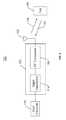
- FIG. 1shows a diagram illustrating an exemplary RFID system 100 in accordance with one embodiment described herein.
- RFID interrogator 102communicates with one or more RFID tags 110 . Data can be exchanged between interrogator 102 and RFID tag 110 via radio transmit signal 108 and radio receive signal 112 .
- RFID interrogator 102comprises RF transceiver 104 , which contains transmitter and receiver electronics, and antenna 106 , which are configured to generate and receive radio transit signal 108 and radio receive signal 112 , respectively. Exchange of data can be accomplished via electromagnetic or electrostatic coupling in the RF spectrum in combination with various modulation and encoding schemes.
- RFID tag 110is a transponder that can be attached to an object of interest and act as an information storage mechanism.
- passive RFID tagsare desirable, because they have a virtually unlimited operational lifetime and can be smaller, lighter, and cheaper than active RFID tags that contain an internal power source, e.g. battery.
- Passive RFID tagspower themselves by rectifying the RF signal emitted by the RF scanner. Consequently, the range of transmit signal 108 determines the operational range of RFID tag 110 .
- RF transceiver 104transmits RF signals to RFID tag 110 , and receives RF signals from RFID tag 110 , via antenna 106 .
- the data in transmit signal 108 and receive signal 112can be contained in one or more bits for the purpose of providing identification and other information relevant to the particular RFID tag application.
- RFID tag 110passes within the range of the radio frequency magnetic field emitted by antenna 106 , RFID tag 110 is excited and transmits data back to RF interrogator 102 .
- a change in the impedance of RFID tag 110can be used to signal the data to RF interrogator 102 via receive signal 112 .
- the impedance change in RFID tag 110can be caused by producing a short circuit across the tag's antenna connections (not shown) in bursts of very short duration.
- RF transceiver 104senses the impedance change as a change in the level of reflected or backscattered energy arriving at antenna 106 .
- Digital electronics 114which can comprise a microprocessor with RAM, performs decoding and reading of receive signal 112 . Similarly, digital electronics 114 performs the coding of transmit signal 108 .
- RF interrogator 102facilitates the reading or writing of data to RFID tags, e.g. RFID tag 110 that are within range of the RF field emitted by antenna 104 .
- RF transceiver 104 and digital electronics 114comprise reader 118 .
- digital electronics 114and can be interfaced with an integral display and/or provide a parallel or serial communications interface to a host computer or industrial controller, e.g. host computer 116 .
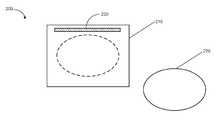
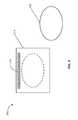
- FIG. 2shows a top-view illustration of an exemplary RFID switch tag 200 in an attached configuration in accordance with one embodiment described herein.
- RFID switch tag 200is used to implement RFID tag 110 in RFID system 100 shown in FIG. 1 .
- RFID switch tag 200includes a base component 210 and a detachable component 220 .
- base component 210includes an UHF booster 230 , such as a booster antenna.
- UHF booster 230can include a passive booster, an active booster, or a battery-assisted passive booster.
- the detachable component 220can include at least one UHF RFID module and an HF RFID module or tag.
- the at least one HF RFID module included in detachable component 220is a near field communication (NFC) module.
- NFCnear field communication
- the UHF RFID module and the HF RFID moduleshare a common integrated circuit (IC) chip.
- detachable component 220essentially acts as a dual-frequency RFID tag.
- a HF or UHF tagis intended to indicate that the HF or UHF module included in detachable component 220 comprise all the components necessary to perform the functions of a RFID tag, such as described with respect to tag 110 in FIG. 1 .
- the modulescan share components such as the IC, or portions of the IC and potentially the antenna. Although, sharing of the antenna or any components can depend on the frequency of operation, the required matching impendence, the protocols being used, etc.
- detachable component 220is positioned substantially in the middle of base component 210
- other embodimentscan have detachable component 220 placed in a non-centered position relative to base component 210 .
- the UHF modulecan be configured such that it will inductively couple with the UHF booster antenna 230 in the base component 210 .
- the at least one UHF RFID module included in detachable component 220is coupled with UHF booster antenna 230 included in base component 210 to form an UHF RFID system of desire performances.
- the desired performancesinclude a desired operating range for the UHF RFID system.
- an UHF coupling antenna within the at least one UHF RFID module in detachable component 220is positioned in a manner to ensure a sufficient amount of coupling, such as an inductive coupling, a capacitive coupling, or both, between the UHF coupling antenna in detachable component 220 and UHF booster antenna 230 in base component 210 .
- the at least one UHF RFID module and the HF RFID tag, such as an NFC tag included in the detachable component 220can be active, passive, or battery-assisted passive without departing from the scope of the inventive concept of this disclosure.
- detachable component 220is shown to have an oval shape, other embodiments of detachable component 220 can have other shapes, such as a circular shape, a rectangular shape, a triangular shape without departing from the scope of the inventive concept of this disclosure. Furthermore, if detachable component 220 has a rectangular shape, the rectangular shape can have either right-angled corners or rounded-corners. When detachable component 220 has a rectangular shape and rounded-corners, detachable component 220 may have an appearance of a card.
- detachable component 220may be attached to base component 210 in a number of ways.
- detachable component 220can be placed inside a pocket attached to base component 210 .
- detachable component 220can be placed inside a cutout within base component 210 having a shape of detachable component 220 but configured with a slightly smaller profile to allow detachable component 220 to be securely held inside the cutout. [coupling]
- RFID switch tag 200can serve as a windshield tag.
- base component 210 of RFID switch tag 200can be attached to a vehicle's windshield using, for example, adhesives (e.g., adhesive strips).
- RFID switch tag 200can be used in various electronic toll collection (ETC) applications.
- ETCelectronic toll collection
- the at least one UHF module in detachable component 220is coupled with UHF booster antenna 230 in base component 210 to form an UHF system having desired performances, such as a long operating range; however, when detachable component 220 is separated from base component 210 and the windshield, base component 210 can remain on the windshield but the at least one UHF module in detachable component 220 is no longer coupled to UHF booster antenna 230 in base component 210 .
- neither the at least one UHF module in detachable component 220 nor UHF booster antenna 230 in base component 210can be able to achieve the intended functionality of an UHF system, i.e., the UHF module is disabled.
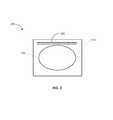
- FIG. 3shows a top-view illustration of an exemplary detachable component 220 in the form of a dual-frequency RFID module 300 in accordance with some embodiments described herein.
- multi-frequency RFID module 300includes an UHF module 310 and an NFC tag 320 .
- UHF module 310further includes an integrated circuit (IC) chip 330 (or “chip 330 ” hereinafter) and an UHF loop 340
- NFC tag 320further includes chip 330 and an HF antenna 350 .
- ICintegrated circuit
- NFC tag 320further includes chip 330 and an HF antenna 350 .
- UHF module 310 and NFC tag 320share chip 330 .
- Chip 330can include a memory (not shown) and other circuits.
- Dual-frequency RFID module 300can also include a substrate 360 that provides structural supports for UHF module 310 and NFC tag 320 .
- chip 330 , UHF loop 340 and HF antenna 350can be deposited or fabricated on substrate 360 .
- UHF loop 340is positioned substantially inside the loops of HF antenna 350 .
- HF antenna 350is tuned to operate at a desired high frequency, such as 13.56 MHz.
- UHF loop 340can also be tuned to operate at a desired ultra high frequency, such as 915 MHz or 2.45 GHz.
- UHF loop 340is used to couple chip 330 to UHF booster antenna 230 in base component 210 to form a functional UHF RFID tag.
- UHF loop 340can be an UHF antenna by itself.
- UHF loop 340can be implemented as any coupling means for coupling chip 330 to UHF booster antenna 230 in base component 210 .
- HF antenna 350is configured as a loop antenna that includes multiple circular loops.
- HF antenna 350can be constructed with non-circular-shaped loops, such as rectangular loops without departing from the scope of the present inventive concept.
- UHF loop 340is shown to include two circular loops; however, in other embodiments, UHF loop 340 can include a single loop or more than two loops. While loops in UHF loop 340 is shown to be circular, UHF loop 340 can also be constructed with non-circular-shaped loops, such as rectangular loops without departing from the scope of the present inventive concept.
- chip 330is configured to perform functions associated with both NFC and UHF systems including, but not limited to, encoding/decoding, modulation/demodulation, digital and analog processing, and data storage.
- multi-frequency RFID module 300uses a single IC chip 330 for both the UHF RFID module and the NFC tag, other implementations of detachable component 220 can use separate IC chips for the UHF RFID module and the NFC tag.
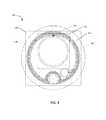
- FIG. 4shows a top-view illustration of RFID switch tag 200 in a detached configuration in accordance with one embodiment described herein.
- FIG. 2shows that detachable component 220 is attached to base component 210
- FIG. 4shows that detachable component 220 can be separated and detached from base component 210 .
- detaching detachable component 220 from base component 210uncouples the at least one UHF RFID module in detachable component 220 from UHF booster antenna 230 in base component 210 .
- the performances of the at least one UHF RFID modulemay be significantly affected.
- detaching detachable component 220 from base component 210can render the at least one UHF RFID module nonfunctional.
- the HF RFID tag such as an NFC tag within detachable component 220can remain functional when detachable component 220 is separated from base component 210 .
- detached detachable component 220can be used exclusively as an HF RFID tag, such as an NFC tag (e.g., for making contactless payments).
- detachable component 220can be configured with a shape and dimensions (including width, height, and thickness) so that it is sufficiently durable and can be conveniently placed inside a wallet, a purse, or a protective cover of a portable electronic device, such as a smartphone, a tablet, or an iPadTM.
- the dimensions of detachable component 220can be significantly greater than a typical RFID tag.
- detachable component 220When detached from base component 210 , detachable component 220 can be use in a “tap and go” manner in various NFC applications without being taken out of a wallet, a purse, or a protective cover of a portable electronic device where detachable component 220 is stored and carried around.
- detachable component 220is configured as a laminated card so that it is sufficiently durable through extensive uses as a standalone card. In some embodiments, detachable component 220 is configured with a hard case to provide additional durability and protection.
- RFID switch tag 200is used in various ETC applications.
- the at least one UHF RFID module in RFID switch tag 200can be configured to be used in high occupancy vehicle (HOV) lanes, while the HF RFID tag in RFID switch tag 200 can be configured to be used in single occupancy vehicle (SOV) lanes.
- HOVhigh occupancy vehicle
- SOVsingle occupancy vehicle
- RFID switch tag 200permits a driver to switch between HOV operations and SOV operations using a single RFID switch tag 200 .
- the tag 200can include a switching mechanism that allows the user to switch between the UHF and HF tags as required.
- RFID switch tag 200can be used in one or more account management applications.
- RFID switch tag 200can be used to track a vehicle for purposes of electronic tolling, parking access, and border control. At least some applications for the RFID switch tag 200 are described in U.S. Pat. Nos. 8,844,831 and 8,944,337, and U.S. patent application Ser. Nos. 14/480,458 and 14/578,196, the disclosures of which are incorporated herein by reference in their entirety.
- access to the memory on the at least one UHF module and the NFC tag included in the detachable component 220can be granted based on a security key.
- a security keyThe provision of secure identification solutions is described in U.S. Pat. Nos. 7,081,819, 7,671,746, 8,237,568, 8,322,044, and 8,004,410, the disclosures of which are incorporated by reference herein in their respective entirety.
- Multi-frequency RFID tagssuch as the RFID switch tag 200 are also described in Reissued U.S. Pat. Nos. RE 43,355 and RE 44,691, the disclosures of which are incorporated by reference herein in their respective entirety.
- Parent application Ser. No. 15/160,982discloses a module that is similar to 300 that can itself me interfaced with an booster antenna and removed therefrom in order to interface with an booster antenna in another substrate, such as in a card.
- the module 220can be included in a card or other substrate as described, which itself can be interface with the booster antenna 230 .
- Thisallows the inclusion of a switching mechanism as described above, which can allow the user to switch between, e.g., the HF and UHF modules in order to enable various functionality or applications. The switching can occur when the module 220 is interface with substrate 210 , or when it is removed therefrom.
- Some applicationscan require a placement of metallic material (e.g., retro-reflective material, holographic image) over the RFID switch tag 200 .
- metallic materiale.g., retro-reflective material, holographic image
- a selective de-metallization processmay be employed to treat the metallic material. Selective de-metallization is described in U.S. Pat. Nos. 7,034,688 and 7,463,154, the disclosures of which are incorporated by reference herein in their respective entirety.
- the example apparatuses, methods, and systems disclosed hereincan be applied wireless communication devices incorporating HF and/or UHF RFID reader capabilities.
- the various components illustrated in the figuresmay be implemented as, for example, but not limited to, software and/or firmware on a processor, ASIC/FPGA/DSP, or dedicated hardware.
- the features and attributes of the specific example embodiments disclosed abovemay be combined in different ways to form additional embodiments, all of which fall within the scope of the present disclosure.
- DSPdigital signal processor
- ASICapplication specific integrated circuit
- FPGAfield programmable gate array
- a general-purpose processormay be a microprocessor, but, in the alternative, the processor may be any conventional processor, controller, microcontroller, or state machine.
- a processormay also be implemented as a combination of receiver devices, e.g., a combination of a DSP and a microprocessor, a plurality of microprocessors, one or more microprocessors in conjunction with a DSP core, or any other such configuration. Alternatively, some steps or methods may be performed by circuitry that is specific to a given function.
- the functions describedcan be implemented in hardware, software, firmware, or any combination thereof. If implemented in software, the functions may be stored as one or more instructions or code on a non-transitory computer-readable storage medium or non-transitory processor-readable storage medium. The steps of a method or algorithm disclosed herein may be embodied in processor-executable instructions that may reside on a non-transitory computer-readable or processor-readable storage medium. Non-transitory computer-readable or processor-readable storage media may be any storage media that may be accessed by a computer or a processor.
- non-transitory computer-readable or processor-readable storage mediamay include RAM, ROM, EEPROM, FLASH memory, CD-ROM or other optical disk storage, magnetic disk storage or other magnetic storage devices, or any other medium that may be used to store desired program code in the form of instructions or data structures and that may be accessed by a computer.
- Disk and discincludes compact disc (CD), laser disc, optical disc, digital versatile disc (DVD), floppy disk, and Blu-ray disc where disks usually reproduce data magnetically, while discs reproduce data optically with lasers. Combinations of the above are also included within the scope of non-transitory computer-readable and processor-readable media.
- the operations of a method or algorithmmay reside as one or any combination or set of codes and/or instructions on a non-transitory processor-readable storage medium and/or computer-readable storage medium, which may be incorporated into a computer program product.
Landscapes
- Engineering & Computer Science (AREA)
- Physics & Mathematics (AREA)
- Health & Medical Sciences (AREA)
- Toxicology (AREA)
- General Physics & Mathematics (AREA)
- Computer Networks & Wireless Communication (AREA)
- Theoretical Computer Science (AREA)
- Computer Vision & Pattern Recognition (AREA)
- Artificial Intelligence (AREA)
- General Health & Medical Sciences (AREA)
- Electromagnetism (AREA)
- Computer Hardware Design (AREA)
- Microelectronics & Electronic Packaging (AREA)
- Signal Processing (AREA)
- Computer Security & Cryptography (AREA)
- Business, Economics & Management (AREA)
- Finance (AREA)
- Devices For Checking Fares Or Tickets At Control Points (AREA)
Abstract
Description
This application claims benefit of priority under 35 U.S.C. § 119(e) to U.S. Patent Application No. 62/199,991, entitled “Detachable Radio Frequency Identification Switch tag,” filed on Aug. 1, 2015. This application also claims priority as a continuation-in-part under 35 U.S.C. § 120 to U.S. patent application Ser. No. 14/818,257, entitled “Methods and Apparatus for Preserving Privacy in an RFID System,” filed Aug. 4, 2015, which in turn claims priority to U.S. patent application Ser. No. 14/229,786, now U.S. Pat. No. 9,098,790, entitled “Methods and Apparatus for Preserving Privacy in an RFID System,” filed Mar. 28, 2014, which in turn claims priority to U.S. patent application Ser. No. 13/736,819, now U.S. Pat. No. 8,710,960, entitled “Methods and Apparatus for Preserving Privacy in an RFID System,” filed Jan. 8, 2013, which in turn claims priority to U.S. patent application Ser. No. 12/364,158, now U.S. Pat. No. 8,350,673, entitled “Methods and Apparatus for Preserving Privacy in an RFID System,” filed Feb. 2, 2009, which in turn claims priority to U.S. provisional Patent Application No. 61/025,000, also entitled “Method and Apparatus for Preserving Privacy in RFID Systems,” filed Jan. 31, 2008; U.S. patent application Ser. No. 14/480,458, entitled “RFID Switch Tag,” filed Sep. 8, 2014, which in turn claims priority to U.S. patent application Ser. No. 13/465,829, now U.S. Pat. No. 8,844,831, entitled “RFID Switch Tag,” filed May 7, 2012, which in turn claims priority to U.S. provisional Patent Application Nos. 61/487,372, filed May 18, 2011 and 61/483,586, filed May 6, 2011, both entitled “RFID Switch Tag;” U.S. patent application Ser. No. 14/578,196, entitled “RFID Switch Tag,” filed Dec. 19, 2014, which in turn claims priority to U.S. patent application Ser. No. 14/060,407, now U.S. Pat. No. 8,944,337, entitled “RFID Switch Tag,” filed Oct. 22, 2013, which in turn claims priority to U.S. patent application Ser. No. 13/465,834, now U.S. Pat. No. 8,561,911, entitled “RFID Switch Tag,” filed May 7, 2012, which in turn claims priority to U.S. provisional Patent Application Nos. 61/487,372, filed May 18, 2011 and 61/483,586, filed May 6, 2011, both entitled “RFID Switch Tag.” The disclosures of the above patents and applications are incorporated by reference in their entirety as a part of this document.
This Application is also related to U.S. patent application Ser. No. 15/160,982, entitled “Multi-Frequency Radio Frequency Identification Tag,” filed May 20, 2016, which in turn claims priority to U.S. provisional Patent Application No. 62/165,167, also entitled “Multi-Frequency Radio Frequency Identification Tag,” filed May 21, 2015. The disclosures of the above patents and applications are incorporated by reference in their entirety as a part of this document.
1. Technical Field
The various embodiments described herein generally relate to radio frequency identification (RFID) systems and more particularly to an RFID switch tag.
2. Related Art
RFID technology harnesses electromagnetic fields to transfer data wirelessly. One of the primary uses for RFID technology is the automatic identification and tracking of objects via RFID tags, which may be attached or incorporated into a variety of objects. Examples include credit cards, passports, license plates, identity cards, cellphones/mobile devices, etc. RFID technology also has applications in numerous areas, including, but not limited to, electronic tolling, parking access, border control, payment processing, asset management, and transportation. Thus, for example, a license plate that includes an RFID tag may be used for the purposes of electronic toll collection (ETC), electronic vehicle registration (EVR), border crossing etc.
Different RFID applications may require different operation frequencies. For example, ultra high frequency (UHF) readers and transponder tags (e.g., operating at 915 megahertz (MHz) or 2.45 gigahertz (GHz)) provide greater read distances and faster data transfer rates, and are thus commonly deployed in ETC systems. In contrast, contactless payment systems may be implemented using high frequency (HF) or near field communication (NFC) readers and transponders (e.g., operating at 13.56 MHz), which tend to exhibit greater field penetration than UHF systems. However, the construction of a conventional RFID tag has limited flexibility to support operation in multiple frequencies.
Embodiments described herein provide various designs of a radio frequency identification (RFID) tag which includes a base component and a detachable component so that the RFID tag can be configured in multiple configurations to support operations in multiple frequencies.
According to an aspect, a radio frequency identification (RFID) switch tag is disclosed. This RFID switch tag includes a base component having an ultra-high frequency (UHF) booster, such as an UHF booster antenna, and a detachable component having at least one UHF RFID module and a high frequency (HF) RFID module, such as a near-field communication (NFC) tag.
According to another aspect, the detachable component is positioned in close proximity to the base component in a first configuration of the RFID switch tag such that the at least one UHF RFID module is sufficiently coupled to the UHF booster in the base component to form an UHF RFID system having a desired performance, such as a desired operating range of the UHF RFID system. In some embodiments, the detachable component is separated from the base component to obtain a second configuration of the RFID switch tag, and the HF RFID module remains functional within the detached detachable component so that the detachable component can be used as a standalone HF RFID tag. Moreover, in the second configuration, the at least one UHF RFID module is decoupled from the UHF booster in the base component to render the at least one UHF RFID module nonfunctional.
According to still another aspect, the UHF RFID module further includes an UHF coupling antenna, and can be coupled to the base component through a coupling between the UHF coupling antenna and the UHF booster.
According to still another aspect, the detachable component can be positioned substantially in the middle of the base component in the first configuration.
According to still another aspect, the RFID switch tag can be placed on a vehicle's windshield to serve as an RFID tag in an electronic toll collection (ETC) application.
According to still another aspect, a technique for using an RFID switch tag that includes a base component and a detachable component is disclosed, wherein the base component further includes an ultra-high frequency (UHF) booster and the detachable component further includes at least one UHF RFID module and a high frequency (HF) RFID module. The detachable component can be positioned in close proximity to the base component in a first configuration of the RFID switch tag such that the at least one UHF RFID module in the detachable component is sufficiently coupled to the UHF booster in the base component to form an UHF RFID tag having a desired operating range longer than an operating range of the at least one UHF RFID module. The UHF RFID tag can be used in a first RFID application which requires the desired operating range.
According to still another aspect, the detachable component can be detached from the base component to obtain a second configuration of the RFID switch tag such that the HF RFID module remains functional within the detached detachable component. The HF RFID module can be used as a near-field communication (NFC) tag in a second RFID application which requires an NFC operating range.
According to still another aspect, the RFID switch tag can be placed on a vehicle's windshield to serve as an RFID tag in an electronic toll collection (ETC) application.
According to still another aspect, the first RFID application is a first ETC application for high occupancy vehicle (HOV) lanes and the second RFID application is a second ETC application for single occupancy vehicle (SOV) lanes.
Other features and advantages of the present inventive concept should be apparent from the following description which illustrates by way of example aspects of the present inventive concept.
The embodiments described herein will be understood from a review of the following detailed description and the accompanying drawings in which like reference numerals refer to like parts and in which:
While certain embodiments are described, these embodiments are presented by way of example only, and are not intended to limit the scope of protection. The methods and systems described herein may be embodied in a variety of other forms. Furthermore, various omissions, substitutions, and changes in the form of the example methods and systems described herein may be made without departing from the scope of protection.
Embodiments described herein provide various designs of a radio frequency identification (RFID) tag which includes at least one base component and a detachable component such that the RFID tag can be configured in multiple configurations to support operations in multiple frequencies. In one aspect, a radio frequency identification (RFID) switch tag is disclosed. This RFID switch tag includes a base component having an ultra-high frequency (UHF) booster, such as an UHF booster antenna, and a detachable component having at least one UHF RFID module and a high frequency (HF) RFID module, such as a near-field communication (NFC) tag. In some embodiments, the detachable component is positioned in close proximity to the base component in a first configuration of the RFID switch tag such that the at least one UHF RFID module is sufficiently coupled to the UHF booster in the base component to form an UHF RFID system having a desired performance, such as a desired operating range of the UHF RFID system. In some embodiments, the detachable component is separated from the base component to obtain a second configuration of the RFID switch tag in which the HF RFID module remains functional within the detached detachable component so that the detachable component can be used as a standalone HF RFID tag. Moreover, in the second configuration, the at least one UHF RFID module is decoupled from the UHF booster in the base component to render the at least one UHF RFID module nonfunctional.
According to other embodiments, a technique for using an RFID switch tag that includes a base component and a detachable component is disclosed, wherein the base component further includes an ultra-high frequency (UHF) booster and the detachable component further includes at least one UHF RFID module and a high frequency (HF) RFID module. This technique can include positioning the detachable component in close proximity to the base component in a first configuration of the RFID switch tag such that the at least one UHF RFID module in the detachable component is sufficiently coupled to the UHF booster in the base component to form an UHF RFID tag having a desired operating range longer than an operating range of the at least one UHF RFID module. The technique further includes using the UHF RFID tag in a first RFID application, which requires the desired operating range. In some embodiments, the technique also includes detaching the detachable component from the base component to obtain a second configuration of the RFID switch tag such that the HF RFID module remains functional within the detached detachable component. The technique additionally includes using the HF RFID module as a near-field communication (NFC) tag in a second RFID application which requires an NFC operating range.
The reference to a HF or UHF tag is intended to indicate that the HF or UHF module included indetachable component 220 comprise all the components necessary to perform the functions of a RFID tag, such as described with respect to tag110 inFIG. 1 . As noted, in certain embodiments, the modules can share components such as the IC, or portions of the IC and potentially the antenna. Although, sharing of the antenna or any components can depend on the frequency of operation, the required matching impendence, the protocols being used, etc.
Although the embodiment ofFIG. 2 shows thatdetachable component 220 is positioned substantially in the middle ofbase component 210, other embodiments can havedetachable component 220 placed in a non-centered position relative tobase component 210. When placed near thebase component 210, the UHF module can be configured such that it will inductively couple with theUHF booster antenna 230 in thebase component 210.
In one exemplary embodiment, the at least one UHF RFID module included indetachable component 220 is coupled withUHF booster antenna 230 included inbase component 210 to form an UHF RFID system of desire performances. For example, the desired performances include a desired operating range for the UHF RFID system. In one embodiment, an UHF coupling antenna within the at least one UHF RFID module indetachable component 220 is positioned in a manner to ensure a sufficient amount of coupling, such as an inductive coupling, a capacitive coupling, or both, between the UHF coupling antenna indetachable component 220 andUHF booster antenna 230 inbase component 210. The at least one UHF RFID module and the HF RFID tag, such as an NFC tag included in thedetachable component 220 can be active, passive, or battery-assisted passive without departing from the scope of the inventive concept of this disclosure.
Althoughdetachable component 220 is shown to have an oval shape, other embodiments ofdetachable component 220 can have other shapes, such as a circular shape, a rectangular shape, a triangular shape without departing from the scope of the inventive concept of this disclosure. Furthermore, ifdetachable component 220 has a rectangular shape, the rectangular shape can have either right-angled corners or rounded-corners. Whendetachable component 220 has a rectangular shape and rounded-corners,detachable component 220 may have an appearance of a card.
InRFID switch tag 200 shown inFIG. 2 ,detachable component 220 may be attached tobase component 210 in a number of ways. For example,detachable component 220 can be placed inside a pocket attached tobase component 210. In some embodiments,detachable component 220 can be placed inside a cutout withinbase component 210 having a shape ofdetachable component 220 but configured with a slightly smaller profile to allowdetachable component 220 to be securely held inside the cutout. [coupling]
According to one exemplary embodiment,RFID switch tag 200 can serve as a windshield tag. In this embodiment,base component 210 ofRFID switch tag 200 can be attached to a vehicle's windshield using, for example, adhesives (e.g., adhesive strips). WhenRFID switch tag 200 is used as a windshield tag,RFID switch tag 200 can be used in various electronic toll collection (ETC) applications. For example, whenRFID switch tag 200 is placed on a windshield with bothbase component 210 anddetachable component 220, the at least one UHF module indetachable component 220 is coupled withUHF booster antenna 230 inbase component 210 to form an UHF system having desired performances, such as a long operating range; however, whendetachable component 220 is separated frombase component 210 and the windshield,base component 210 can remain on the windshield but the at least one UHF module indetachable component 220 is no longer coupled toUHF booster antenna 230 inbase component 210. As a result, neither the at least one UHF module indetachable component 220 norUHF booster antenna 230 inbase component 210 can be able to achieve the intended functionality of an UHF system, i.e., the UHF module is disabled.
In the embodiment ofmulti-frequency RFID module 300 illustrated inFIG. 3 ,UHF loop 340 is positioned substantially inside the loops ofHF antenna 350. In some embodiments,HF antenna 350 is tuned to operate at a desired high frequency, such as 13.56 MHz.UHF loop 340 can also be tuned to operate at a desired ultra high frequency, such as 915 MHz or 2.45 GHz. In some embodiments,UHF loop 340 is used to couplechip 330 toUHF booster antenna 230 inbase component 210 to form a functional UHF RFID tag.UHF loop 340 can be an UHF antenna by itself. Generally,UHF loop 340 can be implemented as any coupling means forcoupling chip 330 toUHF booster antenna 230 inbase component 210.
In the exemplary embodiment shown inFIG. 3 ,HF antenna 350 is configured as a loop antenna that includes multiple circular loops. However, in other embodiments,HF antenna 350 can be constructed with non-circular-shaped loops, such as rectangular loops without departing from the scope of the present inventive concept. Also in this embodiment,UHF loop 340 is shown to include two circular loops; however, in other embodiments,UHF loop 340 can include a single loop or more than two loops. While loops inUHF loop 340 is shown to be circular,UHF loop 340 can also be constructed with non-circular-shaped loops, such as rectangular loops without departing from the scope of the present inventive concept.
In some embodiments,chip 330 is configured to perform functions associated with both NFC and UHF systems including, but not limited to, encoding/decoding, modulation/demodulation, digital and analog processing, and data storage. Althoughmulti-frequency RFID module 300 uses asingle IC chip 330 for both the UHF RFID module and the NFC tag, other implementations ofdetachable component 220 can use separate IC chips for the UHF RFID module and the NFC tag.
Notably, the HF RFID tag such as an NFC tag withindetachable component 220 can remain functional whendetachable component 220 is separated frombase component 210. As such, detacheddetachable component 220 can be used exclusively as an HF RFID tag, such as an NFC tag (e.g., for making contactless payments). When used as an NFC tag,detachable component 220 can be configured with a shape and dimensions (including width, height, and thickness) so that it is sufficiently durable and can be conveniently placed inside a wallet, a purse, or a protective cover of a portable electronic device, such as a smartphone, a tablet, or an iPad™. The dimensions ofdetachable component 220 can be significantly greater than a typical RFID tag. In some embodiments, a rectangular shape having a size and a thickness that resembles a credit card is preferred. When detached frombase component 210,detachable component 220 can be use in a “tap and go” manner in various NFC applications without being taken out of a wallet, a purse, or a protective cover of a portable electronic device wheredetachable component 220 is stored and carried around. In various embodiments,detachable component 220 is configured as a laminated card so that it is sufficiently durable through extensive uses as a standalone card. In some embodiments,detachable component 220 is configured with a hard case to provide additional durability and protection.
In some embodiments,RFID switch tag 200 is used in various ETC applications. For example, the at least one UHF RFID module inRFID switch tag 200 can be configured to be used in high occupancy vehicle (HOV) lanes, while the HF RFID tag inRFID switch tag 200 can be configured to be used in single occupancy vehicle (SOV) lanes. Hence, by switching detachingdetachable component 220 between the detached configuration ofRFID switch tag 200 and the attached configuration ofRFID switch tag 200,RFID switch tag 200 permits a driver to switch between HOV operations and SOV operations using a singleRFID switch tag 200. In such embodiments, thetag 200 can include a switching mechanism that allows the user to switch between the UHF and HF tags as required. U.S. patent application Ser. No. 15/160,982, entitled “Multi-Frequency Radio Frequency Identification Tag,” filed May 20, 2016, which in turn claims priority to U.S. provisional Patent Application No. 62/165,167, also entitled “Multi-Frequency Radio Frequency Identification Tag,” filed May 21, 2015; U.S. patent application Ser. No. 14/818,257, entitled “Methods and Apparatus for Preserving Privacy in an RFID System,” filed Aug. 4, 2015, which in turn claims priority to U.S. patent application Ser. No. 14/229,786, now U.S. Pat. No. 9,098,790, entitled “Methods and Apparatus for Preserving Privacy in an RFID System,” filed Mar. 28, 2014, which in turn claims priority to U.S. patent Application Ser. No. 13/736,819, now U.S. Pat. No. 8,710,960, entitled “Methods and Apparatus for Preserving Privacy in an RFID System,” filed Jan. 8, 2013, which in turn claims priority to U.S. patent application Ser. No. 12/364,158, now U.S. Pat. No. 8,350,673, entitled “Methods and Apparatus for Preserving Privacy in an RFID System,” filed Feb. 2, 2009, which in turn claims priority to U.S. provisional Patent Application No. 61/025,000, also entitled “Method and Apparatus for Preserving Privacy in RFID Systems,” filed Jan. 31, 2008; U.S. patent application Ser. No. 14/480,458, entitled “RFID Switch Tag,” filed Sep. 8, 2014, which in turn claims priority to U.S. patent application Ser. No. 13/465,829, now U.S. Pat. No. 8,844,831, entitled “RFID Switch Tag,” filed May 7, 2012, which in turn claims priority to U.S. provisional Patent Application Nos. 61/487,372, filed May 18, 2011 and 61/483,586, filed May 6, 2011, both entitled “RFID Switch Tag;” U.S. patent application Ser. No. 14/578,196, entitled “RFID Switch Tag,” filed Dec. 19, 2014, which in turn claims priority to U.S. patent application Ser. No. 14/060,407, now U.S. Pat. No. 8,944,337, entitled “RFID Switch Tag,” filed Oct. 22, 2013, which in turn claims priority to U.S. patent application Ser. No. 13/465,834, now U.S. Pat. No. 8,561,911, entitled “RFID Switch Tag,” filed May 7, 2012, which in turn claims priority to U.S. provisional Patent Application Nos. 61/487,372, filed May 18, 2011 and 61/483,586, filed May 6, 2011, both entitled “RFID Switch Tag,” all of which are incorporated herein by reference as if set forth in full; disclose various embodiments of tags that allow switching between modules incorporated within a switchable and/or multi-frequency tag. Any of these mechanisms can be used in accordance withswitch tag 200.
According to one exemplary embodiment,RFID switch tag 200 can be used in one or more account management applications. For example,RFID switch tag 200 can be used to track a vehicle for purposes of electronic tolling, parking access, and border control. At least some applications for theRFID switch tag 200 are described in U.S. Pat. Nos. 8,844,831 and 8,944,337, and U.S. patent application Ser. Nos. 14/480,458 and 14/578,196, the disclosures of which are incorporated herein by reference in their entirety.
In some embodiments, access to the memory on the at least one UHF module and the NFC tag included in thedetachable component 220 can be granted based on a security key. The provision of secure identification solutions is described in U.S. Pat. Nos. 7,081,819, 7,671,746, 8,237,568, 8,322,044, and 8,004,410, the disclosures of which are incorporated by reference herein in their respective entirety.
Multi-frequency RFID tags such as theRFID switch tag 200 are also described in Reissued U.S. Pat. Nos. RE 43,355 and RE 44,691, the disclosures of which are incorporated by reference herein in their respective entirety.
Parent application Ser. No. 15/160,982, discloses a module that is similar to300 that can itself me interfaced with an booster antenna and removed therefrom in order to interface with an booster antenna in another substrate, such as in a card. Here, themodule 220 can be included in a card or other substrate as described, which itself can be interface with thebooster antenna 230. This allows the inclusion of a switching mechanism as described above, which can allow the user to switch between, e.g., the HF and UHF modules in order to enable various functionality or applications. The switching can occur when themodule 220 is interface withsubstrate 210, or when it is removed therefrom. Again U.S. patent application Ser. No. 15/160,982, entitled “Multi-Frequency Radio Frequency Identification Tag,” filed May 20, 2016, which in turn claims priority to U.S. provisional Patent Application No. 62/165,167, also entitled “Multi-Frequency Radio Frequency Identification Tag,” filed May 21, 2015; U.S. patent application Ser. No. 14/818,257, entitled “Methods and Apparatus for Preserving Privacy in an RFID System,” filed Aug. 4, 2015, which in turn claims priority to U.S. patent application Ser. No. 14/229,786, now U.S. Pat. No. 9,098,790, entitled “Methods and Apparatus for Preserving Privacy in an RFID System,” filed Mar. 28, 2014, which in turn claims priority to U.S. patent application Ser. No. 13/736,819, now U.S. Pat. No. 8,710,960, entitled “Methods and Apparatus for Preserving Privacy in an RFID System,” filed Jan. 8, 2013, which in turn claims priority to U.S. patent application Ser. No. 12/364,158, now U.S. Pat. No. 8,350,673, entitled “Methods and Apparatus for Preserving Privacy in an RFID System,” filed Feb. 2, 2009, which in turn claims priority to U.S. provisional Patent Application No. 61/025,000, also entitled “Method and Apparatus for Preserving Privacy in RFID Systems,” filed Jan. 31, 2008; U.S. patent application Ser. No. 14/480,458, entitled “RFID Switch Tag,” filed Sep. 8, 2014, which in turn claims priority to U.S. patent application Ser. No. 13/465,829, now U.S. Pat. No. 8,844,831, entitled “RFID Switch Tag,” filed May 7, 2012, which in turn claims priority to U.S. provisional Patent Application Nos. 61/487,372, filed May 18, 2011 and 61/483,586, filed May 6, 2011, both entitled “RFID Switch Tag;” U.S. patent application Ser. No. 14/578,196, entitled “RFID Switch Tag,” filed Dec. 19, 2014, which in turn claims priority to U.S. patent application Ser. No. 14/060,407, now U.S. Pat. No. 8,944,337, entitled “RFID Switch Tag,” filed Oct. 22, 2013, which in turn claims priority to U.S. patent application Ser. No. 13/465,834, now U.S. Pat. No. 8,561,911, entitled “RFID Switch Tag,” filed May 7, 2012, which in turn claims priority to U.S. provisional Patent Application Nos. 61/487,372, filed May 18, 2011 and 61/483,586, filed May 6, 2011, both entitled “RFID Switch Tag,” disclose various switching mechanism and methods for switching a module such asmodule 220.
Some applications can require a placement of metallic material (e.g., retro-reflective material, holographic image) over theRFID switch tag 200. In order to preserve the transmission and reception capabilities of theRFID switch tag 200, a selective de-metallization process may be employed to treat the metallic material. Selective de-metallization is described in U.S. Pat. Nos. 7,034,688 and 7,463,154, the disclosures of which are incorporated by reference herein in their respective entirety.
The accompanying claims and their equivalents are intended to cover such forms or modifications as would fall within the scope and spirit of the protection. For example, the example apparatuses, methods, and systems disclosed herein can be applied wireless communication devices incorporating HF and/or UHF RFID reader capabilities. The various components illustrated in the figures may be implemented as, for example, but not limited to, software and/or firmware on a processor, ASIC/FPGA/DSP, or dedicated hardware. Also, the features and attributes of the specific example embodiments disclosed above may be combined in different ways to form additional embodiments, all of which fall within the scope of the present disclosure.
The foregoing method descriptions and the process flow diagrams are provided merely as illustrative examples and are not intended to require or imply that the steps of the various embodiments must be performed in the order presented. As will be appreciated by one of skill in the art the order of steps in the foregoing embodiments may be performed in any order. Words such as “thereafter,” “then,” “next,” etc. are not intended to limit the order of the steps; these words are simply used to guide the reader through the description of the methods. Further, any reference to claim elements in the singular, for example, using the articles “a,” “an” or “the” is not to be construed as limiting the element to the singular.
The various illustrative logical blocks, modules, circuits, and algorithm steps described in connection with the embodiments disclosed herein can be implemented as electronic hardware, computer software, or combinations of both. To clearly illustrate this interchangeability of hardware and software, various illustrative components, blocks, modules, circuits, and steps have been described above generally in terms of their functionality. Whether such functionality is implemented as hardware or software depends upon the particular application and design constraints imposed on the overall system. Skilled artisans may implement the described functionality in varying ways for each particular application, but such implementation decisions should not be interpreted as causing a departure from the scope of the present invention.
The hardware used to implement the various illustrative logics, logical blocks, modules, and circuits described in connection with the aspects disclosed herein may be implemented or performed with a general purpose processor, a digital signal processor (DSP), an application specific integrated circuit (ASIC), a field programmable gate array (FPGA) or other programmable logic device, discrete gate or transistor logic, discrete hardware components, or any combination thereof designed to perform the functions described herein. A general-purpose processor may be a microprocessor, but, in the alternative, the processor may be any conventional processor, controller, microcontroller, or state machine. A processor may also be implemented as a combination of receiver devices, e.g., a combination of a DSP and a microprocessor, a plurality of microprocessors, one or more microprocessors in conjunction with a DSP core, or any other such configuration. Alternatively, some steps or methods may be performed by circuitry that is specific to a given function.
In one or more exemplary aspects, the functions described can be implemented in hardware, software, firmware, or any combination thereof. If implemented in software, the functions may be stored as one or more instructions or code on a non-transitory computer-readable storage medium or non-transitory processor-readable storage medium. The steps of a method or algorithm disclosed herein may be embodied in processor-executable instructions that may reside on a non-transitory computer-readable or processor-readable storage medium. Non-transitory computer-readable or processor-readable storage media may be any storage media that may be accessed by a computer or a processor. By way of example but not limitation, such non-transitory computer-readable or processor-readable storage media may include RAM, ROM, EEPROM, FLASH memory, CD-ROM or other optical disk storage, magnetic disk storage or other magnetic storage devices, or any other medium that may be used to store desired program code in the form of instructions or data structures and that may be accessed by a computer. Disk and disc, as used herein, includes compact disc (CD), laser disc, optical disc, digital versatile disc (DVD), floppy disk, and Blu-ray disc where disks usually reproduce data magnetically, while discs reproduce data optically with lasers. Combinations of the above are also included within the scope of non-transitory computer-readable and processor-readable media. Additionally, the operations of a method or algorithm may reside as one or any combination or set of codes and/or instructions on a non-transitory processor-readable storage medium and/or computer-readable storage medium, which may be incorporated into a computer program product.
Although the present disclosure provides certain example embodiments and applications, other embodiments that are apparent to those of ordinary skill in the art, including embodiments which do not provide all of the features and advantages set forth herein, are also within the scope of this disclosure. Accordingly, the scope of the present disclosure is intended to be defined only by reference to the appended claims.
Claims (16)
1. A radio frequency identification (RFID) switch tag, comprising:
a base component including an ultra-high frequency (UHF) booster; and
a detachable component, the detachable component including:
at least one UHF RFID module configured to couple with the UHF booster,
a high frequency (HF) RFID module, and
a switching mechanism configured to switch between the at least one UHF module and the high frequency module.
2. The RFID switch tag ofclaim 1 , wherein the detachable component is positioned in close proximity to the base component in a first configuration of the RFID switch tag such that the at least one UHF RFID module is sufficiently coupled to the UHF booster in the base component to form an UHF RFID system having a desired performance.
3. The RFID switch tag ofclaim 2 , wherein the at least one UHF RFID module further includes an UHF coupling antenna, and the at least one UHF RFID module is coupled to the base component through inductive coupling between the UHF coupling antenna and the UHF booster.
4. The RFID switch tag ofclaim 2 , wherein the detachable component is positioned substantially in the middle of the base component in the first configuration.
5. The RFID switch tag ofclaim 2 , wherein the desired performance is a desired operating range of the UHF RFID system.
6. The RFID switch tag ofclaim 1 , wherein the UHF booster is an UHF booster antenna.
7. The RFID switch tag ofclaim 1 , wherein the HF RFID module includes a near-field communication (NFC) tag.
8. The RFID switch tag ofclaim 1 , wherein the RFID switch tag is placed on a vehicle's windshield to serve as an RFID tag in an electronic toll collection (ETC) application.
9. The RFID switch tag ofclaim 1 , wherein the detachable component is separated from the base component in a second configuration of the RFID switch tag, and wherein the HF RFID module remains functional within the detachable component so that the detachable component can be used as a standalone HF RFID tag.
10. The RFID switch tag ofclaim 9 , wherein the HF RFID tag is configured as an NFC tag.
11. The RFID switch tag ofclaim 9 , wherein the at least one UHF RFID module is decoupled from the UHF booster in the base component, when the detachable component is detached from the base component to render the at least one UHF RFID module nonfunctional.
12. A method of using a radio frequency identification (RFID) switch tag, wherein the RFID switch tag includes a base component including an ultra-high frequency (UHF) booster and a detachable component including at least one UHF RFID module, a high frequency (HF) RFID module, and a switching mechanism, the method comprising:
positioning the detachable component in close proximity to the base component in a first configuration of the RFID switch tag such that the at least one UHF RFID module in the detachable component is sufficiently inductively coupled to the UHF booster in the base component to form an UHF RFID tag having a desired operating range longer than an operating range of the at least one UHF RFID module;
using the UHF RFID tag in a first RFID application that requires the desired operating range;
using the switching mechanism to switch from the UHF RFID module to the HF RFID module; and
using the HF RFID module in a second RFID application, while the detachable component is in close proximity with the base component.
13. The method ofclaim 12 , wherein positioning the detachable component includes positioning the detachable component substantially in the middle of the base component.
14. The method ofclaim 12 , wherein the method further comprises:
detaching the detachable component from the base component to obtain a third configuration of the RFID switch tag such that the HF RFID module remains functional within the detachable component; and
using the HF RFID module as a near-field communication (NFC) tag in a third RFID application which requires an NFC operating range.
15. The method ofclaim 14 , further comprising placing the RFID switch tag on a vehicle's windshield to serve as an RFID tag in an electronic toll collection (ETC) application.
16. The method ofclaim 14 , wherein the first RFID application is a first ETC application for high occupancy vehicle (HOV) lanes and wherein the second RFID application is a second ETC application for single occupancy vehicle (SOV) lanes.
Priority Applications (1)
| Application Number | Priority Date | Filing Date | Title |
|---|---|---|---|
| US15/225,786US10262167B2 (en) | 2008-01-31 | 2016-08-01 | Detachable radio frequency identification switch tag |
Applications Claiming Priority (16)
| Application Number | Priority Date | Filing Date | Title |
|---|---|---|---|
| US2500008P | 2008-01-31 | 2008-01-31 | |
| US12/364,158US8350673B2 (en) | 2008-01-31 | 2009-02-02 | Methods and apparatus for preserving privacy in an RFID system |
| US201161483586P | 2011-05-06 | 2011-05-06 | |
| US201161487372P | 2011-05-18 | 2011-05-18 | |
| US13/465,829US8844831B2 (en) | 2011-05-06 | 2012-05-07 | RFID switch tag |
| US13/465,834US8561911B2 (en) | 2011-05-06 | 2012-05-07 | RFID switch tag |
| US13/736,819US8710960B2 (en) | 2008-01-31 | 2013-01-08 | Methods and apparatus for preserving privacy in an RFID system |
| US14/060,407US8944337B2 (en) | 2011-05-06 | 2013-10-22 | RFID switch tag |
| US14/229,786US9098790B2 (en) | 2008-01-31 | 2014-03-28 | Methods and apparatus for preserving privacy in an RFID system |
| US14/480,458US9436900B2 (en) | 2011-05-06 | 2014-09-08 | RFID switch tag |
| US14/578,196US9582746B2 (en) | 2011-05-06 | 2014-12-19 | RFID switch tag |
| US201562165167P | 2015-05-21 | 2015-05-21 | |
| US201562199991P | 2015-08-01 | 2015-08-01 | |
| US14/818,257US9767331B2 (en) | 2008-01-31 | 2015-08-04 | Methods and apparatus for preserving privacy in an RFID system |
| US15/160,982US10339436B2 (en) | 2015-05-21 | 2016-05-20 | Multi-frequency radio frequency identification tag |
| US15/225,786US10262167B2 (en) | 2008-01-31 | 2016-08-01 | Detachable radio frequency identification switch tag |
Related Parent Applications (3)
| Application Number | Title | Priority Date | Filing Date |
|---|---|---|---|
| US14/480,458Continuation-In-PartUS9436900B2 (en) | 2008-01-31 | 2014-09-08 | RFID switch tag |
| US14/818,257Continuation-In-PartUS9767331B2 (en) | 2008-01-31 | 2015-08-04 | Methods and apparatus for preserving privacy in an RFID system |
| US15/160,982Continuation-In-PartUS10339436B2 (en) | 2008-01-31 | 2016-05-20 | Multi-frequency radio frequency identification tag |
Related Child Applications (1)
| Application Number | Title | Priority Date | Filing Date |
|---|---|---|---|
| US13/736,819ContinuationUS8710960B2 (en) | 2008-01-31 | 2013-01-08 | Methods and apparatus for preserving privacy in an RFID system |
Publications (2)
| Publication Number | Publication Date |
|---|---|
| US20160342821A1 US20160342821A1 (en) | 2016-11-24 |
| US10262167B2true US10262167B2 (en) | 2019-04-16 |
Family
ID=57345612
Family Applications (1)
| Application Number | Title | Priority Date | Filing Date |
|---|---|---|---|
| US15/225,786Active2029-10-27US10262167B2 (en) | 2008-01-31 | 2016-08-01 | Detachable radio frequency identification switch tag |
Country Status (1)
| Country | Link |
|---|---|
| US (1) | US10262167B2 (en) |
Cited By (11)
| Publication number | Priority date | Publication date | Assignee | Title |
|---|---|---|---|---|
| US20200143219A1 (en)* | 2018-11-07 | 2020-05-07 | Neology, Inc. | Detachable radio frequency identification switch tag |
| US20200175497A1 (en)* | 2013-08-13 | 2020-06-04 | Neology, Inc. | Detachable radio frequency identification switch tag |
| US11755874B2 (en) | 2021-03-03 | 2023-09-12 | Sensormatic Electronics, LLC | Methods and systems for heat applied sensor tag |
| US11769026B2 (en) | 2019-11-27 | 2023-09-26 | Sensormatic Electronics, LLC | Flexible water-resistant sensor tag |
| US11809937B2 (en) | 2015-05-21 | 2023-11-07 | Neology, Inc. | Detachable radio frequency identification switch tag |
| US11861440B2 (en) | 2019-09-18 | 2024-01-02 | Sensormatic Electronics, LLC | Systems and methods for providing tags adapted to be incorporated with or in items |
| US11869324B2 (en) | 2021-12-23 | 2024-01-09 | Sensormatic Electronics, LLC | Securing a security tag into an article |
| US11900200B2 (en) | 2019-12-28 | 2024-02-13 | Avery Dennison Retail Information Services Llc | Dual-mode RFID devices |
| US11928538B2 (en) | 2019-09-18 | 2024-03-12 | Sensormatic Electronics, LLC | Systems and methods for laser tuning and attaching RFID tags to products |
| US12175849B2 (en) | 2018-05-22 | 2024-12-24 | Tyco Fire & Security Gmbh | Elongate flexible tag |
| US12223814B2 (en) | 2019-09-16 | 2025-02-11 | Sensormatic Electronics, LLC | Security tag for textiles using conductive thread |
Families Citing this family (11)
| Publication number | Priority date | Publication date | Assignee | Title |
|---|---|---|---|---|
| US10885418B2 (en) | 2011-05-06 | 2021-01-05 | Neology, Inc. | Detachable radio frequency identification switch tag |
| US11948035B2 (en) | 2011-05-06 | 2024-04-02 | Neology, Inc. | RFID switch tag |
| US10679478B2 (en)* | 2016-12-29 | 2020-06-09 | Avery Dennison Retail Information Services, Llc | Dual function strap for resonating elements and ultra high frequency antennas |
| US9900055B1 (en) | 2017-02-01 | 2018-02-20 | Conduent Business Services, Llc | Magnetic presence detection of a smartphone |
| US9936466B1 (en) | 2017-02-17 | 2018-04-03 | Conduent Business Services, Llc | Bluetooth low energy collision management |
| US10652236B2 (en) | 2017-03-17 | 2020-05-12 | Conduent Business Services, Llc | Electronic crowd-based authentication |
| US10445632B2 (en)* | 2017-04-19 | 2019-10-15 | The Boeing Company | Secure RFID tag systems and methods |
| EP3732623B1 (en)* | 2017-12-28 | 2023-11-29 | Avery Dennison Retail Information Services LLC | Apparatus and method of interacting multiple forms of rfid technology to give additional information, security, and performance |
| IT201800003127A1 (en) | 2018-02-28 | 2019-08-28 | St Microelectronics Srl | RADIOFREQUENCY LABEL DEVICE, GROUP CORRESPONDING AND PROCEDURE |
| SE542229C2 (en)* | 2018-07-02 | 2020-03-17 | Stora Enso Oyj | A metal container comprising a uhf rfid tag |
| CN114819031A (en)* | 2022-05-19 | 2022-07-29 | 李秉烜 | Detachable radio frequency identification switch label |
Citations (65)
| Publication number | Priority date | Publication date | Assignee | Title |
|---|---|---|---|---|
| US5337063A (en) | 1991-04-22 | 1994-08-09 | Mitsubishi Denki Kabushiki Kaisha | Antenna circuit for non-contact IC card and method of manufacturing the same |
| US5809142A (en) | 1996-08-14 | 1998-09-15 | Texas Instruments Incorporated | Method and system for calculating a user account balance in a recognition system |
| FR2757952B1 (en) | 1996-12-27 | 1999-03-19 | Gemplus Card Int | RADIO TRANSPONDER PROVIDED WITH AN ANTENNA AND A FREQUENCY TUNING CIRCUIT |
| DE19742126A1 (en) | 1997-09-24 | 1999-03-25 | Siemens Ag | Portable data medium with activation switch |
| EP1087332A1 (en) | 1999-09-22 | 2001-03-28 | EM Microelectronic-Marin SA | Transponder constructed for several different applications |
| US20010048361A1 (en) | 2000-06-01 | 2001-12-06 | Mays Wesley M. | Method and apparatus for providing interchangeability of RFID devices |
| US6342839B1 (en) | 1998-03-09 | 2002-01-29 | Aginfolink Holdings Inc. | Method and apparatus for a livestock data collection and management system |
| US6466131B1 (en) | 1996-07-30 | 2002-10-15 | Micron Technology, Inc. | Radio frequency data communications device with adjustable receiver sensitivity and method |
| US20030016136A1 (en) | 2001-07-20 | 2003-01-23 | Delta Systems, Inc. | Radio frequency powered switch |
| US20030116634A1 (en) | 2001-11-29 | 2003-06-26 | Masahiko Tanaka | Non-contact IC card |
| US20030132301A1 (en) | 2002-12-31 | 2003-07-17 | Massachusetts Institute Of Technology | Manually operated switch for enabling and disabling an RFID card |
| US20040188531A1 (en) | 2003-03-24 | 2004-09-30 | Gengel Glenn W. | RFID tags and processes for producing RFID tags |
| US20050012616A1 (en) | 2003-07-07 | 2005-01-20 | Forster Ian J. | RFID device with changeable characteristics |
| US20050038347A1 (en) | 2002-12-26 | 2005-02-17 | Colin Medical Technology Corporation | Pressure pulse wave sensor and pressure-pulse-wave analyzing apparatus |
| US20050038736A1 (en) | 2001-07-10 | 2005-02-17 | Saunders Peter D. | System and method for transmitting track 1/track 2 formatted information via Radio Frequency |
| US20050237198A1 (en) | 2004-04-08 | 2005-10-27 | Waldner Michele A | Variable frequency radio frequency indentification (RFID) tags |
| US20050242950A1 (en) | 2004-04-30 | 2005-11-03 | Kimberly-Clark Worldwide, Inc. | Activating a data tag by load or orientation or user control |
| US20050242957A1 (en) | 2004-04-30 | 2005-11-03 | Kimberly-Clark Worldwide, Inc. | Deactivating a data tag for user privacy or tamper-evident packaging |
| US20060054710A1 (en) | 2003-04-10 | 2006-03-16 | Forster Ian J | RFID devices having self-compensating antennas and conductive shields |
| US20060132313A1 (en) | 2004-09-22 | 2006-06-22 | Ibm Corporation | System and method for altering or disabling RFID tags |
| US20060145851A1 (en) | 2004-12-17 | 2006-07-06 | Joshua Posamentier | RFID tag with modifiable and reversible read range |
| US20070008140A1 (en) | 2005-06-14 | 2007-01-11 | Mikko Saarisalo | Tag multiplication |
| US20070069858A1 (en) | 2005-09-29 | 2007-03-29 | Oki Electric Industry Co., Ltd. | Communications system for an RFID tag having an inductive antenna device detachable or movable |
| US20070109101A1 (en) | 2005-05-06 | 2007-05-17 | Colby Steven M | Electronically Switchable RFID Tags |
| US20070144662A1 (en) | 2005-12-22 | 2007-06-28 | Armijo Edward A | Method of manufacturing RFID devices |
| US20070200682A1 (en) | 2005-05-06 | 2007-08-30 | Colby Steven M | RFID Device Including Multiple Active Modes |
| US20070200681A1 (en) | 2005-05-06 | 2007-08-30 | Colby Steven M | Identity Device Including Switchable RFID Tag |
| US20070210923A1 (en) | 2005-12-09 | 2007-09-13 | Butler Timothy P | Multiple radio frequency network node rfid tag |
| US20070268140A1 (en) | 2006-05-19 | 2007-11-22 | Wai-Cheung Tang | Method of enabling two-state operation of electronic toll collection system |
| US20070279231A1 (en) | 2006-06-05 | 2007-12-06 | Hong Kong University Of Science And Technology | Asymmetric rfid tag antenna |
| US20070285246A1 (en) | 2006-05-31 | 2007-12-13 | Semiconductor Energy Laboratory Co., Ltd. | Semiconductor device and IC label, IC tag, and IC card having the same |
| US20070290856A1 (en) | 2006-06-19 | 2007-12-20 | Tagsys Sas | RFID tag detuning |
| US20080084310A1 (en) | 2006-10-05 | 2008-04-10 | Pavel Nikitin | Configurable RFID tag with protocol and band selection |
| US20080147461A1 (en) | 2006-12-14 | 2008-06-19 | Morris Lee | Methods and apparatus to monitor consumer activity |
| US20080218344A1 (en) | 2007-03-05 | 2008-09-11 | Steve Charles Lazar | Dual frequency RFID circuit |
| US20080238679A1 (en) | 2007-03-30 | 2008-10-02 | Broadcom Corporation | Multi-mode rfid tag architecture |
| US20080265039A1 (en) | 2007-04-27 | 2008-10-30 | First Data Corporation | Protected Contactless Card |
| US20080308641A1 (en) | 2007-04-10 | 2008-12-18 | Advanced Microelectronic And Automation Technology Ltd. | Smart card with switchable matching antenna |
| US20090096611A1 (en) | 2007-10-16 | 2009-04-16 | Sensormatic Electronics Corporation | Mobile radio frequency identification antenna system and method |
| US20090219158A1 (en) | 2008-03-03 | 2009-09-03 | Intermec Ip Corp. | Rfid tags with enhanced range and bandwidth obtained by spatial antenna diversity |
| US20100079289A1 (en) | 2008-09-30 | 2010-04-01 | Rockwell Automation Technologies, Inc. | Rfid tag based discrete contact position indication |
| US20100194542A1 (en)* | 2008-03-27 | 2010-08-05 | Tc License Ltd. | Rfid tag with integrated disabling and method of use |
| US7782206B2 (en) | 2008-03-27 | 2010-08-24 | Tc License Ltd. | RFID tag disabling systems and methods of use |
| US20100230498A1 (en) | 2006-12-18 | 2010-09-16 | Peter Samuel Atherton | Radio frequency identification tag with privacy and security capabilities |
| US20100283690A1 (en) | 2007-07-26 | 2010-11-11 | Smart Packaging Solutions (Sps) | Secured document with a contactless chip with protection of data against unauthorized access |
| US20100302012A1 (en) | 2009-06-02 | 2010-12-02 | Sirit Technologies Inc. | Switching radio frequency identification (rfid) tags |
| US7859393B2 (en) | 2005-04-26 | 2010-12-28 | Sanyo Electric Co., Ltd. | Tire sensor system and tire used for the same |
| US20110006959A1 (en) | 2009-07-09 | 2011-01-13 | Norbert Wilhelm Menko | Dual Polarized UHF Antenna |
| US8065181B2 (en) | 2008-10-16 | 2011-11-22 | Kapsch Trafficcom Ag | System and method for electronic toll collection based on vehicle load |
| US20110309931A1 (en) | 2010-06-21 | 2011-12-22 | Rose Mark D | Low-power wirelessly-linked rfid tracking system |
| CN102332634A (en) | 2010-07-12 | 2012-01-25 | 国民技术股份有限公司 | Dual-mode antenna for radio frequency identification and radio frequency identification device |
| WO2012025787A1 (en) | 2010-08-24 | 2012-03-01 | Nokia Corporation | Apparatus and methods for wireless communication |
| US20120161937A1 (en) | 2010-12-23 | 2012-06-28 | Claridy Solutions, Inc. | Rfid tagging device and method |
| US20120217928A1 (en) | 2011-02-28 | 2012-08-30 | Juice Technologies Llc | Electric vehicle charging interface |
| US20120248929A1 (en) | 2011-03-29 | 2012-10-04 | General Electric Company | Brush wear detector system with wireless sensor |
| US20120280044A1 (en) | 2011-05-06 | 2012-11-08 | Neology, Inc. | Rfid switch tag |
| US20120287249A1 (en) | 2011-05-12 | 2012-11-15 | Electronics And Telecommunications Research Institute | Method for obtaining depth information and apparatus using the same |
| US8350673B2 (en) | 2008-01-31 | 2013-01-08 | Neology, Inc. | Methods and apparatus for preserving privacy in an RFID system |
| US20130105584A1 (en) | 2011-11-01 | 2013-05-02 | Avery Dennison Corporation | Dual mode chip having radio frequency identification and electronic article surveillance capability |
| US20140074566A1 (en) | 2012-09-11 | 2014-03-13 | James K. McCoy | Remote Sensing of Vehicle Occupancy |
| US20140278841A1 (en) | 2013-03-15 | 2014-09-18 | Ron Natinsky | Remote sensing of vehicle occupancy |
| US20150021389A1 (en) | 2013-07-22 | 2015-01-22 | Amtech Systems, Inc | Vehicle tolling system with occupancy detection |
| US20150070181A1 (en) | 2013-09-12 | 2015-03-12 | Google Inc. | Detector unit with multiple integrated sensing systems and visually pleasing housing |
| US20150077297A1 (en) | 2011-03-16 | 2015-03-19 | Avery Dennison Retail Information Services Llc | Dual band rfid device and method of formation |
| US20170048280A1 (en) | 2014-10-08 | 2017-02-16 | Google Inc. | Network-assisted fabric pairing |
- 2016
- 2016-08-01USUS15/225,786patent/US10262167B2/enactiveActive
Patent Citations (71)
| Publication number | Priority date | Publication date | Assignee | Title |
|---|---|---|---|---|
| US5337063A (en) | 1991-04-22 | 1994-08-09 | Mitsubishi Denki Kabushiki Kaisha | Antenna circuit for non-contact IC card and method of manufacturing the same |
| US6466131B1 (en) | 1996-07-30 | 2002-10-15 | Micron Technology, Inc. | Radio frequency data communications device with adjustable receiver sensitivity and method |
| US20070075837A1 (en) | 1996-07-30 | 2007-04-05 | Tuttle Mark E | Radio frequency data communications device with selectively removable antenna portion and method |
| US5809142A (en) | 1996-08-14 | 1998-09-15 | Texas Instruments Incorporated | Method and system for calculating a user account balance in a recognition system |
| FR2757952B1 (en) | 1996-12-27 | 1999-03-19 | Gemplus Card Int | RADIO TRANSPONDER PROVIDED WITH AN ANTENNA AND A FREQUENCY TUNING CIRCUIT |
| DE19742126A1 (en) | 1997-09-24 | 1999-03-25 | Siemens Ag | Portable data medium with activation switch |
| US6342839B1 (en) | 1998-03-09 | 2002-01-29 | Aginfolink Holdings Inc. | Method and apparatus for a livestock data collection and management system |
| EP1087332A1 (en) | 1999-09-22 | 2001-03-28 | EM Microelectronic-Marin SA | Transponder constructed for several different applications |
| EP1087332B1 (en) | 1999-09-22 | 2008-02-13 | EM Microelectronic-Marin SA | Transponder constructed for several different applications |
| US20010048361A1 (en) | 2000-06-01 | 2001-12-06 | Mays Wesley M. | Method and apparatus for providing interchangeability of RFID devices |
| US20050038736A1 (en) | 2001-07-10 | 2005-02-17 | Saunders Peter D. | System and method for transmitting track 1/track 2 formatted information via Radio Frequency |
| US20030016136A1 (en) | 2001-07-20 | 2003-01-23 | Delta Systems, Inc. | Radio frequency powered switch |
| US20030116634A1 (en) | 2001-11-29 | 2003-06-26 | Masahiko Tanaka | Non-contact IC card |
| US20050038347A1 (en) | 2002-12-26 | 2005-02-17 | Colin Medical Technology Corporation | Pressure pulse wave sensor and pressure-pulse-wave analyzing apparatus |
| US20030132301A1 (en) | 2002-12-31 | 2003-07-17 | Massachusetts Institute Of Technology | Manually operated switch for enabling and disabling an RFID card |
| US20040188531A1 (en) | 2003-03-24 | 2004-09-30 | Gengel Glenn W. | RFID tags and processes for producing RFID tags |
| US20060054710A1 (en) | 2003-04-10 | 2006-03-16 | Forster Ian J | RFID devices having self-compensating antennas and conductive shields |
| US20080211675A1 (en) | 2003-07-07 | 2008-09-04 | Avery Dennison Corporation (Adc) | Rfid device with changeable characteristics |
| US20050012616A1 (en) | 2003-07-07 | 2005-01-20 | Forster Ian J. | RFID device with changeable characteristics |
| US20050237198A1 (en) | 2004-04-08 | 2005-10-27 | Waldner Michele A | Variable frequency radio frequency indentification (RFID) tags |
| US20050242950A1 (en) | 2004-04-30 | 2005-11-03 | Kimberly-Clark Worldwide, Inc. | Activating a data tag by load or orientation or user control |
| US20050242957A1 (en) | 2004-04-30 | 2005-11-03 | Kimberly-Clark Worldwide, Inc. | Deactivating a data tag for user privacy or tamper-evident packaging |
| US20060132313A1 (en) | 2004-09-22 | 2006-06-22 | Ibm Corporation | System and method for altering or disabling RFID tags |
| US20060145851A1 (en) | 2004-12-17 | 2006-07-06 | Joshua Posamentier | RFID tag with modifiable and reversible read range |
| US7859393B2 (en) | 2005-04-26 | 2010-12-28 | Sanyo Electric Co., Ltd. | Tire sensor system and tire used for the same |
| US20070109101A1 (en) | 2005-05-06 | 2007-05-17 | Colby Steven M | Electronically Switchable RFID Tags |
| US20070200682A1 (en) | 2005-05-06 | 2007-08-30 | Colby Steven M | RFID Device Including Multiple Active Modes |
| US20070200681A1 (en) | 2005-05-06 | 2007-08-30 | Colby Steven M | Identity Device Including Switchable RFID Tag |
| US20070008140A1 (en) | 2005-06-14 | 2007-01-11 | Mikko Saarisalo | Tag multiplication |
| US20070069858A1 (en) | 2005-09-29 | 2007-03-29 | Oki Electric Industry Co., Ltd. | Communications system for an RFID tag having an inductive antenna device detachable or movable |
| US20070210923A1 (en) | 2005-12-09 | 2007-09-13 | Butler Timothy P | Multiple radio frequency network node rfid tag |
| US20070144662A1 (en) | 2005-12-22 | 2007-06-28 | Armijo Edward A | Method of manufacturing RFID devices |
| US20070268140A1 (en) | 2006-05-19 | 2007-11-22 | Wai-Cheung Tang | Method of enabling two-state operation of electronic toll collection system |
| US20070285246A1 (en) | 2006-05-31 | 2007-12-13 | Semiconductor Energy Laboratory Co., Ltd. | Semiconductor device and IC label, IC tag, and IC card having the same |
| US20070279231A1 (en) | 2006-06-05 | 2007-12-06 | Hong Kong University Of Science And Technology | Asymmetric rfid tag antenna |
| US20070290856A1 (en) | 2006-06-19 | 2007-12-20 | Tagsys Sas | RFID tag detuning |
| US20080084310A1 (en) | 2006-10-05 | 2008-04-10 | Pavel Nikitin | Configurable RFID tag with protocol and band selection |
| US20080147461A1 (en) | 2006-12-14 | 2008-06-19 | Morris Lee | Methods and apparatus to monitor consumer activity |
| US20100230498A1 (en) | 2006-12-18 | 2010-09-16 | Peter Samuel Atherton | Radio frequency identification tag with privacy and security capabilities |
| US20080218344A1 (en) | 2007-03-05 | 2008-09-11 | Steve Charles Lazar | Dual frequency RFID circuit |
| US20080238679A1 (en) | 2007-03-30 | 2008-10-02 | Broadcom Corporation | Multi-mode rfid tag architecture |
| US20080308641A1 (en) | 2007-04-10 | 2008-12-18 | Advanced Microelectronic And Automation Technology Ltd. | Smart card with switchable matching antenna |
| US20080265039A1 (en) | 2007-04-27 | 2008-10-30 | First Data Corporation | Protected Contactless Card |
| US20100283690A1 (en) | 2007-07-26 | 2010-11-11 | Smart Packaging Solutions (Sps) | Secured document with a contactless chip with protection of data against unauthorized access |
| US20090096611A1 (en) | 2007-10-16 | 2009-04-16 | Sensormatic Electronics Corporation | Mobile radio frequency identification antenna system and method |
| EP2056234A2 (en) | 2007-10-30 | 2009-05-06 | Broadcom Corporation | Multi-mode RFID tag architecture |
| US8710960B2 (en) | 2008-01-31 | 2014-04-29 | Neology, Inc. | Methods and apparatus for preserving privacy in an RFID system |
| US9098790B2 (en) | 2008-01-31 | 2015-08-04 | Neology, Inc. | Methods and apparatus for preserving privacy in an RFID system |
| US8350673B2 (en) | 2008-01-31 | 2013-01-08 | Neology, Inc. | Methods and apparatus for preserving privacy in an RFID system |
| US20090219158A1 (en) | 2008-03-03 | 2009-09-03 | Intermec Ip Corp. | Rfid tags with enhanced range and bandwidth obtained by spatial antenna diversity |
| US20100194542A1 (en)* | 2008-03-27 | 2010-08-05 | Tc License Ltd. | Rfid tag with integrated disabling and method of use |
| US7782206B2 (en) | 2008-03-27 | 2010-08-24 | Tc License Ltd. | RFID tag disabling systems and methods of use |
| US20100079289A1 (en) | 2008-09-30 | 2010-04-01 | Rockwell Automation Technologies, Inc. | Rfid tag based discrete contact position indication |
| US8065181B2 (en) | 2008-10-16 | 2011-11-22 | Kapsch Trafficcom Ag | System and method for electronic toll collection based on vehicle load |
| US20100302012A1 (en) | 2009-06-02 | 2010-12-02 | Sirit Technologies Inc. | Switching radio frequency identification (rfid) tags |
| US20110006959A1 (en) | 2009-07-09 | 2011-01-13 | Norbert Wilhelm Menko | Dual Polarized UHF Antenna |
| US20110309931A1 (en) | 2010-06-21 | 2011-12-22 | Rose Mark D | Low-power wirelessly-linked rfid tracking system |
| CN102332634A (en) | 2010-07-12 | 2012-01-25 | 国民技术股份有限公司 | Dual-mode antenna for radio frequency identification and radio frequency identification device |
| WO2012025787A1 (en) | 2010-08-24 | 2012-03-01 | Nokia Corporation | Apparatus and methods for wireless communication |
| US20120161937A1 (en) | 2010-12-23 | 2012-06-28 | Claridy Solutions, Inc. | Rfid tagging device and method |
| US20120217928A1 (en) | 2011-02-28 | 2012-08-30 | Juice Technologies Llc | Electric vehicle charging interface |
| US20150077297A1 (en) | 2011-03-16 | 2015-03-19 | Avery Dennison Retail Information Services Llc | Dual band rfid device and method of formation |
| US20120248929A1 (en) | 2011-03-29 | 2012-10-04 | General Electric Company | Brush wear detector system with wireless sensor |
| US20120280044A1 (en) | 2011-05-06 | 2012-11-08 | Neology, Inc. | Rfid switch tag |
| US20120287249A1 (en) | 2011-05-12 | 2012-11-15 | Electronics And Telecommunications Research Institute | Method for obtaining depth information and apparatus using the same |
| US20130105584A1 (en) | 2011-11-01 | 2013-05-02 | Avery Dennison Corporation | Dual mode chip having radio frequency identification and electronic article surveillance capability |
| US20140074566A1 (en) | 2012-09-11 | 2014-03-13 | James K. McCoy | Remote Sensing of Vehicle Occupancy |
| US20140278841A1 (en) | 2013-03-15 | 2014-09-18 | Ron Natinsky | Remote sensing of vehicle occupancy |
| US20150021389A1 (en) | 2013-07-22 | 2015-01-22 | Amtech Systems, Inc | Vehicle tolling system with occupancy detection |
| US20150070181A1 (en) | 2013-09-12 | 2015-03-12 | Google Inc. | Detector unit with multiple integrated sensing systems and visually pleasing housing |
| US20170048280A1 (en) | 2014-10-08 | 2017-02-16 | Google Inc. | Network-assisted fabric pairing |
Non-Patent Citations (90)
| Title |
|---|
| 372 Application, to Mullis et al., Inter Partes Review of U.S. Pat. No. 8,944,337, IPR Case No. IPR2016-01763, Exhibit No. 2024, exhibit filing date Jun. 21, 2017, pp. 1-20. |
| 586 Application, to Mullis et al., Inter Partes Review of U.S. Pat. No. 8,944,337, IPR Case No. IPR2016-01763, Exhibit No. 2023, exhibit filing date Jun. 21, 2017, pp. 1-17. |
| Balanis, Constantine A., Excerpts from Antenna Theory, Inter Partes Review of U.S. Pat. No. 8,944,337, IPR Case No. IPR2016-01763, Exhibit No. 2056, exhibit filing date Dec. 6, 2017, pp. 1-4. |
| Boylestad, Introductory Circuit Analysis, Inter Partes Review of U.S. Pat. No. 8,944,337, IPR Case No. IPR2016-01763, Exhibit No. 2016, exhibit filing date Jun. 21, 2017, pp. 1-3. |
| Boylestad, Introductory Circuit Analysis, Inter Partes Review of U.S. Pat. No. 8,944,337, IPR Case No. IPR2016-01763, Exhibit No. 2020, exhibit filing date Jun. 21, 2017, pp. 1-3. |
| Boylestad, Robert L., Excerpt from Introductory Circuit Analysis, 2007, Inter Partes Review of U.S. Pat. No. 8,944,337, IPR Case No. IPR2016-01763, Exhibit No. 1053, exhibit filing date Nov. 17, 2017, pp. 1-4. |
| Clifford, How to Read Circuit Diagrams and Electronic Graphs, Inter Partes Review of U.S. Pat. No. 8,944,337, IPR Case No. IPR2016-01763, Exhibit No. 2015, exhibit filing date Jun. 21, 2017, pp. 1-8. |
| Declaration of Bruce Roesner in Support of Petition, Inter Partes Review of U.S. Pat. No. 8,944,337, IPR Case No. IPR2016-01763, Exhibit No. 1001, exhibit filing date Sep. 9, 2016, pp. 1-89. |
| Declaration of Bruce Roesner in Support of Petitioner's Opposition to Patent Owner's Contingent Motion to Amend, Inter Partes Review of U.S. Pat. No. 8,944,337, IPR Case No. IPR2016-01763, Exhibit No. 1031, exhibit filing date Sep. 21, 2017, pp. 1-35. |
| Declaration of Bruce Roesner, Inter Partes Review of U.S. Pat. No. 8,944,337, IPR Case No. IPR2016-01763, Exhibit No. 1049, exhibit filing date Nov. 17, 2017, pp. 1-93. |
| Deposition of Jim Fischer, IPR Case No. 2016-01763, Sep. 8, 2017, Inter Partes Review of U.S. Pat. No. 8,944,337, IPR Case No. IPR2016-01763, Exhibit No. 1027, exhibit filing date Sep. 21, 2017, pp. 1-364. |
| EPC based RFID Item Level Tagging, Inter Partes Review of U.S. Pat. No. 8,944,337, IPR Case No. IPR2016-01763, Exhibit No. 2013, exhibit filing date Jun. 21, 2017, pp. 1-56. |
| European Patent No. 2230174, to Yoshizaki, issued Sep. 22, 2010, Inter Partes Review of U.S. Pat. No. 8,944,337, IPR Case No. IPR2016-01763, Exhibit No. 1014, exhibit filing date Sep. 9, 2016, pp. 1-23. |
| European Search Report for EP Application No. 12782498.5 dated Mar. 12, 2015 (6 pages). |
| European Search Report issued in European Patent Application No. 09708616.9 dated May 9, 2011 (9 pages). |
| Excerpt from '337 file history: Apr. 4, 2014 Non-Final Rejection, Inter Partes Review of U.S. Pat. No. 8,944,337, IPR Case No. IPR2016-01763, Exhibit No. 1010, exhibit filing date Sep. 9, 2016, pp. 1-5. |
| Excerpt from '337 file history; Nov. 4, 2014 Response After Final Action, Inter Partes Review of U.S. Pat. No. 8,944,337, IPR Case No. IPR2016-01763, Exhibit No. 1011, exhibit filing date Sep. 9, 2016, pp. 1-9. |
| Excerpt from '377 file history: Nov. 14, 2014 Notice of Allowance, Inter Partes Review of U.S. Pat. No. 8,944,337, IPR Case No. IPR2016-01763, Exhibit No. 1019, exhibit filing date Sep. 9, 2016, pp. 1-8. |
| Excerpt from Merriam-Webster's Collegiate Dictionary (10th ed. 2002), Inter Partes Review of U.S. Pat. No. 8,944,337, IPR Case No. IPR2016-01763, Exhibit No. 1029, exhibit filing date Sep. 21, 2017, pp. 1-8. |
| Finkenzeller, Klaus, Excerpts from RFID Handbook, Inter Partes Review of U.S. Pat. No. 8,944,337, IPR Case No. IPR2016-01763, Exhibit No. 2058, exhibit filing date Dec. 6, 2017, pp. 1-24. |
| Finkenzeller, RFID Handbook Fundamentals and Applications in Contactless Smart Cards and Identification, 2nd Ed. 1999 Copyright pages and Chapters 2-4, Inter Partes Review of U.S. Pat. No. 8,944,337, IPR Case No. IPR2016-01763, Exhibit No. 2011, exhibit filing date Dec. 22, 2016, pp. 1-154. |
| Fischer Declaration ISO Patent Owners Contingent Motion to Amend Claims, Inter Partes Review of U.S. Pat. No. 3,944,337, IPR Case No. IPR2016-01763, Exhibit No. 2029, exhibit filing date Jun. 21, 2017, pp. 1-51. |
| Fischer Declaration ISO Patent Owners Preliminary Response, Inter Partes Review of U.S. Pat. No. 8,944,337, IPR Case No. IPR2016-01763, Exhibit No. 2002, exhibit filing date Dec. 22, 2016, pp. 1-124. |
| Fischer Declaration ISO Patent Owners Response to Petition, Inter Partes Review of U.S. Pat. No. 8,944,337, IPR Case No. IPR2016-01763, Exhibit No. 2028, exhibit filing date Jun. 21, 2017, pp. 1-87. |
| Fischer Deposition Exhibit 1021—Annotated Excerpt from U.S. Pat. No. 8,944,337, Inter Partes Review of U.S. Pat. No. 8,944,337, IPR Case No. IPR2016-01763, Exhibit No. 1021, exhibit filing date Sep. 21, 2017, p. 1. |
| Fischer Deposition Exhibit 1022—Annotated Excerpt from U.S. Pat. No. 8,944,337, Inter Partes Review of U.S. Pat. No. 8,944,337, IPR Case No. IPR2016-01763, Exhibit No. 1022, exhibit filing date Sep. 21, 2017, p. 1. |
| Fischer Deposition Exhibit 1023—Annotated Excerpt from U.S. Pat. No. 8,944,337, Inter Partes Review of U.S. Pat. No. 8,944,337, IPR Case No. IPR2016-01763, Exhibit No. 1023, exhibit filing date Sep. 21, 2017, p. 1. |
| Fischer Deposition Exhibit 1024—Annotated Excerpt from U.S. Pat. No. 8,944,337, Inter Partes Review of U.S. Pat. No. 8,944,337, IPR Case No. IPR2016-01763, Exhibit No. 1024, exhibit filing date Sep. 21, 2017, p. 1. |
| Fischer Deposition Exhibit 1025—U.S. Patent Application Publication No. US 2010/0283690 A1 to Artigue et al., Inter Partes Review of U.S. Pat. No. 8,944,337, IPR Case No. IPR2016-01763, Exhibit No. 1025, exhibit filing date Sep. 21, 2017, pp. 1-12. |
| Fischer Deposition Exhibit 1026—Handwritten Diagram, Inter Partes Review of U.S. Pat. No. 8,944,337, IPR Case No. IPR2016-01763, Exhibit No. 1026, exhibit filing date Sep. 21, 2017, p. 1. |
| Fischer Deposition Exhibit 1035A: Model, Inter Partes Review of U.S. Pat. No. 8,944,337, IPR Case No. IPR2016-01763, Exhibit No. 1035A, exhibit filing date Nov. 17, 2017, p. 1. |
| Glossary of RFID Terms May 22, 2013, Inter Partes Review of U.S. Pat. No. 8,944,337, IPR Case No. IPR2016-01763, Exhibit No. 2033, exhibit filing date Jun. 21, 2017, pp. 1-3. |
| Holt et al., Physics 1999, Inter Partes Review of U.S. Pat. No. 8,944,337, IPR Case No. IPR2016-01763, Exhibit No. 2032, exhibit filing date Jun. 21, 2017, pp. 1-4. |
| Instructables: Pull Out Birthday Card, Inter Partes Review of U.S. Pat. No. 8,944,337, IPR Case No. IPR2016-01763, Exhibit No. 1030, exhibit filing date Sep. 21, 2017, pp. 1-6. |
| International Search Report and Written Opinion for PCT/US2016/033636 dated Aug. 30, 2016, 12 pages. |
| International Search Report and Written Opinion for PCT/US2016/045066 dated Nov. 11, 2016, 11 pages. |
| International Search Report and Written Opinion issued in International Patent Application No. PCT/US2009/032840 dated May 26, 2009 (6 pages). |
| International Search Report and Written Opinion issued in International Patent Application No. PCT/US2016/033636 dated Aug. 30, 2016 (14 pages). |
| International Search Report and Written Opinion issued in International Patent Application No. PCT/US2016/045069 dated Oct. 21, 2016(11 pages). |
| International Search Report received in corresponding International Application No. PCT/US2012/036654, dated Nov. 16, 2012, 5 pages. |
| Jamaluddin et al., Microstrip Dipole Antenna Analysis with Different Width and Length at 2.4 GHz, Dec. 2005, Inter Partes Review of U.S. Pat. No. 8,944,337, IPR Case No. IPR2016-01763, Exhibit No. 2047, exhibit filing date Oct. 19, 2017, pp. 1-4. |
| Johnson et al., Introductory Electric Circuit Analysis, Inter Partes Review of U.S. Pat. No. 8,944,337, IPR Case No. IPR2016-01763, Exhibit No. 2018, exhibit filing date Jun. 21, 2017, pp. 1-12. |
| Kaplan, Steven M., Excerpt from Wiley Electrical and Electronics Engineering Dictionary (2004), Inter Partes Review of U.S. Pat. No. 8,944,337, IPR Case No. IPR2016-01763, Exhibit No. 1028, exhibit filing date Sep. 21, 2017, pp. 1-4. |
| Keyrouz et al., Novel Empirical Equations to Calculate the Impedance of a Strip Dipole Antenna, Dec. 2013, Inter Partes Review of U.S. Pat. No. 8,944,337, IPR Case No. IPR2016-01763, Exhibit No. 2046, exhibit filing date Oct. 19, 2017, pp. 1-4. |
| Kraus, John D., Excerpts from Antennas 2nd Ed., Inter Partes Review of U.S. Pat. No. 8,944,337, IPR Case No. IPR2016-01763, Exhibit No. 2051, exhibit filing date Oct. 19, 2017, pp. 1-8. |
| Lee et al., Designing Antenna Booster Cases for Mobile Phones using Capacitive Coupling Techniques 2015, Inter Partes Review of U.S. Pat. No. 8,944,337, IPR Case No. IPR2016-01763, Exhibit No. 2008, exhibit filing date Dec. 22, 2016, pp. 1-2. |
| Lehpamer, Harvey, Excerpts from RFID Design Principles, Inter Partes Review of U.S. Pat. No. 8,944,337, IPR Case No. IPR2016-01763, Exhibit No. 2057, exhibit filing date Dec. 6, 2017, pp. 1-14. |
| Malmstadt et al., Electronics for Scientists: Principles and Experiments for Those Who Use Instruments, Inter Partes Review of U.S. Pat. No. 8,944,337, IPR Case No. IPR2016-01763, Exhibit No. 2019, exhibit filing date Jun. 21, 2017, pp. 1-3. |
| Mazda, F.F., Discrete Electronics Components, 1981, Inter Partes Review of U.S. Pat. No. 8,944,337, IPR Case No. IPR2016-01763, Exhibit No. 2031, exhibit filing date Jun. 21, 2017, pp. 1-11. |
| Motion to Amend Claims, Inter Partes Review of U.S. Pat. No. 8,944,337, IPR Case No. IPR2016-01763, Paper No. 13, filing date Jun. 21, 2017, pp. 1-35. |
| PCT International Publication No. 2003/079487 A1, to Roshchupkin, Inter Partes Review of U.S. Pat. No. 8,944,337, IPR Case No. IPR2016-01763, Exhibit No. 2003, exhibit filing date Dec. 22, 2016, pp. 1-38. |
| PCT International Publication No. 2008/074050 A1, to Peter Samuel Atherton, Inter Partes Review of U.S. Pat. No. 8,944,337, IPR Case No. IPR2016-01763, Exhibit No. 1006, exhibit filing date Sep. 9, 2016, pp. 1-21. |
| PCT International Publication No. 2008/074050 A1, to Peter Samuel Atherton, Inter Partes Review of U.S. Pat. No. 8,944,337, IPR Case No. IPR2016-01763, Exhibit No. 2014, exhibit filing date Jun. 21, 2017, pp. 1-21. |
| Petition, Inter Partes Review of U.S. Pat. No. 8,944,337, IPR Case No. IPR2016-01763, Paper No. 1, filing date Sep. 9, 2016, pp. 1-87. |
| Petitioner's Amended Appendix of Exhibits, Inter Partes Review of U.S. Pat. No. 8,944,337, IPR Case No. IPR2016-01763, Paper No. 18, filing date Sep. 21, 2017, pp. 1-5. |
| Petitioner's Motion to Exclude, Inter Partes Review of U.S. Pat. No. 8,944,337, IPR Case No. IPR2016-01763, Paper No. 38, filing date Dec. 6, 2017, pp. 1-14. |
| Petitioner's Opposition to Patent Owner's Contingent Motion to Amend, Inter Partes Review of U.S. Pat. No. 3,944,337, IPR Case No. IPR2016-01763, Paper No. 17, filed Sep. 21, 2017, pp. 1-32. |
| Petitioner's Reply to Patent Owner's Response, Inter Partes Review of U.S. Pat. No. 8,944,337, IPR Case No. IPR2016-01763, Paper No. 16, filing date Sep. 21, 2017, pp. 1-39. |
| Petitioner's Sur-Reply to Patent Owner's Reply to Petitioner's Opposition to Patent Owner's Contingent Motion to Amend, Inter Partes Review of U.S. Pat. No. 8,944,337, IPR Case No. IPR2016-01763, Paper No. 31, filing date Nov. 17, 2017, pp. 1-18. |
| Poynting, Universal Modem-to-Antenna Adaptor, Inter Partes Review of U.S. Pat. No. 8,944,337, IPR Case No. IPR2016-01763, Exhibit No. 2004, exhibit filing date Dec. 22, 2016, pp. 1-2. |
| Pozar, David M., Excerpts from Microwave Engineering 4th Ed., Inter Partes Review of U.S. Pat. No. 8,944,337, IPR Case No. IPR2016-01763, Exhibit No. 2052, exhibit filing date Oct. 19, 2017, pp. 1-3. |
| Preliminary Response, Inter Partes Review of U.S. Pat. No. 8,944,337, IPR Case No. IPR2016-01763, Paper No. 7, filing date Dec. 22, 2016, pp. 1-62. |
| Reference Designer Chapter 4.1 Impedance of Capacitor 2009, Inter Partes Review of U.S. Pat. No. 8,944,337, IPR Case No. IPR2016-01763, Exhibit No. 2009, exhibit filing date Dec. 22, 2016, pp. 1-2. |
| Reference Designer Chapter 4.1 Parallel Plate Capacitor 2009, Inter Partes Review of U.S. Pat. No. 8,944,337, IPR Case No. IPR2016-01763, Exhibit No. 2010, exhibit filing date Dec. 22, 2016, p. 1. |
| Reply to Petitioner's Opposition to Contingent Motion to Amend, Inter Partes Review of U.S. Pat. No. 8,944,337, IPR Case No. IPR2016-01763, Paper No. 20, filing date Oct. 19, 2017, pp. 1-19. |
| Response to IPR, Inter Partes Review of U.S. Pat. No. 8,944,337, IPR Case No. IPR2016-01763, Paper No. 12, filing date Jun. 21, 2017, pp. 1-63. |
| Stein, Jess (Editor), Excerpt from The Random House Dictionary of the English Language, 1966, Inter Partes Review of U.S. Pat. No. 8,944,337, IPR Case No. IPR2016-01763, Exhibit No. 1050, exhibit filing date Nov. 17, 2017, pp. 1-5. |
| Supplemental Fischer Declaration ISO PO's Motion to Amend, Inter Partes Review of U.S. Pat. No. 8,944,337, IPR Case No. IPR2016-01763, Exhibit No. 2044, exhibit filing date Oct. 19, 2017, pp. 1-36. |
| U.S. Pat. No. 5,659,324, to Taniguchi et al., issued Aug. 19, 1997, Inter Partes Review of U.S. Pat. No. 8,944,337, IPR Case No. IPR2016-01763, Exhibit No. 2007, exhibit filing date Dec. 22, 2016, pp. 1-79. |
| U.S. Pat. No. 6,121,544, to Petsinger (issued Sep. 19, 2000), Inter Partes Review of U.S. Pat. No. 8,944,337, IPR Case No. IPR2016-01763, Exhibit No. 1051, exhibit filing date Nov. 17, 2017, pp. 1-16. |
| U.S. Pat. No. 674,284, to G.A. Sachs, issued May 14, 1901, Inter Partes Review of U.S. Pat. No. 8,944,337, IPR Case No. IPR2016-01763, Exhibit No. 1015, exhibit filing date Sep. 9, 2016, pp. 1-6. |
| U.S. Pat. No. 7,120,987, to Peikang Liu et al., dated Oct. 17, 2006, Inter Partes Review of U.S. Pat. No. 8,944,337, IPR Case No. IPR2016-01763, Exhibit No. 1018, exhibit filing date Sep. 9, 2016, pp. 1-15. |
| U.S. Pat. No. 7,361,251, to Green et al., dated Apr. 22, 2008, Inter Partes Review of U.S. Pat. No. 8,944,337, IPR Case No. IPR2016-01763, Exhibit No. 1017, exhibit filing date Sep. 9, 2016, pp. 1-28. |
| U.S. Pat. No. 7,437,148 B1, to Vaghi et al., issued Oct. 14, 2008, Inter Partes Review of U.S. Pat. No. 8,944,337, IPR Case No. IPR2016-01763, Exhibit No. 2005, exhibit filing date Dec. 22, 2016, pp. 1-28. |
| U.S. Pat. No. 7,460,018, to Yuki Kubo, dated Dec. 2, 2008, Inter Partes Review of U.S. Pat. No 8,944,337, IPR Case No. IPR2016-01763, Exhibit No. 1007, exhibit filing date Sep. 9, 2016, pp. 1-13. |
| U.S. Pat. No. 7,571,694, to Rick Boerner, issued Aug. 11, 2009, Inter Partes Review of U.S. Pat. No. 8,944,337, IPR Case No. IPR2016-01763, Exhibit No. 1013, exhibit filing date Sep. 9, 2016, pp. 1-22. |
| U.S. Pat. No. 7,782,206 B2, to Burnett et al., Inter Partes Review of U.S. Pat. No. 8,944,337, IPR Case No. IPR2016-01763, Exhibit No. 2021, exhibit filing date Jun. 21, 2017, pp. 1-10. |
| U.S. Pat. No. 8,350,673, to Nyalamadugu et al., issued Jan. 8, 2013, Inter Partes Review of U.S. Pat. No. 8,944,337, IPR Case No. IPR2016-01763, Exhibit No. 1012, exhibit filing date Sep. 9, 2016, pp. 1-9. |
| U.S. Pat. No. 8,416,079 B2, to Roesner, issued on Apr. 9, 2013, Inter Partes Review of U.S. Pat. No. 8,944,337, IPR Case No. IPR2016-01763, Exhibit No. 2012, exhibit filing date Dec. 22, 2016, pp. 1-18. |
| U.S. Pat. No. 8,604,995, to Hammad (issued Dec. 10, 2013), Inter Partes Review of U.S. Pat. No. 8,944,337, IPR Case No. IPR2016-01763, Exhibit No. 1052, exhibit filing date Nov. 17, 2017, pp. 1-15. |
| U.S. Pat. No. 8,944,337, to Mullis et al., Inter Partes Review of U.S. Pat. No. 8,944,337, IPR Case No. IPR2016-01763, Exhibit No. 1004, exhibit filing date Sep. 9, 2016, pp. 1-17. |
| U.S. Pat. No. 9,582,746, to Mullis et al., Inter Partes Review of U.S. Pat. No. 8,944,337, IPR Case No. IPR2016-01763, Exhibit No. 2051, exhibit filing date Oct. 19, 2017, pp. 1-8. |
| U.S. Patent Application Publication No. 2004/0242285 A1, to Farshi, Pub. Date Dec. 2, 2004, Inter Partes Review of U.S. Pat. No. 8,944,337, IPR Case No. IPR2016-01763, Exhibit No. 2006, exhibit filing date Dec. 22, 2016, pp. 1-9. |
| U.S. Patent Application Publication No. 2005/0134461 A1, to Gelbman et al., Inter Partes Review of U.S. Pat. No. 8,944,337, IPR Case No. IPR2016-01763, Exhibit No. 2022, exhibit filing date Jun. 21, 2017, pp. 1-27. |
| U.S. Patent Application Publication No. 2007/0144662, to Armijo et al., Inter Partes Review of U.S. Pat. No. 8,944,337, IPR Case No. IPR2016-01763, Exhibit No. 1016, exhibit filing date Sep. 9, 2016, pp. 1-13. |
| U.S. Patent Application Publication No. 2007/0290858, to Janke et al., Inter Partes Review of U.S. Pat. No. 8,944,337, IPR Case No. IPR2016-01763, Exhibit No. 1008, exhibit filing date Sep. 9, 2016, pp. 1-5. |
| U.S. Patent Application Publication No. 2010/0283690, to Artigue et al., Inter Partes Review of U.S. Pat. No. 8,944,337, IPR Case No. IPR2016-01763, Exhibit No. 1020, exhibit filing date Sep. 9, 2016, pp. 1-12. |
| U.S. Patent Application Publication No. 2010/0302012, to Bruce B. Roesner, Inter Partes Review of U.S. Pat. No. 8,944,337, IPR Case No. IPR2016-01763, Exhibit No. 1009, exhibit filing date Sep. 9, 2016, pp. 1-14. |
| U.S. Patent Application Publication No. 2012/0280045 A1, to Mullis et al., Inter Partes Review of U.S. Pat. No. 8,944,337, IPR Case No. IPR2016-01763, Exhibit No. 2025, exhibit filing date Jun. 21, 2017, pp. 1-17. |
| U.S. Patent Application Publication No. 2014/0175177 A1, to Mullis et al., Inter Partes Review of U.S. Pat. No. 8,944,337, IPR Case No. IPR2016-01763, Exhibit No. 2026, exhibit filing date Jun. 21, 2017, pp. 1-16. |
Cited By (18)
| Publication number | Priority date | Publication date | Assignee | Title |
|---|---|---|---|---|
| US11734670B2 (en) | 2013-08-13 | 2023-08-22 | Neology, Inc. | Detachable radio frequency identification switch tag |
| US20200175497A1 (en)* | 2013-08-13 | 2020-06-04 | Neology, Inc. | Detachable radio frequency identification switch tag |
| US10929835B2 (en)* | 2013-08-13 | 2021-02-23 | Neology, Inc. | Detachable radio frequency identification switch tag |
| US11282067B2 (en) | 2013-08-13 | 2022-03-22 | Neology, Inc. | Detachable radio frequency identification switch tag |
| US11809937B2 (en) | 2015-05-21 | 2023-11-07 | Neology, Inc. | Detachable radio frequency identification switch tag |
| US12175849B2 (en) | 2018-05-22 | 2024-12-24 | Tyco Fire & Security Gmbh | Elongate flexible tag |
| US11853828B2 (en) | 2018-11-07 | 2023-12-26 | Neology, Inc. | Detachable radio frequency identification switch tag |
| US20200143219A1 (en)* | 2018-11-07 | 2020-05-07 | Neology, Inc. | Detachable radio frequency identification switch tag |
| US11410011B2 (en) | 2018-11-07 | 2022-08-09 | Neology, Inc. | Detachable radio frequency identification switch tag |
| US12265867B2 (en) | 2018-11-07 | 2025-04-01 | Neology, Inc. | Detachable radio frequency identification switch tag |
| US10891530B2 (en)* | 2018-11-07 | 2021-01-12 | Neology, Inc. | Detachable radio frequency identification switch tag |
| US12223814B2 (en) | 2019-09-16 | 2025-02-11 | Sensormatic Electronics, LLC | Security tag for textiles using conductive thread |
| US11928538B2 (en) | 2019-09-18 | 2024-03-12 | Sensormatic Electronics, LLC | Systems and methods for laser tuning and attaching RFID tags to products |
| US11861440B2 (en) | 2019-09-18 | 2024-01-02 | Sensormatic Electronics, LLC | Systems and methods for providing tags adapted to be incorporated with or in items |
| US11769026B2 (en) | 2019-11-27 | 2023-09-26 | Sensormatic Electronics, LLC | Flexible water-resistant sensor tag |
| US11900200B2 (en) | 2019-12-28 | 2024-02-13 | Avery Dennison Retail Information Services Llc | Dual-mode RFID devices |
| US11755874B2 (en) | 2021-03-03 | 2023-09-12 | Sensormatic Electronics, LLC | Methods and systems for heat applied sensor tag |
| US11869324B2 (en) | 2021-12-23 | 2024-01-09 | Sensormatic Electronics, LLC | Securing a security tag into an article |
Also Published As
| Publication number | Publication date |
|---|---|
| US20160342821A1 (en) | 2016-11-24 |
Similar Documents
| Publication | Publication Date | Title |
|---|---|---|
| US10262167B2 (en) | Detachable radio frequency identification switch tag | |
| US20230045784A9 (en) | Detachable radio frequency identification switch tag | |
| US12265867B2 (en) | Detachable radio frequency identification switch tag | |
| US20190220724A1 (en) | Multi-frequency radio frequency identification tag | |
| US11809937B2 (en) | Detachable radio frequency identification switch tag | |
| US11775795B2 (en) | Detachable radio frequency identification switch tag | |
| EP2250631B1 (en) | Methods and apparatus for preserving privacy in an rfid system | |
| CN103020673A (en) | Article positioning system and method of RFID (Radio Frequency Identification) tag | |
| EP3329428B1 (en) | Detachable radio frequency identification switch tag | |
| US11663440B1 (en) | Radio frequency identification switch tag | |
| US11948035B2 (en) | RFID switch tag | |
| CN202041978U (en) | Multi-sensor-technique integrated electronic tag | |
| CN216979785U (en) | Electronic chip card for dual radio communication system | |
| He et al. | A Multi-Sensor Technique Integrated Tag |
Legal Events
| Date | Code | Title | Description |
|---|---|---|---|
| AS | Assignment | Owner name:NEOLOGY, INC., CALIFORNIA Free format text:ASSIGNMENT OF ASSIGNORS INTEREST;ASSIGNORS:NYALAMADUGU, SHESHI;MULLIS, JOE;LEANIO, BOBBY;REEL/FRAME:041138/0974 Effective date:20161208 | |
| AS | Assignment | Owner name:SMARTRAC TECHNOLOGY FLETCHER, INC., NORTH CAROLINA Free format text:ASSIGNMENT OF ASSIGNORS INTEREST;ASSIGNORS:NEOLOGY, INC.;SINGLE CHIP SYSTEMS CORP.;REEL/FRAME:046321/0793 Effective date:20180511 | |
| STCF | Information on status: patent grant | Free format text:PATENTED CASE | |
| MAFP | Maintenance fee payment | Free format text:PAYMENT OF MAINTENANCE FEE, 4TH YEAR, LARGE ENTITY (ORIGINAL EVENT CODE: M1551); ENTITY STATUS OF PATENT OWNER: LARGE ENTITY Year of fee payment:4 |