US1019578A - Safety-pin. - Google Patents
Safety-pin.Download PDFInfo
- Publication number
- US1019578A US1019578AUS53671010AUS1910536710AUS1019578AUS 1019578 AUS1019578 AUS 1019578AUS 53671010 AUS53671010 AUS 53671010AUS 1910536710 AUS1910536710 AUS 1910536710AUS 1019578 AUS1019578 AUS 1019578A
- Authority
- US
- United States
- Prior art keywords
- pin
- prong
- safety
- head
- arm
- Prior art date
- Legal status (The legal status is an assumption and is not a legal conclusion. Google has not performed a legal analysis and makes no representation as to the accuracy of the status listed.)
- Expired - Lifetime
Links
- 239000004744fabricSubstances0.000description5
- 238000010276constructionMethods0.000description2
- 238000005452bendingMethods0.000description1
- 238000004519manufacturing processMethods0.000description1
Images
Classifications
- A—HUMAN NECESSITIES
- A44—HABERDASHERY; JEWELLERY
- A44B—BUTTONS, PINS, BUCKLES, SLIDE FASTENERS, OR THE LIKE
- A44B9/00—Hat, scarf, or safety pins or the like
- A44B9/12—Safety-pins
- A44B9/18—Hinges; Locking devices
- Y—GENERAL TAGGING OF NEW TECHNOLOGICAL DEVELOPMENTS; GENERAL TAGGING OF CROSS-SECTIONAL TECHNOLOGIES SPANNING OVER SEVERAL SECTIONS OF THE IPC; TECHNICAL SUBJECTS COVERED BY FORMER USPC CROSS-REFERENCE ART COLLECTIONS [XRACs] AND DIGESTS
- Y10—TECHNICAL SUBJECTS COVERED BY FORMER USPC
- Y10T—TECHNICAL SUBJECTS COVERED BY FORMER US CLASSIFICATION
- Y10T24/00—Buckles, buttons, clasps, etc.
- Y10T24/46—Pin or separate essential cooperating device therefor
- Y10T24/4604—Pin or separate essential cooperating device therefor having distinct guiding, holding, or protecting means for penetrated portion
- Y10T24/4657—Pin or separate essential cooperating device therefor having distinct guiding, holding, or protecting means for penetrated portion with pivotal connection between penetrating portion and means
- Y10T24/4659—Connection also permits sliding movement
Definitions
- My inventionrelates to an improvement in safety pins.
- the object of my inventionis to provide a safety pin, which is so constructed that it may be readily opened from the top, thus avoiding the necessity of manipulating the lower prong of the pin containing the point, as is necessary with safety pins now in use.
- a further object of my inventionis to provide a safety pin of the above character, which is of the utmost simplicity of con struction, and the cost of manufacture of which is correspondingly low.
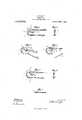
- Figure 1is a side elevation of the head of a safety pin made in accordance with my invent-ion;
- Fig. 2is a cross-section of the same taken on line 22 of Fig. 1;
- Fig. 3is a side elevation of the same showing the head in the position in which it is moved to open the pin;
- Fig. 4is a similar view show ing the pin opened;
- Fig. 5is a view similar to that shown in Fig. 1, but setting forth a slightly modified form;
- Fig. 6is a crosssection of the same taken on line 66 of Fig. 5; and
- Fig. 7is a plan view of the upper prong of the pin.
- Figs. 1 to 4 and 7 1is the head of a safety pin adapted to receive an upper prong 2 and a lower prong 3.
- the head 1is constructed in the same manner as the usual type of safety pin, except the upper portion thereof.
- the upper portionis provided with a rearward extension 4, which constitutes a lever arm, and one side thereof is bent into a horizontal plane at 5 to form a chamber 6.
- the chamber 6is of just sufficient height to receive the broadest portion of the end of the upper prong 2, which is bent upon itself at 7 to form a rearwardly directed spring-arm 8, the end of which is contiguous to the body of the upper prong 2.
- the end of the arm 8is also finished so that it lies in a plane at right angles to the main body of the upper prong 2, as shown in Fig. 7. It will also be noted from Fig. 7
- end of the arm 8is also bent to one side of the main body of the upper prong 2, the purpose of which is to cause the end of said arm to engage in a small hole or opening 9 in a closed position of the pin, and with a larger opening 10 in the open or release position of the pin. (See Figs. 1 and 4.)
- the pinIn the operation of the pin, assuming the same to have been opened and the end of the upper prong 2 to be in the position as indicated in Fig. 1, the pin is caused to engage a body of fabric in the usual manner, and it is also closed in the usual manner by raising the pointed end of the lower prong 3 over the lower portion of the head 1 of the pin. l/Vhile in this position no amount o pull exerted by the fabric itself can open the pin, inasmuch as the end of the arm 8 projects into and engages one side of the opening 9. When now it is desired to open the pin, it is merely necessary to pull upwardly upon the lever arm 4, which moves the head of the pin into the position shown in Fig. 3.
- the pin as already describedmay thus be readily opened by a slight pivotal movement of the head upon the extreme end of the upper prong 2, and may be easily closed in the usual manner without any interference whatever, by raising the point of the lower prong 3 into the lower portion of the head 1.
- the pinis of the utmost simplicity, inasmuch as it differs from the usual pin now found on the market merely by bending the end of the upper may be-opened with greater ease.
- a safety pina rigid head having an abutment, a plurality of prongs, one of which is sharpened and the other of Which engages with the abutment in the head in the closed position of the pin, the abutment and the prong engaging therewith being so constructed as to efi'ect the release of the prong engaged thereby by merely moving the head away from the point of the sharp ened prong.
- a headhaving an abutment at its side, a pair of prongs, one of which is bent to form a loop in the plane of the prongs and the end of the loop being bent laterally out of the plane of the head to engage with said abutment.
Landscapes
- Professional, Industrial, Or Sporting Protective Garments (AREA)
Description
A. WRIGHT.
SAFETY PIN.
APPLICATION FILED JAI1L6, 19.10.
:OLUMBIA PLANOGRAPN co.. WASHINGTON. n. C.
Patented Mar.5, 1912.
pnirnn srarns PATENT oFFioE.
ARTHUR WRIGHT, OF NEW YORK, N. Y.
SAFETY-PIN.
To all whom it may concern:
Be it known that I, ARTHUR VvRIGI-IT, of New York city, in the county of New York and State of New York, have invented a certain new and useful Improvementin Safety-Pins, and do hereby declare that the following is a full and exact description thereof.
My invention relates to an improvement in safety pins.
The object of my invention is to provide a safety pin, which is so constructed that it may be readily opened from the top, thus avoiding the necessity of manipulating the lower prong of the pin containing the point, as is necessary with safety pins now in use.
A further object of my invention is to provide a safety pin of the above character, which is of the utmost simplicity of con struction, and the cost of manufacture of which is correspondingly low.
I have shown my invention in the accompanying drawings, in which,
Figure 1 is a side elevation of the head of a safety pin made in accordance with my invent-ion; Fig. 2 is a cross-section of the same taken on line 22 of Fig. 1; Fig. 3 is a side elevation of the same showing the head in the position in which it is moved to open the pin; Fig. 4 is a similar view show ing the pin opened; Fig. 5 is a view similar to that shown in Fig. 1, but setting forth a slightly modified form; Fig. 6 is a crosssection of the same taken on line 66 of Fig. 5; and Fig. 7 is a plan view of the upper prong of the pin.
In the drawings, reference being had particularly to Figs. 1 to 4 and 7 1 is the head of a safety pin adapted to receive an upper prong 2 and a lower prong 3. Thehead 1 is constructed in the same manner as the usual type of safety pin, except the upper portion thereof. The upper portion is provided with arearward extension 4, which constitutes a lever arm, and one side thereof is bent into a horizontal plane at 5 to form a chamber 6. The chamber 6 is of just sufficient height to receive the broadest portion of the end of the upper prong 2, which is bent upon itself at 7 to form a rearwardly directed spring-arm 8, the end of which is contiguous to the body of the upper prong 2. The end of the arm 8 is also finished so that it lies in a plane at right angles to the main body of the upper prong 2, as shown in Fig. 7. It will also be noted from Fig. 7
Specification of Letters Patent.
Application filed January 6, 1910.
Patented Mar. 5, 1912. Serial No. 536,710.
that the end of the arm 8 is also bent to one side of the main body of the upper prong 2, the purpose of which is to cause the end of said arm to engage in a small hole or opening 9 in a closed position of the pin, and with alarger opening 10 in the open or release position of the pin. (See Figs. 1 and 4.)
In the operation of the pin, assuming the same to have been opened and the end of the upper prong 2 to be in the position as indicated in Fig. 1, the pin is caused to engage a body of fabric in the usual manner, and it is also closed in the usual manner by raising the pointed end of the lower prong 3 over the lower portion of thehead 1 of the pin. l/Vhile in this position no amount o pull exerted by the fabric itself can open the pin, inasmuch as the end of the arm 8 projects into and engages one side of the opening 9. When now it is desired to open the pin, it is merely necessary to pull upwardly upon thelever arm 4, which moves the head of the pin into the position shown in Fig. 3. A further pulling upon thelever arm 4 will cause the end of the upper prong 2 to be moved along the chamber 6 until the arm 8 engages with theopening 10, in which position the lower prong 3 will be released, as shown in Fig. 4. The pin can now be removed from the fabric in the usual manner.
Before causing the pin to again engage a fabric, it should be reset by moving the end of the upper prong 2 along the chamber 6 until the arm 8 engages with the opening 9, whereupon the pin can be caused to engage a fabric in the usual manner, and may be closed in the manner already described. It should be noted that when the lower prong 3 has been released, as shown in Fig. 4, the end of the upper prong 2 cannot in any manner be withdrawn from the chamber 6, inasmuch as in any position of the upper prong 2, the end of the arm 8 is caused to engage wit-h some portion of thelarge opening 10. The pin as already described may thus be readily opened by a slight pivotal movement of the head upon the extreme end of the upper prong 2, and may be easily closed in the usual manner without any interference whatever, by raising the point of the lower prong 3 into the lower portion of thehead 1. At the same time, the pin is of the utmost simplicity, inasmuch as it differs from the usual pin now found on the market merely by bending the end of the upper may be-opened with greater ease.
Many changes might be made in the details of my construction without departing from the principles of the invention.
I claim 1. In a safety pin, a rigid head having an abutment, a plurality of prongs, one of which is sharpened and the other of Which engages with the abutment in the head in the closed position of the pin, the abutment and the prong engaging therewith being so constructed as to efi'ect the release of the prong engaged thereby by merely moving the head away from the point of the sharp ened prong.
2. In a safety pin, a head, having an abutment at its side, a pair of prongs, one of which is bent to form a loop in the plane of the prongs and the end of the loop being bent laterally out of the plane of the head to engage with said abutment.
In testimony that I claim the foregoing I have hereunto set my hand.
ARTHUR WVRIGHT. WVitnesses:
A. NEWooMB, M. MEIKLE.
Copies of this patent may be obtained for five cents each, by addressing the Commissioner of Patents,
Washington, D. C.
Priority Applications (1)
| Application Number | Priority Date | Filing Date | Title |
|---|---|---|---|
| US53671010AUS1019578A (en) | 1910-01-06 | 1910-01-06 | Safety-pin. |
Applications Claiming Priority (1)
| Application Number | Priority Date | Filing Date | Title |
|---|---|---|---|
| US53671010AUS1019578A (en) | 1910-01-06 | 1910-01-06 | Safety-pin. |
Publications (1)
| Publication Number | Publication Date |
|---|---|
| US1019578Atrue US1019578A (en) | 1912-03-05 |
Family
ID=3087876
Family Applications (1)
| Application Number | Title | Priority Date | Filing Date |
|---|---|---|---|
| US53671010AExpired - LifetimeUS1019578A (en) | 1910-01-06 | 1910-01-06 | Safety-pin. |
Country Status (1)
| Country | Link |
|---|---|
| US (1) | US1019578A (en) |
Cited By (5)
| Publication number | Priority date | Publication date | Assignee | Title |
|---|---|---|---|---|
| US2896286A (en)* | 1956-04-09 | 1959-07-28 | Paul E Tobeler | Lockable safety pin |
| US2941269A (en)* | 1956-01-26 | 1960-06-21 | Roger J Keller | Safety pins |
| US2971235A (en)* | 1957-10-04 | 1961-02-14 | Joseph A Benoit | Safety pins |
| US9860953B2 (en) | 2016-04-25 | 2018-01-02 | Xiaofeng Li | Control features of imitation candle devices |
| US9869439B2 (en) | 2016-04-25 | 2018-01-16 | Xiaofeng Li | Advanced control of imitation candle devices |
- 1910
- 1910-01-06USUS53671010Apatent/US1019578A/ennot_activeExpired - Lifetime
Cited By (5)
| Publication number | Priority date | Publication date | Assignee | Title |
|---|---|---|---|---|
| US2941269A (en)* | 1956-01-26 | 1960-06-21 | Roger J Keller | Safety pins |
| US2896286A (en)* | 1956-04-09 | 1959-07-28 | Paul E Tobeler | Lockable safety pin |
| US2971235A (en)* | 1957-10-04 | 1961-02-14 | Joseph A Benoit | Safety pins |
| US9860953B2 (en) | 2016-04-25 | 2018-01-02 | Xiaofeng Li | Control features of imitation candle devices |
| US9869439B2 (en) | 2016-04-25 | 2018-01-16 | Xiaofeng Li | Advanced control of imitation candle devices |
Similar Documents
| Publication | Publication Date | Title |
|---|---|---|
| US471734A (en) | Gottlieb maier | |
| US1019578A (en) | Safety-pin. | |
| US462358A (en) | Island | |
| US297173A (en) | Frank seligee | |
| US753335A (en) | Ho model | |
| US246247A (en) | turpisoh | |
| US446564A (en) | Half to charles n | |
| US1057532A (en) | Button-holder. | |
| USRE13415E (en) | Abthub wbight | |
| US1310548A (en) | Planoahapli | |
| US670105A (en) | Safety-pin. | |
| US185980A (en) | Improvement in snap-hooks | |
| US1209422A (en) | Safety-catch. | |
| US1237198A (en) | Toy. | |
| US505288A (en) | David essex | |
| US808760A (en) | Jewelry-catch. | |
| US378862A (en) | Cuff-holder | |
| US1124899A (en) | Safety-catch for brooches, breastpins, &c. | |
| US209038A (en) | Improvement in toy money-boxes | |
| US1088967A (en) | Hat-pin fastener and protector. | |
| US1005073A (en) | Scarf-pin. | |
| US338377A (en) | Ebastus p | |
| US832899A (en) | Comb. | |
| US433891A (en) | Island | |
| US444234A (en) | Sylvania |