US10103935B2 - Transporting multi-destination networking traffic by sending repetitive unicast - Google Patents
Transporting multi-destination networking traffic by sending repetitive unicastDownload PDFInfo
- Publication number
- US10103935B2 US10103935B2US14/845,797US201514845797AUS10103935B2US 10103935 B2US10103935 B2US 10103935B2US 201514845797 AUS201514845797 AUS 201514845797AUS 10103935 B2US10103935 B2US 10103935B2
- Authority
- US
- United States
- Prior art keywords
- network
- computer
- virtual machine
- control information
- tenant
- Prior art date
- Legal status (The legal status is an assumption and is not a legal conclusion. Google has not performed a legal analysis and makes no representation as to the accuracy of the status listed.)
- Active, expires
Links
Images


Classifications
- H—ELECTRICITY
- H04—ELECTRIC COMMUNICATION TECHNIQUE
- H04L—TRANSMISSION OF DIGITAL INFORMATION, e.g. TELEGRAPHIC COMMUNICATION
- H04L41/00—Arrangements for maintenance, administration or management of data switching networks, e.g. of packet switching networks
- H04L41/08—Configuration management of networks or network elements
- H04L41/0803—Configuration setting
- G—PHYSICS
- G06—COMPUTING OR CALCULATING; COUNTING
- G06F—ELECTRIC DIGITAL DATA PROCESSING
- G06F9/00—Arrangements for program control, e.g. control units
- G06F9/06—Arrangements for program control, e.g. control units using stored programs, i.e. using an internal store of processing equipment to receive or retain programs
- G06F9/44—Arrangements for executing specific programs
- G06F9/455—Emulation; Interpretation; Software simulation, e.g. virtualisation or emulation of application or operating system execution engines
- G06F9/45533—Hypervisors; Virtual machine monitors
- H—ELECTRICITY
- H04—ELECTRIC COMMUNICATION TECHNIQUE
- H04L—TRANSMISSION OF DIGITAL INFORMATION, e.g. TELEGRAPHIC COMMUNICATION
- H04L41/00—Arrangements for maintenance, administration or management of data switching networks, e.g. of packet switching networks
- H04L41/08—Configuration management of networks or network elements
- H04L41/0895—Configuration of virtualised networks or elements, e.g. virtualised network function or OpenFlow elements
- H—ELECTRICITY
- H04—ELECTRIC COMMUNICATION TECHNIQUE
- H04L—TRANSMISSION OF DIGITAL INFORMATION, e.g. TELEGRAPHIC COMMUNICATION
- H04L45/00—Routing or path finding of packets in data switching networks
- H04L45/44—Distributed routing
- H—ELECTRICITY
- H04—ELECTRIC COMMUNICATION TECHNIQUE
- H04L—TRANSMISSION OF DIGITAL INFORMATION, e.g. TELEGRAPHIC COMMUNICATION
- H04L69/00—Network arrangements, protocols or services independent of the application payload and not provided for in the other groups of this subclass
- H04L69/30—Definitions, standards or architectural aspects of layered protocol stacks
- H04L69/32—Architecture of open systems interconnection [OSI] 7-layer type protocol stacks, e.g. the interfaces between the data link level and the physical level
- H04L69/322—Intralayer communication protocols among peer entities or protocol data unit [PDU] definitions
- H04L69/329—Intralayer communication protocols among peer entities or protocol data unit [PDU] definitions in the application layer [OSI layer 7]
- H—ELECTRICITY
- H04—ELECTRIC COMMUNICATION TECHNIQUE
- H04L—TRANSMISSION OF DIGITAL INFORMATION, e.g. TELEGRAPHIC COMMUNICATION
- H04L9/00—Cryptographic mechanisms or cryptographic arrangements for secret or secure communications; Network security protocols
- H04L9/40—Network security protocols
Definitions
- the present inventionrelates generally to the field of computer networking, and more particularly to transporting multi-destinational network traffic.
- Embodiments of the present inventiondisclose a method, computer program product, and system for transporting multi-destinational network traffic using repetitive unicast transmissions in the underlay.
- a first virtual machine of the distributed networksends a first virtual machine control information to a first network system of the distributed network.
- the first virtual machineis associated with a first tenant of the distributed network and is configured to communicate with the first network system.
- the first virtual machine control informationis associated with the first virtual machine and the first tenant.
- the first network systemsends a first control information to a first network control system of the distributed network in response to receiving the first virtual machine control information.
- the first control informationis based, at least in part, on the first virtual machine control information.
- the first network control systemsends at least a portion of the first control information to a number of network systems included in a plurality of network systems that are included in the distributed network.
- the first network control systemsends a second control information to the first network system.
- the second control informationis based, at least in part, on the first control information.
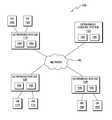
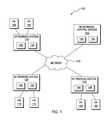
- FIG. 1is a functional block diagram illustrating a distributed network environment, in accordance with an embodiment of the present invention
- FIG. 2is a flowchart depicting operational steps of a new virtual machine integrating into the distributed network environment of FIG. 1 .
- FIG. 3illustrates operational steps of an exemplary multicast transmission of information from one virtual machine to two recipients within the distributed network environment of FIG. 1 .
- FIG. 4is a block diagram of components of networking systems and networking control systems executing a virtual machine configuration program and a data transfer program, in accordance with an embodiment of the present invention.
- Multi-destinational trafficis sent to and from virtual machines by sending transmissions through networking systems which encapsulate multi-destinational transmissions within unicast transmissions so that they can be passed through the underlay network. Once a transmission is received by a second networking system, it is de-capsulated then forwarded to each virtual machine which is determined to be a recipient of the transmission.
- aspects of the present inventionmay be embodied as a system, method or computer program product. Accordingly, aspects of the present invention may take the form of an entirely hardware embodiment, an entirely software embodiment (including firmware, resident software, micro-code, etc.) or an embodiment combining software and hardware aspects that may all generally be referred to herein as a “circuit,” “module” or “system.” Furthermore, aspects of the present invention may take the form of a computer program product embodied in one or more computer-readable medium(s) having computer-readable program code/instructions embodied thereon.
- Computer-readable mediamay be a computer-readable signal medium or a computer-readable storage medium.
- a computer-readable storage mediummay be, for example, but not limited to, an electronic, magnetic, optical, electromagnetic, infrared, or semiconductor system, apparatus, or device, or any suitable combination of the foregoing.
- a computer-readable storage mediummay be any tangible medium that can contain, or store a program for use by or in connection with an instruction execution system, apparatus, or device.
- a computer-readable signal mediummay include a propagated data signal with computer-readable program code embodied therein, for example, in baseband or as part of a carrier wave. Such a propagated signal may take any of a variety of forms, including, but not limited to, electro-magnetic, optical, or any suitable combination thereof.
- a computer-readable signal mediummay be any computer-readable medium that is not a computer-readable storage medium and that can communicate, propagate, or transport a program for use by or in connection with an instruction execution system, apparatus, or device.
- Computer program code for carrying out operations for aspects of the present inventionmay be written in any combination of one or more programming languages, including an object-oriented programming language such as Java®, Smalltalk, C++ or the like and conventional procedural programming languages, such as the “C” programming language or similar programming languages.
- the program codemay execute entirely on a user's computer, partly on the user's computer, as a stand-alone software package, partly on the user's computer and partly on a remote computer or entirely on the remote computer or server.
- the remote computermay be connected to the user's computer through any type of network, including a local area network (LAN) or a wide area network (WAN), or the connection may be made to an external computer (for example, through the Internet using an Internet Service Provider).
- LANlocal area network
- WANwide area network
- Internet Service Providerfor example, AT&T, MCI, Sprint, EarthLink, MSN, GTE, etc.
- the computer program instructionsmay also be loaded onto a computer, other programmable data processing apparatus, or other devices to cause a series of operational steps to be performed on the computer, other programmable apparatus or other devices to produce a computer-implemented process such that the instructions which execute on the computer or other programmable apparatus provide processes for implementing the functions/acts specified in the flowchart and/or block diagram block or blocks.
- FIG. 1is a functional block diagram illustrating a distributed network environment, generally designated 100 , in accordance with one embodiment of the present invention.
- Distributed network environment 100contains networking system 110 , 120 and 130 , network 140 , networking control system 150 , and virtual machines 160 , 165 , 170 , 175 , 180 , and 185 , virtual machine configuration program 190 , and data transfer program 195 .
- networking system 110 , 120 and 130are computing devices which can be standalone devices, servers, laptop computers, tablet computers, netbook computers, personal computers (PCs), or desktop computers.
- networking system 110 , 120 and 130each represent a computing system utilizing clustered computers and components to act as a single pool of seamless resources.
- networking system 110 , 120 and 130can be any computing device or a combination of devices with access to network 140 and virtual machines 160 , 165 , 170 , 175 , 180 , and 185 , and are capable of executing virtual machine configuration program 190 , and data transfer program 195 .
- networking system 110 , 120 and 130act as VNIDs (Virtual Network Interface Devices).
- VNIDsVirtual Network Interface Devices
- Networking system 110 , 120 and 130may include internal and external hardware components, as depicted and described in further detail with respect to FIG. 4 .
- Virtual machines 160 , 165 , 170 , 175 , 180 , and 185are software implemented abstractions of hardware included in networking system 110 , 120 and 130 .
- virtual machines 160 , 165 , 170 , 175 , 180 , and 185can be used to emulate functions of a physical computer (e.g., execute programs).
- virtual machines 160 , 165 , 170 , 175 , 180 , and 185are representations of virtual devices that are being implemented on networking system 110 , 120 and 130 .
- the resources of networking system 110 , 120 and 130can be partitioned for use by one or more virtual machines including virtual machines 160 , 165 , 170 , 175 , 180 , and 185 .
- Networking control system 150is a computing device which acts as a system controller for distributed network environment 100 .
- networking control system 150is a computing device that can be a standalone device, a server, a laptop computer, a tablet computer, a netbook computer, a personal computer (PC), or a desktop computer.
- networking control system 150represents a computing system utilizing clustered computers and components to act as a single pool of seamless resources.
- networking control system 150can be any computing device or a combination of devices with access to networking systems 110 , 120 , and 130 , network 140 and virtual machines 160 , 165 , 170 , 175 , 180 , and 185 , and is capable of executing virtual machine configuration program 190 , and data transfer program 195 .
- Networking control system 150may include internal and external hardware components, as depicted and described in further detail with respect to FIG. 4 .
- Virtual machine configuration program 190is a software program that configures distributed network environment 100 to send and receive transmissions of information to and from a new virtual machine which is added to distributed network environment 100 .
- Virtual machine configuration program 190is installed onto networking system 110 , 120 and 130 , and networking control system 150 , with each device executing a segment of virtual machine configuration program 190 .
- Data transfer program 195is a software program that facilitates broadcast and multicast transmissions of information between two or more virtual machines within distributed network environment 100 .
- Data transfer program 195is installed onto networking system 110 , 120 and 130 , and networking control system 150 , with each device executing a segment of data transfer program 195 .
- This exemplary embodiment of the present inventionincludes a first and a second tenant.
- the first tenantincludes virtual machines 160 , 170 , and 180 while the second tenant includes virtual machines 165 , 175 , and 185 .
- a tenantis a collection of VNETs or virtual machines which must have its traffic isolated from other tenants within a network.
- This exemplary embodiment of the present inventionincludes a first and a second VNET, each comprising an enclosed virtual network connected to network 140 .
- a first VNETincludes networking systems 110 and 120 as well as virtual machines 160 , 165 , 170 , and 175 .
- a second VNETcontains networking system 130 and virtual machines 180 and 185 .
- a VNETis a group of virtual machines which are controlled by one or more common policies.
- a policyincludes a set of rules for transferring information between VNETs.
- FIG. 2is a flowchart, 200 , depicting operational steps utilized by virtual machine configuration program 190 to configure distributed network environment 100 to send and receive transmissions of information to and from a new virtual machine, which is added to distributed network environment 100 , in accordance with one embodiment of the present invention.
- virtual machine 160is added to distributed network environment 100 via networking system 110 in step 205 .
- virtual machine 160is a member of a tenant generally designated the first tenant, and a VNET generally designated the first VNET.
- Virtual machine 160registers with networking system 110 and sends virtual machine control information to networking system 110 , which receives the virtual machine control information, in step 210 .
- virtual machine control informationincludes information associated with the new virtual machine, the first tenant, and the first VNET.
- virtual machine control informationincludes information associated with the tenant and VNET of which the new virtual machine is a member.
- networking system 110Upon receiving virtual machine control information from a new virtual machine, networking system 110 sends control information to networking control system 150 in step 215 .
- Control informationis based, at least in part, on the virtual machine control information received in step 210 and ID information used to represent the networking system and a virtual machine that it connects to.
- the received virtual machine control informationis used by networking control system 150 to update an internal record of all present virtual machines and their respective tenants and VNETs within distributed network environment 100 .
- networking system 150receives information related to virtual machine 160 , the first tenant, and the first VNET which are added to internal records stored within networking system 150 .
- networking control system 150sends information to networking system 110 in step 220 .
- This informationdescribes all other networking systems containing virtual machines which are members of the same domain and/or VNET as the new virtual machine, e.g., VM 160 , using either database records to be stored by networking system 110 or a set of ID information referencing each networking system and its virtual machines, in step 220 .
- the information received by networking system 110 in step 220includes information about virtual machines 170 and 180 which are both within tenant one, as well as the networking systems that they are connected to. The received information is used by networking system 110 to route appropriate traffic to and from virtual machine 160 .
- Networking control system 150sends necessary control information to all other networking systems in step 225 .
- the received informationis used to inform networking systems that a new virtual machine has attached to the network through a networking system, and also to provide information such as the tenant and VNET of which the new virtual machine is a member.
- Control informationis based, at least in part, on the virtual machine control information received in step 210 and ID information used to represent the networking system and a virtual machine that it connects to.
- networking systems 120 and 130receive information from networking control system 150 which indicates that virtual machine 160 has joined distributed network system 100 via networking system 110 , as well as that virtual machine 160 is a member of a first tenant and a first VNET.
- FIG. 3is a flowchart, 300 , depicting operational steps of data transfer program 195 .
- Data transfer program 195is a software program that facilitates broadcast and multicast transmissions of information between two ore more virtual machines within distributed network environment 100 .
- virtual machine 160sends a multicast transmission to virtual machines 170 and 180 via networking system 110 .
- the multicast transmissionis initiated by virtual machine 160 in step 305 .
- a multicast transmissioncan be any transmission of computer-readable information sent to two or more recipients.
- Multicast transmissionscan include IP multicast transmissions, Internet relay chat (IRC) transmissions, or any other digital multicast information transmission known in the art.
- Other embodimentsinclude a broadcast transmission being initiated by a virtual machine to all other virtual machines within the same tenant and/or VNET within distributed network environment 100 .
- An exemplary embodiment of a broadcast transmissionincludes virtual machine 160 initiating a broadcast transmission to all virtual machines within the first VNET.
- networking system 110Upon receiving a multicast transmission from virtual machine 160 , networking system 110 utilizes the control information received from networking control system 150 to determine which networking systems access the recipient virtual machines. Networking system 110 also determines the tenants and VNETs associated with the recipient virtual machines in step 310 . In this exemplary embodiment, networking systems 120 and 130 are determined to be hosts of virtual machines 170 and 180 , which are intended recipients of the current multicast transmission. Virtual machine 170 is determined to be a member of a first tenant and a first VNET, while virtual machine 180 is determined to be a member of a first tenant and a second VNET.
- Networking system 110checks if any of the recipients are members of a different VNET from that of the sender of the transmission in decision step 315 .
- the VNET of each of the recipient virtual machinesis determined using the control information received from networking control system 150 . If all of the recipients of the transmission are members of the same VNET (decision step 315 , yes branch), then networking system 110 proceeds with sending encapsulated unicast packets to the recipient networking systems in step 330 .
- networking system 110determines the relevant VNET that the recipient belongs to. Networking system 110 then communicates with the recipient virtual machine belonging to the determined VNET to determine if the virtual machine is interested in receiving the transmission, in decision step 320 .
- virtual machines 160 and 170are members of a first VNET, while virtual machine 180 is a member of a second VNET.
- networking system 110communicates with networking system 130 to determine if virtual machine 180 is interested in receiving the transmission from virtual machine 160 .
- networking system 110determines that a virtual machine from an outside VNET is interested in receiving the transmission (decision step 320 , yes branch), then network system 110 proceeds with the transmission to all intended recipients, in step 330 .
- networking system 110determines that virtual machine 180 is interested in receiving the transmission from virtual machine 160 , then networking system 110 proceeds with the transmission to all intended recipients in step 330 .
- networking system 110determines that a virtual machine from an outside VNET is not interested in receiving the transmission (decision step 320 , no branch), then networking system 110 proceeds to step 325 . In an exemplary embodiment, if a given virtual machine indicates that it is not interested in receiving a transmission from virtual machine 160 , then networking system 110 would proceed to remove virtual machine 180 from the list of intended recipients in step 325 .
- Virtual machines that are determined to not be interested in receiving a transmission from a virtual machineare removed from the list of recipients in step 325 .
- virtual machine 180were to indicate that it was not interested in receiving a transmission from virtual machine 160 , then virtual machine 180 would be removed from the list of recipients.
- a networking systemproceeds to send an encapsulated transmission in step 330 .
- encapsulated unicast transmissionsare sent to all network systems which are determined to have an interest in receiving the transmission.
- the trafficis encapsulated by networking system 110 into unicast traffic so that the multicast transmission can be passed through network 140 successfully.
- Each packet of unicast traffic prepared by the networking systemcontains at least a portion of the packet received from the virtual machine which initiated the transmission, at least a portion of the ID information received from networking control system 150 , and a header including the destination address of the networking system receiving the packet.
- the networking system sending the transmissioncreates one packet of unicast traffic for each networking system which receives the transmission.
- networking system 110creates one packet of unicast traffic to be sent to networking system 120 and one packet of unicast traffic to be sent to networking system 130 .
- networking system 110creates one packet of unicast traffic to be sent to networking system 120 and one packet of unicast traffic to be sent to networking system 130 .
- a single packet of unicast trafficis created by networking system 110 which is sent to the networking system hosting all of the recipient virtual machines.
- a recipient networking systemreceives a transmission that no connected virtual machines are able to receive in accordance with local policy
- the networking systemnotifies networking control system 150 and causes all other networking systems to update their internal records.
- Internal recordscomprise a list of receiving networking systems and the virtual machines from each tenant that are registered with each networking system.
- Internal recordsare updated by the networking control system 150 providing information about the change in records to each networking system within the network.
- the information provided by networking control system 150can include either information related to the specific change that needs to be updated in the records of each networking system, or a new complete set of records that can be used by each networking system to either update or replace its current records.
- the received packetis forwarded to an appropriate virtual machine, in step 340 .
- an appropriate virtual machineis determined based on at least one of: a) a tenant intended to receive the transmission, b) a virtual machine intended to receive the transmission, or c) a security policy implemented by the networking system.
- virtual machine configuration program 190 and data transfer program 195are stored on networking system 110 , 120 and 130 , and networking control system 150 .
- virtual machine configuration program 190 and data transfer program 195may be stored externally and accessed through a communication network such as network 140 .
- the communication networkcan be, for example, a local area network (LAN), a wide area network (WAN) such as the Internet, or a combination of the two, and may include wired, wireless, fiber optic or any other connection known in the art.
- the communication networkcan be any combination of connections and protocols that will support communications between networking system 110 , 120 and 130 , and networking control system 150 , and virtual machine configuration program 190 and data transfer program 195 in accordance with a desired embodiment of the present invention.
- FIG. 4depicts a block diagram of respective components of networking system 110 , 120 and 130 , and networking control system 150 in accordance with an illustrative embodiment of the present invention. It should be appreciated that FIG. 4 provides only an illustration of one implementation and does not imply any limitations with regard to the environments in which different embodiments may be implemented. Many modifications to the depicted environment may be made.
- Networking system 110 , 120 and 130 , and networking control system 150include respective communications fabric 402 , which provides communications between computer processor(s) 404 , memory 406 , persistent storage 408 , communications unit 410 , and input/output (I/O) interface(s) 412 .
- Communications fabric 402can be implemented with any architecture designed for passing data and/or control information between processors (such as microprocessors, communications and network processors, etc.), system memory, peripheral devices, and any other hardware components within a system.
- processorssuch as microprocessors, communications and network processors, etc.
- Communications fabric 402can be implemented with one or more buses.
- Memory 406 and persistent storage 408are computer-readable storage media.
- memory 406includes random access memory (RAM) 414 and cache memory 416 .
- RAMrandom access memory
- cache memory 416In general, memory 406 can include any suitable volatile or non-volatile computer-readable storage media.
- the media used by persistent storage 408may also be removable.
- a removable hard drivemay be used for persistent storage 408 .
- Other examplesinclude optical and magnetic disks, thumb drives, and smart cards that are inserted into a drive for transfer onto another computer-readable storage medium that is also part of persistent storage 408 .
- Communications unit 410in these examples, provides for communications with other data processing systems or devices, including resources of enterprise grid 112 and client devices 104 , 106 , and 108 .
- communications unit 410includes one or more network interface cards.
- Communications unit 410may provide communications through the use of either or both physical and wireless communications links.
- VM 160 , 165 , 170 , 175 , 180 and 185 , Virtual machine configuration program 190 and data transfer program 195may be downloaded to persistent storage 408 through communications unit 410 .
- I/O interface(s) 412allows for input and output of data with other devices that may be connected to network system 110 , 120 and 130 , or network control system 150 .
- I/O interface(s) 412may provide a connection to external device(s) 418 such as a keyboard, a keypad, a touch screen, and/or some other suitable input device.
- External device(s) 418can also include portable computer-readable storage media such as, for example, thumb drives, portable optical or magnetic disks, and memory cards.
- Software and data used to practice embodiments of the present invention, e.g. virtual machine configuration program 190 and data transfer program 195can be stored on such portable computer-readable storage media and can be loaded onto persistent storage 408 via I/O interface(s) 412 .
- I/O interface(s) 412also connect to a display 420 .
- Display 420provides a mechanism to display data to a user and may be, for example, a computer monitor.
- each block in the flowchart or block diagramsmay represent a module, segment, or portion of code, which comprises one or more executable instructions for implementing the specified logical function(s).
- the functions noted in the blockmay occur out of the order noted in the Figures. For example, two blocks shown in succession may, in fact, be executed substantially concurrently, or the blocks may sometimes be executed in the reverse order, depending upon the functionality involved.
Landscapes
- Engineering & Computer Science (AREA)
- Computer Networks & Wireless Communication (AREA)
- Signal Processing (AREA)
- Software Systems (AREA)
- Theoretical Computer Science (AREA)
- Physics & Mathematics (AREA)
- General Engineering & Computer Science (AREA)
- General Physics & Mathematics (AREA)
- Data Exchanges In Wide-Area Networks (AREA)
Abstract
Description
The present invention relates generally to the field of computer networking, and more particularly to transporting multi-destinational network traffic.
Many current implementations of multicast data transmission require that every networking device connecting the sender and receiver be updated to support multicast technology efficiently. Most traditional underlay networks support only unicast transmissions of information, where a transmission of information is initialized by direct communication between the sender and receiver of a transmission. As more nodes are added into a network, and traffic is sent too many destinations simultaneously, communicating directly with every receiver becomes inefficient. However, there may be advantages to the use of a system for transporting multicast and broadcast traffic more easily using an underlay network which supports only unicast transmissions.
Embodiments of the present invention disclose a method, computer program product, and system for transporting multi-destinational network traffic using repetitive unicast transmissions in the underlay. A first virtual machine of the distributed network sends a first virtual machine control information to a first network system of the distributed network. The first virtual machine is associated with a first tenant of the distributed network and is configured to communicate with the first network system. The first virtual machine control information is associated with the first virtual machine and the first tenant. The first network system sends a first control information to a first network control system of the distributed network in response to receiving the first virtual machine control information. The first control information is based, at least in part, on the first virtual machine control information. The first network control system sends at least a portion of the first control information to a number of network systems included in a plurality of network systems that are included in the distributed network. The first network control system sends a second control information to the first network system. The second control information is based, at least in part, on the first control information.
Most traditional underlay networks support only unicast transmissions of information, where a transmission of information is initialized by direct communication between the sender and receiver of a transmission. As more nodes are added into a network, and traffic is sent to many destinations simultaneously, communicating directly with every receiver becomes inefficient. The present invention includes a system, method and computer program product for transporting overlay multi-destinational traffic in an overlay network using repetitive unicast transmissions sent through an underlay network. Virtual machines are connected to a network via networking systems (also called network systems), each of which maintains a record of the virtual machines which are connected to it. Collected records are synchronized with a networking control system (also called network control system), which updates all networking systems in the event that a change is made to the network. Multi-destinational traffic is sent to and from virtual machines by sending transmissions through networking systems which encapsulate multi-destinational transmissions within unicast transmissions so that they can be passed through the underlay network. Once a transmission is received by a second networking system, it is de-capsulated then forwarded to each virtual machine which is determined to be a recipient of the transmission.
As will be appreciated by one skilled in the art, aspects of the present invention may be embodied as a system, method or computer program product. Accordingly, aspects of the present invention may take the form of an entirely hardware embodiment, an entirely software embodiment (including firmware, resident software, micro-code, etc.) or an embodiment combining software and hardware aspects that may all generally be referred to herein as a “circuit,” “module” or “system.” Furthermore, aspects of the present invention may take the form of a computer program product embodied in one or more computer-readable medium(s) having computer-readable program code/instructions embodied thereon.
Any combination of computer-readable media may be utilized. Computer-readable media may be a computer-readable signal medium or a computer-readable storage medium. A computer-readable storage medium may be, for example, but not limited to, an electronic, magnetic, optical, electromagnetic, infrared, or semiconductor system, apparatus, or device, or any suitable combination of the foregoing. More specific examples (a non-exhaustive list) of a computer-readable storage medium would include the following: an electrical connection having one or more wires, a portable computer diskette, a hard disk, a random access memory (RAM), a read-only memory (ROM), an erasable programmable read-only memory (EPROM or Flash memory), an optical fiber, a portable compact disc read-only memory (CD-ROM), an optical storage device, a magnetic storage device, or any suitable combination of the foregoing. In the context of this document, a computer-readable storage medium may be any tangible medium that can contain, or store a program for use by or in connection with an instruction execution system, apparatus, or device.
A computer-readable signal medium may include a propagated data signal with computer-readable program code embodied therein, for example, in baseband or as part of a carrier wave. Such a propagated signal may take any of a variety of forms, including, but not limited to, electro-magnetic, optical, or any suitable combination thereof. A computer-readable signal medium may be any computer-readable medium that is not a computer-readable storage medium and that can communicate, propagate, or transport a program for use by or in connection with an instruction execution system, apparatus, or device.
Program code embodied on a computer-readable medium may be transmitted using any appropriate medium, including but not limited to wireless, wireline, optical fiber cable, RF, etc., or any suitable combination of the foregoing.
Computer program code for carrying out operations for aspects of the present invention may be written in any combination of one or more programming languages, including an object-oriented programming language such as Java®, Smalltalk, C++ or the like and conventional procedural programming languages, such as the “C” programming language or similar programming languages. The program code may execute entirely on a user's computer, partly on the user's computer, as a stand-alone software package, partly on the user's computer and partly on a remote computer or entirely on the remote computer or server. In the latter scenario, the remote computer may be connected to the user's computer through any type of network, including a local area network (LAN) or a wide area network (WAN), or the connection may be made to an external computer (for example, through the Internet using an Internet Service Provider).
Aspects of the present invention are described below with reference to flowchart illustrations and/or block diagrams of methods, apparatus (systems) and computer program products according to embodiments of the invention. It will be understood that each block of the flowchart illustrations and/or block diagrams, and combinations of blocks in the flowchart illustrations and/or block diagrams, can be implemented by computer program instructions. These computer program instructions may be provided to a processor of a general purpose computer, special purpose computer, or other programmable data processing apparatus to produce a machine, such that the instructions, which execute via the processor of the computer or other programmable data processing apparatus, create means for implementing the functions/acts specified in the flowchart and/or block diagram block or blocks.
These computer program instructions may also be stored in a computer-readable medium that can direct a computer, other programmable data processing apparatus, or other devices to function in a particular manner, such that the instructions stored in the computer-readable medium produce an article of manufacture including instructions which implement the function/act specified in the flowchart and/or block diagram block or blocks.
The computer program instructions may also be loaded onto a computer, other programmable data processing apparatus, or other devices to cause a series of operational steps to be performed on the computer, other programmable apparatus or other devices to produce a computer-implemented process such that the instructions which execute on the computer or other programmable apparatus provide processes for implementing the functions/acts specified in the flowchart and/or block diagram block or blocks.
The present invention will now be described in detail with reference to the Figures.FIG. 1 is a functional block diagram illustrating a distributed network environment, generally designated100, in accordance with one embodiment of the present invention. Distributednetwork environment 100 containsnetworking system network 140,networking control system 150, andvirtual machines machine configuration program 190, anddata transfer program 195.
In various embodiments of the present invention,networking system networking system networking system network 140 andvirtual machines machine configuration program 190, anddata transfer program 195. Within the context ofdistributed network system 100,networking system Networking system FIG. 4 .
Virtual machines (VMs)160,165,170,175,180, and185 are software implemented abstractions of hardware included innetworking system virtual machines virtual machines networking system networking system virtual machines
Virtualmachine configuration program 190 is a software program that configures distributednetwork environment 100 to send and receive transmissions of information to and from a new virtual machine which is added to distributednetwork environment 100. Virtualmachine configuration program 190 is installed ontonetworking system networking control system 150, with each device executing a segment of virtualmachine configuration program 190.
This exemplary embodiment of the present invention includes a first and a second tenant. The first tenant includesvirtual machines virtual machines
This exemplary embodiment of the present invention includes a first and a second VNET, each comprising an enclosed virtual network connected tonetwork 140. A first VNET includesnetworking systems virtual machines networking system 130 andvirtual machines
In an exemplary embodiment of the present invention,virtual machine 160 is added to distributednetwork environment 100 vianetworking system 110 instep 205. In this exemplary embodiment,virtual machine 160 is a member of a tenant generally designated the first tenant, and a VNET generally designated the first VNET.
Upon receiving virtual machine control information from a new virtual machine,networking system 110 sends control information tonetworking control system 150 in step215. Control information is based, at least in part, on the virtual machine control information received instep 210 and ID information used to represent the networking system and a virtual machine that it connects to. The received virtual machine control information is used by networkingcontrol system 150 to update an internal record of all present virtual machines and their respective tenants and VNETs within distributednetwork environment 100. In this exemplary embodiment,networking system 150 receives information related tovirtual machine 160, the first tenant, and the first VNET which are added to internal records stored withinnetworking system 150.
In this exemplary embodiment,networking control system 150 sends information tonetworking system 110 instep 220. This information describes all other networking systems containing virtual machines which are members of the same domain and/or VNET as the new virtual machine, e.g.,VM 160, using either database records to be stored bynetworking system 110 or a set of ID information referencing each networking system and its virtual machines, instep 220. In this exemplary embodiment, the information received bynetworking system 110 instep 220 includes information aboutvirtual machines networking system 110 to route appropriate traffic to and fromvirtual machine 160.
In the exemplary embodiment, the multicast transmission is initiated byvirtual machine 160 instep 305. A multicast transmission can be any transmission of computer-readable information sent to two or more recipients. Multicast transmissions can include IP multicast transmissions, Internet relay chat (IRC) transmissions, or any other digital multicast information transmission known in the art. Other embodiments include a broadcast transmission being initiated by a virtual machine to all other virtual machines within the same tenant and/or VNET within distributednetwork environment 100. An exemplary embodiment of a broadcast transmission includesvirtual machine 160 initiating a broadcast transmission to all virtual machines within the first VNET.
Upon receiving a multicast transmission fromvirtual machine 160,networking system 110 utilizes the control information received fromnetworking control system 150 to determine which networking systems access the recipient virtual machines.Networking system 110 also determines the tenants and VNETs associated with the recipient virtual machines instep 310. In this exemplary embodiment,networking systems virtual machines Virtual machine 170 is determined to be a member of a first tenant and a first VNET, whilevirtual machine 180 is determined to be a member of a first tenant and a second VNET.
In the event that there is at least one virtual machine which is a member of a different VNET from the sender of the transmission (decision step 315, no branch),networking system 110 determines the relevant VNET that the recipient belongs to.Networking system 110 then communicates with the recipient virtual machine belonging to the determined VNET to determine if the virtual machine is interested in receiving the transmission, indecision step 320. In this exemplary embodiment,virtual machines virtual machine 180 is a member of a second VNET. In this exemplaryembodiment networking system 110 communicates withnetworking system 130 to determine ifvirtual machine 180 is interested in receiving the transmission fromvirtual machine 160.
Ifnetworking system 110 determines that a virtual machine from an outside VNET is interested in receiving the transmission (decision step 320, yes branch), thennetwork system 110 proceeds with the transmission to all intended recipients, instep 330. In an exemplary embodiment,networking system 110 determines thatvirtual machine 180 is interested in receiving the transmission fromvirtual machine 160, then networkingsystem 110 proceeds with the transmission to all intended recipients instep 330.
Ifnetworking system 110 determines that a virtual machine from an outside VNET is not interested in receiving the transmission (decision step 320, no branch), then networkingsystem 110 proceeds to step325. In an exemplary embodiment, if a given virtual machine indicates that it is not interested in receiving a transmission fromvirtual machine 160, then networkingsystem 110 would proceed to removevirtual machine 180 from the list of intended recipients instep 325.
Virtual machines that are determined to not be interested in receiving a transmission from a virtual machine are removed from the list of recipients instep 325. In an exemplary embodiment, ifvirtual machine 180 were to indicate that it was not interested in receiving a transmission fromvirtual machine 160, thenvirtual machine 180 would be removed from the list of recipients. After a virtual machine is removed form the list of recipients, a networking system proceeds to send an encapsulated transmission instep 330.
Instep 330, encapsulated unicast transmissions are sent to all network systems which are determined to have an interest in receiving the transmission. The traffic is encapsulated bynetworking system 110 into unicast traffic so that the multicast transmission can be passed throughnetwork 140 successfully. Each packet of unicast traffic prepared by the networking system contains at least a portion of the packet received from the virtual machine which initiated the transmission, at least a portion of the ID information received fromnetworking control system 150, and a header including the destination address of the networking system receiving the packet. The networking system sending the transmission creates one packet of unicast traffic for each networking system which receives the transmission. In this exemplary embodiment,networking system 110 creates one packet of unicast traffic to be sent tonetworking system 120 and one packet of unicast traffic to be sent tonetworking system 130. In other exemplary embodiments where two ore more virtual machines which are recipients of the traffic are connected to a single networking system, a single packet of unicast traffic is created bynetworking system 110 which is sent to the networking system hosting all of the recipient virtual machines.
In exemplary embodiments where a recipient networking system receives a transmission that no connected virtual machines are able to receive in accordance with local policy, the networking system notifiesnetworking control system 150 and causes all other networking systems to update their internal records. Internal records comprise a list of receiving networking systems and the virtual machines from each tenant that are registered with each networking system. Internal records are updated by thenetworking control system 150 providing information about the change in records to each networking system within the network. The information provided bynetworking control system 150 can include either information related to the specific change that needs to be updated in the records of each networking system, or a new complete set of records that can be used by each networking system to either update or replace its current records.
In an exemplary embodiment, the packet sent bynetworking system 110 is received bynetworking system virtual machine 160 as well as a portion of the ID information received fromnetworking control system 150. Once the packet is de-capsulated, destination information is received and the destination tenant and virtual machines are determined instep 335.
Once a recipient virtual machine is determined, the received packet is forwarded to an appropriate virtual machine, instep 340. In exemplary embodiments where multiple virtual machines connected to a networking system are determined to be recipients of the transmission, a copy of the received packet will be sent to each virtual machine. An appropriate virtual machine is determined based on at least one of: a) a tenant intended to receive the transmission, b) a virtual machine intended to receive the transmission, or c) a security policy implemented by the networking system.
In this exemplary embodiment, virtualmachine configuration program 190 anddata transfer program 195 are stored onnetworking system networking control system 150. However, in other embodiments, virtualmachine configuration program 190 anddata transfer program 195 may be stored externally and accessed through a communication network such asnetwork 140. The communication network can be, for example, a local area network (LAN), a wide area network (WAN) such as the Internet, or a combination of the two, and may include wired, wireless, fiber optic or any other connection known in the art. In general, the communication network can be any combination of connections and protocols that will support communications betweennetworking system networking control system 150, and virtualmachine configuration program 190 anddata transfer program 195 in accordance with a desired embodiment of the present invention.
The media used bypersistent storage 408 may also be removable. For example, a removable hard drive may be used forpersistent storage 408. Other examples include optical and magnetic disks, thumb drives, and smart cards that are inserted into a drive for transfer onto another computer-readable storage medium that is also part ofpersistent storage 408.
I/O interface(s)412 allows for input and output of data with other devices that may be connected tonetwork system network control system 150. For example, I/O interface(s)412 may provide a connection to external device(s)418 such as a keyboard, a keypad, a touch screen, and/or some other suitable input device. External device(s)418 can also include portable computer-readable storage media such as, for example, thumb drives, portable optical or magnetic disks, and memory cards. Software and data used to practice embodiments of the present invention, e.g. virtualmachine configuration program 190 anddata transfer program 195, can be stored on such portable computer-readable storage media and can be loaded ontopersistent storage 408 via I/O interface(s)412. I/O interface(s)412 also connect to adisplay 420.
The programs described herein are identified based upon the application for which they are implemented in a specific embodiment of the invention. However, it should be appreciated that any particular program nomenclature herein is used merely for convenience, and thus the invention should not be limited to use solely in any specific application identified and/or implied by such nomenclature.
The flowchart and block diagrams in the Figures illustrate the architecture, functionality, and operation of possible implementations of systems, methods and computer program products according to various embodiments of the present invention. In this regard, each block in the flowchart or block diagrams may represent a module, segment, or portion of code, which comprises one or more executable instructions for implementing the specified logical function(s). It should also be noted that, in some alternative implementations, the functions noted in the block may occur out of the order noted in the Figures. For example, two blocks shown in succession may, in fact, be executed substantially concurrently, or the blocks may sometimes be executed in the reverse order, depending upon the functionality involved. It will also be noted that each block of the block diagrams and/or flowchart illustration, and combinations of blocks in the block diagrams and/or flowchart illustration, can be implemented by special purpose hardware-based systems that perform the specified functions or acts, or combinations of special purpose hardware and computer instructions.
Claims (17)
1. A method for configuring a network, the method comprising:
receiving, by a first network computer, an indication that a first virtual machine has operatively coupled to a network via the first network computer;
receiving, by the first network computer, a first virtual machine control information from the first virtual machine, wherein the first virtual machine control information identifies the first virtual machine and a tenant with which the first virtual machine is associated;
sending, by the first network computer, a first network control information to a network control computer, wherein the first network control information includes at least a portion of the first virtual machine control information; and
receiving, by the first network computer, a second network control information from the network control computer, wherein the second network control information describes a second virtual machine, operatively coupled to the network via a second network computer, and wherein the second virtual machine is capable of communicating with the first virtual machine, and wherein the second virtual machine is determined based on a policy of the network, wherein the policy includes a set of rules for transferring information;
receiving, by the first network computer, a first list, wherein the first list is a list of each virtual machine that is operatively coupled to the network, wherein the list is synchronized with the network control computer, which updates the network when a change is made to the network;
receiving, by the first network computer, a multicast packet sent from the first virtual machine to appropriate virtual machines associated with the tenant, including, at least, the second virtual machine;
determining, by the first network computer, network computers operatively coupled to virtual machines associated with the tenant, including, at least, the second network computer, based on, at least, the second network control information, wherein the appropriate virtual machines associated with the tenant are determined based on: a tenant intended to receive a transmission, a virtual machine intended to receive the transmission, and the policy;
encapsulating, by the first network computer, the multicast packet within a unicast packet for each determined network computer, including, at least, the second network computer; and
sending, by the first network computer, each unicast packet to each respective network computer, including, at least, the second network computer.
2. The method ofclaim 1 , further comprising:
responsive to a third virtual machine attaching to the network via a third network computer, receiving, by the first network computer, a third network control information, wherein the third network control information describes the location of the third virtual machine within the network.
3. The method ofclaim 1 , wherein the first virtual machine and the second virtual machine are included within the tenant.
4. The method ofclaim 3 , wherein the tenant is a group of virtual machines configured to:
communicate with each virtual machine of the group of virtual machines; and
prevent communication with virtual machines outside of the group of virtual machines.
5. The method ofclaim 1 , wherein:
the first network control information further includes identification information of the first network computer; and
the second network control information further describes additional network control computers operatively coupled to one or more additional virtual machines associated with the tenant.
6. The method ofclaim 1 , further comprising:
receiving, by the first network computer, a multicast packet sent from the first virtual machine to at least the second virtual machine;
encapsulating, by the first network computer, the multicast packet within a unicast packet, wherein the unicast packet contains, at least, a portion of the multicast packet, a portion of the second network control information, and a header, wherein the header includes a destination address of the second network computer; and
sending, by the first network computer, the unicast packet to at least the second network computer.
7. A computer program product for configuring a network, the computer program product comprising:
one or more computer readable storage media and program instructions stored on the one or more computer readable storage media, wherein the one or more computer readable storage media are not transitory signals per se, the program instructions comprising:
program instructions to receive, by a first network computer, an indication that a first virtual machine has operatively coupled to a network via the first network computer;
program instructions to receive, by the first network computer, a first virtual machine control information from the first virtual machine, wherein the first virtual machine control information identifies the first virtual machine and a tenant with which the first virtual machine is associated;
program instructions to send, by the first network computer, a first network control information to a network control computer, wherein the first network control information includes at least a portion of the first virtual machine control information; and
program instructions to receive, by the first network computer, a second network control information from the network control computer, wherein the second network control information describes a second virtual machine, operatively coupled to the network via a second network computer, and wherein the second virtual machine is capable of communicating with the first virtual machine, and wherein the second virtual machine is determined based on a policy of the network, wherein the policy includes a set of rules for transferring information;
program instructions to receive, by the first network computer, a first list, wherein the first list is a list of each virtual machine that is operatively coupled to the network, wherein the list is synchronized with the network control computer, which updates the network when a change is made to the network;
program instructions, stored on the one or more computer readable storage devices, to receive, by the first network computer, a multicast packet sent from the first virtual machine to appropriate virtual machines associated with the tenant, including, at least, the second virtual machine;
program instructions, stored on the one or more computer readable storage devices, to determine, by the first network computer, network computers operatively coupled to virtual machines associated with the tenant, including, at least, the second network computer, based on, at least, the second network control information, wherein the appropriate virtual machines associated with the tenant are determined based on: a tenant intended to receive a transmission, a virtual machine intended to receive the transmission, and the policy;
program instructions, stored on the one or more computer readable storage devices, to encapsulate, by the first network computer, the multicast packet within a unicast packet for each determined network computer, including, at least, the second network computer; and
program instructions, stored on the one or more computer readable storage devices, to send, by the first network computer, each unicast packet to each respective network computer, including, at least, the second network computer.
8. The computer program product ofclaim 7 , further comprising:
program instructions, stored on the one or more computer readable storage devices, to, responsive to a third virtual machine attaching to the network via a third network computer, receive, by the first network computer, a third network control information, wherein the third network control information describes the location of the third virtual machine within the network.
9. The computer program product ofclaim 7 , wherein the first virtual machine and the second virtual machine are included within the tenant.
10. The computer program product ofclaim 9 , wherein the tenant is a group of virtual machines configured to:
communicate with each virtual machine of the group of virtual machines; and
prevent communication with virtual machines outside of the group of virtual machines.
11. The computer program product ofclaim 7 , wherein:
the first network control information further includes identification information of the first network computer; and
the second network control information further describes additional network control computers operatively coupled to one or more additional virtual machines associated with the tenant.
12. The computer program product ofclaim 7 , further comprising:
program instructions, stored on the one or more computer readable storage devices, to receive, by the first network computer, a multicast packet sent from the first virtual machine to at least the second virtual machine;
program instructions, stored on the one or more computer readable storage devices, to encapsulate, by the first network computer, the multicast packet within a unicast packet, wherein the unicast packet contains, at least, a portion of the multicast packet, a portion of the second network control information, and a header, wherein the header includes a destination address of the second network computer; and
program instructions, stored on the one or more computer readable storage devices, to send, by the first network computer, the unicast packet to at least the second network computer.
13. A computer system for configuring a network, the computer system comprising:
one or more computer processors, one or more computer readable storage media, and program instructions stored on the one or more computer readable storage media for execution by at least one of the one or more computer processors, wherein the one or more computer readable storage media are not transitory signals per se, the program instructions comprising:
program instructions to receive, by a first network computer, an indication that a first virtual machine has operatively coupled to a network via the first network computer;
program instructions to receive, by the first network computer, a first virtual machine control information from the first virtual machine, wherein the first virtual machine control information identifies the first virtual machine and a tenant with which the first virtual machine is associated;
program instructions to send, by the first network computer, a first network control information to a network control computer, wherein the first network control information includes at least a portion of the first virtual machine control information; and
program instructions to receive, by the first network computer, a second network control information from the network control computer, wherein the second network control information describes a second virtual machine, operatively coupled to the network via a second network computer, and wherein the second virtual machine is capable of communicating with the first virtual machine, and wherein the second virtual machine is determined based on a policy of the network, wherein the policy includes a set of rules for transferring information;
program instructions to receive, by the first network computer, a first list, wherein the first list is a list of each virtual machine that is operatively coupled to the network, wherein the list is synchronized with the network control computer, which updates the network when a change is made to the network;
program instructions, stored on the computer readable storage devices for execution by at least one of the one or more processors, to receive, by the first network computer, a multicast packet sent from the first virtual machine to appropriate virtual machines associated with the tenant, including, at least, the second virtual machine;
program instructions, stored on the computer readable storage devices for execution by at least one of the one or more processors, to determine, by the first network computer, network computers operatively coupled to virtual machines associated with the tenant, including, at least, the second network computer, based on, at least, the second network control information, wherein the appropriate virtual machines associated with the tenant are determined based on: a tenant intended to receive a transmission, a virtual machine intended to receive the transmission, and the policy;
program instructions, stored on the computer readable storage devices for execution by at least one of the one or more processors, to encapsulate, by the first network computer, the multicast packet within a unicast packet for each determined network computer, including, at least, the second network computer; and
program instructions, stored on the computer readable storage devices for execution by at least one of the one or more processors, to send, by the first network computer, each unicast packet to each respective network computer, including, at least, the second network computer.
14. The computer system ofclaim 13 , further comprising:
program instructions, stored on the computer readable storage devices for execution by at least one of the one or more processors, to, responsive to a third virtual machine attaching to the network via a third network computer, receive, by the first network computer, a third network control information, wherein the third network control information describes the location of the third virtual machine within the network.
15. The computer system ofclaim 13 , wherein the tenant is a group of virtual machines configured to:
communicate with each virtual machine of the group of virtual machines; and
prevent communication with virtual machines outside of the group of virtual machines.
16. The computer system ofclaim 13 , wherein:
the first network control information further includes identification information of the first network computer; and
the second network control information further describes additional network control computers operatively coupled to one or more additional virtual machines associated with the tenant.
17. The method ofclaim 1 , further comprising:
receiving, by the first network computer, a multicast packet sent from the first virtual machine;
determining, by the first network computer, there are no virtual machines able to receive the multicast packet, based on, at least, the policy; and
causing, by the first network computer, each networking system to update internal records to reflect that there are no virtual machines within each respective networking system that are able to receive the multicast packet, wherein the internal records include, at least, the first list and a second list, wherein the second list is a list of receiving networking systems.
Priority Applications (2)
| Application Number | Priority Date | Filing Date | Title |
|---|---|---|---|
| US14/845,797US10103935B2 (en) | 2013-10-04 | 2015-09-04 | Transporting multi-destination networking traffic by sending repetitive unicast |
| US16/127,327US10666509B2 (en) | 2013-10-04 | 2018-09-11 | Transporting multi-destination networking traffic by sending repetitive unicast |
Applications Claiming Priority (2)
| Application Number | Priority Date | Filing Date | Title |
|---|---|---|---|
| US14/046,108US20150100670A1 (en) | 2013-10-04 | 2013-10-04 | Transporting multi-destination networking traffic by sending repetitive unicast |
| US14/845,797US10103935B2 (en) | 2013-10-04 | 2015-09-04 | Transporting multi-destination networking traffic by sending repetitive unicast |
Related Parent Applications (1)
| Application Number | Title | Priority Date | Filing Date |
|---|---|---|---|
| US14/046,108ContinuationUS20150100670A1 (en) | 2013-10-04 | 2013-10-04 | Transporting multi-destination networking traffic by sending repetitive unicast |
Related Child Applications (1)
| Application Number | Title | Priority Date | Filing Date |
|---|---|---|---|
| US16/127,327ContinuationUS10666509B2 (en) | 2013-10-04 | 2018-09-11 | Transporting multi-destination networking traffic by sending repetitive unicast |
Publications (2)
| Publication Number | Publication Date |
|---|---|
| US20150381412A1 US20150381412A1 (en) | 2015-12-31 |
| US10103935B2true US10103935B2 (en) | 2018-10-16 |
Family
ID=52777875
Family Applications (3)
| Application Number | Title | Priority Date | Filing Date |
|---|---|---|---|
| US14/046,108AbandonedUS20150100670A1 (en) | 2013-10-04 | 2013-10-04 | Transporting multi-destination networking traffic by sending repetitive unicast |
| US14/845,797Active2034-05-05US10103935B2 (en) | 2013-10-04 | 2015-09-04 | Transporting multi-destination networking traffic by sending repetitive unicast |
| US16/127,327ActiveUS10666509B2 (en) | 2013-10-04 | 2018-09-11 | Transporting multi-destination networking traffic by sending repetitive unicast |
Family Applications Before (1)
| Application Number | Title | Priority Date | Filing Date |
|---|---|---|---|
| US14/046,108AbandonedUS20150100670A1 (en) | 2013-10-04 | 2013-10-04 | Transporting multi-destination networking traffic by sending repetitive unicast |
Family Applications After (1)
| Application Number | Title | Priority Date | Filing Date |
|---|---|---|---|
| US16/127,327ActiveUS10666509B2 (en) | 2013-10-04 | 2018-09-11 | Transporting multi-destination networking traffic by sending repetitive unicast |
Country Status (1)
| Country | Link |
|---|---|
| US (3) | US20150100670A1 (en) |
Cited By (1)
| Publication number | Priority date | Publication date | Assignee | Title |
|---|---|---|---|---|
| US10666509B2 (en) | 2013-10-04 | 2020-05-26 | International Business Machines Corporation | Transporting multi-destination networking traffic by sending repetitive unicast |
Families Citing this family (6)
| Publication number | Priority date | Publication date | Assignee | Title |
|---|---|---|---|---|
| US9971620B2 (en) | 2014-10-15 | 2018-05-15 | Keysight Technologies Singapore (Holdings) Pte Ltd | Methods and systems for network packet impairment within virtual machine host systems |
| US9971619B2 (en)* | 2014-10-15 | 2018-05-15 | Keysight Technologies Singapore (Holdings) Pte Ltd | Methods and systems for forwarding network packets within virtual machine host systems |
| US10171425B2 (en)* | 2016-12-15 | 2019-01-01 | Keysight Technologies Singapore (Holdings) Pte Ltd | Active firewall control for network traffic sessions within virtual processing platforms |
| US11075886B2 (en) | 2016-12-15 | 2021-07-27 | Keysight Technologies Singapore (Sales) Pte. Ltd. | In-session splitting of network traffic sessions for server traffic monitoring |
| US10681202B2 (en)* | 2017-02-17 | 2020-06-09 | Whatsapp Inc. | Methods and systems for processing an ephemeral content message |
| CN110995603A (en)* | 2019-12-09 | 2020-04-10 | 广州信天翁信息科技有限公司 | Many-to-many transmission method of data and heterogeneous data transmission layer |
Citations (31)
| Publication number | Priority date | Publication date | Assignee | Title |
|---|---|---|---|---|
| US6891839B2 (en) | 1999-07-01 | 2005-05-10 | Cisco Technology, Inc. | Distributing packets among multiple tiers of network appliances |
| US7007100B1 (en)* | 2000-12-20 | 2006-02-28 | Nortel Networks Limited | Method for synchronization of multicast routing table changes with a plurality of multicast routing protocols |
| US20060294211A1 (en) | 2005-03-25 | 2006-12-28 | Nicholas Amato | Forwarding table synchronization for virtual environments |
| US7180856B1 (en)* | 2005-12-13 | 2007-02-20 | At&T Corp. | Method and system of monitoring the receipt of multicast traffic |
| US20080107018A1 (en)* | 2006-11-02 | 2008-05-08 | Nortel Networks Limited | Method and apparatus for computing alternate multicast/broadcast paths in a routed network |
| US20090183173A1 (en)* | 2007-06-22 | 2009-07-16 | Daniel Lee Becker | Method and system for determining a host machine by a virtual machine |
| US20090288084A1 (en)* | 2008-05-02 | 2009-11-19 | Skytap | Multitenant hosted virtual machine infrastructure |
| US20090300209A1 (en) | 2008-06-03 | 2009-12-03 | Uri Elzur | Method and system for path based network congestion management |
| US20100046516A1 (en)* | 2007-06-26 | 2010-02-25 | Media Patents, S.L. | Methods and Devices for Managing Multicast Traffic |
| US20100223397A1 (en) | 2009-02-27 | 2010-09-02 | Uri Elzur | Method and system for virtual machine networking |
| US7802000B1 (en) | 2005-08-01 | 2010-09-21 | Vmware | Virtual network in server farm |
| US20110093740A1 (en)* | 2002-04-05 | 2011-04-21 | Tsao Sheng Tai Ted | Distributed Intelligent Virtual Server |
| US20110096789A1 (en)* | 2008-09-30 | 2011-04-28 | Wayzen Lin | Isolating network traffic in multi-tenant virtualization enviroments |
| US20110149960A1 (en)* | 2009-12-17 | 2011-06-23 | Media Patents, S.L. | Method and apparatus for filtering multicast packets |
| US20110184993A1 (en)* | 2010-01-27 | 2011-07-28 | Vmware, Inc. | Independent Access to Virtual Machine Desktop Content |
| US20110243138A1 (en) | 2008-11-28 | 2011-10-06 | Electronics And Telecommunications Research Instit Ute | System for controlling path maximum transmission unit by detecting repetitional ip packet fragmentation and method thereof |
| US20120036236A1 (en) | 2007-03-27 | 2012-02-09 | Amazon Technologies, Inc. | Configuring intercommunications between computing nodes |
| US20120072909A1 (en)* | 2010-09-22 | 2012-03-22 | Juniper Networks Inc. | Automated orchestration between physical and virtual computing systems |
| US20120230223A1 (en)* | 2011-03-11 | 2012-09-13 | Nec Corporation | Thin client environment providing system, server, thin client environment management method and thin client environment management program |
| US20130107710A1 (en)* | 2011-10-26 | 2013-05-02 | International Business Machines Corporation | Confirmed delivery of bridged unicast frames |
| US20130136123A1 (en) | 2011-11-30 | 2013-05-30 | International Business Machines Corporation | Method and apparatus for implementing a flexible virtual local area network |
| US20130205296A1 (en) | 2012-02-02 | 2013-08-08 | International Business Machines Corporation | Multicast message filtering in virtual environments |
| US8514890B2 (en)* | 2009-11-03 | 2013-08-20 | International Business Machines Corporation | Method for switching traffic between virtual machines |
| US8656482B1 (en)* | 2012-08-20 | 2014-02-18 | Bitdefender IPR Management Ltd. | Secure communication using a trusted virtual machine |
| US20140115578A1 (en)* | 2012-10-21 | 2014-04-24 | Geoffrey Howard Cooper | Providing a virtual security appliance architecture to a virtual cloud infrastructure |
| US20140133354A1 (en) | 2011-07-08 | 2014-05-15 | Alcatel-Lucent | Method of transmitting ethernet packets |
| US20140137180A1 (en)* | 2012-11-13 | 2014-05-15 | Bitdefender IPR Management Ltd. | Hypervisor-Based Enterprise Endpoint Protection |
| US20140185616A1 (en)* | 2012-12-31 | 2014-07-03 | Mellanox Technologies Ltd. | Network interface controller supporting network virtualization |
| US20140247753A1 (en)* | 2012-04-18 | 2014-09-04 | Nicira, Inc. | Using transactions to compute and propagate network forwarding state |
| US8892706B1 (en)* | 2010-06-21 | 2014-11-18 | Vmware, Inc. | Private ethernet overlay networks over a shared ethernet in a virtual environment |
| US20150100670A1 (en) | 2013-10-04 | 2015-04-09 | International Business Machines Corporation | Transporting multi-destination networking traffic by sending repetitive unicast |
Family Cites Families (14)
| Publication number | Priority date | Publication date | Assignee | Title |
|---|---|---|---|---|
| US7890549B2 (en)* | 2007-04-30 | 2011-02-15 | Quantum Leap Research, Inc. | Collaboration portal (COPO) a scaleable method, system, and apparatus for providing computer-accessible benefits to communities of users |
| US9176786B2 (en)* | 2008-11-04 | 2015-11-03 | Novell, Inc. | Dynamic and automatic colocation and combining of service providers and service clients in a grid of resources for performing a data backup function |
| JP5190084B2 (en)* | 2010-03-30 | 2013-04-24 | 株式会社日立製作所 | Virtual machine migration method and system |
| US8904382B2 (en)* | 2010-06-17 | 2014-12-02 | International Business Machines Corporation | Creating instances of cloud computing environments |
| US8959569B2 (en)* | 2011-03-18 | 2015-02-17 | Juniper Networks, Inc. | Security enforcement in virtualized systems |
| US8442955B2 (en)* | 2011-03-30 | 2013-05-14 | International Business Machines Corporation | Virtual machine image co-migration |
| US8793377B2 (en)* | 2011-05-03 | 2014-07-29 | International Business Machines Corporation | Identifying optimal virtual machine images in a networked computing environment |
| US8769531B2 (en)* | 2011-05-25 | 2014-07-01 | International Business Machines Corporation | Optimizing the configuration of virtual machine instances in a networked computing environment |
| US8949415B2 (en)* | 2012-01-04 | 2015-02-03 | International Business Machines Corporation | Activity-based virtual machine availability in a networked computing environment |
| JP5906896B2 (en)* | 2012-03-29 | 2016-04-20 | 富士通株式会社 | Network system and communication control method |
| US10454760B2 (en)* | 2012-05-23 | 2019-10-22 | Avago Technologies International Sales Pte. Limited | Layer-3 overlay gateways |
| US10031782B2 (en)* | 2012-06-26 | 2018-07-24 | Juniper Networks, Inc. | Distributed processing of network device tasks |
| JP6040711B2 (en)* | 2012-10-31 | 2016-12-07 | 富士通株式会社 | Management server, virtual machine system, program, and connection method |
| US10135687B2 (en)* | 2014-01-06 | 2018-11-20 | Lenovo Enterprise Solutions (Singapore) Pte. Ltd. | Virtual group policy based filtering within an overlay network |
- 2013
- 2013-10-04USUS14/046,108patent/US20150100670A1/ennot_activeAbandoned
- 2015
- 2015-09-04USUS14/845,797patent/US10103935B2/enactiveActive
- 2018
- 2018-09-11USUS16/127,327patent/US10666509B2/enactiveActive
Patent Citations (34)
| Publication number | Priority date | Publication date | Assignee | Title |
|---|---|---|---|---|
| US6891839B2 (en) | 1999-07-01 | 2005-05-10 | Cisco Technology, Inc. | Distributing packets among multiple tiers of network appliances |
| US7007100B1 (en)* | 2000-12-20 | 2006-02-28 | Nortel Networks Limited | Method for synchronization of multicast routing table changes with a plurality of multicast routing protocols |
| US20110093740A1 (en)* | 2002-04-05 | 2011-04-21 | Tsao Sheng Tai Ted | Distributed Intelligent Virtual Server |
| US20060294211A1 (en) | 2005-03-25 | 2006-12-28 | Nicholas Amato | Forwarding table synchronization for virtual environments |
| US7802000B1 (en) | 2005-08-01 | 2010-09-21 | Vmware | Virtual network in server farm |
| US7180856B1 (en)* | 2005-12-13 | 2007-02-20 | At&T Corp. | Method and system of monitoring the receipt of multicast traffic |
| US20080107018A1 (en)* | 2006-11-02 | 2008-05-08 | Nortel Networks Limited | Method and apparatus for computing alternate multicast/broadcast paths in a routed network |
| US20120036236A1 (en) | 2007-03-27 | 2012-02-09 | Amazon Technologies, Inc. | Configuring intercommunications between computing nodes |
| US20090183173A1 (en)* | 2007-06-22 | 2009-07-16 | Daniel Lee Becker | Method and system for determining a host machine by a virtual machine |
| US20100046516A1 (en)* | 2007-06-26 | 2010-02-25 | Media Patents, S.L. | Methods and Devices for Managing Multicast Traffic |
| US20090288084A1 (en)* | 2008-05-02 | 2009-11-19 | Skytap | Multitenant hosted virtual machine infrastructure |
| US20120096158A1 (en)* | 2008-05-02 | 2012-04-19 | Skytap | Multitenant hosted virtual machine infrastructure |
| US20100138830A1 (en)* | 2008-05-02 | 2010-06-03 | Skytap | Multitenant hosted virtual machine infrastructure |
| US20090300209A1 (en) | 2008-06-03 | 2009-12-03 | Uri Elzur | Method and system for path based network congestion management |
| US20110096789A1 (en)* | 2008-09-30 | 2011-04-28 | Wayzen Lin | Isolating network traffic in multi-tenant virtualization enviroments |
| US20110243138A1 (en) | 2008-11-28 | 2011-10-06 | Electronics And Telecommunications Research Instit Ute | System for controlling path maximum transmission unit by detecting repetitional ip packet fragmentation and method thereof |
| US20100223397A1 (en) | 2009-02-27 | 2010-09-02 | Uri Elzur | Method and system for virtual machine networking |
| US8386642B2 (en) | 2009-02-27 | 2013-02-26 | Broadcom Corporation | Method and system for virtual machine networking |
| US8514890B2 (en)* | 2009-11-03 | 2013-08-20 | International Business Machines Corporation | Method for switching traffic between virtual machines |
| US20110149960A1 (en)* | 2009-12-17 | 2011-06-23 | Media Patents, S.L. | Method and apparatus for filtering multicast packets |
| US20110184993A1 (en)* | 2010-01-27 | 2011-07-28 | Vmware, Inc. | Independent Access to Virtual Machine Desktop Content |
| US8892706B1 (en)* | 2010-06-21 | 2014-11-18 | Vmware, Inc. | Private ethernet overlay networks over a shared ethernet in a virtual environment |
| US20120072909A1 (en)* | 2010-09-22 | 2012-03-22 | Juniper Networks Inc. | Automated orchestration between physical and virtual computing systems |
| US20120230223A1 (en)* | 2011-03-11 | 2012-09-13 | Nec Corporation | Thin client environment providing system, server, thin client environment management method and thin client environment management program |
| US20140133354A1 (en) | 2011-07-08 | 2014-05-15 | Alcatel-Lucent | Method of transmitting ethernet packets |
| US20130107710A1 (en)* | 2011-10-26 | 2013-05-02 | International Business Machines Corporation | Confirmed delivery of bridged unicast frames |
| US20130136123A1 (en) | 2011-11-30 | 2013-05-30 | International Business Machines Corporation | Method and apparatus for implementing a flexible virtual local area network |
| US20130205296A1 (en) | 2012-02-02 | 2013-08-08 | International Business Machines Corporation | Multicast message filtering in virtual environments |
| US20140247753A1 (en)* | 2012-04-18 | 2014-09-04 | Nicira, Inc. | Using transactions to compute and propagate network forwarding state |
| US8656482B1 (en)* | 2012-08-20 | 2014-02-18 | Bitdefender IPR Management Ltd. | Secure communication using a trusted virtual machine |
| US20140115578A1 (en)* | 2012-10-21 | 2014-04-24 | Geoffrey Howard Cooper | Providing a virtual security appliance architecture to a virtual cloud infrastructure |
| US20140137180A1 (en)* | 2012-11-13 | 2014-05-15 | Bitdefender IPR Management Ltd. | Hypervisor-Based Enterprise Endpoint Protection |
| US20140185616A1 (en)* | 2012-12-31 | 2014-07-03 | Mellanox Technologies Ltd. | Network interface controller supporting network virtualization |
| US20150100670A1 (en) | 2013-10-04 | 2015-04-09 | International Business Machines Corporation | Transporting multi-destination networking traffic by sending repetitive unicast |
Non-Patent Citations (3)
| Title |
|---|
| Cisco, "Overlay Transport Virtualization (OTV) Inter-DC Multicast Traffic over Unicast Transport", Cisco Systems, Inc., Jun. 14, 2012, pp. 1-8, Copyright 2012 Cisco Systems, Inc. |
| Elaoud et al., "Cross-Layer Optimized Unicast and Multicast Routing on Overlay Networks", 2006, IEEE, MILCOM 2005, 2006 IEEE Military Communications Conference, pp. 1122-1126, vol. 5. |
| Kamada, et al., "Design and Evaluation of Global Live Migration with Mobility Support for IP Multicast", 2012 IEEE/IPSJ 12th International Symposium on Applications and the Internet (SAINT), pp. 338-344, IEEE Computer Society, Copyright 2012 IEEE, 978-0-7695-4737-4/12, DOI 10.1109/SAINT.2012.61. |
Cited By (1)
| Publication number | Priority date | Publication date | Assignee | Title |
|---|---|---|---|---|
| US10666509B2 (en) | 2013-10-04 | 2020-05-26 | International Business Machines Corporation | Transporting multi-destination networking traffic by sending repetitive unicast |
Also Published As
| Publication number | Publication date |
|---|---|
| US20150381412A1 (en) | 2015-12-31 |
| US20150100670A1 (en) | 2015-04-09 |
| US10666509B2 (en) | 2020-05-26 |
| US20190028333A1 (en) | 2019-01-24 |
Similar Documents
| Publication | Publication Date | Title |
|---|---|---|
| US10666509B2 (en) | Transporting multi-destination networking traffic by sending repetitive unicast | |
| US11516126B2 (en) | Techniques for high performant virtual routing capabilities | |
| US11206188B2 (en) | Accessible application cluster topology | |
| CN115699698A (en) | Loop Prevention in Virtual L2 Networks | |
| US11496599B1 (en) | Efficient flow management utilizing control packets | |
| CN116235482A (en) | virtual layer 2 network | |
| US20220210005A1 (en) | Synchronizing communication channel state information for high flow availability | |
| US12355669B2 (en) | Efficient flow management utilizing unified logging | |
| US12052180B2 (en) | Managing network state for high flow availability within distributed network platform | |
| CN116982295A (en) | Packet flow in cloud infrastructure based on cached and non-cached configuration information | |
| US10153918B2 (en) | Joining an application cluster | |
| US9742881B2 (en) | Network virtualization using just-in-time distributed capability for classification encoding | |
| JP2024503337A (en) | Class-based queuing for scalable multi-tenant RDMA traffic | |
| US20230013110A1 (en) | Techniques for processing network flows | |
| US20240211295A1 (en) | Systems and methods for automated migration replication | |
| US10122626B2 (en) | Self-managed overlay networks | |
| CN119301928A (en) | Network device-level optimization for latency-sensitive RDMA traffic | |
| CN118541674A (en) | Publishing physical topology network locality information for graphics processing unit workloads | |
| US20240223440A1 (en) | Synchronizing communication channel state information for high flow availability | |
| US12436757B2 (en) | Onboarding of customers from single tenant to multi-tenant cloud-native integration server | |
| US20250279936A1 (en) | Scaling application programming interface gateway data plane | |
| CN116746136A (en) | Synchronizing communication channel state information to achieve high traffic availability | |
| CN119301929A (en) | Customized processing for different classes of RDMA traffic | |
| CN116686277A (en) | Class-based queuing for extensible multi-tenant RDMA traffic |
Legal Events
| Date | Code | Title | Description |
|---|---|---|---|
| AS | Assignment | Owner name:INTERNATIONAL BUSINESS MACHINES CORPORATION, NEW Y Free format text:ASSIGNMENT OF ASSIGNORS INTEREST;ASSIGNORS:ANANTHARAM, SUSHMA;BISWAS, AMITABHA;NAGARAJ, UDAY S.;SIGNING DATES FROM 20130927 TO 20130930;REEL/FRAME:036495/0838 | |
| STCF | Information on status: patent grant | Free format text:PATENTED CASE | |
| AS | Assignment | Owner name:KYNDRYL, INC., NEW YORK Free format text:ASSIGNMENT OF ASSIGNORS INTEREST;ASSIGNOR:INTERNATIONAL BUSINESS MACHINES CORPORATION;REEL/FRAME:057885/0644 Effective date:20210930 | |
| MAFP | Maintenance fee payment | Free format text:PAYMENT OF MAINTENANCE FEE, 4TH YEAR, LARGE ENTITY (ORIGINAL EVENT CODE: M1551); ENTITY STATUS OF PATENT OWNER: LARGE ENTITY Year of fee payment:4 |