US10075314B2 - Pilot symbol patterns for transmission through a plurality of antennas - Google Patents
Pilot symbol patterns for transmission through a plurality of antennasDownload PDFInfo
- Publication number
- US10075314B2 US10075314B2US15/891,750US201815891750AUS10075314B2US 10075314 B2US10075314 B2US 10075314B2US 201815891750 AUS201815891750 AUS 201815891750AUS 10075314 B2US10075314 B2US 10075314B2
- Authority
- US
- United States
- Prior art keywords
- pilot symbol
- symbol positions
- pilot
- ofdm
- subcarrier
- Prior art date
- Legal status (The legal status is an assumption and is not a legal conclusion. Google has not performed a legal analysis and makes no representation as to the accuracy of the status listed.)
- Active
Links
- 230000005540biological transmissionEffects0.000titleclaimsdescription24
- 230000001788irregularEffects0.000abstractdescription47
- 230000008859changeEffects0.000abstractdescription43
- 238000000034methodMethods0.000abstractdescription28
- 238000004891communicationMethods0.000abstractdescription10
- 238000005259measurementMethods0.000abstractdescription5
- 239000010432diamondSubstances0.000description54
- 229910003460diamondInorganic materials0.000description53
- 238000010586diagramMethods0.000description49
- 230000004044responseEffects0.000description20
- 239000000969carrierSubstances0.000description19
- 238000012545processingMethods0.000description17
- 238000004364calculation methodMethods0.000description16
- 230000003044adaptive effectEffects0.000description14
- 238000006243chemical reactionMethods0.000description5
- 238000012937correctionMethods0.000description5
- 230000008569processEffects0.000description4
- 230000008901benefitEffects0.000description3
- 230000015556catabolic processEffects0.000description3
- 238000013507mappingMethods0.000description3
- 238000004088simulationMethods0.000description3
- 230000000694effectsEffects0.000description2
- 238000009432framingMethods0.000description2
- 230000008054signal transmissionEffects0.000description2
- 238000007476Maximum LikelihoodMethods0.000description1
- 239000000654additiveSubstances0.000description1
- 230000000996additive effectEffects0.000description1
- 238000013459approachMethods0.000description1
- 239000000872bufferSubstances0.000description1
- 238000004422calculation algorithmMethods0.000description1
- 230000010267cellular communicationEffects0.000description1
- 125000004122cyclic groupChemical group0.000description1
- 230000007423decreaseEffects0.000description1
- 238000006731degradation reactionMethods0.000description1
- 239000000284extractSubstances0.000description1
- 238000000605extractionMethods0.000description1
- 238000005562fadingMethods0.000description1
- 230000002349favourable effectEffects0.000description1
- 230000036039immunityEffects0.000description1
- 238000003780insertionMethods0.000description1
- 230000037431insertionEffects0.000description1
- 238000012986modificationMethods0.000description1
- 230000004048modificationEffects0.000description1
- 230000000737periodic effectEffects0.000description1
- 230000010363phase shiftEffects0.000description1
- 238000011084recoveryMethods0.000description1
- 238000012552reviewMethods0.000description1
- 230000036962time dependentEffects0.000description1
Images








Classifications
- H04L27/2611—
- H—ELECTRICITY
- H04—ELECTRIC COMMUNICATION TECHNIQUE
- H04B—TRANSMISSION
- H04B7/00—Radio transmission systems, i.e. using radiation field
- H04B7/02—Diversity systems; Multi-antenna system, i.e. transmission or reception using multiple antennas
- H04B7/04—Diversity systems; Multi-antenna system, i.e. transmission or reception using multiple antennas using two or more spaced independent antennas
- H04B7/06—Diversity systems; Multi-antenna system, i.e. transmission or reception using multiple antennas using two or more spaced independent antennas at the transmitting station
- H—ELECTRICITY
- H04—ELECTRIC COMMUNICATION TECHNIQUE
- H04B—TRANSMISSION
- H04B7/00—Radio transmission systems, i.e. using radiation field
- H04B7/02—Diversity systems; Multi-antenna system, i.e. transmission or reception using multiple antennas
- H04B7/04—Diversity systems; Multi-antenna system, i.e. transmission or reception using multiple antennas using two or more spaced independent antennas
- H04B7/08—Diversity systems; Multi-antenna system, i.e. transmission or reception using multiple antennas using two or more spaced independent antennas at the receiving station
- H—ELECTRICITY
- H04—ELECTRIC COMMUNICATION TECHNIQUE
- H04L—TRANSMISSION OF DIGITAL INFORMATION, e.g. TELEGRAPHIC COMMUNICATION
- H04L25/00—Baseband systems
- H04L25/02—Details ; arrangements for supplying electrical power along data transmission lines
- H04L25/0202—Channel estimation
- H04L25/0224—Channel estimation using sounding signals
- H04L25/0226—Channel estimation using sounding signals sounding signals per se
- H—ELECTRICITY
- H04—ELECTRIC COMMUNICATION TECHNIQUE
- H04L—TRANSMISSION OF DIGITAL INFORMATION, e.g. TELEGRAPHIC COMMUNICATION
- H04L25/00—Baseband systems
- H04L25/02—Details ; arrangements for supplying electrical power along data transmission lines
- H04L25/0202—Channel estimation
- H04L25/0224—Channel estimation using sounding signals
- H04L25/0228—Channel estimation using sounding signals with direct estimation from sounding signals
- H04L25/023—Channel estimation using sounding signals with direct estimation from sounding signals with extension to other symbols
- H04L25/0232—Channel estimation using sounding signals with direct estimation from sounding signals with extension to other symbols by interpolation between sounding signals
- H—ELECTRICITY
- H04—ELECTRIC COMMUNICATION TECHNIQUE
- H04L—TRANSMISSION OF DIGITAL INFORMATION, e.g. TELEGRAPHIC COMMUNICATION
- H04L27/00—Modulated-carrier systems
- H04L27/26—Systems using multi-frequency codes
- H04L27/2601—Multicarrier modulation systems
- H04L27/2626—Arrangements specific to the transmitter only
- H—ELECTRICITY
- H04—ELECTRIC COMMUNICATION TECHNIQUE
- H04L—TRANSMISSION OF DIGITAL INFORMATION, e.g. TELEGRAPHIC COMMUNICATION
- H04L27/00—Modulated-carrier systems
- H04L27/26—Systems using multi-frequency codes
- H04L27/2601—Multicarrier modulation systems
- H04L27/2647—Arrangements specific to the receiver only
- H—ELECTRICITY
- H04—ELECTRIC COMMUNICATION TECHNIQUE
- H04L—TRANSMISSION OF DIGITAL INFORMATION, e.g. TELEGRAPHIC COMMUNICATION
- H04L5/00—Arrangements affording multiple use of the transmission path
- H04L5/0001—Arrangements for dividing the transmission path
- H04L5/0003—Two-dimensional division
- H04L5/0005—Time-frequency
- H04L5/0007—Time-frequency the frequencies being orthogonal, e.g. OFDM(A) or DMT
- H—ELECTRICITY
- H04—ELECTRIC COMMUNICATION TECHNIQUE
- H04L—TRANSMISSION OF DIGITAL INFORMATION, e.g. TELEGRAPHIC COMMUNICATION
- H04L5/00—Arrangements affording multiple use of the transmission path
- H04L5/0001—Arrangements for dividing the transmission path
- H04L5/0014—Three-dimensional division
- H04L5/0023—Time-frequency-space
- H—ELECTRICITY
- H04—ELECTRIC COMMUNICATION TECHNIQUE
- H04L—TRANSMISSION OF DIGITAL INFORMATION, e.g. TELEGRAPHIC COMMUNICATION
- H04L5/00—Arrangements affording multiple use of the transmission path
- H04L5/003—Arrangements for allocating sub-channels of the transmission path
- H04L5/0048—Allocation of pilot signals, i.e. of signals known to the receiver
Definitions
- This inventionrelates to Orthogonal Frequency Division Multiplexing (OFDM) communication systems, and more particularly to channel interpolation with the use of pilot symbols.
- OFDMOrthogonal Frequency Division Multiplexing
- a transmittertransmits data to a receiver using many sub-carriers in parallel.
- the frequencies of the sub-carriersare orthogonal.
- Channel estimation in OFDMis usually performed with the aid of known pilot symbols which are sparsely inserted in a stream of data symbols.
- the attenuation of the pilot symbolsis measured and the attenuations of the data symbols in between these pilot symbols are then estimated/interpolated.
- Pilot symbolsare overhead, and should be as few in number as possible in order to maximize the transmission rate of data symbols. It is desirable that channel estimation in OFDM be as accurate as possible without sacrificing bandwidth.
- a methodcomprising receiving channel estimates for four pilot symbols in a scattered pilot pattern in time-frequency; calculating the channel response for the pilot symbols in both a first direction and a second direction; determining whether the channel changes more slowly in one direction than the other; and interpolating in the direction of slower channel change.
- the method offurther comprises interpolating in the direction of faster channel change.
- the step of interpolating in the direction of faster channel changeis performed using the result from the step of interpolating in the direction of slower channel change.
- the channel changesare calculated by performing an inner products operation.
- the first directionis a time direction and the second direction is a frequency direction.
- the first directionis a frequency direction and the second direction is a time direction.
- the scattered pilot patternis a regular diamond lattice.
- the scattered pilot patternis an irregular diamond lattice.
- the scattered pilot patternis kite shaped.
- an OFDM receivercomprising: one or more receive antennas; the OFDM transmitter being adapted to receive channel estimates for four pilot symbols in a scattered pilot pattern in time-frequency, calculate channel changes for the pilot symbols in a first direction and a second direction, and interpolate in the direction of slower channel change.
- a method of interpolation using a set of four pilot symbols in a scattered pilot pattern in time-frequency wherein the set of four pilot symbols comprise first and second pilot symbols on a common sub-carrier frequency, spaced in time, and third and fourth pilot symbols transmitted on different sub-carriers on a common OFDM symbol periodcomprising: determining a first channel change between the first and second pilot symbols; determining a second channel change between the third and fourth pilot symbols; determining which of the first and second channel change is slower; if the first channel change is slower, interpolating using the first and second pilot symbols to generate a channel estimate for the common sub-carrier frequency at the common OFDM symbol period, and then using the channel estimate in subsequent interpolations to determine other channel estimates; and if the second channel change is slower, interpolating using the third and fourth pilot symbols to generate a channel estimate for the common sub-carrier frequency at the common OFDM symbol period, and then using the channel estimate in subsequent interpolations to determine other channel estimates.
- a method of inserting pilot symbols into OFDM sub-frames for transmission by a plurality of transmitting antennacomprising: for each sub-frame, defining a set of at least two OFDM symbols none of which are consecutive that are to contain pilot symbols; at each antenna, inserting pilot symbols in each of the set of at least two OFDM symbols in a scattered pattern that does not interfere with the scattered pattern inserted by any other antenna.
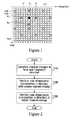
- FIG. 1is a diagram of a single antenna perfect diamond lattice scattered pilot pattern which can be used in accordance with an embodiment of the present invention
- FIG. 2is a flowchart of a method of performing adaptive interpolation in accordance with one embodiment of the present invention
- FIG. 3presents simulation results for one example of adaptive interpolation
- FIG. 4Ais a diagram of a single antenna irregular diamond lattice scattered pilot pattern which can used in accordance with an embodiment of the present invention
- FIG. 4Bis a diagram of a single antenna irregular diamond lattice scattered pilot pattern which can used in accordance with an embodiment of the present invention.
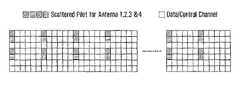
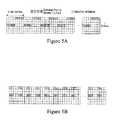
- FIG. 5Ais a diagram of a four antenna irregular diamond lattice scattered pilot pattern which can be used in accordance with an embodiment of the present invention.
- FIG. 5Bis a diagram of a four antenna irregular diamond lattice scattered pilot pattern which can be used in accordance with an embodiment of the present invention.
- FIG. 5Cis a diagram of a four antenna irregular diamond lattice scattered pilot pattern which can be used in accordance with an embodiment of the present invention.
- FIG. 5Dis a diagram of a four antenna irregular diamond lattice scattered pilot pattern which can be used in accordance with an embodiment of the present invention.
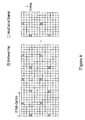
- FIG. 6is a diagram of a single antenna irregular diamond lattice scattered pilot pattern which can be used in accordance with an embodiment of the present invention.
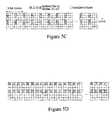
- FIG. 7Ais a diagram of a four antenna irregular diamond lattice scattered pilot pattern which can be used in accordance with an embodiment of the present invention.
- FIG. 7Bis a diagram of a four antenna irregular diamond lattice scattered pilot pattern which can be used in accordance with an embodiment of the present invention.
- FIG. 7Cis a diagram of a four antenna irregular diamond lattice scattered pilot pattern which can be used in accordance with an embodiment of the present invention.
- FIG. 7Dis a diagram of a four antenna irregular diamond lattice scattered pilot pattern which can be used in accordance with an embodiment of the present invention.
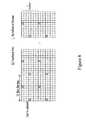
- FIG. 8is a diagram of a single antenna irregular diamond lattice scattered pilot pattern which can be used in accordance with an embodiment of the present invention.
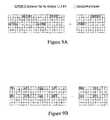
- FIG. 9Ais a diagram of a four antenna irregular diamond lattice scattered pilot pattern which can be used in accordance with an embodiment of the present invention.
- FIG. 9Bis a diagram of a four antenna irregular diamond lattice scattered pilot pattern which can be used in accordance with an embodiment of the present invention.
- FIG. 9Cis a diagram of a four antenna irregular diamond lattice scattered pilot pattern which can be used in accordance with an embodiment of the present invention.
- FIG. 9Dis a diagram of a four antenna irregular diamond lattice scattered pilot pattern which can be used in accordance with an embodiment of the present invention.
- FIG. 10Ais a diagram of a one antenna irregular diamond lattice scattered pilot pattern which can be used in accordance with an embodiment of the present invention.
- FIG. 10Bis a diagram of a four antenna irregular diamond lattice scattered pilot pattern which can be used in accordance with an embodiment of the present invention.
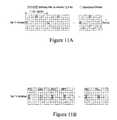
- FIG. 11Ais a diagram of a one antenna irregular diamond lattice scattered pilot pattern which can be used in accordance with an embodiment of the present invention.
- FIG. 11Bis a diagram of a four antenna irregular diamond lattice scattered pilot pattern which can be used in accordance with an embodiment of the present invention.
- FIG. 12Ais a diagram of a one antenna irregular diamond lattice scattered pilot pattern which can be used in accordance with an embodiment of the present invention.
- FIG. 12Bis a diagram of a four antenna irregular diamond lattice scattered pilot pattern which can be used in accordance with an embodiment of the present invention.
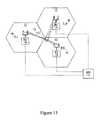
- FIG. 13is a block diagram of a cellular communication system
- FIG. 14is a block diagram of an example base station that might be used to implement some embodiments of the present invention.
- FIG. 15is a block diagram of an example wireless terminal that might be used to implement some embodiments of the present invention.
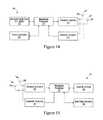
- FIG. 16is a block diagram of a logical breakdown of an example OFDM transmitter architecture that might be used to implement some embodiments of the present invention.
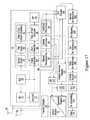
- FIG. 17is a block diagram of a logical breakdown of an example OFDM receiver architecture that might be used to implement some embodiments of the present invention.
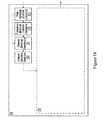
- FIG. 18is a block diagram of one embodiment of the present invention.
- Channel estimation in OFDMis usually performed with the aid of pilot symbols. More particularly, at an OFDM transmitter, known pilot symbols are periodically transmitted along with data symbols. The pilot symbols are typically spaced in time and frequency.
- the variations in phase and amplitude resulting from propagation across an OFDM channelare referred to as the channel response.
- the channel responseis usually frequency and time dependent. If an OFDM receiver can determine the channel response, the received signal can be corrected to compensate for the channel degradation. The determination of the channel response is called channel estimation.
- the transmission of known pilot symbols along with data symbolsallows the receiver to carry out channel estimation.
- the receivercompares the received value of the pilot symbols with the known transmitted value of the pilot symbols to estimate the channel response.
- the pilot symbolsare scattered amongst the data symbols to provide a range of channel responses over time and frequency.
- the set of frequencies and times at which pilot symbols are insertedis referred to as a pilot pattern.
- the pilot patternis a diagonal-shaped lattice, either regular or irregular.
- FIG. 1is an example pilot pattern which can be used in accordance with one embodiment of the present invention. Pilot and data symbols are spread over an OFDM sub-frame in a time direction 120 and a frequency direction 122 . Most symbols within the OFDM sub-frame are data symbols 124 . Pilot symbols 126 are inserted in a diamond lattice pattern. In the illustrated example, the diamond lattice pattern in which each encoded pilot symbols are inserted within the OFDM sub-frame is a perfect diamond lattice pattern as illustrated by pilot symbols h 1 , h 2 , h 3 and h 4 .
- a two dimensional interpolatoris used to estimate the channel response at point h which is between four points of known channel response, i.e. pilot symbols h 1 , h 2 , h 3 and h 4 .
- Point hcan then be used as an additional point from which the receiver can carry out channel estimation.
- the use of point hwould, of course, not add any overhead to the OFDM signal.
- the two dimensional channel interpolationcan be viewed as the sum of two one-dimensional interpolations.
- the sequence of interpolationis adapted to the coherence of the channel.
- One way to achieve adaptive interpolationis to divide the interpolation into two one-dimensional steps as shown in the flowchart illustrated in FIG. 2 :
- the method of adaptive interpolation set out abovetakes advantage of the fact that interpolated results from the direction of larger coherence time/frequency is more reliable, and hence is interpolated first.
- the calculation of hwill effectively increase the density of pilot symbols in the direction of faster change thereby improving channel estimation without increasing overhead.
- the results of the first interpolating stepcan then be used to assist the interpolation in the dimension of smaller coherence time/frequency.
- ⁇ timedenotes channel change in the time direction.
- ⁇ freqdenotes channel change in the frequency direction.
- ⁇ h n ⁇ h m >denotes the inner product of h n and h m .
- cos( ⁇ n ), and b
- h 1 ⁇ h 2denotes the inner product of h 1 and h 2 .
- h 1 ⁇ h 2
- ⁇ tilde over (h) ⁇ h3,h4provides a better estimate ⁇ tilde over (h) ⁇ h1,h2 ; hence ⁇ tilde over (h) ⁇ h3,h4 can be used to improve the channel interpolation quality in the h 1 /h 2 direction.
- hbe the middle point equidistant from h 1 , h 2 , h 3 and h 4 .
- the interpolation sequencewas determined to be:
- any one of a number of conventional channel estimation techniquescan be used. Such channel estimation techniques typically consist of two steps. First, the attenuations at the pilot positions are measured. This measurement is calculated using the formula:
- channel estimation techniquesinclude, but are not limited to, linear interpolation, second order interpolation, maximum likelihood (least square in time domain), linear minimum square error and others.
- a “majority vote”is used to determine the interpolation sequence for all the “diamonds” across the frequency domain. This means that there are several calculations performed along the frequency direction for the channel change. Some results will indicate there is more change in time, while other results indicate there is more change in frequency.
- the “majority vote” optionmeans the choice whether to interpolate first in the time direction or the frequency direction is arrived at by assessing the majority of the results. For example, if the majority of the results indicate that the channel changes faster in the time direction, then interpolation is first performed in the frequency direction, and then in the time direction. If the majority of the results indicate that the channel changes faster in the frequency direction, then interpolation is first performed in the time direction, and is then performed in the frequency direction.
- FIG. 3presents simulation results for the adaptive interpolation method described above.
- the resultsshow the benefit of adaptive interpolation when channel changes slower in the time direction when UE speed is low, and slower in the frequency direction when UE speed is high.
- the curve of “ideal channel”is of the case with clean known channel, i.e. with no interpolation loss and additive noise. As shown this approach recoups most of the interpolation loss.
- the resultswere obtained with the majority vote option described above.
- an irregular diamond shaped pilot patterncan be used in accordance with other embodiments of the present invention, such as the scattered pilot patterns shown in FIGS. 4A to 11 .
- the number of OFDM symbols per Transmission Time Interval (TTI)is odd instead of even.
- the scattered pilot patternscan be generated by more than one antenna such as is shown in FIGS. 5, 7, 9, 10, 11 and 12 .
- the adaptive interpolation methodworks with all “staggered” pilot patterns which describes all shapes other than a square, which does not work.
- a perfect diamond shape, which is the most favorable shape,is a special case of a staggered pilot pattern.
- Another example of a pattern which would workis a “kite” pattern where the pilots are spread further apart in one direction than the other.
- pilotsare transmitted by part of the sub-carriers in at least two non-contiguous OFDM symbols by at least one transmit antenna.
- the pilot sub-carriers in the first OFDM symbol and the second OFDM symbolare staggered in the frequency domain.
- pilot symbols from all transmit antennasare transmitted through the same non-contiguous OFDM symbols. This arrangement will save the terminal power since only two OFDM symbols are coded to obtain the channel information.
- FIG. 4Ais a diagram of a single antenna irregular diamond lattice scattered pilot pattern which can used in accordance with an embodiment of the present invention.
- the overhead associated with this pilot patternis 1/28 per antenna.
- Pilot and data symbolsare spread over an OFDM sub-frame in a time direction 420 and a frequency direction 422 . Most symbols within the OFDM sub-frame are data symbols 424 .
- Pilot symbols 426are inserted in an irregular diamond lattice pattern.
- an OFDM sub-framecomprises eight sub-carriers 428 and seven OFDM symbols 430 .
- FIG. 4Bis a diagram of a single antenna irregular diamond lattice scattered pilot pattern which can used in accordance with an embodiment of the present invention. Though similar to FIG. 4A , in this case one of the pilots in each diamond lattice is offset by one OFDM symbol position. Thus, the adaptive interpolation method does not require that the scattered pilots line up in either or both of the time direction and the frequency direction. In the case of staggered pilot patterns where the pilots do not line up in either the time direction, the frequency direction, or both, it is more accurate to refer to the “h 1 /h 2 direction” and the “h 3 /h 4 direction” rather than the time direction and the frequency direction.
- FIG. 5Ais a diagram of a four antenna irregular diamond lattice scattered pilot pattern which can be used in accordance with an embodiment of the present invention.
- the overhead associated with this scattered pilot patternis 1/28 per antenna.
- an OFDM framecomprises eight sub-carriers 528 and seven OFDM symbols 530 .
- Pilot and data symbolsare spread over an OFDM frame in a time direction 420 and a frequency direction 522 . Most symbols within the OFDM frame are data symbols 524 . Pilot symbols 526 are inserted in an irregular diamond lattice pattern.
- FIGS. 5B, 5C and 5Dare three other examples of scattered pilot patterns which can be generated according to this embodiment.
- FIG. 6is a diagram of a single antenna irregular diamond lattice scattered pilot pattern which can be used in accordance with an embodiment of the present invention.
- FIG. 7Ais a diagram of a four antenna irregular diamond lattice scattered pilot pattern which can be used in accordance with an embodiment of the present invention.
- FIG. 7Bis a diagram of a four antenna irregular diamond lattice scattered pilot pattern which can be used in accordance with an embodiment of the present invention.
- FIG. 7Cis a diagram of a four antenna irregular diamond lattice scattered pilot pattern which can be used in accordance with an embodiment of the present invention.
- FIG. 7Dis a diagram of a four antenna irregular diamond lattice scattered pilot pattern which can be used in accordance with an embodiment of the present invention.
- FIG. 8is a diagram of a single antenna irregular diamond lattice scattered pilot pattern which can be used in accordance with an embodiment of the present invention.
- FIG. 9Ais a diagram of a four antenna irregular diamond lattice scattered pilot pattern which can be used in accordance with an embodiment of the present invention.
- FIG. 9Bis a diagram of a four antenna irregular diamond lattice scattered pilot pattern which can be used in accordance with an embodiment of the present invention.
- FIG. 9Cis a diagram of a four antenna irregular diamond lattice scattered pilot pattern which can be used in accordance with an embodiment of the present invention.
- FIG. 9Dis a diagram of a four antenna irregular diamond lattice scattered pilot pattern which can be used in accordance with an embodiment of the present invention.
- FIG. 10Ais a diagram of a one antenna irregular diamond lattice scattered pilot pattern which can be used in accordance with an embodiment of the present invention.
- FIG. 10Bis a diagram of a four antenna irregular diamond lattice scattered pilot pattern which can be used in accordance with an embodiment of the present invention.
- FIG. 11Ais a diagram of a one antenna irregular diamond lattice scattered pilot pattern which can be used in accordance with an embodiment of the present invention.
- FIG. 11Bis a diagram of a four antenna irregular diamond lattice scattered pilot pattern which can be used in accordance with an embodiment of the present invention.
- FIG. 12Ais a diagram of a one antenna irregular diamond lattice scattered pilot pattern which can be used in accordance with an embodiment of the present invention.
- FIG. 12Bis a diagram of a four antenna irregular diamond lattice scattered pilot pattern which can be used in accordance with an embodiment of the present invention.
- FIGS. 13-17For the purposes of providing context for embodiments of the invention for use in a communication system, FIGS. 13-17 will now be described. As will be described in more detail below, the method of the present invention can, in one embodiment, be implemented through means of the channel estimation logic of a conventional OFDM receiver (see channel estimation 96 in FIG. 17 ).
- FIG. 13shows a base station controller (BSC) 10 which controls wireless communications within multiple cells 12 , which cells are served by corresponding base stations (BS) 14 .
- BSCbase station controller
- each base station 14facilitates communications using OFDM with mobile and/or wireless terminals 16 , which are within the cell 12 associated with the corresponding base station 14 .
- the movement of the mobile terminals 16 in relation to the base stations 14results in significant fluctuation in channel conditions.
- the base stations 14 and mobile terminals 16may include multiple antennas to provide spatial diversity for communications.
- the base station 14generally includes a control system 20 , a baseband processor 22 , transmit circuitry 24 , receive circuitry 26 , multiple antennas 28 , and a network interface 30 .
- the receive circuitry 26receives radio frequency signals bearing information from one or more remote transmitters provided by mobile terminals 16 (illustrated in FIG. 13 ).
- a low noise amplifier and a filtermay cooperate to amplify and remove broadband interference from the signal for processing.
- Downconversion and digitization circuitry(not shown) will then downconvert the filtered, received signal to an intermediate or baseband frequency signal, which is then digitized into one or more digital streams.
- the baseband processor 22processes the digitized received signal to extract the information or data bits conveyed in the received signal. This processing typically comprises demodulation, decoding, and error correction operations. As such, the baseband processor 22 is generally implemented in one or more digital signal processors (DSPs) or application-specific integrated circuits (ASICs).
- DSPsdigital signal processors
- ASICsapplication-specific integrated circuits
- the baseband processor 22receives digitized data, which may represent voice, data, or control information, from the network interface 30 under the control of control system 20 , and encodes the data for transmission.
- the encoded datais output to the transmit circuitry 24 , where it is modulated by a carrier signal having a desired transmit frequency or frequencies.
- a power amplifier(not shown) will amplify the modulated carrier signal to a level appropriate for transmission, and deliver the modulated carrier signal to the antennas 28 through a matching network (not shown).
- Various modulation and processing techniquesavailable to those skilled in the art are used for signal transmission between the base station and the mobile terminal.
- a mobile terminal 16configured according to one embodiment of the present invention is illustrated.
- the mobile terminal 16will include a control system 32 , a baseband processor 34 , transmit circuitry 36 , receive circuitry 38 , multiple antennas 40 , and user interface circuitry 42 .
- the receive circuitry 38receives radio frequency signals bearing information from one or more base stations 14 .
- a low noise amplifier and a filtermay cooperate to amplify and remove broadband interference from the signal for processing.
- Downconversion and digitization circuitry(not shown) will then downconvert the filtered, received signal to an intermediate or baseband frequency signal, which is then digitized into one or more digital streams.
- the baseband processor 34processes the digitized received signal to extract the information or data bits conveyed in the received signal. This processing typically comprises demodulation, decoding, and error correction operations.
- the baseband processor 34is generally implemented in one or more digital signal processors (DSPs) and application specific integrated circuits (ASICs).
- DSPsdigital signal processors
- ASICsapplication specific integrated circuits
- the baseband processor 34receives digitized data, which may represent voice, data, or control information, from the control system 32 , which it encodes for transmission.
- the encoded datais output to the transmit circuitry 36 , where it is used by a modulator to modulate a carrier signal that is at a desired transmit frequency or frequencies.
- a power amplifier(not shown) will amplify the modulated carrier signal to a level appropriate for transmission, and deliver the modulated carrier signal to the antennas 40 through a matching network (not shown).
- Various modulation and processing techniquesavailable to those skilled in the art are used for signal transmission between the mobile terminal and the base station.
- the transmission bandis divided into multiple, orthogonal carrier waves. Each carrier wave is modulated according to the digital data to be transmitted. Because OFDM divides the transmission band into multiple carriers, the bandwidth per carrier decreases and the modulation time per carrier increases. Since the multiple carriers are transmitted in parallel, the transmission rate for the digital data, or symbols, on any given carrier is lower than when a single carrier is used.
- OFDM modulationutilizes the performance of an Inverse Fast Fourier Transform (IFFT) on the information to be transmitted.
- FFTFast Fourier Transform
- the IFFT and FFTare provided by digital signal processing carrying out an Inverse Discrete Fourier Transform (IDFT) and Discrete Fourier Transform (DFT), respectively.
- IDFTInverse Discrete Fourier Transform
- DFTDiscrete Fourier Transform
- the characterizing feature of OFDM modulationis that orthogonal carrier waves are generated for multiple bands within a transmission channel.
- the modulated signalsare digital signals having a relatively low transmission rate and capable of staying within their respective bands.
- the individual carrier wavesare not modulated directly by the digital signals. Instead, all carrier waves are modulated at once by IFFT processing.
- OFDMis preferably used for at least down-link transmission from the base stations 14 to the mobile terminals 16 .
- Each base station 14is equipped with “n” transmit antennas 28
- each mobile terminal 16is equipped with “m” receive antennas 40 .
- the respective antennascan be used for reception and transmission using appropriate duplexers or switches and are so labeled only for clarity.
- the base station controller 10will send data to be transmitted to various mobile terminals 16 to the base station 14 .
- the base station 14may use the channel quality indicators (CQIs) associated with the mobile terminals to schedule the data for transmission as well as select appropriate coding and modulation for transmitting the scheduled data.
- CQIsmay be directly from the mobile terminals 16 or determined at the base station 14 based on information provided by the mobile terminals 16 . In either case, the CQI for each mobile terminal 16 is a function of the degree to which the channel amplitude (or response) varies across the OFDM frequency band.
- Scheduled data 44which is a stream of bits, is scrambled in a manner reducing the peak-to-average power ratio associated with the data using data scrambling logic 46 .
- a cyclic redundancy check (CRC) for the scrambled datais determined and appended to the scrambled data using CRC adding logic 48 .
- channel codingis performed using channel encoder logic 50 to effectively add redundancy to the data to facilitate recovery and error correction at the mobile terminal 16 . Again, the channel coding for a particular mobile terminal 16 is based on the CQI.
- the channel encoder logic 50uses known Turbo encoding techniques.
- the encoded datais then processed by rate matching logic 52 to compensate for the data expansion associated with encoding.
- Bit interleaver logic 54systematically reorders the bits in the encoded data to minimize the loss of consecutive data bits.
- the resultant data bitsare systematically mapped into corresponding symbols depending on the chosen baseband modulation by mapping logic 56 .
- mapping logic 56Preferably, Quadrature Amplitude Modulation (QAM) or Quadrature Phase Shift Key (QPSK) modulation is used.
- QAMQuadrature Amplitude Modulation
- QPSKQuadrature Phase Shift Key
- the degree of modulationis preferably chosen based on the CQI for the particular mobile terminal.
- the symbolsmay be systematically reordered to further bolster the immunity of the transmitted signal to periodic data loss caused by frequency selective fading using symbol interleaver logic 58 .
- STC encoder logic 60which modifies the symbols in a fashion making the transmitted signals more resistant to interference and more readily decoded at a mobile terminal 16 .
- the STC encoder logic 60will process the incoming symbols and provide “n” outputs corresponding to the number of transmit antennas 28 for the base station 14 .
- the control system 20 and/or baseband processor 22 as described above with respect to FIG. 14will provide a mapping control signal to control STC encoding.
- the symbols for the “n” outputsare representative of the data to be transmitted and capable of being recovered by the mobile terminal 16 .
- each of the symbol streams output by the STC encoder logic 60is sent to a corresponding IFFT processor 62 , illustrated separately for ease of understanding.
- the IFFT processors 62will preferably operate on the respective symbols to provide an inverse Fourier Transform.
- the output of the IFFT processors 62provides symbols in the time domain.
- the time domain symbolsare grouped into frames, which are associated with a prefix by prefix insertion logic 64 .
- Each of the resultant signalsis up-converted in the digital domain to an intermediate frequency and converted to an analog signal via the corresponding digital up-conversion (DUC) and digital-to-analog (D/A) conversion circuitry 66 .
- the resultant (analog) signalsare then simultaneously modulated at the desired RF frequency, amplified, and transmitted via the RF circuitry 68 and antennas 28 .
- pilot signals known by the intended mobile terminal 16are scattered among the sub-carriers. The mobile terminal 16 , which is discussed in detail below, will use the pilot signals for channel estimation.
- FIG. 17illustrate reception of the transmitted signals by a mobile terminal 16 .
- the respective signalsare demodulated and amplified by corresponding RF circuitry 70 .
- Analog-to-digital (A/D) converter and down-conversion circuitry 72digitizes and downconverts the analog signal for digital processing.
- the resultant digitized signalmay be used by automatic gain control circuitry (AGC) 74 to control the gain of the amplifiers in the RF circuitry 70 based on the received signal level.
- AGCautomatic gain control circuitry
- the digitized signalis provided to synchronization logic 76 , which includes coarse synchronization logic 78 , which buffers several OFDM symbols and calculates an auto-correlation between the two successive OFDM symbols.
- a resultant time index corresponding to the maximum of the correlation resultdetermines a fine synchronization search window, which is used by fine synchronization logic 80 to determine a precise framing starting position based on the headers.
- the output of the fine synchronization logic 80facilitates frame acquisition by frame alignment logic 84 . Proper framing alignment is important so that subsequent FFT processing provides an accurate conversion from the time domain to the frequency domain.
- the fine synchronization algorithmis based on the correlation between the received pilot signals carried by the headers and a local copy of the known pilot data.
- the synchronization logic 76includes frequency offset and clock estimation logic 82 , which is based on the headers to help estimate such effects on the transmitted signal and provide those estimations to the correction logic 88 to properly process OFDM symbols.
- the OFDM symbols in the time domainare ready for conversion to the frequency domain using FFT processing logic 90 .
- the resultsare frequency domain symbols, which are sent to processing logic 92 .
- the processing logic 92extracts the scattered pilot signal using scattered pilot extraction logic 94 , determines a channel estimate based on the extracted pilot signal using channel estimation logic 96 , and provides channel responses for all sub-carriers using channel reconstruction logic 98 .
- the pilot signalis essentially multiple pilot symbols that are scattered among the data symbols throughout the OFDM sub-carriers in a known pattern in both time and frequency.
- the processing logiccompares the received pilot symbols with the pilot symbols that are expected in certain sub-carriers at certain times to determine a channel response for the sub-carriers in which pilot symbols were transmitted. The results are interpolated to estimate a channel response for most, if not all, of the remaining sub-carriers for which pilot symbols were not provided. The actual and interpolated channel responses are used to estimate an overall channel response, which includes the channel responses for most, if not all, of the sub-carriers in the OFDM channel.
- the frequency domain symbols and channel reconstruction informationwhich are derived from the channel responses for each receive path are provided to an STC decoder 100 , which provides STC decoding on both received paths to recover the transmitted symbols.
- the channel reconstruction informationprovides equalization information to the STC decoder 100 sufficient to remove the effects of the transmission channel when processing the respective frequency domain symbols.
- the recovered symbolsare placed back in order using symbol de-interleaver logic 102 , which corresponds to the symbol interleaver logic 58 of the transmitter.
- the de-interleaved symbolsare then demodulated or de-mapped to a corresponding bitstream using de-mapping logic 104 .
- the bitsare then de-interleaved using bit de-interleaver logic 106 , which corresponds to the bit interleaver logic 54 of the transmitter architecture.
- the de-interleaved bitsare then processed by rate de-matching logic 108 and presented to channel decoder logic 110 to recover the initially scrambled data and the CRC checksum.
- CRC logic 112removes the CRC checksum, checks the scrambled data in traditional fashion, and provides it to the de-scrambling logic 114 for de-scrambling using the known base station de-scrambling code to recover the originally transmitted data 116 .
- a CQIor at least information sufficient to create a CQI at the base station 14 , is determined and transmitted to the base station 14 .
- the CQImay be a function of the carrier-to-interference ratio (CR), as well as the degree to which the channel response varies across the various sub-carriers in the OFDM frequency band.
- the channel gain for each sub-carrier in the OFDM frequency band being used to transmit informationis compared relative to one another to determine the degree to which the channel gain varies across the OFDM frequency band.
- numerous techniquesare available to measure the degree of variation, one technique is to calculate the standard deviation of the channel gain for each sub-carrier throughout the OFDM frequency band being used to transmit data.
- FIG. 18is a block diagram of one embodiment of the present invention.
- the present inventionis shown being implemented within channel estimation logic 96 of FIG. 17 with the conventional aspects of channel estimation logic 96 being shown in dotted outline for ease of reference.
- Persons skilled in the artwill appreciate that the present invention could be implemented as a separate logical component as well.
- time direction channel calculator 127which performs the calculation of channel change in the time direction.
- Frequency direction channel calculator 129performs the calculation of channel change in the frequency direction.
- the preferred calculationis the inner product of the two pilot assisted channel estimates being compared.
- time direction channel calculator 127is shown as being illustrated to the right of frequency direction channel calculator 129 , this does not mean that the time direction channel calculation is necessarily to be performed first or that the calculations cannot be performed simultaneously. Either calculation can be performed first, or both can be performed simultaneously.
- Channel direction comparator 131compares the results of the calculations performed by both direction channel calculator 127 and frequency direction channel calculator 129 for the purpose of comparing and ascertaining which channel direction, time or frequency, changes slower.
- Channel direction selector 133selects which of the two directions changes slower.
- Block 135is utilized to interpolate, first in the direction of slower change, and then in the direction of faster change, in accordance with conventional means.
- time direction channel calculator 127receives two pilot assisted channel estimates and performs the calculation of channel change in the time direction.
- Frequency direction channel calculator 129performs the calculation of channel change in the frequency direction though these two calculations can be performed in different order or simultaneously.
- Channel direction comparator 131compares the results of the calculations performed by both direction channel calculator 127 and frequency direction channel calculator 129 and compares which channel direction, time or frequency, changes slower.
- Channel direction selector 133selects the direction of slower change and interpolation is then performed by block 135 in that direction first, and then in the direction of faster change in accordance with conventional means.
- FIGS. 13 to 18each provide a specific example of a communication system or elements of a communication system that could be used to implement embodiments of the invention. It is to be understood that embodiments of the invention can be implemented with communications systems having architectures that are different than the specific example, but that operate in a manner consistent with the implementation of the embodiments as described herein.
Landscapes
- Engineering & Computer Science (AREA)
- Signal Processing (AREA)
- Computer Networks & Wireless Communication (AREA)
- Power Engineering (AREA)
- Radio Transmission System (AREA)
- Mobile Radio Communication Systems (AREA)
Abstract
Description
This application is a continuation of U.S. patent application Ser. No. 15/642,956, filed on Jul. 6, 2017, titled “Pilot Symbol Patterns for Transmission via a Plurality of Antennas”, by Jianglei Ma et al., which is a continuation of
U.S. patent application Ser. No. 15/226,101, filed on Aug. 2, 2016, (issued as U.S. Pat. No. 9,705,720 on Jul. 11, 2017) titled “Pilot Symbol Patterns for Transmission via a Plurality of Antennas”, by Jianglei Ma et al., which is a continuation of
U.S. patent application Ser. No. 15/046,934, filed on Feb. 18, 2016, (issued as U.S. Pat. No. 9,432,232 on Aug. 30, 2016) titled “Pilot Symbol Patterns for Transmit Antennas”, by Jianglei Ma et al., which is a continuation of
U.S. patent application Ser. No. 13/944,022, filed on Jul. 17, 2013 (issued as U.S. Pat. No. 9,270,510 on Feb. 23, 2016), titled “Adaptive Two-Dimensional Channel Interpolation”, by Jianglei Ma et al., which is a continuation of
U.S. patent application Ser. No. 13/665,982, filed on Nov. 1, 2012 (issued as U.S. Pat. No. 8,842,756 on Sep. 23, 2014), titled “Adaptive Two-Dimensional Channel Interpolation”, which is a continuation of
U.S. patent application Ser. No. 12/064,566, filed on Sep. 4, 2008 (issued as U.S. Pat. No. 8,331,465 on Dec. 11, 2012), which is a U.S. National Stage of
International Application No. PCT/CA2006/001380, filed on Aug. 22, 2006, which claims the benefit of priority to:
U.S. Provisional Application No. 60/722,744, filed on Sep. 30, 2005; and
U.S. Provisional Application No. 60/710,527, filed on Aug. 23, 2005.
All of the above identified Applications are incorporated by reference in their entireties as though fully and completely set forth herein.
The claims in the instant application are different than those of the parent application or other related applications. The Applicant therefore rescinds any disclaimer of claim scope made in the parent application or any predecessor application in relation to the instant application. The Examiner is therefore advised that any such previous disclaimer and the cited references that it was made to avoid, may need to be revisited. Further, any disclaimer made in the instant application should not be read into or against the parent application or other related applications
This invention relates to Orthogonal Frequency Division Multiplexing (OFDM) communication systems, and more particularly to channel interpolation with the use of pilot symbols.
In wireless communication systems that employ OFDM, a transmitter transmits data to a receiver using many sub-carriers in parallel. The frequencies of the sub-carriers are orthogonal.
Channel estimation in OFDM is usually performed with the aid of known pilot symbols which are sparsely inserted in a stream of data symbols. The attenuation of the pilot symbols is measured and the attenuations of the data symbols in between these pilot symbols are then estimated/interpolated.
Pilot symbols are overhead, and should be as few in number as possible in order to maximize the transmission rate of data symbols. It is desirable that channel estimation in OFDM be as accurate as possible without sacrificing bandwidth.
In one embodiment, there is provided a method comprising receiving channel estimates for four pilot symbols in a scattered pilot pattern in time-frequency; calculating the channel response for the pilot symbols in both a first direction and a second direction; determining whether the channel changes more slowly in one direction than the other; and interpolating in the direction of slower channel change.
In some embodiments, the method of further comprises interpolating in the direction of faster channel change.
In some embodiments, the step of interpolating in the direction of faster channel change is performed using the result from the step of interpolating in the direction of slower channel change.
In some embodiments, the channel changes are calculated by performing an inner products operation.
In some embodiments, the first direction is a time direction and the second direction is a frequency direction.
In some embodiments, the first direction is a frequency direction and the second direction is a time direction.
In some embodiments, the scattered pilot pattern is a regular diamond lattice.
In some embodiments, the scattered pilot pattern is an irregular diamond lattice.
In some embodiments, the scattered pilot pattern is kite shaped.
In another embodiment, there is provided an OFDM receiver comprising: one or more receive antennas; the OFDM transmitter being adapted to receive channel estimates for four pilot symbols in a scattered pilot pattern in time-frequency, calculate channel changes for the pilot symbols in a first direction and a second direction, and interpolate in the direction of slower channel change.
In yet another embodiment, there is provided a method of interpolation using a set of four pilot symbols in a scattered pilot pattern in time-frequency wherein the set of four pilot symbols comprise first and second pilot symbols on a common sub-carrier frequency, spaced in time, and third and fourth pilot symbols transmitted on different sub-carriers on a common OFDM symbol period, the method comprising: determining a first channel change between the first and second pilot symbols; determining a second channel change between the third and fourth pilot symbols; determining which of the first and second channel change is slower; if the first channel change is slower, interpolating using the first and second pilot symbols to generate a channel estimate for the common sub-carrier frequency at the common OFDM symbol period, and then using the channel estimate in subsequent interpolations to determine other channel estimates; and if the second channel change is slower, interpolating using the third and fourth pilot symbols to generate a channel estimate for the common sub-carrier frequency at the common OFDM symbol period, and then using the channel estimate in subsequent interpolations to determine other channel estimates.
In yet another embodiment, a method of inserting pilot symbols into OFDM sub-frames for transmission by a plurality of transmitting antenna, the OFDM sub-frames having a time domain and a frequency domain, each OFDM sub-frame comprising a plurality of OFDM symbols, the method comprising: for each sub-frame, defining a set of at least two OFDM symbols none of which are consecutive that are to contain pilot symbols; at each antenna, inserting pilot symbols in each of the set of at least two OFDM symbols in a scattered pattern that does not interfere with the scattered pattern inserted by any other antenna.
Other aspects and features of the present invention will become apparent to those ordinarily skilled in the art upon review of the following description of specific embodiments of the invention in conjunction with the accompanying figures.
Preferred embodiments of the invention will now be described with reference to the attached drawings in which:
Channel estimation in OFDM is usually performed with the aid of pilot symbols. More particularly, at an OFDM transmitter, known pilot symbols are periodically transmitted along with data symbols. The pilot symbols are typically spaced in time and frequency.
The variations in phase and amplitude resulting from propagation across an OFDM channel are referred to as the channel response. The channel response is usually frequency and time dependent. If an OFDM receiver can determine the channel response, the received signal can be corrected to compensate for the channel degradation. The determination of the channel response is called channel estimation. The transmission of known pilot symbols along with data symbols allows the receiver to carry out channel estimation.
When a receiver receives an OFDM signal, the receiver compares the received value of the pilot symbols with the known transmitted value of the pilot symbols to estimate the channel response.
Since the channel response can vary with time and with frequency, the pilot symbols are scattered amongst the data symbols to provide a range of channel responses over time and frequency. The set of frequencies and times at which pilot symbols are inserted is referred to as a pilot pattern. In some cases, the pilot pattern is a diagonal-shaped lattice, either regular or irregular.
A two dimensional interpolator is used to estimate the channel response at point h which is between four points of known channel response, i.e. pilot symbols h1, h2, h3and h4. Point h can then be used as an additional point from which the receiver can carry out channel estimation. The use of point h would, of course, not add any overhead to the OFDM signal.
The channel interpolation scheme is adaptive, i.e. it is a scheme which can adapt to varying conditions in the
h(i,j)=w1(i,j)h1−w2(i,j)h2+w3(i,j)h3+w4(i,j)h4
channel. The following formula presents a particular example of adaptive two-dimensional (time direction and frequency direction) interpolator to calculate point h:
wherew1(i,j)−w2(i,j)+w3(i,j)+w4(i,j)=1.
h(i,j)=w1(i,j)h1−w2(i,j)h2+w3(i,j)h3+w4(i,j)h4
channel. The following formula presents a particular example of adaptive two-dimensional (time direction and frequency direction) interpolator to calculate point h:
wherew1(i,j)−w2(i,j)+w3(i,j)+w4(i,j)=1.
In this case, the two dimensional channel interpolation can be viewed as the sum of two one-dimensional interpolations.
The weights wk(i,j) may be adapted to coherence time and frequency of the channel. In some embodiments, if the channel coherence is less in the time direction than it is in the frequency direction, then h would be calculated using the following formula:
h(i,j)=w1(i,j)h1+w2(i,j)h2+w3(i,j)h3+w4(i,j)h4
where
w3(i,j)=0,
w4(i,j)=0, and
w1(i,j)+w2(i,j)=1.
h(i,j)=w1(i,j)h1+w2(i,j)h2+w3(i,j)h3+w4(i,j)h4
where
w3(i,j)=0,
w4(i,j)=0, and
w1(i,j)+w2(i,j)=1.
Alternatively, if the channel coherence is greater in the time direction than it is in the frequency direction, then h would be calculated using the following formula:
h(i,j)=w1(i,j)h1−w2(i,j)h2+w3(i,j)h3+w4(i,j)h4
where
w1(i,j)=0,
w2(i,j)=0, and
w3(i,j)+w4(i,j)=1.
h(i,j)=w1(i,j)h1−w2(i,j)h2+w3(i,j)h3+w4(i,j)h4
where
w1(i,j)=0,
w2(i,j)=0, and
w3(i,j)+w4(i,j)=1.
In another embodiment, the weights in both directions (time and frequency) are adaptively changed according to the channel coherence in the time and frequency directions as follows:
h(i,j)=ctimew1(i,j)h1+ctimew2(i,j)h2+cfreqw3(i,j)h3+cfreqw4(i,j)h4
ctime+cfreq=1
w1(i,j)+w2(i,j)+w3(i,j)w4(i,j)=1
h(i,j)=ctimew1(i,j)h1+ctimew2(i,j)h2+cfreqw3(i,j)h3+cfreqw4(i,j)h4
ctime+cfreq=1
w1(i,j)+w2(i,j)+w3(i,j)w4(i,j)=1
According to one embodiment, the sequence of interpolation is adapted to the coherence of the channel.
One way to achieve adaptive interpolation is to divide the interpolation into two one-dimensional steps as shown in the flowchart illustrated inFIG. 2 :
- i. at
step 210, calculate the channel changes in both time and frequency directions and determine in which direction the channel changes faster; - ii. at
step 220, perform one-dimensional interpolation in the direction with slower channel change to calculate h; and - iii. at
step 230, using h, perform one-dimensional interpolation in the direction with faster channel change.
- i. at
The method of adaptive interpolation set out above takes advantage of the fact that interpolated results from the direction of larger coherence time/frequency is more reliable, and hence is interpolated first. The calculation of h will effectively increase the density of pilot symbols in the direction of faster change thereby improving channel estimation without increasing overhead. As such, the results of the first interpolating step can then be used to assist the interpolation in the dimension of smaller coherence time/frequency.
In general, there are at least three ways to evaluate the channel change between two pilots, including:
- i. Euclidean distance. One problem with Euclidean distance, however, is that it is not sensitive to phase change;
- ii. Phase change. One problem with phase change, however, is computation complexity; and
- iii. Amplitude change. One problem with amplitude change, however, is that it is insensitive to phase change.
In light of these drawbacks a way to measure channel change so as to take both amplitude change and phase change into account, while at the same time keeping the computation complexity to a minimum, is desirable. According to an embodiment of the invention, therefore, a way of using the inner products of the two pilot assisted channel estimates as a measurement of channel change is shown below.
Λtime= h3,h4
h3,h4 =|h3∥h4cos(θ3,4)
Λfreq=h1,h2=|h1∥h2| cos(θ1,2)
Λtime=


Λfreq=
Λtimedenotes channel change in the time direction.
Λfreqdenotes channel change in the frequency direction.
The term “<hn·hm>” denotes the inner product of hnand hm.
The term “|hn|” denotes the magnitude of the vector hn. If hn=a+bi then |hn|=sqr(a2+b2).
The term “cos(θ1,2)” denotes the cosine of the difference in angle between hnand hm: cos(θn,m)=cos(θn−θm). If hn=a+bi then θn can be calculated as θn=tan−1(b/a).
The vector hncan be represented as h1=|h1|eiθn, or as hn=a+bi, where
a=|hn| cos(θn), andb=|hn| sin(θn).
a=|hn| cos(θn), andb=|hn| sin(θn).
When the amplitude changes linearly between the two channel estimates, the maximum Λ is achieved when |h1|=|h2| in frequency and |h3|=|h4| in time.
Hence the more the channel changes, the smaller the Λ, regardless whether this change is in amplitude or phase. The inner product is able to solve phase ambiguity. When |θ|>π/2 (which rarely occurs), cos(θ) becomes negative, and hence smaller. An inner product may then be computed, which requires two real multiplications and one real addition, and the result is therefore a real number.
Referring again toFIG. 1 , what follows is an example of the adaptive interpolation method.
Assume:
h1=0.4423−1.0968i
h2=−0.0051−0.1484i
h3=0.1258−0.3414i
h4=0.3958−0.588i
h1=0.4423−1.0968i
h2=−0.0051−0.1484i
h3=0.1258−0.3414i
h4=0.3958−0.588i
The central point, known from a simulation, has the value of h=0.2859−0.4224i.
The inner product is then calculated as follows:
h1·h2=0.1605
h3·h4=0.2506
whereh1·h2=denotes the inner product of h1and h2.
where
If h1=a1+ib1and h2=a2+ib2then the inner product can be calculated as
h1·h2=a1a2+b1b2.
Alternatively,h1·h2=|h1∥h2| cos(θ2−θ1).
Sinceh1·h2<h3·h4, the channel changes faster in the h1/h2direction.
h is then estimated in both the frequency and time directions:
{tilde over (h)}h1,h2=0.5(h1+h2)=0.2186−0.6226i
{tilde over (h)}h3,h4=0.5(h3+h4)=0.2608−0.4648i
{tilde over (h)}h1,h2=0.5(h1+h2)=0.2186−0.6226i
{tilde over (h)}h3,h4=0.5(h3+h4)=0.2608−0.4648i
Compared with the known h, obviously {tilde over (h)}h3,h4provides a better estimate {tilde over (h)}h1,h2; hence {tilde over (h)}h3,h4can be used to improve the channel interpolation quality in the h1/h2direction.
Note that there is no requirement that h be the middle point equidistant from h1, h2, h3and h4.
In the example above, the interpolation sequence was determined to be:
- i. interpolate between the two pilots in the time direction first to calculate h, and
- ii. use h and/or one or both of the two pilots to interpolate in the frequency direction.
Of course, if the initial calculation used to determine which channel direction changes faster determines that h3/h4direction changes faster, then the interpolation sequence will be:
- i. interpolate between the two pilots in the frequency direction first to calculate h, and
- ii. use h and/or one or both of the two pilots to interpolate in the time direction.
Once h is calculated, any one of a number of conventional channel estimation techniques can be used. Such channel estimation techniques typically consist of two steps. First, the attenuations at the pilot positions are measured. This measurement is calculated using the formula:
where X(n,k) is the known pilot symbol, and Y(n,k) is the received pilot symbol.
These measurements are then used to estimate (interpolate) the attenuations of the data symbols in the second step. Persons skilled in the art will appreciate that such channel estimation techniques include, but are not limited to, linear interpolation, second order interpolation, maximum likelihood (least square in time domain), linear minimum square error and others.
In another embodiment, a “majority vote” is used to determine the interpolation sequence for all the “diamonds” across the frequency domain. This means that there are several calculations performed along the frequency direction for the channel change. Some results will indicate there is more change in time, while other results indicate there is more change in frequency. The “majority vote” option means the choice whether to interpolate first in the time direction or the frequency direction is arrived at by assessing the majority of the results. For example, if the majority of the results indicate that the channel changes faster in the time direction, then interpolation is first performed in the frequency direction, and then in the time direction. If the majority of the results indicate that the channel changes faster in the frequency direction, then interpolation is first performed in the time direction, and is then performed in the frequency direction.
In accordance with an embodiment of the invention,FIG. 3 presents simulation results for the adaptive interpolation method described above. The results show the benefit of adaptive interpolation when channel changes slower in the time direction when UE speed is low, and slower in the frequency direction when UE speed is high. The curve of “ideal channel” is of the case with clean known channel, i.e. with no interpolation loss and additive noise. As shown this approach recoups most of the interpolation loss. The results were obtained with the majority vote option described above.
It is not necessary that there be a regular diamond shaped pilot pattern in order to use the adaptive interpolation method described above. For example, an irregular diamond shaped pilot pattern can be used in accordance with other embodiments of the present invention, such as the scattered pilot patterns shown inFIGS. 4A to 11 . InFIGS. 4A to 11 , the number of OFDM symbols per Transmission Time Interval (TTI) is odd instead of even. In some embodiments, the scattered pilot patterns can be generated by more than one antenna such as is shown inFIGS. 5, 7, 9, 10, 11 and 12 .
In general, the adaptive interpolation method works with all “staggered” pilot patterns which describes all shapes other than a square, which does not work. A perfect diamond shape, which is the most favorable shape, is a special case of a staggered pilot pattern. Another example of a pattern which would work is a “kite” pattern where the pilots are spread further apart in one direction than the other.
More generally, inFIGS. 4A to 11 , in each sub-frame, pilots are transmitted by part of the sub-carriers in at least two non-contiguous OFDM symbols by at least one transmit antenna. The pilot sub-carriers in the first OFDM symbol and the second OFDM symbol are staggered in the frequency domain. InFIGS. 5A, 5D, 7A, 7D, 9A and 9D , pilot symbols from all transmit antennas are transmitted through the same non-contiguous OFDM symbols. This arrangement will save the terminal power since only two OFDM symbols are coded to obtain the channel information.
As with the scattered pilot pattern inFIG. 1 , there is first performed a calculation of the channel changes in both the time direction and the frequency direction and a comparison is made as to which direction the channel changes faster. One-dimensional interpolation is then performed in the direction with slower channel change. One-dimensional interpolation is then performed in the direction with faster channel change.
Pilot and data symbols are spread over an OFDM frame in a time direction420 and a frequency direction522. Most symbols within the OFDM frame are data symbols524. Pilot symbols526 are inserted in an irregular diamond lattice pattern.
As with the scattered pilot pattern inFIG. 1 , there is first performed a calculation of the channel changes in both the time direction and the frequency direction and a comparison is made as to which direction the channel changes faster. One-dimensional interpolation is then performed in the direction with slower channel change. Using these measurements, one-dimensional interpolation is then performed in the direction with faster channel change.
For the purposes of providing context for embodiments of the invention for use in a communication system,FIGS. 13-17 will now be described. As will be described in more detail below, the method of the present invention can, in one embodiment, be implemented through means of the channel estimation logic of a conventional OFDM receiver (seechannel estimation 96 inFIG. 17 ).
A high level overview of themobile terminals 16 andbase stations 14 upon which aspects of the present invention may be implemented is provided prior to delving into the structural and functional details of the preferred embodiments. With reference toFIG. 14 , abase station 14 is illustrated. Thebase station 14 generally includes acontrol system 20, abaseband processor 22, transmit circuitry24, receivecircuitry 26,multiple antennas 28, and a network interface30. The receivecircuitry 26 receives radio frequency signals bearing information from one or more remote transmitters provided by mobile terminals16 (illustrated inFIG. 13 ). A low noise amplifier and a filter (not shown) may cooperate to amplify and remove broadband interference from the signal for processing. Downconversion and digitization circuitry (not shown) will then downconvert the filtered, received signal to an intermediate or baseband frequency signal, which is then digitized into one or more digital streams.
Thebaseband processor 22 processes the digitized received signal to extract the information or data bits conveyed in the received signal. This processing typically comprises demodulation, decoding, and error correction operations. As such, thebaseband processor 22 is generally implemented in one or more digital signal processors (DSPs) or application-specific integrated circuits (ASICs). The received information is then sent across a wireless network via the network interface30 or transmitted to another mobile terminal16 serviced by thebase station 14.
On the transmit side, thebaseband processor 22 receives digitized data, which may represent voice, data, or control information, from the network interface30 under the control ofcontrol system 20, and encodes the data for transmission. The encoded data is output to the transmit circuitry24, where it is modulated by a carrier signal having a desired transmit frequency or frequencies. A power amplifier (not shown) will amplify the modulated carrier signal to a level appropriate for transmission, and deliver the modulated carrier signal to theantennas 28 through a matching network (not shown). Various modulation and processing techniques available to those skilled in the art are used for signal transmission between the base station and the mobile terminal.
With reference toFIG. 15 , amobile terminal 16 configured according to one embodiment of the present invention is illustrated. Similarly to thebase station 14, themobile terminal 16 will include acontrol system 32, abaseband processor 34, transmitcircuitry 36, receivecircuitry 38,multiple antennas 40, and user interface circuitry42. The receivecircuitry 38 receives radio frequency signals bearing information from one ormore base stations 14. A low noise amplifier and a filter (not shown) may cooperate to amplify and remove broadband interference from the signal for processing. Downconversion and digitization circuitry (not shown) will then downconvert the filtered, received signal to an intermediate or baseband frequency signal, which is then digitized into one or more digital streams.
Thebaseband processor 34 processes the digitized received signal to extract the information or data bits conveyed in the received signal. This processing typically comprises demodulation, decoding, and error correction operations. Thebaseband processor 34 is generally implemented in one or more digital signal processors (DSPs) and application specific integrated circuits (ASICs).
For transmission, thebaseband processor 34 receives digitized data, which may represent voice, data, or control information, from thecontrol system 32, which it encodes for transmission. The encoded data is output to the transmitcircuitry 36, where it is used by a modulator to modulate a carrier signal that is at a desired transmit frequency or frequencies. A power amplifier (not shown) will amplify the modulated carrier signal to a level appropriate for transmission, and deliver the modulated carrier signal to theantennas 40 through a matching network (not shown). Various modulation and processing techniques available to those skilled in the art are used for signal transmission between the mobile terminal and the base station.
In OFDM modulation, the transmission band is divided into multiple, orthogonal carrier waves. Each carrier wave is modulated according to the digital data to be transmitted. Because OFDM divides the transmission band into multiple carriers, the bandwidth per carrier decreases and the modulation time per carrier increases. Since the multiple carriers are transmitted in parallel, the transmission rate for the digital data, or symbols, on any given carrier is lower than when a single carrier is used.
OFDM modulation utilizes the performance of an Inverse Fast Fourier Transform (IFFT) on the information to be transmitted. For demodulation, the performance of a Fast Fourier Transform (FFT) on the received signal recovers the transmitted information. In practice, the IFFT and FFT are provided by digital signal processing carrying out an Inverse Discrete Fourier Transform (IDFT) and Discrete Fourier Transform (DFT), respectively. Accordingly, the characterizing feature of OFDM modulation is that orthogonal carrier waves are generated for multiple bands within a transmission channel. The modulated signals are digital signals having a relatively low transmission rate and capable of staying within their respective bands. The individual carrier waves are not modulated directly by the digital signals. Instead, all carrier waves are modulated at once by IFFT processing.
In operation, OFDM is preferably used for at least down-link transmission from thebase stations 14 to themobile terminals 16. Eachbase station 14 is equipped with “n” transmitantennas 28, and eachmobile terminal 16 is equipped with “m” receiveantennas 40. Notably, the respective antennas can be used for reception and transmission using appropriate duplexers or switches and are so labeled only for clarity.
With reference toFIG. 16 , a logical OFDM transmission architecture will be described. Initially, thebase station controller 10 will send data to be transmitted to variousmobile terminals 16 to thebase station 14. Thebase station 14 may use the channel quality indicators (CQIs) associated with the mobile terminals to schedule the data for transmission as well as select appropriate coding and modulation for transmitting the scheduled data. The CQIs may be directly from themobile terminals 16 or determined at thebase station 14 based on information provided by themobile terminals 16. In either case, the CQI for eachmobile terminal 16 is a function of the degree to which the channel amplitude (or response) varies across the OFDM frequency band.
Scheduleddata 44, which is a stream of bits, is scrambled in a manner reducing the peak-to-average power ratio associated with the data using data scrambling logic46. A cyclic redundancy check (CRC) for the scrambled data is determined and appended to the scrambled data usingCRC adding logic 48. Next, channel coding is performed usingchannel encoder logic 50 to effectively add redundancy to the data to facilitate recovery and error correction at themobile terminal 16. Again, the channel coding for a particularmobile terminal 16 is based on the CQI. In some implementations, thechannel encoder logic 50 uses known Turbo encoding techniques. The encoded data is then processed byrate matching logic 52 to compensate for the data expansion associated with encoding.
At this point, groups of bits have been mapped into symbols representing locations in an amplitude and phase constellation. When spatial diversity is desired, blocks of symbols are then processed by space-time block code (STC)encoder logic 60, which modifies the symbols in a fashion making the transmitted signals more resistant to interference and more readily decoded at amobile terminal 16. TheSTC encoder logic 60 will process the incoming symbols and provide “n” outputs corresponding to the number of transmitantennas 28 for thebase station 14. Thecontrol system 20 and/orbaseband processor 22 as described above with respect toFIG. 14 will provide a mapping control signal to control STC encoding. At this point, assume the symbols for the “n” outputs are representative of the data to be transmitted and capable of being recovered by themobile terminal 16.
For the present example, assume thebase station 14 has two antennas28 (n=2) and theSTC encoder logic 60 provides two output streams of symbols. Accordingly, each of the symbol streams output by theSTC encoder logic 60 is sent to acorresponding IFFT processor 62, illustrated separately for ease of understanding. Those skilled in the art will recognize that one or more processors may be used to provide such digital signal processing, alone or in combination with other processing described herein. TheIFFT processors 62 will preferably operate on the respective symbols to provide an inverse Fourier Transform. The output of theIFFT processors 62 provides symbols in the time domain. The time domain symbols are grouped into frames, which are associated with a prefix byprefix insertion logic 64. Each of the resultant signals is up-converted in the digital domain to an intermediate frequency and converted to an analog signal via the corresponding digital up-conversion (DUC) and digital-to-analog (D/A)conversion circuitry 66. The resultant (analog) signals are then simultaneously modulated at the desired RF frequency, amplified, and transmitted via theRF circuitry 68 andantennas 28. Notably, pilot signals known by the intendedmobile terminal 16 are scattered among the sub-carriers. Themobile terminal 16, which is discussed in detail below, will use the pilot signals for channel estimation.
Reference is now made toFIG. 17 to illustrate reception of the transmitted signals by amobile terminal 16. Upon arrival of the transmitted signals at each of theantennas 40 of themobile terminal 16, the respective signals are demodulated and amplified by correspondingRF circuitry 70. For the sake of conciseness and clarity, only one of the two receive paths is described and illustrated in detail. Analog-to-digital (A/D) converter and down-conversion circuitry72 digitizes and downconverts the analog signal for digital processing. The resultant digitized signal may be used by automatic gain control circuitry (AGC)74 to control the gain of the amplifiers in theRF circuitry 70 based on the received signal level.
Initially, the digitized signal is provided to synchronization logic76, which includescoarse synchronization logic 78, which buffers several OFDM symbols and calculates an auto-correlation between the two successive OFDM symbols. A resultant time index corresponding to the maximum of the correlation result determines a fine synchronization search window, which is used by fine synchronization logic80 to determine a precise framing starting position based on the headers. The output of the fine synchronization logic80 facilitates frame acquisition byframe alignment logic 84. Proper framing alignment is important so that subsequent FFT processing provides an accurate conversion from the time domain to the frequency domain. The fine synchronization algorithm is based on the correlation between the received pilot signals carried by the headers and a local copy of the known pilot data. Once frame alignment acquisition occurs, the prefix of the OFDM symbol is removed with prefix removal logic86 and resultant samples are sent to frequency offsetcorrection logic 88, which compensates for the system frequency offset caused by the unmatched local oscillators in the transmitter and the receiver. Preferably, the synchronization logic76 includes frequency offset andclock estimation logic 82, which is based on the headers to help estimate such effects on the transmitted signal and provide those estimations to thecorrection logic 88 to properly process OFDM symbols.
At this point, the OFDM symbols in the time domain are ready for conversion to the frequency domain using FFT processing logic90. The results are frequency domain symbols, which are sent to processing logic92. The processing logic92 extracts the scattered pilot signal using scatteredpilot extraction logic 94, determines a channel estimate based on the extracted pilot signal usingchannel estimation logic 96, and provides channel responses for all sub-carriers using channel reconstruction logic98. In order to determine a channel response for each of the sub-carriers, the pilot signal is essentially multiple pilot symbols that are scattered among the data symbols throughout the OFDM sub-carriers in a known pattern in both time and frequency. Examples of scattering of pilot symbols among available sub-carriers over a given time and frequency plot in an OFDM environment are found in PCT Patent Application No. PCT/CA2005/000387 filed Mar. 15, 2005 assigned to the same assignee of the present application. Continuing withFIG. 17 , the processing logic compares the received pilot symbols with the pilot symbols that are expected in certain sub-carriers at certain times to determine a channel response for the sub-carriers in which pilot symbols were transmitted. The results are interpolated to estimate a channel response for most, if not all, of the remaining sub-carriers for which pilot symbols were not provided. The actual and interpolated channel responses are used to estimate an overall channel response, which includes the channel responses for most, if not all, of the sub-carriers in the OFDM channel.
The frequency domain symbols and channel reconstruction information, which are derived from the channel responses for each receive path are provided to an STC decoder100, which provides STC decoding on both received paths to recover the transmitted symbols. The channel reconstruction information provides equalization information to the STC decoder100 sufficient to remove the effects of the transmission channel when processing the respective frequency domain symbols.
The recovered symbols are placed back in order usingsymbol de-interleaver logic 102, which corresponds to thesymbol interleaver logic 58 of the transmitter. The de-interleaved symbols are then demodulated or de-mapped to a corresponding bitstream usingde-mapping logic 104. The bits are then de-interleaved using bitde-interleaver logic 106, which corresponds to the bitinterleaver logic 54 of the transmitter architecture. The de-interleaved bits are then processed by ratede-matching logic 108 and presented tochannel decoder logic 110 to recover the initially scrambled data and the CRC checksum. Accordingly, CRC logic112 removes the CRC checksum, checks the scrambled data in traditional fashion, and provides it to thede-scrambling logic 114 for de-scrambling using the known base station de-scrambling code to recover the originally transmitteddata 116.
In parallel to recovering thedata 116, a CQI, or at least information sufficient to create a CQI at thebase station 14, is determined and transmitted to thebase station 14. As noted above, the CQI may be a function of the carrier-to-interference ratio (CR), as well as the degree to which the channel response varies across the various sub-carriers in the OFDM frequency band. The channel gain for each sub-carrier in the OFDM frequency band being used to transmit information is compared relative to one another to determine the degree to which the channel gain varies across the OFDM frequency band. Although numerous techniques are available to measure the degree of variation, one technique is to calculate the standard deviation of the channel gain for each sub-carrier throughout the OFDM frequency band being used to transmit data.
Shown is timedirection channel calculator 127 which performs the calculation of channel change in the time direction. Frequencydirection channel calculator 129 performs the calculation of channel change in the frequency direction. As explained above, the preferred calculation is the inner product of the two pilot assisted channel estimates being compared. Though timedirection channel calculator 127 is shown as being illustrated to the right of frequencydirection channel calculator 129, this does not mean that the time direction channel calculation is necessarily to be performed first or that the calculations cannot be performed simultaneously. Either calculation can be performed first, or both can be performed simultaneously.Channel direction comparator 131 compares the results of the calculations performed by bothdirection channel calculator 127 and frequencydirection channel calculator 129 for the purpose of comparing and ascertaining which channel direction, time or frequency, changes slower.Channel direction selector 133 selects which of the two directions changes slower. Block135 is utilized to interpolate, first in the direction of slower change, and then in the direction of faster change, in accordance with conventional means.
In operation, timedirection channel calculator 127 receives two pilot assisted channel estimates and performs the calculation of channel change in the time direction. Frequencydirection channel calculator 129 performs the calculation of channel change in the frequency direction though these two calculations can be performed in different order or simultaneously.Channel direction comparator 131 compares the results of the calculations performed by bothdirection channel calculator 127 and frequencydirection channel calculator 129 and compares which channel direction, time or frequency, changes slower.Channel direction selector 133 selects the direction of slower change and interpolation is then performed by block135 in that direction first, and then in the direction of faster change in accordance with conventional means.
Numerous modifications and variations of the present invention are possible in light of the above teachings. It is therefore to be understood that within the scope of the appended claims, the invention may be practiced otherwise than as specifically described herein.
Claims (20)
1. An apparatus comprising:
a processor, wherein the processor is configured to receive transmissions via one or more receive antennas, wherein the processor is configured to:
receive, via the one or more receive antennas, a signal comprising a plurality of pilot patterns transmitted by a plurality of transmit antennas, respectively, wherein the plurality of pilot patterns are received at respective sets of pilot symbol positions in a plurality of consecutive subframes,
wherein each subframe of the plurality of consecutive subframes spans a plurality of OFDM symbol durations in time and a plurality of subcarriers in frequency;
wherein each of the pilot patterns is scattered in each subframe,
wherein the pilot patterns are identical but staggered in the frequency domain,
wherein the sets of pilot symbol positions are disjoint,
wherein each pilot symbol position of the union of the sets of pilot symbol positions is frequency and time non-adjacent to any other pilot symbol position of said union,
wherein, for each transmit antenna of the plurality of transmit antennas, the corresponding set of pilot symbol positions includes:
a plurality of first pilot symbol positions that are on a first subcarrier in every seventh OFDM symbol duration of the plurality of consecutive subframes;
a plurality of second pilot symbol positions that are on a second subcarrier in every seventh OFDM symbol duration of the plurality of consecutive subframes, wherein the plurality of first pilot symbol positions and the plurality of second pilot symbol positions are in the same OFDM symbol durations in time and are on non-adjacent subcarriers in frequency;
a plurality of third pilot symbol positions that are on a third subcarrier in every seventh OFDM symbol duration of the plurality of consecutive subframes, wherein the third subcarrier is different and non-adjacent to the first subcarrier and the second subcarrier, wherein the plurality of third pilot symbol positions are on different and non-adjacent OFDM symbol durations than the plurality of first pilot symbol positions and the plurality of second pilot symbol positions, wherein the third subcarrier is located in between the first and second subcarriers in frequency and is equidistant from the first subcarrier and the second subcarrier;
wherein at least one of the plurality of first pilot symbol positions is on a first OFDM symbol duration at the beginning of each subframe of the plurality of consecutive subframes.
2. The apparatus ofclaim 1 , wherein, for each of the transmit antennas, the plurality of third pilot symbol positions of the respective set of pilot symbol positions is offset by four OFDM symbols durations from the plurality of first pilot symbol positions of the respective set.
3. The apparatus ofclaim 2 , wherein the apparatus is a mobile terminal and the signal is a downlink signal received from a base station.
4. The apparatus ofclaim 3 , wherein, in each subframe of said plurality of consecutive subframes, at least two OFDM symbol durations in the subframe include pilot symbol positions belonging to each of the sets of pilot symbol positions, and wherein none of the OFDM symbol durations that include pilot symbol positions of the plurality of sets of pilot symbol positions are consecutive in time.
5. The apparatus ofclaim 4 , wherein, for each of the transmit antennas, the corresponding set of pilot symbol positions includes:
a plurality of fourth pilot symbol positions that are on a fourth subcarrier in every seventh OFDM duration of the plurality of consecutive subframes, wherein the plurality of first pilot symbol positions and the plurality of fourth pilot symbol positions occupy the same OFDM durations and are separated by eleven intervening subcarriers.
6. The apparatus ofclaim 5 , wherein the pilot patterns include common pilots.
7. The apparatus ofclaim 6 , wherein the signal also includes dedicated pilots arranged in a dedicated pilot pattern in a portion of at least one subframe of the plurality of consecutive subframes.
8. An apparatus comprising:
a processor, wherein the processor is configured to transmit via plurality of transmit antennas, wherein the processor is configured to:
transmit a signal comprising a plurality of pilot patterns, wherein the pilot patterns are transmitted via the transmit antennas, respectively, wherein the plurality of pilot patterns are transmitted at respective sets of pilot symbol positions in a plurality of consecutive subframes;
wherein each subframe of the plurality of consecutive subframes spans a plurality of OFDM symbol durations in time and a plurality of subcarriers in frequency;
wherein each of the pilot patterns is scattered in each subframe,
wherein the pilot patterns are identical but staggered in the frequency domain,
wherein the sets of pilot symbol positions are disjoint,
wherein each pilot symbol position of the union of the sets of pilot symbol positions is frequency and time non-adjacent to any other pilot symbol position of said union,
wherein, for each transmit antenna of the plurality of transmit antennas, the corresponding set of pilot symbol positions includes:
a plurality of first pilot symbol positions that are on a first subcarrier in every seventh OFDM symbol duration of the plurality of consecutive subframes;
a plurality of second pilot symbol positions that are on a second subcarrier in every seventh OFDM symbol duration of the plurality of consecutive subframes, wherein the plurality of first pilot symbol positions and the plurality of second pilot symbol positions are on the same OFDM symbol durations in time and are on non-adjacent subcarriers in frequency;
a plurality of third pilot symbol positions that are on a third subcarrier in every seventh OFDM symbol duration of the plurality of consecutive subframes, wherein the third subcarrier is different and non-adjacent to the first subcarrier and the second subcarrier, wherein the plurality of third pilot symbol positions are on different and non-adjacent OFDM symbol durations than the plurality of first pilot symbol positions and the plurality of second pilot symbol positions, wherein the third subcarrier is located in between the first and second subcarriers in frequency and is equidistant from the first subcarrier and the second subcarrier;
wherein at least one of the plurality of first pilot symbol positions is on a first OFDM symbol duration at the beginning of each subframe of the plurality of consecutive subframes.
9. The apparatus ofclaim 8 , wherein, for each of the transmit antennas, the plurality of third pilot symbol positions of the respective set of pilot symbol positions is offset by four OFDM symbols durations from the plurality of first pilot symbol positions of the respective set.
10. The apparatus ofclaim 9 , wherein the apparatus is a base station and the signal is a downlink signal for transmission to a mobile terminal.
11. The apparatus ofclaim 10 , wherein, in each subframe of said plurality of consecutive subframes, at least two OFDM symbol durations in the subframe include pilot symbol positions belonging to each of the sets of pilot symbol positions, and wherein none of the OFDM symbol durations that include pilot symbol positions of the plurality of sets of pilot symbol positions are consecutive in time.
12. The apparatus ofclaim 11 , wherein, for each of the transmit antennas, the corresponding set of pilot symbol positions includes:
a plurality of fourth pilot symbol positions that are on a fourth subcarrier in every seventh OFDM duration of the plurality of consecutive subframes, wherein the plurality of first pilot symbol positions and the plurality of fourth pilot symbol positions occupy the same OFDM durations and are separated by eleven intervening subcarriers.
13. The apparatus ofclaim 12 , wherein the pilot patterns include common pilots.
14. The apparatus ofclaim 13 , wherein the signal further comprises dedicated pilots arranged in a dedicated pilot pattern in a portion of at least one subframe of the plurality of consecutive subframes.
15. A base station comprising:
a plurality of transmit antennas;
digital circuitry, wherein the digital circuitry is configured to transmit via the plurality of transmit antennas, wherein the digital circuitry is configured to:
transmit a signal comprising a plurality of pilot patterns, wherein the pilot patterns are transmitted via the transmit antennas, respectively, wherein the plurality of pilot patterns are transmitted at respective sets of pilot symbol positions in a plurality of consecutive subframes;
wherein each subframe of the plurality of consecutive subframes spans a plurality of OFDM symbol durations in time and a plurality of subcarriers in frequency;
wherein each of the pilot patterns is scattered in each subframe,
wherein the pilot patterns are identical but staggered in the frequency domain,
wherein the sets of pilot symbol positions are disjoint,
wherein each pilot symbol position of the union of the sets of pilot symbol positions is frequency and time non-adjacent to any other pilot symbol position of said union,
wherein, for each transmit antenna of the plurality of transmit antennas, the corresponding set of pilot symbol positions includes:
a plurality of first pilot symbol positions that are on a first subcarrier in every seventh OFDM symbol duration of the plurality of consecutive subframes;
a plurality of second pilot symbol positions that are on a second subcarrier in every seventh OFDM symbol duration of the plurality of consecutive subframes, wherein the plurality of first pilot symbol positions and the plurality of second pilot symbol positions are on the same OFDM symbol durations in time and are on non-adjacent subcarriers in frequency;
a plurality of third pilot symbol positions that are on a third subcarrier in every seventh OFDM symbol duration of the plurality of consecutive subframes, wherein the third subcarrier is different and non-adjacent to the first subcarrier and the second subcarrier, wherein the plurality of third pilot symbol positions are on different and non-adjacent OFDM symbol durations than the plurality of first pilot symbol positions and the plurality of second pilot symbol positions, wherein the third subcarrier is located in between the first and second subcarriers in frequency and is equidistant from the first subcarrier and the second subcarrier;
wherein at least one of the plurality of first pilot symbol positions is on a first OFDM symbol duration at the beginning of each subframe of the plurality of consecutive subframes.
16. The base station ofclaim 15 , wherein, for each of the transmit antennas, the plurality of third pilot symbol positions of the respective set of pilot symbol positions is offset by four OFDM symbols durations from the plurality of first pilot symbol positions of the respective set.
17. The base station ofclaim 16 , wherein, in each subframe of said plurality of consecutive subframes, at least two OFDM symbol durations in the subframe include pilot symbol positions belonging to each of the sets of pilot symbol positions, and wherein none of the OFDM symbol durations that include pilot symbol positions of the plurality of sets of pilot symbol positions are consecutive in time.
18. The base station ofclaim 17 , wherein, for each of the transmit antennas, the corresponding set of pilot symbol positions includes:
a plurality of fourth pilot symbol positions that are on a fourth subcarrier in every seventh OFDM duration of the plurality of consecutive subframes, wherein the plurality of first pilot symbol positions and the plurality of fourth pilot symbol positions occupy the same OFDM durations and are separated by eleven intervening subcarriers.
19. The base station ofclaim 18 , wherein the pilot patterns include common pilots.
20. The base station ofclaim 19 , wherein the signal further comprises dedicated pilots arranged in a dedicated pilot pattern in a portion of at least one subframe of the plurality of consecutive subframes.
Priority Applications (6)
| Application Number | Priority Date | Filing Date | Title |
|---|---|---|---|
| US15/891,750US10075314B2 (en) | 2005-08-23 | 2018-02-08 | Pilot symbol patterns for transmission through a plurality of antennas |
| US16/110,205US10200226B2 (en) | 2005-08-23 | 2018-08-23 | Pilot symbol patterns for transmission through a plurality of antennas |
| US16/255,702US10348542B2 (en) | 2005-08-23 | 2019-01-23 | Pilot symbol patterns for transmission through a plurality of antennas |
| US16/433,273US10476719B2 (en) | 2005-08-23 | 2019-06-06 | Pilot symbol patterns for transmission through a plurality of antennas |
| US16/666,650US10700905B2 (en) | 2005-08-23 | 2019-10-29 | Pilot symbol patterns for transmission through a plurality of antennas |
| US16/915,764US20200328923A1 (en) | 2005-08-23 | 2020-06-29 | Pilot Symbol Patterns for Transmission through a Plurality of Antennas |
Applications Claiming Priority (10)
| Application Number | Priority Date | Filing Date | Title |
|---|---|---|---|
| US71052705P | 2005-08-23 | 2005-08-23 | |
| US72274405P | 2005-09-30 | 2005-09-30 | |
| PCT/CA2006/001380WO2007022628A1 (en) | 2005-08-23 | 2006-08-22 | Adaptive two-dimensional channel interpolation |
| US6456608A | 2008-09-04 | 2008-09-04 | |
| US13/665,982US8842756B2 (en) | 2005-08-23 | 2012-11-01 | Adaptive one-dimensional channel interpolation |
| US13/944,022US9270510B2 (en) | 2005-08-23 | 2013-07-17 | Adaptive two-dimensional channel interpolation |
| US15/046,934US9432232B2 (en) | 2005-08-23 | 2016-02-18 | Pilot symbol patterns for transmit antennas |
| US15/226,101US9705720B2 (en) | 2005-08-23 | 2016-08-02 | Pilot symbol patterns for transmission via a plurality of antennas |
| US15/642,956US9929889B2 (en) | 2005-08-23 | 2017-07-06 | Pilot symbol patterns for transmission via a plurality of antennas |
| US15/891,750US10075314B2 (en) | 2005-08-23 | 2018-02-08 | Pilot symbol patterns for transmission through a plurality of antennas |
Related Parent Applications (1)
| Application Number | Title | Priority Date | Filing Date |
|---|---|---|---|
| US15/642,956ContinuationUS9929889B2 (en) | 2005-08-23 | 2017-07-06 | Pilot symbol patterns for transmission via a plurality of antennas |
Related Child Applications (1)
| Application Number | Title | Priority Date | Filing Date |
|---|---|---|---|
| US16/110,205ContinuationUS10200226B2 (en) | 2005-08-23 | 2018-08-23 | Pilot symbol patterns for transmission through a plurality of antennas |
Publications (2)
| Publication Number | Publication Date |
|---|---|
| US20180167247A1 US20180167247A1 (en) | 2018-06-14 |
| US10075314B2true US10075314B2 (en) | 2018-09-11 |
Family
ID=37771196
Family Applications (10)
| Application Number | Title | Priority Date | Filing Date |
|---|---|---|---|
| US12/064,566Active2028-10-31US8331465B2 (en) | 2005-08-23 | 2006-08-22 | Adaptive two-dimensional channel interpolation |
| US13/666,542ActiveUS8619891B2 (en) | 2005-08-23 | 2012-11-01 | Adaptive two-dimensional channel interpolation |
| US13/665,982ActiveUS8842756B2 (en) | 2005-08-23 | 2012-11-01 | Adaptive one-dimensional channel interpolation |
| US13/944,022ActiveUS9270510B2 (en) | 2005-08-23 | 2013-07-17 | Adaptive two-dimensional channel interpolation |
| US14/088,531ActiveUS8837631B2 (en) | 2005-08-23 | 2013-11-25 | Adaptive two-dimensional channel interpolation |
| US15/046,934ActiveUS9432232B2 (en) | 2005-08-23 | 2016-02-18 | Pilot symbol patterns for transmit antennas |
| US15/226,101ActiveUS9705720B2 (en) | 2005-08-23 | 2016-08-02 | Pilot symbol patterns for transmission via a plurality of antennas |
| US15/642,956ActiveUS9929889B2 (en) | 2005-08-23 | 2017-07-06 | Pilot symbol patterns for transmission via a plurality of antennas |
| US15/891,750ActiveUS10075314B2 (en) | 2005-08-23 | 2018-02-08 | Pilot symbol patterns for transmission through a plurality of antennas |
| US16/110,205ActiveUS10200226B2 (en) | 2005-08-23 | 2018-08-23 | Pilot symbol patterns for transmission through a plurality of antennas |
Family Applications Before (8)
| Application Number | Title | Priority Date | Filing Date |
|---|---|---|---|
| US12/064,566Active2028-10-31US8331465B2 (en) | 2005-08-23 | 2006-08-22 | Adaptive two-dimensional channel interpolation |
| US13/666,542ActiveUS8619891B2 (en) | 2005-08-23 | 2012-11-01 | Adaptive two-dimensional channel interpolation |
| US13/665,982ActiveUS8842756B2 (en) | 2005-08-23 | 2012-11-01 | Adaptive one-dimensional channel interpolation |
| US13/944,022ActiveUS9270510B2 (en) | 2005-08-23 | 2013-07-17 | Adaptive two-dimensional channel interpolation |
| US14/088,531ActiveUS8837631B2 (en) | 2005-08-23 | 2013-11-25 | Adaptive two-dimensional channel interpolation |
| US15/046,934ActiveUS9432232B2 (en) | 2005-08-23 | 2016-02-18 | Pilot symbol patterns for transmit antennas |
| US15/226,101ActiveUS9705720B2 (en) | 2005-08-23 | 2016-08-02 | Pilot symbol patterns for transmission via a plurality of antennas |
| US15/642,956ActiveUS9929889B2 (en) | 2005-08-23 | 2017-07-06 | Pilot symbol patterns for transmission via a plurality of antennas |
Family Applications After (1)
| Application Number | Title | Priority Date | Filing Date |
|---|---|---|---|
| US16/110,205ActiveUS10200226B2 (en) | 2005-08-23 | 2018-08-23 | Pilot symbol patterns for transmission through a plurality of antennas |
Country Status (3)
| Country | Link |
|---|---|
| US (10) | US8331465B2 (en) |
| EP (3) | EP3709554B1 (en) |
| WO (1) | WO2007022628A1 (en) |
Cited By (1)
| Publication number | Priority date | Publication date | Assignee | Title |
|---|---|---|---|---|
| US10205581B2 (en)* | 2016-09-22 | 2019-02-12 | Huawei Technologies Co., Ltd. | Flexible slot architecture for low latency communication |
Families Citing this family (22)
| Publication number | Priority date | Publication date | Assignee | Title |
|---|---|---|---|---|
| WO2006002550A1 (en)* | 2004-07-07 | 2006-01-12 | Nortel Networks Limited | System and method for mapping symbols for mimo transmission |
| JP4816353B2 (en)* | 2006-09-12 | 2011-11-16 | ソニー株式会社 | OFDM receiving apparatus and OFDM signal receiving method |
| JP4961918B2 (en)* | 2006-09-12 | 2012-06-27 | ソニー株式会社 | OFDM receiving apparatus and OFDM receiving method |
| GB2443869B (en)* | 2006-11-17 | 2010-05-12 | Imagination Tech Ltd | OFDM receivers |
| KR100913870B1 (en)* | 2006-11-17 | 2009-08-26 | 삼성전자주식회사 | Channel Estimation Method and Apparatus in Orthogonal Frequency Division System |
| KR101520667B1 (en)* | 2007-09-10 | 2015-05-18 | 엘지전자 주식회사 | Allocation method of pilot subcarriers in mimo system |
| WO2009045135A1 (en)* | 2007-10-04 | 2009-04-09 | Telefonaktiebolaget Lm Ericsson (Publ) | Pilot design for tdd ofdm systems |
| US8085860B2 (en)* | 2008-04-29 | 2011-12-27 | Hong Kong Applied Science And Technology Research Institute Co., Ltd. | Systems and methods for sampling frequency offset estimation |
| US8179983B2 (en)* | 2008-05-20 | 2012-05-15 | Broadcom Corporation | Video processing system with layered video coding for fast channel change and methods for use therewith |
| US9307426B2 (en) | 2008-06-13 | 2016-04-05 | Telefonaktiebolaget L M Ericsson (Publ) | Method and apparatus for testing mobile terminals in an OFDM system |
| US8315339B2 (en) | 2009-05-05 | 2012-11-20 | Telefonaktiebolaget Lm Ericsson (Publ) | Channel estimation |
| EP2346224A1 (en)* | 2010-01-13 | 2011-07-20 | Panasonic Corporation | Pilot Patterns for OFDM Systems with Four Transmit Antennas |
| CN102202029B (en)* | 2010-03-24 | 2015-01-28 | 中兴通讯股份有限公司 | Channel estimation method and device for orthogonal frequency division multiplexing system |
| US8675749B2 (en)* | 2010-05-28 | 2014-03-18 | SiTune Corporation | Channel estimation in OFDM transmission system and method |
| ES2718124T3 (en)* | 2011-06-24 | 2019-06-27 | Sun Patent Trust | Receiving device and reception procedure |
| US9673946B2 (en)* | 2013-10-11 | 2017-06-06 | Intel Corporation | Transmit beamforming sounding with traveling pilots |
| KR102269077B1 (en) | 2014-08-26 | 2021-06-25 | 삼성디스플레이 주식회사 | Method of driving display panel and display apparatus for performing the same |
| US9887801B2 (en)* | 2015-03-11 | 2018-02-06 | Samsung Electronics Co., Ltd. | Resource allocation for repetitions of transmissions in a communication system |
| US10868650B2 (en)* | 2015-05-27 | 2020-12-15 | Qualcomm Incorporated | Pilot reconfiguration and retransmission in wireless networks |
| US10903951B2 (en)* | 2015-06-05 | 2021-01-26 | Futurewei Technologies, Inc. | Systems and methods for adaptive pilot allocation |
| WO2017034185A1 (en)* | 2015-08-21 | 2017-03-02 | Samsung Electronics Co., Ltd. | Filter bank multicarrier modulation-based signal transmitting method, signal receiving method and device |
| CN115037422A (en)* | 2021-03-03 | 2022-09-09 | 中国移动通信有限公司研究院 | Method, device and equipment for sending and receiving pilot signals |
Citations (20)
| Publication number | Priority date | Publication date | Assignee | Title |
|---|---|---|---|---|
| US5867478A (en) | 1997-06-20 | 1999-02-02 | Motorola, Inc. | Synchronous coherent orthogonal frequency division multiplexing system, method, software and device |
| US5995551A (en) | 1997-08-15 | 1999-11-30 | Sicom, Inc. | Rotationally invariant pragmatic trellis coded digital communication system and method therefor |
| US6141393A (en) | 1999-03-03 | 2000-10-31 | Motorola, Inc. | Method and device for channel estimation, equalization, and interference suppression |
| US6175590B1 (en) | 1997-08-08 | 2001-01-16 | Qualcomm Inc. | Method and apparatus for determining the rate of received data in a variable rate communication system |
| US6188717B1 (en) | 1996-11-19 | 2001-02-13 | Deutsche Forschungsanstalt Fur Luft-Und Raumfahrt E.V. | Method of simultaneous radio transmission of digital data between a plurality of subscriber stations and a base station |
| EP1198100A2 (en) | 2000-10-13 | 2002-04-17 | Agere Systems Guardian Corporation | Channel coding based on hidden puncturing for partial-band interference channels |
| US20020159422A1 (en) | 2001-03-09 | 2002-10-31 | Xiaodong Li | Communication system using OFDM for one direction and DSSS for another direction |
| CN1448015A (en) | 2000-07-12 | 2003-10-08 | 高通股份有限公司 | Multiplexing real time services and non-real time services for OFDM systems |
| US20030227866A1 (en) | 2002-06-06 | 2003-12-11 | Hirohisa Yamaguchi | Multi-path equalization for orthogonal frequency division multiplexing communication system |
| WO2004004269A1 (en) | 2002-06-27 | 2004-01-08 | Nortel Networks Limited | Dual-mode shared ofdm methods/transmitters, receivers and systems |
| US20040178934A1 (en) | 2003-03-11 | 2004-09-16 | Jaiganesh Balakrishnan | Efficient bit interleaver for a multi-band OFDM ultra-wideband system |
| US20040190636A1 (en) | 2003-03-31 | 2004-09-30 | Oprea Alexandru M. | System and method for wireless communication systems |
| US20040190640A1 (en) | 2003-02-28 | 2004-09-30 | Nortel Networks Limited | Sub-carrier allocation for OFDM |
| US20040246998A1 (en) | 2003-01-21 | 2004-12-09 | Ar Card | Physical layer structures and initial access schemes in a unsynchronized communication network |
| CA2537534A1 (en) | 2003-09-02 | 2005-03-10 | Qualcomm Incorporated | Multiplexing and transmission of multiple data streams in a wireless multi-carrier communication system |
| US20050265490A1 (en) | 2004-05-28 | 2005-12-01 | Texas Instruments Incorporated | Enhanced channel estimator, method of enhanced channel estimating and an OFDM receiver employing the same |
| US7286500B1 (en)* | 1999-07-02 | 2007-10-23 | Lucent Technologies Inc. | Code division multiple access system having improved pilot channels |
| US7313086B2 (en) | 2003-02-13 | 2007-12-25 | Kabushiki Kaisha Toshiba | OFDM receiver, semiconductor integrated circuit and OFDM method for receiving a signal |
| US7436757B1 (en) | 2002-06-21 | 2008-10-14 | Nortel Networks Limited | Scattered pilot and filtering for channel estimation |
| US7773699B2 (en) | 2001-10-17 | 2010-08-10 | Nortel Networks Limited | Method and apparatus for channel quality measurements |
Family Cites Families (63)
| Publication number | Priority date | Publication date | Assignee | Title |
|---|---|---|---|---|
| JPH0720625A (en) | 1993-07-06 | 1995-01-24 | Sony Corp | Production of phase-shift mask |
| US5544156A (en) | 1994-04-29 | 1996-08-06 | Telefonaktiebolaget Lm Ericsson | Direct sequence CDMA coherent uplink detector |
| TW347616B (en) | 1995-03-31 | 1998-12-11 | Qualcomm Inc | Method and apparatus for performing fast power control in a mobile communication system a method and apparatus for controlling transmission power in a mobile communication system is disclosed. |
| FR2742613B1 (en) | 1995-12-14 | 1998-01-30 | France Telecom | METHOD FOR EVALUATING A QUALITY FACTOR REPRESENTATIVE OF A CHANNEL FOR TRANSMITTING A DIGITAL SIGNAL, AND CORRESPONDING RECEIVER |
| US6865232B1 (en) | 1996-09-02 | 2005-03-08 | Stmicroelectronics N.V. | Multi-carrier transmission systems |
| DE69722415T2 (en) | 1996-09-02 | 2004-05-06 | Stmicroelectronics N.V. | IMPROVEMENTS IN OR WITH REGARD TO CONTROL CHANNELS FOR MESSAGE TRANSMISSION SYSTEMS |
| US6359923B1 (en) | 1997-12-18 | 2002-03-19 | At&T Wireless Services, Inc. | Highly bandwidth efficient communications |
| US6215827B1 (en) | 1997-08-25 | 2001-04-10 | Lucent Technologies, Inc. | System and method for measuring channel quality information in a communication system |
| US6215813B1 (en) | 1997-12-31 | 2001-04-10 | Sony Corporation | Method and apparatus for encoding trellis coded direct sequence spread spectrum communication signals |
| ES2308796T3 (en) | 1998-08-21 | 2008-12-01 | Lucent Technologies Inc. | CDMA MULTI-CODE SYSTEM THAT USES AN ITERATIVE DECODIFICATION. |
| AU1330100A (en) | 1998-10-30 | 2000-05-22 | Broadcom Corporation | Fractional-bit transmission using multiplexed constellations |
| EP0998087A1 (en) | 1998-10-30 | 2000-05-03 | Lucent Technologies Inc. | Multilevel transmission system and method with adaptive mapping |
| US6275485B1 (en) | 1998-12-03 | 2001-08-14 | Qualcomm Inc. | Noise characterization in a wireless communication system |
| US7058414B1 (en) | 2000-05-26 | 2006-06-06 | Freescale Semiconductor, Inc. | Method and system for enabling device functions based on distance information |
| US6654429B1 (en)* | 1998-12-31 | 2003-11-25 | At&T Corp. | Pilot-aided channel estimation for OFDM in wireless systems |
| US6721299B1 (en) | 1999-03-15 | 2004-04-13 | Lg Information & Communications, Ltd. | Pilot signals for synchronization and/or channel estimation |
| US6633601B1 (en) | 1999-05-28 | 2003-10-14 | Koninklijke Philips Electronics N.V. | Method and device for frame rate determination using correlation metrics and frame quality indicators |
| JP2001069117A (en) | 1999-08-31 | 2001-03-16 | Matsushita Electric Ind Co Ltd | OFDM communication apparatus and propagation path estimation method |
| US6782277B1 (en) | 1999-09-30 | 2004-08-24 | Qualcomm Incorporated | Wireless communication system with base station beam sweeping |
| US6834046B1 (en) | 1999-10-05 | 2004-12-21 | Texas Instruments Incorporated | Acquisition of an unevenly spaced synchronization channel in a wireless communication system |
| GB2355164B (en) | 1999-10-07 | 2004-06-09 | Oak Technology Inc | Demodulator circuit |
| US6298035B1 (en) | 1999-12-21 | 2001-10-02 | Nokia Networks Oy | Estimation of two propagation channels in OFDM |
| US6680902B1 (en) | 2000-01-20 | 2004-01-20 | Nortel Networks Limited | Spreading code selection process for equalization in CDMA communications systems |
| US6650694B1 (en) | 2000-02-18 | 2003-11-18 | Texas Instruments Incorporated | Correlator co-processor for CDMA RAKE receiver operations |
| JP4943619B2 (en) | 2000-03-24 | 2012-05-30 | クゥアルコム・アセロス・インコーポレイテッド | Decoding system and method for digital communications. |
| US6597729B1 (en) | 2000-03-29 | 2003-07-22 | Texas Instruments Incorporated | Joint position and carrier frequency estimation method of initial frequency acquisition for a WCDMA mobile terminal |
| US6690712B2 (en) | 2000-05-25 | 2004-02-10 | Samsung Electronics Co., Ltd. | Apparatus and method for transmission diversity using more than two antennas |
| SG99310A1 (en) | 2000-06-16 | 2003-10-27 | Oki Techno Ct Singapore Pte | Methods and apparatus for reducing signal degradation |
| FR2814302B1 (en)* | 2000-09-20 | 2003-02-07 | France Telecom | MULTI-PORTABLE SIGNAL WITH DISTRIBUTED PILOTS DESIGNED TO LIMIT INTERFERENCE, METHOD OF CONSTRUCTING A SIGNAL, METHOD OF RECEPTION, RECEIVER AND RELATED TRANSMISSION DEVICE |
| US6763244B2 (en) | 2001-03-15 | 2004-07-13 | Qualcomm Incorporated | Method and apparatus for adjusting power control setpoint in a wireless communication system |
| US7047016B2 (en) | 2001-05-16 | 2006-05-16 | Qualcomm, Incorporated | Method and apparatus for allocating uplink resources in a multiple-input multiple-output (MIMO) communication system |
| US7043210B2 (en) | 2001-06-05 | 2006-05-09 | Nortel Networks Limited | Adaptive coding and modulation |
| US7197282B2 (en) | 2001-07-26 | 2007-03-27 | Ericsson Inc. | Mobile station loop-back signal processing |
| US7248559B2 (en)* | 2001-10-17 | 2007-07-24 | Nortel Networks Limited | Scattered pilot pattern and channel estimation method for MIMO-OFDM systems |
| US7548506B2 (en) | 2001-10-17 | 2009-06-16 | Nortel Networks Limited | System access and synchronization methods for MIMO OFDM communications systems and physical layer packet and preamble design |
| KR100908143B1 (en) | 2001-11-06 | 2009-07-16 | 엔엑스피 비 브이 | Frequency error detection method and apparatus and computer readable recording medium |
| JP3694479B2 (en) | 2001-12-07 | 2005-09-14 | 松下電器産業株式会社 | Multi-carrier transceiver apparatus, multi-carrier wireless communication method, and multi-carrier wireless communication program |
| JP3940414B2 (en) | 2002-08-28 | 2007-07-04 | 富士通株式会社 | Reception apparatus and frame timing detection method thereof |
| EP1414255A1 (en) | 2002-10-24 | 2004-04-28 | Siemens Aktiengesellschaft | Method for managing radio resources |
| US7002900B2 (en) | 2002-10-25 | 2006-02-21 | Qualcomm Incorporated | Transmit diversity processing for a multi-antenna communication system |
| KR100479864B1 (en) | 2002-11-26 | 2005-03-31 | 학교법인 중앙대학교 | Method and apparatus embodying and synchronizing downlink signal in mobile communication system and method for searching cell using the same |
| US7245559B2 (en) | 2003-01-17 | 2007-07-17 | Science Applications Incorporated Corporation | Acoustic fence |
| US8238956B1 (en) | 2003-03-14 | 2012-08-07 | Apple Inc. | Adjusting power of a control channel based on a characteristic of a message in the control channel |
| KR100922980B1 (en) | 2003-05-02 | 2009-10-22 | 삼성전자주식회사 | Channel Estimation Apparatus and Method in Orthogonal Frequency Division Multiplexing System Using Multiple Antennas |
| CN1792102A (en) | 2003-05-16 | 2006-06-21 | 美商内数位科技公司 | Coordination of backhaul beam forming in wireless communication systems |
| FR2857802B1 (en) | 2003-07-18 | 2007-02-09 | Telediffusion De France Tdf | METHOD AND DEVICE FOR ESTIMATING A PROPAGATION CHANNEL OF A MULTI-CARRIER SIGNAL |
| US7433433B2 (en)* | 2003-11-13 | 2008-10-07 | Telefonaktiebolaget L M Ericsson (Publ) | Channel estimation by adaptive interpolation |
| US7145940B2 (en) | 2003-12-05 | 2006-12-05 | Qualcomm Incorporated | Pilot transmission schemes for a multi-antenna system |
| US20050163194A1 (en) | 2004-01-28 | 2005-07-28 | Qualcomm Incorporated | Interference estimation in a wireless communication system |
| KR100871244B1 (en) | 2004-03-12 | 2008-11-28 | 삼성전자주식회사 | Method and system for transmitting data using a safe channel in a wireless communication system |
| US7742533B2 (en) | 2004-03-12 | 2010-06-22 | Kabushiki Kaisha Toshiba | OFDM signal transmission method and apparatus |
| EP1726111B1 (en)* | 2004-03-15 | 2019-05-29 | Apple Inc. | Pilot design for ofdm systems with four transmit antennas |
| EP1766806B1 (en) | 2004-06-22 | 2017-11-01 | Apple Inc. | Closed loop mimo systems and methods |
| US8027243B2 (en) | 2004-06-25 | 2011-09-27 | Lg Electronics Inc. | Allocation of radio resource in orthogonal frequency division multiplexing system |
| US7830976B2 (en) | 2004-07-16 | 2010-11-09 | Qualcomm Incorporated | Iterative channel and interference estimation with dedicated pilot tones for OFDMA |
| US7649959B2 (en) | 2004-09-27 | 2010-01-19 | Nokia Corporation | Transmission format indication and feedback in multi-carrier wireless communication systems |
| US7924935B2 (en) | 2004-09-30 | 2011-04-12 | Nortel Networks Limited | Channel sounding in OFDMA system |
| WO2006075042A1 (en) | 2005-01-11 | 2006-07-20 | Nokia Corporation | Method for indicating and detecting transmission resource allocations in a multi-user communication system |
| US8031583B2 (en) | 2005-03-30 | 2011-10-04 | Motorola Mobility, Inc. | Method and apparatus for reducing round trip latency and overhead within a communication system |
| TW200705913A (en)* | 2005-05-27 | 2007-02-01 | Mediaphy Corp | Adaptive interpolator for channel estimation |
| JP4869724B2 (en) | 2005-06-14 | 2012-02-08 | 株式会社エヌ・ティ・ティ・ドコモ | Transmission device, transmission method, reception device, and reception method |
| US7751510B2 (en) | 2005-07-26 | 2010-07-06 | Qualcomm Incorporated | Simplified channel and interference estimation with dedicated pilot tones for OFDMA |
| US20070155375A1 (en) | 2006-01-05 | 2007-07-05 | Kappel Thomas A | Cellular telecommunications system and methods of monitoring, control and communications |
- 2006
- 2006-08-22EPEP20170720.5Apatent/EP3709554B1/enactiveActive
- 2006-08-22WOPCT/CA2006/001380patent/WO2007022628A1/enactiveApplication Filing
- 2006-08-22EPEP16205754.1Apatent/EP3174235B1/enactiveActive
- 2006-08-22USUS12/064,566patent/US8331465B2/enactiveActive
- 2006-08-22EPEP06790563Apatent/EP1929684A4/ennot_activeWithdrawn
- 2012
- 2012-11-01USUS13/666,542patent/US8619891B2/enactiveActive
- 2012-11-01USUS13/665,982patent/US8842756B2/enactiveActive
- 2013
- 2013-07-17USUS13/944,022patent/US9270510B2/enactiveActive
- 2013-11-25USUS14/088,531patent/US8837631B2/enactiveActive
- 2016
- 2016-02-18USUS15/046,934patent/US9432232B2/enactiveActive
- 2016-08-02USUS15/226,101patent/US9705720B2/enactiveActive
- 2017
- 2017-07-06USUS15/642,956patent/US9929889B2/enactiveActive
- 2018
- 2018-02-08USUS15/891,750patent/US10075314B2/enactiveActive
- 2018-08-23USUS16/110,205patent/US10200226B2/enactiveActive
Patent Citations (21)
| Publication number | Priority date | Publication date | Assignee | Title |
|---|---|---|---|---|
| US6188717B1 (en) | 1996-11-19 | 2001-02-13 | Deutsche Forschungsanstalt Fur Luft-Und Raumfahrt E.V. | Method of simultaneous radio transmission of digital data between a plurality of subscriber stations and a base station |
| US5867478A (en) | 1997-06-20 | 1999-02-02 | Motorola, Inc. | Synchronous coherent orthogonal frequency division multiplexing system, method, software and device |
| US6175590B1 (en) | 1997-08-08 | 2001-01-16 | Qualcomm Inc. | Method and apparatus for determining the rate of received data in a variable rate communication system |
| US5995551A (en) | 1997-08-15 | 1999-11-30 | Sicom, Inc. | Rotationally invariant pragmatic trellis coded digital communication system and method therefor |
| US6141393A (en) | 1999-03-03 | 2000-10-31 | Motorola, Inc. | Method and device for channel estimation, equalization, and interference suppression |
| US7286500B1 (en)* | 1999-07-02 | 2007-10-23 | Lucent Technologies Inc. | Code division multiple access system having improved pilot channels |
| CN1448015A (en) | 2000-07-12 | 2003-10-08 | 高通股份有限公司 | Multiplexing real time services and non-real time services for OFDM systems |
| EP1198100A2 (en) | 2000-10-13 | 2002-04-17 | Agere Systems Guardian Corporation | Channel coding based on hidden puncturing for partial-band interference channels |
| US20020159422A1 (en) | 2001-03-09 | 2002-10-31 | Xiaodong Li | Communication system using OFDM for one direction and DSSS for another direction |
| US7773699B2 (en) | 2001-10-17 | 2010-08-10 | Nortel Networks Limited | Method and apparatus for channel quality measurements |
| US20030227866A1 (en) | 2002-06-06 | 2003-12-11 | Hirohisa Yamaguchi | Multi-path equalization for orthogonal frequency division multiplexing communication system |
| US7436757B1 (en) | 2002-06-21 | 2008-10-14 | Nortel Networks Limited | Scattered pilot and filtering for channel estimation |
| WO2004004269A1 (en) | 2002-06-27 | 2004-01-08 | Nortel Networks Limited | Dual-mode shared ofdm methods/transmitters, receivers and systems |
| US20040246998A1 (en) | 2003-01-21 | 2004-12-09 | Ar Card | Physical layer structures and initial access schemes in a unsynchronized communication network |
| US7313086B2 (en) | 2003-02-13 | 2007-12-25 | Kabushiki Kaisha Toshiba | OFDM receiver, semiconductor integrated circuit and OFDM method for receiving a signal |
| US20040190640A1 (en) | 2003-02-28 | 2004-09-30 | Nortel Networks Limited | Sub-carrier allocation for OFDM |
| US20040178934A1 (en) | 2003-03-11 | 2004-09-16 | Jaiganesh Balakrishnan | Efficient bit interleaver for a multi-band OFDM ultra-wideband system |
| US20040190636A1 (en) | 2003-03-31 | 2004-09-30 | Oprea Alexandru M. | System and method for wireless communication systems |
| WO2005022811A2 (en) | 2003-09-02 | 2005-03-10 | Qualcomm Incorporated | Multiplexing and transmission of multiple data streams in a wireless multi-carrier communication system |
| CA2537534A1 (en) | 2003-09-02 | 2005-03-10 | Qualcomm Incorporated | Multiplexing and transmission of multiple data streams in a wireless multi-carrier communication system |
| US20050265490A1 (en) | 2004-05-28 | 2005-12-01 | Texas Instruments Incorporated | Enhanced channel estimator, method of enhanced channel estimating and an OFDM receiver employing the same |
Non-Patent Citations (4)
| Title |
|---|
| Notification of Reexamination, Chinese Application No. 201110120817.9, dated Jul. 31, 2015, 25 pages. |
| Office Action for European Patent Application No. 06721726.5, dated Sep. 14, 2016, pp. 1-4. |
| Office Action for European Patent Application No. 17194152.9, dated Jan. 18, 2018, pp. 1-6. |
| Office Action from Chinese Application No. 201310048966.8, dated Apr. 27, 2015, English and Chinese versions, pp. 1-10. |
Cited By (2)
| Publication number | Priority date | Publication date | Assignee | Title |
|---|---|---|---|---|
| US10205581B2 (en)* | 2016-09-22 | 2019-02-12 | Huawei Technologies Co., Ltd. | Flexible slot architecture for low latency communication |
| US10903967B2 (en) | 2016-09-22 | 2021-01-26 | Huawei Technologies Co., Ltd. | Flexible slot architecture for low latency communication |
Also Published As
| Publication number | Publication date |
|---|---|
| US8837631B2 (en) | 2014-09-16 |
| US8842756B2 (en) | 2014-09-23 |
| US20180167247A1 (en) | 2018-06-14 |
| US20160164706A1 (en) | 2016-06-09 |
| US20130136205A1 (en) | 2013-05-30 |
| US20130128997A1 (en) | 2013-05-23 |
| US20170331659A1 (en) | 2017-11-16 |
| US8331465B2 (en) | 2012-12-11 |
| EP3174235B1 (en) | 2020-10-21 |
| US9432232B2 (en) | 2016-08-30 |
| EP1929684A1 (en) | 2008-06-11 |
| EP3174235A1 (en) | 2017-05-31 |
| EP3709554A1 (en) | 2020-09-16 |
| US20160359652A1 (en) | 2016-12-08 |
| EP1929684A4 (en) | 2010-05-19 |
| US8619891B2 (en) | 2013-12-31 |
| US20090213948A1 (en) | 2009-08-27 |
| US9929889B2 (en) | 2018-03-27 |
| US9705720B2 (en) | 2017-07-11 |
| EP3709554B1 (en) | 2021-09-22 |
| US20180367357A1 (en) | 2018-12-20 |
| US20140079152A1 (en) | 2014-03-20 |
| WO2007022628A1 (en) | 2007-03-01 |
| US20140119471A1 (en) | 2014-05-01 |
| US9270510B2 (en) | 2016-02-23 |
| US10200226B2 (en) | 2019-02-05 |
Similar Documents
| Publication | Publication Date | Title |
|---|---|---|
| US10700905B2 (en) | Pilot symbol patterns for transmission through a plurality of antennas | |
| US10075314B2 (en) | Pilot symbol patterns for transmission through a plurality of antennas | |
| US20090201978A1 (en) | System and Method for Processing Secure Transmissions |
Legal Events
| Date | Code | Title | Description |
|---|---|---|---|
| FEPP | Fee payment procedure | Free format text:ENTITY STATUS SET TO UNDISCOUNTED (ORIGINAL EVENT CODE: BIG.); ENTITY STATUS OF PATENT OWNER: LARGE ENTITY | |
| STCF | Information on status: patent grant | Free format text:PATENTED CASE | |
| MAFP | Maintenance fee payment | Free format text:PAYMENT OF MAINTENANCE FEE, 4TH YEAR, LARGE ENTITY (ORIGINAL EVENT CODE: M1551); ENTITY STATUS OF PATENT OWNER: LARGE ENTITY Year of fee payment:4 |