KR102775897B1 - Respiratory sensing device and method of using the respiratory sensing device - Google Patents
Respiratory sensing device and method of using the respiratory sensing deviceDownload PDFInfo
- Publication number
- KR102775897B1 KR102775897B1KR1020230159477AKR20230159477AKR102775897B1KR 102775897 B1KR102775897 B1KR 102775897B1KR 1020230159477 AKR1020230159477 AKR 1020230159477AKR 20230159477 AKR20230159477 AKR 20230159477AKR 102775897 B1KR102775897 B1KR 102775897B1
- Authority
- KR
- South Korea
- Prior art keywords
- sensing device
- respiration
- respiration sensing
- respiratory
- flexible substrate
- Prior art date
- Legal status (The legal status is an assumption and is not a legal conclusion. Google has not performed a legal analysis and makes no representation as to the accuracy of the status listed.)
- Active
Links
Images


Classifications
- A—HUMAN NECESSITIES
- A61—MEDICAL OR VETERINARY SCIENCE; HYGIENE
- A61B—DIAGNOSIS; SURGERY; IDENTIFICATION
- A61B5/00—Measuring for diagnostic purposes; Identification of persons
- A61B5/08—Measuring devices for evaluating the respiratory organs
- A61B5/0803—Recording apparatus specially adapted therefor
- A—HUMAN NECESSITIES
- A61—MEDICAL OR VETERINARY SCIENCE; HYGIENE
- A61B—DIAGNOSIS; SURGERY; IDENTIFICATION
- A61B5/00—Measuring for diagnostic purposes; Identification of persons
- A61B5/48—Other medical applications
- A61B5/4806—Sleep evaluation
- A61B5/4818—Sleep apnoea
- A—HUMAN NECESSITIES
- A61—MEDICAL OR VETERINARY SCIENCE; HYGIENE
- A61B—DIAGNOSIS; SURGERY; IDENTIFICATION
- A61B5/00—Measuring for diagnostic purposes; Identification of persons
- A61B5/08—Measuring devices for evaluating the respiratory organs
- A61B5/0826—Detecting or evaluating apnoea events
- A—HUMAN NECESSITIES
- A61—MEDICAL OR VETERINARY SCIENCE; HYGIENE
- A61B—DIAGNOSIS; SURGERY; IDENTIFICATION
- A61B5/00—Measuring for diagnostic purposes; Identification of persons
- A61B5/103—Measuring devices for testing the shape, pattern, colour, size or movement of the body or parts thereof, for diagnostic purposes
- A61B5/11—Measuring movement of the entire body or parts thereof, e.g. head or hand tremor or mobility of a limb
- A61B5/113—Measuring movement of the entire body or parts thereof, e.g. head or hand tremor or mobility of a limb occurring during breathing
- A—HUMAN NECESSITIES
- A61—MEDICAL OR VETERINARY SCIENCE; HYGIENE
- A61B—DIAGNOSIS; SURGERY; IDENTIFICATION
- A61B5/00—Measuring for diagnostic purposes; Identification of persons
- A61B5/103—Measuring devices for testing the shape, pattern, colour, size or movement of the body or parts thereof, for diagnostic purposes
- A61B5/11—Measuring movement of the entire body or parts thereof, e.g. head or hand tremor or mobility of a limb
- A61B5/113—Measuring movement of the entire body or parts thereof, e.g. head or hand tremor or mobility of a limb occurring during breathing
- A61B5/1135—Measuring movement of the entire body or parts thereof, e.g. head or hand tremor or mobility of a limb occurring during breathing by monitoring thoracic expansion
- A—HUMAN NECESSITIES
- A61—MEDICAL OR VETERINARY SCIENCE; HYGIENE
- A61B—DIAGNOSIS; SURGERY; IDENTIFICATION
- A61B5/00—Measuring for diagnostic purposes; Identification of persons
- A61B5/24—Detecting, measuring or recording bioelectric or biomagnetic signals of the body or parts thereof
- A61B5/25—Bioelectric electrodes therefor
- A61B5/251—Means for maintaining electrode contact with the body
- A61B5/257—Means for maintaining electrode contact with the body using adhesive means, e.g. adhesive pads or tapes
- A—HUMAN NECESSITIES
- A61—MEDICAL OR VETERINARY SCIENCE; HYGIENE
- A61B—DIAGNOSIS; SURGERY; IDENTIFICATION
- A61B5/00—Measuring for diagnostic purposes; Identification of persons
- A61B5/24—Detecting, measuring or recording bioelectric or biomagnetic signals of the body or parts thereof
- A61B5/25—Bioelectric electrodes therefor
- A61B5/251—Means for maintaining electrode contact with the body
- A61B5/257—Means for maintaining electrode contact with the body using adhesive means, e.g. adhesive pads or tapes
- A61B5/259—Means for maintaining electrode contact with the body using adhesive means, e.g. adhesive pads or tapes using conductive adhesive means, e.g. gels
- A—HUMAN NECESSITIES
- A61—MEDICAL OR VETERINARY SCIENCE; HYGIENE
- A61B—DIAGNOSIS; SURGERY; IDENTIFICATION
- A61B5/00—Measuring for diagnostic purposes; Identification of persons
- A61B5/24—Detecting, measuring or recording bioelectric or biomagnetic signals of the body or parts thereof
- A61B5/25—Bioelectric electrodes therefor
- A61B5/279—Bioelectric electrodes therefor specially adapted for particular uses
- A61B5/28—Bioelectric electrodes therefor specially adapted for particular uses for electrocardiography [ECG]
- A—HUMAN NECESSITIES
- A61—MEDICAL OR VETERINARY SCIENCE; HYGIENE
- A61B—DIAGNOSIS; SURGERY; IDENTIFICATION
- A61B5/00—Measuring for diagnostic purposes; Identification of persons
- A61B5/68—Arrangements of detecting, measuring or recording means, e.g. sensors, in relation to patient
- A61B5/6801—Arrangements of detecting, measuring or recording means, e.g. sensors, in relation to patient specially adapted to be attached to or worn on the body surface
- A61B5/6813—Specially adapted to be attached to a specific body part
- A61B5/6823—Trunk, e.g., chest, back, abdomen, hip
- A—HUMAN NECESSITIES
- A61—MEDICAL OR VETERINARY SCIENCE; HYGIENE
- A61B—DIAGNOSIS; SURGERY; IDENTIFICATION
- A61B5/00—Measuring for diagnostic purposes; Identification of persons
- A61B5/68—Arrangements of detecting, measuring or recording means, e.g. sensors, in relation to patient
- A61B5/6801—Arrangements of detecting, measuring or recording means, e.g. sensors, in relation to patient specially adapted to be attached to or worn on the body surface
- A61B5/683—Means for maintaining contact with the body
- A61B5/6832—Means for maintaining contact with the body using adhesives
- A—HUMAN NECESSITIES
- A61—MEDICAL OR VETERINARY SCIENCE; HYGIENE
- A61B—DIAGNOSIS; SURGERY; IDENTIFICATION
- A61B5/00—Measuring for diagnostic purposes; Identification of persons
- A61B5/68—Arrangements of detecting, measuring or recording means, e.g. sensors, in relation to patient
- A61B5/6801—Arrangements of detecting, measuring or recording means, e.g. sensors, in relation to patient specially adapted to be attached to or worn on the body surface
- A61B5/683—Means for maintaining contact with the body
- A61B5/6832—Means for maintaining contact with the body using adhesives
- A61B5/6833—Adhesive patches
- A—HUMAN NECESSITIES
- A61—MEDICAL OR VETERINARY SCIENCE; HYGIENE
- A61M—DEVICES FOR INTRODUCING MEDIA INTO, OR ONTO, THE BODY; DEVICES FOR TRANSDUCING BODY MEDIA OR FOR TAKING MEDIA FROM THE BODY; DEVICES FOR PRODUCING OR ENDING SLEEP OR STUPOR
- A61M16/00—Devices for influencing the respiratory system of patients by gas treatment, e.g. ventilators; Tracheal tubes
- A61M16/0003—Accessories therefor, e.g. sensors, vibrators, negative pressure
- A—HUMAN NECESSITIES
- A61—MEDICAL OR VETERINARY SCIENCE; HYGIENE
- A61B—DIAGNOSIS; SURGERY; IDENTIFICATION
- A61B2562/00—Details of sensors; Constructional details of sensor housings or probes; Accessories for sensors
- A61B2562/04—Arrangements of multiple sensors of the same type
- A61B2562/043—Arrangements of multiple sensors of the same type in a linear array
- A—HUMAN NECESSITIES
- A61—MEDICAL OR VETERINARY SCIENCE; HYGIENE
- A61B—DIAGNOSIS; SURGERY; IDENTIFICATION
- A61B2562/00—Details of sensors; Constructional details of sensor housings or probes; Accessories for sensors
- A61B2562/16—Details of sensor housings or probes; Details of structural supports for sensors
- A61B2562/164—Details of sensor housings or probes; Details of structural supports for sensors the sensor is mounted in or on a conformable substrate or carrier
- A—HUMAN NECESSITIES
- A61—MEDICAL OR VETERINARY SCIENCE; HYGIENE
- A61M—DEVICES FOR INTRODUCING MEDIA INTO, OR ONTO, THE BODY; DEVICES FOR TRANSDUCING BODY MEDIA OR FOR TAKING MEDIA FROM THE BODY; DEVICES FOR PRODUCING OR ENDING SLEEP OR STUPOR
- A61M16/00—Devices for influencing the respiratory system of patients by gas treatment, e.g. ventilators; Tracheal tubes
- A61M16/0003—Accessories therefor, e.g. sensors, vibrators, negative pressure
- A61M2016/0015—Accessories therefor, e.g. sensors, vibrators, negative pressure inhalation detectors
- A61M2016/0018—Accessories therefor, e.g. sensors, vibrators, negative pressure inhalation detectors electrical
Landscapes
- Health & Medical Sciences (AREA)
- Life Sciences & Earth Sciences (AREA)
- Public Health (AREA)
- Veterinary Medicine (AREA)
- General Health & Medical Sciences (AREA)
- Animal Behavior & Ethology (AREA)
- Engineering & Computer Science (AREA)
- Biomedical Technology (AREA)
- Heart & Thoracic Surgery (AREA)
- Medical Informatics (AREA)
- Molecular Biology (AREA)
- Surgery (AREA)
- Pathology (AREA)
- Biophysics (AREA)
- Physics & Mathematics (AREA)
- Dispersion Chemistry (AREA)
- Chemical & Material Sciences (AREA)
- Physiology (AREA)
- Oral & Maxillofacial Surgery (AREA)
- Dentistry (AREA)
- Pulmonology (AREA)
- Hematology (AREA)
- Emergency Medicine (AREA)
- Anesthesiology (AREA)
- Cardiology (AREA)
- Measurement Of The Respiration, Hearing Ability, Form, And Blood Characteristics Of Living Organisms (AREA)
- Measuring And Recording Apparatus For Diagnosis (AREA)
- Measurement And Recording Of Electrical Phenomena And Electrical Characteristics Of The Living Body (AREA)
Abstract
Translated fromKoreanDescription
Translated fromKorean본 개시의 명세서는, 호흡 센싱 장치에 관한 것으로, 보다 상세하게는 사용자의 피부에 부착되면서 피부와 호흡 센싱 전극 사이에 공기층을 포함하는 구조로, 호흡에 따른 복부 또는 흉부 등의 팽창 또는 수축으로 인한 커패시턴스의 변화를 검출하는 호흡 센싱 장치에 관한 것이다.The present disclosure relates to a respiration sensing device, and more particularly, to a respiration sensing device having a structure that is attached to a user's skin and includes an air layer between the skin and a respiration sensing electrode, and detects a change in capacitance due to expansion or contraction of the abdomen or chest due to respiration.
수면 무호흡을 진단하기 위해서는, 수면다원검사(PSG), 가정 수면 무호흡증 테스트(HSAT), 지속적 기도양압(CPAP), ApneaLnk, Actigraphy 등이 이용할 수 있다.To diagnose sleep apnea, polysomnography (PSG), home sleep apnea test (HSAT), continuous positive airway pressure (CPAP), ApneaLnk, and Actigraphy can be used.
수면다원검사는, 뇌활동, 안구 운동, 심박수, 혈중 산소 수치, 공기 흐름 및 근육 활동을 모니터링하는 센서들을 부착한 채로 수면을 함으로써 수면 무호흡 인지 여부를 진단한다. 센서들을 통해 센싱된 데이터들을 이용하여 사용자의 수면 패턴에 대한 포괄적인 데이터를 획득하고, 수면 패턴에 대한 데이터에 기초하여 수면 무호흡 여부를 진단하게 된다. 가정 수면 무호흡증 테스트는, 수면다원검사에 비하여 적은 수의 매개변수를 모니터링할 수 있다. 공기 흐름, 심박수 및 혈중 산소 수준을 측정하는 센싱 값들을 이용하여 수면 무호흡 여부를 진단하게 된다. 그 외에도 기도 양압을 측정하여 수면 무호흡 여부를 진단할 수 있다.Polysomnography diagnoses sleep apnea by having the user sleep while wearing sensors that monitor brain activity, eye movement, heart rate, blood oxygen levels, airflow, and muscle activity. Using the data sensed by the sensors, comprehensive data on the user's sleep patterns are obtained, and sleep apnea is diagnosed based on the data on sleep patterns. Home sleep apnea tests can monitor fewer parameters than polysomnography. Sleep apnea is diagnosed using sensed values that measure airflow, heart rate, and blood oxygen levels. In addition, positive airway pressure can be measured to diagnose sleep apnea.
그런데, 사용자가 복수의 센서들을 착용한 채 수면을 취해야 하기 때문에 이로 인해 불편함을 느끼고, 불편함으로 인해 정확한 검사를 하지 못하는 문제점이 있었다.However, there was a problem that users felt uncomfortable because they had to sleep while wearing multiple sensors, and that they could not perform accurate examinations due to the discomfort.
전술한 배경 기술은 발명자가 본 발명의 도출을 위해 보유하고 있었거나, 본 발명의 도출 과정에서 습득한 기술 정보로서, 반드시 본 발명의 출원 전에 일반 공중에게 공개된 공지 기술이라 할 수는 없다.
[선행문헌]
KR 2016-0019822 (2016.10.10 공개)The background technology described above is technical information that the inventor possessed for deriving the present invention or acquired during the process of deriving the present invention, and cannot necessarily be considered as publicly known technology disclosed to the general public prior to the application of the present invention.
[Previous literature]
KR 2016-0019822 (released on 2016.10.10)
본 발명은 전술한 문제점을 해결하기 위한 발명으로, 사용자의 피부에 부착되면서 피부와 호흡 센싱 전극 사이에 공기층을 포함하는 구조로, 호흡에 따른 복부 또는 흉부 등의 팽창 또는 수축으로 인한 커패시턴스의 변화를 검출하는 호흡 센싱 장치를 제공하는 것을 목적으로 한다.The present invention is an invention for solving the above-mentioned problem, and aims to provide a respiration sensing device that detects changes in capacitance due to expansion or contraction of the abdomen or chest due to respiration, with a structure that includes an air layer between the skin and the respiration sensing electrode while being attached to the user's skin.
다만 이러한 과제는 예시적인 것으로, 본 발명의 해결하고자 하는 과제는 이에 한정되지 않는다.However, these tasks are exemplary, and the tasks to be solved by the present invention are not limited to these.
본 개시의 실시예들에 따른 호흡 센싱 장치는, 구조물을 내부 공간에 구비하고, 상기 구조물 상에 배터리가 배치되는 하우징; 상기 하우징이 일면에 배치되어 전기적으로 연결되며, 복수의 호흡 센서전극들이 배치되는 플렉서블 기판; 및 소정의 두께를 가지고 상기 호흡 센서 전극들이 노출되는 개구부를 포함하고, 상기 플렉서블 기판의 타면에 배치되어 상기 플렉서블 기판을 피부에 부착시키는 접착 부재;를 포함할 수 있다.A respiration sensing device according to embodiments of the present disclosure may include: a housing having a structure in an internal space and a battery disposed on the structure; a flexible substrate on one surface of which the housing is disposed and electrically connected, and on which a plurality of respiration sensor electrodes are disposed; and an adhesive member having an opening through which the respiration sensor electrodes are exposed and having a predetermined thickness and disposed on the other surface of the flexible substrate to attach the flexible substrate to skin.
상기 플렉서블 기판에서, 상기 복수의 호흡 센서 전극들은 상기 하우징이 배치되지 않은 영역에 배치될 수 있다.In the above flexible substrate, the plurality of respiratory sensor electrodes can be placed in an area where the housing is not placed.
본 개시의 실시예들에 따르면, 상기 개구부를 덮도록 배치되고 신축성을 가지는 소재로 구현되는 커버 부재;를 더 포함할 수 있다.According to embodiments of the present disclosure, the device may further include a cover member configured to cover the opening and made of a flexible material.
상기 플렉서블 기판은, 상기 하우징과 대응되는 위치에 하나 이상의 심전도 전극을 더 포함할 수 있다.The above flexible substrate may further include one or more electrocardiogram electrodes at positions corresponding to the housing.
상기 접착 부재는, 상기 심전도 전극과 대응되는 위치에 상기 심전도 전극이 피부와 통전될 수 있도록 하는 통전홀을 더 포함할 수 있다.The above adhesive member may further include a conductive hole at a position corresponding to the electrocardiogram electrode so that the electrocardiogram electrode can be electrically conductive with the skin.
상기 호흡 센서 전극들은 상기 개구부를 통해서 피부에 직접 부착되지 않는다.The above respiratory sensor electrodes are not directly attached to the skin through the above opening.
본 개시의 실시예들에 따르면, 상기 플렉서블 기판 상에 배치되는 연결부를 더 포함할 수 있다.According to embodiments of the present disclosure, the flexible substrate may further include a connecting portion disposed on the flexible substrate.
본 개시의 실시예들에 따르면, 상기 연결부를 통해서 외부의 온도 센서, 가속 센서, 마이크, 심전도 센서 중 적어도 하나와 전기적으로 연결되어 측정값들을 수신할 수 있다.According to embodiments of the present disclosure, measurement values can be received by electrically connecting to at least one of an external temperature sensor, an acceleration sensor, a microphone, and an electrocardiogram sensor through the connecting portion.
본 개시의 실시예들에 따르면, 상기 연결부를 통해서 외부의 코 호흡 장치와 연결되어 사용자의 코에서 배출되는 공기를 확인할 수 있다.According to embodiments of the present disclosure, the external nasal breathing device can be connected through the connecting portion to detect air exhaled from the user's nose.
본 개시의 실시예들에 따르면, 상기 개구부를 통해서 상기 복수의 호흡 센서전극들과 피부 사이의 공기층이 형성되고, 상기 복수의 호흡 센서 전극들은, 호흡에 따른 복부 또는 흉부의 크기 변화에 대응하는 커패시턴스 값을 측정할 수 있다.According to embodiments of the present disclosure, an air layer is formed between the plurality of respiratory sensor electrodes and the skin through the opening, and the plurality of respiratory sensor electrodes can measure a capacitance value corresponding to a change in the size of the abdomen or chest due to breathing.
상기 복수의 호흡 센서 전극들은 호흡 주기에 따라서 달라지는 커패시턴스 값들을 측정할 수 있다.The above plurality of respiratory sensor electrodes can measure capacitance values that vary according to the respiratory cycle.
상기 복수의 호흡 센서 전극들은, 부착되는 위치에 따라서 달라지는 커패시턴스 값들을 측정할 수 있다.The above multiple respiratory sensor electrodes can measure capacitance values that vary depending on the location at which they are attached.
상기 플렉서블 기판에서, 상기 하우징은 일렬로 배치되는 상기 복수의 호흡 센서 전극들의 방향과 직각 방향으로 배치될 수 있다.In the above flexible substrate, the housing can be arranged in a direction perpendicular to the direction of the plurality of respiratory sensor electrodes arranged in a row.
상기 플렉서블 기판에서, 상기 복수의 호흡 센서 전극들과 상기 하우징은 일렬로 배치될 수 있다.In the above flexible substrate, the plurality of respiratory sensor electrodes and the housing can be arranged in a row.
본 개시의 실시예들에 따른 호흡 센싱 장치를 사용하는 방법은, 상기 접착 부재를 통해서 상기 기판의 호흡 센서 전극들을 사용자 복부 부근 높이에 상기 복수의 호흡 센서 전극들이 수평방향으로 배치되도록 부착시키되, 상기 호흡 센싱 전극들이 복부 중앙 측을 향하도록 부착시키는 단계;를 포함할 수 있다.A method of using a respiration sensing device according to embodiments of the present disclosure may include a step of attaching the respiration sensor electrodes of the substrate through the adhesive member so that the plurality of respiration sensor electrodes are horizontally arranged at a height near the user's abdomen, and attaching the respiration sensing electrodes so that they face the center of the abdomen.
본 발명의 실시예에 따른 컴퓨터 프로그램은 컴퓨터를 이용하여 본 발명의 실시예에 따른 방법 중 어느 하나의 방법을 실행시키기 위하여 매체에 저장될 수 있다.A computer program according to an embodiment of the present invention can be stored in a medium to execute any one of the methods according to an embodiment of the present invention using a computer.
이 외에도, 본 발명을 구현하기 위한 다른 방법, 다른 시스템 및 상기 방법을 실행하기 위한 컴퓨터 프로그램을 기록하는 컴퓨터 판독 가능한 기록 매체가 더 제공된다.In addition, other methods for implementing the present invention, other systems, and computer-readable recording media recording a computer program for executing the above methods are further provided.
전술한 것 외의 다른 측면, 특징, 이점이 이하의 도면, 특허청구범위 및 발명의 상세한 설명으로부터 명확해 질 것이다.Other aspects, features and advantages other than those described above will become apparent from the following drawings, claims and detailed description of the invention.
전술한 과제 해결 수단 중 어느 하나에 의하면, 사용자의 피부에 부착되면서 피부와 호흡 센싱 전극 사이에 공기층을 포함하는 구조로, 호흡에 따른 복부 또는 흉부 등의 팽창 또는 수축으로 인한 커패시턴스의 변화를 검출하고, 커패시턴스의 변화 패턴으로 호흡 여부, 호흡 시점 등을 센싱할 수 있다.According to any one of the aforementioned problem solving means, a structure is provided that is attached to the user's skin and includes an air layer between the skin and the respiration sensing electrode, detecting changes in capacitance due to expansion or contraction of the abdomen or chest due to respiration, and sensing whether or not respiration is occurring and the timing of respiration based on the pattern of changes in capacitance.
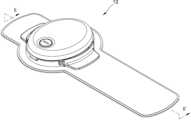
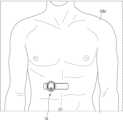
도 1a는, 본 개시의 실시예들에 따른 호흡 센싱 장치를 나타내고, 도 1b는 호흡 센싱 장치가 부착된 실시예에 대한 도면이다.
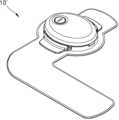
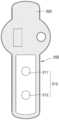
도 1c는 다른 실시예에 따른 호흡 센싱 장치의 사시도이다.
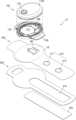
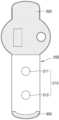
도 2는 호흡 센싱 장치에 대한 도면이다.
도 3은 본 개시의 실시예들에 따른 플렉서블 기판(200)의 저면도이다.
도 4는 보호 부재가 구비된 호흡 센싱 장치(10)의 사시도이다.
도 5a는, 본 개시의 다른 실시예들에 따른, 제1 연결부(230)가 구비된 호흡 센싱 장치(10’’)의 사시도이다.
도 5b는, 본 개시의 다른 실시예들에 따른, 제2 연결부(240)가 구비된 호흡 센싱 장치(10’’’)의 사시도이다.
도 5c는 호흡 센싱 장치(10’’’)의 제2 연결부(240) 내부를 나타내는 도면이다.
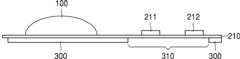
도 6는 도 1a의 Ⅱ-Ⅱ에 따른 호흡 센싱 장치(10)의 단면을 나타내는 도면이다.
도 7a, 도 7b, 도 7c는 접착 부재의 예시 도면들이다.
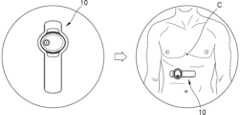
도 8은 본 개시의 실시예들에 따라서, 호흡 센싱 장치가 사용되는 방법에 대한 도면이다.
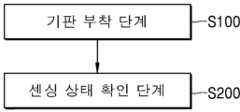
도 9는 본 개시의 실시예들에 따른 호흡 센싱 장치(10)의 사용 방법의 일 실시예의 순서도이다.
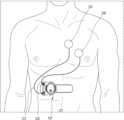
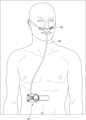
도 10a는 본 개시의 실시예들에 따른, 제1 연결부를 가지는 호흡 센싱 장치(10’’)를 신체에 부착하는 예시 도면이다. 도 10b는 본 개시의 실시예들에 따른, 제2 연결부를 가지는 호흡 센싱 장치(10’’’)를 신체에 부착하는 예시 도면이다.
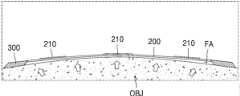
도 11a 및 도 11b는 호흡 주기에 따른 호흡 센싱 장치(10)에서의 공기층의 변화를 나타내는 도면이다.FIG. 1A illustrates a respiration sensing device according to embodiments of the present disclosure, and FIG. 1B is a drawing of an embodiment to which the respiration sensing device is attached.
FIG. 1c is a perspective view of a respiration sensing device according to another embodiment.
Figure 2 is a diagram of a respiration sensing device.
FIG. 3 is a bottom view of a flexible substrate (200) according to embodiments of the present disclosure.
Figure 4 is a perspective view of a respiration sensing device (10) equipped with a protective member.
FIG. 5a is a perspective view of a respiration sensing device (10'') having a first connecting portion (230) according to other embodiments of the present disclosure.
FIG. 5b is a perspective view of a respiration sensing device (10''') having a second connecting portion (240) according to other embodiments of the present disclosure.
FIG. 5c is a drawing showing the inside of the second connection part (240) of the respiration sensing device (10''').
Fig. 6 is a drawing showing a cross-section of a respiration sensing device (10) according to II-II of Fig. 1a.
Figures 7a, 7b, and 7c are exemplary drawings of adhesive members.
FIG. 8 is a diagram illustrating a method of using a respiratory sensing device according to embodiments of the present disclosure.
FIG. 9 is a flowchart of one embodiment of a method of using a respiratory sensing device (10) according to embodiments of the present disclosure.
FIG. 10A is an exemplary drawing of attaching a respiration sensing device (10'') having a first connection portion to a body according to embodiments of the present disclosure. FIG. 10B is an exemplary drawing of attaching a respiration sensing device (10''') having a second connection portion to a body according to embodiments of the present disclosure.
Figures 11a and 11b are drawings showing changes in the air layer in a respiratory sensing device (10) according to the respiratory cycle.
이하 첨부된 도면들에 도시된 본 발명에 관한 실시 예를 참조하여 본 발명의 구성 및 작용을 상세히 설명한다.The configuration and operation of the present invention will be described in detail with reference to embodiments of the present invention illustrated in the accompanying drawings below.
본 발명은 다양한 변환을 가할 수 있고 여러 가지 실시 예를 가질 수 있는 바, 특정 실시 예들을 도면에 예시하고 상세한 설명에 상세하게 설명하고자 한다. 본 발명의 효과 및 특징, 그리고 그것들을 달성하는 방법은 도면과 함께 상세하게 후술되어 있는 실시 예들을 참조하면 명확해질 것이다. 그러나 본 발명은 이하에서 개시되는 실시 예들에 한정되는 것이 아니라 다양한 형태로 구현될 수 있다.The present invention can be modified in various ways and can have various embodiments. Specific embodiments are illustrated in the drawings and described in detail in the detailed description. The effects and features of the present invention and the methods for achieving them will become clear with reference to the embodiments described in detail below together with the drawings. However, the present invention is not limited to the embodiments disclosed below and can be implemented in various forms.
이하, 첨부된 도면을 참조하여 본 발명의 실시 예들을 상세히 설명하기로 하며, 도면을 참조하여 설명할 때 동일하거나 대응하는 구성 요소는 동일한 도면부호를 부여하고 이에 대한 중복되는 설명은 생략하기로 한다.Hereinafter, embodiments of the present invention will be described in detail with reference to the attached drawings. When describing with reference to the drawings, identical or corresponding components are given the same drawing reference numerals and redundant descriptions thereof are omitted.
이하에서, “상부” 나 “상”이라고 기재된 것은 접촉하여 바로 위에 있는 것 뿐만 아니라 비접촉으로 위에 있는 것도 포함할 수 있다.Hereinafter, the terms “upper” or “upper” may include not only things that are directly above in contact, but also things that are above in a non-contact manner.
이하의 실시 예에서, 제1, 제2 등의 용어는 한정적인 의미가 아니라 하나의 구성 요소를 다른 구성 요소와 구별하는 목적으로 사용되었다.In the examples below, the terms first, second, etc. are not used in a limiting sense but are used for the purpose of distinguishing one component from another.
이하의 실시 예에서, 단수의 표현은 문맥상 명백하게 다르게 뜻하지 않는 한, 복수의 표현을 포함한다.In the examples below, singular expressions include plural expressions unless the context clearly indicates otherwise.
이하의 실시 예에서, 포함하다 또는 가지다 등의 용어는 명세서상에 기재된 특징, 또는 구성요소가 존재함을 의미하는 것이고, 하나 이상의 다른 특징들 또는 구성요소가 부가될 가능성을 미리 배제하는 것은 아니다.In the following examples, terms such as “include” or “have” mean that a feature or component described in the specification is present, and do not exclude in advance the possibility that one or more other features or components may be added.
도면에서는 설명의 편의를 위하여 구성 요소들이 그 크기가 과장 또는 축소될 수 있다. 예컨대, 도면에서 나타난 각 구성의 크기 및 두께는 설명의 편의를 위해 임의로 나타내었으므로, 본 발명이 반드시 도시된 바에 한정되지 않는다.In the drawings, the sizes of components may be exaggerated or reduced for convenience of explanation. For example, the sizes and thicknesses of each component shown in the drawings are arbitrarily shown for convenience of explanation, and therefore the present invention is not necessarily limited to what is shown.
또한, 본 명세서에 기재된 “…부”, “…영역” 등의 용어는 적어도 하나의 기능이나 동작을 처리하는 단위를 의미할 수 있다.Additionally, terms such as “… section,” “… area,” etc. described in this specification may mean a unit that processes at least one function or operation.
도 1a는, 본 개시의 실시예들에 따른 호흡 센싱 장치를 나타내고, 도 1b는 호흡 센싱 장치가 부착된 실시예에 대한 도면이다.FIG. 1A illustrates a respiration sensing device according to embodiments of the present disclosure, and FIG. 1B is a drawing of an embodiment to which the respiration sensing device is attached.
본 개시의 실시예들에 따른 호흡 센싱 장치(10)는, 사용자의 배, 흉부 등에 부착되어 사용자의 호흡 정보를 센싱하는 장치일 수 있다. 호흡에 따라서, 사용자의 신체기관인 복부, 흉부 등은 흡기(inspiration)에는 팽창하고 호기(expiration)에는 수축하게 된다. 호흡 센싱 장치(10)는, 접착 부재를 통해 사용자의 신체에 부착되면서 호흡 센싱 전극이 노출되는 위치에는 접착 부재를 구비하지 않아 호흡 센싱 전극과 피부 사이에 소정의 공기층을 가지도록 할 수 있다. 공기층을 가지기 위해서 접착 부재는, 소정의 두께를 가질 수 있다. 접착 부재의 두께는 예를 들어, 0.5mm 이상의 두께일 수 있으며, 바람직하게는 0.6mm 일 수 있다. 이에 한정되지 않고, 다양한 두께로 구현될 수 있다. 사용자의 신체가 호흡에 따라 팽창되면, 호흡 센싱 전극과 피부 사이의 공기층은 작아지고, 호흡에 따라 수축되면, 호흡 센싱 전극과 피부 사이의 공기층은 증가하게 된다. 호흡 센싱 전극에 인접한 공기층의 부피, 크기 변화는, 호흡 센싱 전극에서 검출하는 커패시턴스의 값을 변화시킬 수 있다. 호흡 센싱 장치(10)는 호흡 센싱 전극에서 검출되는 커패시턴스의 값의 변화을 센싱할 수 있다. 호흡 센싱 장치(10)는 커패시턴스 값의 변화로 호흡 시점, 호흡 주기 등의 정보를 획득할 수 있다.The respiration sensing device (10) according to embodiments of the present disclosure may be a device that is attached to the user's stomach, chest, etc. and senses the user's respiration information. Depending on the respiration, the user's body organs, such as the stomach and chest, expand during inspiration and contract during expiration. The respiration sensing device (10) may be attached to the user's body through an adhesive member, and may not have an adhesive member at a location where the respiration sensing electrode is exposed, so that a predetermined air layer may be formed between the respiration sensing electrode and the skin. In order to have the air layer, the adhesive member may have a predetermined thickness. The thickness of the adhesive member may be, for example, 0.5 mm or more, preferably 0.6 mm. The adhesive member is not limited thereto, and may be implemented in various thicknesses. When the user's body expands during respiration, the air layer between the respiration sensing electrode and the skin decreases, and when the body contracts during respiration, the air layer between the respiration sensing electrode and the skin increases. Changes in the volume and size of the air layer adjacent to the respiration sensing electrode can change the value of the capacitance detected by the respiration sensing electrode. The respiration sensing device (10) can sense changes in the value of the capacitance detected by the respiration sensing electrode. The respiration sensing device (10) can obtain information such as the respiration timing and respiration cycle by the changes in the capacitance value.
호흡 센싱 장치(10)는, 사용자의 신체 중에서, 호흡에 따른 변화가 두드러지는 위치에 부착될 수 있다. 호흡 센싱 장치(10)는 소정의 부착 위치, 예를 들어, 복부, 흉부 등에 부착될 수 있다. 호흡 센싱 장치(10)는, 복부에 대해서는 호흡 센싱 전극이 수평 방향으로 부착되어 호흡에 따른 값을 센싱할 수 있다. 호흡 센싱 장치(10)는, 흉부에 대해서는 호흡 센싱 전극이 수직 방향으로 부착되어 호흡 정보를 검출할 수 있으나, 이에 한정되지 않고, 사용자의 신체 구조를 고려하여 적합한 부착 위치에 부착될 수 있다. 적합한 부착 위치는, 호흡에 따라서 부피, 크기 변화가 두드러지는 위치일 수 있다.The respiration sensing device (10) can be attached to a location on the user's body where changes due to respiration are noticeable. The respiration sensing device (10) can be attached to a predetermined attachment location, for example, the abdomen, chest, etc. The respiration sensing device (10) can sense a value due to respiration by attaching the respiration sensing electrode in a horizontal direction to the abdomen. The respiration sensing device (10) can detect respiration information by attaching the respiration sensing electrode in a vertical direction to the chest, but is not limited thereto, and can be attached to a suitable attachment location considering the user's body structure. A suitable attachment location may be a location where changes in volume and size due to respiration are noticeable.
추가적으로, 호흡 센싱 장치(10)는, 다른 장치와 연결되는 제1 연결부를 더 포함하여, 외부의 심전도 전극, 온도 센서, 가속 센서, 마이크, 근전도 전극, 뇌전도 전극 등과 전기적으로 연결되도록 할 수 있다. 제1 연결부를 통해, 외부의 심전도 전극, 온도 센서, 가속 센서, 마이크, 근전도 전극, 뇌전도 전극 등은, 호흡 센싱 장치(10)로부터 전원을 공급 받고, 측정된 측정값을 포함하는 신호를 호흡 센싱 장치(10)로 전송할 수 있다.Additionally, the respiration sensing device (10) may further include a first connection portion that is connected to another device, so as to be electrically connected to external electrocardiogram electrodes, temperature sensors, acceleration sensors, microphones, electromyogram electrodes, electroencephalogram electrodes, etc. Through the first connection portion, the external electrocardiogram electrodes, temperature sensors, acceleration sensors, microphones, electromyogram electrodes, electroencephalogram electrodes, etc. may receive power from the respiration sensing device (10) and transmit signals including measured values to the respiration sensing device (10).
호흡 센싱 장치(10)는, 호흡 정보를 검출하기 위한 부착 위치에 부착되고 케이블을 통해 다른 위치에 부착되는 다른 장치와 연결될 수 있다. 심전도 전극, 온도 센서, 가속 센서, 마이크 등의 장치는 소정의 길이를 가지는 케이블을 통해 연결부에 부착될 수 있다. 호흡 센싱 장치(10)는, 가속 센서를 통해 사용자의 움직임에 대응하는 측정값을 수신할 수 있다. 예를 들어, 심장 근처의 위치에 부착된 심전도 전극과 별도의 케이블을 통해 제1 연결부에 연결될 수 있다. 소리를 측정하기 위해 부착된 마이크와 케이블을 통해 제1 연결부에 연결될 수 있다. 마이크는, 사용자의 코 또는 입 주변에 부착되어 호흡 소리를 획득하여 제1 연결부를 통해 호흡 센싱 장치로 전달할 수 있다. 마이크는, 사용자의 등 쪽에 부착되어 호흡시 폐의 소리를 획득하여 제1 연결부를 통해 호흡 센싱 장치로 전달할 수 있다. 호흡 센싱 장치(10)는, 제1 연결부에 연결된 다른 장치를 통해 심전도 신호, 온도 신호, 소리 신호, 움직임 신호 등을 획득할 수 있다. 심전도 전극, 온도 센서, 가속 센서, 마이크 등의 외부의 장치는, 호흡 센싱 장치(10)와 필요 시에만 연결되고, 불필요한 경우에는 탈착될 수 있다.The respiration sensing device (10) can be attached to an attachment location for detecting respiration information and connected to other devices attached to other locations via a cable. Devices such as an electrocardiogram electrode, a temperature sensor, an acceleration sensor, and a microphone can be attached to a connection portion via a cable having a predetermined length. The respiration sensing device (10) can receive a measurement value corresponding to the user's movement via an acceleration sensor. For example, an electrocardiogram electrode attached to a location near the heart can be connected to the first connection portion via a separate cable. A microphone attached to measure sound can be connected to the first connection portion via a cable. The microphone can be attached around the user's nose or mouth to obtain respiration sound and transmit it to the respiration sensing device via the first connection portion. The microphone can be attached to the user's back to obtain lung sound during respiration and transmit it to the respiration sensing device via the first connection portion. The respiration sensing device (10) can obtain an electrocardiogram signal, a temperature signal, a sound signal, a movement signal, etc. via another device connected to the first connection portion. External devices such as electrocardiogram electrodes, temperature sensors, acceleration sensors, and microphones are connected to the respiration sensing device (10) only when necessary, and can be detached when unnecessary.
본 개시의 실시예들에 따른 호흡 센싱 장치(10)는, 프로세서(MB)를 통해 측정된 호흡 신호와 다른 장치를 통해서 측정된 심전도 신호, 온도 값, 소리 데이터, 움직임값 등을 소정의 알고리즘을 이용하여 동기화 처리할 수 있다. 호흡 센싱 장치(10)는, 동기화 처리된 데이터를 메모리에 저장할 수 있다.The respiration sensing device (10) according to embodiments of the present disclosure can synchronize and process respiration signals measured through a processor (MB) with electrocardiogram signals, temperature values, sound data, movement values, etc. measured through other devices using a predetermined algorithm. The respiration sensing device (10) can store synchronized data in a memory.
도 1c는 다른 실시예에 따른 호흡 센싱 장치의 사시도이다.FIG. 1c is a perspective view of a respiration sensing device according to another embodiment.
호흡 센싱 장치(10’)는 소정의 각도로 굽은 형상일 수 있다. 호흡 센싱 장치(10’)는 바람직하게는 90도로 굽어질 수 있으나 이에 한정되지 않고 45도 이상 135 이하의 각도로 굽어질 수 있다. 굽은 양쪽 영역에는 본체부와, 호흡 센싱 전극들이 각각 배치될 수 있다.The respiration sensing device (10') may be shaped to be bent at a predetermined angle. The respiration sensing device (10') may be bent at an angle of preferably 90 degrees, but is not limited thereto, and may be bent at an angle of 45 degrees or more and 135 degrees or less. The main body and respiration sensing electrodes may be respectively arranged on both sides of the bend.
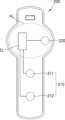
도 2는 호흡 센싱 장치(10)에 대한 도면이다.Figure 2 is a drawing of a respiration sensing device (10).
도 2에 도시된 바와 같이, 호흡 센싱 장치(10)는, 본체부(100), 플렉서블 기판(200), 및 접착 부재(300)를 포함할 수 있다.As shown in FIG. 2, the respiration sensing device (10) may include a main body (100), a flexible substrate (200), and an adhesive member (300).
본체부(100)는 플렉서블 기판(200)의 일면에 배치되며, 하우징(110a, 110b), 배터리(120), 프로세서(MB), 메모리, 및 기타 지지 구조물 등을 포함할 수 있다.The main body (100) is arranged on one side of the flexible substrate (200) and may include a housing (110a, 110b), a battery (120), a processor (MB), memory, and other support structures.
도 1b에 도시된 바와 같이, 하우징(110a, 110b)는 2개의 분리되는 구조로 구현될 수 있다. 하우징(110a, 110b)은 서로 결합 가능한 구조일 수 있다. 하우징(110a, 110b)가 결합되어, 본체부(100)의 다른 구성을 외부 충격으로부터 보호하고 외부 이물질이 내부로 유입되지 않도록 한다. 하우징(110a, 110b)의 형상이나 크기 및 재질 등은 특별히 한정하지 않으며, 호흡 센싱 장치(10)의 사용 목적 등에 따라 적절히 선택될 수 있다. 일 실시예로, 하우징(110a, 110b)는 내부 공간을 구비하는 돔 형상을 가질 수 있다. 하우징(110a, 110b)의 상면에는 버튼(130)이 배치될 수 있다. 도 1a에는 하우징(110a, 110b)의 상면에 하나의 전원 버튼만이 배치되는 것으로 나타냈으나, 이에 한정하지 않는다. 예를 들어 하우징(110a, 110b)의 상면 또는 측면에는 호흡 센싱 장치(10)의 전원을 제어하고 작동 모드를 제어하는 복수 개의 버튼이 배치될 수 있다.As illustrated in FIG. 1b, the housing (110a, 110b) may be implemented as two separate structures. The housings (110a, 110b) may have a structure that can be coupled to each other. The housings (110a, 110b) are coupled to protect other components of the main body (100) from external impact and prevent external foreign substances from entering the inside. The shape, size, material, etc. of the housing (110a, 110b) are not particularly limited and may be appropriately selected depending on the intended use of the respiration sensing device (10). As an example, the housing (110a, 110b) may have a dome shape having an internal space. A button (130) may be arranged on the upper surface of the housing (110a, 110b). In FIG. 1a, only one power button is illustrated as being arranged on the upper surface of the housing (110a, 110b), but the present invention is not limited thereto. For example, a plurality of buttons for controlling power and operating mode of the respiration sensing device (10) may be arranged on the top or side of the housing (110a, 110b).
본체부(100)의 내부에는, 호흡 센싱 전극(210), 배터리(120) 등을 제어하고, 호흡 센싱 전극(210)에서 측정된 신호를 처리하는 프로세서(MB)가 포함될 수 있다. 플렉서블 기판(200)은 프로세서(MB)와 연결되는 전기선들을 내장하여 호흡 센싱 전극들(210) 및/또는 별도의 장치(심전도 전극, 온도 센서, 마이크, 가속도 센서 등)로부터의 신호를 프로세서(MB)에 전달할 수 있다. 또한, 본체부(100)에는 신호 처리 알고리즘을 저장하는 메모리가 포함될 수 있다. 프로세서(MB)의 제어에 의해 측정된 신호들은 메모리에 저장될 수 있다.The main body (100) may include a processor (MB) that controls respiration sensing electrodes (210), a battery (120), etc., and processes signals measured by the respiration sensing electrodes (210). The flexible substrate (200) may have built-in electric lines connected to the processor (MB) to transmit signals from the respiration sensing electrodes (210) and/or separate devices (ECG electrodes, temperature sensors, microphones, acceleration sensors, etc.) to the processor (MB). In addition, the main body (100) may include a memory that stores a signal processing algorithm. Signals measured under the control of the processor (MB) may be stored in the memory.
본체부(100)의 내부에는, 호흡 센싱 전극(210) 및/또는 별도의 장치(심전도 전극, 온도 센서, 마이크, 가속도 센서 등)로부터 측정되는 신호를 모니터링 장치로 전송하는 통신부가 포함될 수 있다. 통신부는 블루투스 연결을 위한 ID를 포함할 수 있다.The interior of the main body (100) may include a communication unit that transmits signals measured from a respiration sensing electrode (210) and/or a separate device (e.g., electrocardiogram electrode, temperature sensor, microphone, acceleration sensor, etc.) to a monitoring device. The communication unit may include an ID for Bluetooth connection.
본체부(100)의 내부에는, 진동, 청각 등의 알람을 발생시키는 알람부(미도시)가 포함될 수 있다. 알람부(미도시)는 프로세서(MB)에 의해 제어될 수 있다.The interior of the main body (100) may include an alarm unit (not shown) that generates an alarm such as a vibration or an audible sound. The alarm unit (not shown) may be controlled by a processor (MB).
플렉서블 기판(200)은 하나 이상의 호흡 센싱 전극(210), 본체부(100)와 전기적으로 연결되는 회로 등을 포함할 수 있다. 플렉서블 기판(200)은, 바람직하게는 2개 이상의 호흡 센싱 전극들(210)을 포함할 수 있다. 호흡 센싱 전극(210)은, 본체부(100)가 배치되는 영역(HL)을 피하여 배치될 수 있다. 호흡 센싱 전극(210)은 본체부(100)가 배치되지 않은 영역에 배치될 수 있다.The flexible substrate (200) may include one or more respiration sensing electrodes (210), a circuit electrically connected to the main body (100), and the like. The flexible substrate (200) may preferably include two or more respiration sensing electrodes (210). The respiration sensing electrodes (210) may be placed so as to avoid the area (HL) where the main body (100) is placed. The respiration sensing electrodes (210) may be placed in an area where the main body (100) is not placed.
플렉서블 기판(200)은 신체, 피부에 밀착되어 신체의 변화에 따라 굽어지는 정도 등이 변화될 수 있다. 플렉서블 기판(200)에서 하드한 소재의 본체부(100) 또는 하우징(110)이 배치되는 일측은 본체부(100) 또는 하우징(110)으로 인해 신체에 따라서 자유롭게 구부러지지 않을 수 있다. 복수의 호흡 센싱 전극들(210)은 하드한 소재의 본체부(100) 또는 하우징(110)에 의해 유연성이 낮아지는 영역을 피하여 배치될 수 있다. 플렉서블 기판(200)의 타측에 복수의 호흡 센싱 전극들(210)이 일렬로 배치될 수 있다. 호흡 센싱 전극들(210)은 일렬로 배치됨에 따라 호흡에 따른 커패시턴스 값들의 변화를 더 크게 측정할 수 있다. 복수의 호흡 센싱 전극들(210)은 일렬로 배치됨에 따라 호흡 주기에 따른 신체의 팽창 또는 수축으로 인한 공기층의 변화를 더 잘 감지할 수 있다. 호흡에 따른 변화를 잘 감지하기 위해서, 호흡 센싱 전극들(210) 사이는 소정의 거리 이상으로 떨어져서 배치될 수 있다. 바람직하게는 소정의 거리는 0.5cm 이상일 수 있다. 호흡 센싱 전극들(210)은 소정의 2개 이상으로 배치될 수 있다. 호흡 센싱 전극들(210)의 개수가 증가할수록 호흡에 따른 공기층의 변화를 더 잘 감지할 수 있다.The flexible substrate (200) can be bent to a degree that changes according to changes in the body by being in close contact with the body or skin. One side of the flexible substrate (200) where the hard body part (100) or the housing (110) is arranged may not be freely bent according to the body due to the body part (100) or the housing (110). The plurality of respiration sensing electrodes (210) can be arranged to avoid an area where flexibility is reduced by the hard body part (100) or the housing (110). The plurality of respiration sensing electrodes (210) can be arranged in a row on the other side of the flexible substrate (200). The respiration sensing electrodes (210) can measure changes in capacitance values according to respiration more significantly by being arranged in a row. The plurality of respiration sensing electrodes (210) can better detect changes in air layers due to expansion or contraction of the body according to the respiratory cycle by being arranged in a row. In order to detect changes according to respiration well, the respiration sensing electrodes (210) may be arranged at a predetermined distance or more apart from each other. Preferably, the predetermined distance may be 0.5 cm or more. The respiration sensing electrodes (210) may be arranged at a predetermined number of two or more. As the number of respiration sensing electrodes (210) increases, the change in the air layer according to respiration can be detected better.
플렉서블 기판(200)은 호흡 센싱 전극들(210)이 배치된 가로 방향으로 길게 형성되는 띠 형상일 수 있다. 가로 방향의 길이는, 세로 방향의 길이의 정해진 배수 이상으로 설정될 수 있다. 다른 실시예에서, 플렉서블 기판(200)은 소정의 각도로 굽은 띠 형상일 수 있다. 이런 경우, 호흡 센싱 전극들(210)과, 본체부(100)는 서로 인접하지 않게 반대편에 배치되어, 호흡 센싱 전극들(210)이 배치되는 영역과 본체부(100)가 배치되는 영역은 소정의 각도를 이루게 될 수 있다.The flexible substrate (200) may be a strip shape formed in a horizontal direction in which the respiration sensing electrodes (210) are arranged. The length in the horizontal direction may be set to a predetermined multiple of the length in the vertical direction or more. In another embodiment, the flexible substrate (200) may be a strip shape bent at a predetermined angle. In this case, the respiration sensing electrodes (210) and the main body (100) may be arranged on opposite sides without being adjacent to each other, so that the area where the respiration sensing electrodes (210) are arranged and the area where the main body (100) is arranged may form a predetermined angle.
복수의 호흡 센싱 전극들(210)이 본체부(100)와 중첩 또는 인접하게 배치되면 본체부(100)에 의해 유연성이 낮아져 신체 변화에 따른 변화를 센싱하기 어려울 수 있으므로, 소정의 거리 이상으로 이격되어 배치될 수 있다. 다른 실시예에서, 본체부(100)의 소재가 유연성을 가지는 경우, 호흡 센싱 전극(210)은 본체부(100)와 중첩 또는 인접하게 배치될 수 있다.If a plurality of respiration sensing electrodes (210) are arranged to overlap or be adjacent to the main body (100), the flexibility of the main body (100) may be reduced, making it difficult to sense changes according to changes in the body. Therefore, they may be arranged to be spaced apart from each other by a predetermined distance or more. In another embodiment, if the material of the main body (100) is flexible, the respiration sensing electrodes (210) may be arranged to overlap or be adjacent to the main body (100).
호흡 센싱 전극들(210)은 플렉서블 기판(200) 상에 배치되어 공기층의 변화에 따라서 센싱값이 변화하도록 설계될 수 있다. 플렉서블 기판(200)은 복수의 호흡 센싱 전극들(210)이 배치되는 방향으로 긴 형상을 가질 수 있다. 호흡 센싱 전극들(210)은 호흡 주기에 따라서 달라지는 커패시턴스 값들을 측정할 수 있다. 호흡 센싱 전극들(210)에서 측정되는 커패시턴스 값의 변화 정도는, 호흡 센싱 전극들(210)이 부착되는 위치, 및/또는 대상체에 따라서 달라지게 된다. 호흡 센싱 전극들(210)에서 측정된 신호에 대해서 호흡의 호기의 시점과 흡기의 시점 등이 각각 판별될 수 있다.The respiration sensing electrodes (210) may be arranged on a flexible substrate (200) and designed such that the sensing value changes according to the change in the air layer. The flexible substrate (200) may have a long shape in the direction in which the plurality of respiration sensing electrodes (210) are arranged. The respiration sensing electrodes (210) may measure capacitance values that change according to the respiratory cycle. The degree of change in the capacitance value measured by the respiration sensing electrodes (210) may vary depending on the position to which the respiration sensing electrodes (210) are attached and/or the subject. The timing of exhalation and inhalation of respiration, etc., may be determined respectively for the signals measured by the respiration sensing electrodes (210).
플렉서블 기판(200)의 타면에는 접착 부재(300)가 배치되어 호흡 센싱 장치(10)가 사용자의 신체에 부착되도록 할 수 있다. 접착 부재(300)는, 접착성 물질로 도포되어, 플렉서블 기판(200)이 피부에 접착되도록 할 수 있다. 접착 부재(300)는, 양면 테이프, 실리콘 테이프 등일 수 있으나, 이에 한정되지 않고 다양한 접착성 물질로 구현될 수 있다. 접착 부재(300)는 호흡 센싱 전극에 대응되는 위치에 개구부(310)를 포함할 수 있다. 개구부(310)를 통해 호흡 센싱 전극들(210)이 외부로 노출될 수 있다. 개구부(310)는 홀 형상으로 구현될 수 있으나, 호흡 센싱 전극들(210)이 외부로 노출되는 다양한 형상으로 변경 가능하다.An adhesive member (300) may be arranged on the other side of the flexible substrate (200) to allow the respiration sensing device (10) to be attached to the user's body. The adhesive member (300) may be coated with an adhesive material to allow the flexible substrate (200) to be attached to the skin. The adhesive member (300) may be a double-sided tape, a silicone tape, or the like, but is not limited thereto and may be implemented with various adhesive materials. The adhesive member (300) may include an opening (310) at a position corresponding to the respiration sensing electrode. The respiration sensing electrodes (210) may be exposed to the outside through the opening (310). The opening (310) may be implemented in a hole shape, but may be changed to various shapes through which the respiration sensing electrodes (210) are exposed to the outside.
접착 부재의 타면에 커버 부재(320)를 더 포함할 수 있다. 커버 부재(320)는 신축성 물질로 구현될 수 있다. 커버 부재(320)는 공기가 통하는 홀을 포함할 수 있다. 커버 부재(320)는, 신축성이 있고 공기가 통하는 물질로 구현될 수 있다. 커버 부재(320)는 접착 부재의 개구부(310)를 덮을 수 있다. 커버 부재(320)는 접착 부재(300)의 일부 또는 전부, 개구부(310)의 일부 또는 전부를 덮도록 구현될 수 있다. 커버 부재(320)는, 호흡 센싱 장치(10)가 피부에 잘 부착되도록 접착성 물질로 도포될 수 있다. 커버 부재(320)는 호흡 센싱을 위한 사용 전에 제거될 수 있다.The other side of the adhesive member may further include a cover member (320). The cover member (320) may be implemented with an elastic material. The cover member (320) may include a hole through which air passes. The cover member (320) may be implemented with an elastic and air-permeable material. The cover member (320) may cover the opening (310) of the adhesive member. The cover member (320) may be implemented to cover part or all of the adhesive member (300), part or all of the opening (310). The cover member (320) may be coated with an adhesive material so that the respiration sensing device (10) is well attached to the skin. The cover member (320) may be removed before use for respiration sensing.
도 3은 본 개시의 실시예들에 따른 플렉서블 기판(200)의 저면도이다.FIG. 3 is a bottom view of a flexible substrate (200) according to embodiments of the present disclosure.
도 3에 도시된 바와 같이, 플렉서블 기판(200)은 심전도 전극(220)을 더 포함할 수 있다. 심전도 전극(220)은 플렉서블 기판(200)에서 본체부(100)가 배치된 영역(HL) 내에 위치될 수 있다. 접착 부재(300)는 심전도 전극과 접촉되는 영역에 피부와 통전될 수 있는 통전홀을 더 포함할 수 있다. 통전홀은 접착 부재(300)에서 관통형성될 수 있다. 통전홀은, 하이드로젤 등의 도전성 물질로 채워질 수 있다. 플렉서블 기판(200)는, 호흡 센싱 전극들(211, 212), 심전도 전극(220)으로부터 전기 신호를 전송하는 전기 회선(EL)을 더 포함할 수 있다. 다른 실시예에서, 플렉서블 기판(200)는, 제1 연결부(230, 도 5b 참조), 제2 연결부(240, 도 5c 참조)와 전기적으로 연결되는 전기 회선을 더 포함할 수 있다.As illustrated in FIG. 3, the flexible substrate (200) may further include an electrocardiogram electrode (220). The electrocardiogram electrode (220) may be positioned within an area (HL) of the flexible substrate (200) where the main body (100) is arranged. The adhesive member (300) may further include a conductive hole capable of conducting electricity with the skin in an area in contact with the electrocardiogram electrode. The conductive hole may be formed through the adhesive member (300). The conductive hole may be filled with a conductive material such as a hydrogel. The flexible substrate (200) may further include an electrical line (EL) that transmits an electrical signal from the respiration sensing electrodes (211, 212) and the electrocardiogram electrode (220). In another embodiment, the flexible substrate (200) may further include an electrical line electrically connected to the first connecting portion (230, see FIG. 5b) and the second connecting portion (240, see FIG. 5c).
다른 실시예에서, 심전도 전극은 별도의 장치에 구비되어 제1 연결부를 통해 호흡 센싱 장치(10)와 연결되도록 구현될 수 있다. 심전도 신호의 측정이 불요한 경우, 심전도 전극은, 탈착될 수 있다. 심전도 전극은, 심전도 측정이 가능한 부착 위치에 부착될 수 있다. 바람직하게는 심전도 전극은, 허파와 비슷한 높이에서 왼쪽 가슴 아래 갈비뼈 위에 부착될 수 있다. 심전도 전극은, 케이블을 통해 연결되어 호흡 센싱 장치(10)의 제어에 의해 심전도 신호를 측정할 수 있다. 심전도 전극은, 측정된 심전도 신호를 호흡 센싱 장치(10)의 본체부(100)로 전송할 수 있다.In another embodiment, the electrocardiogram electrode may be provided in a separate device and implemented to be connected to the respiration sensing device (10) through the first connection portion. If measurement of the electrocardiogram signal is not required, the electrocardiogram electrode may be detachable. The electrocardiogram electrode may be attached to an attachment location where electrocardiogram measurement is possible. Preferably, the electrocardiogram electrode may be attached above the ribs below the left chest at a height similar to the lungs. The electrocardiogram electrode may be connected through a cable to measure the electrocardiogram signal under the control of the respiration sensing device (10). The electrocardiogram electrode may transmit the measured electrocardiogram signal to the main body (100) of the respiration sensing device (10).
플렉서블 기판(200)의 일측인, 본체부(100)가 배치되는 영역(HL)에 심전도 전극(220)가 배치되고, 다른 일측에 상기 영역(HL) 외의 영역에 호흡 센싱 전극(210)가 배치될 수 있다. 호흡 센싱 전극(210) 및/또는 심전도 전극(220)은 본체부(100)와 전기적으로 연결되어 전원을 공급 받고 측정 신호를 전달될 수 있다.An electrocardiogram electrode (220) may be placed in a region (HL) where the main body (100) is placed on one side of the flexible substrate (200), and a respiration sensing electrode (210) may be placed in a region other than the region (HL) on the other side. The respiration sensing electrode (210) and/or the electrocardiogram electrode (220) may be electrically connected to the main body (100) to receive power and transmit a measurement signal.
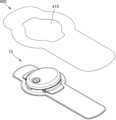
도 4는 보호 부재가 구비된 호흡 센싱 장치(10)의 사시도이다.Figure 4 is a perspective view of a respiration sensing device (10) equipped with a protective member.
도 4에 도시된 바와 같이, 호흡 센싱 장치(10)는 보호 부재(400)를 더 포함할 수 있다. 보호 부재(400)는, 플렉서블 기판(200)을 보호하는 수단으로, 방수성 재질로 구현될 수 있다. 보호 부재(400)는 PU 재질로 구현될 수 있다. 보호 부재(400)는, 플렉서블 기판(200)에 대응하는 형상을 가질 수 있으나, 이에 한정되지 않고 다양한 형상을 가질 수 있다. 보호 부재(400)는, 플렉서블 기판(200)보다 크게 구현되어 플렉서블 기판(200)을 덮을 수 있다. 보호 부재(400)는, 본체부(100)를 보호하지 않도록, 본체부(100)를 노출시키는 개구부(410)를 포함할 수 있다. 개구부(410)는, 본체부(100)에 대응하는 형상을 가질 수 있다.As illustrated in FIG. 4, the respiration sensing device (10) may further include a protective member (400). The protective member (400) may be implemented with a waterproof material as a means for protecting the flexible substrate (200). The protective member (400) may be implemented with a PU material. The protective member (400) may have a shape corresponding to the flexible substrate (200), but is not limited thereto and may have various shapes. The protective member (400) may be implemented to be larger than the flexible substrate (200) and may cover the flexible substrate (200). The protective member (400) may include an opening (410) that exposes the main body (100) so as not to protect the main body (100). The opening (410) may have a shape corresponding to the main body (100).
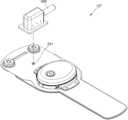
도 5a는, 다른 실시예에 따른 제1 연결부가 구비된 호흡 센싱 장치(10’’)의 사시도이다.FIG. 5a is a perspective view of a respiration sensing device (10'') having a first connecting portion according to another embodiment.
도 5a에 도시된 바와 같이, 호흡 센싱 장치(10’’)는, 심전도 센서 장치, 온도 센서, 소리 센서 등의 다른 장치와 연결되는 제1 연결부(230)를 더 포함할 수 있다. 제1 연결부(230)는, 다른 장치와 전기적으로 연결되어, 다른 장치로 전원을 제공하고, 다른 장치에서 측정된 신호를 수신할 수 있다. 2개의 제1 연결부(230)가 도시되어 있으나, 이는 하나에 예시에 불과하며, 1개 또는 2개 이상의 제1 연결부(230)가 배치될 수 있다. 제1 연결부(230)는, 플렉서블 기판(200)의 일측에 배치될 수 있으나, 이에 한정되지 않고 본체부(100)의 일측에 배치될 수 있다. 제1 연결부(230)는 본체부(100)의 프로세서(MB)와 전기적인 선으로 연결되고 다른 장치와 연결 가능한 구성일 수 있다. 제1 연결부(230)는, 구조적으로 똑딱이 등과 같이 다른 장치와 결합가능하도록 구현될 수 있다. 다른 장치는 제1 연결부(230)와 연결되는 케이블 등을 통해 제1 연결부(230)에 부착될 수 있다. 케이블은, 길이가 변경 가능한 것일 수 있다. 제1 연결부(230)와 장치가 연결된 것으로 판별된 경우, 본체부(100)의 프로세서(MB)는, 장치로부터의 신호를 수신하여 처리할 수 있다.As illustrated in FIG. 5A, the respiration sensing device (10'') may further include a first connection portion (230) that is connected to other devices, such as an electrocardiogram sensor device, a temperature sensor, and a sound sensor. The first connection portion (230) may be electrically connected to other devices to provide power to the other devices and receive signals measured by the other devices. Although two first connection portions (230) are illustrated, this is only an example, and one or more first connection portions (230) may be arranged. The first connection portion (230) may be arranged on one side of the flexible substrate (200), but is not limited thereto, and may be arranged on one side of the main body (100). The first connection portion (230) may be configured to be electrically connected to the processor (MB) of the main body (100) and connectable to other devices. The first connecting portion (230) may be structurally implemented to be coupled with another device, such as a snap. The other device may be attached to the first connecting portion (230) via a cable, etc., connected to the first connecting portion (230). The cable may have a variable length. When it is determined that the first connecting portion (230) and the device are connected, the processor (MB) of the main body (100) may receive and process a signal from the device.
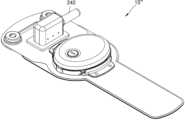
도 5b는, 다른 실시예에 따른 제2 연결부(240)가 구비된 호흡 센싱 장치(10’’’)의 사시도이다.FIG. 5b is a perspective view of a respiration sensing device (10''') equipped with a second connecting portion (240) according to another embodiment.
도 5b에 도시된 바와 같이, 호흡 센싱 장치(10’’’)는 코 호흡 장치와 연결되는 제2 연결부(240)를 더 포함할 수 있다. 코 호흡 장치는 도 10b에 도시된 바와 같이 사용자의 코에 부착되어 코에서 발생되는 공기를 모아 이동시키는 장치로서, 코에 부착되어 코에서 발생되는 공기를 모으는 수단과 상기 수단으로 모아진 공기를 이동시키는 튜브, 장치를 사용자의 얼굴에 밀착시키기 위한 밴드를 포함할 수 있다. 호흡 센싱 장치(10’’’)는 제1 연결부(230) 없이 제2 연결부(240)를 구비할 수 있다. 제2 연결부(240)는 코 호흡 장치(20, 도 10b 참조)의 튜브와 연결되어 코 호흡에 의해 배출되는 공기의 흐름, 움직임(flow)을 측정하는 압력 센서를 포함할 수 있다. 도 5c에 도시된 바와 같이, 제2 연결부(240)는, 내부에 압력 센서(241)를 구비하고, 압력 센서(241)를 통해 코 에서 배출되는 공기에 의한 압력값의 변화를 측정하도록 할 수 있다. 압력값이 기준 압력값 이상(초과)인 경우, 코 호흡이 발생되는 것으로 판단될 수 있다. 압력 센서(241)에서 측정된 값은, 본체부(100)의 프로세서(MB)에 전달될 수 있다. 호흡 센싱 장치(10’’’)의 프로세서(MB)는 압력 센서(241)의 압력이 기 설정된 기준 압력값 초과의 압력을 가진다는 것은, 코에서 배출되는 공기가 있는 것으로, 코 호흡이 있다는 것을 의미한다. 호흡 센싱 장치(10’’’)는 압력 센서(241)에서 측정된 압력이 높아지는 시점을 통해 코 호흡이 발생함을 검출할 수 있다. 또한, 호흡 센싱 장치(10’’’)는 압력 센서(241)에서 측정된 압력이 높아지는 시점에 코 호흡의 발생 시점으로 검출할 수 있다.As illustrated in FIG. 5b, the respiration sensing device (10''') may further include a second connection portion (240) connected to a nasal breathing device. As illustrated in FIG. 10b, the nasal breathing device is a device attached to a user's nose to collect and move air generated from the nose, and may include a means for collecting air generated from the nose by attaching to the nose, a tube for moving the air collected by the means, and a band for attaching the device to the user's face. The respiration sensing device (10''') may be provided with a second connection portion (240) without the first connection portion (230). The second connection portion (240) may include a pressure sensor connected to the tube of the nasal breathing device (20, see FIG. 10b) to measure the flow, movement (flow) of air discharged by nasal breathing. As illustrated in FIG. 5c, the second connecting portion (240) may be provided with a pressure sensor (241) therein, and may be configured to measure a change in pressure value due to air discharged from the nose through the pressure sensor (241). When the pressure value is equal to or greater than a reference pressure value (exceeds), it may be determined that nasal breathing is occurring. The value measured by the pressure sensor (241) may be transmitted to the processor (MB) of the main body (100). The processor (MB) of the respiration sensing device (10''') determines that the pressure of the pressure sensor (241) exceeding a preset reference pressure value means that there is air discharged from the nose, and thus nasal breathing is occurring. The respiration sensing device (10''') may detect that nasal breathing is occurring through the point in time when the pressure measured by the pressure sensor (241) increases. Additionally, the respiration sensing device (10’’’) can detect the occurrence of nasal breathing at the point when the pressure measured by the pressure sensor (241) increases.
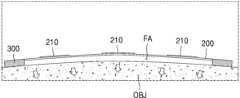
도 6는 도 1a의 Ⅱ-Ⅱ에 따른 호흡 센싱 장치(10)의 단면을 나타내는 도면이다.Fig. 6 is a drawing showing a cross-section of a respiration sensing device (10) according to II-II of Fig. 1a.
플렉서블 기판(200)의 일면에 본체부(100)가 배치되고, 같은 면에 호흡 센싱 전극(211, 212)가 배치될 수 있다. 선택적인 실시예에서, 호흡 센싱 전극(211, 212)는 플렉서블 기판(200)에 내재되는 방식으로 배치될 수 있다. 호흡 센싱 전극(211, 212)는 서로 일정 거리 만큼 떨어져서 배치될 수 있다. 접착 부재(300)는 플렉서블 기판(200)의 타면에 배치되며, 호흡 센싱 전극(211, 212)과 대응되는 위치를 제외한 영역의 일부에 배치되어 호흡 센싱 전극(211, 212)가 외부에 노출되도록 할 수 있다. 호흡 센싱 전극(211, 212)는 개구부(310)의 양 옆의 접착 부재(300)를 통해 피부와 소정의 거리 만큼 이격되어 위치하게 된다. 이격 됨에 따라, 호흡 센싱 전극(211, 212)와 피부 사이에는 소정의 공기층이 존재하게 된다.A main body (100) may be arranged on one side of a flexible substrate (200), and respiration sensing electrodes (211, 212) may be arranged on the same side. In an optional embodiment, the respiration sensing electrodes (211, 212) may be arranged in a manner that they are embedded in the flexible substrate (200). The respiration sensing electrodes (211, 212) may be arranged at a predetermined distance from each other. An adhesive member (300) may be arranged on the other side of the flexible substrate (200), and may be arranged in a part of an area excluding a position corresponding to the respiration sensing electrodes (211, 212) so that the respiration sensing electrodes (211, 212) may be exposed to the outside. The respiration sensing electrodes (211, 212) are positioned at a predetermined distance from the skin through the adhesive members (300) on both sides of the opening (310). As the separation occurs, a certain air layer exists between the respiration sensing electrodes (211, 212) and the skin.
도 7a, 도 7b, 도 7c는 접착 부재의 예시 도면들이다.Figures 7a, 7b, and 7c are exemplary drawings of adhesive members.
접착 부재(300)는 호흡 센싱 전극(210)을 노출하는 형상으로 구현될 수 있다. 접착 부재(300)는, 호흡 센싱 전극들(210)을 노출시키는 형상이라면 다양하게 변형이 가능하다. 접착 부재(300)는, 호흡 센싱 전극들(211, 212)에 대해서 분리되는 공기층이 아닌 하나의 공기층을 가지도록 구현될 수 있다.The adhesive member (300) may be implemented in a shape that exposes the respiration sensing electrodes (210). The adhesive member (300) may be modified in various ways as long as it has a shape that exposes the respiration sensing electrodes (210). The adhesive member (300) may be implemented to have one air layer rather than a separate air layer for the respiration sensing electrodes (211, 212).
도 7a에 도시된 바와 같이, 접착 부재(300)는, 2개로 분리되어 본체부(100)가 배치되는 영역과 호흡 센싱 전극(210)이 없는 임의의 영역에 각각 배치될 수 있다. 도 7b에 도시된 바와 같이, 접착 부재(300)는, 호흡 센싱 전극(210)와 대응되는 위치를 피하면서 호흡 센싱 전극(210)를 감싸는 위치에 배치되는 형상을 가지도록 복 수개로 분할되어 배치될 수 있다. 도 7c에 도시된 바와 같이, 접착 부재(300)는, 호흡 센싱 전극(210)에 대응하는 개구부를 포함하는 형상으로 구현될 수 있다. 접착 부재(300)는 도면에 도시된 바에 한정되지 않고 플렉서블 기판(200)에서 호흡 센싱 전극(210)을 제외한 영역 중 전부 또는 일부를 덮도록 구현될 수 있다.As illustrated in FIG. 7a, the adhesive member (300) may be divided into two and placed respectively in an area where the main body (100) is placed and an arbitrary area where the respiration sensing electrode (210) is not present. As illustrated in FIG. 7b, the adhesive member (300) may be divided into multiple pieces and placed so as to have a shape in which it is placed in a position surrounding the respiration sensing electrode (210) while avoiding a position corresponding to the respiration sensing electrode (210). As illustrated in FIG. 7c, the adhesive member (300) may be implemented in a shape including an opening corresponding to the respiration sensing electrode (210). The adhesive member (300) is not limited to that illustrated in the drawing and may be implemented to cover all or part of an area of the flexible substrate (200) excluding the respiration sensing electrode (210).
도 8은 본 개시의 실시예들에 따라서, 호흡 센싱 장치가 사용되는 방법에 대한 도면이다.FIG. 8 is a diagram illustrating a method of using a respiratory sensing device according to embodiments of the present disclosure.
도 8을 참고하면, 사용자는 호흡 센싱 장치(10)를 착용 전에 부착 영역을 확인할 수 있다. 부착 영역은, 호흡을 통해서 공기의 흐름으로 팽창 또는 수축되는 영역으로, 복부 또는 흉부 부분일 수 있으나 이에 한정되지 않고 호흡 과정에서의 변화가 큰 영역으로 결정될 수 있다. 호흡 센싱 장치(10)에서 호흡 센싱 전극(210)이 배치되는 일측은 가슴 또는 복부의 중앙 측으로 향하도록 부착될 수 있다. 이후 부착 영역에 털이 많을 경우 면도기로 제거한 후, 알콜 스왑을 이용하여 세척 후 1분 이상 충분히 건조시킨다.Referring to Fig. 8, the user can check the attachment area before wearing the respiration sensing device (10). The attachment area is an area that expands or contracts due to the flow of air through respiration, and may be, but is not limited to, the abdomen or chest area. The attachment area may be determined as an area that undergoes significant changes during the respiration process. One side of the respiration sensing electrode (210) of the respiration sensing device (10) may be attached so that it faces the center of the chest or abdomen. Afterwards, if there is a lot of hair in the attachment area, it is removed with a razor, washed with an alcohol swab, and then sufficiently dried for more than 1 minute.
그 다음 호흡 센싱 장치(10)에 부착된 이형필름을 떼어내고, 부착 영역에 호흡 센싱 전극(210)이 위치하도록 호흡 센싱 장치(10)를 부착시킨다. 이 경우, 패치가 잘 부착되도록 1분 이상 전체 부위를 고르게 눌러 주는 것이 필요하다. 이후, 배터리를 통전시키고, 스마트폰 앱 등 모니터링 및 제어를 할 수 있는 기기와 연결하여, 호흡 신호 등을 확인한다. 스마트폰 등의 기기와의 연결은 블루투스 방식을 이용할 수 있으나, 이에 한정되지 않고 다양한 무선 통신을 이용할 수 있다.Next, the release film attached to the respiration sensing device (10) is removed, and the respiration sensing device (10) is attached so that the respiration sensing electrode (210) is positioned in the attachment area. In this case, it is necessary to evenly press the entire area for more than 1 minute so that the patch is well attached. After that, the battery is turned on, and a device capable of monitoring and controlling, such as a smartphone app, is connected to check the respiration signal, etc. The connection with a device such as a smartphone can be made using the Bluetooth method, but is not limited thereto, and various wireless communications can be used.
도 9는 본 개시의 실시예들에 따른 호흡 센싱 장치(10)의 사용 방법의 일 실시예의 순서도이다.FIG. 9 is a flowchart of one embodiment of a method of using a respiratory sensing device (10) according to embodiments of the present disclosure.
도 9를 참조하면, S100에서는, 호흡 센싱 장치(10)에서 이형 필름을 제거하고, 호흡 센싱 장치(10)를 부착 영역에 부착시킨다. 부착 영역은, 복부 또는 흉부 부분일 수 있다. 호흡 센싱 장치(10)에서 호흡 센싱 전극(210)이 배치되는 일측은 가슴 또는 복부의 중앙 측으로 향하도록 부착될 수 있다. 신체 중에서, 호흡에 따라 팽창 또는 수축이 되는 부분으로 부착 영역을 결정할 수 있다. 호흡 센싱 장치(10)를 부착 전 필요한 경우 면도를 진행하고, 알콜 소독을 하는 것이 바람직하다. 호흡 센싱 장치(10)를 부착한 후에는 1분 이상 전체 부위를 고르게 눌러주는 것이 바람직하다.Referring to FIG. 9, in S100, the release film is removed from the respiration sensing device (10), and the respiration sensing device (10) is attached to an attachment area. The attachment area may be the abdomen or chest. One side of the respiration sensing device (10) where the respiration sensing electrode (210) is placed may be attached so as to face the center of the chest or abdomen. The attachment area may be determined as a part of the body that expands or contracts depending on respiration. Before attaching the respiration sensing device (10), it is preferable to shave if necessary and disinfect with alcohol. After attaching the respiration sensing device (10), it is preferable to evenly press the entire area for more than 1 minute.
S200에서는, 호흡 센싱 장치(10)와 무선 통신하는 전자 장치에서 측정값들을 확인할 수 있다. 여기서, 전자 장치는, 프로세서(MB), 통신부, 출력부를 포함하는 컴퓨팅 장치를 말한다. 전자 장치는 수신된 측정값을 디스플레이할 수 있다. 디스플레이되는 측정값을 통해, 사용자는 사용자의 호흡과 부합하는지 여부, 즉, 사용자의 호흡에 따라서 변화하는 커패시턴스 값이 측정되는지 여부를 판단할 수 있다. 측정값이 사용자의 호흡과 부합하지 않는 경우, 호흡 센싱 장치(10)의 부착 위치를 변경할 수 있다. 사용자는, 변경된 부착 위치에 부착되어 호흡 센싱 장치(10)가 측정하는 측정값을 다시 전자 장치를 통해 확인할 수 있다.In S200, the measurement values can be checked in an electronic device that wirelessly communicates with the respiration sensing device (10). Here, the electronic device refers to a computing device including a processor (MB), a communication unit, and an output unit. The electronic device can display the received measurement values. Through the displayed measurement values, the user can determine whether they match the user's breathing, that is, whether a capacitance value that changes according to the user's breathing is measured. If the measurement values do not match the user's breathing, the attachment location of the respiration sensing device (10) can be changed. The user can check the measurement values measured by the respiration sensing device (10) by attaching it to the changed attachment location again through the electronic device.
도 9의 설명에서의, 호흡 센싱 장치(10)는 호흡 센싱 장치(10’, 10’’, 10’’’)과 대체 가능한다.In the description of Fig. 9, the respiration sensing device (10) can be replaced with the respiration sensing device (10’, 10’’, 10’’’).
도 10a는 본 개시의 실시예들에 따른, 제1 연결부를 가지는 호흡 센싱 장치(10’’)를 신체에 부착하는 예시 도면이다.FIG. 10a is an exemplary drawing of attaching a respiration sensing device (10'') having a first connecting portion to a body according to embodiments of the present disclosure.
호흡 센싱 장치(10’’)는 호흡에 따른 변화를 감지하는 복부 부근에 수평 방향으로 부착될 수 있다. 호흡 센싱 장치(10’’)는, 별도의 장치들(D1, D2)과 케이블들(c1, c2)을 통해 연결될 수 있다. 별도의 장치들(D1, D2)은 심전도 전극, 온도 센서, 마이크, 가속도 센서 등일 수 있다. 호흡 센싱 장치(10’’)는, 온도 센서를 추가로 연결하여 사용자의 체온, 주변 온도 등의 온도 값을 측정할 수 있다. 호흡 센싱 장치(10’’)는 마이크를 추가로 연결하여 호흡음, 청진음 또는 사용자의 음성, 코골이 소리 등을 측정할 수 있다. 호흡 센싱 장치(10’’)는, 가속도 센서를 추가로 연결하여 사용자의 움직임 값 등을 측정할 수 있다. 호흡 센싱 장치(10’’)는 심전도 전극을 추가로 연결하여 심전도 신호를 측정할 수 있다. 호흡 센싱 장치(10’’)는 호흡 센싱 전극들로부터 측정된 신호와 별도의 장치로부터 측정된 신호를 측정 시간에 대응시킨 동기화된 데이터를 생성하고, 이러한 데이터를 저장할 수 있다. 호흡 센싱 장치(10’’)는 통신부를 통해 외부의 모니터링 장치로 측정된 신호, 및/또는 동기화된 데이터를 전송할 수 있다.The respiration sensing device (10'') can be attached horizontally near the abdomen to detect changes according to respiration. The respiration sensing device (10'') can be connected to separate devices (D1, D2) and cables (c1, c2). The separate devices (D1, D2) can be electrocardiogram electrodes, temperature sensors, microphones, acceleration sensors, etc. The respiration sensing device (10'') can measure temperature values such as the user's body temperature and ambient temperature by additionally connecting a temperature sensor. The respiration sensing device (10'') can measure breathing sounds, auscultation sounds, or the user's voice, snoring sounds, etc. by additionally connecting a microphone. The respiration sensing device (10'') can measure the user's movement values, etc. by additionally connecting an acceleration sensor. The respiration sensing device (10'') can measure electrocardiogram signals by additionally connecting an electrocardiogram electrode. The respiration sensing device (10'') can generate synchronized data corresponding to the measurement time of the signals measured from the respiration sensing electrodes and the signals measured from a separate device, and store such data. The respiration sensing device (10'') can transmit the measured signals and/or synchronized data to an external monitoring device through a communication unit.
도 10b는 본 개시의 다른 실시예들에 따른 제2 연결부를 가지는 호흡 센싱 장치(10’’’)를 신체에 부착하는 예시 도면이다. 호흡 센싱 장치(10’’’)는 신체에 부착되어 호흡에 따른 커패시턴스 값의 변화를 센싱할 수 있다. 호흡 센싱 장치(10’’’)의 제2 연결부(240)는 사용자의 코 호흡 장치(20)의 튜브(30)와 연결될 수 있다. 튜브(30)를 통해 코에서 배출되는 공기가 제2 연결부(240)로 이동될 수 있다. 코에서 배출되는 다량의 공기는 압력 센서(241)의 압력값을 증가시킬 수 있다. 이러한 압력값을 측정하여 코에서 공기가 배출되는지 여부를 판단할 수 있다. 코에서부터의 공기로 압력센서의 압력값이 기준 압력값 이상(초과)으로 증가하면 코 호흡이 이루어진다고 검출될 수 있다. 압력값의 증가 시점을 코 호흡의 시점으로 판정할 수 있다. 호흡 센싱 장치(10’’’)는 호흡 센싱 전극을 통한 호흡 여부와 압력 센서(241)의 압력값을 통한 코 호흡 여부를 판정하여 호흡 시점에 코 호흡이 누락되지 않고 발생되는지 여부를 결정할 수 있다. 코 호흡의 시점과 폐 호흡의 시점 사이에 동기화 여부도 판단할 수 있다. 호흡의 호기 시점에 대응하여 코 호흡이 이루어져, 압력 센서(241)의 압력값의 증가가 검출될 수 있다. 이와 관련하여, 호흡 센싱 전극을 통한 호기 시점에 압력 센서(241)의 압력값이 기준 압력값 이상(초과)으로 증가하는 것을 검출할 수 있다. 압력값의 증가가 검출되면, 코 호흡이 발생되는 것으로 판정할 수 있다. 호흡 센싱 전극을 통한 호기 시점에 압력 센서(241)의 압력값이 기준 압력값 이상으로 증가하지 않으면, 코 호흡이 발생되지 않는 것으로 판정할 수 있다. 호흡 센싱 전극을 통해서 판단된 호기 시점 보다 늦은 시점에 압력 센서(241)의 압력값이 기준 압력값 이상으로 증가하게 되면, 폐 호흡 시점 이후에 코 호흡이 발생되는 것으로 판단할 수 있다. 이러한 현상에 대해서, 코골이 현상이 있는 것으로 판정할 수 있다.FIG. 10b is an exemplary drawing of attaching a respiration sensing device (10''') having a second connection portion according to other embodiments of the present disclosure to a body. The respiration sensing device (10''') can be attached to a body and sense a change in a capacitance value according to respiration. The second connection portion (240) of the respiration sensing device (10''') can be connected to a tube (30) of a nasal breathing device (20) of a user. Air discharged from the nose through the tube (30) can move to the second connection portion (240). A large amount of air discharged from the nose can increase a pressure value of a pressure sensor (241). By measuring this pressure value, it can be determined whether air is discharged from the nose. If the pressure value of the pressure sensor increases by more than (exceeds) a reference pressure value due to air from the nose, it can be detected that nasal breathing is occurring. The point in time when the pressure value increases can be determined as the point in time of nasal breathing. The respiration sensing device (10''') can determine whether nasal breathing occurs without omission at the time of breathing by determining whether breathing occurs through the respiration sensing electrode and whether nasal breathing occurs through the pressure value of the pressure sensor (241). It can also determine whether synchronization occurs between the time of nasal breathing and the time of pulmonary breathing. Nasal breathing occurs in response to the time of exhalation of breathing, and an increase in the pressure value of the pressure sensor (241) can be detected. In this regard, it can be detected that the pressure value of the pressure sensor (241) increases by more than (exceeds) the reference pressure value at the time of exhalation through the respiration sensing electrode. If an increase in the pressure value is detected, it can be determined that nasal breathing occurs. If the pressure value of the pressure sensor (241) does not increase by more than the reference pressure value at the time of exhalation through the respiration sensing electrode, it can be determined that nasal breathing does not occur. If the pressure value of the pressure sensor (241) increases by more than the reference pressure value at a time later than the time of exhalation determined through the respiration sensing electrode, it can be determined that nasal breathing occurs after the time of pulmonary breathing. For this phenomenon, it can be determined that snoring is present.
도 11a 및 도 11b는 호흡 주기에 따른 호흡 센싱 장치(10)에서의 공기층의 변화를 나타내는 도면이다.Figures 11a and 11b are drawings showing changes in the air layer in a respiratory sensing device (10) according to the respiratory cycle.
도 11a에 도시된 바와 같이, 호흡 흡기에서, 복부가 팽창되면, 호흡 센싱 전극들(210)에 대응하여 형성된 공기층은 줄어들게 되고, 그에 따라 호흡 센싱 전극들(210)에서 측정되는 커패시턴스의 값은 변화하게 된다. 도 11b에 도시된 바와 같이, 호흡 호기에서 복부가 수축되면, 호흡 센싱 전극들(210)에 대응하여 형성된 공기층은 증가하게 되고, 그에 따라 호흡 센싱 전극들(210)에서 측정되는 커패시턴스의 값은 변화하게 된다.As illustrated in FIG. 11a, when the abdomen expands during inspiration, the air layer formed in response to the respiration sensing electrodes (210) decreases, and accordingly, the value of capacitance measured at the respiration sensing electrodes (210) changes. As illustrated in FIG. 11b, when the abdomen contracts during expiration, the air layer formed in response to the respiration sensing electrodes (210) increases, and accordingly, the value of capacitance measured at the respiration sensing electrodes (210) changes.
또한, 이상에서는 본 발명의 바람직한 실시예에 대하여 도시하고 설명하였지만, 본 발명은 상술한 특정의 실시 예에 한정되지 아니하며, 청구범위에서 청구하는 본 발명의 요지를 벗어남이 없이 당해 발명이 속하는 기술분야에서 통상의 지식을 가진 자에 의해 다양한 변형실시가 가능한 것은 물론이고, 이러한 변형실시들은 본 발명의 기술적 사상이나 전망으로부터 개별적으로 이해되어져서는 안될 것이다.In addition, although the preferred embodiments of the present invention have been illustrated and described above, the present invention is not limited to the specific embodiments described above, and various modifications may be made by those skilled in the art without departing from the gist of the present invention as claimed in the claims. Furthermore, such modifications should not be individually understood from the technical idea or prospect of the present invention.
따라서, 본 발명의 사상은 앞에서 설명된 실시예들에 국한하여 정해져서는 아니되며, 후술하는 특허청구범위뿐만 아니라 이 특허청구범위와 균등한 또는 이로부터 등가적으로 변경된 모든 범위가 본 발명의 사상의 범주에 속한다고 할 것이다.Therefore, the idea of the present invention should not be limited to the embodiments described above, and not only the scope of the patent claims described below but also all scopes equivalent to or equivalently modified from the scope of the patent claims are included in the scope of the idea of the present invention.
10, 10’, 10’’, 10’’’: 호흡 센싱 장치
100: 본체부
200: 플렉서블 기판
300: 접착 부재
210: 호흡 센싱 전극
220: 심전도 전극
310: 개구부
230: 제1 연결부
240: 제2 연결부10, 10', 10'', 10''': Breathing sensing device
100: Main body
200: Flexible substrate
300: Adhesive Absence
210: Breath sensing electrode
220: ECG electrodes
310: Aperture
230: First connector
240: Second connector
Claims (16)
Translated fromKorean상기 하우징이 일면에 배치되고, 상기 본체부와 전기적으로 연결되며, 복수의 호흡 센서전극들이 배치되는 플렉서블 기판; 및
소정의 두께를 가지고 상기 호흡 센서 전극들이 모두 노출되도록 형성된 개구부를 포함하고, 상기 플렉서블 기판의 타면에 배치되어 상기 플렉서블 기판을 피부에 부착시키는 접착 부재;를 포함하고,
상기 개구부 및 접착 부재를 통해서 상기 복수의 호흡 센서전극들과 사용자의 피부 사이의 공기층이 형성되고,
상기 복수의 호흡 센서 전극들은, 상기 사용자의 호흡에 따른 복부 또는 흉부의 크기 변화에 대응하여, 상기 공기층의 부피 변화가 발생됨에 따른 변화하는 커패시턴스 값을 측정하는, 호흡 센싱 장치.A housing including a main body and a battery;
A flexible substrate on which the housing is arranged on one side and electrically connected to the main body, and on which a plurality of respiratory sensor electrodes are arranged; and
It includes an opening formed so that all of the respiratory sensor electrodes are exposed with a predetermined thickness, and an adhesive member arranged on the other surface of the flexible substrate to attach the flexible substrate to the skin;
An air layer is formed between the plurality of respiratory sensor electrodes and the user's skin through the above opening and adhesive member,
A respiration sensing device in which the plurality of respiration sensor electrodes measure a capacitance value that changes according to a change in the volume of the air layer in response to a change in the size of the abdomen or chest due to the user's breathing.
상기 플렉서블 기판에서,
상기 복수의 호흡 센서 전극들은 상기 하우징이 배치되지 않은 영역에 배치되는, 호흡 센싱 장치.In the first paragraph,
In the above flexible substrate,
A respiration sensing device, wherein the plurality of respiration sensor electrodes are placed in an area where the housing is not placed.
상기 개구부를 덮도록 배치되고 신축성을 가지는 소재로 구현되는 커버 부재;를 더 포함하는, 호흡 센싱 장치.In the first paragraph,
A respiration sensing device further comprising a cover member formed of a material having elasticity and arranged to cover the opening.
상기 플렉서블 기판은,
상기 하우징과 대응되는 위치에 하나 이상의 심전도 전극을 더 포함하는, 호흡 센싱 장치.In the first paragraph,
The above flexible substrate,
A respiration sensing device further comprising one or more electrocardiogram electrodes positioned corresponding to the housing.
상기 접착 부재는,
상기 심전도 전극과 대응되는 위치에 상기 심전도 전극이 피부와 통전될 수 있도록 하는 통전홀을 더 포함하는, 호흡 센싱 장치.In paragraph 4,
The above adhesive member is,
A respiration sensing device further comprising a conductive hole at a position corresponding to the electrocardiogram electrode so that the electrocardiogram electrode can be electrically connected to the skin.
상기 호흡 센서 전극들은 상기 개구부를 통해서 피부에 직접 부착되지 않는, 호흡 센싱 장치.In the first paragraph,
A respiration sensing device wherein the above respiration sensor electrodes are not directly attached to the skin through the above opening.
상기 플렉서블 기판 상에 배치되는 연결부를 더 포함하는, 호흡 센싱 장치.In the first paragraph,
A respiration sensing device further comprising a connecting portion disposed on the flexible substrate.
상기 연결부를 통해서 외부의 온도 센서, 가속 센서, 마이크, 심전도 센서 중 적어도 하나와 전기적으로 연결되어 측정값들을 수신하는, 호흡 센싱 장치.In Article 7,
A respiration sensing device that is electrically connected to at least one of an external temperature sensor, an acceleration sensor, a microphone, and an electrocardiogram sensor through the above connection part to receive measurement values.
상기 연결부를 통해서 외부의 코 호흡 장치와 연결되어 사용자의 코에서 배출되는 공기를 확인하는, 호흡 센싱 장치.In Article 7,
A breathing sensing device that is connected to an external nasal breathing device through the above connection part and detects air exhaled from the user's nose.
상기 복수의 호흡 센서 전극들은
호흡 주기에 따라서 달라지는 커패시턴스 값들을 측정하는, 호흡 센싱 장치.In the first paragraph,
The above multiple respiratory sensor electrodes
A respiration sensing device that measures capacitance values that vary according to the respiratory cycle.
상기 복수의 호흡 센서 전극들은,
부착되는 위치에 따라서 달라지는 커패시턴스 값들을 측정하는, 호흡 센싱 장치.In the first paragraph,
The above multiple respiratory sensor electrodes are,
A respiration sensing device that measures capacitance values that vary depending on the location to which it is attached.
상기 플렉서블 기판에서,
상기 하우징은 일렬로 배치되는 상기 복수의 호흡 센서 전극들의 방향과 직각 방향으로 배치되는, 호흡 센싱 장치.In the first paragraph,
In the above flexible substrate,
A respiration sensing device, wherein the housing is arranged in a direction perpendicular to the direction of the plurality of respiration sensor electrodes arranged in a row.
상기 플렉서블 기판에서,
상기 복수의 호흡 센서 전극들과 상기 하우징은 일렬로 배치되는, 호흡 센싱 장치.In the first paragraph,
In the above flexible substrate,
A respiration sensing device, wherein the plurality of respiration sensor electrodes and the housing are arranged in a row.
상기 접착 부재를 통해서 상기 기판의 호흡 센서 전극들을 사용자 복부 부근 높이에 상기 복수의 호흡 센서 전극들이 수평방향으로 배치되도록 부착시키되, 상기 호흡 센싱 전극들이 복부 중앙 측을 향하도록 부착시키는 단계;를 포함하는 방법.In a method of using a respiratory sensing device according to any one of claims 1 to 9 and 11 to 13,
A method comprising: attaching the respiratory sensor electrodes of the substrate through the adhesive member so that the plurality of respiratory sensor electrodes are horizontally arranged at a height near the user's abdomen, and attaching the respiratory sensing electrodes so that they face the center of the abdomen.
상기 접착 부재를 통해서 상기 기판의 호흡 센서 전극들을 사용자 흉부 부근 높이에 상기 복수의 호흡 센서 전극들이 수평방향으로 배치되도록 부착시키되, 상기 호흡 센싱 전극들이 복부 중앙 측을 향하도록 부착시키는 단계;를 포함하는 방법.In a method of using a respiratory sensing device according to any one of claims 1 to 9, 11, 12, and 14,
A method comprising: attaching the respiratory sensor electrodes of the substrate through the adhesive member so that the plurality of respiratory sensor electrodes are horizontally arranged at a height near the user's chest, and attaching the respiratory sensing electrodes so that they face the center of the abdomen.
Priority Applications (4)
| Application Number | Priority Date | Filing Date | Title |
|---|---|---|---|
| KR1020230159477AKR102775897B1 (en) | 2023-11-16 | 2023-11-16 | Respiratory sensing device and method of using the respiratory sensing device |
| US18/790,779US20250160689A1 (en) | 2023-11-16 | 2024-07-31 | Respiratory sensing device and method of using the respiratory sensing device |
| CN202411365773.XACN120000154A (en) | 2023-11-16 | 2024-09-29 | Breathing sensing device and method of using the breathing sensing device |
| JP2024175087AJP7734455B2 (en) | 2023-11-16 | 2024-10-04 | Respiratory sensing device and method of using the same |
Applications Claiming Priority (1)
| Application Number | Priority Date | Filing Date | Title |
|---|---|---|---|
| KR1020230159477AKR102775897B1 (en) | 2023-11-16 | 2023-11-16 | Respiratory sensing device and method of using the respiratory sensing device |
Publications (1)
| Publication Number | Publication Date |
|---|---|
| KR102775897B1true KR102775897B1 (en) | 2025-03-06 |
Family
ID=94977505
Family Applications (1)
| Application Number | Title | Priority Date | Filing Date |
|---|---|---|---|
| KR1020230159477AActiveKR102775897B1 (en) | 2023-11-16 | 2023-11-16 | Respiratory sensing device and method of using the respiratory sensing device |
Country Status (4)
| Country | Link |
|---|---|
| US (1) | US20250160689A1 (en) |
| JP (1) | JP7734455B2 (en) |
| KR (1) | KR102775897B1 (en) |
| CN (1) | CN120000154A (en) |
Citations (3)
| Publication number | Priority date | Publication date | Assignee | Title |
|---|---|---|---|---|
| JP2022507834A (en)* | 2018-11-19 | 2022-01-18 | レスメッド センサー テクノロジーズ リミテッド | Methods and equipment for detecting respiratory problems |
| JP2022024101A (en)* | 2015-08-26 | 2022-02-08 | エレメント サイエンス,インク | Wearable device |
| KR102488621B1 (en)* | 2022-08-02 | 2023-01-18 | 주식회사 에이티센스 | Biosignal measuring device and its use method |
Family Cites Families (6)
| Publication number | Priority date | Publication date | Assignee | Title |
|---|---|---|---|---|
| JP2001525706A (en)* | 1997-05-16 | 2001-12-11 | レスメッド・リミテッド | Respiratory analysis system |
| JP4131372B2 (en)* | 2002-03-25 | 2008-08-13 | アドバンスドメディカル株式会社 | Biological monitor device |
| JP2005074012A (en)* | 2003-09-01 | 2005-03-24 | Yamatake Corp | Apnea measurement device |
| WO2006109072A2 (en)* | 2005-04-14 | 2006-10-19 | Hidalgo Limited | Apparatus and system for monitoring |
| WO2011137566A1 (en)* | 2010-05-07 | 2011-11-10 | Yang Changming | Method and system for generating physiological signals with fabric capacitive sensors |
| WO2019197972A1 (en)* | 2018-04-10 | 2019-10-17 | King Abdullah University Of Science And Technology | Capacitive sensor |
- 2023
- 2023-11-16KRKR1020230159477Apatent/KR102775897B1/enactiveActive
- 2024
- 2024-07-31USUS18/790,779patent/US20250160689A1/enactivePending
- 2024-09-29CNCN202411365773.XApatent/CN120000154A/enactivePending
- 2024-10-04JPJP2024175087Apatent/JP7734455B2/enactiveActive
Patent Citations (3)
| Publication number | Priority date | Publication date | Assignee | Title |
|---|---|---|---|---|
| JP2022024101A (en)* | 2015-08-26 | 2022-02-08 | エレメント サイエンス,インク | Wearable device |
| JP2022507834A (en)* | 2018-11-19 | 2022-01-18 | レスメッド センサー テクノロジーズ リミテッド | Methods and equipment for detecting respiratory problems |
| KR102488621B1 (en)* | 2022-08-02 | 2023-01-18 | 주식회사 에이티센스 | Biosignal measuring device and its use method |
Also Published As
| Publication number | Publication date |
|---|---|
| CN120000154A (en) | 2025-05-16 |
| US20250160689A1 (en) | 2025-05-22 |
| JP2025082265A (en) | 2025-05-28 |
| JP7734455B2 (en) | 2025-09-05 |
Similar Documents
| Publication | Publication Date | Title |
|---|---|---|
| CN110251133B (en) | Method and apparatus for respiratory monitoring | |
| US10779737B2 (en) | Method and apparatus for remote detection and monitoring of functional chronotropic incompetence | |
| EP2200499B1 (en) | Multi-sensor patient monitor to detect impending cardiac decompensation | |
| CN100512902C (en) | Bio-mask with integral sensors | |
| US8249686B2 (en) | Adherent device for sleep disordered breathing | |
| US10471226B2 (en) | Patient interface with automatic position adjustment | |
| JP3243566U (en) | sleep physiological system | |
| KR102214161B1 (en) | Smart self-organized sleep control system | |
| JP2021522966A (en) | Devices and methods for deriving respiratory rates from multiple biometric sources | |
| US20240041411A1 (en) | Bio-signal measuring device and method of using the same | |
| CN214965439U (en) | SMD sleep breathing monitoring structure and sleep breathing monitoring system | |
| CN209518869U (en) | A kind of respiratory effort identifies the sleep apnea monitoring device of equipment and its application | |
| KR102775897B1 (en) | Respiratory sensing device and method of using the respiratory sensing device | |
| KR101483065B1 (en) | Portable measuring apparatus of sleep data and Examination system of sleep disorders having the same | |
| JP6013047B2 (en) | Biological information collection device | |
| JP2017080141A (en) | Respiration analysis device, respiration analysis method, and program | |
| CN114831622A (en) | SMD sleep breathing monitoring structure and sleep breathing monitoring system | |
| CN106659429A (en) | Sleep quality detection device | |
| CN221469859U (en) | Respiration measuring device | |
| CN109222987A (en) | A kind of respiratory effort identification equipment and its application apparatus | |
| US20250302377A1 (en) | Biomedical Parameters Monitoring System for the Diagnosis of Sleep Disorders | |
| HK40012716A (en) | A method and device for respiratory monitoring | |
| HK40012716B (en) | A method and device for respiratory monitoring | |
| KR20250009157A (en) | Wearable sleep apnea monitoring system | |
| HK1216294B (en) | A method and device for respiratory monitoring |
Legal Events
| Date | Code | Title | Description |
|---|---|---|---|
| PA0109 | Patent application | Patent event code:PA01091R01D Comment text:Patent Application Patent event date:20231116 | |
| PA0201 | Request for examination | Patent event code:PA02011R01I Patent event date:20231116 Comment text:Patent Application | |
| PA0302 | Request for accelerated examination | Patent event date:20231215 Patent event code:PA03022R01D Comment text:Request for Accelerated Examination | |
| PE0902 | Notice of grounds for rejection | Comment text:Notification of reason for refusal Patent event date:20240319 Patent event code:PE09021S01D | |
| PE0902 | Notice of grounds for rejection | Comment text:Final Notice of Reason for Refusal Patent event date:20240912 Patent event code:PE09021S02D | |
| E701 | Decision to grant or registration of patent right | ||
| PE0701 | Decision of registration | Patent event code:PE07011S01D Comment text:Decision to Grant Registration Patent event date:20250224 | |
| GRNT | Written decision to grant | ||
| PR0701 | Registration of establishment | Comment text:Registration of Establishment Patent event date:20250226 Patent event code:PR07011E01D | |
| PR1002 | Payment of registration fee | Payment date:20250227 End annual number:3 Start annual number:1 | |
| PG1601 | Publication of registration |