KR102058958B1 - Process for direct hydrogen injection in liquid full hydroprocessing reactors - Google Patents
Process for direct hydrogen injection in liquid full hydroprocessing reactorsDownload PDFInfo
- Publication number
- KR102058958B1 KR102058958B1KR1020147035908AKR20147035908AKR102058958B1KR 102058958 B1KR102058958 B1KR 102058958B1KR 1020147035908 AKR1020147035908 AKR 1020147035908AKR 20147035908 AKR20147035908 AKR 20147035908AKR 102058958 B1KR102058958 B1KR 102058958B1
- Authority
- KR
- South Korea
- Prior art keywords
- hydroprocessing
- catalyst
- hydrogen
- liquid
- bed
- Prior art date
- Legal status (The legal status is an assumption and is not a legal conclusion. Google has not performed a legal analysis and makes no representation as to the accuracy of the status listed.)
- Active
Links
- UFHFLCQGNIYNRP-UHFFFAOYSA-NHydrogenChemical compound[H][H]UFHFLCQGNIYNRP-UHFFFAOYSA-N0.000titleclaimsabstractdescription148
- 239000001257hydrogenSubstances0.000titleclaimsabstractdescription118
- 229910052739hydrogenInorganic materials0.000titleclaimsabstractdescription118
- 239000007788liquidSubstances0.000titleclaimsabstractdescription98
- 238000000034methodMethods0.000titleclaimsabstractdescription33
- 238000002347injectionMethods0.000titledescription15
- 239000007924injectionSubstances0.000titledescription15
- 239000003054catalystSubstances0.000claimsabstractdescription178
- 229930195733hydrocarbonNatural products0.000claimsabstractdescription41
- 150000002430hydrocarbonsChemical class0.000claimsabstractdescription41
- 239000004215Carbon black (E152)Substances0.000claimsabstractdescription35
- 239000000203mixtureSubstances0.000claimsabstractdescription35
- 239000003085diluting agentSubstances0.000claimsabstractdescription21
- 239000007789gasSubstances0.000claimsdescription31
- 238000006243chemical reactionMethods0.000claimsdescription15
- 238000004891communicationMethods0.000claimsdescription3
- IJGRMHOSHXDMSA-UHFFFAOYSA-NAtomic nitrogenChemical compoundN#NIJGRMHOSHXDMSA-UHFFFAOYSA-N0.000description30
- NINIDFKCEFEMDL-UHFFFAOYSA-NSulfurChemical compound[S]NINIDFKCEFEMDL-UHFFFAOYSA-N0.000description27
- 229910052717sulfurInorganic materials0.000description27
- 239000011593sulfurSubstances0.000description27
- 229910052757nitrogenInorganic materials0.000description15
- 239000012071phaseSubstances0.000description14
- 239000003208petroleumSubstances0.000description13
- 238000007655standard test methodMethods0.000description11
- 230000005484gravityEffects0.000description10
- 229910052751metalInorganic materials0.000description10
- 239000002184metalChemical group0.000description10
- 238000004517catalytic hydrocrackingMethods0.000description9
- VYPSYNLAJGMNEJ-UHFFFAOYSA-NSilicium dioxideChemical compoundO=[Si]=OVYPSYNLAJGMNEJ-UHFFFAOYSA-N0.000description8
- CIWBSHSKHKDKBQ-JLAZNSOCSA-NAscorbic acidChemical compoundOC[C@H](O)[C@H]1OC(=O)C(O)=C1OCIWBSHSKHKDKBQ-JLAZNSOCSA-N0.000description7
- 239000008186active pharmaceutical agentSubstances0.000description7
- 238000009835boilingMethods0.000description7
- 239000003921oilSubstances0.000description7
- 238000004064recyclingMethods0.000description7
- 230000009286beneficial effectEffects0.000description6
- 239000002245particleSubstances0.000description6
- 239000011555saturated liquidSubstances0.000description6
- 229910018072Al 2 O 3Inorganic materials0.000description5
- OKTJSMMVPCPJKN-UHFFFAOYSA-NCarbonChemical compound[C]OKTJSMMVPCPJKN-UHFFFAOYSA-N0.000description5
- 150000001875compoundsChemical class0.000description5
- 239000000446fuelSubstances0.000description5
- 150000002431hydrogenChemical class0.000description5
- 150000002739metalsChemical group0.000description5
- DDTIGTPWGISMKL-UHFFFAOYSA-Nmolybdenum nickelChemical compound[Ni].[Mo]DDTIGTPWGISMKL-UHFFFAOYSA-N0.000description5
- 239000003209petroleum derivativeSubstances0.000description5
- 239000000047productSubstances0.000description5
- PXHVJJICTQNCMI-UHFFFAOYSA-NNickelChemical compound[Ni]PXHVJJICTQNCMI-UHFFFAOYSA-N0.000description4
- 239000007795chemical reaction productSubstances0.000description4
- 239000002283diesel fuelSubstances0.000description4
- 238000009826distributionMethods0.000description4
- 238000011065in-situ storageMethods0.000description4
- 239000007791liquid phaseSubstances0.000description4
- 239000004576sandSubstances0.000description4
- XLYOFNOQVPJJNP-UHFFFAOYSA-NwaterSubstancesOXLYOFNOQVPJJNP-UHFFFAOYSA-N0.000description4
- WKBOTKDWSSQWDR-UHFFFAOYSA-NBromine atomChemical compound[Br]WKBOTKDWSSQWDR-UHFFFAOYSA-N0.000description3
- 229910003296Ni-MoInorganic materials0.000description3
- PNEYBMLMFCGWSK-UHFFFAOYSA-Naluminium oxideInorganic materials[O-2].[O-2].[O-2].[Al+3].[Al+3]PNEYBMLMFCGWSK-UHFFFAOYSA-N0.000description3
- 125000003118aryl groupChemical group0.000description3
- GDTBXPJZTBHREO-UHFFFAOYSA-NbromineSubstancesBrBrGDTBXPJZTBHREO-UHFFFAOYSA-N0.000description3
- 229910052794bromiumInorganic materials0.000description3
- 239000010724circulating oilSubstances0.000description3
- 238000013461designMethods0.000description3
- 239000012467final productSubstances0.000description3
- 239000003350keroseneSubstances0.000description3
- 238000005987sulfurization reactionMethods0.000description3
- QGZKDVFQNNGYKY-UHFFFAOYSA-NAmmoniaChemical compoundNQGZKDVFQNNGYKY-UHFFFAOYSA-N0.000description2
- VTYYLEPIZMXCLO-UHFFFAOYSA-LCalcium carbonateChemical compound[Ca+2].[O-]C([O-])=OVTYYLEPIZMXCLO-UHFFFAOYSA-L0.000description2
- RWSOTUBLDIXVET-UHFFFAOYSA-NDihydrogen sulfideChemical compoundSRWSOTUBLDIXVET-UHFFFAOYSA-N0.000description2
- ZOKXTWBITQBERF-UHFFFAOYSA-NMolybdenumChemical compound[Mo]ZOKXTWBITQBERF-UHFFFAOYSA-N0.000description2
- GWEVSGVZZGPLCZ-UHFFFAOYSA-NTitan oxideChemical compoundO=[Ti]=OGWEVSGVZZGPLCZ-UHFFFAOYSA-N0.000description2
- MCMNRKCIXSYSNV-UHFFFAOYSA-NZirconium dioxideChemical compoundO=[Zr]=OMCMNRKCIXSYSNV-UHFFFAOYSA-N0.000description2
- TZCXTZWJZNENPQ-UHFFFAOYSA-Lbarium sulfateChemical compound[Ba+2].[O-]S([O-])(=O)=OTZCXTZWJZNENPQ-UHFFFAOYSA-L0.000description2
- 229910052799carbonInorganic materials0.000description2
- 239000010941cobaltSubstances0.000description2
- 229910017052cobaltInorganic materials0.000description2
- GUTLYIVDDKVIGB-UHFFFAOYSA-Ncobalt atomChemical compound[Co]GUTLYIVDDKVIGB-UHFFFAOYSA-N0.000description2
- WHDPTDWLEKQKKX-UHFFFAOYSA-Ncobalt molybdenumChemical compound[Co].[Co].[Mo]WHDPTDWLEKQKKX-UHFFFAOYSA-N0.000description2
- 238000002485combustion reactionMethods0.000description2
- 230000001186cumulative effectEffects0.000description2
- 238000004821distillationMethods0.000description2
- 238000005984hydrogenation reactionMethods0.000description2
- 239000003915liquefied petroleum gasSubstances0.000description2
- 239000012263liquid productSubstances0.000description2
- 239000010687lubricating oilSubstances0.000description2
- VNWKTOKETHGBQD-UHFFFAOYSA-NmethaneChemical compoundCVNWKTOKETHGBQD-UHFFFAOYSA-N0.000description2
- 230000003278mimic effectEffects0.000description2
- 229910052750molybdenumInorganic materials0.000description2
- 239000011733molybdenumSubstances0.000description2
- 229910052759nickelInorganic materials0.000description2
- 229910000510noble metalInorganic materials0.000description2
- 125000001741organic sulfur groupChemical group0.000description2
- 239000011949solid catalystSubstances0.000description2
- 239000000243solutionSubstances0.000description2
- 229910001220stainless steelInorganic materials0.000description2
- 239000010935stainless steelSubstances0.000description2
- WFKWXMTUELFFGS-UHFFFAOYSA-NtungstenChemical compound[W]WFKWXMTUELFFGS-UHFFFAOYSA-N0.000description2
- 229910052721tungstenInorganic materials0.000description2
- 239000010937tungstenSubstances0.000description2
- 238000011144upstream manufacturingMethods0.000description2
- 239000001993waxSubstances0.000description2
- 239000010457zeoliteSubstances0.000description2
- -1Aliphatic OlefinsChemical class0.000description1
- 239000005909KieselgurSubstances0.000description1
- MXRIRQGCELJRSN-UHFFFAOYSA-NO.O.O.[Al]Chemical compoundO.O.O.[Al]MXRIRQGCELJRSN-UHFFFAOYSA-N0.000description1
- 229910000831SteelInorganic materials0.000description1
- 229910021536ZeoliteInorganic materials0.000description1
- 125000001931aliphatic groupChemical group0.000description1
- 150000001336alkenesChemical class0.000description1
- 229910021529ammoniaInorganic materials0.000description1
- 238000004458analytical methodMethods0.000description1
- 239000010426asphaltSubstances0.000description1
- QVGXLLKOCUKJST-UHFFFAOYSA-Natomic oxygenChemical group[O]QVGXLLKOCUKJST-UHFFFAOYSA-N0.000description1
- 239000011324beadSubstances0.000description1
- 230000015572biosynthetic processEffects0.000description1
- 229910000019calcium carbonateInorganic materials0.000description1
- 239000000378calcium silicateSubstances0.000description1
- 229910052918calcium silicateInorganic materials0.000description1
- OYACROKNLOSFPA-UHFFFAOYSA-Ncalcium;dioxido(oxo)silaneChemical compound[Ca+2].[O-][Si]([O-])=OOYACROKNLOSFPA-UHFFFAOYSA-N0.000description1
- 238000004364calculation methodMethods0.000description1
- 239000011203carbon fibre reinforced carbonSubstances0.000description1
- 239000003610charcoalSubstances0.000description1
- 239000003638chemical reducing agentSubstances0.000description1
- 238000002038chemiluminescence detectionMethods0.000description1
- JPNWDVUTVSTKMV-UHFFFAOYSA-Ncobalt tungstenChemical compound[Co].[W]JPNWDVUTVSTKMV-UHFFFAOYSA-N0.000description1
- 239000000571cokeSubstances0.000description1
- 239000000356contaminantSubstances0.000description1
- 239000010779crude oilSubstances0.000description1
- 230000009849deactivationEffects0.000description1
- HNPSIPDUKPIQMN-UHFFFAOYSA-Ndioxosilane;oxo(oxoalumanyloxy)alumaneChemical groupO=[Si]=O.O=[Al]O[Al]=OHNPSIPDUKPIQMN-UHFFFAOYSA-N0.000description1
- 239000006185dispersionSubstances0.000description1
- 238000004090dissolutionMethods0.000description1
- 150000002019disulfidesChemical class0.000description1
- WNAHIZMDSQCWRP-UHFFFAOYSA-Ndodecane-1-thiolChemical compoundCCCCCCCCCCCCSWNAHIZMDSQCWRP-UHFFFAOYSA-N0.000description1
- 238000002149energy-dispersive X-ray emission spectroscopyMethods0.000description1
- 239000012530fluidSubstances0.000description1
- 238000009472formulationMethods0.000description1
- 239000000295fuel oilSubstances0.000description1
- 238000004817gas chromatographyMethods0.000description1
- 238000000769gas chromatography-flame ionisation detectionMethods0.000description1
- 239000003502gasolineSubstances0.000description1
- 238000007429general methodMethods0.000description1
- 239000011521glassSubstances0.000description1
- 229910002804graphiteInorganic materials0.000description1
- 239000010439graphiteSubstances0.000description1
- 238000010438heat treatmentMethods0.000description1
- 239000010763heavy fuel oilSubstances0.000description1
- 125000005842heteroatomChemical group0.000description1
- 229910000037hydrogen sulfideInorganic materials0.000description1
- 239000000463materialSubstances0.000description1
- 238000005259measurementMethods0.000description1
- 239000002480mineral oilSubstances0.000description1
- 235000010446mineral oilNutrition0.000description1
- 229910003455mixed metal oxideInorganic materials0.000description1
- 239000002071nanotubeSubstances0.000description1
- 239000003345natural gasSubstances0.000description1
- MOWMLACGTDMJRV-UHFFFAOYSA-Nnickel tungstenChemical compound[Ni].[W]MOWMLACGTDMJRV-UHFFFAOYSA-N0.000description1
- 229910017464nitrogen compoundInorganic materials0.000description1
- 150000002830nitrogen compoundsChemical class0.000description1
- 239000003027oil sandSubstances0.000description1
- 230000001590oxidative effectEffects0.000description1
- 239000001301oxygenChemical group0.000description1
- 229910052760oxygenInorganic materials0.000description1
- 239000008188pelletSubstances0.000description1
- 230000010412perfusionEffects0.000description1
- 230000010287polarizationEffects0.000description1
- 238000012545processingMethods0.000description1
- 238000011027product recoveryMethods0.000description1
- 239000000376reactantSubstances0.000description1
- 230000003014reinforcing effectEffects0.000description1
- 238000000926separation methodMethods0.000description1
- 239000000377silicon dioxideSubstances0.000description1
- 239000007787solidSubstances0.000description1
- 239000002904solventSubstances0.000description1
- 239000010959steelSubstances0.000description1
- 238000004808supercritical fluid chromatographyMethods0.000description1
- 230000000153supplemental effectEffects0.000description1
- 238000012360testing methodMethods0.000description1
- 150000003568thioethersChemical class0.000description1
- 150000003573thiolsChemical class0.000description1
- 238000004448titrationMethods0.000description1
- 239000012808vapor phaseSubstances0.000description1
- 238000013022ventingMethods0.000description1
- 238000004846x-ray emissionMethods0.000description1
Images
Classifications
- C—CHEMISTRY; METALLURGY
- C10—PETROLEUM, GAS OR COKE INDUSTRIES; TECHNICAL GASES CONTAINING CARBON MONOXIDE; FUELS; LUBRICANTS; PEAT
- C10G—CRACKING HYDROCARBON OILS; PRODUCTION OF LIQUID HYDROCARBON MIXTURES, e.g. BY DESTRUCTIVE HYDROGENATION, OLIGOMERISATION, POLYMERISATION; RECOVERY OF HYDROCARBON OILS FROM OIL-SHALE, OIL-SAND, OR GASES; REFINING MIXTURES MAINLY CONSISTING OF HYDROCARBONS; REFORMING OF NAPHTHA; MINERAL WAXES
- C10G65/00—Treatment of hydrocarbon oils by two or more hydrotreatment processes only
- C10G65/02—Treatment of hydrocarbon oils by two or more hydrotreatment processes only plural serial stages only
- C—CHEMISTRY; METALLURGY
- C10—PETROLEUM, GAS OR COKE INDUSTRIES; TECHNICAL GASES CONTAINING CARBON MONOXIDE; FUELS; LUBRICANTS; PEAT
- C10G—CRACKING HYDROCARBON OILS; PRODUCTION OF LIQUID HYDROCARBON MIXTURES, e.g. BY DESTRUCTIVE HYDROGENATION, OLIGOMERISATION, POLYMERISATION; RECOVERY OF HYDROCARBON OILS FROM OIL-SHALE, OIL-SAND, OR GASES; REFINING MIXTURES MAINLY CONSISTING OF HYDROCARBONS; REFORMING OF NAPHTHA; MINERAL WAXES
- C10G45/00—Refining of hydrocarbon oils using hydrogen or hydrogen-generating compounds
- C10G45/02—Refining of hydrocarbon oils using hydrogen or hydrogen-generating compounds to eliminate hetero atoms without changing the skeleton of the hydrocarbon involved and without cracking into lower boiling hydrocarbons; Hydrofinishing
- C—CHEMISTRY; METALLURGY
- C10—PETROLEUM, GAS OR COKE INDUSTRIES; TECHNICAL GASES CONTAINING CARBON MONOXIDE; FUELS; LUBRICANTS; PEAT
- C10G—CRACKING HYDROCARBON OILS; PRODUCTION OF LIQUID HYDROCARBON MIXTURES, e.g. BY DESTRUCTIVE HYDROGENATION, OLIGOMERISATION, POLYMERISATION; RECOVERY OF HYDROCARBON OILS FROM OIL-SHALE, OIL-SAND, OR GASES; REFINING MIXTURES MAINLY CONSISTING OF HYDROCARBONS; REFORMING OF NAPHTHA; MINERAL WAXES
- C10G45/00—Refining of hydrocarbon oils using hydrogen or hydrogen-generating compounds
- C10G45/02—Refining of hydrocarbon oils using hydrogen or hydrogen-generating compounds to eliminate hetero atoms without changing the skeleton of the hydrocarbon involved and without cracking into lower boiling hydrocarbons; Hydrofinishing
- C10G45/04—Refining of hydrocarbon oils using hydrogen or hydrogen-generating compounds to eliminate hetero atoms without changing the skeleton of the hydrocarbon involved and without cracking into lower boiling hydrocarbons; Hydrofinishing characterised by the catalyst used
- C—CHEMISTRY; METALLURGY
- C10—PETROLEUM, GAS OR COKE INDUSTRIES; TECHNICAL GASES CONTAINING CARBON MONOXIDE; FUELS; LUBRICANTS; PEAT
- C10G—CRACKING HYDROCARBON OILS; PRODUCTION OF LIQUID HYDROCARBON MIXTURES, e.g. BY DESTRUCTIVE HYDROGENATION, OLIGOMERISATION, POLYMERISATION; RECOVERY OF HYDROCARBON OILS FROM OIL-SHALE, OIL-SAND, OR GASES; REFINING MIXTURES MAINLY CONSISTING OF HYDROCARBONS; REFORMING OF NAPHTHA; MINERAL WAXES
- C10G45/00—Refining of hydrocarbon oils using hydrogen or hydrogen-generating compounds
- C10G45/44—Hydrogenation of the aromatic hydrocarbons
- C10G45/46—Hydrogenation of the aromatic hydrocarbons characterised by the catalyst used
- C—CHEMISTRY; METALLURGY
- C10—PETROLEUM, GAS OR COKE INDUSTRIES; TECHNICAL GASES CONTAINING CARBON MONOXIDE; FUELS; LUBRICANTS; PEAT
- C10G—CRACKING HYDROCARBON OILS; PRODUCTION OF LIQUID HYDROCARBON MIXTURES, e.g. BY DESTRUCTIVE HYDROGENATION, OLIGOMERISATION, POLYMERISATION; RECOVERY OF HYDROCARBON OILS FROM OIL-SHALE, OIL-SAND, OR GASES; REFINING MIXTURES MAINLY CONSISTING OF HYDROCARBONS; REFORMING OF NAPHTHA; MINERAL WAXES
- C10G45/00—Refining of hydrocarbon oils using hydrogen or hydrogen-generating compounds
- C10G45/58—Refining of hydrocarbon oils using hydrogen or hydrogen-generating compounds to change the structural skeleton of some of the hydrocarbon content without cracking the other hydrocarbons present, e.g. lowering pour point; Selective hydrocracking of normal paraffins
- C10G45/60—Refining of hydrocarbon oils using hydrogen or hydrogen-generating compounds to change the structural skeleton of some of the hydrocarbon content without cracking the other hydrocarbons present, e.g. lowering pour point; Selective hydrocracking of normal paraffins characterised by the catalyst used
- C—CHEMISTRY; METALLURGY
- C10—PETROLEUM, GAS OR COKE INDUSTRIES; TECHNICAL GASES CONTAINING CARBON MONOXIDE; FUELS; LUBRICANTS; PEAT
- C10G—CRACKING HYDROCARBON OILS; PRODUCTION OF LIQUID HYDROCARBON MIXTURES, e.g. BY DESTRUCTIVE HYDROGENATION, OLIGOMERISATION, POLYMERISATION; RECOVERY OF HYDROCARBON OILS FROM OIL-SHALE, OIL-SAND, OR GASES; REFINING MIXTURES MAINLY CONSISTING OF HYDROCARBONS; REFORMING OF NAPHTHA; MINERAL WAXES
- C10G47/00—Cracking of hydrocarbon oils, in the presence of hydrogen or hydrogen- generating compounds, to obtain lower boiling fractions
- C10G47/02—Cracking of hydrocarbon oils, in the presence of hydrogen or hydrogen- generating compounds, to obtain lower boiling fractions characterised by the catalyst used
- C10G47/10—Cracking of hydrocarbon oils, in the presence of hydrogen or hydrogen- generating compounds, to obtain lower boiling fractions characterised by the catalyst used with catalysts deposited on a carrier
- C10G47/12—Inorganic carriers
- C—CHEMISTRY; METALLURGY
- C10—PETROLEUM, GAS OR COKE INDUSTRIES; TECHNICAL GASES CONTAINING CARBON MONOXIDE; FUELS; LUBRICANTS; PEAT
- C10G—CRACKING HYDROCARBON OILS; PRODUCTION OF LIQUID HYDROCARBON MIXTURES, e.g. BY DESTRUCTIVE HYDROGENATION, OLIGOMERISATION, POLYMERISATION; RECOVERY OF HYDROCARBON OILS FROM OIL-SHALE, OIL-SAND, OR GASES; REFINING MIXTURES MAINLY CONSISTING OF HYDROCARBONS; REFORMING OF NAPHTHA; MINERAL WAXES
- C10G49/00—Treatment of hydrocarbon oils, in the presence of hydrogen or hydrogen-generating compounds, not provided for in a single one of groups C10G45/02, C10G45/32, C10G45/44, C10G45/58 or C10G47/00
- C10G49/002—Apparatus for fixed bed hydrotreatment processes
- C—CHEMISTRY; METALLURGY
- C10—PETROLEUM, GAS OR COKE INDUSTRIES; TECHNICAL GASES CONTAINING CARBON MONOXIDE; FUELS; LUBRICANTS; PEAT
- C10G—CRACKING HYDROCARBON OILS; PRODUCTION OF LIQUID HYDROCARBON MIXTURES, e.g. BY DESTRUCTIVE HYDROGENATION, OLIGOMERISATION, POLYMERISATION; RECOVERY OF HYDROCARBON OILS FROM OIL-SHALE, OIL-SAND, OR GASES; REFINING MIXTURES MAINLY CONSISTING OF HYDROCARBONS; REFORMING OF NAPHTHA; MINERAL WAXES
- C10G65/00—Treatment of hydrocarbon oils by two or more hydrotreatment processes only
- C10G65/14—Treatment of hydrocarbon oils by two or more hydrotreatment processes only plural parallel stages only
- C—CHEMISTRY; METALLURGY
- C10—PETROLEUM, GAS OR COKE INDUSTRIES; TECHNICAL GASES CONTAINING CARBON MONOXIDE; FUELS; LUBRICANTS; PEAT
- C10G—CRACKING HYDROCARBON OILS; PRODUCTION OF LIQUID HYDROCARBON MIXTURES, e.g. BY DESTRUCTIVE HYDROGENATION, OLIGOMERISATION, POLYMERISATION; RECOVERY OF HYDROCARBON OILS FROM OIL-SHALE, OIL-SAND, OR GASES; REFINING MIXTURES MAINLY CONSISTING OF HYDROCARBONS; REFORMING OF NAPHTHA; MINERAL WAXES
- C10G2300/00—Aspects relating to hydrocarbon processing covered by groups C10G1/00 - C10G99/00
- C10G2300/20—Characteristics of the feedstock or the products
- C10G2300/201—Impurities
- C10G2300/202—Heteroatoms content, i.e. S, N, O, P
- C—CHEMISTRY; METALLURGY
- C10—PETROLEUM, GAS OR COKE INDUSTRIES; TECHNICAL GASES CONTAINING CARBON MONOXIDE; FUELS; LUBRICANTS; PEAT
- C10G—CRACKING HYDROCARBON OILS; PRODUCTION OF LIQUID HYDROCARBON MIXTURES, e.g. BY DESTRUCTIVE HYDROGENATION, OLIGOMERISATION, POLYMERISATION; RECOVERY OF HYDROCARBON OILS FROM OIL-SHALE, OIL-SAND, OR GASES; REFINING MIXTURES MAINLY CONSISTING OF HYDROCARBONS; REFORMING OF NAPHTHA; MINERAL WAXES
- C10G2300/00—Aspects relating to hydrocarbon processing covered by groups C10G1/00 - C10G99/00
- C10G2300/80—Additives
- C10G2300/802—Diluents
Landscapes
- Chemical & Material Sciences (AREA)
- Oil, Petroleum & Natural Gas (AREA)
- Engineering & Computer Science (AREA)
- Chemical Kinetics & Catalysis (AREA)
- General Chemical & Material Sciences (AREA)
- Organic Chemistry (AREA)
- Crystallography & Structural Chemistry (AREA)
- Inorganic Chemistry (AREA)
- Production Of Liquid Hydrocarbon Mixture For Refining Petroleum (AREA)
- Devices And Processes Conducted In The Presence Of Fluids And Solid Particles (AREA)
Abstract
Translated fromKoreanDescription
Translated fromKorean본 발명은 하나 이상의 수소화가공-촉매 베드를 가진 하향 유동 반응기(down flow reactor) 내의 탄화수소의 2 상 ("액체로 충전된(liquid full)") 수소화가공 방법에 관한 것이다.The present invention relates to a two-phase (“liquid full”) hydroprocessing process of hydrocarbons in a downflow reactor with one or more hydroprocessing-catalyst beds.
수소화탈황, 수소화탈질소, 수소화탈산소, 수소화탈금속, 수소화탈방향족, 탈왁스, 수소화이성체화(hydroisomerization), 및 수소화분해와 같은 수소화가공은 비정제 탄화수소 공급원료를 업그레이드하기 위해 상업적으로 중요하다. 예를 들어, 수소화탈황(HDS) 및 수소화탈질소(HDN)를 사용하여 각각 황 및 질소를 제거하고 청정 연료를 생성시킨다.Hydroprocessing such as hydrodesulfurization, hydrodenitrification, hydrodeoxygenation, hydrodemetallization, hydrodearomatics, dewaxing, hydroisomerization, and hydrocracking are commercially important to upgrade the crude hydrocarbon feedstock. . For example, hydrodesulfurization (HDS) and hydrodesulfurization (HDN) are used to remove sulfur and nitrogen, respectively, to produce a clean fuel.
종래의 수소화가공 방법은 수소를 증기상으로부터 액체상 탄화수소 공급물을 통해 전달하여 고체 촉매의 표면에서 공급물과 반응시키는 트리클 베드 반응기(trickle bed reactor)를 사용한다. 따라서, 세 상(기체, 액체 및 고체)이 존재한다. 트리클 베드 반응기는 작동하기에 고비용이며, 다량의 수소를 필요로 하며, 수소의 대부분은 고비용 수소 컴프레서를 통해서 재순환되어야 한다. 높은 발열성 수소화가공 방법으로부터의 열 제거는 비효율적이다. 상당한 코크(coke)가 트리클 베드 반응기 내의 촉매의 표면 상에 형성되는데, 이것은 촉매 불활성화를 유발한다.Conventional hydroprocessing methods use a trickle bed reactor that delivers hydrogen from the vapor phase through a liquid hydrocarbon feed and reacts with the feed at the surface of the solid catalyst. Thus, there are three phases (gas, liquid and solid). Trickle bed reactors are expensive to operate, require large amounts of hydrogen, and most of the hydrogen has to be recycled through expensive hydrogen compressors. Heat removal from high exothermic hydroprocessing methods is inefficient. Significant coke forms on the surface of the catalyst in the trickle bed reactor, which leads to catalyst deactivation.
미국 특허 제6,123,835호에는 촉매를 통해 수소를 순환시킬 필요가 없는 2-상 수소화가공 시스템이 개시되어 있다. 2-상 수소화가공 시스템에서, 수소화가공된 액체 유출물의 재순환된 분획 또는 용매가 희석제로서 작용하며, 탄화수소 공급물과 혼합된다. 수소는 공급물/희석제 혼합물 중에 용해되어 액상 중에 수소를 제공한다. 수소화가공 반응에 필요한 수소의 전부가 용액 내에서 이용가능하다.U. S. Patent No. 6,123, 835 discloses a two-phase hydroprocessing system that does not require circulating hydrogen through a catalyst. In a two-phase hydroprocessing system, the recycled fraction or solvent of the hydroprocessed liquid effluent acts as a diluent and is mixed with the hydrocarbon feed. Hydrogen is dissolved in the feed / diluent mixture to provide hydrogen in the liquid phase. All of the hydrogen required for the hydroprocessing reaction is available in solution.
2-상 수소화가공 시스템은 단일 액체 재순환 스트림을 함유하여 반응기 전체에서 용해된 수소 이용가능성을 증가시킨다. 재순환 스트림은 촉매를 통한 수소 기체 재순환을 제거하고, 균일한 온도 분포를 위한 열 싱크(heat sink)를 제공한다. 그러나, 재순환은 이롭지 않다. 재순환은 전환, 예를 들어, 황 제거 효율을 감소시키는 역혼합(back-mixing)을 시스템에 도입한다. 재순환 스트림 내에 존재하는 황화 수소 및 암모니아와 같은 반응 산물이 촉매 활성 부위를 차지하기 때문에 역혼합은 촉매 효율을 감소시킨다. 이것은 동적으로 제한된 영역(kinetically limited region), 즉, ULSD의 경우, 황을 10 ppm 미만으로 감소시키는데 있어서 액체 재순환을 갖지 않는 종래의 트리클 베드 반응기와 경쟁하는데 어려움을 유발한다. "동적으로 제한된 영역"은, 본 명세서에서 유기 황 농도가 매우 낮은(예를 들어, 약 10 내지 50 ppm) 곳을 의미한다. 유기 황 전환의 반응 속도는 반응 산물을 포함하는 재순환물의 존재 하에서 이러한 낮은 황 농도에서 동적으로 제한되게 감소된다.Two-phase hydroprocessing systems contain a single liquid recycle stream to increase dissolved hydrogen availability throughout the reactor. The recycle stream removes hydrogen gas recycle through the catalyst and provides a heat sink for uniform temperature distribution. However, recycling is not beneficial. Recycling introduces back-mixing into the system that reduces conversion, eg, sulfur removal efficiency. Backmixing reduces catalyst efficiency because reaction products such as hydrogen sulfide and ammonia present in the recycle stream occupy the catalytically active site. This creates a difficulty in competing with conventional trickle bed reactors that do not have liquid recycle in reducing sulfur to less than 10 ppm in the case of a dynamically limited region, ie ULSD. By "dynamically limited region" is meant herein where the organic sulfur concentration is very low (eg, about 10-50 ppm). The reaction rate of organic sulfur conversion is dynamically limited at these low sulfur concentrations in the presence of the recycle comprising the reaction product.
재순환 스트림에 대한 필요성을 감소시키거나 제거하고 증가된 황 및 질소 전환을 가능하게 하는 2-상 수소화가공 시스템을 갖는 것이 바람직할 것이며, 본 발명은 이를 제공하는 것을 목적으로 한다.It would be desirable to have a two-phase hydroprocessing system that reduces or eliminates the need for recycle streams and enables increased sulfur and nitrogen conversion, and the present invention aims to provide them.
미국 특허 제6,428,686호에는 액체 공급물을 반응기 유출물과 조합하는 단계 및 수소로 플래싱하는 단계, 이어서 반응기의 업스트림에서 액체로부터 임의의 기체를 분리하는 단계, 및 이어서 반응기 내에서 공급물/유출물/수소 혼합물을 촉매와 접촉시키는 단계, 중간 위치에서 반응기로부터 접촉된 액체를 제거하는 단계, 제거된 액체를 수소 기체와 조합하여 수소로 재포화(resaturate)시키는 단계, 액체로부터 기체를 분리하는 단계, 및 제거된 액체를 제거된 액체가 인출된 지점에서 다시 반응기 내로 재도입하는 단계를 포함하는 수소화가공 방법이 특허청구되어 있다.US Pat. No. 6,428,686 discloses combining a liquid feed with a reactor effluent and flashing with hydrogen, then separating any gas from the liquid upstream of the reactor, and then feeding / effluents / in the reactor Contacting the hydrogen mixture with the catalyst, removing the contacted liquid from the reactor at an intermediate position, resaturating the removed liquid with hydrogen gas, separating the gas from the liquid, and A hydroprocessing method is claimed that includes removing the removed liquid back into the reactor at the point where the removed liquid is withdrawn.
미국 특허 제6,881,326호에는 액체 공급물을 반응기 유출물 및 수소와 조합하여 수소가 용해되어 실질적으로 수소 기체가 없는 액체 공급물 스트림을 형성시키는 단계, 및 이어서 반응기 내에서 액체 공급물 스트림을 촉매와 접촉시키며 실질적으로 과량의 수소 기체가 존재하지 않는 단계, 중간 위치에서 반응기로부터 접촉된 액체를 제거하는 단계, 제거된 액체를 수소와 조합하여 제거된 액체 내에 수소를 용해시키는 단계, 및 제거된 액체를 다시 반응기 내로 재도입하는 단계를 포함하는 수소화가공 방법이 특허청구되어 있다.US 6,881,326 combines a liquid feed with a reactor effluent and hydrogen to dissolve hydrogen to form a liquid feed stream that is substantially free of hydrogen gas, and then contacting the liquid feed stream with a catalyst in the reactor. Substantially free of excess hydrogen gas, removing the contacted liquid from the reactor at an intermediate position, combining the removed liquid with hydrogen to dissolve the hydrogen in the removed liquid, and removing the removed liquid again. There is a patent claim for a hydroprocessing method comprising the reintroduction into a reactor.
미국 특허 제7,569,136호에는 연속 액체상 수소화가공 방법이 개시되어 있다. 일 실시 형태에는, 공급물, 재순환된 반응 산물, 및 수소가 제1 혼합기 내에서 조합되고 제1 혼합물이 제1 반응기로 유동하며; 제1 반응기로부터의 산물이 제2 혼합기 내에서 수소와 조합되고 제2 혼합물이 제2 반응기로 유동하는 하향 유동 2-반응기 시스템이 기재되어 있다. 다른 실시 형태에는, 공급물, 재순환된 반응 산물, 및 수소가 제1 혼합기 내에서 조합되고 제1 혼합물이 반응기 내로 제1 촉매 베드를 통해 유동하며; 제1 반응기로부터의 산물이 제2 혼합기 내에서 수소와 조합되고 제2 혼합물이 제2 촉매 베드로 유동하는 하향 유동 다중-베드 반응기 시스템이 기재되어 있다.US Pat. No. 7,569,136 discloses a continuous liquid phase hydroprocessing method. In one embodiment, the feed, recycled reaction product, and hydrogen are combined in a first mixer and the first mixture flows into the first reactor; A downflow two-reactor system is described in which the product from the first reactor is combined with hydrogen in a second mixer and the second mixture flows into the second reactor. In another embodiment, the feed, recycled reaction product, and hydrogen are combined in the first mixer and the first mixture flows through the first catalyst bed into the reactor; Downflow multi-bed reactor systems are described in which the product from the first reactor is combined with hydrogen in a second mixer and the second mixture flows to the second catalyst bed.
액체상 수소화가공을 위한 방법들이 공지되어 있지만, 개선(예를 들어, 더 적은 역혼합을 동반하는 더 높은 전환)의 필요성이 남아 있다. 본 발명은 이러한 필요성을 충족시킨다.Although methods for liquid phase hydroprocessing are known, there remains a need for improvements (eg higher conversion with less backmixing). The present invention fulfills this need.
본 발명은, 반응기의 업스트림에서 탄화수소 공급물에 수소를 혼합하고 용해시키는 단계, 및 또한 하나 이상의 촉매 베드에 수소 기체를 주입하여 수소화가공 반응 중에 소모된 수소를 보충함과 동시에 그/그들 베드(들)에서 실질적으로 액체로 충전된 조건을 유지하는 단계를 포함하는 방법을 제공한다. 더욱 구체적으로, 본 발명은 (a) 하나 이상의 수소화가공-촉매 베드를 포함하는 하향 유동 반응기를 제공하며, 2개 이상의 수소화가공-촉매 베드가 존재하는 경우에는 상기 베드가 순차적으로 배치되고 액체 소통되도록 제공하는 단계; (b) 탄화수소 공급물을 수소 및 임의로 희석제와 접촉시켜 액체 공급물 혼합물을 형성시키며, 여기서 수소는 혼합물 내에 용해되는 단계; (c) 수소화가공 조건 하에 상기 액체 공급물 혼합물을 하향 유동 반응기 내로 도입하는 단계; (d) 하나 이상의 수소화가공-촉매 베드와 접촉시킴으로써 액체 공급물 혼합물을 반응시키며, 여기서 각각의 상기 하나 이상의 수소화가공-촉매 베드는 실질적으로 액체로 충전되는 단계; 및 (e) 수소화가공 반응에 의해 각각의 베드에서 소모된 수소의 적어도 일부가 보충되고 각각의 수소화가공-촉매 베드 내의 실질적으로 액체로 충전된 조건이 유지되도록 제어된 속도로 하나 이상의 수소화가공-촉매 베드 중 하나 이상에 수소 기체를 주입하는 단계를 포함하는 수소화가공 방법이다.The present invention is directed to mixing and dissolving hydrogen in a hydrocarbon feed upstream of the reactor, and also injecting hydrogen gas into one or more catalyst beds to replenish the hydrogen consumed during the hydroprocessing reaction and at the same time as their / their bed (s) Maintaining a condition substantially filled with liquid. More specifically, the present invention provides a downward flow reactor comprising (a) at least one hydroprocessing-catalyst bed, wherein when there are at least two hydroprocessing-catalyst beds, the beds are arranged sequentially and in liquid communication. Providing; (b) contacting the hydrocarbon feed with hydrogen and optionally a diluent to form a liquid feed mixture, wherein hydrogen is dissolved in the mixture; (c) introducing said liquid feed mixture into a downflow reactor under hydroprocessing conditions; (d) reacting the liquid feed mixture by contacting at least one hydroprocessing-catalyst bed, wherein each of the at least one hydroprocessing-catalyst bed is substantially filled with liquid; And (e) one or more hydroprocessing-catalysts at a controlled rate such that at least a portion of the hydrogen consumed in each bed by the hydroprocessing reaction is replenished and substantially liquid filled conditions in each hydroprocessing-catalyst bed are maintained. Hydroprocessing comprising injecting hydrogen gas into one or more of the beds.
하향-유동 반응기 내의 수소화가공-촉매 베드의 수는 제한되지 않으며, 예를 들어 1개, 2개, 3개, 또는 4개의 베드를 포함한다. 수소 기체는 수소화가공-촉매 베드 중 하나 이상에 주입되어야 하나, 반응기가 복수의 베드를 포함하는 경우에는 수소화가공-촉매 베드 중 하나 초과 또는 전부에 주입될 수 있다.The number of hydroprocessing-catalyst beds in the down-flow reactor is not limited and includes, for example, one, two, three, or four beds. Hydrogen gas must be injected into at least one of the hydroprocessing-catalyst beds, but can be injected into more than one or all of the hydroprocessing-catalyst beds if the reactor comprises a plurality of beds.
수소화가공하고자 하는 탄화수소 공급물은 희석제를 포함할 수 있으며, 이는 수소화가공-촉매 베드 중 하나로부터 재순환된 유출물일 수 있다. 희석제가 존재하는 경우, 희석제-대-액체 탄화수소 공급물의 부피 비율은 약 5 미만, 바람직하게는 1 미만, 더욱 바람직하게는 0.5 미만일 수 있다.The hydrocarbon feed to be hydroprocessed may comprise a diluent, which may be a recycled effluent from one of the hydroprocess-catalyst beds. If diluent is present, the volume ratio of diluent-to-liquid hydrocarbon feed may be less than about 5, preferably less than 1, more preferably less than 0.5.
본 발명의 일 실시 형태에서는, 수소 기체가 주입된 수소화가공-촉매 베드 중 하나 이상, 하나 초과, 또는 전부 위의 헤드스페이스로부터 과량의 기체가 배기된다. 과량의 기체의 배기를 위한 기체 배기구는 수소화가공-촉매 베드 중 임의의 것 또는 전부 위의 헤드스페이스에 위치할 수 있으며, 각각의 헤드스페이스에 하나 또는 복수의 이러한 배기구를 포함할 수 있다.In one embodiment of the present invention, excess gas is vented from the headspace above one or more, more than one, or all of the hydrogenation-catalyst beds infused with hydrogen gas. Gas vents for exhausting excess gas may be located in the headspace above any or all of the hydroprocessing-catalyst beds, and may include one or a plurality of such vents in each headspace.
본 발명의 다른 실시 형태에서, 하나 이상의 수소화가공-촉매 베드 중 하나 이상에 주입되는 수소 기체의 제어된 속도는 수소 주입이 일어나는 수소화가공-촉매 베드(들) 위의 헤드스페이스 내에 존재하도록 결정된 수소 기체의 양을 기초로 조정된다.In another embodiment of the invention, the controlled rate of hydrogen gas injected into one or more of the one or more hydroprocessing-catalyst beds is determined to be in the headspace above the hydroprocessing-catalyst bed (s) where hydrogen injection occurs. Is adjusted based on the amount of.
수소화가공을 위해 용액 내에서 이용가능한 수소의 양을 최대화하고 용해도 한계를 초과하는 수소의 양(이는 헤드스페이스 내로 기체로서 탈출함)을 최소화하거나 제거하기 위해 베드 내로의 수소 주입 속도를 제어할 수 있다.The rate of hydrogen injection into the bed can be controlled to maximize the amount of hydrogen available in solution for hydroprocessing and to minimize or eliminate the amount of hydrogen above the solubility limit (which escapes as gas into the headspace). .
의외로, 수소를 베드에 직접 주입함으로써, 반응기보다 앞에서 공급물에 수소를 배타적으로 공급하는 것에 비해 더 높은 전환(예를 들어, 황, 질소, 방향족)을 달성할 수 있다.Surprisingly, by directly injecting hydrogen into the bed, higher conversions (eg, sulfur, nitrogen, aromatics) can be achieved compared to exclusively supplying hydrogen to the feed ahead of the reactor.
도면의 간단한 설명Brief description of the drawings
<도 1><Figure 1>
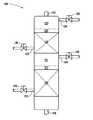
도 1은 2개의 액체로 충전된 수소화가공-촉매 베드를 포함하는 본 발명의 일 실시 형태에 사용하기에 적합한 하향 유동 반응기를 예시한다.1 illustrates a downward flow reactor suitable for use in one embodiment of the present invention comprising two liquid-filled hydroprocessing-catalyst beds.
<도 2><FIG. 2>
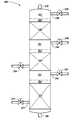
도 2는 3개의 액체로 충전된 수소화가공-촉매 베드를 포함하는 본 발명의 다른 실시 형태에 사용하기에 적합한 하향 유동 반응기를 예시한다.FIG. 2 illustrates a downward flow reactor suitable for use in another embodiment of the present invention comprising a hydroprocess-catalyzed bed filled with three liquids.
본 명세서에 사용되는 바와 같이, "수소화가공"은, 수소화, 수소화처리, 수소화탈황, 수소화탈질소, 수소화탈산소, 수소화탈금속, 수소화탈방향족, 탈왁스, 수소화이성체화, 및 수소화분해를 포함하나 이로 제한되지 않는, 수소의 존재 하에 실행되는 임의의 방법을 의미한다.As used herein, "hydroprocessing" includes hydrogenation, hydroprocessing, hydrodesulfurization, hydrodenitrification, hydrodeoxygenation, hydrodemetallization, hydrodearomatics, dewaxing, hydroisomerization, and hydrocracking. By any method, it is meant, but not limited to, any method carried out in the presence of hydrogen.
본 발명에 의해 규정된 반응기는 하향 유동 방식으로 연속 가공하기 위한 당업계에 공지된 임의의 적합한 반응기, 예를 들어, 관류형 반응기 또는 관형 반응기일 수 있다. 반응기에는 하나 이상의 수소화가공-촉매 베드가 장착된다. 다중-베드 반응기에서, 베드는 순차적으로 배치되며 액체 소통된다. 수소화가공-촉매 베드는, 그 명칭이 시사하는 바와 같이, 수소화가공-촉매로 이루어진다. 촉매는 베드 내에 제자리에 고정되며, 다시 말하면 고정-베드 촉매이다.The reactor defined by the present invention can be any suitable reactor known in the art for continuous processing in a downward flow manner, for example a perfusion reactor or a tubular reactor. The reactor is equipped with one or more hydroprocessing-catalyst beds. In a multi-bed reactor, the beds are arranged sequentially and in liquid communication. The hydroprocessing-catalyst bed, as its name suggests, consists of a hydroprocessing-catalyst. The catalyst is fixed in place in the bed, that is to say a fixed-bed catalyst.
반응기 내의 베드의 수는 이 수소화가공 구역 내의 복잡성 및 제어 비용과 같은 현실적인 고려사항에 기초할 수 있다. 본 명세서에 규정된 바와 같이 하나 이상의 촉매 베드는, 예를 들어 1 내지 10개의 베드 또는 2 내지 4개의 베드일 수 있다. 본 발명에 의해 규정된 반응기는, 예를 들어 1, 2, 3, 및 4개의 수소화가공-촉매 베드를 가진 반응기를 포함한다.The number of beds in the reactor may be based on realistic considerations such as complexity and control costs in this hydroprocessing zone. As defined herein, one or more catalyst beds may be, for example, 1 to 10 beds or 2 to 4 beds. Reactors defined by the present invention include, for example, reactors with one, two, three, and four hydroprocessing-catalyst beds.
단일 반응기 내에, 또는 다중 반응기 내에, 하나 초과의 촉매 베드가 존재하는 경우(각각의 촉매 베드는 촉매 부피를 가짐), 각각의 촉매 베드에서 동일한 수소 소모를 얻기 위하여 각각의 계속되는 베드와 함께 촉매 부피가 증가할 수 있다. 따라서, 2개 초과의 촉매 베드가 존재한다면, 이러한 실시 형태에서 제1 촉매 베드의 촉매 부피는 제2 촉매 베드의 촉매 부피보다 더 작으며, 이후로도 그러하다.In a single reactor, or in multiple reactors, where more than one catalyst bed is present (each catalyst bed has a catalyst volume), the catalyst volume is increased with each subsequent bed to achieve the same hydrogen consumption in each catalyst bed. Can increase. Thus, if there are more than two catalyst beds, in this embodiment the catalyst volume of the first catalyst bed is smaller than the catalyst volume of the second catalyst bed, and so on.
촉매는 수소화처리 촉매 또는 수소화분해 촉매일 수 있다. 본 명세서에서 "수소화처리"는, 헤테로원자, 예를 들어 황, 질소, 산소, 금속, 아스팔텐, 및 그의 조합을 제거하거나, 올레핀 및/또는 방향족을 수소화하기 위해, 수소화처리 촉매의 존재 하에 탄화수소 공급물을 수소와 반응시키는 방법을 의미한다. 본 명세서에서 "수소화분해"는, 탄소-탄소 결합의 파괴를 위하여 수소화분해 촉매의 존재 하에 탄화수소 공급물을 수소와 반응시켜, 탄화수소 공급물의 출발 평균 비등점 및 평균 분자량보다 더 낮은 평균 비등점 및/또는 더 낮은 평균 분자량의 탄화수소를 형성시키는 방법을 의미한다. 수소화분해는 나프텐계 고리를 더 선형인 쇄의 탄화수소로 개환하는 단계 또한 포함한다.The catalyst may be a hydrotreating catalyst or hydrocracking catalyst. “Hydrogenation” herein refers to hydrocarbons in the presence of a hydrotreating catalyst to remove heteroatoms such as sulfur, nitrogen, oxygen, metals, asphaltenes, and combinations thereof, or to hydrogenate olefins and / or aromatics. By means of reacting the feed with hydrogen. As used herein, “hydrocracking” refers to reacting a hydrocarbon feed with hydrogen in the presence of a hydrocracking catalyst to break carbon-carbon bonds, such that the starting boiling point and / or lower than the average molecular weight of the hydrocarbon feed A method of forming hydrocarbons of low average molecular weight. Hydrocracking also includes opening the naphthenic ring to a more linear chain of hydrocarbons.
수소화처리 촉매는 금속 및 산화물 지지체를 포함한다. 금속은 니켈, 코발트 및 그의 조합으로 이루어지는 군으로부터 선택된, 바람직하게는 몰리브덴 및/또는 텅스텐과 조합된, 비귀금속이다. 수소화처리 촉매 지지체는, 바람직하게는 알루미나, 실리카, 티타니아, 지르코니아, 규조토, 실리카-알루미나 제올라이트, 및 이들 중 2개 이상의 조합으로 구성된 군으로부터 선택된 단일- 또는 혼합-금속 산화물이다.Hydrotreating catalysts include metals and oxide supports. The metal is a non-noble metal selected from the group consisting of nickel, cobalt and combinations thereof, preferably combined with molybdenum and / or tungsten. The hydrotreating catalyst support is preferably a single- or mixed-metal oxide selected from the group consisting of alumina, silica, titania, zirconia, diatomaceous earth, silica-alumina zeolites, and combinations of two or more thereof.
수소화분해 촉매는 또한 금속 및 산화물 지지체를 포함한다. 금속은 니켈, 코발트, 및 그의 조합으로 이루어지는 군으로부터 선택된, 바람직하게는 몰리브덴 및/또는 텅스텐과 조합된, 비귀금속이다. 수소화분해 촉매 지지체는 제올라이트, 무정형 실리카, 알루미나, 또는 그의 조합이다.Hydrocracking catalysts also include metal and oxide supports. The metal is a non-noble metal selected from the group consisting of nickel, cobalt, and combinations thereof, preferably combined with molybdenum and / or tungsten. The hydrocracking catalyst support is zeolite, amorphous silica, alumina, or a combination thereof.
본 발명의 촉매는 니켈-몰리브덴(NiMo), 코발트-몰리브덴(CoMo), 니켈-텅스텐(NiW) 및 코발트-텅스텐(CoW), 및 그의 조합으로 구성된 군으로부터 선택된 금속의 조합을 포함할 수 있다.The catalyst of the present invention may comprise a combination of metals selected from the group consisting of nickel-molybdenum (NiMo), cobalt-molybdenum (CoMo), nickel-tungsten (NiW) and cobalt-tungsten (CoW), and combinations thereof.
본 발명에서 사용하기 위한 촉매는 예를 들어 활성탄, 흑연, 및 피브릴 나노튜브 카본뿐만 아니라, 탄산칼슘, 규산칼슘 및 황산바륨과 같은 탄소를 포함하는 다른 물질을 추가로 포함할 수 있다.Catalysts for use in the present invention may further comprise, for example, activated carbon, graphite, and fibrils nanotube carbon, as well as other materials including carbon such as calcium carbonate, calcium silicate and barium sulfate.
본 발명에서 사용하기 위한 촉매는 공지된 구매가능한 수소화가공 촉매를 포함한다. 금속 및 지지체는 유사하거나 또는 동일할 수 있지만, 촉매 제조자는 수소화처리 촉매 또는 수소화분해 촉매 중 어느 하나에 대한 조제물을 제공하기 위한 지식 및 경험을 갖고 있을 것이다. 하나 초과의 유형의 수소화가공 촉매를 수소화가공 반응기에 사용할 수 있다.Catalysts for use in the present invention include known commercially available hydroprocessing catalysts. Although metals and supports may be similar or identical, the catalyst manufacturer will have the knowledge and experience to provide formulations for either hydrotreatment catalysts or hydrocracking catalysts. More than one type of hydroprocessing catalyst may be used in the hydroprocessing reactor.
바람직하게는, 촉매는 입자 형태이고, 더욱 바람직하게는 성형된 입자이다. "성형된 입자"는 촉매가 압출물의 형태임을 의미한다. 압출물은 실린더, 펠렛 또는 구체를 포함한다. 실린더 형상은 하나 이상의 보강 리브를 갖는 중공 내부를 가질 수 있다. 3엽형(Trilobe), 4엽형(quadralobe), 클로버형(cloverleaf), 직사각형 및 삼각형 튜브, 십자가, 및 "C" 형 촉매가 사용될 수 있다. 충전된 베드 반응기가 사용되는 경우, 바람직하게는, 성형된 촉매 입자는 직경이 약 0.25 내지 약 13 mm(약 0.01 내지 약 0.5 인치)이다. 더욱 바람직하게는, 촉매 입자는 직경이 약 0.79 내지 약 6.4mm(약 1/32 내지 약 1/4 인치)이다. 이러한 촉매는 구매가능하다.Preferably, the catalyst is in the form of particles, more preferably shaped particles. "Formed particles" means that the catalyst is in the form of extrudates. The extrudate comprises a cylinder, pellet or sphere. The cylinder shape may have a hollow interior with one or more reinforcing ribs. Trilobe, quadralobe, cloverleaf, rectangular and triangular tubes, crosses, and "C" type catalysts can be used. If a packed bed reactor is used, preferably, the shaped catalyst particles have a diameter of about 0.25 to about 13 mm (about 0.01 to about 0.5 inches). More preferably, the catalyst particles have a diameter of about 0.79 to about 6.4 mm (about 1/32 to about 1/4 inch). Such catalysts are commercially available.
승온에서 수소의 존재 하에 촉매를 황-함유 화합물과 접촉시킴으로써 촉매를 황화시킬 수 있다. 적합한 황-함유 화합물은 티올, 황화물, 이황화물, H2S, 또는 이들 중 2종 이상의 조합을 포함한다. "승온"은 230℃(450℉) 초과 내지 340℃(650℉)를 의미한다. 촉매는 사용 전에("사전-황화") 또는 방법 중에 황화될 수 있다.The catalyst can be sulfided by contacting the catalyst with a sulfur-containing compound in the presence of hydrogen at elevated temperature. Suitable sulfur-containing compounds include thiols, sulfides, disulfides, H2 S, or combinations of two or more thereof. "Raised temperature" means greater than 230 ° C (450 ° F) to 340 ° C (650 ° F). The catalyst may be sulfided prior to use (“pre-sulfurization”) or during the process.
촉매는 본래 위치 밖에서(ex situ)에서 또는 본래 위치에서(in situ) 사전-황화될 수 있다. 촉매 베드의 외부에서(즉, 2-상 및 3-상 수소화가공 구역을 포함하는 수소화가공 단위의 외부에서) 촉매를 황-함유 화합물과 접촉시킴으로써, 촉매를 본래 위치 밖에서 사전-황화시킨다. 촉매 베드 내에서(즉, 2-상 및 3-상 수소화가공 구역을 포함하는 수소화가공 단위 내부에서) 촉매를 황-함유 화합물과 접촉시킴으로써, 촉매를 본래 위치에서 사전-황화시킨다. 바람직하게는, 2-상 및 3-상 수소화가공 구역의 촉매는 본래 위치에서 사전-황화된다.The catalyst may be pre-sulfurized either in situ or in situ. The catalyst is pre-sulfurized outside its original location by contacting the catalyst with a sulfur-containing compound outside of the catalyst bed (ie, outside of the hydroprocessing unit comprising the 2- and 3-phase hydroprocessing zones). The catalyst is pre-sulfurized in situ by contacting the catalyst with a sulfur-containing compound in the catalyst bed (ie, inside a hydroprocessing unit comprising a 2-phase and 3-phase hydroprocessing zone). Preferably, the catalysts of the two-phase and three-phase hydroprocessing zones are pre-sulfurized in situ.
액체 공급물을 제 1의 촉매와 접촉시키기 전에, 공급물 또는 희석제를 황-함유 화합물과 주기적으로 접촉시킴으로써 공정 동안 촉매를 황화시킬 수 있다.Prior to contacting the liquid feed with the first catalyst, the catalyst can be sulfided during the process by periodically contacting the feed or diluent with a sulfur-containing compound.
반응기 내로 도입되기 전에 탄화수소 공급물을 수소 기체 및 임의로 희석제와 접촉시켜 공급물/수소 혼합물 또는 공급물/희석제/수소 혼합물을 제공하며, 이는 액체 공급물 혼합물이다. 액체 공급물 혼합물을 제조하기 위한 접촉 작업은 당업계에 공지된 임의의 적합한 혼합 장치 내에서 수행될 수 있다.The hydrocarbon feed is contacted with hydrogen gas and optionally diluent prior to introduction into the reactor to provide a feed / hydrogen mixture or a feed / diluent / hydrogen mixture, which is a liquid feed mixture. The contacting operation for preparing the liquid feed mixture may be carried out in any suitable mixing device known in the art.
탄화수소 공급물은 바람직하지 않은 양의 오염물질(황, 질소, 금속) 및/또는 방향족을 포함하는 임의의 탄화수소 조성물일 수 있다. 탄화수소 공급물은 점도가 0.3 cP 이상이고, 밀도가 15.6℃(60℉)의 온도에서 750 ㎏/㎥ 이상이며, 종류점(end boiling point)이 약 200℃(390℉) 내지 약 700℃(1300℉)의 범위일 수 있다. 탄화수소 공급물은 광유, 합성유, 석유 유분(petroleum fraction), 또는 오일-샌드 분획(oil-sand fraction), 또는 이들 중 2개 이상의 조합일 수 있다. 석유 유분은 (a) 액화 석유 가스(LPG), 휘발유, 나프타와 같은 경질 증류물; (b) 등유, 디젤과 같은 중간 증류물(middle distillate); 및 (c) 중질 연료유, 윤활유, 왁스, 아스팔트와 같은 중질 증류물 및 잔류물과 같은, 3 개의 주요 범주로 분류될 수 있다. 이들 분류는 원유를 증류하고 유분(증류물)으로 분리하기 위한 일반 방법에 기초한다.The hydrocarbon feed may be any hydrocarbon composition that includes an undesirable amount of contaminants (sulfur, nitrogen, metals) and / or aromatics. The hydrocarbon feed has a viscosity of at least 0.3 cP, a density of at least 750 kg / m 3 at a temperature of 15.6 ° C. (60 ° F.), and an end boiling point of about 200 ° C. (390 ° F.) to about 700 ° C. (1300). In degrees Fahrenheit). The hydrocarbon feed may be mineral oil, synthetic oil, petroleum fraction, or oil-sand fraction, or a combination of two or more thereof. Petroleum fractions include (a) light distillates such as liquefied petroleum gas (LPG), gasoline, naphtha; (b) middle distillates such as kerosene, diesel; And (c) heavy fuel oils, lubricating oils, waxes, heavy distillates such as asphalt, and residues. These classifications are based on general methods for distilling crude oil and separating it into fractions (distillates).
바람직한 탄화수소 공급물은 제트 연료, 등유, 직류(straight run) 디젤, 경질 순환유(light cycle oil), 경질 코커 경유(light coker gas oil), 경유, 중질 순환유, 중질 코커 경유, 중질 경유, 잔유, 탈아스팔트 오일, 왁스, 윤활유, 및 이들 중 2개 이상의 조합으로 구성된 군으로부터 선택된다.Preferred hydrocarbon feeds are jet fuel, kerosene, straight run diesel, light cycle oil, light coker gas oil, diesel, heavy circulating oil, heavy coker diesel, heavy diesel, residual oil. , Deasphalted oil, wax, lubricating oil, and combinations of two or more thereof.
또 다른 바람직한 탄화수소 공급물은 중간 증류물 블렌드이며, 이는 2개 이상의 중간 증류물, 예를 들어 직류 디젤 및 경질 순환유의 혼합물이다. "중간 증류물"은, 나프타(약 300℉ 또는 149℃ 초과의 비등점) 초과에서 비등하고 잔류유(약 800℉ 또는 427℃ 초과의 비등점) 미만에서 비등하는 종합적인 석유 증류 분획을 의미한다. 중간 증류물은 등유, 제트 연료, 디젤 연료 및 연료유(난방유)로서 시판될 수 있는 것이다.Another preferred hydrocarbon feed is an intermediate distillate blend, which is a mixture of two or more intermediate distillates, for example direct diesel and light circulating oil. "Medium distillate" means a synthetic petroleum distillate fraction that boils above naphtha (boiling point above about 300 ° F or 149 ° C) and below residual oil (boiling point above about 800 ° F or 427 ° C). The middle distillate is one that can be marketed as kerosene, jet fuel, diesel fuel and fuel oil (heating oil).
희석제는, 사용하는 경우, 전형적으로 촉매 베드 중 하나로부터의 산물 유출물의 재순환 스트림을 포함하거나, 본질적으로 이로 구성되거나, 이로 구성된다. 재순환 스트림은 액체 재순환물이며, 탄화수소 공급물의 수소와의 접촉 전 또는 후에 탄화수소 공급물과 함께 재순환되고 및 조합되는 촉매 베드의 산물 유출물의 일부이다. 바람직하게는, 탄화수소 공급물은 탄화수소 공급물을 수소와 접촉시키기 전에 희석제와 접촉된다.Diluents, when used, typically comprise, consist essentially of, or consist of a recycle stream of product effluent from one of the catalyst beds. The recycle stream is a liquid recycle and is part of the product effluent of the catalyst bed that is recycled and combined with the hydrocarbon feed before or after contacting the hydrocarbon feed with hydrogen. Preferably, the hydrocarbon feed is contacted with a diluent prior to contacting the hydrocarbon feed with hydrogen.
액체 공급물 혼합물은 "수소화가공 조건" 하에 반응기 내로 도입되며, 이는 촉매 베드 내에서의 목적하는 수소화가공 반응을 달성하기 위해 필요한 승온 및 승압 조건을 지칭한다. 각각의 촉매 베드는 약 200℃ 내지 약 450℃, 바람직하게는 약 250℃ 내지 약 400℃, 더욱 바람직하게는 약 330℃ 내지 약 390℃의 온도, 및 약 0.1 내지 약 10 hr-1, 바람직하게는 약 0.4 내지 약 8.0 hr-1, 더욱 바람직하게는 약 0.4 내지 약 6.0 hr-1의 액체 시간당 공간 속도(liquid hourly space velocity)를 제공하는 액체 공급 속도를 갖는다. 2-상 수소화가공 구역의 각각의 촉매 베드의 압력은 약 3.45 MPa(34.5 바) 내지 약 17.3 MPa(173 바)이다.The liquid feed mixture is introduced into the reactor under “hydroprocessing conditions”, which refers to the elevated temperature and elevated pressure conditions necessary to achieve the desired hydroprocessing reaction in the catalyst bed. Each catalyst bed has a temperature of about 200 ° C. to about 450 ° C., preferably about 250 ° C. to about 400 ° C., more preferably about 330 ° C. to about 390 ° C., and about 0.1 to about 10 hr −1, preferably Has a liquid feed rate that provides a liquid hourly space velocity of about 0.4 to about 8.0 hr-1, more preferably about 0.4 to about 6.0 hr-1. The pressure of each catalyst bed in the two-phase hydroprocessing zone is from about 3.45 MPa (34.5 bar) to about 17.3 MPa (173 bar).
연속 액체 공급물이 반응기에서 하향 유동함에 따라, 그것은 각각의 촉매 베드에 접촉되며, 여기서 수소화가공 반응이 일어난다(본 명세서에서 지칭될 수 있는 바와 같이, "수소화가공 구역"). 전체 베드를 가로질러 액체 공급물의 분배를 보조하는 분배기 플레이트로 촉매 베드의 상부를 덮을 수 있다. 각각의 촉매 베드가 실질적으로 액체로 충전되도록, 액체 공급물은 각각의 촉매 베드를 충전한다. 실질적으로 액체로 충전된다는 것은, 작업 중에, 촉매 베드가 실질적으로 기체상 수소가 없는 고체 촉매 및 액체 공급물을 포함하는 2-상임을 의미한다. 수소 기체가 주입되는 베드의 경우, "실질적으로 기체상 수소가 없는"은, 촉매 베드에 주입된 수소 기체의 50% 이하, 바람직하게는 10% 이하, 더욱 바람직하게는 1% 이하가 헤드스페이스 내로 탈출하기에 충분할 만큼 오래 기체상에 잔류함을 의미한다.As the continuous liquid feed flows downward in the reactor, it contacts each catalyst bed where a hydroprocessing reaction occurs (as may be referred to herein, the "hydroprocessing zone"). The top of the catalyst bed may be covered with a distributor plate to assist in the distribution of the liquid feed across the entire bed. The liquid feed fills each catalyst bed such that each catalyst bed is substantially filled with liquid. Substantially filled with liquid means that during operation, the catalyst bed is a two-phase comprising a solid catalyst and a liquid feed substantially free of gaseous hydrogen. For beds into which hydrogen gas is injected, "substantially free of gaseous hydrogen" means that up to 50%, preferably up to 10%, more preferably up to 1% of the hydrogen gas injected into the catalyst bed into the headspace Remains in the gas phase long enough to escape.
수소 기체는 수소화가공-촉매 베드 중 하나 이상에 주입된다. 수소화가공 반응에 의해 소모되는 수소가 보충됨과 동시에 각각의 촉매 베드에 실질적으로 액체상인 조건이 유지되도록 기체 주입의 속도를 제어한다. 촉매 베드 내의 액체상으로부터 미량의(존재하는 경우) 수소 기체가 탈출하도록 하는 방식 및 속도로 수소를 베드에 주입할 수 있다. 수소 기체의 완전 용해 전에 일부 순간적인 기포 형성이 있을 수 있으나, 공급물 혼합물은 실질적으로 액체상이고 촉매 베드는 여전히 실질적으로 액체로 충전되어 있다. 패킹된 촉매 입자는 액체 공급물 내에서 수소가 역류하여 상승할 때 수소의 혼합을 보조한다. 수소는 버블러(bubbler), 스파지 튜브(sparge tube), 천공 환상 고리(perforated annular ring), 또는 당업계에 공지된 임의의 다른 적합한 수단을 통해 베드에 주입될 수 있다.Hydrogen gas is injected into at least one of the hydroprocessing-catalyst beds. The rate of gas injection is controlled so that hydrogen consumed by the hydroprocessing reaction is replenished, while maintaining substantially liquid conditions in each catalyst bed. Hydrogen may be injected into the bed in a manner and at a rate that allows traces (if any) of hydrogen gas to escape from the liquid phase in the catalyst bed. There may be some instant bubble formation before complete dissolution of the hydrogen gas, but the feed mixture is substantially liquid and the catalyst bed is still substantially filled with liquid. The packed catalyst particles assist in the mixing of hydrogen as it rises back in the liquid feed. Hydrogen can be injected into the bed via a bubbler, sparge tube, perforated annular ring, or any other suitable means known in the art.
각각의 촉매 베드 위에는 헤드스페이스가 있으며, 액체로 충전된 촉매 베드로부터 탈출하는 임의의 기체가 여기에 수집될 수 있다. 단일 베드 또는 순차적인 제1 촉매 베드에 대한 헤드스페이스의 상단부는 일반적으로 반응기의 상부에 의해 형성될 것이나, 기체를 수집하기 위해 설계된 임의의 반응기 특징부일 수 있으며 그럴 필요는 없다. 제2 촉매 베드 및 다른 후속의 촉매 베드의 경우, 주어진 베드에 대한 헤드스페이스의 상단부는 일반적으로 그 앞의 촉매 베드의 하부에 의해 형성될 것이나, 이 또한 기체를 수집하기 위해 설계된 임의의 반응기 특징부일 수 있으며 그럴 필요는 없다.There is a headspace above each catalyst bed, and any gas that escapes from the liquid filled catalyst bed can be collected there. The upper end of the headspace for a single bed or sequential first catalyst bed will generally be formed by the top of the reactor, but may or may not be any reactor feature designed to collect gas. For the second catalyst bed and other subsequent catalyst beds, the top of the headspace for a given bed will generally be formed by the bottom of the catalyst bed in front of it, but this may also be any reactor feature designed to collect gas. You can and do not have to.
촉매 베드 중 임의의 것 또는 전부 위의 헤드스페이스에는 헤드스페이스로부터 과량의 기체를 배기시킬 수 있는 배기구가 장착될 수 있다. 각각의 배기구에는 기체의 유동을 조절할 수 있는 기체 밸브가 장착될 수 있다. 본 명세서에서 용어 "배기구"는 편의상 단수로 사용되지만, 주어진 헤드스페이스에 하나 초과의 배기구가 존재할 수 있는 상황을 포함하는 것으로 이해되어야 한다. 배기된 기체는 과량의 수소, 경질 탄화수소 분획, 및 휘발성 황 및 질소 화합물 중 임의의 하나 또는 다수를 포함할 수 있다.The headspace above any or all of the catalyst beds may be equipped with vents capable of venting excess gas from the headspace. Each exhaust port may be equipped with a gas valve to regulate the flow of gas. Although the term "exhaust" is used herein in the singular for convenience, it should be understood to include situations where there may be more than one exhaust in a given headspace. The vented gas may comprise excess one of hydrogen, light hydrocarbon fractions, and any one or many of volatile sulfur and nitrogen compounds.
예를 들어, 헤드스페이스 아래의 촉매 베드 내의 액체 수준의 위치에 의해, 헤드스페이스 내의 압력으로부터, 또는 당업계에 공지된 임의의 다른 적합한 방법 및 그의 임의의 조합에 의해, 헤드스페이스 내의 과량의 기체의 양을 결정할 수 있다. 양, 발생 속도, 및 수소 함량을 포함하는, 주어진 헤드스페이스 내의 과량의 기체에 관한 정보를 사용하여 그 헤드스페이스 아래의 촉매 베드 내로의 수소 주입의 제어된 속도를 결정할 수 있다.For example, by the location of the liquid level in the catalyst bed below the headspace, from the pressure in the headspace, or by any other suitable method and any combination thereof known in the art, the excess of gas in the headspace The amount can be determined. Information about excess gas in a given headspace, including amount, rate of occurrence, and hydrogen content, can be used to determine the controlled rate of hydrogen injection into the catalyst bed below that headspace.
바람직하게는, 배기된 수소의 총량은, 수소화가공-촉매 베드(들)에 주입된 총 수소 기체의 몰 기준으로 10% 이하, 더욱 바람직하게는 5% 이하이다. 배기된 수소의 총량은 모든 헤드스페이스 배기구로부터 배기된 모든 수소의 누적량을 지칭하고, 주입된 총 수소 기체는 모든 수소화가공-촉매 베드(들)에 주입된 모든 수소 기체의 누적량을 지칭한다.Preferably, the total amount of exhausted hydrogen is 10% or less, more preferably 5% or less, based on the moles of the total hydrogen gas injected into the hydroprocessing-catalyst bed (s). The total amount of hydrogen exhausted refers to the cumulative amount of all hydrogen exhausted from all headspace vents, and the total hydrogen gas injected refers to the cumulative amount of all hydrogen gas injected into all hydroprocessing-catalyst bed (s).
본 발명의 방법은 하나 이상의 베드 전에 액체 공급물에 수소를 용해시키기 위한 기체 포화기 또는 인-라인 기체 혼합기를 임의로 포함할 수 있다.The process of the present invention may optionally include a gas saturator or an in-line gas mixer for dissolving hydrogen in the liquid feed prior to one or more beds.
수소화가공-베드의 수 및 수소 주입 지점의 선택에 관련하여 다양한 반응기 구성이 가능함을, 당업자는 인식할 것이다. 예를 들어, 본 발명의 일 실시 형태에서, 하향 유동 반응기는 순차적인 2개의 수소화가공-촉매 베드(제1 수소화가공-촉매 베드 뒤에 제2 수소화가공-촉매 베드가 이어짐)를 포함하며, 수소는 제2 촉매 베드에 주입된다.Those skilled in the art will recognize that various reactor configurations are possible with regard to the number of hydroprocessing-beds and the choice of hydrogen injection point. For example, in one embodiment of the present invention, the downflow reactor comprises two sequential hydroprocessing-catalyst beds followed by a first hydroprocessing-catalyst bed followed by a second hydroprocessing-catalyst bed, wherein hydrogen is Injected into the second catalyst bed.
본 발명의 다른 실시 형태에서, 하향 유동 반응기는 순차적인 3개의 수소화가공-촉매 베드를 포함하며, 수소 기체는 순차적으로 마지막인 수소화가공-촉매 베드에 주입된다.In another embodiment of the invention, the downflow reactor comprises three sequential hydroprocessing-catalyst beds, wherein hydrogen gas is sequentially injected into the last hydroprocessing-catalyst bed.
본 발명의 또 다른 실시 형태에서, 하향 유동 반응기는 순차적인 3개의 수소화가공-촉매 베드(제1 수소화가공-촉매 베드 뒤에 제2 수소화가공-촉매 베드가 이어지고, 그 뒤에 제3 수소화가공-촉매 베드가 이어짐)를 포함하며, 수소 기체는 제2 및 제3 수소화가공-촉매 베드에 주입된다.In another embodiment of the present invention, the downflow reactor is followed by three sequential hydroprocessing-catalyst beds (first hydroprocessing-catalyst bed followed by a second hydroprocessing-catalyst bed, followed by a third hydroprocessing-catalyst bed). Hydrogen gas is injected into the second and third hydroprocessing-catalyst beds.
본 발명의 또 다른 실시 형태에서, 하향 유동 반응기는 2개 이상의 수소화가공-촉매 베드를 포함하며, 수소 기체는 2개 이상의 수소화가공-촉매 베드 전부에 주입된다.In another embodiment of the present invention, the downflow reactor comprises two or more hydroprocessing-catalyst beds, wherein hydrogen gas is injected into all of the two or more hydroprocessing-catalyst beds.
본 발명의 추가의 태양은 도면에 예시되어 있다.Further aspects of the invention are illustrated in the figures.
도면의 상세한 설명Detailed description of the drawings
도 1은 본 발명의 방법의 일 실시 형태를 위한 하향 유동 반응기 단위(100)를 예시한다. 단순성을 위해, 그리고 방법의 주된 특징부를 설명하기 위해, 본 방법의 소정의 상세한 특징부, 예를 들어 펌프, 압축기, 분리 장비, 공급 탱크, 열 교환기, 산물 회수 용기, 및 다른 보조적인 공정 장비는 나타내지 않는다. 이러한 보조적인 특징부는 임의의 난점 또는 과도한 실험 없이 당업자에 의해 용이하게 설계되고 사용될 수 있다.1 illustrates a
혼합기 내에서 탄화수소 공급물을 수소 및 임의로 희석제와 접촉시킴으로써 형성시킨 액체 공급물 혼합물을 하향 유동 반응기 단위(100)의 상부 입구(120)에 공급한다. 액체 공급물은 하향 이동하여 제1 촉매 베드(130) 및 제2 촉매 베드(150)에 접촉한다. 베드(130 및 150)가 완전히 액체-충전되도록 제1 베드(130) 내의 액체 수준(125) 및 제2 베드(150) 내의 액체 수준(143)을 설정한다. 입구(133)에서 제1 베드(130)에, 그리고 입구(152)에서 제2 베드(150)에 수소를 주입한다. 수소 주입의 속도는 밸브(136 및 155)에 의해 제어된다. 액체 공급물 혼합물 내에서의 그의 용해도를 초과하는 기체는, 제1 촉매 베드(130) 위의 헤드스페이스(123) 및 제2 촉매 베드(150) 위의 헤드스페이스(141) 내에 수집된다. 각각의 헤드스페이스(123 및 141) 내의 기체는 각각 배기구(126 및 146)를 통해 배기되고, 헤드스페이스 배기구(126 및 146)를 통한 기체의 유동은 각각 밸브(128 및 148)에 의해 제어된다. 유출물은 반응기 단위(100)의 출구(159)에서 제2 촉매 베드(150)로부터 나온다.The liquid feed mixture formed by contacting the hydrocarbon feed with hydrogen and optionally diluent in the mixer is fed to the
도 2는 본 발명의 방법의 다른 실시 형태를 위한 하향 유동 반응기 단위(200)를 예시한다. 도1에서와 같이, 단순성을 위해 일부 통상적인 구성요소는 예시하지 않는다.2 illustrates a
혼합기 내에서 탄화수소 공급물을 수소 및 희석제(밸브(254)를 통해 제2 반응기(250)로부터)와 접촉시킴으로써 형성시킨 액체 공급물 혼합물을 입구(220)를 통해 하향 유동 반응기 단위(200)의 상부에 공급한다. 액체 공급물은 하향 이동하여 제1 촉매 베드(230) 및 제2 촉매 베드(250)에 접촉한다. 베드(230 및 250)가 완전히 액체-충전되도록 제1 베드(230) 내의 액체 수준(225) 및 제2 베드(250) 내의 액체 수준(243)을 설정한다. 제1 베드(230) 또는 제2 베드(250) 내의 임의의 과량의 수소는 제1 베드(230)의 헤드스페이스(223) 또는 제2 베드(250)의 헤드스페이스(241) 내에 수집될 수 있다. 각각의 헤드스페이스(223 및 241) 내의 기체는 배기구(226 및 246)를 통해 배기될 수 있다. 배기구(226 및 246)를 통한 기체의 부피는 각각 밸브(228 및 248)에 의해 제어된다.The liquid feed mixture formed by contacting the hydrocarbon feed with hydrogen and diluent (from the
제2 촉매 베드(250)로부터의 유출물의 일부는 밸브(254)를 통해 액체 공급물 혼합물을 위한 희석제로서 제거된다. 제2 베드(250)로부터의 유출물의 나머지 부분은 제3 촉매 베드(270)로의 공급물로서 계속된다. 제3 베드(270) 내의 액체 공급물 수준(264)은 베드를 완전히 충전한다. 수소는 입구(277)에서 제3 베드(270)에 주입되며 수소 주입의 속도는 밸브(274)에 의해 제어된다. 기체, 특히 액체 공급물 혼합물 내에서의 그의 용해도를 초과하는 임의의 수소 기체는, 제3 촉매 베드(270) 위의 헤드스페이스(262) 내에 수집되며 배기구(265)를 통해 배기된다. 헤드스페이스 배기구(265)를 통한 기체의 유동은 밸브(267)에 의해 제어된다. 제2 촉매 베드(250)로부터의 유출물은 수소화가공 반응기 단위(200)의 출구(281)에서 나온다.A portion of the effluent from the
실시예Example
분석 방법 및 용어Analytical Methods and Terminology
모든 ASTM 표준은 펜실베니아주 웨스트 콘쇼호켄 소재의 ASTM 인터내셔날(ASTM International)로부터 입수가능하다.All ASTM standards are available from ASTM International, West Conshohoken, Pennsylvania.
황 및 질소의 양은 중량 백만분율(wppm) 단위로 제공된다.The amounts of sulfur and nitrogen are given in weight parts per million (wppm).
총 황은 2가지 방법, 즉, 문헌[ASTM D4294 (2008), "Standard Test Method for Sulfur in Petroleum and Petroleum Products by Energy Dispersive X-ray Fluorescence Spectrometry," DOI: 10.1520/D4294-08] 및 문헌[ASTM D7220 (2006), "Standard Test Method for Sulfur in Automotive Fuels by Polarization X-ray Fluorescence Spectrometry," DOI: 10.1520/D7220-06]을 사용하여 측정하였다. 총 질소는 문헌[ASTM D4629 (2007), "Standard Test Method for Trace Nitrogen in Liquid Petroleum Hydrocarbons by Syringe/Inlet Oxidative Combustion and Chemiluminescence Detection," DOI: 10.1520/D4629-07] 및 문헌[ASTM D5762 (2005), "Standard Test Method for Nitrogen in Petroleum and Petroleum Products by Boat-Inlet Chemiluminescence," DOI: 10.1520/D5762-05]을 사용하여 측정하였다.Total sulfur is described in two methods, ASTM D4294 (2008), "Standard Test Method for Sulfur in Petroleum and Petroleum Products by Energy Dispersive X-ray Fluorescence Spectrometry," DOI: 10.1520 / D4294-08 and ASTM D7220. (2006), "Standard Test Method for Sulfur in Automotive Fuels by Polarization X-ray Fluorescence Spectrometry," DOI: 10.1520 / D7220-06]. Total nitrogen is described in ASTM D4629 (2007), "Standard Test Method for Trace Nitrogen in Liquid Petroleum Hydrocarbons by Syringe / Inlet Oxidative Combustion and Chemiluminescence Detection," DOI: 10.1520 / D4629-07 and ASTM D5762 (2005), "Standard Test Method for Nitrogen in Petroleum and Petroleum Products by Boat-Inlet Chemiluminescence," DOI: 10.1520 / D5762-05].
방향족 함량은 문헌[ ASTM Standard D5186 - 03(2009), "Standard Test Method for Determination of Aromatic Content and Polynuclear Aromatic Content of Diesel Fuels and Aviation Turbine Fuels by Supercritical Fluid Chromatography", DOI: 10.1520/D5186-03R09]을 사용하여 결정하였다.The aromatic content is used in ASTM Standard D5186-03 (2009), "Standard Test Method for Determination of Aromatic Content and Polynuclear Aromatic Content of Diesel Fuels and Aviation Turbine Fuels by Supercritical Fluid Chromatography", DOI: 10.1520 / D5186-03R09. Was determined.
비등점 범위 분포는 문헌[ ASTM D2887 (2008), "Standard Test Method for Boiling Range Distribution of Petroleum Fractions by Gas Chromatography," DOI: 10.1520/D2887-08] 및 문헌[ASTM D86 (2009) Standard Test Method for Distillation of Petroleum Products at Atmospheric Pressure," DOI: 10.1520/D0086-09]을 사용하여 결정하였다. 비등점은 D2887에 기재된 바와 같이 D2887 데이터로부터 계산된 D86 증류 곡선에 기초하였다.Boiling point range distributions are described in ASTM D2887 (2008), "Standard Test Method for Boiling Range Distribution of Petroleum Fractions by Gas Chromatography," DOI: 10.1520 / D2887-08 and ASTM D86 (2009) Standard Test Method for Distillation of Petroleum Products at Atmospheric Pressure, "DOI: 10.1520 / D0086-09]. The boiling point was based on the D86 distillation curve calculated from the D2887 data as described in D2887.
밀도, 비중, 및 API 비중(API Gravity)은 문헌[ASTM Standard D4052 (2009), "Standard Test Method for Density, Relative Density, and API Gravity of Liquids by Digital Density Meter," DOI: 10.1520/D4052-09]을 사용하여 측정하였다.Density, specific gravity, and API Gravity are described in ASTM Standard D4052 (2009), "Standard Test Method for Density, Relative Density, and API Gravity of Liquids by Digital Density Meter," DOI: 10.1520 / D4052-09. Measured using.
"API 비중"은 미국 석유 협회(American Petroleum Institute) 비중을 지칭하며, 이는 석유 액체가 물에 비해 얼마나 중질 또는 경질인지의 측정값이다. 석유 액체의 API 비중은 10초과이며, 이는 물보다 가벼워서 뜨고; 10미만인 경우, 물보다 무거워 가라앉는다. 따라서 API 비중은 석유 액체의 상대 밀도 및 물의 밀도의 역측정치이며, 석유 액체의 상대 밀도를 비교하기 위해 사용된다."API specific gravity" refers to the American Petroleum Institute specific gravity, which is a measure of how heavy or hard the petroleum liquid is compared to water. The API gravity of petroleum liquids is over 10, which is lighter than water and floats; If it is less than 10, it is heavier than water and sinks. API specific gravity is therefore an inverse measure of the relative density of petroleum liquids and the density of water and is used to compare the relative density of petroleum liquids.
비중(SG: specific gravity)으로부터 석유 액체의 API 비중을 얻는 수학식은 하기와 같다:The equation for obtaining the API gravity of a petroleum liquid from the specific gravity (SG) is as follows:
API 비중 = (141.5/SG) - 131.5API specific gravity = (141.5 / SG)-131.5
브롬수는 석유 샘플 중 지방족 불포화의 측정값이다. 브롬수는 문헌[ASTM Standard D1159, 2007, "Standard Test Method for Bromine Numbers of Petroleum Distillates and Commercial Aliphatic Olefins by Electrometric Titration," DOI: 10.1520/D1159-07]을 사용하여 결정하였다.Bromine number is a measure of aliphatic unsaturation in petroleum samples. Bromine number was determined using ASTM Standard D1159, 2007, "Standard Test Method for Bromine Numbers of Petroleum Distillates and Commercial Aliphatic Olefins by Electrometric Titration," DOI: 10.1520 / D1159-07.
세탄 지수는, 시험 엔진이 이용가능하지 않거나 또는 이 성질을 직접 측정하기에 샘플 크기가 너무 작은 경우 디젤 연료의 세탄가(디젤 연료의 연소 품질 측정값)를 평가하는데 유용한 계산값이다. 세탄 지수는 문헌[ASTM Standard D4737 (2009a), "Standard Test Method for Calculated Cetane Index by Four Variable Equation," DOI: 10.1520/D4737-09a]을 사용하여 결정하였다.The cetane index is a useful calculation to evaluate the cetane number of diesel fuel (combustion quality measurement of diesel fuel) if the test engine is not available or if the sample size is too small to directly measure this property. Cetane index was determined using ASTM Standard D4737 (2009a), “Standard Test Method for Calculated Cetane Index by Four Variable Equation,” DOI: 10.1520 / D4737-09a.
"LHSV"는 액체 시간당 공간 속도를 의미하며, 이는 액체 공급물의 부피 속도를 촉매의 부피로 나눈 것이며, hr-1 단위로 주어진다."LHSV" means liquid hourly space velocity, which is the volumetric velocity of the liquid feed divided by the volume of the catalyst, given in hr-1 units.
굴절률(RI: Refractive Index)은 문헌[ASTM Standard D1218 (2007), "Standard Test Method for Refractive Index and Refractive Dispersion of Hydrocarbon Liquids," DOI: 10.1520/D1218-02R07]을 사용하여 결정하였다.Refractive Index (RI) was determined using ASTM Standard D1218 (2007), “Standard Test Method for Refractive Index and Refractive Dispersion of Hydrocarbon Liquids,” DOI: 10.1520 / D1218-02R07.
"WABT"는 가중평균 베드 온도를 의미한다."WABT" means weighted average bed temperature.
이들 실시예에서 수소화가공 단위는 일련의 4개의 반응기를 포함하였으며, 각각은 각각의 단부에 6 mm(¼") 직경으로의 리듀서(reducer)를 가진 19 mm(¾") OD 316L 스테인리스강 튜빙(길이 49 cm(19 ¼"))으로 작제되었다. 목적하는 부피의 촉매를 반응기의 중간-섹션에 로딩하고 양쪽 단부를 금속 스크린으로 캡핑하여 누출을 방지하였다. 금속 메쉬 후에, 1 mm 유리 비드로 양쪽 단부에서 반응기를 패킹하여 나머지 부피를 충전하였다.In these examples the hydroprocessing unit included a series of four reactors, each with a 19 mm (¾ ") OD 316L stainless steel tubing with a reducer of 6 mm (¼") diameter at each end. 49 cm (19 1/4 ") in length. The desired volume of catalyst was loaded into the middle-section of the reactor and capped at both ends with a metal screen to prevent leakage. After the metal mesh, both sides with 1 mm glass beads At the end the reactor was packed to fill the remaining volume.
OD가 8.9 cm(공칭 3", 스케줄(Schedule) 40)인 고운 모래로 충전된 120 cm 길이의 강관으로 구성된 온도-제어된 모래조에 각각의 반응기를 넣었다. 각각의 반응기의 입구 및 출구에서 온도를 모니터링하고, 8.9 cm OD의 모래조를 둘러싼 별도의 열 테이프를 사용하여 제어하였다.Each reactor was placed in a temperature-controlled sand bath consisting of a 120 cm long steel pipe filled with fine sand with an OD of 8.9 cm (nominal 3 ", Schedule 40). Monitored and controlled using a separate thermal tape surrounding a 8.9 cm OD sand bath.
반응기의 입구 및 출구에 6-mm OD의 316L 스테인리스강 튜빙을 연결하고, 이를 통해 반응물을 공급하였다. 하나의 반응기로부터의 유출물은 순차적으로 다음 반응기를 위한 공급물이 된다. 반응기 입구로 가는 도중에 모래조를 통과시킴으로써 각각의 반응기로의 공급물을 인-라인 예열하였다. 모든 실행에서 모든 반응기를 통한 유동은 상향이다.A 6-mm OD 316L stainless steel tubing was connected to the inlet and outlet of the reactor through which the reactants were fed. The effluent from one reactor is in turn the feed for the next reactor. The feed to each reactor was pre-heated by passing a sand bath along the way to the reactor inlet. In all runs the flow through all reactors is upwards.
하기의 실시예들은 본 발명을 예시하기 위하여 제공된 것이며, 본 발명의 범주를 어떠한 방식으로든 제한하는 것으로 간주되어서는 안된다.The following examples are provided to illustrate the invention and should not be considered as limiting the scope of the invention in any way.
대조군 A 및 실시예 1Control Group A and Example 1
이 세트의 실시예에서, 새 공급물은 표 1에 나타낸 특성을 갖는 중간 증류물 블렌드(MD1)였다. 직류 디젤(SRD, 68 중량%) 샘플과 경질-순환유(LCO, 32 중량%) 샘플(양자 모두 상업적 정유공장으로부터 입수함)을 혼합함으로써 이를 제조하였다.In this set of examples, the fresh feed was an intermediate distillate blend (MD1) having the properties shown in Table 1. It was prepared by mixing a sample of direct current diesel (SRD, 68% by weight) and a sample of light-circulating oil (LCO, 32% by weight), both of which were obtained from a commercial refinery.
반응기 R1, R2, R3, 및 R4는 각각 12 mL, 24 mL, 36 mL, 및 48 mL의 수소화처리 촉매를 함유하였으며, 이는 1.3 mm 직경 및 약 10 mm 길이의 4엽형 형태인 KF-860-1.3Q(γ-Al2O3 상의 Ni-Mo; 루이지애나주 배턴 루지 소재의 알버말 코포레이션(Albemarle Corp.))였다.Reactors R1, R2, R3, and R4 contained 12 mL, 24 mL, 36 mL, and 48 mL of the hydrotreatment catalyst, respectively, which were KF-860-1.3 in 4-leaf form of 1.3 mm diameter and about 10 mm long. Q (Ni-Mo on γ-Al2 O3 ; Albemarle Corp., Baton Rouge, Louisiana).

반응기 내의 수소화처리 촉매를 400 표준 세제곱 센티미터/분(sccm)의 수소 기체의 총 유동 하에 115℃에서 밤새 건조시켰다. 촉매 베드을 통과하는 차콜 라이터 플루이드(charcoal lighter fluid)(CLF)의 유동을 사용하여 반응기를 176℃로 가열하였다. 황 스파이크된-CLF(spiked-CLF)(1-도데칸티올로서 첨가된 황 1 중량%) 및 수소 기체를 176℃에서 반응기를 통해 통과시켜 촉매를 사전-황화시켰다. 압력은 6.9 MPa(1000 psig, 69 바)이었다.The hydrotreating catalyst in the reactor was dried overnight at 115 ° C. under a total flow of 400 standard cubic centimeters per minute (sccm) of hydrogen gas. The reactor was heated to 176 ° C. using a flow of charcoal lighter fluid (CLF) through the catalyst bed. Sulfur spiked-CLF (1 wt% sulfur added as 1-dodecanethiol) and hydrogen gas were passed through the reactor at 176 ° C. to pre-sulfurize the catalyst. The pressure was 6.9 MPa (1000 psig, 69 bar).
반응기의 온도를 점진적으로 320℃로 증가시켰다. 황화수소(H2S)의 통과가 R4의 출구에서 관찰될 때까지 320℃에서 사전-황화를 계속하였다. 사전-황화 후, 320℃ 내지 355℃로 변동되는 온도 및 6.9 MPa(1000 psig, 69 바)의 압력에서 대략 10시간 동안, 직류 디젤(SRD)을 반응기 내의 촉매를 통해 유동시킴으로써 촉매를 안정화시켰다.The temperature of the reactor was gradually increased to 320 ° C. Pre-sulfurization was continued at 320 ° C. until passage of hydrogen sulfide (H2 S) was observed at the exit of R4. After pre-sulfurization, the catalyst was stabilized by flowing direct current diesel (SRD) through the catalyst in the reactor for approximately 10 hours at a temperature varying from 320 ° C. to 355 ° C. and a pressure of 6.9 MPa (1000 psig, 69 bar).
사전-황화되고 안정화된 촉매를 이용하여, 각각의 반응기 내의 온도를 349℃가 되도록 하여 수소화가공 반응을 수행하였다.Using a pre-sulfurized and stabilized catalyst, the hydroprocessing reaction was carried out at a temperature of 349 ° C. in each reactor.
용적형 펌프가 새 공급물을 R1에 4.0 mL/min의 유속으로 제공하였으며, 이는 수소화가공 구역을 통한 2 hr-1의 전체 액체-시간당 공간 속도(LHSV)에 해당한다. 수소화가공 구역은 촉매에 의해 점유된 반응기 공간의 부피이다(이 경우에, 4개의 반응기에 걸쳐 120 mL의 총 촉매).The volumetric pump provided a fresh feed to R1 at a flow rate of 4.0 mL / min, corresponding to a total liquid-hour space velocity (LHSV) of 2 hr−1 through the hydroprocessing zone. The hydroprocessing zone is the volume of reactor space occupied by the catalyst (in this
대조군 A에서, R4로부터의 유출물은 액체 재순환 스트림 및 최종 산물 스트림으로 분할되었다. 액체 재순환 스트림은 피스톤 계량 펌프를 통해 유동하여 R1의 입구로 가는 새 공급물과 조합되었다. 대조군 A는 2의 재순환 비율(액체 재순환 스트림의 부피 대 새 공급물의 부피)을 채용하였다. 실시예 1은 재순환을 채용하지 않았으나, 그 외에는 대조군 A와 동일한 조건을 사용하였다.In Control A, the effluent from R4 was split into a liquid recycle stream and a final product stream. The liquid recycle stream was combined with fresh feed flowing through the piston metering pump to the inlet of R1. Control A employed a recycle ratio of 2 (volume of liquid recycle stream to volume of fresh feed). Example 1 did not employ recycle, but otherwise used the same conditions as control A.
각각의 4개 반응기 전에 수소를 공급물 스트림에 주입하였다. 수소는 압축된 가스 실린더로부터 공급되었으며, 전용 질량유량조절계(mass flow controller)를 사용하여 유동을 측정하였다. 총 수소 공급 속도는 새 공급물 리터 당 수소 기체 107 노르말 리터(NL/L)(600 scf/bbl)였다. R1로의 입구에서의 압력은 공칭 8.27 MPa(1200 psia, 82.7 바)이었다.Hydrogen was injected into the feed stream before each of the four reactors. Hydrogen was supplied from a compressed gas cylinder and the flow was measured using a dedicated mass flow controller. The total hydrogen feed rate was 107 normal liters (NL / L) of hydrogen gas (600 scf / bbl) per liter of fresh feed. The pressure at the inlet to R1 was nominally 8.27 MPa (1200 psia, 82.7 bar).
설계에 의해, 반응기 내에서의 수소 소모는 완전하지 않고 일부 수소가 액체 스트림 중에 반응기로부터 나오지만, 각각의 반응기에서 소모되는 수소의 양이 대략 동일하도록 촉매 부피를 선택하였다. 대략 동일한 양의 수소를 각각의 반응기 2 내지 4에 주입하여 소모된 수소를 보충하였다. R1로의 새 공급물은 잔류 수소를 함유하지 않으므로 제1 반응기에 주입되는 수소의 양은 다른 3개보다 약간 더 많다.By design, the catalyst volume was chosen such that the hydrogen consumption in the reactor was not complete and some hydrogen came out of the reactor in the liquid stream, but the amount of hydrogen consumed in each reactor was approximately equal. Approximately equal amounts of hydrogen were injected into each of the reactors 2 to 4 to replenish the consumed hydrogen. The new feed to R1 does not contain residual hydrogen, so the amount of hydrogen injected into the first reactor is slightly higher than the other three.
대조군 A에서, 그리고 본 명세서의 모든 대조군 실행에서, 각각의 지점에 주입되는 수소의 양은 스트림이 각각의 반응기에 진입함에 따라 탄화수소 공급물 스트림을 포화시키거나 재포화시키기에 딱 맞게 충분하다. 이는 액체로 충전된 수소화가공 표준 조건을 모사한다. 반면에, 실시예 1 및 본 명세서의 모든 실시예 실행에서는, 세트 내의 대조군 실행과 동일한 양의 수소가 사용되나, 수소가 포화점을 초과하고 기체 수소가 수소-포화 액체 스트림과 함께 반응기에 진입하도록 재순환이 사용되지 않거나 적게 사용된다. 이는 본 발명에 규정된 바와 같은 베드 내로의 기체 수소의 주입을 모사한다. 수소화가공 반응이 진행함에 따라 기체 수소가 탄화수소에 신속하게 용해되며, 반응기 출구에서 스트림은 본 명세서에 정의된 바와 같이 실질적으로 액체상이다.In Control A, and in all control runs herein, the amount of hydrogen injected at each point is sufficient to saturate or resaturate the hydrocarbon feed stream as the stream enters each reactor. This mimics the standard conditions for hydroprocessing filled with liquids. On the other hand, in Example 1 and all example runs herein, the same amount of hydrogen is used as the control run in the set, but the hydrogen is above the saturation point and gaseous hydrogen enters the reactor along with the hydrogen-saturated liquid stream. Recycle is not used or less used. This mimics the injection of gaseous hydrogen into a bed as defined in the present invention. As the hydroprocessing proceeds, gaseous hydrogen dissolves rapidly in the hydrocarbon and at the reactor outlet the stream is substantially liquid, as defined herein.
모든 실행에서 24 시간 이상 동안 반응 조건을 유지하여 정상 상태를 달성하였다. 최종 반응기 산출물을 총 황, 질소, 밀도, 및 배기체(off-gas) 유속에 대해 주기적으로 시험하였다.Steady state was achieved by maintaining reaction conditions for at least 24 hours in all runs. Final reactor output was periodically tested for total sulfur, nitrogen, density, and off-gas flow rates.
정상 상태에서, 최종 산물을 플래싱하고, 냉각시키고, 기체 및 액체 산물 스트림으로 분리하였다. 각각의 실행에 대해 총 액체 산물(TLP) 샘플 및 배기체 샘플을 수집하였다. GC-FID를 사용함으로써 TLP 샘플에서 밀도 및 굴절률과 더불어 황 및 질소 함량을 측정하고, 황, 질소, 및 수소와 더불어 전체 물질 수지를 계산하여, 배기체 내의 경질물(light end)을 설명하였다. 총 수소 공급물과 배기체 내에서 확인된 수소의 차이로부터 수소 소모를 계산하였다.At steady state, the final product was flashed, cooled and separated into gaseous and liquid product streams. Total liquid product (TLP) samples and exhaust samples were collected for each run. By using GC-FID, the sulfur and nitrogen content along with the density and refractive index in the TLP sample were measured, and the total mass balance with sulfur, nitrogen, and hydrogen was calculated to account for the light end in the exhaust. Hydrogen consumption was calculated from the difference between the total hydrogen feed and the hydrogen identified in the exhaust.
실시예에 사용된 상향 유동 반응기 설계는 실험실 규모 작업을 위한 편의상의 문제였다. 그 설계는 본 발명에 의해 규정되고 상업적 작업에 바람직한 하향 유동 반응기로부터 얻어질 대표적인 결과를 제공하였다. 실시예 1에서 모든 반응기로의 공급물은 기체 수소 및 수소-포화 액체 탄화수소 공급물의 조합을 포함하며, 이는 수소가 제어된 속도로 모든 촉매 베드에 직접 주입되는 본 발명에 의해 규정된 조건을 모사한다.The upflow reactor design used in the examples was a matter of convenience for laboratory scale work. The design provided representative results to be obtained from a downflow reactor defined by the present invention and desirable for commercial operation. The feed to all reactors in Example 1 includes a combination of gaseous hydrogen and hydrogen-saturated liquid hydrocarbon feeds, which mimic the conditions defined by the invention where hydrogen is injected directly into all catalyst beds at a controlled rate. .
실시예 1 및 대조군 A에 대한 결과를 표 2에 나타낸다.The results for Example 1 and Control A are shown in Table 2.

표 2에서 알 수 있는 바와 같이, 모든 수소가 공급물 내에 용해되는 대조군 A에 비교하여, 수소 주입을 동반하는 실시예 1의 유익한 결과는, 낮거나/없는 재순환, TLP의 더 낮은 황 및 질소 함량, TLP의 더 낮은 밀도, 더 높은 세탄 지수, 및 더 높은 수소 소모(H2 소모)를 포함한다. 본 발명에 의해 규정된 바와 같은 수소 주입은 반응기 시스템의 수소화처리 효율을 개선한다.As can be seen in Table 2, the beneficial results of Example 1 with hydrogen injection, as compared to Control A, where all the hydrogen is dissolved in the feed, are low / no recycle, lower sulfur and nitrogen content of the TLP. , Lower density of TLP, higher cetane index, and higher hydrogen consumption (H2 consumption). Hydrogen injection as defined by the present invention improves the hydrotreating efficiency of the reactor system.
대조군 B 및 실시예 2Control B and Example 2
언급된 바를 제외하고는, 이들 실행은 대조군 A/실시예 1에 대해 기재된 바와 같이 수행되었다. 새 공급물은 표 3에 나타낸 특성을 갖는 상업적 정유공장으로부터의 SRD 샘플(SRD1)이었다.Except as noted, these runs were performed as described for Control A / Example 1. The new feed was an SRD sample (SRD1) from a commercial refinery with the properties shown in Table 3.
반응기 R1, R2, R3, 및 R4는 각각 10 ml, 40 ml, 60 ml, 및 130 mL의 수소화처리 촉매를 함유하였으며, 이는 1.3 mm 직경 및 약 10 mm 길이의 4엽형 형태인 KF-868-1.3Q(루이지애나주 배턴 루지 소재의 알버말 코포레이션으로부터의 γ-Al2O3 상의 Ni-Mo)였다. 앞서 기재된 바와 같이 촉매를 건조시키고, 황화시키고, 안정화시켰다.Reactors R1, R2, R3, and R4 contained 10 ml, 40 ml, 60 ml, and 130 mL of hydrotreatment catalysts, respectively, which were KF-868-1.3 in 4-leaf form of 1.3 mm diameter and about 10 mm long. Q (Ni-Mo on γ-Al2 O3 from Albermal Corporation, Baton Rouge, Louisiana). The catalyst was dried, sulfided and stabilized as previously described.
SRD 새 공급물의 유속은 4.0 mL/min이었으며, 이 경우에 이는 1.0 hr-1의 LHSV에 해당한다. 총 수소 공급 속도는 53 NL/L(300 scf/bbl)였다. R1로의 입구에서의 압력은 7.0 MPa(1,015 psia, 70 바)로 일정하게 유지되었다. WABT는 321℃로 유지되었다. 재순환 비율은 대조군 B에 대해 6.0이었고; 실시예 2에서는 재순환이 없었다.The flow rate of the SRD fresh feed was 4.0 mL / min, which corresponds to an LHSV of 1.0 hr−1 . The total hydrogen feed rate was 53 NL / L (300 scf / bbl). The pressure at the inlet to R1 was kept constant at 7.0 MPa (1,015 psia, 70 bar). WABT was maintained at 321 ° C. The recycle rate was 6.0 for Control B; In Example 2 there was no recycling.

실시예 2에서 공급물은 기체 수소 및 수소-포화 액체 탄화수소 공급물의 조합을 포함하며, 이는 다시, 수소가 제어된 속도로 촉매 베드에 직접 주입되는 본 발명에 의해 규정된 조건을 모사한다. 정상 상태에서의 이들 실행에 대한 결과는 표 4에 나타낸다.The feed in Example 2 comprises a combination of gaseous hydrogen and hydrogen-saturated liquid hydrocarbon feed, which again mimics the conditions defined by the present invention where hydrogen is injected directly into the catalyst bed at a controlled rate. The results for these runs at steady state are shown in Table 4.

표 4에서 알 수 있는 바와 같이, 모든 수소가 공급물 내에 용해되는 대조군 B에 비교하여, 수소 주입을 동반하는 실시예 2에 대한 유익한 결과는, 낮거나/없는 재순환, TLP의 더 낮은 황 및 질소 함량, TLP의 더 낮은 밀도, 더 높은 세탄 지수, 및 더 높은 수소 소모(H2 소모)를 포함한다.As can be seen in Table 4, the beneficial results for Example 2 with hydrogen injection, as compared to Control B, where all the hydrogen is dissolved in the feed, are low / no recycle, lower sulfur and nitrogen in the TLP. Content, lower density of TLP, higher cetane index, and higher hydrogen consumption (H2 consumption).
대조군 C 및 실시예 3Control C and Example 3
언급된 바를 제외하고는, 이들 실행은 대조군 A/실시예 1에 대해 기재된 바와 같이 수행되었다. 새 공급물은, 표 5에 나타낸 특성을 갖는, 상업적 작업으로부터 천연 가솔린(natural gas liquid)으로서 얻어진 중간 증류물(MD2) 공급물 샘플이었다.Except as noted, these runs were performed as described for Control A / Example 1. The new feed was an intermediate distillate (MD2) feed sample obtained as a natural gas liquid from a commercial operation with the properties shown in Table 5.

이 세트의 실행에서는, 4개의 반응기 중 2개만 사용하였다. 반응기 R1 및 R2는 각각 40 mL 및 80 mL의 수소화처리 촉매를 함유하였으며, 이는 1.3 mm 직경 및 약 10 mm 길이의 4엽형 형태인 KF-767-1.3Q(루이지애나주 배턴 루지 소재의 알버말 코포레이션으로부터의 γ-Al2O3 상의 Co-Mo)였다. 앞서 기재된 바와 같이 촉매를 건조시키고, 황화시키고, 안정화시켰다.In this set of runs, only two of the four reactors were used. Reactors R1 and R2 contained 40 mL and 80 mL of hydrotreatment catalysts, respectively, from KF-767-1.3Q (Albertal Corporation, Baton Rouge, Louisiana), in 4-leaf form of 1.3 mm diameter and about 10 mm long. Co-Mo on γ-Al2 O3 ). The catalyst was dried, sulfided and stabilized as previously described.
MD2 새 공급물의 유속은 3.0 mL/min이었으며, 이는 1.5 hr-1의 LHSV에 해당한다. 총 수소 공급 속도는 29 NL/L(165 scf/bbl)였다. R1로의 입구에서의 압력은 4.76 MPa(690 psia, 47.6 바)로 일정하게 유지되었다. WABT는 321℃로 유지되었다. 재순환 비율은 대조군 C에 대해 1.0이었고; 실시예 3에서는 재순환이 없었다.The flow rate of the MD2 fresh feed was 3.0 mL / min, which corresponds to an LHSV of 1.5 hr−1 . Total hydrogen feed rate was 29 NL / L (165 scf / bbl). The pressure at the inlet to R1 remained constant at 4.76 MPa (690 psia, 47.6 bar). WABT was maintained at 321 ° C. Recycle ratio was 1.0 for Control C; In Example 3 there was no recycling.
실시예 3에서 공급물은 기체 수소 및 수소-포화 액체 탄화수소 공급물의 조합을 포함하였으며, 이는 다시, 수소가 제어된 속도로 촉매 베드에 직접 주입되는 본 발명에 의해 규정된 조건을 모사한다. 이들 실행에 대한 정상 상태에서의 결과는 표 6에 나타낸다.The feed in Example 3 included a combination of gaseous hydrogen and hydrogen-saturated liquid hydrocarbon feed, which again mimics the conditions defined by the present invention where hydrogen is injected directly into the catalyst bed at a controlled rate. The results at steady state for these runs are shown in Table 6.

표 6에서 알 수 있는 바와 같이, 모든 수소가 공급물 내에 용해되는 대조군 C에 비교하여, 수소 주입을 동반하는 실시예 3에 대한 유익한 결과는, 낮거나/없는 재순환, TLP의 더 낮은 황 및 질소 함량, TLP의 더 낮은 밀도, 더 높은 세탄 지수, 및 더 높은 수소 소모를 포함한다.As can be seen in Table 6, the beneficial results for Example 3 with hydrogen injection, as compared to Control C, where all the hydrogen is dissolved in the feed, are low / no recycle, lower sulfur and nitrogen of the TLP. Content, lower density of TLP, higher cetane index, and higher hydrogen consumption.
대조군 D 및 실시예 4Control D and Example 4
언급된 바를 제외하고는, 이들 실행은 대조군 A/실시예 1에 대해 기재된 바와 같이 수행되었다. 새 공급물은 표 7에 나타낸 특성을 갖는 새로운 SRD 공급물 샘플(SRD2)이었다.Except as noted, these runs were performed as described for Control A / Example 1. The new feed was a new SRD feed sample (SRD2) with the properties shown in Table 7.

반응기 R1, R2, R3, 및 R4는 각각 12 mL, 24 mL, 36 mL, 및 48 mL의 수소화처리 촉매를 함유하였으며, 이는 1.3 mm 직경 및 약 10 mm 길이의 4엽형 형태인 KF-848-1.3Q(γ-Al2O3 상의 Ni-Mo; 루이지애나주 배턴 루지 소재의 알버말 코포레이션)였다. 앞서 기재된 바와 같이 촉매를 건조시키고, 황화시키고, 안정화시켰다.Reactors R1, R2, R3, and R4 contained 12 mL, 24 mL, 36 mL, and 48 mL of hydrotreating catalyst, respectively, which were KF-848-1.3 in 4-leaf form of 1.3 mm diameter and about 10 mm long. Q (Ni-Mo on γ-Al2 O3 ; Albertal Corporation, Baton Rouge, Louisiana). The catalyst was dried, sulfided and stabilized as previously described.
실시예 4 a 내지 c에서 공급물은 기체 수소 및 수소-포화 액체 탄화수소 공급물의 조합을 포함하였으며, 이는 다시, 수소가 제어된 속도로 촉매 베드에 직접 주입되는 본 발명에 의해 규정된 조건을 모사한다.The feeds in Examples 4 a to c included a combination of gaseous hydrogen and hydrogen-saturated liquid hydrocarbon feeds, which again mimic the conditions defined by the present invention where hydrogen is injected directly into the catalyst bed at a controlled rate. .
SRD2 새 공급물의 유속은 4.0 mL/min이었으며, 이는 2.0 hr-1의 LHSV에 해당하였다. 총 수소 공급 속도는 71 NL/L(400 scf/bbl)였다. R1로의 입구에서의 압력은 7.0 MPa(1,015 psia, 70 바)로 일정하게 유지되었다. WABT는 354℃로 유지되었다. 재순환 비율은 대조군 D에 대해 6.5였다. 실시예 4a에서는 5.5의 재순환 비율이 있었고; 실시예 4b에서는 4.0의 재순환 비율이 있었으며, 실시예 4c에서는 재순환이 없었다.The flow rate of the SRD2 fresh feed was 4.0 mL / min, corresponding to an LHSV of 2.0 hr−1 . Total hydrogen feed rate was 71 NL / L (400 scf / bbl). The pressure at the inlet to R1 was kept constant at 7.0 MPa (1,015 psia, 70 bar). WABT was maintained at 354 ° C. The recycle rate was 6.5 for Control D. In Example 4a there was a recycle rate of 5.5; In Example 4b there was a recycling rate of 4.0, and in Example 4c there was no recycling.
이들 실행에 대한 정상 상태에서의 결과는 표 8에 나타낸다.The results at steady state for these runs are shown in Table 8.

표 8에서 알 수 있는 바와 같이, 모든 수소가 공급물 내에 용해되는 대조군 D에 비교하여, 수소 주입을 동반하는 실시예 4a 내지 4c의 유익한 결과는, 실시예 4a 내지 c의 모든 재순환 수준에서 나타나지만, 특히 최저 재순환 수준(실시예 4c)에서 나타나며, 더 낮은 황이다.As can be seen in Table 8, the beneficial results of Examples 4a-4c with hydrogen injection, compared to Control D, where all the hydrogen is dissolved in the feed, are seen at all recycle levels of Examples 4a-c, Especially at the lowest recycle level (Example 4c), which is lower sulfur.
대조군 E 및 실시예 5Control E and Example 5
언급된 바를 제외하고는, 이들 실행은 대조군 A/실시예 1에 대해 기재된 바와 같이 수행되었다. 새 공급물은 표 7에 나타낸 특성을 갖는 SRD2였다.Except as noted, these runs were performed as described for Control A / Example 1. The new feed was SRD2 with the properties shown in Table 7.
반응기 R1, R2, 및 R3은 각각 60 ml의 수소화처리 촉매를 함유하였으며, 이는 1.3 mm 직경 및 약 10 mm 길이의 4엽형 형태인 KF-767-1.3Q(루이지애나주 배턴 루지 소재의 알버말 코포레이션으로부터의 γ-Al2O3 상의 Co-Mo)였다. 앞서 기재된 바와 같이 촉매를 건조시키고, 황화시키고, 안정화시켰다.Reactors R1, R2, and R3 each contained 60 ml of hydrotreatment catalyst, which was obtained from KF-767-1.3Q (Albertal Corporation, Baton Rouge, Louisiana), in 4-leaf form of 1.3 mm diameter and approximately 10 mm long. Co-Mo on γ-Al2 O3 ). The catalyst was dried, sulfided and stabilized as previously described.
대조군 E에서는, 액체 재순환 스트림 및 최종 산물 스트림으로 분할된 R3의 유출물로부터 재순환을 취하였다. 실시예 5에서는, 액체 재순환 스트림 및 유출물 스트림으로 분할된 R2의 유출물로부터 재순환 스트림을 취하였다. 이어서, R2로부터의 유출물 스트림이 R3으로의 공급물로 작용하였고(재순환 없음) R3으로부터의 총 유출물을 실시예 5의 산물 스트림으로 취하였다.In control E, recycling was taken from the effluent of R3 split into a liquid recycle stream and a final product stream. In Example 5, a recycle stream was taken from the effluent of R2 split into a liquid recycle stream and an effluent stream. The effluent stream from R2 then served as feed to R3 (no recycle) and the total effluent from R3 was taken as the product stream of Example 5.
SRD 새 공급물의 유속은 4.0 mL/min이었으며, 이 경우에 이는 1.3 hr-1의 LHSV에 해당한다. 총 수소 공급 속도는 45 NL/L(250 scf/bbl)였다. R1로의 입구에서의 압력은 7.0 MPa(1,015 psia, 70 바)로 일정하게 유지되었다. WABT는 338℃로 유지되었다. 재순환 비율은 대조군 E에 대해 4.0이었고; 실시예 5에서, R1 및 R2의 재순환 비율은 4.0이었으나, R5의 재순환은 없었다(0).The flow rate of the new SRD feed was 4.0 mL / min, which corresponds to an LHSV of 1.3 hr−1 . The total hydrogen feed rate was 45 NL / L (250 scf / bbl). The pressure at the inlet to R1 was kept constant at 7.0 MPa (1,015 psia, 70 bar). WABT was maintained at 338 ° C. The recycle rate was 4.0 for Control E; In Example 5, the recycle ratio of R1 and R2 was 4.0, but there was no recycle of R5 (0).
실시예 5에서 공급물은 R3에서만 기체 수소 및 수소-포화 액체 탄화수소 공급물의 조합을 포함하며, 이는 수소가 제어된 속도로 하나의 촉매 베드에만 직접 주입되는 본 발명에 의해 규정된 조건을 모사한다.The feed in Example 5 comprises a combination of gaseous hydrogen and hydrogen-saturated liquid hydrocarbon feeds only in R3, which mimics the conditions defined by the present invention where hydrogen is injected directly into only one catalyst bed at a controlled rate.
이들 실행에 대한 정상 상태에서의 결과는 표 9에 나타낸다.The results at steady state for these runs are shown in Table 9.

표 9에서 알 수 있는 바와 같이, 모든 수소가 공급물 내에 용해되는 대조군 E에 비교하여, 수소 주입을 동반하는 실시예 5에 대하여 유익한 결과가 달성되지만, 이는 모든 베드에 수소가 주입되는 경우만큼 크지 않다.As can be seen in Table 9, the beneficial results are achieved for Example 5 with hydrogen injection, compared to Control E, where all the hydrogen is dissolved in the feed, but this is not as large as if all beds were injected with hydrogen. not.
Claims (14)
Translated fromKorean(b) 탄화수소 공급물을 수소 및 임의로 희석제와 접촉시켜 액체 공급물 혼합물을 형성시키며, 여기서 수소는 혼합물 내에 용해되는 단계;
(c) 수소화가공 조건 하에 상기 액체 공급물 혼합물을 하향 유동 반응기 내로 도입하는 단계;
(d) 하나 이상의 수소화가공-촉매 베드와 접촉시킴으로써 액체 공급물 혼합물을 반응시키며, 여기서 각각의 상기 하나 이상의 수소화가공-촉매 베드는 실질적으로 액체로 충전되는(liquid-full) 단계;
(e) 수소화가공 반응에 의해 각각의 베드에서 소모된 수소의 적어도 일부가 보충되고 각각의 수소화가공-촉매 베드 내의 실질적으로 액체로 충전된 조건이 유지되도록 제어된 속도로 하나 이상의 수소화가공-촉매 베드 중 하나 이상에 수소 기체를 직접 주입하는 단계; 및
(f) 하나 이상의 수소화가공-촉매 베드 중 하나 이상의 위에 있는 헤드스페이스(headspace) 내에 존재하도록 결정된 수소 기체의 양을 기초로 상기 하나 이상의 수소화가공-촉매 베드 중 하나 이상에 직접 주입되는 수소 기체의 제어된 속도를 조정하는 단계
를 포함하는, 수소화가공 방법.(a) providing a down flow reactor comprising one or more hydroprocessing-catalyst beds, wherein, if two or more hydroprocessing-catalyst beds are present, the beds are arranged sequentially and in liquid communication Providing to enable;
(b) contacting the hydrocarbon feed with hydrogen and optionally a diluent to form a liquid feed mixture, wherein hydrogen is dissolved in the mixture;
(c) introducing said liquid feed mixture into a downflow reactor under hydroprocessing conditions;
(d) reacting the liquid feed mixture by contacting at least one hydroprocessing-catalyst bed, wherein each of the at least one hydroprocessing-catalyst bed is substantially liquid-full;
(e) at least one hydroprocess-catalyst bed at a controlled rate such that at least a portion of the hydrogen consumed in each bed by the hydroprocessing reaction is replenished and substantially liquid filled conditions in each hydroprocess-catalyst bed are maintained. Directly injecting hydrogen gas into one or more of the following; And
(f) control of hydrogen gas injected directly into one or more of the one or more hydroprocessing-catalyst beds based on the amount of hydrogen gas determined to be present in a headspace above one or more of the one or more hydroprocessing-catalyst beds. To adjust the set speed
Comprising a hydroprocessing method.
Applications Claiming Priority (3)
| Application Number | Priority Date | Filing Date | Title |
|---|---|---|---|
| US13/480,574US9365781B2 (en) | 2012-05-25 | 2012-05-25 | Process for direct hydrogen injection in liquid full hydroprocessing reactors |
| US13/480,574 | 2012-05-25 | ||
| PCT/US2013/041921WO2013177095A1 (en) | 2012-05-25 | 2013-05-21 | Process for direct hydrogen injection in liquid full hydroprocessing reactors |
Publications (2)
| Publication Number | Publication Date |
|---|---|
| KR20150021529A KR20150021529A (en) | 2015-03-02 |
| KR102058958B1true KR102058958B1 (en) | 2019-12-24 |
Family
ID=49620756
Family Applications (1)
| Application Number | Title | Priority Date | Filing Date |
|---|---|---|---|
| KR1020147035908AActiveKR102058958B1 (en) | 2012-05-25 | 2013-05-21 | Process for direct hydrogen injection in liquid full hydroprocessing reactors |
Country Status (8)
| Country | Link |
|---|---|
| US (1) | US9365781B2 (en) |
| KR (1) | KR102058958B1 (en) |
| CN (1) | CN104321411B (en) |
| BR (1) | BR112014029236B1 (en) |
| CA (1) | CA2873940C (en) |
| RU (1) | RU2637553C2 (en) |
| SA (1) | SA113340581B1 (en) |
| WO (1) | WO2013177095A1 (en) |
Families Citing this family (17)
| Publication number | Priority date | Publication date | Assignee | Title |
|---|---|---|---|---|
| FR3014896B1 (en)* | 2013-12-18 | 2018-07-27 | IFP Energies Nouvelles | PROCESS FOR HYDRODESULFURIZATION OF HYDROCARBON CUT |
| WO2016010743A1 (en)* | 2014-07-18 | 2016-01-21 | E. I. Du Pont De Nemours And Company | Liquid-full hydrotreating and selective ring opening processes |
| CN105602619B (en)* | 2015-12-18 | 2017-10-17 | 中国石油天然气股份有限公司 | Liquid-phase hydrogenation isomerization system and process and application thereof |
| CN108779400B (en)* | 2016-01-25 | 2021-08-24 | 精炼技术解决方案有限责任公司 | Method for producing diesel fuel with low levels of sulfur |
| US10450516B2 (en)* | 2016-03-08 | 2019-10-22 | Auterra, Inc. | Catalytic caustic desulfonylation |
| US12025435B2 (en) | 2017-02-12 | 2024-07-02 | Magēmã Technology LLC | Multi-stage device and process for production of a low sulfur heavy marine fuel oil |
| US10604709B2 (en) | 2017-02-12 | 2020-03-31 | Magēmā Technology LLC | Multi-stage device and process for production of a low sulfur heavy marine fuel oil from distressed heavy fuel oil materials |
| US20180230389A1 (en) | 2017-02-12 | 2018-08-16 | Magēmā Technology, LLC | Multi-Stage Process and Device for Reducing Environmental Contaminates in Heavy Marine Fuel Oil |
| US12281266B2 (en) | 2017-02-12 | 2025-04-22 | Magẽmã Technology LLC | Heavy marine fuel oil composition |
| US12071592B2 (en) | 2017-02-12 | 2024-08-27 | Magēmā Technology LLC | Multi-stage process and device utilizing structured catalyst beds and reactive distillation for the production of a low sulfur heavy marine fuel oil |
| US11788017B2 (en) | 2017-02-12 | 2023-10-17 | Magëmã Technology LLC | Multi-stage process and device for reducing environmental contaminants in heavy marine fuel oil |
| CN111523194B (en)* | 2019-02-04 | 2023-11-07 | 南京大学 | Modeling method of reaction rate and conversion rate regulation model under MIHA pure pneumatic operation condition |
| DK3921390T3 (en)* | 2019-02-05 | 2025-06-23 | Regen Iii Corp | METHOD AND SYSTEM FOR RE-REFINING AND UPGRADING USED OIL |
| US11208600B2 (en) | 2019-12-04 | 2021-12-28 | Saudi Arabian Oil Company | Mixed phase two-stage hydrotreating processes for enhanced desulfurization of distillates |
| CN115850013A (en)* | 2021-09-24 | 2023-03-28 | 中国石油化工股份有限公司 | Method for continuously synthesizing exo-tetrahydrodicyclopentadiene |
| US11549069B1 (en) | 2022-01-20 | 2023-01-10 | Saudi Arabian Oil Company | Two-phase hydroprocessing utilizing soluble hydrogen from the high pressure separator |
| CN116970419B (en)* | 2022-04-21 | 2024-12-06 | 中国石油化工股份有限公司 | A processing method for deep desulfurization and dearomatization of diesel fraction |
Citations (3)
| Publication number | Priority date | Publication date | Assignee | Title |
|---|---|---|---|---|
| US20060144756A1 (en)* | 1997-06-24 | 2006-07-06 | Ackerson Michael D | Control system method and apparatus for two phase hydroprocessing |
| US20090095651A1 (en)* | 2007-10-15 | 2009-04-16 | Laura Elise Leonard | Hydrocarbon Conversion Process |
| US20090321319A1 (en)* | 2008-06-30 | 2009-12-31 | Peter Kokayeff | Multi-Staged Hydroprocessing Process And System |
Family Cites Families (28)
| Publication number | Priority date | Publication date | Assignee | Title |
|---|---|---|---|---|
| US3652451A (en) | 1968-12-20 | 1972-03-28 | Universal Oil Prod Co | Fluid distribution for fluid-solids contacting chambers |
| US3652450A (en) | 1968-12-20 | 1972-03-28 | Universal Oil Prod Co | Fluid distribution for fluid-solids contacting chambers |
| US3617524A (en) | 1969-06-25 | 1971-11-02 | Standard Oil Co | Ebullated bed hydrocracking |
| US3697416A (en) | 1971-03-08 | 1972-10-10 | Universal Oil Prod Co | Fluid contacting method for fluid-solid contacting chambers |
| US4182741A (en) | 1978-05-09 | 1980-01-08 | Uop Inc. | Fluid distributor for fixed-bed catalytic reaction zones |
| EP0474663B1 (en) | 1989-05-10 | 1994-03-02 | DAVY McKEE (LONDON) LIMITED | Multi-step hydrodesulphurisation process |
| EP0711331A4 (en)* | 1994-04-29 | 1998-03-25 | Chevron Usa Inc | Catalyst, method and apparatus for a particle replacement system for countercurrent feed-packed bed contact |
| ATE273368T1 (en) | 1997-06-24 | 2004-08-15 | Process Dynamics Inc | HYDROGEN TREATMENT IN TWO PHASES |
| US6299759B1 (en) | 1998-02-13 | 2001-10-09 | Mobil Oil Corporation | Hydroprocessing reactor and process with gas and liquid quench |
| JP2009001823A (en) | 1998-12-11 | 2009-01-08 | Cosmo Research Inst | Manufacturing method of desulfurized light oil |
| US6455015B1 (en) | 2000-02-16 | 2002-09-24 | Uop Llc | Fluid-solid contacting chambers having multi-conduit, multi-nozzle fluid distribution |
| US6517706B1 (en) | 2000-05-01 | 2003-02-11 | Petro-Canada | Hydrocracking of heavy hydrocarbon oils with improved gas and liquid distribution |
| CN1101451C (en) | 2000-05-19 | 2003-02-12 | 中国石油化工集团公司 | Heavy oil and residual oilk hydrogenating conversion process |
| FR2813024B1 (en) | 2000-08-17 | 2004-02-13 | Inst Francais Du Petrole | DEVICE FOR INJECTING A FLUID PLACED BETWEEN TWO SUCCESSIVE BEDS FOR SIMULTANEOUSLY MAKING AND DISPENSING A POLYPHASIC MIXTURE |
| FR2813023B1 (en) | 2000-08-17 | 2003-10-24 | Inst Francais Du Petrole | DISPENSING DEVICE FOR MAKING A POLYPHASIC MIXTURE AND RELATED REACTOR |
| US6623622B2 (en) | 2000-10-10 | 2003-09-23 | Exxonmobil Research And Engineering Company | Two stage diesel fuel hydrotreating and stripping in a single reaction vessel |
| CN1141364C (en) | 2001-04-28 | 2004-03-10 | 中国石油化工股份有限公司 | Process for selectively removing thiol from light oil |
| RU2288253C2 (en) | 2001-11-16 | 2006-11-27 | Шелл Интернэшнл Рисерч Маатсхаппий Б.В. | Method for hydrogenating transformation of hydrocarbon raw stock |
| US20050035026A1 (en) | 2003-08-14 | 2005-02-17 | Conocophillips Company | Catalytic distillation hydroprocessing |
| US20080023372A1 (en) | 2006-07-27 | 2008-01-31 | Leonard Laura E | Hydrocracking Process |
| US8008534B2 (en)* | 2008-06-30 | 2011-08-30 | Uop Llc | Liquid phase hydroprocessing with temperature management |
| CN101338220B (en) | 2008-08-11 | 2016-08-03 | 中国石油化工集团公司 | A kind of hydrogenation method for hydrocarbon oils |
| CN101338219A (en)* | 2008-08-11 | 2009-01-07 | 中国石油化工集团公司 | Two-phase hydrogenation method |
| CN101358146B (en) | 2008-09-05 | 2012-07-04 | 中国石油化工集团公司 | Hydrocarbon oil hydrogenation technique |
| CN101768468B (en) | 2008-12-31 | 2013-11-06 | 中国石油化工股份有限公司 | Hydrogenation method for residual oil |
| CN101992047A (en)* | 2009-08-11 | 2011-03-30 | 中国石化集团洛阳石油化工工程公司 | Reactor and application thereof to hydrocarbon oil two-phase hydrogenation |
| CA2800933A1 (en) | 2010-06-30 | 2012-01-26 | Exxonmobil Research And Engineering Company | Gas and liquid phase hydroprocessing for biocomponent feedstocks |
| US8894838B2 (en) | 2011-04-29 | 2014-11-25 | E I Du Pont De Nemours And Company | Hydroprocessing process using uneven catalyst volume distribution among catalyst beds in liquid-full reactors |
- 2012
- 2012-05-25USUS13/480,574patent/US9365781B2/enactiveActive
- 2013
- 2013-05-21BRBR112014029236-1Apatent/BR112014029236B1/enactiveIP Right Grant
- 2013-05-21CACA2873940Apatent/CA2873940C/enactiveActive
- 2013-05-21WOPCT/US2013/041921patent/WO2013177095A1/enactiveApplication Filing
- 2013-05-21RURU2014152817Apatent/RU2637553C2/enactive
- 2013-05-21CNCN201380026891.1Apatent/CN104321411B/enactiveActive
- 2013-05-21KRKR1020147035908Apatent/KR102058958B1/enactiveActive
- 2013-05-25SASA113340581Apatent/SA113340581B1/enunknown
Patent Citations (3)
| Publication number | Priority date | Publication date | Assignee | Title |
|---|---|---|---|---|
| US20060144756A1 (en)* | 1997-06-24 | 2006-07-06 | Ackerson Michael D | Control system method and apparatus for two phase hydroprocessing |
| US20090095651A1 (en)* | 2007-10-15 | 2009-04-16 | Laura Elise Leonard | Hydrocarbon Conversion Process |
| US20090321319A1 (en)* | 2008-06-30 | 2009-12-31 | Peter Kokayeff | Multi-Staged Hydroprocessing Process And System |
Also Published As
| Publication number | Publication date |
|---|---|
| CA2873940A1 (en) | 2013-11-28 |
| BR112014029236B1 (en) | 2021-01-05 |
| CN104321411B (en) | 2016-08-24 |
| US9365781B2 (en) | 2016-06-14 |
| CN104321411A (en) | 2015-01-28 |
| KR20150021529A (en) | 2015-03-02 |
| RU2014152817A (en) | 2016-07-20 |
| US20130313161A1 (en) | 2013-11-28 |
| RU2637553C2 (en) | 2017-12-05 |
| WO2013177095A1 (en) | 2013-11-28 |
| SA113340581B1 (en) | 2015-07-23 |
| BR112014029236A2 (en) | 2017-06-27 |
| CA2873940C (en) | 2020-11-03 |
Similar Documents
| Publication | Publication Date | Title |
|---|---|---|
| KR102058958B1 (en) | Process for direct hydrogen injection in liquid full hydroprocessing reactors | |
| CA2888675C (en) | Hydroprocessing light cycle oil in liquid-full reactors | |
| CN103347987B (en) | Ring opening in liquid-full reactors pretreatment and selective opening | |
| KR101933733B1 (en) | Hydroprocessing process using increasing catalyst volume along successive catalyst beds in liquid-full reactors | |
| KR101944130B1 (en) | Liquid-full hydroprocessing to improve sulfur removal using one or more liquid recycle streams | |
| US8721871B1 (en) | Hydroprocessing light cycle oil in liquid-full reactors | |
| US8945372B2 (en) | Two phase hydroprocessing process as pretreatment for tree-phase hydroprocessing process | |
| US10005971B2 (en) | Gas oil hydroprocess |
Legal Events
| Date | Code | Title | Description |
|---|---|---|---|
| PA0105 | International application | Patent event date:20141222 Patent event code:PA01051R01D Comment text:International Patent Application | |
| PG1501 | Laying open of application | ||
| PA0201 | Request for examination | Patent event code:PA02012R01D Patent event date:20180427 Comment text:Request for Examination of Application | |
| E902 | Notification of reason for refusal | ||
| PE0902 | Notice of grounds for rejection | Comment text:Notification of reason for refusal Patent event date:20190329 Patent event code:PE09021S01D | |
| E701 | Decision to grant or registration of patent right | ||
| PE0701 | Decision of registration | Patent event code:PE07011S01D Comment text:Decision to Grant Registration Patent event date:20190930 | |
| GRNT | Written decision to grant | ||
| PR0701 | Registration of establishment | Comment text:Registration of Establishment Patent event date:20191218 Patent event code:PR07011E01D | |
| PR1002 | Payment of registration fee | Payment date:20191219 End annual number:3 Start annual number:1 | |
| PG1601 | Publication of registration | ||
| PR1001 | Payment of annual fee | Payment date:20221025 Start annual number:4 End annual number:4 | |
| PR1001 | Payment of annual fee | Payment date:20230808 Start annual number:5 End annual number:5 | |
| PR1001 | Payment of annual fee | Payment date:20240828 Start annual number:6 End annual number:6 |