KR101716986B1 - INTEGRATED PROCESS FOR DEASPHALTING AND DESULfURIZING WHOLE CRUDE OIL - Google Patents
INTEGRATED PROCESS FOR DEASPHALTING AND DESULfURIZING WHOLE CRUDE OILDownload PDFInfo
- Publication number
- KR101716986B1 KR101716986B1KR1020157000070AKR20157000070AKR101716986B1KR 101716986 B1KR101716986 B1KR 101716986B1KR 1020157000070 AKR1020157000070 AKR 1020157000070AKR 20157000070 AKR20157000070 AKR 20157000070AKR 101716986 B1KR101716986 B1KR 101716986B1
- Authority
- KR
- South Korea
- Prior art keywords
- asphalt
- crude oil
- dao
- reaction chamber
- hydrocracking
- Prior art date
- Legal status (The legal status is an assumption and is not a legal conclusion. Google has not performed a legal analysis and makes no representation as to the accuracy of the status listed.)
- Expired - Fee Related
Links
Images
Classifications
- C—CHEMISTRY; METALLURGY
- C10—PETROLEUM, GAS OR COKE INDUSTRIES; TECHNICAL GASES CONTAINING CARBON MONOXIDE; FUELS; LUBRICANTS; PEAT
- C10G—CRACKING HYDROCARBON OILS; PRODUCTION OF LIQUID HYDROCARBON MIXTURES, e.g. BY DESTRUCTIVE HYDROGENATION, OLIGOMERISATION, POLYMERISATION; RECOVERY OF HYDROCARBON OILS FROM OIL-SHALE, OIL-SAND, OR GASES; REFINING MIXTURES MAINLY CONSISTING OF HYDROCARBONS; REFORMING OF NAPHTHA; MINERAL WAXES
- C10G67/00—Treatment of hydrocarbon oils by at least one hydrotreatment process and at least one process for refining in the absence of hydrogen only
- C10G67/02—Treatment of hydrocarbon oils by at least one hydrotreatment process and at least one process for refining in the absence of hydrogen only plural serial stages only
- C10G67/04—Treatment of hydrocarbon oils by at least one hydrotreatment process and at least one process for refining in the absence of hydrogen only plural serial stages only including solvent extraction as the refining step in the absence of hydrogen
- C10G67/0454—Solvent desasphalting
- C10G67/0463—The hydrotreatment being a hydrorefining
- C—CHEMISTRY; METALLURGY
- C10—PETROLEUM, GAS OR COKE INDUSTRIES; TECHNICAL GASES CONTAINING CARBON MONOXIDE; FUELS; LUBRICANTS; PEAT
- C10G—CRACKING HYDROCARBON OILS; PRODUCTION OF LIQUID HYDROCARBON MIXTURES, e.g. BY DESTRUCTIVE HYDROGENATION, OLIGOMERISATION, POLYMERISATION; RECOVERY OF HYDROCARBON OILS FROM OIL-SHALE, OIL-SAND, OR GASES; REFINING MIXTURES MAINLY CONSISTING OF HYDROCARBONS; REFORMING OF NAPHTHA; MINERAL WAXES
- C10G67/00—Treatment of hydrocarbon oils by at least one hydrotreatment process and at least one process for refining in the absence of hydrogen only
- C10G67/02—Treatment of hydrocarbon oils by at least one hydrotreatment process and at least one process for refining in the absence of hydrogen only plural serial stages only
- C10G67/04—Treatment of hydrocarbon oils by at least one hydrotreatment process and at least one process for refining in the absence of hydrogen only plural serial stages only including solvent extraction as the refining step in the absence of hydrogen
- C10G67/0454—Solvent desasphalting
- C10G67/049—The hydrotreatment being a hydrocracking
- C—CHEMISTRY; METALLURGY
- C10—PETROLEUM, GAS OR COKE INDUSTRIES; TECHNICAL GASES CONTAINING CARBON MONOXIDE; FUELS; LUBRICANTS; PEAT
- C10G—CRACKING HYDROCARBON OILS; PRODUCTION OF LIQUID HYDROCARBON MIXTURES, e.g. BY DESTRUCTIVE HYDROGENATION, OLIGOMERISATION, POLYMERISATION; RECOVERY OF HYDROCARBON OILS FROM OIL-SHALE, OIL-SAND, OR GASES; REFINING MIXTURES MAINLY CONSISTING OF HYDROCARBONS; REFORMING OF NAPHTHA; MINERAL WAXES
- C10G47/00—Cracking of hydrocarbon oils, in the presence of hydrogen or hydrogen- generating compounds, to obtain lower boiling fractions
- C10G47/02—Cracking of hydrocarbon oils, in the presence of hydrogen or hydrogen- generating compounds, to obtain lower boiling fractions characterised by the catalyst used
- C10G47/10—Cracking of hydrocarbon oils, in the presence of hydrogen or hydrogen- generating compounds, to obtain lower boiling fractions characterised by the catalyst used with catalysts deposited on a carrier
- C10G47/12—Inorganic carriers
- C10G47/16—Crystalline alumino-silicate carriers
- C10G47/20—Crystalline alumino-silicate carriers the catalyst containing other metals or compounds thereof
- C—CHEMISTRY; METALLURGY
- C10—PETROLEUM, GAS OR COKE INDUSTRIES; TECHNICAL GASES CONTAINING CARBON MONOXIDE; FUELS; LUBRICANTS; PEAT
- C10J—PRODUCTION OF PRODUCER GAS, WATER-GAS, SYNTHESIS GAS FROM SOLID CARBONACEOUS MATERIAL, OR MIXTURES CONTAINING THESE GASES; CARBURETTING AIR OR OTHER GASES
- C10J3/00—Production of combustible gases containing carbon monoxide from solid carbonaceous fuels
- C—CHEMISTRY; METALLURGY
- C10—PETROLEUM, GAS OR COKE INDUSTRIES; TECHNICAL GASES CONTAINING CARBON MONOXIDE; FUELS; LUBRICANTS; PEAT
- C10G—CRACKING HYDROCARBON OILS; PRODUCTION OF LIQUID HYDROCARBON MIXTURES, e.g. BY DESTRUCTIVE HYDROGENATION, OLIGOMERISATION, POLYMERISATION; RECOVERY OF HYDROCARBON OILS FROM OIL-SHALE, OIL-SAND, OR GASES; REFINING MIXTURES MAINLY CONSISTING OF HYDROCARBONS; REFORMING OF NAPHTHA; MINERAL WAXES
- C10G2300/00—Aspects relating to hydrocarbon processing covered by groups C10G1/00 - C10G99/00
- C10G2300/20—Characteristics of the feedstock or the products
- C10G2300/201—Impurities
- C—CHEMISTRY; METALLURGY
- C10—PETROLEUM, GAS OR COKE INDUSTRIES; TECHNICAL GASES CONTAINING CARBON MONOXIDE; FUELS; LUBRICANTS; PEAT
- C10J—PRODUCTION OF PRODUCER GAS, WATER-GAS, SYNTHESIS GAS FROM SOLID CARBONACEOUS MATERIAL, OR MIXTURES CONTAINING THESE GASES; CARBURETTING AIR OR OTHER GASES
- C10J2300/00—Details of gasification processes
- C10J2300/09—Details of the feed, e.g. feeding of spent catalyst, inert gas or halogens
- C10J2300/0913—Carbonaceous raw material
- C10J2300/0946—Waste, e.g. MSW, tires, glass, tar sand, peat, paper, lignite, oil shale
- Y—GENERAL TAGGING OF NEW TECHNOLOGICAL DEVELOPMENTS; GENERAL TAGGING OF CROSS-SECTIONAL TECHNOLOGIES SPANNING OVER SEVERAL SECTIONS OF THE IPC; TECHNICAL SUBJECTS COVERED BY FORMER USPC CROSS-REFERENCE ART COLLECTIONS [XRACs] AND DIGESTS
- Y02—TECHNOLOGIES OR APPLICATIONS FOR MITIGATION OR ADAPTATION AGAINST CLIMATE CHANGE
- Y02P—CLIMATE CHANGE MITIGATION TECHNOLOGIES IN THE PRODUCTION OR PROCESSING OF GOODS
- Y02P20/00—Technologies relating to chemical industry
- Y02P20/10—Process efficiency
- Y—GENERAL TAGGING OF NEW TECHNOLOGICAL DEVELOPMENTS; GENERAL TAGGING OF CROSS-SECTIONAL TECHNOLOGIES SPANNING OVER SEVERAL SECTIONS OF THE IPC; TECHNICAL SUBJECTS COVERED BY FORMER USPC CROSS-REFERENCE ART COLLECTIONS [XRACs] AND DIGESTS
- Y02—TECHNOLOGIES OR APPLICATIONS FOR MITIGATION OR ADAPTATION AGAINST CLIMATE CHANGE
- Y02P—CLIMATE CHANGE MITIGATION TECHNOLOGIES IN THE PRODUCTION OR PROCESSING OF GOODS
- Y02P20/00—Technologies relating to chemical industry
- Y02P20/50—Improvements relating to the production of bulk chemicals
- Y02P20/52—Improvements relating to the production of bulk chemicals using catalysts, e.g. selective catalysts
Landscapes
- Chemical & Material Sciences (AREA)
- Oil, Petroleum & Natural Gas (AREA)
- Engineering & Computer Science (AREA)
- Organic Chemistry (AREA)
- Chemical Kinetics & Catalysis (AREA)
- General Chemical & Material Sciences (AREA)
- Crystallography & Structural Chemistry (AREA)
- Inorganic Chemistry (AREA)
- Combustion & Propulsion (AREA)
- Production Of Liquid Hydrocarbon Mixture For Refining Petroleum (AREA)
- Hydrogen, Water And Hydrids (AREA)
- Catalysts (AREA)
Abstract
Translated fromKoreanDescription
Translated fromKorean본 출원은 2012년 6월 5일자에 출원된 미국 가 특허출원 제61/655,732호의 우선권을 주장하고, 이의 전체적인 내용은 참조로서 여기에 혼입된다.This application claims priority of U.S. Provisional Patent Application No. 61 / 655,732, filed June 5, 2012, the entire contents of which are incorporated herein by reference.
본 발명은 전체 원유로부터 아스팔트 및 다른 불순물을 제거하기 위해 전체 원유를 처리하기 위한 통합 공정에 관한 것이다. 좀더 상세하게는, 상기 통합 공정은, 황 및 질소와 같은 물질을 제거하기 위해, 촉매로 수소화처리/수소화분해 (hydrocracking)를 통해 탈아스팔트화된 오일을 처리하는 단계를 수반하는, 전체 원유로부터 아스팔트를 분리하는 단계를 포함한다. 동시에, 회수된, 아스팔트를 함유하는 분획은 수소화분해 단계에서 사용되는 수소를 생산하기 위해 가스화될 수 있다.The present invention relates to an integrated process for treating whole crude oil to remove asphalt and other impurities from whole crude oil. More particularly, the consolidation process is a process for removing deasphalted oils from hydrocarbons through hydrotreating with a catalyst to remove materials such as sulfur and nitrogen, . At the same time, the recovered, asphalt-containing fraction can be gasified to produce the hydrogen used in the hydrocracking step.
원유를 처리하기 위한 종래의 공정은 증류, 그 다음 다양한 분해, 용매 정제, 및 수소전환 공정을 포함하며, 연료, 윤할유 제품, 석유-화학 제품, 화학제 공급원료, 및 이와 유사한 것과 같은 원하는 제품 군을 생산한다. 대표적인 공정은 적절한 상압 증류탑에서 원유의 증류를 포함하며, 가스 오일, 나프타, 기타 가스, 및 상압 잔사유를 결과한다. 이러한 최종 부분은, 소위 감압 가스 오일, 및 감압 잔사유를 생산하기 위해, 감압 증류탑에서 더욱 분획된다. 그 다음, 감압 가스 오일은, 좀더 가치있는 경질 수송 연료 제품을 생산하기 위해 유동 접촉 분해 또는 수소화분해를 통해 일반적으로 분해되고, 반면 상기 잔사유는 부가적인 유용한 제품을 산출하기 위해 더욱 가공처리될 수 있다. 이들 공정에 포함된 방법들은, 예를 들어, 잔사유의 수소화처리 또는 유동 접촉 분해, 코킹, 및 용매 탈아스팔트화를 포함할 수 있다. 연료 비등점에서 원유 증류로부터 회수된 어떤 물질은 통상적으로 연료로서 직접 사용되어 왔다.Conventional processes for treating crude oil include distillation followed by a variety of cracking, solvent purification, and hydrogen conversion processes and may be performed on a desired product such as fuel, lube oil product, petrochemical product, chemical feedstock, and the like It produces army. Representative processes include distillation of crude oil in a suitable atmospheric distillation column, resulting in gas oil, naphtha, other gases, and atmospheric residues. This final fraction is further fractionated in a vacuum distillation column to produce so-called reduced-pressure gas oil and reduced-pressure residual oil. The pressurized gas oil is then generally cracked through flow catalytic cracking or hydrocracking to produce a more valuable light transport fuel product while the residual oil can be further processed to yield additional useful product have. The processes involved in these processes may include, for example, hydrogenation of residual oil or flow catalytic cracking, caulking, and solvent deasphalting. Some materials recovered from crude distillation at the fuel boiling point have typically been used directly as fuel.
전술된 공정을 더욱 상세하게 설명하면, 용매 탈아스팔트화 공정은 물리적, 분리 공정이고, 여기서 피드 (feed) 성분은 이들의 원래 상태로 회수되는데, 즉, 이들은 화학 반응을 수행하지 않는다. 일반적으로, 3-8 탄소 분자를 함유하는, 파라핀 용매는 중질 원유 분획의 성분을 분리하는데 사용된다. 이것은, 상압 및 감압 중질 잔사유를 통상적으로 두 개의 생산물: (i) 아스팔트 및 (ⅱ) 탈아스팔트화된 또는 탈금속화된 오일 (이하 각각 "DAO" 또는 "DMO"라 함)로 필수적으로 분리시키는, 가변성 공정 (flexible process)이다. 용매의 선택은, 작동 온도, 및 용매/오일 비와 같은, 기타 공정 파라미터와 같이, 당업자에게 맏겨져 있고, 원하는 생산물, 수율, 및 수량을 고려하여 선택된다. 일반적으로, 상기 용매의 분자량이 증가함에 따라, 상기 용매로의 오일의 용해도도 증가한다. 예를 들어, 프로판 또는 프로판/이소부탄 혼합물은 통상적으로 윤할유 브라이트 스톡 (lube oil bright stock)을 제조하는데 사용된다. 다른 한편으로는, 만약 상기 DAO가 유동 접촉 분해와 같은, 전환 실무에 사용된다면, 더 고분자량을 갖는 용매 (예를 들어, 부탄, 또는 펜탄, 또는 이의 혼합물)는 사용된다. DAO 용매화의 생산물은 전술된 것 뿐만 아니라, 윤할 수소화분해 피드, 연료, 수소화분해기 (hydrocracker) 피드, 유동 접촉 분해 피드, 또는 연료 오일 혼합물을 포함한다. 상기 아스팔트 생산물은 다양한 등급의 아스팔트를 위한 혼합 성분, 연료 오일 혼합 성분, 또는 중질 오일 전환 유닛에 대한 공급원료 (예를 들어, 코커)로 사용될 수 있다.Describing the above process in more detail, the solvent deasphalting process is a physical, separation process wherein the feed components are recovered in their original state, i.e., they do not perform a chemical reaction. In general, paraffin solvents, containing 3-8 carbon molecules, are used to separate the components of the heavy crude oil fraction. This means that atmospheric and reduced pressure heavy residues are typically separated essentially as two products: (i) asphalt and (ii) deasphalted or demetallated oil (hereinafter referred to as "DAO" or "DMO" respectively) , A flexible process. The choice of solvent depends on the person skilled in the art, such as operating temperature, and other process parameters such as solvent / oil ratio, and is chosen taking into account the desired product, yield, and yield. Generally, as the molecular weight of the solvent increases, the solubility of the oil in the solvent also increases. For example, propane or propane / isobutane mixtures are typically used to prepare lube oil bright stock. On the other hand, if the DAO is used in conversion applications such as flow catalytic cracking, a solvent with a higher molecular weight (e.g., butane, or pentane, or a mixture thereof) is used. The DAO-soluble plum products include not only those described above, but also lubrication hydrocracking feeds, fuels, hydrocracker feeds, flow catalytic cracking feeds, or fuel oil mixtures. The asphalt product may be used as a blend component for various grades of asphalt, a fuel oil blend component, or as a feedstock (e.g., a caulker) to a heavy oil conversion unit.
종래의 용매 아스팔트화 방법은 촉매 또는 흡착제 (adsorbent) 없이 수행된다. 미국특허 제7,566,394호는 고체 흡착제를 사용하는 개선된 용매 탈아스팔트화 방법을 교시하고 있고, 이의 전체적인 내용은 참조로서 여기에 혼입된다. 상기 방법론에서 개선은 DAO로부터 다핵 방향족 및 질소의 분리를 유도한다. 상기 흡착제들은 그 다음 아스팔트 생산물과 함께 제거되고, 아스팔트 풀에 보내지거나, 또는 멤브레인 벽 가스화기에서 가스화되며, 여기서 고체는 요구된다.Conventional solvent asphaltization processes are performed without catalysts or adsorbents. U.S. Patent No. 7,566,394 teaches improved solvent deasphalting methods using solid adsorbents, the entire contents of which are incorporated herein by reference. Improvements in the methodology lead to the separation of polynuclear aromatics and nitrogen from DAO. The adsorbents are then removed with the asphalt product, sent to an asphalt pool, or gasified in a membrane wall gasifier, where a solid is required.
잘 알려진 바와 같이, 수소화분해 공정은 많은 정제설비에 상업적으로 사용된다. 수소화분해 공정의 통상적 적용은 종래의 유닛에서 370℃ 내지 520℃에서 공급스트림, 및 소위 "잔사유 유닛"에서, 520℃ 이상에서 비등하는 것들을 가공처리하는 단계를 포함한다. 간단히 말하면, 수소화분해는 공급스트림에서 큰 분자의 C-C 결합을 파괴시켜, 더 높은 휘발성 및 경제적 가치를 갖는, 더 작은 분자를 형성하는 공정이다. 부가적으로, 수소화분해 공정은 통상적으로 방향족 화합물의 수소발생에 의해 H/C 비를 증가시키고, 유기-황, 및 유기 질소 화합물을 제거하여, 탄화수소 공급원료의 품질을 개선시킨다.As is well known, hydrocracking processes are used commercially in many refinery installations. Typical applications of the hydrocracking process include processing the feed stream at 370 ° C to 520 ° C in a conventional unit, and boiling at 520 ° C or higher in a so-called "residual unit". Briefly, hydrocracking is the process of breaking down the C-C bond of a large molecule in the feed stream, forming a smaller molecule with higher volatility and economic value. Additionally, hydrocracking processes typically increase the H / C ratio by hydrogen evolution of aromatics, and remove organic-sulfur and organic nitrogen compounds to improve the quality of the hydrocarbon feedstock.
수소화분해로부터 결과하는 상당한 경제적 이들을 고려해 볼 때, 수소화분해 공정을 개선시키는데 실질적인 진전, 및 좀더 활성 촉매를 개발하는 것은 놀라운 것이 아니다.Given the considerable economies resulting from hydrocracking, it is not surprising that substantial progress has been made to improve the hydrocracking process, and to develop more active catalysts.
실무에 있어서, 수소화분해 유닛을 일반적으로 두 개의 주요 존: 반응 존 및 분리 존을 포함한다. 또한 세 개의 표준 구성이 있다: 재순환 및 재순환 없는, 일단, 직렬-흐름 (series-flow) ("관류형 (once-through)"), 및 재순환을 갖는, 이단 공정. 반응 존 구조의 선택은 공급원료 품질, 제품 사양 및 가공처리 목적 및 촉매 선택과 같은, 다양한 파라미터에 의존한다.In practice, the hydrocracking unit generally comprises two major zones: the reaction zone and the separation zone. There are also three standard configurations: a two-stage process with recirculation and recirculation, once through, series-flow ("once-through"), and recirculation. The choice of reaction zone structure depends on various parameters, such as feedstock quality, product specifications and processing purpose and catalyst selection.
일단, 관류형 수소화분해 공정은 통상적인 수소화처리 공정보다 좀더 심각한 작동 조건에서 수행되지만, 종래의 전압력 (full pressure) 수소화분해 공정보다 덜 심각하다. 온건한 수소화분해는 좀더 심각한 공정보다 좀더 비용 효과적이지만, 일반적으로, 종래의 수소화분해의 생산물보다 저급 품질인, 원하는 중간 증류 생산물의 더 적은 양의 생산을 결과한다.For one thing, the hydrocracking process is performed under more severe operating conditions than conventional hydrotreatment processes, but less severe than conventional full pressure hydrocracking processes. The moderate hydrocracking is more cost effective than the more severe process, but generally results in the production of a lesser amount of the desired intermediate distillation product, which is of lower quality than the product of conventional hydrocracking.
단일 또는 다중 촉매 시스템은, 예를 들어, 공급원료 가공 및 제품 사양에 의존하여 사용될 수 있다. 일단 수소화분해 유닛은 일반적으로 단일 또는 이중 촉매 시스템에 걸쳐 중간 증류 수율을 최대화하기 위해 디자인된, 가장 간단한 구성이다. 이중 촉매 시스템은 스택-층 (stacked-bed) 구성에서 또는 두 개의 다른 반응기에서 사용된다.Single or multiple catalyst systems can be used, for example, depending on feedstock processing and product specifications. Once formed, the hydrocracking unit is generally the simplest configuration designed to maximize the mid-distillation yield over single or dual catalyst systems. The dual catalyst system is used in a stacked-bed configuration or in two different reactors.
공급원료는 통상적으로 단일 반응기에서 제1 촉매 존 또는 두-반응기 시스템의 제1 반응기에서, 하나 이상의 무정질-계 수소화처리 촉매에 대해 정제된다. 상기 제1 단계의 유출물 (effluent)은 그 다음 단일 반응기의 버텀 또는 두-반응기 시스템의 제2 반응기에서, 수소발생 및/또는 수소화분해 기능을 갖는 무정질-계 촉매 또는 제올라이트 촉매로 이루어지는 제2 촉매 시스템으로 통과된다.The feedstock is typically purified in a first reactor zone in a first reactor or in a first reactor in a two-reactor system, with respect to one or more amorphous-based hydrotreating catalysts. The effluent of the first stage is then fed to a second reactor of a single reactor or of a second reactor of a two-reactor system, the second stage comprising an amorphous-based catalyst having a hydrogen generating and / or hydrocracking function or a zeolite catalyst Catalyst system.
작동의 "재순환-대-소멸" 모드에서 또한 작동될 수 있는, 이-단 구성에 있어서, 상기 공급원료는 제1 반응기에서 수소화처리 촉매 층에 대해 이를 통과시켜 정제된다. 상기 제2 단계 유출물과 함께, 유출물은 36-370 ℃의 온도 범위에서 비등하는 H2S, NH3, 경질 가스 (C1-C4), 나프타, 및 디젤 제품을 분리시키기 위해 분별장치 컬럼 (fractionator column)으로 통과된다. H2S, NH3, 등이 없는, 미전환된 버텀은 완전한 전환을 위해 제2 단계로 보내진다. 370 ℃ 이상에서 비등하는 탄화수소는 그 다음 제1 단계 반응기 또는 제2 단계 반응기로 재순환된다.In this two-stage configuration, which can also be operated in the "recirculation-extinction" mode of operation, the feedstock is purified by passing it through the hydrotreating catalyst bed in the first reactor. Along with the second stage effluent, the effluent is fed to a fractionator (not shown) to separate boiling H2 S, NH3 , light gas (C1 -C4 ), naphtha, and diesel products in the temperature range of 36-370 ° C. And passed through a fractionator column. The unconverted bottom, without H2 S, NH3 , etc., is sent to the second stage for complete conversion. The hydrocarbons boiling above 370 ° C are then recycled to either the first stage reactor or the second stage reactor.
수소화분해 유닛 유출물은, 36-180 ℃, 180-240 ℃, 240-370 ℃ 및 370 ℃ 이상의 명목상 범위에서 각각 비등하는, 나프타, 젯트 연료/등유, 디젤, 및 미전환된 생산물을 분별하기 위해 증류탑으로 보내진다. 상기 수소화분해된 젯트 연료/등유 제품 (즉, 발연점 >25 mm) 및 디젤 제품 (즉, 옥탄가 >52)은 전세계적인 수송 연료 사양 이상이고 고품질 중 하나이다. 수소화분해 유닛 유출물이 일반적으로 낮은 방향족성 (aromaticity)을 갖는 반면, 잔여 어떤 방향족은 이들 생산물에 대한 발연점 및 옥탄가의 주요 표시 특성을 더 낮출 것이다.The hydrocracking unit effluent is used to separate naphtha, jet fuel / kerosene, diesel, and unconverted products, boiling at nominal ranges of 36-180 DEG C, 180-240 DEG C, 240-370 DEG C, And sent to the distillation tower. The hydrocracked jet fuel / kerosene products (ie, fuming point> 25 mm) and diesel products (ie, octane number> 52) are more than a worldwide transport fuel specification and are of high quality. While the hydrocracking unit effluent generally has low aromaticity, any remaining aromatics will lower the main indicia of fuming point and octane number for these products.
수소화처리 및/또는 수소화분해 중질 오일 분획 또는 전체 원유에서 제기된 하나의 주요 기술적 도전은 작은 농도의 유기 니켈 또는 바나듐 함유 화합물과 같은 오염원, 뿐만 아니라 다핵 방향족 화합물의 영향이다. 이들 유기금속성 화합물, 및 기타들은, 수소화처리 촉매의 활성 또는 수명을 감소시킨다. 상기 오염원 및 다핵 방향족들은 감소된 공정 성능, 증가된 설비의 요구, 정제 공정 유닛의 작동 비용을 유발한다. 상기 원유의 잔사유 분획에서의 금속은 수소화처리공정 촉매 기공 상에 증착하고, 촉매 불활성을 결과한다. 이들 문제점은 다음의 개시에서 설명되고 해결된다.Hydrogenation and / or Hydrocracking One major technical challenge raised in the heavy oil fraction or whole crude oil is the impact of pollutants such as small concentrations of organo-nickel or vanadium-containing compounds, as well as polynuclear aromatics. These organometallic compounds, and others, reduce the activity or lifetime of the hydrotreating catalyst. These sources and polynuclear aromatics cause reduced process performance, increased facility requirements, and operating costs of the refinery process unit. The metal in the residual oil fraction of the crude oil is deposited on the catalyst pores of the hydrotreating process, resulting in catalytic inactivity. These problems are described and resolved in the following disclosure.
본 발명의 분야에서 통상적인, 종래의 공정은 원유의 증류를 포함하고, 증류 후 남는 경질 분획 (나프타 및 디젤 연료)의 처리를 수반한다. 이들 경질 분획은 이들의 품질을 개선하기 위해 탈황 및/또는 처리 (즉, 나프타의 경우 "개질")되고, 그 다음 또 다른 사용을 위해 연료 풀 (fuel pools)로 보내진다. 전술된, 상기 감압 잔사유는 탈아스팔트화된 오일 및 아스팔트를 획득하기 위해, 용매 탈아스팔트화를 통해 처리된다. 아스팔트는 그 다음 가스화로, 더욱 처리되거나, 또는 "아스팔트 풀"로 보내진다.Conventional processes conventional in the field of the present invention involve the distillation of crude oil and involve the treatment of the remaining hard fraction (naphtha and diesel fuel) after distillation. These hard fractions are desulfurized and / or treated (i.e., "reformed" in the case of naphtha) to improve their quality and then sent to fuel pools for further use. As described above, the vacuum residue is treated through solvent deasphalting to obtain deasphalted oil and asphalt. The asphalt is then further processed, either by gasification, or as "asphalt pool".
종래의 공정들은, 본 발명에 따르는 바와 같이, 원유 자체의 처리보다, 원유의 증류 또는 분획물의 처리를 나타낸다. 참조하면, 예를 들어, PCT/EP2008/005210호에서 증류는 아스팔텐 및 DAO를 생산하기 위해 사용되고; 미국특허 제3,902,991호에서, 감압 잔사유는 수소화분해 및 DAO 및 아스팔트의 가스화에 의해 수반되어 용매 추출되며; 미국 공개특허 제2011/0198266호는, 감압 잔사유의 처리를 나타내고; 미국 공개특허 제2008/0223754호에서, 증류 공정으로부터 잔사유는 아스팔텐 및 DAO를 제조하는데 사용되며; 및 EP 683 218호는 또한 잔여 탄화수소 생산물을 처리하는 것을 교시한다. 또한, 예를 들어, 미국특허 제8,110,090호; 제7,347,051호; 제6,357,526호; 제6,241,874호; 제5,958,365호; 제5,384,297호; 제4,938,682호; 제4,039,429호; 및 제2,940,920호, 뿐만 아니라, 미국 공개특허 제2006/0272983호; PCT/KR2010/007651호, 유럽특허출원 제99 141호; 및 일본 공개특허 제8-231965호를 참조. 이들의 전체적인 내용은 참조로서 여기에 혼입된다.Conventional processes represent distillation of crude oil or treatment of fractions rather than treatment of the crude oil itself, as in accordance with the present invention. By way of reference, for example, in PCT / EP2008 / 005210 distillation is used to produce asphaltene and DAO; In U.S. Patent No. 3,902,991, the reduced residual oil is subjected to hydrogenolysis and gasification of DAO and asphalt to solvent extraction; U.S. Published Patent Application No. 2011/0198266 shows treatment of vacuum residue oil; In U. S. Patent Publication No. 2008/0223754, residues from the distillation process are used to prepare asphaltenes and DAO; And EP 683 218 also teach the treatment of residual hydrocarbon products. Also, for example, U.S. Patent No. 8,110,090; 7,347,051; 6,357, 526; 6,241, 874; 5,958,365; 5,384,297; 4,938,682; 4,039, 429; And 2,940,920, as well as U.S. Published Patent Application 2006/0272983; PCT / KR2010 / 007651, European Patent Application No. 99 141; And Japanese Patent Laid-Open No. 8-231965. The entire contents of which are incorporated herein by reference.
본 발명은 증류, 및 나프타 및 디젤 분획을 처리하기 위한 필요를 제거하여, 종래의 공정을 단순화시키고 개선시킨다. 좀더 정확히 말하면, 본 발명은, 알 수 있는 바와 같이, 전체 스트림을 수소화분해시키고, 전술된 단계를 제거하여 전체 원유 공정을 단순화시킨다.The present invention simplifies and simplifies conventional processes by eliminating the need to process distillation and naphtha and diesel fractions. More precisely, the present invention, as can be seen, simplifies the entire crude process by hydrocracking the entire stream and eliminating the steps described above.
본 발명이 어떻게 달성되는지는 다음의 개시에서 알 수 있다.How the invention is achieved can be seen in the following disclosure.
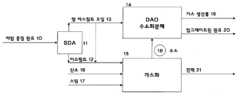
도 1은 단일 반응기 구현 예를 사용하는, 본 발명의 공정의 개략도를 나타낸다.Figure 1 shows a schematic diagram of the process of the present invention using a single reactor embodiment.
본 발명은, 본 발명의 일반적 방법 뿐만 아니라 이의 실행에 사용된 시스템을 예시하는, 도 1을 참조하여 최적으로 이해될 수 있다.The present invention can be best understood with reference to Figure 1, which illustrates the general method of the present invention as well as the system used in its implementation.
도 1을 참조하면, 원유의 공급스트림 (10)은 이를 용매 탈아스팔트화시키기 위하여, 반응 챔버 (11)에 첨가되고, 이에 의해 아스팔트 분획 (12) 및 탈아스팔트화된 오일의 분획, 또는 전술된 바와같이 "DAO (13)"를 생산한다. 이러한 분획이 달성될 수 있는 방식은, 즉, 3-8 탄소를 함유하는 하나 이상의 탄소 원자를 함유하는 파라핀성 용매가 사용되는, 전술된 바와 같다. 촉매 또는 흡착제가 필수적이지 않지만; 흡착제를 사용하여 개선된 탈아스팔트화 공정을 교시하는, 전술된 미국특허 제7,566,394호를 참조하며, 이의 전체적인 내용은 참조로서 여기에 혼입된다. 증류는 사용되지 않고, 분리된 경질 성분은 없다.Referring to Figure 1, a feed stream 10 of crude oil is added to the
상기 "DAO" (13)는 수소화분해/수소화처리 존 (14)으로 전달된다. 도 1은 단일 반응기를 기재하고 있지만, "관류형, 직렬 흐름" 및 "이-단" 반응을 포함하는, 수소화분해를 위한 다양한 방법은 사용될 수 있는 것으로 이해될 것이다. 상기 반응기는 상기 DAO로부터 황 및 질소와 같은 이종원자를 제거하는 하나 이상의 촉매를 함유한다. 이러한 촉매들은 기술분야에서 잘 알려져 있어, 여기에 반복되지 않는다. 이의 대표적인 것은, 예를 들어, 2011년 8월 2일자에 출원된 PCT/US11/46272호에 기재된 촉매이고, 이는 여기에 참조로서 혼입된다. 상기 분해 반응은, 전술된 바와 같이 공급되는, 수소의 존재하에서 발생한다.The "DAO" 13 is transferred to the hydrocracking /
상기 DAO에 부가하여, 상기 원유의 용매 탈아스팔트화는 아스팔트 분획 (12)를 생산하는 것으로 상기될 것이다. 이러한 아스팔트 분획은 산소 (16) 및 스팀 (17)과 함께 가스화 챔버 (15)로 전달된다. 이들 성분, 즉 상기 산소 및 스팀은 순수 형태로, 또는 예를 들어, 분위기 공기를 통해 공급될 수 있다. 상기 아스팔트, 산소 및 스팀은 수소의 생산을 결과하는 온도 및 압력에서 조합된다. 묘사된 구현 예에 있어서, 이러한 수소 (18)는 수소화분해 공정의 발생을 위해 필요한 수소를 공급하기 위해, 상기 DAO 수소화분해 유닛 (14)으로 보낸다. (상기 아스팔트의 가스화가 선택적인 단계이고, 예를 들어, 수소의 독립된 공급원을 공급시키는 단계를 통해 대체될 수 있다는 것에 주목되어야 한다). 다양한 생산물, 예를 들어, 가스 (19) 및 업그레이드 원유 (20)는 결과하고, 가스화의 생산물 (21)은 전력의 발생 또는 다른 사용을 위해 사용된다.In addition to the DAO, solvent deasphalting of the crude oil will be recalled to produce an asphalt fraction 12. These asphalt fractions are transferred to the
상기 DAO로부터 원유의 아스팔트 성분을 분리시켜, 아스팔트 분획에 존재하는, 금속에 의한 촉매의 결함과 같은 문제점을 제거한다. 촉매 수명 주기는 증가되고, 반응기의 정지, 물질의 교체에 대한 필요는 감소된다.Separating the asphalt component of the crude oil from the DAO eliminates problems such as metal catalyst defects present in the asphalt fraction. The catalyst life cycle is increased, the need for reactor shutdown, material replacement is reduced.
여기에 기재된 바와 같은 공정에 있어서, 상기 수소화분해 공정은 표준 수소화분해 조건, 즉, 약 100 내지 약 200 bar의 압력, 약 350℃ (내지 약 450℃) 범위의 온도, 0.1 및 4.0 h-1의 LHSVs, 및 약 500 내지 약 2,500 SLt/Lt의 수소 오일 비에서 발생한다.In the process as described herein, wherein the hydrocracking process is a standard hydrocracking conditions, i.e., about 100 to about 200 bar pressure and about 350 ℃ (to about 450 ℃) temperature range of, 0.1 and 4.0 h-1 LHSVs, and hydrogen oil ratios of from about 500 to about 2,500 SLt / Lt.
실시 예Example
본 실시 예는 "SDA" 분획의 가스화가 수소를 생산하는데 사용되고, 상기 수소가 그 다음 상기 DAO 분획의 수소화분해에서 사용되는 본 발명의 구현 예를 기재한다. 상기 H2는 다른 수단을 통해 공급될 수 있는 것으로 이해될 것이다.This embodiment describes an embodiment of the invention in which the gasification of the "SDA" fraction is used to produce hydrogen and the hydrogen is then used in the hydrocracking of the DAO fraction. It will be appreciated that the H2 may be supplied via other means.
1000 kg 샘플의 원유는, 도 1에서 (11)로 묘사된 것과 같은, 반응 챔버에서, 부탄 용매 및 흡착제와 함께, 공지의 기술을 사용하여, 용매 탈아스팔트화된다. 탈아스팔트화 전에, 상기 원유는 분석되고, 이러한 분석의 결과는 하기 표 1, 컬럼 1에 나타낸다.A 1000 kg sample of crude oil is solvent deasphalted in a reaction chamber, such as depicted in Figure 1 (11), with butane solvent and adsorbent, using known techniques. Prior to de-asphalting, the crude oil was analyzed and the results of this analysis are shown in Table 1, column 1 below.
탈아스팔트화 후에, 상기 아스팔트 분획 및 탈아스팔트화된 오일, 또는 "DAO"는 또한 분석되고, 이들 결과는 표 1의 컬럼 2 및 3에 나타낸다.After de-asphalting, the asphalt fraction and deasphalted oil, or "DAO ", were also analyzed and the results are shown in columns 2 and 3 of Table 1.
상기 아스팔트 분획은, 도 1에서 (14)로 묘사된, 멤브레인 벽 반응기 또는 가스화 챔버로 아스팔트 분획과 산소 및 스팀을 조합시켜 가스화된다. 상기 혼합물은 (중량의 관점에서) 0.6의 물 대 탄소 비, 및 1.0의 산소:피치 비로, 1045℃로 가열된다.The asphalt fraction is gasified by combining the asphalt fraction with oxygen and steam into a membrane wall reactor or gasification chamber, depicted in FIG. 1 (14). The mixture is heated to 1045 DEG C with a water to carbon ratio of 0.6 (in terms of weight) and an oxygen: pitch ratio of 1.0.
가스화가 완성된 후, 원료 신가스 생산물은, 318℃, 1 bar의 압력, 및 3의 물 대 수소의 비에서 작동하는, 수성가스 전환 (water gas shift) ("WGS") 반응기에서, 보일러 또는 공정 열교환기에 의해 생산된 스팀과 조합된다.After the gasification is complete, the feedstock syngas product is fed to a boiler or a condenser in a water gas shift ("WGS") reactor operating at 318 ° C., a pressure of 1 bar, It is combined with the steam produced by the process heat exchanger.
모든 분석 및 결과는 하기 표 1에서 나타내고, 하기에 면밀히 검토되었다:All analyzes and results are shown in Table 1 below and are reviewed in detail below:
중질 COArab
Heavy CO
가스화가 발생하는 동안, 상기 DAO 부분이, "14"로 나타낸, 표준, 수소화분해 유닛으로 도입되고, 360℃, 115 bars의 수소 분압에서 0.3h-1의 전체 유체 공간 속도 (liquid hourly space velocity)로, Ni-Mo 촉진된, 무정질 VGO 수소화분해 촉매 및 VGO 제올라이트 촉매의 3:1 적재 비로 수소화분해된다. 여기에 사용된 촉매에 대하여, 상기에서 혼입된, PCT/US11/46272호를 참조.During gasification, the DAO portion is introduced into a standard, hydrocracking unit, indicated as "14 ", and has a liquid hourly space velocity of 0.3 h <-1 & , Hydrogenolysis with a 3: 1 loading ratio of Ni-Mo promoted, amorphous VGO hydrocracking catalyst and VGO zeolite catalyst. For the catalysts used herein, see PCT / US11 / 46272, incorporated hereinabove.
상기 수소화분해 챔버를 떠나는 생산물은 저분자량 탄화수소 (C1-C4), 업그레이드된 원유, 산소, 스팀, 및 수소의 함량에 대해 분석된다. 이들 값은 표 1에서 컬럼 4-5에 나타낸다. 상기 업그레이드된 원유는 또한, 상기 원유 및 DAO를 분석하는 동일한 방식으로, 다양한 미량의 성분 뿐만 아니라 비등 분획에 대해 분석된다. 상기 표 1를 면밀히 검토하면, 컬럼 1은 상기 반응에 사용된 원유 ("CO")의 분석을 나타낸다. 컬럼 2는 최종 DAO의 분석 및 컬럼 3은 아스팔트 분획의 분석이다. 컬럼 4는 상기 수소화분해 단계에서 생산된 가스에 대한 정보를 나타내고, 컬럼 (5)는 업그레이드된 원유를 나타낸다. 마지막으로, 컬럼 6, 7, 및 8은, 전술된 바와 같은, 반응기에 첨가된 반응물에 관한 것이다.The product leaving the hydrocracking chamber is analyzed for the contents of low molecular weight hydrocarbons (C1 -C4 ), upgraded crude oil, oxygen, steam, and hydrogen. These values are shown in Table 1 in columns 4-5. The upgraded crude oil is also analyzed for the boiling fraction as well as various trace amounts of components, in the same manner as for analyzing the crude oil and DAO. Looking closely at Table 1 above, Column 1 represents the analysis of crude oil ("CO ") used in the reaction. Column 2 is the analysis of the final DAO and Column 3 is the analysis of the asphalt fraction. Column 4 represents information on the gas produced in the hydrocracking step, and column 5 represents upgraded crude oil. Finally, columns 6, 7, and 8 relate to reactants added to the reactor as described above.
전술된 개시는, 증류를 포함하지 않는, 원유와 같은, 공급원료에서 황 및 질소와 같은 불순물을 감소시키기 위한 단순화된 방법론인, 본 발명의 특색을 서술한다. 정리하면, 상기 원유는 용매 아스팔트화되어, DAO 및 아스팔트를 결과한다. 상기 DAO는 그 다음 이를 탈황 및 탈질을 위하여, 및 증류로 370℃ 이상의 비등점을 갖는 어떤 탄화수소를 전환시키기 위하여 촉매의 존재하에서 수소화분해된다. 동시에, 상기 아스팔트 분획은 수소를 생산하기 위해 가스화된다. 하나의 구현 예에 있어서, 상기 수소는 수소화분해 반응기로 다시 보내고, 그 공정에서 사용된다. 공급원료의 성질은 물론 변화될 것이고, 총 공급원료의 약 2% 내지 약 10% 범위의 양으로 재를 포함할 수 있다. 상기 공급원료는 액체 또는 고체일 수 있다. 약 36℃ 내지 약 2000℃의 비등점을 갖는 성분을 갖는 액체 공급원료는 바람직하다. 상기 공급원료는, 예를 들어, 역청 (bituminous), 오일, 샌드, 쉐일 오일, 석탄, 또는 바이오 액체일 수 있고, 바람직하게는 20 ppmw 미만의 황을 함유할 수 있다.The foregoing disclosure describes the features of the present invention, which is a simplified methodology for reducing impurities such as sulfur and nitrogen in the feedstock, such as crude oil, without distillation. In summary, the crude oil is solvent asphaltized, resulting in DAO and asphalt. The DAO is then hydrocracked for desulfurization and denitrification, and in the presence of a catalyst to convert any hydrocarbons having a boiling point above 370 占 폚 by distillation. At the same time, the asphalt fraction is gasified to produce hydrogen. In one embodiment, the hydrogen is sent back to the hydrocracking reactor and used in the process. The nature of the feedstock will of course vary and can include ash in amounts ranging from about 2% to about 10% of the total feedstock. The feedstock may be liquid or solid. A liquid feedstock having a component having a boiling point of from about 36 占 폚 to about 2000 占 폚 is preferred. The feedstock may be, for example, bituminous, oil, sand, shale oil, coal, or a biofluid, preferably containing less than 20 ppmw of sulfur.
실행에 있어서, DAO 및 아스팔트를 분리하기 위해 파라핀 용매에 상기 원유가 적용시키는 것이 바람직하다. 상기 용매는, 직쇄 또는 분지형일 수 있는, 하나 이상의 C3 - C7알칸을 포함한다. 바람직하게는, 상기 용매는 부탄들 중 하나 또는, 가장 바람직하게는 부탄의 혼합물을 포함한다. 용매화는 이들의 온도 및 압력 모두에 대한 임계값 이하의 온도 및 압력에서 일어난다.In practice, it is preferred to apply the crude oil to a paraffinic solvent to separate DAO and asphalt. The solvent may be one or more C3 -C7 Alkane. Preferably, the solvent comprises one or more of butanes, most preferably a mixture of butanes. Solvation occurs at temperatures and pressures below their threshold values for both their temperature and pressure.
고체 흡착제, 바람직하게는 W/W의 관점에서 표현된, 20:0.1 내지 10:1의 탄화수소:흡착제의 비를 제공하기에 충분한 양으로 첨가되는, 고체 흡착제의 존재하에서, 논의된 탈아스팔트화 단계를 수행하는 것이 특히 바람직하다.In the presence of a solid adsorbent, which is added in an amount sufficient to provide a ratio of hydrocarbon: adsorbent of 20: 0.1 to 10: 1, expressed in terms of solid adsorbent, preferably W / W, Is particularly preferable.
분리 후에, 상기 DAO는 수소화분해 유닛에 전달되고, 여기서 수소화분해는, 바람직하게는 약 100 내지 약200 bars의 압력, 약 350℃ 내지 약 500℃의 온도, 약 0.1 내지 약 4.0 h-1의 LHSV, 및 약 500 내지 약 2500 SLt/Lt의 수소:오일 비이지만, 변할 수 있는 조건에서 수행된다. 어떤 표준 수소화분해 시스템은 단일 반응기, 직렬로 작동된 다중 반응기, 고정층 반응기, 비등층 반응기, 등등을 포함하여 사용될 수 있다.After separation, the DAO is passed to the hydrocracking unit, in which the hydrocracking is preferably about 100 to a pressure of about 200 bars, a temperature of from about 350 to about 500 ℃ ℃, from about 0.1 to about 4.0 h-1 LHSV , And a hydrogen: oil ratio of from about 500 to about 2500 SLt / Lt, but can be varied. Some standard hydrocracking systems may be used including a single reactor, multiple reactors operated in series, a fixed bed reactor, a boiler bed reactor, and the like.
촉매는 수소화분해 공정에 사용되는데, 바람직하게는 상기에서 참조로서 혼입된 촉매가 사용된다. 바람직하게는, 상기 촉매는 약 2중량% 내지 약 40중량%의 활성금속, 약 0.3 내지 약 1.5 cc/g의 총 기공 부피, 약 200 내지 약 450 ㎡/g의 총 표면적, 및 적어도 50 angstrom의 평균 기공 직경을 함유한다.The catalyst is used in a hydrocracking process, preferably a catalyst incorporated as reference above. Preferably, the catalyst has a total pore volume of about 2 wt.% To about 40 wt.% Active metal, a pore volume of about 0.3 to about 1.5 cc / g, a total surface area of about 200 to about 450 m 2 / g, Average pore diameter.
활성 금속과 관련하여, Ⅵ, Ⅶ 또는 ⅧB 족으로부터의 금속은 바람직하고, Co, Ni, W, 및 Mo 중 하나 이상을 포함할 수 있다. 그렇게 하는 것이 요구되지는 않지만, 상기 촉매는 일반적으로 알루미나, 실리카, 제올라이트, 또는 예를 들어, 스팀, 암모니아, 산 세척 및/또는 이의 구조로 전이 금속의 삽입에 의해 개질된 제올라이트와 같은 지지체 상에 혼입된다.With respect to the active metal, metals from groups VI, VII, or VIII are preferred and may include one or more of Co, Ni, W, and Mo. Although not required to do so, the catalyst is generally supported on a support such as alumina, silica, zeolite or zeolite modified by, for example, steam, ammonia, acid cleaning and / or the incorporation of a transition metal into its structure Lt; / RTI >
DAO의 수소화분해와 동시에, 상기 원유의 아스팔트 부분은 가스화 챔버, 예를 들어, 멤브레인 벽 타입 반응기에서 바람직하게는 약 900℃ 내지 약 1700℃의 온도, 및 약 20 bars 내지 약 100 bars의 압력에서 가스화된다. O2 함유 가스의 존재하에서 수행된 가스화는, 예를 들어, 순수한 O2 또는 좀더 바람직하게는 분위기 가스 (atmospheric gas)일 수 있다. 가스화 반응기에 유입되는 아스팔트 및 산소의 양을 조절하기 위한 수단은 제공될 수 있다. 이러한 수단은 당업자에게 잘 알려져 있고, 여기서 반복되지 않는다. 부분 연소를 허용하는 화학양론적 균형이 일어나도록, 아스팔트 및 O2의 양을 조절하는 것이 바람직하다. 이것은 전술된, 실시 예에서 수행된 바와 같이, 원유의 탄화수소 함량을 결정하는 단계를 통해 결정될 수 있다. 바람직하게는, 상기 양은 약 0.2:1.0 내지 약 5:0.1의 산소: 탄소의 중량비가 되도록 선택된다.At the same time as the hydrocracking of DAO, the asphalt portion of the crude oil is preferably gasified in a gasification chamber, for example a membrane wall type reactor, at a temperature of from about 900 ° C to about 1700 ° C, and at a pressure of from about 20 bars to about 100 bars do. The gasification performed in the presence of an O2 containing gas may be, for example, pure O2 or more preferably atmospheric gas. Means for adjusting the amount of asphalt and oxygen entering the gasification reactor may be provided. Such means are well known to those skilled in the art, and are not repeated herein. It is desirable to regulate the amount of asphalt and O2 so that a stoichiometric balance is allowed to allow partial burning. This can be determined through the step of determining the hydrocarbon content of the crude oil, as was done in the examples described above. Preferably, the amount is selected to be a weight ratio of oxygen to carbon of from about 0.2: 1.0 to about 5: 0.1.
선택적으로, 스팀은 가스화 챔버에 첨가될 수 있다. 이러한 경우에, 이 역시 원유의 탄소 함량에 기초한 양으로 첨가되고, 바람직하게는 약 0.1:1.0 내지 약 100:1.0의 중량비로 제공된다. 가스화는 수소 및 일산화탄소로 필수적으로 이루어지는 "신가스"라 때때로 언급되는 생산물을 결과한다. 본 발명의 일 구현 예에 있어서, 가스화에 의해 생산된 신가스는 수성가스 전환반응 챔버로 전달되고, H2 및 CO2를 생산하기 위해 처리되며, 그 후 H2는 분리된다. 최종, 순수한 H2는 수소화분해 반응에 보낼 수 있다.Optionally, steam may be added to the gasification chamber. In this case, it is also added in an amount based on the carbon content of the crude oil, and is preferably provided in a weight ratio of about 0.1: 1.0 to about 100: 1.0. Gasification results in a product sometimes referred to as "syngas", which is essentially made up of hydrogen and carbon monoxide. In one embodiment of the present invention, the fresh gas produced by the gasification is delivered to the water gas shift reaction chamber and processed to produce H2 and CO2 , after which H2 is separated. Final, pure H2 may be sent to the hydrocracking reaction.
상기 신가스가 처리되는 공정은 약 150℃ 내지 약 400℃의 온도, 및 약 1 내지 약 60 bars의 압력에서 처리를 포함할 수 있다.The process in which the fresh gas is treated may comprise treatment at a temperature of from about 150 [deg.] C to about 400 [deg.] C, and a pressure of from about 1 to about 60 bars.
상기에서 알 수 있는 바와 같이, 가스 함량은 여기서 기재된 공정의 어떤 시점에서 측정될 수 있다. 따라서, 상기 신가스에서 CO 함량의 측정 후에, 물은, 바람직하게는 약 3:1 내지 약 5:1의 CO와의 몰비에서, 반응 챔버에 첨가될 수 있다.As can be seen, the gas content can be measured at any point in the process described herein. Thus, after measuring the CO content in the fresh gas, water may be added to the reaction chamber, preferably at a molar ratio of from about 3: 1 to about 5: 1 CO.
본 발명의 다른 관점은 기술분야의 당업자에게 명백해질 것이며, 여기서는 반복하지 않는다.Other aspects of the invention will be apparent to those skilled in the art, and will not be repeated here.
사용된 용어 및 표현은 제한의 관점이 아닌 설명의 관점에서 사용되며, 상기 용어 및 표현의 사용에서, 본 발명의 범주내에서 가능한 다양한 변경인 것으로 인정되는, 나타내고 기재된 특색 및 이의 부분의 어떤 균등물을 배제를 의도하지 않는다.The terms and expressions which have been employed are used in an understanding of the specification and not in terms of limitation and are not to be construed as a limitation of the invention as defined in the claims and their equivalents, I do not intend to exclude.
Claims (22)
Translated fromKorean(i) 제1 반응 챔버에서, 아스팔트 분획 및 탈아스팔트화된 오일 (DAO)을 생산하기 위해 상기 전체 원유 공급원료를 고체 흡착제와 접촉시켜 용매 탈아스팔트화시키는 단계;
(ⅱ) 개별적인, 제2 및 제3 반응 챔버에서 상기 DAO 및 아스팔트 분획을 가공처리하는 단계;
(ⅲ) 상기 제2 반응 챔버에서 2-40 wt% 활성 금속, 0.33-1.50 cc/gm의 기공 부피, 250-450 ㎡/g의 표면적, 및 적어도 50 Angstroms의 평균 기공 직경을 함유하는 촉매의 존재하에서, 100 - 200 bars의 압력, 350℃ 내지 500℃의 온도, 0.1 내지 4.0 h-1의 LHSV에서, 500 내지 2,500 SLt/Lt의 수소:DAO 비로, DAO를 수소화분해시켜 상기 DAO로부터 황 및 질소를 제거하고 증류로 370℃ 이상의 비등점을 갖는 상기 DAO에 함유된 어떤 탄화수소를 전환시키는 단계로서, 상기 촉매의 활성 금속은 알루미나, 실리카 또는 제올라이트 지지체 상에 존재하는 Ni 또는 Mo를 포함하는 단계;
(iv) 상기 제3 반응 챔버에서, 산소 및 스팀과 아스팔트 분획을 조합하여 상기 아스팔트 분획을 가스화시켜 상기 아스팔트 분획으로부터 수소를 생산하는 단계; 및
(v) 상기 제3 반응 챔버에서 생산된 수소를 상기 제2 반응 챔버로 도입시키는 단계;
를 포함하며, 상기 방법은 상기 전체 원유 공급원료를 증류하는 단계를 수반하지 않고 수행되는, 전체 원유 공급원료에서 불순물을 감소시키는 방법.As a method for reducing impurities in the entire crude oil feedstock:
(i) contacting the entire crude oil feedstock with a solid adsorbent to produce an asphalt fraction and deasphalted oil (DAO) in a first reaction chamber, followed by solvent deasphalting;
(Ii) processing the DAO and asphalt fractions in separate, second and third reaction chambers;
(Iii) the presence of a catalyst in the second reaction chamber containing a 2-40 wt% active metal, a pore volume of 0.33-1.50 cc / gm, a surface area of 250-450 m2 / g, and an average pore diameter of at least 50 Angstroms Hydrogenation of DAO at a hydrogen: DAO ratio of 500 to 2,500 SLt / Lt at a pressure of 100-200 bars, a temperature of 350-500 占 폚 and a LHSV of 0.1-4.0 h <-1 > And converting any hydrocarbons contained in said DAO having a boiling point above 370 占 폚 by distillation, wherein said active metal of said catalyst comprises Ni or Mo present on an alumina, silica or zeolite support;
(iv) combining the oxygen and steam and the asphalt fraction in the third reaction chamber to produce hydrogen from the asphalt fraction by gasifying the asphalt fraction; And
(v) introducing hydrogen produced in the third reaction chamber into the second reaction chamber;
Wherein the process is carried out without the step of distilling the entire crude oil feedstock.
상기 용매 탈아스팔트화 단계는 상기 용매의 임계 온도 및 임계 압력 이하의 온도 및 압력에서, C3-C7 탄소 원자를 함유하는 용매와 상기 전체 원유 공급원료를 혼합하는 단계를 포함하는 전체 원유 공급원료에서 불순물을 감소시키는 방법.The method according to claim 1,
Wherein the solvent deasphalting step comprises mixing the entire crude oil feedstock with a solvent containing C3 -C7 carbon atoms at a temperature and pressure below the critical temperature and the critical pressure of the solvent, ≪ / RTI >
상기 용매는 n-부탄 및 이소부탄을 포함하는 전체 원유 공급원료에서 불순물을 감소시키는 방법.The method of claim 3,
Wherein said solvent comprises n-butane and isobutane.
상기 전체 원유 공급원료 및 고체 흡착제는 10:1 내지 200:1 w/w의 중량비로 조합되는 전체 원유 공급원료에서 불순물을 감소시키는 방법.The method according to claim 1,
Wherein the total crude oil feedstock and the solid adsorbent are combined in a weight ratio of 10: 1 to 200: 1 w / w.
상기 DAO를 직렬의 다중 챔버에서 수소화분해시키는 단계를 포함하는 전체 원유 공급원료에서 불순물을 감소시키는 방법.The method according to claim 1,
≪ / RTI > hydrocracking said DAO in multiple chambers in series.
상기 수소화분해 챔버는 고정층, 비등층, 또는 슬러리 층 챔버인 전체 원유 공급원료에서 불순물을 감소시키는 방법.The method according to claim 1,
Wherein said hydrocracking chamber is a fixed bed, boiling layer, or slurry layer chamber.
상기 지지체는 제올라이트인 전체 원유 공급원료에서 불순물을 감소시키는 방법.The method according to claim 1,
Wherein said support is a zeolite.
상기 제올라이트는 스팀, 암모니아 또는 산 중 적어도 하나로 처리에 의해 개질되고, 적어도 하나의 전이 금속을 함유하는 전체 원유 공급원료에서 불순물을 감소시키는 방법.18. The method of claim 16,
Wherein the zeolite is modified by treatment with at least one of steam, ammonia, or acid, and wherein the zeolite is reduced by treatment with at least one transition metal.
상기 적어도 하나의 전이 금속은 Zn 또는 Ti인 전체 원유 공급원료에서 불순물을 감소시키는 방법.18. The method of claim 17,
Wherein the at least one transition metal is Zn or < RTI ID = 0.0 > Ti. ≪ / RTI >
900℃ 내지 1700℃의 온도, 및 20 bars 내지 100 bars의 압력에서 상기 아스팔트 분획을 가스화시키는 단계를 포함하는 전체 원유 공급원료에서 불순물을 감소시키는 방법.The method according to claim 1,
Gasifying the asphalt fraction at a temperature of 900 DEG C to 1700 DEG C and a pressure of 20 bars to 100 bars.
상기 제3 반응 챔버에서 산소 및 스팀 중 적어도 하나 및 아스팔트의 양을 조정하여, 상기 아스팔트의 부분 연소를 결과하는 그들 사이에서의 화학양론적 균형을 제공하는 단계를 더욱 포함하는 전체 원유 공급원료에서 불순물을 감소시키는 방법.The method according to claim 1,
Further comprising adjusting the amount of at least one of oxygen and steam and the amount of asphalt in the third reaction chamber to provide a stoichiometric balance between them resulting in partial burning of the asphalt, / RTI >
산소 : 탄소 비에 기초한 화학양론 비는 0.2:1:0 내지 10:0.2 중량비인 전체 원유 공급원료에서 불순물을 감소시키는 방법.The method of claim 19,
Wherein the stoichiometric ratio based on oxygen: carbon ratio is from 0.2: 1: 0 to 10: 0.2 by weight.
제3 반응 챔버로 아스팔트 및 스팀을 전체 원유 공급원료에서의 탄소 중량에 기초하여 0.1 대 1.0 내지 10:0.1의 비로 도입하는 단계를 포함하는 전체 원유 공급원료에서 불순물을 감소시키는 방법.The method of claim 19,
Introducing the asphalt and steam into the third reaction chamber at a ratio of 0.1 to 1.0: 10: 0.1 based on the weight of carbon in the total crude oil feedstock.
Applications Claiming Priority (3)
| Application Number | Priority Date | Filing Date | Title |
|---|---|---|---|
| US201261655732P | 2012-06-05 | 2012-06-05 | |
| US61/655,732 | 2012-06-05 | ||
| PCT/US2013/043055WO2013184462A1 (en) | 2012-06-05 | 2013-05-29 | Integrated process for deasphalting and desulfurizing whole crude oil |
Publications (2)
| Publication Number | Publication Date |
|---|---|
| KR20150021559A KR20150021559A (en) | 2015-03-02 |
| KR101716986B1true KR101716986B1 (en) | 2017-03-15 |
Family
ID=48670064
Family Applications (1)
| Application Number | Title | Priority Date | Filing Date |
|---|---|---|---|
| KR1020157000070AExpired - Fee RelatedKR101716986B1 (en) | 2012-06-05 | 2013-05-29 | INTEGRATED PROCESS FOR DEASPHALTING AND DESULfURIZING WHOLE CRUDE OIL |
Country Status (7)
| Country | Link |
|---|---|
| US (1) | US20130319910A1 (en) |
| EP (1) | EP2855639A1 (en) |
| JP (1) | JP5991562B2 (en) |
| KR (1) | KR101716986B1 (en) |
| CN (1) | CN104540926A (en) |
| SG (1) | SG11201408000XA (en) |
| WO (1) | WO2013184462A1 (en) |
Families Citing this family (29)
| Publication number | Priority date | Publication date | Assignee | Title |
|---|---|---|---|---|
| CN113214866A (en)* | 2013-12-24 | 2021-08-06 | 国际壳牌研究有限公司 | Process for producing middle distillate |
| US9783748B2 (en) | 2014-09-09 | 2017-10-10 | Uop Llc | Process for producing diesel fuel |
| US9663732B2 (en) | 2014-09-09 | 2017-05-30 | Uop Llc | Process for controlling operations of a residue process unit |
| CN108026456A (en)* | 2015-08-04 | 2018-05-11 | 沙特阿拉伯石油公司 | For producing the integral process of anode rank coke |
| US10066172B2 (en) | 2015-12-15 | 2018-09-04 | Saudi Arabian Oil Company | Supercritical water upgrading process to produce paraffinic stream from heavy oil |
| US10011790B2 (en) | 2015-12-15 | 2018-07-03 | Saudi Arabian Oil Company | Supercritical water processes for upgrading a petroleum-based composition while decreasing plugging |
| CN108993318B (en) | 2015-12-15 | 2021-04-27 | 沙特阿拉伯石油公司 | Supercritical reactor system and process for upgrading petroleum |
| US10066176B2 (en)* | 2015-12-15 | 2018-09-04 | Saudi Arabian Oil Company | Supercritical water upgrading process to produce high grade coke |
| US10125318B2 (en) | 2016-04-26 | 2018-11-13 | Saudi Arabian Oil Company | Process for producing high quality coke in delayed coker utilizing mixed solvent deasphalting |
| US10233394B2 (en) | 2016-04-26 | 2019-03-19 | Saudi Arabian Oil Company | Integrated multi-stage solvent deasphalting and delayed coking process to produce high quality coke |
| US11041129B2 (en) | 2016-12-20 | 2021-06-22 | Uop Llc | Processes for producing a fuel range hydrocarbon and a lubricant base oil |
| US10577546B2 (en) | 2017-01-04 | 2020-03-03 | Saudi Arabian Oil Company | Systems and processes for deasphalting oil |
| US10815434B2 (en) | 2017-01-04 | 2020-10-27 | Saudi Arabian Oil Company | Systems and processes for power generation |
| US12025435B2 (en) | 2017-02-12 | 2024-07-02 | Magēmã Technology LLC | Multi-stage device and process for production of a low sulfur heavy marine fuel oil |
| US10604709B2 (en) | 2017-02-12 | 2020-03-31 | Magēmā Technology LLC | Multi-stage device and process for production of a low sulfur heavy marine fuel oil from distressed heavy fuel oil materials |
| US20180230389A1 (en) | 2017-02-12 | 2018-08-16 | Magēmā Technology, LLC | Multi-Stage Process and Device for Reducing Environmental Contaminates in Heavy Marine Fuel Oil |
| US12281266B2 (en) | 2017-02-12 | 2025-04-22 | Magẽmã Technology LLC | Heavy marine fuel oil composition |
| US11788017B2 (en) | 2017-02-12 | 2023-10-17 | Magëmã Technology LLC | Multi-stage process and device for reducing environmental contaminants in heavy marine fuel oil |
| US12071592B2 (en) | 2017-02-12 | 2024-08-27 | Magēmā Technology LLC | Multi-stage process and device utilizing structured catalyst beds and reactive distillation for the production of a low sulfur heavy marine fuel oil |
| EP3891256B1 (en) | 2018-12-04 | 2024-11-06 | SABIC Global Technologies B.V. | Optimizing the simultaneous production of high-value chemicals and fuels from heavy hydrocarbons |
| KR102800058B1 (en) | 2019-03-15 | 2025-04-28 | 루머스 테크놀로지 엘엘씨 | Composition for olefin production |
| US10941354B1 (en) | 2019-10-01 | 2021-03-09 | Saudi Arabian Oil Company | Hydrocracking catalyst comprising a beta zeolite (*BEA) framework substituted with Ti and Zr and methods for its preparation and use |
| US11130920B1 (en) | 2020-04-04 | 2021-09-28 | Saudi Arabian Oil Company | Integrated process and system for treatment of hydrocarbon feedstocks using stripping solvent |
| US11274068B2 (en) | 2020-07-23 | 2022-03-15 | Saudi Arabian Oil Company | Process for interconversion of olefins with modified beta zeolite |
| US11332678B2 (en) | 2020-07-23 | 2022-05-17 | Saudi Arabian Oil Company | Processing of paraffinic naphtha with modified USY zeolite dehydrogenation catalyst |
| US11420192B2 (en) | 2020-07-28 | 2022-08-23 | Saudi Arabian Oil Company | Hydrocracking catalysts containing rare earth containing post-modified USY zeolite, method for preparing hydrocracking catalysts, and methods for hydrocracking hydrocarbon oil with hydrocracking catalysts |
| US11154845B1 (en) | 2020-07-28 | 2021-10-26 | Saudi Arabian Oil Company | Hydrocracking catalysts containing USY and beta zeolites for hydrocarbon oil and method for hydrocracking hydrocarbon oil with hydrocracking catalysts |
| US11142703B1 (en) | 2020-08-05 | 2021-10-12 | Saudi Arabian Oil Company | Fluid catalytic cracking with catalyst system containing modified beta zeolite additive |
| US11618858B1 (en) | 2021-12-06 | 2023-04-04 | Saudi Arabian Oil Company | Hydrodearylation catalysts for aromatic bottoms oil, method for producing hydrodearylation catalysts, and method for hydrodearylating aromatic bottoms oil with hydrodearylation catalysts |
Citations (2)
| Publication number | Priority date | Publication date | Assignee | Title |
|---|---|---|---|---|
| US20090294328A1 (en)* | 2008-05-28 | 2009-12-03 | Kellogg Brown & Root Llc | Integrated solven deasphalting and gasification |
| WO2012018819A1 (en)* | 2010-08-02 | 2012-02-09 | Saudi Arabian Oil Company | Hydrocracking catalyst for hydrocarbon oil, method for producing hydrocracking catalyst, and method for hydrocracking hydrocarbon oil with hydrocracking catalyst |
Family Cites Families (13)
| Publication number | Priority date | Publication date | Assignee | Title |
|---|---|---|---|---|
| US4752376A (en)* | 1985-09-25 | 1988-06-21 | Intevep, S.A. | Multiple stepped process for the demetallization and desulfuration of heavy oil feedstocks |
| US5192421A (en)* | 1991-04-16 | 1993-03-09 | Mobil Oil Corporation | Integrated process for whole crude deasphalting and asphaltene upgrading |
| US5384297A (en)* | 1991-05-08 | 1995-01-24 | Intevep, S.A. | Hydrocracking of feedstocks and catalyst therefor |
| JP5057315B2 (en)* | 1998-10-30 | 2012-10-24 | 日揮株式会社 | Method for producing gas turbine fuel oil |
| JP4509267B2 (en)* | 1999-11-15 | 2010-07-21 | 日揮株式会社 | Oil fuel-fired combined power generation facility and method thereof |
| US6789950B1 (en)* | 1999-12-01 | 2004-09-14 | 3M Innovative Properties Company | Optical fiber connector system |
| US7407571B2 (en)* | 2001-12-26 | 2008-08-05 | Ormat Industries Ltd. | Method of and apparatus for upgrading and gasifying heavy hydrocarbon feeds |
| US6702936B2 (en)* | 2001-12-26 | 2004-03-09 | Ormat Industries Ltd. | Method of and apparatus for upgrading and gasifying heavy hydrocarbon feeds |
| US7381320B2 (en)* | 2004-08-30 | 2008-06-03 | Kellogg Brown & Root Llc | Heavy oil and bitumen upgrading |
| ITMI20042446A1 (en)* | 2004-12-22 | 2005-03-22 | Eni Spa | PROCEDURE FOR CONVERSION OF PESANTYI CHARGES SUCH AS HEAVY CRATES AND DISTILLATION RESIDUES |
| US7566394B2 (en)* | 2006-10-20 | 2009-07-28 | Saudi Arabian Oil Company | Enhanced solvent deasphalting process for heavy hydrocarbon feedstocks utilizing solid adsorbent |
| ITMI20071302A1 (en)* | 2007-06-29 | 2008-12-30 | Eni Spa | PROCEDURE FOR CONVERSION TO DISTILLATES OF HEAVY HYDROCARBURIC CHARGES WITH HYDROGEN AUTOPRODUCTION |
| US7981277B2 (en)* | 2007-12-27 | 2011-07-19 | Kellogg Brown & Root Llc | Integrated solvent deasphalting and dewatering |
- 2013
- 2013-05-29KRKR1020157000070Apatent/KR101716986B1/ennot_activeExpired - Fee Related
- 2013-05-29WOPCT/US2013/043055patent/WO2013184462A1/enactiveApplication Filing
- 2013-05-29USUS13/904,545patent/US20130319910A1/ennot_activeAbandoned
- 2013-05-29CNCN201380029767.0Apatent/CN104540926A/enactivePending
- 2013-05-29SGSG11201408000XApatent/SG11201408000XA/enunknown
- 2013-05-29EPEP13730395.4Apatent/EP2855639A1/ennot_activeCeased
- 2013-05-29JPJP2015516064Apatent/JP5991562B2/enactiveActive
Patent Citations (2)
| Publication number | Priority date | Publication date | Assignee | Title |
|---|---|---|---|---|
| US20090294328A1 (en)* | 2008-05-28 | 2009-12-03 | Kellogg Brown & Root Llc | Integrated solven deasphalting and gasification |
| WO2012018819A1 (en)* | 2010-08-02 | 2012-02-09 | Saudi Arabian Oil Company | Hydrocracking catalyst for hydrocarbon oil, method for producing hydrocracking catalyst, and method for hydrocracking hydrocarbon oil with hydrocracking catalyst |
Also Published As
| Publication number | Publication date |
|---|---|
| WO2013184462A1 (en) | 2013-12-12 |
| SG11201408000XA (en) | 2015-01-29 |
| JP5991562B2 (en) | 2016-09-14 |
| KR20150021559A (en) | 2015-03-02 |
| EP2855639A1 (en) | 2015-04-08 |
| US20130319910A1 (en) | 2013-12-05 |
| JP2015520271A (en) | 2015-07-16 |
| CN104540926A (en) | 2015-04-22 |
Similar Documents
| Publication | Publication Date | Title |
|---|---|---|
| KR101716986B1 (en) | INTEGRATED PROCESS FOR DEASPHALTING AND DESULfURIZING WHOLE CRUDE OIL | |
| US10954447B2 (en) | Integrated process for producing anode grade coke | |
| US8110091B2 (en) | Process for the conversion of feedstocks resulting from renewable sources for producing gas oil fuel bases with a low sulphur content and with an improved cetane number | |
| RU2726626C2 (en) | Conversion method involving use of interchangeable protective hydrodemetallisation layers, hydrotreated stage in bed and hydrocracking step in interchangeable reactors | |
| RU2380397C2 (en) | Raw material processing method, of materials such as heavy crude oil and bottoms | |
| KR101956407B1 (en) | Hydrocracking process with interstage steam stripping | |
| EP3339401B1 (en) | Integrated facility and method for hydrotreatment and hydroconversion with common fractionation | |
| KR20180128052A (en) | Fuel compositions from hard tite oil and sulfur fuel oil | |
| KR20180014775A (en) | Method for converting feedstocks comprising a hydrotreatment step, a hydrocracking step, a precipitation step and a sediment separation step, in order to produce fuel oils | |
| KR20180137410A (en) | Process integrating two-stage hydrocracking and a hydrotreating process | |
| KR102337228B1 (en) | Integrated boiling-bed hydroprocessing, fixed bed hydroprocessing and coking processes for full crude oil conversion to hydrotreated fraction and petroleum green coke | |
| US3537977A (en) | Refinery utilizing hydrogen produced from a portion of the feed | |
| US11384298B2 (en) | Integrated process and system for treatment of hydrocarbon feedstocks using deasphalting solvent | |
| CN110892045A (en) | Reactor staging for slurry hydroconversion of polycyclic aromatic hydrocarbon feed | |
| KR102405154B1 (en) | Process for producing a heavy hydrocarbon fraction with a low sulfur content comprising a demettalation section and a hydrocracking section with reactors exchangeable between the two sections | |
| CN110776953B (en) | Process for treating heavy hydrocarbon feedstock comprising fixed bed hydroprocessing, two deasphalting operations and hydrocracking of bitumen |
Legal Events
| Date | Code | Title | Description |
|---|---|---|---|
| PA0105 | International application | St.27 status event code:A-0-1-A10-A15-nap-PA0105 | |
| P11-X000 | Amendment of application requested | St.27 status event code:A-2-2-P10-P11-nap-X000 | |
| P13-X000 | Application amended | St.27 status event code:A-2-2-P10-P13-nap-X000 | |
| PG1501 | Laying open of application | St.27 status event code:A-1-1-Q10-Q12-nap-PG1501 | |
| A201 | Request for examination | ||
| PA0201 | Request for examination | St.27 status event code:A-1-2-D10-D11-exm-PA0201 | |
| D13-X000 | Search requested | St.27 status event code:A-1-2-D10-D13-srh-X000 | |
| D14-X000 | Search report completed | St.27 status event code:A-1-2-D10-D14-srh-X000 | |
| E902 | Notification of reason for refusal | ||
| PE0902 | Notice of grounds for rejection | St.27 status event code:A-1-2-D10-D21-exm-PE0902 | |
| E13-X000 | Pre-grant limitation requested | St.27 status event code:A-2-3-E10-E13-lim-X000 | |
| P11-X000 | Amendment of application requested | St.27 status event code:A-2-2-P10-P11-nap-X000 | |
| P13-X000 | Application amended | St.27 status event code:A-2-2-P10-P13-nap-X000 | |
| PE0701 | Decision of registration | St.27 status event code:A-1-2-D10-D22-exm-PE0701 | |
| GRNT | Written decision to grant | ||
| PR0701 | Registration of establishment | St.27 status event code:A-2-4-F10-F11-exm-PR0701 | |
| PR1002 | Payment of registration fee | Fee payment year number:1 St.27 status event code:A-2-2-U10-U12-oth-PR1002 | |
| PG1601 | Publication of registration | St.27 status event code:A-4-4-Q10-Q13-nap-PG1601 | |
| R18-X000 | Changes to party contact information recorded | St.27 status event code:A-5-5-R10-R18-oth-X000 | |
| P22-X000 | Classification modified | St.27 status event code:A-4-4-P10-P22-nap-X000 | |
| FPAY | Annual fee payment | Payment date:20200304 Year of fee payment:4 | |
| PR1001 | Payment of annual fee | Fee payment year number:4 St.27 status event code:A-4-4-U10-U11-oth-PR1001 | |
| R18-X000 | Changes to party contact information recorded | St.27 status event code:A-5-5-R10-R18-oth-X000 | |
| PR1001 | Payment of annual fee | Fee payment year number:5 St.27 status event code:A-4-4-U10-U11-oth-PR1001 | |
| PR1001 | Payment of annual fee | Fee payment year number:6 St.27 status event code:A-4-4-U10-U11-oth-PR1001 | |
| PN2301 | Change of applicant | St.27 status event code:A-5-5-R10-R11-asn-PN2301 | |
| PN2301 | Change of applicant | St.27 status event code:A-5-5-R10-R14-asn-PN2301 | |
| PR1001 | Payment of annual fee | Fee payment year number:7 St.27 status event code:A-4-4-U10-U11-oth-PR1001 | |
| PN2301 | Change of applicant | St.27 status event code:A-5-5-R10-R11-asn-PN2301 St.27 status event code:A-5-5-R10-R13-asn-PN2301 | |
| R18-X000 | Changes to party contact information recorded | St.27 status event code:A-5-5-R10-R18-oth-X000 | |
| PC1903 | Unpaid annual fee | Not in force date:20240310 Payment event data comment text:Termination Category : DEFAULT_OF_REGISTRATION_FEE St.27 status event code:A-4-4-U10-U13-oth-PC1903 | |
| PC1903 | Unpaid annual fee | Ip right cessation event data comment text:Termination Category : DEFAULT_OF_REGISTRATION_FEE Not in force date:20240310 St.27 status event code:N-4-6-H10-H13-oth-PC1903 | |
| R18-X000 | Changes to party contact information recorded | St.27 status event code:A-5-5-R10-R18-oth-X000 |