JP2018189980A - Polarizing plate - Google Patents
Polarizing plateDownload PDFInfo
- Publication number
- JP2018189980A JP2018189980AJP2018135721AJP2018135721AJP2018189980AJP 2018189980 AJP2018189980 AJP 2018189980AJP 2018135721 AJP2018135721 AJP 2018135721AJP 2018135721 AJP2018135721 AJP 2018135721AJP 2018189980 AJP2018189980 AJP 2018189980A
- Authority
- JP
- Japan
- Prior art keywords
- polarizing plate
- groove
- cross
- layer
- depth
- Prior art date
- Legal status (The legal status is an assumption and is not a legal conclusion. Google has not performed a legal analysis and makes no representation as to the accuracy of the status listed.)
- Pending
Links
Images












Classifications
- G—PHYSICS
- G02—OPTICS
- G02B—OPTICAL ELEMENTS, SYSTEMS OR APPARATUS
- G02B5/00—Optical elements other than lenses
- G02B5/30—Polarising elements
- G02B5/3025—Polarisers, i.e. arrangements capable of producing a definite output polarisation state from an unpolarised input state
- G02B5/3058—Polarisers, i.e. arrangements capable of producing a definite output polarisation state from an unpolarised input state comprising electrically conductive elements, e.g. wire grids, conductive particles
- G—PHYSICS
- G02—OPTICS
- G02F—OPTICAL DEVICES OR ARRANGEMENTS FOR THE CONTROL OF LIGHT BY MODIFICATION OF THE OPTICAL PROPERTIES OF THE MEDIA OF THE ELEMENTS INVOLVED THEREIN; NON-LINEAR OPTICS; FREQUENCY-CHANGING OF LIGHT; OPTICAL LOGIC ELEMENTS; OPTICAL ANALOGUE/DIGITAL CONVERTERS
- G02F1/00—Devices or arrangements for the control of the intensity, colour, phase, polarisation or direction of light arriving from an independent light source, e.g. switching, gating or modulating; Non-linear optics
- G02F1/01—Devices or arrangements for the control of the intensity, colour, phase, polarisation or direction of light arriving from an independent light source, e.g. switching, gating or modulating; Non-linear optics for the control of the intensity, phase, polarisation or colour
- G02F1/13—Devices or arrangements for the control of the intensity, colour, phase, polarisation or direction of light arriving from an independent light source, e.g. switching, gating or modulating; Non-linear optics for the control of the intensity, phase, polarisation or colour based on liquid crystals, e.g. single liquid crystal display cells
- G02F1/133—Constructional arrangements; Operation of liquid crystal cells; Circuit arrangements
- G02F1/1333—Constructional arrangements; Manufacturing methods
- G02F1/1335—Structural association of cells with optical devices, e.g. polarisers or reflectors
- G—PHYSICS
- G03—PHOTOGRAPHY; CINEMATOGRAPHY; ANALOGOUS TECHNIQUES USING WAVES OTHER THAN OPTICAL WAVES; ELECTROGRAPHY; HOLOGRAPHY
- G03B—APPARATUS OR ARRANGEMENTS FOR TAKING PHOTOGRAPHS OR FOR PROJECTING OR VIEWING THEM; APPARATUS OR ARRANGEMENTS EMPLOYING ANALOGOUS TECHNIQUES USING WAVES OTHER THAN OPTICAL WAVES; ACCESSORIES THEREFOR
- G03B21/00—Projectors or projection-type viewers; Accessories therefor
- G03B21/005—Projectors using an electronic spatial light modulator but not peculiar thereto
- G03B21/006—Projectors using an electronic spatial light modulator but not peculiar thereto using LCD's
- G—PHYSICS
- G03—PHOTOGRAPHY; CINEMATOGRAPHY; ANALOGOUS TECHNIQUES USING WAVES OTHER THAN OPTICAL WAVES; ELECTROGRAPHY; HOLOGRAPHY
- G03B—APPARATUS OR ARRANGEMENTS FOR TAKING PHOTOGRAPHS OR FOR PROJECTING OR VIEWING THEM; APPARATUS OR ARRANGEMENTS EMPLOYING ANALOGOUS TECHNIQUES USING WAVES OTHER THAN OPTICAL WAVES; ACCESSORIES THEREFOR
- G03B21/00—Projectors or projection-type viewers; Accessories therefor
- G03B21/14—Details
- G—PHYSICS
- G03—PHOTOGRAPHY; CINEMATOGRAPHY; ANALOGOUS TECHNIQUES USING WAVES OTHER THAN OPTICAL WAVES; ELECTROGRAPHY; HOLOGRAPHY
- G03B—APPARATUS OR ARRANGEMENTS FOR TAKING PHOTOGRAPHS OR FOR PROJECTING OR VIEWING THEM; APPARATUS OR ARRANGEMENTS EMPLOYING ANALOGOUS TECHNIQUES USING WAVES OTHER THAN OPTICAL WAVES; ACCESSORIES THEREFOR
- G03B21/00—Projectors or projection-type viewers; Accessories therefor
- G03B21/14—Details
- G03B21/20—Lamp housings
- G03B21/2073—Polarisers in the lamp house
Landscapes
- Physics & Mathematics (AREA)
- General Physics & Mathematics (AREA)
- Optics & Photonics (AREA)
- Nonlinear Science (AREA)
- Mathematical Physics (AREA)
- Chemical & Material Sciences (AREA)
- Crystallography & Structural Chemistry (AREA)
- Polarising Elements (AREA)
- Liquid Crystal (AREA)
- Projection Apparatus (AREA)
- Surface Treatment Of Optical Elements (AREA)
- Optical Filters (AREA)
Abstract
Translated fromJapaneseDescription
Translated fromJapanese本技術は、ワイヤーグリッド型の偏光板に関する。 The present technology relates to a wire grid type polarizing plate.
ワイヤーグリッド型の偏光板は、高い耐久性を有するため、例えば光密度が大きい液晶プロジェクタにおいて好適に用いられる。このような偏光板において、光学特性上重要な要件は、低反射である。反射率が高い場合、液晶パネルの誤動作の原因や迷光により画質劣化を引き起す。 Since the wire grid type polarizing plate has high durability, it is preferably used in, for example, a liquid crystal projector having a high light density. In such a polarizing plate, an important requirement for optical characteristics is low reflection. When the reflectance is high, the image quality is deteriorated due to a malfunction of the liquid crystal panel or stray light.
近年、液晶プロジェクタの輝度度化や高精細化により、より低反射な偏光板が望まれている。ワイヤーグリッド型の偏光板は、例えば、反射層と誘電体層と吸収層とを備えており、ワイヤーグリッドと平行なS偏光反射率を、上部の誘電層及び吸収層による吸収効果及び3層の干渉効果を用いて抑制する(例えば、特許文献1参照。)。 In recent years, a polarizing plate with lower reflection has been desired due to the increase in brightness and definition of liquid crystal projectors. The wire grid type polarizing plate includes, for example, a reflection layer, a dielectric layer, and an absorption layer. The S-polarized reflectance parallel to the wire grid can be obtained by absorbing the upper dielectric layer and the absorption layer, It suppresses using an interference effect (for example, refer patent document 1).
前述したワイヤーグリッド型の偏光板において、グリッド間に、基板の材料、若しくは基板上の下地層の材料を露出させた溝が形成されることがあるが、溝の形状によっては、優れた光学特性が得られないことがあった。 In the wire grid type polarizing plate described above, a groove in which the material of the substrate or the material of the base layer on the substrate is exposed may be formed between the grids. Depending on the shape of the groove, excellent optical characteristics may be formed. May not be obtained.
本技術は、このような実情に鑑みて提案されたものであり、優れた光学特性を有する偏光板を提供する。 The present technology has been proposed in view of such circumstances, and provides a polarizing plate having excellent optical characteristics.
本件発明者らは、鋭意検討を行った結果、溝の幅が深さ方向に向かってゼロになるように小さくなることにより、優れた光学特性を得ることが可能であることを見出し、本技術を完成させるに至った。 As a result of intensive studies, the present inventors have found that it is possible to obtain excellent optical characteristics by reducing the width of the groove so that it becomes zero in the depth direction. It came to complete.
すなわち、本技術に係る偏光板は、使用波長帯域の光に対して透明である透明基板と、前記使用帯域の光の波長よりも短いピッチで前記透明基板上に配列され、所定方向に延在し、反射層と反射制御層とを有する格子状凸部と、前記格子状凸部間に凹設され、前記所定方向に直交する方向の幅が深さ方向に向かってゼロになるように小さくなる溝部とを備えることを特徴とする。 That is, the polarizing plate according to the present technology is arranged on the transparent substrate that is transparent to the light in the use wavelength band, and is arranged on the transparent substrate at a pitch shorter than the wavelength of the light in the use band, and extends in a predetermined direction. And a grid-shaped convex portion having a reflective layer and a reflection control layer, and a recess formed between the grid-shaped convex portions, and small so that the width in the direction perpendicular to the predetermined direction becomes zero in the depth direction. And a groove portion.
また、本技術に係る光学機器は、前述の偏光板を搭載してなることを特徴とする。 Moreover, the optical apparatus according to the present technology is characterized by mounting the above-described polarizing plate.
また、本技術に係る偏光板の製造方法は、使用波長帯域の光に対して透明である透明基板上に積層された反射層と反射制御層とをエッチングし、前記使用帯域の光の波長よりも短いピッチで配列され、所定方向に延在する格子状凸部と、前記格子状凸部間に凹設され、前記所定方向に直交する方向の幅が深さ方向に向かってゼロになるように小さくなる溝部とを形成することを特徴とする。 Further, the manufacturing method of the polarizing plate according to the present technology etches the reflection layer and the reflection control layer laminated on the transparent substrate that is transparent to the light in the use wavelength band, and from the wavelength of the light in the use band. Are arranged at a short pitch and extend in a predetermined direction, and are recessed between the grid-shaped convex portions so that the width in the direction perpendicular to the predetermined direction becomes zero in the depth direction. It is characterized by forming a groove portion that becomes smaller.
本技術によれば、溝部の幅を深さ方向に向かってゼロになるように小さくすることにより、透過率特性及び反射率特性を向上させることができ、優れた光学特性を得ることができる。 According to the present technology, by reducing the width of the groove so as to become zero in the depth direction, it is possible to improve the transmittance characteristics and the reflectance characteristics, and to obtain excellent optical characteristics.
以下、本技術の実施の形態について、図面を参照しながら下記順序にて詳細に説明する。
1.偏光板
2.偏光板の製造方法
3.光学機器
4.実施例Hereinafter, embodiments of the present technology will be described in detail in the following order with reference to the drawings.
1.
<1.偏光板>
本実施の形態に係る偏光板は、使用波長帯域の光に対して透明である透明基板と、使用帯域の光の波長よりも短いピッチで透明基板上に配列され、所定方向に延在し、反射層と反射制御層とを有する格子状凸部と、格子状凸部間に凹設され、所定方向に直交する方向の幅が深さ方向に向かってゼロになるように小さくなる溝部とを備える。ここで、溝部は、透明基板に凹設されてもよく、透明基板上に成膜した下地層に凹設されてもよい。下地層は、透明基板の屈折率以下の誘電体からなることが好ましく、SiO2等のSi酸化物であることが好ましい。<1. Polarizing plate>
The polarizing plate according to the present embodiment is a transparent substrate that is transparent to the light in the use wavelength band, and is arranged on the transparent substrate at a pitch shorter than the wavelength of the light in the use band, and extends in a predetermined direction. A grid-like convex portion having a reflective layer and a reflection control layer, and a groove portion that is provided between the grid-like convex portions and is small so that the width in the direction orthogonal to the predetermined direction becomes zero in the depth direction. Prepare. Here, the groove portion may be recessed in the transparent substrate, or may be recessed in the base layer formed on the transparent substrate. The underlayer is preferably made of a dielectric material having a refractive index lower than that of the transparent substrate, and is preferably a Si oxide such as SiO2 .
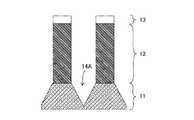
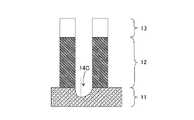
図1は、溝部の断面形状が略V字状である場合の偏光板の構造を模式的に示す断面図であり、図2は、溝部の断面形状が略U字状である場合の偏光板の構造を模式的に示す断面図であり、図3は、溝部の断面形状が非対称である場合の偏光板の構造を模式的に示す断面図である。 FIG. 1 is a cross-sectional view schematically showing the structure of a polarizing plate when the cross-sectional shape of the groove portion is substantially V-shaped, and FIG. 2 is a polarizing plate when the cross-sectional shape of the groove portion is substantially U-shaped. FIG. 3 is a cross-sectional view schematically showing the structure of the polarizing plate when the cross-sectional shape of the groove is asymmetric.
図1〜図3に示すように、偏光板は、透明基板11と、反射層12と反射制御層13とを有する格子状凸部と、格子状凸部間に凹設された溝部14A,14B,14Cとを備える。 As shown in FIG. 1 to FIG. 3, the polarizing plate includes a
格子状凸部は、少なくとも反射層12と反射制御層13とを有する。格子状凸部のピッチは、使用帯域の光の波長よりも小さく、具体的には、100nm以上200nm以下であることが好ましい。また、格子状凸部の高さに対するワイヤーグリッドの長手方向に平行な方向(Y方向)の長さの比は1000以上であることが好ましい。また、溝部14A,14B,14Cの深さに対するY方向の長さの比は1000以上であることが好ましい。また、格子状凸部と溝部14A,14B,14Cとは、Y方向に平行であることが好ましい。これにより、ミクロンサイズの画素で形成されている液晶素子に用いた場合でも、面内の透過率及び反射率を均一にすることができる。 The lattice-shaped convex portion has at least the
反射層12は、吸収軸であるY方向に使用波長帯域の光に対して反射性を有する光反射性材料が帯状に延在してなるものである。すなわち、反射層12は、ワイヤーグリッド型偏光子としての機能を有し、透明基板のワイヤーグリッドが形成された面に向かって入射した光のうち、ワイヤーグリッドの長手方向に平行な方向(Y方向)に電界成分をもつ偏光波(TE波(S波))を減衰させ、ワイヤーグリッドの長手方向と直交する方向(X方向)に電界成分をもつ偏光波(TM波(P波))を透過させる。 The
反射制御層13は、TE波を偏光波の選択的光吸収作用によって減衰させる。反射制御層13の構成を適宜調整することによって、反射層12で反射したTE波について、反射制御層13を透過する際に一部を反射し、反射層12に戻すことができ、また、反射制御層13を通過した光を干渉により減衰させることができる。 The
反射制御層13の構成としては、後述するように、例えば、使用波長帯域の光に対して吸収性を有する光吸収性材料からなる吸収層と、誘電体からなる誘電体層との多層膜であっても、光吸収性材料と誘電体とが混合されてなる反射抑制層であってもよい。 As described later, the configuration of the
溝部14A,14B,14Cは、所定方向に直交する方向の幅が深さ方向に向かってゼロになるように小さくなる。換言すれば、溝部の断面構造は、最深部から基板表面に向かうに従い基板材料に対して空気部分が大きくなる。また、所定方向に直交する方向の溝部の断面の形状、すなわち、所定方向から見たときの溝部の断面の形状は、底面を有さないことが好ましい。ここで、底面を有さないとは、所定方向に直交する方向の底部の幅が10nm以下であることをいう。 The
図1に示す溝部14Aのように、所定方向に直交する方向の溝部の断面の形状は、略V字状とすることができる。これにより、緑色波長帯域(波長520−590nm)及び赤色波長帯域(波長600−680nm)において、透過軸透過率Tpを上昇させるとともに透過軸反射率Rpを低下させ、優れた光学特性を得ることができる。また、溝部の断面形状を略V字状とした場合、溝部の断面形状を四角形状とした場合に比して、青色波長帯域(波長430−510nm)の透過軸透過率Tpの低下を抑制させることができる。 Like the
また、断面形状を略V字状とした場合の溝部の深さは、20nm以上100nm以下であることが好ましく、60nm以上100nm以下であることがより好ましい。これにより、透過軸透過率Tpを上昇させるとともに透過軸反射率Rpを低下させ、優れた光学特性を得ることができる。 Further, the depth of the groove when the cross-sectional shape is substantially V-shaped is preferably 20 nm or more and 100 nm or less, and more preferably 60 nm or more and 100 nm or less. Thereby, it is possible to increase the transmission axis transmittance Tp and decrease the transmission axis reflectance Rp, and to obtain excellent optical characteristics.
また、図2に示す溝部14Bのように、所定方向に直交する方向の溝部の断面の形状は、略U字状とすることができる。これにより、溝部の断面形状を略V字状とした場合と同様に、緑色波長帯域(波長520−590nm)及び赤色波長帯域(波長600−680nm)において、透過軸透過率Tpを上昇させるとともに透過軸反射率Rpを低下させ、優れた光学特性を得ることができる。また、溝部の断面形状を略U字状とした場合、溝部の断面形状を四角形状とした場合に比して、青色波長帯域(波長430−510nm)の透過軸透過率Tpの低下を抑制させることできる。 Moreover, the shape of the cross section of the groove part in the direction orthogonal to the predetermined direction like the
断面形状を略U字状とした場合の溝部の深さは、20nm以上120nm以下であることが好ましく、60nm以上100nm以下であることがより好ましい。これにより、透過軸透過率Tpを上昇させるとともに透過軸反射率Rpを低下させ、優れた光学特性を得ることができる。 The depth of the groove when the cross-sectional shape is substantially U-shaped is preferably 20 nm or more and 120 nm or less, and more preferably 60 nm or more and 100 nm or less. Thereby, it is possible to increase the transmission axis transmittance Tp and decrease the transmission axis reflectance Rp, and to obtain excellent optical characteristics.
また、図3に示す溝部14Cのように、所定方向に直交する方向の溝部の断面の形状は、溝部の深さがゼロのときの幅の中点を通る垂線に対して非対称とすることができる。すなわち、溝部の断面の形状は、溝部の最深部が深さゼロのときの幅の中点を通る垂線上になくてもよい。より具体的には、溝部の深さがゼロのときの幅の中点(原点)を通る垂線と、溝部の最深部と原点とを通る直線との角度が±20°以下であることが好ましい。これにより、溝部の最深部と原点とを通る直線との角度が0°の偏光板、すなわち、所定方向に直交する方向の溝部の断面の形状が溝部の深さゼロのときの幅の中点を通る垂線に対して対称である偏光板と同等の光学特性を得ることができる。 Further, like the groove portion 14C shown in FIG. 3, the shape of the cross section of the groove portion in the direction orthogonal to the predetermined direction may be asymmetric with respect to a perpendicular passing through the midpoint of the width when the depth of the groove portion is zero. it can. That is, the cross-sectional shape of the groove portion may not be on a perpendicular line passing through the midpoint of the width when the deepest portion of the groove portion is zero depth. More specifically, the angle between the perpendicular passing through the midpoint (origin) of the width when the depth of the groove is zero and the straight line passing through the deepest part of the groove and the origin is preferably ± 20 ° or less. . Accordingly, the polarizing plate whose angle between the deepest part of the groove part and the straight line passing through the origin is 0 °, that is, the midpoint of the width when the cross-sectional shape of the groove part in the direction orthogonal to the predetermined direction is zero in the groove part Optical characteristics equivalent to those of a polarizing plate that is symmetric with respect to a perpendicular line passing through can be obtained.
また、溝部の断面の形状が非対称であることにより、少なくとも一方の傾斜が他方よりも小さくなるため、誘電体部、撥水部などの保護膜の形成を容易にすることができる。 In addition, since the cross-sectional shape of the groove is asymmetric, at least one of the slopes is smaller than the other, so that it is possible to easily form a protective film such as a dielectric part or a water repellent part.
保護膜は、誘電体部、撥水部などの成膜によって、格子状凸部の表面及び格子状凸部間の溝部の表面に設けられ、耐湿効果、撥水効果などを付与し、信頼性を向上させることができる。 The protective film is provided on the surface of the grid-like convex part and the surface of the groove part between the grid-like convex parts by forming a dielectric part, a water-repellent part, etc., and provides a moisture resistance effect, a water-repellent effect, etc. Can be improved.
誘電体部を構成する誘電体としては、SiO2等のSi酸化物、Al2O3、酸化ベリリウム、酸化ビスマス、等の金属酸化物、MgF2、氷晶石、ゲルマニウム、二酸化チタン、ケイ素、フッ化マグネシウム、窒化ボロン、酸化ボロン、酸化タンタル、炭素、又はこれらの組み合わせ等の一般的な材料が挙げられる。これらの中でも、SiO2等のSi酸化物が好ましく用いられる。Examples of the dielectric constituting the dielectric part include Si oxides such as SiO2 , metal oxides such as Al2 O3 , beryllium oxide and bismuth oxide, MgF2 , cryolite, germanium, titanium dioxide, silicon, Common materials such as magnesium fluoride, boron nitride, boron oxide, tantalum oxide, carbon, or a combination thereof can be given. Among these, Si oxides such as SiO2 are preferably used.
撥水部は、撥水性化合物を用いて形成され、毛細管現象によりグリッド間に水分が入り込むのを抑制する。具体的な撥水性化合物としては、フルオロアルキル基又はアルキル基を有するシラン化合物、又はリン酸化合物が挙げられ、アルキル鎖の炭素数は、4〜20であることが好ましい。シラン化合物の具体例としては、例えば、FDTS(heptadecafluoro-1,1,2,2-tetrahydrodecyltrichlorosilane)、PETS(pentafuorophenylpropyltrichlorosilane)、FOTS((tridecafluoro-1,1,2,2-tetrahydrooctyl) trichlorosilane)、OTS(n-octadecyltrichlorosilane, (C18))などが挙げられる。また、リン酸化合物の具体例としては、FOPA(1H,1H,2H,2H-perfluoro-n-octylphosphonic acid)、FDPA(1H,1H,2H,2H-perfluoro-n-decylphosphonic acid)、FHPA(1H,1H,2H,2H-perfluoro-n-hexylphosphonic acid)、ODPA(octadecylphosphonic acid)などが挙げられる。溝部の断面の形状が非対称である場合、少なくとも一方の傾斜が他方よりも小さくなるため、CVD、ディップコートなどのコート方法により撥水化合物を溝部に導入することができる。 The water repellent part is formed using a water repellent compound, and suppresses moisture from entering between the grids due to capillary action. Specific examples of the water-repellent compound include a silane compound having a fluoroalkyl group or an alkyl group, or a phosphoric acid compound, and the carbon number of the alkyl chain is preferably 4-20. Specific examples of silane compounds include, for example, FDTS (heptadecafluoro-1,1,2,2-tetrahydrodecyltrichlorosilane), PETS (pentafuorophenylpropyltrichlorosilane), FOTS ((tridecafluoro-1,1,2,2-tetrahydrooctyl) trichlorosilane), OTS ( n-octadecyltrichlorosilane, (C18)) and the like. Specific examples of phosphoric acid compounds include FOPA (1H, 1H, 2H, 2H-perfluoro-n-octylphosphonic acid), FDPA (1H, 1H, 2H, 2H-perfluoro-n-decylphosphonic acid), FHPA (1H , 1H, 2H, 2H-perfluoro-n-hexylphosphonic acid), ODPA (octadecylphosphonic acid), and the like. When the cross-sectional shape of the groove is asymmetric, at least one of the slopes is smaller than the other, so that the water repellent compound can be introduced into the groove by a coating method such as CVD or dip coating.
このような構成の光学部材によれば、透過、反射、干渉、偏光波の選択的光吸収の4つの作用を利用することで、反射層の格子に平行な電界成分をもつ偏光波(TE波(S波))を減衰させ、格子に垂直な電界成分をもつ偏光波(TM波(P波))を透過させることができる。すなわち、TE波は、反射抑制層の偏光波の選択的光吸収作用によって減衰され、反射制御層を透過したTE波は、ワイヤーグリッドとして機能する格子状の反射層によって反射される。 According to the optical member having such a configuration, a polarized wave (TE wave) having an electric field component parallel to the grating of the reflective layer is utilized by utilizing four actions of transmission, reflection, interference, and selective light absorption of the polarized wave. (S wave)) can be attenuated and a polarized wave (TM wave (P wave)) having an electric field component perpendicular to the grating can be transmitted. That is, the TE wave is attenuated by the selective light absorption action of the polarized wave of the reflection suppressing layer, and the TE wave transmitted through the reflection control layer is reflected by the lattice-like reflection layer functioning as a wire grid.
ここで、クリッド間の溝部の幅が深さ方向に向かってゼロになるように小さくなることにより、透過率特性及び反射率特性を向上させることができ、優れた光学特性を得ることができる。また、透過率特性のカスタマー要求は0.1%レベルであるため、偏光板の構造を大幅に変更せずに偏光板の作製プロセスの変更のみによって溝部構造を最適化し、光学特性の向上が達成できることは、産業上、極めて有益である。 Here, by reducing the width of the groove between the clads so as to become zero in the depth direction, the transmittance characteristic and the reflectance characteristic can be improved, and excellent optical characteristics can be obtained. In addition, since the customer requirement for transmittance characteristics is at the 0.1% level, the groove structure is optimized only by changing the manufacturing process of the polarizing plate without significantly changing the structure of the polarizing plate, thereby improving the optical characteristics. What can be done is extremely beneficial in industry.
[具体例1]
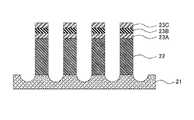
図4は、具体例1として示す偏光板の構造を模式的に示す断面図である。図4に示すように、偏光板は、使用波長帯域の光に対して透明である透明基板21と、使用帯域の光の波長よりも短いピッチで透明基板上に配列され、所定方向に延在する反射層22と、第1の誘電体層23Aと、吸収層23Bと、第2の誘電体層23Cとをこの順に有する格子状凸部と、格子状凸部間に凹設され、所定方向に直交する方向の幅が深さ方向に向かってゼロになるように小さくなる溝部とを備える。すなわち、具体例1として示す偏光板は、反射制御層として、第1の誘電体層23Aと、吸収層23Bと、第2の誘電体層23Cとを有するものである。[Specific Example 1]
FIG. 4 is a cross-sectional view schematically showing the structure of a polarizing plate shown as specific example 1. As shown in FIG. 4, the polarizing plate is arranged on the
透明基板21としては、使用帯域の光に対して透光性を示す基板であれば特に制限されず、目的に応じて適宜選択することができる。「使用帯域の光に対して透光性を示す」とは、使用帯域の光の透過率が100%であることを意味するものではなく、偏光板としての機能を保持可能な透光性を示せばよい。使用帯域の光としては、例えば、波長380nm〜810nm程度の可視光が挙げられる。 The
反射層22としては、使用帯域の光に対して反射性を有する材料であれば特に制限されず、例えばAl、Ag、Cu、Mo、Cr、Ti、Ni、W、Fe、Si、Ge、Teなどの金属単体もしくはこれらを含む合金又は半導体材料を用いることができる。 The
第1の誘電体層23Aは、例えば、吸収層23Bで反射した偏光に対して、吸収層23Bを透過し、反射層22で反射した当該偏光の位相が半波長ずれる膜厚で形成される。実用上、膜厚が最適化されていなくても、吸収層23Bが反射した光を吸収し、コントラストの向上が実現できるので、所望の偏光特性と実際の作製工程の兼ね合いで決定して構わない。 For example, the first
第1の誘電体層23Aとしては、SiO2等のSi酸化物、Al2O3、酸化ベリリウム、酸化ビスマス、等の金属酸化物、MgF2、氷晶石、ゲルマニウム、二酸化チタン、ケイ素、フッ化マグネシウム、窒化ボロン、酸化ボロン、酸化タンタル、炭素、又はこれらの組み合わせ等の一般的な材料が挙げられる。これらの中でも、Si酸化物が好ましく用いられる。As the first
吸収層23Bは、金属材料や半導体材料等の光学定数の消衰定数が零でない、光吸収作用を持つ光吸収性材料からなり、使用帯域の光によって適宜選択される。金属材料としては、Ta、Al、Ag、Cu、Au、Mo、Cr、Ti、W、Ni、Fe、Sn等の元素単体又はこれらの1種以上の元素を含む合金が挙げられる。また、半導体材料としては、Si、Ge、Te、ZnO、シリサイド材料(β−FeSi2、MgSi2、NiSi2、BaSi2、CrSi2、CoSi2、TaSi等)が挙げられる。また、光吸収性材料として、カーボンナノチューブ、グラフェンなどのカーボン材料を用いてもよい。これらの材料を用いることにより、偏光板は、適用される可視光域に対して高い消光比が得られる。これらの中でも、Fe又はTaを含むとともに、Siを含んで構成されることが好ましい。The
第2の誘電体層23Cは、第1の誘電体層23Aと同様の材料を用いることができ、中でも、SiO2等のSi酸化物が好ましく用いられる。The second dielectric layer 23C can be made of the same material as that of the first
[具体例2]
図5は、具体例2として示す偏光板の構造を模式的に示す断面図である。図5に示すように、偏光板は、使用波長帯域の光に対して透明である透明基板31と、使用帯域の光の波長よりも短いピッチで透明基板上に配列され、所定方向に延在する反射層32と、光吸収性材料と誘電体とが混合されてなる反射抑制層33と有する格子状凸部と、格子状凸部間に凹設され、所定方向に直交する方向の幅が深さ方向に向かってゼロになるように小さくなる溝部とを備える。すなわち、具体例2として示す偏光板は、反射制御層として、光吸収性材料と誘電体とが混合されてなる反射抑制層33を有するものである。[Specific Example 2]
FIG. 5 is a cross-sectional view schematically showing the structure of a polarizing plate shown as specific example 2. As shown in FIG. 5, the polarizing plate is arranged on the
透明基板31及び反射層32は、それぞれ前述した具体例1に示す偏光板の透明基板21及び反射層22と同様であるため、ここでは説明を省略する。 Since the
反射抑制層33は、光吸収性材料と誘電体とが混合されてなり、例えば光吸収性材料又は誘電体の濃度が層厚方向に傾斜した濃度分布を有する。 The reflection suppressing layer 33 is formed by mixing a light absorbing material and a dielectric, and has a concentration distribution in which, for example, the concentration of the light absorbing material or the dielectric is inclined in the layer thickness direction.
光吸収性材料としては、金属材料、半導体材料などが挙げられ、使用帯域の光によって適宜選択される。金属材料としては、Ta、Al、Ag、Cu、Au、Mo、Cr、Ti、W、Ni、Fe、Sn等の元素単体又はこれらの1種以上の元素を含む合金が挙げられる。また、半導体材料としては、Si、Ge、Te、ZnO、シリサイド材料(β−FeSi2、MgSi2、NiSi2、BaSi2、CrSi2、CoSi2、TaSi等)が挙げられる。また、光吸収性材料として、カーボンナノチューブ、グラフェンなどのカーボン材料を用いてもよい。これらの材料を用いることにより、偏光板は、適用される可視光域に対して高い消光比が得られる。これらの中でも、Fe又はTaを含むとともに、Siを含んで構成されることが好ましい。Examples of the light-absorbing material include a metal material and a semiconductor material, and are appropriately selected depending on the light in the use band. Examples of the metal material include elemental elements such as Ta, Al, Ag, Cu, Au, Mo, Cr, Ti, W, Ni, Fe, and Sn, or alloys containing one or more of these elements. Examples of the semiconductor material include Si, Ge, Te, ZnO, and silicide materials (β-FeSi2 , MgSi2 , NiSi2 , BaSi2 , CrSi2 , CoSi2 , TaSi, etc.). Further, a carbon material such as carbon nanotube or graphene may be used as the light absorbing material. By using these materials, the polarizing plate can obtain a high extinction ratio with respect to the visible light region to be applied. Among these, it is preferable that Fe or Ta is included and Si is included.
誘電体としては、SiO2等のSi酸化物、Al2O3、酸化ベリリウム、酸化ビスマス、等の金属酸化物、MgF2、氷晶石、ゲルマニウム、二酸化チタン、ケイ素、フッ化マグネシウム、窒化ボロン、酸化ボロン、酸化タンタル、炭素、又はこれらの組み合わせ等の一般的な材料が挙げられる。これらの中でも、Si酸化物が好ましく用いられる。Dielectrics include Si oxides such as SiO2 , metal oxides such as Al2 O3 , beryllium oxide, bismuth oxide, MgF2 , cryolite, germanium, titanium dioxide, silicon, magnesium fluoride, boron nitride. And general materials such as boron oxide, tantalum oxide, carbon, or combinations thereof. Among these, Si oxide is preferably used.
[変形例]
図6は、変形例として示す偏光板の構造を模式的に示す断面図である。図6に示すように、偏光板は、使用波長帯域の光に対して透明である透明基板41と、使用帯域の光の波長よりも短いピッチで透明基板上に配列され、所定方向に延在する反射層42と、光吸収性材料と誘電体とが混合されてなり、所定方向に直交する方向の幅が先端側ほど小さくなる反射抑制層43と有する格子状凸部と、格子状凸部間に凹設され、所定方向に直交する方向の幅が深さ方向に向かってゼロになるように小さくなる溝部とを備える。すなわち、変形例として示す偏光板は、具体例2として示す偏光板において、反射抑制層33が所定方向から見たときに、先端側ほど幅が狭くなったものである。[Modification]
FIG. 6 is a cross-sectional view schematically showing the structure of a polarizing plate shown as a modification. As shown in FIG. 6, the polarizing plate is arranged on the
透明基板41及び反射層42は、それぞれ前述した具体例2に示す偏光板の透明基板31及び反射層32と同様であるため、ここでは説明を省略する。 The
反射抑制層43は、光吸収性材料と誘電体とが混合されてなり、例えば光吸収性材料又は誘電体の濃度が層厚方向に傾斜した濃度分布を有する。光吸収性材料及び誘電体としては、具体例2と同様のものを用いることができる。 The
また、反射抑制層43は、所定方向に直交する方向の幅が先端側ほど小さくなるグリッド先端部を有する。グリッド先端部は、例えば等脚台形状を有する先細形状である。グリッド先端部を先細形状とすることにより、TM波の透過率を向上させることができる。これは、角度のばらつきを持って入射する光に対して散乱を抑制するためと考えられる。 Moreover, the
なお、前述した変形例は、具体例2に示す偏光板の変形例として説明したが、具体例1に示す偏光板の変形例とすることができる。具体例1に示す偏光板の変形例とする場合、グリッド先端部は、第1の誘電体層23A、吸収層23B、及び第2の誘電体層23Cで構成される。 In addition, although the modification mentioned above was demonstrated as a modification of the polarizing plate shown in the specific example 2, it can be set as the modification of the polarizing plate shown in the specific example 1. In the case of a modification of the polarizing plate shown in the first specific example, the leading end of the grid includes the first
<2.偏光板の製造方法>
次に、本実施形態に係る偏光板の製造方法について説明する。本実施形態に係る偏光板の製造方法は、使用波長帯域の光に対して透明である透明基板上に積層された反射層と反射制御層とをエッチングし、使用帯域の光の波長よりも短いピッチで配列され、所定方向に延在する格子状凸部と、格子状凸部間に凹設され、所定方向に直交する方向の幅が深さ方向に向かってゼロになるように小さくなる溝部とを形成する。<2. Manufacturing method of polarizing plate>
Next, the manufacturing method of the polarizing plate which concerns on this embodiment is demonstrated. The manufacturing method of the polarizing plate according to the present embodiment etches the reflection layer and the reflection control layer laminated on the transparent substrate that is transparent to the light in the use wavelength band, and is shorter than the wavelength of the light in the use band. A grid-like convex part arranged at a pitch and extending in a predetermined direction, and a groove part that is recessed between the grid-like convex parts and becomes small so that the width in the direction perpendicular to the predetermined direction becomes zero in the depth direction And form.
以下、偏光板の製造方法について詳細に説明する。先ず、各種膜の成膜工程において、透明基板上に、反射層と、反射制御層とを、例えばスパッタリング法により積層させる。次に、レジストとして感光性樹脂を塗布し、露光及び現像を行い、レジストによる格子状のパターンを形成する。 Hereinafter, the manufacturing method of a polarizing plate is demonstrated in detail. First, in a film forming process of various films, a reflective layer and a reflection control layer are laminated on a transparent substrate by, for example, a sputtering method. Next, a photosensitive resin is applied as a resist, and exposure and development are performed to form a lattice pattern by the resist.
次に、レジストによるグリッドパターンを下層の反射層及び反射制御層に転写させ、反射層と反射制御層とを有する格子状凸部を形成するとともに格子状凸部間に溝部を凹設する。反射層、反射制御層、及び透明基板は、それぞれ異なる物質であり、エッチング性に差があるため、材料に合わせて、エッチングガスを変えることが好ましい。例えば、反射層にアルミニウムを使用した場合、塩素系のプラズマを用いることが好ましく、反射制御層にSiO2やFeSiを使用した場合には、フッ素系プラズマを用いることが好ましい。また、Al2O3を用いた場合には、BCl3を用いることがこのましい。このようにエッチングガスを材料により使い分けることにより、材料の境界の断面形状がエッチング性の違いにより乱れるのを抑制することができ、光学特性の劣化を抑制することができる。Next, the grid pattern by the resist is transferred to the lower reflective layer and the reflection control layer to form a grid-like convex part having the reflective layer and the reflection control layer, and a groove is provided between the grid-like convex parts. Since the reflective layer, the reflection control layer, and the transparent substrate are different materials and have different etching properties, it is preferable to change the etching gas according to the material. For example, when aluminum is used for the reflective layer, chlorine-based plasma is preferably used, and when SiO2 or FeSi is used for the reflection control layer, fluorine-based plasma is preferably used. In addition, when Al2 O3 is used, it is preferable to use BCl3 . Thus, by properly using the etching gas depending on the material, it is possible to suppress the cross-sectional shape of the boundary of the material from being disturbed by the difference in etching property, and it is possible to suppress the deterioration of the optical characteristics.
本実施の形態では、エッチング条件(ガス流量、ガス圧、出力、透明基板の冷却温度など)を最適化することにより、断面形状の幅が深さ方向に向かってゼロになるように小さくなる溝部を形成する。溝部の形成には、プラズマエッチング装置を用いることが好ましい。材料がSiO2である場合、エッチングガスは、CF系ガス(特にCF4)とArの混合ガスを用い、ガス圧を0.5〜1.0Pa、バイアスを40〜200Wとすることが好ましい。また、SiO2にAlが含まれる材料である場合、エッチングガスは、Cl系ガス(特にCl2とBCl3の混合ガス)を用い、ガス圧を0.5〜1.0Pa、バイアスを30〜50Wとすることが好ましい。これにより、断面形状の幅が深さ方向に向かってゼロになるように小さくなる溝部が形成され、優れた光学特性を有する偏光板を得ることができる。In this embodiment, by optimizing the etching conditions (gas flow rate, gas pressure, output, cooling temperature of the transparent substrate, etc.), the groove portion is reduced so that the width of the cross-sectional shape becomes zero in the depth direction. Form. A plasma etching apparatus is preferably used for forming the groove. When the material is SiO2 , the etching gas is preferably a mixed gas of CF-based gas (especially CF4 ) and Ar, the gas pressure is preferably 0.5 to 1.0 Pa, and the bias is 40 to 200 W. When SiO2 is a material containing Al, an etching gas is Cl-based gas (particularly, a mixed gas of Cl2 and BCl3 ), gas pressure is 0.5 to 1.0 Pa, and bias is 30 to 30. 50 W is preferable. Thereby, the groove part which becomes small so that the width | variety of a cross-sectional shape may become zero toward a depth direction is formed, and the polarizing plate which has the outstanding optical characteristic can be obtained.
また、格子状凸部の表面及び格子状凸部間の溝部の表面に、誘電体部、撥水部などの保護膜を成膜してもよい。誘電体部の成膜は、物理蒸着法、化学蒸着法などを用いることができる。これらの中でも、特にALD法(Atomic Layer Deposition法、原子堆積法)を用いることが好ましい。これにより、アスペクト比の高いトレンチ構造でも、溝の細部まで均等に誘電体を付着させることができる。 Further, a protective film such as a dielectric portion or a water repellent portion may be formed on the surface of the lattice-like convex portion and the surface of the groove portion between the lattice-like convex portions. The dielectric part can be formed by physical vapor deposition, chemical vapor deposition, or the like. Among these, it is particularly preferable to use the ALD method (Atomic Layer Deposition method, atomic deposition method). As a result, even in a trench structure with a high aspect ratio, the dielectric can be evenly attached to the details of the groove.
また、撥水部は、格子状凸部の表面及び格子状凸部間の溝部の表面に、撥水性化合物を塗布することにより形成することができる。撥水性化合物の塗布方法としては、ディップ塗布、スピンコート、ベーパー処理などが挙げられる。これらの中でも、特にべーパー処理を用いることが好ましい。これにより、撥水性化合物をアスペクト比の高いトレンチ構造の細部まで塗布することができる。 The water-repellent part can be formed by applying a water-repellent compound to the surface of the grid-like convex part and the surface of the groove part between the grid-like convex parts. Examples of the coating method of the water repellent compound include dip coating, spin coating, and vapor treatment. Among these, it is particularly preferable to use a vapor treatment. Thereby, the water repellent compound can be applied to the details of the trench structure having a high aspect ratio.
<3.光学機器>
本実施の形態に係る光学機器は、前述した偏光板を搭載する。光学機器としては、液晶プロジェクタ、ヘッドアップディスプレイ、デジタルカメラ等が挙げられる。本実施の形態に係る偏光板は、高い透過率を有するため、高輝度が要求される液晶プロジェクタ、ヘッドアップディスプレイ等の用途に好適である。<3. Optical equipment>
The optical apparatus according to the present embodiment is equipped with the polarizing plate described above. Examples of the optical device include a liquid crystal projector, a head-up display, and a digital camera. Since the polarizing plate according to this embodiment has high transmittance, it is suitable for applications such as a liquid crystal projector and a head-up display that require high luminance.
本実施の形態に係る光学機器が複数の偏光板を備える場合、複数の偏光板の少なくとも1つが本技術に係る偏光板であればよい。例えば、本実施の形態に係る光学機器が、液晶プロジェクタである場合、液晶パネルの入射側及び出射側に配置される偏光板の少なくとも一方が本技術に係る偏光板であればよい。 When the optical apparatus according to the present embodiment includes a plurality of polarizing plates, at least one of the plurality of polarizing plates may be a polarizing plate according to the present technology. For example, when the optical apparatus according to the present embodiment is a liquid crystal projector, at least one of the polarizing plates disposed on the incident side and the emitting side of the liquid crystal panel may be the polarizing plate according to the present technology.
<4.実施例>
以下、本技術の実施例について説明する。ワイヤーグリッド型の偏光板において、格子状凸部間の基板に凹設される溝部の形状について、シミュレーションを行った。なお、本技術はこれらの実施例に限定されるものではない。<4. Example>
Hereinafter, examples of the present technology will be described. In the wire grid type polarizing plate, a simulation was performed with respect to the shape of the groove portion provided in the substrate between the lattice-like convex portions. Note that the present technology is not limited to these examples.
シミュレーションは、RCWA(Rigorous Coupled Wave Analysis)法による電磁界シミュレーションにより行った。シミュレーションには、Grating Solver Development社製のグレーティングシミュレータ「Gsolver」を用いた。 The simulation was performed by electromagnetic field simulation by the RCWA (Rigorous Coupled Wave Analysis) method. For the simulation, a grating simulator “Gsolver” manufactured by Grafting Solver Development was used.
[溝部の断面形状が四角形状]
図7は、従来例である溝部の断面形状が四角形状である場合の偏光板の構成を模式的に示す断面図である。図7に示す偏光板は、ガラス基板と、ガラス基板上に141nmのピッチPで配列された幅W35nmのAlからなる反射層と、反射層上に配置された第1のSiO2層と、FeSi層と、第2のSiO2層とを備える。反射層の厚みT42は250nm、第1のSiO2層の厚みT43は5nm、第1のFeSi層の厚みT44は25nm、第2のSiO2層の厚みT45は15nmとした。また、FeSi層におけるFe含有量は5atm%、Si含有量は95atm%とした。[The cross-sectional shape of the groove is square]
FIG. 7 is a cross-sectional view schematically showing a configuration of a polarizing plate in the case where the cross-sectional shape of the groove portion which is a conventional example is a square shape. The polarizing plate shown in FIG. 7 includes a glass substrate, a reflective layer made of Al with a width of W 35 nm arranged at a pitch P of 141 nm on the glass substrate, a first SiO2 layer disposed on the reflective layer, FeSi A layer and a second SiO2 layer. The thickness T42 of the reflective layer was 250 nm, the thickness T43 of the first SiO2 layer was 5 nm, the thickness T44 of the first FeSi layer was 25 nm, and the thickness T45 of the second SiO2 layer was 15 nm. Further, the Fe content in the FeSi layer was 5 atm%, and the Si content was 95 atm%.
また、ガラス基板に形成された溝部の断面の形状を四角形とし、その深さをそれぞれ20nm、40nm、60nm、80nm、100nmとしてシミュレーションを行った。 In addition, the simulation was performed by setting the cross-sectional shape of the groove formed in the glass substrate to a quadrangular shape and the depths of 20 nm, 40 nm, 60 nm, 80 nm, and 100 nm, respectively.
表1に、従来例である溝部の断面形状を四角形状としたときの偏光板の各波長帯域の透過軸透過率Tp及び透過軸反射率Rpの平均値のシミュレーション結果を示す。 Table 1 shows the simulation results of the average values of the transmission axis transmittance Tp and the transmission axis reflectance Rp in each wavelength band of the polarizing plate when the cross-sectional shape of the groove portion, which is a conventional example, is rectangular.

また、図8は、従来例である断面形状を四角形状とした溝部を所定深さにしたときの偏光板の透過軸透過率Tpのシミュレーション結果を示すグラフであり、図9は、従来例である断面形状を四角形状とした溝部を所定深さにしたときの偏光板の透過軸反射率Rpのシミュレーション結果を示すグラフである。 FIG. 8 is a graph showing a simulation result of the transmission axis transmittance Tp of the polarizing plate when a groove having a square cross-sectional shape, which is a conventional example, is set to a predetermined depth, and FIG. 9 is a graph showing the conventional example. It is a graph which shows the simulation result of the transmission axis reflectance Rp of a polarizing plate when the groove part which made a certain cross-sectional shape square shape is made into predetermined depth.
これらの結果より、溝部の断面形状を四角形状とした場合、青色波長帯域(波長430−510nm)の透過軸反射率Rpが大きく上昇し、光学特性が低下することが分かった。また、溝部の深さが60nm以上である場合、緑色波長帯域(波長520−590nm)の透過軸透過率Tpが低下し、青色波長帯域(波長430−510nm)の透過軸透過率Tpが、溝部の深さが0nmである場合よりも低下することが分かった。 From these results, it was found that when the cross-sectional shape of the groove portion is a quadrangular shape, the transmission axis reflectance Rp in the blue wavelength band (wavelength 430 to 510 nm) greatly increases and the optical characteristics deteriorate. Further, when the depth of the groove is 60 nm or more, the transmission axis transmittance Tp in the green wavelength band (wavelength 520 to 590 nm) is lowered, and the transmission axis transmittance Tp in the blue wavelength band (wavelength 430 to 510 nm) is It was found that the depth was lower than when the depth was 0 nm.
[溝部の断面形状が略V字状]
図10は、溝部の断面形状が略V字状である場合の偏光板の構成を模式的に示す断面図である。図10に示す偏光板は、基板に凹設される溝部の断面形状を略V字状とした以外は、図7に示す偏光板の構成と同様とした。すなわち、この偏光板は、ガラス基板と、ガラス基板上に141nmのピッチPで配列された幅W35nmのAlからなる反射層と、反射層上に配置された第1のSiO2層と、FeSi層と、第2のSiO2層とを備える。反射層の厚みT52は250nm、第1のSiO2層の厚みT53は5nm、第1のFeSi層の厚みT54は25nm、第2のSiO2層の厚みT55は15nmとした。また、FeSi層におけるFe含有量は5atm%、Si含有量は95atm%とした。[The cross-sectional shape of the groove is substantially V-shaped]
FIG. 10 is a cross-sectional view schematically showing the configuration of the polarizing plate when the cross-sectional shape of the groove is substantially V-shaped. The polarizing plate shown in FIG. 10 was the same as the polarizing plate shown in FIG. 7 except that the cross-sectional shape of the groove provided in the substrate was substantially V-shaped. That is, the polarizing plate includes a glass substrate, a reflective layer made of Al having a width of W 35 nm arranged at a pitch P of 141 nm on the glass substrate, a first SiO2 layer disposed on the reflective layer, and an FeSi layer And a second SiO2 layer. Reflective layer thicknessT 52 is 250nm, and the first SiO2 layer of thicknessT 53 is 5 nm, the first FeSi layer thicknessT 54 25 nm, the thicknessT 55 of the second SiO2 layer was set to 15 nm. Further, the Fe content in the FeSi layer was 5 atm%, and the Si content was 95 atm%.
また、ガラス基板に形成された溝部の断面の形状を略V字状の三角形とし、その深さをそれぞれ20nm、40nm、60nm、80nm、100nmとしてシミュレーションを行った。 In addition, the simulation was performed with the cross-sectional shape of the groove formed in the glass substrate being a substantially V-shaped triangle and the depths being 20 nm, 40 nm, 60 nm, 80 nm, and 100 nm, respectively.
表2に、溝部の断面形状を略V字状としたときの偏光板の各波長帯域の透過軸透過率Tp及び透過軸反射率Rpの平均値のシミュレーション結果を示す。 Table 2 shows the simulation results of the average values of the transmission axis transmittance Tp and the transmission axis reflectance Rp in each wavelength band of the polarizing plate when the cross-sectional shape of the groove is substantially V-shaped.
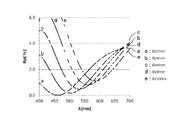
また、図11は、断面形状を略V字状とした溝部を所定深さにしたときの偏光板の透過軸透過率Tpのシミュレーション結果を示すグラフであり、図12は、断面形状を略V字状とした溝部を所定深さにしたときの偏光板の透過軸反射率Rpのシミュレーション結果を示すグラフである。 FIG. 11 is a graph showing a simulation result of the transmission axis transmittance Tp of the polarizing plate when a groove portion having a substantially V-shaped cross section is set to a predetermined depth, and FIG. It is a graph which shows the simulation result of the transmission axis reflectance Rp of a polarizing plate when making the groove part made into the shape of a character into predetermined depth.
また、図13は、従来例である断面形状を四角形状とした溝部を所定深さにしたときの偏光板の各波長帯域の透過軸透過率Tpの平均値のシミュレーション結果を示すグラフであり、図14は、断面形状を略V字状とした溝部を所定深さにしたときの偏光板の各波長帯域の透過軸透過率Tpの平均値のシミュレーション結果を示すグラフである。 FIG. 13 is a graph showing a simulation result of the average value of the transmission axis transmittance Tp in each wavelength band of the polarizing plate when the groove having a square cross-sectional shape as a conventional example is set to a predetermined depth. FIG. 14 is a graph showing a simulation result of the average value of the transmission axis transmittance Tp in each wavelength band of the polarizing plate when the groove portion having a substantially V-shaped cross section is set to a predetermined depth.
これらの結果より、溝部の断面形状を略V字状とした場合、緑色波長帯域(波長520−590nm)及び赤色波長帯域(波長600−680nm)において、透過軸透過率Tpを上昇させるとともに透過軸反射率Rpを低下させ、優れた光学特性が得られることが分かった。また、溝部の断面形状を略V字状とした場合、溝部の断面形状を四角形状とした場合に比して、青色波長帯域(波長430−510nm)の透過軸透過率Tpの低下を抑制させることが分かった。また、溝部の深さが60nm以上100nm以下である場合、青色波長帯域の透過軸透過率Tpが、溝部の深さが0nmである場合よりも大きくなり、優れた光学特性が得られることが分かった。 From these results, when the cross-sectional shape of the groove portion is substantially V-shaped, the transmission axis transmittance Tp is increased and the transmission axis is increased in the green wavelength band (wavelength 520 to 590 nm) and the red wavelength band (
[溝部の断面形状が略U字状]
図15は、溝部の断面形状が略U字状である場合の偏光板の構成を模式的に示す断面図である。図15に示す偏光板は、基板に凹設される溝部の断面形状を略U字状とした以外は、図7に示す偏光板の構成と同様とした。すなわち、この偏光板は、ガラス基板と、ガラス基板上に141nmのピッチPで配列された幅W35nmのAlからなる反射層と、反射層上に配置された第1のSiO2層と、FeSi層と、第2のSiO2層とを備える。反射層の厚みT52は250nm、第1のSiO2層の厚みT53は5nm、第1のFeSi層の厚みT54は25nm、第2のSiO2層の厚みT55は15nmとした。また、FeSi層におけるFe含有量は5atm%、Si含有量は95atm%とした。[The cross-sectional shape of the groove is substantially U-shaped]
FIG. 15 is a cross-sectional view schematically showing the configuration of the polarizing plate when the cross-sectional shape of the groove portion is substantially U-shaped. The polarizing plate shown in FIG. 15 has the same configuration as that of the polarizing plate shown in FIG. 7 except that the cross-sectional shape of the groove provided in the substrate is substantially U-shaped. That is, the polarizing plate includes a glass substrate, a reflective layer made of Al having a width of W 35 nm arranged at a pitch P of 141 nm on the glass substrate, a first SiO2 layer disposed on the reflective layer, and an FeSi layer And a second SiO2 layer. Reflective layer thicknessT 52 is 250nm, and the first SiO2 layer of thicknessT 53 is 5 nm, the first FeSi layer thicknessT 54 25 nm, the thicknessT 55 of the second SiO2 layer was set to 15 nm. Further, the Fe content in the FeSi layer was 5 atm%, and the Si content was 95 atm%.
また、ガラス基板に形成された溝部の断面の形状を略U字状とし、その深さをそれぞれ20nm、40nm、60nm、80nm、100nm、120nmとしてシミュレーションを行った。 In addition, the simulation was performed with the cross-sectional shape of the groove formed in the glass substrate being substantially U-shaped and the depths being 20 nm, 40 nm, 60 nm, 80 nm, 100 nm, and 120 nm, respectively.
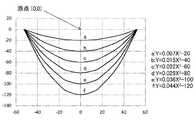
図16は、溝部の断面形状が略U字状である場合の溝部の構成を模式的に示す断面図であり、図17は、溝部の断面形状が略U字状である場合の溝部の断面形状の曲線を示すグラフである。 16 is a cross-sectional view schematically showing the configuration of the groove portion when the cross-sectional shape of the groove portion is substantially U-shaped, and FIG. 17 is a cross-sectional view of the groove portion when the cross-sectional shape of the groove portion is substantially U-shaped. It is a graph which shows the curve of a shape.
図16及び図17に示すように、溝部の断面形状は、溝部の深さゼロのときの幅の中点を原点(0,0)とし、グリッド間隔をW、溝の深さをDとしたとき、下記式を満たす2次曲線とした。
Y=(4D/W2)×X2−DAs shown in FIG. 16 and FIG. 17, the cross-sectional shape of the groove portion is set such that the midpoint of the width when the depth of the groove portion is zero is the origin (0, 0), the grid interval is W, and the groove depth is D. At this time, a quadratic curve satisfying the following formula was adopted.
Y = (4D / W2 ) × X2 −D
すなわち、図17に示すように、深さが20nm〜120nmの溝部の断面形状の曲線(a)〜(f)は、下記式とした。
(a)Y=0.007X2−20、(b)Y=0.015X2−40、(c)Y=0.022X2−60、(d)Y=0.029X2−80、(e)Y=0.036X2−100、(f)Y=0.044X2−120That is, as shown in FIG. 17, the curves (a) to (f) of the cross-sectional shape of the groove part having a depth of 20 nm to 120 nm are represented by the following equations.
(A) Y = 0.007X 2 -20 , (b) Y = 0.015X 2 -40, (c) Y = 0.022X 2 -60, (d) Y = 0.029X 2 -80, (e ) Y = 0.036X2 −100, (f) Y = 0.044X2 −120
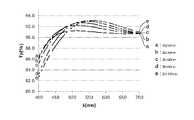
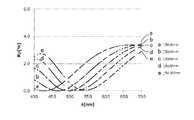
図18は、断面形状を略U字状とした溝部を所定深さにしたときの偏光板の透過軸透過率Tpのシミュレーション結果を示すグラフであり、図19は、断面形状を略U字状とした溝部を所定深さにしたときの偏光板の透過軸反射率Rpのシミュレーション結果を示すグラフである。 FIG. 18 is a graph showing a simulation result of the transmission axis transmittance Tp of the polarizing plate when a groove portion having a substantially U-shaped cross section is set to a predetermined depth, and FIG. 19 is a substantially U-shaped cross section. It is a graph which shows the simulation result of the transmission-axis reflectance Rp of a polarizing plate when making the groove part made into the predetermined depth.
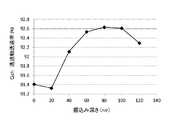
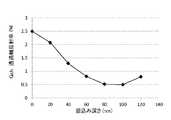
また、図20は、断面形状を略U字状とした溝部の深さに対する緑色波長帯域の透過軸透過率Tpの平均値のシミュレーション結果を示すグラフであり、図21は、断面形状を略U字状とした溝部の深さに対する緑色波長帯域の透過軸反射率Rpの平均値のシミュレーション結果を示すグラフである。 FIG. 20 is a graph showing a simulation result of the average value of the transmission axis transmittance Tp in the green wavelength band with respect to the depth of the groove portion having a substantially U-shaped cross section. FIG. It is a graph which shows the simulation result of the average value of the transmission axis reflectance Rp of the green wavelength band with respect to the depth of the groove-shaped groove.
これらの結果より、溝部の断面形状を略U字状とした場合、緑色波長帯域(波長520−590nm)及び赤色波長帯域(波長600−680nm)において、透過軸透過率Tpを上昇させ、透過軸反射率Rpを低下させ、優れた光学特性が得られることが分かった。また、溝部の断面形状を略U字状とした場合、溝部の断面形状を四角形状とした場合に比して、青色波長帯域(波長430−510nm)の透過軸透過率Tpの低下を抑制させることが分かった。また、溝部の深さが60nm以上120nm以下である場合、緑色波長帯域の透過軸透過率Tpが大きく、緑色波長帯域の透過軸反射率Rpが小さいため、優れた光学特性が得られることが分かった。 From these results, when the cross-sectional shape of the groove portion is substantially U-shaped, the transmission axis transmittance Tp is increased in the green wavelength band (wavelength 520-590 nm) and the red wavelength band (wavelength 600-680 nm), and the transmission axis It was found that the reflectance Rp was decreased and excellent optical characteristics were obtained. Further, when the cross-sectional shape of the groove portion is substantially U-shaped, a decrease in the transmission axis transmittance Tp in the blue wavelength band (wavelength 430 to 510 nm) is suppressed as compared with the case where the cross-sectional shape of the groove portion is a square shape. I understood that. In addition, when the depth of the groove is 60 nm or more and 120 nm or less, it is understood that excellent optical characteristics can be obtained because the transmission axis transmittance Tp in the green wavelength band is large and the transmission axis reflectance Rp in the green wavelength band is small. It was.
[溝部の断面形状が略U字状(非対称)]
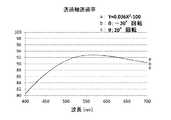
図22は、溝部の深さがゼロのときの幅の中点(原点)を通る垂線と、溝部の最深部と原点とを通る直線との角度の関係を示すグラフである。図22において、曲線(a)は、Y=0.036X2−100であり、曲線(b)は、溝部の深さがゼロのときの幅の中点(原点)を通る垂線と、原点と曲線(b)の最深部とを結んだ直線との角度が20°である曲線を示し、曲線(c)は、溝部の深さがゼロのときの幅の中点(原点)を通る垂線と、原点と曲線(b)の最深部とを結んだ直線との角度が−20°である曲線を示す。[The cross-sectional shape of the groove is substantially U-shaped (asymmetric)]
FIG. 22 is a graph showing an angle relationship between a perpendicular passing through the midpoint (origin) of the width when the depth of the groove is zero and a straight line passing through the deepest part of the groove and the origin. In FIG. 22, the curve (a) is Y = 0.036X2 -100, and the curve (b) is a perpendicular line passing through the midpoint (origin) of the width when the depth of the groove is zero, the origin, The curve (b) shows a curve whose angle with the straight line connecting the deepest part of the curve (b) is 20 °, and the curve (c) is a perpendicular line passing through the midpoint (origin) of the width when the groove depth is zero. The curve whose angle with the straight line which connected the origin and the deepest part of the curve (b) is -20 degrees is shown.
図22に示すように、溝部の断面形状を曲線(a)、曲線(b)、曲線(c)としたときの偏光板について、シミュレーションを行った。偏光板は、基板に凹設される溝部の断面形状を曲線(a)、曲線(b)、曲線(c)とした以外は、図15に示す偏光板の構成と同様とした。 As shown in FIG. 22, a simulation was performed for the polarizing plate when the cross-sectional shape of the groove was a curve (a), a curve (b), and a curve (c). The polarizing plate was the same as the polarizing plate shown in FIG. 15 except that the cross-sectional shape of the groove portion provided in the substrate was changed to curve (a), curve (b), and curve (c).
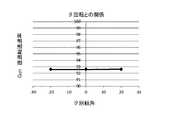
図23は、溝部の断面形状を曲線(a)、曲線(b)、曲線(c)としたときの偏光板の透過軸透過率Tpのシミュレーション結果を示すグラフであり、図24は、溝部の断面形状を曲線(a)、曲線(b)、曲線(c)としたときの偏光板の透過軸反射率Rpのシミュレーション結果を示すグラフである。また、図25は、溝部の深さがゼロのときの幅の中点(原点)を通る垂線と、溝部の最深部と原点とを通る直線との角度がθのときの偏光板について、緑色波長帯域の透過軸透過率Tpの平均値のシミュレーション結果を示すグラフであり、図26は、溝部の深さがゼロのときの幅の中点(原点)を通る垂線と、溝部の最深部と原点とを通る直線との角度がθのときの偏光板について、緑色波長帯域の透過軸反射率Rpの平均値のシミュレーション結果を示すグラフである。 FIG. 23 is a graph showing a simulation result of the transmission axis transmittance Tp of the polarizing plate when the cross-sectional shape of the groove is a curve (a), a curve (b), and a curve (c). It is a graph which shows the simulation result of the transmission axis reflectance Rp of a polarizing plate when a cross-sectional shape is made into the curve (a), the curve (b), and the curve (c). Also, FIG. 25 shows green for a polarizing plate when the angle between the perpendicular passing through the midpoint (origin) of the width when the groove depth is zero and the straight line passing through the deepest portion of the groove and the origin is θ. FIG. 26 is a graph showing the simulation result of the average value of the transmission axis transmittance Tp in the wavelength band, and FIG. 26 shows the perpendicular line passing through the midpoint (origin) of the width when the groove depth is zero, It is a graph which shows the simulation result of the average value of the transmission axis reflectance Rp of a green wavelength band about a polarizing plate when the angle with the straight line which passes along an origin is (theta).
これらの結果より、溝部の深さがゼロのときの幅の中点(原点)を通る垂線と、溝部の最深部と原点とを通る直線との角度が±20°以下であることにより、溝部の最深部と原点とを通る直線との角度が0°の偏光板と同等の光学特性が得られることが分かった。 From these results, the angle between the perpendicular passing through the midpoint (origin) of the width when the depth of the groove is zero and the straight line passing through the deepest part of the groove and the origin is ± 20 ° or less. It was found that optical characteristics equivalent to those of a polarizing plate having an angle between the deepest part of the film and a straight line passing through the origin were 0 °.
[溝部の断面形状の考察]
図27は、断面形状を四角形状、略V字状、又は略U字状とした溝部を所定深さにしたときの偏光板について、緑色波長帯域の透過軸透過率Tpの平均値のシミュレーション結果を示すグラフである。断面形状を四角形状、略V字状、又は略U字状とした溝部を有する偏光板は、それぞれ図7、図10、及び図15に示す偏光板と同様である。[Consideration of cross-sectional shape of groove]
FIG. 27 shows the simulation result of the average value of the transmission axis transmittance Tp in the green wavelength band for the polarizing plate when the groove portion having a quadrangular, substantially V-shaped, or substantially U-shaped cross section has a predetermined depth. It is a graph which shows. A polarizing plate having a groove having a cross-sectional shape of a square shape, a substantially V shape, or a substantially U shape is the same as the polarizing plate shown in FIGS. 7, 10, and 15.
このシミュレーション結果より、溝部の深さを60nm以上100nm以下とすることにより、断面形状を四角形状とした溝部に比して、高い透過軸透過率Tpが得られることが分かった。 From this simulation result, it was found that by setting the depth of the groove to be 60 nm or more and 100 nm or less, a high transmission axis transmittance Tp can be obtained as compared with the groove having a square cross-sectional shape.
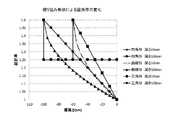
図28は、断面形状を四角形状、略V字状、又は略U字状とした溝部の深さ方向に対する屈折率のシミュレーション結果を示すグラフである。シミュレーションにおいて、空気の屈折率を1.0、基板の屈折率を1.5とし、ピッチを200nm、グリッド間幅を100nmとした。 FIG. 28 is a graph showing a simulation result of the refractive index with respect to the depth direction of the groove having a cross-sectional shape of a square shape, a substantially V shape, or a substantially U shape. In the simulation, the refractive index of air was 1.0, the refractive index of the substrate was 1.5, the pitch was 200 nm, and the width between grids was 100 nm.
深さが60nmの四角形状の溝部は、深さが0nmを超え60nm未満まで屈折率が1.25であり、深さが60nmのとき屈折率が1.5に大きく変化する変化点を有する。一方、深さが60nmの略V字状、又は略U字状の溝部は、幅が深さ方向に向かってゼロになるように小さくなるため、屈折率が1から1.5に徐々に変化し、屈折率の大きな変化点を持っていない。このように屈折率が大きな変化点を持たないように溝部を形成することにより、透過率特性及び反射率特性を向上させるものと考えられる。 The rectangular groove having a depth of 60 nm has a refractive index of 1.25 until the depth exceeds 0 nm and less than 60 nm, and has a changing point at which the refractive index changes greatly to 1.5 when the depth is 60 nm. On the other hand, the substantially V-shaped or substantially U-shaped groove portion having a depth of 60 nm is reduced so that the width becomes zero in the depth direction, so that the refractive index gradually changes from 1 to 1.5. And it does not have a large change point of refractive index. In this way, it is considered that the transmittance characteristic and the reflectance characteristic are improved by forming the groove portion so that the refractive index does not have a large change point.
深さが60nmの略V字状の溝部の深さに対する屈折率は、y=−0.0083x+1(−60≦x≦0)で示される。また、深さが100nmの略U字状の溝部の深さに対する屈折率は、y=2E−0.8x4+2E−06x3+0.0001x2−0.0004x+1.0061(−100≦x≦0)で示される。又は、深さが100nmの略U字状の溝部の深さに対する屈折率は、y=0.0005x2+0.0791x+4.423(−100≦x≦80)、y=2E−05x2+0.0021x+1.0026(−80≦x≦0)で示される。The refractive index with respect to the depth of the substantially V-shaped groove having a depth of 60 nm is represented by y = −0.0083x + 1 (−60 ≦ x ≦ 0). The refractive index with respect to the depth of the substantially U-shaped groove portion having a depth of 100 nm is y = 2E−0.8x4 + 2E−06x3 + 0.0001x2 −0.0004x + 1.0061 (−100 ≦ x ≦ 0 ). Alternatively, the refractive index with respect to the depth of the substantially U-shaped groove having a depth of 100 nm is y = 0.0005x2 + 0.0791x + 4.423 (−100 ≦ x ≦ 80), y = 2E−05x2 + 0.0021x + 1. .0026 (−80 ≦ x ≦ 0).
よって、溝部の深さが0nm以上60nm以下の場合、y≦−0.0083x+1(−60≦x≦0)、y≧2E−0.8x4+2E−06x3+0.0001x2−0.0004x+1.0061(−60≦x≦0)を満たすように、溝部の断面の幅を深さ方向に向かってゼロになるように小さくすればよい。また、溝部の深さが60nm以上100nm以下の場合、1.5≧y≧2E−0.8x4+2E−06x3+0.0001x2−0.0004x+1.0061(−100≦x≦−60)を満たすように、溝部の断面の幅を深さ方向に向かってゼロになるように小さくすればよい。Therefore, when the depth of the groove is 0 nm or more and 60 nm or less, y ≦ −0.0083x + 1 (−60 ≦ x ≦ 0), y ≧ 2E−0.8x4 + 2E−06x3 + 0.0001x2 −0.0004
11 透明基板、12 反射層、13 反射制御層、14A,14B,14C 溝部、 21 透明基板、22 反射層、23A 第1の誘電体層、23B 吸収層、23C 第2の誘電体層、31 透明基板、32 反射層、33 反射抑制層、41 透明基板、42 反射層、43 反射抑制層
DESCRIPTION OF
Claims (11)
Translated fromJapanese前記使用帯域の光の波長よりも短いピッチで前記透明基板上に配列され、所定方向に延在し、反射層と反射制御層とを有する格子状凸部と、
前記格子状凸部間に凹設され、前記所定方向に直交する方向の幅が深さ方向に向かってゼロになるように小さくなる溝部と
を備える偏光板。A transparent substrate that is transparent to light in the wavelength band used;
A grid-like convex portion arranged on the transparent substrate at a pitch shorter than the wavelength of light in the use band, extending in a predetermined direction, and having a reflective layer and a reflection control layer;
A polarizing plate comprising: a groove portion provided between the lattice-shaped convex portions and having a width that decreases in a direction perpendicular to the predetermined direction to zero in the depth direction.
Etching is performed on the reflection layer and the reflection control layer stacked on the transparent substrate that is transparent to the light in the use band, and is arranged at a pitch shorter than the wavelength of the light in the use band and extends in a predetermined direction. A method of manufacturing a polarizing plate, comprising: a grid-like convex part; and a groove part that is provided between the grid-like convex parts and is reduced so that a width in a direction perpendicular to the predetermined direction becomes zero in a depth direction .
Priority Applications (5)
| Application Number | Priority Date | Filing Date | Title |
|---|---|---|---|
| JP2018135721AJP2018189980A (en) | 2018-07-19 | 2018-07-19 | Polarizing plate |
| US16/627,638US12235481B2 (en) | 2018-07-19 | 2019-07-12 | Polarizing plate |
| PCT/JP2019/027718WO2020017455A1 (en) | 2018-07-19 | 2019-07-12 | Polarizer |
| CN201980003256.9ACN110998384B (en) | 2018-07-19 | 2019-07-12 | Polarizing plate |
| JP2023038233AJP7531645B2 (en) | 2018-07-19 | 2023-03-13 | Polarizing plate |
Applications Claiming Priority (1)
| Application Number | Priority Date | Filing Date | Title |
|---|---|---|---|
| JP2018135721AJP2018189980A (en) | 2018-07-19 | 2018-07-19 | Polarizing plate |
Related Child Applications (1)
| Application Number | Title | Priority Date | Filing Date |
|---|---|---|---|
| JP2023038233ADivisionJP7531645B2 (en) | 2018-07-19 | 2023-03-13 | Polarizing plate |
Publications (1)
| Publication Number | Publication Date |
|---|---|
| JP2018189980Atrue JP2018189980A (en) | 2018-11-29 |
Family
ID=64480150
Family Applications (2)
| Application Number | Title | Priority Date | Filing Date |
|---|---|---|---|
| JP2018135721APendingJP2018189980A (en) | 2018-07-19 | 2018-07-19 | Polarizing plate |
| JP2023038233AActiveJP7531645B2 (en) | 2018-07-19 | 2023-03-13 | Polarizing plate |
Family Applications After (1)
| Application Number | Title | Priority Date | Filing Date |
|---|---|---|---|
| JP2023038233AActiveJP7531645B2 (en) | 2018-07-19 | 2023-03-13 | Polarizing plate |
Country Status (4)
| Country | Link |
|---|---|
| US (1) | US12235481B2 (en) |
| JP (2) | JP2018189980A (en) |
| CN (1) | CN110998384B (en) |
| WO (1) | WO2020017455A1 (en) |
Cited By (2)
| Publication number | Priority date | Publication date | Assignee | Title |
|---|---|---|---|---|
| JP2020173333A (en)* | 2019-04-10 | 2020-10-22 | デクセリアルズ株式会社 | Thin film for optical element and manufacturing method thereof, inorganic polarizer and manufacturing method thereof, and optical element and optical apparatus |
| JP2021033049A (en)* | 2019-08-23 | 2021-03-01 | デクセリアルズ株式会社 | Polarizer and optical instrument |
Families Citing this family (1)
| Publication number | Priority date | Publication date | Assignee | Title |
|---|---|---|---|---|
| US11150391B2 (en)* | 2018-11-30 | 2021-10-19 | Moxtek, Inc. | Flexible wire grid polarizer |
Citations (7)
| Publication number | Priority date | Publication date | Assignee | Title |
|---|---|---|---|---|
| JP2003502708A (en)* | 1999-06-22 | 2003-01-21 | モックステック | Broadband wire grid polarizer for the visible spectrum |
| JP2006330178A (en)* | 2005-05-24 | 2006-12-07 | Sony Corp | Optical device and method for manufacturing optical device |
| JP2010085990A (en)* | 2008-09-03 | 2010-04-15 | Asahi Kasei E-Materials Corp | Wire grid polarizing plate |
| WO2013046921A1 (en)* | 2011-09-27 | 2013-04-04 | 日本電気株式会社 | Polarizer, polarizing optical element, light source, and image display device |
| JP2014186181A (en)* | 2013-03-25 | 2014-10-02 | Seiko Epson Corp | Method for manufacturing polarizing element |
| JP6312917B1 (en)* | 2017-02-07 | 2018-04-18 | デクセリアルズ株式会社 | Inorganic polarizing plate, method for producing the same, and optical instrument |
| JP2018106129A (en)* | 2016-12-28 | 2018-07-05 | デクセリアルズ株式会社 | Polarizing plate, method for producing the same, and optical instrument |
Family Cites Families (18)
| Publication number | Priority date | Publication date | Assignee | Title |
|---|---|---|---|---|
| US6288840B1 (en)* | 1999-06-22 | 2001-09-11 | Moxtek | Imbedded wire grid polarizer for the visible spectrum |
| WO2001094993A2 (en)* | 2000-06-08 | 2001-12-13 | Digital Reflection, Inc. | Reflective polarizer |
| JP2003344651A (en)* | 2002-05-22 | 2003-12-03 | Nippon Sheet Glass Co Ltd | Thin-film structure and thin-film polarizer using the same |
| JP2006126338A (en) | 2004-10-27 | 2006-05-18 | Nippon Sheet Glass Co Ltd | Polarizer and its manufacturing method |
| JP2007225744A (en)* | 2006-02-22 | 2007-09-06 | Nippon Zeon Co Ltd | Polarization conversion element |
| US20070217008A1 (en)* | 2006-03-17 | 2007-09-20 | Wang Jian J | Polarizer films and methods of making the same |
| JP4488033B2 (en) | 2007-02-06 | 2010-06-23 | ソニー株式会社 | Polarizing element and liquid crystal projector |
| US20080316599A1 (en)* | 2007-06-22 | 2008-12-25 | Bin Wang | Reflection-Repressed Wire-Grid Polarizer |
| JP2009192586A (en)* | 2008-02-12 | 2009-08-27 | Asahi Kasei E-Materials Corp | Wire grid type polarizing element and display device using the same |
| KR100927587B1 (en)* | 2008-04-30 | 2009-11-23 | 삼성모바일디스플레이주식회사 | Liquid crystal display |
| JP5760388B2 (en)* | 2010-11-01 | 2015-08-12 | セイコーエプソン株式会社 | Polarizing element and manufacturing method thereof, projector, liquid crystal device, electronic device |
| JP5796522B2 (en)* | 2012-03-23 | 2015-10-21 | セイコーエプソン株式会社 | Polarizing element and manufacturing method of polarizing element |
| CN102681078B (en)* | 2012-06-06 | 2014-09-24 | 昆山龙腾光电有限公司 | Grating polarizer |
| JP6100492B2 (en) | 2012-09-05 | 2017-03-22 | デクセリアルズ株式会社 | Polarizing element, projector, and manufacturing method of polarizing element |
| JP6285131B2 (en) | 2013-07-10 | 2018-02-28 | デクセリアルズ株式会社 | Polarizing plate and manufacturing method of polarizing plate |
| JP2015219319A (en)* | 2014-05-15 | 2015-12-07 | デクセリアルズ株式会社 | Inorganic polarizer and method for manufacturing the same |
| JP5996587B2 (en)* | 2014-08-22 | 2016-09-21 | デクセリアルズ株式会社 | Inorganic polarizing plate and method for producing the same |
| JP6230689B1 (en)* | 2016-12-28 | 2017-11-15 | デクセリアルズ株式会社 | Polarizing plate, method for producing the same, and optical instrument |
- 2018
- 2018-07-19JPJP2018135721Apatent/JP2018189980A/enactivePending
- 2019
- 2019-07-12WOPCT/JP2019/027718patent/WO2020017455A1/ennot_activeCeased
- 2019-07-12CNCN201980003256.9Apatent/CN110998384B/enactiveActive
- 2019-07-12USUS16/627,638patent/US12235481B2/enactiveActive
- 2023
- 2023-03-13JPJP2023038233Apatent/JP7531645B2/enactiveActive
Patent Citations (7)
| Publication number | Priority date | Publication date | Assignee | Title |
|---|---|---|---|---|
| JP2003502708A (en)* | 1999-06-22 | 2003-01-21 | モックステック | Broadband wire grid polarizer for the visible spectrum |
| JP2006330178A (en)* | 2005-05-24 | 2006-12-07 | Sony Corp | Optical device and method for manufacturing optical device |
| JP2010085990A (en)* | 2008-09-03 | 2010-04-15 | Asahi Kasei E-Materials Corp | Wire grid polarizing plate |
| WO2013046921A1 (en)* | 2011-09-27 | 2013-04-04 | 日本電気株式会社 | Polarizer, polarizing optical element, light source, and image display device |
| JP2014186181A (en)* | 2013-03-25 | 2014-10-02 | Seiko Epson Corp | Method for manufacturing polarizing element |
| JP2018106129A (en)* | 2016-12-28 | 2018-07-05 | デクセリアルズ株式会社 | Polarizing plate, method for producing the same, and optical instrument |
| JP6312917B1 (en)* | 2017-02-07 | 2018-04-18 | デクセリアルズ株式会社 | Inorganic polarizing plate, method for producing the same, and optical instrument |
Cited By (4)
| Publication number | Priority date | Publication date | Assignee | Title |
|---|---|---|---|---|
| JP2020173333A (en)* | 2019-04-10 | 2020-10-22 | デクセリアルズ株式会社 | Thin film for optical element and manufacturing method thereof, inorganic polarizer and manufacturing method thereof, and optical element and optical apparatus |
| JP7332324B2 (en) | 2019-04-10 | 2023-08-23 | デクセリアルズ株式会社 | Inorganic polarizing plate, manufacturing method thereof, and optical device |
| JP2021033049A (en)* | 2019-08-23 | 2021-03-01 | デクセリアルズ株式会社 | Polarizer and optical instrument |
| JP7356291B2 (en) | 2019-08-23 | 2023-10-04 | デクセリアルズ株式会社 | Polarizing plates and optical equipment |
Also Published As
| Publication number | Publication date |
|---|---|
| CN110998384B (en) | 2023-04-07 |
| JP7531645B2 (en) | 2024-08-09 |
| US12235481B2 (en) | 2025-02-25 |
| WO2020017455A1 (en) | 2020-01-23 |
| JP2023076488A (en) | 2023-06-01 |
| CN110998384A (en) | 2020-04-10 |
| US20210302639A1 (en) | 2021-09-30 |
Similar Documents
| Publication | Publication Date | Title |
|---|---|---|
| US11543702B2 (en) | Polarizer and optical apparatus | |
| JP7531645B2 (en) | Polarizing plate | |
| JP6302040B1 (en) | Polarizing plate, method for producing the same, and optical instrument | |
| US10209420B2 (en) | Polarizing plate, method of manufacturing the same, and optical apparatus | |
| CN107407770A (en) | polarizing element | |
| JP6577641B2 (en) | Polarizing plate, method for producing the same, and optical instrument | |
| JP6722832B2 (en) | Polarizing plate and optical device including the same | |
| WO2019159982A1 (en) | Polarizing plate, method of manufacturing the same, and optical apparatus | |
| US11630254B2 (en) | Wire grid polarizing plate having trapezoidal absorption layer | |
| JP6484373B1 (en) | Polarizing plate and optical apparatus including the same | |
| JP6935318B2 (en) | Polarizing plate and its manufacturing method, and optical equipment | |
| JP6826073B2 (en) | Polarizing plate and its manufacturing method, and optical equipment | |
| US11644605B2 (en) | Polarizing element having alternately laminated dielectric layers and conductive layers and method for manufacturing polarizing element | |
| JP7226966B2 (en) | Polarizing plate and method for producing polarizing plate | |
| US11543573B2 (en) | Polarizing plate and optical apparatus containing same | |
| JP2020003771A (en) | Polarizer manufacturing method | |
| JP7553226B2 (en) | Polarizing plate and optical device equipped with same | |
| JP2019152872A (en) | Polarizing plate and method for manufacturing the same, and optical instrument | |
| JP7101028B2 (en) | Polarizing elements, their manufacturing methods, and optical equipment | |
| JP2020126249A (en) | Polarizing plate, manufacturing method thereof, and optical device |
Legal Events
| Date | Code | Title | Description |
|---|---|---|---|
| A621 | Written request for application examination | Free format text:JAPANESE INTERMEDIATE CODE: A621 Effective date:20210602 | |
| A131 | Notification of reasons for refusal | Free format text:JAPANESE INTERMEDIATE CODE: A131 Effective date:20220712 | |
| A521 | Request for written amendment filed | Free format text:JAPANESE INTERMEDIATE CODE: A523 Effective date:20220912 | |
| A02 | Decision of refusal | Free format text:JAPANESE INTERMEDIATE CODE: A02 Effective date:20221213 |