JP2017215485A - Optical system, exposure apparatus, and article manufacturing method - Google Patents
Optical system, exposure apparatus, and article manufacturing methodDownload PDFInfo
- Publication number
- JP2017215485A JP2017215485AJP2016109641AJP2016109641AJP2017215485AJP 2017215485 AJP2017215485 AJP 2017215485AJP 2016109641 AJP2016109641 AJP 2016109641AJP 2016109641 AJP2016109641 AJP 2016109641AJP 2017215485 AJP2017215485 AJP 2017215485A
- Authority
- JP
- Japan
- Prior art keywords
- optical system
- light emitting
- optical member
- light
- light source
- Prior art date
- Legal status (The legal status is an assumption and is not a legal conclusion. Google has not performed a legal analysis and makes no representation as to the accuracy of the status listed.)
- Granted
Links
Images



Landscapes
- Microscoopes, Condenser (AREA)
- Exposure And Positioning Against Photoresist Photosensitive Materials (AREA)
- Non-Portable Lighting Devices Or Systems Thereof (AREA)
- Planar Illumination Modules (AREA)
- Facsimile Heads (AREA)
Abstract
Description
Translated fromJapanese本発明は、光学系、該光学系を含む露光装置、および、該露光装置を用いて物品を製造する物品製造方法に関する。 The present invention relates to an optical system, an exposure apparatus including the optical system, and an article manufacturing method for manufacturing an article using the exposure apparatus.
LED(発光ダイオード)およびLD(レーザーダイオード)などの固体発光素子は、超高圧水銀ランプなどの他の光源素子に比べて、小型で、エネルギー使用量が少なく、寿命が長いため、多くの照明装置において使用されつつある。固体発光素子は、固体物質に電気などのエネルギーを供給し、励起させることにより発光する光源素子である。 Solid state light emitting devices such as LEDs (light emitting diodes) and LDs (laser diodes) are more compact than other light source devices such as ultra-high pressure mercury lamps. Is being used. A solid light-emitting element is a light source element that emits light by supplying energy such as electricity to a solid substance and exciting it.
しかし、固体発光素子は、超高圧水銀ランプに比べて発光輝度が小さいという課題がある。特に、半導体デバイス等のデバイスを製造するための露光装置に組み込まれる照明装置においては、高い生産性を実現するために、高い輝度が要求される。したがって、発光輝度が小さいことは、露光装置において固体発光素子を使用するにあたって、大きな障壁となる。 However, the solid-state light emitting device has a problem that the light emission luminance is smaller than that of the ultrahigh pressure mercury lamp. In particular, in an illumination apparatus incorporated in an exposure apparatus for manufacturing a device such as a semiconductor device, high luminance is required in order to realize high productivity. Therefore, the low emission luminance is a big barrier when using the solid state light emitting device in the exposure apparatus.
特許文献1には、高い照明輝度を得るために複数のLED素子を用いることが記載されている。より具体的には、特許文献1には、複数のLED素子と、光の入射面が複数のLED素子のそれぞれに対応し、光の出射面が近接、接触又は一体化されて一纏まりに配置された複数のロッドの集合体であるロッド集合体とを備えたLED照明装置が記載されている。 Patent Document 1 describes the use of a plurality of LED elements in order to obtain high illumination brightness. More specifically, in Patent Document 1, a plurality of LED elements and a light incident surface correspond to each of the plurality of LED elements, and a light emission surface is adjacent, contacted, or integrated and arranged together. An LED lighting device including a rod assembly which is an assembly of a plurality of rods is described.
複数の固体発光素子が発生する光を合成することによって高い輝度を有する照明光を得ることができる。しかし、露光装置に使用される照明装置においては、被照明面の所望の照明領域を所望の入射角度分布で照明する必要がある。一方、Helmholtz-Lagrangeの不変量は保存もしくは大きくしかならない。この原理により、光源が発生した光のうち被照明面の照明領域と最大入射角度とで決まるHelmholtz-Lagrange量よりも小さい光しか被照明面に到達することができない。したがって、光源が発生した光のHelmholtz-Lagrange量を増加させることなく集光することが求められる。 By combining the light generated by the plurality of solid state light emitting elements, illumination light having high luminance can be obtained. However, in an illuminating device used for an exposure apparatus, it is necessary to illuminate a desired illumination area on a surface to be illuminated with a desired incident angle distribution. On the other hand, Helmholtz-Lagrange invariants can only be preserved or large. Based on this principle, only light smaller than the Helmholtz-Lagrange amount determined by the illumination area of the illuminated surface and the maximum incident angle among the light generated by the light source can reach the illuminated surface. Therefore, it is required to collect light without increasing the Helmholtz-Lagrange amount of the light generated by the light source.
しかし、例えば、特許文献1に記載された発明では、ロッドが傾けて配置されているため、固体発光素子が発生した光の角度分布がロッドの射出面で傾くため、合成された光の最大角度が、固体発光素子が発生した光の角度より大きくなってしまう。 However, for example, in the invention described in Patent Document 1, since the rod is disposed at an inclination, the angular distribution of the light generated by the solid state light emitting element is inclined at the exit surface of the rod, so the maximum angle of the synthesized light However, the angle of light generated by the solid state light emitting device becomes larger.
本発明は、複数の固体発光素子からの光を効率よく被照明領域に導光するために有利な技術を提供することを目的とする。 It is an object of the present invention to provide an advantageous technique for efficiently guiding light from a plurality of solid state light emitting elements to an illuminated area.
本発明の1つの側面は、光学系に係り、前記光学系は、第1方向に沿って第1ピッチで配置された複数の固体発光素子を有する光源部と、互いに対向するように前記第1方向に離隔して配置された一対の第1反射面を有する光学部材と、前記光源部と前記光学部材との間に配置された集光光学系と、を備え、前記光源部、前記集光光学系および前記光学部材は、前記複数の固体発光素子がそれぞれ発生した光が前記光学部材の入射端に入射し前記光学部材の射出端から射出され、かつ、前記複数の固体発光素子のそれぞれの像が前記射出端において重なるように配置されている。 One aspect of the present invention relates to an optical system, and the optical system includes a light source unit including a plurality of solid state light emitting elements arranged at a first pitch along a first direction so as to face each other. An optical member having a pair of first reflecting surfaces disposed apart from each other in a direction; and a condensing optical system disposed between the light source unit and the optical member, the light source unit and the condensing unit In the optical system and the optical member, light generated by each of the plurality of solid state light emitting elements is incident on an incident end of the optical member and is emitted from an exit end of the optical member, and each of the plurality of solid state light emitting elements is The images are arranged so as to overlap at the exit end.
本発明によれば、複数の固体発光素子からの光を効率よく被照明領域に導光するために有利な技術が提供される。 ADVANTAGE OF THE INVENTION According to this invention, the technique advantageous in order to guide the light from a several solid light emitting element efficiently to a to-be-illuminated area | region is provided.
以下、添付図面を参照しながら本発明をその例示的な実施形態を通して説明する。 Hereinafter, the present invention will be described through exemplary embodiments thereof with reference to the accompanying drawings.
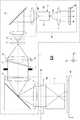
図1には、本発明の一実施形態の露光装置EXの構成が示されている。露光装置EXは、照明光学系1と、原版2を保持する原版ステージRSと、基板4を保持する基板ステージSSと、原版2のパターンを感光材が塗布された基板4に投影し該基板4を露光する投影光学系3とを備える。照明光学系1は、光源部001を含む光学系OSと、原版2が配置される原版面RPと光学系OSとの間に配置されたオプティカルインテグレータ15と、オプティカルインテグレータ15と原版面RPとの間に配置されたコンデンサレンズ16とを含みうる。また、照明光学系1は、光学系OSとオプティカルインテグレータ15との間に配置された波長フィルター14を含みうる。また、照明光学系1は、光学系OSとオプティカルインテグレータ15との間に配置されたリレー光学系13を含みうる。リレー光学系13は、例えば、変倍機能を有しうる。また、照明光学系1は、コンデンサレンズ16と原版面RPとの間にマスキングブレード17およびリレー光学系18を有しうる。 FIG. 1 shows the configuration of an exposure apparatus EX according to an embodiment of the present invention. The exposure apparatus EX projects the illumination optical system 1, the original stage RS that holds the original 2, the substrate stage SS that holds the substrate 4, and the pattern of the original 2 onto the substrate 4 coated with a photosensitive material. And a projection
光学系OSは、光源部001と、光学部材12と、光源部001と光学部材12との間に配置された集光光学系11とを含みうる。光源部001は、複数の固体発光素子10を有する。なお、複数の固体発光素子10を相互に区別する場合には、10a、10bのように符号10の後ろに添え字を付けて説明する。固体発光素子10は、例えば、LED(発光ダイオード)またはLD(レーザーダイオード)でありうる。複数の固体発光素子10は、X方向(第1方向)に沿って第1ピッチで配置され、光学部材12は、互いに対向するようにX方向(第1方向)に離隔して配置された一対の第1反射面121、122を有する。光学部材12は、例えば、ガラスロッドまたは中空ミラーでありうる。ガラスロッドは、ガラスで構成された中実のロッドであり、ガラスロッドの入射端004に入射した光は、ガラス媒質を通過して射出端005に至る。ガラスロッドにおいて、一対の反射面121、122は、ガラスロッドとその外側にある媒質(例えば、空気)との境界によって構成される。ガラスロッドでは、以下で説明される屈折率Nは、ガラス媒質の屈折率である。中空ミラーでは、入射端004と射出端005との間の空間が空気等の気体または真空であり、一対の反射面は、該空間と接する部材(ミラー)によって構成される。中空ミラーでは、以下で説明される屈折率Nは、気体または真空の屈折率である。集光光学系11は、光源部001の複数の固体発光素子10からの光を集光する。光源部001、集光光学系11、光学部材12は、複数の固体発光素子10のそれぞれで発生した光が光学部材12の入射端に入射し光学部材12の射出端から射出され、かつ、複数の固体発光素子10のそれぞれの像が該射出端において重なるように配置されうる。 The optical system OS may include a
光学系OS(光学部材12の射出端005)から射出された光は、リレー光学系13によってオプティカルインテグレータ15に投影される。波長フィルター14は、光学系OS(光源部001)からの光のうち基板4を露光するために使用する波長の光のみを透過する。投影光学系3で良好に色収差が補正されている波長帯域幅は、通常は、数十nm程度である。したがって、光源部001の固体発光素子10の発光スペクトルが広帯域である場合、波長フィルター14によって光が狭帯域化される。また、温度などによる環境変化や、使用時間によって、固体発光素子10の発光スペクトルが変化する場合がある。このような場合にも、波長フィルター14によって所望の波長帯域のみを取り出すことで、良好な結像性能を得ることができる。波長フィルター14は、複数のフィルターを含んでもよく、この場合、該複数のフィルターの中から要求される結像性能に応じたフィルターが選択して使用されうる。例えば、太い線幅のパターンを形成する場合には、透過波長帯域が広いフィルターを使用することで、高い照度を実現して生産性を高めることができる。一方、細い線幅のパターンを形成する場合には、透過波長帯域が狭いフィルターを使用することで、投影光学系3の色収差の発生量を小さくすることができる。 The light emitted from the optical system OS (the
オプティカルインテグレータ15は、例えば、ハエノメレンズで構成されうる。オプティカルインテグレータ15は、光源部001からの光を波面分割し、オプティカルインテグレータ15の射出面に複数の2次光源を形成する。オプティカルインテグレータ15は、例えば、複数のロッドレンズの集合体、複数の短冊状のシリンドリカルレンズの集合体、または、マイクロレンズアレイで構成されうる。コンデンサレンズ16は、オプティカルインテグレータ15の射出面に形成された複数の2次光源からの光を重畳的に重ね合わせることによって、マスキングブレード17が配置された面に均一な光強度分布を形成する。リレー光学系18は、マスキングブレード17が配置された面と、原版2が配置される原版面RPと、を光学的に共役な関係にする。 The
照明光学系1の光路には、ハーフミラー19が配置されうる。ハーフミラー19は、光路中の光の一部をセンサ20に向けて分岐させる。センサ20は、基板4の露光中に光量をモニターするために使用されうる。例えば、センサ20によって検出された値に基づいて基板4の露光量が制御されうる。例えば、露光装置EXがステップ・アンド・リピート方式の場合、基板4の露光開始時に光源部001(複数の固体発光素子10)を点灯させ、その後、センサ20によって光量を積算し、積算値が目標露光量に到達するタイミングで光源部001を消灯させる。消灯の制御に時間遅れが発生する場合には、積算値が目標露光量より当該時間遅れ分だけ小さい値に到達した時点で光源部001の消灯の制御を開始すればよい。また、露光量制御は、シャッターを用いてなされてもよい。この場合には、光源部001(固体発光素子10)を点灯した状態として、不図示のシャッターの開閉動作により露光量が制御されうる。露光装置EXが、走査型露光装置(ステップ・アンド・スキャン方式)の場合には、センサ20による測定値が一定になるように、光源部の複数の固体発光素子10に供給する電力が制御されうる。目標露光量が小さく、最大走査速度で露光できない場合には、複数の固体発光素子10のうちの一部を消灯したり、複数の固体発光素子10に対して供給する電力を小さくしたりすることによって露光量が調整されうる。 A half mirror 19 can be disposed in the optical path of the illumination optical system 1. The half mirror 19 branches a part of the light in the optical path toward the
以下、図2を参照しながら光学系OSの構成を例示的に説明する。光源部001を構成する複数の固体発光素子10は、X方向(第1方向)に沿って第1ピッチL1で配置される。図2には、簡単化のために、2つの固体発光素子10が10a、10bとして示されている。ピッチとは、複数の固体発光素子10の配置周期を意味し、例えば、隣り合う固体発光素子10の中心間距離を等しい。各固体発光素子10の配光分布のうち光学部材12で光を取り込むべき配光分布の範囲を±θとする。つまり、固体発光素子10の表面に対する法線に対して±θの角度範囲(−θから+θの範囲)の光が光学部材12によって取り込まれるものとする。 Hereinafter, an exemplary configuration of the optical system OS will be described with reference to FIG. The plurality of solid state
集光光学系11は、上下方向の矢印で示されている。集光光学系11の焦点距離をfとする。集光光学系11の瞳面は、光源部001の発光面(複数の固体発光素子10の発光面)からf+aの距離に配置される。なお、発光面は、光が射出される面を意味する。光源部001の複数の固体発光素子10がそれぞれ発生した光は、光学部材12の入射端004に入射し、光学部材12の射出端005から射出される。光源部001、集光光学系11および光学部材12は、光学部材12の射出端005が光源部001の発光面(複数の固体発光素子10の発光面)と共役になるように配置される。別の観点で表現すると、光源部001、集光光学系11および光学部材12は、複数の固体発光素子10のそれぞれの像が光学部材12の射出端005において重なるように配置されうる。 The condensing
以下、図3−5を参照しながら、距離a、焦点距離f、光学部材12の長さ、および光学部材12の一対の反射面121、122の間隔Dの好ましい関係を説明する。ただし、ここで説明する関係は、理想的な関係であり、実際の光学系OSでは、このような理想的な関係に対して、要求仕様を満たす範囲での誤差を有すること、あるいは、設計上の制約等に応じた修正がなされることが許容される。 Hereinafter, a preferable relationship among the distance a, the focal length f, the length of the
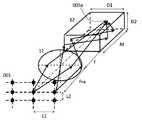
集光光学系11の光軸上に存在する固体発光素子10aから射出される光線は、図3に示されるように光学部材12の射出端005上の点005aに集光する。光学部材12の屈折率(光線が通過する部分の屈折率)をN、光軸方向における光学部材12の長さをMとすると、光源部001の発光面と集光光学系11の前側焦点との距離a、集光光学系11の焦点距離fの間には、M/N=f×f/aの関係がある。 The light beam emitted from the solid
光学部材12の一対の反射面121、122の間隔Dは、図4に示されるように、固体発光素子10aに隣接する固体発光素子10bの像が光学部材12の射出端005の点005aに形成されるように決定される。つまり、集光光学系11の倍率β=f÷a、隣接する固体発光素子10a、10bのピッチL1、および、間隔D1が、D1=β×L1の関係を満たすように間隔Dが決定される。このとき、図4に示されているように、ピッチL1で配置された固体発光素子10a、10bからそれぞれ射出される光線が1つの点005aに集光する。つまり、ピッチLで配置された固体発光素子10a、10bのそれぞれの像の中心が1つの点005aで重なる。 As shown in FIG. 4, the distance D between the pair of reflecting
上記のような配置により、図5に例示されるように、X方向(第1方向)に沿ってピッチL1で配置された全ての固体発光素子10(10a、10b、10c)から射出される光線が光学部材12の射出端005の1つの点005aで重なる。 With the above arrangement, as illustrated in FIG. 5, light beams emitted from all the solid state light emitting devices 10 (10 a, 10 b, 10 c) arranged at the pitch L <b> 1 along the X direction (first direction). Overlap at one
また、固体発光素子10の配光分布のうち±θの角度範囲の光を光学部材12の入射端004で取り込むためには、f×sinθ=D1÷2を満たす必要がある。 Further, in order to capture light in an angle range of ± θ in the light distribution of the solid state light emitting
以上をまとめると、以下の式で示される条件が満たされることが好ましい。 Summarizing the above, it is preferable that the conditions shown by the following expressions are satisfied.
D1=β×L1
D1=2×f×sinθ
a=f×L1÷D1=L1÷(2×sinθ)
M=2×(sinθ)×N×f×f÷L1
以上のような構成によれば、複数の固体発光素子10のそれぞれの光源像が光学部材12の射出端005で合成されて合成光源像が形成される。合成光源像は、光学部材12の射出端005の全域ではなく、一部分に形成されうる。D1 = β × L1
D1 = 2 × f × sin θ
a = f × L1 ÷ D1 = L1 ÷ (2 × sin θ)
M = 2 × (sin θ) × N × f × f ÷ L1
According to the above configuration, the respective light source images of the plurality of solid state
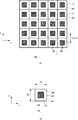
以上の原理は、二次元配列を構成するように配置された複数の固体発光素子10で構成される光源部001を使用する場合にも適用される。図6(a)には、X方向(第1方向)に関して第1ピッチL1を有し、X方向に直交するY方向(第2方向)に関して第2ピッチL2(=L1)を有するように複数の固体発光素子10が配置されて構成される光源部001が例示されている。各固体発光素子10は、発光領域101を有する。複数の発光領域101は、X方向(第1方向)に関して第1ピッチL1を有し、Y方向(第2方向)に関して第2ピッチL2を有するように配置されている。この例では、第1ピッチL1と第2ピッチL2とが等しい。即ち、L1=L2である。 The above principle is applied also when using the
図6(b)には、光学部材12が例示されている。光学部材12は、互いに対向するようにX方向(第1方向)に離隔して配置された一対の第1反射面121、122と、互いに対向するようにY方向(第2方向)に離隔して配置された一対の第2反射面123、124とを有する。一対の第1反射面121、122の間隔はD1であり、一対の第1反射面121、122の間隔はD2であるが、D2はD1と等しい。光学部材12の射出端には、二次元配列を構成するように配置された複数の固体発光素子10のそれぞれの光源像(発光領域101の像)が合成された合成光源像LSIが形成される。合成光源像LSIの外側の部分は、隣接する発光領域101の間の部分(光強度が0の部分)に対応する。 FIG. 6B illustrates the
リレー光学系13は、合成光源像LSIを光源として利用する。これにより、固体発光素子10の発光領域101の隙間によるHelmholtz-Lagrangeの不変量の増加をなくすことができ、複数の固体発光素子10からの光を効率よく被照明領域に導光することができる。 The relay optical system 13 uses the combined light source image LSI as a light source. Thereby, the increase in the invariant of Helmholtz-Lagrange due to the gap between the
一例において、L1=L2=1.2mmで配置された複数の固体発光素子10の配光分布の±60度の角度範囲を利用する場合、焦点距離f=5mmの集光光学系11を使用すると、a=0.69mmの位置に光源部001が配置されうる。幅D1、D2=8.7mm、長さM=54.1mm、屈折率N=1.5のガラスロッドが光学部材12として配置されうる。 In one example, when using an angle range of ± 60 degrees of the light distribution of the plurality of solid state light emitting
光源部001の発光面、集光光学系11および光学部材12の射出端0005は、光源部001の発光面と光学部材12の射出端005とが共役な位置になるような配置を有することが好ましい。しかしながら、該配置が要求仕様に応じた誤差を有すること、あるいは、該配置に対して設計上の制約等に応じた修正がなされることは許容されうる。ここで、光源部001(固体発光素子10)を集光光学系11の光軸方向にΔzずらして配置すると、Δz×tanθだけ固体発光素子10からの光線が広がる。ここで、θは、前述のように、固体発光素子10の配光分布のうち光学部材12で光を取り込むべき配光分布の範囲を示す。ピッチL1に対して上記の光線の広がりΔz×tanθが十分に小さければ、Δzによる性能低下を許容することができる。例えば、Δz≦L÷tanθ÷10であれば、一般的に、要求仕様を満足することができる。つまり、集光光学系11によって定義される光学部材12の射出端005の共役面(つまり、集光光学系11の瞳面からの距離がf+aの面)と光源部001の発光面との距離がL1÷tanθ÷10以内であることが好ましい。 The light emitting surface of the
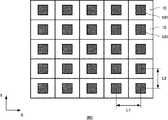
図6を参照しながら説明した例では、L1=L2であった。しかしながら、本発明は、L1とL2とが異なる場合にも適用可能である。図7には、X方向(第1方向)に関して第1ピッチL1を有し、X方向に直交するY方向(第2方向)に関して第2ピッチL2(≠L1)を有するように複数の固体発光素子10が配置されて構成される光源部001が例示されている。各固体発光素子10は、発光領域101を有する。複数の発光領域101は、X方向(第1方向)に関して第1ピッチL1を有し、X方向に直交するY方向(第2方向)に関して第2ピッチL2を有するように配置されている。この例では、第1ピッチL1と第2ピッチL2とが異なる。即ち、L1≠L2である。 In the example described with reference to FIG. 6, L1 = L2. However, the present invention is also applicable when L1 and L2 are different. FIG. 7 shows a plurality of solid state light emission having a first pitch L1 with respect to the X direction (first direction) and a second pitch L2 (≠ L1) with respect to the Y direction (second direction) orthogonal to the X direction. Illustrated is a
図8には、光源部001、集光光学系11および光学部材12の配置が示されている。光学部材12は、互いに対向するようにX方向(第1方向)に離隔して配置された一対の第1反射面121、122と、互いに対向するようにY方向(第2方向)に離隔して配置された一対の第2反射面123、124とを有する。一対の第1反射面121、122の間隔はD1であり、一対の第2反射面123、124の間隔はD2であり、D2はD1と異なる。 FIG. 8 shows the arrangement of the
光源部001の発光面(複数の固体発光素子10の発光面)と集光光学系11との間の距離はf+a、集光光学系11の焦点距離はfである。各固体発光素子10のX方向に関する配光分布のうち光学部材12で光を取り込むべき配光分布の角度範囲を±θ1、各固体発光素子10のY方向に関する配光分布のうち光学部材12で光を取り込むべき配光分布の角度範囲を±θ2とする。また、光学部材12の屈折率(光線が通過する部分の屈折率)をN、光軸方向における光学部材12の長さをMとする。この定義において、上記と同様の考え方に基づいて、以下の式で示される条件を満たすことが好ましい。 The distance between the light emitting surface of the light source unit 001 (the light emitting surfaces of the plurality of solid state light emitting elements 10) and the condensing
D1=β×L1
D2=β×L2
D1=2×f×sinθ1
D2=2×f×sinθ2
a=f×L1÷D1=L1÷(2×sinθ1)
a=f×L2÷D2=L2÷(2×sinθ2)
M=2×(sinθ1)×N×f×f÷L1
M=2×(sinθ2)×N×f×f÷L2
上記条件を満たすことにより、図9に示されているようにX、Y方向に互いに異なるピッチで複数の固体発光素子10が配置される場合においても、複数の固体発光素子10のそれぞれの光源像が光学部材12の射出端005で合成されて合成光源像が形成される。このような構成においても、集光光学系11によって定義される光学部材12の射出端005の共役面(つまり、集光光学系11の瞳面からの距離がf+aの面)と光源部001の発光面との距離が、
L1÷tanθ1÷10以内、かつ、L2÷tanθ2÷10以内
という条件を満たすことが好ましい。D1 = β × L1
D2 = β × L2
D1 = 2 × f × sin θ1
D2 = 2 × f × sin θ2
a = f × L1 ÷ D1 = L1 ÷ (2 × sin θ1)
a = f × L2 ÷ D2 = L2 ÷ (2 × sin θ2)
M = 2 × (sin θ1) × N × f × f ÷ L1
M = 2 × (sin θ2) × N × f × f ÷ L2
By satisfying the above conditions, even when a plurality of solid
It is preferable to satisfy the conditions of L1 ÷ tan θ1 ÷ 10 or less and L2 ÷ tanθ2 ÷ 10 or less.
以下、上記の露光装置を用いた物品製造方法を説明する。物品製造方法は、塗布工程、露光装置、現像工程および処理工程を含みうる。塗布工程では、基板の上にフォトレジストが塗布される。露光工程では、塗布工程を経た基板の上のフォトレジストが上記の露光装置によって露光されうる。現像工程では、露光工程を経た基板の上のフォトレジストが現像されレジストパターンが形成されうる。処理工程では、現像工程を経た基板が処理されうる。この処理は、例えば、エッチング、イオン注入または酸化を含みうる。 Hereinafter, an article manufacturing method using the above exposure apparatus will be described. The article manufacturing method may include a coating process, an exposure apparatus, a developing process, and a processing process. In the coating process, a photoresist is coated on the substrate. In the exposure process, the photoresist on the substrate after the coating process can be exposed by the exposure apparatus. In the development process, the photoresist on the substrate that has undergone the exposure process may be developed to form a resist pattern. In the processing step, the substrate that has undergone the development step can be processed. This treatment may include, for example, etching, ion implantation or oxidation.
1:照明光学系、2:原版、3:投影光学系、4:基板、OS:光学系、001:光源部、10:固体発光素子、11:集光光学系、12:光学部材、121〜124:反射面、13:リレー光学系、14 波長フィルター、15:オプティカルインテグレータ、16:コンデンサレンズ、17:マスキングブレード、18:リレー光学系、004:入射端、005:射出端、L1、L2:ピッチ1: illumination optical system, 2: original plate, 3: projection optical system, 4: substrate, OS: optical system, 001: light source unit, 10: solid-state light emitting element, 11: condensing optical system, 12: optical member, 121- 124: reflecting surface, 13: relay optical system, 14 wavelength filter, 15: optical integrator, 16: condenser lens, 17: masking blade, 18: relay optical system, 004: entrance end, 005: exit end, L1, L2: pitch
Claims (12)
Translated fromJapanese互いに対向するように前記第1方向に離隔して配置された一対の第1反射面を有する光学部材と、
前記光源部と前記光学部材との間に配置された集光光学系と、を備え、
前記光源部、前記集光光学系および前記光学部材は、前記複数の固体発光素子がそれぞれ発生した光が前記光学部材の入射端に入射し前記光学部材の射出端から射出され、かつ、前記複数の固体発光素子のそれぞれの像が前記射出端において重なるように配置されている、
ことを特徴とする光学系。A light source unit having a plurality of solid state light emitting devices arranged at a first pitch along a first direction;
An optical member having a pair of first reflecting surfaces that are spaced apart from each other in the first direction so as to face each other;
A condensing optical system disposed between the light source unit and the optical member,
In the light source unit, the condensing optical system, and the optical member, the light generated by each of the plurality of solid state light emitting elements is incident on an incident end of the optical member, and is emitted from an exit end of the optical member. Each solid-state light emitting element is disposed so as to overlap at the exit end,
An optical system characterized by that.
ことを特徴とする請求項1に記載の光学系。The exit end defined by the condensing optical system when the first pitch is L1, and the range of the light distribution to be taken in by the optical member is ± θ among the light distribution of each solid state light emitting device. The distance between the conjugate surface of the light source and the light emitting surface of the light source unit is within L1 ÷ tan θ ÷ 10.
The optical system according to claim 1.
ことを特徴とする請求項2に記載の光学系。When the magnification of the condensing optical system is β and the distance between the pair of first reflecting surfaces is D1, D1 = β × L1 is satisfied.
The optical system according to claim 2.
前記光学部材は、互いに対向するように前記第2方向に離隔して配置された一対の第2反射面を更に有する、
ことを特徴とする請求項1に記載の光学系。The plurality of solid state light emitting devices are arranged to form a two-dimensional array, and the two-dimensional array has the first pitch with respect to the first direction and has a second direction with respect to a second direction orthogonal to the first direction. 2 pitches,
The optical member further includes a pair of second reflecting surfaces that are spaced apart from each other in the second direction so as to face each other.
The optical system according to claim 1.
ことを特徴とする請求項4に記載の光学系。The first pitch is L1, the second pitch is L2, and the range of the light distribution to be taken in by the optical member among the light distributions of the solid light emitting elements in the first direction is ± θ1, and each solid light emitting element When the range of the light distribution to be taken in by the optical member is ± θ2 in the light distribution in the second direction, the conjugate surface of the exit end defined by the condensing optical system and the light source The distance from the light emitting surface of the portion is within L1 ÷ tan θ1 ÷ 10 and within L2 ÷ tan θ2 ÷ 10.
The optical system according to claim 4.
ことを特徴とする請求項5に記載の光学系。When the magnification of the condensing optical system is β, the distance between the pair of first reflecting surfaces is D1, and the distance between the pair of second reflecting surfaces is D2, D1 = β × L1 and D2 = β ×. Satisfy L2
The optical system according to claim 5.
ことを特徴とする請求項5又は6に記載の光学系。L1 and L2 are equal,
The optical system according to claim 5 or 6, wherein
ことを特徴とする請求項5又は6に記載の光学系。L1 and L2 are different.
The optical system according to claim 5 or 6, wherein
ことを特徴とする請求項1乃至8のいずれか1項に記載の光学系。The plurality of solid state light emitting devices are LEDs;
The optical system according to claim 1, wherein the optical system is an optical system.
ことを特徴とする請求項1乃至9のいずれか1項に記載の光学系。The optical member is a glass rod or a hollow mirror;
The optical system according to claim 1, wherein:
前記照明光学系は、請求項1乃至10のいずれか1項に記載の光学系と、前記原版が配置される原版面と前記光学系との間に配置されたオプティカルインテグレータと、前記オプティカルインテグレータと前記原版面との間に配置されたコンデンサレンズとを含む、
ことを特徴とする露光装置。An exposure apparatus comprising an illumination optical system that illuminates an original and a projection optical system that projects a pattern of the original onto a substrate,
The illumination optical system includes: the optical system according to any one of claims 1 to 10; an optical integrator disposed between an original plate surface on which the original plate is disposed and the optical system; and the optical integrator; Including a condenser lens disposed between the original plate surface,
An exposure apparatus characterized by that.
前記塗布工程を経た前記基板の上の前記フォトレジストを請求項11に記載の露光装置によって露光する露光工程と、
前記露光工程を経た前記基板の上の前記フォトレジストを現像してレジストパターンを形成する現像工程と、
前記現像工程を経た前記基板を処理する処理工程と、
を含むことを特徴とする物品製造方法。A coating process for coating a photoresist on the substrate;
An exposure step of exposing the photoresist on the substrate that has undergone the coating step with an exposure apparatus according to claim 11;
A development step of developing the photoresist on the substrate that has undergone the exposure step to form a resist pattern;
A processing step of processing the substrate after the development step;
An article manufacturing method comprising:
Priority Applications (1)
| Application Number | Priority Date | Filing Date | Title |
|---|---|---|---|
| JP2016109641AJP6700982B2 (en) | 2016-06-01 | 2016-06-01 | Optical system, exposure apparatus, and article manufacturing method |
Applications Claiming Priority (1)
| Application Number | Priority Date | Filing Date | Title |
|---|---|---|---|
| JP2016109641AJP6700982B2 (en) | 2016-06-01 | 2016-06-01 | Optical system, exposure apparatus, and article manufacturing method |
Publications (2)
| Publication Number | Publication Date |
|---|---|
| JP2017215485Atrue JP2017215485A (en) | 2017-12-07 |
| JP6700982B2 JP6700982B2 (en) | 2020-05-27 |
Family
ID=60576933
Family Applications (1)
| Application Number | Title | Priority Date | Filing Date |
|---|---|---|---|
| JP2016109641AActiveJP6700982B2 (en) | 2016-06-01 | 2016-06-01 | Optical system, exposure apparatus, and article manufacturing method |
Country Status (1)
| Country | Link |
|---|---|
| JP (1) | JP6700982B2 (en) |
Cited By (1)
| Publication number | Priority date | Publication date | Assignee | Title |
|---|---|---|---|---|
| KR20200017359A (en)* | 2018-08-08 | 2020-02-18 | 캐논 가부시끼가이샤 | Illumination optical system, exposure apparatus, and method of manufacturing article |
Citations (7)
| Publication number | Priority date | Publication date | Assignee | Title |
|---|---|---|---|---|
| JP2006171427A (en)* | 2004-12-16 | 2006-06-29 | Fuji Photo Film Co Ltd | Illumination optical system and exposure apparatus using same |
| JP2007114603A (en)* | 2005-10-21 | 2007-05-10 | Matsushita Electric Ind Co Ltd | Illumination device and projection-type image display device |
| US20080037260A1 (en)* | 2006-08-08 | 2008-02-14 | Compal Communications, Inc. | Illuminant device for projecting system |
| JP2011039395A (en)* | 2009-08-17 | 2011-02-24 | Canon Inc | Illuminator and image display device having the same |
| JP2014002212A (en)* | 2012-06-15 | 2014-01-09 | Ushio Inc | Light irradiation device and exposure device |
| JP2015088410A (en)* | 2013-11-01 | 2015-05-07 | 株式会社サーマプレシジョン | LED lighting device |
| JP2017111287A (en)* | 2015-12-16 | 2017-06-22 | 株式会社リコー | Projection device |
- 2016
- 2016-06-01JPJP2016109641Apatent/JP6700982B2/enactiveActive
Patent Citations (7)
| Publication number | Priority date | Publication date | Assignee | Title |
|---|---|---|---|---|
| JP2006171427A (en)* | 2004-12-16 | 2006-06-29 | Fuji Photo Film Co Ltd | Illumination optical system and exposure apparatus using same |
| JP2007114603A (en)* | 2005-10-21 | 2007-05-10 | Matsushita Electric Ind Co Ltd | Illumination device and projection-type image display device |
| US20080037260A1 (en)* | 2006-08-08 | 2008-02-14 | Compal Communications, Inc. | Illuminant device for projecting system |
| JP2011039395A (en)* | 2009-08-17 | 2011-02-24 | Canon Inc | Illuminator and image display device having the same |
| JP2014002212A (en)* | 2012-06-15 | 2014-01-09 | Ushio Inc | Light irradiation device and exposure device |
| JP2015088410A (en)* | 2013-11-01 | 2015-05-07 | 株式会社サーマプレシジョン | LED lighting device |
| JP2017111287A (en)* | 2015-12-16 | 2017-06-22 | 株式会社リコー | Projection device |
Cited By (2)
| Publication number | Priority date | Publication date | Assignee | Title |
|---|---|---|---|---|
| KR20200017359A (en)* | 2018-08-08 | 2020-02-18 | 캐논 가부시끼가이샤 | Illumination optical system, exposure apparatus, and method of manufacturing article |
| KR102554101B1 (en) | 2018-08-08 | 2023-07-12 | 캐논 가부시끼가이샤 | Illumination optical system, exposure apparatus, and method of manufacturing article |
Also Published As
| Publication number | Publication date |
|---|---|
| JP6700982B2 (en) | 2020-05-27 |
Similar Documents
| Publication | Publication Date | Title |
|---|---|---|
| JP2946950B2 (en) | Illumination apparatus and exposure apparatus using the same | |
| EP0564264B1 (en) | Illumination device for projection exposure apparatus | |
| KR101448339B1 (en) | Illumination optical system, exposure apparatus, and method of manufacturing device | |
| JP6529809B2 (en) | Light irradiation apparatus and exposure apparatus | |
| JPH1154426A (en) | Illumination apparatus and projection exposure apparatus using the same | |
| TWI509370B (en) | Light lithography process illuminator based on light-emitting diode with high light-receiving efficiency | |
| JP6651124B2 (en) | Illumination optical system, exposure apparatus, and device manufacturing method | |
| JPH032284B2 (en) | ||
| JP7020859B2 (en) | Manufacturing method of illumination optical system, exposure equipment and articles | |
| KR100823405B1 (en) | Exposure apparatus and device manufacturing method | |
| JP6806236B2 (en) | Lighting equipment and methods, exposure equipment and methods, and device manufacturing methods | |
| TW201506548A (en) | Light source device and exposure device | |
| JP6700982B2 (en) | Optical system, exposure apparatus, and article manufacturing method | |
| WO2017138523A1 (en) | Light source device | |
| JP2015191998A (en) | Solid light source, illumination optical system, and exposure apparatus | |
| JP5843905B2 (en) | Illumination optical system, exposure apparatus, and device manufacturing method | |
| JP2006208682A (en) | Lighting optical device and optical device | |
| JP2540744B2 (en) | Exposure illumination device using a laser | |
| KR101999553B1 (en) | Illumination optical device, exposure apparatus, and method of manufacturing article | |
| KR100456436B1 (en) | Illumination system | |
| US5406351A (en) | Photolithography system with improved illumination | |
| KR101782672B1 (en) | Prism optical system, illumination optical system, exposure apparatus, and device manufacturing method | |
| JP2002350620A (en) | Optical member, illumination device and exposure device using the optical member | |
| KR20190046920A (en) | Lighting apparatus, exposure apparatus and manufacturing method of article | |
| JPH07113735B2 (en) | Lighting optics |
Legal Events
| Date | Code | Title | Description |
|---|---|---|---|
| A621 | Written request for application examination | Free format text:JAPANESE INTERMEDIATE CODE: A621 Effective date:20190603 | |
| A977 | Report on retrieval | Free format text:JAPANESE INTERMEDIATE CODE: A971007 Effective date:20200305 | |
| TRDD | Decision of grant or rejection written | ||
| A01 | Written decision to grant a patent or to grant a registration (utility model) | Free format text:JAPANESE INTERMEDIATE CODE: A01 Effective date:20200313 | |
| A61 | First payment of annual fees (during grant procedure) | Free format text:JAPANESE INTERMEDIATE CODE: A61 Effective date:20200501 | |
| R151 | Written notification of patent or utility model registration | Ref document number:6700982 Country of ref document:JP Free format text:JAPANESE INTERMEDIATE CODE: R151 |