JP2013246407A - Optical sheet and display device - Google Patents
Optical sheet and display deviceDownload PDFInfo
- Publication number
- JP2013246407A JP2013246407AJP2012122294AJP2012122294AJP2013246407AJP 2013246407 AJP2013246407 AJP 2013246407AJP 2012122294 AJP2012122294 AJP 2012122294AJP 2012122294 AJP2012122294 AJP 2012122294AJP 2013246407 AJP2013246407 AJP 2013246407A
- Authority
- JP
- Japan
- Prior art keywords
- layer
- optical sheet
- light
- optical
- image
- Prior art date
- Legal status (The legal status is an assumption and is not a legal conclusion. Google has not performed a legal analysis and makes no representation as to the accuracy of the status listed.)
- Pending
Links
Images

Classifications
- G—PHYSICS
- G02—OPTICS
- G02B—OPTICAL ELEMENTS, SYSTEMS OR APPARATUS
- G02B5/00—Optical elements other than lenses
- G02B5/30—Polarising elements
- G02B5/3083—Birefringent or phase retarding elements
- G—PHYSICS
- G02—OPTICS
- G02B—OPTICAL ELEMENTS, SYSTEMS OR APPARATUS
- G02B30/00—Optical systems or apparatus for producing three-dimensional [3D] effects, e.g. stereoscopic images
- G02B30/20—Optical systems or apparatus for producing three-dimensional [3D] effects, e.g. stereoscopic images by providing first and second parallax images to an observer's left and right eyes
- G02B30/22—Optical systems or apparatus for producing three-dimensional [3D] effects, e.g. stereoscopic images by providing first and second parallax images to an observer's left and right eyes of the stereoscopic type
- G02B30/25—Optical systems or apparatus for producing three-dimensional [3D] effects, e.g. stereoscopic images by providing first and second parallax images to an observer's left and right eyes of the stereoscopic type using polarisation techniques
- G—PHYSICS
- G02—OPTICS
- G02B—OPTICAL ELEMENTS, SYSTEMS OR APPARATUS
- G02B30/00—Optical systems or apparatus for producing three-dimensional [3D] effects, e.g. stereoscopic images
- G02B30/20—Optical systems or apparatus for producing three-dimensional [3D] effects, e.g. stereoscopic images by providing first and second parallax images to an observer's left and right eyes
- G02B30/26—Optical systems or apparatus for producing three-dimensional [3D] effects, e.g. stereoscopic images by providing first and second parallax images to an observer's left and right eyes of the autostereoscopic type
- G02B30/27—Optical systems or apparatus for producing three-dimensional [3D] effects, e.g. stereoscopic images by providing first and second parallax images to an observer's left and right eyes of the autostereoscopic type involving lenticular arrays
- G—PHYSICS
- G02—OPTICS
- G02B—OPTICAL ELEMENTS, SYSTEMS OR APPARATUS
- G02B30/00—Optical systems or apparatus for producing three-dimensional [3D] effects, e.g. stereoscopic images
- G02B30/20—Optical systems or apparatus for producing three-dimensional [3D] effects, e.g. stereoscopic images by providing first and second parallax images to an observer's left and right eyes
- G02B30/26—Optical systems or apparatus for producing three-dimensional [3D] effects, e.g. stereoscopic images by providing first and second parallax images to an observer's left and right eyes of the autostereoscopic type
- G02B30/27—Optical systems or apparatus for producing three-dimensional [3D] effects, e.g. stereoscopic images by providing first and second parallax images to an observer's left and right eyes of the autostereoscopic type involving lenticular arrays
- G02B30/28—Optical systems or apparatus for producing three-dimensional [3D] effects, e.g. stereoscopic images by providing first and second parallax images to an observer's left and right eyes of the autostereoscopic type involving lenticular arrays involving active lenticular arrays
Landscapes
- Physics & Mathematics (AREA)
- General Physics & Mathematics (AREA)
- Optics & Photonics (AREA)
- Liquid Crystal (AREA)
- Polarising Elements (AREA)
- Testing, Inspecting, Measuring Of Stereoscopic Televisions And Televisions (AREA)
Abstract
Translated fromJapaneseDescription
Translated fromJapanese本発明は、平面画像および裸眼で視認され得る立体画像を切り換え可能に表示する表示装置、並びに、この表示装置に用いられ光の偏光状態に応じて当該光の進行方向を制御する光学シートに関する。 The present invention relates to a display device that displays a planar image and a stereoscopic image that can be viewed with the naked eye in a switchable manner, and an optical sheet that is used in the display device and controls the traveling direction of the light according to the polarization state of the light.
例えば特許文献1に開示されているように、裸眼で観察され得る立体画像を表示する表示装置の開発が行われている。このような表示装置では、表示面上に形成される平面画像の表示と、奥行き感を有し表示面からずれた位置にも視認される立体画像の表示と、を切り換えることができるようになっている。 For example, as disclosed in Patent Document 1, a display device that displays a stereoscopic image that can be observed with the naked eye has been developed. In such a display device, it is possible to switch between the display of a planar image formed on the display surface and the display of a stereoscopic image that has a sense of depth and is also visually recognized at a position shifted from the display surface. ing.
特許文献1に開示された表示装置では、平面画像が一方の直線偏光成分により形成され、立体画像が他方の直線偏光成分で形成される。表示装置は、立体画像をなす他方の直線偏光成分の光に対してのみレンズ機能を発揮する複屈折レンズを有している。左目用の画像を形成する画素から射出された他方の直線偏光成分の光は、複屈折レンズで集光され、観察者の左目の位置に集められ、同様に、右目用の画像を形成する画素から射出された他方の直線偏光成分の光は、複屈折レンズで集光され、観察者の右目の位置に集められる。この結果、観察者は、左目で左目用の画像を観察すると同時に右目で右目用の画像を観察し、これにより、立体画像を視認することができる。 In the display device disclosed in Patent Document 1, a planar image is formed with one linearly polarized component, and a stereoscopic image is formed with the other linearly polarized component. The display device has a birefringent lens that exhibits a lens function only with respect to the light of the other linearly polarized light component forming the stereoscopic image. The light of the other linearly polarized light component emitted from the pixel that forms the image for the left eye is collected by the birefringent lens, collected at the position of the left eye of the observer, and similarly, the pixel that forms the image for the right eye The light of the other linearly polarized light component emitted from is condensed by a birefringent lens and collected at the position of the right eye of the observer. As a result, the observer can observe the image for the left eye with the left eye and simultaneously observe the image for the right eye with the right eye, whereby the stereoscopic image can be visually recognized.
複屈折レンズは、互いに隣接して配置された光学異方性層および光学等方性層を有している。そして、光学異方性層と光学等方性層との屈折率は、一方の直線偏光成分の振動方向において同一となっており、他方の直線偏光成分の振動方向において異なっている。この結果、光学異方性層と光学等方性層との界面において、他方の偏光成分の光のみが進行方向を変化させる。 The birefringent lens has an optically anisotropic layer and an optically isotropic layer disposed adjacent to each other. The refractive indexes of the optically anisotropic layer and the optically isotropic layer are the same in the vibration direction of one linearly polarized light component and are different in the vibration direction of the other linearly polarized light component. As a result, only the light of the other polarization component changes the traveling direction at the interface between the optically anisotropic layer and the optically isotropic layer.
ところで、上述した複屈折レンズの光学異方性層は、配向された液晶材料を含むことにより光学異方性を呈する。しかしながら、この複屈折レンズは、液晶材料を含むため、安定性、とりわけ熱的な安定性に欠ける。したがって、この複屈折レンズを使用する環境や、この複屈折レンズを含む表示装置が設置される環境には、制約が課されてしまう。 By the way, the optically anisotropic layer of the birefringent lens described above exhibits optical anisotropy by including an aligned liquid crystal material. However, since this birefringent lens contains a liquid crystal material, it lacks stability, particularly thermal stability. Therefore, restrictions are imposed on the environment in which the birefringent lens is used and the environment in which the display device including the birefringent lens is installed.
本発明は、このような点を考慮してなされたものであり、光の偏光状態に応じて当該光の進行方向を制御する光学シートの安定性を改善することを目的とする。 The present invention has been made in consideration of such points, and an object thereof is to improve the stability of an optical sheet that controls the traveling direction of the light according to the polarization state of the light.
本発明による第1の光学シートは、
平面画像および裸眼で視認され得る立体画像を切り換え可能に表示する表示装置に用いられ、光の偏光状態に応じて当該光の進行方向を制御する光学シートであって、
熱可塑性樹脂を含む光学異方性の第1層と、
前記第1層に積層され、一方の偏光成分の光の進行方向を変化させる光学界面を前記第1層との間に形成する第2層と、を備える。The first optical sheet according to the present invention is:
An optical sheet that is used in a display device that displays a planar image and a stereoscopic image that can be viewed with the naked eye in a switchable manner, and that controls the traveling direction of the light according to the polarization state of the light,
A first layer of optical anisotropy comprising a thermoplastic resin;
And a second layer that is stacked on the first layer and forms an optical interface between the first layer and the first polarization component.
本発明による第1の光学シートにおいて、前記第1層をなす材料のガラス転移温度は、100°以上であってもよい。 In the first optical sheet of the present invention, the glass transition temperature of the material forming the first layer may be 100 ° or more.
本発明による第2の光学シートは、
平面画像および裸眼で視認され得る立体画像を切り換え可能に表示する表示装置に用いられ、光の偏光状態に応じて当該光の進行方向を制御する光学シートであって、
光学異方性の第1層と、
前記第1層に積層され、一方の偏光成分の光の進行方向を変化させる光学界面を前記第1層との間に形成する第2層と、を備え、
前記第1層をなす材料のガラス転移温度は、100°以上である。The second optical sheet according to the present invention is:
An optical sheet that is used in a display device that displays a planar image and a stereoscopic image that can be viewed with the naked eye in a switchable manner, and that controls the traveling direction of the light according to the polarization state of the light,
A first layer of optical anisotropy;
A second layer that is stacked on the first layer and forms an optical interface between the first layer and the optical layer that changes the traveling direction of light of one polarization component;
The material forming the first layer has a glass transition temperature of 100 ° or more.
本発明による第3の光学シートは、
平面画像および裸眼で視認され得る立体画像を切り換え可能に表示する表示装置に用いられ、光の偏光状態に応じて当該光の進行方向を制御する光学シートであって、
光学異方性の第1層と、
前記第1層に積層され、一方の偏光成分の光の進行方向を変化させる光学界面を前記第1層との間に形成する第2層と、を備え、
前記第1層は液晶を含まない。The third optical sheet according to the present invention is:
An optical sheet that is used in a display device that displays a planar image and a stereoscopic image that can be viewed with the naked eye in a switchable manner, and that controls the traveling direction of the light according to the polarization state of the light,
A first layer of optical anisotropy;
A second layer that is stacked on the first layer and forms an optical interface between the first layer and the optical layer that changes the traveling direction of light of one polarization component;
The first layer does not include liquid crystal.
本発明による第1〜第3のいずれかの光学シートにおいて、前記熱可塑性樹脂が、ポリエチレンナフタレート樹脂であってもよい。 In any one of the first to third optical sheets according to the present invention, the thermoplastic resin may be a polyethylene naphthalate resin.
本発明による第1〜第3のいずれかの光学シートにおいて、前記第1層の面内の複屈折Δnが0.13以上であってもよい。 In any one of the first to third optical sheets according to the present invention, the in-plane birefringence Δn of the first layer may be 0.13 or more.
本発明による第1〜第3のいずれかの光学シートにおいて、光学シートへの法線方向に進む他方の偏光成分の光が、光学シートを透過した後に、光学シートへの前記法線方向に対して2°以下の角度をなす方向へ進むようにしてもよい。 In any one of the first to third optical sheets according to the present invention, the light of the other polarization component traveling in the normal direction to the optical sheet passes through the optical sheet, and then the normal direction to the optical sheet. It is also possible to proceed in a direction that forms an angle of 2 ° or less.
本発明による第1〜第3のいずれかの光学シートにおいて、150℃で30分加熱しJISC2151の規定にしたがって測定された前記光学シートの寸法安定性が2%以下であってもよい。 In any one of the first to third optical sheets according to the present invention, the dimensional stability of the optical sheet measured at 30 ° C. for 30 minutes and measured according to JIS C2151 may be 2% or less.
本発明による第1〜第3のいずれかの光学シートにおいて、前記第2層は光学等方性であってもよい。 In any one of the first to third optical sheets according to the present invention, the second layer may be optically isotropic.
本発明による第1〜第3のいずれかの光学シートにおいて、前記第1層の電気双極子モーメントの大きさは、前記第2層の電気双極子モーメントの大きさよりも大きくてもよい。 In any one of the first to third optical sheets according to the present invention, the magnitude of the electric dipole moment of the first layer may be larger than the magnitude of the electric dipole moment of the second layer.
本発明による第1〜第3のいずれかの光学シートにおいて、前記第1層の面内における第1方向での屈折率n1x、前記第1層の前記第1方向と平行な方向における前記第2層の屈折率n2x、前記第1層の前記面内における第2方向での屈折率n1y、および、前記第1層の前記第2方向と平行な方向における前記第2層の屈折率n2yが、次の関係を満たすようにしてもよい。
|n1x−n2x|≠|n1y−n2y|In any one of the first to third optical sheets according to the present invention, the refractive index n1x in the first direction in the plane of the first layer, and the first layer in the direction parallel to the first direction of the first layer. Refractive index n2x of two layers, refractive index n1y in the second direction in the plane of the first layer, and refractive index of the second layer in a direction parallel to the second direction of the first layer n2y may satisfy the following relationship.
| N1x −n2x | ≠ | n1y −n2y |
本発明による第1〜第3のいずれかの光学シートにおいて、前記第1層の面内における第1の方向での屈折率n1x、前記第1層の前記第1方向と平行な方向における前記第2層の屈折率n2x、前記第1層の前記面内における前記第1方向と直交する第2の方向での屈折率n1y、および、前記第1層の前記第2方向と平行な方向における前記第2層の屈折率n2yが、次の二式のうちのいずれかを満たすようにしてもよい。
|n1x−n2x|>|n1y−n2y|
|n1y−n2y|>|n1x−n2x|In any one of the first to third optical sheets according to the present invention, the refractive index n1x in the first direction in the plane of the first layer, and the first layer in the direction parallel to the first direction. A refractive index n2x of the second layer, a refractive index n1y in a second direction orthogonal to the first direction in the plane of the first layer, and parallel to the second direction of the first layer The refractive index n2y of the second layer in the direction may satisfy either of the following two formulas.
| N1x −n2x |> | n1y −n2y |
| N1y −n2y | >> | n1x −n2x |
本発明による第1〜第3のいずれかの光学シートにおいて、前記第1層の面内における第1の方向での屈折率n1x、前記第1層の前記第1方向と平行な方向における前記第2層の屈折率n2x、前記第1層の前記面内における前記第1方向と直交する第2の方向での屈折率n1y、および、前記第1層の前記第2方向と平行な方向における前記第2層の屈折率n2yが、次の二条件のうちのいずれかを満たすようにしてもよい。
|n1x−n2x|>|n1y−n2y|且つ|n1y−n2y|≦0.02
|n1y−n2y|>|n1x−n2x|且つ|n1x−n2x|≦0.02In any one of the first to third optical sheets according to the present invention, the refractive index n1x in the first direction in the plane of the first layer, and the first layer in the direction parallel to the first direction. A refractive index n2x of the second layer, a refractive index n1y in a second direction orthogonal to the first direction in the plane of the first layer, and parallel to the second direction of the first layer The refractive index n2y of the second layer in the direction may satisfy one of the following two conditions.
| N1x −n2x |> | n1y −n2y | and | n1y −n2y | ≦ 0.02
| N1y −n2y |> | n1x −n2x | and | n1x −n2x | ≦ 0.02
本発明による第1〜第3のいずれかの光学シートにおいて、前記第1層の面内における第1の方向での屈折率n1x、前記第1層の前記第1方向と平行な方向における前記第2層の屈折率n2x、前記第1層の前記面内における前記第1方向と直交する第2の方向での屈折率n1y、および、前記第1層の前記第2方向と平行な方向における前記第1層の屈折率n2yが、次の四式のうちのいずれかを満たすようにしてもよい。
(n1x−n2x)>|n1y−n2y|
(n2x−n1x)>|n1y−n2y|
(n1y−n2y)>|n1x−n2x|
(n2y−n1y)>|n1x−n2x|In any one of the first to third optical sheets according to the present invention, the refractive index n1x in the first direction in the plane of the first layer, and the first layer in the direction parallel to the first direction. A refractive index n2x of the second layer, a refractive index n1y in a second direction orthogonal to the first direction in the plane of the first layer, and parallel to the second direction of the first layer The refractive index n2y of the first layer in the direction may satisfy any of the following four formulas.
(N1x −n2x )> | n1y −n2y |
(N2x −n1x )> | n1y −n2y |
(N1y −n2y )> | n1x −n2x |
(N2y −n1y )> | n1x −n2x |
本発明による第1〜第3のいずれかの光学シートにおいて、前記第1層の面内における第1の方向での屈折率n1x、前記第1層の前記第1方向と平行な方向における前記第2層の屈折率n2x、前記第1層の前記面内における前記第1方向と直交する第2の方向での屈折率n1y、および、前記第1層の前記第2方向と平行な方向における前記第1層の屈折率n2yが、次の四式のうちのいずれかを満たすようにしてもよい。
(n1x−n2x)>|n1y−n2y|且つ|n1y−n2y|≦0.02
(n2x−n1x)>|n1y−n2y|且つ|n1y−n2y|≦0.02
(n1y−n2y)>|n1x−n2x|且つ|n1x−n2x|≦0.02
(n2y−n1y)>|n1x−n2x|且つ|n1x−n2x|≦0.02In any one of the first to third optical sheets according to the present invention, the refractive index n1x in the first direction in the plane of the first layer, and the first layer in the direction parallel to the first direction. A refractive index n2x of the second layer, a refractive index n1y in a second direction orthogonal to the first direction in the plane of the first layer, and parallel to the second direction of the first layer The refractive index n2y of the first layer in the direction may satisfy any of the following four formulas.
(N1x −n2x )> | n1y −n2y | and | n1y −n2y | ≦ 0.02
(N2x −n1x )> | n1y −n2y | and | n1y −n2y | ≦ 0.02
(N1y −n2y )> | n1x −n2x | and | n1x −n2x | ≦ 0.02
(N2y −n1y )> | n1x −n2x | and | n1x −n2x | ≦ 0.02
本発明による第1〜第3のいずれかの光学シートにおいて、前記第1層は、前記熱可塑性樹脂を主成分として含むようにしてもよい。 In any one of the first to third optical sheets according to the present invention, the first layer may include the thermoplastic resin as a main component.
本発明による第1〜第3のいずれかの光学シートにおいて、前記第1層は、前記熱可塑性樹脂のみからなるようにしてもよい。 In any one of the first to third optical sheets according to the present invention, the first layer may be made of only the thermoplastic resin.
本発明による表示装置は、
平面画像および裸眼で視認され得る立体画像を切り換え可能に表示する表示装置であって、
上述した本発明による第1〜第3の光学シートのいずれかと、
前記光学シートに対向して配置された画像表示ユニットであって、前記立体画像を表示するための一方の偏光成分の光と、前記平面画像を表示するための他方の偏光成分の光とを射出し得る画像表示ユニットと、を備える。A display device according to the present invention comprises:
A display device that displays a planar image and a stereoscopic image that can be viewed with the naked eye in a switchable manner,
Any one of the first to third optical sheets according to the present invention described above;
An image display unit disposed to face the optical sheet, and emits light of one polarization component for displaying the stereoscopic image and light of the other polarization component for displaying the planar image Image display unit.
本発明による第1の光学シートの製造方法は、
平面画像および裸眼で視認され得る立体画像を切り換え可能に表示する表示装置に用いられ且つ光の偏光状態に応じて当該光の進行方向を制御する光学シート、の製造方法であって、
熱可塑性樹脂を成形してなる樹脂フィルムを延伸することによって、光学異方性の第1層を作製する工程と、
前記第1層上に第2層を作製または積層する工程と、を含む。The method for producing the first optical sheet according to the present invention comprises:
A method of manufacturing an optical sheet that is used in a display device that can switchably display a planar image and a stereoscopic image that can be visually recognized with the naked eye, and that controls the traveling direction of the light according to the polarization state of the light,
A step of producing a first layer of optical anisotropy by stretching a resin film formed by molding a thermoplastic resin;
Forming or laminating a second layer on the first layer.
本発明による第1の光学シートの製造方法において、前記樹脂フィルムは、前記熱可塑性樹脂を射出成形または押し出し成形することによって作製されてもよい。 In the first method for producing an optical sheet according to the present invention, the resin film may be produced by injection molding or extrusion molding of the thermoplastic resin.
本発明による第1の光学シートの製造方法において、前記樹脂フィルムは、型面が樹脂で形成された型を用いて、成形されてもよい。 In the first method for producing an optical sheet according to the present invention, the resin film may be molded using a mold having a mold surface formed of a resin.
本発明による第1の光学シートの製造方法において、前記第2層は、前記第1層上に塗布された電離放射線硬化型樹脂を硬化させることによって、作製されてもよい。 In the first method for producing an optical sheet according to the present invention, the second layer may be produced by curing an ionizing radiation curable resin applied on the first layer.
本発明による第2の光学シートの製造方法は、
第1樹脂フィルム上に第2樹脂フィルムを積層した状態で、前記第1層および前記第2層を延伸する工程を含み、
前記第1樹脂フィルムの電気双極子モーメントの大きさは、前記第2樹脂フィルムの電気双極子モーメントの大きさよりも大きい。The method for producing the second optical sheet according to the present invention comprises:
Including a step of stretching the first layer and the second layer in a state where the second resin film is laminated on the first resin film,
The magnitude of the electric dipole moment of the first resin film is larger than the magnitude of the electric dipole moment of the second resin film.
本発明による第2の光学シートの製造方法において、前記第1樹脂フィルムおよび前記第2樹脂フィルムの少なくとも一方は、前記熱可塑性樹脂を射出成形または押し出し成形することによって作製されてもよい。 In the second method for producing an optical sheet according to the present invention, at least one of the first resin film and the second resin film may be produced by injection molding or extrusion molding of the thermoplastic resin.
本発明による第2の光学シートの製造方法において、前記第1樹脂フィルムおよび前記第2樹脂フィルムの少なくとも一方は、型面が樹脂で形成された型を用いて、成形されるようにしてもよい。 In the second method for producing an optical sheet according to the present invention, at least one of the first resin film and the second resin film may be molded using a mold having a mold surface formed of a resin. .
本発明によれば、光の偏光状態に応じて当該光の進行方向を制御する光学シートの安定性を改善することできる。 According to the present invention, it is possible to improve the stability of the optical sheet that controls the traveling direction of the light according to the polarization state of the light.
以下、図面を参照して本発明の一実施の形態について説明する。なお、本件明細書に添付する図面においては、図示と理解のしやすさの便宜上、適宜縮尺および縦横の寸法比等を、実物のそれらから変更し誇張してある。 Hereinafter, an embodiment of the present invention will be described with reference to the drawings. In the drawings attached to the present specification, for the sake of illustration and ease of understanding, the scale, the vertical / horizontal dimension ratio, and the like are appropriately changed and exaggerated from those of the actual product.
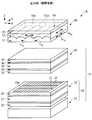
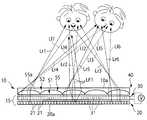
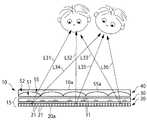
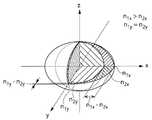
図1〜図4は、本発明の一実施の形態を説明するための図である。このうち、図1は、表示装置を示す斜視図である。図2および図3は、それぞれ、立体画像または平面画像を表示する際の表示装置の作用を説明するための図である。図4は、光学シートの第1層および第2層の屈折率楕円体を示す斜視図である。 1 to 4 are diagrams for explaining an embodiment of the present invention. Among these, FIG. 1 is a perspective view showing a display device. 2 and 3 are diagrams for explaining the operation of the display device when displaying a stereoscopic image or a planar image, respectively. FIG. 4 is a perspective view showing refractive index ellipsoids of the first layer and the second layer of the optical sheet.
本実施の形態における表示装置10は、平面画像および裸眼で視認され得る立体画像を切り換え可能に表示することができる。図1に示すように、表示装置10は、画像表示ユニット15と、画像表示ユニット15に対向して配置された光学シート40と、を有している。画像表示ユニット15は、立体画像を表示するための一方の直線偏光成分の光と、平面画像を表示するための他方の直線偏光成分の光と、を射出するように構成されている。光学シート40は、光の偏光状態に応じて当該光の進行方向を制御するようになっている。より具体的には、光学シート40は、立体画像を表示するための一方の直線偏光成分の光の進行方向を制御し、一方の直線偏光成分の振動方向と直交する方向に振動する他方の直線偏光成分の光の進行方向を維持する。
ここで、平面画像とは、表示面10a上に二次元的に観察される画像であり、一方、立体画像とは、表示面10aとは異なる位置にも観察される奥行きを持った画像である。そして、ここで説明する表示装置10では、両眼視差と運動視差とを利用して立体画像を表示することができるようになっている。図2に示すように、立体画像を表示する場合、画像表示ユニット15の画像形成装置20の各画素21が、観察者の左目または右目が位置するようになると想定された複数の位置に割り振られる。同一の位置に割り振られた複数の画素21が、当該割り振られた位置で観察されるべき画像を形成する。一方、光学シート40は、各画素21から射出される光が、観察者の左目または右目が位置するようになると想定された複数の位置のうちの当該画素21が割り振られた位置に向かうよう、光路を制御する。この結果、観察者の右目および左目には異なる画像が観察され、観察者は画像を立体的に認識する。また、観察方向を変化させると、観察位置に応じた立体画像を観察することができる。 Here, the planar image is an image that is observed two-dimensionally on the
以下、各構成要素についてさらに詳述する。なお、以下の説明においては、立体画像を形成する一方の直線偏光成分を、光学シート40のシート面と平行なx軸方向(図1参照)に振動する第1偏光成分とする。平面画像を形成する他方の直線偏光成分を、x軸方向と直交し且つ光学シート40のシート面と平行なy軸方向(図1参照)に振動する第2偏光成分とする。 Hereinafter, each component will be further described in detail. In the following description, one linearly polarized light component that forms a stereoscopic image is a first polarized light component that vibrates in the x-axis direction (see FIG. 1) parallel to the sheet surface of the
なお、本明細書において、「シート」、「フィルム」、「板」の用語は、呼称の違いのみに基づいて、互いから区別されるものではない。例えば、「フィルム」はシートや板と呼ばれ得るような部材も含む概念であり、したがって、「光学シート」は、「光学フィルム」や「光学板」と呼ばれる部材と呼称の違いのみにおいて区別され得ない。 In the present specification, the terms “sheet”, “film”, and “plate” are not distinguished from each other only based on the difference in names. For example, “film” is a concept that includes members that can be referred to as sheets and plates. Therefore, “optical sheet” is distinguished only from the members that are referred to as “optical films” and “optical plates”. I don't get it.
また、「シート面(フィルム面、板面、パネル面)」とは、対象となるシート状(フィルム状、板状、パネル状)の部材を全体的かつ大局的に見た場合において対象となるシート状部材(フィルム状部材、板状部材、パネル状部材)の平面方向と一致する面のことを指す。本実施の形態においては、画像形成装置20の画像形成面20a、液晶表示パネル25のパネル面、偏光制御装置30のパネル面、光学シート40のシート面、および、表示装置10の表示面10aは平行となっている。また、正面方向とは、光学シート40のシート面への法線方向のことを指す。 The “sheet surface (film surface, plate surface, panel surface)” is a target when the target sheet-like (film shape, plate shape, panel shape) member is viewed as a whole and globally. It refers to the surface that matches the planar direction of the sheet-like member (film-like member, plate-like member, panel-like member). In the present embodiment, the
さらに、本件明細書において用いる形状や幾何学的条件を特定する用語、例えば、「平行」、「直交」等の用語は、厳密な意味に縛られることなく、同様の光学的機能を期待し得る程度の誤差範囲を含めて解釈することとする。 Furthermore, terms specifying the shape and geometric conditions used in the present specification, for example, terms such as “parallel” and “orthogonal” can be expected to have the same optical function without being bound to a strict meaning. Interpretation will be made including a margin of error.
まず、画像表示ユニット15は、画像形成装置20と、画像形成装置20からの光を透過させる偏光制御装置30と、を有している。偏光制御装置30は、画像形成装置20と光学シート40との間に配置されている。画像形成装置20は、画像形成面20aと平行な面内に配列された多数の画素21を含んでいる。図示された例では、多数の画素21は、ストライプ配列されている。以下では、画像形成装置20が、第1偏光成分の光によって画像を形成する例について説明する。この例では、偏光制御装置30は、画像形成装置20から投射された光の偏光状態を、立体画像を表示する場合に第1偏光成分に維持し、平面画像を表示する場合に第2偏光状態に変換する。ただし、この例に限られず、画像形成装置20が第2偏光成分の光を射出し、偏光制御装置30が、立体画像を表示する場合に画像形成装置20から投射された光の偏光状態を第1偏光成分に変換し且つ平面画像を表示する場合に第2偏光状態に維持するようにしてもよい。 First, the
図示された例において、画像形成装置20は、液晶表示装置として形成されている。すなわち、画像形成装置20は、液晶表示パネル25と、液晶表示パネル25の背面に配置されたバックライト24と、を有している。バックライト24は、エッジライト型や直下型等の既知の構成を採用して形成され得る。 In the illustrated example, the
一方、液晶表示パネル25は、一対の偏光板26,28と、一対の偏光板26,28間に配置された液晶セル27と、を有している。偏光板26,28は、入射した光を直交する二つの偏光成分に分解し、一方の方向の偏光成分を透過させ、前記一方の方向に直交する他方の方向の偏光成分を吸収する機能を有した偏光子を有している。ここで説明する一具体例では、バックライト24側に配置された下偏光板26は、第2偏光成分の光を透過させ、偏光制御装置30側に配置された上偏光板28は、第1偏光成分の光を透過させる。 On the other hand, the liquid
液晶セル27は、一対の支持板と、一対の支持板間に配置された液晶分子(液晶材料)と、を有している。液晶セル27は、一つの画素を形成する領域毎に、電界印加がなされ得るようになっている。そして、電界印加された液晶セル27の液晶の配向は変化するようになる。下偏光板26を透過した第2偏光成分の光は、一例として、電界印加されていない液晶セル27を通過する際にその振動方向を90°回転させ、電界印加されている液晶セル27を通過する際にその偏光状態を維持する。このため、液晶セル27への電界印加の有無によって、下偏光板26を透過した第2偏光成分の光が、下偏光板26の出光側に配置された上偏光板28をさらに透過するか、あるいは、上偏光板28で吸収されて遮断されるか、を制御することができる。このようにして、上偏光板28を選択的に透過した各画素21からの第1偏光成分の光によって画像が形成される。 The
次に、偏光制御装置30について説明する。偏光制御装置30は、基本構成として、第1電極34および第2電極36と、第1電極34および第2電極36に配置された媒質層35と、を有している。媒質層35は、一対の電極34,36間において電圧を印加されることにより、屈折率の異方性を生じさせる。図示された例では、第1電極34、液晶層35および第2電極36は、第1支持フィルム33および第2支持フィルム37の間に配置されている。第1電極34、媒質層35および第2電極36は、一対の支持フィルム33,37によって支持および保護されている。以下では、媒質層が、液晶層35として構成された例について説明する。 Next, the
一対の電極34,36および液晶層35は、画像形成装置20の画像形成面20aの全領域に対面する広さを有している。図2および図3に示すように、液晶層35は、液晶分子31を含んだ層として構成されている。一対の電極34,36は、図示しない電圧印加手段に電気的に接続されている。なお、一対の電極34,36は、スペーサー(図示せず)等によって、所定の間隔に保たれている。 The pair of electrodes 34 and 36 and the liquid crystal layer 35 are wide enough to face the entire region of the
液晶層35に含まれる液晶分子31が、典型例としてTN型の液晶分子である場合、一対の電極34,36間に電圧を印加すると、図2に示すように、液晶分子31は配向される。この場合、画像形成装置20からの光の偏光状態は、第1偏光成分のままに維持される。一方、一対の電極34,36間に電圧が印加されていない場合、図3に示すように、液晶分子31はツイスト状に90°旋回する。この場合、画像形成装置20からの光の偏光状態は、振動方向がx軸方向からy軸方向に変換される、すなわち、第1偏光成分から第2偏光成分に変換される。 When the
ただし、以上における画像表示ユニット15、画像形成装置20および偏光制御装置30の説明は、一具体例に過ぎず、既知の手段を用いることができる。 However, the description of the
次に、光学シート40について説明する。図1〜図3に示すように、光学シート40は、第1層51と、第1層51に隣接して設けられた第2層52と、を有している。また、図示された例では、光学シート40は、第2層52上に設けられたフィルム層43を、さらに有している。 Next, the
フィルム層43は、単一の層、または、複数の積層された層として形成される。フィルム層43は、特定の機能を発揮することを期待された層であって、表示装置10の最出光側面、すなわち表示装置10の表示面10aを形成している。フィルム層43は、一例として、反射防止機能を有した反射防止層(AR層)、防眩機能を有した防眩層(AG層)、耐擦傷性を有したハードコート層(HC層)、帯電防止機能を有した帯電防止層(AS層)等の一以上を含むように構成され得る。 The
第1層51と第2層52との間の境界面は、凹凸面として形成されている。この境界面は、少なくとも第1偏光成分の光の進行方向を変化させる光学界面55をなしている。図示された例では、第1層51と第2層52との境界をなす光学界面55は、複数の単位光学界面55aを含んだ面として構成されている。図1に示すように、単位光学界面55aは、ある配列方向に沿って配列されている。各単位光学界面55aは、当該配列方向と非平行な方向に延びている。とりわけ図示された例では、単位光学界面55aはx軸方向に隙間無く配列され、各単位光学界面55aはy軸方向に直線状に延びている。一つの単位光学界面55aは、y軸方向に沿った各位置で同一の形状を有している。また、複数の単位光学界面55aは、互いに同一に構成されている。 The boundary surface between the
この単位光学界面55aは、上述したように、各画素21から射出される光が予め定められた位置に向かうよう、適宜設計される。図示された例では、正面方向および単位光学界面55aの配列方向の両方に平行な断面において、単位光学界面55aは凸レンズ状の輪郭を有し、各画素21からの発散光束LF1(図2)を予め設定された位置に集光させる。複数の単位光学界面55aの集合体としての光学界面55は、レンチキュラーレンズを形成している。 As described above, the unit
ただし、図示された単位光学界面55aおよび光学界面55は、単なる例示に過ぎず、種々の変更が可能である。例えば、単位光学界面55aの断面輪郭を適宜変更することが可能である。また、複数の単位光学界面55aが互いに異なる形状を有するようにしてもよい。一例として、光学界面55が、フレネルレンズを構成するようにしてもよい。さらに、単位光学界面55aが一次元配列された細長状の要素からなる例を示したがこれに限られず、単位光学界面55aが二次元配列されるようにしてもよい。 However, the illustrated unit
次に、第1層51および第2層52の屈折率について説明する。第1層51は、光学異方性であり、少なくとも面内における複屈折性を有している。すなわち、第1層51のx軸方向での屈折率n1xは、第1層51のy軸方向での屈折率n1yとは異なる値となっている。加えて、ここで説明する光学シート40では、第1層51のx軸方向での屈折率n1x、第2層52のx軸方向での屈折率n2x、第1層51のy軸方向での屈折率n1y、および、第2層52のy軸方向での屈折率n2yが、次の関係を満たす。
|n1x−n2x|≠|n1y−n2y|
これにより、光学シート40は、x軸方向に振動する第1偏光成分の光とy軸方向に振動する第2偏光成分の光とに対して、異なる光学機能を発揮するようになる。より具体的に説明すると、互いに同一方向に進む第1偏光成分の光および第2偏光成分の光は、光学シート40の光学界面55を通過すると、異なる方向へ進むようになる。Next, the refractive indexes of the
| N1x −n2x | ≠ | n1y −n2y |
Accordingly, the
とりわけここで説明する例においては、次の関係が満たされるようになっている。
|n1x−n2x|>|n1y−n2y|=0
この場合、光学シート40の光学界面55は、y軸方向に振動する第2偏光成分の光に対して、もはや屈折率差を有した光学的な界面をなさない。したがって、第1偏光成分の光は、光学シート40の光学界面55から光学機能(例えば、レンズ機能)を及ぼされるが、第2偏光成分の光は、光学シート40の光学界面55を通過する際に、その進行方向を変化させることはない。なお本明細書において、屈折率の値は、小数第3位を四捨五入して小数第2位までの数値として取り扱うこととする。In particular, in the example described here, the following relationship is satisfied.
| N1x −n2x |> | n1y −n2y | = 0
In this case, the
ただし、平面画像および裸眼で視認され得る立体画像を切り換え可能に表示する表示装置への適用においては、|n1y−n2y|=0とすることは実用上における必須の条件ではなく、|n1x−n2x|>|n1y−n2y|且つ|n1y−n2y|≦0.02が満たされれば十分である。この場合、第2偏光成分の光が、ゴーストやクロストークといった不具合が生じる程度に、光学シート40の光学界面55にてその進行方向を変化させることはない。However, in application to a display device that displays a planar image and a stereoscopic image that can be viewed with the naked eye in a switchable manner, setting | n1y −n2y | = 0 is not an essential condition for practical use. It is sufficient that1x −n2x |> | n1y −n2y | and | n1y −n2y | ≦ 0.02. In this case, the traveling direction of the light of the second polarization component is not changed at the
また、平面画像および裸眼で視認され得る立体画像を切り換え可能に表示する表示装置への適用においては、第2偏光成分の光に及ぼされる光学作用の程度は、|n1y−n2y|の大きさのみだけでなく、後に詳述する光学シート40の光学界面55の形状等のその他の構成からも影響を受ける。このような観点から、光学シート40のシート面へ直交する方向(すなわち、正面方向)へ進むy軸方向に振動する偏光成分(第2偏光成分)の光が、光学シート40を透過した後に、正面方向に対して2°以下の角度をなす方向へ進むように、光学シート40が構成されていてもよい。この場合、不具合、例えば平面画像を表示した際におけるゴーストの発生等による画質劣化、を及ぼし得るような光学作用が、光学シート40を透過する第2偏光成分の光に及ぼされることを効果的に防止することができる。Further, in application to a display device that displays a planar image and a stereoscopic image that can be viewed with the naked eye in a switchable manner, the degree of optical action exerted on the light of the second polarization component is as large as | n1y −n2y |. Not only this, but also other configurations such as the shape of the
図4は、第1層51および第2層52の各方向での屈折率分布を示す屈折率楕円体の一例が示されている。この例では、
(n1x−n2x)>|n1y−n2y|=0
なる関係が満たされている。第1層51のx軸方向での屈折率n1xは、第1層51のy軸方向での屈折率n1yよりも大きな値となっている。また、図3に示された例において、第2層52は、光学等方性の層として形成されている。すなわち、第2層52のx軸方向での屈折率n2xは、第2層52のy軸方向での屈折率n2yと等しい。したがって、第1層51のx軸方向での屈折率n1xは、第2層51のx軸方向での屈折率n2xよりも大きな値となっている。この結果、図1に示された光学界面55は、凸レンズと同様のレンズ機能を発揮することができる。FIG. 4 shows an example of a refractive index ellipsoid showing a refractive index distribution in each direction of the
(N1x −n2x )> | n1y −n2y | = 0
The relationship is satisfied. The refractive index n1x of the
また、図1に示された例では、第1層51の面内において屈折率が最大となる遅相軸方向が、x軸方向と一致しており、第1層51の面内において屈折率が最小となる進相軸方向が、y軸方向と一致している。且つ、第1層51の面内におけるy軸方向(進相軸方向)の屈折率n2xと第2層52の面内におけるy軸方向の屈折率n2yとを一致させるよう構成される。したがって、y軸方向における第1層51と第2層52との間での屈折率差を0にしながら、x軸方向における第1層51と第2層52との間での屈折率差を大きく設定することができる。なお、家庭用の表示装置への適用においては、容易に製造可能な形状で光学界面55を作製することを条件とすると、第1層51の複屈折率Δn(=n1x−n1y)が0.13以上であることが好ましい。一方、後述するように延伸によって第1層51の光学異方性を付与する場合には、延伸工程での面内均一性等を考慮して、第1層51の複屈折率Δnを0.22以下とすることが好ましい。In the example shown in FIG. 1, the slow axis direction in which the refractive index is maximum in the plane of the
なお、第1層51および第2層52の屈折率は、王子計測機器製「KOBRA−WR」、日本分光(株)製「エリプソメーター M150」、或いは、アッベ屈折率計(アタゴ社製 NAR−4T)を用いて測定された値とすることができる。 The refractive index of the
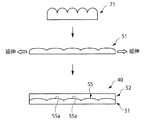
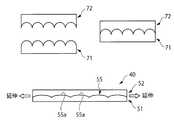
このような光学シート40は、次のようにして製造され得る。まず、図9に示すように、熱可塑性樹脂を用いて樹脂フィルム71を作製する。その後、樹脂フィルム71を延伸して、延伸された樹脂フィルム71からなる第1層51を作製する。その後、第1層51上に第2層52を形成することにより、光学シート40が得られる。 Such an
樹脂フィルム71は、熱可塑性樹脂を主成分として含む樹脂材料、あるいは、熱可塑性樹脂そのものを成形加工することにより、作製され得る。成形加工としては、射出成形や溶融押し出し成形を採用することができる。これらの成形加工によれば、光学界面55を形成する凹凸を有した樹脂フィルム71を作製することができる。 The
なお、樹脂フィルム71の成形には、型面が金型あるいは樹脂で形成された型を用いることができる。特に樹脂で形成された型を用いた場合、金属製の型面を用いた場合と比較して、加熱した熱可塑性樹脂を塗布する際、熱可塑性樹脂から型面への急速な吸熱を抑制することができる。これにより、加熱した熱可塑性樹脂が型面上を十分に延び広がり、賦型率を向上させることができる。また、作製された樹脂フィルム71の型面からの離型性が良いため、離型時における欠損等を防止することができる。型面が樹脂で形成された型としては、長尺のフィルム状の型を用いることができる。 For the molding of the
樹脂フィルム71の延伸は、樹脂フィルム71に光学異方性を付与するための加工であり、したがって、一軸延伸であることが好ましい。樹脂フィルム71がポリエステル系の樹脂からなる場合には、延伸方向(延伸軸)が遅相軸と一致するようになる。したがってこのような場合には、図9に示すように、光学界面55の単位光学界面55aをなすようになる樹脂フィルム71の凸部の配列方向と平行な方向に、樹脂フィルム71を延伸することになる。 The stretching of the
樹脂フィルム71の延伸は、樹脂フィルム71をなす熱可塑性樹脂のガラス転移温度以上に当該樹脂フィルム71を加熱した状態で、実施される。樹脂フィルム71が溶融押し出し成形により作製される場合、押し出し直後の高温の樹脂フィルム71を延伸すればよい。すなわち、延伸のための樹脂フィルム71の加熱処理を別途に設ける必要がない。なお、図9に示すように、樹脂フィルム71は、延伸によって形状を変化させて、第1層51を形成するようになる。したがって、上述した樹脂フィルム71の成形工程では、延伸による変形を見込んだ形状で、樹脂フィルム71を作製することになる。 The stretching of the
次に、作製された第1層51上に樹脂を塗布し、第1層51上で当該樹脂を硬化させることにより、第1層51上に第2層52を形成する。第1層51上に形成された第2層52は、第1層51に対面する面として、第1層51の凹凸に対応した凹凸、言い換えると、第1層51の凹凸と相補的な凹凸を有するようになる。また別の方法として、第1層51上に、別途に成形された第2層52を積層するようにしてもよい。第2層52をなすようになる樹脂は、複屈折性の無い、即ち屈折率等方性(n2x=n2y)の熱可塑性樹脂でもよいし、熱硬化性樹脂でもよいし、電離放射線硬化型樹脂でもよい。以上のようにして、光学シート40が得られる。第2層を構成するこれら複屈折性の無い熱可塑性樹脂等の樹脂は、通常は、未延伸状態で固化されてなる。Next, a
また、別の方法として、図10に示された製造方法によっても、光学シート40を作製することができる。 As another method, the
図10に示された製造方法では、まず、上述した凹凸を有する樹脂フィルム71(図9参照)と、この樹脂フィルム71の凹凸に対応した凹凸、言い換えると、樹脂フィルム71の凹凸と相補的な凹凸を有する第2樹脂フィルム72と、を準備する。次に互いの凹凸が噛み合うようにして、樹脂フィルム71および第2樹脂フィルム72を、例えば接着剤又は粘着剤等を介して、積層する。その後、積層された樹脂フィルム71および第2樹脂フィルム72を延伸することにより、樹脂フィルム71からなる第1層51と第2樹脂フィルム72からなる第2層52とを有する光学シート40が得られる。 In the manufacturing method shown in FIG. 10, first, the
図10に示された製造方法においても、樹脂フィルム71および第2樹脂フィルム72は、図9に示された上述の製造方法と同様にして、熱可塑性樹脂を用いた成形により、作製され得る。また、図10に示された製造方法においても、樹脂フィルム71の延伸により、樹脂フィルム71に面内に複屈折性を付与する。なお、第2樹脂フィルム72も樹脂フィルム71とともに延伸されることになるが、第2樹脂フィルム72に対しては積極的に光学異方性を付与する必要はない。したがって、第2樹脂フィルム72に面内の複屈折性が生じることを防止するため、第2樹脂フィルム72を構成する分子の電気双極子モーメントの大きさは小さい方が好ましい。とりわけ、第2樹脂フィルム72を構成する分子の電気双極子モーメントの大きさが、少なくとも樹脂フィルム71を構成する分子の電気双極子モーメントの大きさよりも小さくなっていることが好ましい。なお、電気双極子モーメントの測定は、まず、横河・ヒューレットパッカード社製のプレシジョンLCRメーターHP4284AのテストフィクスチャーHP16451B電極を用いて誘電率を測定し、次に、測定された誘電率を用いて電気双極子モーメントを特定することにより、行われ得る。 Also in the manufacturing method shown in FIG. 10, the
樹脂フィルム71及び第2樹脂フィルム72について、構成分子の電気双極子モーメントの大きさを斯くの如く選定することにより、樹脂フィルム71及び第2樹脂フィルム72に等量の延伸がかかり、等量の分子配向が生じたとしても、各フィルムに発現する複屈折率(屈折率異方性)の程度は構成分子の電気双極子モーメントの大きさに依存する為、
樹脂フィルム71の複屈折率Δn1>第2樹脂フィルム72の複屈折率Δn2
或いは両フィルムのx及びy軸方向の各屈折率で表記すると、
n1x−n1y>n2x−n2y(理想的には→0)
とすることが出來る。By selecting the magnitude of the electric dipole moment of the constituent molecules for the
Birefringence index Δn1 of the
Or, when expressed by the respective refractive indexes in the x and y axis directions of both films,
n1x −n1y > n2x −n2y (ideally → 0)
And you will come across.
以上のようにして、熱可塑性樹脂を含む光学異方性の第1層51と、第1層51に積層され第1偏光成分の光の進行方向を変化させる光学界面55を第1層51との間に形成する第2層52と、を有する光学シート40を作製することができる。 As described above, the optically anisotropic
なお、第1層51に含まれる熱可塑性樹脂として、ポリカーボネート樹脂、シクロオレフィンポリマー樹脂、アクリル樹脂、ポリエステル樹脂等を用いることができる。このうち、ポリエステル樹脂は、コスト及び機械的強度の面において有利である。具体的なポリエステル樹脂としては、ポリエチレンナフタレート、ポリエチレンテレフタレート、ポリエチレンイソフタレート、ポリブチレンテレフタレート、ポリ(1,4−シクロヘキシレンジメチレンテレフタレート)、ポリエチレン−2,6−ナフタレートを例示することができる。また、第1層50をなすポリエステル樹脂は、これらの上記ポリエステル樹脂の共重合体であってもよく、上記ポリエステルを主体(例えば80モル%以上の成分)とし、少割合(例えば20モル%以下)の他の種類の樹脂とブレンドしたものであってもよい。ポリエステル樹脂として、ポリエチレンナフタレートは、大きな複屈折率を確保し得る点において好ましい。また、ポリエステル樹脂として、ポリエチレンテレフタレート又はポリエチレン−2,6−ナフタレートが力学的物性や光学物性等のバランスが良いので好ましい。なお、光学シート40の安定性の観点から、第1層51をなす材料のガラス転移温度は100℃以上であることが好ましい。 Note that polycarbonate resin, cycloolefin polymer resin, acrylic resin, polyester resin, or the like can be used as the thermoplastic resin included in the
このような光学シート40を含んだ表示装置10では、次のようにして、平面画像および裸眼で観察され得る立体画像を表示することができる。まず、図3を主に参照しながら、平面画像を表示する場合について説明する。 The
バックライト24が、液晶表示パネル25を背面側から面状に照明する。液晶表示パネル25は、バックライト24からの光を画素21毎に選択的に透過させる。このようにして形成された平面画像光L31〜L36は、画像形成装置20の画像形成面20aから射出した状態において、画像形成装置20の下偏光板28を透過し得る第1偏光成分となっている。その後、平面画像光L31〜L36は、偏光制御装置30へと入射する。平面画像を表示する場合、偏光制御装置30の一対の電極34,36間には、電圧が印加されていない。このため、図3に示すように、液晶分子31は、90°旋回した状態となる。この結果、偏光制御装置30を透過する平面画像光L31〜L36は、その偏光状態を変換させる。この結果、平面画像光L31〜L36は、画像表示ユニット15から射出した状態において、第2偏光成分となっている。 The
画像表示ユニット15から射出した平面画像光L31〜L36は、光学シート40へ入射する。光学シート40は、凹凸面として形成された光学界面55を有している。この光学界面55は、光学異方性の第1層51と、第2層52との境界面として構成されている。ただし、平面画像光L31〜L36をなす第2偏光成分の振動方向であるy軸方向における第1層51の屈折率n1yと、y軸方向における第2層52の屈折率n2yとは同一に設定されている。したがって、平面画像光L31〜L36は、光学シート40の光学界面55で進行方向を曲げられることなく進む。このようにして、平面画像をなす光L31〜L36が、表示装置10の表示面10aから出射する。この結果、観察者は、平面画像を観察することが可能となる。The planar image lights L31 to L36 emitted from the
なお、液晶表示パネル25を照明するバックライト24からの光は、正面方向に光軸を有するとともに(つまり正面方向に明るさのピークを有するとともに)、正面方向を中心とした或る程度の角度域内の方向に進む。したがって、各画素21を通過した光は、発散光として、或る程度の角度範囲に向けて、表示装置10の表示面10aから出射する。この結果、図3に示すように、観察者は、表示面10aに形成される同一の平面画像を或る程度の角度範囲から観察することができる。 The light from the
次に、裸眼で立体的に観察される立体画像を表示する場合について説明する。立体画像を表示する場合にも、平面画像を表示する場合と同様にして、画像形成装置20から立体画像光Ll1〜Ll6,Lr1〜Lr6が射出する。この立体画像光Ll1〜Ll6,Lr1〜Lr6は、次に、偏光制御装置30へと入射する。ただし、立体画像を表示する場合には、画像表示ユニット15の画像形成装置20の各画素21が、観察者の左目または右目が位置するようになると想定された複数の位置のうちのいずれかの位置に割り振られる。そして、画像表示ユニット15は、同一の位置に割り振れた複数の画素21からの光によって一つの画像が形成されるよう、画素21毎の光の透過および遮断を制御する。 Next, a case where a stereoscopic image that is stereoscopically observed with the naked eye is displayed will be described. In the case of displaying a stereoscopic image, the stereoscopic image lights L11 to L16 and Lr1 to Lr6 are emitted from the
図2に示すように、立体画像を表示する場合、偏光制御装置30の一対の電極34,36間には、電圧が印加される。このため、立体画像光Ll1〜Ll6,Lr1〜Lr6は、偏光状態を第1状態に維持しながら、偏光制御装置30を透過する。 As shown in FIG. 2, when displaying a stereoscopic image, a voltage is applied between the pair of electrodes 34 and 36 of the
画像表示ユニット15から射出した立体画像光Ll1〜Ll6,Lr1〜Lr6は、光学シート40へ入射する。そして、立体画像光Ll1〜Ll6,Lr1〜Lr6をなす第1偏光成分の振動方向であるx軸方向における第1層51の屈折率n1xは、x軸方向における第2層52の屈折率n2xyよりも大きい値となっている。これにより、光学シート40の光学界面55は、各画素21からの立体画像光Ll1〜Ll6,Lr1〜Lr6の進行方向を制御する。The stereoscopic image lights L11 to L16 and Lr1 to Lr6 emitted from the
上述したように各画素21からの光は、発散光束をなして、光学シート40へ入射する。光学界面55の単位光学界面55aは、レンズ機能を発揮し、各画素21からの光を当該レンズ機能における焦点となる位置に収束させる。具体的には、単位光学界面55aは、対面する位置にある画素21からの発散光束(例えば図2の光束LF1)を、当該画素21が割り振られた位置、すなわち、観察者の左目または右目が位置するようになると想定されたいずれかの位置へ向けて収束させる。このようにして各画素21からの立体画像光Ll1〜Ll6,Lr1〜Lr6は、それぞれ、予定された位置へ進む。 As described above, the light from each
観察者が予め想定された位置から表示装置10を観察すると、観察者の右目によって、当該右目の位置から視認されるべき画像が観察され、観察者の左目によって、当該左目の位置から視認されるべき画像が観察され得る。この結果、観察者は、両眼視差により、裸眼で立体的な画像を視認することができる。また、図2に示すように、観察者が予め想定された別の位置から表示装置10を観察すると、当該位置から観察されるべき画像を、裸眼で立体的に視認することができる。すなわち、観察方向を変化させると、観察者は、当該観察方向に応じて観察されるべき異なる画像を裸眼で観察することができる。すなわち、観察者は、運動視差によって、より立体感を持って画像を視認することができる。 When the observer observes the
ところで、従来、平面画像および裸眼で視認され得る立体画像を切り換え可能に表示する表示装置10では、光の偏光状態に応じて当該光の進行方向を制御する複屈折レンズが、液晶(液晶分子、液晶材料)を含有した光学異方性層を含んでいる。この光学異方性層は、典型的には、液晶を含有した紫外線硬化型樹脂を硬化させることにより、作製される。この従来の複屈折レンズの光学異方性層は、十分な大きさの複屈折率を確保するため、高い配合率で液晶を含み、且つ、5μmを超える程度の厚みの層として形成される。このような従来の複屈折レンズは、液晶を大量に含むため、非常に安定性に欠け、とりわけ熱的な安定性に欠ける。したがって、従来の複屈折レンズ、並びに、この複屈折レンズを含む表示装置は、配置環境の制約を受けていた。 By the way, conventionally, in the
一方、本実施の形態によれば、光学シート40の面内複屈折率を有した第1層51は、液晶(液晶分子、液晶材料)を含まないように構成されている。第1層51は、延伸された熱可塑性樹脂によって光学異方性を発現している。したがって、第1層51は、100°以上のガラス転移温度を有することも十分に可能である。このため、本実施の形態による光学シート40、並びに、この光学シート40を含んだ表示装置10は、優れた安定性を呈するようになる。一例として、本実施の形態による光学シート40は、従来の液晶を含んだ複屈折レンズと比較して、150℃で30分加熱しJISC2151の規定にしたがって測定された寸法安定性を飛躍的に改善することができる。具体的には、本実施の形態によれば、150℃で30分加熱しJISC2151の規定にしたがって測定された光学シート40の寸法安定性を2%以下に抑えることができる。結果として、家庭用テレビ受像器等の一般用途の範囲内での使用環境において、大きな制約を受けることなく、本実施の形態による光学シート40を使用することができ、且つ、本実施の形態による光学シート40が、期待された光学機能を発現することができる。 On the other hand, according to the present embodiment, the
なお、上述した実施の形態に対して様々な変更を加えることが可能である。以下、図面を参照しながら、変形の一例について説明する。以下の説明および以下の説明で用いる図面では、上述した実施の形態と同様に構成され得る部分について、上述の実施の形態における対応する部分に対して用いた符号と同一の符号を用いることとし、重複する説明を省略する。 Note that various modifications can be made to the above-described embodiment. Hereinafter, an example of modification will be described with reference to the drawings. In the following description and the drawings used in the following description, the same reference numerals as those used for the corresponding parts in the above embodiment are used for the parts that can be configured in the same manner as in the above embodiment. A duplicate description is omitted.
光学シート40は、例示に過ぎず適宜変更することができる。まず、フィルム層43は、必須の層ではなく、光学シート40から省略することができる。また、第1層51および第2層52よりも偏光制御装置30側に、何らかの機能を発揮することが期待されたフィルム層が設けられてもよい。さらに、上述したように、光学界面55および単位光学界面55aの構成は、期待される光学機能に応じて適宜変更することができる。さらに、光学異方性の第1層51が、第2層52よりも観察側に配置されていてもよい。 The
また、上述した実施の形態において、第1層51のx軸方向の屈折率n1x、第1層51のy軸方向の屈折率n1y、第2層52のx軸方向の屈折率n2xおよび第2層51のy軸方向の屈折率n2yの関係を説明したが、上述した屈折率n1x,n1y,n2x,n2yの関係は例示に過ぎない。In the above-described embodiment, the refractive index n1x of the
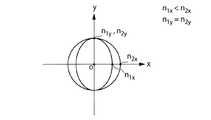
例えば、上述した実施の形態において、第1層51のx軸方向の屈折率n1xが第2層52のx軸方向の屈折率n2xよりも大きくなっている例を示したがこれに限られず、第1層51のx軸方向の屈折率n1xが第2層52のx軸方向の屈折率n2xよりも小さくなっていてもよい。一例としての図5に示された例においては、次の関係が満たされる。
(n2x−n1x)>|n1y−n2y|=0
図5の関係が成り立つ場合、例えば、光学界面55の単位光学界面55aを凹レンズとして構成することにより、上述した実施の形態の光学シート40と概ね同様の光学機能を得ることが可能となる。なお、既に説明したように、図5に示された屈折率の関係に代えて、次の二条件が満たされるようにしてもよい。
(n2x−n1x)>|n1y−n2y|
|n1y−n2y|≦0.02
さらに、(n2x−n1x)>|n1y−n2y|が満たされるとともに、正面方向へ進む第2偏光成分の光が、光学シート40を透過した後に、正面方向に対して2°以下の角度をなす方向へ進むように、光学シート40が構成されてもよい。For example, in the above-described embodiment, the example in which the refractive index n1x in the x-axis direction of the
(N2x −n1x )> | n1y −n2y | = 0
When the relationship of FIG. 5 is established, for example, by configuring the unit
(N2x −n1x )> | n1y −n2y |
| N1y −n2y | ≦ 0.02
Further, (n2x −n1x )> | n1y −n2y | is satisfied, and light of the second polarization component traveling in the front direction is transmitted through the
また、上述した実施の形態においては、x軸方向における第1層51と第2層52との間での屈折率差の大きさ(|n1x−n2x|)がy軸方向における第1層51と第2層52との間での屈折率差の大きさ(|n1y−n2y|)よりも大きくなっている例を示したが、上述した例に代えて、x軸方向における第1層51と第2層52との間での屈折率差の大きさがy軸方向における第1層51と第2層52との間での屈折率差の大きさよりも小さくなっていてもよい。In the embodiment described above, the magnitude of the refractive index difference (| n1x −n2x |) between the
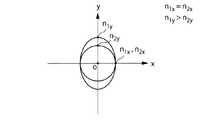
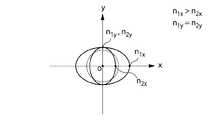
一例として、次の関係が満たされるようにしてもよい。
|n1y−n2y|>|n1x−n2x|=0
この場合、y軸方向に振動する第2偏光成分の光の進行方向が、光学界面55によって制御される。その一方で、x軸方向に振動する第1偏光成分の光は、進行方向を維持して光学界面55を通過する。この例では、画像表示ユニット15が、例えば偏光制御装置30の切り換えにより、立体画像を表示するための光を第2偏光成分の光として射出し、平面画像を表示するための光を第1偏光成分の光として射出するようにすればよい。このような例によっても、上述した実施の形態と同様の作用効果を期待することができる。また、この例では、図6に示すように、第1層51のy軸方向の屈折率n1yが第2層52のy軸方向の屈折率n2yよりも大きくなり、次の関係が満たされるようにしてもよい。
(n1y−n2y)>|n1x−n2x|=0
あるいは、図7に示すように、第1層51のy軸方向の屈折率n1yが第2層52のy軸方向の屈折率n2yよりも小さくなり、次の関係が満たされるようにしてもよい。
(n2y−n1y)>|n1x−n2x|=0As an example, the following relationship may be satisfied.
| N1y −n2y |> | n1x −n2x | = 0
In this case, the traveling direction of the light of the second polarization component that vibrates in the y-axis direction is controlled by the
(N1y −n2y )> | n1x −n2x | = 0
Alternatively, as shown in FIG. 7, the refractive index n1y in the y-axis direction of the
(N2y −n1y )> | n1x −n2x | = 0
なお、既に説明したように、図6に示された屈折率の関係に代えて、次の二条件が満たされるようにしてもよい。
(n1y−n2y)>|n1x−n2x|
|n1x−n2x|≦0.02
さらに、(n1y−n2y)>|n1x−n2x|が満たされるとともに、光学シート40のシート面へ直交する方向(すなわち、正面方向)へ進むx軸方向に振動する偏光成分(第1偏光成分)の光が、光学シート40を透過した後に、正面方向に対して2°以下の角度をなす方向へ進むように、光学シート40が構成されていてもよい。As already described, the following two conditions may be satisfied instead of the refractive index relationship shown in FIG.
(N1y −n2y )> | n1x −n2x |
| N1x −n2x | ≦ 0.02
Further, (n1y −n2y )> | n1x −n2x | is satisfied, and the polarization component (first order) that vibrates in the x-axis direction that proceeds in the direction orthogonal to the sheet surface of the optical sheet 40 (ie, the front direction). The
同様に、図7に示された屈折率の関係に代えて、次の二条件が満たされるようにしてもよい。
(n2y−n1y)>|n1x−n2x|
|n1x−n2x|≦0.02
さらに、(n2y−n1y)>|n1x−n2x|が満たされるとともに、正面方向へ進む第1偏光成分の光が、光学シート40を透過した後に、正面方向に対して2°以下の角度をなす方向へ進むように、光学シート40が構成されていてもよい。Similarly, the following two conditions may be satisfied instead of the refractive index relationship shown in FIG.
(N2y −n1y )> | n1x −n2x |
| N1x −n2x | ≦ 0.02
Further, (n2y −n1y )> | n1x −n2x | is satisfied, and after the light of the first polarization component traveling in the front direction is transmitted through the
さらに、上述した実施の形態では、第1層51のみが光学異方性であり、第2層51は光学等方性である例を説明したが、第1層51および第2層52の両方とも光学異方性であるようにしてもよい。一例としての図8に示された例では、第1層51のx軸方向の屈折率n1x、第1層51のy軸方向の屈折率n1y、第2層52のx軸方向の屈折率n2xおよび第2層51のy軸方向の屈折率n2yが、次の関係を満たすようになっている。
(n1x−n2x)>|n1y−n2y|=0
n1x>n1y
n2x<n2y
図8に示された例によれば、y軸方向における第1層51と第2層52との間での屈折率差を小さく、典型的には0に保ちながら、x軸方向における第1層51と第2層52との間での屈折率差を大きくすることができる。これにより、光学シート40の光学界面55は、x軸方向に振動する偏光成分の光に対してのみ、強い光学機能を発揮することができる。なお、図8に示された例は、一例として、図10を参照しながら説明した製造方法により作製され得る。この際、延伸方向と遅相軸方向とが一致するようになる材料(例えばポリエチレンナフタレート樹脂)を用いて樹脂フィルム71を作製し、延伸方向と進相軸方向とが一致するようになる材料、例えば(スチレン系樹脂)を用いて第2樹脂フィルム72を作製すればよい。Furthermore, in the above-described embodiment, an example in which only the
(N1x −n2x )> | n1y −n2y | = 0
n1x > n1y
n2x <n2y
According to the example shown in FIG. 8, the first refractive index difference between the
なお、既に説明したように、図8に示された屈折率の関係に代えて、次の四条件が満たされるようにしてもよい。
(n1x−n2x)>|n1y−n2y|
|n1y−n2y|≦0.02
n1x>n1y
n2x<n2y
さらに、(n1x−n2x)>|n1y−n2y|、n1x>n1yおよびn2x<n2yが満たされるとともに、光学シート40のシート面へ直交する方向(すなわち、正面方向)へ進むy軸方向に振動する偏光成分(第2偏光成分)の光が、光学シート40を透過した後に、正面方向に対して2°以下の角度をなす方向へ進むように、光学シート40が構成されていてもよい。As already described, the following four conditions may be satisfied instead of the refractive index relationship shown in FIG.
(N1x −n2x )> | n1y −n2y |
| N1y −n2y | ≦ 0.02
n1x > n1y
n2x <n2y
Further, (n1x −n2x )> | n1y −n2y |, n1x > n1y and n2x <n2y are satisfied, and the direction orthogonal to the sheet surface of the optical sheet 40 (ie, the front direction). The light of the polarization component (second polarization component) oscillating in the y-axis direction that travels to the
さらに、上述した実施の形態において、x軸方向およびy軸方向のいずれか一方向における第1層51と第2層52との間での屈折率差が0となる例を説明した。しかしながら、x軸方向およびy軸方向のいずれの方向においても第1層51と第2層52との間での屈折率差が0とならないようにしてもよい。この例においても、光学界面55及び単位光学界面55aの構成を適宜設計することにより、上述した実施の形態と同様の作用効果を得ることができる。 Furthermore, in the above-described embodiment, the example in which the difference in refractive index between the
さらに、上述した実施の形態において、第1層51の面内における主軸(遅相軸および進相軸)が、立体画像を形成する光および平面画像を形成する光の振動方向と一致している例を示したが、一致していなくてもよい。この例においても、各屈折率n1x,n1y,n2x,n2yの大きさを適宜調節することにより、上述した実施の形態と同様の作用効果を得ることができる。Further, in the above-described embodiment, the main axis (slow axis and fast axis) in the plane of the
なお、以上において上述した実施の形態に対するいくつかの変形例を説明してきたが、当然に、複数の変形例を適宜組み合わせて適用することも可能である。 In addition, although the some modification with respect to embodiment mentioned above was demonstrated above, naturally, it is also possible to apply combining several modifications suitably.
10 表示装置
10a 表示面
15 画像表示ユニット
20 画像形成装置
20a 画像形成面
21 画素
24 バックライト
25 液晶表示パネル
26 偏光板、下偏光板
27 液晶セル
28 偏光板、上偏光板
30 偏光制御装置
31 液晶分子、液晶材料、液晶
33 第1支持フィルム
34 第1電極
35 液晶層
36 第2電極
37 第2支持フィルム
40 光学シート
43 フィルム層
51 第1層
52 第2層
55 光学界面、複屈折界面、レンズ面
55a 単位光学面、単位レンズDESCRIPTION OF
Claims (11)
Translated fromJapanese熱可塑性樹脂を含む光学異方性の第1層と、
前記第1層に積層され、一方の偏光成分の光の進行方向を変化させる光学界面を前記第1層との間に形成する第2層と、を備える、光学シート。An optical sheet that is used in a display device that displays a planar image and a stereoscopic image that can be viewed with the naked eye in a switchable manner, and that controls the traveling direction of the light according to the polarization state of the light,
A first layer of optical anisotropy comprising a thermoplastic resin;
An optical sheet comprising: a second layer that is stacked on the first layer and forms an optical interface between the first layer and the first layer that changes a traveling direction of light of one polarization component.
請求項1〜8のいずれか一項に記載の光学シートと、
前記光学シートに対向して配置された画像表示ユニットであって、前記立体画像を表示するための一方の偏光成分の光と、前記平面画像を表示するための他方の偏光成分の光とを射出し得る画像表示ユニットと、を備える、表示装置。A display device that displays a planar image and a stereoscopic image that can be viewed with the naked eye in a switchable manner,
The optical sheet according to any one of claims 1 to 8,
An image display unit disposed to face the optical sheet, and emits light of one polarization component for displaying the stereoscopic image and light of the other polarization component for displaying the planar image An image display unit.
熱可塑性樹脂を成形してなる樹脂フィルムを延伸することによって、光学異方性の第1層を作製する工程と、
前記第1層上に第2層を作製または積層する工程と、を含む、光学シートの製造方法。A method of manufacturing an optical sheet that is used in a display device that can switchably display a planar image and a stereoscopic image that can be visually recognized with the naked eye, and that controls the traveling direction of the light according to the polarization state of the light,
A step of producing a first layer of optical anisotropy by stretching a resin film formed by molding a thermoplastic resin;
A method of producing or laminating a second layer on the first layer.
前記第1樹脂フィルムの電気双極子モーメントの大きさは、前記第2樹脂フィルムの電気双極子モーメントの大きさよりも大きい、光学シートの製造方法。Including a step of stretching the first layer and the second layer in a state where the second resin film is laminated on the first resin film,
The magnitude | size of the electric dipole moment of the said 1st resin film is a manufacturing method of an optical sheet larger than the magnitude | size of the electric dipole moment of the said 2nd resin film.
Priority Applications (2)
| Application Number | Priority Date | Filing Date | Title |
|---|---|---|---|
| JP2012122294AJP2013246407A (en) | 2012-05-29 | 2012-05-29 | Optical sheet and display device |
| US13/903,277US20140055854A1 (en) | 2012-05-29 | 2013-05-28 | Optical sheet and display device |
Applications Claiming Priority (1)
| Application Number | Priority Date | Filing Date | Title |
|---|---|---|---|
| JP2012122294AJP2013246407A (en) | 2012-05-29 | 2012-05-29 | Optical sheet and display device |
Publications (1)
| Publication Number | Publication Date |
|---|---|
| JP2013246407Atrue JP2013246407A (en) | 2013-12-09 |
Family
ID=49846191
Family Applications (1)
| Application Number | Title | Priority Date | Filing Date |
|---|---|---|---|
| JP2012122294APendingJP2013246407A (en) | 2012-05-29 | 2012-05-29 | Optical sheet and display device |
Country Status (2)
| Country | Link |
|---|---|
| US (1) | US20140055854A1 (en) |
| JP (1) | JP2013246407A (en) |
Cited By (1)
| Publication number | Priority date | Publication date | Assignee | Title |
|---|---|---|---|---|
| KR20160068482A (en)* | 2014-12-05 | 2016-06-15 | 에스케이씨 주식회사 | Polyester film, optical film and display comprising same |
Families Citing this family (3)
| Publication number | Priority date | Publication date | Assignee | Title |
|---|---|---|---|---|
| KR102207192B1 (en)* | 2014-09-30 | 2021-01-25 | 엘지디스플레이 주식회사 | Polarizing Control Film and Stereoscopic Display Device Using the Same |
| KR102470569B1 (en)* | 2017-12-29 | 2022-11-24 | 엘지디스플레이 주식회사 | Transparent Display Appartus |
| KR102272149B1 (en)* | 2020-02-26 | 2021-07-02 | 주식회사 토모큐브 | Method and apparatus for retrieving three-dimensional refractive index tensor distribution |
Citations (5)
| Publication number | Priority date | Publication date | Assignee | Title |
|---|---|---|---|---|
| JP2003007072A (en)* | 2001-06-22 | 2003-01-10 | Mitsubishi Chemicals Corp | Optical memory element, reproducing apparatus for optical memory element, and reproducing method for optical memory element |
| JP2008521042A (en)* | 2004-11-18 | 2008-06-19 | コーニンクレッカ フィリップス エレクトロニクス エヌ ヴィ | Two and three dimensional image display |
| JP2010078653A (en)* | 2008-09-24 | 2010-04-08 | Toshiba Corp | Stereoscopic image display |
| JP2010224510A (en)* | 2009-02-28 | 2010-10-07 | Nippon Zeon Co Ltd | Polarizing plate, manufacturing method of polarizing plate, and liquid crystal display device |
| JP2011126181A (en)* | 2009-12-18 | 2011-06-30 | Teijin Ltd | Uniaxially oriented laminated multilayer film, brightness improving member made of the film, composite member for liquid crystal display made of them, and liquid crystal display made of them |
Family Cites Families (18)
| Publication number | Priority date | Publication date | Assignee | Title |
|---|---|---|---|---|
| US6025897A (en)* | 1993-12-21 | 2000-02-15 | 3M Innovative Properties Co. | Display with reflective polarizer and randomizing cavity |
| DE69825251T2 (en)* | 1997-12-16 | 2004-12-30 | Federalnoe Gosudarstvennoe Uni. Predpriyatie "Gosudarstvenny Nauchny Tsentr" Nauchno-Issledovatelsky Inst. Org. Poluprod... | POLARIZER AND LIQUID CRYSTAL DISPLAY ELEMENT |
| AU2001227959A1 (en)* | 2000-01-19 | 2001-07-31 | Omlidon Technologies Llc | Polarizing device |
| US7053865B2 (en)* | 2001-05-31 | 2006-05-30 | Olympus Corporation | 3-D display device |
| GB0119176D0 (en)* | 2001-08-06 | 2001-09-26 | Ocuity Ltd | Optical switching apparatus |
| DE60234365D1 (en)* | 2001-09-26 | 2009-12-24 | Koninkl Philips Electronics Nv | MICROSTRUCTURED LIGHTING SYSTEM FOR PROVIDING POLARIZED LIGHT |
| KR100540109B1 (en)* | 2003-02-06 | 2006-01-10 | 가부시끼가이샤 도시바 | Stereoscopic image display apparatus |
| GB0500420D0 (en)* | 2005-01-10 | 2005-02-16 | Ocuity Ltd | Display apparatus |
| JP4334495B2 (en)* | 2005-03-29 | 2009-09-30 | 株式会社東芝 | Stereoscopic image display device |
| JP5384113B2 (en)* | 2005-12-20 | 2014-01-08 | コーニンクレッカ フィリップス エヌ ヴェ | Autostereoscopic display device |
| EP2103968B1 (en)* | 2006-12-27 | 2012-09-12 | Teijin Limited | Polarizing element and liquid crystal display device |
| JP5105920B2 (en)* | 2007-03-20 | 2012-12-26 | 株式会社東芝 | Stereoscopic image display device |
| TWI471652B (en)* | 2007-06-01 | 2015-02-01 | Teijin Ltd | Phase difference film, versatile film and liquid crystal display device |
| WO2009066841A1 (en)* | 2007-11-19 | 2009-05-28 | Lg Electronics Inc. | Optical sheet package |
| JP5022964B2 (en)* | 2008-03-28 | 2012-09-12 | 株式会社東芝 | 3D image display apparatus and 3D image display method |
| JP2011215352A (en)* | 2010-03-31 | 2011-10-27 | Sony Corp | Optical sheet laminate, lighting unit and display device |
| TW201209791A (en)* | 2010-08-30 | 2012-03-01 | Ind Tech Res Inst | Two mode image displaying apparatus and adjustment method of image brightness |
| JP2012063670A (en)* | 2010-09-17 | 2012-03-29 | Hitachi Displays Ltd | Liquid crystal display device |
- 2012
- 2012-05-29JPJP2012122294Apatent/JP2013246407A/enactivePending
- 2013
- 2013-05-28USUS13/903,277patent/US20140055854A1/ennot_activeAbandoned
Patent Citations (5)
| Publication number | Priority date | Publication date | Assignee | Title |
|---|---|---|---|---|
| JP2003007072A (en)* | 2001-06-22 | 2003-01-10 | Mitsubishi Chemicals Corp | Optical memory element, reproducing apparatus for optical memory element, and reproducing method for optical memory element |
| JP2008521042A (en)* | 2004-11-18 | 2008-06-19 | コーニンクレッカ フィリップス エレクトロニクス エヌ ヴィ | Two and three dimensional image display |
| JP2010078653A (en)* | 2008-09-24 | 2010-04-08 | Toshiba Corp | Stereoscopic image display |
| JP2010224510A (en)* | 2009-02-28 | 2010-10-07 | Nippon Zeon Co Ltd | Polarizing plate, manufacturing method of polarizing plate, and liquid crystal display device |
| JP2011126181A (en)* | 2009-12-18 | 2011-06-30 | Teijin Ltd | Uniaxially oriented laminated multilayer film, brightness improving member made of the film, composite member for liquid crystal display made of them, and liquid crystal display made of them |
Cited By (2)
| Publication number | Priority date | Publication date | Assignee | Title |
|---|---|---|---|---|
| KR20160068482A (en)* | 2014-12-05 | 2016-06-15 | 에스케이씨 주식회사 | Polyester film, optical film and display comprising same |
| KR101658193B1 (en)* | 2014-12-05 | 2016-09-21 | 에스케이씨 주식회사 | Polyester film, optical film and display comprising same |
Also Published As
| Publication number | Publication date |
|---|---|
| US20140055854A1 (en) | 2014-02-27 |
Similar Documents
| Publication | Publication Date | Title |
|---|---|---|
| KR102176227B1 (en) | Light Modulating Device | |
| KR101122199B1 (en) | 2D-3D switchable autostereoscopic display apparatus | |
| KR101913421B1 (en) | Phase difference element and display unit | |
| JP7125028B2 (en) | Polarizer and display device | |
| KR101328109B1 (en) | Optical film, method of producing the same, stereoscopic glasses and stereoscopic display having the same | |
| JP2013246407A (en) | Optical sheet and display device | |
| KR20130091284A (en) | Liquid crystal lens | |
| KR101645550B1 (en) | Substrate film and display device comprising same | |
| CN106814419B (en) | Optical element | |
| JP5753747B2 (en) | Optically anisotropic element, polarizing plate, image display device, and stereoscopic image display system | |
| JP2012131917A (en) | Paint, retardation element, display device, method for manufacturing retardation element | |
| JP5994544B2 (en) | Optical sheet, display device, and optical sheet manufacturing method | |
| KR101938692B1 (en) | Stereoscopic image display device | |
| JP6146637B2 (en) | Display device | |
| JP6047993B2 (en) | Optical sheet and display device | |
| KR102802177B1 (en) | Transmission Variable Device | |
| JP2014115464A (en) | Display device | |
| KR101373200B1 (en) | Optical film, sub pannel and three dimensinaol image display having the same | |
| JP2014044258A (en) | Display device | |
| JP2014035440A (en) | Optical sheet, display device and production method of optical sheet | |
| KR20110107531A (en) | Stereoscopic Image System | |
| KR101658193B1 (en) | Polyester film, optical film and display comprising same | |
| JP2018155907A (en) | Optical film and image display device | |
| KR20110125857A (en) | Stereoscopic Image System | |
| KR101974510B1 (en) | Stereoscopic image display device |
Legal Events
| Date | Code | Title | Description |
|---|---|---|---|
| A621 | Written request for application examination | Free format text:JAPANESE INTERMEDIATE CODE: A621 Effective date:20150422 | |
| A977 | Report on retrieval | Free format text:JAPANESE INTERMEDIATE CODE: A971007 Effective date:20160118 | |
| A131 | Notification of reasons for refusal | Free format text:JAPANESE INTERMEDIATE CODE: A131 Effective date:20160129 | |
| A521 | Request for written amendment filed | Free format text:JAPANESE INTERMEDIATE CODE: A523 Effective date:20160310 | |
| A02 | Decision of refusal | Free format text:JAPANESE INTERMEDIATE CODE: A02 Effective date:20160830 |